EP1140234B1 - Method and apparatus for bone cement preparation - Google Patents
Method and apparatus for bone cement preparation Download PDFInfo
- Publication number
- EP1140234B1 EP1140234B1 EP98965836A EP98965836A EP1140234B1 EP 1140234 B1 EP1140234 B1 EP 1140234B1 EP 98965836 A EP98965836 A EP 98965836A EP 98965836 A EP98965836 A EP 98965836A EP 1140234 B1 EP1140234 B1 EP 1140234B1
- Authority
- EP
- European Patent Office
- Prior art keywords
- powder
- liquid
- container
- component
- inlet port
- Prior art date
- Legal status (The legal status is an assumption and is not a legal conclusion. Google has not performed a legal analysis and makes no representation as to the accuracy of the status listed.)
- Expired - Lifetime
Links
- 238000000034 method Methods 0.000 title claims description 44
- 239000002639 bone cement Substances 0.000 title claims description 35
- 238000002360 preparation method Methods 0.000 title claims description 15
- 239000000843 powder Substances 0.000 claims description 88
- 239000000178 monomer Substances 0.000 claims description 56
- 239000007788 liquid Substances 0.000 claims description 47
- 239000002245 particle Substances 0.000 claims description 15
- VVQNEPGJFQJSBK-UHFFFAOYSA-N Methyl methacrylate Chemical compound COC(=O)C(C)=C VVQNEPGJFQJSBK-UHFFFAOYSA-N 0.000 claims description 12
- 239000004342 Benzoyl peroxide Substances 0.000 claims description 11
- OMPJBNCRMGITSC-UHFFFAOYSA-N Benzoylperoxide Chemical compound C=1C=CC=CC=1C(=O)OOC(=O)C1=CC=CC=C1 OMPJBNCRMGITSC-UHFFFAOYSA-N 0.000 claims description 11
- 235000019400 benzoyl peroxide Nutrition 0.000 claims description 11
- 239000000203 mixture Substances 0.000 claims description 10
- 230000009471 action Effects 0.000 claims description 9
- 238000001125 extrusion Methods 0.000 claims description 8
- 230000003197 catalytic effect Effects 0.000 claims description 5
- SOGAXMICEFXMKE-UHFFFAOYSA-N Butylmethacrylate Chemical compound CCCCOC(=O)C(C)=C SOGAXMICEFXMKE-UHFFFAOYSA-N 0.000 claims description 4
- 230000008961 swelling Effects 0.000 claims description 4
- 238000011144 upstream manufacturing Methods 0.000 claims description 3
- SUPCQIBBMFXVTL-UHFFFAOYSA-N ethyl 2-methylprop-2-enoate Chemical compound CCOC(=O)C(C)=C SUPCQIBBMFXVTL-UHFFFAOYSA-N 0.000 claims description 2
- 239000011800 void material Substances 0.000 claims 4
- 229940102838 methylmethacrylate Drugs 0.000 claims 1
- 239000004568 cement Substances 0.000 description 31
- 238000002156 mixing Methods 0.000 description 23
- 238000006116 polymerization reaction Methods 0.000 description 15
- 229920003229 poly(methyl methacrylate) Polymers 0.000 description 14
- 239000004926 polymethyl methacrylate Substances 0.000 description 14
- 239000011148 porous material Substances 0.000 description 10
- 239000003708 ampul Substances 0.000 description 9
- 229920000642 polymer Polymers 0.000 description 8
- 239000011324 bead Substances 0.000 description 6
- 238000013038 hand mixing Methods 0.000 description 5
- 238000012856 packing Methods 0.000 description 5
- 230000008901 benefit Effects 0.000 description 4
- 238000011049 filling Methods 0.000 description 3
- 238000009472 formulation Methods 0.000 description 3
- 239000011159 matrix material Substances 0.000 description 3
- 230000008569 process Effects 0.000 description 3
- 230000009467 reduction Effects 0.000 description 3
- 238000011541 total hip replacement Methods 0.000 description 3
- 238000009736 wetting Methods 0.000 description 3
- QIGBRXMKCJKVMJ-UHFFFAOYSA-N Hydroquinone Chemical compound OC1=CC=C(O)C=C1 QIGBRXMKCJKVMJ-UHFFFAOYSA-N 0.000 description 2
- MCMNRKCIXSYSNV-UHFFFAOYSA-N ZrO2 Inorganic materials O=[Zr]=O MCMNRKCIXSYSNV-UHFFFAOYSA-N 0.000 description 2
- 210000000988 bone and bone Anatomy 0.000 description 2
- 230000008859 change Effects 0.000 description 2
- 238000000354 decomposition reaction Methods 0.000 description 2
- 238000004090 dissolution Methods 0.000 description 2
- 230000000694 effects Effects 0.000 description 2
- 239000000839 emulsion Substances 0.000 description 2
- 239000012530 fluid Substances 0.000 description 2
- 238000009533 lab test Methods 0.000 description 2
- 230000007774 longterm Effects 0.000 description 2
- 239000000463 material Substances 0.000 description 2
- 230000006911 nucleation Effects 0.000 description 2
- 238000010899 nucleation Methods 0.000 description 2
- RVTZCBVAJQQJTK-UHFFFAOYSA-N oxygen(2-);zirconium(4+) Chemical compound [O-2].[O-2].[Zr+4] RVTZCBVAJQQJTK-UHFFFAOYSA-N 0.000 description 2
- 230000035699 permeability Effects 0.000 description 2
- 239000011347 resin Substances 0.000 description 2
- 229920005989 resin Polymers 0.000 description 2
- 239000000126 substance Substances 0.000 description 2
- 238000001356 surgical procedure Methods 0.000 description 2
- 210000001519 tissue Anatomy 0.000 description 2
- CEAZRRDELHUEMR-URQXQFDESA-N Gentamicin Chemical compound O1[C@H](C(C)NC)CC[C@@H](N)[C@H]1O[C@H]1[C@H](O)[C@@H](O[C@@H]2[C@@H]([C@@H](NC)[C@@](C)(O)CO2)O)[C@H](N)C[C@@H]1N CEAZRRDELHUEMR-URQXQFDESA-N 0.000 description 1
- 229930182566 Gentamicin Natural products 0.000 description 1
- QAOWNCQODCNURD-UHFFFAOYSA-L Sulfate Chemical compound [O-]S([O-])(=O)=O QAOWNCQODCNURD-UHFFFAOYSA-L 0.000 description 1
- 239000000654 additive Substances 0.000 description 1
- 238000005452 bending Methods 0.000 description 1
- 230000003115 biocidal effect Effects 0.000 description 1
- 230000015572 biosynthetic process Effects 0.000 description 1
- 239000003054 catalyst Substances 0.000 description 1
- 238000002144 chemical decomposition reaction Methods 0.000 description 1
- 238000006243 chemical reaction Methods 0.000 description 1
- 238000004140 cleaning Methods 0.000 description 1
- 230000002301 combined effect Effects 0.000 description 1
- 238000005056 compaction Methods 0.000 description 1
- 238000007596 consolidation process Methods 0.000 description 1
- 238000010276 construction Methods 0.000 description 1
- 239000000428 dust Substances 0.000 description 1
- 238000002474 experimental method Methods 0.000 description 1
- 230000000977 initiatory effect Effects 0.000 description 1
- 238000004898 kneading Methods 0.000 description 1
- 210000003127 knee Anatomy 0.000 description 1
- 238000013150 knee replacement Methods 0.000 description 1
- 238000012423 maintenance Methods 0.000 description 1
- 150000002734 metacrylic acid derivatives Chemical class 0.000 description 1
- 238000013508 migration Methods 0.000 description 1
- 230000005012 migration Effects 0.000 description 1
- 238000000465 moulding Methods 0.000 description 1
- GYVGXEWAOAAJEU-UHFFFAOYSA-N n,n,4-trimethylaniline Chemical compound CN(C)C1=CC=C(C)C=C1 GYVGXEWAOAAJEU-UHFFFAOYSA-N 0.000 description 1
- 125000001997 phenyl group Chemical group [H]C1=C([H])C([H])=C(*)C([H])=C1[H] 0.000 description 1
- 229920003023 plastic Polymers 0.000 description 1
- 239000004033 plastic Substances 0.000 description 1
- 230000002035 prolonged effect Effects 0.000 description 1
- 239000002516 radical scavenger Substances 0.000 description 1
- 238000009877 rendering Methods 0.000 description 1
- 239000004576 sand Substances 0.000 description 1
- 229910001220 stainless steel Inorganic materials 0.000 description 1
- 239000010935 stainless steel Substances 0.000 description 1
- 238000010561 standard procedure Methods 0.000 description 1
- 230000003068 static effect Effects 0.000 description 1
- 230000001954 sterilising effect Effects 0.000 description 1
- 238000004659 sterilization and disinfection Methods 0.000 description 1
- 229910021653 sulphate ion Inorganic materials 0.000 description 1
- 239000002344 surface layer Substances 0.000 description 1
- 238000009864 tensile test Methods 0.000 description 1
- 238000012360 testing method Methods 0.000 description 1
- 150000004992 toluidines Chemical class 0.000 description 1
- 238000012546 transfer Methods 0.000 description 1
- 210000000689 upper leg Anatomy 0.000 description 1
Images





Classifications
-
- A—HUMAN NECESSITIES
- A61—MEDICAL OR VETERINARY SCIENCE; HYGIENE
- A61L—METHODS OR APPARATUS FOR STERILISING MATERIALS OR OBJECTS IN GENERAL; DISINFECTION, STERILISATION OR DEODORISATION OF AIR; CHEMICAL ASPECTS OF BANDAGES, DRESSINGS, ABSORBENT PADS OR SURGICAL ARTICLES; MATERIALS FOR BANDAGES, DRESSINGS, ABSORBENT PADS OR SURGICAL ARTICLES
- A61L24/00—Surgical adhesives or cements; Adhesives for colostomy devices
-
- A—HUMAN NECESSITIES
- A61—MEDICAL OR VETERINARY SCIENCE; HYGIENE
- A61L—METHODS OR APPARATUS FOR STERILISING MATERIALS OR OBJECTS IN GENERAL; DISINFECTION, STERILISATION OR DEODORISATION OF AIR; CHEMICAL ASPECTS OF BANDAGES, DRESSINGS, ABSORBENT PADS OR SURGICAL ARTICLES; MATERIALS FOR BANDAGES, DRESSINGS, ABSORBENT PADS OR SURGICAL ARTICLES
- A61L24/00—Surgical adhesives or cements; Adhesives for colostomy devices
- A61L24/04—Surgical adhesives or cements; Adhesives for colostomy devices containing macromolecular materials
- A61L24/06—Surgical adhesives or cements; Adhesives for colostomy devices containing macromolecular materials obtained by reactions only involving carbon-to-carbon unsaturated bonds
-
- B—PERFORMING OPERATIONS; TRANSPORTING
- B01—PHYSICAL OR CHEMICAL PROCESSES OR APPARATUS IN GENERAL
- B01F—MIXING, e.g. DISSOLVING, EMULSIFYING OR DISPERSING
- B01F23/00—Mixing according to the phases to be mixed, e.g. dispersing or emulsifying
- B01F23/50—Mixing liquids with solids
- B01F23/565—Mixing liquids with solids by introducing liquids in solid material, e.g. to obtain slurries
-
- B—PERFORMING OPERATIONS; TRANSPORTING
- B01—PHYSICAL OR CHEMICAL PROCESSES OR APPARATUS IN GENERAL
- B01F—MIXING, e.g. DISSOLVING, EMULSIFYING OR DISPERSING
- B01F33/00—Other mixers; Mixing plants; Combinations of mixers
- B01F33/50—Movable or transportable mixing devices or plants
- B01F33/501—Movable mixing devices, i.e. readily shifted or displaced from one place to another, e.g. portable during use
- B01F33/5011—Movable mixing devices, i.e. readily shifted or displaced from one place to another, e.g. portable during use portable during use, e.g. hand-held
-
- B—PERFORMING OPERATIONS; TRANSPORTING
- B01—PHYSICAL OR CHEMICAL PROCESSES OR APPARATUS IN GENERAL
- B01F—MIXING, e.g. DISSOLVING, EMULSIFYING OR DISPERSING
- B01F35/00—Accessories for mixers; Auxiliary operations or auxiliary devices; Parts or details of general application
- B01F35/71—Feed mechanisms
-
- B—PERFORMING OPERATIONS; TRANSPORTING
- B01—PHYSICAL OR CHEMICAL PROCESSES OR APPARATUS IN GENERAL
- B01F—MIXING, e.g. DISSOLVING, EMULSIFYING OR DISPERSING
- B01F35/00—Accessories for mixers; Auxiliary operations or auxiliary devices; Parts or details of general application
- B01F35/71—Feed mechanisms
- B01F35/716—Feed mechanisms characterised by the relative arrangement of the containers for feeding or mixing the components
- B01F35/7164—Feed mechanisms characterised by the relative arrangement of the containers for feeding or mixing the components the containers being placed in parallel before contacting the contents
-
- B—PERFORMING OPERATIONS; TRANSPORTING
- B01—PHYSICAL OR CHEMICAL PROCESSES OR APPARATUS IN GENERAL
- B01F—MIXING, e.g. DISSOLVING, EMULSIFYING OR DISPERSING
- B01F35/00—Accessories for mixers; Auxiliary operations or auxiliary devices; Parts or details of general application
- B01F35/71—Feed mechanisms
- B01F35/717—Feed mechanisms characterised by the means for feeding the components to the mixer
- B01F35/718—Feed mechanisms characterised by the means for feeding the components to the mixer using vacuum, under pressure in a closed receptacle or circuit system
-
- A—HUMAN NECESSITIES
- A61—MEDICAL OR VETERINARY SCIENCE; HYGIENE
- A61B—DIAGNOSIS; SURGERY; IDENTIFICATION
- A61B17/00—Surgical instruments, devices or methods
- A61B17/56—Surgical instruments or methods for treatment of bones or joints; Devices specially adapted therefor
- A61B17/58—Surgical instruments or methods for treatment of bones or joints; Devices specially adapted therefor for osteosynthesis, e.g. bone plates, screws or setting implements
- A61B17/88—Osteosynthesis instruments; Methods or means for implanting or extracting internal or external fixation devices
- A61B17/8802—Equipment for handling bone cement or other fluid fillers
- A61B17/8805—Equipment for handling bone cement or other fluid fillers for introducing fluid filler into bone or extracting it
- A61B17/8827—Equipment for handling bone cement or other fluid fillers for introducing fluid filler into bone or extracting it with filtering, degassing, venting or pressure relief means
-
- A—HUMAN NECESSITIES
- A61—MEDICAL OR VETERINARY SCIENCE; HYGIENE
- A61F—FILTERS IMPLANTABLE INTO BLOOD VESSELS; PROSTHESES; DEVICES PROVIDING PATENCY TO, OR PREVENTING COLLAPSING OF, TUBULAR STRUCTURES OF THE BODY, e.g. STENTS; ORTHOPAEDIC, NURSING OR CONTRACEPTIVE DEVICES; FOMENTATION; TREATMENT OR PROTECTION OF EYES OR EARS; BANDAGES, DRESSINGS OR ABSORBENT PADS; FIRST-AID KITS
- A61F2/00—Filters implantable into blood vessels; Prostheses, i.e. artificial substitutes or replacements for parts of the body; Appliances for connecting them with the body; Devices providing patency to, or preventing collapsing of, tubular structures of the body, e.g. stents
- A61F2/02—Prostheses implantable into the body
- A61F2/30—Joints
- A61F2/46—Special tools for implanting artificial joints
- A61F2/468—Testing instruments for artificial joints
-
- A—HUMAN NECESSITIES
- A61—MEDICAL OR VETERINARY SCIENCE; HYGIENE
- A61F—FILTERS IMPLANTABLE INTO BLOOD VESSELS; PROSTHESES; DEVICES PROVIDING PATENCY TO, OR PREVENTING COLLAPSING OF, TUBULAR STRUCTURES OF THE BODY, e.g. STENTS; ORTHOPAEDIC, NURSING OR CONTRACEPTIVE DEVICES; FOMENTATION; TREATMENT OR PROTECTION OF EYES OR EARS; BANDAGES, DRESSINGS OR ABSORBENT PADS; FIRST-AID KITS
- A61F2/00—Filters implantable into blood vessels; Prostheses, i.e. artificial substitutes or replacements for parts of the body; Appliances for connecting them with the body; Devices providing patency to, or preventing collapsing of, tubular structures of the body, e.g. stents
- A61F2/02—Prostheses implantable into the body
- A61F2/30—Joints
- A61F2/46—Special tools for implanting artificial joints
- A61F2002/4685—Special tools for implanting artificial joints by means of vacuum
-
- A—HUMAN NECESSITIES
- A61—MEDICAL OR VETERINARY SCIENCE; HYGIENE
- A61L—METHODS OR APPARATUS FOR STERILISING MATERIALS OR OBJECTS IN GENERAL; DISINFECTION, STERILISATION OR DEODORISATION OF AIR; CHEMICAL ASPECTS OF BANDAGES, DRESSINGS, ABSORBENT PADS OR SURGICAL ARTICLES; MATERIALS FOR BANDAGES, DRESSINGS, ABSORBENT PADS OR SURGICAL ARTICLES
- A61L2430/00—Materials or treatment for tissue regeneration
- A61L2430/02—Materials or treatment for tissue regeneration for reconstruction of bones; weight-bearing implants
-
- B—PERFORMING OPERATIONS; TRANSPORTING
- B01—PHYSICAL OR CHEMICAL PROCESSES OR APPARATUS IN GENERAL
- B01F—MIXING, e.g. DISSOLVING, EMULSIFYING OR DISPERSING
- B01F2101/00—Mixing characterised by the nature of the mixed materials or by the application field
- B01F2101/20—Mixing of ingredients for bone cement
Definitions
- This invention relates to a method of bone cement preparation according to the preamble of claim 1. It further relates to a bone cement mixture obtained by said method according to the preamble of claim 20 and an apparatus for performing said method according to the preamble of claim 21.
- the invention allows for preparation of a pore-free, mechanically superior bone cement, in a closed system that requires minimal human intervention, and delivers a consistent, operator-independent performance.
- Surgical bone cement is commonly used for fixation of joint prosthesis, most frequently in total hip and total knee replacement. It is prepared by mixing a powder component, comprising emulsion polymerized polymethylmethacrylate (PMMA), with a methylmethacrylate (MMA)-based liquid.
- PMMA polymethylmethacrylate
- MMA methylmethacrylate
- the conventional catalytic system for the room temperature curing resins is based on the chemical decomposition of benzoyl peroxide by an accelerator, N,N-dimethyl-p-toluidine. Decomposition of benzoyl peroxide releases free (phenyl) radicals and initiates polymerization of MMA. Benzoyl peroxide is either residual, i.e. left over from the polymerization of the PMMA powder, or is added in powder form to PMMA.
- the accelerator is added to MMA liquid, which, at the least, also contains radical scavenger hydroquinone to prevent accidental polymerization.
- centrifuging was found to be partially effective in reducing the porosity of certain commercial brands of bone cement. While centrifuging could be used with some of the existing cements, it required cumbersome equipment, chilling of cement (to reduce viscosity and prolong setting time) and tight coordination of operating room personnel. It has found rather limited clinical acceptance in the U.S. and even less in Europe.
- the use of the bottom-up filling technique for the femur by means of a caulking gun, syringe and a long nozzle, as well as pre-plugging of the femoral canal to allow for cement pressurizing have also been introduced by Dr. Harris. Currently, both, the older top-down and the bottom-up filling technique are used in Europe; in the U.S. the latter is dominant.
- pre-pressurizing of the bone cement aims at reducing porosity by prolonged application of pressure onto the mixed cement. While the pores are reduced during the application of pressure within the syringe, most of the effect is lost upon extrusion of the cement into the bone, where it cannot be substantially pressurized. Some benefit could be expected due to expansion of pressurized air within the pores in terms of compensating for the polymerization shrinkage, but this is very much subject to timing and viscosity of the cement. Overall, pre-pressurizing is probably the least effective measure for porosity reduction (even in laboratory tests done under optimal conditions). Dr. Draenart has subsequently expanded his original system to incorporate partial vacuum mixing, as well as pre-pressurizing.
- a bone cement mixing device which uses an external vacuum source for removing the harmful gaseous form of the monomeric liquid used. Since the addition of the liquid to the powder does not result in a homogeneous bone cement mixture a special mixing device in form of an agitator is used for final mixing of the liquid with the powder.
- the present invention aims at avoiding inclusion of air, rather than allowing for it, and then reducing it. This is accomplished by pre-packing the powder into a syringe, and then drawing the liquid through the powder column by vacuum. As the fluid moves into the powder column residual air in front of the flooding front is pulled away by the vacuum. The end result is that the residual air between the particles of powder is replaced by the cement liquid. The process leads to full wetting contact between the beads and the liquid, rendering any mechanical mixing superfluous.
- benzoyl peroxide should preferably not be added in powdered form. Flooding of powder would result in a gradient of catalyst and lead to uneven polymerization.
- emulsion polymerized PMMA powders can be produced with residue of benzoyl peroxide which upon dissolution of the surface layer of the beads becomes available for the reaction with toluidine.
- Use of such powders with sufficient residue of benzoyl peroxide allows for flooding of a packed powder column with only a slight gradient in concentrations of the catalytic system components.
- methylmethacrylate other suitable polymerisable monomers or comonomers may be used as e.g. ethyl-methacrylate or butyl-methacrylate or mixtures of such methacrylates.
- the vacuum source should be able to generate a vacuum in the range of 10 to 200 mbar, preferably in the range of 50 to 100 mbar.
- the principal process of bone cement preparation according to the present invention is orderly replacement of the residual air in the interspaces of the powder component by the liquid component.
- the powder column with PMMA beads 1 and additives 2 such as zirconium dioxide and antibiotic
- Flooding front 3 sweeps the volume of the powder in the direction 4 driven by a pressure gradient created by reduced pressure (vacuum) in the unflooded interspaces 5 as compared to flooded interspaces 6.
- Experimental work has shown that creating the flooding pressure gradient by increasing the pressure of the liquid instead of reducing the pressure of the air leads to disorderly flooding, whereby the flooding front will advance unevenly and lead to entrapment of air.
- the container 7 is provided with two ports: an inlet or upstream port 8 and an outlet or downstream port 9. Both ports must be designed so as to effectively confine the powder to the container 7 prior to and during cement preparation. Additionally, the inlet port 8 must allow for relatively easy flow of monomer, and the outlet port 9 for easy flow of air.
- Inlet port 8 may optionally be supplied by a valve 12, which is operated either manually or automatically, responding to the pressure difference between the evacuated powder container 7 (at the inlet port 8) and the monomer container 11 (which is essentially at the atmospheric pressure).
- the valve 12 could be used to prevent the flow of monomer before a certain level of vacuum in the powder is achieved.
- permeability of the powder column to air is sufficient to allow a high capacity vacuum pump to reduce the pressure of the residual air fast enough to attain excellent results even if monomer flow is not held back by means of a valve.
- Powder container consists of a syringe 13, a two part piston 14 and 15, and an ampoule adapter 16.
- Adapter 16 is screwed onto the syringe 13. Construction of the adapter 16 provides for a connection between the monomer suction tube 17 and the inlet port 18, which is covered by a fine stainless steel mesh 19.
- adapter 16 When fully screwed-on, adapter 16 is hermetically sealed to the syringe 13 by a seal 20.
- the ampoule 21 filled with monomer 22 is opened and inserted into adapter 16 so that the suction tube 17 reaches near the bottom of the ampoule.
- the mesh 19 is tightly woven with sub-micron openings; this prevents even the smallest of powder particles to cross it. However, resistance to monomer flow is very low.
- Adapter 16 is constructed from three separate plastic components: the suction tube 17, the main body 23 and the cover plate 24, which are ultrasonically welded together with the mesh 19.
- the two piston components, the cap 14, and the seals section 15, are pressed together along the perimeter 25.
- the piston cap 14 is provided with micro-ribs 26 about 50 micrometers deep. This results in a controlled width gap separating the components 14 and 15. This gap is the downstream, or outlet port 9 from the powder compartment 7 of Figure 2.
- the mesh 19 corresponds to the upstream, or the inlet port 8 of figure 2.
- Piston is sealed inside the syringe 13 by two lips 27 and 28.
- the bottom section 33 of the syringe 13 is sealed into the vacuum pump which evacuates the powder column in the powder compartment 35 of the syringe 13, as indicated by arrows 34. Monomer flow is indicated by arrows 36. Powder column in the powder compartment 35 is packed to a pre-determined density.
- a preferred method of preparation of the bone cement comprises a four step procedure:
- Monomer ampoule 21 is opened, placed within the adapter 16, and the whole assembly is then connected to a vacuum source, e.g. a compressed air-driven (Venturi type) vacuum pump 37, Figure 4.
- Vacuum pump 37 is turned on initiating flooding phase which lasts on average 30 seconds.
- Vacuum pump is turned off once the whole powder column has been flooded. Viscosity of the monomer reaching the outlet port 25 is increased and the flow of monomer through the gap between piston components 14 and 15 is very much slowed down. Thus the timing of the vacuum switch is not critical; some monomer is allowed to enter the labyrinth of the piston.
- the syringe is left in place for a pre-determined time (of 1,5 to 3,0 minutes, depending on the room temperature) of the waiting phase. During this time PMMA swells and dissolves in MMA. This releases benzoyl peroxide and initiates polymerization.
- adapter is removed from the syringe and disposed (covering the bottom with a disposal cap 40), a nozzle 41 is placed onto syringe 13, and the cement is extruded using a caulking gun 42 as shown in figure 7.
- valve If this valve is opened with a delay of say 15 to 30 seconds after the vacuum is applied to the bottom of the syringe, monomer will start flooding of the powder column containing less residual air.
- a technically attractive placement of the valve is in the suction tube 17.
- the valve could also be made to open, mechanically or by rupture, by the pressure difference between the powder compartment and the ampoule.
- An alternative to the vacuum pump is an evacuated can 44, Figure 9. Evacuated to say below 1 mbar, the volume of such a can sufficient to drive the flooding is 0,3 to 0,5 liters.
- Such cans could be supplied sterile for single use, eliminating the need for cleaning and sterilization of (as well as the investment into) a vacuum pump. In this case draining operation could be performed by the caulking gun prior to extrusion.
- a method for preparing bone cement known from WO88/03811 TEPIC requires a high level of vacuum in the powder column in order to avoid incomplete flooding. Provision of two ports (8 and 9, Figure 2) on the powder container, as in the current invention, and change in the basic concept of filling empty space by monomer to that of replacing residual air by monomer, allows for an integral source of vacuum -- an enlarged piston 45, Figure 10. Evacuation of the system could be effected through the inlet port which should then be sealed off, e.g. by a valve 43.
- Tensile strength was measured to be 65 MPa compared with 40 to 55 MPa for all commercially available bone cements, hand mixed, or partial vacuum mixed. This is 20 to 60 % higher and approaching the ultimate tensile strength of pure, block polymerized, PMMA (70 to 75 MPa). An important difference is also the greatly reduced variability as illustrated by Weibull plots of static tensile tests (bone cement according to current invention vs. PALACOS R) as shown in figure 11.
- Intrinsic without pores
- fatigue strength in bending
- PALACOS R best commercial bone cement
Landscapes
- Health & Medical Sciences (AREA)
- Chemical & Material Sciences (AREA)
- Chemical Kinetics & Catalysis (AREA)
- Life Sciences & Earth Sciences (AREA)
- Surgery (AREA)
- Epidemiology (AREA)
- Animal Behavior & Ethology (AREA)
- General Health & Medical Sciences (AREA)
- Public Health (AREA)
- Veterinary Medicine (AREA)
- Dispersion Chemistry (AREA)
- Materials For Medical Uses (AREA)
- Polymerisation Methods In General (AREA)
- Graft Or Block Polymers (AREA)
Description
- This invention relates to a method of bone cement preparation according to the preamble of claim 1. It further relates to a bone cement mixture obtained by said method according to the preamble of claim 20 and an apparatus for performing said method according to the preamble of claim 21.
- The invention allows for preparation of a pore-free, mechanically superior bone cement, in a closed system that requires minimal human intervention, and delivers a consistent, operator-independent performance.
- Surgical bone cement is commonly used for fixation of joint prosthesis, most frequently in total hip and total knee replacement. It is prepared by mixing a powder component, comprising emulsion polymerized polymethylmethacrylate (PMMA), with a methylmethacrylate (MMA)-based liquid. The conventional catalytic system for the room temperature curing resins is based on the chemical decomposition of benzoyl peroxide by an accelerator, N,N-dimethyl-p-toluidine. Decomposition of benzoyl peroxide releases free (phenyl) radicals and initiates polymerization of MMA. Benzoyl peroxide is either residual, i.e. left over from the polymerization of the PMMA powder, or is added in powder form to PMMA. The accelerator is added to MMA liquid, which, at the least, also contains radical scavenger hydroquinone to prevent accidental polymerization.
- In conventional bone cements, introduced to total hip replacement (THR) surgery by Dr. John Charnley in the early sixties, the powder and the liquid components are mixed together, either by a spatula in a simple bowl, or in dedicated mixing/delivery devices. Increase in the clinical use of dedicated mixing devices has been driven by mostly two factors: (i) hand mixing in open air leads to air bubble inclusions which significantly reduce the strength of bone cement; (ii) undesirable exposure of the operating room personnel to monomer vapours. Pores within the bone cement mantle, caused mostly by inclusion of air bubbles during mixing, reduce its fatigue strength, which is now generally accepted to be a major risk factor in aseptic loosening of cemented prosthetic components.
- Mixing of the powder and the liquid aims at full wetting of the powder, i.e. all beads should be surrounded by the liquid. Upon decomposition of benzoyl peroxide and release of free radicals, monomer polymerizes with nucleation on the partially dissolved surface of the beads. The amount of monomer relative to powder is thus determined by predominantly physical, rather than chemical considerations. Three characteristics of polymerization effect the outcome and set the limitations on the possible improvements.
- Polymerization is:
- (i) exothermic:
- polymerization of MMA into PMMA releases a fixed amount of heat per mole (55,6 kJ/mol). Release of polymerization heat could increase the temperature of the bone cement mixture by more than 100 deg C, but due to heat transfer into surrounding tissues and the prosthesis, temperatures at the interface to bone rarely exceed 60 deg C. The ratio of monomer to polymer is an important factor influencing final temperature increase. Less monomer to polymerize means less heat released, and the more polymer there is to warm up, the lower the temperature. Bone cement according to this invention uses about 20 % less monomer than conventional hand mixing formulations, which results in reduced peak temperatures (by about 8 degrees C).
- (ii) density increasing:
- density of MMA monomer is 943 kg/m3, density of the polymer is 1180 kg/m3, i.e. polymerization is associated with volumetric shrinkage of about 20 %. With a typical ratio of polymer to monomer of 2,1:1, this leads to an expected cured cement shrinkage of about 6,5 %. However, the ultimate, experimentally measurable, volumetric shrinkage depends on other factors, most importantly on the amount of pores within the cement. Presence of pores allows for shrinkage to be compensated from within, i.e. the pores get larger and the volume change measured from outside is less than if the cement were pore-free. In general, all methods deployed to reduce cement porosity lead to an increase in shrinkage. Reduced use of monomer in the cement of this invention is of an advantage here as well; about 1 % less shrinkage is expected, other factors (i.e. cement and sample preparation technique) being the same.
- (iii) incomplete:
- polymerization process depends on formation of free radicals to initiate it, nucleation on the extant polymer surfaces and availability of monomer molecules to extend the growing chains. In all cases, a number of monomer molecules will not find their way into polymer chains and will thus remain as residual monomer within the polymerized matrix. Polymerization process will continue at a very limited rate even after most of the polymer matrix is formed due to mobility of monomer molecules through the polymerized matrix. That same mobility allows monomer to leach out of the cured cement. This is deemed undesirable in view of tissue compatibility. The range of residual monomer found in commercial cements right after preparation is about 2 to 6 % (monomer weight per total weight). In time (with quasi-equilibrium reached in 2 to 4 weeks) this is reduced to less than 0,5 % due to combined effects of continuing polymerization, migration and release of free monomer. Again, reduced use of monomer in the cement of this invention is of an advantage here as well; less monomer to start with leads to a lower residue (about 20 % compared to the best selling regular viscosity cement).
-
- In the early eighties the shortcomings of hand mixing and delivery of bone cement became widely acknowledged. With the first long term studies of improved cementing techniques becoming available, showing better clinical results than traditional hand mixing / hand application, the interest for, and clinical use of various systems for bone cement preparation has been steadily increasing. Disappointments with the clinical outcomes of cementless prosthesis have also contributed to re-establishment of cemented total joint replacement as a standard procedure, especially for the femoral component of the total hip replacement and for total knee prosthesis.
- All known, commercially available and clinically used mixing systems are designed to remove air inclusions which are invariably introduced at the time when the liquid and powdered components are brought into contact. This task can only be partially accomplished due to mostly time limitations imposed by dissolution of PMMA in MMA and kinetics of polymerization.
- Championed by Dr. William Harris, Boston, centrifuging was found to be partially effective in reducing the porosity of certain commercial brands of bone cement. While centrifuging could be used with some of the existing cements, it required cumbersome equipment, chilling of cement (to reduce viscosity and prolong setting time) and tight coordination of operating room personnel. It has found rather limited clinical acceptance in the U.S. and even less in Europe. The use of the bottom-up filling technique for the femur by means of a caulking gun, syringe and a long nozzle, as well as pre-plugging of the femoral canal to allow for cement pressurizing have also been introduced by Dr. Harris. Currently, both, the older top-down and the bottom-up filling technique are used in Europe; in the U.S. the latter is dominant.
- Developed and brought into clinical use by Dr. Lars Lidgren, Lured, this technique was adopted from the dental field where the same materials have been used for decades before introduction into orthopaedics. In molding of dentures from MMA/PMMA resins, air entrapment has also been recognized as undesirable; here less for reduction of strength than for difficulties of hygiene maintenance in dentures with pores which may be open to the surface. Mixing the cement in a bowl under partial vacuum (of some 100 mbar) reduces the porosity of the material cured at atmospheric, or elevated pressure. Partial vacuum mixing systems have found the widest clinical acceptance. Regular viscosity cements, such as Palacos R, are usually chilled (to reduce viscosity and prolong the setting time) for preparation in these systems and for extrusion through the nozzle in bottom-up delivery.
Laboratory tests show improved fatigue properties of partial vacuum mixed cements, but clinical long term studies do not support expectations. The reasons for this are obscure at the moment, but there are indications that the learning curve in the widespread use of partial vacuum mixing systems may explain this discrepancy; surgery departments that have used such systems for longer times show better outcomes than the newcomers. - Developed by Dr. K. Draenert, Munich, pre-pressurizing of the bone cement aims at reducing porosity by prolonged application of pressure onto the mixed cement. While the pores are reduced during the application of pressure within the syringe, most of the effect is lost upon extrusion of the cement into the bone, where it cannot be substantially pressurized. Some benefit could be expected due to expansion of pressurized air within the pores in terms of compensating for the polymerization shrinkage, but this is very much subject to timing and viscosity of the cement. Overall, pre-pressurizing is probably the least effective measure for porosity reduction (even in laboratory tests done under optimal conditions). Dr. Draenart has subsequently expanded his original system to incorporate partial vacuum mixing, as well as pre-pressurizing.
- Clinical practice, is dominated by various systems for partial vacuum mixing. The basic limitation is imposed by the level of vacuum under which mixing can be carried out. At room temperature, MMA monomer will boil at 38 mbar. Most systems are designed to operate at about 100 mbar. This leaves a significant amount of residual air entrapped in the mixed cement; once the mixture is brought back to atmospheric pressure, air inclusions shrink, say by factor 10 to 20, but pores in fact do persist -- they are only reduced in size. This improves mechanical properties, including fatigue strength, but mostly by the increase in the effective cross section and less by reduction in stress concentration which is not so much influenced by the size of pores.
- From WO88/03811 TEPIC a vacuum flooding system is known which is essentially free of air inclusions, but the requirement for high vacuum in that system is technically difficult to achieve.
- From WO97/18031 JONSSON a bone cement mixing device is known which uses an external vacuum source for removing the harmful gaseous form of the monomeric liquid used. Since the addition of the liquid to the powder does not result in a homogeneous bone cement mixture a special mixing device in form of an agitator is used for final mixing of the liquid with the powder.
- From US 5,588,745 TANAKA ET AL. a further bone cement mixing device is known which the inflow of the liquid occurs simultaneously from the inside and peripherally through a plurality of slits. This know device has also the drawback that it uses the exhaustible vacuum of the pre-evacuated powder compartment.
- Following the basic principles of the method according to the present invention - vacuum-induced flooding of the powder and draining of excess liquid - are described in detail.
In contrast to other known bone cement preparation systems, the present invention aims at avoiding inclusion of air, rather than allowing for it, and then reducing it. This is accomplished by pre-packing the powder into a syringe, and then drawing the liquid through the powder column by vacuum. As the fluid moves into the powder column residual air in front of the flooding front is pulled away by the vacuum. The end result is that the residual air between the particles of powder is replaced by the cement liquid. The process leads to full wetting contact between the beads and the liquid, rendering any mechanical mixing superfluous. - Because of high solubility of benzoyl peroxide in MMA, benzoyl peroxide should preferably not be added in powdered form. Flooding of powder would result in a gradient of catalyst and lead to uneven polymerization. However, emulsion polymerized PMMA powders can be produced with residue of benzoyl peroxide which upon dissolution of the surface layer of the beads becomes available for the reaction with toluidine. Use of such powders with sufficient residue of benzoyl peroxide (with an average value in the range of 1,0 % to 2,5 %) allows for flooding of a packed powder column with only a slight gradient in concentrations of the catalytic system components.
- Deployment of vacuum-induced, controlled flooding eliminates the need for mixing, and removes a major source of variability in cement preparation. Solubility of the PMMA powder leads to additional packing (consolidation) of the column after flooding, which creates a small excess of monomer at the inlet side of the syringe. This excess is expelled (back into the ampoule) by the action of a pneumatically driven piston before the cement syringe is removed from the vacuum pump and placed on the caulking gun for extrusion. Since the syringe ports for vacuum and liquid are provided with screens which do not allow any loss of powder, the action of the pneumatic piston leads to draining of the cement mixture (from any excess monomer). This also provides for the reduced ultimate content of monomer (by about 20%), which in other mixed cements must be present in excess in order to allow for better wetting.
- Besides methylmethacrylate other suitable polymerisable monomers or comonomers may be used as e.g. ethyl-methacrylate or butyl-methacrylate or mixtures of such methacrylates.
- The vacuum source should be able to generate a vacuum in the range of 10 to 200 mbar, preferably in the range of 50 to 100 mbar.
-
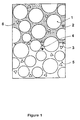
- Fig. 1 is a schematic representation of the movement of the monomer flooding front through the powder column under influence of vacuum for the method according to the invention;
- Fig. 2 is a schematic representation of the principal features of the powder container of the apparatus according to the invention;
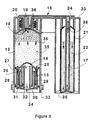
- Fig. 3 is a section through a preferred embodiment of the powder container of the apparatus according to the invention;
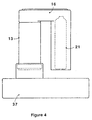
- Fig. 4 is a schematic representation of the bone cement flooding on the vacuum pump;
- Fig. 5. is a schematic representation of the swelling phase of the bone cement;
- Fig. 6 is a schematic representation of the draining phase of the bone cement;
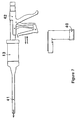
- Fig. 7 is a schematic representation of showing the bone cement extrusion;
- Fig. 8 is a section of the powder container with a valve of the apparatus according to the invention;
- Fig. 9 is a schematic representation of an evacuated can as the source of vacuum for the method according to the invention;
- Fig. 10 is a schematic representation of a pre-evacuated package with a vacuum reservoir for use with the method according to the invention; and
- Fig. 11 shows a Weibull plot for the tensile strength of the bone cement obtained by the method according to invention vs. PALACOS R.
-
- The principal process of bone cement preparation according to the present invention is orderly replacement of the residual air in the interspaces of the powder component by the liquid component. During this so-called flooding phase, Figure 1, the powder column with PMMA beads 1 and additives 2 (such as zirconium dioxide and antibiotic) is divided in two sections separated by the flooding front 3. Flooding front 3 sweeps the volume of the powder in the direction 4 driven by a pressure gradient created by reduced pressure (vacuum) in the unflooded interspaces 5 as compared to flooded interspaces 6. Experimental work has shown that creating the flooding pressure gradient by increasing the pressure of the liquid instead of reducing the pressure of the air leads to disorderly flooding, whereby the flooding front will advance unevenly and lead to entrapment of air.
- In order for the flooding front 3 to completely sweep the volume of the powder container 7, Figure 2, it is necessary to maintain evacuation of the unflooded interspaces 5 throughout the flooding phase. Hence the container 7 is provided with two ports: an inlet or upstream port 8 and an outlet or downstream port 9. Both ports must be designed so as to effectively confine the powder to the container 7 prior to and during cement preparation. Additionally, the inlet port 8 must allow for relatively easy flow of monomer, and the outlet port 9 for easy flow of air.
- Flooding is effected by connecting the outlet port 9 to a vacuum source 10 and the inlet port 8 to a monomer container 11. Since no mixing is needed for a PMMA based bone cement prepared according to this invention, container 7 is preferably inflexible and completely filled with powder. Inlet port 8 may optionally be supplied by a valve 12, which is operated either manually or automatically, responding to the pressure difference between the evacuated powder container 7 (at the inlet port 8) and the monomer container 11 (which is essentially at the atmospheric pressure). The valve 12 could be used to prevent the flow of monomer before a certain level of vacuum in the powder is achieved. Experiments have shown that permeability of the powder column to air is sufficient to allow a high capacity vacuum pump to reduce the pressure of the residual air fast enough to attain excellent results even if monomer flow is not held back by means of a valve.
- A preferred embodiment of the powder container is shown in detail in figure 3. Powder container consists of a syringe 13, a two part piston 14 and 15, and an ampoule adapter 16. Adapter 16 is screwed onto the syringe 13. Construction of the adapter 16 provides for a connection between the monomer suction tube 17 and the inlet port 18, which is covered by a fine stainless steel mesh 19. When fully screwed-on, adapter 16 is hermetically sealed to the syringe 13 by a seal 20. The ampoule 21 filled with monomer 22 is opened and inserted into adapter 16 so that the suction tube 17 reaches near the bottom of the ampoule. The mesh 19 is tightly woven with sub-micron openings; this prevents even the smallest of powder particles to cross it. However, resistance to monomer flow is very low. Adapter 16 is constructed from three separate plastic components: the suction tube 17, the main body 23 and the cover plate 24, which are ultrasonically welded together with the mesh 19.
- The two piston components, the cap 14, and the seals section 15, are pressed together along the perimeter 25. At this aspect the piston cap 14 is provided with micro-ribs 26 about 50 micrometers deep. This results in a controlled width gap separating the components 14 and 15. This gap is the downstream, or outlet port 9 from the powder compartment 7 of Figure 2. The mesh 19 corresponds to the upstream, or the inlet port 8 of figure 2.
- Piston is sealed inside the syringe 13 by two lips 27 and 28. The cylindrical sections 29 and 30 of the piston cap 14, and 31 and 32 of the seals section 15, form a labyrinth which prevents easy spilling of any monomer which may enter the piston at the end of flooding phase. The bottom section 33 of the syringe 13 is sealed into the vacuum pump which evacuates the powder column in the powder compartment 35 of the syringe 13, as indicated by arrows 34. Monomer flow is indicated by arrows 36.
Powder column in the powder compartment 35 is packed to a pre-determined density. Since permeability of the column depends on the fractional porosity P and on the total surface S of the particles in a unit volume according to Kozeny's equation: - Bone cement formulation which was selected for the procedure, contains 10 % by weight of zirconium dioxide and approximately 2,5 % of Gentamycin sulphate. Optimal packing results in a powder column of fractional porosity P = 0,36 and leads to about 30 seconds flooding time for 63 grams of powder. Acceptable range for P is 0,34 to 0,38.
- Monomer ampoule 21 is opened, placed within the adapter 16, and the whole assembly is then connected to a vacuum source, e.g. a compressed air-driven (Venturi type) vacuum pump 37, Figure 4. Vacuum pump 37 is turned on initiating flooding phase which lasts on average 30 seconds.
- Vacuum pump is turned off once the whole powder column has been flooded. Viscosity of the monomer reaching the outlet port 25 is increased and the flow of monomer through the gap between piston components 14 and 15 is very much slowed down. Thus the timing of the vacuum switch is not critical; some monomer is allowed to enter the labyrinth of the piston. Once the flooding is complete, the syringe is left in place for a pre-determined time (of 1,5 to 3,0 minutes, depending on the room temperature) of the waiting phase. During this time PMMA swells and dissolves in MMA. This releases benzoyl peroxide and initiates polymerization. Increased viscosity of the monomer due to dissolved polymer facilitates later extrusion of the cement mass; without this, rheological properties of the cement would resemble those of a wet sand. During swelling phase powder also settles down leaving an excess of monomer 38 at the top of the syringe as shown in figure 5.
- The excess monomer 38 collected at the top of the syringe, as well as minor air bubbles produced in the very early flooding, is returned through the mesh 19 back into the ampoule 21 by the action of a piston 39 in the pump 37, Figure 6. Since neither the mesh 19 nor the piston gaps 25 allow escape of the powder particles, only the monomer is squeezed out from the cement mass as the piston 14/15 is advanced into the syringe 13. This phase, of about 15 to 30 seconds, is defined as draining. Note the principal difference to pressurizing as proposed by Draenart; in pressurizing no fluid is allowed to leave the cement mass.
- Once the excess monomer has been returned to the ampoule, adapter is removed from the syringe and disposed (covering the bottom with a disposal cap 40), a nozzle 41 is placed onto syringe 13, and the cement is extruded using a caulking gun 42 as shown in figure 7.
- If the flooding is allowed to start with the first drop in pressure between the inlet port and the ampoule, some air will be trapped in the initial seconds of flooding. Most of it is expelled during draining. This initial entrapment of air can be reduced by a valve 43 inserted in the path of monomer, Figure 8.
- If this valve is opened with a delay of say 15 to 30 seconds after the vacuum is applied to the bottom of the syringe, monomer will start flooding of the powder column containing less residual air. A technically attractive placement of the valve is in the suction tube 17. The valve could also be made to open, mechanically or by rupture, by the pressure difference between the powder compartment and the ampoule.
- An alternative to the vacuum pump is an evacuated can 44, Figure 9. Evacuated to say below 1 mbar, the volume of such a can sufficient to drive the flooding is 0,3 to 0,5 liters. Such cans could be supplied sterile for single use, eliminating the need for cleaning and sterilization of (as well as the investment into) a vacuum pump. In this case draining operation could be performed by the caulking gun prior to extrusion.
- A method for preparing bone cement known from WO88/03811 TEPIC requires a high level of vacuum in the powder column in order to avoid incomplete flooding. Provision of two ports (8 and 9, Figure 2) on the powder container, as in the current invention, and change in the basic concept of filling empty space by monomer to that of replacing residual air by monomer, allows for an integral source of vacuum -- an enlarged piston 45, Figure 10. Evacuation of the system could be effected through the inlet port which should then be sealed off, e.g. by a valve 43.
- Advantages of the current invention have been demonstrated by extensive testing of mechanical and chemical properties of the bone cement prepared according to the invention. For comparison, most of the commercially available brands have been tested, as well as some preparations of bone cements based on the same formulation, but prepared by conventional means (hand mixing and partial vacuum mixing).
- Release of the monomer into the operating room compared with the open, spatula-and-bowl mixing procedure, followed by kneading, is 60 times lower. Compared to a conventional partial vacuum mixing system, the release is 4 times lower. As commented earlier, the peak temperature is reduced by about 8 degrees C; shrinkage by about 1 % absolute, i.e. by about 20 % relative; residual monomer by about 20 %.
- Tensile strength was measured to be 65 MPa compared with 40 to 55 MPa for all commercially available bone cements, hand mixed, or partial vacuum mixed. This is 20 to 60 % higher and approaching the ultimate tensile strength of pure, block polymerized, PMMA (70 to 75 MPa). An important difference is also the greatly reduced variability as illustrated by Weibull plots of static tensile tests (bone cement according to current invention vs. PALACOS R) as shown in figure 11.
- Intrinsic (without pores) fatigue strength (in bending) matches the best commercial bone cement (PALACOS R).
Claims (24)
- Method of bone cement preparation from a polymeric powder and a liquid component, comprising a polymerisable monomer or comonomer by the action of a catalytic system, whereby the particles of said powder component are packed in a powder container (7;35) with an inlet port (8) and an outlet port (9) and the liquid component is held in a liquid container (11),
characterized in thatA) said powder container (7;35) is completely filled with said polymeric powder;B) the liquid container (11) is connected to said inlet port (8); andC) a vacuum source (10) is connected to said outlet port (9); wherebyD) the void space between said particles of said powder component is flooded by said liquid component, flowing from said inlet port (8) in the direction of said outlet port (9) by the action of the vacuum source (10). - Method of bone cement preparation from a polymeric powder and a liquid component, comprising a polymerisable monomer or comonomer by the action of a catalytic system, whereby the particles of said powder component are packed in a powder container (7;35) with an inlet port (8) and an outlet port (9) and the liquid component is held in a liquid container (11),
characterized in thatA) said powder in said powder container (7;35) is packed to a fractional porosity of 0,30 to 0,43;B) the liquid container (11) is connected to said inlet port (8); andC) a vacuum source (10) is connected to said outlet port (9); wherebyD) the void space between said particles of said powder component is flooded by said liquid component, flowing from said inlet port (8) in the direction of said outlet port (9) by the action of the vacuum source (10). - Method according to claim 1 or 2, characterized in that catalytic system comprises benzoyl peroxide, said benzoyl peroxide being preferably contained within said particles.
- Method according to one of the claims 1 to 3, characterized in that said upstream inlet port (8) and said downstream outlet port (9) of said container (7) allow for the passage of air and liquid, but not of said powder.
- Method according to one of the claims 1 to 4, characterized in that said powder container (7;35) is inflexible, preferably in the form of a syringe (13).
- Method according to one of the claims 1 to 5, characterized in that said powder in said powder containing compartment (35) is packed to a fractional porosity of 0,34 to 0,38.
- Method according to claim 6, characterized in that said powder in said powder containing compartment (35) is packed to a fractional porosity of 0,35 to 0,37.
- Method according to one of the claims 1 to 7, characterized in that said powder component is flooded by said liquid component. in 15 to 60 seconds.
- Method according to claim 8, characterized in that said powder component is flooded by said liquid component in 25 to 35 seconds.
- Method according to one of the claims 1 to 9, characterized in that the flow of said liquid component is controlled by a valve (12) interposed between said liquid container (11) and said inlet port (8).
- Method according to one of the claims 1 to 10, characterized in that flooding of said powder component by said liquid component is followed by swelling, draining of excess liquid component and extrusion of the mixed components.
- Method according to one of the claims 1 to 11, characterized in that said draining of excess liquid is effected by a piston (39) contained in a vacuum pump (37).
- Method according to one of the claims 1 to 12, characterized in that said inlet port (8) comprises a mesh (19) which does not allow for passage of said powder particles, but does allow for passage of said liquid.
- Method according to one of the claims 1 to 13, characterized in that outlet port (9) comprises a narrow gap (25) which substantially blocks passage of said powder particles, but allows for passage of air and said liquid.
- Method according to claim 14, characterized in that gap (25) is smaller than 50 µ.
- Method according to claim 14, characterized in that gap (25) is smaller than 3 times the average diameter of said particles of said powder component.
- Method according to one of the claims 1 to 16, characterized in that said polymerisable monomer or comonomer comprises methyl-methacrylate, ethyl-methacrylate or butyl-methacrylate or mixtures thereof.
- Method according to one of the claims 1 to 17, characterized in that vacuum source (10) generates a vacuum in the range of 10 to 200 mbar.
- Method according to claim 18, characterized in that vacuum source (10) generates a vacuum in the range of 50 to 100 mbar.
- Apparatus for performing the method according to one of the claims 1 to 19,
characterized byA) a powder container (7) with an inlet port (8) and an outlet port (9), said powder container (7;35) being completely filled with a polymeric powder;B) a liquid container (11), whereby said liquid container contains a liquid component comprising a polymerisable monomer or comonomer; wherebyC) said liquid container (11) is connectable to said inlet port (8) ;D) said outlet port (9) is connectable to a vacuum source (10); and;E) the void space between said particles of said powder component is floodable by said liquid component through said inlet port (8) in the direction of said outlet port (9) by the action of the vacuum source (10). - Apparatus for performing the method according to one of the claims 1 to 19,
characterized byA) a powder container (7) with an inlet port (8) and an outlet port (9), said powder container (7;35) containing a polymeric powder, whereby said powder in said powder container (7;35) is packed to a fractional porosity of 0,30 to 0,43;B) a liquid container (11), whereby said liquid container contains a liquid component comprising a polymerisable monomer or comonomer; wherebyC) said liquid container (11) is connectable to said inlet port (8);D) said outlet port (9) is connectable to a vacuum source (10); and;E) the void space between said particles of said powder component is floodable by said liquid component through said inlet port (8) in the direction of said outlet port (9) by the action of the vacuum source (10). - Apparatus according to claim 20 or 21, characterized in that it comprises a vacuum source (10).
- Apparatus according to claim 22, characterized in that said vacuum source (10) is an evacuated can (44).
- Apparatus according to claim 22, characterized in that said vacuum source (10) is an evacuated piston (45).
Applications Claiming Priority (1)
| Application Number | Priority Date | Filing Date | Title |
|---|---|---|---|
| PCT/EP1998/008199 WO2000035506A1 (en) | 1998-12-14 | 1998-12-14 | Method of bone cement preparation |
Publications (2)
| Publication Number | Publication Date |
|---|---|
| EP1140234A1 EP1140234A1 (en) | 2001-10-10 |
| EP1140234B1 true EP1140234B1 (en) | 2003-03-26 |
Family
ID=8167161
Family Applications (1)
| Application Number | Title | Priority Date | Filing Date |
|---|---|---|---|
| EP98965836A Expired - Lifetime EP1140234B1 (en) | 1998-12-14 | 1998-12-14 | Method and apparatus for bone cement preparation |
Country Status (6)
| Country | Link |
|---|---|
| US (1) | US6709149B1 (en) |
| EP (1) | EP1140234B1 (en) |
| JP (1) | JP2002532155A (en) |
| DE (1) | DE69812726T2 (en) |
| ES (1) | ES2197525T3 (en) |
| WO (1) | WO2000035506A1 (en) |
Cited By (5)
| Publication number | Priority date | Publication date | Assignee | Title |
|---|---|---|---|---|
| DE102009035067B3 (en) * | 2009-07-28 | 2011-01-20 | Heraeus Medical Gmbh | Bone cement system |
| CN105342726A (en) * | 2015-08-21 | 2016-02-24 | 郭开今 | 3D (three-dimensional) printing micropore inlaying type bone grain |
| DE102014117224A1 (en) | 2014-11-25 | 2016-05-25 | Heraeus Medical Gmbh | Discharge device for cement cartridges with rolling clamp bodies |
| EP3058886A1 (en) | 2015-02-20 | 2016-08-24 | Heraeus Medical GmbH | Dispensing device with spring tongues for cement cartridges |
| US12408964B2 (en) | 2022-07-19 | 2025-09-09 | Heraeus Medical Gmbh | Device and method for providing a bone cement paste |
Families Citing this family (99)
| Publication number | Priority date | Publication date | Assignee | Title |
|---|---|---|---|---|
| MY133943A (en) * | 2000-08-22 | 2007-11-30 | Synthes Gmbh | Bone replacement material |
| JP4607762B2 (en) * | 2003-08-08 | 2011-01-05 | ジンテーズ ゲゼルシャフト ミト ベシュレンクテル ハフツング | Method of impregnating porous bone substitute material |
| BRPI0413681A (en) | 2003-08-21 | 2006-10-24 | Mixpac Systems Ag | device and process for storing, mixing and dispensing components |
| US7524103B2 (en) * | 2003-11-18 | 2009-04-28 | Boston Scientific Scimed, Inc. | Apparatus for mixing and dispensing a multi-component bone cement |
| JP4414461B2 (en) * | 2004-06-03 | 2010-02-10 | ジンテーズ ゲゼルシャフト ミト ベシュレンクテル ハフツング | Device for impregnation of porous bone substitute material |
| US20060095138A1 (en) * | 2004-06-09 | 2006-05-04 | Csaba Truckai | Composites and methods for treating bone |
| US8038682B2 (en) * | 2004-08-17 | 2011-10-18 | Boston Scientific Scimed, Inc. | Apparatus and methods for delivering compounds into vertebrae for vertebroplasty |
| US20080319445A9 (en) * | 2004-08-17 | 2008-12-25 | Scimed Life Systems, Inc. | Apparatus and methods for delivering compounds into vertebrae for vertebroplasty |
| US7559932B2 (en) * | 2004-12-06 | 2009-07-14 | Dfine, Inc. | Bone treatment systems and methods |
| US7678116B2 (en) * | 2004-12-06 | 2010-03-16 | Dfine, Inc. | Bone treatment systems and methods |
| US8070753B2 (en) * | 2004-12-06 | 2011-12-06 | Dfine, Inc. | Bone treatment systems and methods |
| US7717918B2 (en) | 2004-12-06 | 2010-05-18 | Dfine, Inc. | Bone treatment systems and methods |
| US7722620B2 (en) | 2004-12-06 | 2010-05-25 | Dfine, Inc. | Bone treatment systems and methods |
| US8540723B2 (en) | 2009-04-14 | 2013-09-24 | Dfine, Inc. | Medical system and method of use |
| US8777479B2 (en) * | 2008-10-13 | 2014-07-15 | Dfine, Inc. | System for use in bone cement preparation and delivery |
| US8562620B2 (en) * | 2008-04-21 | 2013-10-22 | Dfine, Inc. | Bone treatment systems |
| US20070118144A1 (en) * | 2005-09-01 | 2007-05-24 | Csaba Truckai | Systems for sensing retrograde flows of bone fill material |
| WO2007048016A2 (en) * | 2005-10-20 | 2007-04-26 | Synthes (U.S.A.) | Perfusion device and method |
| US8575274B2 (en) * | 2006-07-17 | 2013-11-05 | Syracuse University | Multi-solution bone cements and methods of making the same |
| US8696679B2 (en) * | 2006-12-08 | 2014-04-15 | Dfine, Inc. | Bone treatment systems and methods |
| US20080188858A1 (en) * | 2007-02-05 | 2008-08-07 | Robert Luzzi | Bone treatment systems and methods |
| WO2008137428A2 (en) | 2007-04-30 | 2008-11-13 | Dfine, Inc. | Bone treatment systems and methods |
| US9597118B2 (en) | 2007-07-20 | 2017-03-21 | Dfine, Inc. | Bone anchor apparatus and method |
| KR101634664B1 (en) * | 2007-08-29 | 2016-06-29 | 에텍스 코포레이션 | Bone Cement Mixing and Delivery System and Method of Use Thereof |
| US20100030220A1 (en) * | 2008-07-31 | 2010-02-04 | Dfine, Inc. | Bone treatment systems and methods |
| US9445854B2 (en) | 2008-02-01 | 2016-09-20 | Dfine, Inc. | Bone treatment systems and methods |
| ES2483996T3 (en) | 2008-02-28 | 2014-08-08 | Dfine, Inc. | Bone treatment systems and methods |
| US9180416B2 (en) * | 2008-04-21 | 2015-11-10 | Dfine, Inc. | System for use in bone cement preparation and delivery |
| US8480289B2 (en) * | 2008-08-22 | 2013-07-09 | Biomet Manufacturing, Llc | Bone cement mixing cartridge and method of use |
| DE102009013211B4 (en) * | 2009-03-17 | 2012-04-19 | Aap Biomaterials Gmbh | Bone cement vacuum mixing device and method for mixing bone cement |
| DE102009031178B3 (en) * | 2009-06-29 | 2010-09-16 | Heraeus Medical Gmbh | Device for mixing and delivering bone cement |
| DE102010026497B4 (en) | 2010-07-07 | 2014-04-03 | Heraeus Medical Gmbh | Vakuumzementiersystem |
| DE102010026496B4 (en) | 2010-07-07 | 2014-05-22 | Heraeus Medical Gmbh | ampoules breaker |
| US8662736B2 (en) | 2010-07-29 | 2014-03-04 | Heraeus Medical Gmbh | Bone cement system |
| DE102010046055B4 (en) | 2010-09-22 | 2012-10-25 | Heraeus Medical Gmbh | Mixing device for Prepack vacuum cementing system |
| DE102010052323A1 (en) | 2010-11-25 | 2012-05-31 | Heraeus Medical Gmbh | Cartridge with lockable delivery piston |
| DE102011112516B4 (en) | 2011-09-07 | 2024-02-29 | Stryker European Operations Holdings Llc | Container with a container for holding a liquid and a liquid removal device |
| EP2589821B1 (en) * | 2011-11-03 | 2017-08-02 | Heraeus Medical GmbH | Apparatus and method for the generation of vacuum for vacuum cementing systems |
| DE102011119377B3 (en) * | 2011-11-25 | 2013-04-04 | Heraeus Medical Gmbh | Storage and mixing device for bone cement |
| DE102011119371B3 (en) * | 2011-11-25 | 2013-04-04 | Heraeus Medical Gmbh | Device for mixing bone cement |
| US9604184B2 (en) | 2013-03-06 | 2017-03-28 | Orthovita, Inc. | Mixing system and valve assembly |
| US9657935B2 (en) | 2013-07-12 | 2017-05-23 | Benjamin Michael Wilson | Wearable devices with integrated light sources |
| DE102014108569B3 (en) * | 2014-06-18 | 2015-10-22 | Heraeus Medical Gmbh | Vacuum mixing system and method for mixing polymethyl methacrylate bone cement |
| DE102014109905B4 (en) | 2014-07-15 | 2017-02-09 | Heraeus Medical Gmbh | Vacuum mixing system and method for mixing polymethyl methacrylate bone cement |
| DE102014112042B4 (en) | 2014-08-22 | 2017-11-23 | Heraeus Medical Gmbh | Discharge device with elastically driven mixer |
| DE102014112043A1 (en) | 2014-08-22 | 2016-02-25 | Heraeus Medical Gmbh | Tensioned opening device for monomer containers |
| US10821645B2 (en) * | 2014-12-30 | 2020-11-03 | Obshchestvo s ogranichennoy otvetstvennostyu “Avtoklavy vysokogo davleniya i temperatury” | Device for deformational processing of materials (variants) |
| DE102015106899B3 (en) | 2015-05-04 | 2016-07-14 | Heraeus Medical Gmbh | Device for mixing and storing polymethyl methacrylate bone cement |
| DE102015108783B3 (en) * | 2015-06-03 | 2016-07-14 | Heraeus Medical Gmbh | Device for mixing and storing polymethyl methacrylate bone cement |
| DE102015111320B4 (en) | 2015-07-13 | 2018-10-18 | Heraeus Medical Gmbh | Vacuum mixing system and method for mixing polymethyl methacrylate bone cement |
| DE102015116245B4 (en) | 2015-09-25 | 2019-01-31 | Heraeus Medical Gmbh | Apparatus and method for opening glass ampoules and cementing apparatus |
| DE102015116797B4 (en) | 2015-10-02 | 2018-08-23 | Heraeus Medical Gmbh | Apparatus and method for storing and mixing a bone cement |
| DE102015121274B3 (en) | 2015-12-07 | 2017-04-06 | Heraeus Medical Gmbh | Vacuum mixing device with operating element and pump for mixing polymethyl methacrylate bone cement |
| DE102015121277B3 (en) | 2015-12-07 | 2017-04-06 | Heraeus Medical Gmbh | Vacuum mixing device with operating element, pressure and vacuum pump for mixing polymethyl methacrylate bone cement |
| DE102015121276B3 (en) * | 2015-12-07 | 2017-04-06 | Heraeus Medical Gmbh | Mixing device with operating element and pressure pump for mixing polymethyl methacrylate bone cement |
| DE102016106261B4 (en) | 2016-04-06 | 2018-03-15 | Heraeus Medical Gmbh | Device for mixing and storing polymethyl methacrylate bone cement with pressure pump and vial breaker |
| DE102016110561A1 (en) | 2016-06-08 | 2017-12-14 | Heraeus Medical Gmbh | Storage and mixing device for producing a bone cement |
| DE102016110564B4 (en) | 2016-06-08 | 2018-05-09 | Heraeus Medical Gmbh | Storage and mixing device for bone cement with pressure pump |
| DE102016121606B4 (en) | 2016-11-11 | 2019-05-02 | Heraeus Medical Gmbh | Bone cement applicator with bone cement driven closure system and method of applying a bone cement |
| DE102016121607B4 (en) | 2016-11-11 | 2019-05-16 | Heraeus Medical Gmbh | Apparatus and method for storing and mixing a bone cement |
| DE102016222158A1 (en) * | 2016-11-11 | 2018-05-17 | Heraeus Medical Gmbh | A method for producing a polymethylmethacrylate bone cement, bone cement kit for use in such a method, and a bone cement producible by such a method |
| DE102017104854B4 (en) | 2017-03-08 | 2019-05-29 | Heraeus Medical Gmbh | Two-part storage and mixing device for producing a bone cement and method for this |
| DE102017107569A1 (en) | 2017-04-07 | 2018-10-11 | Heraeus Medical Gmbh | Device for storing, mixing and discharging a bone cement and method therefor |
| DE102017109255A1 (en) | 2017-04-28 | 2018-10-31 | Heraeus Medical Gmbh | Bone cement application device with closure means on the discharge piston |
| DE102017110732B4 (en) | 2017-05-17 | 2021-01-28 | Heraeus Medical Gmbh | Apparatus for producing a bone cement dough and for discharging the mixed bone cement dough, and a method for producing a bone cement dough |
| DE102017113126A1 (en) | 2017-06-14 | 2018-12-20 | Heraeus Medical Gmbh | Bone cement applicator with duct element and lock receptacle |
| DE102017125592B4 (en) | 2017-11-02 | 2019-06-19 | Heraeus Medical Gmbh | Powder-liquid bone cement mixer with compressed gas connection |
| DE102017130084B4 (en) | 2017-12-15 | 2019-06-27 | Heraeus Medical Gmbh | Bone cement mixing device with spacer in a vial holder |
| DE102018101041A1 (en) | 2018-01-18 | 2019-07-18 | Heraeus Medical Gmbh | Bone cement applicator with sealable gassing opening |
| DE102018209784A1 (en) | 2018-06-18 | 2019-12-19 | Heraeus Medical Gmbh | Bone cement applicator with retractable mixing stick and method for producing a bone cement |
| DE102018209807A1 (en) | 2018-06-18 | 2019-12-19 | Heraeus Medical Gmbh | Bone cement applicator with retractable mixing stick and method for producing a bone cement |
| DE102018218303A1 (en) | 2018-10-25 | 2020-04-30 | Heraeus Medical Gmbh | Device for providing bone cement |
| EP3643398B1 (en) | 2018-10-25 | 2021-07-07 | Heraeus Medical GmbH | Device and method for producing bone cement |
| DE102018218302A1 (en) | 2018-10-25 | 2020-04-30 | Heraeus Medical Gmbh | Device for providing bone cement |
| DE102018131266B4 (en) | 2018-12-07 | 2021-12-23 | Heraeus Medical Gmbh | Apparatus for mixing a bone cement with a cavity for monomer transfer and a process for the production of a bone cement dough |
| DE102018131268B4 (en) | 2018-12-07 | 2021-11-25 | Heraeus Medical Gmbh | Device for mixing a bone cement with a cavity for monomer transfer |
| CN109363762A (en) * | 2018-12-18 | 2019-02-22 | 艾科美医疗器械(深圳)有限公司 | A negative pressure suction type bone cement perfusion device and perfusion method |
| DE102019104020A1 (en) | 2019-02-18 | 2020-08-20 | Heraeus Medical Gmbh | Bone cement applicator with clampable discharge piston |
| EP3838391A1 (en) | 2019-12-18 | 2021-06-23 | Heraeus Medical GmbH | Device for producing bone cement |
| EP4063007B1 (en) | 2021-03-22 | 2023-08-09 | Heraeus Medical GmbH | Method and device for mixing bone cement with pressure relief |
| EP4079396B1 (en) | 2021-04-22 | 2024-01-03 | Heraeus Medical GmbH | Device for producing bone cement |
| EP4154973B1 (en) | 2021-09-28 | 2024-01-17 | Heraeus Medical GmbH | Device for preparing bone cement paste |
| EP4169608B1 (en) * | 2021-10-25 | 2026-02-25 | Heraeus Medical GmbH | Device for providing a fluid component of a bone cement mass, system and method for providing a bone cement mass |
| EP4257232B1 (en) | 2022-04-04 | 2024-08-28 | Heraeus Medical GmbH | Device and method for producing bone cement |
| EP4282518B1 (en) | 2022-05-23 | 2024-07-03 | Heraeus Medical GmbH | Device and method for producing bone cement |
| EP4299169B1 (en) | 2022-06-30 | 2024-07-31 | Heraeus Medical GmbH | Device and method for producing bone cement |
| EP4458294B1 (en) | 2023-05-04 | 2025-04-02 | Heraeus Medical GmbH | Device for delivering bone cement by an op-robot |
| EP4474042B1 (en) | 2023-06-06 | 2025-12-31 | Heraeus Medical GmbH | MIXING SYSTEM WITH SIDE-MOPTOUGH BREAKER |
| EP4474338A1 (en) | 2023-06-06 | 2024-12-11 | Heraeus Medical GmbH | Vial opener with multifunctional piston |
| EP4474337A1 (en) | 2023-06-06 | 2024-12-11 | Heraeus Medical GmbH | Device and method for dispensing a liquid starting component of a bone cement paste |
| EP4545027B1 (en) | 2023-10-26 | 2025-10-01 | Heraeus Medical GmbH | Device for extruding bone cement, use and system |
| EP4566701A1 (en) | 2023-12-07 | 2025-06-11 | Heraeus Medical GmbH | Kit for producing and extruding bone cement and method |
| EP4603176A1 (en) | 2024-02-15 | 2025-08-20 | Heraeus Medical GmbH | Bone cement mixing system with improved monomer fluid transfer |
| EP4616937A1 (en) | 2024-03-15 | 2025-09-17 | Heraeus Medical GmbH | Bone cement mixing system with a puncture connection and multifunctional operation |
| EP4616933A1 (en) | 2024-03-15 | 2025-09-17 | Heraeus Medical GmbH | Device and method for providing a bone cement dough |
| EP4616938A1 (en) | 2024-03-15 | 2025-09-17 | Heraeus Medical GmbH | Bone cement mixing system with a puncture connection and a pumping function |
| EP4616936A1 (en) | 2024-03-15 | 2025-09-17 | Heraeus Medical GmbH | Bone cement mixing system with a built-in connection and a multifunctional piston |
| EP4616935A1 (en) | 2024-03-15 | 2025-09-17 | Heraeus Medical GmbH | Bone cement mixing system with a puncture connection |
| EP4659852A1 (en) | 2024-06-03 | 2025-12-10 | Heraeus Medical GmbH | Adapter for a mixing system for providing a bone cement dough and kit for providing a bone cement dough comprising an adapter and a mixing system |
Family Cites Families (10)
| Publication number | Priority date | Publication date | Assignee | Title |
|---|---|---|---|---|
| DE2724814C3 (en) | 1977-06-02 | 1980-03-27 | Kulzer & Co Gmbh, 6380 Bad Homburg | Preliminary product for the preparation of bone cement |
| US4463875A (en) * | 1982-06-14 | 1984-08-07 | Robert W. Mann | Method and apparatus for preparing and applying a two-component cement |
| DE3577393D1 (en) * | 1985-05-14 | 1990-06-07 | Schweiz Lab Exper Chirurgie | METHOD AND APPARATUS FOR PREPARING A SELF-HARDENING TWO-COMPONENT POWDER LIQUID CEMENT. |
| DE3674411D1 (en) * | 1986-11-19 | 1990-10-25 | Experimentelle Chirurgie Lab | METHOD AND APPARATUS FOR PREPARING A SELF-HARDENING TWO-COMPONENT POWDER-LIQUID BONE CEMENT. |
| US4973168A (en) * | 1989-01-13 | 1990-11-27 | Chan Kwan Ho | Vacuum mixing/bone cement cartridge and kit |
| SE510490C2 (en) * | 1992-02-07 | 1999-05-31 | Scandimed International Ab | Process for producing bone cement and apparatus for carrying out the process |
| US5588745A (en) * | 1994-09-02 | 1996-12-31 | Howmedica | Methods and apparatus for mixing bone cement components using an evacuated mixing chamber |
| AU7659896A (en) * | 1995-11-13 | 1997-06-05 | Cemvac System Ab | Method and device for feeding components for bone cement into a mixing vessel for these |
| DE19641775A1 (en) * | 1996-08-22 | 1998-02-26 | Merck Patent Gmbh | Process for the production of active ingredient-containing bone cements |
| US6024480A (en) * | 1998-02-09 | 2000-02-15 | Immedica | Vial package for a bone cement mixer and dispenser |
-
1998
- 1998-12-14 JP JP2000587824A patent/JP2002532155A/en active Pending
- 1998-12-14 EP EP98965836A patent/EP1140234B1/en not_active Expired - Lifetime
- 1998-12-14 US US09/868,116 patent/US6709149B1/en not_active Expired - Lifetime
- 1998-12-14 ES ES98965836T patent/ES2197525T3/en not_active Expired - Lifetime
- 1998-12-14 WO PCT/EP1998/008199 patent/WO2000035506A1/en not_active Ceased
- 1998-12-14 DE DE69812726T patent/DE69812726T2/en not_active Expired - Lifetime
Cited By (8)
| Publication number | Priority date | Publication date | Assignee | Title |
|---|---|---|---|---|
| DE102009035067B3 (en) * | 2009-07-28 | 2011-01-20 | Heraeus Medical Gmbh | Bone cement system |
| EP2281532A1 (en) | 2009-07-28 | 2011-02-09 | Heraeus Medical GmbH | Bone cement system |
| DE102014117224A1 (en) | 2014-11-25 | 2016-05-25 | Heraeus Medical Gmbh | Discharge device for cement cartridges with rolling clamp bodies |
| EP3025789A1 (en) | 2014-11-25 | 2016-06-01 | Heraeus Medical GmbH | Discharging device for cement cartridges with rolling clamp bodies |
| EP3058886A1 (en) | 2015-02-20 | 2016-08-24 | Heraeus Medical GmbH | Dispensing device with spring tongues for cement cartridges |
| DE102015102463A1 (en) | 2015-02-20 | 2016-08-25 | Heraeus Medical Gmbh | Discharge device for cement cartridges with spring tongues |
| CN105342726A (en) * | 2015-08-21 | 2016-02-24 | 郭开今 | 3D (three-dimensional) printing micropore inlaying type bone grain |
| US12408964B2 (en) | 2022-07-19 | 2025-09-09 | Heraeus Medical Gmbh | Device and method for providing a bone cement paste |
Also Published As
| Publication number | Publication date |
|---|---|
| DE69812726T2 (en) | 2004-02-05 |
| JP2002532155A (en) | 2002-10-02 |
| WO2000035506A1 (en) | 2000-06-22 |
| DE69812726D1 (en) | 2003-04-30 |
| ES2197525T3 (en) | 2004-01-01 |
| US6709149B1 (en) | 2004-03-23 |
| EP1140234A1 (en) | 2001-10-10 |
Similar Documents
| Publication | Publication Date | Title |
|---|---|---|
| EP1140234B1 (en) | Method and apparatus for bone cement preparation | |
| AU627513B2 (en) | Vacuum mixing/bone cement cartridge and kit | |
| CA2155022C (en) | Method and apparatus for packaging, mixing and delivering cement | |
| US4671263A (en) | Device and process for mixing and applying bone cement | |
| US5015101A (en) | Apparatus and process for mixing and filling | |
| EP0229754B1 (en) | Method and apparatus for preparaing a self-curing two component powder/liquid cement | |
| JP7158315B2 (en) | Bone cement applicator with closure system driven by bone cement dough | |
| CA2013883C (en) | Method and kit for molding surgical implants | |
| CA2900121C (en) | Device for the mixing and storing of polymethylmethacrylate bone cement | |
| CA3056962C (en) | Device for mixing a bone cement with hollow space for monomer transfer | |
| CA2929192C (en) | Device for mixing and storing polymethylmethacrylate bone cement | |
| CN108689011A (en) | Equipment and associated method for storing, mixing and distribute bone cement | |
| AU2018203777B2 (en) | Bone cement applicator with line element and closure receptacle | |
| CA2041300C (en) | Vacuum mixing/bone cement cartridge and kit | |
| HK1231016B (en) | Device for the mixing and storing of polymethylmethacrylate bone cement |
Legal Events
| Date | Code | Title | Description |
|---|---|---|---|
| PUAI | Public reference made under article 153(3) epc to a published international application that has entered the european phase |
Free format text: ORIGINAL CODE: 0009012 |
|
| 17P | Request for examination filed |
Effective date: 20010514 |
|
| AK | Designated contracting states |
Kind code of ref document: A1 Designated state(s): DE ES FR GB IT NL SE |
|
| 17Q | First examination report despatched |
Effective date: 20020322 |
|
| GRAH | Despatch of communication of intention to grant a patent |
Free format text: ORIGINAL CODE: EPIDOS IGRA |
|
| RTI1 | Title (correction) |
Free format text: METHOD AND APPARATUS FOR BONE CEMENT PREPARATION |
|
| GRAH | Despatch of communication of intention to grant a patent |
Free format text: ORIGINAL CODE: EPIDOS IGRA |
|
| GRAA | (expected) grant |
Free format text: ORIGINAL CODE: 0009210 |
|
| AK | Designated contracting states |
Designated state(s): DE ES FR GB IT NL SE |
|
| REG | Reference to a national code |
Ref country code: GB Ref legal event code: FG4D |
|
| REF | Corresponds to: |
Ref document number: 69812726 Country of ref document: DE Date of ref document: 20030430 Kind code of ref document: P |
|
| REG | Reference to a national code |
Ref country code: SE Ref legal event code: TRGR |
|
| ET | Fr: translation filed | ||
| REG | Reference to a national code |
Ref country code: ES Ref legal event code: FG2A Ref document number: 2197525 Country of ref document: ES Kind code of ref document: T3 |
|
| PLBE | No opposition filed within time limit |
Free format text: ORIGINAL CODE: 0009261 |
|
| STAA | Information on the status of an ep patent application or granted ep patent |
Free format text: STATUS: NO OPPOSITION FILED WITHIN TIME LIMIT |
|
| 26N | No opposition filed |
Effective date: 20031230 |
|
| REG | Reference to a national code |
Ref country code: FR Ref legal event code: PLFP Year of fee payment: 18 |
|
| REG | Reference to a national code |
Ref country code: FR Ref legal event code: PLFP Year of fee payment: 19 |
|
| REG | Reference to a national code |
Ref country code: FR Ref legal event code: PLFP Year of fee payment: 20 |
|
| PGFP | Annual fee paid to national office [announced via postgrant information from national office to epo] |
Ref country code: NL Payment date: 20171219 Year of fee payment: 20 Ref country code: DE Payment date: 20171211 Year of fee payment: 20 Ref country code: FR Payment date: 20171221 Year of fee payment: 20 |
|
| PGFP | Annual fee paid to national office [announced via postgrant information from national office to epo] |
Ref country code: SE Payment date: 20171219 Year of fee payment: 20 Ref country code: GB Payment date: 20171221 Year of fee payment: 20 |
|
| PGFP | Annual fee paid to national office [announced via postgrant information from national office to epo] |
Ref country code: ES Payment date: 20180123 Year of fee payment: 20 |
|
| PGFP | Annual fee paid to national office [announced via postgrant information from national office to epo] |
Ref country code: IT Payment date: 20171221 Year of fee payment: 20 |
|
| REG | Reference to a national code |
Ref country code: DE Ref legal event code: R071 Ref document number: 69812726 Country of ref document: DE |
|
| REG | Reference to a national code |
Ref country code: NL Ref legal event code: MK Effective date: 20181213 |
|
| REG | Reference to a national code |
Ref country code: GB Ref legal event code: PE20 Expiry date: 20181213 |
|
| REG | Reference to a national code |
Ref country code: SE Ref legal event code: EUG |
|
| PG25 | Lapsed in a contracting state [announced via postgrant information from national office to epo] |
Ref country code: GB Free format text: LAPSE BECAUSE OF EXPIRATION OF PROTECTION Effective date: 20181213 |
|
| REG | Reference to a national code |
Ref country code: ES Ref legal event code: FD2A Effective date: 20200803 |
|
| PG25 | Lapsed in a contracting state [announced via postgrant information from national office to epo] |
Ref country code: ES Free format text: LAPSE BECAUSE OF EXPIRATION OF PROTECTION Effective date: 20181215 |