EP1140701B1 - Procede de production de carbonate de sodium hydrate - Google Patents
Procede de production de carbonate de sodium hydrate Download PDFInfo
- Publication number
- EP1140701B1 EP1140701B1 EP99972608A EP99972608A EP1140701B1 EP 1140701 B1 EP1140701 B1 EP 1140701B1 EP 99972608 A EP99972608 A EP 99972608A EP 99972608 A EP99972608 A EP 99972608A EP 1140701 B1 EP1140701 B1 EP 1140701B1
- Authority
- EP
- European Patent Office
- Prior art keywords
- sodium carbonate
- water
- solvent
- anhydrate
- transition temperature
- Prior art date
- Legal status (The legal status is an assumption and is not a legal conclusion. Google has not performed a legal analysis and makes no representation as to the accuracy of the status listed.)
- Expired - Lifetime
Links
- CDBYLPFSWZWCQE-UHFFFAOYSA-L Sodium Carbonate Chemical compound [Na+].[Na+].[O-]C([O-])=O CDBYLPFSWZWCQE-UHFFFAOYSA-L 0.000 title claims abstract description 184
- 238000000034 method Methods 0.000 title claims abstract description 68
- 229910000029 sodium carbonate Inorganic materials 0.000 title claims abstract description 50
- 238000004519 manufacturing process Methods 0.000 title claims abstract description 15
- XLYOFNOQVPJJNP-UHFFFAOYSA-N water Substances O XLYOFNOQVPJJNP-UHFFFAOYSA-N 0.000 claims abstract description 71
- 229910001868 water Inorganic materials 0.000 claims abstract description 71
- 239000002904 solvent Substances 0.000 claims abstract description 46
- 230000007704 transition Effects 0.000 claims abstract description 43
- 229940001593 sodium carbonate Drugs 0.000 claims abstract description 35
- UIIMBOGNXHQVGW-UHFFFAOYSA-M Sodium bicarbonate Chemical compound [Na+].OC([O-])=O UIIMBOGNXHQVGW-UHFFFAOYSA-M 0.000 claims abstract description 27
- 238000009835 boiling Methods 0.000 claims abstract description 21
- 239000000203 mixture Substances 0.000 claims abstract description 21
- 229910000030 sodium bicarbonate Inorganic materials 0.000 claims abstract description 14
- 235000017557 sodium bicarbonate Nutrition 0.000 claims abstract description 13
- MQRJBSHKWOFOGF-UHFFFAOYSA-L disodium;carbonate;hydrate Chemical compound O.[Na+].[Na+].[O-]C([O-])=O MQRJBSHKWOFOGF-UHFFFAOYSA-L 0.000 claims abstract description 11
- 229940076133 sodium carbonate monohydrate Drugs 0.000 claims abstract description 11
- BVKZGUZCCUSVTD-UHFFFAOYSA-M Bicarbonate Chemical compound OC([O-])=O BVKZGUZCCUSVTD-UHFFFAOYSA-M 0.000 claims abstract description 10
- 239000007787 solid Substances 0.000 claims abstract description 10
- UIIMBOGNXHQVGW-DEQYMQKBSA-M Sodium bicarbonate-14C Chemical compound [Na+].O[14C]([O-])=O UIIMBOGNXHQVGW-DEQYMQKBSA-M 0.000 claims abstract description 7
- BVKZGUZCCUSVTD-UHFFFAOYSA-L Carbonate Chemical compound [O-]C([O-])=O BVKZGUZCCUSVTD-UHFFFAOYSA-L 0.000 claims abstract description 6
- 150000003839 salts Chemical class 0.000 claims abstract description 6
- 239000011734 sodium Substances 0.000 claims abstract description 4
- 239000000725 suspension Substances 0.000 claims abstract description 4
- DGAQECJNVWCQMB-PUAWFVPOSA-M Ilexoside XXIX Chemical compound C[C@@H]1CC[C@@]2(CC[C@@]3(C(=CC[C@H]4[C@]3(CC[C@@H]5[C@@]4(CC[C@@H](C5(C)C)OS(=O)(=O)[O-])C)C)[C@@H]2[C@]1(C)O)C)C(=O)O[C@H]6[C@@H]([C@H]([C@@H]([C@H](O6)CO)O)O)O.[Na+] DGAQECJNVWCQMB-PUAWFVPOSA-M 0.000 claims abstract description 3
- 229910052708 sodium Inorganic materials 0.000 claims abstract description 3
- 150000004682 monohydrates Chemical class 0.000 claims description 31
- 241001625808 Trona Species 0.000 claims description 24
- 239000013078 crystal Substances 0.000 claims description 22
- 238000002425 crystallisation Methods 0.000 claims description 22
- CURLTUGMZLYLDI-UHFFFAOYSA-N Carbon dioxide Chemical compound O=C=O CURLTUGMZLYLDI-UHFFFAOYSA-N 0.000 claims description 14
- 239000001569 carbon dioxide Substances 0.000 claims description 7
- 229910002092 carbon dioxide Inorganic materials 0.000 claims description 7
- 239000002002 slurry Substances 0.000 claims description 7
- JYYOBHFYCIDXHH-UHFFFAOYSA-N carbonic acid;hydrate Chemical compound O.OC(O)=O JYYOBHFYCIDXHH-UHFFFAOYSA-N 0.000 claims 1
- 235000017550 sodium carbonate Nutrition 0.000 description 33
- 239000000047 product Substances 0.000 description 17
- 238000001953 recrystallisation Methods 0.000 description 17
- 239000000243 solution Substances 0.000 description 16
- 238000006243 chemical reaction Methods 0.000 description 13
- 230000001404 mediated effect Effects 0.000 description 12
- 238000000280 densification Methods 0.000 description 11
- 239000012535 impurity Substances 0.000 description 11
- 150000001875 compounds Chemical class 0.000 description 10
- 238000001704 evaporation Methods 0.000 description 10
- 230000008020 evaporation Effects 0.000 description 9
- 238000001354 calcination Methods 0.000 description 8
- LYCAIKOWRPUZTN-UHFFFAOYSA-N Ethylene glycol Chemical compound OCCO LYCAIKOWRPUZTN-UHFFFAOYSA-N 0.000 description 6
- PEDCQBHIVMGVHV-UHFFFAOYSA-N Glycerine Chemical compound OCC(O)CO PEDCQBHIVMGVHV-UHFFFAOYSA-N 0.000 description 6
- 238000009621 Solvay process Methods 0.000 description 6
- 230000007423 decrease Effects 0.000 description 6
- 230000000694 effects Effects 0.000 description 6
- 230000003247 decreasing effect Effects 0.000 description 4
- 239000012452 mother liquor Substances 0.000 description 4
- ZWEHNKRNPOVVGH-UHFFFAOYSA-N 2-Butanone Chemical compound CCC(C)=O ZWEHNKRNPOVVGH-UHFFFAOYSA-N 0.000 description 3
- OKKJLVBELUTLKV-UHFFFAOYSA-N Methanol Chemical compound OC OKKJLVBELUTLKV-UHFFFAOYSA-N 0.000 description 3
- MTHSVFCYNBDYFN-UHFFFAOYSA-N diethylene glycol Chemical compound OCCOCCO MTHSVFCYNBDYFN-UHFFFAOYSA-N 0.000 description 3
- 238000001035 drying Methods 0.000 description 3
- 229930195733 hydrocarbon Natural products 0.000 description 3
- 150000002430 hydrocarbons Chemical class 0.000 description 3
- VUZPPFZMUPKLLV-UHFFFAOYSA-N methane;hydrate Chemical compound C.O VUZPPFZMUPKLLV-UHFFFAOYSA-N 0.000 description 3
- 239000003960 organic solvent Substances 0.000 description 3
- 238000007670 refining Methods 0.000 description 3
- 239000007790 solid phase Substances 0.000 description 3
- CSCPPACGZOOCGX-UHFFFAOYSA-N Acetone Chemical compound CC(C)=O CSCPPACGZOOCGX-UHFFFAOYSA-N 0.000 description 2
- LFQSCWFLJHTTHZ-UHFFFAOYSA-N Ethanol Chemical compound CCO LFQSCWFLJHTTHZ-UHFFFAOYSA-N 0.000 description 2
- LRHPLDYGYMQRHN-UHFFFAOYSA-N N-Butanol Chemical compound CCCCO LRHPLDYGYMQRHN-UHFFFAOYSA-N 0.000 description 2
- AMQJEAYHLZJPGS-UHFFFAOYSA-N N-Pentanol Chemical compound CCCCCO AMQJEAYHLZJPGS-UHFFFAOYSA-N 0.000 description 2
- 239000007864 aqueous solution Substances 0.000 description 2
- 239000012267 brine Substances 0.000 description 2
- 230000008025 crystallization Effects 0.000 description 2
- 238000000354 decomposition reaction Methods 0.000 description 2
- 238000009826 distribution Methods 0.000 description 2
- 238000001914 filtration Methods 0.000 description 2
- 150000002334 glycols Chemical class 0.000 description 2
- 238000010438 heat treatment Methods 0.000 description 2
- ZSIAUFGUXNUGDI-UHFFFAOYSA-N hexan-1-ol Chemical compound CCCCCCO ZSIAUFGUXNUGDI-UHFFFAOYSA-N 0.000 description 2
- 239000007788 liquid Substances 0.000 description 2
- 238000005065 mining Methods 0.000 description 2
- DNIAPMSPPWPWGF-UHFFFAOYSA-N monopropylene glycol Natural products CC(O)CO DNIAPMSPPWPWGF-UHFFFAOYSA-N 0.000 description 2
- -1 polyethylene-propylene Polymers 0.000 description 2
- 229920005862 polyol Polymers 0.000 description 2
- 150000003077 polyols Chemical class 0.000 description 2
- 229960004063 propylene glycol Drugs 0.000 description 2
- HPALAKNZSZLMCH-UHFFFAOYSA-M sodium;chloride;hydrate Chemical compound O.[Na+].[Cl-] HPALAKNZSZLMCH-UHFFFAOYSA-M 0.000 description 2
- 239000007858 starting material Substances 0.000 description 2
- 239000000126 substance Substances 0.000 description 2
- DNIAPMSPPWPWGF-VKHMYHEASA-N (+)-propylene glycol Chemical compound C[C@H](O)CO DNIAPMSPPWPWGF-VKHMYHEASA-N 0.000 description 1
- DNIAPMSPPWPWGF-GSVOUGTGSA-N (R)-(-)-Propylene glycol Chemical compound C[C@@H](O)CO DNIAPMSPPWPWGF-GSVOUGTGSA-N 0.000 description 1
- YPFDHNVEDLHUCE-UHFFFAOYSA-N 1,3-propanediol Substances OCCCO YPFDHNVEDLHUCE-UHFFFAOYSA-N 0.000 description 1
- 229940035437 1,3-propanediol Drugs 0.000 description 1
- 239000002202 Polyethylene glycol Substances 0.000 description 1
- 150000001298 alcohols Chemical class 0.000 description 1
- 125000003172 aldehyde group Chemical group 0.000 description 1
- 150000001299 aldehydes Chemical class 0.000 description 1
- 125000000217 alkyl group Chemical group 0.000 description 1
- 150000001408 amides Chemical class 0.000 description 1
- 150000001412 amines Chemical class 0.000 description 1
- 125000003277 amino group Chemical group 0.000 description 1
- 239000012736 aqueous medium Substances 0.000 description 1
- 125000004429 atom Chemical group 0.000 description 1
- 230000015572 biosynthetic process Effects 0.000 description 1
- CDQSJQSWAWPGKG-UHFFFAOYSA-N butane-1,1-diol Chemical class CCCC(O)O CDQSJQSWAWPGKG-UHFFFAOYSA-N 0.000 description 1
- 125000005587 carbonate group Chemical group 0.000 description 1
- 150000004649 carbonic acid derivatives Chemical class 0.000 description 1
- 125000003178 carboxy group Chemical group [H]OC(*)=O 0.000 description 1
- 239000007795 chemical reaction product Substances 0.000 description 1
- 239000000356 contaminant Substances 0.000 description 1
- 238000001816 cooling Methods 0.000 description 1
- 230000001419 dependent effect Effects 0.000 description 1
- 230000001627 detrimental effect Effects 0.000 description 1
- 239000006185 dispersion Substances 0.000 description 1
- 238000004090 dissolution Methods 0.000 description 1
- 238000004821 distillation Methods 0.000 description 1
- 238000010410 dusting Methods 0.000 description 1
- 125000001033 ether group Chemical group 0.000 description 1
- 150000002170 ethers Chemical class 0.000 description 1
- 239000011521 glass Substances 0.000 description 1
- 229960005150 glycerol Drugs 0.000 description 1
- XLYOFNOQVPJJNP-ZSJDYOACSA-N heavy water Substances [2H]O[2H] XLYOFNOQVPJJNP-ZSJDYOACSA-N 0.000 description 1
- 125000005842 heteroatom Chemical group 0.000 description 1
- 150000004677 hydrates Chemical class 0.000 description 1
- 125000002887 hydroxy group Chemical group [H]O* 0.000 description 1
- 125000000468 ketone group Chemical group 0.000 description 1
- 150000002576 ketones Chemical class 0.000 description 1
- 239000007791 liquid phase Substances 0.000 description 1
- 239000000463 material Substances 0.000 description 1
- 229940032007 methylethyl ketone Drugs 0.000 description 1
- 150000002825 nitriles Chemical class 0.000 description 1
- 150000002894 organic compounds Chemical class 0.000 description 1
- 239000002245 particle Substances 0.000 description 1
- 239000012071 phase Substances 0.000 description 1
- 238000010587 phase diagram Methods 0.000 description 1
- 229920001223 polyethylene glycol Polymers 0.000 description 1
- 229920001451 polypropylene glycol Polymers 0.000 description 1
- 229920000166 polytrimethylene carbonate Polymers 0.000 description 1
- BDERNNFJNOPAEC-UHFFFAOYSA-N propan-1-ol Chemical compound CCCO BDERNNFJNOPAEC-UHFFFAOYSA-N 0.000 description 1
- 235000013772 propylene glycol Nutrition 0.000 description 1
- 238000000746 purification Methods 0.000 description 1
- 239000002994 raw material Substances 0.000 description 1
- 230000001105 regulatory effect Effects 0.000 description 1
- 229920006395 saturated elastomer Polymers 0.000 description 1
- 238000000926 separation method Methods 0.000 description 1
- 150000004760 silicates Chemical class 0.000 description 1
- 238000010591 solubility diagram Methods 0.000 description 1
- 238000003860 storage Methods 0.000 description 1
- 238000007669 thermal treatment Methods 0.000 description 1
- 238000010977 unit operation Methods 0.000 description 1
- 238000005406 washing Methods 0.000 description 1
- 238000010333 wet classification Methods 0.000 description 1
Images


Classifications
-
- C—CHEMISTRY; METALLURGY
- C01—INORGANIC CHEMISTRY
- C01D—COMPOUNDS OF ALKALI METALS, i.e. LITHIUM, SODIUM, POTASSIUM, RUBIDIUM, CAESIUM, OR FRANCIUM
- C01D7/00—Carbonates of sodium, potassium or alkali metals in general
- C01D7/35—Varying the content of water of crystallisation or the specific gravity
- C01D7/37—Densifying sodium carbonate
-
- C—CHEMISTRY; METALLURGY
- C01—INORGANIC CHEMISTRY
- C01D—COMPOUNDS OF ALKALI METALS, i.e. LITHIUM, SODIUM, POTASSIUM, RUBIDIUM, CAESIUM, OR FRANCIUM
- C01D7/00—Carbonates of sodium, potassium or alkali metals in general
- C01D7/12—Preparation of carbonates from bicarbonates or bicarbonate-containing product
-
- C—CHEMISTRY; METALLURGY
- C01—INORGANIC CHEMISTRY
- C01D—COMPOUNDS OF ALKALI METALS, i.e. LITHIUM, SODIUM, POTASSIUM, RUBIDIUM, CAESIUM, OR FRANCIUM
- C01D7/00—Carbonates of sodium, potassium or alkali metals in general
- C01D7/22—Purification
- C01D7/24—Crystallisation
-
- C—CHEMISTRY; METALLURGY
- C01—INORGANIC CHEMISTRY
- C01D—COMPOUNDS OF ALKALI METALS, i.e. LITHIUM, SODIUM, POTASSIUM, RUBIDIUM, CAESIUM, OR FRANCIUM
- C01D7/00—Carbonates of sodium, potassium or alkali metals in general
- C01D7/35—Varying the content of water of crystallisation or the specific gravity
Definitions
- the invention is directed to a process for the production of anhydrous soda, sodium carbonate anhydrate, with a bulk density of at least 800, preferably at least 1000, more in particular at least 1300 kg/m 3 , by crystallisation.
- Soda is an important chemical, which is produced in large amounts. It is used, among others, in production of glass. There are generally two processes for this production, the so-called Solvay process and the trona process.
- the former is based on the production of solid sodium bicarbonate, which is calcined into light soda anhydrate (crystal water free soda). This calcination is the chemical conversion of bicarbonate to carbonate, carbon dioxide and water.
- trona mainly consisting of the double salt of sodium carbonate and sodium bicarbonate, with two water molecules, and varying amounts of contaminants.
- Trona is converted to soda, dissolved and purified. Subsequently soda is crystallised from the clear solution as the monohydrate, followed by drying to give light soda anhydrate.
- a review of the various aspects of the refining of trona is given in the paper by Aitala et al, Process for Selection Criteria for refining Trona to Commercial Products, presented at the First International Soda Ash Conference (ISAC), June 11, 1997.
- Light soda ash produced by either the trona-route or the Solvay process has a low bulk density. This results in high transport costs and gives rise to dusting during transportation and handling. Depending on the process used, this light soda ash has a bulk density of 550 (Solvay) or 800 (Trona) kg/m 3 .
- a heat densification process can be used to increase the density of the product to about 1000 kg/m 3 .
- hot water is added to the light product to produce monohydrate, which is immediately evaporated in a calciner to form anhydrate again. This requires a large amount of energy.
- Sodium carbonate can be crystallised as various hydrates.
- the anhydrous form Na 2 CO 3
- a saturated soda ash solution 105°C. This means that evaporative crystallisation can only produce anhydrous soda at elevated pressures i.e. when the boiling temperature is higher than the transition temperature (the transition temperature is hardly influenced by pressure).
- the soda is often crystallised by evaporation of water at lower temperatures: Na 2 CO 3 .1H 2 O or monohydrate is produced. After a drying step at 150 to 200°C, whereby the crystal water is removed, the end-product is porous and usually has a bulk density of 800 kg/m 3 .
- the conventional evaporative crystallisation, drying and heat densification steps require a high energy input.
- the resulting product, after heat densification is a dense soda, having a density of about 1000 kg/m 3 .
- This system is limited to crystallisation by evaporation of the solvent, i.e. the water, which means that the economical application of the process is limited to those systems wherein all sodium carbonate is fully dissolved.
- soda ash of high bulk density is produced more or less directly from bicarbonate containing feedstocks, such as trona, or pure bicarbonate.
- the present invention is based on the principle that when recrystallising soda from a dispersion thereof in an aqueous medium, it is possible to produce soda, free of crystal water, of high to very high bulk density, provided that the 'water-activity' of the systems is modified in such a way that the temperature of the crystallising system is below the boiling point of the system and above the transition temperature of the monohydrate-anhydrate transition.
- the crystallisation of soda anhydrate occurs here via a solution mediated conversion of one solid phase into another solid phase.
- the invention in its broadest form is accordingly directed to a process for the production of sodium carbonate-anhydrate having a bulk density of at least 800 kg/m 3 , said process comprising:
- 'solvent' indicates an organic water miscible or partly water miscible organic liquid, which influences the water activity, which will generally result in a decrease of the transition temperature of the anhydrate-monohydrate transition. This transition temperature is defined as the temperature in the phase diagram of sodium carbonate, above which the anhydrate crystal form of sodium carbonate is stable.
- the term 'solvent' includes, unless otherwise indicated also combinations of two or more solvents.
- the starting materials for the process of the present invention are the various forms in which sodium carbonate and bicarbonate occur or are produced. More in particular, as will become evident from the further discussion, the various crystal forms of sodium carbonate are important starting materials. Also the various double salts of sodium carbonate and sodium bicarbonate, optionally containing crystal water, such as trona may be used.
- the various embodiments of the invention are all based on solution mediated recrystallisation or conversion, contrary to the evaporative crystallisation that is conventionally used for commercial soda production, and where the evaporation of water from the process is essential to cause crystallisation.
- the process of the invention accordingly has the distinct advantage of avoiding the evaporation step and thus of much lower energy requirements, thereby reducing the production costs. Further the invention allows it to produce soda of much higher bulk density, up to 50 % higher, thereby reducing storage and transport costs.
- the invention is based on influencing the water activity of the system, by adding organic solvents, as defined herein, whereby the transition temperature above which the anhydrate is stable and below which the monohydrate is stable, is decreased. In this system it is not relevant if the addition of the solvent increases or decreases the solubility of the soda.
- a further aspect of influencing the water activity of the system resides in an improvement of the possibilities of steering the process performance.
- transition temperature With a decreased transition temperature it is possible to determine the optimal operating temperature range.
- An important aspect is of course that the transition temperature is below the boiling temperature of the system at the pressure applied. At the transition temperature there will be no driving force for recrystallisation or conversion, as is clear from the schematic solubility diagram, attached as figure 1.
- the so-called transition temperature At a certain temperature, the so-called transition temperature, the solubilities are equal.
- the difference in solubility can be regulated; the further the temperature is above the transition temperature, the higher the recrystallisation rate.
- the rate of recrystallisation By careful selection of the operating temperature, it is thus possible to regulate the rate of recrystallisation, whereby lower rates yield improved product purity, crystal quality and bulk density.
- higher temperatures result in increased recrystallisation rates, thereby decreasing processing time and equipment costs, but at the cost of product properties.
- light soda ash can be recrystallised or converted in a suspension, to give dense soda, having a much higher bulk density.
- light soda is slurried in a mixture of water and solvent, at a temperature below the transition temperature.
- the sodium carbonate anhydrate crystals are converted to monhydrate crystals by a solution mediated process.
- the temperature of the resulting slurry of sodium carbonate monohydrate is increased to above the said transition temperature.
- the monohydrate crystals are converted to anhydrate crystals, as that has become the stable form, again by a solution mediated recrystallisation. During this conversion the anhydrate has a higher bulk density than before.
- This embodiment can be used as treatment after the conventional soda process, instead of the heat densification step.
- An important advantage of this embodiment of the invention, compared to the heat densification step, is that no water need to be evaporated. In the heat densification step water is required, which has to be removed subsequently. In the process of the invention this is not the case.
- Trona is a raw material, mainly mined in the United States and in Africa, and consists of deposits of double salts of sodium carbonate and sodium bicarbonate in a molar ratio of roughly 1:1 and containing varying amounts of impurities, generally insolubles, varying from deposit location to deposit location.
- trona for producing soda is the only relevant one, although trona is also used for producing other materials.
- trona is also used for producing other materials.
- the present invention now provides an improved method for producing soda from trona (or another sodium bicarbonate source, such as the Solvay process).
- trona is calcined to yield a sodium carbonate, using known techniques. This carbonate is hydrated at a temperature below the transition temperature and subsequently converted to the anhydrate, as disclosed earlier, by recrystallisation.
- the process of the invention has advantages in that it produces soda of increased bulk density, while requiring less energy. Accordingly the process may be applicable and advantageous, as soon as there is a need for producing anhydrous soda of bulk density comparable to or higher than that produced in accordance with the conventional processes.
- the advantages are generally the most pronounced when the soda produced has a bulk density of more than 1000 kg/m 3 , more in particular more than 1300 kg/m 3 .
- the process of the invention is preferably carried out at ambient pressure, i.e. at atmospheric pressure, as this requires the least investments.
- ambient pressure i.e. at atmospheric pressure
- a small over- or under-pressure may also be applied, as this does not require large investments and may result in operational advantages. Accordingly it is generally possible to use a pressure from 0.5 bar (abs) or higher. Under certain circumstances it may even be advantageous to use pressures up to 5 bar for the crystallization step itself.
- the temperature of the recrystallisation step is a critical parameter, which is determined in relation to the required purity and the composition of the liquid system, i.e. water and one or more solvents. Of course the temperature should be below the boiling temperature of the system. This boiling point is determined by the amount and the nature of the solvent(s). Generally, the recrystallisation is done at a temperature sufficiently far below the boiling point that no substantial evaporation of the water and/or solvent occurs. Suitable temperatures for the recrystallisation are between 15 and 105°C, more in particular between 45 and 95°C.
- the temperature is sufficiently high for the decomposition reaction to proceed at a sufficiently high rate. In that situation temperatures of at least 80°C are preferred, possibly combined with a slightly decreased pressure.
- the calcination step is included in the process in order to produce soda from the bicarbonate. Of course it is not necessary to include this step in case traces of sodium bicarbonate (resulting from incomplete calcination) are present in the product.
- Another important parameter in the invention is the choice of type and amount of solvent. Contrary to the situation in the evaporative crystallisation, the solvent does not play a relevant role in influencing the boiling point (i.e. the solvent is not selected for its influence on the boiling point), but should decrease the transition temperature of the monohydrate-anhydrate transition, as defined herein. In order to get a sufficiently large decrease it is generally preferred to have an amount of solvent which is at least 5 wt% of the liquid phase, i.e. 5 % of the combined weight of water and solvent.
- the amount of solvent is also dependent on the nature thereof.
- a solvent having a large influence on the water activity may be used in smaller amounts than a solvent that has a smaller influence.
- the upper limit of the amount of solvent will be 90 wt.%.
- the nature of the solvent plays an important role in the process of the invention. In the first place it should be stable under the process conditions and it should not interfere with the stability and quality of the soda. Preferably it should also be of such nature that minute amounts left in the soda are not detrimental to the future use of the soda. Finally, it would be advantageous if the adhering solvent could be removed from the soda, after separation of the soda from the mother liquor, in an easy manner, for example by washing or evaporation.
- the solvents can be defined as those water miscible or partly water miscible organic compounds that influence the water activity of the system. This tends to exclude the pure hydrocarbons, as their influence is limited and further they are not really sufficiently water miscible. However, all substituted hydrocarbons and all hydrocarbons containing one or more hetero atoms may be tested for their suitability.
- Preferred compounds are the various hydroxy group containing compounds, ether group containing compounds, amine group containing compounds, aldehyde group containing compounds, keto group containing compounds, carboxy group containing compounds and the like.
- the mono- and polyhydroxy compounds such as the monoalcohols, including the lower alcohols having 1 to 6 carbons atoms (methanol, ethanol, propanol, butanol, pentanol and hexanol, which may have straight or branched alkyl chains), polyols, such as glycols, glycerol and the like are deemed suitable.
- low molecular weight polyols such ethylene glycol, diethylene glycol, glycerol, 1,2-propane diol, 1,3- propane diol, the butane diols, polyethylene glycol, polypropylene glycol, polyethylene-propylene glycol (those glycols having a molecular weight between about 150 and 600) and the like.
- Amines may be used, provided that they do not react with the carbonate group.
- An other group of potentially suitable compounds are the amides and nitriles.
- Ethers, ketones and aldehydes may also be used, whereby especially suitable compounds are acetone and methyl-ethyl ketone.
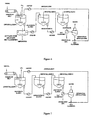
- a cascade of three evaporative crystallisers is used to produce the monohydrous soda form which is stable at the operating conditions.
- the monohydrate is removed from the slurry, it is calcined into light soda ash with a density of about 800 kg/m 3 .
- a final step in the production process usually is the bulk densification of the soda ash.
- a heat densification treatment in a third calciner increases the bulk density up to 1000 kg/m 3 .
- Light soda produced according to the Solvay process also has a low bulk density (of about 550 kg/m 3 ) due to the fact that in the final step of the process sodium bicarbonate is calcined. Upon the evaporation of water and carbon dioxide a very porous product results that is also subjected to the thermal treatment to increase the bulk density.
- Light soda from both the monohydrate and the Solvay process can be used in the embodiment of the invention depicted in figure 3.
- the anhydrous light soda is added to a series of crystallisers 1 that are operated at such conditions that monohydrous soda is stable.
- the anhydrate will therefor transform into monohydrate.
- the transition from monohydrate into anhydrate (and vice versa) is a solution mediated transition: the unstable hydrate will dissolve, resulting in a supersaturation for the stable phase which then crystallises. Since the rate of recrystallisation in a certain mixture is depending on the temperature only, the supersaturation may be kept at a desired, low value which results in a pure product of large crystals.
- the soda monohydrate is transferred to a second series of crystallisers that are operated at a temperature above the transition point of the applied mixture. Under these circumstances monohydrate will transform into anhydrate again. After filtration (or another wet classification), the mother liquor is used to heat the monohydrate slurry and then recycled into the first series of crystallisers.
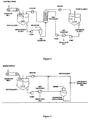
- a comparable flowsheet (see figure 7) is proposed for the wet calcination of sodium bicarbonate. The only difference is that due to the high purity of the feed, no settling tanks and filters are needed to remove insoluble impurities.
- the slurry of monohydrate crystals was transferred continuously to a second crystalliser, wherein the residence time was also 30 min.
- This crystalliser was operated at 80°C, well above the transition temperature of about 70°C in this system.
Landscapes
- Chemical & Material Sciences (AREA)
- Organic Chemistry (AREA)
- Engineering & Computer Science (AREA)
- Materials Engineering (AREA)
- Inorganic Chemistry (AREA)
- Organic Low-Molecular-Weight Compounds And Preparation Thereof (AREA)
- Solid-Sorbent Or Filter-Aiding Compositions (AREA)
- Compounds Of Alkaline-Earth Elements, Aluminum Or Rare-Earth Metals (AREA)
Claims (7)
- Procédé pour la production de carbonate de sodium anhydre ayant une masse volumique en vrac d'au moins 800 kg/m3, ledit procédé comprenant :la fourniture d'une suspension de carbonate de sodium solide et/ou de bicarbonate de sodium, dans un mélange contenant de l'eau et un solvant organique, miscible avec l'eau ou partiellement miscible avec l'eau, ledit solvant influençant la température de transition au-dessous de laquelle le carbonate de sodium monohydraté est stable, de telle manière que le type et la quantité de solvant soient choisis de telle sorte que ladite température de transition soit inférieure au point d'ébullition dudit mélange d'eau et du solvant organique, miscible avec l'eau ou partiellement miscible avec l'eau,dans le cas où du bicarbonate de sodium est présent, la transformation du bicarbonate en carbonate,la cristallisation du carbonate de sodium anhydre dans ledit mélange à une température supérieure à ladite température de transition et inférieure audit point d'ébullition, etla récupération du carbonate de sodium anhydre.
- Procédé selon la revendication 1, dans lequel une suspension épaisse de carbonate de sodium monohydraté dans ledit mélange d'eau et de solvant est recristallisée à une température supérieure à ladite température de transition.
- Procédé selon la revendication 1, dans lequel des cristaux de carbonate de sodium anhydre ayant une densité spécifique inférieure à 1100 kg/m3 sont hydratés dans un mélange d'eau et de solvant à une température inférieure à ladite température de transition, après quoi la température de la suspension épaisse de carbonate de sodium anhydre obtenue est augmentée au-dessus de ladite température de transition.
- Procédé selon la revendication 1, dans lequel du bicarbonate de sodium est introduit dans un mélange d'eau et dudit solvant pour le carbonate de sodium, à une température supérieure à ladite température de transition, de telle manière que le bicarbonate se décompose en carbonate, dioxyde de carbone et eau et que le carbonate de sodium anhydre cristallise.
- Procédé selon la revendication 1, dans lequel du trona est dissous dans ledit mélange d'eau et dudit solvant, facultativement filtré et calciné, après quoi du carbonate de sodium monohydraté est cristallisé à partir de la solution de carbonate de sodium obtenue, et le carbonate de sodium monohydraté est recristallisé à une température supérieure à ladite température de transition.
- Procédé selon les revendications 1 à 5, dans lequel la cristallisation de carbonate de sodium anhydre se produit à une pression supérieure à environ 0,5 bar.
- Procédé selon les revendications 1 à 6, dans lequel le carbonate de sodium anhydre obtenu par ladite cristallisation est transformé en monohydrate et cristallisé de nouveau à une température supérieure à ladite température de transition.
Priority Applications (1)
| Application Number | Priority Date | Filing Date | Title |
|---|---|---|---|
| EP99972608A EP1140701B1 (fr) | 1998-11-24 | 1999-11-23 | Procede de production de carbonate de sodium hydrate |
Applications Claiming Priority (4)
| Application Number | Priority Date | Filing Date | Title |
|---|---|---|---|
| EP98203963A EP1004546A1 (fr) | 1998-11-24 | 1998-11-24 | Procédé de fabrication de soude anhydre |
| EP98203963 | 1998-11-24 | ||
| PCT/NL1999/000719 WO2000030976A1 (fr) | 1998-11-24 | 1999-11-23 | Procede de production de carbonate de sodium hydrate |
| EP99972608A EP1140701B1 (fr) | 1998-11-24 | 1999-11-23 | Procede de production de carbonate de sodium hydrate |
Publications (2)
| Publication Number | Publication Date |
|---|---|
| EP1140701A1 EP1140701A1 (fr) | 2001-10-10 |
| EP1140701B1 true EP1140701B1 (fr) | 2003-04-02 |
Family
ID=8234380
Family Applications (2)
| Application Number | Title | Priority Date | Filing Date |
|---|---|---|---|
| EP98203963A Withdrawn EP1004546A1 (fr) | 1998-11-24 | 1998-11-24 | Procédé de fabrication de soude anhydre |
| EP99972608A Expired - Lifetime EP1140701B1 (fr) | 1998-11-24 | 1999-11-23 | Procede de production de carbonate de sodium hydrate |
Family Applications Before (1)
| Application Number | Title | Priority Date | Filing Date |
|---|---|---|---|
| EP98203963A Withdrawn EP1004546A1 (fr) | 1998-11-24 | 1998-11-24 | Procédé de fabrication de soude anhydre |
Country Status (6)
| Country | Link |
|---|---|
| US (1) | US6514475B1 (fr) |
| EP (2) | EP1004546A1 (fr) |
| AT (1) | ATE236085T1 (fr) |
| AU (1) | AU1416700A (fr) |
| DE (1) | DE69906579D1 (fr) |
| WO (1) | WO2000030976A1 (fr) |
Families Citing this family (2)
| Publication number | Priority date | Publication date | Assignee | Title |
|---|---|---|---|---|
| US7655053B1 (en) * | 2006-09-08 | 2010-02-02 | Bowman Ronald W | Process for sodium carbonate crystals from solutions |
| RU2540659C1 (ru) * | 2013-07-30 | 2015-02-10 | Федеральное государственное унитарное предприятие "Государственный ордена трудового красного знамени научно-исследовательскмй институт химических реактивов и ососбо чистых химических веществ" Министерства образования и науки Российской Федерации | Способ получения карбоната натрия |
Family Cites Families (16)
| Publication number | Priority date | Publication date | Assignee | Title |
|---|---|---|---|---|
| US2670269A (en) * | 1950-07-13 | 1954-02-23 | Columbia Southern Chem Corp | Sodium carbonate |
| GB748443A (en) * | 1953-12-11 | 1956-05-02 | Columbia Southern Chem Corp | Improvements in or relating to sodium carbonate monohydrate and anhydrous sodium carbonate |
| US3425795A (en) * | 1966-08-09 | 1969-02-04 | Allied Chem | Method for preparing superdense sodium carbonate from wyoming trona and the product thereof |
| US3486844A (en) * | 1967-12-29 | 1969-12-30 | Phillips Petroleum Co | Production of dense soda ash |
| US3725014A (en) * | 1971-04-21 | 1973-04-03 | Allied Chem | Sodium carbonate crystallization process with foam prevention |
| US3796794A (en) * | 1972-06-01 | 1974-03-12 | Int Research & Dev Co Ltd | Use of carboxylic acids as crystal growth modifiers for sodium carbonate monohydrate |
| US3933977A (en) * | 1974-01-11 | 1976-01-20 | Intermountain Research And Development Corporation | Process for producing sodium carbonate |
| US3975499A (en) * | 1974-06-05 | 1976-08-17 | Fmc Corporation | Sodium carbonate monohydrate crystallization |
| US4104033A (en) * | 1975-09-12 | 1978-08-01 | Drew Chemical Corporation | Foam prevention in sodium carbonate crystallization |
| US4183901A (en) * | 1976-01-23 | 1980-01-15 | Fmc Corporation | Process for crystallization of anhydrous sodium carbonate |
| US4879042A (en) * | 1980-08-18 | 1989-11-07 | Hanson Donald N | Method of crystallizing salts from aqueous solutions |
| US4374102A (en) * | 1981-11-13 | 1983-02-15 | Nalco Chemical Company | Polymers for controlling soda ash crystal formation |
| GB2109783B (en) * | 1981-11-20 | 1985-08-14 | Glaxo Group Ltd | Crystalline sodium carbonate |
| CH665349A5 (de) * | 1985-01-08 | 1988-05-13 | Sulzer Ag | Metallisches knochenimplantat. |
| US6022385A (en) * | 1994-05-19 | 2000-02-08 | Bowman; Ronald W. | Process for the manufacture of sodium carbonate crystals from minerals or solutions |
| US5716419A (en) * | 1996-07-31 | 1998-02-10 | Ppg Industries, Inc. | Process for crystallization of mineral salts |
-
1998
- 1998-11-24 EP EP98203963A patent/EP1004546A1/fr not_active Withdrawn
- 1998-12-01 US US09/203,270 patent/US6514475B1/en not_active Expired - Fee Related
-
1999
- 1999-11-23 DE DE69906579T patent/DE69906579D1/de not_active Expired - Lifetime
- 1999-11-23 EP EP99972608A patent/EP1140701B1/fr not_active Expired - Lifetime
- 1999-11-23 AU AU14167/00A patent/AU1416700A/en not_active Abandoned
- 1999-11-23 WO PCT/NL1999/000719 patent/WO2000030976A1/fr not_active Ceased
- 1999-11-23 AT AT99972608T patent/ATE236085T1/de not_active IP Right Cessation
Also Published As
| Publication number | Publication date |
|---|---|
| AU1416700A (en) | 2000-06-13 |
| EP1004546A1 (fr) | 2000-05-31 |
| EP1140701A1 (fr) | 2001-10-10 |
| ATE236085T1 (de) | 2003-04-15 |
| WO2000030976A1 (fr) | 2000-06-02 |
| US6514475B1 (en) | 2003-02-04 |
| DE69906579D1 (de) | 2003-05-08 |
Similar Documents
| Publication | Publication Date | Title |
|---|---|---|
| US3119655A (en) | Evaporative process for producing soda ash from trona | |
| US4654204A (en) | Production of sodium bicarbonate by reversion of soda-type feed salt | |
| US6228335B1 (en) | Process for the production of sodium carbonate crystals | |
| KR860001569B1 (ko) | 멜라민의 제조방법 | |
| US4288419A (en) | Enhanced recovery of sodium carbonate from NaCl-containing sodium carbonate solutions | |
| US5654351A (en) | Method for sodium carbonate compound recovery and formation of ammonium sulfate | |
| US4341752A (en) | Method for purification and concentration of MgCl2 -brines | |
| US5514359A (en) | Process for making anhydrous magnesium chloride | |
| US4036931A (en) | Bayer process production of alumina | |
| US4564508A (en) | Process for the recovery of sodium carbonate from salt mixtures | |
| US20030007923A1 (en) | Bicarbonate conversion in a carbonate monohydrate process | |
| CA2032627C (fr) | Methode de preparation de carbonate de sodium et de sulfate d'ammonium a partir de sulfate de sodium | |
| US3451767A (en) | Process of preparing anhydrous sodium carbonate from crude sodium bicarbonate | |
| US3479133A (en) | Production of soda ash from trona | |
| US6667021B2 (en) | Method for producing enhanced sodium carbonate crystals for making sodium bicarbonate | |
| US4286967A (en) | Double crystallization process to produce low organic, low silica soda ash | |
| US3705790A (en) | Process for increasing bulk density of sodium carbonate by the addition of calcium ion | |
| EP1140701B1 (fr) | Procede de production de carbonate de sodium hydrate | |
| US4519806A (en) | Enhanced recovery of soda ash from aqueous sodium carbonate solutions containing Na2 SO4 - and NaCl | |
| US5753200A (en) | Sodium metabisulfite process | |
| US4738836A (en) | Preparation of high bulk density anhydrous sodium carbonate crystals | |
| US4844880A (en) | Process for the manufacture of sodium metabisulfite | |
| US5976485A (en) | Sodium metabisulfite process | |
| EP0081063B1 (fr) | Procédé pour la préparation de persulfate de sodium | |
| EP0135323B1 (fr) | Préparation de bicarbonate de sodium par la réversion de sels doubles contenant NaHCO3 |
Legal Events
| Date | Code | Title | Description |
|---|---|---|---|
| PUAI | Public reference made under article 153(3) epc to a published international application that has entered the european phase |
Free format text: ORIGINAL CODE: 0009012 |
|
| 17P | Request for examination filed |
Effective date: 20010530 |
|
| AK | Designated contracting states |
Kind code of ref document: A1 Designated state(s): AT BE CH CY DE DK ES FI FR GB GR IE IT LI LU MC NL PT SE |
|
| GRAG | Despatch of communication of intention to grant |
Free format text: ORIGINAL CODE: EPIDOS AGRA |
|
| 17Q | First examination report despatched |
Effective date: 20020314 |
|
| GRAG | Despatch of communication of intention to grant |
Free format text: ORIGINAL CODE: EPIDOS AGRA |
|
| GRAH | Despatch of communication of intention to grant a patent |
Free format text: ORIGINAL CODE: EPIDOS IGRA |
|
| GRAH | Despatch of communication of intention to grant a patent |
Free format text: ORIGINAL CODE: EPIDOS IGRA |
|
| GRAA | (expected) grant |
Free format text: ORIGINAL CODE: 0009210 |
|
| AK | Designated contracting states |
Designated state(s): AT BE CH CY DE DK ES FI FR GB GR IE IT LI LU MC NL PT SE |
|
| PG25 | Lapsed in a contracting state [announced via postgrant information from national office to epo] |
Ref country code: LI Free format text: LAPSE BECAUSE OF FAILURE TO SUBMIT A TRANSLATION OF THE DESCRIPTION OR TO PAY THE FEE WITHIN THE PRESCRIBED TIME-LIMIT Effective date: 20030402 Ref country code: IT Free format text: LAPSE BECAUSE OF FAILURE TO SUBMIT A TRANSLATION OF THE DESCRIPTION OR TO PAY THE FEE WITHIN THE PRESCRIBED TIME-LIMIT;WARNING: LAPSES OF ITALIAN PATENTS WITH EFFECTIVE DATE BEFORE 2007 MAY HAVE OCCURRED AT ANY TIME BEFORE 2007. THE CORRECT EFFECTIVE DATE MAY BE DIFFERENT FROM THE ONE RECORDED. Effective date: 20030402 Ref country code: FR Free format text: LAPSE BECAUSE OF FAILURE TO SUBMIT A TRANSLATION OF THE DESCRIPTION OR TO PAY THE FEE WITHIN THE PRESCRIBED TIME-LIMIT Effective date: 20030402 Ref country code: FI Free format text: LAPSE BECAUSE OF FAILURE TO SUBMIT A TRANSLATION OF THE DESCRIPTION OR TO PAY THE FEE WITHIN THE PRESCRIBED TIME-LIMIT Effective date: 20030402 Ref country code: CH Free format text: LAPSE BECAUSE OF FAILURE TO SUBMIT A TRANSLATION OF THE DESCRIPTION OR TO PAY THE FEE WITHIN THE PRESCRIBED TIME-LIMIT Effective date: 20030402 Ref country code: AT Free format text: LAPSE BECAUSE OF FAILURE TO SUBMIT A TRANSLATION OF THE DESCRIPTION OR TO PAY THE FEE WITHIN THE PRESCRIBED TIME-LIMIT Effective date: 20030402 |
|
| REG | Reference to a national code |
Ref country code: GB Ref legal event code: FG4D |
|
| REG | Reference to a national code |
Ref country code: CH Ref legal event code: EP |
|
| REG | Reference to a national code |
Ref country code: IE Ref legal event code: FG4D |
|
| REF | Corresponds to: |
Ref document number: 69906579 Country of ref document: DE Date of ref document: 20030508 Kind code of ref document: P |
|
| PG25 | Lapsed in a contracting state [announced via postgrant information from national office to epo] |
Ref country code: SE Free format text: LAPSE BECAUSE OF FAILURE TO SUBMIT A TRANSLATION OF THE DESCRIPTION OR TO PAY THE FEE WITHIN THE PRESCRIBED TIME-LIMIT Effective date: 20030702 Ref country code: PT Free format text: LAPSE BECAUSE OF FAILURE TO SUBMIT A TRANSLATION OF THE DESCRIPTION OR TO PAY THE FEE WITHIN THE PRESCRIBED TIME-LIMIT Effective date: 20030702 Ref country code: GR Free format text: LAPSE BECAUSE OF FAILURE TO SUBMIT A TRANSLATION OF THE DESCRIPTION OR TO PAY THE FEE WITHIN THE PRESCRIBED TIME-LIMIT Effective date: 20030702 Ref country code: DK Free format text: LAPSE BECAUSE OF FAILURE TO SUBMIT A TRANSLATION OF THE DESCRIPTION OR TO PAY THE FEE WITHIN THE PRESCRIBED TIME-LIMIT Effective date: 20030702 |
|
| PG25 | Lapsed in a contracting state [announced via postgrant information from national office to epo] |
Ref country code: DE Free format text: LAPSE BECAUSE OF FAILURE TO SUBMIT A TRANSLATION OF THE DESCRIPTION OR TO PAY THE FEE WITHIN THE PRESCRIBED TIME-LIMIT Effective date: 20030703 |
|
| REG | Reference to a national code |
Ref country code: CH Ref legal event code: PL |
|
| PG25 | Lapsed in a contracting state [announced via postgrant information from national office to epo] |
Ref country code: ES Free format text: LAPSE BECAUSE OF FAILURE TO SUBMIT A TRANSLATION OF THE DESCRIPTION OR TO PAY THE FEE WITHIN THE PRESCRIBED TIME-LIMIT Effective date: 20031030 |
|
| PG25 | Lapsed in a contracting state [announced via postgrant information from national office to epo] |
Ref country code: LU Free format text: LAPSE BECAUSE OF NON-PAYMENT OF DUE FEES Effective date: 20031123 Ref country code: CY Free format text: LAPSE BECAUSE OF FAILURE TO SUBMIT A TRANSLATION OF THE DESCRIPTION OR TO PAY THE FEE WITHIN THE PRESCRIBED TIME-LIMIT Effective date: 20031123 |
|
| PG25 | Lapsed in a contracting state [announced via postgrant information from national office to epo] |
Ref country code: MC Free format text: LAPSE BECAUSE OF NON-PAYMENT OF DUE FEES Effective date: 20031130 |
|
| PLBE | No opposition filed within time limit |
Free format text: ORIGINAL CODE: 0009261 |
|
| STAA | Information on the status of an ep patent application or granted ep patent |
Free format text: STATUS: NO OPPOSITION FILED WITHIN TIME LIMIT |
|
| EN | Fr: translation not filed | ||
| 26N | No opposition filed |
Effective date: 20040105 |
|
| PGFP | Annual fee paid to national office [announced via postgrant information from national office to epo] |
Ref country code: IE Payment date: 20061027 Year of fee payment: 8 |
|
| PGFP | Annual fee paid to national office [announced via postgrant information from national office to epo] |
Ref country code: NL Payment date: 20061115 Year of fee payment: 8 |
|
| PGFP | Annual fee paid to national office [announced via postgrant information from national office to epo] |
Ref country code: GB Payment date: 20061117 Year of fee payment: 8 |
|
| PGFP | Annual fee paid to national office [announced via postgrant information from national office to epo] |
Ref country code: BE Payment date: 20061120 Year of fee payment: 8 |
|
| BERE | Be: lapsed |
Owner name: *TECHNISCHE UNIVERSITEIT DELFT Effective date: 20071130 |
|
| GBPC | Gb: european patent ceased through non-payment of renewal fee |
Effective date: 20071123 |
|
| NLV4 | Nl: lapsed or anulled due to non-payment of the annual fee |
Effective date: 20080601 |
|
| REG | Reference to a national code |
Ref country code: IE Ref legal event code: MM4A |
|
| PG25 | Lapsed in a contracting state [announced via postgrant information from national office to epo] |
Ref country code: BE Free format text: LAPSE BECAUSE OF NON-PAYMENT OF DUE FEES Effective date: 20071130 |
|
| PG25 | Lapsed in a contracting state [announced via postgrant information from national office to epo] |
Ref country code: NL Free format text: LAPSE BECAUSE OF NON-PAYMENT OF DUE FEES Effective date: 20080601 Ref country code: IE Free format text: LAPSE BECAUSE OF NON-PAYMENT OF DUE FEES Effective date: 20071123 |
|
| PG25 | Lapsed in a contracting state [announced via postgrant information from national office to epo] |
Ref country code: GB Free format text: LAPSE BECAUSE OF NON-PAYMENT OF DUE FEES Effective date: 20071123 |