EP1142587A1 - Remedies for pain - Google Patents
Remedies for pain Download PDFInfo
- Publication number
- EP1142587A1 EP1142587A1 EP99959951A EP99959951A EP1142587A1 EP 1142587 A1 EP1142587 A1 EP 1142587A1 EP 99959951 A EP99959951 A EP 99959951A EP 99959951 A EP99959951 A EP 99959951A EP 1142587 A1 EP1142587 A1 EP 1142587A1
- Authority
- EP
- European Patent Office
- Prior art keywords
- compound
- ring
- piperidine
- pharmacologically acceptable
- spiro
- Prior art date
- Legal status (The legal status is an assumption and is not a legal conclusion. Google has not performed a legal analysis and makes no representation as to the accuracy of the status listed.)
- Withdrawn
Links
- 150000001875 compounds Chemical class 0.000 claims abstract description 234
- 230000000694 effects Effects 0.000 claims abstract description 76
- 150000003839 salts Chemical class 0.000 claims abstract description 46
- 239000003795 chemical substances by application Substances 0.000 claims abstract description 39
- 229940123603 Dopamine D2 receptor antagonist Drugs 0.000 claims abstract description 23
- 239000000442 dopamine 2 receptor blocking agent Substances 0.000 claims abstract description 22
- 239000002756 mu opiate receptor agonist Substances 0.000 claims abstract description 22
- 229940126487 mu opioid receptor agonist Drugs 0.000 claims abstract description 22
- 239000004480 active ingredient Substances 0.000 claims abstract description 6
- 229910052757 nitrogen Inorganic materials 0.000 claims description 34
- -1 hydroxy, carbamoyl Chemical group 0.000 claims description 29
- 125000000956 methoxy group Chemical group [H]C([H])([H])O* 0.000 claims description 26
- 125000002496 methyl group Chemical group [H]C([H])([H])* 0.000 claims description 25
- 239000000460 chlorine Substances 0.000 claims description 23
- 229910052739 hydrogen Inorganic materials 0.000 claims description 22
- 239000001257 hydrogen Substances 0.000 claims description 22
- 125000005842 heteroatom Chemical group 0.000 claims description 21
- IJGRMHOSHXDMSA-UHFFFAOYSA-N nitrogen Substances N#N IJGRMHOSHXDMSA-UHFFFAOYSA-N 0.000 claims description 21
- 125000004435 hydrogen atom Chemical class [H]* 0.000 claims description 20
- 125000003118 aryl group Chemical group 0.000 claims description 19
- 229910052717 sulfur Inorganic materials 0.000 claims description 18
- 229910052801 chlorine Inorganic materials 0.000 claims description 16
- 229910052760 oxygen Inorganic materials 0.000 claims description 16
- QJGQUHMNIGDVPM-UHFFFAOYSA-N nitrogen group Chemical group [N] QJGQUHMNIGDVPM-UHFFFAOYSA-N 0.000 claims description 15
- 125000000217 alkyl group Chemical group 0.000 claims description 11
- ZAMOUSCENKQFHK-UHFFFAOYSA-N Chlorine atom Chemical group [Cl] ZAMOUSCENKQFHK-UHFFFAOYSA-N 0.000 claims description 10
- 125000001997 phenyl group Chemical group [H]C1=C([H])C([H])=C(*)C([H])=C1[H] 0.000 claims description 10
- UHOVQNZJYSORNB-UHFFFAOYSA-N Benzene Chemical compound C1=CC=CC=C1 UHOVQNZJYSORNB-UHFFFAOYSA-N 0.000 claims description 9
- JUJWROOIHBZHMG-UHFFFAOYSA-N Pyridine Chemical group C1=CC=NC=C1 JUJWROOIHBZHMG-UHFFFAOYSA-N 0.000 claims description 8
- PXGOKWXKJXAPGV-UHFFFAOYSA-N Fluorine Chemical group FF PXGOKWXKJXAPGV-UHFFFAOYSA-N 0.000 claims description 7
- UFHFLCQGNIYNRP-UHFFFAOYSA-N Hydrogen Chemical group [H][H] UFHFLCQGNIYNRP-UHFFFAOYSA-N 0.000 claims description 7
- 125000003545 alkoxy group Chemical group 0.000 claims description 7
- 239000011737 fluorine Chemical group 0.000 claims description 7
- 229910052731 fluorine Inorganic materials 0.000 claims description 7
- 125000001309 chloro group Chemical group Cl* 0.000 claims description 6
- 125000004453 alkoxycarbonyl group Chemical group 0.000 claims description 5
- 125000004414 alkyl thio group Chemical group 0.000 claims description 5
- 229910052799 carbon Inorganic materials 0.000 claims description 5
- 229920006395 saturated elastomer Polymers 0.000 claims description 5
- WKBOTKDWSSQWDR-UHFFFAOYSA-N Bromine atom Chemical group [Br] WKBOTKDWSSQWDR-UHFFFAOYSA-N 0.000 claims description 4
- GDTBXPJZTBHREO-UHFFFAOYSA-N bromine Chemical group BrBr GDTBXPJZTBHREO-UHFFFAOYSA-N 0.000 claims description 4
- 229910052794 bromium Inorganic materials 0.000 claims description 4
- 125000004093 cyano group Chemical group *C#N 0.000 claims description 3
- 229910052736 halogen Inorganic materials 0.000 claims description 3
- 150000002367 halogens Chemical class 0.000 claims description 3
- 125000002887 hydroxy group Chemical group [H]O* 0.000 claims description 3
- 125000000449 nitro group Chemical group [O-][N+](*)=O 0.000 claims description 3
- 125000002924 primary amino group Chemical group [H]N([H])* 0.000 claims description 3
- 230000000202 analgesic effect Effects 0.000 abstract description 21
- 230000003389 potentiating effect Effects 0.000 abstract description 10
- 230000001105 regulatory effect Effects 0.000 abstract description 8
- YMWUJEATGCHHMB-UHFFFAOYSA-N Dichloromethane Chemical compound ClCCl YMWUJEATGCHHMB-UHFFFAOYSA-N 0.000 description 141
- HEDRZPFGACZZDS-MICDWDOJSA-N Trichloro(2H)methane Chemical compound [2H]C(Cl)(Cl)Cl HEDRZPFGACZZDS-MICDWDOJSA-N 0.000 description 84
- OKKJLVBELUTLKV-UHFFFAOYSA-N methyl alcohol Substances OC OKKJLVBELUTLKV-UHFFFAOYSA-N 0.000 description 58
- 238000003756 stirring Methods 0.000 description 48
- 125000005605 benzo group Chemical group 0.000 description 47
- 238000001819 mass spectrum Methods 0.000 description 46
- 125000003003 spiro group Chemical group 0.000 description 46
- BQJCRHHNABKAKU-KBQPJGBKSA-N morphine Chemical compound O([C@H]1[C@H](C=C[C@H]23)O)C4=C5[C@@]12CCN(C)[C@@H]3CC5=CC=C4O BQJCRHHNABKAKU-KBQPJGBKSA-N 0.000 description 43
- 239000000243 solution Substances 0.000 description 43
- 238000005160 1H NMR spectroscopy Methods 0.000 description 42
- WYURNTSHIVDZCO-UHFFFAOYSA-N Tetrahydrofuran Chemical compound C1CCOC1 WYURNTSHIVDZCO-UHFFFAOYSA-N 0.000 description 42
- 238000002451 electron ionisation mass spectrometry Methods 0.000 description 40
- HEDRZPFGACZZDS-UHFFFAOYSA-N Chloroform Chemical compound ClC(Cl)Cl HEDRZPFGACZZDS-UHFFFAOYSA-N 0.000 description 38
- XEKOWRVHYACXOJ-UHFFFAOYSA-N Ethyl acetate Chemical compound CCOC(C)=O XEKOWRVHYACXOJ-UHFFFAOYSA-N 0.000 description 33
- 238000000034 method Methods 0.000 description 32
- VLKZOEOYAKHREP-UHFFFAOYSA-N n-Hexane Chemical compound CCCCCC VLKZOEOYAKHREP-UHFFFAOYSA-N 0.000 description 32
- 239000002904 solvent Substances 0.000 description 31
- 239000011541 reaction mixture Substances 0.000 description 30
- 238000010898 silica gel chromatography Methods 0.000 description 29
- 238000000605 extraction Methods 0.000 description 28
- QTBSBXVTEAMEQO-UHFFFAOYSA-N Acetic acid Chemical compound CC(O)=O QTBSBXVTEAMEQO-UHFFFAOYSA-N 0.000 description 27
- CSNNHWWHGAXBCP-UHFFFAOYSA-L Magnesium sulfate Chemical compound [Mg+2].[O-][S+2]([O-])([O-])[O-] CSNNHWWHGAXBCP-UHFFFAOYSA-L 0.000 description 27
- 238000006243 chemical reaction Methods 0.000 description 27
- 239000012044 organic layer Substances 0.000 description 27
- 229940073640 magnesium sulfate anhydrous Drugs 0.000 description 26
- 229960005181 morphine Drugs 0.000 description 22
- YLQBMQCUIZJEEH-UHFFFAOYSA-N tetrahydrofuran Natural products C=1C=COC=1 YLQBMQCUIZJEEH-UHFFFAOYSA-N 0.000 description 21
- VEXZGXHMUGYJMC-UHFFFAOYSA-N Hydrochloric acid Chemical compound Cl VEXZGXHMUGYJMC-UHFFFAOYSA-N 0.000 description 20
- XLYOFNOQVPJJNP-UHFFFAOYSA-N water Substances O XLYOFNOQVPJJNP-UHFFFAOYSA-N 0.000 description 20
- 102000051367 mu Opioid Receptors Human genes 0.000 description 18
- 108020001612 μ-opioid receptors Proteins 0.000 description 18
- UIIMBOGNXHQVGW-UHFFFAOYSA-M Sodium bicarbonate Chemical class [Na+].OC([O-])=O UIIMBOGNXHQVGW-UHFFFAOYSA-M 0.000 description 17
- 230000027455 binding Effects 0.000 description 17
- 239000012528 membrane Substances 0.000 description 17
- VYFYYTLLBUKUHU-UHFFFAOYSA-N dopamine Chemical compound NCCC1=CC=C(O)C(O)=C1 VYFYYTLLBUKUHU-UHFFFAOYSA-N 0.000 description 16
- 241000700159 Rattus Species 0.000 description 15
- RTZKZFJDLAIYFH-UHFFFAOYSA-N Diethyl ether Natural products CCOCC RTZKZFJDLAIYFH-UHFFFAOYSA-N 0.000 description 14
- 230000006399 behavior Effects 0.000 description 11
- IAZDPXIOMUYVGZ-UHFFFAOYSA-N Dimethylsulphoxide Chemical compound CS(C)=O IAZDPXIOMUYVGZ-UHFFFAOYSA-N 0.000 description 10
- 229960004046 apomorphine Drugs 0.000 description 10
- VMWNQDUVQKEIOC-CYBMUJFWSA-N apomorphine Chemical compound C([C@H]1N(C)CC2)C3=CC=C(O)C(O)=C3C3=C1C2=CC=C3 VMWNQDUVQKEIOC-CYBMUJFWSA-N 0.000 description 10
- 230000002401 inhibitory effect Effects 0.000 description 10
- ZMANZCXQSJIPKH-UHFFFAOYSA-N Triethylamine Chemical compound CCN(CC)CC ZMANZCXQSJIPKH-UHFFFAOYSA-N 0.000 description 9
- 230000009194 climbing Effects 0.000 description 9
- 230000000977 initiatory effect Effects 0.000 description 9
- HTQWGIHCFPWKAS-UHFFFAOYSA-N 1-phenyl-1,3,8-triazaspiro[4.5]decan-4-one Chemical compound C1CNCCC11C(=O)NCN1C1=CC=CC=C1 HTQWGIHCFPWKAS-UHFFFAOYSA-N 0.000 description 8
- RKMGAJGJIURJSJ-UHFFFAOYSA-N 2,2,6,6-tetramethylpiperidine Chemical compound CC1(C)CCCC(C)(C)N1 RKMGAJGJIURJSJ-UHFFFAOYSA-N 0.000 description 8
- 102000004980 Dopamine D2 Receptors Human genes 0.000 description 8
- 108090001111 Dopamine D2 Receptors Proteins 0.000 description 8
- 229960003638 dopamine Drugs 0.000 description 8
- AZKDTTQQTKDXLH-UHFFFAOYSA-N naphthalene-2-carbonitrile Chemical compound C1=CC=CC2=CC(C#N)=CC=C21 AZKDTTQQTKDXLH-UHFFFAOYSA-N 0.000 description 8
- 239000012321 sodium triacetoxyborohydride Substances 0.000 description 8
- 239000000126 substance Substances 0.000 description 8
- FAPWRFPIFSIZLT-UHFFFAOYSA-M Sodium chloride Chemical class [Na+].[Cl-] FAPWRFPIFSIZLT-UHFFFAOYSA-M 0.000 description 7
- 230000006742 locomotor activity Effects 0.000 description 7
- AFWWKZCPPRPDQK-UHFFFAOYSA-N 6-chloropyridine-3-carbaldehyde Chemical compound ClC1=CC=C(C=O)C=N1 AFWWKZCPPRPDQK-UHFFFAOYSA-N 0.000 description 6
- CSCPPACGZOOCGX-UHFFFAOYSA-N Acetone Chemical compound CC(C)=O CSCPPACGZOOCGX-UHFFFAOYSA-N 0.000 description 6
- 241000699670 Mus sp. Species 0.000 description 6
- 206010028813 Nausea Diseases 0.000 description 6
- VYPSYNLAJGMNEJ-UHFFFAOYSA-N Silicium dioxide Chemical compound O=[Si]=O VYPSYNLAJGMNEJ-UHFFFAOYSA-N 0.000 description 6
- 239000002253 acid Substances 0.000 description 6
- 230000001143 conditioned effect Effects 0.000 description 6
- 238000002474 experimental method Methods 0.000 description 6
- 239000000706 filtrate Substances 0.000 description 6
- BDAGIHXWWSANSR-UHFFFAOYSA-N methanoic acid Natural products OC=O BDAGIHXWWSANSR-UHFFFAOYSA-N 0.000 description 6
- 239000000203 mixture Substances 0.000 description 6
- 230000008693 nausea Effects 0.000 description 6
- 235000019629 palatability Nutrition 0.000 description 6
- JOXIMZWYDAKGHI-UHFFFAOYSA-N toluene-4-sulfonic acid Chemical compound CC1=CC=C(S(O)(=O)=O)C=C1 JOXIMZWYDAKGHI-UHFFFAOYSA-N 0.000 description 6
- 0 *CN1CCC(CCCC(CCCC2)C2CCC2)C2CCCCCC1 Chemical compound *CN1CCC(CCCC(CCCC2)C2CCC2)C2CCCCCC1 0.000 description 5
- WSLDOOZREJYCGB-UHFFFAOYSA-N 1,2-Dichloroethane Chemical compound ClCCCl WSLDOOZREJYCGB-UHFFFAOYSA-N 0.000 description 5
- 241000699666 Mus <mouse, genus> Species 0.000 description 5
- KDLHZDBZIXYQEI-UHFFFAOYSA-N Palladium Chemical compound [Pd] KDLHZDBZIXYQEI-UHFFFAOYSA-N 0.000 description 5
- 239000000730 antalgic agent Substances 0.000 description 5
- 238000001816 cooling Methods 0.000 description 5
- ZRSNZINYAWTAHE-UHFFFAOYSA-N p-methoxybenzaldehyde Chemical compound COC1=CC=C(C=O)C=C1 ZRSNZINYAWTAHE-UHFFFAOYSA-N 0.000 description 5
- MIOPJNTWMNEORI-GMSGAONNSA-N (S)-camphorsulfonic acid Chemical compound C1C[C@@]2(CS(O)(=O)=O)C(=O)C[C@@H]1C2(C)C MIOPJNTWMNEORI-GMSGAONNSA-N 0.000 description 4
- XBLVHTDFJBKJLG-UHFFFAOYSA-N Ethyl nicotinate Chemical class CCOC(=O)C1=CC=CN=C1 XBLVHTDFJBKJLG-UHFFFAOYSA-N 0.000 description 4
- 208000004547 Hallucinations Diseases 0.000 description 4
- QAOWNCQODCNURD-UHFFFAOYSA-N Sulfuric acid Chemical compound OS(O)(=O)=O QAOWNCQODCNURD-UHFFFAOYSA-N 0.000 description 4
- 230000009471 action Effects 0.000 description 4
- 239000012131 assay buffer Substances 0.000 description 4
- WPYMKLBDIGXBTP-UHFFFAOYSA-N benzoic acid Chemical compound OC(=O)C1=CC=CC=C1 WPYMKLBDIGXBTP-UHFFFAOYSA-N 0.000 description 4
- 230000015572 biosynthetic process Effects 0.000 description 4
- 125000004432 carbon atom Chemical group C* 0.000 description 4
- 231100000673 dose–response relationship Toxicity 0.000 description 4
- MTZQAGJQAFMTAQ-UHFFFAOYSA-N ethyl benzoate Chemical class CCOC(=O)C1=CC=CC=C1 MTZQAGJQAFMTAQ-UHFFFAOYSA-N 0.000 description 4
- 238000001914 filtration Methods 0.000 description 4
- LNEPOXFFQSENCJ-UHFFFAOYSA-N haloperidol Chemical compound C1CC(O)(C=2C=CC(Cl)=CC=2)CCN1CCCC(=O)C1=CC=C(F)C=C1 LNEPOXFFQSENCJ-UHFFFAOYSA-N 0.000 description 4
- 239000003446 ligand Substances 0.000 description 4
- 239000012280 lithium aluminium hydride Substances 0.000 description 4
- NUJOXMJBOLGQSY-UHFFFAOYSA-N manganese dioxide Chemical compound O=[Mn]=O NUJOXMJBOLGQSY-UHFFFAOYSA-N 0.000 description 4
- QPJVMBTYPHYUOC-UHFFFAOYSA-N methyl benzoate Chemical class COC(=O)C1=CC=CC=C1 QPJVMBTYPHYUOC-UHFFFAOYSA-N 0.000 description 4
- YNBADRVTZLEFNH-UHFFFAOYSA-N methyl nicotinate Chemical class COC(=O)C1=CC=CN=C1 YNBADRVTZLEFNH-UHFFFAOYSA-N 0.000 description 4
- DVSDBMFJEQPWNO-UHFFFAOYSA-N methyllithium Chemical compound C[Li] DVSDBMFJEQPWNO-UHFFFAOYSA-N 0.000 description 4
- CTSLXHKWHWQRSH-UHFFFAOYSA-N oxalyl chloride Chemical compound ClC(=O)C(Cl)=O CTSLXHKWHWQRSH-UHFFFAOYSA-N 0.000 description 4
- 230000001737 promoting effect Effects 0.000 description 4
- 230000002285 radioactive effect Effects 0.000 description 4
- 230000002829 reductive effect Effects 0.000 description 4
- 238000000611 regression analysis Methods 0.000 description 4
- 239000011780 sodium chloride Substances 0.000 description 4
- DKGZKTPJOSAWFA-UHFFFAOYSA-N spiperone Chemical compound C1=CC(F)=CC=C1C(=O)CCCN1CCC2(C(NCN2C=2C=CC=CC=2)=O)CC1 DKGZKTPJOSAWFA-UHFFFAOYSA-N 0.000 description 4
- VZCYOOQTPOCHFL-UHFFFAOYSA-N trans-butenedioic acid Natural products OC(=O)C=CC(O)=O VZCYOOQTPOCHFL-UHFFFAOYSA-N 0.000 description 4
- QKNYBSVHEMOAJP-UHFFFAOYSA-N 2-amino-2-(hydroxymethyl)propane-1,3-diol;hydron;chloride Chemical compound Cl.OCC(N)(CO)CO QKNYBSVHEMOAJP-UHFFFAOYSA-N 0.000 description 3
- OSWFIVFLDKOXQC-UHFFFAOYSA-N 4-(3-methoxyphenyl)aniline Chemical compound COC1=CC=CC(C=2C=CC(N)=CC=2)=C1 OSWFIVFLDKOXQC-UHFFFAOYSA-N 0.000 description 3
- BIFDJPLEABLCKG-UHFFFAOYSA-N 4-benzylpiperidin-2-one Chemical compound C1CNC(=O)CC1CC1=CC=CC=C1 BIFDJPLEABLCKG-UHFFFAOYSA-N 0.000 description 3
- 101150049660 DRD2 gene Proteins 0.000 description 3
- XTHFKEDIFFGKHM-UHFFFAOYSA-N Dimethoxyethane Chemical compound COCCOC XTHFKEDIFFGKHM-UHFFFAOYSA-N 0.000 description 3
- LFQSCWFLJHTTHZ-UHFFFAOYSA-N Ethanol Chemical compound CCO LFQSCWFLJHTTHZ-UHFFFAOYSA-N 0.000 description 3
- CPELXLSAUQHCOX-UHFFFAOYSA-N Hydrogen bromide Chemical compound Br CPELXLSAUQHCOX-UHFFFAOYSA-N 0.000 description 3
- ZMXDDKWLCZADIW-UHFFFAOYSA-N N,N-Dimethylformamide Chemical compound CN(C)C=O ZMXDDKWLCZADIW-UHFFFAOYSA-N 0.000 description 3
- 208000008457 Neurologic Manifestations Diseases 0.000 description 3
- HEMHJVSKTPXQMS-UHFFFAOYSA-M Sodium hydroxide Chemical compound [OH-].[Na+] HEMHJVSKTPXQMS-UHFFFAOYSA-M 0.000 description 3
- YXFVVABEGXRONW-UHFFFAOYSA-N Toluene Chemical compound CC1=CC=CC=C1 YXFVVABEGXRONW-UHFFFAOYSA-N 0.000 description 3
- 230000004913 activation Effects 0.000 description 3
- 239000012300 argon atmosphere Substances 0.000 description 3
- ZAPCRRUFUWMVIW-UHFFFAOYSA-N benzyl 2-oxopiperidine-4-carboxylate Chemical compound C1CNC(=O)CC1C(=O)OCC1=CC=CC=C1 ZAPCRRUFUWMVIW-UHFFFAOYSA-N 0.000 description 3
- 230000003750 conditioning effect Effects 0.000 description 3
- 210000001653 corpus striatum Anatomy 0.000 description 3
- 229940079593 drug Drugs 0.000 description 3
- 239000003814 drug Substances 0.000 description 3
- 235000019253 formic acid Nutrition 0.000 description 3
- 125000000623 heterocyclic group Chemical group 0.000 description 3
- 239000003921 oil Substances 0.000 description 3
- 239000008188 pellet Substances 0.000 description 3
- 239000008194 pharmaceutical composition Substances 0.000 description 3
- 210000004129 prosencephalon Anatomy 0.000 description 3
- 230000003578 releasing effect Effects 0.000 description 3
- 125000001424 substituent group Chemical group 0.000 description 3
- SCYULBFZEHDVBN-UHFFFAOYSA-N 1,1-Dichloroethane Chemical compound CC(Cl)Cl SCYULBFZEHDVBN-UHFFFAOYSA-N 0.000 description 2
- PJAYESDXFUNVMS-UHFFFAOYSA-N 1-phenyl-8-(pyridin-3-ylmethyl)-1,3,8-triazaspiro[4.5]decan-4-one Chemical compound C1CN(CC=2C=NC=CC=2)CCC11C(=O)NCN1C1=CC=CC=C1 PJAYESDXFUNVMS-UHFFFAOYSA-N 0.000 description 2
- NQTXSWTWDUBKJR-UHFFFAOYSA-N 1-phenyl-8-(quinolin-7-ylmethyl)-1,3,8-triazaspiro[4.5]decan-4-one Chemical compound C1CN(CC=2C=C3N=CC=CC3=CC=2)CCC11C(=O)NCN1C1=CC=CC=C1 NQTXSWTWDUBKJR-UHFFFAOYSA-N 0.000 description 2
- MIZIOHLLYXVEHJ-UHFFFAOYSA-N 2-[benzyl(2-hydroxyethyl)amino]ethanol Chemical compound OCCN(CCO)CC1=CC=CC=C1 MIZIOHLLYXVEHJ-UHFFFAOYSA-N 0.000 description 2
- LBLYYCQCTBFVLH-UHFFFAOYSA-M 2-methylbenzenesulfonate Chemical compound CC1=CC=CC=C1S([O-])(=O)=O LBLYYCQCTBFVLH-UHFFFAOYSA-M 0.000 description 2
- NIYHACADWRRGMN-UHFFFAOYSA-N 3-[1-[(4-methoxyphenyl)methyl]piperidin-4-yl]-1h-benzimidazol-2-one Chemical compound C1=CC(OC)=CC=C1CN1CCC(N2C(NC3=CC=CC=C32)=O)CC1 NIYHACADWRRGMN-UHFFFAOYSA-N 0.000 description 2
- ZXENFQAIUSZNGN-UHFFFAOYSA-N 3-[1-[(6-chloropyridin-3-yl)methyl]piperidin-4-yl]-1h-benzimidazol-2-one Chemical compound C1=NC(Cl)=CC=C1CN1CCC(N2C(NC3=CC=CC=C32)=O)CC1 ZXENFQAIUSZNGN-UHFFFAOYSA-N 0.000 description 2
- BMYNFMYTOJXKLE-UHFFFAOYSA-N 3-azaniumyl-2-hydroxypropanoate Chemical compound NCC(O)C(O)=O BMYNFMYTOJXKLE-UHFFFAOYSA-N 0.000 description 2
- IMWMEIWYPWVABQ-UHFFFAOYSA-N 6-methylpyridine-3-carbaldehyde Chemical compound CC1=CC=C(C=O)C=N1 IMWMEIWYPWVABQ-UHFFFAOYSA-N 0.000 description 2
- KDYVCOSVYOSHOL-UHFFFAOYSA-N 7-methylquinoline Chemical compound C1=CC=NC2=CC(C)=CC=C21 KDYVCOSVYOSHOL-UHFFFAOYSA-N 0.000 description 2
- KFROAMNHOKUMDY-UHFFFAOYSA-N 8-[(4-bromophenyl)methyl]-1-phenyl-1,3,8-triazaspiro[4.5]decan-4-one Chemical compound C1=CC(Br)=CC=C1CN1CCC2(C(NCN2C=2C=CC=CC=2)=O)CC1 KFROAMNHOKUMDY-UHFFFAOYSA-N 0.000 description 2
- BRSVMNIJSRQKLX-UHFFFAOYSA-N 8-[(4-methoxyphenyl)methyl]-1-phenyl-1,3,8-triazaspiro[4.5]decan-4-one Chemical compound C1=CC(OC)=CC=C1CN1CCC2(C(NCN2C=2C=CC=CC=2)=O)CC1 BRSVMNIJSRQKLX-UHFFFAOYSA-N 0.000 description 2
- DJTXRBPWLWUWFU-UHFFFAOYSA-N 8-[(4-methylphenyl)methyl]-1-phenyl-1,3,8-triazaspiro[4.5]decan-4-one Chemical compound C1=CC(C)=CC=C1CN1CCC2(C(NCN2C=2C=CC=CC=2)=O)CC1 DJTXRBPWLWUWFU-UHFFFAOYSA-N 0.000 description 2
- OCWBTBBFXMPWQM-UHFFFAOYSA-N 8-[(6-methylpyridin-3-yl)methyl]-1-phenyl-1,3,8-triazaspiro[4.5]decan-4-one Chemical compound C1=NC(C)=CC=C1CN1CCC2(C(NCN2C=2C=CC=CC=2)=O)CC1 OCWBTBBFXMPWQM-UHFFFAOYSA-N 0.000 description 2
- QTBSBXVTEAMEQO-UHFFFAOYSA-M Acetate Chemical compound CC([O-])=O QTBSBXVTEAMEQO-UHFFFAOYSA-M 0.000 description 2
- LSNNMFCWUKXFEE-UHFFFAOYSA-M Bisulfite Chemical compound OS([O-])=O LSNNMFCWUKXFEE-UHFFFAOYSA-M 0.000 description 2
- VTYYLEPIZMXCLO-UHFFFAOYSA-L Calcium carbonate Chemical compound [Ca+2].[O-]C([O-])=O VTYYLEPIZMXCLO-UHFFFAOYSA-L 0.000 description 2
- KRKNYBCHXYNGOX-UHFFFAOYSA-K Citrate Chemical compound [O-]C(=O)CC(O)(CC([O-])=O)C([O-])=O KRKNYBCHXYNGOX-UHFFFAOYSA-K 0.000 description 2
- 229940121891 Dopamine receptor antagonist Drugs 0.000 description 2
- 108010010803 Gelatin Proteins 0.000 description 2
- AEMRFAOFKBGASW-UHFFFAOYSA-M Glycolate Chemical compound OCC([O-])=O AEMRFAOFKBGASW-UHFFFAOYSA-M 0.000 description 2
- FEWJPZIEWOKRBE-JCYAYHJZSA-L L-tartrate(2-) Chemical compound [O-]C(=O)[C@H](O)[C@@H](O)C([O-])=O FEWJPZIEWOKRBE-JCYAYHJZSA-L 0.000 description 2
- JVTAAEKCZFNVCJ-UHFFFAOYSA-M Lactate Chemical compound CC(O)C([O-])=O JVTAAEKCZFNVCJ-UHFFFAOYSA-M 0.000 description 2
- TWRXJAOTZQYOKJ-UHFFFAOYSA-L Magnesium chloride Chemical compound [Mg+2].[Cl-].[Cl-] TWRXJAOTZQYOKJ-UHFFFAOYSA-L 0.000 description 2
- OFOBLEOULBTSOW-UHFFFAOYSA-L Malonate Chemical compound [O-]C(=O)CC([O-])=O OFOBLEOULBTSOW-UHFFFAOYSA-L 0.000 description 2
- OFOBLEOULBTSOW-UHFFFAOYSA-N Malonic acid Chemical compound OC(=O)CC(O)=O OFOBLEOULBTSOW-UHFFFAOYSA-N 0.000 description 2
- AFVFQIVMOAPDHO-UHFFFAOYSA-N Methanesulfonic acid Chemical compound CS(O)(=O)=O AFVFQIVMOAPDHO-UHFFFAOYSA-N 0.000 description 2
- 229910002651 NO3 Inorganic materials 0.000 description 2
- NHNBFGGVMKEFGY-UHFFFAOYSA-N Nitrate Chemical compound [O-][N+]([O-])=O NHNBFGGVMKEFGY-UHFFFAOYSA-N 0.000 description 2
- GRYLNZFGIOXLOG-UHFFFAOYSA-N Nitric acid Chemical compound O[N+]([O-])=O GRYLNZFGIOXLOG-UHFFFAOYSA-N 0.000 description 2
- MUBZPKHOEPUJKR-UHFFFAOYSA-N Oxalic acid Chemical compound OC(=O)C(O)=O MUBZPKHOEPUJKR-UHFFFAOYSA-N 0.000 description 2
- NBIIXXVUZAFLBC-UHFFFAOYSA-L Phosphate ion(2-) Chemical compound OP([O-])([O-])=O NBIIXXVUZAFLBC-UHFFFAOYSA-L 0.000 description 2
- XBDQKXXYIPTUBI-UHFFFAOYSA-M Propionate Chemical compound CCC([O-])=O XBDQKXXYIPTUBI-UHFFFAOYSA-M 0.000 description 2
- PMZURENOXWZQFD-UHFFFAOYSA-L Sodium Sulfate Chemical compound [Na+].[Na+].[O-]S([O-])(=O)=O PMZURENOXWZQFD-UHFFFAOYSA-L 0.000 description 2
- 229930006000 Sucrose Natural products 0.000 description 2
- CZMRCDWAGMRECN-UGDNZRGBSA-N Sucrose Chemical compound O[C@H]1[C@H](O)[C@@H](CO)O[C@@]1(CO)O[C@@H]1[C@H](O)[C@@H](O)[C@H](O)[C@@H](CO)O1 CZMRCDWAGMRECN-UGDNZRGBSA-N 0.000 description 2
- QAOWNCQODCNURD-UHFFFAOYSA-L Sulfate Chemical compound [O-]S([O-])(=O)=O QAOWNCQODCNURD-UHFFFAOYSA-L 0.000 description 2
- 238000006859 Swern oxidation reaction Methods 0.000 description 2
- 125000001931 aliphatic group Chemical group 0.000 description 2
- 150000001413 amino acids Chemical class 0.000 description 2
- 230000002973 anti-dopamine Effects 0.000 description 2
- HUMNYLRZRPPJDN-UHFFFAOYSA-N benzaldehyde Chemical compound O=CC1=CC=CC=C1 HUMNYLRZRPPJDN-UHFFFAOYSA-N 0.000 description 2
- SRSXLGNVWSONIS-UHFFFAOYSA-M benzenesulfonate Chemical compound [O-]S(=O)(=O)C1=CC=CC=C1 SRSXLGNVWSONIS-UHFFFAOYSA-M 0.000 description 2
- 229940077388 benzenesulfonate Drugs 0.000 description 2
- 239000011230 binding agent Substances 0.000 description 2
- 230000037396 body weight Effects 0.000 description 2
- ILAHWRKJUDSMFH-UHFFFAOYSA-N boron tribromide Chemical compound BrB(Br)Br ILAHWRKJUDSMFH-UHFFFAOYSA-N 0.000 description 2
- 239000000872 buffer Substances 0.000 description 2
- RMRJXGBAOAMLHD-IHFGGWKQSA-N buprenorphine Chemical compound C([C@]12[C@H]3OC=4C(O)=CC=C(C2=4)C[C@@H]2[C@]11CC[C@]3([C@H](C1)[C@](C)(O)C(C)(C)C)OC)CN2CC1CC1 RMRJXGBAOAMLHD-IHFGGWKQSA-N 0.000 description 2
- 229960001736 buprenorphine Drugs 0.000 description 2
- 239000003153 chemical reaction reagent Substances 0.000 description 2
- 239000003638 chemical reducing agent Substances 0.000 description 2
- NBIIXXVUZAFLBC-UHFFFAOYSA-M dihydrogenphosphate Chemical compound OP(O)([O-])=O NBIIXXVUZAFLBC-UHFFFAOYSA-M 0.000 description 2
- 239000003210 dopamine receptor blocking agent Substances 0.000 description 2
- 239000002552 dosage form Substances 0.000 description 2
- 150000002148 esters Chemical class 0.000 description 2
- RIFGWPKJUGCATF-UHFFFAOYSA-N ethyl chloroformate Chemical compound CCOC(Cl)=O RIFGWPKJUGCATF-UHFFFAOYSA-N 0.000 description 2
- 229940064982 ethylnicotinate Drugs 0.000 description 2
- 239000006260 foam Substances 0.000 description 2
- 238000009472 formulation Methods 0.000 description 2
- VZCYOOQTPOCHFL-OWOJBTEDSA-L fumarate(2-) Chemical compound [O-]C(=O)\C=C\C([O-])=O VZCYOOQTPOCHFL-OWOJBTEDSA-L 0.000 description 2
- 239000008273 gelatin Substances 0.000 description 2
- 229920000159 gelatin Polymers 0.000 description 2
- 235000019322 gelatine Nutrition 0.000 description 2
- 235000011852 gelatine desserts Nutrition 0.000 description 2
- 229960003878 haloperidol Drugs 0.000 description 2
- QAOWNCQODCNURD-UHFFFAOYSA-M hydrogensulfate Chemical compound OS([O-])(=O)=O QAOWNCQODCNURD-UHFFFAOYSA-M 0.000 description 2
- 238000001727 in vivo Methods 0.000 description 2
- 230000006698 induction Effects 0.000 description 2
- 230000001939 inductive effect Effects 0.000 description 2
- 239000007927 intramuscular injection Substances 0.000 description 2
- 238000010255 intramuscular injection Methods 0.000 description 2
- 238000010253 intravenous injection Methods 0.000 description 2
- 238000002372 labelling Methods 0.000 description 2
- 239000007788 liquid Substances 0.000 description 2
- 239000000314 lubricant Substances 0.000 description 2
- HQKMJHAJHXVSDF-UHFFFAOYSA-L magnesium stearate Chemical compound [Mg+2].CCCCCCCCCCCCCCCCCC([O-])=O.CCCCCCCCCCCCCCCCCC([O-])=O HQKMJHAJHXVSDF-UHFFFAOYSA-L 0.000 description 2
- 229940049920 malate Drugs 0.000 description 2
- BJEPYKJPYRNKOW-UHFFFAOYSA-L malate(2-) Chemical compound [O-]C(=O)C(O)CC([O-])=O BJEPYKJPYRNKOW-UHFFFAOYSA-L 0.000 description 2
- VZCYOOQTPOCHFL-UPHRSURJSA-N maleic acid Chemical compound OC(=O)\C=C/C(O)=O VZCYOOQTPOCHFL-UPHRSURJSA-N 0.000 description 2
- IWYDHOAUDWTVEP-UHFFFAOYSA-M mandelate Chemical compound [O-]C(=O)C(O)C1=CC=CC=C1 IWYDHOAUDWTVEP-UHFFFAOYSA-M 0.000 description 2
- 230000001404 mediated effect Effects 0.000 description 2
- UKVIEHSSVKSQBA-UHFFFAOYSA-N methane;palladium Chemical compound C.[Pd] UKVIEHSSVKSQBA-UHFFFAOYSA-N 0.000 description 2
- 229940095102 methyl benzoate Drugs 0.000 description 2
- 229960001238 methylnicotinate Drugs 0.000 description 2
- 150000007522 mineralic acids Chemical class 0.000 description 2
- VLWJKVNMRMHPCC-UHFFFAOYSA-N n-benzyl-2-chloro-n-(2-chloroethyl)ethanamine Chemical compound ClCCN(CCCl)CC1=CC=CC=C1 VLWJKVNMRMHPCC-UHFFFAOYSA-N 0.000 description 2
- 229910017604 nitric acid Inorganic materials 0.000 description 2
- 230000009871 nonspecific binding Effects 0.000 description 2
- 150000007524 organic acids Chemical class 0.000 description 2
- 235000005985 organic acids Nutrition 0.000 description 2
- 230000003647 oxidation Effects 0.000 description 2
- 238000007254 oxidation reaction Methods 0.000 description 2
- FXLOVSHXALFLKQ-UHFFFAOYSA-N p-tolualdehyde Chemical compound CC1=CC=C(C=O)C=C1 FXLOVSHXALFLKQ-UHFFFAOYSA-N 0.000 description 2
- VOKSWYLNZZRQPF-GDIGMMSISA-N pentazocine Chemical compound C1C2=CC=C(O)C=C2[C@@]2(C)[C@@H](C)[C@@H]1N(CC=C(C)C)CC2 VOKSWYLNZZRQPF-GDIGMMSISA-N 0.000 description 2
- 229960005301 pentazocine Drugs 0.000 description 2
- 239000000546 pharmaceutical excipient Substances 0.000 description 2
- XNGIFLGASWRNHJ-UHFFFAOYSA-L phthalate(2-) Chemical compound [O-]C(=O)C1=CC=CC=C1C([O-])=O XNGIFLGASWRNHJ-UHFFFAOYSA-L 0.000 description 2
- BWHMMNNQKKPAPP-UHFFFAOYSA-L potassium carbonate Chemical compound [K+].[K+].[O-]C([O-])=O BWHMMNNQKKPAPP-UHFFFAOYSA-L 0.000 description 2
- 239000000843 powder Substances 0.000 description 2
- 238000000746 purification Methods 0.000 description 2
- WINWAFCAQPFBQA-UHFFFAOYSA-N quinoline-7-carbaldehyde Chemical compound C1=CC=NC2=CC(C=O)=CC=C21 WINWAFCAQPFBQA-UHFFFAOYSA-N 0.000 description 2
- JPJALAQPGMAKDF-UHFFFAOYSA-N selenium dioxide Chemical compound O=[Se]=O JPJALAQPGMAKDF-UHFFFAOYSA-N 0.000 description 2
- 229910052938 sodium sulfate Inorganic materials 0.000 description 2
- 235000011152 sodium sulphate Nutrition 0.000 description 2
- 230000009870 specific binding Effects 0.000 description 2
- 238000007920 subcutaneous administration Methods 0.000 description 2
- KDYFGRWQOYBRFD-UHFFFAOYSA-L succinate(2-) Chemical compound [O-]C(=O)CCC([O-])=O KDYFGRWQOYBRFD-UHFFFAOYSA-L 0.000 description 2
- 239000005720 sucrose Substances 0.000 description 2
- 239000006228 supernatant Substances 0.000 description 2
- 239000000829 suppository Substances 0.000 description 2
- 208000024891 symptom Diseases 0.000 description 2
- 238000003786 synthesis reaction Methods 0.000 description 2
- 229940095064 tartrate Drugs 0.000 description 2
- FYSNRJHAOHDILO-UHFFFAOYSA-N thionyl chloride Chemical compound ClS(Cl)=O FYSNRJHAOHDILO-UHFFFAOYSA-N 0.000 description 2
- LNAZSHAWQACDHT-XIYTZBAFSA-N (2r,3r,4s,5r,6s)-4,5-dimethoxy-2-(methoxymethyl)-3-[(2s,3r,4s,5r,6r)-3,4,5-trimethoxy-6-(methoxymethyl)oxan-2-yl]oxy-6-[(2r,3r,4s,5r,6r)-4,5,6-trimethoxy-2-(methoxymethyl)oxan-3-yl]oxyoxane Chemical compound CO[C@@H]1[C@@H](OC)[C@H](OC)[C@@H](COC)O[C@H]1O[C@H]1[C@H](OC)[C@@H](OC)[C@H](O[C@H]2[C@@H]([C@@H](OC)[C@H](OC)O[C@@H]2COC)OC)O[C@@H]1COC LNAZSHAWQACDHT-XIYTZBAFSA-N 0.000 description 1
- HPZJMUBDEAMBFI-WTNAPCKOSA-N (D-Ala(2)-mephe(4)-gly-ol(5))enkephalin Chemical compound C([C@H](N)C(=O)N[C@H](C)C(=O)NCC(=O)N(C)[C@@H](CC=1C=CC=CC=1)C(=O)NCCO)C1=CC=C(O)C=C1 HPZJMUBDEAMBFI-WTNAPCKOSA-N 0.000 description 1
- BGRJTUBHPOOWDU-NSHDSACASA-N (S)-(-)-sulpiride Chemical compound CCN1CCC[C@H]1CNC(=O)C1=CC(S(N)(=O)=O)=CC=C1OC BGRJTUBHPOOWDU-NSHDSACASA-N 0.000 description 1
- IXPNQXFRVYWDDI-UHFFFAOYSA-N 1-methyl-2,4-dioxo-1,3-diazinane-5-carboximidamide Chemical compound CN1CC(C(N)=N)C(=O)NC1=O IXPNQXFRVYWDDI-UHFFFAOYSA-N 0.000 description 1
- XRXMNWGCKISMOH-UHFFFAOYSA-N 2-bromobenzoic acid Chemical compound OC(=O)C1=CC=CC=C1Br XRXMNWGCKISMOH-UHFFFAOYSA-N 0.000 description 1
- WFIFHOWQEJADPH-UHFFFAOYSA-N 2-chloro-4-(2-oxo-4-phenylpyrrolidin-1-yl)benzenesulfonamide Chemical compound C1=C(Cl)C(S(=O)(=O)N)=CC=C1N1C(=O)CC(C=2C=CC=CC=2)C1 WFIFHOWQEJADPH-UHFFFAOYSA-N 0.000 description 1
- 239000001431 2-methylbenzaldehyde Substances 0.000 description 1
- OQRMWUNUKVUHQO-UHFFFAOYSA-N 2-naphthalen-1-ylacetonitrile Chemical compound C1=CC=C2C(CC#N)=CC=CC2=C1 OQRMWUNUKVUHQO-UHFFFAOYSA-N 0.000 description 1
- BYNBAMHAURJNTR-UHFFFAOYSA-N 3-piperidin-4-yl-1h-benzimidazol-2-one Chemical compound O=C1NC2=CC=CC=C2N1C1CCNCC1 BYNBAMHAURJNTR-UHFFFAOYSA-N 0.000 description 1
- ZRYZBQLXDKPBDU-UHFFFAOYSA-N 4-bromobenzaldehyde Chemical compound BrC1=CC=C(C=O)C=C1 ZRYZBQLXDKPBDU-UHFFFAOYSA-N 0.000 description 1
- AVPYQKSLYISFPO-UHFFFAOYSA-N 4-chlorobenzaldehyde Chemical compound ClC1=CC=C(C=O)C=C1 AVPYQKSLYISFPO-UHFFFAOYSA-N 0.000 description 1
- UOQXIWFBQSVDPP-UHFFFAOYSA-N 4-fluorobenzaldehyde Chemical compound FC1=CC=C(C=O)C=C1 UOQXIWFBQSVDPP-UHFFFAOYSA-N 0.000 description 1
- ZCYVEMRRCGMTRW-UHFFFAOYSA-N 7553-56-2 Chemical compound [I] ZCYVEMRRCGMTRW-UHFFFAOYSA-N 0.000 description 1
- SGBSAWCGUCNCQQ-UHFFFAOYSA-N 8-[(6-chloropyridin-3-yl)methyl]-1-phenyl-1,3,8-triazaspiro[4.5]decan-4-one Chemical compound C1=NC(Cl)=CC=C1CN1CCC2(C(NCN2C=2C=CC=CC=2)=O)CC1 SGBSAWCGUCNCQQ-UHFFFAOYSA-N 0.000 description 1
- QMECPMOWMNRLSL-UHFFFAOYSA-N 8-benzyl-1-phenyl-1,3,8-triazaspiro[4.5]decan-4-one Chemical compound C1CN(CC=2C=CC=CC=2)CCC11C(=O)NCN1C1=CC=CC=C1 QMECPMOWMNRLSL-UHFFFAOYSA-N 0.000 description 1
- 244000215068 Acacia senegal Species 0.000 description 1
- 108700022183 Ala(2)-MePhe(4)-Gly(5)- Enkephalin Proteins 0.000 description 1
- GUBGYTABKSRVRQ-XLOQQCSPSA-N Alpha-Lactose Chemical compound O[C@@H]1[C@@H](O)[C@@H](O)[C@@H](CO)O[C@H]1O[C@@H]1[C@@H](CO)O[C@H](O)[C@H](O)[C@H]1O GUBGYTABKSRVRQ-XLOQQCSPSA-N 0.000 description 1
- VHUUQVKOLVNVRT-UHFFFAOYSA-N Ammonium hydroxide Chemical compound [NH4+].[OH-] VHUUQVKOLVNVRT-UHFFFAOYSA-N 0.000 description 1
- 206010063659 Aversion Diseases 0.000 description 1
- DKPFZGUDAPQIHT-UHFFFAOYSA-N Butyl acetate Natural products CCCCOC(C)=O DKPFZGUDAPQIHT-UHFFFAOYSA-N 0.000 description 1
- UXVMQQNJUSDDNG-UHFFFAOYSA-L Calcium chloride Chemical compound [Cl-].[Cl-].[Ca+2] UXVMQQNJUSDDNG-UHFFFAOYSA-L 0.000 description 1
- 229920002261 Corn starch Polymers 0.000 description 1
- QNAYBMKLOCPYGJ-UWTATZPHSA-N D-alanine Chemical compound C[C@@H](N)C(O)=O QNAYBMKLOCPYGJ-UWTATZPHSA-N 0.000 description 1
- 239000004375 Dextrin Substances 0.000 description 1
- 229920001353 Dextrin Polymers 0.000 description 1
- 229940123100 Dopamine D1 receptor antagonist Drugs 0.000 description 1
- 229940127333 Dopamine D2 Antagonists Drugs 0.000 description 1
- 239000001856 Ethyl cellulose Substances 0.000 description 1
- ZZSNKZQZMQGXPY-UHFFFAOYSA-N Ethyl cellulose Chemical compound CCOCC1OC(OC)C(OCC)C(OCC)C1OC1C(O)C(O)C(OC)C(CO)O1 ZZSNKZQZMQGXPY-UHFFFAOYSA-N 0.000 description 1
- WQZGKKKJIJFFOK-GASJEMHNSA-N Glucose Natural products OC[C@H]1OC(O)[C@H](O)[C@@H](O)[C@@H]1O WQZGKKKJIJFFOK-GASJEMHNSA-N 0.000 description 1
- 229920000084 Gum arabic Polymers 0.000 description 1
- 229920002153 Hydroxypropyl cellulose Polymers 0.000 description 1
- GUBGYTABKSRVRQ-QKKXKWKRSA-N Lactose Natural products OC[C@H]1O[C@@H](O[C@H]2[C@H](O)[C@@H](O)C(O)O[C@@H]2CO)[C@H](O)[C@@H](O)[C@H]1O GUBGYTABKSRVRQ-QKKXKWKRSA-N 0.000 description 1
- 241001465754 Metazoa Species 0.000 description 1
- NTIZESTWPVYFNL-UHFFFAOYSA-N Methyl isobutyl ketone Chemical compound CC(C)CC(C)=O NTIZESTWPVYFNL-UHFFFAOYSA-N 0.000 description 1
- UIHCLUNTQKBZGK-UHFFFAOYSA-N Methyl isobutyl ketone Natural products CCC(C)C(C)=O UIHCLUNTQKBZGK-UHFFFAOYSA-N 0.000 description 1
- VCUFZILGIRCDQQ-KRWDZBQOSA-N N-[[(5S)-2-oxo-3-(2-oxo-3H-1,3-benzoxazol-6-yl)-1,3-oxazolidin-5-yl]methyl]-2-[[3-(trifluoromethoxy)phenyl]methylamino]pyrimidine-5-carboxamide Chemical compound O=C1O[C@H](CN1C1=CC2=C(NC(O2)=O)C=C1)CNC(=O)C=1C=NC(=NC=1)NCC1=CC(=CC=C1)OC(F)(F)F VCUFZILGIRCDQQ-KRWDZBQOSA-N 0.000 description 1
- SCIFESDRCALIIM-VIFPVBQESA-N N-methyl-L-phenylalanine Chemical compound C[NH2+][C@H](C([O-])=O)CC1=CC=CC=C1 SCIFESDRCALIIM-VIFPVBQESA-N 0.000 description 1
- 238000005481 NMR spectroscopy Methods 0.000 description 1
- 239000002202 Polyethylene glycol Substances 0.000 description 1
- 239000004372 Polyvinyl alcohol Substances 0.000 description 1
- KEAYESYHFKHZAL-UHFFFAOYSA-N Sodium Chemical compound [Na] KEAYESYHFKHZAL-UHFFFAOYSA-N 0.000 description 1
- UIIMBOGNXHQVGW-DEQYMQKBSA-M Sodium bicarbonate-14C Chemical class [Na+].O[14C]([O-])=O UIIMBOGNXHQVGW-DEQYMQKBSA-M 0.000 description 1
- 229920002472 Starch Polymers 0.000 description 1
- 206010053615 Thermal burn Diseases 0.000 description 1
- 235000010489 acacia gum Nutrition 0.000 description 1
- 239000000205 acacia gum Substances 0.000 description 1
- 239000000556 agonist Substances 0.000 description 1
- PNEYBMLMFCGWSK-UHFFFAOYSA-N aluminium oxide Inorganic materials [O-2].[O-2].[O-2].[Al+3].[Al+3] PNEYBMLMFCGWSK-UHFFFAOYSA-N 0.000 description 1
- 235000011114 ammonium hydroxide Nutrition 0.000 description 1
- 239000012298 atmosphere Substances 0.000 description 1
- 230000002238 attenuated effect Effects 0.000 description 1
- 150000001555 benzenes Chemical group 0.000 description 1
- AGEZXYOZHKGVCM-UHFFFAOYSA-N benzyl bromide Chemical compound BrCC1=CC=CC=C1 AGEZXYOZHKGVCM-UHFFFAOYSA-N 0.000 description 1
- WQZGKKKJIJFFOK-VFUOTHLCSA-N beta-D-glucose Chemical compound OC[C@H]1O[C@@H](O)[C@H](O)[C@@H](O)[C@@H]1O WQZGKKKJIJFFOK-VFUOTHLCSA-N 0.000 description 1
- 210000004556 brain Anatomy 0.000 description 1
- ANUZKYYBDVLEEI-UHFFFAOYSA-N butane;hexane;lithium Chemical compound [Li]CCCC.CCCCCC ANUZKYYBDVLEEI-UHFFFAOYSA-N 0.000 description 1
- 229910000019 calcium carbonate Inorganic materials 0.000 description 1
- 235000010216 calcium carbonate Nutrition 0.000 description 1
- 239000001110 calcium chloride Substances 0.000 description 1
- 229910001628 calcium chloride Inorganic materials 0.000 description 1
- FNAQSUUGMSOBHW-UHFFFAOYSA-H calcium citrate Chemical compound [Ca+2].[Ca+2].[Ca+2].[O-]C(=O)CC(O)(CC([O-])=O)C([O-])=O.[O-]C(=O)CC(O)(CC([O-])=O)C([O-])=O FNAQSUUGMSOBHW-UHFFFAOYSA-H 0.000 description 1
- 239000001354 calcium citrate Substances 0.000 description 1
- 239000002775 capsule Substances 0.000 description 1
- 239000001913 cellulose Substances 0.000 description 1
- 229920002678 cellulose Polymers 0.000 description 1
- 239000003086 colorant Substances 0.000 description 1
- 238000004440 column chromatography Methods 0.000 description 1
- 230000002860 competitive effect Effects 0.000 description 1
- 239000008120 corn starch Substances 0.000 description 1
- 238000002425 crystallisation Methods 0.000 description 1
- 230000008025 crystallization Effects 0.000 description 1
- 235000019425 dextrin Nutrition 0.000 description 1
- ZBCBWPMODOFKDW-UHFFFAOYSA-N diethanolamine Chemical compound OCCNCCO ZBCBWPMODOFKDW-UHFFFAOYSA-N 0.000 description 1
- 125000004852 dihydrofuranyl group Chemical group O1C(CC=C1)* 0.000 description 1
- 201000010099 disease Diseases 0.000 description 1
- 208000037265 diseases, disorders, signs and symptoms Diseases 0.000 description 1
- 239000003136 dopamine receptor stimulating agent Substances 0.000 description 1
- 238000001035 drying Methods 0.000 description 1
- 235000019325 ethyl cellulose Nutrition 0.000 description 1
- 229920001249 ethyl cellulose Polymers 0.000 description 1
- 125000001495 ethyl group Chemical group [H]C([H])([H])C([H])([H])* 0.000 description 1
- 238000001704 evaporation Methods 0.000 description 1
- 230000008020 evaporation Effects 0.000 description 1
- 239000008103 glucose Substances 0.000 description 1
- 239000008187 granular material Substances 0.000 description 1
- 125000005843 halogen group Chemical group 0.000 description 1
- FUZZWVXGSFPDMH-UHFFFAOYSA-N hexanoic acid Chemical compound CCCCCC(O)=O FUZZWVXGSFPDMH-UHFFFAOYSA-N 0.000 description 1
- 229910000042 hydrogen bromide Inorganic materials 0.000 description 1
- 239000001863 hydroxypropyl cellulose Substances 0.000 description 1
- 235000010977 hydroxypropyl cellulose Nutrition 0.000 description 1
- 239000005457 ice water Substances 0.000 description 1
- 239000011630 iodine Substances 0.000 description 1
- 229910052740 iodine Inorganic materials 0.000 description 1
- 125000000959 isobutyl group Chemical group [H]C([H])([H])C([H])(C([H])([H])[H])C([H])([H])* 0.000 description 1
- 125000001449 isopropyl group Chemical group [H]C([H])([H])C([H])(*)C([H])([H])[H] 0.000 description 1
- 125000005928 isopropyloxycarbonyl group Chemical group [H]C([H])([H])C([H])(OC(*)=O)C([H])([H])[H] 0.000 description 1
- 230000009191 jumping Effects 0.000 description 1
- 238000011813 knockout mouse model Methods 0.000 description 1
- 239000008101 lactose Substances 0.000 description 1
- CRPAYOPLFBUUCA-UHFFFAOYSA-N lithium;2,2,6,6-tetramethyl-1,3-dihydropyridine Chemical compound [Li].CC1(C)CC=CC(C)(C)N1 CRPAYOPLFBUUCA-UHFFFAOYSA-N 0.000 description 1
- 230000033001 locomotion Effects 0.000 description 1
- 229910001629 magnesium chloride Inorganic materials 0.000 description 1
- 235000019359 magnesium stearate Nutrition 0.000 description 1
- RMEDXVIWDFLGES-UHFFFAOYSA-N methyl 6-chloropyridine-3-carboxylate Chemical compound COC(=O)C1=CC=C(Cl)N=C1 RMEDXVIWDFLGES-UHFFFAOYSA-N 0.000 description 1
- 229920000609 methyl cellulose Polymers 0.000 description 1
- 229940043265 methyl isobutyl ketone Drugs 0.000 description 1
- 239000001923 methylcellulose Substances 0.000 description 1
- 235000010981 methylcellulose Nutrition 0.000 description 1
- 239000004081 narcotic agent Substances 0.000 description 1
- 210000001009 nucleus accumben Anatomy 0.000 description 1
- 229940005483 opioid analgesics Drugs 0.000 description 1
- 239000006186 oral dosage form Substances 0.000 description 1
- 150000002894 organic compounds Chemical class 0.000 description 1
- 239000003960 organic solvent Substances 0.000 description 1
- QNGNSVIICDLXHT-UHFFFAOYSA-N para-ethylbenzaldehyde Natural products CCC1=CC=C(C=O)C=C1 QNGNSVIICDLXHT-UHFFFAOYSA-N 0.000 description 1
- 238000007911 parenteral administration Methods 0.000 description 1
- 239000006201 parenteral dosage form Substances 0.000 description 1
- 239000010773 plant oil Substances 0.000 description 1
- 229920001223 polyethylene glycol Polymers 0.000 description 1
- 229920000137 polyphosphoric acid Polymers 0.000 description 1
- 229920002451 polyvinyl alcohol Polymers 0.000 description 1
- 229920001289 polyvinyl ether Polymers 0.000 description 1
- 239000001267 polyvinylpyrrolidone Substances 0.000 description 1
- 229920000036 polyvinylpyrrolidone Polymers 0.000 description 1
- 235000013855 polyvinylpyrrolidone Nutrition 0.000 description 1
- 235000015497 potassium bicarbonate Nutrition 0.000 description 1
- 229910000028 potassium bicarbonate Inorganic materials 0.000 description 1
- 239000011736 potassium bicarbonate Substances 0.000 description 1
- 229910000027 potassium carbonate Inorganic materials 0.000 description 1
- 235000011181 potassium carbonates Nutrition 0.000 description 1
- TYJJADVDDVDEDZ-UHFFFAOYSA-M potassium hydrogencarbonate Chemical compound [K+].OC([O-])=O TYJJADVDDVDEDZ-UHFFFAOYSA-M 0.000 description 1
- 230000008569 process Effects 0.000 description 1
- QJZUKDFHGGYHMC-UHFFFAOYSA-N pyridine-3-carbaldehyde Chemical compound O=CC1=CC=CN=C1 QJZUKDFHGGYHMC-UHFFFAOYSA-N 0.000 description 1
- QZZYYBQGTSGDPP-UHFFFAOYSA-N quinoline-3-carbonitrile Chemical compound C1=CC=CC2=CC(C#N)=CN=C21 QZZYYBQGTSGDPP-UHFFFAOYSA-N 0.000 description 1
- 239000000376 reactant Substances 0.000 description 1
- 230000009467 reduction Effects 0.000 description 1
- 239000000741 silica gel Substances 0.000 description 1
- 229910002027 silica gel Inorganic materials 0.000 description 1
- 235000010413 sodium alginate Nutrition 0.000 description 1
- 239000000661 sodium alginate Substances 0.000 description 1
- 229940005550 sodium alginate Drugs 0.000 description 1
- 239000012312 sodium hydride Substances 0.000 description 1
- 229910000104 sodium hydride Inorganic materials 0.000 description 1
- 238000000638 solvent extraction Methods 0.000 description 1
- 238000012453 sprague-dawley rat model Methods 0.000 description 1
- 239000003381 stabilizer Substances 0.000 description 1
- 238000010561 standard procedure Methods 0.000 description 1
- 239000008107 starch Substances 0.000 description 1
- 235000019698 starch Nutrition 0.000 description 1
- 230000000638 stimulation Effects 0.000 description 1
- 229960004940 sulpiride Drugs 0.000 description 1
- 230000002194 synthesizing effect Effects 0.000 description 1
- 239000006188 syrup Substances 0.000 description 1
- 235000020357 syrup Nutrition 0.000 description 1
- 239000003826 tablet Substances 0.000 description 1
- 239000000454 talc Substances 0.000 description 1
- 229910052623 talc Inorganic materials 0.000 description 1
- 125000000999 tert-butyl group Chemical group [H]C([H])([H])C(*)(C([H])([H])[H])C([H])([H])[H] 0.000 description 1
- 235000013337 tricalcium citrate Nutrition 0.000 description 1
Images

Classifications
-
- C—CHEMISTRY; METALLURGY
- C07—ORGANIC CHEMISTRY
- C07D—HETEROCYCLIC COMPOUNDS
- C07D401/00—Heterocyclic compounds containing two or more hetero rings, having nitrogen atoms as the only ring hetero atoms, at least one ring being a six-membered ring with only one nitrogen atom
- C07D401/02—Heterocyclic compounds containing two or more hetero rings, having nitrogen atoms as the only ring hetero atoms, at least one ring being a six-membered ring with only one nitrogen atom containing two hetero rings
- C07D401/04—Heterocyclic compounds containing two or more hetero rings, having nitrogen atoms as the only ring hetero atoms, at least one ring being a six-membered ring with only one nitrogen atom containing two hetero rings directly linked by a ring-member-to-ring-member bond
-
- A—HUMAN NECESSITIES
- A61—MEDICAL OR VETERINARY SCIENCE; HYGIENE
- A61K—PREPARATIONS FOR MEDICAL, DENTAL OR TOILETRY PURPOSES
- A61K31/00—Medicinal preparations containing organic active ingredients
-
- A—HUMAN NECESSITIES
- A61—MEDICAL OR VETERINARY SCIENCE; HYGIENE
- A61K—PREPARATIONS FOR MEDICAL, DENTAL OR TOILETRY PURPOSES
- A61K31/00—Medicinal preparations containing organic active ingredients
- A61K31/33—Heterocyclic compounds
- A61K31/395—Heterocyclic compounds having nitrogen as a ring hetero atom, e.g. guanethidine or rifamycins
- A61K31/435—Heterocyclic compounds having nitrogen as a ring hetero atom, e.g. guanethidine or rifamycins having six-membered rings with one nitrogen as the only ring hetero atom
- A61K31/438—The ring being spiro-condensed with carbocyclic or heterocyclic ring systems
-
- A—HUMAN NECESSITIES
- A61—MEDICAL OR VETERINARY SCIENCE; HYGIENE
- A61K—PREPARATIONS FOR MEDICAL, DENTAL OR TOILETRY PURPOSES
- A61K31/00—Medicinal preparations containing organic active ingredients
- A61K31/33—Heterocyclic compounds
- A61K31/395—Heterocyclic compounds having nitrogen as a ring hetero atom, e.g. guanethidine or rifamycins
- A61K31/435—Heterocyclic compounds having nitrogen as a ring hetero atom, e.g. guanethidine or rifamycins having six-membered rings with one nitrogen as the only ring hetero atom
- A61K31/44—Non condensed pyridines; Hydrogenated derivatives thereof
- A61K31/4427—Non condensed pyridines; Hydrogenated derivatives thereof containing further heterocyclic ring systems
- A61K31/444—Non condensed pyridines; Hydrogenated derivatives thereof containing further heterocyclic ring systems containing a six-membered ring with nitrogen as a ring heteroatom, e.g. amrinone
-
- A—HUMAN NECESSITIES
- A61—MEDICAL OR VETERINARY SCIENCE; HYGIENE
- A61K—PREPARATIONS FOR MEDICAL, DENTAL OR TOILETRY PURPOSES
- A61K31/00—Medicinal preparations containing organic active ingredients
- A61K31/33—Heterocyclic compounds
- A61K31/395—Heterocyclic compounds having nitrogen as a ring hetero atom, e.g. guanethidine or rifamycins
- A61K31/435—Heterocyclic compounds having nitrogen as a ring hetero atom, e.g. guanethidine or rifamycins having six-membered rings with one nitrogen as the only ring hetero atom
- A61K31/44—Non condensed pyridines; Hydrogenated derivatives thereof
- A61K31/445—Non condensed piperidines, e.g. piperocaine
- A61K31/4523—Non condensed piperidines, e.g. piperocaine containing further heterocyclic ring systems
- A61K31/454—Non condensed piperidines, e.g. piperocaine containing further heterocyclic ring systems containing a five-membered ring with nitrogen as a ring hetero atom, e.g. pimozide, domperidone
-
- A—HUMAN NECESSITIES
- A61—MEDICAL OR VETERINARY SCIENCE; HYGIENE
- A61K—PREPARATIONS FOR MEDICAL, DENTAL OR TOILETRY PURPOSES
- A61K31/00—Medicinal preparations containing organic active ingredients
- A61K31/33—Heterocyclic compounds
- A61K31/395—Heterocyclic compounds having nitrogen as a ring hetero atom, e.g. guanethidine or rifamycins
- A61K31/435—Heterocyclic compounds having nitrogen as a ring hetero atom, e.g. guanethidine or rifamycins having six-membered rings with one nitrogen as the only ring hetero atom
- A61K31/47—Quinolines; Isoquinolines
- A61K31/4709—Non-condensed quinolines and containing further heterocyclic rings
-
- A—HUMAN NECESSITIES
- A61—MEDICAL OR VETERINARY SCIENCE; HYGIENE
- A61P—SPECIFIC THERAPEUTIC ACTIVITY OF CHEMICAL COMPOUNDS OR MEDICINAL PREPARATIONS
- A61P25/00—Drugs for disorders of the nervous system
- A61P25/04—Centrally acting analgesics, e.g. opioids
-
- C—CHEMISTRY; METALLURGY
- C07—ORGANIC CHEMISTRY
- C07D—HETEROCYCLIC COMPOUNDS
- C07D401/00—Heterocyclic compounds containing two or more hetero rings, having nitrogen atoms as the only ring hetero atoms, at least one ring being a six-membered ring with only one nitrogen atom
- C07D401/14—Heterocyclic compounds containing two or more hetero rings, having nitrogen atoms as the only ring hetero atoms, at least one ring being a six-membered ring with only one nitrogen atom containing three or more hetero rings
-
- C—CHEMISTRY; METALLURGY
- C07—ORGANIC CHEMISTRY
- C07D—HETEROCYCLIC COMPOUNDS
- C07D471/00—Heterocyclic compounds containing nitrogen atoms as the only ring hetero atoms in the condensed system, at least one ring being a six-membered ring with one nitrogen atom, not provided for by groups C07D451/00 - C07D463/00
- C07D471/02—Heterocyclic compounds containing nitrogen atoms as the only ring hetero atoms in the condensed system, at least one ring being a six-membered ring with one nitrogen atom, not provided for by groups C07D451/00 - C07D463/00 in which the condensed system contains two hetero rings
- C07D471/10—Spiro-condensed systems
-
- C—CHEMISTRY; METALLURGY
- C07—ORGANIC CHEMISTRY
- C07D—HETEROCYCLIC COMPOUNDS
- C07D491/00—Heterocyclic compounds containing in the condensed ring system both one or more rings having oxygen atoms as the only ring hetero atoms and one or more rings having nitrogen atoms as the only ring hetero atoms, not provided for by groups C07D451/00 - C07D459/00, C07D463/00, C07D477/00 or C07D489/00
- C07D491/02—Heterocyclic compounds containing in the condensed ring system both one or more rings having oxygen atoms as the only ring hetero atoms and one or more rings having nitrogen atoms as the only ring hetero atoms, not provided for by groups C07D451/00 - C07D459/00, C07D463/00, C07D477/00 or C07D489/00 in which the condensed system contains two hetero rings
- C07D491/10—Spiro-condensed systems
Definitions
- opioid analgetic agents such as morphine have been used for pain control agent since long ago.
- morphine which has a strong opioid analgetic agent shows effectiveness against strong pain by acting on ⁇ opioid receptors (agonist activity)
- side effects such as nausea and neurologic manifestation including hallucination and derangement.
- Preferred examples include a benzene ring, a substituted benzene ring, a pyridine ring or a substituted pyridine ring, which are shown in the above general formula (i) or (j).
- Sprague-Dawley rats (170 to 210g) were used.
- a color-coded shuttle box (30cm width ⁇ 60cm length ⁇ 30cm height) which was divided into two compartments (a textured white floor and a flat, smooth black floor) was used as an experiment device.
Landscapes
- Health & Medical Sciences (AREA)
- Chemical & Material Sciences (AREA)
- Organic Chemistry (AREA)
- Life Sciences & Earth Sciences (AREA)
- Pharmacology & Pharmacy (AREA)
- Animal Behavior & Ethology (AREA)
- General Health & Medical Sciences (AREA)
- Public Health (AREA)
- Veterinary Medicine (AREA)
- Medicinal Chemistry (AREA)
- Epidemiology (AREA)
- Engineering & Computer Science (AREA)
- Pain & Pain Management (AREA)
- Bioinformatics & Cheminformatics (AREA)
- Biomedical Technology (AREA)
- Neurology (AREA)
- Neurosurgery (AREA)
- Chemical Kinetics & Catalysis (AREA)
- General Chemical & Material Sciences (AREA)
- Nuclear Medicine, Radiotherapy & Molecular Imaging (AREA)
- Pharmaceuticals Containing Other Organic And Inorganic Compounds (AREA)
Abstract
The present invention provides a pain control agent, which contains, as an
active ingredient, a compound having both µ opioid receptor agonist activity and
dopamine D2 receptor antagonist activity. The compound having both of these
activities exerts a potent morphine-like analgetic effect and causes no psychological
dependence, and even regulates side effects.
In particular, a novel compound represented by general formula (I) or a
pharmacologically acceptable salt thereof has both µ opioid receptor agonist activity
and dopamine D2 receptor antagonist activity, and is useful as pain control agent with
regulated side effects.
Description
The present invention relates to pain control agent, which shows a potent
morphine-like analgetic effect and regulates side effects. Moreover, the present
invention relates to a remedy, which comprises a novel compound having a potent
analgetic effect or a pharmacologically acceptable salt thereof.
As a potent analgetic agent, opioid analgetic agents (pain control agent) such
as morphine have been used for pain control agent since long ago. Whereas morphine,
which has a strong opioid analgetic agent shows effectiveness against strong pain by
acting on µ opioid receptors (agonist activity), there is a problem that its side effects
such as nausea and neurologic manifestation including hallucination and derangement.
These side effects make difficult for pain control agent, resulting in a reduction of the
effectiveness of pain treatment. In addition, it was also well known that a strong
opioid analgetic agent such as morphine forms psychological dependence, causing
serious problems.
Other weak opioid analgetic agents such as pentazocine and buprenorphine do
not have effectiveness on strong pain. These agents induce psychological and
physiological dependence, although these effects are rather weak. In spite of this fact,
since these agents are not designated as narcotics at this moment, and so the
management of agents is not necessarily adequate, the theft, abuse etc. of the agents
cause social problems. In addition, it was also known that the use of pentazocine and
buprenorphine produces the same side effects of morphine, although these effects are
rather weak.
Psychological dependence, nausea, hallucination and derangement, which are
side effects induced by the use of a strong opioid analgetics, are considered to be
associated with a activation of dopamine D2 receptor. Psychological dependence of
morphine is considered to be caused by a dopamine release from nucleus accumbens
which might be related to activatin of µ opioid receptors, and this phenomenon is
inhibited by dopamine D1 and dopamine D2 receptor antagonists. Nausea and
vomition are also considered to be caused by a dopamine release which may be
mediated through activation of µ receptors, and these symptoms are actually treated
with dopamine D2 receptor antagonists such as haloperidol.
Through previous studies with animal experiments, a large number of reports
demonstrated that dopamine releasing effects in the brain are involved in the formation
of psychological dependence with many kinds of dependence-forming agents, and that
dopamine D2 receptor antagonists inhibit psychological dependence induced by such
agents. I has been reported that psychological dependence of morphine is attenuated
in dopamine D2 receptor knockout mice (Nature, 586-589 (1997)). However, the
clinical use of dopamine D2 antagonists together with morphine for the purpose of
inhibiting the formation of psychological dependence is still unknown, and there are
also no reports regarding the degree of a dopamine D2 antagonist action necessary to
inhibit such induction of psychological dependence.
Against nausea and neurologic manifestations such as hallucination and
derangement, which are side effects of morphine, dopamine D2 receptor antagonist
including haloperidol or the like have clinically been used with morphine, but the
combined use of many kinds of agents are not medically preferable considering
compliance and QOL of patients. Furthermore, there are actually no reports regarding
the degree of a dopamine D2 antagonist action required to inhibit nausea and neurologic
manifestation as well as induction of psychological dependence.
Against this backdrop, apart from the combined use of morphine as pain
control agent and other agents inhibiting side effects, a novel pain control agent, which
shows, with a single agent, a potent analgetic effect at least equivalent to that of
morphine, causing no psychological dependence and regulating side effects is desired.
A compound structurally associated with the compound of general formula (I)
of the present invention (spiro[isobenzofuran-1(3H)-4'-piperidine]-3-imine or
spiro[isobenzofuran-1(3H)-4'-piperidine]-3-on derivatives) is described in
WO94/29309, US5627196, US5614523, EP0722941, WO98/08835, WO98/20010 and
WO94/13696. And a method for synthesizing spiro[isobenzofuran-1(3H)-4'-piperidine]-3-imine
or spiro[isobenzofuran-1(3H)-4'-piperidine]-3-on is disclosed in
J.Org.Chem., 41, 2628 (1976), and derivatives of these compounds are disclosed in
J.Org.Chem., 47, 2681(1982), Can.J.Chem., 64, 621(1986), J.Med.Chem., 37,
364(1994), J.Med.Chem., 35, 2033(1992), T.L., 39, 2331(1998), T.L., 24, 2649(1983),
T.L., 39, 2965(1998) and so on.
Compounds of general formulas (II) and (III) are disclosed in US 3155669,
US 3155670, US 3318900, US 3345364 and so on.
However, there are no reports with regard to µ opioid receptor affinity and
analgetic activity, and dopamine D2 receptor affinity of these compounds.
An object of the present invention is to provide a novel pain control agent,
which overcomes the above problems. That is to say, the object of the present
invention is to provide a pain control agent having, with a single agent, a potent
analgetic effect and regulating the expression of side effects. Furthermore, another
object of the present invention is to provide a remedy comprising a novel compound
with the above characteristics or pharmacologically acceptable salts thereof.
We have analyzed various compounds to achieve the above objects, and found
that a novel compound having both µ opioid receptor agonist activity and dopamine
D2 receptor antagonist activity. The compound having both these activities has not
been reported yet. We have found that the above compound exhibits a potent analgetic
effect, and dose not induce a psychological dependence and locomotor activity
promoting effect, such as is exhibited by strong opioids.
The term "a compound having µ opioid receptor agonist activity" is used
herein to mean a compound showing a binding affinity in a µ opioid receptor
membrane binding test, and also showing analgetic activity using hot plate test.
Specifically, (1) the binding affinity can be defined as the strength of test substance to
substitute for binding of [3H]-DAMGO (which denotes Ki value obtained according to
the formula of Cheng and Prusoff, after determining the IC50 value of each compound
by a nonlinear method of least squares regression analysis), in the presence of a µ
receptor membrane fraction prepared from the rat forebrain and a radioactive ligand
(1nM (final concentration) [3H]-DAMGO ([D-Ala2,N-Me-Phe4,Gly-ol]-enkephalin))
labeling the µ receptor; and (2) analgetic activity can be defined as an effect that a test
substance administered-mouse placed on a 52°C hot plate shows avoidance behavior
against thermal stimulation (which refers to ED50 value calculated from the dose
response of each compound by a least square method).
In the present invention, where a compound shows a binding affinity as
above, a compound with a strong affinity, whose Ki value to a µ opioid receptor is
less than 50 nM, is particularly preferable.
The term "a compound having dopamine D2 receptor antagonist activity" is
used herein to mean a compound showing a binding affinity in a D2 receptor membrane
binding test, and also showing inhibiting effect to apomorphine-induced climbing
behavior. Specifically, (1) the binding affinity can be defined as the strength of test
substance to substitute for the bond of [3H]-spiperone (which denotes Ki value obtained
according to the formula of Cheng and Prusoff, after determining the IC50 value of each
compound by a nonlinear method of least squares regression analysis), in the presence
of a dopamine D2 receptor membrane fraction prepared from the rat corpus striatum and
a radioactive ligand (0.1nM (final concentration) of [3H]-spiperone) labeling the D2
receptor; and (2) inhibiting activity to the apomorphine-induced climbing behavior can
be defined as the strength to inhibit climbing behavior of a test substance administered-mouse
(which refers to ED50 value calculated from the dose response of each compound
by a least square method), which shows characteristic climbing behavior caused by the
administration of apomorphine.
In order to specifically indicate the relative activity ratio between µ opioid
receptor agonist activity and dopamine D2 receptor antagonist activity, the activity ratio
herein is defined as the ratio between the above-stated binding affinity of a compound in
the µ opioid receptor membrane binding test and the above-stated binding affinity of
the same compound in the D2 receptor membrane binding test.
After thorough studies based on the above definitions, we found that, a
compound having both µ opioid receptor agonist activity and dopamine D2 receptor
antagonist activity, which activity ratio between µ opioid receptor agonist activity and
dopamine D2 receptor antagonist activity is preferably 1 : 1 to 1 : 150, more preferably
1 : 10 to 1 : 30, shows strong analgetic activity, regulating side effects, and can be used
as a useful pain control agent, with a single agent; thereby completing the present
invention.
That is to say, the present invention comprises the following features:
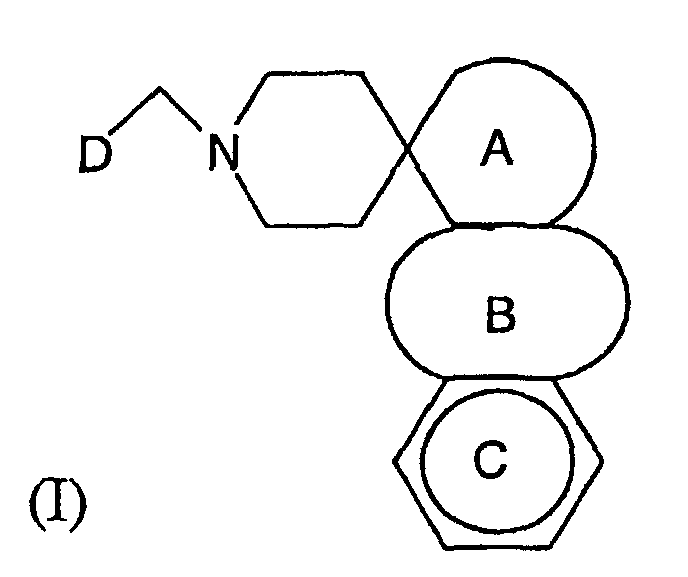

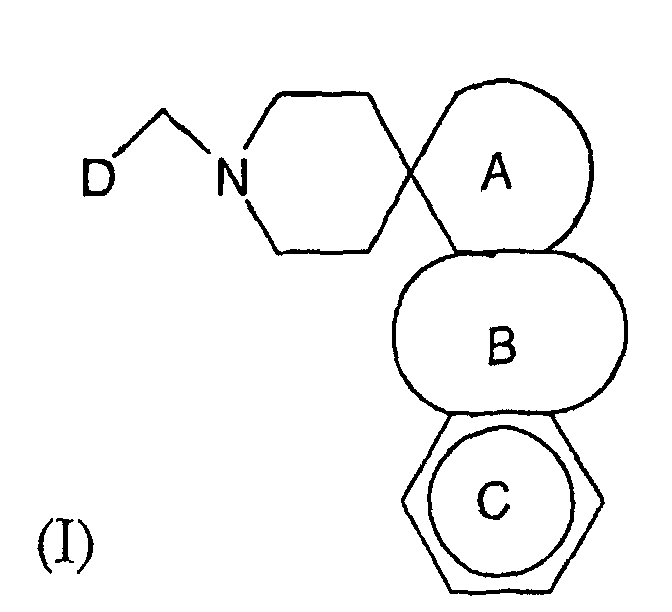
D represents an aromatic ring, which may be substituted and may comprise a heteroatom(s) selected from S, N and O; and
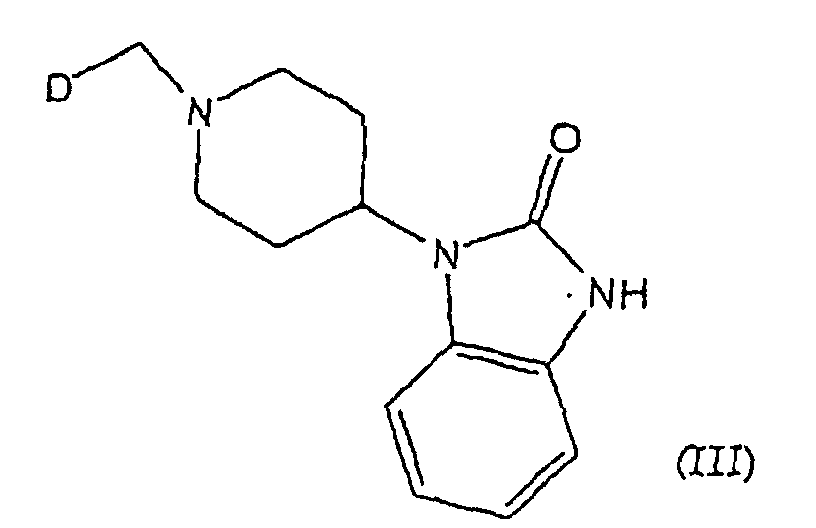
D represents an aromatic ring, which may be substituted and may comprise a heteroatom(s) selected from S, N and O.


This specification includes part or all of the contents as disclosed in the
specifications and/or drawings of Japanese Patent Application Nos. 10-367366 and 11-136812,
which are priority documents of the present application.
Figure 1 shows the position palatability conditioned by the compound of
Example 14 and morphine.
Figure 2 shows the position palatability conditioned by the compound of
Example 16 and morphine.
Generally, the use of a compound having µ opioid receptor agonist activity
as pain control agent is known. However, novel compounds of general formulas (I) to
(III) of the present invention and a pharmacologically acceptable salt thereof are
characterized in that those have both a µ opioid receptor agonist activity and
dopamine D2 receptor antagonist activity. It became clear that the above compounds
show a potent analgetic effect, though it does not cause psychological dependence and
locomotor activity promoting effect as does a strong opioid.
First, the novel compounds of the present invention are described further in
detail.
The term "lower alkyl" as a group or a part of group is used herein to mean
linear or branched alkyl chain containing 1 to 6, preferably 1 to 4 carbon atoms, and
examples of such alkyl include methyl, ethyl, isopropyl, isobutyl, t-butyl and so on.
The term "halogen atom" means fluorine, chlorine, bromine and iodine. The term
"alkoxy" herein means alkyloxy which may be substituted, preferably alkyloxy
containing 1 to 4 carbon atoms, and the examples include linear or branched chain
alkyloxy such as methoxy, ethoxy and isopropyloxy, or cyclic alkyloxy such as
tetrahydropyranyloxy.
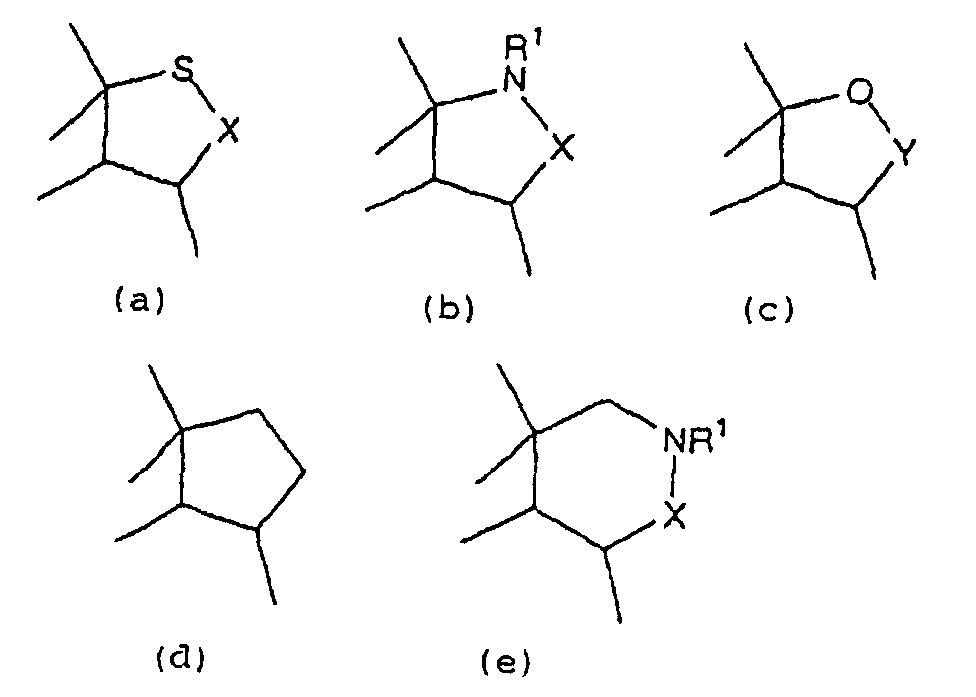
In general formula (I), ring A represents a saturated 5- or 6-membered ring,
which may be substituted and may comprise a heteroatom(s) selected from S, N and O,
and examples of the ring include those shown in the following general formulas (a) to
(e):
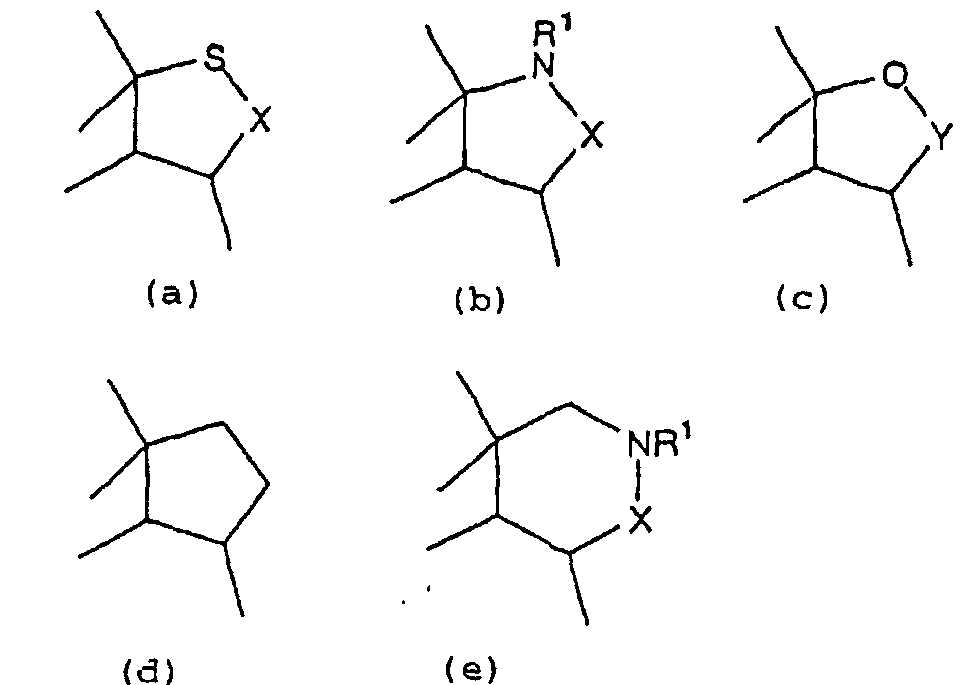 wherein R1 is H or lower alkyl.
A preferred example includes a dihydrofuran group shown in the above
general formula (c), and more preferably includes dihydrofuranone wherein Y is C=O,
or dihydrofuranimine wherein Y is C=NH.
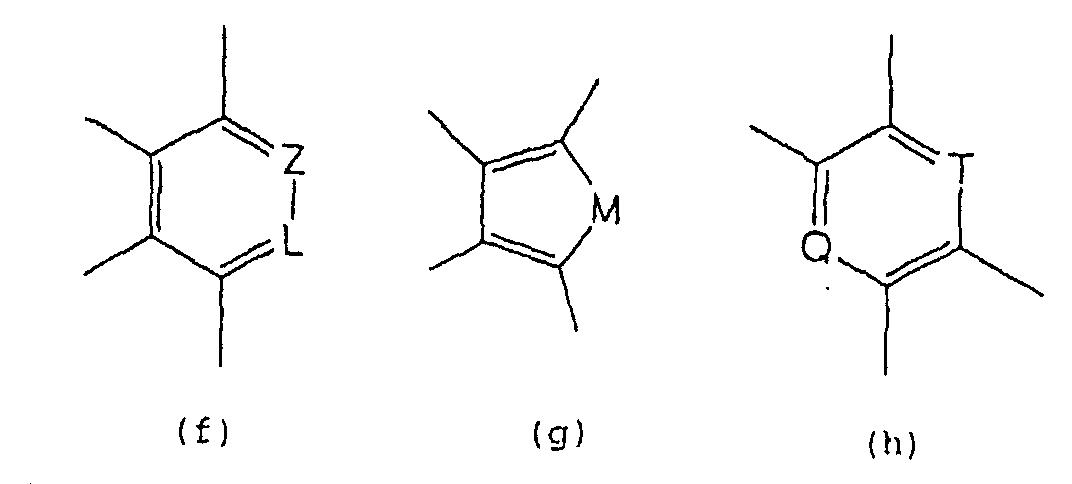
Ring B represents a 5- or 6-membered aromatic ring, which may comprise a
heteroatom selected from N and O, and examples of the ring include those shown in the
following general formulas (f) to (h):
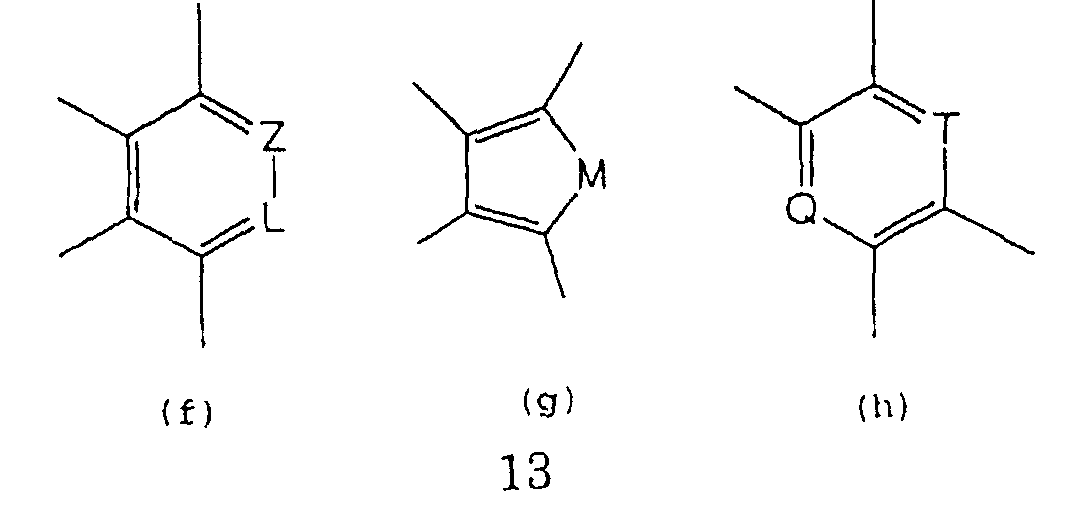
Preferred examples include a benzene ring or a pyridine ring, which are
shown in the above general formula (f), and more preferably includes a benzene ring
wherein both Z and L concurrently represent CH.
Ring C represents a benzene ring or a pyridine ring, which may be substituted,
and a preferred example includes a benzene ring.
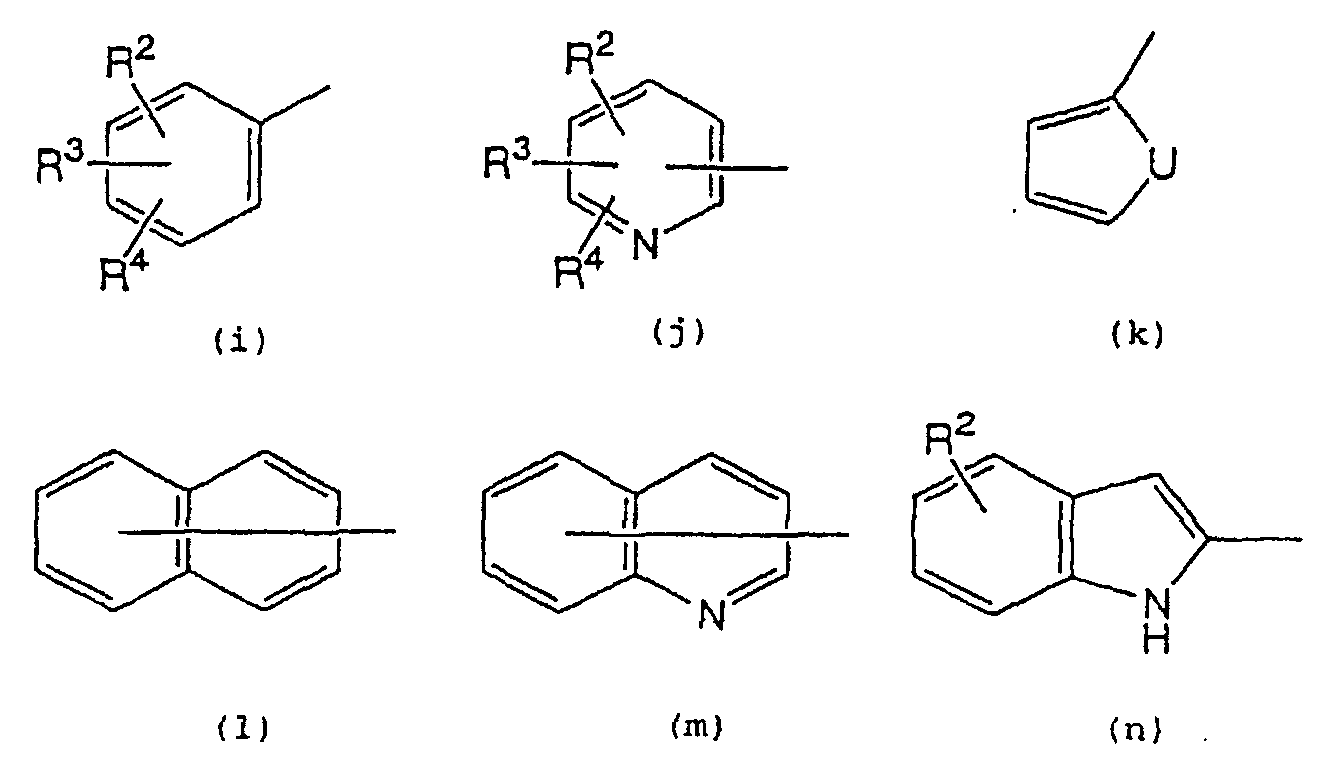
D represents an aromatic ring, which may be substituted and may comprise a
heteroatom(s) selected from S, N and O, and examples of the ring include aromatic
rings shown in the following general formulas (i) to (n):
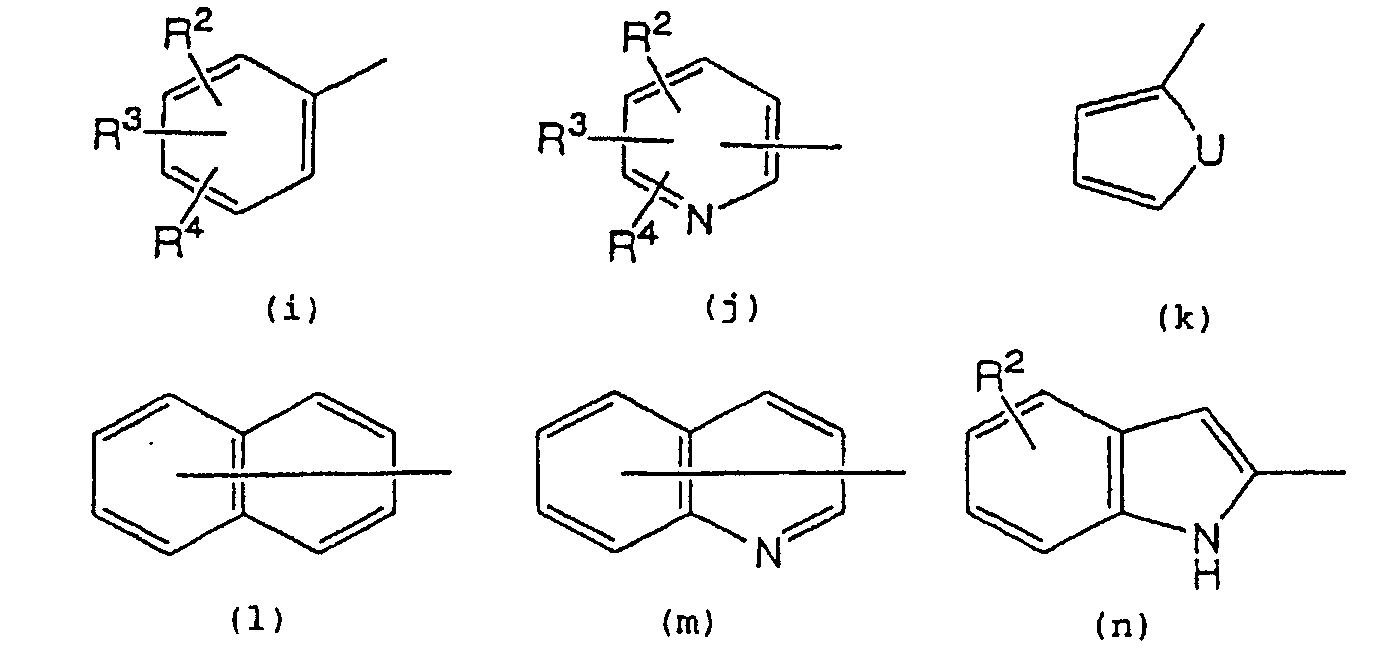
Preferred examples include a benzene ring, a substituted benzene ring, a
pyridine ring or a substituted pyridine ring, which are shown in the above general
formula (i) or (j).
In the above formulas, each of substituents R2, R3 and R4 represents
independently hydrogen, lower alkyl, lower alkoxy, lower alkylthio, lower
alkoxycarbonyl, cyano, halogen, hydroxy, carbamoyl, nitro or amino. Lower alkylthio
herein represents linear or branched alkylthio containing 1 to 4 carbon atoms, such as
methylthio, ethylthio and isopropylthio. Lower alkoxycarbonyl herein represents
alkoxycarbonyl containing 1 to 4 carbon atoms such as methyloxycarbonyl,
ethyloxycarbonyl and isopropyloxycarbonyl. R2, R3 and R4 can independently
substitute for any of hydrogen atoms on a ring, i.e. it may be that none of the hydrogen
atoms are substituted by any substituent other than a hydrogen atom, or one or more
hydrogen atoms may be identically or differently substituted by any substituent other
than a hydrogen atom at one or more points on the ring.
A preferred example of the compound of the present invention includes a
compound, wherein, in the above general formula (I), ring A is (c), Y is C=O or C=NH;
ring B is (f), both Z and L are CH; ring C is a benzene ring; and D is (i) or (j), each of
R2, R3 and R4 is chlorine, fluorine, hydrogen or methoxy.
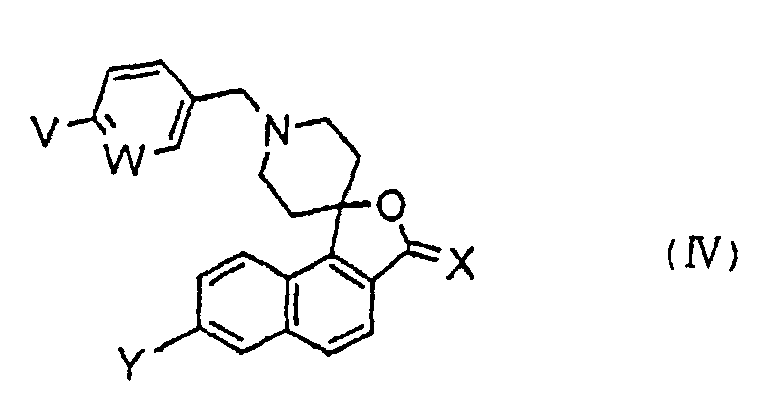
A particularly preferable group of compounds of the present invention
includes a compound shown in the following general formula (IV), which belongs to the
compounds of general formula (I), or pharmacologically acceptable salt thereof:
 wherein V is hydrogen, chlorine, fluorine or methoxy; W is nitrogen or CH; X is NH or
O; and Y is hydrogen, hydroxyl or methoxy.
Another particularly preferable group of compounds of the present invention
includes a compound shown in the following general formula (V), which belongs to the
compounds of general formula (I), or pharmacologically acceptable salt thereof:
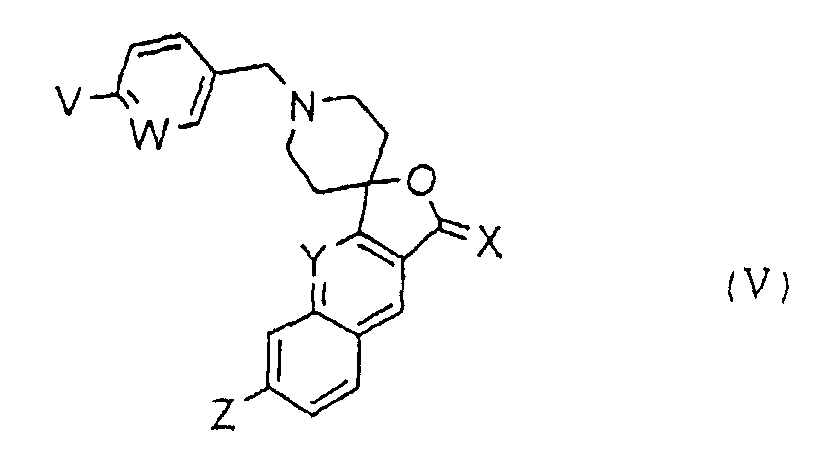 wherein V is hydrogen or chlorine; W is nitrogen or CH; X is NH or O; Y is CH or
nitrogen, and Z is hydrogen or methoxy.
A further particularly preferable group of compounds of the present
invention includes a compound shown in the following general formula (IX), which
belongs to the compounds of general formula (I), or pharmacologically acceptable salt
thereof:
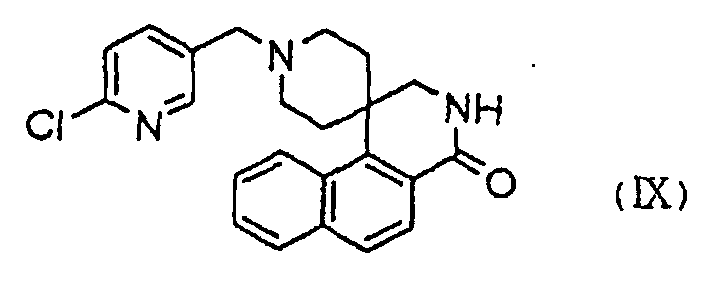
Particularly preferable compounds of the present invention are described, and
specifically named those below, however, a person skilled in the art will realize that, in
the case of a complicated organic compound, a plurality of terms may exist for an
identical compound depending on the nomenclature applied. Therefore, the
nomenclature used in the present specification is described below. The compound
shown in the following structural formula is herein referred as 1'-benzyl(benzo[g]1,3-dihydroisobenzofuran-1-spiro-4'-piperidine)-3-on.

In Japanese Patent Application No. 10-367366, which is a priority
application of the present application, the spirohydrocarbon number, heterocyclic ring
atom number and the characteristic ring number of this compound are shown as follows,
and the compound is referred as 1'-benzyl-benzo[c]spiro[benzodihydrofuran-1(3H), 4'-piperidine]-3-on.

In Japanese Patent Application No. 11-136812, which is also a priority
application of the present application, the spirohydrocarbon number, heterocyclic ring
atom number and the characteristic ring number of this compound are shown as follows,
and the compound is referred as 14-benzylspiro[hydrobenzo[e]isobenzofuran-1, 4'-piperidine]-3-on.

With this being the situation, in respect of compounds described in priority
documents to the present application, the compound name used in the priority
application is also written as an alias name in parentheses.
Examples of a preferable group of compounds of the present invention
include,
Novel compounds of the present invention shown in the above general
formula (I) can be produced by the following method.

The compound of the above general formula (X) can be obtained by the
following process: A base (preferably, lithium 2,2,6,6-tetramethylpyridine) is added to
2-naphthonitrile in a solvent which is not associated with the reaction (e.g.
tetrahydrofuran, dimethoxyethane), and then 4-benzyloxycarbonylpiperidone is further
added thereto. After the mixture is reacted at 0 to -80°C, preferably about -78°C, for 1
to 5 hours, preferably 2 hours, palladium black in formic acid is added. Then, the
obtained mixture is reacted for 2 to 48 hours, preferably about 24 hours.
The compound of the above formula (XI) can be obtained as a commercially
available reagent or obtained by the method described later in Reference examples 1
and 2 (J. Med. Chem. 37, 2729 (1994)); that is, an ester such as substituted methyl
benzoate, substituted ethyl benzoate, substituted methyl nicotinate and substituted ethyl
nicotinate, which are commercially available compounds, is reacted with a reducing
agent such as lithium aluminum hydride at -10 to 50°C, preferably about 0 to 30°C, for
1 to 48 hours, preferably about 2 hours, in a solvent which is not associated with the
reaction (e.g. tetrahydrofuran), followed by Swern oxidation or oxidation with
manganese dioxide.
The compound of the above formula (I) can be obtained by reacting the
compound of the above general formula (X) (in the formula (X), rings A, B and C have
the same definitions as in the above general formula (I)) and the compound of the above
general formula (XI) (in the formula (XI), D has the same definition as in the above
general formula (I)) with sodium triacetoxy borohydride at 20 to 50°C, preferably about
30°C, for 2 to 48 hours, preferably about 5 hours, in a solvent which is not associated
with the reaction (e.g. dichloroethane, tetrahydrofuran, dimethylsulfoxide), in the
presence of acetic acid.
For the synthesis of the compound of general formula (I), the purification of
the target compound from a reaction mixture can be performed by a method well used
in synthetic chemistry, e.g. by a method of partitioning and extracting a reactant into
water and an organic solvent inmiscible with water such as benzene, toluene, ethyl
acetate, butyl acetate, methyl isobutylketone, chloroform and dichloromethane,
followed by concentration, crystallization and so on. Moreover, fractional purification
by a column chromatography with alumina or silica gel can be performed, as required.
The compounds of general formula (I) can be used in the form of
pharmacologically acceptable salts thereof. Examples of possible salt forms include:
acid addition salts with inorganic acids such as hydrochloric acid, nitric acid,
hydrobromic acid and sulfuric acid; those with an aliphatic monocarboxylic acid,
dicarboxylic acid, hydroxyalkanoic acid, hydroxyalkanoic diacid or amino acid; those
induced from atoxic organic acids such as an aromatic acid, an aliphatic or aromatic
sulfonic acid. Examples of such acid addition salts include hydrochloride,
hydrobromate, nitrate, sulfate, hydrogensulfate, monohydrogenphosphate,
dihydrogenphosphate, acetate, propionate, tartrate, oxalate, malonate, succinate,
fumarate, maleate, mandelate, benzoate, phthalate, methanesulfonate, benzenesulfonate,
toluenesulfonate, citrate, lactate, malate, glycolate and the like.
It became clear that, not only the compounds of the above general formula (I),
but also any compound having both µ opioid receptor agonist activity and dopamine
D2 receptor antagonist activity shows a potent analgetic effect and regulates side effects
(in particular, regarding dopamine related behaviors). Therefore, according to the
present invention, a compound having both µ opioid receptor agonist activity and
dopamine D2 receptor antagonist activity (including the above new compound and a
pharmacologically acceptable salt thereof) can be used as a new pain control agent with
regulated side effects, that is, a useful pain control agent with a single agent.
Apart from the compound of the above general formula (I) of the present
invention, any compound having both µ opioid receptor agonist activity and
dopamine D2 receptor antagonist activity can be also used, and the examples include a
compound shown in following general formula (II) or (III):
 wherein D represents an aromatic ring, which may be substituted and may comprise a
heteroatom(s) selected from S, N and O; and
 wherein D represents an aromatic ring, which may be substituted and may comprise a
heteroatom(s) selected from S, N and O.
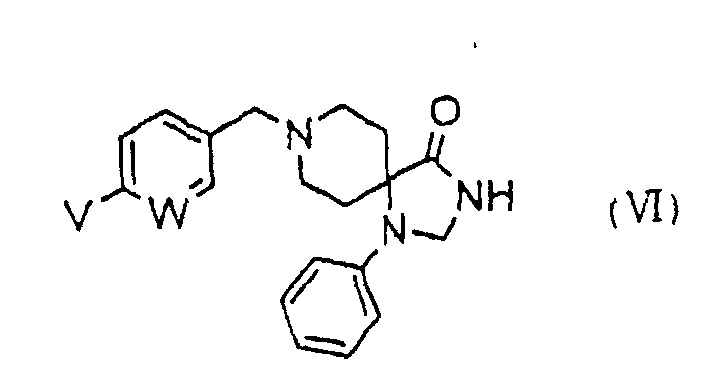
A group of compounds included in compounds of general formula (II)
particularly preferable in the present invention includes a compound shown in the
following general formula (VI) or pharmacologically acceptable salt thereof:
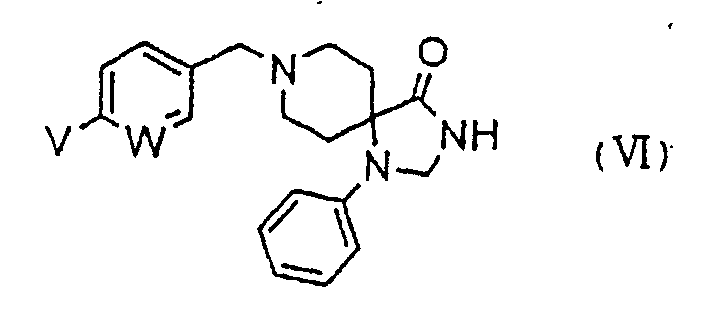 wherein V is hydrogen, chlorine, bromine, methyl or methoxy; and W is nitrogen or
CH.
In addition, another group of compounds included in compounds of general
formula (II) particularly preferable in the present invention includes a compound
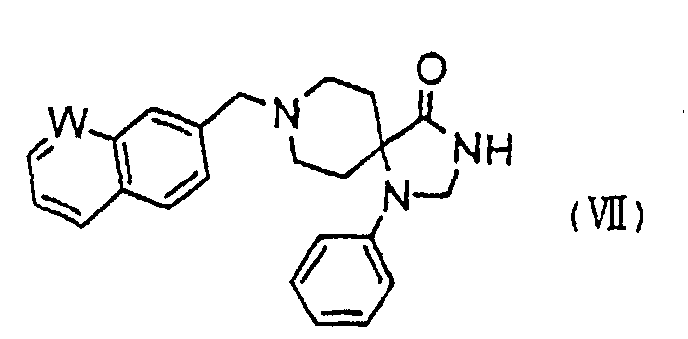
shown in the following general formula (VII) or pharmacologically acceptable salt
thereof:
 wherein W is nitrogen or CH.
Furthermore, a group of compounds comprised in compounds of general
formula (III) particularly preferable in the present invention includes a compound
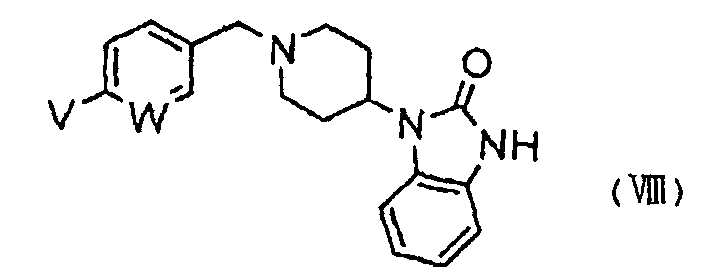
shown in the following general formula (VIII) or pharmacologically acceptable salt
thereof:
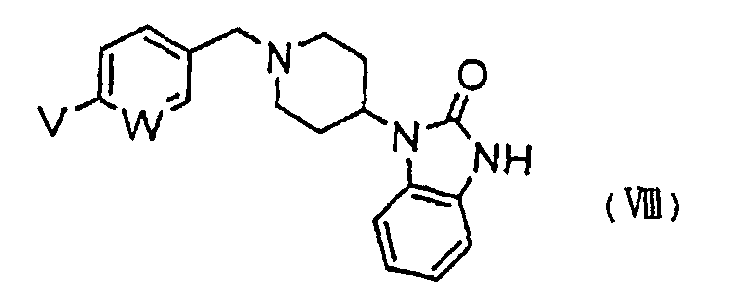 wherein V is chlorine or methoxy; and W is nitrogen or CH.
Compounds of general formulas (II) and (III) are described further in detail.
Just as with the above, the nomenclature used herein for compounds of
general formulas (II) and (III) is described as follows. That is to say, throughout this
specification, the compound shown in the following structural formula is referred as 1'-benzyl-spiroimidazolidine-4,4'-piperidine-3-phenyl-5-on.
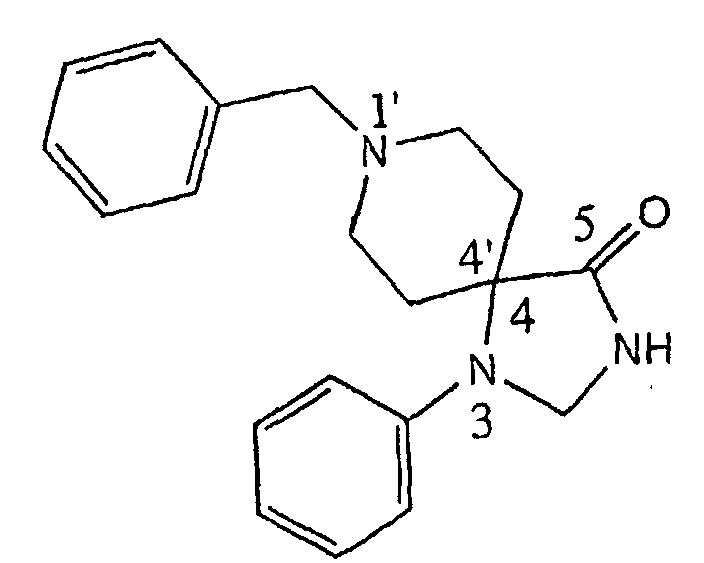
In Japanese Patent Application No. 11-136812, which is a priority application
of the present application, the spirohydrocarbon number, heterocyclic ring atom number
and the ring number characteristic of this structure are shown as follows, and the
compound is referred as 1 -phenyl-8-benzyl-1,3,8-triazaspiro[4,5]decane-4-on.

In general formulas (II) and (III), D adopts the same definition as in the above
general formula (I).
Specific examples of a preferred group of compounds of general formula (II)
and (III) include,
Just as with the compounds of general formula (I), the compounds of general
formulas (II) and (III) can be used in the form of pharmacologically acceptable salts
thereof. Examples of possible salt forms include: acid addition salts with inorganic
acids such as hydrochloric acid, nitric acid, hydrobromic acid and sulfuric acid; those
with an aliphatic monocarboxylic acid, dicarboxylic acid, hydroxyalkanoic acid,
hydroxyalkanoic diacid or amino acid; those induced from atoxic organic acids such as
an aromatic acid, an aliphatic or aromatic sulfonic acid. Examples of such acid
addition salts include hydrochloride, hydrobromide, nitrate, sulfate, hydrogensulfate,
monohydrogenphosphate, dihydrogenphosphate, acetate, propionate, tartrate, oxalate,
malonate, succinate, fumarate, maleate, mandelate, benzoate, phthalate,
methanesulfonate, benzenesulfonate, toluenesulfonate, citrate, lactate, malate, glycolate
and the like.
The compound of general formula (II) or (III) can be produced by the
following method:

Namely, the compounds shown in the above general formulas (XII) and (XIV)
and the compound shown in the above general formula (XIII) (wherein D has the same
definition as in the above general formulas (I) to (III)) are reacted at 20 to 50°C,
preferably at about 30° C, for 2 to 48 hours, preferably about 5 hours, in a solvent which
is not associated with the reaction (e.g, dichloroethane, tetrahydrofuran,
dimethylsulfoxide), in the presence of sodium triacetoxy borohydride and acetic acid.
In addition, the compounds of the above formulas (XII) to (XIV) can be
obtained as commercially available reagents. Furthermore, the compound of general
formula (XIII) can be synthesized by the method described later in Reference examples
1 and 2. That is, an ester such as substituted methyl benzoate, substituted ethyl
benzoate, substituted methyl nicotinate and substituted ethyl nicotinate, which are
commercially available compounds, is reacted with a reducing agent such as lithium
aluminum hydride at -10 to 50°C, preferably about 0 to 30°C, for 1 to 48 hours,
preferably about 2 hours, in a solvent which is not associated with the reaction (e.g.
tetrahydrofuran), followed by Swern oxidation or oxidation with manganese dioxide.
A pharmaceutical composition having, as an active ingredient, the compound
of the present invention can be administered to both humans and non-human animals,
through any route of administration such as oral and parenteral administration (e.g.
intravenous injection, intramuscular injection, and subcutaneous, intrarectal,
percutaneous and intraspinal administration). Therefore, the pharmaceutical
composition having, as an active ingradient, the compound of the present invention
adopts a suitable dosage form depending on the administration route.
Specifically, the oral dosage form includes tablets, capsules, powder, granules,
syrup and so on, while the parenteral dosage form includes intravenous and
intramuscular injections, agents for intrarectal administration, oleaginous suppositories
and aqueous suppositories.
These various formulations can be produced according to standard techniques,
with a commonly used excipient, disintegrator, binder, lubricant, colorant and so on.
Examples of excipients include lactose, glucose, corn starch, sorbit,
crystalline cellulose etc., examples of disintegrators include starch, sodium alginate,
gelatin powder, calcium carbonate, calcium citrate, dextrin etc., examples of binders
include dimethylcellulose, polyvinyl alcohol, polyvinyl ether, methylcellulose,
ethylcellulose, gum arabic, gelatin, hydroxypropylcellulose, polyvinylpyrrolidone etc.,
and examples of lubricants include talc, magnesium stearate, polyethylene glycol,
hydrogenated plant oil etc. Moreover, the above formulations can be produced, as
needed, with the addition of buffer, pH regulator, stabilizer and the like.
The amount of the compound of the present invention contained in a
pharmaceutical composition depends on its dosage form, but it is usually 0.1 to 50
weight %, preferably 0.5 to 20 weight % of the entire composition. The dosage may
be determined as the case may be, considering, for example, age, body weight, sex,
disease type and symptom of the patient, but it is usually 1 to 1,000mg, preferably 1 to
300mg per adult per day, and such dosage may be applied once or divided over several
administrations per day.
The present invention is further described in the following examples. The
example is provided for illustrative purposes only, and is not intended to limit the scope
of the invention.
0.20g (1.17mmol) of methyl 6-chloronicotinate (Lancaster) was dissolved in
4ml of tetrahydrofuran anhydrous, and 0.045g (1.17mmol) of lithium aluminum hydride
was added thereto under ice bath cooling, followed by stirring for 30 minutes. Sodium
sulfate 10 hydrate was added to the reaction mixture until no foam appeared, and after
stirring for 2 hours, filtration with Celite was performed. The filtrate was evaporated,
and the residue was purified with silica gel column chromatography (ethyl acetate) to
obtain 0.090g of 6-chloropyridine-3-methyl alcohol.
1H NMR (CDCl3, 300MHz) δ 3.79(1H, brs), 4.70 (2H, s), 7.31 (1H, d, J = 8.3Hz), 7.69
(1H, dd, J = 2.4, 8.3Hz), 8.28 (1H,d, J= 2.4Hz)
mass spectrum EIMS, m/z :143(M+)
1H NMR (CDCl3, 300MHz) δ 3.79(1H, brs), 4.70 (2H, s), 7.31 (1H, d, J = 8.3Hz), 7.69
(1H, dd, J = 2.4, 8.3Hz), 8.28 (1H,d, J= 2.4Hz)
mass spectrum EIMS, m/z :143(M+)
Subsequently, 1.5ml of methylene chloride anhydrous, in which 0.15ml
(1.89mmol) of dimethylsulfoxide was dissolved, was added at -78°C to the reaction
mixture, to which 2.8ml of methylene chloride anhydrous and 0.09ml (0.94mmol) of
oxalylchloride were added, followed by stirring for 15 minutes. After that, 0.5ml of
methylene chloride anhydrous, in which 0.09g (0.63mmol) of the above 6-chloropyridine-3-methyl
alcohol was dissolved, was added and stirred for 1 hour.
Then, 0.5ml (3.15mmol) of triethylamine was further added thereto, stirred for 1 hour
and the temperature was raised to 0°C. Extraction was performed by adding 20ml of
chloroform and 15ml of saturated sodium chloride solution thereto under ice bath
cooling. After the organic layer was dried with magnesium sulfate anhydrous and the
solvent was evaporated, the residue was purified with silica gel column chromatography
(hexane : ethyl acetate = 1 : 1) to obtain 0.075g of the above compound of interest.
1H NMR (CDCl3, 300MHz) δ 7.53 (1H, d, J=8.3Hz), 8.16(1H, dd, J=2.4, 8.3Hz), 8.88 (1H,d, J=2.4Hz), 10.1 (1H, s)
mass spectrum EIMS, m/z : 141 (M+)
1H NMR (CDCl3, 300MHz) δ 7.53 (1H, d, J=8.3Hz), 8.16(1H, dd, J=2.4, 8.3Hz), 8.88 (1H,d, J=2.4Hz), 10.1 (1H, s)
mass spectrum EIMS, m/z : 141 (M+)
1.00g (6.62mmol) of methyl 6-methyl nicotinate (Lancaster) was dissolved in
20ml of tetrahydrofuran anhydrous, and then 0.25g (6.59mmol) of lithium aluminum
hydride was added thereto under ice bath cooling, followed by stirring for 30 minutes.
Sodium sulfate 10 hydrate was added to the reaction mixture until no foam appeared,
and after stirring for 2 hours, filtration with Celite was performed. The filtrate was
subjected to vacuum concentration, and the residue was purified with silica gel column
chromatography (ethyl acetate) to obtain 0.80g of 6-methylpyridine-3-methyl alcohol.
Subsequently, 4.3ml of methylene chloride anhydrous, in which 0.43ml
(6.06mmol) of dimethylsulfoxide was dissolved, was added at -78°C to the reaction
mixture, to which 8,0ml of methylene chloride anhydrous and 0.27ml (3.10mmol) of
oxalylchloride were added, followed by stirring for 15 minutes. After that, 2.5ml of
methylene chloride anhydrous, in which 0.25g (2.03mmol) of the above 6-methylpyridine-3-methyl
alcohol was dissolved, was further added thereto, followed by
stirring for 1 hour. 1.4ml (10.0mmol) of triethylamine was further added thereto,
stirred for 1 hour and the temperature was raised to 0° C. Extraction was performed by
adding 20ml of chloroform and 15ml of saturated sodium chloride solution thereto
under ice bath cooling. After the organic layer was dried with magnesium sulfate
anhydrous and the solvent was evaporated, the residue was purified with silica gel
column chromatography (hexane : ethyl acetate = 1 : 1) to obtain 0.125g of the above
compound of interest.
1H NMR (CDCl3, 300MHz) δ 2.67 (3H, s), 7.33 (1H, d, J=8.0H z ), 8.07 (1H, dd, J=2.0, 8.0Hz), 8.96 (1H, d, J=2.0Hz), 10.1 (1H, s)
mass spectrum EIMS, m/z : 121 (M+)
1H NMR (CDCl3, 300MHz) δ 2.67 (3H, s), 7.33 (1H, d, J=8.0H z ), 8.07 (1H, dd, J=2.0, 8.0Hz), 8.96 (1H, d, J=2.0Hz), 10.1 (1H, s)
mass spectrum EIMS, m/z : 121 (M+)
0.85g (6.02mmol) of 2,2,6,6-tetramethylpiperidine was dissolved in 25ml of
tetrahydrofuran anhydrous. The reaction mixture was set to 0°C, and 5.3ml of methyl
lithium diethyl ether solution (1.14mol/l) was added thereto, followed by stirring for 30
minutes. The temperature of the reaction mixture was reduced to -78°C, and 0.92g of
2-naphthonitrile dissolved in 3ml of tetrahydrofuran anhydrous was dropped in the
reaction mixture, followed by stirring for 50 minutes. Subsequently, 1.54g (6.60mmol)
of 4-benzyloxycarbonylpiperidone dissolved in 5ml of tetrahydrofuran anhydrous was
added thereto, followed by stirring for 2 hours. The temperature was raised to 0°C
followed by stirring for 1 hour, and then further stirring for 1 hour at room temperature.
Extraction was performed by adding 50ml of methylene chloride, 10ml of water and
5ml of 2mol/l hydrochloric acid solution to the reaction mixture at 0°C. After the
organic layer was dried with magnesium sulfate anhydrous and the solvent was
evaporated, the residue was purified with silica gel column chromatography (methylene
chloride : methanol = 30 : 1) to obtain 0.10g of 1'-benzyloxycarbonyl (benzo[g]1,3-dihydroisobenzofuran-1-spiro-4'-piperidine)-3-imine
and 0.07g of 1'-benzyloxycarbonyl(benzo[f]
1,3-dihydroisobenzofuran-1-spiro-4'-piperidine)-3-imine.
1H NMR (CDCl3, 300MHz) δ 1.76(2H, brd), 2.50-2.64 (2H, m), 3.34-3.52 (2H, m),
4.22-4.44 (2H, m), 5.24 (2H, s), 7.21-8.15 (11 H, m)
mass spectrum EIMS, m/z : 386(M+)
mass spectrum EIMS, m/z : 386(M+)
1H NMR(CDCl3, 300MHz) δ 1.65-1.95 (2H, m), 2.00-2.70 (2H, m), 3.10-3.55 (2H, m),
3.90-4.50 (2H,m), 5.21 (2H,s), 7.23-8.50 (11H, m)
mass spectrum EIMS, m/z : 386 (M+)
mass spectrum EIMS, m/z : 386 (M+)
0.095g (0.250mmol) of the compound obtained in Reference example 3. (1'-benzyloxycarbonyl(benzo[g]1,3-dihydroisobenzofuran-1-spiro-4'-piperidine)-3-imine),
was dissolved in 1.4ml of formic acid, and 0.057g of palladium black was added thereto,
followed by stirring for 24 hours in an argon atmosphere. Then, 0.03g of palladium
black was further added and stirred for 24 hours again. The reaction solution was
filtrated with Celite, and the obtained filtrate was evaporated. Extraction was performed
by adding 10ml of chloroform, 10ml of water and 20ml of saturated sodium bicarbonate
solution to the residue. After the organic layer was dried with magnesium sulfate
anhydrous and the solvent was evaporated to obtain 0.02g of the above compound of
interest.
1H NMR (CDCl3, 300MHz) δ 1.78(2H, d, J=13.0Hz), 2.62(2H, dt, J=5.2, 13.0Hz), 3.12-3.24 (2H, m), 3.26 (2H, d t, J=2.5, 13.0Hz), 7.58-7.66 (2H, m), 7.81-7.88 (1H, m), 7.91-8.03 (2H, m), 8.17-8.23 (1H, m)
mass spectrum EIMS, m/z : 252(M+)
1H NMR (CDCl3, 300MHz) δ 1.78(2H, d, J=13.0Hz), 2.62(2H, dt, J=5.2, 13.0Hz), 3.12-3.24 (2H, m), 3.26 (2H, d t, J=2.5, 13.0Hz), 7.58-7.66 (2H, m), 7.81-7.88 (1H, m), 7.91-8.03 (2H, m), 8.17-8.23 (1H, m)
mass spectrum EIMS, m/z : 252(M+)
0.072g (0.186mmol) of the compound obtained in Reference example 3. (1'-benzyloxycarbonyl(benzo[f]
1,3-dihydroisobenzofuran-1-spiro-4'-piperidine)-3-imine),
was dissolved in 1.4ml of formic acid, and 0.043g of palladium black was added thereto,
followed by stirring for 24 hours in an argon atmosphere. Then, 0.03g of palladium
black was further added and stirred for 24 hours again. The reaction solution was
filtrated with Celite, and the obtained filtrate was evaporated. Extraction was performed
by adding 10ml of chloroform, 10ml of water and 20ml of saturated sodium bicarbonate
solution to the residue. After the organic layer was dried with magnesium sulfate
anhydrous and the solvent was evaporated to obtain 0.017g of the above compound of
interest.
1H NMR (CDCl3, 400MHz) δ 1.70-1.90 (2H,m), 2.22 (2H, dt, J=5.2, 13.7Hz), 3.12-3.30 (4H, m), 7.60 (1H, ddd, J=1.4, 6.8, 7.8Hz), 7.67 (1H, ddd, J=1.4, 6.8, 7.8Hz), 7.83 (1H, s), 7.96 (1H, d, J=7.8Hz), 8.05 (1H, d, J=7.8Hz), 8.47 (1H, s)
mass spectrum EIMS, m/z : 252(M+)
1H NMR (CDCl3, 400MHz) δ 1.70-1.90 (2H,m), 2.22 (2H, dt, J=5.2, 13.7Hz), 3.12-3.30 (4H, m), 7.60 (1H, ddd, J=1.4, 6.8, 7.8Hz), 7.67 (1H, ddd, J=1.4, 6.8, 7.8Hz), 7.83 (1H, s), 7.96 (1H, d, J=7.8Hz), 8.05 (1H, d, J=7.8Hz), 8.47 (1H, s)
mass spectrum EIMS, m/z : 252(M+)
0.042 g (0.166mmol) of the compound obtained in Reference example 4. and
0.024g (0.169mmol) of 6-chloropyridine-3-carboaldehyde obtained in Reference
example 1. were dissolved in 0.84ml of 1,2-dichloroethane, and then 0.09ml
(1.66mmol) of acetic acid and 0.053g (0.25mmol) of sodium triacetoxy borohydride
were added thereto, followed by stirring for 12 hours. Extraction was performed by
adding 10ml of chloroform, 5ml of water and 5ml of saturated sodium bicarbonate
solution to the reaction solution. After the organic layer was dried with magnesium
sulfate anhydrous and the solvent was evaporated, the residue was purified with silica
gel column chromatography (methylene chloride : methanol = 20 : 1) to obtain 0.020g
of the above compound of interest.
1H NMR (CDCl3, 300MHz) δ 1.80(2H, brd), 2.59-2.85 (4H, m), 2.85-3.00 (2H, m), 3.65 (2H, s), 7.34 (1H, d, J=8.3Hz), 7.60-7.80 (3H, m), 7.84 (1H, t, J=8.3Hz), 7.90-8.08 (2H, m), 8.12 (1H, d, J=7.2Hz), 8.44 (1H, d, J=2.4Hz)
mass spectrum EIMS, m/z: 377(M+)
1H NMR (CDCl3, 300MHz) δ 1.80(2H, brd), 2.59-2.85 (4H, m), 2.85-3.00 (2H, m), 3.65 (2H, s), 7.34 (1H, d, J=8.3Hz), 7.60-7.80 (3H, m), 7.84 (1H, t, J=8.3Hz), 7.90-8.08 (2H, m), 8.12 (1H, d, J=7.2Hz), 8.44 (1H, d, J=2.4Hz)
mass spectrum EIMS, m/z: 377(M+)
0.012g (0.032mmol) of the compound obtained in example 1. was dissolved
in 0.25ml of methylene chloride, and 0.03g (0.127mmol) of camphor sulfonic acid was
added thereto, followed by stirring. At each of 2, 20 and 44 hours after initiation of
the reaction, 0.03g (0.127mmol) of camphor sulfonic acid was further added, and at 28
hours after initiation of the reaction, 0.1ml of water was further added. At 66 hours
after initiation of the reaction, extraction was performed by adding 3ml of chloroform
and 2ml of saturated sodium bicarbonate solution. After the organic layer was dried
with magnesium sulfate anhydrous and the solvent was evaporated, the residue was
purified with silica gel column chromatography (methylene chloride : methanol = 20 :
1) to obtain 0.006g of the above compound of interest.
1H NMR (CDCl3, 300MHz) δ 1.80(2H, brd), 2.67-2.85 (4H, m), 2.95(2H, d, J=5.9Hz), 3.66 (2H, s), 7.34 (1H, dd, J=1.3, 8.3Hz), 7.69-7.77 (3H, m), 7.80 (1H, dd, J=1.3, 8.3Hz), 7.98 (1H, d, J=8.3Hz), 8.02-8.08 (1H, m), 8.15-8.23 (1H, m), 8.46(1H, s)
mass spectrum EIMS, m/z: 378(M+)
1H NMR (CDCl3, 300MHz) δ 1.80(2H, brd), 2.67-2.85 (4H, m), 2.95(2H, d, J=5.9Hz), 3.66 (2H, s), 7.34 (1H, dd, J=1.3, 8.3Hz), 7.69-7.77 (3H, m), 7.80 (1H, dd, J=1.3, 8.3Hz), 7.98 (1H, d, J=8.3Hz), 8.02-8.08 (1H, m), 8.15-8.23 (1H, m), 8.46(1H, s)
mass spectrum EIMS, m/z: 378(M+)
0.020 g (0.079mmol) of the compound obtained in Reference example 5. and
0.011g (0.077mmol) of 6-chloropyridine-3-carboaldehyde obtained in Reference
example 1. were dissolved in 0.40ml of 1,2-dichloroethane, and then 0.044ml
(0.79mmol) of acetic acid and 0.025g (0.12mmol) of sodium triacetoxy borohydride
were added thereto, followed by stirring for 12 hours. Extraction was performed by
adding 10ml of chloroform, 5ml of water and 5ml of saturated sodium bicarbonate
solution to the reaction solution. After the organic layer was dried with magnesium
sulfate anhydrous and the solvent was evaporated, the residue was purified with silica
gel column chromatography (methylene chloride : methanol = 20 : 1) to obtain 0.010g
of the above compound of interest.
1H NMR (CDCl3, 400MHz) δ 1.84(2H, brd), 2.32(2H, d, J=4.6, 13.0Hz), 2.64 (2H, d, J=2.2, 13.0Hz), 2.91 (2H, brd), 3.63 (2H, s), 7.33 (1H, d, J=8.0Hz), 7.60 (1H, ddd, J=1.2, 7.8, 8.3Hz), 7.67 (1H, ddd, J=1.2, 8.0, 8.3Hz), 7.71 (1H, dd, J=2.2, 8.0Hz), 7.84(1H, s), 7.96 (1H, d, J=8.0Hz), 8.04 (1H, d, J=7.8Hz), 8.41 (1H, d, J=2.2Hz), 8.46 (1H, s)
mass spectrum EIMS, m/z: 378(M+)
1H NMR (CDCl3, 400MHz) δ 1.84(2H, brd), 2.32(2H, d, J=4.6, 13.0Hz), 2.64 (2H, d, J=2.2, 13.0Hz), 2.91 (2H, brd), 3.63 (2H, s), 7.33 (1H, d, J=8.0Hz), 7.60 (1H, ddd, J=1.2, 7.8, 8.3Hz), 7.67 (1H, ddd, J=1.2, 8.0, 8.3Hz), 7.71 (1H, dd, J=2.2, 8.0Hz), 7.84(1H, s), 7.96 (1H, d, J=8.0Hz), 8.04 (1H, d, J=7.8Hz), 8.41 (1H, d, J=2.2Hz), 8.46 (1H, s)
mass spectrum EIMS, m/z: 378(M+)
12.6mg (50 µ mol) of the compound obtained in Reference example 4. and 11
µ 1 (100 µ mol) of 4-fluorobenzaldehyde (Tokyo Kasei Kogyo Co., Ltd.) were dissolved
in 2ml of 1,2-dimethoxyethane (1% acetic acid), and then 43.4mg (205 µ mol) of
sodium triacetoxy borohydride was added thereto, followed by stirring at room
temperature for 2 hours. The reaction solution was evaporated, and the residue was
purified with silica gel column chromatography (ethyl acetate : hexane = 1 : 2 to
methylene chloride : methanol = 8 : 1) to obtain 17.4mg of the above compound of
interest.
1H NMR (CDCl3, 400MHz) δ 1.83 (2H, d, J=12.7 Hz), 2.80-2.98 (4H, m), 3.25 (2H, brd), 3.89 (2H, s), 7.09 (2H, t, J=8.5Hz), 7.43 (2H, dd, J=5.3, 8.5Hz), 7.62-7.67 (2H, m), 7.84 (1H, d, J=8.5Hz), 7.94-8.01 (2H, m), 8.21 (1H, dd, J=4.2, 5.3Hz)
mass spectrum TSPMS, m/z :361(M+H)+
1H NMR (CDCl3, 400MHz) δ 1.83 (2H, d, J=12.7 Hz), 2.80-2.98 (4H, m), 3.25 (2H, brd), 3.89 (2H, s), 7.09 (2H, t, J=8.5Hz), 7.43 (2H, dd, J=5.3, 8.5Hz), 7.62-7.67 (2H, m), 7.84 (1H, d, J=8.5Hz), 7.94-8.01 (2H, m), 8.21 (1H, dd, J=4.2, 5.3Hz)
mass spectrum TSPMS, m/z :361(M+H)+
Using 12.6mg (50 µ mol) of the compound obtained in Reference example 4.
and 14mg (100 µ mol) of 4-chlorobenzaldehyde (Nacalai Tesque, Inc.), 15.9mg of the
above compound of interest was obtained by the same method as shown in Example 4.
1H NMR (CDCl3, 400MH z ) δ 1.82(2H, d, J=12.4Hz), 2.75-2.92 (4H, m), 3.18(2H, brd), 3.84(2H, s), 7.31-7.40 (4H, m), 7.62-7.67 (2H, m), 7.84 (1H, d, J=8.5Hz), 7.93 - 8.01 (2H, m), 8.20 (1H. dd, J=2.9, 9.5Hz)
mass spectrum TSPMS, m/z: 377(M+H)+
1H NMR (CDCl3, 400MH z ) δ 1.82(2H, d, J=12.4Hz), 2.75-2.92 (4H, m), 3.18(2H, brd), 3.84(2H, s), 7.31-7.40 (4H, m), 7.62-7.67 (2H, m), 7.84 (1H, d, J=8.5Hz), 7.93 - 8.01 (2H, m), 8.20 (1H. dd, J=2.9, 9.5Hz)
mass spectrum TSPMS, m/z: 377(M+H)+
Using 12.6mg (50 µ mol) of the compound obtained in Reference example 4.
and 14mg (100 µ mol) of 4-methoxybenzaldehyde (Tokyo Kasei Kogyo Co., Ltd.),
18.9mg of the above compound of interest was obtained by the same method as in
Example 4.
1H NMR (CDCl3, 400MH z ) δ 1.83(2H, d, J=13.4Hz), 2.82-3.02 (4H, m), 3.29(2H, brd), 3.83(3H, s), 3.90 (2H, s), 6.91-6.95 (2H, m), 7.37 (2H, d, J=8.5Hz), 7.61-7.67 (2H, m), 7.82 (1H, d, J=8.5Hz), 7.93-8.00 (2H, m), 8.24 (1H, dd, J=2.4, 9.0Hz)
mass spectrum TSPMS, m/z: 373(M+H)+
1H NMR (CDCl3, 400MH z ) δ 1.83(2H, d, J=13.4Hz), 2.82-3.02 (4H, m), 3.29(2H, brd), 3.83(3H, s), 3.90 (2H, s), 6.91-6.95 (2H, m), 7.37 (2H, d, J=8.5Hz), 7.61-7.67 (2H, m), 7.82 (1H, d, J=8.5Hz), 7.93-8.00 (2H, m), 8.24 (1H, dd, J=2.4, 9.0Hz)
mass spectrum TSPMS, m/z: 373(M+H)+
17.4mg of the compound obtained in Example 4 was dissolved in 0.75ml of
chloroform and left at room temperature overnight to obtain 17.4mg of the above
compound of interest.
1H NMR (CDCl3, 400MH z ) δ 1.72 (2H, brd), 2.61-2.80 (4H, m), 2.99(2H, brd), 3.64 (2H, s), 6.96-7.01 (2H, m), 7.29-7.34 (2H, m), 7.54-7.64 (2H, m), 7.79 (1H, m), 7.88-7.97 (2H, m), 8.14 (1H, m)
mass spectrum TSPMS, m/z: 362(M+H)+
1H NMR (CDCl3, 400MH z ) δ 1.72 (2H, brd), 2.61-2.80 (4H, m), 2.99(2H, brd), 3.64 (2H, s), 6.96-7.01 (2H, m), 7.29-7.34 (2H, m), 7.54-7.64 (2H, m), 7.79 (1H, m), 7.88-7.97 (2H, m), 8.14 (1H, m)
mass spectrum TSPMS, m/z: 362(M+H)+
15.9mg of the compound obtained in Example 5 was dissolved in 0.75ml of
chloroform and left at room temperature overnight to obtain 15.9mg of the above
compound of interest.
1H NMR (CDCl3, 400MH z ) δ 1.77-1.81 (2H, brd), 2.63 - 2.85 (4H, m), 3.00-3.02 (2H, m), 3.68 (2H, s), 7.33-7.39 (4H, m), 7.62-7.71 (2H, m), 7.84 (1H, dd, J=5.6, 8.5Hz), 7.92-8.05 (2H, m), 8.20 (1H, m)
mass spectrum TSPMS, m/z: 378(M+H)+
1H NMR (CDCl3, 400MH z ) δ 1.77-1.81 (2H, brd), 2.63 - 2.85 (4H, m), 3.00-3.02 (2H, m), 3.68 (2H, s), 7.33-7.39 (4H, m), 7.62-7.71 (2H, m), 7.84 (1H, dd, J=5.6, 8.5Hz), 7.92-8.05 (2H, m), 8.20 (1H, m)
mass spectrum TSPMS, m/z: 378(M+H)+
18.9mg of the compound obtained in Example 6 was dissolved in 0.75ml of
chloroform and left at room temperature overnight to obtain 18.9mg of the above
compound of interest.
1H NMR (CDCl3, 400MH z ) δ 1.79 (2H, brd), 2.65-2.88 (4H, m), 3.07 (2H, brd), 3.70 (2H, s), 3.83 (3H, s), 6.91 (2H, d, J=7.3Hz), 7.29-7.36 (2H, m), 7.60-7.70 (2H, m), 7.83 (1H, dd, J=7.3, 8.3Hz), 7.92 - 8.04 (2H, m), 8.18 - 8.27 (1H, m)
mass spectrum TSPMS, m/z: 374(M+H)+
1H NMR (CDCl3, 400MH z ) δ 1.79 (2H, brd), 2.65-2.88 (4H, m), 3.07 (2H, brd), 3.70 (2H, s), 3.83 (3H, s), 6.91 (2H, d, J=7.3Hz), 7.29-7.36 (2H, m), 7.60-7.70 (2H, m), 7.83 (1H, dd, J=7.3, 8.3Hz), 7.92 - 8.04 (2H, m), 8.18 - 8.27 (1H, m)
mass spectrum TSPMS, m/z: 374(M+H)+
0.85g (6.02mmol) of 2,2,6,6-tetramethylpiperidine was dissolved in 25ml of
tetrahydrofuran anhydrous. The reaction mixture was set to 0°C, and 5.3ml of
1,14mol/l methyl lithium diethyl ether solution was added thereto, followed by stirring
for 30 minutes. The temperature of the reaction mixture was reduced to -78°C, and
0.92g of 2-naphthonitrile dissolved in 3ml of tetrahydrofuran anhydrous was added
dropwise to the reaction mixture, followed by stirring for 50 minutes. Subsequently,
1.25g (6.60mmol) of 4-benzylpiperidone dissolved in 5ml of tetrahydrofuran anhydrous
was added thereto, followed by stirring for 2 hours. The temperature was raised to 0°C
followed by stirring for 1 hour, and then further stirring at room temperature for 1 hour.
Extraction was performed by adding 50ml of methylene chloride, 10ml of water and
5ml of 2mol/l hydrochloric acid solution to the reaction mixture at 0°C. After the
organic layer was dried with magnesium sulfate anhydrous and the solvent was
evaporated, the residue was purified with silica gel column chromatography (methylene
chloride : methanol = 20 : 1) to obtain 0.46g of the above compound of interest.
1H NMR (CDCl3, 400MHz) δ 1.79(2H, brd), 2.59 (2H, brt), 2.74 (2H, dt, J=4.4, 13.0Hz), 2.97 (2H, dd, J=1.8, 8.3Hz), 3.68 (2H, s), 7.25-7.50 (5H, m), 7.55-7.70 (2H, m), 7.84 (1H, brs), 7.92 (1H, d, J =8.6Hz), 7.99 (1H, d, J=7.3Hz), 8.18 (1H, d, J=7.3 Hz)
mass spectrum EIMS, m/z: 342(M+)
1H NMR (CDCl3, 400MHz) δ 1.79(2H, brd), 2.59 (2H, brt), 2.74 (2H, dt, J=4.4, 13.0Hz), 2.97 (2H, dd, J=1.8, 8.3Hz), 3.68 (2H, s), 7.25-7.50 (5H, m), 7.55-7.70 (2H, m), 7.84 (1H, brs), 7.92 (1H, d, J =8.6Hz), 7.99 (1H, d, J=7.3Hz), 8.18 (1H, d, J=7.3 Hz)
mass spectrum EIMS, m/z: 342(M+)
0.015g (0.044mmol) of 1'-benzyl (benzo[g]1,3-dihydroisobenzofuran-1-spiro-4'-piperidine)-3-imine
obtained in Example 10 was dissolved in 0.15ml of methylene
chloride, and then 0.01g (0.044mmol) of camphor sulfonic acid was added thereto,
followed by stirring. At 18 hours after initiation of the reaction, 0.03g (0.131mmol) of
camphor sulfonic acid was further added. At 22 hours after initiation of the reaction,
extraction was performed by adding 3ml of chloroform and 2ml of saturated sodium
bicarbonate solution. After the organic layer was dried with magnesium sulfate
anhydrous and the solvent was evaporated, the residue was purified with silica gel
column chromatography (methylene chloride : methanol = 20 : 1) to obtain 0.006g of
the above compound of interest.
1H NMR (CDCl3, 300MHz) δ 1.78(2H, brd), 2.62-2.87 (4H, m), 3.00 (2H, brd), 3.69 (2H, s), 7.22-7.47 (5H, m), 7.65-7.75 (2H, m), 7.85 (1H, d, J=8.5Hz), 7.97 (1H, d, J=8.5Hz), 8.00-8.06 (1H, m), 8.21-8.28 (1H, m)
mass spectrum EIMS,m/z:343(M+)
1H NMR (CDCl3, 300MHz) δ 1.78(2H, brd), 2.62-2.87 (4H, m), 3.00 (2H, brd), 3.69 (2H, s), 7.22-7.47 (5H, m), 7.65-7.75 (2H, m), 7.85 (1H, d, J=8.5Hz), 7.97 (1H, d, J=8.5Hz), 8.00-8.06 (1H, m), 8.21-8.28 (1H, m)
mass spectrum EIMS,m/z:343(M+)
5.00g (47.6mmol) of diethanolamine (Tokyo Kasei Kogyo Co., Ltd.) was
dissolved in 100ml of N,N-dimethylformamide anhydrous, and then 8.70g (62.9mmol)
of potassium carbonate and 6.52ml (54.8mmol) of benzyl bromide were added thereto
followed by stirring for 21 hours. Extraction was performed by adding 200ml of water
and 200ml of methylene chloride to the reaction mixture. After the organic layer was
dried with magnesium sulfate anhydrous and the solvent was evaporated, the residue
was purified with silica gel column chromatography (methylene chloride : methanol =
10 : 1) to obtain 8.4g of bis(2-hydroxyethyl)benzylamine.
Then, 45ml of methylene chloride and 75ml of thionyl chloride were added to
the obtained 8.4g (43.0mmol) of bis(2-hydroxyethyl)benzylamine and stirred for 12
hours. 100ml of methylene chloride and 500ml of saturated sodium bicarbonate
solution were added to the reaction mixture at 0°C, and then this reaction solution was
poured into a solution containing 250g of saturated sodium bicarbonate, followed by
extraction with methylene chloride. After the organic layer was dried with magnesium
sulfate anhydrous and the solvent was evaporated, the residue was purified with silica
gel column chromatography (hexane : ethyl acetate = 4 : 1) to obtain 8.8g of the above
compound of interest.
mass spectrum EIMS, m/z: 231, 233 (M+)
mass spectrum EIMS, m/z: 231, 233 (M+)
6.40g (38.3mmol) of 1-naphthaleneacetonitrile (Tokyo Kasei Kogyo Co.,
Ltd.) was dissolved in 64ml of dimethylsulfoxide anhydrous, and then 2.01g
(83.8mmol) of sodium hydride washed with n-hexane was added thereto, followed by
stirring for 30 minutes. 8.90g (38.3mmol) of bis(2-chloroethyl)benzylamine obtained
in Reference example 6. was added thereto, and stirred, first, at 75°C for 1 hour in an oil
bath, then at room temperature for 1 hour. Extraction was performed by adding 300ml
of water and 300ml of diethyl ether thereto under ice bath cooling. After the organic
layer was dried with magnesium sulfate anhydrous and the solvent was evaporated, the
residue was purified with silica gel column chromatography (hexane : ethyl acetate = 2 :
1) to obtain 10.7g of the above compound of interest.
1H NMR (CDCl3, 300MHz) δ 2.20(2H, brt), 2.60 (2H, brd), 2.74 (2H, dt, J=1.9Hz, J =12.3Hz), 3.07 (2H, brd), 3.65 (2H, s), 7.25-7.65 (9H, m), 7.85 (1H, d, J=7.7Hz), 7.91 (1H, d, J=8.0Hz), 8.53 (1H, d, J=8.0Hz)
mass spectrum EIMS, m/z: 326(M+)
1H NMR (CDCl3, 300MHz) δ 2.20(2H, brt), 2.60 (2H, brd), 2.74 (2H, dt, J=1.9Hz, J =12.3Hz), 3.07 (2H, brd), 3.65 (2H, s), 7.25-7.65 (9H, m), 7.85 (1H, d, J=7.7Hz), 7.91 (1H, d, J=8.0Hz), 8.53 (1H, d, J=8.0Hz)
mass spectrum EIMS, m/z: 326(M+)
10.7g (32.8mmol) of the compound obtained in Reference example 7 was
dissolved in 100ml of methylene chloride, and then 3.94g (39.4mmol) of potassium
bicarbonate and 3.8ml (39.7mmol) of ethyl chlorocarbonate were added thereto,
followed by stirring for 20 hours. Extraction was performed by adding 200ml of
methylene chloride and 150ml of water. After the organic layer was dried with
magnesium sulfate anhydrous and the solvent was evaporated, the residue was purified
with silica gel column chromatography (hexane : acetone = 4 : 1) to obtain 9.8g of the
above compound of interest.
1H NMR (CDCl3, 300MHz) δ 1.29(3H, t, J=7.1Hz), 2.05 (2H, dt, J=4.2Hz, J=13.2Hz), 2.63 (2H, brd), 3.47 (2H, brt), 4.18 (2H, q, J=7.1Hz), 4.40 (2H, brs), 7.43-7.67 (4H, m), 7.84-7.91 (1H, m), 7.93 (1H, d, J=8.0Hz), 8.51 (1H, d, J=8.7Hz)
mass spectrum EIMS, m/z: 308(M+)
1H NMR (CDCl3, 300MHz) δ 1.29(3H, t, J=7.1Hz), 2.05 (2H, dt, J=4.2Hz, J=13.2Hz), 2.63 (2H, brd), 3.47 (2H, brt), 4.18 (2H, q, J=7.1Hz), 4.40 (2H, brs), 7.43-7.67 (4H, m), 7.84-7.91 (1H, m), 7.93 (1H, d, J=8.0Hz), 8.51 (1H, d, J=8.7Hz)
mass spectrum EIMS, m/z: 308(M+)
9.8g (31.8mmol) of the compound obtained in Reference example 8 was
dissolved in 250ml of ethanol, then 5.0g of palladium carbon and 13.2ml (66mmol) of
5N hydrochloric acid were added thereto, followed by stirring for 10 hours in a
hydrogen atmosphere. 5.0g of palladium carbon was further added and stirred for 24
hours. The reaction solution was filtrated with Celite, the filtrate was evaporated, and
the residue was purified with silica gel column chromatography (hexane : acetone = 4 :
1) to obtain 9.8g of the above compound of interest.
mass spectrum EIMS, m/z: 312 (M+)
mass spectrum EIMS, m/z: 312 (M+)
7.61g (24.4mmol) of the compound obtained in Reference example 9 was
dissolved in 66ml of methylene chloride, then 2.5ml (26.0mmol) of ethyl
chlorocarbonate and 3.5ml (25.1mmol) of triethylamine were added thereto, followed
by stirring for 2 hours. Extraction was performed by adding 100ml of methylene
chloride and 75ml of saturated sodium bicarbonate solution to the reaction mixture.
After the organic layer was dried with magnesium sulfate anhydrous and the solvent
was evaporated, the residue was purified with silica gel column chromatography
(hexane : ethyl acetate = 2: 1) to obtain 7.97g of the above compound of interest.
1H NMR (CDCl3, 300MHz) δ 1.15(3H, t, J=7.1Hz), 1.24 (3H, t, J=7.1Hz), 2.05-2.21 (2H, m), 2.40-2.53 (2H, m), 3.37 (2H, brt), 3.67-3.79 (2H, m), 3.95-4.25 (6H, m), 7.43-7.55 (4H, m), 7.80 (1H, dt, J=4.7Hz), 7.89-7.94 (1H, m), 8.40 (1H, brd)
mass spectrum EIMS, m/z: 384(M+)
1H NMR (CDCl3, 300MHz) δ 1.15(3H, t, J=7.1Hz), 1.24 (3H, t, J=7.1Hz), 2.05-2.21 (2H, m), 2.40-2.53 (2H, m), 3.37 (2H, brt), 3.67-3.79 (2H, m), 3.95-4.25 (6H, m), 7.43-7.55 (4H, m), 7.80 (1H, dt, J=4.7Hz), 7.89-7.94 (1H, m), 8.40 (1H, brd)
mass spectrum EIMS, m/z: 384(M+)
79g of polyphosphoric acid was added to 7.97g (28.8mmol) of the compound
obtained in Reference example 10, and stirred at 150°C for 1 hour in an oil bath.
Extraction was performed by adding 300ml of ice water, 300ml of methylene chloride
and 350ml of 5N sodium hydroxide solution to the reaction mixture. The organic layer
was dried with magnesium sulfate anhydrous and the solvent was evaporated to obtain
2.27g of the above compound of interest.
1H NMR (CDCl3, 300MHz) δ 1.70 (2H, brd), 2.90-3.05 (4H, m), 3.15 (2H, brd), 3.72 (2H, brd), 7.09 (1H, brs), 7.50-7.60 (2H, m), 7.81 (1H, d, J=8.5Hz), 7.85-7.92 (1H, m), 8.17 (1H, d, J=8.5Hz), 8.73-8.81 (1H, m)
mass spectrum EIMS, m/z: 266(M+)
1H NMR (CDCl3, 300MHz) δ 1.70 (2H, brd), 2.90-3.05 (4H, m), 3.15 (2H, brd), 3.72 (2H, brd), 7.09 (1H, brs), 7.50-7.60 (2H, m), 7.81 (1H, d, J=8.5Hz), 7.85-7.92 (1H, m), 8.17 (1H, d, J=8.5Hz), 8.73-8.81 (1H, m)
mass spectrum EIMS, m/z: 266(M+)
0.02g (0.075mmol) of the compound obtained in Reference example 11 and
0.01g (0.077mmol) of 6-chloropyridine-3-carboaldehyde obtained in Reference
example 1. were dissolved in 2.0ml of 1,2-dichloroethane, then 0.043ml (0.78mmol) of
acetic acid and 0.025g (0.12mmol) of sodium triacetoxy borohydride were added
thereto, followed by stirring for 12 hours. Extraction was performed by adding 3.0ml
of chloroform, 1.0ml of water and 3.0ml of saturated sodium bicarbonate solution to the
reaction solution. After the organic layer was dried with magnesium sulfate anhydrous
and the solvent was evaporated, the residue was purified with silica gel column
chromatography (methylene chloride : methanol = 20 : 1) to obtain 0.015g of the above
compound of interest.
1H NMR (CDCl3, 300MHz) δ 1.87 (2H, brd), 2.31 (2H, dt, J=3.0Hz, J=12.6Hz), 2.91 (2H, dd, J=4.6Hz, J=12.6Hz), 3.05 (2H, dt, J=4.6Hz, J=12.6Hz), 3.60 (2H, s), 3.64 (2H, d, J=3.0Hz), 6.35 (1H, s), 7.36 (1H, d, J=8.3Hz), 7.52-7.61 (2H, m), 7.75 (1H, dt, J=2.3Hz, J=8.3Hz), 7.81 (1H, d, J=8.3Hz), 7.86-7.93 (1H, m), 8.16 (1H, d, J=8.3Hz), 8.45 (1H, d, J=2.3Hz), 8.65-8.73 (1H, m)
mass spectrum EIMS, m/z: 390, 392(M+)
1H NMR (CDCl3, 300MHz) δ 1.87 (2H, brd), 2.31 (2H, dt, J=3.0Hz, J=12.6Hz), 2.91 (2H, dd, J=4.6Hz, J=12.6Hz), 3.05 (2H, dt, J=4.6Hz, J=12.6Hz), 3.60 (2H, s), 3.64 (2H, d, J=3.0Hz), 6.35 (1H, s), 7.36 (1H, d, J=8.3Hz), 7.52-7.61 (2H, m), 7.75 (1H, dt, J=2.3Hz, J=8.3Hz), 7.81 (1H, d, J=8.3Hz), 7.86-7.93 (1H, m), 8.16 (1H, d, J=8.3Hz), 8.45 (1H, d, J=2.3Hz), 8.65-8.73 (1H, m)
mass spectrum EIMS, m/z: 390, 392(M+)
1.93g (13.6mmol) of 2,2,6,6-tetramethylpiperidine was dissolved in 48ml of
tetrahydrofuran anhydrous. The reaction mixture was set to 0°C, and 12ml of
1.14mol/l methyl lithium diethyl ether solution was added thereto, followed by stirring
for 30 minutes. The temperature of the reaction mixture was reduced to -78°C, and
0.92g of 2-naphthonitrile dissolved in 10ml of tetrahydrofuran anhydrous was dropped
in the reaction mixture, followed by stirring for 50 minutes. Subsequently, 2.55g
(13.5mmol) of 4-benzylpiperidone dissolved in 10ml of tetrahydrofuran anhydrous was
added thereto, followed by stirring for 2 hours. The temperature was raised to 0°C,
followed by stirring for 1 hour, and the further stirring for 1 hour at room temperature.
Extraction was performed by adding 50ml of methylene chloride, 10ml of water and
5ml of 2mol/l hydrochloric acid solution to the reaction mixture at 0°C. After the
organic layer was dried with magnesium sulfate anhydrous and the solvent was
evaporated, the residue was purified with silica gel column chromatography (methylene
chloride : methanol = 30 : 1) to obtain 1.01g of 1'-benzyl-7-methoxy(benzo[g]1,3-dihydroisobenzofuran-1-spiro-4'-piperidine)-3-imine
(hereinafter referred to compound
(A)) and 0.25g of 1'-benzyl-7-methoxy(benzo[f]1,3-dihydroisobenzofuran-1-spiro-4'-piperidine)-3-imine
(hereinafter referred to compound (B)).
1'-benzyl-7-methoxy(benzo[g]1,3-dihydroisobenzofuran-1-spiro-4'-piperidine)-3-imine 1H NMR (CDC 13, 400MHz) δ 1.76 (2H,, brd), 2.52-2.75 (4H, m), 2.94 (2H, brd), 3.67 (2H, s), 3.95 (3H, s), 7.25-7.40 (7H, m), 7.76 (2H, brd), 8.07 (1H, brs)
mass spectrum EIMS, m/z: 372(M+)
1 '-benzyl-7-methoxy(benzo[f]1,3-dihydroisobenzofuran-1 -spiro-4'-piperidine)-3-imine 1H NMR (CDCl3, 400MHz) δ 1.76(2H, brd), 2.22-3.04 (6H, m), 3.55-3.68 (2H, m), 3.95 (3H, s), 7.15-8.37 (10H, m)
mass spectrum EIMS, m/z: 372(M+)
1'-benzyl-7-methoxy(benzo[g]1,3-dihydroisobenzofuran-1-spiro-4'-piperidine)-3-imine 1H NMR (CDC 13, 400MHz) δ 1.76 (2H,, brd), 2.52-2.75 (4H, m), 2.94 (2H, brd), 3.67 (2H, s), 3.95 (3H, s), 7.25-7.40 (7H, m), 7.76 (2H, brd), 8.07 (1H, brs)
mass spectrum EIMS, m/z: 372(M+)
1 '-benzyl-7-methoxy(benzo[f]1,3-dihydroisobenzofuran-1 -spiro-4'-piperidine)-3-imine 1H NMR (CDCl3, 400MHz) δ 1.76(2H, brd), 2.22-3.04 (6H, m), 3.55-3.68 (2H, m), 3.95 (3H, s), 7.15-8.37 (10H, m)
mass spectrum EIMS, m/z: 372(M+)
5.00g (21.5mmol) of 1-phenyl-1,3,8-triazaspiro[4,5]decane-4-on (SIGMA)
and 2.94g (21.5mmol) of 4-methoxybenzylaldehyde (Tokyo Kasei Kogyo Co., Ltd.)
were dissolved in 100ml of 1,2-dichloroethane, and then 11.9ml (215.0mmol) of acetic
acid and 6.87g (33.4mmol) of sodium triacetoxy borohydride were added thereto,
followed by stirring for 12 hours. Extraction was performed by adding 100ml of
chloroform, 30ml of water and 250ml of saturated sodium bicarbonate solution to the
reaction solution. After the organic layer was dried with magnesium sulfate anhydrous
and the solvent was evaporated, the residue was purified with silica gel column
chromatography (methylene chloride : methanol = 20 : 1) to obtain 4.01g of the above
compound of interest.
1H NMR (CDCl3, 300MHz) δ 1.71 (2H, brt), 2.58-2.75 (2H, m), 2.80 (4H, brd), 3.53 (2H, s), 3.81 (3H, s), 4.72 (2H, s), 6.84-6.97 (5H, m), 7.24-7.35 (4H, m)
mass spectrum EIMS, m/z: 351 (M+)
1H NMR (CDCl3, 300MHz) δ 1.71 (2H, brt), 2.58-2.75 (2H, m), 2.80 (4H, brd), 3.53 (2H, s), 3.81 (3H, s), 4.72 (2H, s), 6.84-6.97 (5H, m), 7.24-7.35 (4H, m)
mass spectrum EIMS, m/z: 351 (M+)
Using 0.15g (0.703mmol) of 1-phenyl-1,3,8-triazaspiro[4,5]decane-4-on
(SIGMA) and 0.10g (0.706mmol) of 6-chloropyridine-3-carboaldehyde obtained in
Reference example 1, 0.119mg of the above compound of interest was obtained by the
same method as in Example 14.
1H NMR (CDCl3, 300MHz) δ 1.73 (2H, brt), 2.61-2.95 (6H, m), 3.57 (2H, s), 4.76 (2H, s), 6.83-6.95 (3H, m), 7.25-7.37 (3H, m), 7.70 (1H, d, J=7.4Hz), 7.79 (1H, s), 8.38 (1H, s)
mass spectrum EIMS, m/z: 356(M+)
1H NMR (CDCl3, 300MHz) δ 1.73 (2H, brt), 2.61-2.95 (6H, m), 3.57 (2H, s), 4.76 (2H, s), 6.83-6.95 (3H, m), 7.25-7.37 (3H, m), 7.70 (1H, d, J=7.4Hz), 7.79 (1H, s), 8.38 (1H, s)
mass spectrum EIMS, m/z: 356(M+)
Using 6.60g (30.9mmol) of 1-phenyl-1,3,8-triazaspiro[4,5]decane-4-on
(SIGMA) and 2.50g (20.5mmol) of 6-methylpyridine-3-carboaldehyde obtained in
Reference example 2, 2.70g of the above compound of interest was obtained by the
same method as in Example 14.
1H NMR (CDCl3, 300MHz) δ 1.71 (2H, brt), 2.55 (3H, s), 2.62-2.90 (6H, m), 3.56 (2H, s), 4.75 (2H, s), 6.82-6.95 (2H, m), 7.13 (1H, d, J=7.7Hz), 7.24-7.35 (2H, m), 7.59 (1H, d, J=7.7Hz), 7.95 (1H, s), 8.49 (1H, s)
mass spectrum EIMS, m/z: 336(M+)
1H NMR (CDCl3, 300MHz) δ 1.71 (2H, brt), 2.55 (3H, s), 2.62-2.90 (6H, m), 3.56 (2H, s), 4.75 (2H, s), 6.82-6.95 (2H, m), 7.13 (1H, d, J=7.7Hz), 7.24-7.35 (2H, m), 7.59 (1H, d, J=7.7Hz), 7.95 (1H, s), 8.49 (1H, s)
mass spectrum EIMS, m/z: 336(M+)
Using 0.10g (0.47mmol) of 1-phenyl-1,3,8-triazaspiro[4,5]decane-4-on
(SIGMA) and 0.05g (0.47mmol) of 3-pyridylaldehyde (Aldrich), 0.059mg of the above
compound of interest was obtained by the same method as in Example 14.
1H NMR (CDCl3, 300MHz) δ 1.72 (2H, brt), 2.63-2.93 (6H, m), 3.60 (2H, s), 4.75 (2H, s), 6.83-6.95 (3H, m), 7.24-7.35 (3H, m), 7.72 (1H, brd), 8.05 (1H, s), 8.51 (1H, d, J=1.6Hz, J=4.8Hz), 8.61 (1H, s)
mass spectrum EIMS, m/z: 322(M+)
1H NMR (CDCl3, 300MHz) δ 1.72 (2H, brt), 2.63-2.93 (6H, m), 3.60 (2H, s), 4.75 (2H, s), 6.83-6.95 (3H, m), 7.24-7.35 (3H, m), 7.72 (1H, brd), 8.05 (1H, s), 8.51 (1H, d, J=1.6Hz, J=4.8Hz), 8.61 (1H, s)
mass spectrum EIMS, m/z: 322(M+)
Using 8.60g (40.3mmol) of 1-phenyl-1,3,8-triazaspiro[4,5]decane-4-on
(SIGMA) and 5.00g (27.0mmol) of 4-bromobenzaldehyde (Tokyo Kasei Kogyo Co.,
Ltd.), 8.12g of the above compound of interest was obtained by the same method as in
Example 14.
1H NMR (CDCl3, 300MHz) δ 1.71 (2H, brd), 2.60-2.88 (6H, m), 3.53 (2H, s), 4.74 (2H, s), 6.84-6.97 (3H, m), 7.22-7.37 (4H, m), 7.45 (2H, d, J=8.2Hz), 7.76 (1H, s)
mass spectrum EIMS, m/z: 399, 401(M+)
1H NMR (CDCl3, 300MHz) δ 1.71 (2H, brd), 2.60-2.88 (6H, m), 3.53 (2H, s), 4.74 (2H, s), 6.84-6.97 (3H, m), 7.22-7.37 (4H, m), 7.45 (2H, d, J=8.2Hz), 7.76 (1H, s)
mass spectrum EIMS, m/z: 399, 401(M+)
Using 0.20g (0.92mmol) of 4-(2-keto-1-benzoimidazolinyl-piperidine
(Aldrich) and 0.123g (0.90mmol) of 4-methoxybenzaldehyde (Tokyo Kasei Kogyo Co.,
Ltd.), 0.133mg of the above compound of interest was obtained by the same method as
in Example 14.
1H NMR (CDCl3, 300MHz) δ 1.81 (2H,brt), 2.27 (2H, brt), 2.40-2.59 (2H, m), 3.06 (2H, brd), 3.54 (2H, s), 3.81 (3H, s), 4.32-4.47 (1H, m), 6.85-6.94 (2H, m), 7.01-7.15 (2H,m), 7.24-7.34 (4H, m), 10.4 (1H, brs)
mass spectrum EIMS, m/z: 337(M+)
1H NMR (CDCl3, 300MHz) δ 1.81 (2H,brt), 2.27 (2H, brt), 2.40-2.59 (2H, m), 3.06 (2H, brd), 3.54 (2H, s), 3.81 (3H, s), 4.32-4.47 (1H, m), 6.85-6.94 (2H, m), 7.01-7.15 (2H,m), 7.24-7.34 (4H, m), 10.4 (1H, brs)
mass spectrum EIMS, m/z: 337(M+)
Using 0.035g (0.161mmol) of 4-(2-keto-1-benzoimidazolinyl)-piperidine
(Aldrich) and 0.023g (0.162mmol) of 6-chloropyridine-3-carboaldehyde obtained in
Reference example 1, 0.021mg of the above compound of interest was obtained by the
same method as in Example 14.
1H NMR (CDCl3, 300MHz) δ 1.83 (2H, brt), 2.22 (2H, brt), 2.41-2.57 (2H, m), 3.01 (2H, brd), 3.56 (2H, s), 4.32-4.45 (1H, m), 7.01-7.17 (3H, m), 7.22-7.29 (1H, m), 7.33 (1H, d, J=8.2Hz), 7.72 (1H, dd, J=2.2Hz, J=8.2Hz), 8.38 (1H, d, J=2.2Hz), 10.0 (1H, s)
mass spectrum EIMS, m/z: 342(M+)
1H NMR (CDCl3, 300MHz) δ 1.83 (2H, brt), 2.22 (2H, brt), 2.41-2.57 (2H, m), 3.01 (2H, brd), 3.56 (2H, s), 4.32-4.45 (1H, m), 7.01-7.17 (3H, m), 7.22-7.29 (1H, m), 7.33 (1H, d, J=8.2Hz), 7.72 (1H, dd, J=2.2Hz, J=8.2Hz), 8.38 (1H, d, J=2.2Hz), 10.0 (1H, s)
mass spectrum EIMS, m/z: 342(M+)
0.67g (6.04mmol) of selenium dioxide (Aldrich) was added to 1.0g
(6.98mmol) of 7-methylquinoline (Aldrich), and the mixture was stirred, first, at 150 to
180°C for 6 hours in an oil bath, then at room temperature for 9 hours. 5ml of
methylene chloride was added to the reaction mixture and filtrated. The filtrate was
evaporated, and the residue was purified with silica gel column chromatography
(hexane : ethyl acetate = 4 : 1) to obtain 0.37g of the above compound of interest.
'H NMR (CDCl3, 300MHz) δ 7.56 (1H, dd, J=4.2Hz, J=8.3Hz), 7.95 (1H, d, J=8.3Hz), 8.06 (1H, dd, J=1.6Hz, J=8.3Hz), 8.24 (1H, d, J=8.3Hz), 8.58 (1H, s), 9.05 (1H, dd, J=1.6Hz, J=4.2Hz), 10.3 (1H, s)
mass spectrum EIMS, m/z: 157(M+)
'H NMR (CDCl3, 300MHz) δ 7.56 (1H, dd, J=4.2Hz, J=8.3Hz), 7.95 (1H, d, J=8.3Hz), 8.06 (1H, dd, J=1.6Hz, J=8.3Hz), 8.24 (1H, d, J=8.3Hz), 8.58 (1H, s), 9.05 (1H, dd, J=1.6Hz, J=4.2Hz), 10.3 (1H, s)
mass spectrum EIMS, m/z: 157(M+)
Using 0.15g (0.954mmol) of 1-phenyl-1,3,8-triazaspiro[4,5]decane-4-on
(SIGMA) and 0.11g (0.70mmol) of 7-quinolinealdehyde obtained in Reference example
12, 0.10g of the above compound of interest was obtained by the same method as in
Example 14.
1H NMR (CDCl3, 300MHz) δ 1.73 (2H, brt), 2.67-2.80 (2H, m), 2.82-2.98 (4H, m), 3.81 (2H, s), 4.74 (2H, s), 6.63 (1H, s), 6.85-6.98 (3H, m), 7.25-7.42 (3H, m), 7.66 (1H, dd, J=1.6Hz, J=8.3Hz), 7.81 (1H, d, J=8.3Hz), 8.06 (1H, s), 8.15 (1H, d, J=8.3Hz), 8.91 (1H, dd, J=1.6Hz, J=4.2Hz)
mass spectrum EIMS, m/z: 372(M+)
1H NMR (CDCl3, 300MHz) δ 1.73 (2H, brt), 2.67-2.80 (2H, m), 2.82-2.98 (4H, m), 3.81 (2H, s), 4.74 (2H, s), 6.63 (1H, s), 6.85-6.98 (3H, m), 7.25-7.42 (3H, m), 7.66 (1H, dd, J=1.6Hz, J=8.3Hz), 7.81 (1H, d, J=8.3Hz), 8.06 (1H, s), 8.15 (1H, d, J=8.3Hz), 8.91 (1H, dd, J=1.6Hz, J=4.2Hz)
mass spectrum EIMS, m/z: 372(M+)
Using 0.1g (0.47mmol) of 1-phenyl-1,3,8-triazaspiro[4,5]decane-4-on
(SIGMA) and 0.073g (0.47mmol) of 2-naphtylaldehyde (Tokyo Kasei Kogyo Co., Ltd.),
0.082g of the above compound of interest was obtained by the same method as in
Example 14.
1H NMR (CDCl3, 300MHz) δ 1.72 (2H, brt), 2.63-2.80 (2H, m), 2.81-2.94 (4H, m), 3.75 (2H, s), 4.72 (2H, s), 6.87 (1H, t, J=7.3Hz), 6.93 (2H, d, J=8.3Hz), 7.31 (2H, dd, J=7.3Hz, J=8.3Hz), 7.39-7.50 (2H, m), 7.57 (2H, d, J=7.3Hz), 7.71 (1H, s), 7.75-7.87 (4H, m)
mass spectrum EIMS, m/z: 371(M+)
1H NMR (CDCl3, 300MHz) δ 1.72 (2H, brt), 2.63-2.80 (2H, m), 2.81-2.94 (4H, m), 3.75 (2H, s), 4.72 (2H, s), 6.87 (1H, t, J=7.3Hz), 6.93 (2H, d, J=8.3Hz), 7.31 (2H, dd, J=7.3Hz, J=8.3Hz), 7.39-7.50 (2H, m), 7.57 (2H, d, J=7.3Hz), 7.71 (1H, s), 7.75-7.87 (4H, m)
mass spectrum EIMS, m/z: 371(M+)
Using 0.1g (0.47mmol) of 1-phenyl-1,3,8-triazaspiro[4,5]decane-4-on
(SIGMA) and 0.05ml (0.42mmol) of 4-methylbenzaldehyde (Tokyo Kasei Kogyo Co.,
Ltd.), 0.115g of the above compound of interest was obtained by the same method as in
Example 14.
1H NMR (CDCl3, 300MHz) δ 1.72 (2H, brt), 2.34 (3H, s), 2.60-2.88 (6H, m), 3.55 (2H, s), 4.72 (2H, s), 6.87 (1H, t, J=7.3Hz), 6.93 (2H, d, J=7.9Hz), 7.13 (2H, d, J=7.9Hz), 7.22-7.34 (4H, m), 7.89 (1H, s)
mass spectrum EIMS, m/z:335(M+)
1H NMR (CDCl3, 300MHz) δ 1.72 (2H, brt), 2.34 (3H, s), 2.60-2.88 (6H, m), 3.55 (2H, s), 4.72 (2H, s), 6.87 (1H, t, J=7.3Hz), 6.93 (2H, d, J=7.9Hz), 7.13 (2H, d, J=7.9Hz), 7.22-7.34 (4H, m), 7.89 (1H, s)
mass spectrum EIMS, m/z:335(M+)
0.410g (1.10mmol) of compound (A) obtained in Example 13 was dissolved
in 4.00ml of methylene chloride, then 0.63g (3.31mmol) of p-toluenesulfonic acid 1
hydrate was added thereto, followed by stirring. At 2 days after initiation of the
reaction, 1ml of 1M hydrochloric acid was added. At 5 days after initiation of the
reaction, extraction was performed by adding 3ml of chloroform and 2ml of saturated
sodium bicarbonate solution. After the organic layer was dried with magnesium
sulfate anhydrous and the solvent was evaporated, the residue was purified with silica
gel column chromatography (methylene chloride : methanol = 20 : 1) to obtain 0.18g of
the above compound of interest.
1H NMR (CDCl3, 400MHz) δ 1.77 (2H, brd), 2.69 (4H, m), 2.97 (2H, d, brd), 3.66 (2H, s), 3.97 (3H, s), 7.25-7.45 (7H, m), 7.83 (1H, d, J=8.3Hz), 7.80 (1H, d, J=8.4Hz), 8.12 (1H, d, J=8.4Hz)
mass spectrum EIMS, m/z: 373(M+)
1H NMR (CDCl3, 400MHz) δ 1.77 (2H, brd), 2.69 (4H, m), 2.97 (2H, d, brd), 3.66 (2H, s), 3.97 (3H, s), 7.25-7.45 (7H, m), 7.83 (1H, d, J=8.3Hz), 7.80 (1H, d, J=8.4Hz), 8.12 (1H, d, J=8.4Hz)
mass spectrum EIMS, m/z: 373(M+)
0.100g (0.27mmol) of compound (B) obtained in Example 13 was dissolved
in 4.00ml of methylene chloride, then 0.15g (0.81mmol) of p-toluenesulfonic acid 1
hydrate was added thereto, followed by stirring. At 2 days after initiation of the
reaction, 1ml of 1M hydrochloric acid was added. At 5 days after initiation of the
reaction, extraction was performed by adding 3ml of chloroform and 2ml of saturated
sodium bicarbonate solution. After the organic layer was dried with magnesium
sulfate anhydrous and the solvent was evaporated, the residue was purified with silica
gel column chromatography (methylene chloride : methanol = 20 : 1) to obtain 0.07g of
the above compound of interest.
1H NMR (CDCl3, 400MHz) δ 1.81 (2H, brd), 2.30 (2H, dt, J=4.6, 13.0Hz), 2.61 (2H, dt, J=2.4, 13.0Hz), 2.94 (2H, brd), 3.66 (2H, s), 3.97 (3H, s), 7.17-7.42 (7H, m), 7.67 (1H, s), 7.89 (1H, d, J=9.1Hz), 8.55 (1H, s)
mass spectrum EIMS, m/z: 373(M+)
1H NMR (CDCl3, 400MHz) δ 1.81 (2H, brd), 2.30 (2H, dt, J=4.6, 13.0Hz), 2.61 (2H, dt, J=2.4, 13.0Hz), 2.94 (2H, brd), 3.66 (2H, s), 3.97 (3H, s), 7.17-7.42 (7H, m), 7.67 (1H, s), 7.89 (1H, d, J=9.1Hz), 8.55 (1H, s)
mass spectrum EIMS, m/z: 373(M+)
0.10g (0.267mmol) of the compound obtained in Example 24 was dissolved in
2.0ml of methylene chloride, then 0.54mlof 1.0M boron tribromide was added thereto,
followed by stirring for 22 hours in an argon atmosphere. Extraction was performed
by adding 2ml of water, 6ml of methylene chloride and 4ml of saturated sodium
bicarbonate solution to the reaction mixture. After the organic layer was dried with
magnesium sulfate anhydrous and the solvent was evaporated, the residue was purified
with silica gel column chromatography (methylene chloride : methanol = 20 : 1) to
obtain 0.70g of the above compound of interest.
1H NMR (CDCl3, 400MHz) δ 1.77 (2H, brd), 2.82-2.98 (4H, m), 3.25 (2H, brd), 3.90 (2H, s), 6.91 (1H, s), 7.31-7.53 (6H, m), 7.55 (1H, d, J=9.1Hz), 7.73 (1H, d, J=9.1Hz), 8.45 (1H, d, J=9.1Hz)
mass spectrum EIMS, m/z: 359(M+)
1H NMR (CDCl3, 400MHz) δ 1.77 (2H, brd), 2.82-2.98 (4H, m), 3.25 (2H, brd), 3.90 (2H, s), 6.91 (1H, s), 7.31-7.53 (6H, m), 7.55 (1H, d, J=9.1Hz), 7.73 (1H, d, J=9.1Hz), 8.45 (1H, d, J=9.1Hz)
mass spectrum EIMS, m/z: 359(M+)
1.87g (13.3mmol) of 2,2,6,6-tetramethylpiperidine was dissolved in 48ml of
tetrahydrofuran anhydrous. The reaction mixture was set to 0°C, and 12ml of
1.14mol/l methyl lithium diethyl ether solution was added thereto, followed by stirring
for 30 minutes. The temperature of the reaction mixture was reduced to -78°C, and
2.00g of 3-quinolinecarbonitrile dissolved in 10ml of tetrahydrofuran anhydrous was
dropped in the reaction mixture, followed by stirring for 50 minutes. Subsequently,
3.00g (15.9mmol) of 4-benzylpiperidone dissolved in 10ml of tetrahydrofuran
anhydrous was added thereto, followed by stirring for 2 hours. The temperature was
raised to 0°C, followed by stirring for 1 hour, then further stirring at room temperature
for 1 hour. Extraction was performed by adding 50ml of methylene chloride, 10ml of
water and 5ml of 2mol/l hydrochloric acid solution to the reaction mixture at 0°C.
After the organic layer was dried with magnesium sulfate anhydrous and the solvent
was evaporated, the residue was purified with silica gel column chromatography
(methylene chloride : methanol = 30 : 1) to obtain 0.451g of the above compound of
interest.
1H NMR (CDCl3, 400MHz) δ 1.76 (2H, brd), 2.43-2.64 (4H, m), 2.97 (2H, brd), 3.65 (2H, s), 7.21-7.43 (6H, m), 7.61 (1H, d, J=8.0Hz), 7.83 (1H, d, J=8.0Hz), 7.99 (1H, d, J=8.0Hz), 8.17 (1H, d, J=8.0Hz), 8.70 (1H, brs)
mass spectrum EIMS, m/z: 343(M+)
1H NMR (CDCl3, 400MHz) δ 1.76 (2H, brd), 2.43-2.64 (4H, m), 2.97 (2H, brd), 3.65 (2H, s), 7.21-7.43 (6H, m), 7.61 (1H, d, J=8.0Hz), 7.83 (1H, d, J=8.0Hz), 7.99 (1H, d, J=8.0Hz), 8.17 (1H, d, J=8.0Hz), 8.70 (1H, brs)
mass spectrum EIMS, m/z: 343(M+)
0.124g (0.36mmol) of the compound obtained in Example 27 was dissolved in
1.30ml of methylene chloride, then 0.20g (1.05mmol) of p-toluenesulfonic acid I
hydrate was added thereto, followed by stirring for 37 hours. Extraction was
performed by adding 25ml of methylene chloride and 25ml of saturated sodium
bicarbonate solution to the reaction mixture. After the organic layer was dried with
magnesium sulfate anhydrous and the solvent was evaporated, the residue was purified
with silica gel column chromatography (methylene chloride : methanol = 20 : 1) to
obtain 0.121g of the above compound of interest.
1H NMR (CDCl3, 400MHz) δ 1.76 (2H, brd), 2.51-2.64 (4H, m), 2.97 (2H, brd), 3.65 (2H, s), 7.21-7.43 (5H, m), 7.67 (1H, d, J=8.0Hz), 7.91 (1H, d, J=8.0Hz), 8.03 (1H, d, J=8.0Hz), 8.22 (1H, d, J=8.0Hz), 8.73 (1H, s)
mass spectrum EIMS, m/z: 344(M+)
1H NMR (CDCl3, 400MHz) δ 1.76 (2H, brd), 2.51-2.64 (4H, m), 2.97 (2H, brd), 3.65 (2H, s), 7.21-7.43 (5H, m), 7.67 (1H, d, J=8.0Hz), 7.91 (1H, d, J=8.0Hz), 8.03 (1H, d, J=8.0Hz), 8.22 (1H, d, J=8.0Hz), 8.73 (1H, s)
mass spectrum EIMS, m/z: 344(M+)
1.19g (5.92mmol) of 2-bromobenzoic acid (Tokyo Kasei Kogyo Co., Ltd.)
was dissolved in 25ml of tetrahydrofuran anhydrous. The reaction mixture was set to-78°C,
and then 8.0ml (11.8mmol) of 1.54mol/l n-butyl lithium n-hexane solution was
added thereto, followed by stirring for 2 hours. Subsequently, 1.40g (6.00mmol) of 4-benzyloxycarbonylpiperidone
dissolved in 5ml of tetrahydrofuran anhydrous was added
thereto, followed by stirring for 3 hours. Then, the temperature was raised to 0°C and
stirred for 2 hours. Extraction was performed by adding 15ml of water and 10ml of
diethyl ether to the reaction mixture at room temperature. The organic layer was
refluxed at 40°C for 1 hour, and then was evaporated. Extraction was carried out by
adding 15ml of chloroform and 10ml of saturated sodium acid carbonate solution to the
residue. After drying with anhydrous magnesium sulfate and evaporation, the residue
was purified with silica gel column chromatography (hexane : ethyl acetate = 2 : 1) to
obtain 0.34g of the above compound of interest.
1H NMR (CDCl3, 300MHz) δ 1.71 (2H, brd), 2.02-2.18 (2H, m), 3.27-3.43 (2H, m), 4.30 (2H, brs), 5.19 (2H, s), 7.33-7.42 (6H, m), 7.55 (1H, t, J=7.5Hz), 7.69 (1H, dt, J=1.1, 7.5Hz), 7.90 (1H, d, J=7.5Hz)
mass spectrum EIMS, m/z: 337(M+)
1H NMR (CDCl3, 300MHz) δ 1.71 (2H, brd), 2.02-2.18 (2H, m), 3.27-3.43 (2H, m), 4.30 (2H, brs), 5.19 (2H, s), 7.33-7.42 (6H, m), 7.55 (1H, t, J=7.5Hz), 7.69 (1H, dt, J=1.1, 7.5Hz), 7.90 (1H, d, J=7.5Hz)
mass spectrum EIMS, m/z: 337(M+)
1'-benzyloxycarbonyl-spiro[benzodihydrofuran-1 (3H),4'-piperidine]-3-on
obtained in Reference example 13. was dissolved in 25% hydrogen bromide (acetic acid
solution) and stirred for 16 hours. Extraction was performed by adding 10ml of water,
20ml of chloroform and 50ml of saturated sodium bicarbonate solution thereto. After
the organic layer was dried with magnesium sulfate anhydrous and the solvent was
evaporated, the residue was purified with silica gel column chromatography (methylene
chloride : methanol : ammonia water = 100 : 10 : 1) to obtain 0.02g of the above
compound of interest.
1H NMR (CDCl3, 300MHz) δ 1.71 (2H, d, J=12.3Hz), 1.90 (1H, brs) 2.04-2.17 (2H, m), 3.05-3.25 (4H, m), 7.43 (1H, t, J=7.6Hz), 7.53 (1H, dt, J=1.0, 7.6Hz), 7.68 (1H, dt, J=1.0, 7.6Hz), 7.90 (1H, d, J=7.6Hz)
mass spectrum EIMS, m/z: 203(M+)
1H NMR (CDCl3, 300MHz) δ 1.71 (2H, d, J=12.3Hz), 1.90 (1H, brs) 2.04-2.17 (2H, m), 3.05-3.25 (4H, m), 7.43 (1H, t, J=7.6Hz), 7.53 (1H, dt, J=1.0, 7.6Hz), 7.68 (1H, dt, J=1.0, 7.6Hz), 7.90 (1H, d, J=7.6Hz)
mass spectrum EIMS, m/z: 203(M+)
0.020g (0.086mmol) of spiro[benzodihydrofuran-1(3H),4'-piperidine]-3-on
obtained in Reference example 14. and 0.011ml (0.106mmol) of benzaldehyde were
dissolved in 0.4ml of 1,2-dichloroethane, then 0.054ml (0.984mmol) of acetic acid and
0.031g (0.15mmol) of sodium triacetoxy borohydride were added thereto, followed by
stirring for 3 hours. Extraction was performed by adding 3ml of chloroform, 1ml of
water and 5ml of saturated sodium bicarbonate solution to the reaction solution. After
the organic layer was dried with magnesium sulfate anhydrous and the solvent was
evaporated, the residue was purified with silica gel column chromatography (methylene
chloride : methanol = 10 : 1) to obtain 0.016g of the above compound of interest.
mass spectrum EIMS, m/z: 293(M+)
mass spectrum EIMS, m/z: 293(M+)
Up to this point, synthesis examples of the compounds of the present
invention are discribed. Hereafter, the compounds disclosed in Examples are classified
into some groups to describe each of the chemical structures.
Compounds classified into the compounds of general formula (I) include the
compounds shown in the following formulas (IV), (V) and (IX):


| Examples | V | W | X | Y |
| 1 | Cl | N | NH | H |
| 2 | Cl | N | O | H |
| 4 | F | CH | NH | H |
| 5 | Cl | CH | NH | H |
| 6 | OCH3 | CH | NH | H |
| 7 | F | CH | O | H |
| 8 | Cl | CH | O | H |
| 9 | OCH3 | CH | O | H |
| 10 | H | CH | NH | H |
| 11 | H | CH | O | H |
| 13 (A) | H | CH | NH | OCH3 |
| 24 | H | CH | O | OCH3 |
| 26 | H | CH | O | OH |
| Examples | V | W | X | Y | Z |
| 3 | Cl | N | O | CH | H |
| 13 (B) | H | CH | NH | CH | OCH3 |
| 25 | H | CH | O | CH | OCH3 |
| 27 | H | CH | NH | N | H |
| 28 | H | CH | O | N | H |
Compounds classified into the compounds of general formula (II) include the
compounds shown in the following formulas (VI) and (VII):
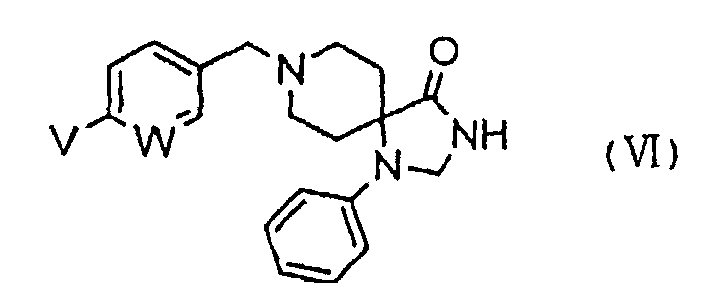
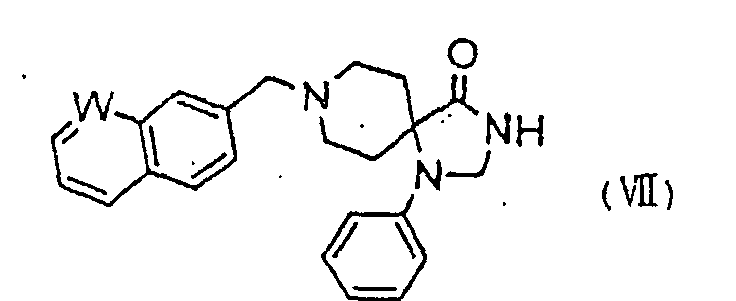
| | V | W | |
| 14 | OCH3 | CH | |
| 15 | | N | |
| 16 | CH3 | N | |
| 17 | H | N | |
| 18 | Br | CH | |
| 23 | CH3 | CH |
| Examples | W |
| 21 | N |
| 22 | CH |
Furthermore, compounds classified into the compounds of general formula
(III) include the compound shown in the following formula (VIII):
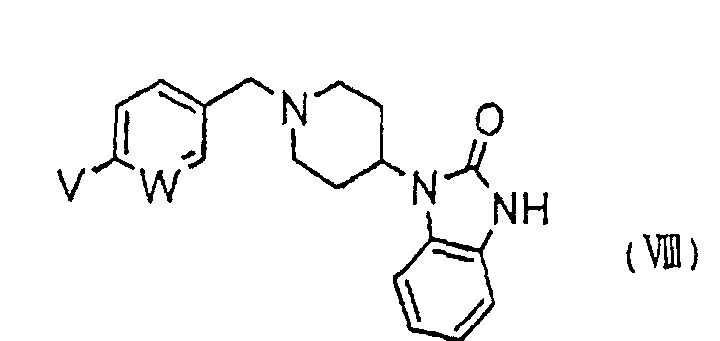
| Examples | V | W |
| 19 | OCH3 | CH |
| 20 | Cl | N |
A membrane fraction obtained from rat forebrain was prepared as a
membrane fraction of a µ opioid receptor. First, rat forebrain was homogenized with
10 × volume of 0.32M sucrose solution, and the obtained homogenate was centrifuged
at 900 × g for 10 minutes. Then, the supernatant was centrifuged at 11,500 × g for 20
minutes to obtain a deposit. The pellet was resuspended in an assay buffer (50mM
Tris-HCl, pH7.4) and centrifuged again, and the finally obtained membrane fraction was
defined as a membrane fraction of a µ opioid receptor.
A binding experiment was carried out with the obtained membrane fraction
and a radioactive ligand [3H]-DAMGO. In the presence of a test compound, the
membrane fraction and 1nM final concentration of [3H]-DAMGO were added and
incubated at 25°C for 90 minutes. The reaction was terminated by rapid filtration with
a GF/B filter, then washed with 5ml of assay buffer. Radioactivity was determined
with a liquid scintillation counter. Nonspecific binding was determined with 1 µM
DAMGO, and specific binding was calculated as the difference between the two values.
After the IC50 value of each compound was determined by a nonlinear method of least
squares regression analysis, Ki value was calculated using Cheng and Prusoff's formula.
As a consequence, it became clear that the compounds of the present
invention have a strong affinity with a µ opioid receptor, in that the Ki value for a µ
receptor affinity of the compound of Reference example 15 was more than 1,000nM,
whereas the Ki value of the compound of the present invention was less than 50nM.
A membrane fraction obtained from rat corpus striatum was prepared as a
membrane fraction of a dopamine D2 receptor. To prepare a sample, first, rat corpus
striatum was homogenized with 10 × volume of 0.32M sucrose solution, and then the
obtained homogenate was centrifuged at 900 × g for 10 minutes. Then, the supernatant
was centrifuged at 11,500 × g for 20 minutes to obtain a deposit. The pellet was
resuspended in a dopamine D2 assay buffer (50mM Tris-HCl buffer containing 120mM
NaCl, 5mM KCl, 1mM MgCl2 and 1mM CaCl2, pH7.4) and centrifuged again, and the
finally obtained pellet was defined as a membrane fraction of a dopamine D2 receptor.
A binding experiment was carried out with the obtained membrane fraction
and a radioactive ligand [3H]-spiperone. In the presence of a test compound, the
membrane fraction and 0.1nM final concentration of [3H]-spiperone were added and
incubated at 37°C for 30 minutes. The reaction was terminated by rapid filtration with
a GF/B filter, then washed with 5ml of assay buffer (50mM Tris-HCl, pH7.4).
Radioactivity was determined with a liquid scintillation counter. Nonspecific binding
was determined with 10 µ M sulpiride, and specific binding was calculated as the
difference between the two values. After the IC50 value of each compound was
determined by a nonlinear method of least squares regression analysis, Ki value was
calculated using Cheng and Prusoff's formula.
The results showing the binding affinity of the compounds of the present
invention with both a µ opioid receptor and a dopamine D2 receptor in the above Test
examples 1 and 2 are presented in the following Table 1.
As a consequence, since the ratio between a µ opioid receptor agonist
activity and a dopamine D2 receptor antagonist activity of the compound of the present
invention are within the range from 1 : 1 to 1 : 150, it can be said that the compound of
the present invention is useful as pain control agent, regulating side effects.
| Test compounds | µ Ki value(nM) | D2Ki value(nM) | µ Ki value : D2Ki value | |
| Compounds of the present invention | Example 1 | 10 | 230 | 1:23 |
| Example 2 | 3.7 | 532 | 1:144 | |
| Example 3 | 37 | 1588 | 1:43 | |
| Example 11 | 41 | 177 | 1:4.3 | |
| Example 12 | 9.8 | 252 | 1:26 | |
| Example 14 | 2.7 | 20 | 1:7.4 | |
| Example 15 | 0.4 | 3.6 | 1:9 | |
| Example 16 | 0.6 | 17 | 1:28 | |
| Example 17 | 15 | 457 | 1:30 | |
| Example 18 | 3.4 | 5.7 | 1:1.7 | |
| Example 19 | 10 | 60 | 1:6 | |
| Example 20 | 5.4 | 76 | 1:14 | |
| Example 23 | 4.2 | 52 | 1:12.4 | |
| Reference example 15 | >1000 | >1000 | ------ | |
| Morphine | 1.0 | >1000 | ------ |
This test is a common method for evaluating an analgetic action against
severe pain, and it is known that a compound having µ opioid receptor agonist
activity reacts well in this test. This test was carried out according to the method of
Narita et al. (Jpn J Pharmacol. 1993; 62:15-24). That is to say, ddY male mice (body
weight: 28 to 33g) were used and a remedy was intraperitoneally administered thereto.
At 30 minutes after administration, the mice were put on a 52°C hot plate and the
latency to paw-tap, paw-lick or an attempt to by jumping was measured. The above
latency before the administration of drug was previously measured at least 1 hour before
the experiment, so that any mice ineligible for this experiment, whose reaction period
went beyond 30 seconds, could be determined and eliminated. In addition, in order to
avoid the thermal burn of tissues, the longest latency was set at 60 seconds. Analgetic
effect was calculated by the following formula.
Analgetic effect (%) = (test latency - control latency) / (60 seconds - control latency) × 100
Then, a sigmoid curve was determined from dose response by a method of
least squares, and 50% effective dose (ED50 value) was calculated. The ED50 values in
respect of the analgetic effect of the compounds of the present invention and morphine
are shown in the following Table 2.
| Test substances | ED50 value (mg/kg) regarding analgetic effect | |
| Compounds of the present invention | Example 14 | 2.99 |
| Example 15 | 1.79 | |
| Example 16 | 1.98 | |
| Example 17 | 15.1 | |
| Example 18 | 7.76 | |
| Example 19 | 7.8 | |
| Example 23 | 7.23 | |
| Morphine | 13.72 |
The compounds of the present invention have equivalent or stronger analgetic
effect than morphine, and from the results of this test and Test example 1., the
compounds of the present invention are assumed to have a µ opioid receptor agonist
activity.
The administration of dopamine receptor agonists, apomorphine induces a
continual climbing behavior in mice. A test for competitive action against this effect is
generally used as a method for detecting the dopamine receptor antagonist. A mouse
was put into a cylindrical wire gauze (10 cm diameter × 14cm height) and allowed to
habituate itself with the circumstances for about 1 hour. Apomorphine (2mg/kg, s.c.)
was administered to the mouse at 10 minutes after the administration of the test drug,
and from 20 minutes after the administration of apomorphine, its climbing behavior
(which means the period during which all four legs of the mouse have left from the
ground) was measured for 1 minute. Furthermore, a sigmoid curve was determined
from dose response by a method of least squares, and ED50 value was calculated. The
ED50 values in respect of the dopamine-antagonising effect of the compounds of the
present invention are shown in the following Table 3.
| Test substances | ED50 value (mg/kg) regarding anti-dopamine action | Wall climbing behavior | |
| Apomorphine + compounds of the present invention | Example 14 | 2.22 | inhibitory effect |
| Example 15 | 1.22 | inhibitory effect | |
| Example 16 | 11.9 | inhibitory effect | |
| Example 18 | 1.05 | inhibitory effect | |
| Example 23 | 9.5 | inhibitory effect | |
| Control (only Apomorphine) | inducing |
All of the compounds of the present invention showed inhibitory effects
against the mouse's climbing behavior induced by apomorphine. From these results, it
was shown that the compounds of the present invention have a dopamine receptor
antagonist activity in vivo. Together with all results of Test examples 1 to 3, it was
shown that the compounds of the present invention have both µ opioid receptor
agonist activity and dopamine D2 receptor antagonist activity in vivo.
It is generally known that the administration of compounds inducing
psychological dependence such as morphine to a mouse promotes its locomotion. This
effect is considered to be caused by increase of dopamine release promoting action by
means of a µ receptor. Thus, the influence of each compound on the locomotor
activity was determined.
Mice were put into a test cage (23 × 33 × 12.5cm) and allowed to habituate
with the cage. Then, test substances were intraperitoneally administered to the mice,
their locomotor activity was measured for 2 hours, using an infrared sensor.
Morphine showed a strong locomotor activity promoting effect, whereas the
compounds of the present invention (Examples 14 to 18, 22 and 23) showed no effect
on locomotor activity. Thus, dopamine releasing effects mediated through activation
of µ opioid receptors of compounds were marked in the compounds of the present
invention having both µ opioid receptor agonist activity and dopamine D2 receptor
antagonist activity. Therefore, it is assumed that the compounds of the present
invention can regulate side effects such as psychological dependence, nausea,
hallucination and derangement, which are considered to be caused by a dopamine
releasing effects through µ opioid receptors.
Sprague-Dawley rats (170 to 210g) were used. A color-coded shuttle box
(30cm width × 60cm length × 30cm height) which was divided into two compartments
(a textured white floor and a flat, smooth black floor) was used as an experiment device.
After a test compound or a saline was intraperitoneally administered to a rat
(with the exception that morphine was administered subcutaneously), the rat was put
into one section for 50 minutes to be conditioned, and on the following day, after a
different remedy was administered, the rat was put into another section to be
conditioned in the same manner. In order to avoid bias caused by administration order
or combination of administration and section, a counterbalance method was adopted.
The rat was put into each section immediately after the administration of test remedies.
After conditioning on the 6th (or 8th) day, a test was performed on the 7th (or 9th) day to
analyze position palatability to the section conditioned by test compound
administration.
This position palatability test was carried out as follows: A rat, to which
neither a test compound nor saline was administered, was put on a platform installed in
the center of the box, and then the period during which the rat stayed in each section
was measured from the moment the rat came down from the platform for 15 minutes.
The difference between the period during which the rat stayed in the section
corresponding to test compound administration, and the period during which the rat
stayed in the section corresponding to administration of saline was calculated.
The results are shown in Figures 1 and 2. This test is generally used as a
simple method for determining psychological dependence, and where the obtained value
is positive, it means that position palatability to the compartment for test compound-administration
exists, that a reward exists toward a test compound used for conditioning,
in other words, that the used drug has psychological dependence. On the other hand,
where the value is negative, it means that place aversion exists, and that is, a test
compound used for conditioning has an aversive effect. From the above results, it
clearly showed that the compounds of Examples 14 and 16 expressed neither
psychological dependence nor aversive effects, while morphine showed a strong
rewarding effect.
According to the present invention, it becomes possible to provide a novel
pain control agent, which shows, with a single agent, a potent analgetic effect at least
equivalent to that of morphine, causing no psychological dependence and regulating
side effects.
In particular, a novel compound shown in general formula (I) and a
pharmacologically acceptable salt thereof have both µ opioid receptor agonist activity
and dopamine D2 receptor antagonist activity, and so is useful as pain control agent
with regulated side effects.
All publications, patents and patent applications cited herein are incorporated
herein by reference in their entirety.
Claims (15)
- A pain control agent, which contains, as an active ingredient, a compound having both µ opioid receptor agonist activity and dopamine D2 receptor antagonist activity.
- The pain control agent according to claim 1, wherein the ratio between the µ opioid receptor agonist activity and dopamine D2 receptor antagonist activity is between 1 : 1 to 1: 150.
- The pain control agent according to 1 or 2, wherein the active ingredient is a compound selected from a group consisting of the following general formulas (I) to (III) or a pharmacologically acceptable salt thereof:wherein
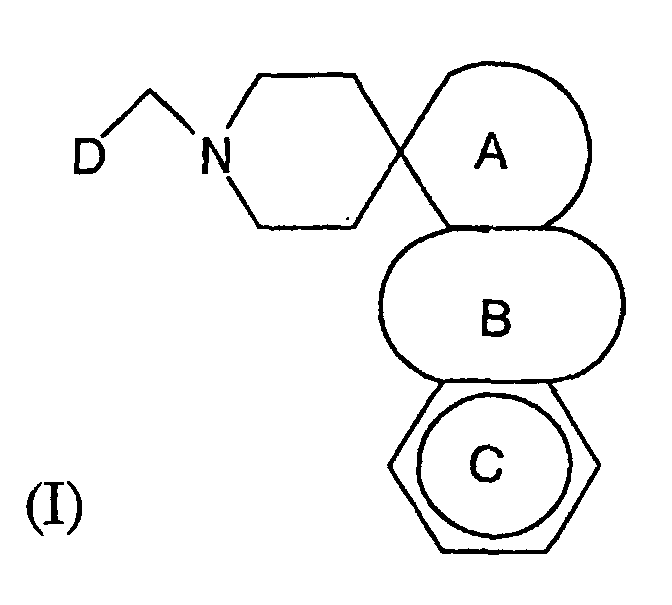 ring A represents a saturated 5- or 6-membered ring, which may be substituted and may comprise a heteroatom(s) selected from S, N and O,ring B represents a 5- or 6-membered aromatic ring, which may comprise a heteroatom selected from N and O,ring C represents a benzene ring or a pyridine ring, which may be substituted, andring D represents an aromatic ring, which may be substituted and may comprise a heteroatom(s) selected from S, N and O;wherein
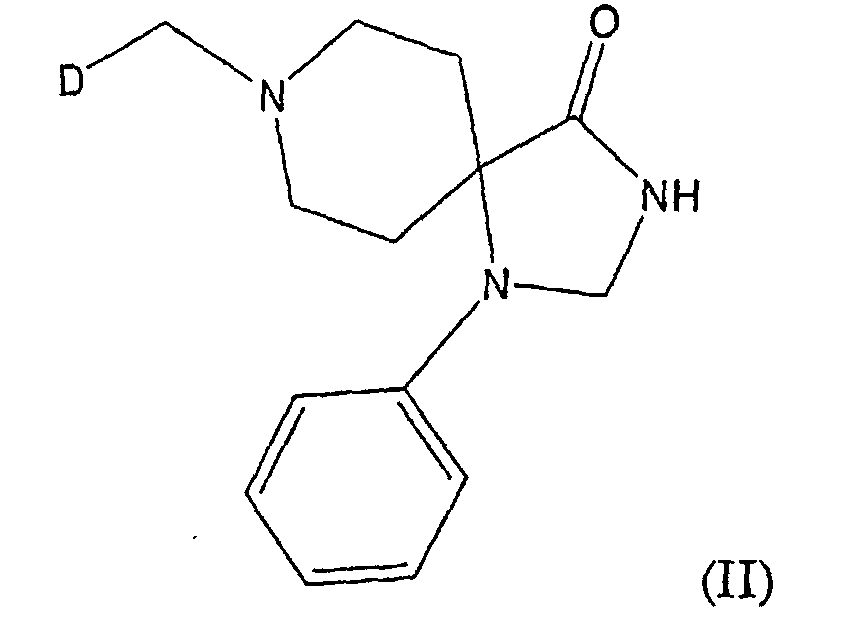 D represents an aromatic ring, which may be substituted and may comprise a heteroatom(s) selected from S, N and O; andwherein
 D represents an aromatic ring, which may be substituted and may comprise a heteroatom(s) selected from S, N and O.
- A compound shown in the following general formula (I) or pharmacologically acceptable salts thereof:wherein
 ring A represents a saturated 5- or 6-membered ring, which may be substituted and may comprise a heteroatom(s) selected from S, N and O,ring B represents a 5- or 6-membered aromatic ring, which may comprise a heteroatom selected from N and O,ring C represents a benzene ring or a pyridine ring, which may be substituted, andring D represents an aromatic ring, which may be substituted and may comprise a heteroatom(s) selected from S, N and O.
- The compound or pharmacologically acceptable salts thereof according to claim 4, whereinring A is shown in any one of the following general formulas (a) to (e):wherein R1 is H or lower alkyl,
 X is CH2 or C=O, andY is CH2, C=O or C=NH;ring B is shown in any one of the following general formulas (f) to (h):wherein
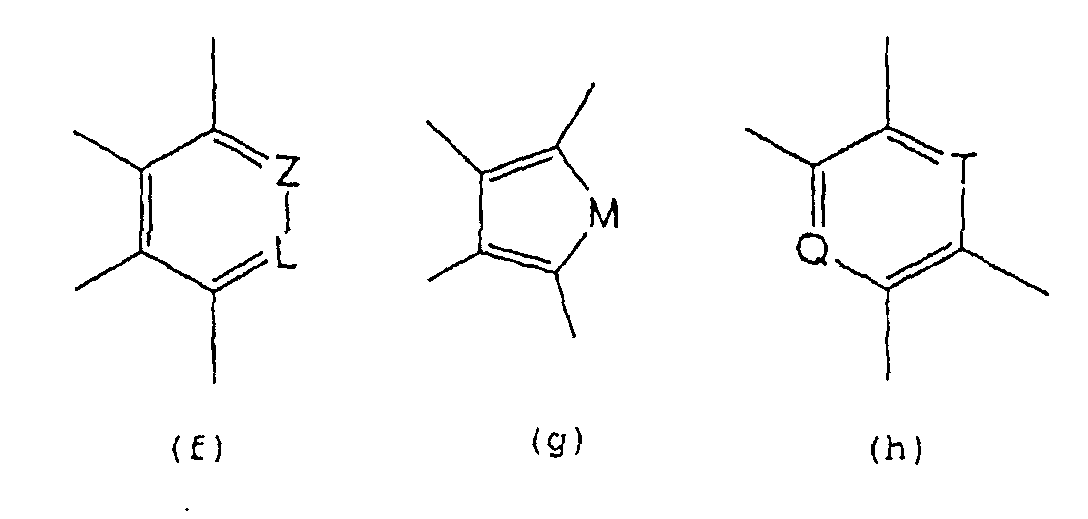 either one of Z and L is N and the other is CH, or both are CH,M is NH or O, andeither one of Q and T is N and the other is CH, or both are CH; andD is shown in any one of the following general formulas (i) to (n):wherein
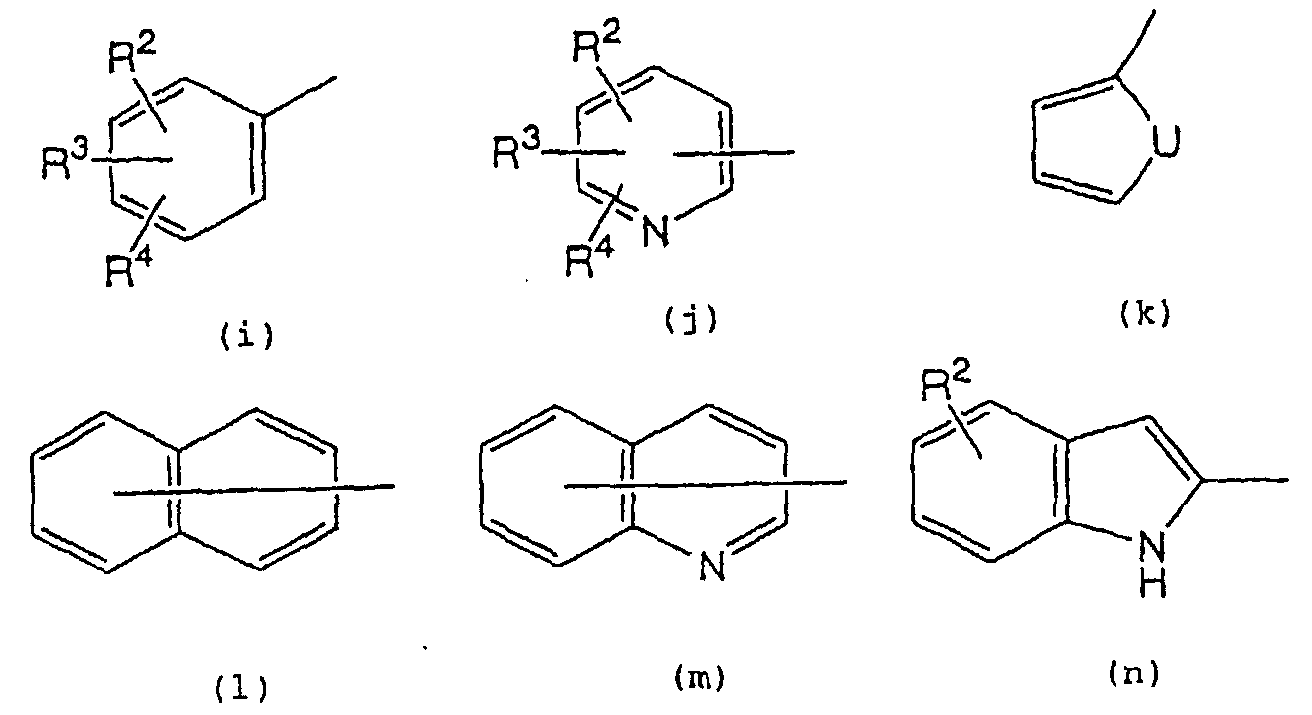 each of R2, R3 and R4 represents independently hydrogen, lower alkyl, lower alkoxy, lower alkylthio, lower alkoxycarbonyl, cyano, halogen, hydroxy, carbamoyl, nitro or amino, andU represents S, O or NR5 (R5 is H or lower alkyl).
- The compound or pharmacologically acceptable salt thereof according to claim 5, wherein ring C is benzene.
- The compound or pharmacologically acceptable salt thereof according to claim 6, whereinring A is (c), wherein Y is C=O or C=NH;ring B is (f), wherein both of Z and L are CH; andD is (i) or (j), wherein each of R2, R3 and R4 is independently chlorine, fluorine, hydrogen or methoxy.
- A compound shown in the following general formula (IV) or pharmacologically acceptable salt thereof:wherein V is hydrogen, chlorine, fluorine or methoxy; W is nitrogen or CH; X is NH or O; and Y is hydrogen, hydroxyl or methoxy.
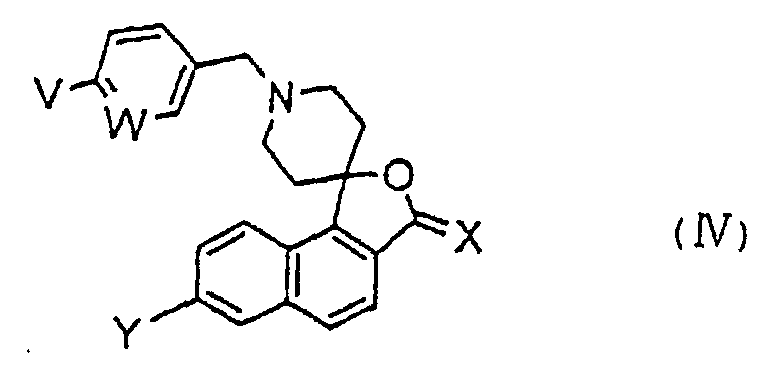
- A compound shown in the following general formula (V) or pharmacologically acceptable salt thereof:wherein V is hydrogen or chlorine; W is nitrogen or CH; X is NH or O; Y is CH or nitrogen, and Z is hydrogen or methoxy.
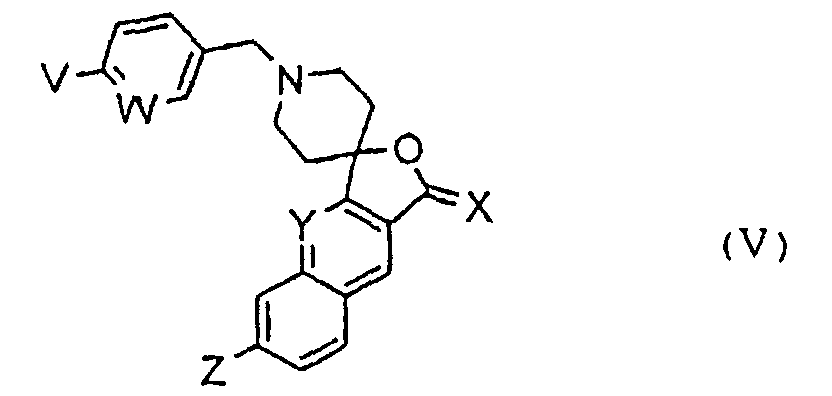
- A compound shown in the following general formula (VI) or pharmacologically acceptable salt thereof:wherein V is hydrogen, chlorine, bromine, methyl or methoxy; W is nitrogen or CH.
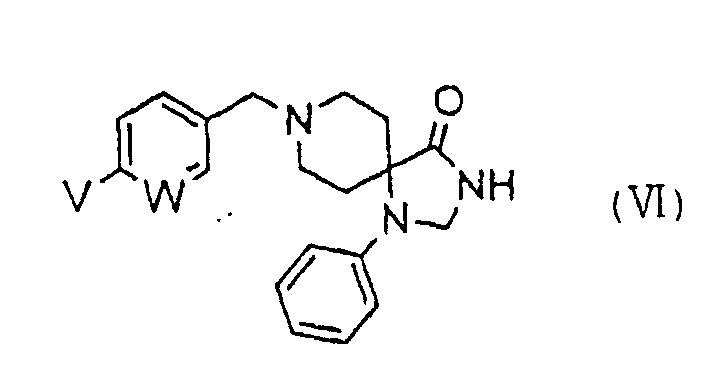
- A compound shown in the following general formula (VII) or pharmacologically acceptable salt thereof:wherein W is nitrogen or CH.
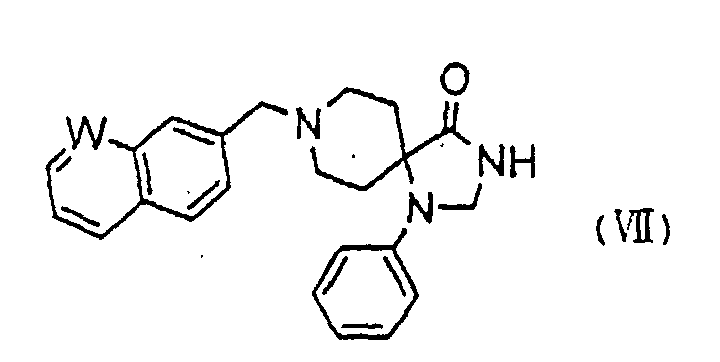
- A compound shown in the following general formula (VIII) or pharmacologically acceptable salt thereof:wherein V is chlorine or methoxy, and W is nitrogen or CH.
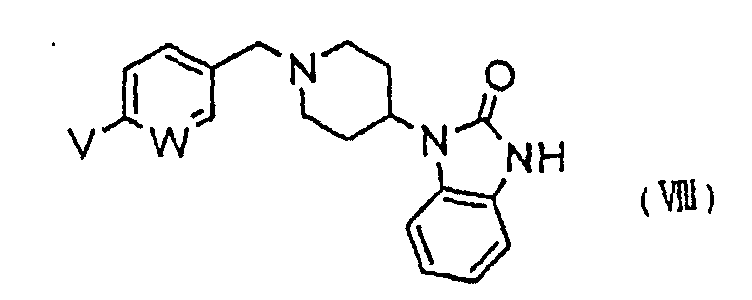
- A compound shown in the following general formula (IX) or pharmacologically acceptable salt thereof:
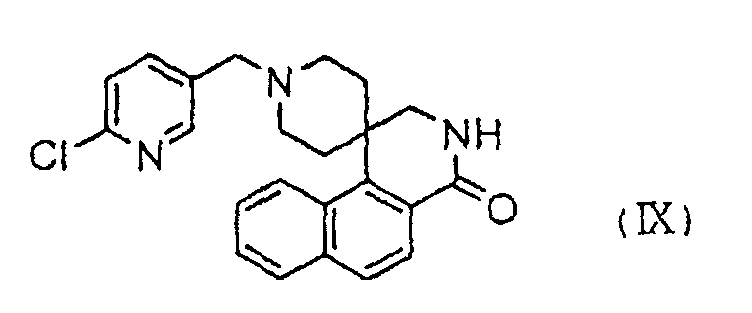
- A remedy containing the compound or pharmacologically acceptable salt thereof according to any one of claims 4 to 13.
- Pain control agent containing the compound or pharmacologically acceptable salt thereof according to any one of claims 4 to 13.
Applications Claiming Priority (5)
| Application Number | Priority Date | Filing Date | Title |
|---|---|---|---|
| JP36736698 | 1998-12-24 | ||
| JP36736698 | 1998-12-24 | ||
| JP13681299 | 1999-05-18 | ||
| JP13681299 | 1999-05-18 | ||
| PCT/JP1999/007191 WO2000038720A1 (en) | 1998-12-24 | 1999-12-21 | Remedies for pain |
Publications (1)
| Publication Number | Publication Date |
|---|---|
| EP1142587A1 true EP1142587A1 (en) | 2001-10-10 |
Family
ID=26470311
Family Applications (1)
| Application Number | Title | Priority Date | Filing Date |
|---|---|---|---|
| EP99959951A Withdrawn EP1142587A1 (en) | 1998-12-24 | 1999-12-21 | Remedies for pain |
Country Status (4)
| Country | Link |
|---|---|
| EP (1) | EP1142587A1 (en) |
| AU (1) | AU1691500A (en) |
| CA (1) | CA2356269A1 (en) |
| WO (1) | WO2000038720A1 (en) |
Cited By (7)
| Publication number | Priority date | Publication date | Assignee | Title |
|---|---|---|---|---|
| WO2004043967A1 (en) * | 2002-11-11 | 2004-05-27 | Grünenthal GmbH | Spirocyclic cyclohexane derivatives |
| WO2005063769A1 (en) * | 2003-12-23 | 2005-07-14 | Grünenthal GmbH | Spirocyclic cyclohexane derivatives |
| WO2005066183A1 (en) * | 2003-12-23 | 2005-07-21 | Grünenthal GmbH | Spirocyclic cyclohexane derivatives with affinity for the orl1-receptor |
| EP1598339A1 (en) * | 2001-04-18 | 2005-11-23 | Euro-Celtique S.A. | 1-(4-amino-cyclohexyl)-1,3-dihydro-2h-benzimidazole-2-one derivatives and related compounds as nociceptin analogs and orl1 ligands for the treatment of pain |
| WO2006018184A3 (en) * | 2004-08-13 | 2006-05-18 | Gruenenthal Gmbh | Spirocyclic cyclohexane derivatives |
| WO2008009416A1 (en) * | 2006-07-18 | 2008-01-24 | Grünenthal GmbH | Spirocyclic azaindole derivatives |
| US9428507B2 (en) * | 2013-06-21 | 2016-08-30 | The Broad Institute, Inc. | Compounds for the treatment of malaria |
Families Citing this family (11)
| Publication number | Priority date | Publication date | Assignee | Title |
|---|---|---|---|---|
| MXPA03009239A (en) * | 2001-04-10 | 2004-11-12 | Johnson & Johnson | 1,3,8-triazaspiro[4.5]decan-4-one derivatives useful for the treatment of orl-1 receptor mediated disorders. |
| US7786141B2 (en) | 2004-08-19 | 2010-08-31 | Vertex Pharmaceuticals Incorporated | Dihydrospiroindene modulators of muscarinic receptors |
| US7879834B2 (en) | 2004-08-19 | 2011-02-01 | Vertex Pharmaceuticals Incorporated | Spiroindoline modulators of muscarinic receptors |
| JP2008521825A (en) | 2004-11-29 | 2008-06-26 | バーテックス ファーマシューティカルズ インコーポレイテッド | Muscarinic receptor modulators |
| CA2634456A1 (en) | 2005-12-22 | 2007-07-05 | Vertex Pharmaceuticals Incorporated | Modulators of muscarinic receptors |
| US8003660B2 (en) | 2006-02-22 | 2011-08-23 | Vertex Pharmaceuticals Incorporated | Modulators of muscarinic receptors |
| RU2008137583A (en) | 2006-02-22 | 2010-03-27 | Вертекс Фармасьютикалз Инкорпорейшн (Us) | SPIROPIPERIDINES AS MODULATORS OF MUSCARINE RECEPTORS |
| US7858790B2 (en) | 2006-06-29 | 2010-12-28 | Vertex Pharmaceuticals Incorporated | Modulators of muscarinic receptors |
| CN101553231A (en) | 2006-08-15 | 2009-10-07 | 弗特克斯药品有限公司 | Modulators of muscarinic receptors |
| US7786107B2 (en) | 2006-08-18 | 2010-08-31 | Vertex Pharmaceuticals Incorporated | Modulators of muscarinic receptors |
| JP2010540640A (en) | 2007-10-03 | 2010-12-24 | バーテックス ファーマシューティカルズ インコーポレイテッド | Muscarinic receptor modulators |
-
1999
- 1999-12-21 CA CA002356269A patent/CA2356269A1/en not_active Abandoned
- 1999-12-21 EP EP99959951A patent/EP1142587A1/en not_active Withdrawn
- 1999-12-21 WO PCT/JP1999/007191 patent/WO2000038720A1/en not_active Ceased
- 1999-12-21 AU AU16915/00A patent/AU1691500A/en not_active Abandoned
Non-Patent Citations (1)
| Title |
|---|
| See references of WO0038720A1 * |
Cited By (24)
| Publication number | Priority date | Publication date | Assignee | Title |
|---|---|---|---|---|
| EP1598339A1 (en) * | 2001-04-18 | 2005-11-23 | Euro-Celtique S.A. | 1-(4-amino-cyclohexyl)-1,3-dihydro-2h-benzimidazole-2-one derivatives and related compounds as nociceptin analogs and orl1 ligands for the treatment of pain |
| EP2062898A3 (en) * | 2002-11-11 | 2010-09-22 | Grünenthal GmbH | Spirocyclic cyclohexane derivatives |
| CN100577664C (en) * | 2002-11-11 | 2010-01-06 | 格吕伦塔尔有限公司 | Spirocyclohexane Derivatives |
| US9862719B2 (en) | 2002-11-11 | 2018-01-09 | Gruenenthal Gmbh | Process or preparing spirocyclic cyclohexane compounds, compositions containing such compounds and method of using such compounds |
| US9120797B2 (en) | 2002-11-11 | 2015-09-01 | Gruenenthal Gmbh | Process for preparing spirocyclic cyclohexane compounds, compositions containing such compounds and method of using such compounds |
| US8053576B2 (en) | 2002-11-11 | 2011-11-08 | Gruenenthal Gmbh | Compositions containing spirocyclic cyclohexane compounds |
| RU2354656C2 (en) * | 2002-11-11 | 2009-05-10 | Грюненталь Гмбх | Spirocyclic cyclohexane derivatives |
| US7547707B2 (en) | 2002-11-11 | 2009-06-16 | Gruenenthal Gmbh | Spirocyclic cyclohexane compounds |
| EP2116544A3 (en) * | 2002-11-11 | 2010-09-22 | Grünenthal GmbH | Spirocyclic cyclohexane derivatives |
| WO2004043967A1 (en) * | 2002-11-11 | 2004-05-27 | Grünenthal GmbH | Spirocyclic cyclohexane derivatives |
| US7951948B2 (en) | 2002-11-11 | 2011-05-31 | Gruenenthal Gmbh | Spirocyclic cyclohexane compounds |
| EP2233487A1 (en) * | 2002-11-11 | 2010-09-29 | Grünenthal GmbH | Spirocyclic cyclohexane derivatives |
| US7799931B2 (en) | 2002-11-11 | 2010-09-21 | Gruenenthal Gmbh | Spirocyclic cyclohexane compounds |
| RU2383544C2 (en) * | 2003-12-23 | 2010-03-10 | Грюненталь Гмбх | Spirocyclic derivatives of cyclohexane with affinity to orl1 receptor |
| WO2005066183A1 (en) * | 2003-12-23 | 2005-07-21 | Grünenthal GmbH | Spirocyclic cyclohexane derivatives with affinity for the orl1-receptor |
| WO2005063769A1 (en) * | 2003-12-23 | 2005-07-14 | Grünenthal GmbH | Spirocyclic cyclohexane derivatives |
| US7776848B2 (en) | 2004-08-13 | 2010-08-17 | Gruenenthal Gmbh | Spirocyclic cyclohexane compounds |
| WO2006018184A3 (en) * | 2004-08-13 | 2006-05-18 | Gruenenthal Gmbh | Spirocyclic cyclohexane derivatives |
| WO2008009416A1 (en) * | 2006-07-18 | 2008-01-24 | Grünenthal GmbH | Spirocyclic azaindole derivatives |
| AU2007276414B2 (en) * | 2006-07-18 | 2012-05-31 | Grunenthal Gmbh | Spirocyclic azaindole derivatives |
| RU2468028C2 (en) * | 2006-07-18 | 2012-11-27 | Грюненталь Гмбх | Spirocyclic azaindole derivatives |
| US8399503B2 (en) | 2006-07-18 | 2013-03-19 | Gruenenthal Gmbh | Spirocyclic azaindole derivatives |
| NO342282B1 (en) * | 2006-07-18 | 2018-04-30 | Gruenenthal Gmbh | Spirocyclic azaindole derivatives, processes for their preparation, compounds, drugs and applications |
| US9428507B2 (en) * | 2013-06-21 | 2016-08-30 | The Broad Institute, Inc. | Compounds for the treatment of malaria |
Also Published As
| Publication number | Publication date |
|---|---|
| WO2000038720A1 (en) | 2000-07-06 |
| AU1691500A (en) | 2000-07-31 |
| CA2356269A1 (en) | 2000-07-06 |
Similar Documents
| Publication | Publication Date | Title |
|---|---|---|
| AU1691500A (en) | Remedies for pain | |
| Sauerberg et al. | Novel functional M1 selective muscarinic agonists. Synthesis and structure-activity relationships of 3-(1, 2, 5-thiadiazolyl)-1, 2, 5, 6-tetrahydro-1-methylpyridines | |
| US5718912A (en) | Muscarine agonists | |
| PL192397B1 (en) | Derivatives of piperidine substituted at their position 4 with 1,2-substituted 1-piperidinyl radical a antagonists of tachykinin receptor | |
| JPH03181461A (en) | antiarrhythmic agent | |
| PL168686B1 (en) | or dihydro-2H-benzopyran) carbonamides EN EN EN EN EN EN EN | |
| US4374139A (en) | Levorotatory N-substituted acylmorphinans useful as analgesic agents | |
| JP5467044B2 (en) | TSH receptor antagonistic tetrahydroquinoline compound | |
| KR20250006217A (en) | Bicyclic heterocyclic amide inhibitor of Naν1.8 for pain treatment | |
| CA2677995A1 (en) | Acylguanidine derivative | |
| US4804665A (en) | Azaspiro compounds and their use | |
| JP3287577B2 (en) | 1,2,3,4-tetrahydro-benzofuro [3,2-c] pyridine derivative | |
| US5708174A (en) | Heterocyclic-esters or -amides used as 5-HT4 receptor antagonists | |
| EP0337167B1 (en) | 4-Aryl-4-piperidine (or pyrrolidine or hexahydroazepine) carbinols and heterocyclic analogs thereof | |
| KR100241662B1 (en) | Hydroisoquinoline derivatives | |
| JPH0747574B2 (en) | Pyridine derivative and psychotropic agent containing the same | |
| CA2131381A1 (en) | Nitrogen containing heterocyclic compounds useful as pharmaceuticals | |
| KR20060006098A (en) | Substituted 1,4-di-piperidin-4-yl-piperazine derivatives in combination with opioid analgesics and their use for the treatment of pain and side effects associated with opioid-based therapies | |
| US5330994A (en) | Tetrahydropyridine isoxazoline derivatives | |
| KR100364340B1 (en) | Imidazolidinone derivatives, acid addition salts and old age dementia | |
| New et al. | Atypical antipsychotic agents: patterns of activity in a series of 3-substituted 2-pyridinyl-1-piperazine derivatives | |
| WO1992006958A1 (en) | 4-acetoxy-piperidine derivatives, process for their preparation and use as a muscarinic m3-receptor antagonist | |
| US5086063A (en) | 4-aryl-4-piperidine (or pyrrolidine or hexahydroazepine) carbinols and heterocyclic analogs thereof | |
| US5137894A (en) | 4-(4-Piperidinyl-thieno[3,2-c]pyridine derivatives of n-alkylglutarimides | |
| JPWO2000038720A1 (en) | pain medication |
Legal Events
| Date | Code | Title | Description |
|---|---|---|---|
| PUAI | Public reference made under article 153(3) epc to a published international application that has entered the european phase |
Free format text: ORIGINAL CODE: 0009012 |
|
| 17P | Request for examination filed |
Effective date: 20010718 |
|
| AK | Designated contracting states |
Kind code of ref document: A1 Designated state(s): AT BE CH CY DE DK ES FI FR GB GR IE IT LI LU MC NL PT SE |
|
| AX | Request for extension of the european patent |
Free format text: AL;LT;LV;MK;RO;SI |
|
| STAA | Information on the status of an ep patent application or granted ep patent |
Free format text: STATUS: THE APPLICATION HAS BEEN WITHDRAWN |
|
| 18W | Application withdrawn |
Withdrawal date: 20020530 |