EP1142713A2 - Inkjet type recording device and method of supplying ink to sub-tank by the same device, and method of checking amount of ink supplied to sub-tank by the same device - Google Patents
Inkjet type recording device and method of supplying ink to sub-tank by the same device, and method of checking amount of ink supplied to sub-tank by the same device Download PDFInfo
- Publication number
- EP1142713A2 EP1142713A2 EP00971797A EP00971797A EP1142713A2 EP 1142713 A2 EP1142713 A2 EP 1142713A2 EP 00971797 A EP00971797 A EP 00971797A EP 00971797 A EP00971797 A EP 00971797A EP 1142713 A2 EP1142713 A2 EP 1142713A2
- Authority
- EP
- European Patent Office
- Prior art keywords
- ink
- subtank
- recording apparatus
- amount
- set forth
- Prior art date
- Legal status (The legal status is an assumption and is not a legal conclusion. Google has not performed a legal analysis and makes no representation as to the accuracy of the status listed.)
- Granted
Links
Images










Classifications
-
- B—PERFORMING OPERATIONS; TRANSPORTING
- B41—PRINTING; LINING MACHINES; TYPEWRITERS; STAMPS
- B41J—TYPEWRITERS; SELECTIVE PRINTING MECHANISMS, i.e. MECHANISMS PRINTING OTHERWISE THAN FROM A FORME; CORRECTION OF TYPOGRAPHICAL ERRORS
- B41J2/00—Typewriters or selective printing mechanisms characterised by the printing or marking process for which they are designed
- B41J2/005—Typewriters or selective printing mechanisms characterised by the printing or marking process for which they are designed characterised by bringing liquid or particles selectively into contact with a printing material
- B41J2/01—Ink jet
- B41J2/17—Ink jet characterised by ink handling
- B41J2/175—Ink supply systems ; Circuit parts therefor
- B41J2/17503—Ink cartridges
- B41J2/17553—Outer structure
-
- B—PERFORMING OPERATIONS; TRANSPORTING
- B41—PRINTING; LINING MACHINES; TYPEWRITERS; STAMPS
- B41J—TYPEWRITERS; SELECTIVE PRINTING MECHANISMS, i.e. MECHANISMS PRINTING OTHERWISE THAN FROM A FORME; CORRECTION OF TYPOGRAPHICAL ERRORS
- B41J2/00—Typewriters or selective printing mechanisms characterised by the printing or marking process for which they are designed
- B41J2/005—Typewriters or selective printing mechanisms characterised by the printing or marking process for which they are designed characterised by bringing liquid or particles selectively into contact with a printing material
- B41J2/01—Ink jet
- B41J2/17—Ink jet characterised by ink handling
- B41J2/175—Ink supply systems ; Circuit parts therefor
- B41J2/17503—Ink cartridges
- B41J2/17506—Refilling of the cartridge
- B41J2/17509—Whilst mounted in the printer
-
- B—PERFORMING OPERATIONS; TRANSPORTING
- B41—PRINTING; LINING MACHINES; TYPEWRITERS; STAMPS
- B41J—TYPEWRITERS; SELECTIVE PRINTING MECHANISMS, i.e. MECHANISMS PRINTING OTHERWISE THAN FROM A FORME; CORRECTION OF TYPOGRAPHICAL ERRORS
- B41J2/00—Typewriters or selective printing mechanisms characterised by the printing or marking process for which they are designed
- B41J2/005—Typewriters or selective printing mechanisms characterised by the printing or marking process for which they are designed characterised by bringing liquid or particles selectively into contact with a printing material
- B41J2/01—Ink jet
- B41J2/17—Ink jet characterised by ink handling
- B41J2/175—Ink supply systems ; Circuit parts therefor
- B41J2/17503—Ink cartridges
- B41J2/17513—Inner structure
-
- B—PERFORMING OPERATIONS; TRANSPORTING
- B41—PRINTING; LINING MACHINES; TYPEWRITERS; STAMPS
- B41J—TYPEWRITERS; SELECTIVE PRINTING MECHANISMS, i.e. MECHANISMS PRINTING OTHERWISE THAN FROM A FORME; CORRECTION OF TYPOGRAPHICAL ERRORS
- B41J2/00—Typewriters or selective printing mechanisms characterised by the printing or marking process for which they are designed
- B41J2/005—Typewriters or selective printing mechanisms characterised by the printing or marking process for which they are designed characterised by bringing liquid or particles selectively into contact with a printing material
- B41J2/01—Ink jet
- B41J2/17—Ink jet characterised by ink handling
- B41J2/175—Ink supply systems ; Circuit parts therefor
- B41J2/17503—Ink cartridges
- B41J2/1752—Mounting within the printer
- B41J2/17523—Ink connection
-
- B—PERFORMING OPERATIONS; TRANSPORTING
- B41—PRINTING; LINING MACHINES; TYPEWRITERS; STAMPS
- B41J—TYPEWRITERS; SELECTIVE PRINTING MECHANISMS, i.e. MECHANISMS PRINTING OTHERWISE THAN FROM A FORME; CORRECTION OF TYPOGRAPHICAL ERRORS
- B41J2/00—Typewriters or selective printing mechanisms characterised by the printing or marking process for which they are designed
- B41J2/005—Typewriters or selective printing mechanisms characterised by the printing or marking process for which they are designed characterised by bringing liquid or particles selectively into contact with a printing material
- B41J2/01—Ink jet
- B41J2/17—Ink jet characterised by ink handling
- B41J2/175—Ink supply systems ; Circuit parts therefor
- B41J2/17503—Ink cartridges
- B41J2/17526—Electrical contacts to the cartridge
-
- B—PERFORMING OPERATIONS; TRANSPORTING
- B41—PRINTING; LINING MACHINES; TYPEWRITERS; STAMPS
- B41J—TYPEWRITERS; SELECTIVE PRINTING MECHANISMS, i.e. MECHANISMS PRINTING OTHERWISE THAN FROM A FORME; CORRECTION OF TYPOGRAPHICAL ERRORS
- B41J2/00—Typewriters or selective printing mechanisms characterised by the printing or marking process for which they are designed
- B41J2/005—Typewriters or selective printing mechanisms characterised by the printing or marking process for which they are designed characterised by bringing liquid or particles selectively into contact with a printing material
- B41J2/01—Ink jet
- B41J2/17—Ink jet characterised by ink handling
- B41J2/175—Ink supply systems ; Circuit parts therefor
- B41J2/17566—Ink level or ink residue control
-
- B—PERFORMING OPERATIONS; TRANSPORTING
- B41—PRINTING; LINING MACHINES; TYPEWRITERS; STAMPS
- B41J—TYPEWRITERS; SELECTIVE PRINTING MECHANISMS, i.e. MECHANISMS PRINTING OTHERWISE THAN FROM A FORME; CORRECTION OF TYPOGRAPHICAL ERRORS
- B41J2/00—Typewriters or selective printing mechanisms characterised by the printing or marking process for which they are designed
- B41J2/005—Typewriters or selective printing mechanisms characterised by the printing or marking process for which they are designed characterised by bringing liquid or particles selectively into contact with a printing material
- B41J2/01—Ink jet
- B41J2/17—Ink jet characterised by ink handling
- B41J2/175—Ink supply systems ; Circuit parts therefor
- B41J2/17596—Ink pumps, ink valves
-
- B—PERFORMING OPERATIONS; TRANSPORTING
- B41—PRINTING; LINING MACHINES; TYPEWRITERS; STAMPS
- B41J—TYPEWRITERS; SELECTIVE PRINTING MECHANISMS, i.e. MECHANISMS PRINTING OTHERWISE THAN FROM A FORME; CORRECTION OF TYPOGRAPHICAL ERRORS
- B41J2/00—Typewriters or selective printing mechanisms characterised by the printing or marking process for which they are designed
- B41J2/005—Typewriters or selective printing mechanisms characterised by the printing or marking process for which they are designed characterised by bringing liquid or particles selectively into contact with a printing material
- B41J2/01—Ink jet
- B41J2/17—Ink jet characterised by ink handling
- B41J2/175—Ink supply systems ; Circuit parts therefor
- B41J2/17566—Ink level or ink residue control
- B41J2002/17573—Ink level or ink residue control using optical means for ink level indication
-
- B—PERFORMING OPERATIONS; TRANSPORTING
- B41—PRINTING; LINING MACHINES; TYPEWRITERS; STAMPS
- B41J—TYPEWRITERS; SELECTIVE PRINTING MECHANISMS, i.e. MECHANISMS PRINTING OTHERWISE THAN FROM A FORME; CORRECTION OF TYPOGRAPHICAL ERRORS
- B41J2/00—Typewriters or selective printing mechanisms characterised by the printing or marking process for which they are designed
- B41J2/005—Typewriters or selective printing mechanisms characterised by the printing or marking process for which they are designed characterised by bringing liquid or particles selectively into contact with a printing material
- B41J2/01—Ink jet
- B41J2/17—Ink jet characterised by ink handling
- B41J2/175—Ink supply systems ; Circuit parts therefor
- B41J2/17566—Ink level or ink residue control
- B41J2002/17576—Ink level or ink residue control using a floater for ink level indication
Definitions
- This invention relates to an ink jet recording apparatus wherein a subtank for supplying ink to a recording head is mounted on a carriage on which the recording head is mounted, and the subtank is replenished with ink in succession from a main tank via an ink replenishing tube, a method of replenishing ink to the subtank, and a method of checking the replenished amount of ink to the subtank.
- An ink jet recording apparatus can form small dots at a high density with relatively small noise at the print time, and thus nowadays is used for various types of print including color print.
- Such an ink jet recording apparatus generally comprises an ink jet recording head mounted on a carriage and moving in a width direction of recording paper, and a paper feeder for relatively moving the recording paper in a direction orthogonal to a move direction of the recording head so that ink drops are ejected from the recording head based on print data, to perform recording on the recording paper.
- the recording head capable of ejecting black ink, yellow ink, cyan ink, and magenta ink, for example, is mounted on the carriage and not only text print in black ink, but also full color print is enabled by varying a ratio of the respective inks ejected.
- Subtanks are placed on the carriage on which the recording head is mounted and each subtank is replenished with ink from the main tank via an ink replenishing tube, and further ink is supplied from each subtank to the recording head.
- a recording apparatus With a long scanning distance of a carriage capable of printing on a large paper face is demanded.
- a recording head is provided with a larger number of nozzles more and more.
- a recording apparatus wherein while print is executed, each subtank mounted on a carriage can be replenished with ink in succession from a main tank and ink is supplied stably from each subtank to the main tank is demanded.
- an ink replenishing tube needs to be connected from the main tank to each subtank corresponding to each ink and the scan distance of the carriage is large and thus the tube run length grows inevitably.
- a recording head is provided with a larger number of nozzles as mentioned above and thus a technical problem is involved wherein the consumed ink amount is large, the dynamic pressure of ink is thus raised in each ink replenishing tube connected from the main tank to each subtank, and the replenished amount of each subtank with ink is thereby insufficient.
- a configuration for applying an air pressure to the main ink side and generating a forcible ink flow by the air pressure from the main tank to each subtank for replenishing the subtank with necessary and sufficient ink can be adopted.
- an ink jet recording apparatus comprising:
- a method of replenishing ink stored in a main tank to a subtank mounted on a carriage reciprocately moving in a widthwise direction of recording paper, together with a recording head, which are incorporated in an ink jet recording apparatus comprising the steps of:
- a method of checking replenishment of ink stored in a main tank to a subtank mounted on a carriage reciprocately moving in a widthwise direction of recording paper, together with a recording head, which are incorporated in an ink jet recording apparatus comprising the steps of:
- the checking method may comprise the steps of:
- the checking method may comprise the steps of:
- Fig. 1 shows an example of an ink jet recording apparatus incorporating the invention as a top view.
- a carriage 1 is guided by a scanning guide member 4 via a timing belt 3 driven by a carriage motor 2 and is reciprocated in a main scanning direction of the longitudinal direction of a paper feeder 5, namely, the width direction of recording paper.
- an ink jet recording head 6 described later is mounted on a face of the carriage 1 opposed to the paper feeder 5.
- Subtanks 7a to 7d for supplying ink to the recording head 6 are also mounted on the carriage 1.
- four subtanks 7a to 7d are provided in a one-to-one-correspondence with the inks.
- Black ink, yellow ink, magenta ink, and cyan ink are supplied to the subtanks 7a to 7d via flexible ink replenishing tubes 10 forming ink supply passages from main tanks 9a to 9d as ink cartridges placed in a cartridge holder 8 placed at an end part of the recording apparatus.
- a capping unit 11 capable of sealing a nozzle formation face of the recording head is placed in a non-print area (home position) on the move passage of the carriage 1 and further a cap member 11 a formed of a flexible material of rubber, etc., capable of sealing the nozzle formation face of the recording head is placed on the top of the capping unit 11.
- a cap member 11 a formed of a flexible material of rubber, etc.
- the cap member 11a serves as a lid for sealing the nozzle formation face of the recording head 6 for preventing nozzle openings from drying, during the non-operating period of the recording apparatus.
- One end of a tube in a suction pump (tube pump) is connected to the cap member 11a although not shown in the figure, and the cleaning operation of causing a negative pressure produced by the suction pump to act on the recording head for sucking and discharging ink from the recording head 6 is executed.
- FIG. 2 schematically shows the configuration of an ink supply system installed in the recording apparatus shown in Fig. 1.
- the ink supply system will be discussed together with Fig. 1 with the same numerals shown.
- air compressed by an air compressing pump 21, which forms a part of a compressor unit is supplied to a pressure regulating valve 22 also serving as an atmospheric release valve, and further is supplied via a pressure detector 23 to the main tanks 9a to 9d (denoted representatively by numeral 9 in Fig. 2 and in the description to follow, the main tanks may be representatively denoted simply by numeral 9).
- the pressure regulating valve 22 also serving as an atmospheric release valve has a function of releasing pressure for maintaining the air pressure applied to each of the main tanks 9a to 9d in a predetermined range when the air pressure compressed by the air compressing pump 21 reaches a predetermined pressure or more.
- the pressure release valve also has a function capable of releasing the compressed state produced by the air compressing pump 21 in response to an instruction.
- the pressure detector 23 senses the air pressure compressed by the air compressing pump 21 and controls driving the air compressing pump 21. That is, if the pressure detector 23 detects the air pressure compressed by the air compressing pump 21 reaching the predetermined pressure, it stops driving the air compressing pump 21 and if the pressure detector 23 detects the air pressure compressed by the air compressing pump 21 becoming less than determined pressure, it drives the air compressing pump 21, and this control sequence is repeated, thereby maintaining the air pressure applied to each of the main tanks 9a to 9d in the predetermined range.
- the outer hull of the main tank is hermetically formed and an ink pack 24 formed of a flexible material in which ink is sealed is stored in the main tank.
- the space formed by the main tank 9 and the ink pack 24 forms an air chamber (pressure chamber) 25 and compressed air via the pressure detector 23 is supplied to the inside of the air chamber 25.
- each ink pack 24 stored in each of the main tanks 9a to 9d undergoes pressurization of the compressed air and an ink flow under a predetermined pressure is produced from each of the main tanks 9a to 9d to each of the subtanks 7a to 7d.
- Ink compressed in each of the main tanks 9a to 9d is supplied to each of the subtanks 7a to 7d mounted on the carriage 1 (the subtanks are denoted representatively by numeral 7 in Fig. 2 and in the description to follow, the subtanks may be representatively denoted simply by numeral 7) via each of ink replenishing valves 26 and each of the ink replenishing tubes 10 forming an ink replenishing controller.
- a float member 31 is placed in the subtank and a permanent magnet 32 is attached to a part of the float member 31.
- Magnetoelectric devices 33a and 33b (in the description to follow, the magnetoelectric devices may be representatively denoted simply by numeral 33) represented by hall devices are placed on a board 34 and are attached to a side wall of the subtank 7.
- the permanent magnet 32 placed on the float member 31 and the hall devices 33a and 33b for producing electric output in response to the magnetic flux density of the permanent magnet 32 following the float position of the float member 31 make up an ink amount detector.
- the ink replenishing valve 26 is opened based on the electric output provided by the hall devices 33a and 33b.
- the ink compressed in the main tank 9 is supplied separately to the associated subtank 7 in which the ink amount lowers. If the ink amount in the subtank 7 reaches a predetermined volume, the ink replenishing valve 26 is closed based on the electric output provided by the hall devices 33a and 33b. Such a sequence is repeated, whereby the subtank is replenished intermittently with ink from the main tank and an almost constant amount of ink is always stored in each subtank.
- each subtank 7 is thus replenished with the corresponding ink compressed by the air pressure in the main tank 9 based on the electric output based on the position of the float member 31 placed in the subtank 7, the ink replenishing response can be enhanced and the ink storage amount in the subtank 7 is managed appropriately.
- Ink is supplied from each subtank 7 to the recording head 6 via a valve 35 and a tube 36 connected thereto and ink drops are ejected through nozzle openings 6a formed in the nozzle formation face of the recording head 6 based on print data supplied to the recording head 6.
- a tube connected to the capping unit 11 is connected to the suction pump (tube pump) not shown.
- Numeral 7e denotes an atmospheric release port made in the subtank 7.
- Figs. 3A and 3B show a state in which the subtanks having the described configuration are arranged in parallel for making up a subtank unit and shows a mode in which the hall device 33 as the magnetoelectric device is disposed on the side wall of each subtank as a schematic drawing.
- Fig. 3A is a sectional view taken along a line E-E in Fig. 3B viewed in the arrow direction.
- Fig. 3B is a sectional view of a state in which one of the subtanks making up the subtank unit is cut in a plane direction.
- the subtank unit supported in a parallel state is housed in a holder 81. It comprises a board holder 82 having engagement members 82a for engaging with fitting holes 81a made in the holder 81, and the hall device 33 is placed on the side wall part of each subtank 7 in an urged state by a plurality of springs 83 placed between the board holder 82 and the board 34 on which the hall devices 33 are arranged.
- the case where one hall device 33 is provided for each subtank is taken as an example, but two hall devices may be provided for each subtank, as described above.
- the subtank 7 is formed in the side wall with a recess part 41c for positioning the hall device 33 and the recess part 41c for positioning is formed, whereby the side wall part of the subtank 7 is made thinner and the distance between the moving path of the permanent magnet 32 attached to the float member 31 and the hall device 33 can be made shorter.
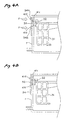
- Figs. 4A and 4B show a modified example wherein the hall device 33 as the magnetoelectric device is disposed on the side wall of the subtank 7 as a schematic drawing.
- the board 34 on which the hall devices 33 are disposed is attached to the subtanks 7 by thermal caulking.
- Fig. 4A shows a state just before thermal caulking is executed as a sectional view
- Fig. 4B shows a state after thermal caulking is executed as a sectional view.
- the subtank 7 is formed of a thermoplastic resin and is previously formed on the side wall part with a pair of projections 41d as shown in Fig. 4A.
- the board 34 on which the hall device 33 is mounted is formed with a pair of through holes 34a at the positions corresponding to the pair of projections 41d.
- the through holes 34a made in the board 34 are inserted into the projections 41d and in this state a heated jig (not shown) is pressed against the projections 41d as indicated by arrows F, whereby the projections 41d are melted and become deformed like flat plates because of the thermoplastic property for holding the board 34 on the side wall part of the subtank 7 as shown in Fig. 4B.
- the recess part 41c for positioning the hall device 33 is formed, whereby the side wall part of the subtank 7 is made thinner and the distance between the moving path of the permanent magnet 32 attached to the float member 31 and the hall device 33 can be made shorter.
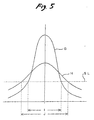
- Fig. 5 examines the distance between the moving path of the permanent magnet 32 attached to the float member 31 and the hall device 33 as the magnetoelectric device and shows the relationship between the distance therebetween and the magnetic flux detection sensitivity of the hall device 33.
- a curve G indicates setting such that the distance between the moving path of the permanent magnet 32 and the hall device 33 becomes relatively short
- a curve H indicates a case where the distance between the moving path of the permanent magnet 32 and the hall device 33 is relatively long.
- the longitudinal solid line represents the magnetic flux density received by the hall device 33 and the lateral solid line indicates the moving path of the permanent magnet 32, namely, the displacement of the permanent magnet 32 from the center longitudinal solid line where the permanent magnet 32 is brought closest to the hall device 33.
- the electric output produced by the hall device 33 is used in a line area almost proportional to the magnetic flux density received at each (the electric output is used in the area proportional to the magnetic flux density). Therefore, if a threshold voltage (threshold level) for opening/closing the valve 26 upon reception of the electric output produced by the hall device 33 is SL in Fig. 5, the width of the area crossing SL in the characteristic G becomes narrow as indicated by I and the width of the area crossing SL in the characteristic H becomes wide as indicated by J.
- a threshold voltage (threshold level) for opening/closing the valve 26 upon reception of the electric output produced by the hall device 33 is SL in Fig. 5
- the width of the area crossing SL in the characteristic G becomes narrow as indicated by I
- the width of the area crossing SL in the characteristic H becomes wide as indicated by J.
- the subtank 7 is formed in the side wall with the recess part 41 c for positioning the hall device 33 and the side wall part of the subtank 7 is made thin in the presence of the recess part 41c for positioning, so that the detection accuracy of the remaining flow amount of ink in the subtank can be more improved.
- Figs. 6 and 7 examine the relationship between the placement position of the permanent magnet attached to the float member and the placement position of the hall device as the magnetoelectric device on the subtank side. That is, in the configuration shown in Fig. 6, the hall device 33 mounted on the board 34 is placed on the side wall part of the subtank 7 and on the other hand, the permanent magnet 32 is placed on the float member 31 on an extension of a support arm 45 and the hall device 33 senses the magnetic flux density as the permanent magnet 32 placed on the float member moves in the gravity direction. That is, the configuration shown in Fig. 6 is a similar configuration to that of the embodiment shown in Figs. 2 to 4.
- the hall device 33 mounted on the board 34 is placed on the upper wall of the subtank 7 and the permanent magnet 32 is placed on the upper wall of the float member 31.
- the magnetic flux density change on the hall device 33 as the permanent magnet 32 placed on the float member 31 moves in the gravity direction is sensed. Therefore, in the configuration shown in Fig. 7, electric output responsive to the remaining flow amount of ink in the subtank 7 can also be produced and the mode can also be adopted effectively.
- the mode shown in Fig. 6 is effective.
- This configuration is shown schematically in Fig. 8. That is, on the side wall of the subtank 7, two hall devices 33a and 33b are placed along the moving path of the permanent magnet placed on the float member.
- the mode taking a state in which the subtank is replenished with ink as an example, as the float member moves (rises) in the anti-gravity direction following replenishing with ink, first a large magnetic force acts on the second hall device 33b and if replenishing with ink is further continued, large magnetic force acts on the first hall device 33a.
- outputs of the hall devices 33a and 33b are converted into binary signals based on a predetermined threshold voltage, combinations of (00), (01), (11), and (10) can be provided and it is made possible to recognize the ink amount in the subtank with good accuracy. For example, if the ink amount in the subtank is gradually decreased by the print operation, it can also be recognized with good accuracy.
- Fig. 9 examines the relationship of the ink amount detection accuracy in the subtank with the distance between the pivotal center of the float member 31 and the permanent magnet in the above-described configuration shown in Fig. 8. That is, in Fig. 8, the distance between pivotal center 44 of the float member and the permanent magnet 32 is shown as L1 and in Fig. 9, the distance is shown as L2.
- the distance between the center parts of the hall devices 33a and 33b is shown as L3.
- L1 is 50 mm and L2 is 25 mm and L3 is 5 mm
- comparison of the detection accuracy between the first and second hall devices 33a and 33b is as follows:
- the widths of the W1 and W2 are larger, variations occur in detection in the first and second hall devices 33a and 33b and particularly, to detect the ink amount in the subtank in the four-combination state resulting from converting the outputs of the hall devices 33a and 33b into binary signals based on the predetermined threshold voltage as described above, it is ideal that the W1 and W2 are nearer to zero.
- the recording apparatus comprises the float member 31 housed in the subtank 7 and floating up in accordance with ink stored in the subtank 7, the magnetoelectric device 33 (33a, 33b) as an output generator for generating electric output following the float position of the float member 31 responsive to the ink amount in the subtank 7, and the ink replenishing valve 26 as supply controller for controlling the amount of ink supplied to the subtank in accordance with the electric output provided by the output generator, and thus the subtank 7 is replenished with ink in succession from the main tank 9 in response to the ink storage amount in the subtank 7.
- the detection level of an ink-low state should be set so that ink remains in the subtank as ink is consumed by executing one cleaning operation.
- the detection level of the ink-low state is thus set, whereby if the cleaning operation is executed, for example, just before the ink amount detector detects the ink-low state, the subtank can be prevented from becoming empty of ink.
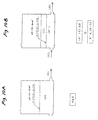
- FIGs. 10A and 10B schematically show the state of the subtank in an ink-low state condition.
- Fig. 10A shows a state in which the ink volume in the subtank corresponding to a predetermined value (ink-low state) detected by the ink amount detector is set to the amount or more of ink consumed by one cleaning operation.
- the remaining ink amount in the subtank at the ink-low state detection level is shown as (A).
- the subtank Letting the amount of ink consumed by one cleaning operation be (B), if the ink-low state level is set so that the relation of A ⁇ B is set, the subtank can be prevented from becoming empty of ink if the cleaning operation is executed just before the ink amount detector detects the ink-low state.
- Fig. 10B shows a state in which the ink volume in the subtank corresponding to a predetermined value (ink-low state) detected by the ink amount detector is set to the amount or more resulting from subtracting the amount of ink with which the subtank is replenished during the cleaning operation from the amount of ink consumed by one cleaning operation.
- the remaining ink amount in the subtank at the ink-low state detection level is shown as (A').
- the amount of ink consumed by one cleaning operation is (B).
- the ink replenishing valve 26 is opened and thus the subtank is replenished with the ink amount shown as (C) during the cleaning operation.
- the ink-low state level detected by the ink amount detector can be set to a lower level than that shown in Fig. 10A, and it is also made possible to design the capacity of each subtank mounted on the carriage as a small size.
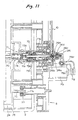
- Figs. 11 and 12 are sectional views to show a part of the main tank 9 and a part of the cartridge holder 8 on an enlarged scale in the state in which the main tank 9 as an ink cartridge mentioned above in the cartridge holder 8.
- Fig. 11 shows a state in which the ink replenishing value 26 placed in the cartridge holder 8 is closed
- Fig. 12 shows a state in which the ink replenishing value 26 is opened; parts corresponding to the parts previously described are denoted by the same numerals.
- An ink tap 71 is formed integrally with the ink pack 24 stored in the main tank 9 and is attached so as to project from one end part of the main tank 9 to the outside.
- a packing member 71 a formed like a ring is placed at the tip part of the ink tap 71 and a valve member 71b placed slidably in an axial direction in the ink tap 71 is urged to the side of the packing member 71a by a spring 71c.
- the valve member 71b if the main tank 9 is not placed in the cartridge holder 8, the valve member 71b abuts the packing member 71a so that leaking out ink from the ink pack 24 can be blocked. In the state shown in the figure, the valve member 71b is pushed in by a hollow needle described later and ink can be derived from the ink pack 24.
- connection plug 73 is formed to project at the center of the cartridge holder 8.
- a hollow needle 73b formed with an ink inlet hole 73a in the vicinity of the tip part is placed in the connection plug 73 and further a slider 73c placed slidably in the axial direction is provided so as to surround the outer periphery of the hollow needle 73b.
- the slider 73c is urged so as to forward project by a spring 73d.
- the slider 73c closes the ink inlet hole 73a made in the hollow needle 73b to close the valve.
- the slider 73c is pushed in by the connection plug 73 in the cartridge holder 8, the ink inlet hole 73a in the hollow needle 73b is exposed, and ink can be introduced into the hollow needle 73b from the main tank 9.
- the outer hull member of the main tank 9 is formed with an inlet port 75 formed of a tubular body communicating with the air chamber (pressure chamber) 25.
- a compressed air supply plug 77 is disposed in the cartridge holder tank 8 and an annular packing member 77a is placed in the compressed air supply plug 77. Therefore, in the state shown in the figure in which the main tank 9 is placed in the cartridge holder 8, the annular packing member 77a placed in the cartridge holder 8 is brought into intimate contact with and is coupled with the outer peripheral surface of the inlet port 75 formed of a tubular body. Accordingly, the compressed air can be introduced into the air chamber (pressure chamber) 25 of the main tank 9.
- the ink replenishing value 26 is disposed at a base end part of the hollow needle 73b disposed in the cartridge holder 8 and the ink replenishing tube 10 is connected via the valve 26, so that the subtank 7 mounted on the carriage 1 can be replenished with ink as described above.
- the ink replenishing value 26 comprises a diaphragm valve 26a and its peripheral margin part is sandwiched between a first case 26b and a second case 26c and the diaphragm valve 26a is housed in both the cases.
- a slide shaft 26d attached to almost the center of the diaphragm valve 26a is attached slidably in the axial direction to the second case 26c.
- the slide shaft 26d receives a driving force produced by an electromagnetic plunger 79 as an actuator and is driven in a horizontal direction as shown in the figure. Therefore, upon reception of the axial driving force of the slide shaft 26d, almost the center of the diaphragm valve 26a is moved in the horizontal direction.
- the driving force produced by the electromagnetic plunger 79 is transmitted to one end part of a driving lever 78 pivoted via a support shaft 78a and is transmitted to the slide shaft 26d capable of driving the diaphragm valve 26a at an opposite end part of the drive lever.
- a spring 26e is placed between the slide shaft 26d and the second case 26c and when the electromagnetic plunger 79 is in a non-activated state, as shown in Fig. 11, the center of the diaphragm valve 26a closes an opening part 26f made in the first case 26b connected to the base end part of the hollow needle 73b to close the valve by the urging force of the spring 26e.
- the electromagnetic plunger 79 is activated, as shown in Fig. 12
- a driving rod 79a of the electromagnetic plunger 79 is pulled in, whereby the slide shaft 26d is pulled out via the driving lever 78. Therefore, the center of the diaphragm valve 26a leaves the opening part 26f made in the first case 26b and is opened.
- ink is introduced from the ink pack 24 into the first case 26b in which the diaphragm valve is placed via an ink flow passage provided by the hollow needle 73b as indicated by the arrow in Fig. 12, and the subtank 7 can be replenished with ink via the ink replenishing tube 10 connected to the first case 26b.
- the electromagnetic plunger 79 is not activated and replenishing with ink is stopped according to output of the hall devices 33a and 33b for detecting the magnetic flux density change of the permanent magnet 32 following the float position of the float member 31 placed in the subtank 7.
- the electromagnetic plunger 79 is also placed in a non-activated state, whereby the center of the diaphragm valve 26a closes the opening part 26f made in the first case 26b connected to the base end part of the hollow needle 73b to close the valve by the urging force of the spring 26e, as shown in Fig. 11. Therefore, if a water head difference exists between the main tank 9 and the subtank 7, ink flowing in either direction via the ink replenishing tube 10 can be blocked.
- the ink flow passage to the opening part 26f of the first case 26b in which the diaphragm valve 26a is placed namely, the ink flow passage formed in the hollow needle 73b and the ink flow passage from the inside of the case 26b to the ink replenishing tube 10 are made almost orthogonal to each other and the derivation part of the ink replenishing tube 10 connected to the case 26b is placed so as to head for almost in a vertical direction.
- air bubbles entered when the main tank 9 as an ink cartridge is placed in the cartridge holder 8 can be floated toward the ink replenishing tube 10 side without building up in the vicinity of the diaphragm valve 26a.
- the air bubbles floated toward the ink replenishing tube 10 side are introduced into the subtank 7 and are floated, so that a problem of the air bubbles entering the recording head 6 and causing a print failure to occur can be circumvented.
- the ink replenishing valve comprising the diaphragm valve 26a is placed in the cartridge holder 8 in which the main tank is placed. That is, the ink replenishing valve is placed in the close vicinity of the main tank side in the ink replenishing passage from the main tank to the subtank. For example, if the main tank 9 is drawn out from the cartridge holder 8, leaking out ink existing in the ink replenishing tube 10 to the cartridge holder 8 side can be effectively blocked because the ink replenishing valve is placed in the close vicinity of the cartridge holder 8.
- the cartridge holder 8 comprises the slider 73c for covering the ink inlet hole 73a of the hollow needle 73b to close the valve, placing the ink replenishing valve in the close vicinity of the main tank side as can contribute to more effective blocking of leaking out ink from the connection plug 73 in the cartridge holder upon reception of a backward flow caused by the water head difference, because the valve closing function of the ink inlet hole 73a by the slider 73c and the valve closing function by the ink replenishing value 26 work as a synergistic effect.
- ink is always pushed out by compressed air from the main tank to the subtank during the operation of the recording apparatus.
- the amount of ink in the subtank is detected by the ink amount detector and opening and closing the ink replenishing valve placed in the ink replenishing passage from the main tank to the subtank are controlled by control signals provided by the ink amount detector, whereby necessary and sufficient ink can always be stored in the subtank.
- the recording apparatus comprises the ink amount detector for detecting the amount of ink stored in the subtank and the ink replenishing controller being placed in the ink replenishing passage between the main tank and the subtank for controlling replenishing the subtank with ink from the main tank in response to the ink amount detection state of the ink amount detector and thus the subtank is always replenished with ink, for example, even during printing and a proper amount of ink can be held in the subtank. Therefore, for example, if the recording apparatus is adopted as a large-sized recording apparatus using a recording head with a large number of nozzles and having a carriage with a long scanning distance, stable print operation can be executed without degrading throughput.
- the ink jet recording apparatus adopting the ink replenishing method
- air pressure is applied to the main tank by the compressor unit so as to control the opening/closing of the ink replenishing valve placed in the ink replenishing passage between the main tank and the subtank, in response to the detection state of the amount of ink stored in the subtank.
- the ink supply valve closed when the operation power of the recording apparatus is off is placed in the ink supply passage from the main tank as an ink cartridge to the subtank mounted on the carriage.
- the ink amount detector containing the float member malfunctions or some failure occurs in the control signal transmission system from the ink amount detector to the ink replenishing valve in the ink jet recording apparatus configured as described above, an accident occurs in which the ink replenishing valve is not closed although the subtank is replenished with a predetermined amount of ink. If such an accident occurs, the following problem can occur: The subtank is continuously replenished with ink from the main tank by the compressed air and ink leaks via the atmospheric release port 7e formed in the subtank or the like, polluting the surroundings.
- step S11 ink level detection in the subtank is executed. It is determined by output of the hall devices 33a and 33b for detecting the magnetic flux density of the permanent magnet attached to the float member as described above.
- the ink amount detector determines that the amount of ink in the subtank is less than a predetermined value, the case is called “LOW” and if the ink amount detector determines that the amount of ink in the subtank reaches a sufficient amount, the case is called “FULL.” If the ink amount is determined “FULL” at step S11, a return mode is entered and subsequently the ink amount is monitored at step S11. If the ink amount is determined "LOW" as the recording head consumes ink, control goes to step S12 and the ink replenishing valve 26 is opened.
- step S13 replenishing the subtank with ink from the main tank is started (ink replenishing step).
- the ink amount detector monitors the ink amount in the subtank as shown at step S13.
- the replenishing valve 26 is opened at the step S12, normally the "LOW" state is detected at step S13 and determination shown at step S14 is made.
- step S14 the elapsed time since the ink replenishing valve opening operation executed at step S12 is determined and if the elapsed time is less than a predetermined time period, control returns to step S13 and ink level detection in the subtank is executed, namely, the ink amount detector monitors the control output.
- the loop returning to step S13 from step S14 mentioned above is repeated.
- step S13 control goes to step S15 at which the ink replenishing valve 26 is closed and a return mode is entered (ink replenishment stopping step). Therefore, the operation shown at steps S11 to S15 is repeated and the subtank is intermittently replenished with ink from the main tank. The operation shown at steps S11 to S15 is repeated when the ink replenishing operation is performed normally.
- the float member 31 forming a part of the ink amount detector undergoes some failure and does not float up, for example, although the subtank is replenished with a sufficient amount of ink, the subtank is continuously replenished with an excessive amount of ink.
- a similar accident also occurs if an unexpected failure occurs in the control signal transmission system from the ink amount detector to the ink replenishing valve. Consequently, a problem of ink overflowing the subtank occurs.
- step S14 The routine shown at the step S14 and step S16 following the step controls so as to prevent the subtank from being replenished with an excessive amount of ink assuming occurrence of such a failure. That is, at step S14, the elapsed time period since the ink replenishing valve opening executed at step S12 is monitored as described above, and if it is determined in the loop operation of steps S13 and S14 that "FULL" is not detected, namely, the "LOW" state remains although the predetermined time period has elapsed, control goes to step S16 and the ink replenishing valve 26 is forcibly closed (ink replenishment forcibly stopping step).
- step S14 it can be assumed that some failure occurs in the ink replenishing system as described above and therefore the valve is forcibly closed automatically because of the expiration of the predetermined time period managed at step S14, whereby replenishing the subtank with excessive ink can be stopped. If control goes to step S14, it is desired that error display indicating the ink supply failure state should be produced for informing the user that trouble in the ink replenishing system occurs.
- the ink jet recording apparatus adopting the ink replenishing control method comprises the controller for forcibly closing the ink replenishing valve placed in the ink replenishing passage from the main tank as an ink cartridge to the subtank if the predetermined time period has elapsed after the ink replenishing valve was opened, so that the problem of polluting the machine with leaked ink, etc., in the recording apparatus using this kind of ink supply system for pressurizing the main tank can be solved.
- a second embodiment comprising ink end detector for checking whether or not an ink cartridge of a main tank is in an ink end condition will be discussed with reference to Figs. 14 to 20.
- Members corresponding to those previously described with reference to Figs. 1 to 13 are denoted by the same reference numerals in Figs. 14 to 20 and will not be discussed again in detail.
- a memory 27 capable of recording information concerning the main tank 9 is placed in a part of a case of the main tank as also shown in Fig. 15, and data concerning the residual ink amount in the main tank is written into the memory 27 as described later.
- a terminal 28 for writing or reading information into or from the memory 27 is placed on a part of the main tank 9, and when the main tank 9 is placed in a recording apparatus, the terminal is electrically connected to the recording apparatus and information concerning the residual ink amount in the main tank is transferred.
- a detection switch 29 forming an ink end detector for detecting the amount of ink stored in the main tank becoming a predetermined value or less may be provided in the main tank 9 as also shown in Fig. 15.
- One face of the ink pack 24 is put on the inner face of the case forming the main tank 9, for example, with a double-faced adhesive sheet and an actuation plate 24b is put on another face of the ink pack 24 in a similar manner. According to the configuration, if the amount of ink sealed in the ink pack 24 becomes low, a part of the actuation plate 24b functions so as to turn on the detection switch 29, for example, as the ink pack 24 contracts.
- a terminal 30 where on/off information of the switch 29 is derived is placed on a part of the main tank 9 and when the main tank 9 is placed in the recording apparatus, the terminal can be electrically connected to the recording apparatus.
- a consumed ink amount calculator for calculating the consumed ink amount in a subtank as described later is provided, and if the calculator determines that ink consumption in the subtank exceeds a predetermined amount, the ink replenishing valve 26 is opened. Thus, ink compressed in the main tank 9 is separately sent to the subtank 7 where ink consumption exceeds the predetermined amount.
- the ink replenishing valve 26 is closed based on output of ink amount detector containing the float member as described above. Such a sequence is repeated, whereby the subtank is intermittently replenished with ink from the main tank and ink in a constant range is always stored in each subtank.
- Fig. 16 shows an example of a control circuit forming an ink end detector of a cartridge, installed in the recording apparatus according to the second embodiment. Parts corresponding to those previously described are denoted by the same reference numerals in Fig. 16, and therefore will not be discussed again.
- the suction pump 15 is connected to capping unit 11 and the discharge side of the suction pump 15 is connected to a waste ink tank 16.
- a print controller 100 has a function of generating bit map data based on print data from a host computer, and causing a head driver 101 to generate a drive signal based on the data for ejecting ink through the recording head 6 mounted on the carriage 1.
- the head driver 101 Upon reception of a flushing command signal from a flushing controller 102, the head driver 101 also outputs a drive signal for the flushing operation to the recording head 6 in addition to the drive signal based on the print data.
- a cleaning controller 103 has a function of controlling a pump driver 105 for driving the suction pump 15 upon reception of a control signal from a cleaning command detector 104.
- a cleaning command switch 106 placed on an operation panel, etc., of the recording apparatus is operated, whereby the cleaning command detector 104 operates and manual cleaning operation is executed.
- the cleaning controller 103 also receives a control signal from the print controller 100 and comprises a cleaning operation function of controlling the pump driver 105 for driving the suction pump 15 according to the received control signal.
- each of the print controller 100, the flushing controller 102, and the cleaning controller 103 supplies a control signal to a consumed ink amount calculator 107.
- the consumed ink amount calculator 107 has a function of calculating the consumption amount of ink stored in each subtank 7.
- the number of ink drops ejected through the recording head by the print controller 100 based on the print data and the number of ink drops ejected through the recording head by the flushing operation of the flushing controller 102, and data whenever the cleaning operation of sucking and discharging ink from the recording head by the cleaning controller 103 is executed are supplied to the consumed ink amount calculator 107.
- the consumed ink amount calculator 107 which receives the data, accesses a coefficient provider 108 based on the number of ink drops ejected through the recording head by execution of print, the number of ink drops ejected through the recording head by the flushing operation, and ink discharge processing each time the cleaning operation is executed and multiplies the data by a coefficient corresponding to each, thereby calculating the consumption amount of ink in the subtank 7.
- the consumption amount of ink in the subtank 7 thus calculated is sent to a subtank consumed ink counter 109 and is counted up (added). If the count reaches a predetermined numeric value, it means a state in which the ink amount in the subtank 7 is decreased, and therefore the ink replenishing valve 26 is opened so as to replenish the subtank with ink from the main tank.
- the ink replenishing valve 26 is closed as mentioned above, and at the same time, the count of the subtank consumed ink counter 109 is reset.
- information of the consumed ink amount in the subtank is transferred from the subtank consumed ink counter 109 to a main tank residual ink counter 110.
- the data concerning the residual ink amount in the main tank stored in the memory 27 installed in the placed main tank is preset in the main tank residual ink counter 110 through write and read unit 111.
- the count of the subtank consumed ink counter 109 just before it is reset is sent to the main tank residual ink counter 110 and the count of the subtank consumed ink counter 109 is subtracted from the count indicating the residual ink amount in the main tank. Accordingly, the main tank residual ink counter 110 is decremented as ink is consumed, and the numeric data is written into the memory 27 through a reader/writer 111.
- the consumed ink amount calculator 107, the coefficient provider 108, the subtank consumed ink counter 109, and the main tank residual ink counter 110 generally are placed in the recording apparatus, but may be placed in the host computer as required.
- a control signal sent to open the ink replenishing valve 26 from the subtank consumed ink counter 109 is supplied to a timer 112.
- the timer 112 starts to count the time period at the same time as the ink replenishing valve 26 is opened. It receives output of the hall devices 33a and 33b occurring when the subtank 7 is placed almost in a fill-up state.
- the timer 112 Upon reception of the control signal sent to open the ink replenishing valve 26, the timer 112 starts to count the time period, and if the output of the hall devices 33a and 33b occurring when the subtank 7 is placed almost in a fill-up state does not come although a predetermined time period has elapsed, the timer 112 causes a display 113 to display a message, etc., indicating that the main tank is in an ink end condition.
- the display 83 is caused to display a message, etc., indicating that the main tank is in an ink end condition, and the print operation of the recording apparatus is stopped. Accordingly, a problem of making also the subtank empty of ink can be circumvented and air bubbles entering the ink supply passage of the recording head can be blocked effectively.
- the display 83 may be placed in the recording apparatus, display of the host computer may be used as required.
- ink in the main tank can be spent all until the main tank becomes almost empty of ink, and the running cost and the load of treating the remaining ink in the scrapped ink cartridge, etc., can be decreased.
- a control routine shown in Fig. 17 is designed so that it can circumvent such a problem. The function of the control routine will be discussed together with the control circuit shown in Fig. 16 with reference to a flowchart indicating the control routine.
- the amount of ink consumed for print, etc. is added to the subtank consumed ink counter as shown at step S11.
- the consumption amount of ink in the subtank calculated by the consumed ink amount calculator 107 shown in Fig. 16 is sent to the subtank consumed ink counter 109 for adding the consumed ink amount.
- step S12 whether or not the subtank consumed ink counter is greater than a predetermined value (A) is checked.
- step S12 If it is determined at the step S12 that the numeric value of the subtank consumed ink counter 109 exceeds the predetermined value (A), control goes to step S13 and the operation of replenishing the subtank with ink is started. This is performed by opening the ink replenishing valve 26. Subsequently, at step S14, whether or not replenishing the subtank with ink is complete is checked. To do this, output of the hall devices 22a and 33b is used as described above.
- step S14 checking whether or not the predetermined time period has elapsed since the operation of replenishing the subtank with ink was started is also started at step S18. This is performed by the timer 112 shown in Fig. 16. It is determined that replenishing the subtank with ink is complete before the expiration of the predetermined time period (Yes), the ink replenishing operation is stopped at step S15. This is performed by closing the ink replenishing valve 26 as described above.
- step S16 the subtank consumed ink counter 109 is reset and at step S17 following the step, the value (A) is subtracted from the main tank residual ink counter 110.
- the ink amount as much as one replenishing the subtank with ink is subtracted and the subtraction result (in other words, the residual ink amount in the ink cartridge) is set in the main tank residual ink counter 110.
- step S14 it is determined at the step S14 that replenishing the subtank with ink is not complete (No), and moreover it is determined at step S18 that the predetermined time period has elapsed, it is estimated that the ink cartridge becomes empty of ink. Then, at step S19, the operation of replenishing the subtank with ink is stopped.
- step S20 whether or not the cartridge residual ink amount counter 110 is equal to or less than a predetermined value is determined. If replenishing the subtank with ink is not complete within the predetermined time period although the main tank residual ink counter 110 does not reach the predetermined value or less (No), in other words although a considerable amount of ink is left in the cartridge, it can be assumed that some trouble occurs, for example, in the ink replenishing passage, the supply passage of the compressed air, or the like. In this case, error display is produced on the display 113.
- step S20 If it is determined at the step S20 that the main tank residual ink amount counter 110 reaches the predetermined value or less (Yes), it is determined that the ink cartridge enters an end condition certainly. In this case, display indicating the ink end is produced on the display 113. That is, the determination at the step S20 is provided, whereby the ink end condition of the main tank can be recognized correctly.
- the information of the residual ink amount in the ink cartridge is read from the memory 27 placed in a part of the case forming the main tank as the ink cartridge, and the consumed ink amount in the subtank is subtracted from the information for use as the residual ink amount information of the ink cartridge.
- the detection switch 29 placed in the ink cartridge for example, as shown in Figs. 14 and 15 can be used as means for recognizing the residual amount information of ink in the ink cartridge.
- the residual amount information of ink in the cartridge based on the detection switch 29 is used at step S20 shown in Fig. 17 as information for determining whether the condition is an error or ink end condition.
- Pressurized air is introduced into the air chamber (pressure chamber) of the ink cartridge and the subtank is replenished with ink
- the invention can also be used for recording apparatuses other than such a type of recording apparatus.
- a recording apparatus for sucking so as to place the inside of a subtank in negative pressure and replenishing the subtank with ink or a recording apparatus for providing a water head difference between an ink cartridge and a subtank for producing an ink flow from the ink cartridge into the subtank
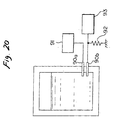
- physical detectors as shown in Figs. 18 to 20 can be used as the residual amount detector of ink in the cartridge.
- Fig. 18 shows a configuration wherein a case of an ink cartridge 9 is molded of a transparent resin and a light source 86 an a photosensor 87 are placed so as to sandwich the vicinity of the lower portion of the case.
- a large amount of ink is stored in the ink cartridge 9, projection light from the light source 86 is blocked and thus the sensor 87 cannot sense the projection light.
- the ink in the cartridge 9 is decreased to less than a predetermined value, the sensor 87 can sense the projection light from the light source 86 through the case molded of a transparent resin and the residual ink amount is determined less than the predetermined value.
- the residual amount of ink in the ink cartridge is detected based on the difference between the critical angle of total reflection determined by the flexion ratio between the ink in the cartridge 9 and the resin forming the case and the critical angle of total reflection determined by the flexion ratio between air and the resin forming the case.
- Fig. 20 shows a configuration wherein a pair of electrode terminals 90a and 90b is buried toward the storage space of ink in the proximity of the lower bottom face of a case of an ink cartridge 9 and a predetermined voltage is applied to one electrode terminal 90a from a constant-voltage source 91.
- a resistor 92 is connected to the other electrode terminal 90b between the electrode terminal and reference potential (ground) and a voltage detector 93 for detecting a potential occurring at the resistor 92 is connected to the other electrode terminal 90b mentioned above.
- the voltage detector 93 detects a predetermined voltage value or more. If the residual amount of ink in the ink cartridge is near an end condition, the voltage value detected by the voltage detector 93 lowers by far. Therefore, the configuration makes it possible to detect the residual amount of ink in the ink cartridge.
- the ink end detector in the ink cartridge shown in Figs. 18 to 20 described above can also be used replacing the numeric value of the residual amount counter of the cartridge at step S20 in Fig. 17 described above.
- an ink jet recording apparatus adopting such a cartridge ink end determination method, if the amount of ink with which a subtank is replenished is insufficient although the ink replenishing time of the subtank from an ink cartridge exceeds a predetermined time period, the ink cartridge is determined to be in an ink end condition, so that the ink end condition of the ink cartridge can be recognized precisely.
- An ink end condition of an ink cartridge is detected by such a detection method, whereby uneconomical management of replacing the ink cartridge with a large amount of ink left or the like can be circumvented.
- Fig. 21 is a flowchart to show the basic concept of a first checking method. That is, first as shown at step S11, whether or not subtank is in an overflow condition is checked based on the output combination of the two hall devices 33a and 33b making up the ink amount detector. If it is determined that the subtank is not in an overflow condition (No), control is returned and a similar determination is repeated from the start.
- overflow time cleaning operation is executed as shown at step S12.
- the nozzle formation face of the recording head 6 is sealed with the capping unit 11 and negative pressure produced by the suction pump 15 is applied, whereby ink is sucked and discharged from the recording head.
- the overflow cleaning a larger amount of ink than that in the manual cleaning operation or timer cleaning operation is sucked and discharged.
- step S13 after execution of such overflow cleaning, again whether or not the subtank is in an overflow condition is checked by the ink amount detector.
- the control is returned. Erroneous detection of the ink level accidentally caused by vibration, etc., is possible at the determination time at the step S11, in which case it is determined that the subtank is not in an overflow condition, of course.
- the overflow condition may be canceled by executing the overflow cleaning at step S12. In any way, it is determined that the subtank is not in an overflow condition in the result of the rechecking, the printable state of the recording apparatus is continued.
- Fig. 22 is a flowchart to show the basic concept of a second checking method when the ink amount detector detects an ink overflow condition.
- the operation of sucking and discharging ink from the recording head is executed two or more times and whether or not the subtank is in an ink overflow condition is checked each time the operation of sucking and discharging ink is executed. That is, as shown at step S21, whether or not the subtank is in an overflow condition is checked based on the output combination of the two hall devices 33a and 33b making up the ink amount detector as at the step S11. If it is determined that the subtank is not in an overflow condition (No), control is returned and a similar determination is repeated from the start.
- the number of times the subtank has been determined to be in an overflow condition, n is incremented by one as shown at step S22.
- the incremented number of times an overflow condition has been detected, n is compared with a predetermined value N at step S23.
- N the predetermined value
- the nozzle formation face of the recording head 6 is sealed with the capping unit 11 and negative pressure produced by the suction pump 15 is applied, whereby ink is sucked and discharged from the recording head.
- the amount of sucking and discharging ink at the step S24 is controlled so as to become an amount less by far than that the amount of sucking and discharging ink in the overflow cleaning.
- control returns to step S21 and whether or not the subtank is in an overflow condition is checked by the ink amount detector. If it is determined that the subtank is not in an overflow condition (No), control is returned. It can also be estimated that erroneous detection was accidentally caused by vibration, etc., at the previous ink level detection time, and the printable state of the recording apparatus is continued.
- step S21 If it is determined that the subtank is in an overflow condition although again the check is made at step S21, the routine of incrementing the number of times the subtank has been determined to be in an overflow condition, n, by one as mentioned above is repeated. If it is determined at step S23 that the number of times the subtank has been determined to be in an overflow condition, n, reaches the predetermined value N (Yes), it is estimated that the subtank enters an overflow condition because of some failure. Also in this case, it is desirable that error display indicating the necessity for maintenance should be produced on the display 113.
- the control routine shown in Fig. 22 the amount of ink discharged at a time from the recording head is lessened and whether or not the subtank is in an overflow condition is determined over several times. If it is determined that the overflow condition is canceled in a state in which the number of times the subtank has been determined to be in an overflow condition, n, does not reach the predetermined value N, the printable state of the recording apparatus is continued. Therefore, the control routine can contribute to a decrease in the total discharge amount of ink.
- Fig. 23 shows a specific control routine to use the checking method shown in Fig. 21 for the ink replenishing system of the recording apparatus described above.
- the routine is executed separately for each of the main tanks as ink cartridges and each of the subtanks corresponding thereto.
- the control routine is started when the operation power of the recording apparatus is turned on and every five seconds, for example, during printing, and whether or not replenishing the subtank with ink from the main tank is enabled is determined.
- a replenishing stop flag is reset as shown at step S31. That is, the replenishing stop flag is reset, whereby it is made possible to replenish the subtank 7 with ink.
- the amount of ink in the subtank 7 is determined from determination of ink level detection shown at step S33, namely, the output combination of the two hall devices 33a and 33b making up the ink amount detector.
- step S32 the determination shown at step S32 is entered every five seconds as mentioned above, and whether the replenishing stop flag is set or reset is determined. If the replenishing stop flag is set, the subtank is not replenished with ink and the replenishing valve 26 is closed as shown at step S34, then control is returned. If it is determined at step S32 that the replenishing stop flag is reset, control goes to the step S33 and ink level detection in the subtank 7 is determined.
- step S33 which condition of ink overflow, full, and low is determined as mentioned above. If the condition is determined an overflow condition, control goes to step S35 and the replenishing stop flag is set.
- the replenishing valve 26 is closed as shown at step S36.
- the pressure regulating valve (relief valve) 22 is opened as shown at step S37, whereby compressed air by the air compressing pump 21 is released to the atmosphere.
- the overflow cleaning is executed as shown at step S38. That is, the cleaning operation at this time is operation similar to that at step S12 previously described with reference to Fig. 21, whereby a large amount of ink is sucked from the recording head 6.
- step S39 whether or not the amount of ink in the subtank 7 is an overflow condition is determined. That is, the step S39 is similar to step S13 previously described with reference to Fig. 21. If it is determined at the step S39 that the subtank is still in an overflow condition (Yes), it is estimated that the subtank 7 enters an overflow condition because of some failure, in which case error display indicating the necessity for maintenance is produced on the display 113.
- step S39 determines whether the subtank is not in an overflow condition (No)
- the pressure regulating valve (relief valve) 22 is closed as shown at step S40 and the air compressing pump 21 is driven for pressuring the ink cartridge as shown at step S41. That is, the recording apparatus is restored to the printable state and control is returned.
- step S39 If it is determined at the above-described step S39 that the subtank is not in an overflow condition (No), it can be estimated that in the previous ink level detection operation, vibration, etc., is received and erroneous detection results, as described above. Thus, in this case, a warning containing a message of "do not give vibration," or the like may be displayed on the display 113.
- Control returns to the step S33 and if it is determined at the step S33 that ink is a full condition, the subtank 7 need not be replenished with ink, and control is returned. If it is determined at step S33 that ink is a low condition, control goes to step S42 and the count-up value of the subtank consumed ink counter 109 is referenced. Whether or not the consumed ink amount in the subtank is equal to or greater than "Ch*" is checked.
- This "Ch*" is a predetermined value set as a parameter and if it is determined that the count-up value of the consumed ink counter 109 does not reach the predetermined value (No), control is returned. If it is determined that the count-up value of the consumed ink counter 109 reaches the predetermined value (Yes), control goes to the routine of replenishing the subtank 7 with ink.
- the ink level detection result at step S33 is a low condition and the count-up value of the consumed ink counter 109 reaches the predetermined value or more, replenishing the subtank 7 with ink is started, as described above.
- Such a logical multiplication is applied, whereby the interval of replenishing the subtank 7 with ink can be prolonged, and the management accuracy of the storage amount of ink in the subtank 7 can also be enhanced.
- replenishing the subtank 7 with ink is started based only on the ink level detection result at step S33, replenishing with ink is started in the ink-low state condition and when the replenishing with ink is started, an ink full condition is detected and the replenishing with ink is stopped after the expiration of a short time. Further, the subtank enters an ink-low state condition after the expiration of a short time period and thus the ink replenishing operation is frequently repeated all the time.
- replenishing with ink is not started until it is checked that the subtank enters an ink-low state condition and that the consumption amount of ink in the subtank 7 exceeds the predetermined value as described above, so that the ink replenishing operation is repeated at sufficient time intervals.
- step S43 following step S42, ink level detection operation to monitor the ink level of the subtank based on replenishing with ink is performed. At this point in time, the ink level detection result is almost always low and at step S44, the replenishing valve 26 is opened and replenishing the subtank 7 with ink from the main tank 9 is started.
- step S45 whether or not a time period in which the ink low condition has been continued reaches a predetermined value is checked.
- the elapsed time period after the replenishing valve 26 was opened at step S44 is measured by the timer 112 shown in Fig. 16.
- the ink level low duration does not reach the predetermined time period and the determination is "No". Therefore, control again returns to step S43 via a loop of (A) shown in Fig. 23 and the state of replenishing the subtank 7 with ink is monitored. That is, the ink replenishing routine from step S43 to S45 is repeated. If it is determined at step S43 that the ink level of the subtank becomes a full condition, control goes to step S46.
- the replenishing valve 26 is closed.
- the consumed ink counter 109 of the subtank 7 is reset to zero as shown at step S47.
- the count of the consumed ink counter (most recent) is subtracted from the count of the cartridge residual amount counter and control is returned.
- the count of the consumed ink counter 109 of the subtank just before reset (most recent) is sent to the residual amount counter 110 of the main tank 9 and is subtracted from the count indicating the residual amount of ink in the main tank. Accordingly, the residual amount of ink in the main tank 9 can be managed.
- step S45 If it is determined at the step S45 that the time period in which the ink low condition has been continued exceeds the predetermined time period (Yes), it means that the subtank 7 is not sufficiently replenished with ink although the ink replenishing time of the subtank 7 reaches a predetermined time period. Therefore, control goes to step S49 and the residual amount of ink in the ink cartridge is referenced. In this case, the value of the residual amount counter 110 of the main tank 9 is referenced and if the determination is ink-low state (Yes), ink in the ink cartridge is insufficient and the replenishing valve 26 is closed as shown at step S50. The replenishing stop flag is set as shown at step S51. In this case, it is desirable that error display indicating that the ink cartridge is in an ink out (ink end) condition should be produced on the display 113.
- Fig. 24 shows a control routine for again checking whether or not the subtank is in an overflow condition after ink is consumed through the recording head when the ink amount detector of the subtank detects an overflow condition of a larger amount of ink than the predetermined value.
- the routine is executed separately for each of the main tanks as ink cartridges and each of the subtanks corresponding thereto.
- the control routine is started every five seconds, for example, during printing of the recording apparatus, and whether or not replenishing the subtank with ink from the main tank is enabled is determined.
- control routine shown in Fig. 24 has a control mode roughly similar to that of the control routine previously described with reference to Fig. 23. Therefore, the corresponding steps are denoted by the same step numbers and will not be discussed again in detail.
- control routine shown in Fig. 24 if the condition is determined an overflow at the determination of ink level in the subtank at step S33, control goes to step S52. As shown at step S52, print is executed to the end of a predetermined number of page, thereby consuming ink through the recording head.
- step S43 in the state in which ink is consumed by executing the step S52, and again the ink level condition in the subtank is checked. If the condition is still determined an overflow as a result of the rechecking, the routine at step S35 and later is entered.
- the ink amount detector of the subtank detects an overflow condition of a larger amount of ink than the predetermined value, whether or not the condition is an ink overflow condition is rechecked after execution of the recovery measure. If the overflow condition is released as a result of the rechecking, the printable state is continued, so that stopping the operation of the recording apparatus caused by an erroneous determination made accidentally can be avoided.
- a mode as shown in Fig. 25 can also be adopted preferably. That is, in the mode shown in Fig. 25, an ink supply system is shown schematically and can be described in comparison with the ink supply system previously described with reference to Fig. 2. Parts corresponding to those previously described with reference to Fig. 2 are denoted by the same reference numerals in Fig. 25 and therefore will not be discussed again in detail.
- an ink pack 24 formed of a flexible material in which ink is sealed is stored in a main tank 9 and the ink sealed in the ink pack 24 is sent out by driving an ink supplying pump 38 as an ink replenishing controller so that a subtank 7 is replenished with the ink via a flexible tube 10 as an ink replenishing passage.
- the ink supplying pump 38 is driven appropriately in response to the detection state of ink amount detector made up of a combination of a permanent magnet 32 on a float member 31 placed in the subtank 7 and hall devices 33a and 33b.
- the ink supplying pump 38 corresponding to the subtank is driven, whereby the subtank is replenished with ink separately from the main tank. If the amount of ink in the subtank 7 reaches a predetermined volume, driving the ink supplying pump 38 is stopped based on the electric output of the hall devices 33a and 33b mentioned above. Such a sequence is repeated, whereby the subtank is replenished intermittently with ink from the main tank and an almost constant amount of ink is always stored in each subtank.
- the configuration of applying the air pressure produced by the air compressing pump forming a part of the compressor unit to each main tank as in the embodiments shown in Figs. 2 to 24 becomes unnecessary, so that the configuration of the ink supply system can be simplified to some extent.
- the ink supply system shown in Fig. 25 if the operation power of the recording apparatus is turned off, driving the ink supplying pump 38 is also stopped, of course, and ink flow is blocked. Accordingly, a problem of backward flowing of ink from each subtank 7 to each main tank 9 can be circumvented.
- the consumed ink amount calculator in each subtank which is provided as a software, can also be used together.
- a subtank unit is replenished with an amount of ink matching the amount of ink consumed in a recording head by pump controller, so that the ink level in the subtank unit can be maintained with high accuracy in an optimum state for print without incurring complicity of a structure of ink level detector, etc.
- FIG. 26 is a block diagram to show the third embodiment.
- a subtank unit 7 is implemented as a vessel comprising an atmospheric release port 7e and an ink supply port 10a in the top and a float member 31 for detecting an ink level is placed in the vessel.
- a magnetic substance 32 is placed on the float member 31 and magnetoelectric devices 33a and 33b each as a sensor for detecting the magnetic substance 32 are placed at positions facing the upper and lower limits of the ink level.
- An ink cartridge 9 in the embodiment comprises an ink pack 24 stored in a hard case that can be sealed and an air pump 120 is connected to the space between the hard case and the ink pack 24 so that the ink pack 24 is compressed by air for discharging ink.
- Pump controller 121 controls a flow amount so that the ink level in the subtank unit becomes at least above the lower limit value and below the upper limit value based on signals from the magnetoelectric devices 33a and 33b as sensors, and drives an air pump 120 in response to ejection by head driver 101.
- the pump controller 121 drives the air pump 120 based on the signals from the magnetoelectric devices 33a and 33b as replenishing sensors for the subtank 7 with ink in an ink cartridge 9 to a stipulated level.
- print controller 100 controls the head driver 101 to execute print through a recording head 6.
- the pump controller 121 adjusts the displacement of the air pump 120 while detecting the amount of ink consumed through the recording head 3 based on a signal from the head driver 21, and discharges ink so that the ink outflow amount from the ink cartridge 6 matches the consumed ink amount in the print.
- ink in the ink cartridge 9 flows into the subtank 7 in a small flow amount and in graphics print, etc., much consuming ink, ink in the ink cartridge 9 flows into the subtank 7 in a large flow amount, so that the ink level in the subtank is always maintained in an optimum state.
- the ink level in the subtank unit 7 can always be maintained in an optimum state without receiving the effect of hysteresis or a dead band of the ink level detector of the float, etc.
- the ink pack 24 is compressed by air for replenishing the subtank 7 with ink, but if an ink supplying pump 122 is connected to a midpoint of an ink supply tube 10 as shown in Fig. 27 and the flow amount of the pump 122 is controlled, a similar advantage can also be provided.
- the magnetoelectric devices 33a and 33b as sensors are placed with a spacing of ⁇ H1 + ⁇ H2 so that ink in the subtank 7 can be detected above and below stipulated level L0 and a magnetic field of the permanent magnet 32 as an indicator can be detected in a predetermined range, namely, a range A in which the ink level should be maintained at the same time.
- the magnetic field of the indicator 32 does not act on the upper magnetic sensor 33a and the fact that the ink level decreases to the liquid amount requiring pouring can be detected, and if the float member 31 moves up more than ⁇ A2 above the position corresponding to the stipulated level L0, the magnetic field of the indicator 32 does not act on the lower magnetic sensor 33b and the fact that the ink level reaches the liquid amount to stop pouring can be detected.
- the magnetic flux distribution of the indicator 32, the sensitivities of the magnetic sensors 33a and 33b, and the placement spacing ⁇ H1 + ⁇ H2 therebetween are adjusted so that the magnetic field of the indicator 32 acts on the two magnetic sensors 33a and 33b at the same time.
- the range of ⁇ A1 + ⁇ A2 in which the ink level should be maintained becomes narrow if the spacing between the magnetic sensors 33a and 33b is widened, and the range becomes wide if the spacing is lessened. If an indicator having a large magnetic flux distribution in an up and down direction is used as the indicator 32, the range in which the ink level should be maintained can be enlarged.
- the float member is formed on the top with a projection 31a (see Figs. 26 and 27) for defining the upper limit position of the float member 31 regardless of a rise in the ink level, and the projection 31 a abuts the upper face of the subtank 7 for limiting the rise position of the float member 31 and preventing the float member 31 from moving outside the detection range of the magnetic sensor 33a.
- the float member is formed with the projection 31a for regulating the upper limit, but if the subtank is formed with a projection, a similar advantage can also be provided.
- a judgement circuit 123 for receiving signals from the magnetic sensors 33a and 33b assumes that ink is of a too small amount, and outputs a first error signal if the first and second magnetic sensors 33a and 33b output both low signals (in the embodiment, the low signal means a state in which a magnetic flux is not detected and a high signal means a state in which a magnetic flux is detected).
- the first error signal from the judgement circuit 123 is output to an alarm 124, the pouring start signal and the pouring stop signal are output to pump driver 121, and the second error signal is output to a forcible stopper 125, in the embodiment, a switch for outputting drive power to the pump 120 (122).
- Such control is performed, whereby the ink level in ink supply unit 3 is maintained in the range of - ⁇ A1 to + ⁇ A2 sandwiching the stipulated level L0 therebetween and ink can be supplied to the recording head 4 at the water head difference appropriate for print.
- the judgement circuit 123 outputs a pouring stop signal at replenishing with ink
- the float member 31 moves up to a top dead center defined by the projection 31a.
- a low signal is output from the first magnetic sensor 33b and a high signal is output from the second magnetic sensor 33a and thus the judgement circuit 123 outputs a second error signal to the forcible stopper 125 for shutting down the operation power supplied to the pump 120 (122) and forcibly stopping pouring of ink, thereby preventing an overflow.
- the float member 31 is stayed at the given upper limit position by the projection 31 a, so that the magnetic field of the indicator 32 acts on the second magnetic sensor 33a and the state can be distinguished from the state in which ink becomes too small. That is, if the upper limit position of the float member 31 is not regulated, the indicator 32 moves to a position at which the magnetic field of the indicator 32 does not act on the second magnetic sensor 33a, and the state cannot be distinguished from the state in which ink becomes too small.
- the indicator of a magnetic substance is placed in the subtank, the float member whose upper limit position is regulated is housed, at least two magnetic sensors are placed so as to sandwich the stipulated ink level therebetween in the up and down direction in areas being outside the ink supplier, where the magnetic flux of the indicator can be received at the same time, and at least three types of ink levels are detected based on the signals of the magnetic sensors, so that not only the predetermined width, but also the limit amount of the amount of ink in the ink supply unit is detected by a number of sensors as small as possible, and the subtank can be replenished with ink with high accuracy.
- the ink jet recording apparatus if the time elapses with the subtank filled with ink, the dissolved air amount of ink in the subtank increases and the ink becomes saturated. If print is started in a state in which ink in the subtank is thus saturated, a sufficient negative pressure is not applied in the recording head and the eject state becomes unstable and at the cleaning time, bubbles occur and the cleaning easily becomes insufficient; this is a problem.
- An ink jet recording apparatus comprises: a print controller 100 for creating bit map data based on a print signal from a host; a carriage controller 130 for controlling a motor 131 for controlling a movement of a carriage 1 in a main scanning direction; and a head driver 101 for driving piezoelectric vibrators based on a signal from the print controller 100 for ejecting ink drops through a recording head 6.
- the recording apparatus also comprises a timer 133 being started when the power of the recording apparatus is turned off, etc., for measuring the non-operating period of the recording apparatus until the power is then turned on, and a refilling (re-replenishing) controller 132 for discharging ink in a subtank 7 and filling again the subtank with fresh ink in a main tank 9 if the non-operating time measured by the timer 133 reaches at a predetermined time period or more.
- the main tank 9 is provided with a pack compressor 136 consisting of an air compressing pump 21, a pressure regulating valve 22, and a pressure detector 23 for pressurizing the inside of the main tank 9 to compress an ink pack 24 for filling (replenishing) the subtank 7 with ink in the ink pack 244 as instructed by the refilling controller 132.
- the dissolved air amount of ink in the subtank 7 increases and soon the ink becomes saturated as the non-operating time of the recording apparatus since the recording apparatus was turned off is prolonged. If print is executed in such ink with the dissolved ink saturated, cleaning and ejecting become easily unstable as described above.
- the predetermined time period for determining whether or not the subtank is to be re-filled (re-replenished) with ink is set to the time at which the saturation degree of ink in the subtank 7 arrives at a given value or more and when the recording apparatus in a non-operating state is turned on, if the non-operating time exceeds the time, the saturation degree of ink in the subtank 7 is high and thus the ink in the subtank is discharged and is replaced with fresh ink before print is executed. On the other hand, if the non-operating time does not reach the time, since the ink ejection is stable to some extent, print is executed without performing the cleaning or the refilling (re-replenishing).
- the recording apparatus having the configuration described above can be used, for example, as follows: First, when the power of the recording apparatus in a non-operating state is turned on, the timer 133 measures the non-operating time until the power is now turned on since the power was previously turned off. Next, if the non-operating time measured by the timer 133 reaches a predetermined time period, as instructed by the refilling controller 132, the discharging valve 135 is opened for discharging ink remaining in the subtank 7, and then the pack compressor 136 pressurizes the inside of the main tank 9 to compress the ink pack 24 for filling the subtank 7 with ink in the ink pack 24. The subtank 7 is filled with fresh ink before print is executed. On the other hand, if the non-operating time period measured by the timer 133 does not exceed the predetermined time period, print is started.
- the subtank 7 may be filled with ink before the recording apparatus enters a non-operating state. In doing so, the time until the dissolved air of ink in the subtank 7 reaches saturation can be prolonged to the maximum, so that the predetermined time period can be set long accordingly and while the non-operating time is not so much long, operation of the recording apparatus can be restarted without replacing ink in the subtank 7 and fruitless consumption of ink can be decreased.
- a residual amount sensor 137 consisting of a permanent magnet 32 and a hall device 33 for sensing the residual amount of ink in a subtank 7 is provided as shown in Fig. 29, and a timer 133 is set so that a time period X until the refilling is performed becomes shorter as the residual amount of ink in the subtank 7 is less, as shown in Fig. 30.
- the time period X is set to one week
- the time period X is set to two week
- the residual amount of ink is in the range of two thirds to a fill-up
- the time period X is set to three weeks.
- ink in the subtank 7 may be discharged with some of the ink left and the subtank 7 may be filled with fresh ink, as shown in Fig. 31.
- ink in the subtank 7 is discharged to one third the capacity of the subtank 7 and the subtank is filled with fresh ink with the ink left in the subtank in one third the capacity.
- the recording apparatus if saturated ink remains in the subtank 7 to some extent, the ink is mixed with fresh ink, whereby the saturation degree can be lowered until given stability can be provided as a whole, so that ink consumption can be decreased accordingly.
Landscapes
- Ink Jet (AREA)
Abstract
Description
the ink jet recording apparatus further comprises:
- an ink amount detector, which detects an amount of ink stored in the subtank; and
- a replenishment controller, which controls replenishment of ink from the main tank to the subtank in accordance with the ink amount detected by the ink amount detector.
Claims (53)
- An ink jet recording apparatus comprising:characterized in thata recording head mounted on a carriage to be reciprocately moved in a widthwise direction of recording paper; anda subtank mounted on the carriage for supplying ink, which is replenished from a main tank, to the recording head,
the ink jet recording apparatus further comprises:an ink amount detector, which detects an amount of ink stored in the subtank; anda replenishment controller, which controls replenishment of ink from the main tank to the subtank in accordance with the ink amount detected by the ink amount detector. - The recording apparatus as set forth in claim 1, wherein the replenishment controller is provided in a replenishment passage which connects the main tank and the subtank.
- The recording apparatus as set forth in claim 2, further comprising a compressor unit which generates pressure to the main tank for replenishing ink stored in the main tank to the subtank,
wherein the replenishment controller includes an ink replenishing valve which is opened or closed by a control signal generated by the ink amount detector. - The recording apparatus as set forth in claim 1 or 2, wherein the replenishment controller includes an ink supplying pump which is operated in accordance with the ink amount detected by the ink amount detector.
- The recording apparatus as set forth in claim 1 or 2, wherein the replenishment controller includes a pump for replenishing ink stored in the main tank to the subtank, and a pump controller for controlling the pump in accordance with a drive signal sent to the recording head.
- The recording apparatus as set forth in any one of claims 1 to 3, wherein the ink amount detector includes a float member floating on ink stored in the subtank, and an output generator which generates an electrical output in accordance with a floating position of the float member, which changes according to the stored ink amount.
- The recording apparatus as set forth in any one of claims 1 to 3, wherein the ink amount detector detects the ink amount stored in the subtank by calculating an amount of ink ejected or sucked from the recording head.
- The recording apparatus as set forth in claim 6, wherein the output generator includes a permanent magnet disposed on the float member, and a magnetoelectric element which generates the electrical output in accordance with a magnetic flux density changing its value according to the position of the float member.
- The recording apparatus as set forth in claim 8, wherein the magnetoelectric element is a hall element.
- The recording apparatus as set forth in claim 9, wherein a plurality of magnetoelectric elements are arranged so as to generate output signals having different phases in accordance with a movement of the permanent magnet provided with the float member.
- The recording apparatus as set forth in claim 10, wherein at least two magnetoelectric elements are arranged above and below a predetermined level of ink such that both elements are able to detect the magnetic flux generated from the permanent magnet so that at least three ink levels are recognized.
- The recording apparatus as set forth in claim 11, wherein the following states are recognized by the output signals from the magnetoelectric elements:a state in which ink stored is too few;a state in which the ink replenishment needs starting;a state in which the ink replenishment needs terminating; anda state in which ink stored is too much.
- The recording apparatus as set forth in any one of claims 1 to 3, wherein the replenishment controller blocks ink communication when an operation power of the apparatus is turned off.
- The recording apparatus as set forth in claim 3, wherein the ink replenishing valve includes a diaphragm valve, a slide shaft provided in a substantially center portion of the diaphragm valve, and an actuator which moves the slide shaft in an axial direction thereof to open or close the diaphragm valve.
- The recording apparatus as set forth in claim 14, wherein the replenishing valve includes a case which accommodates the diaphragm valve therein, so that an aperture formed on the case is opened or closed by the diaphragm valve.
- The recording apparatus as set forth in claim 14 or 15, wherein the center portion of the diaphragm valve is horizontally movable.
- The recording apparatus as set forth in claim 15, wherein an ink replenishing tube is vertically connected to the case; and
wherein an ink supply passage extending to the aperture of the case and an ink supply passage extending from the case to the ink replenishing tube are perpendicular to each other. - The recording apparatus as set forth in claim 14, wherein the actuator is an electromagnetic plunger.
- The recording apparatus as set forth in claim 18, wherein a driving force of the electromagnetic plunger is acted on one end of a pivotal driving lever so that the driving force is transmitted to the slide shaft via the other end of the driving lever.
- The recording apparatus as set forth in claim 18 or 19, wherein the diaphragm valve is opened when the electromagnetic plunger is activated, and is closed when the electromagnetic plunger is not activated.
- The recording apparatus as set forth in any one of claims 1 to 3, further comprising an ink end detector which determines that the ink cartridge is in an ink end state when an ink amount replenished to the subtank is insufficient even if a time period spent for the ink replenishment is a predetermined time period or more.
- The recording apparatus as set forth in claim 21, further comprising:a consumed ink amount calculator, which calculates an ink amount consumed in the subtank;an ink replenishing valve, which is opened to replenish ink stored in the ink cartridge to the subtank, when the consumed ink amount calculated by the consumed ink amount calculator reaches a predetermined value;an ink amount detector, which closes the ink replenishing valve in accordance with a detection output which is provided when it is detected that ink stored in the subtank reaches a predetermined volume by the replenishment;a timer, which starts counting a time period when the ink replenishing valve is opened; andan ink end detector, which determines that the ink cartridge is in an ink end state when the detection output from the ink amount detector is absent even if the timer counts a predetermined time period.
- The recording apparatus as set forth in claim 21, further comprising a residual ink amount detector, which detects that an ink amount remaining in the ink cartridge is a predetermined amount or less,
wherein the determination of the ink end detector is made effective when the residual ink amount detector detects that the residual ink amount is the predetermined amount or less. - The recording apparatus as set forth in claim 22 or 23, wherein the consumed ink amount calculator and the residual ink amount detector respectively calculate the consumed ink amount and the residual ink amount by multiplying coefficients which are respectively provided in association with ink ejection for printing, ink ejection for flushing, and ink suction for cleaning.
- The recording apparatus as set forth in claim 22, wherein the ink amount detector includes a float member floating on ink stored in the subtank, an output generator which generates an electrical output in accordance with a floating position of the float member, which changes according to the stored ink amount.
- The recording apparatus as set forth in any one of claims 1 to 3, further comprising:an ink replenishing valve which is opened or closed by a control signal generated by the ink amount detector; anda controller, which forcibly closes the ink replenishment valve when a predetermined time period is elapsed after the ink replenishment valve is opened.
- The recording apparatus as set forth in claim 26, wherein a recovery operation is performed when the ink amount detector detects an ink overflow state in which the ink amount stored in the subtank exceeds a predetermined value.
- The recording apparatus as set forth in claim 26, wherein the ink overflow state is rechecked after the recovery operation is completed.
- The recording apparatus as set forth in claim 28, wherein a printable condition is continued when the ink overflow state is not detected by the rechecking.
- The recording apparatus as set forth in claim 28, wherein an error condition is recognized when the ink overflow state is detected by the rechecking.
- The recording apparatus as set forth in claim 27, wherein the recovery operation is either one of an operation for discharging ink from the recording head or an operation for consuming ink.
- The recording apparatus as set forth in claim 31, wherein the discharging operation is performed by sealing a nozzle formation face of the recording head with a capping member and applying negative pressure generated by a suction pump therein.
- The recording apparatus as set forth in claim 32, wherein the discharging operation is repeatedly performed; and
wherein the ink overflow state is checked every time when the discharging operation is performed. - The recording apparatus as set forth in claim 33, wherein an error condition is recognized when the ink overflow state is detected even after the discharging operation is repeated at a predetermined number of times.
- The recording apparatus as set forth in claim 31, wherein the consuming operation is performed by executing a predetermined amount of printing.
- The recording apparatus as set forth in claim 35, wherein the printing is continued until printing for a subject page is finished.
- The recording apparatus as set forth in claim 28, wherein an error massage is displayed on a display when the ink overflow state is detected by the rechecking.
- The recording apparatus as set forth in claim 28, wherein an alarm massage is displayed on a display when the ink overflow state is not detected by the rechecking.
- The recording apparatus as set forth in any one of claims 1 to 3, wherein ink stored in the ink cartridge is replenished to the subtank when the ink amount detector detects that the ink amount stored in the subtank is a predetermined amount or less; and
wherein the ink amount detector detects an ink low level which is determined as an ink amount capable of remaining in the subtank even after ink consumption by a single cleaning operation. - The recording apparatus as set forth in claim 39, wherein the predetermined amount detected by the ink amount detector is an ink amount consumed by a single cleaning operation or more.
- The recording apparatus as set forth in claim 39, wherein the predetermined amount detected by the ink amount detector is an ink amount, which is defined by subtracting an ink amount replenished during the cleaning operation from an ink amount consumed by a single cleaning operation, or more.
- The recording apparatus as set forth in any one of claims 1 to 3, further comprising:a timer, which counts a time period in which the apparatus is not operated;a discharger, which discharges ink stored in the subtank; anda refilling controller, which controls the discharger and the replenishment controller such that ink stored in the subtank is discharged while replenishing ink stored in the main tank to the subtank, when the apparatus is recovered from the non-operating state and a time period counted by the timer reaches a predetermined time period.
- The recording apparatus as set forth in claim 42, further comprising a residual ink sensor, which detects an ink amount remaining in the subtank which is in the non-operating state,
wherein the predetermined time period is made shorter as less amount of ink is detected by the residual ink sensor. - The recording apparatus as set forth in claim 42 or 43, wherein a part of ink left in the subtank is discharged when the apparatus is recovered from the non-operating state.
- A method of replenishing ink stored in a main tank to a subtank mounted on a carriage reciprocately moving in a widthwise direction of recording paper, together with a recording head, which are incorporated in an ink jet recording apparatus, the method comprising the steps of:opening an ink replenishing valve provided in a replenishment passage which connects the main tank and the subtank, in accordance with an amount of ink stored in the subtank; andclosing the ink replenishing valve,wherein pressure generated by an air compressing pump forming a compressor unit is applied to the main tank; andwherein the opening and closing steps are repeatedly performed.
- The replenishing method as set forth in claim 45, further comprising the steps of:driving the air compressing pump in accordance with a pressure state in an air passage connecting the air compressing pump and the main tank; andstopping the air compressing pump,wherein the driving and stopping steps are repeatedly performed.
- The replenishing method as set forth in claim 45, further comprising the steps of:replenishing ink by opening the ink replenishing valve, when the ink amount detector detects that the ink amount stored in the subtank is less than a predetermined value;stopping the replenishment of ink by closing the ink replenishing valve, when the ink amount detector detects that a replenished ink amount in the subtank reaches a sufficient volume; andclosing forcibly the ink replenishing valve, when a predetermined time period is elapsed after the replenishing step is started.
- The replenishing method as set forth in claim 47, further comprising the step of displaying an error message, when the forcible closing step is executed.
- A method of checking replenishment of ink stored in a main tank to a subtank mounted on a carriage reciprocately moving in a widthwise direction of recording paper, together with a recording head, which are incorporated in an ink jet recording apparatus, the method comprising the steps of:detecting an ink amount replenished to the subtank by the ink amount detector;discharging ink from the recording head when it is detected an ink overflow state in which the replenished ink amount detected by the detecting step exceeds a predetermined value;checking whether the subtank is in the ink overflow state by detecting again an ink amount replenished to the subtank by the ink amount detector, after the discharging step;continuing a printable condition of the apparatus when the ink overflow state is not detected by the checking step; anddetermining an error condition of the apparatus when the ink overflow state is detected by the checking step.
- A method of checking replenishment of ink stored in a main tank to a subtank mounted on a carriage reciprocately moving in a widthwise direction of recording paper, together with a recording head, which are incorporated in an ink jet recording apparatus, the method comprising the steps of:detecting an ink amount replenished to the subtank by the ink amount detector;discharging ink from the recording head when it is detected an ink overflow state in which the replenished ink amount detected by the detecting step exceeds a predetermined value, while incrementing a number of which the ink overflow state is detected;repeating the discharging step and the incrementing step while comparing the detected number with a predetermined number; anddetecting an error condition of the apparatus when the detected number reaches the predetermined number.
- The checking method as set forth in claim 49 or 50, wherein the discharging step includes the steps of:sealing a nozzle formation face of the recording head with a capping member; andapplying negative pressure therein, which is generated by a suction pump.
- A method of checking replenishment of ink stored in a main tank to a subtank mounted on a carriage reciprocately moving in a widthwise direction of recording paper, together with a recording head, which are incorporated in an ink jet recording apparatus, the method comprising the steps of:detecting an ink amount replenished to the subtank by the ink amount detector;performing a predetermined amount of printing when it is detected an ink overflow state in which the replenished ink amount detected by the detecting step exceeds a predetermined value;checking whether the subtank is in the ink overflow state by detecting again an ink amount replenished to the subtank by the ink amount detector, after the printing step;continuing a printable condition of the apparatus when the ink overflow state is not detected by the checking step; anddetermining an error condition of the apparatus when the ink overflow state is detected by the checking step.
- The checking method as set forth in claim 52, wherein the printing step is continued until printing for a subject page is finished.
Applications Claiming Priority (21)
| Application Number | Priority Date | Filing Date | Title |
|---|---|---|---|
| JP31507199 | 1999-11-05 | ||
| JP31507199 | 1999-11-05 | ||
| JP34635499A JP3617395B2 (en) | 1999-12-06 | 1999-12-06 | Inkjet recording device |
| JP34635499 | 1999-12-06 | ||
| JP2000011109 | 2000-01-20 | ||
| JP2000011109 | 2000-01-20 | ||
| JP2000012461A JP3494101B2 (en) | 2000-01-21 | 2000-01-21 | Ink jet recording device |
| JP2000012461 | 2000-01-21 | ||
| JP2000012462 | 2000-01-21 | ||
| JP2000012462A JP3467685B2 (en) | 2000-01-21 | 2000-01-21 | INK JET RECORDING APPARATUS AND METHOD OF CONTROLLING INK SUPPLY TO SUBTANK IN THE APPARATUS |
| JP2000024422 | 2000-02-01 | ||
| JP2000024420 | 2000-02-01 | ||
| JP2000024420A JP2001212974A (en) | 2000-02-01 | 2000-02-01 | INK JET RECORDING APPARATUS AND METHOD OF SUPPLYING INK TO SUB TANK IN THE APPARATUS |
| JP2000024422 | 2000-02-01 | ||
| JP2000041722A JP3575376B2 (en) | 2000-02-18 | 2000-02-18 | INK JET RECORDING APPARATUS AND INK END DETERMINATION METHOD FOR INK CARTRIDGE USED IN THE APPARATUS |
| JP2000041722 | 2000-02-18 | ||
| JP2000209885A JP3770307B2 (en) | 2000-07-11 | 2000-07-11 | Inkjet recording device |
| JP2000209885 | 2000-07-11 | ||
| JP2000335736 | 2000-11-02 | ||
| JP2000335736A JP3578268B2 (en) | 2000-11-02 | 2000-11-02 | Ink jet recording apparatus and method of verifying ink supply amount to sub tank in the apparatus |
| PCT/JP2000/007783 WO2001032424A2 (en) | 1999-11-05 | 2000-11-06 | Inkjet type recording device and method of supplying ink to sub-tank by the same device, and method of checking amount of ink supplied to sub-tank by the same device |
Publications (4)
| Publication Number | Publication Date |
|---|---|
| EP1142713A2 true EP1142713A2 (en) | 2001-10-10 |
| EP1142713A4 EP1142713A4 (en) | 2005-04-20 |
| EP1142713B1 EP1142713B1 (en) | 2010-03-17 |
| EP1142713B9 EP1142713B9 (en) | 2010-07-21 |
Family
ID=27580502
Family Applications (1)
| Application Number | Title | Priority Date | Filing Date |
|---|---|---|---|
| EP00971797A Expired - Lifetime EP1142713B9 (en) | 1999-11-05 | 2000-11-06 | Inkjet type recording device and method of supplying ink to sub-tank by the same device, and method of checking amount of ink supplied to sub-tank by the same device |
Country Status (5)
| Country | Link |
|---|---|
| US (1) | US6796627B2 (en) |
| EP (1) | EP1142713B9 (en) |
| AT (1) | ATE461043T1 (en) |
| DE (1) | DE60044020D1 (en) |
| WO (1) | WO2001032424A2 (en) |
Cited By (18)
| Publication number | Priority date | Publication date | Assignee | Title |
|---|---|---|---|---|
| EP1329322A3 (en) * | 2002-01-16 | 2003-11-19 | Seiko Epson Corporation | Method of controlling ink jet recording apparatus |
| WO2003097362A2 (en) | 2002-05-20 | 2003-11-27 | Olivetti Tecnost S.P.A. | Ink jet printer with high capacity tank and associated ink refilling system |
| EP1520706A3 (en) * | 2003-09-30 | 2005-05-11 | Brother Kogyo Kabushiki Kaisha | Ink cartridge and ink-jet printer |
| EP1445107A4 (en) * | 2001-11-12 | 2005-06-29 | Seiko Epson Corp | INK CARTRIDGE |
| US7178911B2 (en) | 2001-03-30 | 2007-02-20 | Brother Kogyo Kabushiki Kaisha | Ink cartridge |
| EP1800869A1 (en) * | 2005-12-22 | 2007-06-27 | Tapematic S.P.A. | Ink-feeding device for ink-jet printing apparatus |
| US7237884B2 (en) | 2001-03-30 | 2007-07-03 | Brother Kogyo Kabushiki Kaisha | Ink cartridge |
| US7380925B2 (en) | 2002-03-28 | 2008-06-03 | Brother Kogyo Kabushiki Kaisha | Ink cartridge |
| EP1932671A1 (en) | 2006-12-11 | 2008-06-18 | Agfa Graphics N.V. | Shuttle mounted pressure control device for injet printer |
| WO2009066540A1 (en) | 2007-11-22 | 2009-05-28 | Ricoh Company, Ltd. | Image forming apparatus |
| EP2216180A3 (en) * | 2009-02-09 | 2010-12-01 | Masytec A/S | A system for supplying ink to a printing machine |
| US7901063B2 (en) | 2004-12-17 | 2011-03-08 | Agfa Graphics Nv | Ink rejuvenation system for inkjet printing |
| US7914213B2 (en) | 2003-11-17 | 2011-03-29 | Telecom Italia S.P.A. | Device for printing receipts using two printing units, particularly on thermal paper, and related printing method |
| EP2325012A4 (en) * | 2009-01-09 | 2012-06-06 | Mimaki Eng Kk | Ink supply circuit |
| WO2012130981A1 (en) | 2011-03-31 | 2012-10-04 | Arkema France | Method for producing an object having a printed three-dimensional surface |
| EP2383122A3 (en) * | 2005-02-02 | 2013-02-20 | Seiko Epson Corporation | Attachment, liquid reception container, and liquid supply device |
| EP2508346A3 (en) * | 2008-03-03 | 2013-10-30 | Zamtec Limited | Printer having recycling ink and pressure-equalized upstream and downstream ink lines |
| WO2020027829A1 (en) * | 2018-08-01 | 2020-02-06 | Hewlett-Packard Development Company, L.P. | Printing fluid supplies with displays |
Families Citing this family (97)
| Publication number | Priority date | Publication date | Assignee | Title |
|---|---|---|---|---|
| US20080030623A1 (en) * | 2001-07-19 | 2008-02-07 | Kumar Ramaswamy | Robust reception of digital broadcast transmission |
| EP1445105B1 (en) | 2001-11-12 | 2010-01-13 | Seiko Epson Corporation | Liquid injector |
| US20050155186A1 (en) * | 2002-06-20 | 2005-07-21 | Robbins Industries, Inc. | Kitchen implement and handle |
| JP4241177B2 (en) * | 2003-05-09 | 2009-03-18 | セイコーエプソン株式会社 | Liquid ejector |
| US7040728B2 (en) * | 2003-06-06 | 2006-05-09 | Fuji Xerox Co., Ltd. | Geometry for a dual level fluid quantity sensing refillable fluid container |
| JP2005047058A (en) * | 2003-07-30 | 2005-02-24 | Canon Inc | Inkjet recording device |
| JP4547923B2 (en) * | 2003-08-14 | 2010-09-22 | コニカミノルタホールディングス株式会社 | Inkjet recording device |
| JP2005076868A (en) * | 2003-09-03 | 2005-03-24 | Seiko Epson Corp | Fluid control valve and droplet discharge device |
| US7431411B2 (en) * | 2003-09-17 | 2008-10-07 | Hewlett-Packard Development Company, L.P. | Refilling a print cartridge reservoir |
| US7278722B2 (en) * | 2003-11-25 | 2007-10-09 | Brother Kogyo Kabushiki Kaisha | Ink cartridge |
| US7384136B2 (en) * | 2003-11-25 | 2008-06-10 | Brother Kogyo Kabushiki Kaisha | Ink cartridge |
| US7029083B2 (en) * | 2003-11-26 | 2006-04-18 | Fuji Xerox Co., Ltd. | Systems and methods for controllably refilling a fluid quantity sensing fluid ejection head |
| JP4206938B2 (en) * | 2004-03-08 | 2009-01-14 | ブラザー工業株式会社 | Ink supply structure and method of manufacturing ink supply structure |
| EP1769921B1 (en) * | 2004-07-07 | 2012-02-29 | Konica Minolta Medical & Graphic, Inc. | Inkjet printer |
| US7156133B2 (en) * | 2004-07-13 | 2007-01-02 | Mclaughlin John E | Liquid replenishment system |
| JP4742735B2 (en) * | 2004-09-24 | 2011-08-10 | セイコーエプソン株式会社 | Liquid ejector |
| FR2876425B1 (en) * | 2004-10-07 | 2007-01-26 | Pyroalliance Sa | PYROTECHNIC ACTUATOR WITH MODULAR EFFORT AND OPTIMIZED GEOMETRY |
| US9889672B2 (en) | 2005-02-02 | 2018-02-13 | Seiko Epson Corporation | Attachment, liquid container, and liquid supply apparatus |
| US7810916B2 (en) * | 2005-09-29 | 2010-10-12 | Brother Kogyo Kabushiki Kaisha | Ink cartridges |
| US7837311B2 (en) * | 2005-09-29 | 2010-11-23 | Brother Kogyo Kabushiki Kaisha | Ink cartridges |
| US7682004B2 (en) * | 2005-09-29 | 2010-03-23 | Brother Kogyo Kabushiki Kaisha | Ink cartridges |
| US7445324B2 (en) * | 2005-09-29 | 2008-11-04 | Brother Kogyo Kabushiki Kaisha | Ink cartridges |
| US8025376B2 (en) * | 2005-09-29 | 2011-09-27 | Brother Kogyo Kabushiki Kaisha | Ink cartridges |
| US7775645B2 (en) * | 2005-09-29 | 2010-08-17 | Brother Kogyo Kabushiki Kaisha | Methods of forming cartridges, such as ink cartridges |
| US7828421B2 (en) * | 2005-09-29 | 2010-11-09 | Brother Kogyo Kabushiki Kaisha | Ink cartridge arrangements |
| US7553007B2 (en) * | 2005-09-29 | 2009-06-30 | Brother Kogyo Kabushiki Kaisha | Ink cartridges |
| US7695098B2 (en) * | 2005-10-11 | 2010-04-13 | Silverbrook Research Pty Ltd | Printhead maintenance system comprising disposable sheet feed |
| US7635173B2 (en) * | 2005-10-31 | 2009-12-22 | Eastman Kodak Company | Inkjet printer with spill detection |
| KR100732468B1 (en) * | 2005-12-23 | 2007-06-27 | 주식회사 잉크테크 | Ink refilling system and ink refilling method of ink cartridge |
| US20070159647A1 (en) * | 2005-12-29 | 2007-07-12 | Carling Richard R | Print job cost estimate method and system |
| US7701595B2 (en) * | 2005-12-29 | 2010-04-20 | Eastman Kodak Company | Print job cost estimate method and system |
| KR20070078679A (en) * | 2006-01-27 | 2007-08-01 | 삼성광주전자 주식회사 | Dust collector |
| US8967044B2 (en) * | 2006-02-21 | 2015-03-03 | R.R. Donnelley & Sons, Inc. | Apparatus for applying gating agents to a substrate and image generation kit |
| US7192128B1 (en) | 2006-03-28 | 2007-03-20 | Brother Kogyo Kabushiki Kaisha | Ink cartridges |
| US7241002B1 (en) * | 2006-03-30 | 2007-07-10 | Brother Kogyo Kabushiki Kaisha | Ink cartridges |
| CN2905437Y (en) * | 2006-04-15 | 2007-05-30 | 珠海天威技术开发有限公司 | Print cartridge |
| US8020981B2 (en) * | 2006-07-05 | 2011-09-20 | Brother Kogyo Kabushiki Kaisha | Inkjet recording apparatus and air removal method therefor |
| JP4963572B2 (en) * | 2006-07-05 | 2012-06-27 | 富士フイルム株式会社 | Liquid supply apparatus, image forming apparatus, and liquid supply method |
| JP2008030219A (en) * | 2006-07-26 | 2008-02-14 | Seiko Epson Corp | Liquid ejecting apparatus, liquid container, and liquid remaining amount determination method for liquid container |
| JP2008055775A (en) * | 2006-08-31 | 2008-03-13 | Fujifilm Corp | Inkjet recording device |
| EP2067624B1 (en) * | 2006-09-29 | 2011-02-16 | Brother Kogyo Kabushiki Kaisha | Liquid cartridge and liquid discharge system |
| JP2008194826A (en) * | 2007-02-08 | 2008-08-28 | Mimaki Engineering Co Ltd | Printer |
| JP4380712B2 (en) * | 2007-02-28 | 2009-12-09 | ブラザー工業株式会社 | Droplet discharge device |
| JP5248816B2 (en) * | 2007-07-25 | 2013-07-31 | 富士フイルム株式会社 | Liquid ejecting apparatus and image forming apparatus |
| JP5157325B2 (en) * | 2007-08-31 | 2013-03-06 | ブラザー工業株式会社 | Ink container and method for manufacturing ink container |
| JP4939377B2 (en) * | 2007-11-14 | 2012-05-23 | 株式会社リコー | Image forming apparatus |
| CN101456290B (en) | 2007-12-12 | 2011-09-28 | 精工爱普生株式会社 | Liquid ejecting device, printing apparatus and liquid supplying method |
| US20090167795A1 (en) * | 2007-12-27 | 2009-07-02 | Seiko Epson Corporation | Liquid supply unit, liquid ejecting apparatus, and liquid supplying method |
| JP5239899B2 (en) * | 2008-07-29 | 2013-07-17 | 株式会社リコー | Image forming apparatus |
| JP5316311B2 (en) | 2008-09-17 | 2013-10-16 | セイコーエプソン株式会社 | Liquid supply apparatus, printing apparatus, and control method of liquid supply apparatus |
| JP5298780B2 (en) | 2008-11-04 | 2013-09-25 | セイコーエプソン株式会社 | Liquid supply apparatus, printing apparatus, and control method of liquid supply apparatus |
| JP5045682B2 (en) * | 2009-01-19 | 2012-10-10 | ブラザー工業株式会社 | Inkjet printer |
| JP5394773B2 (en) * | 2009-02-26 | 2014-01-22 | ローランドディー.ジー.株式会社 | Image forming apparatus |
| JP5257145B2 (en) * | 2009-03-02 | 2013-08-07 | ブラザー工業株式会社 | Liquid supply device and droplet ejection device |
| JP5585086B2 (en) * | 2009-03-24 | 2014-09-10 | セイコーエプソン株式会社 | Liquid container |
| US8454136B2 (en) * | 2009-04-30 | 2013-06-04 | Ricoh Company, Ltd. | Ink cartridge and image forming apparatus employing the ink cartridge |
| PL2432642T3 (en) * | 2009-05-18 | 2014-05-30 | Hewlett Packard Development Co | Remote ink supply |
| JP2011148203A (en) * | 2010-01-22 | 2011-08-04 | Brother Industries Ltd | Ink cartridge |
| US8613488B2 (en) * | 2010-01-29 | 2013-12-24 | Brother Kogyo Kabushiki Kaisha | Ink cartridge, recording device, and method for controlling recording device |
| JP5381757B2 (en) | 2010-01-29 | 2014-01-08 | ブラザー工業株式会社 | ink cartridge |
| JP5093276B2 (en) * | 2010-03-26 | 2012-12-12 | ブラザー工業株式会社 | Liquid cartridge and liquid supply device |
| WO2012014777A1 (en) * | 2010-07-30 | 2012-02-02 | ブラザー工業株式会社 | Liquid cartridge and liquid discharge device |
| JP5703721B2 (en) * | 2010-12-02 | 2015-04-22 | 株式会社リコー | Image forming apparatus |
| US8573722B2 (en) | 2011-02-11 | 2013-11-05 | Infoprint Solutions Company, Llc | Ink flow regulation mechanism |
| EP2708362B1 (en) | 2011-05-09 | 2020-06-17 | Brother Kogyo Kabushiki Kaisha | Ink cartridge and recording device |
| JP5807406B2 (en) * | 2011-06-28 | 2015-11-10 | 株式会社リコー | Image forming apparatus |
| JP5968048B2 (en) * | 2012-04-26 | 2016-08-10 | キヤノン株式会社 | Ink filling method and inkjet recording apparatus |
| JP5968047B2 (en) * | 2012-04-26 | 2016-08-10 | キヤノン株式会社 | Ink filling method and inkjet recording apparatus |
| JP5880336B2 (en) | 2012-07-31 | 2016-03-09 | ブラザー工業株式会社 | Liquid storage device |
| EP3060402B1 (en) * | 2013-10-22 | 2020-06-17 | Hewlett-Packard Development Company, L.P. | Controlling an ink flow to a print head |
| JP2015199261A (en) | 2014-04-08 | 2015-11-12 | ブラザー工業株式会社 | Liquid discharge device |
| JP6287510B2 (en) | 2014-04-08 | 2018-03-07 | ブラザー工業株式会社 | Liquid consumption device |
| JP6367065B2 (en) * | 2014-09-22 | 2018-08-01 | 理想科学工業株式会社 | Inkjet printing device |
| US9964891B2 (en) * | 2014-12-17 | 2018-05-08 | Lexmark International, Inc. | Systems for optical communication between an image forming device and a replaceable unit of the image forming device |
| US9573380B2 (en) * | 2015-03-23 | 2017-02-21 | Seiko Epson Corporation | Liquid discharging apparatus |
| JP6528512B2 (en) * | 2015-03-31 | 2019-06-12 | ブラザー工業株式会社 | Server device and control program |
| JP6552265B2 (en) * | 2015-05-19 | 2019-07-31 | キヤノン株式会社 | Inkjet recording device |
| JP6579800B2 (en) * | 2015-05-25 | 2019-09-25 | キヤノン株式会社 | Inkjet recording device |
| JP2017185734A (en) * | 2016-04-07 | 2017-10-12 | 東芝テック株式会社 | Ink supply device and ink jet recording device |
| US10286677B2 (en) | 2016-07-11 | 2019-05-14 | Seiko Epson Corporation | Liquid supply device and liquid ejecting apparatus |
| JP6834589B2 (en) | 2017-02-27 | 2021-02-24 | ブラザー工業株式会社 | Inkjet recording device |
| JP7035318B2 (en) * | 2017-02-27 | 2022-03-15 | ブラザー工業株式会社 | Inkjet recording device |
| US11141987B2 (en) * | 2017-03-28 | 2021-10-12 | Hewlett-Packard Development Company, L.P. | Fluid delivering in a printer |
| JP6859809B2 (en) | 2017-03-31 | 2021-04-14 | ブラザー工業株式会社 | Liquid drainer |
| US10442193B2 (en) * | 2017-03-31 | 2019-10-15 | Brother Kogyo Kabushiki Kaisha | Liquid discharge apparatus |
| JP6848616B2 (en) | 2017-03-31 | 2021-03-24 | ブラザー工業株式会社 | Liquid drainer and cartridge |
| US10946665B2 (en) * | 2017-07-12 | 2021-03-16 | Hewlett-Packard Development Company, L.P. | Determining an out-of-liquid condition |
| CN109304940B (en) * | 2017-07-28 | 2024-04-19 | 珠海纳思达企业管理有限公司 | Detection method for printer, printer and ink cartridge |
| JP6950336B2 (en) | 2017-07-31 | 2021-10-13 | ブラザー工業株式会社 | Inkjet recording device |
| JP7087570B2 (en) * | 2018-03-30 | 2022-06-21 | ブラザー工業株式会社 | Liquid consuming equipment and programs |
| JP7063065B2 (en) * | 2018-03-30 | 2022-05-09 | ブラザー工業株式会社 | system |
| US11007788B2 (en) * | 2018-08-07 | 2021-05-18 | Canon Kabushiki Kaisha | Recording apparatus, control method, and storage medium |
| JP7189494B2 (en) * | 2018-09-19 | 2022-12-14 | 京セラドキュメントソリューションズ株式会社 | liquid injector |
| CN109228674B (en) * | 2018-09-28 | 2019-09-06 | 北海市天硌打印耗材有限公司 | Refillable ink cartridges |
| US20210187951A1 (en) * | 2018-12-11 | 2021-06-24 | Hewlett-Packard Development Company, L.P. | Spittoon cartridge for a printing device |
| CN110421970B (en) * | 2019-07-31 | 2024-11-19 | 珠海赛纳三维科技有限公司 | Ink quantity detection device, ink cartridge ink quantity detection method and 3D printing device |
| CN116160775B (en) * | 2023-02-16 | 2025-05-27 | 河南凯辉实业有限公司 | Automatic ink supply system of large cloth printer |
Family Cites Families (45)
| Publication number | Priority date | Publication date | Assignee | Title |
|---|---|---|---|---|
| US3628770A (en) * | 1970-05-04 | 1971-12-21 | Hills Mccanna Co | Diaphragm valve construction |
| US3761953A (en) * | 1972-10-24 | 1973-09-25 | Mead Corp | Ink supply system for a jet ink printer |
| US3967549A (en) * | 1973-05-11 | 1976-07-06 | Electroprint, Inc. | Ink supply system for an ink mist printer |
| US3991788A (en) * | 1975-08-28 | 1976-11-16 | Coffee-Mat Corporation | Fluid flow distributor for multi-choice vending machine |
| JPS588352B2 (en) * | 1977-11-04 | 1983-02-15 | 株式会社リコー | Inkjet recording device |
| JPS56147017A (en) * | 1980-04-16 | 1981-11-14 | Ricoh Co Ltd | Float type liquid level detector |
| JPS5896561A (en) * | 1981-12-05 | 1983-06-08 | Ricoh Co Ltd | Ink recovery mechanism of inkjet recording device |
| US4466284A (en) * | 1982-03-29 | 1984-08-21 | Sprague Electric Company | Fine resolution liquid level detector |
| US4432005A (en) * | 1982-05-10 | 1984-02-14 | Advanced Color Technology, Inc. | Ink control system for ink jet printer |
| JPS58194561A (en) * | 1982-05-11 | 1983-11-12 | Canon Inc | Recording apparatus |
| US4433341A (en) * | 1982-06-07 | 1984-02-21 | Ncr Corporation | Ink level control for ink jet printer |
| DE3428434C2 (en) * | 1983-08-02 | 1995-09-14 | Canon Kk | Printing device |
| DE3446998A1 (en) * | 1983-12-26 | 1985-07-04 | Canon K.K., Tokio/Tokyo | INK-JET RECORDING DEVICE |
| US4555712A (en) * | 1984-08-03 | 1985-11-26 | Videojet Systems International, Inc. | Ink drop velocity control system |
| US4737801A (en) * | 1985-07-24 | 1988-04-12 | Canon Kabushiki Kaisha | Ink supply device and an ink jet recording apparatus having the ink supply device |
| US5136309A (en) * | 1986-03-19 | 1992-08-04 | Canon Kabushiki Kaisha | Liquid injection apparatus with residual ink quantity detecting means |
| JPS62263059A (en) * | 1986-05-12 | 1987-11-16 | Canon Inc | liquid jet recording device |
| US6000778A (en) * | 1989-05-18 | 1999-12-14 | Canon Kabushiki Kaisha | Recording apparatus recovery method using variable pressure |
| US5136305A (en) * | 1990-12-06 | 1992-08-04 | Xerox Corporation | Ink jet printer with ink supply monitoring means |
| JPH0596741A (en) | 1991-10-04 | 1993-04-20 | Matsushita Electric Ind Co Ltd | Ink jet recorder |
| US5473350A (en) * | 1992-08-06 | 1995-12-05 | Scitex Digital Printing, Inc. | System and method for maintaining ink concentration in a system |
| US5757390A (en) * | 1992-08-12 | 1998-05-26 | Hewlett-Packard Company | Ink volume sensing and replenishing system |
| JP3233175B2 (en) * | 1993-03-11 | 2001-11-26 | セイコーエプソン株式会社 | Ink jet recording device |
| US5751300A (en) * | 1994-02-04 | 1998-05-12 | Hewlett-Packard Company | Ink delivery system for a printer |
| JP3221210B2 (en) * | 1994-02-07 | 2001-10-22 | 富士ゼロックス株式会社 | Ink tank |
| US5673072A (en) * | 1994-10-31 | 1997-09-30 | Hewlett-Packard Company | Method and apparatus for refilling a print cartridge having a spherical stopper |
| US5801735A (en) * | 1995-09-05 | 1998-09-01 | Xerox Corporation | Automated system for refilling ink jet cartridges |
| JP2723095B2 (en) | 1995-10-20 | 1998-03-09 | セイコーエプソン株式会社 | Ink jet recording device |
| GB9603813D0 (en) * | 1996-02-22 | 1996-04-24 | Videojet Systems Int | An ink jet printing system |
| US6290343B1 (en) * | 1996-07-15 | 2001-09-18 | Hewlett-Packard Company | Monitoring and controlling ink pressurization in a modular ink delivery system for an inkjet printer |
| JP3533848B2 (en) | 1996-10-15 | 2004-05-31 | セイコーエプソン株式会社 | Ink jet recording device |
| EP1052100B1 (en) * | 1996-11-11 | 2003-07-09 | Seiko Epson Corporation | Ink jet recording apparatus |
| JP3351456B2 (en) * | 1996-11-14 | 2002-11-25 | セイコーエプソン株式会社 | Ink jet recording device |
| JP3424494B2 (en) | 1997-05-07 | 2003-07-07 | セイコーエプソン株式会社 | Ink jet recording device |
| JP3508815B2 (en) | 1997-08-01 | 2004-03-22 | セイコーエプソン株式会社 | Ink jet recording device |
| JPH1148493A (en) | 1997-08-01 | 1999-02-23 | Seiko Epson Corp | Ink jet recording device |
| JP3114802B2 (en) | 1997-10-09 | 2000-12-04 | セイコーエプソン株式会社 | Ink jet recording device |
| JPH11192732A (en) * | 1997-10-31 | 1999-07-21 | Seiko Epson Corp | Ink jet recording device |
| JPH11188895A (en) | 1997-12-26 | 1999-07-13 | Canon Aptex Inc | Ink jet printing apparatus |
| JPH11192720A (en) | 1998-01-05 | 1999-07-21 | Seiko Epson Corp | Ink jet recording apparatus, ink filling method, and ink supply method |
| JPH11216874A (en) | 1998-02-03 | 1999-08-10 | Fuji Photo Film Co Ltd | Device for detecting presence or absence of residual ink and ink jet printer having the same |
| DE69911744T2 (en) * | 1998-02-13 | 2004-07-29 | Seiko Epson Corp. | INK-JET PRINTER, TANK UNIT SUITABLE FOR IT AND METHOD FOR RESTORING THE INK DROPLET CAPACITY |
| JPH11300986A (en) * | 1998-04-16 | 1999-11-02 | Oki Data Corp | Ink tank, ink detector, and ink detecting method |
| US6155664A (en) * | 1998-06-19 | 2000-12-05 | Lexmark International, Inc. | Off-carrier inkjet print supply with memory |
| US6158850A (en) * | 1998-06-19 | 2000-12-12 | Lexmark International, Inc. | On carrier secondary ink tank with memory and flow control means |
-
2000
- 2000-11-06 AT AT00971797T patent/ATE461043T1/en not_active IP Right Cessation
- 2000-11-06 WO PCT/JP2000/007783 patent/WO2001032424A2/en not_active Ceased
- 2000-11-06 DE DE60044020T patent/DE60044020D1/en not_active Expired - Lifetime
- 2000-11-06 EP EP00971797A patent/EP1142713B9/en not_active Expired - Lifetime
-
2001
- 2001-07-05 US US09/898,080 patent/US6796627B2/en not_active Expired - Lifetime
Cited By (37)
| Publication number | Priority date | Publication date | Assignee | Title |
|---|---|---|---|---|
| US7300144B2 (en) | 2001-03-30 | 2007-11-27 | Brother Kogyo Kabushiki Kaisha | Ink cartridge |
| US7237884B2 (en) | 2001-03-30 | 2007-07-03 | Brother Kogyo Kabushiki Kaisha | Ink cartridge |
| US7178911B2 (en) | 2001-03-30 | 2007-02-20 | Brother Kogyo Kabushiki Kaisha | Ink cartridge |
| US7506972B2 (en) | 2001-11-12 | 2009-03-24 | Seiko Epson Corporation | Ink cartridge |
| EP1445107A4 (en) * | 2001-11-12 | 2005-06-29 | Seiko Epson Corp | INK CARTRIDGE |
| US7086722B2 (en) | 2001-11-12 | 2006-08-08 | Seiko Epson Corporation | Ink cartridge |
| EP1329322A3 (en) * | 2002-01-16 | 2003-11-19 | Seiko Epson Corporation | Method of controlling ink jet recording apparatus |
| US6776467B2 (en) | 2002-01-16 | 2004-08-17 | Seiko Epson Corporation | Method of controlling ink jet recording apparatus |
| US7380925B2 (en) | 2002-03-28 | 2008-06-03 | Brother Kogyo Kabushiki Kaisha | Ink cartridge |
| EP1923220A2 (en) | 2002-05-20 | 2008-05-21 | Telecom Italia S.p.A. | Ink jet printer with high capacity tank and associated ink refilling system |
| EP1923222A2 (en) | 2002-05-20 | 2008-05-21 | Telecom Italia S.p.A. | Ink jet priner with high capacity tank and associated ink refilling system |
| US7690772B2 (en) | 2002-05-20 | 2010-04-06 | Telecom Italia S.P.A. | Ink jet printer with high capacity tank and associated ink refilling system |
| WO2003097362A2 (en) | 2002-05-20 | 2003-11-27 | Olivetti Tecnost S.P.A. | Ink jet printer with high capacity tank and associated ink refilling system |
| US7748822B2 (en) | 2002-05-20 | 2010-07-06 | Telecom Italia S.P.A. | Ink jet printer with high capacity tank and associated ink refilling system |
| US7722171B2 (en) | 2002-05-20 | 2010-05-25 | Telecom Italia S.P.A. | Ink jet printer with high capacity tank and associated ink refilling system |
| EP1792736A1 (en) | 2003-09-30 | 2007-06-06 | Brother Kogyo Kabushiki Kaisha | Ink cartridge and ink-jet printer |
| AU2004214527B2 (en) * | 2003-09-30 | 2006-06-01 | Brother Kogyo Kabushiki Kaisha | Ink cartridge and ink-jet printer |
| EP1520706A3 (en) * | 2003-09-30 | 2005-05-11 | Brother Kogyo Kabushiki Kaisha | Ink cartridge and ink-jet printer |
| US7357494B2 (en) | 2003-09-30 | 2008-04-15 | Brother Kogyo Kabushiki Kaisha | Ink cartridge and ink-jet printer |
| US7798623B2 (en) | 2003-09-30 | 2010-09-21 | Brother Kogyo Kabushiki Kaisha | Ink cartridge and ink-jet printer |
| US7517069B2 (en) | 2003-09-30 | 2009-04-14 | Brother Kogyo Kabushiki Kaisha | Ink cartridge and ink-jet printer |
| US7914213B2 (en) | 2003-11-17 | 2011-03-29 | Telecom Italia S.P.A. | Device for printing receipts using two printing units, particularly on thermal paper, and related printing method |
| US7901063B2 (en) | 2004-12-17 | 2011-03-08 | Agfa Graphics Nv | Ink rejuvenation system for inkjet printing |
| EP2383122A3 (en) * | 2005-02-02 | 2013-02-20 | Seiko Epson Corporation | Attachment, liquid reception container, and liquid supply device |
| US7677711B2 (en) | 2005-12-22 | 2010-03-16 | Tapematic S.P.A. | Ink-feeding device for ink-jet printing apparatus |
| EP1800869A1 (en) * | 2005-12-22 | 2007-06-27 | Tapematic S.P.A. | Ink-feeding device for ink-jet printing apparatus |
| EP1932671A1 (en) | 2006-12-11 | 2008-06-18 | Agfa Graphics N.V. | Shuttle mounted pressure control device for injet printer |
| WO2009066540A1 (en) | 2007-11-22 | 2009-05-28 | Ricoh Company, Ltd. | Image forming apparatus |
| EP2209643A4 (en) * | 2007-11-22 | 2011-07-20 | Ricoh Co Ltd | Image forming apparatus |
| US8177313B2 (en) | 2007-11-22 | 2012-05-15 | Ricoh Company, Ltd. | Image forming apparatus |
| EP2508346A3 (en) * | 2008-03-03 | 2013-10-30 | Zamtec Limited | Printer having recycling ink and pressure-equalized upstream and downstream ink lines |
| TWI455830B (en) * | 2008-03-03 | 2014-10-11 | Zamtec Ltd | a surge chamber containing a float valve that is biased toward the closing by the inlet ink pressure |
| EP2325012A4 (en) * | 2009-01-09 | 2012-06-06 | Mimaki Eng Kk | Ink supply circuit |
| EP2216180A3 (en) * | 2009-02-09 | 2010-12-01 | Masytec A/S | A system for supplying ink to a printing machine |
| WO2012130981A1 (en) | 2011-03-31 | 2012-10-04 | Arkema France | Method for producing an object having a printed three-dimensional surface |
| WO2020027829A1 (en) * | 2018-08-01 | 2020-02-06 | Hewlett-Packard Development Company, L.P. | Printing fluid supplies with displays |
| US11198301B2 (en) | 2018-08-01 | 2021-12-14 | Hewlett-Packard Development Company, L.P. | Printing fluid supplies with displays |
Also Published As
| Publication number | Publication date |
|---|---|
| EP1142713B1 (en) | 2010-03-17 |
| WO2001032424A2 (en) | 2001-05-10 |
| US6796627B2 (en) | 2004-09-28 |
| WO2001032424A3 (en) | 2001-06-14 |
| US20020024543A1 (en) | 2002-02-28 |
| ATE461043T1 (en) | 2010-04-15 |
| EP1142713B9 (en) | 2010-07-21 |
| DE60044020D1 (en) | 2010-04-29 |
| EP1142713A4 (en) | 2005-04-20 |
Similar Documents
| Publication | Publication Date | Title |
|---|---|---|
| EP1142713B9 (en) | Inkjet type recording device and method of supplying ink to sub-tank by the same device, and method of checking amount of ink supplied to sub-tank by the same device | |
| US6866355B2 (en) | Ink jet recording apparatus, and method of supplying ink to sub-tank of the ink jet recording apparatus | |
| US6676237B2 (en) | Ink jet recording apparatus and method of correcting calculation of ink amount consumed therein | |
| JP4290771B2 (en) | Ink volume sensing and replenishment system | |
| EP1754608B1 (en) | Ink-jet recording apparatus | |
| CN107264042B (en) | Liquid box | |
| CN107264041B (en) | Liquid box | |
| EP3225402B1 (en) | Liquid cartridge and system | |
| JP3575376B2 (en) | INK JET RECORDING APPARATUS AND INK END DETERMINATION METHOD FOR INK CARTRIDGE USED IN THE APPARATUS | |
| CN107878033B (en) | Liquid cartridge and liquid consuming apparatus | |
| JP4510981B2 (en) | Inkjet recording device | |
| CN115320256B (en) | Liquid ejection apparatus and control method thereof | |
| WO1992018335A1 (en) | Ink residual quantity sensor of ink jet printer | |
| EP1698470A2 (en) | Liquid ejection apparatus and method for controlling liquid ejection apparatus | |
| JP2002052737A (en) | Ink jet recording apparatus and method for controlling supply of pressurized air to ink cartridge in the apparatus | |
| JP3467685B2 (en) | INK JET RECORDING APPARATUS AND METHOD OF CONTROLLING INK SUPPLY TO SUBTANK IN THE APPARATUS | |
| JPH07125236A (en) | ink cartridge | |
| JP2002508721A (en) | Ink container configured for use with a printing device having an out-of-ink sensing system | |
| JP3578268B2 (en) | Ink jet recording apparatus and method of verifying ink supply amount to sub tank in the apparatus | |
| JP4107257B2 (en) | Liquid ejecting apparatus and liquid remaining amount calculating method | |
| JP3770307B2 (en) | Inkjet recording device | |
| US6188413B1 (en) | Method and device for sensing the quantity of ink remaining in an inkjet printer | |
| KR100694148B1 (en) | Ink level detector and detection method of ink jet printer | |
| JP2004358793A (en) | Ink cartridge remaining amount detection method, ink cartridge remaining amount detection system, ink jet printer, and ink cartridge | |
| KR101801152B1 (en) | Apparatus for discharging residual ink of photograph printer |
Legal Events
| Date | Code | Title | Description |
|---|---|---|---|
| PUAI | Public reference made under article 153(3) epc to a published international application that has entered the european phase |
Free format text: ORIGINAL CODE: 0009012 |
|
| 17P | Request for examination filed |
Effective date: 20010705 |
|
| AK | Designated contracting states |
Kind code of ref document: A2 Designated state(s): AT BE CH CY DE DK ES FI FR GB GR IE IT LI LU MC NL PT SE TR |
|
| A4 | Supplementary search report drawn up and despatched |
Effective date: 20050304 |
|
| 17Q | First examination report despatched |
Effective date: 20081208 |
|
| RIC1 | Information provided on ipc code assigned before grant |
Ipc: B41J 1/00 20060101AFI20090806BHEP |
|
| GRAP | Despatch of communication of intention to grant a patent |
Free format text: ORIGINAL CODE: EPIDOSNIGR1 |
|
| GRAS | Grant fee paid |
Free format text: ORIGINAL CODE: EPIDOSNIGR3 |
|
| GRAA | (expected) grant |
Free format text: ORIGINAL CODE: 0009210 |
|
| AK | Designated contracting states |
Kind code of ref document: B1 Designated state(s): AT BE CH CY DE DK ES FI FR GB GR IE IT LI LU MC NL PT SE TR |
|
| REG | Reference to a national code |
Ref country code: GB Ref legal event code: FG4D |
|
| REG | Reference to a national code |
Ref country code: CH Ref legal event code: EP |
|
| REG | Reference to a national code |
Ref country code: IE Ref legal event code: FG4D |
|
| REF | Corresponds to: |
Ref document number: 60044020 Country of ref document: DE Date of ref document: 20100429 Kind code of ref document: P |
|
| REG | Reference to a national code |
Ref country code: NL Ref legal event code: VDEP Effective date: 20100317 |
|
| PG25 | Lapsed in a contracting state [announced via postgrant information from national office to epo] |
Ref country code: FI Free format text: LAPSE BECAUSE OF FAILURE TO SUBMIT A TRANSLATION OF THE DESCRIPTION OR TO PAY THE FEE WITHIN THE PRESCRIBED TIME-LIMIT Effective date: 20100317 Ref country code: AT Free format text: LAPSE BECAUSE OF FAILURE TO SUBMIT A TRANSLATION OF THE DESCRIPTION OR TO PAY THE FEE WITHIN THE PRESCRIBED TIME-LIMIT Effective date: 20100317 |
|
| PG25 | Lapsed in a contracting state [announced via postgrant information from national office to epo] |
Ref country code: SE Free format text: LAPSE BECAUSE OF FAILURE TO SUBMIT A TRANSLATION OF THE DESCRIPTION OR TO PAY THE FEE WITHIN THE PRESCRIBED TIME-LIMIT Effective date: 20100317 Ref country code: NL Free format text: LAPSE BECAUSE OF FAILURE TO SUBMIT A TRANSLATION OF THE DESCRIPTION OR TO PAY THE FEE WITHIN THE PRESCRIBED TIME-LIMIT Effective date: 20100317 Ref country code: GR Free format text: LAPSE BECAUSE OF FAILURE TO SUBMIT A TRANSLATION OF THE DESCRIPTION OR TO PAY THE FEE WITHIN THE PRESCRIBED TIME-LIMIT Effective date: 20100618 Ref country code: CY Free format text: LAPSE BECAUSE OF FAILURE TO SUBMIT A TRANSLATION OF THE DESCRIPTION OR TO PAY THE FEE WITHIN THE PRESCRIBED TIME-LIMIT Effective date: 20100317 Ref country code: BE Free format text: LAPSE BECAUSE OF FAILURE TO SUBMIT A TRANSLATION OF THE DESCRIPTION OR TO PAY THE FEE WITHIN THE PRESCRIBED TIME-LIMIT Effective date: 20100317 Ref country code: ES Free format text: LAPSE BECAUSE OF FAILURE TO SUBMIT A TRANSLATION OF THE DESCRIPTION OR TO PAY THE FEE WITHIN THE PRESCRIBED TIME-LIMIT Effective date: 20100628 |
|
| PLBE | No opposition filed within time limit |
Free format text: ORIGINAL CODE: 0009261 |
|
| STAA | Information on the status of an ep patent application or granted ep patent |
Free format text: STATUS: NO OPPOSITION FILED WITHIN TIME LIMIT |
|
| PG25 | Lapsed in a contracting state [announced via postgrant information from national office to epo] |
Ref country code: DK Free format text: LAPSE BECAUSE OF FAILURE TO SUBMIT A TRANSLATION OF THE DESCRIPTION OR TO PAY THE FEE WITHIN THE PRESCRIBED TIME-LIMIT Effective date: 20100317 Ref country code: PT Free format text: LAPSE BECAUSE OF FAILURE TO SUBMIT A TRANSLATION OF THE DESCRIPTION OR TO PAY THE FEE WITHIN THE PRESCRIBED TIME-LIMIT Effective date: 20100719 |
|
| 26N | No opposition filed |
Effective date: 20101220 |
|
| PG25 | Lapsed in a contracting state [announced via postgrant information from national office to epo] |
Ref country code: IT Free format text: LAPSE BECAUSE OF FAILURE TO SUBMIT A TRANSLATION OF THE DESCRIPTION OR TO PAY THE FEE WITHIN THE PRESCRIBED TIME-LIMIT Effective date: 20100317 |
|
| PG25 | Lapsed in a contracting state [announced via postgrant information from national office to epo] |
Ref country code: MC Free format text: LAPSE BECAUSE OF NON-PAYMENT OF DUE FEES Effective date: 20101130 |
|
| REG | Reference to a national code |
Ref country code: CH Ref legal event code: PL |
|
| PG25 | Lapsed in a contracting state [announced via postgrant information from national office to epo] |
Ref country code: LI Free format text: LAPSE BECAUSE OF NON-PAYMENT OF DUE FEES Effective date: 20101130 Ref country code: CH Free format text: LAPSE BECAUSE OF NON-PAYMENT OF DUE FEES Effective date: 20101130 |
|
| REG | Reference to a national code |
Ref country code: FR Ref legal event code: ST Effective date: 20110801 |
|
| REG | Reference to a national code |
Ref country code: DE Ref legal event code: R119 Ref document number: 60044020 Country of ref document: DE Effective date: 20110601 Ref country code: DE Ref legal event code: R119 Ref document number: 60044020 Country of ref document: DE Effective date: 20110531 |
|
| PG25 | Lapsed in a contracting state [announced via postgrant information from national office to epo] |
Ref country code: DE Free format text: LAPSE BECAUSE OF NON-PAYMENT OF DUE FEES Effective date: 20110531 |
|
| PG25 | Lapsed in a contracting state [announced via postgrant information from national office to epo] |
Ref country code: IE Free format text: LAPSE BECAUSE OF NON-PAYMENT OF DUE FEES Effective date: 20101106 Ref country code: FR Free format text: LAPSE BECAUSE OF NON-PAYMENT OF DUE FEES Effective date: 20101130 |
|
| PG25 | Lapsed in a contracting state [announced via postgrant information from national office to epo] |
Ref country code: LU Free format text: LAPSE BECAUSE OF NON-PAYMENT OF DUE FEES Effective date: 20101106 |
|
| PG25 | Lapsed in a contracting state [announced via postgrant information from national office to epo] |
Ref country code: TR Free format text: LAPSE BECAUSE OF FAILURE TO SUBMIT A TRANSLATION OF THE DESCRIPTION OR TO PAY THE FEE WITHIN THE PRESCRIBED TIME-LIMIT Effective date: 20100317 |
|
| PGFP | Annual fee paid to national office [announced via postgrant information from national office to epo] |
Ref country code: GB Payment date: 20171101 Year of fee payment: 18 |
|
| GBPC | Gb: european patent ceased through non-payment of renewal fee |
Effective date: 20181106 |
|
| PG25 | Lapsed in a contracting state [announced via postgrant information from national office to epo] |
Ref country code: GB Free format text: LAPSE BECAUSE OF NON-PAYMENT OF DUE FEES Effective date: 20181106 |