BACKGROUND OF THE INVENTION
1. Field of the invention
The present invention relates to cosmetic compositions. More
specifically, the present invention relates to cosmetic compositions that
are excellent in whitening effects, effectively prevent "liver spots",
"freckles" etc. that are caused by sunburn, allow the skin to retain
moisture for a long time, vitalize the skin, suppress wrinkles, and are
excellent in safety and storage stability.
2. Description of the prior art
When the skin is irradiated with ultraviolet rays (hereinafter
referred to as UV), melanocytes in the skin are activated, so that
synthesis of melanin is promoted by the enzyme tyrosinase as well as
TRP1 and TRP2. Deposition of the produced melanin in the skin results
in "liver spots" or "freckles", and therefore various cosmetic compositions,
especially whitening cosmetics are used to prevent such melanin
production. Moreover, the UV are found to promote oxidation of sebum
cutaneum, cell membranes or the like and cause various skin disorders.
In recent years, in particular, an increase in the amount of UV due to
damage of the ozone layer is noted as a problem, and it is desired to
prevent oxidation in the skin more effectively.
Ascorbic acid phosphate ester salts, hydroquinon derivatives,
placental extracts, kojic acids, ellagic acid or the like are known as
components exhibiting a whitening effect, and cosmetic compositions
comprising these components are commonly used. Among these, at
present, the components that are most commonly used are placental
extracts, usually bovine placental extracts. However, in recent years,
bovine spongiform encephalopathy has become worldwide problems. In
Japan, use of bovine placental extracts is banned since December 2000.
Therefore, a novel and effective whitening component is in demand.
On the other hand, in recent years, it has been reported that
polyphenol or the like contained in plants has a high whitening effect,
and cosmetic compositions employing it have been proposed.
Furthermore, for example, Japanese Laid-Open Patent Publication
(Tokkai) No. 6-16531 reports that flavanones have a whitening effect,
and Japanese Laid-Open Patent Publication (Tokkai) No. 10-101543
reports that hydroxyflavones have a whitening effect. However, not only
are the effects of these whitening components not sufficient yet, but also
these components have poor storage stability, so that when they become
finished products, various problems may arise over time. Furthermore,
although these whitening components have a whitening effect, so-called
anti skin-aging effects such as vitalizing the skin and preventing
wrinkles cannot sufficiently be provided at present.
Therefore, there is a great demand for cosmetic compositions
having an excellent whitening effect, providing a skin aging prevention
effect, high safety in use, and excellent storage stability.
SUMMARY OF THE INVENTION
Therefore, it is an object of the present invention to provide a
cosmetic composition having a sufficient excellent whitening effect, a so-called
anti skin-aging effect such as vitalizing the skin and preventing
wrinkles, high safety in use, and excellent storage stability. This object
can be achieved by blending a specific amount of a specific
polymethoxyflavone compound.
A cosmetic composition of the present invention includes 0.00005
to 10 percent by weight (hereinafter referred to as wt%) of
polymethoxyflavone represented by formula (I):
wherein each of R
1, R
2, R
3, R
4, R
5, R
6, R
7, R
8, R
9, and R
10 is selected
from the group consisting of hydrogen atom, hydroxyl group, alkoxy
group having 1 to 20 carbon atoms, alkyl group having 1 to 20 carbon
atoms, alkenyl group having 2 to 20 carbon atoms, hydroxyalkyl group
having 1 to 20 carbon atoms or a sugar residue, and at least four of R
1, R
2,
R
3, R
4, R
5, R
6, R
7, R
8, R
9, and R
10 are methoxy groups.
In one preferred embodiment of the present invention, the
polymethoxyflavone comprises at least one compound selected from the
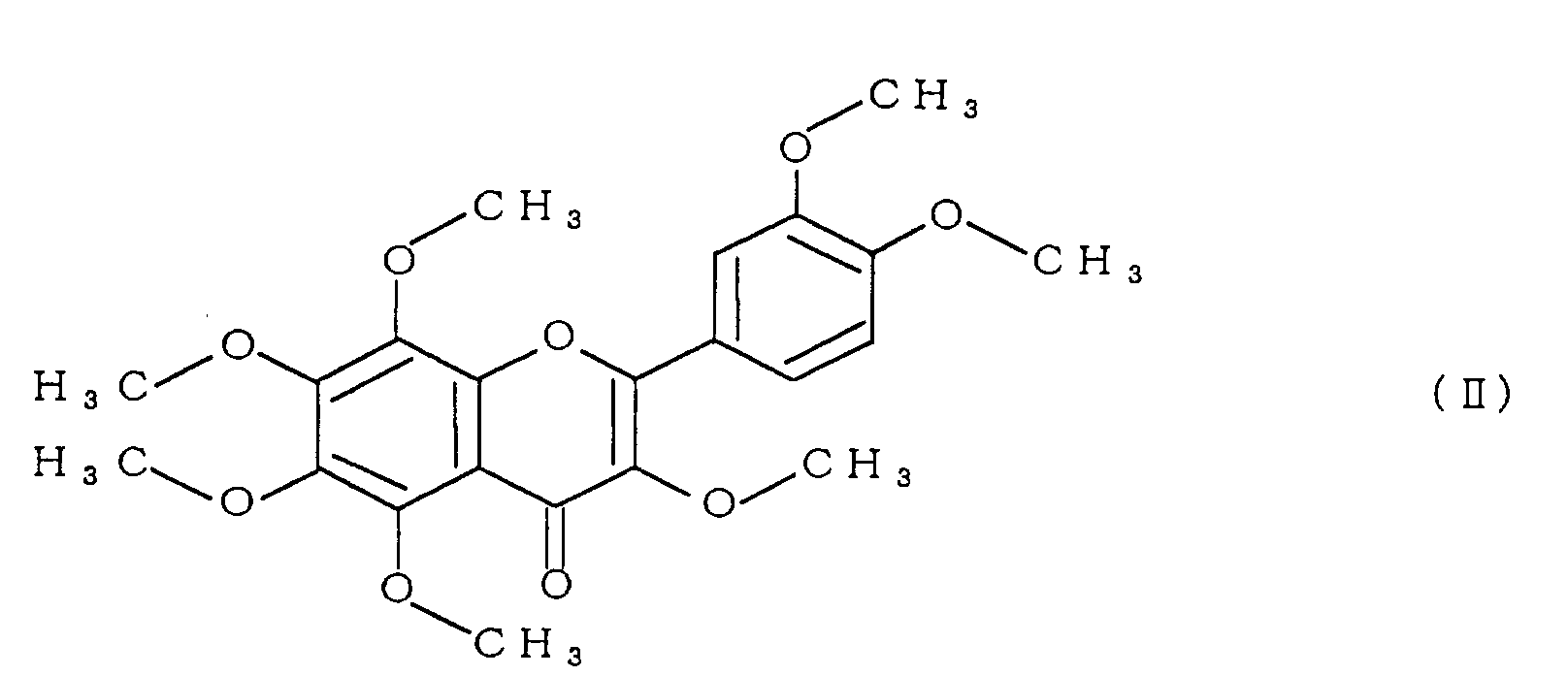
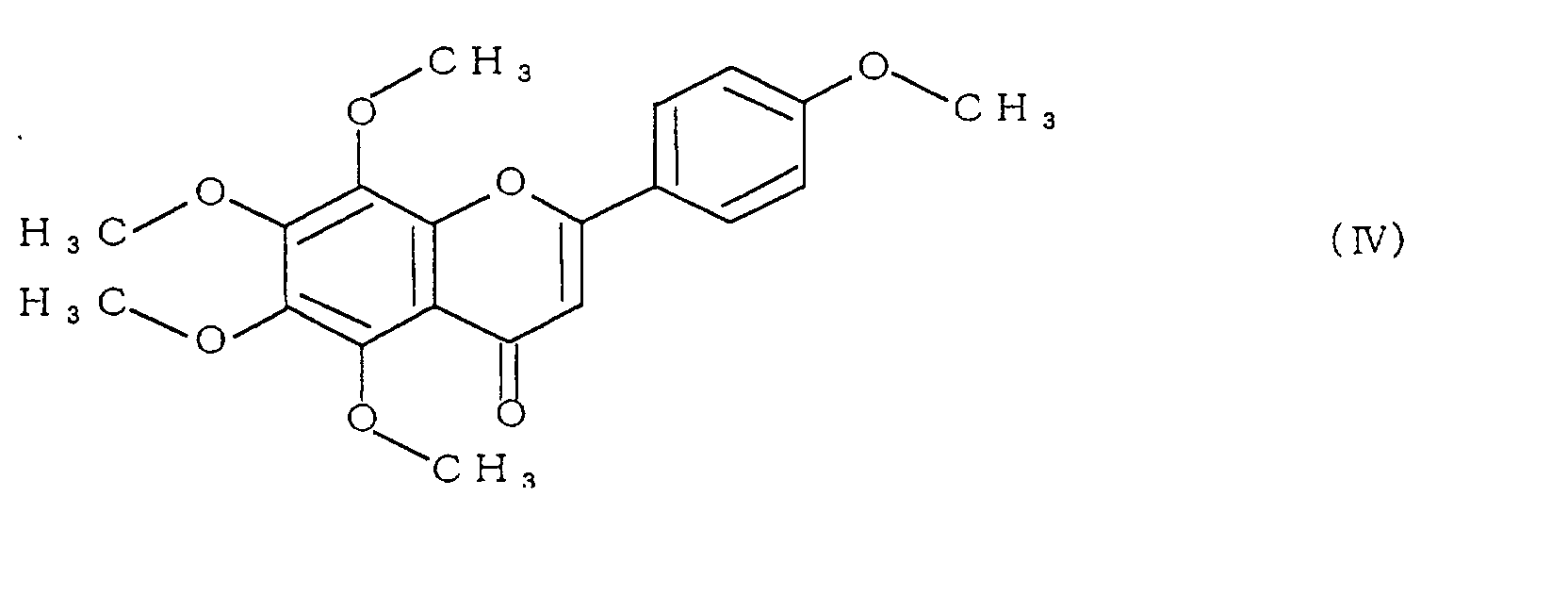
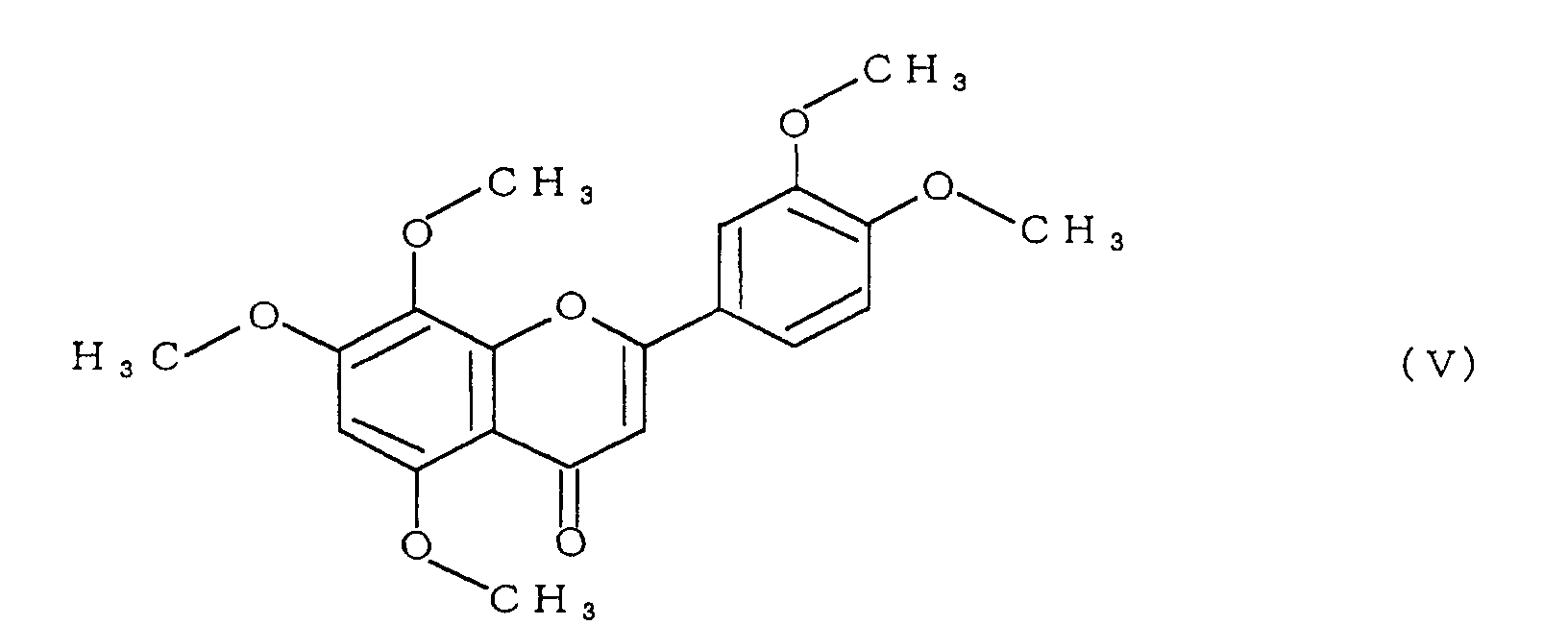
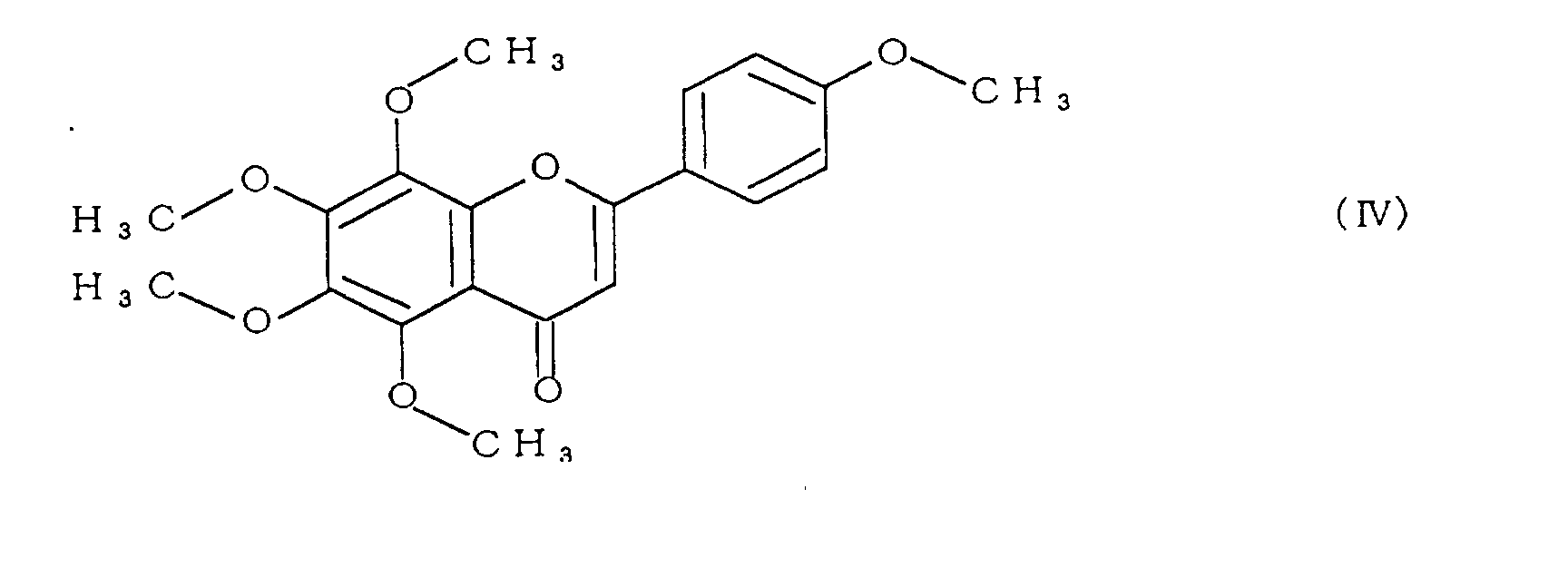
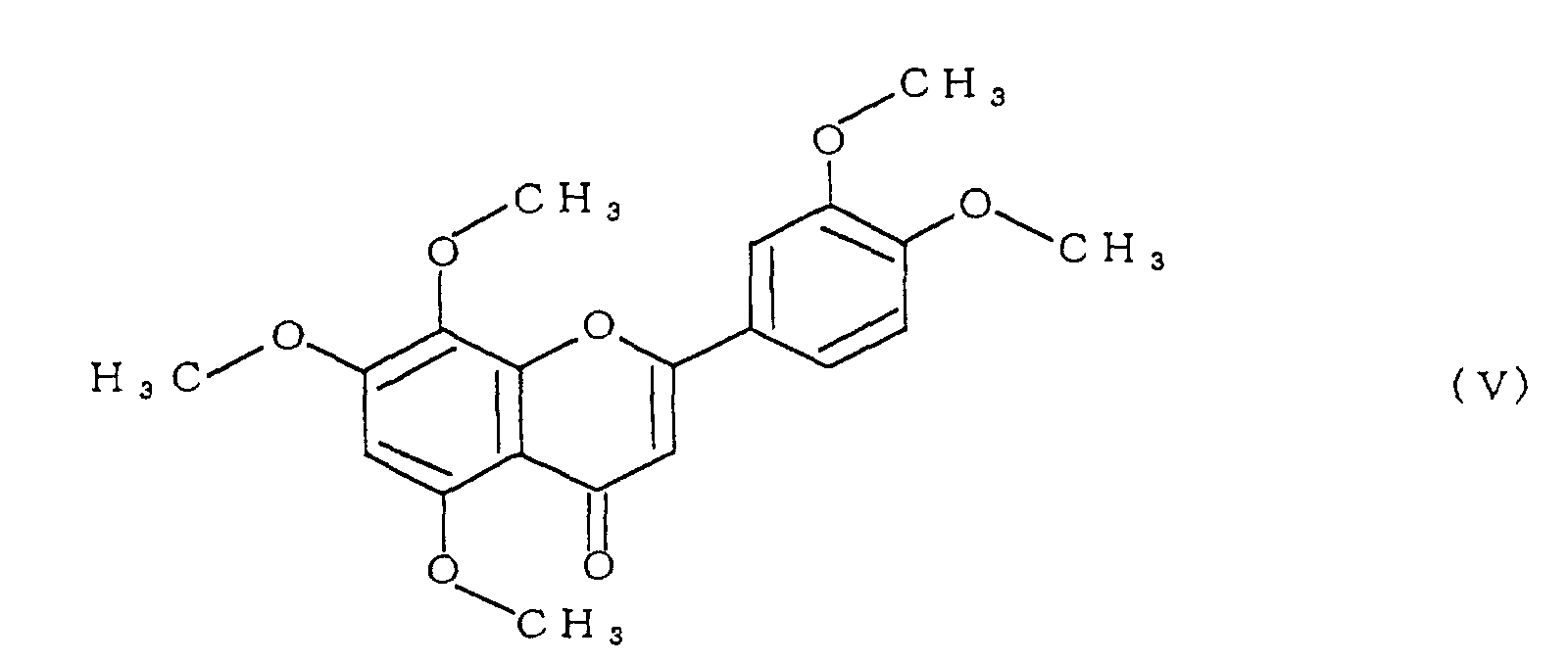
group consisting of compounds represented by formulae (II) to (V):
In one preferred embodiment of the present invention, the
polymethoxyflavone comprises at least one compound selected from the
group consisting of 5,6,7,8,3',4'-hexamethoxyflavone and 5,6,7,8,4'-pentamethoxyflavone.
According to another aspect of the present invention, a method for
isolating and purifying polymethoxyflavone includes the steps of:
subjecting peel of a plant of the Genus Citrus of the Family Rutaceae to
extraction with at least one solvent selected from the group consisting of
methanol, ethanol, propanol, butanol, ethyl acetate, acetone, propylene
glycol, and 1, 3-butylene glycol to obtain an extract (S1); dissolving the
extract (S1) in ethyl acetate, adding water thereto, stirring, separating
into layers, removing a water layer, distilling off the ethyl acetate to
obtain a dry solid product (S2); and dissolving the dry solid product (S2)
in a solvent, and subjecting it to liquid column chromatography.
According to another aspect of the present invention, a method for
isolating and purifying polymethoxyflavone comprising the steps of:
subjecting peel of a plant of the Genus Citrus of the Family Rutaceae to
extraction with at least one solvent selected from the group consisting of
methanol, ethanol, propanol, butanol, ethyl acetate, acetone, propylene
glycol, and 1, 3-butylene glycol to obtain an extract (S1); dissolving the
extract (S1) in hexane and/or chloroform, removing a precipitate,
distilling hexane and/or chloroform to obtain a dry solid product (S3); and
dissolving the dry solid product (S3) in a solvent, and subjecting it to
liquid column chromatography.
In one preferred embodiment of the present invention, the liquid
column chromatography uses silica gel and/or alumina as a filler, and a
mixed solution of hexane/ethanol in a volume proportion of 70/30 to 97/3
as an eluent.
Thus, the cosmetic compositions of the present invention has an
excellent whitening effect and has excellent storage stability.
These and other advantages of the present invention will become
apparent to those skilled in the art upon reading and understanding the
following detailed description.
BRIEF DESCRIPTION OF THE DRAWINGS
Fig. 1 is a diagram showing the 1H-NMR of the compound
represented by formula (III).
Fig. 2 is a diagram showing the 13C-NMR of the compound
represented by formula (III).
Fig. 3 is a diagram showing the mass spectrum of the compound
represented by formula (III).
Fig. 4 is a diagram showing the 1H-NMR of the compound
represented by formula (IV).
Fig. 5 is a diagram showing the 13C-NMR of the compound
represented by formula (IV).
Fig. 6 is a diagram showing the mass spectrum of the compound
represented by formula (IV).
DETAILED DESCRIPTION OF THE INVENTION
A polymethoxyflavone used in the present invention is represented
by the following general formula (I).
wherein each of R
1, R
2, R
3, R
4, R
5, R
6, R
7, R
8, R
9, and R
10 is selected
from the group consisting of hydrogen atom, hydroxyl group, alkoxy
group having 1 to 20 carbon atoms, alkyl group having 1 to 20 carbon
atoms, alkenyl group having 2 to 20 carbon atoms, hydroxyalkyl group
having 1 to 20 carbon atoms or a sugar residue, and at least four of R
1, R
2,
R
3, R
4, R
5, R
6, R
7, R
8, R
9, and R
10 are methoxy groups. The structural
feature is that the second and third positions of the flavonoid skeleton
are reduced, and the compound has a total of four or more methoxy
groups in the chromone ring and the benzene ring bonded to the second
position. In other words, at least four of R
1 to R
10 are methoxy groups.
The positions of the methoxy groups may be either in the chromone ring
or the benzene ring, but it is preferable that a larger number of methoxy
groups are present in the chromone ring.
Examples of groups other than the methoxy groups include the
following. As the alkoxy group having 1 to 20 carbon atoms, lower alkoxy
groups having 1 to 6 carbon atoms are preferable, and methoxy groups,
ethoxy groups, propoxy groups or the like are preferable.
As the alkyl group having 1 to 20 carbon atoms, lower alkyl groups
having 1 to 6 carbon atoms are preferable, and methyl groups, ethyl
groups, propyl groups or the like are preferable.
As the alkenyl group having 2 to 20 carbon atoms, lower alkenyl
groups having 2 to 6 carbon atoms are preferable, and ethenyl groups,
propenyl groups or the like are preferable.
As the hydroxyalkyl group having 1 to 20 carbon atoms, lower
hydroxyalkyl groups having 1 to 6 carbon atoms are preferable, and
hydroxymethyl groups, hydroxyethyl groups, hydroxypropyl groups or
the like are preferable.
As the sugar residue, for example, monosaccharides such as
glucose, galactose, fucose, xylose, mannose, rhamnose, fructose,
arabinose, lyxose, ribose, allose, altrose, idose, talose, deoxyribose,
quinovose and abequose; oligosaccharide residues where 2 to 4 of these
monosaccharides are bonded, such as maltose, lactose, cellobiose,
raffinose, xylobiose and sucrose can be used. Among these, residues of
glucose, galactose, fucose, xylose, mannose, rhamnose, fructose are
preferable.
Specific examples of the polymethoxyflavone include 3,5,6,7,8,3',4'-heptamethoxyflavone
represented by formula (II), 5,6,7,8,3',4'-hexamethoxyflavone
(commonly called nobiletin) represented by formula
(III), 5,6,7,8,4'-pentamethoxyflavone (commonly called tangeretin)
represented by formula (IV), and 5,7,8,3',4'-pentamethoxyflavone
represented by formula (V).
Among these, 5,6,7,8,3',4'-hexamethoxyflavone (nobiletin)
represented by formula (III), and 5,6,7,8,4'-pentamethoxyflavone
(tangeretin) represented by formula (IV) are particularly preferable.
The polymethoxyflavone compound used in the present invention
can be obtained by chemical synthesis, or can be obtained as a natural
product from an extract with a solvent derived from a plant.
Examples of chemical synthesis include the method described in
Indian Journal of Heterocyclic Chemistry Vol. 6. Jan-March 1997,
pp.221-222. With this method, 5,6,7,8,3',4'- hexamethoxyflavone
(formula (III):nobiletin ) can be synthesized.
Examples of a method by which polymethoxyflavone is obtained
from an extract of a plant include extracting the polymethoxyflavone
from the peel of plants of the Genus Citrus of the Family Rutaceae.
Plants of the Genus Citrus of the Family Rutaceae, such as Citrus
unshiu, Citrus poonensis, Citrus hassaku, Citrus lemon, Citrus
tachibana, Citrus junos, Citrus sudachi, Citrus grandis, Citrus tangerina
(tangerine), Citrus reticulate (mandarin orange), Citrus paradisi or the
like contains polymethoxyflavone (Journal of Medicinal Plant Research
Vol. 46, 162-166, (1982)). Among these, preferable plants are Citrus
unshiu, Citrus tachibana, Citrus junos and Citrus sudachi, and more
preferable plants are Citrus unshiu and Citrus tachibana.
Isolation and purification of polymethoxyflavone is performed by
producing an extract from the peel of a plant of the Genus Citrus of the
Family Rutaceae with an organic solvent, and separating the extract by
column chromatography. This method will be described more specifically
below.
First, peel of a plant of the Genus Citrus is subjected to extraction
with a water-soluble alcohol such as methanol, ethanol, propanol,
butanol, propylene glycol, 1,3-butylene glycol or the like; a solvent such
as acetone, hexane, ethyl acetate, chloroform or the like; or a mixed
solvent thereof. Among these, at least one solvent selected from the
group consisting of methanol, ethanol, propanol, butanol, propylene
glycol, 1,3-butylene glycol and ethyl acetate is preferable. More
preferable is at least one solvent selected from the group consisting of
methanol, ethanol, propylene glycol, 1,3-butylene glycol and ethyl acetate.
When the extract liquid is concentrated, an extract (S1) comprising about
1 to 15 wt% of the desired polymethoxyflavone can be obtained. This
extract (S1) can be further dried to a solid.
This extract (S1) is dissolved in ethyl acetate in an amount of
twice or more times, preferably, 3 to 10 times the weight of the extract,
water is added thereto, the mixture is stirred and separated into layers,
and a water layer is removed. Then, the ethyl acetate is distilled off so
as to obtain a dry solid product (S2).
Alternatively, the extract (S1) is dissolved in hexane and/or
chloroform, stirred, and is left undisturbed. Thereafter, a precipitate is
removed, and the supernatant was concentrated and a dry solid product
(S3) can be obtained. As the solvent, hexane or chloroform can be used
alone, however, a mixed solvent of hexane/chloroform is preferably used.
The mixed solvent can be used in a volume proportion of 1/9 to 9/1,
preferably, 3/7 to 7/3.
The obtained dry solid product (S2) or (S3) is preferably dissolved
a suitable solvent and is subjected to liquid column chromatography so
that polymethoxyflavone can be isolated and purified. In the liquid
column chromatography, silica gel or alumina can be used as a filler, and
a mixed solvent of hexane/ethanol in a volume proportion of 70/30 to 97/3
can be used as an eluent.
More specifically, isolation and purification of polymethoxyflavone
from Citrus tachibana will be described. The dried peel of Citrus
tachibana (herbal name: "kippi") is pulverized with a blender and dipped
in a suitable solvent (e.g., 95% ethanol in an amount of five times the
weight) for an appropriate period of time (e.g., five days) for extraction.
The extract liquid is filtered and concentrated under reduced pressure so
that a kippi extract (corresponding to S1 described above) can be
obtained. A suitable amount of ethyl acetate is added to the obtained
kippi extract to dissolve the kippi extract, followed by addition of water
in an amount equal to that of the ethyl acetate and stirring, and the
mixture was left undisturbed. After separating the mixture into layers,
a water layer was removed. This operation (washing with water) was
repeated plural times, preferably three times or more, and then ethyl
acetate was distilled off to obtain a dry solid (corresponding to S2
described above). Alternatively, a suitable amount of mixed solvent of
hexane/chloroform (in a volume proportion of 1/1) is added to the
obtained kippi extract, and is stored undisturbed over night at an
appropriate temperature (e.g., 4 °C). A precipitate is removed by
separating means (e.g., centrifugation) and the supernatant is
concentrated to obtain a dry solid (corresponding to S3 described above).
This dry solid product (corresponding to S2 or S3 described above) is
dissolved in an appropriate amount of a suitable solvent (e.g.,
hexane/ethanol (in a volume proportion of 85/15)), and subjected to
fractional liquid chromatography using a silica gel column or an alumina
column with a mixed solvent of hexane/ethanol as the eluent for
fractionation. Thus, polymethoxyflavone can be isolated and purified.
The structure of the isolated and purified polymethoxyflavone can
be determined by analysis means that is routinely used by those skilled
in the art, such as the nuclear magnetic resonance (NMR) spectrum or
the mass analysis spectrum.
In the present invention, the isolated polymethoxyflavone can be
added alone or can be used in combination of two or more
polymethoxyflavones, or can be added as a mixed product of chemical
synthesis or plant extracts that contains a plurality of natural products.
The polymethoxyflavone is contained in an amount of 0.00005 to
10wt%, preferably 0.0001 to 7wt%, and more preferably 0.001 to 5wt%
with respect to the total amount of the cosmetic compound. An amount
of below 0.00005 wt% cannot provide a sufficient whitening effect, nor
vitalize the skin or suppress wrinkles. An amount of more than 10wt%
not only causes a problem in storage stability, but also is expensive.
Furthermore, the cosmetic composition of the present invention
can comprise ascorbic acid and the derivatives thereof, kojic acid and the
derivatives thereof, hydroquinone derivatives such as arbutin, placental
extracts, ellagic acid and the derivatives thereof, which are known as
whitening components. It is preferable that these whitening components
are contained in an amount of 0.01 to 10wt%. The whitening effect can
be synergistically enhanced by using these whitening components and
polymethoxyflavone together.
The cosmetic composition of the present invention can contain a
base, additives or the like that are usually used in cosmetics, as
appropriate, depending on the type of the cosmetics in an amount that
does not interfere with the performance of the cosmetic composition. For
example, following substances can be contained in the cosmetic
composition of the present invention: lower alcohols such as ethanol and
isopropyl alcohol; polyhydric alcohols such as glycerol, 1,3-butylene glycol,
propylene glycol, dipropylene glycol and polyethylene glycol; hydrocarbon
oils such as liquid paraffin, liquid isoparaffin, squalane, veseline and
solid paraffin; natural fats and oils such as beef tallow, lard and fish oil;
synthetic triglyceride such as glycerol tri 2-ethylhexanoate; ester oils
such as isopropyl myristate, isopropyl palmitate, cetyl palmitate, ethyl
oleate, oleyl oleate and octyldodecyl myristate; waxes such as yellow bees
wax and carnauba wax; silicone derivatives such as linear or cyclic
dimethylpolysiloxane, polyether modified dimethylpolysiloxane, amino-modified
dimethylpolysiloxane; oils such as ceramide, cholesterol, protein
derivatives, lanoline, lanoline derivatives, lecithin; anionic surfactant
such as soap, acylmethyl taurine salts, amide ether sulfuric ester salts;
amphoteric surfactants such as amideamino acid salts, and amidopropyl
dimethylbetaine; nonionic surfactants such as polyoxyethylene alkyl
ethers, polyethylene glycol fatty acid esters, sorbitan fatty acid esters,
polyoxyethylene sorbitan fatty acid esters, polyoxyethylene hydrogenated
castor oil, polyglycerol fatty acid esters, polyoxyethylene glycerol fatty
acid esters, glycerol mono-fatty acid esters, alkyl polyglucoside and
alkanolamide; cationic surfactants such as alkyltrimethylammonium
chloride; semipolar surfactants such as alkyl dimethylamine oxides;
water-soluble polymers such as algic acid, carboxyvinyl polymer,
carboxymethylcellulose, hydroxypropylmethyl-cellulose, hydroxyethyl
cellulose, xanthan gum and hyaluronic acid; organic or inorganic salts
such as pyrrolidone carboxylic acid salts, citric acid salts, malic acid salts
and sodium chloride; acids or alkalis that are pH regulators;
antiinflammatory agents; germicidal agents; chelating agents;
antioxidants; ultraviolet absorbers; natural extracts derived from
animals and plants; and pigments and fragrances.
The cosmetic composition of the present invention can be
preferably used in the form of lotions, milky lotions, oil-in-water creams,
water-in-oil creams or the like.
Examples
Next, the present invention will be described by way of examples,
but the present invention is not limited by these examples.
(Production Example 1: Isolation of polymethoxyflavone)
First, 10kg of dried peel of Citrus tachibana (herbal name: "kippi")
was pulverized with a blender, and immersed for extraction for 5 days in
95% ethanol (first grade) in an amount of 5 times the weight of the dried
peel. An extract liquid was filtered and concentrated under reduced
pressure, and thus 550g of a kippi extract were obtained. The kippi
extract was dissolved in ethyl acetate in an amount of 5 times the weight
of the extract, followed by addition of water in an amount equal to that of
the ethyl acetate and stirring, and the mixture was left undisturbed.
After separating the mixture into layers, a water layer was removed
(washing with water). This operation (washing with water) was repeated
three times, and then ethyl acetate was distilled off. Thus, 300g of dry
solid product were obtained. Furthermore, this dry solid product was
dissolved in a mixed solution of hexane / ethanol (in a volume proportion
of 85/15) in an amount of twice the weight of the dry solid product, and
thus a dissolved solution was obtained. All the dissolved solution was
charged to a column ( 30cm, with a length of 1m) filled with silica gel.
Hexane in a volume of twice the volume of the column was allowed to
flow in the column, and then, using a mixed solvent of hexane/ethanol (in
a volume proportion of 90/10) as an eluent, the elution was fractionated
into 1L fractions. When each fraction was analyzed by silica gel thin
layer chromatography using a hexane/ethanol mixed solution (volume
proportion of 90/10) as a developer, the presence of compounds 1 to 4 was
confirmed. The fractions containing these compounds were mixed, and
the solvent was distilled off to obtain the compounds 1 to 4. The yields of
the compounds were as follows: 7g for compound 1, 63g for compound 2,
33g for compound 3, and 13g for compound 4.
Each of the obtained compounds 1 to 4 was analyzed by the
nuclear magnetic resonance (NMR) spectrum and the mass analysis
(MS) spectrum. Figs. 1 to 3 show the 1H-NMR, 13C-NMR and MS spectra
of the compound 2, and Figs 4 to 6 show the 1H-NMR, 13C-NMR and MS
spectra of the compound 3.
When these data are compared with the data described in
references (Natural Medicines 51(3), 190-193(1997), Chem. Pharm. Bull.
37, 1092(1989), Pharmacological Magazine (YAKUGAKU ZASSHI)
116(3), 244-250 (1996) and Tetrahedron, 16(8), 64(1964), the compound 2
was identified as 5,6,7,8,3',4'-hexamethoxyflavone (formula (III):
nobiletin). The compound 3 was identified as 5,6,7,8,4'-pentamethoxyflavone
(formula (IV): tangeretin).
The structures of the other compounds (compound 1 and
compound 4) were determined by comparing their 1H-NMR, 13C-NMR
and MS spectra with the 1H-NMR, 13C-NMR and MS spectra of the
compounds represented by formulae (III) and (IV). As a result, the
compound 1 was identified as 3,5,6,7,8,3',4'-heptamethoxyflavone
(formula (II)), and the compound 4 was identified as 5,7,8,3',4'-pentamethoxyflavone
(formula (V)).
(Production Example 2: Isolation of polymethoxyflavone)
First, 10kg of dried peel of Citrus tachibana (herbal name: "kippi")
was pulverized with a blender, and immersed for extraction for 5 days in
95% ethanol (first grade) in an amount of 5 times the weight of the dried
peel. An extract liquid was filtered and concentrated under reduced
pressure, and thus 560g of a kippi extract were obtained. A mixed
solvent of hexane/ chloroform (in a volume proportion of 1/1) in an
amount of five times the weight was added to the kippi extract, and the
mixture was stirred for about 30 min. Thereafter, the mixture was left
undisturbed at 4 °C over night, and a supernatant was collected by
decantation, followed by distillation of the solvent. Thus, 320g of dry
solid product were obtained. This dry solid product was separated and
purified by being subjected to column chromatography in the same
manner as in Production Example 1, and thus compounds 1 to 4 were
collected. The yields of the compounds were as follows: 6g for compound
1, 65g for compound 2, 35g for compound 3, and 14g for compound 4. The
results of analysis revealed that the compounds 1 to 4 correspond to the
compounds (II) to (V), respectively.
(Confirmation of whitening effect-1: suppression of melanin formation)
Using the obtained compounds of formulae (II) to (V), the effect of
suppressing melanin production of human melanoma cell (HM3KO) was
examined in vitro. More specifically, HM3KO was cultured to about 5 ×
10
5 by a conventional method, collected by centrifugation to obtain
pellets, and inoculated the pellet to a culture dish of 10cm diameter
containing an Eagle's medium supplemented with 10% fetal bovine
serum and cultured at 37 °C for 24 hours. Thereafter, each
polymethoxyflavone of formulae (II) to (V) was added, or kojic acid or
arbutin for comparison was added thereto so that the final addition
concentration was 10µM, followed by cultivation for 6 days. After the
cultivation, cells were collected by centrifugation, and 1ml of 2N sodium
hydroxide aqueous solution was added thereto to obtain cell lysate. The
absorbance in a wavelength of 410nm of the cell lysate was measured
with a spectrophotometer. Here, the absorbance of the cell lysate to
which a sample is not added is defined as 100% of the melanin
production ratio, and the melanin production ratios are shown as relative
values, measuring the absorbance of each cell lysate. Table 1 shows the
results.
| Sample | Sample concentration in medium (µM) | Melanin production ratio (% of control) |
| (no addition) | 0 | 100 |
| 3,5,6,7,8,3',4'-heptamethoxyflavone : formula (II) | 10 | 65 |
| 5,6,7,8,3',4'-hexamethoxyflavone : formula (III) | 10 | 35 |
| 5,6,7,8,4'-pentamethoxyflavone : formula (IV) | 10 | 55 |
| 5,7,8,3',4'-pentamethoxyflavone : formula (V) | 10 | 60 |
| Kojic acid | 10 | 96 |
| Arbutin | 10 | 97 |
The results of Table 1 indicate that all of the polymethoxyflavones
of formulae (II) to (V) significantly suppressed melanization of HM3KO.
This effects are far beyond those of kojic acid and arbutin.
(Confirmation of whitening effect-2: suppression of UV-induced
pigmentation)
Using brown guinea pigs, the suppression of UV-induced
pigmentation was examined in vivo. More specifically, the backs of the
brown guinea pigs were shaved and covered with an ultraviolet shielding
plate provided with 6 rectangular holes of 2 × 2cm, followed by
irradiation of UV (0.5J/cm
2) to induce pigmentation. Thereafter, 40 µL of
70% (W/W) ethanol aqueous solution containing each of
polymethoxyflavone (nobiletin) of formula (III) or polymethoxyflavone
(tangeretin) of formula (IV) in a concentration shown in Table 2 were
applied twice a day. Then, the degrees of pigmentation before and after
the application were measured. Table 2 shows the results.
| Sample | Sample concentration (%) | Pigmentation degree ΔL |
| | | Before irradiation | After 20 days | After 40 days |
| (no addition) | 0 | 0 | -7.8 | -5.2 |
| 5,6,7,8,3',4'- hexamethoxyflavone: formula (III) | 4 | 0 | -5.1 | -1.9 |
| 5,6,7,8,3',4'- hexamethoxyflavone: formula (III) | 0.4 | 0 | -5.5 | -3.2 |
| 5,6,7,8,4'-pentamethoxyflavone: formula (IV) | 4 | 0 | -5.6 | -3.3 |
| 5,6,7,8,4'-pentamethoxyflavone: formula (IV) | 0.4 | 0 | -6.1 | -3.5 |
In Table 2, the pigmentation degree Δ L was obtained by
measuring a L value before UV irradiation, which is defined as 0, with a
spectrophotometric colorimeter, and obtaining the difference between the
L values before and after UV irradiation. A lower value ΔL corresponds
to a higher pigmentation degree.
Table 2 indicates that the polymethoxyflavone used in the present
invention significantly suppress the induction of pigmentation of brown
guinea pigs.
Examples 1 to 4 and Comparative Examples 1 to 3
Cosmetic compositions for skin lotion containing components
shown in Table 4 were prepared by using five components shown in
Table 3 as common components. The polymethoxyflavones used were the
polymethoxyflavones of formulae (III) and (IV) that were isolated and
purified in the production examples.
| Commonly added components |
| | Components | Added amount (wt%) |
| 1 | Trisodium citrate dihydrate | 0.3 |
| 2 | Ethanol | 3 |
| 3 | Methylparaben | 0.1 |
| 4 | Phenoxyethanol | 0.2 |
| 5 | Sodium sulfate anhydride | 0.1 |
| Total | 3.7 |
The obtained cosmetic compositions were evaluated by the
following method. Table 4 shows the results.
(1) Whitening effect
Evaluation was carried out with 50 women (in their 20's and 30's)
as test persons, and the cosmetic compositions were used twice a day,
that is, in the morning and at night, for 2 months. Then, the
improvement degree in "liver spots" and "freckles" after use was
determined by eyesight with the following criteria.
10 points: when it was determined that the composition was
evidently effective.
5 points: when it was determined that the composition was
slightly effective.
0 point: when it was determined that the composition was not
effective at all.
The average of the points of the 50 women was obtained, and a
cosmetic composition for which the average was 5 points or more was
defined as a cosmetic composition having high whitening effect.
(2) Moisture of the skin
Evaluation was carried out with 20 women (of the age between 22
and 32) as test persons, and the cosmetic compositions were used after
washing their faces. Then, moisture of the skin immediately after use
and 2 hours later were determined with the following criteria.
2 points: when it was perceived that the moisture of the skin was
sufficient immediately after use, and the skin was still moist 2 hours
later.
1 point: when it was perceived that the moisture of the skin was
slightly not sufficient immediately after use, or the skin was slightly dry
2 hours later.
0 point: when it was perceived that the moisture of the skin was
not sufficient.
The average of the points of the 20 women was obtained, and a
cosmetic composition for which the average was 1.5 points or more was
defined as a cosmetic composition having a high effect of allowing the
skin to retain moisture.
(3) Vitality of the skin
Evaluation was carried out with 20 women (of the age between 22
and 32) as test persons, and the cosmetic compositions were used after
washing their faces. Then, the vitality of the skin was determined with
the following criteria.
2 points: when it was perceived that the skin was vitalized.
1 point: when it was perceived that the skin was slightly vitalized.
0 point: when it was perceived that the skin was not vitalized.
The average of the points of the 20 women was obtained, and a
cosmetic composition for which the average was 1.5 points or more was
defined as a cosmetic composition having a high effect of vitalizing the
skin.
(4) Wrinkle suppressing effect
Evaluation was carried out with 20 women (of the age between 24
and 35) as test persons, and the cosmetic compositions were used twice a
day (in the morning and at night) for two weeks in a row. Then, the
wrinkle suppressing effect was determined with the following criteria.
2 points: when it was perceived apparently that wrinkles were not
conspicuous any more.
1 point: when it was perceived that wrinkles were slightly not
conspicuous.
0 point: when it was perceived that there was no wrinkle
suppressing effect.
The average of the points of the 20 women was obtained, and a
cosmetic composition for which the average was 1.5 points or more was
defined as a cosmetic composition having a high effect of suppressing
wrinkles.
(5) Storage stability
The cosmetic compositions were sealed in transparent glass
containers, and stored at 0°C, 25°C, and 40°C for three months. The
appearance thereof was observed, and evaluation was carried out with
the following criteria.
Table 4 shows the results.
| | Examples (wt%) | Comparative Examples (wt%) |
| | 1 | 2 | 3 | 4 | 1 | 2 | 3 |
| a 5,6,7,8,3',4'-hexamethoxyflavone: formula (III) | 2 | --- | 0.5 | 0.3 | --- | --- | --- |
| a. 5,6,7,8,4'-pentamethoxyflavone: formula (IV) | --- | 2 | --- | 0.1 | --- | --- | --- |
| Placental extract | --- | --- | --- | --- | --- | 0.5 | --- |
| Ascorbic acid magnesium phosphate salt | --- | --- | 0.5 | --- | --- | 0.5 | 3 |
| Glycerol | --- | 2 | 2 | 2 | 2 | 2 | 2 |
| Dipropylene glycol | --- | 3 | 3 | 3 | 3 | 3 | 3 |
| Citrate monohydrate | 0.1 | 0.1 | --- | 0.1 | 0.1 | --- | -- |
| Commonly added components | 3.7 |
| Purified water | the rest |
| Total | 100 |
| (1) Whitening effect | G (7.0) | G (6.3) | G (7.5) | G (7.2) | P (1.8) | P (2.2) | P (3.7) |
| (2) Skin moisture | G (1.7) | G (1.8) | G (1.9) | G (1.8) | P (1.2) | P (1.4) | P (1.4) |
| (3) Skin vitality | G (1.7) | G (1.9) | G (1.8) | G (1.7) | P (1.3) | P (1.3) | P (1.3) |
| (4) Wrinkle suppressing effect | G (1.8) | G (1.9) | G (1.8) | G (1.7) | P (1.2) | P (1.2) | P (1.3) |
| (5) Storage stability | G | G | G | G | G | G | P |
According to Examples 1 to 4, the lotions containing
polymethoxyflavones of the present invention are excellent in the
whitening effect, allow the skin to retain moisture for a long time, and
vitalize the skin, and suppress wrinkles, and have excellent storage
stability. On the other hand, Comparative Examples 1 to 3 cannot
provide cosmetic compositions with adequate performance. More
specifically, in Comparative Example 1, since no polymethoxyflavone is
contained, almost no whitening effect is provided. In Comparative
Example 2 where placental extract is used instead of the
polymethoxyflavone, the whitening effect is weak, and there is no effect
on the skin moisturization, the skin vitalization, and the suppression of
wrinkles. In Comparative Example 3 where ascorbic acid salt is used
instead of the polymethoxyflavone, the whitening effect is weak, and
there is no effect on the skin moisturization, the skin vitalization, and
the suppression of wrinkles, and the storage stability is also problematic.
Examples 5 to 7
Cosmetic whitening compositions for oil-in-water milky lotion
shown in Table 8 were prepared by using the 12 components shown in
Table 5 as common components.
| Commonly added components |
| | Components | Added amount (wt%) |
| 1 | Xanthan gum (manufactured by Dainippon Pharmaceutical Co., Ltd., "ECHO GUM T") | 0.1 |
| 2 | Carboxyvinyl polymer (BFGoodrich Co., Ltd., "carbopol 940") | 0.12 |
| 3 | Ethanol | 5 |
| 4 | Purified sunflower oil | 5 |
| 5 | Squalane | 3 |
| 6 | Octyldodecyl myristate | 2 |
| 7 | Polyoxyethylene(32mol)monostearate | 0.5 |
| 8 | Polyoxyethylene (20mol) stearyl ether | 0.7 |
| 9 | Glycerol monostearate | 1 |
| 10 | Methylparaben | 0.1 |
| 11 | Butylparaben | 0.05 |
| 12 | Phenoxyethanol | 0.2 |
| Total | 17.77 |
The obtained milky lotions were evaluated in the same manner as
in Examples 1 to 4. Table 8 shows the results.
Examples 8 and 9
Cosmetic skin care compositions for oil-in-water creams shown in
Table 8 were prepared by using the 12 components shown in Table 6 as
common components.
| Commonly added components |
| | Components | Added amount (wt%) |
| 1 | Purified olive oil | 8 |
| 2 | Squalane | 3 |
| 3 | Octyldodecyl myristate | 2 |
| 4 | Dimethylpolysiloxane (100CS) | 1 |
| 5 | Purified yellow wax | 3 |
| 6 | Polyoxyethylene (20mol) sorbitan monostearate | 1 |
| 7 | Polyoxyethylene(75mol)monostearate | 1 |
| 8 | Glycerol monostearate | 2 |
| 9 | Tocopherol acetate | 0.05 |
| 10 | Methylparaben | 0.2 |
| 11 | Propylparaben | 0.1 |
| 12 | Butylparaben | 0.1 |
| Total | 21.45 |
The obtained oil in water creams were evaluated in the same
manner as in Examples 1 to 4. The storage stability was evaluated with
the method shown in (5') below.
(5') Storage stability
The cosmetic compositions were sealed in transparent glass
containers, and stored at - 5°C, 25°C, and 45°C for one month. Then,
their state was examined, and evaluation was carried out with the
following three criteria.
Table 8 shows the results.
Examples 10 and 11
Cosmetic skin care compositions for water-in-oil creams shown in
Table 8 were prepared by using the 12 components shown in Table 7 as
common components.
| Commonly added components |
| | Components | Added amount (wt%) |
| 1 | Purified jojoba oil | 3 |
| 2 | Purified sunflower oil | 6 |
| 3 | Dimethylpolysiloxane (100CS) | 1 |
| 4 | Squalane | 4 |
| 5 | Octyldodecyl myristate | 5 |
| 6 | Glycerol monooleate | 1.5 |
| 7 | Diglycerol monooleate | 0.2 |
| 8 | Tocopherol acetate | 0.1 |
| 9 | Methylparaben | 0.2 |
| 10 | Propylparaben | 0.1 |
| 11 | Butylparaben | 0.1 |
| 12 | Magnesium sulfate (heptahydrate) | 0.5 |
| Total | 21.7 |
The obtained water-in-oil creams were evaluated in the same
manner as in Examples 8 and 9.
Table 8 shows the results.
| | Examples (wt%) |
| | o/w milky lotion | o/w cream | w/o cream |
| | 5 | 6 | 7 | 8 | 9 | 10 | 11 |
| a5,6,7,8,3',4'-hexamethoxyflavone: formula(III) | 1 | - | 0.5 | 2 | 0.5 | 1 | 2 |
| a.5,6,7,8,4'-pentamethoxyflavone: formula(IV) | - | 2 | - | - | 1 | - | 1 |
| Glycerol | 2 | 2 | 2 | 2 | 2 | 2 | 2 |
| Dipropylene glycol | 2 | 2 | 2 | 3 | 3 | 3 | 3 |
| Polyethylene glycol 1540 | 2 | 2 | 2 | - | - | - | - |
| Ascorbic acid magnesium phosphate salt | - | - | - | 0.5 | - | - | - |
| L-arginine | 0.1 | 0.1 | 0.1 | - | - | - | - |
| Cetanol | 2 | - | - | 3 | - | - | 3 |
| Behenyl alcohol | - | 1 | 1 | - | 3 | 2 | - |
| Decamethylcyclosiloxane | - | - | - | 3 | - | - | - |
| Commonly added components | 17.77(table 5) | 21.45(table 6) | 21.7(table 7) |
| Purified water | the rest |
| Total | 100 |
| (1) Whitening effect | G (7.1) | G (6.4) | G (7.8) | G (7.2) | G (6.8) | G (7.6) | G (8.1) |
| (2) Skin moisture | G (1.9) | G (1.9) | G (1.8) | G (1.9) | G (1.9) | G (2.0) | G (2.0) |
| (3) Skin vitality | G (1.8) | G (1.9) | G (1.9) | G (1.8) | G (1.9) | G (1.8) | G (1.8) |
| (4) Wrinkle suppressing effect | G (1.9) | G (2.0) | G (1.9) | G (1.9) | G (1.9) | G (1.9) | G (1.8) |
| (5) Storage stability | G | G | G | - | - | - | - |
| (5')Storage stability | - | - | - | G | G | G | G |
According to Examples 5 to 7, all the cosmetic compositions (milky
lotions) of the present invention have an excellent whitening effect, allow
the skin to retain moisture for a long time, vitalize the skin, suppress
wrinkles, and have excellent storage stability.
According to Examples 8 and 9, all the cosmetic skin care
compositions (creams) of the present invention have an excellent
whitening effect, allow the skin to retain moisture for a long time,
vitalize the skin, suppress wrinkles, and have excellent storage stability.
According to Examples 10 and 11, all the cosmetic compositions
(creams) of the present invention have an excellent whitening effect,
allow the skin to retain moisture for a long time, vitalize the skin,
suppress wrinkles, and have excellent storage stability.
The invention may be embodied in other forms without departing
from the spirit or essential characteristics thereof. The embodiments
disclosed in this application are to be considered in all respects as
illustrative and not limiting. The scope of the invention is indicated by
the appended claims rather than by the foregoing description, and all
changes which come within the meaning and range of equivalency of the
claims are intended to be embraced therein.