EP1148113A1 - Elément solide combustible pour la désintégration d'une couche de dépot de combustion et méthode de fabrication d'un tel élément - Google Patents
Elément solide combustible pour la désintégration d'une couche de dépot de combustion et méthode de fabrication d'un tel élément Download PDFInfo
- Publication number
- EP1148113A1 EP1148113A1 EP01201227A EP01201227A EP1148113A1 EP 1148113 A1 EP1148113 A1 EP 1148113A1 EP 01201227 A EP01201227 A EP 01201227A EP 01201227 A EP01201227 A EP 01201227A EP 1148113 A1 EP1148113 A1 EP 1148113A1
- Authority
- EP
- European Patent Office
- Prior art keywords
- product
- internal space
- deposit layer
- solid combustible
- disintegrating
- Prior art date
- Legal status (The legal status is an assumption and is not a legal conclusion. Google has not performed a legal analysis and makes no representation as to the accuracy of the status listed.)
- Granted
Links
Images
Classifications
-
- C—CHEMISTRY; METALLURGY
- C10—PETROLEUM, GAS OR COKE INDUSTRIES; TECHNICAL GASES CONTAINING CARBON MONOXIDE; FUELS; LUBRICANTS; PEAT
- C10L—FUELS NOT OTHERWISE PROVIDED FOR; NATURAL GAS; SYNTHETIC NATURAL GAS OBTAINED BY PROCESSES NOT COVERED BY SUBCLASSES C10G OR C10K; LIQUIFIED PETROLEUM GAS; USE OF ADDITIVES TO FUELS OR FIRES; FIRE-LIGHTERS
- C10L5/00—Solid fuels
- C10L5/40—Solid fuels essentially based on materials of non-mineral origin
- C10L5/44—Solid fuels essentially based on materials of non-mineral origin on vegetable substances
-
- C—CHEMISTRY; METALLURGY
- C10—PETROLEUM, GAS OR COKE INDUSTRIES; TECHNICAL GASES CONTAINING CARBON MONOXIDE; FUELS; LUBRICANTS; PEAT
- C10L—FUELS NOT OTHERWISE PROVIDED FOR; NATURAL GAS; SYNTHETIC NATURAL GAS OBTAINED BY PROCESSES NOT COVERED BY SUBCLASSES C10G OR C10K; LIQUIFIED PETROLEUM GAS; USE OF ADDITIVES TO FUELS OR FIRES; FIRE-LIGHTERS
- C10L10/00—Use of additives to fuels or fires for particular purposes
- C10L10/06—Use of additives to fuels or fires for particular purposes for facilitating soot removal
-
- Y—GENERAL TAGGING OF NEW TECHNOLOGICAL DEVELOPMENTS; GENERAL TAGGING OF CROSS-SECTIONAL TECHNOLOGIES SPANNING OVER SEVERAL SECTIONS OF THE IPC; TECHNICAL SUBJECTS COVERED BY FORMER USPC CROSS-REFERENCE ART COLLECTIONS [XRACs] AND DIGESTS
- Y02—TECHNOLOGIES OR APPLICATIONS FOR MITIGATION OR ADAPTATION AGAINST CLIMATE CHANGE
- Y02E—REDUCTION OF GREENHOUSE GAS [GHG] EMISSIONS, RELATED TO ENERGY GENERATION, TRANSMISSION OR DISTRIBUTION
- Y02E50/00—Technologies for the production of fuel of non-fossil origin
- Y02E50/10—Biofuels, e.g. bio-diesel
-
- Y—GENERAL TAGGING OF NEW TECHNOLOGICAL DEVELOPMENTS; GENERAL TAGGING OF CROSS-SECTIONAL TECHNOLOGIES SPANNING OVER SEVERAL SECTIONS OF THE IPC; TECHNICAL SUBJECTS COVERED BY FORMER USPC CROSS-REFERENCE ART COLLECTIONS [XRACs] AND DIGESTS
- Y02—TECHNOLOGIES OR APPLICATIONS FOR MITIGATION OR ADAPTATION AGAINST CLIMATE CHANGE
- Y02E—REDUCTION OF GREENHOUSE GAS [GHG] EMISSIONS, RELATED TO ENERGY GENERATION, TRANSMISSION OR DISTRIBUTION
- Y02E50/00—Technologies for the production of fuel of non-fossil origin
- Y02E50/30—Fuel from waste, e.g. synthetic alcohol or diesel
Definitions
- This invention relates to a method for manufacturing a solid combustible element, comprising a product for disintegrating a combustion deposit layer, such as for example soot and/or tar deposits that are the result of a combustion.
- This invention furthermore also relates to such a solid combustible element and in particular such a combustible element that is formed out of loose particles of a combustible material, such as for example wood waste and/or sawdust.
- combustion deposit layer With each device that comes into contact with fire and/or smoke, such as for example a heating apparatus (a hearth, a stove, ...), an incinerator and the smoke flues (e.g. chimneys) thereof, the problem exists that after the course of time a deposit layer is formed on the walls that come into contact with the fire or the smoke.
- This deposit layer referred to in this patent application by the term combustion deposit layer, gradually becomes thicker.
- the composition of this combustion deposit layer is dependent on the type of fuel. As a result of the combustion of solid fuels, such as coal or wood, this layer will principally consist of a combination of soot particles, ash, and tar.
- This combustion deposit layer comprises combustible components and can in the course of use of the apparatus or the installation spontaneously start to burn. This fire can be dangerous and cause damage. So-called chimney fires arise through an ignition of the combustion deposit layer deposited on the chimney walls.
- this layer furthermore also leads to a decrease in the passage section of the duct, with the result that the smoke discharge progresses less efficiently.
- a known product is marketed by the German firm "Boomex”. The product is composed of (the given percentages are weight percentages) 2 to 4% cupric chloride, approximately 15% ethylene glycol and approximately 70% polyethylene glycol, and is sold in liquid form.
- Another known product is sold in powder form and contains ammonium chloride ( ⁇ 90%), copper sulphate ( ⁇ 10%) and zinc chloride ( ⁇ 10%). This product is also available in tablet form and then consists of among others copper(II) chloride, ammonium chloride and zinc stearate.
- a disadvantage of the prescribed method of use of these products consists in that this use is rather time-consuming and not without danger.
- the products must be considered as rather dangerous chemical products.
- all contact with the skin and the eyes must be avoided.
- Putting a certain dose of such a dangerous chemical product in a burning fire place is rather dangerous.
- a solid fuel element exists in which a product is incorporated for disintegrating a combustion deposit layer.
- This solid fuel element is described in the French patent no. FR-2 749 855, and consists of three different ingredients, namely a solid cellulose-containing fuel such as for example wood waste, a chemical and/or catalytic product for disintegrating tar and/or soot deposits and an added binding agent such as for example paraffin.
- the binding agent is used in order to make a cohesive aggregate of the mixture of solid fuel particles and the chemical product. This occurs for example by pressing the mixture into a mould.
- This element can placed in the installation or the apparatus prior to lighting the fire place. With the combustion of the element the chemical product incorporated therein is gradually released without additional operations still being required. The difficult, dangerous and time-consuming manipulation of the product is because of this indeed avoided, but this element has the great disadvantage that the raw material and production costs for producing it are rather high. Another disadvantage lies in the fact that the production of this element is only possible if the solid fuel is mixed "in small particles" with the chemical product and the binding agent. Large units of a certain fuel, e.g. wooden logs, first have to be reduced to a quantity of small particles before they can be used for the production of these elements. This additional operation increases the production costs even higher.
- the purpose of this invention is efficiently and simply to provide a method for manufacturing a solid combustible element with a product for disintegrating a combustion deposit layer that is less expensive than the known methods, and in particular can be produced at low raw material and production costs, even starting with relatively large units of a certain fuel.
- a method for manufacturing a solid combustible element comprising a product for disintegrating a combustion deposit layer, whereby an internal space is made in the solid combustible element, and whereby the aforementioned product is provided in this internal space.
- the term "internal space” is used in the sense of any opening, gap, recess, passage, channel or hollow in the material of the combustible element that is at least partly surrounded by this material. This signifies that such an internal space can be both open and closed, and that being or not being fully closed off from such a space therefore cannot be interpreted as a characteristic through which this space could not be considered as an internal space in the meaning that is applied in this patent application. Hence among others a bore or a channel in the element of which the access opening(s) are not closed off is considered as an internal hollow space.
- combustion deposit layer in this specification and in the claims of this patent application is meant any deposit layer whatever that has originated as a result of a contact with smoke and/or fire, and in particular a deposit layer that contains soot particles and/or ash and/or tar.
- a product for disintegrating such a combustion deposit layer is meant any product that can totally or partially disintegrate such a deposit layer (irrespective of the composition thereof) or can reduce the coherence of such a deposit layer or can promote or cause such a disintegration or reduction of coherence to arise.
- a combustible element For the production of a combustible element according to this invention use can also be made of relatively large units of a solid fuel, without these first having to be reduced to smaller particles. It is indeed sufficient to provide an internal space in these large units, e.g. by drilling, and inserting the aforementioned products therein.
- An additional purpose of this invention is to provide a solid combustible element that comprises a product for disintegrating a combustion deposit layer, and that in comparison to the known products can be produced at lower raw material and production costs (even starting with relatively large units of a certain fuel).
- the element has a natural coherence or through the compression of an amount of loose particles of one or several combustible materials, without addition of any binding agent, it is compressed to a coherent aggregate, while in the element an internal space is provided in which the aforementioned product is located.
- Use can therefore be made of the natural properties and components of the combustible material in order to form a cohesive aggregate.
- combustible materials of vegetable origin it is the lignin therein that ensure this. No binding agent need therefore be added any longer.
- all combustible products are suitable, but waste products or residual substances from other production processes are preferred because they are usually rather inexpensive.
- the aforementioned loose particles can be very small, such as for example in the case of sawdust, but can also be several centimetres long if for example combustible fibres or vegetable parts are used.
- a wooden log or wooden stump for example has a natural coherence in contrast to a compressed amount of wood waste or sawdust where the coherence is obtained by technical means (a press), whether or not after adding a binding agent.
- a press technical means
- an element with a natural coherence only an internal space then has to be made (for example by drilling an opening in it) and the product subsequently has to be placed in this space.
- the opening can be closed off again (e.g. by means of a cork or sealing plugs) after inserting the product in order to prevent the product from falling out. This is however not absolutely necessary.
- the product can be provided in a casing or recipient that fits into the internal space whereby the casing or recipient can be wedged in this space (e.g. because of the fact that it is compressible) or can be attached in another manner (e.g. by an adhesive).
- the product could also be processed into a solid form (whether or not by adding an additional carrier material), whereby this solid form can be attached inside the internal space.
- the casing, the recipient, the possible carrier material and the possible sealing plugs are preferable made of products that combust well and with combustion do not cause the formation of substances that can damage health or the environment.
- the combustible materials are preferably principally of vegetable origin. These materials are often found as waste materials, among others from agriculture, the food industry and wood processing industry, and are in general rather inexpensive. Furthermore most vegetable materials have the important advantage that they can be compressed into a cohesive aggregate without adding any binding agent. Combustible materials of non-vegetable origin, such as among others fossil fuels (coal), can be used.
- the aforementioned product can be provided in the internal space both in powder form or as a liquid or as one or several solid units (e.g. tablets).
- the element preferably has an elongated form that is symmetrical in relation to a central axis extending according to the longitudinal direction, while the internal space extends according to the aforementioned central axis.
- the internal space can be closed off after the aforementioned product is placed therein, and either an element can be formed by compressing an amount of loose particles of one or several combustible materials without adding any binding agent until they form a coherent aggregate, or an element with a natural coherence can be used.
- the additional advantage is obtained that the coherence of the particles is increased because of the fact that a hard crust is formed on the surface of the sides of the element that come into contact with the heated pressing mould walls. This is particularly so if the compressed particles contain cellulose.
- the method according to this invention is preferably so applied that a combustible element is obtained with the above mentioned properties.
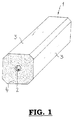
- FIG. 1 in which a preferred embodiment of a combustible element according to this invention is represented in perspective.
- Sawdust from wood (preferably dust free) is fed in a continuous feed stream on a conveyor belt system through a drying installation until the sawdust is dried to a degree of humidity from 2% to 8%.
- Each pressing device comprises an open pressing channel with an octagonal section. From the open entrance of the channel to the open exit thereof the transverse dimensions gradually decrease. It is obvious that this pressing channel can have any possible form in cross-section, such as e.g. triangular, quadrangular, rectangular, hexagonal or round.
- Each pressing device furthermore still also comprises a heating device with which the walls of the pressing channel can be heated to a temperature of 100°C to 200°C.
- each pressing device is provided with a pressing screw that comprises a central shaft to which a wall connects extending in radial direction and running helically round the central shaft (hereinafter called helical wall).
- This pressing screw has a rear part connecting to a feed hopper into which the sawdust is fed and a front part that is in the pressing channel.
- the front part of the pressing screw has a projecting shank in front in the extension of the central axis.
- the sawdust falls out of the feed hopper into the spaces between successive helical wall parts of the rear part of the pressing screw and is brought forwards by the continuous rotation of this pressing screw - according to the principle of the Archimedean screw - and pressed into the pressing channel.
- the pressing screw continuously brings sawdust to the pressing channel, and presses the sawdust in the channel towards the outlet of the channel. Through this pressure and through the gradual narrowing of the pressing channel the sawdust is compressed.
- the walls of the pressing channel are held at a temperature of approximately 180°C.
- the sawdust forms a cohesive aggregate.
- the coherence is obtained on the one hand by the "lignin" present in the wood that is released during the production process, and on the other hand because of the fact that the contact with the heated pressing channel walls forms a hard crust on the surface of the side walls of the compressed aggregate.
- the aggregate is formed with a central passage that extends according to its longitudinal axis.
- the aggregate is sawed by an automatic sawing installation into pieces with a length of ⁇ 20 to 30 cm and a weight of approximately 800g to 1000g.
- Elongated elements (1) are thus obtained with the appearance of a wooden block with an octagonal cross-section, with a central passage (2) that is principally cylindrical, and with a dark brown hard crust on the surface of the side walls (3).
- each element (1) After the pressing and the sawing of the elements (1), the elements are allowed to cool. Subsequently a well-determined amount of a powdery chemical product is inserted into the central passage of each element. For an element that weighs approximately 1000 g without the product approximately 150 g of product are provided. Finally the two openings of the passage (2) of each element (1) are sealed by means of corks or plugs of a combustible material, or any other sealing means.
- Effective products for disintegrating a combustion deposit layer are among others products that contain an ammonium salt and/or phosphoric acid or phosphorus pentoxide.
- a mixture of an ammonium salt and phosphorus pentoxide are preferred.
- the aforementioned ammonium salt is for example ammonium sulphate.
Landscapes
- Chemical & Material Sciences (AREA)
- Oil, Petroleum & Natural Gas (AREA)
- Organic Chemistry (AREA)
- Engineering & Computer Science (AREA)
- Combustion & Propulsion (AREA)
- Solid Fuels And Fuel-Associated Substances (AREA)
- Processing Of Solid Wastes (AREA)
- Catalysts (AREA)
- Ceramic Products (AREA)
- Glass Compositions (AREA)
Applications Claiming Priority (2)
| Application Number | Priority Date | Filing Date | Title |
|---|---|---|---|
| BE2000/0279A BE1013395A5 (nl) | 2000-04-17 | 2000-04-17 | Vast brandbaar element voor het afbreken van een verbrandings-afzetlaag en werkwijze voor de productie van een dergelijk element. |
| BE20000279 | 2000-04-17 |
Publications (2)
| Publication Number | Publication Date |
|---|---|
| EP1148113A1 true EP1148113A1 (fr) | 2001-10-24 |
| EP1148113B1 EP1148113B1 (fr) | 2007-07-25 |
Family
ID=3896500
Family Applications (1)
| Application Number | Title | Priority Date | Filing Date |
|---|---|---|---|
| EP01201227A Expired - Lifetime EP1148113B1 (fr) | 2000-04-17 | 2001-04-04 | Utilisation d'un élément solide combustible pour la désintégration d'une couche de dépot de combustion |
Country Status (9)
| Country | Link |
|---|---|
| US (1) | US6913631B2 (fr) |
| EP (1) | EP1148113B1 (fr) |
| AT (1) | ATE368096T1 (fr) |
| BE (1) | BE1013395A5 (fr) |
| CA (1) | CA2342643C (fr) |
| DE (1) | DE60129501T2 (fr) |
| DK (1) | DK1148113T3 (fr) |
| ES (1) | ES2291267T3 (fr) |
| PT (1) | PT1148113E (fr) |
Cited By (1)
| Publication number | Priority date | Publication date | Assignee | Title |
|---|---|---|---|---|
| EP2434003A1 (fr) * | 2010-09-23 | 2012-03-28 | Chembo S.A. | Composition solide de ramonage chimique |
Families Citing this family (4)
| Publication number | Priority date | Publication date | Assignee | Title |
|---|---|---|---|---|
| US20090107036A1 (en) * | 2007-10-29 | 2009-04-30 | Harmondsworth Holdings Limited | Combustible log |
| US8250995B2 (en) * | 2008-04-29 | 2012-08-28 | Lee Henry K | Log cartridge burning system |
| US20190127653A1 (en) * | 2017-10-29 | 2019-05-02 | Eric James Brender | Shredable and splitable wax accelerant impregnated fire tinder |
| US12018223B2 (en) | 2020-11-25 | 2024-06-25 | David W. Presby | Biofuel and method of biofuel production |
Citations (13)
| Publication number | Priority date | Publication date | Assignee | Title |
|---|---|---|---|---|
| DE158469C (fr) * | 1900-01-01 | |||
| FR1390668A (fr) * | 1964-04-02 | 1965-02-26 | Allume-feux anti-suie | |
| US3252770A (en) * | 1962-07-03 | 1966-05-24 | Electro Chemical Lab Corp | Lighter for charcoal and like material |
| US3515525A (en) * | 1967-09-05 | 1970-06-02 | Electro Chem Lab Corp | Fire building device |
| GB1281064A (en) * | 1969-11-12 | 1972-07-12 | Mobil Oil Corp | Combustible fuel container |
| US4147518A (en) * | 1977-03-02 | 1979-04-03 | Pine Rest Christian Rehabilitation Services | Extrusion apparatus for making fire kindling device |
| EP0010792A1 (fr) * | 1978-11-02 | 1980-05-14 | Metallgesellschaft Ag | Procédé pour gazéifier des combustibles en particules fines |
| FR2554458A1 (fr) * | 1983-11-03 | 1985-05-10 | Thibonnet Bernard | Complexe combustible de nettoyage |
| FR2564851A1 (fr) * | 1984-05-28 | 1985-11-29 | Gruaz Eric | Allume-feu bicomposant. |
| FR2601381A1 (fr) * | 1986-07-11 | 1988-01-15 | Chaker Elisabeth | Buchettes combustibles |
| FR2667611A1 (fr) * | 1990-10-05 | 1992-04-10 | Denis Cie | Allume-feu instantane et son procede de fabrication. |
| DE29508692U1 (de) * | 1995-05-24 | 1995-09-21 | Rud. W. Oelkers Market In GmbH, 82340 Feldafing | Hilfsmittel zum Entflammen und zur Unterstützung der Verbrennung eines festen oder flüssigen Brennstoffes |
| FR2749855A1 (fr) * | 1996-10-10 | 1997-12-19 | Eurexim | Agent combustible solide de destruction de la suie et des goudrons, son procede de fabrication et son utilisation |
Family Cites Families (2)
| Publication number | Priority date | Publication date | Assignee | Title |
|---|---|---|---|---|
| US936241A (en) * | 1908-10-16 | 1909-10-05 | Ellis Heating Company | Composition for treating fuel. |
| US4670018A (en) * | 1985-09-03 | 1987-06-02 | Cornwell James H | High BTU fuel element |
-
2000
- 2000-04-17 BE BE2000/0279A patent/BE1013395A5/nl not_active IP Right Cessation
-
2001
- 2001-03-29 CA CA2342643A patent/CA2342643C/fr not_active Expired - Lifetime
- 2001-04-04 EP EP01201227A patent/EP1148113B1/fr not_active Expired - Lifetime
- 2001-04-04 PT PT01201227T patent/PT1148113E/pt unknown
- 2001-04-04 DK DK01201227T patent/DK1148113T3/da active
- 2001-04-04 DE DE60129501T patent/DE60129501T2/de not_active Expired - Lifetime
- 2001-04-04 AT AT01201227T patent/ATE368096T1/de active
- 2001-04-04 ES ES01201227T patent/ES2291267T3/es not_active Expired - Lifetime
- 2001-04-17 US US09/836,158 patent/US6913631B2/en not_active Expired - Lifetime
Patent Citations (13)
| Publication number | Priority date | Publication date | Assignee | Title |
|---|---|---|---|---|
| DE158469C (fr) * | 1900-01-01 | |||
| US3252770A (en) * | 1962-07-03 | 1966-05-24 | Electro Chemical Lab Corp | Lighter for charcoal and like material |
| FR1390668A (fr) * | 1964-04-02 | 1965-02-26 | Allume-feux anti-suie | |
| US3515525A (en) * | 1967-09-05 | 1970-06-02 | Electro Chem Lab Corp | Fire building device |
| GB1281064A (en) * | 1969-11-12 | 1972-07-12 | Mobil Oil Corp | Combustible fuel container |
| US4147518A (en) * | 1977-03-02 | 1979-04-03 | Pine Rest Christian Rehabilitation Services | Extrusion apparatus for making fire kindling device |
| EP0010792A1 (fr) * | 1978-11-02 | 1980-05-14 | Metallgesellschaft Ag | Procédé pour gazéifier des combustibles en particules fines |
| FR2554458A1 (fr) * | 1983-11-03 | 1985-05-10 | Thibonnet Bernard | Complexe combustible de nettoyage |
| FR2564851A1 (fr) * | 1984-05-28 | 1985-11-29 | Gruaz Eric | Allume-feu bicomposant. |
| FR2601381A1 (fr) * | 1986-07-11 | 1988-01-15 | Chaker Elisabeth | Buchettes combustibles |
| FR2667611A1 (fr) * | 1990-10-05 | 1992-04-10 | Denis Cie | Allume-feu instantane et son procede de fabrication. |
| DE29508692U1 (de) * | 1995-05-24 | 1995-09-21 | Rud. W. Oelkers Market In GmbH, 82340 Feldafing | Hilfsmittel zum Entflammen und zur Unterstützung der Verbrennung eines festen oder flüssigen Brennstoffes |
| FR2749855A1 (fr) * | 1996-10-10 | 1997-12-19 | Eurexim | Agent combustible solide de destruction de la suie et des goudrons, son procede de fabrication et son utilisation |
Cited By (2)
| Publication number | Priority date | Publication date | Assignee | Title |
|---|---|---|---|---|
| EP2434003A1 (fr) * | 2010-09-23 | 2012-03-28 | Chembo S.A. | Composition solide de ramonage chimique |
| BE1019873A3 (fr) * | 2010-09-23 | 2013-02-05 | Chembo S A | Composition solide de ramonage chimique. |
Also Published As
| Publication number | Publication date |
|---|---|
| US6913631B2 (en) | 2005-07-05 |
| DE60129501D1 (de) | 2007-09-06 |
| US20010029697A1 (en) | 2001-10-18 |
| ATE368096T1 (de) | 2007-08-15 |
| CA2342643C (fr) | 2010-07-06 |
| ES2291267T3 (es) | 2008-03-01 |
| CA2342643A1 (fr) | 2001-10-17 |
| DK1148113T3 (da) | 2007-09-17 |
| BE1013395A5 (nl) | 2001-12-04 |
| PT1148113E (pt) | 2007-11-02 |
| DE60129501T2 (de) | 2008-02-07 |
| EP1148113B1 (fr) | 2007-07-25 |
Similar Documents
| Publication | Publication Date | Title |
|---|---|---|
| DE2700156C2 (de) | Verfahren zur Herstellung von Brennstoffbriketts | |
| US4308033A (en) | Fuel pellet and process for making it by shaping under pressure an organic fibrous material | |
| EP2400217A2 (fr) | Brûleur fermé pour brûler du combustible granulaire | |
| CA2342643C (fr) | Element combustible solide pour desintegrer une couche de depots de combustion et methode pour produire un tel element | |
| DE69700378T2 (de) | Fester Brennstoff zur Zerstörung von Russ und Teer, Verfahren zu dessen Herstellung, und dessen Verwendung | |
| US7540890B2 (en) | Creosote and soot destroying fire log | |
| US3829297A (en) | Pulp bound compacted fuels | |
| US20240368492A1 (en) | Sawdust charcoal | |
| EP0549861B1 (fr) | Procédé et installation pour la fabrication d'un combustible par séchage d'un mélange de boue et d'un produit inflammable | |
| WO1988000232A1 (fr) | Combustibles ameliores | |
| RU2073066C1 (ru) | Способ получения топливных брикетов | |
| EP1254946B1 (fr) | Produit de ramonage chimique | |
| CA1115955A (fr) | Substance cellulosique et polymere thermoplastique formant des pastilles de combustible | |
| JP7449714B2 (ja) | 廃棄物処理方法 | |
| DE202005004140U1 (de) | Abbrandkörper | |
| AU1751592A (en) | Solid fuel | |
| US20220041947A1 (en) | Coconut shell charcoal log | |
| EP0498911A1 (fr) | Briquettes de déchets et procédé pour leur fabrication | |
| JPS61106699A (ja) | 固体燃料の製造方法 | |
| CA1273202A (fr) | Produit combustible | |
| IES86418Y1 (en) | A robust moisture resistant fire log that is clean to handle and can be lit directly with a naked flame without the necessity to use additional combustible materials | |
| HUP0600903A2 (en) | Fuel made of dry vegetable substances | |
| RO117460B1 (ro) | Procedeu de obţinere a unor brichete combustibile | |
| IE20120420U1 (en) | A robust moisture resistant fire log that is clean to handle and can be lit directly with a naked flame without the necessity to use additional combustible materials | |
| WOOD | Corvallis, Oregon, USA |
Legal Events
| Date | Code | Title | Description |
|---|---|---|---|
| PUAI | Public reference made under article 153(3) epc to a published international application that has entered the european phase |
Free format text: ORIGINAL CODE: 0009012 |
|
| AK | Designated contracting states |
Kind code of ref document: A1 Designated state(s): AT BE CH CY DE DK ES FI FR GB GR IE IT LI LU MC NL PT SE TR |
|
| AX | Request for extension of the european patent |
Free format text: AL;LT;LV;MK;RO;SI |
|
| 17P | Request for examination filed |
Effective date: 20011119 |
|
| AKX | Designation fees paid |
Free format text: AT BE CH CY DE DK ES FI FR GB GR IE IT LI LU MC NL PT SE TR |
|
| 17Q | First examination report despatched |
Effective date: 20031216 |
|
| RAP1 | Party data changed (applicant data changed or rights of an application transferred) |
Owner name: ENTECO SA/NV |
|
| RTI1 | Title (correction) |
Free format text: USE OF A SOLID COMBUSTIBLE ELEMENT FOR DISENTEGRATING A COMBUSTION DEPOSIT LAYER |
|
| GRAP | Despatch of communication of intention to grant a patent |
Free format text: ORIGINAL CODE: EPIDOSNIGR1 |
|
| GRAS | Grant fee paid |
Free format text: ORIGINAL CODE: EPIDOSNIGR3 |
|
| GRAA | (expected) grant |
Free format text: ORIGINAL CODE: 0009210 |
|
| AK | Designated contracting states |
Kind code of ref document: B1 Designated state(s): AT BE CH CY DE DK ES FI FR GB GR IE IT LI LU MC NL PT SE TR |
|
| REG | Reference to a national code |
Ref country code: GB Ref legal event code: FG4D |
|
| REG | Reference to a national code |
Ref country code: CH Ref legal event code: EP |
|
| REG | Reference to a national code |
Ref country code: IE Ref legal event code: FG4D |
|
| REF | Corresponds to: |
Ref document number: 60129501 Country of ref document: DE Date of ref document: 20070906 Kind code of ref document: P |
|
| REG | Reference to a national code |
Ref country code: DK Ref legal event code: T3 |
|
| REG | Reference to a national code |
Ref country code: GR Ref legal event code: EP Ref document number: 20070402869 Country of ref document: GR |
|
| REG | Reference to a national code |
Ref country code: SE Ref legal event code: TRGR |
|
| REG | Reference to a national code |
Ref country code: PT Ref legal event code: SC4A Free format text: AVAILABILITY OF NATIONAL TRANSLATION Effective date: 20071022 |
|
| REG | Reference to a national code |
Ref country code: CH Ref legal event code: NV Representative=s name: SCHNEIDER FELDMANN AG PATENT- UND MARKENANWAELTE |
|
| ET | Fr: translation filed | ||
| REG | Reference to a national code |
Ref country code: ES Ref legal event code: FG2A Ref document number: 2291267 Country of ref document: ES Kind code of ref document: T3 |
|
| PLBE | No opposition filed within time limit |
Free format text: ORIGINAL CODE: 0009261 |
|
| STAA | Information on the status of an ep patent application or granted ep patent |
Free format text: STATUS: NO OPPOSITION FILED WITHIN TIME LIMIT |
|
| 26N | No opposition filed |
Effective date: 20080428 |
|
| PG25 | Lapsed in a contracting state [announced via postgrant information from national office to epo] |
Ref country code: MC Free format text: LAPSE BECAUSE OF NON-PAYMENT OF DUE FEES Effective date: 20080430 |
|
| PG25 | Lapsed in a contracting state [announced via postgrant information from national office to epo] |
Ref country code: CY Free format text: LAPSE BECAUSE OF FAILURE TO SUBMIT A TRANSLATION OF THE DESCRIPTION OR TO PAY THE FEE WITHIN THE PRESCRIBED TIME-LIMIT Effective date: 20070725 |
|
| PG25 | Lapsed in a contracting state [announced via postgrant information from national office to epo] |
Ref country code: TR Free format text: LAPSE BECAUSE OF FAILURE TO SUBMIT A TRANSLATION OF THE DESCRIPTION OR TO PAY THE FEE WITHIN THE PRESCRIBED TIME-LIMIT Effective date: 20070725 |
|
| PGFP | Annual fee paid to national office [announced via postgrant information from national office to epo] |
Ref country code: GR Payment date: 20140423 Year of fee payment: 14 Ref country code: FI Payment date: 20140411 Year of fee payment: 14 Ref country code: SE Payment date: 20140418 Year of fee payment: 14 Ref country code: CH Payment date: 20140418 Year of fee payment: 14 Ref country code: AT Payment date: 20140411 Year of fee payment: 14 |
|
| PGFP | Annual fee paid to national office [announced via postgrant information from national office to epo] |
Ref country code: DK Payment date: 20140422 Year of fee payment: 14 |
|
| PGFP | Annual fee paid to national office [announced via postgrant information from national office to epo] |
Ref country code: LU Payment date: 20150422 Year of fee payment: 15 |
|
| PGFP | Annual fee paid to national office [announced via postgrant information from national office to epo] |
Ref country code: NL Payment date: 20150420 Year of fee payment: 15 |
|
| PGFP | Annual fee paid to national office [announced via postgrant information from national office to epo] |
Ref country code: ES Payment date: 20150427 Year of fee payment: 15 Ref country code: DE Payment date: 20150421 Year of fee payment: 15 Ref country code: GB Payment date: 20150420 Year of fee payment: 15 Ref country code: PT Payment date: 20150401 Year of fee payment: 15 |
|
| PGFP | Annual fee paid to national office [announced via postgrant information from national office to epo] |
Ref country code: IE Payment date: 20150424 Year of fee payment: 15 |
|
| REG | Reference to a national code |
Ref country code: DK Ref legal event code: EBP Effective date: 20150430 |
|
| REG | Reference to a national code |
Ref country code: CH Ref legal event code: PL |
|
| REG | Reference to a national code |
Ref country code: SE Ref legal event code: EUG Ref country code: AT Ref legal event code: MM01 Ref document number: 368096 Country of ref document: AT Kind code of ref document: T Effective date: 20150404 |
|
| PG25 | Lapsed in a contracting state [announced via postgrant information from national office to epo] |
Ref country code: CH Free format text: LAPSE BECAUSE OF NON-PAYMENT OF DUE FEES Effective date: 20150430 Ref country code: GR Free format text: LAPSE BECAUSE OF NON-PAYMENT OF DUE FEES Effective date: 20151106 Ref country code: FI Free format text: LAPSE BECAUSE OF NON-PAYMENT OF DUE FEES Effective date: 20150404 Ref country code: LI Free format text: LAPSE BECAUSE OF NON-PAYMENT OF DUE FEES Effective date: 20150430 |
|
| REG | Reference to a national code |
Ref country code: GR Ref legal event code: ML Ref document number: 20070402869 Country of ref document: GR Effective date: 20151106 |
|
| PG25 | Lapsed in a contracting state [announced via postgrant information from national office to epo] |
Ref country code: SE Free format text: LAPSE BECAUSE OF NON-PAYMENT OF DUE FEES Effective date: 20150405 Ref country code: AT Free format text: LAPSE BECAUSE OF NON-PAYMENT OF DUE FEES Effective date: 20150404 |
|
| REG | Reference to a national code |
Ref country code: FR Ref legal event code: PLFP Year of fee payment: 16 |
|
| PG25 | Lapsed in a contracting state [announced via postgrant information from national office to epo] |
Ref country code: DK Free format text: LAPSE BECAUSE OF NON-PAYMENT OF DUE FEES Effective date: 20150430 |
|
| REG | Reference to a national code |
Ref country code: DE Ref legal event code: R119 Ref document number: 60129501 Country of ref document: DE |
|
| REG | Reference to a national code |
Ref country code: NL Ref legal event code: MM Effective date: 20160501 |
|
| GBPC | Gb: european patent ceased through non-payment of renewal fee |
Effective date: 20160404 |
|
| PG25 | Lapsed in a contracting state [announced via postgrant information from national office to epo] |
Ref country code: LU Free format text: LAPSE BECAUSE OF NON-PAYMENT OF DUE FEES Effective date: 20160404 |
|
| REG | Reference to a national code |
Ref country code: IE Ref legal event code: MM4A |
|
| PG25 | Lapsed in a contracting state [announced via postgrant information from national office to epo] |
Ref country code: GB Free format text: LAPSE BECAUSE OF NON-PAYMENT OF DUE FEES Effective date: 20160404 Ref country code: NL Free format text: LAPSE BECAUSE OF NON-PAYMENT OF DUE FEES Effective date: 20160501 Ref country code: DE Free format text: LAPSE BECAUSE OF NON-PAYMENT OF DUE FEES Effective date: 20161101 |
|
| PG25 | Lapsed in a contracting state [announced via postgrant information from national office to epo] |
Ref country code: PT Free format text: LAPSE BECAUSE OF NON-PAYMENT OF DUE FEES Effective date: 20161004 |
|
| REG | Reference to a national code |
Ref country code: FR Ref legal event code: PLFP Year of fee payment: 17 |
|
| PG25 | Lapsed in a contracting state [announced via postgrant information from national office to epo] |
Ref country code: IE Free format text: LAPSE BECAUSE OF NON-PAYMENT OF DUE FEES Effective date: 20160404 |
|
| REG | Reference to a national code |
Ref country code: FR Ref legal event code: PLFP Year of fee payment: 18 |
|
| PG25 | Lapsed in a contracting state [announced via postgrant information from national office to epo] |
Ref country code: ES Free format text: LAPSE BECAUSE OF NON-PAYMENT OF DUE FEES Effective date: 20160405 |
|
| REG | Reference to a national code |
Ref country code: ES Ref legal event code: FD2A Effective date: 20180628 |
|
| REG | Reference to a national code |
Ref country code: BE Ref legal event code: PD Owner name: ERES SAPOLI NV; BE Free format text: DETAILS ASSIGNMENT: CHANGE OF OWNER(S), CESSION; FORMER OWNER NAME: ENTECO SA/NV Effective date: 20190426 |
|
| PGFP | Annual fee paid to national office [announced via postgrant information from national office to epo] |
Ref country code: IT Payment date: 20190430 Year of fee payment: 19 |
|
| PGFP | Annual fee paid to national office [announced via postgrant information from national office to epo] |
Ref country code: FR Payment date: 20200429 Year of fee payment: 20 |
|
| PGFP | Annual fee paid to national office [announced via postgrant information from national office to epo] |
Ref country code: BE Payment date: 20200429 Year of fee payment: 20 |
|
| REG | Reference to a national code |
Ref country code: BE Ref legal event code: MK Effective date: 20210404 |
|
| PG25 | Lapsed in a contracting state [announced via postgrant information from national office to epo] |
Ref country code: IT Free format text: LAPSE BECAUSE OF NON-PAYMENT OF DUE FEES Effective date: 20200404 |