BACKGROUND OF THE INVENTION
1. Field of the Invention
The present invention relates to a stick-type
solid water-in-oil emulsion cosmetic composition. More
specifically, it relates to a novel stick-type solid
water-in-oil emulsion type cosmetic composition having an
excellent stability, having a refreshing feeling and
freshness after finish when coated on the skin, in spite
of the solid form, and particularly giving a soft feeling
of use when coated.
2. Description of the Related Art
In recent years, solid water-in-oil type
emulsion cosmetic compositions having excellent stability
have been appearing on the market. Particularly, this
type cosmetic composition gives an emulsion type
treatment, even in the form of a solid, and therefore,
the effect on the skin is high. Further, since water is
added, a novel feeling of use such as a refreshing
feeling and feeling of wateriness can be obtained.
However, in most cases, a hydrocarbon-based wax
having a high solidifying power is mainly used as a solid
oil of the essential ingredient for solidification. This
is not at all satisfactory in terms of the "softness to
the skin".
SUMMARY OF THE INVENTION
Accordingly, an object of the present invention is
to provide a novel stick-type solid water-in-oil type
emulsion cosmetic composition which is capable of solving
the above problem of the prior art and which is capable
of providing a refreshing feeling and freshness after
finish when coated on the skin, and particularly giving a
soft feeling of use when coated.
In accordance with the present invention, there is
provided a stick-type solid water-in-oil type emulsion
cosmetic composition comprising the following components
(a) to (c):
DESCRIPTION OF THE PREFERRED EMBODIMENT
The present invention will now be explained in more
detail. In this specification and in the claims the
singular forms "a", "an" and "the" include plural
referents unless the context clearly dictates otherwise.
The present inventors engaged in intensive studies
to solve this problem and, as a result, found that a
stick-type solid water-in-oil type emulsion cosmetic
composition containing a hydrogenated jojoba oil, as a
solid oil, can solve the above problem whereby the
present invention has been completed.
The stick-type solid water-in-oil type emulsion
cosmetic composition of the present invention has the
property of easily melting on the skin due to the fact
that the wax used has a suitably low melting point and
spreading over the skin smoothly, since the yield value
thereof at the time of application is small. Further,
since it is an emulsion base, blending of a moisture
retaining ingredient becomes possible and formulations,
considering the skin in the winter when the skin can
easily become rough, become possible.
The stick-type solid water-in-oil type emulsion
cosmetic composition of the present invention is intended
to mean one which is filled into a stick container and
usually solidifies, including paste form, without
fluidity at the temperature range of, for example, 0°C to
50°C, in which the cosmetic composition is used. Among
the stick-type water-in-oil type emulsion cosmetic
compositions, those from which the content is sending out
in use are preferable. The "stick-type container" used in
the present invention typically in the form of a column
or cylinder type or an elliptical column type having a
size of 5 - 40 mm diameter, preferably 8 - 25 mm diameter
especially for a foundation, 3 - 15 cm height, preferably
7 cm or more height for a foundation in view of the
usability.
The hydrogenated jojoba oil used in the present
invention is mainly a compound obtained from the
hydrogenation of a jojoba oil mainly composed of an ester
of a monovalent higher unsaturated fatty acid and
monovalent higher unsaturated alcohol having the
following chemical structure:
wherein m is 16, 18 or 20 and n is 18, 20 or 22, provided
that the total carbon number is 38 - 44. As commercially
available products, for example, partially hydrogenated
jojoba oil such as Floraesters 20, Floraesters 30, and
Floraesters 60 (all made by Floratech) and Jobacream M-40
(made by Koei Kogyosha) and completely hydrogenated
jojoba oil such as Floraesters 70 and Floraesters 70 HG
(all made by Floratech) and Extreme Hydrogenated Jojoba
(made by Koei Kosansha) etc. are exemplified. Among
these, it is preferable to use completely hydrogenated
jojoba oil hydrogenating all unsaturated bond portions.
The amount of hydrogenated jojoba oil to be
formulated is 0.5 to 40.0% by weight, particularly
preferably 2.0 to 20.0% by weight, in the entire cosmetic
composition.
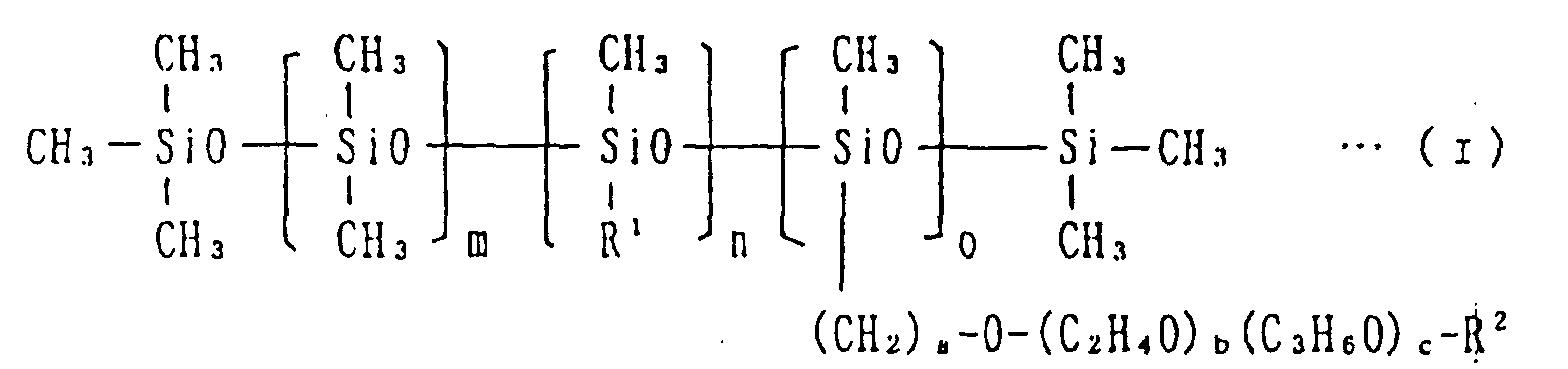
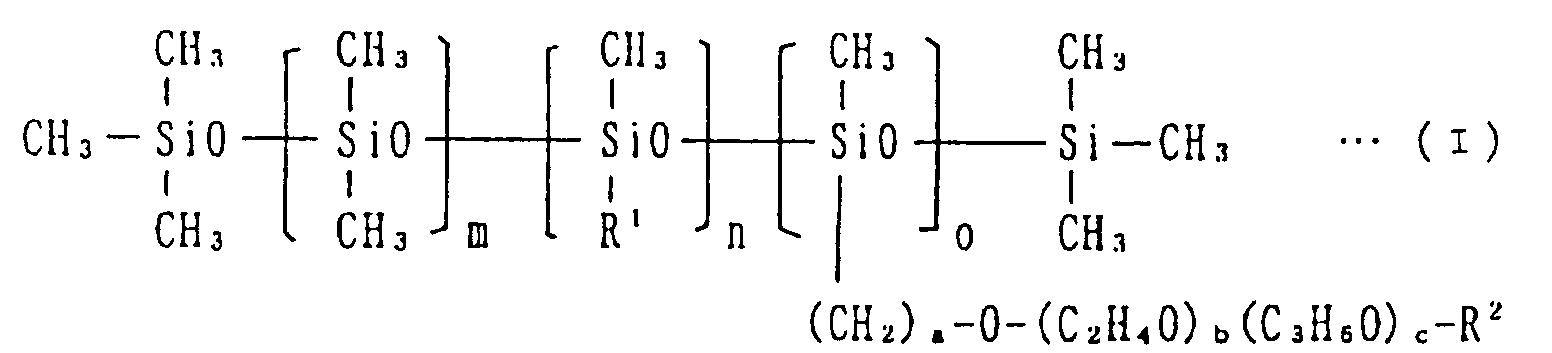
The polyoxyalkylene-modified silicone or alkyl- and
polyoxyalkylene-modified silicone can be represented by
the following formula (I):
wherein a is an integer of 1 to 5, b is an integer of 7
to 100, c is an integer of 0 to 100, m is an integer of
10 to 500, n is an integer of 0 to 150, and o is an
integer of 1 to 50, R
1 is a C
1 to C
26 alkyl group, and R
2
is a hydrogen atom or a C
1 to C
5 alkyl group.
The use of the polyoxyalkylene-modified silicone and
alkyl- and polyoxyalkylene-modified silicone, are
suitable for the reasons of, for example, fillability in
containers, especially high temperature properties,
usability, especially lack of stickiness, emulsion
stability.
The amount of the surfactant formulated in the
present cosmetic composition is selected, depending upon
the amount of the aqueous phase emulsified, but 0.1 to
10.0% by weight, more preferably 1.0 to 8.0% by weight,
in the total weight of the cosmetic composition is
preferable.
The amount of the water formulated in the present
cosmetic composition is 5.0 to 50.0% by weight,
preferably 10.0 to 25.0% by weight, in the total cosmetic
composition. When an amount of water is less than 5.0% by
weight, a refreshing feeling at the time of use cannot be
expected. In particular, for obtaining an extremely high
refreshing feeling at the time of use, it is preferable
to formulate at least 10.0% by weight. Further, the
higher the amount of water formulated, the heavier the
slip tends to become. Therefore, the amount of water
formulated is preferably not more than 25.0% by weight.
In the present invention, as the wax ingredient, it
is preferable to further include a hydrocarbon wax other
than the hydrogenated jojoba oil. Examples of the
hydrocarbon wax are ceresine wax, paraffin wax,
microcrystalline wax, Fisher-Tropsh wax, SASOL wax, etc.
Among these, the use of ceresine wax is preferable from
the viewpoint of the uniform solidification in the
container when filling. For instance, in the case of
polyethylene wax alone, the filling property tends to
become undesirable due to the relatively high melting
point.
The ratio (i.e., ratio by weight) of the
hydrogenated jojoba oil and the hydrocarbon wax is
hydrocarbon wax/hydrogenated jojoba oil = 0.05 to 15,
preferably 0.1 to 7.5. Here, an amount of hydrocarbon wax
of not more than 15% by weight is preferable. Further,
the total amount of the wax ingredient in the total
weight of the cosmetic composition is preferably 3 to 22%
by weight. The stability becomes further higher if
hydrogenated jojoba oil is used in combination with
hydrocarbon wax.
The solid water-in-oil type emulsion cosmetic
composition of the present invention has a hardness at
the time of measurement by a card tension meter of
preferably 4 to 70 at 37°C, 200 g load, and 1.5.
Particularly, a hardness of 7 to 40 is optimal from the
viewpoint of the skin feeling.
Further, in the present invention, powders of
pigments may be formulated, in addition to the above-mentioned
essential ingredients of the hydrogenated
jojoba oil, surfactant, and water. The pigment powder
used in this case is not particularly limited so long as
they are usually used in cosmetic compositions. It is
possible to formulate powder of a pigment such as an
inorganic pigment, organic pigment, or metal pigment.
Examples of inorganic powders are, talc, kaolin, calcium
carbonate, zinc white, titanium dioxide, red iron oxide,
yellow iron oxide, black iron oxide, ultramarine,
titanium coated mica, bismuth oxichloride, Bengara,
sintered pigments, Gunjo Pink, chromium hydroxide,
titanium oxide coated mica, chromium oxide, aluminum
cobalt oxide, Prussian Blue, carbon black, anhydrous
silicic acid, magnesium silicate, bentonite, mica,
zirconium oxide, magnesium oxide, zinc oxide, titanium
oxide, light calcium carbonate, heavy calcium carbonate,
light magnesium carbonate, heavy magnesium carbonate,
calamine, etc. Here, a powder of a pigment which is
treated to give it hydrophobicity is particularly
preferable. The method of giving hydrophobicity may
include treating of the surface with a high viscosity
silicone, coating of the surface with a silicone resin
reacted with an alkylhydrogen polysiloxane, further
followed by treating with an alkene, treating with one or
more types of a cationic activant, anionic activant, and
nonionic activant, coating of the surface by a wax, etc.
The surface should be made hydrophobic. The method is not
particularly limited. Further, the amount of the pigment
powder formulated is preferably not more than 50% by
weight of the total cosmetic composition.
Further, the stick-type solid water-in-oil type
emulsion cosmetic composition of the present invention
may contain therein ingredients normally used for
cosmetic compositions to an extent not detracting from
the effects of the present invention. For example, the
other surfactants such as those usually formulated into a
cosmetic composition may be used, together with the above
surfactant, irrespective of the ionic character thereof.
Examples of anionic surfactants are raw materials
for soap; fatty acid soaps such as sodium laurate; higher
alkyl sulfate ester salts such as sodium laurosulfate;
alkyl ether sulfate ester salts such as polyoxyethylene
(i.e., "POE") laurosulfate triethanol amine; N-acylsarcosine
acids such as sodium lauroyl sarcosinate;
higher fatty acid amide sulfonates such as sodium N-cocoyl-N-methyl
taurate; phosphate ester salts such as
POE stearyl ether phosphate; sulfosuccinates such as
sodium di-2-ethylhexylsulfosuccinate;
alkylbenzensulfonates such as sodium
dodecylbenzensulfonate; N-acyl glutamates such as
disodium N-stearoyl glutamate; higher fatty acid ester
sulfate ester salts such as sodium hydrogenated glyceryl
cocoate sulfate; sulfated oils such as Turkey red oil;
POE alkyl ether carboxylic acid; POE alkylaryl ether
carboxylate; α-olefinsulfates; higher fatty acid ester
sulfonates; secondary alcohol sulfate ester salts; higher
fatty acid alkylolamide sulfate ester salts; sodium
lauroyl monoethanolamide succinate; N-palmitoyl
asparaginate ditriethanol amine; sodium caseine.
Examples of cationic surfactants are alkyl trimethyl
ammonium salts such as stearyl trimethyl ammonium
chloride; dialkyldimethyl ammonium salts such as
distearyldimethyl ammonium chloride; alkyl pyridinium
salts such as cetylpyridinium chloride; alkyl quaternary
ammonium salts, alkyl dimethylbenzyl ammonium salts,
alkyl isoquinolinium salts; dialkyl morphonium salts; POE
alkyl amines; alkyl amine salts; polyamine fatty acid
derivatives; amyl alcohol fatty acid derivatives;
benzalkonium chloride, benzethonium chloride, etc.
Examples of amphoteric surfactants are imidazoline
amphoteric surfactants such as sodium 2-undecyl-N,N,N-(hydroxyethylcarboxymethyl)-2-imidazoline;
betaine
surfactants such as lauryldimethyl-aminoacetate betaine,
etc.
Examples of lyophilic nonionic surfactants are
sorbitan fatty acid esters such as sorbitan
monoisostearate and sorbitan sesquioleate; glyceryl
polyglyceryl fatty acids such as glyceryl monostearate;
propylene glycol fatty acid esters such as propylene
glycol monostearate; hydrogenated castor oil derivatives;
glyceryl alkyl ethers; polyoxyalkylene-modified silicone;
alkyl- and polyoxyalkylene-modified silicone; etc.
Examples of hydrophilic nonionic surfactants are POE
sorbitan fatty acid esters such as POE sorbitan
monooleate; POE sorbite fatty acid esters such as POE-sorbitan
monooleate; POE glyceryl fatty acid esters such
as POE-glyceryl monoisostearate; POE alkyl ethers such as
POE stearyl ethers and POE cholestanol ethers; POE alkyl
phenyl ethers such as POE nonyl phenyl ethers; pluaronics
such as Pluronic; POE-POP alkyl ethers such as
POE·polyoxypropylene (i.e., "POP") cetyl ethers, tetra-POE·tetra-POP
ethylene diamine condensation products such
as Tetronic; POE castor oil, POE castor oil hydrogenated
castor oil derivatives such as POE hydrogenated castor
oil POE beeswax lanolin derivatives; alkanolamides; POE
propylene glycol fatty acid esters; POE alkylamines; POE
fatty acid amides; sucrose fatty acid esters; POE
nonylphenyl formaldehyde condensation products;
alkylethoxydimethylamineoxide; trioleylphosphoric acid,
etc. However, please note that the present invention is
not limited to the use of the above surfactants.
Further, these surfactants may be used alone or in
any combinations thereof in the stick-type solid water-in-oil
type emulsion cosmetic composition of the present
invention.
The other ingredients include the aqueous phase
ingredients, polyhydric alcohol, mucosaccharides (sodium
hyaluronate etc.), organic acids and organic salts (amino
acid, amino acid salts, oxyacid salts), and other
moisture-retaining agents, alcohols such as ethanol, oil
phase ingredients such as vaseline, solid and semisolid
oils such as lanolin, silicone wax, fluorowaxes, silicone
resins, silicone rubber, higher fatty acids, higher
alcohols, liquid oils such as squalene, liquid paraffin,
ester oils, triglyceride, volatile hydrocarbon oils,
fluorocarbons, medicines such as vitamin E, vitamin E
acetate, astringents, antioxidants, preservatives,
fragrances, sodium phosphate (II), and other pH
adjusters, clay minerals, thickners, UV blockers, etc.
may be formulated in the solid water-in-oil type emulsion
cosmetic composition of the present invention.
The stick-type solid water-in-oil type emulsion
cosmetic composition of the present invention may be
spread on the skin with the finger or a puff, or which
can be directly spread on the skin from the stick. The
stick-type solid water-in-oil type emulsion cosmetic
composition has a better skin feeling than possible up to
now.
EXAMPLES
The present invention will now be further
illustrated in detail by, but is by no means limited to,
the following Examples, wherein the amounts are all % by
weight unless otherwise noted.
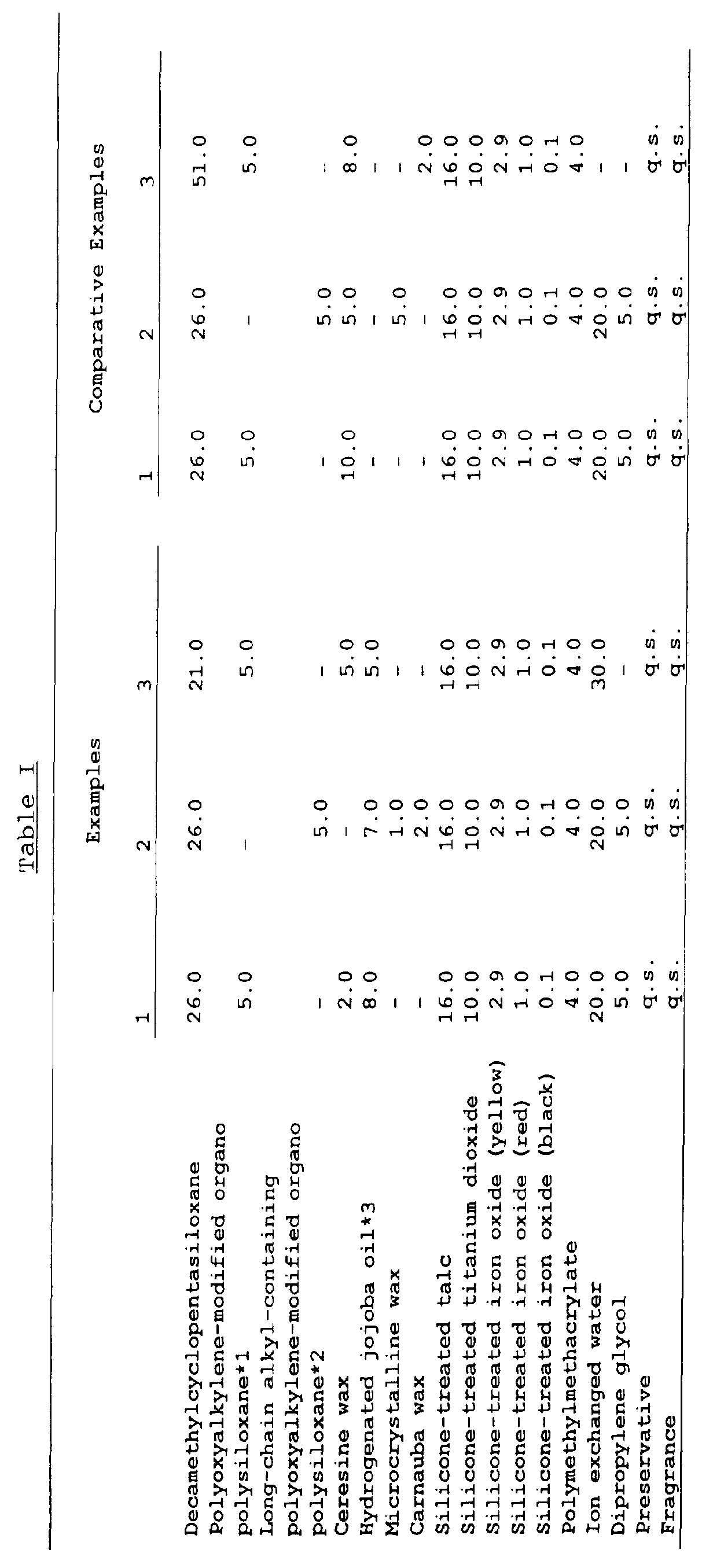
Examples 1 to 3 and Comparative Examples 1 to 3
Stick-type water-in-oil type emulsion cosmetic
compositions were prepared by the formulations shown in
the following Table I and were evaluated for usability
and hardness by the methods explained above. The results
are shown in Table II.
1) Evaluation of Usability
Samples of the stick type water-in-oil type emulsion
cosmetic compositions were evaluated by a panel of 20 for
feeling of use (i.e., softness to the skin, refreshing
feeling, freshness after finish, lightness of slip) by
directly applying the stick-type water-in-oil type
emulsion cosmetic composition to the skin from the stick
container.
Evaluation Criteria
G (good): At least 15 panelists responded "good"
F (fair): 7 to 14 panelists responded "good"
P (poor): 6 or less panelists responded "good"
2) Hardness
The hardness was measured by a card tension meter
under conditions of 37°C, 200 g load, and 1.5.
| | Examples | Comparative Examples |
| | 1 | 2 | 3 | 1 | 2 | 3 |
| Softness to the skin | G | G | G | P | P | P |
| Refreshing feeling | G | G | G | G | G | P |
| Freshness after finish | G | G | G | G | P | G |
| Light slip | G | G | F | G | G | G |
| Hardness | 18 | 25 | 20 | 15 | 8 | 28 |
The method of production in the following Examples
was to heat the oil phase ingredients to 80°C to melt
them, then disperse the powder in it, emulsify and
disperse the aqueous phase ingredients heated in advance,
and fill the result and mixture in a container in the
fluid state. Next, this was cooled to obtain the desired
product. In all cases, the stability was excellent, there
was a refreshing feeling, and the smoothness to the skin
was superior.
weight = about 6000, and polyether-modification
ratio = about 20 wt%
| Hydrophobically treated pigment powder | 20.0 |
| Ion exchanged water | 10.0 |
| Glyceryl | 15.0 |
| 1,3-butylene glycol | 2.0 |
| Preservative | q.s. |
| Fragrance | q.s |
| Decamethylcyclopentanesiloxane |
35.0 wt% |
| Polyoxyalkylene-modified organo polysiloxane (compound of above general formula (I) where a=3, b=50, c=60, m=100, n=50, o=15, R1=C16H33, R2=H, molecular weight = about 15,000) |
2.0 |
| Sorbitan sesquiisostearate |
2.0 |
| Ceresine |
2.0 |
| Hydrogenated jojoba oil |
7.0 |
| Hydrophobically treated pigment powder |
15.0 |
| Polyacrylic acid alkyl |
12.0 |
| Dipropylene glycol |
5.0 |
| Ion exchanged water |
20.0 |
| Preservative |
q.s. |
| Antioxidants |
q.s |
Example 5: Urea-Containing Solid Cosmetic Composition
| Trimethylsiloxysilicate |
3.0 w |
| Dimethyl polysiloxane |
10.0 |
| Decamethylcyclopentasiloxane |
20.0 |
| Hydrogenated jojoba oil |
8.0 |
| Ceresine |
2.0 |
| Polyoxyalkylene-modified organo polysiloxane (compound of above general formula (I) where a=3, b=24, c=24, m=400, n=0, o=10, R2=H, molecular weight = about 55,000) |
2.0 |
| Ion exchanged water |
46.0 |
| Urea |
3.0 |
| Glyceryl |
3.0 |
| Diglyceryl |
2.0 |
| Propylene glycol |
1.0 |
| Preservative |
q.s. |
Example 6: Rouge
| Dimethyl polysiloxane (1.5 cs) |
20.0 wt% |
| Decamethylcyclopentasiloxane |
10.0 |
| Cetyl isooctanate |
15.0 |
| Polyoxyalkylene-modified organo polysiloxane (compound of above general formula (I) where a=3, b=8 to 10, c=0, m=50 to 60, n=0, o=2 to 5, R2=H, molecular weight = about 6000, polyether modification ratio = about 20 wt% |
3.0 |
| Hydrogenated jojoba oil |
10.0 |
| Hydrocarbon wax |
2.0 |
| Fragrance |
q.s. |
| Hydrophobically treated pigment powder |
30.0 |
| Ion exchanged water |
6.9 |
| Sodium hyaluronate |
0.1 |
| Sodium chondroitin sulfate |
1.5 |
| Polyethylene glycol |
1.5 |
| Preservative |
q.s. |
Example 7: Lipstick
| Octamethylcyclotetrasiloxane |
10.0 wt% |
| Dimethyl polysiloxane (6 cs) |
23.0 |
| Carnauba wax |
2.8 |
| Hydrogenated jojoba oil |
8.0 |
| Polyoxyalkylene-modified organo polysiloxane (compound of above general formula (I) where a=3, b=50, c=60, m=100, n=50, o=15, R1=C16H33, R2=H, molecular weight = about 15,000) |
5.0 |
| Red iron oxide |
0.3 |
| Yellow iron oxide |
1.0 |
| Lake red CBA (Red No. 204) |
0.7 |
| Dibutyl hydroxytoluene |
q.s. |
| Fragrance |
q.s. |
| Ion exchanged water |
48.4 |
| Water-soluble collagen solution |
0.3 |
| Sodium pyrrolidonecarboxylate |
0.5 |
Example 8: Lip Treatment
| Squalane |
10.0 wt% |
| Lanolin |
2.0 |
| Octamethylcyclotetrasiloxane |
27.69 |
| Isoparaffin (boiling point 155°C) |
10.0 |
| Trimethylsiloxysilicate |
3.0 |
| Hydrogenated jojoba oil |
8.0 |
| Polyoxyalkylene-modified organo siloxane (compound of above general formula (I) where a=3, b=24, c=24, m=400, n=0, o=10, R2=H, molecular weight = about 55,000) |
3.0 |
| Ion exchanged water |
30.0 |
| Glyceryl |
5.0 |
| Sodium lactate |
0.3 |
| Sodium L-glutamate |
0.3 |
| Sodium hyaluronate |
0.1 |
| Sorbitol |
0.5 |
| Lithol rubine BCA (Red No. 202) |
0.01 |
| Menthol |
0.1 |
| Fragrance |
q.s. |
As explained above, the stick-type solid water-in-oil
type emulsion cosmetic composition of the present
invention has an excellent stability, has a refreshing
feeling and freshness after finish when applied to the
skin despite being in solid form, and particularly gives
a soft feeling of use when applied to the skin.


 (c) 5.0 to 50.0% by weight of water.