EP1162075B1 - Photogravure - Google Patents
Photogravure Download PDFInfo
- Publication number
- EP1162075B1 EP1162075B1 EP98937846A EP98937846A EP1162075B1 EP 1162075 B1 EP1162075 B1 EP 1162075B1 EP 98937846 A EP98937846 A EP 98937846A EP 98937846 A EP98937846 A EP 98937846A EP 1162075 B1 EP1162075 B1 EP 1162075B1
- Authority
- EP
- European Patent Office
- Prior art keywords
- paper
- printing
- gravure printing
- electrostatic
- surface resistivity
- Prior art date
- Legal status (The legal status is an assumption and is not a legal conclusion. Google has not performed a legal analysis and makes no representation as to the accuracy of the status listed.)
- Expired - Lifetime
Links
Images

Classifications
-
- G—PHYSICS
- G03—PHOTOGRAPHY; CINEMATOGRAPHY; ANALOGOUS TECHNIQUES USING WAVES OTHER THAN OPTICAL WAVES; ELECTROGRAPHY; HOLOGRAPHY
- G03G—ELECTROGRAPHY; ELECTROPHOTOGRAPHY; MAGNETOGRAPHY
- G03G5/00—Recording-members for original recording by exposure, e.g. to light, to heat or to electrons; Manufacture thereof; Selection of materials therefor
- G03G5/02—Charge-receiving layers
-
- B—PERFORMING OPERATIONS; TRANSPORTING
- B41—PRINTING; LINING MACHINES; TYPEWRITERS; STAMPS
- B41F—PRINTING MACHINES OR PRESSES
- B41F9/00—Rotary intaglio printing presses
- B41F9/001—Heliostatic printing
-
- B—PERFORMING OPERATIONS; TRANSPORTING
- B41—PRINTING; LINING MACHINES; TYPEWRITERS; STAMPS
- B41M—PRINTING, DUPLICATING, MARKING, OR COPYING PROCESSES; COLOUR PRINTING
- B41M1/00—Inking and printing with a printer's forme
- B41M1/10—Intaglio printing ; Gravure printing
-
- Y—GENERAL TAGGING OF NEW TECHNOLOGICAL DEVELOPMENTS; GENERAL TAGGING OF CROSS-SECTIONAL TECHNOLOGIES SPANNING OVER SEVERAL SECTIONS OF THE IPC; TECHNICAL SUBJECTS COVERED BY FORMER USPC CROSS-REFERENCE ART COLLECTIONS [XRACs] AND DIGESTS
- Y10—TECHNICAL SUBJECTS COVERED BY FORMER USPC
- Y10S—TECHNICAL SUBJECTS COVERED BY FORMER USPC CROSS-REFERENCE ART COLLECTIONS [XRACs] AND DIGESTS
- Y10S101/00—Printing
- Y10S101/37—Printing employing electrostatic force
Definitions
- the present invention generally relates to an art for preventing damages of printed matters due to static electricity, and particularly to a printing method for preventing various damages due to static electricity in a stack of plural paper sheets subjected to electrostatic printing.
- the gravure printing ink is composed of electrically neutral fine particles.
- electrostatic printing in order to achieve effective transfer of the ink from the cells of the plate cylinder to the surface of the paper, an electric field is generated in a nip portion between the plate cylinder and the impression cylinder.
- the particles of the printing ink in the cells of the plate cylinder passing through this electric field to transfer from the cells to the surface of the paper by employing the force generating in the electrostatic field. Since the paper and the ink pass through the electrostatic field, the printing surface of the paper subjected to the electrostatic printing is uniformly charged positively and negatively.
- the book produced in the above manner sometimes causes a problem that when a reader tries to turn pages, he can not easily separate each pair of pages opposing with each other because the opposing pages adhere to each other by electrostatic attraction. In such a case, if the reader misses the adhered pages or skips the pages without an effort of peeling the adhered pages, there remain pages that are not viewed by the reader, which will cause a trouble especially in the case of a sales catalogue. In addition, crackling sounds occurring at the time of turning pages will make the reader unpleasant. It is considered that the unpleasantness is caused by so-called electric discharge induced by separation.
- Paper conventionally used for gravure printing has a surface resistivity of generally more than or equal to 10 10 ⁇ / ⁇ .
- the electrostatic troubles as mentioned above will occur due to the electric charges.
- the surface resistivity of the paper is decreased to reduce the electric charge and rapidly attenuate static electricity, the surface conductivity of the paper is increased and the electric field strength of the aforementioned nip portion is weakened. Consequently, it is likely to generate so-called " missing dot" on the printing surface and deteriorate the quality of the printed matter.
- the number of pages tends to increase, and the desire to use thin paper arises from the view point of transportation costs.
- such thin paper is much affected by the electric charges in turning of a page of printed matters because the firmness of the paper is weak.
- the present invention suppresses occurrence of missing dots on the printing surface and prevents the above-mentioned electrostatic troubles from occurring due to remaining of electric charges in electrostatic printing by using paper having a surface resistivity of predetermined range in electrostatic gravure printing.
- paper having a surface resistivity in the range of 1.0 x 10 9 to 9.0 x 10 9 ⁇ / ⁇ , preferably 1.0 x 10 9 to 7.0 x 10 9 ⁇ / ⁇ , most preferably 1.0 x 10 9 to 5.0 x 10 9 ⁇ / ⁇ is used.
- These values of surface resistivity are measured under the condition that a water content of the paper is in the range of 4% to 6%. The water content is measured under the environmental condition of 23°C ⁇ 1°C in temperature and 50% ⁇ 2% in RH (relative humidity).
- paper has a structure that a coating layer is applied on both sides of paper on which surface sizing treatment has been conducted after paper-making.
- the above-mentioned surface resistance preferable to the present invention can be realized by adding an inorganic salt to a sizing agent.
- a sizing agent those known in the art can be used.
- the inorganic salt various kinds and amounts that can realize the surface resistivity within the above-mentioned ranges may be selected appropriately.
- paper having a thickness of 50 ⁇ m to 55 ⁇ m on which surface sizing treatment has been conducted with a sizing agent containing sodium chloride in a proportion of 0.15 g to 0.2 g per 60g of paper it is possible to obtain paper having a surface resistivity of 1.0 x 10 9 to 9.0 x 10 9 ⁇ / ⁇ .
- 200 rolls of continuous paper having a definite amount of 64 g/m 2 , a thickness of 55 ⁇ m, a width of 2450 mm and a length of 25000 m were prepared.
- 100 rolls out of those 200 rolls are made from paper subjected to surface sizing treatment with a sizing agent to which 0.2 g of sodium chloride per 60 g of paper is added and mixed (hereinafter, abbreviated as sodium chloride added paper).
- Another 100 rolls are made from conventional gravure printing paper subjected to surface sizing treatment with a sizing agent to which no sodium chloride is added and mixed (hereinafter, abbreviated as additive-free paper).
- the surface resistivity was measured for each of 6 sheets of A4-sized paper pieces which were cut from a portion near the outermost circumference of each of the 200 rolls immediately before printing, by using Resistivity Meter available from Mitsubishi Chemical Corporation, and the average value of six measured values was evaluated as a surface resistivity of each roll of paper.
- the water content of paper was determined by cutting 6 pieces of paper of about 1 g from the portion of each roll where the 6 sheets of paper pieces had been cut out; measuring weight of each sample piece while drying them in an oven of 100°C; regarding the state where the weight no longer changes as the absolute dry condition; and calculating the water content according to the formula, [Sample weight (g) - Sample weight in the absolute dry condition (g)]/Sample weight (g).
- an electronic-type moisture meter available from SHIMADZU COPORATION was used for each roll.
- the average value of the water content of 6 paper pieces was evaluated as a water content of each roll of paper. It was confirmed that all rolls have the water content within the range of 4% to 6%.
- the total electric potential and the intensity of crackle were determined by printing the same pattern, character and the like on all of the 200 rolls of paper under the same condition by electrostatic gravure printing; preparing 20000 copies of an AB-sized merchandize catalogue of 72 page for each roll; and arbitrarily selecting 3 copies among them and making measurements.
- an experimenter sequentially turned pages from the first page with his hand for each of the 3 copies to be measured which are selected from the printed matters of the above rolls.
- the experimenter measured the maximum value of the electric potential generated at the time of each turn at a position 10 cm apart from the copies to be measured, and calculated a sum of absolute values of measured values of 35 times measurements for each copy. Then the average value of each sum of absolute values of the 3 copies is determined as a total electric potential of the printed matters of each roll.
- an electric potential meter available from SHISHIDO Electrostatics Co. Ltd. was used.
- the experimenter heard generated sound whenever he turned pages of each of 3 copies and ranked the sound volume into four ranks (large, intermediate, small and no sound). Then the experimenter assigned evaluation points of 3, 2, 1 and 0 for the respective ranks and evaluated the total evaluation points for each copy. The average value of each total evaluation points of the 3 copies is determined as the intensity of crackle of the printed matters of each roll.
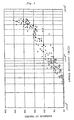
- open circles represent measured values for the above-mentioned 100 rolls of sodium chloride added paper
- closed circles represent measured values for the above-mentioned 100 rolls of non-additive paper. Since some of measured values approximately overlap with each other, the numbers of the respective circles are less than 100.
- the lateral axis represents a log scale.
- the values of the total electric potential and the intensity of crackle of the printed matter are smaller than those of almost all of the non-additive paper, and in the case of the paper having a surface resistivity of 1.0 x 10 9 to 5.0 x 10 9 ⁇ / ⁇ , the values of the total electric potential and the intensity of crackle of the printed matter are practically negligible.
- the sample of printed matter (a catalogue of 72 pages) from the paper having a surface resistivity of 4.8 x 10 9 ⁇ / ⁇ which is determined to have a total electric potential of 8.6 kV, a maximum measured electric potential of 0.5 V, and the intensity of crackle of 3.3 generated crackling sounds of estimation point 1 for 3 or 4 times per a single copy in the page turning measurement, causing little unpleasantness and no adhesion of pages.
- the printing method of the invention can suppress occurrence of missing dots in printed matters, as well as eliminate electrostatic troubles, so that it has an excellent applicability to gravure printing particularly using thin paper.
Landscapes
- Physics & Mathematics (AREA)
- General Physics & Mathematics (AREA)
- Engineering & Computer Science (AREA)
- Mechanical Engineering (AREA)
- Paper (AREA)
- Printing Plates And Materials Therefor (AREA)
- Printing Methods (AREA)
- Manufacture Or Reproduction Of Printing Formes (AREA)
- Rotary Presses (AREA)
- Laminated Bodies (AREA)
- Tubes (AREA)
Claims (5)
- Procédé d'héliogravure, caractérisé en ce qu'une impression électrostatique est effectuée en utilisant du papier ayant une teneur en eau de 4 % à 6 % et une résistivité superficielle de 1,0 x 10⁹ à 9,0 x 10⁹ Ω/□ dans la condition environnementale de température de 23°C ± 1 °C et d'humidité relative (RH) de 50 % ± 2 %.
- Procédé d'héliogravure selon la revendication 1, caractérisé en ce que la résistivité superficielle du papier est dans la plage de 1,0 x 10⁹ à 7,0 x 10⁹ Ω/□.
- Procédé d'héliogravure selon la revendication 1, caractérisé en ce que la résistivité superficielle du papier est dans la plage de 1,0 x 10⁹ à 5,0 x 10⁹ Ω/□.
- Procédé d'héliogravure selon la revendication 1, caractérisé en ce que le papier a été soumis à un traitement de collage en surface avec un agent de collage comprenant 0,15 g à 0,2 g d'un sel inorganique pour 60 g de papier.
- Procédé d'héliogravure selon la revendication 4, caractérisé en ce que le sel inorganique est du chlorure de sodium.
Applications Claiming Priority (1)
| Application Number | Priority Date | Filing Date | Title |
|---|---|---|---|
| PCT/JP1998/003651 WO2000009343A1 (fr) | 1998-08-17 | 1998-08-17 | Photogravure |
Publications (3)
| Publication Number | Publication Date |
|---|---|
| EP1162075A1 EP1162075A1 (fr) | 2001-12-12 |
| EP1162075A4 EP1162075A4 (fr) | 2004-06-30 |
| EP1162075B1 true EP1162075B1 (fr) | 2005-11-02 |
Family
ID=14208803
Family Applications (1)
| Application Number | Title | Priority Date | Filing Date |
|---|---|---|---|
| EP98937846A Expired - Lifetime EP1162075B1 (fr) | 1998-08-17 | 1998-08-17 | Photogravure |
Country Status (8)
| Country | Link |
|---|---|
| US (1) | US6598523B1 (fr) |
| EP (1) | EP1162075B1 (fr) |
| JP (1) | JP3581654B2 (fr) |
| KR (1) | KR100499681B1 (fr) |
| AT (1) | ATE308420T1 (fr) |
| CA (1) | CA2340101C (fr) |
| DE (1) | DE69832208T2 (fr) |
| WO (1) | WO2000009343A1 (fr) |
Families Citing this family (3)
| Publication number | Priority date | Publication date | Assignee | Title |
|---|---|---|---|---|
| DE10321365A1 (de) * | 2003-05-13 | 2004-12-16 | X-Film Selbstkebefolien Gmbh | Mit Digitaldrucktechnik bedruckbare Kunststoff-Folie und Herstellung einer bedruckten Kunststoff-Folie |
| DE102015102846B4 (de) * | 2015-02-27 | 2019-10-17 | Delfortgroup Ag | Dünndruckpapier mit verbesserter Opazität |
| AT521847A1 (de) * | 2018-11-09 | 2020-05-15 | Hueck Folien Gmbh | Verfahren zur Herstellung eines Sicherheitsmerkmals |
Family Cites Families (19)
| Publication number | Priority date | Publication date | Assignee | Title |
|---|---|---|---|---|
| US3991253A (en) * | 1973-03-08 | 1976-11-09 | Monsanto Company | Dielectric recording media |
| US3951882A (en) * | 1973-03-08 | 1976-04-20 | Monsanto Company | Dielectric coating compositions |
| JPS598828B2 (ja) * | 1976-05-15 | 1984-02-27 | 京セラミタ株式会社 | オフセツト印刷及び平版印刷に適した電子写真感光材料及びその製法 |
| JPS57204058A (en) * | 1981-06-10 | 1982-12-14 | Fuji Xerox Co Ltd | Transfer form for electrophotography |
| DE3760488D1 (en) * | 1986-05-26 | 1989-10-05 | Agfa Gevaert Nv | A sheet or web carrying an antistatic layer |
| US5238801A (en) * | 1988-10-19 | 1993-08-24 | Fuji Photo Film Co., Ltd. | Process of treating a silver halide photographic element |
| JPH02147240A (ja) * | 1988-11-29 | 1990-06-06 | Dainippon Printing Co Ltd | 表面処理プラスチックフィルム |
| US5192613A (en) * | 1990-01-26 | 1993-03-09 | E. I. Du Pont De Nemours And Company | Electrographic recording element with reduced humidity sensitivity |
| JP2597916Y2 (ja) * | 1991-04-12 | 1999-07-26 | 日本製紙株式会社 | 磁気記録媒体の製造方法 |
| JP3125395B2 (ja) * | 1991-12-12 | 2001-01-15 | シーアイ化成株式会社 | 帯電防止機能を有する転写シートを用いた化粧材及びその製造方法 |
| JPH05341554A (ja) * | 1992-06-04 | 1993-12-24 | Fuji Xerox Co Ltd | 電子写真用転写用紙 |
| JP3816121B2 (ja) * | 1994-12-20 | 2006-08-30 | 富士ゼロックス株式会社 | 電子写真用転写紙及びカラー画像形成方法 |
| JP3816120B2 (ja) * | 1994-12-20 | 2006-08-30 | 富士ゼロックス株式会社 | 電子写真用転写紙 |
| CH691584A5 (de) * | 1995-08-18 | 2001-08-31 | Spengler Electronic Ag | Verfahren und Vorrichtung zur elektrostatischen Substratübertragung. |
| JPH09119091A (ja) * | 1995-10-24 | 1997-05-06 | Fuji Xerox Co Ltd | 記録用紙 |
| JPH09124987A (ja) * | 1995-11-06 | 1997-05-13 | Toyo Ink Mfg Co Ltd | 静電グラビア印刷インキ |
| US5707554A (en) * | 1996-05-08 | 1998-01-13 | Rexam Graphics, Incorporated | Electrically conductive surface release polymers |
| US5759636A (en) * | 1996-12-18 | 1998-06-02 | Rexam Graphics, Inc. | Electrographic imaging element |
| US6578478B2 (en) * | 1997-11-27 | 2003-06-17 | Spengler Electronic Ag | Electrostatic arrangement for rotogravure and flexographic printing unit |
-
1998
- 1998-08-17 US US09/762,672 patent/US6598523B1/en not_active Expired - Fee Related
- 1998-08-17 WO PCT/JP1998/003651 patent/WO2000009343A1/fr not_active Ceased
- 1998-08-17 JP JP2000564822A patent/JP3581654B2/ja not_active Expired - Fee Related
- 1998-08-17 AT AT98937846T patent/ATE308420T1/de active
- 1998-08-17 EP EP98937846A patent/EP1162075B1/fr not_active Expired - Lifetime
- 1998-08-17 DE DE69832208T patent/DE69832208T2/de not_active Expired - Lifetime
- 1998-08-17 KR KR10-2001-7001703A patent/KR100499681B1/ko not_active Expired - Fee Related
- 1998-08-17 CA CA002340101A patent/CA2340101C/fr not_active Expired - Fee Related
Also Published As
| Publication number | Publication date |
|---|---|
| CA2340101A1 (fr) | 2000-02-24 |
| JP3581654B2 (ja) | 2004-10-27 |
| KR20010106438A (ko) | 2001-11-29 |
| US6598523B1 (en) | 2003-07-29 |
| KR100499681B1 (ko) | 2005-07-07 |
| WO2000009343A1 (fr) | 2000-02-24 |
| DE69832208T2 (de) | 2006-07-13 |
| ATE308420T1 (de) | 2005-11-15 |
| CA2340101C (fr) | 2005-02-22 |
| DE69832208D1 (de) | 2005-12-08 |
| EP1162075A1 (fr) | 2001-12-12 |
| EP1162075A4 (fr) | 2004-06-30 |
Similar Documents
| Publication | Publication Date | Title |
|---|---|---|
| US5205212A (en) | Method of reducing ink electrets in gravure web printing | |
| DE69820128T2 (de) | Bilderzeugungsgerät und Herstellungsverfahren von dielektrischen Folien | |
| EP1162075B1 (fr) | Photogravure | |
| CA2013015A1 (fr) | Revetement ameliorant l'adhesion d'un toner et papier portant ce revetement | |
| JPH08511484A (ja) | レーザーでミシン目を入れたボンド紙を用いて製造した多ページ折り丁 | |
| EP1666978A3 (fr) | Dispositiv de formation d`images | |
| US4222901A (en) | Electroconductive polymers having improved solvent holdout properties | |
| JPWO2000009343A1 (ja) | グラビア印刷方法 | |
| JP2004099280A (ja) | 用紙搬送装置 | |
| CN106676939B (zh) | 纸板、制造该纸板的方法以及使用该纸板的图像形成方法 | |
| KR20200108740A (ko) | 정전기를 제거하는 인쇄 방법 | |
| DE69309962T2 (de) | Beschichtetes papier für auf reibung basierende zuführungssysteme des "bogen nach bogen" typs | |
| Kawamoto et al. | Development of electrostatic paper separation and feed mechanism | |
| DE3043736A1 (de) | Verfahren zum uebertragen eines pigmentbildes | |
| Borch et al. | Paper material considerations for system printers | |
| JPH0415318B2 (fr) | ||
| DE3149699A1 (de) | Einen leitfaehigen ueberzug aufweisendes gebilde und verfahren und chemische loesung zum aufbringen des ueberzugs | |
| CA2293053A1 (fr) | Procede et appareil de production d'un produit imprime plie | |
| US4096288A (en) | Method of partial reproduction of a pattern from a master | |
| JPH0341822B2 (fr) | ||
| US4079697A (en) | Electrode conductive roller developing device | |
| JP2000131870A (ja) | プリント用及び複写用シート | |
| JP4373158B2 (ja) | グラビア印刷用板紙およびこれを用いた印刷物 | |
| EP1037744A1 (fr) | Carton fort pour la protection contre l'electricite statique de dispositifs sensibles a l'electricite statique | |
| US6251552B1 (en) | Method and apparatus of developing electrophotographic master plate for printing |
Legal Events
| Date | Code | Title | Description |
|---|---|---|---|
| PUAI | Public reference made under article 153(3) epc to a published international application that has entered the european phase |
Free format text: ORIGINAL CODE: 0009012 |
|
| 17P | Request for examination filed |
Effective date: 20010215 |
|
| AK | Designated contracting states |
Kind code of ref document: A1 Designated state(s): AT DE FI IT |
|
| A4 | Supplementary search report drawn up and despatched |
Effective date: 20040513 |
|
| RIC1 | Information provided on ipc code assigned before grant |
Ipc: 7B 41M 1/10 B Ipc: 7B 41F 9/00 A |
|
| GRAP | Despatch of communication of intention to grant a patent |
Free format text: ORIGINAL CODE: EPIDOSNIGR1 |
|
| GRAS | Grant fee paid |
Free format text: ORIGINAL CODE: EPIDOSNIGR3 |
|
| GRAA | (expected) grant |
Free format text: ORIGINAL CODE: 0009210 |
|
| AK | Designated contracting states |
Kind code of ref document: B1 Designated state(s): AT DE FI IT |
|
| REF | Corresponds to: |
Ref document number: 69832208 Country of ref document: DE Date of ref document: 20051208 Kind code of ref document: P |
|
| PLBE | No opposition filed within time limit |
Free format text: ORIGINAL CODE: 0009261 |
|
| STAA | Information on the status of an ep patent application or granted ep patent |
Free format text: STATUS: NO OPPOSITION FILED WITHIN TIME LIMIT |
|
| 26N | No opposition filed |
Effective date: 20060803 |
|
| PGFP | Annual fee paid to national office [announced via postgrant information from national office to epo] |
Ref country code: FI Payment date: 20120813 Year of fee payment: 15 |
|
| PGFP | Annual fee paid to national office [announced via postgrant information from national office to epo] |
Ref country code: IT Payment date: 20120821 Year of fee payment: 15 Ref country code: DE Payment date: 20120822 Year of fee payment: 15 |
|
| PGFP | Annual fee paid to national office [announced via postgrant information from national office to epo] |
Ref country code: AT Payment date: 20120813 Year of fee payment: 15 |
|
| REG | Reference to a national code |
Ref country code: AT Ref legal event code: MM01 Ref document number: 308420 Country of ref document: AT Kind code of ref document: T Effective date: 20130817 |
|
| PG25 | Lapsed in a contracting state [announced via postgrant information from national office to epo] |
Ref country code: DE Free format text: LAPSE BECAUSE OF NON-PAYMENT OF DUE FEES Effective date: 20140301 Ref country code: FI Free format text: LAPSE BECAUSE OF NON-PAYMENT OF DUE FEES Effective date: 20130817 |
|
| PG25 | Lapsed in a contracting state [announced via postgrant information from national office to epo] |
Ref country code: AT Free format text: LAPSE BECAUSE OF NON-PAYMENT OF DUE FEES Effective date: 20130817 Ref country code: IT Free format text: LAPSE BECAUSE OF NON-PAYMENT OF DUE FEES Effective date: 20130817 |
|
| REG | Reference to a national code |
Ref country code: DE Ref legal event code: R119 Ref document number: 69832208 Country of ref document: DE Effective date: 20140301 |