EP1178878B1 - Automated product profiling apparatus - Google Patents
Automated product profiling apparatus Download PDFInfo
- Publication number
- EP1178878B1 EP1178878B1 EP00928257A EP00928257A EP1178878B1 EP 1178878 B1 EP1178878 B1 EP 1178878B1 EP 00928257 A EP00928257 A EP 00928257A EP 00928257 A EP00928257 A EP 00928257A EP 1178878 B1 EP1178878 B1 EP 1178878B1
- Authority
- EP
- European Patent Office
- Prior art keywords
- product
- processor
- conveyor line
- line
- cameras
- Prior art date
- Legal status (The legal status is an assumption and is not a legal conclusion. Google has not performed a legal analysis and makes no representation as to the accuracy of the status listed.)
- Expired - Lifetime
Links
Images



Classifications
-
- A—HUMAN NECESSITIES
- A22—BUTCHERING; MEAT TREATMENT; PROCESSING POULTRY OR FISH
- A22C—PROCESSING MEAT, POULTRY, OR FISH
- A22C17/00—Other devices for processing meat or bones
- A22C17/0006—Cutting or shaping meat
- A22C17/0033—Cutting slices out of a piece of meat
-
- A—HUMAN NECESSITIES
- A22—BUTCHERING; MEAT TREATMENT; PROCESSING POULTRY OR FISH
- A22C—PROCESSING MEAT, POULTRY, OR FISH
- A22C17/00—Other devices for processing meat or bones
- A22C17/0073—Other devices for processing meat or bones using visual recognition, X-rays, ultrasounds, or other contactless means to determine quality or size of portioned meat
-
- A—HUMAN NECESSITIES
- A22—BUTCHERING; MEAT TREATMENT; PROCESSING POULTRY OR FISH
- A22C—PROCESSING MEAT, POULTRY, OR FISH
- A22C17/00—Other devices for processing meat or bones
- A22C17/0073—Other devices for processing meat or bones using visual recognition, X-rays, ultrasounds, or other contactless means to determine quality or size of portioned meat
- A22C17/0086—Calculating cutting patterns based on visual recognition
-
- A—HUMAN NECESSITIES
- A22—BUTCHERING; MEAT TREATMENT; PROCESSING POULTRY OR FISH
- A22C—PROCESSING MEAT, POULTRY, OR FISH
- A22C17/00—Other devices for processing meat or bones
- A22C17/02—Apparatus for holding meat or bones while cutting
-
- B—PERFORMING OPERATIONS; TRANSPORTING
- B26—HAND CUTTING TOOLS; CUTTING; SEVERING
- B26D—CUTTING; DETAILS COMMON TO MACHINES FOR PERFORATING, PUNCHING, CUTTING-OUT, STAMPING-OUT OR SEVERING
- B26D5/00—Arrangements for operating and controlling machines or devices for cutting, cutting-out, stamping-out, punching, perforating, or severing by means other than cutting
- B26D5/005—Computer numerical control means
-
- B—PERFORMING OPERATIONS; TRANSPORTING
- B26—HAND CUTTING TOOLS; CUTTING; SEVERING
- B26D—CUTTING; DETAILS COMMON TO MACHINES FOR PERFORATING, PUNCHING, CUTTING-OUT, STAMPING-OUT OR SEVERING
- B26D5/00—Arrangements for operating and controlling machines or devices for cutting, cutting-out, stamping-out, punching, perforating, or severing by means other than cutting
- B26D5/007—Control means comprising cameras, vision or image processing systems
-
- B—PERFORMING OPERATIONS; TRANSPORTING
- B26—HAND CUTTING TOOLS; CUTTING; SEVERING
- B26D—CUTTING; DETAILS COMMON TO MACHINES FOR PERFORATING, PUNCHING, CUTTING-OUT, STAMPING-OUT OR SEVERING
- B26D7/00—Details of apparatus for cutting, cutting-out, stamping-out, punching, perforating, or severing by means other than cutting
- B26D7/06—Arrangements for feeding or delivering work of other than sheet, web, or filamentary form
- B26D7/0625—Arrangements for feeding or delivering work of other than sheet, web, or filamentary form by endless conveyors, e.g. belts
-
- B—PERFORMING OPERATIONS; TRANSPORTING
- B26—HAND CUTTING TOOLS; CUTTING; SEVERING
- B26D—CUTTING; DETAILS COMMON TO MACHINES FOR PERFORATING, PUNCHING, CUTTING-OUT, STAMPING-OUT OR SEVERING
- B26D7/00—Details of apparatus for cutting, cutting-out, stamping-out, punching, perforating, or severing by means other than cutting
- B26D7/06—Arrangements for feeding or delivering work of other than sheet, web, or filamentary form
- B26D7/0641—Arrangements for feeding or delivering work of other than sheet, web, or filamentary form using chutes, hoppers, magazines
-
- B—PERFORMING OPERATIONS; TRANSPORTING
- B26—HAND CUTTING TOOLS; CUTTING; SEVERING
- B26D—CUTTING; DETAILS COMMON TO MACHINES FOR PERFORATING, PUNCHING, CUTTING-OUT, STAMPING-OUT OR SEVERING
- B26D7/00—Details of apparatus for cutting, cutting-out, stamping-out, punching, perforating, or severing by means other than cutting
- B26D7/27—Means for performing other operations combined with cutting
- B26D7/30—Means for performing other operations combined with cutting for weighing cut product
-
- G—PHYSICS
- G01—MEASURING; TESTING
- G01B—MEASURING LENGTH, THICKNESS OR SIMILAR LINEAR DIMENSIONS; MEASURING ANGLES; MEASURING AREAS; MEASURING IRREGULARITIES OF SURFACES OR CONTOURS
- G01B11/00—Measuring arrangements characterised by the use of optical techniques
- G01B11/24—Measuring arrangements characterised by the use of optical techniques for measuring contours or curvatures
- G01B11/245—Measuring arrangements characterised by the use of optical techniques for measuring contours or curvatures using a plurality of fixed, simultaneously operating transducers
-
- G—PHYSICS
- G01—MEASURING; TESTING
- G01B—MEASURING LENGTH, THICKNESS OR SIMILAR LINEAR DIMENSIONS; MEASURING ANGLES; MEASURING AREAS; MEASURING IRREGULARITIES OF SURFACES OR CONTOURS
- G01B11/00—Measuring arrangements characterised by the use of optical techniques
- G01B11/24—Measuring arrangements characterised by the use of optical techniques for measuring contours or curvatures
- G01B11/25—Measuring arrangements characterised by the use of optical techniques for measuring contours or curvatures by projecting a pattern, e.g. one or more lines, moiré fringes on the object
- G01B11/2536—Measuring arrangements characterised by the use of optical techniques for measuring contours or curvatures by projecting a pattern, e.g. one or more lines, moiré fringes on the object using several gratings with variable grating pitch, projected on the object with the same angle of incidence
-
- B—PERFORMING OPERATIONS; TRANSPORTING
- B26—HAND CUTTING TOOLS; CUTTING; SEVERING
- B26D—CUTTING; DETAILS COMMON TO MACHINES FOR PERFORATING, PUNCHING, CUTTING-OUT, STAMPING-OUT OR SEVERING
- B26D2210/00—Machines or methods used for cutting special materials
- B26D2210/02—Machines or methods used for cutting special materials for cutting food products, e.g. food slicers
Definitions
- the present invention relates to an apparatus for determining the profile of a product that is to undergo a subsequent physical process.
- the subsequent physical process is one in which the product profile is needed to ensure proper processing of the product.
- Typical subsequent physical processes include slicing the product into individual slices on a slicing machine.
- Such slicing machines are principally, but not exclusively, used for slicing food products such as cheese, meat and pressed or moulded meat products.
- Known slicing machines include a rotating blade and a product feeder that drives the product forward towards the blade so that successive slices are cut from one face of the product.
- the distance through which the product is advanced between successive cuts of the blade determines the thickness of the slices.
- the product is of uniform shape and density, it may be sufficient to use a single predetermined slice thickness to give a slice or group of slices of the required weight. Further, it may be sufficient to provide an output scale proximate the output side of the blade to measure the current weight of the slice to product and adjust the thickness of the subsequent slice(s) to make the desired unit weight.
- a slicing machine for cutting slices from a product includes a camera arranged to view a cut face of the product; boundary recognition apparatus arranged to process image signals from the camera to determine a boundary of the cut face; calculating apparatus arranged to calculate a parameter characteristic of the cut face from image data corresponding to regions of the cut face within the boundary; and control signal generating apparatus arranged to generate a control signal to control the operation of the slicer in accordance with the determined parameter.
- the foregoing system may be suitable for low-throughput slicing machines, it is significantly less suitable for high-speed slicing machines, such as those available from Formax Inc, of Mokena, Illinois, under the brand name S-180 TM .
- Second, substantial measurement inaccuracies may result from shadowing effects resulting from the relative positions of the illumination source, cut face, and slicing machine components - a problem not addressed in the Thurne patent.
- the present invention is directed at an automated system for processing a product based on the acquisition of its surface profile, comprising a conveyor line along which the product is conducted, in sequence, between a profiling apparatus and a product processor, the profiling apparatus having line lasers above and below the product for illuminating the surface profile of the product, and cameras for imaging the surface profile illuminated by the line lasers.
- each line laser is adapted to illuminate the surface profile of the product across a plane transverse to the conveyance direction of the product; a controller is connected to the cameras for determining the volume of the product by acquiring and processing multiple visual images acquired by the cameras along the length of the product as the product is moved through the profiling apparatus, and is arranged to complete its processing of such visual images before processing of the product in the product processor; and the product processor has a control system for varying its processing operation on the product based in part upon the volume of the product.
- the system comprises an apparatus which comprises a scanning section for accepting product; one or more product drives for driving the product along a scanning path through the scanning section; an upper vision system disposed to acquire visual information relating to the profile of the upper portion of the product along the length of the product; and a lower vision system disposed to acquire visual information relating to the profile of the lower portion of the product along the length of the product.
- the scanning section typically comprises a scanning chamber having an open input end for accepting a product and an open outlet end to allow the product to exit the chamber and the apparatus can include an output section for receiving the product from the outlet end for delivery to a product processor.
- a controller connected to the upper and lower vision systems is adapted to convert information received from the upper and lower vision systems into a format suitable for subsequent use by the product processor.
- Figure 1 illustrates a product processing system, shown generally at 10, that performs a physical process on a product in which the physical process is dependent on accurate measurement of the profile of the raw product.
- product processing system 10 is comprised of a product profiling apparatus 15 and a product processor 20.
- the product profiling apparatus 15 functions to measure the profile of the raw product and provide the profile information to the product processor 20 that, in turn, uses the information to accurately execute the physical process that is to be performed on the raw product.
- the acquisition of the product profile information is completed before the particular raw product undergoes physical processing in the product processor 20.
- the profiling apparatus 15 is disposed prior to the product processor 20, it is possible to acquire complete product profiles for several individual raw products before each of the raw products is provided to the input of the product processor 20.
- the profiling apparatus 15 may be used to provide product profile information to a plurality of different product processors that are operating in either a time sequential or concurrent manner.
- the profiling apparatus 15 is comprised of an input section 25, a scanning section 30, and an output section 35.
- the input section 25 includes a plurality of support bars 40 that are disposed to support the product 45 that is to be profiled.
- a plurality of upstanding fingers 50 extend through interstitial regions between the support bars 40. The fingers 50 engage a rear portion of product 45 and drive it into the scanning section 30. The fingers are arranged to be vertically above the support bars when moved in the driving direction and vertically beneath the bars when conducted in the return direction.
- Scanning section 30 includes a housing 55 having an input end that is open to receive product 45 and an outlet end that is open to allow product 45 to exit therefrom.
- housing 55 comprises a principal housing portion 60, an upper vision system housing 65, and a lower vision housing 70.
- the upper vision system housing 65 includes an upper vision system disposed therein.
- the upper vision system of the disclosed embodiment includes a vertically directed line laser 75 for illuminating one side of the product in a fixed plane traversed by the driven product and an associated camera 80 vertically angled for imaging the laser-illuminated contour of the product 45.
- the lower vision system housing 70 includes a lower vision system disposed therein that is comprised of a line laser 85 and corresponding camera 90 for addressing the other side of the product.
- Each of the upper and lower vision system housings 65 and 70 includes an opening that is positioned to allow the respective vision system to view a product 45 passing through the principal housing 60.
- These openings may merely comprise cut out sections.
- the openings are covered with a transparent material to form a window that mechanically isolates the vision system components from the components disposed in the principal housing 60 yet does not interfere with the vision system operation.
- each of the vision system housings 65 and 70 contain two opposing line lasers for illuminating downwardly and across the product from opposed sides of the product. In instances of a considerably uneven profile and/or in the event of highly reflective surface characteristics, opposed sides illumination on the product provides for higher resolution camera imaging.
- support bars 95 may be formed as extensions of support bars 40, or may be formed as a support component that is distinct from support bars 40.
- the number and diameter of the support bars 95 should be minimized to facilitate accuracy of the scanning measurements provided by the lower vision system. Most preferably, although not shown, the diameters of the support bars 95 are substantially reduced to a minimum where they cross the laser light line emanating from the lower vision system laser.
- Product 45 is driven through the principal housing 60 by a product drive, shown generally at 100
- the product drive 100 is comprised of a product engagement member 105 that is disposed to engage a rear portion of product 45 and drive it along support rods 95 through the principal housing 60.
- Product engagement member 105 includes a plurality of slots that are disposed to allow concurrent operation of the fingers 50 and product engagement member 105 at the input end of the principal housing 60.
- a pair of upstanding members 110 are connected to opposite ends of the product engagement member 105.
- the upstanding members 110 are fastened to respective drive belts 115 and 120 to move the product engagement member 105 and corresponding product 45 through the principal housing 60.
- the drive belts 115 and 120 are preferably driven at a constant, precise velocity by, for example, a servo motor, a motor with a resolver, etc.
- the product 45 is engaged by another set of fingers 130 that extends through interstitial regions of support bars 95.
- Support bars 95 may be extended to the output section 35 or, alternatively, a further distinct set of support bars may be used to support the product 45 at the output section 35.
- Fingers 130 engage the rear portion of product 45 and drive it to the output section 35 and therefrom to the processing apparatus 20, which, in the disclosed embodiment, is a slicing machine.
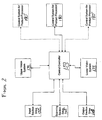
- FIG. 2 is a schematic block diagram of one embodiment of a control system suitable for controlled operation of product profiling apparatus 15.
- the control system comprises a central controller 150 that is responsible for 1) controlling the drive mechanisms associated with various portions of the profiling apparatus 15; 2) coordinating the operation of the vision systems, including acquisition of the profile data; and 3) communicating the profile data to control systems for one or more product processors 20.
- the central controller 150 is connected to receive sensed signals from and provide motion control signals to each of the input and output section drives 155 and 160 and the scanning section drive 65.
- the central controller 150 is connected to receive sensed signals from and provide scanning control signals to the upper and lower vision systems 170 and 175.
- the profile information acquired from the upper and lower vision systems 170 and 175 is communicated to the control system 180 of at least one product processor 20.
- the profile information may be communicated to the control system 180 in any one of a variety of processing states.
- the central controller 150 may communicate raw profile data to the control system 180.
- the central controller 150 may communicate the profile information after the raw data it acquires has been processed at the central controller 150 thereby relieving the control system 180 from much of the additional processing overhead associated with profile calculations.
- each of the products 45 may be provided with a bar-code or other visual image marker that may be acquired or otherwise input to the central controller 150 as well as the particular control system 180, 180', 180" associated with the particular product processor 20 that is to slice the particular product.
- the particular control system may request the profile data associated with the identified product from the central controller 150.
- the product profiling apparatus 15 can be described with respect to Figures 1 and 2.
- the product 45 shown here as a slab of bacon or the like, is provided at input section 25 where it is supported by support rods 40.
- Central controller 150 then activates input section drive 155 so that fingers 50 engage the rear portion of product 45 and drive it into the scanning section 30.
- Product engagement member 105 is preferably hinged to swing out of the way or otherwise glide over the upper surface of product 45 as it is moved through the opening at the input of the scanning section 30.
- the central controller 150 been directs the scanning section drive 165 to operate so that the product engagement member 105 contacts the rear portion of product 45 and begins to drive product 45 through the interior chamber of the principal housing 55.
- the product 45 is driven a small distance over support rods 95 before reaching the position in the principal housing 55 in which product scanning begins. This allows the product to settle upon the support rods 95 and against product engagement member 105 before scanning thereby increasing the accuracy of the resulting profile data.
- a resolver or the like associated with the scanning section drive 165 generates control pulses corresponding to incremental movement of the product 45 over a fixed distance through the principal housing 55. These control pulses are used as synchronization signals that the central controller 150 uses to trigger the acquisition of a profile reading.
- the profile readings are in the form of a visual image captured by the cameras 80 and 90 at fixed increments along the length of the product 45.
- the product profile is accentuated by directing a line of laser light across the upper and lower surfaces of the product 45. Accordingly, the interior of the principal housing 55 should be as dark as possible so that cameras 80 and 90 may detect the line projected by line lasers 75 and 85.
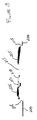
- Figure 3 is an exemplary image acquired by camera 80 of profiling apparatus 15. Although camera 80 is capable all of providing an image of 640 X 480 pixels, only a sub-portion of that entire available image is extracted by central controller 150 for further processing. As shown, the resulting image is comprised of linear end regions 200.
- the linear end regions are formed by reflection of the light from line laser 75 by a pair of reference reflectors that, preferably, are disposed to be even with the upper surfaces of support rods 95.
- There are a plurality of elevated, non-linear regions between linear regions 200 are a plurality of elevated, non-linear regions between linear regions 200. These non-linear regions correspond to the upper profile of product 45 that has been illuminated by line laser 75.
- the laser light impinging on the upper surface of product 45 may be dispersed in different manners.
- the product 45 is bacon or another fat-containing comestible
- fatted regions, such as at 205 disperse the laser light to a greater degree than lean regions 210.
- a broader light band is formed at the fatted regions 205.
- Controller 150 may compensate for this dispersion by, for example, selecting the area of highest dark pixel concentration for the vertical measurement.
- a vertical distance measurement may be obtained by taking the average vertical distance of the uppermost vertical distance measurement and the lowermost vertical distance measurement.
- the light reflected from the surface of product 45 may be blocked from the view of the camera. These regions appear as void regions 215.
- central controller 150 may be programmed to assume a linear transition of the surface contour. Since void regions 215 are generally of a very limited dimension, this assumption still provides for an accurate representation of the overall product profile. Similarly, an assumption that there is a linear transition of the surface contour at the regions of the lower surface of product 45 that are blocked by support rods 90 does not significantly diminish the accuracy of the profile measurements. To minimize any inaccuracies introduced by the presence of support rods 95, the number and diameter of support rods 90 should be minimized. Further, support rods 95 should have a generally round cross-section so that they generate obstructed or otherwise unusable regions of the profile image that are substantially equal in the length.
- the central controller 150 controls the output section drive 160 so that fingers 130 engage the rear portion of product 45 and drive it from the interior of scanning section 15 to output section 35.
- Product 45 may be removed by an operator from section 35 and provided to the input of a subsequent product processor 20.
- the output section 35 and corresponding output section drive 160 may be designed to drive product 45 into a loading position on the subsequent product processor.
- Profiling apparatus 15 may include a digital scale for weighing the product 45.
- the output of the digital scale may be provided to central controller 150.
- Central controller 150 may be programmed to calculate the overall volume of product 45 based on the profile measurements.
- Central controller 150 may then use the overall product value and the weight provided by the digital scale to calculate the average density of the product 45.
- the average density measurement may be used by a slicing machine, such as product processor 20, in combination with the profile measurements to calculate the product slice thicknesses that are required to make a particular weight, such as the weight of product slices that are to be provided in a single consumer package.
- one or more of the average density, overall volume, or product profile measurements/calculations may be executed by the control system 180 of the slicing machine.
- FIGS 4 and 5 illustrate a specific embodiment of the profiling apparatus 15 in which like parts are similarly numbered.
- the drive mechanisms associated with input section 25, scanning section 30, and output section 30 are similarly numbered.
- the lasers are preferably disposed on opposite sides of the product and projecting their beams down onto and across the product.
- the camera position generally does not change. In this way, a triangulated approach to capture of the surface profile on both respective sides of the product is utilized.
- the drive mechanisms associated with the input section 25 and output section 30 are interrelated. More particularly, the drive mechanisms are comprised of a single, dual-ended pneumatic actuator, shown generally at 300 that is mounted below support rods 40 (the support rods throughout are continuous and formed as a single set of rods).
- Actuator 300 includes a piston rod 305 having a first end connected to a first finger engagement assembly 315 and a second end connected to a second finger engagement assembly 310.
- Finger engagement assembly 310 includes the fingers 50 thereon while finger engagement assembly 315 includes the fingers 130 thereon. Fingers 50 are disposed on a pivot rod 320 along with one or more counterbalance mechanisms 325.
- the counterbalance mechanisms 325 urge fingers 50 to rotate about a horizontal axis defined by pivot rod 320 until fingers 50 engage one or more stop members 330.
- the one or more stop members 330 are disposed to the stock fell rotation of fingers 50 when they are in an upright position. This arrangement allows fingers 50 to slide under a successive product 45 disposed on the input section 25 as the fingers are driven back to the home position after delivering a previous product 45 to the scanning section 30.
- a similar arrangement is provided for finger assembly 315 disposed at the first end of piston rod 305.
- the one or more counterbalance mechanisms 335 of the finger assembly 315 are positioned to engage a further stop member 340 at the output position of the output section 35.
- counterbalance mechanisms 335 are driven into engagement with the further stop mechanisms 340. This causes the fingers 130 to rotate about a horizontal axis defined by pivot rod 345 which assists in driving the product 45 from output section 35 to, for example, the input of a slicing machine.
- the scanning section drive includes motor 350 that is connected to rotate drive roller 355.
- Securement mechanisms 365 are connected to upstanding members 110 (shown in Figure 5) to secure upstanding members 110 and product engagement member 105 with drives belts 115 and 120.
- the securement mechanisms 365 are connected to one another by a strut 372 to enhance the rigidity of the overall drive mechanism. Additionally, securement mechanisms 365 each engage respective guide rods 377 that extend along the length of the transport path along which the product engagement member 105 moves product 45 through scanning section 30.
- securement members 365 each include a pivoted connection 378 that allows the product engagement member 105 to glide over the upper surface of a product 45 disposed in the scanning section 30 as member 105 is returned to its home position after driving a product from the scanning section 30.
- the product engagement member 105 may be actively moved by, for example, an actuator, so that its movement to the home position is not obstructed by the product 45.
- the product is preferably supplied to the input section 25 from a stacked input.
- Figure 6 illustrates a specific embodiment of a vertically extending stacker 400, in the form of a chute the walls of which are defined by columns of rollers 410.
- the lower end of the chute is immediately above, and opens onto, the input section 25.
- the upper end of the chute extends above and angles away from the input section.
- the chute defines a gravity-drop passage in which a plurality of the products can be stacked one on top of the other for successive and automatic loading onto the input section 25.
- a product stop 380 shown in Figure 7, which could hold the movement of the product under the influence of the engagement member 105 until the fingers 130 have fully returned to engage the next product.
- the product stopper 380 is freely pivotable about a transverse, horizontal axis, and formed at a forward side with an L-shaped stop wall 381 and on the other side of the pivot axis with a counterweight abutment 382. Until the piston carrying the fingers 130 is fully returned, the L-shaped stop wall 381 is in a raised blocking position in the path of conveyance of the next product being delivered to the vision system housing, as shown by the dotted line image in Figure 7.
- the counterweight abutment 382 With the piston in its fully-returned position, the counterweight abutment 382 is engaged and raised, causing the stop wall 381 to be lowered and not obstructing the conveyance movement of the next product.
- the engagement member 105 is able to conduct the product over the tilted-down fingers 130, as well as the lowered stop wall, and fully into the vision system housing for further conveyance, from behind, by the then raised fingers 130.
- reference reflectors 375 are those referenced above in connection with the operation of the profiling apparatus 15.
Landscapes
- Engineering & Computer Science (AREA)
- Life Sciences & Earth Sciences (AREA)
- Forests & Forestry (AREA)
- Mechanical Engineering (AREA)
- Wood Science & Technology (AREA)
- Zoology (AREA)
- Food Science & Technology (AREA)
- Physics & Mathematics (AREA)
- Computer Vision & Pattern Recognition (AREA)
- General Physics & Mathematics (AREA)
- General Engineering & Computer Science (AREA)
- Length Measuring Devices By Optical Means (AREA)
- Coating With Molten Metal (AREA)
- Crystals, And After-Treatments Of Crystals (AREA)
- Mechanical Treatment Of Semiconductor (AREA)
- Processing Of Stones Or Stones Resemblance Materials (AREA)
- Automatic Analysis And Handling Materials Therefor (AREA)
- Sampling And Sample Adjustment (AREA)
Abstract
Description
- The present invention relates to an apparatus for determining the profile of a product that is to undergo a subsequent physical process. The subsequent physical process is one in which the product profile is needed to ensure proper processing of the product. Typical subsequent physical processes include slicing the product into individual slices on a slicing machine. Such slicing machines are principally, but not exclusively, used for slicing food products such as cheese, meat and pressed or moulded meat products.
- Known slicing machines include a rotating blade and a product feeder that drives the product forward towards the blade so that successive slices are cut from one face of the product. The distance through which the product is advanced between successive cuts of the blade determines the thickness of the slices. Where the product is of uniform shape and density, it may be sufficient to use a single predetermined slice thickness to give a slice or group of slices of the required weight. Further, it may be sufficient to provide an output scale proximate the output side of the blade to measure the current weight of the slice to product and adjust the thickness of the subsequent slice(s) to make the desired unit weight. Reference is directed to German Patent Specification No: 196 04 254, describing a system in which a computer is coupled to a regulating circuit which controls the advance of product supply means as a function of deviations from a desired weight.
- In general, however, variations in the shape and density of the product mean that the weight of a slice of a given thickness varies. A previous approach to dealing with this variation is described in United States Patent No: 4,428,263. In that process an automatic slicing machine is programmed to vary the thickness of the slices in accordance with a typical weight distribution for the product.
- It has also been proposed to make some determination of the cross-sectional area of the product as it is cut. One such system is purportedly disclosed in United States Patent No: 5,136,906, assigned to Thurne Engineering Co., Ltd (the Thurne Patent). According to that patent, a slicing machine for cutting slices from a product includes a camera arranged to view a cut face of the product; boundary recognition apparatus arranged to process image signals from the camera to determine a boundary of the cut face; calculating apparatus arranged to calculate a parameter characteristic of the cut face from image data corresponding to regions of the cut face within the boundary; and control signal generating apparatus arranged to generate a control signal to control the operation of the slicer in accordance with the determined parameter.
- Although the foregoing system may be suitable for low-throughput slicing machines, it is significantly less suitable for high-speed slicing machines, such as those available from Formax Inc, of Mokena, Illinois, under the brand name S-180™. First, by calculating the product profile at the cut face, a very limited amount of processing time is available to perform the calculations that are necessary to ensure the proper thickness of each slice before the cut face must again be imaged for processing the thickness of the next slice. Second, substantial measurement inaccuracies may result from shadowing effects resulting from the relative positions of the illumination source, cut face, and slicing machine components - a problem not addressed in the Thurne patent. Third, further measurement inaccuracies are introduced by the apparent assumption that the profiles at the bottom and a side of the product are linear. Finally, by attempting to measure the product profile at the cut face, substantial inaccuracies may be introduced due to the presence of scrap product. One of the goals of the apparatus described in the Thurne patent is to remove the inaccuracies introduced by the scrap product. However, by addressing this problem at the cut face, the apparatus of the Thurne patent must necessarily introduce a further level and higher degree of image processing.
- The present invention is directed at an automated system for processing a product based on the acquisition of its surface profile, comprising a conveyor line along which the product is conducted, in sequence, between a profiling apparatus and a product processor, the profiling apparatus having line lasers above and below the product for illuminating the surface profile of the product, and cameras for imaging the surface profile illuminated by the line lasers. According to the invention each line laser is adapted to illuminate the surface profile of the product across a plane transverse to the conveyance direction of the product; a controller is connected to the cameras for determining the volume of the product by acquiring and processing multiple visual images acquired by the cameras along the length of the product as the product is moved through the profiling apparatus, and is arranged to complete its processing of such visual images before processing of the product in the product processor; and the product processor has a control system for varying its processing operation on the product based in part upon the volume of the product.
- In one embodiment the system comprises an apparatus which comprises a scanning section for accepting product; one or more product drives for driving the product along a scanning path through the scanning section; an upper vision system disposed to acquire visual information relating to the profile of the upper portion of the product along the length of the product; and a lower vision system disposed to acquire visual information relating to the profile of the lower portion of the product along the length of the product. The scanning section typically comprises a scanning chamber having an open input end for accepting a product and an open outlet end to allow the product to exit the chamber and the apparatus can include an output section for receiving the product from the outlet end for delivery to a product processor. A controller connected to the upper and lower vision systems is adapted to convert information received from the upper and lower vision systems into a format suitable for subsequent use by the product processor.
- In the description which follows, an embodiment of the invention will be described by way of example, and with reference to the accompanying drawings. In the drawings:
- Figure 1 is a perspective view of a product processing system constructed in accordance with one embodiment of the present invention.
- Figure 2 is a schematic block diagram of one embodiment of a control system that may be used in the profiling apparatus of the system illustrated in Figure 1.
- Figure 3 is an exemplary image obtained by the upper vision system of the embodiment of the profiling apparatus illustrated in Figure 1.
- Figures 4 and 5 are cross-sectional views of one embodiment of a profiling apparatus that may be used in the system Figure 1.
- Figure 6 is a schematic cross-sectional view showing an input stacker.
- Figure 7 is a schematic cross-sectional view showing a product stopper at the inlet to the vision system housing.
- Figure 1 illustrates a product processing system, shown generally at 10, that performs a physical process on a product in which the physical process is dependent on accurate measurement of the profile of the raw product. As shown,
product processing system 10 is comprised of aproduct profiling apparatus 15 and aproduct processor 20. Theproduct profiling apparatus 15 functions to measure the profile of the raw product and provide the profile information to theproduct processor 20 that, in turn, uses the information to accurately execute the physical process that is to be performed on the raw product. - In the illustrated embodiment, the acquisition of the product profile information is completed before the particular raw product undergoes physical processing in the
product processor 20. Using the configuration shown in Figure 1 in which theprofiling apparatus 15 is disposed prior to theproduct processor 20, it is possible to acquire complete product profiles for several individual raw products before each of the raw products is provided to the input of theproduct processor 20. Additionally, if theprofiling apparatus 15 is designed as a stand-alone apparatus, then theprofiling apparatus 15 may be used to provide product profile information to a plurality of different product processors that are operating in either a time sequential or concurrent manner. - Generally stated, the
profiling apparatus 15 is comprised of aninput section 25, ascanning section 30, and anoutput section 35. Theinput section 25 includes a plurality ofsupport bars 40 that are disposed to support theproduct 45 that is to be profiled. A plurality ofupstanding fingers 50 extend through interstitial regions between thesupport bars 40. Thefingers 50 engage a rear portion ofproduct 45 and drive it into thescanning section 30. The fingers are arranged to be vertically above the support bars when moved in the driving direction and vertically beneath the bars when conducted in the return direction. -
Scanning section 30 includes ahousing 55 having an input end that is open to receiveproduct 45 and an outlet end that is open to allowproduct 45 to exit therefrom. In the illustrated embodiment,housing 55 comprises aprincipal housing portion 60, an upper vision system housing 65, and a lower vision housing 70. The uppervision system housing 65 includes an upper vision system disposed therein. The upper vision system of the disclosed embodiment includes a vertically directedline laser 75 for illuminating one side of the product in a fixed plane traversed by the driven product and an associatedcamera 80 vertically angled for imaging the laser-illuminated contour of theproduct 45. Similarly, the lower vision system housing 70 includes a lower vision system disposed therein that is comprised of aline laser 85 andcorresponding camera 90 for addressing the other side of the product. Each of the upper and lowervision system housings 65 and 70 includes an opening that is positioned to allow the respective vision system to view aproduct 45 passing through theprincipal housing 60. These openings may merely comprise cut out sections. Preferably, however, the openings are covered with a transparent material to form a window that mechanically isolates the vision system components from the components disposed in theprincipal housing 60 yet does not interfere with the vision system operation. - Although, for purposes of this overview description of the
product profiling apparatus 15, with reference to the early Figures, a single line laser is shown for use in each of the upper and lowervision system housings 65 and 70, it is considered more preferable, as further discussed below with respect to a more detailed discussion of structure and operation of the system machinery, that each of the vision system housings contain two opposing line lasers for illuminating downwardly and across the product from opposed sides of the product. In instances of a considerably uneven profile and/or in the event of highly reflective surface characteristics, opposed sides illumination on the product provides for higher resolution camera imaging. - Within
principal housing 60,product 45 is supported by a plurality ofrounded support bars 95. Thesesupport bars 95 may be formed as extensions ofsupport bars 40, or may be formed as a support component that is distinct fromsupport bars 40. The number and diameter of thesupport bars 95 should be minimized to facilitate accuracy of the scanning measurements provided by the lower vision system. Most preferably, although not shown, the diameters of thesupport bars 95 are substantially reduced to a minimum where they cross the laser light line emanating from the lower vision system laser. -
Product 45 is driven through theprincipal housing 60 by a product drive, shown generally at 100, In the illustrated embodiment, theproduct drive 100 is comprised of aproduct engagement member 105 that is disposed to engage a rear portion ofproduct 45 and drive it alongsupport rods 95 through theprincipal housing 60.Product engagement member 105 includes a plurality of slots that are disposed to allow concurrent operation of thefingers 50 andproduct engagement member 105 at the input end of theprincipal housing 60. A pair ofupstanding members 110 are connected to opposite ends of theproduct engagement member 105. Theupstanding members 110, in turn, are fastened torespective drive belts product engagement member 105 and correspondingproduct 45 through theprincipal housing 60. Thedrive belts - At the outlet end of the
principal housing 60, theproduct 45 is engaged by another set offingers 130 that extends through interstitial regions of support bars 95. Support bars 95 may be extended to theoutput section 35 or, alternatively, a further distinct set of support bars may be used to support theproduct 45 at theoutput section 35.Fingers 130 engage the rear portion ofproduct 45 and drive it to theoutput section 35 and therefrom to theprocessing apparatus 20, which, in the disclosed embodiment, is a slicing machine. - Figure 2 is a schematic block diagram of one embodiment of a control system suitable for controlled operation of
product profiling apparatus 15. In the illustrated embodiment, the control system comprises acentral controller 150 that is responsible for 1) controlling the drive mechanisms associated with various portions of theprofiling apparatus 15; 2) coordinating the operation of the vision systems, including acquisition of the profile data; and 3) communicating the profile data to control systems for one ormore product processors 20. To this end, thecentral controller 150 is connected to receive sensed signals from and provide motion control signals to each of the input and output section drives 155 and 160 and thescanning section drive 65. Similarly, thecentral controller 150 is connected to receive sensed signals from and provide scanning control signals to the upper andlower vision systems lower vision systems control system 180 of at least oneproduct processor 20. The profile information may be communicated to thecontrol system 180 in any one of a variety of processing states. For example, thecentral controller 150 may communicate raw profile data to thecontrol system 180. Alternatively, or in addition, thecentral controller 150 may communicate the profile information after the raw data it acquires has been processed at thecentral controller 150 thereby relieving thecontrol system 180 from much of the additional processing overhead associated with profile calculations. - If more than one
product processor 20 is to be served by a singleproduct profiling apparatus 15, then a method for tracking eachproduct 45 through the system to insure that each of theproduct processors 20 receives the correct profile data must be provided. For example, each of theproducts 45 may be provided with a bar-code or other visual image marker that may be acquired or otherwise input to thecentral controller 150 as well as theparticular control system particular product processor 20 that is to slice the particular product. When the identity of theproduct 45 that is to be sliced by the product processor is determined by therespective control system central controller 150. - Operation of the
product profiling apparatus 15 can be described with respect to Figures 1 and 2. First, theproduct 45, shown here as a slab of bacon or the like, is provided atinput section 25 where it is supported bysupport rods 40.Central controller 150 then activates input section drive 155 so thatfingers 50 engage the rear portion ofproduct 45 and drive it into thescanning section 30.Product engagement member 105 is preferably hinged to swing out of the way or otherwise glide over the upper surface ofproduct 45 as it is moved through the opening at the input of thescanning section 30. Thecentral controller 150 been directs the scanning section drive 165 to operate so that theproduct engagement member 105 contacts the rear portion ofproduct 45 and begins to driveproduct 45 through the interior chamber of theprincipal housing 55. Preferably, theproduct 45 is driven a small distance oversupport rods 95 before reaching the position in theprincipal housing 55 in which product scanning begins. This allows the product to settle upon thesupport rods 95 and againstproduct engagement member 105 before scanning thereby increasing the accuracy of the resulting profile data. - In accordance with one embodiment of the
profiling apparatus 15, a resolver or the like associated with thescanning section drive 165 generates control pulses corresponding to incremental movement of theproduct 45 over a fixed distance through theprincipal housing 55. These control pulses are used as synchronization signals that thecentral controller 150 uses to trigger the acquisition of a profile reading. Here, the profile readings are in the form of a visual image captured by thecameras product 45. The product profile is accentuated by directing a line of laser light across the upper and lower surfaces of theproduct 45. Accordingly, the interior of theprincipal housing 55 should be as dark as possible so thatcameras line lasers - Figure 3 is an exemplary image acquired by
camera 80 ofprofiling apparatus 15. Althoughcamera 80 is capable all of providing an image of 640 X 480 pixels, only a sub-portion of that entire available image is extracted bycentral controller 150 for further processing. As shown, the resulting image is comprised oflinear end regions 200. The linear end regions are formed by reflection of the light fromline laser 75 by a pair of reference reflectors that, preferably, are disposed to be even with the upper surfaces ofsupport rods 95. There are a plurality of elevated, non-linear regions betweenlinear regions 200. These non-linear regions correspond to the upper profile ofproduct 45 that has been illuminated byline laser 75. By taking measurements of the vertical distance (e.g., the number of vertical pixels) betweenlinear end regions 200 and the elevated, non-linear regions, it is possible to calculate the contour of the profile of the product at the position along the interior ofprincipal housing 55 at which the image was acquired. By acquiring a number of such images along the length ofproduct 45, an accurate representation of the upper profile ofproduct 45 can be obtained. Similar images are concurrently acquired bycamera 90 based on illumination of the lower portion ofproduct 45 byline laser 85. As in the case of the upper profile measurements, linear reference regions are formed by reflection of the light fromline laser 85 by a pair of reference reflectors. From the images of the upper and lower product surfaces that are acquired by the upper andlower vision systems central controller 150 can provide a substantially accurate data representation of the complete product profile to controlsystem 180 ofproduct processor 20. - Depending on the content of the
product 45, the laser light impinging on the upper surface ofproduct 45 may be dispersed in different manners. For example, if theproduct 45 is bacon or another fat-containing comestible, fatted regions, such as at 205 disperse the laser light to a greater degree than lean regions 210. As a result, a broader light band is formed at thefatted regions 205.Controller 150 may compensate for this dispersion by, for example, selecting the area of highest dark pixel concentration for the vertical measurement. Alternatively, a vertical distance measurement may be obtained by taking the average vertical distance of the uppermost vertical distance measurement and the lowermost vertical distance measurement. - As shown in Figure 3, the light reflected from the surface of
product 45 may be blocked from the view of the camera. These regions appear asvoid regions 215. In such regions,central controller 150 may be programmed to assume a linear transition of the surface contour. Sincevoid regions 215 are generally of a very limited dimension, this assumption still provides for an accurate representation of the overall product profile. Similarly, an assumption that there is a linear transition of the surface contour at the regions of the lower surface ofproduct 45 that are blocked bysupport rods 90 does not significantly diminish the accuracy of the profile measurements. To minimize any inaccuracies introduced by the presence ofsupport rods 95, the number and diameter ofsupport rods 90 should be minimized. Further,support rods 95 should have a generally round cross-section so that they generate obstructed or otherwise unusable regions of the profile image that are substantially equal in the length. - Once
product 45 as been driven to the outlet portion ofscanning section 30, thecentral controller 150 controls the output section drive 160 so thatfingers 130 engage the rear portion ofproduct 45 and drive it from the interior ofscanning section 15 tooutput section 35.Product 45 may be removed by an operator fromsection 35 and provided to the input of asubsequent product processor 20. Alternatively, theoutput section 35 and corresponding output section drive 160 may be designed to driveproduct 45 into a loading position on the subsequent product processor. -
Profiling apparatus 15 may include a digital scale for weighing theproduct 45. The output of the digital scale may be provided tocentral controller 150.Central controller 150 may be programmed to calculate the overall volume ofproduct 45 based on the profile measurements.Central controller 150 may then use the overall product value and the weight provided by the digital scale to calculate the average density of theproduct 45. The average density measurement may be used by a slicing machine, such asproduct processor 20, in combination with the profile measurements to calculate the product slice thicknesses that are required to make a particular weight, such as the weight of product slices that are to be provided in a single consumer package. Alternatively, one or more of the average density, overall volume, or product profile measurements/calculations may be executed by thecontrol system 180 of the slicing machine. - Figures 4 and 5 illustrate a specific embodiment of the
profiling apparatus 15 in which like parts are similarly numbered. Of note in connection with the embodiment shown in these Figures are the drive mechanisms associated withinput section 25, scanningsection 30, andoutput section 30. - It has been found and is considered preferable that, rather than using a single line laser to illuminate a surface of the product as shown in Figure 4, a pair of generally opposed lasers applying overlapping beams to cover that surface of the product can yield more profile data and better resolution in the camera image. This would be the case especially in instances where the product surface is quite irregular and/or contains large fatted regions since these situations tend to result in shadowing an/or blurring in the camera image. The more the profile data and the better the resolution in the camera image, the more definite and precise is the surface profile data, there being less need for averaging or extrapolation.
- In the case of using more than one line laser in each of the vision system housings above and below the product, the lasers are preferably disposed on opposite sides of the product and projecting their beams down onto and across the product. The camera position generally does not change. In this way, a triangulated approach to capture of the surface profile on both respective sides of the product is utilized.
- As illustrated, the drive mechanisms associated with the
input section 25 andoutput section 30 are interrelated. More particularly, the drive mechanisms are comprised of a single, dual-ended pneumatic actuator, shown generally at 300 that is mounted below support rods 40 (the support rods throughout are continuous and formed as a single set of rods).Actuator 300 includes apiston rod 305 having a first end connected to a firstfinger engagement assembly 315 and a second end connected to a secondfinger engagement assembly 310.Finger engagement assembly 310 includes thefingers 50 thereon whilefinger engagement assembly 315 includes thefingers 130 thereon.Fingers 50 are disposed on apivot rod 320 along with one ormore counterbalance mechanisms 325. Thecounterbalance mechanisms 325urge fingers 50 to rotate about a horizontal axis defined bypivot rod 320 untilfingers 50 engage one ormore stop members 330. The one ormore stop members 330 are disposed to the stock fell rotation offingers 50 when they are in an upright position. This arrangement allowsfingers 50 to slide under asuccessive product 45 disposed on theinput section 25 as the fingers are driven back to the home position after delivering aprevious product 45 to thescanning section 30. - A similar arrangement is provided for
finger assembly 315 disposed at the first end ofpiston rod 305. Here, however, the one ormore counterbalance mechanisms 335 of thefinger assembly 315 are positioned to engage afurther stop member 340 at the output position of theoutput section 35. As thefingers 130drive product 45 alongoutput section 35,counterbalance mechanisms 335 are driven into engagement with thefurther stop mechanisms 340. This causes thefingers 130 to rotate about a horizontal axis defined bypivot rod 345 which assists in driving theproduct 45 fromoutput section 35 to, for example, the input of a slicing machine. - In the embodiment shown in Figures 4 and 5, the scanning section drive includes
motor 350 that is connected to rotatedrive roller 355. Driveroller 355, in turn, drivesbelts drive roller 355 andidle roller 360.Securement mechanisms 365 are connected to upstanding members 110 (shown in Figure 5) to secureupstanding members 110 andproduct engagement member 105 withdrives belts securement mechanisms 365 are connected to one another by astrut 372 to enhance the rigidity of the overall drive mechanism. Additionally,securement mechanisms 365 each engage respective guide rods 377 that extend along the length of the transport path along which theproduct engagement member 105 movesproduct 45 throughscanning section 30. Preferably,securement members 365 each include a pivotedconnection 378 that allows theproduct engagement member 105 to glide over the upper surface of aproduct 45 disposed in thescanning section 30 asmember 105 is returned to its home position after driving a product from thescanning section 30. Alternatively, theproduct engagement member 105 may be actively moved by, for example, an actuator, so that its movement to the home position is not obstructed by theproduct 45. - To further facilitate and enhance continuous, automated running of the invention product processing system, the product is preferably supplied to the
input section 25 from a stacked input. Figure 6 illustrates a specific embodiment of a vertically extendingstacker 400, in the form of a chute the walls of which are defined by columns ofrollers 410. The lower end of the chute is immediately above, and opens onto, theinput section 25. The upper end of the chute extends above and angles away from the input section. The chute defines a gravity-drop passage in which a plurality of the products can be stacked one on top of the other for successive and automatic loading onto theinput section 25. After each previous, underlying product has landed on the input section support bars and been passed from beneath the chute into thescanning section 30 by thefingers 50, the next product in the stack drops onto the input section support bars such that the system is automatically loaded for a continuous running operation. - As a back-up precaution in the event the
scanning section drive 350 gets ahead of the return movement of thefingers 130, there is preferably provided aproduct stop 380, shown in Figure 7, which could hold the movement of the product under the influence of theengagement member 105 until thefingers 130 have fully returned to engage the next product. Theproduct stopper 380 is freely pivotable about a transverse, horizontal axis, and formed at a forward side with an L-shapedstop wall 381 and on the other side of the pivot axis with acounterweight abutment 382. Until the piston carrying thefingers 130 is fully returned, the L-shapedstop wall 381 is in a raised blocking position in the path of conveyance of the next product being delivered to the vision system housing, as shown by the dotted line image in Figure 7. With the piston in its fully-returned position, thecounterweight abutment 382 is engaged and raised, causing thestop wall 381 to be lowered and not obstructing the conveyance movement of the next product. In this case, theengagement member 105 is able to conduct the product over the tilted-downfingers 130, as well as the lowered stop wall, and fully into the vision system housing for further conveyance, from behind, by the then raisedfingers 130. - Other features of the specific embodiment that are shown in Figures 4 and 5 include
reference reflectors 375. Thereference reflectors 375 are those referenced above in connection with the operation of theprofiling apparatus 15.
Claims (20)
- An automated system (10) for processing a product based on the acquisition of its surface profile, comprising a conveyor line (40,95) along which the product is conducted, in sequence, between a profiling apparatus (15) and a product processor (20), the profiling apparatus having line lasers (75,85) above and below the product for illuminating the surface profile of the product, and cameras (80,90) for imaging the surface profile illuminated by the line lasers;
CHARACTERIZED IN THAT
each line laser is adapted to illuminate the surface profile of the product across a plane transverse to the conveyance direction of the product; a controller (150) is connected to the cameras (80,90) for determining the volume of the product by acquiring and processing multiple visual images acquired by the cameras along the length of the product as the product is moved through the profiling apparatus, and is arranged to complete its processing of such visual images before processing of the product in the product processor; and the product processor (20) has a control system (180) for varying its processing operation on the product based in part upon the volume of the product. - The system of Claim 1, wherein the product is supported in the profiling apparatus on a plurality of spaced-apart bars (95) extending parallel to the conveyed direction of the product.
- The system of Claim 2, wherein the bars (95) are sized and shaped within the transverse plane to minimize obstruction of camera imaging of the product profile.
- The system of any preceding Claim, including a digital scale for weighing the product and providing the weight information to the controller (150).
- The system of any preceding Claim, wherein the conveyor line (40,95) receives a stacked input of products, and conducts the input products successively and continuously.
- The system of any preceding Claim, wherein at least one line laser (75) is disposed above the conveyor line and at least one line laser (85) is disposed beneath the product.
- The system of Claim 6, wherein two line lasers (75) are disposed above the conveyor line and two line lasers (85) are disposed below the conveyor line.
- The system of any preceding Claim, wherein the line lasers (75) above the product are disposed on opposite sides of the product and project onto and across the product.
- The system of Claim 6 or Claim 7, wherein the cameras (80,90) acquire a visual image of the surface profile appearing as linear end regions and a plurality of vertically offset, non-linear regions between the end regions.
- The system of any preceding Claim, wherein the cameras comprise an upper camera (80) located above the conveyor line and a lower camera (90) located below the conveyor line.
- The system of any preceding Claim, wherein said multiple images are acquired by said cameras at fixed increments along the length of the product.
- The system of any preceding Claim, wherein the product processor (20) comprises a plurality of processors (180) and the conveyor line (40) conducts a product to each processor (180).
- The system according to any preceding Claim, wherein the conveyor line (40,95) defines a horizontal direction.
- The system of any preceding Claim, wherein the conveyor line comprises a scanning section drive (105) that moves the product through said transverse plane, which scanning section drive is independent of the product processor (20).
- The system of any preceding Claim, wherein the conveyor line comprises a scanning section drive (105) and an output section drive (130), the scanning section drive (105) moving product through said transverse plane to a position to be engaged by the output section drive (130) for delivering product into a loading position on product processor (20).
- The system of any preceding Claim, wherein the conveyor line comprises an input section drive (50) for moving product into the scanning section (30); a scanning section drive (105) for moving product through said transverse plane to a position to be engaged by an output section drive (130) for delivering product out of the profiling apparatus.
- The system of any preceding Claim, wherein the profiling apparatus (15) has reference markers in the transverse plane for disposition on opposed sides of the product.
- The system of any preceding Claim, wherein the profiling apparatus has reference reflectors in the transverse plane for disposition on opposed sides of the product, and wherein the cameras (80,90) acquire multiple visual images of the surface profile appearing as linear end regions corresponding to the reference reflectors and a plurality of vertically offset, non-linear regions between the end regions corresponding to the upper and lower surface profiles of the product.
- The system of any preceding Claim for processing slabs of food product; wherein the product processor (20) comprises a slicing apparatus.
- The system of any preceding Claim for processing a food product, wherein the product processor is a slicer adapted to cut slices of particular weight.
Priority Applications (5)
| Application Number | Priority Date | Filing Date | Title |
|---|---|---|---|
| DK07004190.0T DK1782929T3 (en) | 1999-04-20 | 2000-04-20 | Automatic product profiling device |
| EP10012278A EP2266766A3 (en) | 1999-04-20 | 2000-04-20 | Automated product profiling apparatus |
| DE20023774U DE20023774U1 (en) | 1999-04-20 | 2000-04-20 | Automated profiling apparatus for food products such as cheese, meat, has controller which co-ordinates the actuation of lasers and cameras, while the food product is conveyed through fixed plane |
| DE60034332T DE60034332T3 (en) | 1999-04-20 | 2000-04-20 | DEVICE FOR AUTOMATIC SAMPLING OF A PRODUCT |
| EP07004190.0A EP1782929B2 (en) | 1999-04-20 | 2000-04-20 | Automated product profiling apparatus |
Applications Claiming Priority (3)
| Application Number | Priority Date | Filing Date | Title |
|---|---|---|---|
| US13020899P | 1999-04-20 | 1999-04-20 | |
| US130208P | 1999-04-20 | ||
| PCT/US2000/010691 WO2000062983A1 (en) | 1999-04-20 | 2000-04-20 | Automated product profiling apparatus and product slicing system using same |
Related Child Applications (3)
| Application Number | Title | Priority Date | Filing Date |
|---|---|---|---|
| EP07004190.0A Division EP1782929B2 (en) | 1999-04-20 | 2000-04-20 | Automated product profiling apparatus |
| EP07004190.0 Division-Into | 2007-02-28 | ||
| EP10012278.7 Division-Into | 2010-09-30 |
Publications (4)
| Publication Number | Publication Date |
|---|---|
| EP1178878A1 EP1178878A1 (en) | 2002-02-13 |
| EP1178878A4 EP1178878A4 (en) | 2005-11-16 |
| EP1178878B1 true EP1178878B1 (en) | 2007-04-11 |
| EP1178878B2 EP1178878B2 (en) | 2011-05-04 |
Family
ID=22443578
Family Applications (3)
| Application Number | Title | Priority Date | Filing Date |
|---|---|---|---|
| EP07004190.0A Expired - Lifetime EP1782929B2 (en) | 1999-04-20 | 2000-04-20 | Automated product profiling apparatus |
| EP10012278A Withdrawn EP2266766A3 (en) | 1999-04-20 | 2000-04-20 | Automated product profiling apparatus |
| EP00928257A Expired - Lifetime EP1178878B2 (en) | 1999-04-20 | 2000-04-20 | Automated product profiling apparatus |
Family Applications Before (2)
| Application Number | Title | Priority Date | Filing Date |
|---|---|---|---|
| EP07004190.0A Expired - Lifetime EP1782929B2 (en) | 1999-04-20 | 2000-04-20 | Automated product profiling apparatus |
| EP10012278A Withdrawn EP2266766A3 (en) | 1999-04-20 | 2000-04-20 | Automated product profiling apparatus |
Country Status (7)
| Country | Link |
|---|---|
| EP (3) | EP1782929B2 (en) |
| AT (1) | ATE359156T1 (en) |
| AU (1) | AU4651800A (en) |
| DE (3) | DE00928257T1 (en) |
| DK (1) | DK1782929T3 (en) |
| NO (1) | NO20015117L (en) |
| WO (1) | WO2000062983A1 (en) |
Cited By (10)
| Publication number | Priority date | Publication date | Assignee | Title |
|---|---|---|---|---|
| WO2011015284A1 (en) | 2009-08-07 | 2011-02-10 | Weber Maschinenbau Gmbh Breidenbach | Method for obtaining constant weight slices from sliced food products and device for performing said method |
| DE102009059855A1 (en) | 2009-12-21 | 2011-06-22 | Weber Maschinenbau GmbH, 35236 | scanning |
| DE102010021951A1 (en) | 2010-05-28 | 2011-12-01 | Weber Maschinenbau Gmbh Breidenbach | Scanning device for determining partial cross-sectional profiles of meat product that is cut by heavy-duty slicer, has detection device detecting images containing light lines, where scanning planes and lines are separated from each other |
| EP2420362A1 (en) | 2010-08-18 | 2012-02-22 | Weber Maschinenbau GmbH Breidenbach | Method and device for cutting food products |
| EP2420364A1 (en) | 2010-08-18 | 2012-02-22 | Weber Maschinenbau GmbH Breidenbach | Portion completion with multi-track cutting |
| EP2420363A1 (en) | 2010-08-18 | 2012-02-22 | Weber Maschinenbau GmbH Breidenbach | Simultaneous cutting of food products supplied on multiple tracks |
| EP2444213A1 (en) | 2010-10-22 | 2012-04-25 | Weber Maschinenbau GmbH Breidenbach | Scanning device and method for determining the contours of an object |
| CN106690335A (en) * | 2017-02-21 | 2017-05-24 | 山东交通学院 | Freestone type peach pitting device |
| EP2720553B1 (en) | 2011-06-17 | 2018-01-03 | Marel Townsend Further Processing B.V. | Method and installation for processing a mass of pumpable foodstuff material |
| EP3962704B1 (en) * | 2019-05-03 | 2024-01-17 | Thurne-Middleby Ltd. | Feeding of products in food slicers |
Families Citing this family (31)
| Publication number | Priority date | Publication date | Assignee | Title |
|---|---|---|---|---|
| US6997089B2 (en) | 2002-06-25 | 2006-02-14 | Formax, Inc. | Optical grading system for slicer apparatus |
| US7055419B2 (en) | 2003-01-10 | 2006-06-06 | Formax, Inc. | System and method for optimizing slices from slicing apparatus |
| DE102004010900A1 (en) * | 2004-03-05 | 2005-09-22 | Alpma Alpenland Maschinenbau Gmbh | Apparatus and method for cutting food products |
| WO2006136818A1 (en) * | 2005-06-24 | 2006-12-28 | Aew Delford Systems Limited | Two colour vision system |
| GB0512877D0 (en) * | 2005-06-24 | 2005-08-03 | Aew Delford Group Ltd | Improved vision system |
| DE102005047752B3 (en) * | 2005-09-28 | 2006-10-05 | Nordischer Maschinenbau Rud. Baader Gmbh + Co Kg | Trimming machine for fish fillets has conveyor which continuously feeds fillets to trimming head and camera which detects position of each fillet and controls head so that it automatically trims its surface |
| GB0612246D0 (en) * | 2006-06-21 | 2006-08-02 | Aew Delford Systems | Vision system using strobed illumination |
| GB2446566B (en) * | 2007-02-15 | 2009-01-07 | Aew Delford Systems Ltd | Control of food slicing machines |
| US7860277B2 (en) | 2007-04-10 | 2010-12-28 | Bizerba Gmbh & Co. Kg | Food product checking system and method for identifying and grading food products |
| DE102007021510A1 (en) * | 2007-05-04 | 2008-11-06 | Maja-Maschinenfabrik Hermann Schill Gmbh & Co. Kg | Article e.g. meat, cutting device for use in food industry, has hand-hold device-drive moving upward or downward around hold-down device in straight line to increase or decrease integrity of conveying unit |
| DE102009023728B4 (en) * | 2009-06-03 | 2017-02-02 | Weber Maschinenbau Gmbh Breidenbach | Apparatus and method for slicing food products |
| IT1395814B1 (en) * | 2009-10-12 | 2012-10-26 | Gallucci | APPARATUS FOR CUTTING AND / OR ENGRAVING ITEMS INCLUDING A FLAT SURFACE ON WHICH DRAWINGS AND / OR WRITINGS ARE REPRODUCED AND METHOD TO IMPLEMENT THE APPARATUS |
| US20130133490A1 (en) * | 2009-12-23 | 2013-05-30 | Cfs Buhl Gmbh | Method for classifying the quality of food slices of a stick of food |
| DE102012102649A1 (en) * | 2012-03-27 | 2013-10-02 | Uwe Reifenhäuser | Method and device for weight-accurate cutting of a food strand |
| CN102729289B (en) * | 2012-06-27 | 2015-07-22 | 济南好为尔机械有限公司 | Food weight-fixed cutting method and food cutting machine |
| DE102012223140A1 (en) * | 2012-12-05 | 2014-06-05 | Weber Maschinenbau Gmbh Breidenbach | Method and device for examining a food product to be pelleted in a pelleting operation |
| DE102014103221A1 (en) * | 2014-03-11 | 2015-09-17 | Alpma Alpenland Maschinenbau Gmbh | Arrangement of optical elements for inspection of food surfaces |
| DE102016101753A1 (en) | 2016-02-01 | 2017-08-03 | Textor Maschinenbau GmbH | CUTTING FOOD PRODUCTS |
| DE102016102034A1 (en) | 2016-02-05 | 2017-08-10 | Textor Maschinenbau GmbH | Slicing food products |
| ES2930859T3 (en) | 2016-08-18 | 2022-12-22 | Gea Food Solutions Germany Gmbh | Procedure for cutting exact weight portions |
| IT201700076239A1 (en) | 2017-07-06 | 2019-01-06 | Grasselli S P A | Food scanning equipment. |
| GB201810055D0 (en) * | 2018-06-19 | 2018-08-08 | Ishida Europe Ltd | Method and system for processing poultry portions |
| CN108908464B (en) * | 2018-06-27 | 2020-09-18 | 中国地质大学(北京) | Rapid width measuring device for medium plate production based on computer technology |
| EP3898130B1 (en) | 2018-12-19 | 2024-06-05 | 6D Systems | Facility and method for the automated processing, and in particular the slicing, of a rigid product such as a frozen food product |
| FR3090444B1 (en) | 2018-12-19 | 2020-12-18 | 6D Systems | INSTALLATION AND PROCESS FOR AUTOMATED TREATMENT, AND IN PARTICULAR CUTTING INTO SLICES, OF A RIGID PRODUCT SUCH AS A FROZEN FOOD PRODUCT |
| FR3090442B1 (en) | 2018-12-19 | 2021-06-18 | 6D Systems | ROBOT GRIPPER |
| WO2020210203A1 (en) | 2019-04-08 | 2020-10-15 | Provisur Technologies, Inc. | Apparatus and method for cutting meat products into blocks of meat |
| DE102019110313B3 (en) | 2019-04-18 | 2020-07-02 | Provisur Technologies GmbH | Food processing device and corresponding food processing method |
| GB2586438B (en) | 2019-05-03 | 2022-08-31 | Thurne Middleby Ltd | Feeding of food products in slicing or portioning machines |
| US20230126530A1 (en) | 2021-10-25 | 2023-04-27 | Provisur Technologies, Inc. | Food product gripping assembly for a food product slicing apparatus |
| JP2025538392A (en) * | 2022-11-18 | 2025-11-28 | タイ ユニオン グループ パブリック カンパニー リミテッド | Complex multi-vision automated cutting system |
Citations (1)
| Publication number | Priority date | Publication date | Assignee | Title |
|---|---|---|---|---|
| US6100540A (en) * | 1999-02-22 | 2000-08-08 | Visidyne, Inc. | Laser displacement measurement system |
Family Cites Families (32)
| Publication number | Priority date | Publication date | Assignee | Title |
|---|---|---|---|---|
| US4158507A (en) † | 1977-07-27 | 1979-06-19 | Recognition Equipment Incorporated | Laser measuring system for inspection |
| US4188544A (en) † | 1977-08-22 | 1980-02-12 | Weyerhaeuser Company | Method and apparatus for automatically processing a workpiece employing calibrated scanning |
| US4264208A (en) † | 1978-10-25 | 1981-04-28 | Semperit Aktiengesellschaft | Method and apparatus for measuring the surface of an object |
| US4541722A (en) † | 1982-12-13 | 1985-09-17 | Jenksystems, Inc. | Contour line scanner |
| GB8330422D0 (en) * | 1983-11-15 | 1983-12-21 | Whitehouse J A | Sizing apparatus |
| US4557019A (en) * | 1984-08-10 | 1985-12-10 | Seafreeze Limited Partnership | Automatic portion-cutting method and machine |
| DK157380C (en) † | 1986-11-06 | 1991-08-12 | Lumetech As | METHODS OF OPTICAL, BODY-FREE MEASUREMENT OF MEAT TEXTURE |
| US4718146A (en) * | 1987-01-20 | 1988-01-12 | Oscar Mayer Foods Corporation | Apparatus for sawing turkey breasts and other objects |
| US5249491A (en) * | 1987-08-21 | 1993-10-05 | Aaron U. Jones | Sawmill method and apparatus with movable scanning means |
| CA1323290C (en) * | 1988-09-14 | 1993-10-19 | Aaron U. Jones | Method and apparatus for an automatic sawmill |
| JP2563390B2 (en) * | 1987-11-17 | 1996-12-11 | マルハ 株式会社 | Cutting equipment for food processing |
| DE3805455A1 (en) † | 1988-02-22 | 1989-08-31 | Linck Masch Gatterlinck | DEVICE FOR PHOTOELECTRICAL SCANING AND / OR MEASURING WOODEN PRODUCTS |
| FR2627423A1 (en) * | 1988-02-23 | 1989-08-25 | Cerisy Sa | Controlled food slicing machine - uses video image of slice to allow automatic determination of thickness |
| DE3808790A1 (en) * | 1988-03-16 | 1989-09-28 | Guenther Weber | METHOD FOR OBTAINING WEIGHT-CONSTANT PORTIONS OR DISCS FROM SLICED FOOD PRODUCTS |
| US4875254A (en) * | 1988-03-22 | 1989-10-24 | Design Systems, Inc. | Method and apparatus for automatically cutting food products to predetermined weight or shape |
| US4907294A (en) * | 1988-04-28 | 1990-03-06 | U.S. Natural Resources, Inc. | Log scanning system |
| US5028799A (en) * | 1988-08-01 | 1991-07-02 | Robotic Vision System, Inc. | Method and apparatus for three dimensional object surface determination using co-planar data from multiple sensors |
| DE3836859C2 (en) * | 1988-12-15 | 1998-04-09 | Kuchler Fritz | Slicer |
| CA2070822A1 (en) † | 1989-12-05 | 1991-06-06 | Herbert Barg | Process and arrangement for optoelectronic measuring of objects |
| GB9006804D0 (en) * | 1990-03-27 | 1990-05-23 | Thurne Eng Co Ltd | Slicing machine |
| FR2663877B1 (en) * | 1990-06-29 | 1995-01-13 | Soviba Viandes Bretagne Anjou | AUTOMATIC MACHINE FOR SLICING NON RIGID PRODUCTS SUCH AS FOOD MATERIALS SUCH AS MEAT. |
| DE4037383A1 (en) * | 1990-11-20 | 1992-05-21 | Mesacon Messtechnik | METHOD FOR CONTINUOUS TOUCH-FREE MEASUREMENT OF PROFILES AND DEVICE FOR CARRYING OUT THE MEASURING METHOD |
| ES2046811T3 (en) * | 1991-03-22 | 1994-02-01 | Frisco-Findus Ag | APPARATUS AND PROCEDURE FOR CUTTING. |
| FR2678201B1 (en) * | 1991-06-25 | 1996-02-16 | Royal Champignon Sa | AUTOMATIC CUTTING PLANT FOR MUSHROOM FEET |
| GB9127139D0 (en) † | 1991-12-20 | 1992-02-19 | 3D Scanners Ltd | Scanning unit |
| DK69992D0 (en) * | 1992-05-26 | 1992-05-26 | Northern Food Line Machines K | MACHINE FOR PORTION CUTTING OF ISAER FOODSTUFFS |
| US5352153A (en) * | 1993-07-13 | 1994-10-04 | The Laitram Corporation | Imaging system for use in processing transversely cut fish body sections |
| JP3523310B2 (en) † | 1993-12-27 | 2004-04-26 | 株式会社エフ・エフ・シー | Automatic cutting device for fish meat |
| WO1995021375A1 (en) * | 1994-02-01 | 1995-08-10 | Tulip International A/S | System, apparatus and method for on-line determination of quality characteristics of pieces of meat, and arrangement for illumination of pieces of meat |
| DE19604254B4 (en) * | 1996-02-06 | 2006-11-23 | Weber Maschinenbau Gmbh & Co. Kg | Method and device for obtaining weight-constant portions or slices from cut-up food products |
| CA2200545C (en) * | 1997-03-20 | 2003-01-07 | Didier Conte | Apparatus and method for removing ribs |
| GB9805445D0 (en) * | 1998-03-16 | 1998-05-13 | Whitehouse John A | Product scanner |
-
2000
- 2000-04-20 DE DE00928257T patent/DE00928257T1/en active Pending
- 2000-04-20 DE DE20023774U patent/DE20023774U1/en not_active Expired - Lifetime
- 2000-04-20 EP EP07004190.0A patent/EP1782929B2/en not_active Expired - Lifetime
- 2000-04-20 WO PCT/US2000/010691 patent/WO2000062983A1/en not_active Ceased
- 2000-04-20 EP EP10012278A patent/EP2266766A3/en not_active Withdrawn
- 2000-04-20 AT AT00928257T patent/ATE359156T1/en not_active IP Right Cessation
- 2000-04-20 DE DE60034332T patent/DE60034332T3/en not_active Expired - Lifetime
- 2000-04-20 DK DK07004190.0T patent/DK1782929T3/en active
- 2000-04-20 AU AU46518/00A patent/AU4651800A/en not_active Abandoned
- 2000-04-20 EP EP00928257A patent/EP1178878B2/en not_active Expired - Lifetime
-
2001
- 2001-10-19 NO NO20015117A patent/NO20015117L/en not_active Application Discontinuation
Patent Citations (1)
| Publication number | Priority date | Publication date | Assignee | Title |
|---|---|---|---|---|
| US6100540A (en) * | 1999-02-22 | 2000-08-08 | Visidyne, Inc. | Laser displacement measurement system |
Non-Patent Citations (1)
| Title |
|---|
| SAGAR: "Reflex laser profile gage-On line measurements of hot rolled sections", IRON AND STEEL ENGINEER, August 1997 (1997-08-01), pages 60 - 63, XP000702218 * |
Cited By (19)
| Publication number | Priority date | Publication date | Assignee | Title |
|---|---|---|---|---|
| DE102009036682A1 (en) | 2009-08-07 | 2011-02-17 | Weber Maschinenbau Gmbh Breidenbach | Slicing food products |
| WO2011015284A1 (en) | 2009-08-07 | 2011-02-10 | Weber Maschinenbau Gmbh Breidenbach | Method for obtaining constant weight slices from sliced food products and device for performing said method |
| US8643851B2 (en) | 2009-12-21 | 2014-02-04 | Weber Maschinenbau Gmbh Breidenbach | Scanning device |
| DE102009059855A1 (en) | 2009-12-21 | 2011-06-22 | Weber Maschinenbau GmbH, 35236 | scanning |
| EP2341313A1 (en) | 2009-12-21 | 2011-07-06 | Weber Maschinenbau GmbH Breidenbach | Sampling device |
| DE102010021951A1 (en) | 2010-05-28 | 2011-12-01 | Weber Maschinenbau Gmbh Breidenbach | Scanning device for determining partial cross-sectional profiles of meat product that is cut by heavy-duty slicer, has detection device detecting images containing light lines, where scanning planes and lines are separated from each other |
| EP2420362A1 (en) | 2010-08-18 | 2012-02-22 | Weber Maschinenbau GmbH Breidenbach | Method and device for cutting food products |
| EP2420363A1 (en) | 2010-08-18 | 2012-02-22 | Weber Maschinenbau GmbH Breidenbach | Simultaneous cutting of food products supplied on multiple tracks |
| DE102010034677A1 (en) | 2010-08-18 | 2012-02-23 | Weber Maschinenbau Gmbh Breidenbach | Portionskomplettierung when mehrspuringen slicing |
| DE102010034674A1 (en) | 2010-08-18 | 2012-02-23 | Weber Maschinenbau Gmbh Breidenbach | Simultaneous slicing of multi-track food products |
| EP2420364A1 (en) | 2010-08-18 | 2012-02-22 | Weber Maschinenbau GmbH Breidenbach | Portion completion with multi-track cutting |
| US9764490B2 (en) | 2010-08-18 | 2017-09-19 | Weber Maschinenbau Gmbh Breidenbach | Method and apparatus for cutting of food products |
| EP2444213A1 (en) | 2010-10-22 | 2012-04-25 | Weber Maschinenbau GmbH Breidenbach | Scanning device and method for determining the contours of an object |
| DE102010049310A1 (en) | 2010-10-22 | 2012-04-26 | Weber Maschinenbau Gmbh Breidenbach | Scanning device and method for determining the contour of an object |
| EP2720553B1 (en) | 2011-06-17 | 2018-01-03 | Marel Townsend Further Processing B.V. | Method and installation for processing a mass of pumpable foodstuff material |
| EP2720553B2 (en) † | 2011-06-17 | 2022-08-10 | Marel Townsend Further Processing B.V. | Method and installation for processing a mass of pumpable foodstuff material |
| CN106690335A (en) * | 2017-02-21 | 2017-05-24 | 山东交通学院 | Freestone type peach pitting device |
| CN106690335B (en) * | 2017-02-21 | 2019-01-01 | 山东交通学院 | A kind of freestone class peach seeder |
| EP3962704B1 (en) * | 2019-05-03 | 2024-01-17 | Thurne-Middleby Ltd. | Feeding of products in food slicers |
Also Published As
| Publication number | Publication date |
|---|---|
| EP1178878B2 (en) | 2011-05-04 |
| EP2266766A2 (en) | 2010-12-29 |
| DK1782929T3 (en) | 2013-04-15 |
| EP2266766A3 (en) | 2012-03-07 |
| DE60034332D1 (en) | 2007-05-24 |
| EP1782929A3 (en) | 2008-12-17 |
| NO20015117L (en) | 2001-12-19 |
| WO2000062983A1 (en) | 2000-10-26 |
| EP1782929B1 (en) | 2013-01-02 |
| NO20015117D0 (en) | 2001-10-19 |
| AU4651800A (en) | 2000-11-02 |
| EP1782929A2 (en) | 2007-05-09 |
| EP1178878A1 (en) | 2002-02-13 |
| EP1178878A4 (en) | 2005-11-16 |
| DE20023774U1 (en) | 2006-05-18 |
| DE60034332T3 (en) | 2012-02-09 |
| DE00928257T1 (en) | 2005-12-15 |
| ATE359156T1 (en) | 2007-05-15 |
| EP1782929B2 (en) | 2019-12-25 |
| DE60034332T2 (en) | 2007-12-20 |
Similar Documents
| Publication | Publication Date | Title |
|---|---|---|
| EP1178878B2 (en) | Automated product profiling apparatus | |
| US7623249B2 (en) | Automated product profiling apparatus and product slicing system using same | |
| US9888696B2 (en) | Automated product profiling apparatus and product slicing system using the same | |
| US5054345A (en) | Method of obtaining constant weight portions or slices of sliced food products | |
| US7373217B2 (en) | Apparatus for slicing a food product and method therefore | |
| US5481466A (en) | Meat slicing machine and method of use thereof | |
| EP0713753B1 (en) | Slicing machine for slicing two or more food loaves | |
| US5129298A (en) | Automatic machine for slicing non-rigid products, such as foodstuffs such as meats | |
| CA1198193A (en) | Inspection and cutting apparatus | |
| EP1718160B1 (en) | Method and apparatus for portion cutting of food products or similar items | |
| EP2029330B1 (en) | Product slicing machine with VISION SYSTEM USING STROBED ILLUMINATION and method of assessing an end face of a product | |
| DK2187752T3 (en) | DEVICE AND PROCEDURE FOR SEPARATING SEPARATELY | |
| US12492081B2 (en) | Method for positioning an article to be transported and device for carrying out the method | |
| WO2006136814A1 (en) | Vision system with picture correction storage | |
| EP1583427B1 (en) | A method of processing fillets, such as salmon fillets, and a system for performing the method | |
| US7207880B2 (en) | Contour following loin puller apparatus |
Legal Events
| Date | Code | Title | Description |
|---|---|---|---|
| PUAI | Public reference made under article 153(3) epc to a published international application that has entered the european phase |
Free format text: ORIGINAL CODE: 0009012 |
|
| 17P | Request for examination filed |
Effective date: 20011023 |
|
| AK | Designated contracting states |
Kind code of ref document: A1 Designated state(s): AT BE CH CY DE DK ES FI FR GB GR IE IT LI LU MC NL PT SE |
|
| AX | Request for extension of the european patent |
Free format text: AL;LT;LV;MK;RO;SI |
|
| TCNL | Nl: translation of patent claims filed | ||
| EL | Fr: translation of claims filed | ||
| A4 | Supplementary search report drawn up and despatched |
Effective date: 20051006 |
|
| DET | De: translation of patent claims | ||
| 17Q | First examination report despatched |
Effective date: 20060301 |
|
| GRAP | Despatch of communication of intention to grant a patent |
Free format text: ORIGINAL CODE: EPIDOSNIGR1 |
|
| GRAC | Information related to communication of intention to grant a patent modified |
Free format text: ORIGINAL CODE: EPIDOSCIGR1 |
|
| RTI1 | Title (correction) |
Free format text: AUTOMATED PRODUCT PROFILING APPARATUS |
|
| GRAS | Grant fee paid |
Free format text: ORIGINAL CODE: EPIDOSNIGR3 |
|
| GRAA | (expected) grant |
Free format text: ORIGINAL CODE: 0009210 |
|
| AK | Designated contracting states |
Kind code of ref document: B1 Designated state(s): AT BE CH CY DE DK ES FI FR GB GR IE IT LI LU MC NL PT SE |
|
| PG25 | Lapsed in a contracting state [announced via postgrant information from national office to epo] |
Ref country code: FI Free format text: LAPSE BECAUSE OF FAILURE TO SUBMIT A TRANSLATION OF THE DESCRIPTION OR TO PAY THE FEE WITHIN THE PRESCRIBED TIME-LIMIT Effective date: 20070411 |
|
| REG | Reference to a national code |
Ref country code: GB Ref legal event code: FG4D |
|
| REG | Reference to a national code |
Ref country code: CH Ref legal event code: EP |
|
| REG | Reference to a national code |
Ref country code: IE Ref legal event code: FG4D |
|
| REF | Corresponds to: |
Ref document number: 60034332 Country of ref document: DE Date of ref document: 20070524 Kind code of ref document: P |
|
| PG25 | Lapsed in a contracting state [announced via postgrant information from national office to epo] |
Ref country code: SE Free format text: LAPSE BECAUSE OF FAILURE TO SUBMIT A TRANSLATION OF THE DESCRIPTION OR TO PAY THE FEE WITHIN THE PRESCRIBED TIME-LIMIT Effective date: 20070711 |
|
| PG25 | Lapsed in a contracting state [announced via postgrant information from national office to epo] |
Ref country code: ES Free format text: LAPSE BECAUSE OF FAILURE TO SUBMIT A TRANSLATION OF THE DESCRIPTION OR TO PAY THE FEE WITHIN THE PRESCRIBED TIME-LIMIT Effective date: 20070722 |
|
| PG25 | Lapsed in a contracting state [announced via postgrant information from national office to epo] |
Ref country code: PT Free format text: LAPSE BECAUSE OF FAILURE TO SUBMIT A TRANSLATION OF THE DESCRIPTION OR TO PAY THE FEE WITHIN THE PRESCRIBED TIME-LIMIT Effective date: 20070911 |
|
| REG | Reference to a national code |
Ref country code: CH Ref legal event code: NV Representative=s name: RITSCHER & PARTNER AG |
|
| ET | Fr: translation filed | ||
| PG25 | Lapsed in a contracting state [announced via postgrant information from national office to epo] |
Ref country code: AT Free format text: LAPSE BECAUSE OF FAILURE TO SUBMIT A TRANSLATION OF THE DESCRIPTION OR TO PAY THE FEE WITHIN THE PRESCRIBED TIME-LIMIT Effective date: 20070411 |
|
| PG25 | Lapsed in a contracting state [announced via postgrant information from national office to epo] |
Ref country code: BE Free format text: LAPSE BECAUSE OF FAILURE TO SUBMIT A TRANSLATION OF THE DESCRIPTION OR TO PAY THE FEE WITHIN THE PRESCRIBED TIME-LIMIT Effective date: 20070411 |
|
| PLBI | Opposition filed |
Free format text: ORIGINAL CODE: 0009260 |
|
| PG25 | Lapsed in a contracting state [announced via postgrant information from national office to epo] |
Ref country code: DK Free format text: LAPSE BECAUSE OF FAILURE TO SUBMIT A TRANSLATION OF THE DESCRIPTION OR TO PAY THE FEE WITHIN THE PRESCRIBED TIME-LIMIT Effective date: 20070411 |
|
| PLAX | Notice of opposition and request to file observation + time limit sent |
Free format text: ORIGINAL CODE: EPIDOSNOBS2 |
|
| 26 | Opposition filed |
Opponent name: WEBER MASCHINENBAU GMBH & CO. KG Effective date: 20080109 |
|
| REG | Reference to a national code |
Ref country code: CH Ref legal event code: PCAR Free format text: RITSCHER & PARTNER AG;RESIRAIN 1;8125 ZOLLIKERBERG (CH) |
|
| PG25 | Lapsed in a contracting state [announced via postgrant information from national office to epo] |
Ref country code: IT Free format text: LAPSE BECAUSE OF FAILURE TO SUBMIT A TRANSLATION OF THE DESCRIPTION OR TO PAY THE FEE WITHIN THE PRESCRIBED TIME-LIMIT Effective date: 20070411 Ref country code: GR Free format text: LAPSE BECAUSE OF FAILURE TO SUBMIT A TRANSLATION OF THE DESCRIPTION OR TO PAY THE FEE WITHIN THE PRESCRIBED TIME-LIMIT Effective date: 20070712 |
|
| NLR1 | Nl: opposition has been filed with the epo |
Opponent name: WEBER MASCHINENBAU GMBH & CO. KG |
|
| PG25 | Lapsed in a contracting state [announced via postgrant information from national office to epo] |
Ref country code: IE Free format text: LAPSE BECAUSE OF NON-PAYMENT OF DUE FEES Effective date: 20070420 |
|
| PLBB | Reply of patent proprietor to notice(s) of opposition received |
Free format text: ORIGINAL CODE: EPIDOSNOBS3 |
|
| PG25 | Lapsed in a contracting state [announced via postgrant information from national office to epo] |
Ref country code: MC Free format text: LAPSE BECAUSE OF NON-PAYMENT OF DUE FEES Effective date: 20070430 |
|
| APBM | Appeal reference recorded |
Free format text: ORIGINAL CODE: EPIDOSNREFNO |
|
| APBP | Date of receipt of notice of appeal recorded |
Free format text: ORIGINAL CODE: EPIDOSNNOA2O |
|
| APAH | Appeal reference modified |
Free format text: ORIGINAL CODE: EPIDOSCREFNO |
|
| PG25 | Lapsed in a contracting state [announced via postgrant information from national office to epo] |
Ref country code: CY Free format text: LAPSE BECAUSE OF FAILURE TO SUBMIT A TRANSLATION OF THE DESCRIPTION OR TO PAY THE FEE WITHIN THE PRESCRIBED TIME-LIMIT Effective date: 20070411 |
|
| APBQ | Date of receipt of statement of grounds of appeal recorded |
Free format text: ORIGINAL CODE: EPIDOSNNOA3O |
|
| PLAB | Opposition data, opponent's data or that of the opponent's representative modified |
Free format text: ORIGINAL CODE: 0009299OPPO |
|
| PG25 | Lapsed in a contracting state [announced via postgrant information from national office to epo] |
Ref country code: LU Free format text: LAPSE BECAUSE OF NON-PAYMENT OF DUE FEES Effective date: 20070420 |
|
| R26 | Opposition filed (corrected) |
Opponent name: WEBER MASCHINENBAU GMBH BREIDENBACH Effective date: 20080109 |
|
| NLR1 | Nl: opposition has been filed with the epo |
Opponent name: WEBER MASCHINENBAU GMBH BREIDENBACH |
|
| PLAB | Opposition data, opponent's data or that of the opponent's representative modified |
Free format text: ORIGINAL CODE: 0009299OPPO |
|
| R26 | Opposition filed (corrected) |
Opponent name: WEBER MASCHINENBAU GMBH BREIDENBACH Effective date: 20080109 |
|
| APBU | Appeal procedure closed |
Free format text: ORIGINAL CODE: EPIDOSNNOA9O |
|
| PUAH | Patent maintained in amended form |
Free format text: ORIGINAL CODE: 0009272 |
|
| STAA | Information on the status of an ep patent application or granted ep patent |
Free format text: STATUS: PATENT MAINTAINED AS AMENDED |
|
| 27A | Patent maintained in amended form |
Effective date: 20110504 |
|
| AK | Designated contracting states |
Kind code of ref document: B2 Designated state(s): AT BE CH CY DE DK ES FI FR GB GR IE IT LI LU MC NL PT SE |
|
| REG | Reference to a national code |
Ref country code: CH Ref legal event code: AEN Free format text: AUFRECHTERHALTUNG DES PATENTES IN GEAENDERTER FORM |
|
| REG | Reference to a national code |
Ref country code: DE Ref legal event code: R102 Ref document number: 60034332 Country of ref document: DE Effective date: 20110504 |
|
| REG | Reference to a national code |
Ref country code: NL Ref legal event code: T3 |
|
| REG | Reference to a national code |
Ref country code: CH Ref legal event code: PFA Owner name: FORMAX, INC., US Free format text: FORMER OWNER: FORMAX, INC., US |
|
| REG | Reference to a national code |
Ref country code: CH Ref legal event code: PL |
|
| REG | Reference to a national code |
Ref country code: CH Ref legal event code: AECN Free format text: DAS PATENT IST AUFGRUND DES WEITERBEHANDLUNGSANTRAGS VOM 12. DEZEMBER 2014 REAKTIVIERT WORDEN. |
|
| PGFP | Annual fee paid to national office [announced via postgrant information from national office to epo] |
Ref country code: CH Payment date: 20150414 Year of fee payment: 16 |
|
| REG | Reference to a national code |
Ref country code: FR Ref legal event code: PLFP Year of fee payment: 17 |
|
| REG | Reference to a national code |
Ref country code: CH Ref legal event code: PL |
|
| PG25 | Lapsed in a contracting state [announced via postgrant information from national office to epo] |
Ref country code: CH Free format text: LAPSE BECAUSE OF NON-PAYMENT OF DUE FEES Effective date: 20160430 Ref country code: LI Free format text: LAPSE BECAUSE OF NON-PAYMENT OF DUE FEES Effective date: 20160430 |
|
| REG | Reference to a national code |
Ref country code: FR Ref legal event code: PLFP Year of fee payment: 18 |
|
| REG | Reference to a national code |
Ref country code: FR Ref legal event code: PLFP Year of fee payment: 19 |
|
| PGFP | Annual fee paid to national office [announced via postgrant information from national office to epo] |
Ref country code: NL Payment date: 20190426 Year of fee payment: 20 |
|
| PGFP | Annual fee paid to national office [announced via postgrant information from national office to epo] |
Ref country code: DE Payment date: 20190429 Year of fee payment: 20 |
|
| PGFP | Annual fee paid to national office [announced via postgrant information from national office to epo] |
Ref country code: FR Payment date: 20190425 Year of fee payment: 20 |
|
| PGFP | Annual fee paid to national office [announced via postgrant information from national office to epo] |
Ref country code: GB Payment date: 20190429 Year of fee payment: 20 |
|
| REG | Reference to a national code |
Ref country code: DE Ref legal event code: R071 Ref document number: 60034332 Country of ref document: DE |
|
| REG | Reference to a national code |
Ref country code: NL Ref legal event code: MK Effective date: 20200419 |
|
| REG | Reference to a national code |
Ref country code: GB Ref legal event code: PE20 Expiry date: 20200419 |
|
| PG25 | Lapsed in a contracting state [announced via postgrant information from national office to epo] |
Ref country code: GB Free format text: LAPSE BECAUSE OF EXPIRATION OF PROTECTION Effective date: 20200419 |