EP1186494A2 - Druckhalteeinrichtung für Bremsflüssigkeit - Google Patents
Druckhalteeinrichtung für Bremsflüssigkeit Download PDFInfo
- Publication number
- EP1186494A2 EP1186494A2 EP01121276A EP01121276A EP1186494A2 EP 1186494 A2 EP1186494 A2 EP 1186494A2 EP 01121276 A EP01121276 A EP 01121276A EP 01121276 A EP01121276 A EP 01121276A EP 1186494 A2 EP1186494 A2 EP 1186494A2
- Authority
- EP
- European Patent Office
- Prior art keywords
- fluid pressure
- brake fluid
- vehicle
- driving force
- brake
- Prior art date
- Legal status (The legal status is an assumption and is not a legal conclusion. Google has not performed a legal analysis and makes no representation as to the accuracy of the status listed.)
- Granted
Links
Images






Classifications
-
- B—PERFORMING OPERATIONS; TRANSPORTING
- B60—VEHICLES IN GENERAL
- B60W—CONJOINT CONTROL OF VEHICLE SUB-UNITS OF DIFFERENT TYPE OR DIFFERENT FUNCTION; CONTROL SYSTEMS SPECIALLY ADAPTED FOR HYBRID VEHICLES; ROAD VEHICLE DRIVE CONTROL SYSTEMS FOR PURPOSES NOT RELATED TO THE CONTROL OF A PARTICULAR SUB-UNIT
- B60W10/00—Conjoint control of vehicle sub-units of different type or different function
- B60W10/04—Conjoint control of vehicle sub-units of different type or different function including control of propulsion units
- B60W10/06—Conjoint control of vehicle sub-units of different type or different function including control of propulsion units including control of combustion engines
-
- B—PERFORMING OPERATIONS; TRANSPORTING
- B60—VEHICLES IN GENERAL
- B60T—VEHICLE BRAKE CONTROL SYSTEMS OR PARTS THEREOF; BRAKE CONTROL SYSTEMS OR PARTS THEREOF, IN GENERAL; ARRANGEMENT OF BRAKING ELEMENTS ON VEHICLES IN GENERAL; PORTABLE DEVICES FOR PREVENTING UNWANTED MOVEMENT OF VEHICLES; VEHICLE MODIFICATIONS TO FACILITATE COOLING OF BRAKES
- B60T13/00—Transmitting braking action from initiating means to ultimate brake actuator with power assistance or drive; Brake systems incorporating such transmitting means, e.g. air-pressure brake systems
- B60T13/10—Transmitting braking action from initiating means to ultimate brake actuator with power assistance or drive; Brake systems incorporating such transmitting means, e.g. air-pressure brake systems with fluid assistance, drive, or release
- B60T13/66—Electrical control in fluid-pressure brake systems
- B60T13/662—Electrical control in fluid-pressure brake systems characterised by specified functions of the control system components
-
- B—PERFORMING OPERATIONS; TRANSPORTING
- B60—VEHICLES IN GENERAL
- B60T—VEHICLE BRAKE CONTROL SYSTEMS OR PARTS THEREOF; BRAKE CONTROL SYSTEMS OR PARTS THEREOF, IN GENERAL; ARRANGEMENT OF BRAKING ELEMENTS ON VEHICLES IN GENERAL; PORTABLE DEVICES FOR PREVENTING UNWANTED MOVEMENT OF VEHICLES; VEHICLE MODIFICATIONS TO FACILITATE COOLING OF BRAKES
- B60T7/00—Brake-action initiating means
- B60T7/12—Brake-action initiating means for automatic initiation; for initiation not subject to will of driver or passenger
- B60T7/122—Brake-action initiating means for automatic initiation; for initiation not subject to will of driver or passenger for locking of reverse movement
-
- B—PERFORMING OPERATIONS; TRANSPORTING
- B60—VEHICLES IN GENERAL
- B60W—CONJOINT CONTROL OF VEHICLE SUB-UNITS OF DIFFERENT TYPE OR DIFFERENT FUNCTION; CONTROL SYSTEMS SPECIALLY ADAPTED FOR HYBRID VEHICLES; ROAD VEHICLE DRIVE CONTROL SYSTEMS FOR PURPOSES NOT RELATED TO THE CONTROL OF A PARTICULAR SUB-UNIT
- B60W10/00—Conjoint control of vehicle sub-units of different type or different function
- B60W10/04—Conjoint control of vehicle sub-units of different type or different function including control of propulsion units
-
- B—PERFORMING OPERATIONS; TRANSPORTING
- B60—VEHICLES IN GENERAL
- B60W—CONJOINT CONTROL OF VEHICLE SUB-UNITS OF DIFFERENT TYPE OR DIFFERENT FUNCTION; CONTROL SYSTEMS SPECIALLY ADAPTED FOR HYBRID VEHICLES; ROAD VEHICLE DRIVE CONTROL SYSTEMS FOR PURPOSES NOT RELATED TO THE CONTROL OF A PARTICULAR SUB-UNIT
- B60W10/00—Conjoint control of vehicle sub-units of different type or different function
- B60W10/18—Conjoint control of vehicle sub-units of different type or different function including control of braking systems
-
- B—PERFORMING OPERATIONS; TRANSPORTING
- B60—VEHICLES IN GENERAL
- B60W—CONJOINT CONTROL OF VEHICLE SUB-UNITS OF DIFFERENT TYPE OR DIFFERENT FUNCTION; CONTROL SYSTEMS SPECIALLY ADAPTED FOR HYBRID VEHICLES; ROAD VEHICLE DRIVE CONTROL SYSTEMS FOR PURPOSES NOT RELATED TO THE CONTROL OF A PARTICULAR SUB-UNIT
- B60W30/00—Purposes of road vehicle drive control systems not related to the control of a particular sub-unit, e.g. of systems using conjoint control of vehicle sub-units
- B60W30/18—Propelling the vehicle
- B60W30/18009—Propelling the vehicle related to particular drive situations
- B60W30/18063—Creeping
-
- B—PERFORMING OPERATIONS; TRANSPORTING
- B60—VEHICLES IN GENERAL
- B60W—CONJOINT CONTROL OF VEHICLE SUB-UNITS OF DIFFERENT TYPE OR DIFFERENT FUNCTION; CONTROL SYSTEMS SPECIALLY ADAPTED FOR HYBRID VEHICLES; ROAD VEHICLE DRIVE CONTROL SYSTEMS FOR PURPOSES NOT RELATED TO THE CONTROL OF A PARTICULAR SUB-UNIT
- B60W30/00—Purposes of road vehicle drive control systems not related to the control of a particular sub-unit, e.g. of systems using conjoint control of vehicle sub-units
- B60W30/18—Propelling the vehicle
- B60W30/1819—Propulsion control with control means using analogue circuits, relays or mechanical links
-
- F—MECHANICAL ENGINEERING; LIGHTING; HEATING; WEAPONS; BLASTING
- F02—COMBUSTION ENGINES; HOT-GAS OR COMBUSTION-PRODUCT ENGINE PLANTS
- F02N—STARTING OF COMBUSTION ENGINES; STARTING AIDS FOR SUCH ENGINES, NOT OTHERWISE PROVIDED FOR
- F02N11/00—Starting of engines by means of electric motors
- F02N11/08—Circuits specially adapted for starting of engines
- F02N11/0814—Circuits specially adapted for starting of engines comprising means for controlling automatic idle-start-stop
- F02N11/0818—Conditions for starting or stopping the engine or for deactivating the idle-start-stop mode
-
- F—MECHANICAL ENGINEERING; LIGHTING; HEATING; WEAPONS; BLASTING
- F02—COMBUSTION ENGINES; HOT-GAS OR COMBUSTION-PRODUCT ENGINE PLANTS
- F02N—STARTING OF COMBUSTION ENGINES; STARTING AIDS FOR SUCH ENGINES, NOT OTHERWISE PROVIDED FOR
- F02N11/00—Starting of engines by means of electric motors
- F02N11/08—Circuits specially adapted for starting of engines
- F02N11/0814—Circuits specially adapted for starting of engines comprising means for controlling automatic idle-start-stop
- F02N11/0818—Conditions for starting or stopping the engine or for deactivating the idle-start-stop mode
- F02N11/0825—Conditions for starting or stopping the engine or for deactivating the idle-start-stop mode related to prevention of engine restart failure, e.g. disabling automatic stop at low battery state
-
- F—MECHANICAL ENGINEERING; LIGHTING; HEATING; WEAPONS; BLASTING
- F02—COMBUSTION ENGINES; HOT-GAS OR COMBUSTION-PRODUCT ENGINE PLANTS
- F02N—STARTING OF COMBUSTION ENGINES; STARTING AIDS FOR SUCH ENGINES, NOT OTHERWISE PROVIDED FOR
- F02N2200/00—Parameters used for control of starting apparatus
- F02N2200/02—Parameters used for control of starting apparatus said parameters being related to the engine
- F02N2200/023—Engine temperature
-
- F—MECHANICAL ENGINEERING; LIGHTING; HEATING; WEAPONS; BLASTING
- F02—COMBUSTION ENGINES; HOT-GAS OR COMBUSTION-PRODUCT ENGINE PLANTS
- F02N—STARTING OF COMBUSTION ENGINES; STARTING AIDS FOR SUCH ENGINES, NOT OTHERWISE PROVIDED FOR
- F02N2200/00—Parameters used for control of starting apparatus
- F02N2200/06—Parameters used for control of starting apparatus said parameters being related to the power supply or driving circuits for the starter
- F02N2200/061—Battery state of charge [SOC]
-
- F—MECHANICAL ENGINEERING; LIGHTING; HEATING; WEAPONS; BLASTING
- F02—COMBUSTION ENGINES; HOT-GAS OR COMBUSTION-PRODUCT ENGINE PLANTS
- F02N—STARTING OF COMBUSTION ENGINES; STARTING AIDS FOR SUCH ENGINES, NOT OTHERWISE PROVIDED FOR
- F02N2200/00—Parameters used for control of starting apparatus
- F02N2200/08—Parameters used for control of starting apparatus said parameters being related to the vehicle or its components
- F02N2200/0802—Transmission state, e.g. gear ratio or neutral state
-
- F—MECHANICAL ENGINEERING; LIGHTING; HEATING; WEAPONS; BLASTING
- F02—COMBUSTION ENGINES; HOT-GAS OR COMBUSTION-PRODUCT ENGINE PLANTS
- F02N—STARTING OF COMBUSTION ENGINES; STARTING AIDS FOR SUCH ENGINES, NOT OTHERWISE PROVIDED FOR
- F02N2200/00—Parameters used for control of starting apparatus
- F02N2200/08—Parameters used for control of starting apparatus said parameters being related to the vehicle or its components
- F02N2200/0809—Electrical loads
-
- F—MECHANICAL ENGINEERING; LIGHTING; HEATING; WEAPONS; BLASTING
- F02—COMBUSTION ENGINES; HOT-GAS OR COMBUSTION-PRODUCT ENGINE PLANTS
- F02N—STARTING OF COMBUSTION ENGINES; STARTING AIDS FOR SUCH ENGINES, NOT OTHERWISE PROVIDED FOR
- F02N2200/00—Parameters used for control of starting apparatus
- F02N2200/10—Parameters used for control of starting apparatus said parameters being related to driver demands or status
- F02N2200/101—Accelerator pedal position
-
- F—MECHANICAL ENGINEERING; LIGHTING; HEATING; WEAPONS; BLASTING
- F02—COMBUSTION ENGINES; HOT-GAS OR COMBUSTION-PRODUCT ENGINE PLANTS
- F02N—STARTING OF COMBUSTION ENGINES; STARTING AIDS FOR SUCH ENGINES, NOT OTHERWISE PROVIDED FOR
- F02N2200/00—Parameters used for control of starting apparatus
- F02N2200/10—Parameters used for control of starting apparatus said parameters being related to driver demands or status
- F02N2200/102—Brake pedal position
-
- Y—GENERAL TAGGING OF NEW TECHNOLOGICAL DEVELOPMENTS; GENERAL TAGGING OF CROSS-SECTIONAL TECHNOLOGIES SPANNING OVER SEVERAL SECTIONS OF THE IPC; TECHNICAL SUBJECTS COVERED BY FORMER USPC CROSS-REFERENCE ART COLLECTIONS [XRACs] AND DIGESTS
- Y02—TECHNOLOGIES OR APPLICATIONS FOR MITIGATION OR ADAPTATION AGAINST CLIMATE CHANGE
- Y02T—CLIMATE CHANGE MITIGATION TECHNOLOGIES RELATED TO TRANSPORTATION
- Y02T10/00—Road transport of goods or passengers
- Y02T10/10—Internal combustion engine [ICE] based vehicles
- Y02T10/40—Engine management systems
Definitions
- the present invention relates to a brake fluid pressure retaining apparatus for continuously retaining brake fluid pressure within a wheel cylinder after releasing the brake pedal.
- the brake fluid pressure retaining apparatus is mounted on a vehicle, which is equipped with an automatic transmission and a driving force control unit for making a creep driving force smaller at a depression of the brake pedal than at a release of the brake pedal.
- the brake fluid pressure retaining apparatus continuously retains brake fluid pressure within a wheel cylinder after releasing the brake pedal so that the braking force continuously acts on the vehicle.
- the brake fluid pressure retaining apparatus disclose a brake fluid pressure retaining apparatus in Japanese Patent Application No. Hei-11-164621 (unpublished), in which brake fluid pressure passages are provided with a solenoid valve and a bypass passage bypassing the solenoid valve is provided with a restriction.
- the brake fluid pressure retaining apparatus gradually decreases and releases the retained brake fluid pressure through the restrictions when a certain time (about 1 second) passes after the driving force is changed into a greater condition.
- the brake fluid pressure retaining apparatus ensures a starting operation of the vehicle on an up slope as well as a smooth starting operation of the vehicle on a down slope, at which a displacement force due to the vehicle's own weight affects on, without a sudden feel of the driver.
- the object of the present invention is to provide a brake fluid pressure retaining apparatus, which ensures a smooth starting operation of the vehicle on an up slope with decreased backward displacement amount of the vehicle and also ensures a smooth starting operation on a down slope.
- backward displacement is also referred to as a “backward movement” throughout the specification and the claims.
- a brake fluid pressure retaining apparatus in combination with a vehicle equipped with a driving force control unit, the driving force control unit which transmits a driving force from a driving motor to driving wheels when a transmission is set in a driving range even after a depression of an accelerator pedal is released at a certain or lower vehicle speed, and which switches the magnitude of the driving force transmitted to the driving wheels between a greater condition and a smaller condition in accordance with a depression of a brake pedal, so that the driving force is made smaller at a depression of the brake pedal than at a release of the brake pedal
- the brake fluid pressure retaining apparatus comprising:
- the brake fluid pressure retaining apparatus Because brake fluid pressure is continuously retained within the wheel cylinder after releasing the brake pedal, the vehicle is prevented from undesirably rolling down a slope upon starting from the slope.
- the control means releases the retained brake fluid pressure when the setting time passes after the driving force is increased to the greater condition due to release of the brake pedal.
- the brake fluid pressure is not retained constantly.
- the retained brake fluid pressure is gradually decreased by the flow rate control of the bypass passage equipped with a restriction. For this reason, the braking force is released gradually and slowly, which leads to a smooth starting operation of the vehicle on both up and down slopes without any sudden impacts .
- the control means releases the retained brake fluid pressure when the second setting time passes, so as to retain the brake fluid pressure longer than the first setting time and continuously restrict the backward movement of the vehicle.
- the second setting time is for extending or delaying the first setting time. Because the second setting time is set only when the vehicle undesirably rolls down a slope, unnecessary brake dragging does not arise at a start of the vehicle unless the vehicle moves backwards.
- the term “smaller condition” or “made smaller” includes an instance when the driving force is decreased to zero (in the preferred embodiment to be described later, the instance when the engine is stopped). Therefore, the term “the driving force is increased to the greater condition” includes (1) an instance that the driving force arises from zero and thereafter increases (in the preferred embodiment, the instance that the driving force is increased from the engine stop condition to the strong creep condition) and (2) an instance that the existing driving force further increases (in the preferred embodiment, the instance that the driving force is increased from the weak creep condition to the strong creep condition).
- a sufficient time for example 1 second is required for decreasing the brake fluid pressure to such an extent that the driver does not experience any sudden feels when the solenoid valve is switched to the communicating position and the retained brake fluid pressure is instantly released.
- other optional values may be set as the first setting time in accordance with the flow rate control of the restriction.
- the “second setting time” is set for decreasing the backward movement of the vehicle.
- the “second setting time” is also set for eliminating unnecessary brake dragging.
- the “second setting time” may be set desirably with the use of any means or manners.
- this brake fluid pressure retaining apparatus if the vehicle does not undesirably move backwards, a smooth starting operation of the vehicle can be carried out without a sudden impact. This can be achieved by the braking force that is based on the brake fluid pressure gradually decreasing through the restriction during the first setting time.
- the brake fluid pressure is retained longer by the second setting time in comparison with the situation when the vehicle does not move backwards.
- backward displacement amount of the vehicle becomes small.
- the longer the brake fluid pressure retaining apparatus retains the brake fluid pressure the smaller the retained brake fluid pressure becomes at the time of releasing the retained brake fluid pressure. Therefore, the release of the brake fluid pressure is carried out smoothly. As a result, even if the vehicle undesirably moves backwards, a smooth starting operation of the vehicle can be achieved with the backward displacement amount decreased.
- the second setting time becomes shorter as the load of the driving motor increases.
- the second setting time becomes shorter.
- the load of the driving motor is greater, it is assumed that the backward movement restriction force derived from the driving force is also greater. Therefore, the backward movement of the vehicle can be prevented even if the second setting time becomes shorter. Further, shortening the second setting time prevents unnecessary brake dragging.
- the load of the driving motor is smaller, it is assumed that the backward movement restriction force derive from the driving force is smaller. Therefore, in order to decrease the backward displacement amount of the vehicle, the second setting time is not made shorter.
- the term "the load of the driving motor” includes those understood as a rotational speed (Ne) of the engine or the motor, a driving force transmission capacity (starting torque) of the starting clutch, a throttle angle ( ⁇ TH) and the like.
- this brake fluid pressure retaining apparatus it is possible to decrease unnecessary brake dragging because the second setting time becomes shorter in accordance with the increment of the load of the driving motor. Decreasing the retention time of the brake fluid pressure corresponds with the driver's intention of quickly starting the vehicle with the increased load of the driving motor.
- a brake fluid pressure retaining apparatus in combination with a vehicle equipped with a driving force control unit, the driving force control unit which transmits a driving force from a driving motor to driving wheels when a transmission is set in a driving range even after a depression of an accelerator pedal is released at a certain or lower vehicle speed, and which switches the magnitude of the driving force transmitted to the driving wheels between a greater condition and a smaller condition in accordance with a depression of a brake pedal, so that the driving force is made smaller at a depression of the brake pedal than at a release of the brake pedal
- the brake fluid pressure retaining apparatus comprising:
- the brake fluid pressure retaining apparatus releases the retained brake fluid pressure when the second setting time instead of the first setting time passes.
- the second setting time decreasingly changes from a time longer than the first setting time in accordance with the increment of the load of the driving motor.
- the second setting time is set to be longer than the first setting time.
- the second setting time may be set to be shorter.
- the terms "a certain vehicle speed”, “smaller condition”, “made smaller”, “a first setting time”, “the load of the driving motor” are the same as those of the brake fluid pressure retaining apparatus according to the first aspect of the invention.
- the "second setting time” is set both for decreasing the backward displacement amount of the vehicle and for eliminating unnecessary brake dragging.
- the second setting time is set so as to be decreased from 2 seconds at the maximum to 0 second in accordance with the load of the driving motor.
- the "second setting time” may be set desirably with the use of any means or manners.
- this brake fluid pressure retaining apparatus if the vehicle does not undesirably move backwards, a smooth starting operation of the vehicle can be carried out without a sudden impact. This can be achieved by the braking force that is based on the brake fluid pressure gradually decreasing through the restriction during the first setting time.
- the release of the brake fluid pressure is carried out when the second setting time passes.
- the second setting time decreasingly changes from a time longer than the first setting time in accordance with the increment of the load of the driving motor. For this reason, when the load of the driving motor is small (viz. when the driving force is small) , the brake fluid pressure is retained longer than the first setting time. Backward displacement amount of the vehicle is therefore decreased. Further, because of the restriction D, the longer the brake fluid pressure retaining apparatus retains the brake fluid pressure, the smaller the retained brake fluid pressure becomes at the time of releasing the retained brake fluid pressure. Therefore, the release of the brake fluid pressure is carried out smoothly.
- (a) indicates change in the vehicle speed
- (b) indicates the relationship between driving force and braking force
- (c) indicates the conditions (ON/OFF) of solenoid valves.
- the brake fluid pressure retaining apparatus continuously retains brake fluid pressure within a wheel cylinder after releasing the brake pedal to continuously make the braking force act on the vehicle.
- the way of retaining brake fluid pressure differs when the vehicle does not undesirably displace backwards and when the vehicle undesirably rolls down a slope.
- a vehicle with the brake fluid pressure retaining apparatus is provided with a driving force control unit and/or a driving motor stopping unit.
- the driving force control unit decreases creep driving force when the driving motor is idling and the brake pedal is depressed under a certain or lower vehicle speed.
- the driving motor stopping unit automatically stops the driving motor while the vehicle stops.
- the vehicle shown in this embodiment is a hybrid type vehicle having an engine and an electric motor as a driving motor, and is provided with a belt-type continuously variable transmission (hereinafter referred to as CVT).
- the engine is an internal combustion engine operates on gasoline and the like, and the electric motor operates on electricity.
- the driving motor of the vehicle is not restricted merely to an engine or a motor.
- the transmission is not restricted to CVT and it may be of any know type as long as being an automatic transmission.
- the vehicle with an automatic transmission moves slowly as if it creeps along the ground when the transmission is set to a running range, such as a D (Drive) or R (Reverse) range and the accelerator pedal is released (the driving motor is idling) .
- a running range such as a D (Drive) or R (Reverse) range and the accelerator pedal is released (the driving motor is idling) .
- the vehicle is equipped with an engine 1 and a motor 2 as a driving motor, and is provided with CVT 3 as a transmission.
- Engine 1 is controlled at a fuel injection electronic control unit (hereinafter referred to as FI ECU).
- the FI ECU is integrally constructed with a management electronic control unit (hereinafter referred to as MG ECU), and it is incorporated in a fuel injection/management electronic control unit 4 (hereinafter referred to as FI/MG ECU).
- Motor 2 is controlled at a motor electronic control unit 5 (hereinafter referred to as MOT ECU).
- CVT 3 is controlled at a CVT electronic control unit 6 (hereinafter referred to as CVT ECU).
- a drive axle 7 provided with two driving wheels 8, 8 is mounted to the CVT 3.
- Each driving wheel 8 is provided with a disc brake 9, which includes a wheel cylinder WC and the like (Fig. 2).
- the wheel cylinders WC of the disc brakes 9 are connected to a master cylinder MC through a brake fluid pressure retaining apparatus RU.
- the brake switch BSW detects whether or not the brake pedal BP is depressed.
- Engine 1 is an internal combustion engine which makes use of thermal energy.
- Engine 1 drives the two driving wheels 8 through CVT 3 and drive axle 7.
- engine 1 may be automatically stopped while the vehicle stops. For this reason, the vehicle is provided with a driving motor stopping unit for automatically stopping engine 1 when a certain automatic engine stop condition is satisfied.
- Motor 2 has an assist mode for assisting the engine drive with the use of electric energy from a battery (not shown) .
- Motor 2 has a regeneration mode for converting the kinetic energy derived from the rotation of drive axle 7 into electric energy.
- the converted electric energy is stored in the battery.
- motor 2 has an actuation mode for actuating engine 1.
- CVT 3 includes an endless belt wound between a drive pulley and a driven pulley to enable a continuously variable gear ratio by changing the winding radius of the endless belt.
- the winding radius change is achieved by changing each pulley width.
- CVT 3 engages a starting clutch and an output shaft to transmit the output of engine 1 converted by the endless belt into drive axle 7 through gears at the output side of the starting clutch.
- the vehicle equipped with CVT 3 enables creep running while engine 1 is idling, and such a vehicle can vary the creep driving force.
- Range positions of the positioning switch PSW are selected by a shift lever. These range positions are selected from a P range for parking the vehicle, an N range as a neutral range, an R range for backward running, a D range for normal running, and an L range for obtaining a sudden acceleration or strong engine brake.
- the term "running range" indicates a range position, at which the vehicle can move. In this vehicle, the running range includes the D range, L range and R range.
- a D mode as a normal running mode and an S mode as a sports mode can be selected by a mode switch MSW.
- Information from the positioning switch PSW and the mode switch MSW is transmitted to CVT ECU 6 and a meter 10.
- Meter 10 indicates the range information and the mode information selected by the positioning switch PSW and the mode switch, respectively.
- reduction of the creep driving force is carried out while the positioning switch PSW is set in the D or L range.
- the strong creep condition is retained while the positioning switch PSW is set in the R range.
- the driving force is not transmitted to the driving wheels 8 while the positioning switch PSW is set in the N or P range.
- the driving force transmission capacity is decreased and the driving force is substantially switched to the weak creep condition.
- the FI ECU contained in FI/MG ECU 4 controls the amount of fuel injection to achieve the optimum air fuel ratio, and it also generally controls engine 1.
- Various kinds of information such as a throttle angle and conditions of engine 1 are transmitted to the FI ECU such that engine 1 is controlled based on this information.
- the MG ECU contained in FI/MG ECU 4 mainly controls MOT ECU 5 as well as determining the automatic engine stop conditions and automatic engine actuation conditions.
- the MG ECU receives information regarding the conditions of motor 2 and other information such as the conditions of engine 1 from the FI ECU, and based on this information it sends instructions about the mode switching of motor 2 to MOT ECU 5. Further, the MG ECU receives information such as the conditions of CVT 3, conditions of engine 1, range information of the positioning switch PSW, conditions of motor 2 and the like, and based on this information it determines whether engine 1 should be automatically stopped or automatically actuated.
- MOT ECU 5 controls motor 2 based on a control signal from FI/MG ECU 4.
- the control signal from FI/MG ECU 4 includes mode information instructing actuation of engine 1 by motor 2, assistance of the engine actuation or regeneration of electric energy, and an output required value to motor 2, and MOT ECU 5 sends an order to motor 2 based on this information. Further, MOT ECU 5 receives information from motor 2 and transmits information such as the amount of generated energy and the capacity of the battery to FI/MG ECU 4.
- CVT ECU 6 controls the transmission gear ratio of CVT 3, the engaging force of the starting clutch and the like .
- Various kinds of information such as the conditions of CVT 3, conditions of engine 1, range information of the positioning switch PSW and the like is transmitted to CVT ECU 6, and based on this information CVT ECU 6 transmits a signal to CVT 3.
- the signal includes control of the hydraulic pressure of each cylinder provided at the drive pulley and the driven pulley of CVT 3, and control of the hydraulic pressure of the starting clutch.
- CVT ECU 6 comprises a control unit CU for the ON/OFF control (shut-off or Off/communicate or Open) of the solenoid valves SV(A), SV(B) of the brake fluid pressure retaining apparatus RU.
- CVT ECU 6 transmits a signal to the brake fluid pressure retaining apparatus RU for turning ON and OFF the solenoid valves SV(A), SV(B).
- CVT ECU 6 also determines the switching of the creep driving force and transmits the determined information to the driving force control unit DCU of CVT 3.
- CVT ECU 6 also comprises a failure-detecting unit DU for detecting a malfunction of the brake fluid pressure retaining apparatus RU.
- Disk brakes 9 are constructed such that a disk rotor rotatable with driving wheel 8 is pressed between the brake pads moved by the wheel cylinder WC (Fig. 2) and braking force is obtained by the frictional force therebetween. Brake fluid pressure within the master cylinder MC is transmitted to the wheel cylinders WC through the brake fluid pressure retaining apparatus RU.
- the brake fluid pressure retaining apparatus RU continuously retains the brake fluid pressure within the wheel cylinder WC after the depression of the brake pedal BP is released, so as to continuously make the braking force act on the vehicle. Further, the brake fluid pressure retaining apparatus RU continues to retain the brake fluid pressure under certain conditions even after the driving force is increased to a strong creep condition.
- the brake fluid pressure retaining apparatus RU comprises a control unit CU within CVT ECU 6. Constitution of the brake fluid pressure retaining apparatus RU will be described later in greater detail with reference to Fig. 2.
- a master cylinder MC is a device for converting a brake pedal depression into hydraulic pressure.
- a master power MP is provided between the master cylinder MC and the brake pedal BP.
- the master power MP enhances braking force by applying negative pressure of engine 1 or compressed air to the driver's brake pedal depression force.
- a brake switch BSW is provided at the brake pedal BP to detect whether or not the brake pedal BP is depressed.
- the driving force control unit DCU of the vehicle is incorporated in CVT 3.
- the driving force control unit DCU variably controls the driving force transmission capacity of the starting clutch, thereby changing creep driving force.
- the driving force control unit DCU determines to change the magnitude of the creep driving force.
- the driving force control unit DCU comprises CVT ECU 6, which transmits a hydraulic pressure command value to a linear solenoid valve.
- the linear solenoid valve controls the engagement hydraulic pressure of the starting clutch based on the determination result of the driving force control unit DCU.
- the creep driving force is adjusted based on the engaging force of the starting clutch (the driving force transmission capacity), and the driving force of the vehicle includes three conditions: (1) a strong condition; (2) a weak condition; and (3) a middle condition between the strong and weak conditions.
- the driving force transmission capacity at each condition is predetermined to be greater in the strong condition, less in the weak condition, and intermediate in the middle condition.
- the strong condition is referred to as a strong creep condition
- the weak condition is referred to as a weak creep condition
- the middle condition is referred to as a middle creep condition.
- the strong creep condition includes two driving force levels, i.e., a strong level and a weak level.
- the strong level is referred to as a strong creep condition
- the weak level is referred to as a strong creep condition for driving.
- the driving force is adjusted in order to keep the vehicle stationary on a slope having an inclination angle of 5 degrees, and this condition is achieved when the vehicle speed is at 5 km/h or lower.
- the strong creep condition for driving the driving force is adjusted in to be less than that in the strong creep condition.
- the strong creep condition for driving is a preliminary condition before switching to the weak creep condition, and this conditions is achieved when the vehicle speed is over 5 km/h. In the weak creep condition, almost no driving force is obtained.
- the middle creep condition is an intermediate condition when the driving force is decreased stepwise in the process of switching from the strong creep condition to the weak creep condition.
- the strong creep condition is achieved when the accelerator pedal is released (idling condition) and the positioning switch PSW selects a running range, such as a D range, an L range or a R range, and when the brake pedal BP is released.
- the strong creep condition the vehicle moves slowly as if it creeps along the ground. If the driver depresses the brake pedal BP in this situation, the weak creep condition is achieved. The vehicle stops or moves at an extremely low speed (almost no driving force is obtained) in the weak creep condition.
- greater condition indicates the strong creep condition except for the strong creep condition for driving and when the vehicle speed is at 5 km/h or lower, and the term “smaller condition” indicates the weak creep condition.
- the driving force control unit DCU controls the driving force transmission capacity of the starting clutch and switches to the predetermined driving force in each creep condition when CVT ECU 6 determines conditions (hereinafter described) required for a weak creep condition, middle creep condition, strong creep condition or a strong creep condition for driving.
- the driving force control unit DCU determines the above conditions at CVT ECU 6, and it transmits a hydraulic pressure command value to a linear solenoid valve of CVT 3, where the engagement hydraulic pressure of the starting clutch is controlled.
- the driving force transmission capacity (engagement force) of the starting clutch is adjusted at CVT 3 based on the hydraulic pressure command value. The driving force transmission capacity is therefore changed and the creep driving force is adjusted. Because the driving force control unit DCU decreases the driving force, the fuel consumption of the vehicle is improved.
- driving force transmission capacity indicates the maximum driving force (driving torque) transmitted by the starting clutch.
- the driving motor stopping unit incorporated in the vehicle includes the FI/MG ECU 4 and other elements.
- the driving motor stopping unit enables an automatic engine stop operation while the vehicle stops.
- the automatic engine stop conditions are determined at the FI/MG ECU 4 and CVT ECU 6. The automatic engine stop conditions will be described later.
- FI/MG ECU 4 sends an engine stop order to engine 1 to automatically stop engine 1. Because the driving motor stopping unit automatically stops engine 1, the vehicle's fuel consumption improves.
- FI/MG ECU 4 and CVT ECU 6 determine automatic engine actuation conditions while the driving motor stopping unit automatically stops engine 1. When all of the automatic engine actuation conditions are satisfied, FI/MG ECU 4 sends an engine actuation order to MOT ECU 5. MOT ECU 5 further transmits an engine actuation order to motor 2. Motor 2 then automatically actuates engine 1, and at the same time, the driving force is switched to the strong creep condition. The automatic engine actuation conditions will be described later.
- failure-detecting unit DU detects a malfunction of the brake fluid pressure retaining apparatus RU, operation of the driving motor stopping unit is prohibited.
- a backward movement detection device BKD for detecting or determining backward displacement of the vehicle will be described.
- the backward movement detection device BKD in this embodiment utilizes a phase difference of teeth of helical gears.
- the helical gears HG (A) and HG (B) are provided down stream of the starting clutch of CVT 3.
- the helical gears HG(A), HG(B) may be provided at any positions as long as they are rotatable with the tires.
- gear teeth of the helical gears HG(A), HG(B) are positioned in helical and diagonal relation around the periphery of the gear.
- the phase of the gear teeth shifts with the rotation of the helical gears HG(A), HG(B) in x and y directions.
- electromagnetic pick-ups P(A), P(B) are provided on the respective helical gears HG(A), HG(B) to align in the same axis AX of the helical gears.
- the electromagnetic pick-ups P(A), P (B) detect the front ends of the gear teeth.
- the direction of the rotation is obtained from the pulse phase difference based on the two pulses detected at the electromagnetic pick-ups P(A) , P(B).
- the direction of the rotation is therefore detected by the pulse phase difference.
- Rotation in the y direction indicates backward displacement of the vehicle.
- Backward displacement is detected by the relative positions of the two pulses obtained from the electromagnetic pick-ups P(A) , P(B) mentioned above.
- any known gears other than helical gears HG(A), HG(B) may be employed.
- the backward movement detection device BKD also has a function as a vehicle speed sensor. For this reason, the whole arrangement becomes compact and cheap.
- the letter “F” in front of each signal indicates that the signal is flag information, which is either a 0 or 1.
- the letter “V_” indicates that the signal is numerical information (unit is optional)
- the letter “I_” indicates that the signal includes different kinds of information.
- V_MOTTRQ represents an output torque value of motor 2.
- F_MGSTB is a flag showing whether all of the engine stop conditions determined at FI/MG ECU 4 are satisfied. If all the conditions are satisfied, a 1 is provided, and if not, 0 is provided. The automatic engine stop conditions regarding F_MGSTB will be described later. When F_MGSTB and F_CVTOK (hereinafter described) are both set to 1, engine 1 is automatically stopped. When one of these flags is set to 0, engine 1 is automatically actuated.
- V_NEP represents engine speed
- F_CVTOK is a flag indicating whether all of the engine stop conditions determined at CVT ECU 6 are satisfied. If all the conditions are satisfied, a 1 is provided, and if not, a 0 is provided. The automatic engine stop conditions regarding F_CVTOK will be described later.
- F_CVTTO is a flag indicating whether the oil temperature of CVT 3 is greater than a certain value. If the oil temperature is equal to or greater than the certain value, a 1 is provided, and if the oil temperature is less than the value, a 0 is provided. The oil temperature of CVT 3 is obtained from an electrical resistance value of the linear solenoid valve controlling the hydraulic pressure of the starting clutch at CVT 3.
- F_POSR is a flag indicating whether the positioning switch PSW is set in the R range. If the positioning switch PSW is set in the R range, a 1 is provided, and if not, a 0 is provided.
- F_POSDD is a flag indicating whether the positioning switch PSW is set in the D range and the mode switch MSW is set in the D mode. If the D range and D mode (D range/D mode) are selected, a 1 is provided, and if not, a 0 is provided.
- F_MCRPON is a flag indicating whether or not the driving force is in the middle creep condition.
- a 1 is provided in the middle creep condition, and if not, a 0 is provided.
- F_MCRPON is 1, engine 1 is required to blow middle air in the middle creep condition (weaker air than that in the strong creep condition).
- F_AIRSCRP is a strong air demand flag in the strong creep condition. If strong air is required in the strong creep condition, a 1 is provided, and if not, a 0 is given.
- FI/MG ECU 4 blows weak air in the weak creep condition.
- the engine output should be adjusted by blowing air corresponding to the strong creep condition, middle creep condition or the weak creep condition.
- a strong air blow strong air in the strong creep condition
- air blow means the supply of air from an air passage bypassing a throttle valve in engine 1 to an intake pipe positioned downstream from the throttle valve. Air flow is adjusted by controlling the degree of the opening of the air passage.
- V_ANP represents a negative pressure value at the intake pipe of engine 1.
- V_TH represents a throttle angle.
- V_TW represents a temperature of the cooling water at engine 1.
- V_TA represents the intake temperature of engine 1. The brake fluid temperature in the brake fluid pressure retaining apparatus RU disposed within the engine compartment is obtained from the intake temperature. This is because both temperatures change with respect to the temperature at the engine compartment.
- V_VSP1 represents a vehicle speed pulse from one of two vehicle speed pickups provided in CVT 3. Vehicle speed is calculated based on this vehicle speed pulse.
- V_NDRP represents a pulse showing the number of revolutions of the drive pulley provided at CVT 3.
- V_NDNP represents a pulse showing the number of revolutions of the driven pulley provided at CVT 3.
- V_VSP2 represents a vehicle speed pulse from the other vehicle speed pickup at CVT 3.
- V_VSP2 is more accurate than V_VSP1, and V_VSP2 is used for calculating the amount of clutch slipping at CVT 3.
- F_BK represents a backward displacement flag (backward displacement signal) showing a result that backward displacement of the vehicle is detected. If backward displacement of the vehicle is detected, a 1 is provided, and if not, a 0 is provided. The backward displacement of the vehicle may be detected at CVT ECU 6 after the phase difference signal is transmitted to CVT ECU 6.
- V_QBAT represents the remaining capacity of the battery.
- V_ACTTRQ represents an output torque value of motor 2, which is the same as V_MOTTRQ.
- I_MOT represents information such as the amount of generated energy of motor 2 showing electric loading. Motor 2 generates all the electric power consumed for the vehicle, including the electric power for driving the motor.
- V_CMDPWR represents an output required value to motor 2.
- V_ENGTRQ represents an output torque value of engine 1.
- I_MG represents information such as an actuation mode, assist mode and a regeneration mode with respect to motor 2.
- V_M/PNP represents a negative pressure detected value at a constant pressure chamber of the master power MP.
- a signal transmitted from the positioning switch PSW to FI/MG ECU 4 will be described.
- An N or P is transmitted as positioning information when the positioning switch PSW selects either the N or P range.
- V_DRHP represents a hydraulic pressure command value transmitted to the linear solenoid valve, which controls hydraulic pressure within the cylinder of the drive pulley at CVT 3.
- V_DNHP represents a hydraulic pressure command value transmitted to the linear solenoid valve, which controls hydraulic pressure within the cylinder of the driven pulley at CVT 3.
- the transmission gear ratio of CVT 3 is changed by V_DRHP and V_DNHP.
- V_SCHP represents a hydraulic pressure command value transmitted to the linear solenoid valve, which controls the hydraulic pressure of the starting clutch at CVT 3.
- the engaging force of the starting clutch (driving force transmission capacity) is changed by V_SCHP.
- F_SOLA is a flag for the ON/OFF (shut-off position or close/communicating position or open) of the solenoid valve SV(A) of the brake fluid pressure retaining apparatus RU (shown in Fig. 2).
- a 1 is provided for closing (ON) the solenoid valve SV(A), and a 0 is provided for opening (OFF) the solenoid valve SV(A).
- F_SOLB is a flag for the ON/OFF (shut- off position or close/communicating position or open) of the solenoid valve SV(B) of the brake fluid pressure retaining apparatus RU (shown in Fig. 2).
- a 1 is provided for closing (ON) the solenoid valve SV(B), and a 0 is provided for opening (OFF) the solenoid valve SV(B).
- the positioning switch PSW selects the N, P, R, D or L range, and the selected range is transmitted as positioning information.
- the mode switch MSW selects either the D (normal running mode) or S mode (sports running mode), and the selected mode is transmitted as mode information.
- the mode switch MSW is a mode selection switch, which works when the positioning switch PSW is set in the D range.
- F_BKSW is a flag showing whether the brake pedal BP is depressed (ON) or released (OFF). If the brake pedal BP is depressed, a 1 is provided, and if the brake pedal is released, a 0 is provided.
- the positioning switch PSW selects the N, P, R, D or L range, and the selected range is transmitted as positioning information. Further, the mode switch MSW selects either the D (normal running mode) or S mode (sports running mode), and the selected mode is transmitted as mode information.
- the brake fluid pressure retaining apparatus RU in this embodiment is incorporated within the brake fluid pressure circuits BC of a hydraulically operable braking device BK.
- the brake fluid pressure retaining apparatus RU comprises a brake fluid pressure reduction speed control means which retains reduction speed of the brake fluid pressure within the wheel cylinder less than that of brake pedal load applied by the driver.
- a referential character such as (A) or (B) is put after each referential numeral when referring to a particular single element or part. Meanwhile, no such referential character is put after a referential numeral when referring to an overall constitution.
- the brake fluid pressure circuit BC of the hydraulically operable braking device BK comprises the brake fluid pressure passage FP connecting the braking device BK to the master cylinder MC and the wheel cylinder WC. Because braking is a very important safety factor, the braking device BK has two separate systems of brake fluid pressure circuits BC(A), BC(B). Therefore, if one system is out of order, the remaining system obtains a minimum braking force.
- a master cylinder piston MCP is inserted into a main body of the master cylinder MC.
- the piston MCP is pressed and pressure is applied to the brake fluid within the master cylinder MC so that mechanical force is converted into brake fluid pressure.
- the piston MCP is returned to the original position by the resilient action of a return spring MCS and brake fluid pressure is released.
- two separate brake fluid pressure circuits BC are provided.
- the master cylinder MC shown in Fig. 2 is a tandem master cylinder, where two pistons MCP are connected in series so that the main body of the master cylinder MC is divided into two portions.
- a master power MP (brake booster) is provided between the brake pedal BP and the master cylinder MC to ease the braking effort of the driver.
- the master power MP shown in Fig. 2 is a vacuum servo type.
- the master power MP removes negative pressure from an intake manifold of engine 1 (Fig. 1) to facilitate the braking operation of the driver.
- the brake fluid pressure passage FP connects the master cylinder MC and the wheel cylinders WC.
- the brake fluid pressure passage BC functions as a fluid channel. Brake fluid pressure generated at the master cylinder MC is transmitted to the wheel cylinders WC because the flow of the brake fluid travels through the brake fluid pressure passage BC. When the brake fluid pressure within the wheel cylinders WC is greater, the brake fluid is transmitted from the wheel cylinders WC to the master cylinder MC through the brake fluid pressure passage BC. Because separate brake fluid pressure circuits BC are provided for the reason mentioned above, two separate brake fluid passage systems FP are also provided.
- the brake fluid pressure circuit BC such as constructed by the brake fluidpassage shown in Fig.
- the brake fluid pressure circuit BC(A) is for braking a front right wheel and a rear left wheel
- the other brake fluid pressure circuit BC(B) is for braking a front left wheel and a rear right wheel
- the brake fluid pressure circuit may be a front and rear dividing piping type, where one brake fluid pressure circuit is for braking the front wheels, and the other brake fluid pressure circuit is for braking the rear wheels.
- the wheel cylinder WC is provided for each wheel so that brake fluid pressure generated at the master cylinder MC and transmitted to the wheel cylinders WC through the brake fluid pressure passage FP is converted into a mechanical force (braking force) for braking wheels.
- a piston is inserted into the wheel cylinder WC so that when the piston is pressed by the brake fluid pressure, it generates a braking force for actuating brake pads in disc brakes or brake shoes in drum brakes.
- brake fluid pressure control valves for controlling the brake fluid pressure within the wheel cylinders of the front and rear wheels may be provided.
- the brake fluid pressure retaining apparatus RU comprises a brake fluid pressure reduction speed control means which, upon starting the vehicle, retains reduction speed of the brake fluid pressure within the wheel cylinder WC less than that of brake pedal load applied by the driver.
- the brake fluid pressure retaining apparatus RU has a function for retaining reduction speed of the brake fluid pressure within the wheel cylinder WC (reduction speed of the braking force) less than that of brake pedal load applied by the driver when the driver releases the brake pedal BP at a restart of the vehicle.
- Such a function can be achieved by providing a flow resistance against a flow of brake fluid within the brake fluid pressure circuit BC, so as to restrict the flow of brake fluid per se.
- the brake fluid pressure circuit BC comprises a solenoid valve SV and a restriction D, and if necessary, a check valve CV and a relief valve RV.
- a solenoid valve SV and a restriction D constitute the brake fluid pressure reduction speed control means.
- the brake fluid pressure circuit BC connects the master cylinder MC and the wheel cylinder WC, and it is provided with a fluid pressure passage MNP to be communicated or shut off by the action of the solenoid valve SV. Further, a bypass passage BYP is provided. The bypass passage BYP bypasses the solenoid valve SV, and it always connects the master cylinder MC and the wheel cylinder WC.
- the restriction D is provided within the bypass passage BYP for restricting a flow rate of the brake fluid, i.e. a flow of the brake fluid per se. Therefore, even if the solenoid valve SV is in a shut-off position, the restriction within the bypass passage BYP connects the master cylinder MC and the wheel cylinder WC in a flow restriction manner.
- the solenoid valve SV is actuated by an electric signal from the control unit CU.
- the solenoid valve SV is switched between the communicating position and the shut-off position.
- the solenoid valve SV shuts off a flow of brake fluid within the brake fluid pressure passage FP in its shut-off position to retain the brake fluid pressure applied to the wheel cylinder WC.
- the solenoid valves SV(A), SV(B) shown in Fig. 2 are both in the communicating position.
- the solenoid valve SV prevents the vehicle from undesirably rolling down a slope when the vehicle starts on a slope . This is because when the driver releases the brake pedal BP, brake fluid pressure is retained within the wheel cylinder WC.
- the terms "backward displacement" or “rolling down a slope” indicate that the vehicle moves in an opposite direction due to its own weight (potential energy) , in other words, the vehicle begins to descend backwards on a slope.
- the solenoid valve SV may be one of normally open and normally closed types. However, in order to have a fail-safe mechanism, a normally open type is preferable. This is because when electricity is cut off due to a malfunction, the brake does not work or the brake always works in a normally closed type solenoid valve SV. (In this embodiment, the normally open type solenoid valves are used.) In the normal operation, the solenoid valve SV is shut off when the vehicle stops, and is kept in the shut-off position until the vehicle starts to move. Conditions for switching the solenoid valve SV to the shut-off position or to the communicating position will be described later.
- a restriction D always connects the master cylinder MC and the wheel cylinders WC regardless of the conditions of the solenoid valve SV such as ON (communicating position) or OFF (shut-off position).
- the restriction D reduces brake fluid pressure within the wheel cylinder WC at a certain speed by gradually transferring brake fluid from the wheel cylinder WC to the master cylinder MC.
- a restriction D may be formed by providing a flow control valve in the brake fluid passage FP.
- the restriction D may be formed at a part of the brake fluid passage FP by way of flow resistance (reduced area portion of the passage, at which a part of the section becomes narrow).
- the braking force is gradually lowered so that even if the solenoid valve SV is in the shut-off position, the brake does not work permanently.
- the reduction speed of the brake fluid pressure within the wheel cylinder is less than that of brake pedal load applied by the driver. Therefore, even if the solenoid valve SV is in the shut-off position, the braking force is reduced after a certain period of time so that the vehicle can start to move on an up slope by the driving force of the driving motor. Meanwhile, the vehicle can start off on a down slope due to its own weight without requiring the accelerator pedal operation of the driver.
- the restriction D does not affect the braking force as long as the brake fluid pressure within the master cylinder MC due to the driver's brake pedal operation is greater than that within the wheel cylinder WC. This is because brake fluid flows based on a pressure difference between the wheel cylinder WC and the master cylinder MC, i.e. from one at a higher brake fluid pressure to the other at a lower brake fluid pressure. Unless the driver releases the brake pedal BP, the brake fluid pressure within the wheel cylinder WC does not decrease although it may increase.
- the restriction D may function as a check valve to prevent a counter flow from the master cylinder MC to the wheel cylinder WC.
- Reduction speed of the brake fluid pressure within the wheel cylinder WC is determined to prevent the vehicle from undesirably rolling down a slope during the time that the driver releases the brake pedal BP and then depresses the accelerator pedal and that the driving motor increases the driving force sufficiently to start the vehicle on the slope.
- 0.5 seconds is required for sufficiently increasing the driving force after the pedal-changing action. If it is possible to prevent the vehicle from rolling down a slope during this interval, the driver can smoothly start the vehicle on the slope. For this reason, the brake fluid pressure reduction speed is determined such that the brake fluid pressure can be retained longer than 0.5 seconds.
- Reduction speed for reducing brake fluid pressure within the wheel cylinder WC can be changed by properties of the brake fluid or the shape of the restriction D (cross section or length of the flow passage).
- the restriction D may be employed as an integral member with a solenoid valve SV and a check valve CV. In this case, the number of parts and installation space may be reduced.
- a check valve CV is provided as necessary.
- the check valve CV transfers the brake fluid pressure generated within the master cylinder MC into the wheel cylinders WC when the solenoid valve SV is closed and the driver increases the brake pedal load.
- the check valve CV works effectively when the brake fluid pressure generated within the master cylinder MC is greater than that within the wheel cylinder WC.
- the check valve CV quickly increases brake fluid pressure within the wheel cylinder WC in accordance with the increased brake pedal load. If an arrangement is employed such that the solenoid valve SV is switched from the shut-off position to the communicating position when the brake fluid pressure within the master cylinder MC becomes greater than that within the wheel cylinders WC, there is no need to provide a check valve CV because the solenoid valve SV itself responds to the increased brake pedal load.
- a relief valve RV is also provided as necessary.
- the relief valve RV transfers brake fluid within the wheel cylinder WC into the master cylinder MC until the brake fluid pressure within the wheel cylinder becomes a certain pressure level (relief pressure) when the solenoid valve SV is in the shut-off position and the driver gradually or instantly releases the brake pedal BP.
- the relief valve RV works when the brake fluid pressure within the wheel cylinder WC is greater than the predetermined brake fluid pressure and the brake fluid pressure within the master cylinder MC. Therefore, even if the solenoid valve SV is in the shut-off position, extra brake fluid pressure within the wheel cylinder WC, beyond the necessary brake fluid pressure, is quickly reduced to the relief pressure.
- Control unit CU included in CVT ECU 6 comprises CPU (not shown) , memory, input/output interface, bus, and the like, and controls the brake fluidpressure retaining apparatus RU.
- Various signals such as F_BKSW from the brake switch BSW, a hydraulic pressure command value V_SCHP to a linear solenoid valve of CVT 3, where the engagement hydraulic pressure of the starting clutch is controlled, a vehicle speed pulse V_VSP1, a backward displacement signal F_BK, a throttle angle signal V_ ⁇ TH (Fig. 4A), and a signal from the positioning switch PSW are inputted into the control unit CU in order to control ON/OFF of the solenoid valve SV.
- the control unit CU generates flag signals F_SOLA, F_SOLB to turn on and off the solenoid valves SV(A), SV(B), and transmits them to the solenoid valves SV (A), SV(B).
- the solenoid valve SV(A) is ON (shut-off position) when the flag signal F_SOLA is "1", and OFF (communicating position) when the flag signal F_SOLA is "0".
- the solenoid valve SV(B) is ON (shut-off position) when the flag signal F_SOLB is "1", and OFF (communicating position) when the flag signal F_SOLB is "0".
- Conditions for turning on and off the solenoid valve SV viz. the conditions that the brake flu id pressure retaining apparatus RU retains brake fluid pressure and the conditions that the retained brake fluid pressure is released, will be described later.
- control unit CU which releases the retained brake fluid pressure with the use of a first setting time and a second setting time, will be described with reference to Fig. 4.
- the control unit CU shown in Fig. 4A comprises a signal generating section CU1, a signal delaying section CU2, a signal switching section CU3 and the like.
- the signal generating section CU1 generates signals F_SOLA (0) and F_SOLB (0) for switching the solenoid valve SV from the shut-off position to the communicating position so as to instantly release the retained brake fluid pressure, and then inputs these signals to the subsequent signal delaying section CU2.
- the signal generating section CU1 inputs the signals F_SOLA (0) and F_SOLB (0) on condition that the release of the brake pedal BP is confirmed by F_BKSW from the brake switch BSW and that the strong creep condition is confirmed by the hydraulic pressure command value V_SCHP from CVT ECU 6.
- the flag signals F_SOLA (0) and F_SOLB (0) indicate that 0 is set for the aforementioned flag signals F_SOLA and F_SOLB, respectively.
- the flag signals F_SOLA (0) and F_SOLB (0) are inputted into a first setting time delaying section and a second setting time delaying section of the signal delaying section CU2.
- the first setting time delaying section delays the signals F_SOLA (0) and F_SOLB (0) for a certain period of time, i.e. a first setting time TM (1 second) , and inputs them to the subsequent signal switching section CU3.
- the throttle angle signal V_ ⁇ TH is inputted into the first setting time delaying section.
- the first setting time delaying section outputs the signals F_SOLA (0) and F_SOLB (0) to the subsequent signal switching section CU3 when the depression of the accelerator pedal is detected.
- second setting time delaying section delays the signals F_SOLA (0) and F_SOLB (0) for a certain period of time, i.e. a second setting time TM2 (2 seconds at the maximum) to be set based on the throttle angle, and inputs them to the subsequent signal switching section CU3.
- the throttle angle signal V_ ⁇ TH is inputted into the second setting time delaying section, and the second setting time delaying section searches a map as shown in Fig. 4B with the use of the inputted signal as an address to set the second setting time TM2.
- the second setting time TM2 shown in this figure becomes smaller (shorter) between 2 seconds and 0 second as the throttle angle signal V_ ⁇ TH becomes greater.
- the second setting time TM2 becomes shorter as the driver depresses the accelerator pedal forcibly.
- the map-search is carried out in for example every 10 milliseconds . Every time the map is searched, the second setting time TM2 is updated. Therefore, the second setting time may become shorter after 10 milliseconds for example from 2 seconds to 0.8 seconds and vice versa.
- the second setting time TM2 may be constant, such as for example 2 seconds. This can also achieve the purpose for decreasing the backward displacement amount of the vehicle upon rolling down a slope .
- the retained brake fluid pressure is released after the first setting time TM1 passes. Therefore, even if the second setting time TM2 is fixed at 2 seconds, no problems will arise at a start as long as the vehicle does not displace backwards.
- 2 seconds is determined for providing the driver with sufficient time upon the vehicle undesirably rolling down a slope and also in consideration of brake dragging.
- the second setting time TM2 is changedbetween 2 seconds and 0 second.
- the second setting time TM2 may be changed between 2 seconds and 1 second.
- the minimum value of the second setting time TM2 may be the same as the first setting time TM1. In this instance, it is also possible to decrease the backward displacement amount of the vehicle and brake dragging.
- the backward displacement signal F_BK is inputted into the subsequent signal switching section CU3.
- the signal switching section CU3 selects F_SOLA (0) and F_SOLB (0) outputted either from the first setting time delaying section or the second setting time delaying section of the signal delaying section CU2, and then outputs the selected signals to the subsequent solenoid valves SV(A), SV(B).
- the signal switching section CU3 selects the signals F_SOLA (0) and F_SOLB (0) outputted from the first setting time delaying section.
- the signal switching section CU3 selects the signals F_SOLA (0) and F_SOLB (0) outputted from the second setting time delaying section. Therefore, even if the signals F_SOLA (0) and F_SOLB (0) are outputted from the first setting time delaying section, these signals are not inputted into the solenoid valves SV(A), SV(B).
- the backward displacement signal F_BK becomes 1 when the vehicle undesirably rolls down a slope. This value is kept until a starting operation is completed.
- Fig. 4A merely shows the constitution of the control unit CU for releasing the retained brake fluid pressure with the use of the first setting time TM1 and the second setting time TM2 . Therefore, the control unit CU includes various elements, such as for retaining brake fluid pressure, other than the elements shown in Fig. 4A.
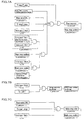
- the manner of operation for releasing the retained brake fluid pressure with the use of the first setting time TM1 and the second setting time TM2 may be illustrated by the flow chart shown in Fig. 5. See Figs. 1 and 2 for reference.
- the driver releases the brake pedal BP to start the vehicle.
- the brake switch BSW is then turned OFF (S1) and the driving force is increased to the strong creep condition (S2, S3).
- the strong creep condition is achieved, the signals F_SOLA (0) and F_SOLB (0) are generated for turning OFF (communicating position) the solenoid valves SV(A), SV(B) (S4).
- the timer is turned ON and actuates (S5).
- step S6 determination is made as to whether the vehicle is undesirably rolling down a slope (backward displacement detection), and if backward displacement is not detected, then proceeding to step S7 to determine whether the fist setting time TM1 has passed. If the first setting time TM1 has not passed, then proceeding to step S8 to determine whether the accelerator pedal is depressed. If the accelerator pedal is not depressed, then proceeding to step S6.
- step S7 if the first setting time TM1 has passed, it is determined that the starting operation was carried out without undesirable backward displacement, and therefore at step S12, the retained brake fluid pressure is released, i.e. F_SOLA (0) and F_SOLB (0) are outputted to the solenoid valves SV(A), SV(B).
- step S8 if the accelerator pedal is depressed, the vehicle has not undesirably rolled down at this point of time and the vehicle can start by the driving force raised due to the depression of the accelerator pedal. Therefore, the retained brake fluid pressure is released at step S12.
- the first setting time viz. the interval after the timer is ON at step S5 and before the retained brake fluid pressure is released at step S12, is 1 second.
- step S9 and step S10 the throttle angle signal V_ ⁇ TH is read and the second setting time TM2 is set.
- the second setting time becomes shorter as the depression amount of the accelerator pedal increases, viz. as the throttle angle signal V_ ⁇ TH becomes greater. This is because the output of engine 1 is greater as the throttle angle signal V_ ⁇ TH becomes greater, and therefore it is determined that the backward displacement restriction force has been raised proportionally. Determination is made at step S11 whether the second setting time TM2 has passed. And if the second setting time TM2 has not passed, then proceeding to step S8 to operate the subsequent processes.
- the retained brake fluid pressure is released (S12) because the vehicle can start by the driving force (or the driver has been given a sufficient time) .
- the second setting time viz. the interval after the timer is ON at step S5 and before the retained brake fluid pressure is released at step S12, is 2 second.
- the backward displacement amount of the vehicle becomes smaller in comparison with the case when the retained brake fluid pressure is always released at the first setting time TM1. Also, it provides the driver with sufficient time.
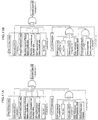
- the brake fluid pressure is retained when all of the following four conditions are satisfied.
- both solenoid valves SV(A), SV(B) are switched to the shut-off position, thereby retaining the brake fluid pressure.
- Vehicle speed of 0 km/h also includes a condition just before the vehicle stops.
- the weak creep order (F_WCRP) is transmitted when any of the following conditions I) and II) is satisfied.
- the conditions are:
- the weak creep order is transmitted and the driving force is switched to the weak creep condition.
- the above conditions are determined at the driving force control unit DCU.
- the reason for switching the driving force to the weak creep condition is to improve the vehicle's fuel consumption. When on a slope, it is for reminding the driver to forcefully depress the brake pedal BP to prevent backward displacement of the vehicle while the vehicle stops on the slope.
- a strong creep order for driving (F_MSCRP) is transmitted when both of the following two conditions I) and II) are satisfied (Fig. 7B).
- the creep diving force is switched to the strong creep condition for driving after the strong creep order for driving is transmitted.
- the driving force control unit DCU determines whether the strong creep condition for driving is strong deceleration of the vehicle before stopping due to the switching operation from the strong creep condition to the weak creep condition. Another reason is to prevent momentary backward displacement of the vehicle on an up slope while the vehicle stops.
- the driving force is switched to the strong creep condition for driving, which is weaker than the strong creep condition, in advance of switching to the weak creep condition.
- vehicle speed 5 km/h
- the middle creep condition is required.
- the driving force is switched to the middle creep condition.
- a determination of whether or not the driving force is in the weak creep condition, strong creep condition for driving or the middle creep condition, is made based on the hydraulic pressure command value to the starting clutch of CVT 3.
- engine 1 is automatically stopped while the vehicle stops. Conditions for automatically stopping engine 1 will be described.
- an engine stop order (F_ENGOFF) is transmitted and engine 1 is automatically stopped.
- the automatic engine stop operation of engine 1 is carried out by the driving motor stopping unit. Therefore, the following automatic engine stop conditions are determined at the driving motor stopping unit. Specifically, the automatic engine stop conditions are determined at FI/MG ECU 4 and CVT ECU 6.
- F_MGSTB becomes 1.
- F_CVTOK becomes 1.
- the solenoid valve SV is switched to the communicating position for releasing the retained brake fluid pressure.
- the solenoid valve SV is switched to the communicating position to release the retained brake fluid pressure.
- the backward displacement amount will be increased if the retained brake fluid pressure is released, while the vehicle is undesirably rolling down a slope, after the first setting time TM1 has passed. For this reason, the above condition is required for decreasing the backward displacement amount of the vehicle. In this condition, the brake fluid pressure is retained until the second setting time TM2 that is longer than the first setting time TM1 passes.
- the second setting time TM2 is set to be shorter between 2 seconds and 0 second as the depression amount of the accelerator pedal (throttle angle signal V_ ⁇ TH) becomes greater (Fig. 4B). For this reason, depending on the depression force of the accelerator pedal, the second setting time TM2 may be shorter than the first setting time TM1. In this event, because the depression amount of the accelerator pedal is great, the driving force of engine 1 (motor 2) is great. Thereby, even if the retained brake fluid pressure is released when the second setting time TM2 that is shorter than the first setting time TM1 passes, the backward displacement amount of the vehicle is kept smaller. Further, because the brake fluid pressure is released after a short time, unnecessary brake dragging can be eliminated.
- the creep rising is determined based on the condition whether the driving force is increased to the strong creep condition.
- This condition is determined at the driving force control unit DCU.
- the driving force has been increased to such an extent that the vehicle does not undesirably roll down a slope having an inclination angle of 5 degrees even if the brake fluid pressure retaining apparatus RU releases the retained brake fluid pressure and the braking force does not act on the vehicle any longer.
- the determination whether or not the driving force has been increased to the strong creep condition is carried out based on the hydraulic pressure command value to a linear solenoid valve of CVT 3, where the engagement hydraulic pressure of the starting clutch is controlled.
- the strong creep order (F_SCRP) is transmitted when any of the following two conditions shown in Figs. 10A and 10B is satisfied, and the strong creep condition is achieved.
- the first condition required for the strong creep order is that either I) or II) is satisfied.
- the second condition required for the strong creep order is that either III) or IV) is satisfied.
- Conditions I) and IV) are determined at the driving force control unit DCU.
- condition I (1) to (3) of condition I
- condition III (1) to (3) of condition III
- Figs. 12 and 13 With reference to two time charts shown in Figs. 12 and 13, the way of controlling the vehicle having the above system will be described.
- the vehicle is operated in the order of braking, stopping and starting.
- a thick line indicates the driving force and a thin line indicates the braking force.
- a thin line indicates the braking force.
- the driving force is changed by the driving force control unit DCU from the strong creep condition for driving to the weak creep condition, and further engine 1 is stopped by the driving motor stopping unit (not shown) .
- the positioning switch PSW and the mode switch MSW of the vehicle are not changed from the D range/D mode.
- the brake fluid pressure retaining apparatus RU comprises a relief valve RV and a check valve CV. The vehicle stops on an up slope.
- the driving force control unit DCU transmits a strong creep order for driving (F_MSCRP) when the driver releases the accelerator pedal (TH[OFF]) while the vehicle is running (vehicle speed > 5 km/h).
- the driving force is then switched to the strong creep condition for driving (F_MSCRPON), which is less than the strong creep condition (F_SCRPON).
- the driving force control unit DCU transmits a weak creep order (F_WCRP) and driving force is switched to the weak creep condition (F_WCRPON).
- F_WCRP weak creep order
- F_WCRPON weak creep condition
- the brake fluidpressure retaining apparatus RU switches the solenoid valve SV to the shut-off position (Fig. 12(c)) to retain brake fluid pressure (braking force) within the wheel cylinder WC. Further, the driving motor stopping unit automatically stops engine 1 (F_ENGOFF) and the driving force is lost. Because engine 1 is stopped through the weak creep condition, the driver has depressed the brake pedal BP to such an extent that the vehicle does not roll down a slope. Therefore, the braking force prevents undesirable backward displacement of the vehicle, even if engine 1 is automatically stopped. With the provision of a check valve CV, the driver can increase the braking force by further depression of the brake pedal BP even if the solenoid valve SV is in the shut-off position. The reason for automatically stopping engine 1 is that improved fuel consumption and reduction of exhaust gas can be achieved when idling is stopped.
- the driver then releases the brake pedal BP in order to prepare for restarting the vehicle . If the diver depresses the brake pedal BP more than a preset pressure of the relief valve RV (relief pressure) , the relief valve RV actuates upon the driver releasing the brake pedal BP and the braking force immediately decreases to the relief pressure. Providing the relief valve RV ensures a smooth starting operation of the vehicle on a slope, even if the driver depresses the brake pedal BP more than is required.
- a preset pressure of the relief valve RV relieve pressure
- a phantom line extends downward from "Relief pressure" on the line indicating braking force.
- the phantom line indicates a situation in change of the braking force where the brake fluid pressure is not retained (viz. returned conditions of the brake pedal BP).
- the vehicle displaces backwards, such as shown by the phantom line at a mid part of Fig. 12(a).
- Hydraulic oil has been discharged from the oil pressure chamber of the starting clutch at CVT 3 while engine 1 is stopped. Therefore, when engine 1 is actuated and the supply of pressure oil to the starting clutch is initiated, the driving force suddenly rises due to resistance of a piston enforcing the clutch. However, because the hydraulic oil within the oil pressure chamber is discharged, a clearance or play exists for the advance stroke of the piston. Therefore, the hydraulic pressure command value to the starting clutch does not correspond to the actual hydraulic pressure value (driving force transmission capacity); hence the driving force transmission capacity of the starting clutch increases little by little until the oil pressure chamber is filled with hydraulic oil. As a result, the driving force gradually increases, and when the oil pressure chamber is filled with hydraulic oil, the driving force then increases in accordance with the hydraulic pressure command value to the strong creep condition (F_SCRPON).
- the timer When switched to the strong creep condition, the timer is actuated to release the retained brake fluid pressure.
- the brake fluid pressure retaining apparatus RU switches the solenoid valve SV to the communicating position when the first setting time TM1 passes (viz. when 1 second passes after switching to the strong creep condition) .
- the retained brake fluid pressure is thereby released and the braking force falls to zero, such as shown by the phantom line of Fig. 12 (b) extending downward from the point indicating the first setting time TM1.
- the brake fluid pressure is gradually decreased through the restriction D after the depression of the brake pedal BP is released and before the first setting time TM1 passes .
- the vehicle undesirably rolls down a slope (viz. backward displacement is detected by the backward movement detection device BKD), such as shown by the solid line of Fig. 12(a). Therefore, the release of the retained brake fluid pressure is carried out based on the second setting time TM2 instead of the first setting time TM1. As a result, the braking force is retained longer.
- the retained brake fluid pressure is released when the first setting time TM1 passes, the backward displacement amount of the vehicle considerably increases such as shown by the phantom line of Fig. 12(a) extending at a right-hand side of the figure.
- the second setting time TM2 may become shorter than the first setting time TM1. That is the second setting time passes as soon as the driver depresses the accelerator pedal. In this instance, the generating driving force is also great and the backward displacement amount of the vehicle does not increase . Decreasing the second setting time TM2 corresponds with the driver's intention of quickly starting the vehicle without brake dragging and with a strong depression of the accelerator pedal.
- the brake fluid pressure retaining apparatus RU retains brake fluid pressure for a long time in the relation with the depression amount of the accelerator pedal (throttle angle). Therefore, the backward displacement amount of the vehicle becomes small.
- the driver carries out various operations while the brake fluid pressure is retained. Further, the retained brake fluid is smaller, because of the restriction D, at a time of releasing (viz. when the solenoid valve SV is switched to the communicating position) as the brake fluid pressure retaining apparatus RU (solenoid valve) actuates longer. This ensures a smooth starting operation of the vehicle.
- this brake fluid pressure retaining apparatus RU it is not necessary to determine whether the vehicle stops on a slope or a flat surface, and therefore there is no need to provide means for detecting a slope.
- the driving force is changed by the driving force control unit DCU from the strong creep condition for driving to the weak creep condition, and the weak creep condition is kept while the vehicle stops.
- the positioning switch PSW and the mode switch MSW of the vehicle are not changed from the D range/D mode.
- the brake fluid pressure retaining apparatus RU comprises a relief valve RV and a check valve CV. The vehicle stops on an up slope.
- the brake fluid pressure retaining apparatus RU switches the solenoid valve SV to the shut-off position (Fig. 13(c)) to retain brake fluid pressure (braking force) within the wheel cylinder WC.
- the driver has depressed the brake pedal BP to such an extent that the vehicle does not roll down a slope. Therefore, the braking force prevents undesirable backward displacement of the vehicle.
- the driver can increase the braking force by further depression of the brake pedal BP even if the solenoid valve SV is in the shut-off position.
- the reason for stopping the vehicle in the weak creep condition is to eliminate drawbacks, such as vibration and deteriorated fuel consumption. In other words, if a relatively great driving force, such as the strong creep, is restricted by the braking force, vibration will arise and fuel consumption of the vehicle will be deteriorated.
- Engine 1 is not automatically stopped because the vehicle is not provided with the driving force stopping unit, otherwise the automatic engine stop condition is not satisfied in the case that the vehicle is equipped with the driving force stopping unit.
- the driver then releases the brake pedal BP in order to prepare for restarting the vehicle. If the diver depresses the brake pedal BP more than a preset pressure of the relief valve RV (relief pressure), the relief valve RV actuates upon the driver releasing the brake pedal BP and the braking force immediately decreases to the relief pressure. Providing the relief valve RV ensures a smooth starting operation of the vehicle on a slope, even if the driver depresses the brake pedal BP more than is required.
- a preset pressure of the relief valve RV relieve pressure
- a phantom line extends downward from "Relief pressure" on the line indicating braking force.
- the phantom line indicates a situation in change of the braking force where the brake fluid pressure is not retained (viz. returned conditions of the brake pedal BP).
- the vehicle displaces backwards, such as shown by the phantom line at a mid part of Fig. 13(a).
- the timer When switched to the strong creep condition, the timer is actuated to release the retained brake fluid pressure.
- the brake fluid pressure retaining apparatus RU switches the solenoid valve SV to the communicating position when the first setting time TM1 passes (viz. when 1 second passes after switching to the strong creep condition).
- the retained brake fluid pressure is thereby released and the braking force falls to zero, such as shown by the phantom line of Fig. 13(b) extending downward from the point indicating the first setting time TM1.
- the brake fluid pressure is gradually decreased through the restriction D after the depression of the brake pedal BP is released and before the first setting time TM1 passes.
- the braking force gradually decreases, and by the time the solenoid valve SV is switched to the communicating position, the braking force becomes considerably small. Therefore, a smooth starting operation without a sudden feel can be achieved even if the vehicle has stopped on a flat road surface or a down slope. Also, unnecessary brake dragging does not arise.
- the vehicle undesirably rolls down a slope (viz. backward displacement is detected by the backward movement detection device BKD), such as shown by the solid line of Fig. 13(a). Therefore, the release of the retained brake fluid pressure is carried out based on the second setting time TM2 instead of the first setting time TM1. As a result, the braking force is retained longer.
- the retained brake fluid pressure is released when the first setting time TM1 passes, the backward displacement amount of the vehicle considerably increases such as shown by the phantom line of Fig. 13(a) extending at a right-hand side of the figure.
- the brake fluid pressure retaining apparatus RU retains brake fluid pressure for a long time in the relation with the depression amount of the accelerator pedal (throttle angle). Therefore, likewise Time Chart for Control (1), the backward displacement amount of the vehicle becomes small.
- the driver carries out various operations while the brake fluid pressure is retained. Further, because of the restriction D, the longer the brake fluid pressure retaining apparatus RU retains the brake fluid pressure, the smaller the retained brake fluid pressure becomes. This ensures a smooth starting operation of the vehicle.
- the control unit CU determines conditions whether the vehicle stops and the like, and then turns ON the solenoid valve SV (shut-off position) to retain brake fluid pressure (braking force) within the wheel cylinder WC.
- the driver then releases the brake pedal BP to start off the vehicle on a down slope.
- the driver On a down slope, the driver often starts off the vehicle due to the vehicle's own weight and without depressing the accelerator pedal.
- the brake fluid pressure retaining apparatus RU even if the solenoid valve SV is in the shut-off position, the braking force gradually decreases through the restriction D after releasing or loosening the depression of the brake pedal BP.
- the driver can start off the vehicle without depressing the accelerator pedal and by the displacement force due to the vehicle's own weight.
- the backward movement detection device may employ any known means other than helical gears.
- the brake fluid pressure retaining apparatus may comprise a servo valve or passage-switching valve to be operated by electromagnetic means.
- the second setting time may be set based on the rotational speed (Ne) of the engine or backward displacement velocity of the vehicle instead of the throttle angle ( ⁇ TH).
- a brake fluid pressure retaining apparatus RU is mounted on a vehicle equipped with an automatic transmission CVT and a driving motor control unit DCU.
- the driving motor control unit switches the magnitude of creep driving force between a greater condition and a smaller condition in accordance with a depression of the brake pedal, so that the driving force is made smaller at a depression of the brake pedal than at a release of the brake pedal.
- the brake fluid pressure retaining apparatus continuously retains brake fluid pressure within a wheel cylinder WC after releasing a brake pedal BP. The retained brake fluid pressure is released after the driving force increases to the greater condition and when a first setting time TM1 passes.
- the retained brake fluid pressure is released after a second setting time TM2, which decreasingly changes from a time longer than the first setting time in accordance with a throttle angle signal V_ ⁇ TH, passes instead of the first setting time.
Landscapes
- Engineering & Computer Science (AREA)
- Mechanical Engineering (AREA)
- Chemical & Material Sciences (AREA)
- Combustion & Propulsion (AREA)
- Transportation (AREA)
- Automation & Control Theory (AREA)
- General Engineering & Computer Science (AREA)
- Regulating Braking Force (AREA)
- Control Of Transmission Device (AREA)
Applications Claiming Priority (2)
| Application Number | Priority Date | Filing Date | Title |
|---|---|---|---|
| JP2000275783A JP3891467B2 (ja) | 2000-09-12 | 2000-09-12 | ブレーキ液圧保持装置 |
| JP2000275783 | 2000-09-12 |
Publications (3)
| Publication Number | Publication Date |
|---|---|
| EP1186494A2 true EP1186494A2 (de) | 2002-03-13 |
| EP1186494A3 EP1186494A3 (de) | 2002-11-13 |
| EP1186494B1 EP1186494B1 (de) | 2005-01-26 |
Family
ID=18761347
Family Applications (1)
| Application Number | Title | Priority Date | Filing Date |
|---|---|---|---|
| EP01121276A Expired - Lifetime EP1186494B1 (de) | 2000-09-12 | 2001-09-05 | Druckhalteeinrichtung für Bremsflüssigkeit |
Country Status (5)
| Country | Link |
|---|---|
| US (1) | US6533081B2 (de) |
| EP (1) | EP1186494B1 (de) |
| JP (1) | JP3891467B2 (de) |
| CA (1) | CA2357207C (de) |
| DE (1) | DE60108575T2 (de) |
Cited By (6)
| Publication number | Priority date | Publication date | Assignee | Title |
|---|---|---|---|---|
| EP1566540A3 (de) * | 2004-02-18 | 2007-04-25 | Yamaha Hatsudoki Kabushiki Kaisha | Fahrzeug mit Sattel, und Motorsteuereinrichtung und Leerlaufstoppverbotsverfahren für das Fahrzeug mit Sattel |
| EP2458196A1 (de) * | 2010-11-30 | 2012-05-30 | JATCO Ltd | Steuerung eines Fahrzeugs und Steuerungsverfahren für ein Fahrzeug |
| CN102548813A (zh) * | 2009-10-07 | 2012-07-04 | 本田技研工业株式会社 | 车辆的起步辅助装置 |
| EP2666683A4 (de) * | 2011-01-21 | 2018-05-23 | Hitachi Construction Machinery Co., Ltd. | Hydraulischer antrieb einer arbeitsmaschine mit rädern |
| EP3492326A4 (de) * | 2017-03-30 | 2020-03-04 | Hitachi Construction Machinery Co., Ltd. | Arbeitsmaschine und verfahren zum bremsen einer arbeitsmaschine |
| CN112622845A (zh) * | 2020-12-23 | 2021-04-09 | 万向钱潮股份有限公司 | 一种热备用电子驻车制动系统协调控制方法 |
Families Citing this family (31)
| Publication number | Priority date | Publication date | Assignee | Title |
|---|---|---|---|---|
| JP2004175177A (ja) * | 2002-11-26 | 2004-06-24 | Nissin Kogyo Co Ltd | 車両用ブレーキ液圧保持装置 |
| JP3743421B2 (ja) * | 2002-04-23 | 2006-02-08 | 日産自動車株式会社 | 車両の制御装置 |
| US7032697B2 (en) * | 2002-05-30 | 2006-04-25 | Hyeongcheol Lee | Drive control system for vehicles with an auxiliary driving system |
| JP4515053B2 (ja) | 2003-07-23 | 2010-07-28 | 株式会社トランストロン | ブレーキ液圧保持装置 |
| JP2006082782A (ja) * | 2004-09-17 | 2006-03-30 | Honda Motor Co Ltd | ブレーキ力保持制御装置 |
| JP2006088733A (ja) * | 2004-09-21 | 2006-04-06 | Honda Motor Co Ltd | ブレーキ力保持装置 |
| JP2006183600A (ja) * | 2004-12-28 | 2006-07-13 | Toyota Motor Corp | エンジン停止再始動制御装置、その方法及びそれを搭載した車両 |
| JP4329695B2 (ja) * | 2005-01-07 | 2009-09-09 | トヨタ自動車株式会社 | 制動装置の制御装置 |
| FR2915159B1 (fr) * | 2007-04-19 | 2009-09-04 | Renault Sas | Procede d'aide au demarrage en cote et dispositif associe. |
| US7954318B2 (en) * | 2007-07-31 | 2011-06-07 | Borgwarner Inc. | PTM self-bleed/failsafe open system for FWD and RWD |
| JP2010075036A (ja) * | 2008-08-22 | 2010-04-02 | Fuji Heavy Ind Ltd | 電気自動車の制御装置 |
| DE102010033416A1 (de) * | 2010-08-04 | 2012-02-09 | Voith Patent Gmbh | Verfahren zum Steuern einer Anfahrhilfe eines Kraftfahrzeugs |
| GB2483719B (en) * | 2010-09-20 | 2013-06-19 | Land Rover Uk Ltd | Improvements relating to brake control |
| JP5652090B2 (ja) * | 2010-09-30 | 2015-01-14 | トヨタ自動車株式会社 | 車両制御装置 |
| JP5381954B2 (ja) * | 2010-10-20 | 2014-01-08 | 三菱自動車工業株式会社 | 車両駆動力制御装置 |
| JP6027482B2 (ja) * | 2013-04-12 | 2016-11-16 | 日野自動車株式会社 | 電動パーキングブレーキシステム |
| US8958964B2 (en) | 2013-06-07 | 2015-02-17 | Ford Global Technologies, Llc | Method for increasing vacuum production for a vehicle |
| JP6117028B2 (ja) * | 2013-07-04 | 2017-04-19 | 本田技研工業株式会社 | 車両用ブレーキシステム |
| KR102162645B1 (ko) * | 2014-04-29 | 2020-10-07 | 주식회사 만도 | 차량의 밀림 방지 장치 및 그 방법 |
| US9428193B2 (en) | 2014-05-21 | 2016-08-30 | Ford Global Technologies, Llc | Method for preventing wheel spin on stopped vehicles |
| US9776607B2 (en) * | 2015-01-28 | 2017-10-03 | Continental Automotive Systems, Inc. | Fault-tolerant redundant by-wire brake system |
| US9821778B2 (en) | 2016-02-23 | 2017-11-21 | Honda Motor Co., Ltd. | Vehicle control system |
| US9809207B2 (en) | 2016-02-23 | 2017-11-07 | Honda Motor Co., Ltd. | Vehicle control system |
| JP6729142B2 (ja) * | 2016-07-29 | 2020-07-22 | 日産自動車株式会社 | 駆動力制御方法及び駆動力制御装置 |
| US10322688B2 (en) * | 2016-12-30 | 2019-06-18 | Textron Innovations Inc. | Controlling electrical access to a lithium battery on a utility vehicle |
| BR112020011696B1 (pt) * | 2017-12-15 | 2024-01-09 | Nissan Motor Co., Ltd | Método de controle de veículo e aparelho de controle de veículo |
| JP7156830B2 (ja) * | 2018-06-14 | 2022-10-19 | 株式会社Subaru | 車両の制御装置 |
| JP7020329B2 (ja) * | 2018-07-25 | 2022-02-16 | トヨタ自動車株式会社 | 自動駐車制御装置及び自動駐車システム |
| DE102018217806A1 (de) * | 2018-10-18 | 2020-04-23 | Robert Bosch Gmbh | Verfahren zum Betreiben eines Bremssystems eines Kraftfahrzeugs, Bremssystem, Kraftfahrzeug |
| JP7152321B2 (ja) * | 2019-01-11 | 2022-10-12 | トヨタ自動車株式会社 | 運転支援システム |
| US11951987B2 (en) | 2021-10-21 | 2024-04-09 | Toyota Motor Engineering & Manufacturing North America, Inc. | Creep torque feedback to improve controllably maneuvering a vehicle |
Family Cites Families (8)
| Publication number | Priority date | Publication date | Assignee | Title |
|---|---|---|---|---|
| US4572335A (en) * | 1983-03-11 | 1986-02-25 | Jacob Kobelt | Brake actuating system |
| DE3621076A1 (de) * | 1986-06-24 | 1988-01-14 | Opel Adam Ag | Bremsvorrichtung fuer fahrzeuge mit anfahrhilfevorrichtung |
| JP3596138B2 (ja) * | 1996-01-29 | 2004-12-02 | トヨタ自動車株式会社 | 発進クラッチを備えた車両におけるブレーキ力制御装置 |
| JPH10122344A (ja) * | 1996-10-23 | 1998-05-15 | Aisin Aw Co Ltd | 車両用自動変速機の制御装置 |
| FR2784639B1 (fr) * | 1998-10-14 | 2006-09-08 | Luk Getriebe Systeme Gmbh | Dispositif et procede de verrouillage en pente pour vehicule automobile |
| JP3598491B2 (ja) * | 1998-12-25 | 2004-12-08 | 本田技研工業株式会社 | ブレーキ液圧保持装置 |
| JP3413648B2 (ja) * | 1999-04-28 | 2003-06-03 | 本田技研工業株式会社 | ブレーキ力保持装置 |
| JP2000351360A (ja) | 1999-06-11 | 2000-12-19 | Honda Motor Co Ltd | ブレーキ液圧保持装置 |
-
2000
- 2000-09-12 JP JP2000275783A patent/JP3891467B2/ja not_active Expired - Lifetime
-
2001
- 2001-09-05 EP EP01121276A patent/EP1186494B1/de not_active Expired - Lifetime
- 2001-09-05 DE DE60108575T patent/DE60108575T2/de not_active Expired - Lifetime
- 2001-09-10 CA CA002357207A patent/CA2357207C/en not_active Expired - Lifetime
- 2001-09-12 US US09/952,232 patent/US6533081B2/en not_active Expired - Lifetime
Cited By (12)
| Publication number | Priority date | Publication date | Assignee | Title |
|---|---|---|---|---|
| EP1566540A3 (de) * | 2004-02-18 | 2007-04-25 | Yamaha Hatsudoki Kabushiki Kaisha | Fahrzeug mit Sattel, und Motorsteuereinrichtung und Leerlaufstoppverbotsverfahren für das Fahrzeug mit Sattel |
| CN100445538C (zh) * | 2004-02-18 | 2008-12-24 | 雅马哈发动机株式会社 | 鞍座型车辆及用于其发动机控制装置和怠速停止解除方法 |
| CN101255825B (zh) * | 2004-02-18 | 2011-04-13 | 雅马哈发动机株式会社 | 鞍座型车辆及用于其发动机控制装置和怠速停止解除方法 |
| TWI412660B (zh) * | 2004-02-18 | 2013-10-21 | Yamaha Motor Co Ltd | 鞍座型車輛,用於其之引擎控制裝置及惰速停止解除方法 |
| CN102548813A (zh) * | 2009-10-07 | 2012-07-04 | 本田技研工业株式会社 | 车辆的起步辅助装置 |
| CN102548813B (zh) * | 2009-10-07 | 2014-09-03 | 本田技研工业株式会社 | 车辆的起步辅助装置 |
| EP2458196A1 (de) * | 2010-11-30 | 2012-05-30 | JATCO Ltd | Steuerung eines Fahrzeugs und Steuerungsverfahren für ein Fahrzeug |
| CN102476633A (zh) * | 2010-11-30 | 2012-05-30 | 加特可株式会社 | 车辆的控制装置及控制方法 |
| US8771142B2 (en) | 2010-11-30 | 2014-07-08 | Jatco Ltd | Controller of vehicle and control method of vehicle |
| EP2666683A4 (de) * | 2011-01-21 | 2018-05-23 | Hitachi Construction Machinery Co., Ltd. | Hydraulischer antrieb einer arbeitsmaschine mit rädern |
| EP3492326A4 (de) * | 2017-03-30 | 2020-03-04 | Hitachi Construction Machinery Co., Ltd. | Arbeitsmaschine und verfahren zum bremsen einer arbeitsmaschine |
| CN112622845A (zh) * | 2020-12-23 | 2021-04-09 | 万向钱潮股份有限公司 | 一种热备用电子驻车制动系统协调控制方法 |
Also Published As
| Publication number | Publication date |
|---|---|
| JP3891467B2 (ja) | 2007-03-14 |
| US6533081B2 (en) | 2003-03-18 |
| EP1186494B1 (de) | 2005-01-26 |
| EP1186494A3 (de) | 2002-11-13 |
| CA2357207C (en) | 2007-07-31 |
| DE60108575D1 (de) | 2005-03-03 |
| US20020029943A1 (en) | 2002-03-14 |
| CA2357207A1 (en) | 2002-03-12 |
| JP2002087231A (ja) | 2002-03-27 |
| DE60108575T2 (de) | 2006-03-23 |
Similar Documents
| Publication | Publication Date | Title |
|---|---|---|
| EP1186494B1 (de) | Druckhalteeinrichtung für Bremsflüssigkeit | |
| US6547344B2 (en) | Braking apparatus for vehicles | |
| US6338398B1 (en) | Vehicle with braking force retaining unit | |
| US6346064B1 (en) | Driving force control unit for vehicles | |
| US6370466B1 (en) | Braking force retaining unit | |
| US6388407B1 (en) | Apparatus for controlling a driving motor | |
| CA2292169C (en) | Brake fluid pressure retaining unit | |
| US6296592B1 (en) | Braking force control unit | |
| US7484816B2 (en) | Vehicle control apparatus | |
| US20060108868A1 (en) | Braking force retaining unit | |
| US6358182B1 (en) | Driving force control unit for vehicles | |
| US6336689B1 (en) | Brake fluid pressure retaining unit | |
| US6328672B1 (en) | Driving force control unit for vehicle | |
| JP3967850B2 (ja) | ブレーキ力保持装置付きの車両 | |
| EP1065115B1 (de) | Antriebskraftsteuerung eines Fahrzeugs | |
| JP3695687B2 (ja) | ブレーキ力保持装置付車両 | |
| JP2000272485A (ja) | ブレーキ液圧保持装置 | |
| JP2000313320A (ja) | ブレーキ力制御装置 |
Legal Events
| Date | Code | Title | Description |
|---|---|---|---|
| PUAI | Public reference made under article 153(3) epc to a published international application that has entered the european phase |
Free format text: ORIGINAL CODE: 0009012 |
|
| AK | Designated contracting states |
Kind code of ref document: A2 Designated state(s): AT BE CH CY DE DK ES FI FR GB GR IE IT LI LU MC NL PT SE TR |
|
| AX | Request for extension of the european patent |
Free format text: AL;LT;LV;MK;RO;SI |
|
| PUAL | Search report despatched |
Free format text: ORIGINAL CODE: 0009013 |
|
| AK | Designated contracting states |
Kind code of ref document: A3 Designated state(s): AT BE CH CY DE DK ES FI FR GB GR IE IT LI LU MC NL PT SE TR |
|
| AX | Request for extension of the european patent |
Free format text: AL;LT;LV;MK;RO;SI |
|
| 17P | Request for examination filed |
Effective date: 20021212 |
|
| AKX | Designation fees paid |
Designated state(s): DE GB |
|
| GRAP | Despatch of communication of intention to grant a patent |
Free format text: ORIGINAL CODE: EPIDOSNIGR1 |
|
| GRAA | (expected) grant |
Free format text: ORIGINAL CODE: 0009210 |
|
| GRAS | Grant fee paid |
Free format text: ORIGINAL CODE: EPIDOSNIGR3 |
|
| AK | Designated contracting states |
Kind code of ref document: B1 Designated state(s): DE GB |
|
| REG | Reference to a national code |
Ref country code: IE Ref legal event code: FG4D Ref country code: GB Ref legal event code: FG4D |
|
| REF | Corresponds to: |
Ref document number: 60108575 Country of ref document: DE Date of ref document: 20050303 Kind code of ref document: P |
|
| PLBE | No opposition filed within time limit |
Free format text: ORIGINAL CODE: 0009261 |
|
| STAA | Information on the status of an ep patent application or granted ep patent |
Free format text: STATUS: NO OPPOSITION FILED WITHIN TIME LIMIT |
|
| 26N | No opposition filed |
Effective date: 20051027 |
|
| REG | Reference to a national code |
Ref country code: GB Ref legal event code: 746 Effective date: 20120521 |
|
| REG | Reference to a national code |
Ref country code: DE Ref legal event code: R084 Ref document number: 60108575 Country of ref document: DE Effective date: 20120523 |
|
| PGFP | Annual fee paid to national office [announced via postgrant information from national office to epo] |
Ref country code: GB Payment date: 20150902 Year of fee payment: 15 |
|
| GBPC | Gb: european patent ceased through non-payment of renewal fee |
Effective date: 20160905 |
|
| PG25 | Lapsed in a contracting state [announced via postgrant information from national office to epo] |
Ref country code: GB Free format text: LAPSE BECAUSE OF NON-PAYMENT OF DUE FEES Effective date: 20160905 |
|
| PGFP | Annual fee paid to national office [announced via postgrant information from national office to epo] |
Ref country code: DE Payment date: 20200826 Year of fee payment: 20 |
|
| REG | Reference to a national code |
Ref country code: DE Ref legal event code: R071 Ref document number: 60108575 Country of ref document: DE |