EP1189978B1 - Process for preparing an integral polypropylene foam - Google Patents
Process for preparing an integral polypropylene foam Download PDFInfo
- Publication number
- EP1189978B1 EP1189978B1 EP00938899A EP00938899A EP1189978B1 EP 1189978 B1 EP1189978 B1 EP 1189978B1 EP 00938899 A EP00938899 A EP 00938899A EP 00938899 A EP00938899 A EP 00938899A EP 1189978 B1 EP1189978 B1 EP 1189978B1
- Authority
- EP
- European Patent Office
- Prior art keywords
- polypropylene
- foamed
- composition
- skin
- layer
- Prior art date
- Legal status (The legal status is an assumption and is not a legal conclusion. Google has not performed a legal analysis and makes no representation as to the accuracy of the status listed.)
- Expired - Lifetime
Links
- -1 polypropylene Polymers 0.000 title claims abstract description 69
- 239000004743 Polypropylene Substances 0.000 title claims abstract description 68
- 229920001155 polypropylene Polymers 0.000 title claims abstract description 68
- 239000006260 foam Substances 0.000 title abstract description 23
- 238000004519 manufacturing process Methods 0.000 title abstract description 5
- 239000000203 mixture Substances 0.000 claims abstract description 31
- 238000000034 method Methods 0.000 claims abstract description 17
- 239000000155 melt Substances 0.000 claims abstract description 13
- 238000005482 strain hardening Methods 0.000 claims abstract description 10
- 239000004604 Blowing Agent Substances 0.000 claims abstract description 9
- 210000000497 foam cell Anatomy 0.000 claims abstract description 7
- 239000000463 material Substances 0.000 claims description 12
- 238000002360 preparation method Methods 0.000 claims description 9
- 239000000758 substrate Substances 0.000 claims description 9
- VGGSQFUCUMXWEO-UHFFFAOYSA-N Ethene Chemical compound C=C VGGSQFUCUMXWEO-UHFFFAOYSA-N 0.000 claims description 3
- 239000005977 Ethylene Substances 0.000 claims description 3
- 239000006261 foam material Substances 0.000 claims description 2
- 229920000642 polymer Polymers 0.000 description 6
- NNPPMTNAJDCUHE-UHFFFAOYSA-N isobutane Chemical compound CC(C)C NNPPMTNAJDCUHE-UHFFFAOYSA-N 0.000 description 4
- XECAHXYUAAWDEL-UHFFFAOYSA-N acrylonitrile butadiene styrene Chemical compound C=CC=C.C=CC#N.C=CC1=CC=CC=C1 XECAHXYUAAWDEL-UHFFFAOYSA-N 0.000 description 3
- 229920000122 acrylonitrile butadiene styrene Polymers 0.000 description 3
- 239000004676 acrylonitrile butadiene styrene Substances 0.000 description 3
- KRKNYBCHXYNGOX-UHFFFAOYSA-N citric acid Chemical compound OC(=O)CC(O)(C(O)=O)CC(O)=O KRKNYBCHXYNGOX-UHFFFAOYSA-N 0.000 description 3
- 238000001125 extrusion Methods 0.000 description 3
- 238000003475 lamination Methods 0.000 description 3
- 229920005629 polypropylene homopolymer Polymers 0.000 description 3
- 238000005096 rolling process Methods 0.000 description 3
- IJGRMHOSHXDMSA-UHFFFAOYSA-N Atomic nitrogen Chemical compound N#N IJGRMHOSHXDMSA-UHFFFAOYSA-N 0.000 description 2
- CURLTUGMZLYLDI-UHFFFAOYSA-N Carbon dioxide Chemical compound O=C=O CURLTUGMZLYLDI-UHFFFAOYSA-N 0.000 description 2
- CTQNGGLPUBDAKN-UHFFFAOYSA-N O-Xylene Chemical compound CC1=CC=CC=C1C CTQNGGLPUBDAKN-UHFFFAOYSA-N 0.000 description 2
- ATUOYWHBWRKTHZ-UHFFFAOYSA-N Propane Chemical compound CCC ATUOYWHBWRKTHZ-UHFFFAOYSA-N 0.000 description 2
- 210000004027 cell Anatomy 0.000 description 2
- 229920001577 copolymer Polymers 0.000 description 2
- 239000000945 filler Substances 0.000 description 2
- 239000001282 iso-butane Substances 0.000 description 2
- 229920001384 propylene homopolymer Polymers 0.000 description 2
- 239000000454 talc Substances 0.000 description 2
- 229910052623 talc Inorganic materials 0.000 description 2
- 239000008096 xylene Substances 0.000 description 2
- 239000004711 α-olefin Substances 0.000 description 2
- 229920000089 Cyclic olefin copolymer Polymers 0.000 description 1
- UAUDZVJPLUQNMU-UHFFFAOYSA-N Erucasaeureamid Natural products CCCCCCCCC=CCCCCCCCCCCCC(N)=O UAUDZVJPLUQNMU-UHFFFAOYSA-N 0.000 description 1
- 229920000181 Ethylene propylene rubber Polymers 0.000 description 1
- 229920005830 Polyurethane Foam Polymers 0.000 description 1
- BLRPTPMANUNPDV-UHFFFAOYSA-N Silane Chemical compound [SiH4] BLRPTPMANUNPDV-UHFFFAOYSA-N 0.000 description 1
- UIIMBOGNXHQVGW-DEQYMQKBSA-M Sodium bicarbonate-14C Chemical compound [Na+].O[14C]([O-])=O UIIMBOGNXHQVGW-DEQYMQKBSA-M 0.000 description 1
- 150000001335 aliphatic alkanes Chemical class 0.000 description 1
- 150000001408 amides Chemical class 0.000 description 1
- 238000009835 boiling Methods 0.000 description 1
- 239000001569 carbon dioxide Substances 0.000 description 1
- 229910002092 carbon dioxide Inorganic materials 0.000 description 1
- 239000002666 chemical blowing agent Substances 0.000 description 1
- 239000003795 chemical substances by application Substances 0.000 description 1
- 230000000052 comparative effect Effects 0.000 description 1
- 238000013329 compounding Methods 0.000 description 1
- 230000001143 conditioned effect Effects 0.000 description 1
- 230000006378 damage Effects 0.000 description 1
- 238000010586 diagram Methods 0.000 description 1
- 229920001971 elastomer Polymers 0.000 description 1
- 239000000806 elastomer Substances 0.000 description 1
- UAUDZVJPLUQNMU-KTKRTIGZSA-N erucamide Chemical compound CCCCCCCC\C=C/CCCCCCCCCCCC(N)=O UAUDZVJPLUQNMU-KTKRTIGZSA-N 0.000 description 1
- 238000005187 foaming Methods 0.000 description 1
- 239000007789 gas Substances 0.000 description 1
- VOZRXNHHFUQHIL-UHFFFAOYSA-N glycidyl methacrylate Chemical compound CC(=C)C(=O)OCC1CO1 VOZRXNHHFUQHIL-UHFFFAOYSA-N 0.000 description 1
- 239000001307 helium Substances 0.000 description 1
- 229910052734 helium Inorganic materials 0.000 description 1
- SWQJXJOGLNCZEY-UHFFFAOYSA-N helium atom Chemical compound [He] SWQJXJOGLNCZEY-UHFFFAOYSA-N 0.000 description 1
- 239000011261 inert gas Substances 0.000 description 1
- 238000010030 laminating Methods 0.000 description 1
- FPYJFEHAWHCUMM-UHFFFAOYSA-N maleic anhydride Chemical compound O=C1OC(=O)C=C1 FPYJFEHAWHCUMM-UHFFFAOYSA-N 0.000 description 1
- 239000012968 metallocene catalyst Substances 0.000 description 1
- 239000010445 mica Substances 0.000 description 1
- 229910052618 mica group Inorganic materials 0.000 description 1
- IJDNQMDRQITEOD-UHFFFAOYSA-N n-butane Chemical compound CCCC IJDNQMDRQITEOD-UHFFFAOYSA-N 0.000 description 1
- 229910052757 nitrogen Inorganic materials 0.000 description 1
- 239000002667 nucleating agent Substances 0.000 description 1
- 150000002978 peroxides Chemical class 0.000 description 1
- 239000004033 plastic Substances 0.000 description 1
- 229920003023 plastic Polymers 0.000 description 1
- 229920000098 polyolefin Polymers 0.000 description 1
- 239000012462 polypropylene substrate Substances 0.000 description 1
- 229920002635 polyurethane Polymers 0.000 description 1
- 239000004814 polyurethane Substances 0.000 description 1
- 239000011496 polyurethane foam Substances 0.000 description 1
- 239000001294 propane Substances 0.000 description 1
- 238000004064 recycling Methods 0.000 description 1
- 229910000077 silane Inorganic materials 0.000 description 1
- 239000000126 substance Substances 0.000 description 1
- 238000005303 weighing Methods 0.000 description 1
- 239000010456 wollastonite Substances 0.000 description 1
- 229910052882 wollastonite Inorganic materials 0.000 description 1
Images
Classifications
-
- B—PERFORMING OPERATIONS; TRANSPORTING
- B32—LAYERED PRODUCTS
- B32B—LAYERED PRODUCTS, i.e. PRODUCTS BUILT-UP OF STRATA OF FLAT OR NON-FLAT, e.g. CELLULAR OR HONEYCOMB, FORM
- B32B27/00—Layered products comprising a layer of synthetic resin
- B32B27/32—Layered products comprising a layer of synthetic resin comprising polyolefins
-
- B—PERFORMING OPERATIONS; TRANSPORTING
- B32—LAYERED PRODUCTS
- B32B—LAYERED PRODUCTS, i.e. PRODUCTS BUILT-UP OF STRATA OF FLAT OR NON-FLAT, e.g. CELLULAR OR HONEYCOMB, FORM
- B32B27/00—Layered products comprising a layer of synthetic resin
- B32B27/06—Layered products comprising a layer of synthetic resin as the main or only constituent of a layer, which is next to another layer of the same or of a different material
- B32B27/065—Layered products comprising a layer of synthetic resin as the main or only constituent of a layer, which is next to another layer of the same or of a different material of foam
-
- B—PERFORMING OPERATIONS; TRANSPORTING
- B29—WORKING OF PLASTICS; WORKING OF SUBSTANCES IN A PLASTIC STATE IN GENERAL
- B29C—SHAPING OR JOINING OF PLASTICS; SHAPING OF MATERIAL IN A PLASTIC STATE, NOT OTHERWISE PROVIDED FOR; AFTER-TREATMENT OF THE SHAPED PRODUCTS, e.g. REPAIRING
- B29C44/00—Shaping by internal pressure generated in the material, e.g. swelling or foaming ; Producing porous or cellular expanded plastics articles
- B29C44/20—Shaping by internal pressure generated in the material, e.g. swelling or foaming ; Producing porous or cellular expanded plastics articles for articles of indefinite length
- B29C44/22—Shaping by internal pressure generated in the material, e.g. swelling or foaming ; Producing porous or cellular expanded plastics articles for articles of indefinite length consisting of at least two parts of chemically or physically different materials, e.g. having different densities
- B29C44/24—Making multilayered articles
-
- B—PERFORMING OPERATIONS; TRANSPORTING
- B32—LAYERED PRODUCTS
- B32B—LAYERED PRODUCTS, i.e. PRODUCTS BUILT-UP OF STRATA OF FLAT OR NON-FLAT, e.g. CELLULAR OR HONEYCOMB, FORM
- B32B5/00—Layered products characterised by the non- homogeneity or physical structure, i.e. comprising a fibrous, filamentary, particulate or foam layer; Layered products characterised by having a layer differing constitutionally or physically in different parts
- B32B5/18—Layered products characterised by the non- homogeneity or physical structure, i.e. comprising a fibrous, filamentary, particulate or foam layer; Layered products characterised by having a layer differing constitutionally or physically in different parts characterised by features of a layer of foamed material
-
- C—CHEMISTRY; METALLURGY
- C08—ORGANIC MACROMOLECULAR COMPOUNDS; THEIR PREPARATION OR CHEMICAL WORKING-UP; COMPOSITIONS BASED THEREON
- C08J—WORKING-UP; GENERAL PROCESSES OF COMPOUNDING; AFTER-TREATMENT NOT COVERED BY SUBCLASSES C08B, C08C, C08F, C08G or C08H
- C08J9/00—Working-up of macromolecular substances to porous or cellular articles or materials; After-treatment thereof
- C08J9/34—Chemical features in the manufacture of articles consisting of a foamed macromolecular core and a macromolecular surface layer having a higher density than the core
-
- B—PERFORMING OPERATIONS; TRANSPORTING
- B29—WORKING OF PLASTICS; WORKING OF SUBSTANCES IN A PLASTIC STATE IN GENERAL
- B29K—INDEXING SCHEME ASSOCIATED WITH SUBCLASSES B29B, B29C OR B29D, RELATING TO MOULDING MATERIALS OR TO MATERIALS FOR MOULDS, REINFORCEMENTS, FILLERS OR PREFORMED PARTS, e.g. INSERTS
- B29K2105/00—Condition, form or state of moulded material or of the material to be shaped
- B29K2105/04—Condition, form or state of moulded material or of the material to be shaped cellular or porous
- B29K2105/043—Skinned foam
-
- B—PERFORMING OPERATIONS; TRANSPORTING
- B32—LAYERED PRODUCTS
- B32B—LAYERED PRODUCTS, i.e. PRODUCTS BUILT-UP OF STRATA OF FLAT OR NON-FLAT, e.g. CELLULAR OR HONEYCOMB, FORM
- B32B2266/00—Composition of foam
- B32B2266/02—Organic
- B32B2266/0214—Materials belonging to B32B27/00
- B32B2266/025—Polyolefin
-
- B—PERFORMING OPERATIONS; TRANSPORTING
- B32—LAYERED PRODUCTS
- B32B—LAYERED PRODUCTS, i.e. PRODUCTS BUILT-UP OF STRATA OF FLAT OR NON-FLAT, e.g. CELLULAR OR HONEYCOMB, FORM
- B32B2266/00—Composition of foam
- B32B2266/08—Closed cell foam
-
- B—PERFORMING OPERATIONS; TRANSPORTING
- B32—LAYERED PRODUCTS
- B32B—LAYERED PRODUCTS, i.e. PRODUCTS BUILT-UP OF STRATA OF FLAT OR NON-FLAT, e.g. CELLULAR OR HONEYCOMB, FORM
- B32B2323/00—Polyalkenes
- B32B2323/10—Polypropylene
-
- B—PERFORMING OPERATIONS; TRANSPORTING
- B32—LAYERED PRODUCTS
- B32B—LAYERED PRODUCTS, i.e. PRODUCTS BUILT-UP OF STRATA OF FLAT OR NON-FLAT, e.g. CELLULAR OR HONEYCOMB, FORM
- B32B2605/00—Vehicles
- B32B2605/08—Cars
-
- C—CHEMISTRY; METALLURGY
- C08—ORGANIC MACROMOLECULAR COMPOUNDS; THEIR PREPARATION OR CHEMICAL WORKING-UP; COMPOSITIONS BASED THEREON
- C08J—WORKING-UP; GENERAL PROCESSES OF COMPOUNDING; AFTER-TREATMENT NOT COVERED BY SUBCLASSES C08B, C08C, C08F, C08G or C08H
- C08J2201/00—Foams characterised by the foaming process
- C08J2201/02—Foams characterised by the foaming process characterised by mechanical pre- or post-treatments
- C08J2201/03—Extrusion of the foamable blend
-
- C—CHEMISTRY; METALLURGY
- C08—ORGANIC MACROMOLECULAR COMPOUNDS; THEIR PREPARATION OR CHEMICAL WORKING-UP; COMPOSITIONS BASED THEREON
- C08J—WORKING-UP; GENERAL PROCESSES OF COMPOUNDING; AFTER-TREATMENT NOT COVERED BY SUBCLASSES C08B, C08C, C08F, C08G or C08H
- C08J2205/00—Foams characterised by their properties
- C08J2205/04—Foams characterised by their properties characterised by the foam pores
- C08J2205/052—Closed cells, i.e. more than 50% of the pores are closed
-
- C—CHEMISTRY; METALLURGY
- C08—ORGANIC MACROMOLECULAR COMPOUNDS; THEIR PREPARATION OR CHEMICAL WORKING-UP; COMPOSITIONS BASED THEREON
- C08J—WORKING-UP; GENERAL PROCESSES OF COMPOUNDING; AFTER-TREATMENT NOT COVERED BY SUBCLASSES C08B, C08C, C08F, C08G or C08H
- C08J2323/00—Characterised by the use of homopolymers or copolymers of unsaturated aliphatic hydrocarbons having only one carbon-to-carbon double bond; Derivatives of such polymers
- C08J2323/02—Characterised by the use of homopolymers or copolymers of unsaturated aliphatic hydrocarbons having only one carbon-to-carbon double bond; Derivatives of such polymers not modified by chemical after treatment
- C08J2323/10—Homopolymers or copolymers of propene
- C08J2323/12—Polypropene
Definitions
- the invention relates to a process for the preparation of a polyolefin foam having an outer skin and to the skin-bearing foam product itself as well as articles manufactured therewith or formed therefrom.
- a polymeric material comprising a foam substrate with an essentially non-porous outer "skin".
- the material is a laminate of a foamed polyurethane substrate and a PVC or PVC/ABS (acrylonitrile butadiene styrene) skin material; however such products have also been made by laminating together a foamed polypropylene substrate and a non-foamed polypropylene skin material.
- US Patent No. 5845588 describes plastic palletts fabricated together by the combination of various separate components.
- the invention therein primarily concerns the make-up of the pallet which comprises deck, and upper and lower runner components. Whilst the patent does suggest manufacturing pallets comprising a skin layer and a foamed layer there is no description of the process requirements for producing a foamed polypropylene structure.
- skin-bearing polypropylene foams may be prepared by coextrusion of a substantially non-crosslinked polypropylene foam and a polypropylene skin material.
- Such skin-bearing foams have particular advantages over the known PVC and PVC/ABS skinned polyurethane foams in terms of ease of product recycling since the products contains only one basic type of polymer.
- the foam:skin laminate strength is better than that achieved with lamination of equivalent pre-formed foam and skin layers.
- the invention provides a process for the preparation of a skin-bearing polypropylene foam material, said process comprising coextruding a first polypropylene composition containing a blowing agent and a second polypropylene composition whereby to form a non-foamed skin of said second polypropylene composition on a foamed layer of said first polypropylene composition which foamed layer contains closed foam cells, said first composition having a melt strength of at least 0.5g, preferably at least 1g, especially at least 2g, e.g.
- the blowing agent is preferably used at a concentration such that the resultant foam layer has a density of 10 to 350 kg/m 3 preferably 15 to 150 kg/m 3 .
- the blowing agent may be an inorganic or organic gas generating agent, e.g. a chemical having a boiling point in the range -50 to 100°C, for example an alkane such as propane, isobutane or n-butane, etc., or an essentially inert gas such as nitrogen, carbon dioxide or helium.
- the blowing agent which may be introduced into the first polypropylene composition before or more preferably after that composition is introduced into the extruder, will be used at concentrations of 0.5 to 5 wt%, more preferably 1 to 2.5 wt%, relative to the first composition.
- the cell structure of the foam may be controlled by addition of a foam nucleating agent, e.g. a chemical blowing agent such as for example citric acid or sodium bicarbonate, or a particulate filler such as talc.
- the foaming is effected such as to produce a closed cell structure and a density of from 15 to 350 kg/m 3 .
- the extrusion of such polypropylene foams is described for example in EP-A-743337.
- the invention provides a polypropylene material having a substrate of a foamed first polypropylene having a melt strength of at least 1g, a strain hardening of at least 0.1g/(m.min), closed foam cells, and a density of between 10 and 350 kg/m 3 and on said substrate a skin of a non-foamed second polypropylene having a Shore D value of 15 to 55, e.g. 20 to 45.
- the invention in other aspects also provides the use of a non-foamed, polypropylene having a Shore D value of 15 to 55, e.g. 20 to 45, for the preparation of articles of a coextruded multi-layer polypropylene which includes a foamed layer with a non-foamed skin and also the use of a foamable, polypropylene having a melt strength of at least 1g and a strain hardening of at least 0.1g/(m.min) for the preparation of coextruded multi-layer polypropylene which includes a foamed layer with a non-foamed skin.
- the polypropylene used for production of the foam is preferably a high melt strength, strain hardening polypropylene, e.g. a polypropylene having the following properties: melt flow index (230°C/2.16 kg) of 0.1 to 200, preferably 0.2 to 50, especially 0.3 to 25 g/10 min, an ethylene content of 0 (polypropylene homopolymer) to 50 percent by weight, preferably 0.05 to 25 percent by weight, especially 0.5 to 15 percent by weight.
- melt flow index 230°C/2.16 kg
- 0.1 to 200 preferably 0.2 to 50, especially 0.3 to 25 g/10 min
- an ethylene content of 0 (polypropylene homopolymer) to 50 percent by weight preferably 0.05 to 25 percent by weight, especially 0.5 to 15 percent by weight.
- These grades may be prepared by e.g. gamma source irradiation and are available as e.g. Montell Profax 814 from Montell.
- high melt strength polypropylene examples include silane grafting and long chain branching, peroxide treatment (e.g. Daploy 130D from Borealis), and long chain branching of unsaturated polypropylene. Alternatively they may be prepared in a reactor process by using Ziegler-Natta and/or a metallocene catalyst. Other documents describing the preparations of high melt strength polypropylene include DE-A-19603438, DE-A-19603439, DE-A-19603600 and DE-A-19607430.
- the first polypropylene composition may comprise a single polypropylene or a mixture of two or more polypropylenes.
- the first polypropylene composition may contain propylene homopolymers or copolymers (e.g. with C 2 and/or C 4-10 ⁇ -olefin copolymers) and should preferably be at least partially xylene soluble at 150°C.
- the polypropylene used for the preparation of the skin again may conveniently comprise one or more than one polypropylene and propylene homo and copolymers (e.g. with C 2 and/or C 4-10 ⁇ -olefin comonomers) may be used.
- the composition again is preferably at least partially soluble in xylene at 150°C and is preferably a polypropylene having the following properties: melt flow index (230°C/2.16 kg) of 0.2 to 25 g/10 min, an ethylene content of 0 (polypropylene homopolymer) to 25 percent by weight.
- This polypropylene material may also contain fillers like: talc (surface modified or not); wollastonite; mica; a modified polypropylene material like maleic anhydride or glycidyl methacrylate functionalized polypropylene; an elastomer material like ethylene-propylene rubber; and an acid amide like erucamide.
- talc surface modified or not
- wollastonite a modified polypropylene material like maleic anhydride or glycidyl methacrylate functionalized polypropylene
- an elastomer material like ethylene-propylene rubber
- an acid amide like erucamide an acid amide like erucamide.
- coextrusion will be effected to produce a foam thickness of 0.5 to 10 mm, preferably 1 to 7 mm, more preferably 2 to 5 mm and a skin thickness of 0.1 to 3 mm, preferably 0.3 to 1.5 mm, more preferably 0.4 to 1.1 mm.
- the skin may if desired be embossed or vacuum formed to create a desired design or texture.
- the two polypropylenes are preferably extruded at temperatures within 330°C, more preferably at the same temperature, e.g. at temperatures in the range 145 to 255°C.
- a multi-orificed extrusion die or a plurality of dies may be used.
- one of the polypropylenes may be extruded to produce a surface onto which, while it is still above its melt temperature, the second polypropylene may be extruded.
- the coextrusion may involve placing a skin on either side of a foam layer.
- the non-laminate multilayer products of the invention may have two, three or more layers.
- Shore D values are measured according to ISO 868.
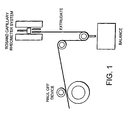
- the melt strength is measured by using an apparatus as seen on the schematic diagram of the attached figure 1.
- the apparatus consists of a capillary rheometer of trademark "Rosand RH-7", a haul off device and a force transducer to measure the strength of the polymer melt.
- the inner diameter of the barrel is 15 mm, and is equipped with a fitting piston.
- a polymer sample was conditioned in the rheometer for 10 minutes at 190°C. Then the sample was extruded by means of a piston at piston velocity of 1 mm/min to press the melt vertically downwards through a cylindrical die having an opening inlet angle of 190 degrees, a diameter of 1 mm and a length of 16 mm.
- the monofilament passed essentially vertically down to the force measuring device, placed at a position of 25 cm below the die outlet. At this point the monofilament has solidified.
- the force measuring device consists of a free rolling wheel under which the monofilament passes, the free rotating wheel being attached to a weighing device.
- the monofilament then passes essentially vertically upwards onto one free rolling roller and is wound onto the last roller. The draw off speed is determined by this last roller, and is set at 1 m/min at this point.
- the force that is exerted upwards by the polymer upwards on the free rolling wheel is measured in grams. Then this value is divided by a factor of two to get the melt strength. Thus if the total force exerted upwards by the polymer monofilament on the wheel is 0.098 N, this is measured as 10 g, and this again corresponds to a melt strength of 5 g.
- Strain hardening is a measure of the slope of the curve obtained when melt strength is plotted against haul off speed.
- the skin:foam products of the invention may be used for example in automotive parts such as dashboards, door panels, head liners, boot inlays, etc.
- automotive parts such as dashboards, door panels, head liners, boot inlays, etc.
- Such articles e.g. components for motor vehicles, also form a further aspect of the invention.
- Non-foamed polypropylene (Borealis EA040T from Borealis) and a foamable polypropylene (Daploy 130D and/or Daplen DM55 from Borealis) impregnated during foam extrusion with isobutane, are co-extruded at a temperature of about 170°C through a twin screw extruder (foam) and a single screw extruder (skin) having a round die of 350 mm circumference and a millimeter sized radial width operating at a total mass flow of 150 kg/hour so as to produce a twin layer tube having a foamed layer on the inner side and a non-foamed skin layer on the outer.
- Examples 4 and 5 are comparative.
- Example 4 does not use a high melt strength polypropylene but only a polypropylene homopolymer.
- Example 5 has a higher density than equivalent Example 3 due to partial destruction of foam cells during lamination.
- the coextruded multilayer polypropylene of Examples 1 to 3 has a heat- and UV-stable skin on an impact softening, firmly-attached foam substrate.
Landscapes
- Chemical & Material Sciences (AREA)
- Engineering & Computer Science (AREA)
- Materials Engineering (AREA)
- Health & Medical Sciences (AREA)
- Chemical Kinetics & Catalysis (AREA)
- Medicinal Chemistry (AREA)
- Polymers & Plastics (AREA)
- Organic Chemistry (AREA)
- Manufacture Of Porous Articles, And Recovery And Treatment Of Waste Products (AREA)
- Laminated Bodies (AREA)
- Glass Compositions (AREA)
- Iron Core Of Rotating Electric Machines (AREA)
- Extrusion Moulding Of Plastics Or The Like (AREA)
Abstract
Description
- The invention relates to a process for the preparation of a polyolefin foam having an outer skin and to the skin-bearing foam product itself as well as articles manufactured therewith or formed therefrom.
- For many purposes, e.g. in automotive parts such as dashboards, door panels, head liners, boot inlays, etc., it is known to use a polymeric material comprising a foam substrate with an essentially non-porous outer "skin". Commonly the material is a laminate of a foamed polyurethane substrate and a PVC or PVC/ABS (acrylonitrile butadiene styrene) skin material; however such products have also been made by laminating together a foamed polypropylene substrate and a non-foamed polypropylene skin material.
- This is not an efficient process and at the temperatures required for lamination it is necessary to use a cross-linked polypropylene foam as otherwise the foam collapses.
- US Patent No. 5845588 describes plastic palletts fabricated together by the combination of various separate components. The invention therein primarily concerns the make-up of the pallet which comprises deck, and upper and lower runner components. Whilst the patent does suggest manufacturing pallets comprising a skin layer and a foamed layer there is no description of the process requirements for producing a foamed polypropylene structure.
- We have now found that skin-bearing polypropylene foams may be prepared by coextrusion of a substantially non-crosslinked polypropylene foam and a polypropylene skin material. Such skin-bearing foams have particular advantages over the known PVC and PVC/ABS skinned polyurethane foams in terms of ease of product recycling since the products contains only one basic type of polymer. Moreover the foam:skin laminate strength is better than that achieved with lamination of equivalent pre-formed foam and skin layers.
- Thus viewed from one aspect the invention provides a process for the preparation of a skin-bearing polypropylene foam material, said process comprising coextruding a first polypropylene composition containing a blowing agent and a second polypropylene composition whereby to form a non-foamed skin of said second polypropylene composition on a foamed layer of said first polypropylene composition which foamed layer contains closed foam cells, said first composition having a melt strength of at least 0.5g, preferably at least 1g, especially at least 2g, e.g. at least 5g and a strain hardening of at least 0.05 g/(m.min), preferably at least 0.1g/(m.min), especially at least 0.2 g/(m.min) and said second composition having a Shore D value of 15 to 55, e.g. 20 to 45.
- In the process of the invention, the blowing agent is preferably used at a concentration such that the resultant foam layer has a density of 10 to 350 kg/m3 preferably 15 to 150 kg/m3. The blowing agent may be an inorganic or organic gas generating agent, e.g. a chemical having a boiling point in the range -50 to 100°C, for example an alkane such as propane, isobutane or n-butane, etc., or an essentially inert gas such as nitrogen, carbon dioxide or helium. Typically, the blowing agent, which may be introduced into the first polypropylene composition before or more preferably after that composition is introduced into the extruder, will be used at concentrations of 0.5 to 5 wt%, more preferably 1 to 2.5 wt%, relative to the first composition. The cell structure of the foam may be controlled by addition of a foam nucleating agent, e.g. a chemical blowing agent such as for example citric acid or sodium bicarbonate, or a particulate filler such as talc. The foaming is effected such as to produce a closed cell structure and a density of from 15 to 350 kg/m3. The extrusion of such polypropylene foams is described for example in EP-A-743337.
- Viewed from a further aspect the invention provides a polypropylene material having a substrate of a foamed first polypropylene having a melt strength of at least 1g, a strain hardening of at least 0.1g/(m.min), closed foam cells, and a density of between 10 and 350 kg/m3 and on said substrate a skin of a non-foamed second polypropylene having a Shore D value of 15 to 55, e.g. 20 to 45.
- The invention in other aspects also provides the use of a non-foamed, polypropylene having a Shore D value of 15 to 55, e.g. 20 to 45, for the preparation of articles of a coextruded multi-layer polypropylene which includes a foamed layer with a non-foamed skin and also the use of a foamable, polypropylene having a melt strength of at least 1g and a strain hardening of at least 0.1g/(m.min) for the preparation of coextruded multi-layer polypropylene which includes a foamed layer with a non-foamed skin.
- The polypropylene used for production of the foam is preferably a high melt strength, strain hardening polypropylene, e.g. a polypropylene having the following properties: melt flow index (230°C/2.16 kg) of 0.1 to 200, preferably 0.2 to 50, especially 0.3 to 25 g/10 min, an ethylene content of 0 (polypropylene homopolymer) to 50 percent by weight, preferably 0.05 to 25 percent by weight, especially 0.5 to 15 percent by weight. These grades may be prepared by e.g. gamma source irradiation and are available as e.g. Montell Profax 814 from Montell. Other examples of preparing such high melt strength polypropylene involve silane grafting and long chain branching, peroxide treatment (e.g. Daploy 130D from Borealis), and long chain branching of unsaturated polypropylene. Alternatively they may be prepared in a reactor process by using Ziegler-Natta and/or a metallocene catalyst. Other documents describing the preparations of high melt strength polypropylene include DE-A-19603438, DE-A-19603439, DE-A-19603600 and DE-A-19607430.
- The first polypropylene composition may comprise a single polypropylene or a mixture of two or more polypropylenes. The first polypropylene composition may contain propylene homopolymers or copolymers (e.g. with C2 and/or C4-10 α-olefin copolymers) and should preferably be at least partially xylene soluble at 150°C.
- The polypropylene used for the preparation of the skin again may conveniently comprise one or more than one polypropylene and propylene homo and copolymers (e.g. with C2 and/or C4-10 α-olefin comonomers) may be used. The composition again is preferably at least partially soluble in xylene at 150°C and is preferably a polypropylene having the following properties: melt flow index (230°C/2.16 kg) of 0.2 to 25 g/10 min, an ethylene content of 0 (polypropylene homopolymer) to 25 percent by weight. This polypropylene material may also contain fillers like: talc (surface modified or not); wollastonite; mica; a modified polypropylene material like maleic anhydride or glycidyl methacrylate functionalized polypropylene; an elastomer material like ethylene-propylene rubber; and an acid amide like erucamide. These polypropylene grades may be prepared by a continuous extruder compounding step and are commercially available as e.g EA 040T from Borealis. Other examples of preparing suitable materials for application as skin are described in EP-A-673396.
- Typically, coextrusion will be effected to produce a foam thickness of 0.5 to 10 mm, preferably 1 to 7 mm, more preferably 2 to 5 mm and a skin thickness of 0.1 to 3 mm, preferably 0.3 to 1.5 mm, more preferably 0.4 to 1.1 mm. The skin may if desired be embossed or vacuum formed to create a desired design or texture.
- In the coextrusion process, the two polypropylenes are preferably extruded at temperatures within 330°C, more preferably at the same temperature, e.g. at temperatures in the range 145 to 255°C. For this purpose a multi-orificed extrusion die or a plurality of dies may be used. If desired one of the polypropylenes may be extruded to produce a surface onto which, while it is still above its melt temperature, the second polypropylene may be extruded.
- If desired, the coextrusion may involve placing a skin on either side of a foam layer. Thus the non-laminate multilayer products of the invention may have two, three or more layers.
- In the present invention, Shore D values are measured according to ISO 868. The melt strength is measured by using an apparatus as seen on the schematic diagram of the attached figure 1. The apparatus consists of a capillary rheometer of trademark "Rosand RH-7", a haul off device and a force transducer to measure the strength of the polymer melt. The inner diameter of the barrel is 15 mm, and is equipped with a fitting piston. A polymer sample was conditioned in the rheometer for 10 minutes at 190°C. Then the sample was extruded by means of a piston at piston velocity of 1 mm/min to press the melt vertically downwards through a cylindrical die having an opening inlet angle of 190 degrees, a diameter of 1 mm and a length of 16 mm. From the die, the monofilament passed essentially vertically down to the force measuring device, placed at a position of 25 cm below the die outlet. At this point the monofilament has solidified. The force measuring device consists of a free rolling wheel under which the monofilament passes, the free rotating wheel being attached to a weighing device. The monofilament then passes essentially vertically upwards onto one free rolling roller and is wound onto the last roller. The draw off speed is determined by this last roller, and is set at 1 m/min at this point.
- The force that is exerted upwards by the polymer upwards on the free rolling wheel is measured in grams. Then this value is divided by a factor of two to get the melt strength. Thus if the total force exerted upwards by the polymer monofilament on the wheel is 0.098 N, this is measured as 10 g, and this again corresponds to a melt strength of 5 g.
- Strain hardening is a measure of the slope of the curve obtained when melt strength is plotted against haul off speed.
- The skin:foam products of the invention may be used for example in automotive parts such as dashboards, door panels, head liners, boot inlays, etc. Such articles, e.g. components for motor vehicles, also form a further aspect of the invention.
- The invention will now be described further with reference to the following non-limiting Examples.
- Non-foamed polypropylene (Borealis EA040T from Borealis) and a foamable polypropylene (Daploy 130D and/or Daplen DM55 from Borealis) impregnated during foam extrusion with isobutane, are co-extruded at a temperature of about 170°C through a twin screw extruder (foam) and a single screw extruder (skin) having a round die of 350 mm circumference and a millimeter sized radial width operating at a total mass flow of 150 kg/hour so as to produce a twin layer tube having a foamed layer on the inner side and a non-foamed skin layer on the outer. The polymers used and the densities of the overall resultant structure are set out in Table 1 below:
Example No. Foamed Layer
(wt ratio)Blowing agent
(wt%)Overall Density
(g/cm3)1 50:50 1.3 0.250 2 70:30 2 0.200 3 100:0 2 0.125 4 0:100 2 0.675 5 100:0 2 0.300 - Examples 4 and 5 are comparative. Example 4 does not use a high melt strength polypropylene but only a polypropylene homopolymer. Example 5 has a higher density than equivalent Example 3 due to partial destruction of foam cells during lamination.
- The coextruded multilayer polypropylene of Examples 1 to 3 has a heat- and UV-stable skin on an impact softening, firmly-attached foam substrate.
Claims (12)
- A process for the preparation of a skin-bearing polypropylene foam material, said process comprising coextruding a first polypropylene composition containing a blowing agent and a second polypropylene composition whereby to form a non-foamed skin of said second polypropylene composition on a foamed layer of said first polypropylene composition which foamed layer contains closed foam cells, said first composition having a melt strength of at least 1g and a strain hardening of at least 0.1g/(m.min) and said second composition having a Shore D value of 15 to 55.
- A process as claimed in claim 1 wherein said foamed layer has a density of 10 to 350 kg/m3.
- A process as claimed in claim 1 or 2 wherein said second composition has a Shore D value of 20 to 45.
- A process as claimed in any one of claims 1 to 3 wherein said first polypropylene composition is substantially non-crosslinked.
- A process as claimed in any one of claims 1 to 4 wherein the blowing agent is introduced into the first polypropylene composition after said composition is introduced into an extruder.
- A process as claimed in any one of claims 1 to 5 wherein said blowing agent is used at concentrations of 1 to 2.5 wt % relative to said first polypropylene composition.
- A process as claimed in any one of claims 1 to 6 wherein said first polypropylene composition has a melt flow index (230°C/2.16 kg) of 0.3 to 25 g/10 min and an ethylene content of 0 to 25% wt.
- A polypropylene material having a substrate of a foamed first polypropylene having a melt strength of at least 1g, a strain hardening of at least 0.1g/(m.min), closed foam cells, and a density of between 10 and 350 kg/m3 and on said substrate a skin of a non-foamed second polypropylene having a Shore D value of 15 to 55.
- The use of a non-foamed, polypropylene having a Shore D value of 15 to 55 for the preparation of articles of a coextruded multi-layer polypropylene which includes a foamed layer with a non-foamed skin.
- The use of a foamable, polypropylene having a melt strength of at least 1g and a strain hardening of at least 0.1g/(m.min) for the preparation of articles of a coextruded multi-layer polypropylene which includes a foamed layer with a non-foamed skin.
- An article comprising a polypropylene material having a substrate of a foamed first polypropylene having a melt strength of at least 1g, a strain hardening of at least 0.1g/(m.min), closed foam cells, and a density of between 10 and 350 kg/m3 and on said substrate a skin of a non-foamed second polypropylene having a Shore D value of 15 to 55.
- An article as claimed in claim 11 in the form of a component for a motor vehicle.
Applications Claiming Priority (3)
| Application Number | Priority Date | Filing Date | Title |
|---|---|---|---|
| GBGB9912739.1A GB9912739D0 (en) | 1999-06-01 | 1999-06-01 | Process |
| GB9912739 | 1999-06-01 | ||
| PCT/GB2000/002090 WO2000073369A1 (en) | 1999-06-01 | 2000-06-01 | Process for preparing an integral polypropylene foam |
Publications (2)
| Publication Number | Publication Date |
|---|---|
| EP1189978A1 EP1189978A1 (en) | 2002-03-27 |
| EP1189978B1 true EP1189978B1 (en) | 2003-07-30 |
Family
ID=10854551
Family Applications (1)
| Application Number | Title | Priority Date | Filing Date |
|---|---|---|---|
| EP00938899A Expired - Lifetime EP1189978B1 (en) | 1999-06-01 | 2000-06-01 | Process for preparing an integral polypropylene foam |
Country Status (6)
| Country | Link |
|---|---|
| EP (1) | EP1189978B1 (en) |
| AT (1) | ATE246219T1 (en) |
| AU (1) | AU5412400A (en) |
| DE (1) | DE60004231T2 (en) |
| GB (1) | GB9912739D0 (en) |
| WO (1) | WO2000073369A1 (en) |
Cited By (2)
| Publication number | Priority date | Publication date | Assignee | Title |
|---|---|---|---|---|
| EP2803478A2 (en) | 2014-09-02 | 2014-11-19 | Mondi Consumer Packaging Technologies GmbH | Plastic multilayer film |
| EP2815879A2 (en) | 2014-09-02 | 2014-12-24 | Mondi Consumer Packaging Technologies GmbH | Polyethylene coextrusion film |
Families Citing this family (11)
| Publication number | Priority date | Publication date | Assignee | Title |
|---|---|---|---|---|
| KR100324068B1 (en) * | 1999-05-17 | 2002-02-16 | 오원석 | Resin Sheet By Co-extrusion Comprising a Foaming Layer and a Non-Foaming Layer |
| EP1886806B1 (en) | 2006-07-10 | 2010-11-10 | Borealis Technology Oy | Biaxially oriented polypropylene film |
| ATE421760T1 (en) | 2006-07-10 | 2009-02-15 | Borealis Tech Oy | ELECTRICAL INSULATING FILM |
| EP1967547A1 (en) | 2006-08-25 | 2008-09-10 | Borealis Technology OY | Extrusion coated substrate |
| EP1900764B1 (en) * | 2006-08-25 | 2009-04-01 | Borealis Technology Oy | Polypropylene foam |
| ATE462189T1 (en) | 2006-09-25 | 2010-04-15 | Borealis Tech Oy | COAXIAL CABLE |
| ATE424424T1 (en) | 2006-12-28 | 2009-03-15 | Borealis Tech Oy | METHOD FOR PRODUCING BRANCHED POLYPROPYLENE |
| DE102007002230A1 (en) | 2007-01-10 | 2008-07-17 | Benecke-Kaliko Ag | Thermoplastic film |
| ITMI20082348A1 (en) | 2008-12-30 | 2010-06-30 | Meccaniche Luigi Bander A S P A Costruzioni | EXPANDED EXPANDED POLYESTER EXTRUSION PROCESS AND EQUIPMENT APPLICABLE TO PRODUCTION OF LEAVES, SHEETS OR EXPANDED POLYESTER TUBES |
| ITMI20131068A1 (en) * | 2013-06-26 | 2014-12-27 | Meccaniche Luigi Bander A S P A Costruzioni | POLYMER MATERIAL SHEET OR LEAF AND THERMOFORMED ARTICLE MADE WITH SUCH A SHEET OR LEAF |
| CA2960892C (en) | 2014-09-23 | 2019-03-12 | Dart Container Corporation | Insulated container and methods of making and assembling |
Family Cites Families (4)
| Publication number | Priority date | Publication date | Assignee | Title |
|---|---|---|---|---|
| US4657811A (en) * | 1983-08-30 | 1987-04-14 | Mobil Oil Corporation | High performance three layer polyolefin film |
| US4705715A (en) * | 1986-10-28 | 1987-11-10 | The Kendall Company | Adhesive tapes having a foamed backing and method for making same |
| NO960910L (en) * | 1996-01-11 | 1997-07-14 | Borealis As | plastic pallet |
| NO306205B1 (en) * | 1996-01-11 | 1999-10-04 | Borealis As | plastic pallet |
-
1999
- 1999-06-01 GB GBGB9912739.1A patent/GB9912739D0/en not_active Ceased
-
2000
- 2000-06-01 DE DE60004231T patent/DE60004231T2/en not_active Expired - Lifetime
- 2000-06-01 WO PCT/GB2000/002090 patent/WO2000073369A1/en not_active Ceased
- 2000-06-01 EP EP00938899A patent/EP1189978B1/en not_active Expired - Lifetime
- 2000-06-01 AT AT00938899T patent/ATE246219T1/en not_active IP Right Cessation
- 2000-06-01 AU AU54124/00A patent/AU5412400A/en not_active Abandoned
Cited By (2)
| Publication number | Priority date | Publication date | Assignee | Title |
|---|---|---|---|---|
| EP2803478A2 (en) | 2014-09-02 | 2014-11-19 | Mondi Consumer Packaging Technologies GmbH | Plastic multilayer film |
| EP2815879A2 (en) | 2014-09-02 | 2014-12-24 | Mondi Consumer Packaging Technologies GmbH | Polyethylene coextrusion film |
Also Published As
| Publication number | Publication date |
|---|---|
| WO2000073369A1 (en) | 2000-12-07 |
| DE60004231T2 (en) | 2004-04-22 |
| DE60004231D1 (en) | 2003-09-04 |
| AU5412400A (en) | 2000-12-18 |
| EP1189978A1 (en) | 2002-03-27 |
| GB9912739D0 (en) | 1999-08-04 |
| ATE246219T1 (en) | 2003-08-15 |
Similar Documents
| Publication | Publication Date | Title |
|---|---|---|
| CA2078123C (en) | Polypropylene foam sheets | |
| EP1189978B1 (en) | Process for preparing an integral polypropylene foam | |
| US6545094B2 (en) | Blends of ethylenic polymers with improved modulus and melt strength and articles fabricated from these blends | |
| US6258862B1 (en) | Composition based on polyolefins and on ethylene-vinyl acetate copolymer | |
| US20060233989A1 (en) | Singlelayer and multilayer polyolefin foam pipes | |
| US6908668B2 (en) | Foamed polyolefin resin sheet | |
| WO1997022656B1 (en) | Thermoplastic foam and process for producing it using carbon dioxide | |
| EP1870434B1 (en) | Blends of ethylenic polymers with improved modulus and melt strength and articles fabricated from these blends | |
| CN1102941C (en) | Process for making foam articles having good low temperature toughness from high melt strength polypropene materials | |
| EP3826833A1 (en) | Multilayer foam films and methods for making the same | |
| KR20020067637A (en) | Methods for producing multi-layer foamed sheets | |
| JP4855422B2 (en) | Multilayer structure | |
| WO1996027485A1 (en) | Method of recycling polymer materials and sheet article made thereby | |
| JP3297253B2 (en) | Crosslinked polyolefin-based resin foam, laminate and molded article | |
| JP2002166510A (en) | Polyolefin resin foam sheet | |
| JP2002166460A (en) | Method for producing polyolefin resin foam sheet | |
| JP3525095B2 (en) | Polypropylene resin composite molding for automobile | |
| EP4612222A1 (en) | Foamed article | |
| JPS6153223B2 (en) | ||
| HK1112013B (en) | Blends of ethylenic polymers with improved modulus and melt strength and articles fabricated from these blends | |
| MXPA99000433A (en) | Process for elaborating foam articles that have a good hardness at low temperatures from high strength propylene materials to the fus | |
| MXPA00011696A (en) | Thermoformable polypropylene foam sheet |
Legal Events
| Date | Code | Title | Description |
|---|---|---|---|
| PUAI | Public reference made under article 153(3) epc to a published international application that has entered the european phase |
Free format text: ORIGINAL CODE: 0009012 |
|
| 17P | Request for examination filed |
Effective date: 20011025 |
|
| AK | Designated contracting states |
Kind code of ref document: A1 Designated state(s): AT BE CH CY DE DK ES FI FR GB GR IE IT LI LU MC NL PT SE |
|
| AX | Request for extension of the european patent |
Free format text: AL;LT;LV;MK;RO;SI |
|
| GRAH | Despatch of communication of intention to grant a patent |
Free format text: ORIGINAL CODE: EPIDOS IGRA |
|
| GRAH | Despatch of communication of intention to grant a patent |
Free format text: ORIGINAL CODE: EPIDOS IGRA |
|
| GRAA | (expected) grant |
Free format text: ORIGINAL CODE: 0009210 |
|
| AK | Designated contracting states |
Designated state(s): AT BE CH CY DE DK ES FI FR GB GR IE IT LI LU MC NL PT SE |
|
| PG25 | Lapsed in a contracting state [announced via postgrant information from national office to epo] |
Ref country code: IT Free format text: LAPSE BECAUSE OF FAILURE TO SUBMIT A TRANSLATION OF THE DESCRIPTION OR TO PAY THE FEE WITHIN THE PRE;WARNING: LAPSES OF ITALIAN PATENTS WITH EFFECTIVE DATE BEFORE 2007 MAY HAVE OCCURRED AT ANY TIME BEFORE 2007. THE CORRECT EFFECTIVE DATE MAY BE DIFFERENT FROM THE ONE RECORDED.SCRIBED TIME-LIMIT Effective date: 20030730 Ref country code: CH Free format text: LAPSE BECAUSE OF FAILURE TO SUBMIT A TRANSLATION OF THE DESCRIPTION OR TO PAY THE FEE WITHIN THE PRESCRIBED TIME-LIMIT Effective date: 20030730 Ref country code: NL Free format text: LAPSE BECAUSE OF FAILURE TO SUBMIT A TRANSLATION OF THE DESCRIPTION OR TO PAY THE FEE WITHIN THE PRESCRIBED TIME-LIMIT Effective date: 20030730 Ref country code: CY Free format text: LAPSE BECAUSE OF FAILURE TO SUBMIT A TRANSLATION OF THE DESCRIPTION OR TO PAY THE FEE WITHIN THE PRESCRIBED TIME-LIMIT Effective date: 20030730 Ref country code: AT Free format text: LAPSE BECAUSE OF FAILURE TO SUBMIT A TRANSLATION OF THE DESCRIPTION OR TO PAY THE FEE WITHIN THE PRESCRIBED TIME-LIMIT Effective date: 20030730 Ref country code: LI Free format text: LAPSE BECAUSE OF FAILURE TO SUBMIT A TRANSLATION OF THE DESCRIPTION OR TO PAY THE FEE WITHIN THE PRESCRIBED TIME-LIMIT Effective date: 20030730 Ref country code: FI Free format text: LAPSE BECAUSE OF FAILURE TO SUBMIT A TRANSLATION OF THE DESCRIPTION OR TO PAY THE FEE WITHIN THE PRESCRIBED TIME-LIMIT Effective date: 20030730 Ref country code: BE Free format text: LAPSE BECAUSE OF FAILURE TO SUBMIT A TRANSLATION OF THE DESCRIPTION OR TO PAY THE FEE WITHIN THE PRESCRIBED TIME-LIMIT Effective date: 20030730 |
|
| REG | Reference to a national code |
Ref country code: GB Ref legal event code: FG4D |
|
| REG | Reference to a national code |
Ref country code: CH Ref legal event code: EP |
|
| REG | Reference to a national code |
Ref country code: IE Ref legal event code: FG4D |
|
| REF | Corresponds to: |
Ref document number: 60004231 Country of ref document: DE Date of ref document: 20030904 Kind code of ref document: P |
|
| PG25 | Lapsed in a contracting state [announced via postgrant information from national office to epo] |
Ref country code: GR Free format text: LAPSE BECAUSE OF FAILURE TO SUBMIT A TRANSLATION OF THE DESCRIPTION OR TO PAY THE FEE WITHIN THE PRESCRIBED TIME-LIMIT Effective date: 20031030 Ref country code: DK Free format text: LAPSE BECAUSE OF FAILURE TO SUBMIT A TRANSLATION OF THE DESCRIPTION OR TO PAY THE FEE WITHIN THE PRESCRIBED TIME-LIMIT Effective date: 20031030 |
|
| PG25 | Lapsed in a contracting state [announced via postgrant information from national office to epo] |
Ref country code: ES Free format text: LAPSE BECAUSE OF FAILURE TO SUBMIT A TRANSLATION OF THE DESCRIPTION OR TO PAY THE FEE WITHIN THE PRESCRIBED TIME-LIMIT Effective date: 20031110 |
|
| REG | Reference to a national code |
Ref country code: SE Ref legal event code: TRGR |
|
| NLV1 | Nl: lapsed or annulled due to failure to fulfill the requirements of art. 29p and 29m of the patents act | ||
| PG25 | Lapsed in a contracting state [announced via postgrant information from national office to epo] |
Ref country code: PT Free format text: LAPSE BECAUSE OF FAILURE TO SUBMIT A TRANSLATION OF THE DESCRIPTION OR TO PAY THE FEE WITHIN THE PRESCRIBED TIME-LIMIT Effective date: 20031230 |
|
| LTIE | Lt: invalidation of european patent or patent extension |
Effective date: 20030730 |
|
| REG | Reference to a national code |
Ref country code: CH Ref legal event code: PL |
|
| ET | Fr: translation filed | ||
| PG25 | Lapsed in a contracting state [announced via postgrant information from national office to epo] |
Ref country code: IE Free format text: LAPSE BECAUSE OF NON-PAYMENT OF DUE FEES Effective date: 20040601 Ref country code: LU Free format text: LAPSE BECAUSE OF NON-PAYMENT OF DUE FEES Effective date: 20040601 Ref country code: GB Free format text: LAPSE BECAUSE OF NON-PAYMENT OF DUE FEES Effective date: 20040601 |
|
| PLBE | No opposition filed within time limit |
Free format text: ORIGINAL CODE: 0009261 |
|
| STAA | Information on the status of an ep patent application or granted ep patent |
Free format text: STATUS: NO OPPOSITION FILED WITHIN TIME LIMIT |
|
| PG25 | Lapsed in a contracting state [announced via postgrant information from national office to epo] |
Ref country code: MC Free format text: LAPSE BECAUSE OF NON-PAYMENT OF DUE FEES Effective date: 20040630 |
|
| 26N | No opposition filed |
Effective date: 20040504 |
|
| GBPC | Gb: european patent ceased through non-payment of renewal fee | ||
| REG | Reference to a national code |
Ref country code: IE Ref legal event code: MM4A |
|
| PGFP | Annual fee paid to national office [announced via postgrant information from national office to epo] |
Ref country code: FR Payment date: 20110630 Year of fee payment: 12 Ref country code: SE Payment date: 20110613 Year of fee payment: 12 |
|
| REG | Reference to a national code |
Ref country code: SE Ref legal event code: EUG |
|
| PG25 | Lapsed in a contracting state [announced via postgrant information from national office to epo] |
Ref country code: SE Free format text: LAPSE BECAUSE OF NON-PAYMENT OF DUE FEES Effective date: 20120602 |
|
| REG | Reference to a national code |
Ref country code: FR Ref legal event code: ST Effective date: 20130228 |
|
| PG25 | Lapsed in a contracting state [announced via postgrant information from national office to epo] |
Ref country code: FR Free format text: LAPSE BECAUSE OF NON-PAYMENT OF DUE FEES Effective date: 20120702 |
|
| PGFP | Annual fee paid to national office [announced via postgrant information from national office to epo] |
Ref country code: DE Payment date: 20190619 Year of fee payment: 20 |
|
| REG | Reference to a national code |
Ref country code: DE Ref legal event code: R071 Ref document number: 60004231 Country of ref document: DE |