The present invention relates to imaged elements having a
protective overcoat that resists fingerprints, common stains, and spills. In
particular, a curable overcoat composition is applied to an imaged element that
contains a curing agent incorporated into a top layer of the imaged element,
resulting in a cured water-resistant and/or stain resistant overcoat. The invention
can be used to protect photographic elements and recording media.
Gelatin has been used extensively in a variety of imaging elements
as the binder because of its many unique and advantageous properties. For
example, its property of water swellability allows processing chemistry to be
carried out to form silver halide-based photographic images, and its hydrophilic
nature allows gelatin to function as an ink-receiver in ink-jet recording media.
However, due to this same property, imaging elements with exposed gelatin-containing
materials, no matter if they are formed on transparent or reflective
media, have to be handled with extreme care so as not to be in contact with any
aqueous solutions that may damage the images. Accidental spillage of common
household solutions such as coffee, punch, or even plain water can damage
imaging elements such as ink-jet, electrophotographic, or photographic prints.
There have been attempts over the years to provide protective
layers for gelatin based photographic systems that will protect the images from
damages by water or aqueous solutions. US Patent No. 2,173,480 describes a
method of applying a colloidal suspension to moist film as the last step of
photographic processing before drying. A series of patents describes methods of
solvent coating a protective layer on the image after photographic processing is
completed and are described in US Patent Nos. 3,190,197, 3,415,670 and
3,733,293. US patent No. 5,376,434 describes a protective layer formed on a
photographic print by coating and drying a latex on a gelatin-containing layer
bearing an image. The latex is a resin having a glass transition temperature of
from 30°C to 70°C. The application of UV-polymerizable monomers and
oligomers on processed image followed by radiation exposure to form crosslinked
protective layer is described in US Patent Nos. 4,092,173, 4,171,979, 4,333,998
and 4,426,431. Aqueous based materials to obtain a spill resistant protective
overcoat have been disclosed in which aqueous dispersed particles when coated
and dried coalesce into a uniform coating. See, for example, US Patent No.
5,376,434 to Ogawa et al. and US Patent No. 6,087,051 to Shoji et al.
In addition to a uniform coating, it may be advantageous to
develop a level of crosslinking in an overcoat in order to build spill resistance and
durability. One method for obtaining crosslinking is the use of molecules
containing two or more reactive moieties (i.e., multifunctional molecules) that can
be cured when exposed to high temperatures or actinic radiation. Various patents
describe the use of actinic radiation to obtain a crosslinkable overcoat for
photographic packages. For example, US 4,092,173 to Novak et al. discloses an
overcoat technology using UV curable or actinic radiation for curing. This patent
describes an acrylated urethane polyfunctional acrylate ester which is applied to
photographic elements for scratch resistance. US Patent No. 4,171,979 also to
Novak et al. discloses an improvement upon US Patent No. 4,092,173 and
includes repair of surface defects. US Patent No. 4,333,998 to Leszyk discloses
an improvement upon US Patent 4,092,173 by the addition of a siloxycarbinol to
the radiation curable composition.
US Patent No. 4,426,431 to Harasta et al. discloses a photocurable
coating for restorative or protective treatment that uses a composition comprising
a polymerizable epoxide, a polymerizable acrylic compound, catalyst, and a
polymerizable organofunctional silane. The coating appears to involve a standard
cationically initiated epoxy reaction. Other patents also disclose cationically
initiated epoxy type systems. For example, EP 0 484 083 (1991) discloses
triglycidyl ethers of trimethylol alkanes initiated with onium salts. US Patent
Nos. 4,619,949 and 4,587,169 to Kistner disclose the use of an epoxy terminated
silane and an aliphatic monomer epoxy resin, cationically initiated with an onium
salt.
The UV-curable coatings described in the above-mentioned US
Patent Nos. 4619949, US 4587169, and in EP 0 484 083 (1991), where an epoxy
based liquid overcoat containing a photoinitiator is coated to the surface of a
photographic image, are neat monomer systems that are 100 % monomer and
photoinitiator. Prior to cure, they are liquids that are difficult to handle and may
create a health hazard if handled incorrectly.
US Patent No. 4,107,013 to McGiniss et al. describes a paint
comprising a high molecular weight aqueous latex solution combined with a low
molecular weight photocrosslinkable polymer. This composition has the
advantage that heating of the coating to provide flow-out or leveling is eliminated.
The low molecular weight crosslinker further provides flexibility and substrate
adhesion while maintaining corrosion and wear resistance film characteristics.
This patent does not disclose the use of such a coating for an imaging element, but
is directed to improving the properties of a paint.
US Patent No. 4,186,069 to Muzyczko et al. discloses a latex
solution with an incorporated photopolymerizable component. The system is
described as a three-phase system prior to coating, including an aqueous phase, a
latex phase, and a light-sensitive polymer phase. Upon coating, this system
becomes a two-phase system consisting of a latex phase and a light-sensitive
polymer phase. These systems are aimed at water developable lithographic
printing plates.
It would be advantageous to have an overcoat composition that
would provide protection for a photographic element, which overcoat could be
applied to the imaged element quickly and economically. It is difficult, however,
to coat a photographic element, because a coating composition that has good
coating properties may not have good protective properties for an imaged
element. It would be desirable to obtain a protective overcoat with the desired
protective properties in the final product but which, at the same time, can be
applied efficiently and economically in a photoprocessing setting, for example, as
an adjunct to a conventional minilab operation. Not only for ease of handling, but
for uniform coating properties, it would also be desirable for a curable coating
composition to cure rapidly after it is applied to the substrate to be coated, but at
the same time, not to cure prematurely, either during storage or before the film-forming
has been completed. It would be desirable that any process for coating
photographs or digital prints be robust in nature, not adversely sensitive to
variations in the operating conditions.
The present invention is directed to a method of processing an
imaged element to provide a cured overcoat that can protect the element from
aqueous spills, fingerprints, and the like. It has been found that by the curing of a
protective overcoats on an imaged element, improved performance is obtained
with respect to durability, fingerprint resistance, and scratch resistance. The
present invention generally involves two parts: (1) an imaged element that has
incorporated in a top layer thereof a curing agent that will initiate crosslinking or
that will initiate polymerization of a multifunctional monomer, and (2) an
overcoat composition that when applied to the imaged element (in which the
curing agent is incorporated) will crosslink, resulting in a superior spill resistant
protective overcoat.
In one embodiment of the present invention, the imaged element is
a photographic print comprising a support and at least one gelatin-based imaged
layer. In a further embodiment, the protective overcoat overlying the gelatin-based
imaged layer is the made from a composition comprising an aqueous
dispersible latex and a curable component. In one particular embodiment, a
photoinitiator is incorporated into a top layer of a photographic print.
Another aspect of the invention provides for a method of forming a
water-resistant overcoat over an imaged element. In one particular embodiment, a
photocurable overcoat composition is applied to the surface of a print that has an
incorporated photoinitiator, and actinic radiation is used to activate the
photoinitiator and cure the overcoat.
The present invention provides a simple and inexpensive way to
improve the water, stain and abrasion resistance of processed imaged elements
such as photographic prints. In accordance with the invention, the protective
overcoat is applied over the imaged element after image formation, for example,
after exposure and subsequent processing with respect to photographic prints. In
particular, an overcoat formulation is applied to the emulsion side of photographic
products, particularly photographic prints, or to ink-jet or thermal-dye (dye-sub)
prints from digital electronic images derived from conventional film or based on
digital images from a digital still camera (hereinafter referred to as "digital
prints").
By the term "water-resistant" is meant herein that, after ordinary
image processing, the imaged element does not imbibe water and has a protective
overcoat that prevents or minimizes water-based stains from discoloring the
imaged side of the imaged element.
As indicated above, the present invention involves the use of (1) an
imaged element that has incorporated in a top layer thereof a curing agent that
will initiate crosslinking or that will initiate polymerization of a multifunctional
monomer, and (2) an overcoat composition that when applied to the imaged
element (in which the curing agent is incorporated) will cure or crosslink,
resulting in a superior spill resistant protective overcoat.
In one embodiment of the invention, the overcoat composition
comprises (as a curable material) a polymerizable curing component in the form
of a multifunctional monomer, including monomers, prepolymers, and
macromonomers having more than one polymerizable ethylenic unsaturation in
the molecule. In another embodiment of the invention, the overcoat composition
comprises (as a curable material) a polymeric curing component, one or more
crosslinkable polymers such as amino-formaldehyde resins, unblocked or blocked
polyisocyanates, oxirane or epoxy-containing polymers, carboxylic acid-containing
polymers or hydroxyl-containing polymers. Such crosslinkable
polymers may be either be self-cured (such as a polymer containing both epoxy
and hydroxy groups) or cured with such crosslinking agents as a multifunctional
acid, alcohol or amine, or multivalent metal ions. Other crosslinkers that could be
used include: aldehydes, dialdehydes or melamine formaldehydes such as
dihydroxy dioxane, glyoxal, glutaraldehyde, methylolmelamine, di or
polyfunctional isocyanates such as dicyclomethane diisocyanate, polyisocyanate
based on hexamethylene diisocyanate (for example Desmodur® N3300 from
Bayer), anhydrides such as phthalic anhydride, maleic anhydride and its
derivatives including polymers such as poly(maleic anhydride-co-styrene), di or
polyfunctional aziridines such as Xama-7®, a polyfunctional aziridine from
Cordova Chem, vinyl sulfones such as bisvinylsulfonyl methane, di or
polyfunctional epoxies such as diepoxydecane, diepoxyoctane or Epon® resins
from Shell Oil, metal alkoxides such as trimethyl borate, tetraethylorthosilicate, or
titanium tetrabutoxide, and metal salts such as zinc acetate or aluminum acetate.
In still another embodiment of the invention, the coating
composition can comprise an non-curable aqueous latex in combination with a
curable material, such as a polymerizable curing component. This polymerizable
curing component is preferably in the form of at least one multifunctional
monomer that will be absorbed or loaded into the latex phase and that forms a
crosslinked structure on curing. This two phase solution, an aqueous phase and a
loaded latex phase, can then be coated onto an imaged element such as a
photographic print and dried, thereby forming a uniform coating. In still another
embodiment of the invention, the non-curable aqueous latex solution may be used
in combination with a polymeric curing component. Alternately, a polymeric
curing component can be in the form of a latex. In a preferred embodiment of the
invention, the overcoat composition applied to the imaged element comprises a
dry laydown of at least 0.54 g/m2 (50 mg/ft2) made from an overcoat formulation
comprising water-dispersible latex particles in the form of particles have an
average particle size of 10 to 250 nm, a photopolymerizable component system
comprising copolymerizable compatible monomers, at least one of which
monomers is a multifunctional monomer having more than one polymerizable
ethylenic unsaturation, wherein the Tg of the coated composition comprising the
latex particles and the photopolymerizable component system prior to
crosslinking is -60 to 60°C. Suitably, the overcoat composition applied to the
imaged element to form the protective overcoat comprises 5 to 75% water,
preferably 10 to 50% by weight of the total composition.
In any case, after coating the imaged element with an overcoat
composition comprising a curable material or system according to the present
invention, the curing agent in the underlying layer of the photographic element
can diffuse into the overcoat to cure or crosslink the curable component. In some
cases, an additional means or step such as exposure to actinic radiation or heat
may be required or optional for promoting diffusion and/or to initiating the curing
reaction.
In one embodiment, involving a photoinitiated system, a
photoinitiator is incorporated into a top layer of a photographic print such that the
photoinitiator can effectively diffuse to the surface of the element. After a
curable overcoat composition is applied to the surface of the print that has the
incorporated photoinitiator, actinic radiation is used to activate the photoinitiator
and cure the overcoat. Optionally, the photoinitiator may be incorporated into a
gelatin coating on photographic paper by loading the photoinitiator into a latex
particle, mixing the loaded latex with gelatin, and coating the resulting dispersion
onto the photographic paper. This process can be carried out by forming an
aqueous mixture of photoinitiator, latex, and surfactant. Upon mixing, the
photoinitiator will prefer the latex environment compared to the aqueous
environment, resulting in a latex particle swollen with photoinitiator or catalyst.
Another method of incorporating the photoinitiator is to prepare a conventional
surfactant-stabilized dispersion in gelatin. A particularly preferred method is that
described in US Patent 5,468,604, in which a hydrophobic additive is used to
stabilize the dispersion against ripening.
In this embodiment, then, a loaded latex or gelatin-stabilized
emulsion containing the photoinitiator can then be incorporated into the top
gelatin layer or other topcoat of a photographic paper. When a photocurable
material is applied to the photoinitiator loaded topcoat, and exposed to UV light
or other form of radiation, a cured durable overcoat is produced. It will be
understood that, in other embodiments, when the overcoated material is some
other kind of material that crosslinks in the presence of some other kind of curing
agent incorporated into the overcoat, an appropriate means (heat, exposure to an
activating atmosphere or solution, or other means) of inducing crosslinking may
be used.
Monomers that can be used herein to comprise a curable material
may be any molecule that may be polymerized or copolymerized to effect curing.
Preferable monomer systems would be multifunctional acrylates and mixtures
thereof with any vinyl containing compound that can be initiated, particularly in
the case of a photoinitiated process, by a free radical source such as a
benzophenone, benzoin or benzoin ether compound. Multifunctional acrylates are
preferred. Additionally, an epoxy containing multifunctional compound,
including oligomers or prepolymers, may be used which can be ionically initiated
using a cation generating source such as an onium ion containing compound.
The term "curing agent" is meant to include photoinitiators,
catalysts, sensitizers, or other compounds that will initiate crosslinking or that will
initiate polymerization of a multifunctional monomer. For example,
photoinitiators used to initiate light-induced radical polymerization include
photodecomposition products of carbonyl compounds such as di-tert-butyl ketone
and 2-hydroxy-2-methyl propiophenone, azo compounds such as 2.2'-azobis(isobutyronitrile),
hydrazines such as tetraphenylhydrazine and peroxides
such as di-benzoyl peroxide. Photoinitiators of the radical polymerization variety
may also be polymeric as in the case of polymers bearing pendant benzophenone
moieties. In addition to organic photoinitiators, one can also use organometallic
complexes such as titanocene and various (cyclopentadienyl)(arene)iron(II) salts.
Compounds including derivatives of acetophenone, anthraquinone and benzoin
are useful as water-soluble photoinitiators for aqueous curable systems.
Compounds useful for cationic photoinitation include onium salts such as
diaryliodonium, triarylsulfonium and ferrocenium salts. For the purposes of
efficient utilization of light sources, worker safety and economy, it is useful to
extend the sensitivity of photoiniator systems to wavelengths longer than the
ultraviolet region. For this purpose, dyes or sensitizers are used, including
acridines, oxazines, thiazines, xanthenes, cyanines and merocyanines.
With respect to photographic applications, the curing agent should
have a logP such that even if a substantial portion of the curing agent washes out
in water during photoprocessing, a sufficient amount remains to be effective. The
water-solubility (or logP) of the curing agent or photoinitiator should not be so
high (or in the case of LogP so low) that all of it is washed out in processing
before effectively curing the curable material. On the other hand, the water-solubility
(or logP) of the curing agent or photoinitiator should not be so low (or
in the case of LogP, so high) that it would not migrate well enough into the
overcoat to be effective. Thus, in one embodiment of the invention the curing
agent or photoinitiator preferably has a water solubility as measured by the logP
between 3 and 12, more preferably between 4 and 11, and most preferably
between 4 and 9. The logP is the calculated value of the octanol-water partition
coefficient, calculated by the method of Viswanadhan, et al., as described in M.
Reinhard and A. Drefahl, "Toolkit for Estimating Physicochemical Properties of
Organic Compounds", Wiley-Interscience, New York, 1999. The logP value is a
well accepted measure of hydrophobicity (and therefore water solubility) in the
biological and chemical literature.
Examples of logP values for various curing agents are HMP (1.54),
benzoin (2.81), BME (3.05), BEE (3.39), BIBE (4.26). Regarding uses of the
present invention that do not involve aqueous processing, such as ink-jet printing,
the high end of the logP ranges still apply, since the curing agent still has to move
from one layer to another. The examples below show that it helps to swell the
gelatin in the overcoat with water, suggesting an upper limit on the
hydrophobicity of the curing agent for the purpose of effecting mobility. This can
depend, however, on the time allowed for curing.
Examples of multifunctional monomers include monomers such as
1,3-butylene glycol dimethacrylate; ethylene glycol diacrylate; ethylene glycol
dimethacrylate; Bisphenol-A-dimethacrylate; diethylene glycol dimethacrylate;
pentaerythritol triacrylate; pentaerythritol tetraacrylate; triethylene glycol
dimethacrylate; trimethylol propane trimethacrylate; trimethylene glycol
dimethacrylate; trimethylol propane triacrylate; tetraethylene glycol diacrylate;
ethoxylated Bisphenol-A-dimethacrylate; pentaerythritol tetramethacrylate; allyl
acrylate; allyl crotonate; allyl methacrylate; diallyl acrylate; diallyl fumarate;
diallyl malate; diallyl maleate; diallyl methalate; diallyl-oxyethyl methacrylate;
melamine acrylate; triallyl-5-triazine; vinyl trialloxy silane; triallyl cyanurate; 1,6-hexanediol
diacrylate; divinyl benzene; diallyl amine; trimethylol propane
dimethyl ether; diallyl malate methacrylate; and dihydroxyethylphthalate. The
preferred multifunctional monomer is pentaerythritol tetraacrylate.
In general, the amount of curing agent incorporated in the imaged
element will vary, depending on the amount of curable material and the type of
curing reaction. For example, in the embodiment of the invention comprising a
hydrophobic polymer latex loaded with a UV-curable monomer composition, the
monomer composition could range between 20 to 300 wt. % with respect to the
hydrophobic polymer, and would preferably range between 50 to 200 wt. %, with
respect to the hydrophobic polymer (1:2 to 2:1 weight ratio). In general the
curing agent or photoinitiator composition incorporated into an imaged element
could range between 1 to 30 wt. % with respect to the curable material in the
overcoat and would preferably range between 5 to 15 wt. %. Preferably, for
embodiments involving a curable polymer, the amount of curing agent
incorporated into the photographic element could range between 5 to 30%,
preferably 10 to 25% with respect to the curable polymer.
In the case of overcoat compositions comprising dispersions of
hydrophobic polymers, latexes or hydrophobic polymers of any composition that
can be stabilized in a water-based medium, the hydrophobic polymers are
generally classified as either condensation polymer or addition polymers.
Condensation polymers include, for example, polyesters, polyamides,
polyurethanes, polyureas, polyethers, polycarbonates, polyacid anhydrides, and
polymers comprising combinations of the above-mentioned types. Addition
polymers are polymers formed from polymerization of vinyl-type monomers
including, for example, allyl compounds, vinyl ethers, vinyl heterocyclic
compounds, styrenes, olefins and halogenated olefins, unsaturated acids and
esters derived form them, unsaturated nitriles, vinyl alcohols, acrylamides and
methacrylamides, vinyl ketones, multifunctional monomers, or copolymers
formed from various combinations of these monomers. Such latex polymers can
be prepared in aqueous media using well-known free radical emulsion
polymerization methods and may consist of homopolymers made from one type
of the above-mentioned monomers or copolymers made from more than one type
of the above-mentioned monomers. Polymers comprising monomers which form
water-insoluble homopolymers are preferred, as are copolymers of such
monomers. Preferred polymers may also comprise monomers which give water-soluble
homopolymers, if the overall polymer composition is sufficiently water-insoluble
to form a latex. Further listings of suitable monomers for addition type
polymers are found in US patent No. 5,594,047. The polymer can be prepared by
emulsion polymerization, suspension polymerization, dispersion polymerization,
and other polymerization methods known in the art of polymerization.
Optionally, latex particles in a coating composition in accordance with the
invention can also contain suitable crosslinking agents for crosslinking the water-dispersible
polymer during preparation. The selection of water-dispersible
particles to be used in the overcoat is based on the material properties one wishes
to have as the protective overcoat in addition to water resistance.
Preferred latex polymers are polymers obtained by copolymerizing
one or more ethylenically unsaturated monomers including, for example, alkyl
esters of acrylic or methacrylic acid such as methyl methacrylate, ethyl
methacrylate, butyl methacrylate, ethyl acrylate, butyl acrylate, hexyl acrylate, noctyl
acrylate, lauryl methacrylate, 2-ethylhexyl methacrylate, nonyl acrylate,
benzyl methacrylate, the hydroxyalkyl esters of the same acids such as 2-hydroxyethyl
acrylate, 2-hydroxyethyl methacrylate, and 2-hydroxypropyl
methacrylate, the nitrile and amides of the same acids such as acrylonitrile,
methacrylonitrile, and methacrylamide, vinyl acetate, vinyl propionate, vinylidene
chloride, vinyl chloride, and vinyl aromatic compounds such as styrene, t-butyl
styrene and vinyl toluene, dialkyl maleates, dialkyl itaconates, dialkyl methylene-malonates,
isoprene, and butadiene. Suitable ethylenically unsaturated monomers
containing carboxylic acid groups include acrylic monomers such as acrylic acid,
methacrylic acid, ethacrylic acid, itaconic acid, maleic acid, fumaric acid,
monoalkyl itaconate including monomethyl itaconate, monoethyl itaconate, and
monobutyl itaconate, monoalkyl maleate including monomethyl maleate,
monoethyl maleate, and monobutyl maleate, citraconic acid, and styrene
carboxylic acid. Suitable polyethylenically unsaturated monomers include
butadiene, isoprene, allylmethacrylate, diacrylates of alkyl diols such as
butanediol diacrylate and hexanediol diacrylate, divinyl benzene and the like.
To form a latex, the latex monomer solution may be dispersed in
water using techniques well known in the art, including emulsion polymerization
or solution polymerization technique. Emulsion polymerization is preferred.
Emulsion polymerization is well known in the art and is described, for example,
in J. L. Gardon, "Emulsion Polymerization", Chapter 6 in "Polymerization
Processes" edited by C. E. Schildknecht and I. Skeist, published by Wiley and
Sons, Inc. New York, 1977. Examples of the chemical initiators which may be
used include a thermally decomposable initiator, for example, a persulfate (such
as ammonium persulfate, potassium persulfate, sodium persulfate), hydrogen
peroxide, 4,4'-azobis(4-cyanovaleric acid), and redox initiators such as hydrogen
peroxide-iron(II) salt, potassium persulfate-sodium hydrogensulfate, potassium
persulfate-sodium metabisulfite, potassium persulfate-sodium hydrogen bisulfite,
cerium salt-alcohol, etc. Emulsifiers which may be used in the emulsion
polymerization include soap, a sulfonate(for example, sodium N-methyl-N-oleoyltaurate,
sodium dodecylbenzene sulfonate alpha-olefin sulfonate,
diphenyloxide disulfonate, naphthalene sulfonate, sulfosuccinates and
sulfosuccinamates, polyether sulfonate, alkyl polyether sulfonate,
alkylarylpolyether sulfonate, etc.), a sulfate (for example, sodium dodecyl
sulfate), a phosphate (for example, nonylphenol ethoxylate phosphate, linear
alcohol alkoxylate phosphate, alkylphenol ethoxylate phosphate, phenol
ethoxylate), a cationic compound (for example, cetyl trimethylammonium
bromide, hexadecyl trimethylammonium bromide, etc.), an amphoteric compound
and a high molecular weight protective colloid(for example, polyvinyl alcohol,
polyacrylic acid, gelatin, etc.). Specific examples and functions of the emulsifiers
are described in . J. L. Gardon, "Emulsion Polymerization", Chapter 6 in
"Polymerization Processes" edited by C. E. Schildknecht and I. Skeist, published
by Wiley and Sons, Inc., New York, 1977 and references contained therein.
Common chain transfer agents or mixtures thereof known in the art, such as alkyl-mercaptans,
can be used to control the polymer molecular weight. As mentioned
above, the latex can be curable if desired by, for example adding suitable
crosslinking agents for crosslinking the functional groups such as acid groups in
the polymer material. Such an additive can also improve the adhesion of the
overcoat layer to the substrate below as well as contribute to the cohesive strength
of the layer. Crosslinkers such as epoxy compounds, polyfunctional aziridines,
methoxyalkyl melamines, triazines, polyisocyanates, carbodiimides, polyvalent
metal cations, and the like may all be considered.
In accordance with the invention, an imaged element such as a
photographic element can be provided with a protective overcoat by applying the
overcoat composition after development, in the case of a photographic print, or
after printing, in the case of an ink-jet or other digital print. The application,
drying, and curing of the protective overcoat on an imaged element can be
accomplished, for example, by any of the methods described in commonly
assigned US Patent No. 5,984,539. A preferred method of application, drying,
and curing is shown in Figure 16A of the latter patent. As indicated above, the
properties of the protective overcoat on the imaged element are enhanced by the
crosslinking of the photopolymerizable component system in the overcoat by
means of actinic radiation.
In one embodiment, a photographic element according to the
present invention comprises: (a) a support; (b) at least one silver-halide emulsion
layer superposed on a side of said support; and (c) overlying the silver emulsion
layer, a protective overcoat having a dry laydown of at least 0.54 g/m2 (50 mg/ft2)
made from an overcoat formulation comprising 0.45 to 6.0 g/m2 (45 to 600
mg/ft2) dry laydown of water-dispersible latex particles in the form of particles
have an average particle size of 10 to 250 nm, and a photopolymerizable
component system comprising 20 to 300 weight percent, with respect to the
hydrophobic polymer, of copolymerizable compatible monomers, at least one of
which monomers is a multifunctional monomer having more than one
polymerizable ethylenic unsaturation, wherein the Tg of the coated composition
comprising the latex particles and the photopolymerizable component system
prior to crosslinking is -60 to 60°C, preferably -20 to 30°C.
The protective overcoat should be clear, i.e., transparent, and is
preferably colorless. But it is specifically contemplated that the polymer overcoat
can have some color for the purposes of color correction, or for special effects, so
long as it does not detrimentally affect the formation or viewing of the image
through the overcoat. Thus, there can be incorporated into the polymer a dye that
will impart color or tint. In addition, additives can be incorporated into the
polymer that will give the overcoat various desired properties. For example, a
UV absorber may be incorporated into the polymer to make the overcoat UV
absorptive, thus protecting the image from UV induced fading. Other compounds
may be added to the coating composition, depending on the functions of the
particular layer, including surfactants, emulsifiers, coating aids, lubricants, matte
particles, rheology modifiers, crosslinking agents, antifoggants, inorganic fillers
such as conductive and nonconductive metal oxide particles, pigments, magnetic
particles, biocide, and the like. The coating composition may also include a small
amount of organic solvent, preferably the concentration of organic solvent is less
than 1 percent by weight of the total coating composition. The invention does not
preclude coating the desired polymeric material from a volatile organic solution
or from a melt of the polymer.
Examples of coating aids include surfactants, viscosity modifiers
and the like. Surfactants include any surface-active material that will lower the
surface tension of the coating preparation sufficiently to prevent edge-withdrawal,
repellencies, and other coating defects. These include alkyloxy- or
alkylphenoxypolyether or polyglycidol derivatives and their sulfates, such as
nonylphenoxypoly(glycidol) available from Olin Matheson Corporation or
sodium octylphenoxypoly(ethyleneoxide) sulfate, organic sulfates or sulfonates,
such as sodium dodecyl sulfate, sodium dodecyl sulfonate, sodium bis(2-ethylhexyl)sulfosuccinate
(Aerosol OT), and alkylcarboxylate salts such as
sodium decanoate.
Matte particles well known in the art may also be used in the
coating composition of the invention, such matting agents have been described in
Research Disclosure No. 308119, published Dec. 1989, pages 1008 to 1009.
When polymer matte particles are employed, the polymer may contain reactive
functional groups capable of forming covalent bonds with the binder polymer by
intermolecular crosslinking or by reaction with a crosslinking agent in order to
promote improved adhesion of the matte particles to the coated layers. Suitable
reactive functional groups include hydroxyl, carboxyl, carbodiimide, epoxide,
aziridine, vinyl sulfone, sulfinic acid, active methylene, amino, amide, allyl, and
the like.
In order to reduce the sliding friction of the imaged elements in
accordance with this invention, the water-dispersible polymers may contain
fluorinated or siloxane-based components and/or the coating composition may
also include lubricants or combinations of lubricants. Typical lubricants include
(1) silicone based materials disclosed, for example, in U.S. Patent Nos. 3,489,567,
3,080,317, 3,042,522, 4,004,927, and 4,047,958, and in British Patent Nos.
955,061 and 1,143,118; (2) higher fatty acids and derivatives, higher alcohols and
derivatives, metal salts of higher fatty acids, higher fatty acid esters, higher fatty
acid amides, polyhydric alcohol esters of higher fatty acids, etc., disclosed in U.S.
Patent Nos. 2,454,043; 2,732,305; 2,976,148; 3,206,311; 3,933,516; 2,588,765;
3,121,060; 3,502,473; 3,042,222; and 4,427,964, in British Patent Nos. 1,263,722;
1,198,387; 1,430,997; 1,466,304; 1,320,757; 1,320,565; and 1,320,756; and in
German Patent Nos. 1,284,295 and 1,284,294; (3) liquid paraffin and paraffin or
wax like materials such as carnauba wax, natural and synthetic waxes, petroleum
waxes, mineral waxes, silicone-wax copolymers and the like; (4) perfluoro- or
fluoro- or fluorochloro-containing materials, which include
poly(tetrafluoroethylene), poly(trifluorochloroethylene), poly(vinylidene fluoride,
poly(trifluorochloroethylene-co-vinyl chloride), poly(meth)acrylates or
poly(meth)acrylamides containing perfluoroalkyl side groups, and the like.
Lubricants useful in the present invention are described in further detail in
Research Disclosure No.308119, published Dec. 1989, page 1006.
The support material used with this invention can comprise various
polymeric films, papers, glass, and the like. The thickness of the support is not
critical. Support thicknesses of 2 to 15 mils (0.002 to 0.015 inches) can be used.
Biaxially oriented support laminates can be used with the present invention.
These supports are disclosed in commonly owned U.S. Patents Nos. 5,853,965,
5,866,282, 5,874,205, 5,888,643, 5,888,681, 5,888,683, and 5,888,714. These
supports include a paper base and a biaxially oriented polyolefin sheet, typically
polypropylene, laminated to one or both sides of the paper base. At least one
photosensitive silver halide layer is applied to the biaxially oriented polyolefin
sheet.
The coating composition of the invention can be applied by any of
a number of well known techniques, such as dip coating, rod coating, blade
coating, air knife coating, gravure coating and reverse roll coating, extrusion
coating, slide coating, curtain coating, and the like. After coating, the layer is
generally dried by simple evaporation, which may be accelerated by known
techniques such as convection heating. Known coating and drying methods are
described in further detail in Research Disclosure No. 308119, Published Dec.
1989, pages 1007 to 1008. Preferably, a commercial embodiment involve
simultaneous co-extrusion.
Photographic elements can contain conductive layers incorporated
into multilayer photographic elements in any of various configurations depending
upon the requirements of the specific photographic element. Preferably, the
conductive layer is present as a subbing or tie layer underlying a magnetic
recording layer on the side of the support opposite the photographic layer(s).
However, conductive layers can be overcoated with layers other than a transparent
magnetic recording layer (e.g., abrasion-resistant backing layer, curl control layer,
pelloid, etc.) in order to minimize the increase in the resistivity of the conductive
layer after overcoating. Further, additional conductive layers also can be
provided on the same side of the support as the photographic layer(s) or on both
sides of the support. An optional conductive subbing layer can be applied either
underlying or overlying a gelatin subbing layer containing an antihalation dye or
pigment. Alternatively, both antihalation and antistatic functions can be
combined in a single layer containing conductive particles, antihalation dye, and a
binder. Such a hybrid layer is typically coated on the same side of the support as
the sensitized emulsion layer. Additional optional layers can be present as well.
An additional conductive layer can be used as an outermost layer of an
photographic element, for example, as a protective layer overlying an image-forming
layer. When a conductive layer is applied over a sensitized emulsion
layer, it is not necessary to apply any intermediate layers such as barrier or
adhesion-promoting layers between the conductive overcoat layer and the
photographic layer(s), although they can optionally be present. Other addenda,
such as polymer lattices to improve dimensional stability, hardeners or crosslinking
agents, surfactants, matting agents, lubricants, and various other well-known
additives can be present in any or all of the above mentioned layers.
Conductive layers underlying a transparent magnetic recording
layer typically exhibit an internal resistivity of less than 1x10¹⁰ ohms/square,
preferably less than 1x10⁹ ohms/square, and more preferably, less than 1x10⁸
ohms/square.
Imaged elements protected in accordance with this invention may
be photographic elements that differ widely in structure and composition. For
example, the photographic elements can vary greatly with regard to the type of
support, the number and composition of the image-forming layers, and the
number and types of auxiliary layers that are included in the elements. In
particular, photographic elements can be still films, motion picture films, x-ray
films, graphic arts films, paper prints or microfiche. It is also specifically
contemplated to use the conductive layer of the present invention in small format
films as described in Research Disclosure, Item 36230 (June 1994). Photographic
elements can be either simple black-and-white or monochrome elements or
multilayer and/or multicolor elements adapted for use in a negative-positive
process or a reversal process. Generally, the photographic element is prepared by
coating one side of the film support with one or more layers comprising a
dispersion of silver halide crystals in an aqueous solution of gelatin and optionally
one or more subbing layers. The coating process can be carried out on a
continuously operating coating machine wherein a single layer or a plurality of
layers are applied to the support. For multicolor elements, layers can be coated
simultaneously on the composite film support as described in U.S. Patent Nos.
2,761,791 and 3,508,947. Additional useful coating and drying procedures are
described in Research Disclosure, Vol. 176, Item 17643 (Dec., 1978). Because of
the amount of handling that can occur with paper prints, they are the preferred
imaged photographic elements for use in this invention.
While a primary purpose of applying an overcoat to imaged
elements in accordance with this invention is to protect the element from physical
damage, application of the overcoat may also protect the image from fading or
yellowing. This is particularly true with elements that contain images that are
susceptible to fading or yellowing due to the action of oxygen. For example, the
fading of dyes derived from pyrazolone and pyrazoloazole couplers is believed to
be caused, at least in part, by the presence of oxygen, so that the application of an
overcoat which acts as a barrier to the passage of oxygen into the element will
reduce such fading.
Photographic elements in which the images to be protected are
formed can have the structures and components shown in Research Disclosures
37038 and 38957. Other structures which are useful in this invention are
disclosed in commonly owned US Serial No. 09/299,395, filed April 26, 1999 and
US Serial No. 09/299,548, filed April 26, 1999. Specific photographic elements
can be those shown on pages 96-98 of Research Disclosure 37038 as Color Paper
Elements 1 and 2. A typical multicolor photographic element comprises a support
bearing a cyan dye image-forming unit comprised of at least one red-sensitive
silver halide emulsion layer having associated therewith at least one cyan dye-forming
coupler, a magenta dye image-forming unit comprising at least one
green-sensitive silver halide emulsion layer having associated therewith at least
one magenta dye-forming coupler, and a yellow dye image-forming unit
comprising at least one blue-sensitive silver halide emulsion layer having
associated therewith at least one yellow dye-forming coupler.
The photographic element can contain additional layers, such as
filter layers, interlayers, overcoat layers, subbing layers, and the like. All of these
can be coated on a support that can be transparent (for example, a film support) or
reflective (for example, a paper support). Photographic elements protected in
accordance with the present invention may also include a magnetic recording
material as described in Research Disclosure, Item 34390, November 1992, or a
transparent magnetic recording layer such as a layer containing magnetic particles
on the underside of a transparent support as described in US 4,279,945 and US
4,302,523.
Suitable silver-halide emulsions and their preparation, as well as
methods of chemical and spectral sensitization, are described in Sections I through
V of Research Disclosures 37038 and 38957. Others are described in US Serial
No. 09/299,395, filed April 26, 1999 and US Serial No. 09/299,548, filed
April 26, 1999. Color materials and development modifiers are described in
Sections V through XX of Research Disclosures 37038 and 38957. Vehicles are
described in Section II of Research Disclosures 37038 and 38957, and various
additives such as brighteners, antifoggants, stabilizers, light absorbing and
scattering materials, hardeners, coating aids, plasticizers, lubricants and matting
agents are described in Sections VI through X and XI through XIV of Research
Disclosures 37038 and 38957. Processing methods and agents are described in
Sections XIX and XX of Research Disclosures 37038 and 38957, and methods of
exposure are described in Section XVI of Research Disclosures 37038 and 38957.
Photographic elements typically provide the silver halide in the
form of an emulsion. Photographic emulsions generally include a vehicle for
coating the emulsion as a layer of a photographic element. Useful vehicles
include both naturally occurring substances such as proteins, protein derivatives,
cellulose derivatives (e.g., cellulose esters), gelatin (e.g., alkali-treated gelatin
such as cattle bone or hide gelatin, or acid treated gelatin such as pigskin gelatin),
gelatin derivatives (e.g., acetylated gelatin, phthalated gelatin, and the like). Also
useful as vehicles or vehicle extenders are hydrophilic water-permeable colloids.
These include synthetic polymeric peptizers, carriers, and/or binders such as
poly(vinyl alcohol), poly(vinyl lactams), acrylamide polymers, polyvinyl acetals,
polymers of alkyl and sulfoalkyl acrylates and methacrylates, hydrolyzed
polyvinyl acetates, polyamides, polyvinyl pyridine, methacrylamide copolymers,
and the like.
Photographic elements can be imagewise exposed using a variety of
techniques. Typically exposure is to light in the visible region of the spectrum, and
typically is of a live image through a lens. Exposure can also be to a stored image
(such as a computer stored image) by means of light emitting devices (such as
LEDs, CRTs, etc.).
Images can be developed in photographic elements in any of a
number of well known photographic processes utilizing any of a number of well
known processing compositions, described, for example, in T.H. James, editor,
The Theory of the Photographic Process, 4th Edition, Macmillan, New York,
1977. In the case of processing a color negative element, the element is treated
with a color developer (that is one which will form the colored image dyes with
the color couplers), and then with an oxidizer and a solvent to remove silver and
silver halide. In the case of processing a color reversal element, the element is
first treated with a black and white developer (that is, a developer which does not
form colored dyes with the coupler compounds) followed by a treatment to render
developable unexposed silver halide (usually chemical or light fogging), followed
by treatment with a color developer. Development is followed by bleach-fixing,
to remove silver or silver halide, washing and drying.
In one embodiment of a method of using a composition according
to the present invention, a photographic element may be provided with a
protective overcoat having the above described coating composition overlying the
silver halide emulsion layer superposed on a support. The photographic element,
after image-wise exposure, is developed in an alkaline developer solution having a
pH greater than 7, preferably greater than 8, more preferably greater than 9. The
protective overcoat may be applied after development. The application, drying,
and curing of the protective overcoat on an imaged element can be accomplished,
for example, by any of the methods described in commonly assigned US Patent
No. 5,984,539. A preferred method of application, drying, and curing is shown in
Figure 16A of the latter patent.
The overcoat layer in accordance with this invention is particularly
advantageous for use with photographic prints due to superior physical properties
including excellent resistance to water-based spills, fingerprinting, fading and
yellowing, while providing exceptional transparency and toughness necessary for
providing resistance to scratches, abrasion, blocking, and ferrotyping.
The present invention also applies to imaged recording elements in
which the images, for example, are derived from a pixel-based picture made with
a digital still camera. The image can be formed in one or more recording layers,
for example as produced using ink-jet printing or electrophotographic printing.
Ink-jet printing technology is reviewed in an article titled "Progress and Trends in
Ink-Jet Printing Technology" by Hue P. Le in the Journal of Imaging Science and
Technology, Volume 42, Number 1 (January/February 1998), pp. 49-61.
Essentially, ink droplets, typically in the volume range 1-100 picoliters, are
ejected from a printhead to a receiver material on which the image is formed. The
ink-jet printhead may be of the continuous or drop-on-demand varieties. Several
physical mechanisms for drop ejection are known, but the currently most popular
among these are thermal and piezoelectric. In the thermal mechanism, ink in the
printhead is heated to form a water vapor bubble that expels one or more ink
droplets out of the printhead toward the receiver. Representative thermal ink-jet
printheads are described in, for example, U.S. Pat. No. 4,723,129 of Endo et al.
(Canon) and U.S. Pat No. 4,490,728 of Vaught et al. (Hewlett Packard). In the
piezoelectric mechanism, one or more droplets are expelled from the printhead by
a physical deformation that accompanies a voltage change across a piezoelectric
material forming a part of the printhead structure. Representative piezoelectric
printheads are described in, for example, U.S. Pat. No. 4,459,601 of Howkins
(Exxon) and U.S. Pat. No. 5563634 of Masahiro et al. (Seiko Epson).
The carrier for the ink-jet inks may be comprised solely of
water or can be predominantly water mixed with water soluble solvents such
as polyhydric alcohols or can be predominantly organic materials such as
polyhydric alcohols. The dyes used in such compositions are typically water-soluble
direct or acid type dyes. Such liquid ink compositions have been
described extensively in the prior art, including, for example, US Patent No.
4,781,758.
In addition to water and one or more colorants, such as dyes or
pigments, an aqueous ink typically contains one or more humectants, which affect
ink viscosity and volatility, one or more surfactants, which affect the wetting and
penetrating properties of the ink, and a biocide, which extends the useful life of
the ink. Aqueous inks may also contain many other ingredients, including metal
ion chelating agents, pH buffers, defoamers, and dispersing agents. It is well
known to improve the tone scale or bit depth of an image by using more than one
ink density for each color. Representative ink-jet inks are described in, for
example, U.S. Pat. No. 5,571,850 of Ma et al. (DuPont), U.S. Pat. No. 5, 560,770
of Yatake (Seiko Epson), and U.S. Pat. No. 5,738,716 of Santilli et al. (Eastman
Kodak).
Ink-jet media or receivers may be reflective, transparent, or of
intermediate transparency (e.g., for day/night display materials). At minimum, an
ink-jet receiver includes a support and an ink receiving layer. The simplest ink-jet
receiver is plain paper, in which these two functions are combined. As a practical
matter, more complex receiver structures are required for improved image quality
and physical properties. Specifically formulated ink receiving layers coated on
paper or other supports improve color density and dot resolution. Receiver
composition and structure may also be modified to improve properties such as
wettability, ink absorptivity, drying time, gloss, reduced image artifacts,
waterfastness, and light and dark stability. Representative ink-jet receiver
structures and compositions are described in, for example, U.S. Pat. No.
4,954,395 of Hasegawa et al. (Canon), U.S. Pat. No. 5,725,961 of Ozawa et al.
(Seiko Epson), and U.S. Pat. No. 5,605,750 of Romano et al. (Eastman Kodak).
The use of the present invention in the context of typical recording
elements will now be described in more detail. Any support or substrate may be
used in a recording element, for example, plain or calendered paper, paper coated
with protective polyolefin layers, polymeric films such as poly(ethylene
terephthalate), poly(ethylene naphthalate), poly(1,4-cyclohexane dimethylene
terephthalate), polyvinyl chloride, polyimide, polycarbonate, polystyrene, or
cellulose esters. In particular, polyethylene-coated paper or poly(ethylene
terephthalate) is preferred.
The support is suitably of a thickness of from 50 to 800 µm,
preferably from 75 to 500 µm. Therefore, on page 19 (on the original draft), the
range should be 50 to 800 um, preferably 75 to 500 um. Antioxidants, antistatic
agents, plasticizers, dyes, pigments and other known additives may be
incorporated into the support, if desired.
In order to improve the adhesion of the image-recording layer to
the support, the surface of the support may be optionally subjected to a corona-discharge
treatment prior to applying the image-recording layer.
Optionally, an additional backing layer or coating may be applied
to the backside of a support (i.e., the side of the support opposite the side on
which the image-recording layers are coated) for the purposes of improving the
machine-handling properties and curl of the recording element, controlling the
friction and resistivity thereof, and the like.
Typically, the backing layer may comprise a binder and a filler.
Typical fillers include amorphous and crystalline silicas, poly(methyl
methacrylate), hollow sphere polystyrene beads, micro crystalline cellulose, zinc
oxide, talc, and the like. The filler loaded in the backing layer is generally less
than 5 percent by weight of the binder component and the average particle size of
the filler material is in the range of 5 to 30 µm. Typical binders used in the
backing layer are polymers such as acrylates, methacrylates, polystyrenes,
acrylamides, poly(vinyl chloride)-poly(vinyl acetate) co-polymers, poly(vinyl
alcohol), cellulose derivatives, and the like. Additionally, an antistatic agent also
can be included in the backing layer to prevent static hindrance of the recording
element. Particularly suitable antistatic agents are compounds such as
dodecylbenzenesulfonate sodium salt, octyl-sulfonate potassium salt,
oligostyrenesulfonate sodium salt, laurylsulfosuccinate sodium salt, and the like.
The antistatic agent may be added to the binder composition in an amount of 0.1
to 15 percent by weight, based on the weight of the binder. An image-recording
layer may also be coated on the backside, if desired.
Preferably, the support in a recording element is coated with an
image forming layer or layers of materials capable of absorbing the carrier and/or
dyes in the ink. The thickness of this layer is typically from 5 to 50 micrometers
(µm). The material may include a hydrophilic polymer, including naturally-occurring
hydrophilic colloids and gums such as gelatin, albumin, guar, xantham,
acacia, chitosan, starches and their derivatives, functionalized proteins,
functionalized gums and starches, and cellulose ethers and their derivatives,
polyvinyloxazoline and polyvinylmethyloxazoline, polyoxides, polyethers,
poly(ethylene imine), poly(acrylic acid), poly(methacrylic acid), n-vinyl amides
including polyacrylamide and polyvinylpyrrolidone, and poly(vinyl alcohol), its
derivatives and copolymers. Poly(vinyl alcohol) and its derivatives are preferred
hydrophilic absorbing materials for use in ink receptive coatings. This layer may
also comprise a microporous material. Preferred microporous materials are silica,
alumina, or hydrated alumina, boehmite, mica, montmorillonite, kaolite,talc,
vermiculite, zeolites, calcium silicate, titanium oxide, barium sulfate, and the like,
optionally in combination with a polymeric binder. See, for example, US Patent
No. 5,605,750. Many known microporous materials may be employed, including
for example, those described in US Patent Nos. 5.032,450; 5,035,886, 5,071,645,
and 5,14,438.
For higher quality ink-jet media, a separate upper image-forming
layer may be formed above a carrier-absorbing layer. Accordingly, when the ink
is ejected from the nozzle of the ink-jet printer in the form of individual droplets,
the droplets pass through the upper layer where most of the dyes or pigments in
the ink are retained or mordanted while the remaining dyes/pigments and the
carrier portion of the ink pass freely through the upper layer to the carrier-absorbing
layer where they are rapidly absorbed, for example, by a hydrophilic
polymer and/or microporous material. In this manner, large volumes of ink are
quickly absorbed by the recording elements, giving rise to high quality recorded
images having excellent optical density and good color gamut.
Image-forming layers in recording elements can also incorporate
various known additives, including matting agents such as titanium dioxide, zinc
oxide, silica, and polymeric beads such as polystyrene beads for the purposes of
contributing to the non-blocking characteristics of the recording elements and to
control the smudge resistance thereof; surfactants for improving the aging
behavior of the ink-absorbing resin or layer, promoting the absorption and drying
of a subsequently applied ink thereto, enhancing the surface uniformity of the
ink-receiving layer and adjusting the surface tension of the dried coating;
fluorescent dyes; pH controllers; anti-foaming agents; lubricants; preservatives;
dye-fixing agents; viscosity modifiers; waterproofing agents; dispersing agents;
UV absorbing agents; mordants, and the like.
If desired, in addition to a coating according to the present
invention, the recording element can be further coated with an ink-permeable,
anti-tack, ink receptive coating, such as, for example, a hydrophilic cellulose
derivative such as methyl cellulose, ethyl cellulose, hydroxyethyl cellulose,
hydroxypropyl cellulose, sodium carboxymethyl cellulose, calcium
carboxymethyl cellulose, methyethyl cellulose, methylhydroxyethyl cellulose,
hydroxypropylmethyl cellulose, hydroxybutylmethyl cellulose, ethylhydroxyethyl
cellulose, sodium carboxymethylhydroxyethyl cellulose, carboxymethylethyl
cellulose, hydroxypropylmethyl cellulose phthalate, hydroxypropylmethyl
cellulose acetate succinate, hydroxypropyl cellulose acetate, esters of
hydroxyethyl cellulose and diallyldimethyl ammonium chloride, esters of
hydroxyethyl cellulose and 2-hydroxypropyltrimethylammonium chloride and
esters of hydroxyethyl cellulose and a lauryldimethylammonium substituted
epoxide; as well as hydroxyethyl cellulose grafted with alkyl C12-C14 chains.
The present invention is illustrated by the following examples.
Unless otherwise indicated, the molecular weights herein are weight average
molecular weights, as determined by size exclusion chromatography described
below.
EXAMPLES
Assessment of overcoat performance
Test for degree of cure:
Since the coatings were initially liquid, the degree of cure could be
qualitatively established by observing the transition from liquid to highly
crosslinked, durable solid. Intermediate stages of cure corresponded to varying
degrees of resistance to scratching in a simple scratch test, performed by rubbing
the sample with a wooden dowel (radius = ca. 0.5 mm), using no load other than
the weight of the dowel. The condition after scratching was observed visually,
and rank-ordered using the following system:
Test for Water resistance:
Ponceau red dye is known to stain gelatin through ionic interaction.
Ponceau red dye solution was prepared by dissolving 1.0 g of dye in 1000 grams
of a mixture of 5 wt. % acetic acid in water. A drop of the dye solution was
placed on the surface of the coated and cured sample. After 10 minutes, the
excess dye solution was removed using a clean cotton cloth. The performance of
the overcoat was evaluated by visually ranking the degree to which the coating
was stained by the dye according to the following scheme:
A ranking of A is most desirable, B is acceptable, and C and D show poor or no
protection.
Test for wiping damage:
The resistance of the overcoat to damage upon wiping was
evaluated by examining the area tested as described above for water resistance. In
particular, any scratching damage that occurred when the excess dye solution was
removed by wiping with a clean cotton cloth was noted, and visually ranked
according to the following scheme:
Test for fingerprint resistance:
The resistance of the overcoat to marking by fingerprinting was
evaluated using synthetic mixture designed to mimic skin oil ("Thermaderm").
This mixture was prepared using the components of Table 1 as follows:
| Non-aqueous phase | Amount |
| Corn oil | 78.96 grams |
| Mineral oil | 25.26. grams |
| Glycerin | 52.64 grams |
| Stearyl alcohol | 15.79 grams |
| Oleic acid | 63.16 grams |
| Sorbitan monooleate | 21.05 grams |
| Cetyl palmitate | 6.32 grams |
| Oleyl alcohol | 6.32 grams |
| Stearic acid | 31.58 grams |
| Lexemul® AR Glyceryl Stearate (Inolex | 47.36 grams |
| Chemical Co., Philadelphia, PA 19148) |
| Cholesterol | 9.47 grams |
| Methylparaben | 4.21 grams |
| Butyl paraben | 3.16 grams |
| Butylated hydroxytoluene | 0.21 grams |
| Butylated hydroxyanisole | 0.21 grams |
| Vitamin E acetate | 0.13 grains |
| Cetyl alcohol | 15.79 grams |
| Squalene | 15.79 grams |
| Aqueous Phase |
| Pegosperse® 1750 MS-K Surfactant | 31.58 grams |
| Distilled water | 571.01 grams |
The water-insoluble components were combined and warmed using
a water bath to a homogeneous solution. The aqueous phase was also warmed to
dissolve the surfactant, Pegosperse® an ethoxylated fatty acid sold by Glyco
Chemicals, Inc. The aqueous phase was quickly added to the non-aqueous phase
with vigorous agitation. The resultant suspension was then partially emulsified
with a high-shear mixer for approximately 5 minutes. Complete emulsification
was accomplished by processing through a high-pressure homogenizer. After
preparation, the material was stored in a tightly sealed container and frozen,
removing small quantities as needed for testing.
The thermaderm mixture was applied to the surface of the
protective overcoat by smearing a small drop of thermaderm over an area of 1
cm
2. The sample was allowed to stand for 24 hours under ambient conditions and
then wiped with a cotton cloth. Each coating was rated according to the following
scheme.
A ranking of "A" is most desirable, "B" is acceptable, and "C" and "D" are not
acceptable at all.
EXAMPLE 1
Preparation of photoinitiator-loaded latex dispersion using 2-hydroxy-2-mnethyl
propiophenone (HMP) (Dispersion Dl):
A mixture was prepared of 24.07 grams of 2-hydroxy-2-methyl
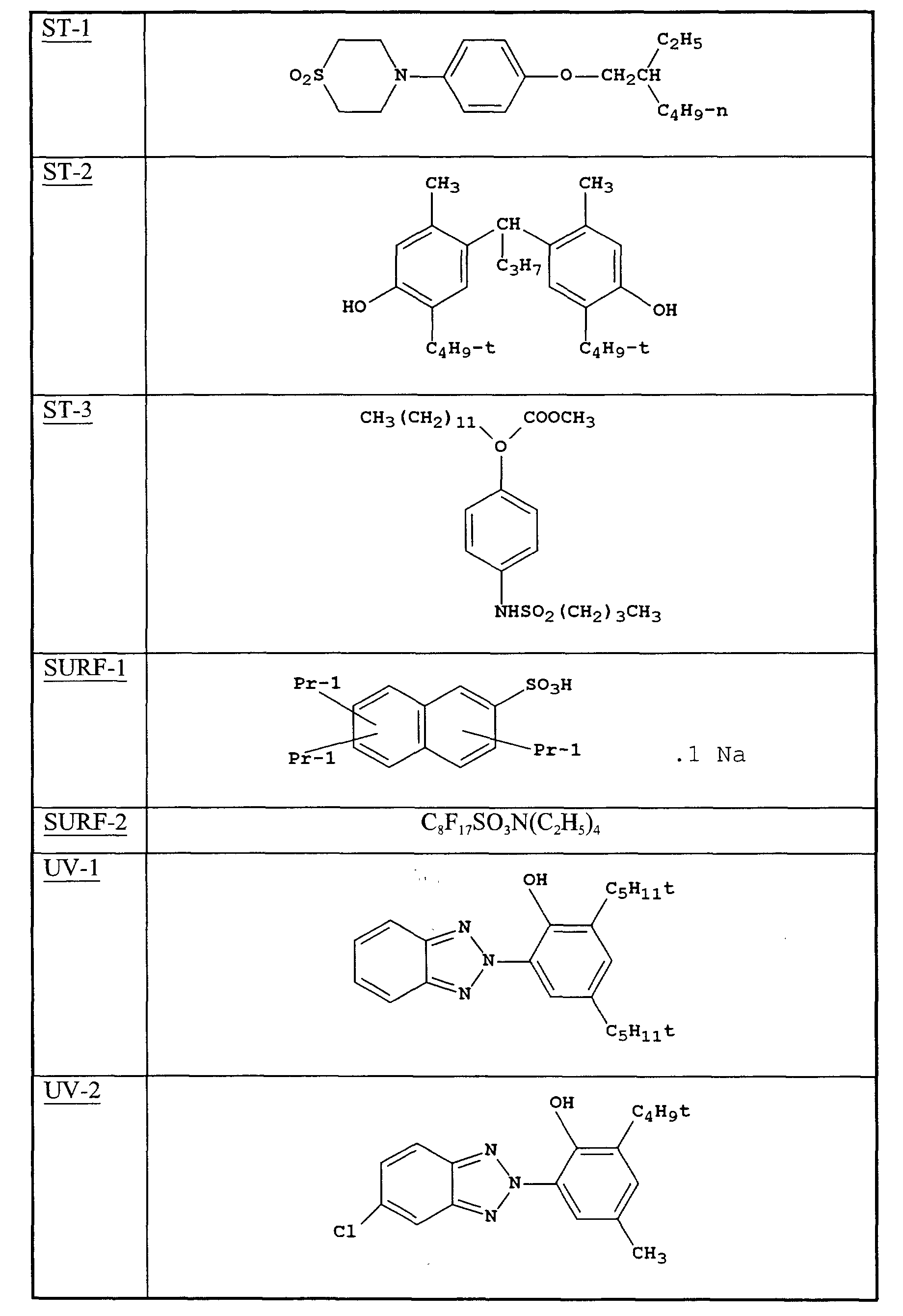
propiophenone (Aldrich), 20.02 grams of a 10 wt. % solution of SURF-1
surfactant, 116.01 grams de-ionized water. This suspension was sonicated for 4
minutes. To this solution was added 40.0 grams of polymer P1. Polymer P1 was
a butyl acrylate/2-acrylamido-2-methylpropane sulfonic acid/2-acetoacetoxyethyl
methacrylate (90:4:6 weight ratio) latex polymer (20 % solution of latex
particles). This solution was stirred with a magnetic stir bar for 4 hours, and then
used to prepared melts for coating as described below.
Preparation of photoinitiator-loaded latex using benzoin methyl ether (BME)
(Dispersion D2):
A mixture was prepared of 12 grams of BME (Aldrich Chem. Co.),
15 grams of a 10 wt. % solution of SURF-1 surfactant, 53 grams de-ionized
water. This solution was sonicated for 4 minutes. To the dispersed suspension
was added 20 grams of P1. This solution was stirred with a magnetic stirring bar
for 4 hours, and then used to prepared melts for coating as described below.
Preparation of photoinitiator-loaded latex using benzoin isobutyl ether
(BIBE) (Dispersion D3):
A mixture was prepared of 32 grams of BIBE (Aldrich), 40 grams
of a 10 wt. % solution SURF-1, 141 grams de-ionized water. This solution was
sonicated for 6 minutes. To the dispersed suspension was added 53.5 grams of
P1. This suspension was allowed to stand in a constant temperature bath for 30
minutes at 45°C. Then, 134 grams of a warm solution of 11.6% Type IV
photographic gelatin in water was added, together with a magnetic stirring bar.
The suspension was stirred magnetically for one hour, stored overnight in the
refrigerator, and used to prepare coating melts as described below.
Preparation of a dispersion of BIBE stabilized with diundecyl phthalate
(Dispersion D4).
A mixture of 26.1g BIBE and 2.91 g diundecyl phthalate was
poured into a solution comprised of 32.6g of 10 wt. % SURF-1., 141.2 g 11.6%
Type IV photographic gelatin, and 124.2 g of water. The mixture was shaken
well and then passed through a colloid mill six times. Microscopic examination
of the resulting suspension showed particles that were less than 1 micron in size.
This dispersion was stored as with Dispersion D3, and used to prepare coating
melts as described below.
Preparation of Coatings with incorporated photoinitiator
A color photographic paper imaging element (Substrate S1) was
prepared on a coating machine. The schematic structure is shown below:
| Layer | Laydown (mg/sq.ft.) |
| UV-absorbing Layer | 12.11 UV-1 |
| | 2.13 UV-2 |
| | 3.57 SCV-1 |
| | 2.37 S-1 |
| | 2.37 S-2 |
| | 47.5 Gelatin |
| Cyan | 18.1 Red light sensitive AgX |
| | 39.31 C-1 |
| | 38.52 S-2 |
| | 3.22 S-3 |
| | 25.31 UV-1 |
| | 129.0 Gelatin |
| UV | 17.43 UV-1 |
| | 3.07 UV-2 |
| | 5.14 SCV-1 |
| | 3.41 S-1 |
| | 3.41 S-2 |
| | 68.4 Gelatin |
| Magenta | 7.70 Green-light sensitive AgX |
| | 1.11 KCL |
| | 29.5 C-2 |
| | 8.26 S-2 |
| | 3.54 S-4 |
| | 17.7 ST-1 |
| | 2.01 ST-2 |
| | 57.0 ST-3 |
| | 0.05 FOG-1 |
| | 0.285 Nitric Acid |
| | 117.0 Gelatin |
| Layer | Laydown (mg/sq.ft.) |
| IL | 6.12 SCV-1 |
| | 18.4 S-2 |
| | 6.025 3,5-Disulfocatechol disodium salt |
| | 0.524 Nitric Acid |
| | 0.18 SURF-1 |
| | 70.0 Gelatin |
| Yellow | 24.0 Blue-light sensitive AgX |
| | 45.0 C-3 |
| | 45.0 P-1 |
| | 20.3 S-2 |
| | 0.88 SCV-2 |
| | 141.8 Gelatin |
| Photographic paper support |
| sublayer 1: resin coat (Titanox and optic brightener in polyethylene) |
| sublayer 2: paper |
| sublayer 3: resin coat (polyethylene) |
Melts were prepared by combining a specified amount of gelatin,
de-ionized water, and HMP-loaded latex dispersion D1. The amounts were
chosen to yield a final topcoat (initiator-containing) composition as in described
in Table 2 below. The gelatin solutions were melted and stirred using a magnetic
stirrer and hot plate. A chemical hardener solution was also prepared, which
could be combined with the sample melt upon coating to yield the desired coating
composition. The chemical hardener was bis-vinyl sulfonyl methane (BVSM).
The gelatin melts and hardener solutions were mixed and coated on
the above stated color paper rug using an experimental coating machine equipped
with an extrusion hopper. Three topcoats were prepared, using different levels of
gelatin and photoinitiator. The coating laydowns for the coatings of Example 1
were those indicated in Table 2. Coating C1 is a control, having no photoinitiator,
and coatings C2 and C3 are coatings of the invention.
| Topcoat Sample No. | Gelatin laydown (mg/ft2) | Photoinitiator (HMP) laydown (mg/ft2) | Hardener (BVSM) (wt % of total gelatin) |
| C1 | 300 | 0 | 1.5 |
| C2 | 207 | 208 | 1.9 |
| C3 | 207 | 360 | 2.3 |
Three protective overcoat formulations were prepared by
dissolving pentaerythritol tetraacrylate (Aldrich) in various mixtures of
isopropanol and de-ionized water. The photocurable formulation compositions
are listed in Table 3. The solutions were protected from exposure to room light
by using brown-glass containers.
| Sample No. | Pentaerythritol- tetraacrylate wt. % | Isopropanol wt. % | De-ionized water wt. % |
| F1 | 50 | 50 | 0 |
| F2 | 25 | 50 | 25 |
| F3 | 43.75 | 43.75 | 12.5 |
Formulation F1 as described previously was coated onto
approximately 4 inch-square samples of substrates C1, C2, and C3 using a
Headway Research® spin-coating device, at a spin speed of 3000 revolutions per
minute and a spin-off time of 30 seconds. The coated samples were cured by
exposure to ultraviolet light using a Fusion Systems® UV cure apparatus,
equipped with a medium pressure mercury arc lamp. The ultraviolet dosage was
set for 300 mJ/cm
2. The time between coating application and cure was varied
between 0 and 20 minutes. The results of the evaluation of overcoats are given in
Table 4:
| Coating No. + Overcoat No. | Time before curing (min) | Degree of Cure |
| C1 + F1 (no HMP) (control) | 0 | NC |
| 5 | NC |
| 10 | NC |
| 20 | NC |
| C2 + F1 (invention) | 0 | NC |
| 5 | NC |
| 10 | D |
| 20 | C |
| C3 + F1 (invention) | 0 | NC |
| 5 | NC |
| 10 | C |
| 20 | C |
When the photocrosslinkable monomer was applied over a coating (C1) that
comprised no photoinitiator, no cure of the monomer was obtained even after long
standing. In contrast, in the coatings of the invention (C2 and C3), where a
photoinitiator was incorporated into the top gelatin layer, on standing sufficient
photoinitiator diffused into the applied overcoat so that crosslinking could occur
on exposure to actinic radiation. The diffusion time with formulation F1, which
comprised no water to swell the gelatin in the coating, was relatively slow, so that
even after 20 minutes, the curing was only partially complete.
In a second experiment, each formulation F1-F3 was applied over
each of the coatings C1-C3. After 20 minutes, the samples were cured as
described above. The overcoat was evaluated for degree of cure, water (stain)
resistance, and fingerprint resistance, with the results of the evaluation of the
overcoats in the second experiment shown in Table 5.
| Coating No. | Overcoat No. | | Degree of cure | Water (stain) resistance | Fingerprint resistance |
| C1 (gelatin only) | none | Control | N/A | D | C |
| F1 | " | NC | not evaluated | |
| F2 | " | NC | D | |
| F3 | " | NC | D | |
| C2 (208 mg/ft2 HMP) | F1 | Invention | C | not evaluated | not evaluated |
| F2 | " | A | A | A |
| F3 | " | D | A | |
| C3(360 mg/ft2 HMP) | F1 | invention | C | not evaluated | not evaluated |
| F2 | " | A | A | A |
| F3 | " | A | A | A |
In this experiment, Formulations F2 and F3, both containing water, give
substantially better results than Formulation F1; a hard coating with excellent
protection against both water-based stains and fingerprinting may be obtained
under appropriate conditions. Formulation F2, with a 2:1 weight ratio of
isopropanol to water, appears to give optimal combination of gelatin swelling and
solubility of the photoinitiator, so that good performance is obtained on substrate
C2 with only 208 mg/ft
2 of HMP. However, the performance with this
formulation can be improved by using a higher level of HMP in the substrate;
thus, the combination of C3 with F2 also gives good performance. Alternatively,
higher levels of the crosslinkable monomer can be used (Formulation F3). This
example therefore shows that there is a reasonably wide range of combination of
coating composition and overcoat formulation under which a good protective
overcoat may be obtained.
Coating melts containing photoinitiator as in Table 2 were
prepared, except using Dispersions D3 (BME photoinitiator) and D4 (BIBE
photoinitiator). Coatings C4 through C12 were prepared by application of these
melts to the color paper substrate S1 as single layer coatings as described in
Example 1, with coating laydowns as shown in Table 6 below. As before, BVSM
was used as a hardener, at a level of 1.8 % w/w with respect to the total gelatin in
the coating.
| Coating No. | Gelatin Laydown mg/ft2 | Source of Photoinitiator | Photoinitiator Laydown mg/ft2 |
| C4 Control | 100 | None | 0 |
| C5 | 100 | D4 | 18 |
| C6 | 100 | D4 | 36 |
| C7 | 100 | D4 | 63 |
| C8 | 100 | D4 | 90 |
| C9 | 100 | D3 | 18 |
| C10 | 100 | D3 | 36 |
| C11 | 100 | D3 | 63 |
| C12 | 100 | D3 | 90 |
Small samples of coatings C4 through C12 were spin-coated as described in
Example 2 with the Formulation F2 of Example 1. The coating conditions (1000
rpm) gave a coating thickness after solvent evaporation of 1.5 microns. The
overcoated samples were cured by exposure to 300 mJ/cm
2 of UV irradiation. The
coatings were evaluated for degree of cure and stain resistance as described in
Example 2, with results summarized in Table 7 below.
| Coating | Photoinitiator (Dispersion) | | Degree of cure | Water (stain) resistance |
| C4 | none | Control | NC | D |
| C5 | 18 mg/ft2 BIBE (D4) | Invention | D | B |
| C6 | 36 mg/ft2 BIBE (D4) | Invention | A | C |
| C7 | 63 mg/ft2 BIBE (D4) | Invention | A | B |
| C8 | 90 mg/ft2 BIBE (D4) | Invention | A | B |
| C9 | 18 mg/ft2 BIBE (D3) | Invention | D | C |
| C10 | 36 mg/ft2 BIBE (D3) | Invention | A | B |
| C11 | 63 mg/ft2 BIBE (D3) | Invention | A | B |
| C12 | 90 mg/ft2 BIBE (D3) | Invention | A | B |
Even with only 18 mg/ft2 of the photoinitiator in the support, some
degree of crosslinking can be obtained under these conditions using either a
loaded latex dispersion (D4) of BIBE or a gelatin-stabilized oil-in-water
dispersion (D3). All of the higher levels of photoinitiator yielded coatings that
completely crosslinked the photopolymerizable monomer in the overcoat, and
yielded a hard, relatively water-impermeable protective layer.
EXAMPLE 4
In another series of experiments, samples of Coatings C4 through
C12 used in Example 3 were subjected to the Kodak RA-4 photographic
processing. The coatings were then spin coated and cured as before. The results
after photographic processing are shown in Table 8 below.
| Coating | | Degree of cure | Water (stain resistance) | Wiping Damage |
| C4 | Control | NC | D | C |
| C5 | Comparison | NC | D | C |
| C6 | Invention | A | D | C |
| C7 | Invention | A | B | B |
| C8 | Invention | A | B | A |
| C9 | Comparison | NC | D | C |
| C10 | Invention | NC | C | C |
| C11 | Invention | A | B | A |
| C12 | Invention | A | B | A |
Some of the photoinitiator is removed during the photographic
processing of these coatings, so that at lower coating levels, there is not enough to
give optimal and efficient crosslinking of the overcoat. However, with either type
of dispersion, enough photoinitiator remains at coating levels greater than 40
mg/ft2 to obtain an optimally durable, substantially water impermeable, protective
layer. This example therefore demonstrates that the invention is compatible with
conventional photoprocessing.
EXAMPLE 5
Formulation F4 is a 5% suspension in water of Polymer P2 , a
butyl methacrylate/vinylidine chloride/itaconic acid (49:49:2 weight ratio) latex
polymer alone. Formulation F5 is a formulation of P2 loaded with 25%
pentaerythritol tetraacrylate (5% total solids). Samples of Coatings C4 (control),
C8, and C 12 were subjected to the Kodak RA-4photographic development process
and then overcoated by spray coating with the a 5 The dried coatings were
exposed to ca. 600 mJ/ft
2 of UV irradiation, and tested for water and fingerprint
resistance. The results are shown in Table 9.
| Coating | | Water (stain) resistance | Fingerprint Resistance |
| C4 + F4 | Control | D | A |
| C4 + F5 | Comparison | D | A |
| C8 + F5 | Invention | A | A |
| C12 + F5 | Invention | A | A |
The control sample coated with the latex alone gives poor water
resistance because the latex does not form a continuous film. Incorporation of the
tetraacrylate does not soften the latex sufficiently to allow it to form a film.
However, coating the loaded latex over a support containing the photocrosslinking
catalyst allows a durable, continuous film to be formed that is impermeable to
water. The resistance to fingerprints is good in all cases with this polymeric
overcoat, and is not degraded by the addition of the tetraacrylate, or by exposure
to light.