EP1195447A1 - Hot rolled steel plate, cold rolled steel plate and hot dip galvanized steel plate being excellent in strain aging hardening characteristics, and method for their production - Google Patents
Hot rolled steel plate, cold rolled steel plate and hot dip galvanized steel plate being excellent in strain aging hardening characteristics, and method for their production Download PDFInfo
- Publication number
- EP1195447A1 EP1195447A1 EP01917697A EP01917697A EP1195447A1 EP 1195447 A1 EP1195447 A1 EP 1195447A1 EP 01917697 A EP01917697 A EP 01917697A EP 01917697 A EP01917697 A EP 01917697A EP 1195447 A1 EP1195447 A1 EP 1195447A1
- Authority
- EP
- European Patent Office
- Prior art keywords
- less
- steel sheet
- hot
- rolled steel
- cold
- Prior art date
- Legal status (The legal status is an assumption and is not a legal conclusion. Google has not performed a legal analysis and makes no representation as to the accuracy of the status listed.)
- Granted
Links
Images


Classifications
-
- C—CHEMISTRY; METALLURGY
- C22—METALLURGY; FERROUS OR NON-FERROUS ALLOYS; TREATMENT OF ALLOYS OR NON-FERROUS METALS
- C22C—ALLOYS
- C22C38/00—Ferrous alloys, e.g. steel alloys
-
- C—CHEMISTRY; METALLURGY
- C22—METALLURGY; FERROUS OR NON-FERROUS ALLOYS; TREATMENT OF ALLOYS OR NON-FERROUS METALS
- C22C—ALLOYS
- C22C38/00—Ferrous alloys, e.g. steel alloys
- C22C38/16—Ferrous alloys, e.g. steel alloys containing copper
-
- C—CHEMISTRY; METALLURGY
- C21—METALLURGY OF IRON
- C21D—MODIFYING THE PHYSICAL STRUCTURE OF FERROUS METALS; GENERAL DEVICES FOR HEAT TREATMENT OF FERROUS OR NON-FERROUS METALS OR ALLOYS; MAKING METAL MALLEABLE, e.g. BY DECARBURISATION OR TEMPERING
- C21D8/00—Modifying the physical properties of ferrous metals or ferrous alloys by deformation combined with, or followed by, heat treatment
- C21D8/02—Modifying the physical properties of ferrous metals or ferrous alloys by deformation combined with, or followed by, heat treatment during manufacturing of plates or strips
- C21D8/0221—Modifying the physical properties of ferrous metals or ferrous alloys by deformation combined with, or followed by, heat treatment during manufacturing of plates or strips characterised by the working steps
- C21D8/0226—Hot rolling
-
- C—CHEMISTRY; METALLURGY
- C21—METALLURGY OF IRON
- C21D—MODIFYING THE PHYSICAL STRUCTURE OF FERROUS METALS; GENERAL DEVICES FOR HEAT TREATMENT OF FERROUS OR NON-FERROUS METALS OR ALLOYS; MAKING METAL MALLEABLE, e.g. BY DECARBURISATION OR TEMPERING
- C21D8/00—Modifying the physical properties of ferrous metals or ferrous alloys by deformation combined with, or followed by, heat treatment
- C21D8/02—Modifying the physical properties of ferrous metals or ferrous alloys by deformation combined with, or followed by, heat treatment during manufacturing of plates or strips
- C21D8/0247—Modifying the physical properties of ferrous metals or ferrous alloys by deformation combined with, or followed by, heat treatment during manufacturing of plates or strips characterised by the heat treatment
- C21D8/0273—Final recrystallisation annealing
-
- C—CHEMISTRY; METALLURGY
- C22—METALLURGY; FERROUS OR NON-FERROUS ALLOYS; TREATMENT OF ALLOYS OR NON-FERROUS METALS
- C22C—ALLOYS
- C22C38/00—Ferrous alloys, e.g. steel alloys
- C22C38/02—Ferrous alloys, e.g. steel alloys containing silicon
-
- C—CHEMISTRY; METALLURGY
- C22—METALLURGY; FERROUS OR NON-FERROUS ALLOYS; TREATMENT OF ALLOYS OR NON-FERROUS METALS
- C22C—ALLOYS
- C22C38/00—Ferrous alloys, e.g. steel alloys
- C22C38/04—Ferrous alloys, e.g. steel alloys containing manganese
-
- C—CHEMISTRY; METALLURGY
- C22—METALLURGY; FERROUS OR NON-FERROUS ALLOYS; TREATMENT OF ALLOYS OR NON-FERROUS METALS
- C22C—ALLOYS
- C22C38/00—Ferrous alloys, e.g. steel alloys
- C22C38/06—Ferrous alloys, e.g. steel alloys containing aluminium
-
- C—CHEMISTRY; METALLURGY
- C22—METALLURGY; FERROUS OR NON-FERROUS ALLOYS; TREATMENT OF ALLOYS OR NON-FERROUS METALS
- C22C—ALLOYS
- C22C38/00—Ferrous alloys, e.g. steel alloys
- C22C38/12—Ferrous alloys, e.g. steel alloys containing tungsten, tantalum, molybdenum, vanadium, or niobium
-
- C—CHEMISTRY; METALLURGY
- C23—COATING METALLIC MATERIAL; COATING MATERIAL WITH METALLIC MATERIAL; CHEMICAL SURFACE TREATMENT; DIFFUSION TREATMENT OF METALLIC MATERIAL; COATING BY VACUUM EVAPORATION, BY SPUTTERING, BY ION IMPLANTATION OR BY CHEMICAL VAPOUR DEPOSITION, IN GENERAL; INHIBITING CORROSION OF METALLIC MATERIAL OR INCRUSTATION IN GENERAL
- C23C—COATING METALLIC MATERIAL; COATING MATERIAL WITH METALLIC MATERIAL; SURFACE TREATMENT OF METALLIC MATERIAL BY DIFFUSION INTO THE SURFACE, BY CHEMICAL CONVERSION OR SUBSTITUTION; COATING BY VACUUM EVAPORATION, BY SPUTTERING, BY ION IMPLANTATION OR BY CHEMICAL VAPOUR DEPOSITION, IN GENERAL
- C23C2/00—Hot-dipping or immersion processes for applying the coating material in the molten state without affecting the shape; Apparatus therefor
- C23C2/02—Pretreatment of the material to be coated, e.g. for coating on selected surface areas
-
- C—CHEMISTRY; METALLURGY
- C23—COATING METALLIC MATERIAL; COATING MATERIAL WITH METALLIC MATERIAL; CHEMICAL SURFACE TREATMENT; DIFFUSION TREATMENT OF METALLIC MATERIAL; COATING BY VACUUM EVAPORATION, BY SPUTTERING, BY ION IMPLANTATION OR BY CHEMICAL VAPOUR DEPOSITION, IN GENERAL; INHIBITING CORROSION OF METALLIC MATERIAL OR INCRUSTATION IN GENERAL
- C23C—COATING METALLIC MATERIAL; COATING MATERIAL WITH METALLIC MATERIAL; SURFACE TREATMENT OF METALLIC MATERIAL BY DIFFUSION INTO THE SURFACE, BY CHEMICAL CONVERSION OR SUBSTITUTION; COATING BY VACUUM EVAPORATION, BY SPUTTERING, BY ION IMPLANTATION OR BY CHEMICAL VAPOUR DEPOSITION, IN GENERAL
- C23C2/00—Hot-dipping or immersion processes for applying the coating material in the molten state without affecting the shape; Apparatus therefor
- C23C2/02—Pretreatment of the material to be coated, e.g. for coating on selected surface areas
- C23C2/022—Pretreatment of the material to be coated, e.g. for coating on selected surface areas by heating
- C23C2/0224—Two or more thermal pretreatments
-
- C—CHEMISTRY; METALLURGY
- C23—COATING METALLIC MATERIAL; COATING MATERIAL WITH METALLIC MATERIAL; CHEMICAL SURFACE TREATMENT; DIFFUSION TREATMENT OF METALLIC MATERIAL; COATING BY VACUUM EVAPORATION, BY SPUTTERING, BY ION IMPLANTATION OR BY CHEMICAL VAPOUR DEPOSITION, IN GENERAL; INHIBITING CORROSION OF METALLIC MATERIAL OR INCRUSTATION IN GENERAL
- C23C—COATING METALLIC MATERIAL; COATING MATERIAL WITH METALLIC MATERIAL; SURFACE TREATMENT OF METALLIC MATERIAL BY DIFFUSION INTO THE SURFACE, BY CHEMICAL CONVERSION OR SUBSTITUTION; COATING BY VACUUM EVAPORATION, BY SPUTTERING, BY ION IMPLANTATION OR BY CHEMICAL VAPOUR DEPOSITION, IN GENERAL
- C23C2/00—Hot-dipping or immersion processes for applying the coating material in the molten state without affecting the shape; Apparatus therefor
- C23C2/02—Pretreatment of the material to be coated, e.g. for coating on selected surface areas
- C23C2/024—Pretreatment of the material to be coated, e.g. for coating on selected surface areas by cleaning or etching
-
- C—CHEMISTRY; METALLURGY
- C23—COATING METALLIC MATERIAL; COATING MATERIAL WITH METALLIC MATERIAL; CHEMICAL SURFACE TREATMENT; DIFFUSION TREATMENT OF METALLIC MATERIAL; COATING BY VACUUM EVAPORATION, BY SPUTTERING, BY ION IMPLANTATION OR BY CHEMICAL VAPOUR DEPOSITION, IN GENERAL; INHIBITING CORROSION OF METALLIC MATERIAL OR INCRUSTATION IN GENERAL
- C23C—COATING METALLIC MATERIAL; COATING MATERIAL WITH METALLIC MATERIAL; SURFACE TREATMENT OF METALLIC MATERIAL BY DIFFUSION INTO THE SURFACE, BY CHEMICAL CONVERSION OR SUBSTITUTION; COATING BY VACUUM EVAPORATION, BY SPUTTERING, BY ION IMPLANTATION OR BY CHEMICAL VAPOUR DEPOSITION, IN GENERAL
- C23C2/00—Hot-dipping or immersion processes for applying the coating material in the molten state without affecting the shape; Apparatus therefor
- C23C2/04—Hot-dipping or immersion processes for applying the coating material in the molten state without affecting the shape; Apparatus therefor characterised by the coating material
- C23C2/06—Zinc or cadmium or alloys based thereon
-
- C—CHEMISTRY; METALLURGY
- C23—COATING METALLIC MATERIAL; COATING MATERIAL WITH METALLIC MATERIAL; CHEMICAL SURFACE TREATMENT; DIFFUSION TREATMENT OF METALLIC MATERIAL; COATING BY VACUUM EVAPORATION, BY SPUTTERING, BY ION IMPLANTATION OR BY CHEMICAL VAPOUR DEPOSITION, IN GENERAL; INHIBITING CORROSION OF METALLIC MATERIAL OR INCRUSTATION IN GENERAL
- C23C—COATING METALLIC MATERIAL; COATING MATERIAL WITH METALLIC MATERIAL; SURFACE TREATMENT OF METALLIC MATERIAL BY DIFFUSION INTO THE SURFACE, BY CHEMICAL CONVERSION OR SUBSTITUTION; COATING BY VACUUM EVAPORATION, BY SPUTTERING, BY ION IMPLANTATION OR BY CHEMICAL VAPOUR DEPOSITION, IN GENERAL
- C23C2/00—Hot-dipping or immersion processes for applying the coating material in the molten state without affecting the shape; Apparatus therefor
- C23C2/34—Hot-dipping or immersion processes for applying the coating material in the molten state without affecting the shape; Apparatus therefor characterised by the shape of the material to be treated
- C23C2/36—Elongated material
- C23C2/40—Plates; Strips
-
- C—CHEMISTRY; METALLURGY
- C21—METALLURGY OF IRON
- C21D—MODIFYING THE PHYSICAL STRUCTURE OF FERROUS METALS; GENERAL DEVICES FOR HEAT TREATMENT OF FERROUS OR NON-FERROUS METALS OR ALLOYS; MAKING METAL MALLEABLE, e.g. BY DECARBURISATION OR TEMPERING
- C21D1/00—General methods or devices for heat treatment, e.g. annealing, hardening, quenching or tempering
- C21D1/18—Hardening; Quenching with or without subsequent tempering
- C21D1/185—Hardening; Quenching with or without subsequent tempering from an intercritical temperature
-
- C—CHEMISTRY; METALLURGY
- C21—METALLURGY OF IRON
- C21D—MODIFYING THE PHYSICAL STRUCTURE OF FERROUS METALS; GENERAL DEVICES FOR HEAT TREATMENT OF FERROUS OR NON-FERROUS METALS OR ALLOYS; MAKING METAL MALLEABLE, e.g. BY DECARBURISATION OR TEMPERING
- C21D2211/00—Microstructure comprising significant phases
- C21D2211/005—Ferrite
-
- C—CHEMISTRY; METALLURGY
- C21—METALLURGY OF IRON
- C21D—MODIFYING THE PHYSICAL STRUCTURE OF FERROUS METALS; GENERAL DEVICES FOR HEAT TREATMENT OF FERROUS OR NON-FERROUS METALS OR ALLOYS; MAKING METAL MALLEABLE, e.g. BY DECARBURISATION OR TEMPERING
- C21D2211/00—Microstructure comprising significant phases
- C21D2211/008—Martensite
-
- C—CHEMISTRY; METALLURGY
- C21—METALLURGY OF IRON
- C21D—MODIFYING THE PHYSICAL STRUCTURE OF FERROUS METALS; GENERAL DEVICES FOR HEAT TREATMENT OF FERROUS OR NON-FERROUS METALS OR ALLOYS; MAKING METAL MALLEABLE, e.g. BY DECARBURISATION OR TEMPERING
- C21D8/00—Modifying the physical properties of ferrous metals or ferrous alloys by deformation combined with, or followed by, heat treatment
- C21D8/02—Modifying the physical properties of ferrous metals or ferrous alloys by deformation combined with, or followed by, heat treatment during manufacturing of plates or strips
- C21D8/0221—Modifying the physical properties of ferrous metals or ferrous alloys by deformation combined with, or followed by, heat treatment during manufacturing of plates or strips characterised by the working steps
- C21D8/0236—Cold rolling
-
- C—CHEMISTRY; METALLURGY
- C21—METALLURGY OF IRON
- C21D—MODIFYING THE PHYSICAL STRUCTURE OF FERROUS METALS; GENERAL DEVICES FOR HEAT TREATMENT OF FERROUS OR NON-FERROUS METALS OR ALLOYS; MAKING METAL MALLEABLE, e.g. BY DECARBURISATION OR TEMPERING
- C21D8/00—Modifying the physical properties of ferrous metals or ferrous alloys by deformation combined with, or followed by, heat treatment
- C21D8/02—Modifying the physical properties of ferrous metals or ferrous alloys by deformation combined with, or followed by, heat treatment during manufacturing of plates or strips
- C21D8/0278—Modifying the physical properties of ferrous metals or ferrous alloys by deformation combined with, or followed by, heat treatment during manufacturing of plates or strips involving a particular surface treatment
-
- Y—GENERAL TAGGING OF NEW TECHNOLOGICAL DEVELOPMENTS; GENERAL TAGGING OF CROSS-SECTIONAL TECHNOLOGIES SPANNING OVER SEVERAL SECTIONS OF THE IPC; TECHNICAL SUBJECTS COVERED BY FORMER USPC CROSS-REFERENCE ART COLLECTIONS [XRACs] AND DIGESTS
- Y10—TECHNICAL SUBJECTS COVERED BY FORMER USPC
- Y10T—TECHNICAL SUBJECTS COVERED BY FORMER US CLASSIFICATION
- Y10T428/00—Stock material or miscellaneous articles
- Y10T428/12—All metal or with adjacent metals
- Y10T428/12493—Composite; i.e., plural, adjacent, spatially distinct metal components [e.g., layers, joint, etc.]
- Y10T428/12771—Transition metal-base component
- Y10T428/12785—Group IIB metal-base component
- Y10T428/12792—Zn-base component
- Y10T428/12799—Next to Fe-base component [e.g., galvanized]
Definitions
- the present invention relates mainly to steel sheets for automobile, and more particularly, to steel sheets having a very high strain age hardening property, excellent in press-formability such as bending workability, stretch-flanging workability, and drawing workability, in which tensile strength increases considerably through a heat treatment after press forming, and manufacturing methods thereof.
- steel sheets as herein used shall include hot-rolled steel sheets, cold-rolled steel sheets, and plated steel sheets.
- This steel sheet is based on a process comprising the steps of controlling the content of C remaining finally in a solid-solution state (solute C content) within an appropriate range, keeping mildness, satisfactory shape freezability and elongation during press forming, preventing movement of dislocation introduced during press forming by the residual solute C fixed to it during the baking treatment after press forming, thereby causing an increase in yield stress.
- this baking hardening type automotive steel sheet while yield stress can be increased, it was impossible to increase tensile strength.
- Japanese Examined Patent Application Publication No. 5-24979 discloses a baking hardening high-strength cold-rolled steel sheet having a chemical composition comprising from 0.08 to 0.20% C, from 1.5 to 3.5% Mn and the balance Fe and incidental impurities, and having a structure composed of uniform bainite containing up to 5% ferrite or bainite partially containing martensite.
- 5-24979 has an object to achieve a high baking hardening amount conventionally unavailable through conversion of structure from the conventional structure mainly comprising ferrite into a structure mainly comprising bainite, by rapidly cooling the steel sheet after continuous annealing within a temperature range of from 400 to 200°C in the cooling step and then slowly cooling the same.
- a high baking hardening amount conventionally unavailable is obtained through an increase in yield strength after baking, it is yet impossible to increase tensile strength, and there still remains a problem in that improvement of impact resistance cannot be expected.
- Japanese Examined Patent Application Publication No. 8-23048 proposes a manufacturing method of a hot-rolled steel sheet, comprising the steps of reheating a steel containing from 0.02 to 0.13% C, up to 2.0% Si, from 0.6 to 2.5% Mn, up to 0.10% sol. Al, and from 0.0080 to 0.0250% N to a temperature of at least 1,100°C, applying a hot rolling end finish rolling at a temperature of from 850 to 950°C, then cooling the hot-rolled steel sheet at a cooling rate of at least 15°C/second to a temperature of under 150°C, and coiling the same, thereby achieving a composite structure mainly comprising ferrite and martensite.
- a hot-dip galvanized steel sheet is suitable as a material applied to portions required to have a high corrosion resistance, and a particular demand exists for hot-dip galvanized steel sheets excellent in press-formability during forming, and is considerably hardened by a heat treatment after forming.
- Japanese Patent Publication No. 2802513 proposes a manufacturing method of a hot-dip galvanized steel sheet using a hot-rolled steel sheet as a substrate.
- the patented method comprises the steps of hot-rolling a steel slab containing up to 0.05% C, from 0.05 to 0.5% Mn, up to 0.1% Al and from 0.8 to 2.0% Cu under conditions including a coiling temperature of up to 530°C, reducing the steel sheet surface by heating the hot-rolled steel sheet to a temperature of up to 530°C, and hot-dip-galvanizing the sheet, whereby a remarkable hardening is available through a heat treatment after forming.
- the heat treatment temperature must be at least 500°C, and this has posed a problem in practice.
- Japanese Unexamined Patent Application Publication No. 10-310824 proposes a manufacturing method of an alloyed hot-dip galvanized steel sheet permitting expectation of an increase in strength through a heat treatment after forming, using a hot-rolled or cold-rolled steel sheet as a substrate.
- This method comprises the steps of hot-rolling a steel containing from 0.01 to 0.08% C, appropriate amounts of Si, Mn, P, S, Al and N, and one or more of Cr, W and Mo in a total amount of from 0.05 to 3.0%, or cold-rolling or temper-rolling the sheet and annealing the same, applying hot-dip galvanizing the sheet, and then, conducting a heating/alloying treatment.
- the Publication asserts that, after forming, tensile strength is increased by heating the sheet at a temperature within a range of from 200 to 450°C.
- the resultant steel sheet involves a problem in that, because the microstructure comprises a ferrite single phase, a ferrite + pearlite, or a ferrite + bainite structure, a high elongation and a low yield strength are unavailable, resulting in a low press-formability.
- Japanese Unexamined Patent Application Publication No. 11-199975 proposes a hot-rolled steel sheet for working excellent in fatigue property, containing from 0.03 to 2.0% C, appropriate amounts of Si, Mn, P, S and Al, from 0.2 to 2.0% Cu, and from 0.0002 to 0.002% B, of which the microstructure is a composite structure having ferrite as a main phase and martensite as the second phase, and the state of presence of Cu in the ferrite phase in a solid-solution state and/or precipitation of up to 2 nm.
- the proposed steel sheet has an object based on a fact that fatigue limit ratio is remarkably improved only when compositely adding Cu and B, and achieving the finest state of Cu as up to 2 nm.
- the present invention was developed in view of the fact that, in spite of the strong demand as described above, a technique for industrially stably manufacturing a steel sheet satisfying these properties has never been proposed, and has an object to favorably solve the problems described above and to provide a high-strength steel sheet suitable as an automotive steel sheet, having an excellent press-formability, and excellent in strain age hardening property causing tensile strength to increase considerably through a heat treatment at a relatively low temperature after press-forming, and a manufacturing method permitting stable production of such a high-strength steel sheet.
- steel sheets as herein used shall include hot-rolled steel sheets, cold-rolled steel sheets and plated steel sheets.
- the present inventors carried out extensive studies on the effect of the steel sheet structure and alloying elements on strain age hardening property. As a result, the following findings were obtained. It is possible to obtain a high strain age hardening bringing about an increase in yield stress, and in addition, a remarkable increase in tensile strength, after application of a pre-strain treatment of an amount of prestrain of 5% or more and a heat treatment at a relatively low temperature within a range of from 150 to 350°C. There is thus available a steel sheet having a satisfactory elongation, a low yield strength and a high hole expanding ratio, and excellent in press-formability.
- the present inventors carried out further extensive studies and found that the above-mentioned phenomenon occurred in steel sheets not containing Cu as well.
- a prestrain is imparted by using a steel sheet containing one or more of Mo, Cr and W in place of Cu, and achieving a ferrite + martensite composite structure, and a heat treatment was applied at a low temperature, very fine carbides were formed to strain-induced-precipitate in martensite, resulting in an increase in tensile strength.
- the strain-induced precipitation upon heating to a low temperature was found to become more remarkable by containing one or more of Nb, V and Ti, in addition to one or more of Mo, Cr and W.
- the present invention was completed through further studies on the basis of the aforementioned findings.
- the gist of the invention is as follows:
- the present inventors investigated the effect of the amount of prestrain on the subsequent strain age hardening property by assuming types of deformation to which automotive steel sheets are subjected.
- the resultant findings included the possibility to arrange data in terms of uniaxial equivalent strain (tensile strain) except for a very deep drawing, that the uniaxial equivalent strain amount substantially accounts for more than 5% for actual parts, and that the parts strength exhibits a good agreement with the strength available after a strain aging treatment of a prestrain of 5%.
- the prestrain (deformation) of a strain aging treatment is assumed to give a tensile plastic strain of 5% or more in the present invention.
- the conventional baking treatment conditions include 170°C x 20 minutes as standards.
- a heat treatment temperature of 150°C or more is necessary. Under conditions including a temperature of over 350°C, on the other hand, the effect is saturated, and even a tendency toward softening is exhibited. Heating to a temperature of over 350°C causes marked occurrence of thermal strain or temper color. For these reasons, a heat treatment temperature range of from 150 to 350°C is adopted for strain age hardening in the invention.
- the holding time of the heat treatment temperature should be 30 seconds or more. Holding a heat treatment temperature within a range of from 150 to 350°C for about 30 seconds permits achievement of substantially sufficient strain age hardening. When desiring a more stable strain age hardening, the holding time should preferably be 60 seconds or more, or more preferably, 300 seconds or more.
- a sheet bar having a chemical composition containing, in weight percentage, 0.04% C, 0.82% Si, 1.6% Mn, 0.01% P, 0.005% S, 0.04% Al and 0.002% N, with Cu varying to 0.3% and 1.3% was heated to 1,150°C and soaked at this temperature, subjected to three-pass rolling to a thickness of 2.0 mm so as to achieve a finish rolling end temperature of 850°C, and converted from a single ferrite structure steel sheet into a hot-rolled steel sheet having a composite ferrite + martensite structure by changing cooling conditions and the coiling temperature.
- Tensile property was investigated through a tensile test on these hot-rolled steel sheets.
- a pre-strain treatment of a tensile prestrain of 5% was applied to test pieces sampled from these hot-rolled steel sheets. Then, after applying a heat treatment at 50 to 350°C for 20 minutes, a tensile test was carried out to determine tensile property, and the strain age hardening property was evaluated.
- the strain age hardening property was evaluated in terms of the increment ⁇ TS of tensile strength from before to after the heat treatment.
- the tensile test was carried out by using JIS #5 tensile test pieces.
- Fig. 1 illustrates the effect of the Cu content on the relationship between ⁇ TS and the steel sheet (hot-rolled steel sheet) structure.
- the value of ⁇ TS was determined by conducting a pre-strain treatment of a tensile prestrain of 5% on the test pieces, and then, applying a heat treatment of 250°C x 20 minutes. It is suggested from Fig. 1 that, for a Cu content of 1.3 wt.%, a high strain age hardening property as represented by a ⁇ TS of 80 MPa or more is available by achieving a composite ferrite + martensite steel sheet structure. In the case of a Cu content of 0.3 wt.%, ⁇ TS is under 80 MPa, and a high strain age hardening property cannot be obtained even by achieving a composite ferrite + martensite steel sheet structure.
- Fig. 2 illustrates the effect of the Cu content on the relationship between ⁇ TS and the heat treatment temperature after pre-strain treatment.
- the hot-rolled sheet used was prepared by cooling the sheet after hot rolling at a cooling rate of 20°C/second to 700°C, then, after air-cooling for 5 seconds, cooling the sheet at a cooling rate of 30°C/second to 450°C, and then, applying a coiling equivalent treatment at 450°C for one hour.
- the thus obtained hot-rolled steel sheet had a composite microstructure comprising ferrite as a main phase and martensite of an area ratio of 8%. After applying a pre-strain treatment to these hot-rolled steel sheets, a heat treatment was carried out to determine ⁇ TS.
- ⁇ TS increases along with an increase in the heat treatment temperature, and this increment is largely dependent upon the Cu content.
- the Cu content is 1.3 wt.%, a high strain age hardening property can be obtained at a heat treatment temperature of 150°C or more and a ⁇ TS of 80 MPa or more.
- ⁇ TS is under 80 MPa, and a high strain age hardening property is unavailable at any heat treatment temperature.
- the hole expanding ratio ⁇ was determined by forming punch holes in test pieces through punching with a punch having a diameter of 10 mm, and conducting hole expansion until occurrence of cracks running through the thickness, so that the burr is outside, by means of a conical punch having a vertical angle of 60°.
- Fig. 3 suggests that a steel sheet having a Cu content of 0.3 wt.% has a composite ferrite ( ⁇ ) + martensite structure, and with a YR of under 70%, the decreasing YR results in a decrease in ⁇ .
- a steel sheet having a Cu content of 1.3 wt.% has a composite ferrite ( ⁇ ) + martensite structure and keeps a high ⁇ -value even with a decreasing YR.
- a low YR and a high ⁇ cannot simultaneously be obtained.
- very fine Cu precipitates in the steel sheet as a result of a pre-strain with an amount of strain of 2% or more as measured upon measuring the increment of deformation stress from before to after a usual heat treatment and the heat treatment carried out at a relatively low temperature as within a range of from 150 to 350°C.
- a high strain age hardening property leading to an increase in yield stress and a remarkable increase in tensile strength is considered to have been obtained through this precipitation of very fine Cu.
- Precipitation of very fine Cu by a heat treatment in a relatively low temperature region has never been observed in ultra-low carbon steel or low-carbon steel in reports so far released.
- the hole expanding ratio is increased in a steel sheet to which Cu is added and in which a composite ferrite + martensite structure is achieved.
- a detailed mechanism of this increase has not as yet been clarified. It is however considered attributable to the fact that addition of Cu reduces the difference in hardness between ferrite and martensite.
- the hot-rolled steel sheet of the invention is a high-strength hot-rolled steel sheet having a tensile strength TS of 440 MPa or more and excellent in press-formability, of which tensile strength remarkably increases as a result of a heat treatment at a relatively low temperature after press forming, leading to an excellent strain age hardening property with a ⁇ TS of 80 MPa or more.
- the hot-rolled steel sheet of the invention has a composite structure comprising a ferrite phase and a secondary phase containing martensite phase having an area ratio of 2% or more relative to the entire structure.
- the structure of the hot-rolled steel sheet of the invention into a composite structure comprising a ferrite phase which is the main phase and a secondary phase containing martensite.
- Ferrite serving as the main phase should preferably have an area ratio of 50% or more. With ferrite of under 50%, it is difficult to keep a high elongation, resulting in a lower press-formability.
- the area ratio of the ferrite phase should preferably be 80% or more.
- the ferrite phase should preferably be 98% or less.
- steel must contain martensite as the secondary phase in an area ratio of 2% or more relative to the entire structure.
- An area ratio of martensite of under 2% cannot simultaneously satisfy a low YS and a high El.
- the secondary phase may be a single martensite phase having an area ratio of 2% or more, or may be a mixture of a martensite phase of an area ratio of 2% or more and a secondary phase comprising a pearlite phase, a bainite phase, or a retained austenite phase.
- the hot-rolled steel sheet having the above-mentioned structure thus becomes a steel sheet excellent in press-formability, with a low yield strength and a high elongation, and in strain age hardening property.
- C is an element which improves strength of a steel sheet, and promotes formation of a composite structure of ferrite and martensite, and should preferably be contained in an amount of 0.01% or more for forming a composite structure in the invention.
- a C content of over 0.15% causes an increase in partial ratio of carbides in steel, resulting in a decrease in elongation, and hence a decrease in press-formability.
- a more important problem is that a C content of over 0.15% leads to a serious decrease in spot weldability and arc weldability. For these reasons, in the invention, the C content is limited to 0.15% or less. From the point of view of formability, the C content should more preferably be 0.10% or less.
- Si is a useful strengthening element which can improve strength of a steel sheet without causing a marked decrease in elongation of the steel sheet, and is effective for accelerating ferrite transformation and promoting martensite formation through C concentration into non-transformed austenite.
- a Si content of over 2.0% however leads to deterioration of press-formability and deteriorates the surface quality.
- the Si content is therefore limited to 2.0% or less.
- Si should preferably be contained in an amount of 0.1% or more.
- Mn has a function of strengthening steel, and of accelerating formation of a composite ferrite + martensite structure.
- Mn is an element effective for preventing hot cracking caused by S, and should therefore be contained in an amount dependent upon S content. These effects are particularly remarkable at a Mn content of 0.5% or more.
- a Mn content of over 3.0% results in deterioration of press-formability and weldabillity.
- the Mn content is therefore limited to 3.0% or less, and more preferably, to 1.0% or more.
- P has a function of strengthening steel, and can be contained in an amount necessary for a desired strength. An excessive P content however causes deterioration of press-formability.
- the P content is therefore limited to 0.10% or less.
- the P content should preferably be 0.08% or less.
- S is an element which is present as inclusions in steel and causes deterioration of elongation, formability, and particularly stretch flanging formability of a steel sheet. It should therefore be the lowest possible. A S content reduced to 0.02% or less does not exert much adverse effect. In the invention, therefore, the S content is limited to 0.02% or less. When an excellent stretch flanging formability is required, the S content should preferably be 0.010% or less.
- Al is an element which is added as a deoxidizing element of steel, and is useful for improving cleanliness of steel.
- an Al content of over 0.10% cannot give a further deoxidizing effect, but causes in contrast deterioration of press-formability.
- the Al content is therefore limited to 0.10% or less, and preferably, 0.01% or more.
- the invention does not exclude a steelmaking process based on a deoxidation by means of a deoxidizer other than Al.
- Ti deoxidation or Si deoxidation may be used, and steel sheets produced by such deoxidation methods are also included in the scope of the invention.
- N is an element which increases strength of a steel sheet through solid-solution strengthing or strain age hardening.
- a N content of over 0.02% causes an increase in the content of nitrides in the steel sheet, which in turn causes a serious deterioration of elongation, and furthermore, of press-formability.
- the N content is therefore limited to 0.02% or less.
- the N content should suitably be 0.01% or less.
- Cu is an element which remarkably increases strain age hardening of a steel sheet (increase in strength after pre-strain - heat treatment), and is one of the most important elements in the invention.
- a Cu content of under 0.5% an increase in tensile strength of over ⁇ TS: 80 MPa even by using different pre-strain - heat treatment conditions cannot be obtained.
- Cu should be contained in an amount of 0.5% or more.
- the effect is saturated so that an effect corresponding to the content cannot be expected, leading to unfavorable economic effects. Deterioration of press-formability results, and the surface quality of the steel sheet degrades.
- the Cu content is therefore limited within a range of from 0.5 to 3.0%.
- the Cu content should preferably be within a range of from 1.0 to 2.5%.
- Group A Ni: 2.0% or less:
- Ni is an element effective for preventing surface defects produced on the steel sheet surface upon adding Cu, and can be contained as required. If contained, the Ni content, depending upon the Cu content, should preferably be about a half the Cu content. An Ni content of over 2.0% cannot give a corresponding effect because of saturation of the effect, leading to economic disadvantages, and causes deterioration of press-formability. The Ni content should preferably be limited to 2.0% or less.
- Group B one or two of Cr and Mo: 2.0% or less in total:
- Group B As in Mn, both Cr and Mo have a function of promoting formation of a composite ferrite + martensite structure, and can be contained as required. If one or two of Cr and Mo are contained in an amount of over 2.0% in total, there occurs a decrease in press-formability. It is therefore desirable to limit the total content of one or two of Cr and Mo forming group B to 2.0% or less.
- Group C one or more of Nb, Ti and V: 0.2% or less in total:
- Nb, Ti and V are carbide-forming elements which effectively act to increase strength through fine dispersion of carbides, and can be selected and contained as required. However, if the total content of one or more of Nb, Ti and V is over 0.2%, there occurs deterioration of press-formability. The total content of Nb, Ti and/or V should therefore preferably be limited to 0.2% or less.
- one or more selected from the group consisting of from 0.05 to 2.0% Mo, from 0.05 to 2.0% Cr, and from 0.05 to 2.0% W may be contained in an amount of 2.0% or less in total, or further one or more selected from the group consisting of Nb, Ti and V in an amount of 2.0% or less in total.
- Mo, Cr and W are elements which cause a remarkable increase in strain age hardening of a steel sheet, are the most important elements in the invention, and can be selected and contained. Containing one or more of Mo, Cr and W, and achievement of a composite ferrite + martensite structure cause strain-induced fine precipitation of fine carbides during pre-strain - heat treatment, thus making it possible to obtain a tensile strength as represented by a ⁇ TS of 80 MPa or more. With a content of each of these elements of under 0.05%, changing of pre-strain - heat treatment conditions or the steel sheet structure does not give an increase in tensile strength represented by a ⁇ TS of 80 MPa or more.
- Nb, Ti and V 2.0% or less in total:
- Nb, Ti and V are carbide-forming elements, and can be selected and contained as required. Containing one or more of Nb, Ti and V, and achievement of a composite ferrite + martensite structure cause strain-induced fine precipitation of fine carbides during pre-strain - heat treatment, thus making it possible to obtain a tensile strength as represented by a ⁇ TS of 80 MPa or more.
- a total content of one or more of Nb, Ti and V of over 2.0% causes deterioration of press-formability.
- the total content of Nb, Ti and/or V should therefore preferably be limited to 2.0% or less.
- one or two of 0.1% or less Cu and 0.1% or less REM may be contained.
- Ca and REM are elements contributing to improvement of elongation through shape control of inclusions. If the Ca content is over 0.1% and the REM content is over 0.1%, however, there would be a decrease in cleanliness, and a decrease in elongation.
- one or two of up to 0.1% B and up to 0.1% Zr may be contained.
- the balance except for the above-mentioned constituents comprises Fe and incidental impurities. Allowable incidental impurities include 0.01% or less Sb, 0.01% or less Pb, 0.1% or less Sn, 0.01% or less Zn, and 0.1% or less Co.
- the hot-rolled steel sheet having the aforementioned chemical composition and structure has a low yield strength and a high elongation, excellent in press-formability and in strain age hardening property.
- the hot-rolled steel sheet of the invention is made from a steel slab, as a material, having a chemical composition within the ranges described above, and by hot-rolling such a material into a prescribed thickness.
- While the steel slab used should preferably be manufactured by the continuous casting process to prevent macro-segregation of the constituents, or may be manufactured by the ingot casting process or the thin continuous casting process.
- An energy-saving process such as direct-hot-charge rolling or direct rolling is applicable with no problem, which comprises the steps of manufacturing a steel slab, then once cooling the slab to room temperature, then reheating as in the conventional art, and charging the same into a reheating furnace as a hot slab without cooling, or immediately rolling the slab after slight holding.
- the slab reheating temperature SRT should preferably be the lowest possible with a view to preventing surface defects caused by Cu when the chemical composition contains Cu.
- a reheating temperature of under 900°C there is an increase in the rolling load, thus increasing the risk of occurrence of a trouble during hot rolling.
- the slab reheating temperature should preferably be 1,300°C or below.
- Hot rolling should preferably be performed at a finish rolling end temperature FDT of the Ar 3 transformation point or more.
- Finish rolling end temperature Ar 3 transformation point or more:
- a finish rolling end temperature FDT of the Ar 3 transformation point or more By adopting a finish rolling end temperature FDT of the Ar 3 transformation point or more, it is possible to obtain a uniform structure of the hot-rolled mother sheet, and a composite ferrite + martensite structure through cooling after hot rolling. This ensures maintenance of an excellent press-formability.
- a finish rolling end temperature of under the Ar 3 transformation point leads to a non-uniform structure of the hot-rolled mother sheet, and the remaining deformation structure causes deterioration of press-formability.
- a finish rolling end temperature of under the Ar 3 transformation point results in a higher rolling load during hot rolling, and a higher risk of occurrence of troubles during hot rolling.
- the FDT of hot rolling should therefore preferably be Ar 3 transformation point or more.
- cooling should preferably be carried out at a cooling rate of 5°C/second or more to a temperature region from Ar 3 transformation point to Ar 1 transformation point.
- the rolled sheet After air cooling or slow cooling, the rolled sheet is cooled again at a cooling rate of 5°C/second or more, and coiled at a coiling temperature of 550°C or below.
- non-transformed austenite is transformed into martensite. This converts the structure into a composite ferrite + martensite structure.
- the cooling rate should more preferably be 10°C/second or more, or still more preferably, 100°C/second or less from the point of view of hot-rolled sheet shape.
- the coiling temperature CT should be under 500°C, and preferably, 350°C or more from the point of view of the hot-rolled sheet shape. A coiling temperature of under 350°C causes serious disorder of the steel sheet shape, and an increase in the risk of occurrence of inconveniences during practical use.
- all or part of finish rolling may be lubrication rolling to reduce the rolling load during hot rolling.
- Application of lubrication rolling is effective with a view to achieving a uniform steel sheet shape and a uniform material quality.
- the frictional coefficient during lubrication rolling should preferably be within a range of from 0.25 to 0.10. It is desirable to adopt a continuous rolling process comprising connecting sheet bars in succession and rolling the same continuously. Application of the continuous rolling process is desirable also from the point of view of operational stability of hot rolling.
- temper rolling of 10% or less may be applied for adjustment such as shape correction or surface roughness control.
- the hot-rolled steel sheet of the invention is applicable not only for working but also as an mother sheet for surface treatment.
- Applicable surface treatments include galvanizing (including alloying), tin-plating and enameling.
- the hot-rolled steel sheet of the invention may be subjected to a special treatment to improve chemical conversion treatment property, weldability, press-formability and corrosion resistance.
- a sheet bar having a chemical composition comprising, in weight percentage, 0.04% C, 0.02% Si, 1.7% Mn, 0.01% P, 0.005% S, 0.04% Al, 0.002% N and 0.3 or 1.3% Cu was heated to 1,150°C, soaked and subjected to three-pass rolling into a thickness of 4.0 mm so that the finish rolling end temperature was 900°C. After the completion of finish rolling and coiling, a temperature holding equivalent treatment of 600°C x 1 h was applied. Thereafter, the sheet was cold-rolled at a reduction of 70% into a cold-rolled steel sheet having a thickness of 1.2 mm. Then, recrystallization annealing was applied to cold-rolled sheets under various conditions.
- Tensile properties were investigated by conducting a tensile test on the resultant cold-rolled steel sheets. Strain age hardening properties of these cold-rolled steel sheets were investigated.
- Tensile properties were determined by first sampling test pieces from these cold-rolled steel sheets, applying a pre-strain treatment with a tensile prestrain of 5% to these test pieces, then performing a heat treatment of 50 to 350°C x 20 minutes, and then conducting a tensile test.
- the strain age hardening properties were evaluated in terms of the tensile strength increment ⁇ TS from before to after the heat treatment, as described in the section of hot-rolled steel sheet.
- Fig. 4 illustrates the effect of the Cu content on the relationship between ⁇ TS of the cold-rolled steel sheet and the recrystallization annealing temperature.
- the value of ⁇ TS was determined by applying a pre-strain treatment with a tensile prestrain of 5% to test pieces sampled from the resultant cold-rolled steel sheets, conducting a heat treatment of 250°C x 20 minutes, and carrying out a tensile test.
- Fig. 4 suggests that a high strain age hardening property as represented by a ⁇ TS of 80 MPa or more is available, in the case of a Cu content of 1.3 wt.%, by using a recrystallization annealing temperature of 700°C or more to convert the steel sheet structure into a composite ferrite + martensite structure.
- a high strain age hardening property is unavailable because ⁇ TS is under 80 MPa at any recrystallization annealing temperature.
- Fig. 4 suggests the possibility to manufacture a cold-rolled steel sheet having a high strain age hardening property by optimizing the Cu content and achieving a composite ferrite + martensite structure.
- Fig. 5 illustrates the effect of the Cu content on the relationship between ⁇ TS of the cold-rolled steel sheet and the heat treatment temperature after a pre-strain treatment.
- the steel sheet used was annealed at 800°C which was the dual phase region of ferrite ( ⁇ ) + austenite ( ⁇ ) for a holding time of 40 seconds after cold rolling, and cooled from a holding temperature (800°C) at a cooling rate of 30°C/second to room temperature.
- the steel sheets had a composite ferrite + martensite (secondary phase) microstructure, with a martensite structural partial ratio represented by an area ratio of 8%.
- ⁇ TS increases according as the heat treatment temperature increases, and the increment thereof largely depends upon the Cu content.
- a Cu content of 1.3 wt.% a high strain age hardening property as represented by a ⁇ TS of 80 MPa or more is available at a heat treatment temperature of 150°C or more.
- ⁇ TS is under 80 MPa at any heat treatment temperature, and a high strain age hardening property cannot be obtained.
- the hole expanding ratio ⁇ was determined by forming a punch hole in a test piece by punching with a punch having a diameter of 10 mm, expanding the hole until production of cracks running through the thickness so that burs were produced on the outside by means of a conical punch having a vertical angle of 60°.
- a cold-rolled steel sheet satisfying both a low yield ratio and a high hole expanding ratio can be manufactured by using a Cu content within an appropriate range and achieving a composite ferrite + martensite structure.
- the cold-rolled steel sheet of the invention is a high-strength cold-rolled steel sheet having a tensile strength TS of 440 MPa or more and excellent in press-formability, of which tensile strength is remarkably increased by a heat treatment at a relatively low temperature after press forming, and having an excellent strain age hardening property typically represented by a ⁇ TS 80 MPa or more.
- the cold-rolled steel sheet of the invention has a composite structure comprising a ferrite phase and a secondary phase containing a martensite phase of an area ratio of 2% or more.
- the ferrite phase which is the main phase and a secondary phase containing martensite.
- Ferrite the main phase
- the ferrite phase should preferably have an area ratio of 50% or more. If ferrite is under 50% in area ratio, it is difficult to keep a high elongation, leading to a lower press-formability.
- the ferrite phase should preferably have an area ratio of 80% or more.
- the ferrite phase should preferably have an area ratio of 98% or less.
- martensite as the secondary phase must be contained in an area ratio of 2% or more.
- the secondary phase may be a single martensite phase having an area ratio of 2% or more, or a mixture of a martensite phase having an area ratio of 2% or more with any of the other pearlite phase, bainite phase and retained austenite phase. There is imposed no particular restriction in this respect.
- the cold-rolled steel sheet having the structure as described above has a low yield strength and a high elongation, is excellent in press-formability, and excellent in strain age hardening property.
- C is an element which improves strength of a steel sheet, and promotes formation of a composite structure of ferrite and martensite, and should preferably be contained in an amount of 0.01% or more for forming a composite structure in the invention.
- a C content of over 0.15% causes an increase in partial ratio of carbides in steel, resulting in a decrease in elongation, and hence a decrease in press-formability.
- a more important problem is that a C content of over 0.15% leads to a serious decrease in spot weldability and arc weldability. For these reasons, in the invention, the C content is limited to 0.15% or less. From the point of view of formability, the C content should more preferably be 0.10% or less.
- Si is a useful strengthening element which can improve strength of a steel sheet without causing a marked decrease in elongation of the steel sheet.
- a Si content of over 2.0% however leads to deterioration of press-formability and degrades the surface quality.
- the Si content is therefore limited to 2.0% or less, and preferably, to 0.1% or more.
- Mn has a function of strengthening steel, reducing the critical cooling rate for obtaining a composite ferrite + martensite structure, and accelerating formation of the composite ferrite + martensite structure.
- the Mn content should preferably correspond to the cooling rate after recrystallization annealing.
- Mn is an element effective for preventing hot cracking caused by S, and should therefore be contained in an amount dependent upon the S content. These effects are particularly remarkable at a Mn content of 0.5% or more.
- a Mn content of over 3.0% results in deterioration of press-formability and weldability.
- the Mn content is therefore limited to 3.0% or less, and more preferably, to 1.0% or more.
- P has a function of strengthening steel, and can be contained in an amount necessary for a desired strength. An excessive P content however causes deterioration of press-formability.
- the P content is therefore limited to 0.10% or less.
- the P content should preferably be 0.08% or less.
- S is an element which is present as inclusions in steel and causes deterioration of elongation, formability, and particularly stretch flanging formability of a steel sheet. It should therefore be the lowest possible. A S content reduced to up to 0.02% does not exert much adverse effect. In the invention, therefore, the S content is limited to 0.02% or less. When an excellent stretch flanging formability is required, the S content should preferably be 0.010% or less.
- Al is an element which is added as a deoxidizing element of steel, and is useful for improving cleanliness of steel.
- an Al content of over 0.10% cannot give a further deoxidizing effect, but causes in contrast deterioration of press-formability.
- the Al content is therefore limited to 0.10% or less.
- the invention does not exclude a steelmaking process based on a deoxidation by means of a deoxidizer other than Al.
- Ti deoxidation or Si deoxidation may be used, and steel sheets produced by such deoxidation methods are also included in the scope of the invention.
- addition of Ca or REM to molten steel does not impair the features of the steel sheet of the invention at all. It is needless to mention that steel sheets containing Ca or REM are also included within the scope of the invention.
- N is an element which increases strength of a steel sheet through solid-solution strengthing or strain age hardening.
- a N content of over 0.02% causes an increase in the content of nitrides in the steel sheet, which in turn causes a serious deterioration of elongation, and furthermore, of press-formability.
- the N content is therefore limited to 0.02% or less.
- the N content should suitably be 0.01% or less.
- Cu is an element which remarkably increase strain age hardening of a steel sheet (increase in strength after pre-strain - heat treatment), and is one of the most important elements in the invention.
- a Cu content of under 0.5% an increase in tensile strength of over ⁇ TS: 80 MPa cannot be obtained even by using different pre-strain - heat treatment conditions.
- Cu should be contained in an amount of 0.5% or more.
- a Cu content of over 3.0% on the other hand, the effect is saturated so that an effect corresponding to the content cannot be expected, leading to unfavorable economic effects. Deterioration of press-formability results, and the surface quality of the steel sheet is degraded.
- the Cu content is therefore limited within a range of from 0.5 to 3.0%.
- the Cu content should preferably be within a range of from 1.0 to 2.5%.
- Group A Ni: 2.0% or less:
- Ni is an element effective for preventing surface defects produced on the steel sheet surface upon adding Cu, and can be contained as required. If contained, the Ni content, depending upon the Cu content, should preferably be about a half the Cu content. A Ni content of over 2.0% cannot give a corresponding effect because of saturation of the effect, leading to economic disadvantages, and causes deterioration of press-formability. The Ni content should preferably be limited to 2.0% or less.
- Group B one or two of Cr and Mo: 2.0% or less in total:
- Group B As in Mn, both Cr and Mo have a function of promoting formation of a composite ferrite + martensite structure, and can be contained as required. If one or two of Cr and Mo are contained in an amount of over 2.0% in total, there occurs a decrease in press-formability. It is therefore desirable to limit the total content of one or two of Cr and Mo forming group B to 2.0% or less.
- Group C one or more of Nb, Ti and V: 0.2% or less in total:
- Nb, Ti and V are carbide-forming elements which effectively act to increase strength through fine dispersion of carbides, and can be selected and contained as required. However, if the total content of one or more of Nb, Ti and V is over 0.2%, there occurs deterioration of press-formability. The total content of Nb, Ti and/or V should therefore preferably be limited to 0.2% or less.
- one or more selected from the group consisting of from 0.05 to 2.0% Mo, from 0.05 to 2.0% Cr, and from 0.05 to 2.0% W may be contained in an amount of 2.0% or less in total, or further one or more selected from the group consisting of Nb, Ti and V in an amount of 2.0% or less in total.
- Mo, Cr and W are elements which cause a remarkable increase in strain age hardening of a steel sheet, are the most important elements in the invention, and can be selected and contained as required. Containing one or more of Mo, Cr and W and achievement of a composite ferrite + martensite structure cause strain-induced fine precipitation of fine carbides during pre-strain - heat treatment, thus making it possible to obtain a tensile strength as represented by a ⁇ TS of 80 MPa or more. With a content of each of these elements of under 0.05%, changing of pre-strain - heat treatment conditions or the steel sheet structure does not give an increase in tensile strength as represented by a ⁇ TS of 80 MPa or more.
- Nb, Ti and V 2.0% or less in total:
- Nb, Ti and V are carbide-forming elements, and, when containing one or more of Mo, Cr and W, can be selected and contained as required. Containing one or more of Nb, Ti and V, and achievement of a composite ferrite + martensite structure cause strain-induced fine precipitation of fine carbides during pre-strain - heat treatment, thus making it possible to obtain a tensile strength as represented by a ⁇ TS of 80 MPa or more.
- a total content of one or more of Nb, Ti and V of over 2.0% causes deterioration of press-formability.
- the total content of Nb, Ti and/or V should therefore preferably be limited to 2.0% or less.
- Ca and REM are elements contributing to improvement of elongation through shape control of inclusions. If the Ca content is over 0.1% and the REM content is over 0.1%, however, there would be a decrease in cleanliness, and a decrease in elongation.
- one or two of 0.1% or less B and 0.1% or less Zr may be contained.
- the balance except for the above-mentioned elements comprises Fe and incidental impurities. Allowable incidental impurities include 0.01% or less Sb, 0.01% or less Pb, 0.1% or less Sn, 0.01% or less Zn, and 0.1% or less Co.
- the cold-rolled steel sheet of the invention is manufactured by using, as a material, a steel slab having the chemical composition within the aforementioned ranges, and sequentially carrying out a hot rolling step of hot-rolling the steel slab into a hot-rolled steel sheet, a cold rolling step of cold-rolling the hot-rolled steel sheet into a cold-rolled steel sheet, and a recrystallization annealing step of applying recrystallization annealing to the cold-rolled steel sheet into a cold-rolled annealed steel sheet.
- the steel slab used should preferably be manufactured by the continuous casting process to prevent macro-segregation of the elements, it may be manufactured by the ingot casting process or the thin-slab continuous casting process.
- An energy-saving process such as direct-hot-charge rolling or direct rolling is applicable with no problem, which comprises the steps of manufacturing a steel slab, then once cooling the slab to room temperature, then reheating the slab as in the conventional art, and charging the same into a reheating furnace as a hot slab without cooling, or immediately rolling the slab after slight holding.
- the above-mentioned material (steel slab) is reheated, and subjected to the hot rolling step of applying hot rolling to make a hot-rolled steel sheet.
- Usual known conditions for the hot rolling step pose no problem only so far as these conditions permit manufacture of a hot-rolled steel sheet having a desired thickness.
- Preferable hot rolling conditions are as follows:
- Slab reheating temperature 900°C or more.
- the slab reheating temperature SRT should preferably be the lowest possible with a view to preventing surface defects caused by Cu when the chemical composition contains Cu.
- a reheating temperature of under 900°C there is an increase in the rolling load, thus increasing the risk of occurrence of a trouble during hot rolling.
- the slab reheating temperature should preferably be 1,300°C or less.
- Finish rolling end temperature 700°C or more:
- a finish rolling end temperature FDT of 700°C or more By adopting a finish rolling end temperature FDT of 700°C or more, it is possible to obtain a uniform hot-rolled mother sheet structure which can give an excellent formability after cold rolling and recrystallization annealing.
- a finish rolling end temperature of under 700°C results in a non-uniform hot-rolled mother sheet structure, and a higher rolling load during hot rolling, leading to an increased risk of occurrence of troubles during hot rolling.
- the FDT in the hot rolling step should preferably be 700°C or more.
- Coiling temperature 800°C or below:
- the coiling temperature CT should preferably be 800°C or below, and more preferably, 200°C or more.
- a coiling temperature of over 800°C tends to cause a decrease in yield as a result of increase of scale causing a scale loss.
- With a coiling temperature of under 200°C the steel sheet shape is in marked disorder, and there is an increasing risk of occurrence of inconveniences in practical use.
- the hot rolling step in the invention it is desirable to reheat the slab to a temperature of 900°C or more, hot-roll the reheated slab at a finish rolling end temperature of 700°C or more, and coil the hot-rolled steel sheet at a coiling temperature of 800°C or below, and preferably 200°C or more.
- all or part of finish rolling may be lubrication rolling to reduce the rolling load during hot rolling.
- Application of lubrication rolling is effective with a view to achieving a uniform steel sheet shape and a uniform material quality.
- the frictional coefficient during lubrication rolling should preferably be within a range of from 0.25 to 0.10. It is desirable to adopt a continuous rolling process comprising connecting sheet bars in succession and rolling the same continuously. Application of the continuous rolling process is desirable also from the point of view of operational stability of hot rolling.
- the cold rolling step is conducted on the hot-rolled steel sheet.
- the hot-rolled steel sheet is cold-rolled into a cold-rolled steel sheet.
- the cold rolling conditions suffice to permit production of a cold-rolled steel sheet having a desired dimensions, and no particular restriction is imposed.
- the cold rolling reduction should preferably be 40% or more. With a reduction of under 40%, it becomes difficult for recrystallization to take place uniformly during the recrystallization annealing that follows.
- Recrystallization annealing should preferably be carried out on a continuous annealing line, or on a continuous hot-dip galvanizing line.
- the annealing temperature for recrystallization annealing should preferably be within an ( ⁇ + ⁇ ) dual phase region in a temperature range of from the Ac 1 transformation point to the Ac 3 transformation point. An annealing temperature of under the Ac 1 transformation point leads to a single ferrite phase.
- the cooling rate for cooling the sheet during recrystallization annealing should preferably be 1°C/second or more with a view to forming martensite.
- temper rolling of 10% or less may be applied for adjustment such as shape correction or surface roughness control.
- the cold-rolled steel sheet of the invention is applicable not only for working but also as an mother sheet for surface treatment.
- Applicable surface treatments include galvanizing (including alloying), tin-plating and enameling.
- the cold-rolled steel sheet of the invention may be subjected to a special treatment to improve chemical conversion treatment property, weldability, press-formability and corrosion resistance.
- a sheet bar having a chemical composition comprising, in weight percentage, 0.04% C, 0.02% Si, 1.7% Mn, 0.01% P, 0.004% S, 0.04% Al, 0.002% N and 0.3 or 1.3% Cu was heated to 1,150°C, soaked and subjected to three-pass rolling into a thickness of 4.0 mm so that the finish rolling end temperature was 900°C. After the completion of finish rolling and coiling, a temperature holding equivalent treatment of 600°C x 1 h was applied. Thereafter, the sheet was cold-rolled at a reduction of 70% into a cold-rolled steel sheet having a thickness of 1.2 mm.
- Tensile properties were determined by first sampling test pieces from these hot-dip galvanized steel sheets, applying a pre-strain treatment with a tensile prestrain of 5% to these test pieces, then performing a heat treatment of 50 to 350°C x 20 minutes, and then conducting a tensile test.
- the strain age hardening properties were evaluated in terms of the tensile strength increment ⁇ TS from before to after heat treatment, as described in the section of hot-rolled steel sheet.
- Fig. 7 illustrates the effect of the Cu content on the relationship between ⁇ TS of the hot-dip galvanized steel sheet and the recrystallization annealing temperature.
- the value of ⁇ TS was determined by applying a pre-strain treatment with a tensile prestrain of 5% to test pieces sampled from the resultant hot-dip galvanized steel sheets, conducting a heat treatment of 250°C x 20 minutes, and carrying out a tensile test.
- Fig. 7 suggests that a high strain age hardening property as represented by a ⁇ TS of 80 MPa or more is available, in the case of a Cu content of 1.3 wt.%, by using a recrystallization annealing temperature of 700°C or more to convert the steel sheet structure into a composite ferrite + martensite structure.
- a high strain age hardening property is unavailable because ⁇ TS is under 80 MPa at any recrystallization annealing temperature.
- Fig. 7 suggests the possibility to manufacture a hot-dip galvanized steel sheet having a high strain age hardening property by optimizing the Cu content and achieving a composite ferrite + martensite structure.
- Fig. 8 illustrates the effect of the Cu content on the relationship between ⁇ TS of the hot-dip galvanized steel sheet and the heat treatment temperature after a pre-strain treatment.
- the value of ⁇ TS was determined on hot-dip galvanized steel sheets manufactured by applying annealing at 800°C for a holding time of 40 seconds in the ferrite + austenite dual phase region as recrystallization annealing conditions to cold-rolled steel sheet, at various heat treatment temperatures after pre-strain treatment.
- the microstructure after annealing was a composite ferrite + martensite structure having a martensite area ratio of 7%.
- ⁇ TS increases according as the heat treatment temperature increases, and the increment thereof largely depends upon the Cu content.
- a Cu content of 1.3 wt.% a high strain age hardening property as represented by a ⁇ TS of 80 MPa or more is available at a heat treatment temperature of 150°C or more.
- ⁇ TS is under 80 MPa at any heat treatment temperature, and a high strain age hardening, property cannot be obtained.
- ⁇ the hole expanding ratio
- a hot-dip galvanized steel sheet satisfying both a low yield ratio and a high hole expanding ratio can be manufactured by using a Cu content within an appropriate range and achieving a composite ferrite + martensite structure.
- the hot-dip galvanized steel sheet of the invention has a hot-dip galvanizing layer or an alloying hot-galvanizing layer formed on the surface thereof, and is a high-strength hot-dip galvanized steel sheet having a tensile strength TS of 440 MPa or more, and excellent in press-formability. Tensile strength thereof remarkably increases through a heat treatment applied at a relatively low temperature after press-forming to have an excellent strain age hardening property as represented by a ⁇ TS of 80 MPa or more.
- the steel sheet may be a hot-rolled steel sheet or a cold-rolled steel sheet.
- the hot-dip galvanized steel sheet of the invention has a composite structure comprising a ferrite phase and a secondary phase containing martensite phase having an area ratio of 2% or more relative to the entire structure.
- the structure of the hot-dip galvanized steel sheet of the invention into a composite structure comprising a ferrite phase which is the main phase and a secondary phase containing martensite.
- Ferrite serving as the main phase should preferably have an area ratio of 50% or more. With ferrite of under 50%, it is difficult to keep a high elongation, resulting in a lower press-formability.
- the area ratio of the ferrite phase should preferably be 80% or more.
- the ferrite phase should preferably be 98% or less.
- steel In the hot-dip galvanized steel sheet of the invention, steel must contain martensite as the secondary phase in an area ratio of 2% or more.
- An area ratio of martensite of under 2% cannot simultaneously satisfy a low YS and a high El.
- the secondary phase may be a single martensite phase having an area ratio of 2% or more, or may be a mixture of a martensite phase of an area ratio of 2% or more and a sub phase comprising a pearlite phase, a bainite phase, or a residual austenite phase.
- the hot-dip galvanized steel sheet having the above-mentioned structure thus becomes a steel sheet excellent in press-formability, with a low yield strength and a high elongation, and in strain age hardening property.
- C is an element which improves strength of a steel sheet, and promotes formation of a composite structure of ferrite and martensite, and should preferably be contained in an amount of 0.01% or more for forming a composite ferrite + martensite structure in the invention.
- a C content of over 0.15% causes an increase in partial ratio of carbides in steel, resulting in a decrease in elongation, and hence a decrease in press-formability.
- a more important problem is that a C content of over 0.15% leads to a serious decrease in spot weldability and arc weldability.
- the C content is limited to 0.15% or less. From the point of view of formability, the C content should more preferably be 0.10% or less.
- Si is a useful strengthening element which can improve strength of a steel sheet without causing a marked decrease in elongation of the steel sheet.
- a Si content of over 2.0% however leads to deterioration of press-formability and degrades platability.
- the Si content is therefore limited to 2.0% or less, and preferably, 0.1% or more.
- Mn has a function of strengthening steel, reducing the critical cooling rate for obtaining a composite ferrite + martensite structure, and of accelerating formation of the composite ferrite + martensite structure.
- Mn is an element effective for preventing hot cracking caused by S, and should therefore be contained in an amount dependent upon the S content. These effects are particularly remarkable at an Mn content of 0.5% or more.
- an Mn content of over 3.0% results in deterioration of press-formability and weldability.
- the Mn content is therefore limited to 3.0% or less, and more preferably, to 1.0% or more.
- P has a function of strengthening steel, and can be contained in an amount necessary for a desired strength. An excessive P content however causes deterioration of press-formability.
- the P content is therefore limited to 0.10% or less.
- the P content should preferably be 0.08% or less.
- S is an element which is present as inclusions in steel and causes deterioration of elongation, formability, and particularly stretch flanging formability of a steel sheet. It should therefore be the lowest possible. A S content reduced to 0.02% or less does not exert much adverse effect. In the invention, therefore, the S content is limited to 0.02% or less. When an excellent stretch flanging formability is required, the S content should preferably be 0.010% or less. S: 0.02% or less:
- Al is an element which is added as a deoxidizing element of steel, and is useful for improving cleanliness of steel.
- an Al content of over 0.10% cannot give a further deoxidizing effect, but causes in contrast deterioration of press-formability.
- the Al content is therefore limited to 0.10% or less.
- the invention does not exclude a steelmaking process based on a deoxidation by means of a deoxidizer other than Al.
- Ti deoxidation or Si deoxidation may be used, and steel sheets produced by such deoxidation methods are also included in the scope of the invention.
- N is an element which increases strength of a steel sheet through solid-solution strengthing or strain age hardening.
- a N content of over 0.02% causes an increase in the content of nitrides in the steel sheet, which in turn causes a serious deterioration of elongation, and furthermore, of press-formability.
- the N content is therefore limited to 0.02% or less.
- the N content should suitably be 0.01% or less, and preferably 0.0005% or more.
- Cu is an element which remarkably increases strain age hardening of the hot-dip galvanized steel sheet of the invention (increase in strength after pre-strain - heat treatment), and is one of the most important elements in the invention.
- a Cu content of under 0.5% an increase in tensile strength of over ⁇ TS: 80 MPa cannot be obtained even by using different pre-determination - heat treatment conditions.
- Cu should be contained in an amount of 0.5% or more.
- the effect is saturated so that an effect corresponding to the content cannot be expected, leading to unfavorable economic effects. Deterioration of press-formability results, and the surface quality of the steel sheet is degraded.
- the Cu content is therefore limited within a range of from 0.5 to 3.0%.
- the Cu content should preferably be within a range of from 1.0 to 2.5%.
- Group A Ni: 2.0% or less:
- Ni is an element effective for preventing surface defects produced on the steel sheet surface upon adding Cu, and can be contained as required. If contained, the Ni content, depending upon the Cu content, should preferably be about a half the Cu content. A Ni content of over 2.0% cannot give a corresponding effect because of saturation of the effect, leading to economic disadvantages, and causes deterioration of press-formability. The Ni content should preferably be limited to 2.0% or less.
- Group B one or two of Cr and Mo: 2.0% or less in total:
- Group B As in Mn, both Cr and Mo have a function of reducing the critical cooling rate for obtaining a composite ferrite + martensite structure and promoting formation of a composite ferrite + martensite structure, and can be contained as required. If one or two of Cr and Mo are contained in an amount of over 2.0% in total, there occurs a decrease in press-formability. It is therefore desirable to limit the total content of one or two of Cr and Mo forming group B to 2.0% or less.
- Group C one or more of Nb, Ti and V: 0.2% or less in total:
- Nb, Ti and v are carbide-forming elements which effectively act to increase strength through fine dispersion of carbides, and can be selected and contained as required. However, if the total content of one or more of Nb, Ti and V is over 0.2%, there occurs deterioration of press-formability. The total content of Nb, Ti and/or V should therefore preferably be limited to 0.2% or less.
- one or more selected from the group consisting of from 0.05 to 2.0% Mo, from 0.05 to 2.0% Cr, and from 0.05 to 2.0% W may be contained in an amount of 2.0% or less in total, or further one or more selected from the group consisting of Nb, Ti and V in an amount of 2.0% or less in total.
- Mo, Cr and W are elements which cause a remarkable increase in strain age hardening of a steel sheet, are the most important elements in the invention, and can be selected and contained as required. Containing one or more of Mo, Cr and W, and achievement of a composite ferrite + martensite structure cause strain-induced fine precipitation of fine carbides during pre-strain - heat treatment, thus making it possible to obtain a tensile strength as represented by a ⁇ TS of 80 MPa or more. With a content of each of these elements of under 0.05%, changing of pre-strain - heat treatment conditions or the steel sheet structure does not give an increase in tensile strength represented by a ⁇ TS of 80 MPa or more.
- Nb, Ti and V 2.0% or less in total:
- Nb, Ti and V are carbide-forming elements, and, when containing one or more of Mo, Cr and W, can be selected and contained as required. Containing one or more of Nb, Ti and V, and achievement of a composite ferrite + martensite structure cause strain-induced fine precipitation of fine carbides during pre-strain - heat treatment, thus making it possible to obtain a tensile strength as represented by a ⁇ TS of 80 MPa or more.
- a total content of one or more of Nb, Ti and V of over 2.0% causes deterioration of press-formability.
- the total content of Nb, Ti and/or V should therefore preferably be limited to 2.0% or less.
- Ca and REM are elements contributing to improvement of elongation through shape control of inclusions. If the Ca content is over 0.1% and the REM content is over 0.1%, however, there would be a decrease in cleanliness, and a decrease in elongation.
- one or two of 0.1% or less B and 0.1% or less Zr may be contained.
- the balance except for the above-mentioned elements comprises Fe and incidental impurities. Allowable incidental impurities include 0.01% or less Sb, 0.01% or less Pb, 0.1% or less Sn, 0.01% or less Zn, and 0.1% or less Co.
- the hot-dip galvanized steel sheet of the invention is manufactured by annealing the steel sheet having the aforementioned chemical composition through heating to ferrite + austenite dual phase region within a temperature region of from Ac 3 transformation point to Ac 1 transformation point on a line for continuous hot-dip galvanizing, and applying a hot-dip galvanizing treatment, thereby forming a hot-dip galvanizing layer on the surface of the steel sheet.
- a hot-rolled steel sheet or a cold-rolled steel sheet may be used.
- a preferable manufacturing method of the steel sheet used will be described. It is needless to mention that the manufacturing method of the hot-dip galvanized steel sheet of the invention is not limited to the described one.
- the material used should preferably be prepared by making molten steel having the aforementioned chemical composition by a conventionally known process, and for preventing macro-segregation of the elements, a steel slab should preferably be manufactured by the continuous casting process.
- the ingot making process or the thin-slab continuous casting process is applicable.
- an energy-saving process of charging the hot steel slab into a reheating furnace without cooling the same, or after a slight temperature holding, immediately rolling as in direct-hot-charge rolling or direct rolling is applicable with no problem.
- the above-mentioned material (steel slab) is reheated, and rolled into a hot-rolled sheet through application of the hot rolling step.
- No particular problem is encountered as to conventionally known conditions so far as such conditions permit manufacture of a hot-rolled steel sheet having a desired thickness in the hot rolling step.
- Preferable conditions for hot rolling are as follows:
- the slab reheating temperature should preferably be the lowest possible to prevent surface defects caused by Cu. Considering the increase in scale loss caused along with the increase in weight loss of oxidation, the slab reheating temperature should preferably be 1,300°C or below.
- Finish rolling end temperature 700°C or more:
- a finish rolling end temperature FDT of 700°C or more By adopting a finish rolling end temperature FDT of 700°C or more, it is possible to obtain a uniform structure of the hot-rolled mother sheet. On the other hand, a finish rolling end temperature of under 700°C leads to a non-uniform structure of the hot-rolled mother sheet and a higher rolling load during hot rolling, thus increasing the risk of occurrence of troubles during hot rolling.
- the FDT for the hot rolling step should therefore preferably be 700°C or more.
- Coiling temperature 800°C or below:
- the coiling temperature CT should preferably be 800°C or below, and more preferably, 200°C or more.
- a coiling temperature of over 800°C tends to cause a decrease in yield as a result of scale loss due to an increase of scale.
- With a coiling temperature of under 200°C the steel sheet shape is seriously disturbed, and there is an increasing risk of occurrence of inconveniences in practical use.
- the hot-rolled steel sheet suitably applicable in the invention should preferably be prepared by reheating the slab having the aforementioned chemical composition to 900°C or more, subjecting the same to hot rolling so that the finish rolling end temperature becomes 700°C or more and coiling the same at a coiling temperature of 800°C or more, and preferably, 200°C or more.
- all or part of finish rolling may comprise lubrication rolling to reduce the rolling load during hot rolling.
- lubrication rolling is effective also from the point of view of achieving a uniform steel sheet shape and a uniform material quality.
- the frictional coefficient upon lubrication rolling should preferably be within a range of from 0.25 to 0.10. It is desirable to convert neighboring sheet bars to form a continuous rolling process for continuously carrying out finish rolling. Application of the continuous rolling process is desirable also from the point of view of operational stability of hot rolling.
- the hot-rolled sheet with scale adhering thereto may be subjected to hot-rolled sheet annealing to form an internal oxide film in the surface layer of the steel sheet. Formation of the internal oxide layer improves hot-dip galvanizing property for preventing surface concentration of Si, Mn and P.
- the hot-rolled sheet manufactured by the above-mentioned method may be used as an mother sheet for plating, and moreover, the cold-rolled sheet manufactured by applying cold rolling step to the above-mentioned hot-rolled sheet.
- cold rolling is applied to the hot-rolled sheet.
- Any cold rolling conditions may be used so far as such conditions permit production of cold-rolled steel sheets of desired dimensions and shape, and no particular restriction is imposed.
- the reduction in cold rolling should preferably be 40% or more. A reduction of under 40% makes it difficult for recrystallization to take place uniformly during annealing, the next step.
- the above-mentioned hot-rolled or cold-rolled (steel) sheet should preferably be subjected to annealing of heating the sheet to a ferrite ( ⁇ ) + austenite ( ⁇ ) dual-phase region within a temperature range of from Ac 1 transformation point to Ac 3 transformation point on a continuous hot-dip galvanizing line.
- a heating temperature of under Ac 1 transformation point leads to a ferrite single-phase structure.
- a heating temperature of over Ac 3 transformation point results in coarsening of crystal grains and in an austenite single-phase structure, causing serious deterioration of press-formability.
- Annealing in the ( ⁇ + ⁇ ) dual-phase region makes it possible to obtain a composite ferrite + martensite structure and a high ⁇ TS.
- cooling should preferably be carried out from the dual-phase region heating temperature to the hot-dip galvanizing treatment temperature at a cooling rate of 5°C/second or more. With a cooling rate of under 5°C/second, it becomes difficult for martensite transformation to take place and to achieve a composite ferrite + martensite structure.
- the hot-dip galvanizing treatment may be carried out under treatment conditions (galvanizing bath temperature: 450 to 500°C) commonly used in a usual continuous hot-dip galvanizing line, and it is not necessary to impose a particular restriction. Because galvanizing at an excessively high temperature leads to a poor platability, galvanizing should preferably be conducted at a temperature of 500°C or below. Galvanizing at a temperature of under 450°C poses a problem of deterioration of platability.
- the cooling rate from the hot-dip galvanizing temperature to 300°C should preferably be 5°C/second or more.
- wiping may be performed.
- an alloying treatment of the hot-dip galvanizing layer may be applied.
- the alloying treatment of the hot-dip galvanizing layer should preferably be carried out by reheating the sheet to a temperature region of from 460 to 560°C after the hot-dip galvanizing treatment.
- An alloying treatment at a temperature of over 560°C causes deterioration of platability.
- an alloying treatment at a temperature of under 460°C causes a slower progress of alloying, hence deterioration of productivity.
- temper rolling 10% or less may be applied for adjustments such as shape correction and surface roughness adjustment.
- a special treatment may be applied after the hot-dip galvanizing, for improving chemical conversion treatment property, weldability, press-formability and corrosion resistance.
- Molten steel having the chemical composition as shown in Table 1 was made in a converter, and cast into steel slabs by the continuous casting process. These steel slabs were heated, and hot-rolled under the conditions shown in Table 2 into hot-rolled steel strips having a thickness of 2.0 mm (hot-rolled steel sheets), followed by temper rolling of 1.0%. Steel sheet No. 2 was rolled by lubrication rolling on latter four stands of finish rolling.
- the microstructure, tensile properties, strain age hardening property and hole expanding ratio were determined. Press-formability was evaluated in terms of elongation El and yield strength.
- Test pieces were sampled from the resultant steel strips, and for the cross-section (section C) perpendicular to the rolling direction, microstructure was shot by means of an optical microscope or a scanning type electron microscope, and the structural partial ratio of ferrite, the main phase, and the kind and structural partial ratio of the secondary phase were determined by use of an image analyzer.
- JIS #5 tensile test pieces were sampled from the resultant steel strips (hot-rolled sheets), and a tensile test was carried out in accordance with JIS Z2241 to determine yield strength YS, tensile strength TS, elongation El and yield ratio YR.
- YS HT and TS HT are yield stress and tensile strength after the pre-strain -heat treatment
- YS and TS are yield stress and tensile strength of the steel strips (hot-rolled steel sheets).
- a hole was formed by punching a test piece sampled from the resultant steel strip (hot-rolled sheet) by means of a punch having a diameter of 10 mm. Then, The hole was expanded until occurrence of cracks running through the thickness by use of a conical punch having a vertical angle of 60° so that burrs were produced on the outside, thereby determining the hole expanding ratio ⁇ .
- Molten steel having the chemical composition as shown in Table 4 was made in a converter and cast into steel slabs by the continuous casting process. These steel slabs were reheated, and hot-rolled under conditions shown in Table 5 into hot-rolled steel strips (hot-rolled sheets) having a thickness of 2.0 mm, followed by temper rolling of a reduction of 1.0%.
- Molten steel having the chemical composition as shown in Table 7 was made in a converter and cast into steel slabs by the continuous casting process. These steel slabs were reheated to 1,150°C as shown in Table 8, and then hot-rolled in a hot rolling step with a finish rolling end temperature of 900°C and a coiling temperature of 600°C into hot-rolled steel strips (hot-rolled steel sheets) having a thickness of 4.0 mm.
- the steel sheet No. 2-2 was lubrication-rolled through the latter four stands of finish rolling. Then, these hot-rolled steel strips (hot-rolled sheets) were subjected to a cold rolling step for cold pickling and cold rolling into cold-rolled steel strips (cold-rolled sheets) having a thickness of 1.2 mm.
- Test pieces were sampled from the resultant steel strips, and microstructure, tensile properties, strain age hardening property and hole expanding property were investigated as in Example 1. Press-formability was evaluated in terms of elongation El, yield strength and hole expanding ratio.
- Molten steel having the chemical composition as shown in Table 10 was made in a converter and cast into steel slabs by the continuous casting process. These steel slabs were reheated to 1,250°C, and hot-rolled in a hot rolling step for hot rolling with a finish rolling end temperature of 900°C and a coiling temperature of 600°C into hot-rolled steel strips (hot-rolled sheets) having a thickness of 4.0 mm. Then, these hot-rolled steel strips (hot-rolled sheets) were subjected to a cold rolling step of pickling and cold-rolling into cold rolled steel strips (cold-rolled sheets) having a thickness of 1.2 mm.
- Test pieces were sampled from the resultant steel strips, and microstructure, tensile properties, strain age hardening property and hole expanding property were investigated, as in Example 1. Press-formability was evaluated in terms of elongation, yield strength and hole expanding ratio.
- Molten steel having the chemical composition as shown in Table 13 was made in a converter and cast into steel slabs by the continuous casting process. These steel slabs were hot-rolled under the conditions shown in Table 14 into hot-rolled steel strips (hot-rolled sheets). Steel sheet No. 3-3 was lubrication-rolled on the latter four stands of finish rolling. After pickling, these hot-rolled steel strips (hot-rolled sheet) were annealed on a continuous hot-dip galvanizing line (CGL) under the conditions shown in Table 14, and then subjected to a hot-dip galvanizing treatment, thereby forming a hot-dip galvanizing layer on the surface of the steel sheet. Then, an alloying treatment of the hot-dip galvanizing layer was applied under the conditions shown in Table 14. Some of the steel sheets were left as hot-dip galvanized.
- CGL continuous hot-dip galvanizing line
- hot-rolled steel strips were subjected to a cold rolling step under the conditions shown in Table 14 into cold-rolled steel strips (cold-rolled sheets).
- These cold-rolled steel strips were annealed under the conditions shown in Table 14 on a continuous hot-dip galvanizing line (CGL), and then subjected to a hot-dip galvanizing treatment to form a hot-dip galvanizing layer on the surface of the steel sheets.
- CGL continuous hot-dip galvanizing line
- an alloying treatment of the hot-dip galvanizing layer was applied under the conditions shown in Table 14.
- the galvanizing bath temperature was within a range of from 460 to 480°C, and the temperature of the steel sheets to be dipped was within a range of from the galvanizing bath temperature to (bath temperature + 10°C).
- the sheets were reheated to the alloying temperature, and held at the temperature for a period of from 15 to 28 seconds. These steel sheets were further subjected to temper rolling of an elongation of 1.0%.
- Molten steel having the chemical composition as shown in Table 16 was made in a converter and cast into steel slabs by the continuous casting process. These steel slabs were hot-rolled under the conditions shown in Table 17 into hot-rolled steel strips (hot-rolled sheets) having a thickness of 1.6 or 4.0 mm. After pickling, the hot-rolled steel strips having a thickness of 1.6 mm were annealed under the conditions shown in Table 17 on a continuous hot-dip galvanizing line (CGL), and the subjected to a hot-dip galvanizing treatment, thereby forming a hot-dip galvanizing layer on the surface of each steel sheet. Then, an alloying treatment of the hot-dip galvanizing layer was applied under the conditions shown in Table 17. Some of the steel sheets were left as hot-dip galvanized.
- CGL continuous hot-dip galvanizing line
- hot-rolled steel strips were cold-rolled under the conditions shown in Table 17 into cold-rolled steel strips (cold-rolled sheets).
- These cold-rolled steel strips were annealed under the conditions shown in Table 17 on a continuous hot-dip galvanizing line (CGL), and then, subjected to a hot-dip galvanizing treatment, thereby forming a hot-dip galvanizing layer on the surface of each steel sheet. Then, an alloying treatment of the hot-dip galvanizing layer was applied. Some of the steel sheets were left as hot-dip galvanized.
- CGL continuous hot-dip galvanizing line
- the galvanizing bath temperature was within a range of from 460 to 480°C, and the temperature of the steel sheets to be dipped was within a range of from the galvanizing bath temperature to (bath temperature + 10°C).
- the sheets were reheated to the alloying temperature, and held at the temperature for a period of from 15 to 28 seconds. These steel sheets were further subjected to temper rolling of an elongation of 1.0%.
- the present invention it is possible to stably manufacture hot-rolled steel sheets, cold-rolled steel sheets and plated steel sheets in which tensile strength remarkably increased through a heat treatment applied after press forming while maintaining an excellent press-formability, giving industrially remarkable effects.
- a steel sheet of the invention to automotive parts, there are available advantages of easy press forming, high and stable parts properties after completion, and. sufficient contribution to the weight reduction of the automobile body.
Landscapes
- Chemical & Material Sciences (AREA)
- Engineering & Computer Science (AREA)
- Materials Engineering (AREA)
- Mechanical Engineering (AREA)
- Metallurgy (AREA)
- Organic Chemistry (AREA)
- Chemical Kinetics & Catalysis (AREA)
- Physics & Mathematics (AREA)
- Thermal Sciences (AREA)
- Crystallography & Structural Chemistry (AREA)
- Heat Treatment Of Sheet Steel (AREA)
- Coating With Molten Metal (AREA)
Abstract
Description
and
and
and
and
and
and
and
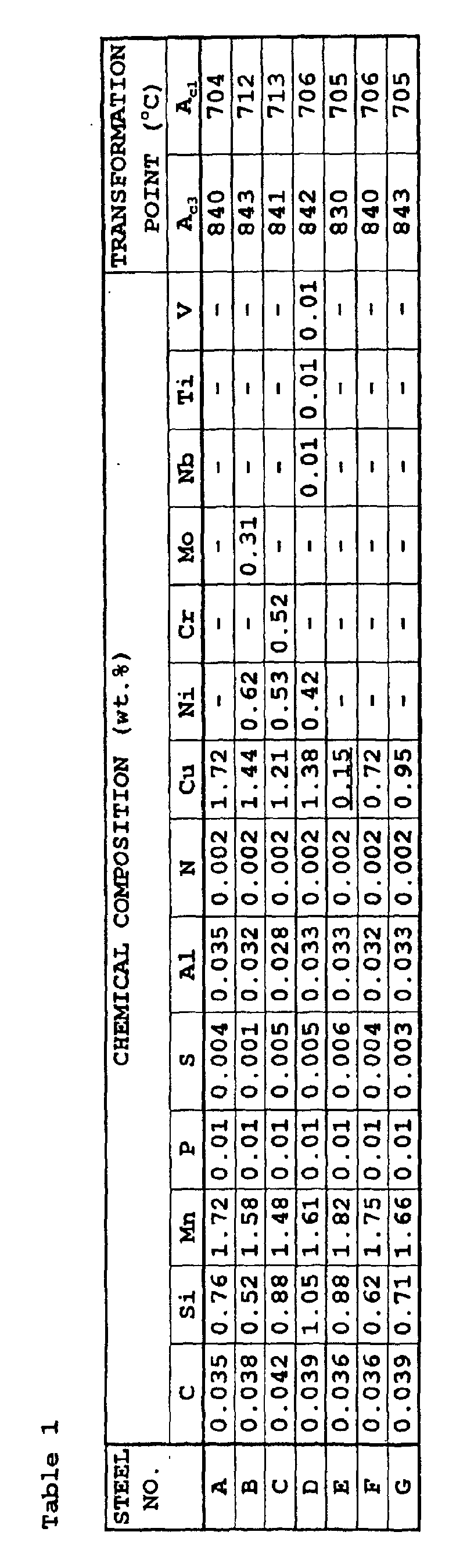
| STEEL SHEET NO. | STEEL NO. | SLAB REHEATING TEMP. SRT °C | HOT ROLLING - COOLING AFTER ROLLING | ||||
| FINISH ROLLING END TEMP. FDT °C | COOLING RATE FROM Ar3 TO Ar1 °C/s | AIR COOLING/SLOW COOLING BETWEEN Ar3 AND Ar1 s | COOLING RATE BEFORE COILING °C | COILING TEMP. CT °C | |||
| 1 | A | 1150 | 850 | 30 | 5 | 30 | 450 |
| 2 | B | 1150 | 850 | 30 | 5 | 30 | 450 |
| 3 | B | 1150 | 850 | 10 | 0 | 20 | 600 |
| 4 | B | 1150 | 700 | 10 | 0 | 10 | 450 |
| 5 | C | 1150 | 850 | 30 | 5 | 30 | 450 |
| 6 | D | 1150 | 850 | 30 | 5 | 30 | 450 |
| 7 | E | 1150 | 850 | 30 | 5 | 30 | 450 |
| 8 | F | 1150 | 850 | 30 | 5 | 30 | 450 |
| 9 | G | 1150 | 850 | 30 | 5 | 30 | 450 |


| STEEL SHEET NO. | STEEL NO. | SLAB REHEATING TEMP. SRT °C | HOT ROLLING - COOLING AFTER ROLLING | ||||
| FINISH ROLLING END TEMP. FDT °C | COOLING RATE FROM Ar3 TO Ar1 °C/s | AIR COOLING/SLOW COOLING BETWEEN Ar3 AND Ar1 S | COOLING RATE BEFORE COILING °C | COILING TEMP. CT °C | |||
| 10 | H | 1150 | 850 | 30 | 5 | 30 | 450 |
| 11 | I | 1150 | 850 | 30 | 5 | 30 | 450 |
| 12 | I | 1150 | 850 | 10 | 0 | 20 | 600 |
| 13 | I | 1150 | 850 | 10 | 0 | 10 | 450 |
| 14 | J | 1150 | 850 | 30 | 5 | 30 | 450 |
| 15 | K | 1150 | 850 | 30 | 5 | 30 | 450 |
| 16 | L | 1150 | 850 | 30 | 5 | 30 | 450 |
| 17 | M | 1150 | 850 | 30 | 5 | 30 | 450 |
| 18 | N | 1150 | 850 | 30 | 5 | 30 | 450 |
| 19 | P | 1150 | 850 | 30 | 5 | 30 | 450 |
| 20 | Q | 1150 | 850 | 30 | 5 | 30 | 450 |
| 21 | R | 1150 | 850 | 30 | 5 | 30 | 450 |
| 22 | S | 1150 | 850 | 30 | 5 | 30 | 450 |


| STEEL SHEET NO. | STEEL NO. | SLAB REHEATING TEMP. (°C) | HOT ROLLING STEP | COLD ROLLING STEP | RECRYSTALLIZATION ANNEALING | |
| FINISH ROLLING END TEMP. FDT °C | COILING TEMP. CT °C | COLD ROLLING REDUCTION % | ANNEALING TEMP. (°C) | |||
| 2-1 | 2A | 1150 | 900 | 600 | 70 | 800 |
| 2-2 | 2B | 800 | ||||
| 2-3 | 2B | 980 | ||||
| 2-4 | 2B | 680 | ||||
| 2-5 | 2C | 800 | ||||
| 2-6 | 2D | 800 | ||||
| 2-7 | 2E | 800 | ||||
| 2-8 | 2F | 1150 | 900 | 600 | 70 | 800 |
| 2-9 | 2G | 1150 | 900 | 600 | 70 | 800 |


| STEEL SHEET NO. | STEEL NO. | SLAB REHEATING TEMP. (°C) | HOT ROLLING STEP | COLD ROLLING STEP | RECRYSTALLIZATION ANNEALING | |
| FINISH ROLLING END TEMP. FDT °C | COILING TEMP. CT °C | COLD ROLLING REDUCTION % | ANNEALING TEMP. (°C) | |||
| 2-10 | 2H | 1250 | 900 | 600 | 70 | 800 |
| 2-11 | 2I | 800 | ||||
| 2-12 | 2I | 980 | ||||
| 2-13 | 2I | 680 | ||||
| 2-14 | 2J | 800 | ||||
| 2-15 | 2K | 800 | ||||
| 2-16 | 2L | 800 | ||||
| 2-17 | 2M | 800 | ||||
| 2-18 | 2N | 800 | ||||
| 2-19 | 2P | 800 | ||||
| 2-20 | 2Q | 800 | ||||
| 2-21 | 2R | 800 | ||||
| 2-22 | 2S | 800 | ||||
| 2-23 | 2T | 800 |


Claims (31)
- A steel sheet excellent in press-formability and in strain age hardening property as typically represented by a ΔTS of 80 MPa or more, comprising a structure having ferrite phase as a main phase forming a composite structure with a secondary phase containing martensite phase in an area ratio of 2% or more.
- A steel sheet according to claim 1, which is a hot-rolled steel sheet.
- A steel sheet according to claim 2, comprising, in weight percentage:
C: 0.15% or less, Si: 2.0% or less, Mn: 3.0% or less, P: 0.1% or less, S: 0.02% or less, Al: 0.1% or less, N: 0.02% or less, Cu: from 0.5 to 3.0%, - A steel sheet according to claim 3, containing, in weight percentage, one or more selected from the following groups A to C, in addition to the above-mentioned chemical composition:group A: Ni: 2.0% or less;group B: one or two of Cr and Mo: 2.0% or less in total;
andgroup C: one or more of Nb, Ti and V: 0.2% or less in total. - A steel sheet according to claim 2, having a chemical composition comprising, in weight percentage:
C: 0.15% or less, Si: 2.0% or less, Mn: 3.0% or less, P: 0.1% or less, S: 0.02%, or less Al: 0.1% or less, N: 0.02% or less, - A steel sheet according to claim 5, further comprising, in addition to the above-mentioned chemical composition, in weight percentage, one or more selected from the group consisting of Nb, Ti, and V, 2.0% or less in total.
- A manufacturing method of a steel sheet excellent in press-formability and in strain age hardening property as typically represented by a ΔTS of 80 MPa or more, comprising the steps, when hot-rolling a steel slab having a chemical composition comprising, in weight percentage:
C: 0.15% or less, Si: 2.0% or less, Mn: 3.0% or less, P: 0.1% or less, S: 0.02% or less, Al: 0.1% or less, N: 0.02% or less, and Cu: from 0.5 to 3.0%, - A manufacturing method of a hot-rolled steel sheet according to claim 7, containing, in addition to said chemical composition in weight percentage, one or more selected from the following groups A to C:group A: Ni: 2.0% or less;group B: one or two of Cr and Mo: 2.0% or less in total;
andgroup C: one or more of Nb, Ti and V: 0.2% or less in total. - A manufacturing method of a hot-rolled steel sheet, according to claim 7, wherein said steel slab has a chemical composition containing, in weight percentage:
C: 0.15% or less, Si: 2.0% or less, Mn: 3.0% or less, P: 0.1% or less, S: 0.02% or less, Al: 0.1% or less, N: 0.02% or less, - A manufacturing method of a hot-rolled steel sheet according to any one of claims 7 to 9, wherein all or part of said finish rolling comprises lubrication rolling.
- A steel sheet according to claim 1, which is a cold-rolled steel sheet.
- A steel sheet according to claim 11, comprising, in weight percentage:
C: 0.15% or less, Si: 2.0% or less, Mn: 3.0% or less, P: 0.1% or less, S: 0.02% or less, Al: 0.1% or less, N: 0.02% or less, Cu: from 0.5 to 3.0%, - A steel sheet according to claim 12, containing, in weight percentage, one or more selected from the following groups A to C, in addition to the above-mentioned chemical composition:group: Ni: 2.0% or less;group B: one or two of Cr and Mo: 2.0% or less in total;
andgroup C: one or more of Nb, Ti and V: 0.2% or less in total. - A steel sheet according to claim 11, having a chemical composition comprising, in weight percentage:
C: 0.15% or less, Si: 2.0% or less, Mn: 3.0% or less, P: 0.1% or less, S: 0.02% or less, Al: 0.1% or less, N: 0.02% or less, - A steel sheet according to claim 14, further comprising, in addition to the above-mentioned chemical composition, in weight percentage, one or more selected from the group consisting of Nb, Ti and V, 2.0% or less in total.
- A manufacturing method of a cold-rolled steel sheet excellent in press-formability and in strain age hardening property typically represented by a ΔTS of 80 MPa or more, comprising the steps of using a steel slab having a chemical composition containing, in weight percentage:
C: 0.15% or less, Si: 2.0% or less, Mn: 3.0% or less, P: 0.1% or less, S: 0.02% or less, Al: 0.1% or less, N: 0.02% or less, and Cu: from 0.5 to 3.0% - A manufacturing method of a cold-rolled steel sheet according to claim 16, containing, in addition to said chemical composition in weight percentage, one or more selected from the following groups A to C:group A: Ni: 2.0% or less;group B: one or two of Cr and Mo: 2.0% or less in total;
andgroup C: one or more of Nb, Ti and V: 0.2% or less in total. - A manufacturing method of a cold-rolled steel sheet according to claim 16, wherein said steel slab has a chemical composition containing, in weight percentage:
C: 0.15% or less, Si: 2.0% or less, Mn: 3.0% or less, P: 0.1% or less, S: 0.02% or less, Al: 0.1% or less, N: 0.02% or less, - A manufacturing method of a cold-rolled steel sheet according to any one of claims 16 to 18, wherein said hot rolling is conducted under conditions including a heating temperature of said material of 900°C or more, a finish rolling end temperature of 700°C or more, and a coiling temperature of 800°C or below.
- A manufacturing method of a cold-rolled steel sheet according to any one of claims 16 to 19, wherein all or part of said hot rolling comprises lubrication rolling.
- A hot-dip galvanized steel sheet comprising a hot-dip galvanizing layer or an alloyed hot-dip galvanizing layer formed on the surface of the steel sheet according to any one of claims 2 to 6.
- A hot-dip galvanized steel sheet comprising a hot-dip galvanizing layer or an alloyed hot-dip galvanizing layer formed on the surface of the steel sheet according to any one of claims 11 to 15.
- A manufacturing method of a hot-dip galvanized steel sheet excellent in press-formability, and in strain age hardening property as typically represented by a ΔTS of 80 MPa or more, comprising the steps of using a steel sheet having a chemical composition containing, in weight percentage:
C: 0.15% or less, Si: 2.0% or less, Mn: 3.0% or less, P: 0.1% or less, S: 0.02% or less, Al: 0.1% or less, N: 0.02% or less, and Cu: from 0.5 to 3.0%, - A manufacturing method of a hot-dip galvanized steel sheet according to claim 23, further containing, in weight percentage, in addition to said chemical composition, one or more of the following groups A to C:group A: Ni: 2.0% or less;group B: one or two of Cr and Mo, 0.2% or less in total;
andgroup C: one or more of Nb, Ti and V, 0.2% or less in total. - A manufacturing method of a hot-dip galvanized steel sheet according to claim 23, wherein said steel sheet is replaced by a steel sheet having a chemical composition containing, in weight percentage:
C: 0.15% or less, Si: 2.0% or less, Mn: 3.0% or less, P: 0.1% or less, S: 0.02% or less, Al: 0.1% or less, N: 0.02% or less, - A manufacturing method of a hot-dip galvanized steel sheet according to any one of claims 23 to 25, wherein, prior to said annealing, a preheating treatment of heating the sheet at a temperature of 700°C or more on a continuous annealing line, and then applying a pretreatment comprising a pickling treatment.
- A manufacturing method of a hot-dip galvanized steel sheet according to any one of claims 23 to 26, comprising the steps of conducting said hot-dip galvanizing treatment to form a hot-dip galvanizing layer on the surface of the steel sheet, and then, performing an alloying treatment of said hot-dip galvanizing layer.
- A manufacturing method of a hot-dip galvanized steel sheet excellent in press-formability, and in strain age hardening property as typically represented by a ΔTS of 80 MPa or more according to any one of claims 23 to 27, wherein said steel sheet is a hot-rolled steel sheet manufactured by hot-rolling the material having said chemical composition under conditions including a heating temperature of 900°C or more, a finish rolling end temperature of 700°C or more and a coiling temperature of 800°C or below, or a cold-rolled steel sheet obtained by cold-rolling said hot-rolled steel sheet.
- A manufacturing method of a hot-dip galvanized steel sheet excellent in press-formability and in strain age hardening property as typically represented by a ΔTS of 80 MPa or more, further comprising a step of applying a hot-dip galvanizing treatment to the hot-rolled steel sheet resulting from the manufacturing method of a hot-rolled steel sheet according to any one of claims 7 to 10 to form a hot-dip galvanizing layer on the surface of said hot-rolled steel sheet.
- A manufacturing method of a hot-dip galvanized steel sheet excellent in press-formability and in strain age hardening property as typically represented by a ΔTS of 80 MPa or more, further comprising a step of applying a hot-dip galvanizing treatment to the cold-rolled steel sheet resulting from the manufacturing method of a cold-rolled steel sheet according to any one of claims 16 to 20 to form a hot-dip galvanizing layer on the surface of said cold-rolled steel sheet.
- A manufacturing method of a hot-dip galvanized steel sheet according to any one of claims 29 and 30, further comprising the step of carrying out an alloying treatment after said hot-dip galvanizing treatment.
Applications Claiming Priority (13)
| Application Number | Priority Date | Filing Date | Title |
|---|---|---|---|
| JP2000106340 | 2000-04-07 | ||
| JP2000106340 | 2000-04-07 | ||
| JP2000107870 | 2000-04-10 | ||
| JP2000107870 | 2000-04-10 | ||
| JP2000114933 | 2000-04-17 | ||
| JP2000114933 | 2000-04-17 | ||
| JP2000286009A JP3925064B2 (en) | 2000-04-10 | 2000-09-20 | Hot-dip galvanized steel sheet excellent in press formability and strain age hardening characteristics and method for producing the same |
| JP2000286009 | 2000-09-20 | ||
| JP2000286008A JP3925063B2 (en) | 2000-04-07 | 2000-09-20 | Cold-rolled steel sheet excellent in press formability and strain age hardening characteristics and method for producing the same |
| JP2000286008 | 2000-09-20 | ||
| JP2000299640 | 2000-09-29 | ||
| JP2000299640A JP4670135B2 (en) | 2000-04-17 | 2000-09-29 | Manufacturing method of hot-rolled steel sheet with excellent strain age hardening characteristics |
| PCT/JP2001/002749 WO2001077400A1 (en) | 2000-04-07 | 2001-03-30 | Hot rolled steel plate, cold rolled steel plate and hot dip galvanized steel plate being excellent in strain aging hardening characteristics, and method for their production |
Publications (3)
| Publication Number | Publication Date |
|---|---|
| EP1195447A1 true EP1195447A1 (en) | 2002-04-10 |
| EP1195447A4 EP1195447A4 (en) | 2003-05-02 |
| EP1195447B1 EP1195447B1 (en) | 2006-01-04 |
Family
ID=27554759
Family Applications (1)
| Application Number | Title | Priority Date | Filing Date |
|---|---|---|---|
| EP01917697A Expired - Lifetime EP1195447B1 (en) | 2000-04-07 | 2001-03-30 | Hot rolled steel plate, cold rolled steel plate and hot dip galvanized steel plate being excellent in strain aging hardening characteristics, and method for their production |
Country Status (9)
| Country | Link |
|---|---|
| US (5) | US6676774B2 (en) |
| EP (1) | EP1195447B1 (en) |
| KR (1) | KR100664433B1 (en) |
| CN (2) | CN1295353C (en) |
| AT (1) | ATE315112T1 (en) |
| AU (1) | AU780588B2 (en) |
| CA (1) | CA2372388C (en) |
| DE (1) | DE60116477T2 (en) |
| WO (1) | WO2001077400A1 (en) |
Cited By (20)
| Publication number | Priority date | Publication date | Assignee | Title |
|---|---|---|---|---|
| EP1264911A3 (en) * | 2001-06-06 | 2003-05-02 | Kawasaki Steel Corporation | High-ductility steel sheet excellent in press formability and strain age hardenability, and method for manufacturing the same |
| WO2003057928A1 (en) * | 2002-01-14 | 2003-07-17 | Usinor | Method for the production of a siderurgical product made of carbon steel with a high copper content, and siderurgical product obtained according to said method |
| WO2004094681A1 (en) * | 2003-04-21 | 2004-11-04 | Jfe Steel Corporation | High strength hot-rolled steel plate |
| EP1394276A4 (en) * | 2001-06-07 | 2006-01-18 | Jfe Steel Corp | High tensile hot-rolled steel sheet excellent in resistance to scuff on mold andin fatigue characteristics |
| WO2006103991A1 (en) | 2005-03-28 | 2006-10-05 | Kabushiki Kaisha Kobe Seiko Sho | High strength hot rolled steel sheet excellent in bore expanding workability and method for production thereof |
| WO2008082134A1 (en) * | 2006-12-28 | 2008-07-10 | Posco | Dual phase steel having superior deep drawing, and method for manufacturing of it |
| WO2008110670A1 (en) * | 2007-03-14 | 2008-09-18 | Arcelormittal France | Steel for hot working or quenching with a tool having an improved ductility |
| EP2135967A4 (en) * | 2007-04-11 | 2011-01-19 | Nippon Steel Corp | FORGER STEEL |
| DE112006003169B4 (en) * | 2005-12-01 | 2013-03-21 | Posco | Steel sheets for hot press forming with excellent heat treatment and impact properties, hot pressed parts produced therefrom and process for their production |
| CN102996896A (en) * | 2012-09-28 | 2013-03-27 | 蚌埠市昊业滤清器有限公司 | Water drain valve core structure with wear-resistant layer |
| WO2013149734A1 (en) * | 2012-04-05 | 2013-10-10 | Tata Steel Ijmuiden B.V. | Steel strip having a low si content |
| EP2138600A4 (en) * | 2007-03-30 | 2014-01-01 | Jfe Steel Corp | High-strength hot-dip zinc-coated steel sheet |
| EP2169083A4 (en) * | 2007-07-11 | 2015-05-20 | Jfe Steel Corp | PROCESS FOR PRODUCING HIGH STRENGTH COLD LAMINATED STEEL SHEET WITH LOW LIMIT OF ELASTICITY AND LESS MATERIAL QUALITY FLUCTUATIONS |
| EP2762580A4 (en) * | 2011-09-29 | 2015-06-03 | Jfe Steel Corp | HOT DIP GALVANIZED STEEL SHEET, AND METHOD OF MANUFACTURING THE SAME |
| EP2933346A4 (en) * | 2012-12-11 | 2016-01-20 | Nippon Steel & Sumitomo Metal Corp | HOT ROLLED STEEL SHEET AND MANUFACTURING METHOD THEREOF |
| CN105378128A (en) * | 2013-07-03 | 2016-03-02 | Posco公司 | Hot-rolled steel sheet having excellent workability and anti-aging properties and method for manufacturing same |
| EP2169091A4 (en) * | 2007-07-11 | 2016-11-30 | Jfe Steel Corp | HIGH-FIXED FIRE-GRAINED STEEL PLATE WITH LOW STRENGTH AND LESS MATERIAL QUALITY FLAIRING AND METHOD OF MANUFACTURING THEREOF |
| EP2184374A4 (en) * | 2007-07-11 | 2017-01-04 | JFE Steel Corporation | High-strength hot-dip galvanized steel sheet and process for producing the same |
| EP2562286A4 (en) * | 2010-04-22 | 2017-05-03 | JFE Steel Corporation | High strength hot-dip galvanized steel sheet with superior workability and production method therefor |
| CN109604336A (en) * | 2018-10-24 | 2019-04-12 | 首钢京唐钢铁联合有限责任公司 | Method and device for preparing hot-dip galvanized sheet |
Families Citing this family (65)
| Publication number | Priority date | Publication date | Assignee | Title |
|---|---|---|---|---|
| JP3794230B2 (en) * | 2000-01-28 | 2006-07-05 | Jfeスチール株式会社 | Manufacturing method of high workability steel pipe |
| US6676774B2 (en) * | 2000-04-07 | 2004-01-13 | Jfe Steel Corporation | Hot rolled steel plate and cold rolled steel plate being excellent in strain aging hardening characteristics |
| JP4530606B2 (en) * | 2002-06-10 | 2010-08-25 | Jfeスチール株式会社 | Manufacturing method of ultra-high strength cold-rolled steel sheet with excellent spot weldability |
| US20040238082A1 (en) * | 2002-06-14 | 2004-12-02 | Jfe Steel Corporation | High strength cold rolled steel plate and method for production thereof |
| FR2844281B1 (en) * | 2002-09-06 | 2005-04-29 | Usinor | HIGH MECHANICAL STRENGTH STEEL AND METHOD OF MANUFACTURING SHEET OF ZINC-COATED STEEL OR ZINC ALLOY STEEL |
| CA2520814C (en) | 2003-03-31 | 2009-09-15 | Nippon Steel Corporation | Alloyed molten zinc plated steel sheet and process of production of same |
| JP4206029B2 (en) * | 2003-11-05 | 2009-01-07 | 新日本製鐵株式会社 | Hot-rolled steel sheet with excellent chemical conversion and its manufacturing method |
| WO2005068676A1 (en) * | 2004-01-14 | 2005-07-28 | Nippon Steel Corporation | Hot dip zinc plated high strength steel sheet excellent in plating adhesiveness and hole expanding characteristics |
| JP4510488B2 (en) * | 2004-03-11 | 2010-07-21 | 新日本製鐵株式会社 | Hot-dip galvanized composite high-strength steel sheet excellent in formability and hole expansibility and method for producing the same |
| US20050205169A1 (en) * | 2004-03-22 | 2005-09-22 | Alwin Mary E | High copper low alloy steel sheet |
| US20080264525A1 (en) * | 2004-03-22 | 2008-10-30 | Nucor Corporation | High copper low alloy steel sheet |
| CN100519805C (en) * | 2004-03-31 | 2009-07-29 | 杰富意钢铁株式会社 | High-rigidity/high-strength thin steel sheet and manufacturing method therefor |
| US20080118390A1 (en) * | 2004-03-31 | 2008-05-22 | Jfe Steel Corporation | High-Stiffness High-Strength Thin Steel Sheet and Method For Producing the Same |
| CN100485072C (en) * | 2004-03-31 | 2009-05-06 | 杰富意钢铁株式会社 | High-rigidity high-strength sheet steel and preparation method thereof |
| US20070144633A1 (en) * | 2004-03-31 | 2007-06-28 | Taro Kizu | High-stiffness high-strength thin steel sheet and method for producing the same |
| JP4358707B2 (en) * | 2004-08-24 | 2009-11-04 | 新日本製鐵株式会社 | High-tensile steel material having excellent weldability and toughness and tensile strength of 550 MPa class or higher and method for producing the same |
| US7442268B2 (en) * | 2004-11-24 | 2008-10-28 | Nucor Corporation | Method of manufacturing cold rolled dual-phase steel sheet |
| US8337643B2 (en) * | 2004-11-24 | 2012-12-25 | Nucor Corporation | Hot rolled dual phase steel sheet |
| US7959747B2 (en) * | 2004-11-24 | 2011-06-14 | Nucor Corporation | Method of making cold rolled dual phase steel sheet |
| US7717976B2 (en) * | 2004-12-14 | 2010-05-18 | L&P Property Management Company | Method for making strain aging resistant steel |
| JP4555694B2 (en) * | 2005-01-18 | 2010-10-06 | 新日本製鐵株式会社 | Bake-hardening hot-rolled steel sheet excellent in workability and method for producing the same |
| WO2007067014A1 (en) * | 2005-12-09 | 2007-06-14 | Posco | Tole d'acier laminee a froid de haute resistance possedant une excellente propriete de formabilite et de revetement, tole d'acier plaquee de metal a base de zinc fabriquee a partir de cette tole et procece de fabrication de celle-ci |
| JP5157146B2 (en) * | 2006-01-11 | 2013-03-06 | Jfeスチール株式会社 | Hot-dip galvanized steel sheet |
| JP4855163B2 (en) * | 2006-01-18 | 2012-01-18 | 新日本製鐵株式会社 | Enamel processed products |
| CN100554479C (en) * | 2006-02-23 | 2009-10-28 | 株式会社神户制钢所 | The high tensile steel plate of excellent in workability |
| US20070260258A1 (en) * | 2006-05-05 | 2007-11-08 | Robert Sommerich | Access and delivery needle for percutaneous vertebroplasty |
| US11155902B2 (en) | 2006-09-27 | 2021-10-26 | Nucor Corporation | High strength, hot dip coated, dual phase, steel sheet and method of manufacturing same |
| US7608155B2 (en) * | 2006-09-27 | 2009-10-27 | Nucor Corporation | High strength, hot dip coated, dual phase, steel sheet and method of manufacturing same |
| KR100833078B1 (en) * | 2006-12-22 | 2008-05-27 | 주식회사 포스코 | High strength hot rolled steel sheet with excellent weather resistance |
| KR100891834B1 (en) * | 2007-06-08 | 2009-04-07 | 주식회사 포스코 | High strength hot dip galvanized steel sheet with excellent yield strength and surface quality and its manufacturing method |
| EP2209926B1 (en) * | 2007-10-10 | 2019-08-07 | Nucor Corporation | Complex metallographic structured steel and method of manufacturing same |
| KR100957981B1 (en) * | 2007-12-20 | 2010-05-19 | 주식회사 포스코 | High strength cold rolled steel, hot dip galvanized steel with excellent workability and its manufacturing method |
| EP2105223A1 (en) * | 2008-03-19 | 2009-09-30 | Nucor Corporation | Strip casting apparatus with casting roll positioning |
| US20090236068A1 (en) | 2008-03-19 | 2009-09-24 | Nucor Corporation | Strip casting apparatus for rapid set and change of casting rolls |
| KR101103203B1 (en) * | 2008-03-26 | 2012-01-05 | 신닛뽄세이테쯔 카부시키카이샤 | Hot rolled steel sheet possessing excellent fatigue properties and stretch-flange ability and process for producing the hot rolled steel sheet |
| US20090288798A1 (en) * | 2008-05-23 | 2009-11-26 | Nucor Corporation | Method and apparatus for controlling temperature of thin cast strip |
| US8820615B2 (en) * | 2008-07-11 | 2014-09-02 | Aktiebolaget Skf | Method for manufacturing a steel component, a weld seam, a welded steel component, and a bearing component |
| KR101024800B1 (en) * | 2008-08-28 | 2011-03-24 | 현대제철 주식회사 | Ultra-high strength hot-dip galvanized steel sheet with excellent plating and workability and its manufacturing method |
| KR101105003B1 (en) * | 2008-11-29 | 2012-01-16 | 주식회사 포스코 | Steel plate excellent in corrosion resistance in strong acid saline solution and its manufacturing method |
| KR101125931B1 (en) * | 2008-11-29 | 2012-03-21 | 주식회사 포스코 | High toughness ship-building steel with excellent general corrosion and pitting corrosion resistance at low ph chloride solution and manufacturing method for the same |
| KR101091294B1 (en) * | 2008-12-24 | 2011-12-07 | 주식회사 포스코 | Manufacturing method of high strength high tensile steel sheet and hot rolled steel sheet, cold rolled steel sheet, galvanized steel sheet and galvanized alloy steel sheet |
| JP4623233B2 (en) * | 2009-02-02 | 2011-02-02 | Jfeスチール株式会社 | High-strength hot-dip galvanized steel sheet and manufacturing method thereof |
| US20100215981A1 (en) * | 2009-02-20 | 2010-08-26 | Nucor Corporation | Hot rolled thin cast strip product and method for making the same |
| MX2011012371A (en) | 2009-05-27 | 2011-12-08 | Nippon Steel Corp | High-strength steel sheet, hot-dipped steel sheet, and alloy hot-dipped steel sheet that have excellent fatigue, elongation, and collision characteristics, and manufacturing method for said steel sheets. |
| JP5740847B2 (en) * | 2009-06-26 | 2015-07-01 | Jfeスチール株式会社 | High-strength hot-dip galvanized steel sheet and manufacturing method thereof |
| JP4811528B2 (en) | 2009-07-28 | 2011-11-09 | Jfeスチール株式会社 | High-strength cold-rolled steel sheet and manufacturing method thereof |
| ES2795653T3 (en) | 2009-11-09 | 2020-11-24 | Nippon Steel Corp | High strength steel sheet having excellent processability and paint bake hardenability, and method to produce the high strength steel sheet |
| JP5765116B2 (en) * | 2010-09-29 | 2015-08-19 | Jfeスチール株式会社 | High-strength hot-dip galvanized steel sheet excellent in deep drawability and stretch flangeability and method for producing the same |
| JP5825481B2 (en) * | 2010-11-05 | 2015-12-02 | Jfeスチール株式会社 | High-strength cold-rolled steel sheet excellent in deep drawability and bake hardenability and its manufacturing method |
| CN102169063A (en) * | 2010-12-27 | 2011-08-31 | 宝钢集团新疆八一钢铁有限公司 | Method for quickly detecting scale defect on surface of hot-rolled pickled plate |
| KR101242953B1 (en) * | 2010-12-27 | 2013-03-12 | 주식회사 포스코 | Coating Method and Zinc Coating Device |
| KR101417294B1 (en) * | 2012-06-21 | 2014-07-08 | 주식회사 포스코 | Hot-rolled steel sheet having excellent multi-corrosion resistant and weldability and method for manufacturing thereof |
| KR101417295B1 (en) * | 2012-06-21 | 2014-07-08 | 주식회사 포스코 | Cold-rolled steel sheet having excellent sulfuric acid-corrosion resistant and surface properties and method for manufacturing thereof |
| CN103143857B (en) * | 2013-04-01 | 2014-12-17 | 武汉科技大学 | Copper-containing high-intensity high-toughness submerged arc welding wire and welding process thereof |
| CN104419887A (en) * | 2013-09-05 | 2015-03-18 | 鞍钢股份有限公司 | Production method of zinc-aluminum-magnesium coated steel plate with high coating hardness and coated steel plate |
| RU2562734C1 (en) * | 2014-05-12 | 2015-09-10 | Публичное акционерное общество "Северсталь" (ПАО "Северсталь") | High-strength cold-resistant steel |
| KR101701627B1 (en) * | 2015-07-17 | 2017-02-01 | 현대제철 주식회사 | Manufacturing method for plated steel sheet using hot press forming |
| CN108103410B (en) * | 2018-03-05 | 2020-05-26 | 嘉兴德基机械设计有限公司 | A kind of pipeline steel with yield strength ≥910MPa and preparation method thereof |
| WO2020239891A1 (en) * | 2019-05-28 | 2020-12-03 | Tata Steel Ijmuiden B.V. | Steel strip, sheet or blank for producing a hot-stamped part, part, and method for hot-stamping a blank into a part |
| CN112658031A (en) * | 2020-12-10 | 2021-04-16 | 华菱安赛乐米塔尔汽车板有限公司 | Control method for improving edge forming of cold-rolled hot-galvanized high-strength dual-phase steel |
| CN113136528A (en) * | 2021-04-23 | 2021-07-20 | 唐山全丰薄板有限公司 | 1500 MPa-grade ultrahigh-strength cold-rolled steel plate for automobiles and manufacturing method thereof |
| CN113584395B (en) * | 2021-08-05 | 2022-07-26 | 攀钢集团攀枝花钢铁研究院有限公司 | 450 MPa-grade hot-galvanized dual-phase steel and production method thereof |
| KR20230092609A (en) * | 2021-12-17 | 2023-06-26 | 주식회사 포스코 | Cold-rolled steel sheet with excellent weldability and method of manufacturing thereof |
| CN115216607B (en) * | 2022-06-30 | 2023-11-10 | 武汉钢铁有限公司 | Control method for alloying speck defect of hot dip galvanized iron alloy outer plate |
| CN116275692B (en) * | 2023-02-16 | 2025-05-16 | 南京钢铁股份有限公司 | A gas shielded welding wire and welding method for welding E47BCA and E47 |
Family Cites Families (51)
| Publication number | Priority date | Publication date | Assignee | Title |
|---|---|---|---|---|
| US3326647A (en) * | 1966-03-11 | 1967-06-20 | Du Pont | Rolled carbon steel clad with stainless steel |
| JPS55122820A (en) * | 1979-03-13 | 1980-09-20 | Kawasaki Steel Corp | Manufacture of alloyed zinc-plated high tensile steel sheet with superior workability |
| JPS5613437A (en) * | 1979-07-16 | 1981-02-09 | Nisshin Steel Co Ltd | Preparation of high tensile galvanized steel sheet having superior workability |
| JPS5669359A (en) * | 1979-10-16 | 1981-06-10 | Kobe Steel Ltd | Composite structure type high strength cold rolled steel sheet |
| JPS57137426A (en) * | 1981-02-20 | 1982-08-25 | Kawasaki Steel Corp | Production of low yield ratio, high tensile hot rolled steel plate by mixed structure |
| JPH03277743A (en) * | 1990-03-27 | 1991-12-09 | Kawasaki Steel Corp | Ultrahigh tensile strength cold rolled steel sheet and its manufacture |
| ES2125856T5 (en) * | 1990-08-17 | 2004-09-16 | Jfe Steel Corporation | HIGH RESISTANCE STEEL SHEET FOR PRESS FORMATION AND PRODUCTION METHOD OF THE SAME. |
| JPH05345916A (en) * | 1991-01-29 | 1993-12-27 | Nippon Steel Corp | Production of high strength hot rolled steel plate for automobile under carriage parts excellent in stretch flange formability and corrosion resistance |
| US5356494A (en) * | 1991-04-26 | 1994-10-18 | Kawasaki Steel Corporation | High strength cold rolled steel sheet having excellent non-aging property at room temperature and suitable for drawing and method of producing the same |
| US5290370A (en) * | 1991-08-19 | 1994-03-01 | Kawasaki Steel Corporation | Cold-rolled high-tension steel sheet having superior deep drawability and method thereof |
| FR2687520B1 (en) * | 1992-02-14 | 1994-05-06 | France Telecom | METHOD FOR IMPLANTING THE INFRASTRUCTURE OF A CELLULAR COMMUNICATION NETWORK. |
| EP0559225B1 (en) * | 1992-03-06 | 1999-02-10 | Kawasaki Steel Corporation | Producing steel sheet having high tensile strength and excellent stretch flanging formability |
| CA2097900C (en) * | 1992-06-08 | 1997-09-16 | Saiji Matsuoka | High-strength cold-rolled steel sheet excelling in deep drawability and method of producing the same |
| DE69329236T2 (en) | 1992-06-22 | 2001-04-05 | Nippon Steel Corp., Tokio/Tokyo | COLD ROLLED STEEL SHEET WITH GOOD BURNING TEMPERATURE, WITHOUT COLD AGING AND EXCELLENT PORNABILITY, DIVER-COATED COLD ROLLED STEEL SHEET AND THEIR PRODUCTION PROCESS |
| JPH0681081A (en) | 1992-08-31 | 1994-03-22 | Nippon Steel Corp | Cold roller steel sheet and galvanized cold rolled steel sheet combining excellent baking hardenability and cold nonaging property as well and production thereof |
| EP0585843A3 (en) * | 1992-08-28 | 1996-06-26 | Toyota Motor Co Ltd | High-formability steel plate with a great potential for strength enhancement by high-density energy treatment |
| US5690755A (en) * | 1992-08-31 | 1997-11-25 | Nippon Steel Corporation | Cold-rolled steel sheet and hot-dip galvanized cold-rolled steel sheet having excellent bake hardenability, non-aging properties at room temperature and good formability and process for producing the same |
| JPH06240366A (en) * | 1993-02-12 | 1994-08-30 | Nippon Steel Corp | Production of high strength galvannealed cold rolled steel sheet excellent in deep drawability |
| JPH06264149A (en) * | 1993-03-09 | 1994-09-20 | Kobe Steel Ltd | Production of high strength galvannealed steel sheet for deep drawing, having baking hardenability |
| JPH0734135A (en) * | 1993-07-14 | 1995-02-03 | Kobe Steel Ltd | Production of high strength galvannealed steel sheet for high working excellent in plating adhesion |
| JPH07179946A (en) * | 1993-12-24 | 1995-07-18 | Kawasaki Steel Corp | Highly workable high-strength cold-rolled steel sheet with excellent secondary work brittleness resistance |
| US6580904B2 (en) * | 1994-04-28 | 2003-06-17 | Metro One Telecommunications, Inc. | Method of providing directional assistance to a mobile telephone subscriber |
| JPH0860240A (en) * | 1994-08-22 | 1996-03-05 | Kobe Steel Ltd | Production of high strength hot rolled steel sheet for working excellent in endurance strength |
| JP3039842B2 (en) * | 1994-12-26 | 2000-05-08 | 川崎製鉄株式会社 | Hot-rolled and cold-rolled steel sheets for automobiles having excellent impact resistance and methods for producing them |
| DE69607702T2 (en) * | 1995-02-03 | 2000-11-23 | Nippon Steel Corp., Tokio/Tokyo | High-strength conduit steel with a low yield strength-tensile strength ratio and excellent low-temperature toughness |
| BG100572A (en) | 1995-06-01 | 1996-12-31 | Enichem S.P.A. | Low speed crystallization polyesters and catalytic system for their preparation |
| TW415967B (en) * | 1996-02-29 | 2000-12-21 | Kawasaki Steel Co | Steel, steel sheet having excellent workability and method of the same by electric furnace-vacuum degassing process |
| JP3497654B2 (en) * | 1996-03-08 | 2004-02-16 | 新日本製鐵株式会社 | Fe-Cu alloy steel having good strength, ductility, and toughness and method for producing the same |
| JP3425837B2 (en) * | 1996-03-28 | 2003-07-14 | 株式会社神戸製鋼所 | High-strength hot-rolled steel sheet, high-strength galvanized steel sheet excellent in pitting corrosion resistance and crushing properties, and methods for producing them |
| JPH1047982A (en) * | 1996-08-06 | 1998-02-20 | Sony Corp | Position measuring device, position measuring method, navigation device, navigation method, information service method, and automobile |
| CA2283924C (en) * | 1997-03-17 | 2006-11-28 | Nippon Steel Corporation | Dual-phase type high-strength steel sheets having high impact energy absorption properties and a method of producing the same |
| JP3724193B2 (en) * | 1997-06-06 | 2005-12-07 | Jfeスチール株式会社 | High-strength, high-workability hot-rolled steel sheet with excellent impact resistance and low yield ratio |
| JPH1161330A (en) * | 1997-06-09 | 1999-03-05 | Kawasaki Steel Corp | High-strength, high-workability steel sheet with excellent impact resistance and slidability during processing |
| JP3320014B2 (en) * | 1997-06-16 | 2002-09-03 | 川崎製鉄株式会社 | High strength, high workability cold rolled steel sheet with excellent impact resistance |
| JP3755300B2 (en) * | 1997-07-11 | 2006-03-15 | Jfeスチール株式会社 | High-strength, high-workability hot-rolled steel sheet with excellent impact resistance and good sheet crown and method for producing the same |
| KR100498214B1 (en) * | 1997-09-11 | 2005-07-01 | 제이에프이 스틸 가부시키가이샤 | Hot rolled steel plate to be processed having hyper fine particles, method of manufacturing the same, and method of manufacturing cold rolled steel plate |
| JP3752071B2 (en) * | 1998-01-20 | 2006-03-08 | 新日本製鐵株式会社 | Hot-rolled steel sheet for machining excellent in fatigue characteristics and method for producing the same |
| JP3899680B2 (en) * | 1998-05-29 | 2007-03-28 | Jfeスチール株式会社 | Paint bake-hardening type high-tensile steel sheet and manufacturing method thereof |
| JPH11350064A (en) * | 1998-06-08 | 1999-12-21 | Kobe Steel Ltd | High strength steel sheet excellent in shape fixability and impact resistance and its production |
| JP3793350B2 (en) * | 1998-06-29 | 2006-07-05 | 新日本製鐵株式会社 | Dual-phase high-strength cold-rolled steel sheet with excellent dynamic deformation characteristics and manufacturing method thereof |
| CA2310335C (en) * | 1998-09-29 | 2009-05-19 | Kawasaki Steel Corporation | High strength thin steel sheet, high strength galvannealed steel sheet and manufacturing method thereof |
| US6465114B1 (en) * | 1999-05-24 | 2002-10-15 | Nippon Steel Corporation | -Zn coated steel material, ZN coated steel sheet and painted steel sheet excellent in corrosion resistance, and method of producing the same |
| US6312536B1 (en) * | 1999-05-28 | 2001-11-06 | Kabushiki Kaisha Kobe Seiko Sho | Hot-dip galvanized steel sheet and production thereof |
| JP4272302B2 (en) * | 1999-06-10 | 2009-06-03 | 新日本製鐵株式会社 | High-strength steel sheet with excellent formability and weldability and method for producing the same |
| DE19936151A1 (en) * | 1999-07-31 | 2001-02-08 | Thyssenkrupp Stahl Ag | High-strength steel strip or sheet and process for its manufacture |
| JP3750789B2 (en) * | 1999-11-19 | 2006-03-01 | 株式会社神戸製鋼所 | Hot-dip galvanized steel sheet having excellent ductility and method for producing the same |
| WO2001053554A1 (en) * | 2000-01-24 | 2001-07-26 | Nkk Corporation | Hot dip zinc plated steel sheet and method for producing the same |
| US6676774B2 (en) * | 2000-04-07 | 2004-01-13 | Jfe Steel Corporation | Hot rolled steel plate and cold rolled steel plate being excellent in strain aging hardening characteristics |
| US20030015263A1 (en) * | 2000-05-26 | 2003-01-23 | Chikara Kami | Cold rolled steel sheet and galvanized steel sheet having strain aging hardening property and method for producing the same |
| US6786981B2 (en) * | 2000-12-22 | 2004-09-07 | Jfe Steel Corporation | Ferritic stainless steel sheet for fuel tank and fuel pipe |
| CA2387322C (en) * | 2001-06-06 | 2008-09-30 | Kawasaki Steel Corporation | High-ductility steel sheet excellent in press formability and strain age hardenability, and method for manufacturing the same |
-
2001
- 2001-03-30 US US09/980,300 patent/US6676774B2/en not_active Expired - Lifetime
- 2001-03-30 DE DE60116477T patent/DE60116477T2/en not_active Expired - Lifetime
- 2001-03-30 KR KR1020017015687A patent/KR100664433B1/en not_active Expired - Fee Related
- 2001-03-30 CN CNB2003101015966A patent/CN1295353C/en not_active Expired - Fee Related
- 2001-03-30 AT AT01917697T patent/ATE315112T1/en not_active IP Right Cessation
- 2001-03-30 CA CA002372388A patent/CA2372388C/en not_active Expired - Fee Related
- 2001-03-30 CN CNB018014909A patent/CN1147609C/en not_active Expired - Fee Related
- 2001-03-30 EP EP01917697A patent/EP1195447B1/en not_active Expired - Lifetime
- 2001-03-30 AU AU44664/01A patent/AU780588B2/en not_active Ceased
- 2001-03-30 WO PCT/JP2001/002749 patent/WO2001077400A1/en not_active Ceased
-
2003
- 2003-05-02 US US10/428,571 patent/US20040108024A1/en not_active Abandoned
- 2003-05-02 US US10/428,881 patent/US6814819B2/en not_active Expired - Lifetime
- 2003-05-02 US US10/429,013 patent/US20030213535A1/en not_active Abandoned
- 2003-05-02 US US10/429,018 patent/US7396420B2/en not_active Expired - Fee Related
Cited By (42)
| Publication number | Priority date | Publication date | Assignee | Title |
|---|---|---|---|---|
| EP1264911A3 (en) * | 2001-06-06 | 2003-05-02 | Kawasaki Steel Corporation | High-ductility steel sheet excellent in press formability and strain age hardenability, and method for manufacturing the same |
| US7485194B2 (en) | 2001-06-07 | 2009-02-03 | Jfe Steel Corporation | High tensile hot-rolled steel sheet excellent in resistance to scuff on mold and in fatigue characteristics |
| EP1394276A4 (en) * | 2001-06-07 | 2006-01-18 | Jfe Steel Corp | High tensile hot-rolled steel sheet excellent in resistance to scuff on mold andin fatigue characteristics |
| WO2003057928A1 (en) * | 2002-01-14 | 2003-07-17 | Usinor | Method for the production of a siderurgical product made of carbon steel with a high copper content, and siderurgical product obtained according to said method |
| FR2834722A1 (en) * | 2002-01-14 | 2003-07-18 | Usinor | MANUFACTURING PROCESS OF A COPPER-RICH CARBON STEEL STEEL PRODUCT, AND THUS OBTAINED STEEL PRODUCT |
| US7425240B2 (en) | 2002-01-14 | 2008-09-16 | Usinor | Method for the production of a siderurgical product made of carbon steel with a high copper content |
| WO2004094681A1 (en) * | 2003-04-21 | 2004-11-04 | Jfe Steel Corporation | High strength hot-rolled steel plate |
| EP1616970A4 (en) * | 2003-04-21 | 2011-01-12 | Jfe Steel Corp | High strength hot-rolled steel plate |
| US7527700B2 (en) | 2003-04-21 | 2009-05-05 | Jfe Steel Corporation | High strength hot rolled steel sheet and method for manufacturing the same |
| WO2006103991A1 (en) | 2005-03-28 | 2006-10-05 | Kabushiki Kaisha Kobe Seiko Sho | High strength hot rolled steel sheet excellent in bore expanding workability and method for production thereof |
| EP1865083A4 (en) * | 2005-03-28 | 2009-02-25 | Kobe Steel Ltd | High strength hot rolled steel sheet excellent in bore expanding workability and method for production thereof |
| US8038809B2 (en) | 2005-03-28 | 2011-10-18 | Kobe Steel, Ltd. | High strength hot rolled steel sheet excellent in bore expanding workability and method for production thereof |
| US8486205B2 (en) | 2005-03-28 | 2013-07-16 | Kobe Steel, Ltd. | High strength hot rolled steel sheet excellent in bore expanding workability and method for production thereof |
| DE112006003169B4 (en) * | 2005-12-01 | 2013-03-21 | Posco | Steel sheets for hot press forming with excellent heat treatment and impact properties, hot pressed parts produced therefrom and process for their production |
| WO2008082134A1 (en) * | 2006-12-28 | 2008-07-10 | Posco | Dual phase steel having superior deep drawing, and method for manufacturing of it |
| WO2008132303A1 (en) * | 2007-03-14 | 2008-11-06 | Arcelormittal France | Steel for tool-less hot forming or quenching with improved ductility |
| WO2008110670A1 (en) * | 2007-03-14 | 2008-09-18 | Arcelormittal France | Steel for hot working or quenching with a tool having an improved ductility |
| US8722203B2 (en) | 2007-03-14 | 2014-05-13 | Arcelormittal France | Steel, for hot forming or quenching in a tool, having improved ductility |
| CN101631880B (en) * | 2007-03-14 | 2012-07-04 | 安赛乐米塔尔法国公司 | Steel for tool-less hot forming or quenching with improved ductility |
| US9611517B2 (en) | 2007-03-14 | 2017-04-04 | Arcelormittal France | Process for manufacturing steel, for hot forming or quenching in a tool, having improved ductility |
| EP2138600A4 (en) * | 2007-03-30 | 2014-01-01 | Jfe Steel Corp | High-strength hot-dip zinc-coated steel sheet |
| EP2135967A4 (en) * | 2007-04-11 | 2011-01-19 | Nippon Steel Corp | FORGER STEEL |
| US9657379B2 (en) | 2007-04-11 | 2017-05-23 | Nippon Steel & Sumitomo Metal Corporation | Forging steel |
| EP2762593A1 (en) * | 2007-04-11 | 2014-08-06 | Nippon Steel & Sumitomo Metal Corporation | Forging steel |
| EP2169091A4 (en) * | 2007-07-11 | 2016-11-30 | Jfe Steel Corp | HIGH-FIXED FIRE-GRAINED STEEL PLATE WITH LOW STRENGTH AND LESS MATERIAL QUALITY FLAIRING AND METHOD OF MANUFACTURING THEREOF |
| EP2184374A4 (en) * | 2007-07-11 | 2017-01-04 | JFE Steel Corporation | High-strength hot-dip galvanized steel sheet and process for producing the same |
| EP2169083A4 (en) * | 2007-07-11 | 2015-05-20 | Jfe Steel Corp | PROCESS FOR PRODUCING HIGH STRENGTH COLD LAMINATED STEEL SHEET WITH LOW LIMIT OF ELASTICITY AND LESS MATERIAL QUALITY FLUCTUATIONS |
| EP2562286A4 (en) * | 2010-04-22 | 2017-05-03 | JFE Steel Corporation | High strength hot-dip galvanized steel sheet with superior workability and production method therefor |
| EP2762580A4 (en) * | 2011-09-29 | 2015-06-03 | Jfe Steel Corp | HOT DIP GALVANIZED STEEL SHEET, AND METHOD OF MANUFACTURING THE SAME |
| WO2013149734A1 (en) * | 2012-04-05 | 2013-10-10 | Tata Steel Ijmuiden B.V. | Steel strip having a low si content |
| CN104411856A (en) * | 2012-04-05 | 2015-03-11 | 塔塔钢铁艾默伊登有限责任公司 | Steel strip with low Si content |
| US9593400B2 (en) | 2012-04-05 | 2017-03-14 | Tata Steel Ijmuiden Bv | Steel strip having a low Si content |
| WO2013149733A1 (en) * | 2012-04-05 | 2013-10-10 | Tata Steel Ijmuiden B.V. | Steel strip having a low si content |
| WO2013149732A1 (en) * | 2012-04-05 | 2013-10-10 | Tata Steel Ijmuiden B.V. | Steel strip having a low si content |
| US9695493B2 (en) | 2012-04-05 | 2017-07-04 | Tata Steel Ijmuiden Bv | Steel strip having a low Si content |
| CN102996896A (en) * | 2012-09-28 | 2013-03-27 | 蚌埠市昊业滤清器有限公司 | Water drain valve core structure with wear-resistant layer |
| EP2933346A4 (en) * | 2012-12-11 | 2016-01-20 | Nippon Steel & Sumitomo Metal Corp | HOT ROLLED STEEL SHEET AND MANUFACTURING METHOD THEREOF |
| US10273566B2 (en) | 2012-12-11 | 2019-04-30 | Nippon Steel & Sumitomo Metal Corporation | Hot-rolled steel sheet and method for producing same |
| CN105378128A (en) * | 2013-07-03 | 2016-03-02 | Posco公司 | Hot-rolled steel sheet having excellent workability and anti-aging properties and method for manufacturing same |
| EP3018227A4 (en) * | 2013-07-03 | 2016-07-20 | Posco | HOT-ROLLED STEEL SHEET HAVING EXCELLENT MACHINING CAPABILITY AND EXCELLENT ANTI-AGING PROPERTIES, AND METHOD FOR MANUFACTURING THE SAME |
| US10196703B2 (en) | 2013-07-03 | 2019-02-05 | Posco | Hot-rolled steel having excellent workability and anti-aging properties |
| CN109604336A (en) * | 2018-10-24 | 2019-04-12 | 首钢京唐钢铁联合有限责任公司 | Method and device for preparing hot-dip galvanized sheet |
Also Published As
| Publication number | Publication date |
|---|---|
| DE60116477D1 (en) | 2006-03-30 |
| US20030201038A1 (en) | 2003-10-30 |
| CN1147609C (en) | 2004-04-28 |
| CN1295353C (en) | 2007-01-17 |
| US20040007297A1 (en) | 2004-01-15 |
| EP1195447A4 (en) | 2003-05-02 |
| AU780588B2 (en) | 2005-04-07 |
| US20040108024A1 (en) | 2004-06-10 |
| WO2001077400A1 (en) | 2001-10-18 |
| US7396420B2 (en) | 2008-07-08 |
| AU4466401A (en) | 2001-10-23 |
| CA2372388C (en) | 2009-05-26 |
| DE60116477T2 (en) | 2006-07-13 |
| ATE315112T1 (en) | 2006-02-15 |
| KR100664433B1 (en) | 2007-01-03 |
| CN1380909A (en) | 2002-11-20 |
| EP1195447B1 (en) | 2006-01-04 |
| US20030111144A1 (en) | 2003-06-19 |
| US6814819B2 (en) | 2004-11-09 |
| US6676774B2 (en) | 2004-01-13 |
| US20030213535A1 (en) | 2003-11-20 |
| CA2372388A1 (en) | 2001-10-18 |
| CN1495278A (en) | 2004-05-12 |
| KR20020021646A (en) | 2002-03-21 |
Similar Documents
| Publication | Publication Date | Title |
|---|---|---|
| EP1195447B1 (en) | Hot rolled steel plate, cold rolled steel plate and hot dip galvanized steel plate being excellent in strain aging hardening characteristics, and method for their production | |
| EP1264911B1 (en) | High-ductility steel sheet excellent in press formability and strain age hardenability, and method for manufacturing the same | |
| EP1338667B1 (en) | Composite structure type high tensile strength steel plate, plated plate of composite structure type high tensile strength steel and method for their production | |
| EP2811047A1 (en) | Hot-dip galvanized steel sheet and production method therefor | |
| JP2006265583A (en) | Hot-rolled steel sheet for hot pressing, manufacturing method thereof, and manufacturing method of hot-press formed member | |
| JP4608822B2 (en) | Highly ductile hot-dip galvanized steel sheet excellent in press formability and strain age hardening characteristics and method for producing the same | |
| CN113316656A (en) | High-strength hot-dip galvanized steel sheet and method for producing same | |
| JP4752522B2 (en) | Manufacturing method of high strength cold-rolled steel sheet for deep drawing | |
| JP4670135B2 (en) | Manufacturing method of hot-rolled steel sheet with excellent strain age hardening characteristics | |
| JP4826694B2 (en) | Method for improving fatigue resistance of thin steel sheet | |
| JP3925064B2 (en) | Hot-dip galvanized steel sheet excellent in press formability and strain age hardening characteristics and method for producing the same | |
| JP3925063B2 (en) | Cold-rolled steel sheet excellent in press formability and strain age hardening characteristics and method for producing the same | |
| JP5017751B2 (en) | Highly ductile hot-rolled steel sheet excellent in press formability and strain age hardening characteristics and method for producing the same | |
| JP4599768B2 (en) | Highly ductile cold-rolled steel sheet excellent in press formability and strain age hardening characteristics and method for producing the same | |
| JP5392223B2 (en) | Hot-rolled steel sheet with excellent strain age hardening characteristics and method for producing the same | |
| JP2007224408A (en) | Hot-rolled steel sheet with excellent strain age hardening characteristics and method for producing the same | |
| JP4325228B2 (en) | Cold-rolled steel sheet excellent in deep drawability and strain age hardening characteristics and method for producing the same | |
| JP3544441B2 (en) | High-strength hot-rolled steel sheet and plated steel sheet with excellent deep drawability and method for producing the same | |
| JP2002115027A (en) | Thin sheet of galvanized soft steel and its production method | |
| JP2003342681A (en) | Composite structure type high-tensile cold-rolled steel sheet and hot-dip galvanized steel sheet excellent in deep drawability and strain age hardening, and methods for producing them |
Legal Events
| Date | Code | Title | Description |
|---|---|---|---|
| PUAI | Public reference made under article 153(3) epc to a published international application that has entered the european phase |
Free format text: ORIGINAL CODE: 0009012 |
|
| AK | Designated contracting states |
Kind code of ref document: A1 Designated state(s): AT BE CH CY DE DK ES FI FR GB GR IE IT LI LU MC NL PT SE TR |
|
| AX | Request for extension of the european patent |
Free format text: AL;LT;LV;MK;RO;SI |
|
| 17P | Request for examination filed |
Effective date: 20020404 |
|
| RIC1 | Information provided on ipc code assigned before grant |
Free format text: 7C 22C 38/00 A, 7C 21D 9/46 B, 7C 23C 2/06 B, 7C 23C 2/28 B, 7C 22C 38/02 B, 7C 22C 38/04 B, 7C 21D 7/13 B, 7C 21D 1/02 B, 7C 21D 8/02 B |
|
| A4 | Supplementary search report drawn up and despatched |
Effective date: 20030313 |
|
| RAP1 | Party data changed (applicant data changed or rights of an application transferred) |
Owner name: JFE STEEL CORPORATION |
|
| 17Q | First examination report despatched |
Effective date: 20031119 |
|
| GRAP | Despatch of communication of intention to grant a patent |
Free format text: ORIGINAL CODE: EPIDOSNIGR1 |
|
| GRAS | Grant fee paid |
Free format text: ORIGINAL CODE: EPIDOSNIGR3 |
|
| GRAA | (expected) grant |
Free format text: ORIGINAL CODE: 0009210 |
|
| AK | Designated contracting states |
Kind code of ref document: B1 Designated state(s): AT BE CH CY DE DK ES FI FR GB GR IE IT LI LU MC NL PT SE TR |
|
| PG25 | Lapsed in a contracting state [announced via postgrant information from national office to epo] |
Ref country code: IT Free format text: LAPSE BECAUSE OF FAILURE TO SUBMIT A TRANSLATION OF THE DESCRIPTION OR TO PAY THE FEE WITHIN THE PRESCRIBED TIME-LIMIT;WARNING: LAPSES OF ITALIAN PATENTS WITH EFFECTIVE DATE BEFORE 2007 MAY HAVE OCCURRED AT ANY TIME BEFORE 2007. THE CORRECT EFFECTIVE DATE MAY BE DIFFERENT FROM THE ONE RECORDED. Effective date: 20060104 Ref country code: BE Free format text: LAPSE BECAUSE OF FAILURE TO SUBMIT A TRANSLATION OF THE DESCRIPTION OR TO PAY THE FEE WITHIN THE PRESCRIBED TIME-LIMIT Effective date: 20060104 Ref country code: AT Free format text: LAPSE BECAUSE OF FAILURE TO SUBMIT A TRANSLATION OF THE DESCRIPTION OR TO PAY THE FEE WITHIN THE PRESCRIBED TIME-LIMIT Effective date: 20060104 Ref country code: FI Free format text: LAPSE BECAUSE OF FAILURE TO SUBMIT A TRANSLATION OF THE DESCRIPTION OR TO PAY THE FEE WITHIN THE PRESCRIBED TIME-LIMIT Effective date: 20060104 Ref country code: CH Free format text: LAPSE BECAUSE OF FAILURE TO SUBMIT A TRANSLATION OF THE DESCRIPTION OR TO PAY THE FEE WITHIN THE PRESCRIBED TIME-LIMIT Effective date: 20060104 Ref country code: NL Free format text: LAPSE BECAUSE OF FAILURE TO SUBMIT A TRANSLATION OF THE DESCRIPTION OR TO PAY THE FEE WITHIN THE PRESCRIBED TIME-LIMIT Effective date: 20060104 Ref country code: LI Free format text: LAPSE BECAUSE OF FAILURE TO SUBMIT A TRANSLATION OF THE DESCRIPTION OR TO PAY THE FEE WITHIN THE PRESCRIBED TIME-LIMIT Effective date: 20060104 |
|
| REG | Reference to a national code |
Ref country code: GB Ref legal event code: FG4D |
|
| REG | Reference to a national code |
Ref country code: CH Ref legal event code: EP |
|
| REG | Reference to a national code |
Ref country code: IE Ref legal event code: FG4D |
|
| PG25 | Lapsed in a contracting state [announced via postgrant information from national office to epo] |
Ref country code: IE Free format text: LAPSE BECAUSE OF NON-PAYMENT OF DUE FEES Effective date: 20060330 |
|
| REF | Corresponds to: |
Ref document number: 60116477 Country of ref document: DE Date of ref document: 20060330 Kind code of ref document: P |
|
| PG25 | Lapsed in a contracting state [announced via postgrant information from national office to epo] |
Ref country code: LU Free format text: LAPSE BECAUSE OF NON-PAYMENT OF DUE FEES Effective date: 20060331 Ref country code: MC Free format text: LAPSE BECAUSE OF NON-PAYMENT OF DUE FEES Effective date: 20060331 |
|
| PG25 | Lapsed in a contracting state [announced via postgrant information from national office to epo] |
Ref country code: SE Free format text: LAPSE BECAUSE OF FAILURE TO SUBMIT A TRANSLATION OF THE DESCRIPTION OR TO PAY THE FEE WITHIN THE PRESCRIBED TIME-LIMIT Effective date: 20060404 Ref country code: DK Free format text: LAPSE BECAUSE OF FAILURE TO SUBMIT A TRANSLATION OF THE DESCRIPTION OR TO PAY THE FEE WITHIN THE PRESCRIBED TIME-LIMIT Effective date: 20060404 |
|
| PG25 | Lapsed in a contracting state [announced via postgrant information from national office to epo] |
Ref country code: ES Free format text: LAPSE BECAUSE OF FAILURE TO SUBMIT A TRANSLATION OF THE DESCRIPTION OR TO PAY THE FEE WITHIN THE PRESCRIBED TIME-LIMIT Effective date: 20060415 |
|
| PG25 | Lapsed in a contracting state [announced via postgrant information from national office to epo] |
Ref country code: PT Free format text: LAPSE BECAUSE OF FAILURE TO SUBMIT A TRANSLATION OF THE DESCRIPTION OR TO PAY THE FEE WITHIN THE PRESCRIBED TIME-LIMIT Effective date: 20060605 |
|
| ET | Fr: translation filed | ||
| NLV1 | Nl: lapsed or annulled due to failure to fulfill the requirements of art. 29p and 29m of the patents act | ||
| REG | Reference to a national code |
Ref country code: CH Ref legal event code: PL |
|
| PLBE | No opposition filed within time limit |
Free format text: ORIGINAL CODE: 0009261 |
|
| STAA | Information on the status of an ep patent application or granted ep patent |
Free format text: STATUS: NO OPPOSITION FILED WITHIN TIME LIMIT |
|
| 26N | No opposition filed |
Effective date: 20061005 |
|
| PG25 | Lapsed in a contracting state [announced via postgrant information from national office to epo] |
Ref country code: GR Free format text: LAPSE BECAUSE OF FAILURE TO SUBMIT A TRANSLATION OF THE DESCRIPTION OR TO PAY THE FEE WITHIN THE PRESCRIBED TIME-LIMIT Effective date: 20060405 |
|
| PG25 | Lapsed in a contracting state [announced via postgrant information from national office to epo] |
Ref country code: TR Free format text: LAPSE BECAUSE OF FAILURE TO SUBMIT A TRANSLATION OF THE DESCRIPTION OR TO PAY THE FEE WITHIN THE PRESCRIBED TIME-LIMIT Effective date: 20060104 |
|
| PG25 | Lapsed in a contracting state [announced via postgrant information from national office to epo] |
Ref country code: CY Free format text: LAPSE BECAUSE OF FAILURE TO SUBMIT A TRANSLATION OF THE DESCRIPTION OR TO PAY THE FEE WITHIN THE PRESCRIBED TIME-LIMIT Effective date: 20060104 |
|
| REG | Reference to a national code |
Ref country code: FR Ref legal event code: PLFP Year of fee payment: 16 |
|
| PGFP | Annual fee paid to national office [announced via postgrant information from national office to epo] |
Ref country code: DE Payment date: 20160322 Year of fee payment: 16 |
|
| PGFP | Annual fee paid to national office [announced via postgrant information from national office to epo] |
Ref country code: FR Payment date: 20160208 Year of fee payment: 16 Ref country code: GB Payment date: 20160330 Year of fee payment: 16 |
|
| REG | Reference to a national code |
Ref country code: DE Ref legal event code: R119 Ref document number: 60116477 Country of ref document: DE |
|
| GBPC | Gb: european patent ceased through non-payment of renewal fee |
Effective date: 20170330 |
|
| REG | Reference to a national code |
Ref country code: FR Ref legal event code: ST Effective date: 20171130 |
|
| PG25 | Lapsed in a contracting state [announced via postgrant information from national office to epo] |
Ref country code: FR Free format text: LAPSE BECAUSE OF NON-PAYMENT OF DUE FEES Effective date: 20170331 Ref country code: DE Free format text: LAPSE BECAUSE OF NON-PAYMENT OF DUE FEES Effective date: 20171003 |
|
| PG25 | Lapsed in a contracting state [announced via postgrant information from national office to epo] |
Ref country code: GB Free format text: LAPSE BECAUSE OF NON-PAYMENT OF DUE FEES Effective date: 20170330 |