EP1198165A2 - Shielding method using a ferrite encapsulate coating - Google Patents
Shielding method using a ferrite encapsulate coating Download PDFInfo
- Publication number
- EP1198165A2 EP1198165A2 EP01124468A EP01124468A EP1198165A2 EP 1198165 A2 EP1198165 A2 EP 1198165A2 EP 01124468 A EP01124468 A EP 01124468A EP 01124468 A EP01124468 A EP 01124468A EP 1198165 A2 EP1198165 A2 EP 1198165A2
- Authority
- EP
- European Patent Office
- Prior art keywords
- magnetic field
- encapsulant
- ferrite particles
- electronic unit
- recited
- Prior art date
- Legal status (The legal status is an assumption and is not a legal conclusion. Google has not performed a legal analysis and makes no representation as to the accuracy of the status listed.)
- Granted
Links
Images


Classifications
-
- H—ELECTRICITY
- H05—ELECTRIC TECHNIQUES NOT OTHERWISE PROVIDED FOR
- H05K—PRINTED CIRCUITS; CASINGS OR CONSTRUCTIONAL DETAILS OF ELECTRIC APPARATUS; MANUFACTURE OF ASSEMBLAGES OF ELECTRICAL COMPONENTS
- H05K9/00—Screening of apparatus or components against electric or magnetic fields
- H05K9/0073—Shielding materials
- H05K9/0075—Magnetic shielding materials
-
- H—ELECTRICITY
- H05—ELECTRIC TECHNIQUES NOT OTHERWISE PROVIDED FOR
- H05K—PRINTED CIRCUITS; CASINGS OR CONSTRUCTIONAL DETAILS OF ELECTRIC APPARATUS; MANUFACTURE OF ASSEMBLAGES OF ELECTRICAL COMPONENTS
- H05K1/00—Printed circuits
- H05K1/02—Details
- H05K1/0213—Electrical arrangements not otherwise provided for
- H05K1/0216—Reduction of cross-talk, noise or electromagnetic interference
- H05K1/023—Reduction of cross-talk, noise or electromagnetic interference using auxiliary mounted passive components or auxiliary substances
- H05K1/0233—Filters, inductors or a magnetic substance
-
- H—ELECTRICITY
- H05—ELECTRIC TECHNIQUES NOT OTHERWISE PROVIDED FOR
- H05K—PRINTED CIRCUITS; CASINGS OR CONSTRUCTIONAL DETAILS OF ELECTRIC APPARATUS; MANUFACTURE OF ASSEMBLAGES OF ELECTRICAL COMPONENTS
- H05K3/00—Apparatus or processes for manufacturing printed circuits
- H05K3/22—Secondary treatment of printed circuits
- H05K3/28—Applying non-metallic protective coatings
- H05K3/284—Applying non-metallic protective coatings for encapsulating mounted components
Definitions
- the present invention relates generally to magnetic field absorption, and more particularly, to a ferrite encapsulate coating used for magnetic field absorption.
- Metal-based housings are traditionally utilized to protect electronic circuitry from magnetic field interference. Although these devices effectively accomplish the task, the additional cost and added bulk of metal-based housings frequently prevent their incorporation into a final product. Many different products and methods have evolved which improve on both the cost and bulk issues of metal-based housings, but these products and methods also have their own limitations.
- U.S Pat. No. 4,474,676 discloses a shielding material partially consisting of ferrite flakes.
- the shielding material typically is disbursed into the plastic housing of a device that emits electromagnetic interference (EMI), such as a computer CPU.
- EMI electromagnetic interference
- the shielding material in the plastic housing reduces the amount of EMI radiated into external surroundings. While the material disclosed in '676 may be effective at reducing EMI emissions, it does not absorb magnetic radiation. Instead it reduces the amount of EMI radiated into the environment.
- U.S. Pat. No. 5,547,599 discloses an epoxy film.
- the epoxy film is comprised mainly of a random distribution of ferrite particles in powder form.
- the epoxy film covers word straps, which are conductive fixtures, on plated wire memory devices and protects them from EMI radiation emitted by external sources.
- word straps which are conductive fixtures, on plated wire memory devices and protects them from EMI radiation emitted by external sources.
- the epoxy film must be heat cured. Because the epoxy film requires heat curing, it is ill suited for application on heat sensitive components.
- An additional limitation concerns the random distribution of the ferrite particles after the film is cured. Because the ferrite particles are not concentrated in the locations on the word straps that are most affected by EMI radiation, the epoxy film's ability to absorb the magnetic radiation is reduced.
- U.S. Pat. No. 6,063,511 discloses a typically ferrite-based film to absorb EMI radiation.
- the film of '511 is sprayed onto a surface susceptible to EMI radiation.
- the thickness of most ferrite flakes in this film must be less than the skin depth of all frequencies of EMI radiation that need to be protected against.
- One limitation of this film is that only the predetermined frequencies of EMI radiation are protected against; thus, any component covered with this film is vulnerable to EMI radiation of an unanticipated frequency.
- '599 because the ferrite flakes' location is fixed, they are not able to travel to the location on the component that is most affected by EMI radiation.
- an improved and reliable means to absorb a magnetic field is provided. Another object of the invention is to decrease the costs associated with providing a means to absorb a magnetic field. A third object of the invention is to use ferrite particle migration in order to achieve a more efficient magnetic field absorbing device.
- a method to absorb magnetic field interference begins by placing an electronic unit, such as a seat control module, into a fixture.
- the electronic unit contains at least one electrical component, such as a microchip, requiring the reduction of a magnetic field.
- the microchip can be surrounded by a containment apparatus, such as a mold, into which encapsulant is poured.
- exclusion devices such as masks, protect components that should not be coated with encapsulant.
- the ferrite particles When the ferrite particles are exposed to magnetic field interference, they migrate along the generated field lines and absorb the magnetic field interference. After the new distribution of ferrite particles occurs, the encapsulant can be cured. Curing the encapsulant causes the ferrite particles to be frozen in place along the field lines, allowing for continuous protection of the microchip.
- the present invention thus achieves an improved method to absorb a magnetic field.
- the present invention is advantageous because it is less expensive and occupies considerably less space than metal-based magnetic field absorbing devices.
- the present invention also minimizes heat buildup on the encapsulate-coated components.
- the present invention illustrates a method for absorbing active, external and dynamic magnetic fields using a ferrite encapsulate coating particularly suited for covering electronic units.
- the present invention also applies to various other uses that may require a method for absorbing active, external and dynamic magnetic fields using a ferrite encapsulate coating.
- FIGURE 1 a flow diagram illustrating the initial steps of the process 10 to protect an electrical component, such as a microchip 12, on an electronic unit 14 from magnetic field interference 16 in accordance with one embodiment of the present invention is shown.
- an electrical component such as a microchip 12
- the process is merely one representation of many possible processes to use a ferrite encapsulate coating to protect components on an electronic unit 14. Further, this process can be used to protect other components by coating the radiating component with encapsulant.
- microchips 12 are merely one type of electrical component that may need to be protected from magnetic field interference 16.
- the electronic unit 14 is initially placed inside a fixture 18.
- a number of containment apparatuses such as molds 20, can be placed around microchips 12 that need to be covered with encapsulant (not shown).
- the molds 20 serve to provide structure for the encapsulant while still in its liquid state, much like an ice cube tray provides structure for water.
- molds 20 are merely one type of containment apparatus that can be used to provide structure for the encapsulant. Once the encapsulant hardens and no longer needs the structural support the molds 20 provide, the molds 20 are removed. In the event the entire electronic unit 14 must be covered with encapsulant, molds 20 are not used.
- exclusion apparatuses such as masks 22, can also be added to the electronic unit 14.
- Masks 22 serve to prevent encapsulate from being poured onto components where it is not needed.
- masks 22 are merely one type of exclusion apparatus that can be used to prevent encapsulant from being poured on a microchip 12. As in the case with molds 20, if the entire electronic unit 14 must be covered with encapsulant, masks 22 are not used.
- a source of magnetic field interference 16 is needed.
- the magnetic field interference 16 can be created actively by the microchip 12 itself.
- a power supply 25 generates the current and voltage necessary to activate the microchip 12.
- a power supply 25 is merely one many possible ways to activate a microchip 12.
- the magnetic field interference 16 can also be created passively by an external source. For example, if a first electronic unit were placed in close proximity to a second unit that produced magnetic field interference, the second unit would be a source of magnetic field interference to the first. In the process depicted in FIGURE 1, placing at least one magnet 24 into the fixture 18 creates passive magnetic field interference 16.
- magnets 24 are merely one way to simulate external magnetic field interference 16.
- the magnet's 24 position in the fixture should mimic the expected location of external magnetic field interference 16 the microchip 12 will experience once the electronic unit 14 is installed into a product.
- the magnet's 24 strength should mimic the strength of the external magnetic field interference that the microchip 12 will experience.
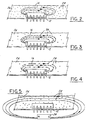
- FIGURE 2 a microchip 12, initially coated with encapsulant 26, actively producing magnetic field interference 16 according to one embodiment of the present invention is illustrated. Because the ferrite particles 28 in the encapsulant 26 have not been allowed time to migrate, their distribution remains random throughout the encapsulant 26.
- FIGURE 3 the relative location of the ferrite particles 28 after time has been allotted for migration according to one embodiment of the present invention is depicted.
- the random distribution of ferrite particles 28 in FIGURE 2 has given way to a new distribution ordered along the field lines of the active magnetic field interference 16. Once enough time passes for the ferrite particles 28 to migrate to their new location along the field lines, the encapsulant 28 is cured.
- the method used to cure the encapsulant 28 depends upon a number of factors, including, but not limited to, the chemical composition of the ferrite, the microchip's 12 ability to tolerate heat, the speed at which the encapsulant 26 must be cured and whether the entire electronic unit (best seen in FIGURE 1) is coated with encapsulant 26.
- the overall effect the ferrite particles 28 have on absorbing the active magnetic field interference 16 is illustrated.
- the ferrite particles 28 are fixed in their location along the field lines created by the active magnetic field interference 16. In this fixed location, the ferrite particles 28 will absorb the energy generated by the active magnetic field interference 16, thus weakening overall field strength. Because of the reduction in field strength, the active magnetic field interference 16 will have a reduced effect on surrounding components that are sensitive to radiated emissions.
- FIGURE 5 a microchip 12, initially coated with encapsulant 26 and exposed to passive magnetic field interference 16 according to one embodiment of the present invention, is illustrated.
- an external magnet 24 passively creates magnetic field interference 16.
- the ferrite particles 28 are randomly distributed throughout the encapsulant 26 when the encapsulant is initially applied to the microchip 12.
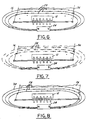
- FIGURE 6 the ferrite particle 28 distribution after migration, while exposed to passive magnetic field interference 16, according to one embodiment of the present invention is depicted.
- the ferrite particles 28, originally distributed randomly throughout the encapsulant 26, are now concentrated along the field lines generated by the external magnet 24. Once enough time passes to allow most of the ferrite particles 28 to migrate to their new location along the field lines of the magnetic field interference 16, the encapsulant 28 is cured.
- the method used to cure the encapsulant 28 depends upon a number of factors, including, but not limited to, the chemical composition of the ferrite, the microchip's 12 ability to tolerate heat, the speed at which the encapsulant 26 must be cured and whether the entire electronic unit (best seen in FIGURE 1)) is coated with encapsulant 26.
- the overall effect the ferrite particles 28 have on absorbing the passive magnetic field interference 16 is illustrated.
- the ferrite particles 28 are fixed in their location along the field lines created by the external magnet 24. In this fixed location, the ferrite particles 28 will absorb the energy generated by the magnetic field interference 16, thus weakening overall field strength. Because of the reduction in field strength, the microchip's 12 performance improves.
- ferrite particles 28 absorbing initial dynamic magnetic field interference 16 when the encapsulant 26 is uncured are depicted.
- the ferrite particles 28 are concentrated along the field lines generated by the external magnet 24.
- the magnetic field interference 30 in this example is dynamic; thus, in order to allow the ferrite particles to freely migrate as the direction or strength of the magnetic field interference 30 changes, the encapsulant 26 is not cured.
- ferrite particle 28 migration when the magnetic field interference 16 characteristics change is illustrated. Because the encapsulant 26 is uncured, the ferrite particles are free to migrate to any location where magnetic interference exists. Here, the direction of the magnetic field interference 30 is changing. Because the natural tendency of ferrite particles 28 is to align with the strongest magnetic field present, the ferrite particles 28 will migrate from their locations along the "old,” fading magnetic field interference 30 to new locations along the field lines of the "new" magnetic field interference 32.
- the new location of the ferrite particles 28 in response to the changed characteristics of the dynamic magnetic field interference 32 is shown.
- the ferrite particles 28 are now in alignment with the "new" magnetic field interference 32. If the strength or direction of the "new" magnetic field interference 32 changes again in the future, the ferrite particles 28, because the encapsulant remains uncured, are free to migrate to yet another new location of magnetic field interference (not shown).
Landscapes
- Engineering & Computer Science (AREA)
- Microelectronics & Electronic Packaging (AREA)
- Physics & Mathematics (AREA)
- Electromagnetism (AREA)
- Shielding Devices Or Components To Electric Or Magnetic Fields (AREA)
- Hard Magnetic Materials (AREA)
Abstract
Description
Claims (10)
- A device to absorb magnetic fields that interfere with electrical components comprising:an electronic unit containing at least one first electrical component requiring a reduction of a magnetic field; andan encapsulant, partially comprised of ferrite particles, wherein said ferrite particles, when exposed to said magnetic field interference, migrate along magnetic field lines and absorb said magnetic field.
- The device as recited in claim 1 wherein said encapsulant comprises a base material comprising a non-conductive liquid polymer with low hygroscopic tendencies and ferrite particles where size and chemical composition of said ferrite particles are adjusted in accordance with magnetic field frequency.
- The device as recited in claim 2 wherein said encapsulant further comprises reactants that enable curing of said encapsulant when said encapsulant is catalytic.
- The device as recited in claim 1 wherein said at least one first electrical component, on said electronic unit, produces said magnetic field.
- The device as recited in claim 1 wherein at least one second component external to said electronic unit produces said magnetic field.
- The device as recited in claim 1 wherein at least one first electrical component produces a dynamic magnetic field.
- The device as recited in claim 1 wherein at least one second component external to said electronic unit produces a dynamic magnetic field.
- A system for absorbing magnetic field interference on an electronic unit comprising:an electronic unit containing at least one first electrical component requiring a reduction of a magnetic field;an encapsulant, partially comprised of ferrite particles, wherein ferrite particle size and chemical composition are adjusted in accordance with magnetic field frequency and wherein said ferrite particles, when exposed to said magnetic field interference, migrate along the magnetic field lines and absorb said magnetic field and wherein said encapsulant is partially comprised of a base material comprising a non-conductive liquid polymer with low hygroscopic tendencies; anda magnetic field wherein said magnetic field adversely affects component performance.
- The system as recited in claim 8 further comprising at least one containment apparatus used to keep said encapsulant on said at least one first electrical component.
- A method for absorbing magnetic field interference comprising the steps of:placing electronic unit into a fixture;exposing said electronic unit to a magnetic field;filling said at least one mold with said encapsulant; andallotting time for said ferrite particles to migrate along magnetic field lines created by said magnetic field.
Applications Claiming Priority (2)
| Application Number | Priority Date | Filing Date | Title |
|---|---|---|---|
| US09/686,189 US6534707B1 (en) | 2000-10-11 | 2000-10-11 | Method for absorbing active, external and dynamic magnetic fields using a ferrite encapsulated coating |
| US686189 | 2000-10-11 |
Publications (3)
| Publication Number | Publication Date |
|---|---|
| EP1198165A2 true EP1198165A2 (en) | 2002-04-17 |
| EP1198165A3 EP1198165A3 (en) | 2002-10-16 |
| EP1198165B1 EP1198165B1 (en) | 2004-06-23 |
Family
ID=24755288
Family Applications (1)
| Application Number | Title | Priority Date | Filing Date |
|---|---|---|---|
| EP01124468A Expired - Lifetime EP1198165B1 (en) | 2000-10-11 | 2001-10-11 | Shielding method using a ferrite encapsulate coating |
Country Status (3)
| Country | Link |
|---|---|
| US (1) | US6534707B1 (en) |
| EP (1) | EP1198165B1 (en) |
| DE (1) | DE60103963T2 (en) |
Cited By (4)
| Publication number | Priority date | Publication date | Assignee | Title |
|---|---|---|---|---|
| DE202009017289U1 (en) | 2009-12-22 | 2010-03-25 | Volkswagen Ag | Control panel for operating a mobile phone in a motor vehicle |
| EP2180672A2 (en) | 2008-10-23 | 2010-04-28 | Volkswagen AG | Mobile device system for a motor vehicle |
| DE102009050529A1 (en) | 2009-10-23 | 2011-04-28 | Volkswagen Ag | Mobile device i.e. personal digital assistant, system for land vehicle, has adapter including position determination unit, where position determination unit calculates proposed route from location of adapter to destination |
| CN105556659A (en) * | 2013-10-15 | 2016-05-04 | 英特尔公司 | Magnetic shielded integrated circuit package |
Families Citing this family (10)
| Publication number | Priority date | Publication date | Assignee | Title |
|---|---|---|---|---|
| GB0104910D0 (en) * | 2001-02-28 | 2001-04-18 | Ibm | Devices to reduce electro-magnetic field radiation |
| JP3916889B2 (en) * | 2001-06-08 | 2007-05-23 | ソニー株式会社 | Semiconductor sealing resin composition and semiconductor device using the same |
| US7730823B1 (en) * | 2005-01-15 | 2010-06-08 | Cedar Ridge Research Llc | Magnetic damping field armor system and method |
| WO2007002376A2 (en) * | 2005-06-24 | 2007-01-04 | Konarka Technologies, Inc. | Method of preparing electrode |
| EP1902476B1 (en) * | 2005-07-12 | 2014-07-09 | Merck Patent GmbH | Method of transferring photovoltaic cells |
| WO2007011742A2 (en) * | 2005-07-14 | 2007-01-25 | Konarka Technologies, Inc. | Cigs photovoltaic cells |
| DE102005046908A1 (en) * | 2005-09-30 | 2007-04-05 | Merck Patent Gmbh | Electrochemical deposition of gray selenium on substrate e.g. non-metal, metalloid, metal, alloy or conductive and metallized ceramic or plastics for use as photosemiconductor in photovoltaics or electronics is carried out from ionic liquid |
| US9121885B2 (en) * | 2010-08-16 | 2015-09-01 | Infineon Technologies Ag | Sensor package and method of manufacturing thereof |
| EP2461657A1 (en) * | 2010-12-02 | 2012-06-06 | Siemens Aktiengesellschaft | Electric assembly and method for producing an assembly |
| US10856455B1 (en) * | 2019-09-05 | 2020-12-01 | The Boeing Company | Electromagnetic interference shielding panels and associated methods |
Family Cites Families (15)
| Publication number | Priority date | Publication date | Assignee | Title |
|---|---|---|---|---|
| US4188605A (en) | 1978-07-21 | 1980-02-12 | Stout Glenn M | Encapsulated Hall effect device |
| JPS6018145B2 (en) | 1980-09-22 | 1985-05-09 | 株式会社日立製作所 | Resin-encapsulated semiconductor device |
| JPS59158016A (en) | 1983-02-28 | 1984-09-07 | ティーディーケイ株式会社 | Electromagnetically shielding material |
| US4698197A (en) * | 1985-02-12 | 1987-10-06 | The United States Of America As Represented By The United States Department Of Energy | Magnetic shielding |
| US5547599A (en) | 1989-03-17 | 1996-08-20 | Raytheon Company | Ferrite/epoxy film |
| JPH0645781A (en) * | 1992-07-22 | 1994-02-18 | Uniden Corp | Electromagnetic wave shielding structure |
| JP2951487B2 (en) * | 1992-09-11 | 1999-09-20 | ユニデン株式会社 | Electromagnetic wave shielding method |
| US5371404A (en) | 1993-02-04 | 1994-12-06 | Motorola, Inc. | Thermally conductive integrated circuit package with radio frequency shielding |
| FI117224B (en) * | 1994-01-20 | 2006-07-31 | Nec Tokin Corp | Electromagnetic piece for removing interference, as well as electronic device and hybrid microcircuit element in which it is used |
| US5677511A (en) | 1995-03-20 | 1997-10-14 | National Semiconductor Corporation | Overmolded PC board with ESD protection and EMI suppression |
| US5785913A (en) * | 1996-05-30 | 1998-07-28 | Westinghouse Electric Corporation | Method of magnetically forming a particle filled polymer having enhanced material characteristics |
| US5709960A (en) | 1996-06-21 | 1998-01-20 | Motorola, Inc. | Mold compound |
| WO1998035382A1 (en) * | 1997-02-10 | 1998-08-13 | Matsushita Electronics Corporation | Resin sealed semiconductor device and method for manufacturing the same |
| US6190509B1 (en) * | 1997-03-04 | 2001-02-20 | Tessera, Inc. | Methods of making anisotropic conductive elements for use in microelectronic packaging |
| GB2345802B (en) * | 1997-08-19 | 2001-08-01 | Taiyo Yuden Kk | Wire wound electronic component |
-
2000
- 2000-10-11 US US09/686,189 patent/US6534707B1/en not_active Expired - Fee Related
-
2001
- 2001-10-11 DE DE60103963T patent/DE60103963T2/en not_active Expired - Fee Related
- 2001-10-11 EP EP01124468A patent/EP1198165B1/en not_active Expired - Lifetime
Cited By (7)
| Publication number | Priority date | Publication date | Assignee | Title |
|---|---|---|---|---|
| EP2180672A2 (en) | 2008-10-23 | 2010-04-28 | Volkswagen AG | Mobile device system for a motor vehicle |
| DE102009050579A1 (en) | 2008-10-23 | 2010-04-29 | Bury Gmbh & Co. Kg | Mobile device system for a motor vehicle |
| DE102009050529A1 (en) | 2009-10-23 | 2011-04-28 | Volkswagen Ag | Mobile device i.e. personal digital assistant, system for land vehicle, has adapter including position determination unit, where position determination unit calculates proposed route from location of adapter to destination |
| DE102009050529B4 (en) | 2009-10-23 | 2020-06-04 | Volkswagen Ag | Mobile device system for a motor vehicle |
| DE202009017289U1 (en) | 2009-12-22 | 2010-03-25 | Volkswagen Ag | Control panel for operating a mobile phone in a motor vehicle |
| DE202010001964U1 (en) | 2009-12-22 | 2010-04-22 | Volkswagen Ag | Control panel for operating a mobile phone in a motor vehicle |
| CN105556659A (en) * | 2013-10-15 | 2016-05-04 | 英特尔公司 | Magnetic shielded integrated circuit package |
Also Published As
| Publication number | Publication date |
|---|---|
| DE60103963T2 (en) | 2005-07-14 |
| EP1198165B1 (en) | 2004-06-23 |
| DE60103963D1 (en) | 2004-07-29 |
| EP1198165A3 (en) | 2002-10-16 |
| US6534707B1 (en) | 2003-03-18 |
Similar Documents
| Publication | Publication Date | Title |
|---|---|---|
| US6534707B1 (en) | Method for absorbing active, external and dynamic magnetic fields using a ferrite encapsulated coating | |
| ES2656009T3 (en) | Powder coating method and apparatus for absorbing electromagnetic interference (EMI) | |
| US9545043B1 (en) | Shielding encapsulation for electrical circuitry | |
| US20160141085A1 (en) | Magnetically Controlled Polymer Nanocomposite Material and Methods for Applying and Curing Same, and Nanomagnetic Composite for RF Applications | |
| US20020148979A1 (en) | Methods and compositions for ionizing radiation shielding | |
| US20170287851A1 (en) | Semiconductor package having an emi shielding layer | |
| WO2020041320A1 (en) | Patterned materials and films and systems and methods for making the same | |
| JPH077099A (en) | Integrated circuit package and method for attenuating electromagnetic radiation | |
| JP2017118015A (en) | Electronic device and method of arranging electromagnetic interference suppressor | |
| JPH05327275A (en) | Electromagnetic shield and manufacture thereof | |
| JP2002020637A (en) | Sealing or embedding compound with electromagnetic shielding properties for manufacturing electronic components | |
| US20030117786A1 (en) | Electromagnetic interference waveguide shield with absorber layer | |
| JP2001068888A (en) | Electromagnetic wave absorber | |
| KR20110111425A (en) | Radiation reduction device | |
| JPH073195U (en) | Exterior structure of hybrid integrated circuit parts | |
| JPH05110283A (en) | Plastic box body and molding method thereof | |
| Sarkar et al. | Analysis of arbitrarily shaped microstrip patch antennas using the sommerfeld formulation | |
| JPH039823A (en) | Method and apparatus for molding electrically conductive resin | |
| JP2857960B2 (en) | Manufacturing method of radio wave absorber | |
| JPS60101011A (en) | Manufacture of resin molded item | |
| US6114447A (en) | Radio frequency-transmissive compositions, methods of forming radio frequency-transmissive compositions | |
| US20030002240A1 (en) | Electrical device having components arranged in a casing and outwardly electromagnetically shielded | |
| JP2001284877A (en) | Electromagnetic wave shielding materials | |
| CN1568139A (en) | Filling adhesive for preventing electromagnetic interference | |
| KR19990046321A (en) | Magnetic net for electricwave shield |
Legal Events
| Date | Code | Title | Description |
|---|---|---|---|
| PUAI | Public reference made under article 153(3) epc to a published international application that has entered the european phase |
Free format text: ORIGINAL CODE: 0009012 |
|
| AK | Designated contracting states |
Kind code of ref document: A2 Designated state(s): AT BE CH CY DE DK ES FI FR GB GR IE IT LI LU MC NL PT SE TR |
|
| AX | Request for extension of the european patent |
Free format text: AL;LT;LV;MK;RO;SI |
|
| 17P | Request for examination filed |
Effective date: 20020613 |
|
| PUAL | Search report despatched |
Free format text: ORIGINAL CODE: 0009013 |
|
| AK | Designated contracting states |
Kind code of ref document: A3 Designated state(s): AT BE CH CY DE DK ES FI FR GB GR IE IT LI LU MC NL PT SE TR |
|
| AX | Request for extension of the european patent |
Free format text: AL;LT;LV;MK;RO;SI |
|
| RIC1 | Information provided on ipc code assigned before grant |
Free format text: 7H 05K 9/00 A, 7H 01Q 17/00 B |
|
| 17Q | First examination report despatched |
Effective date: 20030303 |
|
| AKX | Designation fees paid |
Designated state(s): DE FR GB |
|
| GRAP | Despatch of communication of intention to grant a patent |
Free format text: ORIGINAL CODE: EPIDOSNIGR1 |
|
| GRAS | Grant fee paid |
Free format text: ORIGINAL CODE: EPIDOSNIGR3 |
|
| GRAA | (expected) grant |
Free format text: ORIGINAL CODE: 0009210 |
|
| AK | Designated contracting states |
Kind code of ref document: B1 Designated state(s): DE FR GB |
|
| REG | Reference to a national code |
Ref country code: GB Ref legal event code: FG4D |
|
| REG | Reference to a national code |
Ref country code: IE Ref legal event code: FG4D |
|
| REF | Corresponds to: |
Ref document number: 60103963 Country of ref document: DE Date of ref document: 20040729 Kind code of ref document: P |
|
| ET | Fr: translation filed | ||
| PLBE | No opposition filed within time limit |
Free format text: ORIGINAL CODE: 0009261 |
|
| STAA | Information on the status of an ep patent application or granted ep patent |
Free format text: STATUS: NO OPPOSITION FILED WITHIN TIME LIMIT |
|
| 26N | No opposition filed |
Effective date: 20050324 |
|
| PGFP | Annual fee paid to national office [announced via postgrant information from national office to epo] |
Ref country code: FR Payment date: 20051014 Year of fee payment: 5 |
|
| REG | Reference to a national code |
Ref country code: FR Ref legal event code: ST Effective date: 20070629 |
|
| PGFP | Annual fee paid to national office [announced via postgrant information from national office to epo] |
Ref country code: DE Payment date: 20071025 Year of fee payment: 7 |
|
| PG25 | Lapsed in a contracting state [announced via postgrant information from national office to epo] |
Ref country code: FR Free format text: LAPSE BECAUSE OF NON-PAYMENT OF DUE FEES Effective date: 20061031 |
|
| PGFP | Annual fee paid to national office [announced via postgrant information from national office to epo] |
Ref country code: GB Payment date: 20071023 Year of fee payment: 7 |
|
| GBPC | Gb: european patent ceased through non-payment of renewal fee |
Effective date: 20081011 |
|
| PG25 | Lapsed in a contracting state [announced via postgrant information from national office to epo] |
Ref country code: DE Free format text: LAPSE BECAUSE OF NON-PAYMENT OF DUE FEES Effective date: 20090501 |
|
| PG25 | Lapsed in a contracting state [announced via postgrant information from national office to epo] |
Ref country code: GB Free format text: LAPSE BECAUSE OF NON-PAYMENT OF DUE FEES Effective date: 20081011 |