EP1200272B1 - Wertdokument - Google Patents
Wertdokument Download PDFInfo
- Publication number
- EP1200272B1 EP1200272B1 EP00941978A EP00941978A EP1200272B1 EP 1200272 B1 EP1200272 B1 EP 1200272B1 EP 00941978 A EP00941978 A EP 00941978A EP 00941978 A EP00941978 A EP 00941978A EP 1200272 B1 EP1200272 B1 EP 1200272B1
- Authority
- EP
- European Patent Office
- Prior art keywords
- dye
- value
- document
- molecular sieve
- luminescent substance
- Prior art date
- Legal status (The legal status is an assumption and is not a legal conclusion. Google has not performed a legal analysis and makes no representation as to the accuracy of the status listed.)
- Expired - Lifetime
Links
Images


Classifications
-
- B—PERFORMING OPERATIONS; TRANSPORTING
- B41—PRINTING; LINING MACHINES; TYPEWRITERS; STAMPS
- B41M—PRINTING, DUPLICATING, MARKING, OR COPYING PROCESSES; COLOUR PRINTING
- B41M3/00—Printing processes to produce particular kinds of printed work, e.g. patterns
- B41M3/14—Security printing
- B41M3/144—Security printing using fluorescent, luminescent or iridescent effects
-
- B—PERFORMING OPERATIONS; TRANSPORTING
- B42—BOOKBINDING; ALBUMS; FILES; SPECIAL PRINTED MATTER
- B42D—BOOKS; BOOK COVERS; LOOSE LEAVES; PRINTED MATTER CHARACTERISED BY IDENTIFICATION OR SECURITY FEATURES; PRINTED MATTER OF SPECIAL FORMAT OR STYLE NOT OTHERWISE PROVIDED FOR; DEVICES FOR USE THEREWITH AND NOT OTHERWISE PROVIDED FOR; MOVABLE-STRIP WRITING OR READING APPARATUS
- B42D25/00—Information-bearing cards or sheet-like structures characterised by identification or security features; Manufacture thereof
- B42D25/20—Information-bearing cards or sheet-like structures characterised by identification or security features; Manufacture thereof characterised by a particular use or purpose
- B42D25/29—Securities; Bank notes
-
- Y—GENERAL TAGGING OF NEW TECHNOLOGICAL DEVELOPMENTS; GENERAL TAGGING OF CROSS-SECTIONAL TECHNOLOGIES SPANNING OVER SEVERAL SECTIONS OF THE IPC; TECHNICAL SUBJECTS COVERED BY FORMER USPC CROSS-REFERENCE ART COLLECTIONS [XRACs] AND DIGESTS
- Y10—TECHNICAL SUBJECTS COVERED BY FORMER USPC
- Y10T—TECHNICAL SUBJECTS COVERED BY FORMER US CLASSIFICATION
- Y10T428/00—Stock material or miscellaneous articles
- Y10T428/24—Structurally defined web or sheet [e.g., overall dimension, etc.]
- Y10T428/24802—Discontinuous or differential coating, impregnation or bond [e.g., artwork, printing, retouched photograph, etc.]
- Y10T428/24893—Discontinuous or differential coating, impregnation or bond [e.g., artwork, printing, retouched photograph, etc.] including particulate material
-
- Y—GENERAL TAGGING OF NEW TECHNOLOGICAL DEVELOPMENTS; GENERAL TAGGING OF CROSS-SECTIONAL TECHNOLOGIES SPANNING OVER SEVERAL SECTIONS OF THE IPC; TECHNICAL SUBJECTS COVERED BY FORMER USPC CROSS-REFERENCE ART COLLECTIONS [XRACs] AND DIGESTS
- Y10—TECHNICAL SUBJECTS COVERED BY FORMER USPC
- Y10T—TECHNICAL SUBJECTS COVERED BY FORMER US CLASSIFICATION
- Y10T428/00—Stock material or miscellaneous articles
- Y10T428/24—Structurally defined web or sheet [e.g., overall dimension, etc.]
- Y10T428/24802—Discontinuous or differential coating, impregnation or bond [e.g., artwork, printing, retouched photograph, etc.]
- Y10T428/24893—Discontinuous or differential coating, impregnation or bond [e.g., artwork, printing, retouched photograph, etc.] including particulate material
- Y10T428/24901—Discontinuous or differential coating, impregnation or bond [e.g., artwork, printing, retouched photograph, etc.] including particulate material including coloring matter
-
- Y—GENERAL TAGGING OF NEW TECHNOLOGICAL DEVELOPMENTS; GENERAL TAGGING OF CROSS-SECTIONAL TECHNOLOGIES SPANNING OVER SEVERAL SECTIONS OF THE IPC; TECHNICAL SUBJECTS COVERED BY FORMER USPC CROSS-REFERENCE ART COLLECTIONS [XRACs] AND DIGESTS
- Y10—TECHNICAL SUBJECTS COVERED BY FORMER USPC
- Y10T—TECHNICAL SUBJECTS COVERED BY FORMER US CLASSIFICATION
- Y10T428/00—Stock material or miscellaneous articles
- Y10T428/29—Coated or structually defined flake, particle, cell, strand, strand portion, rod, filament, macroscopic fiber or mass thereof
- Y10T428/2982—Particulate matter [e.g., sphere, flake, etc.]
- Y10T428/2991—Coated
Definitions
- the invention relates to a document of value, such as security, identification card or the like, with at least one authenticity feature in the form of a luminescent substance.
- the invention further relates to a security element with at least one authenticity feature in the form of a luminescent Substance and a method for marking products, wherein the product is provided with a luminescent substance.
- Marking products are particularly useful for security applications long used luminescent substances.
- the advantage of one Such marking is that with suitable lighting of the marked object the luminescent substances with high intensity emit and thus detectable, while areas without the luminescent Substances appear essentially dark. To this The markings can be detected with high sensitivity.
- numerous luminescent substances were used for marking used that have very broad emission bands. This is particularly typical for organic dyes whose luminescence line widths are some Can be 50 nm and more. They also have similar line widths many classic inorganic luminescent substances.
- EP 0 522 627 A1 describes the production of luminescent molecular sieves and their use as lamp fluorescent.
- reactants complexing agents and rare earth ions
- the Cavities of zeolites are introduced, where they react to chelate complexes.
- the chelate complex is fixed inside the cavities.
- colored molecular sieves are the metal salts as color Component included, for a long time under the name "Ultramarine dyes / -pigments known (German Reichspatent No. 1, 1877).
- This pure Inorganic systems are made, for example, by heating zeolite molecular sieves with alkali metal sulfides in a non-oxidizing atmosphere and then in an oxidizing atmosphere at temperatures above 300 ° C (JP-A-63-017 217; JP-A55-071 762).
- Organic dyes are usually made by treating colorless ones Molecular sieves with dye solutions applied to the molecular sieves (see e.g. JP-A-63-0 17 217; JP-A-53-0 22 094 and JP-A-75-0 08 462).
- dye solutions applied to the molecular sieves see e.g. JP-A-63-0 17 217; JP-A-53-0 22 094 and JP-A-75-0 08 462).
- Adhesion is achieved with strongly basic dyes.
- pigments consisting of an inorganic carrier (often layered minerals, zeolites or zeolite-like materials) and an adsorbed colorant, in paints and emulsion paints is known (JP-PS-75-0 08 452).
- JP-PS-75-0 08 452 When using these pigments it is necessary to change the composition choose the color so that the color pigment does not match the surrounding medium reacts in the solvent used is insoluble and uniformly sedimented, which is particularly the case with mixed colors is important. This makes many of them interesting for color production Solvents and binders excluded and the possibilities of mixed color production severely restricted using the pigments described.
- the systems and uses described have in common that the luminescent substances retain their characteristic properties that they also in solutions or as a powder. By installation in the zeolite only slight shifts, especially with organic dyes and broadening of the spectral bands were observed. For the However, these effects are not advantageous when used as a marker. There they overlap the emission bands of numerous different luminescent substances, the selectivity of the detection of the substances is severely restricted. Although there are chemically different substances, the differences are their emission bands often so low that their luminescence over a wide spectral range can be investigated with complex means must be so that identification is possible at all. For many applications is the effort of a clear identification so high, that it can only be carried out in exceptional cases.
- the invention is therefore based on the object of a document of value as well a security element for marking any product with at least propose a luminescent substance that is easy to detect and is identifiable.
- the present invention is used as an authenticity feature for value documents uses a luminescent system in which the line width of dyes greatly reduced by the effect of the stimulated emission is as large as possible in a selected spectral range characteristic narrow-band luminescence lines of different To be able to distinguish between dye matrix systems.
- the stimulated emission processes are caused by the fact that the dyes in a resonator that encloses the dyes.
- the resonator is formed by a molecular sieve crystallite, the surfaces of which Includes luminescence of the dye molecules.
- the luminescent radiation is decoupled via micro-defects in these surfaces.
- any other dye-loaded can be used.
- dyes from the class of pyridines and Rhodamine also dyes from the class of cyanines or coumarins or any other dyes from the class of laser dyes are used become.
- the spectral properties of the dyes can thereby a corresponding chemical modification of the chromophore is set become.
- the molecular sieve used is preferably a Molecular sieve with channel structure and suitable morphology, e.g. out the classes AFI, LTL, MFI, M41S.
- ALPO-5, SAPO-5 (AFI class) as well as MAPO and MAPSO, ELAPO and ELAPSO can be used.
- M stands for any metal, such as. Mn, Mg, Co, Fe, Cr, Zn and EL for an element such as Li, Be, B, Ti, As, Ga, Ge.
- a UV absorber and / or a in the cavities of the molecular sieve UV stabilizer based on sterically hindered amines preferably be stored in a dosage of 0.5 to 3% by weight.
- HALS sterically hindered amines
- a UV absorber For example, Tinuvin-P, Tinuvin 928 (Ciba Geigy) can be used become.
- the sterically hindered amines are, for example around Tinuvin 144 (Ciba Geigy), Tinuvin 123 (Ciba Geigy), HALS 3051 (Clariant) or derivatives thereof.
- UV stabilizers or UV absorbers antioxidants can also be incorporated into the cavities.
- the invention is now based on the knowledge that these systems are very different Suitable for marking applications, as an internal particle Resonator is used to add to the luminescence line width of the system suitable suggestion to greatly reduce. It can therefore be a big one Number of different dyes on the spectral position of their luminescence spectra differ. That is, with the help of these dyes, a variety represented by encodings. The number of different markers can be increased even more if in addition the intensity the emitted radiation is evaluated, which is proportional to the amount of existing luminescent or dye.
- coding systems can be used be formed.
- an object with different of the dyes described above are marked.
- the coding arises from the presence or absence of one or more Particle.
- the characteristic properties of the dye-molecular sieve systems only become apparent when there is intensive optical excitation with light of a suitable wavelength. Due to the threshold behavior of the systems, the optical irradiance must exceed a threshold value that is characteristic of the systems. Typical threshold values are 0.2-4 MW / cm 2 .
- Light sources of suitable wavelength with sufficient radiation power can be used as the excitation source.
- An optical device can be used to concentrate the light from the excitation source on a sufficiently small spot and thus to increase the irradiance of the systems.
- Dyes from the class of pyridines are enclosed in a suitable molecular sieve, such as, for example, an SAPO-5 molecular sieve.
- a suitable molecular sieve such as, for example, an SAPO-5 molecular sieve.
- the dye-loaded molecular sieve When excited with a frequency-doubled Nd: YAG laser, the dye-loaded molecular sieve absorbs in the range of the laser wavelength of 532 nm. With a laser power density of 4 MW / cm 2 , the dye-loaded molecular sieve shows a very narrow-band laser-like fluorescence spectrum in the range of approx. 680 nm.
- Rhodamine is a dye from the class of Rhodamine in a suitable molecular sieve, which belongs for example to the structure type MFI, LTL, EMT, M41S, AFI, CHA.
- a frequency-doubled Nd: YAG laser and a laser power density of 4 MW / cm 2 this substance shows a very narrow-band laser-like fluorescence spectrum in the range of 560 nm.
- a dye from the class of the coumarins is enclosed in a suitable molecular sieve, such as, for example, an A1 PO-5 molecular sieve.
- a suitable molecular sieve such as, for example, an A1 PO-5 molecular sieve.
- the molecular sieve When excited with a Xe Cl excimer laser with a wavelength of 308 nm and a laser power density of 4 MW / cm 2 , the molecular sieve shows a very narrow-band laser-like fluorescence spectrum in the range of 530 nm.
- Evidence of systems must be evidence of at least one of the following characteristic features of the systems include a Differentiation from conventional, non-stimulated emitting luminescent substances to enable.
- the characteristic increase in intensity in a narrow wavelength range with excitation above threshold the characteristic Threshold behavior of the increase in intensity when the Irradiance using a suitable spectrally constricting element be detected in the detection channel.
- the characteristic narrowing of the luminescence line can be determined by the Comparison of the intensities in the characteristic of the dye system narrow wavelength range with the intensity in other wavelength ranges be detected. This happens e.g. using a spectrometer setup sufficient spectral resolution or by measuring in different Detection channels by suitable spectrally selective elements measure the intensity in the required spectral range. In case of transient A characteristic spectral distribution is observed with excitation with an intensity maximum at the characteristic wavelength or characteristic intensity relationships in the different channels, that do not occur with conventional luminescent dyes.
- Another characteristic feature of the systems is the saturation of the optical transition only at much higher luminescence intensities, so that with these systems much higher luminescence intensities can be observed than with conventional luminescent substances.
- the molecular sieves described form microcrystals or crystal-like structures, hereinafter referred to as particles become.
- the particles can be used to mark any objects, in particular of securities, passports, forms, CDs or other everyday products can be used.
- the easiest One possibility is to add the particles to a printing ink.
- the particles can also be added directly to the material of the object become. This is useful, for example, if the object to be secured a document of value, such as a banknote or ID card.
- the particles are preferably the paper pulp added during the manufacture of the banknote paper.
- ID cards on the other hand, one of the top or inlet layers in volume with the Particles.
- the particles can also be incorporated directly into a polymer be embedded.
- the authenticity feature according to the invention can or the dye-loaded molecular sieves also with a kind of camouflage can be combined.
- a label uses two luminescent substances, one of the Fabrics a conventional luminescent substance and the other one according to the invention dye-loaded molecular sieve. With subliminal stimulation both substances behave in the same way, while above-threshold Excitation of the emission behavior of the dye-laden molecular sieve, as already explained, changed.
- a barcode the particles of the invention printed and the spaces between Barcodes with the conventional luminescent substance, so is subliminal Suggestion just to prove a uniformly luminescent field. If the particles according to the invention are excited above threshold narrow in the emission spectrum in the area of the bars of the barcode Luminescence peaks and in this way make the code visible. With help this principle can of course also be any other coding or information is displayed.
- the substances, conventional luminescent substance and molecular sieve according to the invention can also work together in one ink or another Carrier material may be included.
- the excitation is used of the molecular sieve as an additional authenticity feature and increased thus the protection against counterfeiting.
- FIG. 1 shows an inventive value document 1 with an inventive one Security element 2.
- the security element exists 2 from a dashed area in which the actual Authenticity feature, an imprint 3, is arranged.
- This imprint 3 contains the dye-loaded molecular sieve particles according to the invention.
- the security element 2 could also be designed in the form of a label be, which the authenticity feature 3 in the form of an imprint wearing. It is also conceivable for the security element 2 to be in the form of a thread or tape, the authenticity feature 3 on a carrier material, preferably a plastic film is arranged. This tape can either be arranged over the entire surface of the value document 1 are or at least partially embedded in the value document his. This type of insertion is particularly useful for banknotes, which are often provided with so-called "window security threads". Here the security thread is practically in the paper during its manufacture woven in so that it can surface directly in certain areas of the paper occurs.
- FIG. 2 shows the document of value shown in FIG. 1 along the line AA in cross section.
- FIG. 3 shows a further embodiment of the value document according to the invention 1 in cross section along the line A - A.
- the security feature 2 not only from the authenticity feature 3 in the form of an imprint, it also has a tamprint 4, which shows the authenticity feature 3 surrounds in the entire area of the security element 2. that is, the area shown in dashed lines in Fig. 1 is complete with the camouflage 4 provided, except for the area of the authenticity feature 3.
- This Camouflage print 4 contains an ordinary luminescent substance, which also is preferably transparent in the visual spectral range. additionally this luminescent substance shows the same absorption and emission behavior like the particles according to the invention, as long as they have a laser power density below the threshold value characteristic for these particles be stimulated.
- the security element 2 only as uniform perceive luminescent surface.
- excitation above threshold changes the emission behavior of the authenticity feature 3 and through the authenticity mark 3 shown occurs in the form of narrow, very intense emission lines from the luminescent underground, which is formed by the camouflage print 4.
- Fig. 4 shows the absorption spectrum of a dye-loaded according to the invention Molecular sieve in the range of 530 nm.
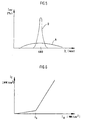
- the authenticity shows one relatively broadband luminescence emission based on spontaneous emission and is represented by curve A in FIG.
- the material shows a very narrow band Emission in the 680 nm range as shown by curve B in FIG. 5 shown.
- the emission intensity I E only grows slowly below the threshold I S with the excitation intensity. Above the threshold value Is the stimulated emission of the dye-loaded molecular sieve sets in, so that the emission intensity grows much faster with the excitation intensity.
- the molecular sieve surrounding the dye acts like a laser resonator that amplifies the luminescent radiation emitted by the dye in a laser-like manner.
Landscapes
- Business, Economics & Management (AREA)
- Accounting & Taxation (AREA)
- Finance (AREA)
- Credit Cards Or The Like (AREA)
- Luminescent Compositions (AREA)
- Investigating, Analyzing Materials By Fluorescence Or Luminescence (AREA)
- Braking Elements And Transmission Devices (AREA)
- Valve Device For Special Equipments (AREA)
- Holo Graphy (AREA)
- Compounds Of Unknown Constitution (AREA)
- Saccharide Compounds (AREA)
- Preparation Of Compounds By Using Micro-Organisms (AREA)
- Polarising Elements (AREA)
Description
DE 41 26 461 beschreibt die Herstellung solcher Materialien sowie deren Einsatz als Pigment und optischen Datenspeicher. Farbstoffe, wie z.B. Phthalocyanine, Phenoxazine, Azofarbstoffe usw. werden irreversibel fixiert, indem das Molekularsieb um den Farbstoff herum in-Situ gebildet wird. Diese Technik wird allgemein als "Crystallisation-Inclusion" bezeichnet (G. Schulz-Ekloff "Nonlinear optical effects of dye-loaded molecular sieves" in Advanced Zeolite Science and Application Studies in Surface Sciences Catalysis, Vol. 85 (1994), 145 -175). Eine weitere Methode zur irreversiblen Fixierung von Farbstoffen in Molekularsieben, die "ship-in-the-bottle-Synthese", wurde z.B. von G. Meyer et al. beschrieben (Zeolites 4 (1984), 30). Hierzu werden Übergangsmetall-ausgetauschte Zeolithe mit o-Phthalodinitril umgesetzt, wobei der Farbstoff (Cobalt-, Nickel- oder KupferPhthalocyanin) in den ca. 12 Å großen Superkäfigen des Faujasits gebildet wird. Da diese Superkäfige nur durch ca. 7 Å bis 8 Å große Öffnungen zugänglich sind, kann zwar das Phthalodinitril in die Hohlräume hineindiffundieren, ein Herausdiffundieren des gebildeten Farbstoffes ist jedoch aus sterischen Gründen nicht mehr möglich.
- Fig. 1
- erfindungsgemäßes Wertdokument mit einem erfindungsgemäßen Echtheitsmerkmal,
- Fig. 2
- Schnitt entlang A - A des Wertdokuments in Fig. 1,
- Fig. 3
- Schnitt entlang A - A einer weiteren Ausführungsform des erfindungsgemäßen Wertdokuments,
- Fig. 4
- Absorptionsspektrum eines erfindungsgemäßen Echtheitsmerkmals,
- Fig. 5
- Emissionsspektrum eines erfindungsgemäßen Echtheitsmerkmals,
- Fig. 6
- Verhalten der Emissionsintensität in Abhängigkeit von der Anregungsintensität eines erfindungsgmäßen Echtheitsmerkmals.
Claims (20)
- Wertdokument (1), wie Wertpapier, Ausweiskarte oder dergleichen, mit wenigstens einem Echtheitsmerkmal (3) in Form einer lumineszierenden Substanz, wobei die lumineszierende Substanz (3) Partikel aufweist, die aus einem farbstoffbeladenen Molekularsieb bestehen, dessen Struktur einen optischen Resonator ausbildet, in dem zumindest ein Farbstoff zu stimulierter Emission angeregt werden kann, wobei der Farbstoff in den Hohlräumen des Molekularsiebs eingebaut ist bzw. sich in oder an den inneren und äußeren Oberflächen des Molekularsiebs befindet und der Übergang zur stimulierten Emission mit einer nachweisbaren Veränderung der Lumineszenzeigenschaften des Farbstoffs einhergeht.
- Wertdokument (1) nach Anspruch 1, dadurch gekennzeichnet, dass die lumineszierende Substanz (3) verschiedene Partikel aufweist, die aus unterschiedlichen farbstoffbeladenen Molekularsieben bestehen.
- Wertdokument (1) nach Anspruch 1 oder 2, dadurch gekennzeichnet, dass Molekularsiebe mit Kanalstruktur, wie z.B. aus den Klassen Aluminophosphate eingesetzt werden.
- Wertdokument (1) nach wenigstens einem der Ansprüche 1 bis 3, dadurch gekennzeichnet, dass die Farbstoffmoleküle aus der Klasse der Laserfarbstoffe eingesetzt werden.
- Wertdokument (1) nach wenigstens einem der Ansprüche 1 bis 4, dadurch gekennzeichnet, dass die Spektraleigenschaften des Farbstoffs durch Wahl der Endgruppen eingestellt wird.
- Wertdokument (1) nach wenigstens einem der Ansprüche 1 bis 5, dadurch gekennzeichnet, dass das Molekularsieb verschiedene anregbare Farbstoffe aufweist.
- Wertdokument (1) nach wenigstens einem der Ansprüche 1 bis 6, dadurch gekennzeichnet, dass das Wertdokument (1) ein weiteres Echtheitsmerkmal aufweist.
- Wertdokument (1) nach Anspruch 7, dadurch gekennzeichnet, dass das zweite Echtheitsmerkmal ein weiterer Lumineszenzstoff ist, der vorzugsweise die gleiche Körperfarbe aufweist wie die lumineszierende Substanz.
- Wertdokument (1) nach wenigstens einem der Ansprüche 1 bis 8, dadurch gekennzeichnet, dass die lumineszierende Substanz (3) im Volumen des Wertdokuments (1) vorliegt.
- Wertdokument (1) nach wenigstens einem der Ansprüche 1 bis 8, dadurch gekennzeichnet, dass die lumineszierende Substanz (3) einer Druckfarbe zugemischt ist.
- Wertdokument (1) nach Anspruch 10, dadurch gekennzeichnet, dass die Druckfarbe in Form einer Codierung, insbesondere eines Barcodes aufgebracht ist.
- Wertdokument (1) nach Anspruch 10 oder 11, dadurch gekennzeichnet, dass die Druckfarbe mit der lumineszierenden Substanz von einer zweiten Druckfarbe mit einer weiteren lumineszierenden Substanz umgeben ist.
- Wertdokument (1) nach wenigstens einem der Ansprüche 10 bis 12, dadurch gekennzeichnet, dass die Druckfarbe zumindest bereichsweise auf dem Wertdokument (1) oder einem Träger aufgebracht ist, der mit dem Wertdokument (1) verbunden ist.
- Wertdokument (1) nach wenigstens einem der Ansprüche 1 bis 8, dadurch gekennzeichnet, dass die lumineszierende Substanz (3) in oder auf einem Sicherheitselement (2) angeordnet ist, das mit dem Wertdokument verbunden ist.
- Sicherheitselement (2) mit wenigstens einem Echtheitsmerkmal (3) in Form einer lumineszierenden Substanz, wobei die lumineszierende Substanz (3) Partikel aufweist, die aus einem farbstoffbeladenen Molekularsieb bestehen, dessen Struktur einen optischen Resonator ausbildet, in dem zumindest ein Farbstoff zu stimulierter Emission angeregt werden kann, wobei der Farbstoff in den Hohlräumen des Molekularsiebs eingebaut ist bzw. sich in oder an den inneren und äußeren Oberflächen des Molekularsiebs befindet und der Übergang zur stimulierten Emission mit einer nachweisbaren Veränderung der Lumineszenzeigenschaften des Farbstoffs einhergeht.
- Sicherheitselement (2) nach Anspruch 15, dadurch gekennzeichnet, dass das Sicherheitselement (2) wenigstens ein Trägermaterial aufweist, in dessen Volumen oder auf dessen Oberfläche die lumineszierende Substanz (3) angeordnet ist.
- Sicherheitselement (2) nach Anspruch 15 oder 16, dadurch gekennzeichnet, dass das Sicherheitselement (2) die Form eines Streifens, Bandes oder Etiketts aufweist.
- Verfahren zur Markierung von Produkten, wobei das Produkt mit einer lumineszierenden Substanz versehen wird, die Partikel aufweist, die aus einem farbstoffbeladenen Molekularsieb bestehen, dessen Struktur einen optischen Resonator ausbildet, in dem zumindest ein Farbstoff zu stimulierter Emission angeregt werden kann, wobei der Farbstoff in den Hohlräumen des Molekularsiebs eingebaut ist bzw. sich in oder an den inneren und äußeren Oberflächen des Molekularsiebs befindet und der Übergang zur stimulierten Emission mit einer nachweisbaren Veränderung der Lumineszenzeigenschaften des Farbstoffs einhergeht.
- Verfahren zur Überprüfung einer lumineszierenden Substanz, die Partikel aufweist, die aus die aus einem farbstoffbeladenen Molekularsieb bestehen, dessen Struktur einen optischen Resonator ausbildet, in dem zumindest ein Farbstoff zu stimulierter Emission angeregt werden kann, wobei der Farbstoff in den Hohlräumen des Molekularsiebs eingebaut ist bzw. sich in oder an den inneren und äußeren Oberflächen des Molekularsiebs befindet und der Übergang zur stimulierten Emission mit einer nachweisbaren Veränderung der Lumineszenzeigenschaften des Farbstoffs einhergeht, wobei die Linienverschmälerung und -verschiebung und/oder das Schwellenverhalten und/oder die Lebensdauerverkürzung als Echtheitsmerkmal verwendet werden.
- Verwendung von farbstoffbeladenen Molekularsieben, welche ohne äußeren Resonator eine stimulierte Lumineszenz zeigen, zur Markierung von Produkten.
Applications Claiming Priority (3)
| Application Number | Priority Date | Filing Date | Title |
|---|---|---|---|
| DE19923959A DE19923959A1 (de) | 1999-05-25 | 1999-05-25 | Wertdokument |
| DE19923959 | 1999-05-25 | ||
| PCT/EP2000/004694 WO2000071363A1 (de) | 1999-05-25 | 2000-05-23 | Wertdokument |
Publications (2)
| Publication Number | Publication Date |
|---|---|
| EP1200272A1 EP1200272A1 (de) | 2002-05-02 |
| EP1200272B1 true EP1200272B1 (de) | 2003-04-16 |
Family
ID=7909145
Family Applications (1)
| Application Number | Title | Priority Date | Filing Date |
|---|---|---|---|
| EP00941978A Expired - Lifetime EP1200272B1 (de) | 1999-05-25 | 2000-05-23 | Wertdokument |
Country Status (10)
| Country | Link |
|---|---|
| US (1) | US6858323B1 (de) |
| EP (1) | EP1200272B1 (de) |
| CN (1) | CN1119250C (de) |
| AT (1) | ATE237479T1 (de) |
| AU (1) | AU5675600A (de) |
| CA (1) | CA2374814C (de) |
| DE (2) | DE19923959A1 (de) |
| MX (1) | MXPA01012084A (de) |
| RU (1) | RU2232422C2 (de) |
| WO (1) | WO2000071363A1 (de) |
Families Citing this family (17)
| Publication number | Priority date | Publication date | Assignee | Title |
|---|---|---|---|---|
| DE10048812B4 (de) * | 2000-09-29 | 2005-07-28 | Orga Systems Gmbh | Datenträger mit mittels energiereichem Strahl personalisierbaren Echtheitsmerkmalen |
| DE10116315A1 (de) | 2001-04-02 | 2002-10-10 | Giesecke & Devrient Gmbh | Farbcodierung zur Kennzeichnung von Gegentänden |
| DE10346632A1 (de) * | 2003-10-08 | 2005-05-19 | Giesecke & Devrient Gmbh | Wertdokument |
| DE10346636A1 (de) * | 2003-10-08 | 2005-05-12 | Giesecke & Devrient Gmbh | Vorrichtung und Verfahren zur Prüfung von Wertdokumenten |
| DE102004025373A1 (de) * | 2004-05-24 | 2005-12-15 | Merck Patent Gmbh | Maschinenlesbares Sicherheitselement für Sicherheitserzeugnisse |
| US8110281B2 (en) * | 2004-07-02 | 2012-02-07 | 3Dtl, Inc. | Systems and methods for creating optical effects on media |
| RU2388054C9 (ru) * | 2004-09-02 | 2010-09-20 | Гизеке Унд Девриент Гмбх | Ценный документ с люминесцентными свойствами |
| KR101280751B1 (ko) * | 2004-09-02 | 2013-07-05 | 방크 드 프랑스 | 발광 특성을 갖는 가치 증서 |
| DE102004052151A1 (de) * | 2004-10-26 | 2006-04-27 | Giesecke & Devrient Gmbh | Partikelgemisch |
| GB0427407D0 (en) * | 2004-12-14 | 2005-01-19 | Rue De Int Ltd | Security material |
| AT502868B1 (de) * | 2005-03-21 | 2008-06-15 | Oebs Gmbh | Sicherheitselement |
| GB0525665D0 (en) * | 2005-12-16 | 2006-01-25 | Filtrona Plc | Detector and method of detection |
| DE102006017764A1 (de) * | 2006-04-12 | 2007-10-18 | Bundesdruckerei Gmbh | Sicherheits- und/oder Wertdokument |
| CA2719793C (en) | 2008-04-02 | 2014-10-07 | Sicpa Holding Sa | Identification and authentication using liquid crystal material markings |
| UY32530A (es) | 2009-04-02 | 2010-10-29 | Sicpa Holding Sa | Identificación y autenticación usando marcados de material de cristal liquido polimérico |
| DE102009058669A1 (de) * | 2009-12-16 | 2011-06-22 | Giesecke & Devrient GmbH, 81677 | Echtheitsmerkmal in Form von lumineszierenden Substanzen |
| DE102010022701B4 (de) * | 2010-06-04 | 2012-02-02 | Innovent E.V. | Verfahren zur Kennzeichung eines Substrates |
Family Cites Families (16)
| Publication number | Priority date | Publication date | Assignee | Title |
|---|---|---|---|---|
| JPS5322094A (en) | 1976-08-06 | 1978-03-01 | Tateishi Roka Kougiyou Kk | Adsorbing agents for rearing ponds and rearing tanks for aquatic animals |
| JPS5571762A (en) | 1978-11-27 | 1980-05-30 | Toyo Soda Mfg Co Ltd | Inorganic blue pigment and its production |
| ES503247A0 (es) * | 1980-05-30 | 1982-05-16 | Gao Ges Automation Org | Perfeccionamientos en la fabricacion de papel dotado de mar-cas de seguridad |
| JPH0674139B2 (ja) | 1986-07-10 | 1994-09-21 | 日本化薬株式会社 | 着色ゼオライト |
| JPH028462A (ja) | 1988-06-25 | 1990-01-11 | K F C:Kk | 建物の外壁補修工法とそのためのアンカーピン |
| JPH028452A (ja) | 1988-06-28 | 1990-01-11 | Hakusui Kosan Kk | 粉塵発生壁の隠蔽方法 |
| US5100587A (en) * | 1989-11-13 | 1992-03-31 | The United States Of America As Represented By The Department Of Energy | Solid-state radioluminescent zeolite-containing composition and light sources |
| DE4122009A1 (de) | 1991-07-03 | 1993-01-07 | Philips Patentverwaltung | Lumineszenzfaehiger stoff |
| DE4126461C2 (de) * | 1991-08-09 | 1994-09-29 | Rainer Hoppe | Farbstoffbeladenes anorganisches Molekularsieb, Verfahren zu seiner Herstellung und seine Verwendung |
| DE4131447A1 (de) | 1991-09-21 | 1993-03-25 | Basf Ag | Farbige, kristalline alumophosphate und/oder silicoalumophosphate vom ael-typ |
| DE4207339A1 (de) | 1992-03-09 | 1993-09-16 | Basf Ag | Molekularsiebe, enthaltend farbstoffe auf basis von indigo |
| DE4207745A1 (de) | 1992-03-11 | 1993-09-16 | Basf Ag | Azofarbstoffe enthaltende molekularsiebe |
| AT403967B (de) * | 1992-11-18 | 1998-07-27 | Oesterr Nationalbank | Dokument und folienaufbau zur herstellung eines dokumentes |
| WO1997010307A1 (en) | 1995-09-15 | 1997-03-20 | Videojet Systems International, Inc. | A jet ink composition |
| RU2123722C1 (ru) * | 1997-02-14 | 1998-12-20 | Предприятие Товарищество с ограниченной ответственностью "Вилдис" | Способ контроля подлинности ценной бумаги |
| DE19708543C2 (de) * | 1997-03-04 | 2000-12-07 | Bundesdruckerei Gmbh | Wert- und Sicherheitserzeugnis mit lumineszierenden Sicherheitselementen und Verfahren zur Herstellung derselben |
-
1999
- 1999-05-25 DE DE19923959A patent/DE19923959A1/de not_active Ceased
-
2000
- 2000-05-23 US US09/926,579 patent/US6858323B1/en not_active Expired - Lifetime
- 2000-05-23 CN CN00810135A patent/CN1119250C/zh not_active Expired - Fee Related
- 2000-05-23 DE DE50001811T patent/DE50001811D1/de not_active Expired - Lifetime
- 2000-05-23 MX MXPA01012084A patent/MXPA01012084A/es active IP Right Grant
- 2000-05-23 AU AU56756/00A patent/AU5675600A/en not_active Abandoned
- 2000-05-23 WO PCT/EP2000/004694 patent/WO2000071363A1/de not_active Ceased
- 2000-05-23 CA CA002374814A patent/CA2374814C/en not_active Expired - Fee Related
- 2000-05-23 EP EP00941978A patent/EP1200272B1/de not_active Expired - Lifetime
- 2000-05-23 AT AT00941978T patent/ATE237479T1/de not_active IP Right Cessation
- 2000-05-23 RU RU2001133359/09A patent/RU2232422C2/ru not_active IP Right Cessation
Also Published As
| Publication number | Publication date |
|---|---|
| ATE237479T1 (de) | 2003-05-15 |
| EP1200272A1 (de) | 2002-05-02 |
| CA2374814C (en) | 2008-08-26 |
| CA2374814A1 (en) | 2000-11-30 |
| RU2232422C2 (ru) | 2004-07-10 |
| DE50001811D1 (de) | 2003-05-22 |
| MXPA01012084A (es) | 2003-06-30 |
| WO2000071363A1 (de) | 2000-11-30 |
| CN1360543A (zh) | 2002-07-24 |
| DE19923959A1 (de) | 2000-11-30 |
| AU5675600A (en) | 2000-12-12 |
| US6858323B1 (en) | 2005-02-22 |
| CN1119250C (zh) | 2003-08-27 |
Similar Documents
| Publication | Publication Date | Title |
|---|---|---|
| EP1200272B1 (de) | Wertdokument | |
| DE3048734C2 (de) | ||
| DE602004001345T2 (de) | Tintenstrahldrucktintenzusammensetzung und verfahren zur sicherheitskennzeichnung | |
| DE60211368T2 (de) | Tintensatz, druckerzeugnis, druckverfahren sowie verwendung eines farbmittels | |
| DE10048812B4 (de) | Datenträger mit mittels energiereichem Strahl personalisierbaren Echtheitsmerkmalen | |
| DE19802588A1 (de) | Lumineszierende Fasern, Verfahren zu deren Herstellung und deren Verwendung | |
| WO1999038703A1 (de) | Bedrucktes wertdokument mit einem lumineszierenden echtheitsmerkmal | |
| EP1370424B1 (de) | Wertdokument | |
| EP2467444A1 (de) | Sicherheitselement mit farbumschlag | |
| EP1673233A2 (de) | Codierungssystem für wertdokumente | |
| EP3181659B1 (de) | Wertdokument | |
| EP1826728A2 (de) | Lasermerkierbares Sicherheitselement | |
| DE19934436B4 (de) | Verwendung feinstkörniger anorganischer Leuchtstoffe | |
| EP1673739A2 (de) | Wertdokument | |
| DE102006047851A1 (de) | Echtheitsmerkmal in Form von lumineszierenden Substanzen | |
| WO2007003531A1 (de) | Holmiumdotierte anti-stokes-leuchtstoffe und sicherheitsmerkmale mit diesen leuchtstoffen | |
| EP1175469A2 (de) | Feinstkörnige anorganische leuchtstoffe | |
| DE10326645A1 (de) | Wertdokument mit einem Sicherheitselement und Verfahren zur Herstellung des Wertdokuments | |
| EP4380801A1 (de) | Lumineszierende druckfarbe für den sicherheitsdruck, gegenstand mit lumineszenzmerkmal und herstellungsverfahren | |
| EP1383959B1 (de) | Farbcodierung zur kennzeichnung von gegenständen | |
| DE10134977A1 (de) | Lumineszenzstoffe, ihre Herstellung und Verwendung | |
| AT378210B (de) | Wertpapier mit echtheitsmerkmalen in form von lumineszierenden substanzen | |
| WO2025242671A1 (de) | System schaltbarer kapsellumineszenzpigmente |
Legal Events
| Date | Code | Title | Description |
|---|---|---|---|
| PUAI | Public reference made under article 153(3) epc to a published international application that has entered the european phase |
Free format text: ORIGINAL CODE: 0009012 |
|
| 17P | Request for examination filed |
Effective date: 20011227 |
|
| AK | Designated contracting states |
Kind code of ref document: A1 Designated state(s): AT BE CH CY DE DK ES FI FR GB GR IE IT LI LU MC NL PT SE |
|
| AX | Request for extension of the european patent |
Free format text: AL PAYMENT 20011227;LT PAYMENT 20011227;LV PAYMENT 20011227;MK PAYMENT 20011227;RO PAYMENT 20011227;SI PAYMENT 20011227 |
|
| GRAH | Despatch of communication of intention to grant a patent |
Free format text: ORIGINAL CODE: EPIDOS IGRA |
|
| GRAH | Despatch of communication of intention to grant a patent |
Free format text: ORIGINAL CODE: EPIDOS IGRA |
|
| GRAA | (expected) grant |
Free format text: ORIGINAL CODE: 0009210 |
|
| AK | Designated contracting states |
Designated state(s): AT BE CH CY DE DK ES FI FR GB GR IE IT LI LU MC NL PT SE |
|
| AX | Request for extension of the european patent |
Extension state: AL LT LV MK RO SI |
|
| PG25 | Lapsed in a contracting state [announced via postgrant information from national office to epo] |
Ref country code: IT Free format text: LAPSE BECAUSE OF FAILURE TO SUBMIT A TRANSLATION OF THE DESCRIPTION OR TO PAY THE FEE WITHIN THE PRESCRIBED TIME-LIMIT;WARNING: LAPSES OF ITALIAN PATENTS WITH EFFECTIVE DATE BEFORE 2007 MAY HAVE OCCURRED AT ANY TIME BEFORE 2007. THE CORRECT EFFECTIVE DATE MAY BE DIFFERENT FROM THE ONE RECORDED. Effective date: 20030416 Ref country code: NL Free format text: LAPSE BECAUSE OF FAILURE TO SUBMIT A TRANSLATION OF THE DESCRIPTION OR TO PAY THE FEE WITHIN THE PRESCRIBED TIME-LIMIT Effective date: 20030416 Ref country code: IE Free format text: LAPSE BECAUSE OF NON-PAYMENT OF DUE FEES Effective date: 20030416 Ref country code: FR Free format text: LAPSE BECAUSE OF FAILURE TO SUBMIT A TRANSLATION OF THE DESCRIPTION OR TO PAY THE FEE WITHIN THE PRESCRIBED TIME-LIMIT Effective date: 20030416 Ref country code: FI Free format text: LAPSE BECAUSE OF FAILURE TO SUBMIT A TRANSLATION OF THE DESCRIPTION OR TO PAY THE FEE WITHIN THE PRESCRIBED TIME-LIMIT Effective date: 20030416 |
|
| REG | Reference to a national code |
Ref country code: GB Ref legal event code: FG4D Free format text: NOT ENGLISH |
|
| REG | Reference to a national code |
Ref country code: CH Ref legal event code: EP |
|
| GBT | Gb: translation of ep patent filed (gb section 77(6)(a)/1977) |
Effective date: 20030416 |
|
| REF | Corresponds to: |
Ref document number: 50001811 Country of ref document: DE Date of ref document: 20030522 Kind code of ref document: P |
|
| PG25 | Lapsed in a contracting state [announced via postgrant information from national office to epo] |
Ref country code: CY Free format text: LAPSE BECAUSE OF FAILURE TO SUBMIT A TRANSLATION OF THE DESCRIPTION OR TO PAY THE FEE WITHIN THE PRESCRIBED TIME-LIMIT Effective date: 20030523 Ref country code: AT Free format text: LAPSE BECAUSE OF NON-PAYMENT OF DUE FEES Effective date: 20030523 Ref country code: LU Free format text: LAPSE BECAUSE OF NON-PAYMENT OF DUE FEES Effective date: 20030523 |
|
| REG | Reference to a national code |
Ref country code: IE Ref legal event code: FG4D Free format text: GERMAN |
|
| PG25 | Lapsed in a contracting state [announced via postgrant information from national office to epo] |
Ref country code: BE Free format text: LAPSE BECAUSE OF NON-PAYMENT OF DUE FEES Effective date: 20030531 Ref country code: MC Free format text: LAPSE BECAUSE OF NON-PAYMENT OF DUE FEES Effective date: 20030531 |
|
| PG25 | Lapsed in a contracting state [announced via postgrant information from national office to epo] |
Ref country code: GR Free format text: LAPSE BECAUSE OF FAILURE TO SUBMIT A TRANSLATION OF THE DESCRIPTION OR TO PAY THE FEE WITHIN THE PRESCRIBED TIME-LIMIT Effective date: 20030716 Ref country code: PT Free format text: LAPSE BECAUSE OF FAILURE TO SUBMIT A TRANSLATION OF THE DESCRIPTION OR TO PAY THE FEE WITHIN THE PRESCRIBED TIME-LIMIT Effective date: 20030716 Ref country code: DK Free format text: LAPSE BECAUSE OF FAILURE TO SUBMIT A TRANSLATION OF THE DESCRIPTION OR TO PAY THE FEE WITHIN THE PRESCRIBED TIME-LIMIT Effective date: 20030716 Ref country code: SE Free format text: LAPSE BECAUSE OF FAILURE TO SUBMIT A TRANSLATION OF THE DESCRIPTION OR TO PAY THE FEE WITHIN THE PRESCRIBED TIME-LIMIT Effective date: 20030716 |
|
| LTIE | Lt: invalidation of european patent or patent extension |
Effective date: 20030416 |
|
| NLV1 | Nl: lapsed or annulled due to failure to fulfill the requirements of art. 29p and 29m of the patents act | ||
| PG25 | Lapsed in a contracting state [announced via postgrant information from national office to epo] |
Ref country code: ES Free format text: LAPSE BECAUSE OF FAILURE TO SUBMIT A TRANSLATION OF THE DESCRIPTION OR TO PAY THE FEE WITHIN THE PRESCRIBED TIME-LIMIT Effective date: 20031030 |
|
| REG | Reference to a national code |
Ref country code: IE Ref legal event code: FD4D Ref document number: 1200272E Country of ref document: IE |
|
| BERE | Be: lapsed |
Owner name: *GIESECKE & DEVRIENT G.M.B.H. Effective date: 20030531 |
|
| PLBQ | Unpublished change to opponent data |
Free format text: ORIGINAL CODE: EPIDOS OPPO |
|
| PLBI | Opposition filed |
Free format text: ORIGINAL CODE: 0009260 |
|
| PLAX | Notice of opposition and request to file observation + time limit sent |
Free format text: ORIGINAL CODE: EPIDOSNOBS2 |
|
| 26 | Opposition filed |
Opponent name: SPECTRA SYSTEMS CORPORATION Effective date: 20040115 |
|
| EN | Fr: translation not filed | ||
| PG25 | Lapsed in a contracting state [announced via postgrant information from national office to epo] |
Ref country code: CH Free format text: LAPSE BECAUSE OF NON-PAYMENT OF DUE FEES Effective date: 20040531 Ref country code: LI Free format text: LAPSE BECAUSE OF NON-PAYMENT OF DUE FEES Effective date: 20040531 |
|
| PLBB | Reply of patent proprietor to notice(s) of opposition received |
Free format text: ORIGINAL CODE: EPIDOSNOBS3 |
|
| PLBQ | Unpublished change to opponent data |
Free format text: ORIGINAL CODE: EPIDOS OPPO |
|
| PLAB | Opposition data, opponent's data or that of the opponent's representative modified |
Free format text: ORIGINAL CODE: 0009299OPPO |
|
| REG | Reference to a national code |
Ref country code: CH Ref legal event code: PL |
|
| R26 | Opposition filed (corrected) |
Opponent name: SPECTRA SYSTEMS CORPORATION Effective date: 20040115 |
|
| PLCK | Communication despatched that opposition was rejected |
Free format text: ORIGINAL CODE: EPIDOSNREJ1 |
|
| PLBN | Opposition rejected |
Free format text: ORIGINAL CODE: 0009273 |
|
| STAA | Information on the status of an ep patent application or granted ep patent |
Free format text: STATUS: OPPOSITION REJECTED |
|
| 27O | Opposition rejected |
Effective date: 20060509 |
|
| PGFP | Annual fee paid to national office [announced via postgrant information from national office to epo] |
Ref country code: GB Payment date: 20130522 Year of fee payment: 14 |
|
| REG | Reference to a national code |
Ref country code: DE Ref legal event code: R082 Ref document number: 50001811 Country of ref document: DE |
|
| GBPC | Gb: european patent ceased through non-payment of renewal fee |
Effective date: 20140523 |
|
| PG25 | Lapsed in a contracting state [announced via postgrant information from national office to epo] |
Ref country code: GB Free format text: LAPSE BECAUSE OF NON-PAYMENT OF DUE FEES Effective date: 20140523 |
|
| PGFP | Annual fee paid to national office [announced via postgrant information from national office to epo] |
Ref country code: DE Payment date: 20160531 Year of fee payment: 17 |
|
| REG | Reference to a national code |
Ref country code: DE Ref legal event code: R119 Ref document number: 50001811 Country of ref document: DE |
|
| PG25 | Lapsed in a contracting state [announced via postgrant information from national office to epo] |
Ref country code: DE Free format text: LAPSE BECAUSE OF NON-PAYMENT OF DUE FEES Effective date: 20171201 |