EP1201780A1 - Steel plate having excellent burring workability together with high fatigue strength, and method for producing the same - Google Patents
Steel plate having excellent burring workability together with high fatigue strength, and method for producing the same Download PDFInfo
- Publication number
- EP1201780A1 EP1201780A1 EP00981781A EP00981781A EP1201780A1 EP 1201780 A1 EP1201780 A1 EP 1201780A1 EP 00981781 A EP00981781 A EP 00981781A EP 00981781 A EP00981781 A EP 00981781A EP 1201780 A1 EP1201780 A1 EP 1201780A1
- Authority
- EP
- European Patent Office
- Prior art keywords
- steel sheet
- temperature
- phase
- sec
- ferrite
- Prior art date
- Legal status (The legal status is an assumption and is not a legal conclusion. Google has not performed a legal analysis and makes no representation as to the accuracy of the status listed.)
- Granted
Links
Images


Classifications
-
- C—CHEMISTRY; METALLURGY
- C21—METALLURGY OF IRON
- C21D—MODIFYING THE PHYSICAL STRUCTURE OF FERROUS METALS; GENERAL DEVICES FOR HEAT TREATMENT OF FERROUS OR NON-FERROUS METALS OR ALLOYS; MAKING METAL MALLEABLE, e.g. BY DECARBURISATION OR TEMPERING
- C21D8/00—Modifying the physical properties of ferrous metals or ferrous alloys by deformation combined with, or followed by, heat treatment
- C21D8/02—Modifying the physical properties of ferrous metals or ferrous alloys by deformation combined with, or followed by, heat treatment during manufacturing of plates or strips
- C21D8/0221—Modifying the physical properties of ferrous metals or ferrous alloys by deformation combined with, or followed by, heat treatment during manufacturing of plates or strips characterised by the working steps
- C21D8/0226—Hot rolling
-
- C—CHEMISTRY; METALLURGY
- C21—METALLURGY OF IRON
- C21D—MODIFYING THE PHYSICAL STRUCTURE OF FERROUS METALS; GENERAL DEVICES FOR HEAT TREATMENT OF FERROUS OR NON-FERROUS METALS OR ALLOYS; MAKING METAL MALLEABLE, e.g. BY DECARBURISATION OR TEMPERING
- C21D8/00—Modifying the physical properties of ferrous metals or ferrous alloys by deformation combined with, or followed by, heat treatment
- C21D8/02—Modifying the physical properties of ferrous metals or ferrous alloys by deformation combined with, or followed by, heat treatment during manufacturing of plates or strips
- C21D8/0247—Modifying the physical properties of ferrous metals or ferrous alloys by deformation combined with, or followed by, heat treatment during manufacturing of plates or strips characterised by the heat treatment
- C21D8/0263—Modifying the physical properties of ferrous metals or ferrous alloys by deformation combined with, or followed by, heat treatment during manufacturing of plates or strips characterised by the heat treatment following hot rolling
-
- C—CHEMISTRY; METALLURGY
- C22—METALLURGY; FERROUS OR NON-FERROUS ALLOYS; TREATMENT OF ALLOYS OR NON-FERROUS METALS
- C22C—ALLOYS
- C22C38/00—Ferrous alloys, e.g. steel alloys
- C22C38/02—Ferrous alloys, e.g. steel alloys containing silicon
-
- C—CHEMISTRY; METALLURGY
- C22—METALLURGY; FERROUS OR NON-FERROUS ALLOYS; TREATMENT OF ALLOYS OR NON-FERROUS METALS
- C22C—ALLOYS
- C22C38/00—Ferrous alloys, e.g. steel alloys
- C22C38/04—Ferrous alloys, e.g. steel alloys containing manganese
-
- C—CHEMISTRY; METALLURGY
- C22—METALLURGY; FERROUS OR NON-FERROUS ALLOYS; TREATMENT OF ALLOYS OR NON-FERROUS METALS
- C22C—ALLOYS
- C22C38/00—Ferrous alloys, e.g. steel alloys
- C22C38/06—Ferrous alloys, e.g. steel alloys containing aluminium
-
- C—CHEMISTRY; METALLURGY
- C21—METALLURGY OF IRON
- C21D—MODIFYING THE PHYSICAL STRUCTURE OF FERROUS METALS; GENERAL DEVICES FOR HEAT TREATMENT OF FERROUS OR NON-FERROUS METALS OR ALLOYS; MAKING METAL MALLEABLE, e.g. BY DECARBURISATION OR TEMPERING
- C21D1/00—General methods or devices for heat treatment, e.g. annealing, hardening, quenching or tempering
- C21D1/18—Hardening; Quenching with or without subsequent tempering
- C21D1/185—Hardening; Quenching with or without subsequent tempering from an intercritical temperature
-
- C—CHEMISTRY; METALLURGY
- C21—METALLURGY OF IRON
- C21D—MODIFYING THE PHYSICAL STRUCTURE OF FERROUS METALS; GENERAL DEVICES FOR HEAT TREATMENT OF FERROUS OR NON-FERROUS METALS OR ALLOYS; MAKING METAL MALLEABLE, e.g. BY DECARBURISATION OR TEMPERING
- C21D2211/00—Microstructure comprising significant phases
- C21D2211/001—Austenite
-
- C—CHEMISTRY; METALLURGY
- C21—METALLURGY OF IRON
- C21D—MODIFYING THE PHYSICAL STRUCTURE OF FERROUS METALS; GENERAL DEVICES FOR HEAT TREATMENT OF FERROUS OR NON-FERROUS METALS OR ALLOYS; MAKING METAL MALLEABLE, e.g. BY DECARBURISATION OR TEMPERING
- C21D2211/00—Microstructure comprising significant phases
- C21D2211/005—Ferrite
-
- C—CHEMISTRY; METALLURGY
- C21—METALLURGY OF IRON
- C21D—MODIFYING THE PHYSICAL STRUCTURE OF FERROUS METALS; GENERAL DEVICES FOR HEAT TREATMENT OF FERROUS OR NON-FERROUS METALS OR ALLOYS; MAKING METAL MALLEABLE, e.g. BY DECARBURISATION OR TEMPERING
- C21D2211/00—Microstructure comprising significant phases
- C21D2211/008—Martensite
Definitions
- This invention relates to a compound structure steel sheet excellent in burring workability, having a tensile strength of 540 MPa or more, and a method to produce the same, and, more specifically, to a high fatigue strength steel sheet excellent in hole expansibility (burring workability) and suitable as a material for roadwheels and other undercarriage parts of cars wherein both the hole expansibility and durability are required, and a method to produce the same.
- light metals such as aluminum alloys and high strength steel sheets to car components is being increased to achieve fuel economy and other related advantages through car weight reduction.
- light metals such as aluminum alloys have an advantage of high specific strength, their application is limited to special uses because of a far higher cost than steel. To further reduce car weight, therefore, a wider application of low cost, high strength steel sheets is required.
- hole expansibility and fatigue resistance are regarded as particularly important. This is because burring (hole expansion) to form a hub hole is especially difficult, among various working stages, in forming a roadwheel disc and the fatigue resistance is the aspect controlled under the most stringent standards among the properties required of wheel components.
- Japanese Unexamined Patent Publication No. H5-179396 discloses a technology to secure the fatigue resistance of a steel sheet by forming its microstructure to consist of ferrite and martensite or retained austenite, and to ensure the hole expansibility by strengthening ferrite with precipitates of TiC, NbC, etc. so that the strength difference between ferrite grains and a martensite phase may be decreased and deformation may not concentrate locally on ferrite grains.
- Japanese Unexamined Patent Publication No. H5-179396 is incapable of providing a sufficient elongation because it proposes to strengthen the ferrite grains by precipitation hardening.
- it capable of providing a low yield ratio which is a unique characteristic of the ferrite-martensite compound structure, because the precipitates block movable, high-density dislocations created around the martensite phase during production.
- the addition of Ti and Nb is not desirable since it raises production costs.
- the object of the present invention is to provide a compound structure steel sheet capable of advantageously solving the above problems of conventional technologies, excellent in fatigue resistance and burring workability (hole expansibility) and having a tensile strength of 540 MPa or more, and a method to produce said steel sheet economically and stably.
- microstructure is a compound structure having ferrite as the main phase and martensite or retained austenite mainly as the second phase; that the average grain size of the ferrite is 2 ⁇ m or more and 20 ⁇ m or less, that the quotient of the average grain size of the second phase divided by the average grain size of the ferrite is 0.05 or more and 0.8 or less, and that the carbon concentration of the second phase is 0.2% or more and 2% or less; that the quotient of the volume percentage of the second phase divided by the average grain size of the second phase is 3 or more and 12 or less; and that the quotient of the average hardness of the second phase divided by the average
- the gist of the present invention is as follows:
- the influence of the average grain size of the ferrite and the size of the second phase on hole expansibility was investigated first.
- the specimens for the test were prepared in the following manner:
- Fig. 1 shows the result of the hole expanding test of the steel sheets thus prepared in relation to the average grain size of the ferrite and the size of the second phase.
- the present inventors newly discovered that there was a strong correlation between hole expansibility and each of the average grain size of the ferrite and the size of the second phase (the quotient of the average grain size of the second phase divided by the average grain size of the ferrite), and that the hole expansibility was markedly enhanced when the average grain size of the ferrite was 2 ⁇ m or more and 20 ⁇ m or less and the quotient of the average grain size of the second phase divided by the average grain size of the ferrite is 0.05 or more and 0.8 or less.
- the mechanism for this is not altogether clear, but it is supposed to be as follows: if the size of the second phase is too large, voids form easily at the interface between the second phase and its parent phase and the voids serve as initial points of cracks during hole expansion; if it is too small, local ductility, which correlates with the hole expansion rate, is lowered; and thus the hole expansion rate increases when the second phase has the optimum size and interval. It is also supposed that, if the average grain size of the ferrite is too small, yield stress increases adversely affecting the shape-freezing property after forming, and if it is too large, the microstructure becomes inhomogeneous and local ductility, which correlates with the hole expansion rate, is lowered.
- the average grain size of ferrite was measured in accordance with the section method stipulated in the test method of ferrite crystal grain size of JIS G 0552 steel, and that the average grain size of the second phase was defined as the equivalent diameter of an average circle and the value obtained from an image processor and the like was used.
- Fig. 2 shows the hole expansibility of the above steel sheets in relation to the carbon concentration in the second phase.
- the present inventors newly discovered from the result that there was a strong correlation between the carbon concentration in the second phase and the hole expansibility and that, when the carbon concentration in the second phase was 0.2% or more and 2% or less, the hole expansibility was markedly improved.
- the carbon concentration in the second phase exceeds 1.2%, however, heat affected zones soften remarkably during welding by spot welding or similar methods and the softened heat affected zones may trigger fatigue failures. For this reason, it is preferable that the carbon concentration in the second phase falls within the range from 0.2 to 1.2%.
- the microstructure of a steel sheet according to the present invention is defined to be a compound structure having ferrite as the main phase and martensite or retained austenite mainly as the second phase.
- the second phase may contain unavoidable bainite and pearlite.
- the volume percentages of the retained austenite, ferrite, bainite, pearlite and martensite are defined as the respective area percentages observed by a optical microscope at a magnification of 200 to 500 times in the microstructure on the section surface at 1/4 of the sheet thickness of the specimens cut out from the 1/4 or 3/4 width position of the steel sheets, after polishing the section surface along the rolling direction and etching it with a nitral reagent and a reagent disclosed in Japanese Unexamined Patent Publication No. H5-163590.
- Austenite can easily be identified crystallographically because its crystal structure is different from that of ferrite.
- the volume percentage of the retained austenite can therefore be obtained experimentally by the X-ray diffraction method.
- the carbon concentration in the retained austenite can be obtained experimentally by either the X-ray diffraction method or by Mössbauer spectrometry.
- the carbon concentration in the retained austenite can be measured from the relationship between the carbon concentration and the change in lattice constant caused by the placement of C, an interstitial solid solution element, at the crystal lattice of austenite.
- the lattice constant is obtained by measuring the angles of reflection of (002), (022), (113) and (222) planes of austenite using K ⁇ -rays of Co, Cu and Fe, and calculating it from the angle of reflection described in a literature (B. D.
- the carbon concentration in the second phase is the value obtained by the calibration curve method described in a literature (Hiroyoshi Soejima: Electron Beam Micro Analysis, published from Nikkan Kogyo Shimbunsha) using an electron probe micro analyzer (EPMA). Note that, because five or more of the second phase grains were measured, the carbon concentration value is an average value of the measured grains.
- the carbon concentration in the retained austenite may be obtained by the following simplified measuring method as a substitution to the above methods, namely a method to calculate it from the carbon content of the entire steel (the phase having the largest volume percentage and the second phase), which is the average carbon concentration in the entire steel, and the carbon concentration in the ferrite.
- the carbon content of all the steel is the carbon content in steel chemical composition, and the carbon concentration in the ferrite can be calculated from a bake-hardenability index (hereinafter BH).
- BH bake-hardenability index
- MPa bake-hardenability index
- the BH amount of a compound structure steel may be regarded to correlate to the solute carbon amount in ferrite, since it is safe to consider that the hard second phase does not deform plastically under a pre-strain of 2.0% or so.
- Fig. 3 shows the result of the hole expanding tests of the steel sheets in terms of the quotient of the volume percentage of the second phase Vs divided by the average grain size of the second phase dm and the quotient of the average hardness of the second phase Hvs divided by the average hardness of the ferrite Hvf.
- the present inventors discovered that there was a strong correlation between hole expansibility and each of the quotient of the volume percentage of the second phase divided by the average grain size of the second phase and the quotient of the average hardness of the second phase divided by the average hardness of the ferrite, and that the hole expansibility improved remarkably when the quotient of the volume percentage of the second phase divided by the average grain size of the second phase was 3 or more and 12 or less and the quotient of the average hardness of the second phase divided by the average hardness of ferrite was 1.5 or more and 7 or less.
- C is indispensable for obtaining a desired microstructure.
- its content exceeds 0.3%, however, it deteriorates workability and weldability and, hence, its content has to be 0.3% or less.
- the C content is below 0.01%, steel strength decreases and, therefore, its content has to be 0.01% or more.
- Si is indispensable for obtaining a desired microstructure, and is effective for enhancing strength through solid solution hardening. Its content has to be 0.01% or more for obtaining a desired strength but, when contained in excess of 2%, it deteriorates workability. The Si content, therefore, has to be 0.01% or more and 2% or less.
- Mn is effective for enhancing strength through solid solution hardening. Its content has to be 0.05% or more for obtaining a desired strength but, when added in excess of 3%, cracks occur in slabs. Thus its content has to be 3% or less.
- P is an undesirable impurity and the lower its content, the better.
- its content exceeds 0.1%, workability and weldability are adversely affected, and so is fatigue property. Therefore, its content has to be 0.1% or less.
- S is an undesirable impurity and the lower its content, the better.
- its content is too large, the A type inclusions detrimental to the hole expansibility are formed and, for this reason, its content has to be minimized.
- An S content of 0.01% or less is permissible.
- Al 0.005% or more of Al is required for the deoxidation of molten steel but its upper limit is set at 1% to avoid a cost increase. Al increases the formation of non-metallic inclusions and deteriorates elongation when added excessively and, for this reason, a preferable content of Al is 0.5% or less.
- the Cu is added in an appropriate amount since, in solid solution, it improves the fatigue property. However, a tangible effect is not obtained with an addition amount of below 0.2%, but the effect saturates when contained in excess of 2%. Thus, the range of the Cu content has to be from 0.2 to 2%.
- B is added in an appropriate amount since it raises fatigue limit when added in combination with Cu.
- An addition below 0.0002% is not enough to obtain the effect but, when added in excess of 0.002%, cracks are likely to occur in slabs.
- the B addition has to be 0.0002% or more and 0.002% or less.
- Ni is added for preventing hot shortness caused by Cu.
- An addition below 0.1% is not enough to obtain the effect but, when added in excess of 1%, the effect saturates. For this reason its content has to be 0.1 to 1%.
- Ca and REM change the shape of non-metallic inclusions, which initiate fractures and deteriorate workability, and render them harmless. But a tangible effect is not obtained when each of the addition amount is below 0.0005%.
- the effect saturates.
- precipitation hardening elements and/or solution hardening elements may be added to enhance strength.
- precipitation hardening elements and/or solution hardening elements namely one or more of Ti, Nb, Mo, V, Cr and Zr.
- the addition amount is below 0.05%, 0.01%, 0.05%, 0.02%, 0.01% and 0.02%, respectively, no tangible effect shows and, when added in excess of 0.5%, 0.5%, 1%, 0.2%, 1% and 0.2%, respectively, the effect saturates.
- slabs cast from molten steel prepared so as to contain the desired amounts of the component elements may be fed directly to a hot rolling mill while they are hot or fed to a hot rolling mill after being cooled to room temperature and then heating in a reheating furnace.
- the reheating temperature is below 1,400°C since, when it is 1,400°C or higher, the amount of scale off becomes large and the product yield is reduced. It is also desirable that the reheating temperature is 1,000°C or higher since a slab temperature below 1,000°C remarkably lowers the operation efficiency of the mill in relation to its rolling schedule.
- the rolling has to be completed at a final rolling temperature (FT) within the range from the Ar 3 transformation temperature to 100°C above the Ar 3 transformation temperature.
- FT final rolling temperature
- the value of the impact pressure P (MPa) of high pressure water on the steel sheet surface multiplied by the flow rate L (l/cm 2 ) of the water is equal to or above 0.0025.
- L (l/cm 2 ) V / (W x v), where V (l/min.) is the liquid flow rate of a nozzle, W (cm) is the width in which the liquid blown from a nozzle hits the steel sheet surface and v (cm/min.) is the travelling speed of the steel sheet.
- the maximum surface roughness Ry of the steel sheet after the finish rolling is 15 ⁇ m (15 ⁇ mRy, 12.5 mm, ln12.5 mm) or less.
- the fatigue strength of a steel sheet as hot rolled or pickled correlates with the maximum roughness Ry of the steel sheet surface, as stated in page 84 of Metal Material Fatigue Design Handbook edited by the Society of Materials Science, Japan, for example.
- the finish hot rolling is done within 5 sec. after the high pressure descaling in order to prevent scale from forming again.
- the steel sheet Immediately after the finish rolling, the steel sheet has to be held in the temperature range from the Ar 3 transformation temperature to the Ar 1 transformation temperature (the two-phase zone of ferrite and austenite) for 1 to 20 sec.
- This retention is meant for accelerating ferrite transformation in the two-phase zone. If the retention time is less than 1 sec., the ferrite transformation in the two-phase zone is not enough for obtaining a sufficient ductility and, if it exceeds 20 sec., on the other hand, pearlite forms and the desired compound structure having ferrite as the main phase and martensite, or retained austenite mainly as the second phase, is not obtained.
- the temperature range during the retention for 1 to 20 sec. is from the Ar 1 transformation temperature to 800°C for the purpose of promoting the ferrite transformation.
- the retention time is curtailed to 1 to 10 sec.
- the steel sheet is cooled from the above temperature range to a coiling temperature (CT) at a cooling rate of 20°C/sec. or higher. If the cooling rate is below 20°C/sec., pearlite or bainite containing much carbide form and martensite or retained austenite does not form in a sufficient amount and, consequently, the desired microstructure having ferrite as the main phase and martensite or retained austenite as the second phase is not obtained.
- CT coiling temperature
- the effect of the present invention can be enjoyed without bothering to specify an upper limit of the cooling rate during the cooling down to the coiling temperature but, to avoid the warping of a sheet caused by thermal strain, it is preferable to control the cooling rate to 200°C/sec. or below.
- the coiling temperature has to be 350°C or below when producing a steel sheet whose microstructure is a compound structure having ferrite as the main phase and martensite as the second phase.
- the reason for this is that, if the coiling temperature is above 350°C, bainite forms and martensite does not form in a sufficient amount, and thus the desired microstructure having ferrite as the main phase and martensite as the second phase is not obtained. Therefore, the coiling temperature has to be 350°C or below. It is not necessary to specifically set a lower limit of the coiling temperature but, to avoid a bad appearance caused by rust when a coil is kept wet for a long period, it is preferable that the coiling temperature is 50°C or above.
- the coiling temperature has to be above 350°C and 450°C or below.
- the reason for this is that, if the coiling temperature exceeds 450°C, bainite containing much carbide forms and retained austenite does not form in a sufficient amount, and thus the desired microstructure is not obtained, and that, if the coiling temperature is 350°C or below, a large amount of martensite forms and retained austenite does not form in a sufficient amount, and thus the desired microstructure is not obtained.
- the coiling temperature therefore, has to be above 350°C and 450°C or below.
- a high fatigue strength steel sheet may also be a cold rolled steel sheet.
- the cold reduction rate is 30 to 80%. The reason for this is that, if the reduction rate is below 30%, recrystallization at the succeeding annealing process becomes incomplete and ductility is deteriorated, and that, if it is above 80%, the rolling load on a cold rolling mill becomes too high.
- the present invention assumes that continuous annealing is employed in the annealing process.
- a steel sheet has to be heated to the two-phase temperature range, namely from the Ac 1 temperature to the Ac 3 temperature.
- the heating temperature is too low even within the above temperature range and if cementite has precipitated after hot rolling, it takes too long for the cementite to return to solid solution, and that, if the heating temperature is too high even within the above temperature range, the volume percentage of austenite becomes too large, the carbon concentration in the austenite decreases and the cooling curve in the CCT diagram tends to cross the transformation nose of bainite containing much carbide or that of pearlite.
- the heating temperature is 780°C or above and 850°C or below.
- a retention time below 15 sec. is insufficient for the cementite to return to solid solution completely and, if the retention time exceeds 600 sec., it requires an undesirably slow travelling speed of the steel sheet.
- the retention time has to be 15 to 600 sec.
- the cooling rate after the retention when cooled at a rate below 20°C/sec., the cooling curve in the CCT diagram tends to cross the transformation nose of bainite containing much carbide or that of pearlite and, therefore, the cooling rate has to be 20°C/sec. or higher. If the cooling end temperature is higher than 350°C, the desired microstructure is not obtained, and hence the steel sheet has to be cooled to a temperature range of 350°C or lower.
- the steel sheet has to be held at a temperature of 350 to 450°C, namely a temperature range to accelerate bainite transformation and stabilize the retained austenite phase in a sufficient amount. If the holding temperature is above 450°C, the retained austenite dissolves into pearlite. If it is below 350°C, fine carbide precipitates and the retained austenite does not form in a desired amount, causing deterioration of ductility.
- the holding temperature to accelerate the bainite transformation and stabilize the retained austenite in a sufficient amount is defined to be above 350°C and 450°C or lower.
- the retention time if a retention time is below 15 sec., the acceleration of the bainite transformation is insufficient and unstable retained austenite transforms into martensite at the end of the cooling, and thus stable retained austenite phase is not obtained in a sufficient amount. If the retention time exceeds 600 sec., the bainite transformation is accelerated too much and the stable retained austenite phase is not obtained in a sufficient amount. Another problem with this is an undesirably slow travelling speed of the steel sheet.
- the retention time to accelerate the bainite transformation and stabilize the retained austenite phase in a sufficient amount is, therefore, 15 sec. or longer and 600 sec. or shorter.
- the cooling rate to the cooling end temperature, if it is below 5°C/sec., the bainite transformation is accelerated too much and the stable retained austenite phase may not be obtained in a sufficient amount. For this reason, the cooling rate has to be 5°C/sec. or more.
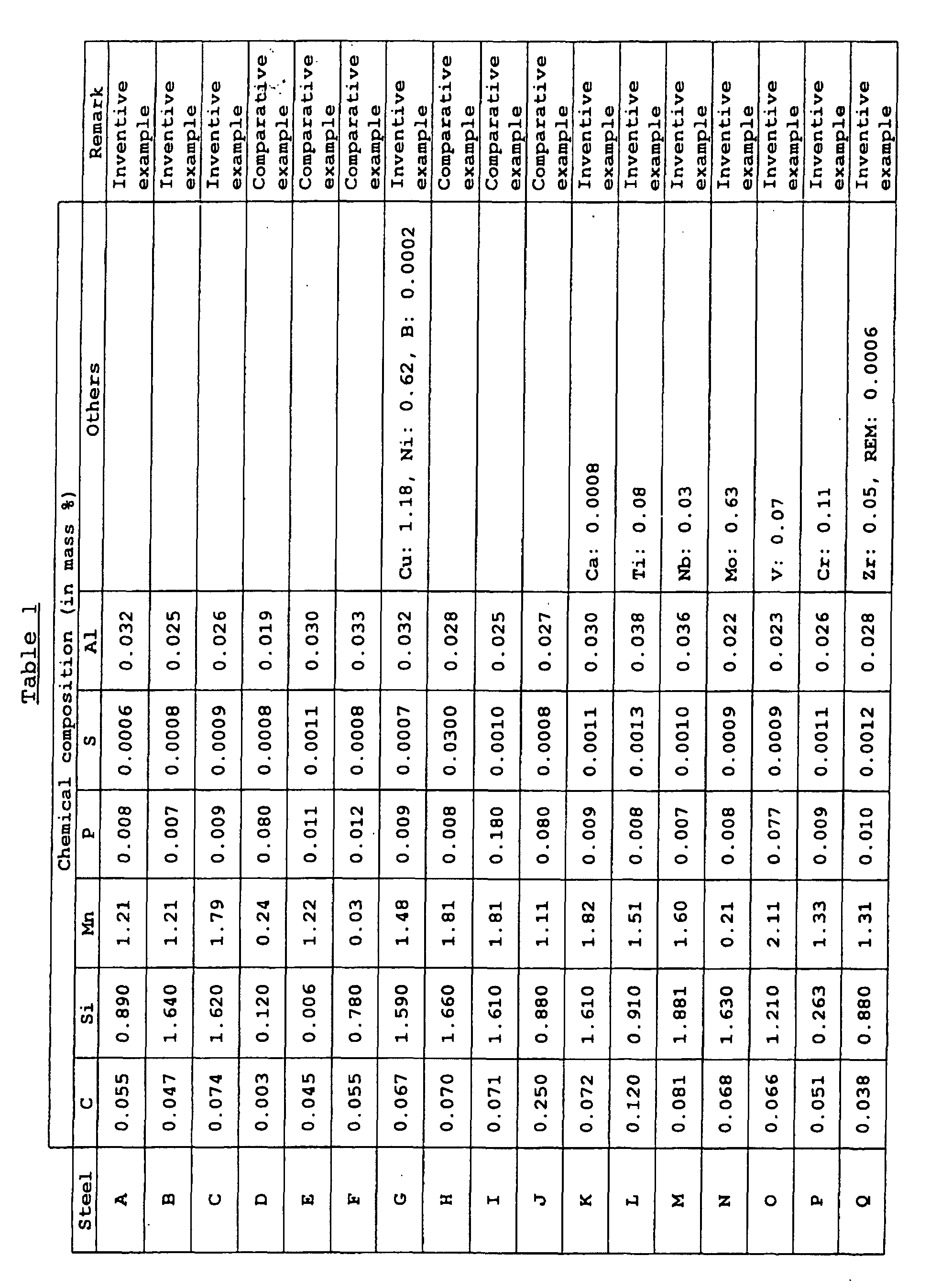
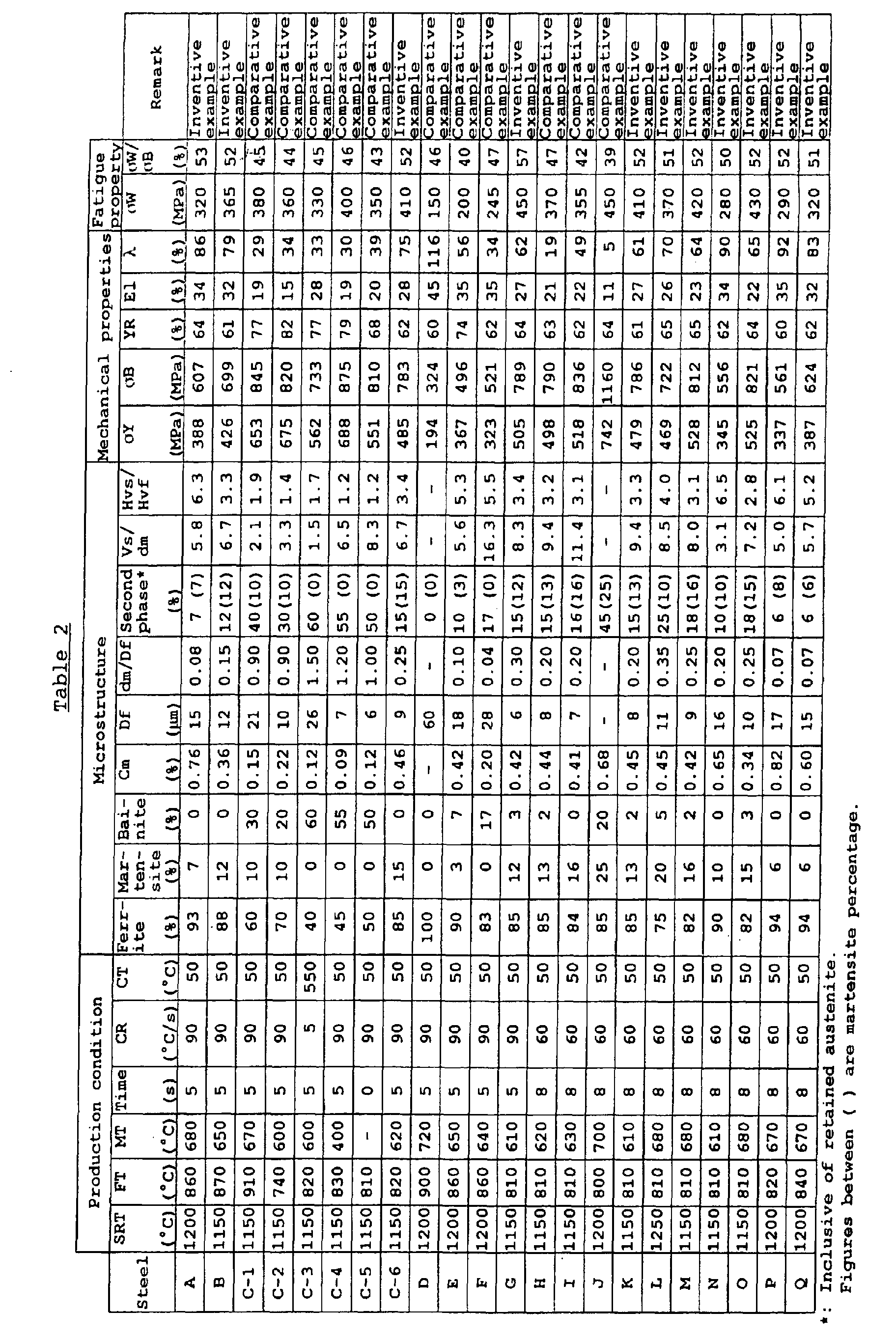
- Steels A to Q having the respective chemical compositions listed in Table 1 were produced using a converter, and each of them underwent the following production processes: continuous casting into slabs; reheating to the respective heating temperature (SRT) listed in Table 2, rough rolling and then finish rolling into a thickness of 1.2 to 5.4 mm at the respective final rolling temperature (FT) listed also in Table 2, and then coiling at the respective coiling temperature (CT) also listed in Table 2.
- SRT heating temperature
- FT final rolling temperature
- CT coiling temperature
- the No. 5 test pieces according to JIS Z 2201 were cut out from the hot-rolled steel sheets thus produced and underwent a tensile test in accordance with the test method specified in JIS Z 2241.
- the test result is shown in Table 2.
- the volume percentages of ferrite and the second phase are defined as their respective area percentages in the microstructure observed with a light-optic microscope at a magnification of 200 to 500 times at 1/4 of the steel sheet thickness in a section surface along the rolling direction.
- the average grain size of the ferrite was measured in accordance with the section method stipulated in the test method of ferrite crystal grain size of steel under JIS G 0552, and that the average grain size of the second phase was defined as the equivalent diameter of an average circle and the value obtained from an image processor and the like was used. Hardness was measured in accordance with the Vickers hardness test method specified in JIS Z 2244 under a testing force of 0.049 to 0.098 N and a retention time of 15 sec.
- the carbon concentration in the second phase is the value obtained by the calibration curve method described in the literature (Hiroyoshi Soejima: Electron Beam Micro Analysis, published from Nikkan Kogyo Shimbunsha) using an EPMA (electron probe micro analyzer). Note that, because five or more of the second phase grains were measured, the carbon concentration value is an average value of the measured grains.
- the carbon concentration in the second phase was measured by the simplified measuring method.
- a fatigue test under completely reversed plane bending was conducted on the test pieces for plane bending fatigue test shown in Fig. 4 having a length of 98 mm, a width of 38 mm, a width of the minimum section portion of 20 mm and a notch radius of 30 mm.
- the fatigue property of the steel sheets was evaluated in terms of the quotient of the fatigue limit ⁇ W after 10 x 10 7 times of bending divided by the tensile strength ⁇ B of the steel sheet (the above quotient being a relative fatigue limit, expressed as ⁇ W/ ⁇ B).
- the burring workability was evaluated following the hole expanding test method according to the Standard of the Japan Iron and Steel Federation JFS T 1001-1996.
- the compound structure steel sheet excellent in burring workability having: prescribed amounts of component elements; a microstructure of a compound structure having ferrite as the phase accounting for the largest volume percentage and martensite mainly as the second phase; an average grain size of the ferrite being 2 ⁇ m or more and 20 ⁇ m or less; a quotient of the average grain size of the second phase divided by the average grain size of the ferrite being 0.05 or more and 0.8 or less; a carbon concentration in the second phase being 0.2% or more and 2% or less; a quotient of the volume percentage of the second phase Vs divided by the average grain size of the second phase dm being 3 or more and 12 or less; and a quotient of the average hardness of the second phase Hvs divided by the average hardness of the ferrite Hvf being 1.5 or more and 7 or less.
- the final finish rolling temperature (FT) was above the range of the present invention and the grain size of the ferrite (Df), the size of the second phase (dm/Df), the carbon concentration in the second phase (Cm) and the grain size of the second phase (Vs/dm) were outside the respective ranges of the present invention, and, as a result, a sufficiently good value was not obtained in either the hole expansion rate ( ⁇ ) or the relative fatigue limit ( ⁇ W/ ⁇ B).
- the final finish rolling temperature (FT) was below the range of the present invention, and the size of the second phase (dm/Df) and the difference in strength between the ferrite and the second phase (Hvs/Hvf) were outside the respective ranges of the present invention and, consequently, a sufficiently good value was not obtained in either the hole expansion rate ( ⁇ ) or the relative fatigue limit ( ⁇ W/ ⁇ B). Besides, elongation (E1) was low owing to residual strain.
- the cooling rate (CR) after the retention time was slower than the range of the present invention and the coiling temperature (CT) was higher than the range of the present invention and, as a consequence, the grain size of the ferrite (Df), the size of the second phase (dm/Df), the carbon concentration in the second phase (Cm) and the grain size of the second phase (Vs/dm) were outside the respective ranges of the present invention.
- a sufficiently good value was not obtained in either the hole expansion rate ( ⁇ ) or the relative fatigue limit ( ⁇ W/ ⁇ B).
- the retention temperature (MT) after the finish rolling and before the coiling was below the range of the present invention, and the size of the second phase (dm/Df), the carbon concentration in the second phase (Cm) and the strength difference between the ferrite and the second phase (Hvs/Hvf) were outside the respective ranges of the present invention and, as a result, a sufficiently good value was not obtained in either the hole expansion rate ( ⁇ ) or the relative fatigue limit ( ⁇ W/ ⁇ B).
- the desired microstructure was not obtained because the C content was outside the range of the present invention and, as a result, a sufficiently good value was not obtained in either the strength (TS) or the relative fatigue limit ( ⁇ W/ ⁇ B).
- the content of Si was outside the range of the present invention and, consequently, a sufficiently good value was not obtained in either the strength (TS) or the relative fatigue limit ( ⁇ W/ ⁇ B).
- the content of Mn was outside the range of the present invention, and the grain size of the ferrite (Df), the size of the second phase (dm/Df) and the grain size of the second phase (Vs/dm) were outside the respective ranges of the present invention and, as a result, a sufficiently good value was not obtained in any of the strength (TS), the hole expansion rate ( ⁇ ) and the relative fatigue limit ( ⁇ W/ ⁇ B).
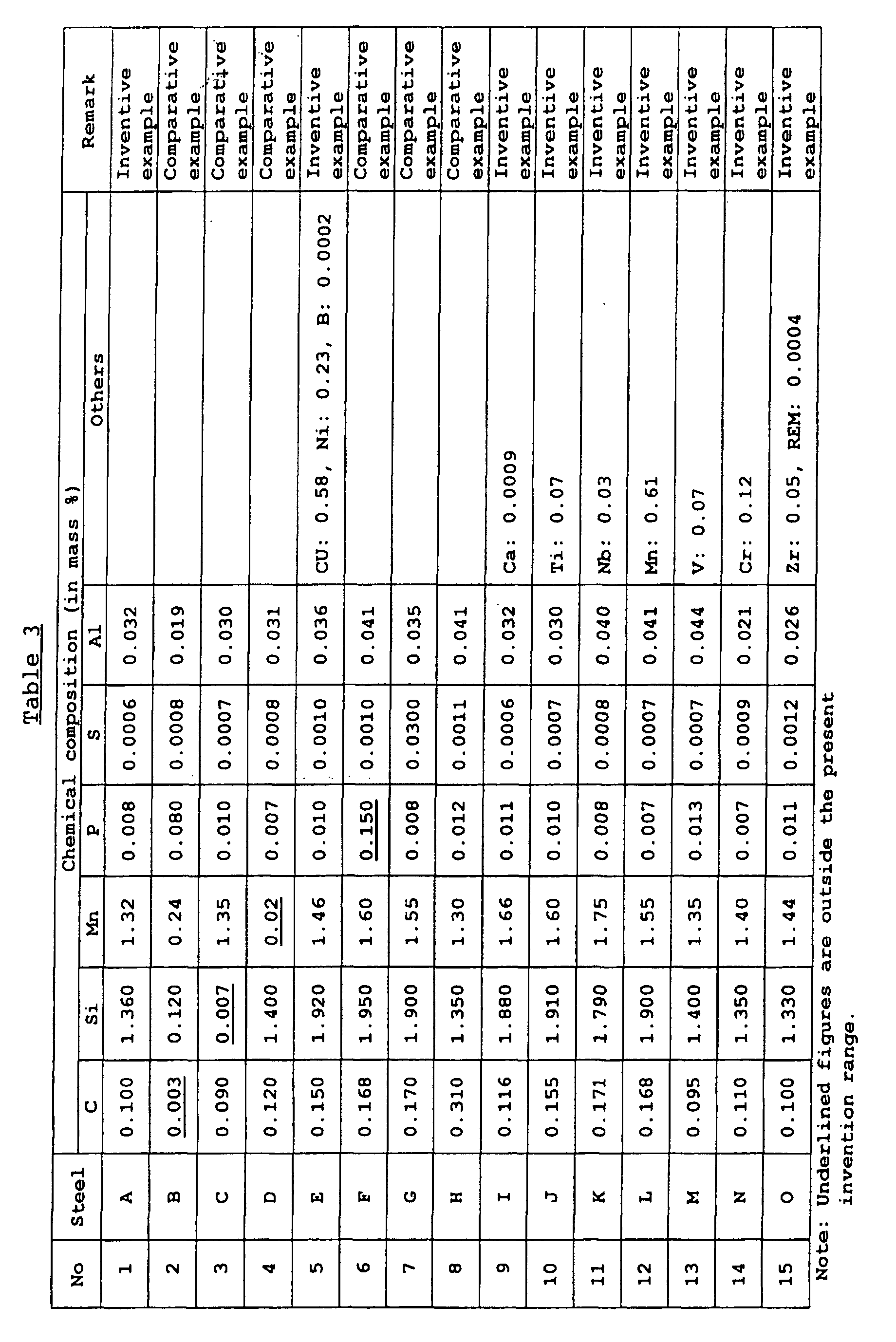
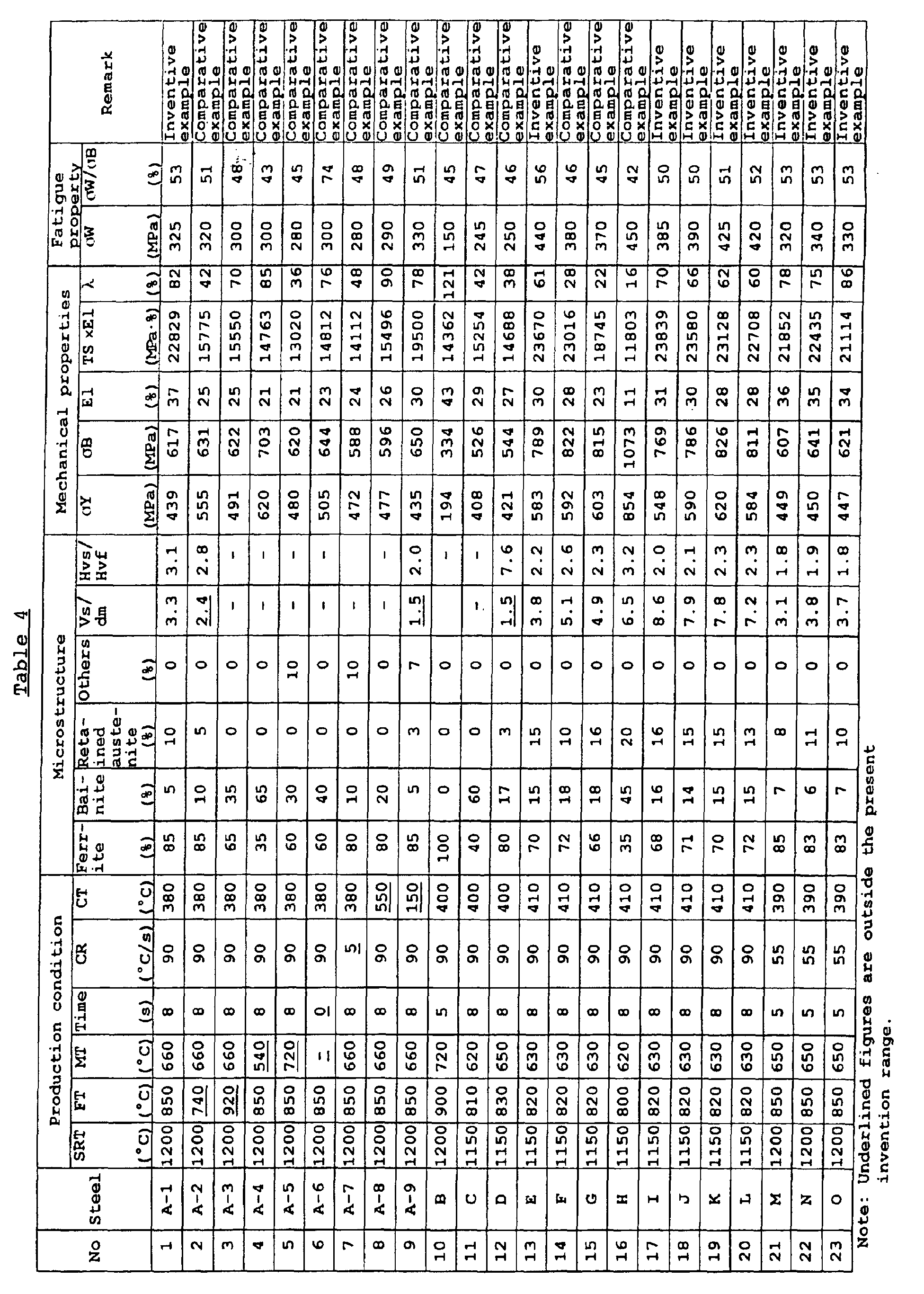
- Steels A to O having the respective chemical compositions listed in Table 3 were produced using a converter, and each of them underwent the following production processes: continuous casting into slabs; reheating to the respective heating temperature (SRT) listed in Table 4, rough rolling and then finish rolling into a thickness of 1.2 to 5.4 mm at the respective final rolling temperature (FT) listed also in Table 4, and then coiling at the respective coiling temperature (CT) also listed in Table 4.
- SRT heating temperature
- FT final rolling temperature
- CT coiling temperature
- the No. 5 test pieces according to JIS Z 2201 were cut out from the hot-rolled steel sheets thus produced and underwent a tensile test in accordance with the test method specified in JIS Z 2241.
- the test result is shown in Table 4.
- "Others” in “Micro structure” of Table 4 indicates pearlite or martensite.
- the volume percentages of the retained austenite, ferrite, bainite, pearlite and martensite are defined as the respective area percentages observed with a light-optic microscope at a magnification of 200 to 500 times in the microstructure on the section surface at 1/4 of the sheet thickness of the specimens cut out from the 1/4 or 3/4 width position of the steel sheets, after polishing the section surface along the rolling direction and etching it with a nitral reagent and a reagent disclosed in Japanese Unexamined Patent Publication No. H5-163590.
- some of the figures are those obtained by the X-ray diffraction method.
- the average grain size of the retained austenite was defined as the equivalent diameter of an average circle and the value obtained from an image processor and the like was used. Hardness was measured in accordance with the Vickers hardness test method specified in JIS Z 2244 under a testing force of 0.049 to 0.098 N and a retention time of 15 sec.
- a fatigue test under completely reversed plane bending was conducted on the test pieces for plane bending fatigue test shown in Fig. 4 having a length of 98 mm, a width of 38 mm, a width of the minimum section portion of 20 mm and a notch radius of 30 mm.
- the fatigue property of the steel sheets was evaluated in terms of the quotient of the fatigue limit ⁇ W after 10 x 10 7 times of bending divided by the tensile strength ⁇ B of the steel sheet (the above quotient being a relative fatigue limit, expressed as ⁇ W / ⁇ B ). Note that no machining was done to the surfaces of the test pieces for the fatigue test and they were tested with their surfaces left as pickled.
- the burring workability (hole expansibility) was evaluated in terms of the hole expansion value obtained by the hole expanding test method according to the Standard of the Japan Iron and Steel Federation JFS T 1001-1996.
- the final finish rolling temperature (FT) was below the range of the present invention and, as a result, both a strength-ductility balance (TS x El) and the hole expansion rate ( ⁇ ) were low owing to residual strain.
- the final finish rolling temperature (FT) was above the range of the present invention and thus the desired microstructure was not obtained and, as a result, both the strength-ductility balance (TS x El) and the relative fatigue limit ( ⁇ W / ⁇ B ) were low.
- the content of P was outside the range of the present invention and, as a result, a sufficiently good value was not obtained in the relative fatigue limit ( ⁇ W / ⁇ B ).
- the content of S was outside the range of the present invention and, as a result, a sufficiently good value was not obtained in either the hole expansion rate ( ⁇ ) or the relative fatigue limit ( ⁇ W / ⁇ B ).
- the C content was outside the range of the present invention and, as a result, a sufficiently good value was not obtained in any of the elongation (E1), the hole expansion rate ( ⁇ ) and the relative fatigue limit ( ⁇ W / ⁇ B ).
- the present invention provides a compound structure steel sheet excellent in burring workability having a tensile strength of 540 MPa or more, and a method to produce the same.
- the hot-rolled steel sheet according to the present invention realizes a remarkable improvement in burring workability (hole expansibility) while maintaining a sufficiently good fatigue property and, therefore, the present invention has a high industrial value.
Landscapes
- Chemical & Material Sciences (AREA)
- Engineering & Computer Science (AREA)
- Materials Engineering (AREA)
- Mechanical Engineering (AREA)
- Metallurgy (AREA)
- Organic Chemistry (AREA)
- Physics & Mathematics (AREA)
- Thermal Sciences (AREA)
- Crystallography & Structural Chemistry (AREA)
- Heat Treatment Of Sheet Steel (AREA)
Abstract
Description
Claims (14)
- A high fatigue strength steel sheet excellent in burring workability characterized in that:the steel sheet is made of a steel containing, by mass,0.01 to 0.3% of C,0.01 to 2% of Si,0.05 to 3% of Mn,0.1% or less of P,0.01% or less of S, and0.005 to 1% or Al, andthe balance consisting of Fe and unavoidable impurities;the microstructure is a compound structure having ferrite as the main phase and martensite as the second phase;the average grain size of the ferrite is 2 µm or more and 20 µm or less;the quotient of the average grain size of the second phase divided by the average grain size of the ferrite is 0.05 or more and 0.8 or less; andthe carbon concentration in the second phase is 0.2% or more and 3% or less.
- A high fatigue strength steel sheet excellent in burring workability characterized in that:the steel sheet is made of a steel containing, by mass,0.01 to 0.3% of C,0.01 to 2% of Si,0.05 to 3% of Mn,0.1% or less of P,0.01% or less of S, and0.005 to 1% or Al, andthe balance consisting of Fe and unavoidable impurities;the microstructure is a compound structure having ferrite as the main phase and martensite as the second phase;the quotient of the volume percentage of the second phase divided by its average grain size is 3 or more and 12 or less; andthe quotient of the average hardness of the second phase divided by the average hardness of the ferrite is 1.5 or more and 7 or less.
- A high fatigue strength steel sheet excellent in burring workability according to claim 1 or 2, characterized in that; the steel further contains, in mass, 0.2 to 2% of Cu, and the Cu exists in the ferrite phase of the steel in the state of the precipitates of grains 2 nm or less in size consisting purely of Cu and/or in the state of solid solution.
- A high fatigue strength steel sheet excellent in burring workability according to any one of claims 1 to 3, characterized by further containing, by mass, 0.0002 to 0.002% of B.
- A high fatigue strength steel sheet excellent in burring workability according to any one of claims 1 to 4, characterized by further containing, by mass, 0.1 to 1% of Ni.
- A high fatigue strength steel sheet excellent in burring workability according to any one of claims 1 to 5, characterized by further containing, by mass, one or both of 0.0005 to 0.002% of Ca and 0.0005 to 0.02% of REM.
- A high fatigue strength steel sheet excellent in burring workability according to any one of claims 1 to 6, characterized by further containing, by mass, one or more of;0.05 to 0.5% of Ti,0.01 to 0.5% of Nb,0.05 to 1% of Mo,0.02 to 0.2% of V,0.01 to 1% of Cr, and0.02 to 0.2% of Zr.
- A high fatigue strength steel sheet excellent in burring workability according to any one of claims 1 to 7, characterized in that the microstructure is a compound structure having ferrite as the main phase and retained austenite accounting for a volume percentage of 5% or more and 25% or less as the second phase.
- A method to produce a high fatigue strength steel sheet excellent in burring workability according to any one of claims 1 to 7, characterized by, when hot rolling a slab having said chemical composition, completing finish hot rolling at a temperature from the Ar3 transformation temperature to 100°C above the Ar3 transformation temperature, holding the hot-rolled steel sheet thus produced in the temperature range from the Ar1 transformation temperature to the Ar3 transformation temperature for 1 to 20 sec., then cooling it at a cooling rate of 20°C/sec. or higher, and coiling it at a coiling temperature of 350°C or lower.
- A method to produce a high fatigue strength steel sheet excellent in burring workability according to any one of claims 1 to 7, characterized by, when hot rolling a slab having said chemical composition, applying high pressure descaling to the slab after rough rolling, completing finish hot rolling at a temperature from the Ar3 transformation temperature to 100°C above the Ar3 transformation temperature, holding the hot-rolled steel sheet thus produced in the temperature range from the Ar1 transformation temperature to the Ar3 transformation temperature for 1 to 20 sec., then cooling it at a cooling rate of 20°C/sec. or higher, and coiling it at a coiling temperature of 350°C or lower.
- A method to produce a high fatigue strength steel sheet excellent in burring workability according to any one of claims 1 to 7, characterized by completing the hot rolling of a slab having said chemical composition at a temperature of the Ar3 transformation temperature or higher, subsequently pickling and cold-rolling the hot-rolled steel sheet thus produced, holding the cold-rolled steel sheet in the temperature range from the Ac1 transformation temperature to the Ac3 transformation temperature for 30 to 150 sec., then cooling it at a cooling rate of 20°C/sec. or higher to the temperature range of 350°C or lower.
- A method to produce a high fatigue strength steel sheet excellent in burring workability according to any one of claims 1 to 7, characterized by, when hot rolling a slab having said chemical composition, completing finish hot rolling at a temperature from the Ar3 transformation temperature to 100°C above the Ar3 transformation temperature, holding the hot-rolled steel sheet thus produced in the temperature range from the Ar1 transformation temperature to the Ar3 transformation temperature for 1 to 20 sec., then cooling it at a cooling rate of 20°C/sec. or higher, and coiling it at a coiling temperature of above 350°C and 450°C or lower.
- A method to produce a high fatigue strength steel sheet excellent in burring workability according to any one of claims 1 to 7, characterized by, when hot rolling a slab having said chemical composition, applying high pressure descaling to the slab after rough rolling, completing finish hot rolling at a temperature from the Ar3 transformation temperature to 100°C above the Ar3 transformation temperature, holding the hot-rolled steel sheet thus produced in the temperature range from the Ar1 transformation temperature to the Ar3 transformation temperature for 1 to 20 sec., then cooling it at a cooling rate of 20°C/sec. or higher, and coiling it at a coiling temperature of above 350°C and 450°C or lower.
- A method to produce a high fatigue strength steel sheet excellent in burring workability according to any one of claims 1 to 7, characterized by, completing the hot rolling of a slab having said chemical composition at a temperature of the Ar3 transformation temperature or higher, subsequently pickling and cold rolling the hot-rolled steel sheet thus produced, holding the cold-rolled steel sheet in the temperature range from the Ac1 transformation temperature to the Ac3 transformation temperature for 30 to 150 sec., then cooling it at a cooling rate of 20°C/sec. or higher, holding it in the temperature range of above 350°C and 450°C or lower for 15 to 600 sec., and cooling it at a cooling rate of 5°C/sec. or higher to the temperature range of 150°C or below.
Applications Claiming Priority (5)
| Application Number | Priority Date | Filing Date | Title |
|---|---|---|---|
| JP2000121209 | 2000-04-21 | ||
| JP2000121210 | 2000-04-21 | ||
| JP2000121210A JP2001303187A (en) | 2000-04-21 | 2000-04-21 | Composite structure steel sheet excellent in burring workability and method for producing the same |
| JP2000121209A JP4445095B2 (en) | 2000-04-21 | 2000-04-21 | Composite structure steel plate excellent in burring workability and manufacturing method thereof |
| PCT/JP2000/008934 WO2001081640A1 (en) | 2000-04-21 | 2000-12-15 | Steel plate having excellent burring workability together with high fatigue strength, and method for producing the same |
Publications (3)
| Publication Number | Publication Date |
|---|---|
| EP1201780A1 true EP1201780A1 (en) | 2002-05-02 |
| EP1201780A4 EP1201780A4 (en) | 2003-01-29 |
| EP1201780B1 EP1201780B1 (en) | 2005-03-23 |
Family
ID=26590571
Family Applications (1)
| Application Number | Title | Priority Date | Filing Date |
|---|---|---|---|
| EP00981781A Expired - Lifetime EP1201780B1 (en) | 2000-04-21 | 2000-12-15 | Steel plate having excellent burring workability together with high fatigue strength, and method for producing the same |
Country Status (6)
| Country | Link |
|---|---|
| US (1) | US6589369B2 (en) |
| EP (1) | EP1201780B1 (en) |
| KR (1) | KR100441414B1 (en) |
| DE (1) | DE60018940D1 (en) |
| TW (1) | TWI261072B (en) |
| WO (1) | WO2001081640A1 (en) |
Cited By (29)
| Publication number | Priority date | Publication date | Assignee | Title |
|---|---|---|---|---|
| WO2003010351A1 (en) * | 2001-07-25 | 2003-02-06 | Nippon Steel Corporation | Multi-phase steel sheet excellent in hole expandability and method of producing the same |
| WO2003031669A1 (en) * | 2001-10-04 | 2003-04-17 | Nippon Steel Corporation | High-strength thin steel sheet drawable and excellent in shape fixation property and method of producing the same |
| WO2003057928A1 (en) * | 2002-01-14 | 2003-07-17 | Usinor | Method for the production of a siderurgical product made of carbon steel with a high copper content, and siderurgical product obtained according to said method |
| WO2003106723A1 (en) * | 2002-06-14 | 2003-12-24 | Jfeスチール株式会社 | High strength cold rolled steel plate and method for production thereof |
| EP1382702A1 (en) * | 2002-07-12 | 2004-01-21 | Kabushiki Kaisha Kobe Seiko Sho (Kobe Steel, Ltd.) | High-strength steel sheet having excellent workability and production process therefor |
| EP1391526A3 (en) * | 2002-08-20 | 2004-04-21 | Kabushiki Kaisha Kobe Seiko Sho (Kobe Steel, Ltd.) | Dual phase steel sheet with good bake-hardening properties |
| WO2004059024A1 (en) * | 2002-12-26 | 2004-07-15 | Nippon Steel Corporation | High strength thin steel sheet excellent in hole expansibility, ductility and chemical treatment characteristics, and method for production thereof |
| EP1362930A4 (en) * | 2001-02-23 | 2004-11-24 | Nippon Steel Corp | THIN SHEET OF STEEL WITH EXCELLENT FAITGUE RESISTANCE FOR A MOTOR VEHICLE, AND PRODUCTION METHOD |
| WO2004104256A1 (en) * | 2003-05-21 | 2004-12-02 | Nippon Steel Corporation | A cold-rolled steel sheet having a tensile strength of 780 mpa or more an excellent local formability and a suppressed increase in weld hardness |
| EP1389639A3 (en) * | 2002-07-29 | 2005-06-08 | Kabushiki Kaisha Kobe Seiko Sho (Kobe Steel, Ltd.) | Steel sheet with excellent bendability |
| EP1553202A1 (en) * | 2004-01-09 | 2005-07-13 | Kabushiki Kaisha Kobe Seiko Sho (Kobe Steel, Ltd.) | Ultra-high strength steel sheet having excellent hydrogen embrittlement resistance, and method for manufacturing the same |
| EP1577412A4 (en) * | 2002-12-24 | 2006-04-12 | Nippon Steel Corp | HIGH RESISTANCE STEEL SHEET HAVING EXCELLENT EBARBAGEABILITY AND EXCELLENT SOFTENING RESISTANCE IN A HEAT-AFFECTED AREA AND PROCESS FOR PRODUCING THE SAME |
| WO2006103991A1 (en) | 2005-03-28 | 2006-10-05 | Kabushiki Kaisha Kobe Seiko Sho | High strength hot rolled steel sheet excellent in bore expanding workability and method for production thereof |
| EP1666623A4 (en) * | 2003-09-24 | 2006-11-29 | Nippon Steel Corp | HOT ROLLED STEEL SHEET TO WORK |
| US7507307B2 (en) | 2002-06-10 | 2009-03-24 | Jfe Steel Corporation | Method for producing cold rolled steel plate of super high strength |
| EP2123786A1 (en) | 2008-05-21 | 2009-11-25 | ArcelorMittal France | Method of manufacturing very high-resistance, cold-laminated dual-phase steel sheets, and sheets produced thereby |
| EP2157203A1 (en) * | 2008-08-12 | 2010-02-24 | Kabushiki Kaisha Kobe Seiko Sho (Kobe Steel, Ltd.) | High-strength steel sheet superior in formability |
| US7981224B2 (en) | 2003-12-18 | 2011-07-19 | Nippon Steel Corporation | Multi-phase steel sheet excellent in hole expandability and method of producing the same |
| WO2013139319A1 (en) | 2012-03-20 | 2013-09-26 | Salzgitter Flachstahl Gmbh | High-strength multi-phase steel, and method for producing a strip from said steel |
| CN103459647A (en) * | 2011-03-28 | 2013-12-18 | 新日铁住金株式会社 | Hot-rolled steel sheet and manufacturing method thereof |
| CN104685087A (en) * | 2012-09-26 | 2015-06-03 | 新日铁住金株式会社 | Composite-structure steel sheet and process for producing same |
| RU2562203C1 (en) * | 2014-06-27 | 2015-09-10 | Публичное акционерное общество "Северсталь" (ПАО "Северсталь") | Production of cold-rolled high-strength stock for cold stamping |
| RU2562201C1 (en) * | 2014-06-27 | 2015-09-10 | Публичное акционерное общество "Северсталь" (ПАО "Северсталь") | Production of cold-rolled high-strength stock for cold stamping |
| CN105838997A (en) * | 2016-05-17 | 2016-08-10 | 武汉钢铁股份有限公司 | Si-Mn 780 MPa-grade hot-rolled dual-phase steel and production method thereof |
| RU2606361C2 (en) * | 2011-05-10 | 2017-01-10 | Арселормитталь Инвестигасьон И Десарролло Сл | Steel sheet with high mechanical strength, ductility and formability properties, production method and use of such sheets |
| US9631265B2 (en) | 2011-05-25 | 2017-04-25 | Nippon Steel | Hot-rolled steel sheet and method for producing same |
| CN107746931A (en) * | 2017-10-31 | 2018-03-02 | 攀钢集团攀枝花钢铁研究院有限公司 | A kind of hot-rolled dual-phase steel used for automobile wheels and its production method |
| US10400301B2 (en) | 2014-12-10 | 2019-09-03 | Posco | Dual-phase steel sheet with excellent formability and manufacturing method therefor |
| EP3831972A4 (en) * | 2018-07-31 | 2021-06-09 | JFE Steel Corporation | HIGH STRENGTH HOT ROLLED SHEET AND ITS MANUFACTURING PROCESS |
Families Citing this family (36)
| Publication number | Priority date | Publication date | Assignee | Title |
|---|---|---|---|---|
| EP1288322A1 (en) | 2001-08-29 | 2003-03-05 | Sidmar N.V. | An ultra high strength steel composition, the process of production of an ultra high strength steel product and the product obtained |
| JP3643806B2 (en) * | 2001-09-28 | 2005-04-27 | 三菱重工業株式会社 | High-accuracy creep damage evaluation method |
| JP4284405B2 (en) * | 2002-10-17 | 2009-06-24 | 独立行政法人物質・材料研究機構 | Tapping screw and its manufacturing method |
| EP1431406A1 (en) * | 2002-12-20 | 2004-06-23 | Sidmar N.V. | A steel composition for the production of cold rolled multiphase steel products |
| KR20060099520A (en) | 2003-10-21 | 2006-09-19 | 노보 노르디스크 에이/에스 | Medical Skin Mounting Device |
| EP1527792A1 (en) * | 2003-10-27 | 2005-05-04 | Novo Nordisk A/S | Medical injection device mountable to the skin |
| JP4681290B2 (en) * | 2004-12-03 | 2011-05-11 | 本田技研工業株式会社 | High strength steel plate and manufacturing method thereof |
| JP4555694B2 (en) * | 2005-01-18 | 2010-10-06 | 新日本製鐵株式会社 | Bake-hardening hot-rolled steel sheet excellent in workability and method for producing the same |
| US8298172B2 (en) * | 2005-04-13 | 2012-10-30 | Novo Nordisk A/S | Medical skin mountable device and system |
| WO2007031532A1 (en) * | 2005-09-13 | 2007-03-22 | Novo Nordisk A/S | Reservoir device with inspection aid for detection of drug condition |
| EP1940489A1 (en) * | 2005-10-17 | 2008-07-09 | Novo Nordisk A/S | Vented drug reservoir unit |
| JP5302009B2 (en) | 2005-12-26 | 2013-10-02 | ポスコ | High carbon steel sheet with excellent formability and method for producing the same |
| JP5095958B2 (en) * | 2006-06-01 | 2012-12-12 | 本田技研工業株式会社 | High strength steel plate and manufacturing method thereof |
| US20080178972A1 (en) * | 2006-10-18 | 2008-07-31 | Kabushiki Kaisha Kobe Seiko Sho (Kobe Steel, Ltd) | High strength steel sheet and method for producing the same |
| KR100901746B1 (en) * | 2007-05-22 | 2009-06-10 | 현대하이스코 주식회사 | Ultra High Strength Hydroforming Steel Pipe Manufacturing Method |
| JP5323563B2 (en) * | 2009-03-31 | 2013-10-23 | 株式会社神戸製鋼所 | High-strength cold-rolled steel sheet with excellent workability and shape freezeability |
| CN102822374B (en) * | 2010-03-24 | 2014-12-17 | 杰富意钢铁株式会社 | High-strength electrical-resistance-welded steel pipe and manufacturing method therefor |
| CN101942601B (en) * | 2010-09-15 | 2012-11-14 | 北京科技大学 | Manufacturing method of transformation induced plasticity steel containing V hot rolling |
| TWI415954B (en) * | 2010-10-27 | 2013-11-21 | China Steel Corp | High strength steel and its manufacturing method |
| JP5486634B2 (en) | 2012-04-24 | 2014-05-07 | 株式会社神戸製鋼所 | Steel for machine structure for cold working and method for producing the same |
| CN104471094B (en) * | 2012-07-20 | 2019-02-26 | 新日铁住金株式会社 | steel |
| US20140261914A1 (en) * | 2013-03-15 | 2014-09-18 | Thyssenkrupp Steel Usa, Llc | Method of producing hot rolled high strength dual phase steels using room temperature water quenching |
| US9776592B2 (en) | 2013-08-22 | 2017-10-03 | Autoliv Asp, Inc. | Double swage airbag inflator vessel and methods for manufacture thereof |
| WO2016132549A1 (en) | 2015-02-20 | 2016-08-25 | 新日鐵住金株式会社 | Hot-rolled steel sheet |
| BR112017013229A2 (en) * | 2015-02-20 | 2018-01-09 | Nippon Steel & Sumitomo Metal Corporation | hot rolled steel sheet |
| WO2016135898A1 (en) | 2015-02-25 | 2016-09-01 | 新日鐵住金株式会社 | Hot-rolled steel sheet or plate |
| KR101980471B1 (en) | 2015-02-25 | 2019-05-21 | 닛폰세이테츠 가부시키가이샤 | Hot-rolled steel sheet |
| BR112019000422B1 (en) | 2016-08-05 | 2023-03-28 | Nippon Steel Corporation | STEEL PLATE AND GALVANIZED STEEL PLATE |
| BR112019000766B8 (en) | 2016-08-05 | 2023-03-14 | Nippon Steel & Sumitomo Metal Corp | STEEL SHEET |
| TWI657874B (en) * | 2016-08-25 | 2019-05-01 | 陳志宏 | Metal wire production equipment and machines in the equipment |
| CN109772907A (en) * | 2019-01-22 | 2019-05-21 | 江苏飞达环保科技有限公司 | A kind of uniform cooling means improving steel yield strength |
| SE543341C2 (en) | 2019-04-01 | 2020-12-08 | Greeniron H2 Ab | Method and device for producing direct reduced metal |
| SE543642C2 (en) | 2019-09-23 | 2021-05-11 | Greeniron H2 Ab | Method and device for producing direct reduced, carburized metal |
| CN116157675A (en) * | 2020-09-24 | 2023-05-23 | 杰富意钢铁株式会社 | Cleanliness evaluation method of cast slab as raw material of high fatigue strength steel and method of manufacturing high fatigue strength steel |
| CN112795849B (en) * | 2020-11-20 | 2022-07-12 | 唐山钢铁集团有限责任公司 | 1300Mpa high-toughness hot-dip galvanized steel plate and production method thereof |
| KR102484995B1 (en) * | 2020-12-10 | 2023-01-04 | 주식회사 포스코 | Hot-rolled steel for hyper tube and manufacturing method for the same |
Family Cites Families (10)
| Publication number | Priority date | Publication date | Assignee | Title |
|---|---|---|---|---|
| JP2952624B2 (en) * | 1991-05-30 | 1999-09-27 | 新日本製鐵株式会社 | High yield ratio type hot rolled high strength steel sheet excellent in formability and spot weldability and its manufacturing method and high yield ratio type hot rolled high strength steel sheet excellent in formability and its manufacturing method |
| JP2548654B2 (en) | 1991-12-13 | 1996-10-30 | 新日本製鐵株式会社 | Etching solution for complex structure steel and etching method |
| JP3219820B2 (en) | 1991-12-27 | 2001-10-15 | 川崎製鉄株式会社 | Low yield ratio high strength hot rolled steel sheet and method for producing the same |
| JPH083679A (en) * | 1994-06-14 | 1996-01-09 | Nippon Steel Corp | Hot-rolled high-strength steel sheet having excellent heat formability and softening property, which is excellent in formability and fatigue characteristics, and a method for producing the same |
| JP3090421B2 (en) * | 1996-07-22 | 2000-09-18 | 新日本製鐵株式会社 | Hot-rolled high-strength steel sheet for processing with excellent durability fatigue resistance |
| CA2278841C (en) * | 1997-01-29 | 2007-05-01 | Nippon Steel Corporation | High strength steels having excellent formability and high impact energy absorption properties, and a method for producing the same |
| CA2283924C (en) * | 1997-03-17 | 2006-11-28 | Nippon Steel Corporation | Dual-phase type high-strength steel sheets having high impact energy absorption properties and a method of producing the same |
| JP3619359B2 (en) * | 1998-01-19 | 2005-02-09 | 新日本製鐵株式会社 | Composite structure high-strength cold-rolled steel sheet with excellent fatigue characteristics and method for producing the same |
| JP3752071B2 (en) | 1998-01-20 | 2006-03-08 | 新日本製鐵株式会社 | Hot-rolled steel sheet for machining excellent in fatigue characteristics and method for producing the same |
| JP3790357B2 (en) * | 1998-03-31 | 2006-06-28 | 新日本製鐵株式会社 | Hot-rolled steel sheet for machining excellent in fatigue characteristics and method for producing the same |
-
2000
- 2000-12-15 KR KR10-2001-7010080A patent/KR100441414B1/en not_active Expired - Lifetime
- 2000-12-15 US US09/890,048 patent/US6589369B2/en not_active Expired - Lifetime
- 2000-12-15 WO PCT/JP2000/008934 patent/WO2001081640A1/en not_active Ceased
- 2000-12-15 DE DE60018940T patent/DE60018940D1/en not_active Expired - Lifetime
- 2000-12-15 EP EP00981781A patent/EP1201780B1/en not_active Expired - Lifetime
- 2000-12-22 TW TW089127752A patent/TWI261072B/en not_active IP Right Cessation
Cited By (56)
| Publication number | Priority date | Publication date | Assignee | Title |
|---|---|---|---|---|
| EP1362930A4 (en) * | 2001-02-23 | 2004-11-24 | Nippon Steel Corp | THIN SHEET OF STEEL WITH EXCELLENT FAITGUE RESISTANCE FOR A MOTOR VEHICLE, AND PRODUCTION METHOD |
| WO2003010351A1 (en) * | 2001-07-25 | 2003-02-06 | Nippon Steel Corporation | Multi-phase steel sheet excellent in hole expandability and method of producing the same |
| WO2003031669A1 (en) * | 2001-10-04 | 2003-04-17 | Nippon Steel Corporation | High-strength thin steel sheet drawable and excellent in shape fixation property and method of producing the same |
| US7503984B2 (en) | 2001-10-04 | 2009-03-17 | Nippon Steel Corporation | High-strength thin steel sheet drawable and excellent in shape fixation property and method of producing the same |
| WO2003057928A1 (en) * | 2002-01-14 | 2003-07-17 | Usinor | Method for the production of a siderurgical product made of carbon steel with a high copper content, and siderurgical product obtained according to said method |
| FR2834722A1 (en) * | 2002-01-14 | 2003-07-18 | Usinor | MANUFACTURING PROCESS OF A COPPER-RICH CARBON STEEL STEEL PRODUCT, AND THUS OBTAINED STEEL PRODUCT |
| US7425240B2 (en) | 2002-01-14 | 2008-09-16 | Usinor | Method for the production of a siderurgical product made of carbon steel with a high copper content |
| US7507307B2 (en) | 2002-06-10 | 2009-03-24 | Jfe Steel Corporation | Method for producing cold rolled steel plate of super high strength |
| EP1514951A4 (en) * | 2002-06-14 | 2006-05-10 | Jfe Steel Corp | High strength cold rolled steel plate and method for production thereof |
| WO2003106723A1 (en) * | 2002-06-14 | 2003-12-24 | Jfeスチール株式会社 | High strength cold rolled steel plate and method for production thereof |
| EP2017363A3 (en) * | 2002-06-14 | 2009-08-05 | JFE Steel Corporation | High strength cold-rolled steel sheet and method for manufacturing the same |
| EP1382702A1 (en) * | 2002-07-12 | 2004-01-21 | Kabushiki Kaisha Kobe Seiko Sho (Kobe Steel, Ltd.) | High-strength steel sheet having excellent workability and production process therefor |
| US7008488B2 (en) | 2002-07-12 | 2006-03-07 | Kabushiki Kaisha Kobe Seiko Sho (Kobe Steel, Ltd.) | High-strength steel sheet having excellent workability and production process therefor |
| EP1389639A3 (en) * | 2002-07-29 | 2005-06-08 | Kabushiki Kaisha Kobe Seiko Sho (Kobe Steel, Ltd.) | Steel sheet with excellent bendability |
| US9194015B2 (en) | 2002-08-20 | 2015-11-24 | Kobe Steel, Ltd. | Dual phase steel sheet with good bake-hardening properties |
| EP1391526A3 (en) * | 2002-08-20 | 2004-04-21 | Kabushiki Kaisha Kobe Seiko Sho (Kobe Steel, Ltd.) | Dual phase steel sheet with good bake-hardening properties |
| EP1577412A4 (en) * | 2002-12-24 | 2006-04-12 | Nippon Steel Corp | HIGH RESISTANCE STEEL SHEET HAVING EXCELLENT EBARBAGEABILITY AND EXCELLENT SOFTENING RESISTANCE IN A HEAT-AFFECTED AREA AND PROCESS FOR PRODUCING THE SAME |
| US7749338B2 (en) | 2002-12-24 | 2010-07-06 | Nippon Steel Corporation | High burring, high strength steel sheet excellent in softening resistance of weld heat affected zone and method of production of same |
| US7780797B2 (en) | 2002-12-26 | 2010-08-24 | Nippon Steel Corporation | High strength thin steel excellent in hole expansibility, ductility and chemical treatment characteristics |
| KR100756114B1 (en) * | 2002-12-26 | 2007-09-05 | 신닛뽄세이테쯔 카부시키카이샤 | Method for production of high strength thin steel sheet excellent in hole expansibility, ductility and chemical treatment characteristics |
| WO2004059024A1 (en) * | 2002-12-26 | 2004-07-15 | Nippon Steel Corporation | High strength thin steel sheet excellent in hole expansibility, ductility and chemical treatment characteristics, and method for production thereof |
| US7780799B2 (en) | 2003-05-21 | 2010-08-24 | Nippon Steel Corporation | Cold-rolled steel sheet having a tensile strength of 780 MPA or more, an excellent local formability and a suppressed increase in weld hardness |
| WO2004104256A1 (en) * | 2003-05-21 | 2004-12-02 | Nippon Steel Corporation | A cold-rolled steel sheet having a tensile strength of 780 mpa or more an excellent local formability and a suppressed increase in weld hardness |
| US7381478B2 (en) | 2003-09-24 | 2008-06-03 | Nippon Steel Corporation | Hot rolled steel sheet for processing and method for manufacturing the same |
| EP1666623A4 (en) * | 2003-09-24 | 2006-11-29 | Nippon Steel Corp | HOT ROLLED STEEL SHEET TO WORK |
| US7981224B2 (en) | 2003-12-18 | 2011-07-19 | Nippon Steel Corporation | Multi-phase steel sheet excellent in hole expandability and method of producing the same |
| EP1553202A1 (en) * | 2004-01-09 | 2005-07-13 | Kabushiki Kaisha Kobe Seiko Sho (Kobe Steel, Ltd.) | Ultra-high strength steel sheet having excellent hydrogen embrittlement resistance, and method for manufacturing the same |
| EP1865083A4 (en) * | 2005-03-28 | 2009-02-25 | Kobe Steel Ltd | High strength hot rolled steel sheet excellent in bore expanding workability and method for production thereof |
| WO2006103991A1 (en) | 2005-03-28 | 2006-10-05 | Kabushiki Kaisha Kobe Seiko Sho | High strength hot rolled steel sheet excellent in bore expanding workability and method for production thereof |
| US8038809B2 (en) | 2005-03-28 | 2011-10-18 | Kobe Steel, Ltd. | High strength hot rolled steel sheet excellent in bore expanding workability and method for production thereof |
| US8486205B2 (en) | 2005-03-28 | 2013-07-16 | Kobe Steel, Ltd. | High strength hot rolled steel sheet excellent in bore expanding workability and method for production thereof |
| US10190187B2 (en) | 2008-05-21 | 2019-01-29 | Arcelormittal | Manufacturing method for very high-strength, cold-rolled, dual-phase steel sheets |
| EP2123786A1 (en) | 2008-05-21 | 2009-11-25 | ArcelorMittal France | Method of manufacturing very high-resistance, cold-laminated dual-phase steel sheets, and sheets produced thereby |
| US12448661B2 (en) | 2008-05-21 | 2025-10-21 | Arcelormittal | Very high-strength, cold-rolled, dual steel sheets |
| EP2157203A1 (en) * | 2008-08-12 | 2010-02-24 | Kabushiki Kaisha Kobe Seiko Sho (Kobe Steel, Ltd.) | High-strength steel sheet superior in formability |
| US8128762B2 (en) | 2008-08-12 | 2012-03-06 | Kobe Steel, Ltd. | High-strength steel sheet superior in formability |
| CN103459647B (en) * | 2011-03-28 | 2015-09-02 | 新日铁住金株式会社 | Hot-rolled steel sheet and manufacturing method thereof |
| EP2692893A4 (en) * | 2011-03-28 | 2014-12-10 | Nippon Steel & Sumitomo Metal Corp | HOT ROLLED STEEL SHEET AND PRODUCTION METHOD THEREOF |
| US9670569B2 (en) | 2011-03-28 | 2017-06-06 | Nippon Steel & Sumitomo Metal Corporation | Cold-rolled steel sheet and production method thereof |
| US9546413B2 (en) | 2011-03-28 | 2017-01-17 | Nippon Steel & Sumitomo Metal Corporation | Hot-rolled steel sheet and production method thereof |
| CN103459647A (en) * | 2011-03-28 | 2013-12-18 | 新日铁住金株式会社 | Hot-rolled steel sheet and manufacturing method thereof |
| RU2606361C2 (en) * | 2011-05-10 | 2017-01-10 | Арселормитталь Инвестигасьон И Десарролло Сл | Steel sheet with high mechanical strength, ductility and formability properties, production method and use of such sheets |
| US10167539B2 (en) | 2011-05-25 | 2019-01-01 | Nippon Steel & Sumitomo Metal Corporation | Hot-rolled steel sheet and method for producing same |
| US9631265B2 (en) | 2011-05-25 | 2017-04-25 | Nippon Steel | Hot-rolled steel sheet and method for producing same |
| US10519525B2 (en) | 2012-03-20 | 2019-12-31 | Salzgitter Flachstahl Gmbh | High strength multi-phase steel, and method for producing a strip from said steel |
| DE102012006017A1 (en) | 2012-03-20 | 2013-09-26 | Salzgitter Flachstahl Gmbh | High strength multiphase steel and method of making a strip of this steel |
| WO2013139319A1 (en) | 2012-03-20 | 2013-09-26 | Salzgitter Flachstahl Gmbh | High-strength multi-phase steel, and method for producing a strip from said steel |
| CN104685087B (en) * | 2012-09-26 | 2017-03-15 | 新日铁住金株式会社 | Complex tissue steel plate and its manufacture method |
| CN104685087A (en) * | 2012-09-26 | 2015-06-03 | 新日铁住金株式会社 | Composite-structure steel sheet and process for producing same |
| RU2562201C1 (en) * | 2014-06-27 | 2015-09-10 | Публичное акционерное общество "Северсталь" (ПАО "Северсталь") | Production of cold-rolled high-strength stock for cold stamping |
| RU2562203C1 (en) * | 2014-06-27 | 2015-09-10 | Публичное акционерное общество "Северсталь" (ПАО "Северсталь") | Production of cold-rolled high-strength stock for cold stamping |
| US10400301B2 (en) | 2014-12-10 | 2019-09-03 | Posco | Dual-phase steel sheet with excellent formability and manufacturing method therefor |
| CN105838997A (en) * | 2016-05-17 | 2016-08-10 | 武汉钢铁股份有限公司 | Si-Mn 780 MPa-grade hot-rolled dual-phase steel and production method thereof |
| CN107746931A (en) * | 2017-10-31 | 2018-03-02 | 攀钢集团攀枝花钢铁研究院有限公司 | A kind of hot-rolled dual-phase steel used for automobile wheels and its production method |
| EP3831972A4 (en) * | 2018-07-31 | 2021-06-09 | JFE Steel Corporation | HIGH STRENGTH HOT ROLLED SHEET AND ITS MANUFACTURING PROCESS |
| US12065711B2 (en) | 2018-07-31 | 2024-08-20 | Jfe Steel Corporation | High-strength hot rolled steel sheet and method for manufacturing same |
Also Published As
| Publication number | Publication date |
|---|---|
| DE60018940D1 (en) | 2005-04-28 |
| US6589369B2 (en) | 2003-07-08 |
| TWI261072B (en) | 2006-09-01 |
| KR100441414B1 (en) | 2004-07-23 |
| KR20020022639A (en) | 2002-03-27 |
| WO2001081640A1 (en) | 2001-11-01 |
| EP1201780B1 (en) | 2005-03-23 |
| EP1201780A4 (en) | 2003-01-29 |
| US20020179193A1 (en) | 2002-12-05 |
Similar Documents
| Publication | Publication Date | Title |
|---|---|---|
| EP1201780B1 (en) | Steel plate having excellent burring workability together with high fatigue strength, and method for producing the same | |
| US10190186B2 (en) | Method for manufacturing a high-strength galvanized steel sheet having excellent formability and crashworthiness | |
| CA3133435C (en) | High strength and high formability steel sheet and manufacturing method | |
| US7503984B2 (en) | High-strength thin steel sheet drawable and excellent in shape fixation property and method of producing the same | |
| KR101591611B1 (en) | Method for producing cold-rolled steel sheet | |
| JP6897882B2 (en) | Hot-rolled steel sheet and its manufacturing method | |
| KR20230086778A (en) | Steel plate and its manufacturing method | |
| JP2001303186A (en) | Composite structure steel sheet excellent in burring workability and method for producing the same | |
| KR102739362B1 (en) | High-strength steel plate and shock-absorbing member and method for manufacturing high-strength steel plate | |
| WO2024166891A1 (en) | Hot stamp molded body, steel sheet, and methods for manufacturing same | |
| JP7657372B2 (en) | Steel plate and its manufacturing method | |
| US12577642B2 (en) | High-strength steel sheet and method for manufacturing the same | |
| WO2023013372A1 (en) | High-strength steel sheet | |
| JP7509327B1 (en) | High-strength galvanized steel sheet and its manufacturing method, and member and its manufacturing method | |
| CN116034173A (en) | Cold-rolled and coated steel sheet and manufacturing method thereof | |
| KR102738553B1 (en) | High-strength steel plate and shock-absorbing member and method for manufacturing high-strength steel plate | |
| WO2024032949A1 (en) | Hot-rolled high-strength steel strip | |
| JP2024538879A (en) | Cold-rolled heat-treated steel sheet and its manufacturing method | |
| KR20250154533A (en) | Steel plate | |
| JP7761183B1 (en) | Galvanized steel sheet and method for manufacturing the same | |
| WO2024190769A1 (en) | Steel member and steel sheet | |
| JP2026502075A (en) | Cold-rolled coated steel sheet and its manufacturing method | |
| WO2025263029A1 (en) | Galvanized steel sheet and method for producing galvanized steel sheet | |
| WO2024166881A1 (en) | Hot stamp molded body and steel sheet, and methods for producing same | |
| KR20240090672A (en) | Cold rolled heat treated steel sheet and manufacturing method thereof |
Legal Events
| Date | Code | Title | Description |
|---|---|---|---|
| PUAI | Public reference made under article 153(3) epc to a published international application that has entered the european phase |
Free format text: ORIGINAL CODE: 0009012 |
|
| 17P | Request for examination filed |
Effective date: 20010830 |
|
| AK | Designated contracting states |
Kind code of ref document: A1 Designated state(s): AT BE CH CY DE DK ES FI FR GB GR IE IT LI LU MC NL PT SE TR |
|
| A4 | Supplementary search report drawn up and despatched |
Effective date: 20021217 |
|
| 17Q | First examination report despatched |
Effective date: 20030708 |
|
| RBV | Designated contracting states (corrected) |
Designated state(s): DE FR GB NL |
|
| GRAP | Despatch of communication of intention to grant a patent |
Free format text: ORIGINAL CODE: EPIDOSNIGR1 |
|
| GRAS | Grant fee paid |
Free format text: ORIGINAL CODE: EPIDOSNIGR3 |
|
| GRAA | (expected) grant |
Free format text: ORIGINAL CODE: 0009210 |
|
| AK | Designated contracting states |
Kind code of ref document: B1 Designated state(s): DE FR GB NL |
|
| PG25 | Lapsed in a contracting state [announced via postgrant information from national office to epo] |
Ref country code: NL Free format text: LAPSE BECAUSE OF FAILURE TO SUBMIT A TRANSLATION OF THE DESCRIPTION OR TO PAY THE FEE WITHIN THE PRESCRIBED TIME-LIMIT Effective date: 20050323 |
|
| REG | Reference to a national code |
Ref country code: GB Ref legal event code: FG4D |
|
| REG | Reference to a national code |
Ref country code: IE Ref legal event code: FG4D |
|
| REF | Corresponds to: |
Ref document number: 60018940 Country of ref document: DE Date of ref document: 20050428 Kind code of ref document: P |
|
| PG25 | Lapsed in a contracting state [announced via postgrant information from national office to epo] |
Ref country code: DE Free format text: LAPSE BECAUSE OF FAILURE TO SUBMIT A TRANSLATION OF THE DESCRIPTION OR TO PAY THE FEE WITHIN THE PRESCRIBED TIME-LIMIT Effective date: 20050624 |
|
| NLV1 | Nl: lapsed or annulled due to failure to fulfill the requirements of art. 29p and 29m of the patents act | ||
| PG25 | Lapsed in a contracting state [announced via postgrant information from national office to epo] |
Ref country code: GB Free format text: LAPSE BECAUSE OF NON-PAYMENT OF DUE FEES Effective date: 20051215 |
|
| PLBE | No opposition filed within time limit |
Free format text: ORIGINAL CODE: 0009261 |
|
| STAA | Information on the status of an ep patent application or granted ep patent |
Free format text: STATUS: NO OPPOSITION FILED WITHIN TIME LIMIT |
|
| ET | Fr: translation filed | ||
| 26N | No opposition filed |
Effective date: 20051227 |
|
| GBPC | Gb: european patent ceased through non-payment of renewal fee |
Effective date: 20051215 |
|
| REG | Reference to a national code |
Ref country code: FR Ref legal event code: CA Effective date: 20130913 Ref country code: FR Ref legal event code: CD Owner name: NIPPON STEEL & SUMITOMO METAL CORPORATION, JP Effective date: 20130913 |
|
| REG | Reference to a national code |
Ref country code: FR Ref legal event code: PLFP Year of fee payment: 16 |
|
| REG | Reference to a national code |
Ref country code: FR Ref legal event code: PLFP Year of fee payment: 17 |
|
| REG | Reference to a national code |
Ref country code: FR Ref legal event code: PLFP Year of fee payment: 18 |
|
| PGFP | Annual fee paid to national office [announced via postgrant information from national office to epo] |
Ref country code: FR Payment date: 20191115 Year of fee payment: 20 |