EP1205700A1 - Float operated venting valve - Google Patents
Float operated venting valve Download PDFInfo
- Publication number
- EP1205700A1 EP1205700A1 EP01126261A EP01126261A EP1205700A1 EP 1205700 A1 EP1205700 A1 EP 1205700A1 EP 01126261 A EP01126261 A EP 01126261A EP 01126261 A EP01126261 A EP 01126261A EP 1205700 A1 EP1205700 A1 EP 1205700A1
- Authority
- EP
- European Patent Office
- Prior art keywords
- float
- valve
- valve member
- fuel level
- vapor
- Prior art date
- Legal status (The legal status is an assumption and is not a legal conclusion. Google has not performed a legal analysis and makes no representation as to the accuracy of the status listed.)
- Granted
Links
- 238000013022 venting Methods 0.000 title claims abstract description 20
- 239000000446 fuel Substances 0.000 claims abstract description 38
- 230000009471 action Effects 0.000 claims abstract description 12
- 239000002828 fuel tank Substances 0.000 claims abstract description 12
- 229920001971 elastomer Polymers 0.000 claims description 9
- 238000011084 recovery Methods 0.000 claims description 4
- 230000004044 response Effects 0.000 claims description 3
- 238000000034 method Methods 0.000 claims 5
- 230000002093 peripheral effect Effects 0.000 claims 3
- 230000000694 effects Effects 0.000 claims 1
- 239000000806 elastomer Substances 0.000 claims 1
- 239000013536 elastomeric material Substances 0.000 claims 1
- 238000007789 sealing Methods 0.000 abstract description 9
- 238000005336 cracking Methods 0.000 description 3
- 239000007788 liquid Substances 0.000 description 3
- 239000004033 plastic Substances 0.000 description 3
- 239000011324 bead Substances 0.000 description 2
- 238000003780 insertion Methods 0.000 description 2
- 230000037431 insertion Effects 0.000 description 2
- 230000007246 mechanism Effects 0.000 description 2
- OKTJSMMVPCPJKN-UHFFFAOYSA-N Carbon Chemical compound [C] OKTJSMMVPCPJKN-UHFFFAOYSA-N 0.000 description 1
- 241000169624 Casearia sylvestris Species 0.000 description 1
- 238000013459 approach Methods 0.000 description 1
- 229910052799 carbon Inorganic materials 0.000 description 1
- 238000011161 development Methods 0.000 description 1
- 239000000945 filler Substances 0.000 description 1
- 239000000463 material Substances 0.000 description 1
- 238000012986 modification Methods 0.000 description 1
- 230000004048 modification Effects 0.000 description 1
- 238000012545 processing Methods 0.000 description 1
- 238000011160 research Methods 0.000 description 1
- 230000000630 rising effect Effects 0.000 description 1
- 239000013589 supplement Substances 0.000 description 1
Images


Classifications
-
- B—PERFORMING OPERATIONS; TRANSPORTING
- B60—VEHICLES IN GENERAL
- B60K—ARRANGEMENT OR MOUNTING OF PROPULSION UNITS OR OF TRANSMISSIONS IN VEHICLES; ARRANGEMENT OR MOUNTING OF PLURAL DIVERSE PRIME-MOVERS IN VEHICLES; AUXILIARY DRIVES FOR VEHICLES; INSTRUMENTATION OR DASHBOARDS FOR VEHICLES; ARRANGEMENTS IN CONNECTION WITH COOLING, AIR INTAKE, GAS EXHAUST OR FUEL SUPPLY OF PROPULSION UNITS IN VEHICLES
- B60K15/00—Arrangement in connection with fuel supply of combustion engines or other fuel consuming energy converters, e.g. fuel cells; Mounting or construction of fuel tanks
- B60K15/03—Fuel tanks
- B60K15/035—Fuel tanks characterised by venting means
- B60K15/03519—Valve arrangements in the vent line
-
- F—MECHANICAL ENGINEERING; LIGHTING; HEATING; WEAPONS; BLASTING
- F16—ENGINEERING ELEMENTS AND UNITS; GENERAL MEASURES FOR PRODUCING AND MAINTAINING EFFECTIVE FUNCTIONING OF MACHINES OR INSTALLATIONS; THERMAL INSULATION IN GENERAL
- F16K—VALVES; TAPS; COCKS; ACTUATING-FLOATS; DEVICES FOR VENTING OR AERATING
- F16K24/00—Devices, e.g. valves, for venting or aerating enclosures
- F16K24/04—Devices, e.g. valves, for venting or aerating enclosures for venting only
- F16K24/042—Devices, e.g. valves, for venting or aerating enclosures for venting only actuated by a float
-
- Y—GENERAL TAGGING OF NEW TECHNOLOGICAL DEVELOPMENTS; GENERAL TAGGING OF CROSS-SECTIONAL TECHNOLOGIES SPANNING OVER SEVERAL SECTIONS OF THE IPC; TECHNICAL SUBJECTS COVERED BY FORMER USPC CROSS-REFERENCE ART COLLECTIONS [XRACs] AND DIGESTS
- Y10—TECHNICAL SUBJECTS COVERED BY FORMER USPC
- Y10T—TECHNICAL SUBJECTS COVERED BY FORMER US CLASSIFICATION
- Y10T137/00—Fluid handling
- Y10T137/0318—Processes
- Y10T137/0324—With control of flow by a condition or characteristic of a fluid
-
- Y—GENERAL TAGGING OF NEW TECHNOLOGICAL DEVELOPMENTS; GENERAL TAGGING OF CROSS-SECTIONAL TECHNOLOGIES SPANNING OVER SEVERAL SECTIONS OF THE IPC; TECHNICAL SUBJECTS COVERED BY FORMER USPC CROSS-REFERENCE ART COLLECTIONS [XRACs] AND DIGESTS
- Y10—TECHNICAL SUBJECTS COVERED BY FORMER USPC
- Y10T—TECHNICAL SUBJECTS COVERED BY FORMER US CLASSIFICATION
- Y10T137/00—Fluid handling
- Y10T137/2931—Diverse fluid containing pressure systems
- Y10T137/3003—Fluid separating traps or vents
- Y10T137/3084—Discriminating outlet for gas
- Y10T137/309—Fluid sensing valve
- Y10T137/3099—Float responsive
Definitions
- the present invention is in the field of fuel level responsive valves used in vehicle fuel tanks.
- Fuel level responsive valves are well known in the art of controlling the venting of fuel vapor from vehicle fuel tanks. These valves typically have a float mechanism trapped within a valve body to move a valve closure element into and out of sealing engagement with a vent outlet in response to rising and falling fuel levels. Such valves are most often employed as rollover valves, responding to fuel slosh or vehicle tilt and rollover situations to protect a vapor-processing canister from liquid fuel, although they can also be used for fill control shutoff and primary onboard vapor control.
- the present invention solves the foregoing disadvantages of the prior art valve with a valve element having a pliable, resilient diaphragm-like seal member peripherally stiffened by a thickened rim to give the resilient seal a lever-type opening action.
- the float has a generally ring-shaped cage or frame which traps the resilient seal member.
- the trapped resilient seal is preferably stiffened, for example with a thickened edge to provide body or shape holding characteristics to a thin, pliable center section which engages the vent outlet.
- the seal member is trapped inside the cage for limited vertical, and preferable also limited horizontal movement within the cage to assist with the opening action.
- the cage is integrally formed with the float and has a flexible strip portion or "living hinge” portion which is folded and snap-locked in place after insertion of the seal member in the cage for retaining the seal member in the cage.
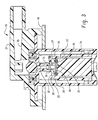
- valve indicated generally at 16 is shown schematically illustrated in a typical vehicle fuel system environment including a fuel tank 10, a filler pipe 12, and a vapor recovery apparatus such as a carbon canister 14 connected to valve 16 by a conduit or hose 17.
- Fuel level responsive vapor control valves such as 16 are typically mounted in the upper wall of fuel tank 10, positioned to close vapor venting from the tank to canister 14 when fuel level 18 submerges valve 16, for example during refueling, or during fuel slosh or vehicle rollover conditions. Valve 16 reopens when fuel level 18 drops, or when the slosh or rollover condition is alleviated.
- valve 16 is depicted as a "rollover" valve typically used in conjunction with one or more additional valves in the fuel tank to supplement refueling vapor control and pressure relief functions. It will be apparent to those skilled in the art, however, that valve 16 incorporating the present invention can be employed in almost any type of fuel level responsive valve, and is not limited to the rollover valve application now described.
- valve 16 is illustrated in detail, generally comprising the valve closure and reopening structure at the top of a float mechanism and its relationship to a vapor venting outlet in the upper end of the valve where fuel vapor is vented to the vapor recovery apparatus outside the fuel tank.
- valve 16 includes a valve body 20 having a generally hollow cylinder made from a fuel-resistant plastic material, although the exact composition of valve body 20 is not critical to the present invention.
- Valve body 20 includes an interior float chamber 22 designed to receive a fuel level responsive float 24 in a sliding arrangement.
- Float chamber 22 typically includes at least one, and usually several lower fuel entry ports (not shown) and one or more higher fuel vapor entry ports (not shown) such that liquid fuel freely enters chamber 22 when the fuel level in the tank reaches valve 16, thereby forcing the float 24 upwardly toward vapor venting orifice or outlet 32 located in the upper end of the float chamber and having the lower end thereof forming a valve seat 36.
- Outlet 32 communicates with a passage 35 on the portion 37 of the valve external to tank 10, which portion 35 is adapted for connection to conduit or hose 17 connected to canister 14.
- the fuel vapor entry ports in the upper end of the valve body usually in the form of radial windows (not shown) in the sidewall around chamber 22, admit fuel vapor to be vented through outlet 32 until the outlet is closed by a valve element on the float contacting valve seat 36.
- Float 24 carries a valve closure element indicated generally at 25 on its upper end, captured on the float at one end by flange ring 38 and posts 28, 29, 31 and hinged port 30, illustrated in FIG. 2 as an integral part of float 24 projecting from its upper surface and which forms a cage indicated generally at 33.
- the cage 33 thus comprises a flange or ring 38 supported by posts 28, 29, 31 and 30 which allow the valve element some limited up and down and side to side travel or lost motion relative to the float for a peelaway type reopening action described in further detail below.
- hinged post 30 is shown in the open position enabling the valve seal element 26 to be inserted in cage 33, prior to snap locking the end of post 30 into cutout 39 formed in flange ring 38.
- Valve element 25 is shown in its valve closed position in FIG. 2, forced against vent seat 36 and outlet 32 and is shown in partially peeled open state. In this beginning to open position, valve element 25 is contacted at its rim by the undersurface of the flange or ring 38.
- valve element 25 comprises a soft, pliable, rubberlike seal element 26.
- Valve closure element 25 is preferably a disk-shaped element with a stiffened, preferably, thickened edge 27, illustrated as an annular bead, surrounding a thin, pliable central webbing or diaphragm-like seal element portion 26.
- the central webbing seal element portion 26 is preferably on the order of .015 inches (0.38 mm) in thickness, although it will be apparent to those skilled in the art that different thicknesses with different pliability characteristics may be used depending on the valve application.
- central seal element portion 26 makes a closely-conforming seal with valve seat 36 of vent outlet 32 which is generally superior to the seal formed by rigid plastic valve elements.
- the thin , pliable nature of central seal element portion 26 provides what is known as a "low sealing force" seal with the vent outlet, which is generally desirable in most applications.
- the pliable, reinforced rubber seal 26 is trapped for limited vertical and horizontal movement inside cage 33 which results in improved sealing and reopening action. It will be understood that when the fuel level begins to drop float 24 begins to descend in float chamber 22. Referring to FIG. 4, while the pliable rubber seal 26 remains closed on vent seat 36 of outlet 32 due to the pressure differential between the fuel tank and the canister, and the underside 34 of the flange 38 contacts the upper surface of bead rim 27 and has begun to "crack open" a portion of seal 26 from the vent port valve seat 36.
- This initial cracking or peeling action breaks the seal between rubber disk 26 and vent outlet 32 to begin reducing the pressure differential across rubber seal 26.
- float 24 has dropped further to bring the underside of actuator flange 38 lower to continue the peeling action and break any remaining contact between rubber seal 27 and vent outlet 32 by pulling it straight off the vent outlet.
- the reinforced edge 27 on pliable rubber seal 26 serves to stiffen the overall rubber seal to pull it off the vent outlet in a manner similar to a rigid seal element for the final opening stages.
- float 24 is shown as having descended far enough to pull valve element 25 completely free from the vent seat 36 of outlet 32, such that valve element 25 now drops back down to rest on the upper surface of the float, with internal rubber seal 26 dropping down inside paddle frame cage 33 to its ramp-centered lower position on upper surface 40 of float 24 shoulder 26h.
- valve element 25 may vary depending on the vent outlet which it is intended to close.
- the invention is not to be limited by the foregoing exemplary illustrations, except as provided by the following claims.
Landscapes
- Engineering & Computer Science (AREA)
- General Engineering & Computer Science (AREA)
- Mechanical Engineering (AREA)
- Chemical & Material Sciences (AREA)
- Sustainable Development (AREA)
- Sustainable Energy (AREA)
- Life Sciences & Earth Sciences (AREA)
- Combustion & Propulsion (AREA)
- Transportation (AREA)
- Cooling, Air Intake And Gas Exhaust, And Fuel Tank Arrangements In Propulsion Units (AREA)
- Self-Closing Valves And Venting Or Aerating Valves (AREA)
- Supplying Secondary Fuel Or The Like To Fuel, Air Or Fuel-Air Mixtures (AREA)
- Float Valves (AREA)
Abstract
Description
- Not Applicable
- Not Applicable
- Not Applicable
- The present invention is in the field of fuel level responsive valves used in vehicle fuel tanks.
- Fuel level responsive valves are well known in the art of controlling the venting of fuel vapor from vehicle fuel tanks. These valves typically have a float mechanism trapped within a valve body to move a valve closure element into and out of sealing engagement with a vent outlet in response to rising and falling fuel levels. Such valves are most often employed as rollover valves, responding to fuel slosh or vehicle tilt and rollover situations to protect a vapor-processing canister from liquid fuel, although they can also be used for fill control shutoff and primary onboard vapor control.
- Some successful float-operated valves are shown in U.S. Patent No. 4,753,262 issued to Bergsma, and U.S. Patent No. 5,313,977 issued to Bergsma, et al., both co-owned with the present application. These valves employ a peelaway type opening action, in which a rigid plastic plate- or paddle-like valve element is initially "cracked" open over a limited segment of its sealing surface with the vent outlet by an actuator attached to the float, and subsequently "peeled" from the vent outlet, either circumferentially or in lever fashion. By initially cracking or peeling only a portion of the valve element from the vent outlet, the pressure differential acting across the valve element is reduced to prevent the float from becoming "hung up", or lodged in the closed position, unable to overcome the force of the pressure differential acting across the surface area of the valve element to open the valve when fuel level drops. The net downward force comprising the weight of the float, less buoyancy forces is not sufficient to move the entire valve element off the vent outlet at once, because the accumulated force of the vapor pressure differential acting across the entire surface area of the valve element is substantially greater.
- Heretofore rigid valve elements have been employed because they are more responsive to the initial "cracking" or "peeling" action of the float. It is therefore necessary to either machine the sealing surfaces of the rigid valve element and the vent outlet carefully to ensure an adequate vapor and liquid seal, or to apply an additional resilient, rubberlike seal member to either the valve element or the vent outlet to improve the seal between them.
- Another prior approach has been the use of pliable, ribbonlike valve elements which are opened in a generally continuous peeling fashion. Examples of such valves are shown in the above-described patent to Bergsma, et al. and in U.S. Patent No. 4,770,201 and published European Patent Application EP 0724098A1 to Zakai, et al.
- While pliable, rubber-type valve elements provide improved sealing with the vent outlet, rubber-type seals have tended to provide a continuous peeling action which has been found not as desirable as the cracked-open lever action of rigid valve elements. Such seals have also been found prone to "bunching up" or deforming due to high volume vapor flow, large pressure differentials, and any horizontal sliding motion of the float relative to the vent outlet.
- The present invention solves the foregoing disadvantages of the prior art valve with a valve element having a pliable, resilient diaphragm-like seal member peripherally stiffened by a thickened rim to give the resilient seal a lever-type opening action.
- In a preferred form, the float has a generally ring-shaped cage or frame which traps the resilient seal member. The trapped resilient seal is preferably stiffened, for example with a thickened edge to provide body or shape holding characteristics to a thin, pliable center section which engages the vent outlet.
- The seal member is trapped inside the cage for limited vertical, and preferable also limited horizontal movement within the cage to assist with the opening action.
- In the preferred form the cage is integrally formed with the float and has a flexible strip portion or "living hinge" portion which is folded and snap-locked in place after insertion of the seal member in the cage for retaining the seal member in the cage.
-
- FIG. 1 is a schematic representation of a vehicle fuel system of the type in which a valve according to the present invention is capable of being used;
- FIG. 2 is a perspective view of the rollover vent valve of FIG. 1;
- FIG. 3 is a cutaway or section view taken along section indicating lines 3-3 of FIG. 2, showing the valve fully open;
- FIG. 4 is an enlarged view of a portion of FIG. 3 showing the initial peelaway stage when the seal between the valve element and the vent outlet is first broken;
- FIG. 5 is a view showing the valve element further opened from the position of FIG. 4; and,
- FIG. 6 is a perspective view of the top of the float with the cage opened for insertion of the valve member.
-
- Referring first to FIG. 1, a valve indicated generally at 16 according to the present invention is shown schematically illustrated in a typical vehicle fuel system environment including a
fuel tank 10, afiller pipe 12, and a vapor recovery apparatus such as acarbon canister 14 connected tovalve 16 by a conduit orhose 17. - Fuel level responsive vapor control valves such as 16 are typically mounted in the upper wall of
fuel tank 10, positioned to close vapor venting from the tank to canister 14 whenfuel level 18 submergesvalve 16, for example during refueling, or during fuel slosh or vehicle rollover conditions. Valve 16 reopens whenfuel level 18 drops, or when the slosh or rollover condition is alleviated. - In the illustrated embodiment,
valve 16 is depicted as a "rollover" valve typically used in conjunction with one or more additional valves in the fuel tank to supplement refueling vapor control and pressure relief functions. It will be apparent to those skilled in the art, however, thatvalve 16 incorporating the present invention can be employed in almost any type of fuel level responsive valve, and is not limited to the rollover valve application now described. - Referring next to figures 2 and 3, the
inventive valve 16 is illustrated in detail, generally comprising the valve closure and reopening structure at the top of a float mechanism and its relationship to a vapor venting outlet in the upper end of the valve where fuel vapor is vented to the vapor recovery apparatus outside the fuel tank. In particular,valve 16 includes avalve body 20 having a generally hollow cylinder made from a fuel-resistant plastic material, although the exact composition ofvalve body 20 is not critical to the present invention. Valvebody 20 includes aninterior float chamber 22 designed to receive a fuel levelresponsive float 24 in a sliding arrangement.Float chamber 22 typically includes at least one, and usually several lower fuel entry ports (not shown) and one or more higher fuel vapor entry ports (not shown) such that liquid fuel freely enterschamber 22 when the fuel level in the tank reachesvalve 16, thereby forcing thefloat 24 upwardly toward vapor venting orifice oroutlet 32 located in the upper end of the float chamber and having the lower end thereof forming avalve seat 36.Outlet 32 communicates with apassage 35 on theportion 37 of the valve external totank 10, whichportion 35 is adapted for connection to conduit orhose 17 connected tocanister 14. The fuel vapor entry ports in the upper end of the valve body, usually in the form of radial windows (not shown) in the sidewall aroundchamber 22, admit fuel vapor to be vented throughoutlet 32 until the outlet is closed by a valve element on the float contactingvalve seat 36. -
Float 24 carries a valve closure element indicated generally at 25 on its upper end, captured on the float at one end byflange ring 38 andposts port 30, illustrated in FIG. 2 as an integral part offloat 24 projecting from its upper surface and which forms a cage indicated generally at 33. Thecage 33 thus comprises a flange orring 38 supported byposts - Referring to FIG. 6 hinged
post 30 is shown in the open position enabling thevalve seal element 26 to be inserted incage 33, prior to snap locking the end ofpost 30 intocutout 39 formed inflange ring 38. -
Valve element 25 is shown in its valve closed position in FIG. 2, forced againstvent seat 36 andoutlet 32 and is shown in partially peeled open state. In this beginning to open position,valve element 25 is contacted at its rim by the undersurface of the flange orring 38. - Referring to FIGS. 3, 4 and 5, in accordance with the present invention,
valve element 25 comprises a soft, pliable,rubberlike seal element 26. -
Valve closure element 25 is preferably a disk-shaped element with a stiffened, preferably, thickenededge 27, illustrated as an annular bead, surrounding a thin, pliable central webbing or diaphragm-likeseal element portion 26. For purposes of illustration, the central webbingseal element portion 26 is preferably on the order of .015 inches (0.38 mm) in thickness, although it will be apparent to those skilled in the art that different thicknesses with different pliability characteristics may be used depending on the valve application. As shown in FIG. 4, centralseal element portion 26 makes a closely-conforming seal withvalve seat 36 ofvent outlet 32 which is generally superior to the seal formed by rigid plastic valve elements. The thin , pliable nature of centralseal element portion 26 provides what is known as a "low sealing force" seal with the vent outlet, which is generally desirable in most applications. - The pliable, reinforced
rubber seal 26 is trapped for limited vertical and horizontal movement insidecage 33 which results in improved sealing and reopening action. It will be understood that when the fuel level begins to dropfloat 24 begins to descend infloat chamber 22. Referring to FIG. 4, while thepliable rubber seal 26 remains closed onvent seat 36 ofoutlet 32 due to the pressure differential between the fuel tank and the canister, and theunderside 34 of theflange 38 contacts the upper surface ofbead rim 27 and has begun to "crack open" a portion ofseal 26 from the ventport valve seat 36. - This initial cracking or peeling action breaks the seal between
rubber disk 26 andvent outlet 32 to begin reducing the pressure differential acrossrubber seal 26. - Referring next to FIG. 5,
float 24 has dropped further to bring the underside ofactuator flange 38 lower to continue the peeling action and break any remaining contact betweenrubber seal 27 andvent outlet 32 by pulling it straight off the vent outlet. As shown in FIG. 5, the reinforcededge 27 onpliable rubber seal 26 serves to stiffen the overall rubber seal to pull it off the vent outlet in a manner similar to a rigid seal element for the final opening stages. - In FIG. 3,
float 24 is shown as having descended far enough to pullvalve element 25 completely free from thevent seat 36 ofoutlet 32, such thatvalve element 25 now drops back down to rest on the upper surface of the float, withinternal rubber seal 26 dropping down insidepaddle frame cage 33 to its ramp-centered lower position onupper surface 40 offloat 24 shoulder 26h. - It will be apparent to those skilled in the art that various modifications may be made to the disclosed structure for different valve applications, without departing from the spirit and scope of my invention. For example, the size and shape of
valve element 25 may vary depending on the vent outlet which it is intended to close. The invention is not to be limited by the foregoing exemplary illustrations, except as provided by the following claims.
Claims (14)
- A fuel level responsive valve adapted for use in a vehicle fuel tank to close vapor venting from the tank to a vapor recovery apparatus when the fuel level in the tank rises to a certain level, the valve comprising:(a) a valve body having a float chamber and a vapor venting outlet at an upper end of the float chamber;(b) a float in the float chamber, the float having a closed position near the vapor venting outlet when the fuel level rises, and an open position away from the vapor venting outlet when the fuel level drops;(c) a valve element disposed for movement with and including means providing a lever type peelaway opening action to the valve element with respect to the venting outlet wherein the valve element comprises a resilient seal portion trapped on said float for limited vertical and horizontal movement and including a relatively stiff, peripheral portion.
- A fuel level responsive valve adapted for use in a vehicle fuel tank to close vapor venting from the tank to a vapor recovery apparatus when the fuel level in the tank rises to a certain level, the valve comprising:(a) a valve body having a float chamber and a vapor venting outlet at an upper end of the float chamber;(b) a float in the float chamber, the float having a closed position near the vapor venting outlet when the fuel level rises, and an open position away from the vapor venting outlet when the fuel level drops; wherein, the valve element comprises a resilient rubber-like valve closure member having a stiffened edge and a rigid arm extending from the edge to the actuator means.
- A float operated valve assembly for a fuel tank comprising:(a) a valve body having a float chamber and a vapor venting outlet port at an upper end of the float chamber;(b) a valve member disposed for movement with said float for closing said outlet port, said valve member having a relatively thin, flexible portion and a stiffened, marginal portion of substantially lesser flexibility than said flexible portion;(c) means operative for capturing said valve member on said float for limited lost motion movement with respect thereto, said means operative to contact said thickened marginal portion and to effect peelaway movement of said valve member from said venting outlet port upon dropping of said float.
- The valve assembly defined in claim 3, wherein said valve member is formed of elastomeric material.
- The valve assembly defined in claim 3, wherein said means attaching said valve member is formed integrally as one piece with said float.
- The valve assembly defined in claim 3, wherein said means attaching said valve member is formed integrally as one piece with said float and includes a living hinge portion deformed to retain said valve member.
- The valve assembly defined in claim 3, wherein said means attaching said valve member is formed integrally with said float and includes a cage portion deformed and snap-locked for retaining said valve member.
- The valve assembly defined in claim 3, wherein said valve member flexible portion comprises a central region.
- The valve assembly defined in claim 3, wherein said stiffened marginal portion comprises a thickened peripheral rim.
- A method of closing a vapor vent port in a fuel tank in response to fuel level in the tank comprising:(a) disposing a valve body in said tank and forming a vapor vent port therein;(b) disposing a float for movement with respect to said port in response to changes in fuel level in the tank.(c) capturing a resilient valve member for limited lost motion movement on said float and stiffening marginal portions of said valve member; and,(d) closing said valve member on said port when the fuel level reaches a certain level and moving said marginal portions of said valve member and effecting a peelaway opening of said port when fuel level falls below said certain level.
- The method defined in claim 10, wherein said step of capturing a valve member includes forming a cage integrally as one piece with said float.
- The method defined in claim 10, wherein said step of stiffening the marginal portions of said valve member includes forming a thickened peripheral rim about said valve member.
- The method defined in claim 10, wherein said step of capturing includes forming an integrally hinged portion as one piece on said float and deforming said hinged portion and retaining said valve member on said float.
- The method defined in claim 10, wherein said step of stiffening marginal portions of said valve member includes forming said flexible portions and marginal portions integrally of elastomer.
Applications Claiming Priority (2)
| Application Number | Priority Date | Filing Date | Title |
|---|---|---|---|
| US707480 | 2000-11-07 | ||
| US09/707,480 US6371146B1 (en) | 2000-11-07 | 2000-11-07 | Peelaway type rollover valve element |
Publications (2)
| Publication Number | Publication Date |
|---|---|
| EP1205700A1 true EP1205700A1 (en) | 2002-05-15 |
| EP1205700B1 EP1205700B1 (en) | 2004-01-21 |
Family
ID=24841865
Family Applications (1)
| Application Number | Title | Priority Date | Filing Date |
|---|---|---|---|
| EP01126261A Expired - Lifetime EP1205700B1 (en) | 2000-11-07 | 2001-11-06 | Float operated venting valve |
Country Status (8)
| Country | Link |
|---|---|
| US (1) | US6371146B1 (en) |
| EP (1) | EP1205700B1 (en) |
| JP (1) | JP2002213316A (en) |
| CN (1) | CN1353260A (en) |
| CA (1) | CA2361216A1 (en) |
| DE (1) | DE60101835T2 (en) |
| ES (1) | ES2211721T3 (en) |
| MX (1) | MXPA01011326A (en) |
Families Citing this family (23)
| Publication number | Priority date | Publication date | Assignee | Title |
|---|---|---|---|---|
| US6508263B1 (en) * | 2001-09-20 | 2003-01-21 | Eaton Corporation | Float operated fuel tank vapor vent valve |
| US6691725B2 (en) * | 2001-12-14 | 2004-02-17 | Eaton Corporation | Fuel vapor vent valve with peel-off mechanism for ensuring reopening |
| KR100463058B1 (en) * | 2002-11-12 | 2004-12-23 | 현대자동차주식회사 | Vent valve structure |
| KR100509820B1 (en) * | 2002-11-28 | 2005-08-23 | 현대자동차주식회사 | vent valve of fuel tank for vehicle |
| US7083062B2 (en) | 2003-01-27 | 2006-08-01 | Eaton Corporation | Orientationless internal closure/retainer and valve assembly employing same |
| WO2005083307A1 (en) | 2004-02-27 | 2005-09-09 | Toyota Jidosha Kabushiki Kaisha | Seal member |
| US7318576B2 (en) | 2004-05-27 | 2008-01-15 | Alfmeier Prazision Ag Baugruppen Und Systemlosungen | Bi-directional air valve for a tank system of a motor vehicle |
| US7234452B2 (en) * | 2004-12-20 | 2007-06-26 | Eaton Corporation | Controlling vapor emission in a small engine fuel tank system |
| FR2886366B1 (en) * | 2005-05-24 | 2007-07-06 | Inergy Automotive Systems Res | LIQUID TANK AIR SUPPLY SYSTEM |
| JP4536611B2 (en) * | 2005-07-08 | 2010-09-01 | 京三電機株式会社 | Float valve opening structure with single seal structure |
| US7543597B2 (en) * | 2005-10-07 | 2009-06-09 | Alfmeier Corporation | Vent valve assembly with lever arrangement |
| US8109285B2 (en) * | 2005-11-08 | 2012-02-07 | Raval A.C.S. Ltd. | Roll over vent valve |
| JP4767675B2 (en) * | 2005-12-07 | 2011-09-07 | 株式会社パイオラックス | Fuel leak prevention valve |
| JP5091689B2 (en) * | 2008-01-10 | 2012-12-05 | 株式会社パイオラックス | Float valve device |
| JP5352413B2 (en) * | 2009-10-20 | 2013-11-27 | 株式会社ニフコ | Fuel tank connector |
| CN103362705B (en) * | 2012-03-29 | 2016-12-14 | 比亚迪股份有限公司 | A kind of fuel tank is protected valve and has the fuel tank of this protection valve |
| KR20150012283A (en) * | 2012-05-10 | 2015-02-03 | 이턴 코포레이션 | Quick response float-operated vapor vent valve |
| EP2872348B1 (en) | 2012-07-12 | 2020-01-15 | Eaton Corporation | Flapper valve with guide legs |
| IN2014DN10928A (en) * | 2012-12-24 | 2015-05-22 | Eaton Corp | |
| JP6157404B2 (en) * | 2014-05-09 | 2017-07-05 | 株式会社ニフコ | Valve device |
| CN106949275A (en) * | 2017-02-23 | 2017-07-14 | 慈溪市华龙电子有限公司 | One kind ventilation stop valve |
| CN106812984A (en) * | 2017-02-23 | 2017-06-09 | 慈溪市华龙电子有限公司 | One kind ventilation stop valve |
| WO2022101752A1 (en) * | 2020-11-13 | 2022-05-19 | Giacomini S.P.A. | Deaerator with integrated shut-off valve |
Citations (6)
| Publication number | Priority date | Publication date | Assignee | Title |
|---|---|---|---|---|
| US4753262A (en) * | 1987-02-06 | 1988-06-28 | G.T. Products, Inc. | Fuel system vent valve having roll-over closure with improved re-opening action for venting |
| US4770201A (en) * | 1986-08-01 | 1988-09-13 | Aran Engineering Development Ltd. | Fluid flow valve |
| US5404907A (en) * | 1993-02-18 | 1995-04-11 | G. T. Products, Inc. | Weldable vapor vent valve for fuel tanks |
| EP0724098A1 (en) * | 1995-01-25 | 1996-07-31 | Raviv Precision Injection Molding | A roll vent valve |
| US5605175A (en) * | 1995-05-24 | 1997-02-25 | Bergsma; Rudolph | Fluid responsive vent control valve with peel-away opening action |
| WO2000053960A1 (en) * | 1999-03-11 | 2000-09-14 | Raviv Precision Injection Moulding | Over filling interdiction, vent and roll over valve |
Family Cites Families (3)
| Publication number | Priority date | Publication date | Assignee | Title |
|---|---|---|---|---|
| JP2549551B2 (en) * | 1988-10-20 | 1996-10-30 | 豊田合成株式会社 | Fuel cut-off valve |
| US5172714A (en) * | 1990-11-30 | 1992-12-22 | Nissan Motor Co., Ltd. | Fuel check valve assembly for fuel tank |
| US5313977A (en) | 1992-11-12 | 1994-05-24 | G. T. Products, Inc. | Fluid-responsive vent control valve with peel-away opening action |
-
2000
- 2000-11-07 US US09/707,480 patent/US6371146B1/en not_active Expired - Fee Related
-
2001
- 2001-11-06 ES ES01126261T patent/ES2211721T3/en not_active Expired - Lifetime
- 2001-11-06 JP JP2001340473A patent/JP2002213316A/en not_active Withdrawn
- 2001-11-06 EP EP01126261A patent/EP1205700B1/en not_active Expired - Lifetime
- 2001-11-06 DE DE60101835T patent/DE60101835T2/en not_active Expired - Fee Related
- 2001-11-07 MX MXPA01011326A patent/MXPA01011326A/en not_active Application Discontinuation
- 2001-11-07 CA CA002361216A patent/CA2361216A1/en not_active Abandoned
- 2001-11-07 CN CN01143197.0A patent/CN1353260A/en active Pending
Patent Citations (6)
| Publication number | Priority date | Publication date | Assignee | Title |
|---|---|---|---|---|
| US4770201A (en) * | 1986-08-01 | 1988-09-13 | Aran Engineering Development Ltd. | Fluid flow valve |
| US4753262A (en) * | 1987-02-06 | 1988-06-28 | G.T. Products, Inc. | Fuel system vent valve having roll-over closure with improved re-opening action for venting |
| US5404907A (en) * | 1993-02-18 | 1995-04-11 | G. T. Products, Inc. | Weldable vapor vent valve for fuel tanks |
| EP0724098A1 (en) * | 1995-01-25 | 1996-07-31 | Raviv Precision Injection Molding | A roll vent valve |
| US5605175A (en) * | 1995-05-24 | 1997-02-25 | Bergsma; Rudolph | Fluid responsive vent control valve with peel-away opening action |
| WO2000053960A1 (en) * | 1999-03-11 | 2000-09-14 | Raviv Precision Injection Moulding | Over filling interdiction, vent and roll over valve |
Also Published As
| Publication number | Publication date |
|---|---|
| DE60101835D1 (en) | 2004-02-26 |
| MXPA01011326A (en) | 2010-05-24 |
| JP2002213316A (en) | 2002-07-31 |
| DE60101835T2 (en) | 2004-12-16 |
| ES2211721T3 (en) | 2004-07-16 |
| CN1353260A (en) | 2002-06-12 |
| EP1205700B1 (en) | 2004-01-21 |
| CA2361216A1 (en) | 2002-05-07 |
| US6371146B1 (en) | 2002-04-16 |
Similar Documents
| Publication | Publication Date | Title |
|---|---|---|
| US6371146B1 (en) | Peelaway type rollover valve element | |
| US5605175A (en) | Fluid responsive vent control valve with peel-away opening action | |
| US5028244A (en) | Tank venting control valve assembly | |
| EP0758974B1 (en) | Fill limit valve assembly | |
| US7882862B2 (en) | Fuel and vapor vent management system for filler neck | |
| US4991615A (en) | Tank pressure control apparatus | |
| US6918405B2 (en) | Fill limit vent valve | |
| EP1295747B1 (en) | Float operated fuel tank vapor vent valve | |
| EP1323568B1 (en) | Fuel vapor vent valve with peel-off mechanism for ensuring reopening | |
| EP1199207A2 (en) | Fuel tank vent control valve | |
| EP1782992A1 (en) | Roll-over valve with underpressure security function | |
| US5044397A (en) | Tank pressure control apparatus | |
| US20020157706A1 (en) | Two-stage float operated fuel tank vent valve | |
| US8485215B2 (en) | Liquid tank venting system | |
| EP1232898A2 (en) | Easy opening fuel tank vent valve | |
| KR20060107382A (en) | Steam vent / tipping and shutoff valve assemblies and steam exhaust control | |
| US8267113B2 (en) | Safety valve for the venting circuit of a liquid tank | |
| JPH0528729U (en) | Liquid fuel shutoff valve |
Legal Events
| Date | Code | Title | Description |
|---|---|---|---|
| PUAI | Public reference made under article 153(3) epc to a published international application that has entered the european phase |
Free format text: ORIGINAL CODE: 0009012 |
|
| AK | Designated contracting states |
Kind code of ref document: A1 Designated state(s): AT BE CH CY DE DK ES FI FR GB GR IE IT LI LU MC NL PT SE TR |
|
| AX | Request for extension of the european patent |
Free format text: AL;LT;LV;MK;RO;SI |
|
| 17P | Request for examination filed |
Effective date: 20020531 |
|
| 17Q | First examination report despatched |
Effective date: 20020730 |
|
| AKX | Designation fees paid |
Designated state(s): DE ES FR GB IT |
|
| GRAH | Despatch of communication of intention to grant a patent |
Free format text: ORIGINAL CODE: EPIDOS IGRA |
|
| GRAS | Grant fee paid |
Free format text: ORIGINAL CODE: EPIDOSNIGR3 |
|
| GRAA | (expected) grant |
Free format text: ORIGINAL CODE: 0009210 |
|
| AK | Designated contracting states |
Kind code of ref document: B1 Designated state(s): DE ES FR GB IT |
|
| REG | Reference to a national code |
Ref country code: GB Ref legal event code: FG4D |
|
| REG | Reference to a national code |
Ref country code: IE Ref legal event code: FG4D |
|
| REF | Corresponds to: |
Ref document number: 60101835 Country of ref document: DE Date of ref document: 20040226 Kind code of ref document: P |
|
| REG | Reference to a national code |
Ref country code: ES Ref legal event code: FG2A Ref document number: 2211721 Country of ref document: ES Kind code of ref document: T3 |
|
| ET | Fr: translation filed | ||
| PLBE | No opposition filed within time limit |
Free format text: ORIGINAL CODE: 0009261 |
|
| STAA | Information on the status of an ep patent application or granted ep patent |
Free format text: STATUS: NO OPPOSITION FILED WITHIN TIME LIMIT |
|
| 26N | No opposition filed |
Effective date: 20041022 |
|
| PGFP | Annual fee paid to national office [announced via postgrant information from national office to epo] |
Ref country code: FR Payment date: 20051104 Year of fee payment: 5 |
|
| PGFP | Annual fee paid to national office [announced via postgrant information from national office to epo] |
Ref country code: ES Payment date: 20051123 Year of fee payment: 5 |
|
| PGFP | Annual fee paid to national office [announced via postgrant information from national office to epo] |
Ref country code: DE Payment date: 20051130 Year of fee payment: 5 |
|
| PGFP | Annual fee paid to national office [announced via postgrant information from national office to epo] |
Ref country code: IT Payment date: 20061130 Year of fee payment: 6 |
|
| PG25 | Lapsed in a contracting state [announced via postgrant information from national office to epo] |
Ref country code: DE Free format text: LAPSE BECAUSE OF NON-PAYMENT OF DUE FEES Effective date: 20070601 |
|
| GBPC | Gb: european patent ceased through non-payment of renewal fee |
Effective date: 20061106 |
|
| REG | Reference to a national code |
Ref country code: FR Ref legal event code: ST Effective date: 20070731 |
|
| PG25 | Lapsed in a contracting state [announced via postgrant information from national office to epo] |
Ref country code: GB Free format text: LAPSE BECAUSE OF NON-PAYMENT OF DUE FEES Effective date: 20061106 |
|
| REG | Reference to a national code |
Ref country code: ES Ref legal event code: FD2A Effective date: 20061107 |
|
| PG25 | Lapsed in a contracting state [announced via postgrant information from national office to epo] |
Ref country code: ES Free format text: LAPSE BECAUSE OF NON-PAYMENT OF DUE FEES Effective date: 20061107 Ref country code: FR Free format text: LAPSE BECAUSE OF NON-PAYMENT OF DUE FEES Effective date: 20061130 |
|
| PGFP | Annual fee paid to national office [announced via postgrant information from national office to epo] |
Ref country code: GB Payment date: 20051004 Year of fee payment: 5 |
|
| PG25 | Lapsed in a contracting state [announced via postgrant information from national office to epo] |
Ref country code: IT Free format text: LAPSE BECAUSE OF NON-PAYMENT OF DUE FEES Effective date: 20071106 |