EP1205842A2 - Minimum delta generator for program binaries - Google Patents
Minimum delta generator for program binaries Download PDFInfo
- Publication number
- EP1205842A2 EP1205842A2 EP01126979A EP01126979A EP1205842A2 EP 1205842 A2 EP1205842 A2 EP 1205842A2 EP 01126979 A EP01126979 A EP 01126979A EP 01126979 A EP01126979 A EP 01126979A EP 1205842 A2 EP1205842 A2 EP 1205842A2
- Authority
- EP
- European Patent Office
- Prior art keywords
- blocks
- cfg
- delta
- representation
- program
- Prior art date
- Legal status (The legal status is an assumption and is not a legal conclusion. Google has not performed a legal analysis and makes no representation as to the accuracy of the status listed.)
- Withdrawn
Links
Images



Classifications
-
- G—PHYSICS
- G06—COMPUTING OR CALCULATING; COUNTING
- G06F—ELECTRIC DIGITAL DATA PROCESSING
- G06F8/00—Arrangements for software engineering
- G06F8/60—Software deployment
- G06F8/65—Updates
- G06F8/658—Incremental updates; Differential updates
-
- Y—GENERAL TAGGING OF NEW TECHNOLOGICAL DEVELOPMENTS; GENERAL TAGGING OF CROSS-SECTIONAL TECHNOLOGIES SPANNING OVER SEVERAL SECTIONS OF THE IPC; TECHNICAL SUBJECTS COVERED BY FORMER USPC CROSS-REFERENCE ART COLLECTIONS [XRACs] AND DIGESTS
- Y10—TECHNICAL SUBJECTS COVERED BY FORMER USPC
- Y10S—TECHNICAL SUBJECTS COVERED BY FORMER USPC CROSS-REFERENCE ART COLLECTIONS [XRACs] AND DIGESTS
- Y10S707/00—Data processing: database and file management or data structures
- Y10S707/99931—Database or file accessing
- Y10S707/99933—Query processing, i.e. searching
- Y10S707/99936—Pattern matching access
-
- Y—GENERAL TAGGING OF NEW TECHNOLOGICAL DEVELOPMENTS; GENERAL TAGGING OF CROSS-SECTIONAL TECHNOLOGIES SPANNING OVER SEVERAL SECTIONS OF THE IPC; TECHNICAL SUBJECTS COVERED BY FORMER USPC CROSS-REFERENCE ART COLLECTIONS [XRACs] AND DIGESTS
- Y10—TECHNICAL SUBJECTS COVERED BY FORMER USPC
- Y10S—TECHNICAL SUBJECTS COVERED BY FORMER USPC CROSS-REFERENCE ART COLLECTIONS [XRACs] AND DIGESTS
- Y10S707/00—Data processing: database and file management or data structures
- Y10S707/99941—Database schema or data structure
- Y10S707/99943—Generating database or data structure, e.g. via user interface
Definitions
- This invention generally relates to generating a minimum delta between program binaries.
- Aggravating matters is a trend to move the source of such updates from local, portable, high-bandwidth removable media (such as a CD-ROM) to remote, centralized, relatively low-bandwidth network servers (such as Internet web servers). While replacing a 100 MB of software may be from a CD-ROM may take several minutes, replacing the same amount of software over a dial-up Internet connection may take several hours.
- local, portable, high-bandwidth removable media such as a CD-ROM
- remote, centralized, relatively low-bandwidth network servers such as Internet web servers
- the problem with delta-patching is accuracy. Identifying what is and is not patched is difficult. If the boundaries of such a patch are not accurately determined, the patched version will be different from the desired new version of the software.
- a prerequisite for detecting fragment deltas is the ability to detect invariance of fragments.
- a program module before a program module can be patched, one needs to determine which fragments have not been changed across the two versions. With knowledge of the source code for each version, detecting such invariants and creating a patch is not very difficult.
- Described herein is a technology for generating a minimum delta between at least two program binaries.
- An implementation, described herein is given a source program (S) in a binary format and a target program (T) in a binary form. It constructs control flow graphs (CFGs) of each. It matches common blocks of the S's CFGs and T's CFGs. The blocks are matched based upon their content and their local neighborhoods (e.g., d -neighborhoods). In addition, blocks are matched using labels, which are based upon computed hash values. The matching is done in multiple passes where each pass improves the matching by relaxing the criteria for a match. In addition, the register renaming problems is solved so that blocks can be fairly compared.
- This described implementation produces an intermediate output, which is the content of unmatched blocks.
- Such unmatched blocks are those found in T that are not found in S. It generates a set of edge edit operations for merging the unmatched blocks into S. The combination of the unmatched blocks and the edit operations is the delta. To patch S to produce a reconstructed copy of T, the delta is merged with S.
- Fig. 1 is a schematic block diagram showing an embodiment of a minimum delta generator for program binaries.
- Fig. 2 is a schematic block diagram showing another embodiment of a minimum delta generator for program binaries.
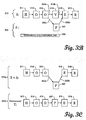
- Figs. 3A-C are illustrations of a simplified application of an implementation of a minimum delta generator for program binaries.
- Figs. 4 and 5 are illustrations of applications of implementations of a minimum delta generator for program binaries.
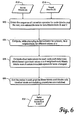
- Fig. 6 is a flow diagram showing a methodological implementation of a minimum delta generator for program binaries.
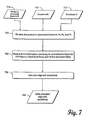
- Fig. 7 is a flow diagram showing another methodological implementation of a minimum delta generator for program binaries.
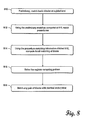
- Fig. 8 is a flow diagram showing still another methodological implementation of a minimum delta generator for program binaries.
- Fig. 9 is an example of a computing operating environment capable of implementing an implementation of a minimum delta generator for program binaries.
- Described herein are one or more exemplary implementations of a minimum delta generator for program binaries.
- the inventors intend these exemplary implementations to be examples.
- the inventors do not intend these exemplary implementations to limit the scope of the claimed present invention. Rather, the inventors have contemplated that the claimed present invention might also be embodied and implemented in other ways, in conjunction with other present or future technologies.
- delta-generator An exemplary implementation of a minimum delta generator for program binaries may be referred to as an exemplary "delta-generator.”
- the one or more exemplary implementations described herein may be implemented (whole or in part) by a delta-generator system 100 of Fig. 1 and/or by a computing environment like that shown in Fig. 9.
- an exemplary delta-generator finds the minimum differences between the binary source and target programs and uses that to modify the source program. However, accuracy is not compromised for such efficiency and speed.
- the exemplary delta-generator compares the binary fragments of the source and target programs. It identifies those fragments that are the same (i.e., unchanged) between them. Necessarily, this also identifies those fragments that are different (i.e., changed) between them. The changed fragments are included in a delta.
- the exemplary delta-generator patches the source with the delta to transform the source into the target program.
- Fig. 1 illustrates the delta-generator system 100. It shows a binary source program 112 and a binary target program 122.
- the delta-generator system 100 reconstructs the target program 122 from the source program 112 and a delta ( ⁇ ) 142.
- the target and source programs are different versions of the same program, so that at least some portions of their code are common.
- the target program may be a newer version of the source program.
- a source CFGer 110 produces a Control Flow Graph (CFG) of the source program 112. CFGs are discussed in more detail below in the "Terminology" section. Likewise, a target CFGer 120 produces a CFG of the target program 122. Of course, these two CFGers 110 and 120 may be a common CFGer.
- CFG Control Flow Graph
- Fig. 1 shows a block matcher 130 that receives the source and target CFGs as input and compares them. It matches binary fragments found in both the source and target CFG.
- the delta generator 140 identifies the remaining (i.e., unmatched) fragments in the target CFG that were not matched as the delta ( ⁇ ) fragments. Collectively, the block matcher 140 and the delta generator 150 it identify binary fragments in the target CFG that are matched in the source CFG or those that are unmatched in the source CFG.
- the ⁇ -determiner 140 also determines how to edit the source CFG to merge the ⁇ therein. These "edits" are part of the ⁇ 142, which is the result of the ⁇ -determiner 140.
- a ⁇ -patcher 150 patches the source program at the binary level.
- the source program 112 is combined with the ⁇ 142 to reconstruct the target program 150.
- the reconstructed target program 150 is identical to target program 122. It is identical because the intended result is an identical copy of the target program 122. Since this delta-generator system 100 introduces no inaccuracies by its efficient patching of the source program, the copy will be identical.
- Fig. 2 schematically illustrates a sample application scenario for the exemplary implementation of a minimum delta generator for program binaries.
- Fig. 2 shows a server side 210 and a client side 220 linked via a network connection 215, such as the Internet.
- the server side 210 includes a server 212 having a copy of the binary source program (S) 112 and a copy of the binary target program (T) 122.
- the client side 220 includes a client 222 having only a copy of the binary source program (S) 112. Initially, it does not have a copy of the target program (T) 122 or delta ( ⁇ ) 142.
- the server 212 at the server side 210 produces the ⁇ 142, in accordance with implementations described herein. It transmits such ⁇ to the client 222 at the client side 220.
- Representations 142a and 142b (and their arrows) indicates the ⁇ being transmitted from the server to the client.
- a minimum sized delta is transmitted over a presumably limited bandwidth network 215 for a client to patch S to accurately reconstruct T.
- program binary is binary manifestation of program module (e.g., software). It does not include the source code for a program module.
- a “basic block” (or simply a “block”) is a sequence of instructions that has a single entry point (only the first instruction can be reached from outside) and has one exit point, at the last instruction. Thus, there is sequential control flow inside a basic block.
- a basic block is an example of a fragment. Specifically, it is an example of a code-fragment.
- a basic block may be called a "code block.”
- a Control Flow Graph is an abstraction of a program. It is a directed graph where the nodes are the basic blocks in the program, and the edges (often visually indicated by arrows) represent all possible control flow between blocks.
- Figs. 3A-5 include CFGs.
- a data block is an example of a fragment. Specifically, it is an example of a data-fragment.
- Data blocks have static data (called the "raw” data) and they may have pointers to other parts of the program. These pointers could be, for example, virtual table entries of an object. Such pointers are relocatable data, and are thus different from other static data in a data block.
- pointers in data blocks are represented by directed edges from the data block to the target blocks.
- address operands in the instructions in a code block are represented as edges from the code block to the block at the corresponding address.
- the content of a data block includes its raw data, but it excludes the pointers in the block.
- the content of a code block includes its sequence of instructions, but it excludes the address operands.
- the contents of the basic blocks in a CFG, along with its edges, fully specify the program. Given any block ⁇ in a CFG P , its parents are the set ⁇ x
- the CFG described herein contains complete information about the layout of the program.
- the layout of the function i.e., the organization of the basic blocks in the program's address space
- the layout of the function is captured by a linked list of the all the blocks of the corresponding procedure, such that a traversal of the list, from head to tail, exactly describes the order of the basic blocks in the function's layout.
- a tool V creates the CFG described herein for any given program binary. Moreover, V may provide an interface (to the CFG) that allows a large class of modifications to be made to the program. These modifications include, but are not restricted to, addition and deletion of basic blocks, modification of their contents, and changes in the edges.
- the exemplary implementations fully minimize ⁇ while maintaining the ability to achieve complete accuracy in patching S to reconstruct T .
- complete accuracy' and “substantially identical” or similar terminology) allows for insubstantial differences between the original T and the reconstructed T.
- a prerequisite for detecting changes between binary programs is the ability to detect identity of binary fragments.
- identity of a fragment in a program module by finding the same unchanged fragment in another program module (presumably an earlier or later version of the same module).
- Figs. 3A-3C illustrate a simple example of a methodological implementation of the exemplary delta-generator.
- the initial goal is to compute a ⁇ 330 for the input lists source ( S ) 310 and target ( T ) 320.
- Fig. 3A shows source 310 and it includes six nodes, 311-316; and the contents of those nodes are H, O, O, V, E, R, respectively.
- Target 320 includes six nodes, 321-326; and contents of those nodes are H, O, O, P, E, R, respectively.
- the target 320 is largely unchanged. The difference is node 314 (containing "V"), which is missing in the target but is replaced by node 324 (containing "P").
- the exemplary delta-generator matches nodes that have not changed. Based on content and relative positioning, each node is matched (i.e., identified) except for the nodes 314 and 324. For example, node 311 and 321 match because their content (specifically, "H") and relative position are identical. Likewise, nodes 312 and 312 match, nodes 313 and 313, nodes 315 and 315, and nodes 316 and 316.
- the delta 330 includes the content ("P") of node 324 as the content of node 337.
- the delta 330 also includes "edits” that specify how the new node is patched into the source. Specifically, delta 330 specifies "ADDEDGE(313, 337); ADDEDGE(337, 315)" within edit-box 339.
- Fig. 3B shows that there are two edges to be added to source 310 after inserting the new node 337.
- the delta contains the edit operations ADDEDGE(313, 337), which translates to adding an edge 339a from the node 313 in the source 310 to the new node 337, and ADDEDGE(337, 315), which specifies the addition of link 339b from node 337 to node 315 in the source.
- Fig. 3C illustrates a combination of the source and the delta at 340a.
- the addition of the delta transforms the source to an exact copy of list target 320. That exact copy of the target may be called a reconstructed target 340b.
- a good matching of blocks is one that minimizes the number of edit operations. If two blocks are matched based on content similarity alone, there might not be a good match. This is because there are usually multiple blocks in the source as well as target with identical content, differing only in their location in the respective graphs. For example, consider the subgraphs shown in Fig. 4.
- Fig. 4 shows subgraphs of source 410 and target 420.
- all the blocks in each of the following groups are identical: (412, 416, 422), (413, 417, 423), (414, 418, 424), (411, 421), (415, 425).
- two blocks can be matched only if they are identical in content. If block 422 is matched with block 412 (which both contain "A"), then the best matching of the other blocks is
- the edit operations are Delete(411, 412), Add(422, 416), Delete(416, 419), Add(416, 415).
- Delete(a, b) means “delete the edge from node a to node b.”
- Add(a, b) means “add an edge from node a to node b.”
- the exemplary delta-generator considers neighborhoods of blocks while matching them.
- the exemplary delta-generator matches blocks based on their content and neighborhood. In fact, it makes several passes of the source and target CFGs, considering neighborhoods of decreasing sizes in each pass. Matching based on larger neighborhood sizes first is desirable ⁇ it produces matches that are more accurate. In a final pass, blocks are matched based on their content alone, after matching based on neighborhood has been examined. Although not a requirement, matching content last is advantageous because the overhead of recording an unmatched block is usually greater than the size of the edit operations required after it has been matched with any arbitrary block that has identical content.
- Register operands may be tricky to handle. Addition or deletion of some blocks may change the register allocation in some other nearby regions of the CFG, even though no change was made in these regions. Such operands are matched modulo a possible register-renaming, using register flow analysis of each graph. Since offsets of stack variables usually change because of changes in the local variable declarations, they present a problem. To address this problem, the exemplary delta-generator matches blocks even if certain immediate operands have changed. In each of the above cases, when the sequence of operand types remains same, the content of code blocks is considered unchanged.
- An i -neighborhood (i.e., local neighborhood) of a node ⁇ in a CFG P is the set of blocks that are at distance ⁇ i from ⁇ in the undirected graph corresponding to P.
- a 0-neighorhood is the set ⁇
- a 1-neighborhood is ⁇ and its parents and children.
- the exemplary delta-generator computes, while attempting to find a match for a block, its d -neighborhood, for different values of d.
- the exemplary delta-generator computes the i -neighborhood of ⁇ doing a breadth first traversal of the CFG, starting from the node ⁇ . It traverses child edges as well as parent edges (in the reverse direction) of blocks until it is at a distance greater than i from ⁇ . Alternatively, the exemplary delta-generator may ignore all parent edges, and traverses only child edges to compute the neighborhood.
- the neighborhood may exclude any blocks that are in a different procedure.
- the exemplary delta-generator uses small neighborhood sizes (typically three or less), along with a longer random component, which is obtained by doing a "random walk” that is described later. This "random walk” heuristic has been empirically observed to perform well.
- Random walk One example of a "random walk" is illustrated by the following: Suppose a person has to do a random walk on a straight road with several bus-stations A,B....N (in that order) on it. The person starts at A (one end of the road). Since this person can only go to the right, the person must go right - to B. Now, at B, there are two options - go left (to A) or right (to C). In the uniform random walk model, an unbiased coin is tossed and the person decides to go one way if its heads and the other if its tails. If the person keeps doing this at every station she reaches, then the person has performed a random walk.
- R be the undirected graph whose vertices are the nodes of the CFG and which has an edge on a vertex pair if and only if the corresponding vertex pair in the CFG has a (directed) control flow edge, in either direction.
- R is a graph with maximum degree three. It starts at the original node w, and at any node x, takes one of the dx edges with uniform probability. (dx is the degree of x). It aborts when it encounters a procedure boundary (call or branch to another procedure) or when the path length crosses a pre-determined limit.
- a block b that does not match any other block in content.
- Such a block if included in the neighborhood of any block ⁇ , may prevent ⁇ from being matched, since in order for ⁇ to be matched to some block, its entire neighborhood has to be matched.
- the block b is called a "bad" node or an outlier. Before performing the matching, such outliers may be filtered out of the neighborhood of all their neighbors.
- the exemplary delta-generator detects matches in several passes of the CFGs, based on progressively relaxing criteria. Preliminarily, the exemplary delta-generator matches the procedures of S and T, based on a preliminary estimate of the number of matching blocks. Examples of procedures are routines and subroutines of a binary program.
- This preliminary matching is performed at a global level (i.e., blocks are matched irrespective of the procedures in which they are located). Subsequently, blocks are matched only if they belong to matching procedures. Such matching may also be called local matching.
- the procedure match information is also used to examine targets of call instructions to detect if two different calls target the same function (which may have been renamed or whose first blocks might be different).
- the hash value of a block ⁇ is computed as follows:
- the nodes in each graph are sorted by these labels and blocks with identical labels and matching procedures are matched.
- the exemplary delta-generator has computed a partial matching of the blocks of S and T.
- Figs. 3A-C gave a simple illustration of computing ⁇ .
- Fig. 5 illustrates an example that shows how the matching computed above may be used in creating the ⁇ for the case of graphs (i.e., CFGs).
- Fig. 5 shows subgraphs of source 510 and target 520.
- the matching phase has matched these block pairs: 511 and 521 ("A"), 512 and 522 ("B"), 513 and 523 ("C"), and 516 and 526 ("E").
- the unmatched blocks in the target subgraph 520 are block 525 (F t ) and block 524 (D t ). If ⁇ contains the contents of block 525 (F t ) and block 524 (D t ), and the edit operations Add(512, 525) and Add (512, 524), the target subgraph 520 can be reconstructed from the source subgraph 510.
- the edit operations Delete(512, 514) and Delete(512, 515) need not be explicitly included in the ⁇ . They are implicitly included. Those of ordinary skilled in the art understand that the implicit edits may be expressly included in the ⁇ without departing from the spirit and the scope of the present invention. However, the implicit edits are not included in the ⁇ of the exemplary implementations described herein because they unnecessarily increase the size of the ⁇ .
- the exemplary delta-generator therefore, outputs (at some point) the contents of the unmatched blocks in the target, and the edges that need to be added, and that comprises the ⁇ .
- Figs. 6 and 7 shows methodological implementations of the exemplary delta-generator performed by the delta-generator system 100 (or some portion thereof). These methodological implementations may be performed in software, hardware, or a combination thereof.
- Fig. 6 primarily shows the "matching" phase of a methodological implementation of the exemplary delta-generator.
- Fig. 7 primarily shows the "edit” phase of a methodological implementation of the exemplary delta-generator.
- the “edit” phase follows the “matching” phase.
- the result of the "edit” phase is the delta.
- Fig. 6 shows, at 620, the exemplary delta-generator obtaining the sequence of instruction opcodes for code blocks and the raw, non-relocatable data for data blocks.
- Such blocks being blocks of procedures from source program binary (S) 612 and procedures from target program binary (T) 614.
- the exemplary delta-generator computes, while attempting to find a match for a block, its d -neighborhood, for different values of d .
- the d -neighborhood is computed by breadth first traversal.
- short hash values are computed for each node.
- the exemplary delta-generator determines labels for nodes based upon the hash values in their d-neighborhood (i.e., local neighborhood). Also at 628, the exemplary delta-generator matches blocks even if certain immediate operands have changed.
- the nodes in each graph are sorted by these labels, and blocks with identical labels and matching procedures are matched.
- the exemplary delta-generator has computed a partial matching of the blocks of S and T. It also computes the converse, which are the unmatched blocks.
- Fig. 7 shows, at 720, the exemplary delta-generator receives the content 710 of unmatched blocks in P t (i.e., a procedure from target program binary), which is part of the output from the methodological implementation of Fig. 6.
- the content of a block excludes all edge information.
- an unmatched block ⁇ whose content is being recorded has address operands (for code blocks) or pointers (for data blocks), then such operands or pointers are replaced by "dummy" addresses that indicate that they have to be corrected using the edge edit information.
- P s and P t represent all pairs of procedures (in S and T respectively) that are matched by the matching phase.
- P s is the procedure from the source
- P t is the matching procedure from T.
- the exemplary delta-generator receives a pair of procedure P s 712 in source program binary (S) and procedure P t 714 in source program binary (T).
- all the information necessary to reconstruct a linked list of P t from a linked list of P s is recorded as part of the computed ⁇ .
- the layout (i.e., arrangement of blocks) of each procedure in the program's address space is captured by a linked list of blocks, such that a sequential traversal of this list, from head to tail, can exactly describe the layout of the procedure.
- the first task in reconstructing P t from P s would be to reconstruct the linked list of P t from the linked list of P s .
- all the information necessary to reconstruct one linked list from the other is recorded as part of the computed ⁇ .
- edge edit operations are calculated.
- An edge edit operation is an explicit addition of an edge (rather than an implicit deletion).
- Each edge can be fully specified by its source and target.
- source refers to the exact operand (for code blocks) or relocatable word (for data blocks) that this edge represents.
- target represents the block whose address this operand or relocatable word refers to.
- the exemplary delta-generator records an edited edge (an edge that has been added or deleted) by recording unique identifiers for the source and the target in separate lists.
- the delta for a given procedure (P s ) in the source is outputted at 734.
- Such delta includes the unmatched blocks in P t and the edge edit operations calculated at 732.
- the above methodological implementation of the "edit" phase of the exemplary delta-generator records sufficient information to reconstruct the target program binary up to some minor changes in register names, immediate values, and instruction opcodes. These changed register names, immediate values, and opcodes are recorded in separate lists.
- the matching phase of the exemplary implementation makes several passes of the CFGs, each of which is described in more detail below.
- Each pass in the matching phase uses different criteria for comparing blocks in S and T , and it does so by computing hash values or labels for each block.
- two exemplary sub-processes are employed and called in several passes. Herein, they are called ComputeLabel and ComputeDLabel.
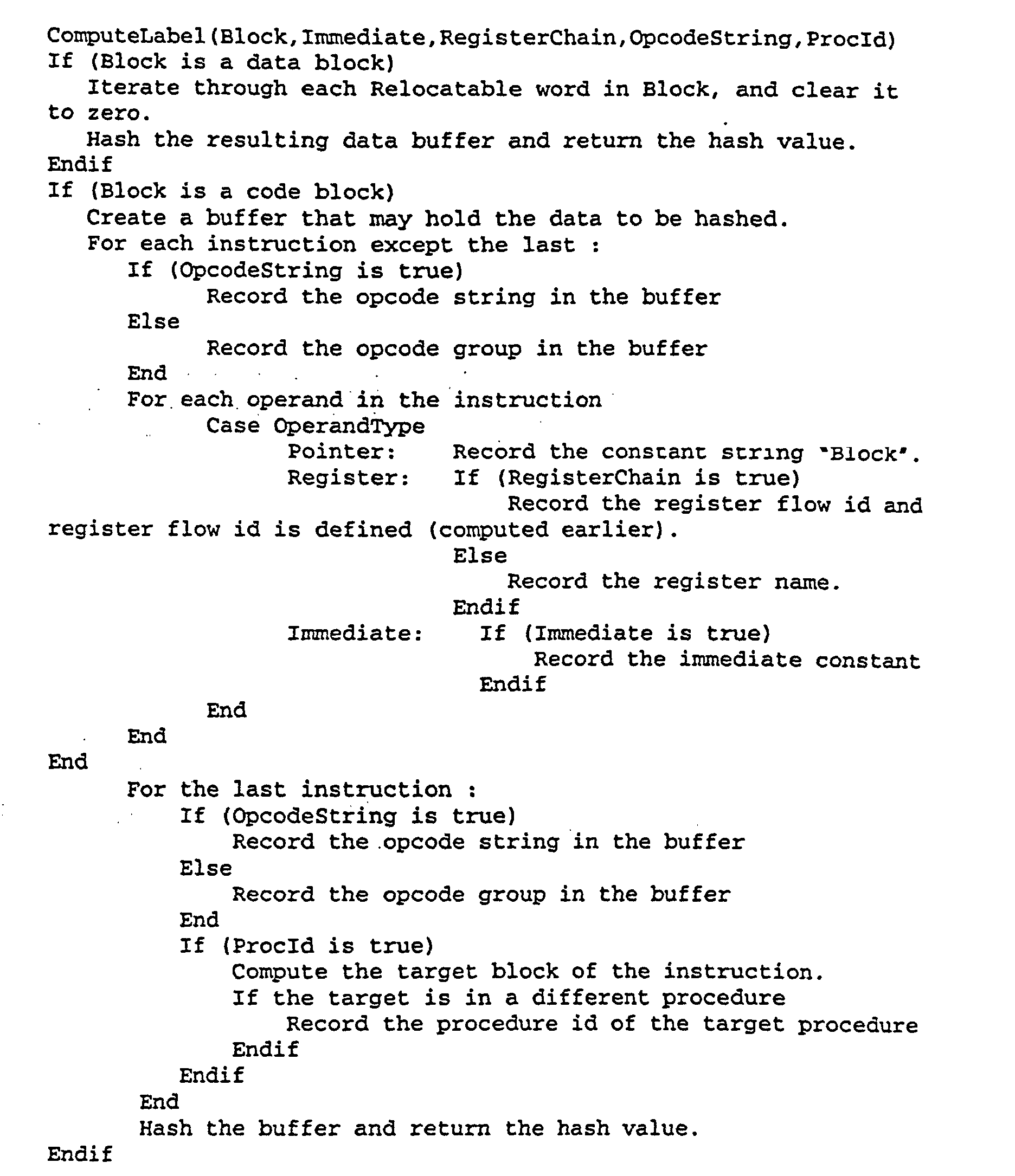
- ComputeLabel Computes the hash value of the content of a block. This is also called the content label of the block. It uses a standard hash to calculate the hash value.
- An example of such a standard hash is MD5, which produces 16 byte strings as the hash of a given string of bytes.
- ComputeLabel This exemplary sub-process, called ComputeLabel, is parameterized to allow different matching criteria, and the Boolean parameters are: Immediate, RegisterChain, OpcodeString and ProcId . Immediate indicates whether the immediate operands in a code block are to be used in hashing. Similarly, RegisterChain specifies whether register renaming is to be used, and OpcodeString indicates whether an opcode is represented by its precise name or its group identifier ("group id").
- ProcId indicates whether procedure matching has already been done, in which case procedures have unique identifiers that match for matching procedures. If this parameter is set, function call targets are represented by their procedure identifiers.
- An example of the pseudo-code is for the subprocess ComputeLabel is:
- ComputeDLabel Computes the hash value based on content as well as neighborhood. This examines the entire already-computed neighborhood (including the root node) and concatenates their content labels. It then returns the hash value of this concatenated list.
- the implementation uses a standard hash to calculate the hash value.
- An example of such a standard hash is MD5, which produces 16 byte strings as the hash of a given string of bytes.
- Fig. 8 illustrates the broad methodological implementation of the matching phase of the exemplary delta-generator.
- This broad methodological implementation may be performed by the delta-generator system 100 (or some portion thereof).
- This broad methodological implementation may be performed in software, hardware, or a combination thereof.
- This task (810 of Fig. 8) matches basic blocks at a global level.
- This task (812 of Fig. 8) uses the preliminary match computed above to match procedures.
- An exemplary delta-generator for matching procedures meets this condition: Given any P s and any two P t1 and P t2 , if P s is matched to P t1 then either m st1 ⁇ m st2 or P t2 is matched to P s such that m st2 ⁇ m st2 .
- the following technique satisfies the condition:
- Task 3 (814 of Fig. 8): Local Matching of Basic Blocks
- This task (814 of Fig. 8) uses the procedure matching information obtained in the previous task to compute local matching of blocks (i.e., blocks are matched only between matching procedures).
- This task (816 of Fig. 8) solves the register-renaming problem (i.e., it detects matching blocks even in the face of a possible register renaming).
- the exemplary delta-generator computes all register flow chains in S and T , and assigns each of them an identifier. Matching blocks have their corresponding register flows assigned the same identifier.
- the exemplary delta-generator calls ComputeLabel with RegisterChain true and assigns each block a content label.
- the exemplary delta-generator repeats this task until no more matches are discovered. This is done because the new matching blocks may cause some more register chains to be assigned the same identifiers, and in turn lead to even more matches.
- Task 5 (818 of Fig. 8): The Final Pass
- the exemplary delta-generator computes its use-def chains, def-use chains, and dominator information.
- a use-def chain is a list that starts with a register use and goes through all the definitions (defs) of that register that reach this use.
- a def-use chain is a list that starts with a register def and goes through each use of the same register, reached by this def.
- a block d is called a dominator of another block b. b is reachable from d and any path to b from the entry point of the procedure must first pass through d .
- computing dominator information means computing all dominators of every block in the procedure.
- the exemplary delta-generator looks at all the register defs in the block, and assigns each of them an id, called the def id, which is unique for that block.
- the exemplary delta-generator looks at all the register uses in that block, and if any use has its only def in the same block, assigns the def identifier to this use.
- all defs and some uses have ids associated with them.
- the exemplary delta-generator calls ComputeDLabel to assign it a d -label, and matches S and T based on the newly computed d -labels.
- the exemplary delta-generator does the following:
- identifiers replace any previously assigned def identifiers that the defs may have. The fact that two defs match is recorded, and a single identifier is associated with both of them.
- the exemplary delta-generator matches register uses based on the newly assigned def identifiers. For both S and T , the exemplary delta-generator iterates through all the register uses in each basic block. For each such use, all the defs are examined that reach it and are not dominated by it. The exemplary delta-generator adds up their def identifiers and assign the sum to the current use's identifier. Consequently, each register operand, def or use, has an identifier associated with it. Matching blocks have matching identifiers associated with corresponding register operands. More specifically, two register operands, that have exactly matching defs, may also have matching identifiers even though the register names may be different.
- the exemplary delta-generator creates a new dummy CFG, called bin, with a single procedure that may serve as a container for all the additional blocks of T. These blocks are, for example, maintained in the form of a linked list.
- the exemplary delta-generator traverses each block in T , in sequence, and assigns consecutive identifiers (starting at zero) to each unmatched block. Also, the exemplary delta-generator dumps the unmatched blocks into bin, making sure that address operands in code blocks and pointers in data blocks are modified into 'dummy' addresses referring to the blocks containing those pointers.
- the exemplary delta-generator traverses each block in S , in sequence, and assigns consecutive identifiers to each matching block. The same identifiers are assigned to matching blocks in T. The identifiers assigned in this and the previous task are called New_Node_Ids.
- the exemplary delta-generator examines the matched blocks of the source graph. If a block x in S matches block y in T, check each of its outgoing edges. For each edge x ⁇ z 1 , there has to be a corresponding y ⁇ z 2 .
- An edge is recorded as follows. Three lists, named Targetld, OperandIndex and SourceProcFirstBlock are created. If an edge x ⁇ y is to be recorded, the New_Node_Ids of y is inserted into TargetId. If this edge was the i th edge in the current procedure, i is pushed into the list OperandIndex. Finally, if any procedure P s in S has at least one edge being recorded, the New_Node_Id of its first block is pushed into SourceProcFirstBlock.
- the exemplary delta-generator examines all the unmatched blocks in the target graph. The exemplary delta-generator looks at each of its outgoing edges x ⁇ y. If y is also an unmatched block, the exemplary delta-generator creates an edge in bin going from x to y. If y matches z in the source graph, the exemplary delta-generator records the link x ⁇ z by pushing the New_Node_Id of z into a list called TargetOperandTargets.
- the exemplary delta-generator traverses the linked list of the blocks of P t .
- the exemplary delta-generator traverses the linked list of the blocks of P t .
- ptr 1 and ptr 2 point to the current node and its next node in T, let mptr 1 and mptr 2 be their 'matching' pointers.
- mptr 1 and mptr 2 be their 'matching' pointers.
- ptr i points to block x in T
- its matching pointer mptr i points to its matching block in S if there is one, or to the copy of x that has been dumped in bin.
- the edge mptr 1 ⁇ mptr 2 is recorded. This is done by pushing the New_Node_Ids of their corresponding blocks into separate lists called LinkedListsLeft and LinkedListsRight.
- the New_Node_Id of the first block of P t along with the latter's size (in terms of number of blocks) and the number of recorded links in P t is recorded in a separate list called ProcedureInfo.
- the exemplary delta-generator uses the edit information computed above, along with S to reconstruct T.
- the exemplary delta-generator may detect the register names, immediate values, and instruction opcodes that differ between the original and reconstructed versions of T, and output these differences in a separate list called MinorDifferences.
- the generated ⁇ may be transmitted from a server 212 to a client 222.
- the exemplary delta-generator may format the patch in a way that it can be heavily compressed.
- the patch is split into several parts, each holding information of a different kind, so that each part can be compressed separately. This approach is based on the observation that different types of data (code vs. lists of integers, for example) may be best compressed by different compression algorithms (i.e., engines).
- an anti-piracy tool may be able to detect similarity of programs.
- Another possible exemplary application could be in analysis of the nature of changes between different versions of software.
- Fig. 9 illustrates an example of a suitable computing environment 920 on which an exemplary delta-generator are, for example, implemented.
- Exemplary computing environment 920 is only one example of a suitable computing environment and is not intended to suggest any limitation as to the scope of use or functionality of an exemplary delta-generator. Neither should the computing environment 920 be interpreted as having any dependency or requirement relating to any one or combination of components illustrated in the exemplary computing environment 920.
- the exemplary delta-generator is operational with numerous other general purpose or special purpose computing system environments or configurations.
- Examples of well known computing systems, environments, and/or configurations that are, for example, suitable for use with an exemplary delta-generator include, but are not limited to, personal computers, server computers, thin clients, thick clients, hand-held or laptop devices, multiprocessor systems, microprocessor-based systems, set top boxes, programmable consumer electronics, network PCs, minicomputers, mainframe computers, distributed computing environments that include any of the above systems or devices, and the like.
- An exemplary delta-generator are, for example, described in the general context of computer-executable instructions, such as program modules, being executed by a computer.
- program modules include routines, programs, objects, components, data structures, etc. that perform particular tasks or implement particular abstract data types.
- An exemplary delta-generator may also be practiced in distributed computing environments where tasks are performed by remote processing devices that are linked through a communications network.
- program modules are, for example, located in both local and remote computer storage media including memory storage devices.
- the computing environment 920 includes a general-purpose computing device in the form of a computer 930.
- the components of computer 920 may include, by are not limited to, one or more processors or processing units 932, a system memory 934, and a bus 936 that couples various system components including the system memory 934 to the processor 932.
- Bus 936 represents one or more of any of several types of bus structures, including a memory bus or memory controller, a peripheral bus, an accelerated graphics port, and a processor or local bus using any of a variety of bus architectures.
- bus architectures include Industry Standard Architecture (ISA) bus, Micro Channel Architecture (MCA) bus, Enhanced ISA (EISA) bus, Video Electronics Standards Association (VESA) local bus, and Peripheral Component Interconnects (PCI) bus also known as Mezzanine bus.
- Computer 930 typically includes a variety of computer readable media. Such media are, for example, any available media that is accessible by computer 930, and it includes both volatile and non-volatile media, removable and non-removable media.
- the system memory includes computer readable media in the form of volatile memory, such as random access memory (RAM) 940, and/or non-volatile memory, such as read only memory (ROM) 938.
- RAM random access memory
- ROM read only memory
- a basic input/output system (BIOS) 942 containing the basic routines that help to transfer information between elements within computer 930, such as during start-up, is stored in ROM 938.
- BIOS basic input/output system
- RAM 940 typically contains data and/or program modules that are immediately accessible to and/or presently be operated on by processor 932.
- Computer 930 may further include other removable/non-removable, volatile/non-volatile computer storage media.
- Fig. 9 illustrates a hard disk drive 944 for reading from and writing to a non-removable, non-volatile magnetic media (not shown and typically called a "hard drive"), a magnetic disk drive 946 for reading from and writing to a removable, non-volatile magnetic disk 948 (e.g., a "floppy disk"), and an optical disk drive 950 for reading from or writing to a removable, non-volatile optical disk 952 such as a CD-ROM, DVD-ROM or other optical media.
- the hard disk drive 944, magnetic disk drive 946, and optical disk drive 950 are each connected to bus 936 by one or more interfaces 954.
- the drives and their associated computer-readable media provide nonvolatile storage of computer readable instructions, data structures, program modules, and other data for computer 930.
- the exemplary environment described herein employs a hard disk, a removable magnetic disk 948 and a removable optical disk 952, it should be appreciated by those skilled in the art that other types of computer readable media which can store data that is accessible by a computer, such as magnetic cassettes, flash memory cards, digital video disks, random access memories (RAMs), read only memories (ROM), and the like, may also be used in the exemplary operating environment.
- a number of program modules are, for example, stored on the hard disk, magnetic disk 948, optical disk 952, ROM 938, or RAM 940, including, by way of example, and not limitation, an operating system 958, one or more application programs 960, other program modules 962, and program data 964.
- Each of such operating system 958, one or more application programs 960, other program modules 962, and program data 964 may include an embodiment of an exemplary delta-generator. More specifically, each may include an embodiment of delta-generator system, comparator, edit-op determiner, and output sub-system.
- a user may enter commands and information into computer 930 through input devices such as keyboard 966 and pointing device 968 (such as a "mouse").
- Other input devices may include a microphone, joystick, game pad, satellite dish, serial port, scanner, or the like.
- a user input interface 970 that is coupled to bus 936, but are, for example, connected by other interface and bus structures, such as a parallel port, game port, or a universal serial bus (USB).
- a monitor 972 or other type of display device is also connected to bus 936 via an interface, such as a video adapter 974.
- a monitor 972 or other type of display device is also connected to bus 936 via an interface, such as a video adapter 974.
- personal computers typically include other peripheral output devices (not shown), such as speakers and printers, which may be connected through output peripheral interface 975.
- Computer 930 may operate in a networked environment using logical connections to one or more remote computers, such as a remote computer 982.
- Remote computer 982 may include many or all of the elements and features described herein relative to computer 930.
- Logical connections shown in Fig. 9 are a local area network (LAN) 977 and a general wide area network (WAN) 979.
- LAN local area network
- WAN wide area network
- Such networking environments are commonplace in offices, enterprise-wide computer networks, intranets, and the Internet.
- the computer 930 When used in a LAN networking environment, the computer 930 is connected to LAN 977 via network interface or adapter 986.
- the computer When used in a WAN networking environment, the computer typically includes a modem 978 or other means for establishing communications over the WAN 979.
- the modem 978 which are, for example, internal or external, are, for example, connected to the system bus 936 via the user input interface 970 or other appropriate mechanism.
- Computer 930 typically includes a modem 978 or other means for establishing communications over the Internet 980.
- Modem 978 which are, for example, internal or external, is connected to bus 936 via interface 970.
- Fig. 9 illustrates remote application programs 989 as residing on a memory device of remote computer 982. It will be appreciated that the network connections shown and described are exemplary and other means of establishing a communications link between the computers are, for example, used.
- Fig. 9 illustrates an example of a suitable operating environment 920 in which an exemplary delta-generator may be implemented.
- the exemplary delta-generator(s) described herein is implemented (wholly or in part) by any program module 960-962 and/or operating system 958 in Fig. 9 or a portion thereof.
- the operating environment is only an example of a suitable operating environment and is not intended to suggest any limitation as to the scope or use of functionality of the exemplary delta-generator(s) described herein.
- Other well known computing systems, environments, and/or configurations that are suitable for use with an exemplary delta-generator include, but are not limited to, personal computers (PCs), server computers, hand-held or laptop devices, multiprocessor systems, microprocessor-based systems, programmable consumer electronics, wireless phones and equipments, general- and special-purpose appliances, application-specific integrated circuits (ASICs), network PCs, minicomputers, mainframe computers, distributed computing environments that include any of the above systems or devices, and the like.
- An implementation of an exemplary delta-generator may be described in the general context of computer-executable instructions, such as program modules, executed by one or more computers or other devices.
- program modules include routines, programs, objects, components, data structures, etc. that perform particular tasks or implement particular abstract data types.
- the functionality of the program modules may be combined or distributed as desired in various embodiments.
- Computer readable media can be any available media that can be accessed by a computer.
- Computer readable media may comprise "computer storage media” and "communications media.”
- Computer storage media include volatile and non-volatile, removable and non-removable media implemented in any method or technology for storage of information such as computer readable instructions, data structures, program modules, or other data.
- Computer storage media includes, but is not limited to, RAM, ROM, EEPROM, flash memory or other memory technology, CD-ROM, digital versatile disks (DVD) or other optical storage, magnetic cassettes, magnetic tape, magnetic disk storage or other magnetic storage devices, or any other medium which can be used to store the desired information and which can be accessed by a computer.
- Communication media typically embodies computer readable instructions, data structures, program modules, or other data in a modulated data signal, such as carrier wave or other transport mechanism. Communication media also includes any information delivery media.
- modulated data signal means a signal that has one or more of its characteristics set or changed in such a manner as to encode information in the signal.
- communication media includes wired media such as a wired network or direct-wired connection, and wireless media such as acoustic, RF, infrared, and other wireless media. Combinations of any of the above are also included within the scope of computer readable media.
Landscapes
- Engineering & Computer Science (AREA)
- Software Systems (AREA)
- General Engineering & Computer Science (AREA)
- Theoretical Computer Science (AREA)
- Computer Security & Cryptography (AREA)
- Physics & Mathematics (AREA)
- General Physics & Mathematics (AREA)
- Stored Programmes (AREA)
Abstract
Description
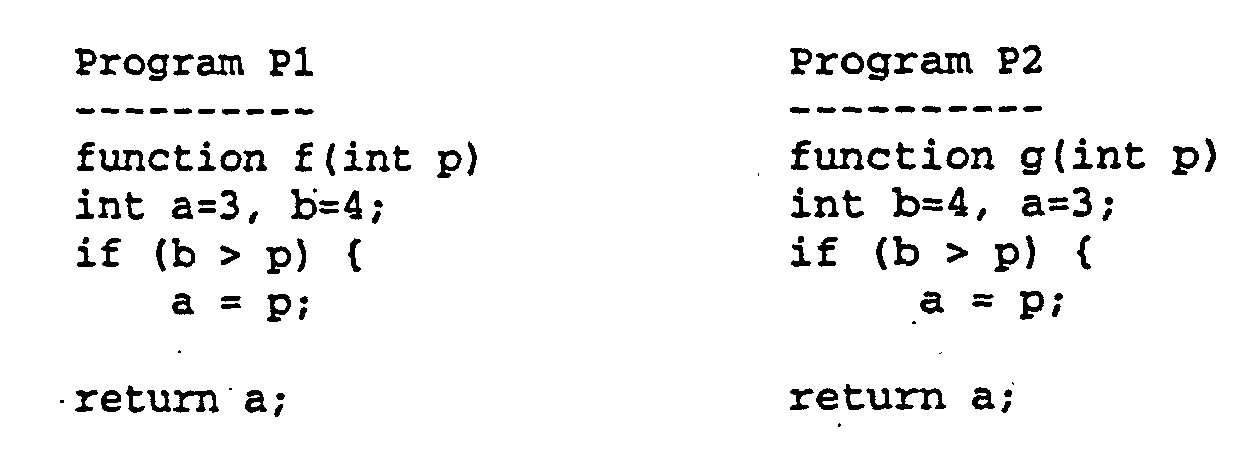
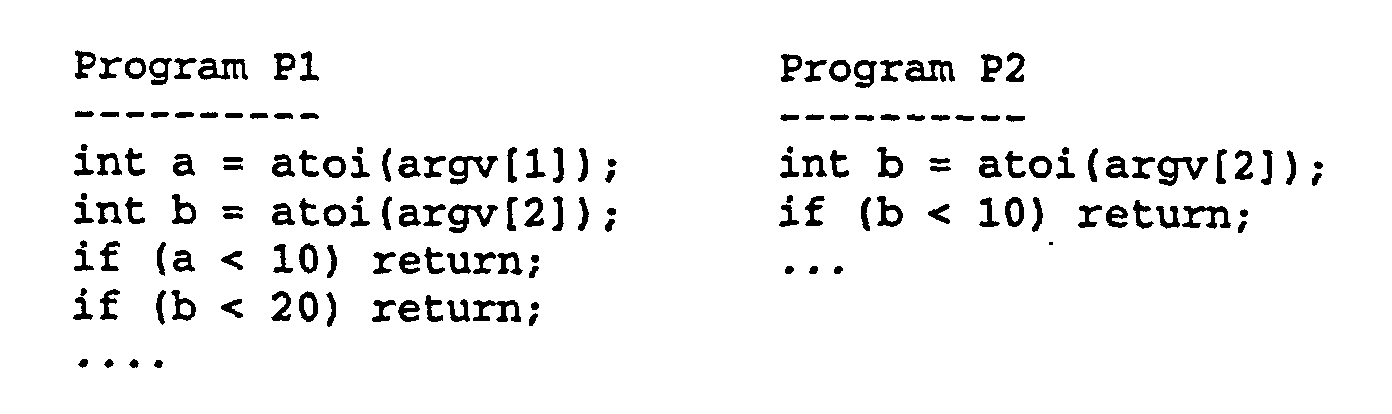
- Changes in one region of code can cause another (unchanged) region to look different
- Two small sequences of binary code may look identical even if they correspond to source code with different functionality
- Differences in the register allocation in the two builds


- U.S. Patent Application Serial No. 09/343,805 entitled "Translation and Transformation of Heterogeneous Programs";
- U.S. Patent Application Serial No. 09/343,298 entitled "Instrumentation and Optimization Tools for Heterogeneous Programs";
- U.S. Patent Application Serial No. 09/343,279 entitled "Shared Library Optimization for Heterogeneous Programs";
- U.S. Patent Application Serial No. 09/343,276 entitled "Application Program Interface for Transforming Heterogeneous Programs"; and
- U.S. Patent Application Serial No. 09/343,287 entitled "Cross Module Representation of Heterogeneous Programs".
- Diff(S,T)=Δ;and
- Patch(S, Δ)=T
- The difference between S and T is delta; and
- When S is patched with delta, it is T.
- block 411 (Ds) with block 421 (Dt);
- block 415 (Es) with block 425(Et);
- block 413 with block 423 (which both contain "B"); and
- block 414 with block 424 (which both contain "C").
In this case, no edit operations are needed, since the local edge structure is
preserved under this matching. On the other hand, if
block 422 is matched with block 416 (which both contain "A"), the best matching of the other blocks is - block 411 (Ds) with block 421 (Dt);
- block 415 (Es) with block 425(Et);
- block 417 with block 423 (which both contain "B"); and
- block 418 with block 424 (which both contain "C").
Let R be the undirected graph whose vertices are the nodes of the CFG and which has an edge on a vertex pair if and only if the corresponding vertex pair in the CFG has a (directed) control flow edge, in either direction. Clearly, R is a graph with maximum degree three. It starts at the original node w, and at any node x, takes one of the dx edges with uniform probability. (dx is the degree of x). It aborts when it encounters a procedure boundary (call or branch to another procedure) or when the path length crosses a pre-determined limit.
- Each block in its d-neighborhood (for some suitable value of d) is hashed based on its content to produce a label for itself;
- All these labels are concatenated and the resulting string is hashed again to produce a single label for ν, which is called the "d-label" of the block.
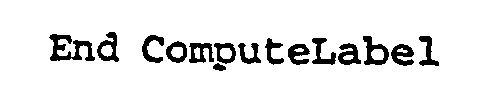
- For each block in S as well as T, the exemplary delta-generator calls ComputeLabel and assigns it a content label. Each of the four parameters to ComputeLabel is false at this stage.
- The exemplary delta-generator matches blocks of S with blocks of T based on the computed labels. Duplicate blocks in S (i.e., blocks having the same hash value) are matched to any of the blocks in T that have the same label. Whenever two blocks are matched, each of them is assigned a unique MatchId for reference later. Blocks that are unmatched after this task are designated as outliers.
- The exemplary delta-generator computes d-neighborhoods (d=2) for each block, by doing a breadth-first traversal that starts at this block. The traversal visits parents of a block if it has no children.
- The exemplary delta-generator filters out bad nodes computed above from all d-neighborhoods.
- The exemplary delta-generator calls ComputeDLabel for each block and assigns it a d-label, which is the value returned from the call.
- The exemplary delta-generator matches blocks of S and T that have identical d-labels.
- Any two matching blocks, b1 and b2 must have the same number of out-edges. Let these out-edges be ordered by their location in the blocks. Two blocks c1 and c2 are said to be corresponding children of blocks b1 and b2 if they are the i th children of b1 and b2 respectively, according to the above ordering, for some i. The exemplary delta-generator refines the matches by using the following rule: If matching blocks have corresponding children that match in their content labels (but maybe not in their d-labels), match those children.
- The exemplary delta-generator iterates through each procedure Pt in T, and computes, for each procedure Ps in S, the number mst of blocks in Pt that match blocks in Ps.
- The exemplary delta-generator matchs procedure pairs based on their mst values. The mst values may also be called the procedure-matching-criteria. The technique for matching procedures using mst values is discussed below.
- The exemplary delta-generator assigns the same unique identifiers to matching procedures. The exemplary delta-generator assigns unique identifiers to all other procedures also.
- Create (Pt, Ps, mst) triplets ∀ s,t and sort them on mst; and
- Iterate through the sorted list of triplets in the descending order. At any iteration, if Pt and Ps are both unmatched, match them.
- Start with no blocks matched. For each block in S as well as T, the exemplary delta-generator calls ComputeLabel and assigns it a content label. The Immediate, OpcodeString and ProcId parameters are true when calling ComputeLabel.
- The exemplary delta-generator matches blocks of S with blocks of T based on the computed content labels. Duplicate blocks in S (i.e., blocks having the same hash value, are matched to any of the blocks in T that have the same label). Whenever two blocks are matched, each of them is assigned a unique MatchId for reference later. If a block already has a previously assigned MatchId, reassign it. Blocks that are unmatched after this task are designated as outliers.
- For d = 3,2,1 the exemplary delta-generator does the following:
- o Computes d-neighborhood for each block, by doing a breadth-first traversal that starts at this block. The d-neighborhood has a random component also. The random component is a set of blocks that are encountered while performing a fixed length uniform random walk starting at the original node. The random walk looks only at real control flow edges and chooses one of them with uniform probability. It aborts when it encounters a procedure boundary (e.g., call or branch to another procedure).
- o Filters out the bad nodes computed above from all the d-neighborhoods.
- o Calls ComputeDLabel for each block and assign it a d-label.
- o. Matches blocks of S and T that have identical d-labels. If two blocks in T match the same block in S, only one of them is actually matched. The tie may be broken arbitrarily.
- o Improves the matching by following the guideline: If matching blocks have corresponding children that match in their content labels (but maybe not in their d-labels), match those children.
- The exemplary delta-generator assigns each matching pair of blocks a unique Matchid, which is used as the content label for those two blocks thereafter.
- Iterates through corresponding (located at the same place) register defs in the two blocks.
- Assigns a unique identifier (positive), unique for the entire procedure, to each of the two defs being examined currently.
- case i. z2 matches z1 : do nothing.
- case ii. z 2 matches z 3 ≠ z2 : Record the link x → z3 .
- case iii. z 2 is unmatched: Record the link x → z 2.
Claims (22)
- A method for generating a delta between a first program binary and a second program binary, the method comprising the steps of:obtaining a first control flow graph (CFG) representation of the first binary and obtaining a second CFG representation of the second binary;comparing the first and second CFG representations to identify blocks (nominally matched blocks) that match in the first and second CFG representations, thereby identifying blocks (nominally unmatched blocks) in the second CFG representation that do not match in the first CFG representation;determining edit-operations that merges the unmatched blocks into the first CFG representation so that first CFG representation is substantially identical to the second CFG representation;producing a delta comprising the unmatched blocks and the edit-operations.
- A method for transmitting a delta comprising:a method for generating a delta as recited in claim 1;transmitting the delta over a network.
- A method for patching a copy of the first program binary, the method comprising:a method for generating a delta as recited in claim 1;patching the copy of the first program binary so that the copy is substantially identical to the second program binary, wherein the delta guides such patching.
- A method as recited in claim 1, wherein the comparing step further comprises matching blocks across the first and second CFG representations based, at least partially, upon content of blocks being compared and neighborhoods of blocks local to blocks being compared.
- A method as recited in claim 1, wherein the comparing step further comprises matching blocks across the first and second CFG representations based, at least partially, upon content of the blocks being compared and a local neighborhoods of blocks surrounding the blocks being compared, wherein a local neighborhood of a block is augmented with a random sampling of blocks from a substantially large neighborhood of blocks surrounding the block.
- A computer-readable medium having embodied thereon a data structure, comprising a delta generated in accordance with the steps recited in claim 1.
- A computer-readable medium having computer-executable instructions that, when executed by a computer, performs the method as recited in claim 1.
- A method for matching blocks between a first control flow graph (CFG) representation of a portion of a first program and a second CFG representation of a portion of a second program, the method comprising:matching blocks between the first and second CFG representations based upon the content of the blocks;detecting outliers, wherein outliers are blocks in the first CFG representation that do not match any block in the second CFG representation during the matching step;computing a neighborhood of each block in the first and second CFG representations by performing a breadth first traversal;removing the outliers from each neighborhood.
- A method as recited in claim 8 further comprising:computing labels for each block in first and second CFG representations based upon content of a block;for each neighborhood computed in the computing step, forming a "d-label" for each block in a neighborhood based upon the labels of the blocks within the neighborhood;d-label matching blocks between first and second CFG representations based upon the d-label of the blocks.
- A computer-readable medium having computer-executable instructions that, when executed by a computer, performs the method as recited in claim 8.
- A method for matching procedures between a first control flow graph (CFG) representation of a portion of a first program and a second CFG representation of a portion of a second program, the method comprising:computing a procedure-match-criterion for each procedure in the second CFG representation, where the procedure-match-criterion for a procedure in the second CFG representation represents the number of matching blocks between that procedure and a specified procedure in the first CFG representation;matching procedures in the second CFG representation with the specified procedure in the first CFG representation based upon the procedure-match-criteria for the procedures in the second CFG representation.
- A computer-readable medium having computer-executable instructions that, when executed by a computer, performs the method as recited in claim 11.
- A method for matching of blocks in a procedure of a first control flow graph (CFG) representation of a portion of a first program between an ostensibly matching procedure of a second CFG representation of a portion of a second program, the method comprising:matching blocks between the first and second CFG representations based upon the content of the blocks;computing successively smaller neighborhoods of each block in the first and second CFG representations via breadth first traversals;for each neighborhood computed in the computing step, forming a "d-label" for each block in a neighborhood based upon the labels of the blocks within the neighborhood;d-label matching blocks between first and second CFG representations based upon the d-label of the blocks.
- A method as recited in claim 13, wherein at least one neighborhood computed in the computing steps is augmented with a random sampling of blocks in the complete representation of the neighborhood.
- A computer-readable medium having computer-executable instructions that, when executed by a computer, performs the method as recited in claim 13.
- A method for facilitating matching of blocks between a first control flow graph (CFG) representation of a portion of a first program and a second CFG representation of a portion of a second program, whereby blocks may match except for nominal differences, the method comprising:computing register flows for each block by analyzing a def-use chain and a use-def chain;for each block, assigning def-identifiers to definitions ("def"s) of each register;for each block, associating a use of a register in a block with the def identifier of all defs of that register that reach this use;matching blocks between the first and second CFG representations based upon the def-identifiers and use-identifiers.
- A computer-readable medium having computer-executable instructions that, when executed by a computer, performs the method as recited in claim 16.
- A patch data structure generated in accordance with the following acts:providing a server computer in a communications with a communications network;receiving input from a client computer by way of the communications network, the input providing a parameter indicative of a request for upgrading a copy of a first program binary to a match a second program binary;retrieving a delta between a first program binary and the second program binary, wherein computing such delta comprises the steps of:a) obtaining a first control flow graph (CFG) representation of the first binary and obtaining a second CFG representation of the second binary;b) comparing the first and second CFG representations to identify blocks (nominally matched blocks) that match in the first and second CFG representations, thereby identifying blocks (nominally unmatched blocks) in the second CFG representation that do not match in the first CFG representation;c) determining edit-operations that merges the unmatched blocks into the first CFG representation so that first CFG representation is substantially identical to the second CFG representation;d) producing a delta comprising the unmatched blocks and the edit-operations;generating the patch data structure as a function of the delta.
- A method for transmitting a patch data structure comprising transmitting a patch data structure as recited in claim 18 over a communications network.
- A method for patching a copy of the first program binary at a client computer, the method comprising patching the copy of the first program binary so that the copy is substantially identical to the second program binary, wherein a delta in a patch data structure as recited in claim 18 guides such patching.
- A delta-generator system, comprising:a comparator that is configured to compare a first control flow graph (CFG) representation of a first program binary and a second CFG representation of the second program binary for identifying blocks (nominally matched blocks) that match in the first and second CFG representations, thereby identifying blocks (nominally unmatched blocks) in the second CFG representation that do not match in the first CFG representation;an edit-op determiner configured to determine the edit-operations that merges the unmatched blocks into the first CFG representation so that first CFG representation is substantially identical to the second CFG representation;an output sub-system that is configured to produce a delta comprising the unmatched blocks and the edit-operations.
- A computer-readable medium having embodied thereon a data structure comprising a delta produced by the system as recited in claim 21.
Applications Claiming Priority (2)
| Application Number | Priority Date | Filing Date | Title |
|---|---|---|---|
| US713633 | 2000-11-14 | ||
| US09/713,633 US7058941B1 (en) | 2000-11-14 | 2000-11-14 | Minimum delta generator for program binaries |
Publications (2)
| Publication Number | Publication Date |
|---|---|
| EP1205842A2 true EP1205842A2 (en) | 2002-05-15 |
| EP1205842A3 EP1205842A3 (en) | 2004-08-04 |
Family
ID=24866875
Family Applications (1)
| Application Number | Title | Priority Date | Filing Date |
|---|---|---|---|
| EP01126979A Withdrawn EP1205842A3 (en) | 2000-11-14 | 2001-11-13 | Minimum delta generator for program binaries |
Country Status (3)
| Country | Link |
|---|---|
| US (4) | US7058941B1 (en) |
| EP (1) | EP1205842A3 (en) |
| JP (3) | JP4615795B2 (en) |
Cited By (10)
| Publication number | Priority date | Publication date | Assignee | Title |
|---|---|---|---|---|
| EP1855194A1 (en) * | 2006-05-11 | 2007-11-14 | Asea Brown Boveri Ab | Synchronization of a graphical program and a robot program |
| EP2030119A4 (en) * | 2006-06-19 | 2009-07-22 | Samsung Electronics Co Ltd | INFORMATION UPGRADE SYSTEM AND METHOD FOR RADIO LINKED DEVICE |
| CN102023870A (en) * | 2010-12-31 | 2011-04-20 | 深圳市普联技术有限公司 | Detection method and device for software modification as well as electronic equipment |
| US8719810B2 (en) * | 2006-07-14 | 2014-05-06 | Samsung Electronics Co., Ltd | Program upgrade system and method for over the air-capable mobile terminal |
| US8775974B2 (en) | 2005-12-21 | 2014-07-08 | International Business Machines Corporation | Multi-contextual delta navigation in a compare view |
| EP2924522A1 (en) * | 2014-03-28 | 2015-09-30 | dSPACE digital signal processing and control engineering GmbH | Method for influencing a control program |
| US9292822B2 (en) | 2006-01-03 | 2016-03-22 | Motio, Inc. | Supplemental system for business intelligence systems |
| US20170277517A1 (en) * | 2016-03-22 | 2017-09-28 | M2Communication Inc. | Method Of Updating Program Code And Electronic Device Using The Same |
| EP3299956A1 (en) * | 2016-09-26 | 2018-03-28 | Siemens Aktiengesellschaft | Method and assembly for updating a computer program |
| EP3742240A1 (en) * | 2019-05-22 | 2020-11-25 | Siemens Aktiengesellschaft | Method and engineering system for changing a program of an industrial automation component |
Families Citing this family (82)
| Publication number | Priority date | Publication date | Assignee | Title |
|---|---|---|---|---|
| US7219332B2 (en) * | 2000-07-07 | 2007-05-15 | Microsoft Corporation | Configuring software components(merge) with transformation component using configurable and non-configurable data elements |
| US7058941B1 (en) * | 2000-11-14 | 2006-06-06 | Microsoft Corporation | Minimum delta generator for program binaries |
| US7072908B2 (en) * | 2001-03-26 | 2006-07-04 | Microsoft Corporation | Methods and systems for synchronizing visualizations with audio streams |
| US6925467B2 (en) * | 2002-05-13 | 2005-08-02 | Innopath Software, Inc. | Byte-level file differencing and updating algorithms |
| US6836657B2 (en) * | 2002-11-12 | 2004-12-28 | Innopath Software, Inc. | Upgrading of electronic files including automatic recovery from failures and errors occurring during the upgrade |
| US7096311B2 (en) | 2002-09-30 | 2006-08-22 | Innopath Software, Inc. | Updating electronic files using byte-level file differencing and updating algorithms |
| US7984435B2 (en) * | 2002-11-13 | 2011-07-19 | Hewlett-Packard Development Company, L.P. | Update system employing reference software to reduce number of update packages |
| US7844734B2 (en) | 2002-11-18 | 2010-11-30 | Innopath Software, Inc. | Dynamic addressing (DA) using a centralized DA manager |
| US20040098421A1 (en) * | 2002-11-18 | 2004-05-20 | Luosheng Peng | Scheduling updates of electronic files |
| US7003534B2 (en) * | 2002-11-18 | 2006-02-21 | Innopath Software, Inc. | Generating difference files using module information of embedded software components |
| US20050204351A1 (en) * | 2002-11-18 | 2005-09-15 | James Jiang | Dynamic addressing (DA) using a centralized DA Manager |
| US7007049B2 (en) * | 2002-11-18 | 2006-02-28 | Innopath Software, Inc. | Device memory management during electronic file updating |
| US7320010B2 (en) | 2002-11-18 | 2008-01-15 | Innopath Software, Inc. | Controlling updates of electronic files |
| US7275244B1 (en) * | 2003-03-18 | 2007-09-25 | Microsoft Corporation | System and method for incrementally saving web files to a web server using file hash values |
| US7308684B2 (en) * | 2003-06-16 | 2007-12-11 | Microsoft Corporation | Classifying software and reformulating resources according to classifications |
| US7210124B2 (en) * | 2003-06-16 | 2007-04-24 | Microsoft Corporation | Reformulating resources with nodes reachable from defined entry points |
| US7676506B2 (en) * | 2003-06-20 | 2010-03-09 | Innopath Software, Inc. | Differential file compression of software image versions |
| US7496904B2 (en) * | 2003-06-26 | 2009-02-24 | Microsoft Corporation | Mining dependencies for testing and risk management |
| US20040268302A1 (en) * | 2003-06-26 | 2004-12-30 | Microsoft Corporation | Framework for determining and exposing binary dependencies |
| US7031972B2 (en) | 2003-07-21 | 2006-04-18 | Innopath Software, Inc. | Algorithms for block-level code alignment of software binary files |
| US7079946B2 (en) * | 2003-08-29 | 2006-07-18 | Denso Corporation | Iterative logical renewal of navigable map database |
| US7290174B1 (en) * | 2003-12-03 | 2007-10-30 | Altera Corporation | Methods and apparatus for generating test instruction sequences |
| US20060047855A1 (en) * | 2004-05-13 | 2006-03-02 | Microsoft Corporation | Efficient chunking algorithm |
| US7555531B2 (en) * | 2004-04-15 | 2009-06-30 | Microsoft Corporation | Efficient algorithm and protocol for remote differential compression |
| US7904895B1 (en) | 2004-04-21 | 2011-03-08 | Hewlett-Packard Develpment Company, L.P. | Firmware update in electronic devices employing update agent in a flash memory card |
| US8526940B1 (en) | 2004-08-17 | 2013-09-03 | Palm, Inc. | Centralized rules repository for smart phone customer care |
| US7516451B2 (en) | 2004-08-31 | 2009-04-07 | Innopath Software, Inc. | Maintaining mobile device electronic files including using difference files when upgrading |
| US7613787B2 (en) * | 2004-09-24 | 2009-11-03 | Microsoft Corporation | Efficient algorithm for finding candidate objects for remote differential compression |
| WO2006052242A1 (en) * | 2004-11-08 | 2006-05-18 | Seirad, Inc. | Methods and systems for compressing and comparing genomic data |
| US7849462B2 (en) * | 2005-01-07 | 2010-12-07 | Microsoft Corporation | Image server |
| US8073926B2 (en) * | 2005-01-07 | 2011-12-06 | Microsoft Corporation | Virtual machine image server |
| US20070094348A1 (en) * | 2005-01-07 | 2007-04-26 | Microsoft Corporation | BITS/RDC integration and BITS enhancements |
| US8719786B2 (en) * | 2005-03-30 | 2014-05-06 | Alcatel Lucent | Method for performing conditionalized N-way merging of source code |
| KR100772399B1 (en) * | 2006-02-28 | 2007-11-01 | 삼성전자주식회사 | A computer-readable recording medium recording a patch file generating method and a program for performing the method. |
| US20070239993A1 (en) * | 2006-03-17 | 2007-10-11 | The Trustees Of The University Of Pennsylvania | System and method for comparing similarity of computer programs |
| US7509298B2 (en) * | 2006-03-31 | 2009-03-24 | International Business Machines Corporation | System and method for a logical-model based application understanding and transformation |
| WO2007133559A2 (en) * | 2006-05-10 | 2007-11-22 | Innopath Software | Processing of compact functional differences |
| US8209676B2 (en) | 2006-06-08 | 2012-06-26 | Hewlett-Packard Development Company, L.P. | Device management in a network |
| US7861224B2 (en) * | 2006-06-22 | 2010-12-28 | Microsoft Corporation | Delta compression using multiple pointers |
| EP2047420A4 (en) | 2006-07-27 | 2009-11-18 | Hewlett Packard Development Co | User experience and dependency management in a mobile device |
| US7984375B1 (en) | 2006-10-10 | 2011-07-19 | Adobe Systems Incorporated | Automated detection and implementation of state and object modifications |
| US8122443B2 (en) * | 2006-12-14 | 2012-02-21 | International Business Machines Corporation | Dynamic multi-context delta view for merging structured data in a visual merge tool |
| US8418149B2 (en) * | 2006-12-28 | 2013-04-09 | International Business Machines Corporation | Differential comparison system and method |
| KR101254247B1 (en) * | 2007-01-18 | 2013-04-12 | 중앙대학교 산학협력단 | Apparatus and method for detecting program plagiarism through memory access log analysis |
| US20080180445A1 (en) * | 2007-01-29 | 2008-07-31 | Mark Peskin | Output Management Systems And Methods |
| US8837721B2 (en) * | 2007-03-22 | 2014-09-16 | Microsoft Corporation | Optical DNA based on non-deterministic errors |
| US8788848B2 (en) * | 2007-03-22 | 2014-07-22 | Microsoft Corporation | Optical DNA |
| US8095914B1 (en) * | 2007-04-03 | 2012-01-10 | Altera Corporation | Methods for instruction trace decomposition |
| US8087006B2 (en) * | 2007-05-31 | 2011-12-27 | Microsoft Corporation | Static performance analysis of software |
| US8166466B2 (en) * | 2007-06-22 | 2012-04-24 | Microsoft Corporation | Function matching in binaries |
| US8166469B2 (en) * | 2007-08-20 | 2012-04-24 | Red Hat, Inc. | Method and an apparatus to conduct software release |
| US20100115502A1 (en) * | 2008-11-06 | 2010-05-06 | Jiva Azeem S | Post Processing of Dynamically Generated Code |
| JP4839424B2 (en) * | 2008-12-15 | 2011-12-21 | インターナショナル・ビジネス・マシーンズ・コーポレーション | Method for supporting program analysis, and computer program and computer system thereof |
| US8359340B2 (en) | 2008-12-23 | 2013-01-22 | At&T Intellectual Property I, L.P. | System and method for representing media assets |
| US20100214894A1 (en) * | 2009-02-20 | 2010-08-26 | Microsoft Corporation | Optical Medium with Added Descriptor to Reduce Counterfeiting |
| US9135948B2 (en) * | 2009-07-03 | 2015-09-15 | Microsoft Technology Licensing, Llc | Optical medium with added descriptor to reduce counterfeiting |
| US9292266B2 (en) * | 2010-04-30 | 2016-03-22 | Qualcomm Incorporate | Preprocessor for file updating |
| US9195810B2 (en) | 2010-12-28 | 2015-11-24 | Microsoft Technology Licensing, Llc | Identifying factorable code |
| JP2012257041A (en) * | 2011-06-08 | 2012-12-27 | Sony Corp | Communication apparatus, communication system, communication method, and program |
| US8726255B2 (en) | 2012-05-01 | 2014-05-13 | Concurix Corporation | Recompiling with generic to specific replacement |
| US20120324454A1 (en) * | 2012-05-04 | 2012-12-20 | Concurix Corporation | Control Flow Graph Driven Operating System |
| US8970613B2 (en) * | 2012-06-06 | 2015-03-03 | Apple Inc. | Render tree caching |
| US9575813B2 (en) | 2012-07-17 | 2017-02-21 | Microsoft Technology Licensing, Llc | Pattern matching process scheduler with upstream optimization |
| US8793669B2 (en) | 2012-07-17 | 2014-07-29 | Concurix Corporation | Pattern extraction from executable code in message passing environments |
| KR20140077435A (en) * | 2012-12-14 | 2014-06-24 | 삼성전자주식회사 | Software update service method and apparatus for mobile terminal |
| US8984495B2 (en) * | 2013-01-03 | 2015-03-17 | International Business Machines Corporation | Enhanced string analysis that improves accuracy of static analysis |
| US8910134B2 (en) * | 2013-01-03 | 2014-12-09 | Oracle International Corporation | System for applying transformation to improve graph analysis |
| US9659050B2 (en) * | 2013-08-06 | 2017-05-23 | Sybase, Inc. | Delta store giving row-level versioning semantics to a non-row-level versioning underlying store |
| US9459861B1 (en) | 2014-03-31 | 2016-10-04 | Terbium Labs, Inc. | Systems and methods for detecting copied computer code using fingerprints |
| US8997256B1 (en) | 2014-03-31 | 2015-03-31 | Terbium Labs LLC | Systems and methods for detecting copied computer code using fingerprints |
| US9378001B2 (en) * | 2014-05-02 | 2016-06-28 | Microsoft Technology Licensing, Llc | Matching program sections through feature extraction |
| US10152406B2 (en) * | 2015-08-25 | 2018-12-11 | Fujistu Limited | Software program repair |
| US9971570B2 (en) | 2015-12-15 | 2018-05-15 | Oracle International Corporation | Automated generation of memory consumption aware code |
| US10318250B1 (en) * | 2017-03-17 | 2019-06-11 | Symantec Corporation | Systems and methods for locating functions for later interception |
| US10732963B2 (en) * | 2017-04-05 | 2020-08-04 | Dell Products, Lp | System and method for automatically managing updated UEFI variables |
| US10387139B2 (en) | 2017-07-25 | 2019-08-20 | Aurora Labs Ltd. | Opportunistic software updates during select operational modes |
| US11144893B2 (en) * | 2017-10-30 | 2021-10-12 | Nec Corporation | Method and system for securing smart contracts in blockchains |
| US10509642B2 (en) * | 2018-03-30 | 2019-12-17 | International Business Machines Corporation | Intelligent discovery and application of API changes for application migration |
| US11307962B2 (en) * | 2018-07-09 | 2022-04-19 | United States Of America As Represented By The Secretary Of The Navy | Method for semantic preserving transform mutation discovery and vetting |
| WO2020194186A1 (en) * | 2019-03-25 | 2020-10-01 | Aurora Labs Ltd. | Generating and signing a line-of-code behavior and relation model |
| US20240427592A1 (en) * | 2023-06-21 | 2024-12-26 | Red Hat, Inc. | Dual software version capability through qubit storage |
| US20250021348A1 (en) * | 2023-07-13 | 2025-01-16 | Cisco Technology, Inc. | Hash value filtering for control flow integrity |
Family Cites Families (21)
| Publication number | Priority date | Publication date | Assignee | Title |
|---|---|---|---|---|
| JPS63208941A (en) | 1987-02-25 | 1988-08-30 | Fujitsu Ltd | Managing system for updating history of program path |
| EP0528617B1 (en) * | 1991-08-19 | 1999-12-22 | Sun Microsystems, Inc. | Method and apparatus for change control in multiple development environments. |
| US5379422A (en) * | 1992-01-16 | 1995-01-03 | Digital Equipment Corporation | Simple random sampling on pseudo-ranked hierarchical data structures in a data processing system |
| US5579223A (en) * | 1992-12-24 | 1996-11-26 | Microsoft Corporation | Method and system for incorporating modifications made to a computer program into a translated version of the computer program |
| US5710916A (en) * | 1994-05-24 | 1998-01-20 | Panasonic Technologies, Inc. | Method and apparatus for similarity matching of handwritten data objects |
| JPH0916389A (en) | 1995-07-03 | 1997-01-17 | Nippon Telegr & Teleph Corp <Ntt> | Method and apparatus for automatically generating program parts |
| US5774730A (en) * | 1995-07-31 | 1998-06-30 | International Business Machines Corporation | Method and apparatus for improving colorability of constrained nodes in an interference graph within a computer system |
| US5974254A (en) * | 1997-06-06 | 1999-10-26 | National Instruments Corporation | Method for detecting differences between graphical programs |
| WO1999004336A1 (en) | 1997-07-15 | 1999-01-28 | Pocket Soft, Inc. | System for finding differences between two computer files and updating the computer files |
| US6314562B1 (en) * | 1997-09-12 | 2001-11-06 | Microsoft Corporation | Method and system for anticipatory optimization of computer programs |
| US6205444B1 (en) * | 1997-10-17 | 2001-03-20 | International Business Machines Corporation | Multiple sequence alignment system and method |
| US6018747A (en) * | 1997-11-26 | 2000-01-25 | International Business Machines Corporation | Method for generating and reconstructing in-place delta files |
| US6189116B1 (en) * | 1998-07-14 | 2001-02-13 | Autodesk, Inc. | Complete, randomly ordered traversal of cyclic directed graphs |
| IL125846A0 (en) | 1998-08-19 | 1999-04-11 | Emony | Incremental program update |
| US6594822B1 (en) * | 1999-02-19 | 2003-07-15 | Nortel Networks Limited | Method and apparatus for creating a software patch by comparing object files |
| US7058941B1 (en) | 2000-11-14 | 2006-06-06 | Microsoft Corporation | Minimum delta generator for program binaries |
| US6559068B2 (en) * | 2001-06-28 | 2003-05-06 | Koninklijke Philips Electronics N.V. | Method for improving inversion layer mobility in a silicon carbide metal-oxide semiconductor field-effect transistor |
| US6904588B2 (en) * | 2001-07-26 | 2005-06-07 | Tat Consultancy Services Limited | Pattern-based comparison and merging of model versions |
| US6860422B2 (en) * | 2002-09-03 | 2005-03-01 | Ricoh Company, Ltd. | Method and apparatus for tracking documents in a workflow |
| WO2004097627A2 (en) * | 2003-05-01 | 2004-11-11 | Maz Laboratory | A method of representing data flow between programming objects in a hierarchical display |
| JP2006243838A (en) * | 2005-02-28 | 2006-09-14 | Toshiba Corp | Program development device |
-
2000
- 2000-11-14 US US09/713,633 patent/US7058941B1/en not_active Expired - Fee Related
-
2001
- 2001-11-13 EP EP01126979A patent/EP1205842A3/en not_active Withdrawn
- 2001-11-14 JP JP2001349299A patent/JP4615795B2/en not_active Expired - Fee Related
-
2004
- 2004-06-07 US US10/862,554 patent/US7263531B2/en not_active Expired - Fee Related
-
2006
- 2006-03-15 US US11/276,814 patent/US7681190B2/en not_active Expired - Fee Related
- 2006-03-15 US US11/276,815 patent/US7685590B2/en not_active Expired - Fee Related
-
2007
- 2007-05-01 JP JP2007121230A patent/JP4676456B2/en not_active Expired - Fee Related
-
2008
- 2008-02-25 JP JP2008043553A patent/JP4796596B2/en not_active Expired - Fee Related
Cited By (20)
| Publication number | Priority date | Publication date | Assignee | Title |
|---|---|---|---|---|
| US8775974B2 (en) | 2005-12-21 | 2014-07-08 | International Business Machines Corporation | Multi-contextual delta navigation in a compare view |
| US9785907B2 (en) | 2006-01-03 | 2017-10-10 | Motio, Inc. | Supplemental system for business intelligence systems |
| US10242331B2 (en) | 2006-01-03 | 2019-03-26 | Motio, Inc. | Supplemental system for business intelligence systems to provide visual identification of meaningful differences |
| US9292822B2 (en) | 2006-01-03 | 2016-03-22 | Motio, Inc. | Supplemental system for business intelligence systems |
| WO2007131872A1 (en) * | 2006-05-11 | 2007-11-22 | Abb Ab | Synchronization of a graphical program and a robot program |
| US10481885B2 (en) | 2006-05-11 | 2019-11-19 | Abb Schweiz Ag | Synchronization of a graphical program and a robot program |
| EP1855194A1 (en) * | 2006-05-11 | 2007-11-14 | Asea Brown Boveri Ab | Synchronization of a graphical program and a robot program |
| EP2030119A4 (en) * | 2006-06-19 | 2009-07-22 | Samsung Electronics Co Ltd | INFORMATION UPGRADE SYSTEM AND METHOD FOR RADIO LINKED DEVICE |
| EP2030120A4 (en) * | 2006-06-19 | 2009-08-26 | Samsung Electronics Co Ltd | SYSTEM AND METHOD FOR UPGRADING PROGRAM FOR PORTABLE RADIO COMMUNICATION DEVICE |
| US8719810B2 (en) * | 2006-07-14 | 2014-05-06 | Samsung Electronics Co., Ltd | Program upgrade system and method for over the air-capable mobile terminal |
| CN102023870B (en) * | 2010-12-31 | 2013-07-24 | 深圳市普联技术有限公司 | Detection method and device for software modification as well as electronic equipment |
| CN102023870A (en) * | 2010-12-31 | 2011-04-20 | 深圳市普联技术有限公司 | Detection method and device for software modification as well as electronic equipment |
| US9971321B2 (en) | 2014-03-28 | 2018-05-15 | Dspace Digital Signal Processing And Control Engineering Gmbh | Method for influencing a control program |
| EP2924522A1 (en) * | 2014-03-28 | 2015-09-30 | dSPACE digital signal processing and control engineering GmbH | Method for influencing a control program |
| US20170277517A1 (en) * | 2016-03-22 | 2017-09-28 | M2Communication Inc. | Method Of Updating Program Code And Electronic Device Using The Same |
| EP3299956A1 (en) * | 2016-09-26 | 2018-03-28 | Siemens Aktiengesellschaft | Method and assembly for updating a computer program |
| EP3742240A1 (en) * | 2019-05-22 | 2020-11-25 | Siemens Aktiengesellschaft | Method and engineering system for changing a program of an industrial automation component |
| WO2020233924A1 (en) * | 2019-05-22 | 2020-11-26 | Siemens Aktiengesellschaft | Method and engineering system for the modification of a program of an industrial automation component |
| CN113874796A (en) * | 2019-05-22 | 2021-12-31 | 西门子股份公司 | Method for changing program of industrial automation component and engineering planning system |
| US11579594B2 (en) | 2019-05-22 | 2023-02-14 | Siemens Aktiengesellschaft | Method and engineering system for modifying a program of an industrial automation component |
Also Published As
| Publication number | Publication date |
|---|---|
| JP2008165825A (en) | 2008-07-17 |
| JP4676456B2 (en) | 2011-04-27 |
| JP2002169702A (en) | 2002-06-14 |
| US20040225996A1 (en) | 2004-11-11 |
| US7685590B2 (en) | 2010-03-23 |
| JP4796596B2 (en) | 2011-10-19 |
| US7263531B2 (en) | 2007-08-28 |
| US7681190B2 (en) | 2010-03-16 |
| EP1205842A3 (en) | 2004-08-04 |
| JP2007234043A (en) | 2007-09-13 |
| US20060145896A1 (en) | 2006-07-06 |
| US7058941B1 (en) | 2006-06-06 |
| US20060145895A1 (en) | 2006-07-06 |
| JP4615795B2 (en) | 2011-01-19 |
Similar Documents
| Publication | Publication Date | Title |
|---|---|---|
| US7685590B2 (en) | Minimum delta generator for program binaries | |
| US5313616A (en) | Method for analyzing calls of application program by inserting monitoring routines into the executable version and redirecting calls to the monitoring routines | |
| US8307351B2 (en) | System and method for performing code provenance review in a software due diligence system | |
| US8549635B2 (en) | Malware detection using external call characteristics | |
| US8479161B2 (en) | System and method for performing software due diligence using a binary scan engine and parallel pattern matching | |
| JP5208350B2 (en) | Self-describing software image update component | |
| US10203953B2 (en) | Identification of duplicate function implementations | |
| US7721276B2 (en) | Computer-implemented method, system and program product for comparing application program interfaces (APIs) between JAVA byte code releases | |
| US20050027988A1 (en) | System and method of verifying the authenticity of dynamically connectable executable images | |
| CN112860265A (en) | Method and device for detecting operation abnormity of source code database | |
| CN112099880B (en) | Scenario-driven application reduction method and system | |
| Tekchandani et al. | Semantic code clone detection for Internet of Things applications using reaching definition and liveness analysis | |
| EP1376342A2 (en) | Single pass intermediate language verification algorithm | |
| CN100394385C (en) | System and method for validating reliability of dynamically linkable executable images | |
| US20020174135A1 (en) | Schema-based file conversion | |
| CN121187708B (en) | Operating system containerized kernel compatibility method based on mixed binary translation | |
| CN114417347A (en) | Vulnerability detection method, device, equipment, storage medium and program of application program | |
| CN117892314A (en) | A method and system for scanning service image vulnerabilities | |
| US7644401B2 (en) | Executable file creation | |
| JP2004185450A (en) | Management method for long file name | |
| Atterer | Automatic test data generation from VDM-SL specifications | |
| CN117421252B (en) | Code detection method, device and computer readable storage medium | |
| CN120596126B (en) | Software package compatibility analysis method, electronic device and storage medium | |
| CN116932027A (en) | Method, device, equipment, storage medium and program product for generating installation program | |
| HK1057115B (en) | Method of verifying the authenticity of dynamically connectable executable images |
Legal Events
| Date | Code | Title | Description |
|---|---|---|---|
| PUAI | Public reference made under article 153(3) epc to a published international application that has entered the european phase |
Free format text: ORIGINAL CODE: 0009012 |
|
| AK | Designated contracting states |
Kind code of ref document: A2 Designated state(s): AT BE CH CY DE DK ES FI FR GB GR IE IT LI LU MC NL PT SE TR |
|
| AX | Request for extension of the european patent |
Free format text: AL;LT;LV;MK;RO;SI |
|
| RIN1 | Information on inventor provided before grant (corrected) |
Inventor name: SINHA, SAURABH Inventor name: VENKATESAN, RAMARATHNAM |
|
| PUAL | Search report despatched |
Free format text: ORIGINAL CODE: 0009013 |
|
| AK | Designated contracting states |
Kind code of ref document: A3 Designated state(s): AT BE CH CY DE DK ES FI FR GB GR IE IT LI LU MC NL PT SE TR |
|
| AX | Request for extension of the european patent |
Extension state: AL LT LV MK RO SI |
|
| 17P | Request for examination filed |
Effective date: 20041029 |
|
| 17Q | First examination report despatched |
Effective date: 20050301 |
|
| AKX | Designation fees paid |
Designated state(s): AT BE CH CY DE DK ES FI FR GB GR IE IT LI LU MC NL PT SE TR |
|
| 16A | New documents despatched to applicant after publication of the search report |
Effective date: 20050614 |
|
| STAA | Information on the status of an ep patent application or granted ep patent |
Free format text: STATUS: THE APPLICATION IS DEEMED TO BE WITHDRAWN |
|
| 18D | Application deemed to be withdrawn |
Effective date: 20100601 |