EP1213745A1 - Procédé de fabrication d'une mémoire ferroélectrique et dispositif de mémoire - Google Patents
Procédé de fabrication d'une mémoire ferroélectrique et dispositif de mémoire Download PDFInfo
- Publication number
- EP1213745A1 EP1213745A1 EP00126732A EP00126732A EP1213745A1 EP 1213745 A1 EP1213745 A1 EP 1213745A1 EP 00126732 A EP00126732 A EP 00126732A EP 00126732 A EP00126732 A EP 00126732A EP 1213745 A1 EP1213745 A1 EP 1213745A1
- Authority
- EP
- European Patent Office
- Prior art keywords
- particles
- substrate
- ferroelectric
- memory device
- ferroelectric particles
- Prior art date
- Legal status (The legal status is an assumption and is not a legal conclusion. Google has not performed a legal analysis and makes no representation as to the accuracy of the status listed.)
- Withdrawn
Links
Images



Classifications
-
- H—ELECTRICITY
- H10—SEMICONDUCTOR DEVICES; ELECTRIC SOLID-STATE DEVICES NOT OTHERWISE PROVIDED FOR
- H10B—ELECTRONIC MEMORY DEVICES
- H10B51/00—Ferroelectric RAM [FeRAM] devices comprising ferroelectric memory transistors
-
- G—PHYSICS
- G11—INFORMATION STORAGE
- G11B—INFORMATION STORAGE BASED ON RELATIVE MOVEMENT BETWEEN RECORD CARRIER AND TRANSDUCER
- G11B9/00—Recording or reproducing using a method not covered by one of the main groups G11B3/00 - G11B7/00; Record carriers therefor
- G11B9/02—Recording or reproducing using a method not covered by one of the main groups G11B3/00 - G11B7/00; Record carriers therefor using ferroelectric record carriers; Record carriers therefor
-
- G—PHYSICS
- G11—INFORMATION STORAGE
- G11B—INFORMATION STORAGE BASED ON RELATIVE MOVEMENT BETWEEN RECORD CARRIER AND TRANSDUCER
- G11B9/00—Recording or reproducing using a method not covered by one of the main groups G11B3/00 - G11B7/00; Record carriers therefor
- G11B9/12—Recording or reproducing using a method not covered by one of the main groups G11B3/00 - G11B7/00; Record carriers therefor using near-field interactions; Record carriers therefor
- G11B9/14—Recording or reproducing using a method not covered by one of the main groups G11B3/00 - G11B7/00; Record carriers therefor using near-field interactions; Record carriers therefor using microscopic probe means, i.e. recording or reproducing by means directly associated with the tip of a microscopic electrical probe as used in Scanning Tunneling Microscopy [STM] or Atomic Force Microscopy [AFM] for inducing physical or electrical perturbations in a recording medium; Record carriers or media specially adapted for such transducing of information
-
- G—PHYSICS
- G11—INFORMATION STORAGE
- G11B—INFORMATION STORAGE BASED ON RELATIVE MOVEMENT BETWEEN RECORD CARRIER AND TRANSDUCER
- G11B9/00—Recording or reproducing using a method not covered by one of the main groups G11B3/00 - G11B7/00; Record carriers therefor
- G11B9/12—Recording or reproducing using a method not covered by one of the main groups G11B3/00 - G11B7/00; Record carriers therefor using near-field interactions; Record carriers therefor
- G11B9/14—Recording or reproducing using a method not covered by one of the main groups G11B3/00 - G11B7/00; Record carriers therefor using near-field interactions; Record carriers therefor using microscopic probe means, i.e. recording or reproducing by means directly associated with the tip of a microscopic electrical probe as used in Scanning Tunneling Microscopy [STM] or Atomic Force Microscopy [AFM] for inducing physical or electrical perturbations in a recording medium; Record carriers or media specially adapted for such transducing of information
- G11B9/1409—Heads
-
- G—PHYSICS
- G11—INFORMATION STORAGE
- G11B—INFORMATION STORAGE BASED ON RELATIVE MOVEMENT BETWEEN RECORD CARRIER AND TRANSDUCER
- G11B9/00—Recording or reproducing using a method not covered by one of the main groups G11B3/00 - G11B7/00; Record carriers therefor
- G11B9/12—Recording or reproducing using a method not covered by one of the main groups G11B3/00 - G11B7/00; Record carriers therefor using near-field interactions; Record carriers therefor
- G11B9/14—Recording or reproducing using a method not covered by one of the main groups G11B3/00 - G11B7/00; Record carriers therefor using near-field interactions; Record carriers therefor using microscopic probe means, i.e. recording or reproducing by means directly associated with the tip of a microscopic electrical probe as used in Scanning Tunneling Microscopy [STM] or Atomic Force Microscopy [AFM] for inducing physical or electrical perturbations in a recording medium; Record carriers or media specially adapted for such transducing of information
- G11B9/1463—Record carriers for recording or reproduction involving the use of microscopic probe means
- G11B9/149—Record carriers for recording or reproduction involving the use of microscopic probe means characterised by the memorising material or structure
-
- G—PHYSICS
- G11—INFORMATION STORAGE
- G11C—STATIC STORES
- G11C11/00—Digital stores characterised by the use of particular electric or magnetic storage elements; Storage elements therefor
- G11C11/21—Digital stores characterised by the use of particular electric or magnetic storage elements; Storage elements therefor using electric elements
- G11C11/22—Digital stores characterised by the use of particular electric or magnetic storage elements; Storage elements therefor using electric elements using ferroelectric elements
-
- H—ELECTRICITY
- H10—SEMICONDUCTOR DEVICES; ELECTRIC SOLID-STATE DEVICES NOT OTHERWISE PROVIDED FOR
- H10B—ELECTRONIC MEMORY DEVICES
- H10B53/00—Ferroelectric RAM [FeRAM] devices comprising ferroelectric memory capacitors
-
- H—ELECTRICITY
- H10—SEMICONDUCTOR DEVICES; ELECTRIC SOLID-STATE DEVICES NOT OTHERWISE PROVIDED FOR
- H10P—GENERIC PROCESSES OR APPARATUS FOR THE MANUFACTURE OR TREATMENT OF DEVICES COVERED BY CLASS H10
- H10P14/00—Formation of materials, e.g. in the shape of layers or pillars
- H10P14/60—Formation of materials, e.g. in the shape of layers or pillars of insulating materials
- H10P14/69—Inorganic materials
- H10P14/692—Inorganic materials composed of oxides, glassy oxides or oxide-based glasses
- H10P14/6938—Inorganic materials composed of oxides, glassy oxides or oxide-based glasses the material containing at least one metal element, e.g. metal oxides, metal oxynitrides or metal oxycarbides
- H10P14/69398—Inorganic materials composed of oxides, glassy oxides or oxide-based glasses the material containing at least one metal element, e.g. metal oxides, metal oxynitrides or metal oxycarbides the material having a perovskite structure, e.g. BaTiO3
Definitions
- the present invention refers to a method of producing a ferroelectric memory, a method of storing information on a substrate and to a memory device.
- ferroelectric materials Just like with ferromagnetic materials, used for example in conventional audio tapes, ferroelectric materials display a hysteresis behavior with regards to their electrical polarization under the influence of an external electrical field.
- Ferroelectric materials are a subgroup of noncentrosymmetric crystalline materials that have a spontaneous electrical polarization, the direction of which can be altered by an external electrical field.
- the term "ferroelectric" was coined because the P-E relation of these materials is very similar to the B-H relation of ferromagnetic materials.
- Ferroelectrics are also analogous to ferromagnets in that they are characterized by a Curie temperature T c (above which they become paraelectrical) and that they have an internal domain structure.
- the hysteresis loop shown in fig. 1, is caused by the existence of permanent electrical dipoles.
- P O
- the B 4+ ions become displaced in the direction of the field, and domains that are more favorably aligned with the field grow at the expense of those that are not.
- Examples include BaTiO 3 , PbTiO 3 and PbZr x Ti 1-x O 3 (PZT).
- the structure consists of 12 coordinated A 2+ ions on the corners of a cube, octahedral O 2- ions on the faces, and tetrahedral B 4+ ions in the center (see for example figure 2).
- the Curie temperature in these materials is associated with a structural transition from regular cubic above T c to a distorted tetragonal form below T c .
- the hysteresis loop typical of ferroelectrical materials is the basis for ferroelectric random access memory (FRAM) devices.
- FRAM ferroelectric random access memory
- ferroelectric materials possess two stable polarization directions at zero field they can be used as non-volatile memory elements.
- the direction of polarization is used to store information, a logical "0" corresponding to one direction and a logical "1" corresponding to the other direction.
- the device structure used in FRAM cells is either the ferroelectric field-effect transistor (FEFET) or the ferroelectric capacitor (FECAP).
- FRAM ferroelectric field-effect transistor
- FECAP ferroelectric capacitor
- Ferroelectric memory devices are generally susceptible to three forms of degradation in performance during use:
- Nanometer-scale polarization domains can be created in inorganic ferroelectric thin films using a conductive atomic force microscope (AFM). Domains as small as 30 nm diameter can be formed in a ferroelectric organic thin film on a conductive substrate by applying electrical pulses with an Au-conductive AFM tip. Binary information can be "written” by changing the polarity of the applied electrical pulses and “read” by using piezoelectrical measurements [Matsushige, K., Yamada, H.; Tanaka, H.; Horiuchi, T.; Chen, X. Q. (1998) Nanotechnology 9, 208 - 211: “Nanoscale control and detection of electric dipoles in organic molecules.”]
- EP 0 788 149 A1 describes a method of depositing nanometre scale particles on a substrate in which Au particles are coated with negatively charged citrate ions, and the substrate is treated with a positively charged surfactant such that the opposite charges on the substrate and the Au particles are attracted to each other, and a thin film of particles is thus deposited.
- This structure is used as a tunnelling-gate in a transistor-like arrangement.
- a memory device is considered, based on the storage of information in the form of an excess electron.
- One bit of information according to the invention of this document corresponds to the presence or absence of one electron on the individual particle.
- the object of the present invention is to provide a method of storing information based on ferroelectric particles, which method allows a miniaturization of memory devices down to the nanometer scale whilst at the same time avoiding instability and degradation behavior commonly encountered with ferroelectric devices.
- the object is solved by a method of producing a ferroelectric memory which method comprises:
- the order of steps c) and d) may be reversed. In one embodiment, the order of steps a) and b) may be reversed.
- said axis may have an orientation the average of which is in two or more non-identical predetermined directions with regard to a surface of said substrate. "The average of which” is meant to designate a state in which, within an ensemble of particles, the average orientation of these particles within that ensemble is the predetermined direction with regard to a surface of said substrate.
- said at least one predetermined direction is essentially perpendicular to a surface of said substrate.
- said at least one predetermined direction is at an oblique angle to a surface of said substrate.
- "Oblique" in this context is meant to signify any value x taken from the range 0° ⁇ x ⁇ 180°.
- x is taken from the range 45° ⁇ x ⁇ 135°.
- the object is also solved by a method of producing a ferroelectric memory which method comprises:
- steps a) and b) may be reversed. In one embodiment the order of steps c) and d) may be reversed.
- said ferroelectric particles attach to said substrate in a manner that they are separated from each other on said substrate. This can, for example, be achieved by chemical moieties attached to the particles, the moieties carrying a net charge each, which will lead to a mutual repulsion between the particles.
- ferroelectric particles attach to said substrate by electrostatic interactions.
- said orientating occurs by electrostatic interactions. This can, for example, be achieved by chemical moieties, carrying a net charge each, which are attached to said particles, which charges cause the particles to be orientated in a specific orientation.
- said substrate exhibits charges of one electrical polarity, and wherein said ferroelectric particles exhibit charges of the opposite electrical polarity.
- said charges exhibited by said substrate are generated by application of an electrical potential and optionally by adjusting a pH-value, and/or they are charged moieties appended to said substrate.
- the process of generating/changing charges on a substrate by applying an electrical potential in order to attract particles of opposite charge is referred to as "electrophoretic deposition", e.g. hereafter in the example section.
- said charges exhibited by said ferroelectric particles are charged moieties appended to said particles.
- said charged moieties are negative and comprise groups which can be represented by the general form XO - or XS - , where X is covalently attached to O - or S - by one of its constituent atoms, said constituent atom being an atom selected from the second through sixteenth column and second through sixth row of the Periodic Table.
- XO - is selected from the group comprising phenolate and carboxylate (a C-atom being the link to O - ), phosphate and phosphonate (a P-atom being the link to O - ), sulfate and sulfonate (an S-atom being the link to O - ), borate (a B-atom being the link to O - ), Arsenate and Arsenite (an Asatom being the link to O - ).
- XS - is selected from the group comprising thiolate and dithiocarbamate (a C-atom being the link to S - ), dithiophosphate and dithiophosphonate (a P-atom being the link to S - ).
- said charged moieties are positive and comprise groups which can be represented by the general form C 4 P + or C 3 S + , where C is a carbon atom having sp 3 hybridisation, or by the general form C a NH b + , where C is a carbon atom having either sp 3 or sp 2 hybridisation and the sum of the coefficients a and b equals 3 in the case of sp 3 hybridisation, or 2 in the case of sp 2 hybridisation.
- Positively charged moieties of the form C 4 P + are known generally as "phosphonium” ions and those of the form C 3 S + are known generally as “sulfonium” ions.
- Another way to express these moieties is R(PR 1 R 2 R 3 ) + and R (SR 1 R 2 ) + , respectively, where R is an alkyl or aryl residue used for the appendage, and R 1 , R 2 , and R 3 are alkyl or aryl groups which may be the same or different and may be connected (cyclic).
- the latter groups should not be very large, and suitable examples are methyl (CH 3 ) and ethyl (CH 2 CH 3 ) groups.
- alkyl or aryl groups can themselves be substituted.
- 2-hydroxyethyl (CH 2 CH 3 OH) groups might be used instead of ethyl groups to enhance the polarity.
- Positively charged moieties of the form C a NH b + are known generally as "ammonium ions". The possibilities of these N-based moieties are greater because H can be used instead of alkyl or aryl groups, but there must be at least one alkyl or aryl R group for the appendage.
- RNH 3 + (“primary” ammonium), RNR 1 H 2 + (“secondary” ammonium), RNR 1 R 2 H + ("tertiary” ammonium), and RNR 1 R 2 R 3+ (“quaternary” ammonium) ions.
- the R 1 , R 2 , and R 3 groups may be the same or different and may be connected (cyclic).
- An important class of heterocyclic tertiary and quaternary ammonium moieties are those derived from pyridine ("pyridinium” ions).
- said charged moieties are appended via silylation.
- said charged moieties are appended via complexation.
- Complexation here refers to a coordination complex formed at the surface of the particle involving one or more metal atoms intrinsic to the particle and the donor atoms of a ligand.
- said charged moieties are metal complexes.
- said charged moieties are appended to a polymer.
- any charged polymer that can bind to the particle surface could be useful. Some groups of the polymer would interact with atoms on the particle surface to anchor it to the particle and the rest would provide charged moieties to interact with the solvent.
- carboxylic acid groups of the poly(acrylic acid) serve both functions, binding to the barium titanate particle principally through the titanium atoms.
- polymers that could be used instead, including poly(phosphates), poly(amino acids), and poly(ethylene imine).
- ferroelectric particles are single-domain particles.
- said particles are 5 - 200 nm in size, preferably 10 - 150 nm, more preferably 20 - 100 nm in size, the size of each particle being determined by the longest dimension of said particle.
- ferroelectric particles are formed by compounds selected from the group comprising mixed oxides containing corner sharing oxygen octahedra.
- ferroelectric particles are formed by compounds selected from the group comprising perovskite-type compounds.
- ferroelectric particles are formed by compounds selected from the group comprising tungsten-bronze type compounds.
- ferroelectric particles are formed by compounds selected from the group comprising bismuth oxide layer-structured compounds.
- ferroelectric particles are formed by compounds selected from the group comprising lithium niobate or lithium tantalate.
- said ferroelectric particles are formed by compounds selected from the group which can be represented by the general form A l B m O n , wherein
- ferroelectric particles form a layer on said substrate.
- said layer has a thickness in the range of 5 - 200 nm.
- said layer has a thickness in the range of 10 - 150 nm.
- said layer is a monolayer.
- said substrate forms part of an electrode, said electrode being at least partially immersed in a suspension of said particles.
- said electrode forms part of an electrical cell, an electrical field being created in said electrical cell, said electrical field causing said substrate to exhibit charges of one polarity.
- said pH-value of said suspension is adjusted to the range of 7 - 9.
- said particles are fixed to said substrate, preferably by means of drying and/or crosslinking and/or drying under vacuum.
- attachment is meant to designate any contacting interaction.
- Attachment can, for example, occur by electrostatic forces, but other forces are not intended to be excluded, as used herein. If an attachment by covalent forces is intended, it is herein referred to explicitly as “attachment by covalent interactions”.
- attachment by covalent interactions The term “being fixed”, however, is meant to designate a contacting interaction which is primarily covalent in its nature.
- said ferroelectric particles attach to said substrate by affinity interactions.
- said ferroelectric particles attach to said substrate by covalent interactions.
- the object is also solved by a method of storing information on a substrate wherein, in a device obtainable by a method of producing a ferroelectric memory according to the present invention, the electrical dipoles of said particles are directed by directing means 140.
- the object is furthermore solved by a method of storing information on a substrate wherein, in a device obtainable by a method of producing a ferroelectric memory according to the present invention, a permanent dipole moment in the ferroelectric state is created in all or at least a plurality of said particles by directing means 140, resulting in groups of particles having essentially the same permanent dipole moment.
- a “group of particles” may be an array of e.g. 1x2, 2x2, 3x3, 4x4, 2x3, 2x4, 3x4, etc. particles.
- said dipole moment in the ferroelectric state is essentially perpendicular to a surface of said substrate.
- said dipole moment in the ferroelectric state is essentially at an oblique angle to a surface of said substrate.
- said directing means is selected from the group comprising probes of scanning probe microscopes (SPM) for applying electrical pulses.
- SPM scanning probe microscopes
- said creating of said dipole moment occurs by applying electrical pulses to individual ferroelectric particles and/or by applying electrical pulses to groups of particles.
- said directing of said electrical dipoles occurs by applying electrical pulses to individual ferroelectric particles and/or by applying electrical pulses to groups of particles.
- directing said electrical dipoles is meant to designate, for example, an action by which it is determined whether an electrical dipole points "up” or “down” along its axis of orientation.
- Orientating said ferroelectric particles is meant to designate, for example, an action by which an axis of said particles is established along which a "directing action" of dipoles can occur.
- said at least one predetermined direction is an essentially perpendicular direction with regard to a surface of said substrate.
- At least one predetermined direction is meant to enclose embodiments, in which there are two or more, non-identical predetermined directions.
- said at least one predetermined direction is an oblique direction with regard to a surface of said substrate.
- "Oblique direction” in this context means that it forms an angle with said surface of said substrate the value x of which is taken from the range 0° ⁇ x ⁇ 180°.
- x is taken from the range 45° ⁇ x ⁇ 135°.
- ferroelectric particles attach to said substrate in a manner that they are separated from each other on said substrate.
- said ferroelectric particles attach to said substrate by electrostatic interactions.
- said substrate exhibits charges of one electrical polarity, and wherein said ferroelectric particles exhibit charges of the opposite electrical polarity.
- said charges exhibited by said substrate are generated by application of an electrical potential and/or by adjusting a pH-value, and/or they are charged moieties appended to said substrate.
- said charges exhibited by said ferroelectric particles are charged moieties.
- said charges exhibited by said ferroelectric particles are charged moieties appended to said particles.
- said charged moieties are negative and comprise groups which can be represented by the general form XO - or XS - , where X is covalently attached to O - or S - by one of its constituent atoms, said constituent atom being an atom selected from the second through sixteenth column and second through sixth row of the Periodic Table.
- XO - is selected from the group comprising phenolate and carboxylate (a C-atom being the link to O - ), phosphate and phosphonate (a P-atom being the link to O - ), sulfate and sulfonate (an S-atom being the link to O - ), borate (a B-atom being the link to O - ), Arsenate and Arsenite (an Asatom being the link to O - ).
- XS - is selected from the group comprising thiolate and dithiocarbamate (a C-atom being the link to S - ), dithiophosphate and dithiophosphonate (a P-atom being the link to S + ).
- said charged moieties are positive and comprise groups which can be represented by the general form C 4 P + or C 3 S + , where C is a carbon atom having sp 3 hybridisation, or by the general form C a NH b + , where C is a carbon atom having either sp 3 or sp 2 hybridisation and the sum of the coefficients a and b equals 3 in the case of sp 3 hybridisation, or 2 in the case of sp 2 hybridisation.
- said charged moieties are appended via silylation.
- Complexation here refers to a coordination complex formed at the surface of the particle involving one or more metal atoms intrinsic to the particle and the donor atoms of a ligand.
- said charged moieties are metal complexes.
- said charged moieties are appended to a polymer.
- said ferroelectric particles are single-domain particles.
- said particles are 5 - 200 nm in size, preferably, 10 - 150 nm, more preferably 20 - 100 nm in size, the size of each particle being determined by the longest dimension of said particle.
- said ferroelectric particles are formed by compound selected from the group comprising mixed oxides containing corner sharing oxygen octahedra.
- ferroelectric particles are formed by compounds selected from the group comprising perovskite-type compounds.
- ferroelectric particles are formed by compounds selected from the group comprising tungsten-bronze type compounds.
- ferroelectric particles are formed by compounds selected from the group comprising bismuth oxide layer-structured compounds.
- ferroelectric particles are formed by compounds selected from the group comprising lithium niobate or lithium tantalate.
- said ferroelectric particles are formed by compounds selected from the group formed which can be represented by the general form A l B m O n , wherein
- said ferroelectric particles form a layer on said substrate.
- said layer has a thickness in the range of 5- 200 nm.
- said layer is a monolayer.
- the object is also solved by a method of storing information on a substrate which method comprises:
- the object is also solved by the use of a memory device manufactured by the method according to the present invention or of a memory device obtainable by the method according to the present invention or of a memory device according to the present invention, for the storage of binary information.
- the binding of said ferroelectric particles to said substrate is governed by electrostatic interactions.
- said receptors provide charges of one electrical polarity to said substrate.
- said ligands provide charges of the opposite electrical polarity to said particles.
- said receptors are charges generated by application of an electrical field and/or by adjusting a pH-value.
- said ligands are charged moieties affixed to silane derivatives, wherein it is especially preferred that said affixed moieties are selected from the group comprising 3-aminopropyl and N-(2-aminoethyl)-3-aminopropyl.
- said ferroelectric particles are uniformly sized.
- said ferroelectric particles are single-domain particles.
- said particles have essentially cubic and/or essentially spherical morphology.
- said particles form plate-like crystals.
- said particles are 5 - 200 nm in size, preferably 10 - 150 nm, more preferably 20 - 100 nm, this numerical value referring to either the diameter or the length of the longest edge of the particle.
- said particles are crystalline.
- ferroelectric particles are formed by inorganic ferroelectric compounds.
- said ferroelectric particles are formed by compounds selected from the group comprising perovskite-type compounds, barium titanate, lead circonate, wherein, more preferred, the perovskite-type compounds are selected from the group comprising BaTiO 3 , PbTiO 3 , PbZr x Ti 1-x O 3 (PZT), ABX 3 , wherein
- said monolayer has a thickness in the range of 5 - 100 nm.
- said substrate is electrically conducting.
- the invention may also provide that said substrate is smooth compared to the dimensions of said particles.
- said substrate is formed by a substance selected from the group comprising glass, surface-modified glass, glass, that has an extra layer attached to its surface, glass with an extra layer of fluorine-doped tin oxide (F-SnO 2 ).
- F-SnO 2 fluorine-doped tin oxide
- said substrate forms part of an electrode in an electrical cell, said electrical cell being capable of adopting an open-circuit condition ("open-circuit electrical cell”) or a closed-circuit condition (“closed-circuit electrical cell”), wherein it is preferred that said electrode is at least partially immersed in a suspension of said particles, and wherein it is also preferred that said electrical cell is polarised by application of an external electrical field, said electrical cell now being a closed-circuit electrical cell.
- a pH-value of said suspension is in the range of 2 - 6 in said open-circuit electrical cell, and/or a pH-value of said suspension is in the range of 7 - 9 in said closed-circuit electrical cell.
- said monolayer is fixed to said substrate, wherein it is preferred that said monolayer is fixed to said substrate by means of drying and/or crosslinking and/or drying under vacuum .
- said orientating means is selected from the group comprising probes of scanning probe microscopes (SPM) for applying electrical pulses.
- SPM scanning probe microscopes
- said orientating of the electrical dipoles occurs by applying electrical pulses to individual ferroelectric particles.
- the binding of said ferroelectric particles to said substrate is governed by affinity interactions.
- the binding of said ferroelectric particles to said substrate is governed by covalent interactions.
- said ferroelectric particles are bound to said substrate by interactions of receptors on said substrate with ligands on said ferroelectric particles.
- ferroelectric particles are bound to said substrate by electrostatic interactions.
- said receptors provide charges of one electrical polarity to said substrate, and/or said ligands provide charges of the opposite electrical polarity to said particles.
- said receptors are charges generated by application of an electrical field and/or by adjusting a pH-value.
- said ligands are selected from the group comprising (3-aminopropyl)triethoxysilane and N-(2-aminoethyl)-3-aminopropyltrimethoxysilane.
- said ferroelectric particles are uniformly sized.
- ferroelectric particles are single-domain particles.
- the invention may also provide that said particles have essentially cubic and/or essentially spherical morphology.
- said particles are 5 - 200 nm in size, preferably 10 - 150 nm, more preferably 20 - 100 nm, the size being determined by the longest dimension of the particle.
- This longest dimension can, for example, be the diameter or the length of the longest edge of the particle.
- said particles are crystalline.
- said ferroelectric particles are formed by inorganic ferroelectric compounds.
- said ferroelectric particles are formed by compounds selected from the group comprising perovskite-type compounds, potassium sodium tartrate, barium titanate, lead circonate wherein, more preferred, the perovskite-type compounds are selected from the group comprising BaTiO 3 , PbTiO 3 , PbZr x Ti 1-x O 3 (PZT), ABX 3 , wherein
- said monolayer has a thickness in the range of 5 - 100 nm.
- said substrate is electrically conducting.
- the invention may also provide that said substrate is smooth compared to the dimensions of said particles.
- said substrate is formed by a substance selected from the group comprising glass, surface-modified glass, glass, that has an extra layer attached to its surface, glass with an extra layer of fluorine-doped tin oxide (F-SnO 2 ).
- F-SnO 2 fluorine-doped tin oxide
- the memory device is used in an electronic component.
- “Ferroelectric particles” are particles exhibiting ferroelectric properties.
- substrate refers to any entity to which particles can attach.
- the term “monolayer” of substance A refers to a film comprising a single layer of molecules/atoms of substance A.
- the binding of... is governed by electrostatic interactions” refers to a relation in which the binding is accompanied by and/or due to electrostatic interactions.
- receptor and ligand refer to two entities capable of interacting with and binding to each other. They can be functional groups, groups with opposite electrical polarity, but also merely charges of opposite electrical polarity induced by the application of an electrical field or generated by other means.
- the term “particles are uniformly sized” means that the particles, on average, have essentially the same size.
- the term “single-domain particles” is meant to designate the fact that such a particle is a single ferroelectric domain.
- a ferroelectric domain is an entity in which all electrical dipoles are aligned resulting in a net electrical polarisation.
- the term “electrically conducting” refers to a capability of transporting charges, electrons, electron-holes, ions, etc.
- the term “said substrate is smooth compared to the dimensions of said particles” is meant to designate a state in which the roughness of the substrate measured by the mean dimension of its peaks (and the enclosed valleys) is smaller than the mean dimensions of the particles.
- the terms “open-circuit condition” and “closed-circuit condition” designate an electrical circuit which is open and closed respectively.
- the term “said electrode is at least partially immersed” designates a state in which all or part of the electrode's surface is immersed.
- the present invention uses arrays of ferroelectric particles, preferably as individually addressable, non-volatile memory elements.
- the particles of choice exhibit a narrow size distribution and are highly crystalline (nanocrystals), single-domain ferroelectric substances.
- one bit of information corresponds to the "up"- or "down"-direction of the electrical polarization of one individual particle.
- the memory unit cell can be made up of small arrays (e.g. 1x2, 2x2, 3x3, 2x3, 2x4, 4x4 ...etc.) or clusters of particles instead of single particles.
- Fig. 1 illustrates a hysteresis curve typical of a ferroelectric material at a temperature below T c .
- the dashed curve represents the polarization of the material when it is first produced, and the solid curve represents the hysteresis loop obtained after an applied electrical field exceeding the coercive field E c has permanently polarized the material.
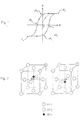
- Fig. 2 illustrates the distorted cubic unit cell structure of a ferroelectric ABO 3 perovskite (below T c ).
- the B 4+ ion can occupy positions slightly above or below the plane defined by O 2- ions. Two of the six possible polarization (P) orientations are indicated. These six orientations are degenerated in the absence of an external electrical field.
- the B 4+ ion In the distorted tetragonal unit cell, the B 4+ ion has two stable positions, either above or below the oxide-ion plane. In either position, the B 4+ ion is not coincident with the negative charge center of the O 2- ions by a small fraction (ca. 0.1) of the ⁇ ngstrom, thus creating an electrical dipole.
- This electrical dipole spontaneously aligns with those in adjacent unit cells, resulting in the formation of a micro-structural entity known as a ferroelectric domain and yielding a net electrical polarization over many unit cell dimensions.
- the energy barrier between the two possible positions for the B 4+ ion is sufficiently low to permit motion of the ion between sites by the coercion of an electrical field, and the material can thus be directionally polarized with ease.
- the direction of the electrical dipole remains until an opposite electrical field is applied. Ionic displacements typically respond to electrical field reversals up to frequencies of about 10 13 Hz.
- Barium titanate (BaTiO 3 ) is a suitable ferroelectric material in multilayer capacitors. Its Curie temperature T c is 120° and saturation polarization P s is 0.26 C m -2 at 23°C. Partial substitutions for Ba 2+ (such as Sr 2+ , Ca 2+ , Pb 2+ , and Cd 2+ ) or Ti 4+ (such as Zr 4+ , Sn 4+ , and Hf 4+ ) are used to modify the dielectric behavior and temperature dependence of BaTiO 3 . Undoped Ba-TiO 3 is a p-type semiconductor with an optical band gap of 3.2 eV.
- Fig. 3 illustrates the ferroelectric structures that are present in the two most common forms of FRAM devices, the FEFET (3A) and the FECAP (3B). Both structures contain polycrystalline ferroelectric materials.
- the FEFET is a classical MOS transistor with source 60, gate 70, drain 90 and an Si-substrate 100, with the SiO 2 gate dielectric replaced by a thin film ferroelectric 80.
- the remanent polarization of the ferroelectric controls the channel conductivity.
- the effective threshold voltage of the field-effect transistor depends on the direction of polarization. Hence, information readout is possible by determining the current level flowing through the device at constant gate voltage. This readout mechanism is non-destructive.
- a FECAP is substituted for the conventional silicon dioxide capacitor in dynamic random access memory (DRAM) devices.
- the FECAP typically consists of two electrodes 110 and 120 in parallel to the substrate, with the ferroelectric material 130 sandwiched in between.
- polarization of the ferroelectric gives rise to compensating charges in the electrodes, and a change in polarization due to switching results in a change in the electrode charge.
- the information content is probed by applying a voltage over the FECAP and measuring the displacement current as a voltage drop over a current-integrating bit-line capacitor. This voltage is then compared to a reference voltage corresponding to that of a non-switching FECAP.
- One problem with this type of FRAM cell is the fact that the readout mechanism destroys the original information content, so that the device has to be re-programmed.
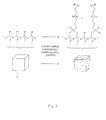
- Fig. 4 illustrates a method of surface modification of cubic shaped BaTiO 3 monoparticles 10 using the silylating agent N-(2-aminoethyl)-3-aminopropyltrimethoxysilane according to the present invention.
- This reagent condenses with -OH groups present on the particle surface to introduce positively charged -NH 2 + and -NH 3 + groups.
- Fig. 5 illustrates a method for depositing a monoparticulate layer of BaTiO 3 particles on a TEC glass electrode according to the present invention.
- the substrate 30 has an additional layer 32 of F-SnO 2 on it.
- the BaTiO 3 particles in suspension have been surface modified with N-(2-aminoethyl)-3-aminopropyltrimethoxysilane as illustrated in Fig. 4.
- the opposite electrode 34 has a metal film 36 on it. Charges on the particles are omitted for simplicity.
- FIG 5A there is an open circuit and acidic pH, and the particles are dispersed and randomly oriented in the solution phase between the two electrodes. Both the particles and the F-SnO 2 layer are positively charged.
- FIG 5B there is a closed circuit and neutral pH, and the particles are adsorbed to the TEC glass electrode and oriented with their polarization dipoles pointed in the direction of the electrical field.
- the particles are positively charged and the F-SnO 2 layer is negatively charged.
- Gaps between the particles and between the particles and the F-SnO 2 layer contain the N-(2-aminoethyl)-3-aminopropyltrimethoxysilane groups. "+" indicates a positive charge, "-" a negative charge.
- figures 4 and 5 illustrate a preferred method for preparing a monolayer of barium titanate particles oriented with their crystal axis perpendicular to the substrate according to the present invention.
- the particles which have a cubic morphology and are 20-70 nm in size, are commercially available [Advanced Powder Technology Pty Ltd, Nedlands, Western Australia ( http://www.apt-powders.com).].
- the particles are reacted with the silylating reagent N-(2-aminoethyl)-3-aminopropyltrimethoxysilane.
- This reaction essentially gives the particles positively charged organic (sub-monolayer) coatings by converting some of the hydroxyl (-OH) groups on the surface into secondary and primary ammonium (-NH 2 + and - NH 3 + ) groups (Figure 4).
- an electrical field is used to orient the particles while they are depositing onto a TEC (transparent electrical conducting) glass substrate ( Figure 5).
- the TEC glass is electrically conducting by virtue of a thin layer of fluorine-doped tin dioxide (F-SnO 2 ).
- F-SnO 2 fluorine-doped tin dioxide
- Fig. 6 illustrates a preferred method for binary information storage in individual ferroelectric particles.
- Each particle contains a single ferroelectric crystalline domain.
- the particles are adsorbed onto a conductive substrate and individually addressed with directing means 140, here a conductive tip of a scanning probe microscope (SPM) tip 140, attached to an electrical pulse generator 150.
- Negative or positive electrical pulses are applied to the particles via the SPM tip and polarize the particles in either the "up” or “down” direction, respectively, of their electrical dipoles 20, 20'.
- the figure illustrates a preferred method of writing binary information by applying electrical pulses to individual ferroelectric particles using a conductive SPM tip.
- a dashed arrow indicates the direction of movement of the tip.
- the particles exist as a monolayer or sub-monolayer on a conducting substrate, prepared by a method such as that described in Figure 5. Each particle is addressable by movement of the SPM tip.
- the electrical field strength of the applied pulse is equal to or greater than the coercive field, E c .
- the polarity of the applied electric field determines whether the resultant polarity of the permanent dipole in the particle is either up or down, representing either "0" or "1" in binary language.
- Example 1 BaTiO 3 powder (1 g) is suspended in toluene (20 ml) and N-(2-aminoethyl)-3-aminopropyltrimethoxysilane (AEAPS) (0.1 g) is added. The mixture is heated at 80 - 100°C for 4 hours, then cooled to room temperature and centrifuged. After removing the supernatant liquid, the precipitate is washed twice by re-suspending it in toluene (10 ml) and centrifuging, washed once the same way with ethanol (10 ml), and then dried under vacuum at 80°C. The dried powder is suspended in aqueous 0.001 M HCl (20 ml) and treated ultrasonically until completely dispersed. If complete dispersion is not achieved, the non-dispersed material is removed by centrifugation.
- AEAPS N-(2-aminoethyl)-3-aminopropyltrimethoxysilane
- Example 2 A portion of the aqueous dispersion from Example 1 (10 ml) is mixed with bromoacetic acid (0.5 g) until the latter is dissolved. Then a 1 M solution of sodium carbonate in water (10 ml) is added. The resultant mixture is heated at 80 - 100°C for 2 hours, then cooled to room temperature and centrifuged. After removing the supernatant liqud, the precipitate is washed twice by re-suspending it in water (5 ml) and centrifuging. The washed precipitate is re-suspended in water (10 ml) and treated ultrasonically until completely dispersed. If complete dispersion is not achieved, the non-dispersed material is removed by centrifugation.
- Example 3 BaTiO 3 powder (1 g) is suspended in iso-propanol (20 ml) and 5-sulfosalicylic acid (SSA) (0.1 g) is added. The mixture is heated at 70 - 80°C for 2 hours, then cooled to room temperature and centrifuged. After removing the supernatant liquid, the precipitate is washed twice by re-suspending it in iso-propanol (10 ml) and centrifuging. It is then dried under vacuum at 80°C. The dried powder is suspended in aqueous 0.001 M NaOH (20 ml) and treated ultrasonically until completely dispersed. If complete dispersion is not achieved, the non-dispersed material is removed by centrifugation.
- SSA 5-sulfosalicylic acid
- the ligand is 5-sulfosalicyclic acid, which binds to titanium atoms on the surface of barium titanate particles.
- the de-protonated form of this molecule can bind to a titanium atom through its carboxylate and phenolate oxygen atoms so that the negatively charged sulfonate group is directed away from the surface of the particle.
- Example 4 A 0.1 M solution of cupric chloride in water (10 ml) is stirred while the aqueous dispersion from Example 1 is slowly added until the colour change from sky blue to dark blue is no longer observed.
- Example 5 A 0.1 M solution of cupric chloride in water (10 ml) is stirred while the aqueous dispersion from Example 2 is slowly added until the colour change from sky blue to turquoise blue is no longer observed.
- Examples 4 and 5 are supposed to illustrate claim 14.
- the charged moieties in these examples are copper (cupric, Cu 2+ ) ion complexes.
- the cupric ion tends to have fourcoordinate (tetrahedral) coordination geometry.
- the four donor atoms may be the N-atoms present in two N-(2-aminoethyl)-3-aminopropyl groups.
- the four donor atoms may be the two N-atoms and two of the carboxylate O-atoms present after modification with bromoacetic acid (Example 2): The structures are indicated below.
- Example 6 BaTiO 3 powder (1 g ) is suspended in iso-propanol (20 ml) and poly(acrylic acid) (PAA) (0.1 g) is added. The mixture is heated at 70 - 80°C for 2 hours, then cooled to room temperature and centrifuged. After removing the supernatant liquid, the precipitate is washed twice by re-suspending it in iso-propanol (10 ml) and centrifuging. It is then dried under vacuum at 80°C. The dried powder is suspended in aqueous 0.001 M NaOH (20 ml) and treated ultrasonically until completely dispersed. If complete dispersion is not achieved, the non-dispersed material is removed by centrifugation.
- PAA poly(acrylic acid)
- Example 7 A sheet of transparent electrically conducting glass with F-doped SnO 2 as conducting layer (F-SnO 2 -glass (ca. 10 cm 2 ) is immersed into a solution of AEAPS (0.1 g) in toluene (20 ml). The solution is heated to 80 - 100°C for 1 hour. After removing the substrate, it is washed with toluene and then with ethanol, then kept under vacuum at 80°C for 2 hours.
- F-SnO 2 -glass ca. 10 cm 2
- Example 8 A sheet of F-SnO 2 -glass (ca. 10 cm 2 ) is immersed into a solution of (3-glycidoxypropyl)-trimethoxysilane (GPS) (0.1 g) in toluene (20 ml). The solution is heated to 80 - 100°C for 1 hour. After removing the substrate, it is washed with toluene and then with ethanol, then kept under vacuum at 80°C for 2 hours.
- GPS (3-glycidoxypropyl)-trimethoxysilane
- Example 9 An evaporated film of carbon on glass (C-glass) (ca. 10 cm 2 ) is treated in a plasma cleaner with O 2 plasma until the surface of the film becomes hydrophilic (wetted by water).
- Example 10 F-SnO 2 -glass (ca. 10 cm 2 ) is placed into an aqueous dispersion of the AEAPS-treated particles from Example 1 (2 ml diluted with 20 ml water). The dispersion is stirred while aqueous 0.001 M NaOH solution is added gradually until the pH reaches ca. 7.5. The glass is removed after 1 hour and dried under vacuum at 80°C for 2 hours.
- Example 11 AEAPS-treated F-SnO 2 -glass from Example 8 (ca. 10 cm 2 ) is placed into an aqueous dispersion of the SSA-treated particles from Example 3 (2 ml diluted with 20 ml water). The dispersion is stirred while aqueous 0.001 M HCl solution is added gradually until the pH reaches ca. 5. The glass is removed after 1 hour and dried under vacuum at 80°C for 2 hours.
- Example 12 A portion of the aqueous dispersion of AEAPS-treated particles from Example 1 (2 ml) is diluted with water (20 ml) and placed in an open-circuit cell with co-planar ca. 10 cm 2 electrodes separated by a distance of 1 cm.
- F-SnO 2 -glass is used as the cathode substrate and a C-glass is used as the anode.
- a conventional dc power supply is used to generate the applied voltage.
- the particles are deposited onto the F-SnO 2 -glass by applying a voltage of 1 V. After deposition is complete (ca. 1 minute) the substrate is removed while the electrodes are still polarised. The polarisation is then switched off and the substrate is disconnected and dried under vacuum at 80°C for 2 hours.
- aqueous 0.001 M NaOH is added to the dispersion gradually (with stirring) until the pH reaches ca. 7,5 before withdrawing the cathode.
- Example 13 The same procedure as in Example 12 is performed with the GPS-treated F-SnO 2 -glass from Example 8 instead of untreated F-SnO 2 -glass as the cathode substrate.
- Example 14 A portion of the aqueous dispersion of PAA-treated particles from Example 6 (2 ml) is diluted with water (20 ml) and placed in an open-circuit cell with co-planar ca. 10 cm 2 electrodes separated by a distance of 1 cm. C-glass is used as the anode substrate and F-SnO 2 -glass is used as the cathode. The particles are deposited onto the C-glass by applying a dc voltage of 1 V. After deposition is complete (ca. 1 minute) the substrate is removed while the electrodes are still polarised. The polarisation is then switched off and the substrate is disconnected and dried under vacuum at 80°C for 2 hours.
- Example 15 The same procedure as in Example 14 is performed with the plasma-treated C-glass from Example 9 instead of untreated C-glass as the cathode substrate.
Landscapes
- Engineering & Computer Science (AREA)
- Computer Hardware Design (AREA)
- Semiconductor Memories (AREA)
- Formation Of Insulating Films (AREA)
Priority Applications (3)
| Application Number | Priority Date | Filing Date | Title |
|---|---|---|---|
| EP00126732A EP1213745A1 (fr) | 2000-12-05 | 2000-12-05 | Procédé de fabrication d'une mémoire ferroélectrique et dispositif de mémoire |
| US10/006,347 US6756236B2 (en) | 2000-12-05 | 2001-12-04 | Method of producing a ferroelectric memory and a memory device |
| JP2001371837A JP4172619B2 (ja) | 2000-12-05 | 2001-12-05 | 強誘電体メモリの製造方法、情報格納方法及び記憶素子 |
Applications Claiming Priority (1)
| Application Number | Priority Date | Filing Date | Title |
|---|---|---|---|
| EP00126732A EP1213745A1 (fr) | 2000-12-05 | 2000-12-05 | Procédé de fabrication d'une mémoire ferroélectrique et dispositif de mémoire |
Publications (1)
| Publication Number | Publication Date |
|---|---|
| EP1213745A1 true EP1213745A1 (fr) | 2002-06-12 |
Family
ID=8170584
Family Applications (1)
| Application Number | Title | Priority Date | Filing Date |
|---|---|---|---|
| EP00126732A Withdrawn EP1213745A1 (fr) | 2000-12-05 | 2000-12-05 | Procédé de fabrication d'une mémoire ferroélectrique et dispositif de mémoire |
Country Status (3)
| Country | Link |
|---|---|
| US (1) | US6756236B2 (fr) |
| EP (1) | EP1213745A1 (fr) |
| JP (1) | JP4172619B2 (fr) |
Cited By (2)
| Publication number | Priority date | Publication date | Assignee | Title |
|---|---|---|---|---|
| EP1367592A3 (fr) * | 2002-05-23 | 2004-05-12 | Samsung Electronics Co., Ltd. | Mémoire ferroélectrique thermiquement stable |
| WO2005076368A1 (fr) * | 2004-01-06 | 2005-08-18 | Philips Intellectual Property & Standards Gmbh | Transistor avec points quantiques dans la couche a effet tunnel |
Families Citing this family (24)
| Publication number | Priority date | Publication date | Assignee | Title |
|---|---|---|---|---|
| US7015546B2 (en) * | 2000-02-23 | 2006-03-21 | Semiconductor Research Corporation | Deterministically doped field-effect devices and methods of making same |
| DE10232386A1 (de) * | 2002-07-17 | 2004-01-29 | Infineon Technologies Ag | Verfahren zum Speichern von Information in einem ferroelektrischen Material, Verfahren zum Auslesen von in einem ferroelektrischen Material gespeicherter Information sowie Vorrichtung zum Speichern von Information und Auslesen in einem ferroelektrischen Material |
| JP4632018B2 (ja) * | 2003-10-15 | 2011-02-16 | セイコーエプソン株式会社 | 強誘電体膜、強誘電体膜の製造方法、および強誘電体キャパシタ、ならびに強誘電体メモリ |
| KR100585462B1 (ko) * | 2003-12-26 | 2006-06-07 | 한국전자통신연구원 | 정보 저장 및 독출 장치 |
| US7484247B2 (en) | 2004-08-07 | 2009-01-27 | Allen F Rozman | System and method for protecting a computer system from malicious software |
| JP2007084852A (ja) * | 2005-09-20 | 2007-04-05 | Omron Corp | 誘電体膜の形成方法 |
| WO2007070673A1 (fr) * | 2005-12-15 | 2007-06-21 | Cabot Corporation | Composites polymeres transparents |
| US7470974B2 (en) * | 2006-07-14 | 2008-12-30 | Cabot Corporation | Substantially transparent material for use with light-emitting device |
| KR100851982B1 (ko) * | 2007-02-23 | 2008-08-12 | 삼성전자주식회사 | 강유전체 나노도트를 포함하는 강유전체 정보저장매체 및그 제조방법 |
| JP5490996B2 (ja) * | 2008-02-27 | 2014-05-14 | 日本碍子株式会社 | セラミックス配向膜の製造方法 |
| JP5185224B2 (ja) * | 2008-09-24 | 2013-04-17 | 日本碍子株式会社 | 結晶配向セラミックスの製造方法 |
| WO2011043794A2 (fr) * | 2009-09-29 | 2011-04-14 | Yale University | Dispositifs ferroélectriques comprenant une couche ayant deux configurations stables ou davantage |
| CN102030308B (zh) * | 2010-10-27 | 2012-08-01 | 复旦大学 | 基于铁电薄膜电畴的极化组装微小颗粒有序阵列的方法 |
| JP2016036458A (ja) * | 2014-08-06 | 2016-03-22 | 京楽産業.株式会社 | 記憶装置 |
| JP2016036453A (ja) * | 2014-08-06 | 2016-03-22 | 京楽産業.株式会社 | 記憶装置 |
| JP2016036455A (ja) * | 2014-08-06 | 2016-03-22 | 京楽産業.株式会社 | 記憶装置 |
| JP2016036454A (ja) * | 2014-08-06 | 2016-03-22 | 京楽産業.株式会社 | 記憶制御装置 |
| JP2016036457A (ja) * | 2014-08-06 | 2016-03-22 | 京楽産業.株式会社 | 記憶装置 |
| JP2016036456A (ja) * | 2014-08-06 | 2016-03-22 | 京楽産業.株式会社 | 記憶装置 |
| JP6926475B2 (ja) * | 2015-11-25 | 2021-08-25 | 東レ株式会社 | 強誘電体記憶素子、その製造方法、ならびにそれを用いたメモリセルおよびそれを用いた無線通信装置 |
| JP6650138B2 (ja) * | 2015-11-27 | 2020-02-19 | 国立大学法人広島大学 | 分子性金属酸化物クラスター、分子性金属酸化物クラスター結晶、分子性金属酸化物クラスター結晶凝集体、分子メモリ、結晶メモリ及び分子性金属酸化物クラスターへの分子分極形成方法 |
| US9966128B1 (en) * | 2017-03-20 | 2018-05-08 | Globalfoundries Inc. | Storage structure with non-volatile storage capability and a method of operating the same |
| KR102693428B1 (ko) | 2018-12-21 | 2024-08-09 | 삼성전자주식회사 | 강유전 구조체 및 이를 포함하는 반도체 장치 |
| US11387254B2 (en) * | 2020-10-30 | 2022-07-12 | Ferroelectric Memory Gmbh | Memory cell and methods thereof |
Citations (4)
| Publication number | Priority date | Publication date | Assignee | Title |
|---|---|---|---|---|
| US3890604A (en) * | 1973-11-06 | 1975-06-17 | Klaus Schroder | Selective dipole orientation of individual volume elements of a solid body |
| EP0837504A2 (fr) * | 1996-08-20 | 1998-04-22 | Ramtron International Corporation | Dispositif ferroélectrique partiellement ou complètement encapsulé |
| US5777977A (en) * | 1995-08-23 | 1998-07-07 | Sony Corporation | Recording and reproducing apparatus |
| US6025618A (en) * | 1996-11-12 | 2000-02-15 | Chen; Zhi Quan | Two-parts ferroelectric RAM |
Family Cites Families (6)
| Publication number | Priority date | Publication date | Assignee | Title |
|---|---|---|---|---|
| US5083855A (en) * | 1980-01-08 | 1992-01-28 | Clark Noel A | Surface stabilized ferroelectric liquid crystal devices |
| US5164852A (en) * | 1986-12-16 | 1992-11-17 | Semiconductor Energy Laboratory Co., Ltd. | Method of orientating a ferroelectric liquid crystal layer by AC electric field |
| US5239504A (en) * | 1991-04-12 | 1993-08-24 | International Business Machines Corporation | Magnetostrictive/electrostrictive thin film memory |
| NO309500B1 (no) * | 1997-08-15 | 2001-02-05 | Thin Film Electronics Asa | Ferroelektrisk databehandlingsinnretning, fremgangsmåter til dens fremstilling og utlesing, samt bruk av samme |
| US6297865B1 (en) * | 1998-03-10 | 2001-10-02 | Sony Corporation | Liquid crystal element having polarization moderating properties |
| US6628016B2 (en) * | 2000-03-20 | 2003-09-30 | California Molecular Electronics Corporation | Molecular dipolar rotors |
-
2000
- 2000-12-05 EP EP00126732A patent/EP1213745A1/fr not_active Withdrawn
-
2001
- 2001-12-04 US US10/006,347 patent/US6756236B2/en not_active Expired - Fee Related
- 2001-12-05 JP JP2001371837A patent/JP4172619B2/ja not_active Expired - Fee Related
Patent Citations (4)
| Publication number | Priority date | Publication date | Assignee | Title |
|---|---|---|---|---|
| US3890604A (en) * | 1973-11-06 | 1975-06-17 | Klaus Schroder | Selective dipole orientation of individual volume elements of a solid body |
| US5777977A (en) * | 1995-08-23 | 1998-07-07 | Sony Corporation | Recording and reproducing apparatus |
| EP0837504A2 (fr) * | 1996-08-20 | 1998-04-22 | Ramtron International Corporation | Dispositif ferroélectrique partiellement ou complètement encapsulé |
| US6025618A (en) * | 1996-11-12 | 2000-02-15 | Chen; Zhi Quan | Two-parts ferroelectric RAM |
Non-Patent Citations (1)
| Title |
|---|
| MATSUSHIGE K ET AL.: "Nanoscale control and detection of electric dipoles in organic molecules", NANOTECHNOLOGY, vol. 9, September 1998 (1998-09-01), Bristol (UK), pages 208 - 211, XP001065781, ISSN: 0957-4484 * |
Cited By (3)
| Publication number | Priority date | Publication date | Assignee | Title |
|---|---|---|---|---|
| EP1367592A3 (fr) * | 2002-05-23 | 2004-05-12 | Samsung Electronics Co., Ltd. | Mémoire ferroélectrique thermiquement stable |
| WO2005076368A1 (fr) * | 2004-01-06 | 2005-08-18 | Philips Intellectual Property & Standards Gmbh | Transistor avec points quantiques dans la couche a effet tunnel |
| CN100459170C (zh) * | 2004-01-06 | 2009-02-04 | Nxp股份有限公司 | 在其隧穿层中具有量子点的晶体管 |
Also Published As
| Publication number | Publication date |
|---|---|
| US20020066915A1 (en) | 2002-06-06 |
| JP2002208271A (ja) | 2002-07-26 |
| US6756236B2 (en) | 2004-06-29 |
| JP4172619B2 (ja) | 2008-10-29 |
Similar Documents
| Publication | Publication Date | Title |
|---|---|---|
| US6756236B2 (en) | Method of producing a ferroelectric memory and a memory device | |
| Jiao et al. | Ferroelectric field effect transistors for electronics and optoelectronics | |
| KR100388549B1 (ko) | 데이터 저장용 강유전성 드라이브 | |
| Guan et al. | Recent progress in two‐dimensional ferroelectric materials | |
| Du et al. | High-speed switching and giant electroresistance in an epitaxial Hf0. 5Zr0. 5O2-based ferroelectric tunnel junction memristor | |
| Liu et al. | Room-temperature magnetoelectric coupling in electronic ferroelectric film based on [(n-C3H7) 4N][FeIIIFeII (dto) 3](dto= C2O2S2) | |
| Muller et al. | Ferroelectric thin films for oxide electronics | |
| JP3752183B2 (ja) | 微粒子のアレイをアセンブルする方法 | |
| AU2021102996A4 (en) | Topological Magnetic structure and preparation method thereof, regulation method of topological magnetic structure and memory based on the topological magnetic structure | |
| JPH07502150A (ja) | 集積回路メモリー | |
| KR20160048619A (ko) | 광결정 표시장치 및 광결정성을 이용한 표시 방법 | |
| Keeney et al. | Persistence of ferroelectricity close to unit-cell thickness in structurally disordered Aurivillius phases | |
| Zhang et al. | Distorted monolayer ReS2 with low-magnetic-field controlled magnetoelectricity | |
| Coll et al. | Nanocrystalline ferroelectric BiFeO3 thin films by low-temperature atomic layer deposition | |
| US20070152253A1 (en) | Ferroelectric Oxide Artificial Lattice, Method For Fabricating The Same And Ferroelectric Storage Medium For Ultrahigh Density Data Storage Device | |
| Liu et al. | Coexistence of magnetism and ferroelectricity in 3d transition-metal-doped SnTe monolayer | |
| EP0561279B1 (fr) | Film magnétique organique et procédé pour sa fabrication | |
| Dunn et al. | Insights into the relationship between inherent materials properties of PZT and photochemistry for the development of nanostructured silver | |
| Ramasundaram et al. | Crystalline structure and ferroelectric response of poly (vinylidene fluoride)/organically modified silicate thin films prepared by heat controlled spin coating | |
| Patel et al. | Increased magnetoelectric coupling in porous nanocomposites of CoFe2O4 and BiFeO3 with residual porosity for switchable magnetic devices | |
| KR100552701B1 (ko) | 전하-쌍극자가 결합된 정보 저장 매체 및 그 제조 방법 | |
| Lous | Ferroelectric memory devices | |
| JP2008277827A (ja) | 不揮発性メモリ素子及びその製造方法 | |
| KR20080103812A (ko) | 유기단분자층 및 블록공중합체를 포함하는 나노구조체 및그 제조방법 | |
| JP3969833B2 (ja) | 強磁性強誘電体薄膜とその製造方法 |
Legal Events
| Date | Code | Title | Description |
|---|---|---|---|
| PUAI | Public reference made under article 153(3) epc to a published international application that has entered the european phase |
Free format text: ORIGINAL CODE: 0009012 |
|
| AK | Designated contracting states |
Kind code of ref document: A1 Designated state(s): AT BE CH CY DE DK ES FI FR GB GR IE IT LI LU MC NL PT SE TR |
|
| AX | Request for extension of the european patent |
Free format text: AL;LT;LV;MK;RO;SI |
|
| 17P | Request for examination filed |
Effective date: 20020625 |
|
| AKX | Designation fees paid |
Designated state(s): DE FR GB NL |
|
| 17Q | First examination report despatched |
Effective date: 20041201 |
|
| RAP1 | Party data changed (applicant data changed or rights of an application transferred) |
Owner name: SONY DEUTSCHLAND GMBH |
|
| 17Q | First examination report despatched |
Effective date: 20041201 |
|
| RAP1 | Party data changed (applicant data changed or rights of an application transferred) |
Owner name: SONY DEUTSCHLAND GMBH |
|
| STAA | Information on the status of an ep patent application or granted ep patent |
Free format text: STATUS: THE APPLICATION IS DEEMED TO BE WITHDRAWN |
|
| 18D | Application deemed to be withdrawn |
Effective date: 20100223 |