EP1225172A1 - Polyorthoester and curable composition containing the same - Google Patents
Polyorthoester and curable composition containing the same Download PDFInfo
- Publication number
- EP1225172A1 EP1225172A1 EP00957113A EP00957113A EP1225172A1 EP 1225172 A1 EP1225172 A1 EP 1225172A1 EP 00957113 A EP00957113 A EP 00957113A EP 00957113 A EP00957113 A EP 00957113A EP 1225172 A1 EP1225172 A1 EP 1225172A1
- Authority
- EP
- European Patent Office
- Prior art keywords
- group
- glycol
- compound
- polyorthoester
- compounds
- Prior art date
- Legal status (The legal status is an assumption and is not a legal conclusion. Google has not performed a legal analysis and makes no representation as to the accuracy of the status listed.)
- Granted
Links
- ULPDSNLBZMHGPI-UHFFFAOYSA-N CC1CC2OC2CC1 Chemical compound CC1CC2OC2CC1 ULPDSNLBZMHGPI-UHFFFAOYSA-N 0.000 description 1
- XBWSXJOAMWANCK-UHFFFAOYSA-N NC(C1CC2OC2CC1)=O Chemical compound NC(C1CC2OC2CC1)=O XBWSXJOAMWANCK-UHFFFAOYSA-N 0.000 description 1
Classifications
-
- C—CHEMISTRY; METALLURGY
- C09—DYES; PAINTS; POLISHES; NATURAL RESINS; ADHESIVES; COMPOSITIONS NOT OTHERWISE PROVIDED FOR; APPLICATIONS OF MATERIALS NOT OTHERWISE PROVIDED FOR
- C09D—COATING COMPOSITIONS, e.g. PAINTS, VARNISHES OR LACQUERS; FILLING PASTES; CHEMICAL PAINT OR INK REMOVERS; INKS; CORRECTING FLUIDS; WOODSTAINS; PASTES OR SOLIDS FOR COLOURING OR PRINTING; USE OF MATERIALS THEREFOR
- C09D11/00—Inks
- C09D11/02—Printing inks
- C09D11/10—Printing inks based on artificial resins
- C09D11/101—Inks specially adapted for printing processes involving curing by wave energy or particle radiation, e.g. with UV-curing following the printing
-
- C—CHEMISTRY; METALLURGY
- C07—ORGANIC CHEMISTRY
- C07D—HETEROCYCLIC COMPOUNDS
- C07D317/00—Heterocyclic compounds containing five-membered rings having two oxygen atoms as the only ring hetero atoms
- C07D317/08—Heterocyclic compounds containing five-membered rings having two oxygen atoms as the only ring hetero atoms having the hetero atoms in positions 1 and 3
- C07D317/10—Heterocyclic compounds containing five-membered rings having two oxygen atoms as the only ring hetero atoms having the hetero atoms in positions 1 and 3 not condensed with other rings
- C07D317/32—Heterocyclic compounds containing five-membered rings having two oxygen atoms as the only ring hetero atoms having the hetero atoms in positions 1 and 3 not condensed with other rings with hetero atoms or with carbon atoms having three bonds to hetero atoms with at the most one bond to halogen, e.g. ester or nitrile radicals, directly attached to ring carbon atoms
- C07D317/34—Oxygen atoms
-
- C—CHEMISTRY; METALLURGY
- C07—ORGANIC CHEMISTRY
- C07D—HETEROCYCLIC COMPOUNDS
- C07D319/00—Heterocyclic compounds containing six-membered rings having two oxygen atoms as the only ring hetero atoms
- C07D319/04—1,3-Dioxanes; Hydrogenated 1,3-dioxanes
- C07D319/06—1,3-Dioxanes; Hydrogenated 1,3-dioxanes not condensed with other rings
Definitions
- the present invention relates to a polyorthoester and a curable composition containing the same, more specifically to a novel polyorthoester which has a low viscosity and is readily controlled in a molecular weight and which has a high degree of freedom in molecular design and a production process for the same, and a curable composition containing the above polyorthoester, which can be reduced in a viscosity and increased in a solid content.
- orthoester has so far been used as a dehydrating agent and a synthetic raw material for and various compounds. Further, orthoester is known as a protective group for a hydroxyl group and protects a hydroxyl group on such moderate conditions as a room temperature in the presence of an acid catalyst by reaction as shown in the following equation (i):
- the protected hydroxyl group is stable under a base condition, but the protective group is readily desorbed under an acid condition by hydrolysis as shown in the following equation (ii) or (iii):
- the polyorthoesters described in these official gazettes are compounds which are obtained by condensing triols with orthoesters and which have a specific repetitive unit, for example, a repetitive unit represented by the following formula (v):
- a specific repetitive unit for example, a repetitive unit represented by the following formula (v):
- only specific triol can be used as a hydroxy group-containing compound, and it has a degree of a freedom only in such an extent that a molecular weight can be changed by a blending ratio of the triol to the orthoester, so that there is the problem that a degree of freedom in molecular design is low.
- lactone is essentially used as a raw material, and therefore a degree of freedom in molecular design is low.
- a polymer having a bicycloorthoester structure is described in Japanese Patent Application Laid-Open No.233114/1985, and it is shown that the above polymer is a cross-linking high polymer having an excellent balance between an elastic modulus and a toughness.
- trimethylolpropane or trimethylolethane is essentially used as a raw material, and therefore involved therein is the problem that a degree of freedom in molecular design is low.
- EP-A-882106 described in EP-A-882106 is a coating material composition which contains a bicyclo- or spiro-orthoester-functional compound and which has a low volatile organic substance content (VOC) and a long pot life.
- this coating material composition has to use triol, tetraol, lactone or oxetane as a raw material, and therefore involved as well therein is the problem that a degree of freedom in molecular design is low.
- an alkoxy group of an orthoester is subjected to alcohol exchange reaction with a hydroxyl group in the presence of an acid catalyst, and a 5-membered ring, a 6-membered ring or a bicyclo ring can be formed by using a hydroxyl group-containing compound in which two hydroxyl groups are close. Making use of this property, an orthoester is used as a protective group for close hydroxyl groups mainly in the biochemical field.
- Three alkoxy groups of an orthoester can be subjected to alcohol exchange reaction, and it can be turned into a polyorthoester by combining with polyhydric alcohol.
- an orthoester is subjected merely to exchange reaction with polyhydric alcohol (condensation reaction by dealcohol), it is gelatinized by converting into three dimension.
- a curable resin composition prepared by combining a polyhydric hydroxyl group-containing compound or a resin with a curing agent has so far been known, and the above curable resin composition has the problems that it is increased in a viscosity which originates in a hydroxyl group and reduced in a compatibility and that it is increased in a polarity and deteriorated in a wetting property when coated on a base material and it is inferior in storage stability when mixed with a curing agent having a reactivity with a hydroxyl group at a room temperature such as a polyisocyanate compound.
- One object of the present invention is to provide a novel polyorthoester having a high degree of freedom in molecular design and a low viscosity and capable of being readily controlled in a molecular weight.
- One more object of the present invention is to provide an industrially useful process in which capable of being easily produced is a novel polyorthoester having a high degree of freedom in molecular design and a low viscosity and capable of being readily controlled in a molecular weight.
- a different object of the present invention is to provide a curable composition using a polyorthoester having a high degree of freedom in molecular design and a low viscosity and capable of being readily controlled in a molecular weight, in which there involved is no problem originating in a hydroxyl group, for example, a problem on an increase in a viscosity of the curable composition; the solid content can be elevated; and the compatibility, the wetting property to a base material and the storage stability are good.
- Further different object of the present invention is to provide a curable composition using a polyorthoester having a high degree of freedom in molecular design and a low viscosity and capable of being readily controlled in a molecular weight, in which there involved are no problems on a curability of the curable composition and a reduction in the hardness; the viscosity can be reduced, and the solid content can be elevated; and the compatibility and the wetting property to a base material are good.
- the present invention provides a polyorthoester prepared by reacting:
- the present invention provides a production process for a polyorthoester characterized by subjecting the orthoester (a), the glycol compound (b) and the hydroxyl group-containing compound (c) each described above to condensation reaction in the presence of an acid catalyst.
- curable composition I comprising:
- curable composition II comprising:
- the polyorthoester of the present invention is a reaction product of the orthoester (a), the glycol compound (b) and the hydroxyl group-containing compound (c) each described below.
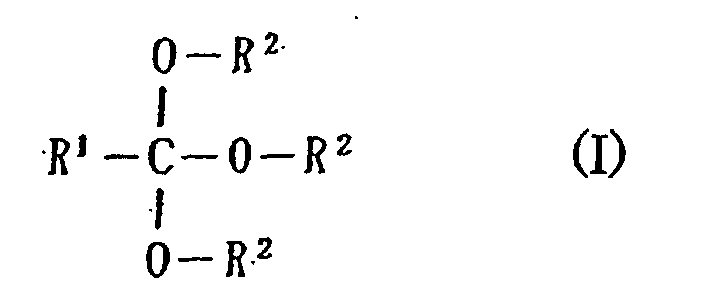
- the orthoester which is the component (a) is a compound represented by the following Formula (I): wherein R 1 represents a hydrogen atom or an alkyl group having 1 to 4 carbon atoms, and three R 2' s may be the same or different and each represent an alkyl group having 1 to 4 carbon atoms.
- the "alkyl group having 1 to 4 carbon atoms" represented by R 1 or R 2 is linear or branched and includes, for example, methyl, ethyl, n-propyl, isopropyl, n-butyl, isobutyl and t-butyl.
- the specific examples of the orthoester (a) include, for example, methyl orthoformate, ethyl orthoformate, propyl orthoformate, butyl orthoformate, methyl orthoacetate, ethyl orthoacetate, methyl orthopropionate, ethyl orthopropionate, methyl orthobutyrate and ethyl orthobutyrate.
- methyl orthoformate, ethyl orthoformate, methyl orthoacetate and ethyl orthoacetate are suited. They may be used alone or in combination of two or more kinds thereof.
- the glycol compound which is the component (b) is at least one glycol compound selected from ⁇ -glycols and ⁇ -glycols having two hydroxyl groups in a molecule.
- a compound represented by the following Formula (II) can suitably be used as the ⁇ -glycol: wherein R 3 , R 4 , R 5 and R 6 may be the same or different and each represent a hydrogen atom, an alkyl group having 1 to 24, preferably 1 to 10 carbon atoms, an aralkyl group having 7 to 24, preferably 7 to 10 carbon atoms or a phenyl group, or a group obtained by substituting a part of these groups with an oxygen atom, and the total of the carbon atoms in the groups represented by R 3 , R 4 , R 5 and R 6 falls in a range of 0 to 24, preferably 0 to 10; and R 4 and R 5 may form a cyclic structure together with carbon atoms to which they are bonded directly.
- R 3 , R 4 , R 5 and R 6 may be the same or different and each represent a hydrogen atom, an alkyl group having 1 to 24, preferably 1 to 10 carbon atoms, an aralkyl group having 7
- the "alkyl group having 1 to 24 carbon atoms" represented by R 3 , R 4 , R 5 or R 6 is linear, branched or cyclic and includes methyl, ethyl, n-propyl, isopropyl, n-butyl, isobutyl, t-butyl, pentyl, hexyl, n-octyl, 2-ethylhexyl, decyl, dodecyl, octadecyl, cyclohexyl, methylcyclohexyl, cyclohexylmethyl and cyclohexylethyl.
- the "aralkyl group having 7 to 24 carbon atoms" represented by R 3 , R 4 , R 5 or R 6 is preferably an alkyl group substituted with phenyl, and the specific examples thereof include benzyl and phenethyl.
- the "group obtained by substituting a part of the alkyl group, the aralkyl group or the phenyl group with an oxygen atom" represented by R 3 , R 4 , R 5 or R 6 includes, for example, an alkoxyalkyl group such as methoxymethyl, ethoxymethyl, propoxymethyl and butoxymethyl; an alkanoyloxyalkyl group such as acetoxymethyl and acetoxyethyl; and an aryloxyalkyl group such as phenoxymethyl and phenoxyethyl.
- R 3 , R 4 , R 5 or R 6 in Formula (II) described above is preferably a hydrogen atom or an alkyl group having 1 to 6 carbon atoms.
- the cyclic structure which can be formed by R 4 and R 5 together with carbon atoms to which they are bonded directly includes, for example, a cyclohexyl group and a cyclopentyl group.
- the representative examples of the ⁇ -glycols include, for example, ethylene glycol, 1,2-propylene glycol, 1,2-butylene glycol, 2,3-butylene glycol, 1,2-hexanediol, 1,2-dihydroxycyclohexane, pinacol and hydrolysis products of long chain alkyl monoepoxides; fatty acid monoglycerides ( ⁇ products) such as glycerin monoacetate ( ⁇ product) and glycerin monostearate ( ⁇ product) 3-ethoxypropane-1,2-diol and 3-phenoxypropane-1,2-diol.
- ethylene glycol, 1,2-propylene glycol and 1,2-hexanediol are suited.
- R 7 , R 8 , R 9 , R 10 , R 11 and R 12 may be the same or different and each represent a hydrogen atom, an alkyl group having 1 to 24, preferably 1 to 10 carbon atoms, an aralkyl group having 7 to 24, preferably 7 to 10 carbon atoms or a phenyl group, or a group obtained by substituting a part of these groups with an oxygen atom, and the total of the carbon atoms in the groups represented by R 7 , R 8 , R 9 , R 10 , R 11 and R 12 falls in a range of 0 to 24, preferably 0 to 10; and R 7 and R 9 or R 7 , R 9 and R 11 may form a cyclic structure together with carbon atoms to which they are bonded directly.
- R 7 , R 8 , R 9 , R 10 , R 11 and R 12 may be the same or different and each represent a hydrogen atom, an alkyl group having 1 to 24, preferably 1 to 10 carbon atoms, an a
- the "alkyl group having 1 to 24 carbon atoms" represented by R 7 , R 8 , R 9 , R 10 , R 11 or R 12 includes the same ones as those described above as the alkyl group represented by R 3 , R 4 , R 5 or R 6 in Formula (II) described above.
- the "aralkyl group having 7 to 24 carbon atoms" represented by R 7 , R 8 , R 9 , R 10 , R 11 or R 12 is preferably an alkyl group substituted with phenyl, and the specific examples thereof include benzyl and phenethyl.
- the "group obtained by substituting a part of the alkyl group, the aralkyl group or the phenyl group with an oxygen atom" represented by R 7 , R 8 , R 9 , R 10 , R 11 or R 12 includes, for example, an alkoxyalkyl group such as methoxymethyl, ethoxymethyl, propoxymethyl and butoxymethyl; an alkanoyloxyalkyl group such as acetoxymethyl and acetoxyethyl; and an aryloxyalkyl group such as phenoxymethyl and phenoxyethyl.
- the cyclic structure which can be formed by R 7 and R 9 or R 7 , R 9 and R 11 together with carbon atoms to which they are bonded directly includes, for example, a cyclohexyl group and a cyclopentyl group.
- R 7 , R 8 , R 9 , R 10 , R 11 or R 12 in Formula (III) described above is preferably a hydrogen atom or an alkyl group having 1 to 6 carbon atoms.
- the representative examples of the ⁇ -glycols include, for example, neopentyl glycol, 2-methyl-1,3-propanediol, 2-methyl-2,4-pentanediol, 3-methyl-1,3-butanediol, 2-ethyl-1,3-hexanediol, 2,2-diethyl-1,3-propanediol, 2,2,4-trimethyl-1,3-pentanediol, 2-butyl-2-ethyl-1,3-propanediol, 2-phenoxypropane-1,3-diol, 2-methyl-2-phenylpropane-1,3-diol, 1,3-propylene glycol, 1,3-butylene glycol, dimethylolpropionic acid, dimethylolbutanoic acid, 2-ethyl-1,3-octanediol and 1,3-dihydroxycyclohexane; fatty acid
- neopentyl glycol 2-methyl-1,3-propanediol, 2-methyl-2,4-pentanediol, 3-methyl-1,3-butanediol, 2-ethyl-1,3-hexanediol, 2,2-diethyl-1,3-propanediol, 2,2,4-trimethyl-1,3-pentanediol and 2-butyl-2-ethyl-1,3-propanediol.
- the hydroxyl group-containing compound which is the component (c) is a compound having two or more hydroxyl groups in a molecule other than the glycol compound (b) described above.
- the hydroxyl group-containing compound (c) includes compounds having two hydroxyl groups other than ⁇ -glycols and ⁇ -glycols or compounds having 3 or more, preferably 3 to 40 hydroxyl groups in a molecule.
- the compounds having two hydroxyl groups other than ⁇ -glycols and ⁇ -glycols include, for example, 1,4-butanediol, 1,4-dihydroxycyclohexane, 1,5-pentanediol, 1,6-hexanediol, 2,5-hexanediol, 3-methyl-1,5-pentanediol, 1,4-dimethylolcyclohexane, tricyclodecanedimethanol, 2,2-dimethyl-3-hydroxypropyl-2,2-dimethyl-3-hydroxypropionate (this compound corresponds to ester of hydroxypivalic acid and neopentyl glycol), bisphenol A, bisphenol F, bis(4-hydroxyhexyl)-2,2-propane, bis(4-hydroxyhexyl)methane, 3,9-bis(1,1-dimethyl-2-hydroxyethyl)-2,4,8,10-tetraoxaspiro[5,5
- the compounds described above having 3 or more hydroxyl groups include, for example, glycerin, diglycerin, triglycerin, pentaerythritol, dipentaerythritol, sorbitol, mannit, trimethylolethane, trimethylolpropane, ditrimethylolpropane, tris(2-hydroxyethyl)isocyanurate, gluconic acid and polymers having 3 or more hydroxyl groups (polyesters, polyethers, acryl polymers, ketone resins, phenol resins, epoxy resins, urethane resins those having 3 or more hydroxyl groups, polyvinyl alcohols which are saponified products of polyvinyl acetates and natural saccharides such as glucose), each of which has 3 or more hydroxyl groups.
- hydroxyl group-containing compound (c) Capable of being suitably used as the hydroxyl group-containing compound (c) are the compounds having a molecular weight falling in a range of 90 to 100,000, particularly 100 to 50,000 and further particularly 100 to 10,000 and a hydroxyl group value falling in a range of 20 to 1,850 mg KOH/g, particularly 40 to 1,650 mg KOH/g and further particularly 80 to 1,650 mg KOH/g.
- a blending ratio of the orthoester (a), the glycol compound (b) and the hydroxyl group-containing compound (c) shall not specifically be restricted.
- the polyorthoester of the present invention can be obtained by subjecting the three components (a), (b) and (c) described above to condensation reaction.
- it can suitably be produced by heating the three components described above at a temperature falling in a range of usually a room temperature to 250°C, preferably 70 to 200°C for 1 to 20 hours, if necessary, in the presence of an organic solvent and an acid catalyst to subject them to condensation reaction.
- an alkoxy group of the orthoester (a) causes exchange reaction with the alcohol parts of the glycol compound (b) and the hydroxyl group-containing compound (c).
- the orthoester (a) is preferentially reacted with the ⁇ -glycol or ⁇ -glycol which is the glycol compound (b) having hydroxyl groups close to each other to form a cyclic structure. That is, the glycol compound (b) is cyclized by preferentially reacting with two functional groups (alkoxyl groups) of the orthoester (a) which is trifunctional. The remaining one alkoxyl group of the orthoester is reacted with the hydroxyl group-containing compound (c).
- cross-linking between the molecules is not brought about in producing the polyorthoester of the present invention, and therefore the resulting polyorthoester can be inhibited to a large extent from being increased in a molecular weight and a viscosity.
- the orthoester (a) is reacted directly with the hydroxyl group-containing compound (c) in the absence of the glycol compound (b)
- cross-linking between the molecules takes place, so that the product is rapidly increased in a molecular weight and a viscosity.
- the present invention has made it possible to inhibit the product from being increased in a molecular weight and a viscosity to control them by adding the glycol compound (b) to the orthoester (a) and the hydroxyl group-containing compound (c) to react them.
- the polyorthoester having a structure in which a hydroxyl group contained in the hydroxyl group-containing compound (c) is blocked by the orthoester of a 5-membered ring or a 6-membered ring constituted by the orthoester (a) and the glycol compound (b).
- the polyorthoester of the present invention produced in the manner described above can have a structure represented by the following Formula (IV): wherein Y 1 represents a di- to hexavalent residue obtained by removing the following 2 to 6 hydroxyl groups from the compound having 2 to 6 hydroxyl groups in a molecule; R 1 , R 3 , R 4 , R 5 and R 6 are the same as defined above; and n represents an integer of 2 to 6.
- the polyorthoester of the present invention produced in the manner described above can have a structure represented by the following Formula (V): wherein Y 2 represents a di- to hexavalent residue obtained by removing the following 2 to 6 hydroxyl groups from the compound having 2 to 6 hydroxyl groups in a molecule; R 1 , R 7 , R 8 , R 9 , R 10 , R 11 and R 12 are the same as defined above; and n represents an integer of 2 to 6.
- the polyorthoester of the present invention produced in the manner described above can have a structure represented by the following Formula (VI): wherein Y 3 represents a residue obtained by removing 2 hydroxyl groups from the compound having 2 hydroxyl groups in a molecule; and R 1 , R 3 , R 4 , R 5 and R 6 are the same as defined above.
- the polyorthoester of the present invention produced in the manner described above can have a structure represented by the following Formula (VII): wherein Y 4 represents a residue obtained by removing the four hydroxyl groups from the compound having four hydroxyl groups in a molecule; and R 1 , R 7 , R 8 , R 9 , R 10 , R 11 and R 12 are the same as defined above.
- the polyorthoester provided by the present invention can be used as a binder, a cross-linking agent and a reactive diluent for coating materials, inks and adhesives. Further, it can be used as a hydrolytic polymer, a biodegradable polymer and a controlled release chemical.
- Curable composition I
- the curable composition I provided by the present invention comprises:
- Curing agent (B)
- a compound (hereinafter, referred to as a "compound (B)" having at least two groups having a reactivity with a hydroxyl group in a molecule is used as the curing agent (B) in order to cause a three-dimensional cross-linking reaction with the polyorthoester (A), and the above compound is reacted with a hydroxyl group formed by hydrolysis of an orthoester group in the polyorthoester (A) to form a cured matter.
- the representative examples of the compound (B) are, for example, polyisocyanate compounds, amino resins, epoxy group-containing compounds, alkoxysilyl group-containing compounds and compounds having two or more carboxylic anhydride groups.
- polyisocyanate compounds described above include all of compounds in which isocyanato groups (NCO group) are not blocked (hereinafter abbreviated as “non-blocked polyisocyanate compound”) and compounds in which isocyanato groups are partially or completely blocked (hereinafter abbreviated as “blocked polyisocyanate compound”).
- the non-blocked polyisocyanate compounds include, for example, aliphatic diisocyanates such as lysine diisocyanate, hexamethylene diisocyanate and trimethylhexane diisocyanate; alicyclic diisocyanates such as hydrogenated xylilene diisocyanate, isophorone diisocyanate, methylcyclohexane-2,4 or 2,6-diisocyanate, 4,4'-methylenebis(cyclohexylisocyanate) and 1,3-(isocyanatomethyl)cyclohexane; aromatic diisocyanates such as tolylene diisocyanate, xylylene diisocyanate and diphenylmethane diisocyanate; organic polyisocyanates including trivalent or more polyisocyanates such as lysine triisocyanate, adducts of these organic polyisocyanates to polyhydric alcohols, low molecular weight polyester resins or water
- the blocked polyisocyanate compounds are obtained by blocking the isocyanate groups of the non-blocked polyisocyanate compounds described above with a blocking agent.
- a blocking agent including phenol bases such as phenol, cresol and xylenol; lactam bases such as ⁇ -caprolactam, ⁇ -valerolactam, ⁇ -butyrolactam and ⁇ -propiolactam; alcohol bases such as methanol, ethanol, n- or i-propyl alcohol, n-, i- or t-butyl alcohol, ethylene glycol monomethyl ether, ethylene glycol monoethyl ether, ethylene glycol monobutyl ether, diethylene glycol monomethyl ether, diethylene glycol monoethyl ether, propylene glycol monomethyl ether and benzyl alcohol; oxime bases such as formamidoxime, acetaldoxime, acetoxime, methyl eth
- These polyisocyanate compounds can be used alone or in combination of two or more kinds thereof.
- the amino resins which can be used as the compound (B) include, for example, methylol amino resins obtained by reacting aldehydes with amino components such as melamine, urea, benzoguanamine, acetoguanamine, steroguanamine, spiroguanamine and dicyanediamide.
- the aldehydes described above include, for example, formaldehyde, paraformaldehyde, acetaldehyde and benzaldehyde.
- compounds obtained by etherifying these methylol amino resins with at least one alcohol are included in the amino resins described above.
- the alcohols used for the etherification include, for example, monohydric alcohols such as methyl alcohol, ethyl alcohol, n-propyl alcohol, isopropyl alcohol, n-butyl alcohol, isobutyl alcohol, 2-ethylbutanol and 2-ethylhexanol.
- monohydric alcohols such as methyl alcohol, ethyl alcohol, n-propyl alcohol, isopropyl alcohol, n-butyl alcohol, isobutyl alcohol, 2-ethylbutanol and 2-ethylhexanol.
- melamine resins obtained by etherifying at least a part of the methylol groups of the methylol melamine resins with the monohydric alcohols having 1 to 4 carbon atoms.
- methyl-etherified melamine resins such as Cymel 300, ditto 303, ditto 325, ditto 327, ditto 350, ditto 730, ditto 736 and ditto 738 (all described above are manufactured by Mitsui Cytec Co., Ltd.), Melan 522 and ditto 523 (all described above are manufactured by Hitachi Chemical Co., Ltd.), Nikalac MS 001, ditto MX430 and ditto MX650 (all described above are manufactured by Sanwa Chemical Co., Ltd.), Sumimal M-550, ditto M-100 and ditto M-40S (all described above are manufactured by Sumitomo Chemical Ind.
- Cymel 300, ditto 303, ditto 325, ditto 327, ditto 350, ditto 730, ditto 736 and ditto 738 all described above are manufactured by Mitsui Cytec Co., Ltd.
- Melan 522 and ditto 523 all described above are manufactured
- methyl ether and butyl ether-mixed etherified melamine resins such as Cymel 232, ditto 266, ditto XV-514 and ditto 1130 (all described above are manufactured by Mitsui Cytec Co., Ltd.), Nikalac MX500, ditto MX600 ditto MS35 and ditto MS 95 (all described above are manufactured by Sanwa Chemical Co., Ltd.), Resimine 753 and ditto 755 (all described above are manufactured by Monsanto Co., Ltd.) and Sumimal M-66B (manufactured by Sumitomo Chemical Ind. Co., Ltd.).
- These melamine resins can be used alone or in combination of two or more kinds thereof.
- the epoxy group-containing compound which can be used as the compound (B) is a compound having two or more epoxy groups in a molecule, and the representative examples thereof include ethylene glycol diglycidyl ether, polyethylene glycol diglycidyl ether, propylene glycol diglycidyl ether, tripropylene glycol diglycidyl ether, polypropylene glycol diglycidyl ether, 1,4-butanediol diglycidyl ether, neopentyl glycol diglycidyl ether, 1,6-hexanediol diglycidyl ether, glycerin diglycidyl ether, diglycerin tetraglycidyl ether, trimethylolpropane triglycidyl ether, 2,6-diglycidyl phenyl ether, sorbitol triglycidyl ether, triglycidyl isocyanurate, diglycidylamine, digly
- the epoxy group-containing compound described above includes copolymers of epoxy group-containing polymerizable unsaturated monomers such as glycidyl (meth)acrylate, allyl glycidyl ether and 3,4-epoxycyclohexylmethyl (meth)acrylate with other polymerizable unsaturated monomers.
- the other polymerizable unsaturated monomers described above include , for example, C 1 to C 24 alkyl (meth)acrylates such as methyl (meth)acrylate, ethyl (meth)acrylate, n-propyl (meth)acrylate, isopropyl (meth)acrylate, n-butyl (meth)acrylate, isobutyl (meth)acrylate, tert-butyl (meth)acrylate, 2-ethylhexyl acrylate, n-octyl (meth)acrylate, lauryl (meth)acrylate, tridecyl (meth)acrylate and stearyl (meth)acrylate; monoesters of polyhydric alcohols and acrylic acid or methacrylic acid such as 2-hydroxyethyl (meth)acrylate, hydroxypropyl (meth)acrylate, 2,3-dihydroxybutyl (meth)acrylate, 4-hydroxybutyl (meth)acrylate and
- the epoxy group-containing compounds described above can be used alone or in combination of two or more kinds thereof.
- a content of the epoxy group of the epoxy group-containing compound described above shall not specifically be restricted, and the epoxy equivalent falls suitably in a range of usually 100 to 3,000, preferably 100 to 500.
- the alkoxysilyl group-containing compound which can be used as the compound (B) is a compound having two or more alkoxysilyl groups in a molecule and includes, for example, alkoxysilanes having no polymerizable unsaturated groups such as dimethoxydimethylsilane, dimethoxydiethylsilane, dimethoxydiphenylsilane, diethoxydimethylsilane, trimethoxymethylsilane, trimethoxyethylsilane, trimethoxypropylsilane, trimethoxyphenylsilane, tetramethoxysilane, tetraethoxysilane, tetrabutoxysilane and dimethoxydiethoxysilane; polymerizable unsaturated group-containing alkoxysilanes such as vinyltrimethoxysilane, vinyltriethoxysilane, vinylmethyldimethoxysilane, vinylmethyldiethoxysilane,
- the polymerizable unsaturated monomers capable of being copolymerized with the alkoxysilanes which are the monomer components for the copolymers described above include monomers other than the alkoxysilyl group-containing compounds capable of being used as the "other polymerizable unsaturated monomers" which are copolymerized with the epoxy group-containing polymerizable unsaturated monomers when the epoxy group-containing compounds described above are copolymers.
- polyacid anhydride having two or more carboxylic anhydride groups which can be used as the curing agent (B) are, for example, pyromellitic anhydride, a condensation product [ethylenebis(anhydrotrimellitate)] of one mole of ethylene glycol and 2 moles of trimellitic anhydride, a condensation product [glycerintris(anhydrotrimellitate)] of one mole of glycerin and 3 moles of trimellitic anhydride; linear or cyclic polyacid anhydrides obtained by subjecting polybasic acids such as succinic acid, adipic acid, azelaic acid, sebacic acid, dodecanedioic acid, dimer acid, ethyl-octadecanedioic acid, phenyl-hexadecanedioic acid and 1,4-cyclohexanedicarboxylic
- the monomers other than the polymerizable unsaturated acid anhydrides which can form the above polymers include , for example, alkyl (meth)acrylates having 1 to 24 carbon atoms such as methyl (meth)acrylate, ethyl (meth)acrylate, n-propyl (meth)acrylate, isopropyl (meth)acrylate, n-butyl (meth)acrylate, isobutyl (meth)acrylate, tert-butyl (meth)acrylate, 2-ethylhexyl acrylate, n-octyl (meth)acrylate, lauryl (meth)acrylate, tridecyl (meth)acrylate and stearyl (meth)acrylate; vinyl aromatic compounds such as styrene, vinyltoluene and ⁇ -methylstyrene; polymerizable unsaturated monocarboxylic acids such as acrylic acid, methacrylic acid and crotonic acid;
- a content of the acid anhydride groups in the polyacid anhydrides described above shall not specifically be restricted, and the whole acid value based on the acid anhydride groups falls suitably in a range of usually 50 to 1,100 mg KOH/g, preferably 80 to 800 mg KOH/g.
- the polyisocyanate compounds and the amino resins can be given as the particularly suitable compound.
- the compounds (B) described above can be used alone or in combination of two or more kinds thereof.
- the curable composition I of the present invention comprises the polyorthoester (A) and the compound (B) each described above as the essential components.
- a blending proportion of these both components shall not specifically be restricted and falls suitably in a range of usually 95/5 to 20/80, preferably 90/10 to 30/70 and more preferably 70/30 to 30/70.
- the curable composition I of the present invention can suitably contain, if necessary, an acid catalyst, an organic solvent, a curing catalyst, a pigment, a UV absorber, a coated surface-controlling agent, an antioxidant, a fluidity-controlling agent and a wax.
- the acid catalyst described above is a catalyst for accelerating a reaction of deblocking an orthoester group to reproduce a hydroxyl group.
- the kind thereof shall not specifically be restricted, and capable of being given are, for example, inorganic acids such as hydrochloric acid, sulfuric acid and nitric acid; sulfonic acid compounds such as methanesulfonic acid, ethanesulfonic acid, paratoluenesulfonic acid, dodecylbenzenesulfonic acid, dinonylnaphthalenesulfonic acid and dinonylnaphthalenedisulfonic acid; compounds obtained by neutralizing the sulfonic acid compounds described above with bases such as amines; esters of the sulfonic acid compounds described above with primary, secondary or tertiary alcohols such as n-propanol, n-butanol, n-hexanol, n-octanol, isopropanol, 2-butan
- the curable composition I of the present invention can usually be a composition of a non-solvent or organic solvent type.
- solvents which can dissolve or disperse the respective components of the curable composition I can be used, and capable of being given are, for example, hydrocarbon base solvents such as heptane, toluene, xylene, octane and mineral spirits; ester base solvents such as ethyl acetate, n-butyl acetate, isobutyl acetate, ethylene glycol monomethyl ether acetate and diethylene glycol monobutyl ether acetate; ketone base solvents such as methyl ethyl ketone, methyl isobutyl ketone, diisobutyl ketone and cyclohexanone; alcohol base solvents such as methanol, ethanol, isopropanol, n-butanol, sec-butanol and isobutanol;
- the curing catalyst described above which is blended, if necessary, with the curable composition I is intended for accelerating the curing reaction of the curable composition I, and suited when the compound (B) is a blocked polyisocyanate compound is, for example, a curing catalyst which promotes the dissociation of a blocking agent in the blocked polyisocyanate compound which is a curing agent.
- organic metal catalysts such as tin octanoate, dibutyltin di(2-ethylhexanoate), dioctyltin di(2-ethylhexanoate), dioctyltin diacetate, dibutyltin dilaurate, dibutyltin oxide, dioctyltin oxide and lead 2-ethylhexanoate.
- the compound (B) is an amino resin such as a melamine resin, particularly a methyl-etherified or methyl ether and butyl ether-mixed etherified melamine resin having a low molecular weight, phosphoric acid, a sulfonic acid compound or an amine-neutralized product of the sulfonic acid compound is suitably used as the curing catalyst.
- the representative examples of the sulfonic acid compound include p-toluenesulfonic acid, dodecylbenzenesulfonic acid, dinonylnaphthalenesulfonic acid and dinonylnaphthalenedisulfonic acid.
- the amine in the amine-neutralized product of the sulfonic acid compound may be any one of primary amines, secondary amines and tertiary amines.
- the curing catalyst used when the compound (B) is the epoxy group-containing compound includes, for example, chelating compounds such as tetrakis(acetylacetonato)zirconium, cobalt acetylacetonate, tris(acetylacetonato)aluminum and manganese acetylacetonate; chelating reaction products of compounds having a ⁇ -hydroxyamino structure with lead (II) oxide; metal carboxylates such as lead 2-ethylhexanoate, lead secanoate, lead naphthenoate, lead octanoate, lead acetate, lead lactate and zirconium octanoate; and imidazole compounds such as imidazole, 2-methylimidazole, 2-isopropylimidazole, 2-undecylimidazole and 2-phenylimidazole.
- chelating compounds such as tetrakis(acetylacetonato
- the curing catalyst used when the compound (B) is the alkoxysilyl group-containing compound includes, for example, organic sulfonic acid compounds such as dodecylbenzenesulfonic acid, paratoluenesulfonic acid, dinonylnaphthalenesulfonic acid and trifluorosulfonic acid; amine-neutralized products of these organic sulfonic acid compounds; and phosphoric acid base compounds such as monobutyl phosphate, dibutyl phosphate, monoisopropyl phosphate, diisopropyl phosphate, monooctyl phosphate, dioctyl phosphate, monodecyl phosphate, didecyl phosphate, metaphosphoric acid, orthophosphoric acid, pyrophosphoric acid, trimethyl phosphate, triethyl phosphate, tributyl phosphate, trioctyl phosphate, tributoxyethyl phosphate, tris chlor
- the curing catalyst used when the compound (B) is the polyacid anhydride includes, for example, quaternary salt catalysts such as tetraethylammonium bromide, tetrabutylammonium bromide, tetraethylammonium chloride, tetrabutylammonium fluoride, tetrabutylphosphonium bromide, triphenylbenzylphosphonium chloride and n-dodecyltributylammonium bromide; and amines such as triethylamine and tributylamine.
- quaternary salt catalysts such as tetraethylammonium bromide, tetrabutylammonium bromide, tetraethylammonium chloride, tetrabutylammonium fluoride, tetrabutylphosphonium bromide, triphenylbenzylphosphonium chloride and n
- inorganic color pigments such as titanium white, carbon black, red iron oxide and titanium yellow
- organic color pigments such as quinacridone red, azo red, phthalocyanine blue, phthalocyanine green and organic yellow pigments
- brilliant pigments such as aluminum powder and brilliant mica powder
- extender pigments such as silica powder, calcium carbonate, barium sulfate, mica, clay and talc
- rust preventive pigments such as calcium ion-exchanged silica, phosphate base rust preventive pigments and chromate base pigments.
- the curable composition I of the present invention can suitably be used for uses in coating material compositions, adhesives and inks, particularly as a coating material composition.
- the curing conditions of the curable composition I of the present invention shall not specifically be restricted.
- the curing temperature falls suitably in a range of a room temperature (about 0°C) to about 200°C, particularly about 60°C to about 180°C, and when the curing time is shorter than 5 minutes, the curing temperature falls suitably in a range of about 60°C to about 300°C, particularly about 80°C to about 260°C.
- the curable composition II of the present invention comprises a combination of
- the base polymer (1) which is the component (1) in the curable composition II of the present invention is a polymer having a reactivity with the curing agent (2) described later.
- the base polymer (1) shall not specifically be restricted in a kind thereof as long as it has a reactive group (for example, a hydroxyl group, an epoxy group, a carboxyl group, an alkoxysilyl group, an acid anhydride group and an isocyanate group) capable of being reacted with the curing agent (2) and can be reacted with the curing agent (2) and cured.
- the representative examples of the base polymer (1) include, for example, hydroxyl group-containing polymers having a hydroxyl group value falling in a range of 5 to 500 mg KOH/g, preferably 20 to 300 mg KOH/g and more preferably 50 to 200 mg KOH/g and a number average molecular weight falling in a range of 500 to 50,000, preferably 1,000 to 30,000 and more preferably 1,500 to 10,000.
- the resin kind of the base polymer (1) are, for example, acrylic resins, polyester resins, silicon acrylic resins, fluororesins and epoxy resins. Among them, particularly the acrylic resins and the polyester resins can suitably be used.
- the acrylic resin which can be used as the base polymer (1) are, for example, the (co)polymers of the following polymerizable unsaturated monomers having such reactive group as described above.
- Preferred are the polymers comprising 30 % by weight or more, preferably 40 to 90 % by weight of a C 1 to C 24 alkyl (meth)acrylate unit based on the whole monomer components, and the acrylic resins having a hydroxyl group are particularly suited.
- the polymerizable unsaturated monomers having a reactive group include, for example, monoesters of polyhydric alcohols and acrylic acid or methacrylic acid such as 2-hydroxyethyl (meth)acrylate, hydroxypropyl (meth)acrylate, 2,3-dihydroxybutyl (meth)acrylate, 4-hydroxybutyl (meth)acrylate and polyethylene glycol mono(meth)acrylate; compounds obtained by subjecting ⁇ -caprolactone to ring opening reaction with the monoesters described above of the polyhydric alcohols and acrylic acid or methacrylic acid; carboxyl group-containing polymerizable unsaturated monomers such as acrylic acid, methacrylic acid, itaconic acid, maleic acid and crotonic acid; acid anhydride group-containing polymerizable unsaturated monomers such as maleic anhydride and itaconic anhydride; epoxy group-containing polymerizable unsaturated monomers such as glycidyl (meth)acrylate, allyl gly
- the other polymerizable unsaturated monomers which can be copolymerized with these polymerizable unsaturated monomers having a reactive group include , for example, linear, branched or cyclic C 1 to C 24 alkyl (meth)acrylates such as methyl (meth)acrylate, ethyl (meth)acrylate, n-propyl (meth)acrylate, isopropyl (meth)acrylate, n-butyl (meth)acrylate, isobutyl (meth)acrylate, tert-butyl (meth)acrylate, 2-ethylhexyl acrylate, n-octyl (meth)acrylate, lauryl (meth)acrylate, tridecyl (meth)acrylate, stearyl (meth)acrylate, isobornyl (meth)acrylate, tricyclodecanyl (meth)acrylate and cyclohexyl acrylate; nitrogen-containing( me
- These polymerizable unsaturated monomers can be used alone or in combination of two or more kinds thereof.
- the polyester resin capable of being used as the base polymer (1) includes, for example, oil-free polyester resins, oil-modified alkyd resins; and modified products of these resins, for example, urethane-modified polyester resins, urethane-modified alkyd resins and epoxy-modified polyester resins, and the polyester resins having a hydroxyl group are suited.
- the oil-free polyester resin described above comprises an ester of a polybasic acid component and a polyhydric alcohol component.
- Mainly used as the polybasic acid component are, for example, at least one dibasic acid selected from phthalic anhydride, isophthalic acid, terephthalic acid, tetrahydrophthalic anhydride, hexahydrophthalic anhydride, hexahydroterephthalic anhydride, succinic acid, fumaric acid, adipic acid, sebacic acid and maleic anhydride, and lower alkyl esters of these acids.
- monobasic acids such as benzoic acid, crotonic acid and p-t-butylbenzoic acid
- trivalent or higher polybasic acids such as trimellitic anhydride, methylcyclohexenetricarboxylic acid and pyromellitic anhydride.
- polyhydric alcohol component mainly used as the polyhydric alcohol component are, for example, dihydric alcohols such as ethylene glycol, diethylene glycol, propylene glycol, 1,4-butanediol, neopentyl glycol, 3-methylpentanediol, 1,4-hexanediol, 1,6-hexanediol, 2-butyl-2-ethyl-1,3-propanediol and 1,4-dimethylolcyclohexane.
- dihydric alcohols such as ethylene glycol, diethylene glycol, propylene glycol, 1,4-butanediol, neopentyl glycol, 3-methylpentanediol, 1,4-hexanediol, 1,6-hexanediol, 2-butyl-2-ethyl-1,3-propanediol and 1,4-dimethylolcyclohexane.
- polyhydric alcohols can be used alone or in a mixture of two or more kinds thereof. Esterification or transesterification between these both components can be carried out by a conventionally known method. Isophthalic acid, terephthalic acid and lower alkyl esters of these acids are particularly preferred as the acid component.
- the alkyd resins are obtained by reacting the acid components and the alcohol components of the oil-free polyester resins described above with oil fatty acids by a conventionally known method.
- oil fatty acids are, for example, coconut oil fatty acid, soybean oil fatty acid, linseed oil fatty acid, safflower oil fatty acid, tall oil fatty acid, dehydrated castor oil fatty acid and tung oil fatty acid.
- An oil length of the alkyd resins is preferably 30 % or less, particularly 5 to 20 %.
- the urethane-modified polyester resins include resins obtained by reacting the oil-free polyester resins described above or oil-free polyester resins of a low molecular weight obtained by reacting the acid components and the alcohol components used in producing the oil-free polyester resins described above with polyisocyanate compounds by a conventionally known method.
- the urethane-modified alkyd resin includes resins obtained by reacting the alkyd resins described above or alkyd resins of a low molecular weight obtained by reacting the respective components used in producing the alkyd resins described above with polyisocyanate compounds by a conventionally known method.
- the polyisocyanate compounds which can be used in producing the modified polyester resins and the modified alkyd resins each described above include, for example, aliphatic, alicyclic, aromatic or aromatic/aliphatic polyisocyanate compounds such as hexamethylenediisocyanate, isophoronediisocyanate, xylilenediisocyanate, tolylenediisocyanate, 4,4'-diphenylmethanediisocyanate, 4,4'-methylenebis(cyclohexylisocyanate) and 2,4,6-triisocyanatotoluene.
- aliphatic, alicyclic, aromatic or aromatic/aliphatic polyisocyanate compounds such as hexamethylenediisocyanate, isophoronediisocyanate, xylilenediisocyanate, tolylenediisocyanate, 4,4'-diphenylmethanediisocyanate, 4,4'-methylene
- the epoxy-modified polyester resins include, for example, reaction products obtained by using polyester resins produced from the respective components used for producing the polyester resins described above and reacting carboxyl groups in the polyester resins with epoxy group-containing resins and reaction products obtained by bonding hydroxyl groups contained in polyester resins with hydroxyl groups contained in epoxy resins via polyisocyanate compounds by addition, condensation or graft reaction of the polyester resins with the epoxy resins.
- the epoxy-modified polyester resins have suitably such a modification degree that the epoxy resins account for 0.1 to 30 % by weight, particularly 1 to 20 % by weight based on the epoxy-modified polyester resins.
- the silicon acrylic resins which can be used as the base polymer (1) include, for example, resins obtained by subjecting hydroxyl group-containing acrylic resins to condensation reaction with silicon resins having a hydroxyl group or an alkoxyl group by dehydration or dealcohol by heating, if necessary, in the presence of a reaction catalyst such as a metal alkoxide compound.
- the silicon polyester resins which can be used as the base polymer (1) include, for example, resins obtained by subjecting hydroxyl group-containing polyester resins to condensation reaction with silicon resins having a hydroxyl group or an alkoxyl group by dehydration or dealcohol by heating, if necessary, in the presence of a reaction catalyst such as a metal alkoxide compound.
- the silicon resin having a hydroxyl group or an alkoxyl group used for producing the silicon acrylic resins and the silicon polyester resins each described above can be obtained in the form of commercial products, and capable of being given as the examples thereof are, for example, SH-6018, DC3074, DC3037 and SR2402 (all products described above are manufactured by Toray Dow Corning Co., Ltd.); KR9218 and X-40-9220 (all products described above are manufactured by Shin-etsu Chemical Co., Ltd.), TSR165 and XR-31B1763 (all products described above are manufactured by Toshiba Silicon Co., Ltd.).
- a use proportion of the silicon resins described above in the silicon acrylic resins and the silicon polyester resins falls suitably in a range of 1 to 100 parts by weight, particularly 5 to 60 parts by weight per 100 parts by weight of the resin solid matters of the acrylic resins and the polyester resins.
- the fluororesins which can be used as the base polymer (1) include preferably hydroxyl group-containing fluororesins, and capable of being given are, for example, copolymers of fuloroolefins such as vinyl fluoride and hydroxyl group-containing polymerizable unsaturated monomers such as hydroxyethyl vinyl ether with other polymerizable unsaturated monomers such as ethyl vinyl ether.
- the epoxy resins which can be used as the base polymer (1) include, for example, glycidyl ether type epoxy resins, glycidyl ester type epoxy resins, other glycidyl type epoxy resins; and modified epoxy resins obtained by modifying these epoxy resins with modifying agents such as alkylphenols and fatty acids. These various epoxy resins may be increased in a molecular weight with a linking agent in order to obtain a suitable molecular weight.
- the glycidyl ether type epoxy resins described above are epoxy resins having a glycidyl ether group which can be obtained by reacting polyhydric alcohols or polyhydric phenols with epihalohydrins or alkylene oxides.
- the examples of the polyhydric alcohols described above include ethylene glycol, diethylene glycol, triethylene glycol, polyethylene glycol, propylene glycol, polypropylene glycol, neopentyl glycol, butylene glycol, 1,6-hexanediol, 1,4-hexanediol, glycerin, trimethylolethane, trimethylolpropane, pentaerythritol, diglycerin and sorbitol.
- polyhydric phenols described above-in include 2,2-bis(4-hydroxyphenyl)-propane (bisphenol A), 2,2-bis(2-hydroxyphenyl)propane, 2-(2-hydroxyphenyl)-2-(4-hydroxyphenyl)propane, halogenated bisphenol A, bis(4-hydroxyphenyl)methane (bisphenol F), 4,4'-dihydroxybenzophenone, tris(4-hydroxyphenyl)propane, 1,1-bis(4-hydroxyphenyl)ethane, 4,4'-dihydroxybiphenol, resorcin, hydroquinone, tetrahydroxyphenylethane, 1,2,3-tris(2,3-epoxypropoxy)propane, novolak type polyhydric phenols and cresol type polyhydric phenols.
- the glycidyl ester type epoxy resins described above include resins obtained by highly polymerizing diglycidyl phthalate, diglycidyl hexahydrophthalate, diglycidyl tetrahydrophthalate and dimeric acid diglycidyl ester by using linking agents.
- the other glycidyl type epoxy resins described above include, for example, resins obtained by highly polymerizing tetraglycidylaminodiphenylmethane and triglycidylisocyanurate by using linking agents.
- the modified epoxy resins are epoxy resins obtained by modifying epoxy resins before modified such as the glycidyl ether type epoxy resins and the glycidyl ester type epoxy resins each described above with modifying agents such as alkylphenols and fatty acids.
- the linking agents used in order to optimize the molecular weights of the various epoxy resins such as the glycidyl ether type epoxy resins, the glycidyl ester type epoxy resins and the other glycidyl type epoxy resins each described above include, for example, polyhydric phenols, polyhydric alcohols, polybasic acids, primary or secondary amines and polyisocyanates.
- the polyhydric alcohols and polyhydric phenols which have been given above as the examples of the raw materials for the glycidyl ether type epoxy resins can be given as the polyhydric phenols and polyhydric alcohols.
- the polybasic acids include, for example, adipic acid, azelaic acid, sebacic acid, hexahydrophthalic anhydride, tetrahydrophthalic anhydride, isophthalic acid and dimeric acid.
- the primary or secondary amines include, for example, ethylamine, n-propylamine, isopropylamine, n-butylamine, monoethanolamine and hexamethylenediamine.
- the polyisocyanates include, for example, isophoronediisocyanate, diphenylmethanediisocyanate and hexamethylenediisocyanate.
- the curing agent which is the component (2) in the curable composition II of the present invention is a substance which has a reactivity with a hydroxyl group and which can be reacted with a hydroxyl group produced by hydrolysis of an orthoester group in the polyorthoester (3) described above and also reacted with the base polymer (1) to form a cured matter.
- curing agent (2) Capable of being given as the representative example of the curing agent (2) are, for example, polyisocyanate compounds, amino resins, epoxy group-containing compounds, alkoxysilyl group-containing compounds and compounds having two or more carboxylic anhydride groups.
- the curable composition II of the present invention comprises a combination of the base polymer (1) and the curing agent (2) each described above and further comprises the polyorthoester of the present invention described above.
- a blending proportion of the respective components (1), (2) and (3) described above shall not specifically be restricted, and usually, it falls suitably in the following range based on 100 parts by weight of the total of solid matters contained in the components (1), (2) and (3):
- the curable composition II of the present invention can suitably contain, if necessary, an acid catalyst, an organic solvent, a curing catalyst, a pigment, a UV absorber, a coated surface-controlling agent, an antioxidant, a fluidity-controlling agent and a wax in addition to the components (1), (2) and (3) described above.
- the acid catalyst described above is a catalyst for accelerating a reaction of deblocking an orthoester group to reproduce a hydroxyl group.
- the kind thereof shall not specifically be restricted, and capable of being used as well are, for example, those which have been given as the examples of the acid catalyst capable of being blended with the curable composition I of the present invention.
- the curable composition II of the present invention can usually be a composition of a non-solvent or organic solvent type.
- solvents which can dissolve or disperse the respective components of the curable composition II can be used and include, for example, the same ones as given as the examples of the organic solvents for the curable composition I.
- suitable ones selected from those given above as the examples of the curing catalyst and the pigment which can be blended with the curable composition I of the present invention can also be used as the curing catalyst and the pigment which are blended with the curable composition II of the present invention.
- the curing conditions of the curable composition II of the present invention can be changed according to the kind of the curing agent (2) used and shall not specifically be restricted.
- the curing temperature falls suitably in a range of a room temperature (about 0°C) to about 200°C, particularly about 60°C to about 180°C, and when the curing time is shorter than 5 minutes, the curing temperature falls suitably in a range of about 60°C to about 300°C, particularly about 80°C to about 260°C.
- the curable composition I of the present invention can suitably be used for uses in coating material compositions, adhesives and inks, particularly as a coating material composition.
- a reactor equipped with a stirrer, a condenser, a temperature-controlling device, a water separator, a fractionating column, a nitrogen-introducing tube and a solvent-recovering device was charged with 161 parts of 1,6-hexanediol, 351 parts of 1,4-dimethylolcyclohexane, 146 parts of trimethylolpropane, 114 parts of adipic acid, 300 parts of hexahydrophthalic anhydride and 243 parts of isophthalic acid, and the reactor was substituted with nitrogen and then started to be heated. The temperature was elevated at a fixed rate from 170°C to 230°C in 3 hours while removing condensation water and then maintained at 230°C for one hour.
- the resulting resin (solid matter) had a resin acid value of 6.5 mg KOH/g, a hydroxyl group value of 120 mg KOH/g, a number average molecular weight of 1,800 and a weight average molecular weight of 5,200.
- a reactor equipped with a stirrer, a condenser, a temperature-controlling device, a nitrogen-introducing tube and a dropping funnel was charged with 983 parts of xylene and 240 parts of 3-methoxybutyl acetate, and the reactor was substituted with nitrogen, heated and maintained at 135°C. Dropwise added thereto in 4 hours was a mixture comprising 600 parts of styrene, 636 parts of isobutyl methacrylate, 552 parts of 2-ethylhexyl acrylate, 612 parts of 2-hydroxyethyl methacrylate and 192 parts of azobisisobutyronitrile.
- the solution was ripened at 135°C for 30 minutes, and then a mixed solution comprising 168 parts of xylene and 12 parts of azobisisobutyronitrile was dropwise added thereto in one hour. Then, the solution was maintained at 135°C for 30 minutes to obtain an acrylic resin solution (AR-1) having a non-volatile matter content of about 63 % and a Gardner viscosity (20°C) of U + .
- the resulting resin (solid matter) had a hydroxyl value of 110 mg KOH/g, a number average molecular weight of 1,900 and a weight average molecular weight of 4,300.
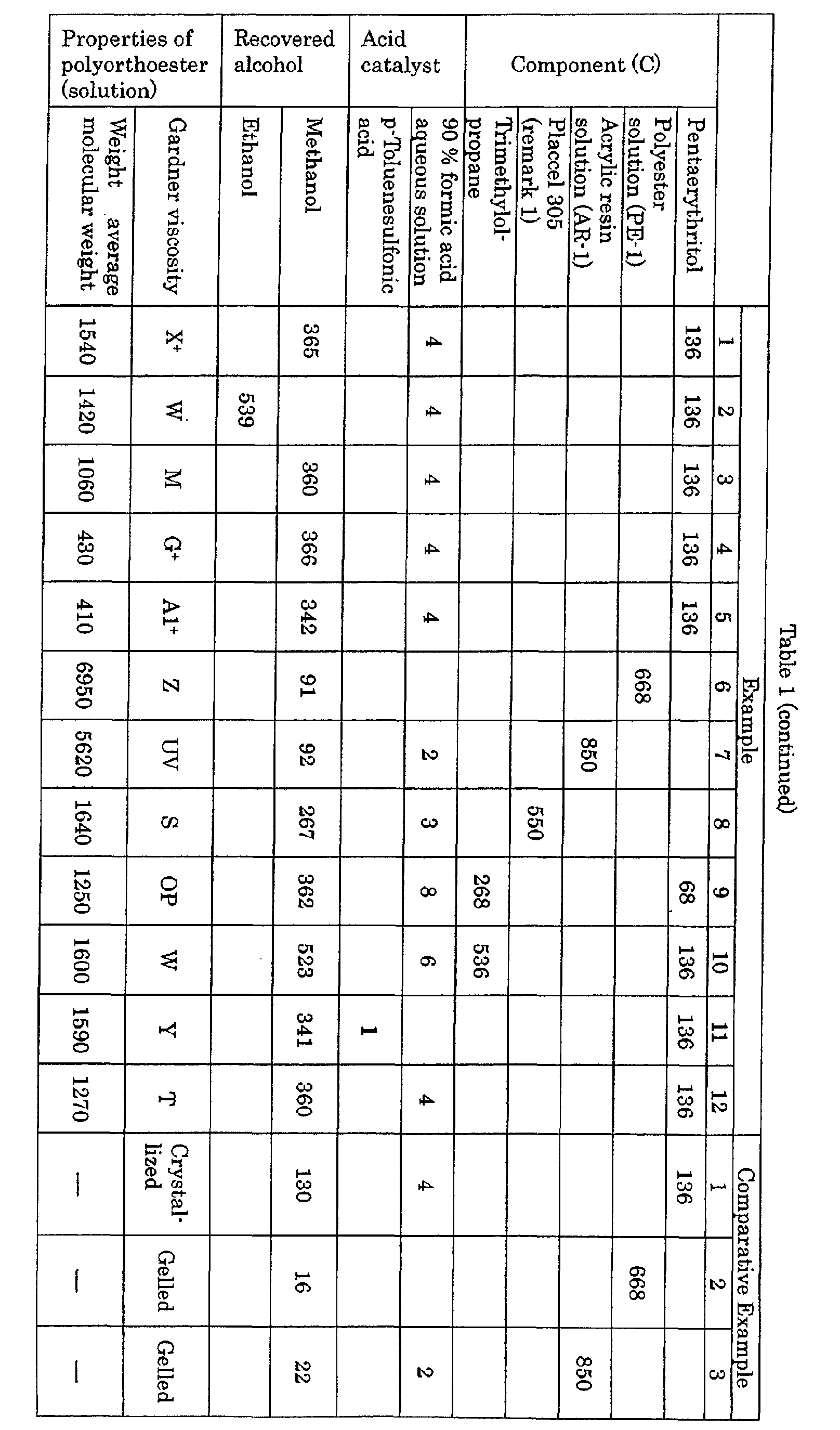
- a reactor equipped with a stirrer, a condenser, a temperature-controlling device and a solvent-recovering device was charged with 424 parts of methyl orthoformate, 640 parts of 2-butyl-2-ethyl-1,3-propanediol, 136 parts of pentaerythritol and 4 parts of a 90 % formic acid aqueous solution and maintained at about 85°C for one hour while distilling off methanol produced by alcohol exchange reaction. Then, the temperature was elevated up to 190°C in 2 hours, and 365 parts of methanol was recovered to obtain a colorless and liquid polyorthoester.
- the polyorthoester thus obtained had a Gardner viscosity of X + and a weight average molecular weight of 1,540. Examples 2 to 12 and Comparative Examples 1 to 3.
- Example 6 The reaction was carried out in the same manner as in Example 1 to obtain the respective polyorthoesters, except that in Example 1, the blended raw material compositions were changed as shown in the following Table 1.
- distilled off was a part of an organic solvent (xylene) contained in the raw material in addition to alcohol produced by alcohol exchange.
- the polyorthoester solution obtained in Example 6 had a solid content of about 74 %, and the polyorthoester solution obtained in Example 7 had a solid content of about 68 %.
- Comparative Example 1 The polyorthoester obtained in Comparative Example 1 had a solid content of about 100 % and crystallized. In Comparative Example 2 and Comparative Example 3, gelation took place in the middle of the reaction.
- Example 6 All the polyorthoesters obtained in Examples 1 to 5 and 8 to 12 were colorless and liquid polyorthoesters and had a solid content of substantially about 100 %.
- the acid catalyst was not blended, but a carboxyl group contained in the resin in the polyester solution (PE-1) works as a catalyst.
- the polyorthoester obtained in Example 6 had a solid content of about 74 %, and when the solid content was controlled to 69 % by adding xylene to the above polyorthoester, the Gardner viscosity was V, which was lower than the viscosity X of the polyester solution (PE-1) having a solid content of 69 % used in Example 6.
- the polyorthoester solution obtained in Example 7 had a solid content of about 68 %, and when the solid content was controlled to 63 % by adding xylene to the above polyorthoester, the Gardner viscosity was O, which was lower than the viscosity U + of the acrylic resin solution (AR-1) having a solid content of 63 % used as a raw material in Example 7.
- a reactor equipped with a stirrer, a condenser, a temperature-controlling device, a nitrogen-introducing tube and a dropping funnel was charged with 983 parts of xylene and 240 parts of 3-methoxybutyl acetate, and the reactor was substituted with nitrogen, heated and maintained at 135°C. Dropwise added thereto in 4 hours was a mixture comprising 720 parts of styrene, 720 parts of 2-ethylhexyl acrylate, 960 parts of glycidyl methacrylate and 192 parts of azobisisobutyronitrile.
- the solution was aged at 135°C for 30 minutes, and then a mixed solution comprising 168 parts of xylene and 12 parts of azobisisobutyronitrile was dropwise added in one hour. Then, the solution was maintained at 135°C for 30 minutes to obtain an epoxy group-containing acrylic resin solution (B-1) having a non-volatile matter content of about 63 % and a Gardner viscosity (20°C) of S.
- the resulting resin (solid matter) had an epoxy equivalent of about 370, a number average molecular weight of 2,100 and a weight average molecular weight of 4,900.
- a reactor equipped with a stirrer, a condenser, a temperature-controlling device, a nitrogen-introducing tube and a dropping funnel was charged with 983 parts of xylene and 240 parts of 3-methoxybutyl acetate, and the reactor was substituted with nitrogen, heated and maintained at 135°C. Dropwise added thereto in 4 hours was a mixture comprising 600 parts of styrene, 600 parts of maleic anhydride, 1200 parts of n-butyl acrylate and 192 parts of azobisisobutyronitrile.
- the solution was aged at 135°C for 30 minutes, and then a mixed solution comprising 168 parts of xylene and 12 parts of azobisisobutyronitrile was dropwise added in one hour. Then, the solution was maintained at 135°C for 30 minutes to obtain an acid anhydride group-containing acrylic resin solution (B-2) having a non-volatile matter content of about 63 % and a Gardner viscosity (20°C) of R - .
- the resulting resin (solid matter) had a whole acid value of about 266 mg KOH/g, a half acid value of about 138 mg KOH/g, a number average molecular weight of 1,900 and a weight average molecular weight of 4,800.
- a reactor equipped with a stirrer, a condenser, a temperature-controlling device, a nitrogen-introducing tube and a dropping funnel was charged with 983 parts of xylene and 240 parts of 3-methoxybutyl acetate, and the reactor was substituted with nitrogen, heated and maintained at 135°C.
- Dropwise added thereto in 4 hours was a mixture comprising 720 parts of styrene, 720 parts of n-butyl methacrylate, 480 parts of 2-ethylhexyl acrylate, 480 parts of ⁇ -methacryloyloxypropyltrimethoxysilane and 192 parts of azobisisobutyronitrile.
- the solution was aged at 135°C for 30 minutes, and then a mixed solution comprising 168 parts of xylene and 12 parts of azobisisobutyronitrile was dropwise added in one hour. Then, the solution was maintained at 135°C for 30 minutes to obtain an alkoxysilyl group-containing acrylic resin solution (B-3) having a non-volatile matter content of about 63 % and a Gardner viscosity (20°C) of W.
- the resulting resin (solid matter) had a number average molecular weight of 2,800 and a weight average molecular weight of 5,500.
- a reactor equipped with a stirrer, a condenser, a temperature-controlling device, a nitrogen-introducing tube and a dropping funnel was charged with 983 parts of xylene and 240 parts of 3-methoxybutyl acetate, and the reactor was substituted with nitrogen, heated and maintained at 135°C. Dropwise added thereto in 4 hours was a mixture comprising 480 parts of styrene, 480 parts of maleic anhydride, 480 parts of glycidyl methacrylate, 960 parts of 2-ethylhexyl acrylate and 192 parts of azobisisobutyronitrile.
- the solution was aged at 135°C for 30 minutes, and then a mixed solution comprising 168 parts of xylene and 12 parts of azobisisobutyronitrile was dropwise added in one hour. Then, the solution was maintained at 135°C for 30 minutes to obtain an acrylic resin solution (B-4) containing an epoxy group and acid anhydride group and having a non-volatile matter content of about 63 % and a Gardner viscosity (20°C) of S + .
- the resulting resin (solid matter) had an epoxy equivalent of about 710, a half acid value of about 102 mg KOH/g, a number average molecular weight of 2,200 and a weight average molecular weight of 4,900.
- Example 1 The polyorthoester 100 parts obtained in Example 1 was blended with 191 parts of Desmodur N-3300 (triisocyanurate of hexamethylenediisocyanate, manufactured by Sumitomo Bayer Urethane Co., Ltd.) and 11.6 parts of Nacure 5543 (sulfonate base acid catalyst solution, active ingredient: about 25 %, manufactured by King Industries Inc., U.S.A.), and the solution was homogeneously mixed to obtain a curable composition.
- Desmodur N-3300 triisocyanurate of hexamethylenediisocyanate, manufactured by Sumitomo Bayer Urethane Co., Ltd.
- Nacure 5543 sulfonate base acid catalyst solution, active ingredient: about 25 %, manufactured by King Industries Inc., U.S.A.
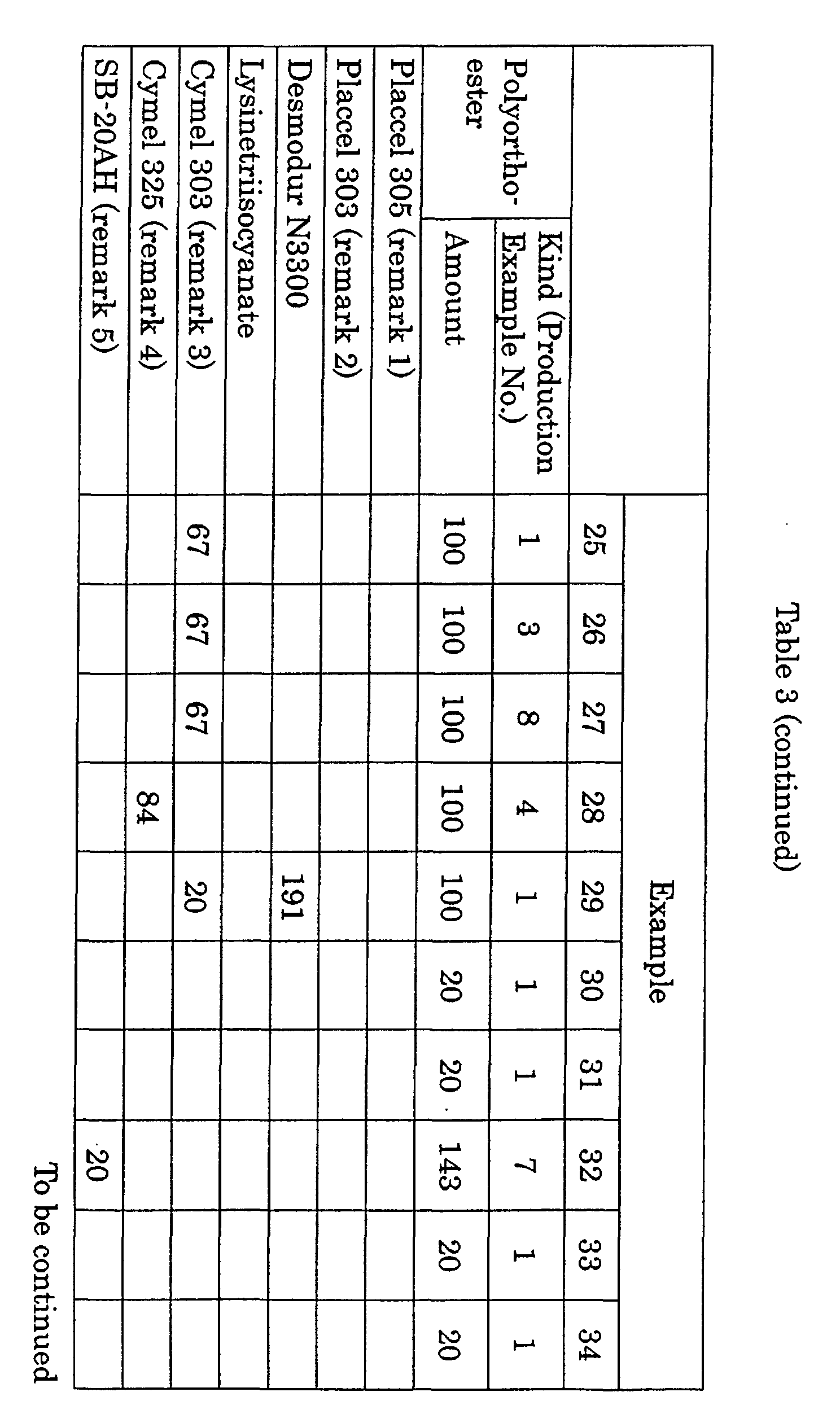
- Example 13 The same operation as in Example 13 was carried out to obtain the respective curable compositions, except that in Example 13, the blending composition was changed as shown in the following Table 3.
- the respective curable compositions obtained in Examples 13 to 34 and Comparative Examples 4 to 5 were tested for a compatibility and a solvent resistance and a gel ratio of the cured coating films based on the following test methods. Further, the respective curable compositions obtained in Examples 13 to 34 and Comparative Examples 4 to 5 were tested as well for a pot life. The test results thereof are shown in the following Table 3. Further, the Gardener viscosities of the respective curable compositions obtained in Examples 13 to 34 and Comparative Examples 4 to 5 are shown as well in Table 3.
- Each curable composition was put in a test tube to visually observe the appearance thereof, and it was evaluated according to the following criteria:
- the curable composition was coated on a polished cold rolled steel plate so that a dried film thickness was about 30 ⁇ m and dried at 140°C for 30 minutes (only the composition prepared in Example 30 was dried at 160°C for 30 minutes) to obtain a coating film.
- the surface of the coated film was rubbed in a length of about 5 cm at a load of about 1 kg/cm 2 by 20 reciprocations with a three-folded gauze impregnated with xylene, and then the state of the surface of the coated film was observed and evaluated according to the following criteria:
- the curable composition was coated on a teflon sheet so that a dried film thickness was about 30 ⁇ m and dried at 140°C for 30 minutes (only the composition prepared in Example 30 was dried at 160°C for 30 minutes), and the coating film was peeled off to obtain a free coating film.
- the curable composition was put in a glass bottle of 100 ml, and the bottle was sealed up and left standing in a dark place of 30°C to measure the viscosity every 6 hours to determine time passing until the viscosity grew larger to lose fluidity:
- a reactor equipped with a stirrer, a condenser, a temperature-controlling device, a nitrogen-introducing tube and a dropping funnel was charged with 983 parts of xylene and 240 parts of 3-methoxybutyl acetate, and the reactor was substituted with nitrogen, heated and maintained at 135°C.
- Dropwise added thereto in 4 hours was a mixture comprising 600 parts of styrene, 384 parts of isobutyl methacrylate, 480 parts of 2-ethylhexyl acrylate, 552 parts of 2-hydroxyethyl methacrylate, 450 parts of Placcel FM-3X (80 % xylene solution, manufactured by Daicel Chemical Industries, Ltd.), 24 parts of acrylic acid and 120 parts of azobisisobutyronitrile. After finishing dropwise adding, the solution was aged at 135°C for 30 minutes, and then a mixed solution comprising 144 parts of xylene and 24 parts of azobisisobutyronitrile was dropwise added in one hour.
- the solution was maintained at 135°C for 30 minutes to obtain an acrylic resin solution (AR-2) having a non-volatile matter content of about 60 % and a Gardner viscosity (20°C) of T.
- the resulting resin (solid matter) had a hydroxyl value of about 117 mg KOH/g, a number average molecular weight of 3,400 and a weight average molecular weight of 7,500.
- a reactor equipped with a stirrer, a condenser, a temperature-controlling device, a nitrogen-introducing tube and a dropping funnel was charged with 983 parts of xylene and 240 parts of 3-methoxybutyl acetate, and the reactor was substituted with nitrogen, heated and maintained at 135°C.
- Dropwise added thereto in 4 hours was a mixture comprising 240 parts of styrene, 240 parts of methyl methacrylate, 720 parts of n-butyl methacrylate, 240 parts of 2-hydroxyethyl methacrylate, 960 parts of glycidyl methacrylate and 120 parts of azobisisobutyronitrile.
- the solution was aged at 135°C for 30 minutes, and then a mixed solution comprising 144 parts of xylene and 24 parts of azobisisobutyronitrile was dropwise added in one hour. Then, the solution was maintained at 135°C for 30 minutes and diluted with 234 parts of xylene to obtain an acrylic resin solution (AR-3) having a non-volatile matter content of about 60 % and a Gardner viscosity (20°C) of RS.
- the resulting resin (solid matter) had a hydroxyl value of about 43 mg KOH/g, an epoxy equivalent of about 360, a number average molecular weight of about 3,000 and a weight average molecular weight of 6,900.
- a reactor equipped with a stirrer, a condenser, a temperature-controlling device, a nitrogen-introducing tube and a dropping funnel was charged with 288 parts of xylene and 432 parts of 3-methoxybutyl acetate, and the reactor was substituted with nitrogen, heated and maintained at 135°C.
- a reactor equipped with a stirrer, a condenser, a temperature-controlling device, a water separator, a fractionating column, a nitrogen-introducing tube and a solvent-recovering device was charged with 200 parts of neopentyl glycol, 101 parts of trimethylolpropane, 132 parts of isophthalic acid, 116 parts of adipic acid, 61 parts of hexahydrophthalic anhydride and 68 parts of 1,4-cyclohexanedicarboxylic acid, and the reactor was substituted with nitrogen and then started to be heated.
- the temperature was elevated at a fixed rate from 170°C to 230°C in 3 hours while removing condensation water and then maintained at 230°C for one hour.
- the resulting resin (solid matter) had a resin acid value of about 10 mg KOH/g, a hydroxyl value of about 128 mg KOH/g, a number average molecular weight of 2,300 and a weight average molecular weight of 12,000.
- a reactor equipped with a stirrer, a condenser, a temperature-controlling device and a solvent-recovering device was charged with 636 parts of methyl orthoformate, 960 parts of 2-butyl-2-ethyl-1,3-propanediol, 254 parts of dipentaerythritol and 2 parts of a 90 % formic acid aqueous solution and maintained at about 85°C for one hour while distilling off methanol produced by alcohol exchange reaction. Then, the temperature was elevated up to 190°C in 2 hours, and 553 parts of methanol was recovered to obtain a colorless and liquid polyorthoester (C-5).
- the polyorthoester (C-5) thus obtained had a Gardner viscosity of Z 4 and a weight average molecular weight of 2,010.
- the polyorthoesters thus obtained was a colorless and liquid polyorthoester and had a solid content of substantially about 100 %.
- the 60 % acrylic resin solution (AR-2) 16.7 parts obtained in Example 7 was blended with 9.9 parts of Desmodur N-3300 (triisocyanurate of hexamethylenediisocyanate, manufactured by Sumitomo Bayer Urethane Co., Ltd.), 3.0 parts of the polyorthoester obtained in Example 1, 4.0 parts of xylene, 0.7 part of 3-methoxybutyl acetate and 0.9 part of Nacure 5543 (sulfonic acid base acid catalyst solution, active ingredient: about 25 %, manufactured by King Industries Inc., U.S.A.), and the solution was homogeneously mixed to obtain a curable composition having a non-volatile matter content of 65 %.
- Desmodur N-3300 triisocyanurate of hexamethylenediisocyanate, manufactured by Sumitomo Bayer Urethane Co., Ltd.
- Nacure 5543 sulfonic acid base acid catalyst solution, active ingredient: about 25 %, manufactured
- Example 36 The same operation as in Example 36 was carried out to obtain the respective curable compositions, except that in Example 36, the blending composition was changed as shown in the following Table 4.
- the curable compositions obtained in Example 46 and Comparative Example 10 had a non-volatile matter content of 60 %, and all the curable compositions obtained in Examples 37 to 45 and Comparative Examples 6 to 9 had a non-volatile matter content of 65 %.
- the remark in Table 4 means the following: (remark 6) Cymel 303: methyl-etherified melamine resin, solid content: about 100 %, manufactured by Mitsui Cytec Co., Ltd.
- the respective curable compositions obtained in Examples 36 to 46 and Comparative Examples 6 to 10 were tested for a gel ratio, a coating film hardness and a solvent resistance of the cured coating films based on the following test methods. The test results thereof are shown in the following Table 4. Further, the Gardener viscosities of the respective curable compositions obtained in Examples 36 to 46 and Comparative Examples 6 to 10 are shown as well in Table 4. All the respective curable compositions were excellent in a compatibility and a wetting property to the base material.
- the curable composition was coated on a teflon sheet so that a dried film thickness was about 30 ⁇ m and dried at 140°C for 30 minutes, and the coating film was peeled off to obtain a free coating film.
- the curable composition was coated on a polished cold rolled steel plate so that a dried film thickness was about 30 ⁇ m and dried at 140°C for 30 minutes to obtain a coating film.
- the coating film thus obtained was measured for a Knoop hardness at 20°C on the conditions of a load of 25 g and a load-applying time of 20 seconds by means of a microhardness meter ("Model DMH-2", a product manufactured by Matsuzawa Seiki Co., Ltd.). The larger the value, the higher the hardness.
- the curable composition was coated on a polished cold rolled steel plate so that a dried film thickness was about 30 ⁇ m and dried at 140°C for 30 minutes to obtain a coating film.
- the surface thereof was rubbed in a length of about 5 cm at a load of about 1 kg/cm 2 by 20 reciprocations with a three-folded gauze impregnated with xylene, and then the state of the coated face was observed and evaluated according to the following criteria:
- Example 36 with Comparative Example 6, Example 41 with Comparative Example 7, Example 43 with Comparative Example 8, Example 44 with Comparative Example 9 and Example 46 with Comparative Example 10 show that in all cases, the addition of the polyorthoesters allow the curable compositions to be reduced in a viscosity in the same non-volatile matter content and solvent composition without lowering the curing property and the hardness.
- the curable composition II according to the present invention can achieve a reduction in a viscosity without reducing the coating film performances by adding the polyorthoester and therefore is useful particularly as a binder for a high solid coating material.
- the polyorthoester of the present invention comprises an orthoester structure introduced into a hydroxyl group part of a hydroxyl group-containing compound and has a high degree of freedom in molecular design, and it can be applied to various fields and is industrially very useful.
- the polyorthoester of the present invention can be produced without causing gelation and a marked rise in a viscosity, and it has a low viscosity and can readily be controlled in a molecular weight.
- the polyorthoester of the present invention can be produced by means of the same apparatus as a conventional polyester resin production apparatus in which alcohol produced by condensation can be distilled off, and therefore it does not require a specific apparatus and can readily be produced, so that it is industrially useful from such point of view.
- the curable composition of the present invention is a composition comprising a polyorthoester and a curing agent.
- the polyorthoester comprises, as described above, an orthoester structure introduced into a hydroxyl group part of a hydroxyl group-containing compound and has a high degree of freedom in molecular design, and it can be applied to various fields and is industrially very useful.
- the curable composition I of the present invention comprises a structure in which a hydroxyl group in a hydroxyl group-containing compound is blocked by the orthoester and therefore is free of problems originating in a hydroxyl group, for example, a problem on a rise in a viscosity of the curable composition, so that it can be increased in a solid content and is excellent in a compatibility, a wetting property to a base material and a storage stability.
Landscapes
- Chemical & Material Sciences (AREA)
- Organic Chemistry (AREA)
- Life Sciences & Earth Sciences (AREA)
- Engineering & Computer Science (AREA)
- Materials Engineering (AREA)
- Wood Science & Technology (AREA)
- Polyurethanes Or Polyureas (AREA)
- Polyesters Or Polycarbonates (AREA)
- Polyethers (AREA)
- Compositions Of Macromolecular Compounds (AREA)
Abstract
Description


No. 502465/1993 (=U.S Patent No.5,824,343).



| Weight average molecular weight | Hydroxyl group value (mg KOH/g) | Viscosity (mPa·s) | |
| Polyorthoester of Example 1 | 1540 | 550 | 1350 |
| Polyorthoester of Example 11 | 1590 | 550 | 1420 |
| Praccel 303 (remark 2) | 610 | 540 | 1800 |



(remark 6) Cymel 303: methyl-etherified melamine resin, solid content: about 100 %, manufactured by Mitsui Cytec Co., Ltd.


Claims (30)
- A polyorthoester prepared by reacting:(a) an orthoester represented by the following Formula (I):wherein R1 represents a hydrogen atom or an alkyl group having 1 to 4 carbon atoms, and three R2's may be the same or different and each represent an alkyl group having 1 to 4 carbon atoms,
 (b) at least one glycol compound selected from α-glycols and β-glycols, and(c) a hydroxyl group-containing compound having at least two hydroxyl groups in a molecule other than the compound (b) described above.
 - The polyorthoester as described in claim 1, wherein the orthoester (a) is at least one compound selected from the group consisting of methyl orthoformate, ethyl orthoformate, propyl orthoformate, butyl orthoformate, methyl orthoacetate, ethyl orthoacetate, methyl orthopropionate, ethyl orthopropionate, methyl orthobutyrate and ethyl orthobutyrate.
- The polyorthoester as described in claim 1, wherein the orthoester (a) is at least one compound selected from the group consisting of methyl orthoformate, ethyl orthoformate, methyl orthoacetate and ethyl orthoacetate.
- The polyorthoester as described in claim 1, wherein the glycol compound (b) is at least one glycol compound selected from the group consisting of an α-glycol represented by the following Formula (II):wherein R3, R4, R5 and R6 may be the same or different and each represent a hydrogen atom, an alkyl group having 1 to 24 carbon atoms, an aralkyl group having 7 to 24 carbon atoms or a phenyl group, or a group obtained by substituting a part of these groups with an oxygen atom, and the total of the carbon atoms in the groups represented by R3, R4, R5 and R6 falls in a range of 0 to 24; and R4 and R5 may form a cyclic structure together with carbon atoms to which they are bonded directly and
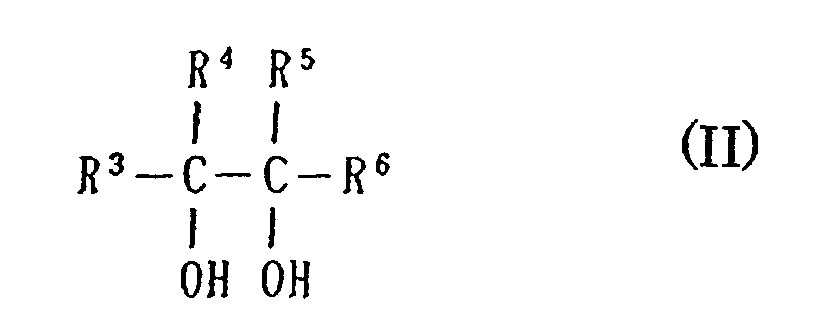
a β-glycol represented by the following Formula (III):wherein R7, R8, R9, R10, R11 and R12 may be the same or different and each represent a hydrogen atom, an alkyl group having 1 to 24 carbon atoms, an aralkyl group having 7 to 24 carbon atoms or a phenyl group, or a group obtained by substituting a part of these groups with an oxygen atom, and the total of the carbon atoms in the groups represented by R7, R8, R9, R10, R11 and R12 falls in a range of 0 to 24; and R7 and R9 or R7, R9 and R11 may form a cyclic structure together with carbon atoms to which they are bonded directly.
- The polyorthoester as described in claim 4, wherein the α-glycol is selected from the group consisting of ethylene glycol, 1,2-propylene glycol, 1,2-butylene glycol, 2,3-butylene glycol, 1,2-hexanediol, 1,2-dihydroxycyclohexane, pinacol, hydrolysis products of long chain alkyl monoepoxides, glycerin monoacetate (α product), glycerin monostearate (α product), 3-ethoxypropane-1,2-diol and 3-phenoxypropane-1,2-diol.
- The polyorthoester as described in claim 4, wherein the β-glycol is selected from the group consisting of neopentyl glycol, 2-methyl-1,3-propanediol, 2-methyl-2,4-pentanediol, 3-methyl-1,3-butanediol, 2-ethyl-1,3-hexanediol, 2,2-diethyl-1,3-propanediol, 2,2,4-trimethyl-1,3-pentanediol, 2-butyl-2-ethyl-1,3-propanediol, 2-phenoxypropane-1,3-diol, 2-methyl-2-phenylpropane-1,3-diol, 1,3-propylene glycol, 1,3-butylene glycol, dimethylolpropionic acid, dimethylolbutanoic acid, 2-ethyl-1,3-octanediol, 1,3-dihydroxycyclohexane, glycerin monoacetate (β product) and glycerin monostearate (β product).
- The polyorthoester as described in claim 1, wherein the glycol compound (b) is at least one compound selected from the group consisting of ethylene glycol, 1,2-propylene glycol, 1,2-hexanediol, neopentyl glycol, 2-methyl-1,3-propanediol, 2-methyl-2,4-pentanediol, 3-methyl-1,3-butanediol, 2-ethyl-1,3-hexanediol, 2,2-diethyl-1,3-propanediol, 2,2,4-trimethyl-1,3-pentanediol and 2-butyl-2-ethyl-1,3-propanediol.
- The polyorthoester as described in claim 1, wherein the hydroxyl group-containing compound (c) is at least one compound selected from the group consisting of 1,4-butanediol, 1,4-dihydroxycyclohexane, 1,5-pentanediol, 1,6-hexanediol, 2,5-hexanediol, 3-methyl-1,5-pentanediol, 1,4-dimethylolcyclohexane, tricyclodecanedimethanol, 2,2-dimethyl-3-hydroxypropyl-2,2-dimethyl-3-hydroxypropionate, bisphenol A, bisphenol F, bis(4-hydroxyhexyl)-2,2-propane, bis(4-hydroxyhexyl)methane, 3,9-bis(1,1-dimethyl-2-hydroxyethyl)-2,4,8,10-tetraoxaspiro[5,5]undecane, diethylene glycol, triethylene glycol, tetra- or more polyethylene glycol, dipropylene glycol, tripropylene glycol, tetra- or more polypropylene glycol, copolymers having hydroxyl groups at both terminals obtained by copolymerizing ethylene oxide with propylene oxide, polycaprolactonediol, polycarbonatediol, carboxylic acid adducts of diepoxide, glycerin, diglycerin, triglycerin, pentaerythritol, dipentaerythritol, sorbitol, mannit, trimethylolethane, trimethylolpropane, ditrimethylolpropane, tris(2-hydroxyethyl)isocyanurate, gluconic acid and polymers having 3 or more hydroxyl groups.
- The polyorthoester as described in claim 1, wherein the hydroxyl group-containing compound (c) has a molecular weight falling in a range of 90 to 100,000 and a hydroxyl group value falling in a range of 20 to 1,850 mg KOH/g.
- The polyorthoester as described in claim 1, wherein a hydroxyl group contained in the hydroxyl group-containing compound (c) is blocked by an orthoester of a 5-membered ring or a 6-membered ring constituted by the orthoester (a) and the glycol compound (b).
- The polyorthoester as described in claim 1, having a structure represented by the following Formula (IV):wherein Y1 represents a di- to hexavalent residue obtained by removing the following 2 to 6 hydroxyl groups from a compound having 2 to 6 hydroxyl groups in a molecule; R1, R3, R4, R5 and R6 are the same as defined in claims 1 and 4; and n represents an integer of 2 to 6, or
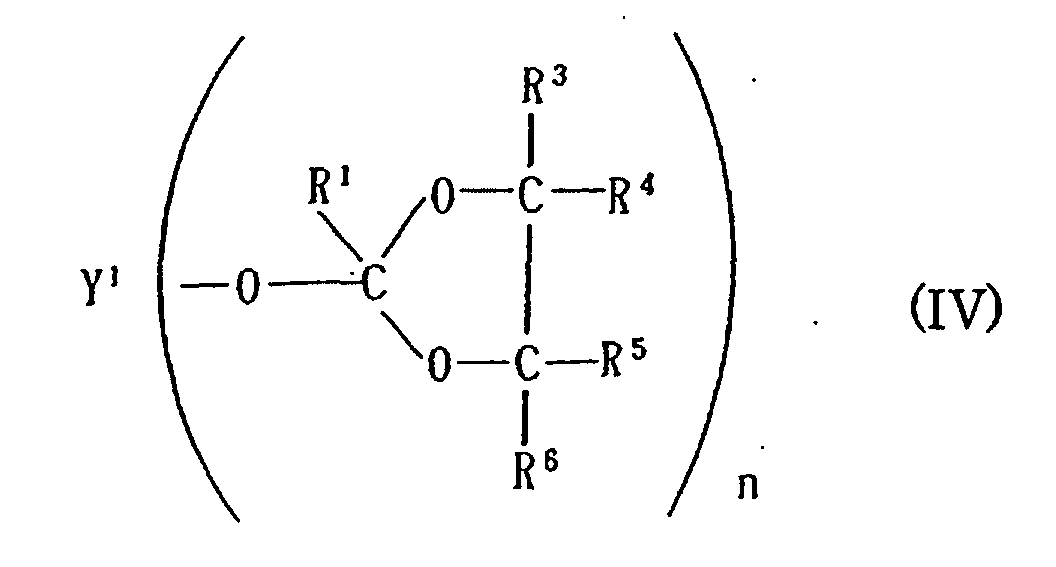
the following Formula (V):wherein Y2 represents a di- to hexavalent residue obtained by removing the following 2 to 6 hydroxyl groups from a compound having 2 to 6 hydroxyl groups in a molecule; R1, R7, R8, R9, R10, R11 and R12 are the same as defined in claims 1 and 4; and n represents an integer of 2 to 6.
- The polyorthoester as described in claim 1, having a structure represented by the following Formula (VII):wherein Y4 represents a residue obtained by removing the following four hydroxyl groups from a compound having four hydroxyl groups in a molecule; and R1, R7, R8, R9, R10, R11 and R12 are the same as defined in claims 1 and 4.

- A production process for a polyorthoester characterized by subjecting the orthoester (a), the glycol compound (b) and the hydroxyl group-containing compound (c) each described in claim 1 to condensation reaction in the presence of an acid catalyst.
- The process as described in claim 13, wherein the orthoester (a) in a proportion falling in a range of 0.05 to 5 moles is reacted with the glycol compound (b) in a proportion falling in a range of 0.05 to 5 moles each per equivalent of a hydroxyl group contained in the hydroxyl group-containing compound (c).
- A curable composition comprising:(A) the polyorthoester as described in claim 1, and(B) a curing agent having a group having a reactivity with a hydroxyl group.
- The curable composition as described in claim 15, wherein the curing agent (B) is at least one compound or resin selected from the group consisting of polyisocyanate compounds, amino resins, epoxy group-containing compounds, alkoxysilyl group-containing compounds and compounds having two or more carboxylic anhydride groups.
- The curable composition as described in claim 15, wherein the curing agent (B) is at least one compound or resin selected from the group consisting of polyisocyanate compounds and amino resins.
- The curable composition as described in claim 15, comprising the polyorthoester (A) and the curing agent (B) in a range of 95/5 to 20/80 in terms of a solid matter weight ratio of (A)/(B).
- The curable composition as described in claim 15, further comprising an acid catalyst.
- The curable composition as described in claim 19, wherein the acid catalyst is at least one compound selected from the group consisting of sulfonic acid compounds, neutralized compounds of the sulfonic acid compounds, organic phosphoric acid base compounds and neutralized compounds of the organic phosphoric acid base compounds.
- The curable composition as described in claim 15, assuming the form of a coating material composition, an adhesive or an ink.
- A curable composition comprising:(1) a base polymer having a reactivity with the following curing agent (2),(2) a curing agent which has a group having a reactivity with a hydroxyl group and which has a reactivity with the base polymer (1), and(3) the polyorthoester as described in claim 1.
- The curable composition as described in claim 22, wherein the base polymer (1) is a hydroxyl group-containing polymer having a hydroxyl group value falling in a range of 20 to 300 mg KOH/g and a number average molecular weight falling in a range of 1,000 to 30,000.
- The curable composition as described in claim 22, wherein the base polymer (1) is at least one polymer selected from the group consisting of hydroxyl group-containing acrylic resins and hydroxyl group-containing polyester resins.
- The curable composition as described in claim 22, wherein the curing agent (2) is at least one compound selected from the group consisting of polyisocyanate compounds, amino resins, epoxy group-containing compounds, alkoxysilyl group-containing compounds and compounds having two or more carboxylic anhydride groups.
- The curable composition as described in claim 22, wherein the curing agent (2) is at least one compound or resin selected from the group consisting of polyisocyanate compounds and amino resins.
- The curable composition as described in claim 22, comprising the base polymer (1), the curing agent (2) and the polyorthoester (3) in a range of 20 to 89 parts by weight of the component (1), 5 to 70 parts by weight of the component (2) and 1 to 40 parts by weight of the component (3) based on 100 parts by weight of the total of solid matters contained in the respective components (1), (2) and (3).
- The curable composition as described in claim 22, further comprising an acid catalyst.
- The curable composition as described in claim 28, wherein the acid catalyst is at least one compound selected from the group consisting of sulfonic acid compounds, neutralized compounds of the sulfonic acid compounds, organic phosphoric acid base compounds and neutralized compounds of the organic phosphoric acid base compounds.
- The curable composition as described in claim 22, assuming the form of a coating material composition, an adhesive or an ink.
Applications Claiming Priority (7)
| Application Number | Priority Date | Filing Date | Title |
|---|---|---|---|
| JP26382099 | 1999-09-17 | ||
| JP26382099 | 1999-09-17 | ||
| JP30089499 | 1999-10-22 | ||
| JP30089499 | 1999-10-22 | ||
| JP33783799 | 1999-11-29 | ||
| JP33783799 | 1999-11-29 | ||
| PCT/JP2000/006220 WO2001021611A1 (en) | 1999-09-17 | 2000-09-12 | Polyorthoester and curable composition containing the same |
Publications (3)
| Publication Number | Publication Date |
|---|---|
| EP1225172A1 true EP1225172A1 (en) | 2002-07-24 |
| EP1225172A4 EP1225172A4 (en) | 2003-01-22 |
| EP1225172B1 EP1225172B1 (en) | 2004-07-21 |
Family
ID=27335252
Family Applications (1)
| Application Number | Title | Priority Date | Filing Date |
|---|---|---|---|
| EP00957113A Expired - Lifetime EP1225172B1 (en) | 1999-09-17 | 2000-09-12 | Polyorthoester and curable composition containing the same |
Country Status (3)
| Country | Link |
|---|---|
| EP (1) | EP1225172B1 (en) |
| DE (1) | DE60012353T2 (en) |
| WO (1) | WO2001021611A1 (en) |
Cited By (10)
| Publication number | Priority date | Publication date | Assignee | Title |
|---|---|---|---|---|
| EP1538171A1 (en) * | 2003-12-02 | 2005-06-08 | E.I. du Pont de Nemours and Company | Coating compositions with high solids content for vehicle repair coating |
| WO2005092934A1 (en) * | 2004-03-22 | 2005-10-06 | E.I. Dupont De Nemours And Company | Orthoester-protected polyols for low voc coatings |
| EP1557437A3 (en) * | 2004-01-23 | 2006-01-18 | Bayer MaterialScience AG | Ortho ester group containing binders |
| EP1669384A3 (en) * | 2004-11-26 | 2008-03-19 | Bayer MaterialScience AG | Mixtures of binders which contain bicycloorthoester and/or polyorthoester groups |
| WO2008045425A1 (en) * | 2006-10-05 | 2008-04-17 | E. I. Du Pont De Nemours And Company | Orthoformate-protected polyols |
| US7875697B2 (en) * | 2006-06-29 | 2011-01-25 | Medtronic, Inc. | Poly(orthoester) polymers, and methods of making and using same |
| CN102181254A (en) * | 2010-03-03 | 2011-09-14 | 武汉市科达云石护理材料有限公司 | Additive capable of increasing toughness of marble adhesive |
| US8475823B2 (en) | 2008-04-18 | 2013-07-02 | Medtronic, Inc. | Baclofen formulation in a polyorthoester carrier |
| US8956642B2 (en) | 2008-04-18 | 2015-02-17 | Medtronic, Inc. | Bupivacaine formulation in a polyorthoester carrier |
| US9376586B2 (en) | 2009-11-20 | 2016-06-28 | Basf Coatings Gmbh | Coating agents with good storage stability, and coatings produced therefrom with high scratch resistance and simultaneously good weathering resistance |
Families Citing this family (5)
| Publication number | Priority date | Publication date | Assignee | Title |
|---|---|---|---|---|
| DE102005016982A1 (en) * | 2005-04-13 | 2006-10-19 | Bayer Materialscience Ag | Orthoestergruppenhaltige binder |
| JP6354408B2 (en) * | 2013-11-19 | 2018-07-11 | Jsr株式会社 | Electronic device, organic EL element, and liquid crystal display element |
| JP2019511512A (en) * | 2016-03-30 | 2019-04-25 | ピラマル エンタープライジーズ リミテッド | Improved process for producing droxidopa and intermediates thereof |
| WO2019239533A1 (en) * | 2018-06-13 | 2019-12-19 | 共栄社化学株式会社 | Thermosetting resin composition and cured film |
| JP7790045B2 (en) * | 2021-07-27 | 2025-12-23 | Dic株式会社 | Adhesive composition and molded article |
Family Cites Families (6)
| Publication number | Priority date | Publication date | Assignee | Title |
|---|---|---|---|---|
| US3515694A (en) * | 1968-05-22 | 1970-06-02 | Grace W R & Co | Orthoester stabilized polyvinyl-chloride resins |
| US3514428A (en) * | 1968-05-22 | 1970-05-26 | Grace W R & Co | Orthoester stabilized polyvinyl-chloride resin |
| CH621416A5 (en) * | 1975-03-27 | 1981-01-30 | Hoechst Ag | |
| KR920702383A (en) * | 1989-08-28 | 1992-09-03 | 원본미기재 | Biocorrosive polymers useful for controlling the release of therapeutic agents |
| DE19711758C2 (en) * | 1997-03-21 | 2003-06-18 | Degussa | Process for the preparation of 1,3-dioxane compounds |
| JP4220037B2 (en) * | 1998-11-17 | 2009-02-04 | 関西ペイント株式会社 | Resin composition for coating |
-
2000
- 2000-09-12 DE DE60012353T patent/DE60012353T2/en not_active Expired - Fee Related
- 2000-09-12 WO PCT/JP2000/006220 patent/WO2001021611A1/en not_active Ceased
- 2000-09-12 EP EP00957113A patent/EP1225172B1/en not_active Expired - Lifetime
Cited By (17)
| Publication number | Priority date | Publication date | Assignee | Title |
|---|---|---|---|---|
| US7071286B2 (en) | 2003-12-02 | 2006-07-04 | E. I. Dupont De Nemours And Company | Coating compositions with high solids content for vehicle coating |
| EP1538171A1 (en) * | 2003-12-02 | 2005-06-08 | E.I. du Pont de Nemours and Company | Coating compositions with high solids content for vehicle repair coating |
| US7659358B2 (en) | 2004-01-23 | 2010-02-09 | Bayer Materialscience Ag | Binders containing ortho ester groups |
| EP1557437A3 (en) * | 2004-01-23 | 2006-01-18 | Bayer MaterialScience AG | Ortho ester group containing binders |
| WO2005092934A1 (en) * | 2004-03-22 | 2005-10-06 | E.I. Dupont De Nemours And Company | Orthoester-protected polyols for low voc coatings |
| EP1669384A3 (en) * | 2004-11-26 | 2008-03-19 | Bayer MaterialScience AG | Mixtures of binders which contain bicycloorthoester and/or polyorthoester groups |
| US7875697B2 (en) * | 2006-06-29 | 2011-01-25 | Medtronic, Inc. | Poly(orthoester) polymers, and methods of making and using same |
| US8133968B2 (en) | 2006-06-29 | 2012-03-13 | Medtronic, Inc. | Poly(orthoester) polymers, and methods of making and using same |
| US7740699B2 (en) * | 2006-10-05 | 2010-06-22 | E.I. Du Pont De Nemours And Company | Orthoformate-protected polyols |
| WO2008045425A1 (en) * | 2006-10-05 | 2008-04-17 | E. I. Du Pont De Nemours And Company | Orthoformate-protected polyols |
| US8475823B2 (en) | 2008-04-18 | 2013-07-02 | Medtronic, Inc. | Baclofen formulation in a polyorthoester carrier |
| US8940315B2 (en) | 2008-04-18 | 2015-01-27 | Medtronic, Inc. | Benzodiazepine formulation in a polyorthoester carrier |
| US8956642B2 (en) | 2008-04-18 | 2015-02-17 | Medtronic, Inc. | Bupivacaine formulation in a polyorthoester carrier |
| US9376586B2 (en) | 2009-11-20 | 2016-06-28 | Basf Coatings Gmbh | Coating agents with good storage stability, and coatings produced therefrom with high scratch resistance and simultaneously good weathering resistance |
| CN102181254A (en) * | 2010-03-03 | 2011-09-14 | 武汉市科达云石护理材料有限公司 | Additive capable of increasing toughness of marble adhesive |
| CN102181254B (en) * | 2010-03-03 | 2015-08-12 | 武汉市科达云石护理材料有限公司 | Toughness reinforcing cloud stone glue composition |
| WO2012113291A1 (en) * | 2011-02-24 | 2012-08-30 | 武汉市科达云石护理材料有限公司 | Additive for increasing toughness of marble glue |
Also Published As
| Publication number | Publication date |
|---|---|
| EP1225172B1 (en) | 2004-07-21 |
| EP1225172A4 (en) | 2003-01-22 |
| DE60012353T2 (en) | 2005-07-21 |
| WO2001021611A1 (en) | 2001-03-29 |
| DE60012353D1 (en) | 2004-08-26 |
Similar Documents
| Publication | Publication Date | Title |
|---|---|---|
| EP1225172B1 (en) | Polyorthoester and curable composition containing the same | |
| US6863982B2 (en) | Curable film-forming composition exhibiting improved yellowing resistance | |
| US5681906A (en) | Thermoset coating compositions having improved hardness | |
| KR100336227B1 (en) | Curable resin composition, coating composition and method for forming coated film | |
| JP5345072B2 (en) | Novel block polyisocyanate and urethane composition containing the same | |
| TW200906971A (en) | Low volatiles coatings, sealants and binders from renewable oils | |
| US20140287252A1 (en) | Polyester polyol resins compositions | |
| US9751982B2 (en) | Polyether polyol resins compositions | |
| KR101586763B1 (en) | Curable alkoxycarbonylamino compositions, coatings, and methods | |
| US20140295193A1 (en) | Polyester polyol resins compositions | |
| US9376378B2 (en) | Method using zirconium catalyst for producing carbamate-functional materials | |
| DE60313928T2 (en) | Solid-rich coating composition | |
| RU2690164C2 (en) | Method of using titanium catalyst for producing materials containing carbamate functional groups | |
| JP2001302968A (en) | Flat coating composition | |
| JP2002035676A (en) | Coating finishing method | |
| JP2001163922A (en) | Polyorthoester and curing composition using it | |
| JPH08259667A (en) | Curable resin composition, coating composition and coating film forming method | |
| JPWO2001021611A1 (en) | Polyorthoester and curable composition containing same | |
| KR20140077191A (en) | Polyether polyol resin compositions | |
| JP2001163940A (en) | Curable composition | |
| JP2001151843A (en) | Curable composition | |
| JP2002038086A (en) | Coating composition for can outer surface | |
| JP2001181498A (en) | Cationically polymerizable composition | |
| JP2001295070A (en) | Method for manufacturing coated metallic sheet | |
| JP2001164103A (en) | Curable composition |
Legal Events
| Date | Code | Title | Description |
|---|---|---|---|
| PUAI | Public reference made under article 153(3) epc to a published international application that has entered the european phase |
Free format text: ORIGINAL CODE: 0009012 |
|
| 17P | Request for examination filed |
Effective date: 20020403 |
|
| AK | Designated contracting states |
Kind code of ref document: A1 Designated state(s): DE GB |
|
| AX | Request for extension of the european patent |
Free format text: AL;LT;LV;MK;RO;SI |
|
| RIC1 | Information provided on ipc code assigned before grant |
Free format text: 7C 07D 317/34 A, 7C 07D 319/06 B, 7C 09D 167/00 B, 7C 09J 167/00 B |
|
| A4 | Supplementary search report drawn up and despatched |
Effective date: 20021209 |
|
| AK | Designated contracting states |
Kind code of ref document: A4 Designated state(s): DE GB |
|
| 17Q | First examination report despatched |
Effective date: 20030618 |
|
| GRAP | Despatch of communication of intention to grant a patent |
Free format text: ORIGINAL CODE: EPIDOSNIGR1 |
|
| GRAS | Grant fee paid |
Free format text: ORIGINAL CODE: EPIDOSNIGR3 |
|
| GRAA | (expected) grant |
Free format text: ORIGINAL CODE: 0009210 |
|
| AK | Designated contracting states |
Kind code of ref document: B1 Designated state(s): DE GB |
|
| REG | Reference to a national code |
Ref country code: GB Ref legal event code: FG4D |
|
| REF | Corresponds to: |
Ref document number: 60012353 Country of ref document: DE Date of ref document: 20040826 Kind code of ref document: P |
|
| LTIE | Lt: invalidation of european patent or patent extension |
Effective date: 20040721 |
|
| PLBE | No opposition filed within time limit |
Free format text: ORIGINAL CODE: 0009261 |
|
| STAA | Information on the status of an ep patent application or granted ep patent |
Free format text: STATUS: NO OPPOSITION FILED WITHIN TIME LIMIT |
|
| 26N | No opposition filed |
Effective date: 20050422 |
|
| PGFP | Annual fee paid to national office [announced via postgrant information from national office to epo] |
Ref country code: GB Payment date: 20060906 Year of fee payment: 7 |
|
| PGFP | Annual fee paid to national office [announced via postgrant information from national office to epo] |
Ref country code: DE Payment date: 20060907 Year of fee payment: 7 |
|
| GBPC | Gb: european patent ceased through non-payment of renewal fee |
Effective date: 20070912 |
|
| PG25 | Lapsed in a contracting state [announced via postgrant information from national office to epo] |
Ref country code: DE Free format text: LAPSE BECAUSE OF NON-PAYMENT OF DUE FEES Effective date: 20080401 |
|
| PG25 | Lapsed in a contracting state [announced via postgrant information from national office to epo] |
Ref country code: GB Free format text: LAPSE BECAUSE OF NON-PAYMENT OF DUE FEES Effective date: 20070912 |