EP1225353A1 - Rolling apparatus - Google Patents
Rolling apparatus Download PDFInfo
- Publication number
- EP1225353A1 EP1225353A1 EP01950020A EP01950020A EP1225353A1 EP 1225353 A1 EP1225353 A1 EP 1225353A1 EP 01950020 A EP01950020 A EP 01950020A EP 01950020 A EP01950020 A EP 01950020A EP 1225353 A1 EP1225353 A1 EP 1225353A1
- Authority
- EP
- European Patent Office
- Prior art keywords
- rolling
- bearing
- titanium alloy
- rolling device
- test
- Prior art date
- Legal status (The legal status is an assumption and is not a legal conclusion. Google has not performed a legal analysis and makes no representation as to the accuracy of the status listed.)
- Withdrawn
Links
Images












Classifications
-
- F—MECHANICAL ENGINEERING; LIGHTING; HEATING; WEAPONS; BLASTING
- F16—ENGINEERING ELEMENTS AND UNITS; GENERAL MEASURES FOR PRODUCING AND MAINTAINING EFFECTIVE FUNCTIONING OF MACHINES OR INSTALLATIONS; THERMAL INSULATION IN GENERAL
- F16C—SHAFTS; FLEXIBLE SHAFTS; ELEMENTS OR CRANKSHAFT MECHANISMS; ROTARY BODIES OTHER THAN GEARING ELEMENTS; BEARINGS
- F16C33/00—Parts of bearings; Special methods for making bearings or parts thereof
- F16C33/30—Parts of ball or roller bearings
- F16C33/38—Ball cages
- F16C33/44—Selection of substances
-
- C—CHEMISTRY; METALLURGY
- C23—COATING METALLIC MATERIAL; COATING MATERIAL WITH METALLIC MATERIAL; CHEMICAL SURFACE TREATMENT; DIFFUSION TREATMENT OF METALLIC MATERIAL; COATING BY VACUUM EVAPORATION, BY SPUTTERING, BY ION IMPLANTATION OR BY CHEMICAL VAPOUR DEPOSITION, IN GENERAL; INHIBITING CORROSION OF METALLIC MATERIAL OR INCRUSTATION IN GENERAL
- C23C—COATING METALLIC MATERIAL; COATING MATERIAL WITH METALLIC MATERIAL; SURFACE TREATMENT OF METALLIC MATERIAL BY DIFFUSION INTO THE SURFACE, BY CHEMICAL CONVERSION OR SUBSTITUTION; COATING BY VACUUM EVAPORATION, BY SPUTTERING, BY ION IMPLANTATION OR BY CHEMICAL VAPOUR DEPOSITION, IN GENERAL
- C23C8/00—Solid state diffusion of only non-metal elements into metallic material surfaces; Chemical surface treatment of metallic material by reaction of the surface with a reactive gas, leaving reaction products of surface material in the coating, e.g. conversion coatings, passivation of metals
- C23C8/02—Pretreatment of the material to be coated
-
- C—CHEMISTRY; METALLURGY
- C23—COATING METALLIC MATERIAL; COATING MATERIAL WITH METALLIC MATERIAL; CHEMICAL SURFACE TREATMENT; DIFFUSION TREATMENT OF METALLIC MATERIAL; COATING BY VACUUM EVAPORATION, BY SPUTTERING, BY ION IMPLANTATION OR BY CHEMICAL VAPOUR DEPOSITION, IN GENERAL; INHIBITING CORROSION OF METALLIC MATERIAL OR INCRUSTATION IN GENERAL
- C23C—COATING METALLIC MATERIAL; COATING MATERIAL WITH METALLIC MATERIAL; SURFACE TREATMENT OF METALLIC MATERIAL BY DIFFUSION INTO THE SURFACE, BY CHEMICAL CONVERSION OR SUBSTITUTION; COATING BY VACUUM EVAPORATION, BY SPUTTERING, BY ION IMPLANTATION OR BY CHEMICAL VAPOUR DEPOSITION, IN GENERAL
- C23C8/00—Solid state diffusion of only non-metal elements into metallic material surfaces; Chemical surface treatment of metallic material by reaction of the surface with a reactive gas, leaving reaction products of surface material in the coating, e.g. conversion coatings, passivation of metals
- C23C8/06—Solid state diffusion of only non-metal elements into metallic material surfaces; Chemical surface treatment of metallic material by reaction of the surface with a reactive gas, leaving reaction products of surface material in the coating, e.g. conversion coatings, passivation of metals using gases
- C23C8/08—Solid state diffusion of only non-metal elements into metallic material surfaces; Chemical surface treatment of metallic material by reaction of the surface with a reactive gas, leaving reaction products of surface material in the coating, e.g. conversion coatings, passivation of metals using gases only one element being applied
- C23C8/10—Oxidising
-
- F—MECHANICAL ENGINEERING; LIGHTING; HEATING; WEAPONS; BLASTING
- F16—ENGINEERING ELEMENTS AND UNITS; GENERAL MEASURES FOR PRODUCING AND MAINTAINING EFFECTIVE FUNCTIONING OF MACHINES OR INSTALLATIONS; THERMAL INSULATION IN GENERAL
- F16C—SHAFTS; FLEXIBLE SHAFTS; ELEMENTS OR CRANKSHAFT MECHANISMS; ROTARY BODIES OTHER THAN GEARING ELEMENTS; BEARINGS
- F16C33/00—Parts of bearings; Special methods for making bearings or parts thereof
- F16C33/30—Parts of ball or roller bearings
- F16C33/303—Parts of ball or roller bearings of hybrid bearings, e.g. rolling bearings with steel races and ceramic rolling elements
-
- F—MECHANICAL ENGINEERING; LIGHTING; HEATING; WEAPONS; BLASTING
- F16—ENGINEERING ELEMENTS AND UNITS; GENERAL MEASURES FOR PRODUCING AND MAINTAINING EFFECTIVE FUNCTIONING OF MACHINES OR INSTALLATIONS; THERMAL INSULATION IN GENERAL
- F16C—SHAFTS; FLEXIBLE SHAFTS; ELEMENTS OR CRANKSHAFT MECHANISMS; ROTARY BODIES OTHER THAN GEARING ELEMENTS; BEARINGS
- F16C33/00—Parts of bearings; Special methods for making bearings or parts thereof
- F16C33/30—Parts of ball or roller bearings
- F16C33/32—Balls
-
- F—MECHANICAL ENGINEERING; LIGHTING; HEATING; WEAPONS; BLASTING
- F16—ENGINEERING ELEMENTS AND UNITS; GENERAL MEASURES FOR PRODUCING AND MAINTAINING EFFECTIVE FUNCTIONING OF MACHINES OR INSTALLATIONS; THERMAL INSULATION IN GENERAL
- F16C—SHAFTS; FLEXIBLE SHAFTS; ELEMENTS OR CRANKSHAFT MECHANISMS; ROTARY BODIES OTHER THAN GEARING ELEMENTS; BEARINGS
- F16C33/00—Parts of bearings; Special methods for making bearings or parts thereof
- F16C33/30—Parts of ball or roller bearings
- F16C33/38—Ball cages
- F16C33/41—Ball cages comb-shaped
- F16C33/412—Massive or moulded comb cages, e.g. snap ball cages
- F16C33/414—Massive or moulded comb cages, e.g. snap ball cages formed as one-piece cages, i.e. monoblock comb cages
-
- F—MECHANICAL ENGINEERING; LIGHTING; HEATING; WEAPONS; BLASTING
- F16—ENGINEERING ELEMENTS AND UNITS; GENERAL MEASURES FOR PRODUCING AND MAINTAINING EFFECTIVE FUNCTIONING OF MACHINES OR INSTALLATIONS; THERMAL INSULATION IN GENERAL
- F16C—SHAFTS; FLEXIBLE SHAFTS; ELEMENTS OR CRANKSHAFT MECHANISMS; ROTARY BODIES OTHER THAN GEARING ELEMENTS; BEARINGS
- F16C33/00—Parts of bearings; Special methods for making bearings or parts thereof
- F16C33/30—Parts of ball or roller bearings
- F16C33/58—Raceways; Race rings
- F16C33/62—Selection of substances
-
- F—MECHANICAL ENGINEERING; LIGHTING; HEATING; WEAPONS; BLASTING
- F16—ENGINEERING ELEMENTS AND UNITS; GENERAL MEASURES FOR PRODUCING AND MAINTAINING EFFECTIVE FUNCTIONING OF MACHINES OR INSTALLATIONS; THERMAL INSULATION IN GENERAL
- F16C—SHAFTS; FLEXIBLE SHAFTS; ELEMENTS OR CRANKSHAFT MECHANISMS; ROTARY BODIES OTHER THAN GEARING ELEMENTS; BEARINGS
- F16C19/00—Bearings with rolling contact, for exclusively rotary movement
- F16C19/02—Bearings with rolling contact, for exclusively rotary movement with bearing balls essentially of the same size in one or more circular rows
- F16C19/04—Bearings with rolling contact, for exclusively rotary movement with bearing balls essentially of the same size in one or more circular rows for radial load mainly
- F16C19/06—Bearings with rolling contact, for exclusively rotary movement with bearing balls essentially of the same size in one or more circular rows for radial load mainly with a single row or balls
-
- F—MECHANICAL ENGINEERING; LIGHTING; HEATING; WEAPONS; BLASTING
- F16—ENGINEERING ELEMENTS AND UNITS; GENERAL MEASURES FOR PRODUCING AND MAINTAINING EFFECTIVE FUNCTIONING OF MACHINES OR INSTALLATIONS; THERMAL INSULATION IN GENERAL
- F16C—SHAFTS; FLEXIBLE SHAFTS; ELEMENTS OR CRANKSHAFT MECHANISMS; ROTARY BODIES OTHER THAN GEARING ELEMENTS; BEARINGS
- F16C2202/00—Solid materials defined by their properties
- F16C2202/20—Thermal properties
-
- F—MECHANICAL ENGINEERING; LIGHTING; HEATING; WEAPONS; BLASTING
- F16—ENGINEERING ELEMENTS AND UNITS; GENERAL MEASURES FOR PRODUCING AND MAINTAINING EFFECTIVE FUNCTIONING OF MACHINES OR INSTALLATIONS; THERMAL INSULATION IN GENERAL
- F16C—SHAFTS; FLEXIBLE SHAFTS; ELEMENTS OR CRANKSHAFT MECHANISMS; ROTARY BODIES OTHER THAN GEARING ELEMENTS; BEARINGS
- F16C2204/00—Metallic materials; Alloys
- F16C2204/40—Alloys based on refractory metals
- F16C2204/42—Alloys based on titanium
-
- F—MECHANICAL ENGINEERING; LIGHTING; HEATING; WEAPONS; BLASTING
- F16—ENGINEERING ELEMENTS AND UNITS; GENERAL MEASURES FOR PRODUCING AND MAINTAINING EFFECTIVE FUNCTIONING OF MACHINES OR INSTALLATIONS; THERMAL INSULATION IN GENERAL
- F16C—SHAFTS; FLEXIBLE SHAFTS; ELEMENTS OR CRANKSHAFT MECHANISMS; ROTARY BODIES OTHER THAN GEARING ELEMENTS; BEARINGS
- F16C2206/00—Materials with ceramics, cermets, hard carbon or similar non-metallic hard materials as main constituents
- F16C2206/80—Cermets, i.e. composites of ceramics and metal
-
- F—MECHANICAL ENGINEERING; LIGHTING; HEATING; WEAPONS; BLASTING
- F16—ENGINEERING ELEMENTS AND UNITS; GENERAL MEASURES FOR PRODUCING AND MAINTAINING EFFECTIVE FUNCTIONING OF MACHINES OR INSTALLATIONS; THERMAL INSULATION IN GENERAL
- F16C—SHAFTS; FLEXIBLE SHAFTS; ELEMENTS OR CRANKSHAFT MECHANISMS; ROTARY BODIES OTHER THAN GEARING ELEMENTS; BEARINGS
- F16C2240/00—Specified values or numerical ranges of parameters; Relations between them
- F16C2240/40—Linear dimensions, e.g. length, radius, thickness, gap
- F16C2240/54—Surface roughness
-
- F—MECHANICAL ENGINEERING; LIGHTING; HEATING; WEAPONS; BLASTING
- F16—ENGINEERING ELEMENTS AND UNITS; GENERAL MEASURES FOR PRODUCING AND MAINTAINING EFFECTIVE FUNCTIONING OF MACHINES OR INSTALLATIONS; THERMAL INSULATION IN GENERAL
- F16C—SHAFTS; FLEXIBLE SHAFTS; ELEMENTS OR CRANKSHAFT MECHANISMS; ROTARY BODIES OTHER THAN GEARING ELEMENTS; BEARINGS
- F16C2240/00—Specified values or numerical ranges of parameters; Relations between them
- F16C2240/40—Linear dimensions, e.g. length, radius, thickness, gap
- F16C2240/60—Thickness, e.g. thickness of coatings
- F16C2240/64—Thickness, e.g. thickness of coatings in the nanometer range
-
- F—MECHANICAL ENGINEERING; LIGHTING; HEATING; WEAPONS; BLASTING
- F16—ENGINEERING ELEMENTS AND UNITS; GENERAL MEASURES FOR PRODUCING AND MAINTAINING EFFECTIVE FUNCTIONING OF MACHINES OR INSTALLATIONS; THERMAL INSULATION IN GENERAL
- F16C—SHAFTS; FLEXIBLE SHAFTS; ELEMENTS OR CRANKSHAFT MECHANISMS; ROTARY BODIES OTHER THAN GEARING ELEMENTS; BEARINGS
- F16C2360/00—Engines or pumps
- F16C2360/44—Centrifugal pumps
- F16C2360/45—Turbo-molecular pumps
-
- Y—GENERAL TAGGING OF NEW TECHNOLOGICAL DEVELOPMENTS; GENERAL TAGGING OF CROSS-SECTIONAL TECHNOLOGIES SPANNING OVER SEVERAL SECTIONS OF THE IPC; TECHNICAL SUBJECTS COVERED BY FORMER USPC CROSS-REFERENCE ART COLLECTIONS [XRACs] AND DIGESTS
- Y10—TECHNICAL SUBJECTS COVERED BY FORMER USPC
- Y10T—TECHNICAL SUBJECTS COVERED BY FORMER US CLASSIFICATION
- Y10T428/00—Stock material or miscellaneous articles
- Y10T428/12—All metal or with adjacent metals
- Y10T428/12493—Composite; i.e., plural, adjacent, spatially distinct metal components [e.g., layers, joint, etc.]
- Y10T428/12535—Composite; i.e., plural, adjacent, spatially distinct metal components [e.g., layers, joint, etc.] with additional, spatially distinct nonmetal component
- Y10T428/12576—Boride, carbide or nitride component
-
- Y—GENERAL TAGGING OF NEW TECHNOLOGICAL DEVELOPMENTS; GENERAL TAGGING OF CROSS-SECTIONAL TECHNOLOGIES SPANNING OVER SEVERAL SECTIONS OF THE IPC; TECHNICAL SUBJECTS COVERED BY FORMER USPC CROSS-REFERENCE ART COLLECTIONS [XRACs] AND DIGESTS
- Y10—TECHNICAL SUBJECTS COVERED BY FORMER USPC
- Y10T—TECHNICAL SUBJECTS COVERED BY FORMER US CLASSIFICATION
- Y10T428/00—Stock material or miscellaneous articles
- Y10T428/12—All metal or with adjacent metals
- Y10T428/12493—Composite; i.e., plural, adjacent, spatially distinct metal components [e.g., layers, joint, etc.]
- Y10T428/12535—Composite; i.e., plural, adjacent, spatially distinct metal components [e.g., layers, joint, etc.] with additional, spatially distinct nonmetal component
- Y10T428/12611—Oxide-containing component
-
- Y—GENERAL TAGGING OF NEW TECHNOLOGICAL DEVELOPMENTS; GENERAL TAGGING OF CROSS-SECTIONAL TECHNOLOGIES SPANNING OVER SEVERAL SECTIONS OF THE IPC; TECHNICAL SUBJECTS COVERED BY FORMER USPC CROSS-REFERENCE ART COLLECTIONS [XRACs] AND DIGESTS
- Y10—TECHNICAL SUBJECTS COVERED BY FORMER USPC
- Y10T—TECHNICAL SUBJECTS COVERED BY FORMER US CLASSIFICATION
- Y10T428/00—Stock material or miscellaneous articles
- Y10T428/12—All metal or with adjacent metals
- Y10T428/12493—Composite; i.e., plural, adjacent, spatially distinct metal components [e.g., layers, joint, etc.]
- Y10T428/12771—Transition metal-base component
- Y10T428/12806—Refractory [Group IVB, VB, or VIB] metal-base component
-
- Y—GENERAL TAGGING OF NEW TECHNOLOGICAL DEVELOPMENTS; GENERAL TAGGING OF CROSS-SECTIONAL TECHNOLOGIES SPANNING OVER SEVERAL SECTIONS OF THE IPC; TECHNICAL SUBJECTS COVERED BY FORMER USPC CROSS-REFERENCE ART COLLECTIONS [XRACs] AND DIGESTS
- Y10—TECHNICAL SUBJECTS COVERED BY FORMER USPC
- Y10T—TECHNICAL SUBJECTS COVERED BY FORMER US CLASSIFICATION
- Y10T428/00—Stock material or miscellaneous articles
- Y10T428/12—All metal or with adjacent metals
- Y10T428/12993—Surface feature [e.g., rough, mirror]
-
- Y—GENERAL TAGGING OF NEW TECHNOLOGICAL DEVELOPMENTS; GENERAL TAGGING OF CROSS-SECTIONAL TECHNOLOGIES SPANNING OVER SEVERAL SECTIONS OF THE IPC; TECHNICAL SUBJECTS COVERED BY FORMER USPC CROSS-REFERENCE ART COLLECTIONS [XRACs] AND DIGESTS
- Y10—TECHNICAL SUBJECTS COVERED BY FORMER USPC
- Y10T—TECHNICAL SUBJECTS COVERED BY FORMER US CLASSIFICATION
- Y10T428/00—Stock material or miscellaneous articles
- Y10T428/26—Web or sheet containing structurally defined element or component, the element or component having a specified physical dimension
- Y10T428/263—Coating layer not in excess of 5 mils thick or equivalent
- Y10T428/264—Up to 3 mils
- Y10T428/265—1 mil or less
Definitions
- This invention concerns a rolling device such as a rolling bearing, a ball screw and a linear guide and, more in particular, it relates to a rolling device suitable to use, for example, in semiconductor production apparatus, chemical fiber production machines, liquid crystal panel production apparatus, and equipments using electron beams or X-rays.
- rolling bearings such as ball bearings
- bearing rings and rolling elements thereof are generally formed of iron and steel materials such as high carbon chromium bearing steels and case hardening steels and rolling bearings are used in various working circumstances. Accordingly, in machines that use water or sea water such as food machines or chemical fiber production machines, since rust is formed on the surfaces of bearing rings and rolling elements due to water or sea water intruding into the inside of bearings making them no more usable, rolling bearings in which bearing rings or rolling elements are formed of austenitic stainless steels such as SUS 440C are mainly used.
- rolling bearings have good corrosion resistance to water or sea water, corrosion resistance to chemicals, for example, acidic solutions such as sulfuric acid or alkaline solutions can not be said favorable.
- acidic solutions such as sulfuric acid or alkaline solutions
- titanium alloys lack in the surface hardness when merely applied with usual solution treatment or aging treatment and can not be used as they are as the material for the bearing ring of the rolling bearing. Accordingly, when titanium alloy is used as the material for the bearing ring of the rolling bearing, it is necessary to increase the surface hardness of the titanium alloy by some or other methods.
- the permeability of the non-magnetic stainless steel is about 1.04 to 1.002, when the non-magnetic stainless steel is used as the material for the bearing ring of the rolling bearing, it has a possibility of causing disturbance in the peripheral magnetic fields when the bearing ring is magnetized even slightly.
- beryllium copper has a permeability of 1.001 or less and has less possibility of causing disturbance in the peripheral magnetic fields as in the non-magnetic stainless steel.
- a portion of elements or compounds thereof constituting beryllium copper is considered as environmental load substances, its use may sometimes suffer from restriction. Further, since it is expected that the environmental problem will be considered more important in the future, use of beryllium copper itself may possibly be limited. Further, since beryllium copper has a highest hardness of about Hv 400, it involves a problem of tending to cause early wear during use under large load.
- a first object of the present invention is to provide a rolling device that can be used favorably over an extended period of time even in a highly corrosive circumstance.
- a second object of the present invention is to provide a rolling device suitable to use in machines that use strongly acidic solutions such as sulfuric acid or strongly alkaline solutions.
- a third object of the present invention is to provide a rolling device that can be used favorably over an extended period of time also in a circumstance where non-magnetic property is required.
- a fourth object of the present invention is to provide a rolling device suitable to use in equipments using electron beams or X-rays such as a wafer inspection apparatus or nuclear magnetic resonance diagnostic apparatus.
- a fifth object of the present invention is to provide a rolling device that can be used favorably over an extended period of time also in a circumstance where a lubricant such as grease can not be used.
- a rolling device comprises an outer member and an inner member each having a raceway surface and rolling elements rolling on the raceway surface by rotational or linear movement of the outer member or the inner member in which the outer member and/or the inner member is constituted with at least one kind of titanium alloys of ⁇ type titanium alloys, near type titanium alloys and ⁇ + ⁇ type titanium alloys.
- the titanium alloy has a surface hardness of Hv 400 or more and less than Hv 600. Further, the titanium alloy has a core hardness of Hv 420 or more, preferably, Hv 450 or more and has an oxygen compound layer on the surface in which the oxygen compound layer comprises a titanium oxide containing rutile type TiO 2 and has a thickness of 20 nm or more and, preferably, 50 nm or more.
- the rolling element is constituted with at least one kind of materials of titanium alloys, silicon nitride, silicon carbide, zirconia series ceramics, alumina series ceramics and SIALON series ceramics.
- the rolling device further comprises a cage for holding the rolling elements and the cage has a heat conductivity of 20 W/(m ⁇ K) or more.
- the cage is constituted, preferably, with one kind of materials of copper, tellurium copper, brass, aluminum bronze, phosphorus bronze, nickel silver, cupro nickel and beryllium copper.
- At least one of the outer member, the inner member and the rolling elements is constituted with a titanium alloy and the titanium alloy has a ⁇ phase with the size of the crystal particles of 1 ⁇ m or less, preferably, 800 nm or less and, further preferably, 10 nm or less.
- the outer member and/or the inner member has a hard film on the raceway surface.
- the hard film is constituted with at least one kind of materials of TiN, TiC, TiCN, TiAlN, CrN, SiC and diamond-like carbon, and the raceway surface formed with the hard film has a surface hardness of Hv 350 or more and, preferably, Hv 450 or more.
- the outer member and/or the inner member has a lubricating film of 0.1 ⁇ m to 10 ⁇ m and, preferably, 0.1 ⁇ m to 5 ⁇ m on the hard film.
- the rolling element is constituted with a superhard alloy and or cermet and has a heat conductivity of 35 W/(m ⁇ K) or more, preferably, 50 W/(m ⁇ K) or more.
- the rolling element is constituted with an iron and steel material and has the surface hardening layer having corrosion resistance on the surface and the surface hardening layer is formed by applying a chromium diffusion penetration treatment or a nitridation treatment to the surface of a base material constituting the rolling element.
- the titanium alloy is a titanium alloy satisfying the condition: 3.7 ⁇ (H/E), preferably, 4.0 ⁇ (H/E) and, further preferably, (H/E) ⁇ 4.5
- E (Gpa) represents the Young's modulus
- H (Hv) represents the minimum hardness for the portion from the raceway surface to a depth corresponding to 2/100 to 5/100 for the diameter of the rolling element.
- the ratio ⁇ 2 / ⁇ 1 between the heat expansion coefficient ⁇ 1 of the titanium alloy and the heat expansion coefficient ⁇ 2 of the rolling element is within a range of 0.4 to 1.3.
- a sealed plate for shielding an opening formed between the outer member and the inner member is formed of titanium at a purity of 99.5% or higher and the outer member and the inner member each has an oxide film comprising TiOx (in which 0 ⁇ x ⁇ 2) on the surface.
- the ⁇ -type titanium alloy and the ⁇ + ⁇ type titanium alloy increase the hardness by fine precipitation of the ⁇ -phase in the ⁇ -phase by applying a solution treatment to the titanium alloy from the vicinity of the temperature at which the ⁇ -phase transforms into the ⁇ -phase to transform the metal structure substantially into the ⁇ -phase and then applying an aging treatment to the titanium alloy.
- a solution treatment to the titanium alloy from the vicinity of the temperature at which the ⁇ -phase transforms into the ⁇ -phase to transform the metal structure substantially into the ⁇ -phase and then applying an aging treatment to the titanium alloy.
- ⁇ -stable alloying elements are concentrated in the ⁇ -phase along with preparation of the ⁇ -phase. Accordingly, local corrosion tends to occur due to the difference of the corrosion resistance between the ⁇ -phase and the ⁇ -phase along with increase in the precipitation amount of the ⁇ -phase.
- the ⁇ -phase in the ⁇ -type titanium alloy or the ⁇ + ⁇ type titanium alloy remains to some extent in order that the alloy can be used suitably also in a highly corrosive circumstance but, since the ⁇ -phase is soft compared with the ⁇ -phase, the wear resistance is insufficient when the amount of the ⁇ -phase is excessive while the corrosion resistance is improved.
- the present inventors have made an earnest study on the solution treatment and the aging treatment of the titanium alloy and have found that a titanium alloy which is satisfactory as the material for the bearing ring of a rolling element can be obtained by applying a low temperature oxidation treatment to the titanium alloy after the solution treatment such that the surface hardness of the titanium alloy is Hv 400 or more and less than Hv 600. Then, since the hardness of Hv 400 or more and less than 600 is a hardness comparable with that of the stainless steels such as SUS 630 or YHD50 (trade mark) used so far as the bearing material for the special circumstances, it can be used sufficiently as the material for the bearing element in a circumstance where a large load is not applied by so much.
- the surface of a portion of the bearing ring that is in contact with the rolling element has an elliptic shape that is referred to as a contact ellipse and the area is extremely small. Accordingly, when stress is applied to the bearing ring, an extremely large surface pressure exerts on the contact ellipse.
- the bearing ring of the rolling bearing is formed of a titanium alloy (Young's modulus: about 100 Gpa) and the rolling element is formed of a stainless steel (Young's modulus: about 200 Gpa)
- the area of the contact ellipse of a bearing ring made of titanium alloy is larger than that of the bearing ring made of a stainless steel and the maximum contact surface pressure at the contact ellipse of the bearing ring made of titanium alloy is about 0.8 times that of the bearing ring made of stainless steel. Accordingly, since the contact area with the rolling element is larger in the bearing ring made of the titanium alloy than in the bearing ring made of the stainless steel, the contact pressure surface is lowered and the rolling fatigue is moderated preferably.
- the surface hardness of the bearing ring made of the titanium alloy is less than Hv 400, wear tends to be caused abruptly even when the surface pressure is low. Further, indentations are tend to be caused upon intrusion of obstacles such as dusts to shorten the life of the rolling bearing. Accordingly, it is necessary for the bearing ring made of the titanium alloy that the surface hardness is Hv 400 or more and the surface hardness of the bearing ring made of the titanium alloy is more preferably Hv 450 or more when higher wear resistance is required. Further, when corrosion resistance or wear resistance is further required, the titanium alloy can be provided with higher hardness and corrosion resistance by surface hardening heat treatment such as a nitridation treatment or an oxidation treatment.
- the permeability of a titanium alloy is 1.001 or less and the value is nearly equal with that for the substantially complete non-magnetic property. Accordingly, since peripheral magnetic fields suffer from no effects by the rotation of the bearing ring, it can be used favorably to equipments using electron beams or X-rays. However, if the rolling, element or the cage is not a non-magnetic body, magnetization thereof causes deterioration of the accuracy in the apparatus described above by magnetization thereof. Accordingly, when a substantially complete non-magnetic property is required for the rolling device, it is necessary that the permeability of the rolling element and the cage should also be 1.001 or less like that in the permeability of the bearing ring made of the titanium alloy.
- the material for the rolling element with the magnetic permeability of 1.001 or less can include titanium alloys, as well as ceramics such as silicon nitride, silicon carbide, zirconia series ceramics, alumina series ceramics and SIALON series ceramics or titanium alloys. Further, the material for the cage with the permeability of 1.001 or less can include resins such as polyamide and fluoro resins or non-magnetic metals such as brass and SUS 304.
- the cage made of stainless steels typically represented by SUS 304 martensite is formed by strain induced transformation upon pressing. Accordingly, the cage is tended to be magnetized to result in a possibility of increasing the magnetic field fluctuation due to the rotation of the cage. Further, in recent years, specific permeability lower than 1.01 to 1.1 of the non-magnetic stainless steel, specifically, about 1.001 is demanded and the use of the cage made of the non-magnetic stainless steel is sometimes restricted. Accordingly, it is desirable that the rolling element is made of ceramics, while the cage is made of a copper series alloy.
- the titanium alloy is a substantially complete non-magnetic body and ceramics are also complete non-magnetic body.
- the copper alloy is a non-magnetic material with the permeability lower than that of the non-magnetic stainless steel and the specific permeability thereof is 1.001 or less. Accordingly, even when it is used under a magnetic circumstance, since rotation of the cage does not cause fluctuation of magnetic fields, it is suitable as a cage made of metal in a rolling device used under a non-magnetic circumstance.
- the copper alloy has self-lubricity, friction characteristics at the contact surface with the rolling element and at the guiding surface of the bearing ring are improved and the amount of wear is small even under a circumstance where a lubricating oil or grease can not be used or a non-magnetic and vacuum circumstance as in electron beam equipments or semiconductor production apparatus.
- the cage made of the copper alloy has a high heat conductivity and causes no heat accumulation on the sliding guide surface, adhesive wear can be suppressed.
- the copper alloy has high heat dissipation, can promote heat dissipation along with rotation of the,cage and can suppress the temperature elevation of the bearing.
- the bearing is made of the titanium alloy and the cage is made of austenitic non-magnetic stainless steel such as SUS 304, since the heat conductivity and the specific heat of SUS 304 are small, temperature locally rises remarkably at a sliding portion between the cage and the bearing ring guide surface tending to cause adhesive wear relative to the bearing ring.
- the cage made of the copper alloy since the heat conductivity of the austenitic non-magnetic stainless steel such as SUS 304 is 16 W/(m ⁇ K), it is preferred, for the cage made of the copper alloy to use a cage made of a copper alloy having a heat conductivity of 20 W/(m ⁇ K) or more and, more preferably, 35 W/(m ⁇ K) or more.
- any of copper alloys can be used suitably so long as it has the heat conductivity of 20 W/(m ⁇ K) or more, for example, copper alloy castings such as pure copper, tellurium copper, brass, freely cutting brass, high strength brass, and aluminum bronze or stretchable copper alloys such as pure copper, tellurium, phosphorus bronze, nickel silver and cupro nickel or precipitation hardening type beryllium copper.
- copper alloy castings such as pure copper, tellurium copper, brass, freely cutting brass, high strength brass, and aluminum bronze
- stretchable copper alloys such as pure copper, tellurium, phosphorus bronze, nickel silver and cupro nickel or precipitation hardening type beryllium copper.
- low alloys such as pure copper and tellurium copper have low strength and hardness, it is desirable to use copper alloys excluding them in a case where particular importance is attached to the wear resistance.
- the surface treatment such as an oxidation treatment or a nitridation treatment should be applied at a high temperature of 600°C or higher for insuring the thickness of the compound layer and diffusion promotion of intruded elements.
- an oxygen compound such as TiO 2 or Ti 3 O is formed on the surface even at a relatively low temperature of 400 to 600°C.
- the oxygen compound such as TiO 2 formed on the surface of the titanium alloy by the oxidation treatment is a highly chemically stable substance.
- the surface of the titanium compound tends to become highly reactive by sliding movement with the rolling element or the like, by which adhesive wear tends to be caused so that it is considered to be poor in the wear resistance.
- the surface is covered with the highly chemically stable compound by applying the oxidation treatment to the titanium alloy, surface activation is suppressed and, as a result, seizure less occurs to improve the sliding property and the wear resistance.
- the thickness of the oxygen compound layer formed on the surface of the titanium alloy by the oxidation treatment is 20 nm or more, the load carrying capacity increases to remarkably improve the effect of the wear resistance and sliding property.
- the thickness of the oxygen compound layer is less than 20 nm, the effect of improving the wear resistance and the sliding property is small. Accordingly it is desirable that the thickness of the oxygen compound layer is 20 nm or more. Further, for obtaining better wear resistance and sliding property, it is preferred that the thickness of the oxygen compound layer is 50 nm or more.
- the oxygen compound layer formed on the surface of the titanium alloy mainly comprises rutile type TiO 2 and the thickness of the oxygen compound layer also increases. Accordingly, durability to great load is improved, but the surface roughness of the titanium alloy is sometimes deteriorated on the other hand to increase the rotational torque of the bearing.
- the oxygen compound layer formed on the surface of the titanium alloy is in a state where TiO x oxide such as rutile type TiO 2 and Ti 3 O (x : 0 ⁇ x ⁇ 2) and Ti are present together, which is more dense compared with the oxygen compound layer mainly comprising rutile type TiO 2 . Accordingly, the surface roughness after the oxidation treatment is favorable and, as a result, the rotational torque of the bearing is lowered and detachment of the compound layer or the like is less caused.
- Fig. 10A shows a heat treatment step for the solution treatment and the aging treatment conducted generally as a method of hardening the ⁇ type titanium alloy and the ⁇ + ⁇ type titanium alloy.
- heating is often conducted in a high vacuum atmosphere or in an inert gas atmosphere such as argon.
- Fig. 10B shows a gas oxidation treatment at high temperature.
- it is often used after the oxidation treatment as it is but, since heating is conducted at a high temperature for a long time without the solution treatment and the aging treatment, the core hardness is lowered to sometimes give undesired effects on the rolling life. Further, as described above, it may be a worry of causing degradation in the surface roughness and brittlement of the compound layer.
- Fig. 10C shows a method of an oxidation treatment at a low temperature of 400 to 600°C for the titanium compound after the solution treatment. Since the temperature for the oxidation treatment of 400 to 600°C is within a range of the temperature identical to that upon aging treatment after the solution treatment of the ⁇ type titanium alloy and the ⁇ + ⁇ type titanium alloy, it can serve both as the oxidation treatment and the aging treatment. Accordingly, it does not increase the cost due to the increase in the number of steps.
- the hardness is improved to Hv 420 or more by the aging treatment not only for the surface of the titanium alloy but also for the core of the titanium alloy, the rolling life is improved. Further, since the processing temperature is low, thermal deformation is small to give less possibility of deteriorating the dimensional accuracy of the bearing ring.
- the core hardness is less than Hv 420, since the effect for extending the rolling life of the bearing is small even when it has the oxygen compound layer on the surface, it is desirable that the hardness of the core obtained by the oxidation treatment also serving as the aging treatment is Hv 420 or more. Further, for obtaining a more stable extending effect of the rolling life, it is preferred to increase the core hardness of the titanium alloy to Hv 450 or more.
- the oxidation treatment is conducted in a gas atmosphere such as in oxygen or an oxygen-containing gas.
- a gas atmosphere such as in oxygen or an oxygen-containing gas.
- it is conducted in atmospheric air, in a 90% N 2 +10% O 2 gas or in a gas in which a predetermined amount of H 2 O gas is mixed to an Ar gas.
- the kind of the gas in the oxidation treatment atmosphere is not restricted so long as the oxygen compound layer containing rutile type TiO 2 and having a thickness of 20 nm or more can be formed on the surface by applying the oxidation treatment.
- the oxidation can also be conducted using the gas described above in a state of reducing the pressure in the heating furnace.
- ⁇ + ⁇ titanium alloy or ⁇ type titanium alloy that increases the hardness by the solution treatment and the aging treatment can be used suitably. They include, for example, Ti-6Al-4V, Ti-15V-3Cr-3Sn-3Al, Ti-22V-4Al and Ti-15Mo-5Zr-3Al. There is no restriction on the kind so long as the titanium alloy forms an oxygen compound layer containing rutile type TiO 2 and having a thickness of 20 nm or more on the surface with the core hardness being Hv 420 or more by applying the oxidation treatment.
- Fig. 1 is a vertical cross sectional view of a rolling bearing according to an embodiment of the present invention.
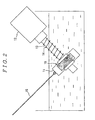
- Fig. 2 is a view showing a test apparatus used upon testing of a rolling life of a rolling bearing.
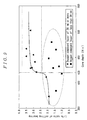
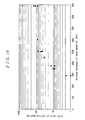
- Fig. 3 is a view showing a relation between the result of a corrosion resistant test of rolling bearing and the surface hardness of bearing rings made of titanium alloy.
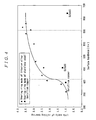
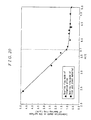
- Fig. 4 is a view showing a relation between the result of a rolling life test of rolling bearing and the surface hardness of bearing rings made of titanium alloy.
- Fig. 5 is a view showing a method of measuring the change in magnetic flux density in peripheral magnetic fields.
- Fig. 6 is a view showing a signal waveform outputted from a tesla meter shown in Fig. 5.
- Fig. 7 is a view showing a method of testing the wear resistance of a bearing ring made of titanium alloy.
- Fig. 8 is a view showing a relation between the result of a wear resistance test of bearing rings made of titanium alloy and the thickness of an oxygen compound.
- Fig. 9 is a view showing a relation between the result of a rolling life test of bearing ring made of titanium alloy and a hardness for the core.
- Fig. 10A is a view showing an existent method upon hardening a titanium alloy.
- Fig. 10B is a view showing a method upon hardening a titanium alloy by a high temperature oxidizing treatment.
- Fig. 10C is a view showing a method upon hardening a titanium alloy by a low temperature oxidizing treatment.
- Fig. 11A is a side elevational view of a Sawin type wearing testing machine.
- Fig. 11B is a front elevational view of a Sawin type wearing testing machine.
- Fig. 12 is a fragmentary cross sectional view of a rolling bearing according to another embodiment of the present invention.
- Fig. 13 is a view for explaining a gas nitridation treatment applied to a bearing ring made of a titanium alloy.
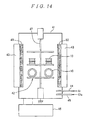
- Fig. 14 is a schematic view of an apparatus for forming a hard film on the surface of a bearing ring made of a titanium alloy.
- Fig. 15 is a cross sectional view of a test apparatus used upon testing durability of a thrust rolling bearing.
- Fig. 16 is a view showing a relation between the surface hardness of bearing ring made of a titanium alloy and a peeling life of a hard film formed on the surface of the bearing ring.
- Fig. 17 is a schematic view of an apparatus for testing durability of a radial rolling bearing in vacuum.
- Fig. 18 is a view showing a relation between heat conductivity and a wearing ratio of a rolling element
- Fig. 19 is cross sectional view of a rolling bearing in another embodiment of this invention.
- Fig. 20 is a view showing a relation between indentation resistance test and H/E of a rolling bearing.
- Fig. 21 is a view showing a relation between rolling life test and H/E of a rolling bearing.
- Fig. 22 is a view showing a fluctuation pattern of circumstantial temperature.
- Fig. 23 is a view showing the relation between the ratio of the linear expansion coefficient of a bearing ring and a linear expansion coefficient of a rolling element and a rolling life of a rolling bearing.
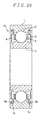
- Fig. 24 is a cross sectional view of a rolling bearing as an other embodiment according to this invention.
- Fig. 25 is a schematic view of a testing apparatus for testing wear resistance of a rolling bearing.
- Fig. 1 is a cross sectional view of a rolling bearing according to an embodiment of the present invention.
- a rolling bearing shown in Fig. 1 is a ball bearing of bearing No. 6001 (12 mm inner diameter, 28 mm outer diameter and 8 mm width) comprising an outer ring 1, an inner ring 2, rolling. elements 3, a cage 4 and seals 5.
- the bearing rings 1 and 2 are formed of one kind of titanium compounds of Ti-6Al-4V, Ti-15Mo-5Zr-3Al and Ti-15Mo-5Zr.
- a spherical rolling element 3 conducts rolling movement on rolling surfaces 1a and 2a during rotation of one of the bearing rings 1 and 2.
- the rolling element 3 is formed of silicon nitride and the cage 4 holding the rolling element 3 is formed of a fluoro resin.
- the bearing rings 1 and 2 made of titanium alloy are machined into a predetermined shape and then applied with a solution treatment and an aging treatment.
- the rolling surfaces 1a and 2a of the bearing rings 1 and 2 are applied with grinding after applying the solution treatment and the aging treatment.
- the solution treatment was applied by keeping the titanium alloy at a temperature of 950°C to 1000°C in a case where the titanium alloy is Ti-6Al-4V and at a temperature of 800°C to 850°C in a case where the titanium alloy is Ti-15Mo-5Zr-3Al or Ti-15Mo-5Zr for one hour and then the titanium alloy was cooled with water for solution treatment.
- the aging treatment for the titanium alloy was conducted under the treating conditions at 350°C to 500°C for 3 hours to 40 hours. Cooling was conducted usually by air cooling and the cooling rate was retarded by furnace cooling for those titanium alloys which are required to improve the hardness by making the precipitated tissue finer. Further, for those titanium alloys which are required to precipitate the ⁇ -phase more uniformly and finely, a two step aging treatment of applying an aging treatment under the conditions at 425°C for 17 hours at first and then applying an aging treatment under the conditions at 475°C for 7 hours was adapted.
- Test specimens were manufactured with materials for bearing rings shown in Table 1 and the following corrosion resistance test was conducted for each of the manufactured test pieces. That is, each of the test specimens in Table 1 was immersed in a 5N-H 2 SO 4 sulfuric acid solution at about 25°C, the weight of the test specimens before immersing in the sulfuric acid solution and after immersing for about 24 hours in the sulfuric acid solution were measured and the decrease in the weight with the sulfuric acid solution was evaluated.
- rolling bearings for use in the test were manufactured with the materials shown in Table 1 and the following rolling life test was conducted in an aqueous NaCl solution at 5% by weight concentration for each of the manufactured test bearings. That is, as shown in Fig. 2, after setting a test bearing 10 to a rotational shaft 13 of a tester, an axial load of about 19.6 N and an axial load of about 49 N were loaded by a spring 14 and a wire 15 and, in this state, the rotational shaft 13 was rotated at a speed of about 1000 rpm by a motor 12. Then, after rotating the inner ring of the test bearing by a predetermined number of cycles, the wearing amount on the rolling surface was measured.
- Table 1 shows the test result in the corrosion resistance test (decrease in the weight) and Fig. 3 shows a relation between the test result of the corrosion resistance test and the surface hardness of titanium alloys.
- Nos. 1 - 6 corresponding to the examples of the present invention show smaller values for the reduction of weight in the sulfuric acid solution compared with Nos. 6' to 8' as the comparative examples. This is because the bearing rings of Nos. 6' to 8' are formed of stainless steel or beryllium copper, whereas bearing rings of Nos. 1 to 6 are formed of a titanium alloys.
- Nos. 1 to 6 corresponding to the examples of the present invention show smaller values for the reduction of weight in the sulfuric acid solution compared with Nos. 3' to 5' as the comparative examples. This is because the surface hardness of the bearing rings made of titanium alloys is Hv 600 or more in Nos. 3' to 5', whereas the surface hardness of the bearings rings made of the titanium alloy is less than Hv 600 in Nos. 1 to 6.
- Table 1 shows the test result of the rolling life test (rolling life ratio) and Fig. 4 shows a relation between the test result of the rolling life test and the surface hardness of the rolling bearing made of the titanium alloy.
- the rolling life ratios in Table 1 and Fig. 4 are comparative values in a case of evaluation based on the rolling life of No. 1' being assumed as 1.
- Nos. 1 to 6 corresponding to the examples of the. present invention show. larger values for rolling life ratio in salt water compared with Nos. 1' and 2' as the comparative examples. This is because the surface hardness of the bearing rings made of the titanium alloy is less than Hv 400 in Nos. 1' to 2', whereas the surface hardness of the bearing rings of the titanium alloy is Hv 400 or more in Nos. 1 to 6.
- rolling bearings that can be used suitably for a long period of time even under such a circumstance where corrosion resistance is required against corrosive fluids such as saline or sulfuric acid can be obtained by making the bearing ring of the rolling bearing of the titanium alloy and setting the surface hardness for the bearing ring material to less than Hv 600 and Hv 400 or more.
- Rolling bearings for use in test were manufactured with materials shown in Table 2A and Table 2B, and the following test for measuring the change of magnetic flux density was conducted to each of the manufactured test bearings. That is, as shown in Fig. 5, after attaching a test bearing 10 to a rotational shaft 13 rotated in an magnetic field of a permanent magnet 16, the rotational shaft 13 was rotated at a speed of about 500 rpm and the change of the magnetic flux density was measured by a tesla meter 17. Then, those showing the maximum output of the tesla meter 17 (refer to Fig. 6) of 0.1 mT or more were evaluated as with change of the magnetic flux density, whereas those showing the maximum output of less than 0.1 mT were evaluated as with no change of the magnetic flux density.
- Table 2A shows the test result for the test of measuring the change of magnetic flux density while Table 2B shows the magnetic permeability of materials shown in Table 2A.
- Material Permeability Bearing ring Ti-6Al-4V 1.001 or less Ti-15Mo-5Zr-3Al 1.001 or less Ti-15Mo-5Zr 1.001 or less Be copper 1.001 or less Non-magnetic stainless steel More than 1.001 Rolling element Si 3 N 4 1.001 or less SiC 1.001 or less Zirconia ceramics 1.001 or less Alumina ceramics 1.001 or less SUS440C More than 1.001 Cage Resin 1.001 or less SUS304 More than 1.001
- Nos. 1 to 6 corresponding to the examples of the present invention show less change of magnetic flux density compared with Nos. 11' and 14' as the comparative example. This is because the cage is formed of SUS 304 in Nos. 11' and 14', whereas the cage of is formed of a resin in Nos. 1 to 6.
- Nos. 1 to 6 corresponding to the examples of the present invention show less change of magnetic flux density compared with Nos. 12' and 13' as the comparative examples. This is because the rolling elements are formed of SUS 440C in Nos. 12' and 13', whereas the rolling elements are formed of ceramics such as silicon nitride in Nos. 1 to 6.
- Nos. 1 to 6 corresponding to the examples of the present invention show less change of magnetic flux density compared with No. 15' as the comparative example. This is because the bearing ring is formed of the non-magnetic stainless steel in No. 15', whereas the bearing rings are formed of the titanium alloy in Nos. 1 to 6.
- the bearing rings made of titanium alloys for the test bearings used were formed of titanium alloys applied with a solution treatment under the conditions at 800 to 850°C x 1 hr, cooled by water and then applied with a first age hardening treatment under the conditions at 425°C x 20 hrs and further applied with a second age hardening treatment under the conditions at 475°C x 7 hrs for obtaining a surface hardness of Hv 480 or more.
- Table 4 shows the test result for the cage wear test (wear ratio).
- the wear ratios for respective cages in Table 4 are comparative values in a case of evaluation based on the wear amount of No. 21' being assumed as 1.
- Nos. 21-35 corresponding to the examples of the present invention show smaller values for the wear ratio compared with No. 21' as the comparative examples. This is because the heat conductivity of the material for the cage (stainless steel) is less than 20 W/(m ⁇ K) in No. 21', whereas the heat conductivity of the material for the cage (copper alloy) is 20 W/(m ⁇ K) or more in Nos. 21 to 35.
- Nos. 21 to 35 corresponding to the examples of the present invention show less change of magnetic flux density compared with No. 22' as the comparative example. This is because the specific permeability of the material for the cage shows a value exceeding 1.001 in No. 22', whereas the specific permeability of the material for the cage shows the value of 1.001 or less in Nos. 21 to 35.
- rolling bearings that can be used favorably even under a circumstance where a lubricant such as grease can not be use and non-magnetic property is required can be obtained by increasing the heat conductivity of the material of the cage to 20 W/(m ⁇ K) or more and lowering the specific permeability of the material for the cage as 1.001 or less.
- Disk-shaped test specimen each of 50 mm diameter were manufactured with materials shown in Table 5 and wear evaluation test was conducted to each of the test specimens. Specifically, as shown in Fig. 7, a load was applied by way of rolling elements 31 made of silicon nitride to the surface of a disk-shaped test specimen 33 and a cage 32 made of brass was rotated at a speed of 1000 rpm while gradually increasing the load applied to the test specimen 33 in a range from 20 N to 90 N. Then, the load at the instance the rotational resistance of the cage 32 reached 0.69 N ⁇ m was evaluated as a seizure load and the maximum wear indentation depth on the surface of the test specimen was measured simultaneously. In a case where the rotational resistance of the cage 32 did not reach 0.69 N ⁇ m even when the load exceeded 98 N, the seizure load at the instance the load reached at 98 N was evaluated as the rotational resistance of the cage 32.
- Table 5 shows the seizure load and the maximum wear indentation depth for each of the test specimens obtained by the wear evaluation test.
- the test specimens made of the titanium alloys of Nos. 36 - 43 show larger seizure load compared with the test specimens made of the titanium alloys of No. 36' and No. 39'. This is because an oxide compound layer is not formed on the surface of the test specimens made of the titanium alloys of Nos. 36' and 39', whereas the oxide compound layer is formed on the surface of the test specimens made of titanium alloys of Nos. 36 - 43.
- test specimens made of the titanium alloys of Nos. 36 - 43 show less rotational resistance of the cage at the instance the load reaches 98 N compared with the test specimen made of the titanium alloy of No. 38' where the load reaches 98 N. This is because the test specimen made of the titanium alloy of No. 38' does not contain TiO x (0 ⁇ x ⁇ 2) in the oxygen compound layer, whereas the test specimens made of the titanium alloys in Nos. 36 - 43 contain TiO 2 and TiO x in the oxide compound layer.
- test specimen made of the titanium alloys of Nos. 36 - 43 show larger seizure load compared with the test specimens made of the titanium alloys of Nos. 40' and 41'. This is because the test specimens made of the titanium alloys of Nos. 40' and 41' have a thickness of an oxygen compound layer of less than 20 nm, whereas the test specimens made of titanium alloys of Nos. 36 to 43 have a thickness of the oxygen compound layer of 20 nm or more.
- test specimens made of the titanium alloys of Nos. 36 - 43 have larger seizure load compared with the test specimen made of the titanium alloy of No. 37'. This is because the test specimen made of the titanium alloy of No. 37' has a thickness of the oxygen compound layer of 110 nm, whereas the test specimens made of the titanium alloys of Nos. 36 - 43 have an oxygen compound layer with a thickness of 95 nm or less.
- the wear resistance of the bearing ring made of the titanium alloy can be increased by forming the oxide compound layer containing TiO x to the surface of the bearing ring made of the titanium alloy. Further, it can be seen that the wear resistance of the bearing ring made of the titanium alloy can be increased further by making the thickness of the oxide compound layer to 20 nm or more and 95 nm or less.
- Fig. 8 shows a relation between the thickness of the oxide compound layer and the maximum wear indentation depth of the test specimen made of the titanium alloy shown in Table 5.
- the maximum wear indentation depth is about 2 ⁇ m or less and as the thickness of the oxygen compound layer is 50 nm or more, the maximum wear indentation depth is about 1 ⁇ m or less. Accordingly, the wear resistance of the bearing ring made of the titanium can be increased further by defining the thickness of the oxygen compound layer to 20 - 95 nm, preferably, 50 - 95 nm.
- Bearing rings were manufactured with materials shown in Table 6, which were incorporated into test bearings in which the rolling element comprised Si 3 N 4 and the cage comprised a fluoro resin, and a rolling life test in water for rolling bearing was conducted under the conditions at radial load: 98 N, axial load: 20 N, rotational speed: 1000 rpm and in a lubrication state: no lubrication.
- Table 6 shows the rolling life for each of the test bearings obtained by the rolling life test in water.
- the rolling life ratios in Table 6 are comparative values in a case of evaluation based on the rolling life of No. 44' being assumed as 1.
- the test bearings Nos. 36 - 43 show larger values for the rolling life ratio compared with the test bearings Nos. 36' and 39'. This is because the oxide compound layer is not formed on the surface of the bearing rings made of the titanium alloys in the test bearings Nos. 36' and 39', whereas the oxide compound layer is formed on the surface of the bearing rings made of the titanium alloys in the test bearings Nos. 36 - 43. Further, the test bearings Nos. 36 - 43 show larger values for the rolling life ratio compared with the test bearings No. 38'. This is because the oxygen compound layer does not contain TiO x (0 ⁇ x ⁇ 2) in the test bearings No.
- the oxygen compound layer contains TiO x (0 ⁇ x ⁇ 2) in the test bearings Nos. 36 - 43.
- the test bearings Nos. 36 - 43 are excellent in the rolling life compared with the test bearings Nos. 40' and 41'. This is because the thickness of the oxygen compound layer is less than 20 nm in the test bearings of Nos. 40' and 41', whereas the thickness of the oxygen compound layer is 20 nm or more in the test bearings Nos. 36 - 43.
- Fig. 9 shows a relation between the rolling life ratio for each of the test bearings and the core hardness of the rolling bearings made of the titanium alloys shown in Table 6.
- the rolling life of the bearing is about 2.0 as the comparative value when the core hardness of the bearing ring made of the titanium alloy is less than Hv 420, whereas the rolling life of the bearing is about 3.5 as the comparative value when the core hardness of the bearing ring made of the titanium alloy is Hv 420 or more. Accordingly, it can be seen that the rolling life of the rolling bearing can be increased by increasing the core hardness of the bearing ring made of the titanium alloy to Hv 420 or more.
- test specimens were manufactured with materials shown in Table 7 and a solution treatment and an aging treatment were applied to the test specimens Nos. 1 - 14 under the conditions shown in the table. Then, using the test specimens, measurement for the particle diameter of the ⁇ -phase, Vickers' hardness test, salt spray test and Sawin type wear test were conducted.
- Crystal tissue for the cross section of a test specimen was observed for dark view images using a test specimen for transmission type electron microscopic observation by using a transmission type electron microscope "JEM-2010" manufactured by Nippon Denshi Co. to measure the particle diameter for the ⁇ phase.
- the crystal tissue of the titanium alloy was ( ⁇ + ⁇ ) phase or ( ⁇ + ⁇ + ⁇ ) in Nos. 1 -10 and 13 and ( ⁇ + ⁇ ) phase in No. 11.
- a fixed test specimen 21 comprising various kinds of alloys manufactured as described above and a rotational test specimen 22 comprising Si 3 N 4 were attached to a Sawin type wear tester and the rotational test specimen 22 was rotated relative to the fixed test specimen 21 without lubrication while pressing the fixed test specimen 21 to the outer circumferential surface of the rotational test specimen 22 by a weight for loading and a weight for balancing.
- the fixed test specimen 21 is sized 19 mm x 19 mm x 3 mm thickness
- the ringshaped rotational test specimen 22 is sized 45 mm: outer diameter, 6 mm: thickness and 6 mm: width.
- the conditions for the rotation were at a pressing load of 39.2 N, at a rotational speed of the rotational test specimen 22 to the fixed test specimen 21 of 2.6 m/s as the circumferential speed and for a rotational distance of the rotational test specimen 22 of 400 m.
- the wear volume of the test specimen 21 along with rotation was measured and the ratio when assuming the wear volume of No. 11 as 1 was calculated as "wear ratio" for each of the specimens.
- Table 8 shows the test results.
- No ⁇ phase 453 1.0 ⁇ 12 1 ⁇ over 430 1.4 ⁇ 13 10 nm or less 480 0.88 ⁇ 14 - 690 0.1 ⁇ 15 - 421 2.3 ⁇
- Nos. 1 to 10 and No. 13 corresponding to the examples of the present invention are more excellent in the wear resistance and favorable in the corrosion resistance by the use of a titanium alloy of a crystal tissue having the ⁇ phase with the particle diameter of 1 ⁇ m or less, compared with a case of using a titanium alloy of a crystal tissue not having ⁇ phase (No. 11), a case in which the particle diameter of the ⁇ phase exceeds 1 ⁇ m (No. 12) and a case of using the Be-Cu alloy (No. 15).
- the hardness and the wear resistance were favorable but the corrosion resistance in salt water was poor.
- the temperature for the aging treatment is 475°C, which is higher than the ⁇ phase precipitation temperature and it is considered that the ⁇ phase precipitated in a temperature region from 300 to 450°C during cooling to form a ( ⁇ + ⁇ + ⁇ ) phase since the cooling rate after the aging treatment was lowered by gradual cooling in the furnace.
- the inner ring 2 and the outer ring 1 comprising the titanium alloy of the crystal tissue having the ⁇ phase with a particle diameter of 1 ⁇ m or less are obtained by manufacturing the inner ring 2 and the outer ring 1 in the same manner as for test specimens of Nos. 1 to 10 and 13.
- the rolling elements 3 for example, made of ceramics such as Si 3 N 4 and, optionally, the cage 4, for example, made of plastics, a rolling bearing suitable to use in a corrosive circumstance or a circumstance requiring non-magnetic property can be obtained.
- Fig. 12 is a cross sectional view of a deep groove ball bearing (bearing number: 608) as another embodiment of the present invention.
- the outer ring 1 and the inner ring 2 are formed of ⁇ + ⁇ type titanium alloy such as Ti-6Al 4V or ⁇ + ⁇ type titanium alloy such as Ti-15Mo-5Zr-3Al, Ti-15Mo-5Zr-3Al and the like.
- the rolling element 3 disposed between the outer ring 1 and the inner ring 2 is formed of ceramics such as silicon nitride, silicon carbide, zirconia and alumina.
- a hard film 6 is formed to the raceway surface of the bearing rings 1 and 2 along which the rolling elements 3 roll.
- the hard film comprises, for example, TiN, CrN, TiAlN or diamond-like carbon and a lubricating film 7 comprising a fluoro-containing a molybdenum disulfide, tungsten sulfide or fluoro-containing polymer having functional groups is formed on the surface of the hard film 6.
- the titanium alloy is applied with a hardening treatment by a first or second method after machining into a predetermined shape for obtaining a hardness of Hv 350 or more by Vickers hardness.
- the first method is a method of applying a solution treatment and an aging treatment to the titanium alloy to obtain a hardness of Hv 350 or more and the second method is a method of applying a gas nitridation treatment to the titanium alloy to obtain a hardness of Hv 350 or more.
- the titanium alloy in a case where the titanium alloy is Ti-6Al-4V, the titanium alloy is placed in a temperature atmosphere at 950 to 1000°C for one hour and, subsequently, the titanium alloy is water cooled to apply a solution treatment. Further, in a case where the titanium alloy is Ti-15Mo-5Zr-3Al or Ti-15Mo-5Zr-3Al, the titanium alloy is placed in a temperature atmosphere from 800 to 850°C for about one hour and, subsequently, the titanium alloy is water cooled to apply a solution treatment.
- the titanium alloy is placed in a temperature atmosphere of 300 to 500°C for about 3 to 40 hours to apply an aging treatment to the titanium alloy.
- the hardness of the titanium alloy is adjusted by controlling the time for the aging treatment. Cooling of the titanium alloy by the aging treatment is usually conducted by air cooling and for making the hardness of the titanium alloy harder, it is desirable to gradually cool the titanium alloy in the furnace in order to more finely precipitate the ⁇ phase from the ⁇ phase.
- the titanium alloy is heated in a furnace under vacuum at a temperature lower than the transformation point in order to prevent oxidation on the surface of the titanium alloy.
- the pressure in the furnace exceeds 0.133 Pa
- residual oxygen in the furnace and titanium react chemically to form an oxide layer on the surface of the titanium alloy that hinders the nitridation treatment.
- the pressure in the furnace is lowered to 0.133 Pa or less as shown in Fig. 13.
- the nitridation treatment temperature for the titanium alloy is high, reactivity between titanium and nitrogen is favorable.
- the diffusion rate of nitrogen intruding into the titanium alloy increases therealong and, as a result, a nitrogen diffusion layer is formed to the surface of layer of the titanium alloy.
- the nitridation treatment temperature is higher than the transformation point (temperature from ⁇ phase to ⁇ phase) or higher, crystal grains grow abruptly to give undesired effects on the fatigue strength of the bearing ring.
- the nitridation treatment temperature is controlled to a temperature lower by about 5 to 200°C than the transformation point.
- a treating gas such as a nitrogen gas or NH 3
- a nitrogen gas or NH 3 when the pressure of the treating gas is excessively high, nitridation on the surface of the titanium alloy proceeds rapidly to make the nitride layer formed on the surface of the titanium alloy coarse and brittle.
- the hard film 6 was formed by using a film deposition treatment apparatus utilizing an arc vapor deposition method (refer to Fig. 14). Specifically, a test bearing was placed on a turn table 42 having a rotational shaft 47. Then, the inside of a vacuum vessel 41 was evacuated by a vacuum pump 46 to condition the pressure to 1 ⁇ 10 4 Pa or less, under which DC bias was applied to a pair of cathodes 43 and 43 while introducing an Ar gas from a gas introduction port 44 to apply ion bombarding by Ar and apply cleaning for a work 48 (outer ring 1 and inner ring 2).
- the temperature of the work 48 was elevated to 400 to 500°C and a Ti material in a case of forming a Ti series hard film 6 or a Cr material in a case of forming a Cr film hard film 6 are attached, respectively, to targets 49 and 50. Then, while rotating the turn table 42, a bias at -200 to -300 V, 80 to 150 A was applied to the targets 49 and 50.
- a nitrogen gas was introduced as a treating gas in a case of forming the nitride type hard film 6 or a methane gas (CH 4 ) was introduced as a treating gas in a case of forming the carbide type film 6 from the gas introduction port 45 and an identical DC bias was applied to the targets 49 and 50 while rotating the turn table 42.
- the hard film 6 could be formed at least on the entire inner circumferential surface of the outer ring 1 and at least on the entire outer circumferential surface of the inner ring 2.
- the thickness of the hard film 6 was controlled by the treatment time.
- the nitrogen compound layer formed on the surface by the gas nitridation treatment was removed by finish polishing to expose the nitrogen diffusion layer to condition the surface hardness to Hv 550 or more, and a hard film 6 was formed to the upper layer thereof.
- the method of forming the hard film 6 is not restricted to the method as described above but, for example, an HCD ion plating method, sputtering method, plasma CVD method or the like may be adopted.
- Bearings used were thrust ball bearings manufactured by the same method as described above (bearing No.: 51305).
- a thrust ball bearing 12 comprising an outer ring 1, an inner ring 2, rolling elements 3 and a cage 4 was attached to a rotational shaft 51 of a thrust life testing machine and a rotation test was conducted in a state of filling a lubricant in a housing 53 under the conditions at a load of 9800 N, a rotational speed of 1000 rpm, using brass as the material of the cage, silicone nitride as the material of roiling element and #68 turbine oil (68 cSt/40°C) as the lubricant.
- Table 9 shows the surface hardness Hv for the base material of the outer ring 1 and the inner ring 2, the kind of the hard film and the result of peeling life, respectively.
- No. Type of base material hardening Hardness of base material surface Hard film Peeling life ratio Example 1 450 TiN 33 2 500 TiN 52 3 500 TiAlN 78 4 500 SiC+DLC 45 5 603 TiN 85 6 889 TiN 83 7 889 TiAlN 132 8 889 SiC+DLC 111 9 376 TiN 10.5 10 376 TiAlN 13.2 11 350 TiN 8.5 12 350 TiAlN 10.1 Comp.
- the base material for the outer ring 1 and the inner ring 2 in Table 9 is ⁇ type titanium alloy: Ti-15Mo-5Zr-3Al.
- the life For the judgment of the peeling life, the instance at which a vibration level detected by an acceleration pick up reached five times the initial value was defined as the life. Then, it is indicated as a comparative value based on the life of a raw material (base material not applied with hardening treatment) covered with a hard film comprising TiN (No. 1' in Table 9) being assumed as 1.
- Fig. 16 shows a relation between the surface hardness Hv of the base material and the peeling life of the hard film is shown. As can be seen from Fig. 16, when the surface hardness of the base material is Hv 350 or more, the peeling life of the hard film is improved and it was further improved at Hv 450 or more.
- Nos 1 to 12 corresponding to the examples of the present invention show larger values for the peeling life ratio of the hard film compared with No. 3' and No. 4' as the comparative examples. This is because the surface hardness of the raceway surface formed with the hard film is Hv 290 or less in the bearings No. 3' and No. 4', whereas the surface hardness of the raceway surface formed with the hard film is Hv 350 or more in the bearings Nos. 1 to 12.
- durability of the hard film can be improved and early peeling or the like of the hard film can be prevented by increasing the surface hardness of the raceway surface formed with the hard film to Hv 350 or more preferably, Hv 450 or more.
- the bearing used is a deep groove ball bearing manufactured by the same method as described above (bearing number: 608, inner diameter 8 mm ⁇ outer diameter 22 mm ⁇ width 7 mm).
- a deep groove ball bearing having an outer ring 1, an inner ring 2 and rolling elements 3 was attached in a bearing housing 62 in a vacuum chamber 61 of a vacuum duration test apparatus (refer to Fig. 17) and duration test under vacuum atmosphere was conducted.
- Rotation of a motor 63 is introduced by way of a magnetic seal unit 64 to the test bearing 10.
- the axial load is applied by a coil spring 65 to the test bearing 10 and the rotational torque of the test bearing 10 is measured by a leaf spring appended with a not illustrated strain gage.
- inside of the vacuum chamber 61 is evacuated by a not illustrated turbo molecular pump and an ion pump.
- test conditions in this case are as shown below; Axial load 49 N Rotational speed 1000 Rpm Vacuum degree 10 -5 Pa or less
- Table 10 shows the kind of the base material for the outer ring 1 and the inner ring 2, the type of the hardening treatment applied to the base material, the surface hardness Hv of the base material, the kind of the hard film 6, the kind of the lubricating film 7, the material for the rolling element 3 and the life (result of vacuum duration test), respectively.
- "DFO" in the column for the kind of the lubricating film means a fluoro-containing polymer having functional groups.
- the life was indicated by a relative value based on the life of a raw material (base material not applied with hardening treatment) covered with a hard film comprising TiN (No. 3' in Table 10) being assumed as 1.
- Nos. 13 to 29 corresponding to the examples of the present invention show larger values for the life ratio compared with No. 3' as the comparative example. This is because the surface hardness of the raceway surface is Hv 290 or less in bearing No. 3', whereas the surface hardness is Hv 350 or more for the raceway surface in bearings Nos. 13 to 29. Further, Nos. 13 to 29 corresponding to the examples of the present invention show larger values for the life ratio in vacuum compared with No. 4' as the comparative example. This is because a lubricating film is formed directly on the raceway surface of a bearing ring made of the titanium alloy in bearing No. 4', whereas the lubricating film is formed on the surface of the hard film formed on the raceway surface in the bearing Nos. 13 to 29.
- a rolling bearing that can be used favorably for a long period of time even under a vacuum atmosphere where a lubricant such as grease can not be used can be obtained by forming the hard film on the raceway surface of the bearing ring made of the titanium alloy and forming the lubricant film on the surface of the hard film.
- Ti-6Al-4V of ⁇ + ⁇ type titanium alloy and Ti-15Mo-5Zr-3Al and Ti-15Mo-5Zr of ⁇ type titanium alloy are used, but the kind of the titanium alloys is not restricted to those described above and other kinds of titanium alloys may also be used so long as the surface hardness of the base material can be Hv 350 or more, preferably, Hv 450 or more.
- Table 11 shows the conditions for the solution treatment and the conditions for the aging treatment for the bearing rings made of titanium alloys.
- Symbol Material for bearing ring Solution treatment condition Aging treatment condition A Ti-15Mo-5Zr-3Al 730 - 850°C ⁇ 1Hr 450°C ⁇ 20Hr B ⁇ 800 - 850°C ⁇ 1Hr 450°C ⁇ 20Hr 475°C ⁇ 10Hr C Ti-15Mo-5Zr 730 - 850°C ⁇ 2Hr 400°C ⁇ 90Hr D ⁇ 730 - 850°C ⁇ 2Hr 450°C ⁇ 20Hr E Ti-15V-3Cr- 3Sn -3Al 730 - 850°C ⁇ 3Hr 450°C ⁇ 20Hr F Ti-22V-4Al 730 - 850°C ⁇ 4Hr 450°C ⁇ 20Hr G Ti-6Al-4V 900°C ⁇ 1Hr 540°C ⁇ 10Hr
- Test bearings were manufactured by using bearing rings made of titanium alloys shown in Table 11 and rolling elements made of materials shown in Table 12 and a wear resistance test was conducted for each of the test bearings under vacuum. Specifically, the rotation test was conducted in vacuum for each of the test bearings under the conditions at an axial load of 19.6 N and at a rotational speed of 1000 rpm and in a lubrication state of no lubrication, and the amount of wear in each of the bearing rings after 1 ⁇ 10 7 rotation was calculated as [wear ratio] based on the ratio defining the amount of wear in No. 1' being assumed as 1.
- Table 12 shows the test result of the vacuum rotation test.
- the wear ratio for each of the bearing rings shown in Table 12 is a comparative value in a case of evaluation based on the wear amount of No. 1' being assumed as 1.
- Nos. 1 to 12 corresponding to the examples of the present invention show larger values for the life ratio compared with No. 1' as the comparative example. This is because the material for the rolling element of the rolling bearing No. 1' is SiN 4 , whereas the material for the rolling element of the rolling bearings Nos. 1 to 12 is superhard alloy or cermet.
- the bearings Nos. 1 to 12 show larger values for the life ratio compared with No. 2' and No. 3' as the comparative examples. This is because the heat conductivity of the superhard alloy or cermet of the bearings No. 2' and No. 3' is 31 W/(m ⁇ K) or less, whereas the heat conductivity of the superhard alloy or cermet of the rolling bearings Nos. 1 to 12 is 35 W/(m ⁇ K) or more.
- rolling bearings that can be used favorably for a long period of time even under a vacuum atmosphere can be obtained by forming the rolling element of the superhard alloy or cermet and increasing the heat conductivity of the superhard alloy or cermet to 35 W/(m ⁇ K) or more.
- Fig. 18 shows a relation between the wear ratio shown in Table 12 and the heat conductivity of the superhard alloy or cermet.
- the wear ratio of the bearing ring made of the titanium alloy increases as the heat conductivity of the superhard alloy or cermet is higher till the heat conductivity reaches 50 W/(m ⁇ K), but the wear ratio of the bearing ring made of titanium does not increase so much even when the heat conductivity of the superhard alloy or the cermet increase when the heat conductivity exceeds 50 W/ (m ⁇ K).
- the heat conductivity of the superhard alloy or cermet within a range from 30 to 50 W/(m ⁇ K) in a case of forming the rolling element of the superhard alloy or cermet.
- Rolling bearings for test were manufactured with the materials shown in Table 13 and the following salt water rolling test and a magnetic flux density change measuring test were conducted to each of the thus manufactured test bearings.
- the materials A, B, C and G for the bearing rings are materials shown in Table 11 and NR 8 is WC-Ni series superhard alloy, NR 11 is WC-Ni-C r series superhard alloy and DUX 30 is TiC-TaN-Ni-Mo series cermet as the material for the rolling element.
- a rolling life test in an aqueous NaCl solution at 5 wt% concentration was conducted for each of test bearings to examine the wear ratio and presence or absence of rusting in each of bearing rings.
- the test conditions in this case are as shown below; Radial Load 49.2 N Axial load 19.2 N Rotational speed 1000 rpm Lubrication no lubrication
- the superhard alloy or cermet Since the superhard alloy or cermet has high hardness (Hv 900 or more) and high melting point corresponding to ceramics, they cause less adhesion or wear even if the lubricating condition is stringent. Further, since they have high hardness, the amount of plastic deformation during working is very small and a small degree of unevenness is less caused. Therefore, rolling elements at an extremely high accuracy can be manufactured. Further, with respect to the toughness, since it is higher than that of ceramics, cracking or chipping is less caused during manufacture and they are less fractured against impact load.
- the superhard alloy or cermet having the heat conductivity of 35 W/(m ⁇ K) or more as the material for the rolling element, the amount of heat generation at the face of contact between the bearing ring and the rolling element can be suppressed to suppress the adhesive wear of the bearing ring made of titanium alloy. Further, since the superhard alloy or cermet has a larger Young' modulus compared with ceramics, the area of contact between the rolling element and the bearing ring is reduced, so that the rotational torque can be suppressed to stabilize the rotational characteristics.
- the superhard alloy and the cermet are alloys formed of nine kinds of metals belonging to the group IVa, the group Va and the group VIa of the periodical table, namely, W, Mo, Cr, Ta, Nb, V, Hf, Zr and Ti as targets by sinter bonding the powder of such carbides by using iron group metals such as Fe, Co and Ni.
- the cermets are sintered alloys formed by bonding mainly TiC, TiN or TiCN, among them, with Ni.
- the superhard alloys when classified in accordance with alloy systems include, for example, WC-Co series, WC-Cr 3 C 2 -Co system, WC-TaC-Co system, WC-TiC-Co series, WC-NbC-Co system, WC-TaC-NbC-Co series, WC-TiC-TaC-NbC-Co series, WC-TiC-TaC-Co series, WC-ZrC-Co series, WC-TiC-ZrC-Co series, WC-TaC-VC-Co series, WC-Cr 3 C 2 -Co series and WC-TiC-Cr 3 C 2 -Co series.
- Those improved with the corrosion resistance include, for example, WC-Ni series, WC-Co-Ni series, WC-Cr 3 C 2 -Mo 2 C-Ni series, WC-Ti(C,N)-TaC series, WC-Ti(C,N) series and Cr 3 C 2 -Ni series.
- the cermets include, for example, TiC-Ni series, TiC-Mo-Ni series, TiC-Co series, TiC-Mo 2 C-Ni series, TiC-Mo 2 C-ZrC-Ni series, TiC-Mo 2 C-Co series, Mo 2 C-Ni series Ti (C, N)-Mo 2 C-Ni series, TiC-TiN-Mo 2 C-Ni series, TiC-TiN-Mo 2 C-Co series, TiC-TiN-Mo 2 C-TaC-Ni series, TiC-TiN-Mo 2 C-WC-TaC-Ni series, TiC-WC-Ni series, Ti(C,N)-WC-Ni series, TiC-Mo series, and Ti(C, N)-Mo series.
- Ti(C,N)-Mo 2 C-Ni series, Ti(C,N)-WC-Ni series or Ti(C,N)-Mo series is an alloy formed by sintering TiC-Mo 2 C-Ni series, TiC-WC-Ni series or TiC-Mo series in a nitrogen gas (N 2 ).
- the typical composition of the cermet comprises, for example, TiC-30% Ni, TiC-10% Mo-30% Ni, TiC-20% Mo-30% Ni, TiC-30% Mo-30% Ni, TiC-11% Mo 2 C 11% Mo 2 C-24% Ni, TiC-30% Mo 2 C -20% Ni, TiC-19% Mo 2 C-24% Ni, TiC-8% Mo 2 C-15% Ni, Ti(C,N)-25%Mo 2 C-15%, TiC-14% TiN-19% Mo 2 C-24% Ni, TiC 0.7 N 0.3 -11% Mo 2 C-24% Ni, TiC 0.7 N 0.3 -19% Mo 2 C-24% Ni, TiC 0.7 N 0.3 -27% Mo 2 C-24% Ni, TiC-20%Mo-15%Ni, TiC-30%Mo-15%Ni.
- High resistance and non-magnetic property can be coped with by the change of the ingredient systems of the superhard alloy or cermet of the rolling element. Further, in a case of using the rolling bearing according to the present invention for high speed rotation, it is desirable to use a cermet of low density as the material for the rolling element. Further in a case where a large load is applied or an impact load is given to the rolling bearing according to the present invention, it is desirable to use a superhard alloy of higher toughness as the material of the rolling element.
- Rolling bearings for test (inner diameter: 12 mm, outer diameter: 28 mm, width: 8 mm, roll diameter : 4.76 mm, number of balls; 8) were measured with the materials shown in Table 14 and the following impact resistance test and the rolling life test were conducted to each of the thus manufactured test bearings.
- the inner rings and the outer rings shown in Table 14 were obtained by any of the following methods (i) to (iv).
- test resistance test was conducted by the following method. At first, each of the test bearings was attached to the rotational shaft of an impact acceleration testing machine. Then, the test bearings were dropped from various heights in the axial direction (30 - 100 cm) in a state of attaching the rolling bearings and applying a preload at 9.6 N and the impact acceleration upon dropping was measured by an acceleration gage. The test bearing was rotated before and after the dropping to measure the axial vibration acceleration (G value).
- the impact resistance evaluation value in Table 14 is a comparative value in a case of evaluation based on the test result for No. 1' (impact acceleration at the minimum dropping height where the difference of the G value before and after dropping was 5 mG or more) being assumed as 1.
- the evaluation value for the corrosion resistance in Table 14 is a comparative value in a case of evaluation based on the test result for No. 1' (time to reach the G value five times as much as the initial value) being assumed as 1.
- ⁇ type also including near ⁇ type
- ( ⁇ + ⁇ ) type is preferably used.
- the hardness of the titanium alloys can be increased to Hv 400 to more by precipitation hardening of precipitating fine ⁇ phase in ⁇ phase by applying a solution treatment from a temperature just below or just above the ⁇ / ⁇ transformation point to form ⁇ phase and then applying an aging treatment at 350 to 600°C.
- the chromium diffusion penetration treatment (a) above is conducted, for example, as described below.
- a material to be treated comprising high carbon chromium bearing steel and a chemical formulated from powdery chromium (Cr), powdery alumina (Al 2 O 3 ) and powdery ammonium chloride (NH 4 Cl) are tightly sealed in a steel case and the case is placed in a furnace.
- the inside of the furnace is heated to 900 - 1100°C and kept for a predetermined time while flowing a hydrogen (H 2 ) gas or argon (Ar) in the casing.
- chromium chloride CrCl 2
- the chromium chloride conducts substitution reaction with atoms forming the surface of the material to be treated by which chromium diffuses and penetrates to the surface of the material to be treated.
- chromium formed by precipitation of chromium chloride by reduction with hydrogen diffuses and penetrates to the surface of the material to be treated.
- a chromium diffusion layer is formed on the surface of the material to be treated.
- the chromium diffusion layer has corrosion resistance and the surface hardness is Hv 1050 to 1100.
- the hardness of the core is lowered when applying gradual cooling after the chromium diffusion and penetration treatment, it is preferred to harden the core by conducting hardening and tempering after the treatment.
- the nitridation treatment (b) is conducted, for example, as described below.
- fluoridation treatment was conducted to the material to be treated comprising iron and steel material having 3.0% by weight (preferably, 8.0% by weight or more) of chromium by using, for example, a nitrogen fluoride (NF 3 ) gas at 200 to 400°C.
- NF 3 nitrogen fluoride
- a nitridation treatment is conducted by using an ammonia (NH 3 ) gas at 400 to 500°C. This method is referred to as an Nv nitridation treatment (registered trade mark of Air Water Co.).
- an extremely dense and uniform nitride layer can be formed even when the nitridation treatment is conducted at a low temperature of 400 to 500°C by applying a fluoridation treatment as the pretreatment.
- the nitride layer has corrosion resistance and a surface hardness of Hv 1230 to 1350. Further, fine deformations can be prevented from being formed on the surface of the material to be treated by applying the nitridation treatment at low temperature. Therefore, degradation of the dimensional accuracy of the rolling element by the surface hardening treatment is prevented.
- the reason for using the iron and steel material having 3.0% by weight or more (preferably, from 8.0% by weight or more) of chromium is that the hardness for the surface hardening layer is increased to a necessary hardness for obtaining satisfactory wear resistance. That is, while the hardness of the surface hardening layer (b) can be improved by forming fine chromium nitride with chromium and nitrogen, a hardness required for obtaining a satisfactory wear resistance can not be obtained when the chromium content is less than 3.0% by weight.
- an iron and steel material capable of satisfying: [C (%)] ⁇ -0.05 [Cr(%)] +1.41.
- the thickness (depth) of the surface hardening layer (a) and (b) is preferably a size corresponding to 1.5 to 6% of the diameter for the rolling element and is 100 ⁇ m or less.
- the Young's modulus of the surface hardening layer formed by the treatment (a) and (b) is substantially equal with the Young's modulus of the stainless steel or the bearing steel as the material to be treated (200-210 GPa), which is lower than the Young's modulus of 250 to 400 GPa of ceramics.
- the area of contact between the rolling element and the bearing ring is increased to decrease the contact face pressure compared with the rolling bearing described in Japanese Published Unexamined Patent Application Hei 11-223221. Accordingly, the sharing stress formed between the rolling element and the bearing ring during rotation is moderated to cause less rolling fatigue. Further, fine indentations are less caused to the rolling element and the bearing ring when an impact load is applied from the outside.
- Fig. 19 shows a rolling bearing according to another embodiment of the present invention.
- the rolling bearing of this embodiment comprises bearing rings 1 and 2 made of titanium alloy, rolling elements 3 interposed between the bearing rings 1 and 2, and a seal 5 sealed between the bearing rings 1 and 2 for preventing leakage of grease or intrusion of obstacles.
- a titanium alloy with a ratio of the hardness to the Young' modulus (H/E) of 3.7 or more is used and any of titanium alloys can be used suitably irrespective of their kinds so long as the titanium alloy can satisfy : 3.7 ⁇ (H/E).
- ⁇ + ⁇ type or ⁇ type (also including near ⁇ type) titanium alloys capable of attaining high hardness by precipitation hardening by solution treatment and aging treatment include, for example, ⁇ + ⁇ type titanium alloy: Ti-6Al-4V or ⁇ type titanium alloy : Ti-24V-4Al, Ti-15V-3Cr-3Sn-3Al and Ti-15Mo-5Zr-3Al.
- the hardness at least from the surface to 2.5% Da can be set to Hv 420 or more thereby increasing (H/E) to 3.7 or more.
- the rolling element 3 as the rolling element, a rolling element made of iron and steel material or ceramic material can be used.
- a rolling element made of stainless steel or ceramic As the rolling element 3.
- a rolling element made of ceramics such as silicon nitride series, silicon carbide series, aluminum oxide series or zirconium oxide series.
- a rolling element made of iron and steel material constituted with high carbon chromium steel such as SUJ2, martensitic stainless steel such as SUS 440C, 13 Cr system or high speed steel represented by M50 which are excellent in toughness and having lower Young's modulus compared with ceramics.
- the grease to be sealed has no particular restriction and any of greases having a usable temperature range may be used.
- the seal 5 has no particular restriction on the material and any material can be used so long as it is within a usable temperature range but a seal made of rubber such as nitrile rubber that is easily deformed elastically along with elastic deformation of the bearing rings 1 and 2 is used preferably.
- the bearing rings 1 and 2 are bearing rings made of titanium alloys, they have low Young's modulus and are easily deformed elastically. Accordingly, when impact is transmitted, for example, from axles to the bearing, since the bearing rings locally deform elastically to play a role of a spring that absorbs impact, impact transmitted to the machine main body is decreased. Accordingly, in such an application use as care-aid instruments such as a wheel chair, sports instruments such as a roller blade or bicycles in which impacts or vibrations are directly transmitted from axles to the instrument main body or user, since the impact or vibration is moderated by the use of the rolling bearings according to the present invention, it can be used suitably.
- the material is made of titanium alloy and the ratio of the hardness to the Young' modulus (H/E) is set to 3.7 or more, the indentation resistance and the rolling life are improved. Accordingly, it can be used suitably even in a case where impact or vibration is loaded to the bearing or in a case where there is a worry that obstacles intrude into the bearings.
- the grease when used as the lubricant, since the grease functions as a damper for the vibration or impact, moderation of impact and vibration and indentation resistance are further improved.
- ball bearings are shown as the example of the rolling bearing in the embodiments described above, it may be a roller bearing.
- the rolling bearing according to the present invention was manufactured by the method shown below. Grease was sealed as a lubricant.
- ⁇ + ⁇ type titanium alloy Ti-6Al-4V
- ⁇ type titanium alloy Ti-15V-3Cr-3Sn-3A1, Ti-22v-4Al, Ti-15Mo-5Zr-3Al
- the solution treatment was conducted by the following method. That is, for the ⁇ + ⁇ titanium alloy: Ti-6Al-4V, the solution treatment was conducted by keeping at a temperature of 950 to 1000°C for one hour and then water-cooling. Further, for the ⁇ type titanium alloys: Ti-15V-3Cr-3Sn-3Al, Ti-22V-4Al and Ti-15Mo-5Zr-3Al, the solution treatment was conducted by keeping at a temperature of 750 to 850°c for one hour and water-cooling.
- a rolling element made of ceramics such as, silicon nitride series, silicon carbide series, zirconium oxide series and aluminum oxide series and a rolling element made of 13% Cr system martensitic stainless steel were used.
- a mineral oil type grease is used for the grease. Further, nitrile rubber seal was used for the seal 5 and a case made of polyamide was used for the cage.
- bearing rings were manufactured with martensitic stainless steel (SUS440C) and precipitation hardening type stainless steel (SUS 630).
- the martensitic stainless steel (SUS 440c) was applied with oil hardening from a temperature of 900 to 950°C and applied with tempering at 150 to 200°C.
- the precipitation hardening type stainless steel (SUS 630) was applied with a solution treatment at a temperature from 920 - 970°C and applied with an aging treatment at 450 - 500°C.
- an outer ring 1 made of titanium alloy cut into 1/4 size was used for the indentation resistance test.
- a spherical rolling element 3 made of silicon nitride having a diameter of 4.76 mm was pressed against the raceway surface of the bearing ring (outer ring 1) cut into 1/4 and a load at 980N was loaded to the raceway surface of the bearing ring 1 by way of the rolling element 3 in this state. Then, the maximum depth of the indentation formed to the raceway surface at a portion applied with the load was measured.
- Table 15 shows the test results for the indentation resistance test (indentation depth) and Fig. 20 shows a relation between the test result of the indentation resistance test and H/E.
- Nos. 1 to 10 corresponding to the examples of the present invention show smaller values for the depth of indentations formed on the raceway surface compared with Nos. 1' to 4' as the comparative examples. This is because the ratio of the hardness to the Young's modulus (H/E) of the material for the bearing ring is 2.4 to 3.6 in the bearings Nos. 1' to 4', whereas the ratio of the hardness to the Young's modulus (H/E) for the material of the bearing ring is 3.7 or more in Nos. 1 to 10.
- a rolling life test was conducted by the following method. At first, an initial vibration value of the bearing is measured when the inner ring is rotated under the conditions at a number of rotation of 500 rpm, a radial load of 69N and an axial load of 20N. Then, the rolling bearing is detached from a rolling life testing machine and the bearing is dropped from 1 m height in a state of applying a preload of 20 N with the end face of the rolling bearing being directed to the surface of the floor. Subsequently, the bearing is again set to the rolling life testing machine and the vibration value of the bearing when the inner ring is rotated under the same conditions as described above is measured. Then, the instance that the measured value exceeds five times the initial vibration value was evaluated as the rolling life.
- Fig. 15 shows the test result of the rolling life test (rolling life ratio) and Fig. 21 shows a relation between the test results of the rolling life test and H/E.
- the roiling life ratios in Table 15 and Fig. 21 are comparative values when evaluation is made based on the rolling life of No. 4' being assumed as 1.
- Nos. 1 to 10 corresponding to the examples of the present invention show larger values for the rolling life ratio compared with Nos. 1' to 4' as the comparative examples. This is because the ratio of the hardness to the Young's modulus (H/E) for the material of the bearing ring is 2.4 to 3.6 in the bearings Nos. 1' to 4', whereas the ratio of the hardness to the Young's- modulus (H/E) for the material of the bearing ring is 3.7 or more in the bearings Nos. 1 to 10.
- H/E is preferably within a range from 3.7 to 4.8 for the bearing ring made of the titanium alloy.
- Rolling bearings for test were manufactured with the materials shown in Table 16 and the following rolling life test was conducted as below for each of the test bearings. That is, the vibration values were measured when the inner ring for each of the test bearings was rotated under the conditions at a radial load of 49N and a rotational speed of 1000 m -1 and the rolling life of the bearing was evaluated as an instance that the measured value reached twice the initial vibration value just after starting the rotation. In this case, the circumstantial temperature was changed in accordance with the pattern shown in Fig. 22.
- the material for the bearing ring is made of Ti-6Al-4V
- a titanium alloy after applied with a solution treatment at a temperature of 920 to 1000°c and then applied with an aging treatment at a temperature of 450 to 550°c was used as shown in Table 16.
- a titanium alloy applied with a solution treatment at a temperature of 770 to 850°C and then applied with an aging treatment at a temperature of 400 to 500°C for 10 to 60 hours was used.
- the material of the bearing ring was made of Ti-22V-4Al
- a titanium alloy applied with a solution treatment at a temperature of 700 to 800°C and then applied with an aging treatment at a temperature of 400 to 500°C for 5 to 40 hours was used. Cooling in the solution treatment was conducted by water-cooling and cooling in the aging treatment was conducted by furnace cooling.
- Table 16 shows the test result of the rolling life test (rolling life ratio) and Fig. 23 shows a relation between the test results of the rolling life test and the linear expansion coefficient ratio ⁇ 2 / ⁇ 1 ( ⁇ 1 : linear expansion coefficient of the material for the bearing ring, ⁇ 2 : linear expansion coefficient of the material for the rolling element).
- the rolling life ratio in Table 16 and Fig. 23 are comparative values when evaluated based on the rolling life for No. 1' being assumed as 1.
- Nos. 1 to 8 corresponding to the examples of the present invention show larger values for the rolling life ratio compared with Nos. 2' and 3' as the comparative examples. This is because the linear expansion coefficient ratio between the material for the bearing ring and the material for the rolling element is: ⁇ 2 / ⁇ 1 ⁇ 1.4 in Nos. 2' and 3', whereas the linear expansion coefficient ratio between the material for the bearing ring and the material for the rolling element is: ⁇ 2 / ⁇ 1 ⁇ 1.3 in Nos. 1 to 8. Further, Nos. 1 to 8 corresponding to the examples of the present invention show larger values for the rolling life ratio compared with Nos. 1', 4' to 6' as the comparative examples.
- Fig. 24 shows a further embodiment of the rolling bearing according to the present invention.
- the rolling bearing comprises an inner ring 2 externally fitted and secured to the outer circumferential surface of a shaft to be supported (not illustrated), an outer ring 1 disposed to the outer circumference of the inner ring 2 and plural spherical rolling elements 3 disposed rotationally between the outer ring 1 and the inner ring 2 and a cage 4 for holding the spherical rolling elements 3 in an equi-distance relative to the circumferential direction of the rolling rings 11 and 12.
- Shield plates 9 are disposed on both axial ends of the bearing rings 11 and 12 for closing the open space formed on both sides of the rolling element 3.
- the inner ring 1 and the outer ring 1 each comprises a titanium alloy having a hardness of Hv 420 or more (for example, ⁇ + ⁇ type titanium alloy, near ⁇ type titanium alloy and ⁇ type titanium alloy) with the specific permeability being 1.001 or less.
- the rolling element 3 comprises ceramics such as electroconductive zirconia or silicon nitride, preferably, electroconductive ceramics with the specific permeability being 1.001 or less.
- the cage 4 is formed, for providing the cage itself with an electric insulation and self lubricancy, for example, by adding a solid lubricant such as PTFE, MAC, graphite, N-lauro ⁇ L-lysin, hBN and fluoro mica to a resin material, for example, fluoro-containing resin, PEEK, PEEK-PBI, PPS, TPI, PEN, PFA, ETFE, FEP, PCTFE, ECTFE and PVDF.
- a solid lubricant such as PTFE, MAC, graphite, N-lauro ⁇ L-lysin, hBN and fluoro mica
- a resin material for example, fluoro-containing resin, PEEK, PEEK-PBI, PPS, TPI, PEN, PFA, ETFE, FEP, PCTFE, ECTFE and PVDF.
- the shield plate 9 comprises titanium at a purity of 99.5% or higher and the specific permeability of the shield plate 9 is 1.001 or less. Further, the shield plate 9 is formed as a ring, and fitting portions 9a that fit detachably to shield plate holding grooves 1a and 1a formed to the inner circumferential surface of the outer ring 1 are formed to the outer circumferential surface of the plate.
- the specific permeability of the inner ring 2, the outer ring 1 and the rolling element 3 is 1.001 or less.
- the magnetic flux density at the periphery of the bearing does not change greatly by the rotation of the inner ring 2 or the outer ring 1, it can be used to equipments using electron beams such as wafer inspection apparatus.
- the shield plate 9 is formed of titanium at a purity of 99.5% or higher, the specific permeability of the shield plate 9 is 1.001 or less.
- Rolling bearings for test shown in Table 17 were manufactured and the following magnetic flux density change measuring test and the bearing wear test were conducted to each of the manufactured test bearings.
- the titanium alloy (material for inner and outer rings) shown in Table 17 those applied with the solution treatment and the aging treatment under the conditions shown in Table 18 were used.
- a magnetic flux density change measuring test was conducted by the following method. That is, as shown in Fig. 5, after attaching a test bearing 10 to a rotational shaft 13 disposed in magnetic fields of a permanent magnet 16, the rotational shaft 13 was rotated at a speed of about 200 rpm during which the change of magnetic flux density was measured by a tesla meter 17. Then, for the maximum output of the tesla meter shown in Fig. 6, those showing 0.1 mT or more are evaluated as with change of the magnetic flux density and those with less than 0.1 mT were evaluated as with no change of the magnetic flux density.
- a bearing wear test was conducted by the following method. That is, as shown in Fig. 25, a silicon wafer 33 was supported by three test bearings 10 and the silicon wafer 33 was loaded and unloaded while irradiating electron beams from an electron gun 32 to the silicon wafer 33. Then, after repeating loading/unloading of the silicon wafer 33 for 150,000 cycles, the amount of wear for the outer ring of the test bearing 10 was measured. Simultaneously, absence or presence for the occurrence of halation at the portion of the rolling bearing in a case of irradiating electron beams was confirmed by a detector 31.
- Table 17 shows the test results for the magnetic flux density change measuring test and the bearing wear test.
- the wear ratio as the result of the bearing wear test in Table 17 is a comparative value in a case of evaluation based on the amount of wear in the outer ring of No. 6' being assumed as 1.
- Nos. 1 to 10 as the examples of the present invention show smaller values for the wear amount on the surface of the outer ring compared with No. 6'. This is because the bearing ring of No. 6' is formed of beryllium copper, whereas the bearing ring of Nos. 1 to 10 are formed of titanium alloys harder than beryllium copper.
- Nos. 1 to 10 as the examples of the present invention show smaller values for the change of the magnetic flux density compared with Nos 4' and 5' as the comparative examples. This is because the cage for Nos. 4' and 5' are formed of iron and steel materials such as SUS 304 and SPCC , whereas the cage for Nos. 1 to 10 are formed of resins such as fluoro resin.
- Nos. 1 to 10 as the examples of the present invention show smaller values of the probability for the occurrence of halation due to electron beams compared with Nos. 2' and 3'. This is because the shield plate of the bearings for 2' and 3' are formed of iron and steel materials such as SUS 304 and SPCC, whereas the shield plate for the bearings of Nos. 1 to 10 are formed of titanium at a purity of 99.5% or higher.
- a rolling bearing which can be used suitably in a circumstance where corrosion resistance and non-magnetic property are required by forming the rolling element with ceramics, forming the cage with the resin and forming the shield plate with titanium at a purity of 99.5% or higher.
- Nos. 4, 5, 8. as the examples of the present inventions are examples of forming a hard film such as of TiN on the surface of a rolling element made of ceramics and electroconductivity can be ensured by forming the hard film such as of TiN on the surface of the rolling element made of ceramics.
- titanium alloys hardened by aging treatment for example, ⁇ + ⁇ type titanium alloy, near ⁇ type titanium alloy and ⁇ type titanium alloy
- any of titanium alloys having a hardness of Hv 420 or more by age-hardening treatment can be used suitably.
- the sliding property on the surface of the bearing ring can further be improved by heating the titanium alloy in atmospheric air to apply oxidation thereby forming an oxide layer comprising TiOx (0 ⁇ x ⁇ 2) on the surface of the titanium alloy.
- the temperature for the oxidation treatment is set to 400 to 500°C, which is the temperature for the aging treatment, the age-hardening treatment and the oxidation treatment can be conducted simultaneously, as well as the oxide layer formed within this temperature range becomes highly dense and the close adhesion can be improved preferably.
- an oxide film can be formed on the rolling surface of the bearing ring of the titanium alloy.
- a further preferred sliding property can be obtained by applying super finishing to the rolling surface of the bearing ring made of the titanium alloy and then applying the oxidation treatment.
- a lubricating oil or grease can not be used as the lubricant.
- the cage is formed of a resin having a self-lubricity, the lubricating property can be enhanced to improve the ware resistance of the rolling bearing.
- the specific permeability of the cage is 1.001 or less, so that the magnetic flux density does not change greatly depending on the material of the cage and it is suitable for use in semiconductor manufacturing apparatus utilizing electron beams.
- fluoro-containing resin polyether ether ketone (PEEK), copolymer of polyether ether ketone and polybenzoimidazole (PEEK-PBI), polyphenylene sulfide (PPS), thermoplastic polyimide (TPI), polyether nitrile (PEN), thermoplastic aromatic polyamideimide, tetrafluoroethylene - perfluoro alkylvinyl ether copolymer (PFA), tetrafluoroethylene - ethylene polymer (ETFE), tetrafluroethylene - hexafluoropropylene copolymer (FEP), polychlorotrifluoroethylene (PCTFE), chlorotrifluoroethylene - ethylene copolymer (PCTFE) and polyvinylidene fluoride (PVDF) are suitable.
- tetrafluoroethylene resin powder PTFE
- graphite graphite
- hexagonal boron nitride hBN
- fluoro mica melamine cyanurate
- MCA melamine cyanurate
- amino acid compound having layered crystal tissue N-lauro - L-lysine
- fluoro graphite fluoro pitch
- MoS 2 molybdenum disulfide
- WS 2 tungsten disulfide
- PTFE, MAC, graphite, N-lauro - L-lysine, hBN and fluoro mica used alone or in a combination of two or more of them are more preferred in view of lubricity.
- the ceramics forming the rolling element and the resin forming the cage are insulative material, when insulators are present at the wafer supporting portion of a semiconductor manufacturing apparatus, particularly, within a range which is visible as images near the electron beams, the rolling element or the cage which is an insulator is charged up to cause halation.
- the ceramics used as the constituent material for the rolling element desirably have electroconductivity and, specifically, electroconductive zirconia series ceramics are suitable.
- ceramic coating films such as of TiN, TiC, TiCN, TiAlN having conductivity is preferably applied to the surface of the rolling element by a coating treatment such as PVC (Physical Vapor Deposition), CVD (Chemical Vapor Deposition) and the like.
- the cage it gives no effects on the conductivity of the bearing but since it is an insulator as described above, halation occurs upon irradiation of electron beams. Further, since the resin material for the cage is difficult to be applied with the film deposition treatment, charge up can not be prevented by the conductive ceramic coating as in the case of the rolling element. In view of the above, when the rolling bearing used in equipments utilizing electron beams is constituted as a shield type rolling bearing having a metal shield plate, since the portion of the cage is concealed by the shield plate, occurrence of halation due to electron beams can be prevented.
- the shield plate Since the shield plate is manufactured by press molding, plastic fabrication at a room temperature is required.
- the material used for the shield plate has been austenitic stainless steel typically represented by SUS 304 and cold rolled steel plates (JIS SPCC, SPCD, SPCE) but any of them is a material mainly comprising steel, the specific permeability is 1.001 or more which gives undesired effects on the peripheral magnetic fields.
- the shield plate when the shield plate is formed of titanium at a purity of 99.5% or higher, the specific permeability of the shield plate is 1.001 or less.
- the rotation of the shield plate does not cause such a change of the magnetic flux density as flexing the electron beam in the peripheral magnetic fields, it is suitable as a shield plate for the rolling bearing used near the electron beam generation portion. Since pure titanium has excellent cold moldability, a thin plate can be manufactured and since it can be fabricated by press molding, the shield plate can be manufactured at a reduced cost.
- any of JIS classes 1 to 4 can be used suitably, with first and second classes of less impurity content being particularly preferred in view of the press moldability.
- Electron beams are easily deflected even by slight magnetic fields to lower the writing accuracy and inspection accuracy of wafers. Therefore, along with the use of electron beams, a requirement for the non-magnetic property of the rolling bearing used, for example, in the wafer transportation stage or a wafer supporting portion has been increased.
- a rolling bearing made of non-magnetic stainless steel having a specific permeability of about 1.01 to 1.1 is used, since it gives effects on the electron beams and causes fluctuation of the magnetic fields, a rolling bearing made of beryllium copper with a specific permeability of 1.001 or less is used.
- the titanium alloy is a completely non-magnetic material with the specific permeability of 1.001 or less, it is suitable as a constituent material for the rolling bearing or linear guide used in the semiconductor production apparatus utilizing electron beams.
- the semiconductor production apparatus utilizing the electron beams can include specifically, for example, length measuring SEM, stepper, electron beam lithography system, and wafer defect inspection apparatus and the rolling device according to the present invention can be used suitably, for example, in a wafer supporting holder or a stage moving portion of the apparatus described above.
- the measuring apparatus utilizing the electron beams can include, specifically, a rotational portion of spectralized crystals or a specimen stage of an electron probe micro analyzer (EPMA), scanning electron microscope (SEM), focusing ion beam FIB, transmission electron microscope (TEM), ESCA and Auger electron spectroscopic apparatus, and the rolling device according to the present invention can be used suitably, for example, to an operating portion near the electron generation source.
- EPMA electron probe micro analyzer
- SEM scanning electron microscope
- TEM transmission electron microscope
- ESCA Auger electron spectroscopic apparatus
- the semiconductor production apparatus using magnetic fields can include, for example, an etching apparatus of applying a voltage under magnetic fields by an powerful permanent magnet, and the rolling device according to the present invention can be used suitably, for example, to a joint portion of a conveyor robot arm for conveying wafers in the chamber.
- the rolling bearing used in strong magnetic fields for example, the rolling bearing for supporting axle used near a super electroconductive magnet of a linear motor car rotates while intersecting the strong magnetic fields from a superelectroconductive magnet during rotation of the axle. Accordingly, when the rolling bearing is made of ferroelectric material such as martensitic steel, it may be a worry that eddy current is caused to generate heat in the rolling element or the bearing ring of the bearing and bring about seizure along with temperature elevation.
- the bearing ring of the rolling bearing according to the present invention is formed of the titanium alloy and has a lower specific permeability than that of the non-magnetic steel. Accordingly, it causes less eddy current and can be used suitably.
- the rolling bearing used in a nuclear magnetic resonance diagnostic apparatus lowers the inspection accuracy by the fluctuation of magnetic fields along with rotation of the bearing. Since the bearing ring made of the titanium alloy in the rolling bearing according to the present invention is completely non-magnetic with the specific permeability being 1.001 or less, it can be used suitably, for example, in the rolling portion of the nuclear magnetic resonance diagnostic apparatus.
- an alkaline solution such as an ammonia solution or a strongly acidic solution is used for the cleaning of the semiconductor wafer. Accordingly, intrusion of impurities into the semiconductor manufacturing steps due to the scattering of the alkaline solution or strongly acidic solution or exposure in the vapors thereof results in a significant problem. Further, since a corrosive gas is used in the etching apparatus, the corrosion resistance is required.
- the rolling device according to the present invention has a sufficient corrosion resistance even in an alkaline solution such as an ammonia solution, it is possible to provide a bacteriocidal property by the titanium oxide coating.
- the rolling bearing according as the present invention can be used suitably also to the bearings for supporting transportation conveyors in the photographic developing machine or as the bearing used in the pump for supplementing chemicals. (Reduced Weight - Compact Resistance /Young's modulus)
- the bearing ring made of the titanium alloy of the rolling bearing according to the present invention has a specific gravity of about 2/3 for that of the steel, the weight of the bearing ring can be reduced.
- the bearing ring made of the titanium alloy has a specific gravity as low as about 2/3 for that of the steel, the weight of the hand piece is reduced. Further, since the rotational torque of the bearing is reduced and the noise can be reduced, the rolling bearing according to the present invention can be used suitably as a rolling bearing for use in the dental hand piece.
- driving motors high power motors are used so that the number of a rotation reaches the maximum number of rotation in a short period of time and driving motors having a great reserve in the power for actually required power upon conducting cutting or the like at the maximum number of rotation are used.
- the driving motor For decreasing the power of the driving motor, it may be considered to reduce the rising time from start up to the maximum number of rotation, to decrease the maximum number of rotation or to decrease the inertia of the rotational shaft that is rotationally driven by the driving motor.
- the working efficiency is reduced when the rising time is made longer or the maximum number of rotation is kept lower, it is most effective to decrease the inertia of the rotational shaft in order to reduce the power of the driving motor while maintaining the working efficiency at a high accuracy.
- titanium alloys specifically gravity: about 4.0 - 5.0
- specific gravity : about 7.8 titanium alloys having a smaller specific gravity compared with existent iron and steel materials
- the bearing rings made of titanium alloys have small Young's modulus, the weight of bearing rings can be reduced in ball bearings, cylindrical roller bearings, tapered corn roll bearings, self aligned roller bearings for use in the driving system, for example, in general industrial machines or automobile transmissions and the weight of the entire apparatus can be reduced. Further, the rolling bearing according to the present invention is suitable since it is reduced in the weight and higher speed rotation is possible. Further, since the Young's modulus of the bearing ring is small as 1/2 for that of the steel when an identical load is applied, the rolling bearing made of the titanium alloys has an effect of decreasing the surface pressure at a portion in contact with rolling elements to decrease the stress at the portion of contact, so that it has an effect capable of increasing the rolling fatigue strength.
- X-rays are generated by impinging thermoelectrons to a target attached to the top end of a rotating anode that supports the bearing, in which the shaft has to be grounded to the earth by way of the bearing in order to prevent charging on the target.
- ceramics but heat resistant iron and steel materials such as SKH are used irrespective of conditions at vacuum, high speed and high temperature. Since the rolling bearing according to the present invention is reduced in the weight, it can be rotated at a high speed, does not suffer from lowering in the hardness even at high temperature and further has electroconductivity, it can be used suitably as a bearing for use in the rotating anode X-ray tube. In this case, electroconductive ceramics are suitable as the rolling element.
- a wire bonder that connects semiconductor devices mounted on the substrate to circuits has a structure in which bearing portions of the linear guide rail are fixed and rails having a part mounting head secured at the top end is moved vertically.
- a machine gun system has been adopted in which plural rails are arranged on a drum and the parts are mounted continuously while rotating the drum. Vertical movement for mounting the parts, as well as rotational acceleration by the rotation of the drum in synchronization with the vertical movement are given to a linearly moving rail, and the inertia caused by the own weight of the rail and the own weight of the head exerts as a bending moment on the rail.
- the rolling device according to the present invention can be reduced greatly in the weight compared with existent devices made of steel, it can decrease acceleration loaded on the rail and can be used suitably as a linear moving guide device for use in part mounting machines.
- the rolling bearing according to the present invention is preferred since it is reduced in the weight and can reduce the weight of the engine auxiliaries described above.
- tissue whitening changes are formed particularly near the maximum shearing stress position of a load area of an outer ring as a fixed ring in existent bearings made of steels and early peeling occurs starting from the change of tissue as a trigger in about 1/5 to 1/20 of the designed bearing life. Since the bearing made of titanium alloy in the rolling bearing according to the present invention has a stable tissue and causes no change in the tissue as exemplified by the tissue whitening change, the life can be extended.
- rolling bearings for use in business equipments such as copying machines, laser beam printers (LBP) and facsimiles are used under high temperature, for example, at about 200 to 250°C, working conditions are further severe (about 100 to 150°C at the portions other than the fixing portion).
- LBP laser beam printers
- facsimiles for example, bearings for heat rolls and bearings for pressure rolls used in the fixing portion of LBP
- working conditions are further severe (about 100 to 150°C at the portions other than the fixing portion).
- recyclic use of the fixing portion is required for resource saving.
- a characteristics of less releasing heat from the heat roll at high temperature to the outside is also required for the heat roll at high temperature for energy saving.
- the heat conductivity of the titanium alloy is low among other metal materials, when the rolling bearing using the bearing ring made of titanium alloy as the bearing for use in the heat roll, the amount of heat transmitted from the heat roll by way of the bearing to the outside can be reduced.
- the preload is sometimes decreased to lower the rotational accuracy of the main shaft.
- the linear expansion coefficient of the rolling element within the range of the working temperature of the bearing (1 - 9.0 x 10 -6 /K) is much smaller compared with that of the bearing ring comprising bearing steel or stainless steel. That is, the amount of heat expansion of the rolling element is smaller relative to the amount of heat expansion of the bearing ring by the temperature elevation upon rotation of the bearing and, correspondingly, the amount of the gap inside of the bearings increases, to reduce the preload initially applied between the bearings and, depending on the case, this may cause complete loss of preload.
- the loss of preload causes lowering of the rotational performance such as reduction of the rigidity of the shaft, increase in the rotation of the shaft with reflection and change of the resonance frequency of the shaft.
- the bearing ring is formed of the titanium alloy, since the linear expansion coefficient of the bearing ring is 8.0 to 9.0 x 10 -5 /K, loss of preload is less caused. Further, it is suitable to form the rolling element with the zirconia series ceramics since the difference of the linear heat expansion coefficient between the bearing ring and the rolling element can be decreased.
- the Young's modulus of the rolling element is lower compared with a case of forming the rolling element of the bearing steel or stainless steel and the occurrence of indentations due to localized stress can be suppressed even in a case of undergoing excess impact load, the acoustic performance or the vibrational performance of the bearing is not reduced.
Landscapes
- Engineering & Computer Science (AREA)
- General Engineering & Computer Science (AREA)
- Mechanical Engineering (AREA)
- Chemical & Material Sciences (AREA)
- Chemical Kinetics & Catalysis (AREA)
- Materials Engineering (AREA)
- Metallurgy (AREA)
- Organic Chemistry (AREA)
- Ceramic Engineering (AREA)
- Rolling Contact Bearings (AREA)
- Transmission Devices (AREA)
- Bearings For Parts Moving Linearly (AREA)
Abstract
The bearing rings 1 and 2 of a rolling bearing is
formed of one kind of titanium alloys of β type titanium
alloys, near β type titanium alloys and α + β type titanium
alloys. The titanium alloy has a surface hardness of Hv 400
or more and less than Hv 600 for increasing the corrosion
resistance and wear resistance of the bearing ring.
Spherical rolling elements 3 rolling on the raceway surfaces
1a and 2a of the bearing rings 1 and 2 are formed of ceramics
such as silicon nitride. When β type titanium alloys or α +
β type titanium alloys after a solution treatment and applied
with an oxidation treatment at a low temperature of 400 to
600°C are used as the material for the bearing ring, a
bearing ring made of titanium alloy suitable to use under a
circumstance requiring corrosion resistance is obtained.
Description
This invention concerns a rolling device such as a
rolling bearing, a ball screw and a linear guide and, more in
particular, it relates to a rolling device suitable to use,
for example, in semiconductor production apparatus, chemical
fiber production machines, liquid crystal panel production
apparatus, and equipments using electron beams or X-rays.
In rolling bearings such as ball bearings, bearing
rings and rolling elements thereof are generally formed of
iron and steel materials such as high carbon chromium bearing
steels and case hardening steels and rolling bearings are
used in various working circumstances. Accordingly, in
machines that use water or sea water such as food machines or
chemical fiber production machines, since rust is formed on
the surfaces of bearing rings and rolling elements due to
water or sea water intruding into the inside of bearings
making them no more usable, rolling bearings in which bearing
rings or rolling elements are formed of austenitic stainless
steels such as SUS 440C are mainly used.
While such rolling bearings have good corrosion
resistance to water or sea water, corrosion resistance to
chemicals, for example, acidic solutions such as sulfuric
acid or alkaline solutions can not be said favorable. In
view of the above, rolling bearings in which bearing rings
are formed of titanium alloys have often been used in
machines that use chemicals, for example, acidic solutions
such as sulfuric acid or alkaline solutions, for example,
semiconductor production apparatus and liquid crystal panel
production apparatus. However, titanium alloys lack in the
surface hardness when merely applied with usual solution
treatment or aging treatment and can not be used as they are
as the material for the bearing ring of the rolling bearing.
Accordingly, when titanium alloy is used as the material for
the bearing ring of the rolling bearing, it is necessary to
increase the surface hardness of the titanium alloy by some
or other methods.
As a method of increasing the surface hardness of the
titanium alloys, a method of increasing the surface hardness
of β-titanium alloy to the surface hardness of Hv 600 or more
is disclosed in Japanese Published Unexamined Patent
Application No. Hei 11-22221. However, according to the
method disclosed in this publication, α-phase has to be
precipitated in excess in the β type titanium alloy and since
the α-phase is poor in the corrosion resistance compared
with the β-phase, the corrosion resistance is sometimes
insufficient depending on the working circumstance. Further,
in the method disclosed in this publication, it is necessary
to apply shot peening after cold working to result in a
problem of increasing the cost by the increase in the number
of steps such as cold working or shot peening.
Further, in equipments used in semiconductor
production steps, for example, an electron beam lithography
system or a wafer inspection apparatus, laser beams have been
used so far as a means for writing circuit patterns on a
wafer but along with the micro-miniaturization of the circuit
patterns, electron beams having shorter wavelength and higher
resolution power than the laser beams have been used in
recent years. In the electron beam lithography system or the
wafer inspection equipment using the electron beams, the
electron beams are deflected easily when disturbance is
present in peripheral magnetic fields to sometimes lower the
writing accuracy or inspection accuracy. Accordingly, in a
case of using rolling bearings to such apparatus, it requires
such a rolling bearing that does not disturb the peripheral
magnetic fields by the rotation of the bearing ring and, in
order to satisfy such a demand, use of non-magnetic stainless
steel or beryllium copper as the material for the bearing
ring of the rolling bearing has been investigated.
However, since the permeability of the non-magnetic
stainless steel is about 1.04 to 1.002, when the non-magnetic
stainless steel is used as the material for the bearing ring
of the rolling bearing, it has a possibility of causing
disturbance in the peripheral magnetic fields when the
bearing ring is magnetized even slightly. On the other hand,
beryllium copper has a permeability of 1.001 or less and has
less possibility of causing disturbance in the peripheral
magnetic fields as in the non-magnetic stainless steel.
However, since a portion of elements or compounds thereof
constituting beryllium copper is considered as environmental
load substances, its use may sometimes suffer from
restriction. Further, since it is expected that the
environmental problem will be considered more important in
the future, use of beryllium copper itself may possibly be
limited. Further, since beryllium copper has a highest
hardness of about Hv 400, it involves a problem of tending to
cause early wear during use under large load.
A first object of the present invention is to provide
a rolling device that can be used favorably over an extended
period of time even in a highly corrosive circumstance.
A second object of the present invention is to provide
a rolling device suitable to use in machines that use
strongly acidic solutions such as sulfuric acid or strongly
alkaline solutions.
A third object of the present invention is to provide
a rolling device that can be used favorably over an extended
period of time also in a circumstance where non-magnetic
property is required.
A fourth object of the present invention is to provide
a rolling device suitable to use in equipments using electron
beams or X-rays such as a wafer inspection apparatus or
nuclear magnetic resonance diagnostic apparatus.
A fifth object of the present invention is to provide
a rolling device that can be used favorably over an extended
period of time also in a circumstance where a lubricant such
as grease can not be used.
A rolling device according to this invention comprises
an outer member and an inner member each having a raceway
surface and rolling elements rolling on the raceway surface
by rotational or linear movement of the outer member or the
inner member in which the outer member and/or the inner
member is constituted with at least one kind of titanium
alloys of β type titanium alloys, near type titanium alloys
and α + β type titanium alloys.
In a preferred embodiment of the present invention,
the titanium alloy has a surface hardness of Hv 400 or more
and less than Hv 600. Further, the titanium alloy has a core
hardness of Hv 420 or more, preferably, Hv 450 or more and
has an oxygen compound layer on the surface in which the
oxygen compound layer comprises a titanium oxide containing
rutile type TiO2 and has a thickness of 20 nm or more and,
preferably, 50 nm or more.
In a preferred embodiment of the present invention,
the rolling element is constituted with at least one kind of
materials of titanium alloys, silicon nitride, silicon
carbide, zirconia series ceramics, alumina series ceramics
and SIALON series ceramics.
In another preferred embodiment of the present
invention, the rolling device further comprises a cage for
holding the rolling elements and the cage has a heat
conductivity of 20 W/(m·K) or more. Further, the cage is
constituted, preferably, with one kind of materials of copper,
tellurium copper, brass, aluminum bronze, phosphorus bronze,
nickel silver, cupro nickel and beryllium copper.
In a further preferred embodiment of the present
invention, at least one of the outer member, the inner member
and the rolling elements is constituted with a titanium alloy
and the titanium alloy has a ω phase with the size of the
crystal particles of 1 µm or less, preferably, 800 nm or less
and, further preferably, 10 nm or less.
In a further preferred embodiment of the present
invention, the outer member and/or the inner member has a
hard film on the raceway surface. The hard film is
constituted with at least one kind of materials of TiN, TiC,
TiCN, TiAlN, CrN, SiC and diamond-like carbon, and the
raceway surface formed with the hard film has a surface
hardness of Hv 350 or more and, preferably, Hv 450 or more.
Further, the outer member and/or the inner member has a
lubricating film of 0.1 µm to 10 µm and, preferably, 0.1 µm
to 5 µm on the hard film.
In a further preferred embodiment of the present
invention, the rolling element is constituted with a
superhard alloy and or cermet and has a heat conductivity of
35 W/(m·K) or more, preferably, 50 W/(m·K) or more.
In a further preferred embodiment of the present
invention, the rolling element is constituted with an iron
and steel material and has the surface hardening layer having
corrosion resistance on the surface and the surface hardening
layer is formed by applying a chromium diffusion penetration
treatment or a nitridation treatment to the surface of a base
material constituting the rolling element.
In a further preferred embodiment of the present
invention, the titanium alloy is a titanium alloy satisfying
the condition: 3.7 ≦ (H/E), preferably, 4.0 ≦ (H/E) and,
further preferably, (H/E) ≦ 4.5 where E (Gpa) represents the
Young's modulus and H (Hv) represents the minimum hardness
for the portion from the raceway surface to a depth
corresponding to 2/100 to 5/100 for the diameter of the
rolling element.
In a further preferred embodiment of the present
invention, the ratio α2/α1 between the heat expansion
coefficient α1 of the titanium alloy and the heat expansion
coefficient α2 of the rolling element is within a range of
0.4 to 1.3.
In a further preferred embodiment of the present
invention, a sealed plate for shielding an opening formed
between the outer member and the inner member is formed of
titanium at a purity of 99.5% or higher and the outer member
and the inner member each has an oxide film comprising TiOx
(in which 0 < x < 2) on the surface.
The β-type titanium alloy and the α + β type titanium
alloy increase the hardness by fine precipitation of the α-phase
in the β-phase by applying a solution treatment to the
titanium alloy from the vicinity of the temperature at which
the α-phase transforms into the β-phase to transform the
metal structure substantially into the β-phase and then
applying an aging treatment to the titanium alloy. However,
when the α-phase is precipitated by the aging treatment, β-stable
alloying elements are concentrated in the β-phase
along with preparation of the α-phase. Accordingly, local
corrosion tends to occur due to the difference of the
corrosion resistance between the α-phase and the β-phase
along with increase in the precipitation amount of the α-phase.
Accordingly, it is necessary that the β-phase in the
β-type titanium alloy or the α + β type titanium alloy
remains to some extent in order that the alloy can be used
suitably also in a highly corrosive circumstance but, since
the β-phase is soft compared with the α-phase, the wear
resistance is insufficient when the amount of the β-phase is
excessive while the corrosion resistance is improved.
The present inventors have made an earnest study on
the solution treatment and the aging treatment of the
titanium alloy and have found that a titanium alloy which is
satisfactory as the material for the bearing ring of a
rolling element can be obtained by applying a low temperature
oxidation treatment to the titanium alloy after the solution
treatment such that the surface hardness of the titanium
alloy is Hv 400 or more and less than Hv 600. Then, since
the hardness of Hv 400 or more and less than 600 is a
hardness comparable with that of the stainless steels such as
SUS 630 or YHD50 (trade mark) used so far as the bearing
material for the special circumstances, it can be used
sufficiently as the material for the bearing element in a
circumstance where a large load is not applied by so much.
The surface of a portion of the bearing ring that is
in contact with the rolling element has an elliptic shape
that is referred to as a contact ellipse and the area is
extremely small. Accordingly, when stress is applied to the
bearing ring, an extremely large surface pressure exerts on
the contact ellipse. When the bearing ring of the rolling
bearing is formed of a titanium alloy (Young's modulus: about
100 Gpa) and the rolling element is formed of a stainless
steel (Young's modulus: about 200 Gpa), this means that the
bearing ring deforms more greatly than the rolling element
and the area of the contact ellipse in contact with the
rolling, element increase. In view of calculation, the area
of the contact ellipse of a bearing ring made of titanium
alloy is larger than that of the bearing ring made of a
stainless steel and the maximum contact surface pressure at
the contact ellipse of the bearing ring made of titanium
alloy is about 0.8 times that of the bearing ring made of
stainless steel. Accordingly, since the contact area with
the rolling element is larger in the bearing ring made of the
titanium alloy than in the bearing ring made of the stainless
steel, the contact pressure surface is lowered and the
rolling fatigue is moderated preferably.
However, when the surface hardness of the bearing ring
made of the titanium alloy is less than Hv 400, wear tends to
be caused abruptly even when the surface pressure is low.
Further, indentations are tend to be caused upon intrusion of
obstacles such as dusts to shorten the life of the rolling
bearing. Accordingly, it is necessary for the bearing ring
made of the titanium alloy that the surface hardness is Hv
400 or more and the surface hardness of the bearing ring made
of the titanium alloy is more preferably Hv 450 or more when
higher wear resistance is required. Further, when corrosion
resistance or wear resistance is further required, the
titanium alloy can be provided with higher hardness and
corrosion resistance by surface hardening heat treatment such
as a nitridation treatment or an oxidation treatment.
The permeability of a titanium alloy is 1.001 or less
and the value is nearly equal with that for the
substantially complete non-magnetic property. Accordingly,
since peripheral magnetic fields suffer from no effects by
the rotation of the bearing ring, it can be used favorably to
equipments using electron beams or X-rays. However, if the
rolling, element or the cage is not a non-magnetic body,
magnetization thereof causes deterioration of the accuracy in
the apparatus described above by magnetization thereof.
Accordingly, when a substantially complete non-magnetic
property is required for the rolling device, it is necessary
that the permeability of the rolling element and the cage
should also be 1.001 or less like that in the permeability of
the bearing ring made of the titanium alloy.
The material for the rolling element with the magnetic
permeability of 1.001 or less can include titanium alloys, as
well as ceramics such as silicon nitride, silicon carbide,
zirconia series ceramics, alumina series ceramics and SIALON
series ceramics or titanium alloys. Further, the material
for the cage with the permeability of 1.001 or less can
include resins such as polyamide and fluoro resins or non-magnetic
metals such as brass and SUS 304.
When the materials are investigated in details, in the
cage made of stainless steels typically represented by SUS
304, martensite is formed by strain induced transformation
upon pressing. Accordingly, the cage is tended to be
magnetized to result in a possibility of increasing the
magnetic field fluctuation due to the rotation of the cage.
Further, in recent years, specific permeability lower than
1.01 to 1.1 of the non-magnetic stainless steel, specifically,
about 1.001 is demanded and the use of the cage made of the
non-magnetic stainless steel is sometimes restricted.
Accordingly, it is desirable that the rolling element is made
of ceramics, while the cage is made of a copper series alloy.
The titanium alloy is a substantially complete non-magnetic
body and ceramics are also complete non-magnetic
body. On the other hand, the copper alloy is a non-magnetic
material with the permeability lower than that of the non-magnetic
stainless steel and the specific permeability
thereof is 1.001 or less. Accordingly, even when it is used
under a magnetic circumstance, since rotation of the cage
does not cause fluctuation of magnetic fields, it is suitable
as a cage made of metal in a rolling device used under a non-magnetic
circumstance.
Further, since the copper alloy has self-lubricity,
friction characteristics at the contact surface with the
rolling element and at the guiding surface of the bearing
ring are improved and the amount of wear is small even under
a circumstance where a lubricating oil or grease can not be
used or a non-magnetic and vacuum circumstance as in electron
beam equipments or semiconductor production apparatus.
Further, since the cage made of the copper alloy has a
high heat conductivity and causes no heat accumulation on the
sliding guide surface, adhesive wear can be suppressed.
Further, the copper alloy has high heat dissipation, can
promote heat dissipation along with rotation of the,cage and
can suppress the temperature elevation of the bearing. On
the contrary, in a case where the bearing is made of the
titanium alloy and the cage is made of austenitic non-magnetic
stainless steel such as SUS 304, since the heat
conductivity and the specific heat of SUS 304 are small,
temperature locally rises remarkably at a sliding portion
between the cage and the bearing ring guide surface tending
to cause adhesive wear relative to the bearing ring. Since
the heat conductivity of the austenitic non-magnetic
stainless steel such as SUS 304 is 16 W/(m·K), it is
preferred, for the cage made of the copper alloy to use a
cage made of a copper alloy having a heat conductivity of 20
W/(m·K) or more and, more preferably, 35 W/(m·K) or more.
Referring to the kind of the copper alloy, any of
copper alloys can be used suitably so long as it has the heat
conductivity of 20 W/(m·K) or more, for example, copper alloy
castings such as pure copper, tellurium copper, brass, freely
cutting brass, high strength brass, and aluminum bronze or
stretchable copper alloys such as pure copper, tellurium,
phosphorus bronze, nickel silver and cupro nickel or
precipitation hardening type beryllium copper. However,
since low alloys such as pure copper and tellurium copper
have low strength and hardness, it is desirable to use copper
alloys excluding them in a case where particular importance
is attached to the wear resistance.
It is considered that the surface treatment such as an
oxidation treatment or a nitridation treatment should be
applied at a high temperature of 600°C or higher for insuring
the thickness of the compound layer and diffusion promotion
of intruded elements. However, when the titanium alloy is
heated in oxygen or oxygen-containing gas for a predetermined
period of time, since titanium has a high affinity with
oxygen, an oxygen compound such as TiO2 or Ti3O is formed on
the surface even at a relatively low temperature of 400 to
600°C.
The oxygen compound such as TiO2 formed on the surface
of the titanium alloy by the oxidation treatment is a highly
chemically stable substance. On the other hand, the surface
of the titanium compound tends to become highly reactive by
sliding movement with the rolling element or the like, by
which adhesive wear tends to be caused so that it is
considered to be poor in the wear resistance. However, since
the surface is covered with the highly chemically stable
compound by applying the oxidation treatment to the titanium
alloy, surface activation is suppressed and, as a result,
seizure less occurs to improve the sliding property and the
wear resistance.
Further, when the thickness of the oxygen compound
layer formed on the surface of the titanium alloy by the
oxidation treatment is 20 nm or more, the load carrying
capacity increases to remarkably improve the effect of the
wear resistance and sliding property. However, when the
thickness of the oxygen compound layer is less than 20 nm,
the effect of improving the wear resistance and the sliding
property is small. Accordingly it is desirable that the
thickness of the oxygen compound layer is 20 nm or more.
Further, for obtaining better wear resistance and sliding
property, it is preferred that the thickness of the oxygen
compound layer is 50 nm or more.
When the titanium alloy is put to the oxidation
treatment at a high temperature of 700°C or higher, the
oxygen compound layer formed on the surface of the titanium
alloy mainly comprises rutile type TiO2 and the thickness of
the oxygen compound layer also increases. Accordingly,
durability to great load is improved, but the surface
roughness of the titanium alloy is sometimes deteriorated on
the other hand to increase the rotational torque of the
bearing.
On the other hand, when the titanium alloy is put to
the oxidation treatment at a temperature of 400 to 600°C, the
oxygen compound layer formed on the surface of the titanium
alloy is in a state where TiOx oxide such as rutile type TiO2
and Ti3O (x : 0 < x < 2) and Ti are present together, which
is more dense compared with the oxygen compound layer mainly
comprising rutile type TiO2. Accordingly, the surface
roughness after the oxidation treatment is favorable and, as
a result, the rotational torque of the bearing is lowered and
detachment of the compound layer or the like is less caused.
Fig. 10A shows a heat treatment step for the solution
treatment and the aging treatment conducted generally as a
method of hardening the β type titanium alloy and the α + β
type titanium alloy. In this heat treatment method, since
the titanium alloy tends to be oxidized abruptly, heating is
often conducted in a high vacuum atmosphere or in an inert
gas atmosphere such as argon.
Fig. 10B shows a gas oxidation treatment at high
temperature. In this case, it is often used after the
oxidation treatment as it is but, since heating is conducted
at a high temperature for a long time without the solution
treatment and the aging treatment, the core hardness is
lowered to sometimes give undesired effects on the rolling
life. Further, as described above, it may be a worry of
causing degradation in the surface roughness and brittlement
of the compound layer.
Fig. 10C shows a method of an oxidation treatment at a
low temperature of 400 to 600°C for the titanium compound
after the solution treatment. Since the temperature for the
oxidation treatment of 400 to 600°C is within a range of the
temperature identical to that upon aging treatment after the
solution treatment of the β type titanium alloy and the α + β
type titanium alloy, it can serve both as the oxidation
treatment and the aging treatment. Accordingly, it does not
increase the cost due to the increase in the number of steps.
Further, since the hardness is improved to Hv 420 or
more by the aging treatment not only for the surface of the
titanium alloy but also for the core of the titanium alloy,
the rolling life is improved. Further, since the processing
temperature is low, thermal deformation is small to give less
possibility of deteriorating the dimensional accuracy of the
bearing ring. However, when the core hardness is less than
Hv 420, since the effect for extending the rolling life of
the bearing is small even when it has the oxygen compound
layer on the surface, it is desirable that the hardness of
the core obtained by the oxidation treatment also serving as
the aging treatment is Hv 420 or more. Further, for
obtaining a more stable extending effect of the rolling life,
it is preferred to increase the core hardness of the titanium
alloy to Hv 450 or more.
The oxidation treatment is conducted in a gas
atmosphere such as in oxygen or an oxygen-containing gas.
For example, it is conducted in atmospheric air, in a 90% N2
+10% O2 gas or in a gas in which a predetermined amount of
H2O gas is mixed to an Ar gas. However, the kind of the gas
in the oxidation treatment atmosphere is not restricted so
long as the oxygen compound layer containing rutile type TiO2
and having a thickness of 20 nm or more can be formed on the
surface by applying the oxidation treatment. Further, in
order to prevent abrupt oxidation, the oxidation can also be
conducted using the gas described above in a state of
reducing the pressure in the heating furnace.
As the titanium alloy for which the oxidation
treatment is applied, α + β titanium alloy or β type titanium
alloy that increases the hardness by the solution treatment
and the aging treatment can be used suitably. They include,
for example, Ti-6Al-4V, Ti-15V-3Cr-3Sn-3Al, Ti-22V-4Al and
Ti-15Mo-5Zr-3Al. There is no restriction on the kind so long
as the titanium alloy forms an oxygen compound layer
containing rutile type TiO2 and having a thickness of 20 nm
or more on the surface with the core hardness being Hv 420 or
more by applying the oxidation treatment.
Fig. 1 is a vertical cross sectional view of a rolling
bearing according to an embodiment of the present invention.
Fig. 2 is a view showing a test apparatus used upon
testing of a rolling life of a rolling bearing.
Fig. 3 is a view showing a relation between the result
of a corrosion resistant test of rolling bearing and the
surface hardness of bearing rings made of titanium alloy.
Fig. 4 is a view showing a relation between the result
of a rolling life test of rolling bearing and the surface
hardness of bearing rings made of titanium alloy.
Fig. 5 is a view showing a method of measuring the
change in magnetic flux density in peripheral magnetic fields.
Fig. 6 is a view showing a signal waveform outputted
from a tesla meter shown in Fig. 5.
Fig. 7 is a view showing a method of testing the wear
resistance of a bearing ring made of titanium alloy.
Fig. 8 is a view showing a relation between the result
of a wear resistance test of bearing rings made of titanium
alloy and the thickness of an oxygen compound.
Fig. 9 is a view showing a relation between the result
of a rolling life test of bearing ring made of titanium alloy
and a hardness for the core.
Fig. 10A is a view showing an existent method upon
hardening a titanium alloy.
Fig. 10B is a view showing a method upon hardening a
titanium alloy by a high temperature oxidizing treatment.
Fig. 10C is a view showing a method upon hardening a
titanium alloy by a low temperature oxidizing treatment.
Fig. 11A is a side elevational view of a Sawin type
wearing testing machine.
Fig. 11B is a front elevational view of a Sawin type
wearing testing machine.
Fig. 12 is a fragmentary cross sectional view of a
rolling bearing according to another embodiment of the
present invention.
Fig. 13 is a view for explaining a gas nitridation
treatment applied to a bearing ring made of a titanium alloy.
Fig. 14 is a schematic view of an apparatus for
forming a hard film on the surface of a bearing ring made of
a titanium alloy.
Fig. 15 is a cross sectional view of a test apparatus
used upon testing durability of a thrust rolling bearing.
Fig. 16 is a view showing a relation between the
surface hardness of bearing ring made of a titanium alloy and
a peeling life of a hard film formed on the surface of the
bearing ring.
Fig. 17 is a schematic view of an apparatus for
testing durability of a radial rolling bearing in vacuum.
Fig. 18 is a view showing a relation between heat
conductivity and a wearing ratio of a rolling element,
Fig. 19 is cross sectional view of a rolling bearing
in another embodiment of this invention.
Fig. 20 is a view showing a relation between
indentation resistance test and H/E of a rolling bearing.
Fig. 21 is a view showing a relation between rolling
life test and H/E of a rolling bearing.
Fig. 22 is a view showing a fluctuation pattern of
circumstantial temperature.
Fig. 23 is a view showing the relation between the
ratio of the linear expansion coefficient of a bearing ring
and a linear expansion coefficient of a rolling element and a
rolling life of a rolling bearing.
Fig. 24 is a cross sectional view of a rolling bearing
as an other embodiment according to this invention, and
Fig. 25 is a schematic view of a testing apparatus for
testing wear resistance of a rolling bearing.
The rolling device according to the present invention
is to be explained more specifically with reference to the
appended drawings.
Fig. 1 is a cross sectional view of a rolling bearing
according to an embodiment of the present invention. A
rolling bearing shown in Fig. 1 is a ball bearing of bearing
No. 6001 (12 mm inner diameter, 28 mm outer diameter and 8 mm
width) comprising an outer ring 1, an inner ring 2, rolling.
elements 3, a cage 4 and seals 5.
The bearing rings 1 and 2 are formed of one kind of
titanium compounds of Ti-6Al-4V, Ti-15Mo-5Zr-3Al and Ti-15Mo-5Zr.
A spherical rolling element 3 conducts rolling movement
on rolling surfaces 1a and 2a during rotation of one of the
bearing rings 1 and 2. The rolling element 3 is formed of
silicon nitride and the cage 4 holding the rolling element 3
is formed of a fluoro resin.
The bearing rings 1 and 2 made of titanium alloy are
machined into a predetermined shape and then applied with a
solution treatment and an aging treatment. The rolling
surfaces 1a and 2a of the bearing rings 1 and 2 are applied
with grinding after applying the solution treatment and the
aging treatment. The solution treatment was applied by
keeping the titanium alloy at a temperature of 950°C to
1000°C in a case where the titanium alloy is Ti-6Al-4V and at
a temperature of 800°C to 850°C in a case where the titanium
alloy is Ti-15Mo-5Zr-3Al or Ti-15Mo-5Zr for one hour and then
the titanium alloy was cooled with water for solution
treatment.
The aging treatment for the titanium alloy was
conducted under the treating conditions at 350°C to 500°C for
3 hours to 40 hours. Cooling was conducted usually by air
cooling and the cooling rate was retarded by furnace cooling
for those titanium alloys which are required to improve the
hardness by making the precipitated tissue finer. Further,
for those titanium alloys which are required to precipitate
the α-phase more uniformly and finely, a two step aging
treatment of applying an aging treatment under the conditions
at 425°C for 17 hours at first and then applying an aging
treatment under the conditions at 475°C for 7 hours was
adapted.
Test specimens were manufactured with materials for
bearing rings shown in Table 1 and the following corrosion
resistance test was conducted for each of the manufactured
test pieces. That is, each of the test specimens in Table 1
was immersed in a 5N-H2SO4 sulfuric acid solution at about
25°C, the weight of the test specimens before immersing in
the sulfuric acid solution and after immersing for about 24
hours in the sulfuric acid solution were measured and the
decrease in the weight with the sulfuric acid solution was
evaluated.
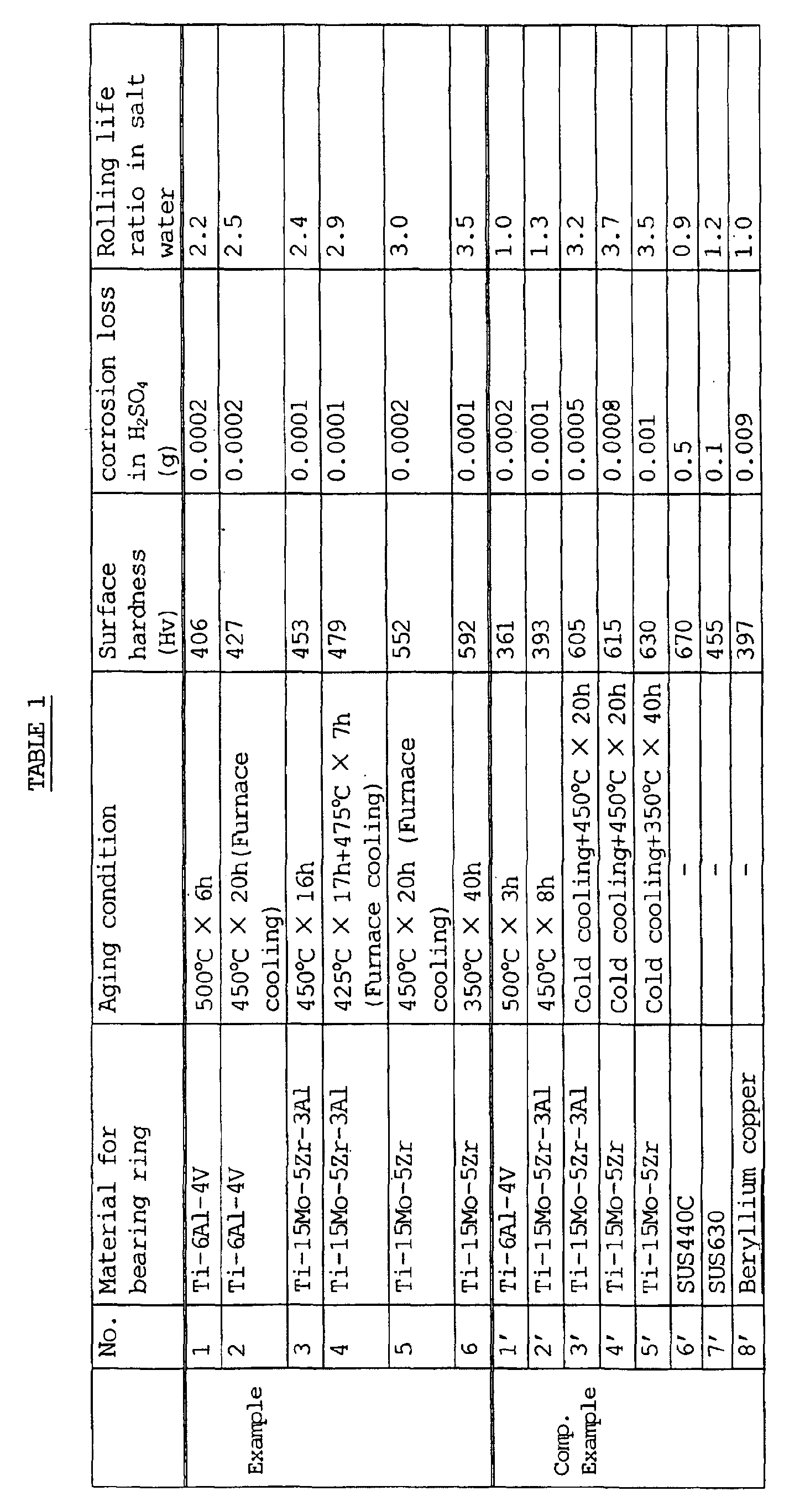
Then, rolling bearings for use in the test were
manufactured with the materials shown in Table 1 and the
following rolling life test was conducted in an aqueous NaCl
solution at 5% by weight concentration for each of the
manufactured test bearings. That is, as shown in Fig. 2,
after setting a test bearing 10 to a rotational shaft 13 of a
tester, an axial load of about 19.6 N and an axial load of
about 49 N were loaded by a spring 14 and a wire 15 and, in
this state, the rotational shaft 13 was rotated at a speed of
about 1000 rpm by a motor 12. Then, after rotating the inner
ring of the test bearing by a predetermined number of cycles,
the wearing amount on the rolling surface was measured.
Table 1 shows the test result in the corrosion
resistance test (decrease in the weight) and Fig. 3 shows a
relation between the test result of the corrosion resistance
test and the surface hardness of titanium alloys.
As can be seen from Table 1 and Fig. 3, Nos. 1 - 6
corresponding to the examples of the present invention show
smaller values for the reduction of weight in the sulfuric
acid solution compared with Nos. 6' to 8' as the comparative
examples. This is because the bearing rings of Nos. 6' to 8'
are formed of stainless steel or beryllium copper, whereas
bearing rings of Nos. 1 to 6 are formed of a titanium alloys.
Further, Nos. 1 to 6 corresponding to the examples of
the present invention show smaller values for the reduction
of weight in the sulfuric acid solution compared with Nos. 3'
to 5' as the comparative examples. This is because the
surface hardness of the bearing rings made of titanium alloys
is Hv 600 or more in Nos. 3' to 5', whereas the surface
hardness of the bearings rings made of the titanium alloy is
less than Hv 600 in Nos. 1 to 6.
Then, Table 1 shows the test result of the rolling
life test (rolling life ratio) and Fig. 4 shows a relation
between the test result of the rolling life test and the
surface hardness of the rolling bearing made of the titanium
alloy. The rolling life ratios in Table 1 and Fig. 4 are
comparative values in a case of evaluation based on the
rolling life of No. 1' being assumed as 1.
As can be seen from Table 1 and Fig. 4, Nos. 1 to 6
corresponding to the examples of the. present invention show.
larger values for rolling life ratio in salt water compared
with Nos. 1' and 2' as the comparative examples. This is
because the surface hardness of the bearing rings made of the
titanium alloy is less than Hv 400 in Nos. 1' to 2', whereas
the surface hardness of the bearing rings of the titanium
alloy is Hv 400 or more in Nos. 1 to 6.
From the foregoings, it can be seen that rolling
bearings that can be used suitably for a long period of time
even under such a circumstance where corrosion resistance is
required against corrosive fluids such as saline or sulfuric
acid can be obtained by making the bearing ring of the
rolling bearing of the titanium alloy and setting the surface
hardness for the bearing ring material to less than Hv 600
and Hv 400 or more.
Rolling bearings for use in test were manufactured
with materials shown in Table 2A and Table 2B, and the
following test for measuring the change of magnetic flux
density was conducted to each of the manufactured test
bearings. That is, as shown in Fig. 5, after attaching a
test bearing 10 to a rotational shaft 13 rotated in an
magnetic field of a permanent magnet 16, the rotational shaft
13 was rotated at a speed of about 500 rpm and the change of
the magnetic flux density was measured by a tesla meter 17.
Then, those showing the maximum output of the tesla meter 17
(refer to Fig. 6) of 0.1 mT or more were evaluated as with
change of the magnetic flux density, whereas those showing
the maximum output of less than 0.1 mT were evaluated as with
no change of the magnetic flux density.
Table 2A shows the test result for the test of
measuring the change of magnetic flux density while Table 2B
shows the magnetic permeability of materials shown in Table
2A.
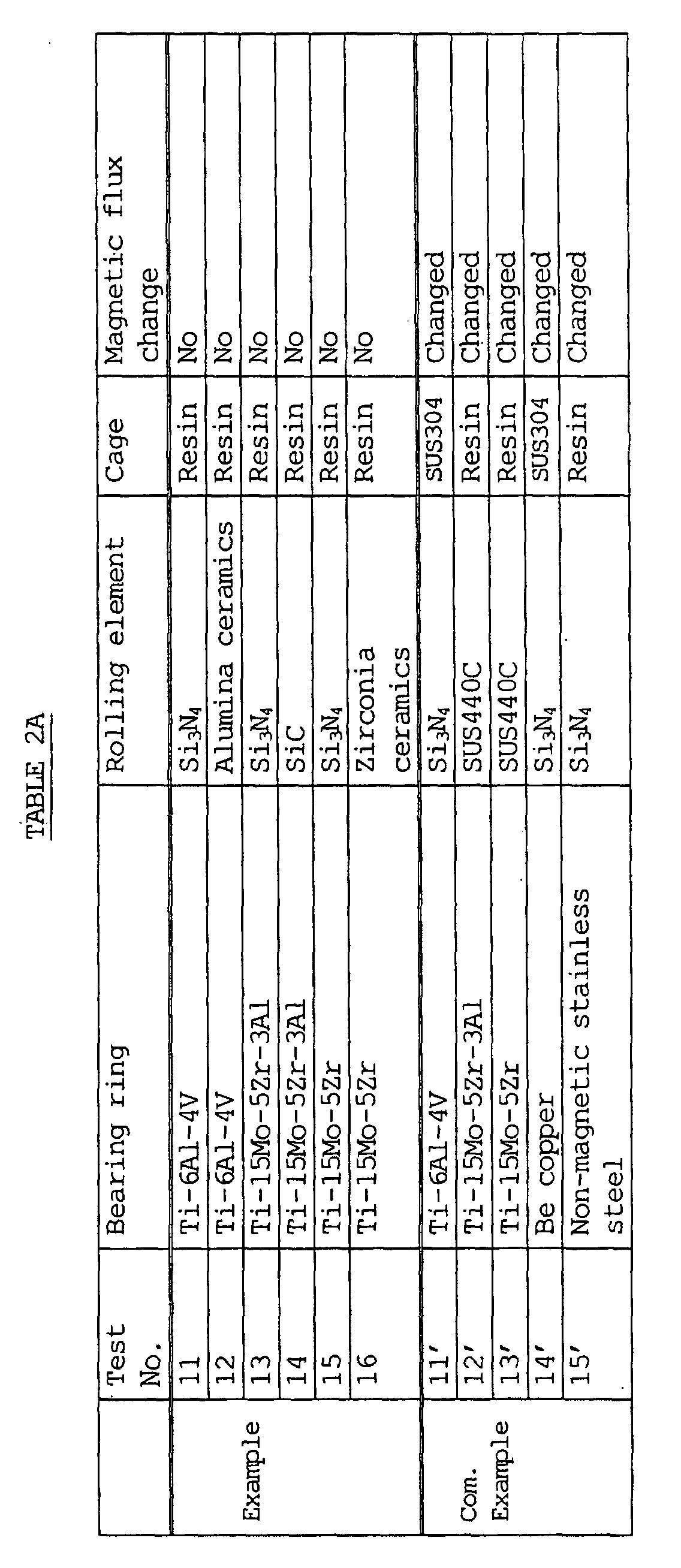
| Material | Permeability | |
| Bearing ring | Ti-6Al-4V | 1.001 or less |
| Ti-15Mo-5Zr-3Al | 1.001 or less | |
| Ti-15Mo-5Zr | 1.001 or less | |
| Be copper | 1.001 or less | |
| Non-magnetic stainless steel | More than 1.001 | |
| Rolling element | Si3N4 | 1.001 or less |
| SiC | 1.001 or less | |
| Zirconia ceramics | 1.001 or less | |
| Alumina ceramics | 1.001 or less | |
| SUS440C | More than 1.001 | |
| Cage | Resin | 1.001 or less |
| SUS304 | More than 1.001 |
As can be seen from the test result of Table 2A, Nos.
1 to 6 corresponding to the examples of the present
invention show less change of magnetic flux density compared
with Nos. 11' and 14' as the comparative example. This is
because the cage is formed of SUS 304 in Nos. 11' and 14',
whereas the cage of is formed of a resin in Nos. 1 to 6.
Further, Nos. 1 to 6 corresponding to the examples of
the present invention show less change of magnetic flux
density compared with Nos. 12' and 13' as the comparative
examples. This is because the rolling elements are formed of
SUS 440C in Nos. 12' and 13', whereas the rolling elements
are formed of ceramics such as silicon nitride in Nos. 1 to
6.
Further, Nos. 1 to 6 corresponding to the examples of
the present invention show less change of magnetic flux
density compared with No. 15' as the comparative example.
This is because the bearing ring is formed of the non-magnetic
stainless steel in No. 15', whereas the bearing
rings are formed of the titanium alloy in Nos. 1 to 6.
Accordingly, it can be seen that since the magnetic
flux density of peripheral magnetic fields does not change
greatly by the rotation of the bearing by making the bearing
ring with the titanium alloy, the rolling elements with the
ceramics and the cage with the resin, rolling bearings
favorable for the use under the circumstance where non-magnetic
property is required can be obtained.
Cages were manufactured with materials shown in Table
3, which were incorporated into test bearings where the
bearing ring comprised Ti-15Mo-5Zr-3Al and the rolling
element comprised Si3N4 and a wearing test for the cage was
conducted. Specifically, each of the test bearings was
rotated under the conditions at a rotational speed: 200 rpm,
under a radial load: 49.0 N, axial load: 19.6 N, at a vacuum
degree: 1 x 10⁻⁵ Torr and in lubrication state: non-lubrication.
Then, the weight of the cage before rotation of
the test bearing and the weight of the cage at the instance
the rotation of the test bearing reached 1 x 10⁷ were
measured, and the difference was evaluated as the amount of
wear of the cage.

The bearing rings made of titanium alloys for the test
bearings used were formed of titanium alloys applied with a
solution treatment under the conditions at 800 to 850°C x 1
hr, cooled by water and then applied with a first age
hardening treatment under the conditions at 425°C x 20 hrs
and further applied with a second age hardening treatment
under the conditions at 475°C x 7 hrs for obtaining a surface
hardness of Hv 480 or more.
No. 33 "Echobrass" in Table 3 is a name of commercial
products manufactured by Sanpo Shindo Kogyo Co., Ltd.
Table 4 shows the test result for the cage wear test
(wear ratio). The wear ratios for respective cages in Table
4 are comparative values in a case of evaluation based on
the wear amount of No. 21' being assumed as 1.
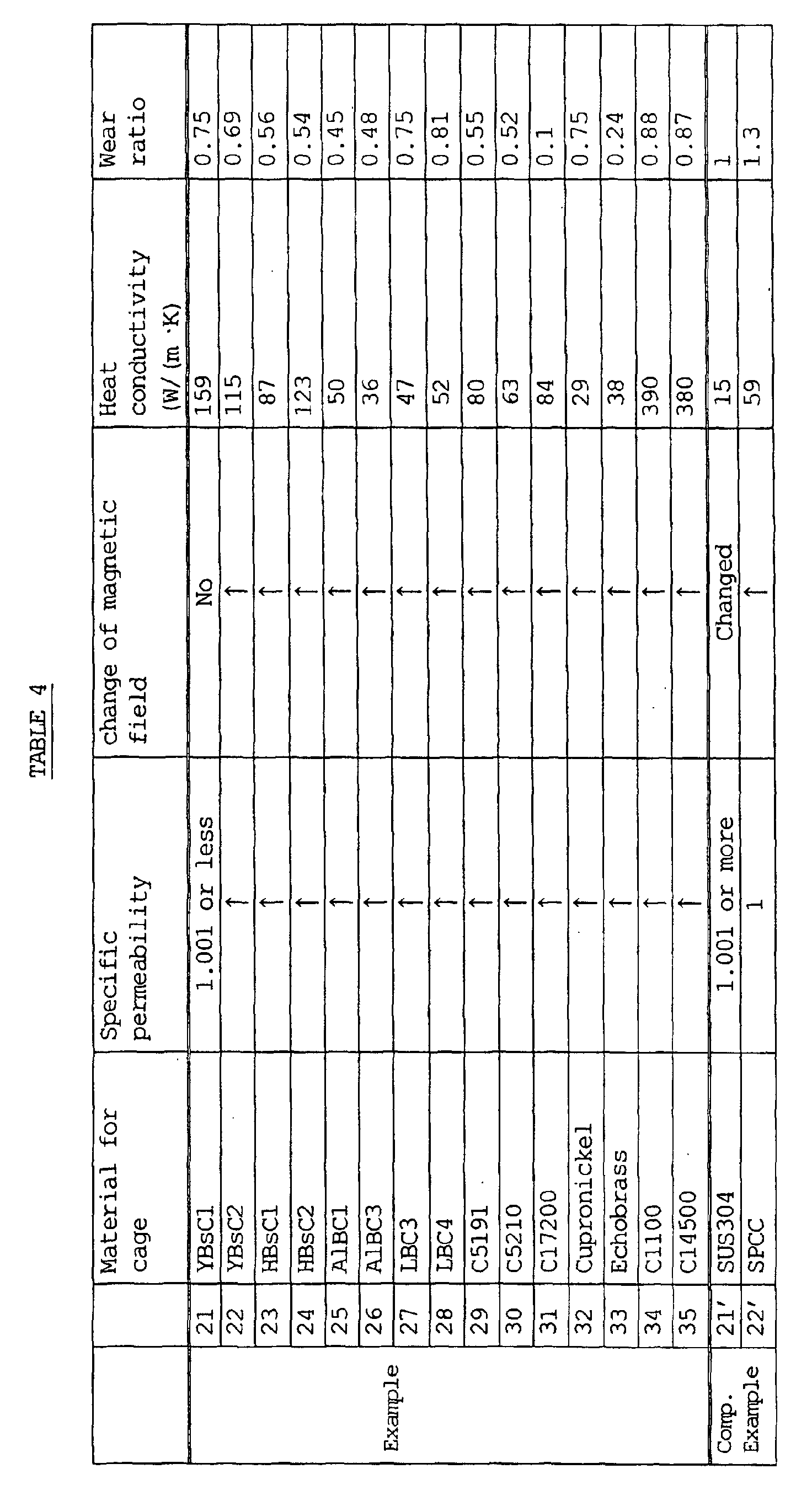
As can be seen from the result of Table 4, Nos. 21-35
corresponding to the examples of the present invention
show smaller values for the wear ratio compared with No. 21'
as the comparative examples. This is because the heat
conductivity of the material for the cage (stainless steel)
is less than 20 W/(m·K) in No. 21', whereas the heat
conductivity of the material for the cage (copper alloy) is
20 W/(m·K) or more in Nos. 21 to 35.
Further, Nos. 21 to 35 corresponding to the examples
of the present invention show less change of magnetic flux
density compared with No. 22' as the comparative example.
This is because the specific permeability of the material
for the cage shows a value exceeding 1.001 in No. 22',
whereas the specific permeability of the material for the
cage shows the value of 1.001 or less in Nos. 21 to 35.
Accordingly, rolling bearings that can be used
favorably even under a circumstance where a lubricant such
as grease can not be use and non-magnetic property is
required can be obtained by increasing the heat conductivity
of the material of the cage to 20 W/(m·K) or more and
lowering the specific permeability of the material for the
cage as 1.001 or less.
Disk-shaped test specimen each of 50 mm diameter were
manufactured with materials shown in Table 5 and wear
evaluation test was conducted to each of the test specimens.
Specifically, as shown in Fig. 7, a load was applied by way
of rolling elements 31 made of silicon nitride to the
surface of a disk-shaped test specimen 33 and a cage 32 made
of brass was rotated at a speed of 1000 rpm while gradually
increasing the load applied to the test specimen 33 in a
range from 20 N to 90 N. Then, the load at the instance the
rotational resistance of the cage 32 reached 0.69 N·m was
evaluated as a seizure load and the maximum wear indentation
depth on the surface of the test specimen was measured
simultaneously. In a case where the rotational resistance of
the cage 32 did not reach 0.69 N·m even when the load
exceeded 98 N, the seizure load at the instance the load
reached at 98 N was evaluated as the rotational resistance
of the cage 32.
Table 5 shows the seizure load and the maximum wear
indentation depth for each of the test specimens obtained by
the wear evaluation test.

As can be seen from the test result in Table 5, the
test specimens made of the titanium alloys of Nos. 36 - 43
show larger seizure load compared with the test specimens
made of the titanium alloys of No. 36' and No. 39'. This is
because an oxide compound layer is not formed on the surface
of the test specimens made of the titanium alloys of Nos.
36' and 39', whereas the oxide compound layer is formed on
the surface of the test specimens made of titanium alloys of
Nos. 36 - 43.
Further, the test specimens made of the titanium
alloys of Nos. 36 - 43 show less rotational resistance of
the cage at the instance the load reaches 98 N compared with
the test specimen made of the titanium alloy of No. 38'
where the load reaches 98 N. This is because the test
specimen made of the titanium alloy of No. 38' does not
contain TiOx (0 < x < 2) in the oxygen compound layer,
whereas the test specimens made of the titanium alloys in
Nos. 36 - 43 contain TiO2 and TiOx in the oxide compound
layer.
Further, the test specimen made of the titanium alloys
of Nos. 36 - 43 show larger seizure load compared with the
test specimens made of the titanium alloys of Nos. 40' and
41'. This is because the test specimens made of the titanium
alloys of Nos. 40' and 41' have a thickness of an oxygen
compound layer of less than 20 nm, whereas the test
specimens made of titanium alloys of Nos. 36 to 43 have a
thickness of the oxygen compound layer of 20 nm or more.
Further, the test specimens made of the titanium
alloys of Nos. 36 - 43 have larger seizure load compared
with the test specimen made of the titanium alloy of No. 37'.
This is because the test specimen made of the titanium alloy
of No. 37' has a thickness of the oxygen compound layer of
110 nm, whereas the test specimens made of the titanium
alloys of Nos. 36 - 43 have an oxygen compound layer with a
thickness of 95 nm or less.
From the foregoings, it can be seen that the wear
resistance of the bearing ring made of the titanium alloy
can be increased by forming the oxide compound layer
containing TiOx to the surface of the bearing ring made of
the titanium alloy. Further, it can be seen that the wear
resistance of the bearing ring made of the titanium alloy
can be increased further by making the thickness of the
oxide compound layer to 20 nm or more and 95 nm or less.
Fig. 8 shows a relation between the thickness of the
oxide compound layer and the maximum wear indentation depth
of the test specimen made of the titanium alloy shown in
Table 5. As shown in the figure, as the thickness of the
oxygen compound layer is 20 nm or more, the maximum wear
indentation depth is about 2 µm or less and as the thickness
of the oxygen compound layer is 50 nm or more, the maximum
wear indentation depth is about 1 µm or less. Accordingly,
the wear resistance of the bearing ring made of the titanium
can be increased further by defining the thickness of the
oxygen compound layer to 20 - 95 nm, preferably, 50 - 95 nm.
Bearing rings were manufactured with materials shown
in Table 6, which were incorporated into test bearings in
which the rolling element comprised Si3N4 and the cage
comprised a fluoro resin, and a rolling life test in water
for rolling bearing was conducted under the conditions at
radial load: 98 N, axial load: 20 N, rotational speed: 1000
rpm and in a lubrication state: no lubrication.
Table 6 shows the rolling life for each of the test
bearings obtained by the rolling life test in water. The
rolling life ratios in Table 6 are comparative values in a
case of evaluation based on the rolling life of No. 44'
being assumed as 1.

As can be seen from the test results in Table 6, the
test bearings Nos. 36 - 43 show larger values for the rolling
life ratio compared with the test bearings Nos. 36' and 39'.
This is because the oxide compound layer is not formed on the
surface of the bearing rings made of the titanium alloys in
the test bearings Nos. 36' and 39', whereas the oxide
compound layer is formed on the surface of the bearing rings
made of the titanium alloys in the test bearings Nos. 36 - 43.
Further, the test bearings Nos. 36 - 43 show larger values
for the rolling life ratio compared with the test bearings No.
38'. This is because the oxygen compound layer does not
contain TiOx (0 < x < 2) in the test bearings No. 38',
whereas the oxygen compound layer contains TiOx (0 < x < 2)
in the test bearings Nos. 36 - 43. Further, the test
bearings Nos. 36 - 43 are excellent in the rolling life
compared with the test bearings Nos. 40' and 41'. This is
because the thickness of the oxygen compound layer is less
than 20 nm in the test bearings of Nos. 40' and 41', whereas
the thickness of the oxygen compound layer is 20 nm or more
in the test bearings Nos. 36 - 43.
Fig. 9 shows a relation between the rolling life ratio
for each of the test bearings and the core hardness of the
rolling bearings made of the titanium alloys shown in Table 6.
As shown in the figure, the rolling life of the bearing is
about 2.0 as the comparative value when the core hardness of
the bearing ring made of the titanium alloy is less than Hv
420, whereas the rolling life of the bearing is about 3.5 as
the comparative value when the core hardness of the bearing
ring made of the titanium alloy is Hv 420 or more.
Accordingly, it can be seen that the rolling life of the
rolling bearing can be increased by increasing the core
hardness of the bearing ring made of the titanium alloy to Hv
420 or more.
Then, test specimens were manufactured with materials
shown in Table 7 and a solution treatment and an aging
treatment were applied to the test specimens Nos. 1 - 14
under the conditions shown in the table. Then, using the
test specimens, measurement for the particle diameter of the
ω-phase, Vickers' hardness test, salt spray test and Sawin
type wear test were conducted.

Crystal tissue for the cross section of a test
specimen was observed for dark view images using a test
specimen for transmission type electron microscopic
observation by using a transmission type electron microscope
"JEM-2010" manufactured by Nippon Denshi Co. to measure the
particle diameter for the ω phase. As a result of the
observation, the crystal tissue of the titanium alloy was (β
+ ω) phase or (β + ω + α) in Nos. 1 -10 and 13 and (β + α)
phase in No. 11.
After mirror-polishing the cross section of a test
specimen, it was measured under the conditions at a load of
100 g by a micro Vickers hardness tester while abutting a
presser to the mirror face of the test specimen.
According to "JIS Z2371", and using an aqueous NaCl
solution at 5% by weight concentration at a temperature of
35°C, the appearance of the test specimen after lapse of one
week was observed visually. Those not recognized for the
occurrence of rust was evaluated as having satisfactory
corrosion resistance (○) and those recognized for the
occurrence of rust was evaluated as having poor corrosion
resistance (X) by the observation.
As shown in Fig. 11A and Fig. 11B, a fixed test
specimen 21 comprising various kinds of alloys manufactured
as described above and a rotational test specimen 22
comprising Si3N4 were attached to a Sawin type wear tester
and the rotational test specimen 22 was rotated relative to
the fixed test specimen 21 without lubrication while pressing
the fixed test specimen 21 to the outer circumferential
surface of the rotational test specimen 22 by a weight for
loading and a weight for balancing. The fixed test specimen
21 is sized 19 mm x 19 mm x 3 mm thickness, while the ringshaped
rotational test specimen 22 is sized 45 mm: outer
diameter, 6 mm: thickness and 6 mm: width.
The conditions for the rotation were at a pressing
load of 39.2 N, at a rotational speed of the rotational test
specimen 22 to the fixed test specimen 21 of 2.6 m/s as the
circumferential speed and for a rotational distance of the
rotational test specimen 22 of 400 m. The wear volume of the
test specimen 21 along with rotation was measured and the
ratio when assuming the wear volume of No. 11 as 1 was
calculated as "wear ratio" for each of the specimens.
Table 8 shows the test results.
| No. | ω phase particle diameter | Hardness (Hv) | Wear | Corrosion resistance | |
| 1 | 1 µm or less | 492 | 0.72 | ○ | |
| 2 | 1 µm or less | 514 | 0.64 | ○ | |
| 3 | 1 µm or less | 520 | 0.68 | ○ | |
| 4 | 1 µm or less | 510 | 0.72 | ○ | |
| 5 | 1 µm or less | 493 | 0.69 | ○ | |
| 6 | 1 µm or less | 491 | 0.65 | ○ | |
| 7 | 1 µm or less | 530 | 0.61 | ○ | |
| 8 | 1 µm or less | 528 | 0.60 | ○ | |
| 9 | 1 µm or less | 501 | 0.72 | ○ | |
| 10 | 1 µm or less | 492 | 0.68 | ○ | |
| 11 | No ω phase | 453 | 1.0 | ○ | |
| 12 | 1 µ over | 430 | 1.4 | ○ | |
| 13 | 10 nm or less | 480 | 0.88 | ○ | |
| 14 | - | 690 | 0.1 | × | |
| 15 | - | 421 | 2.3 | ○ |
As can be seen from the test result of Table 8, Nos. 1
to 10 and No. 13 corresponding to the examples of the present
invention are more excellent in the wear resistance and
favorable in the corrosion resistance by the use of a
titanium alloy of a crystal tissue having the ω phase with
the particle diameter of 1 µm or less, compared with a case
of using a titanium alloy of a crystal tissue not having ω
phase (No. 11), a case in which the particle diameter of the
ω phase exceeds 1 µm (No. 12) and a case of using the Be-Cu
alloy (No. 15). In a case of using stainless steel (No. 14),
the hardness and the wear resistance were favorable but the
corrosion resistance in salt water was poor.
In No. 5, the temperature for the aging treatment is
475°C, which is higher than the ω phase precipitation
temperature and it is considered that the ω phase
precipitated in a temperature region from 300 to 450°C during
cooling to form a (β + ω + α) phase since the cooling rate
after the aging treatment was lowered by gradual cooling in
the furnace.
In Nos. 7 and 8, since a great amount of plastic
strains are introduced by cold rolling into the titanium
alloy, a number of nuclei of the ω-phase are formed during
gradual cooling to increase the existent ratio of the ω-phase
in the titanium alloy (volume ratio) compared with the case
of not applying cold rolling (No. 5). Thus, the hardness was
increased and the wear resistance was also preferred
particularly.
In No. 13, since the particle diameter of the ω phase
was relatively small as 10 nm or less, the hardness and the
wear resistance were somewhat inferior to those of Nos. 1 to
10, but it was within a range that is usable as bearing rings
or rolling elements of rolling bearings.
From the foregoings, in the rolling bearing comprising
the inner ring (raceway member) 2, the outer ring, (raceway
member) 1, the rolling elements 3 and the cage 4, the inner
ring 2 and the outer ring 1 comprising the titanium alloy of
the crystal tissue having the ω phase with a particle
diameter of 1 µm or less are obtained by manufacturing the
inner ring 2 and the outer ring 1 in the same manner as for
test specimens of Nos. 1 to 10 and 13. Then, by the
combination of the inner ring 2 and the outer ring 1 with the
rolling elements 3, for example, made of ceramics such as
Si3N4 and, optionally, the cage 4, for example, made of
plastics, a rolling bearing suitable to use in a corrosive
circumstance or a circumstance requiring non-magnetic
property can be obtained.
Fig. 12 is a cross sectional view of a deep groove
ball bearing (bearing number: 608) as another embodiment of
the present invention. In the drawing, the outer ring 1 and
the inner ring 2 are formed of α+β type titanium alloy such
as Ti-6Al 4V or α+β type titanium alloy such as Ti-15Mo-5Zr-3Al,
Ti-15Mo-5Zr-3Al and the like. The rolling element 3
disposed between the outer ring 1 and the inner ring 2 is
formed of ceramics such as silicon nitride, silicon carbide,
zirconia and alumina. A hard film 6 is formed to the raceway
surface of the bearing rings 1 and 2 along which the rolling
elements 3 roll. The hard film comprises, for example, TiN,
CrN, TiAlN or diamond-like carbon and a lubricating film 7
comprising a fluoro-containing a molybdenum disulfide,
tungsten sulfide or fluoro-containing polymer having
functional groups is formed on the surface of the hard film 6.
The titanium alloy is applied with a hardening
treatment by a first or second method after machining into a
predetermined shape for obtaining a hardness of Hv 350 or
more by Vickers hardness.
The first method is a method of applying a solution
treatment and an aging treatment to the titanium alloy to
obtain a hardness of Hv 350 or more and the second method is
a method of applying a gas nitridation treatment to the
titanium alloy to obtain a hardness of Hv 350 or more.
In the first method, in a case where the titanium
alloy is Ti-6Al-4V, the titanium alloy is placed in a
temperature atmosphere at 950 to 1000°C for one hour and,
subsequently, the titanium alloy is water cooled to apply a
solution treatment. Further, in a case where the titanium
alloy is Ti-15Mo-5Zr-3Al or Ti-15Mo-5Zr-3Al, the titanium
alloy is placed in a temperature atmosphere from 800 to 850°C
for about one hour and, subsequently, the titanium alloy is
water cooled to apply a solution treatment.
In a case of precipitating the α phase of high
hardness from the β phase of the titanium alloy, after the
solution treatment, the titanium alloy is placed in a
temperature atmosphere of 300 to 500°C for about 3 to 40
hours to apply an aging treatment to the titanium alloy. The
hardness of the titanium alloy is adjusted by controlling the
time for the aging treatment. Cooling of the titanium alloy
by the aging treatment is usually conducted by air cooling
and for making the hardness of the titanium alloy harder, it
is desirable to gradually cool the titanium alloy in the
furnace in order to more finely precipitate the α phase from
the β phase.
In a case of obtaining a hardness of Hv 350 or more by
the second method, The titanium alloy is heated in a furnace
under vacuum at a temperature lower than the transformation
point in order to prevent oxidation on the surface of the
titanium alloy. In this case, when the pressure in the
furnace, exceeds 0.133 Pa, residual oxygen in the furnace and
titanium react chemically to form an oxide layer on the
surface of the titanium alloy that hinders the nitridation
treatment. Accordingly, in a case of obtaining a hardness of
Hv 350 or more by the nitridation treatment of the titanium
alloy, the pressure in the furnace is lowered to 0.133 Pa or
less as shown in Fig. 13.
When the nitridation treatment temperature for the
titanium alloy is high, reactivity between titanium and
nitrogen is favorable. The diffusion rate of nitrogen
intruding into the titanium alloy increases therealong and,
as a result, a nitrogen diffusion layer is formed to the
surface of layer of the titanium alloy. However, when the
nitridation treatment temperature is higher than the
transformation point (temperature from α phase to β phase) or
higher, crystal grains grow abruptly to give undesired
effects on the fatigue strength of the bearing ring.
Accordingly, when the titanium alloy is nitrided with a
treating gas such as a nitrogen gas or NH3, the nitridation
treatment temperature is controlled to a temperature lower by
about 5 to 200°C than the transformation point.
In a case of nitriding the titanium alloy with a
treating gas such as a nitrogen gas or NH3, when the pressure
of the treating gas is excessively high, nitridation on the
surface of the titanium alloy proceeds rapidly to make the
nitride layer formed on the surface of the titanium alloy
coarse and brittle. In order to avoid this, it is desirable
to control the gas pressure in the furnace to 1333 Pa or less.
Further, also during cooling, it is desirable to conduct
cooling in the furnace while keeping a predetermined gas
pressure in order to prevent oxidation.
Then, a method of forming the hard film 6 to the
raceway surface of the outer ring 1 and the inner ring 2 is
to be explained.
The hard film 6 was formed by using a film deposition
treatment apparatus utilizing an arc vapor deposition method
(refer to Fig. 14). Specifically, a test bearing was placed
on a turn table 42 having a rotational shaft 47. Then, the
inside of a vacuum vessel 41 was evacuated by a vacuum pump
46 to condition the pressure to 1 × 10⁴ Pa or less, under
which DC bias was applied to a pair of cathodes 43 and 43
while introducing an Ar gas from a gas introduction port 44
to apply ion bombarding by Ar and apply cleaning for a work
48 (outer ring 1 and inner ring 2).
Then, the temperature of the work 48 was elevated to
400 to 500°C and a Ti material in a case of forming a Ti
series hard film 6 or a Cr material in a case of forming a Cr
film hard film 6 are attached, respectively, to targets 49
and 50. Then, while rotating the turn table 42, a bias at
-200 to -300 V, 80 to 150 A was applied to the targets 49 and
50.
Further, a nitrogen gas was introduced as a treating
gas in a case of forming the nitride type hard film 6 or a
methane gas (CH4) was introduced as a treating gas in a case
of forming the carbide type film 6 from the gas introduction
port 45 and an identical DC bias was applied to the targets
49 and 50 while rotating the turn table 42.
By the procedures described above, the hard film 6
could be formed at least on the entire inner circumferential
surface of the outer ring 1 and at least on the entire outer
circumferential surface of the inner ring 2. The thickness
of the hard film 6 was controlled by the treatment time. For
those applied with the gas nitridation treatment, the
nitrogen compound layer formed on the surface by the gas
nitridation treatment was removed by finish polishing to
expose the nitrogen diffusion layer to condition the surface
hardness to Hv 550 or more, and a hard film 6 was formed to
the upper layer thereof.
The method of forming the hard film 6 is not
restricted to the method as described above but, for example,
an HCD ion plating method, sputtering method, plasma CVD
method or the like may be adopted.
Then, the result of evaluation for the peeling life of
the hard film is to be explained. Bearings used were thrust
ball bearings manufactured by the same method as described
above (bearing No.: 51305).
As shown in Fig. 15, a thrust ball bearing 12
comprising an outer ring 1, an inner ring 2, rolling elements
3 and a cage 4 was attached to a rotational shaft 51 of a
thrust life testing machine and a rotation test was conducted
in a state of filling a lubricant in a housing 53 under the
conditions at a load of 9800 N, a rotational speed of 1000
rpm, using brass as the material of the cage, silicone
nitride as the material of roiling element and #68 turbine
oil (68 cSt/40°C) as the lubricant.
Table 9 shows the surface hardness Hv for the base
material of the outer ring 1 and the inner ring 2, the kind
of the hard film and the result of peeling life, respectively.
| No. | Type of base material hardening | Hardness of base material surface | Hard film | Peeling life ratio | |
| Example | 1 | 450 | | 33 | |
| 2 | 500 | | 52 | ||
| 3 | 500 | TiAlN | 78 | ||
| 4 | 500 | SiC+ | 45 | ||
| 5 | 603 | TiN | 85 | ||
| 6 | 889 | TiN | 83 | ||
| 7 | 889 | TiAlN | 132 | ||
| 8 | 889 | SiC+DLC | 111 | ||
| 9 | 376 | TiN | 10.5 | ||
| 10 | 376 | TiAlN | 13.2 | ||
| 11 | 350 | TiN | 8.5 | ||
| 12 | 350 | TiAlN | 10.1 | ||
| Comp. Example | 3' | None | 290 | | 1 |
| 4' | 290 | TiAlN | 1.8 |
The base material for the outer ring 1 and the inner
ring 2 in Table 9 is β type titanium alloy: Ti-15Mo-5Zr-3Al.
For the judgment of the peeling life, the instance at which a
vibration level detected by an acceleration pick up reached
five times the initial value was defined as the life. Then,
it is indicated as a comparative value based on the life of a
raw material (base material not applied with hardening
treatment) covered with a hard film comprising TiN (No. 1' in
Table 9) being assumed as 1.
Fig. 16 shows a relation between the surface hardness
Hv of the base material and the peeling life of the hard film
is shown. As can be seen from Fig. 16, when the surface
hardness of the base material is Hv 350 or more, the peeling
life of the hard film is improved and it was further improved
at Hv 450 or more.
As can be seen from Table 9 and Fig. 16, Nos 1 to 12
corresponding to the examples of the present invention show
larger values for the peeling life ratio of the hard film
compared with No. 3' and No. 4' as the comparative examples.
This is because the surface hardness of the raceway surface
formed with the hard film is Hv 290 or less in the bearings
No. 3' and No. 4', whereas the surface hardness of the
raceway surface formed with the hard film is Hv 350 or more
in the bearings Nos. 1 to 12.
Comparing Nos. 1 to 4 with Nos. 9 to 12 shown in Table
9, it can be seen that the peeling life ratio of Nos. 1 to 4
shows larger values than the peeling life ratio of Nos. 9 to
12. This is because the surface hardness of the raceway
surface is Hv 376 or less in the bearings Nos. 9 to 12,
whereas the surface hardness of the raceway surface is Hv 450
or more in the bearings Nos. 1 to 4.
Accordingly, durability of the hard film can be
improved and early peeling or the like of the hard film can
be prevented by increasing the surface hardness of the
raceway surface formed with the hard film to Hv 350 or more
preferably, Hv 450 or more.
Then, the result for the evaluation of the durability
of rolling bearing in a vacuum atmosphere is to be explained.
The bearing used is a deep groove ball bearing manufactured
by the same method as described above (bearing number: 608,
inner diameter 8 mm × outer diameter 22 mm × width 7 mm).
A deep groove ball bearing having an outer ring 1, an
inner ring 2 and rolling elements 3 was attached in a bearing
housing 62 in a vacuum chamber 61 of a vacuum duration test
apparatus (refer to Fig. 17) and duration test under vacuum
atmosphere was conducted. Rotation of a motor 63 is
introduced by way of a magnetic seal unit 64 to the test
bearing 10. Further, the axial load is applied by a coil
spring 65 to the test bearing 10 and the rotational torque of
the test bearing 10 is measured by a leaf spring appended
with a not illustrated strain gage. Further, inside of the
vacuum chamber 61 is evacuated by a not illustrated turbo
molecular pump and an ion pump.
The test conditions in this case are as shown below;
| Axial load | 49 |
| Rotational speed | |
| 1000 | |
| Vacuum degree | |
| 10-5 Pa or less |
Table 10 shows the kind of the base material for the
outer ring 1 and the inner ring 2, the type of the hardening
treatment applied to the base material, the surface hardness
Hv of the base material, the kind of the hard film 6, the
kind of the lubricating film 7, the material for the rolling
element 3 and the life (result of vacuum duration test),
respectively. "DFO" in the column for the kind of the
lubricating film means a fluoro-containing polymer having
functional groups. Further, the life was indicated by a
relative value based on the life of a raw material (base
material not applied with hardening treatment) covered with a
hard film comprising TiN (No. 3' in Table 10) being assumed
as 1.
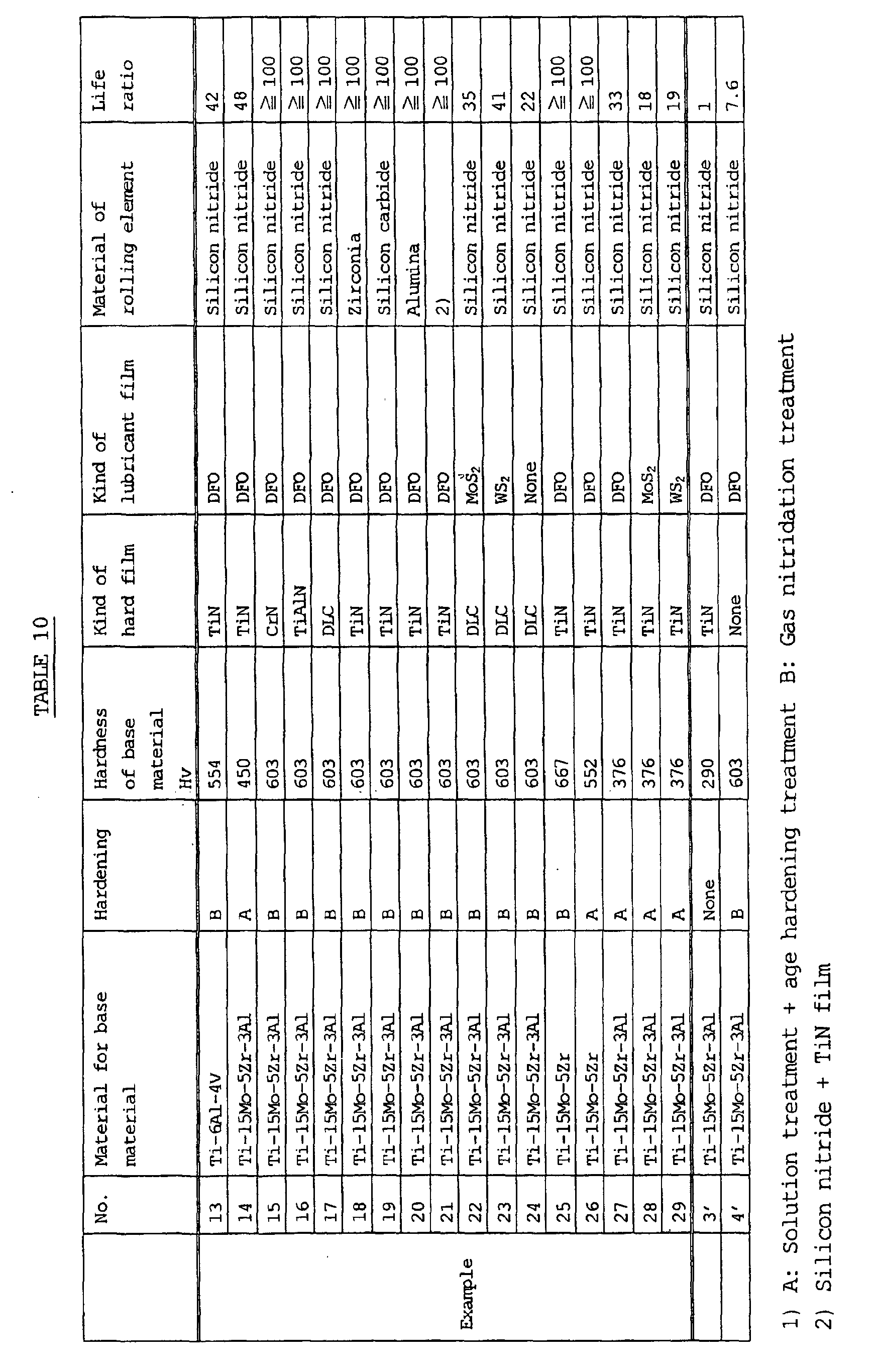
As can be seen from Table 10, Nos. 13 to 29
corresponding to the examples of the present invention
show larger values for the life ratio compared with No. 3'
as the comparative example. This is because the surface
hardness of the raceway surface is Hv 290 or less in
bearing No. 3', whereas the surface hardness is Hv 350 or
more for the raceway surface in bearings Nos. 13 to 29.
Further, Nos. 13 to 29 corresponding to the examples of
the present invention show larger values for the life
ratio in vacuum compared with No. 4' as the comparative
example. This is because a lubricating film is formed
directly on the raceway surface of a bearing ring made of
the titanium alloy in bearing No. 4', whereas the
lubricating film is formed on the surface of the hard
film formed on the raceway surface in the bearing Nos. 13
to 29.
Accordingly, it can be seen that a rolling bearing
that can be used favorably for a long period of time even
under a vacuum atmosphere where a lubricant such as
grease can not be used can be obtained by forming the
hard film on the raceway surface of the bearing ring made
of the titanium alloy and forming the lubricant film on
the surface of the hard film.
As the base material, Ti-6Al-4V of α + β type
titanium alloy and Ti-15Mo-5Zr-3Al and Ti-15Mo-5Zr of β
type titanium alloy are used, but the kind of the
titanium alloys is not restricted to those described
above and other kinds of titanium alloys may also be used
so long as the surface hardness of the base material can
be Hv 350 or more, preferably, Hv 450 or more.
Table 11 shows the conditions for the solution
treatment and the conditions for the aging treatment for
the bearing rings made of titanium alloys.
| Symbol | Material for bearing ring | Solution treatment condition | Aging treatment condition |
| A | Ti-15Mo-5Zr-3Al | 730 - 850°C × | 450°C × 20Hr |
| B | ↑ | 800 - 850°C × | 450°C × 20Hr 475°C × 10Hr |
| C | Ti-15Mo-5Zr | 730 - 850°C × | 400°C × 90Hr |
| D | ↑ | 730 - 850°C × | 450°C × 20Hr |
| E | Ti-15V-3Cr-3Sn-3Al | 730 - 850°C × | 450°C × 20Hr |
| F | Ti-22V-4Al | 730 - 850°C × | 450°C × 20Hr |
| G | Ti-6Al- | 900°C × 1Hr | 540°C × 10Hr |
Test bearings were manufactured by using bearing
rings made of titanium alloys shown in Table 11 and
rolling elements made of materials shown in Table 12 and
a wear resistance test was conducted for each of the test
bearings under vacuum. Specifically, the rotation test
was conducted in vacuum for each of the test bearings
under the conditions at an axial load of 19.6 N and at a
rotational speed of 1000 rpm and in a lubrication state
of no lubrication, and the amount of wear in each of the
bearing rings after 1 × 10⁷ rotation was calculated as
[wear ratio] based on the ratio defining the amount of
wear in No. 1' being assumed as 1.
Table 12 shows the test result of the vacuum
rotation test.

The wear ratio for each of the bearing rings shown
in Table 12 is a comparative value in a case of
evaluation based on the wear amount of No. 1' being
assumed as 1.
As can be seen from the test result of Table 12,
Nos. 1 to 12 corresponding to the examples of the present
invention show larger values for the life ratio compared
with No. 1' as the comparative example. This is because
the material for the rolling element of the rolling
bearing No. 1' is SiN4, whereas the material for the
rolling element of the rolling bearings Nos. 1 to 12 is
superhard alloy or cermet.
Further, the bearings Nos. 1 to 12 show larger
values for the life ratio compared with No. 2' and No. 3'
as the comparative examples. This is because the heat
conductivity of the superhard alloy or cermet of the
bearings No. 2' and No. 3' is 31 W/(m·K) or less, whereas
the heat conductivity of the superhard alloy or cermet of
the rolling bearings Nos. 1 to 12 is 35 W/(m·K) or more.
Accordingly, it can be seen that rolling bearings
that can be used favorably for a long period of time even
under a vacuum atmosphere can be obtained by forming the
rolling element of the superhard alloy or cermet and
increasing the heat conductivity of the superhard alloy
or cermet to 35 W/(m·K) or more.
Fig. 18 shows a relation between the wear ratio
shown in Table 12 and the heat conductivity of the
superhard alloy or cermet. As shown in the figure, the
wear ratio of the bearing ring made of the titanium alloy
increases as the heat conductivity of the superhard alloy
or cermet is higher till the heat conductivity reaches 50
W/(m·K), but the wear ratio of the bearing ring made of
titanium does not increase so much even when the heat
conductivity of the superhard alloy or the cermet
increase when the heat conductivity exceeds 50 W/ (m·K).
From the foregoings, it is desirable to set the
heat conductivity of the superhard alloy or cermet within
a range from 30 to 50 W/(m·K) in a case of forming the
rolling element of the superhard alloy or cermet.
Rolling bearings for test were manufactured with
the materials shown in Table 13 and the following salt
water rolling test and a magnetic flux density change
measuring test were conducted to each of the thus
manufactured test bearings. In Table 13, the materials A,
B, C and G for the bearing rings are materials shown in
Table 11 and NR8 is WC-Ni series superhard alloy, NR 11
is WC-Ni-Cr series superhard alloy and DUX 30 is TiC-TaN-Ni-Mo
series cermet as the material for the rolling
element.

Using the test apparatus shown in Fig. 2, a rolling
life test in an aqueous NaCl solution at 5 wt%
concentration was conducted for each of test bearings to
examine the wear ratio and presence or absence of rusting
in each of bearing rings. The test conditions in this
case are as shown below;
| Radial Load | 49.2 N |
| Axial load | 19.2 |
| Rotational speed | |
| 1000 rpm | |
| Lubrication | no lubrication |
As shown in Fig. 5, after attaching a test bearing
10 to a rotational shaft 13 rotated in a magnetic field
of a permanent magnet 16, the rotational shaft 13 was
rotated at a speed of about 500 rpm and the change of the
magnetic flux density was measured by a tesla meter 17.
Then, those showing the output of the tesla meter of 0.1
Mt or more at the maximum were defined as with change of
the magnetic flux density and those showing less than 0.1
Mt were defined as with no change of the magnetic flux
density. Table 13 shows the test result. As can be seen
from the test result in the table, Nos. 1 to 26
corresponding to the examples of the present invention
showed excellent wear resistance even under corrosive
circumstance in salt water and of course no rusting was
observed. Further, since there was no change of the
magnetic flux density at all, it was confirmed that they
were excellent also in view of non-magnetic property.
Since the superhard alloy or cermet has high
hardness (Hv 900 or more) and high melting point
corresponding to ceramics, they cause less adhesion or
wear even if the lubricating condition is stringent.
Further, since they have high hardness, the amount of
plastic deformation during working is very small and a
small degree of unevenness is less caused. Therefore,
rolling elements at an extremely high accuracy can be
manufactured. Further, with respect to the toughness,
since it is higher than that of ceramics, cracking or
chipping is less caused during manufacture and they are
less fractured against impact load.
By the use of the superhard alloy or cermet having
the heat conductivity of 35 W/(m·K) or more as the
material for the rolling element, the amount of heat
generation at the face of contact between the bearing
ring and the rolling element can be suppressed to
suppress the adhesive wear of the bearing ring made of
titanium alloy. Further, since the superhard alloy or
cermet has a larger Young' modulus compared with ceramics,
the area of contact between the rolling element and the
bearing ring is reduced, so that the rotational torque
can be suppressed to stabilize the rotational
characteristics.
The superhard alloy and the cermet are alloys
formed of nine kinds of metals belonging to the group IVa,
the group Va and the group VIa of the periodical table,
namely, W, Mo, Cr, Ta, Nb, V, Hf, Zr and Ti as targets by
sinter bonding the powder of such carbides by using iron
group metals such as Fe, Co and Ni. The cermets are
sintered alloys formed by bonding mainly TiC, TiN or TiCN,
among them, with Ni.
The superhard alloys when classified in accordance
with alloy systems, include, for example, WC-Co series,
WC-Cr3C2-Co system, WC-TaC-Co system, WC-TiC-Co series,
WC-NbC-Co system, WC-TaC-NbC-Co series, WC-TiC-TaC-NbC-Co
series, WC-TiC-TaC-Co series, WC-ZrC-Co series, WC-TiC-ZrC-Co
series, WC-TaC-VC-Co series, WC-Cr3C2-Co series and
WC-TiC-Cr3C2-Co series. Those improved with the corrosion
resistance include, for example, WC-Ni series, WC-Co-Ni
series, WC-Cr3C2-Mo2C-Ni series, WC-Ti(C,N)-TaC series,
WC-Ti(C,N) series and Cr3C2-Ni series.
A typical composition for the WC-Co series
comprises W:Co:C = 70.41-91:06: 3.0 - 25.0 : 4.59 - 5.94.
A typical composition of WC-TaC-NbC-Co series comprises
W:Co:Ta:Nb:C = 65.7 - 86.3: 5.8 - 25.0 : 1.4 - 3.1: 0.3-1.5
: 4.7 - 5.8. A typical composition of the WC-TiC-TaC-NbC-Co
series comprises W:Co:Ta:Ti:Nb:C = 65.0 - 75.3- :
6.0 - 10.7 : 5.2 - 7.2 : 3.2 - 11.0 : 1.6 - 2.4 : 6.2-7.6.
A typical composition for the WC-TaC-Co series
comprises W:Co:Ta:C = 53.51 - 90.30: 3.5 - 25.0 : 0.30-25.33:
4.59 - 5.90. A typical example of the WC-TiC-Co
series comprise W: Co: Ti:C = 57.27- 78.86 : 4.0 - 13.0 :
3.20 - 25.59: 5.88- 10.14. A typical example for the WC-TiC-TaC-Co
comprises W:Co:Ta:Ti:C = 47.38-87.31: 3.0-10.0:
0.94-9.38:0.12-25.59:5.96-10.15.
The cermets include, for example, TiC-Ni series,
TiC-Mo-Ni series, TiC-Co series, TiC-Mo2C-Ni series, TiC-Mo2C-ZrC-Ni
series, TiC-Mo2C-Co series, Mo2C-Ni series
Ti (C, N)-Mo2C-Ni series, TiC-TiN-Mo2C-Ni series, TiC-TiN-Mo2C-Co
series, TiC-TiN-Mo2C-TaC-Ni series, TiC-TiN-Mo2C-WC-TaC-Ni
series, TiC-WC-Ni series, Ti(C,N)-WC-Ni series,
TiC-Mo series, and Ti(C, N)-Mo series. Ti(C,N)-Mo2C-Ni
series, Ti(C,N)-WC-Ni series or Ti(C,N)-Mo series is an
alloy formed by sintering TiC-Mo2C-Ni series, TiC-WC-Ni
series or TiC-Mo series in a nitrogen gas (N2).
The typical composition of the cermet comprises,
for example, TiC-30% Ni, TiC-10% Mo-30% Ni, TiC-20% Mo-30%
Ni, TiC-30% Mo-30% Ni, TiC-11% Mo2C 11% Mo2C-24% Ni,
TiC-30% Mo2C -20% Ni, TiC-19% Mo2C-24% Ni, TiC-8% Mo2C-15%
Ni, Ti(C,N)-25%Mo2C-15%, TiC-14% TiN-19% Mo2C-24% Ni,
TiC0.7N0.3-11% Mo2C-24% Ni, TiC0.7N0.3-19% Mo2C-24% Ni,
TiC0.7N0.3-27% Mo2C-24% Ni, TiC-20%Mo-15%Ni, TiC-30%Mo-15%Ni.
High resistance and non-magnetic property can be
coped with by the change of the ingredient systems of the
superhard alloy or cermet of the rolling element. Further,
in a case of using the rolling bearing according to the
present invention for high speed rotation, it is
desirable to use a cermet of low density as the material
for the rolling element. Further in a case where a large
load is applied or an impact load is given to the rolling
bearing according to the present invention, it is
desirable to use a superhard alloy of higher toughness as
the material of the rolling element.
Rolling bearings for test (inner diameter: 12 mm,
outer diameter: 28 mm, width: 8 mm, roll diameter : 4.76
mm, number of balls; 8) were measured with the materials
shown in Table 14 and the following impact resistance
test and the rolling life test were conducted to each of
the thus manufactured test bearings.

The inner rings and the outer rings shown in Table
14 were obtained by any of the following methods (i) to
(iv).
An impact resistance test was conducted by the
following method. At first, each of the test bearings was
attached to the rotational shaft of an impact
acceleration testing machine. Then, the test bearings
were dropped from various heights in the axial direction
(30 - 100 cm) in a state of attaching the rolling
bearings and applying a preload at 9.6 N and the impact
acceleration upon dropping was measured by an
acceleration gage. The test bearing was rotated before
and after the dropping to measure the axial vibration
acceleration (G value).
After the measurement, the minimum dropping height
at which the difference between the G value after
dropping and the G value before dropping was 5 mG or more
was examined and the impact resistance was judged
according to the impact acceleration at the dropping
height. The impact resistance evaluation value in Table
14 is a comparative value in a case of evaluation based
on the test result for No. 1' (impact acceleration at the
minimum dropping height where the difference of the G
value before and after dropping was 5 mG or more) being
assumed as 1.
While rotating the test bearing under the following
conditions, an aqueous solution of NaCl at 5 wt% solution
was sprayed under the condition of 1 ml on every 1 min to
the rolling bearing. The rotation was conducted while
always measuring the axial vibratory acceleration (G
value) and the corrosion resistant rolling life was
defined as a time to reaching the G value five times as
much as the initial value. The evaluation value for the
corrosion resistance in Table 14 is a comparative value
in a case of evaluation based on the test result for No.
1' (time to reach the G value five times as much as the
initial value) being assumed as 1.
| Radial load | 78N |
| Axial load | 20 |
| Rotational speed | |
| 1000 rpm |
The results are shown together in Table 14.
As can be seen from each of the test results in
Table 14, Nos. 1 to 6 corresponding to the examples of
the present invention showed larger values for both of
the impact resistance and the corrosion resistance
compared with Nos. 1' to 9' as the comparative examples.
For the titanium alloy, β type (also including near
β type) or (α+β) type is preferably used. The hardness of
the titanium alloys can be increased to Hv 400 to more by
precipitation hardening of precipitating fine α phase in
β phase by applying a solution treatment from a
temperature just below or just above the α/β
transformation point to form β phase and then applying an
aging treatment at 350 to 600°C.
For the rolling element, the following
constitution(a) or (b) is preferred;
The chromium diffusion penetration treatment (a)
above is conducted, for example, as described below. At
first, a material to be treated comprising high carbon
chromium bearing steel and a chemical formulated from
powdery chromium (Cr), powdery alumina (Al2O3) and powdery
ammonium chloride (NH4Cl) are tightly sealed in a steel
case and the case is placed in a furnace. Then, the
inside of the furnace is heated to 900 - 1100°C and kept
for a predetermined time while flowing a hydrogen (H2) gas
or argon (Ar) in the casing.
Thus, chemical is reacted in the case to form
vapors of chromium chloride (CrCl2). The chromium
chloride conducts substitution reaction with atoms
forming the surface of the material to be treated by
which chromium diffuses and penetrates to the surface of
the material to be treated. Alternatively, chromium
formed by precipitation of chromium chloride by reduction
with hydrogen diffuses and penetrates to the surface of
the material to be treated. As a result, a chromium
diffusion layer is formed on the surface of the material
to be treated. The chromium diffusion layer has corrosion
resistance and the surface hardness is Hv 1050 to 1100.
Since the hardness of the core is lowered when
applying gradual cooling after the chromium diffusion and
penetration treatment, it is preferred to harden the core
by conducting hardening and tempering after the treatment.
The nitridation treatment (b) is conducted, for
example, as described below. At first, fluoridation
treatment was conducted to the material to be treated
comprising iron and steel material having 3.0% by weight
(preferably, 8.0% by weight or more) of chromium by using,
for example, a nitrogen fluoride (NF3) gas at 200 to 400°C.
Then, a nitridation treatment is conducted by using an
ammonia (NH3) gas at 400 to 500°C. This method is referred
to as an Nv nitridation treatment (registered trade mark
of Air Water Co.).
In this method, an extremely dense and uniform
nitride layer can be formed even when the nitridation
treatment is conducted at a low temperature of 400 to
500°C by applying a fluoridation treatment as the
pretreatment. The nitride layer has corrosion resistance
and a surface hardness of Hv 1230 to 1350. Further, fine
deformations can be prevented from being formed on the
surface of the material to be treated by applying the
nitridation treatment at low temperature. Therefore,
degradation of the dimensional accuracy of the rolling
element by the surface hardening treatment is prevented.
The reason for using the iron and steel material
having 3.0% by weight or more (preferably, from 8.0% by
weight or more) of chromium is that the hardness for the
surface hardening layer is increased to a necessary
hardness for obtaining satisfactory wear resistance. That
is, while the hardness of the surface hardening layer (b)
can be improved by forming fine chromium nitride with
chromium and nitrogen, a hardness required for obtaining
a satisfactory wear resistance can not be obtained when
the chromium content is less than 3.0% by weight.
Further, in order not to cause coarse eutectic
carbides by the Nv nitridation treatment, it is preferred
to use an iron and steel material capable of satisfying:
[C (%)] ≦ -0.05 [Cr(%)] +1.41.
The thickness (depth) of the surface hardening
layer (a) and (b) is preferably a size corresponding to
1.5 to 6% of the diameter for the rolling element and is
100 µm or less.
The Young's modulus of the surface hardening layer
formed by the treatment (a) and (b) is substantially
equal with the Young's modulus of the stainless steel or
the bearing steel as the material to be treated (200-210
GPa), which is lower than the Young's modulus of 250 to
400 GPa of ceramics.
In the rolling bearing according to the present
invention, the area of contact between the rolling
element and the bearing ring is increased to decrease the
contact face pressure compared with the rolling bearing
described in Japanese Published Unexamined Patent
Application Hei 11-223221. Accordingly, the sharing
stress formed between the rolling element and the bearing
ring during rotation is moderated to cause less rolling
fatigue. Further, fine indentations are less caused to
the rolling element and the bearing ring when an impact
load is applied from the outside.
Fig. 19 shows a rolling bearing according to
another embodiment of the present invention. As shown in
the drawing, the rolling bearing of this embodiment
comprises bearing rings 1 and 2 made of titanium alloy,
rolling elements 3 interposed between the bearing rings 1
and 2, and a seal 5 sealed between the bearing rings 1
and 2 for preventing leakage of grease or intrusion of
obstacles.
As the material for the bearing rings 1 and 2, a
titanium alloy with a ratio of the hardness to the Young'
modulus (H/E) of 3.7 or more is used and any of titanium
alloys can be used suitably irrespective of their kinds
so long as the titanium alloy can satisfy : 3.7 ≦ (H/E).
However, it is preferred to use α+β type or β type (also
including near β type) titanium alloys capable of
attaining high hardness by precipitation hardening by
solution treatment and aging treatment. They include, for
example, α+β type titanium alloy: Ti-6Al-4V or β type
titanium alloy : Ti-24V-4Al, Ti-15V-3Cr-3Sn-3Al and Ti-15Mo-5Zr-3Al.
In this case, when the β phase is formed with the
solution treatment and the α phase is precipitated to the
soft β phase by the aging treatment, the hardness at least
from the surface to 2.5% Da (Da; diameter for rolling
element) can be set to Hv 420 or more thereby increasing
(H/E) to 3.7 or more.
Further, for the rolling element 3 as the rolling
element, a rolling element made of iron and steel
material or ceramic material can be used.
However, when the corrosion resistance is required,
it is preferred to use a rolling element made of
stainless steel or ceramic as the rolling element 3. When
reduction weight is required particularly, it is
preferred to use a rolling element made of ceramics such
as silicon nitride series, silicon carbide series,
aluminum oxide series or zirconium oxide series. Further,
in a case where a violent impact is loaded, it is
preferred to use a rolling element made of iron and steel
material constituted with high carbon chromium steel such
as SUJ2, martensitic stainless steel such as SUS 440C, 13
Cr system or high speed steel represented by M50 which
are excellent in toughness and having lower Young's
modulus compared with ceramics.
Further, the grease to be sealed has no particular
restriction and any of greases having a usable
temperature range may be used.
The seal 5 has no particular restriction on the
material and any material can be used so long as it is
within a usable temperature range but a seal made of
rubber such as nitrile rubber that is easily deformed
elastically along with elastic deformation of the bearing
rings 1 and 2 is used preferably.
Then, the operation and the like of the rolling
bearing of the constitution described above are to be
explained.
Since the bearing rings 1 and 2 are bearing rings
made of titanium alloys, they have low Young's modulus and
are easily deformed elastically. Accordingly, when impact
is transmitted, for example, from axles to the bearing,
since the bearing rings locally deform elastically to
play a role of a spring that absorbs impact, impact
transmitted to the machine main body is decreased.
Accordingly, in such an application use as care-aid
instruments such as a wheel chair, sports instruments
such as a roller blade or bicycles in which impacts or
vibrations are directly transmitted from axles to the
instrument main body or user, since the impact or
vibration is moderated by the use of the rolling bearings
according to the present invention, it can be used
suitably.
Further, since the material is made of titanium
alloy and the ratio of the hardness to the Young' modulus
(H/E) is set to 3.7 or more, the indentation resistance
and the rolling life are improved. Accordingly, it can be
used suitably even in a case where impact or vibration is
loaded to the bearing or in a case where there is a worry
that obstacles intrude into the bearings.
Furthermore, when the grease is used as the
lubricant, since the grease functions as a damper for the
vibration or impact, moderation of impact and vibration
and indentation resistance are further improved.
While ball bearings are shown as the example of the
rolling bearing in the embodiments described above, it
may be a roller bearing.
The rolling bearing according to the present
invention was manufactured by the method shown below.
Grease was sealed as a lubricant.
For the bearing ring, one of α+β type titanium
alloy (Ti-6Al-4V) or β type titanium alloy (Ti-15V-3Cr-3Sn-3A1,
Ti-22v-4Al, Ti-15Mo-5Zr-3Al) was used to
manufacture a bearing ring for the rolling bearing of
bearing No. 6001. After machining, solution treatment and
aging treatment were applied and then grinding was
applied.
The solution treatment was conducted by the
following method. That is, for the α+β titanium alloy:
Ti-6Al-4V, the solution treatment was conducted by
keeping at a temperature of 950 to 1000°C for one hour and
then water-cooling. Further, for the β type titanium
alloys: Ti-15V-3Cr-3Sn-3Al, Ti-22V-4Al and Ti-15Mo-5Zr-3Al,
the solution treatment was conducted by keeping at a
temperature of 750 to 850°c for one hour and water-cooling.
For the aging treatment, after keeping at a
temperature of 400°C to 600°C for 6 to 30 hours, cooling
in the furnace was conducted down to 200°C to conduct the
aging treatment.
For the rolling element, a rolling element made of
ceramics such as, silicon nitride series, silicon carbide
series, zirconium oxide series and aluminum oxide series
and a rolling element made of 13% Cr system martensitic
stainless steel were used.
A mineral oil type grease is used for the grease.
Further, nitrile rubber seal was used for the seal 5 and
a case made of polyamide was used for the cage.
Further, as comparative examples, bearing rings
were manufactured with martensitic stainless steel
(SUS440C) and precipitation hardening type stainless
steel (SUS 630). The martensitic stainless steel (SUS
440c) was applied with oil hardening from a temperature
of 900 to 950°C and applied with tempering at 150 to 200°C.
The precipitation hardening type stainless steel (SUS
630) was applied with a solution treatment at a
temperature from 920 - 970°C and applied with an aging
treatment at 450 - 500°C.
For each of the rolling bearings manufactured under
the conditions described above, an indentation resistance
test and a rolling type test were conducted.
For the indentation resistance test, an outer ring
1 made of titanium alloy cut into 1/4 size was used. A
spherical rolling element 3 made of silicon nitride
having a diameter of 4.76 mm was pressed against the
raceway surface of the bearing ring (outer ring 1) cut
into 1/4 and a load at 980N was loaded to the raceway
surface of the bearing ring 1 by way of the rolling
element 3 in this state. Then, the maximum depth of the
indentation formed to the raceway surface at a portion
applied with the load was measured.
Table 15 shows the test results for the indentation
resistance test (indentation depth) and Fig. 20 shows a
relation between the test result of the indentation
resistance test and H/E.

As can be seen from Table 15 and Fig. 20, Nos. 1 to
10 corresponding to the examples of the present invention
show smaller values for the depth of indentations formed
on the raceway surface compared with Nos. 1' to 4' as the
comparative examples. This is because the ratio of the
hardness to the Young's modulus (H/E) of the material for
the bearing ring is 2.4 to 3.6 in the bearings Nos. 1' to
4', whereas the ratio of the hardness to the Young's
modulus (H/E) for the material of the bearing ring is 3.7
or more in Nos. 1 to 10.
A rolling life test was conducted by the following
method. At first, an initial vibration value of the
bearing is measured when the inner ring is rotated under
the conditions at a number of rotation of 500 rpm, a
radial load of 69N and an axial load of 20N. Then, the
rolling bearing is detached from a rolling life testing
machine and the bearing is dropped from 1 m height in a
state of applying a preload of 20 N with the end face of
the rolling bearing being directed to the surface of the
floor. Subsequently, the bearing is again set to the
rolling life testing machine and the vibration value of
the bearing when the inner ring is rotated under the same
conditions as described above is measured. Then, the
instance that the measured value exceeds five times the
initial vibration value was evaluated as the rolling life.
Fig. 15 shows the test result of the rolling life
test (rolling life ratio) and Fig. 21 shows a relation
between the test results of the rolling life test and H/E.
the roiling life ratios in Table 15 and Fig. 21 are
comparative values when evaluation is made based on the
rolling life of No. 4' being assumed as 1.
As can be seen from Table 15 and Fig. 21, Nos. 1 to
10 corresponding to the examples of the present invention
show larger values for the rolling life ratio compared
with Nos. 1' to 4' as the comparative examples. This is
because the ratio of the hardness to the Young's modulus
(H/E) for the material of the bearing ring is 2.4 to 3.6
in the bearings Nos. 1' to 4', whereas the ratio of the
hardness to the Young's- modulus (H/E) for the material of
the bearing ring is 3.7 or more in the bearings Nos. 1 to
10.
Accordingly, it is possible to improve the impact
resistance and the wear resistance of the bearing ring
made of the titanium alloy by increasing H/E of the
bearing ring made of the titanium alloy as: 3.7 ≦ (H/E).
Further, as apparent from the result of the indent
resistance test and the rolling life test as described
above, there is no substantial difference in the effect
between a case where H/E is 3.7 to 4.8 and exceeds 4.8
and since heat treatment or shot peening is required for
increasing the H/E value and the cost is increased by so
much, H/E is preferably within a range from 3.7 to 4.8
for the bearing ring made of the titanium alloy.
Rolling bearings for test were manufactured with
the materials shown in Table 16 and the following rolling
life test was conducted as below for each of the test
bearings. That is, the vibration values were measured
when the inner ring for each of the test bearings was
rotated under the conditions at a radial load of 49N and
a rotational speed of 1000 m-1 and the rolling life of the
bearing was evaluated as an instance that the measured
value reached twice the initial vibration value just
after starting the rotation. In this case, the
circumstantial temperature was changed in accordance with
the pattern shown in Fig. 22.
In a case where the material for the bearing ring
is made of Ti-6Al-4V, a titanium alloy after applied with
a solution treatment at a temperature of 920 to 1000°c and
then applied with an aging treatment at a temperature of
450 to 550°c was used as shown in Table 16. Further, in a
case where the material for the bearing ring was made of
Ti-15Mo-5Zr-3Al, a titanium alloy applied with a solution
treatment at a temperature of 770 to 850°C and then
applied with an aging treatment at a temperature of 400
to 500°C for 10 to 60 hours was used. Further, in a case
where the material of the bearing ring was made of Ti-22V-4Al,
a titanium alloy applied with a solution
treatment at a temperature of 700 to 800°C and then
applied with an aging treatment at a temperature of 400
to 500°C for 5 to 40 hours was used. Cooling in the
solution treatment was conducted by water-cooling and
cooling in the aging treatment was conducted by furnace
cooling.

Table 16 shows the test result of the rolling life
test (rolling life ratio) and Fig. 23 shows a relation
between the test results of the rolling life test and the
linear expansion coefficient ratio α2/α1 (α1: linear
expansion coefficient of the material for the bearing ring,
α2: linear expansion coefficient of the material for the
rolling element). The rolling life ratio in Table 16 and Fig.
23 are comparative values when evaluated based on the rolling
life for No. 1' being assumed as 1.
As can be seen from Table 16 and Fig. 23, Nos. 1 to 8
corresponding to the examples of the present invention show
larger values for the rolling life ratio compared with Nos.
2' and 3' as the comparative examples. This is because the
linear expansion coefficient ratio between the material for
the bearing ring and the material for the rolling element is:
α2/α1 ≧ 1.4 in Nos. 2' and 3', whereas the linear expansion
coefficient ratio between the material for the bearing ring
and the material for the rolling element is: α2/α1 ≦ 1.3 in
Nos. 1 to 8. Further, Nos. 1 to 8 corresponding to the
examples of the present invention show larger values for the
rolling life ratio compared with Nos. 1', 4' to 6' as the
comparative examples. This is because the linear expansion
coefficient ratio between the material for the bearing ring
and the material for the rolling element is: α2/α1 ≦ 0.3 in
Nos. 1' and 4' to 6', whereas the linear expansion
coefficient ratio between the material for the bearing ring
and the material for the rolling element is: α2/α1 ≧ 0.4 in
Nos. 1 to 8.
Accordingly, it can be seen that rolling life of
excellent durability can be obtained even in a circumstance
where circumstantial temperature varies greatly by setting
the linear expansion coefficient ratio between the material
for the bearing ring and the material for the rolling element
as 0.4 ≦ α2/α1 ≦ 1.3. Further, since change for the gap in
the bearing and preload and fitting stress can be moderated
by setting the linear expansion coefficient ratio between the
material for the bearing ring and the material for the
rolling element to 0.4 ≦ α2/α1 ≦ 1.3, the rotational
performance of the bearing is stabilized even when the
circumstantial temperature fluctuates.
Fig. 24 shows a further embodiment of the rolling
bearing according to the present invention. In the drawing,
the rolling bearing comprises an inner ring 2 externally
fitted and secured to the outer circumferential surface of a
shaft to be supported (not illustrated), an outer ring 1
disposed to the outer circumference of the inner ring 2 and
plural spherical rolling elements 3 disposed rotationally
between the outer ring 1 and the inner ring 2 and a cage 4
for holding the spherical rolling elements 3 in an equi-distance
relative to the circumferential direction of the
rolling rings 11 and 12. Shield plates 9 are disposed on
both axial ends of the bearing rings 11 and 12 for closing
the open space formed on both sides of the rolling element 3.
In this embodiment, the inner ring 1 and the outer
ring 1 each comprises a titanium alloy having a hardness of
Hv 420 or more (for example, α + β type titanium alloy, near
β type titanium alloy and β type titanium alloy) with the
specific permeability being 1.001 or less. The rolling
element 3 comprises ceramics such as electroconductive
zirconia or silicon nitride, preferably, electroconductive
ceramics with the specific permeability being 1.001 or less.
The cage 4 is formed, for providing the cage itself
with an electric insulation and self lubricancy, for example,
by adding a solid lubricant such as PTFE, MAC, graphite, N-lauro
· L-lysin, hBN and fluoro mica to a resin material, for
example, fluoro-containing resin, PEEK, PEEK-PBI, PPS, TPI,
PEN, PFA, ETFE, FEP, PCTFE, ECTFE and PVDF.
The shield plate 9 comprises titanium at a purity of
99.5% or higher and the specific permeability of the shield
plate 9 is 1.001 or less. Further, the shield plate 9 is
formed as a ring, and fitting portions 9a that fit detachably
to shield plate holding grooves 1a and 1a formed to the inner
circumferential surface of the outer ring 1 are formed to the
outer circumferential surface of the plate.
As described above, when the inner ring 2 and the
outer ring 1 are formed of the titanium alloy and the rolling
element 3 is formed of ceramics, the specific permeability of
the inner ring 2, the outer ring 1 and the rolling element 3
is 1.001 or less. Thus, since the magnetic flux density at
the periphery of the bearing does not change greatly by the
rotation of the inner ring 2 or the outer ring 1, it can be
used to equipments using electron beams such as wafer
inspection apparatus. Further, when the shield plate 9 is
formed of titanium at a purity of 99.5% or higher, the
specific permeability of the shield plate 9 is 1.001 or less.
Thus, since electron beams irradiated to the rolling element
4 or the cage 4 can be shielded by the shield plate 9, charge
up of the rolling element 3 by the electron beams can be
prevented to prevent occurrence of halation. Further, when
the resin of the cage 4 is formed with a resin, since the
specific permeability of the cage 4 is 1.001 or less, and the
cage 4 is not charged up by electron beams when it is
irradiated by the electron beams, occurrence of halation can
be prevented. Further, since a solid lubricant is added in
the resin constituting the cage 4 to provide the cage 4 with
self-lubricancy, the cage itself functions as a lubricant and
it can be used preferably even in a vacuum atmosphere where
the use of lubricant or grease is difficult.
Rolling bearings for test shown in Table 17 were
manufactured and the following magnetic flux density change
measuring test and the bearing wear test were conducted to
each of the manufactured test bearings. As the titanium
alloy (material for inner and outer rings) shown in Table 17,
those applied with the solution treatment and the aging
treatment under the conditions shown in Table 18 were used.

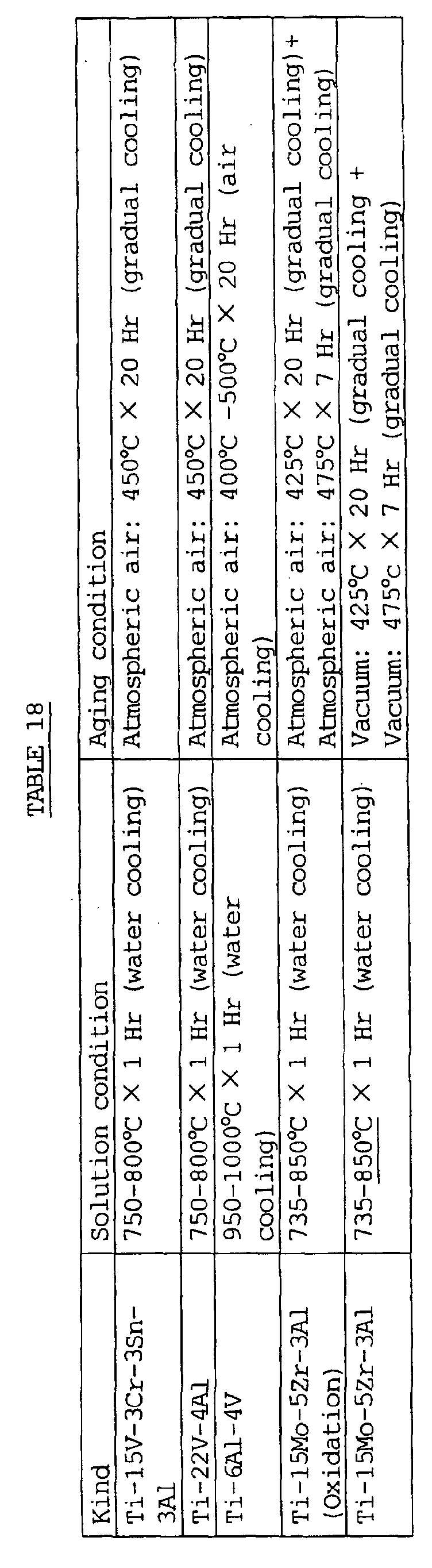
A magnetic flux density change measuring test was
conducted by the following method. That is, as shown in Fig.
5, after attaching a test bearing 10 to a rotational shaft 13
disposed in magnetic fields of a permanent magnet 16, the
rotational shaft 13 was rotated at a speed of about 200 rpm
during which the change of magnetic flux density was measured
by a tesla meter 17. Then, for the maximum output of the
tesla meter shown in Fig. 6, those showing 0.1 mT or more are
evaluated as with change of the magnetic flux density and
those with less than 0.1 mT were evaluated as with no change
of the magnetic flux density.
A bearing wear test was conducted by the following
method. That is, as shown in Fig. 25, a silicon wafer 33 was
supported by three test bearings 10 and the silicon wafer 33
was loaded and unloaded while irradiating electron beams from
an electron gun 32 to the silicon wafer 33. Then, after
repeating loading/unloading of the silicon wafer 33 for
150,000 cycles, the amount of wear for the outer ring of the
test bearing 10 was measured. Simultaneously, absence or
presence for the occurrence of halation at the portion of the
rolling bearing in a case of irradiating electron beams was
confirmed by a detector 31.
Table 17 shows the test results for the magnetic flux
density change measuring test and the bearing wear test. The
wear ratio as the result of the bearing wear test in Table 17
is a comparative value in a case of evaluation based on the
amount of wear in the outer ring of No. 6' being assumed as 1.
As can be seen from the test result in Table 17, Nos.
1 to 10 as the examples of the present invention show smaller
values for the wear amount on the surface of the outer ring
compared with No. 6'. This is because the bearing ring of No.
6' is formed of beryllium copper, whereas the bearing ring of
Nos. 1 to 10 are formed of titanium alloys harder than
beryllium copper.
Further, Nos. 1 to 10 as the examples of the present
invention show smaller values for the change of the magnetic
flux density compared with Nos 4' and 5' as the comparative
examples. This is because the cage for Nos. 4' and 5' are
formed of iron and steel materials such as SUS 304 and SPCC
, whereas the cage for Nos. 1 to 10 are formed of resins such
as fluoro resin.
Further, Nos. 1 to 10 as the examples of the present
invention show smaller values of the probability for the
occurrence of halation due to electron beams compared with
Nos. 2' and 3'. This is because the shield plate of the
bearings for 2' and 3' are formed of iron and steel materials
such as SUS 304 and SPCC, whereas the shield plate for the
bearings of Nos. 1 to 10 are formed of titanium at a purity
of 99.5% or higher.
Accordingly, it can be seen that a rolling bearing
which can be used suitably in a circumstance where corrosion
resistance and non-magnetic property are required by forming
the rolling element with ceramics, forming the cage with the
resin and forming the shield plate with titanium at a purity
of 99.5% or higher.
Nos. 4, 5, 8. as the examples of the present inventions
are examples of forming a hard film such as of TiN on the
surface of a rolling element made of ceramics and
electroconductivity can be ensured by forming the hard film
such as of TiN on the surface of the rolling element made of
ceramics.
As the kind of the titanium alloys used as the
constituent material for the bearing ring, titanium alloys
hardened by aging treatment (for example, α + β type titanium
alloy, near β type titanium alloy and β type titanium alloy)
are preferred and they can include, specifically, Ti-6Al-4V,
Ti-62 46, Ti-15Mo-5Zr-3Al, Ti-22V-4Al, Ti-15Mo-3Cr-3Sn-3Al.
In addition, any of titanium alloys having a hardness of Hv
420 or more by age-hardening treatment can be used suitably.
When more excellent seizure resistance and wear
resistance are required, the sliding property on the surface
of the bearing ring can further be improved by heating the
titanium alloy in atmospheric air to apply oxidation thereby
forming an oxide layer comprising TiOx (0 < x < 2) on the
surface of the titanium alloy. In this case, when the
temperature for the oxidation treatment is set to 400 to
500°C, which is the temperature for the aging treatment, the
age-hardening treatment and the oxidation treatment can be
conducted simultaneously, as well as the oxide layer formed
within this temperature range becomes highly dense and the
close adhesion can be improved preferably. Further when the
titanium alloy is applied with the solution treatment at a
temperature of 700 to 1000°C and further applied with
oxidation treatment after polishing, an oxide film can be
formed on the rolling surface of the bearing ring of the
titanium alloy. In this case, a further preferred sliding
property can be obtained by applying super finishing to the
rolling surface of the bearing ring made of the titanium
alloy and then applying the oxidation treatment.
In equipments utilizing electron beams such as a wafer
inspection apparatus, it is required to form an surrounding
atmosphere to a high vacuum atmosphere of 10-4 Pa or higher.
Therefore, in the rolling bearing used in equipments that
utilize electron beams, a lubricating oil or grease can not
be used as the lubricant. When the cage is formed of a resin
having a self-lubricity, the lubricating property can be
enhanced to improve the ware resistance of the rolling
bearing. Further, when the cage is formed of a resin, the
specific permeability of the cage is 1.001 or less, so that
the magnetic flux density does not change greatly depending
on the material of the cage and it is suitable for use in
semiconductor manufacturing apparatus utilizing electron
beams.
As the material for the cage, fluoro-containing resin,
polyether ether ketone (PEEK), copolymer of polyether ether
ketone and polybenzoimidazole (PEEK-PBI), polyphenylene
sulfide (PPS), thermoplastic polyimide (TPI), polyether
nitrile (PEN), thermoplastic aromatic polyamideimide,
tetrafluoroethylene - perfluoro alkylvinyl ether copolymer
(PFA), tetrafluoroethylene - ethylene polymer (ETFE),
tetrafluroethylene - hexafluoropropylene copolymer (FEP),
polychlorotrifluoroethylene (PCTFE), chlorotrifluoroethylene
- ethylene copolymer (PCTFE) and polyvinylidene fluoride
(PVDF) are suitable.
As the solid lubricant to be added to the resin
described above, at least one of tetrafluoroethylene resin
powder (PTFE), graphite, hexagonal boron nitride (hBN),
fluoro mica, melamine cyanurate (MCA), amino acid compound
having layered crystal tissue (N-lauro - L-lysine), fluoro
graphite, fluoro pitch, molybdenum disulfide (MoS2), tungsten
disulfide (WS2) can be used. Among them, PTFE, MAC, graphite,
N-lauro - L-lysine, hBN and fluoro mica used alone or in a
combination of two or more of them are more preferred in view
of lubricity.
Since the ceramics forming the rolling element and the
resin forming the cage are insulative material, when
insulators are present at the wafer supporting portion of a
semiconductor manufacturing apparatus, particularly, within a
range which is visible as images near the electron beams, the
rolling element or the cage which is an insulator is charged
up to cause halation.
Further, in the bearing for supporting the wafer, if
the bearing itself has no electroconductivity, since current
does not flow to the inside of the bearing, no desired images
can be obtained, for example, in a case of length measuring
SEM. Accordingly, the ceramics used as the constituent
material for the rolling element desirably have
electroconductivity and, specifically, electroconductive
zirconia series ceramics are suitable.
Further, in a case of insulative ceramics such as
silicon nitride series ceramics and alumina series ceramics,
ceramic coating films such as of TiN, TiC, TiCN, TiAlN having
conductivity is preferably applied to the surface of the
rolling element by a coating treatment such as PVC (Physical
Vapor Deposition), CVD (Chemical Vapor Deposition) and the
like.
On the other hand, regarding the cage, it gives no
effects on the conductivity of the bearing but since it is an
insulator as described above, halation occurs upon
irradiation of electron beams. Further, since the resin
material for the cage is difficult to be applied with the
film deposition treatment, charge up can not be prevented by
the conductive ceramic coating as in the case of the rolling
element. In view of the above, when the rolling bearing used
in equipments utilizing electron beams is constituted as a
shield type rolling bearing having a metal shield plate,
since the portion of the cage is concealed by the shield
plate, occurrence of halation due to electron beams can be
prevented.
Further, also in a case of using insulative ceramics
to the rolling element, occurrence of halation can be
prevented with no effects on the peripheral magnetic fields
by using a shield plate made of pure titanium.
Since the shield plate is manufactured by press
molding, plastic fabrication at a room temperature is
required. The material used for the shield plate has been
austenitic stainless steel typically represented by SUS 304
and cold rolled steel plates (JIS SPCC, SPCD, SPCE) but any
of them is a material mainly comprising steel, the specific
permeability is 1.001 or more which gives undesired effects
on the peripheral magnetic fields.
On the other hand, when the shield plate is formed of
titanium at a purity of 99.5% or higher, the specific
permeability of the shield plate is 1.001 or less. Thus,
since the rotation of the shield plate does not cause such a
change of the magnetic flux density as flexing the electron
beam in the peripheral magnetic fields, it is suitable as a
shield plate for the rolling bearing used near the electron
beam generation portion. Since pure titanium has excellent
cold moldability, a thin plate can be manufactured and since
it can be fabricated by press molding, the shield plate can
be manufactured at a reduced cost.
As the titanium used for the shield plate material,
any of JIS classes 1 to 4 can be used suitably, with first
and second classes of less impurity content being
particularly preferred in view of the press moldability.
Suitable application use of the rolling device
according to the present invention described above is as
shown below.
Along with the trend of increasing the integration
degree in semiconductor devices, dimensional reduction of
integrated circuit patterns formed to the wafer has been
proceeded. While laser beams have been utilized, for example,
in semiconductor production apparatus or wafer inspection
apparatus but higher resolution power has been required along
with the dimensional reduction of the circuit pattern and the
system has now been shifted to apparatus utilizing electron
beams at a shorter wavelength and having higher resolution
than the laser beams.
Electron beams are easily deflected even by slight
magnetic fields to lower the writing accuracy and inspection
accuracy of wafers. Therefore, along with the use of
electron beams, a requirement for the non-magnetic property
of the rolling bearing used, for example, in the wafer
transportation stage or a wafer supporting portion has been
increased. In such semiconductor production apparatus
utilizing the electron beams, when a rolling bearing made of
non-magnetic stainless steel having a specific permeability
of about 1.01 to 1.1 is used, since it gives effects on the
electron beams and causes fluctuation of the magnetic fields,
a rolling bearing made of beryllium copper with a specific
permeability of 1.001 or less is used.
Since the titanium alloy is a completely non-magnetic
material with the specific permeability of 1.001 or less, it
is suitable as a constituent material for the rolling bearing
or linear guide used in the semiconductor production
apparatus utilizing electron beams.
In a case of using the rolling bearing or the linear
guide in the vicinity of an electron gun as an electron
generation source, since the rotational motion of the rolling
bearing or the linear motion of the linear guide causes
fluctuation in the magnetic field to deflect the electron
beams, it is necessary that the specific permeability of the
rolling bearing or the linear guide is reduced to 1.001 or
less.
The semiconductor production apparatus utilizing the
electron beams can include specifically, for example, length
measuring SEM, stepper, electron beam lithography system, and
wafer defect inspection apparatus and the rolling device
according to the present invention can be used suitably, for
example, in a wafer supporting holder or a stage moving
portion of the apparatus described above.
Further, the measuring apparatus utilizing the
electron beams can include, specifically, a rotational
portion of spectralized crystals or a specimen stage of an
electron probe micro analyzer (EPMA), scanning electron
microscope (SEM), focusing ion beam FIB, transmission
electron microscope (TEM), ESCA and Auger electron
spectroscopic apparatus, and the rolling device according to
the present invention can be used suitably, for example, to
an operating portion near the electron generation source.
Further, the semiconductor production apparatus using
magnetic fields can include, for example, an etching
apparatus of applying a voltage under magnetic fields by an
powerful permanent magnet, and the rolling device according
to the present invention can be used suitably, for example,
to a joint portion of a conveyor robot arm for conveying
wafers in the chamber.
The rolling bearing used in strong magnetic fields,
for example, the rolling bearing for supporting axle used
near a super electroconductive magnet of a linear motor car
rotates while intersecting the strong magnetic fields from a
superelectroconductive magnet during rotation of the axle.
Accordingly, when the rolling bearing is made of
ferroelectric material such as martensitic steel, it may be a
worry that eddy current is caused to generate heat in the
rolling element or the bearing ring of the bearing and bring
about seizure along with temperature elevation.
It is necessary that the bearing used in such strong
magnetic fields be formed as non-magnetic material. The
bearing ring of the rolling bearing according to the present
invention is formed of the titanium alloy and has a lower
specific permeability than that of the non-magnetic steel.
Accordingly, it causes less eddy current and can be used
suitably.
The rolling bearing used in a nuclear magnetic
resonance diagnostic apparatus lowers the inspection accuracy
by the fluctuation of magnetic fields along with rotation of
the bearing. Since the bearing ring made of the titanium
alloy in the rolling bearing according to the present
invention is completely non-magnetic with the specific
permeability being 1.001 or less, it can be used suitably,
for example, in the rolling portion of the nuclear magnetic
resonance diagnostic apparatus.
In a case of a rolling device such as a rolling
bearing, a linear moving guide device or a ball screw used,
for example, in a wafer cleaning apparatus, an alkaline
solution such as an ammonia solution or a strongly acidic
solution is used for the cleaning of the semiconductor wafer.
Accordingly, intrusion of impurities into the semiconductor
manufacturing steps due to the scattering of the alkaline
solution or strongly acidic solution or exposure in the
vapors thereof results in a significant problem. Further,
since a corrosive gas is used in the etching apparatus, the
corrosion resistance is required.
Since the rolling device according to the present
invention has a sufficient corrosion resistance even in an
alkaline solution such as an ammonia solution, it is possible
to provide a bacteriocidal property by the titanium oxide
coating.
In the same manner, since corrosive chemicals are used
in photographic developing machines in the developing step or
the fixing step, the rolling bearing according as the present
invention can be used suitably also to the bearings for
supporting transportation conveyors in the photographic
developing machine or as the bearing used in the pump for
supplementing chemicals.
(Reduced Weight - Compact Resistance /Young's modulus)
Since the bearing ring made of the titanium alloy of
the rolling bearing according to the present invention has a
specific gravity of about 2/3 for that of the steel, the
weight of the bearing ring can be reduced.
Since a hand piece in dental equipments for conducting
drilling or cutting, since a dental cutting tool attached to
a shaft is used while being rotated at a super-high speed of
300,000 rpm or higher, a reduced weight and quietness are
required. Accordingly, reduced weight and low noise are
required also for the bearing used in the hand piece of the
dental equipments.
Since the bearing ring made of the titanium alloy has
a specific gravity as low as about 2/3 for that of the steel,
the weight of the hand piece is reduced. Further, since the
rotational torque of the bearing is reduced and the noise can
be reduced, the rolling bearing according to the present
invention can be used suitably as a rolling bearing for use
in the dental hand piece.
Further, in driving motors, high power motors are used
so that the number of a rotation reaches the maximum number
of rotation in a short period of time and driving motors
having a great reserve in the power for actually required
power upon conducting cutting or the like at the maximum
number of rotation are used.
For decreasing the power of the driving motor, it may
be considered to reduce the rising time from start up to the
maximum number of rotation, to decrease the maximum number of
rotation or to decrease the inertia of the rotational shaft
that is rotationally driven by the driving motor. However,
since the working efficiency is reduced when the rising time
is made longer or the maximum number of rotation is kept
lower, it is most effective to decrease the inertia of the
rotational shaft in order to reduce the power of the driving
motor while maintaining the working efficiency at a high
accuracy.
For decreasing the inertia of the rotational shaft, it
is necessary to decrease the weight of the rotational shaft
and it is effective to use titanium alloys (specific gravity:
about 4.0 - 5.0) having a smaller specific gravity compared
with existent iron and steel materials (specific gravity :
about 7.8) is preferred since the size of the device can be
reduced and the consumption power of the driving motor can be
decreased without deteriorating the desired working
efficiency.
Since the bearing rings made of titanium alloys have
small Young's modulus, the weight of bearing rings can be
reduced in ball bearings, cylindrical roller bearings,
tapered corn roll bearings, self aligned roller bearings for
use in the driving system, for example, in general industrial
machines or automobile transmissions and the weight of the
entire apparatus can be reduced. Further, the rolling
bearing according to the present invention is suitable since
it is reduced in the weight and higher speed rotation is
possible. Further, since the Young's modulus of the bearing
ring is small as 1/2 for that of the steel when an identical
load is applied, the rolling bearing made of the titanium
alloys has an effect of decreasing the surface pressure at a
portion in contact with rolling elements to decrease the
stress at the portion of contact, so that it has an effect
capable of increasing the rolling fatigue strength.
In addition, when the rolling bearings according to
the present invention are used as the angular ball bearings
and the cylindrical roller bearings used under a high speed
rotation of dmn = 200,000 or more such as in spindles of
machine tools and turbo chargers, since the inertia at high
speed rotation is decreased, they can be used suitably.
In the bearing for use in a rotating anode X-ray tube,
X-rays are generated by impinging thermoelectrons to a target
attached to the top end of a rotating anode that supports the
bearing, in which the shaft has to be grounded to the earth
by way of the bearing in order to prevent charging on the
target. Further, not ceramics but heat resistant iron and
steel materials such as SKH are used irrespective of
conditions at vacuum, high speed and high temperature. Since
the rolling bearing according to the present invention is
reduced in the weight, it can be rotated at a high speed,
does not suffer from lowering in the hardness even at high
temperature and further has electroconductivity, it can be
used suitably as a bearing for use in the rotating anode X-ray
tube. In this case, electroconductive ceramics are
suitable as the rolling element.
In part mounting machines used for electronic
equipment production steps such as for computers and portable
telephones, the speed of operations of taking out precision
parts such as semiconductor devices and mounting them to
substrate has been increased and, particularly, along with
recent demand for reducing the size of electronic equipments
themselves, the size of semiconductor devices arranged on the
substrates is decreased and integration on the substrates has
been progressed, so that the positioning accuracy in a case
of mounting parts reaches an order of as fine as several µm.
Further, since the attaching speed has also tended to be
increased in order to improve the production efficiency of
substrates and parts are mounted at a high speed of 0.5 to
1.0 sec or less for 1 cycle, the operation speed of a linear
moving device that supports the head is also increased.
Further, a wire bonder that connects semiconductor devices
mounted on the substrate to circuits has a structure in which
bearing portions of the linear guide rail are fixed and rails
having a part mounting head secured at the top end is moved
vertically. In many actual mounting machines, since a series
of attaching steps such as adsorption of parts, mounting and
fixing of them on substrates are conducted continuously, a
machine gun system has been adopted in which plural rails are
arranged on a drum and the parts are mounted continuously
while rotating the drum. Vertical movement for mounting the
parts, as well as rotational acceleration by the rotation of
the drum in synchronization with the vertical movement are
given to a linearly moving rail, and the inertia caused by
the own weight of the rail and the own weight of the head
exerts as a bending moment on the rail. Particularly, when
the cycle time for the vertical movement of the rail is
reduced to 0.1 sec or less, acceleration exerting on the rail
increases to about several G - several tens G and, in
addition, acceleration in the circumferential direction of
the drum also increases to about several G. Since the
rolling device according to the present invention can be
reduced greatly in the weight compared with existent devices
made of steel, it can decrease acceleration loaded on the
rail and can be used suitably as a linear moving guide device
for use in part mounting machines.
Further, along with reduction in the size and the
weight of automobiles, improvement in the performance and
increase in the power have been demanded in addition to the
reduction in the size and the weight also for engine
auxiliaries such as alternators, and larger vibrations and
greater loads (about 4G - 20G as gravitational acceleration)
along with high speed rotation under more stringent working
conditions than usual are exerted simultaneously by way of
belts, for example, on the bearings for use in alternators
upon operation of the engine and they are used under high
temperature condition (about 90 - 130°C).
The rolling bearing according to the present invention
is preferred since it is reduced in the weight and can reduce
the weight of the engine auxiliaries described above.
Further, in severe circumstances of large vibrations,
great load and high temperature, tissue whitening changes are
formed particularly near the maximum shearing stress position
of a load area of an outer ring as a fixed ring in existent
bearings made of steels and early peeling occurs starting
from the change of tissue as a trigger in about 1/5 to 1/20
of the designed bearing life. Since the bearing made of
titanium alloy in the rolling bearing according to the
present invention has a stable tissue and causes no change in
the tissue as exemplified by the tissue whitening change, the
life can be extended.
Since rolling bearings for use in business equipments
such as copying machines, laser beam printers (LBP) and
facsimiles (for example, bearings for heat rolls and bearings
for pressure rolls used in the fixing portion of LBP) are
used under high temperature, for example, at about 200 to
250°C, working conditions are further severe (about 100 to
150°C at the portions other than the fixing portion). In
addition, recyclic use of the fixing portion is required for
resource saving. Further, a characteristics of less
releasing heat from the heat roll at high temperature to the
outside is also required for the heat roll at high
temperature for energy saving.
Since the heat conductivity of the titanium alloy is
low among other metal materials, when the rolling bearing
using the bearing ring made of titanium alloy as the bearing
for use in the heat roll, the amount of heat transmitted from
the heat roll by way of the bearing to the outside can be
reduced.
In information recording apparatus such as video tape
recorders (VTR) or hard disk devices (HDD), fineness of
reproduced images and higher density for the information
recording amount are desired and rotational accuracy has been
improved. As a bearing for satisfying the requirement of
high rotational accuracy, a so-called combined bearing unit
in which preload is applied between two opposed rolling
bearings has been adopted. Loading of preload between the
bearings can provide effects such as improvement of the
rigidity for the main shaft, decrease of rotation with
deflection and avoidance of resonance frequency.
When the rolling element of the rolling bearing is
formed of silicon nitride, the preload is sometimes decreased
to lower the rotational accuracy of the main shaft. This is
attributable to that the linear expansion coefficient of the
rolling element within the range of the working temperature
of the bearing (1 - 9.0 x 10⁻⁶/K) is much smaller compared
with that of the bearing ring comprising bearing steel or
stainless steel. That is, the amount of heat expansion of
the rolling element is smaller relative to the amount of heat
expansion of the bearing ring by the temperature elevation
upon rotation of the bearing and, correspondingly, the amount
of the gap inside of the bearings increases, to reduce the
preload initially applied between the bearings and, depending
on the case, this may cause complete loss of preload. The
loss of preload causes lowering of the rotational performance
such as reduction of the rigidity of the shaft, increase in
the rotation of the shaft with reflection and change of the
resonance frequency of the shaft.
Further, another problem in a case of forming the
rolling element with silicon nitride is that the impact
resistance of the bearing is decreased. That is, when an
excess impact load is applied from the outside to the bearing,
stress is localized to the rolling element and to the portion
of contact between the bearing ring and the rolling element
and, as a result, minute indentation may sometimes be formed
to the raceway surface of the bearing ring. Occurrence of
the indentation remarkably deteriorates the acoustic
performance and vibrational performance of the bearing to
result in lowering of the performance of VTR or HDD. This is
because the Young's modulus of the rolling element is higher
and the bearing ring less deforms elastically compared with
the case of forming the rolling element with bearing steel or
stainless steel, which remarkably localizes the stress that
causes indentations to the raceway surface tending to cause
indentations.
In this case, when the bearing ring is formed of the
titanium alloy, since the linear expansion coefficient of the
bearing ring is 8.0 to 9.0 x 10⁻⁵/K, loss of preload is less
caused. Further, it is suitable to form the rolling element
with the zirconia series ceramics since the difference of the
linear heat expansion coefficient between the bearing ring
and the rolling element can be decreased.
Further, with regard to the impact resistance, since
the Young's modulus of the rolling element is lower compared
with a case of forming the rolling element of the bearing
steel or stainless steel and the occurrence of indentations
due to localized stress can be suppressed even in a case of
undergoing excess impact load, the acoustic performance or
the vibrational performance of the bearing is not reduced.
Claims (30)
- A rolling device comprising an outer member and an inner member each having a raceway surface and rolling elements rolling on the raceway surface by rotational or linear movement of the outer member or the inner member in which
the outer member and/or the inner member is constituted with at least one kind of titanium alloys of β type titanium alloys, near type titanium alloys and α + β type titanium alloys. - A rolling device as defined in claim 1, wherein the titanium alloy has a surface hardness of Hv 400 or more and less than Hv 600.
- A rolling device as defined in claim 2, wherein the outer member and/or the inner member has a core hardness of Hv 420 or more and have an oxygen compound layer at the surface, and the oxygen compound layer comprises titanium oxide containing rutile type TiO2 and has a thickness of 20 nm or more.
- A rolling device as defined in claim 3, wherein the core hardness of the outer member and/or the inner member is Hv 450 or more and a thickness of the oxygen compound layer is 50 nm or more.
- A rolling device as defined in claim 1, wherein the rolling element is constituted with at least one kind of materials of titanium alloys, silicon nitride, silicon carbide, zirconia series ceramics, alumina series ceramics and SIALON series ceramics.
- A rolling device comprising an outer member and an inner member each having a raceway surface, rolling elements rolling on the raceway surface by rotational or linear movement of the outer member or the inner member and a cage for holding the rolling elements in which the outer member and/or the inner member is constituted with one kind of titanium alloys of β type titanium alloys, near type titanium alloys and α + β type titanium alloy and the titanium alloy has a surface hardness of Hv 400 or more and less than Hv 600 and the cage has a heat conductivity of 20 W/(m·K) or more.
- A rolling device as defined in claim 6, wherein the cage is constituted with one kind of materials of copper, tellurium copper, brass, aluminum bronze, phosphorus bronze, nickel silver, cupro nickel and beryllium copper.
- A rolling device comprising an outer member and an inner member each having a raceway surface and rolling elements rolling on the raceway surface by rotational or linear movement of the outer member or the inner member in which
at least one of the outer member, the inner member and the rolling elements is constituted with a titanium alloy and which has a ω phase with the size of the crystal particles of 1 µm or less. - A rolling device as defined in claim 8, wherein the size of the crystal particles is 800 nm or less.
- A rolling device as defined in claim 8, wherein the size of the crystal particles is 10 nm or less.
- A rolling device as defined in claim 1, wherein the outer member and/or the inner member has a hard film on the raceway surface.
- A rolling device as defined in claim 11, wherein the raceway surface formed with the hard film has a surface hardness of Hv of 350 or more.
- A rolling device as defined in claim 11, wherein the raceway surface formed with the hard film has a surface hardness of Hv of 450 or more.
- A rolling device as defined in claim 11, wherein the hard film is constituted with at least one kind of materials of TiN, TiC, TiCN, TiAlN, CrN, SiC and diamond-like carbon.
- A rolling device as defined in claim 11, wherein the outer member and/or the inner member has a lubricating film of 0.1 µm to 10 µm on the hard film.
- A rolling device as defined in claim 11, wherein the outer member and/or inner member has a lubricating film of 0.1 µm to 5 µm on the hard film.
- A rolling device as defined in claim 1, wherein the rolling element is constituted with a superhard alloy or cermet.
- A rolling device as defined in claim 17, wherein the rolling element has a heat conductivity of 35 W/(m·K) or more.
- A rolling device as defined in claim 17, wherein the rolling element has a heat conductivity of 50 W/(m·K) or more.
- A rolling device as defined in claim 1, wherein the rolling element has a surface hardening layer constituted with an iron and steel material and has a corrosion resistance on the surface.
- A rolling device as defined in claim 20, wherein the surface hardening layer is formed by applying a chromium diffusion penetration treatment on the surface of a base material constituting the rolling element.
- A rolling device as defined in claim 20, wherein the surface hardening layer contains a nitride layer formed by applying a nitridation treatment to the surface of a base material constituting the rolling element.
- A rolling device as defined in claim 1, wherein the titanium alloy is the titanium alloy satisfying the condition: 3.7 ≦ (H/E) where E (Gpa) represents the Young's modulus and H (Hv) represents the minimum hardness for the portion from the raceway surface to a depth corresponding to 2/100 to 5/100 for the diameter of the rolling element.
- A rolling device as defined in claim 1, wherein the titanium alloy is a titanium alloy satisfying the condition: 4.0 ≦ (H/E) where E (Gpa) represents the Young's modulus and H (Hv) represents the minimum hardness for the portion from the raceway surface to a depth corresponding to 2/100 to 5/100 for the diameter of the rolling element.
- A rolling device as defined in claim 23 or 24 wherein (H/E) is 4.5 or less.
- A rolling device as defined in claim 1, wherein the ratio α2/α1 between the heat expansion coefficient α1 of the titanium alloy and the heat expansion coefficient α2 of the rolling element is within a range of 0.4 to 1.3.
- A rolling device as defined in claim 1, wherein the rolling device further comprises a shield plate for shielding an opening formed between the outer member and the inner member and the shield plate is formed of titanium at a purity of 99.5% or higher.
- A rolling device as defined in claim 26, wherein the outer member and the inner member each has an oxide film containing TiOx (x = 0 - 2) on the surface.
- A rolling device as defined in any one of claims 8, 11, 16, 19, 22, 25 and 26 wherein the rolling element is constituted with at least one kind of materials of titanium alloys, silicon nitride, silicon carbide, zirconia series ceramics, alumina series ceramics and SIALON series ceramics.
- A rolling device as defined in any one claims 2, 11, 16, 19, 22, 25 and 26 wherein the rolling device further comprises a cage for holding the rolling elements and the cage is constituted with one kind of materials of copper, tellurium copper, brass, aluminum bronze, phosphorus bronze, nickel silver, cupro nickel and beryllium copper.
Applications Claiming Priority (21)
| Application Number | Priority Date | Filing Date | Title |
|---|---|---|---|
| JP2000217285 | 2000-07-18 | ||
| JP2000217285 | 2000-07-18 | ||
| JP2000230184 | 2000-07-31 | ||
| JP2000230183 | 2000-07-31 | ||
| JP2000230183 | 2000-07-31 | ||
| JP2000230184 | 2000-07-31 | ||
| JP2000312757 | 2000-10-13 | ||
| JP2000312757 | 2000-10-13 | ||
| JP2000336390 | 2000-11-02 | ||
| JP2000336390 | 2000-11-02 | ||
| JP2000357514 | 2000-11-24 | ||
| JP2000357514 | 2000-11-24 | ||
| JP2001042901 | 2001-02-20 | ||
| JP2001042901 | 2001-02-20 | ||
| JP2001077833 | 2001-03-19 | ||
| JP2001077833 | 2001-03-19 | ||
| JP2001146044 | 2001-05-16 | ||
| JP2001146044 | 2001-05-16 | ||
| JP2001180507 | 2001-06-14 | ||
| JP2001180507 | 2001-06-14 | ||
| PCT/JP2001/006232 WO2002008623A1 (en) | 2000-07-18 | 2001-07-18 | Rolling apparatus |
Publications (2)
| Publication Number | Publication Date |
|---|---|
| EP1225353A1 true EP1225353A1 (en) | 2002-07-24 |
| EP1225353A4 EP1225353A4 (en) | 2006-08-09 |
Family
ID=27580535
Family Applications (1)
| Application Number | Title | Priority Date | Filing Date |
|---|---|---|---|
| EP01950020A Withdrawn EP1225353A4 (en) | 2000-07-18 | 2001-07-18 | Rolling apparatus |
Country Status (4)
| Country | Link |
|---|---|
| US (1) | US6828041B2 (en) |
| EP (1) | EP1225353A4 (en) |
| JP (1) | JP3724480B2 (en) |
| WO (1) | WO2002008623A1 (en) |
Cited By (13)
| Publication number | Priority date | Publication date | Assignee | Title |
|---|---|---|---|---|
| EP1571233A1 (en) * | 2004-03-04 | 2005-09-07 | Shimano Inc. | Method of hardening a beta titanium member |
| FR2874066A1 (en) * | 2004-08-04 | 2006-02-10 | Andre Large | VIBRATION FILTRATION GUIDANCE |
| EP1728483A1 (en) * | 2005-05-30 | 2006-12-06 | Kaltenbach & Voigt GmbH | Hand-piece with coating for moving or moveable parts |
| WO2007137558A1 (en) * | 2006-05-26 | 2007-12-06 | Schaeffler Kg | Roller bearing |
| WO2007125001A3 (en) * | 2006-04-29 | 2008-01-17 | Schaeffler Kg | Rolling bearing for dry-running or lubricated applications |
| WO2009056334A1 (en) * | 2007-11-02 | 2009-05-07 | Aktiebolaget Skf | Combination of bearing component and sensor |
| ITMI20082050A1 (en) * | 2008-11-18 | 2010-05-19 | Race Spa T | LINEAR GUIDE AND METHOD FOR PRODURLA. |
| WO2012146650A1 (en) * | 2011-04-29 | 2012-11-01 | Aktiebolaget Skf | Alloy for a Bearing Component |
| EP2060812A3 (en) * | 2007-11-14 | 2012-12-05 | JTEKT Corporation | Rolling bearing |
| WO2012146653A3 (en) * | 2011-04-29 | 2013-11-21 | Aktiebolaget Skf | Heat-treatment of an alloy for a bearing component |
| CH710410A1 (en) * | 2014-11-26 | 2016-05-31 | Fives Cryomec Ag | Rotary pump for cryogenic fluids. |
| WO2017101923A1 (en) * | 2015-12-16 | 2017-06-22 | Schaeffler Technologies AG & Co. KG | Rolling bearing with rolling bodies made of ceramic material |
| EP3225715A4 (en) * | 2014-11-28 | 2018-05-02 | Nippon Steel & Sumitomo Metal Corporation | Titanium alloy member and method of manufacturing titanium alloy member |
Families Citing this family (32)
| Publication number | Priority date | Publication date | Assignee | Title |
|---|---|---|---|---|
| JP2004340783A (en) * | 2003-05-16 | 2004-12-02 | Ntn Corp | Torque detecting device |
| US20040263024A1 (en) * | 2003-06-26 | 2004-12-30 | Meffe Marc E. | Piezodynamic preload adjustment system |
| GB2412701B (en) * | 2004-03-31 | 2006-03-22 | Minebea Co Ltd | A metal-to-metal spherical bearing |
| WO2005122942A1 (en) * | 2004-06-08 | 2005-12-29 | Neil Hamilton Luebke | Dental and medical instruments comprising titanium |
| EP1617093A1 (en) * | 2004-07-16 | 2006-01-18 | Ab Skf | Bearing with light weight metal and ceramic material |
| WO2007039684A1 (en) * | 2005-10-03 | 2007-04-12 | Marin Clausin | Rolling mechanism for supporting very large maximum loads |
| JP4718332B2 (en) * | 2006-01-06 | 2011-07-06 | 日東電工株式会社 | Metal foreign matter removal method |
| US7976637B2 (en) * | 2006-03-08 | 2011-07-12 | Tokyo Electron Limited | Substrate processing system, substrate surface processing apparatus, substrate surface inspecting apparatus, substrate surface inspecting method, and storage medium storing program for implementing the method |
| US20070272231A1 (en) * | 2006-05-25 | 2007-11-29 | Ssw Holding Company, Inc. | Oven rack having an integral lubricious, dry porcelain surface |
| DE102006030836B4 (en) * | 2006-07-04 | 2012-03-01 | Gebrüder Reinfurt GmbH & Co. KG | Rolling bearing cage |
| DE102006051641A1 (en) * | 2006-11-02 | 2008-05-08 | Schaeffler Kg | Rolling bearing for dry-running or lubricated applications, such as food processing, has bearing rings, which are made of stainless steel and rolling body or bearing rings consists of corrosion resistant titanium alloy |
| GB0805224D0 (en) * | 2008-03-20 | 2008-04-30 | Minebea Co Ltd | An aerospace bearing component |
| US20090240390A1 (en) * | 2008-03-21 | 2009-09-24 | Nenad Nenadic | System and method for component monitoring |
| US8485730B2 (en) * | 2008-03-27 | 2013-07-16 | Ntn Corporation | Rolling bearing |
| DE102008048412A1 (en) * | 2008-05-08 | 2009-11-12 | Schaeffler Kg | storage module |
| JP2010001985A (en) * | 2008-06-20 | 2010-01-07 | Ntn Corp | Rolling bearing |
| US20100108932A1 (en) * | 2008-10-31 | 2010-05-06 | Bauer Robert R | Bearing assembly and a method for controlling fluid flow within a conduit |
| EP2366809B1 (en) * | 2008-12-17 | 2018-12-05 | Nippon Steel & Sumitomo Metal Corporation | Titanium material and method for producing titanium material |
| JP5569592B2 (en) * | 2010-11-15 | 2014-08-13 | 日本精工株式会社 | Ball screw |
| JP5905681B2 (en) * | 2011-08-23 | 2016-04-20 | Ntn株式会社 | Rolling bearing |
| US9206847B2 (en) * | 2012-01-24 | 2015-12-08 | Us Synthetic Corporation | Roller bearing assemblies, apparatuses, and related methods of manufacture |
| DE102012202155A1 (en) * | 2012-02-14 | 2013-08-14 | Schaeffler Technologies AG & Co. KG | roller bearing |
| JP6026777B2 (en) | 2012-05-25 | 2016-11-16 | 株式会社豊田中央研究所 | Sliding member and manufacturing method thereof |
| JP2016196820A (en) * | 2015-04-02 | 2016-11-24 | 株式会社Ihi | Engine compressor blade |
| US10580681B2 (en) * | 2016-07-10 | 2020-03-03 | Yaskawa America Inc. | Robotic apparatus and method for transport of a workpiece |
| JP6737660B2 (en) * | 2016-08-30 | 2020-08-12 | グローブライド株式会社 | Bearing unit with magnetic fluid seal, and drive motor equipped with such bearing unit |
| US10781857B2 (en) | 2016-11-08 | 2020-09-22 | Carrier Corporation | Hybrid bearings |
| DE102017223421A1 (en) * | 2017-12-20 | 2019-06-27 | Aktiebolaget Skf | Hybrid ball bearing in particular for a refrigerating compressor |
| DE102018206635A1 (en) * | 2017-12-20 | 2019-06-27 | Aktiebolaget Skf | Hybrid rolling bearing, in particular for a refrigerating compressor |
| KR102487083B1 (en) * | 2020-07-01 | 2023-01-10 | 주식회사 케이티앤지 | Apparatus for generating aerosol including susceptor assembly |
| US11554480B2 (en) * | 2021-04-06 | 2023-01-17 | Samsung Electronics Co., Ltd. | Systems and methods for implementing miniaturized cycloidal gears |
| FR3149656B1 (en) * | 2023-06-08 | 2025-06-20 | Ntn Europe | Rolling bearing |
Family Cites Families (10)
| Publication number | Priority date | Publication date | Assignee | Title |
|---|---|---|---|---|
| US4848934A (en) * | 1985-01-11 | 1989-07-18 | The Boeing Company | Lightweight high performance titanium sliding contact bearing |
| US5154401A (en) * | 1987-07-06 | 1992-10-13 | Schramm David E | Corrosion free high load marine blocks |
| JPH0514641U (en) * | 1991-08-07 | 1993-02-26 | 光洋精工株式会社 | Rolling bearing |
| JPH07103247A (en) * | 1993-10-06 | 1995-04-18 | Koyo Seiko Co Ltd | Rolling bearing |
| JPH11223221A (en) * | 1997-07-01 | 1999-08-17 | Nippon Seiko Kk | Rolling bearing |
| JPH11153140A (en) * | 1997-11-19 | 1999-06-08 | Nippon Seiko Kk | Bearings for special environments |
| JPH11247863A (en) * | 1998-03-06 | 1999-09-14 | Nippon Seiko Kk | Multi-point contact ball bearing |
| JP2000035043A (en) * | 1998-07-16 | 2000-02-02 | Nippon Seiko Kk | Rolling bearing |
| JP2001193741A (en) * | 2000-01-05 | 2001-07-17 | Minebea Co Ltd | Spherical sliding bearing and manufacturing method |
| JP2002054637A (en) * | 2000-03-30 | 2002-02-20 | Nsk Ltd | Rolling device |
-
2001
- 2001-07-18 JP JP2002514278A patent/JP3724480B2/en not_active Expired - Fee Related
- 2001-07-18 EP EP01950020A patent/EP1225353A4/en not_active Withdrawn
- 2001-07-18 WO PCT/JP2001/006232 patent/WO2002008623A1/en not_active Ceased
- 2001-07-18 US US10/069,076 patent/US6828041B2/en not_active Expired - Lifetime
Cited By (23)
| Publication number | Priority date | Publication date | Assignee | Title |
|---|---|---|---|---|
| EP1571233A1 (en) * | 2004-03-04 | 2005-09-07 | Shimano Inc. | Method of hardening a beta titanium member |
| FR2874066A1 (en) * | 2004-08-04 | 2006-02-10 | Andre Large | VIBRATION FILTRATION GUIDANCE |
| EP1728483A1 (en) * | 2005-05-30 | 2006-12-06 | Kaltenbach & Voigt GmbH | Hand-piece with coating for moving or moveable parts |
| WO2006128587A1 (en) * | 2005-05-30 | 2006-12-07 | Kaltenbach & Voigt Gmbh | Handpiece with coating for moved or movable parts |
| WO2007125001A3 (en) * | 2006-04-29 | 2008-01-17 | Schaeffler Kg | Rolling bearing for dry-running or lubricated applications |
| US8210751B2 (en) | 2006-05-26 | 2012-07-03 | Schaeffler Technologies AG & Co. KG | Roller bearing |
| WO2007137558A1 (en) * | 2006-05-26 | 2007-12-06 | Schaeffler Kg | Roller bearing |
| EP2166241A1 (en) * | 2006-05-26 | 2010-03-24 | Schaeffler AG | Roller bearing |
| WO2009056334A1 (en) * | 2007-11-02 | 2009-05-07 | Aktiebolaget Skf | Combination of bearing component and sensor |
| WO2009056159A1 (en) * | 2007-11-02 | 2009-05-07 | Aktiebolaget Skf | Combination of bearing component and sensor |
| US8316723B2 (en) | 2007-11-02 | 2012-11-27 | Aktiebolaget Skf | Combination of bearing component and sensor |
| EP2060812A3 (en) * | 2007-11-14 | 2012-12-05 | JTEKT Corporation | Rolling bearing |
| CN102209855A (en) * | 2008-11-18 | 2011-10-05 | T瑞斯股份公司 | Linear guide rail and manufacturing method thereof |
| WO2010058331A1 (en) * | 2008-11-18 | 2010-05-27 | T Race Spa | Linear guide rail and method for the manufacture thereof |
| ITMI20082050A1 (en) * | 2008-11-18 | 2010-05-19 | Race Spa T | LINEAR GUIDE AND METHOD FOR PRODURLA. |
| WO2012146650A1 (en) * | 2011-04-29 | 2012-11-01 | Aktiebolaget Skf | Alloy for a Bearing Component |
| WO2012146653A3 (en) * | 2011-04-29 | 2013-11-21 | Aktiebolaget Skf | Heat-treatment of an alloy for a bearing component |
| US9732408B2 (en) | 2011-04-29 | 2017-08-15 | Aktiebolaget Skf | Heat-treatment of an alloy for a bearing component |
| CH710410A1 (en) * | 2014-11-26 | 2016-05-31 | Fives Cryomec Ag | Rotary pump for cryogenic fluids. |
| EP3026269A1 (en) * | 2014-11-26 | 2016-06-01 | Fives Cryomec AG | Rotary pump for cryogenic liquids |
| EP3225715A4 (en) * | 2014-11-28 | 2018-05-02 | Nippon Steel & Sumitomo Metal Corporation | Titanium alloy member and method of manufacturing titanium alloy member |
| US10669619B2 (en) | 2014-11-28 | 2020-06-02 | Nippon Steel Corporation | Titanium alloy member and method for manufacturing the same |
| WO2017101923A1 (en) * | 2015-12-16 | 2017-06-22 | Schaeffler Technologies AG & Co. KG | Rolling bearing with rolling bodies made of ceramic material |
Also Published As
| Publication number | Publication date |
|---|---|
| US6828041B2 (en) | 2004-12-07 |
| US20020191878A1 (en) | 2002-12-19 |
| WO2002008623A1 (en) | 2002-01-31 |
| EP1225353A4 (en) | 2006-08-09 |
| JP3724480B2 (en) | 2005-12-07 |
Similar Documents
| Publication | Publication Date | Title |
|---|---|---|
| US6828041B2 (en) | Rolling apparatus | |
| JPWO2002008623A1 (en) | Rolling Device | |
| EP1262674B1 (en) | Rolling sliding member and rolling apparatus | |
| US6874942B2 (en) | Rolling device | |
| EP0685439B1 (en) | Seal or bearing | |
| WO2011122662A1 (en) | Anti-friction bearing | |
| WO2001069100A1 (en) | Rolling support device and method for manufacturing the same | |
| JP2009052745A (en) | Method for manufacturing press cage for rolling bearing | |
| JP2001193743A (en) | Rolling bearing | |
| JP2003314560A (en) | Rolling device | |
| Hintermann | Exploitation of wear-and corrosion-resistant cvd-coatings | |
| WO2001018273A1 (en) | Rolling bearing | |
| US20060056750A1 (en) | Hydrodynamic bearing device and motor | |
| JP2004307894A (en) | Method for producing corrosion-resistant and wear-resistant non-magnetic metal products and the resulting corrosion-resistant and wear-resistant non-magnetic metal products | |
| JPWO2006035947A1 (en) | Rolling guide device | |
| JP2001227550A (en) | Rolling member | |
| JP2007155022A (en) | Rolling device | |
| JP2001323932A (en) | Rolling support device | |
| JP2006300323A (en) | Rolling device | |
| JPH11247863A (en) | Multi-point contact ball bearing | |
| JP2003139139A (en) | Rolling device | |
| JP2001295847A (en) | Rolling device | |
| JP2008111462A (en) | Rolling member and rolling device | |
| JP2003231932A (en) | Rolling device | |
| JP2006200749A (en) | Rolling device |
Legal Events
| Date | Code | Title | Description |
|---|---|---|---|
| PUAI | Public reference made under article 153(3) epc to a published international application that has entered the european phase |
Free format text: ORIGINAL CODE: 0009012 |
|
| 17P | Request for examination filed |
Effective date: 20020409 |
|
| AK | Designated contracting states |
Kind code of ref document: A1 Designated state(s): AT BE CH CY DE DK ES FI FR GB GR IE IT LI LU MC NL PT SE TR |
|
| RBV | Designated contracting states (corrected) |
Designated state(s): AT DE |
|
| A4 | Supplementary search report drawn up and despatched |
Effective date: 20060706 |
|
| 17Q | First examination report despatched |
Effective date: 20080229 |
|
| STAA | Information on the status of an ep patent application or granted ep patent |
Free format text: STATUS: THE APPLICATION IS DEEMED TO BE WITHDRAWN |
|
| 18D | Application deemed to be withdrawn |
Effective date: 20090908 |