EP1225449B1 - Nicht-enzymatischer, Detergenzien enthaltender Einweg-Elektrodestreifen für den Nachweis von Harnsäure oder Hämoglobin,sowie Verfahren für die Produktion und Anwendung desgleichen - Google Patents
Nicht-enzymatischer, Detergenzien enthaltender Einweg-Elektrodestreifen für den Nachweis von Harnsäure oder Hämoglobin,sowie Verfahren für die Produktion und Anwendung desgleichen Download PDFInfo
- Publication number
- EP1225449B1 EP1225449B1 EP01300476A EP01300476A EP1225449B1 EP 1225449 B1 EP1225449 B1 EP 1225449B1 EP 01300476 A EP01300476 A EP 01300476A EP 01300476 A EP01300476 A EP 01300476A EP 1225449 B1 EP1225449 B1 EP 1225449B1
- Authority
- EP
- European Patent Office
- Prior art keywords
- electrode
- film
- article
- reaction
- cathode
- Prior art date
- Legal status (The legal status is an assumption and is not a legal conclusion. Google has not performed a legal analysis and makes no representation as to the accuracy of the status listed.)
- Expired - Lifetime
Links
- 108010054147 Hemoglobins Proteins 0.000 title claims abstract description 66
- 102000001554 Hemoglobins Human genes 0.000 title claims abstract description 66
- 239000004094 surface-active agent Substances 0.000 title claims abstract description 20
- LEHOTFFKMJEONL-UHFFFAOYSA-N Uric Acid Chemical compound N1C(=O)NC(=O)C2=C1NC(=O)N2 LEHOTFFKMJEONL-UHFFFAOYSA-N 0.000 title abstract description 21
- TVWHNULVHGKJHS-UHFFFAOYSA-N Uric acid Natural products N1C(=O)NC(=O)C2NC(=O)NC21 TVWHNULVHGKJHS-UHFFFAOYSA-N 0.000 title abstract description 21
- 229940116269 uric acid Drugs 0.000 title abstract description 21
- 238000004519 manufacturing process Methods 0.000 title abstract description 14
- 239000008280 blood Substances 0.000 claims abstract description 32
- 210000004369 blood Anatomy 0.000 claims abstract description 18
- 239000007788 liquid Substances 0.000 claims abstract description 11
- 238000006243 chemical reaction Methods 0.000 claims description 64
- 239000000758 substrate Substances 0.000 claims description 28
- 238000001514 detection method Methods 0.000 claims description 23
- 230000002255 enzymatic effect Effects 0.000 claims description 17
- 238000000034 method Methods 0.000 claims description 17
- 239000011248 coating agent Substances 0.000 claims description 10
- 238000000576 coating method Methods 0.000 claims description 10
- 238000007650 screen-printing Methods 0.000 claims description 9
- -1 polyethylene terephthalate Polymers 0.000 claims description 8
- 230000007935 neutral effect Effects 0.000 claims description 7
- 238000007254 oxidation reaction Methods 0.000 claims description 7
- 238000012360 testing method Methods 0.000 claims description 7
- 239000002202 Polyethylene glycol Substances 0.000 claims description 6
- 239000004372 Polyvinyl alcohol Substances 0.000 claims description 6
- 229920001223 polyethylene glycol Polymers 0.000 claims description 6
- 229920000642 polymer Polymers 0.000 claims description 6
- 229920002451 polyvinyl alcohol Polymers 0.000 claims description 6
- 229920004890 Triton X-100 Polymers 0.000 claims description 5
- 239000013504 Triton X-100 Substances 0.000 claims description 5
- 238000005534 hematocrit Methods 0.000 claims description 5
- 229920000609 methyl cellulose Polymers 0.000 claims description 5
- 239000001923 methylcellulose Substances 0.000 claims description 5
- 235000010981 methylcellulose Nutrition 0.000 claims description 5
- 230000003647 oxidation Effects 0.000 claims description 5
- 238000006479 redox reaction Methods 0.000 claims description 5
- 238000003487 electrochemical reaction Methods 0.000 claims description 4
- 239000011152 fibreglass Substances 0.000 claims description 4
- 229920000139 polyethylene terephthalate Polymers 0.000 claims description 4
- 239000005020 polyethylene terephthalate Substances 0.000 claims description 4
- 229920000036 polyvinylpyrrolidone Polymers 0.000 claims description 4
- 239000001267 polyvinylpyrrolidone Substances 0.000 claims description 4
- 235000013855 polyvinylpyrrolidone Nutrition 0.000 claims description 4
- 108010010803 Gelatin Proteins 0.000 claims description 3
- 229920000168 Microcrystalline cellulose Polymers 0.000 claims description 3
- 229920002678 cellulose Polymers 0.000 claims description 3
- 235000010980 cellulose Nutrition 0.000 claims description 3
- 229920000159 gelatin Polymers 0.000 claims description 3
- 239000008273 gelatin Substances 0.000 claims description 3
- 235000019322 gelatine Nutrition 0.000 claims description 3
- 235000011852 gelatine desserts Nutrition 0.000 claims description 3
- 239000008108 microcrystalline cellulose Substances 0.000 claims description 3
- 235000019813 microcrystalline cellulose Nutrition 0.000 claims description 3
- 229940016286 microcrystalline cellulose Drugs 0.000 claims description 3
- 239000004800 polyvinyl chloride Substances 0.000 claims description 3
- 229920001342 Bakelite® Polymers 0.000 claims description 2
- 229920002134 Carboxymethyl cellulose Polymers 0.000 claims description 2
- 239000004637 bakelite Substances 0.000 claims description 2
- 239000001768 carboxy methyl cellulose Substances 0.000 claims description 2
- 235000010948 carboxy methyl cellulose Nutrition 0.000 claims description 2
- 239000008112 carboxymethyl-cellulose Substances 0.000 claims description 2
- 239000000919 ceramic Substances 0.000 claims description 2
- 239000011521 glass Substances 0.000 claims description 2
- 229920000515 polycarbonate Polymers 0.000 claims description 2
- 239000004417 polycarbonate Substances 0.000 claims description 2
- 229920000728 polyester Polymers 0.000 claims description 2
- 125000001174 sulfone group Chemical group 0.000 claims description 2
- 239000001913 cellulose Substances 0.000 claims 1
- 239000000463 material Substances 0.000 description 12
- CIWBSHSKHKDKBQ-JLAZNSOCSA-N Ascorbic acid Chemical compound OC[C@H](O)[C@H]1OC(=O)C(O)=C1O CIWBSHSKHKDKBQ-JLAZNSOCSA-N 0.000 description 8
- 108090000790 Enzymes Proteins 0.000 description 8
- 102000004190 Enzymes Human genes 0.000 description 8
- OKTJSMMVPCPJKN-UHFFFAOYSA-N Carbon Chemical compound [C] OKTJSMMVPCPJKN-UHFFFAOYSA-N 0.000 description 5
- 239000002002 slurry Substances 0.000 description 5
- BQCADISMDOOEFD-UHFFFAOYSA-N Silver Chemical compound [Ag] BQCADISMDOOEFD-UHFFFAOYSA-N 0.000 description 4
- 229910052799 carbon Inorganic materials 0.000 description 4
- 238000010586 diagram Methods 0.000 description 4
- 238000007639 printing Methods 0.000 description 4
- 229910052709 silver Inorganic materials 0.000 description 4
- 239000004332 silver Substances 0.000 description 4
- 108010061951 Methemoglobin Proteins 0.000 description 3
- 235000010323 ascorbic acid Nutrition 0.000 description 3
- 239000011668 ascorbic acid Substances 0.000 description 3
- 229960005070 ascorbic acid Drugs 0.000 description 3
- 230000000694 effects Effects 0.000 description 3
- 238000005516 engineering process Methods 0.000 description 3
- 239000000203 mixture Substances 0.000 description 3
- LZZYPRNAOMGNLH-UHFFFAOYSA-M Cetrimonium bromide Chemical compound [Br-].CCCCCCCCCCCCCCCC[N+](C)(C)C LZZYPRNAOMGNLH-UHFFFAOYSA-M 0.000 description 2
- WQZGKKKJIJFFOK-GASJEMHNSA-N Glucose Natural products OC[C@H]1OC(O)[C@H](O)[C@@H](O)[C@@H]1O WQZGKKKJIJFFOK-GASJEMHNSA-N 0.000 description 2
- 206010018910 Haemolysis Diseases 0.000 description 2
- KDLHZDBZIXYQEI-UHFFFAOYSA-N Palladium Chemical compound [Pd] KDLHZDBZIXYQEI-UHFFFAOYSA-N 0.000 description 2
- 238000010521 absorption reaction Methods 0.000 description 2
- YRRFBANPGRXQNJ-UHFFFAOYSA-M acetyl(trimethyl)azanium;bromide Chemical compound [Br-].CC(=O)[N+](C)(C)C YRRFBANPGRXQNJ-UHFFFAOYSA-M 0.000 description 2
- WQZGKKKJIJFFOK-VFUOTHLCSA-N beta-D-glucose Chemical compound OC[C@H]1O[C@@H](O)[C@H](O)[C@@H](O)[C@@H]1O WQZGKKKJIJFFOK-VFUOTHLCSA-N 0.000 description 2
- 230000000975 bioactive effect Effects 0.000 description 2
- 238000005119 centrifugation Methods 0.000 description 2
- 239000008103 glucose Substances 0.000 description 2
- PCHJSUWPFVWCPO-UHFFFAOYSA-N gold Chemical compound [Au] PCHJSUWPFVWCPO-UHFFFAOYSA-N 0.000 description 2
- 229910052737 gold Inorganic materials 0.000 description 2
- 239000010931 gold Substances 0.000 description 2
- 230000008588 hemolysis Effects 0.000 description 2
- 229910052751 metal Inorganic materials 0.000 description 2
- 239000002184 metal Substances 0.000 description 2
- 229920002113 octoxynol Polymers 0.000 description 2
- BASFCYQUMIYNBI-UHFFFAOYSA-N platinum Chemical compound [Pt] BASFCYQUMIYNBI-UHFFFAOYSA-N 0.000 description 2
- 238000002360 preparation method Methods 0.000 description 2
- 238000003860 storage Methods 0.000 description 2
- 239000000126 substance Substances 0.000 description 2
- ZAMOUSCENKQFHK-UHFFFAOYSA-N Chlorine atom Chemical compound [Cl] ZAMOUSCENKQFHK-UHFFFAOYSA-N 0.000 description 1
- RYGMFSIKBFXOCR-UHFFFAOYSA-N Copper Chemical compound [Cu] RYGMFSIKBFXOCR-UHFFFAOYSA-N 0.000 description 1
- ZZZCUOFIHGPKAK-UHFFFAOYSA-N D-erythro-ascorbic acid Natural products OCC1OC(=O)C(O)=C1O ZZZCUOFIHGPKAK-UHFFFAOYSA-N 0.000 description 1
- 101000848724 Homo sapiens Rap guanine nucleotide exchange factor 3 Proteins 0.000 description 1
- 229920000557 Nafion® Polymers 0.000 description 1
- 102100034584 Rap guanine nucleotide exchange factor 3 Human genes 0.000 description 1
- 108010092464 Urate Oxidase Proteins 0.000 description 1
- 229930003268 Vitamin C Natural products 0.000 description 1
- 230000002378 acidificating effect Effects 0.000 description 1
- 239000013543 active substance Substances 0.000 description 1
- 239000012491 analyte Substances 0.000 description 1
- 238000012742 biochemical analysis Methods 0.000 description 1
- 210000001124 body fluid Anatomy 0.000 description 1
- 239000010839 body fluid Substances 0.000 description 1
- 239000000460 chlorine Substances 0.000 description 1
- 229910052801 chlorine Inorganic materials 0.000 description 1
- 238000004737 colorimetric analysis Methods 0.000 description 1
- 238000007796 conventional method Methods 0.000 description 1
- 229910052802 copper Inorganic materials 0.000 description 1
- 239000010949 copper Substances 0.000 description 1
- 239000003599 detergent Substances 0.000 description 1
- 238000007812 electrochemical assay Methods 0.000 description 1
- 239000003995 emulsifying agent Substances 0.000 description 1
- 238000006911 enzymatic reaction Methods 0.000 description 1
- YAGKRVSRTSUGEY-UHFFFAOYSA-N ferricyanide Chemical compound [Fe+3].N#[C-].N#[C-].N#[C-].N#[C-].N#[C-].N#[C-] YAGKRVSRTSUGEY-UHFFFAOYSA-N 0.000 description 1
- 229910021397 glassy carbon Inorganic materials 0.000 description 1
- 229910002804 graphite Inorganic materials 0.000 description 1
- 239000010439 graphite Substances 0.000 description 1
- 231100000086 high toxicity Toxicity 0.000 description 1
- 150000002431 hydrogen Chemical class 0.000 description 1
- 229910052739 hydrogen Inorganic materials 0.000 description 1
- 239000001257 hydrogen Substances 0.000 description 1
- 230000002209 hydrophobic effect Effects 0.000 description 1
- 238000009413 insulation Methods 0.000 description 1
- 238000005259 measurement Methods 0.000 description 1
- 230000003287 optical effect Effects 0.000 description 1
- 230000001590 oxidative effect Effects 0.000 description 1
- 229910052763 palladium Inorganic materials 0.000 description 1
- FIKAKWIAUPDISJ-UHFFFAOYSA-L paraquat dichloride Chemical compound [Cl-].[Cl-].C1=C[N+](C)=CC=C1C1=CC=[N+](C)C=C1 FIKAKWIAUPDISJ-UHFFFAOYSA-L 0.000 description 1
- 239000008363 phosphate buffer Substances 0.000 description 1
- 229910052697 platinum Inorganic materials 0.000 description 1
- 108010094020 polyglycine Proteins 0.000 description 1
- 229920000232 polyglycine polymer Polymers 0.000 description 1
- 229920000915 polyvinyl chloride Polymers 0.000 description 1
- 238000004321 preservation Methods 0.000 description 1
- 238000012545 processing Methods 0.000 description 1
- 229910001925 ruthenium oxide Inorganic materials 0.000 description 1
- WOCIAKWEIIZHES-UHFFFAOYSA-N ruthenium(iv) oxide Chemical compound O=[Ru]=O WOCIAKWEIIZHES-UHFFFAOYSA-N 0.000 description 1
- 238000012546 transfer Methods 0.000 description 1
- GPRLSGONYQIRFK-MNYXATJNSA-N triton Chemical group [3H+] GPRLSGONYQIRFK-MNYXATJNSA-N 0.000 description 1
- 229920002554 vinyl polymer Polymers 0.000 description 1
- 235000019154 vitamin C Nutrition 0.000 description 1
- 239000011718 vitamin C Substances 0.000 description 1
- 239000002023 wood Substances 0.000 description 1
Images


Classifications
-
- G—PHYSICS
- G01—MEASURING; TESTING
- G01N—INVESTIGATING OR ANALYSING MATERIALS BY DETERMINING THEIR CHEMICAL OR PHYSICAL PROPERTIES
- G01N33/00—Investigating or analysing materials by specific methods not covered by groups G01N1/00 - G01N31/00
- G01N33/48—Biological material, e.g. blood, urine; Haemocytometers
- G01N33/50—Chemical analysis of biological material, e.g. blood, urine; Testing involving biospecific ligand binding methods; Immunological testing
- G01N33/53—Immunoassay; Biospecific binding assay; Materials therefor
- G01N33/5308—Immunoassay; Biospecific binding assay; Materials therefor for analytes not provided for elsewhere, e.g. nucleic acids, uric acid, worms, mites
-
- G—PHYSICS
- G01—MEASURING; TESTING
- G01N—INVESTIGATING OR ANALYSING MATERIALS BY DETERMINING THEIR CHEMICAL OR PHYSICAL PROPERTIES
- G01N33/00—Investigating or analysing materials by specific methods not covered by groups G01N1/00 - G01N31/00
- G01N33/48—Biological material, e.g. blood, urine; Haemocytometers
- G01N33/50—Chemical analysis of biological material, e.g. blood, urine; Testing involving biospecific ligand binding methods; Immunological testing
- G01N33/52—Use of compounds or compositions for colorimetric, spectrophotometric or fluorometric investigation, e.g. use of reagent paper and including single- and multilayer analytical elements
- G01N33/525—Multi-layer analytical elements
- G01N33/526—Multi-layer analytical elements the element being adapted for a specific analyte
-
- G—PHYSICS
- G01—MEASURING; TESTING
- G01N—INVESTIGATING OR ANALYSING MATERIALS BY DETERMINING THEIR CHEMICAL OR PHYSICAL PROPERTIES
- G01N33/00—Investigating or analysing materials by specific methods not covered by groups G01N1/00 - G01N31/00
- G01N33/48—Biological material, e.g. blood, urine; Haemocytometers
- G01N33/50—Chemical analysis of biological material, e.g. blood, urine; Testing involving biospecific ligand binding methods; Immunological testing
- G01N33/72—Chemical analysis of biological material, e.g. blood, urine; Testing involving biospecific ligand binding methods; Immunological testing involving blood pigments, e.g. haemoglobin, bilirubin or other porphyrins; involving occult blood
- G01N33/721—Haemoglobin
- G01N33/726—Devices
Definitions
- the present invention relates to a disposable electrode strip for detecting biomolecules, particularly hemoglobin.
- the detection of biomolecules can be carried out by two types of electrodes: enzyme electrode and non-enzyme electrode.
- enzyme electrode For clinical biochemical analysis, biomolecules are detected through a reduction or an enzymatic method. Enzyme electrodes cannot be mass-produced because of the high costs caused by strict preservation conditions, complicated manufacturing procedures and control conditions. Enzyme electrodes are not disposable and suitable for household use. On the contrary, non-enzyme electrodes can be made of disposable material and are easy to produce, store and use; therefore, they are advantageous bio-analyzers for detecting biomolecules such as uric acid and hemoglobin.
- Such electrode has the disadvantages as follows: (1) the linear ranges are out of normal diagnostic ranges; (2) such electrode is not suitable for detecting blood sample; (3) the electrode manufacturing process is time-consuming and complicated and not suitable for mass production, and (4) the electrode costs high, and thus can not be used as a disposable strip.
- Jyh-Myng Zen and Jen-Sen Tang modified the glassy carbon electrode by Nafion/Ru 2-x Pb x O 7-x (ruthenium oxide pyrochlore) and detected uric acid by Osteryoung square-wave voltammeter.
- the detection of the electrode is suitable in an acidic uric acid solution with pH 1.
- the electrode is not suitable for detecting blood sample.
- such electrode has the disadvantages as follows: (1) the price of the electrode is expensive; (2) the detectable ranges do not meet the diagnostic detection ranges; (3) the electrode manufacturing process is complex and not suitable for mass production; and (4) the electrode can not be used as a disposable strip and thus is not suitable for household use.
- the Cyanmet-hemoglobin method is commonly used in the art. Said method uses Drabkin's solution to solve hemoglobin, i.e. an oxidization of the Fe 2+ of hemoglobin to Fe 3+ with K 3 Fe(CN) 6 to form met-hemoglobin (MHb). Further, said MHb combines with KCN to form a stabilized cyanmet-hemoglobin.
- the concentration of hemoglobin can be obtained by measuring absorption at. 540nm using optical colorimetry. Based on the oxidization of Fe 2+ of hemoglobin with K 3 Fe(CN) 6 , the hemoglobin can be detected through a suitable electrode and a detectable oxidation potential.
- the above-mentioned method has a disadvantage of causing pollution of KCN having a high toxicity.
- US - A- 4876205 describes an electrochemical assay for haemoglobin.
- US-A-5556533 describes a method for applying voltage to a hydrogen peroxide-type enzyme electrode.
- One object of the invention is to provide a hemoglobin disposable detecting electrode strip, comprising an electric insulating substrate, a conducting film, an electric insulating film and a reaction film.
- Another object of the invention is to provide a method for producing a disposable hemoglobin detecting electrode strip
- Another object of the invention is to provide a hemoglobin detecting equipment.
- Another further object of the invention is to provide a method for detecting the concentration of hemoglobin in a liquid sample.
- FIG.1a is a top view diagram of an electrode strip of the present invention.
- FIG.1b is a front view diagram of an electrode strip of the present invention.
- FIG.2a shows the step of coating the conducting film 2 on electric insulating substrate 1 to form at least an anode and a cathode.
- FIG.2b shows the step of partially covering an electric insulating film on the conducting film.
- the uncovered conducting film contains an anode connector 6, a cathode connector 7, a working electrode 8 and a reference electrode 9.
- FIG.2c shows the step of coating a reaction film 4 on a reaction region formed by coating working electrode and the reference electrode.
- FIG.2d shows the step of coating a reaction film with a protection film 5.
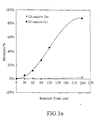
- FIG.3a shows the hemolysis caused by the reaction film of the hemoglobin detecting electrode strip.
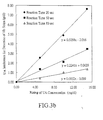
- FIG. 3b shows the concentrations of the uric acid and hemoglobin can be measured through the adjustment of current of the detection device.
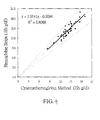
- FIG. 4 shows the concentration of hemoglobin in whole-blood respectively detected by the electrode strip of the present invention and Cyanmet-hemoglobin method.
- FIG. 5 shows the hematocrit in whole-blood respectively detected by the electrode strip of the present invention and the centrifugation method.
- the present invention features a disposable detecting electrode strip modified by a water-soluble redox electron mediator and a surfactant.
- the electrode strip detects the concentration of biomolecules in a liquid sample by catching signals generated by a redox current of a redox electron mediator and the biomolecules such as uric acid and hemoglobin.
- the electrode modified by a higher concentration of neutral surfactant Triton X-100 has a high reaction velocity and accuracy in the detection of hemoglobin.
- An object of the invention is to provide a disposable electrode article eg. in the form of a strip which is suitable for the non-enzymatic detection of hemoglobin, which article comprises:
- the electric insulating substrate has a flat surface and an insulation property.
- Said substrate is thermal-resistant more than 40°C, preferably 40-80°C, which can increase the conductivity through thermal processing.
- Any materials with the above-mentioned properties are suitable for the electric insulating substrate of the invention.
- such materials are selected from the group consisting of polyvinyl chloride (PVC), fiber glass (FR-4), polyester sulphone, bakelite plate, polyethylene terephthalate (PET) plate, polycarbonate (PC) plate. glass plate and ceramics plate (CEM-1).
- the conducting film is coated on one side of said insulting substrate to form an isolated and disconnected cathode and an isolated and disconnected anode.
- the coating is achieved by screen printing with printing ink or sticking with a metal film.
- the metal film is selected from the group consisting of gold, silver, platinum and palladium.
- the printing ink is selected from the group consisting of carbon ink, gold ink, silver ink, the mixture of carbon and silver ink, volatile graphite, copper ink, or the mixture of the above (for example, printing silver ink first and then printing carbon ink).
- Said cathode is partially covered by said electric insulating film and the uncovered ends of the cathode form a reference electrode and a cathode connector, respectively.
- the anode is also partially covered by said electric insulating film and the uncovered ends of the anode form a working electrode and anode connector respectively.
- the reference electrode of the cathode is covered by the reaction film and cooperates together with the working electrode of the anode to detect the induced electric effect.
- the cathode and anode connectors are used to connect with the amperometric sensor.
- the electric insulating film is coated on one surface of said electric insulating substrate but does not insulate the above-mentioned cathode connector, anode connector, working electrode and reference electrode.
- the region uncovered by the electric insulating film including the working electrode and the reference electrode forms a reaction region, which is then coated by the reaction film for testing samples.
- the thickness of the electric insulating films is 0.1mm to 2mm, preferably more than 0.6 mm.
- the reaction film is coated on the reaction region by any suitable method, preferably by pipetting or screen printing.
- the reaction film consists of a water-soluble redox electron mediator, a carrier and a surfactant.
- the reaction film contacts with a sample and reacts electrochemically. Further, the reaction film can be covered with a protection film.
- the conductive mediator is a material for donating or accepting electrons, that can be used as the mediator for transferring electron between the tested analyte and electrode in the redox reaction.
- the conductive mediator will change from oxidation state to reduction state after reacting with tested sample.
- the conductive mediator can then reverse to oxidation state by applying a forced voltage.
- the changes of, such as potential, resistance, or current caused by electrochemical reaction can be transferred through the conducting film, i.e. from the working electrode and the reference electrode connected with the reaction film to the cathode connector and the anode connector.
- a conductive mediator suitable for 100mV to 500mV of redox potential difference can be used in the invention.
- said conductive mediator is selected from the group consisting of potassium ferricyanide, ferricinium, tetrathisfulvalene, methylviologen and ferricyanide. More preferably, said conductive mediator is potassium ferricyanide. The amount of said conductive mediator preferably ranges from 0.3 to 5% by weight of the reaction film.
- the carrier absorbs a sample because the sample is hydrophilic and hard to attach to a hydrophobic conducting film.
- the carrier can enhance the absorption of sample, and enhance the signals to be transferred to the conducting film.
- Said reaction film contacts with a sample and reacts electrochemically with said sample. Therefore, the carrier can be distributed all over the reaction film area and the signals be thoroughly transferred.
- the carrier is selected from the group consisting of microcrystalline cellulose, carboxymethyl cellulose or methyl cellulose. More preferably, the celluloses have a size of below 100 ⁇ m.
- the amount of the celluloses ranges from about 0.01% to about 0.1 % by weight of the reaction film.
- the carrier optionally comprises a polymer.
- the polymer is to facilitate the reaction film having a certain viscosity.
- the reaction film can therefore be distributed thoroughly.
- the polymer is selected from the group consisting of polyvinyl alcohol (PVA), polyvinyl pyrrolidone (PVP), polyethylene glycol (PEG), gelatin and the mixture thereof. More preferably, the amount of the polymer ranges from 0 to 15% by weight of the reaction film.
- the surfactant used in said reaction film is a neutral surfactant with the concentration more than 1% by weight eg. 1% to 6% by weight.
- the surfactant is triton. Most preferably, the concentration of said neutral surfactant ranges from 1% to 5% by weight.
- the non-enzymatic disposable hemoglobin detecting electrode strip can be used in the detection of hematocrit.
- the ratio value of hematocrit/ hemoglobin is between 2.9 and 3.1. Therefore, the hematocrit can be calculated by the concentration of hemoglobin detected by the hemoglobin detecting electrode strip of the invention.
- Another object of the invention is to provide a method for producing disposable non-enzymatic or hemoglobin detecting electrode strip which comprises:
- a conducting film is coated on one side of a flat substrate to form at least an anode and a cathode that are separately isolated from each other. After coating, the conducting film is dried at 35°C to 80°C.
- an electric insulating film with a thickness of 0.6 mm or above is partially printed onto the conducting film.
- the uncovered parts of the conducting film form a cathode connector, an anode connector, a working electrode and a reference electrode.
- An area formed by the working electrode and the reference electrode in a circle or any other suitable shape is an area of reaction film.
- a reaction film is pipetting or screen printing on a reaction region so that the individual working electrode and the reference electrode can be connected.
- Said region can be a circle or any other suitable shape.
- the reaction film can be further dried at 40 to 80° C.
- a protection film is optionally coated on and around the area of the reaction film. The disposable non-enzymatic electrode strip is therefore produced.
- a hemoglobin detecting equipment comprises disposable non-enzymatic hemoglobin detecting electrode strip and a amperometric sensor directly analyzing hemoglobin in a liquid sample, wherein the electrode strip comprises:
- the detecting conditions at a low operation voltage of below 400 mV and at a pH value from 5.0 to 10.0 avoid interference caused by other oxidizing components.
- Further object of the invention is to provide a method for detecting a concentration of hemoglobin in liquid, which comprises dropping the liquid on a non-enzymatic disposable hemoglobin detecting electrode strip of the invention, and controlling an amperometric sensor to be operated at a low operation voltage of below 400 mV, and a pH value in the range from 5.0 to 8.0.
- the detecting method of non-enzymatic electrode strip can proceed easily by using electrochemical detecting equipment.
- the reaction current caused by the redox reaction of hemoglobin can be detected in a hemoglobin detecting equipment by dropping a whole-blood sample on the reaction area of the non-enzymatic disposable hemoglobin detecting electrode strip of the present invention.
- Such an electrochemical reaction technology is commonly applied in electrochemical blood sugar monitor for detecting blood sugar.
- the method of directly detecting hemoglobin in whole-blood is novel and first disclosed in the present invention by using a redox electron mediator to transfer signals of the redox reaction of hemoglobin and by controlling the reaction at a pH value from 5.0 to 8.0 as well as a low operation voltage of below 400 mV to avoid the interference result from glucose and ascorbic acid in blood.
- the present invention can be used in the detection of biomolecules such as hemoglobin in any liquid samples.
- the sample which may be tested in accordance with the invention may be any body fluid, preferably blood or a component of blood, more preferably whole blood.
- whole-blood As a sample for detecting hemoglobin, there will be interference caused by other components, especially ascorbic acid in the blood.
- the disposable detecting electrode strip and detecting equipment of the present invention can directly detect the hemoglobin in whole-blood for household use.
- One important advantage of the present invention is to eliminate the use of any bio-active substances such as enzymes. So, the present invention simplifies the production process, reduces the production cost, increases the storage term, and releases the storage restriction of the detecting electrode strip.
- Figs. 1a and 1b are respectively a top view diagram and a front view diagram of an electrode strip of the present invention.
- the electrode strip structure comprises an electric insulating substrate 1 , a conducting film 2 coated on the insulating substrate, an electric insulating film 3 coated on a part of the conducting film 2 , and a reaction film 4 for reacting with a sample.
- the electric insulating substrate 1 of the present invention adheres to the conducting film 2 .
- the cathode of the conducting film 2 is partially covered by the electric insulating film 3 and two uncovered ends of the cathode are a working electrode 8 and a cathode connector 6 respectively.
- the working electrode 8 of the cathode is covered by the reaction film 4 and is used to detect an induced electric effect of samples during the electrochemical reaction of uric acid.
- the cathode connector 6 is used to connect with a amperometric sensor.
- the anode is also partially covered by the electric insulating film 3 and two uncovered ends of the anode are a reference electrode 9 and an anode connector 7 respectively.
- the reference electrode 9 of the anode is covered by the reaction film 4 and cooperates together with the working electrode of the cathode to detect the induced electric effect.
- a conducting film 2 is first coated such as by screen printing on one side of a flat substrate 1 to form at least an anode and a cathode which are separately isolated from each other.
- the uncovered parts of the conducting film form a cathode connector 6 , an anode connector 7 , a working electrode 8 and a reference electrode 9 .
- a conductive mediator are screen printing on the circle area of the reaction film 4 and a protection film 5 is optionally coated on and around the circle area of the reaction film 4 .
- FIG. 3a shows the hemolysis caused by the reaction film of the hemoglobin detecting electrode strip.
- Figure 3b shows that the signal of the hemoglobin reaction can be amplified through the adjustment of current to reduce the interference of the uric acid.
- a conducting film 2 comprising a set of isolated and disconnected anode and cathode and then dried at 40 to 80° C.
- An electric insulating film 3 with a thickness of about 0.6 mm was subsequently screen printed on the conducting film 2 partially.
- the uncovered part of the conducting film formed a cathode connector 6, a anode connector 7 , a working electrode 8 and a reference electrode 9 .
- the circle area formed by working electrode 8 and reference electrode 9 was an area of reaction film 4 .
- the disposable non-enzymatic uric acid detecting electrode strip was produced through the production steps of the above.
- the uric acid in blood was detected for 20 seconds by the above-obtained disposable non-enzymatic uric acid detecting electrode strip of the present invention by taking whole-blood as a sample.
- the test results were the same as the uric acid concentration detected by any conventional method.
- the uric acid in blood was detected for 30 seconds by the above obtained disposable non-enzymatic uric acid detecting electrode strip of the present invention by taking whole-blood as a sample.
- the test results were the same as the uric acid concentration detected by uricase method in combination with EPAC bio-analyzer.
- the hemoglobin in blood was detected for 30 seconds by the above obtained disposable non-enzymatic hemoglobin detecting electrode strip of the present invention by taking whole-blood as a sample.
- the test results were the same as the hemoglobin concentration detected by the cyanmet-hemoglobin method.
- the results of the hemocrit detected by the strip of the invention are same as those detected by centrifugation (see Figure 5 ).
- the disposable non-enzymatic hemoglobin detecting electrode strip of the present invention can precisely detect the hemoglobin concentration and hemocrit in blood by taking whole-blood as a sample and does not require any pretreatment.
- the hemoglobin in blood was detected for 80 seconds by the above obtained disposable non-enzymatic hemoglobin detecting electrode strip of the present invention by taking whole-blood as a sample.
- the test results were the same as the hemoglobin concentration detected by the cyanmet-hemoglobin method.
- the results show that the disposable non-enzymatic hemoglobin detecting electrode strip of the present invention can precisely detect the hemoglobin concentration in blood by taking whole-blood as a sample and does not require any pretreatment.
- the hemoglobin detecting electrode strip of the present invention does not require any bioactive substances and thus the production steps are simplified and shortened. Furthermore, the present invention can take whole-blood as a testing sample and precisely detect the hemoglobin concentration at a low operation voltage of below 400 mV and pH value from 5.0 to 8.0.
Landscapes
- Health & Medical Sciences (AREA)
- Life Sciences & Earth Sciences (AREA)
- Engineering & Computer Science (AREA)
- Hematology (AREA)
- Immunology (AREA)
- Molecular Biology (AREA)
- Chemical & Material Sciences (AREA)
- Biomedical Technology (AREA)
- Urology & Nephrology (AREA)
- Physics & Mathematics (AREA)
- Analytical Chemistry (AREA)
- Cell Biology (AREA)
- Pathology (AREA)
- Food Science & Technology (AREA)
- Medicinal Chemistry (AREA)
- Biotechnology (AREA)
- Microbiology (AREA)
- Biochemistry (AREA)
- General Health & Medical Sciences (AREA)
- General Physics & Mathematics (AREA)
- Tropical Medicine & Parasitology (AREA)
- Measuring Or Testing Involving Enzymes Or Micro-Organisms (AREA)
- Investigating Or Analysing Biological Materials (AREA)
- Detergent Compositions (AREA)
Claims (22)
- Für den nicht-enzymatischen Nachweis von Hämoglobin geeigneter Wegwerf-Elektrodengegenstand, umfassend:(1) ein elektrisch isolierendes Substrat;(2) einen auf eine Seite des isolierenden Substrats schichtförmig aufgetragenen leitenden Film zur Bildung einer isolierten und abgeschalteten Anode und einer isolierten und abgeschalteten Kathode;(3) einen elektrisch isolierenden Film, der schichtförmig auf einen Teil des leitenden Films aufgetragen ist, wobei ein Bereich der leitenden Filmanode einen Anodenanschluss bildet und ein weiterer Bereich der leitenden Filmanode, der nicht mit dem isolierenden Film beschichtet ist, mindestens eine Referenzelektrode bildet und wobei ein Bereich der leitenden Filmkathode einen Kathodenanschluss bildet und ein weiterer Bereich der leitenden Filmkathode, der nicht mit dem isolierenden Film beschichtet ist, mindestens eine Arbeitselektrode bildet; und(4) einen Reaktionsfilm, der einen Träger, einen leitenden Vermittler und ein neutrales oberflächenaktives Mittel umfasst, wobei es sich beim oberflächenaktiven Mittel um Triton X-100 der Formel

- Elektrodengegenstand nach Anspruch 1, wobei das elektrisch isolierende Substrat eine flache Oberfläche aufweist.
- Elektrodengegenstand nach Anspruch 1 oder 2, wobei das elektrisch isolierende Substrat bei Temperaturen von mehr als 40 °C wärmebeständig ist.
- Elektrodengegenstand nach Anspruch 3, wobei das elektrisch isolierende Substrat bei Temperaturen von 40 bis 80 °C wärmebeständig ist.
- Elektrodengegenstand nach einem der vorstehenden Ansprüche, wobei das elektrisch isolierende Substrat Polyvinylchlorid (PVC), Glasfasern (FR-4), Polyestersulfon, eine Bakelit-Dünnschicht, eine Polyethylenterephthalat (PET)-Dünnschicht, eine Polycarbonat (PC)-Dünnschicht, eine Glasdünnschicht oder eine keramische Dünnschicht (CEM-1) umfasst.
- Elektrodengegenstand nach einem der vorstehenden Ansprüche, wobei der Reaktionsfilm bei Kontakt mit einer Testprobe einer elektrochemischen Reaktion unterliegen kann.
- Elektrodengegenstand nach einem der vorstehenden Ansprüche, wobei der Reaktionsfilm ferner mit einem Schutzfilm bedeckt ist.
- Elektrodengegenstand nach einem der vorstehenden Ansprüche, wobei der Träger mikrokristalline Cellulose, Carboxymethylcellulose oder Methylcellulose umfasst.
- Elektrodengegenstand nach Anspruch 8, wobei es sich beim Träger um mikrokristalline Cellulose mit einer Größe unter 100 µm handelt.
- Elektrodengegenstand nach Anspruch 8 oder 9, wobei die Menge der Trägercellulose im Bereich von 0,01 bis 0,1 Gew.-% des Reaktionsfilms liegt.
- Elektrodengegenstand nach einem der vorstehenden Ansprüche, wobei der Träger gegebenenfalls ein Polymeres umfasst, bei dem es sich um Polyvinylalkohol (PVA), Polyvinylpyrrolidon (PVP), Polyethylenglykol (PEG) oder Gelatine handelt.
- Elektrodengegenstand nach Anspruch 11, wobei die Menge des Polymeren 0 bis 15 Gew.-% des Reaktionsfilms beträgt.
- Elektrodengegenstand nach einem der vorstehenden Ansprüche, wobei es sich beim leitenden Vermittler um K3Fe(CN)6 handelt.
- Elektrodengegenstand nach einem der vorstehenden Ansprüche, wobei die Menge des leitenden Vermittlers 0,3 bis 5 Gew.-% des Reaktionsfilms beträgt.
- Elektrodengegenstand nach Anspruch 1, wobei das oberflächenaktive Mittel im Reaktionsfilm in einer Menge von 1 bis 5 Gew,-% vorliegt.
- Elektrodengegenstand nach Anspruch 1, der sich zur Verwendung bei der Bestimmung des Hämatokritwerts eignet.
- Verfahren zur Herstellung des Elektrodengegenstands nach einem der vorstehenden Ansprüche, umfassend die folgenden Stufen:(a) das schichtförmige Auftragen eines leitenden Films auf eine Seite eines elektrisch isolierenden Substrats und das Bilden einer isolierten und abgeschalteten Anode und einer isolierten und abgeschalteten Kathode;(b) das schichtförmige Auftragen eines elektrisch isolierenden Films auf einen Teil des leitenden Films, wobei ein Bereich der leitenden Filmanode einen Anodenanschluss bildet und ein weiterer Bereich der leitenden Filmanode, der nicht mit dem isolierenden Film beschichtet ist, eine Referenzelektrode bildet und ein Bereich der leitenden Filmkathode einen Kathodenanschluss bildet und ein weiterer Bereich der leitenden Filmkathode, der nicht mit dem isolierenden Film beschichtet ist, eine Arbeitselektrode bildet; und(c) das Bilden eines Reaktionsfilms auf einem Bereich, der mindestens die Arbeitselektrode und die Referenzelektrode enthält, um einen elektrischen Anschluss der Arbeitselektrode und der Referenzelektrode zu ermöglichen.
- Verfahren nach Anspruch 17, wobei der Reaktionsfilm durch Siebdruck oder Pipettieren des Films auf diesem Bereich gebildet wird.
- Vorrichtung, die zum nicht-enzymatischen Nachweis von Hämoglobin in einer flüssigen Probe geeignet ist, wobei die Vorrichtung einen Elektrodengegenstand und einen amperometrischen Sensor umfasst, wobei der Elektrodengegenstand folgendes umfasst:(1) ein elektrisch isolierendes Substrat;(2) einen auf eine Seite des isolierenden Substrats schichtförmig aufgetragenen leitenden Film zur Bildung einer isolierten und abgeschalteten Anode und einer isolierten und abgeschalteten Kathode;(3) einen elektrisch isolierenden Film, der schichtförmig auf einen Teil des leitenden Films aufgetragen ist, wobei ein Bereich der leitenden Filmanode einen Anodenanschluss bildet und ein weiterer Bereich der leitenden Filmanode, der nicht mit dem isolierenden Film beschichtet ist, mindestens eine Referenzelektrode bildet und wobei ein Bereich der leitenden Filmkathode einen Kathodenanschluss bildet und ein weiterer Bereich der leitenden Filmkathode, der nicht mit dem isolierenden Film beschichtet ist, mindestens eine Arbeitselektrode bildet; und(4) einen Reaktionsfilm, der einen Träger, einen leitenden Vermittler und ein neutrales oberflächenaktives Mittel umfasst, wobei es sich beim oberflächenaktiven Mittel um Triton X-100 der Formelhandelt, wobei X einen Wert von 9 bis 10 hat, wobei das oberflächenaktive Mittel in einer Konzentration von mehr als 1 % vorliegt, wobei der Reaktionsfilm schichtförmig auf einen Bereich aufgetragen ist, der mindestens die Arbeitselektrode und die Referenzelektrode umfasst, um einen elektrischen Anschluss der Arbeitselektrode und der Referenzelektrode über diesen Reaktionsfilm zu ermöglichen; und

wobei der amperometrische Sensor an den Anodenanschluss und den Kathodenanschluss des Elektrodengegenstands angeschlossen ist, wobei der Sensor eine Spannungsausgabeeinrichtung, einen Signalempfänger und eine Anzeigeeinrichtung umfasst, wobei die Spannungsausgabeeinrichtung zur Bereitstellung einer Spannung von 100 mV bis unter 400 mV am Reaktionsfilm des Elektrodengegenstands befähigt ist, um den leitenden Vermittler von einem Reduktionszustand in einen Oxidationszustand zu oxidieren, nachdem die Umsetzung mit Hämoglobin der Probe erfolgt ist; wobei der Signalempfänger zum Empfangen einer Strom-, Spannungs- oder Widerstandsänderung, die während einer Redoxreaktion erzeugt wird, und zur Übermittlung der Änderung zur Anzeigeeinrichtung, um die Konzentration an Hämoglobin in der Probe anzuzeigen, befähigt ist. - Vorrichtung nach Anspruch 19, wobei der Nachweiselektrodengegenstand für den einmaligen Gebrauch bestimmt ist.
- Einrichtung nach Anspruch 19 oder 20, geeignet zur Messung einer flüssigen Probe, bei der es sich um Blut handelt.
- Verfahren zum Bestimmen der Konzentration von Hämoglobin in einer Flüssigkeit, umfassend das Auftropfen einer Probe der Flüssigkeit auf einen Wegwerf-Elektrodengegenstand zur Bestimmung von Hämoglobin nach Anspruch 1, der an einen amperometrischen Sensor angeschlossen ist, und das Steuern des amperometrischen Sensors zum Betreiben bei einer Spannung von 100 mV bis unter 400 mV und einem pH-Wert von 5,0 bis 8,0.
Priority Applications (6)
| Application Number | Priority Date | Filing Date | Title |
|---|---|---|---|
| DE60141725T DE60141725D1 (de) | 2001-01-19 | 2001-01-19 | Nicht enzymatischer Einwegerkennungselektrodenstreifen der einen oberflächenaktiven Stoff beinhaltet, zum Nachweis von Harnsäure; Herstellungsverfahren dafür und Verwendung davon |
| EP08005522A EP1936375B1 (de) | 2001-01-19 | 2001-01-19 | Nicht enzymatischer Einwegerkennungselektrodenstreifen der einen oberflächenaktiven Stoff beinhaltet, zum Nachweis von Harnsäure; Herstellungsverfahren dafür und Verwendung davon |
| EP01300476A EP1225449B1 (de) | 2001-01-19 | 2001-01-19 | Nicht-enzymatischer, Detergenzien enthaltender Einweg-Elektrodestreifen für den Nachweis von Harnsäure oder Hämoglobin,sowie Verfahren für die Produktion und Anwendung desgleichen |
| AT01300476T ATE412174T1 (de) | 2001-01-19 | 2001-01-19 | Nicht-enzymatischer, detergenzien enthaltender einweg-elektrodestreifen für den nachweis von harnsäure oder hämoglobin,sowie verfahren für die produktion und anwendung desgleichen |
| AT08005522T ATE462969T1 (de) | 2001-01-19 | 2001-01-19 | Nicht enzymatischer einwegerkennungselektrodenstreifen der einen oberflächenaktiven stoff beinhaltet, zum nachweis von harnsäure; herstellungsverfahren dafür und verwendung davon |
| DE60136260T DE60136260D1 (de) | 2001-01-19 | 2001-01-19 | Nicht-enzymatischer, Detergenzien enthaltender Einweg-Elektrodestreifen für den Nachweis von Harnsäure oder Hämoglobin,sowie Verfahren für die Produktion und Anwendung desgleichen |
Applications Claiming Priority (1)
| Application Number | Priority Date | Filing Date | Title |
|---|---|---|---|
| EP01300476A EP1225449B1 (de) | 2001-01-19 | 2001-01-19 | Nicht-enzymatischer, Detergenzien enthaltender Einweg-Elektrodestreifen für den Nachweis von Harnsäure oder Hämoglobin,sowie Verfahren für die Produktion und Anwendung desgleichen |
Related Child Applications (1)
| Application Number | Title | Priority Date | Filing Date |
|---|---|---|---|
| EP08005522A Division EP1936375B1 (de) | 2001-01-19 | 2001-01-19 | Nicht enzymatischer Einwegerkennungselektrodenstreifen der einen oberflächenaktiven Stoff beinhaltet, zum Nachweis von Harnsäure; Herstellungsverfahren dafür und Verwendung davon |
Publications (2)
| Publication Number | Publication Date |
|---|---|
| EP1225449A1 EP1225449A1 (de) | 2002-07-24 |
| EP1225449B1 true EP1225449B1 (de) | 2008-10-22 |
Family
ID=8181654
Family Applications (2)
| Application Number | Title | Priority Date | Filing Date |
|---|---|---|---|
| EP01300476A Expired - Lifetime EP1225449B1 (de) | 2001-01-19 | 2001-01-19 | Nicht-enzymatischer, Detergenzien enthaltender Einweg-Elektrodestreifen für den Nachweis von Harnsäure oder Hämoglobin,sowie Verfahren für die Produktion und Anwendung desgleichen |
| EP08005522A Expired - Lifetime EP1936375B1 (de) | 2001-01-19 | 2001-01-19 | Nicht enzymatischer Einwegerkennungselektrodenstreifen der einen oberflächenaktiven Stoff beinhaltet, zum Nachweis von Harnsäure; Herstellungsverfahren dafür und Verwendung davon |
Family Applications After (1)
| Application Number | Title | Priority Date | Filing Date |
|---|---|---|---|
| EP08005522A Expired - Lifetime EP1936375B1 (de) | 2001-01-19 | 2001-01-19 | Nicht enzymatischer Einwegerkennungselektrodenstreifen der einen oberflächenaktiven Stoff beinhaltet, zum Nachweis von Harnsäure; Herstellungsverfahren dafür und Verwendung davon |
Country Status (3)
| Country | Link |
|---|---|
| EP (2) | EP1225449B1 (de) |
| AT (2) | ATE462969T1 (de) |
| DE (2) | DE60141725D1 (de) |
Families Citing this family (7)
| Publication number | Priority date | Publication date | Assignee | Title |
|---|---|---|---|---|
| TW200304544A (en) | 2002-03-29 | 2003-10-01 | Apex Biotechnology Corp | Method to prepare whole-blood examining electrode test strip reaction membrane preparing object, and the related product |
| MX2011003952A (es) * | 2008-10-14 | 2011-05-23 | Piramal Healtcare Ltd | Metodo electroquimico no enzimatico para la determinacion simultanea de hemoglobina total y hemoglobina glucosilada. |
| WO2013019102A2 (en) * | 2011-08-01 | 2013-02-07 | Mimos Berhad | A non-enzymatic sensor |
| CN106290500B (zh) * | 2016-08-24 | 2018-11-16 | 川北医学院附属医院 | 利用石墨烯—二硫化钼—全氟磺酸树脂检测尿酸的方法 |
| CN110487865A (zh) * | 2019-09-04 | 2019-11-22 | 安徽信灵检验医学科技股份有限公司 | 一种尿白蛋白测试电极的制作方法 |
| CN112858422B (zh) * | 2019-11-12 | 2022-12-20 | 北京怡成生物电子技术股份有限公司 | 一种去抗坏血酸干扰的电化学尿酸试条及其制作与应用 |
| GB2591455B (en) * | 2020-01-21 | 2022-08-17 | Univ Of Colombo | Nonenzymatic electrochemical sensors |
Family Cites Families (11)
| Publication number | Priority date | Publication date | Assignee | Title |
|---|---|---|---|---|
| US4301412A (en) * | 1979-10-29 | 1981-11-17 | United States Surgical Corporation | Liquid conductivity measuring system and sample cards therefor |
| IT1196348B (it) | 1984-11-29 | 1988-11-16 | Italfarmaco Spa | Composti ad attivita'antiinfiammatoria |
| US4713165A (en) * | 1986-07-02 | 1987-12-15 | Ilex Corporation | Sensor having ion-selective electrodes |
| GB8619627D0 (en) * | 1986-08-12 | 1986-09-24 | Genetics Int Inc | Electrochemical assay |
| DE4427363A1 (de) * | 1993-08-03 | 1995-03-09 | A & D Co Ltd | Chemischer Einmalsensor |
| US5779867A (en) * | 1994-10-07 | 1998-07-14 | Biomedix, Inc. | Dry chemistry glucose sensor |
| US5667983A (en) * | 1994-10-24 | 1997-09-16 | Chiron Diagnostics Corporation | Reagents with enhanced performance in clinical diagnostic systems |
| US6054039A (en) * | 1997-08-18 | 2000-04-25 | Shieh; Paul | Determination of glycoprotein and glycosylated hemoglobin in blood |
| TW369411B (en) * | 1998-11-09 | 1999-09-11 | Apex Biotechnology Co Ltd | Disposal electrode test block for current-type non-enzymatic uric acid test, its process and application |
| US6258223B1 (en) * | 1999-07-09 | 2001-07-10 | Applied Materials, Inc. | In-situ electroless copper seed layer enhancement in an electroplating system |
| TW416005B (en) * | 1999-11-11 | 2000-12-21 | Apex Biotechnology Corp | Biosensor with multiple sampling ways |
-
2001
- 2001-01-19 AT AT08005522T patent/ATE462969T1/de not_active IP Right Cessation
- 2001-01-19 EP EP01300476A patent/EP1225449B1/de not_active Expired - Lifetime
- 2001-01-19 DE DE60141725T patent/DE60141725D1/de not_active Expired - Lifetime
- 2001-01-19 DE DE60136260T patent/DE60136260D1/de not_active Expired - Lifetime
- 2001-01-19 AT AT01300476T patent/ATE412174T1/de not_active IP Right Cessation
- 2001-01-19 EP EP08005522A patent/EP1936375B1/de not_active Expired - Lifetime
Non-Patent Citations (1)
| Title |
|---|
| Productinformation from SIGMA about Triton X-100 dated 21.04.1999. * |
Also Published As
| Publication number | Publication date |
|---|---|
| ATE462969T1 (de) | 2010-04-15 |
| EP1936375B1 (de) | 2010-03-31 |
| ATE412174T1 (de) | 2008-11-15 |
| EP1225449A1 (de) | 2002-07-24 |
| EP1936375A1 (de) | 2008-06-25 |
| DE60136260D1 (de) | 2008-12-04 |
| DE60141725D1 (de) | 2010-05-12 |
Similar Documents
| Publication | Publication Date | Title |
|---|---|---|
| US6491803B1 (en) | Test strip and biosensor incorporating with nanometer metal particles | |
| CA2358464C (en) | Disposable test strips with integrated reagent/blood separation layer | |
| JP4879459B2 (ja) | 液体サンプルの分析のための電気化学式バイオセンサストリップ | |
| US9846136B2 (en) | Multi-region and potential test sensors, methods and systems | |
| EP1262768A1 (de) | Analytisches element, messgerät und verfahren zur identifizierung eines substrates mit diesem element | |
| HUT76409A (en) | Methods for electrochemical measurements | |
| US20100089774A1 (en) | Non-enzymatic electrochemical method for simultaneous determination of total hemoglobin and glycated hemoglobin | |
| EP2284526B1 (de) | Biosensorsystem und verfahren zur messung einer analytkonzentration in einer blutprobe | |
| EP2373805B1 (de) | Niedriggesamtsalz-reagenszusammensetzungen und systeme für biosensoren | |
| US8512532B2 (en) | Method of producing whole blood detecting electrode strip and reaction film formulation and the related products | |
| US6258230B1 (en) | Non-enzymatic disposable uric acid detecting electrode strip, method for producing the same and its use | |
| EP1225449B1 (de) | Nicht-enzymatischer, Detergenzien enthaltender Einweg-Elektrodestreifen für den Nachweis von Harnsäure oder Hämoglobin,sowie Verfahren für die Produktion und Anwendung desgleichen | |
| KR20100136159A (ko) | 크레아틴의 방해영향을 줄인 크레아티닌 마이크로센서 | |
| Jiang et al. | Performance of an amperometric biosensor for the determination of hemoglobin | |
| TW202346857A (zh) | 電化學系統與植入式生化試片 | |
| US7319018B2 (en) | Lactate biosensing strip with two electrodes | |
| CN1908669B (zh) | 血红蛋白芯片的制备及其电化学检测方法 | |
| EP1578984A1 (de) | Verfahren zur herstellung von lactate biodetektion strip | |
| JPS63109365A (ja) | 化学プローブおよび酵素センサー | |
| EP1578985B1 (de) | Lactate biodetektion strip | |
| LAVANYA et al. | DEVELOPMENT OF SENSITIVE AND SELECTIVE ELECTROCHEMICAL SENSOR BY MODIFYING CARBON PASTE ELECTRODE (MCPE) | |
| Raugel | Inceltech LH-SGI | |
| HK1229422A1 (en) | Test sensor for determining the concentration of an analyte in a sample | |
| JPH11118751A (ja) | キシリトール分析要素 |
Legal Events
| Date | Code | Title | Description |
|---|---|---|---|
| PUAI | Public reference made under article 153(3) epc to a published international application that has entered the european phase |
Free format text: ORIGINAL CODE: 0009012 |
|
| AK | Designated contracting states |
Kind code of ref document: A1 Designated state(s): AT BE CH CY DE DK ES FI FR GB GR IE IT LI LU MC NL PT SE TR |
|
| AX | Request for extension of the european patent |
Free format text: AL;LT;LV;MK;RO;SI |
|
| 17P | Request for examination filed |
Effective date: 20030124 |
|
| AKX | Designation fees paid |
Designated state(s): AT BE CH CY DE DK ES FI FR GB GR IE IT LI LU MC NL PT SE TR |
|
| AXX | Extension fees paid |
Extension state: MK Payment date: 20030124 Extension state: LV Payment date: 20030124 Extension state: SI Payment date: 20030124 Extension state: LT Payment date: 20030124 Extension state: AL Payment date: 20030124 Extension state: RO Payment date: 20030124 |
|
| 17Q | First examination report despatched |
Effective date: 20030818 |
|
| 17Q | First examination report despatched |
Effective date: 20030818 |
|
| GRAP | Despatch of communication of intention to grant a patent |
Free format text: ORIGINAL CODE: EPIDOSNIGR1 |
|
| GRAS | Grant fee paid |
Free format text: ORIGINAL CODE: EPIDOSNIGR3 |
|
| RAP1 | Party data changed (applicant data changed or rights of an application transferred) |
Owner name: APEX BIOTECHNOLOGY CORPORATION |
|
| GRAA | (expected) grant |
Free format text: ORIGINAL CODE: 0009210 |
|
| AK | Designated contracting states |
Kind code of ref document: B1 Designated state(s): AT BE CH CY DE DK ES FI FR GB GR IE IT LI LU MC NL PT SE TR |
|
| AX | Request for extension of the european patent |
Extension state: AL LT LV MK RO SI |
|
| REG | Reference to a national code |
Ref country code: GB Ref legal event code: FG4D |
|
| REG | Reference to a national code |
Ref country code: CH Ref legal event code: EP |
|
| REG | Reference to a national code |
Ref country code: IE Ref legal event code: FG4D |
|
| REF | Corresponds to: |
Ref document number: 60136260 Country of ref document: DE Date of ref document: 20081204 Kind code of ref document: P |
|
| LTIE | Lt: invalidation of european patent or patent extension |
Effective date: 20081022 |
|
| NLV1 | Nl: lapsed or annulled due to failure to fulfill the requirements of art. 29p and 29m of the patents act | ||
| PG25 | Lapsed in a contracting state [announced via postgrant information from national office to epo] |
Ref country code: AT Free format text: LAPSE BECAUSE OF FAILURE TO SUBMIT A TRANSLATION OF THE DESCRIPTION OR TO PAY THE FEE WITHIN THE PRESCRIBED TIME-LIMIT Effective date: 20081022 Ref country code: ES Free format text: LAPSE BECAUSE OF FAILURE TO SUBMIT A TRANSLATION OF THE DESCRIPTION OR TO PAY THE FEE WITHIN THE PRESCRIBED TIME-LIMIT Effective date: 20090202 |
|
| PG25 | Lapsed in a contracting state [announced via postgrant information from national office to epo] |
Ref country code: PT Free format text: LAPSE BECAUSE OF FAILURE TO SUBMIT A TRANSLATION OF THE DESCRIPTION OR TO PAY THE FEE WITHIN THE PRESCRIBED TIME-LIMIT Effective date: 20090323 Ref country code: NL Free format text: LAPSE BECAUSE OF FAILURE TO SUBMIT A TRANSLATION OF THE DESCRIPTION OR TO PAY THE FEE WITHIN THE PRESCRIBED TIME-LIMIT Effective date: 20081022 Ref country code: FI Free format text: LAPSE BECAUSE OF FAILURE TO SUBMIT A TRANSLATION OF THE DESCRIPTION OR TO PAY THE FEE WITHIN THE PRESCRIBED TIME-LIMIT Effective date: 20081022 |
|
| PG25 | Lapsed in a contracting state [announced via postgrant information from national office to epo] |
Ref country code: BE Free format text: LAPSE BECAUSE OF FAILURE TO SUBMIT A TRANSLATION OF THE DESCRIPTION OR TO PAY THE FEE WITHIN THE PRESCRIBED TIME-LIMIT Effective date: 20081022 Ref country code: DK Free format text: LAPSE BECAUSE OF FAILURE TO SUBMIT A TRANSLATION OF THE DESCRIPTION OR TO PAY THE FEE WITHIN THE PRESCRIBED TIME-LIMIT Effective date: 20081022 |
|
| PLBE | No opposition filed within time limit |
Free format text: ORIGINAL CODE: 0009261 |
|
| STAA | Information on the status of an ep patent application or granted ep patent |
Free format text: STATUS: NO OPPOSITION FILED WITHIN TIME LIMIT |
|
| PG25 | Lapsed in a contracting state [announced via postgrant information from national office to epo] |
Ref country code: IT Free format text: LAPSE BECAUSE OF FAILURE TO SUBMIT A TRANSLATION OF THE DESCRIPTION OR TO PAY THE FEE WITHIN THE PRESCRIBED TIME-LIMIT Effective date: 20081022 Ref country code: MC Free format text: LAPSE BECAUSE OF NON-PAYMENT OF DUE FEES Effective date: 20090131 Ref country code: SE Free format text: LAPSE BECAUSE OF FAILURE TO SUBMIT A TRANSLATION OF THE DESCRIPTION OR TO PAY THE FEE WITHIN THE PRESCRIBED TIME-LIMIT Effective date: 20090122 |
|
| REG | Reference to a national code |
Ref country code: CH Ref legal event code: PL |
|
| 26N | No opposition filed |
Effective date: 20090723 |
|
| PG25 | Lapsed in a contracting state [announced via postgrant information from national office to epo] |
Ref country code: LI Free format text: LAPSE BECAUSE OF NON-PAYMENT OF DUE FEES Effective date: 20090131 Ref country code: CH Free format text: LAPSE BECAUSE OF NON-PAYMENT OF DUE FEES Effective date: 20090131 |
|
| REG | Reference to a national code |
Ref country code: FR Ref legal event code: ST Effective date: 20091030 |
|
| PG25 | Lapsed in a contracting state [announced via postgrant information from national office to epo] |
Ref country code: IE Free format text: LAPSE BECAUSE OF NON-PAYMENT OF DUE FEES Effective date: 20090119 |
|
| PG25 | Lapsed in a contracting state [announced via postgrant information from national office to epo] |
Ref country code: FR Free format text: LAPSE BECAUSE OF NON-PAYMENT OF DUE FEES Effective date: 20090202 |
|
| PG25 | Lapsed in a contracting state [announced via postgrant information from national office to epo] |
Ref country code: GR Free format text: LAPSE BECAUSE OF FAILURE TO SUBMIT A TRANSLATION OF THE DESCRIPTION OR TO PAY THE FEE WITHIN THE PRESCRIBED TIME-LIMIT Effective date: 20090123 |
|
| PG25 | Lapsed in a contracting state [announced via postgrant information from national office to epo] |
Ref country code: LU Free format text: LAPSE BECAUSE OF NON-PAYMENT OF DUE FEES Effective date: 20090119 |
|
| PG25 | Lapsed in a contracting state [announced via postgrant information from national office to epo] |
Ref country code: CY Free format text: LAPSE BECAUSE OF FAILURE TO SUBMIT A TRANSLATION OF THE DESCRIPTION OR TO PAY THE FEE WITHIN THE PRESCRIBED TIME-LIMIT Effective date: 20081022 |
|
| PGFP | Annual fee paid to national office [announced via postgrant information from national office to epo] |
Ref country code: GB Payment date: 20191127 Year of fee payment: 20 Ref country code: DE Payment date: 20191118 Year of fee payment: 20 |
|
| PGFP | Annual fee paid to national office [announced via postgrant information from national office to epo] |
Ref country code: TR Payment date: 20200117 Year of fee payment: 20 |
|
| REG | Reference to a national code |
Ref country code: DE Ref legal event code: R071 Ref document number: 60136260 Country of ref document: DE |
|
| REG | Reference to a national code |
Ref country code: GB Ref legal event code: PE20 Expiry date: 20210118 |
|
| PG25 | Lapsed in a contracting state [announced via postgrant information from national office to epo] |
Ref country code: GB Free format text: LAPSE BECAUSE OF EXPIRATION OF PROTECTION Effective date: 20210118 |