EP1249131B1 - Video kompression für mehrfachsendeverteilungen unter verwendung von räumlicher skalierbarkeit und gleichwellenfunkkodierung - Google Patents
Video kompression für mehrfachsendeverteilungen unter verwendung von räumlicher skalierbarkeit und gleichwellenfunkkodierung Download PDFInfo
- Publication number
- EP1249131B1 EP1249131B1 EP00923225A EP00923225A EP1249131B1 EP 1249131 B1 EP1249131 B1 EP 1249131B1 EP 00923225 A EP00923225 A EP 00923225A EP 00923225 A EP00923225 A EP 00923225A EP 1249131 B1 EP1249131 B1 EP 1249131B1
- Authority
- EP
- European Patent Office
- Prior art keywords
- coding
- video data
- simulcast
- psnr
- video
- Prior art date
- Legal status (The legal status is an assumption and is not a legal conclusion. Google has not performed a legal analysis and makes no representation as to the accuracy of the status listed.)
- Expired - Lifetime
Links
Images












Classifications
-
- H—ELECTRICITY
- H04—ELECTRIC COMMUNICATION TECHNIQUE
- H04N—PICTORIAL COMMUNICATION, e.g. TELEVISION
- H04N19/00—Methods or arrangements for coding, decoding, compressing or decompressing digital video signals
- H04N19/10—Methods or arrangements for coding, decoding, compressing or decompressing digital video signals using adaptive coding
- H04N19/134—Methods or arrangements for coding, decoding, compressing or decompressing digital video signals using adaptive coding characterised by the element, parameter or criterion affecting or controlling the adaptive coding
- H04N19/154—Measured or subjectively estimated visual quality after decoding, e.g. measurement of distortion
-
- H—ELECTRICITY
- H04—ELECTRIC COMMUNICATION TECHNIQUE
- H04N—PICTORIAL COMMUNICATION, e.g. TELEVISION
- H04N21/00—Selective content distribution, e.g. interactive television or video on demand [VOD]
- H04N21/60—Network structure or processes for video distribution between server and client or between remote clients; Control signalling between clients, server and network components; Transmission of management data between server and client, e.g. sending from server to client commands for recording incoming content stream; Communication details between server and client
- H04N21/63—Control signaling related to video distribution between client, server and network components; Network processes for video distribution between server and clients or between remote clients, e.g. transmitting basic layer and enhancement layers over different transmission paths, setting up a peer-to-peer communication via Internet between remote STB's; Communication protocols; Addressing
- H04N21/64—Addressing
- H04N21/6405—Multicasting
-
- H—ELECTRICITY
- H04—ELECTRIC COMMUNICATION TECHNIQUE
- H04N—PICTORIAL COMMUNICATION, e.g. TELEVISION
- H04N19/00—Methods or arrangements for coding, decoding, compressing or decompressing digital video signals
- H04N19/10—Methods or arrangements for coding, decoding, compressing or decompressing digital video signals using adaptive coding
- H04N19/102—Methods or arrangements for coding, decoding, compressing or decompressing digital video signals using adaptive coding characterised by the element, parameter or selection affected or controlled by the adaptive coding
- H04N19/12—Selection from among a plurality of transforms or standards, e.g. selection between discrete cosine transform [DCT] and sub-band transform or selection between H.263 and H.264
-
- H—ELECTRICITY
- H04—ELECTRIC COMMUNICATION TECHNIQUE
- H04N—PICTORIAL COMMUNICATION, e.g. TELEVISION
- H04N19/00—Methods or arrangements for coding, decoding, compressing or decompressing digital video signals
- H04N19/20—Methods or arrangements for coding, decoding, compressing or decompressing digital video signals using video object coding
- H04N19/29—Methods or arrangements for coding, decoding, compressing or decompressing digital video signals using video object coding involving scalability at the object level, e.g. video object layer [VOL]
-
- H—ELECTRICITY
- H04—ELECTRIC COMMUNICATION TECHNIQUE
- H04N—PICTORIAL COMMUNICATION, e.g. TELEVISION
- H04N19/00—Methods or arrangements for coding, decoding, compressing or decompressing digital video signals
- H04N19/30—Methods or arrangements for coding, decoding, compressing or decompressing digital video signals using hierarchical techniques, e.g. scalability
- H04N19/33—Methods or arrangements for coding, decoding, compressing or decompressing digital video signals using hierarchical techniques, e.g. scalability in the spatial domain
-
- H—ELECTRICITY
- H04—ELECTRIC COMMUNICATION TECHNIQUE
- H04N—PICTORIAL COMMUNICATION, e.g. TELEVISION
- H04N21/00—Selective content distribution, e.g. interactive television or video on demand [VOD]
- H04N21/20—Servers specifically adapted for the distribution of content, e.g. VOD servers; Operations thereof
- H04N21/23—Processing of content or additional data; Elementary server operations; Server middleware
- H04N21/234—Processing of video elementary streams, e.g. splicing of video streams or manipulating encoded video stream scene graphs
- H04N21/2343—Processing of video elementary streams, e.g. splicing of video streams or manipulating encoded video stream scene graphs involving reformatting operations of video signals for distribution or compliance with end-user requests or end-user device requirements
- H04N21/234327—Processing of video elementary streams, e.g. splicing of video streams or manipulating encoded video stream scene graphs involving reformatting operations of video signals for distribution or compliance with end-user requests or end-user device requirements by decomposing into layers, e.g. base layer and one or more enhancement layers
-
- H—ELECTRICITY
- H04—ELECTRIC COMMUNICATION TECHNIQUE
- H04N—PICTORIAL COMMUNICATION, e.g. TELEVISION
- H04N21/00—Selective content distribution, e.g. interactive television or video on demand [VOD]
- H04N21/20—Servers specifically adapted for the distribution of content, e.g. VOD servers; Operations thereof
- H04N21/23—Processing of content or additional data; Elementary server operations; Server middleware
- H04N21/234—Processing of video elementary streams, e.g. splicing of video streams or manipulating encoded video stream scene graphs
- H04N21/2343—Processing of video elementary streams, e.g. splicing of video streams or manipulating encoded video stream scene graphs involving reformatting operations of video signals for distribution or compliance with end-user requests or end-user device requirements
- H04N21/23439—Processing of video elementary streams, e.g. splicing of video streams or manipulating encoded video stream scene graphs involving reformatting operations of video signals for distribution or compliance with end-user requests or end-user device requirements for generating different versions
-
- H—ELECTRICITY
- H04—ELECTRIC COMMUNICATION TECHNIQUE
- H04N—PICTORIAL COMMUNICATION, e.g. TELEVISION
- H04N21/00—Selective content distribution, e.g. interactive television or video on demand [VOD]
- H04N21/20—Servers specifically adapted for the distribution of content, e.g. VOD servers; Operations thereof
- H04N21/25—Management operations performed by the server for facilitating the content distribution or administrating data related to end-users or client devices, e.g. end-user or client device authentication, learning user preferences for recommending movies
- H04N21/266—Channel or content management, e.g. generation and management of keys and entitlement messages in a conditional access system, merging a VOD unicast channel into a multicast channel
- H04N21/2662—Controlling the complexity of the video stream, e.g. by scaling the resolution or bitrate of the video stream based on the client capabilities
-
- H—ELECTRICITY
- H04—ELECTRIC COMMUNICATION TECHNIQUE
- H04N—PICTORIAL COMMUNICATION, e.g. TELEVISION
- H04N21/00—Selective content distribution, e.g. interactive television or video on demand [VOD]
- H04N21/40—Client devices specifically adapted for the reception of or interaction with content, e.g. set-top-box [STB]; Operations thereof
- H04N21/45—Management operations performed by the client for facilitating the reception of or the interaction with the content or administrating data related to the end-user or to the client device itself, e.g. learning user preferences for recommending movies, resolving scheduling conflicts
- H04N21/4508—Management of client data or end-user data
- H04N21/4516—Management of client data or end-user data involving client characteristics, e.g. Set-Top-Box type, software version or amount of memory available
-
- H—ELECTRICITY
- H04—ELECTRIC COMMUNICATION TECHNIQUE
- H04N—PICTORIAL COMMUNICATION, e.g. TELEVISION
- H04N21/00—Selective content distribution, e.g. interactive television or video on demand [VOD]
- H04N21/40—Client devices specifically adapted for the reception of or interaction with content, e.g. set-top-box [STB]; Operations thereof
- H04N21/45—Management operations performed by the client for facilitating the reception of or the interaction with the content or administrating data related to the end-user or to the client device itself, e.g. learning user preferences for recommending movies, resolving scheduling conflicts
- H04N21/454—Content or additional data filtering, e.g. blocking advertisements
Definitions
- the present invention relates to digital television and the like, and more particularly to a video coding scheme for multicast applications.
- the invention is particularly suitable for providing a streaming video server for multicast video over computer networks, such as Internet protocol (IP) networks.
- IP Internet protocol
- a multicast transmission can use simulcast (“Sim.”) or spatial scalability (“SS”) coding.
- codec complexity may not be an issue and the first two factors are the main concerns.
- the selection of the video compression (coding) scheme to be used often follows the rule that for a given total combined allocation of two or more service rates, a coding scheme that can achieve the highest peak signal-to-noise ratio (PSNR) for clients is desired. Also, for a given quality requirement (e.g., PSNR for each bitstream), a coding scheme that can achieve the smallest total bit allocation is desired.
- PSNR peak signal-to-noise ratio
- scalable bitstreams are expected to perform better than simulcast coding.
- This reasoning suggests that a multicast implementation without complexity constraints should only use spatial scalability.
- the present inventors have found that simulcast coding outperforms spatial scalability for certain operating regions. This surprising discovery enables a determination to be made as to which approach to use for a given application and to provide an adaptive switching technique between the two coding approaches.
- Such a method should enable a determination to be made as to whether simulcast coding or spatial scalability should be used to encode video for clients with a specific communication link. It would be further advantageous if, in addition to guiding decisions for specific cases, the methodology could be used to construct decision regions to guide more general scenarios, or used to adaptively switch between the two approaches. Operating points for both simulcast coding and spatial scalability, in terms of bit allocations among clients, should also be determinable by using such a method.
- the present invention provides a system having the aforementioned and other advantages.
- an optimal technique is provided for selecting between spatial scalability and simulcast coding to provide an efficient compression algorithm.
- simulcast coding can outperform spatial scalability when a small proportion of bits is allocated to the base layer.
- a technique is also provided for determining whether simulcast coding or spatial scalability should be used to encode video for clients with a specific communication link. Operating points for both simulcast coding and spatial scalability are also determined. Adaptive switching between the two approaches is also provided, with the operating regions being used to guide the switching.
- the proportion of bits allocated to the base layer to achieve equal quality is independent of the total bit rate for both simulcast and spatial scalability.
- the present invention provides techniques for selecting between simulcast coding and spatial scalability for multicast services, such as multicast video.
- CIF was developed so that computerized video images can be shared from one computer to another.
- An image that is digitized to CIF has a resolution of 352 x 288 or 352 x 240, which is essentially one-half of the resolution of CCIR 601.
- the CCIR 601 recommendation of the International Radio Consultative Committee for the digitization of color video signals deals with color space conversion from RGB to YCrCb, the digital filters used for limiting the bandwidth, the sample rate (defined as 13.5 MHz), and the horizontal resolution (720 active pixels).
- scalable or layered coding which is the process of encoding video into an independent base layer and one or more dependent enhancement layers. This allows some decoders to decode the base layer to receive basic video and other decoders to decode enhancement layers in addition to the base layer to achieve higher temporal resolution, spatial resolution, and/or video quality.
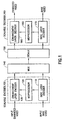
- the general concept of scalability is illustrated in FIG. 1 for a codec with two layers. Note that additional layers can be used.
- the scalable encoder 100 takes two input sequences and generates two bitstreams for multiplexing at a mux 140. Specifically, the input base video stream or layer is processed at a base layer encoder 110, and upsampled at a midprocessor 120 to provide a reference image for predictive coding of the input enhanced video stream or layer at an enhancement layer encoder 130.
- the enhancement layer encoder uses information about the base layer provided by the midprocessor to efficiently code the enhancement layer.
- a channel which can be, e.g., a computer network such as the Internet, or a broadband communication channel such as a cable television network
- the total bitstream is demultiplexed at a demux 150, and the scalable decoder 160 simply inverts the operations of the scalable encoder 100 using a base layer decoder 170, a midprocessor 180, and an enhancement layer decoder 190.
- the MPEG-2 standard defines scalable tools for spatial, temporal and quality (SNR) scalability.
- SNR spatial, temporal and quality
- the main commercial applications that MPEG-2 was targeted to were digital video disks and digital television, applications where the additional functionality of scalability is often not used.
- SNR spatial, temporal and quality
- MPEG-2 scalable coding is often not used.
- new applications such as streaming video could greatly benefit from scalability.
- One example where scalable coding may be useful is for video transmission in a multicast environment. Clients have a wide range of processing power, memory resources and available bandwidth. This requires a server to provide different resolutions and/or qualities of video to be able to satisfy the different capabilities of their clients.
- the recently completed multimedia standard MPEG-4 version 1 offers two types of scalability: temporal and spatial. In addition to applying scalability to frames (pictures) of video, the standard also defines scalability for arbitrary shaped objects.
- Temporal scalability permits an increase in the temporal resolution by using one or more enhancement layers in addition to the base layer.
- FIG. 2 shows an example of temporal scalable coding with two layers.
- Basic video is obtained by decoding only the independent base layer 200, which is done in the same manner as in the non-scalable, single layer case.
- Use of the dependent enhancement layer 250 provides video with, e.g., seven times the temporal resolution of the basic video. The same spatial resolution is obtained whether or not the enhancement layer 250 is used.
- a frame in the enhancement layer 250 can use motion compensated prediction from the previous or next frame in display order belonging to the base layer as well as the most recently decoded frame in the same layer.
- FIG. 3 shows an example of spatial scalable coding with two layers.
- Basic video is obtained by decoding only the independent base layer 300, which is done in the same manner as in the non-scalable, single layer case.
- Use of the dependent enhancement layer 350 provides video with, e.g., twice the spatial resolution of the basic video. The same temporal resolution is obtained whether or not the enhancement layer is used.
- a frame in the enhancement layer can use motion compensated prediction from the temporally coincident frame in the base layer as well as the most recently decoded frame in the same layer.
- FIG. 4 shows an example of simulcast coding with two bitstreams.
- the streams are independent, whereas scalable coding usually refers to an independent base layer with one or more dependently-coded enhancement layers.
- one of the simulcast streams (termed a lower-resolution stream) has the same resolution as the base layer, and the other simulcast bitstream (termed a higher-resolution stream) has the same resolution as the enhancement layer.
- First and second input bitstreams are coded at corresponding video encoders 420 and 410, respectively.
- the input video #1 is assumed to be a lower-resolution stream, while the input video #2 is assumed to be a higher-resolution stream.
- the bitstreams are then multiplexed at a mux 430, transmitted across some channel, demultiplexed at a demux 440, and decoded independently at video decoders 470 and 460, respectively, in a simulcast decoder 450.
- no additional decoder complexity is required to decode the higher-resolution video. This may be important for commercial applications since additional decoder complexity often increases the cost of receivers.
- This invention focuses on the performance of spatial scalability and its simulcast counterpart. Simulations have been performed with an MPEG-4 encoder on rectangular video to gain insight into the issues with transmitting video at a variety of spatial resolutions.
- One issue with layered coding is the proper allocation of bits between layers.
- investigations in connection with the invention focus on determining guidelines for bit allocation.
- VOP refers to a Video Object Plane, as known from the MPEG-4 standard.
- PSNR The measure of quality here is the PSNR, which is defined to be the Peak Signal-to-Noise Ratio of the luminance (Y) component of the decoded video compared to the input video at the same resolution. While PSNR is the quality measure used here, other possible measures include, e.g., MSE (Mean Square Error) and a Perceptual Distortion Measure. PSNR as used here is defined to be 20 * log10(MSE) (dB).
- bit rate is an average bit rate over a sequence.
- the model allows each single layer to be represented by two parameters (constants) A and B (along with the range of bit rates where this model is valid).
- "ln” denotes the natural logarithm.
- Bitrate is the "x" parameter in the figures.
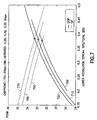
- FIG. 7 is a plot of PSNR vs. fraction of total bits allocated to the lower-resolution stream, for a total bandwidth of 0.29, 0.32, and 0.35 Mbps for QCIF/CIF simulcast.
- the figure shows examples of the different qualities that can be achieved by limiting the total bandwidth to 0.29, 0.32 and 0.35 Mbps, respectively, for simulcast ("Sim.") transmission of the Carphone QCIF and CIF sequences. Both qualities are plotted as functions of the fraction of total bits allocated to the lower-resolution stream (i.e., the QCIF stream).
- the solid lines 700, 710, 720 represent the PSNR of the lower-resolution (QCIF) sequence for total bit rates of 0.29, 0.32, and 0.35 Mbps, respectively.
- the dotted lines 750, 760, 770 represent the PSNR of the higher-resolution (CIF) sequence for total bit rates of 0.29, 0.32, and 0.35 Mbps, respectively.
- the monotonicity of the PSNR for both layers implies that if the functions intersect, they will intersect at only one point. In some cases, there may be no intersection point due to insufficient or excess total bandwidth.
- An additional exit condition checking the difference in bit rates can be used to determine if there is no intersection. This has been omitted from the following algorithm for simplicity. Therefore, the algorithm below assumes that a proper total bit rate has been selected allowing the functions to intersect.
- a bisection algorithm using the difference in PSNR between the layers can be used to find the point of equal quality. An example algorithm follows:
- This algorithm is just one example of how the crossover point can be found. Other techniques are possible, such as a linear interpolation.
- FIG. 8 gives an example of the iterations needed to obtain the point 800 of equal quality in both streams of the QCIF/CIF simulcast coding of the carphone sequence, for the 0.32 Mbps case.
- R 1 (i) and R 2 ( i ) represent the bit rates R 1 and R 2 , respectively, for the lower-resolution stream at iteration i of the algorithm.
- FIG. 8 shows the absolute bit rate of the lower-resolution stream
- FIG. 7 shows the fraction of the total bits that are allocated to the lower-resolution stream. It should be easily understood here and elsewhere how to convert between these two types of scales.
- the ability to transmit two streams of different resolutions that have roughly the same quality may be desirable in applications such as streaming video over the Internet with the resolutions used here.
- other applications may have different requirements. For example, consider two different agendas for the same simulcast system.
- One application may desire relatively higher quality in the lower-resolution stream to satisfy a larger number of receivers receiving the lower resolution.
- Another application may desire a relatively higher quality in the higher-resolution streams to satisfy the receivers receiving the higher resolution because of the higher cost of the bandwidth required to receive the entire simulcast stream.
- the analysis in the following sections focuses on achieving the same quality for both streams, but this may not be the goal of some applications and this issue is revisited hereinbelow.
- FIG. 7 illustrates that the fraction of bits allocated to the lower-resolution stream to achieve equal quality in the two streams is essentially independent of the total bit rate. This is a very useful result and its significance can be seen by the following example. Assume that a multiplexer is combining simulcast bitstreams and has already determined the proper bit allocation between streams. The preceding result suggests that the multiplexer does not have to redetermine the proper bit allocation when reacting to a change in the total bandwidth. Instead, the proportion of bits allocated to each stream should remain the same.
- FIGs 9 and 10 show the results of performing the same analysis as described above for different sequences at a wide variety of constrained total bandwidths.
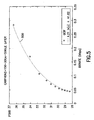
- FIG. 9 shows the PSNR versus bitrate for the test sequences Basket 900, Bus 910, Carphone 920, Foreman 930, News 940, and Silentvoice 950.
- both the lower-resolution (QCIF) and higher-resolution (CIF) streams is shown by only one curve for each sequence since the data in this plot was obtained by requiring equal PSNR for both streams, and the bitrate shown is the total bitrate.
- both streams have a PSNR of approximately 24 dB.
- the PSNR of both streams increases, up to approximately 32 dB when the total bit rate is 4.5 Mbps.
- FIG. 10 shows the fraction of total bits allocated to the lower-resolution streams versus total bitrate for the test sequences Basket 1000, Bus 1010, Carphone 1020, Foreman 1030, News 1040, and Silentvoice 1050.
- the data show that approximately 40 ⁇ 4 % of the total bandwidth should be allocated to the lower-resolution stream to achieve equal quality in both streams of simulcast coding. This result can be used as a general guide for the bit allocation of simulcast bitstreams.
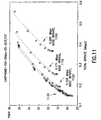
- Results for the spatial scalable ("SS") coding of the Carphone QCIF and CIF sequences are shown in FIG. 11.
- the abscissa of each data point is the total bit rate of both streams, and the ordinate (on the vertical axis) represents the PSNR of the enhancement layer (the higher, CIF resolution) using spatial scalability.
- Each set of curves uses the same lower-resolution QCIF base layer (and therefore base layer bit rate and PSNR) with different enhancement layer bit rates.
- the circles denote empirical results, and the dotted lines are logarithmic fits to each set of curves using the same base layer.
- the 0.286, 0.171, and 0.108 base layer bit rates are shown at curves 1100, 1110, and 1120, respectively.
- the remaining bit rates of 0.0835 through 0.0456 are shown at the aggregate curves 1130.
- FIG. 12 is a plot of PSNR vs. the fraction of total bits allocated to the base layer, for total bandwidths of 0.29, 0.32 and 0.35 Mbps for QCIF/CIF spatial scalability.
- the figure shows examples of the different qualities that can be achieved by limiting the total bandwidth to 0.29, 0.32 and 0.35 Mbps.
- the solid lines represent the PSNR of the base layer (QCIF) sequence and the dotted lines represent the PSNR of the enhancement layer (CIF) sequence.
- the solid lines 1200, 1210, 1220 represent the PSNR of the QCIF sequence for 0.29, 0.32, and 0.35 Mbps, respectively.
- the dotted lines 1250, 1260, 1270 represent the PSNR of the CIF sequence for 0.29, 0.32, and 0.35 Mbps, respectively.
- PSNR of the CIF sequences is not a monotonic function of the fraction of bits allocated to the base layer. That is, there is a peak in the PSNR for the CIF sequences near 20%.
- the PSNR of the QCIF sequence is a monotonically increasing function of the fraction of total bits allocated to it. Moreover, it appears that allocating less than approximately 20% of the total bitstream to the base layer gives declining performance in both layers. The decline is relatively slight for the CIF layer, but rather sharp for the QCIF layer. This trend is also present with the other test sequences. This result is different from the one seen in the simulcast approach, where both layers are independent, and is due to the dependence of the CIF enhancement.layer on the upsampled QCIF base layer. This result of 20% allocation for the base layer can be a useful minimum boundary for the allocation of base layer bits for spatial scalable encoders.
- FIG. 12 shows that the fraction of bits allocated to the base layer to achieve equal quality in the two layers is essentially independent from the total bit rate. This result is similar to the conclusions obtained after analysis of the simulcast experiments and can be very useful for allocating spatial scalable bitstreams.
- FIGs 13 and 14 show the results of performing the same analysis as described above for different sequences at a wide variety of constrained total bandwidths, where the base layer and enhancement layer have the same PSNR for a given total bit rate.
- FIG. 13 shows the PSNR versus total bitrate for the test sequences Basket 1300, Bus 1310, Carphone 1320, Foreman 1330, News 1340, and Silentvoice 1350.
- FIG. 14 shows the fraction of total bits allocated to the base layer versus total bitrate for the test sequences Basket 1400, Bus 1410, Carphone 1420, Foreman 1430, News 1440, and Silentvoice 1450.
- the data of FIG. 14 shows that approximately 45 ⁇ 5 % of the total bandwidth should be allocated to the base layer to achieve equal quality in both layers of spatial scalable coded bitstreams. This percentage can be used as a general guide for the bit allocation of spatial scalable bitstreams.
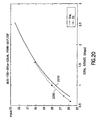
- FIGs 15 through 20 show the simulcast and spatial scalability results for each test sequence, where the QCIF and CIF video sequences have the same PSNR for a given total bit rate.
- FIG. 15 shows the PSNR for spatial scalability 1500 and simulcast 1510 for the carphone sequence
- FIG. 16 shows the PSNR for spatial scalability 1600 and simulcast 1610 for the news sequence
- FIG. 17 shows the PSNR for spatial scalability 1700 and simulcast 1710 for the foreman sequence
- FIG. 18 shows the PSNR for spatial scalability 1800 and simulcast 1810 for the basket sequence
- FIG. 19 shows the PSNR for spatial scalability 1900 and simulcast 1910 for the silentvoice sequence
- FIG. 20 shows the PSNR for spatial scalability 2000 and simulcast 2010 for the bus sequence.
- the operating regions of simulcast coding and spatial scalability are often different, with spatial scalability being the only option at relatively low total bit rates, and simulcast coding at relatively high total bit rates.
- spatial scalability can be used if a coarse quantizer is used for residual coding.
- Simulcast coding may not be possible since the bandwidth may be too low to encode sequences at the higher resolution even with the coarsest quantizer.
- much more information must be encoded for the simulcast case since no information is available from the base layer. That is, there usually is a lot less signal energy in the residual (the difference between the uncoded enhancement layer and an upsampled version of the decoded base layer) than in the original signal.
- the enhancement layer of spatial scalability can be thought of as encoding the residual while the second, higher-resolution stream of simulcast coding is encoding the original, high resolution signal. Since we are using the same range of quantizers for both the enhancement layer of spatial scalability and the second layer of simulcast coding, it is not surprising that there are different ranges for the coded bitrates for the two methods.
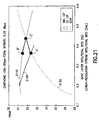
- FIGs 21 through 23 show the results of both simulcast and scalable coding for the QCIF and CIF Carphone sequences with fixed total bandwidths of 0.29, 0.32 and 0.35 Mbps, respectively.
- the results are plotted as functions of the fraction of bits allocated to the base layer (for SS), or the lower-resolution stream (for Sim.).
- FIG. 21 shows the PSNR for 0.29 Mbps for simulcast CIF 2100, spatial scalability CIF 2110, and QCIF 2120 (which is the same for simulcast or spatial scalability).
- FIG. 22 shows the PSNR for 0.32 Mbps for simulcast CIF 2200, spatial scalability CIF 2210, and QCIF 2220.
- FIG. 23 shows the PSNR for 0.35 Mbps for simulcast CIF 2300, spatial scalability CIF 2310, and QCIF 2320.
- simulcast outperforms spatial scalability ("SS") if a relatively small percentage of the total bit rate is assigned to the base layer.
- SS spatial scalability
- FIG. 21 provide visual markers to aid the following discussion.
- Point A' is the operating point for equal PSNR in both streams using simulcast coding.
- Point B' is the corresponding point for spatial scalability using the same amount of bits allocated to the base layer as Point A'.
- Point C' is the operating point for equal PSNR in both layers using spatial scalability. Note that the use of the operating points that achieves equal quality in both streams or layers (Points A' and C', respectively) causes different amounts of bits to be allocated to the lower-resolution stream or base layer depending, respectively, on whether simulcast (Point A') or spatial scalability (Point C') is used.
- bit allocation problem involves two bit rates (the base and enhancement bitstreams for SS., and the lower-resolution and higher-resolution bitsreams for Sim.), and the choice between simulcast coding and spatial scalability. Note that more than two streams or layers may be used, in which case the bit allocation problem is extended accordingly.
- One method to obtain this three-dimensional data is to fix the rate of the base layer (or lower-resolution stream), and decide between simulcast coding and spatial scalability for different bit rates for the enhancement layer or higher-resolution stream. By combining the data at different base layer (lower-resolution stream) rates, the complete three-dimensional data can be constructed.
- FIGs 24 and 25 are examples of fixing the bit rate (and therefore, PSNR) of the base layer (or lower-resolution stream), for the transmission of the Carphone QCIF and CIF sequences.
- FIG. 24 shows the PSNR of the higher-resolution stream or enhancement layer, respectively, for simulcast 2400 and spatial scalability 2410 at 0.29 Mbps
- FIG. 25 shows the corresponding PSNR for simulcast 2500 and spatial scalability 2510 at 0.05 Mbps. Note that the curve for spatial scalability has a smaller dynamic range.
- fixing the QCIF data results in a PSNR of 36.45 for that data.
- the total bit rate is then 0.29 Mbps + the enhancement layer or higher-resolution stream layer bit rate.
- the data point at (0 Mbps, 30 dB) results if no enhancement layer data is used, i.e., the base layer is simply upsampled (using bilinear interpolation) to create the enhancement layer.
- the fixed QCIF bit rate results in a PSNR of 28.36 for that data.
- the total bit rate is then 0.05 Mbps + the enhancement layer or higher-resolution stream bit rate.
- the data point at (0 Mbps, 27 dB) results if no enhancement layer data is used, i.e., the base layer is simply upsampled (using bilinear interpolation) to create the enhancement layer.
- the general trend is for spatial scalability to be more efficient at lower enhancement layer/higher-resolution stream bit rates, while simulcast coding is more efficient at higher enhancement layer/higher-resolution stream bit rates.
- An important result is to determine the boundary where simulcast coding and spatial scalability are equivalent. This boundary can then be used to determine whether one should use simulcast coding or spatial scalability.
- the functions for simulcast coding and spatial scalability may not intersect, but the curves can be extrapolated to find an intersection point by fitting both curves to logarithms and finding the intersection of the logarithmic fits.
- Y1 is the PSNR for one curve, e.g., the simulcast coding curve, with curve fit constants A and B.
- Y2 is the PSNR for the other curve, e.g., the spatial scalability curve, with curve fit constants C and D.
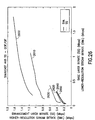
- FIG. 26 shows the results of applying this technique of estimating the boundary between simulcast coding and spatial scalability for all the test sequences.
- This figure shows the test sequences Basket 2600, Bus 2610, Carphone 2620, Foreman 2630, News 2640, and Silentvoice 2650.
- the data indicates that operating points above the curve should use simulcast coding and points below the-curve should use spatial scalability to obtain the highest PSNR for the CIF video sequence (e.g., the enhancement layer or higher-resolution stream).
- the base bit rate uniquely determines the PSNR of the QCIF sequence since this resolution is single layer coded. The decision boundaries tend to have the same shape with different scales.
- FIG. 27 shows normalized decision boundaries for the test sequences Basket 2700, Bus 2710, Carphone 2720, Foreman 2730, News 2740, and Silentvoice 2750.
- the present invention can be applied to video broadcasting in a multicast environment, such as a video server providing video (e.g., movies) to users via a computer network such as the Internet.
- the users may receive the data via an appliance such as a personal computer, Internet-capable set-top box, or the like.
- an appliance such as a personal computer, Internet-capable set-top box, or the like.
- the server would like to provide different resolutions and/or qualities of the same video sequence to satisfy each type of client. Note that the server should provide content for all the service rates continuously, otherwise, an entire client type does not receive service.
- This scenario is different from the unicast environment, where different levels of service are provided to account for dynamic changes in the point-to-point transmission.
- the server can adaptively switch between bitstreams to provide service commensurate with the available resources. Therefore, only one bitstream is transmitted at any instance and it can be tailored to the target bit rate.
- This scheme provides high quality video, and benefits from low decoder complexity since single-layer decoding is always used.
- Different services may involve improving the spatial resolution, temporal resolution and/or quality of the video transmission with increasing bit rates.
- This discussion focuses on providing different levels of spatial resolution.
- Clients at the lower service rate receive QCIF resolution video and those at the higher service rate receive CIF resolution video. Both service rates receive video with the same temporal resolution.
- One approach to providing multicast service is to simulcast code the sequence at all of the service rates. This approach produces high quality video at all service rates.
- the encoder since service must be provided to all client types, the encoder must transmit a large amount of data, i.e., the sum of all the service rates.
- the main expense in multicast transmission is the total used bandwidth (in terms of total number of packets transmitted). Network congestion is also a problem, so it may be necessary to constrain the total combined rate of all the service rates.
- the minimum bandwidth necessary is the largest single service rate that is able to provide adequate service to all clients. The following discussion assumes that a constraint on the total bandwidth is imposed where the constrained rate is between the largest single service rate and the sum of all the service rates.
- simulcast approach can still be used to provide two levels of service by reducing the higher bitstream to the difference between the constrained total and the lower bitstream.
- Another approach is to use spatially scalability. Intuitively, one expects spatial scalability to perform better since the information in the base layer (QCIF) sequence is used to assist construction of the enhancement layer (CIF) sequence. In general, this is true, but it has been found in connection with the present invention that simulcast coding can outperform spatial scalability when a small proportion of bits are allocated to the base layer/lower-resolution stream. This is counterintuitive, since spatial scalability "rates" information in the base layer and its enhancement layer has the same bit rate as the single layer bitstream used by simulcast coding.
- One explanation may be that the overhead incurred by using a scalable coding syntax surpasses the gain obtained.
- the base layer also may not provide good prediction when a small amount of bits is allocated to it.
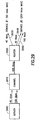
- FIGs 28 and 29 are examples of multicast broadcasting using simulcast coding and spatial scalability, respectively, when the total used bandwidth is constrained to 200 kbps and the user service rates are 50 kbps and 200 kbps.
- a server 2800 provides simulcast-coded lower-resolution and higher-resolution streams at 40 and 160 kbps, respectively, to a 200 kbps channel 2810 and a switching device, such as a router 2820.
- the 40 kbps stream is routed to the first service via a path 2830
- the 160 kbps stream is routed to the second service via a path 2850.
- the router 2820 does not route the 160 kbps stream to the first service since the first service cannot handle this data rate.
- the router 2820 does not route the 40 kbps stream to the second service since this service only has use for one of the streams, and can handle the higher resolution 160 kbps stream.
- any known computer-network routing protocol may be used to achieve this result.
- the router 2820 should be informed of which services can handle which data rates. Each service can represent many end users.
- a server 2900 provides spatial scalability-coded base and enhancement layers at 40 and 160 kbps, respectively, to a 200 kbps channel 2910 and a switching device, such as a router 2920.
- the 40 kbps base layer is routed to the first service via a path 2930, and both the 40 kbps base layer and 160 kbps enhancement layer are routed to the second service via paths 2940 and 2950, respectively (which may be the same path).
- the second service receives both the layers since they must be used together to obtain the maximum information (e.g., image resolution).
- the video for the 50 kbps service rate is identical regardless of which coding approach is used. That is, the user with the 50 kbps service receives only the 40 kbps lower-resolution stream when simulcast coding is used, or the equivalent 40 kbps base layer when scalability coding is used.
- the 200 kbps service in the simulcast coding approach constructs video for the higher service rate using the 160 kbps stream.
- This service does not use the 40 kbps single layer stream since it is independent from the 160 kbps layer and therefore there is no benefit to using it.
- the 200 kbps service in the spatial scalability approach can use the 40 kbps base layer in addition to the 160 kbps enhancement layer, allowing it to construct video for the higher service rate using 200 kbps.
- FIG. 22 shows the results of encoding the QCIF and CIF Carphone sequences using both spatial scalability and simulcast coding with different bit allocations, but a fixed total bandwidth of 0.32 Mbps. Note that spatial scalability outperforms simulcast coding for many different bit allocations. However, simulcast coding is more efficient if less than about 20% of the total bandwidth is allocated to the base layer/lower-resolution stream.
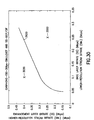
- FIG. 30 shows a decision boundary 2620 (from FIG. 26) between simulcast coding and spatial scalability for the Carphone QCIF and CIF sequences.
- operating points above the decision boundary should use simulcast coding, and points below it should use spatial scalability coding.
- the definition of operating point used here is the average bitrate over the entire sequence. Note that similar analysis can be performed using a smaller subset of the sequence such as a group of pictures. The methods described in this document can be used to construct this curve and then used to determine whether simulcast coding or spatial scalability should be used to encode the video.
- a fixed total bitrate gives only one constraint on two variables (the base and enhancement bit rates), therefore, one can use any distribution of the total bitrate. For example, assume that 0.5 Mbps total bitrate is available. In one case, 0.25 Mbps is used for the QCIF resolution, and 0.25 Mbps is used for the CIF resolution. Since this operating point 3000 is below the curve 2620, spatial scalability should be used to obtain the best quality for the CIF data. In another case, 0.1 Mbps is used for the QCIF resolution, and 0.4 Mbps is used for the CIF resolution. Since this operating point 3020 is above the curve 2620, simulcast coding should be used to achieve the best quality for the CIF data. Recall that the quality of the QCIF data is the same regardless of whether simulcast coding or scalability coding is used.
- simulations described here used a number of encoding and decoding experiments before settling on which transmission mode to use, one may be able to determine model parameters without having to run encoding/decoding experiments for every sequence.
- Determining new model parameters for each sequence may not be necessary if one already has good model parameters. This may be the case for sequences that are similar. For example, in FIG. 26, the sequences carphone 2620, news 2640, and silentvoice 2650 have a similar coding decision boundary. Using the boundary obtained with one of these sequences to assist the simulcast/scalable coding decision may still be optimal for the coding of a different sequence, as long as the data points are not close to the decision boundary. Determining new model parameters for each sequence may be desirable, especially if one wants to maximize the quality of video delivery, despite the increased computational costs.
- FIG. 31 illustrates an adaptive simulcast/spatial scalability encoder apparatus in accordance with the present invention.
- a higher-resolution video sequence such as CIF
- a lower-resolution video sequence such as QCIF
- the analysis function 3110 analyzes the video sequences based on the above discussion to provide a select signal to the switches 3130, 3140 to route both of the sequences to either the simulcast encoder 400 or the scalable encoder 100. See Figures 1 and 4, respectively.
- the analysis function 3110 may include a decoder and encoder, where the PSNR of a layer is determined by comparing the output of the decoder to the input to the encoder.
- Successive sequences each having several (e.g., 150) pictures/frames, may be analyzed to adaptively route each sequence to either the simulcast encoder 400 or the scalable encoder 100. Moreover, the analysis may occur off-line, prior to when the video is transmitted to a user. In this manner, unnecessary processing delays are avoided. For example, the video data may be recovered from a memory, analyzed, then returned to the storage device. Each sequence of analyzed data may be marked to indicate whether it is to be subsequently routed to either the simulcast encoder 400 or the scalable encoder 100. This marking may be achieved any number of ways, such as providing overhead control bits with the video data.
- the decoders should have the capability to determine whether they are receiving a simulcast-coded or scalability-coded stream. This can be achieved according to the relevant data standard (e.g., MPEG-4). Moreover, the decoders should have scalable decoding capabilities and single layer decoding capabilities. Advantageously, the invention can be carried out without modification to such decoders.
- the present invention provides for the compression of video data for multicast environments.
- Spatial scalability and simulcast coding are used in the compression process.
- Simulations are provided to compare the performance of spatial scalability and simulcast coding of lower-resolution (e.g., QCIF) and higher-resolution (e.g., CIF) sequences.
- QCIF lower-resolution
- CIF higher-resolution
Landscapes
- Engineering & Computer Science (AREA)
- Multimedia (AREA)
- Signal Processing (AREA)
- Databases & Information Systems (AREA)
- Physics & Mathematics (AREA)
- Discrete Mathematics (AREA)
- General Physics & Mathematics (AREA)
- Compression Or Coding Systems Of Tv Signals (AREA)
- Two-Way Televisions, Distribution Of Moving Picture Or The Like (AREA)
Claims (12)
- Ein Verfahren zum Codieren von Videodaten, das die folgenden Schritte beinhaltet:Modellieren einer Qualität von Videodaten geringerer Auflösung und von entsprechenden Videodaten höherer Auslösung bei variierenden Bitzuordnungen zwischen den Videodaten geringerer und höherer Auslösung;Bestimmen eines Überkreuzungspunkts der modellierten Qualitäten, bei dem die Videodaten geringerer und höherer Auflösung eine annähernd gleiche Qualität aufweisen, wobei der Überkreuzungspunkt eine entsprechende Bitzuordnung zwischen den Videodaten geringerer und höherer Auflösung anzeigt; undCodieren der Videodaten gemäß der entsprechenden Bitzuordnung, um die Videodaten geringerer und höherer Auflösung auf annähernd gleichen Qualitätsniveaus bereitzustellen.
- Verfahren gemäß Anspruch 1, wobei:die im Codierungsschritt codierten Videodaten eine Bildersequenz beinhalten.
- Verfahren gemäß Anspruch 1 oder 2, wobei:die entsprechende Bitzuordnung ein Durchschnitt einer Sequenz von Bildern ist, die die Videodaten geringerer und höherer Auflösung beinhalten.
- Verfahren gemäß einem der Ansprüche 1 bis 3, wobei:sich die im Codierungsschritt codierten Videodaten von den im Modellierungsschritt verwendeten Videodaten unterscheiden.
- Verfahren gemäß einem der Ansprüche 1 bis 3, wobei:die im Codierungsschritt codierten Videodaten die gleichen wie die im Modellierungsschritt verwendeten Videodaten sind.
- Verfahren gemäß einem der Ansprüche 1 bis 5, wobei:die Qualität einen Spitzen-Signal-Rauschabstand (PSNR) beinhaltet.
- Verfahren gemäß einem der Ansprüche 1 bis 6, wobei:der Modellierungsschritt ein logarithmisches Model verwendet.
- Verfahren gemäß Anspruch 1, wobei:die codierten Videodaten in unabhängigen Simulcast-Strömen codiert sind.
- Verfahren gemäß einem der Ansprüche 1 bis 8, wobei:die codierten Videodaten unter Verwendung von räumlicher Skalierbarkeits-Codierung in einer Basiszone und mindestens einer Anreicherungszone codiert sind.
- Verfahren gemäß Anspruch 1 bis 9, wobei:der Überkreuzungspunkt in Übereinstimmung mit einem Halbierungsalgorithmus bestimmt wird.
- Verfahren gemäß Anspruch 1 bis 9, wobei:der Überkreuzungspunkt extrapoliert wird.
- Eine Vorrichtung zum Codieren von Videodaten, die Folgendes beinhaltet:ein Mittel (3110) zum Modellieren einer Qualität von Videodaten geringerer Auflösung und von entsprechenden Videodaten höherer Ausflösung bei variierenden Bitzuordnungen zwischen den Videodaten geringerer und höherer Ausflösung;ein Mittel (3110) zum Bestimmen eines Überkreuzungspunkts der modellierten Qualitäten, bei dem die Videodaten geringerer und höherer Auflösung eine annähernd gleiche Qualität aufweisen, wobei der Überkreuzungspunkt eine entsprechende Bitzuordnung zwischen den Videodaten geringerer und höherer Auflösung anzeigt; undMittel (100, 400) zum Codieren der Videodaten gemäß der entsprechenden Bitzuordnung, um die Videodaten geringerer und höherer Auflösung auf annähernd gleichen Qualitätsniveaus bereitzustellen.
Applications Claiming Priority (3)
| Application Number | Priority Date | Filing Date | Title |
|---|---|---|---|
| US17177499P | 1999-12-22 | 1999-12-22 | |
| US171774P | 1999-12-22 | ||
| PCT/US2000/009584 WO2001047283A1 (en) | 1999-12-22 | 2000-04-10 | Video compression for multicast environments using spatial scalability and simulcast coding |
Publications (2)
| Publication Number | Publication Date |
|---|---|
| EP1249131A1 EP1249131A1 (de) | 2002-10-16 |
| EP1249131B1 true EP1249131B1 (de) | 2004-03-17 |
Family
ID=22625083
Family Applications (1)
| Application Number | Title | Priority Date | Filing Date |
|---|---|---|---|
| EP00923225A Expired - Lifetime EP1249131B1 (de) | 1999-12-22 | 2000-04-10 | Video kompression für mehrfachsendeverteilungen unter verwendung von räumlicher skalierbarkeit und gleichwellenfunkkodierung |
Country Status (9)
| Country | Link |
|---|---|
| US (1) | US6580754B1 (de) |
| EP (1) | EP1249131B1 (de) |
| KR (1) | KR20020070362A (de) |
| CN (1) | CN1435055A (de) |
| AU (1) | AU4338800A (de) |
| CA (1) | CA2395605C (de) |
| DE (1) | DE60009159T2 (de) |
| TW (1) | TW465243B (de) |
| WO (1) | WO2001047283A1 (de) |
Cited By (1)
| Publication number | Priority date | Publication date | Assignee | Title |
|---|---|---|---|---|
| WO2006137709A1 (en) * | 2005-06-24 | 2006-12-28 | Samsung Electronics Co., Ltd. | Video coding method and apparatus using multi-layer based weighted prediction |
Families Citing this family (87)
| Publication number | Priority date | Publication date | Assignee | Title |
|---|---|---|---|---|
| GB2364841B (en) * | 2000-07-11 | 2002-09-11 | Motorola Inc | Method and apparatus for video encoding |
| EP1319309B1 (de) * | 2000-09-22 | 2006-11-22 | Koninklijke Philips Electronics N.V. | Videocodierung mit hybrider temporeller und snr-bezogener feingranularer skalierbarkeit |
| US6836512B2 (en) * | 2000-10-11 | 2004-12-28 | Koninklijke Philips Electronics N.V. | Spatial scalability for fine granular video encoding |
| US20020126759A1 (en) * | 2001-01-10 | 2002-09-12 | Wen-Hsiao Peng | Method and apparatus for providing prediction mode fine granularity scalability |
| US7184548B2 (en) * | 2001-05-04 | 2007-02-27 | Hewlett-Packard Development Company, L.P. | Encoding and decoding methods for secure scalable streaming and related systems |
| US7349539B2 (en) * | 2001-05-04 | 2008-03-25 | Hewlett-Packard Development Company, L.P. | Encoding and encrypting devices for secure scalable data streaming |
| US6785334B2 (en) * | 2001-08-15 | 2004-08-31 | Koninklijke Philips Electronics N.V. | Method for transmission control in hybrid temporal-SNR fine granular video coding |
| FI114527B (fi) | 2002-01-23 | 2004-10-29 | Nokia Corp | Kuvakehysten ryhmittely videokoodauksessa |
| FI114433B (fi) * | 2002-01-23 | 2004-10-15 | Nokia Corp | Otossiirtymän koodaaminen videokoodauksessa |
| WO2003063505A1 (en) * | 2002-01-23 | 2003-07-31 | Nokia Corporation | Grouping of image frames in video coding |
| US6944222B2 (en) * | 2002-03-04 | 2005-09-13 | Koninklijke Philips Electronics N.V. | Efficiency FGST framework employing higher quality reference frames |
| US20030169813A1 (en) * | 2002-03-08 | 2003-09-11 | Van Der Schaar Mihaela | Method and apparatus to execute a smooth transition between FGS encoded structures |
| US6917713B2 (en) * | 2002-05-29 | 2005-07-12 | Koninklijke Philips Electronics N.V. | System and method for enhancing videos from drift-free scalable bitstream |
| US20060140264A1 (en) * | 2002-06-18 | 2006-06-29 | Cecile Dufour | Video encoding method and corresponding encoding and decoding devices |
| US7136532B2 (en) * | 2002-06-27 | 2006-11-14 | Koninklijke Philips Electronics N.V. | FGS decoder based on quality estimated at the decoder |
| US8397269B2 (en) | 2002-08-13 | 2013-03-12 | Microsoft Corporation | Fast digital channel changing |
| US7523482B2 (en) * | 2002-08-13 | 2009-04-21 | Microsoft Corporation | Seamless digital channel changing |
| US8204079B2 (en) | 2002-10-28 | 2012-06-19 | Qualcomm Incorporated | Joint transmission of multiple multimedia streams |
| US20040083495A1 (en) * | 2002-10-29 | 2004-04-29 | Lane Richard D. | Mulitmedia transmission using variable gain amplification based on data importance |
| WO2004064277A2 (en) * | 2003-01-16 | 2004-07-29 | Sony United Kingdom Limited | Video network |
| GB0301033D0 (en) * | 2003-01-16 | 2003-02-19 | Sony Uk Ltd | Networks and methods and devices therefor |
| US20060123456A1 (en) * | 2003-02-07 | 2006-06-08 | Hiroaki Dei | Video data distribution control method, device, system and program |
| US7603689B2 (en) * | 2003-06-13 | 2009-10-13 | Microsoft Corporation | Fast start-up for digital video streams |
| US7444419B2 (en) | 2003-10-10 | 2008-10-28 | Microsoft Corporation | Media stream scheduling for hiccup-free fast-channel-change in the presence of network chokepoints |
| US7562375B2 (en) * | 2003-10-10 | 2009-07-14 | Microsoft Corporation | Fast channel change |
| AU2004307036B2 (en) * | 2003-10-20 | 2008-01-10 | Samsung Electronics Co., Ltd. | Bit-rate control method and apparatus for normalizing visual quality |
| CN1890974B (zh) * | 2003-12-03 | 2012-05-16 | 皇家飞利浦电子股份有限公司 | 用于mpeg-2系统中的改进缩放性支持的系统和方法 |
| US7430222B2 (en) * | 2004-02-27 | 2008-09-30 | Microsoft Corporation | Media stream splicer |
| KR101145261B1 (ko) * | 2004-02-27 | 2012-05-24 | 삼성전자주식회사 | 멀티미디어 데이터를 기록한 정보저장매체, 그 재생방법및 재생장치 |
| CA2557312C (en) * | 2004-03-04 | 2013-04-23 | Samsung Electronics Co., Ltd. | Video encoding and decoding methods and systems for video streaming service |
| US7809155B2 (en) | 2004-06-30 | 2010-10-05 | Intel Corporation | Computing a higher resolution image from multiple lower resolution images using model-base, robust Bayesian estimation |
| US7447382B2 (en) | 2004-06-30 | 2008-11-04 | Intel Corporation | Computing a higher resolution image from multiple lower resolution images using model-based, robust Bayesian estimation |
| US7640352B2 (en) * | 2004-09-24 | 2009-12-29 | Microsoft Corporation | Methods and systems for presentation of media obtained from a media stream |
| KR100679022B1 (ko) * | 2004-10-18 | 2007-02-05 | 삼성전자주식회사 | 계층간 필터링을 이용한 비디오 코딩 및 디코딩방법과,비디오 인코더 및 디코더 |
| EP1813114A4 (de) * | 2004-10-18 | 2007-11-07 | Samsung Electronics Co Ltd | Verfahren und vorrichtung zur vordecodierung eines hybriden bitstroms |
| CA2594118C (en) | 2004-12-08 | 2015-07-21 | Imagine Communications Ltd. | Distributed statistical multiplexing of multi-media |
| US7477653B2 (en) * | 2004-12-10 | 2009-01-13 | Microsoft Corporation | Accelerated channel change in rate-limited environments |
| US7974193B2 (en) * | 2005-04-08 | 2011-07-05 | Qualcomm Incorporated | Methods and systems for resizing multimedia content based on quality and rate information |
| CN100444637C (zh) * | 2005-04-14 | 2008-12-17 | 中兴通讯股份有限公司 | 一种在网络中传输视频流的方法 |
| JP5008664B2 (ja) * | 2005-07-11 | 2012-08-22 | トムソン ライセンシング | マクロブロック適応型レイヤ間テクスチャ内予測の方法及び装置 |
| JP4618430B2 (ja) * | 2005-09-02 | 2011-01-26 | 富士ゼロックス株式会社 | 画像処理装置、画像処理方法及びそのプログラム |
| US8135040B2 (en) * | 2005-11-30 | 2012-03-13 | Microsoft Corporation | Accelerated channel change |
| CN105049894B (zh) | 2005-12-08 | 2018-03-16 | 维德约股份有限公司 | 用于视频通信系统中的差错弹性和随机接入的系统和方法 |
| US20070201388A1 (en) * | 2006-01-31 | 2007-08-30 | Qualcomm Incorporated | Methods and systems for resizing multimedia content based on quality and rate information |
| US8582905B2 (en) | 2006-01-31 | 2013-11-12 | Qualcomm Incorporated | Methods and systems for rate control within an encoding device |
| US8693538B2 (en) * | 2006-03-03 | 2014-04-08 | Vidyo, Inc. | System and method for providing error resilience, random access and rate control in scalable video communications |
| FR2903556B1 (fr) * | 2006-07-04 | 2008-10-03 | Canon Kk | Procedes et des dispositifs de codage et de decodage d'images, un systeme de telecommunications comportant de tels dispositifs et des programmes d'ordinateur mettant en oeuvre de tels procedes |
| US8630355B2 (en) * | 2006-12-22 | 2014-01-14 | Qualcomm Incorporated | Multimedia data reorganization between base layer and enhancement layer |
| CA2650151C (en) * | 2008-01-17 | 2013-04-02 | Lg Electronics Inc. | An iptv receiving system and data processing method |
| JP5369893B2 (ja) * | 2008-05-30 | 2013-12-18 | 株式会社Jvcケンウッド | 動画像符号化装置、動画像符号化方法、動画像符号化プログラム、動画像復号装置、動画像復号方法、動画像復号プログラム、動画像再符号化装置、動画像再符号化方法、動画像再符号化プログラム |
| CN101686383B (zh) * | 2008-09-23 | 2013-05-01 | Utc消防和保安美国有限公司 | 通过网络传输媒体的方法及系统 |
| US20100074321A1 (en) * | 2008-09-25 | 2010-03-25 | Microsoft Corporation | Adaptive image compression using predefined models |
| US8380790B2 (en) * | 2008-12-15 | 2013-02-19 | Microsoft Corporation | Video conference rate matching |
| US20100149301A1 (en) * | 2008-12-15 | 2010-06-17 | Microsoft Corporation | Video Conferencing Subscription Using Multiple Bit Rate Streams |
| US8228363B2 (en) * | 2009-01-30 | 2012-07-24 | Polycom, Inc. | Method and system for conducting continuous presence conferences |
| US12542927B2 (en) * | 2009-06-07 | 2026-02-03 | Lg Electronics Inc. | Method and apparatus for decoding a video signal |
| FR2954035B1 (fr) * | 2009-12-11 | 2012-01-20 | Thales Sa | Procede d'estimation de la qualite video a une resolution quelconque |
| US8947492B2 (en) * | 2010-06-18 | 2015-02-03 | Microsoft Corporation | Combining multiple bit rate and scalable video coding |
| US8576271B2 (en) * | 2010-06-25 | 2013-11-05 | Microsoft Corporation | Combining direct and routed communication in a video conference |
| JP5474887B2 (ja) | 2011-08-01 | 2014-04-16 | 株式会社ソニー・コンピュータエンタテインメント | 動画データ生成装置、動画像表示装置、動画データ生成方法、動画像表示方法、および動画像ファイルのデータ構造 |
| ES2607438T3 (es) | 2012-04-13 | 2017-03-31 | Ge Video Compression, Llc | Flujo de datos escalable y entidad de red |
| US9544587B2 (en) * | 2012-05-14 | 2017-01-10 | Google Technology Holdings LLC | Scalable video coding with enhanced base layer |
| US8791982B1 (en) | 2012-06-27 | 2014-07-29 | Google Inc. | Video multicast engine |
| US20140028788A1 (en) | 2012-07-30 | 2014-01-30 | Polycom, Inc. | Method and system for conducting video conferences of diverse participating devices |
| US20140098880A1 (en) * | 2012-10-05 | 2014-04-10 | Qualcomm Incorporated | Prediction mode information upsampling for scalable video coding |
| US9516080B2 (en) | 2013-05-31 | 2016-12-06 | Western Digital Technologies, Inc. | Methods and apparatuses for streaming content |
| US9854020B1 (en) | 2014-02-14 | 2017-12-26 | Google Inc. | Bitrate selection for video streaming |
| US9948618B2 (en) | 2015-02-05 | 2018-04-17 | Western Digital Technologies, Inc. | Secure stream buffer on network attached storage |
| US9609275B2 (en) | 2015-07-08 | 2017-03-28 | Google Inc. | Single-stream transmission method for multi-user video conferencing |
| US10390071B2 (en) * | 2016-04-16 | 2019-08-20 | Ittiam Systems (P) Ltd. | Content delivery edge storage optimized media delivery to adaptive bitrate (ABR) streaming clients |
| JP7478668B2 (ja) * | 2018-12-21 | 2024-05-07 | パナソニック インテレクチュアル プロパティ コーポレーション オブ アメリカ | 三次元データ符号化方法、三次元データ復号方法、三次元データ符号化装置、及び三次元データ復号装置 |
| GB2599206B (en) * | 2019-01-17 | 2023-05-10 | Brightcove Inc | Optimal multi-codec ABR ladder design |
| GB2620499B (en) * | 2019-03-20 | 2024-04-03 | V Nova Int Ltd | Low complexity enhancement video coding |
| CN113906746B (zh) * | 2019-06-12 | 2025-09-23 | 索尼集团公司 | 图像处理装置和方法 |
| CN114710665B (zh) * | 2019-09-20 | 2024-10-25 | 杭州海康威视数字技术股份有限公司 | 一种解码、编码方法、装置及其设备 |
| WO2021054805A1 (ko) * | 2019-09-20 | 2021-03-25 | 한국전자통신연구원 | 영상 부호화/복호화 방법, 장치 및 비트스트림을 저장한 기록 매체 |
| CN112106362A (zh) * | 2019-09-30 | 2020-12-18 | 深圳市大疆创新科技有限公司 | 可移动平台的图像处理方法、装置、可移动平台及介质 |
| CN114731431B (zh) * | 2019-11-15 | 2025-05-09 | 寰发股份有限公司 | 用于编解码360度虚拟现实视频序列的方法和装置 |
| WO2021100863A1 (en) * | 2019-11-22 | 2021-05-27 | Sharp Kabushiki Kaisha | Systems and methods for signaling tiles and slices in video coding |
| CN115349263A (zh) * | 2020-05-19 | 2022-11-15 | 谷歌有限责任公司 | 质量归一化视频转码的动态参数选择 |
| WO2022009505A1 (ja) * | 2020-07-07 | 2022-01-13 | パナソニック インテレクチュアル プロパティ コーポレーション オブ アメリカ | 符号化装置、復号装置、符号化方法、復号方法、及び、ハイブリッド符号化システム |
| JP7626862B2 (ja) * | 2020-12-28 | 2025-02-04 | 北京字節跳動網絡技術有限公司 | 映像コーディングにおけるクロスランダムアクセスポイント信号通知 |
| WO2022176270A1 (ja) | 2021-02-16 | 2022-08-25 | パナソニック インテレクチュアル プロパティ コーポレーション オブ アメリカ | 符号化装置、復号装置、符号化方法、及び、復号方法 |
| US11818192B2 (en) * | 2022-02-28 | 2023-11-14 | Nvidia Corporation | Encoding output for streaming applications based on client upscaling capabilities |
| US12273523B2 (en) * | 2022-06-15 | 2025-04-08 | Tencent America LLC | Systems and methods for joint signaling of transform coefficient signs |
| US12373990B2 (en) * | 2022-10-11 | 2025-07-29 | Tencent America LLC | Method and apparatus for UV attributes coding for symmetry mesh |
| FR3148506A1 (fr) * | 2023-05-04 | 2024-11-08 | Orange | Priorisation des flux de données entre une source de contenus audio-vidéos et des clients de télécommunication |
Family Cites Families (7)
| Publication number | Priority date | Publication date | Assignee | Title |
|---|---|---|---|---|
| US5742892A (en) * | 1995-04-18 | 1998-04-21 | Sun Microsystems, Inc. | Decoder for a software-implemented end-to-end scalable video delivery system |
| US6111596A (en) * | 1995-12-29 | 2000-08-29 | Lucent Technologies Inc. | Gain and offset correction for efficient stereoscopic coding and improved display |
| KR100209643B1 (ko) * | 1996-05-02 | 1999-07-15 | 구자홍 | 액정표시소자 구동회로 |
| US6233017B1 (en) * | 1996-09-16 | 2001-05-15 | Microsoft Corporation | Multimedia compression system with adaptive block sizes |
| US6728775B1 (en) * | 1997-03-17 | 2004-04-27 | Microsoft Corporation | Multiple multicasting of multimedia streams |
| US6292512B1 (en) * | 1998-07-06 | 2001-09-18 | U.S. Philips Corporation | Scalable video coding system |
| US6151362A (en) * | 1998-10-30 | 2000-11-21 | Motorola, Inc. | Joint rate control for stereoscopic video coding |
-
2000
- 2000-04-10 EP EP00923225A patent/EP1249131B1/de not_active Expired - Lifetime
- 2000-04-10 CA CA2395605A patent/CA2395605C/en not_active Expired - Lifetime
- 2000-04-10 WO PCT/US2000/009584 patent/WO2001047283A1/en not_active Ceased
- 2000-04-10 AU AU43388/00A patent/AU4338800A/en not_active Abandoned
- 2000-04-10 CN CN00819043A patent/CN1435055A/zh active Pending
- 2000-04-10 KR KR1020027008107A patent/KR20020070362A/ko not_active Withdrawn
- 2000-04-10 US US09/546,647 patent/US6580754B1/en not_active Expired - Lifetime
- 2000-04-10 DE DE60009159T patent/DE60009159T2/de not_active Expired - Lifetime
- 2000-05-05 TW TW089108630A patent/TW465243B/zh not_active IP Right Cessation
Cited By (2)
| Publication number | Priority date | Publication date | Assignee | Title |
|---|---|---|---|---|
| WO2006137709A1 (en) * | 2005-06-24 | 2006-12-28 | Samsung Electronics Co., Ltd. | Video coding method and apparatus using multi-layer based weighted prediction |
| CN101208958B (zh) * | 2005-06-24 | 2012-05-30 | 三星电子株式会社 | 使用基于多层的加权预测的视频编码方法和装置 |
Also Published As
| Publication number | Publication date |
|---|---|
| EP1249131A1 (de) | 2002-10-16 |
| CN1435055A (zh) | 2003-08-06 |
| DE60009159T2 (de) | 2004-11-25 |
| DE60009159D1 (de) | 2004-04-22 |
| CA2395605C (en) | 2011-04-05 |
| KR20020070362A (ko) | 2002-09-06 |
| TW465243B (en) | 2001-11-21 |
| US6580754B1 (en) | 2003-06-17 |
| WO2001047283A1 (en) | 2001-06-28 |
| CA2395605A1 (en) | 2001-06-28 |
| AU4338800A (en) | 2001-07-03 |
Similar Documents
| Publication | Publication Date | Title |
|---|---|---|
| EP1249131B1 (de) | Video kompression für mehrfachsendeverteilungen unter verwendung von räumlicher skalierbarkeit und gleichwellenfunkkodierung | |
| Van Der Schaar et al. | Adaptive motion-compensation fine-granular-scalability (AMC-FGS) for wireless video | |
| EP1472845B1 (de) | Skalierbare gezielte videomehrfachsendung auf basis der bandbreite oder fähigkeit des clients | |
| US7227894B2 (en) | Method and apparatus for MPEG-4 FGS performance enhancement | |
| Schierl et al. | Using H. 264/AVC-based scalable video coding (SVC) for real time streaming in wireless IP networks | |
| EP1638333A1 (de) | Ratenadaptive Videocodierung | |
| US20040179606A1 (en) | Method for transcoding fine-granular-scalability enhancement layer of video to minimized spatial variations | |
| KR100952185B1 (ko) | 순방향 에러 정정 코드를 이용하여 비디오의 드리프트 없는 단편적인 다중 설명 채널 코딩을 위한 시스템 및 방법 | |
| WO2005032138A1 (en) | System and method for combining advanced data partitioning and fine granularity scalability for efficient spatio-temporal-snr scalability video coding and streaming | |
| US20040139219A1 (en) | Transcaling: a video coding and multicasting framework for wireless IP multimedia services | |
| Koumaras et al. | Analysis of H. 264 video encoded traffic | |
| Choi et al. | Dynamic and interoperable adaptation of SVC for QoS-enabled streaming | |
| Garrido-Cantos et al. | Motion-based temporal transcoding from H. 264/AVC-to-SVC in baseline profile | |
| Wan et al. | Video compression for multicast environments using spatial scalability and simulcast coding | |
| Lefol et al. | An efficient complexity-scalable video transcoder with mode refinement | |
| Wan et al. | Adaptive format conversion for scalable video coding | |
| Tang et al. | Investigation and Performance Evaluation of Scalable High Efficiency Video Coding | |
| Jeong et al. | Statistical multiplexing using scalable video coding for layered multicast | |
| Oh et al. | Scalable stereo video coding for heterogeneous environments | |
| Cieplinski | Scalable Video Coding for Flexible Multimedia Services | |
| WO2002096115A1 (en) | A fine granularity scalability scheme | |
| Wittig et al. | Combined data partitioning and fine granularity scalability for channel adaptive video transmission | |
| Inamdar | Performance Evaluation Of Greedy Heuristic For SIP Analyzer In H. 264/SVC | |
| Kang et al. | MPEG-21 DIA-based video adaptation framework and its application to rate adaptation | |
| Ramkishor et al. | Bandwidth adaptation for MPEG-4 video streaming over the internet |
Legal Events
| Date | Code | Title | Description |
|---|---|---|---|
| PUAI | Public reference made under article 153(3) epc to a published international application that has entered the european phase |
Free format text: ORIGINAL CODE: 0009012 |
|
| 17P | Request for examination filed |
Effective date: 20020625 |
|
| AK | Designated contracting states |
Kind code of ref document: A1 Designated state(s): AT BE CH CY DE DK ES FI FR GB GR IE IT LI LU MC NL PT SE |
|
| AX | Request for extension of the european patent |
Free format text: AL;LT;LV;MK;RO;SI |
|
| 17Q | First examination report despatched |
Effective date: 20030204 |
|
| GRAP | Despatch of communication of intention to grant a patent |
Free format text: ORIGINAL CODE: EPIDOSNIGR1 |
|
| GRAS | Grant fee paid |
Free format text: ORIGINAL CODE: EPIDOSNIGR3 |
|
| GRAA | (expected) grant |
Free format text: ORIGINAL CODE: 0009210 |
|
| AK | Designated contracting states |
Kind code of ref document: B1 Designated state(s): DE FR GB |
|
| REG | Reference to a national code |
Ref country code: GB Ref legal event code: FG4D |
|
| REG | Reference to a national code |
Ref country code: IE Ref legal event code: FG4D |
|
| REF | Corresponds to: |
Ref document number: 60009159 Country of ref document: DE Date of ref document: 20040422 Kind code of ref document: P |
|
| REG | Reference to a national code |
Ref country code: DE Ref legal event code: R096 Ref document number: 60009159 Country of ref document: DE Effective date: 20040422 |
|
| ET | Fr: translation filed | ||
| PLBE | No opposition filed within time limit |
Free format text: ORIGINAL CODE: 0009261 |
|
| STAA | Information on the status of an ep patent application or granted ep patent |
Free format text: STATUS: NO OPPOSITION FILED WITHIN TIME LIMIT |
|
| REG | Reference to a national code |
Ref country code: IE Ref legal event code: MM4A |
|
| 26N | No opposition filed |
Effective date: 20041220 |
|
| REG | Reference to a national code |
Ref country code: DE Ref legal event code: R097 Ref document number: 60009159 Country of ref document: DE Effective date: 20041220 |
|
| REG | Reference to a national code |
Ref country code: DE Ref legal event code: R082 Ref document number: 60009159 Country of ref document: DE Representative=s name: HOEGER, STELLRECHT & PARTNER PATENTANWAELTE, DE |
|
| REG | Reference to a national code |
Ref country code: DE Ref legal event code: R081 Ref document number: 60009159 Country of ref document: DE Owner name: MOTOROLA MOBILITY LLC (N.D. GES. D. STAATES DE, US Free format text: FORMER OWNER: GENERAL INSTRUMENT CORPORATION, HORSHAM, PA., US Effective date: 20130729 Ref country code: DE Ref legal event code: R082 Ref document number: 60009159 Country of ref document: DE Representative=s name: HOEGER, STELLRECHT & PARTNER PATENTANWAELTE MB, DE Effective date: 20130729 Ref country code: DE Ref legal event code: R081 Ref document number: 60009159 Country of ref document: DE Owner name: GOOGLE TECHNOLOGY HOLDINGS LLC, MOUNTAIN VIEW, US Free format text: FORMER OWNER: GENERAL INSTRUMENT CORPORATION, HORSHAM, PA., US Effective date: 20130729 Ref country code: DE Ref legal event code: R082 Ref document number: 60009159 Country of ref document: DE Representative=s name: BETTEN & RESCH PATENT- UND RECHTSANWAELTE PART, DE Effective date: 20130729 Ref country code: DE Ref legal event code: R082 Ref document number: 60009159 Country of ref document: DE Representative=s name: HOEGER, STELLRECHT & PARTNER PATENTANWAELTE, DE Effective date: 20130729 Ref country code: DE Ref legal event code: R081 Ref document number: 60009159 Country of ref document: DE Owner name: MOTOROLA MOBILITY LLC (N.D. GES. D. STAATES DE, US Free format text: FORMER OWNER: GENERAL INSTRUMENT CORPORATION, HORSHAM, US Effective date: 20130729 |
|
| REG | Reference to a national code |
Ref country code: GB Ref legal event code: 732E Free format text: REGISTERED BETWEEN 20130919 AND 20130925 |
|
| REG | Reference to a national code |
Ref country code: FR Ref legal event code: TP Owner name: MOTOROLA MOBILITY LLC, US Effective date: 20131230 |
|
| REG | Reference to a national code |
Ref country code: DE Ref legal event code: R082 Ref document number: 60009159 Country of ref document: DE Representative=s name: HOEGER, STELLRECHT & PARTNER PATENTANWAELTE MB, DE Ref country code: DE Ref legal event code: R082 Ref document number: 60009159 Country of ref document: DE Representative=s name: BETTEN & RESCH PATENT- UND RECHTSANWAELTE PART, DE |
|
| REG | Reference to a national code |
Ref country code: FR Ref legal event code: PLFP Year of fee payment: 17 |
|
| REG | Reference to a national code |
Ref country code: FR Ref legal event code: PLFP Year of fee payment: 18 |
|
| REG | Reference to a national code |
Ref country code: GB Ref legal event code: 732E Free format text: REGISTERED BETWEEN 20170831 AND 20170906 |
|
| REG | Reference to a national code |
Ref country code: FR Ref legal event code: TP Owner name: GOOGLE TECHNOLOGY HOLDINGS LLC, US Effective date: 20171214 |
|
| REG | Reference to a national code |
Ref country code: FR Ref legal event code: PLFP Year of fee payment: 19 |
|
| REG | Reference to a national code |
Ref country code: DE Ref legal event code: R082 Ref document number: 60009159 Country of ref document: DE Representative=s name: BETTEN & RESCH PATENT- UND RECHTSANWAELTE PART, DE Ref country code: DE Ref legal event code: R081 Ref document number: 60009159 Country of ref document: DE Owner name: GOOGLE TECHNOLOGY HOLDINGS LLC, MOUNTAIN VIEW, US Free format text: FORMER OWNER: MOTOROLA MOBILITY LLC (N.D. GES. D. STAATES DELAWARE), LIBERTYVILLE, ILL., US |
|
| PGFP | Annual fee paid to national office [announced via postgrant information from national office to epo] |
Ref country code: DE Payment date: 20190429 Year of fee payment: 20 |
|
| PGFP | Annual fee paid to national office [announced via postgrant information from national office to epo] |
Ref country code: FR Payment date: 20190425 Year of fee payment: 20 |
|
| PGFP | Annual fee paid to national office [announced via postgrant information from national office to epo] |
Ref country code: GB Payment date: 20190429 Year of fee payment: 20 |
|
| REG | Reference to a national code |
Ref country code: DE Ref legal event code: R071 Ref document number: 60009159 Country of ref document: DE |
|
| REG | Reference to a national code |
Ref country code: GB Ref legal event code: PE20 Expiry date: 20200409 |
|
| PG25 | Lapsed in a contracting state [announced via postgrant information from national office to epo] |
Ref country code: GB Free format text: LAPSE BECAUSE OF EXPIRATION OF PROTECTION Effective date: 20200409 |
|
| P01 | Opt-out of the competence of the unified patent court (upc) registered |
Effective date: 20230516 |