EP1253170A1 - Rubber composition for tire tread - Google Patents
Rubber composition for tire tread Download PDFInfo
- Publication number
- EP1253170A1 EP1253170A1 EP02009209A EP02009209A EP1253170A1 EP 1253170 A1 EP1253170 A1 EP 1253170A1 EP 02009209 A EP02009209 A EP 02009209A EP 02009209 A EP02009209 A EP 02009209A EP 1253170 A1 EP1253170 A1 EP 1253170A1
- Authority
- EP
- European Patent Office
- Prior art keywords
- weight
- rubber
- parts
- component
- tire tread
- Prior art date
- Legal status (The legal status is an assumption and is not a legal conclusion. Google has not performed a legal analysis and makes no representation as to the accuracy of the status listed.)
- Granted
Links
- 229920001971 elastomer Polymers 0.000 title claims abstract description 91
- 239000005060 rubber Substances 0.000 title claims abstract description 91
- 239000000203 mixture Substances 0.000 title claims abstract description 31
- PPBRXRYQALVLMV-UHFFFAOYSA-N Styrene Chemical compound C=CC1=CC=CC=C1 PPBRXRYQALVLMV-UHFFFAOYSA-N 0.000 claims abstract description 10
- 150000001993 dienes Chemical class 0.000 claims abstract description 9
- 239000005062 Polybutadiene Substances 0.000 claims abstract description 7
- 229920002857 polybutadiene Polymers 0.000 claims abstract description 6
- 125000000391 vinyl group Chemical group [H]C([*])=C([H])[H] 0.000 claims abstract description 5
- 229920002554 vinyl polymer Polymers 0.000 claims abstract description 5
- 239000004615 ingredient Substances 0.000 claims abstract description 4
- VYPSYNLAJGMNEJ-UHFFFAOYSA-N Silicium dioxide Chemical compound O=[Si]=O VYPSYNLAJGMNEJ-UHFFFAOYSA-N 0.000 claims description 22
- 239000000377 silicon dioxide Substances 0.000 claims description 11
- 244000043261 Hevea brasiliensis Species 0.000 claims description 3
- 229920003052 natural elastomer Polymers 0.000 claims description 3
- 229920001194 natural rubber Polymers 0.000 claims description 3
- 235000019589 hardness Nutrition 0.000 description 18
- 229920003048 styrene butadiene rubber Polymers 0.000 description 11
- 239000002174 Styrene-butadiene Substances 0.000 description 10
- 230000002411 adverse Effects 0.000 description 5
- 230000003247 decreasing effect Effects 0.000 description 5
- 230000000694 effects Effects 0.000 description 5
- 230000000052 comparative effect Effects 0.000 description 4
- 238000013329 compounding Methods 0.000 description 4
- 238000004073 vulcanization Methods 0.000 description 4
- 239000003795 chemical substances by application Substances 0.000 description 3
- 238000002156 mixing Methods 0.000 description 3
- NINIDFKCEFEMDL-UHFFFAOYSA-N Sulfur Chemical compound [S] NINIDFKCEFEMDL-UHFFFAOYSA-N 0.000 description 2
- 229920005549 butyl rubber Polymers 0.000 description 2
- 239000006229 carbon black Substances 0.000 description 2
- 239000000945 filler Substances 0.000 description 2
- 238000009472 formulation Methods 0.000 description 2
- 230000009477 glass transition Effects 0.000 description 2
- 238000000034 method Methods 0.000 description 2
- 239000004014 plasticizer Substances 0.000 description 2
- 229910052717 sulfur Inorganic materials 0.000 description 2
- 239000011593 sulfur Substances 0.000 description 2
- 239000004594 Masterbatch (MB) Substances 0.000 description 1
- 239000006087 Silane Coupling Agent Substances 0.000 description 1
- 238000005299 abrasion Methods 0.000 description 1
- 239000003963 antioxidant agent Substances 0.000 description 1
- 230000003078 antioxidant effect Effects 0.000 description 1
- 230000001112 coagulating effect Effects 0.000 description 1
- 229920001577 copolymer Polymers 0.000 description 1
- 238000004132 cross linking Methods 0.000 description 1
- 239000003431 cross linking reagent Substances 0.000 description 1
- 238000001035 drying Methods 0.000 description 1
- 238000011156 evaluation Methods 0.000 description 1
- 238000005259 measurement Methods 0.000 description 1
- 239000003921 oil Substances 0.000 description 1
- 229920001195 polyisoprene Polymers 0.000 description 1
- 238000002360 preparation method Methods 0.000 description 1
- 230000002787 reinforcement Effects 0.000 description 1
- 239000007787 solid Substances 0.000 description 1
Classifications
-
- C—CHEMISTRY; METALLURGY
- C08—ORGANIC MACROMOLECULAR COMPOUNDS; THEIR PREPARATION OR CHEMICAL WORKING-UP; COMPOSITIONS BASED THEREON
- C08L—COMPOSITIONS OF MACROMOLECULAR COMPOUNDS
- C08L9/00—Compositions of homopolymers or copolymers of conjugated diene hydrocarbons
- C08L9/06—Copolymers with styrene
-
- C—CHEMISTRY; METALLURGY
- C08—ORGANIC MACROMOLECULAR COMPOUNDS; THEIR PREPARATION OR CHEMICAL WORKING-UP; COMPOSITIONS BASED THEREON
- C08L—COMPOSITIONS OF MACROMOLECULAR COMPOUNDS
- C08L2205/00—Polymer mixtures characterised by other features
- C08L2205/02—Polymer mixtures characterised by other features containing two or more polymers of the same C08L -group
-
- C—CHEMISTRY; METALLURGY
- C08—ORGANIC MACROMOLECULAR COMPOUNDS; THEIR PREPARATION OR CHEMICAL WORKING-UP; COMPOSITIONS BASED THEREON
- C08L—COMPOSITIONS OF MACROMOLECULAR COMPOUNDS
- C08L7/00—Compositions of natural rubber
-
- C—CHEMISTRY; METALLURGY
- C08—ORGANIC MACROMOLECULAR COMPOUNDS; THEIR PREPARATION OR CHEMICAL WORKING-UP; COMPOSITIONS BASED THEREON
- C08L—COMPOSITIONS OF MACROMOLECULAR COMPOUNDS
- C08L9/00—Compositions of homopolymers or copolymers of conjugated diene hydrocarbons
Definitions
- the present invention relates to a rubber composition for a high performance tire tread, more particularly a rubber composition for a tire tread having improved dry/wet grip without increasing the temperature dependency of hardness.
- an object of the present invention is to provide a rubber composition for a tire tread achieving a high degree of balance of the dry/wet grip in the tire tread rubber composition, without increasing the temperature dependency of hardness.
- a rubber composition for a tire tread comprising (A) 50 to 90 parts by weight of a rubber ingredient (A) composed of SBR having a styrene content (St) of not more than 40% by weight, a vinyl content (Vn) in a polybutadiene moiety of 20 to 70% by weight, and a weight average molecular weight (Mw) of 60,000 to 3,000,000, (B) 10 to 50 parts by weight of a rubber component composed of a diene-based rubber having a Tg of not more than -45°C and (C) 5 to 200 parts by weight, based upon 100 parts by weight of the rubber component (A), of a rubber component composed of low molecular weight SBR having an St of 1 to 60% by weight, a Vn of 20 to 80% by weight and an Mw of 2,000 to 50,000 the total amount of the rubber component (A) and the rubber component (B) being 100 parts by weight.
- the inventors found that by combining a low molecular weight SBR having a specific microstructure and a diene-based rubber having a Tg of not more than -45°C, a rubber composition for a tire tread achieving an improvement in the dry/wet grip without increasing the temperature dependency of hardness is obtained.
- SBR styrene content (St) of not more than 40% by weight, preferably 5 to 37% by weight, a vinyl content (Vn) in the polybutadiene moiety of 20 to 70% by weight, preferably 30 to 70% by weight, and a weight average molecular weight (Mw) of 60,000 to 3,000,000, preferably 70,000 to 2,000,000, is blended in an amount of 50 to 90 parts by weight, preferably 60 to 90 parts by weight, based upon 100 parts by weight of the total of the rubber components (A) and (B).
- St styrene content
- Vn vinyl content
- Mw weight average molecular weight
- the rubber component (B) is a diene-based rubber having a glass transition temperature (Tg) of not more than -45°C, preferably -105°C to -45°C and is used in an amount of 10 to 50 parts by weight, preferably 10 to 40 parts by weight, based upon 100 parts by weight of the total of the rubber components (A) and (B).
- Tg glass transition temperature
- the diene-based rubber component for example, it is possible to use natural rubber (NR), polyisoprene rubber (IR), various types of styrene-butadiene copolymer rubber (SBR), various types of polybutadiene rubber (BR), acrylonitrile butadiene copolymer rubber (NBR), butyl rubber (IIR), or other diene-based rubber alone or in any blend thereof.
- natural rubber NR
- IR polyisoprene rubber
- SBR various types of styrene-butadiene copolymer rubber
- BR polybutadiene rubber
- NBR acrylonitrile butadiene copolymer rubber
- IIR butyl rubber
- the diene-based rubber when used for the tire tread of the present invention, to achieve both grip and abrasion resistance and to decrease the temperature dependency of hardness, which are the objects of the present invention, it is necessary to use the diene-based rubber having a glass transition temperature (Tg) of not more than -45°C as an average value. If the Tg of the rubber component (B) is higher than -45°C, the temperature dependency of the hardness becomes larger. If the amount blended is less than 10 parts by weight of the total weight of the rubber components (A) and (B), the effect of improvement in the temperature dependency of the hardness is small, whereas if the amount is more than 50 parts by weight, the grip is decreased.
- Tg of the rubber component (A) - Tg of the rubber component (B) is 20°C or more, more preferably 25 to 60°C.
- a low molecular weight SBR having a styrene content (St) of 1 to 60% by weight, preferably 10 to 50% by weight, a vinyl content (Vn) in the polybutadiene part of 20 to 80% by weight, preferably 30 to 70% by weight, and a weight average molecular weight (Mw) of 2,000 to 50,000, preferably 4,000 to 50,000 is blended in an amount of 5 to 200 parts by weight, preferably 5 to 100 parts by weight, based upon 100 parts by weight of the rubber component (A).
- St and Vn amounts of the component (C) are outside of the above range, the balance of the dry/wet grip of the rubber composition is similarly adversely affected.
- the grip increase effect is small, whereas if the amount is more than 200 parts by weight, the processability is adversely affected.
- the amount of the rubber component (C) blended is particularly preferably 5 to 50 parts by weight based upon 100 parts by weight of the rubber ingredient (A).
- Mw weight average molecular weight
- the breakage characteristic of the rubber composition is adversely affected, whereas if the molecular weight is more than 50,000, the grip increase effect is small.
- the rubber components (A) and (C); (B) and (C); (A), (B), and (C); or (A) and (B) may be obtained by blending the polymerized rubbers, followed by coagulating and drying or by blending dried rubbers. Further, the rubber components may be blended with various known compounding agents. Preferably, the rubber component (C) may be blended with the component (A), then coagulated and dried. This latter batch is easy to handle.
- silica in an amount of at least 20 parts by weight, preferably 20 to 135 parts by weight, more preferably 20 to 100 parts by weight based upon the total amount of the rubber components (A) and (B).
- this amount of silica By using this amount of silica, the wet performance and the dry high speed driving stability can be obtained.
- the temperature dependency of the hardness can be further decreased.
- fillers other than silica in general carbon black or silica surface treated carbon black may be blended in a predetermined amount.
- silica it is possible to use any silica ordinarily blended into this type of rubber composition, for example, wet silica, dry silica, surface treated silica, etc.
- silica it is preferable to also use a silane coupling agent known in this technical field in order to improve the reinforcement of the rubber.
- the rubber composition for a tire tread of the present invention may further include therein various compounding agents generally blended into the rubber such as an ordinary vulcanization or cross-linking agent, vulcanization or cross-linking accelerator, various types of oils, an antioxidant, a filler, a plasticizer, a softener etc.
- various compounding agents generally blended into the rubber such as an ordinary vulcanization or cross-linking agent, vulcanization or cross-linking accelerator, various types of oils, an antioxidant, a filler, a plasticizer, a softener etc.
- the amounts of these compounding agent can be made the conventional general amounts blended so long as the object of the present invention is not adversely affected.
- the formulating components other than the vulcanization accelerator and the sulfur were mixed in a 1.8 liter closed type mixer for 3 to 5 minutes.
- the vulcanization accelerator and sulfur were mixed into the resultant master batch by an 8-inch open roll to obtain a rubber composition. Thereafter, this composition was press vulcanized in a 15 x 15 x 0.2 cm mold at 160°C for 20 minutes to prepare the desired test piece (i.e., rubber sheet). This was measured and evaluated for the stretch type viscoelasticity tan ⁇ (0°C and 60°C) and JIS hardness (0°C and 60°C).
- the rubber composition according to the present invention has a superior effect in the dry/wet grip without increasing the temperature dependency of the hardness, and therefore the rubber composition according to is useful as a rubber composition for a tire tread.
Landscapes
- Chemical & Material Sciences (AREA)
- Health & Medical Sciences (AREA)
- Chemical Kinetics & Catalysis (AREA)
- Medicinal Chemistry (AREA)
- Polymers & Plastics (AREA)
- Organic Chemistry (AREA)
- Tires In General (AREA)
- Compositions Of Macromolecular Compounds (AREA)
Abstract
Description
- The present invention relates to a rubber composition for a high performance tire tread, more particularly a rubber composition for a tire tread having improved dry/wet grip without increasing the temperature dependency of hardness.
- As a technique for improving the dry grip of a tire, it has been known in the past to blend a rubber with a low molecular weight SBR (Japanese Unexamined Patent Publication (Kokai) No. 6-279620 etc.). However, when a rubber is blended with a low molecular weight SBR, the Tg of the rubber composition as a whole normally increases and, as a result, the temperature dependency of the hardness increases and the wet grip is decreased. Further, if a plasticizer is blended or the Tg of the low molecular weight SBR is decreased to decrease the temperature dependency of the hardness, there was the problem of decreasing the dry grip. Therefore, in the prior art for blending low molecular weight SBR, it was impossible to achieve a high degree of balance in the dry/wet grip.
- Accordingly, an object of the present invention is to provide a rubber composition for a tire tread achieving a high degree of balance of the dry/wet grip in the tire tread rubber composition, without increasing the temperature dependency of hardness.
- In accordance with the present invention, there is provided a rubber composition for a tire tread comprising (A) 50 to 90 parts by weight of a rubber ingredient (A) composed of SBR having a styrene content (St) of not more than 40% by weight, a vinyl content (Vn) in a polybutadiene moiety of 20 to 70% by weight, and a weight average molecular weight (Mw) of 60,000 to 3,000,000, (B) 10 to 50 parts by weight of a rubber component composed of a diene-based rubber having a Tg of not more than -45°C and (C) 5 to 200 parts by weight, based upon 100 parts by weight of the rubber component (A), of a rubber component composed of low molecular weight SBR having an St of 1 to 60% by weight, a Vn of 20 to 80% by weight and an Mw of 2,000 to 50,000 the total amount of the rubber component (A) and the rubber component (B) being 100 parts by weight.
- According to the present invention, the inventors found that by combining a low molecular weight SBR having a specific microstructure and a diene-based rubber having a Tg of not more than -45°C, a rubber composition for a tire tread achieving an improvement in the dry/wet grip without increasing the temperature dependency of hardness is obtained.
- As the rubber component (A) used for the rubber composition for a tire tread of the present invention, SBR having a styrene content (St) of not more than 40% by weight, preferably 5 to 37% by weight, a vinyl content (Vn) in the polybutadiene moiety of 20 to 70% by weight, preferably 30 to 70% by weight, and a weight average molecular weight (Mw) of 60,000 to 3,000,000, preferably 70,000 to 2,000,000, is blended in an amount of 50 to 90 parts by weight, preferably 60 to 90 parts by weight, based upon 100 parts by weight of the total of the rubber components (A) and (B). When the amounts of St and Vn of the component (A) are outside of the above ranges, the temperature dependency of hardness of the rubber composition and the balance of the dry/wet grip are adversely affected. When an amount of the rubber component (A) to be blended is less than 50 parts by weight, the grip increase effect is small.
- Further, the rubber component (B) is a diene-based rubber having a glass transition temperature (Tg) of not more than -45°C, preferably -105°C to -45°C and is used in an amount of 10 to 50 parts by weight, preferably 10 to 40 parts by weight, based upon 100 parts by weight of the total of the rubber components (A) and (B). As the diene-based rubber component, for example, it is possible to use natural rubber (NR), polyisoprene rubber (IR), various types of styrene-butadiene copolymer rubber (SBR), various types of polybutadiene rubber (BR), acrylonitrile butadiene copolymer rubber (NBR), butyl rubber (IIR), or other diene-based rubber alone or in any blend thereof. However, when the diene-based rubber is used for the tire tread of the present invention, to achieve both grip and abrasion resistance and to decrease the temperature dependency of hardness, which are the objects of the present invention, it is necessary to use the diene-based rubber having a glass transition temperature (Tg) of not more than -45°C as an average value. If the Tg of the rubber component (B) is higher than -45°C, the temperature dependency of the hardness becomes larger. If the amount blended is less than 10 parts by weight of the total weight of the rubber components (A) and (B), the effect of improvement in the temperature dependency of the hardness is small, whereas if the amount is more than 50 parts by weight, the grip is decreased. Preferably, Tg of the rubber component (A) - Tg of the rubber component (B) is 20°C or more, more preferably 25 to 60°C.
- Further, as the rubber component (C), a low molecular weight SBR having a styrene content (St) of 1 to 60% by weight, preferably 10 to 50% by weight, a vinyl content (Vn) in the polybutadiene part of 20 to 80% by weight, preferably 30 to 70% by weight, and a weight average molecular weight (Mw) of 2,000 to 50,000, preferably 4,000 to 50,000 is blended in an amount of 5 to 200 parts by weight, preferably 5 to 100 parts by weight, based upon 100 parts by weight of the rubber component (A). When St and Vn amounts of the component (C) are outside of the above range, the balance of the dry/wet grip of the rubber composition is similarly adversely affected. When an amount of the rubber component (C) blended is less than 5 parts by weight based upon 100 parts by weight of the rubber component (A), the grip increase effect is small, whereas if the amount is more than 200 parts by weight, the processability is adversely affected. The amount of the rubber component (C) blended is particularly preferably 5 to 50 parts by weight based upon 100 parts by weight of the rubber ingredient (A). When the weight average molecular weight (Mw) is less than 2,000, the breakage characteristic of the rubber composition is adversely affected, whereas if the molecular weight is more than 50,000, the grip increase effect is small.
- The rubber components (A) and (C); (B) and (C); (A), (B), and (C); or (A) and (B) may be obtained by blending the polymerized rubbers, followed by coagulating and drying or by blending dried rubbers. Further, the rubber components may be blended with various known compounding agents. Preferably, the rubber component (C) may be blended with the component (A), then coagulated and dried. This latter batch is easy to handle.
- In the rubber composition for a tire tread of the present invention, it is preferable to use silica in an amount of at least 20 parts by weight, preferably 20 to 135 parts by weight, more preferably 20 to 100 parts by weight based upon the total amount of the rubber components (A) and (B). By using this amount of silica, the wet performance and the dry high speed driving stability can be obtained. When the silica is blended, the temperature dependency of the hardness can be further decreased. As fillers other than silica, in general carbon black or silica surface treated carbon black may be blended in a predetermined amount. As the silica, it is possible to use any silica ordinarily blended into this type of rubber composition, for example, wet silica, dry silica, surface treated silica, etc. When using these silicas, it is preferable to also use a silane coupling agent known in this technical field in order to improve the reinforcement of the rubber.
- The rubber composition for a tire tread of the present invention may further include therein various compounding agents generally blended into the rubber such as an ordinary vulcanization or cross-linking agent, vulcanization or cross-linking accelerator, various types of oils, an antioxidant, a filler, a plasticizer, a softener etc. The amounts of these compounding agent can be made the conventional general amounts blended so long as the object of the present invention is not adversely affected.
- The present invention will now be explained in further detail by Examples and Comparative Examples, but the technical scope of the present invention is of course not limited to these Examples.
- The formulations (A) and (B) and compounding components in the Examples and Comparative Examples are as shown in the following Tables I and II.

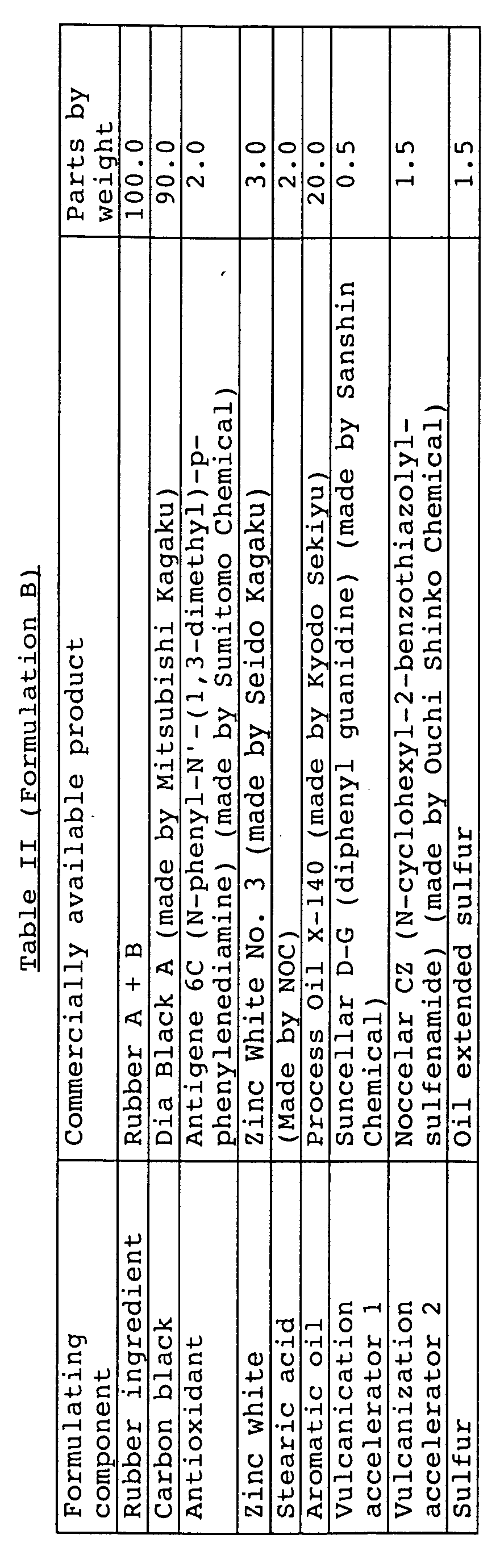
- The formulating components other than the vulcanization accelerator and the sulfur were mixed in a 1.8 liter closed type mixer for 3 to 5 minutes. The vulcanization accelerator and sulfur were mixed into the resultant master batch by an 8-inch open roll to obtain a rubber composition. Thereafter, this composition was press vulcanized in a 15 x 15 x 0.2 cm mold at 160°C for 20 minutes to prepare the desired test piece (i.e., rubber sheet). This was measured and evaluated for the stretch type viscoelasticity tanδ (0°C and 60°C) and JIS hardness (0°C and 60°C).
- The methods for measurement and evaluation in the Examples were as follows:
- 1) Stretch type viscoelasticity tanδ (0°C, 60°C): a Toyo Seiki Seisakusho Rheolograph Solid was used to measure the viscoelasticity at an initial strain of 10%, a dynamic strain of ±2% and a frequency of 20Hz (sample width: 5 mm). The tanδ (0°C) is an indicator of the wet grip. The higher the value, the better the results. Further, the tanδ (60°C) is an indicator of the dry grip. The higher the value, the better the results.
- 2) Δ hardness: The JIS hardnesses (0°C) and (60°C) were measured according to JIS K6301 Spring Type Hardness Test Type A. The temperature dependency of the hardness was evaluated using the difference as the Δ hardness. The lower the value, the smaller the temperature dependency of the hardness and the better the result. Specifically, it is best when the ΔHs is less than 20.
-
- The results of the rubber compositions of the formulations (A) and (B) in the Examples are shown in the following Table III with reference to Comparative Example 1.
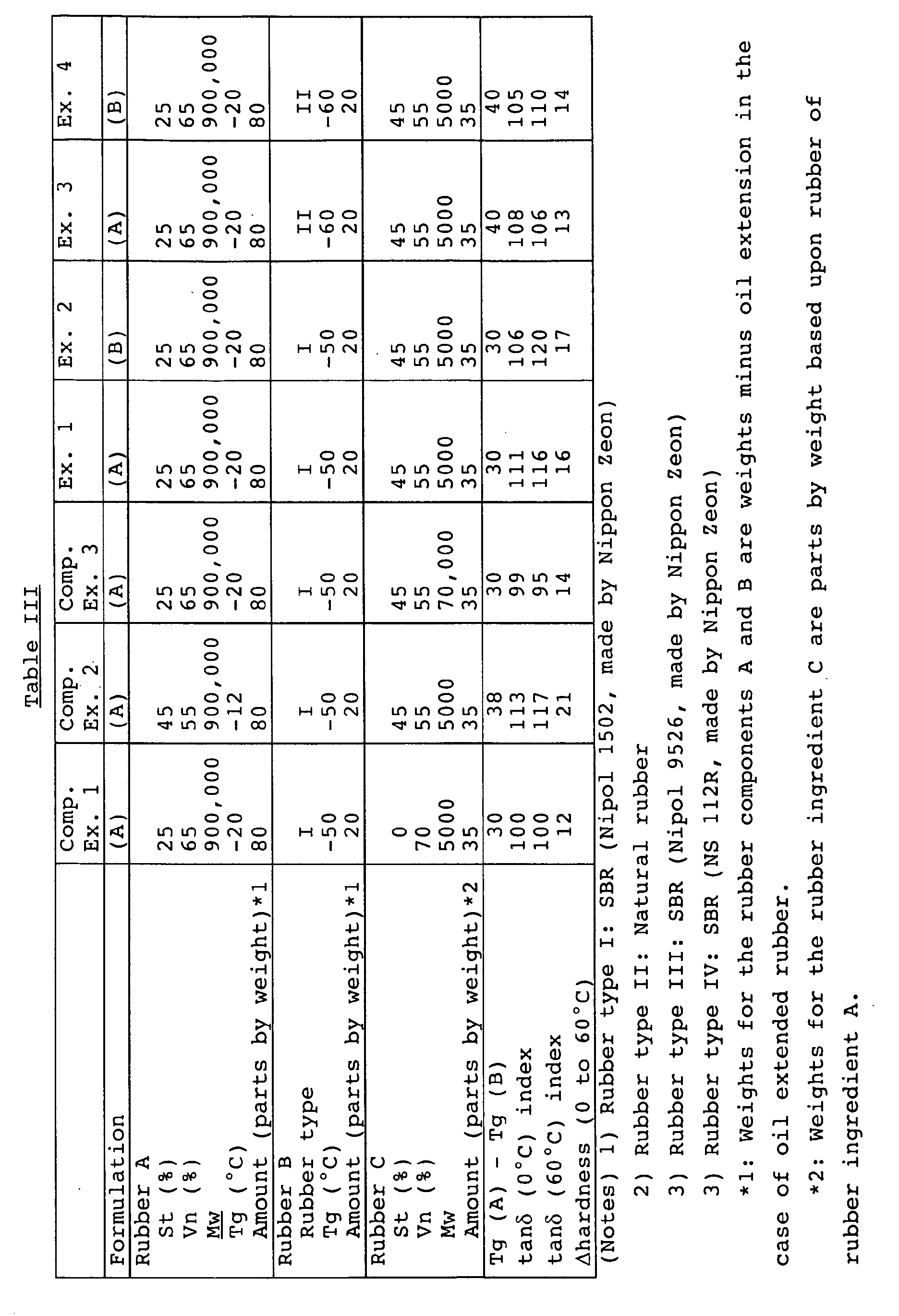

- As will be seen from the results shown in Table III, the rubber composition according to the present invention has a superior effect in the dry/wet grip without increasing the temperature dependency of the hardness, and therefore the rubber composition according to is useful as a rubber composition for a tire tread.
Claims (6)
- A rubber composition for a tire tread comprising (A) 50 to 90 parts by weight of a rubber ingredient (A) composed of SBR having a styrene content (St) of not more than 40% by weight, a vinyl content (Vn) in a polybutadiene moiety of 20 to 70% by weight, and a weight average molecular weight (Mw) of 60,000 to 3,000,000, (B) 10 to 50 parts by weight of a rubber component composed of a diene-based rubber having a Tg of not more than -45°C and (C) 5 to 200 parts by weight, based upon 100 parts by weight of the rubber component (A), of a rubber component composed of low molecular weight SBR having an St of 1 to 60% by weight, a Vn of 20 to 80% by weight and an Mw of 2,000 to 50,000 the total amount of the rubber component (A) and the rubber component (B) being 100 parts by weight.
- A rubber composition for a tire tread as claimed in claim 1 further comprising silica in an amount of at least 20 parts by weight, based upon 100 parts by weight of a total of the rubber component (A) and the rubber component (B).
- A rubber composition for a tire tread as claimed in claim 1 or 2, wherein the difference between Tg of the rubber component (A) and Tg of the rubber component (B) is 20°C or more.
- A rubber composition for a tire tread as claimed in any one of claims 1 to 3, wherein the component (A) is 50 to 90 parts by weight, based upon the total amount of the rubber components (A) and (B), of SBR having an St of 5 - 37% by weight, a Vn of 30 - 70% and an Mw of 70,000 to 2,000,000.
- A rubber composition for a tire tread as claimed in any one of claims 1 to 4, wherein the component (B) is 10 to 50 parts by weight, based upon the total amount of the rubber components (A) and (B), of at least one rubber selected from natural rubber IR, SBR and BR having an average Tg of -105°C to -45°C.
- A rubber composition for a tire tread as claimed in any one of claims 1 to 5, wherein the component (C) is 5 to 100 parts by weight, based upon 100 parts by weight of the rubber component (A), of a low molecular weight SBR having an St of 10 - 50% by weight, a Vn of 30 - 70% by weight and an Mw of 4,000-50,000.
Applications Claiming Priority (2)
| Application Number | Priority Date | Filing Date | Title |
|---|---|---|---|
| JP2001126510 | 2001-04-24 | ||
| JP2001126510A JP2002322317A (en) | 2001-04-24 | 2001-04-24 | Rubber composition for tire tread |
Publications (2)
| Publication Number | Publication Date |
|---|---|
| EP1253170A1 true EP1253170A1 (en) | 2002-10-30 |
| EP1253170B1 EP1253170B1 (en) | 2007-06-13 |
Family
ID=18975532
Family Applications (1)
| Application Number | Title | Priority Date | Filing Date |
|---|---|---|---|
| EP02009209A Expired - Lifetime EP1253170B1 (en) | 2001-04-24 | 2002-04-24 | Rubber composition for tire tread |
Country Status (3)
| Country | Link |
|---|---|
| EP (1) | EP1253170B1 (en) |
| JP (1) | JP2002322317A (en) |
| DE (1) | DE60220580T2 (en) |
Cited By (8)
| Publication number | Priority date | Publication date | Assignee | Title |
|---|---|---|---|---|
| EP1323777A1 (en) * | 2001-12-28 | 2003-07-02 | JSR Corporation | Rubber composition, vibration-isolating rubber and vibration-isolating mount |
| EP1612241A1 (en) * | 2004-07-02 | 2006-01-04 | Sumitomo Rubber Industries, Ltd. | Rubber composition and tire using the same |
| WO2009007167A1 (en) * | 2007-07-10 | 2009-01-15 | Continental Aktiengesellschaft | Rubber mixture, especially for tyres |
| EP1860146A4 (en) * | 2005-03-14 | 2009-07-01 | Bridgestone Corp | Rubber composition and pneumatic tire using the same |
| EP2853557A1 (en) | 2013-09-27 | 2015-04-01 | Continental Reifen Deutschland GmbH | Sulfur crosslinkable rubber composition |
| EP2853558A1 (en) | 2013-09-27 | 2015-04-01 | Continental Reifen Deutschland GmbH | Sulfur crosslinkable rubber composition |
| DE102014202749A1 (en) | 2014-02-14 | 2015-08-20 | Continental Reifen Deutschland Gmbh | Sulfur crosslinkable rubber compound and vehicle tires |
| RU2571135C2 (en) * | 2011-06-03 | 2015-12-20 | Бриджстоун Корпорейшн | Rubber mixture and tyre manufactured with its application |
Families Citing this family (8)
| Publication number | Priority date | Publication date | Assignee | Title |
|---|---|---|---|---|
| JP2005146115A (en) * | 2003-11-14 | 2005-06-09 | Sumitomo Rubber Ind Ltd | Rubber composition for tire tread |
| JP4518858B2 (en) * | 2004-07-27 | 2010-08-04 | 横浜ゴム株式会社 | Rubber composition for tire |
| JP4138729B2 (en) | 2004-11-01 | 2008-08-27 | 住友ゴム工業株式会社 | Rubber composition and tire comprising the same |
| JP2006152200A (en) * | 2004-12-01 | 2006-06-15 | Yokohama Rubber Co Ltd:The | Rubber composition for tire |
| JP4945084B2 (en) * | 2005-03-14 | 2012-06-06 | 株式会社ブリヂストン | Rubber composition and pneumatic tire using the same |
| JP4945083B2 (en) * | 2005-03-14 | 2012-06-06 | 株式会社ブリヂストン | Rubber composition and pneumatic tire using the same |
| JP5154071B2 (en) * | 2005-12-28 | 2013-02-27 | 住友ゴム工業株式会社 | Rubber composition and tire using the same |
| US9303154B2 (en) | 2008-12-31 | 2016-04-05 | Bridgestone Corporation | Rubber compositions including a polymeric component having a multi-modal molecular weight distribution |
Citations (3)
| Publication number | Priority date | Publication date | Assignee | Title |
|---|---|---|---|---|
| EP0087736A1 (en) * | 1982-02-26 | 1983-09-07 | Sumitomo Rubber Industries Limited | Elastomer composition |
| EP0502728A1 (en) * | 1991-03-05 | 1992-09-09 | Bridgestone Corporation | Pneumatic tires |
| EP0585012A1 (en) * | 1992-08-17 | 1994-03-02 | Bridgestone Corporation | Rubber compositions |
Family Cites Families (7)
| Publication number | Priority date | Publication date | Assignee | Title |
|---|---|---|---|---|
| JPS61203145A (en) * | 1985-03-05 | 1986-09-09 | Bridgestone Corp | Rubber composition for tire tread |
| JP3184986B2 (en) * | 1991-10-08 | 2001-07-09 | 横浜ゴム株式会社 | Rubber composition for tire tread |
| JP3220507B2 (en) * | 1992-04-23 | 2001-10-22 | 旭化成株式会社 | Rubber-like polymer composition |
| JPH05311006A (en) * | 1992-05-13 | 1993-11-22 | Yokohama Rubber Co Ltd:The | Rubber composition for tire tread |
| JPH07188468A (en) * | 1993-12-27 | 1995-07-25 | Bridgestone Corp | Rubber composition and pneumatic tire |
| JPH08269343A (en) * | 1995-03-29 | 1996-10-15 | Asahi Glass Co Ltd | Curable composition and method for producing the same |
| JP3457469B2 (en) * | 1995-06-30 | 2003-10-20 | 株式会社ブリヂストン | Rubber composition |
-
2001
- 2001-04-24 JP JP2001126510A patent/JP2002322317A/en active Pending
-
2002
- 2002-04-24 DE DE2002620580 patent/DE60220580T2/en not_active Expired - Lifetime
- 2002-04-24 EP EP02009209A patent/EP1253170B1/en not_active Expired - Lifetime
Patent Citations (3)
| Publication number | Priority date | Publication date | Assignee | Title |
|---|---|---|---|---|
| EP0087736A1 (en) * | 1982-02-26 | 1983-09-07 | Sumitomo Rubber Industries Limited | Elastomer composition |
| EP0502728A1 (en) * | 1991-03-05 | 1992-09-09 | Bridgestone Corporation | Pneumatic tires |
| EP0585012A1 (en) * | 1992-08-17 | 1994-03-02 | Bridgestone Corporation | Rubber compositions |
Cited By (12)
| Publication number | Priority date | Publication date | Assignee | Title |
|---|---|---|---|---|
| EP1323777A1 (en) * | 2001-12-28 | 2003-07-02 | JSR Corporation | Rubber composition, vibration-isolating rubber and vibration-isolating mount |
| US6812288B2 (en) | 2001-12-28 | 2004-11-02 | Jsr Corporation | Rubber composition, vibration-isolating rubber and vibration-isolating mount |
| EP1612241A1 (en) * | 2004-07-02 | 2006-01-04 | Sumitomo Rubber Industries, Ltd. | Rubber composition and tire using the same |
| US7304109B2 (en) | 2004-07-02 | 2007-12-04 | Sumitomo Rubber Industries, Ltd. | Rubber composition and tire using the same |
| EP1860146A4 (en) * | 2005-03-14 | 2009-07-01 | Bridgestone Corp | Rubber composition and pneumatic tire using the same |
| US8800615B2 (en) | 2005-03-14 | 2014-08-12 | Bridgestone Corporation | Rubber composition and pneumatic tire using the same |
| WO2009007167A1 (en) * | 2007-07-10 | 2009-01-15 | Continental Aktiengesellschaft | Rubber mixture, especially for tyres |
| RU2571135C2 (en) * | 2011-06-03 | 2015-12-20 | Бриджстоун Корпорейшн | Rubber mixture and tyre manufactured with its application |
| EP2853557A1 (en) | 2013-09-27 | 2015-04-01 | Continental Reifen Deutschland GmbH | Sulfur crosslinkable rubber composition |
| EP2853558A1 (en) | 2013-09-27 | 2015-04-01 | Continental Reifen Deutschland GmbH | Sulfur crosslinkable rubber composition |
| US9856368B2 (en) | 2013-09-27 | 2018-01-02 | Continental Reifen Deutschland Gmbh | Sulfur-crosslinkable rubber mixture |
| DE102014202749A1 (en) | 2014-02-14 | 2015-08-20 | Continental Reifen Deutschland Gmbh | Sulfur crosslinkable rubber compound and vehicle tires |
Also Published As
| Publication number | Publication date |
|---|---|
| EP1253170B1 (en) | 2007-06-13 |
| DE60220580T2 (en) | 2008-03-06 |
| DE60220580D1 (en) | 2007-07-26 |
| JP2002322317A (en) | 2002-11-08 |
Similar Documents
| Publication | Publication Date | Title |
|---|---|---|
| US9284439B2 (en) | Tire rubber composite and pneumatic tire | |
| JP4883172B2 (en) | Rubber composition for tire | |
| JP5234203B2 (en) | Rubber composition for tire | |
| JP4294070B2 (en) | Rubber composition for tire | |
| EP1253170B1 (en) | Rubber composition for tire tread | |
| CA2245770A1 (en) | Elastomer compositions and tires with treads thereof | |
| JP2930525B2 (en) | Rubber composition for tire tread | |
| JPH11349732A (en) | Rubber composition for tire | |
| JP2016003274A (en) | Rubber composition and pneumatic tire using the same | |
| US20060116465A1 (en) | Pneumatic tire | |
| US20010041765A1 (en) | Rubber composition | |
| JP2008138086A (en) | Rubber composition for tire tread | |
| JP7469589B2 (en) | Rubber composition for tires and pneumatic tire using same | |
| JP4229512B2 (en) | Rubber composition for tire tread | |
| JP2018131560A (en) | Rubber composition for tire | |
| JP2013023640A (en) | Rubber composition for tire tread and pneumatic tire obtained by using the same | |
| JP2001247722A (en) | Rubber composition | |
| JP2005350595A (en) | Pneumatic tire | |
| JP5633230B2 (en) | Rubber composition for tire and pneumatic tire using the same | |
| JP3494575B2 (en) | Rubber composition for tire tread | |
| JP2008088236A (en) | Rubber composition for tire tread and pneumatic tire produced by using the same | |
| JP4910416B2 (en) | Rubber composition for tire | |
| JPH09241430A (en) | Rubber composition for tire tread | |
| JP4063578B2 (en) | Pneumatic tire | |
| JP2004010863A (en) | Rubber composition for tire |
Legal Events
| Date | Code | Title | Description |
|---|---|---|---|
| PUAI | Public reference made under article 153(3) epc to a published international application that has entered the european phase |
Free format text: ORIGINAL CODE: 0009012 |
|
| AK | Designated contracting states |
Kind code of ref document: A1 Designated state(s): AT BE CH CY DE DK ES FI FR GB GR IE IT LI LU MC NL PT SE TR |
|
| AX | Request for extension of the european patent |
Free format text: AL;LT;LV;MK;RO;SI |
|
| 17P | Request for examination filed |
Effective date: 20021211 |
|
| AKX | Designation fees paid |
Designated state(s): DE FR GB IT |
|
| 17Q | First examination report despatched |
Effective date: 20041223 |
|
| GRAP | Despatch of communication of intention to grant a patent |
Free format text: ORIGINAL CODE: EPIDOSNIGR1 |
|
| GRAS | Grant fee paid |
Free format text: ORIGINAL CODE: EPIDOSNIGR3 |
|
| GRAA | (expected) grant |
Free format text: ORIGINAL CODE: 0009210 |
|
| AK | Designated contracting states |
Kind code of ref document: B1 Designated state(s): DE FR GB IT |
|
| REG | Reference to a national code |
Ref country code: GB Ref legal event code: FG4D |
|
| REF | Corresponds to: |
Ref document number: 60220580 Country of ref document: DE Date of ref document: 20070726 Kind code of ref document: P |
|
| ET | Fr: translation filed | ||
| PLBE | No opposition filed within time limit |
Free format text: ORIGINAL CODE: 0009261 |
|
| STAA | Information on the status of an ep patent application or granted ep patent |
Free format text: STATUS: NO OPPOSITION FILED WITHIN TIME LIMIT |
|
| 26N | No opposition filed |
Effective date: 20080314 |
|
| PGFP | Annual fee paid to national office [announced via postgrant information from national office to epo] |
Ref country code: GB Payment date: 20100325 Year of fee payment: 9 |
|
| PGFP | Annual fee paid to national office [announced via postgrant information from national office to epo] |
Ref country code: FR Payment date: 20100521 Year of fee payment: 9 |
|
| PGFP | Annual fee paid to national office [announced via postgrant information from national office to epo] |
Ref country code: IT Payment date: 20100422 Year of fee payment: 9 |
|
| GBPC | Gb: european patent ceased through non-payment of renewal fee |
Effective date: 20110424 |
|
| REG | Reference to a national code |
Ref country code: FR Ref legal event code: ST Effective date: 20111230 |
|
| PG25 | Lapsed in a contracting state [announced via postgrant information from national office to epo] |
Ref country code: FR Free format text: LAPSE BECAUSE OF NON-PAYMENT OF DUE FEES Effective date: 20110502 |
|
| PG25 | Lapsed in a contracting state [announced via postgrant information from national office to epo] |
Ref country code: GB Free format text: LAPSE BECAUSE OF NON-PAYMENT OF DUE FEES Effective date: 20110424 Ref country code: IT Free format text: LAPSE BECAUSE OF NON-PAYMENT OF DUE FEES Effective date: 20110424 |
|
| PGFP | Annual fee paid to national office [announced via postgrant information from national office to epo] |
Ref country code: DE Payment date: 20130508 Year of fee payment: 12 |
|
| REG | Reference to a national code |
Ref country code: DE Ref legal event code: R119 Ref document number: 60220580 Country of ref document: DE |
|
| REG | Reference to a national code |
Ref country code: DE Ref legal event code: R119 Ref document number: 60220580 Country of ref document: DE Effective date: 20141101 |
|
| PG25 | Lapsed in a contracting state [announced via postgrant information from national office to epo] |
Ref country code: DE Free format text: LAPSE BECAUSE OF NON-PAYMENT OF DUE FEES Effective date: 20141101 |