EP1274229A1 - Verfahren zur Gewinnung von Zeilensynchronisationinformationen aus einem Videosignal und Gerät zur Verwirklichung des Verfahrens - Google Patents
Verfahren zur Gewinnung von Zeilensynchronisationinformationen aus einem Videosignal und Gerät zur Verwirklichung des Verfahrens Download PDFInfo
- Publication number
- EP1274229A1 EP1274229A1 EP01401811A EP01401811A EP1274229A1 EP 1274229 A1 EP1274229 A1 EP 1274229A1 EP 01401811 A EP01401811 A EP 01401811A EP 01401811 A EP01401811 A EP 01401811A EP 1274229 A1 EP1274229 A1 EP 1274229A1
- Authority
- EP
- European Patent Office
- Prior art keywords
- line
- video
- signal
- video line
- sync
- Prior art date
- Legal status (The legal status is an assumption and is not a legal conclusion. Google has not performed a legal analysis and makes no representation as to the accuracy of the status listed.)
- Withdrawn
Links
- 238000000034 method Methods 0.000 title claims abstract description 27
- 230000002123 temporal effect Effects 0.000 claims description 12
- 238000001914 filtration Methods 0.000 claims description 6
- 230000006870 function Effects 0.000 abstract description 29
- 238000012545 processing Methods 0.000 description 18
- 238000012417 linear regression Methods 0.000 description 12
- 238000004364 calculation method Methods 0.000 description 9
- 238000009125 cardiac resynchronization therapy Methods 0.000 description 6
- 230000004044 response Effects 0.000 description 6
- 239000002131 composite material Substances 0.000 description 5
- 238000010586 diagram Methods 0.000 description 5
- 230000000694 effects Effects 0.000 description 5
- 238000005516 engineering process Methods 0.000 description 5
- 230000006399 behavior Effects 0.000 description 4
- 230000001934 delay Effects 0.000 description 4
- 238000001514 detection method Methods 0.000 description 4
- 230000001629 suppression Effects 0.000 description 4
- 238000012546 transfer Methods 0.000 description 4
- 230000033228 biological regulation Effects 0.000 description 3
- 230000006872 improvement Effects 0.000 description 3
- 238000000926 separation method Methods 0.000 description 3
- 230000007704 transition Effects 0.000 description 3
- 238000013459 approach Methods 0.000 description 2
- 238000006243 chemical reaction Methods 0.000 description 2
- 238000012937 correction Methods 0.000 description 2
- 239000013078 crystal Substances 0.000 description 2
- 230000003111 delayed effect Effects 0.000 description 2
- 238000013461 design Methods 0.000 description 2
- 238000005259 measurement Methods 0.000 description 2
- 238000005070 sampling Methods 0.000 description 2
- 230000001360 synchronised effect Effects 0.000 description 2
- 230000004075 alteration Effects 0.000 description 1
- 230000008901 benefit Effects 0.000 description 1
- 230000015556 catabolic process Effects 0.000 description 1
- 230000008859 change Effects 0.000 description 1
- 230000008878 coupling Effects 0.000 description 1
- 238000010168 coupling process Methods 0.000 description 1
- 238000005859 coupling reaction Methods 0.000 description 1
- 238000006731 degradation reaction Methods 0.000 description 1
- 230000006866 deterioration Effects 0.000 description 1
- 238000003708 edge detection Methods 0.000 description 1
- 238000010894 electron beam technology Methods 0.000 description 1
- 238000011156 evaluation Methods 0.000 description 1
- 238000009499 grossing Methods 0.000 description 1
- 230000001771 impaired effect Effects 0.000 description 1
- 238000011835 investigation Methods 0.000 description 1
- 230000001788 irregular Effects 0.000 description 1
- 230000004672 jump response Effects 0.000 description 1
- 230000005055 memory storage Effects 0.000 description 1
- 230000010363 phase shift Effects 0.000 description 1
- 238000013139 quantization Methods 0.000 description 1
- 230000009467 reduction Effects 0.000 description 1
- 230000001105 regulatory effect Effects 0.000 description 1
- 230000002441 reversible effect Effects 0.000 description 1
Images





Classifications
-
- H—ELECTRICITY
- H04—ELECTRIC COMMUNICATION TECHNIQUE
- H04N—PICTORIAL COMMUNICATION, e.g. TELEVISION
- H04N5/00—Details of television systems
- H04N5/04—Synchronising
- H04N5/08—Separation of synchronising signals from picture signals
- H04N5/10—Separation of line synchronising signal from frame synchronising signal or vice versa
Definitions
- the invention relates to a method for obtaining line synchronization information items from a video signal. According to a second aspect the invention is related to an apparatus for generating a line synchronisation pulse for a video line signal.
- analogue source signals will still exist for many years in the future. Examples include the terrestrial reception of video signals, which is still widespread to date, and the analogue recording methods, e.g. according to the VHS standard in the case of video recorders.
- Such analogue signal sources represent critical signal sources for digital systems, and their signal processing requires special measures. The situation is the same for future multimedia terminals as long as they are equipped with an analogue video input. Due to the existence of large quantities of analogue video material, e.g. VHS tape libraries, it is unlikely that the use of analogue video signals could disappear in the near future.
- a sync slicer is used for sync separation.
- the sync slicer is combined with a PLL (Phase Locked Loop) for "smoothing" the extracted sync information.
- PLL Phase Locked Loop
- the PLL technology is mature but has well known limitations due to two conflicting requirements: On the one hand the PLL must have a low-pass characteristic to suppress disturbances in the sync signal detection caused by noise.
- tape recorders in particular camcorders, output the video signal on a variable time base due to mechanical tolerances.
- the time base variations also appear as disturbances of the sync signal to the PLL.
- this kind of disturbance has to be passed through without attenuation because any alterations of the time base would create horizontal instabilities of the displayed video picture.
- the PLL has to suppress noise on the one hand and has to pass time-base variations on the other hand. Fortunately, the two effects are distinguishable by their frequency. Time-base variations are a low frequency effect above 1 kHz. As the PLL is always a second order loop, corner frequencies and stability are selected in every new designed system for best compromise.
- TV receivers with digital signal processing have been operating, as a rule, with clock systems, which are synchronized with the respective input signal. Since the input signal is the analogue CVBS signal, either the horizontal sync pulse (line-locked clock) or, alternatively, the colour subcarriers or colour synchronizing pulses (burst) (colour subcarrier-locked clock) are frequently used as reference point for the synchronization.
- the sync separation in the video lines has usually been carried out to date by means of analogue methods using so-called sync separator stages and a PLL filter stage connected downstream.
- a PLL filter stage which is a digital realization of the known analogue sync signal processing is commonly used.
- the filter stage is then a digital PLL (Phase-Locked Loop).
- digital PLL Phase-Locked Loop
- Examples of such digital PLL circuits are the circuits SAA 7111 from Philips, HMP 8112 from Harris and Digit 3000 from Micronas.
- the principal problem with such digital PLL circuits is that the known instabilities in the picture occur when the input signal present is an analogue video signal picked off from an analogue video recorder, which is currently operating in the search mode (fast forward or reverse run). Many users of analogue video recorders are sufficiently acquainted with such instabilities. Specifically, disturbing horizontal stripes appear in the picture when the video recorder is operating in the search mode.
- EP-A 0 266 147 discloses a digital PLL circuit for a television receiver.
- this digital PLL circuit in order to avoid the abovementioned problem in the search operating mode in video recorders, a switching unit is provided which drastically shortens the time constant of the phase-locked loop in the event of identification of a sudden phase change caused by the head changeover at the end of a slanted track, with the result that the region of instability in the picture is reduced in size.
- the disadvantage of this solution is that the reduction of the time constant of the phase-locked loop provided by this solution means that noise components in the video signal are able to be suppressed less well and disturbing lines still remain visible, even though to a lesser extent than when the time constant is larger.
- EP-A 0 899 945 a method is for obtaining line synchronization information is described.
- a video line is convoluted with an idealized horizontal synchronization pulse.
- the result of the convolutions processed in an open loop system replacing the PLL.
- the open loop system is realized by a linear regression to extrapolate the best guess of a current sync pulse using past sync pulses.
- Convolving or convolution, is a well-known term meaning the integral of one function multiplied by another function, which is shifted in time, see for example in "New IEEE Standard Dictionary of Electrical and Electronics Terms", 1993.
- the present invention suggests a method for obtaining line synchronization information from a video line signal.
- the relevant part of the video line signal is analysed to determine time instants defining the temporal position of the line synchronization pulses.
- a predetermined number of video lines is stored in a line delay. Using this as a data base a filtered time instant for a video line preceding the currently received video line by the number of video lines stored in the line delay.
- the calculation is an interpolation of the time instants determined for video lines preceding and following the currently displayed video line.
- the interpolation is a linear interpolation.
- an apparatus for generating line synchronization pulses from a video line signal comprises means for analysing the entire or the relevant part of the video line to determine time instants defining the temporal position of the line synchronization pulses.
- the apparatus further includes a line delay for storing a number of video lines.
- means are provided for calculating a filtered time instant for a video line preceding the currently received video line by the number of video lines stored in the line delay.
- the apparatus comprises means for convolving the entire or the relevant part of the video line with a pattern function.
- the apparatus is provided with an FIR filter having a set of predetermined filter constants.
- Fig. 1 Simulated values for the position of the line sync pulses in a video signal are plotted in Fig. 1.
- the number of the respective line is plotted in the direction of the abscissa in Figure 1.
- the reciprocal of the current horizontal frequency 1/f H for the line sync pulses is plotted in the direction of the ordinate of Fig. 1.
- the letter "n" generally designates the line number of each video line.
- the plotting of the reciprocal of the current horizontal frequency means that the time-domain positions of the respective line sync pulses can be compared with one another.
- the values corresponding to the actual measured values for the individual positions of the line sync pulses are in each case specified by the broken vertical lines. The end of each broken vertical line then specifies the line sync pulse position established.
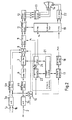
- Fig. 2 shows a top level diagram of the sync and video processing of a TV incorporating the present invention.
- the proposed architecture is based on a free running system clock, e.g. a crystal oscillator.
- the system clock has no correlation to the video sync or colour subcarrier frequencies.
- the free running system clock is particularly advantageous for processor-based systems adapted to receive video signals of various types and properties.
- colour burst-locked clocked systems are also possible to realize with the architecture described in the following if this is desirable for certain embodiments.
- Fig. 2 On the left hand side of Fig. 2 the inputs for analogue base band video signals are shown.
- the inputs 1a and 1b are used for S video signals having separate chrominance C and luminance Y inputs.
- the input 2 is provided for receiving composite video signals.
- the analogue video signals are converted into corresponding digital signals by A/D converters 3a and 3b, respectively.
- the digital output signals are then stored in FIFO (first-in-first-out) line delays 4a and 4b, respectively, having a size of e.g. eight video lines.
- the FIFO line delays are necessary for filtering time data used in horizontal sync processing, as it will be described further below.
- a comb filter is provided to separate the luminance Y and the chrominance C signals. Subsequently, the signals are fed into a chrominance decoder to generate the luminance signal Y and the chrominance signal C.
- a switch 8 is controlled to select the luminance and chrominance signals received from line delay 4a or from chroma decoder 7 to be further processed in a pixel interpolation filter 9, which will be described in more detail below.
- the output of filter 9 is buffered in a line buffer 11 and passed on to a colour dematrix 12 for generating digital R, G, B signals.
- the digital R, G, B signals are converted into analogue signals, amplified by associated drivers in block 13 and supplied to a cathode ray tube 14 for display.
- the signal processing may be different than shown in the present embodiment. However, these differences do not depart from the scope of the present invention.
- a digital luminance signal Y or a digital composite video signal is selectively used depending on which analogue inputs are active.
- the signal for sync signal processing is selected by switch 16 controlled by the same control signal as the switch 8.
- the vertical sync processing in block 17 is conventional and is therefore not described in more detail.
- the information regarding which field of a video frame is currently being processed is also obtained in this unit.
- the vertical sync signal V sync is delayed in a line delay 18 to re-establish the timing to the video signals delayed in the line delays 4a and 4b, respectively.
- the V sync signal is input to a microprocessor 19, which is among other functions operative to execute the synchronization logic.
- a H sync processing unit 21 the H sync signals are detected and processed by the inventive method, which will be described in more detail below.
- the horizontal sync information is supplied to the ⁇ P 19.
- the ⁇ P 19 uses the horizontal and vertical sync information to generate output signals for a deflection driver 22 being connected to a deflection apparatus not shown in Fig. 2.
- the deflection apparatus is associated with the CRT 14 and effects the scanning of the electron beams inside the CRT in a conventional way.
- the deflection driver 22 is replaced by an appropriate device effecting the representation of the video signal line by line on the screen of the respective display device.
- the H sync processing unit 21 comprises a H sync detector 23 to determine the timing of H sync signals contained in the received video signal.
- the H sync signals are filtered in a H-filter 24 and the resulting signals H o and ⁇ o are provided to the ⁇ P19 and to the pixel interpolation filter 9.
- the operation of the H sync detector 23, the H-filter 24 and the V sync processor 17 is controlled by an event control 25, which will be described in more detail in connection with Fig. 8.
- the present H sync detector 23 operates according to the correlation principle.
- the CVBS signal is convolved with an ideal line sync pulse and then the minimum is sought.
- This principle is illustrated in Fig. 3, where it is possible to discern in principle that the convolution operation of two square-wave pulses generates a triangle function as result function. This function then has a minimum or maximum, which specifies the position of the line sync pulse.
- the CVBS signal for a video line is designated by the reference symbol f in (k).
- the reference symbol s ideal (k) designates an ideal line sync pulse.
- the result function of the convolution operation is designated by the reference symbol ⁇ SV (k).
- the reference symbol k S specifies the position of the minimum of the result function.
- the convolution operation is carried out in the H sync detector 23 for example in such a way that the CVBS signal present in one of the line stores 4a, 4b for a video line is digitally convolved with a corresponding ideal line sync pulse.
- the execution may alternatively be configured in such a way that instead of the CVBS signal for the entire video line being convolved with the ideal line sync pulse, only the relevant part for the line sync pulse is convolved with the idealized line sync pulse.
- the zero of the first derivative of the result function is calculated.
- This computation operation is illustrated in more detail in Fig. 5, where the reference symbol ⁇ ⁇ SV (k) designates the first derivative of the result function, the variable k stands for the respective sample of the derivative function, k S specifies the position of the zero of the derivative and k 0 specifies the last sample with a negative sign in the transition region of the first derivative of the result function.
- a linear regression is carried out in the transition region of the derivative function. The zero is then calculated in a simple manner using the regression line established. The point of intersection of the regression line with the zero axis is designated by the reference symbol N s in Figure 5.
- the regression length l v amounts to nine samples in the example illustrated.
- the minimum of the first derivative is calculated with subpixel resolution.
- the subpixel resolution is necessary since the subsequent vertical filtering cannot effectively eliminate pixel quantization.
- the subpixel resolution is also necessary because, e.g. given a sampling rate of 18 MHz for the A/D conversion in the A/D conversion unit 20 and a display having a width of 56 cm, the visibility limit for picture details is approximately 0.17 pixel.
- Investigations with various input signals have shown that a linear regression yields an optimum result for the calculation of the subpixel resolution. For the calculation of the centre of the line sync pulse, which corresponds to the minimum of the result function of the convolution operation, approximately 10 samples are sufficient for the region around the zero of the derivative function.
- the computation rule that approximately 10 samples are sufficient was established at a sampling rate of 18 MHz using video signals having a constant horizontal frequency for various signal-to-noise ratios in the case of terrestrial reception.
- the standard deviation for a signal having a signal-to-noise ratio of 15 dB was 0.93 pixel.
- the standard deviation is 0.07 pixel.
- the horizontal frequency can deviate by up to 4% in the trick mode in video recorders, which also proportionally affects the length of the line sync pulse. This is then manifested in a deterioration in the identifiability of the edge in the course of the derivative function of the result function of the convolution operation. However, it has been shown that deviations up to this degree have no relevant influence on the detection accuracy in the course of the zero determination.
- the centre k S of the line sync pulse by means of linear regression, it is possible to use an arithmetic unit instead of a more complex microprocessor, since approximately 32 ⁇ s remain for this calculation, which corresponds to half of one video line in the PAL system.
- the equidistant samples enable a distinct simplification of the calculation.
- the formula for the calculation of the centre k s of the line sync pulse with subpixel accuracy then reads as follows:
- k l is a constant, which can be calculated as a function of the regression length 1. All the other symbols are known from the description regarding Figures 5 and 3.
- the phase difference between the H sync pulses and the beginning of a clock cycle would also be a constant value for all video lines.
- the video line duration is not constant but variable. Noise and low frequent distortions are super imposing the input video signal causing a time shift of the detected temporal position of the H sync pulse. As a consequence the detected video line duration T H changes line by line causing horizontal jitter. To avoid this kind of jitter it is necessary to filter the detected temporal positions of the H sync pulses.
- H I describes the time difference between two H sync pulses measured in integer cycles of the internal system clock.
- ⁇ I represents a fraction of one cycle allowing to determine the temporal position of a specific H sync pulse with subpixel resolution.
- Fig. 6 displays an analogue composite video signal CVBS with incorporated H sync pulses, which are indicated by "H”.
- Fig. 6b illustrates the temporal position t i of the H sync pulses by vertical lines 25.
- the abscissa in Fig. 6b is divided into units of the nominal duration T H of a video line.
- the temporal position t i falls into a particular cycle of the system clock.
- the relevant cycles define the integer number H I .
- a comparison between Figs. 6b and 6c illustrates that the nominal beginning of a video line as shown in Fig. 6b coincides with the beginning of a cycle of the system clock as illustrated in Fig. 6c.
- Fig. 6a displays an analogue composite video signal CVBS with incorporated H sync pulses, which are indicated by "H”.
- Fig. 6b illustrates the temporal position t i of the H sync pulses by vertical lines 25.
- FIG. 6b also shows that the temporal positions t i of the detected H sync pulses do not coincide with a cycle of the system clock.
- the time shift also discernible in Fig. 6b as a deviation from the nominal beginning of a video line is quantified by ⁇ I .
- ⁇ I defines the fraction of a system clock cycle the respective H sync pulse lags behind the clock cycle.
- the time instants t i determined according to the described method are subsequently filtered in a horizontal filter 24.
- the horizontal filter 24 is a FIR filter having symmetrical filter coefficients.
- One line duration ⁇ T n is the time difference between two H sync pulses n and n+1, defined by the time instants t n and t n+1 .
- the FIR filter then calculates the filter output signal according to the equation where C n,l are the filter coefficients, (1+1) is the filter length, and t n the time instants of the H sync pulses.
- Fig. 7b the FIR filter 24 is shown in more detail.
- the time instants are stored in delay stages 26 -1 ...26 o .
- the contents of the delay stages is multiplied with the associated filter coefficient c n,m in multipliers 27 -1 ...27 o .
- the individual products are summed up in an adder 28 to yield the filter output T m .
- the index m of the calculated filter output T m is related to the number of video lines that can be stored in the line delay 4a or 4b.
- the output of the horizontal filter depends exclusively on the input signals, i.e. the detected time instants t i .
- the H-filter 24 is an open loop filter.
- the horizontal filter outputs the filtered temporal position of the H sync pulse in terms of values H o and ⁇ o indicating the length of the video line in terms of a number of system clock cycles and a phase shift relative to the system clock, respectively.
- the time correction of the video signal is done by the pixel interpolation filter block 9, which is arranged to shift each video line in time with subpixel resolution corresponding to the value of ⁇ o , wherein o ⁇ ⁇ o ⁇ 1.
- the output signal H o of the H filter defines the start of each new video line with the accuracy of one system clock cycle.
- the H I pulse in connection with the additional phase information ⁇ I is used as input for the H-filter 24.
- the summed up time information of each H sync pulse ( ⁇ H I + ⁇ I ) is stored for a defined number of lines, which equals the FIR filter length.
- Fig. 8 shows in more detail the circuit section being effective for the time management.
- the time management circuit section which is referenced as a whole with the reference number 31, is structured into several blocks comprising a counter block 32, a comparator block 33, a phase memory 34, the FIR filter 24 and an event control 25.
- the details of the FIR filter 24 have already been described in connection with Fig. 7b.
- the counter block 32 includes two counters 36a, 36b to measure the time difference between the occurrences of two subsequent H I signals in units of clock cycles.
- the H I signal is also supplied to the event control 25 outputting a counter reset signal. During normal operation the counter reset signal corresponds the H I signal.
- a counter control unit 37 controls a switch 38 to connect the counter reset signal emitted by the uP 19 with either counter 36a or counter 36b for resetting it. At the same time the counter control unit 37 operates two further switches 39a and 39b to connect the output of the respective counter, which is not reset to one input of a comparator 41.
- the second input of the comparator 41 is provided with the predicted value calculated in the H-filter 24. The calculation is based on past and future H I values. If the two input values of the comparator 41 are equal it outputs the H o pulse.
- Fig. 9 shows the timing of the H I signal, the H 0 pulse and the contents of the counters 36a, 36b.
- One counter counts each H I pulse and the other counts the number of clock cycles for counter memory storage (circle) and output comparison (cross) and vice versa.
- the selected counter for output comparison counts the number of clock cycles from the last input pulse H I until the output pulse is generated by the prediction value (cross in Fig. 9).
- the selected filter is reset. Fractions of a clock cycle are not important for the counter time scheme. Fractional parts of a clock cycle are stored in the phase memory 34.
- Some lines of delay/memory are needed for the new horizontal filter technique based on an interpolation principle.
- a 8 line delay block is used to delay the video signal by 8 video lines. This is needed, because the signal delay allows the H filter block to obtain timing information from past video lines (still stored in line memory), before the video signal is output to the pixel interpolation filter. After passing the pixel interpolation filter, the video lines are orthogonalized with the processed timing information of the H filter and further time corrections are not possible. Using this line delay, the filter behavior can be improved as shown in the next chapter.
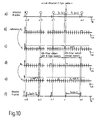
- Fig. 10 the timing of different types of signals is shown in an overview. From top to bottom the processing of the horizontal sync signals is visualized beginning with the detected H sync signals in Fig. 10a. On the abscissa of all diagrams in Fig. 10 the time grows from left to right.
- Figs. 10a to 10c correspond to the illustration in Figs. 6b to 6d describing the output of the H sync detector 23 (Fig. 2).
- the output signals H I and ⁇ I are provided to H-filter 24 to generate the filtered signals H o and ⁇ o (Figs. 10d, 10e) supplied to the ⁇ P 19 and the pixel interpolation filter 9, respectively.
- Fig. 10f the filtered H pulse (Fig. 10f) is supplied to the deflection driver 22 (Fig. 2).
- Fig. 10 also illustrates the effect of the time delay.
- a line delay corresponds to case b) in Fig. 10b, where the estimation time point is approximately seven lines in the past, referring to the actual detected H sync pulse.
- This configuration is adapted to the present embodiment having eight lines of video memory.
- the size of the memory and the parameters of the line delay may be different in other embodiments of the invention.
- the line delay following the vertical signal processing block is needed to compensate the line delay of the video streams (Y/C or composite video) and uses the same delay time as the video stream line delay.
- the realization of the line delay for the vertical signal needs much less hardware; it is a binary signal (V-Imp, Field).
- the present embodiment of the invention uses a free-running output clock frequency and outputs a fixed number of pixels per line. Depending on the variation of horizontal and vertical input frequency, the number of lines per each output field can vary. Field synchronization is possible by changing the number of output lines per field. Therefore, this mode is ideally suited to drive CRTs for the following reasons.
- the maximum needed line buffer size is defined by the maximum difference between the input and output memory addresses during one field. Hence, for a maximum averaged H-frequency variation of ⁇ 0.5% including phase-skips at the writing and constant output H-frequency at the reading, the line buffer memory size must at least be capable to store three video lines.
- the implementation of the vertical synchronization with changing vertical frequency in CRT-TVs does not present difficulties for a person skilled in the art. This type of synchronization can also be used for other display technologies like LCD or plasma displays.
- Fig. 11 shows a comparison between the conventional PLL, a system based on a linear regression filter technique without video line memory and with four lines of video memory and finally the actual new approach based on the FIR filter technology.
- Fig. 11a shows the time-base variation tracking and Fig. 9b the noise suppression.
- Fig. 11a shows the error transfer function
- the error at typical distortion frequencies at approximately 30 Hz must be in the order of - 60 dB to avoid visible jitter.
- Fig. 11 shows a comparison between the conventional PLL, a system based on a linear regression filter technique without video line memory and with four lines of video memory and finally the actual new approach based on the FIR filter technology.
- Fig. 11a shows the time-base variation tracking and Fig. 9b the noise suppression.
- Fig. 11a shows the error transfer function
- 11b details the improvement of sync-noise suppression compared to PLL and also compared to the previous patent application.
- the filter quality is in between the symmetrical FIR filter and the linear regression without memory. This is a suitable solution for one to approximately five line delays or line memory resulting in asymmetrical FIR coefficients.
- Fig. 12 a diagram shows the asymmetrical and symmetrical impulse responses corresponding to filter coefficients of the various filter types described above.
- the + symbols indicate the coefficients for linear regression without memory;
- the x symbols indicate the coefficients for linear regression with a memory having a size of four lines;
- the * symbols indicate the coefficients for a symmetrical FIR filter and
- the dots indicate the coefficients of a conventional PLL design with a fast time constant and infinite impulse response.
- the indices of the filter coefficients are plotted. It is noted that the linear regression with and without memory and the PLL filter represent asymmetric filters in contrast to the symmetrical FIR filter.
- Fig. 13 gives a rough impression about the achievable improvement.
- a reference measurement is made with Philips SAA7113H mounted on an original Philips evaluation board.
- Fig. 13b shows the response of the proposed algorithm using a symmetrical FIR filter.
- the phase jump response is reduced to 50%. After the phase jump very good stability is achieved and no comb structure due to phase differences in different picture is visible. In addition, also the noise suppression is much better.
Landscapes
- Engineering & Computer Science (AREA)
- Multimedia (AREA)
- Signal Processing (AREA)
- Synchronizing For Television (AREA)
- Television Signal Processing For Recording (AREA)
- Television Systems (AREA)
Priority Applications (9)
| Application Number | Priority Date | Filing Date | Title |
|---|---|---|---|
| EP01401811A EP1274229A1 (de) | 2001-07-06 | 2001-07-06 | Verfahren zur Gewinnung von Zeilensynchronisationinformationen aus einem Videosignal und Gerät zur Verwirklichung des Verfahrens |
| EP02743237A EP1405503B1 (de) | 2001-07-06 | 2002-06-24 | Verfahren zum erlangen von zeilensynchronisationsinformationsobjekten von einen videosignal und vorrichtung zur durchführung des verfahrens |
| US10/483,033 US7271843B2 (en) | 2001-07-06 | 2002-06-24 | Method and apparatus for analyzing a digitally converted analogue signal |
| PCT/EP2002/006933 WO2003005704A1 (en) | 2001-07-06 | 2002-06-24 | Method for obtaining line synchronization information items from a video signal, and apparatus for carrying out the method |
| KR10-2004-7000026A KR20040013092A (ko) | 2001-07-06 | 2002-06-24 | 비디오 신호로부터 라인 동기화 정보 아이템을 얻기 위한방법, 및 이 방법을 수행하기 위한 장치 |
| MXPA03011891A MXPA03011891A (es) | 2001-07-06 | 2002-06-24 | Metodo para la obtencion de unidades de informacion de sincronizacion lineal a partir de una senal de video, y aparato para llevar a cabo tal metodo. |
| JP2003511533A JP2004534482A (ja) | 2001-07-06 | 2002-06-24 | ライン同期情報アイテムをビデオ信号から獲得する方法、およびこの方法を実施するための装置 |
| CNA028135849A CN1524375A (zh) | 2001-07-06 | 2002-06-24 | 从视频信号中获得行同步信息项的方法及设备 |
| DE60214715T DE60214715T2 (de) | 2001-07-06 | 2002-06-24 | Verfahren zum erlangen von zeilensynchronisationsinformationsobjekten von einen videosignal und vorrichtung zur durchführung des verfahrens |
Applications Claiming Priority (1)
| Application Number | Priority Date | Filing Date | Title |
|---|---|---|---|
| EP01401811A EP1274229A1 (de) | 2001-07-06 | 2001-07-06 | Verfahren zur Gewinnung von Zeilensynchronisationinformationen aus einem Videosignal und Gerät zur Verwirklichung des Verfahrens |
Publications (1)
| Publication Number | Publication Date |
|---|---|
| EP1274229A1 true EP1274229A1 (de) | 2003-01-08 |
Family
ID=8182799
Family Applications (2)
| Application Number | Title | Priority Date | Filing Date |
|---|---|---|---|
| EP01401811A Withdrawn EP1274229A1 (de) | 2001-07-06 | 2001-07-06 | Verfahren zur Gewinnung von Zeilensynchronisationinformationen aus einem Videosignal und Gerät zur Verwirklichung des Verfahrens |
| EP02743237A Expired - Lifetime EP1405503B1 (de) | 2001-07-06 | 2002-06-24 | Verfahren zum erlangen von zeilensynchronisationsinformationsobjekten von einen videosignal und vorrichtung zur durchführung des verfahrens |
Family Applications After (1)
| Application Number | Title | Priority Date | Filing Date |
|---|---|---|---|
| EP02743237A Expired - Lifetime EP1405503B1 (de) | 2001-07-06 | 2002-06-24 | Verfahren zum erlangen von zeilensynchronisationsinformationsobjekten von einen videosignal und vorrichtung zur durchführung des verfahrens |
Country Status (8)
| Country | Link |
|---|---|
| US (1) | US7271843B2 (de) |
| EP (2) | EP1274229A1 (de) |
| JP (1) | JP2004534482A (de) |
| KR (1) | KR20040013092A (de) |
| CN (1) | CN1524375A (de) |
| DE (1) | DE60214715T2 (de) |
| MX (1) | MXPA03011891A (de) |
| WO (1) | WO2003005704A1 (de) |
Cited By (2)
| Publication number | Priority date | Publication date | Assignee | Title |
|---|---|---|---|---|
| DE102005060701A1 (de) * | 2005-07-28 | 2007-02-08 | Rohde & Schwarz Gmbh & Co. Kg | Verfahren zur Bestimmung von Vertikalsynchronisationszeitpunkten |
| US7782314B2 (en) * | 2003-05-29 | 2010-08-24 | Fujitsu Component Limited | Device and system for synchronizing image signals transmitted with superimposed signals |
Families Citing this family (2)
| Publication number | Priority date | Publication date | Assignee | Title |
|---|---|---|---|---|
| KR102200399B1 (ko) * | 2014-12-04 | 2021-01-08 | 한화테크윈 주식회사 | 동축 통신형 수신장치 |
| CN113792371B (zh) * | 2021-09-27 | 2024-01-26 | 江西科技学院 | 基于锁相值的轨道异常匹配的诊断方法 |
Citations (3)
| Publication number | Priority date | Publication date | Assignee | Title |
|---|---|---|---|---|
| US5594506A (en) * | 1995-09-26 | 1997-01-14 | Samsung Electronics Co., Ltd. | Line sync detector for digital television receiver |
| EP0796007A1 (de) * | 1996-03-13 | 1997-09-17 | Michael Johannes Koch | Schaltung zur Zeilen- und Bildsynchronisation eines digitalisierten Videosignals |
| EP0899945A2 (de) * | 1997-08-27 | 1999-03-03 | Deutsche Thomson-Brandt Gmbh | Verfahren und Vorrichtung zur Gewinnung von Zeilensynchronisations-Informationsposten aus einem Videosignal |
Family Cites Families (9)
| Publication number | Priority date | Publication date | Assignee | Title |
|---|---|---|---|---|
| US4220967A (en) | 1976-09-27 | 1980-09-02 | Hughes Aircraft Company | Scene tracker using multiple independent correlators |
| JPS59229709A (ja) * | 1983-06-10 | 1984-12-24 | Toshiba Corp | 画像情報記録装置 |
| US5119193A (en) * | 1990-09-19 | 1992-06-02 | Nec Corporation | Video-signal processing device |
| WO1993017438A1 (en) * | 1992-02-25 | 1993-09-02 | Matsushita Electric Industrial Co., Ltd. | Zinc oxide varistor and production thereof |
| US5404173A (en) * | 1993-03-10 | 1995-04-04 | Brooktree Corporation | Method to synchronize video modulation using a constant time base |
| US5515108A (en) * | 1993-08-18 | 1996-05-07 | Samsung Electronics Corporation | Digital automatic frequency control method and circuit therefor |
| DE4335197A1 (de) * | 1993-10-15 | 1995-04-20 | Thomson Brandt Gmbh | Synchronsignal-Abtrennschaltung für einen Fernsehempfänger |
| KR0134309B1 (ko) * | 1994-03-11 | 1998-04-23 | 김광호 | 디지탈 주파수 자동조절회로 |
| JPH08116466A (ja) * | 1994-10-14 | 1996-05-07 | Fujitsu Ten Ltd | 同期信号処理回路 |
-
2001
- 2001-07-06 EP EP01401811A patent/EP1274229A1/de not_active Withdrawn
-
2002
- 2002-06-24 EP EP02743237A patent/EP1405503B1/de not_active Expired - Lifetime
- 2002-06-24 DE DE60214715T patent/DE60214715T2/de not_active Expired - Lifetime
- 2002-06-24 MX MXPA03011891A patent/MXPA03011891A/es active IP Right Grant
- 2002-06-24 US US10/483,033 patent/US7271843B2/en not_active Expired - Fee Related
- 2002-06-24 JP JP2003511533A patent/JP2004534482A/ja active Pending
- 2002-06-24 CN CNA028135849A patent/CN1524375A/zh active Pending
- 2002-06-24 KR KR10-2004-7000026A patent/KR20040013092A/ko not_active Withdrawn
- 2002-06-24 WO PCT/EP2002/006933 patent/WO2003005704A1/en not_active Ceased
Patent Citations (3)
| Publication number | Priority date | Publication date | Assignee | Title |
|---|---|---|---|---|
| US5594506A (en) * | 1995-09-26 | 1997-01-14 | Samsung Electronics Co., Ltd. | Line sync detector for digital television receiver |
| EP0796007A1 (de) * | 1996-03-13 | 1997-09-17 | Michael Johannes Koch | Schaltung zur Zeilen- und Bildsynchronisation eines digitalisierten Videosignals |
| EP0899945A2 (de) * | 1997-08-27 | 1999-03-03 | Deutsche Thomson-Brandt Gmbh | Verfahren und Vorrichtung zur Gewinnung von Zeilensynchronisations-Informationsposten aus einem Videosignal |
Cited By (3)
| Publication number | Priority date | Publication date | Assignee | Title |
|---|---|---|---|---|
| US7782314B2 (en) * | 2003-05-29 | 2010-08-24 | Fujitsu Component Limited | Device and system for synchronizing image signals transmitted with superimposed signals |
| DE102005060701A1 (de) * | 2005-07-28 | 2007-02-08 | Rohde & Schwarz Gmbh & Co. Kg | Verfahren zur Bestimmung von Vertikalsynchronisationszeitpunkten |
| DE102005060701B4 (de) * | 2005-07-28 | 2011-06-16 | Rohde & Schwarz Gmbh & Co. Kg | Verfahren zur Bestimmung von Vertikalsynchronisationszeitpunkten |
Also Published As
| Publication number | Publication date |
|---|---|
| CN1524375A (zh) | 2004-08-25 |
| EP1405503A1 (de) | 2004-04-07 |
| EP1405503B1 (de) | 2006-09-13 |
| US20040174461A1 (en) | 2004-09-09 |
| MXPA03011891A (es) | 2004-03-26 |
| KR20040013092A (ko) | 2004-02-11 |
| DE60214715D1 (de) | 2006-10-26 |
| JP2004534482A (ja) | 2004-11-11 |
| US7271843B2 (en) | 2007-09-18 |
| WO2003005704A1 (en) | 2003-01-16 |
| DE60214715T2 (de) | 2007-02-22 |
Similar Documents
| Publication | Publication Date | Title |
|---|---|---|
| US5786872A (en) | Motion detection circuit calculates difference between input video signal and one frame-period signal | |
| KR0126658B1 (ko) | 비표준 텔레비젼 신호처리를 위한 샘플률 변환장치 | |
| KR940006625B1 (ko) | 비디오 신호 처리 시스템 | |
| US4595953A (en) | Television receiver having character generator with burst locked pixel clock and correction for non-standard video signals | |
| EP0899945B1 (de) | Verfahren und Vorrichtung zur Gewinnung von Zeilensynchronisations-Informationsposten aus einem Videosignal | |
| US4667240A (en) | Timing correction circuitry as for TV signal recursive filters | |
| JPH0783467B2 (ja) | テレビジヨン表示方式 | |
| US6219105B1 (en) | Video signal processing apparatus | |
| JPH03171984A (ja) | 自走システムクロックでアナログビデオ信号を処理するデジタル回路装置 | |
| EP1405503B1 (de) | Verfahren zum erlangen von zeilensynchronisationsinformationsobjekten von einen videosignal und vorrichtung zur durchführung des verfahrens | |
| US4977445A (en) | Sync-signal reproducing circuit for use in television receiver | |
| US5923377A (en) | Jitter reducing circuit | |
| US6801706B1 (en) | Jitter correcting apparatus and method for video signals | |
| JP3417154B2 (ja) | 表示装置 | |
| KR930005339B1 (ko) | 더블 어지뮤즈 4헤드 vtr에서 변속재생시 에러 보정회로 | |
| KR100239980B1 (ko) | 비디오 수신기의 안정화를 위한 수평 라인 카운터 | |
| KR0130812B1 (ko) | 디지탈 수평동기신호와 위상에러 바랭장치 및 그 방법 | |
| JP2571038B2 (ja) | ディジタルテレビジョン信号処理装置 | |
| Rothermel et al. | Synchronization of analog video signals with improved image stability | |
| JP2653351B2 (ja) | ディジタルテレビジョン受信機 | |
| JP2517619B2 (ja) | テレビジョン受像機 | |
| JPH06311532A (ja) | 映像信号のジッタ補正回路 | |
| JP3140202B2 (ja) | ゴースト除去装置 | |
| JPH07131819A (ja) | 映像信号の非標準信号検出回路 | |
| JPH10126644A (ja) | 垂直同期分離回路 |
Legal Events
| Date | Code | Title | Description |
|---|---|---|---|
| PUAI | Public reference made under article 153(3) epc to a published international application that has entered the european phase |
Free format text: ORIGINAL CODE: 0009012 |
|
| AK | Designated contracting states |
Kind code of ref document: A1 Designated state(s): AT BE CH CY DE DK ES FI FR GB GR IE IT LI LU MC NL PT SE TR |
|
| AX | Request for extension of the european patent |
Free format text: AL;LT;LV;MK;RO;SI |
|
| AKX | Designation fees paid | ||
| REG | Reference to a national code |
Ref country code: DE Ref legal event code: 8566 |
|
| STAA | Information on the status of an ep patent application or granted ep patent |
Free format text: STATUS: THE APPLICATION IS DEEMED TO BE WITHDRAWN |
|
| 18D | Application deemed to be withdrawn |
Effective date: 20030709 |