EP1288845A2 - User authentication method and user authentication device - Google Patents
User authentication method and user authentication device Download PDFInfo
- Publication number
- EP1288845A2 EP1288845A2 EP02017384A EP02017384A EP1288845A2 EP 1288845 A2 EP1288845 A2 EP 1288845A2 EP 02017384 A EP02017384 A EP 02017384A EP 02017384 A EP02017384 A EP 02017384A EP 1288845 A2 EP1288845 A2 EP 1288845A2
- Authority
- EP
- European Patent Office
- Prior art keywords
- user
- relative movement
- user authentication
- pattern
- series
- Prior art date
- Legal status (The legal status is an assumption and is not a legal conclusion. Google has not performed a legal analysis and makes no representation as to the accuracy of the status listed.)
- Withdrawn
Links
Images








Classifications
-
- G—PHYSICS
- G06—COMPUTING OR CALCULATING; COUNTING
- G06V—IMAGE OR VIDEO RECOGNITION OR UNDERSTANDING
- G06V40/00—Recognition of biometric, human-related or animal-related patterns in image or video data
- G06V40/30—Writer recognition; Reading and verifying signatures
-
- G—PHYSICS
- G06—COMPUTING OR CALCULATING; COUNTING
- G06V—IMAGE OR VIDEO RECOGNITION OR UNDERSTANDING
- G06V40/00—Recognition of biometric, human-related or animal-related patterns in image or video data
- G06V40/10—Human or animal bodies, e.g. vehicle occupants or pedestrians; Body parts, e.g. hands
- G06V40/12—Fingerprints or palmprints
- G06V40/1335—Combining adjacent partial images (e.g. slices) to create a composite input or reference pattern; Tracking a sweeping finger movement
-
- G—PHYSICS
- G06—COMPUTING OR CALCULATING; COUNTING
- G06V—IMAGE OR VIDEO RECOGNITION OR UNDERSTANDING
- G06V40/00—Recognition of biometric, human-related or animal-related patterns in image or video data
- G06V40/10—Human or animal bodies, e.g. vehicle occupants or pedestrians; Body parts, e.g. hands
- G06V40/12—Fingerprints or palmprints
- G06V40/13—Sensors therefor
- G06V40/1318—Sensors therefor using electro-optical elements or layers, e.g. electroluminescent sensing
-
- G—PHYSICS
- G06—COMPUTING OR CALCULATING; COUNTING
- G06V—IMAGE OR VIDEO RECOGNITION OR UNDERSTANDING
- G06V40/00—Recognition of biometric, human-related or animal-related patterns in image or video data
- G06V40/10—Human or animal bodies, e.g. vehicle occupants or pedestrians; Body parts, e.g. hands
- G06V40/12—Fingerprints or palmprints
- G06V40/1347—Preprocessing; Feature extraction
-
- G—PHYSICS
- G06—COMPUTING OR CALCULATING; COUNTING
- G06V—IMAGE OR VIDEO RECOGNITION OR UNDERSTANDING
- G06V40/00—Recognition of biometric, human-related or animal-related patterns in image or video data
- G06V40/10—Human or animal bodies, e.g. vehicle occupants or pedestrians; Body parts, e.g. hands
- G06V40/12—Fingerprints or palmprints
- G06V40/1365—Matching; Classification
-
- G—PHYSICS
- G06—COMPUTING OR CALCULATING; COUNTING
- G06V—IMAGE OR VIDEO RECOGNITION OR UNDERSTANDING
- G06V40/00—Recognition of biometric, human-related or animal-related patterns in image or video data
- G06V40/40—Spoof detection, e.g. liveness detection
-
- G—PHYSICS
- G06—COMPUTING OR CALCULATING; COUNTING
- G06V—IMAGE OR VIDEO RECOGNITION OR UNDERSTANDING
- G06V40/00—Recognition of biometric, human-related or animal-related patterns in image or video data
- G06V40/50—Maintenance of biometric data or enrolment thereof
Definitions
- the present invention relates to a user authentication method of determining identity of a user at a personal information apparatus with a series of fingerprint images captured by a fingerprint sensor as input for the purpose of personal identification using fingerprints and a device therefor.
- fingerprint matching Effective in user authentication for use in information apparatuses and information services is fingerprint matching making the most of identity of a fingerprint that is unique in every person and invariant over time.
- Conventional procedure taken in user authentication using fingerprint matching is in advance registering and preserving fingerprint data applied by an authorized user who has a right to use the apparatus or the service and collating fingerprint data obtained from a fingerprint input through a fingerprint input unit when a certain user uses the apparatus or the service with the fingerprint data (which will be referred to as template) of the authorized user and when they coincide with each other, allowing the user in question to use the apparatus and the service as an authorized user.
- the above-described conventional user authentication method has the following problems.
- Second problem is that while expansion of a range of information apparatus on which a user authentication device is mounted requires an input device for inputting a fingerprint to be reduced in cost and scale, the reduction in scale will be accompanied with deterioration of fingerprint matching precision. More specifically, although for the expansion of a range of the apparatus on which the device is mounted, it is desirable to use an input device having only a smaller region for use as a sensor surface than a fingerprint region, the sensor surface whose area is small will accommodate less features to result in degrading precision of fingerprint matching.
- An object of the present invention is to provide a user authentication method and a user authentication device which eliminate such unlawfulness using such false biometrics including false finger as described above to realize more reliable user authentication.
- Another object of the present invention is to provide a user authentication method and a user authentication device which allow even a sensor of a small area to realize highly precise user authentication at low costs.
- a user authentication method of making determination of identity of a user based on an image of a part of a body of the user as biometrics captured by a sensor comprising the step of using information about a pattern of movement of the part of the body relative to the sensor as secret information for specifying a user to conduct user authentication.
- determination of identity of a registered user is made based on both a degree of similarity of feature information extracted from a single image of the part of the body captured by the sensor and a degree of similarity of the relative movement pattern.
- a corresponding point between a preceding frame and a current frame is searched to obtain a sweep pattern which is a series of moving vectors obtained by calculating a moving vector of the relative movement of the part of the body as the relative movement pattern, thereby conducting user authentication based on the sweep pattern in question.
- a corresponding point between a preceding frame and a current frame is searched to conduct user authentication based on a sweep pattern as a series of moving vectors obtained by calculating a moving vector of relative movement of a finger.
- a degree of similarity of the relative movement pattern and a frame as a series of images of the part of the body captured by the sensor are sequentially registered so as to have overlaps correlated best to extract feature information for collation from a composite image obtained by composition, thereby conducting user authentication based on a degree of similarity of the feature information in question.
- a corresponding point between a preceding frame and a current frame is searched to obtain a sweep pattern which is a series of moving vectors obtained by calculating a moving vector of the relative movement of the part of the body as the relative movement pattern
- the frames are sequentially registered so as to have overlaps correlated best to extract feature information for collation from a composite image obtained by composition, thereby conducting user authentication based on the sweep pattern and the feature information.
- a pressure value pattern as a series of pressure value difference vectors is obtained from a time series change of a pressure value in the relative movement of the part of the body to conduct user authentication based on the relative movement pattern and the pressure value pattern.
- user authentication is conducted based on feature information extracted from a single image of the part of the body captured by the sensor, a sweep pattern which is a series of moving vectors obtained by searching, with respect to a frame as a series of images of the part of the body captured by the sensor, a corresponding point between a preceding frame and a current frame and calculating a moving vector of relative movement of a finger, and a pressure value pattern as a series of pressure value difference vectors obtained from a time series change of a pressure value in the relative movement of the part of the body.
- a sweep pattern which is a series of moving vectors obtained by searching, with respect to a frame as a series of images of the part of the body captured by the sensor, a corresponding point between a preceding frame and a current frame and calculating a moving vector of relative movement of a finger
- a pressure value pattern as a series of pressure value difference vectors obtained from a time series change of a pressure value in the relative movement of the part of the body.
- a corresponding point between a preceding frame and a current frame is searched to obtain a sweep pattern which is a series of moving vectors obtained by calculating a moving vector of the relative movement of the part of the body as the relative movement pattern
- the frames are sequentially registered so as to have overlaps correlated best to extract feature information for collation from a composite image obtained by composition
- a pressure value pattern as a series of pressure value difference vectors is obtained from a time series change of a pressure value in the relative movement of the part of the body, thereby conducting user authentication based on the sweep pattern, the feature information and the pressure value pattern.
- the part of the body is a finger and relative movement pattern information of the finger in question is used as secret information for specifying a user.
- the relative movement pattern information of a plurality of users are registered corresponding to the respective users to conduct user authentication for each selected user.
- the relative movement pattern information of a plurality of users are registered corresponding to the respective users to conduct user authentication by specifying a user based on the relative movement pattern information of the user input through the sensor.
- a user authentication device for making determination of identity of a user with an image of a part of a body of the user as biometrics captured by a sensor as input, wherein information about a pattern of movement of the part of the body relative to the sensor is input to conduct user authentication based on the relative movement pattern.
- determination of identity of a registered user is made based on both a degree of similarity of feature information extracted from a single image of the part of the body captured by the sensor and a degree of similarity of the relative movement pattern.
- the user authentication device comprises means for searching, with respect to a frame as a series of images of the part of the body captured by the sensor, a corresponding point between a preceding frame and a current frame and calculating a moving vector of the relative movement of the part of the body to obtain a sweep pattern which is a series of moving vectors as the relative movement pattern.
- the user authentication device comprises means for searching, with respect to a frame as a series of images of the part of the body captured by the sensor, a corresponding point between a preceding frame and a current frame and calculating a moving vector of the relative movement of the part of the body to obtain a sweep pattern which is a series of moving vectors as the relative movement pattern, means for storing a relative movement pattern of an authorized user in advance, and determination means for comparing a relative movement pattern obtained at the time of authentication with a relative movement pattern in the storage means to determine a degree of similarity between the patterns.
- the user authentication device comprises means for extracting feature information from a single image of the part of the body captured by the sensor, first storage means for storing the feature information of an authorized user in advance, means for searching, with respect to a frame as a series of images of the part of the body captured by the sensor, a corresponding point between a preceding frame and a current frame and calculating a moving vector of the relative movement of the part of the body to obtain a sweep pattern which is a series of moving vectors as the relative movement pattern, second storage means for storing the relative movement pattern of an authorized user in advance, and determination means for comparing the feature information and the relative movement pattern obtained at the time of authentication with the feature information and the relative movement pattern in the first and second storage means to determine a degree of similarity between the information and patterns.
- a degree of similarity of the relative movement pattern and a frame as a series of images of the part of the body captured by the sensor are sequentially registered so as to have overlaps correlated best to extract feature information for collation from a composite image obtained by composition, thereby conducting user authentication based on a degree of similarity of the feature information in question.
- the user authentication device comprises means for searching, with respect to a frame as a series of images of the part of the body captured by the sensor, a corresponding point between a preceding frame and a current frame and calculating a moving vector of the relative movement of the part of the body to obtain a sweep pattern which is a series of moving vectors as the relative movement pattern, means for sequentially registering, with respect to a frame as a series of images of the part of the body captured by the sensor, the frames so as to have overlaps correlated best to extract feature information for collation from a composite image obtained by composition, and determination means for comparing the feature information and the relative movement pattern obtained at the time of authentication with the feature information and the relative movement pattern of an authorized user to determine a degree of similarity between the information and patterns.
- a pressure value pattern as a series of pressure value difference vectors is obtained from a time series change of a pressure value in the relative movement of the part of the body to conduct user authentication based on the relative movement pattern and the pressure value pattern.
- the user authentication device comprises means for extracting feature information from a single image of the part of the body captured by the sensor, means for searching, with respect to a frame as a series of images of the part of the body captured by the sensor, a corresponding point between a preceding frame and a current frame and calculating a moving vector of the relative movement of the part of body to obtain a sweep pattern which is a series of moving vectors as the relative movement pattern, means for obtaining a pressure value pattern as a series of pressure value difference vectors from a time series change of a pressure value in the relative movement of the part of the body, and determination means for comparing the feature information, the relative movement pattern and the pressure value pattern obtained at the time of authentication with the feature information, the relative movement pattern and the pressure value pattern of an authorized user to determine a degree of similarity among the information and patterns.
- the user authentication device comprises means for searching, with respect to a frame as a series of images of the part of the body captured by the sensor, a corresponding point between a preceding frame and a current frame and calculating a moving vector of the relative movement of the part of the body to obtain a sweep pattern which is a series of moving vectors as the relative movement pattern, means for sequentially registering, with respect to a frame as a series of images of the part of the body captured by the sensor, the frames so as to have overlaps correlated best to extract feature information for collation from a composite image obtained by composition, means for obtaining a pressure value pattern as a series of pressure value difference vectors from a time series change of a pressure value in the relative movement of the part of the body, and determination means for comparing the sweep pattern, the feature information and the pressure value pattern obtained at the time of authentication with the relative movement pattern, the feature information and the pressure value pattern of an authorized user to determine a degree of similarity between the information and patterns.
- the part of the body is a finger and relative movement pattern information of the finger in question is used as secret information for specifying a user.
- a cover for covering relative movement of the part of the body from the outside.
- the relative movement pattern information of a plurality of users are registered corresponding to the respective users to conduct user authentication for each selected user.
- the user authentication device comprises selection means for selecting a user to be authenticated from among a plurality of users.
- the relative movement pattern information of a plurality of users are registered corresponding to the respective users to conduct user authentication by specifying a user based on the relative movement pattern information of the user input through the sensor.
- a user authentication program for making determination of identity of a user based on an image of a part of a body of the user as biometrics captured by a sensor, comprising the function of conducting user authentication by using information about a pattern of movement of the part of the body relative to the sensor as secret information for specifying a user.
- an information processing method using user authentication of making determination of identity of a user with an image of a part of a body of the user as biometrics captured by a sensor as input, comprising the steps of:
- an information apparatus having a user authentication device for making determination of identity of a user with an image of a part of a body of the user as biometrics captured by a sensor as input, which apparatus inputs information about a pattern of movement of the part of the body relative to the sensor to conduct user authentication based on the relative movement pattern in question, has user inherent information related to interruption and resumption of operation of the apparatus which is correlated with the relative movement pattern information registered for each of a plurality of users, and executes interruption and resumption of operation of the apparatus based on the user inherent information corresponding to a user whose user authentication has been conducted.
- an information processing method using user authentication of making determination of identity of a user with an image of a part of a body of the user as biometrics captured by a sensor as input, comprising the steps of:
- an information apparatus having a user authentication device for making determination of identity of a user with an image of a part of a body of the user as biometrics captured by a sensor as input, which apparatus inputs information about a pattern of movement of the part of the body relative to the sensor to conduct user authentication based on the relative movement pattern in question, registers a command giving an instruction on operation of the apparatus so as to be correlated with the relative movement pattern information registered for each of a plurality of parts of the body or each of a plurality of users, and executes operation of the apparatus based on the command corresponding to the part of the body or the user whose user authentication has been conducted.
- the present invention is intended to conduct user authentication using a plurality of image groups obtained by moving a finger on a sensor relatively to the sensor (sweeping), in which "sweep patterns" such as a start point, a path, speed and an end point of a finger sweep are also employed as secret information known only to a person in question for use as information for authentication.
- "sweep patterns" such as a start point, a path, speed and an end point of a finger sweep are also employed as secret information known only to a person in question for use as information for authentication.
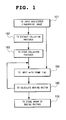
- Figs. 1 and 2 are flow charts showing a flow of processing in the first embodiment
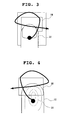
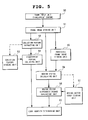
- Figs. 3 and 4 are views showing an example of movement of a finger on a fingerprint sensor
- Fig. 5 is a block diagram showing a structure of a user authentication device according to the present embodiment.
- the user authentication device is intended to confirm a user by using fingerprints in order not to allow a person other than a relevant person to use a personal information apparatus such as an information terminal, a videogame player and a portable telephone.
- the device is also intended to allow, when the above-described information apparatus is commonly used by a plurality of persons, only an authorized user to use it by the user-basis setting according to a fingerprint of each individual.
- the owner registers his fingerprint data and sweep pattern at the device in advance in a manner as described in the following.
- the first applied image data is assumed to be an image f(0) for the sake of convenience.
- Step 102 extract features for fingerprint matching from the image data
- Step 103 store the extracted features as collation features
- FIG. 3 illustrates how the finger put on a frame input unit (fingerprint sensor) 50 is swept as seen from above, with a curved arrow indicating movement of the finger on the frame input unit 50.
- Fig. 4 also shows the movement illustrated in Fig. 3 as seen from below, that is, the bulb of the finger seen from the side of the frame input unit 50.
- a frame as a partial image of the fingerprint captured by the frame input unit 50 is successively input as time passes (Step 101).
- a series of these frames successively input is denoted as f(1) ⁇ f(m) ⁇ f(M).
- the finger is swept at a speed not too fast such that a time interval between frames is short enough and that adjacent frames have considerable captured areas overlapping with each other (i.e. such that an overlap of captured areas can be obtained that can be precisely calculated by a moving vector which will be described later).
- Step 104 When a certain frame f(m) is input (Step 104), a corresponding point between f(m-1), i.e. the preceding frame, and the current frame is searched to calculate a moving vector of relative motion of the finger (Step 105).
- a moving vector when the number of corresponding points between the preceding frame and the current frame is smaller than a predetermined value necessary at least for calculating the moving vector, the user is asked to again input the image.
- Step 106 store the series of the moving vectors with respect to each frame.
- the foregoing is the fingerprint registration procedure for user authentication.
- the captured image of the fingerprint is input (Step 201).
- the image is assumed to be an image g(0) for the sake of convenience.
- features for fingerprint matching are extracted (Step 202) and collated with the previously stored collation features (Step 203) to evaluate the degree of difference (Step 205).
- a frame as a partial image of the fingerprint captured by the frame input unit 50 is successively input as time passes (Step 206).
- a series of these frames is represented as g(1) ⁇ g(n) ⁇ g(N).
- Step 208 By comparing the series of these moving vectors with the stored series of the moving vectors as of the registration, evaluate the degree of difference between sweep patterns as of the registration and as of user authentication (Step 208).
- Step 209 make determination of user's identity based on the result of the above-described evaluation of the degree of difference in feature collation and the result of the evaluation of the degree of difference in sweep patterns.
- the determination of user's identity when the result of each evaluation of the degree of difference is lower than a predetermined threshold value, determine that the user in question is an authorized user and allow him to use the information apparatus.
- the result of each evaluation of the degree of difference is higher than the predetermined threshold value, determine that the user in question is a false user and refuse use of the information apparatus.
- the threshold value for use in authentication based on the above-described degree of difference (or the degree of similarity)
- a threshold value set too low in a case using the degree of similarity, set too high
- authentication for refusal will be given because making completely the same movement is impossible.
- a threshold value for the above-described degree of difference (or the degree of similarity) set too high in a case using the degree of similarity, set too low
- authentication for allowance will be given with ease.
- the above-described threshold value is set to have such balance as giving no permission to other person than an authorized user with ease without refusing authentication of the authorized user himself.
- Fig. 5 is a functional block diagram showing a user authentication device according to the first embodiment
- Fig. 6 is a diagram showing an entire structure of the user authentication device according to the first embodiment.
- a user authentication device 10 includes the frame input unit 50, a frame image storing unit 51, a collation feature extracting unit 52, a collation feature storing unit 53, a fingerprint feature collating unit 54, a preceding frame image storing unit 55, a moving vector calculating unit 56, a moving vector group storing unit 57, a moving vector difference degree evaluating unit 58 and a user identity determining unit 65.
- the user authentication unit 10 is composed of the frame input unit 50, an authentication processing unit 11 implemented by a program-controlled CPU or the like and a storage unit 12, with the authentication processing unit (CPU) 11 having the above-described collation feature extracting unit 52, fingerprint feature collating unit 54, moving vector calculating unit 56, moving vector difference degree evaluating unit 58 and user identity determining unit 65 and the storage unit 12 having the above-described frame image storing unit 51, collation feature storing unit 53, preceding frame image storing unit 55 and moving vector group storing unit 57.
- the authentication processing unit (CPU) 11 having the above-described collation feature extracting unit 52, fingerprint feature collating unit 54, moving vector calculating unit 56, moving vector difference degree evaluating unit 58 and user identity determining unit 65 and the storage unit 12 having the above-described frame image storing unit 51, collation feature storing unit 53, preceding frame image storing unit 55 and moving vector group storing unit 57.
- the frame input unit 50 as a fingerprint sensor is a part for receiving input of a fingerprint image for the confirmation of a person in question.
- the part has such a function of successively obtaining partial images of a moving target to be captured as a camera and a scanner and has such an outer configuration as that of the frame input unit 50 shown in Fig. 3, for example.
- Size of the frame input unit 50 is, for example, smaller than the whole part of a fingerprint of a finger.
- a still picture of a finger of the user put on the frame input unit 50 can be captured by the unit or when the user moves his finger (sweeping movement) in a direction, for example, that indicated by the arrow (or in the reverse direction) in Fig. 3 relatively to the frame input unit 50, a plurality of fingerprint images (each individual fingerprint partial image will be referred to as a frame) successively captured with the movement can be obtained.
- the frame input unit 50 converts irregularities corresponding to ridge lines of a finger put thereon into image densities to capture the image at preset capture timing.
- the technique recited in Japanese Patent Laying-Open (Kokai) No. 2000-217803, for example, is used.
- Other methods have been also put to practical use including a method using prisms and a method using capacitance.
- the latest frame image applied is stored in the frame image storing unit 51.
- the collation feature extracting unit 52 extracts features for collation from a two-dimensional image held in the frame image storing unit 51.
- the collation feature storing unit 53 is a part for extracting features for collation from a fingerprint image of an authorized user of the information apparatus and storing the same in advance.
- collation features extracted by the collation feature extracting unit 52 are stored in the collation feature storing unit 53 as indicated by a broken arrow.
- the fingerprint feature collating unit 54 collates fingerprint features of an authorized user held in the collation feature storing unit 53 and fingerprint features of a user whose fingerprint is input this time which are calculated by the collation feature extracting unit 52 to output its degree of difference (or conversely, the degree of similarity).
- a fingerprint matching device including the collation feature extracting unit 52 and the fingerprint feature collating unit 54 is, for example, "Fingerprint matching Device" recited in Japanese Patent Laying-Open (Kokai) No. Showa 56-24675 or that recited in Japanese Patent Laying-Open (Kokai) No. Heisei 4-33065.
- the preceding frame image storing unit 55 stores, with respect to a frame image successively captured by the frame input unit 50, an image immediately precedent to the current frame. More specifically, when the image g(n) exists in the frame image storing unit 51, its immediately preceding image g(n-1) is stored in the preceding frame image storing unit 55.
- the moving vector calculating unit 56 registers the frame image g(n-1) recorded in the preceding frame image storing unit 55 and the image g(n) existing in the frame image storing unit 51 to calculate a moving vector between the images.
- a sequential similarity detection algorithm can be used. This method is intended, in a case of calculating a moving vector from, for example, the image g(n-1) to the image g(n), to register the image g(n-1) and the image g(n) while gradually moving the image g(n) in parallel with the image g(n-1) and regard a vector (or inverse vector) of parallel displacement obtained at a time when the two are registered best as a moving vector between the frames.
- SSDA sequential similarity detection algorithm
- a moving vector is calculated for each frame from a series of frames successively obtained from a moving picture to determine a series of the vectors.
- the series of vectors forms a sweep pattern.
- the moving vector group storing unit 57 is a part for obtaining a group of moving vectors from a sweep pattern of an authorized user of the information apparatus as of the registration and storing the same in advance. At the registration, a series of vectors obtained by the moving vector calculating unit 56 is stored in the moving vector group storing unit 57 as indicated by a broken arrow in Fig. 5.
- the moving vector difference degree calculating unit 58 evaluates, at the time of user authentication, a degree of difference between a group of moving vectors describing a sweep pattern of an authorized user held in the moving vector group storing unit 57 and a group of moving vectors describing a sweep pattern of a user whose sweep pattern is input this time which is calculated by the moving vector calculating unit 56.
- the degree of difference can be calculated by, for example, adding each vector in the vector group in a time serial order, smoothing an obtained polygonal line to obtain an approximate curve of a locus (which represents a locus of a sweep pattern) and accumulating a distance difference at fixed intervals between approximate curves obtained from both vector groups.
- Such a method enables a degree of coincidence to be quantitatively evaluated. For example, when two sweep patterns expressed by two moving vector groups are approximate to each other, the degree of difference is determined to be low and when they are not approximate to each other, the degree of difference is determined to be high.
- the user identity determining unit 65 obtains a weighted sum of a degree of difference (or a degree of similarity) obtained by the fingerprint feature collating unit 54 between fingerprint features of an authorized user and fingerprint features of a user whose fingerprint is input this time and a degree of difference (or a degree of similarity) obtained by the moving vector difference degree calculating unit 58 between a sweep pattern of the authorized user and a sweep pattern of the user whose fingerprint is input this time and compares the obtained sum with a preset threshold value.
- the unit when the degree of difference (or the degree of similarity) taking both elements into consideration is lower than the threshold value (in a case of the degree of similarity, when higher than the threshold value), the unit considers the user in question as the authorized user and allows him to use the information apparatus on which the present user authentication device is mounted (enabling operation of the device). Conversely, when the degree of difference (or the degree of similarity) is higher than the threshold value (in a case of the degree of similarity, lower than the threshold value), the unit conducts predetermined operation such as refraining from making allowance (disabling operation of the device) because of lack of coincidence.
- Such a sweep pattern as described above can be handled as secret information known only to a person in question and personal information appropriately reproducible only by the person in question. Therefore, when related to the static fingerprint features as of the start of sweeping and the sweep pattern, applied patterns as of registration and authentication satisfactorily coincide with each other, the person in question can be more precisely authenticated. As a result, such a false finger as described above can be eliminated to realize more reliable user authentication.
- the present user authentication device 10 is to be mounted on a personal information apparatus such as an information terminal, a videogame player and a portable telephone and when the device is to be mounted thereon, the frame input unit 50 as a fingerprint sensor is to be disposed being exposed on a casing 20 of the information apparatus mounted with the device as shown in Fig. 7.
- a cover 40 is provided so as to cover the frame input unit 50 disposed at the casing 20 as illustrated in Figs. 7 to 9.
- the cover 40 is intended to prevent sweeping movement of a finger 30 put on the frame input unit 50 from being seen from the outside and is designed to have an area allowing the finger 30 inserted into the cover to move within a predetermined range.
- Provision of such a cover 40 over the frame input unit 50 enables movement of a finger of an authorized user at the registration of his sweep pattern to be concealed. It is therefore possible to prevent a false user from imitating authorized user's finger movement, thereby enhancing secrecy of a sweep pattern.
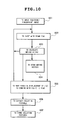
- FIGS. 10 and 11 are flow charts showing a flow of processing of a user authentication method according to the second embodiment and Fig. 14 is a block diagram showing a structure of a user authentication device according to the second embodiment.
- An owner registers his fingerprint data and sweep pattern at a device in advance in a manner as described in the following at the start of use of an information apparatus or on other occasion.
- the first applied image data is assumed to be an image f(0) for the sake of convenience.
- the user two-dimensionally sweeps his finger 30 put on the frame input unit 50a relatively to the frame input unit 50a with the finger being in contact with the frame input unit 50a.
- the present embodiment takes a case where an area of the frame input unit 50a is further smaller than that of the first embodiment into consideration.
- a frame as a partial image of the fingerprint captured by the frame input unit 50a is successively input as time passes (Step 601).
- a series of these frames successively input is denoted as f(1) ⁇ f(m) ⁇ f(M).
- the finger is swept at a speed not too fast such that a time interval between frames is short enough and that adjacent frames have considerable captured areas overlapping with each other (i.e. such that an overlap of captured areas can be obtained that can be precisely calculated by a moving vector which will be described later).
- Step 602 When a certain frame f(m) is input (Step 602), a corresponding point between f(m-1), i.e. the preceding frame, and the current frame is searched to calculate a moving vector of relative motion of the finger (Step 603).
- a moving vector when the number of corresponding points between the preceding frame and the current frame is smaller than a predetermined value necessary at least for calculating the moving vector, the user is asked to again input the image.
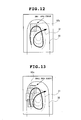
- Fig. 13 shows how the features are extracted, and composing the respective frames input by sweeping movement shown in Fig. 12 results in obtaining such a composite resultant image represented as a gray region as can be seen from Fig. 13 showing a transitional result.
- the captured image of the fingerprint is input (Step 701).
- the image is assumed to be an image g(0) for the sake of convenience.
- a frame as a partial image of the fingerprint captured by the frame input unit is successively input as time passes similarly to that at the registration (Step 702).
- a series of these frames is represented as g(1) ⁇ g(n) ⁇ g(N).
- Step 704 By comparing the series of these moving vectors with the already stored series of the moving vectors as of the registration, evaluate a degree of difference between sweep patterns as of the registration and as of the user authentication (Step 704).
- Step 705 by registering the input series of frame images and combining them similarly to that at the registration, compose a fingerprint image of a large area which covers a larger area of the original fingerprint (Step 705).
- Step 706 extract features for collation with respect to the composite resultant image and collate them with the previously stored collation features (Step 707) to evaluate its degree of difference (Step 707).
- a user authentication device includes the frame input unit 50a, a frame image storing unit 71, a collation feature extracting unit 72, a collation feature storing unit 73, a fingerprint feature collating unit 74, a preceding frame image storing unit 75, a moving vector calculating unit 76, a moving vector group storing unit 77, a moving vector difference degree evaluating unit 78, an image composing unit 81, a partial composite image storing unit 82 and a user identity determining unit 85.
- the user authentication device 10 is composed of the frame input unit 50a, the authentication processing unit 11 implemented by a program-controlled CPU or the like and the storage unit 12, with the authentication processing unit (CPU) 11 having the above-described collation feature extracting unit 72, fingerprint feature collating unit 74, moving vector calculating unit 76, moving vector difference degree evaluating unit 78, image composing unit 81 and user identity determining unit 85 and the storage unit 12 having the above-described frame image storing unit 71, collation feature storing unit 73, preceding frame image storing unit 75, moving vector group storing unit 77 and partial composite image storing unit 82.
- the authentication processing unit (CPU) 11 having the above-described collation feature extracting unit 72, fingerprint feature collating unit 74, moving vector calculating unit 76, moving vector difference degree evaluating unit 78, image composing unit 81 and user identity determining unit 85 and the storage unit 12 having the above-described frame image storing unit 71, collation feature storing unit 73, preceding frame image storing unit 75
- the frame input unit 50a is a part for receiving input of a fingerprint image for the confirmation of a person in question.
- the part has, for example, such an outer configuration as that of the frame input unit 50a shown in Fig. 12.
- Used as the frame input unit 50a is a unit smaller than the whole part of a fingerprint of a finger and further smaller than the frame input unit 50 of the first embodiment.
- the input frame image is stored in the frame image storing unit 71.
- the preceding frame image storing unit 75, the moving vector calculating unit 76, the moving vector group storing unit 77 and the moving vector difference degree evaluating unit 78 are the same as their counterparts in the first embodiment.
- the partial composite image storing unit 82 holds a resultant image S(n-1) obtained by composing frame images f(0) to f(n-1).
- the image composing unit 81 displaces the image f(n) in the frame image storing unit in parallel by the moving vector equivalent to displacement between f(n) and f(n-1) calculated by the moving vector calculating unit 76 and combines the displaced image f(n) and S(n-1) in the partial composite image storing unit to obtain a new partial composite image S(n).
- One example of how the images are composed is shown in Fig. 13.
- a light gray portion as a sum of sets of first three frame images represents a partial composite image S(n-1) which is composed using the frame image groups f(1) ⁇ f(n-1) and which is held in the partial composite image storing unit 82 and a rectangle indicated by an arrow represents f(n).
- Possible composition method is, for example, extending S(n-1) by adding a new region of f(n) which will not overlap with S(n-1).
- the composition result is written as S(n) having a larger area than S(n-1) into the partial composite image storing unit 82.
- the collation feature extracting unit 72 extracts features for collation from a two-dimensional image as a final composition result.
- the collation feature storing unit 73 is a part for extracting features for collation from a fingerprint image of an authorized user of the information apparatus and storing the same in advance. At the registration, collation features extracted by the collation feature extracting unit 72 are stored in the collation feature storing unit 73.
- the fingerprint feature collating unit 74 collates the fingerprint features of the authorized user held in the collation feature storing unit and fingerprint features of a user whose fingerprint is input this time which are calculated by the collation feature extracting unit to output its degree of difference (or conversely a degree of similarity) in the same manner as described above.
- the user identity determining unit 85 obtains a weighted sum of a degree of difference (or a degree of similarity) obtained by the moving vector difference degree evaluating unit 78 between a sweep pattern of an authorized user and a sweep pattern of a user whose fingerprint is input this time and a degree of difference (or a degree of similarity) obtained by the fingerprint feature collating unit 74 between fingerprint features in a composite image composed using the sweep of the authorized user and fingerprint features of a composite image composed using the sweep of the user whose fingerprint is input this time.
- the unit 85 compares the obtained result with a preset threshold value and as a result of the comparison, when the degree of difference taking both elements into consideration is lower than the threshold value (in a case of the degree of similarity, when higher than the threshold value), the unit considers the user in question as the authorized user and allows him to use the information apparatus. Conversely, when the degree of difference (or the degree of similarity) is higher than the threshold value (in a case of the degree of similarity, lower than the threshold value), the unit conducts predetermined operation such as refraining from making allowance (disabling operation of the device) because of lack of coincidence.
- the second embodiment enables movement of a finger of the authorized user at the registration of a sweep pattern to be concealed by providing a cover covering over the frame input unit 50a disposed on a casing of the information apparatus. It is therefore possible to prevent a false user from imitating finger movement, thereby enhancing secrecy of a sweep pattern.
- FIG. 16 is a functional block diagram showing the user authentication device according to the third embodiment
- Fig. 17 is a diagram showing an entire structure of the user authentication device according to the third embodiment.
- the user authentication device 10 according to the third embodiment is structured, as the expansion of the user authentication device according to the first embodiment, to use a pressure value difference vector for authentication, which is a time series change of a pressure value obtained from a finger being swept.
- the user authentication device 10 of the present embodiment includes, in addition to the components of the first embodiment, a pressure input unit (pressure sensor) 150, a pressure value storing unit 151, a preceding pressure value storing unit 155, a pressure value difference vector calculating unit 156, a pressure value difference vector group storing unit 157 and a pressure value difference vector difference degree evaluating unit 158.
- a pressure input unit pressure sensor
- a pressure value storing unit 151 a pressure value storing unit 151
- a preceding pressure value storing unit 155 a pressure value difference vector calculating unit 156
- a pressure value difference vector group storing unit 157 a pressure value difference vector difference degree evaluating unit 158.
- the user authentication device 10 has the pressure input unit 150 in addition to the components shown in Fig. 6, as well as including the authentication processing unit 11 realized by a program-controlled CPU or the like and the storage unit 12, with the authentication processing unit (CPU) 11 having the pressure value difference vector calculating unit 156 and the pressure value difference vector difference degree evaluating unit 158 other than the above-described collation feature extracting unit 52, fingerprint feature collating unit 54, moving vector calculating unit 56, moving vector difference degree evaluating unit 58 and user identity determining unit 65 and the storage unit 12 having the pressure value storing unit 151, the preceding pressure value storing unit 155 and the pressure value difference vector group storing unit 157 other than the above-described frame image storing unit 51, collation feature storing unit 53, preceding frame image storing unit 55 and moving vector group storing unit 57.
- the authentication processing unit (CPU) 11 having the pressure value difference vector calculating unit 156 and the pressure value difference vector difference degree evaluating unit 158 other than the above-described collation feature extracting unit 52, fingerprint
- the pressure input unit 150 which is a pressure sensor is a part for receiving input of a pressure value for the confirmation of a person in question.
- the unit has a function of successively obtaining pressure values of a moving finger and is formed integrally with the frame input unit 50 shown in Fig. 3, for example.
- the pressure input unit 150 detect a pressure value of a finger put thereon at preset timing.
- the input pressure value is stored in the pressure value storing unit 151.
- the preceding pressure value storing unit 155 stores a pressure value obtained immediately before a current pressure value among pressure values successively obtained by the pressure input unit 150. More specifically, when a pressure value p(n) exists in the pressure value storing unit 151, stored in the preceding pressure value storing unit 155 is its immediately preceding pressure value p(n-1).
- the pressure value difference vector calculating unit 156 calculates a pressure value difference vector indicative of a time series change of the pressure value p(n-1) recorded in the preceding pressure value storing unit 155 and the pressure value p(n) existing in the pressure value storing unit 151. To the calculation of the pressure value difference vector, the above-described moving vector calculation method is applicable.
- a pressure value difference vector is calculated from a string of successively obtained pressure values to determine its series.
- the vector series is assumed to be a pressure value pattern.
- the pressure value difference vector group storing unit 157 is a part for in advance obtaining a pressure value difference vector group from a pressure value pattern of an authorized user of the information apparatus obtained at the registration and storing the same.
- a vector series obtained by the pressure value difference vector calculating unit 156 is stored in the pressure value difference vector group storing unit 157.
- the pressure value difference vector difference degree evaluating unit 158 evaluates a degree of difference with respect to a pressure value difference vector group which describes a pressure value pattern of an authorized user held in the pressure value difference vector group storing unit 157 and a pressure value difference vector group which describes a pressure value pattern of a user whose pressure value pattern is input this time which is calculated by the pressure value difference vector calculating unit 156.
- the pressure value difference vector difference degree evaluating unit 158 is allowed to calculate a degree of difference by, for example, adding the respective vectors in the vector group in a time serial order, smoothing an obtained polygonal line to obtain an approximate curve of a locus and accumulating a pressure difference at fixed intervals of the approximate curves obtained from both vector groups.
- the user identity determining unit 65 obtains a weighted sum of three degrees of difference (or degrees of similarity) including a degree of difference (or a degree of similarity) between a pressure value pattern of an authorized user and a pressure value pattern of a user whose fingerprint is input this time in addition to a degree of difference (or a degree of similarity) between fingerprint features of the authorized user and fingerprint features of the user whose fingerprint is input this time and a degree of difference (or a degree of similarity) between a sweep pattern of the authorized user and a sweep pattern of the user whose fingerprint is input this time and compares the obtained sum with a preset threshold value.
- Such a pressure value pattern as described above can be handled as secret information known only to a person in question and as personal information appropriately reproducible only by the person in question. Therefore, when related to three elements including a pressure value pattern in addition to static fingerprint features as of the start of sweeping and a sweep pattern, input patterns as of the registration and the authentication satisfactorily coincide with each other, the person in question can be authenticated more precisely. As a result, such false finger as described above can be eliminated to realize more reliable user authentication.
- An owner registers his pressure value pattern in addition to his fingerprint data and sweep pattern at a device in advance in a manner as described in the following at the start of use of an information apparatus or on other occasion.
- a user as the owner of the information apparatus puts a part of the surface of his finger on the pressure input unit 150 (frame input unit 50) provided for inputting a pressure value to bring the same into contact with the unit and two-dimensionally moves his finger relatively to the pressure input unit with his finger being in contact with the pressure input unit 150.
- the user makes sweeping movement as shown in Fig. 3.
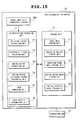
- Step 1001 a pressure value detected by the pressure input unit 150 is successively input as time passes.
- a series of these pressure values successively input is denoted as p(1) ⁇ p(m) ⁇ p(M).
- Step 1002 When a certain pressure value p(m) is input (Step 1002), a pressure value difference vector as a time series change between p(m-1), i.e. the preceding pressure value and the current pressure value p(m) is calculated (Step 1003).
- Step 1004 store a series of pressure value difference vectors (a group of pressure value difference vectors) of each pressure value as a pressure value pattern.
- the foregoing is a procedure of registering a pressure value pattern for user authentication.
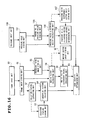
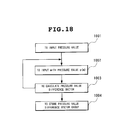
- a pressure value detected by the pressure input unit 150 is successively input as time passes (Step 1101).
- a series of these pressure values is represented as p(1) ⁇ p(n) ⁇ p(N).
- a pressure value difference vector as a time series change between the preceding pressure value p(n-1) and the current pressure value p(n) is calculated similarly to that at the registration (Step 1103).
- Step 1104 By comparing the series of pressure value difference vectors with a stored series of pressure value difference vectors as of the registration, evaluate a degree of difference between pressure value patterns as of the registration and the user authentication (Step 1104).
- Step 1105 make determination of user identity based on the result of the evaluation of the degree of difference in pressure pattern in addition to the above-described result of the evaluation of the degree of difference in feature collation and result of the evaluation of the degree of difference in sweep pattern.
- the determination of user's identity when each result of the evaluation of the degree of difference is lower than a predetermined threshold, determine that the user in question is an authorized user and allow him to use the information apparatus. When each result of the evaluation of the degree of difference is higher than the predetermined threshold, determine that the user in question is a false user and refuse use of the information apparatus.
- the above-described third embodiment has a structure with authentication using a pressure value added to the structure of the first embodiment, it is as a matter of course possible to add authentication using a pressure value to the user authentication according to the second embodiment. Also in this case, more reliable user authentication is realized.
- FIG. 20 is a diagram showing the entire structure of the user authentication device according to the fourth embodiment.
- the fourth embodiment is structured such that when a single information apparatus is shared by a plurality of users, authentication data composed of fingerprint data and a sweep pattern of each of a plurality of authorized users is stored to select a user at the time of use and conduct authentication for the same.
- Fig. 20 the same component as that of the first embodiment is given the common reference numeral. Structure and operation of the frame input unit 50 and the authentication processing unit 11 are the same as those described above.
- a storage unit 2000 includes a plurality of user-basis information storing units 12a, 12b, ..., 12n for storing authentication data of each user.
- the user-basis information storing units 12a, 12b, ..., 12n each include the frame image storing unit 51, the collation feature storing unit 53, the preceding frame image storing unit 55 and the moving vector group storing unit 57 similarly to the storage unit 12 shown in Fig. 6.
- a user selection unit 2001 for selecting a user to be collated is provided between the authentication processing unit 11 and the storage unit 2000.
- the user selection unit 2001 selects a user whose authentication data is to be registered and a user to be authenticated by the operation of a user selection operating unit 2002 composed of keys and buttons which is provided in the information apparatus.
- the authentication processing unit 11 stores fingerprint data and a sweep pattern of a user selected by the user selection unit 2001 into the user-basis information storing unit 12a, 12b, ..., or 12n corresponding to the selected user and in the authentication processing, conducts authentication processing based on authentication data stored in the user-basis information storing unit 12a, 12b, ..., or 12n corresponding to the selected user.
- FIG. 21 is a diagram showing the entire structure of the user authentication device according to the fifth embodiment.
- the fifth embodiment is designed such that when a single information apparatus is shared by a plurality of users, authentication data composed of fingerprint data and a sweep pattern of each of a plurality of authorized users is stored to make determination of identity based on most similar authentication data at the time of authentication processing.
- the storage unit 2000 includes a plurality of user-basis information storing units 12a, 12b, ..., 12n for storing authentication data of each user.
- the user-basis information storing units 12a, 12b, ..., 12n each include the frame image storing unit 51, the collation feature storing unit 53, the preceding frame image storing unit 55 and the moving vector group storing unit 57 similarly to the storage unit 12 shown in Fig. 6.
- the authentication processing unit 11 is provided with a one-to-multiple user identity determining unit 65a.
- the one-to-multiple user identity determining unit 65a collates input fingerprint data and sweep pattern with authentication data stored in the plurality of user-basis information storing units 12a, 12b, ..., 12n to determine their coincidence with the most similar authentication data.
- This arrangement enables authentication of a plurality of users without selecting a user every time authentication is conducted as in the fourth embodiment.
- FIG. 22 is a diagram showing a structure of an information apparatus having the user authentication device according to the sixth embodiment.
- An information apparatus 2200 according to the sixth embodiment is an expansion of the above-described fifth embodiment and includes the user authentication device 10, an interruption/resumption management unit 2201 and a user inherent information processing unit 2202.
- the storage unit 2000 includes a plurality of user-basis information storing units 12a, 12b, ..., 12n for storing user inherent information which are provided corresponding to authentication data of the respective users.
- the user-basis information storing units 12a, 12b, ..., 12n each include the frame image storing unit 51, the collation feature storing unit 53, the preceding frame image storing unit 55, the moving vector group storing unit 57 and a user inherent information storing unit similarly to the storage unit 12 shown in Fig. 6.
- the authentication processing unit 11 is provided with the one-to-multiple user identity determining unit 65a.
- the interruption/resumption management unit 2201 instructs the authentication processing unit 11 and the storage unit 2000 to interrupt or resume use of the apparatus based on user's input.
- the user-basis information storing units 12a, 12b, ..., 12n store authentication data (fingerprint data and sweep pattern) received from the authentication processing unit 11 so as to be correlated with user's inherent information related to the information apparatus 2200.
- user inherent information includes all the data considered to be information useful personally for a user among the data handled by the information apparatus 2200.
- the data included is, for example, that indicative of work progress information (to which stage work is done), that indicative of working conditions information (under which conditions work is done) or that indicative of work history information (under which instruction work is done) when the user interrupts the use of the device. More specifically, information indicated by the data is "to which page of an electronic picture book have you read?", “to which stage of game have you played?", “what kind of background screen have you selected on display screen?", “how is layout on display screen?”, “which search results have you obtained so far?”, “what kinds of search keys have been given?”, “what kinds of commands have been given?” and the like.
- Such user inherent information may be designated by a user himself or automatically designated in the information apparatus 2200.
- the one-to-multiple user identity determining unit 65a of the authentication processing unit 11 conducts collation and based on the collation result, user inherent information correlated with authentication data having the highest degree of similarity with the input authentication data is selected from the user-basis information storing units 12a, 12b, ..., 12n and output to the user inherent information processing unit 2202.
- the authentication data which gives the degree of similarity not less than the threshold value may be output as a collation result without collating all the authentication data.
- the user inherent information processing unit 2202 receives user inherent information selected from the user-basis information storing units 12a, 12b, ..., 12n to conduct transmission presentation of the inherent information to the user, setting of the information apparatus 2200 or communication to other device group according to the contents of the user inherent information.
- the same information apparatus when used by a plurality of users and the plurality of users have their inherent information (e.g. work progress information, working conditions information, and work history information) related to the information device, by identifying a user by his input fingerprint, information inherent to the user related to the information device is preserved corresponding to the user when the use of the device is interrupted and by selectively presenting, to the user, the preserved information inherent to the user which corresponds to the identified user when the use of the device is resumed, a burden on the user at the time of interruption/resumption of the use of the device is reduced and interruption/resumption is enabled smoothly.
- inherent information e.g. work progress information, working conditions information, and work history information
- FIG. 23 is a diagram showing a structure of an information apparatus including the user authentication device according to the seventh embodiment.
- the information apparatus 2200 includes the user authentication device 10 and a command notification unit 2400.
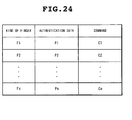
- a storage unit 2300 of the user authentication processing device 10 includes, in addition to the frame image storing unit 51, the collation feature storing unit 53, the preceding frame image storing unit 55 and the moving vector group storing unit 57, a correspondence table storing unit 2301, in which the correspondence table storing unit 2301 authentication data Pi of each finger Fi (1 ⁇ i ⁇ n) of a user is stored and as shown in Fig. 24, a correspondence table composed of commands Ci each allotted to each finger so as to correspond to the authentication data Pi of each finger Fi (1 ⁇ i ⁇ n) of the user is stored.
- the authentication data of each finger Fi is composed of the above-described fingerprint data and sweep pattern.
- Each finger Fi in the correspondence table shown in Fig. 24 indicates a kind of finger such as the thumb of the right hand or the ring finger of the left hand.
- the commands Ci are instructions to an information apparatus to which the present invention is applied.
- the information apparatus to which the present invention is applied is a system capable of transmitting and receiving electronic mail, for example, "transmission of mail", "reception of mail”, etc. correspond to the commands Ci.
- a user identity determining unit 65b of the authentication processing unit 11 authenticates a user based on the results obtained by the fingerprint feature collating unit 54 and the moving vector difference degree evaluating unit 58, as well as specifying a kind of finger used for input by the user.
- the command notification unit 2400 obtains a command assigned to a kind of finger specified by the user identity determining unit 65b based on the correspondence table stored in the storage unit 2300 and notifies the corresponding command to a data processing unit 2500 for controlling operation of the information apparatus of the present invention. Then, the data processing unit 2500 executes processing according to the notified command.
- a kind of finger which a user employed for operating the information apparatus is specified to discriminate user's input according to the kind of finger, the user is allowed to make different input by operating the apparatus using a different finger.
- a portable terminal for example, is allowed to execute such processing as activating a calendar when operated by the right index finger and making a call to a person when operated by the right middle finger simultaneously with authentication.
- a palmprint of a hand for example, can be used as biometrics.
- inputting a sweep pattern by sweeping a part of the palm on the frame input unit in the same manner as that of a fingerprint enables the above-described first and second embodiments to be applicable without modification.
- the iris which is a muscle pattern in the surrounding of the pupil within the dark eye or a face itself can be used as biometrics.
- biometrics At the input of the biometrics through a camera, by moving the eye ball or the whole of the face relatively to the camera and also using its sweep pattern as secret information inherent to an authorized user, input of false biometrics can be eliminated to realize collation of higher precision.
- the above-described user authentication methods can be realized not only by hardware but also as software using a user authentication program for realizing the above-described respective functions which is recorded in a recording medium of a computer system such as a magnetic disc or a semiconductor memory.
- the user authentication program as shown in Fig. 6, is read from a recording medium 15 into the authentication processing unit (CPU) 11 of the computer system or downloaded from a network to control operation of the authentication processing unit 11, thereby realizing each function of the above-described units to execute user authentication processing.
- the processing.shown in Figs. 1 and 2 and Figs. 10 and 11 is executed.
- the present invention since user authentication is conducted using a sweep pattern as light movement of a part of a body (e.g. fingerprint) expressed simultaneously with the input of the part of the body, more reliable user authentication is realized. Accordingly, when the present invention is applied to an information apparatus for use in electronic commerce etc., higher secrecy can be maintained.
- a body e.g. fingerprint
- a sweep pattern is equivalent to light movement expressed simultaneously with the input of a part of a body and therefore can be secret information known only to a person in question. Provision of a cover at an input unit or other method will further enhance its confidentiality.
- the sweep pattern can be handled as personal information effective for specifying a person in question because even when other person by any chance sees his sweep pattern, it is difficult to reproduce the same appropriately. Accordingly, a method of authenticating a person in question more precisely only when with respect to both static feature information as of the start of sweeping and a sweep pattern, inputs at the registration and authentication satisfactorily coincide with each other realizes more reliable user authentication.
- Using a sweep pattern that only an authorized user is allowed to know together with a collation result of feature information obtained from a still picture enables more reliable user authentication to be realized. More specifically, even if a fingerprint pattern can be imitated by a false finger (replica), unless sweep patterns as of before and after the fingerprint pattern input can be imitated, pretension of others using such a false finger can be eliminated.
- a small-sized sensor having a small area which can be realized at low costs enables input of partial images of many parts of a body by sweeping on the sensor and enables collation of feature information using the images, and further use of a sweep pattern known only to a person in question and hard to imitate by others even peeping enables stable confirmation of the person in question with higher precision.
- reduction in costs and areas of a sensor will expand a range of applicable apparatuses on which the sensor can be mounted to enable application in a wider range.
- Provision of a cover for concealing movement of a finger when an authorized user registers his sweep pattern prevents a false user from imitating the authorized user's finger movement, thereby enhancing secrecy of a sweep pattern.
- the same information apparatus is used by a plurality of users and the plurality of users have their inherent information related to the information device (e.g. work progress information, working conditions information and work history information)
- the information device e.g. work progress information, working conditions information and work history information
- the preserved information inherent to the user which corresponds to the identified user is selectively provided to the user when the use of the device is resumed, thereby reducing a burden on a user at the time of interruption/resumption of the use of the device, as well as enabling smooth interruption/resumption.
Landscapes
- Engineering & Computer Science (AREA)
- Human Computer Interaction (AREA)
- Physics & Mathematics (AREA)
- General Physics & Mathematics (AREA)
- Multimedia (AREA)
- Theoretical Computer Science (AREA)
- Computer Vision & Pattern Recognition (AREA)
- Collating Specific Patterns (AREA)
- Measurement Of The Respiration, Hearing Ability, Form, And Blood Characteristics Of Living Organisms (AREA)
- Image Analysis (AREA)
Abstract
Description
using information about a pattern of movement of the part of the body relative to the sensor as secret information for specifying a user to conduct user authentication.
information about a pattern of movement of the part of the body relative to the sensor is input to conduct user authentication based on the relative movement pattern.
conducting user authentication by using information about a pattern of movement of the part of the body relative to the sensor as secret information for specifying a user.
inputs information about a pattern of movement of the part of the body relative to the sensor to conduct user authentication based on the relative movement pattern in question,
has user inherent information related to interruption and resumption of operation of the apparatus which is correlated with the relative movement pattern information registered for each of a plurality of users, and
executes interruption and resumption of operation of the apparatus based on the user inherent information corresponding to a user whose user authentication has been conducted.
inputs information about a pattern of movement of the part of the body relative to the sensor to conduct user authentication based on the relative movement pattern in question,
registers a command giving an instruction on operation of the apparatus so as to be correlated with the relative movement pattern information registered for each of a plurality of parts of the body or each of a plurality of users, and
executes operation of the apparatus based on the command corresponding to the part of the body or the user whose user authentication has been conducted.
Claims (43)
- A user authentication method of making determination of identity of a user based on an image of a part of a body of the user as biometrics captured by a sensor, comprising the step of
using information about a pattern of movement of said part of the body relative to said sensor as secret information for specifying a user to conduct user authentication. - The user authentication method as set forth in claim 1, wherein
determination of identity of a registered user is made based on both a degree of similarity of feature information extracted from a single image of said part of the body captured by said sensor and a degree of similarity of said relative movement pattern. - The user authentication method as set forth in claim 1, wherein
with respect to a frame as a series of images of said part of the body captured by said sensor, a corresponding point between a preceding frame and a current frame is searched to obtain a sweep pattern which is a series of moving vectors obtained by calculating a moving vector of the relative movement of said part of the body as said relative movement pattern, thereby conducting user authentication based on the sweep pattern in question. - The user authentication method as set forth in claim 1, wherein
with respect to feature information extracted from a single image of said part of the body captured by said sensor and a frame as a series of images of said part of the body captured by said sensor, a corresponding point between a preceding frame and a current frame is searched to conduct user authentication based on a sweep pattern as a series of moving vectors obtained by calculating a moving vector of relative movement of a finger. - The user authentication method as set forth in claim 1, wherein
a degree of similarity of said relative movement pattern and a frame as a series of images of said part of the body captured by said sensor are sequentially registered so as to have overlaps correlated best to extract feature information for collation from a composite image obtained by composition, thereby conducting user authentication based on a degree of similarity of the feature information in question. - The user authentication method as set forth in claim 1, wherein
with respect to a frame as a series of images of said part of the body captured by said sensor, a corresponding point between a preceding frame and a current frame is searched to obtain a sweep pattern which is a series of moving vectors obtained by calculating a moving vector of the relative movement of said part of the body as said relative movement pattern, and
with respect to a frame as a series of images of said part of the body captured by said sensor, the frames are sequentially registered so as to have overlaps correlated best to extract feature information for collation from a composite image obtained by composition, thereby conducting user authentication based on said sweep pattern and said feature information. - The user authentication method as set forth in claim 1, wherein
a pressure value pattern as a series of pressure value difference vectors is obtained from a time series change of a pressure value in the relative movement of said part of the body to conduct user authentication based on said relative movement pattern and said pressure value pattern. - The user authentication method as set forth in claim 1, wherein
user authentication is conducted based on:feature information extracted from a single image of said part of the body captured by said sensor,a sweep pattern which is a series of moving vectors obtained by searching, with respect to a frame as a series of images of said part of the body captured by said sensor, a corresponding point between a preceding frame and a current frame and calculating a moving vector of relative movement of a finger, anda pressure value pattern as a series of pressure value difference vectors obtained from a time series change of a pressure value in the relative movement of said part of the body. - The user authentication method as set forth in claim 1, wherein
with respect to a frame as a series of images of said part of the body captured by said sensor, a corresponding point between a preceding frame and a current frame is searched to obtain a sweep pattern which is a series of moving vectors obtained by calculating a moving vector of the relative movement of said part of the body as said relative movement pattern,
with respect to a frame as a series of images of said part of the body captured by said sensor, the frames are sequentially registered so as to have overlaps correlated best to extract feature information for collation from a composite image obtained by composition, and
a pressure value pattern as a series of pressure value difference vectors is obtained from a time series change of a pressure value in the relative movement of said part of the body, thereby conducting user authentication based on said sweep pattern, said feature information and said pressure value pattern. - The user authentication method as set forth in claim 1, wherein
said part of the body is a finger and relative movement pattern information of the finger in question is used as secret information for specifying a user. - The user authentication method as set forth in claim 1, wherein
said relative movement pattern information of a plurality of users are registered corresponding to the respective users to conduct user authentication for each selected user. - The user authentication method as set forth in claim 1, wherein
said relative movement pattern information of a plurality of users are registered corresponding to the respective users to conduct user authentication by specifying a user based on said relative movement pattern information of the user input through said sensor. - A user authentication device for making determination of identity of a user with an image of a part of a body of the user as biometrics captured by a sensor as input, wherein
information about a pattern of movement of said part of the body relative to said sensor is input to conduct user authentication based on the relative movement pattern. - The user authentication device as set forth in claim 13, wherein
determination of identity of a registered user is made based on both a degree of similarity of feature information extracted from a single image of said part of the body captured by said sensor and a degree of similarity of said relative movement pattern. - The user authentication device as set forth in claim 13, comprising
means (56) for searching, with respect to a frame as a series of images of said part of the body captured by said sensor, a corresponding point between a preceding frame and a current frame and calculating a moving vector of the relative movement of said part of the body to obtain a sweep pattern which is a series of moving vectors as said relative movement pattern. - The user authentication device as set forth in claim 13, comprising:means (56) for searching, with respect to a frame as a series of images of said part of the body captured by said sensor, a corresponding point between a preceding frame and a current frame and calculating a moving vector of the relative movement of said part of the body to obtain a sweep pattern which is a series of moving vectors as said relative movement pattern,means (57) for storing a relative movement pattern of an authorized user in advance, anddetermination means (65) for comparing a relative movement pattern obtained at the time of authentication with a relative movement pattern in said storage means (57) to determine a degree of similarity between the patterns.
- The user authentication device as set forth in claim 13, comprising:means (52) for extracting feature information from a single image of said part of the body captured by said sensor,first storage means (53) for storing said feature information of an authorized user in advance,means (56) for searching, with respect to a frame as a series of images of said part of the body captured by said sensor, a corresponding point between a preceding frame and a current frame and calculating a moving vector of the relative movement of said part of the body to obtain a sweep pattern which is a series of moving vectors as said relative movement pattern,second storage means (57) for storing said relative movement pattern of an authorized user in advance, anddetermination means (65) for comparing said feature information and said relative movement pattern obtained at the time of authentication with said feature information and said relative movement pattern in said first and second storage means (53, 57) to determine a degree of similarity between the information and patterns.
- The user authentication device as set forth in claim 13, wherein
a degree of similarity of said relative movement pattern and a frame as a series of images of said part of the body captured by said sensor are sequentially registered so as to have overlaps correlated best to extract feature information for collation from a composite image obtained by composition, thereby conducting user authentication based on a degree of similarity of the feature information in question. - The user authentication device as set forth in claim 13, comprising:means (76) for searching, with respect to a frame as a series of images of said part of the body captured by said sensor, a corresponding point between a preceding frame and a current frame and calculating a moving vector of the relative movement of said part of the body to obtain a sweep pattern which is a series of moving vectors as said relative movement pattern,means (72) for sequentially registering, with respect to a frame as a series of images of said part of the body captured by said sensor, the frames so as to have overlaps correlated best to extract feature information for collation from a composite image obtained by composition, anddetermination means (85) for comparing said feature information and said relative movement pattern obtained at the time of authentication with said feature information and said relative movement pattern of an authorized user to determine a degree of similarity between the information and patterns.
- The user authentication device as set forth in claim 13, wherein a pressure value pattern as a series of pressure value difference vectors is obtained from a time series change of a pressure value in the relative movement of said part of the body to conduct user authentication based on said relative movement pattern and said pressure value pattern.
- The user authentication device as set forth in claim 13, comprising:means (52) for extracting feature information from a single image of said part of the body captured by said sensor,means (56) for searching, with respect to a frame as a series of images of said part of the body captured by said sensor, a corresponding point between a preceding frame and a current frame and calculating a moving vector of the relative movement of said part of body to obtain a sweep pattern which is a series of moving vectors as said relative movement pattern,means (156) for obtaining a pressure value pattern as a series of pressure value difference vectors from a time series change of a pressure value in the relative movement of said part of the body, anddetermination means (65) for comparing said feature information, said relative movement pattern and said pressure value pattern obtained at the time of authentication with said feature information, said relative movement pattern and said pressure value pattern of an authorized user to determine a degree of similarity among the information and patterns.
- The user authentication device as set forth in claim 13, comprising:means (56) for searching, with respect to a frame as a series of images of said part of the body captured by said sensor, a corresponding point between a preceding frame and a current frame and calculating a moving vector of the relative movement of said part of the body to obtain a sweep pattern which is a series of moving vectors as said relative movement pattern,means (72) for sequentially registering, with respect to a frame as a series of images of said part of the body captured by said sensor, the frames so as to have overlaps correlated best to extract feature information for collation from a composite image obtained by composition,means (156) for obtaining a pressure value pattern as a series of pressure value difference vectors from a time series change of a pressure value in the relative movement of said part of the body, anddetermination means (65) for comparing said sweep pattern, said feature information and said pressure value pattern obtained at the time of authentication with said relative movement pattern, said feature information and said pressure value pattern of an authorized user to determine a degree of similarity between the information and patterns.
- The user authentication device as set forth in claim 13, wherein
said part of the body is a finger and relative movement pattern information of the finger in question is used as secret information for specifying a user. - The user authentication device as set forth in claim 13, wherein
provided around said sensor is a cover for covering relative movement of said part of the body from the outside. - The user authentication device as set forth in claim 13, wherein
said relative movement pattern information of a plurality of users are registered corresponding to the respective users to conduct user authentication for each selected user. - The user authentication device as set forth in claim 25, comprising
selection means (2001) for selecting a user to be authenticated from among a plurality of users. - The user authentication device as set forth in claim 13, wherein
said relative movement pattern information of a plurality of users are registered corresponding to the respective users to conduct user authentication by specifying a user based on said relative movement pattern information of the user input through said sensor. - A user authentication program for making determination of identity of a user based on an image of a part of a body of the user as biometrics captured by a sensor, comprising the function of
conducting user authentication by using information about a pattern of movement of said part of the body relative to said sensor as secret information for specifying a user. - The user authentication program as set forth in claim 28, wherein
determination of identity of a registered user is made based on both a degree of similarity of feature information extracted from a single image of said part of the body captured by said sensor and a degree of similarity of said relative movement pattern. - The user authentication program as set forth in claim 28, wherein
with respect to a frame as a series of images of said part of the body captured by said sensor, a corresponding point between a preceding frame and a current frame is searched, and
a sweep pattern which is a series of moving vectors obtained by calculating a moving vector of the relative movement of said part of the body is obtained as said relative movement pattern, thereby conducting user authentication based on the sweep pattern in question. - The user authentication program as set forth in claim 28, wherein
with respect to feature information extracted from a single image of said part of the body picked by said sensor and a frame as a series of images of said part of the body captured by said sensor, a corresponding point between a preceding frame and a current frame is searched to conduct user authentication based on a sweep pattern as a series of moving vectors obtained by calculating a moving vector of relative movement of a finger. - The user authentication program as set forth in claim 28, wherein
a degree of similarity of said relative movement pattern and a frame as a series of images of said part of the body captured by said sensor are sequentially registered so as to have overlaps correlated best to extract feature information for collation from a composite image obtained by composition, thereby conducting user authentication based on a degree of similarity of the feature information in question. - The user authentication program as set forth in claim 28, wherein
with respect to a frame as a series of images of said part of the body captured by said sensor, a corresponding point between a preceding frame and a current frame is searched to obtain a sweep pattern which is a series of moving vectors obtained by calculating a moving vector of the relative movement of said part of the body as said relative movement pattern, and
with respect to a frame as a series of images of said part of the body captured by said sensor, the frames are sequentially registered so as to have overlaps correlated best to extract feature information for collation from a composite image obtained by composition, thereby conducting user authentication based on said sweep pattern and said feature information. - The user authentication program as set forth in claim 28, wherein
a pressure value pattern as a series of pressure value difference vectors is obtained from a time series change of a pressure value in the relative movement of said part of the body to conduct user authentication based on said relative movement pattern and said pressure value pattern. - The user authentication program as set forth in claim 28, wherein
user authentication is conducted based on:feature information extracted from a single image of said part of the body captured by said sensor,a sweep pattern as a series of moving vectors obtained by searching, with respect to a frame as a series of images of said part of the body captured by said sensor, a corresponding point between a preceding frame and a current frame and calculating a moving vector of the relative movement of a finger, anda pressure value pattern as a series of pressure value difference vectors obtained from a time series change of a pressure value in the relative movement of said part of the body. - The user authentication program as set forth in claim 28, wherein
with respect to a frame as a series of images of said part of the body captured by said sensor, a corresponding point between a preceding frame and a current frame is searched to obtain a sweep pattern which is a series of moving vectors obtained by calculating a moving vector of the relative movement of said part of the body as said relative movement pattern,
with respect to a frame as a series of images of said part of the body captured by said sensor, the frames are sequentially registered so as to have overlaps correlated best to extract feature information for collation from a composite image obtained by composition, and
a pressure value pattern as a series of pressure value difference vectors is obtained from a time series change of a pressure value in the relative movement of said part of the body, thereby conducting user authentication based on said sweep pattern, said feature information and said pressure value pattern. - The user authentication program as set forth in claim 36, wherein
said part of the body is a finger and relative movement pattern information of the finger in question is used as secret information for specifying a user. - The user authentication program as set forth in claim 28, wherein
said relative movement pattern information of a plurality of users are registered corresponding to the respective users to conduct user authentication for each selected user. - The user authentication program as set forth in claim 28, wherein
said relative movement pattern information of a plurality of users are registered corresponding to the respective users to conduct user authentication by specifying a user based on said relative movement pattern information of the user input through said sensor. - An information processing method using user authentication of making determination of identity of a user with an image of a part of a body of the user as biometrics captured by a sensor as input, comprising the steps of:receiving input of information about a pattern of movement of said part of the body relative to said sensor to conduct user authentication based on the relative movement pattern in question,having user inherent information related to interruption and resumption of operation of an apparatus which is correlated with said relative movement pattern information registered for each of a plurality of users, andexecuting interruption and resumption of operation of said apparatus based on said user inherent information corresponding to a user whose user authentication has been conducted.
- An information apparatus having a user authentication device for making determination of identity of a user with an image of a part of a body of the user as biometrics captured by a sensor as input, which apparatus
inputs information about a pattern of movement of said part of the body relative to said sensor to conduct user authentication based on the relative movement pattern in question,
has user inherent information related to interruption and resumption of operation of the apparatus which is correlated with said relative movement pattern information registered for each of a plurality of users, and
executes interruption and resumption of operation of said apparatus based on said user inherent information corresponding to a user whose user authentication has been conducted. - An information processing method using user authentication of making determination of identity of a user with an image of a part of a body of the user as biometrics captured by a sensor as input, comprising the steps of:inputting information about a pattern of movement of said part of the body relative to said sensor to conduct user authentication based on the relative movement pattern in question,registering a command giving an instruction on operation of the apparatus so as to be correlated with said relative movement pattern information registered for each of a plurality of parts of the body or each of a plurality of users, andexecuting operation of said apparatus based on said command corresponding to said part of the body or said user whose user authentication has been conducted.
- An information apparatus having a user authentication device for making determination of identity of a user with an image of a part of a body of the user as biometrics captured by a sensor as input, which apparatus
inputs information about a pattern of movement of said part of the body relative to said sensor to conduct user authentication based on the relative movement pattern in question,
registers a command giving an instruction on operation of the apparatus so as to be correlated with said relative movement pattern information registered for each of a plurality of parts of the body or each of a plurality of users, and
executes operation of said apparatus based on said command corresponding to said part of the body or said user whose user authentication has been conducted.
Applications Claiming Priority (2)
| Application Number | Priority Date | Filing Date | Title |
|---|---|---|---|
| JP2001236985A JP2003051012A (en) | 2001-08-03 | 2001-08-03 | User authentication method and user authentication device |
| JP2001236985 | 2001-08-03 |
Publications (2)
| Publication Number | Publication Date |
|---|---|
| EP1288845A2 true EP1288845A2 (en) | 2003-03-05 |
| EP1288845A3 EP1288845A3 (en) | 2005-09-07 |
Family
ID=19068150
Family Applications (1)
| Application Number | Title | Priority Date | Filing Date |
|---|---|---|---|
| EP02017384A Withdrawn EP1288845A3 (en) | 2001-08-03 | 2002-08-02 | User authentication method and user authentication device |
Country Status (5)
| Country | Link |
|---|---|
| US (1) | US20030028784A1 (en) |
| EP (1) | EP1288845A3 (en) |
| JP (1) | JP2003051012A (en) |
| KR (1) | KR100597152B1 (en) |
| CN (1) | CN1231867C (en) |
Cited By (1)
| Publication number | Priority date | Publication date | Assignee | Title |
|---|---|---|---|---|
| FR3063366A1 (en) * | 2017-02-27 | 2018-08-31 | Safran Identity & Security | METHOD AND DEVICE FOR RECOGNIZING AN INDIVIDUAL BY BIOMETRIC SIGNATURE |
Families Citing this family (47)
| Publication number | Priority date | Publication date | Assignee | Title |
|---|---|---|---|---|
| US7054470B2 (en) * | 1999-12-02 | 2006-05-30 | International Business Machines Corporation | System and method for distortion characterization in fingerprint and palm-print image sequences and using this distortion as a behavioral biometrics |
| US7013030B2 (en) * | 2002-02-14 | 2006-03-14 | Wong Jacob Y | Personal choice biometric signature |
| JP2004133794A (en) * | 2002-10-11 | 2004-04-30 | Ntt Docomo Inc | Authentication device, authentication system, and authentication method |
| JP4269654B2 (en) * | 2002-11-20 | 2009-05-27 | ソニー株式会社 | Fingerprint authentication apparatus and method, and authentication apparatus and method |
| FR2862785B1 (en) * | 2003-11-21 | 2006-01-20 | Atmel Grenoble Sa | DIGITAL SENSOR SENSOR WITH TWO SCANNING DIRECTIONS |
| FR2874440B1 (en) | 2004-08-17 | 2008-04-25 | Oberthur Card Syst Sa | METHOD AND DEVICE FOR PROCESSING DATA |
| JP2006059282A (en) | 2004-08-24 | 2006-03-02 | Fujitsu Ltd | Authentication method based on biometric feature information |
| WO2006122580A1 (en) * | 2005-05-13 | 2006-11-23 | Tbs Holding Ag | Device and method for recording the finger or hand lines |
| US20070033414A1 (en) * | 2005-08-02 | 2007-02-08 | Sony Ericsson Mobile Communications Ab | Methods, systems, and computer program products for sharing digital rights management-protected multimedia content using biometric data |
| JP4734088B2 (en) * | 2005-10-25 | 2011-07-27 | 株式会社日立製作所 | User authentication apparatus and control method thereof |
| KR100651268B1 (en) * | 2005-11-16 | 2006-12-01 | 주식회사 케이티프리텔 | Device and method for authenticating user of terminal |
| JP2007193656A (en) * | 2006-01-20 | 2007-08-02 | Kddi Corp | Identification device |
| JP2007206991A (en) * | 2006-02-02 | 2007-08-16 | Hitachi Ltd | Biological information processing apparatus and biological information processing program |
| JP5018071B2 (en) * | 2006-12-20 | 2012-09-05 | ソニー株式会社 | Verification method, registration device, verification device, and program |
| JP4367663B2 (en) * | 2007-04-10 | 2009-11-18 | ソニー株式会社 | Image processing apparatus, image processing method, and program |
| JP5238297B2 (en) * | 2008-03-04 | 2013-07-17 | シャープ株式会社 | Authentication method and input device |
| JP2010061577A (en) * | 2008-09-05 | 2010-03-18 | Fujitsu Ltd | Function starting device, function starting method, and function start processing program |
| US8516561B2 (en) * | 2008-09-29 | 2013-08-20 | At&T Intellectual Property I, L.P. | Methods and apparatus for determining user authorization from motion of a gesture-based control unit |
| WO2010131371A1 (en) * | 2009-05-12 | 2010-11-18 | Toyota Jidosha Kabushiki Kaisha | Object recognition method, object recognition apparatus, and autonomous mobile robot |
| JP4693192B1 (en) | 2010-04-28 | 2011-06-01 | エンパイア テクノロジー ディベロップメント エルエルシー | Fingerprint authentication apparatus and fingerprint authentication method |
| US9274594B2 (en) * | 2010-05-28 | 2016-03-01 | Microsoft Technology Licensing, Llc | Cloud-based personal trait profile data |
| US9141150B1 (en) * | 2010-09-15 | 2015-09-22 | Alarm.Com Incorporated | Authentication and control interface of a security system |
| US8494961B1 (en) | 2010-10-14 | 2013-07-23 | Jpmorgan Chase Bank, N.A. | Image authentication and security system and method |
| JP2012212430A (en) * | 2011-03-24 | 2012-11-01 | Nikon Corp | Electronic device, method for estimating operator, and program |
| CN102841696B (en) * | 2011-06-24 | 2015-07-29 | 国基电子(上海)有限公司 | The method of electronic equipment and input password thereof |
| US8885878B2 (en) | 2011-07-22 | 2014-11-11 | Microsoft Corporation | Interactive secret sharing |
| TWI476702B (en) * | 2012-03-16 | 2015-03-11 | Pixart Imaging Inc | User identification system and method for identifying user |
| CN103324275B (en) * | 2012-03-23 | 2016-12-14 | 原相科技股份有限公司 | User identification system and method for identifying users |
| TW201346610A (en) | 2012-05-01 | 2013-11-16 | Pixart Imaging Inc | User identification method, physiological detection device and physiological detection method |
| CN103425852B (en) * | 2012-05-14 | 2017-09-29 | 原相科技股份有限公司 | user identification method, physiological detection device and physiological detection method |
| US9852275B2 (en) * | 2013-03-15 | 2017-12-26 | NSS Lab Works LLC | Security device, methods, and systems for continuous authentication |
| JP5433812B1 (en) * | 2013-08-27 | 2014-03-05 | 株式会社 ディー・エヌ・エー | Authentication device and authentication program |
| US9639765B2 (en) * | 2014-09-05 | 2017-05-02 | Qualcomm Incorporated | Multi-stage liveness determination |
| US9817956B2 (en) * | 2014-12-12 | 2017-11-14 | Excalibur Ip, Llc | User authentication and data encryption |
| US9916431B2 (en) * | 2015-01-15 | 2018-03-13 | Qualcomm Incorporated | Context-based access verification |
| US20170038848A1 (en) * | 2015-08-07 | 2017-02-09 | Fitbit, Inc. | User identification via collected sensor data from a wearable fitness monitor |
| US20180357407A1 (en) * | 2015-12-03 | 2018-12-13 | Carrier Corporation | Authentication system with motion parameters |
| US11893147B2 (en) * | 2016-03-11 | 2024-02-06 | Limbic Life Ag | Occupant support device and system for controlling objects |
| JP6792986B2 (en) * | 2016-09-27 | 2020-12-02 | 株式会社日立製作所 | Biometric device |
| KR102466676B1 (en) * | 2017-08-16 | 2022-11-14 | 삼성전자주식회사 | Method of estimating bio-sensor performance, authentication method using bio-image and electronic apparatus adopting the authentication method |
| CN111695386B (en) * | 2019-03-15 | 2024-04-26 | 虹软科技股份有限公司 | Fingerprint image enhancement, fingerprint identification and application program starting method |
| US20230103224A1 (en) * | 2020-03-17 | 2023-03-30 | Kansas State University Research Foundation | Secure architecture for biometric authentication |
| JP7552144B2 (en) * | 2020-08-24 | 2024-09-18 | コニカミノルタ株式会社 | Authentication system, authentication method and program |
| US12323742B2 (en) | 2020-08-27 | 2025-06-03 | Alarm.Com Incorporated | Access control system |
| US11861041B2 (en) * | 2021-02-08 | 2024-01-02 | Capital One Services, Llc | Methods and systems for automatically preserving a user session on a public access shared computer |
| US20250053625A1 (en) * | 2023-08-07 | 2025-02-13 | Dell Products, L.P. | Hand structure authentication system and method |
| WO2026032496A1 (en) | 2024-08-06 | 2026-02-12 | Fr-Innovations Gmbh | Attachable camera having a light source, and use of said attachable camera in forestry |
Family Cites Families (16)
| Publication number | Priority date | Publication date | Assignee | Title |
|---|---|---|---|---|
| US5774591A (en) * | 1995-12-15 | 1998-06-30 | Xerox Corporation | Apparatus and method for recognizing facial expressions and facial gestures in a sequence of images |
| US5933515A (en) * | 1996-07-25 | 1999-08-03 | California Institute Of Technology | User identification through sequential input of fingerprints |
| US6259805B1 (en) * | 1996-12-04 | 2001-07-10 | Dew Engineering And Development Limited | Biometric security encryption system |
| JPH10275233A (en) * | 1997-03-31 | 1998-10-13 | Yamatake:Kk | Information processing system, pointing device, and information processing device |
| JPH10320550A (en) * | 1997-05-14 | 1998-12-04 | Sony Corp | Collation device |
| JPH1153317A (en) * | 1997-08-07 | 1999-02-26 | Nec Corp | Password input device |
| US6213391B1 (en) * | 1997-09-10 | 2001-04-10 | William H. Lewis | Portable system for personal identification based upon distinctive characteristics of the user |
| US6185316B1 (en) * | 1997-11-12 | 2001-02-06 | Unisys Corporation | Self-authentication apparatus and method |
| JP2948186B2 (en) * | 1998-02-10 | 1999-09-13 | 株式会社エイ・ティ・アール知能映像通信研究所 | Expression extraction method from facial video |
| CA2273560A1 (en) * | 1998-07-17 | 2000-01-17 | David Andrew Inglis | Finger sensor operating technique |
| JP4244409B2 (en) * | 1998-09-02 | 2009-03-25 | ソニー株式会社 | Fingerprint verification device and fingerprint verification method |
| KR20000032308A (en) * | 1998-11-13 | 2000-06-15 | 정선종 | Method for generating commends of continuous gesture by using gloves and its system |
| GB2356961A (en) * | 1999-12-02 | 2001-06-06 | Ibm | Biometrics system |
| US6735695B1 (en) * | 1999-12-20 | 2004-05-11 | International Business Machines Corporation | Methods and apparatus for restricting access of a user using random partial biometrics |
| SE515239C2 (en) * | 2000-05-15 | 2001-07-02 | Ericsson Telefon Ab L M | Method for generating a composite image and apparatus for detecting fingerprints |
| US6766040B1 (en) * | 2000-10-02 | 2004-07-20 | Biometric Solutions, Llc | System and method for capturing, enrolling and verifying a fingerprint |
-
2001
- 2001-08-03 JP JP2001236985A patent/JP2003051012A/en active Pending
-
2002
- 2002-08-01 US US10/208,777 patent/US20030028784A1/en not_active Abandoned
- 2002-08-02 EP EP02017384A patent/EP1288845A3/en not_active Withdrawn
- 2002-08-03 KR KR1020020045983A patent/KR100597152B1/en not_active Expired - Fee Related
- 2002-08-05 CN CNB021278032A patent/CN1231867C/en not_active Expired - Fee Related
Cited By (2)
| Publication number | Priority date | Publication date | Assignee | Title |
|---|---|---|---|---|
| FR3063366A1 (en) * | 2017-02-27 | 2018-08-31 | Safran Identity & Security | METHOD AND DEVICE FOR RECOGNIZING AN INDIVIDUAL BY BIOMETRIC SIGNATURE |
| EP3367304A3 (en) * | 2017-02-27 | 2018-12-05 | Idemia Identity & Security France | Method and device for recognising a person by biometric signature |
Also Published As
| Publication number | Publication date |
|---|---|
| US20030028784A1 (en) | 2003-02-06 |
| JP2003051012A (en) | 2003-02-21 |
| CN1402190A (en) | 2003-03-12 |
| EP1288845A3 (en) | 2005-09-07 |
| KR20030013345A (en) | 2003-02-14 |
| CN1231867C (en) | 2005-12-14 |
| KR100597152B1 (en) | 2006-07-05 |
Similar Documents
| Publication | Publication Date | Title |
|---|---|---|
| EP1288845A2 (en) | User authentication method and user authentication device | |
| EP1339008B1 (en) | Authentication method, and program and apparatus therefor | |
| AU776356B2 (en) | User authentication apparatus which uses biometrics and user authentication method for use with user authentication apparatus | |
| Vacca | Biometric technologies and verification systems | |
| KR101706290B1 (en) | Biometric verification device and method | |
| KR100564076B1 (en) | Fingerprint Identification Method and Device | |
| KR100860954B1 (en) | Method and apparatus for enrollment and authentication of biometric images | |
| EP2947592B1 (en) | Embedded authentication systems in an electronic device | |
| EP0976087B1 (en) | Biometric recognition using a master pattern set | |
| EP1418486A2 (en) | Fingerprint-based authentication apparatus | |
| US7050609B2 (en) | Biometric data acceptance method | |
| EP1423821A1 (en) | Method and apparatus for checking a person's identity, where a system of coordinates, constant to the fingerprint, is the reference | |
| EP1330185B1 (en) | Device and method for biometric verification and registration of a persons identity by means of fingerprint information | |
| KR100641434B1 (en) | Mobile communication terminal equipped with fingerprint recognition means and its operation method | |
| JPH10275233A (en) | Information processing system, pointing device, and information processing device | |
| EP1246122A2 (en) | Palmprint region dividing device and palmprint region dividing method thereof, and palmprint region dividing program | |
| JP4812497B2 (en) | Biometric verification system | |
| JP2007328571A (en) | Multimodal biometric authentication device | |
| JP4270842B2 (en) | Fingerprint verification device | |
| JP2755127B2 (en) | Personal authentication device | |
| JP2909136B2 (en) | Fingerprint image processing device | |
| KR100472562B1 (en) | Identification system and method using fingerprint and finger blood vessel and media that can record computer program sources thereof | |
| McDowall | Biometrics: The password you'll never forget | |
| WO2000070545A1 (en) | Biometric system for biometric input, comparison, authentication and access control and method therefor | |
| JP2001291103A (en) | Device and method for authenticating fingerprint, recording medium with fingerprint authentication program recorded thereon and fingerprint recording medium |
Legal Events
| Date | Code | Title | Description |
|---|---|---|---|
| PUAI | Public reference made under article 153(3) epc to a published international application that has entered the european phase |
Free format text: ORIGINAL CODE: 0009012 |
|
| AK | Designated contracting states |
Kind code of ref document: A2 Designated state(s): AT BE BG CH CY CZ DE DK EE ES FI FR GB GR IE IT LI LU MC NL PT SE SK TR Designated state(s): AT BE BG CH CY CZ DE DK EE ES FI FR GB GR IE IT LI LU MC NL PT SE SK TR |
|
| AX | Request for extension of the european patent |
Extension state: AL LT LV MK RO SI |
|
| PUAL | Search report despatched |
Free format text: ORIGINAL CODE: 0009013 |
|
| AK | Designated contracting states |
Kind code of ref document: A3 Designated state(s): AT BE BG CH CY CZ DE DK EE ES FI FR GB GR IE IT LI LU MC NL PT SE SK TR |
|
| AX | Request for extension of the european patent |
Extension state: AL LT LV MK RO SI |
|
| 17P | Request for examination filed |
Effective date: 20050728 |
|
| AKX | Designation fees paid |
Designated state(s): DE FR GB |
|
| STAA | Information on the status of an ep patent application or granted ep patent |
Free format text: STATUS: THE APPLICATION IS DEEMED TO BE WITHDRAWN |
|
| 18D | Application deemed to be withdrawn |
Effective date: 20071129 |