EP1295255B1 - Determination d'un vecteur candidat de correspondance de bloc - Google Patents
Determination d'un vecteur candidat de correspondance de bloc Download PDFInfo
- Publication number
- EP1295255B1 EP1295255B1 EP01933900A EP01933900A EP1295255B1 EP 1295255 B1 EP1295255 B1 EP 1295255B1 EP 01933900 A EP01933900 A EP 01933900A EP 01933900 A EP01933900 A EP 01933900A EP 1295255 B1 EP1295255 B1 EP 1295255B1
- Authority
- EP
- European Patent Office
- Prior art keywords
- image
- value
- values
- block
- candidate
- Prior art date
- Legal status (The legal status is an assumption and is not a legal conclusion. Google has not performed a legal analysis and makes no representation as to the accuracy of the status listed.)
- Expired - Lifetime
Links
Images
Classifications
-
- G—PHYSICS
- G06—COMPUTING OR CALCULATING; COUNTING
- G06T—IMAGE DATA PROCESSING OR GENERATION, IN GENERAL
- G06T7/00—Image analysis
- G06T7/20—Analysis of motion
-
- G—PHYSICS
- G06—COMPUTING OR CALCULATING; COUNTING
- G06T—IMAGE DATA PROCESSING OR GENERATION, IN GENERAL
- G06T7/00—Image analysis
- G06T7/20—Analysis of motion
- G06T7/223—Analysis of motion using block-matching
-
- H—ELECTRICITY
- H04—ELECTRIC COMMUNICATION TECHNIQUE
- H04N—PICTORIAL COMMUNICATION, e.g. TELEVISION
- H04N19/00—Methods or arrangements for coding, decoding, compressing or decompressing digital video signals
- H04N19/50—Methods or arrangements for coding, decoding, compressing or decompressing digital video signals using predictive coding
- H04N19/503—Methods or arrangements for coding, decoding, compressing or decompressing digital video signals using predictive coding involving temporal prediction
- H04N19/51—Motion estimation or motion compensation
-
- G—PHYSICS
- G06—COMPUTING OR CALCULATING; COUNTING
- G06T—IMAGE DATA PROCESSING OR GENERATION, IN GENERAL
- G06T2207/00—Indexing scheme for image analysis or image enhancement
- G06T2207/10—Image acquisition modality
- G06T2207/10016—Video; Image sequence
Definitions
- the invention relates to a method of choosing an optimal candidate value to be used for matching a block from a first image with an area from a second image, as defined in claim 1.
- the invention likewise relates to a system for choosing an optimal candidate value to be used for matching a block from a first image with an area from a second image, as defined in claim 4.
- the invention furthermore relates to an apparatus for processing a video signal that comprises a variety of images.
- a method of the type defined in the opening paragraph is known from international patent application published under number WO 99/40726 by the same applicants.
- the image is divided into a number of blocks, for example, rectangles of equal size.
- the image may then be compared with another image by matching the individual blocks in the other image.
- Matching a block with a second image is effected by choosing a number of candidate values for the motion vector or the depth and then determining for each candidate value in how far the block corresponds to an area in the second image. The degree of deviation in this match may be calculated. This deviation is called the matching error that belongs to the candidate value.
- the optimal candidate value is the candidate value that has a relatively small matching error. Suitable candidate values are, inter alia, the depths or the motion vectors of adjacent blocks from the first image, because they are likely to have approximately the same characteristics as the present block. Since a block comprises pixels, the matching error may be determined on the basis of the corresponding pixels in the block from the first image and in the area in the second image. A mathematical technique such as determining the mean square error (MSE) is suitable for this purpose.
- MSE mean square error
- the method described above may be repeated a number of times to come to the best possible choice of the optimal candidate value.
- the depths are initially chosen at random. With each repetition the values of adjacent blocks are used then, which may differ from the previous repetition. The newly found value having the smallest matching error is subsequently used for calculating the matching error of other blocks. When the values do not change any longer, the final depth has been determined and the repetitions may be stopped With each repetition, the current value for the optimal candidate value and the matching error are to be saved for each block.
- WO 97/46020 provides for a method for furnishing output motion vectors, wherein motion vectors are retrieved from an encoded signal, and the retrieved motion vectors are post-processed to obtain the output motion vectors.
- This post-processing includes generating candidate motion vectors and selecting the output motion vectors in dependence upon the candidate motion vectors and the retrieved motion vectors.
- the chosen candidate motion vectors might not be optimal, as parameters from the first image are not taken into account sufficiently.
- the properties of the first image also include temporal changes of the value of previously chosen optimal candidate values for blocks from the first image. If, for example, the method is executed several times, previously obtained optimal candidate values are available. On the basis of these values, the second set (variety) may be formed so that it fits with the changes. If many large changes occur, the variety may be formed with many large candidate values, because this fits well with the first image.
- a histogram is made of said changes and the second set (variety) is determined in proportion to a distribution in the histogram.
- the properties of the first image also include a direction of temporal changes of the value of previously chosen optimal candidate values for blocks from the first image.
- This embodiment is advantageous in that with the aid of these properties there may be determined whether a repeated execution of the method leads to oscillation of the optimal candidate value chosen with each repetition around a certain point. In that case, the variety may be chosen such that oscillation is terminated.
- the system determines said variety and renders it available to the collector, so that the latter can choose herefrom a candidate value and add it to the set.
- the properties of the first image also include temporal changes of the value of previously chosen optimal candidate values for blocks from the first image.
- system is arranged for making a histogram of said changes and for determining the variety in proportion to a distribution in the histogram.
- the properties of the first image also include a direction of temporal changes of the value of previously chosen optimal candidate values for blocks from the first image.
- the image processor enhances the image on the basis of the optimal candidate value that is chosen by a system in accordance with the invention. Since a better choice of the optimal candidate value is made with this system, this will lead to an enhanced image that is better than with other apparatus.
- the apparatus further includes a display system for displaying an enhanced video signal.
- the image is subdivided into a number of blocks. These blocks may be rectangular and of equal size, so that the subdivision may be effected in a simple and fast manner, although it is alternatively possible to utilize arbitrary other shapes.
- the use of non-rectangular blocks is advantageous in that now arbitrary objects may be covered by a group of blocks, so that motion or depth of such an object can be determined.
- By subdividing the image into blocks it is now possible to compare the image with a second image by matching the blocks from the first image with an area from the second image. If the blocks are chosen sufficiently small, there may be assumed that each block moves uniformly and that the depth in a block is the same everywhere.
- the optimal candidate value is the candidate value having a relatively small matching error, preferably the smallest matching error.
- the matching error may be determined on the basis of the corresponding pixels in the two blocks.
- a mathematical technique such as determining the mean square error (MSE) is suitable for this purpose.
- M and N are the dimensions of the block in pixels and U i (m, n) is the pixel intensity in image i at location (m, n).
- SAD d ⁇ x ⁇ y ⁇ B U 1 ⁇ x + ⁇ x d , y + ⁇ y d - U 0 x ⁇ y
- (x, y) is a pixel in a block B
- ⁇ x(d) is the change of x based on the candidate value for the depth d.
- mean absolute difference In addition to the mean square error and the sum of absolute differences, also other mathematical techniques, such as the mean absolute difference or the sum of square errors may be used for calculating the matching error of a candidate value for the depth or for a motion vector.
- a set with a limited number of candidate values is made, which are subsequently used, as described above, for determining an area from the second image, after which the block from the first image is matched therewith.
- the values for the depth or the found motion vector of adjacent other blocks are chosen, possibly added by a random value or a previously calculated value for the depth or the motion vector for this block.
- the optimal candidate value is chosen as the candidate value having the smallest matching error.
- the steps of making the set, calculating the matching errors of the elements of this set and choosing the optimal candidate value may be executed as three separate steps, but also in combination.
- the matching error may be calculated directly, for example, after which this matching error can be compared with a "running minimum". If a matching error that has just been calculated turns out to be smaller than this running minimum, the current candidate value is chosen as a provisional optimal candidate value and its matching error as a new running minimum. After all the candidate values in the set have been chosen, the thus determined provisional optimal candidate value now becomes the real optimal candidate value.
- the method described above may be repeated a number of times to come to the best possible choice of the optimal candidate value.
- the depth in the image initially the depths are chosen at random. With each repetition the values of adjacent blocks are used then, which values may be different from the values of the previous repetition. The newly found value having the smallest matching error is subsequently used for calculating the matching error of other blocks. When the values no longer change, the final value is determined and repetitions may be stopped. With each repetition, the current value for the optimal candidate value and the matching error are to be saved for each block.
- a candidate value is added to said set, which candidate value comes from a variety of candidate values.
- This variety of candidate values is first determined, for example preceding a repetition of the method described above.
- the candidate values from this variety are determined based on properties of the first image. These properties may also include temporal changes of the value of previously chosen optimal candidate values for blocks from the first image.
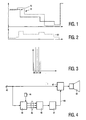
- Fig. 1 shows a graph of block depths in a first image, which are determined with the method described above.
- a comparable graph may be made for motion vectors.
- the graph relates to depth candidate values, the smallest values are used for the depth minimums of the graph.
- each candidate value is a vector having components for the horizontal and vertical movement. In that case a motion vector candidate value is a minimum of the graph when one of the components of this vector is smaller than the corresponding components of the other vectors.
- the block depths from the first image are plotted on the y-axis against the blocks on the x-axis in the graph shown in Fig. 1.
- Curve 10 denotes block depths as they are determined for a first repetition of the method described above, and the curve 11 shows depths as determined for a second repetition.
- the curves 10 and 11 may also be obtained in different manners, for example, via an algorithm that statistically determines depth values, or by making use of depth information from an external source. Based on the curves 10 and 11, a new graph may be made, which shows the absolute differences of block depths. This graph is shown in Fig. 2.
- Curve 20 is obtained by determining for each point on the x axis of the graph of Fig. 1 the absolute difference between the values of curves 10 and 11, and plotting this difference against the corresponding point on the x axis of the graph of fig. 2.
- a histogram of the changes is made, which is shown in Fig. 3.
- the values of the curve 20 are grouped based on their frequency of occurrence.
- Group 30 contains small values from the graph of Fig. 2, group 32 large values from this graph and group 31 intermediate values.
- the boundaries between the groups 30, 31 and 32 are chosen arbitrarily and depend on the total number of blocks that are taken into consideration and their relative distribution. In case group 32 has very few values, the group 32 may be enlarged by shifting the boundary between group 32 and group 31.
- a set of candidate values is made for determining an area to be matched from a second image.
- a candidate value that is chosen from a variety of candidate values which are determined on the basis of properties from the first image, such as depth changes, which appears from the histogram of Fig. 3.
- the graph of Fig. 1, and thus the histogram of Fig. 3, may be constructed for the entire first image or a sub-area thereof. In the latter case separate varieties are made for each sub-area. These varieties may also be adapted after one or more repetitions of the method of determining an optimal candidate value by re-constructing the graph of fig. 1 and making a new histogram.
- the choice of a candidate value from this variety may be made on the basis of previously chosen optimal candidate values for the block from the first image that is going to be matched. If it turns out that it is a matter of major changes in these previously chosen optimal candidate values, a large candidate value is chosen from the variety. If it appears that there were only minor changes between these previously chosen optimal candidate values, it is better to choose a small candidate value from the variety.
- Another property of the first image can be used, that is, information about the direction of the changes in previously chosen optimal candidate values. So doing, there may be detected whether this direction changes continuously, and thus there may be detected whether it is a matter of oscillations.
- a candidate value having the same direction as a previously chosen optimal candidate value is then chosen from the variety.
- Fig. 4 represents an apparatus for processing a video signal 40, which video signal 40 comprises a variety of images.
- the apparatus comprises an image processor 41, which is arranged for processing the video signal 40 to obtain an enhanced video signal.
- This enhanced video signal is then displayed on a display screen 42.
- Fig. 4 shows the display screen 42 as part of the same apparatus that includes the image processor 41, it may be clear that the display screen 42 may also be arranged independently of the apparatus and can receive the enhanced video signal from the apparatus via a network.
- the image processor 41 can enhance the video signal 40 based on information about the motion or depth of individual images in the video signal 40. For example, it is possible for the image processor 41 to process the video signal 40, so that a user can watch the image from another angle by separately rotating, based on depth information, individual objects determined by a group of blocks, and thus generating a correct reproduction from another angle. This may provide, for example, a stereoscopic reproduction. Motion information may be used for detecting and marking moving objects, for example, to be used for automatic surveillance cameras. The thus obtained video signal with marked objects provides an enhancement for the user of these cameras, because they can now detect the image changes much faster.
- the image processor 41 enhances the video signal 40 which is offered, for example, in a compressed format such as MPEG, by producing a video signal that is compressed more efficiently.
- An individual object determined via a group of blocks, which object occurs in a number of images in the video signal 40 may now be compressed by storing pixel information about the object once-only and storing only the motion vector or depth information of this object for other images this object occurs in. Since this information requires less storage capacity than the pixel information of the complete object, a method such as this one can provide a considerably enhanced compressed video signal.
- the apparatus further includes a collector 43, a matcher 46 and a selector 47.
- the collector 43 is arranged for making a set 45 of candidate values for determining an area to be matched from the second image.
- the set 45 made by the collector 43 includes, inter alia, previously determined depths of blocks adjacent to the first block.
- the depths of adjacent blocks will generally show little mutual difference.
- the depths of blocks adjacent to the first block therefore form a good starting point for determining the depth of the first block and are therefore used as candidate values for this depth.
- a storage system 44 on which this depth and other previously determined depths can be stored, so that the collector 43 can use them when making the set 45 of candidate values.
- the collector 43 sends the set 45 of candidate values on to a matcher 46.
- the matcher 46 determines for each candidate value from the set, on the basis of said candidate value, an area to be matched from the second image. Subsequently, the matcher 46 matches the block from the first image with this area and the matcher 46 calculates an associated matching area, as is described above.
- methods mentioned earlier may be implemented, such as the mean square error, the mean absolute difference, the sum of absolute differences or the sum of square errors.
- a selector 47 chooses the optimal candidate value 48 from the set 45 on the basis of the calculated matching errors.
- the optimal candidate value 48 is the candidate value having a relatively low matching error.
- the selector 47 then sends the optimal candidate value 48 to the image processor 41. Repeating this procedure for various blocks from an image provides depth information for this image. Based on the thus provided depth information, the image processor 41 can process the video signal 40 to obtain an enhanced video signal. This enhanced video signal may then be displayed on the display screen 42.
- the system determines a variety of candidate values which are determined on the basis of properties of the first image.
- the collector 43 adds a candidate value to said set 45, which candidate value comes from this variety of candidate values.
- the properties of the first image also include temporal changes of the value of previously chosen optimal candidate values for blocks from the first image.
- the system makes a histogram of said changes. Subsequently, the system determines the variety in proportion to a distribution in the histogram, as described above with reference to Fig. 1, Fig. 2 and Fig. 3.
Landscapes
- Engineering & Computer Science (AREA)
- Multimedia (AREA)
- Computer Vision & Pattern Recognition (AREA)
- Physics & Mathematics (AREA)
- General Physics & Mathematics (AREA)
- Theoretical Computer Science (AREA)
- Signal Processing (AREA)
- Image Analysis (AREA)
- Television Signal Processing For Recording (AREA)
Claims (8)
- Procédé de choix d'une valeur candidate optimale à utiliser pour la correspondance d'un bloc d'une première image avec une zone d'une deuxième image, le procédé comportant:(a) la création d'un premier ensemble (45) de valeurs candidates permettant de déterminer une zone à mettre en correspondance dans la deuxième image,(b) pour chaque valeur candidate du premier ensemble (45), la détermination d'une zone à mettre en correspondance dans la deuxième image, sur base de ladite valeur candidate, la correspondance du bloc de la première image avec cette zone et le calcul d'une erreur de correspondance, et(c) le choix de la valeur candidate optimale (48) dans le premier ensemble (45) sur base des erreurs de correspondance calculées,caractérisé en ce qu'un deuxième ensemble de valeurs candidates est déterminé, lesquelles valeurs candidates sont déterminées sur base des propriétés de la première image, et ce que l'étape (a) inclut aussi l'ajout d'une valeur candidate au premier ensemble qui est choisie dans ledit deuxième ensemble, dans lequel les propriétés de la première image incluent aussi les changements temporels de la valeur des valeurs candidates optimales précédemment choisies pour les blocs de la première image.
- Procédé selon la revendication 1, caractérisé en ce qu'un histogramme desdits changements est créé et en ce que le deuxième ensemble est déterminé en proportion d'une distribution dans l'histogramme.
- Procédé selon la revendication 1, caractérisé en ce que les propriétés de la première image incluent aussi une direction des changements temporels de la valeur des valeurs candidates optimales précédemment choisies pour les blocs de la première image.
- Système permettant de choisir une valeur candidate optimale à utiliser pour la correspondance d'un bloc d'une première image avec une zone d'une deuxième image, le système comportant:- un collecteur (43), qui est prévu pour créer un premier ensemble (45) de valeurs candidates permettant de déterminer une zone à mettre en correspondance dans la deuxième image,- un dispositif de correspondance (46), qui est prévu pour déterminer pour chaque valeur candidate du premier ensemble sur base de ladite valeur candidate une zone à mettre en correspondance dans la deuxième image, pour la correspondance du bloc de la première image avec cette zone et pour le calcul d'une zone correspondante, et- un sélecteur (47), qui est prévu pour choisir la valeur candidate optimale (48) du premier ensemble (45) sur base des erreurs de correspondance calculées, caractérisé en ce que le système est prévu pour déterminer un deuxième ensemble de valeurs candidates, lesquelles valeurs candidates sont déterminées sur base des propriétés de la première image, où les propriétés de la première image incluent aussi les changements temporels de la valeur des valeurs candidates optimales précédemment choisies pour les blocs de la première image, et où le collecteur (43) est aussi prévu pour ajouter une valeur candidate à l'ensemble (45) qui est choisi dans ladite variété.
- Système selon la revendication 4, caractérisé en ce que le système est prévu pour créer un histogramme desdits changements et pour déterminer le deuxième ensemble en proportion d'une distribution dans l'histogramme.
- Système selon la revendication 4, caractérisé en ce que les propriétés de la première image incluent aussi une direction des changements temporels de la valeur des valeurs candidates optimales précédemment choisies pour les blocs de la première image.
- Appareil permettant de traiter un signal vidéo (40) qui comporte une variété d'images, incluant:- un système (43,46,47) selon la revendication 4 permettant de choisir une valeur candidate optimale (48) à utiliser pour la correspondance d'un bloc d'une première image (40) avec une zone d'une deuxième image, le système étant prévu pour choisir les valeurs candidates optimales pour les blocs des images de ladite variété d'image, et- un processeur d'image (41) permettant de traiter le signal vidéo (40) pour obtenir un signal vidéo amélioré sur base des valeurs candidates optimales obtenues comme déterminées par ledit système (43,46,47).
- Appareil selon la revendication 7, caractérisé en ce que l'appareil inclut en outre un système d'affichage (42) permettant d'afficher le signal vidéo amélioré.
Priority Applications (1)
| Application Number | Priority Date | Filing Date | Title |
|---|---|---|---|
| EP01933900A EP1295255B1 (fr) | 2000-05-19 | 2001-04-27 | Determination d'un vecteur candidat de correspondance de bloc |
Applications Claiming Priority (4)
| Application Number | Priority Date | Filing Date | Title |
|---|---|---|---|
| EP00201772 | 2000-05-19 | ||
| EP00201772 | 2000-05-19 | ||
| EP01933900A EP1295255B1 (fr) | 2000-05-19 | 2001-04-27 | Determination d'un vecteur candidat de correspondance de bloc |
| PCT/EP2001/004770 WO2001091054A1 (fr) | 2000-05-19 | 2001-04-27 | Determination d'un vecteur candidat de correspondance de bloc |
Publications (2)
| Publication Number | Publication Date |
|---|---|
| EP1295255A1 EP1295255A1 (fr) | 2003-03-26 |
| EP1295255B1 true EP1295255B1 (fr) | 2007-02-14 |
Family
ID=8171516
Family Applications (1)
| Application Number | Title | Priority Date | Filing Date |
|---|---|---|---|
| EP01933900A Expired - Lifetime EP1295255B1 (fr) | 2000-05-19 | 2001-04-27 | Determination d'un vecteur candidat de correspondance de bloc |
Country Status (8)
| Country | Link |
|---|---|
| US (1) | US6810134B2 (fr) |
| EP (1) | EP1295255B1 (fr) |
| JP (1) | JP2003534615A (fr) |
| KR (1) | KR20020020944A (fr) |
| CN (1) | CN1230784C (fr) |
| AT (1) | ATE354141T1 (fr) |
| DE (1) | DE60126612T2 (fr) |
| WO (1) | WO2001091054A1 (fr) |
Families Citing this family (3)
| Publication number | Priority date | Publication date | Assignee | Title |
|---|---|---|---|---|
| US7006666B2 (en) * | 2001-11-21 | 2006-02-28 | Etreppid Technologies, Llc | Method and apparatus for detecting and reacting to occurrence of an event |
| WO2010050632A1 (fr) * | 2008-10-29 | 2010-05-06 | Udp Co., Ltd. | Procédé de stabilisation d'image et dispositif pour réaliser le procédé |
| CN111462170B (zh) | 2020-03-30 | 2023-08-25 | Oppo广东移动通信有限公司 | 运动估计方法、运动估计装置、存储介质与电子设备 |
Family Cites Families (14)
| Publication number | Priority date | Publication date | Assignee | Title |
|---|---|---|---|---|
| US5642294A (en) * | 1993-12-17 | 1997-06-24 | Nippon Telegraph And Telephone Corporation | Method and apparatus for video cut detection |
| US5802361A (en) * | 1994-09-30 | 1998-09-01 | Apple Computer, Inc. | Method and system for searching graphic images and videos |
| US5946044A (en) * | 1995-06-30 | 1999-08-31 | Sony Corporation | Image signal converting method and image signal converting apparatus |
| JP2000512091A (ja) * | 1996-05-24 | 2000-09-12 | フィリップス エレクトロニクス ネムローゼ フェンノートシャップ | 動作ベクトル処理 |
| DE69730565T2 (de) * | 1996-06-26 | 2005-02-03 | Matsushita Electric Industrial Co., Ltd., Kadoma | Gerät zur Erzeugung eines stereoskopischen bewegenden Bildes mittels Computergraphik |
| US6030344A (en) * | 1996-12-04 | 2000-02-29 | Acuson Corporation | Methods and apparatus for ultrasound image quantification |
| US6249318B1 (en) * | 1997-09-12 | 2001-06-19 | 8×8, Inc. | Video coding/decoding arrangement and method therefor |
| US6091777A (en) * | 1997-09-18 | 2000-07-18 | Cubic Video Technologies, Inc. | Continuously adaptive digital video compression system and method for a web streamer |
| DE19744134A1 (de) * | 1997-09-29 | 1999-04-01 | Hertz Inst Heinrich | Verfahren zur Bestimmung von Blockvektoren für die Bewegungsschätzung |
| KR100251548B1 (ko) * | 1997-11-01 | 2000-04-15 | 구자홍 | 디지털영상을위한움직임추정장치및방법 |
| US6335985B1 (en) * | 1998-01-07 | 2002-01-01 | Kabushiki Kaisha Toshiba | Object extraction apparatus |
| JP2001520781A (ja) * | 1998-02-06 | 2001-10-30 | コーニンクレッカ フィリップス エレクトロニクス エヌ ヴィ | 動き又はデプス推定 |
| US6298144B1 (en) * | 1998-05-20 | 2001-10-02 | The United States Of America As Represented By The National Security Agency | Device for and method of detecting motion in an image |
| JP3280001B2 (ja) * | 1999-09-16 | 2002-04-30 | 富士重工業株式会社 | ステレオ画像の位置ずれ調整装置 |
-
2001
- 2001-04-27 EP EP01933900A patent/EP1295255B1/fr not_active Expired - Lifetime
- 2001-04-27 DE DE60126612T patent/DE60126612T2/de not_active Expired - Fee Related
- 2001-04-27 KR KR1020027000749A patent/KR20020020944A/ko not_active Abandoned
- 2001-04-27 CN CNB018013244A patent/CN1230784C/zh not_active Expired - Fee Related
- 2001-04-27 JP JP2001587368A patent/JP2003534615A/ja not_active Withdrawn
- 2001-04-27 WO PCT/EP2001/004770 patent/WO2001091054A1/fr not_active Ceased
- 2001-04-27 AT AT01933900T patent/ATE354141T1/de not_active IP Right Cessation
- 2001-05-07 US US09/850,347 patent/US6810134B2/en not_active Expired - Fee Related
Also Published As
| Publication number | Publication date |
|---|---|
| US20020009210A1 (en) | 2002-01-24 |
| DE60126612T2 (de) | 2007-10-31 |
| CN1381026A (zh) | 2002-11-20 |
| EP1295255A1 (fr) | 2003-03-26 |
| DE60126612D1 (de) | 2007-03-29 |
| US6810134B2 (en) | 2004-10-26 |
| WO2001091054A1 (fr) | 2001-11-29 |
| ATE354141T1 (de) | 2007-03-15 |
| KR20020020944A (ko) | 2002-03-16 |
| JP2003534615A (ja) | 2003-11-18 |
| CN1230784C (zh) | 2005-12-07 |
Similar Documents
| Publication | Publication Date | Title |
|---|---|---|
| US6987866B2 (en) | Multi-modal motion estimation for video sequences | |
| KR100591470B1 (ko) | 비디오 시퀀스의 변환 검출 | |
| US8605787B2 (en) | Image processing system, image processing method, and recording medium storing image processing program | |
| EP2911382B1 (fr) | Dispositif de traitement d'image et procédé de traitement d'image | |
| EP0624981B1 (fr) | Circuit pour la détection du vecteur de mouvement | |
| KR100636170B1 (ko) | 경사 이미지 모서리 위치 및 휘도 천이 범위 검출 방법 및장치 | |
| US6738497B2 (en) | Method, system and apparatus for image block matching | |
| WO2007052191A2 (fr) | Remplissage par des resultats de profondeur | |
| KR101038690B1 (ko) | 화상 신호 처리 장치 및 방법, 및 기록 매체 | |
| EP1295255B1 (fr) | Determination d'un vecteur candidat de correspondance de bloc | |
| US6985604B2 (en) | Method, system and apparatus for block matching based on visible pixels | |
| JP2006521740A (ja) | 動きベクトル決定方法 | |
| JP3175914B2 (ja) | 画像符号化方法および画像符号化装置 | |
| US20020009147A1 (en) | Method, system and apparatus | |
| JP3509397B2 (ja) | マルコフモデル画像符号化装置 | |
| KR100591491B1 (ko) | 화상 처리 장치 및 화상 처리 방법과 컴퓨터 판독 가능한기록 매체 | |
| JPH08242454A (ja) | グローバル動きパラメタ検出方法 | |
| KR100493718B1 (ko) | 골프스윙객체 자세추적방법 | |
| JPH0795587A (ja) | 動きベクトル検出方法 | |
| KR100683360B1 (ko) | 영상 이진화 방법 | |
| JP2001155167A (ja) | 領域分割方法及び装置並びに記憶媒体 |
Legal Events
| Date | Code | Title | Description |
|---|---|---|---|
| PUAI | Public reference made under article 153(3) epc to a published international application that has entered the european phase |
Free format text: ORIGINAL CODE: 0009012 |
|
| 17P | Request for examination filed |
Effective date: 20021219 |
|
| AK | Designated contracting states |
Kind code of ref document: A1 Designated state(s): AT BE CH CY DE DK ES FI FR GB GR IE IT LI LU MC NL PT SE TR |
|
| GRAP | Despatch of communication of intention to grant a patent |
Free format text: ORIGINAL CODE: EPIDOSNIGR1 |
|
| GRAS | Grant fee paid |
Free format text: ORIGINAL CODE: EPIDOSNIGR3 |
|
| GRAA | (expected) grant |
Free format text: ORIGINAL CODE: 0009210 |
|
| AK | Designated contracting states |
Kind code of ref document: B1 Designated state(s): AT BE CH CY DE DK ES FI FR GB GR IE IT LI LU MC NL PT SE TR |
|
| PG25 | Lapsed in a contracting state [announced via postgrant information from national office to epo] |
Ref country code: FI Free format text: LAPSE BECAUSE OF FAILURE TO SUBMIT A TRANSLATION OF THE DESCRIPTION OR TO PAY THE FEE WITHIN THE PRESCRIBED TIME-LIMIT Effective date: 20070214 Ref country code: NL Free format text: LAPSE BECAUSE OF FAILURE TO SUBMIT A TRANSLATION OF THE DESCRIPTION OR TO PAY THE FEE WITHIN THE PRESCRIBED TIME-LIMIT Effective date: 20070214 Ref country code: DK Free format text: LAPSE BECAUSE OF FAILURE TO SUBMIT A TRANSLATION OF THE DESCRIPTION OR TO PAY THE FEE WITHIN THE PRESCRIBED TIME-LIMIT Effective date: 20070214 Ref country code: BE Free format text: LAPSE BECAUSE OF FAILURE TO SUBMIT A TRANSLATION OF THE DESCRIPTION OR TO PAY THE FEE WITHIN THE PRESCRIBED TIME-LIMIT Effective date: 20070214 Ref country code: CH Free format text: LAPSE BECAUSE OF FAILURE TO SUBMIT A TRANSLATION OF THE DESCRIPTION OR TO PAY THE FEE WITHIN THE PRESCRIBED TIME-LIMIT Effective date: 20070214 Ref country code: LI Free format text: LAPSE BECAUSE OF FAILURE TO SUBMIT A TRANSLATION OF THE DESCRIPTION OR TO PAY THE FEE WITHIN THE PRESCRIBED TIME-LIMIT Effective date: 20070214 Ref country code: AT Free format text: LAPSE BECAUSE OF FAILURE TO SUBMIT A TRANSLATION OF THE DESCRIPTION OR TO PAY THE FEE WITHIN THE PRESCRIBED TIME-LIMIT Effective date: 20070214 |
|
| REG | Reference to a national code |
Ref country code: GB Ref legal event code: FG4D |
|
| REG | Reference to a national code |
Ref country code: CH Ref legal event code: EP |
|
| REF | Corresponds to: |
Ref document number: 60126612 Country of ref document: DE Date of ref document: 20070329 Kind code of ref document: P |
|
| REG | Reference to a national code |
Ref country code: IE Ref legal event code: FG4D |
|
| PG25 | Lapsed in a contracting state [announced via postgrant information from national office to epo] |
Ref country code: SE Free format text: LAPSE BECAUSE OF FAILURE TO SUBMIT A TRANSLATION OF THE DESCRIPTION OR TO PAY THE FEE WITHIN THE PRESCRIBED TIME-LIMIT Effective date: 20070514 |
|
| PG25 | Lapsed in a contracting state [announced via postgrant information from national office to epo] |
Ref country code: ES Free format text: LAPSE BECAUSE OF FAILURE TO SUBMIT A TRANSLATION OF THE DESCRIPTION OR TO PAY THE FEE WITHIN THE PRESCRIBED TIME-LIMIT Effective date: 20070525 |
|
| PG25 | Lapsed in a contracting state [announced via postgrant information from national office to epo] |
Ref country code: PT Free format text: LAPSE BECAUSE OF FAILURE TO SUBMIT A TRANSLATION OF THE DESCRIPTION OR TO PAY THE FEE WITHIN THE PRESCRIBED TIME-LIMIT Effective date: 20070716 |
|
| NLV1 | Nl: lapsed or annulled due to failure to fulfill the requirements of art. 29p and 29m of the patents act | ||
| ET | Fr: translation filed | ||
| REG | Reference to a national code |
Ref country code: CH Ref legal event code: PL |
|
| PGFP | Annual fee paid to national office [announced via postgrant information from national office to epo] |
Ref country code: GB Payment date: 20070425 Year of fee payment: 7 |
|
| PLBE | No opposition filed within time limit |
Free format text: ORIGINAL CODE: 0009261 |
|
| STAA | Information on the status of an ep patent application or granted ep patent |
Free format text: STATUS: NO OPPOSITION FILED WITHIN TIME LIMIT |
|
| 26N | No opposition filed |
Effective date: 20071115 |
|
| PG25 | Lapsed in a contracting state [announced via postgrant information from national office to epo] |
Ref country code: DE Free format text: LAPSE BECAUSE OF NON-PAYMENT OF DUE FEES Effective date: 20071101 |
|
| PG25 | Lapsed in a contracting state [announced via postgrant information from national office to epo] |
Ref country code: IT Free format text: LAPSE BECAUSE OF FAILURE TO SUBMIT A TRANSLATION OF THE DESCRIPTION OR TO PAY THE FEE WITHIN THE PRESCRIBED TIME-LIMIT Effective date: 20070214 Ref country code: GR Free format text: LAPSE BECAUSE OF FAILURE TO SUBMIT A TRANSLATION OF THE DESCRIPTION OR TO PAY THE FEE WITHIN THE PRESCRIBED TIME-LIMIT Effective date: 20070515 |
|
| PGFP | Annual fee paid to national office [announced via postgrant information from national office to epo] |
Ref country code: FR Payment date: 20070425 Year of fee payment: 7 |
|
| PG25 | Lapsed in a contracting state [announced via postgrant information from national office to epo] |
Ref country code: IE Free format text: LAPSE BECAUSE OF NON-PAYMENT OF DUE FEES Effective date: 20070427 |
|
| GBPC | Gb: european patent ceased through non-payment of renewal fee |
Effective date: 20080427 |
|
| REG | Reference to a national code |
Ref country code: FR Ref legal event code: ST Effective date: 20081231 |
|
| PG25 | Lapsed in a contracting state [announced via postgrant information from national office to epo] |
Ref country code: MC Free format text: LAPSE BECAUSE OF NON-PAYMENT OF DUE FEES Effective date: 20070430 |
|
| PG25 | Lapsed in a contracting state [announced via postgrant information from national office to epo] |
Ref country code: FR Free format text: LAPSE BECAUSE OF NON-PAYMENT OF DUE FEES Effective date: 20080430 |
|
| PG25 | Lapsed in a contracting state [announced via postgrant information from national office to epo] |
Ref country code: GB Free format text: LAPSE BECAUSE OF NON-PAYMENT OF DUE FEES Effective date: 20080427 |
|
| PG25 | Lapsed in a contracting state [announced via postgrant information from national office to epo] |
Ref country code: CY Free format text: LAPSE BECAUSE OF FAILURE TO SUBMIT A TRANSLATION OF THE DESCRIPTION OR TO PAY THE FEE WITHIN THE PRESCRIBED TIME-LIMIT Effective date: 20070214 |
|
| PG25 | Lapsed in a contracting state [announced via postgrant information from national office to epo] |
Ref country code: LU Free format text: LAPSE BECAUSE OF NON-PAYMENT OF DUE FEES Effective date: 20070427 |
|
| PG25 | Lapsed in a contracting state [announced via postgrant information from national office to epo] |
Ref country code: TR Free format text: LAPSE BECAUSE OF FAILURE TO SUBMIT A TRANSLATION OF THE DESCRIPTION OR TO PAY THE FEE WITHIN THE PRESCRIBED TIME-LIMIT Effective date: 20070214 |