EP1308438A1 - 3-substituted urea derivatives and medicinal use thereof - Google Patents
3-substituted urea derivatives and medicinal use thereof Download PDFInfo
- Publication number
- EP1308438A1 EP1308438A1 EP01955657A EP01955657A EP1308438A1 EP 1308438 A1 EP1308438 A1 EP 1308438A1 EP 01955657 A EP01955657 A EP 01955657A EP 01955657 A EP01955657 A EP 01955657A EP 1308438 A1 EP1308438 A1 EP 1308438A1
- Authority
- EP
- European Patent Office
- Prior art keywords
- urea
- diisopropylphenyl
- methyl
- isopropylphenyl
- substituent
- Prior art date
- Legal status (The legal status is an assumption and is not a legal conclusion. Google has not performed a legal analysis and makes no representation as to the accuracy of the status listed.)
- Granted
Links
- NENKJDFYHOXISA-UHFFFAOYSA-N CC(C)c(cc1)ccc1N(Cc(cc1)ccc1O)C(Nc1c(C(C)C)cccc1C(C)C)=O Chemical compound CC(C)c(cc1)ccc1N(Cc(cc1)ccc1O)C(Nc1c(C(C)C)cccc1C(C)C)=O NENKJDFYHOXISA-UHFFFAOYSA-N 0.000 description 1
- JPZVCZKYKVYZOM-UHFFFAOYSA-N CC(C)c(cc1)ccc1N(Cc1c[n](Cc2nccc(C)c2)nc1)C(Nc1c(C(C)C)cccc1C(C)C)=O Chemical compound CC(C)c(cc1)ccc1N(Cc1c[n](Cc2nccc(C)c2)nc1)C(Nc1c(C(C)C)cccc1C(C)C)=O JPZVCZKYKVYZOM-UHFFFAOYSA-N 0.000 description 1
- YLEAVYPKMYFKBC-UHFFFAOYSA-N CC(C)c1cccc(C(C)C)c1NC(N(Cc(cc1)ccc1N(C)C)c1ccc(C)cc1)=O Chemical compound CC(C)c1cccc(C(C)C)c1NC(N(Cc(cc1)ccc1N(C)C)c1ccc(C)cc1)=O YLEAVYPKMYFKBC-UHFFFAOYSA-N 0.000 description 1
- SFAAOEOCMLZWKQ-UHFFFAOYSA-N CC(C)c1cccc(C(C)C)c1NC(N(Cc(cc1)ccc1N(C)C)c1ccc(C)cc1C)=O Chemical compound CC(C)c1cccc(C(C)C)c1NC(N(Cc(cc1)ccc1N(C)C)c1ccc(C)cc1C)=O SFAAOEOCMLZWKQ-UHFFFAOYSA-N 0.000 description 1
- GIEIEXSCTSWUDM-UHFFFAOYSA-N CC(C)c1cccc(C(C)C)c1NC(N(Cc(cc1)ccc1OC)c1ccc(C)cc1)=O Chemical compound CC(C)c1cccc(C(C)C)c1NC(N(Cc(cc1)ccc1OC)c1ccc(C)cc1)=O GIEIEXSCTSWUDM-UHFFFAOYSA-N 0.000 description 1
- DNCAZBMGPYIZOA-UHFFFAOYSA-N CCc(cc1)ccc1N(Cc1ccc(CN(C)C)cc1)C(Nc1c(C(C)C)cccc1C(C)C)=O Chemical compound CCc(cc1)ccc1N(Cc1ccc(CN(C)C)cc1)C(Nc1c(C(C)C)cccc1C(C)C)=O DNCAZBMGPYIZOA-UHFFFAOYSA-N 0.000 description 1
Classifications
-
- C—CHEMISTRY; METALLURGY
- C07—ORGANIC CHEMISTRY
- C07D—HETEROCYCLIC COMPOUNDS
- C07D213/00—Heterocyclic compounds containing six-membered rings, not condensed with other rings, with one nitrogen atom as the only ring hetero atom and three or more double bonds between ring members or between ring members and non-ring members
- C07D213/02—Heterocyclic compounds containing six-membered rings, not condensed with other rings, with one nitrogen atom as the only ring hetero atom and three or more double bonds between ring members or between ring members and non-ring members having three double bonds between ring members or between ring members and non-ring members
- C07D213/04—Heterocyclic compounds containing six-membered rings, not condensed with other rings, with one nitrogen atom as the only ring hetero atom and three or more double bonds between ring members or between ring members and non-ring members having three double bonds between ring members or between ring members and non-ring members having no bond between the ring nitrogen atom and a non-ring member or having only hydrogen or carbon atoms directly attached to the ring nitrogen atom
- C07D213/60—Heterocyclic compounds containing six-membered rings, not condensed with other rings, with one nitrogen atom as the only ring hetero atom and three or more double bonds between ring members or between ring members and non-ring members having three double bonds between ring members or between ring members and non-ring members having no bond between the ring nitrogen atom and a non-ring member or having only hydrogen or carbon atoms directly attached to the ring nitrogen atom with hetero atoms or with carbon atoms having three bonds to hetero atoms with at the most one bond to halogen, e.g. ester or nitrile radicals, directly attached to ring carbon atoms
- C07D213/62—Oxygen or sulfur atoms
- C07D213/63—One oxygen atom
- C07D213/64—One oxygen atom attached in position 2 or 6
-
- A—HUMAN NECESSITIES
- A61—MEDICAL OR VETERINARY SCIENCE; HYGIENE
- A61K—PREPARATIONS FOR MEDICAL, DENTAL OR TOILETRY PURPOSES
- A61K31/00—Medicinal preparations containing organic active ingredients
- A61K31/16—Amides, e.g. hydroxamic acids
- A61K31/17—Amides, e.g. hydroxamic acids having the group >N—C(O)—N< or >N—C(S)—N<, e.g. urea, thiourea, carmustine
-
- A—HUMAN NECESSITIES
- A61—MEDICAL OR VETERINARY SCIENCE; HYGIENE
- A61P—SPECIFIC THERAPEUTIC ACTIVITY OF CHEMICAL COMPOUNDS OR MEDICINAL PREPARATIONS
- A61P11/00—Drugs for disorders of the respiratory system
-
- A—HUMAN NECESSITIES
- A61—MEDICAL OR VETERINARY SCIENCE; HYGIENE
- A61P—SPECIFIC THERAPEUTIC ACTIVITY OF CHEMICAL COMPOUNDS OR MEDICINAL PREPARATIONS
- A61P11/00—Drugs for disorders of the respiratory system
- A61P11/06—Antiasthmatics
-
- A—HUMAN NECESSITIES
- A61—MEDICAL OR VETERINARY SCIENCE; HYGIENE
- A61P—SPECIFIC THERAPEUTIC ACTIVITY OF CHEMICAL COMPOUNDS OR MEDICINAL PREPARATIONS
- A61P17/00—Drugs for dermatological disorders
- A61P17/02—Drugs for dermatological disorders for treating wounds, ulcers, burns, scars, keloids, or the like
-
- A—HUMAN NECESSITIES
- A61—MEDICAL OR VETERINARY SCIENCE; HYGIENE
- A61P—SPECIFIC THERAPEUTIC ACTIVITY OF CHEMICAL COMPOUNDS OR MEDICINAL PREPARATIONS
- A61P17/00—Drugs for dermatological disorders
- A61P17/06—Antipsoriatics
-
- A—HUMAN NECESSITIES
- A61—MEDICAL OR VETERINARY SCIENCE; HYGIENE
- A61P—SPECIFIC THERAPEUTIC ACTIVITY OF CHEMICAL COMPOUNDS OR MEDICINAL PREPARATIONS
- A61P25/00—Drugs for disorders of the nervous system
- A61P25/28—Drugs for disorders of the nervous system for treating neurodegenerative disorders of the central nervous system, e.g. nootropic agents, cognition enhancers, drugs for treating Alzheimer's disease or other forms of dementia
-
- A—HUMAN NECESSITIES
- A61—MEDICAL OR VETERINARY SCIENCE; HYGIENE
- A61P—SPECIFIC THERAPEUTIC ACTIVITY OF CHEMICAL COMPOUNDS OR MEDICINAL PREPARATIONS
- A61P31/00—Antiinfectives, i.e. antibiotics, antiseptics, chemotherapeutics
- A61P31/04—Antibacterial agents
-
- A—HUMAN NECESSITIES
- A61—MEDICAL OR VETERINARY SCIENCE; HYGIENE
- A61P—SPECIFIC THERAPEUTIC ACTIVITY OF CHEMICAL COMPOUNDS OR MEDICINAL PREPARATIONS
- A61P31/00—Antiinfectives, i.e. antibiotics, antiseptics, chemotherapeutics
- A61P31/12—Antivirals
-
- A—HUMAN NECESSITIES
- A61—MEDICAL OR VETERINARY SCIENCE; HYGIENE
- A61P—SPECIFIC THERAPEUTIC ACTIVITY OF CHEMICAL COMPOUNDS OR MEDICINAL PREPARATIONS
- A61P37/00—Drugs for immunological or allergic disorders
- A61P37/02—Immunomodulators
-
- A—HUMAN NECESSITIES
- A61—MEDICAL OR VETERINARY SCIENCE; HYGIENE
- A61P—SPECIFIC THERAPEUTIC ACTIVITY OF CHEMICAL COMPOUNDS OR MEDICINAL PREPARATIONS
- A61P37/00—Drugs for immunological or allergic disorders
- A61P37/02—Immunomodulators
- A61P37/06—Immunosuppressants, e.g. drugs for graft rejection
-
- A—HUMAN NECESSITIES
- A61—MEDICAL OR VETERINARY SCIENCE; HYGIENE
- A61P—SPECIFIC THERAPEUTIC ACTIVITY OF CHEMICAL COMPOUNDS OR MEDICINAL PREPARATIONS
- A61P37/00—Drugs for immunological or allergic disorders
- A61P37/08—Antiallergic agents
-
- A—HUMAN NECESSITIES
- A61—MEDICAL OR VETERINARY SCIENCE; HYGIENE
- A61P—SPECIFIC THERAPEUTIC ACTIVITY OF CHEMICAL COMPOUNDS OR MEDICINAL PREPARATIONS
- A61P43/00—Drugs for specific purposes, not provided for in groups A61P1/00-A61P41/00
-
- A—HUMAN NECESSITIES
- A61—MEDICAL OR VETERINARY SCIENCE; HYGIENE
- A61P—SPECIFIC THERAPEUTIC ACTIVITY OF CHEMICAL COMPOUNDS OR MEDICINAL PREPARATIONS
- A61P7/00—Drugs for disorders of the blood or the extracellular fluid
-
- A—HUMAN NECESSITIES
- A61—MEDICAL OR VETERINARY SCIENCE; HYGIENE
- A61P—SPECIFIC THERAPEUTIC ACTIVITY OF CHEMICAL COMPOUNDS OR MEDICINAL PREPARATIONS
- A61P9/00—Drugs for disorders of the cardiovascular system
- A61P9/08—Vasodilators for multiple indications
-
- A—HUMAN NECESSITIES
- A61—MEDICAL OR VETERINARY SCIENCE; HYGIENE
- A61P—SPECIFIC THERAPEUTIC ACTIVITY OF CHEMICAL COMPOUNDS OR MEDICINAL PREPARATIONS
- A61P9/00—Drugs for disorders of the cardiovascular system
- A61P9/10—Drugs for disorders of the cardiovascular system for treating ischaemic or atherosclerotic diseases, e.g. antianginal drugs, coronary vasodilators, drugs for myocardial infarction, retinopathy, cerebrovascula insufficiency, renal arteriosclerosis
-
- C—CHEMISTRY; METALLURGY
- C07—ORGANIC CHEMISTRY
- C07C—ACYCLIC OR CARBOCYCLIC COMPOUNDS
- C07C275/00—Derivatives of urea, i.e. compounds containing any of the groups, the nitrogen atoms not being part of nitro or nitroso groups
- C07C275/28—Derivatives of urea, i.e. compounds containing any of the groups, the nitrogen atoms not being part of nitro or nitroso groups having nitrogen atoms of urea groups bound to carbon atoms of six-membered aromatic rings of a carbon skeleton
-
- C—CHEMISTRY; METALLURGY
- C07—ORGANIC CHEMISTRY
- C07C—ACYCLIC OR CARBOCYCLIC COMPOUNDS
- C07C275/00—Derivatives of urea, i.e. compounds containing any of the groups, the nitrogen atoms not being part of nitro or nitroso groups
- C07C275/28—Derivatives of urea, i.e. compounds containing any of the groups, the nitrogen atoms not being part of nitro or nitroso groups having nitrogen atoms of urea groups bound to carbon atoms of six-membered aromatic rings of a carbon skeleton
- C07C275/30—Derivatives of urea, i.e. compounds containing any of the groups, the nitrogen atoms not being part of nitro or nitroso groups having nitrogen atoms of urea groups bound to carbon atoms of six-membered aromatic rings of a carbon skeleton being further substituted by halogen atoms, or by nitro or nitroso groups
-
- C—CHEMISTRY; METALLURGY
- C07—ORGANIC CHEMISTRY
- C07C—ACYCLIC OR CARBOCYCLIC COMPOUNDS
- C07C275/00—Derivatives of urea, i.e. compounds containing any of the groups, the nitrogen atoms not being part of nitro or nitroso groups
- C07C275/28—Derivatives of urea, i.e. compounds containing any of the groups, the nitrogen atoms not being part of nitro or nitroso groups having nitrogen atoms of urea groups bound to carbon atoms of six-membered aromatic rings of a carbon skeleton
- C07C275/32—Derivatives of urea, i.e. compounds containing any of the groups, the nitrogen atoms not being part of nitro or nitroso groups having nitrogen atoms of urea groups bound to carbon atoms of six-membered aromatic rings of a carbon skeleton being further substituted by singly-bound oxygen atoms
- C07C275/34—Derivatives of urea, i.e. compounds containing any of the groups, the nitrogen atoms not being part of nitro or nitroso groups having nitrogen atoms of urea groups bound to carbon atoms of six-membered aromatic rings of a carbon skeleton being further substituted by singly-bound oxygen atoms having nitrogen atoms of urea groups and singly-bound oxygen atoms bound to carbon atoms of the same non-condensed six-membered aromatic ring
-
- C—CHEMISTRY; METALLURGY
- C07—ORGANIC CHEMISTRY
- C07C—ACYCLIC OR CARBOCYCLIC COMPOUNDS
- C07C275/00—Derivatives of urea, i.e. compounds containing any of the groups, the nitrogen atoms not being part of nitro or nitroso groups
- C07C275/28—Derivatives of urea, i.e. compounds containing any of the groups, the nitrogen atoms not being part of nitro or nitroso groups having nitrogen atoms of urea groups bound to carbon atoms of six-membered aromatic rings of a carbon skeleton
- C07C275/40—Derivatives of urea, i.e. compounds containing any of the groups, the nitrogen atoms not being part of nitro or nitroso groups having nitrogen atoms of urea groups bound to carbon atoms of six-membered aromatic rings of a carbon skeleton being further substituted by nitrogen atoms not being part of nitro or nitroso groups
-
- C—CHEMISTRY; METALLURGY
- C07—ORGANIC CHEMISTRY
- C07C—ACYCLIC OR CARBOCYCLIC COMPOUNDS
- C07C275/00—Derivatives of urea, i.e. compounds containing any of the groups, the nitrogen atoms not being part of nitro or nitroso groups
- C07C275/28—Derivatives of urea, i.e. compounds containing any of the groups, the nitrogen atoms not being part of nitro or nitroso groups having nitrogen atoms of urea groups bound to carbon atoms of six-membered aromatic rings of a carbon skeleton
- C07C275/42—Derivatives of urea, i.e. compounds containing any of the groups, the nitrogen atoms not being part of nitro or nitroso groups having nitrogen atoms of urea groups bound to carbon atoms of six-membered aromatic rings of a carbon skeleton being further substituted by carboxyl groups
-
- C—CHEMISTRY; METALLURGY
- C07—ORGANIC CHEMISTRY
- C07C—ACYCLIC OR CARBOCYCLIC COMPOUNDS
- C07C323/00—Thiols, sulfides, hydropolysulfides or polysulfides substituted by halogen, oxygen or nitrogen atoms, or by sulfur atoms not being part of thio groups
- C07C323/23—Thiols, sulfides, hydropolysulfides or polysulfides substituted by halogen, oxygen or nitrogen atoms, or by sulfur atoms not being part of thio groups containing thio groups and nitrogen atoms, not being part of nitro or nitroso groups, bound to the same carbon skeleton
- C07C323/39—Thiols, sulfides, hydropolysulfides or polysulfides substituted by halogen, oxygen or nitrogen atoms, or by sulfur atoms not being part of thio groups containing thio groups and nitrogen atoms, not being part of nitro or nitroso groups, bound to the same carbon skeleton at least one of the nitrogen atoms being part of any of the groups, X being a hetero atom, Y being any atom
- C07C323/43—Y being a hetero atom
-
- C—CHEMISTRY; METALLURGY
- C07—ORGANIC CHEMISTRY
- C07C—ACYCLIC OR CARBOCYCLIC COMPOUNDS
- C07C323/00—Thiols, sulfides, hydropolysulfides or polysulfides substituted by halogen, oxygen or nitrogen atoms, or by sulfur atoms not being part of thio groups
- C07C323/23—Thiols, sulfides, hydropolysulfides or polysulfides substituted by halogen, oxygen or nitrogen atoms, or by sulfur atoms not being part of thio groups containing thio groups and nitrogen atoms, not being part of nitro or nitroso groups, bound to the same carbon skeleton
- C07C323/39—Thiols, sulfides, hydropolysulfides or polysulfides substituted by halogen, oxygen or nitrogen atoms, or by sulfur atoms not being part of thio groups containing thio groups and nitrogen atoms, not being part of nitro or nitroso groups, bound to the same carbon skeleton at least one of the nitrogen atoms being part of any of the groups, X being a hetero atom, Y being any atom
- C07C323/43—Y being a hetero atom
- C07C323/44—X or Y being nitrogen atoms
-
- C—CHEMISTRY; METALLURGY
- C07—ORGANIC CHEMISTRY
- C07D—HETEROCYCLIC COMPOUNDS
- C07D209/00—Heterocyclic compounds containing five-membered rings, condensed with other rings, with one nitrogen atom as the only ring hetero atom
- C07D209/02—Heterocyclic compounds containing five-membered rings, condensed with other rings, with one nitrogen atom as the only ring hetero atom condensed with one carbocyclic ring
- C07D209/04—Indoles; Hydrogenated indoles
- C07D209/10—Indoles; Hydrogenated indoles with substituted hydrocarbon radicals attached to carbon atoms of the hetero ring
- C07D209/14—Radicals substituted by nitrogen atoms, not forming part of a nitro radical
-
- C—CHEMISTRY; METALLURGY
- C07—ORGANIC CHEMISTRY
- C07D—HETEROCYCLIC COMPOUNDS
- C07D231/00—Heterocyclic compounds containing 1,2-diazole or hydrogenated 1,2-diazole rings
- C07D231/02—Heterocyclic compounds containing 1,2-diazole or hydrogenated 1,2-diazole rings not condensed with other rings
- C07D231/10—Heterocyclic compounds containing 1,2-diazole or hydrogenated 1,2-diazole rings not condensed with other rings having two or three double bonds between ring members or between ring members and non-ring members
- C07D231/12—Heterocyclic compounds containing 1,2-diazole or hydrogenated 1,2-diazole rings not condensed with other rings having two or three double bonds between ring members or between ring members and non-ring members with only hydrogen atoms, hydrocarbon or substituted hydrocarbon radicals, directly attached to ring carbon atoms
-
- C—CHEMISTRY; METALLURGY
- C07—ORGANIC CHEMISTRY
- C07D—HETEROCYCLIC COMPOUNDS
- C07D295/00—Heterocyclic compounds containing polymethylene-imine rings with at least five ring members, 3-azabicyclo [3.2.2] nonane, piperazine, morpholine or thiomorpholine rings, having only hydrogen atoms directly attached to the ring carbon atoms
- C07D295/04—Heterocyclic compounds containing polymethylene-imine rings with at least five ring members, 3-azabicyclo [3.2.2] nonane, piperazine, morpholine or thiomorpholine rings, having only hydrogen atoms directly attached to the ring carbon atoms with substituted hydrocarbon radicals attached to ring nitrogen atoms
- C07D295/12—Heterocyclic compounds containing polymethylene-imine rings with at least five ring members, 3-azabicyclo [3.2.2] nonane, piperazine, morpholine or thiomorpholine rings, having only hydrogen atoms directly attached to the ring carbon atoms with substituted hydrocarbon radicals attached to ring nitrogen atoms substituted by singly or doubly bound nitrogen atoms
- C07D295/135—Heterocyclic compounds containing polymethylene-imine rings with at least five ring members, 3-azabicyclo [3.2.2] nonane, piperazine, morpholine or thiomorpholine rings, having only hydrogen atoms directly attached to the ring carbon atoms with substituted hydrocarbon radicals attached to ring nitrogen atoms substituted by singly or doubly bound nitrogen atoms with the ring nitrogen atoms and the substituent nitrogen atoms separated by carbocyclic rings or by carbon chains interrupted by carbocyclic rings
-
- C—CHEMISTRY; METALLURGY
- C07—ORGANIC CHEMISTRY
- C07D—HETEROCYCLIC COMPOUNDS
- C07D317/00—Heterocyclic compounds containing five-membered rings having two oxygen atoms as the only ring hetero atoms
- C07D317/08—Heterocyclic compounds containing five-membered rings having two oxygen atoms as the only ring hetero atoms having the hetero atoms in positions 1 and 3
- C07D317/44—Heterocyclic compounds containing five-membered rings having two oxygen atoms as the only ring hetero atoms having the hetero atoms in positions 1 and 3 ortho- or peri-condensed with carbocyclic rings or ring systems
- C07D317/46—Heterocyclic compounds containing five-membered rings having two oxygen atoms as the only ring hetero atoms having the hetero atoms in positions 1 and 3 ortho- or peri-condensed with carbocyclic rings or ring systems condensed with one six-membered ring
- C07D317/48—Methylenedioxybenzenes or hydrogenated methylenedioxybenzenes, unsubstituted on the hetero ring
- C07D317/50—Methylenedioxybenzenes or hydrogenated methylenedioxybenzenes, unsubstituted on the hetero ring with only hydrogen atoms, hydrocarbon or substituted hydrocarbon radicals, directly attached to atoms of the carbocyclic ring
- C07D317/58—Radicals substituted by nitrogen atoms
-
- C—CHEMISTRY; METALLURGY
- C07—ORGANIC CHEMISTRY
- C07D—HETEROCYCLIC COMPOUNDS
- C07D401/00—Heterocyclic compounds containing two or more hetero rings, having nitrogen atoms as the only ring hetero atoms, at least one ring being a six-membered ring with only one nitrogen atom
- C07D401/02—Heterocyclic compounds containing two or more hetero rings, having nitrogen atoms as the only ring hetero atoms, at least one ring being a six-membered ring with only one nitrogen atom containing two hetero rings
- C07D401/06—Heterocyclic compounds containing two or more hetero rings, having nitrogen atoms as the only ring hetero atoms, at least one ring being a six-membered ring with only one nitrogen atom containing two hetero rings linked by a carbon chain containing only aliphatic carbon atoms
Definitions
- the present invention relates to a urea derivative showing a C5a receptor antagonistic action and useful for the prophylaxis or treatment of autoimmune diseases such as rheumatism and systemic lupus erythematosus and the like, sepsis, adult respiratory distress syndrome, chronic obstructive pulmonary disease, allergic diseases such as asthma and the like, atherosclerosis, cardiac infarction, brain infarction, psoriasis, Alzheimer's disease or serious organ injuries (e.g., pneumonia, nephritis, hepatitis and pancreatitis and the like) due to activation of leukocytes caused by ischemia, trauma, burn, surgical invasion and the like, a pharmaceutically acceptable salt thereof and pharmaceutical use thereof.
- autoimmune diseases such as rheumatism and systemic lupus erythematosus and the like, sepsis, adult respiratory distress syndrome, chronic obstructive pulmonary disease, allergic diseases such as asthma and the like, atherosclerosis,
- complement component C5a When the complement system is activated, the protein of the complement system is enzymolysed and fragments having various physiological activities are produced.
- One of the fragments, complement component C5a is a glycoprotein having a molecular weight of about 11,000, consists of 74 amino acids and has a strong inflammation inducing action.
- C5a has a broad range of actions such as smooth muscle contraction, promotion of blood vessel permeability, migration of leukocyte, degranulation of leukocyte, production of reactive oxygen species, reinforcement of antibody production, induction of production of cytokine, TNF (tumor necrosis factor), leukotriene and the like, and the like, and is said to be a causative substance of diseases such as autoimmune diseases (e.g., rheumatism and systemic lupus erythematosus and the like), sepsis, adult respiratory distress syndrome, chronic obstructive pulmonary disease, allergic diseases (e.g., asthma and the like), atherosclerosis, cardiac infarction, brain infarction, psoriasis, Alzheimer's disease, serious organ injuries (e.g., pneumonia, nephritis, hepatitis, pancreatitis and the like) due to activation of leukocytes caused by ischemia, trauma, burn, surgical invasion and the like, and the like [
- a non-peptide small molecular compound having a C5a receptor antagonistic action is expected as a novel non-steroid type antiinflammatory drug.
- it can be expected as a prophylactic or therapeutic drug of infectious diseases caused by bacteria or virus that invades via a C5a receptor.
- JP-A-10-182648 discloses TAN-2474 related compounds having a C5a antagonistic action.
- JP-A-10-182648 discloses TAN-2474 related compounds having a C5a antagonistic action.
- the specification of WO94/07815 discloses peptide derivatives having a C5a receptor antagonistic action
- the specification of WO99/00406 discloses cyclic peptide derivatives having a C5a receptor antagonistic action.
- the present inventors have conducted intensive studies with the aim of finding a non-peptide compound having a C5a receptor antagonistic action. As a result, they have found that a urea derivative according to the present invention shows a C5a receptor antagonistic action, which resulted in the completion of the present invention.
- the present invention provides the following.
- the compound of the present invention is characterized in that it has a substituent on the nitrogen atom at the 1-position of N-substituted phenyl-N'-substituted phenyl urea. Due to this chemical characteristic, a C5a receptor antagonistic action is acquired.
- C5a receptor antagonistic drug and “C5a receptor antagonist” are substances that inhibit the bond between a C5a receptor and “substances that bind to a C5a receptor”.
- the "substances that bind to a C5a receptor” means C5a, a hydrolysates of C5a (e.g., C5a desArg wherein the carboxy terminal arginine of C5a has been deleted), and substances having affinity for known or unknown C5a receptor.
- C5a receptor antagonistic action means an action that inhibits a reaction that causes some physiological changes (e.g., increase of intracellular Ca 2+ , and the like) by binding, via C5a receptor, of "substances that bind to a C5a receptor" to a cell that expressed the C5a receptor.
- the alkyl for R 1 -R 6 and A includes, for example, linear or branched chain alkyl having 1 to 18 carbon atoms such as methyl, ethyl, propyl, isopropyl, butyl, isobutyl, secondary butyl, tertiary butyl, pentyl, 3-methylbutyl, neopentyl, 1-ethylpentyl, hexyl, 2-ethylbutyl, heptyl, octyl, decyl, hexadecyl, octadecyl and the like, and the like.
- the alkoxy for R 1 -R 6 includes, for example, linear or branched chain alkoxy having 1 to 18 carbon atoms such as methoxy, ethoxy, propoxy, isopropoxy, butoxy, isobutoxy, secondary butoxy, tertiary butoxy, pentyloxy, 3-methylbutoxy, neopentyloxy, hexyloxy, heptyloxy, octyloxy, decyloxy, hexadecyloxy, octadecyloxy and the like, and the like.
- the halogen for R 1 -R 6 is fluorine, chlorine, bromine or iodine.
- the cycloalkyl for R 1 -R 3 and A is exemplified by cycloalkyl having 3 to 7 carbon atoms, such as cyclopropyl, cyclopentyl, cyclohexyl and the like, and the like.
- the aryl for R 1 -R 3 and A is exemplified by aryl having 6 to 14 carbon atoms such as phenyl, 1-naphthyl, 2-naphthyl, 1-anthryl, 2-anthryl and the like.
- the aryl may be substituted by one or more substituents, wherein the position of the substitution is not particularly limited.
- the substituent may form a ring, and the ring may be condensed with aryl.
- the substituent constitutes the ring, the ring may contain one or more hetero atoms such as nitrogen atom, oxygen atom, sulfur atom and the like. Examples thereof include benzo[d]1,3-dioxolen-5-yl, 2,3-dihydrobenzofuranyl and the like.
- the heteroaryl for R 1 -R 3 and A contains 5-14 atoms constituting the ring, and one or more hetero atoms such as nitrogen atom, oxygen atom, sulfur atom and the like.
- the heteroaryl may be substituted by one or more substituents and the position of substitution is not particularly limited. It may be monocyclic or polycyclic.
- the heteroaryl is preferably pyrrolyl, imidazolyl, pyrazolyl, isothiazolyl, thiazolyl, isoxazolyl, oxazolyl, thienyl, furyl, pyridyl, pyrazinyl, pyrimidinyl, pyridazinyl, indolyl, isoindolyl, indazolyl, benzofuranyl, benzothienyl, benzoxazolyl, benzimidazolyl, benzothiazolyl, quinolyl, isoquinolyl, quinoxalinyl, quinazolinyl, phenazinyl, tetrazolyl, oxadiazolyl and the like.
- the alkenyl for R 1 -R 3 is exemplified by linear or branched chain alkenyl having 2 to 8 carbon atoms such as vinyl, allyl, 1-propenyl, isopropenyl, 2-butenyl, 3-butenyl, 2-pentenyl, 4-pentenyl, 3-methyl-2-butenyl, 5-hexenyl, 4-methyl-3-pentenyl and the like, and the like.
- the alkynyl for R 1 -R 3 is exemplified by alkynyl having 2 to 5 carbon atoms such as ethynyl, propargyl, 2-butynyl, 5-pentynyl and the like, and the like.
- the alkylthio for R 1 -R 3 is exemplified by linear or branched chain alkylthio having 1 to 18 carbon atoms such as methylthio, ethylthio, propylthio, isopropylthio, butylthio, isobutylthio, secondary butylthio, tertiary butylthio, pentylthio, 3-methylbutylthio, neopentylthio, 1-ethylpentylthio, hexylthio, 2-ethylbutylthio, heptylthio, octylthio, decylthio, hexadecylthio, octadecylthio and the like, and the like.
- the alkylamino for R 1 -R 3 is lower alkylamino mono- or di-substituted by linear or branched chain lower alkyl having 1 to 3 carbon atoms, which is exemplified by methylamino, dimethylamino, ethylamino, diethylamino, propylamino, dipropylamino and the like.
- the cyclic amino for R 1 -R 3 has 3-8 atoms constituting the ring and may contain one or more oxygen atom, sulfur atom and nitrogen atom in the ring.
- Examples of cyclic amino include aziridyl, pyrrolidinyl, piperazino, piperidino, piperidyl, morpholino, morpholinyl, thiomorpholinyl, imidazolidinyl, heptamethyleneimino and the like.
- the alkylsulfonyl for R 1 -R 3 is linear or branched chain lower alkylsulfonyl having 1 to 3 carbon atoms, which is exemplified by methylsulfonyl, ethylsulfonyl, propylsulfonyl and the like.
- the acyl for R 1 -R 3 is exemplified by alkanoyl having 2 to 8 carbon atoms such as acetyl, propionyl, butyryl, isobutyryl, valeryl, isovaleryl, hexanoyl, octanoyl and the like, cycloalkylcarbonyl (cycloalkyl moiety is as defined for the aforementioned cycloalkyl) such as cyclopropylcarbonyl, cyclopentylcarbonyl, cyclohexylcarbonyl and the like, arylcarbonyl (aryl moiety is as defined for the aforementioned aryl) such as benzoyl, toluoyl, naphthoyl and the like, heteroarylcarbonyl (heteroaryl moiety is as defined for the aforementioned heteroaryl) such as nicotinoyl, thenoyl, furoyl and the like, and the like.
- acylamino for R 1 -R 3 , "acyl” is as defined above for acyl.
- alkylsulfonylamino and arylsulfonylamino are included in acylamino.
- the "alkyl” and “aryl” are as defined above.
- the acylamino is exemplified by acetamide, benzamide and the like.
- the alkoxycarbonyl for R 1 -R 3 is exemplified by alkoxycarbonyl wherein the alkoxy moiety is linear or branched chain alkoxy having 1 to 4 carbon atoms, such as methoxycarbonyl, ethoxycarbonyl, propoxycarbonyl, isopropoxycarbonyl, butoxycarbonyl, isobutoxycarbonyl, tertiary butoxycarbonyl and the like, and the like.
- the alkylene for D is exemplified by alkylene having 1 to 10 carbon atoms such as methylene, ethylene, trimethylene, tetramethylene, pentamethylene, hexamethylene, octamethylene, nonamethylene, decamethylene and the like, and the like.
- haloalkyl is linear or branched chain haloalkyl having 1 to 4 carbon atoms, which is exemplified by fluoromethyl, chloromethyl, bromomethyl, trifluoromethyl and the like.
- haloalkyloxy is linear or branched chain haloalkyloxy having 1 to 4 carbon atoms, which is exemplified by 2,2,2-trifluoroethoxy, 2,2,3,3,3-pentafluoropropoxy and the like.
- aryl of arylalkyl is as defined above for aryl, and “alkyl” is linear or branched chain lower alkyl having 1 to 3 carbon atoms.
- arylalkyl include benzyl, 2-phenylethyl, 3-phenylpropyl, 1-naphthylmethyl, 2-(1-naphthyl)ethyl, 2-naphthylmethyl, 2-(2-naphthyl)ethyl, 4-trifluoromethylbenzyl and the like.
- heteroaryl of heteroarylalkyl is as defined above for heteroaryl and “alkyl” is linear or branched chain lower alkyl having 1 to 3 carbon atoms.
- heteroarylalkyl examples include 2-pyridylmethyl, 3-pyridylmethyl, 4-pyridylmethyl, 2-thienylmethyl, 3-thienylmethyl, 2-furylmethyl, 3-furylmethyl, 2-pyrrolylmethyl, 3-pyrrolylmethyl, 3-pyrazolylmethyl, 4-pyrazolylmethyl, 5-pyrazolylmethyl, 2-imidazolylmethyl, 4-imidazolylmethyl, 5-imidazolylmethyl, 2-oxazolylmethyl, 4-oxazolylmethyl, 5-oxazolylmethyl, 2-thiazolylmethyl, 4-thiazolylmethyl, 5-thiazolylmethyl, 2-(2-pyridyl)ethyl, 2-(3-pyridyl)ethyl, 2-(4-pyridyl)
- aryl of aryloxy is as defined above for aryl.
- the aryloxy is exemplified by phenoxy and the like.
- aryl of arylalkyloxy is as defined above for aryl
- alkyl is linear or branched chain lower alkyl having 1 to 3 carbon atoms.
- the arylalkyloxy is exemplified by benzyloxy and the like.
- alkylcarbamoyl is lower alkylcarbamoyl mono- or di-substituted with lower alkyl having 1 to 3 carbon atoms, which is exemplified by methylcarbamoyl, ethylcarbamoyl, dimethylcarbamoyl and the like.
- the substituent of "optionally having a substituent” is exemplified by alkyl, cycloalkyl, haloalkyl, haloalkyloxy, alkenyl, alkynyl, hydroxy, alkoxy, mercapto, alkylthio, halogen, nitro, nitrile, amino, alkylamino, cyclic amino, alkylsulfonyl, carbamoyl, alkylcarbamoyl, acylamino, sulfamoyl, acyl, carboxy, alkoxycarbonyl, aryl, heteroaryl, arylalkyl, heteroarylalkyl, aryloxy, arylalkyloxy and the like, as defined above.
- the pharmaceutically acceptable salt of the compound of the formula (1) is preferably exemplified by a salt with inorganic acid such as hydrochloric acid, hydrobromic acid, sulfuric acid, phosphoric acid, nitric acid and the like, a salt with organic acid such as acetic acid, propionic acid, succinic acid, glycolic acid, lactic acid, malic acid, tartaric acid, citric acid, maleic acid, fumaric acid, methanesulfonic acid, benzenesulfonic acid, p-toluenesulfonic acid, camphorsulfonic acid, ascorbic acid and the like, or a salt with metal such as alkali metal (lithium, sodium, potassium and the like), alkaline earth metal (calcium, magnesium and the like), aluminum and the like, salt with organic base such as piperidine, piperazine, morpholine, diethanolamine, ethylenediamine and the like.
- organic acid such as hydrochloric acid, hydrobromic acid, sulfur
- the present invention encompasses solvates (e.g., hydrate) of the compound of the formula (1) or a salt thereof, prodrug metabolized in vivo to be converted to the compound of the formula (1), and active metabolites of the compound of the formula (1).
- the compound of the present invention further encompasses any form of an optically pure enantiomer, a diastereomer and a mixture of these.
- the compound of the formula (1) can be synthesized by the route of the following methods 1-3.
- R 1 , R 2 , R 3 , R 4 , R 5 , R 6 , A, D and X are as defined above.
- the compound of the formula (1) can be produced by reacting an aniline compound of the formula (2) with a compound of the formula (3) without solvent or in a suitable solvent.
- the solvent to be used for the reaction is exemplified by methylene chloride, chloroform, benzene, toluene, xylene and the like. While the reaction temperature varies depending on the solvent, it is generally from 0°C to 140°C, and while the reaction time varies depending on the reaction temperature, it is generally 1 hr to 72 hr.
- R 1 , R 2 , R 3 , R 4 , R 5 , R 6 , A, D and X are as defined above.
- the compound of the formula (1) can be produced by reacting an aniline compound of the formula (2) or a salt thereof with a compound of the formula (4) or a reactive derivative thereof without solvent or in a suitable solvent.
- reaction between compound (2) or a salt thereof and compound (4) is carried out in the presence of a condensing agent such as carbodiimide(N,N'-dicyclohexylcarbodiimide, 1-ethyl-3-(3-dimethylaminopropyl)-carbodiimide and the like), diphenylphosphorylazide, N,N'-carbonyldiimidazole, 1-benzotriazolyloxy tris(dimethylamino)phosphonium hexafluorophosphate (Bop reagent), 2-chloro-N-methylpyridinium iodide-tributylamine system (Mukaiyama Method) and the like without solvent or in a suitable solvent preferably at -20°C to 80°C. Generally, the reaction completes in 24 hr.
- a condensing agent such as carbodiimide(N,N'-dicyclohexylcarbodiimide, 1-ethyl
- the reaction is generally carried out without solvent or in a suitable solvent preferably in the presence of an acid scavenger of an organic base such as triethylamine, N-methylmorpholine, pyridine, dimethylaniline and the like or inorganic base such as sodium hydrogencarbonate, potassium carbonate, potassium hydroxide and the like at -20°C to 80°C.
- an organic base such as triethylamine, N-methylmorpholine, pyridine, dimethylaniline and the like
- inorganic base such as sodium hydrogencarbonate, potassium carbonate, potassium hydroxide and the like at -20°C to 80°C.
- an active ester (4-nitrophenyl ester, 4-chlorobenzyl ester, 4-chlorophenyl ester, succinimide ester, benzotriazole ester, 4-dimethylsulfonium phenyl ester and the like) is used as a reactive derivative
- the reaction is generally carried out without solvent or in a suitable solvent at -20°C to the refluxing temperature of the solvent.
- the solvent to be used for the aforementioned reactions is exemplified by hydrocarbons such as hexane, benzene, toluene, xylene and the like, halogenated hydrocarbons such as chloroform, dichloromethane, dichloroethane and the like, ethers such as tetrahydrofuran, dioxane and the like, esters such as ethyl acetate and the like, ketones such as acetone, methyl ethyl ketone and the like, alcohols such as methanol, ethanol, isopropyl alcohol and the like, amides such as dimethylformamide, dimethylacetamide and the like, acetonitrile, dimethyl sulfoxide, water and a mixed solvent thereof and the like, and can be selected as appropriate depending on the reaction.
- hydrocarbons such as hexane, benzene, toluene, xylene and the like
- R 1 , R 2 , R 3 , R 4 , R 5 , R 6 , A, D and X are as defined above.
- the compound of the formula (1) can be produced by reacting a compound of the formula (5) or a reactive derivative thereof with an aniline compound of the formula (6) or a salt thereof without solvent or in a suitable solvent.
- reaction between compound (5) and compound (6) or a salt thereof is carried out in the presence of a condensing agent such as carbodiimide (N,N'-dicyclohexylcarbodiimide, 1-ethyl-3-(3-dimethylaminopropyl)-carbodiimide and the like), diphenylphosphorylazide, N,N'-carbonyldiimidazole, 1-benzotriazolyloxy tris(dimethylamino)phosphonium hexafluorophosphate (Bop reagent), 2-chloro-N-methylpyridinium iodide-tributylamine system (Mukaiyama Method) and the like without solvent or in a suitable solvent preferably at -20°C to 80°C. Generally, the reaction completes in 24 hr.
- a condensing agent such as carbodiimide (N,N'-dicyclohexylcarbodiimide, 1-ethy
- the reaction is generally carried out without solvent or in a suitable solvent preferably in the presence of an acid scavenger of organic base such as triethylamine, N-methylmorpholine, pyridine, dimethylaniline and the like or inorganic base such as sodium hydrogencarbonate, potassium carbonate, potassium hydroxide and the like at -20°C to 80°C.
- organic base such as triethylamine, N-methylmorpholine, pyridine, dimethylaniline and the like
- inorganic base such as sodium hydrogencarbonate, potassium carbonate, potassium hydroxide and the like at -20°C to 80°C.
- an active ester (4-nitrophenyl ester, 4-chlorobenzyl ester, 4-chlorophenyl ester, succinimide ester, benzotriazole ester, 4-dimethylsulfonium phenyl ester and the like)
- the reaction is generally carried out without solvent or in a suitable solvent at -20°C to the refluxing temperature of the solvent.
- the inert solvent to be used in the aforementioned reactions is exemplified by hydrocarbons such as hexane, benzene, toluene, xylene and the like, halogenated hydrocarbons such as chloroform, dichloromethane, dichloroethane and the like, ethers such as tetrahydrofuran, dioxane and the like, esters such as ethyl acetate and the like, ketones such as acetone, methyl ethyl ketone and the like, alcohols such as methanol, ethanol, isopropyl alcohol and the like, amides such as dimethylformamide, dimethylacetamide and the like, acetonitrile, dimethyl sulfoxide, water and a mixed solvent thereof and the like, and can be selected as appropriate depending on the reaction.
- hydrocarbons such as hexane, benzene, toluene, xylene and the like
- a compound wherein A is alkoxyphenyl can be synthesized by the following route.
- R 1 , R 2 , R 3 , R 4 , R 5 , R 6 , D and X are as defined above
- R 7 is alkyl optionally having a substituent, and the like
- protecting group Y is methyl, benzyl, substituted benzyl, benzyloxycarbonyl and the like
- L is chlorine, bromine, iodine, methanesulfonyloxy, p-toluenesulfonyloxy, trifluoromethanesulfonyloxy and the like.
- a protecting group Y of a urea compound of the formula (7) is removed in a suitable solvent to give a phenol compound of the formula (8), which is then reacted with a compound of the formula (9) in the presence of a base in a suitable solvent, whereby a compound of the formula (10) can be produced.
- the protecting group can be removed by a typical method such as hydrolysis, acid treatment, reduction and the like according to a conventional method depending on the kind of the protecting group.
- the reaction between compound (8) and compound (9) is carried out without solvent or in a suitable solvent that does. not inhibit the reaction, preferably in the presence of a acid scavenger of an organic base such as triethylamine, N-methylmorpholine, pyridine, dimethylaniline and the like or an inorganic base such as alkali hydrogencarbonate, alkali carbonate, alkali hydroxide and the like at -20°C to the refluxing temperature of the solvent.
- a acid scavenger of an organic base such as triethylamine, N-methylmorpholine, pyridine, dimethylaniline and the like
- an inorganic base such as alkali hydrogencarbonate, alkali carbonate, alkali hydroxide and the like at -20°C to the refluxing temperature of the solvent.
- the solvent to be used is exemplified by hydrocarbons such as hexane, benzene, toluene, xylene and the like, halogenated hydrocarbons such as chloroform, dichloromethane, dichloroethane and the like, ethers such as tetrahydrofuran, dioxane and the like, esters such as ethyl acetate and the like, ketones such as acetone, methyl ethyl ketone and the like, alcohols such as methanol, ethanol, isopropyl alcohol and the like, amides such as dimethylformamide, dimethylacetamide and the like, acetonitrile, dimethyl sulfoxide, water and a mixed solvent thereof and the like, and can be selected as appropriate depending on the reaction.
- hydrocarbons such as hexane, benzene, toluene, xylene and the like
- halogenated hydrocarbons such as chloroform
- the aniline which is a starting material, can be synthesized by the following methods 5-7.
- R 1 , R 2 , R 3 , A, D and L are as defined above, and W is acetyl, tert-butoxycarbonyl and the like.
- the solvent to be used for this reaction is exemplified by methanol, ethanol, propanol, isopropyl alcohol, methylene chloride, chloroform, tetrahydrofuran, dioxane, benzene, toluene, xylene, dimethylformamide, dimethyl sulfoxide and the like.
- the base to be used is exemplified by sodium hydride, sodium carbonate, potassium carbonate, sodium hydrogencarbonate, sodium hydroxide, potassium hydroxide, triethylamine, diisopropylethylamine, pyridine and the like. While the reaction temperature varies depending on the solvent, it is generally from 0°C to 140°C and while the reaction time varies depending on the reaction temperature, it is generally from 1 hr to 24 hr.
- the protecting group can be removed by a typical method such as hydrolysis, acid treatment and the like according to a conventional method depending on the kind of the protecting group.
- R 1 , R 2 , R 3 and A are as defined above, Z is alkylene optionally having a substituent, and R 8 is hydrogen, alkyl optionally having a substituent, aryl optionally having a substituent, heteroaryl optionally having a substituent and the like.
- a compound of the formula (11) and aldehyde or ketone of the formula (14) are subjected to dehydration condensation without solvent or in a suitable solvent to give a compound of the formula (15), which is then subjected to catalytic reduction or reacted with a reducing agent in a suitable solvent, whereby a compound of the formula (16) can be produced.
- the dehydration condensation reaction between compound (11) and compound (14) can be carried out in the presence of a dehydrating agent or by removing generated water using a Dean-Stark trap from the reaction system.
- a dehydrating agent to be used for this reaction a general dehydrating agent can be used.
- the dehydrating agent is exemplified by magnesium sulfate, molecular sieves and the like.
- the solvent to be used for the reaction is exemplified by methylene chloride, chloroform, benzene, toluene, xylene and the like. While the reaction temperature varies depending on the solvent, it is generally from room temperature to the refluxing temperature of the solvent and while the reaction time varies depending on the reaction temperature, it is generally from 1hr to 24 hr.
- the reducing agent to be used for the reduction sodium borohydride, sodium cyanoborohydride, formic acid, sodium formate and the like can be mentioned.
- the solvent to be used for the reduction is exemplified by water, methanol, ethanol, propanol, tetrahydrofuran, dioxane, acetic acid and the like, and it may be a mixed solvent thereof. While the reaction temperature varies depending on the solvent, it is generally from 0°C to 80°C and while the reaction time varies depending on the reaction temperature, it is generally from 1 hr to 24 hr.
- R 1 , R 2 , R 3 , A and Z are as defined above.
- a compound of the formula (11) or a salt thereof is reacted with carboxylic acid of the formula (17) or a reactive derivative thereof without solvent or in a suitable solvent to give an amide compound of the formula (18), which is then reacted with a reducing agent in a suitable solvent, whereby a compound of the formula (19) can be produced.
- the reaction between compound (11) or a salt thereof and compound (17) is carried out in the presence of a condensing agent such as carbodiimide (N,N'-dicyclohexylcarbodiimide, 1-ethyl-3-(3-dimethylaminopropyl)-carbodiimide and the like), diphenylphosphorylazide, N,N'-carbonyldiimidazole, 1-benzotriazolyloxy tris(dimethylamino)phosphonium hexafluorophosphate (Bop reagent), 2-chloro-N-methylpyridinium iodide-tributylamine system (Mukaiyama Method) and the like in an inert solvent or without solvent preferably at -20°C to 80°C.
- a condensing agent such as carbodiimide (N,N'-dicyclohexylcarbodiimide, 1-ethyl-3-(3-dimethylamin
- the reaction is generally carried out without solvent or in a suitable solvent preferably in the presence of a acid scavenger of an organic base such as triethylamine, N-methylmorpholine, pyridine, dimethylaniline and the like or an inorganic base such as alkali hydrogencarbonate, alkali carbonate, alkali hydroxide and the like at -20°C to 80°C.
- a acid scavenger of an organic base such as triethylamine, N-methylmorpholine, pyridine, dimethylaniline and the like
- an inorganic base such as alkali hydrogencarbonate, alkali carbonate, alkali hydroxide and the like at -20°C to 80°C.
- an active ester (4-nitrophenyl ester, 4-chlorobenzyl ester, 4-chlorophenyl ester, succinimide ester, benzotriazole ester, 4-dimethylsulfonium phenyl ester and the like)
- the reaction is generally carried out without solvent or in a suitable solvent at -20°C to the refluxing temperature of the solvent.
- the solvent to be used for the aforementioned amidation reaction may be, for example, hydrocarbons such as hexane, benzene, toluene and the like, halogenated hydrocarbons such as chloroform, dichloromethane, dichloroethane and the like, ethers such as tetrahydrofuran, dioxane and the like, esters such as ethyl acetate and the like, ketones such as acetone, methyl ethyl ketone and the like, alcohols such as methanol, ethanol, isopropyl alcohol and the like, amides such as dimethylformamide, dimethylacetamide and the like, acetonitrile, dimethyl sulfoxide, water, a mixed solvent thereof and the like, and can be selected as appropriate depending on the reaction.
- hydrocarbons such as hexane, benzene, toluene and the like
- halogenated hydrocarbons such as chloroform, dichlor
- the reducing agent to be used for the reduction is exemplified by lithium aluminum hydride, borane and the like.
- the solvent to be used for the reduction is exemplified by tetrahydrofuran, diethyl ether, hexane and the like, or a mixed solvent thereof may be used. While the reaction temperature varies depending on the solvent, it is generally from 0°C to the refluxing temperature of the solvent and while the reaction time varies depending on the reaction temperature, it is generally from 1 hr to 24 hr.
- a part of the compound of the formula (1) according to the present invention can be converted to a desired salt by a treatment with an acid or a base as necessary in a suitable solvent (methanol, ethanol and the like).
- suitable solvent methanol, ethanol and the like
- inorganic acid addition salt e.g., salt with hydrochloric acid, hydrobromic acid, hydroiodic acid, sulfuric acid, nitric acid, phosphoric acid and the like
- organic acid addition salt e.g., salt with methanesulfonic acid, ethanesulfonic acid, benzenesulfonic acid, p-toluenesulfonic acid, formic acid, acetic acid, trifluoroacetic acid, oxalic acid, citric acid, malonic acid, fumaric acid, glutaric acid, adipic acid, maleic acid, tartaric acid, succinic acid, mandelic acid, benzoic acid, lactic acid, salicylic acid, gallic acid
- the compound of the formula (1) can be converted to, for example, alkali metal salt (e.g., salt with lithium, sodium, potassium and the like), alkaline earth metal (e.g., salt with calcium, magnesium and the like), aluminum salt, ammonium salt, salt with organic base salt (e.g., salt with triethylamine, morpholine, piperidine, triethanolamine, tris-hydroxymethylaminomethane and the like), or salt with amino acid (e.g., salt with alanine, phenylalanine, histidine, lysin, arginine, glutamic acid, aspartic acid and the like).
- alkali metal salt e.g., salt with lithium, sodium, potassium and the like
- alkaline earth metal e.g., salt with calcium, magnesium and the like
- aluminum salt e.g., ammonium salt
- salt with organic base salt e.g., salt with triethylamine, morpholine, piperidine, triethanol
- the compound of the formula (1) or a pharmaceutically acceptable salt thereof can show polymorphism and can be present as more than one tautomer, and also can be present as a solvate (e.g., ketone solvate, hydrate and the like). Accordingly, the present invention encompasses any of the above-mentioned polymorphic form or solvate thereof, any mixture thereof and the like.
- the compound of the present invention, a pharmaceutically acceptable salt thereof and a solvate thereof show a C5a receptor antagonistic action and are useful as a prophylactic or therapeutic drug of diseases or syndromes due to inflammation caused by C5a [e.g., autoimmune diseases such as rheumatism and systemic lupus erythematosus and the like, sepsis, adult respiratory distress syndrome, chronic obstructive pulmonary disease, allergic diseases such as asthma and the like, atherosclerosis, cardiac infarction, brain infarction, psoriasis, Alzheimer's disease and serious'organ injury (e.g., pneumonia, nephritis, hepatitis and pancreatitis and the like) due to activation of leukocytes caused by ischemia, trauma, burn, surgical invasion and the like.
- autoimmune diseases such as rheumatism and systemic lupus erythematosus and the like
- sepsis adult respiratory distress syndrome
- the compound of the present invention of the formula (1) When used for the aforementioned prophylaxis or treatment, it is generally administered systemically or topically and orally or parenterally.
- the dose to patients varies depending on the age, body weight, sex, general health conditions, treatment effect, diet, administration time, administration method, clearance rate, combination of drugs, the condition of the disease under treatment and the like. It is generally desirably in the range of from 0.1 mg to 500 mg per dose for an adult by oral administration once to several times a day, or in the range of from 0.01 mg to 200 mg per dose for an adult by parenteral administration (preferably intravenous administration) once to several times a day.
- a dose smaller than the above-mentioned range may be sufficient or a dose exceeding the above-mentioned range may be necessary.
- the compound of the present invention, a pharmaceutically acceptable salt thereof and a solvate thereof can be used orally or parenterally by inhalation, rectal administration or topical administration as a pharmaceutical composition or preparation (e.g., powder, granule, tablet, pill, capsule, syrup, elixir, suspension, solution and the like), wherein at least one compound of the present invention can be used alone or used upon admixing with a pharmaceutically acceptable carrier (excipient, binder, disintegrant, corrigent, corrective, emulsifier, diluent and/or dissolution aids and the like).
- a pharmaceutically acceptable carrier excipient, binder, disintegrant, corrigent, corrective, emulsifier, diluent and/or dissolution aids and the like.
- a pharmaceutical composition can be prepared according to a general method.
- parenteral is meant subcutaneous injection, intravenous injection, intramuscular injection, intraperitoneal injection, drip and the like.
- a composition for injection such as sterile suspension for injection and oil suspension can be prepared using a suitable dispersing agent, wetting agent, or suspending agent according to a method known in the art.
- a solid composition for oral administration is exemplified by tablet, pill, capsule, powder, granule and the like.
- one or more active compounds can be admixed with at least one additive such as sucrose, lactose, mannitol, multitol, glucose, hydroxypropylcellulose, microcrystalline cellulose, starch, polyvinylpyrrolidone, magnesium aluminometasilicate, dextran, starches, agar, arginates, chitins, chitosans, pectins, tragacanth gums, Acacia, gelatins, collagens, casein, albumin, synthetic or semi-synthetic polymers or glicerides.
- composition can contain further additives such as lubricants (e.g., magnesium stearate etc.), preservatives (e.g., parabens, sorbins etc.), antioxidants (e.g., ascorbic acid, ⁇ -tocopherol, cysteine etc.), disintegrants (e.g., carmellose calcium etc.), stabilizers (e.g., lactose etc.), dissolution aids (e.g., glutamic acid, aspartic acid etc.), binder, thickener, sweetener, flavor, perfume and the like.
- lubricants e.g., magnesium stearate etc.
- preservatives e.g., parabens, sorbins etc.
- antioxidants e.g., ascorbic acid, ⁇ -tocopherol, cysteine etc.
- disintegrants e.g., carmellose calcium etc.
- stabilizers e.g., lactose etc.
- the tablet and pill may be coated with a film of gastric or enteric coating such as sucrose, gelatin, hydroxypropylcellulose, hydroxypropylmethylcellulose phthalate and the like, or may be coated with two or more layers.
- they may include a capsule of absorbable material such as gelatin.
- the liquid composition for oral administration includes pharmaceutically acceptable solution, suspension, syrup, elixir and the like, and may contain a generally used inactive diluent (purified water, ethanol).
- This composition may contain, besides the inactive diluent, auxiliaries such as wetting agent, suspending agent, sweetening agent, flavor, perfume and preservative.
- compositions for oral administration are, for example, spray agent containing one or more active substances and formulated by a method known per se.
- the composition for injection for parenteral administration may include sterile aqueous or non-aqueous solution, suspension and emulsion.
- aqueous solution and suspension include distilled water for injection and physiological saline.
- water insoluble solution and suspension include propylene glycol, polyethylene glycol, olive oil, ethanol, polysorbate 80 and the like.
- the above-mentioned composition may further contain auxiliaries such as preservative, wetting agent, emulsifier, dispersing agent, stabilizer (e.g., lactose and the like) and dissolution aids (e.g., amino acid such as arginine, glutamic acid, aspartic acid, and the like). These can be sterilized by, for example, filtration through a bacteria-retaining filter, addition of microbicide or UV irradiation and the like.
- composition for injection can be used by producing a sterile solid composition and dissolved, for example, the lyophilized product in sterile water or sterile solvent for injection before use.
- composition for parenteral administration include external solution, ointment, liniment, suppository and the like, containing one or more active substances and formulated by a conventional method.
- the suppository for rectal administration can be produced by admixing the drug and a suitable non-irritant vehicle, which is a substance which is solid at ambient temperature but liquid at the temperature of intestine and which melts in the rectum to release the drug, such as cocoa butter and polyethylene glycols.
- a suitable non-irritant vehicle which is a substance which is solid at ambient temperature but liquid at the temperature of intestine and which melts in the rectum to release the drug, such as cocoa butter and polyethylene glycols.
- the compound of the formula (1) of the present invention or a pharmaceutically acceptable salt thereof is expected to show a superior treatment effect by a combined use with an agent for the prophylaxis or treatment of autoimmune diseases, sepsis, adult respiratory distress syndrome, chronic obstructive pulmonary disease, allergic diseases such as asthma and the like, atherosclerosis, cardiac infarction, brain infarction, psoriasis, Alzheimer's disease, ischemia, trauma, burn or serious organ injury.
- the “combined use” is meant a combination composition of the compound of the present invention or a pharmaceutically acceptable salt thereof with an agent for the prophylaxis or treatment of autoimmune disease, sepsis, adult respiratory distress syndrome, chronic obstructive pulmonary disease, allergic disease such as asthma and the like, atherosclerosis, cardiac infarction, brain infarction, psoriasis, Alzheimer's disease, ischemia, trauma, burn or serious organ injury, and the use as a potentiator of an action of an agent for the prophylaxis or treatment of autoimmune disease, sepsis, adult respiratory distress syndrome, chronic obstructive pulmonary disease, allergic disease such as asthma and the like, atherosclerosis, cardiac infarction, brain infarction, psoriasis, Alzheimer's disease, ischemia, trauma, burn or serious organ injury, including combined use and concurrent use, wherein two or more active ingredient compounds are simultaneously used with or without mixing or used in a staggered manner.
- the pharmaceutical drug of the present invention which is characterized by the combined use of the compound represented by the above-mentioned formula (1) or a pharmaceutically acceptable salt thereof and an agent for the prophylaxis or treatment of autoimmune disease, sepsis, adult respiratory distress syndrome, chronic obstructive pulmonary disease, allergic disease such as asthma and the like, atherosclerosis, cardiac infarction, brain infarction, psoriasis, Alzheimer's disease, ischemia, trauma, burn or serious organ injury, is not particularly limited in terms of the mode of use thereof as long as the compound represented by the formula (1) or a pharmaceutically acceptable salt thereof and an agent for the prophylaxis or treatment of autoimmune disease, sepsis, adult respiratory distress syndrome, chronic obstructive pulmonary disease, allergic disease such as asthma and the like, atherosclerosis, cardiac infarction, brain infarction, psoriasis, Alzheimer's disease, ischemia, trauma, burn or serious organ injury are combined.
- (A) the compound represented by the formula (1) or a pharmaceutically acceptable salt thereof, and (B) an agent for the prophylaxis or treatment of autoimmune disease, sepsis, adult respiratory distress syndrome, chronic obstructive pulmonary disease, allergic disease such as asthma and the like, atherosclerosis, cardiac infarction, brain infarction, psoriasis, Alzheimer's disease, ischemia, trauma, burn or serious organ injury may be formulated as preparations to be each generally administered, or a composition wherein they are combined in advance may be used.
- the combined pharmaceutical drug of the present invention may be, for example, a single agent obtained by mixing the compound represented by the formula (1) or a pharmaceutically acceptable salt thereof and an agent for the prophylaxis or treatment of autoimmune disease, sepsis, adult respiratory distress syndrome, chronic obstructive pulmonary disease, allergic disease such as asthma and the like, atherosclerosis, cardiac infarction, brain infarction, psoriasis, Alzheimer's disease, ischemia, trauma, burn or serious organ injury according to a known production method for pharmaceutical preparations using, where desired, pharmaceutically acceptable diluent, excipient and the like, or respective preparations thereof obtained using, where desired, pharmaceutically acceptable diluent, excipient and the like, or a combination preparation in a container including respective preparations thereof (set, kit, pack).
- the combined pharmaceutical drug of the present invention can be used as a combination preparation packaging the same or different preparations of a preparation containing the compound represented by the formula (1) or a pharmaceutically acceptable salt thereof, and an agent for the prophylaxis or treatment of autoimmune disease, sepsis, adult respiratory distress syndrome, chronic obstructive pulmonary disease, allergic disease such as asthma and the like, atherosclerosis, cardiac infarction, brain infarction, psoriasis, Alzheimer's disease, ischemia, trauma, burn or serious organ injury, or as a composition containing the compound represented by the formula (1) or a pharmaceutically acceptable salt thereof and an agent for the prophylaxis or treatment of autoimmune disease, sepsis, adult respiratory distress syndrome, chronic obstructive pulmonary disease, allergic disease such as asthma and the like, atherosclerosis, cardiac infarction, brain infarction, psoriasis, Alzheimer's disease, ischemia, trauma, burn or serious organ injury.
- the ratio of the composition is optional, and the amount of the compound of the present invention or a pharmaceutically acceptable salt thereof to be mixed can be determined depending on the kind of the various pharmaceutical agents to be mixed for combination, and the factors such as titer and the like.
- the dose of the compound of the present invention or a pharmaceutically acceptable salt thereof, and the pharmaceutical agent to be combined therewith can be determined as appropriate from the range generally employed. It is preferable to administer in a smaller dose than the dose for single use of each pharmaceutical agent, in the hope of affording a synergistic effect.
- Examples of the agent for the prophylaxis or treatment of autoimmune disease, sepsis, adult respiratory distress syndrome, chronic obstructive pulmonary disease, allergic disease such as asthma and the like, atherosclerosis, cardiac infarction, brain infarction, psoriasis, Alzheimer's disease, ischemia, trauma, burn or serious organ injury include antirheumatic agents (gold compound, penicillamine, bucillamine, lobenzarit, actarit, salazosulfapyridine etc.), immunosuppressants (azathioprine, cyclophosphamide, methotrexate, brequinar sodium, deoxyspergualin, mizoribine, 2-morpholinoethyl mycophenolate, cyclosporin, rapamycin, tacrolimus hydrate, leflunomide, OKT-3, anti-TNF- ⁇ antibody, anti-IL (interleukin)-6 antibody and FTY720 (EP627406-B1) etc.), steroidal drugs (predon
- reaction mixture was cooled and 1N-hydrochloric acid (60 mL) was added. The mixture was stirred for one day at room temperature. The reaction mixture was poured into aqueous sodium hydrogencarbonate solution and the mixture was extracted with chloroform. The organic layer was washed with saturated brine and dried over sodium sulfate. The solvent was evaporated and the residue was purified by silica gel column chromatography to give (1-ethylpyrazol-4-ylmethyl)(4-isopropylphenyl)amine (1.95 g).
- reaction and treatment were conducted using (4-isopropylphenyl)( ⁇ 1-[(4-methyl-2-pyridyl)methyl]pyrazol-4-yl ⁇ methyl)amine (0.42 g) and 2,6-diisopropylphenyl isocyanate (0.42 mL) as starting materials.
- Tablets containing the following ingredients were produced by a conventional method. ingredients per tablet compound of Example 1 10 mg lactose 125 mg corn starch 75 mg talc 4 mg magnesium stearate 1 mg total weight 215 mg
- Capsules containing the following ingredients were produced by a conventional method. ingredients per capsule compound of Example 1 10 mg lactose 165 mg corn starch 20 mg talc 5 mg weight of a capsule 200 mg
- Ointment containing the following ingredients was produced by a conventional method. ingredients dose compound of Example 1 0.2 g white petrolatum 97.8 g liquid paraffin 2 g total weight 100 g
- Test Example 1 C5a receptor binding assay
- the C5a receptor binding inhibitory action of C5a and the test compound was evaluated by a receptor binding assay comprising reacting human cell line U-937 (human histiocytic lymphoma line), which expresses the C5a receptor, with [ 125 I]-human C5a (Amersham Pharmacia Biotech) in a MultiScreen (MILLIPORE).
- U-937 cell was stimulated with 1 mM dibutyryl cyclic AMP (dcAMP, SIGMA) for 2 days to express the C5a receptor (dcAMP-U-937 cell), and suspended in a binding buffer [50 mM HEPES, 1 mM CaCl 2 , 5 mM MgCl 2 , 0.5% bovine serum albumin (BSA, SIGMA), 0.02% NaN 3 (pH 7.2)] and stored at -80°C.
- a binding buffer 50 mM HEPES, 1 mM CaCl 2 , 5 mM MgCl 2 , 0.5% bovine serum albumin (BSA, SIGMA), 0.02% NaN 3 (pH 7.2)
- the binding assay was started by the addition of 50 ⁇ L of dcAMP-U-937 cell suspension dissolved immediately before use, 25 ⁇ L of a binding buffer or a test compound solution, and 25 ⁇ L of [ 125 I]-C5a solution (final concentration 200 pM), to each well of the MultiScreen.
- a non-labeled C5a final concentration 20 nM was added instead of the test compound solution.
- suction filtration and addition of 300 ⁇ L of the binding buffer were repeated 4 times to remove non-binding portion.
- the radioactivity on the filter was measured using a gamma counter.
- the rate (% inhibition) of inhibition of C5a binding by the test compound was calculated by the following formula using the count value obtained without addition of the test compound as Total, the count value obtained with addition of non-labeled C5a as Non, and the count value obtained with addition of the test compound as Test.
- % Inhibition 100-[(Test-Non)/(Total-Non)] ⁇ 100
- IC 50 value concentration of the test compound, at which binding of [ 125 I]-human C5a is inhibited by 50%, was calculated by two-interpolation method.
- IC 50 value of the compound of Example 34 was 100 nmol/L.
- Test Example 2 action on increase of intracellular Ca 2+ concentration of C5a stimulated neutrophile
- a neutrophile fraction was separately taken from human peripheral venous blood using Lympholyte-poly (Cedarlane), and suspended in Hank's Balanced Salt Solution (HBSS, GIBCO BRL) supplemented with 1% fetal bovine serum (FBS). Then, Fura 2-AM (final concentration 5 ⁇ M, DOJINDO) was added to the neutrophile fraction (5 ⁇ 10 6 cells/mL), and the mixture was incubated at 37°C for 40 min. The cells were washed by centrifugation and suspended to the concentration of 1 ⁇ 10 6 cells/mL.
- HBSS Hank's Balanced Salt Solution
- FBS 1% fetal bovine serum
- the intracellular Ca 2+ concentration was measured using a spectrophotofluorometer (CAF-110, JASCO Corporation), and calculated from the ratio (Ex340 value/Ex380 value) of fluorescent intensities at 500 nm upon excitation at 340 nm and 380 nm, the former being Ex340 value, the latter being Ex380 value.
- a neutrophile suspension 450 ⁇ L, 1 ⁇ 10 6 cells/mL was dispensed to a cuvette having a stirrer bar at 5 min before the measurement and the suspension was heated to 37°C. Then the cuvette was set on CAF-110 set for 37°C, and the measurement was started. Immediately thereafter, 50 ⁇ L of a test compound solution was added.
- concentration (IC 50 value) of the test compound, at which increase in intracellular Ca 2+ concentration of C5a-stimulated neutrophile is inhibited by 50% was calculated by two-interpolation method.
- the IC 50 value of the compound of Example 34 was 5 nmol/L. Moreover, addition of the compound of Example 34 (10 ⁇ mol/L) did not induce an increase in intracellular Ca 2+ and the agonistic action was not found.
- Test Example 3 action of C5a-stimulated neutrophile on production of reactive oxygen species
- a neutrophile fraction was separately taken from human peripheral venous blood using Lympholyte-poly (Cedarlane), and suspended in Hank's Balanced Salt Solution (HBSS, GIBCO BRL) containing 1% fetal bovine serum (FBS) and 1 mmol/L of luminol (Wako Pure Chemical Industries, Ltd.). Reactive oxygen species was measured using a luminometer (MicroLumat, Berthold) for 96 well plate. That is, 1 ⁇ 10 5 cells/150 ⁇ L of neutrophile suspension and 25 ⁇ L of a test compound solution were added to a well, which was set in a MicroLumat set for 37°C and stood for about 5 min.
- HBSS Hank's Balanced Salt Solution
- FBS fetal bovine serum
- luminol luminol
- the concentration (IC 50 value) of the test compound, at which the production of reactive oxygen species in C5a stimulated neutrophile is inhibited by 50% was calculated by two-interpolation method.
- the IC 50 value of the compound of Example 34 was 10 nmol/L.
- Test Example 4 action on migrating ability of C5a-stimulated neutrophile
- a neutrophile fraction was separately taken from human peripheral venous blood using Lympholyte-poly (Cedarlane) and suspended in RPMI 1640 medium (GIBCO BRL) supplemented with 0.1% bovine serum albumin (BSA).
- BSA bovine serum albumin
- To this neutrophile fraction (5 ⁇ 10 6 cells/mL) was added Calcein-AM (final concentration 5 ⁇ M, FUNAKOSHI), and the mixture was incubated at 37°C for 30 min. The cells were washed by centrifugation and suspended to a concentration of 1 ⁇ 10 6 cells/mL.
- the migration was evaluated by adding neutrophiles to chemotaxicell (pore size: 3 ⁇ m, KURABO) and measuring the neutrophiles that migrated outside the chemotaxicell.
- the rate (% inhibition) of the inhibition of migration of C5a-stimulated neutrophile by the test compound was calculated by the following formula, wherein the fluorescence intensity of neutrophile that migrated by C5a stimulation without addition of the test compound is Max, the fluorescent intensity of neutrophile that migrated without addition of test compound and without C5a stimulation is Min, and the fluorescent intensity of neutrophile that migrated by C5a stimulation with the addition of the test compound is Test.
- % inhibition 100-[(Test-Min)/(Max-Min)] ⁇ 100
- concentration (IC 50 value) of the test compound, at which migration of C5a-stimulated neutrophile is inhibited by 50% was calculated by two-interpolation method.
- the IC 50 value of the compound of Example 34 was 100 nmol/L.
- Test Example 5 action on C5a-induced decrease in neutrophile in cynomolgus monkey
- % inhibition 100-[(Test-Min)/(Max-Min)] ⁇ 100 Test: decrease rate of neutrophiles in peripheral blood when test compound and human C5a were administered Min: decrease rate of neutrophiles in peripheral blood upon administration of administration medium for test compound and administration medium for human C5a Max: decrease rate of neutrophiles in peripheral blood upon administration of administration medium for test compound and human C5a
- the compound of Example 53 showed 74% inhibition at the dose of 30 mg/kg.
- Type II collagen derived from bovine is intradermally inoculated twice to the back of cynomolgus monkey, together with complete Freund's adjuvant H37Rv (Wako Pure Chemical Industries, Ltd.) on the first day of testing and day 21.
- the test compound is orally administered from day 22 to day 33 after inoculation.
- the swelling of four limb joints is observed according to the scores of 0 (no change) - 3 (edema of 5 toes).
- the joint swelling score of each monkey is shown by the total scores of four limbs.
- test compound In a single administration toxicity test, the test compound is administered to male and female SD rats (3 per group) and cynomolgus monkey (1 per group) and the toxicity by single administration is evaluated using the presence or absence of death incident, general condition and body weight as indices.
- a repeat administration toxicity test the test compound is repeatedly administered to male and female SD rats (6 per group) and male and female cynomolgus monkeys (2 per group) for 2 weeks and the toxicity of the test compound by repeat administration is evaluated using general condition, body weight, diet intake, hematological test, biochemical test for blood, weight of organs and autopsy (including pathological test of tissues) as indices.
- Test Example 8 evaluation of bioavailability in rat
- the test compound is intravenously and orally administered to male SD rats (5 per group), and the blood is drawn with the lapse of time. Using high performance liquid chromatography, the drug concentration in plasma is measured.
- the bioavailability (BA) is calculated by the following formula.
- AUC by oral administration AUC by oral administration ⁇ dose of intravenous administration dose of oral administration ⁇ 100(%)
- AUC plasma concentration - area under time curve
- the compound of the present invention has a C5a receptor antagonistic action and is useful as an agent for the prophylaxis or treatment of diseases or syndromes due to inflammation caused by C5a [e.g., autoimmune diseases such as rheumatism, systemic lupus erythematosus and the like, sepsis, adult respiratory distress syndrome, chronic obstructive pulmonary disease, allergic diseases such as asthma and the like, atherosclerosis, cardiac infarction, brain infarction, psoriasis, Alzheimer's disease and serious organ injury (e.g., pneumonia, nephritis, hepatitis and pancreatitis and the like) due to activation of leukocytes caused by ischemia, trauma, burn, surgical invasion and the like].
- autoimmune diseases such as rheumatism, systemic lupus erythematosus and the like, sepsis, adult respiratory distress syndrome, chronic obstructive pulmonary disease, allergic diseases such as asthma and the like, at
Landscapes
- Chemical & Material Sciences (AREA)
- Organic Chemistry (AREA)
- Health & Medical Sciences (AREA)
- Life Sciences & Earth Sciences (AREA)
- Medicinal Chemistry (AREA)
- Pharmacology & Pharmacy (AREA)
- Animal Behavior & Ethology (AREA)
- General Health & Medical Sciences (AREA)
- Public Health (AREA)
- Veterinary Medicine (AREA)
- Bioinformatics & Cheminformatics (AREA)
- Engineering & Computer Science (AREA)
- Chemical Kinetics & Catalysis (AREA)
- General Chemical & Material Sciences (AREA)
- Nuclear Medicine, Radiotherapy & Molecular Imaging (AREA)
- Immunology (AREA)
- Pulmonology (AREA)
- Biomedical Technology (AREA)
- Neurosurgery (AREA)
- Communicable Diseases (AREA)
- Oncology (AREA)
- Epidemiology (AREA)
- Dermatology (AREA)
- Neurology (AREA)
- Heart & Thoracic Surgery (AREA)
- Cardiology (AREA)
- Vascular Medicine (AREA)
- Diabetes (AREA)
- Hospice & Palliative Care (AREA)
- Urology & Nephrology (AREA)
- Transplantation (AREA)
- Psychiatry (AREA)
- Hematology (AREA)
- Virology (AREA)
- Pharmaceuticals Containing Other Organic And Inorganic Compounds (AREA)
- Acyclic And Carbocyclic Compounds In Medicinal Compositions (AREA)
- Organic Low-Molecular-Weight Compounds And Preparation Thereof (AREA)
Abstract
formula (1)
Description

- R1, R2 and R3
- are the same or different and each is hydrogen, alkyl optionally having a substituent, cycloalkyl optionally having a substituent, alkenyl optionally having a substituent, alkynyl optionally having a substituent, hydroxy, alkoxy optionally having a substituent, mercapto, alkylthio optionally having a substituent, halogen, nitro, nitrile, amino, alkylamino, cyclic amino, alkylsulfonyl, carbamoyl, acylamino, sulfamoyl, acyl, carboxy, alkoxycarbonyl, aryl optionally having a substituent or heteroaryl optionally having a substituent, D is a bond or alkylene optionally having a substituent, A is alkyl optionally having a substituent, cycloalkyl optionally having a substituent, aryl optionally having a substituent or heteroaryl optionally having a substituent,
- R4 and R5
- are the same or different and each is hydrogen, alkyl optionally having a substituent, alkoxy optionally having a substituent, hydroxy or halogen,
- R6
- is hydrogen, alkyl optionally having a substituent, alkoxy optionally having a substituent, hydroxy or halogen, and
- X
- is oxygen atom or sulfur atom, or a pharmaceutically acceptable salt thereof.
N'-(2,6-diisopropylphenyl)-N-[(4-dimethylaminophenyl)methyl]-N-(4-octylphenyl)urea,
N-(4-butylphenyl)-N'-(2,6-diisopropylphenyl)-N-[(4-dimethylaminophenyl]methyl]urea, N'-(2,6-diisopropylphenyl)-N-[(4-dimethylaminophenyl)methyl]-N-(4-methoxyphenyl)urea,
N'-(2,6-diisopropylphenyl)-N-[(4-dimethylaminophenyl)methyl]-N-(4-ethylphenyl)urea,
N'-(2,6-diisopropylphenyl)-N-[(4-dimethylaminophenyl)methyl]-N-(4-propylphenyl)urea,
N'-(2,6-diisopropylphenyl)-N-[(4-dimethylaminophenyl)methyl]-N-(4-isopropylphenyl)urea,
N'-(2,6-diisopropylphenyl)-N-[(4-dimethylaminophenyl)methyl]-N-(4-ethoxyphenyl)urea,
N'-(2,6-diisopropylphenyl)-N-(4-isopropylphenyl)-N-[(4-isopropylphenyl)methyl]urea,
N-butyl-N'-(2,6-diisopropylphenyl)-N-(4-isopropylphenyl)urea, N-(3,4-dichlorophenylmethyl)-N'-(2,6-diisopropylphenyl)-N-(4-isopropylphenyl)urea,
N'-(2,6-diisopropylphenyl)-N-[(2,4-dimethoxyphenyl)methyl]-N-(4-isopropylphenyl)urea,
N'-(2,6-diisopropylphenyl)-N-[(4-dimethylaminophenyl)methyl]-N-(2,4-dimethylphenyl)urea,
N-(benzo[d]1,3-dioxolen-5-ylmethyl)-N'-(2,6-diisopropylphenyl)-N-(4-isopropylphenyl)urea,
N'-(2,6-diisopropylphenyl)-N-[(2,4-dimethylphenyl)methyl]-N-(4-isopropylphenyl)urea,
N'-(2,6-diisopropylphenyl)-N-[(4-fluorophenyl)methyl]-N-(4-isopropylphenyl)urea,
N-[(4-chlorophenyl)methyl]-N'-(2,6-diisopropylphenyl)-N-(4-isopropylphenyl)urea,
N-[(4-bromophenyl)methyl]-N'-(2,6-diisopropylphenyl)-N-(4-isopropylphenyl)urea,
N'-(2,6-diisopropylphenyl)-N-(4-isopropylphenyl)-N-[(4-trifluoromethylphenyl)methyl]urea,
N-[(2,4-dichlorophenyl)methyl]-N'-(2,6-diisopropylphenyl)-N-(4-isopropylphenyl)urea,
N'-(2,6-diisopropylphenyl)-N-[(4-hydroxyphenyl)methyl]-N-(4-isopropylphenyl)urea and
N'-(2,6-diisopropylphenyl)-N-(4-isopropylphenyl)-N-[(4-methylthiophenyl)methyl]urea,
or a pharmaceutically acceptable salt thereof. The present invention further relates to the following pharmaceutical compositions.


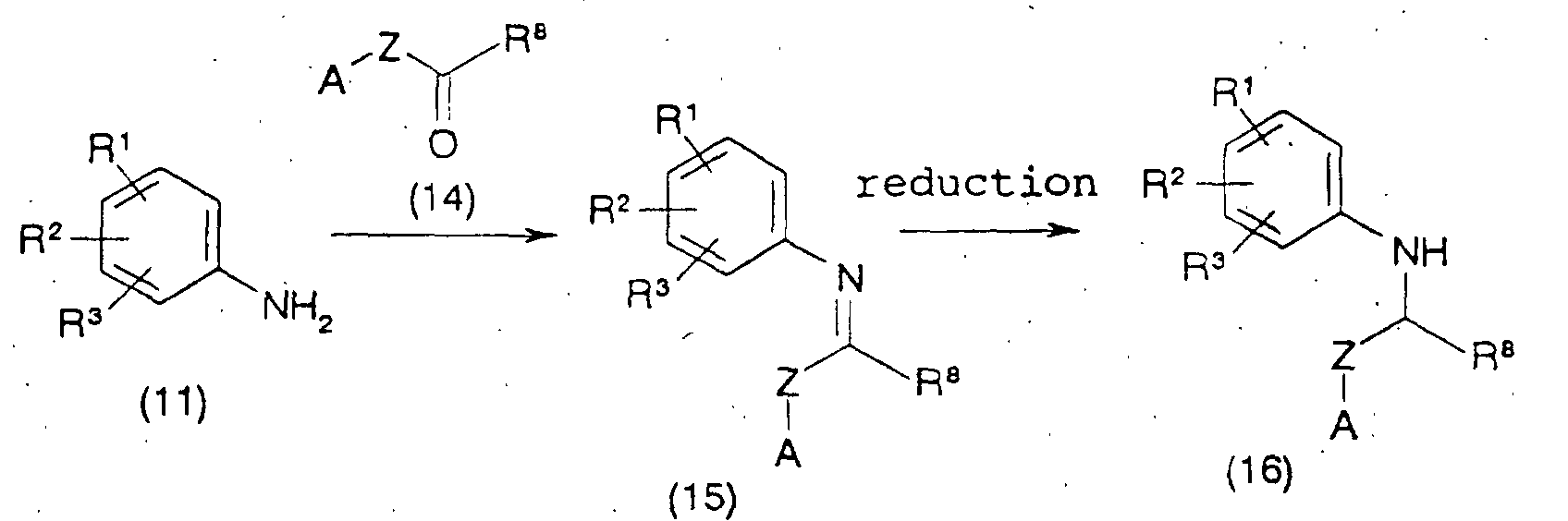

1H-NMR(CDCl3)δ: 0.85(3H, t, J=6.6Hz), 1.27-1.30(10H, m), 1.59(2H, t, J=7.3Hz), 2.58(2H, t, J=7.3Hz), 4.29(2H, s), 6.56(2H, d, J=8.6Hz), 6.97(2H, d, J=8.6Hz), 7.26-7.38(5H, m).
1H-NMR(CDCl3)δ: 0.87(3H, t, J=6.8Hz), 1.22-1.41(10H, m), 1.53(2H, t, J=7.9Hz), 2.48(2H, t, J=7.9Hz), 2.92(6H, s), 4.17(2H, s), 6.58(2H, d, J=8.0Hz), 6.70(2H, d, J=8.0Hz), 6.98(2H, d, J=8.0Hz), 7.23(2H, d, J=8.0Hz).
1H-NMR(CDCl3)δ: 1.20(6H, d, J=7.3Hz), 1.24(6H, d, J=7.3Hz), 2.80(1H, m), 2.90(1H, m), 3.84(1H, s),4.25(2H, s), 6.58(2H, d, J=8.6Hz), 7.04(2H, d, J=8.6Hz), 7.19(2H, d, J=7.9Hz), 7.29(2H, d, J=7.9Hz).
1H-NMR(CDCl3)δ: 1.19(6H, d, J=6.6Hz), 2.80(1H, m), 3.84(1H, s), 4.26(2H, s), 6.53(2H, d, J=8.6Hz), 7.03(2H, d, J=8.6Hz), 7.18(1H, dd, J=2.0, 8.0Hz), 7.37(1H, d,J =8.0Hz), 7.45(1H, d, J=2.0Hz).
1H-NMR(CDCl3)δ: 1.19(6H, d, J=7.3Hz), 2.70-2.82(1H, m), 4.19(2H, s), 5.91(2H, s), 6.57(2H, d, J=8.6Hz), 6.59-6.86(4H, m), 7.03(2H, d, J=8.6Hz).
1H-NMR(CDCl3)δ: 1.19(6H, d, J=7.3Hz), 2.70-2.82(1H, m), 3.78(3H, s), 3.81(3H, s), 4.21(2H, s), 6.40-6.46(2H, m), 6.60(2H, d, J=8.6Hz), 7.03(2H, d, J=8.6Hz), 7.20(1H, d, J=8.0Hz).
1H-NMR(CDCl3)δ: 1.20(6H, d, J=7.3Hz), 2.30(3H, s), 2.32(3H, s), 2.83(1H, m), 3.84(1H, s), 4.19(2H, s), 6.57(2H, d, J=8.6Hz), 7.03(2H, d, J=8.6Hz), 6.89-7.22(5H,m).
1H-NMR(CDCl3)δ: 1.20(6H, d, J=6.6Hz), 2.80(1H, m), 3.84(1H, s), 4.26(2H, s), 6.57(2H, d, J=8.8Hz), 6.97-7.05(4H, m), 7.30-7.35(2H, m).
1H-NMR(CDCl3)δ: 1.19(6H, d, J=6.6Hz), 2.80(1H, m), 3.84(1H, s), 4.38(2H, s), 6.56(2H, d, J=8.6Hz), 7.04(2H, d, J=8.6Hz), 7.47(2H, d, J=8.8Hz), 7.58(2H, d, J=8.8Hz).
1H-NMR(CDCl3)δ: 1.17(6H, d, J=7.2Hz), 2.79(1H, m), 4.36(2H, s), 6.53(2H, d, J=8.6Hz), 7.03(2H, d, J=8.6Hz), 7.14-7.19(1H, m), 7.33-7.38(2H, m).
1H-NMR(CDCl3)δ: 1.19(6H, d, J=6.6Hz), 2.47(3H, s), 2.80(1H, m), 3.87(1H, s), 4.36(2H, s), 6.57(2H, d, J=8.6Hz), 7.04(2H, d, J=8.6Hz), 7.23(2H, d, J=8.5Hz), 7.29(2H, d, J=8.5Hz).
1H-NMR(CDCl3)δ: 0.88(3H, t, J=6.6Hz), 1.20-1.40(10H, m), 1.53-1.59(2H, m), 2.50(2H, t, J=8.1Hz), 4.45(2H, s), 6.64(2H, d, J=8.6Hz), 7.00(2H, d, J=8.6Hz), 7.10-7.19(2H, m), 7.37(1H, d, J=8.0Hz), 7.67(1H, d, J=8.0Hz), 8.02(1H, s).
1H-NMR(CDCl3)δ: 1.21(6H, d, J=6.9Hz), 1.47(3H, t, J=7.3Hz), 2.81(1H, sept, J=6.9Hz), 3.57-3.78(1H, brs), 4.14(2H, q, J=7.3Hz), 4.15(2H, s), 6.62(2H, d, J=8.4Hz), 7.06(2H, d, J=8.4Hz), 7.36(1H, s), 7.47(1H, s)
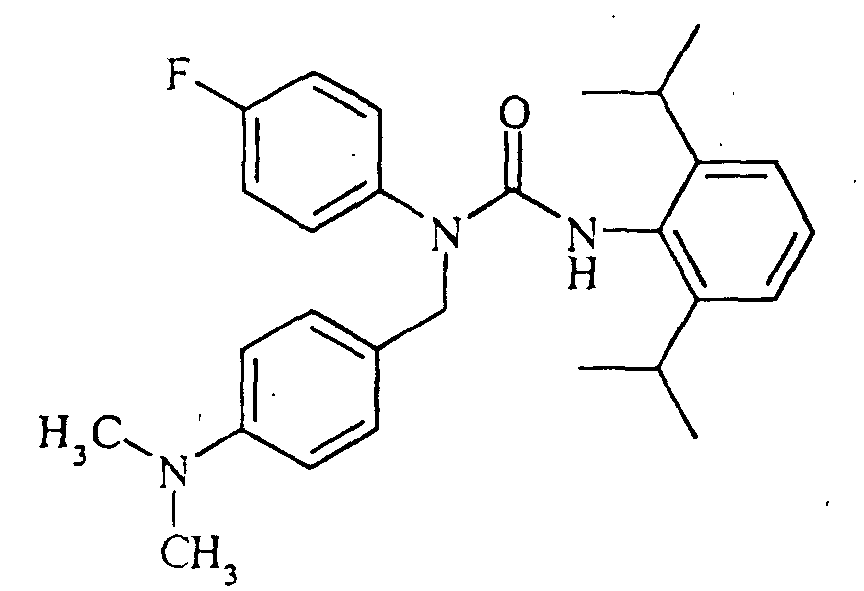

1H-NMR(CDCl3)δ: 0.92(3H, t, J=7.3Hz), 1.16(12H, d, J=6.6Hz), 1.20-1.50(2H, m), 1.52-1.70(2H, m), 2.59(2H, t, J=7.9Hz), 2.93(6H, s), 3.00-3.20(2H, m), 4.79(2H, s), 5.41(1H, s), 6.65(2H, d, J=9.2Hz), 7.00-7.22(9H, m).
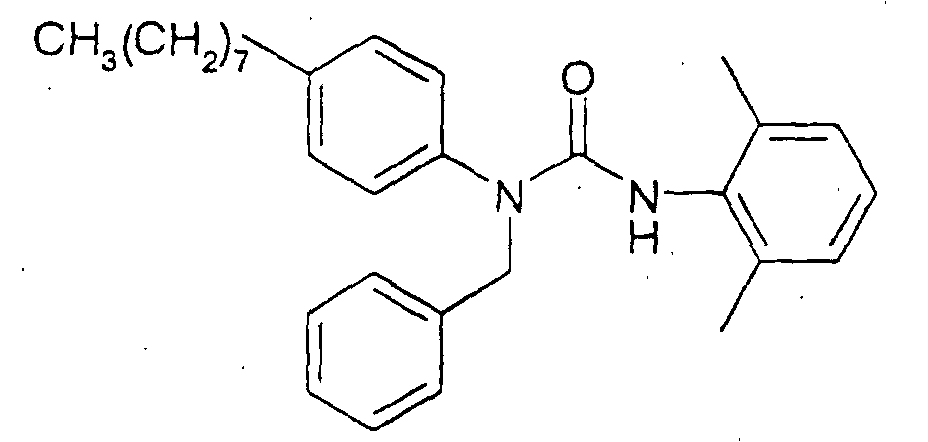
1H-NMR(CDCl3)δ: 0.86(3H, t, J=7.2Hz), 1.25-1.30(10H, m), 1.56-1.61(2H, m), 1.68(2H, m), 2.21(6H, s), 2.58(2H, t, J=7.9Hz), 4.90(2H, s), 5.56(1H, s), 7.01(2H, s), 7.08(2H, d, J=7.9Hz), 7.17(2H, d, J=7.9Hz), 7.22-7.30(6H, m).

1H-NMR(CDCl3)δ: 0.87(3H, t, J=7.2Hz), 1.17(12H, d, J=6.6Hz), 1.25-1.30(10H, m), 1.68(2H, m), 2.58(2H, t, J=7.9Hz), 3.08(2H, m), 4.98(2H, s), 5.56(1H, s), 7.09-7.13(4H, m), 7.20-7.26(3H, m), 7.50(2H, d, J=8.6Hz), 8.15(2H, d, J=8.6Hz).

1H-NMR(CDCl3)δ: 0.91(3H, t, J=7.3Hz), 1.16(12H, d, J=6.6Hz), 1.27-1.40(2H, m), 1.52-1.63(2H, m), 2.60(2H, t, J=7.9Hz), 3.10(2H, m), 4.90(2H, s), 5.48(1H, s), 7.06-7.30(12H, m).


1H-NMR(CDCl3)δ: 0.88(3H, t, J=7.3Hz), 1.17(12H, d, J=6.6Hz), 1.20-1.46(8H, m), 1.69-1.81(2H, m), 3.04-3.14(2H, m), 3.94(2H, t, J=6.6Hz), 4.86(2H, s), 5.47(1H, s), 6.86(2H, d, J=9.0Hz), 7.03-7.30(10H, m).
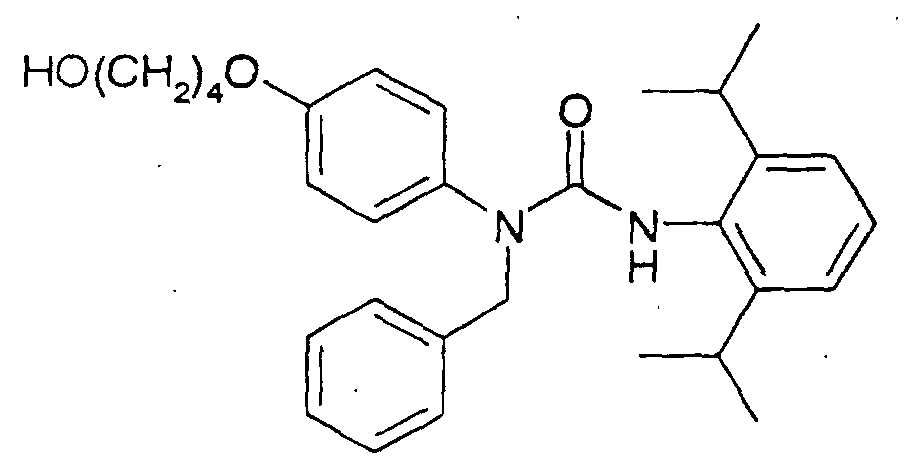
1H-NMR(CDCl3)δ: 1.16(12H, d, J=6.6Hz), 1.55(1H, brs), 1.61-1.71(2H, m), 1.78-1.88(2H, m), 3.03-3.14(2H, m), 3.61(2H, m), 3.94(2H, t, J=6.6Hz), 4.86(2H, s), 5.48(1H, s), 6.84(2H, d, J=8.6Hz), 7.18-7.30(10H, m).

1H-NMR(CDCl3)δ: 1.17(12H, d, J=7.3Hz), 1.24(6H, d, J=6.6Hz), 2.83-2.99(1H, m), 3.01-3.15(2H, m), 4.84(2H, s), 5.49(1H, s), 7.07-7.12(4H, m), 7.21-7.28(7H, m).
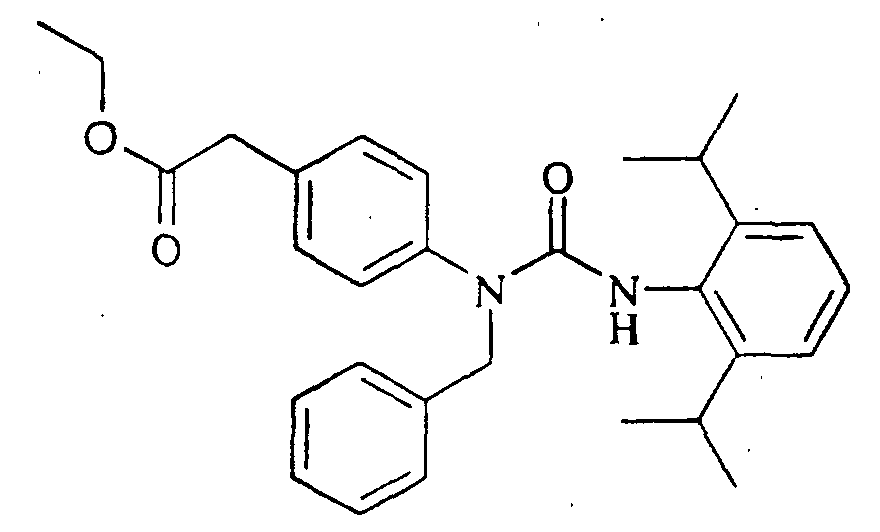
1H-NMR(CDCl3)δ: 1.16(12H, d, J=6.6Hz), 1.21(3H, t, J=7.3Hz), 3.03-3.14(2H, m), 3.60(2H, s), 4.14(2H, q, J=7.3Hz), 4.90(2H, s), 5.49(1H, s), 7.09-7.38(12H, m).

1H-NMR(CDCl3)δ: 0.87(3H, t, J=6.8Hz), 1.16(12H, d, J=6.6Hz), 1.22-1.41(10H, m), 1.53(2H, t, J=7.9Hz), 2.56(2H, t, J=7.9Hz), 3.09(2H, m), 3.78(3H, s), 4.82(2H, s), 5.43(1H, s), 7.05(2H, d, J=8.0Hz), 7.07-7.22(9H, m).

1H-NMR(CDCl3)δ: 0.86(3H, t, J=6.6Hz), 1.16(12H, d, J=6.6Hz), 1.20-1.30(10H, m), 1.49-1.59(2H, m), 2.60(2H, t, J=8.8Hz), 3.01-3.16(2H, m), 4.87(2H, s), 5.47(1H, s), 7.09-7.35(16H, m).

1H-NMR(CDCl3)δ: 0.85(3H, t, J=6.6Hz), 1.16(12H, d, J=6.6Hz), 1.22-1.41(10H, m), 1.58(2H, t, J=7.9Hz), 2.58(2H, t, J=8.0Hz), 2.93(6H, s), 3.09(2H, m), 4.77(2H, s), 5.42(1H, s), 6.65(2H, d, J=8.6Hz), 7.05-7.22(9H, m).

1H-NMR(CDCl3)δ: 0.86(3H, t, J=6.6Hz), 1.16(12H, d, J=6.6Hz), 1.20-1.29(10H, m), 1.49-1.59(2H, m), 2.58(2H, t, J=8.6Hz), 3.02-3.18(2H, m), 3.76(3H, s), 4.87(2H, s), 5.48(1H, s),6.60-6.85(2H, m), 6.93(1H, s), 7.09-7.38(8H, m).
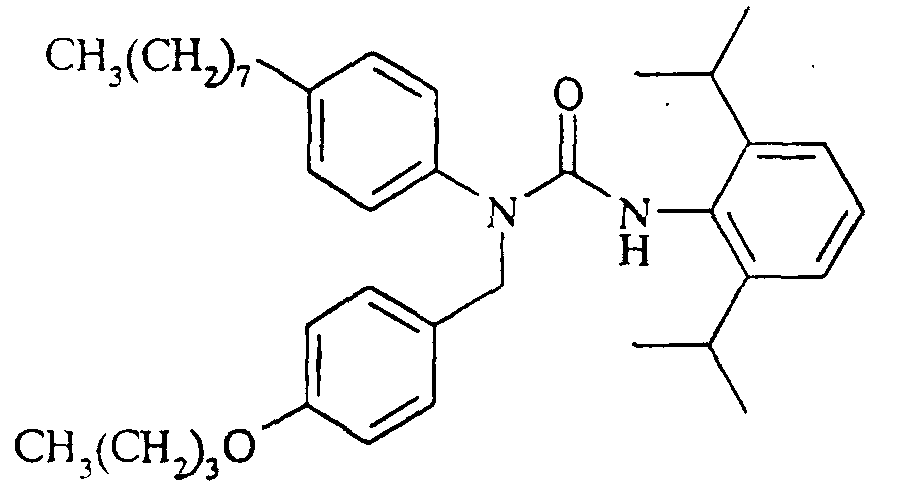


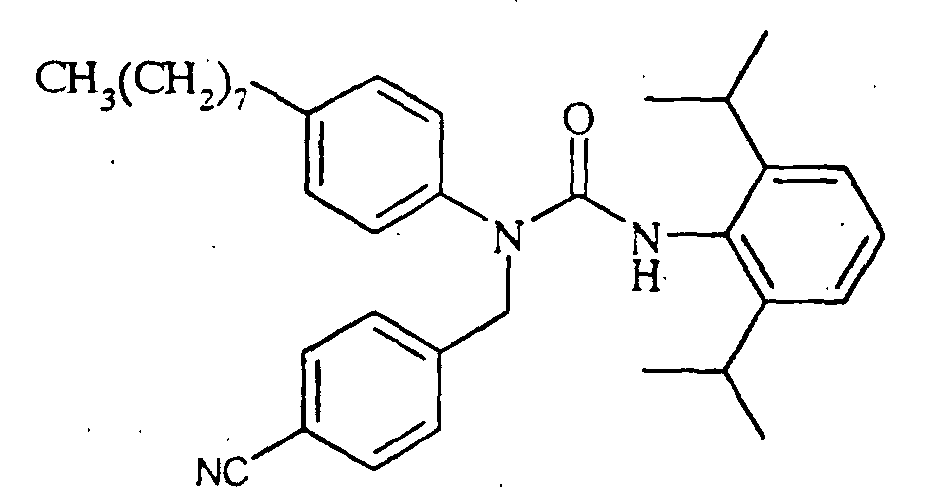
1H-NMR(CDCl3)δ: 0.87(3H, t, J=6.6Hz), 1.16(12H, d, J=6.6Hz), 1.20-1.30(10H, m), 1.51-1.63(2H, m), 2.61(2H, t, J=7.9Hz), 2.98-3.14(2H, m), 4.93(2H, s), 5.56(1H, s), 7.07-7.25(7H, m), 7.44(2H, d, J=7.9Hz), 7.58(2H, d, J=7.9Hz) Example 19

1H-NMR(CDCl3)δ: 0.87(3H, t, J=6.6Hz), 1.17(12H, d, J=6.6Hz), 1.20-1.25(10H, m), 1.54-1.67(2H, m), 2.57(2H, t, J=7.9Hz), 3.05-3.20(2H, m), 3.61(3H, s), 4.98(2H, s), 5.55(1H, s), 6.78(1H, d, J=8.8Hz), 6.91(1H, t, J=7.9Hz), 7.08-7.23(8H, m), 7.43(1H, dd, J=1.3, 7.2Hz).
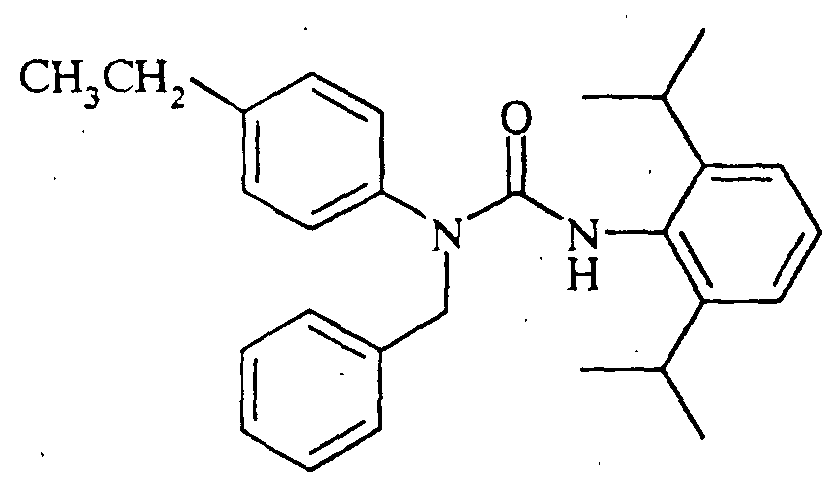
1H-NMR(CDCl3)δ: 1.16-1.27(15H, m), 2.60(2H, q, J=7.3Hz), 3.02-3.15(2H, m), 4.90(2H, s), 5.48(1H, s), 7.07-7.33(12H, m).

1H-NMR(CDCl3)δ: 0.88(3H, t, J=7.2Hz), 1.28-1.32(10H, m), 1.60(2H, m), 2.60(2H, t, J=7.9Hz), 4.90(2H, s), 6.22(1H, s), 6.95-7.31(14H, m).

1H-NMR(CDCl3)δ: 1.16(12H, d, J=6.6Hz), 2.93(6H, s), 3.00-3.20(2H, m), 3.79(3H, s), 4.77(2H, s), 5.40(1H, s), 6.65(2H, d, J=8.6Hz), 6.80-7.30(9H, m).


1H-NMR(CDCl3)δ: 1.16(12H, d, J=6.6Hz), 1.25(3H, t, J=7.2Hz), 2.64(2H, q, J=7.9Hz), 2.93(6H, s), 3.09(2H, m), 4.78(2H, s), 5.42(1H, s), 6.66(2H, d, J=8.6Hz), 6.86-7.22(9H, m).


1H-NMR(CDCl3)δ: 1.16(12H, d, J=6.6Hz), 1.23(6H, d, J=6.6Hz), 2.94(6H, s), 3.04-3.14(2H, m), 3.44-3.51(1H, m), 4.79(2H, s), 5.42(1H, s), 6.66(2H, d, J=8.6Hz), 7.07-7.23(9H, m).


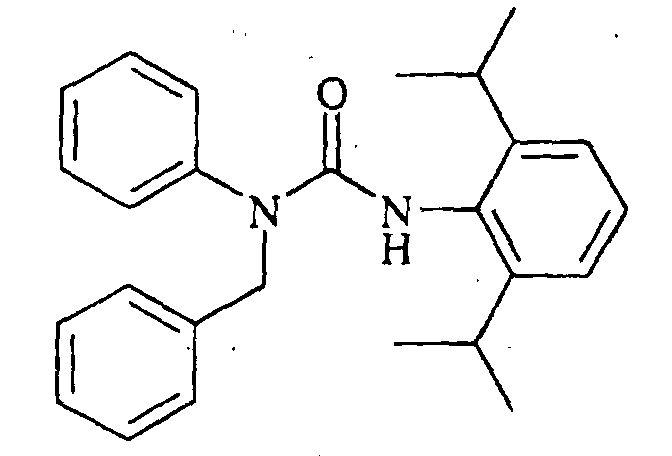
1H-NMR(CDCl3)δ: 1.17(12H, d, J=7.2Hz), 3.02-3.18(2H, m), 4.92(2H, s), 5.45(1H, s), 7.09-7.42(13H, m).


1H-NMR(CDCl3)δ: 0.92(3H, t, J=7.9Hz), 1.16(12H, d, J=6.6Hz), 1.58-1.67(2H, m), 2.57(2H, t, J=8.0Hz), 2.93(6H, s), 3.04-3.14(2H, m), 4.78(2H, s), 5.42(1H, s), 6.66(2H, d, J=8.6Hz), 6.86-7.22(9H, m).


1H-NMR(CDCl3)δ: 1.16(12H, d, J=6.6Hz), 1.40(3H, t, J=8.0Hz), 2.93(6H, s), 3.03-3.18(2H, m), 4.02(2H, q, J=6.5Hz), 4.75(2H, s), 5.40(1H, s), 6.66(2H, d, J=9.2Hz), 6.86(2H, d, J=9.2Hz), 7.03-7.20(7H, m).

1H-NMR(CDCl3)δ: 1.16(6H, d, J=6.6Hz), 1.17(12H, d, J=6.6Hz), 2.81-2.89(1H, m), 2.92(6H, s), 3.00-3.30(2H, m), 4.80(2H, s), 5.40(1H, s), 6.65(2H, d, J=9.3Hz), 6.96-7.31(9H, m).

1H-NMR(CDCl3)δ: 1.16(12H, d, J=6.6Hz), 2.93(6H, s), 2.94(6H, s), 3.01-3.19(2H, m), 4.75(2H, s), 5.48(1H, s), 6.65(4H, d, J=8.3Hz), 6.98(2H, dd, J=2.0, 6.6Hz), 7.14-7.21(5H, m).
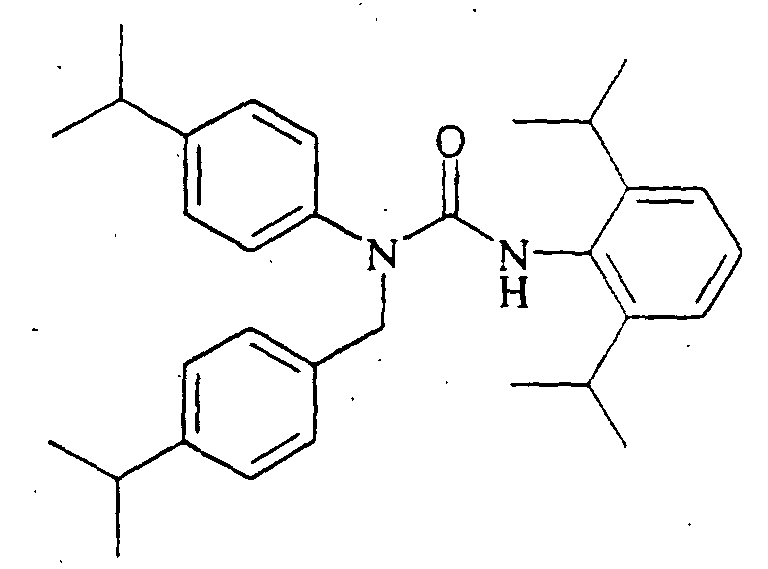
1H-NMR(CDCl3)δ: 1.16(12H, d, J=6.6Hz), 1.23(6H, d, J=6.6Hz), 1.25(6H, d, J=6.6Hz), 2.89(2H, m), 3.10(2H, m), 4.86(2H, s), 5.48(1H, s), 7.08-7.25(11H, m).

1H-NMR(CDCl3)δ: 1.16(12H, d, J=6.6Hz), 1.27(6H, d, J=6.6Hz), 2.87-3.01(1H, m), 3.04-3.27(2H, m), 3.32(3H, s), 5.51(1H, s), 7.10(2H, d, J=7.3Hz), 7.18(1H, d, J=6.6Hz), 7.33(4H, s).

1H-NMR(CDCl3)δ: 0.91(3H, t, J=7.2Hz), 1.16(12H, d, J=6.6Hz), 1.27(6H, d, J=7.2Hz), 1.30-1.60(4H, m), 2.87-3.01(1H, m), 3.04-3.27(2H, m), 3.72(2H, t, J=7.3Hz), 5.38(1H, s), 7.05(2H, d, J=8.6Hz), 7.19-7.35(7H, m).


1H-NMR(CDCl3)δ: 1.15(12H, d, J=6.6Hz), 1.22(3H, d, J=6.6Hz), 1.29(3H, d, J=6.6Hz), 2.93(6H, s), 3.09-3.14(2H, m), 3.33-3.49(1H, m), 3.96(1H, d, J=14Hz), 5.30(1H, s), 5.49(1H, d, J=14Hz), 6.62(2H, dd, J=2.0, 6.6Hz), 6.77(1H, dd, J=1.3, 6.6Hz), 7.08-7.44(8H, m).

1H-NMR(CDCl3)δ: 1.16(12H, d, J=6.6Hz), 2.22(3H, s), 2.24(3H, s), 2.93(6H, s), 3.05-3.20(2H, m), 4.78(2H, s), 5.45(1H, s), 6.66(2H, d, J=8.6Hz), 6.86(1H, dd, J=2.6, 8.0Hz), 6.98(1H, d, J=2.0Hz), 7.08-7.20(6H, m)

1H-NMR(CDCl3)δ: 1.19(12H, d, J=7.4Hz), 1.24(6H, d, J=6.6Hz), 2.92(1H, m), 3.08(2H, m), 4.83(2H, s), 5.51(1H, s), 7.09-7.29(8H, m), 7.35(1H, d, J=8.5Hz), 7.47(1H, d, J=2.0Hz).
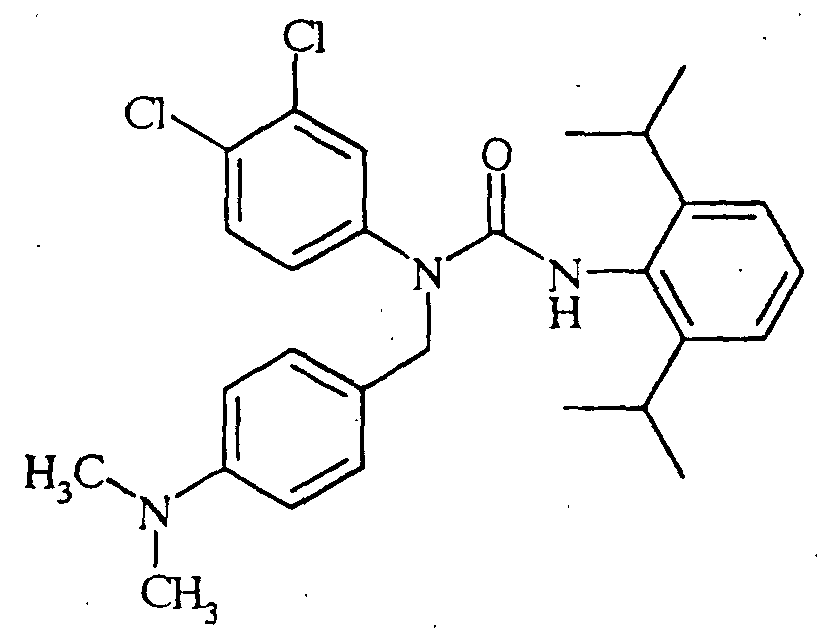

1H-NMR(CDCl3)δ: 1.16(12H, d, J=7.4Hz), 1.22(6H, d, J=6.6Hz), 2.81-2.91(1H, m), 3.05-3.17(2H, m), 3.54(3H, s), 3.79(3H, s), 4.90(2H, s), 5.50(1H, s), 6.35(1H, d, J=2.0Hz), 6.45(1H, d, J=8.0Hz), 7.08-7.34(8H, m).
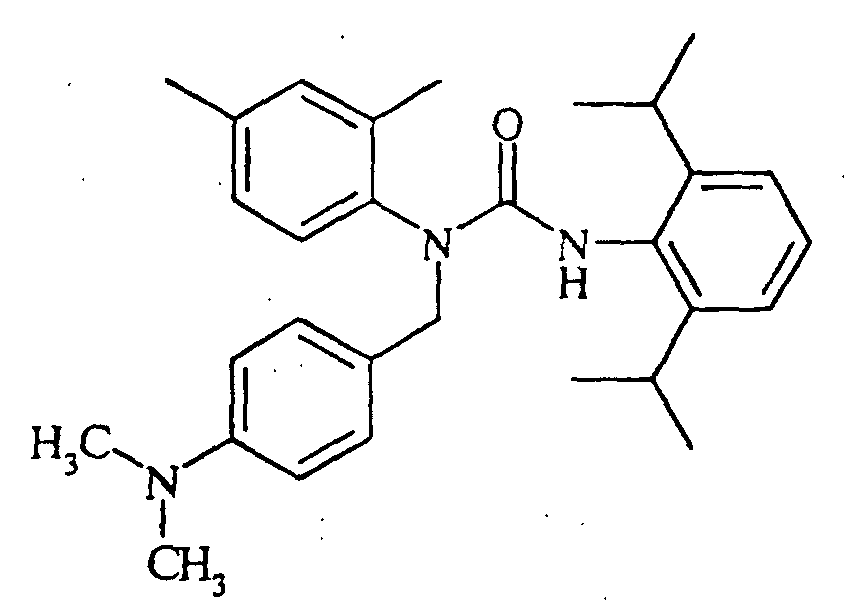

1H-NMR(CDCl3)δ: 1.18(12H, d, J=7.4Hz), 1.24(6H, d, J=6.6Hz), 2.81-2.99(1H, m), 3.03-3.17(2H, m), 4.79(2H, s), 5.46(1H, s), 5.94(2H, s), 6.68(2H, d, J=1.3Hz), 6.91(1H, s), 7.09-7.25(7H, m).
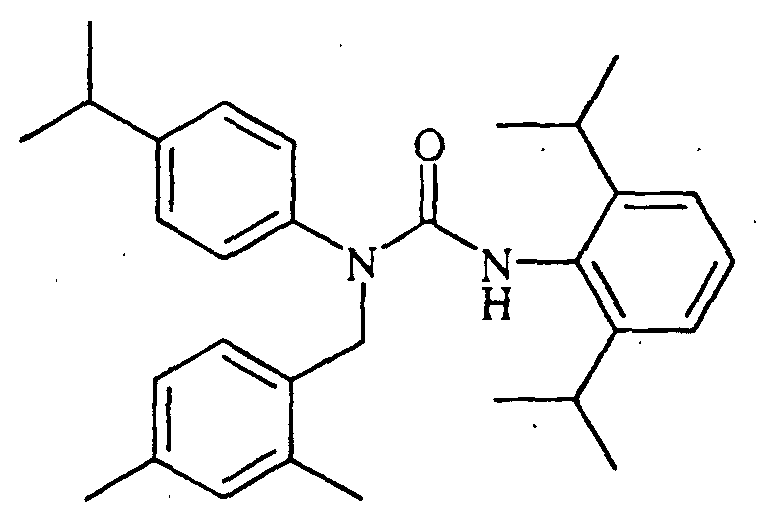

1H-NMR(CDCl3)δ: 1.18(12H, d, J=6.6Hz), 1.24(6H, d, J=6.6Hz), 2.91(1H, m), 3.11(2H, m), 4.93(2H, s), 5.51(1H, s), 7.10-7.62(16H, m).


1H-NMR(CDCl3)δ: 1.16(12H, d, J=7.3Hz), 1.24(6H, d, J=6.6Hz), 2.85-2.95(1H, m), 3.00-3.15(2H, m), 4.82(2H, s), 5.48(1H, s), 7.05-7.13(4H, m), 7.18-7.30(5H, m), 7.35-7.45(2H, m).

1H-NMR(CDCl3)δ: 1.16(12H, d, J=7.2Hz), 1.23(6H, d, J=6.6Hz), 2.86-3.00(1H, m), 3.03-3.31(2H, m), 3.82(3H, s), 4.78(2H, s), 5.41(1H, s), 6.55-6.68(1H, m), 6.70-6.80(1H, m), 7.01-7.26(8H, m).
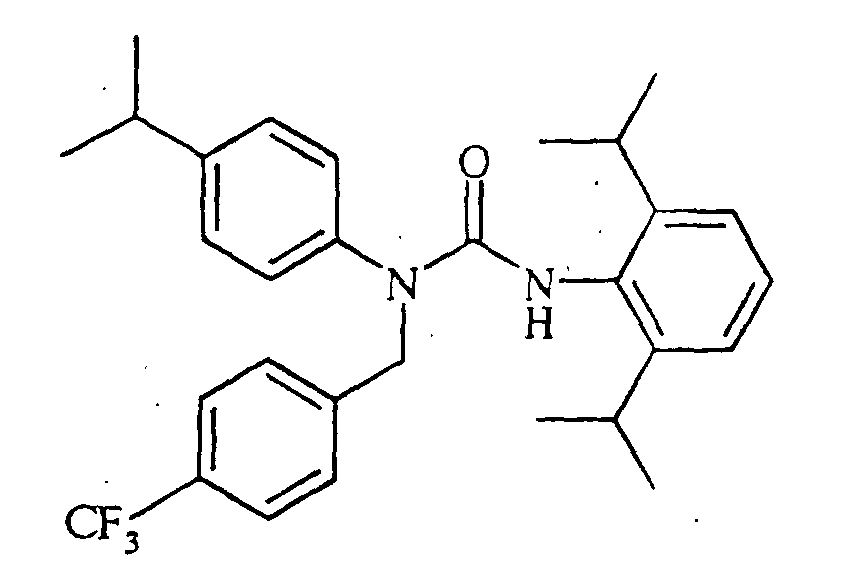
1H-NMR(CDCl3)δ: 1.17(12H, d, J=6.4Hz), 1.24(6H, d, J=6.5Hz), 2.89-2.98(1H, m), 3.05-3.18(2H, m), 4.94(2H, s), 5.52(1H, s), 7.05-7.30(7H, m), 7.45(2H, d, J=7.9Hz), 7.55(2H, d, J=7.9Hz).

1H-NMR(CDCl3)δ: 1.15(12H, d, J=7.3Hz), 1.23(6H, d, J=7.3Hz), 1.38(18H, s), 2.85-2.98(1H, m), 3.00-3.16(2H, m), 4.80(2H, s), 5.11(1H, s), 5.44(1H, s), 6.99-7.26(9H, m).
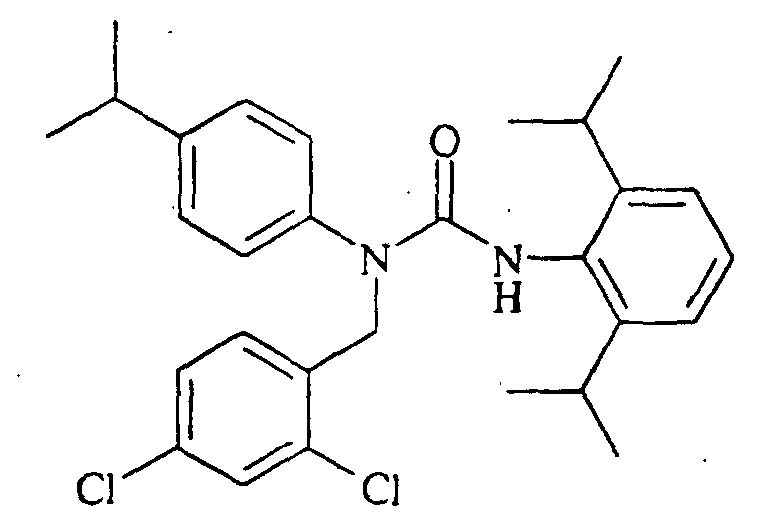
1H-NMR(CDCl3)δ: 1.17(12H, d, J=6.6Hz), 1.23(6H, d, J=6.6Hz), 2.85-3.00(1H, m), 3.00-3.20(2H, m), 5.03(2H, s), 5.58(1H, s), 7.10-7.31(9H, m), 7.50(1H, d, J=7.9Hz).
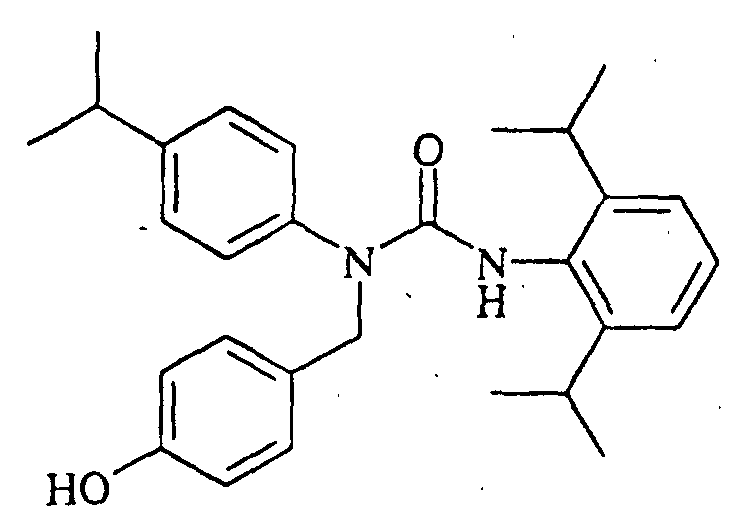
1H-NMR(CDCl3)δ: 1.15(12H, d, J=7.3Hz), 1.24(6H, d, J=7.3Hz), 2.85-2.93(1H, m), 3.04-3.12(2H, m), 4.79(2H, s), 5.46(1H, s), 5.92(1H, s), 6.64(2H, d, J=8.6Hz), 7.05-7.30(9H, m).


1H-NMR(CDCl3)δ: 1.16(12H, d, J=7.3Hz), 1.23(6H, d, J=7.3Hz), 2.48(3H, s), 2.80-2.98(1H, m), 3.01-3.15(2H, m), 4.84(2H, s), 5.46(1H, s), 7.08-7.26(11H, m).


1H-NMR(CDCl3)δ: 1.12(12H, d, J=6.8Hz), 1.25(6H, d, J=6.9Hz), 2.88-3.06(3H, m), 4.67(2H, s), 5.25(2H, s), 5.39(1H, s), 7.08-7.31(12H, m), 7.41-7.43(2H, m)

1H-NMR(DMSO-d6)δ: 1.08(12H, d, J=6.9Hz), 1.20(6H, d, J=6.9Hz), 2.51(3H, s), 2.85-2.94(1H, m), 3.02-3.11(2H, m), 4.67(2H, s), 5.72(2H, s), 7.07-7.09(3H, m), 7.16-7.19(3H, m), 7.27-7.30(3H, m), 7.42(1H, s), 7.77(1H, d, J=5.6Hz), 7.83(1H, s), 8.74(1H, d, J=5.9Hz)

1H-NMR(CDCl3)δ: 0.88(3H, t, J=6.7Hz), 1.15(12H, d, J=6.6Hz), 1.24-1.28(14H, m), 1.77-1.78(2H, m), 2.88-2.98(1H, m), 3.00-3.09(2H, m), 4.04(2H, t, J=7.1Hz), 4.67(2H, s), 5.42(1H, s), 7.09-7.21(5H, m), 7.27(2H, d, J=8.2Hz), 7.35(1H, s), 7.43(1H, s)
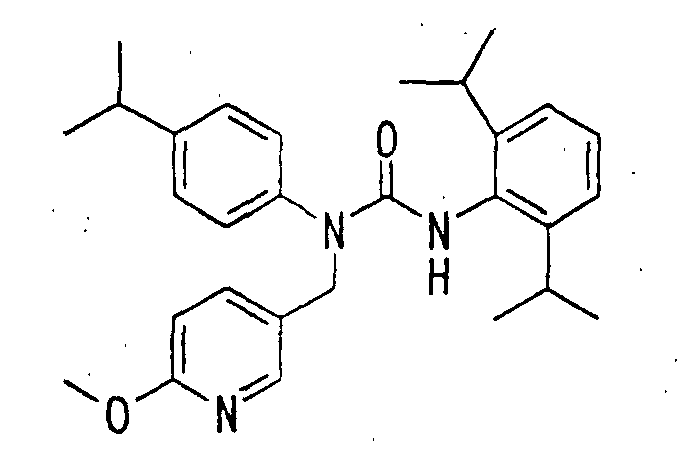
1H-NMR(CDCl3)δ: 1.16(12H, d, J=6.7Hz), 1.24(6H, d, J=6.9Hz), 2.87-2.96(1H, m), 3.00-3.09(2H, m), 3.92(3H, s), 4.81(2H, s), 5.45(1H, s), 6.71(1H, d, J=8.3Hz), 7.06-7.12(4H, m), 7.22-7.27(3H, m), 7.73-7.88(1H, m), 7.88(1H, s)
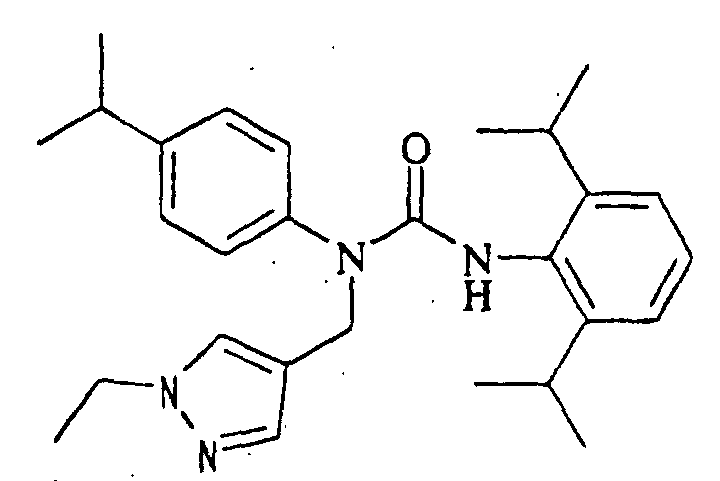
1H-NMR(CDCl3)δ: 1.14(12H, d, J=6.9Hz), 1.26(6H, d, J=6.9Hz), 1.45(3H, t, J=7.3Hz), 2.94(1H, sept, J=6.9Hz), 3.04(2H, sept, J=6.9Hz), 4.12(2H, q, J=7.3Hz), 4.66(2H, s), 5.41(1H, s), 7.09-7.29(7H, m), 7.34(1H, s), 7.36(1H, s), 7.48(1H,s)
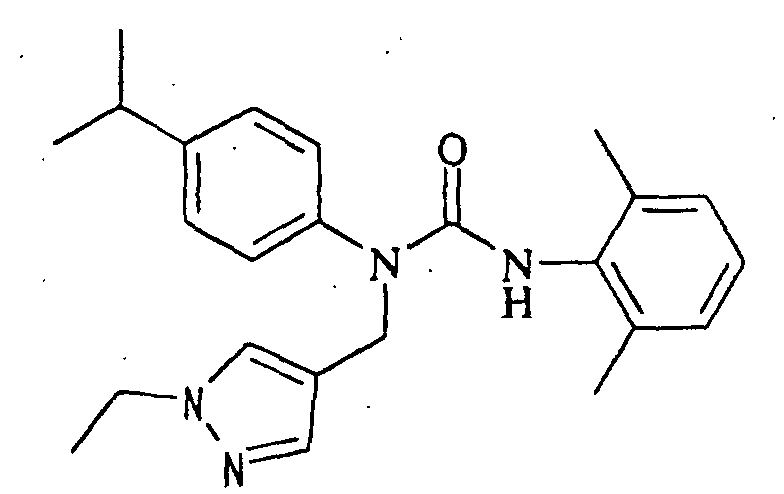
1H-NMR(CDCl3)δ: 1.26(6H, d, J=6.9Hz), 1.45(3H, t, J=7.3Hz), 2.18(6H, s), 2.93(1H, sept, J=6.9Hz), 4.13(2H, q, J=7.3Hz), 4.69(2H, s), 5.49(1H, s), 7.01(3H, s), 7.15(2H, d, J=8.4Hz), 7.27(2H, d, J=8.4Hz), 7.34(1H, s), 7.44(1H, s)

| ingredients | per tablet |
| compound of Example 1 | 10 mg |
| lactose | 125 mg |
| corn starch | 75 mg |
| talc | 4 mg |
| magnesium stearate | 1 mg |
| total weight | 215 mg |
| ingredients | per capsule |
| compound of Example 1 | 10 mg |
| lactose | 165 mg |
| corn starch | 20 mg |
| talc | 5 mg |
| weight of a capsule | 200 mg |
| ingredients | dose |
| compound of Example 1 | 0.2 g |
| white petrolatum | 97.8 g |
| liquid paraffin | 2 g |
| total weight | 100 g |
| ingredients | dose |
| compound of Example 1 | 0.2 g |
| sodium chloride | 0.9 g |
| distilled water for injection suitable amount total weight | 100 g |
| ingredients | |
| compound of Example 1 | 0.1 g |
| sodium chloride | 0.3 g |
| sterile purified water suitable amount total weight | 100 g |
% Inhibition = 100-[(Test-Non)/(Total-Non)]×100
% inhibition = 100-[(Test-Min)/(Max-Min)]×100
% inhibition = 100-[(Test-Min)/(Max-Min)]×100
% inhibition = 100-[(Test-Min)/(Max-Min)]×100
% inhibition = 100-[(Test-Min)/(Max-Min)]×100
Test: decrease rate of neutrophiles in peripheral blood when
test compound and human C5a were administered
Min: decrease rate of neutrophiles in peripheral blood upon
administration of administration medium for test
compound and administration medium for human C5a
Max: decrease rate of neutrophiles in peripheral blood upon
administration of administration medium for test
compound and human C5a
The bioavailability (BA) is calculated by the following formula.
Claims (12)
- A urea derivative of the formula (1)wherein

- R1, R2 and R3
- are the same or different and each is hydrogen, alkyl optionally having a substituent, cycloalkyl optionally having a substituent, alkenyl optionally having a substituent, alkynyl optionally having a substituent, hydroxy, alkoxy optionally having a substituent, mercapto, alkylthio optionally having a substituent, halogen, nitro, nitrile, amino, alkylamino, cyclic amino, alkylsulfonyl, carbamoyl, acylamino, sulfamoyl, acyl, carboxy, alkoxycarbonyl, aryl optionally having a substituent or heteroaryl optionally having a substituent, D is a bond or alkylene optionally having a substituent, A is alkyl optionally having a substituent, cycloalkyl optionally having a substituent, aryl optionally having a substituent or heteroaryl optionally having a substituent,
- R4 and R5
- are the same or different and each is hydrogen, alkyl optionally having a substituent, alkoxy optionally having a substituent, hydroxy or halogen,
- R6
- is hydrogen, alkyl optionally having a substituent, alkoxy optionally having a substituent, hydroxy or halogen, and
- X
- is oxygen atom or sulfur atom,
- The urea derivative of claim 1, wherein D of the formula (1) is alkylene optionally having a substituent and A is aryl optionally having a substituent or heteroaryl optionally having a substituent, or a pharmaceutically acceptable salt thereof.
- The urea derivative of claim 1 or 2, wherein R1, R2 and R3 of the formula (1) are the same or different and each is hydrogen or alkyl having 2 to 4 carbon atoms, or a pharmaceutically acceptable salt thereof.
- The urea derivative of any of claims 1 to 3, wherein R4 and R5 of the formula (1) are the same or different and each is alkyl, alkoxy or halogen, or a pharmaceutically acceptable salt thereof.
- The urea derivative of any of claims 1 to 4, which is a compound selected from
N-benzyl-N'-(2,6-dimethylphenyl)-N-(4-octylphenyl)urea, N'-(2,6-diisopropylphenyl)-N-[(4-methoxyphenyl)methyl]-N-(4-octylphenyl)urea,
N'-(2,6-diisopropylphenyl)-N-[(4-dimethylaminophenyl)methyl]-N-(4-octylphenyl)urea, N-(4-butylphenyl)-N'-(2,6-diisopropylphenyl)-N-[(4-dimethylaminophenyl)methyl]urea,
N'-(2,6-diisopropylphenyl)-N-[(4-dimethylaminophenyl)methyl]-N-(4-methoxyphenyl)urea,
N'-(2,6-diisopropylphenyl)-N-[(4-dimethylaminophenyl)methyl]-N-(4-ethylphenyl)urea,
N'-(2,6-diisopropylphenyl)-N-[(4-dimethylaminophenyl)methyl]-N-(4-propylphenyl)urea,
N'-(2,6-diisopropylphenyl)-N-[(4-dimethylaminophenyl)methyl]-N-(4-isopropylphenyl)urea,
N'-(2,6-diisopropylphenyl)-N-[(4-dimethylaminophenyl)methyl]-N-(4-ethoxyphenyl)urea,
N'-(2,6-diisopropylphenyl)-N-(4-isopropylphenyl)-N-[(4-isopropylphenyl)methyl]urea,
N-butyl-N'-(2,6-diisopropylphenyl)-N-(4-isopropylphenyl)urea, N-(3,4-dichlorophenylmethyl)-N'-(2,6-diisopropylphenyl)-N-(4-isopropylphenyl)urea,
N'-(2,6-diisopropylphenyl)-N-[(2,4-dimethoxyphenyl)methyl]-N-(4-isopropylphenyl)urea,
N'-(2,6-diisopropylphenyl)-N-[(4-dimethylaminophenyl)methyl]-N-(2,4-dimethylphenyl)urea,
N-(benzo[d]1,3-dioxolen-5-ylmethyl)-N'-(2,6-diisopropylphenyl)-N-(4-isopropylphenyl)urea,
N'-(2,6-diisopropylphenyl)-N-[(2,4-dimethylphenyl)methyl]-N-(4-isopropylphenyl)urea,
N'-(2,6-diisopropylphenyl)-N-[(4-fluorophenyl)methyl]-N-(4-isopropylphenyl)urea,
N-[(4-chlorophenyl)methyl]-N'-(2,6-diisopropylphenyl)-N-(4-isopropylphenyl)urea,
N-[(4-bromophenyl)methyl]-N'-(2,6-diisopropylphenyl)-N-(4-isopropylphenyl)urea,
N'-(2,6-diisopropylphenyl)-N-(4-isopropylphenyl)-N-[(4-trifluoromethylphenyl)methyl]urea,
N-[(2,4-dichlorophenyl)methyl]-N'-(2,6-diisopropylphenyl)-N-(4-isopropylphenyl)urea,
N'-(2,6-diisopropylphenyl)-N-[(4-hydroxyphenyl)methyl]-N-(4-isopropylphenyl)urea and
N'-(2,6-diisopropylphenyl)-N-(4-isopropylphenyl)-N-[(4-methylthiophenyl)methyl]urea,
or a pharmaceutically acceptable salt thereof. - A pharmaceutical composition comprising the urea derivative of any of claims 1 to 5 or a pharmaceutically acceptable salt thereof, and a pharmaceutically acceptable additive.
- A prophylactic or therapeutic drug of a disease, in which C5a is involved, which comprises the urea derivative of any of claims 1 to 5 or a pharmaceutically acceptable salt thereof as an active ingredient.
- The prophylactic or therapeutic drug of claim 7, wherein the disease, in which C5a is involved, is an autoimmune disease, sepsis, adult respiratory distress syndrome, chronic obstructive pulmonary disease, an allergic disease such as asthma and the like, atherosclerosis, cardiac infarction, brain infarction, psoriasis, Alzheimer's disease, ischemia, trauma, burn or serious organ injury.
- A C5a receptor antagonist comprising the urea derivative of any of claims 1 to 5 or a pharmaceutically acceptable salt thereof as an active ingredient.
- The C5a receptor antagonist of claim 9, which is a prophylactic or therapeutic drug of an infectious disease caused by bacteria or virus that invades via the C5a receptor.
- The C5a receptor antagonist of claim 9, which is used in combination with an agent for the prophylaxis or treatment of an autoimmune disease, sepsis, adult respiratory distress syndrome, chronic obstructive pulmonary disease, an allergic disease such as asthma and the like, atherosclerosis, cardiac infarction, brain infarction, psoriasis, Alzheimer's disease, ischemia, trauma, burn or serious organ injury.
- A combination drug with an agent for the prophylaxis or treatment of an autoimmune disease, sepsis, adult respiratory distress syndrome, chronic obstructive pulmonary disease, an allergic disease such as asthma and the like, atherosclerosis, cardiac infarction, brain infarction, psoriasis, Alzheimer's disease, ischemia, trauma, burn or serious organ injury, which comprises the urea derivative of any of claims 1 to 5 or a pharmaceutically acceptable salt thereof as an active ingredient.
Applications Claiming Priority (3)
| Application Number | Priority Date | Filing Date | Title |
|---|---|---|---|
| JP2000243290 | 2000-08-10 | ||
| JP2000243290 | 2000-08-10 | ||
| PCT/JP2001/006902 WO2002014265A1 (en) | 2000-08-10 | 2001-08-10 | Novel 3-substituted urea derivatives and medicinal use thereof |
Publications (4)
| Publication Number | Publication Date |
|---|---|
| EP1308438A1 true EP1308438A1 (en) | 2003-05-07 |
| EP1308438A4 EP1308438A4 (en) | 2005-09-28 |
| EP1308438B1 EP1308438B1 (en) | 2010-10-20 |
| EP1308438B9 EP1308438B9 (en) | 2012-03-28 |
Family
ID=18734165
Family Applications (1)
| Application Number | Title | Priority Date | Filing Date |
|---|---|---|---|
| EP01955657A Expired - Lifetime EP1308438B9 (en) | 2000-08-10 | 2001-08-10 | 3-substituted urea derivatives and medicinal use thereof |
Country Status (11)
| Country | Link |
|---|---|
| US (1) | US7105567B2 (en) |
| EP (1) | EP1308438B9 (en) |
| JP (1) | JP5059275B2 (en) |
| KR (1) | KR100802332B1 (en) |
| CN (1) | CN1231464C (en) |
| AT (1) | ATE485266T1 (en) |
| AU (1) | AU2001277751A1 (en) |
| CA (1) | CA2418652C (en) |
| DE (1) | DE60143297D1 (en) |
| ES (1) | ES2353077T3 (en) |
| WO (1) | WO2002014265A1 (en) |
Cited By (6)
| Publication number | Priority date | Publication date | Assignee | Title |
|---|---|---|---|---|
| WO2004043925A3 (en) * | 2002-11-08 | 2004-08-05 | Neurogen Corp | 3-substituted-6-aryl pyridined as ligands of c5a receptors |
| US6777422B2 (en) | 2002-03-28 | 2004-08-17 | Neurogen Corp. | Substituted tetrahydroisoquinolines as C5a receptor modulators |
| US6858637B2 (en) | 2002-03-28 | 2005-02-22 | Neurogen Corporation | Substituted biaryl amides as C5a receptor modulators |
| WO2005092366A1 (en) * | 2004-03-26 | 2005-10-06 | Promics Pty Limited | TREATMENT OF NEUROLOGICAL CONDITIONS USING COMPLEMENT C5a RECEPTOR MODULATORS |
| WO2006128670A1 (en) * | 2005-05-30 | 2006-12-07 | Jerini Ag | C5a receptor antagonists |
| US7919459B2 (en) | 2002-04-08 | 2011-04-05 | Promics Pty Limited | Use of C5a receptor antagonist in the treatment of fibrosis |
Families Citing this family (22)
| Publication number | Priority date | Publication date | Assignee | Title |
|---|---|---|---|---|
| US6884815B1 (en) | 1999-09-28 | 2005-04-26 | Neurogen Corporation | High affinity small molecule C5a receptor modulators |
| US6723743B1 (en) | 1999-09-28 | 2004-04-20 | Neurogen Corporation | High affinity small molecule C5a receptor modulators |
| WO2002022556A1 (en) * | 2000-09-14 | 2002-03-21 | Mitsubishi Pharma Corporation | Novel amide derivatives and medicinal use thereof ugs |
| KR20040093487A (en) | 2002-03-29 | 2004-11-05 | 뉴로젠 코포레이션 | New aryl imidazoles and related compounds as c5a receptor modulators |
| CA2480082A1 (en) * | 2002-03-29 | 2003-10-16 | Neurogen Corporation | Combination therapy for the treatment of conditions with pathogenic inflammatory components |
| US8998846B2 (en) | 2006-11-20 | 2015-04-07 | Lutonix, Inc. | Drug releasing coatings for balloon catheters |
| US9737640B2 (en) | 2006-11-20 | 2017-08-22 | Lutonix, Inc. | Drug releasing coatings for medical devices |
| US8414910B2 (en) | 2006-11-20 | 2013-04-09 | Lutonix, Inc. | Drug releasing coatings for medical devices |
| US8425459B2 (en) | 2006-11-20 | 2013-04-23 | Lutonix, Inc. | Medical device rapid drug releasing coatings comprising a therapeutic agent and a contrast agent |
| US8414526B2 (en) | 2006-11-20 | 2013-04-09 | Lutonix, Inc. | Medical device rapid drug releasing coatings comprising oils, fatty acids, and/or lipids |
| US8414525B2 (en) | 2006-11-20 | 2013-04-09 | Lutonix, Inc. | Drug releasing coatings for medical devices |
| US8414909B2 (en) | 2006-11-20 | 2013-04-09 | Lutonix, Inc. | Drug releasing coatings for medical devices |
| US9700704B2 (en) | 2006-11-20 | 2017-07-11 | Lutonix, Inc. | Drug releasing coatings for balloon catheters |
| US20080276935A1 (en) | 2006-11-20 | 2008-11-13 | Lixiao Wang | Treatment of asthma and chronic obstructive pulmonary disease with anti-proliferate and anti-inflammatory drugs |
| EP2167464B1 (en) * | 2007-05-25 | 2014-12-03 | AbbVie Deutschland GmbH & Co KG | Heterocyclic compounds as positive modulators of metabotropic glutamate receptor 2 (mglu2 receptor) |
| RS54998B1 (en) | 2008-12-22 | 2016-11-30 | Chemocentryx Inc | C5AR ANTAGONISTS |
| RS56332B1 (en) | 2010-06-24 | 2017-12-29 | Chemocentryx Inc | C5ar antagonists |
| DK3200791T3 (en) | 2014-09-29 | 2020-05-25 | Chemocentryx Inc | Methods and intermediates in the preparation of C5AR antagonists |
| JP7339733B2 (en) | 2016-01-14 | 2023-09-06 | ケモセントリックス,インコーポレイティド | Methods of treating C3 nephropathy |
| CN106946781B (en) * | 2017-04-24 | 2019-04-19 | 合肥工业大学 | A kind of pyrazole diphenyl urea derivatives and its preparation method and use |
| CN113354621B (en) * | 2021-06-04 | 2022-05-17 | 沈阳药科大学 | 1-substituted benzyl-3-aryl urea compound and preparation method and application thereof |
| KR102783985B1 (en) * | 2021-10-12 | 2025-03-21 | 주식회사 메타이뮨 | Novel capsid assembly inhibitors |
Family Cites Families (9)
| Publication number | Priority date | Publication date | Assignee | Title |
|---|---|---|---|---|
| DE1197613B (en) * | 1960-05-07 | 1965-07-29 | Bayer Ag | Anti-aging, anti-ozone and anti-fatigue agents |
| DE2928485A1 (en) * | 1979-07-14 | 1981-01-29 | Bayer Ag | USE OF UREA DERIVATIVES AS A MEDICINAL PRODUCT IN THE TREATMENT OF FATTY METABOLISM DISORDERS |
| US4868210A (en) * | 1988-03-30 | 1989-09-19 | Warner-Lambert Company | Antihyperlipidemic and antiatherosclerotic compounds and compositions |
| JPH0395153A (en) * | 1989-06-15 | 1991-04-19 | Mitsubishi Kasei Corp | Diphenyl urea derivative |
| IL101785A0 (en) | 1991-05-10 | 1992-12-30 | Fujisawa Pharmaceutical Co | Urea derivatives,processes for the preparation thereof and pharmaceutical compositions containing the same |
| WO1994007815A2 (en) | 1992-09-25 | 1994-04-14 | Abbott Laboratories | Small peptide anaphylatoxin receptor ligands |
| JP2001501918A (en) | 1996-08-21 | 2001-02-13 | スミスクライン・ビーチャム・コーポレイション | IL-8 receptor antagonist |
| JPH10182648A (en) * | 1996-10-21 | 1998-07-07 | Takeda Chem Ind Ltd | TAN-2474-related compounds, their production and use |
| AUPO755097A0 (en) | 1997-06-25 | 1997-07-17 | University Of Queensland, The | Receptor agonist and antagonist |
-
2001
- 2001-08-10 CA CA2418652A patent/CA2418652C/en not_active Expired - Fee Related
- 2001-08-10 AU AU2001277751A patent/AU2001277751A1/en not_active Abandoned
- 2001-08-10 JP JP2002519410A patent/JP5059275B2/en not_active Expired - Fee Related
- 2001-08-10 KR KR1020037001968A patent/KR100802332B1/en not_active Expired - Fee Related
- 2001-08-10 ES ES01955657T patent/ES2353077T3/en not_active Expired - Lifetime
- 2001-08-10 AT AT01955657T patent/ATE485266T1/en not_active IP Right Cessation
- 2001-08-10 EP EP01955657A patent/EP1308438B9/en not_active Expired - Lifetime
- 2001-08-10 US US10/343,961 patent/US7105567B2/en not_active Expired - Fee Related
- 2001-08-10 DE DE60143297T patent/DE60143297D1/en not_active Expired - Lifetime
- 2001-08-10 WO PCT/JP2001/006902 patent/WO2002014265A1/en not_active Ceased
- 2001-08-10 CN CNB018163505A patent/CN1231464C/en not_active Expired - Fee Related
Cited By (12)
| Publication number | Priority date | Publication date | Assignee | Title |
|---|---|---|---|---|
| US6777422B2 (en) | 2002-03-28 | 2004-08-17 | Neurogen Corp. | Substituted tetrahydroisoquinolines as C5a receptor modulators |
| US6858637B2 (en) | 2002-03-28 | 2005-02-22 | Neurogen Corporation | Substituted biaryl amides as C5a receptor modulators |
| US6916830B2 (en) | 2002-03-28 | 2005-07-12 | Neurogen Corporation | Substituted tetrahydroisoquinolines as C5a receptor modulators |
| US7148225B2 (en) | 2002-03-28 | 2006-12-12 | Neurogen Corporation | Substituted biaryl amides as C5A receptor modulators |
| US7919459B2 (en) | 2002-04-08 | 2011-04-05 | Promics Pty Limited | Use of C5a receptor antagonist in the treatment of fibrosis |
| WO2004043925A3 (en) * | 2002-11-08 | 2004-08-05 | Neurogen Corp | 3-substituted-6-aryl pyridined as ligands of c5a receptors |
| US7342115B2 (en) | 2002-11-08 | 2008-03-11 | Neurogen Corporation | 3-substituted-6-aryl pyridines |
| WO2005092366A1 (en) * | 2004-03-26 | 2005-10-06 | Promics Pty Limited | TREATMENT OF NEUROLOGICAL CONDITIONS USING COMPLEMENT C5a RECEPTOR MODULATORS |
| JP2007530454A (en) * | 2004-03-26 | 2007-11-01 | プロミックス・ピーティーワイ・リミテッド | Treatment of neurological disorders using complement C5a receptor modulators |
| WO2006128670A1 (en) * | 2005-05-30 | 2006-12-07 | Jerini Ag | C5a receptor antagonists |
| EP1739078A1 (en) | 2005-05-30 | 2007-01-03 | Jerini AG | Antagonists of C5a-receptor |
| US8071810B2 (en) | 2005-05-30 | 2011-12-06 | Jerini Ag | C5a receptor antagonists |
Also Published As
| Publication number | Publication date |
|---|---|
| AU2001277751A1 (en) | 2002-02-25 |
| DE60143297D1 (en) | 2010-12-02 |
| EP1308438B1 (en) | 2010-10-20 |
| KR20030029820A (en) | 2003-04-16 |
| KR100802332B1 (en) | 2008-02-13 |
| ES2353077T3 (en) | 2011-02-25 |
| CN1466569A (en) | 2004-01-07 |
| CA2418652C (en) | 2010-03-23 |
| ATE485266T1 (en) | 2010-11-15 |
| JP5059275B2 (en) | 2012-10-24 |
| US20030207939A1 (en) | 2003-11-06 |
| US7105567B2 (en) | 2006-09-12 |
| WO2002014265A1 (en) | 2002-02-21 |
| EP1308438B9 (en) | 2012-03-28 |
| CN1231464C (en) | 2005-12-14 |
| CA2418652A1 (en) | 2002-02-21 |
| EP1308438A4 (en) | 2005-09-28 |
Similar Documents
| Publication | Publication Date | Title |
|---|---|---|
| EP1308438B9 (en) | 3-substituted urea derivatives and medicinal use thereof | |
| JPWO2002014265A1 (en) | Novel 3-substituted urea derivatives and their pharmaceutical use | |
| EP1318140B1 (en) | Novel amide derivatives and medicinal use thereof | |
| JP4850702B2 (en) | 4- (Methylsulfonylamino) phenyl analog as vanilloid antagonist showing excellent analgesic action and pharmaceutical composition containing the same | |
| EP1553075B1 (en) | Lpa receptor antagonists | |
| EP1370530B1 (en) | Acylated 1,2,3,4-tetrahydronaphthyl amines and their use as pharmaceutical | |
| KR100688740B1 (en) | N-cyanomethyl amide as a protease inhibitor | |
| AU7446600A (en) | Novel diarylamide derivatives and use thereof as medicines | |
| JP2007261945A (en) | Thiazole derivative | |
| KR101194968B1 (en) | 1,1'-1,2-ethynediylbis-benzene derivatives as ptp 1-b inhibitors | |
| JPWO2003078409A1 (en) | Carboxylic acid compound and drug containing the compound as an active ingredient | |
| CN109053630A (en) | A kind of benzothiazole analog derivative and application thereof | |
| AU2001269895B2 (en) | Hiv integrase inhibitors | |
| JP4336039B2 (en) | Epoxy succinamide derivatives | |
| RU2457201C2 (en) | (2r)-2-[(4-sulphonyl)aminophenyl]propanamide and pharmaceutical compositions containing them | |
| RU2424227C2 (en) | S1p3 receptor antagonist | |
| US20040234622A1 (en) | Sulfonamide derivatives | |
| KR100556158B1 (en) | Novel N-hydroxy thiourea, urea and amide compounds and pharmaceutical compositions containing them | |
| RU2008129641A (en) | CCR9 ACTIVITY INHIBITORS | |
| KR101969553B1 (en) | Novel amide compounds and use thereof | |
| KR102253652B1 (en) | Novel compound with cancer metastasis inhibiting activity, method for preparing the same and pharmaceutical composition for inhibiting cancer metastasis and invasion or treating cancer | |
| HU207839B (en) | Process for producing benzanilides and pharmaceutical compositions containing them | |
| HK1055724A (en) | 3-substituted urea derivatives and medicinal use thereof | |
| CN102603553B (en) | Compound with collaborative antifungal effect and application thereof in pharmaceuticals | |
| KR102830313B1 (en) | Novel tryptophan hydroxylase inhibitors and use thereof |
Legal Events
| Date | Code | Title | Description |
|---|---|---|---|
| PUAI | Public reference made under article 153(3) epc to a published international application that has entered the european phase |
Free format text: ORIGINAL CODE: 0009012 |
|
| 17P | Request for examination filed |
Effective date: 20030214 |
|
| AK | Designated contracting states |
Designated state(s): AT BE CH CY DE DK ES FI FR GB GR IE IT LI LU MC NL PT SE TR |
|
| AX | Request for extension of the european patent |
Extension state: AL LT LV MK RO SI |
|
| RIN1 | Information on inventor provided before grant (corrected) |
Inventor name: NAKA, YOICHI, Inventor name: SUMICHIKA, HIROSHI,C/O MITSUBISHI PHARMA CORP. Inventor name: ITOH, KATSUHIKO Inventor name: ISHIBUCHI, SEIGO,C/O MITSUBISHI PHARMA CORP. |
|
| RIN1 | Information on inventor provided before grant (corrected) |
Inventor name: NAKA, YOICHI, Inventor name: SUMICHIKA, HIROSHI,C/O MITSUBISHI PHARMA CORP. Inventor name: ITOH, KATSUHIKO Inventor name: ISHIBUCHI, SEIGO,C/O MITSUBISHI PHARMA CORP. |
|
| A4 | Supplementary search report drawn up and despatched |
Effective date: 20050811 |
|
| 17Q | First examination report despatched |
Effective date: 20080125 |
|
| RAP1 | Party data changed (applicant data changed or rights of an application transferred) |
Owner name: MITSUBISHI TANABE PHARMA CORPORATION |
|
| R17C | First examination report despatched (corrected) |
Effective date: 20080926 |
|
| GRAP | Despatch of communication of intention to grant a patent |
Free format text: ORIGINAL CODE: EPIDOSNIGR1 |
|
| GRAS | Grant fee paid |
Free format text: ORIGINAL CODE: EPIDOSNIGR3 |
|
| RAP1 | Party data changed (applicant data changed or rights of an application transferred) |
Owner name: MITSUBISHI TANABE PHARMA CORPORATION |
|
| RAP1 | Party data changed (applicant data changed or rights of an application transferred) |
Owner name: MITSUBISHI TANABE PHARMA CORPORATION |
|
| REG | Reference to a national code |
Ref country code: HK Ref legal event code: WD Ref document number: 1055724 Country of ref document: HK |
|
| GRAA | (expected) grant |
Free format text: ORIGINAL CODE: 0009210 |
|
| AK | Designated contracting states |
Kind code of ref document: B1 Designated state(s): AT BE CH CY DE DK ES FI FR GB GR IE IT LI LU MC NL PT SE TR |
|
| AX | Request for extension of the european patent |
Extension state: AL LT LV MK RO SI |
|
| REG | Reference to a national code |
Ref country code: GB Ref legal event code: FG4D |
|
| REG | Reference to a national code |
Ref country code: CH Ref legal event code: EP |
|
| REG | Reference to a national code |
Ref country code: IE Ref legal event code: FG4D |
|
| REF | Corresponds to: |
Ref document number: 60143297 Country of ref document: DE Date of ref document: 20101202 Kind code of ref document: P |
|
| REG | Reference to a national code |
Ref country code: ES Ref legal event code: FG2A Effective date: 20110215 |
|
| REG | Reference to a national code |
Ref country code: NL Ref legal event code: VDEP Effective date: 20101020 |
|
| LTIE | Lt: invalidation of european patent or patent extension |
Effective date: 20101020 |
|
| PG25 | Lapsed in a contracting state [announced via postgrant information from national office to epo] |
Ref country code: SE Free format text: LAPSE BECAUSE OF FAILURE TO SUBMIT A TRANSLATION OF THE DESCRIPTION OR TO PAY THE FEE WITHIN THE PRESCRIBED TIME-LIMIT Effective date: 20101020 Ref country code: FI Free format text: LAPSE BECAUSE OF FAILURE TO SUBMIT A TRANSLATION OF THE DESCRIPTION OR TO PAY THE FEE WITHIN THE PRESCRIBED TIME-LIMIT Effective date: 20101020 Ref country code: PT Free format text: LAPSE BECAUSE OF FAILURE TO SUBMIT A TRANSLATION OF THE DESCRIPTION OR TO PAY THE FEE WITHIN THE PRESCRIBED TIME-LIMIT Effective date: 20110221 Ref country code: NL Free format text: LAPSE BECAUSE OF FAILURE TO SUBMIT A TRANSLATION OF THE DESCRIPTION OR TO PAY THE FEE WITHIN THE PRESCRIBED TIME-LIMIT Effective date: 20101020 Ref country code: AT Free format text: LAPSE BECAUSE OF FAILURE TO SUBMIT A TRANSLATION OF THE DESCRIPTION OR TO PAY THE FEE WITHIN THE PRESCRIBED TIME-LIMIT Effective date: 20101020 |
|
| PG25 | Lapsed in a contracting state [announced via postgrant information from national office to epo] |
Ref country code: GR Free format text: LAPSE BECAUSE OF FAILURE TO SUBMIT A TRANSLATION OF THE DESCRIPTION OR TO PAY THE FEE WITHIN THE PRESCRIBED TIME-LIMIT Effective date: 20110121 Ref country code: BE Free format text: LAPSE BECAUSE OF FAILURE TO SUBMIT A TRANSLATION OF THE DESCRIPTION OR TO PAY THE FEE WITHIN THE PRESCRIBED TIME-LIMIT Effective date: 20101020 |
|
| PLBE | No opposition filed within time limit |
Free format text: ORIGINAL CODE: 0009261 |
|
| STAA | Information on the status of an ep patent application or granted ep patent |
Free format text: STATUS: NO OPPOSITION FILED WITHIN TIME LIMIT |
|
| PG25 | Lapsed in a contracting state [announced via postgrant information from national office to epo] |
Ref country code: DK Free format text: LAPSE BECAUSE OF FAILURE TO SUBMIT A TRANSLATION OF THE DESCRIPTION OR TO PAY THE FEE WITHIN THE PRESCRIBED TIME-LIMIT Effective date: 20101020 |
|
| 26N | No opposition filed |
Effective date: 20110721 |
|
| REG | Reference to a national code |
Ref country code: DE Ref legal event code: R097 Ref document number: 60143297 Country of ref document: DE Effective date: 20110721 |
|
| PG25 | Lapsed in a contracting state [announced via postgrant information from national office to epo] |
Ref country code: MC Free format text: LAPSE BECAUSE OF NON-PAYMENT OF DUE FEES Effective date: 20110831 |
|
| REG | Reference to a national code |
Ref country code: CH Ref legal event code: PL |
|
| PG25 | Lapsed in a contracting state [announced via postgrant information from national office to epo] |
Ref country code: CH Free format text: LAPSE BECAUSE OF NON-PAYMENT OF DUE FEES Effective date: 20110831 Ref country code: LI Free format text: LAPSE BECAUSE OF NON-PAYMENT OF DUE FEES Effective date: 20110831 |
|
| PG25 | Lapsed in a contracting state [announced via postgrant information from national office to epo] |
Ref country code: IT Free format text: LAPSE BECAUSE OF NON-PAYMENT OF DUE FEES Effective date: 20110810 |
|
| PG25 | Lapsed in a contracting state [announced via postgrant information from national office to epo] |
Ref country code: IE Free format text: LAPSE BECAUSE OF NON-PAYMENT OF DUE FEES Effective date: 20110810 |
|
| PGRI | Patent reinstated in contracting state [announced from national office to epo] |
Ref country code: IT Effective date: 20120901 |
|
| PG25 | Lapsed in a contracting state [announced via postgrant information from national office to epo] |
Ref country code: LU Free format text: LAPSE BECAUSE OF NON-PAYMENT OF DUE FEES Effective date: 20110810 Ref country code: CY Free format text: LAPSE BECAUSE OF EXPIRATION OF PROTECTION Effective date: 20101020 |
|
| PG25 | Lapsed in a contracting state [announced via postgrant information from national office to epo] |
Ref country code: TR Free format text: LAPSE BECAUSE OF FAILURE TO SUBMIT A TRANSLATION OF THE DESCRIPTION OR TO PAY THE FEE WITHIN THE PRESCRIBED TIME-LIMIT Effective date: 20101020 |
|
| PGFP | Annual fee paid to national office [announced via postgrant information from national office to epo] |
Ref country code: DE Payment date: 20130807 Year of fee payment: 13 Ref country code: ES Payment date: 20130711 Year of fee payment: 13 |
|
| PGFP | Annual fee paid to national office [announced via postgrant information from national office to epo] |
Ref country code: GB Payment date: 20130807 Year of fee payment: 13 Ref country code: FR Payment date: 20130808 Year of fee payment: 13 |
|
| PGFP | Annual fee paid to national office [announced via postgrant information from national office to epo] |
Ref country code: IT Payment date: 20130808 Year of fee payment: 13 |
|
| REG | Reference to a national code |
Ref country code: DE Ref legal event code: R119 Ref document number: 60143297 Country of ref document: DE |
|
| GBPC | Gb: european patent ceased through non-payment of renewal fee |
Effective date: 20140810 |
|
| PG25 | Lapsed in a contracting state [announced via postgrant information from national office to epo] |
Ref country code: IT Free format text: LAPSE BECAUSE OF NON-PAYMENT OF DUE FEES Effective date: 20140810 |
|
| REG | Reference to a national code |
Ref country code: DE Ref legal event code: R119 Ref document number: 60143297 Country of ref document: DE Effective date: 20150303 |
|
| REG | Reference to a national code |
Ref country code: FR Ref legal event code: ST Effective date: 20150430 |
|
| PG25 | Lapsed in a contracting state [announced via postgrant information from national office to epo] |
Ref country code: GB Free format text: LAPSE BECAUSE OF NON-PAYMENT OF DUE FEES Effective date: 20140810 Ref country code: DE Free format text: LAPSE BECAUSE OF NON-PAYMENT OF DUE FEES Effective date: 20150303 |
|
| PG25 | Lapsed in a contracting state [announced via postgrant information from national office to epo] |
Ref country code: FR Free format text: LAPSE BECAUSE OF NON-PAYMENT OF DUE FEES Effective date: 20140901 |
|
| REG | Reference to a national code |
Ref country code: ES Ref legal event code: FD2A Effective date: 20150925 |
|
| PG25 | Lapsed in a contracting state [announced via postgrant information from national office to epo] |
Ref country code: ES Free format text: LAPSE BECAUSE OF NON-PAYMENT OF DUE FEES Effective date: 20140811 |