EP1312526A1 - Double-decker railway coaches, with intercommunicating passageways at both levels - Google Patents
Double-decker railway coaches, with intercommunicating passageways at both levels Download PDFInfo
- Publication number
- EP1312526A1 EP1312526A1 EP01660206A EP01660206A EP1312526A1 EP 1312526 A1 EP1312526 A1 EP 1312526A1 EP 01660206 A EP01660206 A EP 01660206A EP 01660206 A EP01660206 A EP 01660206A EP 1312526 A1 EP1312526 A1 EP 1312526A1
- Authority
- EP
- European Patent Office
- Prior art keywords
- coaches
- bridge
- wheels
- successive
- coach
- Prior art date
- Legal status (The legal status is an assumption and is not a legal conclusion. Google has not performed a legal analysis and makes no representation as to the accuracy of the status listed.)
- Granted
Links
- 230000002093 peripheral effect Effects 0.000 claims abstract description 11
- 239000000725 suspension Substances 0.000 claims description 9
- 238000010276 construction Methods 0.000 description 6
- 239000002699 waste material Substances 0.000 description 4
- 238000005096 rolling process Methods 0.000 description 3
- 230000008878 coupling Effects 0.000 description 2
- 238000010168 coupling process Methods 0.000 description 2
- 238000005859 coupling reaction Methods 0.000 description 2
- 230000003247 decreasing effect Effects 0.000 description 1
- 230000001419 dependent effect Effects 0.000 description 1
- 239000003562 lightweight material Substances 0.000 description 1
- 239000012528 membrane Substances 0.000 description 1
- 230000000630 rising effect Effects 0.000 description 1
- 238000004904 shortening Methods 0.000 description 1
Images

Classifications
-
- B—PERFORMING OPERATIONS; TRANSPORTING
- B61—RAILWAYS
- B61D—BODY DETAILS OR KINDS OF RAILWAY VEHICLES
- B61D3/00—Wagons or vans
- B61D3/10—Articulated vehicles
-
- B—PERFORMING OPERATIONS; TRANSPORTING
- B60—VEHICLES IN GENERAL
- B60D—VEHICLE CONNECTIONS
- B60D5/00—Gangways for coupled vehicles, e.g. of concertina type
- B60D5/006—Passages between articulated vehicles, e.g. bridges or rotating plates
-
- B—PERFORMING OPERATIONS; TRANSPORTING
- B61—RAILWAYS
- B61D—BODY DETAILS OR KINDS OF RAILWAY VEHICLES
- B61D1/00—Carriages for ordinary railway passenger traffic
- B61D1/06—Carriages for ordinary railway passenger traffic with multiple deck arrangement
-
- B—PERFORMING OPERATIONS; TRANSPORTING
- B61—RAILWAYS
- B61D—BODY DETAILS OR KINDS OF RAILWAY VEHICLES
- B61D17/00—Construction details of vehicle bodies
- B61D17/04—Construction details of vehicle bodies with bodies of metal; with composite, e.g. metal and wood body structures
- B61D17/20—Communication passages between coaches; Adaptation of coach ends therefor
-
- B—PERFORMING OPERATIONS; TRANSPORTING
- B61—RAILWAYS
- B61D—BODY DETAILS OR KINDS OF RAILWAY VEHICLES
- B61D17/00—Construction details of vehicle bodies
- B61D17/04—Construction details of vehicle bodies with bodies of metal; with composite, e.g. metal and wood body structures
- B61D17/20—Communication passages between coaches; Adaptation of coach ends therefor
- B61D17/22—Communication passages between coaches; Adaptation of coach ends therefor flexible, e.g. bellows
-
- B—PERFORMING OPERATIONS; TRANSPORTING
- B62—LAND VEHICLES FOR TRAVELLING OTHERWISE THAN ON RAILS
- B62D—MOTOR VEHICLES; TRAILERS
- B62D31/00—Superstructures for passenger vehicles
- B62D31/04—Superstructures for passenger vehicles with more than one deck
-
- B—PERFORMING OPERATIONS; TRANSPORTING
- B60—VEHICLES IN GENERAL
- B60Y—INDEXING SCHEME RELATING TO ASPECTS CROSS-CUTTING VEHICLE TECHNOLOGY
- B60Y2200/00—Type of vehicle
- B60Y2200/30—Railway vehicles
Definitions
- the invention relates to an intercommunicating passageway between double-decker articulated railway coaches, which have a limited kinematic gauge, and which comprise a lower passenger room with an inner height and a first floor at a lower level, and an upper passenger room with an inner height and a second floor at a higher level, on top of said lower passenger room.
- Publication DE-43 35 420 concerns an intercommunicating area for coaches with staircases for double decker rail vehicles, which is designed in such a way that persons moving rapidly into the upper decker by means of stairs quickly orientate themselves there and move comfortably to the seats of the respective coaches.
- the publication describes disadvantages in the double decker rail vehicles relating to the intercommunicating area in the upper decker and the staircase so that for example there is the problem of an excessively narrow passage and staircase connection in the upper deck and the resulting waste of space in the coach.
- these problems are solved by locating the stairs and corridors of the two coupled coaches in the end region of the coaches diagonally opposite one another, as a result of which an X-shaped arrangement is produced, whereupon these stairs and corridors continue from a single bridge extending from coach to coach therebetween at a somewhat lower level than the upper deckers of the coupled coaches.
- the combination of the functions of the exit areas from the stairs and the intercommunicating area between coaches at the coupling point of each body is said to permit a space-saving walk-trough area to be provided.
- Publication EP-0 336 809 discloses a double-decker car-carrying railway wagon with a deformable elastic membrane in the intercommunicating passage between the wagons.
- the main subject of the publication is the construction and configuration of the bellows, by which a free transport of vehicles and passengers is tried to obtain.
- the publication also shows two continuous floors, which assure prolongation of wagon floors with the aid of an appropriate deformation, and which are so enclosed within the bellows, too. How this could be possible is not explained.
- These kind of wagons are intended for transport of cars trough the English Channel, for which purpose the outer dimensions of the wagons are much greater than those allowable for ordinary railway networks.
- the lower floor of the wagon continues as a single plane between the universally used two axle bogies with four wheels and above these two axle bogies, which is not possible in wagons and coaches having standard kinematic gauge or profile according to UIC Code 505-1 OR Appendix 4, which defines a maximum height of 4660 mm or 4310 mm, because under these circumstances the room between the upper side of the two axle bogie and the upper limit of the gauge does not allow acceptable heights for two floors or decks. I.e.
- GB-589 565 and GB-1 508 173 disclose articulated railway vehicles, in which the wheels are so guided that they strike the track at a small negative angle on incidence thus enabling the train to be constructed of light weight material and run at high speed without danger of derailment.
- this condition is attained by mounting a pair of wheels on a bogie or truck, which is disposed between two adjacent vehicles, and which is adapted to be locked to one or the other of said vehicles according to the direction of running.
- the wheels are mounted on the bogie independently of each other about a common axis line.
- the latter publication GB-1 508 173 describes improvements to the articulated railway vehicles having a car body, one end of which is supported by a running gear frame or bogie frame or yoke provided with the pair of wheels.
- the car body is further supported on springs bearing upon the running gear frame and located independently from one another symmetrically on each side of the central vertical longitudinal plane of the car.
- the springs are adjustable pneumatic springs in order to reduce the passenger awareness of unbalanced centrifugal force, only when the train reaches a speed above a predetermined minimum, and only when the track has a sufficient predetermined degree of curvature.
- the main object of the invention is to further improve the effective rate of coverage with seats in the railway coaches used in ordinary railway networks.
- the passenger coach has an outer profile in accordance to UIC Code 505-1 OR Appendix 4, an outer profile in accordance to other respective Codes or Standards applicable for ordinary railways at least in railway networks including extending into cities, towns and the like, and that the coach should have as a many seats as possible.
- the second object of the invention is to enable such constructional features in the coach that the train can run without functional problems at high speeds.
- the third object of the invention is to enable said improvement with as simple and reliable a construction as possible, and to avoid any excessive costs.
- a wheel frame at an area between two successive coaches, and having a lowered center section and a pair of wheels supported by and connected trough separate bearings to said wheel frame;
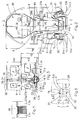
- Fig. 1 illustrates generally a part of a train provided with the intercommunicating passageways between double-decker articulated railway coaches according to the invention, in a longitudinal section trough the vertical center plane I-I of Fig. 2.
- Fig. 2 illustrates an intercommunicating passageway according to the invention having a lower bridge and an upper bridge, as well as the wheel frame arrangement with a pair of independently rolling wheels between the successive coaches, partially in a transverse section trough the vertical plane II-II of Fig. 1 and partially in the respective direction.
- Fig. 3 illustrates an intercommunicating passageway of Fig. 1, and the wheel frame arrangement with a pair of independent wheels between the successive coaches, in the same view as in Fig. 2, but on a larger scale.
- Fig. 4 illustrates a detail of the bellows comprised by and surrounding the intercommunicating passageway according to the invention from the area IV of Fig. 3.
- Fig. 5 illustrates diagrammatically the bridges at the lower and upper floor of the coaches extending from coach to coach within the intercommunicating passageway according to the invention in a plan view V of Fig. 2.
- Fig. 6 shows generally a part of a train according to Prior Art, in which each coach is provided with bogie units, each of which being two axle bogies at both ends of each coach, as well as a single floor in the area the intercommunicating passageway, in the same view as Fig. 1.
- the intercommunicating passageway 9 between double-decker articulated railway coaches 1 according to the invention is a combination of several constructional features.
- the double-decker coaches 1 for passengers have a lower passenger room 7 and an upper passenger room 8 on top of the lower passenger room.
- the lower passenger room has an inner height H3 and a first floor 3 at a first lower level H1a with seats as shown in Fig. 1, and providing necessary vertical room for the passengers to walk along the coach as well as to and from their seats.
- the first floor 3 of the lower passenger room 7 is positioned between the pairs 23 of wheels 13a, 13b at the ends 24, 25 of each of the coaches as described later, i.e. at a level, which is downward from the line going through the highest point of the wheels.
- the upper passenger room 8 has an inner height H4 and a second floor 4 at a higher level H2 with seats as shown in Fig. 1, and providing necessary vertical room for the passengers to walk along the coach as well as to and from their seats.
- the upper passenger room above the lower passenger room has a length L4 substantially equal with the length L1 of the coach 1 as practically do the length L3 of the lower passenger room, which assure a very high utilization of the total room inside the coaches.
- the length L3 of the lower passenger room is only slightly shorter than the total length L1 of the coach because of the suspension means 29 for the pair of wheels with their wheel frame 10 between the coaches, disclosed later in detail.
- the longitudinal room required by this one set of suspension means 29 included at least partially in the gap 26 - which is always needed - between the adjacent ends 24, 25 of the successive coaches means very small loss of useful space in the lower passenger room and practically no loss of useful space in the upper passenger room.
- staircases 35 between the upper passenger room 8 and the lower passenger room 7 but one bare staircase in a coach causes a decrease of a few seats only.
- the height portion Hp between the upper limit of a standard kinematic gauge and said wheels is smaller than the sum H3+H4 of the inner heights of two superimposed passenger rooms 7, 8, i.e. H3+H4 ⁇ Hp.
- the headrooms - that is the spacing between the decks or floors should have been summed - but because the thickness of the floors and the roof in the coaches are very small as compared to the inner heights, these thicknesses can be neglected.
- the sum of this said height portion Hp and the rolling diameter ⁇ of the wheels shall be at maximum equal with the vertical kinematic gauge or smaller than the vertical kinematic gauge, i.e.
- the diameters ⁇ of the wheels 12a, 12b depends on the weights loading them and on the required speed of the train. Typically the wheel diameters ⁇ are at least 800 mm and preferably in the order of 900 mm to 950 mm.
- the inner height H3 of the lower passenger rooms 7 is substantially equal with the inner height H4 of the upper passenger rooms 8.
- the adjacent ends 24, 25 of each of two successive coaches 1a and 1b or 1b and 1a are both supported by the wheel frame 10, which is positioned, with its wheels 13a, 13b, at the area - at least partly within the gap 26 - between two successive coaches.
- the reference number 1 is used generally for the coaches, and the reference numbers 1a, 1b are used for occasions, in which the successive coaches shall be distinguished from each other, only.
- the gap 26 between the adjacent ends 24, 25 of the successive coaches are needed to provide room for turning the coaches in respect to each other along a curved passage of rails, i.e. to allow an angle deviating from 180° between the longitudinal axis of the successive coaches.
- the wheel frame has a lowered center section 11, which means that the wheel frame 10 has a form of the letter ⁇ in the direction transversal to the length L1 of the coach, and a pair of wheels 12a, 12b supported by and connected trough separate bearings 13 to said wheel frame, as visible in the Figure 2.
- These wheels 12a, 12b in the pair 23 of wheels have a common axle line 14, but not a common shaft.
- the coaches further comprise suspension means 29 mounted between the wheel frame 10 and a coach body at two points 28a, 28b having a spacing W2 therebetween in transversal direction of the coach.
- the suspension means 29 are rigidly attached at these two points 28a, 28b to the body of one of the two successive coaches, at the support area 27c close to the end thereof, and the end of the other of the two successive coaches is supported via a pair of carrying bars 27a, 27b at both longitudinal sides of the coaches and crossing the gap 26. So the load from both adjacent ends 24, 25 of two successive coaches are carried through the suspension means 26 and a single wheel frame 10 with the pair 23 of wheels.
- the successive coaches 1a, 1b further comprise two pairs 30 of connection rods 31a, 31b therebetween. The connection rods in both pairs 30, each at one longitudinal side of the coaches, being longitudinally successive and interposed by a control lever 32 through articulations 33.
- Each of the control levers 32 is pivotally secured to one of the transversally opposite end regions of the wheel frame 10, and the connection rods being coupled with stationary articulations 34 with the mutually opposite ends of the successive coaches.
- Connecting rods 31a, 31b and the control lever 32 across the gap 26 halves the mutual longitudinal movements on both sides of the train, on one side a shortening movement and on the other side a lengthening movement, for the wheel frame so creating the parallelism between the tangent of the rails and the rolling plane of the wheels.
- a first bridge 5 extending between two successive coaches 1a, 1b, the first bridge being substantially at a second lower level H1b and on the first floors 3 of the coaches connected, and further a second bridge 6 extending between the two successive coaches 1a, 1b.
- the first lower level H1a of the first floors and second lower levels H1b of the first bridges are down from the highest peripheral point P of the wheels.
- the second lower level H1b is at a slightly higher level than the first lower level H1a, there being a small height difference ⁇ H, whereupon the second lower level H1b of the first bridge 5 is positioned at a height, which is between the axle line 14 and the highest peripheral point P of the wheels.
- the first floors 3 are provided with a ramps 36 at both ends of the coach rising from the first lower level H1a to the second lower level H1b.
- the first bridge substantially at the same level as the first floor 3.
- both the second lower level H1b of the first bridge and the first lower level H1a of the first floors can be so low as approximately at the height of the axle line 14.
- first lower level H1a of the first floors 3 and the second lower level H1b of the first bridges 5 are down from the highest peripheral point P of the wheels, and typically somewhere between the highest peripheral point P and the common axle line 14 of the wheels. So the first bridge 5 extends from coach to coach 1b to 1a to 1b etc. between the wheels 12a and 12b of the pair of wheels and above the lowered center section 11 of the wheel frame 10.
- the second bridge 6 is substantially at the same higher level H2 with the second floors 4 of the coaches connected.
- the first bridge 5 typically rests against the first floors 3 or against the ramps 36 thereof of the successive and adjacent coaches. In a similar way the second bridge 6 typically rest against second floors 4 of the successive and adjacent coaches. If only possible the second lower level H1b of the first bridge 5 should be closer to a common axle line 14 of said pair of wheels than the highest peripheral point P of the wheels.
- the intercommunicating passageway has, according to the invention, a upper walkin 15 above or upwards from the first bridge 5, continuing from a lower passenger room 7 in one of the successive coaches 1a or 1b to a lower passenger room 7 in another of the successive coaches 1b or 1a.
- the upper walkin 15 extending from coach to coach along and within the spacing W2 between the mounting points 28a, 28b of the suspension means to the coach.
- This upper walkin 15 has an inner height H5 substantially the same as, or approaching that H3 of the lower passenger rooms.
- the possible difference between the inner height H5 of the upper walkin and the inner height H3 of the lower passenger room 7 is the height difference ⁇ H, which is a fraction of the inner height H3 of the lower passenger room.
- the height difference ⁇ H is smaller than 20%, preferably smaller than 15%, and typically from 5% to 10% of the inner height H3 of the lower passenger room.
- the intercommunicating passageway has, according to the invention, also a lower walkin 16 above the second bridge 6, continuing from an upper passenger room 8 in one of the successive coaches 1a or 1b to an upper passenger room 8 in another of the successive coaches 1b or 1a.
- This lower walkin has an inner height H6 approaching that H4 of the upper passenger rooms.
- the inner height H6 of the lower walkin 16 is practically the same as the inner height H4 of the upper passenger rooms.
- the height variations in the order of bridge thicknesses shall be considered unessential, while the thickness of the bridges 5, 6 can be extremely small, like 10 mm 30 mm, because of the low loads caused by passengers and the shortness of the gap 26 between the coaches.
- the upper walkin 15 has an inner width W5, which is substantially smaller than inner width W3 of the lower passenger rooms 7, and the lower walkin 16 has an inner width W6, which is substantially smaller than inner width W4 of the upper passenger rooms 8.
- one of the successive coaches comprises a lock 20 fixed in the first floor 3 and attaching the first bridge 5 to the coach pivotally around a vertical line V and a lock 20 fixed in the second floor 4 and attaching second bridge 6 to the coach pivotally around a vertical line V.
- the locks 20 may be simple vertical pin construction close to one longitudinal end of the bridges configured to prohibit unintentional removing of the bridge and to allow pivotal movement of the bridge around the vertical line V, which goes trough the pin. The pivotal movement happens when the train goes along a curved rail passage.
- the another of the adjacent and successive coaches comprises a pair of side stops 21 fixed in the first floor 3, and a pair of side stops 21 fixed in the second floor 4, whereupon the side stops are located transversally at both sides of the first and the second bridge 5,6.
- the side stops may also include configurations for attachment of the bridges to the respective coach 1, and prohibiting unintentional removing of the bridges.
- the coaches further comprise bellows means 26 surrounding the passageway.
- the bellows means 29 are positioned substantially inwards from the kinematic gauge applied, and so the bellows means 26 goes along the predetermined limit line or area of the combination of the upper walkin 16 and the lower walkin 15, as clearly shown in Fig. 2. This arrangement ensures lower noise in the walkins, promotes tidiness and maintains the passengers to experience the walkins as parts of the actual passenger rooms 7, 8.
Landscapes
- Engineering & Computer Science (AREA)
- Mechanical Engineering (AREA)
- Transportation (AREA)
- Life Sciences & Earth Sciences (AREA)
- Wood Science & Technology (AREA)
- Chemical & Material Sciences (AREA)
- Combustion & Propulsion (AREA)
- Body Structure For Vehicles (AREA)
- Mechanical Coupling Of Light Guides (AREA)
- Paper (AREA)
- Road Paving Structures (AREA)
- Management, Administration, Business Operations System, And Electronic Commerce (AREA)
- Bridges Or Land Bridges (AREA)
- Interconnected Communication Systems, Intercoms, And Interphones (AREA)
- Artificial Fish Reefs (AREA)
- Air Bags (AREA)
- Fluid-Pressure Circuits (AREA)
- Passenger Equipment (AREA)
- Cage And Drive Apparatuses For Elevators (AREA)
- Platform Screen Doors And Railroad Systems (AREA)
- Vehicle Body Suspensions (AREA)
Abstract
Description
Claims (13)
- An intercommunicating passageway (9) between double-decker articulated railway coaches (1), comprising in combination:A wheel frame (10) at an area between two successive coaches, and havinga lowered center section (11), anda pair of wheels (12a, 12b) supported by and connected trough separate bearings (13) to said wheel frame;Said coaches (1) havinga lower passenger room (7) with an inner height (H3) and a first floor (3) at a first lower level (H1a) between pairs of wheels at the ends (24, 25) of the coach,an upper passenger room (8) with an inner height (H4) and a second floor (4) at a higher level (H2), on top of said lower passenger room, anda height portion (Hp) between the upper limit of a standard kinematic gauge and said wheels smaller than the sum (H3+H4) of said inner heights,In said passagewaya first bridge (5) extending between two successive coaches (1a, 1b), the first bridge being at a second lower level (H1b) on the first floors (3) of the coaches connected,a second bridge (6) extending between said two successive coaches (1a, 1b), the second bridge being substantially in the same higher level (H2) with the second floors (4) of the coaches connected, andsaid first and second lower levels (H1a, H1b) of the first floors and the first bridge are down from the highest peripheral point (P) of said wheels.
- An intercommunicating passageway according to claim 1, characterized in that said first lower levels (H1a) of the first floors (3) is substantially at a height of a common axle line (14) of said pair of wheels; and that said second lower levels (H1b) of the first bridge (5) is closer to a common axle line (14) of said pair of wheels than the highest peripheral point (P) of said wheels.
- An intercommunicating passageway according to claim 1 or 2, characterized in that it has a upper walkin (15) above the first bridge (5), continuing from a lower passenger room (7) in one of the successive coaches (1a or 1b) to a lower passenger room (7) in another of the successive coaches (1b or 1a), said upper walkin having an inner height (H5) approaching that (H3) of the lower passenger rooms.
- An intercommunicating passageway according to claim 1 or 2, characterized in that it has a lower walkin (16) above the second bridge (6), continuing from an upper passenger room (8) in one of the successive coaches (1a or 1b) to an upper passenger room (8) in another of the successive coaches (1b or 1a), said lower walkin having an inner height (H6) approaching that (H4) of the upper passenger rooms.
- An intercommunicating passageway according to claim 3 or 4, characterized in that the inner height (H3) of the lower passenger rooms (7) is substantially equal with the inner height (H4) of the upper passenger rooms (8).
- An intercommunicating passageway according to claim 1 or 2, characterized in that said first bridge (5) extends from coach to coach (1b to 1a to 1b...) between the wheels (12a and 12b) of said pair of wheels and above the lowered center section (11) of the wheel frame (10).
- An intercommunicating passageway according to claim 3 or 4, characterized in that the upper walkin (15) has an inner width (W5) and the lower walkin (16) has an inner width (W6), which are substantially smaller than inner widths (W3, W4) of the lower and the upper passenger rooms, respectively.
- An intercommunicating passageway according to claim 1, characterized in that said successive coaches (1a, 1b) further comprise two pairs (30) of connection rods (31a, 31b) therebetween, said connection rods in both pairs being longitudinally successive and interposed through articulations (33) by a control lever (32) pivotally secured to one of transversally opposite end regions of the wheel frame (10), and said connection rods being coupled with stationary articulations (34) with the mutually opposite ends of the successive coaches.
- An intercommunicating passageway according to claim 8, characterized in that one of the successive coaches comprises locks (20) attaching said first and said second bridge (5, 6) to the coach pivotally around a vertical line (V); and that another of the successive coaches comprises a pair of side stops (21) fixed in said first floor (3) and in said second floor (4), said side stops located transversally at both sides of the first and the second bridge (5,6).
- An intercommunicating passageway according to claim 1 or 8 or 9, characterized in that said first bridge (5) and said second bridge (6) rest against the first floor (3) and the second floor (4), respectively.
- An intercommunicating passageway according to claim 1, characterized in that said coaches further comprise suspension means (29) mounted between the wheel frame (10) and a coach body at two points (28a, 28b) having a spacing (W2) therebetween in transversal direction of the coach, and an upper walkin (15) extending from coach to coach (1a to 1b to 1a...) along said spacing.
- An intercommunicating passageway according to claim 1, characterized in that said coaches further comprise bellows means (26) surrounding the passageway; and that the bellows means are positioned substantially inwards from the kinematic gauge applied.
- An intercommunicating passageway according to any of the preceding claims, characterized in that said coaches (1) have a standard kinematic gauge in accordance with UIC Code 505-1 OR, Appendix 4.
Priority Applications (17)
| Application Number | Priority Date | Filing Date | Title |
|---|---|---|---|
| PT01660206T PT1312526E (en) | 2001-11-16 | 2001-11-16 | DOUBLE ROAD RAILWAYS WITH INTERCOMMUNICATING PASSAGES IN BOTH THE LEVELS |
| DE60103069T DE60103069T2 (en) | 2001-11-16 | 2001-11-16 | Double-decker railway wagons with passage facilities in both floors |
| DK01660206T DK1312526T3 (en) | 2001-11-16 | 2001-11-16 | Double-deck railroad cars with interconnected corridors on both levels |
| AT01660206T ATE265344T1 (en) | 2001-11-16 | 2001-11-16 | DOUBLE-STOREY RAILWAY CARS WITH PASSAGE FACILITIES ON BOTH FLOOR |
| EP01660206A EP1312526B1 (en) | 2001-11-16 | 2001-11-16 | Double-decker railway coaches, with intercommunicating passageways at both levels |
| TR2004/01873T TR200401873T4 (en) | 2001-11-16 | 2001-11-16 | Passages connected to each other in double-decker railway passenger cars. |
| ES01660206T ES2217106T3 (en) | 2001-11-16 | 2001-11-16 | TWO-FLOOR RAILWAY WAGONS WITH INTERCOM COMMUNICATION STEPS IN EACH FLOOR. |
| AU2002301373A AU2002301373B2 (en) | 2001-11-16 | 2002-10-02 | Intercommunicating passageways in double-decker railway coaches |
| CA2407980A CA2407980C (en) | 2001-11-16 | 2002-10-11 | Intercommunicating passageways in double-decker railway coaches |
| RU2002129997/11A RU2296685C2 (en) | 2001-11-16 | 2002-11-12 | Gangway between double-deck passenger cars |
| KR1020020070241A KR20030040121A (en) | 2001-11-16 | 2002-11-13 | Intercommunicating passageways in double-decker railway coaches |
| US10/293,225 US6945176B2 (en) | 2001-11-16 | 2002-11-13 | Intercommunicating passageways in double-decker railway coaches |
| CZ2002-3788A CZ304245B6 (en) | 2001-11-16 | 2002-11-14 | Connecting passage between double-deck articulated railway couches |
| MXPA02011259A MXPA02011259A (en) | 2001-11-16 | 2002-11-14 | Double-decker railway coaches, with intercommunicating passageways at both levels. |
| PL357153A PL201095B1 (en) | 2001-11-16 | 2002-11-15 | Passage between two adjacent double-deck coaches |
| CNB021506736A CN100333951C (en) | 2001-11-16 | 2002-11-18 | Communicating passage in double-decked passenger train |
| JP2002334232A JP2003154933A (en) | 2001-11-16 | 2002-11-18 | Connecting passage in two-story railway passenger car |
Applications Claiming Priority (1)
| Application Number | Priority Date | Filing Date | Title |
|---|---|---|---|
| EP01660206A EP1312526B1 (en) | 2001-11-16 | 2001-11-16 | Double-decker railway coaches, with intercommunicating passageways at both levels |
Publications (2)
| Publication Number | Publication Date |
|---|---|
| EP1312526A1 true EP1312526A1 (en) | 2003-05-21 |
| EP1312526B1 EP1312526B1 (en) | 2004-04-28 |
Family
ID=8183637
Family Applications (1)
| Application Number | Title | Priority Date | Filing Date |
|---|---|---|---|
| EP01660206A Expired - Lifetime EP1312526B1 (en) | 2001-11-16 | 2001-11-16 | Double-decker railway coaches, with intercommunicating passageways at both levels |
Country Status (17)
| Country | Link |
|---|---|
| US (1) | US6945176B2 (en) |
| EP (1) | EP1312526B1 (en) |
| JP (1) | JP2003154933A (en) |
| KR (1) | KR20030040121A (en) |
| CN (1) | CN100333951C (en) |
| AT (1) | ATE265344T1 (en) |
| AU (1) | AU2002301373B2 (en) |
| CA (1) | CA2407980C (en) |
| CZ (1) | CZ304245B6 (en) |
| DE (1) | DE60103069T2 (en) |
| DK (1) | DK1312526T3 (en) |
| ES (1) | ES2217106T3 (en) |
| MX (1) | MXPA02011259A (en) |
| PL (1) | PL201095B1 (en) |
| PT (1) | PT1312526E (en) |
| RU (1) | RU2296685C2 (en) |
| TR (1) | TR200401873T4 (en) |
Cited By (4)
| Publication number | Priority date | Publication date | Assignee | Title |
|---|---|---|---|---|
| FR2859967A1 (en) * | 2003-09-19 | 2005-03-25 | Alstom | Rail transit car for constituting double decker train, has bottom level, top level, and engine transmission unit placed between two cars each having predetermined length, width, and height |
| FR2882014A1 (en) * | 2005-02-17 | 2006-08-18 | Hutchinson Sa | Secondary suspension unit for circulation of Talgo pendular train, has emergency spring with emergency position corresponding to depressurization of annular membrane and active position corresponding to pressurization of pressure chamber |
| EP3159237A1 (en) | 2015-10-23 | 2017-04-26 | ALSTOM Transport Technologies | Railway vehicle having at least a lowered bogie |
| EP3159236A1 (en) | 2015-10-23 | 2017-04-26 | ALSTOM Transport Technologies | Railway vehicle having at least a lowered bogie |
Families Citing this family (19)
| Publication number | Priority date | Publication date | Assignee | Title |
|---|---|---|---|---|
| US6668729B1 (en) * | 2002-08-21 | 2003-12-30 | Bryan Richards | Transit system |
| JP4562655B2 (en) * | 2003-07-16 | 2010-10-13 | 財団法人生産技術研究奨励会 | Self-steering cart and railway vehicle to which the self-steering cart is applied |
| KR100604421B1 (en) | 2004-12-29 | 2006-07-25 | 한국철도기술연구원 | Low center tilting railroad car |
| CN1313299C (en) * | 2005-06-23 | 2007-05-02 | 重庆工学院 | Passenger car movig ladder device |
| FR2898569B1 (en) * | 2006-03-16 | 2008-06-20 | Alstom Transport Sa | DEVICE FOR INTERCIRCULATION BETWEEN TWO TRAIN PASSENGER CARS REACHED TO ONE ANOTHER, CAR OF TRAINS AND CORRESPONDING TRAIN. |
| FR2914609B1 (en) * | 2007-04-05 | 2009-07-10 | Alstom Transport Sa | BOGIE FOR RAILWAY VEHICLE |
| FR2928601B1 (en) * | 2008-03-11 | 2011-09-09 | Alstom Transport Sa | RAILWAY VEHICLE CAR FACILITATING ACCESS TO TRAVELERS WITH REDUCED MOBILITY |
| ES2453047T5 (en) * | 2010-04-29 | 2017-07-24 | Bombardier Transportation Gmbh | Vehicle head with reduced sensitivity to lateral wind |
| US8608108B2 (en) * | 2010-12-03 | 2013-12-17 | The Boeing Company | Aircraft configuration with ramp access to multiple decks |
| KR101396208B1 (en) * | 2012-10-19 | 2014-05-19 | 한국철도기술연구원 | Indoor structure for double deck railway vehicle |
| KR101585538B1 (en) * | 2014-06-02 | 2016-01-15 | 지에스건설 주식회사 | Modularity intermodal system |
| FR3035056B1 (en) | 2015-04-16 | 2018-08-31 | Metrolab | RAME CONSISTING OF A PLURALITY OF TWO LEVEL RAILWAY VEHICLES FOR PASSENGERS AND FREIGHT |
| CN107776591B (en) * | 2016-08-28 | 2024-07-19 | 中车青岛四方机车车辆股份有限公司 | Rail vehicle carriage structure and rail vehicle |
| FR3055874B1 (en) * | 2016-09-13 | 2019-07-19 | Alstom Transport Technologies | MODULAR RESTORATION CAR, IN PARTICULAR FOR A RAILWAY VEHICLE |
| EP3315799B2 (en) † | 2016-10-26 | 2022-02-23 | GESIPA Blindniettechnik GmbH | Blind rivet nut |
| FR3064577B1 (en) * | 2017-03-29 | 2020-03-13 | Alstom Transport Technologies | RAIL VEHICLE COMPRISING PARTIALLY STANDARDIZED CARS |
| CN110758436B (en) * | 2019-10-31 | 2020-08-04 | 青岛理工大学 | Active control system for rolling dynamic behavior of high-speed train |
| CN112519829B (en) * | 2020-12-03 | 2022-09-23 | 中车唐山机车车辆有限公司 | Double-deck rail vehicle |
| CN112498499B (en) * | 2020-12-04 | 2022-05-17 | 中车南京浦镇车辆有限公司 | Rubber wheel train |
Citations (4)
| Publication number | Priority date | Publication date | Assignee | Title |
|---|---|---|---|---|
| FR1159975A (en) * | 1955-10-01 | 1958-07-04 | Atel Const Nord De La France | Low-platform articulated rail vehicles |
| GB1508173A (en) * | 1974-03-25 | 1978-04-19 | Talgo Patentes | Train having a pendular suspension system |
| EP0642964A1 (en) * | 1993-09-10 | 1995-03-15 | Inventio Ag | Articulated double-deck train |
| EP0756980A1 (en) * | 1995-08-02 | 1997-02-05 | Gerhard Schilling | Double-deck railway vehicle |
Family Cites Families (13)
| Publication number | Priority date | Publication date | Assignee | Title |
|---|---|---|---|---|
| GB589565A (en) | 1944-07-08 | 1947-06-24 | Talgo Patentes | Improvements in or relating to articulated railway vehicles |
| US2843417A (en) * | 1955-06-20 | 1958-07-15 | Karl Kassbohrer G M B H | Connecting means for the vehicles of link-trains |
| US2881713A (en) * | 1955-10-01 | 1959-04-14 | Rheinstahl Siegener Eisenbahnb | Rail vehicle with low platform |
| IT8361950U1 (en) * | 1983-06-28 | 1984-12-28 | Officina Mecc Della Stanga O M S S P A | ARTICULATION FOR URBAN AND SUBURBAN RAIL TRANSPORT VEHICLES, IN PARTICULAR FOR TRAM AND/OR METROPOLITAN VEHICLES. |
| DE3711032A1 (en) * | 1987-04-02 | 1988-10-20 | Huebner Gummi & Kunststoff | BELLOWS |
| FR2629034B1 (en) | 1988-03-25 | 1990-04-20 | Caoutchouc Manuf Plastique | DEFORMABLE MEMBRANE FOR INTERCIRCULATION TUNNEL BETWEEN SUCCESSIVE RAILWAY OR ROAD VEHICLES |
| FI79814C (en) * | 1988-06-10 | 1990-03-12 | Rautaruukki Oy | VAGNSKOMBINATION. |
| SU1654071A1 (en) * | 1989-02-13 | 1991-06-07 | Uralsky Elektromekh I | Box car body |
| BE1006915A3 (en) * | 1993-03-10 | 1995-01-24 | Hool Nv | Articulated bus. |
| DE59406809D1 (en) * | 1993-07-01 | 1998-10-08 | Siemens Sgp Verkehrstech Gmbh | Rail vehicle |
| DE4335420A1 (en) | 1993-10-18 | 1995-04-20 | Michael Mann | Intercommunicating area between coaches with staircase for double decker rail vehicles |
| DE4442368C2 (en) * | 1994-11-29 | 1999-10-28 | Talbot Gmbh & Co Kg | Double-decker rail vehicle |
| FR2738208B1 (en) * | 1995-09-04 | 1997-10-03 | Gec Alsthom Transport Sa | TWO-LEVEL CAR WITH CONTINUOUS CIRCULATION ON THE UPPER FLOOR AND ACCESS FROM A HIGH DOCK |
-
2001
- 2001-11-16 ES ES01660206T patent/ES2217106T3/en not_active Expired - Lifetime
- 2001-11-16 DK DK01660206T patent/DK1312526T3/en active
- 2001-11-16 DE DE60103069T patent/DE60103069T2/en not_active Expired - Lifetime
- 2001-11-16 TR TR2004/01873T patent/TR200401873T4/en unknown
- 2001-11-16 PT PT01660206T patent/PT1312526E/en unknown
- 2001-11-16 AT AT01660206T patent/ATE265344T1/en active
- 2001-11-16 EP EP01660206A patent/EP1312526B1/en not_active Expired - Lifetime
-
2002
- 2002-10-02 AU AU2002301373A patent/AU2002301373B2/en not_active Ceased
- 2002-10-11 CA CA2407980A patent/CA2407980C/en not_active Expired - Lifetime
- 2002-11-12 RU RU2002129997/11A patent/RU2296685C2/en not_active IP Right Cessation
- 2002-11-13 US US10/293,225 patent/US6945176B2/en not_active Expired - Fee Related
- 2002-11-13 KR KR1020020070241A patent/KR20030040121A/en not_active Ceased
- 2002-11-14 CZ CZ2002-3788A patent/CZ304245B6/en not_active IP Right Cessation
- 2002-11-14 MX MXPA02011259A patent/MXPA02011259A/en unknown
- 2002-11-15 PL PL357153A patent/PL201095B1/en unknown
- 2002-11-18 CN CNB021506736A patent/CN100333951C/en not_active Expired - Fee Related
- 2002-11-18 JP JP2002334232A patent/JP2003154933A/en active Pending
Patent Citations (4)
| Publication number | Priority date | Publication date | Assignee | Title |
|---|---|---|---|---|
| FR1159975A (en) * | 1955-10-01 | 1958-07-04 | Atel Const Nord De La France | Low-platform articulated rail vehicles |
| GB1508173A (en) * | 1974-03-25 | 1978-04-19 | Talgo Patentes | Train having a pendular suspension system |
| EP0642964A1 (en) * | 1993-09-10 | 1995-03-15 | Inventio Ag | Articulated double-deck train |
| EP0756980A1 (en) * | 1995-08-02 | 1997-02-05 | Gerhard Schilling | Double-deck railway vehicle |
Cited By (10)
| Publication number | Priority date | Publication date | Assignee | Title |
|---|---|---|---|---|
| FR2859967A1 (en) * | 2003-09-19 | 2005-03-25 | Alstom | Rail transit car for constituting double decker train, has bottom level, top level, and engine transmission unit placed between two cars each having predetermined length, width, and height |
| EP1577186A1 (en) * | 2003-09-19 | 2005-09-21 | Alstom | Arrangement of a double deck railway vehicle |
| EP2258594A1 (en) * | 2003-09-19 | 2010-12-08 | ALSTOM Transport SA | Double deck train composition |
| FR2882014A1 (en) * | 2005-02-17 | 2006-08-18 | Hutchinson Sa | Secondary suspension unit for circulation of Talgo pendular train, has emergency spring with emergency position corresponding to depressurization of annular membrane and active position corresponding to pressurization of pressure chamber |
| EP1693270A1 (en) * | 2005-02-17 | 2006-08-23 | Hutchinson | Secondary suspension device, with emergency suspension, for railway vehicle. |
| EP3159237A1 (en) | 2015-10-23 | 2017-04-26 | ALSTOM Transport Technologies | Railway vehicle having at least a lowered bogie |
| EP3159236A1 (en) | 2015-10-23 | 2017-04-26 | ALSTOM Transport Technologies | Railway vehicle having at least a lowered bogie |
| FR3042769A1 (en) * | 2015-10-23 | 2017-04-28 | Alstom Transp Tech | RAILWAY VEHICLE COMPRISING AT LEAST ONE LOWER BOGIE |
| US10286931B2 (en) | 2015-10-23 | 2019-05-14 | Alstom Transport Technologies | Bogie for full double deck emu |
| US10315670B2 (en) | 2015-10-23 | 2019-06-11 | Alstom Transport Technologies | Bogie for full double deck EMU |
Also Published As
| Publication number | Publication date |
|---|---|
| PL357153A1 (en) | 2003-05-19 |
| EP1312526B1 (en) | 2004-04-28 |
| PL201095B1 (en) | 2009-03-31 |
| US20030094116A1 (en) | 2003-05-22 |
| TR200401873T4 (en) | 2004-10-21 |
| DE60103069D1 (en) | 2004-06-03 |
| MXPA02011259A (en) | 2004-10-15 |
| US6945176B2 (en) | 2005-09-20 |
| CA2407980C (en) | 2010-12-21 |
| CA2407980A1 (en) | 2003-05-16 |
| CN100333951C (en) | 2007-08-29 |
| CN1420048A (en) | 2003-05-28 |
| RU2296685C2 (en) | 2007-04-10 |
| JP2003154933A (en) | 2003-05-27 |
| ATE265344T1 (en) | 2004-05-15 |
| KR20030040121A (en) | 2003-05-22 |
| CZ20023788A3 (en) | 2003-06-18 |
| DE60103069T2 (en) | 2004-10-14 |
| DK1312526T3 (en) | 2004-08-30 |
| PT1312526E (en) | 2004-09-30 |
| AU2002301373B2 (en) | 2008-10-02 |
| ES2217106T3 (en) | 2004-11-01 |
| CZ304245B6 (en) | 2014-01-29 |
Similar Documents
| Publication | Publication Date | Title |
|---|---|---|
| EP1312526B1 (en) | Double-decker railway coaches, with intercommunicating passageways at both levels | |
| CN101678843B (en) | Bogie for railway vehicle | |
| AU2009242050B2 (en) | Variable-width bogie with rotating axles and a stationary apparatus for changing track width | |
| EP2216227B1 (en) | Bogie for low floor type railway vehicle and low floor type railway vehicle with the same | |
| AU641590B2 (en) | Improvements in railroad car truck damping member | |
| RU2002129997A (en) | CONNECTING PASS BETWEEN TWO-STORED RAILWAY PASSENGER CARS | |
| CS261869B2 (en) | Hinge connection for town and suburb railway traffic vehicles | |
| RU2430847C2 (en) | Intercar passage device for two coupled passenger train cars, car and train | |
| EP0086788A1 (en) | Improvements in or relating to means of transportation. | |
| CA1267040A (en) | Articulated powered rail cars for local traffic, in particular streetcar lines | |
| EP1685015B1 (en) | Articulated passenger rail vehicle with an intermediate car module | |
| PL195559B1 (en) | Rail vehicle | |
| EP4360981B1 (en) | Mid-floor height railway vehicle with level-access at middle platform heights | |
| IT8268510A1 (en) | TWO-AXLE CARRYING BOOTY FOR RAILWAY AND TRAMWAY VEHICLES, AND RAILWAY AND TRAMWAY VEHICLE USING SUCH BOOTY. | |
| US4535702A (en) | Articulated railway vehicle | |
| HU223939B1 (en) | Swivel frame for railway use | |
| RU2238202C1 (en) | Two-axle rail bogie for supporting adjacent bodies of articulated cars | |
| US809921A (en) | Steel underframe for railway-cars. | |
| AU701141B2 (en) | Rail switch and crossing arrangement | |
| Freitag et al. | New bogie for German ICE (InterCity Express) based on BT41 | |
| CA2313741A1 (en) | Rail road car with cantilevered articulation |
Legal Events
| Date | Code | Title | Description |
|---|---|---|---|
| PUAI | Public reference made under article 153(3) epc to a published international application that has entered the european phase |
Free format text: ORIGINAL CODE: 0009012 |
|
| 17P | Request for examination filed |
Effective date: 20020912 |
|
| AK | Designated contracting states |
Designated state(s): AT BE CH CY DE DK ES FI FR GB GR IE IT LI LU MC NL PT SE TR |
|
| AX | Request for extension of the european patent |
Extension state: AL LT LV MK RO SI |
|
| GRAP | Despatch of communication of intention to grant a patent |
Free format text: ORIGINAL CODE: EPIDOSNIGR1 |
|
| GRAS | Grant fee paid |
Free format text: ORIGINAL CODE: EPIDOSNIGR3 |
|
| AKX | Designation fees paid |
Designated state(s): AT BE CH CY DE DK ES FI FR GB GR IE IT LI LU MC NL PT SE TR |
|
| GRAA | (expected) grant |
Free format text: ORIGINAL CODE: 0009210 |
|
| AK | Designated contracting states |
Kind code of ref document: B1 Designated state(s): AT BE CH CY DE DK ES FI FR GB GR IE IT LI LU MC NL PT SE TR |
|
| PG25 | Lapsed in a contracting state [announced via postgrant information from national office to epo] |
Ref country code: BE Free format text: LAPSE BECAUSE OF FAILURE TO SUBMIT A TRANSLATION OF THE DESCRIPTION OR TO PAY THE FEE WITHIN THE PRESCRIBED TIME-LIMIT Effective date: 20040428 Ref country code: CY Free format text: LAPSE BECAUSE OF FAILURE TO SUBMIT A TRANSLATION OF THE DESCRIPTION OR TO PAY THE FEE WITHIN THE PRESCRIBED TIME-LIMIT Effective date: 20040428 Ref country code: NL Free format text: LAPSE BECAUSE OF FAILURE TO SUBMIT A TRANSLATION OF THE DESCRIPTION OR TO PAY THE FEE WITHIN THE PRESCRIBED TIME-LIMIT Effective date: 20040428 |
|
| REG | Reference to a national code |
Ref country code: GB Ref legal event code: FG4D |
|
| REG | Reference to a national code |
Ref country code: CH Ref legal event code: EP |
|
| REG | Reference to a national code |
Ref country code: IE Ref legal event code: FG4D |
|
| REF | Corresponds to: |
Ref document number: 60103069 Country of ref document: DE Date of ref document: 20040603 Kind code of ref document: P |
|
| REG | Reference to a national code |
Ref country code: SE Ref legal event code: TRGR |
|
| PG25 | Lapsed in a contracting state [announced via postgrant information from national office to epo] |
Ref country code: GR Free format text: LAPSE BECAUSE OF FAILURE TO SUBMIT A TRANSLATION OF THE DESCRIPTION OR TO PAY THE FEE WITHIN THE PRESCRIBED TIME-LIMIT Effective date: 20040728 |
|
| REG | Reference to a national code |
Ref country code: DK Ref legal event code: T3 |
|
| REG | Reference to a national code |
Ref country code: CH Ref legal event code: NV Representative=s name: NOVAGRAAF INTERNATIONAL SA |
|
| REG | Reference to a national code |
Ref country code: PT Ref legal event code: SC4A Free format text: AVAILABILITY OF NATIONAL TRANSLATION Effective date: 20040728 |
|
| NLV1 | Nl: lapsed or annulled due to failure to fulfill the requirements of art. 29p and 29m of the patents act | ||
| ET | Fr: translation filed | ||
| REG | Reference to a national code |
Ref country code: ES Ref legal event code: FG2A Ref document number: 2217106 Country of ref document: ES Kind code of ref document: T3 |
|
| PG25 | Lapsed in a contracting state [announced via postgrant information from national office to epo] |
Ref country code: LU Free format text: LAPSE BECAUSE OF NON-PAYMENT OF DUE FEES Effective date: 20041116 Ref country code: IE Free format text: LAPSE BECAUSE OF NON-PAYMENT OF DUE FEES Effective date: 20041116 |
|
| PG25 | Lapsed in a contracting state [announced via postgrant information from national office to epo] |
Ref country code: MC Free format text: LAPSE BECAUSE OF NON-PAYMENT OF DUE FEES Effective date: 20041130 |
|
| PLBE | No opposition filed within time limit |
Free format text: ORIGINAL CODE: 0009261 |
|
| STAA | Information on the status of an ep patent application or granted ep patent |
Free format text: STATUS: NO OPPOSITION FILED WITHIN TIME LIMIT |
|
| 26N | No opposition filed |
Effective date: 20050131 |
|
| REG | Reference to a national code |
Ref country code: IE Ref legal event code: MM4A |
|
| PG25 | Lapsed in a contracting state [announced via postgrant information from national office to epo] |
Ref country code: GB Free format text: LAPSE BECAUSE OF NON-PAYMENT OF DUE FEES Effective date: 20051116 |
|
| GBPC | Gb: european patent ceased through non-payment of renewal fee |
Effective date: 20051116 |
|
| REG | Reference to a national code |
Ref country code: CH Ref legal event code: PUE Owner name: PATENTES TALGO S.A. Free format text: TALGO OY#ELEKTRONIIKKATIE 2#90570 OULU (FI) -TRANSFER TO- PATENTES TALGO S.A.#GABRIEL GARCIA MARQUEZ, 4#28230 LAS ROZAS (MADRID) (ES) |
|
| REG | Reference to a national code |
Ref country code: FR Ref legal event code: TP |
|
| REG | Reference to a national code |
Ref country code: ES Ref legal event code: PC2A |
|
| REG | Reference to a national code |
Ref country code: ES Ref legal event code: PC2A |
|
| REG | Reference to a national code |
Ref country code: FR Ref legal event code: TP |
|
| REG | Reference to a national code |
Ref country code: DE Ref legal event code: R081 Ref document number: 60103069 Country of ref document: DE Owner name: PATENTES TALGO SL, LAS MATAS, ES Free format text: FORMER OWNER: TALGO OY, OULU, FI Effective date: 20110214 |
|
| REG | Reference to a national code |
Ref country code: CH Ref legal event code: PFA Owner name: PATENTES TALGO S.A. Free format text: PATENTES TALGO S.A.#GABRIEL GARCIA MARQUEZ, 4#28230 LAS ROZAS (MADRID) (ES) -TRANSFER TO- PATENTES TALGO S.A.#GABRIEL GARCIA MARQUEZ, 4#28230 LAS ROZAS (MADRID) (ES) |
|
| REG | Reference to a national code |
Ref country code: FR Ref legal event code: PLFP Year of fee payment: 15 |
|
| REG | Reference to a national code |
Ref country code: FR Ref legal event code: PLFP Year of fee payment: 16 |
|
| REG | Reference to a national code |
Ref country code: DE Ref legal event code: R082 Ref document number: 60103069 Country of ref document: DE Representative=s name: KLUNKER IP PATENTANWAELTE PARTG MBB, DE |
|
| REG | Reference to a national code |
Ref country code: FR Ref legal event code: PLFP Year of fee payment: 17 |
|
| PGFP | Annual fee paid to national office [announced via postgrant information from national office to epo] |
Ref country code: FI Payment date: 20171129 Year of fee payment: 17 Ref country code: FR Payment date: 20171127 Year of fee payment: 17 Ref country code: TR Payment date: 20171102 Year of fee payment: 17 Ref country code: DK Payment date: 20171127 Year of fee payment: 17 |
|
| PGFP | Annual fee paid to national office [announced via postgrant information from national office to epo] |
Ref country code: AT Payment date: 20171102 Year of fee payment: 17 Ref country code: CH Payment date: 20171127 Year of fee payment: 17 Ref country code: SE Payment date: 20171129 Year of fee payment: 17 |
|
| PGFP | Annual fee paid to national office [announced via postgrant information from national office to epo] |
Ref country code: PT Payment date: 20181105 Year of fee payment: 18 |
|
| REG | Reference to a national code |
Ref country code: DK Ref legal event code: EBP Effective date: 20181130 |
|
| REG | Reference to a national code |
Ref country code: CH Ref legal event code: PL |
|
| REG | Reference to a national code |
Ref country code: SE Ref legal event code: EUG |
|
| REG | Reference to a national code |
Ref country code: AT Ref legal event code: MM01 Ref document number: 265344 Country of ref document: AT Kind code of ref document: T Effective date: 20181116 |
|
| PG25 | Lapsed in a contracting state [announced via postgrant information from national office to epo] |
Ref country code: FI Free format text: LAPSE BECAUSE OF NON-PAYMENT OF DUE FEES Effective date: 20181116 Ref country code: SE Free format text: LAPSE BECAUSE OF NON-PAYMENT OF DUE FEES Effective date: 20181117 |
|
| PG25 | Lapsed in a contracting state [announced via postgrant information from national office to epo] |
Ref country code: CH Free format text: LAPSE BECAUSE OF NON-PAYMENT OF DUE FEES Effective date: 20181130 Ref country code: LI Free format text: LAPSE BECAUSE OF NON-PAYMENT OF DUE FEES Effective date: 20181130 |
|
| PG25 | Lapsed in a contracting state [announced via postgrant information from national office to epo] |
Ref country code: DK Free format text: LAPSE BECAUSE OF NON-PAYMENT OF DUE FEES Effective date: 20181130 Ref country code: AT Free format text: LAPSE BECAUSE OF NON-PAYMENT OF DUE FEES Effective date: 20181116 Ref country code: FR Free format text: LAPSE BECAUSE OF NON-PAYMENT OF DUE FEES Effective date: 20181130 |
|
| PG25 | Lapsed in a contracting state [announced via postgrant information from national office to epo] |
Ref country code: PT Free format text: LAPSE BECAUSE OF NON-PAYMENT OF DUE FEES Effective date: 20200619 |
|
| PG25 | Lapsed in a contracting state [announced via postgrant information from national office to epo] |
Ref country code: IT Free format text: LAPSE BECAUSE OF NON-PAYMENT OF DUE FEES Effective date: 20191116 |
|
| PGFP | Annual fee paid to national office [announced via postgrant information from national office to epo] |
Ref country code: DE Payment date: 20201119 Year of fee payment: 20 Ref country code: ES Payment date: 20201211 Year of fee payment: 20 |
|
| REG | Reference to a national code |
Ref country code: DE Ref legal event code: R071 Ref document number: 60103069 Country of ref document: DE |
|
| REG | Reference to a national code |
Ref country code: ES Ref legal event code: FD2A Effective date: 20220225 |
|
| PG25 | Lapsed in a contracting state [announced via postgrant information from national office to epo] |
Ref country code: ES Free format text: LAPSE BECAUSE OF EXPIRATION OF PROTECTION Effective date: 20211117 |
|
| PG25 | Lapsed in a contracting state [announced via postgrant information from national office to epo] |
Ref country code: TR Free format text: LAPSE BECAUSE OF NON-PAYMENT OF DUE FEES Effective date: 20181116 |