EP1316418A1 - Monoaxial elastische Laminatfolie - Google Patents
Monoaxial elastische Laminatfolie Download PDFInfo
- Publication number
- EP1316418A1 EP1316418A1 EP02026176A EP02026176A EP1316418A1 EP 1316418 A1 EP1316418 A1 EP 1316418A1 EP 02026176 A EP02026176 A EP 02026176A EP 02026176 A EP02026176 A EP 02026176A EP 1316418 A1 EP1316418 A1 EP 1316418A1
- Authority
- EP
- European Patent Office
- Prior art keywords
- skin layer
- stretching
- laminate film
- core layer
- layer
- Prior art date
- Legal status (The legal status is an assumption and is not a legal conclusion. Google has not performed a legal analysis and makes no representation as to the accuracy of the status listed.)
- Granted
Links
- 239000005001 laminate film Substances 0.000 title claims abstract description 30
- 239000010410 layer Substances 0.000 claims abstract description 66
- 239000012792 core layer Substances 0.000 claims abstract description 40
- 229920002725 thermoplastic elastomer Polymers 0.000 claims abstract description 9
- 238000000034 method Methods 0.000 claims abstract description 6
- 239000000203 mixture Substances 0.000 claims description 19
- 239000004793 Polystyrene Substances 0.000 claims description 13
- 229920002223 polystyrene Polymers 0.000 claims description 13
- -1 ethyl butyl Chemical group 0.000 claims description 7
- 229920002614 Polyether block amide Polymers 0.000 claims description 6
- 229920003023 plastic Polymers 0.000 claims description 6
- 239000004033 plastic Substances 0.000 claims description 6
- 229920000098 polyolefin Polymers 0.000 claims description 6
- 229920001400 block copolymer Polymers 0.000 claims description 5
- 230000000717 retained effect Effects 0.000 claims description 5
- 229920000468 styrene butadiene styrene block copolymer Polymers 0.000 claims description 5
- 239000000654 additive Substances 0.000 claims description 4
- BFMKFCLXZSUVPI-UHFFFAOYSA-N ethyl but-3-enoate Chemical compound CCOC(=O)CC=C BFMKFCLXZSUVPI-UHFFFAOYSA-N 0.000 claims description 4
- 229920005629 polypropylene homopolymer Polymers 0.000 claims description 3
- KWKAKUADMBZCLK-UHFFFAOYSA-N 1-octene Chemical compound CCCCCCC=C KWKAKUADMBZCLK-UHFFFAOYSA-N 0.000 claims description 2
- VGGSQFUCUMXWEO-UHFFFAOYSA-N Ethene Chemical compound C=C VGGSQFUCUMXWEO-UHFFFAOYSA-N 0.000 claims description 2
- 239000005977 Ethylene Substances 0.000 claims description 2
- 239000004433 Thermoplastic polyurethane Substances 0.000 claims description 2
- 239000011256 inorganic filler Substances 0.000 claims description 2
- 229910003475 inorganic filler Inorganic materials 0.000 claims description 2
- 239000012968 metallocene catalyst Substances 0.000 claims description 2
- 229920000642 polymer Polymers 0.000 claims description 2
- 229920001935 styrene-ethylene-butadiene-styrene Polymers 0.000 claims description 2
- 239000012815 thermoplastic material Substances 0.000 claims description 2
- 229920002803 thermoplastic polyurethane Polymers 0.000 claims description 2
- VPRUMANMDWQMNF-UHFFFAOYSA-N phenylethane boronic acid Chemical compound OB(O)CCC1=CC=CC=C1 VPRUMANMDWQMNF-UHFFFAOYSA-N 0.000 claims 1
- 229920000346 polystyrene-polyisoprene block-polystyrene Polymers 0.000 claims 1
- 229920001169 thermoplastic Polymers 0.000 abstract description 5
- 230000002427 irreversible effect Effects 0.000 abstract 1
- 230000007704 transition Effects 0.000 abstract 1
- 239000000463 material Substances 0.000 description 15
- 229920001971 elastomer Polymers 0.000 description 13
- PPBRXRYQALVLMV-UHFFFAOYSA-N Styrene Chemical compound C=CC1=CC=CC=C1 PPBRXRYQALVLMV-UHFFFAOYSA-N 0.000 description 10
- 239000000155 melt Substances 0.000 description 10
- 239000000806 elastomer Substances 0.000 description 8
- 239000000454 talc Substances 0.000 description 7
- 229910052623 talc Inorganic materials 0.000 description 7
- 229920001903 high density polyethylene Polymers 0.000 description 6
- 239000004700 high-density polyethylene Substances 0.000 description 6
- 239000002131 composite material Substances 0.000 description 5
- 239000005060 rubber Substances 0.000 description 5
- 239000004743 Polypropylene Substances 0.000 description 3
- FACXGONDLDSNOE-UHFFFAOYSA-N buta-1,3-diene;styrene Chemical compound C=CC=C.C=CC1=CC=CC=C1.C=CC1=CC=CC=C1 FACXGONDLDSNOE-UHFFFAOYSA-N 0.000 description 3
- 229920001577 copolymer Polymers 0.000 description 3
- 238000010586 diagram Methods 0.000 description 3
- 229920001200 poly(ethylene-vinyl acetate) Polymers 0.000 description 3
- 229920001155 polypropylene Polymers 0.000 description 3
- 229920006132 styrene block copolymer Polymers 0.000 description 3
- 239000004416 thermosoftening plastic Substances 0.000 description 3
- 238000011282 treatment Methods 0.000 description 3
- DQXBYHZEEUGOBF-UHFFFAOYSA-N but-3-enoic acid;ethene Chemical compound C=C.OC(=O)CC=C DQXBYHZEEUGOBF-UHFFFAOYSA-N 0.000 description 2
- 239000005038 ethylene vinyl acetate Substances 0.000 description 2
- 238000001125 extrusion Methods 0.000 description 2
- 229920001519 homopolymer Polymers 0.000 description 2
- FPYJFEHAWHCUMM-UHFFFAOYSA-N maleic anhydride Chemical compound O=C1OC(=O)C=C1 FPYJFEHAWHCUMM-UHFFFAOYSA-N 0.000 description 2
- 238000004519 manufacturing process Methods 0.000 description 2
- 239000004745 nonwoven fabric Substances 0.000 description 2
- 239000002245 particle Substances 0.000 description 2
- 229920005989 resin Polymers 0.000 description 2
- 239000011347 resin Substances 0.000 description 2
- 239000000126 substance Substances 0.000 description 2
- 238000009864 tensile test Methods 0.000 description 2
- 206010021639 Incontinence Diseases 0.000 description 1
- 239000004698 Polyethylene Substances 0.000 description 1
- XTXRWKRVRITETP-UHFFFAOYSA-N Vinyl acetate Chemical compound CC(=O)OC=C XTXRWKRVRITETP-UHFFFAOYSA-N 0.000 description 1
- 230000000996 additive effect Effects 0.000 description 1
- 229920006271 aliphatic hydrocarbon resin Polymers 0.000 description 1
- 150000001338 aliphatic hydrocarbons Chemical class 0.000 description 1
- 150000001408 amides Chemical class 0.000 description 1
- 239000002216 antistatic agent Substances 0.000 description 1
- 150000004945 aromatic hydrocarbons Chemical class 0.000 description 1
- 230000015572 biosynthetic process Effects 0.000 description 1
- 239000007767 bonding agent Substances 0.000 description 1
- CQEYYJKEWSMYFG-UHFFFAOYSA-N butyl acrylate Chemical compound CCCCOC(=O)C=C CQEYYJKEWSMYFG-UHFFFAOYSA-N 0.000 description 1
- QYMGIIIPAFAFRX-UHFFFAOYSA-N butyl prop-2-enoate;ethene Chemical compound C=C.CCCCOC(=O)C=C QYMGIIIPAFAFRX-UHFFFAOYSA-N 0.000 description 1
- 239000003795 chemical substances by application Substances 0.000 description 1
- 230000000052 comparative effect Effects 0.000 description 1
- 238000001816 cooling Methods 0.000 description 1
- 230000007423 decrease Effects 0.000 description 1
- 150000001993 dienes Chemical class 0.000 description 1
- HDERJYVLTPVNRI-UHFFFAOYSA-N ethene;ethenyl acetate Chemical class C=C.CC(=O)OC=C HDERJYVLTPVNRI-UHFFFAOYSA-N 0.000 description 1
- HQQADJVZYDDRJT-UHFFFAOYSA-N ethene;prop-1-ene Chemical group C=C.CC=C HQQADJVZYDDRJT-UHFFFAOYSA-N 0.000 description 1
- BXOUVIIITJXIKB-UHFFFAOYSA-N ethene;styrene Chemical group C=C.C=CC1=CC=CC=C1 BXOUVIIITJXIKB-UHFFFAOYSA-N 0.000 description 1
- 229920001038 ethylene copolymer Polymers 0.000 description 1
- 229920006245 ethylene-butyl acrylate Polymers 0.000 description 1
- 239000004744 fabric Substances 0.000 description 1
- 239000000945 filler Substances 0.000 description 1
- 230000009477 glass transition Effects 0.000 description 1
- 239000012760 heat stabilizer Substances 0.000 description 1
- 238000010438 heat treatment Methods 0.000 description 1
- 239000004816 latex Substances 0.000 description 1
- 229920000126 latex Polymers 0.000 description 1
- 238000000465 moulding Methods 0.000 description 1
- 239000000049 pigment Substances 0.000 description 1
- 229920000728 polyester Polymers 0.000 description 1
- 229920000573 polyethylene Polymers 0.000 description 1
- 150000003097 polyterpenes Chemical class 0.000 description 1
- 229920002635 polyurethane Polymers 0.000 description 1
- 239000004814 polyurethane Substances 0.000 description 1
- 238000007493 shaping process Methods 0.000 description 1
- 239000002356 single layer Substances 0.000 description 1
- 239000007787 solid Substances 0.000 description 1
- 239000003381 stabilizer Substances 0.000 description 1
- 238000005496 tempering Methods 0.000 description 1
- 229920001897 terpolymer Polymers 0.000 description 1
- 238000012360 testing method Methods 0.000 description 1
- 239000004753 textile Substances 0.000 description 1
- 229920001187 thermosetting polymer Polymers 0.000 description 1
Images


Classifications
-
- B—PERFORMING OPERATIONS; TRANSPORTING
- B29—WORKING OF PLASTICS; WORKING OF SUBSTANCES IN A PLASTIC STATE IN GENERAL
- B29C—SHAPING OR JOINING OF PLASTICS; SHAPING OF MATERIAL IN A PLASTIC STATE, NOT OTHERWISE PROVIDED FOR; AFTER-TREATMENT OF THE SHAPED PRODUCTS, e.g. REPAIRING
- B29C55/00—Shaping by stretching, e.g. drawing through a die; Apparatus therefor
- B29C55/02—Shaping by stretching, e.g. drawing through a die; Apparatus therefor of plates or sheets
- B29C55/023—Shaping by stretching, e.g. drawing through a die; Apparatus therefor of plates or sheets using multilayered plates or sheets
-
- B—PERFORMING OPERATIONS; TRANSPORTING
- B32—LAYERED PRODUCTS
- B32B—LAYERED PRODUCTS, i.e. PRODUCTS BUILT-UP OF STRATA OF FLAT OR NON-FLAT, e.g. CELLULAR OR HONEYCOMB, FORM
- B32B25/00—Layered products comprising a layer of natural or synthetic rubber
- B32B25/04—Layered products comprising a layer of natural or synthetic rubber comprising rubber as the main or only constituent of a layer, which is next to another layer of the same or of a different material
- B32B25/08—Layered products comprising a layer of natural or synthetic rubber comprising rubber as the main or only constituent of a layer, which is next to another layer of the same or of a different material of synthetic resin
-
- B—PERFORMING OPERATIONS; TRANSPORTING
- B32—LAYERED PRODUCTS
- B32B—LAYERED PRODUCTS, i.e. PRODUCTS BUILT-UP OF STRATA OF FLAT OR NON-FLAT, e.g. CELLULAR OR HONEYCOMB, FORM
- B32B27/00—Layered products comprising a layer of synthetic resin
- B32B27/32—Layered products comprising a layer of synthetic resin comprising polyolefins
-
- B—PERFORMING OPERATIONS; TRANSPORTING
- B32—LAYERED PRODUCTS
- B32B—LAYERED PRODUCTS, i.e. PRODUCTS BUILT-UP OF STRATA OF FLAT OR NON-FLAT, e.g. CELLULAR OR HONEYCOMB, FORM
- B32B33/00—Layered products characterised by particular properties or particular surface features, e.g. particular surface coatings; Layered products designed for particular purposes not covered by another single class
-
- B—PERFORMING OPERATIONS; TRANSPORTING
- B32—LAYERED PRODUCTS
- B32B—LAYERED PRODUCTS, i.e. PRODUCTS BUILT-UP OF STRATA OF FLAT OR NON-FLAT, e.g. CELLULAR OR HONEYCOMB, FORM
- B32B38/00—Ancillary operations in connection with laminating processes
- B32B38/0012—Mechanical treatment, e.g. roughening, deforming, stretching
- B32B2038/0028—Stretching, elongating
-
- B—PERFORMING OPERATIONS; TRANSPORTING
- B32—LAYERED PRODUCTS
- B32B—LAYERED PRODUCTS, i.e. PRODUCTS BUILT-UP OF STRATA OF FLAT OR NON-FLAT, e.g. CELLULAR OR HONEYCOMB, FORM
- B32B2307/00—Properties of the layers or laminate
- B32B2307/50—Properties of the layers or laminate having particular mechanical properties
- B32B2307/51—Elastic
-
- B—PERFORMING OPERATIONS; TRANSPORTING
- B32—LAYERED PRODUCTS
- B32B—LAYERED PRODUCTS, i.e. PRODUCTS BUILT-UP OF STRATA OF FLAT OR NON-FLAT, e.g. CELLULAR OR HONEYCOMB, FORM
- B32B37/00—Methods or apparatus for laminating, e.g. by curing or by ultrasonic bonding
- B32B37/14—Methods or apparatus for laminating, e.g. by curing or by ultrasonic bonding characterised by the properties of the layers
- B32B37/15—Methods or apparatus for laminating, e.g. by curing or by ultrasonic bonding characterised by the properties of the layers with at least one layer being manufactured and immediately laminated before reaching its stable state, e.g. in which a layer is extruded and laminated while in semi-molten state
- B32B37/153—Methods or apparatus for laminating, e.g. by curing or by ultrasonic bonding characterised by the properties of the layers with at least one layer being manufactured and immediately laminated before reaching its stable state, e.g. in which a layer is extruded and laminated while in semi-molten state at least one layer is extruded and immediately laminated while in semi-molten state
-
- B—PERFORMING OPERATIONS; TRANSPORTING
- B32—LAYERED PRODUCTS
- B32B—LAYERED PRODUCTS, i.e. PRODUCTS BUILT-UP OF STRATA OF FLAT OR NON-FLAT, e.g. CELLULAR OR HONEYCOMB, FORM
- B32B38/00—Ancillary operations in connection with laminating processes
- B32B38/0036—Heat treatment
-
- Y—GENERAL TAGGING OF NEW TECHNOLOGICAL DEVELOPMENTS; GENERAL TAGGING OF CROSS-SECTIONAL TECHNOLOGIES SPANNING OVER SEVERAL SECTIONS OF THE IPC; TECHNICAL SUBJECTS COVERED BY FORMER USPC CROSS-REFERENCE ART COLLECTIONS [XRACs] AND DIGESTS
- Y10—TECHNICAL SUBJECTS COVERED BY FORMER USPC
- Y10T—TECHNICAL SUBJECTS COVERED BY FORMER US CLASSIFICATION
- Y10T428/00—Stock material or miscellaneous articles
- Y10T428/31504—Composite [nonstructural laminate]
-
- Y—GENERAL TAGGING OF NEW TECHNOLOGICAL DEVELOPMENTS; GENERAL TAGGING OF CROSS-SECTIONAL TECHNOLOGIES SPANNING OVER SEVERAL SECTIONS OF THE IPC; TECHNICAL SUBJECTS COVERED BY FORMER USPC CROSS-REFERENCE ART COLLECTIONS [XRACs] AND DIGESTS
- Y10—TECHNICAL SUBJECTS COVERED BY FORMER USPC
- Y10T—TECHNICAL SUBJECTS COVERED BY FORMER US CLASSIFICATION
- Y10T428/00—Stock material or miscellaneous articles
- Y10T428/31504—Composite [nonstructural laminate]
- Y10T428/31551—Of polyamidoester [polyurethane, polyisocyanate, polycarbamate, etc.]
-
- Y—GENERAL TAGGING OF NEW TECHNOLOGICAL DEVELOPMENTS; GENERAL TAGGING OF CROSS-SECTIONAL TECHNOLOGIES SPANNING OVER SEVERAL SECTIONS OF THE IPC; TECHNICAL SUBJECTS COVERED BY FORMER USPC CROSS-REFERENCE ART COLLECTIONS [XRACs] AND DIGESTS
- Y10—TECHNICAL SUBJECTS COVERED BY FORMER USPC
- Y10T—TECHNICAL SUBJECTS COVERED BY FORMER US CLASSIFICATION
- Y10T428/00—Stock material or miscellaneous articles
- Y10T428/31504—Composite [nonstructural laminate]
- Y10T428/31551—Of polyamidoester [polyurethane, polyisocyanate, polycarbamate, etc.]
- Y10T428/31573—Next to addition polymer of ethylenically unsaturated monomer
- Y10T428/31587—Hydrocarbon polymer [polyethylene, polybutadiene, etc.]
-
- Y—GENERAL TAGGING OF NEW TECHNOLOGICAL DEVELOPMENTS; GENERAL TAGGING OF CROSS-SECTIONAL TECHNOLOGIES SPANNING OVER SEVERAL SECTIONS OF THE IPC; TECHNICAL SUBJECTS COVERED BY FORMER USPC CROSS-REFERENCE ART COLLECTIONS [XRACs] AND DIGESTS
- Y10—TECHNICAL SUBJECTS COVERED BY FORMER USPC
- Y10T—TECHNICAL SUBJECTS COVERED BY FORMER US CLASSIFICATION
- Y10T428/00—Stock material or miscellaneous articles
- Y10T428/31504—Composite [nonstructural laminate]
- Y10T428/31855—Of addition polymer from unsaturated monomers
- Y10T428/31909—Next to second addition polymer from unsaturated monomers
- Y10T428/31913—Monoolefin polymer
-
- Y—GENERAL TAGGING OF NEW TECHNOLOGICAL DEVELOPMENTS; GENERAL TAGGING OF CROSS-SECTIONAL TECHNOLOGIES SPANNING OVER SEVERAL SECTIONS OF THE IPC; TECHNICAL SUBJECTS COVERED BY FORMER USPC CROSS-REFERENCE ART COLLECTIONS [XRACs] AND DIGESTS
- Y10—TECHNICAL SUBJECTS COVERED BY FORMER USPC
- Y10T—TECHNICAL SUBJECTS COVERED BY FORMER US CLASSIFICATION
- Y10T428/00—Stock material or miscellaneous articles
- Y10T428/31504—Composite [nonstructural laminate]
- Y10T428/31855—Of addition polymer from unsaturated monomers
- Y10T428/31938—Polymer of monoethylenically unsaturated hydrocarbon
Definitions
- the invention relates to a monoaxially elastic laminate film, the elastic in a preferred direction of stretch is stretchable and transverse to this stretching direction has a relatively firm and inelastic structure.
- Monoaxially elastic laminates are used, for example Disposable hygiene products such as diapers and incontinence pads used, e.g. B. in the elastic waistbands of this article (US-A 4,681,580). Strips are used for such applications Material needed in the longitudinal direction around the two or more times its original length is stretchable and has a high dimensional stability in the transverse direction. The Material should look as possible as conventional rubber bands behave that knitted with textiles as knitted fabrics Latex strands are made. Such rubber bands are for example in H. Vavra, basic apprenticeship in tailoring, Verlag Otto Beyer, Leipzig, 1935, page 47.
- DE 197 15 938 A1 discloses a laminate film which a core layer made of a thermoplastic elastomer and Has skin layers made of a brittle material.
- the elastic Core location is z. B. made tacky with tackifiers.
- the preferably applied to the core layer on both sides Skin layers consist of a brittle hardening thermoplastic Plastic and inorganic fillers for Promote the brittleness of the material.
- the laminate film with a nonwoven fabric connected are one Roll pair supplied and in the nip of a compressive stress exposed. By pressurizing frayed the skin layer and the nonwoven fabric with the exposed exposed sticky surface of the core layer.
- Neither the laminate film nor that of laminate film and nonwoven existing network have the for the beginning described application required properties of a conventional rubber band.
- a fluffy composite film which is a core layer made of a thermoplastic Elastomer and at least one together with the core layer coextruded skin layer made of a thermoplastic, stretchable Plastic base substance and heterogeneously integrated in it Has additives particles.
- the composite film is stretched uniaxially or multiaxially after its extrusion, where the additive particles are at their boundary areas detach from the surrounding plastic base substance and stand up on a fluffy surface when the stretched composite film relaxes.
- the well-known slide also does not have the properties of a rubber band on which a high elasticity in a preferred Has stretching direction and in the transverse direction is dimensionally stable.
- the invention is based on the object, a monoaxial specify elastic laminate film which - similar to a conventional rubber band - high elasticity in just has an axial direction and in the transverse direction also has a relatively firm and inelastic structure.
- the object of the invention and solution to this problem is a monoaxially elastic laminate film with a core layer made of a thermoplastic elastomer and at least one skin layer coextruded together with the core layer, wherein the skin layer consists of a thermoplastic material with a brittle solidified molecular structure that stretches only a little using a stretching force and breaks seamlessly when a predetermined breaking force is exceeded, and whereby the brittle, solidified molecular structure is irreversibly broken up by uniaxial stretching in the stretching direction, but is retained transversely to the stretching direction and thereby stiffens the film in the transverse direction.
- the skin layer of the laminate film according to the invention shows a brittle fracture behavior, the fracture behavior of duromers is comparable.
- the material has a high tensile strength due to its tensile strength.
- the material expands under tensile stress not or only a little and then tears when the predetermined tensile strength seamlessly.
- the brittle fracture behavior can by the mixture composition of the Skin layer or by post-treatment of the coextrudate be generated.
- the aftercare includes physical and mechanical treatments. This is how heat treatment works below the glass transition temperature of a semi-crystalline Thermoplastic is an embrittlement of the plastic.
- the mechanical properties can be stretched be changed. There is often a connection between the mechanical properties and the molecular Orientation, which in turn depends on the drawing conditions (Temperature, speed, degree of stretching) is determined. The strength generally increases in the direction of orientation of the stretched material increases greatly while the stretchability decreases.
- the laminate is stretched monoaxially below the yield point of the core layer, but with a tensile force above the tear strength F R of the skin layer.
- the embrittled molecular structure of the skin layer is broken irreversibly in the direction of stretching and is retained across the direction of stretching.
- the result is a material that can be stretched two or more times its original length in the preferred direction of stretching and has a relatively firm and inelastic structure in the transverse direction.
- the skin layer can be stretched in the preferred stretching direction by at least 50% with a tensile force which is required to stretch the core layer by 100%, whereas the stretching in the transverse direction when the same force is applied is less than 5 % is.
- the laminate according to the invention has a preferably single-layer, however optionally also multi-layer core layer on the laminate essentially the elasticity gives.
- the core layer is on one or on the entire surface both sides with a skin layer, which the previous features described, covered.
- the skin layer is not full surface, but only in areas by stretching broken in the direction of stretch and consequently the material only in areas with high elasticity in one Axis direction. Elastic areas and not elastic areas are optically distinguishable.
- block copolymers preferably styrene-soprene styrene (SIS), styrene butadiene styrene (SBS), styrene ethylene block copolymer (SEBS) or polyether block amides (PEBA) Block copolymers can be used. Particularly advantageous are not heat shrinkable polymers.
- SIS styrene-soprene styrene
- SBS styrene butadiene styrene
- SEBS styrene ethylene block copolymer
- PEBA polyether block amides
- Block copolymers preferably styrene-soprene styrene (SIS), styrene butadiene styrene (SBS), styrene ethylene block copolymer (SEBS) or polyether block amides (PEBA) Block copolymers. Particularly advantageous are not
- Tackifiers include aliphatic or aromatic Hydrocarbon tackifier, polyterpene resin tackifier and hydrogenated tackifying resins. Are preferred aliphatic hydrocarbon resins.
- Embrittled skin is suitable for the skin layer after treatment Polyolefins.
- Mixtures of polyolefins can also be used and polystyrene, mixtures of polyolefins, Polystyrene and ethylene vinyl acetate and mixtures of Ethylene butyl acrylate and polystyrene are used.
- the skin layer can also contain additives. For this belong u. a. Antistatic agents, pigments, fillers, non-stick agents, Heat stabilizers, photo stabilizers and the like.
- Skin layer and core layer touch after coextrusion over the entire surface and are at least adhesively bonded to one another.
- bonding agent layers can also be used be provided between the skin layer and the core layer.
- the invention also relates to a method for the production a monoaxially elastic laminate film, the one Core layer made of a thermoplastic elastomer and at least a skin layer made of a polyolefinic plastic having.
- the coextrudate is used for formation an embrittled molecular structure in the skin layer a temperature of 140 ° C to 155 ° C in a first Expansion direction uniaxial in a ratio of 1: 5 to 1:10 stretched and then shrinking to room temperature cooled.
- a three layer Coextrudate made that on both sides of the core layer each has a skin layer.
- the skin layers exist according to a preferred embodiment of the invention from a Polypropylene homopolymer.
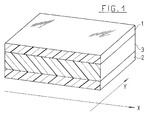
- the section shown in FIG. 1 from a monoaxially elastic laminate film produced according to the invention is greatly enlarged.
- the film has a core layer 3 made of a thermoplastic elastomer and skin layers 1, 2 arranged on both sides and co-extruded together with the core layer 3.
- the skin layers 1, 2 consist of a thermoplastic with a brittle solidified molecular structure, which arises during extrusion and / or aftertreatment.
- the skin layers 1, 2 have an expansion behavior which is similar to a thermoset. Using a tensile force F, the material does not expand or only slightly, as long as a predetermined tensile strength F R is not exceeded. If the tensile strength is exceeded, the material tears seamlessly. If the laminate film shown in FIG.
- the elastic core layer will readily follow this stretching force and essentially return to the previous configuration when the force is removed. If the specific tensile strength F R of the skin layers is exceeded during the stretching, characteristic cracks and gaps form in the skin layers 1, 2, which are reminiscent of crevasses on a microscopic scale. In these areas, the molecular structure or the embrittled molecular structure is irreversibly broken, so that when the strain is renewed, small forces are sufficient to break up the molecular structure again. In contrast, the embrittled molecular structure is retained in the transverse direction to the preferred direction of expansion (coordinate Y), so that the laminate film retains a relatively firm and inelastic structure in the Y direction.
- the tensile force F is defined on the ordinate as a force in Newton (N) that acts on a strip 15 mm wide.
- the abscissa shows the elongation ⁇ l in%.
- the film essentially returns to the original configuration.
- the reset takes place according to the relief curve K2.
- a curve is created in accordance with curve K3.
- the elasticity of the composite film in the preferred direction of stretching that is to say in the direction X, is essentially determined by the elasticity behavior of the core layer 3.
- the material can be stretched several times its original length. After the first stretch, the laminate film behaves in the X direction like a typical elastomer, as well as after the second and every further stretch.
- FIGS. 2 and 3 show the force / elongation behavior in the Y direction, that is to say transversely to the preferred elongation direction X.
- the Y direction corresponds to the machine direction MD.
- F s a threshold value
- This threshold value F S can be set within limits known to the person skilled in the art of plastics.
- a comparative examination of FIGS. 2 and 3 reveals that the laminate film according to the invention can be stretched in the X direction by a multiple of its original length, while it is dimensionally stable in the Y direction and forces which act essentially without stretching in the Y direction up to one Threshold F s picks up.
- Skin layers are preferred which are characterized by the following properties after an initial stretch. They stretch at a tensile force which is required to stretch the elastomeric core layer by 100%, in one direction by at least 50%, in the other direction by preferably less than 5% in the same force.
- a three-layer laminate film with the following structure was coextruded on a three-layer coextrusion system.
- the skin layers each consisted of polypropylene homopolymer with a density of 0.900 g / cm 3 and a melt index of 2 g / 10 min at 230 ° C. and 2.16 kg. The layers were adjusted to a thickness of 24 ⁇ m.
- the core layer consisted of an extrusion-capable styrene block copolymer, namely a styrene soprene styrene triblock with a styrene content of 18% by weight and a melt index of 7 g / 10 min at 200 ° C and 5 kg.
- the thickness of the elastomer Core layer was 400 ⁇ m.
- the laminate film produced in this way had one Thickness of 80 ⁇ m. It was solid in the machine direction and dimensionally stable and had one across the machine direction high elasticity. A tensile test was carried out in the machine direction with a force of 5 N an elongation of measured less than 3%. This stretched in the transverse direction Material with the same force by 120%.
- a film was placed on a three-layer blown film line extruded in their two outer skin layers contained a mixture of polypropylene and 30 wt .-% talc.
- the grain size of the talc was below 0.5 ⁇ m.
- the thickness of the outer layers was 5 ⁇ m in each case.
- the core location the film consisted of a mixture of a styrene block copolymer (SIS triblock with a styrene content of 18 Wt .-%) and ethylene vinyl acetate with 18 wt .-%, so that a melt index of 2 g / 10 min at 190 ° C gave 2.16 kg.
- the thickness of the core layer was 60 ⁇ m.
- the manufactured one Film stretched crosswise at a temperature of 15 ° C, with a stretch ratio of 1: 5.
- Elongation reached 185%. With the same force in the machine direction the film only stretched about 3%.
- a multilayer film with the following structure was coextruded on a three-layer coextrusion system.
- the core layer consisted of a thermoplastic polyurethane with a Shore hardness according to DIN 53505 of 70 Shore A.
- the skin layers each consisted of a mixture of HDPE (high density polyethylene) with equal proportions of polystyrene and ethyl vinyl acetate.
- the HDPE had a density of 0.960 g / cm 3 and a melt index of 8 g / 10 min at 190 ° C., 2.16 kg.
- the polystyrene was a homopolymer with a melt flow rate of 18 g / 10 min at 200 ° C and 5 kg.
- the ethyl vinyl acetate contained 25% vinyl acetate and had a melt index of 3 g / 10 min at 190 ° C. and 2.16 kg.
- the total thickness of the film was 100 ⁇ m, the ratio of the layers being 1: 8: 1.
- the film produced was very stable in the machine direction. It could easily be stretched in the transverse direction by hand. Then it behaved elastically in the transverse direction.
- a film was extruded, consisting of three layers composed.
- the core of the film consisted of one Polyethylene block amide (PEBA), the outer layers of one Mixture (blend) of HDPE, the 5 wt .-% maleic anhydride was grafted on and made of 20 wt .-% polystyrene with a Add 0.5% by weight talc.
- PEBAX Polyethylene block amide
- HDPE grafted with maleic anhydride was made by the company DuPont manufactured.
- the talc had a medium grain of 5 ⁇ m.
- the total thickness of the film was 50 microns
- the Outer layers were 5 ⁇ m each and the core was 40 ⁇ m thick.
- Example 4 In the same thickness distribution as in Example 4 coextruded a laminate film.
- a polyester elastomer from DSM (trade name Arnitel) used for the core of the film.
- the outer layers are exposed a blend of ethyl butyl acrylate (60% by weight), polystyrene (39.5% by weight) and talc (0.5% by weight) together.
- the total thickness the film was 70 ⁇ m; the outer layers were each 6 ⁇ m thick.
- the ethyl butyl acrylate had a molecular one 28% butyl acrylate and a melt index of 4 g / 10 min at 190 ° C and 2.16 kg.
- Polystyrene and Talc had the same characteristics as in Example 4.
- a 35 ⁇ m thick film was extruded on a three-layer blown film line.
- the core of the film was 30 ⁇ m thick and was composed of a copolymer of ethylene and octene made with metallocene catalysts.
- the density of the copolymer was 0.870 g / cm 3 .
- a melt index of 1 g / 10 min at 190 ° C. and 2.16 kg was measured.
- the outer layers of the film consisted of a blend of 75% by weight polypropylene, 0.8% by weight talc and 24.2% by weight polystyrene.
- the polypropylene was a homopolymer with a density of 0.910 g / cm 3 and a melt index of 8 g / 10 min at 230 ° C and 2.16 kg.
- An 80 ⁇ m thick film was placed on a flat film line extruded.
- a blend was made for the core of the film Styrene-butadiene-styrene block copolymer (SBS) and styrene-soprene styrene block copolymer (SIS) used.
- the melt index of the Blends were 6 g / 10 min at 200 ° C and 5 kg.
- polystyrene and 20% by weight of ethyl vinyl acetate is used.
- the outer layers were 6 ⁇ m thick, the core 68 ⁇ m.
- the manufactured Material was very stable in the machine direction and left do not stretch until a force of more than 6 N / 15 mm. In The film was already able to move in the transverse direction with a force of Stretch 3.3 N / 15 mm by 300%. After the first stretch only a force of 2.5 N / 15 mm was required to achieve the to achieve the same 300% stretch.
- a film produced according to Example 7 was in a Stretching frame stretched in the transverse direction by 300% and then relieved. The result was a film that was very elastic in the transverse direction and still little stretchable in the machine direction. When using the same Force that caused a stretch of 300% in the transverse direction, only about 5% elongation in the machine direction detected.
Landscapes
- Engineering & Computer Science (AREA)
- Mechanical Engineering (AREA)
- Laminated Bodies (AREA)
- Extrusion Moulding Of Plastics Or The Like (AREA)
Abstract
Description
wobei die Skinlage aus einem thermoplastischen Kunststoff mit einem spröde verfestigten Molekülverband besteht, der sich unter Anwendung einer Dehnkraft nur wenig dehnt und bei Überschreiten einer vorgegebenen Reißkraft übergangslos reißt, und
wobei der spröde verfestigte Molekülverband durch eine einachsige Dehnung in Dehnrichtung irreversibel aufgebrochen ist, jedoch quer zur Dehnrichtung erhalten bleibt und dadurch die Folie in Querrichtung versteift.
- Fig. 1
- den Schichtenaufbau einer erfindungsgemäßen monoaxial elastischen Laminatfolie,
- Fig. 2
- ein Kraft-Dehnungs-Diagramm für das Dehnungsverhalten der erfindungsgemäßen Laminatfolie in bevorzugter Dehnungsrichtung,
- Fig. 3
- das Kraft-Dehnungs-Diagramm für das Dehnungsverhalten der Verbundfolie quer zur bevorzugten Dehnungsrichtung.
Claims (9)
- Monoaxial elastische Laminatfolie mit einer Kernlage aus einem thermoplastischen Elastomer und mindestens einer zusammen mit der Kernlage koextrudierten Skinlage,
wobei die Skinlage aus einem thermoplastischen Kunststoff mit einem spröde verfestigten Molekülverband besteht, der sich unter Anwendung einer Dehnkraft nur wenig dehnt und bei Überschreiten einer vorgegebenen Reißkraft übergangslos reißt, und
wobei der spröde verfestigte Molekülverband durch eine einachsige Dehnung in Dehnrichtung irreversibel aufgebrochen ist, jedoch quer zur Dehnrichtung erhalten bleibt und dadurch die Folie in Querrichtung versteift. - Laminatfolie nach Anspruch 1, dadurch gekennzeichnet, dass die Skinlage sich bei einer Zugkraft, die man braucht, um die Kernlage um 100 % zu dehnen, in der bevorzugten Dehnrichtung um mindestens 50 % sowie bei Anwendung der gleichen Kraft in Querrichtung um weniger als 5 % dehnt.
- Laminatfolie nach Anspruch 1 oder 2, dadurch gekennzeichnet, dass die Skinlage nicht vollflächig sondern lediglich in Bereichen durch Verstreckung in Dehnrichtung aufgebrochen ist.
- Laminatfolie nach einem der Ansprüche 1 bis 3, dadurch gekennzeichnet, dass die Kernlage aus einem Blockcopolymer, ausgewählt aus der Gruppe der SIS-, SBS-, SEBS- oder PEBA-Blockcopolymere, oder aus einem thermoplastischen Polyurethan oder aus einem mit Metallocenkatalysatoren hergestellten Polymer aus Ethylen und Octen besteht.
- Laminatfolie nach einem der Ansprüche 1 bis 4, dadurch gekennzeichnet, dass die Skinlage aus einem durch Nachbehandlung versprödeten Polyolefin oder einer Mischung aus Polyolefin und Polystyrol oder einer Mischung aus Polyolefin, Polystyrol und Ethylvinylacetat oder einer Mischung aus Ethylbutylacrylat und Polystyrol besteht.
- Laminatfolie nach einem der Ansprüche 1 bis 5, dadurch gekennzeichnet, dass die Skinlage Zusätze eines anorganischen Füllstoffes enthält.
- Verfahren zur Herstellung einer monoaxial elastischen Laminatfolie,
wobei ein Coextrudat mit einer Kernlage aus einem thermoplastischen Elastomer und mindestens einer polyolefinischen Skinlage hergestellt wird,
wobei das Coextrudat zur Bildung eines spröde verfestigten Molekülverbandes in der Skinlage bei einer Temperatur zwischen 140 °C und 155 °C in einer ersten Dehnrichtung einachsig in einem Verhältnis von 1:5 bis 1:10 verstreckt sowie anschließend unter Schrumpfung auf Zimmertemperatur abgekühlt wird und
wobei durch erneutes einachsiges Recken quer zur ersten Dehnrichtung in einem Verhältnis zwischen 1:2,5 bis 1:3,5 der Molekülverband in der Skinlage aufgebrochen wird, so dass sich das Laminat in der letztgenannten Reckrichtung dehnen lässt und in der ersten Dehnrichtung steif bleibt. - Verfahren nach Anspruch 7, dadurch gekennzeichnet, dass die Skinlage aus einem Polypropylen-Homopolymer besteht.
- Verfahren nach Anspruch 7 oder 8, dadurch gekennzeichnet, dass ein dreischichtiges Coextrudat hergestellt wird, das auf beiden Seiten der Kernlage jeweils eine Skinlage aus einem polyolefinischen Kunststoff aufweist.
Applications Claiming Priority (2)
| Application Number | Priority Date | Filing Date | Title |
|---|---|---|---|
| DE10158345A DE10158345B4 (de) | 2001-11-28 | 2001-11-28 | Monoaxial elastische Laminatfolie |
| DE10158345 | 2001-11-28 |
Publications (2)
| Publication Number | Publication Date |
|---|---|
| EP1316418A1 true EP1316418A1 (de) | 2003-06-04 |
| EP1316418B1 EP1316418B1 (de) | 2005-10-05 |
Family
ID=7707245
Family Applications (1)
| Application Number | Title | Priority Date | Filing Date |
|---|---|---|---|
| EP02026176A Expired - Lifetime EP1316418B1 (de) | 2001-11-28 | 2002-11-25 | Monoaxial elastische Laminatfolie |
Country Status (4)
| Country | Link |
|---|---|
| US (1) | US7449240B2 (de) |
| EP (1) | EP1316418B1 (de) |
| DE (2) | DE10158345B4 (de) |
| ES (1) | ES2245715T3 (de) |
Cited By (5)
| Publication number | Priority date | Publication date | Assignee | Title |
|---|---|---|---|---|
| EP2471652A1 (de) | 2010-12-28 | 2012-07-04 | Nordenia Technologies GmbH | Elastomerer Schichtstoff und Verfahren zu seiner Herstellung |
| US8603281B2 (en) | 2008-06-30 | 2013-12-10 | Kimberly-Clark Worldwide, Inc. | Elastic composite containing a low strength and lightweight nonwoven facing |
| US8679992B2 (en) | 2008-06-30 | 2014-03-25 | Kimberly-Clark Worldwide, Inc. | Elastic composite formed from multiple laminate structures |
| EP2886326A1 (de) | 2013-12-23 | 2015-06-24 | Mondi Consumer Packaging Technologies GmbH | Coextrusionsfolie sowie Verfahren zur Herstellung einer Coextrusionsfolie |
| WO2021056247A1 (zh) * | 2019-09-25 | 2021-04-01 | 佐福(天津)科技有限公司 | 无纺布及无纺布的加工装置 |
Families Citing this family (10)
| Publication number | Priority date | Publication date | Assignee | Title |
|---|---|---|---|---|
| CA2609987A1 (en) * | 2005-06-20 | 2007-01-04 | Pliant Corporation | Low cost multilayer elastomeric films having a low permanent set |
| US20070141352A1 (en) * | 2005-12-15 | 2007-06-21 | Calhoun Patricia H | Cross-directional elastic films with machine direction stiffness |
| ES2377781T3 (es) | 2009-10-20 | 2012-03-30 | Nordenia Deutschland Gronau Gmbh | Película de coextrusión y procedimiento para fabricar un material compuesto |
| DE102010009230A1 (de) * | 2010-02-25 | 2011-08-25 | Giesecke & Devrient GmbH, 81677 | Hochflexibles Folienverbundmaterial und seine Verwendung in Kartenkörpern |
| DE102011051193A1 (de) * | 2011-06-20 | 2012-12-20 | Nordenia Technologies Gmbh | Seitenfaltenbeutel zur Verpackung von stückigem und körnigem Schüttgut |
| US10213990B2 (en) | 2013-12-31 | 2019-02-26 | Kimberly-Clark Worldwide, Inc. | Methods to make stretchable elastic laminates |
| US9802392B2 (en) * | 2014-03-31 | 2017-10-31 | Kimberly-Clark Worldwide, Inc. | Microtextured multilayered elastic laminates with enhanced strength and elasticity and methods of making thereof |
| EP3034098B1 (de) * | 2014-12-17 | 2018-02-14 | Surfaceskins Limited | Verwendung einer perforierten elastischen Folie als Frontwand eines fluidabgebenden Kissens |
| DE102024113233A1 (de) | 2024-05-13 | 2025-11-13 | Rkw Se | Soft elastic blown film |
| DE102024119044A1 (de) | 2024-07-04 | 2026-01-08 | Rkw Se | SEBS based elastic blown film (SEBS basierte, elastische Blasfolie) |
Citations (5)
| Publication number | Priority date | Publication date | Assignee | Title |
|---|---|---|---|---|
| US4834820A (en) * | 1986-09-24 | 1989-05-30 | Star Rubber Kogyo Kabushiki Kaisha | Method for producing tape for putting on disposable diaper |
| US5344691A (en) * | 1990-03-30 | 1994-09-06 | Minnesota Mining And Manufacturing Company | Spatially modified elastic laminates |
| US5422178A (en) * | 1992-06-19 | 1995-06-06 | Minnesota Mining And Manufacturing Company | Elastic film laminate |
| US5501679A (en) * | 1989-11-17 | 1996-03-26 | Minnesota Mining And Manufacturing Company | Elastomeric laminates with microtextured skin layers |
| US5691043A (en) * | 1994-07-15 | 1997-11-25 | Mobil Oil Corporation | Uniaxially shrinkable biaxially oriented polypropylene film and its method of preparation |
Family Cites Families (4)
| Publication number | Priority date | Publication date | Assignee | Title |
|---|---|---|---|---|
| US4681580A (en) * | 1985-03-29 | 1987-07-21 | The Procter & Gamble Company | Disposable diapers with unitary waistshield and elastically expansible waistbands |
| DE4243012C2 (de) | 1992-12-18 | 1997-09-11 | Corovin Gmbh | Mehrschichtiges elastisches Flächengebilde sowie Verfahren zur Herstellung eines mehrschichtigen elastischen Flächengebildes |
| DE19526044C2 (de) * | 1995-07-17 | 1999-03-18 | M & W Verpackungen Gmbh | Flauschige Verbundfolie und Verfahren zur Herstellung einer solchen Verbundfolie |
| DE19715938C2 (de) * | 1997-04-16 | 2003-10-09 | Nordenia Deutschland Gronau | Mehrschichtiges Koextrudat mit einer klebrigen Kernlage |
-
2001
- 2001-11-28 DE DE10158345A patent/DE10158345B4/de not_active Expired - Fee Related
-
2002
- 2002-11-25 ES ES02026176T patent/ES2245715T3/es not_active Expired - Lifetime
- 2002-11-25 EP EP02026176A patent/EP1316418B1/de not_active Expired - Lifetime
- 2002-11-25 DE DE50204458T patent/DE50204458D1/de not_active Expired - Lifetime
- 2002-11-27 US US10/306,801 patent/US7449240B2/en not_active Expired - Lifetime
Patent Citations (6)
| Publication number | Priority date | Publication date | Assignee | Title |
|---|---|---|---|---|
| US4834820A (en) * | 1986-09-24 | 1989-05-30 | Star Rubber Kogyo Kabushiki Kaisha | Method for producing tape for putting on disposable diaper |
| US5501679A (en) * | 1989-11-17 | 1996-03-26 | Minnesota Mining And Manufacturing Company | Elastomeric laminates with microtextured skin layers |
| US5344691A (en) * | 1990-03-30 | 1994-09-06 | Minnesota Mining And Manufacturing Company | Spatially modified elastic laminates |
| US5422178A (en) * | 1992-06-19 | 1995-06-06 | Minnesota Mining And Manufacturing Company | Elastic film laminate |
| EP0703068A2 (de) * | 1992-06-19 | 1996-03-27 | Minnesota Mining And Manufacturing Company | Anisotropischer Verbundfilm |
| US5691043A (en) * | 1994-07-15 | 1997-11-25 | Mobil Oil Corporation | Uniaxially shrinkable biaxially oriented polypropylene film and its method of preparation |
Cited By (9)
| Publication number | Priority date | Publication date | Assignee | Title |
|---|---|---|---|---|
| US8603281B2 (en) | 2008-06-30 | 2013-12-10 | Kimberly-Clark Worldwide, Inc. | Elastic composite containing a low strength and lightweight nonwoven facing |
| US8679992B2 (en) | 2008-06-30 | 2014-03-25 | Kimberly-Clark Worldwide, Inc. | Elastic composite formed from multiple laminate structures |
| EP2471652A1 (de) | 2010-12-28 | 2012-07-04 | Nordenia Technologies GmbH | Elastomerer Schichtstoff und Verfahren zu seiner Herstellung |
| US9457543B2 (en) | 2010-12-28 | 2016-10-04 | Mondi Consumer Packaging Technologies Gmbh | Elastomer laminate and method for its production |
| EP2886326A1 (de) | 2013-12-23 | 2015-06-24 | Mondi Consumer Packaging Technologies GmbH | Coextrusionsfolie sowie Verfahren zur Herstellung einer Coextrusionsfolie |
| DE102013114783A1 (de) | 2013-12-23 | 2015-06-25 | Mondi Consumer Packaging Technologies Gmbh | Coextrusionsfolie sowie Verfahren zur Herstellung einer Coextrusionsfolie |
| CN104827735A (zh) * | 2013-12-23 | 2015-08-12 | 盟迪消费品包装技术有限公司 | 共挤薄膜以及用于制备共挤薄膜的方法 |
| CN104827735B (zh) * | 2013-12-23 | 2018-07-13 | 盟迪消费品包装技术有限公司 | 共挤薄膜以及用于制备共挤薄膜的方法 |
| WO2021056247A1 (zh) * | 2019-09-25 | 2021-04-01 | 佐福(天津)科技有限公司 | 无纺布及无纺布的加工装置 |
Also Published As
| Publication number | Publication date |
|---|---|
| ES2245715T3 (es) | 2006-01-16 |
| DE10158345A1 (de) | 2003-06-12 |
| US20030134126A1 (en) | 2003-07-17 |
| DE10158345B4 (de) | 2005-11-24 |
| US7449240B2 (en) | 2008-11-11 |
| EP1316418B1 (de) | 2005-10-05 |
| DE50204458D1 (de) | 2006-02-16 |
Similar Documents
| Publication | Publication Date | Title |
|---|---|---|
| DE69332833T2 (de) | Anisotrope Verbundfolie | |
| DE69121703T2 (de) | Räumlich modifizierte elastische verbundstoffe | |
| EP1316418B1 (de) | Monoaxial elastische Laminatfolie | |
| DE69415536T2 (de) | Elastische mehrschichtige folie aus schrittweise gestrecktem faserigem vliesstoff und elastomerfilm und verfahren zu deren herstellung | |
| DE69020903T2 (de) | Elastomere verbundstoffe mit mikrotexturierten oberflächenschichten. | |
| EP0754544B1 (de) | Verbundfolie und Verfahren zur Herstellung einer solchen Verbundfolie | |
| DE19983597B3 (de) | Verfahren zur Herstellung eines elastischen Laminats, Flüssigkeit absorbierende Schutzkleidung und elastisches Laminat | |
| EP1321288B1 (de) | Elastisches Folienlaminat | |
| EP2471652A1 (de) | Elastomerer Schichtstoff und Verfahren zu seiner Herstellung | |
| EP3228291A1 (de) | Weichelastische folie für folienbändchen | |
| DE10358409B4 (de) | Verbundstoff für einen elastischen Windelverschluss und Verfahren zu seiner Herstellung | |
| DE3144912A1 (de) | Biaxial gestreckte polyolefinische kunststoffolie mit einem elastizitaetsmodul in laengsrichtung von mehr als 4000 n/mm(pfeil hoch)2(pfeil hoch) | |
| EP1278632B1 (de) | Verfahren zum herstellen eines mehrschichtigen coextrudates | |
| DE68904331T2 (de) | Kreuzlaminierter film aus orientiertem polypropylen und diesen film enthaltender befestigungsstreifen fuer eine papierwindel. | |
| DE69728575T2 (de) | Anisotrope elastische folien und bahnen | |
| DE102005016895B4 (de) | Verschlussstreifen für Windeln | |
| EP3228292A1 (de) | Elastisches laminat sowie verfahren zur herstellung des elastischen laminates | |
| EP2110241B1 (de) | Verbundmaterial, insbesondere für Verschlusselemente an Windeln, mit hohem Dehnungsvermögen und semielastischen Eigenschaften | |
| DE102008013689A1 (de) | Folienanordnung | |
| EP2886588B1 (de) | Elastische Monofolie sowie Verfahren zur Herstellung eines Laminates für Einweg-Hygieneprodukte | |
| DE102024119044A1 (de) | SEBS based elastic blown film (SEBS basierte, elastische Blasfolie) | |
| DE102024113233A1 (de) | Soft elastic blown film | |
| EP1064149A1 (de) | Laminat, verfahren zu dessen herstellung sowie verwendung eines laminats insbesondere als medizinisches trägermaterial | |
| DE19826455A1 (de) | Laminat, Verfahren zu dessen Herstellung sowie Verwendung eines Laminats insbesondere als medizinisches Trägermaterial | |
| EP4620670A1 (de) | Elastische folie, nonwovenelement sowie hygieneartikel |
Legal Events
| Date | Code | Title | Description |
|---|---|---|---|
| PUAI | Public reference made under article 153(3) epc to a published international application that has entered the european phase |
Free format text: ORIGINAL CODE: 0009012 |
|
| 17P | Request for examination filed |
Effective date: 20030327 |
|
| AK | Designated contracting states |
Designated state(s): AT BE BG CH CY CZ DE DK EE ES FI FR GB GR IE IT LI LU MC NL PT SE SK TR |
|
| AX | Request for extension of the european patent |
Extension state: AL LT LV MK RO SI |
|
| 17Q | First examination report despatched |
Effective date: 20030811 |
|
| AKX | Designation fees paid |
Designated state(s): DE ES FR GB IT NL |
|
| GRAP | Despatch of communication of intention to grant a patent |
Free format text: ORIGINAL CODE: EPIDOSNIGR1 |
|
| GRAS | Grant fee paid |
Free format text: ORIGINAL CODE: EPIDOSNIGR3 |
|
| GRAA | (expected) grant |
Free format text: ORIGINAL CODE: 0009210 |
|
| AK | Designated contracting states |
Kind code of ref document: B1 Designated state(s): DE ES FR GB IT NL |
|
| REG | Reference to a national code |
Ref country code: GB Ref legal event code: FG4D Free format text: NOT ENGLISH |
|
| GBT | Gb: translation of ep patent filed (gb section 77(6)(a)/1977) | ||
| REG | Reference to a national code |
Ref country code: ES Ref legal event code: FG2A Ref document number: 2245715 Country of ref document: ES Kind code of ref document: T3 |
|
| REF | Corresponds to: |
Ref document number: 50204458 Country of ref document: DE Date of ref document: 20060216 Kind code of ref document: P |
|
| ET | Fr: translation filed | ||
| PLBE | No opposition filed within time limit |
Free format text: ORIGINAL CODE: 0009261 |
|
| STAA | Information on the status of an ep patent application or granted ep patent |
Free format text: STATUS: NO OPPOSITION FILED WITHIN TIME LIMIT |
|
| 26N | No opposition filed |
Effective date: 20060706 |
|
| REG | Reference to a national code |
Ref country code: FR Ref legal event code: PLFP Year of fee payment: 14 |
|
| REG | Reference to a national code |
Ref country code: FR Ref legal event code: PLFP Year of fee payment: 15 |
|
| REG | Reference to a national code |
Ref country code: FR Ref legal event code: PLFP Year of fee payment: 16 |
|
| PGFP | Annual fee paid to national office [announced via postgrant information from national office to epo] |
Ref country code: FR Payment date: 20211119 Year of fee payment: 20 Ref country code: NL Payment date: 20211118 Year of fee payment: 20 Ref country code: GB Payment date: 20211118 Year of fee payment: 20 Ref country code: DE Payment date: 20211025 Year of fee payment: 20 |
|
| PGFP | Annual fee paid to national office [announced via postgrant information from national office to epo] |
Ref country code: IT Payment date: 20211119 Year of fee payment: 20 |
|
| PGFP | Annual fee paid to national office [announced via postgrant information from national office to epo] |
Ref country code: ES Payment date: 20220121 Year of fee payment: 20 |
|
| REG | Reference to a national code |
Ref country code: DE Ref legal event code: R071 Ref document number: 50204458 Country of ref document: DE |
|
| REG | Reference to a national code |
Ref country code: NL Ref legal event code: MK Effective date: 20221124 |
|
| REG | Reference to a national code |
Ref country code: GB Ref legal event code: PE20 Expiry date: 20221124 |
|
| PG25 | Lapsed in a contracting state [announced via postgrant information from national office to epo] |
Ref country code: GB Free format text: LAPSE BECAUSE OF EXPIRATION OF PROTECTION Effective date: 20221124 |
|
| REG | Reference to a national code |
Ref country code: ES Ref legal event code: FD2A Effective date: 20230504 |
|
| PG25 | Lapsed in a contracting state [announced via postgrant information from national office to epo] |
Ref country code: ES Free format text: LAPSE BECAUSE OF EXPIRATION OF PROTECTION Effective date: 20221126 |