EP1323710A1 - Nitrogenous five-membered ring compounds - Google Patents
Nitrogenous five-membered ring compounds Download PDFInfo
- Publication number
- EP1323710A1 EP1323710A1 EP01974716A EP01974716A EP1323710A1 EP 1323710 A1 EP1323710 A1 EP 1323710A1 EP 01974716 A EP01974716 A EP 01974716A EP 01974716 A EP01974716 A EP 01974716A EP 1323710 A1 EP1323710 A1 EP 1323710A1
- Authority
- EP
- European Patent Office
- Prior art keywords
- group
- lower alkyl
- compound
- substituted
- alkyl group
- Prior art date
- Legal status (The legal status is an assumption and is not a legal conclusion. Google has not performed a legal analysis and makes no representation as to the accuracy of the status listed.)
- Granted
Links
- 0 CC*CCB(CC1)CCC1(*)N Chemical compound CC*CCB(CC1)CCC1(*)N 0.000 description 2
Classifications
-
- C—CHEMISTRY; METALLURGY
- C07—ORGANIC CHEMISTRY
- C07D—HETEROCYCLIC COMPOUNDS
- C07D207/00—Heterocyclic compounds containing five-membered rings not condensed with other rings, with one nitrogen atom as the only ring hetero atom
- C07D207/02—Heterocyclic compounds containing five-membered rings not condensed with other rings, with one nitrogen atom as the only ring hetero atom with only hydrogen or carbon atoms directly attached to the ring nitrogen atom
- C07D207/30—Heterocyclic compounds containing five-membered rings not condensed with other rings, with one nitrogen atom as the only ring hetero atom with only hydrogen or carbon atoms directly attached to the ring nitrogen atom having two double bonds between ring members or between ring members and non-ring members
- C07D207/34—Heterocyclic compounds containing five-membered rings not condensed with other rings, with one nitrogen atom as the only ring hetero atom with only hydrogen or carbon atoms directly attached to the ring nitrogen atom having two double bonds between ring members or between ring members and non-ring members with hetero atoms or with carbon atoms having three bonds to hetero atoms with at the most one bond to halogen, e.g. ester or nitrile radicals, directly attached to ring carbon atoms
- C07D207/36—Oxygen or sulfur atoms
- C07D207/40—2,5-Pyrrolidine-diones
- C07D207/404—2,5-Pyrrolidine-diones with only hydrogen atoms or radicals containing only hydrogen and carbon atoms directly attached to other ring carbon atoms, e.g. succinimide
-
- A—HUMAN NECESSITIES
- A61—MEDICAL OR VETERINARY SCIENCE; HYGIENE
- A61K—PREPARATIONS FOR MEDICAL, DENTAL OR TOILETRY PURPOSES
- A61K31/00—Medicinal preparations containing organic active ingredients
- A61K31/33—Heterocyclic compounds
- A61K31/395—Heterocyclic compounds having nitrogen as a ring hetero atom, e.g. guanethidine or rifamycins
- A61K31/40—Heterocyclic compounds having nitrogen as a ring hetero atom, e.g. guanethidine or rifamycins having five-membered rings with one nitrogen as the only ring hetero atom, e.g. sulpiride, succinimide, tolmetin, buflomedil
-
- A—HUMAN NECESSITIES
- A61—MEDICAL OR VETERINARY SCIENCE; HYGIENE
- A61K—PREPARATIONS FOR MEDICAL, DENTAL OR TOILETRY PURPOSES
- A61K31/00—Medicinal preparations containing organic active ingredients
- A61K31/33—Heterocyclic compounds
- A61K31/395—Heterocyclic compounds having nitrogen as a ring hetero atom, e.g. guanethidine or rifamycins
- A61K31/41—Heterocyclic compounds having nitrogen as a ring hetero atom, e.g. guanethidine or rifamycins having five-membered rings with two or more ring hetero atoms, at least one of which being nitrogen, e.g. tetrazole
- A61K31/425—Thiazoles
-
- A—HUMAN NECESSITIES
- A61—MEDICAL OR VETERINARY SCIENCE; HYGIENE
- A61K—PREPARATIONS FOR MEDICAL, DENTAL OR TOILETRY PURPOSES
- A61K31/00—Medicinal preparations containing organic active ingredients
- A61K31/33—Heterocyclic compounds
- A61K31/395—Heterocyclic compounds having nitrogen as a ring hetero atom, e.g. guanethidine or rifamycins
- A61K31/435—Heterocyclic compounds having nitrogen as a ring hetero atom, e.g. guanethidine or rifamycins having six-membered rings with one nitrogen as the only ring hetero atom
- A61K31/44—Non condensed pyridines; Hydrogenated derivatives thereof
-
- A—HUMAN NECESSITIES
- A61—MEDICAL OR VETERINARY SCIENCE; HYGIENE
- A61K—PREPARATIONS FOR MEDICAL, DENTAL OR TOILETRY PURPOSES
- A61K31/00—Medicinal preparations containing organic active ingredients
- A61K31/33—Heterocyclic compounds
- A61K31/395—Heterocyclic compounds having nitrogen as a ring hetero atom, e.g. guanethidine or rifamycins
- A61K31/495—Heterocyclic compounds having nitrogen as a ring hetero atom, e.g. guanethidine or rifamycins having six-membered rings with two or more nitrogen atoms as the only ring heteroatoms, e.g. piperazine or tetrazines
- A61K31/4965—Non-condensed pyrazines
-
- A—HUMAN NECESSITIES
- A61—MEDICAL OR VETERINARY SCIENCE; HYGIENE
- A61K—PREPARATIONS FOR MEDICAL, DENTAL OR TOILETRY PURPOSES
- A61K31/00—Medicinal preparations containing organic active ingredients
- A61K31/33—Heterocyclic compounds
- A61K31/395—Heterocyclic compounds having nitrogen as a ring hetero atom, e.g. guanethidine or rifamycins
- A61K31/495—Heterocyclic compounds having nitrogen as a ring hetero atom, e.g. guanethidine or rifamycins having six-membered rings with two or more nitrogen atoms as the only ring heteroatoms, e.g. piperazine or tetrazines
- A61K31/4965—Non-condensed pyrazines
- A61K31/497—Non-condensed pyrazines containing further heterocyclic rings
-
- A—HUMAN NECESSITIES
- A61—MEDICAL OR VETERINARY SCIENCE; HYGIENE
- A61K—PREPARATIONS FOR MEDICAL, DENTAL OR TOILETRY PURPOSES
- A61K31/00—Medicinal preparations containing organic active ingredients
- A61K31/33—Heterocyclic compounds
- A61K31/395—Heterocyclic compounds having nitrogen as a ring hetero atom, e.g. guanethidine or rifamycins
- A61K31/535—Heterocyclic compounds having nitrogen as a ring hetero atom, e.g. guanethidine or rifamycins having six-membered rings with at least one nitrogen and one oxygen as the ring hetero atoms, e.g. 1,2-oxazines
- A61K31/5375—1,4-Oxazines, e.g. morpholine
-
- A—HUMAN NECESSITIES
- A61—MEDICAL OR VETERINARY SCIENCE; HYGIENE
- A61P—SPECIFIC THERAPEUTIC ACTIVITY OF CHEMICAL COMPOUNDS OR MEDICINAL PREPARATIONS
- A61P3/00—Drugs for disorders of the metabolism
- A61P3/08—Drugs for disorders of the metabolism for glucose homeostasis
- A61P3/10—Drugs for disorders of the metabolism for glucose homeostasis for hyperglycaemia, e.g. antidiabetics
-
- A—HUMAN NECESSITIES
- A61—MEDICAL OR VETERINARY SCIENCE; HYGIENE
- A61P—SPECIFIC THERAPEUTIC ACTIVITY OF CHEMICAL COMPOUNDS OR MEDICINAL PREPARATIONS
- A61P43/00—Drugs for specific purposes, not provided for in groups A61P1/00-A61P41/00
-
- C—CHEMISTRY; METALLURGY
- C07—ORGANIC CHEMISTRY
- C07D—HETEROCYCLIC COMPOUNDS
- C07D207/00—Heterocyclic compounds containing five-membered rings not condensed with other rings, with one nitrogen atom as the only ring hetero atom
- C07D207/02—Heterocyclic compounds containing five-membered rings not condensed with other rings, with one nitrogen atom as the only ring hetero atom with only hydrogen or carbon atoms directly attached to the ring nitrogen atom
- C07D207/04—Heterocyclic compounds containing five-membered rings not condensed with other rings, with one nitrogen atom as the only ring hetero atom with only hydrogen or carbon atoms directly attached to the ring nitrogen atom having no double bonds between ring members or between ring members and non-ring members
- C07D207/10—Heterocyclic compounds containing five-membered rings not condensed with other rings, with one nitrogen atom as the only ring hetero atom with only hydrogen or carbon atoms directly attached to the ring nitrogen atom having no double bonds between ring members or between ring members and non-ring members with hetero atoms or with carbon atoms having three bonds to hetero atoms with at the most one bond to halogen, e.g. ester or nitrile radicals, directly attached to ring carbon atoms
- C07D207/16—Carbon atoms having three bonds to hetero atoms with at the most one bond to halogen, e.g. ester or nitrile radicals
-
- C—CHEMISTRY; METALLURGY
- C07—ORGANIC CHEMISTRY
- C07D—HETEROCYCLIC COMPOUNDS
- C07D207/00—Heterocyclic compounds containing five-membered rings not condensed with other rings, with one nitrogen atom as the only ring hetero atom
- C07D207/02—Heterocyclic compounds containing five-membered rings not condensed with other rings, with one nitrogen atom as the only ring hetero atom with only hydrogen or carbon atoms directly attached to the ring nitrogen atom
- C07D207/30—Heterocyclic compounds containing five-membered rings not condensed with other rings, with one nitrogen atom as the only ring hetero atom with only hydrogen or carbon atoms directly attached to the ring nitrogen atom having two double bonds between ring members or between ring members and non-ring members
- C07D207/34—Heterocyclic compounds containing five-membered rings not condensed with other rings, with one nitrogen atom as the only ring hetero atom with only hydrogen or carbon atoms directly attached to the ring nitrogen atom having two double bonds between ring members or between ring members and non-ring members with hetero atoms or with carbon atoms having three bonds to hetero atoms with at the most one bond to halogen, e.g. ester or nitrile radicals, directly attached to ring carbon atoms
- C07D207/36—Oxygen or sulfur atoms
- C07D207/40—2,5-Pyrrolidine-diones
- C07D207/416—2,5-Pyrrolidine-diones with hetero atoms or with carbon atoms having three bonds to hetero atoms with at the most one bond to halogen, e.g. ester or nitrile radicals, directly attached to other ring carbon atoms
-
- C—CHEMISTRY; METALLURGY
- C07—ORGANIC CHEMISTRY
- C07D—HETEROCYCLIC COMPOUNDS
- C07D401/00—Heterocyclic compounds containing two or more hetero rings, having nitrogen atoms as the only ring hetero atoms, at least one ring being a six-membered ring with only one nitrogen atom
- C07D401/02—Heterocyclic compounds containing two or more hetero rings, having nitrogen atoms as the only ring hetero atoms, at least one ring being a six-membered ring with only one nitrogen atom containing two hetero rings
- C07D401/12—Heterocyclic compounds containing two or more hetero rings, having nitrogen atoms as the only ring hetero atoms, at least one ring being a six-membered ring with only one nitrogen atom containing two hetero rings linked by a chain containing hetero atoms as chain links
-
- C—CHEMISTRY; METALLURGY
- C07—ORGANIC CHEMISTRY
- C07D—HETEROCYCLIC COMPOUNDS
- C07D401/00—Heterocyclic compounds containing two or more hetero rings, having nitrogen atoms as the only ring hetero atoms, at least one ring being a six-membered ring with only one nitrogen atom
- C07D401/14—Heterocyclic compounds containing two or more hetero rings, having nitrogen atoms as the only ring hetero atoms, at least one ring being a six-membered ring with only one nitrogen atom containing three or more hetero rings
-
- C—CHEMISTRY; METALLURGY
- C07—ORGANIC CHEMISTRY
- C07D—HETEROCYCLIC COMPOUNDS
- C07D403/00—Heterocyclic compounds containing two or more hetero rings, having nitrogen atoms as the only ring hetero atoms, not provided for by group C07D401/00
- C07D403/02—Heterocyclic compounds containing two or more hetero rings, having nitrogen atoms as the only ring hetero atoms, not provided for by group C07D401/00 containing two hetero rings
- C07D403/12—Heterocyclic compounds containing two or more hetero rings, having nitrogen atoms as the only ring hetero atoms, not provided for by group C07D401/00 containing two hetero rings linked by a chain containing hetero atoms as chain links
-
- C—CHEMISTRY; METALLURGY
- C07—ORGANIC CHEMISTRY
- C07D—HETEROCYCLIC COMPOUNDS
- C07D405/00—Heterocyclic compounds containing both one or more hetero rings having oxygen atoms as the only ring hetero atoms, and one or more rings having nitrogen as the only ring hetero atom
- C07D405/02—Heterocyclic compounds containing both one or more hetero rings having oxygen atoms as the only ring hetero atoms, and one or more rings having nitrogen as the only ring hetero atom containing two hetero rings
- C07D405/12—Heterocyclic compounds containing both one or more hetero rings having oxygen atoms as the only ring hetero atoms, and one or more rings having nitrogen as the only ring hetero atom containing two hetero rings linked by a chain containing hetero atoms as chain links
-
- C—CHEMISTRY; METALLURGY
- C07—ORGANIC CHEMISTRY
- C07D—HETEROCYCLIC COMPOUNDS
- C07D409/00—Heterocyclic compounds containing two or more hetero rings, at least one ring having sulfur atoms as the only ring hetero atoms
- C07D409/14—Heterocyclic compounds containing two or more hetero rings, at least one ring having sulfur atoms as the only ring hetero atoms containing three or more hetero rings
-
- C—CHEMISTRY; METALLURGY
- C07—ORGANIC CHEMISTRY
- C07D—HETEROCYCLIC COMPOUNDS
- C07D413/00—Heterocyclic compounds containing two or more hetero rings, at least one ring having nitrogen and oxygen atoms as the only ring hetero atoms
- C07D413/02—Heterocyclic compounds containing two or more hetero rings, at least one ring having nitrogen and oxygen atoms as the only ring hetero atoms containing two hetero rings
- C07D413/12—Heterocyclic compounds containing two or more hetero rings, at least one ring having nitrogen and oxygen atoms as the only ring hetero atoms containing two hetero rings linked by a chain containing hetero atoms as chain links
-
- C—CHEMISTRY; METALLURGY
- C07—ORGANIC CHEMISTRY
- C07D—HETEROCYCLIC COMPOUNDS
- C07D413/00—Heterocyclic compounds containing two or more hetero rings, at least one ring having nitrogen and oxygen atoms as the only ring hetero atoms
- C07D413/14—Heterocyclic compounds containing two or more hetero rings, at least one ring having nitrogen and oxygen atoms as the only ring hetero atoms containing three or more hetero rings
-
- C—CHEMISTRY; METALLURGY
- C07—ORGANIC CHEMISTRY
- C07D—HETEROCYCLIC COMPOUNDS
- C07D417/00—Heterocyclic compounds containing two or more hetero rings, at least one ring having nitrogen and sulfur atoms as the only ring hetero atoms, not provided for by group C07D415/00
- C07D417/02—Heterocyclic compounds containing two or more hetero rings, at least one ring having nitrogen and sulfur atoms as the only ring hetero atoms, not provided for by group C07D415/00 containing two hetero rings
- C07D417/12—Heterocyclic compounds containing two or more hetero rings, at least one ring having nitrogen and sulfur atoms as the only ring hetero atoms, not provided for by group C07D415/00 containing two hetero rings linked by a chain containing hetero atoms as chain links
-
- C—CHEMISTRY; METALLURGY
- C07—ORGANIC CHEMISTRY
- C07D—HETEROCYCLIC COMPOUNDS
- C07D417/00—Heterocyclic compounds containing two or more hetero rings, at least one ring having nitrogen and sulfur atoms as the only ring hetero atoms, not provided for by group C07D415/00
- C07D417/14—Heterocyclic compounds containing two or more hetero rings, at least one ring having nitrogen and sulfur atoms as the only ring hetero atoms, not provided for by group C07D415/00 containing three or more hetero rings
-
- C—CHEMISTRY; METALLURGY
- C07—ORGANIC CHEMISTRY
- C07D—HETEROCYCLIC COMPOUNDS
- C07D471/00—Heterocyclic compounds containing nitrogen atoms as the only ring hetero atoms in the condensed system, at least one ring being a six-membered ring with one nitrogen atom, not provided for by groups C07D451/00 - C07D463/00
- C07D471/02—Heterocyclic compounds containing nitrogen atoms as the only ring hetero atoms in the condensed system, at least one ring being a six-membered ring with one nitrogen atom, not provided for by groups C07D451/00 - C07D463/00 in which the condensed system contains two hetero rings
- C07D471/04—Ortho-condensed systems
-
- C—CHEMISTRY; METALLURGY
- C07—ORGANIC CHEMISTRY
- C07D—HETEROCYCLIC COMPOUNDS
- C07D513/00—Heterocyclic compounds containing in the condensed system at least one hetero ring having nitrogen and sulfur atoms as the only ring hetero atoms, not provided for in groups C07D463/00, C07D477/00 or C07D499/00 - C07D507/00
- C07D513/02—Heterocyclic compounds containing in the condensed system at least one hetero ring having nitrogen and sulfur atoms as the only ring hetero atoms, not provided for in groups C07D463/00, C07D477/00 or C07D499/00 - C07D507/00 in which the condensed system contains two hetero rings
- C07D513/04—Ortho-condensed systems
Definitions
- the present invention relates to a novel nitrogen-containing 5-membered ring compound having superior dipeptidylpeptidase IV (DPPIV) inhibitory action that is useful as a pharmaceutical.
- DPPIV dipeptidylpeptidase IV
- Dipeptidylpeptidase IV is a kind of serine protease that specifically hydrolyzes a dipeptide of Xaa-Pro or Xaa-Ala (where Xaa may be any amino acid) from the N terminus of a polypeptide chain.
- DPPIV also called to as CD26
- diseases Holst, et al., Diabetes, Vol. 47, pp. 1663-1670, 1998; Augustyns, et al., Current Medicinal Chemistry, Vol. 6, pp. 311-327, 1999; Meester, et al., Immunol. Today, Vol. 20, pp. 367-375, 1999; and, Fleicher, et al., Immunol. Today, Vol. 15, pp. 180-184, 1994).
- GLP-1 (glucagon-like peptide 1) is a peptide hormone that mainly acts in the pancreas after being secreted from the lower small intestine after meals, and primarily has the function of amplifying glucose-induced insulin secretion. In addition, there are several reports suggesting that GLP-1 has an appetite-suppressing action. DPPIV hydrolyzes GLP-1, forming an inactive or antagonistic peptide.
- Substances that inhibit the enzyme activity of DPPIV enhance the insulin secretion response to oral glucose loading by enhancing the action of intrinsic GLP-1, thereby improving impaired glucose tolerance.
- DPPIV inhibitors are considered to be useful for the prophylaxis and treatment of diabetes (particularly type 2 diabetes), etc. Also, they are expected to be effective for the prophylaxis and treatment of other diseases induced or exacerbated by impaired glucose tolerance (including hyperglycemia (such as postprandial hyperglycemia), hyperinsulinemia, diabetes complications (such as renal disorder and neurological disorder), lipid metabolism disorder and obesity, etc.).
- hyperglycemia such as postprandial hyperglycemia
- hyperinsulinemia such as postprandial hyperglycemia
- diabetes complications such as renal disorder and neurological disorder
- lipid metabolism disorder and obesity lipid metabolism disorder and obesity, etc.
- DPPIV inhibitors are also expected to be effective for the prophylaxis and treatment of diseases that are to be improved by enhancing the appetite-suppressing action of GLP-1 (including overeating and obesity, etc.).
- DPPIV (CD26) present on the surface of T cells is strongly upregulated following T cell activation, and plays an important role in the activation and proliferation of T cells.
- T cell activity is known to be suppressed when DPPIV (CD26) is blocked by antibodies or inhibitory substances.
- DPPIV (CD26) positive rate of peripheral blood T cells is elevated in rheumatoid patients, and high levels of DPPIV activity have been detected in the urine of nephritis patients.
- DPPIV (CD26) is also thought to play an important role in the entry of HIV into lymphocytes.
- substances that inhibit DPPIV are expected to demonstrate prophylactic and therapeutic effects against diseases including autoimmune diseases (such as arthritis and rheumatoid arthritis), osteoporosis, acquired immunodeficiency syndrome (AIDS) and rejections of transplanted organs and tissues.
- diseases including autoimmune diseases (such as arthritis and rheumatoid arthritis), osteoporosis, acquired immunodeficiency syndrome (AIDS) and rejections of transplanted organs and tissues.
- the present invention provides a novel aliphatic nitrogen-containing 5-membered ring compound having an excellent DPPIV inhibitory action.
- the'present invention relates to an aliphatic nitrogen-containing 5-membered ring compound represented by the formula [I]: wherein symbols in the formula have the following meanings;
- optical isomers based on an asymmetric carbon can be present in the objective compound [I] of the present invention, the present invention includes any of these optical isomers as well as mixtures thereof.
- isomers (cis form or trans form) are also present based on the relative positions of substituents with respect to the standard plane of a cyclic group, the present invention also includes any of these isomers as well as mixtures thereof.
- examples of a lower alkyl group, a lower alkylthio group, a lower alkylsulfonyl group, a lower alkoxy group and a lower alkylamino group include linear or branched groups having 1 to 6 carbon atoms, and particularly those having 1 to 4 carbon atoms.
- examples of a lower alkanoyl group and a lower alkanoylamino group include linear or branched groups having 2 to 7 carbon atoms, and particularly those having 2 to 5 carbon atoms.
- examples of a lower cycloalkyl group and lower cycloalkenyl group include those having 3 to 8 carbon atoms, and particularly 3 to 6 carbon atoms.
- Examples of a lower alkylene group include linear or . branched groups having 1 to 6 carbon atoms, and particularly 1 to 4 carbon atoms.
- Examples of a lower alkenyl group and lower alkenylene group include those having 2 to 7 carbon atoms, and particularly 2 to 5 carbon atoms.
- examples of a halogen atom include fluorine, chlorine, bromine and iodine.
- hydrogen atom, a lower alkyl group, a hydroxy lower alkyl'group or lower alkoxy lower alkyl group represented by R 1
- R 1 specific examples of "hydrogen atom, a lower alkyl group, a hydroxy lower alkyl'group or lower alkoxy lower alkyl group” represented by R 1 include hydrogen atom, methyl group, hydroxymethyl group, methoxymethyl group, etc. Among them, hydrogen atom or a lower alkyl group (such as methyl group, etc.) is preferred.
- a cyclic group portion of "a cyclic group which may be substituted" represented by R 2 includes
- Such monocyclic or bicyclic hydrocarbon groups include those having 3 to 15 carbon atoms, which may be partially or completely saturated.
- monocyclic hydrocarbon group those having 3 to 7 carbon atoms are preferred, examples of which may include phenyl group, cyclohexyl group, cyclopentyl group, cyclobutyl group, cyclopropyl group, and partially or completely saturated cyclic groups thereof, etc.
- bicyclic hydrocarbon group those having 9 to 11 carbon atoms are preferred, examples of which may include an indanyl group, an indenyl group, a naphthyl group, a tetrahydronaphthyl group and partially or completely saturated cyclic groups thereof, etc.
- Examples of the monocyclic or bicyclic heterocyclic groups may include a monocyclic or bicyclic heterocyclic group containing 1 to 4 hetero atoms selected from nitrogen atom, oxygen atom and sulfur atom, which may be partially. or completely saturated.
- Examples of the monocyclic heterocyclic groups may include a heterocyclic group containing 1 to 2 hetero atoms selected from nitrogen atom, oxygen atom and sulfur atom and comprising of a saturated or unsaturated 5- to 7-membered ring, and specifically mentioned are: a pyrrolidinyl group, an imidazolidinyl group, a pyrazolidinyl group, an oxolanyl group, a thiolanyl group, a pyrrolinyl group, an imidazolinyl group, a pyrazolinyl group, a pyrrolyl group, an imidazolyl group, a pyrazolyl group, a triazolyl group, a tetrazolyl group, a furyl group, an.oxazolyl group, an isoxazolyl group, an oxadiazolyl group, a thienyl group, a thiazolyl group, an isothiazolyl group
- bicyclic heterocyclic group may include a heterocyclic group containing 1 to 3 hetero atoms selected from nitrogen atom, oxygen atom and sulfur atom and comprising two saturated or unsaturated 5- to 7-membered rings being fused, and specifically mentioned are: an indolinyl group, an isoindolinyl group, an indolyl group, an indazolyl group, an isoindolyl group, a benzimidazolyl group, a benzothiazolyl group, a benzoxazolyl group, a benzodioxolyl group, a benzothienyl group, a benzofuryl group, a thienopyridyl group, a thiazolopyridyl group, a pyrrolopyridyl group, a dihydropyrrolopyridyl group, a quinolyl group, an isoquinolyl group, a quinoxalinyl group, a quir
- cyclic groups monocyclic or bicyclic hydrocarbon groups or monocyclic or bicyclic heterocyclic groups
- a monocyclic heterocyclic group (preferably, a monocyclic 5- to 6-membered aliphatic heterocyclic group) containing 1 to 2 hetero atoms selected from nitrogen atom, oxygen atom and sulfur atom, or.
- a bicyclic heterocyclic group containing 1 to 3 hetero atoms selected from nitrogen atom, oxygen atom and sulfur atom and comprising two 5- to 7-membered rings being fused is more preferred.
- more preferred examples may include: "phenyl group, cyclohexyl group, cyclopropyl group, a pyrrolidinyl group, an imidazolidinyl group, a pyrazolidinyl group, a pyrrolyl group, an imidazolyl group, a pyrazolyl group, a furyl group, an oxazolyl group, an isoxazolyl group, a thienyl group, a thiazolyl group, an isothiazolyl group, a piperidyl group, a piperazinyl group, a morpholinyl group, a thiomorpholinyl group, a pyridyl group, a pyrimidinyl group, a pyrazinyl group, a pyridazinyl group, an isoindolinyl group, an indolinyl group, a thiazolopyridyl group, a
- more preferred examples may include: "a piperidyl group (1-piperidyl group, etc.), a piperazinyl group (1-piperazinyl group, etc.), a morpholinyl group (4-morpholinyl group, etc.), an indolinyl group (1-indolinyl group, etc.),' an isoindolinyl group (2-isoindolinyl group, etc.), a thiazolopyridyl group (thiazolo[5,4-b]pyridin-2-yl group, etc.). etc.”
- particularly preferred examples may include: "1-piperidyl group, 1-piperazinyl, group, 4-morpholinyl group, 1-indolinyl group, 2-isoindolinyl group, thiazolo-[5,4-b]pyridin-2-yl group, etc.”.
- a cyclic group (a monocyclic or bicyclic hydrocarbon group or a monocyclic or bicyclic heterocyclic group) which may be substituted" represented by R 2 may be unsubstituted or may have 1 to 3 substituents which are the same or different.
- the substituent(s) of the cyclic group is/are not particularly limited, and examples of which may include substituents selected from the following "substituents of Group A". Among them, “substituents of Group A'" are more preferred.
- substituents of "the amino group substituted by 1 or 2 substituents which are the same or different, selected from a substituted or unsubstituted lower alkyl group” represented by R 2 are not particularly limited, and examples of which may include a lower alkyl group substituted by a group selected from "cyano group, a lower alkoxy group (methoxy group, etc.), a monocyclic aryl group (phenyl group, etc.), a nitrogen-containing monocyclic 6-membered aromatic heterocyclic group (a pyridyl group, etc.), etc.”
- substituents of Group A the following substituents are exemplified: a halogen atom (Cl, F, Br, etc.), cyano group, nitro group, amino group, oxo group, a lower alkyl group, a lower alkoxy group, a lower alkanoyl group, a lower alkoxycarbonyl group, a lower alkoxycarbonylamino group, a lower cycloalkanoyl group, a halo-lower alkyl group, a halo-lower alkylcarbonyl group, a nitrogen-containing monocyclic 5- to 6-membered aliphatic heterocyclic group-substituted carbonyl group, a nitrogen-containing monocyclic 6-membered aromatic heterocyclic group, a monocyclic aryl group, a monocyclic aryl group-substituted aryl lower alkylcarbonylamino group, a lower alkylthio group, an aminosulfony
- a nitrogen-containing monocyclic 5- to 6-membered aliphatic heterocyclic group in “the nitrogen-containing monocyclic 5- to 6-membered aliphatic heterocyclic group-substituted carbonyl group", specific examples include “a pyrrolidinyl group, a piperidinyl group, a piperazinyl group, etc.”
- the nitrogen-containing monocyclic 6-membered aromatic heterocyclic group specific examples may include "a pyridyl group, a pyrimidinyl group, a pyrazinyl group, a pyridazinyl group, a pyranyl group, etc.”
- substituents of Group A the following substitutes are exemplified: oxo group, a lower alkanoyl group, a lower cycloalkanoyl group, a lower alkoxycarbonyl group and a nitrogen-containing monocyclic 5- to 6-membered aliphatic heterocyclic group-substituted carbonyl group (a pyrrolidinyl group, a piperidinyl group, etc.).
- R 2 may include (1) a monocyclic or bicyclic nitrogen-containing heterocyclic group which may be substituted or (2) an amino group substituted by 1 or 2 substituents selected from a substituted or unsubstituted lower alkyl group, represented by the formula:
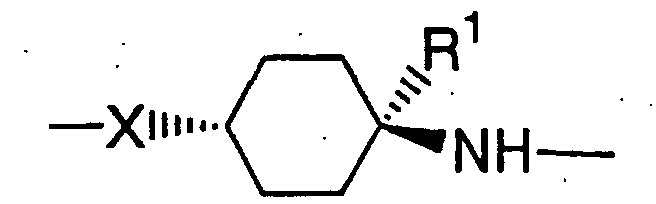
- a trans-isomeric compound is more preferred from the viewpoint of obtaining a higher DPPIV inhibitory activity. That is, among the objective compound [I] of the present invention wherein B is CH, a compound having the following partial structure: or a pharmaceutically acceptable salt thereof is preferred.
- R 2 is a cyclic group which may have 1 to 3 substituents which are the same or different, selected from the substituents of Group A', where the cyclic portion is a group selected from a piperidyl group, a piperazinyl group, a morpholinyl group, an indolinyl group, an isoindolinyl group, and a thiazolopyridyl group may be exemplified (Compound Group 4).
- a is -S-, and R 1 is hydrogen atom or a lower alkyl group; and the like may be exemplified.
- the objective compound [I] or a pharmaceutically acceptable salt thereof of the present invention has superior inhibitory action on the enzyme activity of DPPIV. They have superior inhibitory action especially on human DPPIV. In addition, they also exhibit high selectivity with respect to DPPIV (namely, type IV dipeptidylpeptidase) in various serine proteases (e.g., plasmin, thrombin, prolylendopeptidase, trypsin and dipeptidylpeptidase II).
- DPPIV namely, type IV dipeptidylpeptidase
- serine proteases e.g., plasmin, thrombin, prolylendopeptidase, trypsin and dipeptidylpeptidase II.
- the objective compound [I] or a pharmaceutically acceptable salt thereof of the present invention improves insulin secretion response to oral glucose loading by means of its DPPIV inhibitory action.
- the objective compound [I] or a pharmaceutically acceptable salt thereof of the present invention is useful as prophylactic or therapeutic agents for diseases relating to DPPIV (diseases mediated by DPPIV), that is, diseases which is expected to be alleviated by inhibiting DPPIV enzyme activity.
- diabetes e.g., type 1 diabetes and type 2 diabetes
- hyperglycemia such as postprandial hyperglycemia
- hyperinsulinemia such as postprandial hyperglycemia
- diabetes complications such as renal disorder and neurological disorder
- obesity overeating
- lipid metabolism disorder such as hyperlipemia including hypertriglyceridemia and others
- autoimmune diseases such as arthritis and rheumatoid arthritis
- osteoporosis acquired immunodeficiency syndrome (AIDS) and rejection of transplanted organs and tissues.
- AIDS acquired immunodeficiency syndrome
- the objective compound [I] or a pharmaceutically acceptable salt thereof of the present invention is particularly useful as a prophylactic or therapeutic agent of diabetes (and particularly type 2 diabetes).
- the compound of the present invention has low toxicity, and thus, has a high level of safety when used as a pharmaceutical compound. Furthermore, it also demonstrates superior pharmacokinetic characteristics [including bioavailability, in vitro metabolic stability (stability in human liver homogenates), P450 inhibitory action and protein binding capabilities, etc.].
- the DPPIV inhibitory action of the compound of the present invention as well as its pharmaceutical efficacy (including anti-hyperglycemia effect and the effect of improving insulin secretion response to glucose loading) based on that action can be confirmed by known methods or methods equivalent to those methods (WO 98/19998; WO 00/34241; Holst, et al., Diabetes, Vol. 47, pp. 1663-1670, 1998; Augustyns, et al., Current Medicinal Chemistry, Vol. 6, pp. 311-327, 1999; Meester, et al., Immunol. Today, Vol. 20, pp. 367-375, 1999; and, Fleicher, et al., Immunol. Today, Vol. 15, pp. 180-184, 1994).
- the objective compound [I] of the present invention can be used for a pharmaceutical use either in a free form or in a form of a pharmaceutically acceptable salt.
- the pharmaceutically acceptable salt of the compound [I] include an inorganic acid salt such as hydrochloride, sulfate, phosphate or hydrobromide, and an organic acid salt such as acetate, fumarate, oxalate, citrate, methanesulfonate, benzenesulfonate, tosylate or maleate, etc'.
- a salt with a base for example, an alkali metal salt such as a sodium salt, a potassium salt, etc., or an alkaline earth metal salt such as a calcium salt and the like
- a base for example, an alkali metal salt such as a sodium salt, a potassium salt, etc., or an alkaline earth metal salt such as a calcium salt and the like
- the objective compound [I] or the pharmaceutically acceptable salt thereof of the present invention include its internal salts, adducts, solvates and hydrates.
- the objective compound [I] or pharmaceutically acceptable salts thereof of the present invention can be administered orally or parenterally and used as commonly used pharmaceutical preparations, such as tablets, granules, capsules, powders, injection solution and inhalants.
- the compound of the present invention for example, can be used with pharmaceutically acceptable general excipients such as binder, disintegrator, extenders, fillers and lubricants, or diluents, and prepared according to the usual method.
- the administration dose of the objective compound [I] or pharmaceutically acceptable salts thereof of the present invention may vary depending on the administration method, age, weight and condition of a patient, and it is generally about 0.01 to 300 mg/kg, preferably about 0.1 to 30 mg/kg per day.
- the objective compound [I] of the present invention can be prepared according to the following (Process A) to (Process D), but it is not limited to these processes.
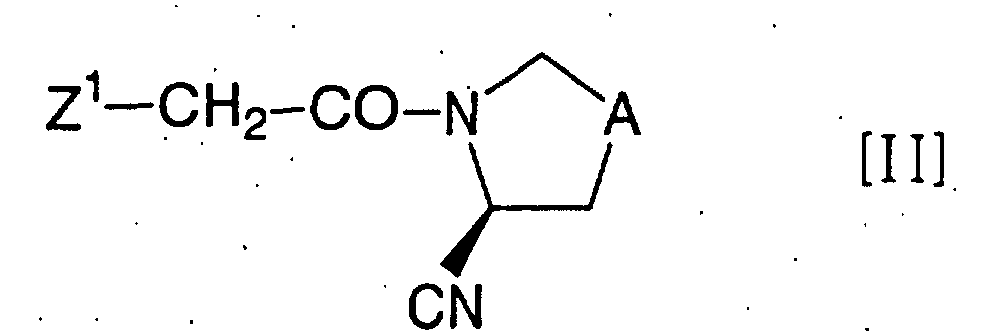
- the objective compound [I] of the present invention can be prepared by reacting a compound represented by the formula [II]: wherein Z 1 represents a reactive residue and A has the same meaning as defined above, with a compound represented by the formula [III]: wherein R 1 , R 2 , B and X have the same meanings as defined above, or salts thereof, and optionally, by making the products into a pharmaceutically acceptable salt.
- a salt with an inorganic acid such as hydrochloride and sulfate, or a salt with an inorganic base such as an alkali metal salt and an alkaline earth metal salt can be used.
- reactive residue of Z 1 commonly used reactive residues such as a halogen atom, a lower alkylsulfonyloxy group and an arylsulfonyloxy group can be used, among which the halogen atom is particularly preferred.
- reaction of the compound [II] with the compound [III] or the salt thereof can be carried out in a suitable solvent or without solvent in the presence or absence of an acid acceptor.
- any solvents may be suitable as long as it does not adversely affect to the reaction, and, for example, acetonitrile, methanol, ethanol, isopropyl alcohol, propyl alcohol, acetone, dimethylformamide, dimethyl sulfoxide, tetrahydrofuran, ether, dioxane, ethyl acetate, toluene, methylene chloride, dichloroethane, chloroform or a mixed solvent of these solvents can be suitably used.
- This reaction suitably proceeds at 0 to 120°C, particularly at room temperature to 80°C.
- an inorganic base for example, alkali metal hydride such as sodium hydride, alkali metal carbonate such as sodium carbonate and potassium carbonate, alkali metal'alkoxide such as sodium methoxide, alkali metal such as sodium, and alkali metal hydroxide such as sodium hydroxide and potassium hydroxide, etc.
- an organic base for example, triethylamine, diisopropylethylamine, N-methylmorpholine, pyridine, dimethylaniline, dimethylaminopyridine, etc.
- the compound wherein R 2 represents a monocyclic or bicyclic nitrogen-containing heterocyclic group which may be substituted, and X represents -COO-, represented by the formula [I-a]: wherein R 21 represents a monocyclic or bicyclic nitrogen-containing heterocyclic group which may be substituted, and R 1 , A and B have the same meanings as defined above, can be prepared by reacting a compound represented by the formula [IV] : wherein R represents a protective group for the amino group, and R 1 , A and B have the same meanings as defined above, or a salt thereof with a phosgene or an equivalent thereof, and subsequently, further reacting with a compound represented by the formula [V]: R 21 H wherein R 21 has the same meaning as defined above, to obtain a compound represented by the formula [VI]: wherein R; R 1 , R 21 , A and B have the same meanings as defined above, or a salt thereof,'and further
- reaction with the compound [V] can be carried out in a suitable solvent or without solvent in the presence of a phosgene or an equivalent thereof and an acid acceptor.
- the phosgene or the equivalent thereof triphosgene, diphosgene, carbonyldiimidazol, 4-nitrophenyl-chloroformate, etc. can be suitably used.
- an inorganic base for example, alkali metal hydride such as sodium hydride, alkali metal carbonate such as sodium carbonate and potassium carbonate, alkali metal amide such as sodium amide and lithium amide,. alkali metal alkoxide such as sodium methoxide, alkali metal such as sodium, and alkali metal hydroxide such as sodium hydroxide and potassium hydroxide, etc.
- organic base for example, triethylamine, diisopropylethylamine, N-methylmorpholine, pyridine, dimethylaniline, dimethylaminopyridine, etc.
- any solvents may be suitable as long as it does not adversely affect to the reaction, and, for example, methylene chloride, dichloroethane, chloroform, ether, tetrahydrofuran, ethyl acetate, toluene or a mixed solvent thereof can be suitably used.
- the present reaction suitably proceeds at -78°C to 110°C, especially at 0°C to room temperature.
- the following removal of the protective group (R) for an amino group of the compound [VI] can be carried out according to the conventional method, and it can be carried out, for example, in a suitable solvent or without solvent by an acid treatment, base treatment or catalytic reduction.
- an inorganic acid such as hydrochloric acid, sulfuric acid, etc.
- an organic acid such as acetic acid, trifluoroacetic acid, methanesulfonic acid, p-toluenesulfonic acid, etc.
- an inorganic base for example, alkali metal hydride such as sodium hydride, etc., alkali metal carbonate such as sodium carbonate, potassium carbonate, etc., alkali metal amide such as sodium amide, lithium amide, etc., alkali metal alkoxide such as sodium methoxide, etc., alkali metal such as sodium, etc., and alkali metal hydroxide such as sodium hydroxide, potassium hydroxide, etc.
- an organic base for example, triethylamine, diisopropylethylamine, morpholine, N-methylmorpholine, pyridine, piperidine, dimethylaniline, dimethylaminopyridine, etc.
- the catalytic reduction can be carried out by suitably using palladium-carbon, palladium hydroxide-carbon, platinum oxide or Raney nickel under hydrogen atmosphere.
- any solvents may be suitable as long as it does not adversely affect to the reaction, and, for example, methanol, ethanol, isopropyl alcohol, propyl alcohol, dioxane, methylene chloride, chloroform, dichloroethane, ether, tetrahydrofuran, ethyl acetate, toluene or a mixed solvent thereof can be suitably used.
- This reaction suitably proceeds at -78°C to 80°C, particularly at 0°C to room temperature.
- the compound wherein B is N, X is -CO-, -Alk-CO- or -SO 2 -, represented by the formula [I-b] : wherein X 1 represents -CO-, -Alk-CO- or -SO 2 -, and R 1 , R 2 and A have the same meanings as defined above, can be prepared by reacting a compound represented by the formula [VII]: wherein n is 0, 1, 2 or 3, P represents a resin residue, and R 1 and A have the same meanings as defined above, with a compound represented by the formula [VIII] : R 2 -V 1 wherein V 1 represents -COOH, -Alk-COOH or a chlorosulfonyl group, and R 2 has the same meaning as defined above, or a salt thereof, and subsequently removing a linker and the resin residue portion represented by the formula [IX]: wherein P and n have the same meanings as defined above,
- a compound wherein X 1 is -CO- and R 2 is a carboxy lower alkylene group can be prepared by using a compound represented by the formula [X]: wherein Alk1 represents a lower alkylene group, in place of the compound [VIII] or a salt thereof to carry out the reaction with the compound [VII], and subsequently removing the linker and the resin residue portion represented by the formula [IX] from the reaction product.
- a compound wherein X 2 is -CON(R 3 )- and R 2 is a carboxy lower alkyl. group can be prepared by using a compound [X] in place of the compound [XII] or a salt thereof, reacting the same with the compound [XI], and subsequently removing the linker and the resin residue portion represented by the formula [IX] from the reaction product.
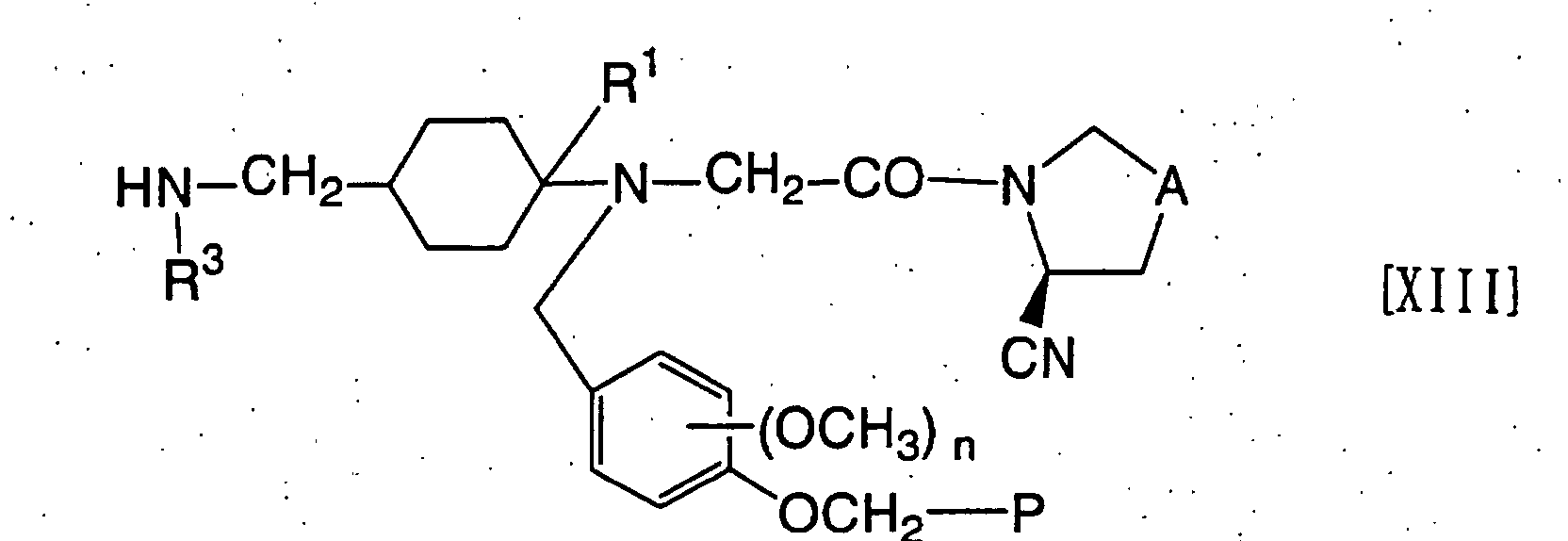
- a compound wherein B is CH and X is -CON(R 3 )CH 2 - or -Alk-CON(R 3 )CH 2 -, represented by the formula [I-d]: wherein X 3 represents -CON(R 3 )CH 2 - or -Alk-CON(R 3 )CH 2 -, and R 1 , R 2 , R 3 and A have the same meanings as defined above, can be prepared by reacting a compound represented by the formula [XIII] : wherein R 1 , R 3 , A, P and n have the same meanings as defined above, with a compound represented by the formula [XII] or a salt thereof, and subsequently removing the linker and the resin residue portion represented by the formula [IX] from the reaction product.
- a compound [I-d] wherein X 2 is -CON(R 3 )CH 2 - and R 2 is a carboxy lower alkyl group can be prepared by using a compound [X] in place of the compound [XII] or a salt thereof, reacting the same with the compound [XIII], and subsequently removing the linker and the resin residue portion represented by the formula [IX] from the reaction product.
- the reactions in Process C (the reaction between the compound [VII] and the compound [VIII] or a salt thereof (or the compound [X])); and the reactions in Process D (the reaction between the compound [XI] or [XIII] and the compound [XII] or a salt thereof (or the compound [X])) can be carried out, optionally in the presence of a condensing agent and/or an acid acceptor, in a suitable solvent or without solvent. Further, the linker and the resin residue portion are removed according to. the conventional method, and if necessary, purification is carried out by, for example, extraction, distribution, reprecipitation, crystallization, recrystallization, various kinds of chromatographies, high performance chromatography, etc.
- linker a group in which a resin residue (P) portion is removed from the group represented by the formula [IX] can be exemplified.
- a resin that is used in a conventional solid phase synthesis can be used, and there may be mentioned, for example, a Merrifield resin (4-chloromethyl polystyrene resin, etc.), a Wang resin (4-benzyloxybenzyl alcohol resin, etc.), a hydroxymethyl polystyrene resin (4-hydroxymethyl polystyrene resin, etc.), etc.
- any resin may be used as long as it does not adversely affect to the reaction, and it is suitably selected depending on the kind of the objective compound.
- those with a particle diameter of 70 to 200 ⁇ m are preferably used, and a loading capacity is preferably 0.1 to 2 mmol/g.
- O-benzotriazol-1-yl-N,N,N',N'-tetramethyluroniumhexafluorophosphate DCC (dicyclohexylcarbodiimide), EDC (1-ethyl-3-(3-dimethyl-aminopropyl)carbodiimide), chloroformates (for example, ethyl chloroformate and isobutyl chloroformate) and carbonyldiimidazole, etc.
- DCC dicyclohexylcarbodiimide
- EDC 1-ethyl-3-(3-dimethyl-aminopropyl)carbodiimide
- chloroformates for example, ethyl chloroformate and isobutyl chloroformate
- carbonyldiimidazole etc.
- an additive such as a base (sodium carbonate, sodium hydrogencarbonate, triethylamine, pyridine, 4-.dimethylaminopyridine, diisopropylethylamine, 1,8-diazabicyclo[5.4.0]undec-7-ene, etc.).
- a base sodium carbonate, sodium hydrogencarbonate, triethylamine, pyridine, 4-.dimethylaminopyridine, diisopropylethylamine, 1,8-diazabicyclo[5.4.0]undec-7-ene, etc.
- 1-hydroxybenzotriazole, 1-hydroxysuccinimide, etc. can be added to the above condensing agent.
- alkali metal hydroxide such as sodium hydroxide and potassium hydroxide
- alkali metal hydrogencarbonate such as sodium hydrogencarbonate and potassium hydrogencarbonate
- alkali metal carbonate such as sodium carbonate and potassium carbonate
- an organic base triethylamine, pyridine, etc.
- the following removal of the linker and the resin residue portion can be suitably carried out in a suitable solvent or without solvent by treating the product with trifluoroacetic acid, trifluoromethanesulfonic acid, hydrogen fluoride, hydrogen bromide, hydrogen chloride, etc, and a mixture thereof.
- any solvents may be suitable as long as it does not adversely affect to the reaction, and, for example, methylene chloride, N-methyl morpholine, dimethylformamide, tetrahydrofuran, dimethylacetamide or a mixed solvent thereof can be suitably used.
- the reaction in Process C suitably proceeds at 0 to 120°C, particularly at 20 to 50°C.
- the reaction in Process D suitably proceeds at 0 to 50°C, particularly at 0 to 30°C.
- any solvents may be suitable as long as it does not adversely affect to the reaction, and, for example, methylene chloride, acetic acid, trifluoroacetic acid or a mixed solvent thereof can be suitably used.
- the reaction suitably proceeds at 0 to 50°C, particularly at 0 to 30°C.
- the starting material [II] of the present invention can be prepared, for example, according to the process described in International Patent Publications Nos. WO98/19998, WO00/34241 and Reference Examples mentioned below (Reference Example 1 or 2), etc.
- the compound [II] can be obtained by reacting a compound represented by the formula [20]: wherein A has the same meaning as defined above, with a compound represented by the formula [21]: Z 2 -CH 2 CO-Z 3 wherein Z 2 and Z 3 represent a reactive residue which may be the same or different, in the presence of an acid acceptor (for example, triethylamine, etc.) to obtain a compound represented by the formula [22]: wherein Z 2 and A have the same meanings as defined above, and treating the product with a dehydrating agent (for example, phosphorous oxychloride, trifluoroacetic anhydride, etc.) according to the conventional method.
- a dehydrating agent for example, phosphorous oxychloride, trifluoroacetic anhydride, etc.
- the starting material [III] can be prepared, for example, by the same process as described in Reference Examples mentioned below (Reference Examples 7 to 10).
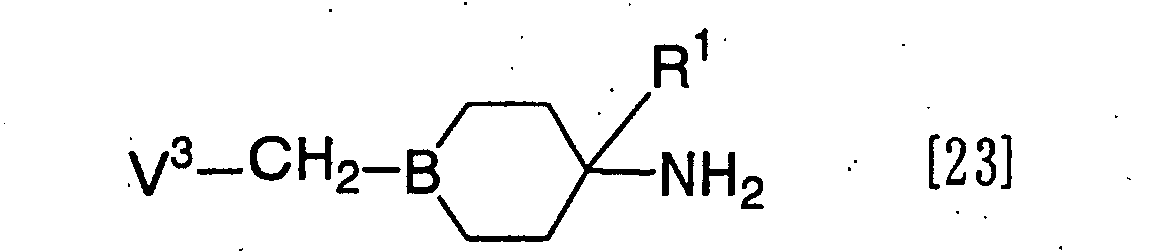
- the compound [III] wherein X is -O-CH 2 -or -NHCH 2 - can be prepared by reacting a compound represented by the formula [23] : wherein V 3 represents a hydroxy group or an amino group, and R 1 and B have the same meanings as defined above, an amino group-protected material thereof or a salt thereof with a compound represented by the formula [24]: R 2 -Z 4 wherein Z 4 represents a reactive residue and the other symbol has the same meaning as defined above, in the presence or absence of an acid acceptor (for example, an organic base such as triethylamine, diisopropylethylamine, etc., and an inorganic base such as sodium hydride, potassium carbonate, etc.), and, if necessary, removing the protective group for the amino group according to the conventional method.
- an acid acceptor for example, an organic base such as triethylamine, diisopropylethylamine, etc., and an inorganic base such as sodium hydride
- any of the same protective groups commonly used as mentioned above R can be suitably used.
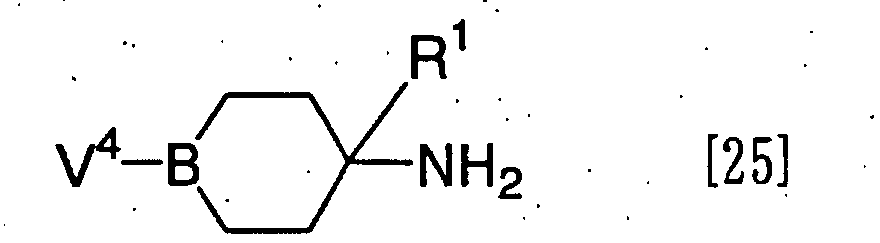
- the compound [III] wherein X is -Alk-O- or -S- can be prepared by reacting a compound represented by the formula [25]: wherein V 4 represents a hydroxy group or a mercapto group and R 1 and B have the same meanings as defined above, an amino group-protected material thereof or a salt thereof with a compound represented by the formula [26a] or the formula [26b] : R 2 -Z 51 or R 2 -Alk-Z 52 wherein Z 51 and Z 52 represent a reactive residue and R 2 and Alk have the same meanings as defined above, in the presence or absence of an acid acceptor (for example, an organic base such as triethylamine, diisopropylethylamine, etc., and an inorganic base such as sodium hydride, potassium carbonate, etc.), and, if necessary, removing the protective group for the amino group according to the conventional method.
- an acid acceptor for example, an organic base such as triethylamine, di
- the compound [III] wherein X is -COCH 2 N(R 3 )- or -SO 2 N(R 3 )- can be obtained by reacting a compound represented by the formula [27]: wherein V 5 represents -N(R 3 )H, and R 1 , R 3 and B have the same meanings as defined above, an amino group-protected material thereof or a salt thereof with a compound represented by the formula [28a] or the formula [28b]: R 2 -COCH 2 -Z 61 or R 2 -SO 2 -Z 62 wherein Z 61 and Z 62 represent a reactive residue and R 2 has the same meaning as defined above, in the presence or absence of an acid acceptor (for example, an organic base such as triethylamine, diisopropylethylamine, etc., and an inorganic base such as sodium hydride, potassium carbonate, etc.), and, if necessary, removing the protective group for the amino group according to the conventional method.
- an acid acceptor
- the compound [III] wherein X is -CON(R 3 )-, -Alk-CON(R 3 )- or -SO 2 N(R 3 )- can be prepared by reacting the compound represented by the formula [27], an amino group-protected material thereof or a salt thereof, with a compound represented by the formula [29] : R 2 -V 6 [29] wherein V 6 represents -COOH, -Alk-COOH or -SO 3 H and R 2 has the same meaning as defined above, or a salt thereof in the presence of a condensing agent (1-ethyl-3-(3-dimethylaminopropyl)carbodiimide, etc.), and, if necessary, removing the protective group for the amino group according to the conventional method.
- a condensing agent (1-ethyl-3-(3-dimethylaminopropyl)carbodiimide, etc.
- the compound [III] wherein X is -CON(R 3 )CH 2 - or -Alk-CON(R 3 )CH 2 - can be prepared by reacting a compound represented by the formula [30]: wherein V 7 represents -N(R 3 )H, and R 1 , R 3 and B have the same meanings as defined above, an amino group-protected material thereof or a salt thereof, with a compound represented by the formula [31] : R 2 -V 8 wherein V 8 represents -COOH or -Alk-COOH and R 2 has the same meaning as defined above, or a salt thereof in the presence of a condensing agent (1-ethyl-3-(3-dimethylaminopropyl)carbodiimide, etc.), and, if necessary, removing the protective group for the amino group according to the conventional method.
- a condensing agent (1-ethyl-3-(3-dimethylaminopropyl)carbodiimide
- the compound [III] wherein B is H, X is -CO- or -Alk-CO- and R 2 is (1) a monocyclic or bicyclic nitrogen-containing heterocyclic group which may be substituted or (2) an amino group substituted by 1 or 2 substituents selected from a substituted or unsubstituted lower alkyl group, represented by the formula: can be prepared by reacting a compound represented by the formula [32]: wherein V 9 represents -COOH and R 1 has the same meaning as defined above, an amino group-protected material thereof or a salt thereof, with a compound represented by the formula [33a]: R 22 -Alk-H wherein R 22 represents (1) a monocyclic or bicyclic nitrogen-containing heterocyclic group which may be substituted or (2) an amino group substituted by 1 or 2 substituents selected from a substituted or unsubstituted lower alkyl group, represented by the formula: and Alk has the same meaning as defined above, or a salt thereof, in the presence of a
- the compound [III] wherein B is N, X is -CO- or -Alk-CO- and R 2 is (1) a monocyclic or bicyclic nitrogen-containing heterocyclic group which may be substituted or (2) an amino group substituted by 1 or 2 substituents selected from a substituted or unsubstituted lower alkyl group, represented by the formula: can be prepared by reacting a compound represented by the formula [330]: wherein R 1 has the same meaning as defined above, an amino group-protected material thereof or a salt thereof, with the compound represented by the formula [331] or [332] : R 22 -CO-Z 7 R 22 -Alk-COOH wherein R 22 represents (1) a monocyclic or bicyclic nitrogen-containing heterocyclic group which may be substituted or (2) an amino group substituted by 1 or 2 substituents selected from a substituted or unsubstituted lower alkyl group, represented by the formula: and Z 7 represents a reactive residue, or a salt thereof, in the
- the compound [III] wherein B is CH, X is a single bonding arm and R 2 is (1) a monocyclic or bicyclic nitrogen-containing heterocyclic group which may be substituted or (2) an amino group substituted by 1 or 2 substituents selected from a substituted or unsubstituted lower alkyl group, represented by the formula: can be prepared by reacting the compound represented by the formula [34] : wherein R 1 has the same meaning as defined above, an amino group-protected material thereof or a salt thereof, with a compound represented by the formula [33b]: R 22 -H [33b] wherein R 22 has the same meaning as defined above, in the presence of a reducing agent (sodium triacetoxyborohydride, etc.), and, if necessary, removing the protective group for the amino group according to the' conventional method.
- a reducing agent sodium triacetoxyborohydride, etc.
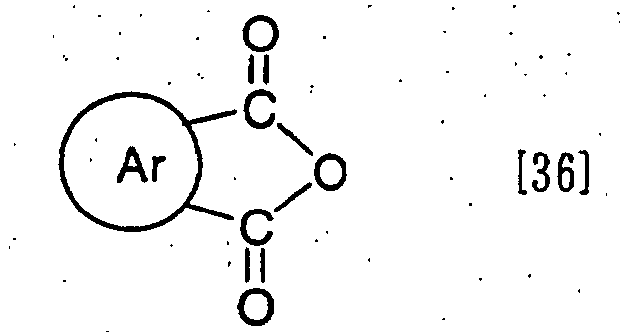
- the compound [III] wherein B is CH, X is a single bonding arm and R 2 is a group represented by the formula: can be prepared by reacting a compound represented by the formula [35]: wherein R 1 has the same meaning as defined above, an amino group-protected material thereof or a salt thereof, with a compound represented by the formula [36] : wherein Ar represents an arylene (phenylene, etc.) which may have a substituent(s), in the presence or absence of an acid acceptor (for example, an organic base such as triethylamine, diisopropylethylamine, etc., and an inorganic base such as sodium hydride, potassium carbonate, etc.), and, if necessary, removing the protective group for the amino group according to the conventional method.
- an acid acceptor for example, an organic base such as triethylamine, diisopropylethylamine, etc., and an inorganic base such as sodium hydride, potassium carbonate, etc.
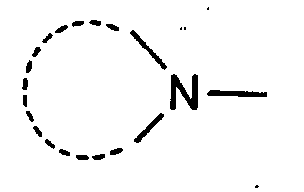
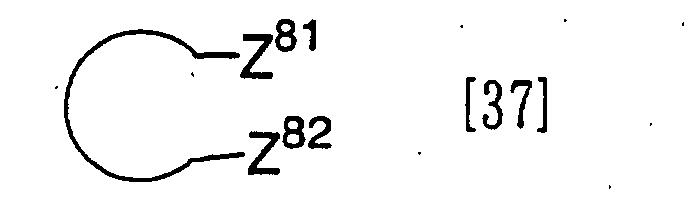
- the compound [III] wherein B is CH, X is a single bonding arm and R 2 is a nitrogen-containing heterocyclic group represented by the formula: can be prepared by reacting the compound represented by the above-mentioned formula [35], an amino group-protected material thereof or a salt thereof, with a compound represented by the formula [37]: wherein Z 81 and Z 82 both represent a reactive residue, or a salt thereof, in the presence or absence of an acid acceptor (for example,.an organic base such'as triethylamine, diisopropylethylamine, etc., and an inorganic base such as sodium hydride, potassium carbonate, etc.), and, if necessary, removing the protective group for the amino group according to the conventional method.
- an acid acceptor for example,.an organic base such'as triethylamine, diisopropylethylamine, etc., and an inorganic base such as sodium hydride, potassium carbonate, etc.
- the compound [III] wherein B.is N and X is a single bonding arm can be prepared by reacting a compound represented by the formula [38]: wherein R 1 has the same meaning as defined above, an amino group-protected material thereof or a salt thereof, with the compound represented by the above-mentioned formula [24]: R 2 -Z 4 wherein R 2 and Z 4 have the same meanings as defined above, in the presence or absence of an acid acceptor (for example, an organic base such as triethylamine, diisopropylethylamine, etc., and an inorganic base such as sodium hydride, potassium carbonate, etc.), and, if necessary, removing the protective group for the amino group according to the conventional method.
- an acid acceptor for example, an organic base such as triethylamine, diisopropylethylamine, etc., and an inorganic base such as sodium hydride, potassium carbonate, etc.
- the protective group for the amino group any of the same commonly used
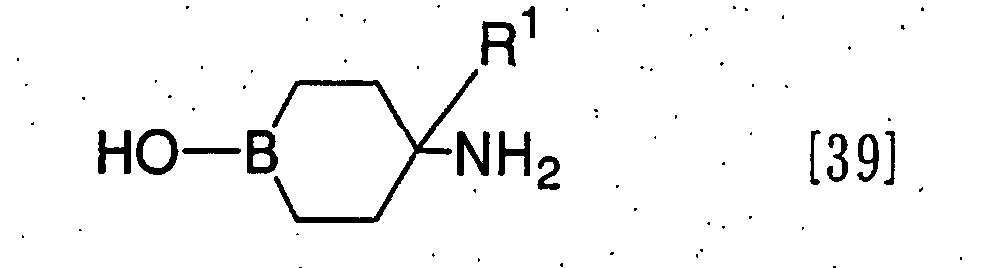
- the compound [III] wherein X is -COO- can be prepared by reacting an amino group-protected material or a salt of a compound represented by the formula [39]: wherein R 1 and B have the same meanings as defined above, with a compound represented by the formula [40]: R 2 -COCl wherein R 2 has the same meaning as defined above, in the presence of an acid acceptor (dimethylaminopyridine, etc.), and, if necessary, removing the protective group for the amino group according to the conventional method.
- an acid acceptor dimethylaminopyridine, etc.
- the protective group for the amino group any of the same protective groups commonly used as mentioned above R can be suitably used.
- the starting materials [20] to [40] can be prepared according to the known methods or in the same manner as mentioned in Reference Examples below.
- the starting material [III] wherein B is CH cis/trans isomers are present, taking a cyclohexane ring as a standard plane.
- R, R 1 , Z 1 , A and B have the same meanings as defined above.
- a compound represented by the formula [IV] or a salt thereof can be prepared by reacting the compound represented by the above formula [II] with a compound represented by the formula [41] or a salt thereof to obtain a compound represented by the formula [42] or a salt thereof, and further reacting the same with a compound represented by the formula [43] or the formula [44].
- Reaction between the compound [II] and the compound [41] or a salt thereof can be carried out in the presence or absence of an acid acceptor, in a suitable solvent or without solvent.
- a suitable solvent any solvents may be suitable as long as it is not adversely affected to the' reaction, and, for example, acetonitrile, methanol, ethanol, isopropyl alcohol, propyl alcohol, acetone, dimethylformamide, dimethyl sulfoxide, tetrahydrofuran, ether, dioxane, ethyl acetate, toluene, methylene chloride, dichloroethane, chloroform or a mixed solvent thereof can be suitably used.
- This reaction suitably proceeds at 0 to 120°C, particularly at room temperature to 80°C.
- an inorganic base for example, alkali metal hydride such as sodium hydride, alkali metal carbonate such as sodium carbonate and potassium carbonate, alkali metal alkoxide such as sodium methoxide, alkali metal such as sodium, and alkali metal hydroxide such as sodium hydroxide and potassium hydroxide, etc.
- an organic base for example, triethylamine, diisopropylethylamine, N-methylmorpholine, pyridine, dimethylaniline, dimethylaminopyridine, etc.
- Reaction between the compound [42] or a salt thereof and the compound [43] or [44] can be carried out in the presence of an acid acceptor, in a suitable solvent or without solvent.
- any solvents may be suitable as long as it is not adversely affected to the reaction, and, for example, acetonitrile, methanol, ethanol, isopropyl alcohol, propyl alcohol, acetone, tetrahydrofuran, ether, dioxane, ethyl acetate, toluene, methylene chloride, dichloroethane, chloroform, water or a mixed solvent thereof can be suitably used.
- This reaction suitably proceeds at 0 to 120°C, particularly at room temperature to 80°C.
- an inorganic base for example, alkali metal hydride such as sodium hydride, alkali metal carbonate such as sodium carbonate and potassium carbonate, alkali metal alkoxide such as sodium methoxide, alkali metal such as sodium, and alkali metal hydroxide such as sodium hydroxide and potassium hydroxide, etc.
- an organic base for example, triethylamine, diisopropylethylamine, N-methylmorpholine, pyridine, dimethylaniline, dimethylaminopyridine, etc.
- the compound [VII], the compound [IX] or the compound [XIII] can be each obtained by reacting a compound represented by the formula [50], [51] or [52]: wherein V 10 , V 11 and V 12 represent protective groups for the amino group, and R 1 and R 3 have the same meanings as defined above, with a compound represented by the formula [53]: wherein P and n have the same meanings as defined above, according to a conventional method, in the presence of a reducing agent (for example, sodium triacetoxyborohydride, etc.), subsequently reacting the product in the presence of the compound [II] and an acid acceptor (diisopropylethylamine, etc.), and then, removing the protective group for the amino group according to the conventional method.
- a reducing agent for example, sodium triacetoxyborohydride, etc.
- an acid acceptor diisopropylethylamine, etc.
- the compound [I] of the present invention or its starting material prepared according to the above is isolated in a free form or as a salt thereof, and purified. Salts can be prepared by subjecting to the salt-forming treatment conventionally used.
- Isolation and purification can be carried out by applying the usual chemical operations such as extraction, concentration, crystallization, filtration, recrystallization, various kinds of chromatographies and the like.
- optical isomers such as racemic modifications, optically active substances, diastereomers, etc. can be present alone or as mixtures thereof.
- a stereochemically pure isomer can be derived by using a stereochemically pure starting material or by separating an optical isomer according to the general separation process for racemic resolution. Also, diastereomeric mixtures can be separated according to the conventional method, for example, fractional crystallization or by chromatography.
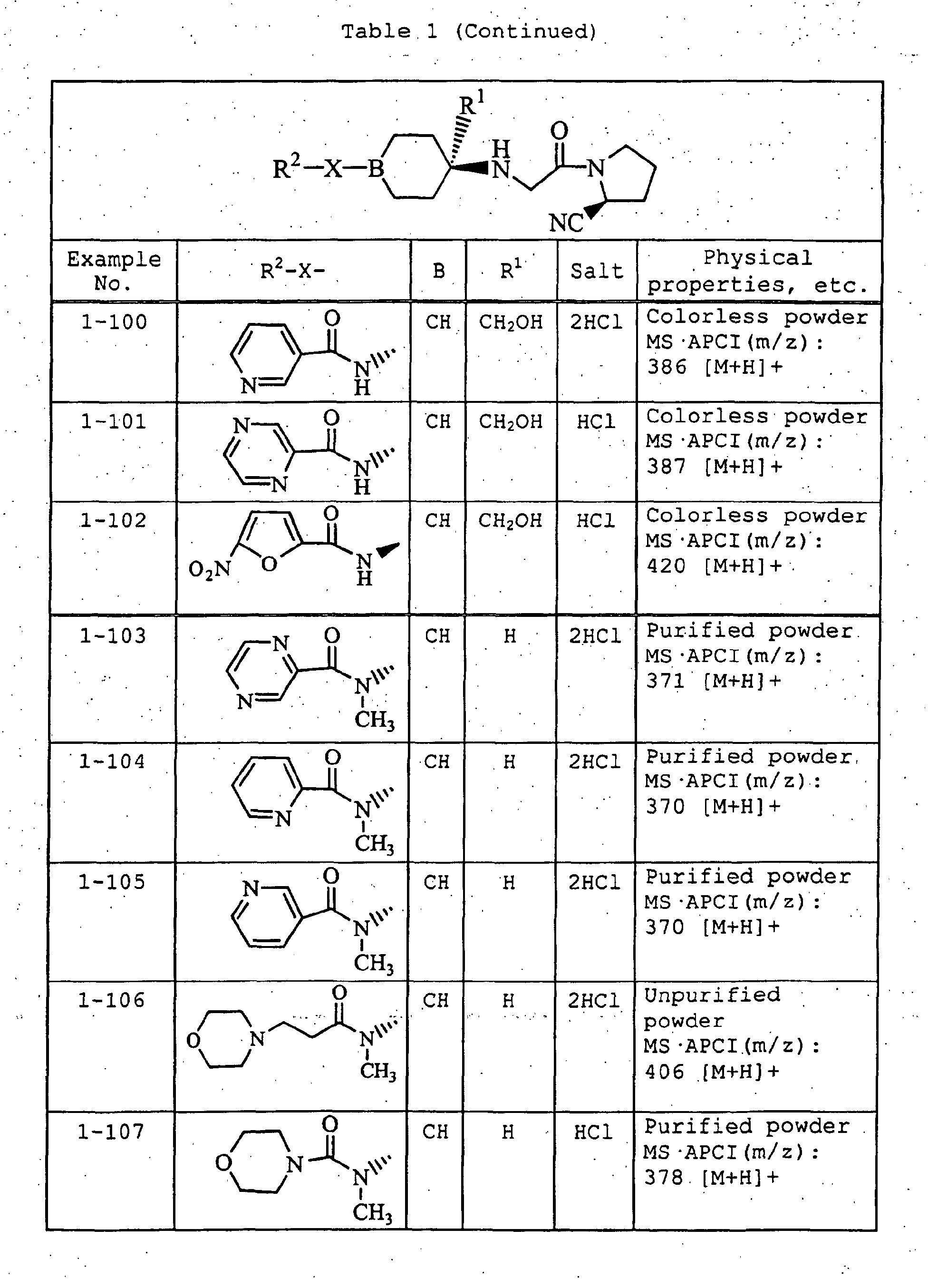
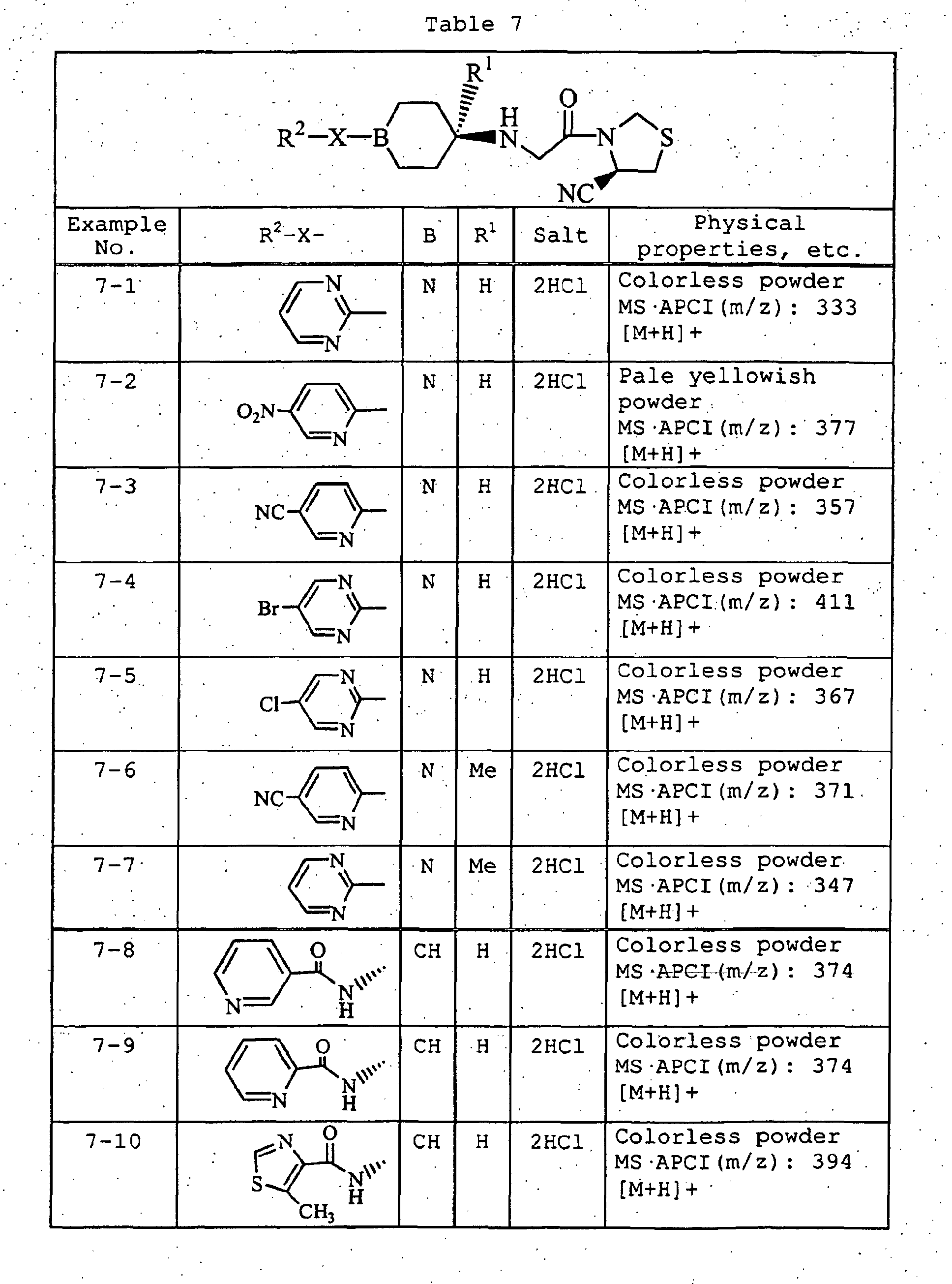
- Example 1 The compounds of Table 1 shown below (Examples 1-2 to 1-90, 1-92 to 1-109) were obtained in the same manner as in the above-mentioned Example 1-1 by using (S)-1-bromoacetyl-2-cyanopyrrolidine and corresponding starting materials. (Provided that the compound of Example 1-93 was obtained as a by-product of Example 1-33.) (The corresponding starting materials were obtained in the same manner as described in Reference Examples mentioned below, by known methods or by a method in combination of these methods.)
- Example 4-1 The compounds of Examples 4-2 and 4-3 in Table 4 were obtained in the same manner as in Example 4-1, using the corresponding starting materials (isocyanate compounds). Also, the compounds of Examples 4-4 and 4-5 in Table 4 were obtained in the same manner as in Example 4-1, using intramolecular cyclic anhydride of dicarboxylic acid (succinic anhydride and glutaric anhydride) as starting materials in place of the isocyanate compound.
- Example 4 The compound of Examples 4-6 in Table 4 was obtained in the same manner as in Example 4-1, except for using methylchloroformate as a starting material in place of benzyl isocyanate,.and carrying out the reaction of the section (1) in the presence of triethylamine. Also, the compounds of Examples 4-7 to 4-10 were obtained in the same manner as mentioned above, using a corresponding starting material (chloride).
- a mixture comprising 500 mg of the resin compound obtained in the Reference Example 3 (2) and 0.5M methanesulfonic acid in dioxane/methylene chloride (1/9) was stirred at room temperature for 18 hours.
- the resin was collected by filtration and was washed with dimethylformamide, 10% triethylamine-methylene chloride, dimethylformamide-water (1:1), methanol, tetrahydrofuran, methanol and methylene chloride.
- a mixture of the obtained resin, 177 mg of 2-quinolinecarboxylic acid, 138 mg of 1-hydroxy-benzotriazol, 387 mg of O-benzotriazol-1-yl-N,N,N',N'-tetramethyluronium hexafluorophosphate, 224 ml of N-methylmorpholine and 4 ml of dimethylformamide was stirred at room temperature for 18 hours.
- the resin was collected by filtration and washed with dimethylformamide, dimethylformamide-water (1:1), methanol, tetrahydrofuran, methanol and methylene chloride, and dried under reduced pressure to obtain a resin.
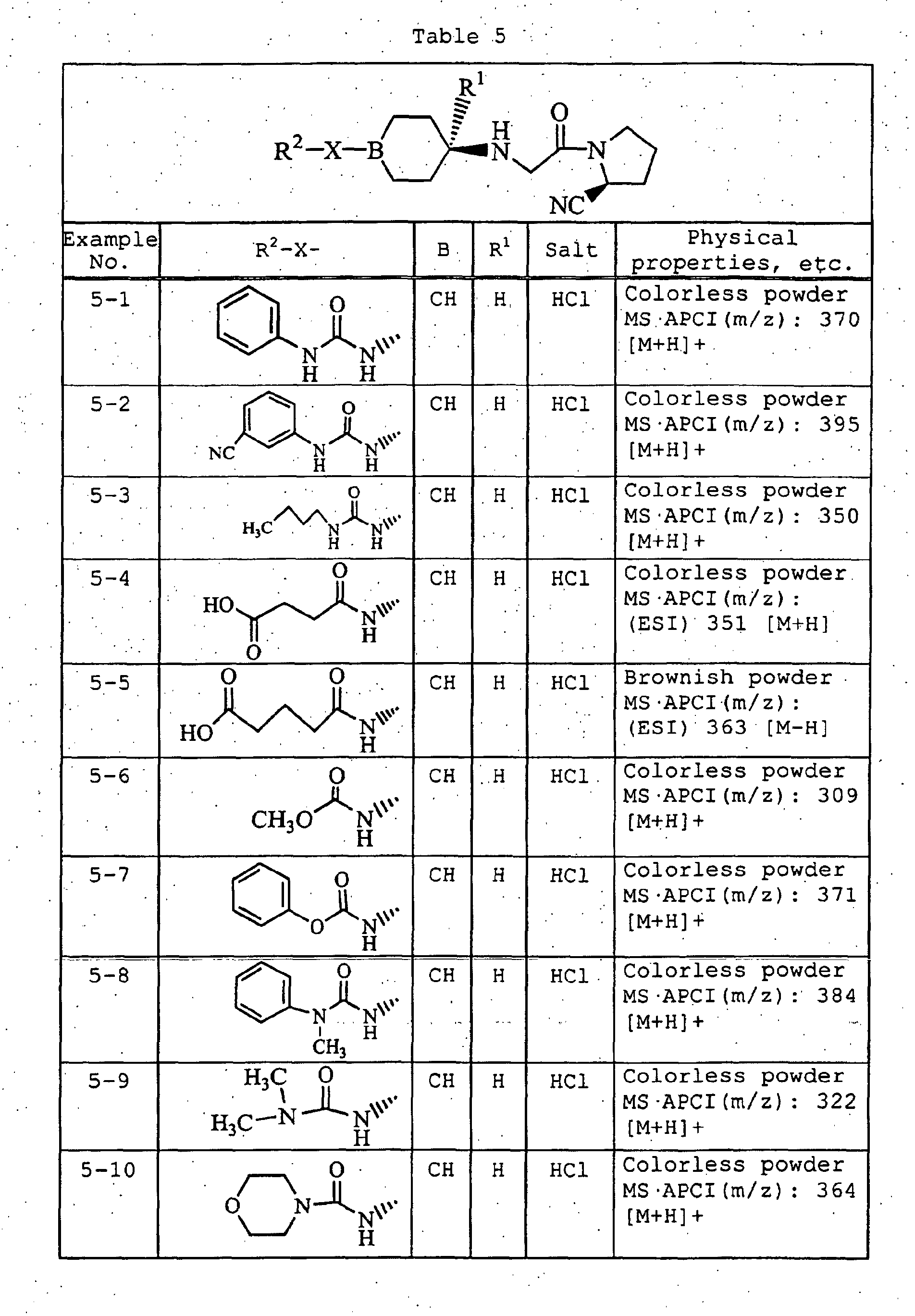
- Examples 5-1 to 5-12 in Table 5 were obtained in the same manner as in Examples 4-1 to 4-10 by using a resin compound obtained in Reference Example 4 in place of the resin compound of Reference Example 3 (2).
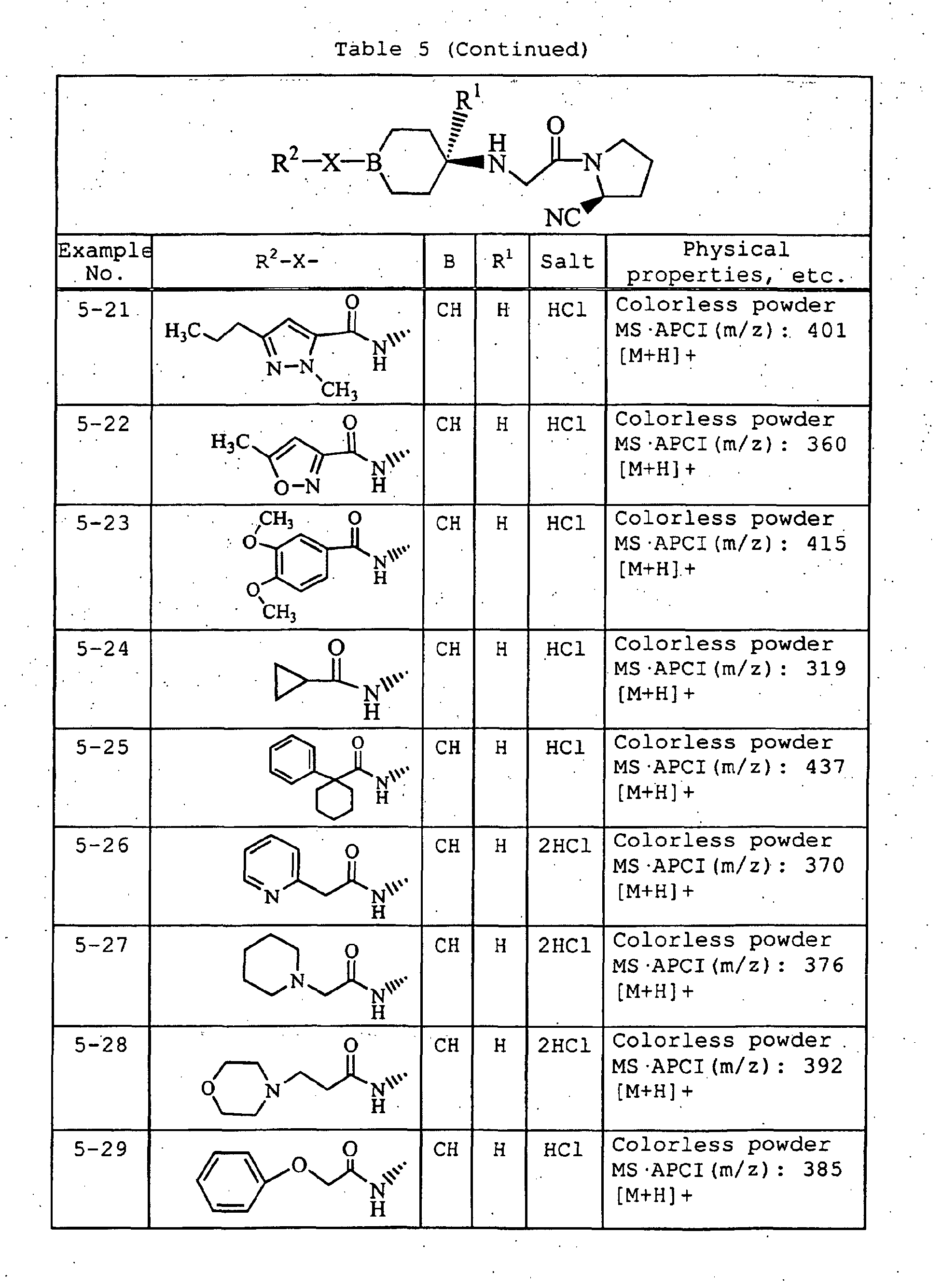
- the compounds of Examples 5-13 to 5-30 in Table 5 were obtained in the same manner as in Example 4-11, using a resin compound obtained in Reference Example 4 in place of the resin compound of Reference Example 3 (2). Also, the compounds of Examples 5-31 to 5-36 in Table 5 were obtained in the same manner by using a resin compound obtained in Reference Example 5 (5).
- a mixture comprising 500 mg of the resin compound obtained in the Reference Example 5 (5) and 0.5M methanesulfonic acid in dioxane/methylene chloride (1/9) was shaken at room temperature for 30 minutes.
- the resin was collected by filtration and was washed with methylene chloride, 10% triethylamine-methylene chloride, methylene chloride, dimethylformamide, dimethylformamide-water (1:1), tetrahydrofuran, methanol, tetrahydrofuran, methanol and dimethylacetamide.
- a mixture of the obtained resin, 293 mg of 2-chloro-5-bromopyrimidine and 211 ⁇ l of triethylamine was shaken at 55°C for 16 hours.
- the resin was collected by filtration and washed with dimethylformamide, methylene chloride, 10% triethylamine-methylene chloride, methylene chloride, dimethylformamide, dimethylformamide-water (1:1), tetrahydrofuran, methanol, tetrahydrofuran, methanol and methylene chloride.
- Whole amount of the obtained resin was treated with trifluoroacetic acid to obtain 61 mg of (S)-1-[trans-4-(5-bromopyrimidin-2-ylaminomethyl)cyclohexyl-amino]acetyl-2-cyanopyrrolidine hydrochloride (Example 5-37 in Table 5).
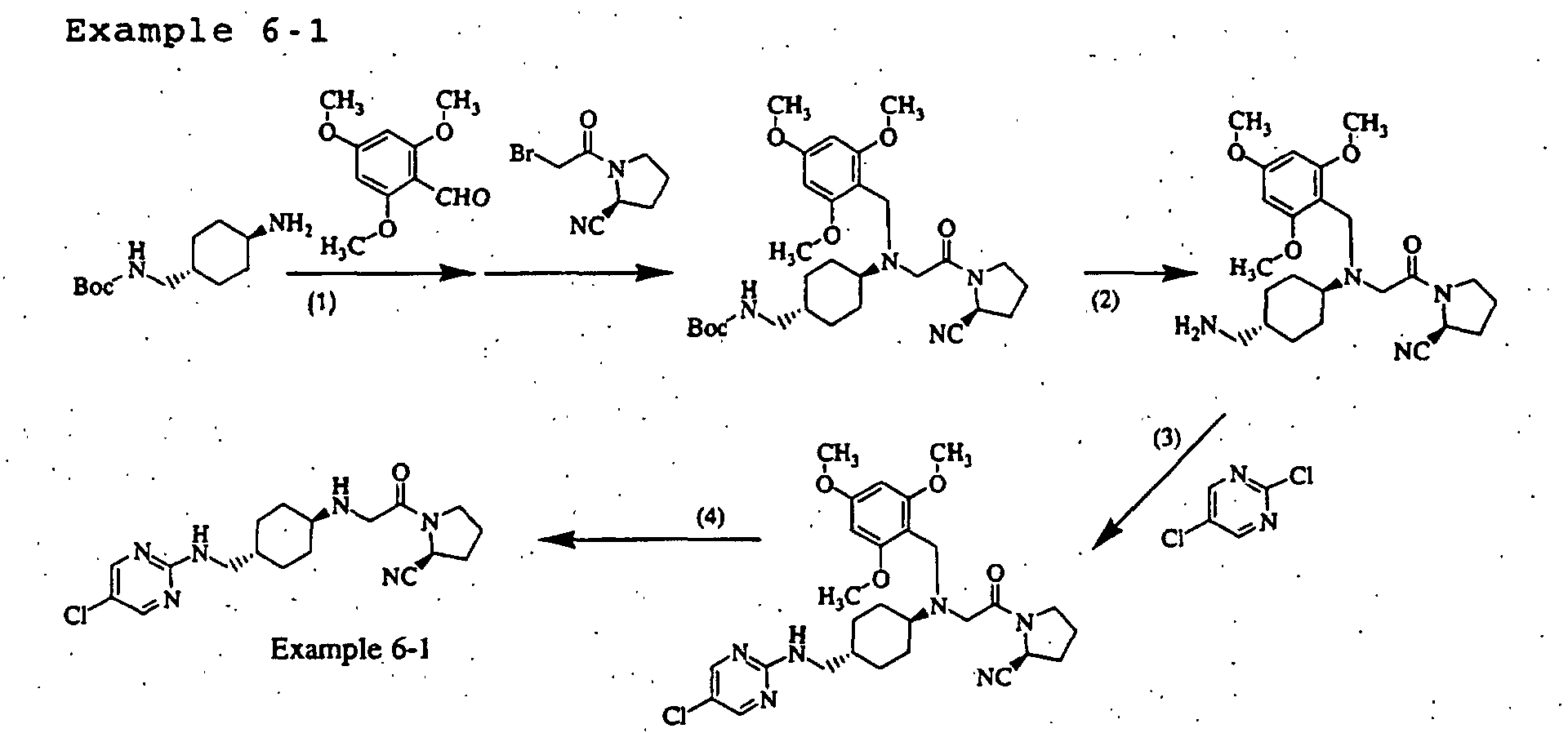
- Example 6-1 The compounds of Examples 6-2 to 6-4 in Table 6 were obtained in the same manner as in Example 6-1 (3) and (4) by using the compound obtained in the above Example 6-1 (2) and corresponding starting materials.
- L-thioprolineamide hydrochloride was synthesized according to the process described in the literature (Ashworth et. al., Bioorg. Med. Chem. Lett., Vol. 6, pp. 2745-2748, 1996). 2.36 ml of chloroacetyl chloride was added to 150 ml of a dichloromethane solution containing 5.00 g of the thus obtained L-thioprolineamide hydrochloride and 8.67 ml of triethylamine under ice-cooling, and the mixture was stirred at the same temperature for 1 hour. To the reaction mixture were added 4.8 ml of pyridine and 8.4 ml of trifluoroacetic anhydride, and the mixture was further stirred at room temperature for 1 hour.
- t-4-tert-butoxycarbonylamino-4-methoxymethyl-r-1-cyclohexylamine or c-4-tert-butoxycarbonylamino-4-methoxymethyl-r-1-cyclohexylamine was obtained in the same manner as Reference Example 6-1, (1) to (5) or (6) except for using methoxymethyl chloride in place of methyl iodide in the step of Reference Example 6-1, (1).
- this compound was treated with an acid to remove a protective group (tert-butoxycarbonyl group) to obtain 4-amino-4-methoxymethylpiperidine.
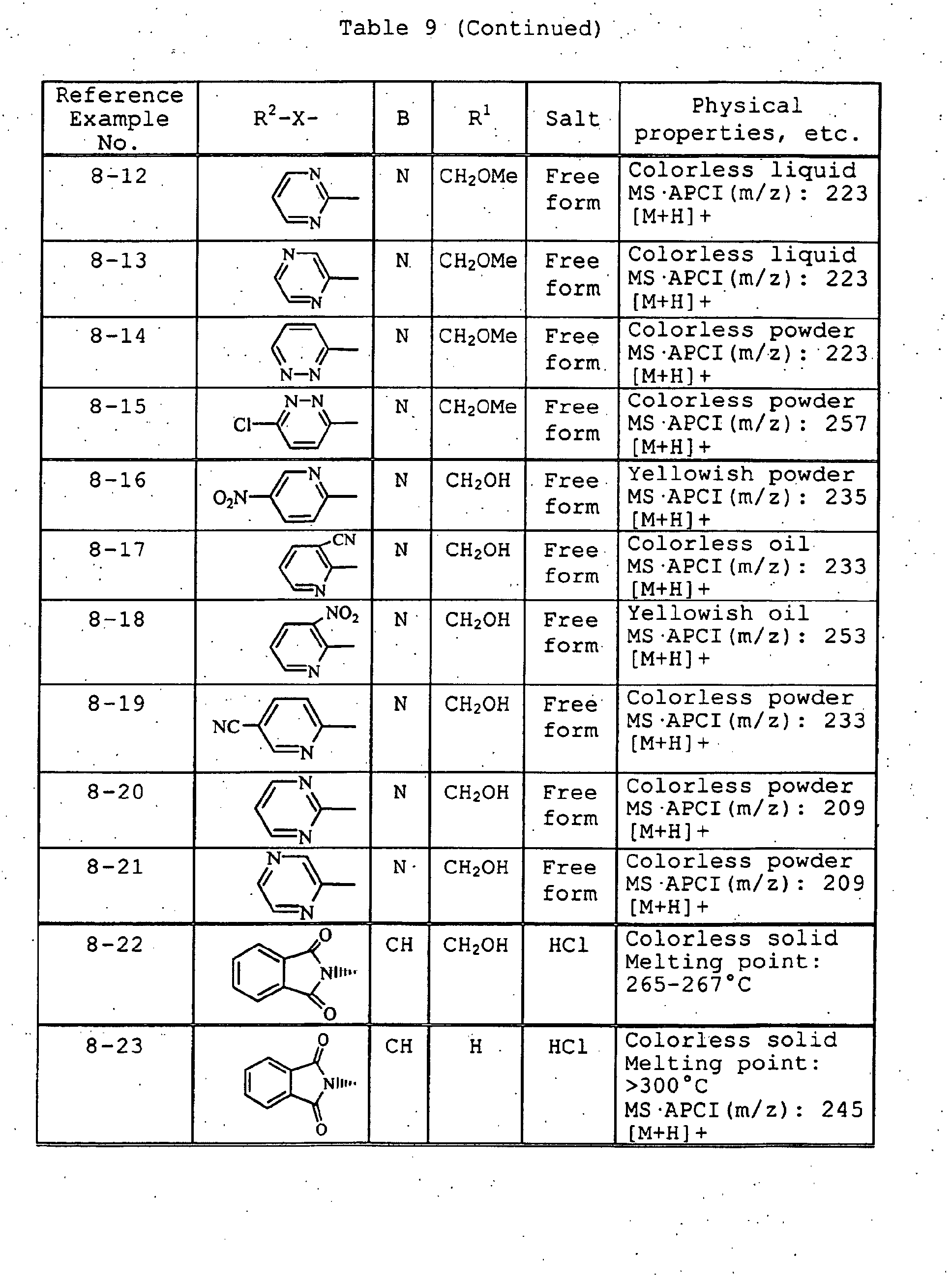
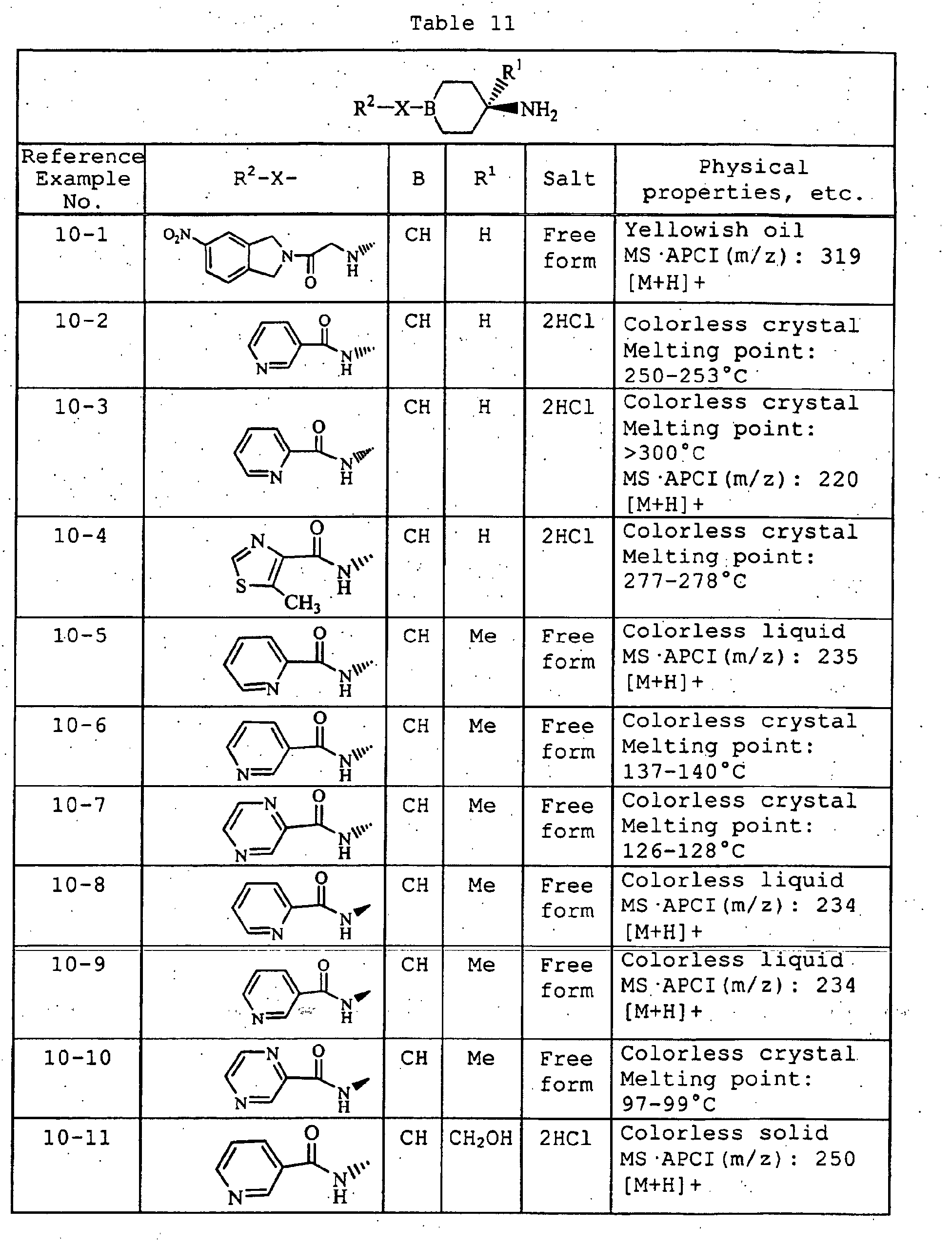
- trans-4-(1,3-dioxo-5-methoxycarbonyl-2-iso-indolinyl)cyclohexylamine hydrochloride (Reference Example 8-32 in Table 9) was obtained in the same manner as in Reference Example 8-25.
- trans-4-[1,3-dioxo-5-(1-pyrroli-dinyl)carbonyl-2-isoindolinyl]cyclohexylamine hydrochloride (Reference Example 8-33 in Table 9) was obtained in the same manner as in Reference Example 8-25.
- trans-4-(benzyloxycarbonylamino)-1-cyclohexane-carboxamidine'hydrochloride (a compound of Reference Example 8-35 (5)) (348 mg) as a starting material, by reacting the same with acetylacetone according to the method of Libman et al. (J. Chem. Soc., p. 2305, 1952), trans-1-benzyloxycarbonylamino-4-(4,6-dimethylpyrimidin-2-yl)cyclohexane (220 mg) was obtained.
- a mixture comprising 500 mg of N-tert-butoxycarbonyl-trans-1,4-cyclohexanediamine, 326 mg of 1,4-dichlorobutane, 805 mg of potassium carbonate, 70 mg of sodium iodide and ethanol-water (8 ml-2 ml) was stirred at 90°C for 12 days. Water was added to the reaction mixture, and the resulting mixture was extracted with chloroform. The extract was washed with brine, dried over anhydrous sodium sulfate, and then, the solvent was removed under reduced pressure.
- a mixture comprising 10 g of trans-4-(tert-butoxy-carbonylamino)cyclohexanecarboxylic acid, 7.93 g of 2-chloro-3-aminopyridine, 10.2 g of 1-(3-dimethylamino-propyl)-3-ethylcarbodiimide hydrochloride, 6.5 g of 4-dimethylaminopyridine, and 180 mL of N,N-dimethylformamide was stirred at room temperature for 15 hours. To the reaction mixture was added an aqueous sodium hydrogen-carbonate solution to make the solution alkaline, and extracted with ethyl acetate.
- trans-4-(benzyloxycarbonylamino)cyclo-hexanecarboxylic acid and 2-aminophenol in the same manner as in Reference Example 8-40, trans-4-benzyloxycarbonyl-amino-N-(2-hydroxyphenyl)cyclohexanecarboxamide was obtained.
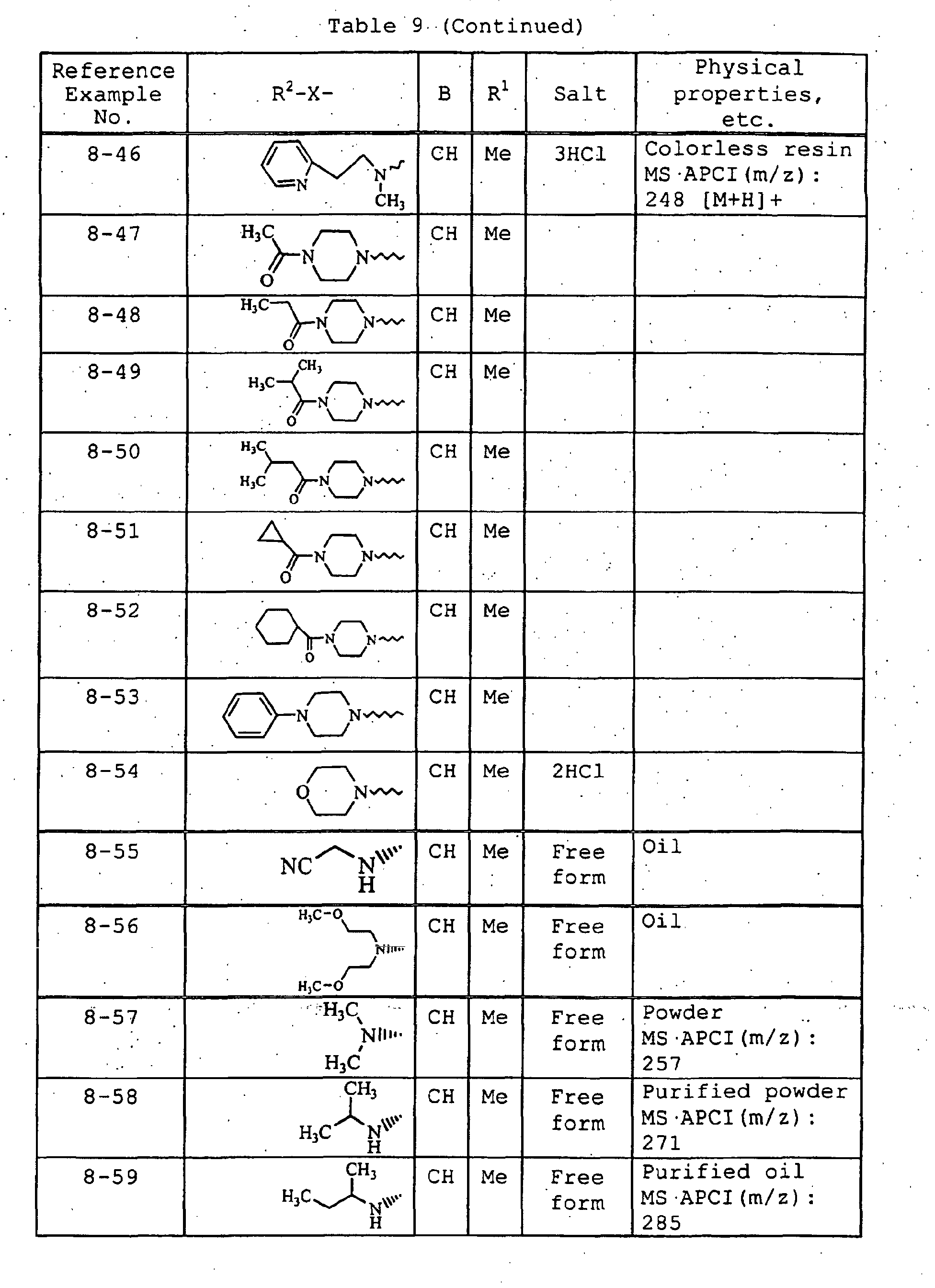
- This compound was stirred in 2 ml of 4N hydrochloric acid-dioxane, and 2 ml of ethanol for 8 hours, and then, the reaction mixture was concentrated. An aqueous 10% sodium hydroxide solution was added thereto. The mixture was extracted with chloroform, dried over anhydrous sodium sulfate, and the solvent was removed under reduced pressure to obtain 55 mg of t-4-dimethylamino-1-methyl-r-1-cyclo-hexylamine (Reference Example 8-57 in Table 9).
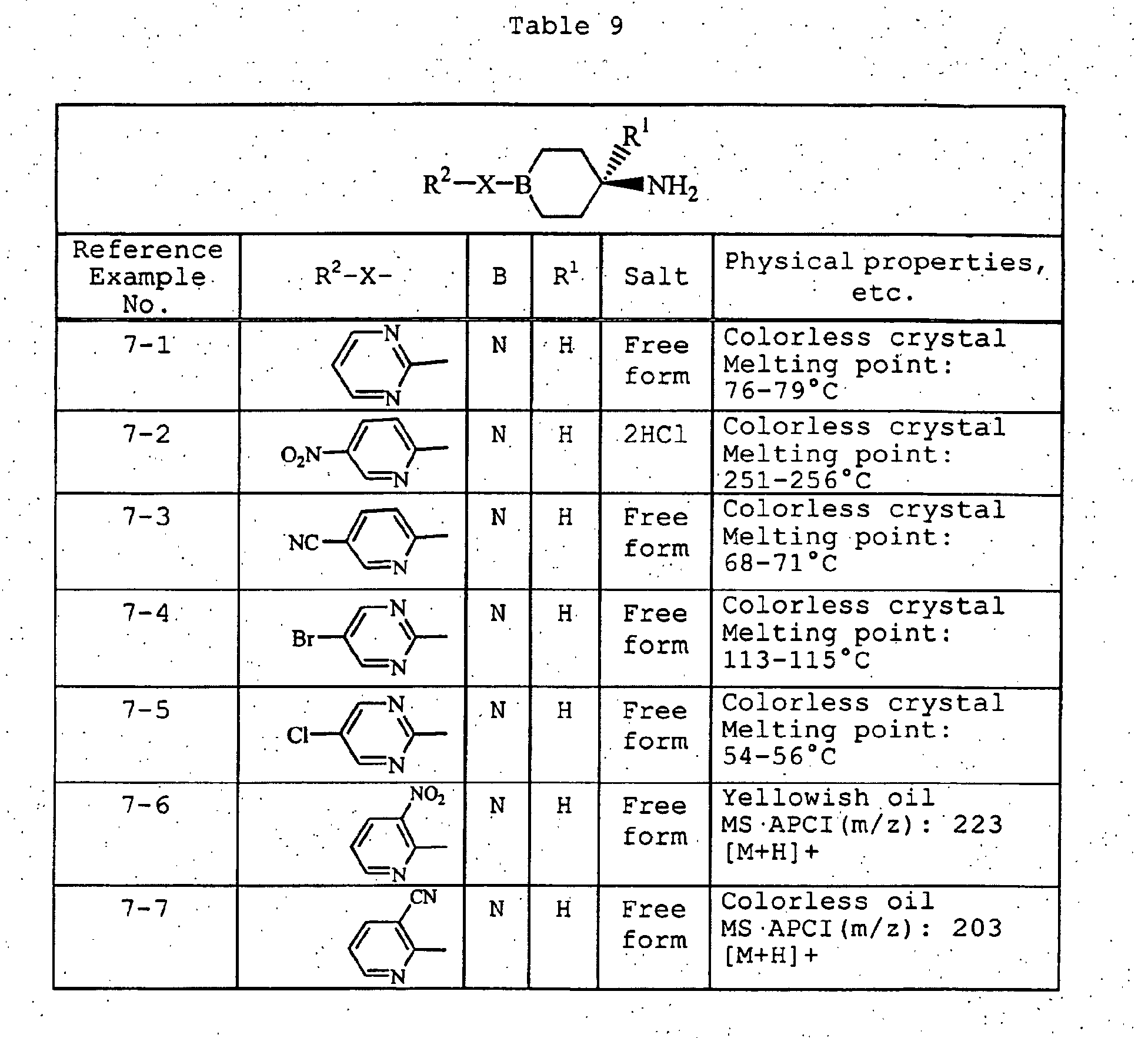
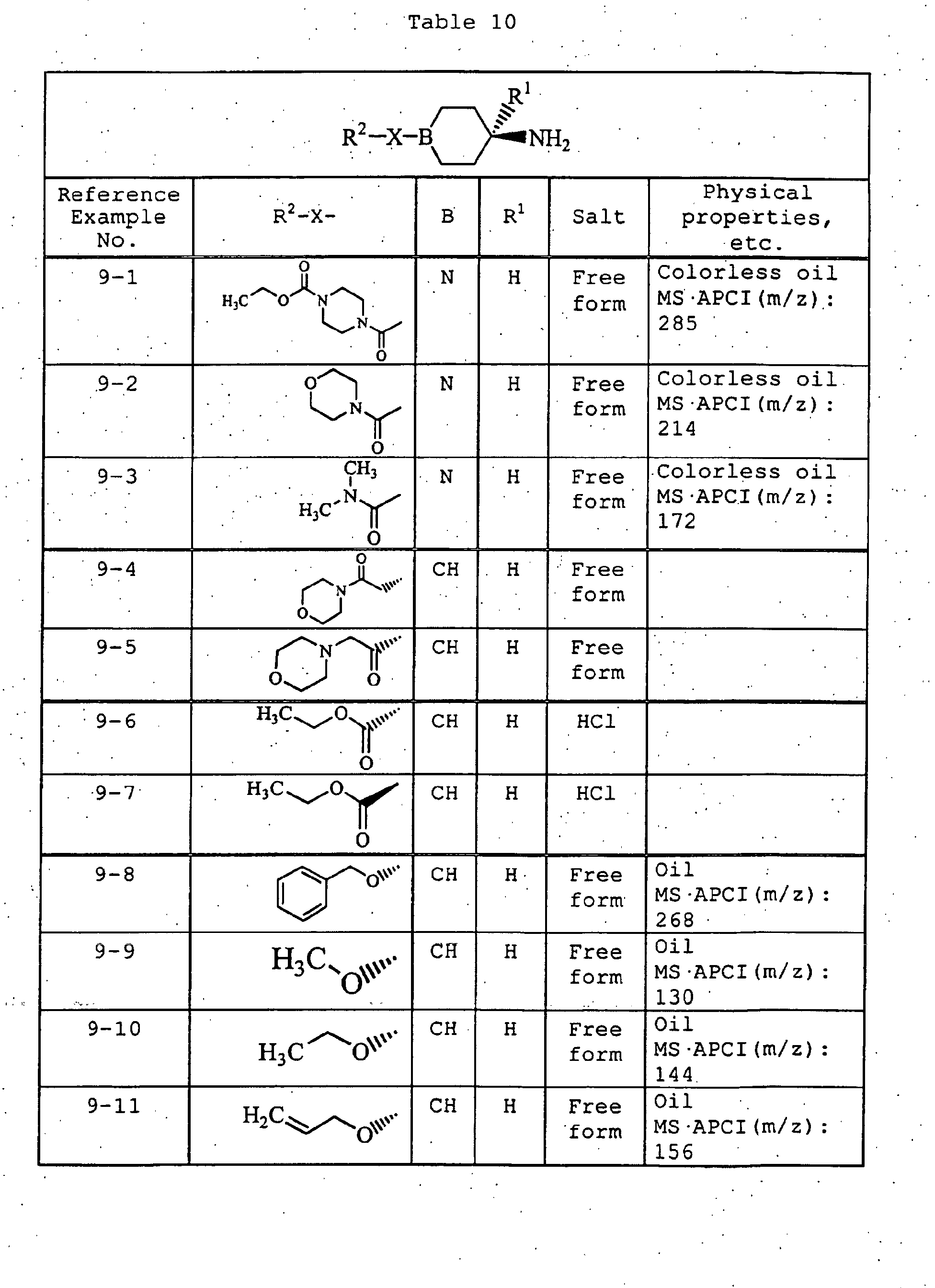
- Ethyl trans-4-aminocyclohexanecarboxylate hydrochloride (Reference Example 9-6) and ethyl cis-4-aminocyclo-hexanecarboxylate ⁇ hydrochloride (Reference Example 9-7) were synthesized according to the method described in a literature (Johnston et al., J. Med. Chem., 1971, Vol. 14, pp. 600-614).
Landscapes
- Chemical & Material Sciences (AREA)
- Organic Chemistry (AREA)
- Health & Medical Sciences (AREA)
- Medicinal Chemistry (AREA)
- Pharmacology & Pharmacy (AREA)
- Life Sciences & Earth Sciences (AREA)
- Animal Behavior & Ethology (AREA)
- General Health & Medical Sciences (AREA)
- Public Health (AREA)
- Veterinary Medicine (AREA)
- Epidemiology (AREA)
- Diabetes (AREA)
- Engineering & Computer Science (AREA)
- Bioinformatics & Cheminformatics (AREA)
- Chemical Kinetics & Catalysis (AREA)
- General Chemical & Material Sciences (AREA)
- Nuclear Medicine, Radiotherapy & Molecular Imaging (AREA)
- Emergency Medicine (AREA)
- Hematology (AREA)
- Obesity (AREA)
- Endocrinology (AREA)
- Pharmaceuticals Containing Other Organic And Inorganic Compounds (AREA)
- Plural Heterocyclic Compounds (AREA)
- Heterocyclic Carbon Compounds Containing A Hetero Ring Having Nitrogen And Oxygen As The Only Ring Hetero Atoms (AREA)
- Hydrogenated Pyridines (AREA)
- Acyclic And Carbocyclic Compounds In Medicinal Compositions (AREA)
- Peptides Or Proteins (AREA)
- Investigating Or Analysing Biological Materials (AREA)
- Glass Compositions (AREA)
- Heterocyclic Carbon Compounds Containing A Hetero Ring Having Oxygen Or Sulfur (AREA)
Abstract
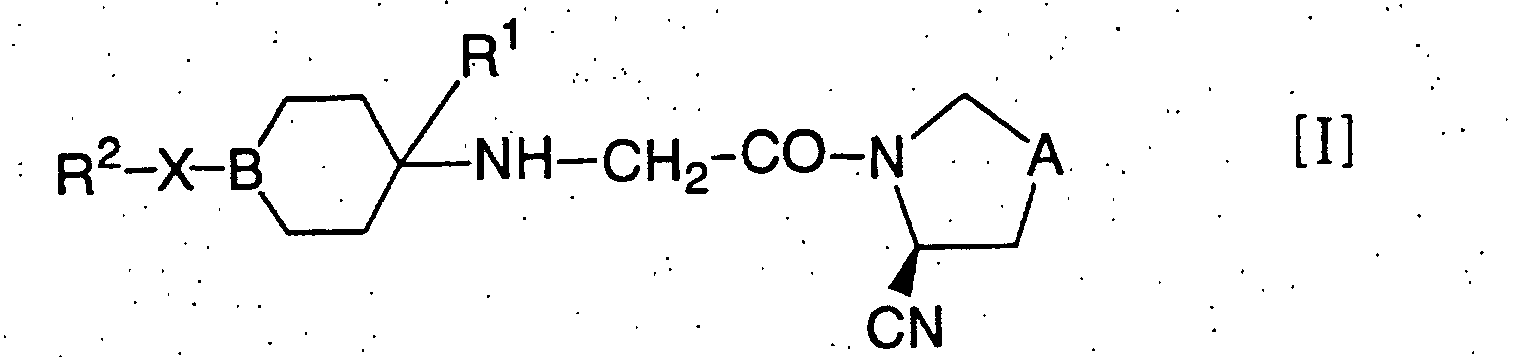
Description

where the bonding arm at a right terminal in each definition of the above X represents a bonding arm with B,
- (1) a cyclic group which may be substituted, where
the cyclic group portion is
- (i) a monocyclic or bicyclic hydrocarbon group, or
- (ii) a monocyclic or bicyclic heterocyclic group;
and partially or completely saturated cyclic groups thereof, etc.
and partially or completely saturated cyclic groups thereof, etc.
"phenyl group, cyclohexyl group, cyclopentyl group, cyclobutyl group, cyclopropyl group, a pyrrolidinyl group, an imidazolidinyl group, a pyrazolidinyl group, an oxolanyl group, a thiolanyl group, a pyrrolinyl group, an imidazolinyl group, a pyrazolinyl group, a pyrrolyl group, an imidazolyl group, a pyrazolyl group, a triazolyl group, a tetrazolyl group, a furyl group, an oxazolyl group, an isoxazolyl group, an oxadiazolyl group, a thienyl group, a thiazolyl group, an isothiazolyl group, a thiadiazolyl group, a piperidyl group, a piperazinyl group, a morpholinyl group, a thiomorpholinyl group, a pyridyl group, a pyrimidinyl group, a pyrazinyl group, a pyridazinyl group, a pyranyl group, a tetrahydropyridyl group, a dihydro-pyridazinyl group, a perhydroazepinyl group, a perhydro-thiazepinyl group, an indolinyl group, an isoindolinyl group, an indolyl group, an indazolyl group, an isoindolyl group, a benzimidazolyl group, a benzothiazolyl group, a benzoxazolyl group, a benzodioxolyl group, a benzothienyl group, a benzofuryl group, a thienopyridyl group, a thiazolopyridyl group, a pyrrolopyridyl group, a dihydropyrrolopyridyl group, a quinolyl group, an isoquinolyl group, a quinoxalinyl group, a quinazolinyl group, a phthalazinyl group, a cinnolinyl group, a chromanyl group, an isochromanyl group, a naphthyridinyl group, and partially or completely saturated cyclic groups thereof, etc.".
"phenyl group, cyclohexyl group, cyclopropyl group, a pyrrolidinyl group, an imidazolidinyl group, a pyrazolidinyl group, a pyrrolyl group, an imidazolyl group, a pyrazolyl group, a furyl group, an oxazolyl group, an isoxazolyl group, a thienyl group, a thiazolyl group, an isothiazolyl group, a piperidyl group, a piperazinyl group, a morpholinyl group, a thiomorpholinyl group, a pyridyl group, a pyrimidinyl group, a pyrazinyl group, a pyridazinyl group, an isoindolinyl group, an indolinyl group, a thiazolopyridyl group, a pyrrolopyridyl group, a dihydropyrrolopyridyl group, a benzoxazolyl group, a quinolyl group, an isoquinolyl group, a quinazolinyl group, an isoindolyl group, an indolyl group,
and partially or completely saturated cyclic groups thereof, etc."
"1-piperidyl group, 1-piperazinyl, group, 4-morpholinyl group, 1-indolinyl group, 2-isoindolinyl group, thiazolo-[5,4-b]pyridin-2-yl group, etc.".
a halogen atom (Cl, F, Br, etc.), cyano group, nitro group, amino group, oxo group, a lower alkyl group, a lower alkoxy group, a lower alkanoyl group, a lower alkoxycarbonyl group, a lower alkoxycarbonylamino group, a lower cycloalkanoyl group, a halo-lower alkyl group, a halo-lower alkylcarbonyl group, a nitrogen-containing monocyclic 5- to 6-membered aliphatic heterocyclic group-substituted carbonyl group, a nitrogen-containing monocyclic 6-membered aromatic heterocyclic group, a monocyclic aryl group, a monocyclic aryl group-substituted aryl lower alkylcarbonylamino group, a lower alkylthio group, an aminosulfonyl group, etc.
(As "a nitrogen-containing monocyclic 5- to 6-membered aliphatic heterocyclic group" in "the nitrogen-containing monocyclic 5- to 6-membered aliphatic heterocyclic group-substituted carbonyl group", specific examples include "a pyrrolidinyl group, a piperidinyl group, a piperazinyl group, etc."
oxo group, a lower alkanoyl group, a lower cycloalkanoyl group, a lower alkoxycarbonyl group and a nitrogen-containing monocyclic 5- to 6-membered aliphatic heterocyclic group-substituted carbonyl group (a pyrrolidinyl group, a piperidinyl group, etc.).

among the two kinds of cis-trans isomers based on a cyclohexyl ring in the structure [I] as a standard plane, a trans-isomeric compound is more preferred from the viewpoint of obtaining a higher DPPIV inhibitory activity. That is, among the objective compound [I] of the present invention wherein B is CH, a compound having the following partial structure:
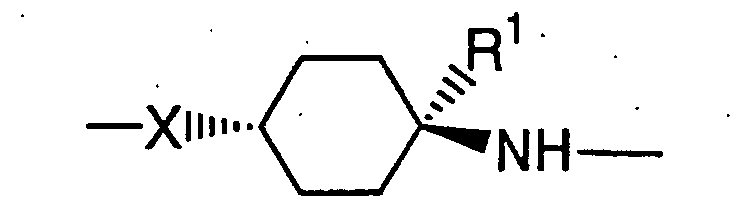
may be exemplified (Compound Group 2).



can be prepared by reacting a compound represented by the formula [IV] :
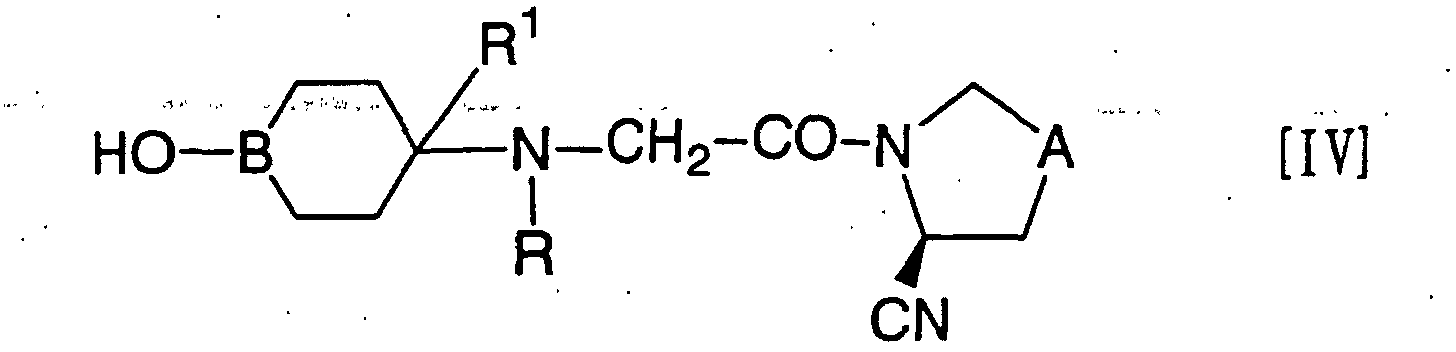

or a salt thereof,'and further removing the protective group (R) for the amino group from the product.

R2 and A have the same meanings as defined above, can be prepared by reacting a compound represented by the formula [VII]:




and treating the product with a dehydrating agent (for example, phosphorous oxychloride, trifluoroacetic anhydride, etc.) according to the conventional method.
R2 and Alk have the same meanings as defined above, in the presence or absence of an acid acceptor (for example, an organic base such as triethylamine, diisopropylethylamine, etc., and an inorganic base such as sodium hydride, potassium carbonate, etc.), and, if necessary, removing the protective group for the amino group according to the conventional method. As the protective group for the amino group, any of the same protective groups commonly used as mentioned above R can be suitably used.






















Claims (34)
- An aliphatic nitrogen-containing 5-membered ring compound represented by the formula [I]:wherein symbols in the formula have the following meanings ;
 provided that when X is a single bonding arm, then R2 is a group selected from the above (1) and (2), and when X is -CO-, then B is N, or a pharmaceutically acceptable salt thereof.A: -CH2- or -S-,B: CH or N,R1: H, a lower alkyl group, a hydroxy lower alkyl group or a lower alkoxy lower alkyl group,X: a single bonding arm, -CO-, -Alk-CO-, -COCH2-, -Alk-O-, -O-CH2-, -SO2-, -S-, -COO-, -CON(R3)-, -Alk-CON(R3)-, -CON(R3)CH2-, -Alk-CON(R3)CH2-, -COCH2N(R3)-, -SO2N(R3)- or -NHCH2-,
where the bonding arm at a right terminus in each definition of the above X represents a bonding arm with B,R3: hydrogen atom or a lower alkyl group,Alk: a lower alkylene group, andR2: a group selected from the following (1), (2) and (3);(1) a cyclic group which may be substituted, where the cyclic group portion is(i) a monocyclic or bicyclic hydrocarbon group, or(ii) a monocyclic or bicyclic heterocyclic group;(2) an amino group substituted by 1 or 2 substituents which are the same or different and selected from a substituted or unsubstituted lower alkyl group; and(3) a lower alkyl group, a carboxy lower alkyl group, a lower alkoxy group, a lower alkenyl group, a lower alkoxy-substituted lower alkyl group, a phenoxy group, a phenoxy-substituted lower alkyl group or a phenyl lower alkenyl group, - An aliphatic nitrogen-containing 5-membered ring compound represented by the formula [I-e]:wherein symbols in the formula have the following meanings;
 or a pharmaceutically acceptable salt thereof.A: -CH2- or -S-,B: CH or N,R1: H, a lower alkyl group, a hydroxy lower alkyl group or a lower alkoxy lower alkyl group,X4: a single bonding arm, -Alk-CO-, -COCH2-, -Alk-O-, -O-CH2-, -SO2-, -S-, -COO-, -CON(R3)-, -Alk-CON(R3)-, -CON(R3)CH2-, -Alk-CON(R3)CH2-, -COCH2N(R3)-, -SO2N(R3)- or -NHCH2-,
where the bonding arm at the right terminus in each definition of the above X represents a bonding arm with B,R3: hydrogen atom or a lower alkyl group,Alk: a lower alkylene group,R23: a group selected from the following (1) and (2);(1) a cyclic group which may be substituted, where the cyclic group portion is(i) a monocyclic or bicyclic hydrocarbon group, or(ii) a monocyclic or bicyclic heterocyclic group; and(2) an amino group substituted by 1 or 2 substituents which are the same or different and selected from a substituted or unsubstituted lower alkyl group, - The compound according to Claim 1, wherein R2 is a group selected from the following (1), (2) and (3);(1) a cyclic group which may have 1 to 3 substituents which are the same or different and selected from the following substituents of Group A, where the cyclic group portion is(i) a monocyclic or bicyclic hydrocarbon group, or(ii) a monocyclic or bicyclic heterocyclic group;(2) an amino group substituted by 1 or 2 substituents which are the same or different and selected from "a lower alkyl group which may be substituted by substituent(s) selected from cyano group, a lower alkoxy group, phenyl group and a nitrogen-containing monocyclic 6-membered aromatic heterocyclic group"; and(3) a lower alkyl group, a carboxy lower alkyl group, a lower alkoxy group, a lower alkenyl group, a lower alkoxy-substituted lower alkyl group, a phenoxy group, a phenoxy-substituted lower alkyl group or a phenyl lower alkenyl group.
Substituents of Group A: a halogen atom, cyano group, nitro group, amino group, oxo group, a lower alkyl group, a lower alkoxy group, a lower .alkanoyl group, a lower alkoxycarbonyl group, a lower alkoxycarbonylamino group, a lower cycloalkanoyl group, a halo-lower alkyl group, a halo-lower alkylcarbonyl group, a nitrogen-containing monocyclic 5- to 6-membered aliphatic heterocyclic group-substituted carbonyl group, a nitrogen-containing monocyclic 6-membered aromatic heterocyclic group, a monocyclic aryl group, a monocyclic aryl group-substituted aryl lower alkylcarbonylamino group, a lower alkylthio group and an aminosulfonyl group. - The compound according to Claim 1, wherein R2 is a cyclic group which may be substituted, where the cyclic group portion is a group selected from the following (i), (ii) and (iii);(i) a monocyclic hydrocarbon group having 3 to 7 carbon atoms,(ii) a monocyclic heterocyclic group containing 1 to 2 hetero atoms selected from nitrogen atom, oxygen atom and sulfur atom, and(iii) a bicyclic heterocyclic group containing 1 to 3 hetero.atoms selected from nitrogen atom, oxygen atom and sulfur atom and comprising two 5- to 7-membered rings being fused.
- The compound according to Claim 4, wherein R2 is a cyclic group which may have 1 to 3 substituerits which are the same or different, where the cyclic group portion is a group selected from
phenyl group, cyclohexyl group, cyclopentyl group, cyclobutyl group, cyclopropyl group, a pyrrolidinyl group, an imidazolidinyl group, a pyrazolidinyl group, an oxolanyl group, a thiolanyl group, a pyrrolinyl group, an imidazolinyl group, a pyrazolinyl group, a pyrrolyl group, an imidazolyl group, a pyrazolyl group, a triazolyl group, a tetrazolyl group, a furyl group, an oxazolyl group, an isoxazolyl group, an oxadiazolyl group, a thienyl group, a thiazolyl group, an isothiazolyl group, a thiadiazolyl group,. a piperidyl group, a piperazinyl group, a morpholinyl group, a thiomorpholinyl group, a pyridyl group, a pyrimidinyl group, a pyrazinyl group, a pyridazinyl group, a pyranyl group, a tetrahydropyridyl group, a dihydro-pyridazinyl group, a perhydroazepinyl group, a perhydro-thiazepinyl group, an indolinyl group, an isoindolinyl group, an indolyl group, an indazolyl group, an isoindolyl group, a benzimidazolyl group, a benzothiazolyl group, a benzoxazolyl group, a benzodioxolyl group, a benzothienyl group, a benzofuryl group, a thienopyridyl group, a thiazolopyridyl group, a pyrrolopyridyl group, a dihydropyrrolopyridyl group, a quinolyl group, an isoquinolyl group, a quinoxalinyl group, a quinazolinyl group, a phthalazinyl group, a cinnolinyl group, a chromanyl group, an isochromanyl group, a naphthyridinyl group, and partially or completely saturated cyclic groups thereof. - The compound according to Claim 5, wherein R2 is a cyclic group which may have substituents, where the cyclic group portion is a group selected from phenyl group, cyclohexyl group, cyclopropyl group, a pyrrolidinyl group, an imidazolidinyl group, a pyrazolidinyl group, a pyrrolyl group, an imidazolyl group, a pyrazolyl group, a furyl group, an oxazolyl group, an isoxazolyl group, a thienyl group, a thiazolyl group, an isothiazolyl group, a piperidyl group, a piperazinyl group, a morpholinyl group, a thiomorpholinyl group, a pyridyl group, a pyrimidinyl group, a pyrazinyl group, a pyridazinyl group, an isoindolinyl group, an indolinyl group, a thiazolopyridyl group, a pyrrolopyridyl group, a dihydropyrrolopyridyl group, a benzoxazolyl group, a quinolyl group, an isoquinolyl group, a quinazolinyl group, an isoindolyl group, an indolyl group. and partially or completely saturated cyclic groups thereof.
- The compound according to Claim 6, wherein R2 is a cyclic group which may have substituents, where the cyclic group portion is a group selected from a piperidyl group, a piperazinyl group, a morpholinyl group, an indolinyl group, an isoindolinyl group and a thiazolopyridyl group.
- The compound according to any one of Claims 3 to 7, wherein R2 is a cyclic group which may have 1 to 3 substituents, selected from the following substituents of Group A', where the cyclic group portion is a group selected from a piperidyl group, a piperazinyl group, a morpholinyl group, an indolinyl group, an isoindolinyl group and a thiazolopyridyl group.
Substituents of Group A': oxo group, a lower alkanoyl group, a lower cycloalkanoyl group, a lower alkoxycarbonyl group and a nitrogen-containing aliphatic heterocyclic group-substituted carbonyl group. - The compound according to any one of Claims 2 to 8,
wherein B is CH, X is a single bonding arm and R2 is (1) a monocyclic or bicyclic nitrogen-containing heterocyclic group which may be substituted or (2) an amino group substituted by 1 or 2 substituents selected from a substituted or unsubstituted lower alkyl group, represented by the formula:
- The compound according to Claim 2, wherein B is CH, X is a single bonding arm, A is -CH2- and R1 is hydrogen atom or a lower alkyl group.
- The compound according to Claim 3, wherein B is CH, X is a single bonding arm, A is -CH2- and R1 is hydrogen atom or a lower alkyl group.
- The compound according to Claim 4, wherein B is CH, X is a single bonding arm, A is -CH2- and R1 is hydrogen atom or a lower alkyl group.
- The compound according to Claim 5, wherein B is CH, X is a single bonding arm, A is -CH2- and R1 is hydrogen atom or a lower alkyl group.
- The compound according to Claim 6, wherein B is CH, X is a single bonding arm, A is -CH2- and R1 is hydrogen atom or a lower alkyl group.
- The compound according to Claim 7, wherein B is CH, X is a single bonding arm, A is -CH2- and R1 is hydrogen atom or a lower alkyl group.
- The compound according to Claim 8, wherein B is CH, X is a single bonding arm, A is -CH2- and R1 is hydrogen atom or a lower alkyl group.
- The compound according to Claim 9, wherein B is CH, X is a single bonding arm, A is -CH2- and R1 is hydrogen atom or a lower alkyl group.
- The compound according to Claim 2, wherein B is CH, X is a single bonding arm, A is -S- and R1 is hydrogen atom or a lower alkyl group.
- The compound according to any one of Claims 1 to 18,
wherein B is CH, and the compound has the following partial structure:or a pharmaceutically acceptable salt thereof.
- A compound selected from the following group consisting of:(S)-2-cyano-1-[t-4-(4-acetyl-1-piperazinyl)-1-methyl-r-1-cyclohexylamino]acetylpyrrolidine;(S)-2-cyano-1-[trans-4-(1,3-dioxo-2-isoindolinyl)-cyclohexylamino]acetylpyrrolidine;(S)-2-cyano-1-(trans-4-morpholinocyclohexylamino]-acetylpyrrolidine; and(S)-2-cyano-1-[trans-4-(thiazolo[5,4-b]pyridin-2-yl)-cyclohexylamino]acetylpyrrolidine, or a pharmaceutically acceptable salt thereof.
- A method for preparing an aliphatic nitrogen-containing 5-membered ring compound represented by the formula [I] :wherein symbols in the formula have the following meanings;
 or a pharmaceutically acceptable salt thereof, which comprises reacting a compound represented by the formula [II] :A: -CH2- or -S-,B: CH or N,R1: H, a lower alkyl group, a hydroxy lower alkyl group or a lower alkoxy lower alkyl group,X: a. single bonding arm, -CO-, -Alk-CO-, -COCH2-, -Alk-O-, -O-CH2-, -SO2-, -S-, -COO-, -CON(R3)-, -Alk-CON(R3)-, -CON(R3)CH2-, -Alk-CON(R3)CH2-, -COCH2N(R3)-, -SO2N(R3)- or -NHCH2-,
wherein the bonding arm at a right terminus in each definition of the above X represents a bonding arm with B,R3: hydrogen atom or a lower alkyl group,Alk: a lower alkylene group, andR2: a group selected from the following (1), (2) and (3);(1) a cyclic group which may be substituted, where the cyclic group portion is(i) a monocyclic or bicyclic hydrocarbon group, or(ii) a monocyclic or bicyclic heterocyclic group;(2) an amino group substituted by 1 or 2 substituents which are the same or different and selected from a substituted or unsubstituted lower alkyl group; and(3) a lower alkyl group, a carboxy lower alkyl group, a lower alkoxy group, a lower alkenyl group, a lower alkoxy-substituted lower alkyl group, a phenoxy group, a phenoxy-substituted lower alkyl group or a phenyl lower alkenyl group, provided that when X is a single bonding arm, then R2 is a group selected from the above (1) and (2), and when X is -CO-, then B is N,wherein A represents -CH2- or -S- and Z1 represents a reactive residue, with a compound represented by the formula [III]: wherein R1, R2, B and X have the same meanings as defined above, or salts thereof, and optionally making the product into a pharmaceutically acceptable salt thereof.
- A method for inhibiting dipeptidylpeptidase IV activity by using the compound according to any one of Claims 1 to 20.
- A method for treatment or prophylaxis of a disease, which comprises administering to a patient an effective dose of the compound according to any one of Claims 1 to 20.
- The method for treatment or prophylaxis of a disease according to Claim 23, wherein the disease is'expected to be alleviated by inhibiting dipeptidylpeptidase IV activity.
- The method for treatment or prophylaxis of a disease according to Claim.23, wherein the disease is diabetes.
- The method for treatment or prophylaxis of a disease according to Claim 23, wherein the disease is type 2 diabetes.
- Use of the compound according to any one of Claims 1 to 20 as an inhibitor of dipeptidylpeptidase IV.
- Use of the compound according to any one of Claims 1 to 20 as a pharmaceutically effective ingredient of a medicine.
- Use of the compound according to any one of Claims 1 to 20 for the preparation of a medicine.
- The use according to Claim 23 or 24, wherein the medicine is for the treatment or prophylaxis of a disease that is expected to be improved by inhibiting dipeptidylpeptidase IV activity.
- The use according to Claim 28 or 29, wherein the medicine is for the treatment or prophylaxis of diabetes.
- The use according to Claim 28 or 29, wherein the medicine is for the treatment or prophylaxis of type 2 diabetes.
- A pharmaceutical composition comprising the compound according to any one of Claims 1 to 20 as an effective ingredient.
- The pharmaceutical composition according to Claim 33 wherein the pharmaceutical composition is a dipeptidylpeptidase IV inhibitor.
Applications Claiming Priority (7)
| Application Number | Priority Date | Filing Date | Title |
|---|---|---|---|
| JP2000308528 | 2000-10-06 | ||
| JP2000308528 | 2000-10-06 | ||
| JP2000312562 | 2000-10-12 | ||
| JP2000312562 | 2000-10-12 | ||
| JP2001099251 | 2001-03-30 | ||
| JP2001099251 | 2001-03-30 | ||
| PCT/JP2001/008802 WO2002030890A1 (en) | 2000-10-06 | 2001-10-05 | Nitrogenous five-membered ring compounds |
Publications (3)
| Publication Number | Publication Date |
|---|---|
| EP1323710A1 true EP1323710A1 (en) | 2003-07-02 |
| EP1323710A4 EP1323710A4 (en) | 2005-05-18 |
| EP1323710B1 EP1323710B1 (en) | 2008-09-10 |
Family
ID=27344889
Family Applications (2)
| Application Number | Title | Priority Date | Filing Date |
|---|---|---|---|
| EP01974716A Expired - Lifetime EP1323710B1 (en) | 2000-10-06 | 2001-10-05 | Nitrogenous five-membered ring compounds |
| EP01974717A Expired - Lifetime EP1325910B1 (en) | 2000-10-06 | 2001-10-05 | Aliphatic nitrogenous five-membered ring compounds |
Family Applications After (1)
| Application Number | Title | Priority Date | Filing Date |
|---|---|---|---|
| EP01974717A Expired - Lifetime EP1325910B1 (en) | 2000-10-06 | 2001-10-05 | Aliphatic nitrogenous five-membered ring compounds |
Country Status (20)
| Country | Link |
|---|---|
| US (5) | US7138397B2 (en) |
| EP (2) | EP1323710B1 (en) |
| KR (2) | KR100526091B1 (en) |
| CN (2) | CN1280269C (en) |
| AT (2) | ATE408597T1 (en) |
| AU (4) | AU2001294197C1 (en) |
| BR (1) | BR0114436A (en) |
| CA (2) | CA2424964C (en) |
| DE (2) | DE60135862D1 (en) |
| DK (2) | DK1323710T3 (en) |
| ES (2) | ES2312471T3 (en) |
| HU (1) | HUP0303391A3 (en) |
| IL (2) | IL154893A0 (en) |
| MX (2) | MXPA03003007A (en) |
| NO (1) | NO324519B1 (en) |
| NZ (2) | NZ525630A (en) |
| PL (1) | PL362545A1 (en) |
| PT (2) | PT1325910E (en) |
| TW (1) | TWI290919B (en) |
| WO (2) | WO2002030890A1 (en) |
Cited By (16)
| Publication number | Priority date | Publication date | Assignee | Title |
|---|---|---|---|---|
| WO2003106456A3 (en) * | 2002-06-14 | 2004-03-04 | Sanofi Synthelabo | NEW COMPOUNDS |
| WO2004043949A1 (en) * | 2002-11-11 | 2004-05-27 | Grünenthal GmbH | 4-substituted 1-aminocyclohexane derivatives for utilization as orl1-receptor and mu-opiate receptor ligands |
| WO2005021536A3 (en) * | 2003-08-29 | 2005-10-13 | Sanofi Aventis | Adamantane and azabicyclo-octane and nonane derivatives, process of their preparation and their use as dpp-iv inhibitors |
| WO2005110971A1 (en) | 2004-05-10 | 2005-11-24 | Grünenthal GmbH | Heteroaryl substituted cyclohexyl-1,4-diamine derivatives |
| WO2005110976A1 (en) * | 2004-05-10 | 2005-11-24 | Grünenthal GmbH | Substituted cyclohexylacetic acid derivatives |
| WO2006012441A1 (en) * | 2004-07-23 | 2006-02-02 | Susan Marie Royalty | Peptidase inhibitors |
| WO2006011035A1 (en) * | 2004-07-23 | 2006-02-02 | Glenmark Pharmaceuticals Ltd. | Novel dipeptidyl peptidase iv inhibitors; process for their preparation and compositions containing them |
| US7074798B2 (en) | 2002-02-25 | 2006-07-11 | Eisai Co., Ltd | Xanthine derivative and DPPIV inhibitor |
| US7205323B2 (en) | 2004-10-12 | 2007-04-17 | Glenmark Pharmaceuticals S.A. | Dipeptidyl peptidase IV inhibitors pharmaceutical compositions containing them, and process for their preparation |
| EP1464335A3 (en) * | 2003-03-31 | 2007-05-09 | Taisho Pharmaceutical Co. Ltd. | Quinoline, tetrahydroquinoline and pyrimidine derivatives as mch antagonist |
| WO2006127287A3 (en) * | 2005-05-20 | 2007-06-07 | Bristol Myers Squibb Co | Pyrrolopyridine-based inhibitors of dipeptidyl peptidase iv and methods |
| WO2009091082A1 (en) * | 2008-01-17 | 2009-07-23 | Mitsubishi Tanabe Pharma Corporation | Combination therapy comprising sglt inhibitors and dpp4 inhibitors |
| WO2010039124A1 (en) * | 2008-09-30 | 2010-04-08 | Mitsubishi Tanabe Pharma Corporation | Benzenesulfonic acid salt compounds |
| EP2253311A2 (en) | 2006-04-11 | 2010-11-24 | Arena Pharmaceuticals, Inc. | Use of GPR119 receptor agonists for increasing bone mass and for treating osteoporosis, as well as combination therapy relating thereto |
| EP2231687A4 (en) * | 2008-01-10 | 2012-11-14 | Sun Pharma Advanced Res Co Ltd | Novel derivatives of acyl cyanopyrrolidines |
| WO2019154859A1 (en) * | 2018-02-06 | 2019-08-15 | Universität Heidelberg | Fap inhibitor |
Families Citing this family (108)
| Publication number | Priority date | Publication date | Assignee | Title |
|---|---|---|---|---|
| DE10123163A1 (en) * | 2001-05-09 | 2003-01-16 | Gruenenthal Gmbh | Substituted cyclohexane-1,4-diamine derivatives |
| ES2296979T3 (en) | 2001-06-27 | 2008-05-01 | Smithkline Beecham Corporation | FLUOROPIRROLIDINS AS INHIBITORS OF DIPEPTIDIL PEPTIDASA. |
| DE60221983T2 (en) | 2001-06-27 | 2008-05-15 | Smithkline Beecham Corp. | FLUORPYRROLIDINES AS DIPEPTIDYL-PEPTIDASE INHIBITORS |
| JP4300108B2 (en) | 2001-06-27 | 2009-07-22 | スミスクライン ビーチャム コーポレーション | Pyrrolidines as dipeptidyl peptidase inhibitors |
| US6861440B2 (en) * | 2001-10-26 | 2005-03-01 | Hoffmann-La Roche Inc. | DPP IV inhibitors |
| JP2005527504A (en) * | 2002-02-28 | 2005-09-15 | プロシディオン・リミテッド | DPIV inhibitors based on glutaminyl |
| HUP0200849A2 (en) * | 2002-03-06 | 2004-08-30 | Sanofi-Synthelabo | N-aminoacetyl-pyrrolidine-2-carbonitrile derivatives, pharmaceutical compositions containing them and process for producing them |
| DE10213051B4 (en) * | 2002-03-23 | 2013-03-07 | Grünenthal GmbH | Substituted 4-aminocyclohexanols |
| WO2004007446A1 (en) * | 2002-07-10 | 2004-01-22 | Yamanouchi Pharmaceutical Co., Ltd. | Novel azetidine derivative or salt thereof |
| TW200401635A (en) | 2002-07-23 | 2004-02-01 | Yamanouchi Pharma Co Ltd | 2-Cyano-4-fluoropyrrolidine derivative or salt thereof |
| US7238724B2 (en) | 2002-09-19 | 2007-07-03 | Abbott Laboratories | Pharmaceutical compositions as inhibitors of dipeptidyl peptidase-IV (DPP-IV) |
| US7262207B2 (en) | 2002-09-19 | 2007-08-28 | Abbott Laboratories | Pharmaceutical compositions as inhibitors of dipeptidyl peptidase-IV (DPP-IV) |
| GB0224830D0 (en) | 2002-10-24 | 2002-12-04 | Sterix Ltd | Compound |
| EP1556040A1 (en) * | 2002-10-24 | 2005-07-27 | Sterix Limited | Inhibitors of 11-beta-hydroxy steroid dehydrogenase type 1 and type 2 |
| US7550590B2 (en) * | 2003-03-25 | 2009-06-23 | Takeda Pharmaceutical Company Limited | Dipeptidyl peptidase inhibitors |
| CN100451004C (en) * | 2003-03-31 | 2009-01-14 | 大正制药株式会社 | Pyrimidine derivatives |
| US20090137658A1 (en) * | 2003-05-06 | 2009-05-28 | Tanabe Seiyaku Co.,Ltd. | Benzenesulfonic acid salt compounds |
| GB0310593D0 (en) * | 2003-05-08 | 2003-06-11 | Leuven K U Res & Dev | Peptidic prodrugs |
| WO2004103993A1 (en) | 2003-05-14 | 2004-12-02 | Syrrx, Inc. | Dipeptidyl peptidase inhibitors |
| ES2355105T3 (en) | 2003-06-20 | 2011-03-22 | F. Hoffmann-La Roche Ag | REQUEST (2,1-A) ISOQUINOLINE AS INHIBITORS OF THE DPP-IV. |
| RU2339636C2 (en) | 2003-06-20 | 2008-11-27 | Ф.Хоффманн-Ля Рош Аг | Hexahydropyridoisoquinolines as dipeptidyl peptidase iv (dppiv) inhibitors |
| KR20060041309A (en) * | 2003-08-13 | 2006-05-11 | 다케다 야쿠힌 고교 가부시키가이샤 | 4-pyrimidone derivatives and their use as peptidyl peptidase inhibitors |
| US7678909B1 (en) | 2003-08-13 | 2010-03-16 | Takeda Pharmaceutical Company Limited | Dipeptidyl peptidase inhibitors |
| US7169926B1 (en) | 2003-08-13 | 2007-01-30 | Takeda Pharmaceutical Company Limited | Dipeptidyl peptidase inhibitors |
| US7205409B2 (en) | 2003-09-04 | 2007-04-17 | Abbott Laboratories | Pharmaceutical compositions as inhibitors of dipeptidyl peptidase-IV (DPP-IV) |
| WO2005030751A2 (en) * | 2003-09-08 | 2005-04-07 | Takeda Pharmaceutical Company Limited | Dipeptidyl peptidase inhibitors |
| US7790734B2 (en) * | 2003-09-08 | 2010-09-07 | Takeda Pharmaceutical Company Limited | Dipeptidyl peptidase inhibitors |
| US7291744B2 (en) | 2003-11-13 | 2007-11-06 | Bristol-Myers Squibb Company | N-ureidoalkyl-amino compounds as modulators of chemokine receptor activity |
| KR20120008093A (en) | 2003-11-17 | 2012-01-25 | 노파르티스 아게 | Use of dipeptidyl peptidase iv inhibitors |
| US7504423B2 (en) | 2003-12-11 | 2009-03-17 | Mitsubishi Tanabe Pharma Corporation | α-amino acid derivatives and use thereof as medicines |
| EP1697358A1 (en) * | 2003-12-19 | 2006-09-06 | Altana Pharma AG | Intermediates for the preparation of tricyclic dihydropyrano -imidazo -pyridines derivatives |
| DK1715893T3 (en) | 2004-01-20 | 2009-11-09 | Novartis Pharma Ag | Direct compression formulation and method |
| PL1712547T3 (en) * | 2004-02-05 | 2012-04-30 | Kyorin Seiyaku Kk | Bicycloester derivative |
| KR100783255B1 (en) | 2004-02-13 | 2007-12-06 | 워너-램버트 캄파니 엘엘씨 | Androgen receptor modulators |
| WO2005077900A1 (en) * | 2004-02-18 | 2005-08-25 | Kyorin Pharmaceutical Co., Ltd. | Bicyclic amide derivatives |
| CA2557275C (en) * | 2004-02-27 | 2012-06-05 | Kyorin Pharmaceutical Co., Ltd. | Bicyclo derivative |
| US7348346B2 (en) | 2004-03-08 | 2008-03-25 | Abbott Laboratories | Pharmaceutical compositions as inhibitors of dipeptidyl peptidase-IV (DPP-IV) |
| US7732446B1 (en) | 2004-03-11 | 2010-06-08 | Takeda Pharmaceutical Company Limited | Dipeptidyl peptidase inhibitors |
| CN102127057A (en) | 2004-03-15 | 2011-07-20 | 武田药品工业株式会社 | Dipeptidyl peptidase inhibitors |
| US20090036448A1 (en) * | 2004-03-30 | 2009-02-05 | Taisho Pharmecutical Co., Ltd. | Pyrimidine derivatives and methods of treatment related to the use thereof |
| JP2007532621A (en) | 2004-04-13 | 2007-11-15 | ワーナー−ランバート カンパニー リミテッド ライアビリティー カンパニー | Androgen modulator |
| WO2005102990A1 (en) | 2004-04-22 | 2005-11-03 | Warner-Lambert Company Llc | Androgen modulators |
| TW200604167A (en) * | 2004-04-27 | 2006-02-01 | Astellas Pharma Inc | Pyrrolidine derivatives |
| DE102004023632A1 (en) * | 2004-05-10 | 2005-12-08 | Grünenthal GmbH | Substituted cyclohexylcarboxylic acid derivatives |
| JP2008501714A (en) * | 2004-06-04 | 2008-01-24 | 武田薬品工業株式会社 | Dipeptidyl peptidase inhibitor |
| EP1781598A1 (en) | 2004-07-08 | 2007-05-09 | Warner-Lambert Company LLC | Androgen modulators |
| WO2006019965A2 (en) | 2004-07-16 | 2006-02-23 | Takeda San Diego, Inc. | Dipeptidyl peptidase inhibitors |
| ATE553077T1 (en) | 2004-07-23 | 2012-04-15 | Nuada Llc | PEPTIDATE INHIBITORS |
| US20080090863A1 (en) * | 2004-09-30 | 2008-04-17 | Taisho Pharmaceutical Co., Ltd. | Pyridine Derivatives and Their Use as Medicaments for Treating Diseases Related to Mch Receptor |
| CN101087757B (en) * | 2004-10-12 | 2013-01-02 | 格兰马克药品股份有限公司 | Novel dipeptidyl peptidase iv inhibitors, process for their preparation and compositions containing them |
| WO2006068978A2 (en) * | 2004-12-21 | 2006-06-29 | Takeda Pharmaceutial Company Limited | Dipeptidyl peptidase inhibitors |
| DOP2006000008A (en) * | 2005-01-10 | 2006-08-31 | Arena Pharm Inc | COMBINED THERAPY FOR THE TREATMENT OF DIABETES AND RELATED AFFECTIONS AND FOR THE TREATMENT OF AFFECTIONS THAT IMPROVE THROUGH AN INCREASE IN THE BLOOD CONCENTRATION OF GLP-1 |
| EP2527337A1 (en) * | 2005-04-14 | 2012-11-28 | Bristol-Myers Squibb Company | Inhibitors of 11-beta hydroxysteroid dehydrogenase type I |
| AU2006239929B2 (en) * | 2005-04-22 | 2011-11-03 | Alantos Pharmaceuticals Holding, Inc. | Dipeptidyl peptidase-IV inhibitors |
| TW200724139A (en) | 2005-05-05 | 2007-07-01 | Warner Lambert Co | Androgen modulators |
| US20090287710A1 (en) * | 2005-05-31 | 2009-11-19 | Koninklijke Philips Electronics, N.V. | Portable storage media, host device and method of accessing the content of the portable storage media by the host device |
| EP1888101B1 (en) | 2005-06-06 | 2012-03-21 | Georgetown University | Compositions and methods for lipo modeling |
| MY152185A (en) | 2005-06-10 | 2014-08-29 | Novartis Ag | Modified release 1-[(3-hydroxy-adamant-1-ylamino)-acetyl]-pyrrolidine-2(s)-carbonitrile formulation |
| EP1760076A1 (en) | 2005-09-02 | 2007-03-07 | Ferring B.V. | FAP Inhibitors |
| GEP20135838B (en) | 2005-09-14 | 2013-06-10 | Takeda Pharmaceutical | Dipeptidyl peptidase inhibitors usage at diabetes treatment |
| PL1931350T5 (en) * | 2005-09-14 | 2021-11-15 | Takeda Pharmaceutical Company Limited | Administration of dipeptidyl peptidase inhibitors |
| TW200745079A (en) * | 2005-09-16 | 2007-12-16 | Takeda Pharmaceuticals Co | Polymorphs of benzoate salt of 2-[[6-[(3R)-3-amino-1-piperidinyl]-3,4-dihydro-3-methyl-2,4-dioxo-1(2H)-pyrimidinyl]methyl]-benzonitrile and methods of use therefor |
| TW200745080A (en) * | 2005-09-16 | 2007-12-16 | Takeda Pharmaceuticals Co | Polymorphs of tartrate salt of 2-[2-(3-(R)-amino-piperidin-1-yl)-5-fluoro-6-oxo-6H-pyrimidin-1-ylmethyl]-benzonitrile and methods of use therefor |
| CN101360723A (en) | 2005-09-16 | 2009-02-04 | 武田药品工业株式会社 | Process for preparing pyrimidinedione derivatives |
| GB0526291D0 (en) | 2005-12-23 | 2006-02-01 | Prosidion Ltd | Therapeutic method |
| EP1995237A4 (en) * | 2006-03-08 | 2011-07-06 | Kyorin Seiyaku Kk | PROCESS FOR PRODUCING AN AMINOACETYLPYRROLIDINECARBONITRILE DERIVATIVE AND INTERMEDIATE USED FOR THE PRODUCTION THEREOF |
| WO2007112347A1 (en) | 2006-03-28 | 2007-10-04 | Takeda Pharmaceutical Company Limited | Dipeptidyl peptidase inhibitors |
| EP1999108A1 (en) * | 2006-03-28 | 2008-12-10 | Takeda Pharmaceutical Company Limited | Preparation of (r)-3-aminopiperidine dihydrochloride |
| SG10201404220TA (en) | 2006-04-11 | 2014-10-30 | Arena Pharm Inc | Methods of using gpr119 receptor to identify compounds useful for increasing bone mass in an individual |
| WO2007148185A2 (en) * | 2006-06-21 | 2007-12-27 | Pfizer Products Inc. | Substituted 3 -amino- pyrrolidino-4 -lactams as dpp inhibitors |
| US8324383B2 (en) | 2006-09-13 | 2012-12-04 | Takeda Pharmaceutical Company Limited | Methods of making polymorphs of benzoate salt of 2-[[6-[(3R)-3-amino-1-piperidinyl]-3,4-dihydro-3-methyl-2,4-dioxo-1(2H)-pyrimidinyl]methyl]-benzonitrile |
| TW200838536A (en) | 2006-11-29 | 2008-10-01 | Takeda Pharmaceutical | Polymorphs of succinate salt of 2-[6-(3-amino-piperidin-1-yl)-3-methyl-2,4-dioxo-3,4-dihydro-2H-pyrimidin-1-ylmethy]-4-fluor-benzonitrile and methods of use therefor |
| JP2010120851A (en) * | 2007-02-09 | 2010-06-03 | Kyorin Pharmaceut Co Ltd | Dimerized cyclo derivative |
| US8093236B2 (en) | 2007-03-13 | 2012-01-10 | Takeda Pharmaceuticals Company Limited | Weekly administration of dipeptidyl peptidase inhibitors |
| US8143427B2 (en) * | 2007-03-22 | 2012-03-27 | Kyorin Pharmaceutical Co., Ltd. | Method for producing aminoacetylpyrrolidinecarbonitrile derivative |
| KR20120030570A (en) | 2007-04-03 | 2012-03-28 | 미쓰비시 타나베 파마 코퍼레이션 | Combined use of dipeptidyl peptidase iv inhibitor compound and sweetener |
| US8338450B2 (en) * | 2007-09-21 | 2012-12-25 | Lupin Limited | Compounds as dipeptidyl peptidase IV (DPP IV) inhibitors |
| US8278313B2 (en) | 2008-03-11 | 2012-10-02 | Abbott Laboratories | Macrocyclic spiro pyrimidine derivatives |
| US8436005B2 (en) | 2008-04-03 | 2013-05-07 | Abbott Laboratories | Macrocyclic pyrimidine derivatives |
| EP2108960A1 (en) | 2008-04-07 | 2009-10-14 | Arena Pharmaceuticals, Inc. | Methods of using A G protein-coupled receptor to identify peptide YY (PYY) secretagogues and compounds useful in the treatment of conditons modulated by PYY |
| CA2732984A1 (en) * | 2008-08-07 | 2010-02-11 | Kyorin Pharmaceutical Co., Ltd. | Process for production of bicyclo[2.2.2]octylamine derivative |
| CN102186474A (en) * | 2008-08-14 | 2011-09-14 | 杏林制药株式会社 | stable pharmaceutical composition |
| US7876263B2 (en) * | 2009-02-24 | 2011-01-25 | Raytheon Company | Asymmetrically thinned active array TR module and antenna architecture |
| US7965235B2 (en) * | 2009-02-24 | 2011-06-21 | Raytheon Company | Multi-channel thinned TR module architecture |
| US8748457B2 (en) | 2009-06-18 | 2014-06-10 | Lupin Limited | 2-amino-2- [8-(dimethyl carbamoyl)- 8-aza- bicyclo [3.2.1] oct-3-yl]-exo- ethanoyl derivatives as potent DPP-IV inhibitors |
| AR077642A1 (en) | 2009-07-09 | 2011-09-14 | Arena Pharm Inc | METABOLISM MODULATORS AND THE TREATMENT OF DISORDERS RELATED TO THE SAME |
| AU2011237775A1 (en) | 2010-04-06 | 2012-11-22 | Arena Pharmaceuticals, Inc. | Modulators of the GPR119 receptor and the treatment of disorders related thereto |
| PH12013500547A1 (en) | 2010-09-22 | 2013-06-10 | Arena Pharm Inc | Modulators of the gpr119 receptor and the treatment of disorders related thereto |
| US20140018371A1 (en) | 2011-04-01 | 2014-01-16 | Arena Pharmaceuticals, Inc. | Modulators Of The GPR119 Receptor And The Treatment Of Disorders Related Thereto |
| US20140066369A1 (en) | 2011-04-19 | 2014-03-06 | Arena Pharmaceuticals, Inc. | Modulators Of The GPR119 Receptor And The Treatment Of Disorders Related Thereto |
| WO2012145604A1 (en) | 2011-04-22 | 2012-10-26 | Arena Pharmaceuticals, Inc. | Modulators of the gpr119 receptor and the treatment of disorders related thereto |
| US20140038889A1 (en) | 2011-04-22 | 2014-02-06 | Arena Pharmaceuticals, Inc. | Modulators Of The GPR119 Receptor And The Treatment Of Disorders Related Thereto |
| WO2012170702A1 (en) | 2011-06-08 | 2012-12-13 | Arena Pharmaceuticals, Inc. | Modulators of the gpr119 receptor and the treatment of disorders related thereto |
| EP2729468A4 (en) * | 2011-07-05 | 2015-03-18 | Merck Sharp & Dohme | TRICYCLIC HETEROCYCLES USEFUL AS INHIBITORS OF DIPEPTIDYL PEPTIDASE-IV |
| WO2013055910A1 (en) | 2011-10-12 | 2013-04-18 | Arena Pharmaceuticals, Inc. | Modulators of the gpr119 receptor and the treatment of disorders related thereto |
| CN102875558A (en) * | 2012-11-05 | 2013-01-16 | 贵州大学 | 2-chloro-4-substituted-8-nitrobenzofuran [3,2-d] miazines compound, preparation method of compound and application of compound |
| WO2014074668A1 (en) | 2012-11-08 | 2014-05-15 | Arena Pharmaceuticals, Inc. | Modulators of gpr119 and the treatment of disorders related thereto |
| NO2699580T3 (en) * | 2014-01-24 | 2018-02-24 | ||
| MY176401A (en) | 2014-04-24 | 2020-08-05 | Mitsubishi Tanabe Pharma Corp | Novel disubstituted 1,2,4-triazine compound |
| EA201791982A1 (en) | 2015-03-09 | 2020-02-17 | Интекрин Терапьютикс, Инк. | METHODS FOR TREATING A NON-ALCOHOLIC FAT LIVER DISEASE AND / OR LIPODYSTROPHY |
| AU2018249822A1 (en) | 2017-04-03 | 2019-10-31 | Coherus Biosciences Inc. | PPArgamma agonist for treatment of progressive supranuclear palsy |
| CN108218865B (en) * | 2018-03-31 | 2020-06-26 | 济南市儿童医院 | Amide derivative and application thereof in cardiovascular and cerebrovascular aspects |
| CN108456207B (en) * | 2018-03-31 | 2020-11-20 | 浙江药苑生物科技有限公司 | An amide derivative and its application in cardiovascular and cerebrovascular |
| US12286401B2 (en) | 2018-07-31 | 2025-04-29 | The Trustees Of The University Of Pennsylvania | Small molecules that sensitize HIV-1 infected cells to antibody dependent cellular cytotoxicity |
| CN116530222A (en) * | 2021-04-22 | 2023-08-01 | 住友电气工业株式会社 | Flexible printed circuit board and method for manufacturing flexible printed circuit board |
| CN116650481B (en) * | 2021-12-10 | 2024-06-14 | 中南大学湘雅医院 | Aromatic compounds as activators of plexin protein-B2 and their use in preparing drugs for treating osteoporosis |
| EP4532466A1 (en) | 2022-06-03 | 2025-04-09 | Universiteit Antwerpen | Dpp9 binding compounds |
| EP4646265A1 (en) | 2023-01-06 | 2025-11-12 | Insmed Incorporated | Novel, reversible dpp1 inhibitors and uses thereof |
Family Cites Families (12)
| Publication number | Priority date | Publication date | Assignee | Title |
|---|---|---|---|---|
| US6512481B1 (en) * | 1996-10-10 | 2003-01-28 | Teratech Corporation | Communication system using geographic position data |
| US6011155A (en) * | 1996-11-07 | 2000-01-04 | Novartis Ag | N-(substituted glycyl)-2-cyanopyrrolidines, pharmaceutical compositions containing them and their use in inhibiting dipeptidyl peptidase-IV |
| TW492957B (en) | 1996-11-07 | 2002-07-01 | Novartis Ag | N-substituted 2-cyanopyrrolidnes |
| US6316612B1 (en) * | 1997-08-22 | 2001-11-13 | Ribozyme Pharmaceuticals, Inc. | Xylofuranosly-containing nucleoside phosphoramidites and polynucleotides |
| US6484015B1 (en) * | 1997-10-27 | 2002-11-19 | Lucent Technologies Inc. | Portable telephone antenna |
| CO5150173A1 (en) | 1998-12-10 | 2002-04-29 | Novartis Ag | COMPOUNDS N- (REPLACED GLYCLE) -2-DIPEPTIDYL-IV PEPTIDASE INHIBITING CYANOPIRROLIDINS (DPP-IV) WHICH ARE EFFECTIVE IN THE TREATMENT OF CONDITIONS MEDIATED BY DPP-IV INHIBITION |
| US6110949A (en) * | 1999-06-24 | 2000-08-29 | Novartis Ag | N-(substituted glycyl)-4-cyanothiazolidines, pharmaceutical compositions containing them and their use in inhibiting dipeptidyl peptidase-IV |
| US6107317A (en) * | 1999-06-24 | 2000-08-22 | Novartis Ag | N-(substituted glycyl)-thiazolidines, pharmaceutical compositions containing them and their use in inhibiting dipeptidyl peptidase-IV |
| JP3551122B2 (en) * | 2000-04-07 | 2004-08-04 | 日本電気株式会社 | Mobile phone equipment |
| US6432969B1 (en) * | 2000-06-13 | 2002-08-13 | Novartis Ag | N-(substituted glycyl)-2 cyanopyrrolidines, pharmaceutical compositions containing them and their use in inhibiting dipeptidyl peptidase-IV |
| TW583185B (en) | 2000-06-13 | 2004-04-11 | Novartis Ag | N-(substituted glycyl)-2-cyanopyrrolidines and pharmaceutical composition for inhibiting dipeptidyl peptidase-IV (DPP-IV) or for the prevention or treatment of diseases or conditions associated with elevated levels of DPP-IV comprising the same |
| WO2002051836A1 (en) | 2000-12-27 | 2002-07-04 | Kyowa Hakko Kogyo Co., Ltd. | Dipeptidyl peptidase iv inhibitor |
-
2001
- 2001-10-05 US US10/398,485 patent/US7138397B2/en not_active Expired - Fee Related
- 2001-10-05 US US10/398,486 patent/US6849622B2/en not_active Expired - Fee Related
- 2001-10-05 NZ NZ525630A patent/NZ525630A/en unknown
- 2001-10-05 KR KR10-2003-7004829A patent/KR100526091B1/en not_active Expired - Fee Related
- 2001-10-05 CA CA002424964A patent/CA2424964C/en not_active Expired - Fee Related
- 2001-10-05 EP EP01974716A patent/EP1323710B1/en not_active Expired - Lifetime
- 2001-10-05 WO PCT/JP2001/008802 patent/WO2002030890A1/en not_active Ceased
- 2001-10-05 TW TWNITROGEN-A patent/TWI290919B/en not_active IP Right Cessation
- 2001-10-05 NZ NZ524974A patent/NZ524974A/en unknown
- 2001-10-05 DK DK01974716T patent/DK1323710T3/en active
- 2001-10-05 PL PL01362545A patent/PL362545A1/en not_active Application Discontinuation
- 2001-10-05 AU AU2001294197A patent/AU2001294197C1/en not_active Ceased
- 2001-10-05 MX MXPA03003007A patent/MXPA03003007A/en active IP Right Grant
- 2001-10-05 AT AT01974717T patent/ATE408597T1/en not_active IP Right Cessation
- 2001-10-05 EP EP01974717A patent/EP1325910B1/en not_active Expired - Lifetime
- 2001-10-05 ES ES01974716T patent/ES2312471T3/en not_active Expired - Lifetime
- 2001-10-05 CN CNB018169570A patent/CN1280269C/en not_active Expired - Fee Related
- 2001-10-05 DE DE60135862T patent/DE60135862D1/en not_active Expired - Lifetime
- 2001-10-05 HU HU0303391A patent/HUP0303391A3/en unknown
- 2001-10-05 MX MXPA03003006A patent/MXPA03003006A/en active IP Right Grant
- 2001-10-05 DK DK01974717T patent/DK1325910T3/en active
- 2001-10-05 AT AT01974716T patent/ATE407924T1/en not_active IP Right Cessation
- 2001-10-05 ES ES01974717T patent/ES2312472T3/en not_active Expired - Lifetime
- 2001-10-05 IL IL15489301A patent/IL154893A0/en active IP Right Grant
- 2001-10-05 BR BR0114436-7A patent/BR0114436A/en not_active IP Right Cessation
- 2001-10-05 CN CNB018166741A patent/CN1257891C/en not_active Expired - Fee Related
- 2001-10-05 KR KR1020037004824A patent/KR100555014B1/en not_active Expired - Fee Related
- 2001-10-05 PT PT01974717T patent/PT1325910E/en unknown
- 2001-10-05 CA CA002424600A patent/CA2424600C/en not_active Expired - Fee Related
- 2001-10-05 AU AU2001294196A patent/AU2001294196B2/en not_active Ceased
- 2001-10-05 PT PT01974716T patent/PT1323710E/en unknown
- 2001-10-05 DE DE60135764T patent/DE60135764D1/en not_active Expired - Lifetime
- 2001-10-05 AU AU9419601A patent/AU9419601A/en active Pending
- 2001-10-05 WO PCT/JP2001/008803 patent/WO2002030891A1/en not_active Ceased
- 2001-10-05 AU AU9419701A patent/AU9419701A/en active Pending
-
2003
- 2003-03-12 IL IL154893A patent/IL154893A/en not_active IP Right Cessation
- 2003-04-02 NO NO20031490A patent/NO324519B1/en not_active IP Right Cessation
-
2004
- 2004-06-22 US US10/872,442 patent/US7160877B2/en not_active Expired - Fee Related
-
2006
- 2006-06-15 US US11/452,923 patent/US7332487B2/en not_active Expired - Fee Related
-
2007
- 2007-12-07 US US12/000,024 patent/US7666869B2/en not_active Expired - Fee Related
Cited By (31)
| Publication number | Priority date | Publication date | Assignee | Title |
|---|---|---|---|---|
| US7074798B2 (en) | 2002-02-25 | 2006-07-11 | Eisai Co., Ltd | Xanthine derivative and DPPIV inhibitor |
| CN100347170C (en) * | 2002-06-14 | 2007-11-07 | 赛诺菲-安万特公司 | Azabicyclo-octane and nonane derivatives with DPP-IV inhibiting activity |
| US7781455B2 (en) | 2002-06-14 | 2010-08-24 | Sanofi-Aventis | Compounds |
| WO2003106456A3 (en) * | 2002-06-14 | 2004-03-04 | Sanofi Synthelabo | NEW COMPOUNDS |
| EA008166B1 (en) * | 2002-06-14 | 2007-04-27 | Санофи-Авентис | Azabicyclo-octane and nonane derivatives with ddp-iv inhibiting activity |
| WO2004043949A1 (en) * | 2002-11-11 | 2004-05-27 | Grünenthal GmbH | 4-substituted 1-aminocyclohexane derivatives for utilization as orl1-receptor and mu-opiate receptor ligands |
| US7759385B2 (en) | 2002-11-11 | 2010-07-20 | Gruenenthal Gmbh | 4-substituted 1-aminocyclohexane compounds for utilization as ORL1-receptor and mu-opiate receptor ligands |
| EP1464335A3 (en) * | 2003-03-31 | 2007-05-09 | Taisho Pharmaceutical Co. Ltd. | Quinoline, tetrahydroquinoline and pyrimidine derivatives as mch antagonist |
| WO2005021536A3 (en) * | 2003-08-29 | 2005-10-13 | Sanofi Aventis | Adamantane and azabicyclo-octane and nonane derivatives, process of their preparation and their use as dpp-iv inhibitors |
| US7652021B2 (en) | 2003-08-29 | 2010-01-26 | Sanofi-Aventis | Compounds useful for DPP-IV enzyme inhibition |
| AU2004268832B2 (en) * | 2003-08-29 | 2011-04-28 | Sanofi-Aventis | Adamantane and azabicyclo-octane and nonane derivatives, process of their preparation and their use as DPP-IV inhibitors |
| WO2005110976A1 (en) * | 2004-05-10 | 2005-11-24 | Grünenthal GmbH | Substituted cyclohexylacetic acid derivatives |
| US8017630B2 (en) | 2004-05-10 | 2011-09-13 | Gruenenthal Gmbh | Cyclohexylacetic acid compounds |
| US8093272B2 (en) | 2004-05-10 | 2012-01-10 | Gruenenthal Gmbh | Heteroaryl substituted cyclohexyl-1,4-diamine compounds |
| WO2005110971A1 (en) | 2004-05-10 | 2005-11-24 | Grünenthal GmbH | Heteroaryl substituted cyclohexyl-1,4-diamine derivatives |
| WO2006011035A1 (en) * | 2004-07-23 | 2006-02-02 | Glenmark Pharmaceuticals Ltd. | Novel dipeptidyl peptidase iv inhibitors; process for their preparation and compositions containing them |
| WO2006012441A1 (en) * | 2004-07-23 | 2006-02-02 | Susan Marie Royalty | Peptidase inhibitors |
| US7524844B2 (en) | 2004-10-12 | 2009-04-28 | Glenmark Pharmaceuticals S.A. | Dipeptidyl peptidase IV inhibitors, process for their preparation and compositions containing them |
| US7205323B2 (en) | 2004-10-12 | 2007-04-17 | Glenmark Pharmaceuticals S.A. | Dipeptidyl peptidase IV inhibitors pharmaceutical compositions containing them, and process for their preparation |
| US7538128B2 (en) | 2004-10-12 | 2009-05-26 | Glenmark Pharmaceuticals S.A. | Dipeptidyl peptidase IV inhibitors, process for their preparation and compositions containing them |
| US7521557B2 (en) | 2005-05-20 | 2009-04-21 | Bristol-Myers Squibb Company | Pyrrolopyridine-based inhibitors of dipeptidyl peptidase IV and methods |
| WO2006127287A3 (en) * | 2005-05-20 | 2007-06-07 | Bristol Myers Squibb Co | Pyrrolopyridine-based inhibitors of dipeptidyl peptidase iv and methods |
| EP2253311A2 (en) | 2006-04-11 | 2010-11-24 | Arena Pharmaceuticals, Inc. | Use of GPR119 receptor agonists for increasing bone mass and for treating osteoporosis, as well as combination therapy relating thereto |
| EP2231687A4 (en) * | 2008-01-10 | 2012-11-14 | Sun Pharma Advanced Res Co Ltd | Novel derivatives of acyl cyanopyrrolidines |
| WO2009091082A1 (en) * | 2008-01-17 | 2009-07-23 | Mitsubishi Tanabe Pharma Corporation | Combination therapy comprising sglt inhibitors and dpp4 inhibitors |
| AU2009205060B2 (en) * | 2008-01-17 | 2013-06-27 | Mitsubishi Tanabe Pharma Corporation | Combination therapy comprising SGLT inhibitors and DPP4 inhibitors |
| AU2009205060C1 (en) * | 2008-01-17 | 2013-12-19 | Mitsubishi Tanabe Pharma Corporation | Combination therapy comprising SGLT inhibitors and DPP4 inhibitors |
| US8853385B2 (en) | 2008-01-17 | 2014-10-07 | Mitsubishi Tanabe Pharma Corporation | Combination therapy comprising SGLT inhibitors and DPP4 inhibitors |
| EP2252289B1 (en) | 2008-01-17 | 2019-10-23 | Mitsubishi Tanabe Pharma Corporation | Combination therapy comprising sglt inhibitors and dpp4 inhibitors |
| WO2010039124A1 (en) * | 2008-09-30 | 2010-04-08 | Mitsubishi Tanabe Pharma Corporation | Benzenesulfonic acid salt compounds |
| WO2019154859A1 (en) * | 2018-02-06 | 2019-08-15 | Universität Heidelberg | Fap inhibitor |
Also Published As
Similar Documents
| Publication | Publication Date | Title |
|---|---|---|
| KR100555014B1 (en) | Nitrogen-containing five-membered ring compounds | |
| JP4329291B2 (en) | Nitrogen-containing five-membered ring compounds | |
| JP4329382B2 (en) | Pharmaceutical composition | |
| JP4329381B2 (en) | Pharmaceutical composition | |
| JP5154609B2 (en) | Method for assaying effect of test substance on PTH production | |
| JP4329290B2 (en) | Aliphatic nitrogen-containing five-membered ring compounds | |
| US7560569B2 (en) | Bicycloamide derivative | |
| KR100869616B1 (en) | Proline derivatives and their use as dipeptidyl peptidase iv inhibitors | |
| WO2006068163A1 (en) | Bicyclic pyrrole derivatives | |
| KR20110098827A (en) | Carbazole Carboxamide Compounds Useful as Kinase Inhibitors | |
| MXPA05004435A (en) | 1-acyl-pyrrolidine derivatives for the treatment of viral infections. | |
| JP2004035574A (en) | Aliphatic nitrogen-containing five-membered ring compound | |
| JP2005200427A (en) | Nitrogen-containing five-membered ring compounds | |
| AU2005229666A1 (en) | Nitrogen-containing 5-membered ring compound | |
| HK1055301B (en) | Nitrogenous five-membered ring compounds |
Legal Events
| Date | Code | Title | Description |
|---|---|---|---|
| PUAI | Public reference made under article 153(3) epc to a published international application that has entered the european phase |
Free format text: ORIGINAL CODE: 0009012 |
|
| 17P | Request for examination filed |
Effective date: 20030402 |
|
| AK | Designated contracting states |
Designated state(s): AT BE CH CY DE DK ES FI FR GB GR IE IT LI LU MC NL PT SE TR |
|
| AX | Request for extension of the european patent |
Extension state: AL LT LV MK RO SI |
|
| A4 | Supplementary search report drawn up and despatched |
Effective date: 20050406 |
|
| 17Q | First examination report despatched |
Effective date: 20051220 |
|
| RAP1 | Party data changed (applicant data changed or rights of an application transferred) |
Owner name: MITSUBISHI TANABE PHARMA CORPORATION |
|
| GRAP | Despatch of communication of intention to grant a patent |
Free format text: ORIGINAL CODE: EPIDOSNIGR1 |
|
| GRAS | Grant fee paid |
Free format text: ORIGINAL CODE: EPIDOSNIGR3 |
|
| GRAA | (expected) grant |
Free format text: ORIGINAL CODE: 0009210 |
|
| AK | Designated contracting states |
Kind code of ref document: B1 Designated state(s): AT BE CH CY DE DK ES FI FR GB GR IE IT LI LU MC NL PT SE TR |
|
| REG | Reference to a national code |
Ref country code: GB Ref legal event code: FG4D |
|
| REG | Reference to a national code |
Ref country code: CH Ref legal event code: EP |
|
| REG | Reference to a national code |
Ref country code: IE Ref legal event code: FG4D |
|
| REF | Corresponds to: |
Ref document number: 60135764 Country of ref document: DE Date of ref document: 20081023 Kind code of ref document: P |
|
| REG | Reference to a national code |
Ref country code: CH Ref legal event code: NV Representative=s name: NOVAGRAAF INTERNATIONAL SA |
|
| REG | Reference to a national code |
Ref country code: PT Ref legal event code: SC4A Free format text: AVAILABILITY OF NATIONAL TRANSLATION Effective date: 20081114 |
|
| REG | Reference to a national code |
Ref country code: DK Ref legal event code: T3 |
|
| REG | Reference to a national code |
Ref country code: SE Ref legal event code: TRGR |
|
| REG | Reference to a national code |
Ref country code: GR Ref legal event code: EP Ref document number: 20080403424 Country of ref document: GR |
|
| PG25 | Lapsed in a contracting state [announced via postgrant information from national office to epo] |
Ref country code: FI Free format text: LAPSE BECAUSE OF FAILURE TO SUBMIT A TRANSLATION OF THE DESCRIPTION OR TO PAY THE FEE WITHIN THE PRESCRIBED TIME-LIMIT Effective date: 20080910 |
|
| REG | Reference to a national code |
Ref country code: ES Ref legal event code: FG2A Ref document number: 2312471 Country of ref document: ES Kind code of ref document: T3 |
|
| REG | Reference to a national code |
Ref country code: HK Ref legal event code: GR Ref document number: 1055301 Country of ref document: HK |
|
| PG25 | Lapsed in a contracting state [announced via postgrant information from national office to epo] |
Ref country code: MC Free format text: LAPSE BECAUSE OF NON-PAYMENT OF DUE FEES Effective date: 20081031 |
|
| PLBE | No opposition filed within time limit |
Free format text: ORIGINAL CODE: 0009261 |
|
| STAA | Information on the status of an ep patent application or granted ep patent |
Free format text: STATUS: NO OPPOSITION FILED WITHIN TIME LIMIT |
|
| 26N | No opposition filed |
Effective date: 20090611 |
|
| PGFP | Annual fee paid to national office [announced via postgrant information from national office to epo] |
Ref country code: ES Payment date: 20090929 Year of fee payment: 9 |
|
| PGFP | Annual fee paid to national office [announced via postgrant information from national office to epo] |
Ref country code: PT Payment date: 20090916 Year of fee payment: 9 Ref country code: TR Payment date: 20090928 Year of fee payment: 9 |
|
| PGFP | Annual fee paid to national office [announced via postgrant information from national office to epo] |
Ref country code: AT Payment date: 20091014 Year of fee payment: 9 Ref country code: CH Payment date: 20091015 Year of fee payment: 9 Ref country code: DK Payment date: 20091013 Year of fee payment: 9 Ref country code: IE Payment date: 20091029 Year of fee payment: 9 Ref country code: SE Payment date: 20091026 Year of fee payment: 9 |
|
| PGFP | Annual fee paid to national office [announced via postgrant information from national office to epo] |
Ref country code: NL Payment date: 20091030 Year of fee payment: 9 |
|
| PGFP | Annual fee paid to national office [announced via postgrant information from national office to epo] |
Ref country code: BE Payment date: 20091015 Year of fee payment: 9 |
|
| PGFP | Annual fee paid to national office [announced via postgrant information from national office to epo] |
Ref country code: GR Payment date: 20091029 Year of fee payment: 9 |
|
| PG25 | Lapsed in a contracting state [announced via postgrant information from national office to epo] |
Ref country code: LU Free format text: LAPSE BECAUSE OF NON-PAYMENT OF DUE FEES Effective date: 20081005 Ref country code: CY Free format text: LAPSE BECAUSE OF FAILURE TO SUBMIT A TRANSLATION OF THE DESCRIPTION OR TO PAY THE FEE WITHIN THE PRESCRIBED TIME-LIMIT Effective date: 20080910 |
|
| BERE | Be: lapsed |
Owner name: MITSUBISHI TANABE PHARMA CORP. Effective date: 20101031 |
|
| REG | Reference to a national code |
Ref country code: NL Ref legal event code: V1 Effective date: 20110501 |
|
| REG | Reference to a national code |
Ref country code: DK Ref legal event code: EBP |
|
| REG | Reference to a national code |
Ref country code: CH Ref legal event code: PL |
|
| PG25 | Lapsed in a contracting state [announced via postgrant information from national office to epo] |
Ref country code: LI Free format text: LAPSE BECAUSE OF NON-PAYMENT OF DUE FEES Effective date: 20101031 Ref country code: PT Free format text: LAPSE BECAUSE OF NON-PAYMENT OF DUE FEES Effective date: 20110405 Ref country code: GR Free format text: LAPSE BECAUSE OF NON-PAYMENT OF DUE FEES Effective date: 20110503 Ref country code: CH Free format text: LAPSE BECAUSE OF NON-PAYMENT OF DUE FEES Effective date: 20101031 |
|
| REG | Reference to a national code |
Ref country code: IE Ref legal event code: MM4A |
|
| PG25 | Lapsed in a contracting state [announced via postgrant information from national office to epo] |
Ref country code: NL Free format text: LAPSE BECAUSE OF NON-PAYMENT OF DUE FEES Effective date: 20110501 Ref country code: AT Free format text: LAPSE BECAUSE OF NON-PAYMENT OF DUE FEES Effective date: 20101005 Ref country code: BE Free format text: LAPSE BECAUSE OF NON-PAYMENT OF DUE FEES Effective date: 20101031 |
|
| PG25 | Lapsed in a contracting state [announced via postgrant information from national office to epo] |
Ref country code: SE Free format text: LAPSE BECAUSE OF NON-PAYMENT OF DUE FEES Effective date: 20101006 |
|
| PG25 | Lapsed in a contracting state [announced via postgrant information from national office to epo] |
Ref country code: IE Free format text: LAPSE BECAUSE OF NON-PAYMENT OF DUE FEES Effective date: 20101005 Ref country code: DK Free format text: LAPSE BECAUSE OF NON-PAYMENT OF DUE FEES Effective date: 20101031 |
|
| REG | Reference to a national code |
Ref country code: ES Ref legal event code: FD2A Effective date: 20111118 |
|
| PG25 | Lapsed in a contracting state [announced via postgrant information from national office to epo] |
Ref country code: ES Free format text: LAPSE BECAUSE OF NON-PAYMENT OF DUE FEES Effective date: 20101006 |
|
| PG25 | Lapsed in a contracting state [announced via postgrant information from national office to epo] |
Ref country code: TR Free format text: LAPSE BECAUSE OF NON-PAYMENT OF DUE FEES Effective date: 20101005 |
|
| PGFP | Annual fee paid to national office [announced via postgrant information from national office to epo] |
Ref country code: GB Payment date: 20130927 Year of fee payment: 13 |
|
| PGFP | Annual fee paid to national office [announced via postgrant information from national office to epo] |
Ref country code: FR Payment date: 20131009 Year of fee payment: 13 Ref country code: DE Payment date: 20131024 Year of fee payment: 13 |
|
| PGFP | Annual fee paid to national office [announced via postgrant information from national office to epo] |
Ref country code: IT Payment date: 20131009 Year of fee payment: 13 |
|
| REG | Reference to a national code |
Ref country code: DE Ref legal event code: R119 Ref document number: 60135764 Country of ref document: DE |
|
| GBPC | Gb: european patent ceased through non-payment of renewal fee |
Effective date: 20141005 |
|
| PG25 | Lapsed in a contracting state [announced via postgrant information from national office to epo] |
Ref country code: GB Free format text: LAPSE BECAUSE OF NON-PAYMENT OF DUE FEES Effective date: 20141005 Ref country code: DE Free format text: LAPSE BECAUSE OF NON-PAYMENT OF DUE FEES Effective date: 20150501 |
|
| REG | Reference to a national code |
Ref country code: FR Ref legal event code: ST Effective date: 20150630 |
|
| PG25 | Lapsed in a contracting state [announced via postgrant information from national office to epo] |
Ref country code: IT Free format text: LAPSE BECAUSE OF NON-PAYMENT OF DUE FEES Effective date: 20141005 Ref country code: FR Free format text: LAPSE BECAUSE OF NON-PAYMENT OF DUE FEES Effective date: 20141031 |