EP1340778B1 - Polyhydroxyalkanoates comprenant une structure vinylphényle dans la chaine pendante et procédé pour les préparer - Google Patents
Polyhydroxyalkanoates comprenant une structure vinylphényle dans la chaine pendante et procédé pour les préparer Download PDFInfo
- Publication number
- EP1340778B1 EP1340778B1 EP03004350A EP03004350A EP1340778B1 EP 1340778 B1 EP1340778 B1 EP 1340778B1 EP 03004350 A EP03004350 A EP 03004350A EP 03004350 A EP03004350 A EP 03004350A EP 1340778 B1 EP1340778 B1 EP 1340778B1
- Authority
- EP
- European Patent Office
- Prior art keywords
- group
- general formula
- represented
- integer
- unit
- Prior art date
- Legal status (The legal status is an assumption and is not a legal conclusion. Google has not performed a legal analysis and makes no representation as to the accuracy of the status listed.)
- Expired - Lifetime
Links
- 229920000903 polyhydroxyalkanoate Polymers 0.000 title claims description 188
- 239000005014 poly(hydroxyalkanoate) Substances 0.000 title claims description 186
- 238000004519 manufacturing process Methods 0.000 title claims description 57
- -1 vinylphenyl structure Chemical group 0.000 title claims description 32
- 230000000813 microbial effect Effects 0.000 claims description 89
- 244000005700 microbiome Species 0.000 claims description 73
- MHAJPDPJQMAIIY-UHFFFAOYSA-N Hydrogen peroxide Chemical compound OO MHAJPDPJQMAIIY-UHFFFAOYSA-N 0.000 claims description 61
- 239000001963 growth medium Substances 0.000 claims description 57
- 238000000034 method Methods 0.000 claims description 56
- 125000005843 halogen group Chemical group 0.000 claims description 54
- 239000002253 acid Substances 0.000 claims description 45
- 125000004435 hydrogen atom Chemical group [H]* 0.000 claims description 42
- 125000001997 phenyl group Chemical group [H]C1=C([H])C([H])=C(*)C([H])=C1[H] 0.000 claims description 34
- 125000001424 substituent group Chemical group 0.000 claims description 33
- 125000000391 vinyl group Chemical group [H]C([*])=C([H])[H] 0.000 claims description 32
- 229920001577 copolymer Polymers 0.000 claims description 26
- 238000007254 oxidation reaction Methods 0.000 claims description 21
- 125000003118 aryl group Chemical group 0.000 claims description 20
- 230000003647 oxidation Effects 0.000 claims description 20
- 239000002994 raw material Substances 0.000 claims description 19
- 150000003839 salts Chemical class 0.000 claims description 19
- 229910052708 sodium Inorganic materials 0.000 claims description 19
- 125000000113 cyclohexyl group Chemical group [H]C1([H])C([H])([H])C([H])([H])C([H])(*)C([H])([H])C1([H])[H] 0.000 claims description 18
- 229910052739 hydrogen Inorganic materials 0.000 claims description 16
- 125000000956 methoxy group Chemical group [H]C([H])([H])O* 0.000 claims description 16
- 229910052700 potassium Inorganic materials 0.000 claims description 16
- 235000002639 sodium chloride Nutrition 0.000 claims description 16
- 239000011734 sodium Substances 0.000 claims description 15
- 125000001544 thienyl group Chemical group 0.000 claims description 15
- NHQDETIJWKXCTC-UHFFFAOYSA-N 3-chloroperbenzoic acid Chemical compound OOC(=O)C1=CC=CC(Cl)=C1 NHQDETIJWKXCTC-UHFFFAOYSA-N 0.000 claims description 12
- 241001508466 Pseudomonas cichorii Species 0.000 claims description 12
- LULAYUGMBFYYEX-UHFFFAOYSA-N metachloroperbenzoic acid Natural products OC(=O)C1=CC=CC(Cl)=C1 LULAYUGMBFYYEX-UHFFFAOYSA-N 0.000 claims description 12
- 102000004196 processed proteins & peptides Human genes 0.000 claims description 11
- 108090000765 processed proteins & peptides Proteins 0.000 claims description 11
- KFSLWBXXFJQRDL-UHFFFAOYSA-N Peracetic acid Chemical compound CC(=O)OO KFSLWBXXFJQRDL-UHFFFAOYSA-N 0.000 claims description 10
- 239000007800 oxidant agent Substances 0.000 claims description 10
- 150000007524 organic acids Chemical class 0.000 claims description 8
- 230000001590 oxidative effect Effects 0.000 claims description 8
- 125000003356 phenylsulfanyl group Chemical group [*]SC1=C([H])C([H])=C([H])C([H])=C1[H] 0.000 claims description 8
- 235000001014 amino acid Nutrition 0.000 claims description 7
- 150000001413 amino acids Chemical class 0.000 claims description 7
- 150000001875 compounds Chemical class 0.000 claims description 7
- PEDCQBHIVMGVHV-UHFFFAOYSA-N Glycerine Chemical compound OCC(O)CO PEDCQBHIVMGVHV-UHFFFAOYSA-N 0.000 claims description 6
- 125000004432 carbon atom Chemical group C* 0.000 claims description 6
- KRKNYBCHXYNGOX-UHFFFAOYSA-N citric acid Chemical compound OC(=O)CC(O)(C(O)=O)CC(O)=O KRKNYBCHXYNGOX-UHFFFAOYSA-N 0.000 claims description 6
- 125000000951 phenoxy group Chemical group [H]C1=C([H])C([H])=C(O*)C([H])=C1[H] 0.000 claims description 6
- LJGHYPLBDBRCRZ-UHFFFAOYSA-N 3-(3-aminophenyl)sulfonylaniline Chemical compound NC1=CC=CC(S(=O)(=O)C=2C=C(N)C=CC=2)=C1 LJGHYPLBDBRCRZ-UHFFFAOYSA-N 0.000 claims description 5
- 241000589516 Pseudomonas Species 0.000 claims description 5
- 241000589776 Pseudomonas putida Species 0.000 claims description 5
- SOCTUWSJJQCPFX-UHFFFAOYSA-N dichromate(2-) Chemical compound [O-][Cr](=O)(=O)O[Cr]([O-])(=O)=O SOCTUWSJJQCPFX-UHFFFAOYSA-N 0.000 claims description 5
- VTIIJXUACCWYHX-UHFFFAOYSA-L disodium;carboxylatooxy carbonate Chemical compound [Na+].[Na+].[O-]C(=O)OOC([O-])=O VTIIJXUACCWYHX-UHFFFAOYSA-L 0.000 claims description 5
- 235000005985 organic acids Nutrition 0.000 claims description 5
- KHIWWQKSHDUIBK-UHFFFAOYSA-N periodic acid Chemical compound OI(=O)(=O)=O KHIWWQKSHDUIBK-UHFFFAOYSA-N 0.000 claims description 5
- 125000003170 phenylsulfonyl group Chemical group C1(=CC=CC=C1)S(=O)(=O)* 0.000 claims description 5
- 229940045872 sodium percarbonate Drugs 0.000 claims description 5
- 235000000346 sugar Nutrition 0.000 claims description 5
- 150000008163 sugars Chemical class 0.000 claims description 5
- NAWXUBYGYWOOIX-SFHVURJKSA-N (2s)-2-[[4-[2-(2,4-diaminoquinazolin-6-yl)ethyl]benzoyl]amino]-4-methylidenepentanedioic acid Chemical compound C1=CC2=NC(N)=NC(N)=C2C=C1CCC1=CC=C(C(=O)N[C@@H](CC(=C)C(O)=O)C(O)=O)C=C1 NAWXUBYGYWOOIX-SFHVURJKSA-N 0.000 claims description 4
- 125000000175 2-thienyl group Chemical group S1C([*])=C([H])C([H])=C1[H] 0.000 claims description 4
- RGHNJXZEOKUKBD-SQOUGZDYSA-N D-gluconic acid Chemical compound OC[C@@H](O)[C@@H](O)[C@H](O)[C@@H](O)C(O)=O RGHNJXZEOKUKBD-SQOUGZDYSA-N 0.000 claims description 4
- SRBFZHDQGSBBOR-IOVATXLUSA-N D-xylopyranose Chemical compound O[C@@H]1COC(O)[C@H](O)[C@H]1O SRBFZHDQGSBBOR-IOVATXLUSA-N 0.000 claims description 4
- VZCYOOQTPOCHFL-OWOJBTEDSA-N Fumaric acid Chemical compound OC(=O)\C=C\C(O)=O VZCYOOQTPOCHFL-OWOJBTEDSA-N 0.000 claims description 4
- IAJILQKETJEXLJ-UHFFFAOYSA-N Galacturonsaeure Natural products O=CC(O)C(O)C(O)C(O)C(O)=O IAJILQKETJEXLJ-UHFFFAOYSA-N 0.000 claims description 4
- CBENFWSGALASAD-UHFFFAOYSA-N Ozone Chemical compound [O-][O+]=O CBENFWSGALASAD-UHFFFAOYSA-N 0.000 claims description 4
- ZLMJMSJWJFRBEC-UHFFFAOYSA-N Potassium Chemical group [K] ZLMJMSJWJFRBEC-UHFFFAOYSA-N 0.000 claims description 4
- LCTONWCANYUPML-UHFFFAOYSA-N Pyruvic acid Chemical compound CC(=O)C(O)=O LCTONWCANYUPML-UHFFFAOYSA-N 0.000 claims description 4
- 150000007513 acids Chemical class 0.000 claims description 4
- PYMYPHUHKUWMLA-UHFFFAOYSA-N arabinose Natural products OCC(O)C(O)C(O)C=O PYMYPHUHKUWMLA-UHFFFAOYSA-N 0.000 claims description 4
- 125000003236 benzoyl group Chemical group [H]C1=C([H])C([H])=C(C([H])=C1[H])C(*)=O 0.000 claims description 4
- SRBFZHDQGSBBOR-UHFFFAOYSA-N beta-D-Pyranose-Lyxose Natural products OC1COC(O)C(O)C1O SRBFZHDQGSBBOR-UHFFFAOYSA-N 0.000 claims description 4
- 229940041514 candida albicans extract Drugs 0.000 claims description 4
- JVTAAEKCZFNVCJ-UHFFFAOYSA-N lactic acid Chemical compound CC(O)C(O)=O JVTAAEKCZFNVCJ-UHFFFAOYSA-N 0.000 claims description 4
- KHPXUQMNIQBQEV-UHFFFAOYSA-N oxaloacetic acid Chemical compound OC(=O)CC(=O)C(O)=O KHPXUQMNIQBQEV-UHFFFAOYSA-N 0.000 claims description 4
- 125000004436 sodium atom Chemical group 0.000 claims description 4
- 239000012138 yeast extract Substances 0.000 claims description 4
- WQZGKKKJIJFFOK-GASJEMHNSA-N Glucose Natural products OC[C@H]1OC(O)[C@H](O)[C@@H](O)[C@@H]1O WQZGKKKJIJFFOK-GASJEMHNSA-N 0.000 claims description 3
- 241001300822 Pseudomonas jessenii Species 0.000 claims description 3
- 230000002378 acidificating effect Effects 0.000 claims description 3
- BJEPYKJPYRNKOW-REOHCLBHSA-N (S)-malic acid Chemical compound OC(=O)[C@@H](O)CC(O)=O BJEPYKJPYRNKOW-REOHCLBHSA-N 0.000 claims description 2
- OWEGMIWEEQEYGQ-UHFFFAOYSA-N 100676-05-9 Natural products OC1C(O)C(O)C(CO)OC1OCC1C(O)C(O)C(O)C(OC2C(OC(O)C(O)C2O)CO)O1 OWEGMIWEEQEYGQ-UHFFFAOYSA-N 0.000 claims description 2
- KPGXRSRHYNQIFN-UHFFFAOYSA-N 2-oxoglutaric acid Chemical compound OC(=O)CCC(=O)C(O)=O KPGXRSRHYNQIFN-UHFFFAOYSA-N 0.000 claims description 2
- GUBGYTABKSRVRQ-XLOQQCSPSA-N Alpha-Lactose Chemical compound O[C@@H]1[C@@H](O)[C@@H](O)[C@@H](CO)O[C@H]1O[C@@H]1[C@@H](CO)O[C@H](O)[C@H](O)[C@H]1O GUBGYTABKSRVRQ-XLOQQCSPSA-N 0.000 claims description 2
- YTBSYETUWUMLBZ-UHFFFAOYSA-N D-Erythrose Natural products OCC(O)C(O)C=O YTBSYETUWUMLBZ-UHFFFAOYSA-N 0.000 claims description 2
- YTBSYETUWUMLBZ-IUYQGCFVSA-N D-erythrose Chemical compound OC[C@@H](O)[C@@H](O)C=O YTBSYETUWUMLBZ-IUYQGCFVSA-N 0.000 claims description 2
- RGHNJXZEOKUKBD-UHFFFAOYSA-N D-gluconic acid Natural products OCC(O)C(O)C(O)C(O)C(O)=O RGHNJXZEOKUKBD-UHFFFAOYSA-N 0.000 claims description 2
- MNQZXJOMYWMBOU-VKHMYHEASA-N D-glyceraldehyde Chemical compound OC[C@@H](O)C=O MNQZXJOMYWMBOU-VKHMYHEASA-N 0.000 claims description 2
- WQZGKKKJIJFFOK-QTVWNMPRSA-N D-mannopyranose Chemical compound OC[C@H]1OC(O)[C@@H](O)[C@@H](O)[C@@H]1O WQZGKKKJIJFFOK-QTVWNMPRSA-N 0.000 claims description 2
- ODBLHEXUDAPZAU-ZAFYKAAXSA-N D-threo-isocitric acid Chemical compound OC(=O)[C@H](O)[C@@H](C(O)=O)CC(O)=O ODBLHEXUDAPZAU-ZAFYKAAXSA-N 0.000 claims description 2
- 239000004386 Erythritol Substances 0.000 claims description 2
- UNXHWFMMPAWVPI-UHFFFAOYSA-N Erythritol Natural products OCC(O)C(O)CO UNXHWFMMPAWVPI-UHFFFAOYSA-N 0.000 claims description 2
- 206010056474 Erythrosis Diseases 0.000 claims description 2
- 229930091371 Fructose Natural products 0.000 claims description 2
- 239000005715 Fructose Substances 0.000 claims description 2
- RFSUNEUAIZKAJO-ARQDHWQXSA-N Fructose Chemical compound OC[C@H]1O[C@](O)(CO)[C@@H](O)[C@@H]1O RFSUNEUAIZKAJO-ARQDHWQXSA-N 0.000 claims description 2
- WHUUTDBJXJRKMK-UHFFFAOYSA-N Glutamic acid Natural products OC(=O)C(N)CCC(O)=O WHUUTDBJXJRKMK-UHFFFAOYSA-N 0.000 claims description 2
- ODBLHEXUDAPZAU-FONMRSAGSA-N Isocitric acid Natural products OC(=O)[C@@H](O)[C@H](C(O)=O)CC(O)=O ODBLHEXUDAPZAU-FONMRSAGSA-N 0.000 claims description 2
- CKLJMWTZIZZHCS-REOHCLBHSA-N L-aspartic acid Chemical compound OC(=O)[C@@H](N)CC(O)=O CKLJMWTZIZZHCS-REOHCLBHSA-N 0.000 claims description 2
- WHUUTDBJXJRKMK-VKHMYHEASA-N L-glutamic acid Chemical compound OC(=O)[C@@H](N)CCC(O)=O WHUUTDBJXJRKMK-VKHMYHEASA-N 0.000 claims description 2
- GUBGYTABKSRVRQ-QKKXKWKRSA-N Lactose Natural products OC[C@H]1O[C@@H](O[C@H]2[C@H](O)[C@@H](O)C(O)O[C@@H]2CO)[C@H](O)[C@@H](O)[C@H]1O GUBGYTABKSRVRQ-QKKXKWKRSA-N 0.000 claims description 2
- GUBGYTABKSRVRQ-PICCSMPSSA-N Maltose Natural products O[C@@H]1[C@@H](O)[C@H](O)[C@@H](CO)O[C@@H]1O[C@@H]1[C@@H](CO)OC(O)[C@H](O)[C@H]1O GUBGYTABKSRVRQ-PICCSMPSSA-N 0.000 claims description 2
- KDYFGRWQOYBRFD-UHFFFAOYSA-N Succinic acid Natural products OC(=O)CCC(O)=O KDYFGRWQOYBRFD-UHFFFAOYSA-N 0.000 claims description 2
- 229930006000 Sucrose Natural products 0.000 claims description 2
- CZMRCDWAGMRECN-UGDNZRGBSA-N Sucrose Chemical compound O[C@H]1[C@H](O)[C@@H](CO)O[C@@]1(CO)O[C@@H]1[C@H](O)[C@@H](O)[C@H](O)[C@@H](CO)O1 CZMRCDWAGMRECN-UGDNZRGBSA-N 0.000 claims description 2
- TVXBFESIOXBWNM-UHFFFAOYSA-N Xylitol Natural products OCCC(O)C(O)C(O)CCO TVXBFESIOXBWNM-UHFFFAOYSA-N 0.000 claims description 2
- IAJILQKETJEXLJ-RSJOWCBRSA-N aldehydo-D-galacturonic acid Chemical compound O=C[C@H](O)[C@@H](O)[C@@H](O)[C@H](O)C(O)=O IAJILQKETJEXLJ-RSJOWCBRSA-N 0.000 claims description 2
- IAJILQKETJEXLJ-QTBDOELSSA-N aldehydo-D-glucuronic acid Chemical compound O=C[C@H](O)[C@@H](O)[C@H](O)[C@H](O)C(O)=O IAJILQKETJEXLJ-QTBDOELSSA-N 0.000 claims description 2
- WQZGKKKJIJFFOK-PHYPRBDBSA-N alpha-D-galactose Chemical compound OC[C@H]1O[C@H](O)[C@H](O)[C@@H](O)[C@H]1O WQZGKKKJIJFFOK-PHYPRBDBSA-N 0.000 claims description 2
- BJEPYKJPYRNKOW-UHFFFAOYSA-N alpha-hydroxysuccinic acid Natural products OC(=O)C(O)CC(O)=O BJEPYKJPYRNKOW-UHFFFAOYSA-N 0.000 claims description 2
- PYMYPHUHKUWMLA-WDCZJNDASA-N arabinose Chemical compound OC[C@@H](O)[C@@H](O)[C@H](O)C=O PYMYPHUHKUWMLA-WDCZJNDASA-N 0.000 claims description 2
- 235000003704 aspartic acid Nutrition 0.000 claims description 2
- WQZGKKKJIJFFOK-VFUOTHLCSA-N beta-D-glucose Chemical compound OC[C@H]1O[C@@H](O)[C@H](O)[C@@H](O)[C@@H]1O WQZGKKKJIJFFOK-VFUOTHLCSA-N 0.000 claims description 2
- OQFSQFPPLPISGP-UHFFFAOYSA-N beta-carboxyaspartic acid Natural products OC(=O)C(N)C(C(O)=O)C(O)=O OQFSQFPPLPISGP-UHFFFAOYSA-N 0.000 claims description 2
- GUBGYTABKSRVRQ-QUYVBRFLSA-N beta-maltose Chemical compound OC[C@H]1O[C@H](O[C@H]2[C@H](O)[C@@H](O)[C@H](O)O[C@@H]2CO)[C@H](O)[C@@H](O)[C@@H]1O GUBGYTABKSRVRQ-QUYVBRFLSA-N 0.000 claims description 2
- KDYFGRWQOYBRFD-NUQCWPJISA-N butanedioic acid Chemical compound O[14C](=O)CC[14C](O)=O KDYFGRWQOYBRFD-NUQCWPJISA-N 0.000 claims description 2
- UNXHWFMMPAWVPI-ZXZARUISSA-N erythritol Chemical compound OC[C@H](O)[C@H](O)CO UNXHWFMMPAWVPI-ZXZARUISSA-N 0.000 claims description 2
- 229940009714 erythritol Drugs 0.000 claims description 2
- 235000019414 erythritol Nutrition 0.000 claims description 2
- 239000001530 fumaric acid Substances 0.000 claims description 2
- 235000011087 fumaric acid Nutrition 0.000 claims description 2
- 229930182830 galactose Natural products 0.000 claims description 2
- 239000000174 gluconic acid Substances 0.000 claims description 2
- 235000012208 gluconic acid Nutrition 0.000 claims description 2
- 239000008103 glucose Substances 0.000 claims description 2
- 229940097043 glucuronic acid Drugs 0.000 claims description 2
- 235000013922 glutamic acid Nutrition 0.000 claims description 2
- 239000004220 glutamic acid Substances 0.000 claims description 2
- 235000011187 glycerol Nutrition 0.000 claims description 2
- 239000004310 lactic acid Substances 0.000 claims description 2
- 235000014655 lactic acid Nutrition 0.000 claims description 2
- 239000008101 lactose Substances 0.000 claims description 2
- 239000001630 malic acid Substances 0.000 claims description 2
- 235000011090 malic acid Nutrition 0.000 claims description 2
- HEBKCHPVOIAQTA-UHFFFAOYSA-N meso ribitol Natural products OCC(O)C(O)C(O)CO HEBKCHPVOIAQTA-UHFFFAOYSA-N 0.000 claims description 2
- 229940107700 pyruvic acid Drugs 0.000 claims description 2
- 239000005720 sucrose Substances 0.000 claims description 2
- 230000002194 synthesizing effect Effects 0.000 claims description 2
- ODBLHEXUDAPZAU-UHFFFAOYSA-N threo-D-isocitric acid Natural products OC(=O)C(O)C(C(O)=O)CC(O)=O ODBLHEXUDAPZAU-UHFFFAOYSA-N 0.000 claims description 2
- VZCYOOQTPOCHFL-UHFFFAOYSA-N trans-butenedioic acid Natural products OC(=O)C=CC(O)=O VZCYOOQTPOCHFL-UHFFFAOYSA-N 0.000 claims description 2
- 239000000811 xylitol Substances 0.000 claims description 2
- 235000010447 xylitol Nutrition 0.000 claims description 2
- HEBKCHPVOIAQTA-SCDXWVJYSA-N xylitol Chemical compound OC[C@H](O)[C@@H](O)[C@H](O)CO HEBKCHPVOIAQTA-SCDXWVJYSA-N 0.000 claims description 2
- 229960002675 xylitol Drugs 0.000 claims description 2
- 229920000642 polymer Polymers 0.000 description 168
- 210000004027 cell Anatomy 0.000 description 89
- HEDRZPFGACZZDS-UHFFFAOYSA-N Chloroform Chemical compound ClC(Cl)Cl HEDRZPFGACZZDS-UHFFFAOYSA-N 0.000 description 62
- 238000006243 chemical reaction Methods 0.000 description 50
- OKKJLVBELUTLKV-UHFFFAOYSA-N Methanol Chemical compound OC OKKJLVBELUTLKV-UHFFFAOYSA-N 0.000 description 42
- 239000000243 solution Substances 0.000 description 31
- HEDRZPFGACZZDS-MICDWDOJSA-N Trichloro(2H)methane Chemical compound [2H]C(Cl)(Cl)Cl HEDRZPFGACZZDS-MICDWDOJSA-N 0.000 description 26
- 239000002904 solvent Substances 0.000 description 26
- 238000009826 distribution Methods 0.000 description 24
- 239000000758 substrate Substances 0.000 description 22
- CSCPPACGZOOCGX-UHFFFAOYSA-N Acetone Chemical compound CC(C)=O CSCPPACGZOOCGX-UHFFFAOYSA-N 0.000 description 21
- 239000000126 substance Substances 0.000 description 20
- 239000000203 mixture Substances 0.000 description 18
- 125000000449 nitro group Chemical group [O-][N+](*)=O 0.000 description 18
- 238000005227 gel permeation chromatography Methods 0.000 description 17
- 238000011282 treatment Methods 0.000 description 17
- KHUYUPYDGZTBIT-UHFFFAOYSA-N 5-(4-ethenylphenyl)pentanoic acid Chemical compound OC(=O)CCCCC1=CC=C(C=C)C=C1 KHUYUPYDGZTBIT-UHFFFAOYSA-N 0.000 description 15
- 239000002609 medium Substances 0.000 description 15
- 230000001954 sterilising effect Effects 0.000 description 14
- 238000004659 sterilization and disinfection Methods 0.000 description 14
- 238000005160 1H NMR spectroscopy Methods 0.000 description 13
- 239000000706 filtrate Substances 0.000 description 13
- YMWUJEATGCHHMB-UHFFFAOYSA-N Dichloromethane Chemical compound ClCCl YMWUJEATGCHHMB-UHFFFAOYSA-N 0.000 description 12
- 238000000425 proton nuclear magnetic resonance spectrum Methods 0.000 description 12
- 230000009477 glass transition Effects 0.000 description 10
- 229920000728 polyester Polymers 0.000 description 9
- 125000003396 thiol group Chemical group [H]S* 0.000 description 9
- OKTJSMMVPCPJKN-UHFFFAOYSA-N Carbon Chemical group [C] OKTJSMMVPCPJKN-UHFFFAOYSA-N 0.000 description 8
- 241000589781 Pseudomonas oleovorans Species 0.000 description 8
- 238000005259 measurement Methods 0.000 description 8
- 238000009629 microbiological culture Methods 0.000 description 8
- 239000000178 monomer Substances 0.000 description 8
- 239000000047 product Substances 0.000 description 8
- BYHDDXPKOZIZRV-UHFFFAOYSA-N 5-phenylpentanoic acid Chemical compound OC(=O)CCCCC1=CC=CC=C1 BYHDDXPKOZIZRV-UHFFFAOYSA-N 0.000 description 7
- 238000005481 NMR spectroscopy Methods 0.000 description 7
- 238000005119 centrifugation Methods 0.000 description 7
- 238000004108 freeze drying Methods 0.000 description 7
- 230000000704 physical effect Effects 0.000 description 7
- 239000002244 precipitate Substances 0.000 description 7
- QTBSBXVTEAMEQO-UHFFFAOYSA-N Acetic acid Chemical compound CC(O)=O QTBSBXVTEAMEQO-UHFFFAOYSA-N 0.000 description 6
- IJGRMHOSHXDMSA-UHFFFAOYSA-N Atomic nitrogen Chemical compound N#N IJGRMHOSHXDMSA-UHFFFAOYSA-N 0.000 description 6
- ZMXDDKWLCZADIW-UHFFFAOYSA-N N,N-Dimethylformamide Chemical compound CN(C)C=O ZMXDDKWLCZADIW-UHFFFAOYSA-N 0.000 description 6
- 229910052799 carbon Inorganic materials 0.000 description 6
- 230000001276 controlling effect Effects 0.000 description 6
- 238000004132 cross linking Methods 0.000 description 6
- 238000012258 culturing Methods 0.000 description 6
- 238000010438 heat treatment Methods 0.000 description 6
- 230000035484 reaction time Effects 0.000 description 6
- 239000004793 Polystyrene Substances 0.000 description 5
- 229940024606 amino acid Drugs 0.000 description 5
- 229910017053 inorganic salt Inorganic materials 0.000 description 5
- 239000000463 material Substances 0.000 description 5
- 238000007248 oxidative elimination reaction Methods 0.000 description 5
- 229920002223 polystyrene Polymers 0.000 description 5
- 230000009257 reactivity Effects 0.000 description 5
- 229940005605 valeric acid Drugs 0.000 description 5
- XLYOFNOQVPJJNP-UHFFFAOYSA-N water Substances O XLYOFNOQVPJJNP-UHFFFAOYSA-N 0.000 description 5
- 0 C*[N+](*(*(C*)O*(C)C)=N)[O-] Chemical compound C*[N+](*(*(C*)O*(C)C)=N)[O-] 0.000 description 4
- VEXZGXHMUGYJMC-UHFFFAOYSA-N Hydrochloric acid Chemical compound Cl VEXZGXHMUGYJMC-UHFFFAOYSA-N 0.000 description 4
- 208000037534 Progressive hemifacial atrophy Diseases 0.000 description 4
- FAPWRFPIFSIZLT-UHFFFAOYSA-M Sodium chloride Chemical compound [Na+].[Cl-] FAPWRFPIFSIZLT-UHFFFAOYSA-M 0.000 description 4
- QAOWNCQODCNURD-UHFFFAOYSA-N Sulfuric acid Chemical compound OS(O)(=O)=O QAOWNCQODCNURD-UHFFFAOYSA-N 0.000 description 4
- WYURNTSHIVDZCO-UHFFFAOYSA-N Tetrahydrofuran Chemical compound C1CCOC1 WYURNTSHIVDZCO-UHFFFAOYSA-N 0.000 description 4
- YTPLMLYBLZKORZ-UHFFFAOYSA-N Thiophene Chemical group C=1C=CSC=1 YTPLMLYBLZKORZ-UHFFFAOYSA-N 0.000 description 4
- YXFVVABEGXRONW-UHFFFAOYSA-N Toluene Chemical compound CC1=CC=CC=C1 YXFVVABEGXRONW-UHFFFAOYSA-N 0.000 description 4
- 150000003983 crown ethers Chemical class 0.000 description 4
- 238000001914 filtration Methods 0.000 description 4
- 229920002521 macromolecule Polymers 0.000 description 4
- 238000012017 passive hemagglutination assay Methods 0.000 description 4
- 230000008569 process Effects 0.000 description 4
- OCOCFNMFLNFNIA-ZSCHJXSPSA-N 2-(1-benzylindazol-3-yl)oxyacetic acid;(2s)-2,6-diaminohexanoic acid Chemical compound [NH3+]CCCC[C@H]([NH3+])C([O-])=O.C12=CC=CC=C2C(OCC(=O)[O-])=NN1CC1=CC=CC=C1 OCOCFNMFLNFNIA-ZSCHJXSPSA-N 0.000 description 3
- YYEBMOCMHWICRI-UHFFFAOYSA-N 5-phenoxypentanoic acid Chemical compound OC(=O)CCCCOC1=CC=CC=C1 YYEBMOCMHWICRI-UHFFFAOYSA-N 0.000 description 3
- GJMNFBCGDBGJMD-UHFFFAOYSA-N 5-phenylsulfanylpentanoic acid Chemical compound OC(=O)CCCCSC1=CC=CC=C1 GJMNFBCGDBGJMD-UHFFFAOYSA-N 0.000 description 3
- OQFTZRHAQGXEQU-UHFFFAOYSA-N 5-thiophen-2-ylpentanoic acid Chemical compound OC(=O)CCCCC1=CC=CS1 OQFTZRHAQGXEQU-UHFFFAOYSA-N 0.000 description 3
- AIEMSTCGCMIJTI-UHFFFAOYSA-N 6-oxo-6-phenylhexanoic acid Chemical compound OC(=O)CCCCC(=O)C1=CC=CC=C1 AIEMSTCGCMIJTI-UHFFFAOYSA-N 0.000 description 3
- WEVYAHXRMPXWCK-UHFFFAOYSA-N Acetonitrile Chemical compound CC#N WEVYAHXRMPXWCK-UHFFFAOYSA-N 0.000 description 3
- NLXLAEXVIDQMFP-UHFFFAOYSA-N Ammonia chloride Chemical compound [NH4+].[Cl-] NLXLAEXVIDQMFP-UHFFFAOYSA-N 0.000 description 3
- UHOVQNZJYSORNB-UHFFFAOYSA-N Benzene Chemical compound C1=CC=CC=C1 UHOVQNZJYSORNB-UHFFFAOYSA-N 0.000 description 3
- GRYLNZFGIOXLOG-UHFFFAOYSA-N Nitric acid Chemical compound O[N+]([O-])=O GRYLNZFGIOXLOG-UHFFFAOYSA-N 0.000 description 3
- 125000000217 alkyl group Chemical group 0.000 description 3
- 230000008901 benefit Effects 0.000 description 3
- 125000003178 carboxy group Chemical group [H]OC(*)=O 0.000 description 3
- 238000010790 dilution Methods 0.000 description 3
- 239000012895 dilution Substances 0.000 description 3
- 230000000694 effects Effects 0.000 description 3
- 125000000524 functional group Chemical group 0.000 description 3
- VLKZOEOYAKHREP-UHFFFAOYSA-N n-Hexane Chemical compound CCCCCC VLKZOEOYAKHREP-UHFFFAOYSA-N 0.000 description 3
- 229910017604 nitric acid Inorganic materials 0.000 description 3
- 229910052757 nitrogen Inorganic materials 0.000 description 3
- 239000007787 solid Substances 0.000 description 3
- 241000894007 species Species 0.000 description 3
- RYHBNJHYFVUHQT-UHFFFAOYSA-N 1,4-Dioxane Chemical compound C1COCCO1 RYHBNJHYFVUHQT-UHFFFAOYSA-N 0.000 description 2
- QGZKDVFQNNGYKY-UHFFFAOYSA-N Ammonia Chemical compound N QGZKDVFQNNGYKY-UHFFFAOYSA-N 0.000 description 2
- IAZDPXIOMUYVGZ-WFGJKAKNSA-N Dimethyl sulfoxide Chemical compound [2H]C([2H])([2H])S(=O)C([2H])([2H])[2H] IAZDPXIOMUYVGZ-WFGJKAKNSA-N 0.000 description 2
- CSNNHWWHGAXBCP-UHFFFAOYSA-L Magnesium sulfate Chemical compound [Mg+2].[O-][S+2]([O-])([O-])[O-] CSNNHWWHGAXBCP-UHFFFAOYSA-L 0.000 description 2
- IMNFDUFMRHMDMM-UHFFFAOYSA-N N-Heptane Chemical compound CCCCCCC IMNFDUFMRHMDMM-UHFFFAOYSA-N 0.000 description 2
- 239000013543 active substance Substances 0.000 description 2
- 150000003863 ammonium salts Chemical class 0.000 description 2
- 239000012736 aqueous medium Substances 0.000 description 2
- 239000011324 bead Substances 0.000 description 2
- 229920000704 biodegradable plastic Polymers 0.000 description 2
- 150000001721 carbon Chemical group 0.000 description 2
- 239000011203 carbon fibre reinforced carbon Substances 0.000 description 2
- 150000001732 carboxylic acid derivatives Chemical class 0.000 description 2
- 210000000170 cell membrane Anatomy 0.000 description 2
- NEHMKBQYUWJMIP-NJFSPNSNSA-N chloro(114C)methane Chemical compound [14CH3]Cl NEHMKBQYUWJMIP-NJFSPNSNSA-N 0.000 description 2
- 238000003776 cleavage reaction Methods 0.000 description 2
- 238000001816 cooling Methods 0.000 description 2
- 238000012136 culture method Methods 0.000 description 2
- 230000003247 decreasing effect Effects 0.000 description 2
- 125000003700 epoxy group Chemical group 0.000 description 2
- 230000002349 favourable effect Effects 0.000 description 2
- 125000001153 fluoro group Chemical group F* 0.000 description 2
- 238000000227 grinding Methods 0.000 description 2
- 150000008282 halocarbons Chemical class 0.000 description 2
- NAQMVNRVTILPCV-UHFFFAOYSA-N hexane-1,6-diamine Chemical compound NCCCCCCN NAQMVNRVTILPCV-UHFFFAOYSA-N 0.000 description 2
- 238000000265 homogenisation Methods 0.000 description 2
- WQYVRQLZKVEZGA-UHFFFAOYSA-N hypochlorite Chemical compound Cl[O-] WQYVRQLZKVEZGA-UHFFFAOYSA-N 0.000 description 2
- 230000004807 localization Effects 0.000 description 2
- 238000002844 melting Methods 0.000 description 2
- 230000008018 melting Effects 0.000 description 2
- 238000010309 melting process Methods 0.000 description 2
- WWZKQHOCKIZLMA-UHFFFAOYSA-N octanoic acid Chemical compound CCCCCCCC(O)=O WWZKQHOCKIZLMA-UHFFFAOYSA-N 0.000 description 2
- 239000003960 organic solvent Substances 0.000 description 2
- 229920000070 poly-3-hydroxybutyrate Polymers 0.000 description 2
- 239000012286 potassium permanganate Substances 0.000 description 2
- 239000000843 powder Substances 0.000 description 2
- 230000007017 scission Effects 0.000 description 2
- 239000011780 sodium chloride Substances 0.000 description 2
- DAEPDZWVDSPTHF-UHFFFAOYSA-M sodium pyruvate Chemical compound [Na+].CC(=O)C([O-])=O DAEPDZWVDSPTHF-UHFFFAOYSA-M 0.000 description 2
- 238000000638 solvent extraction Methods 0.000 description 2
- 238000003756 stirring Methods 0.000 description 2
- 125000000475 sulfinyl group Chemical group [*:2]S([*:1])=O 0.000 description 2
- 125000000472 sulfonyl group Chemical group *S(*)(=O)=O 0.000 description 2
- YLQBMQCUIZJEEH-UHFFFAOYSA-N tetrahydrofuran Natural products C=1C=COC=1 YLQBMQCUIZJEEH-UHFFFAOYSA-N 0.000 description 2
- 238000010257 thawing Methods 0.000 description 2
- 229930192474 thiophene Chemical group 0.000 description 2
- 229910021654 trace metal Inorganic materials 0.000 description 2
- 238000001665 trituration Methods 0.000 description 2
- 238000005303 weighing Methods 0.000 description 2
- IMMRMPAXYUIDLR-UHFFFAOYSA-N (R)-3-Hydroxy-5-phenylpentanoic acid Chemical compound OC(=O)CC(O)CCC1=CC=CC=C1 IMMRMPAXYUIDLR-UHFFFAOYSA-N 0.000 description 1
- KHSYYLCXQKCYQX-UHFFFAOYSA-N 1-naphthalen-2-ylethanamine Chemical compound C1=CC=CC2=CC(C(N)C)=CC=C21 KHSYYLCXQKCYQX-UHFFFAOYSA-N 0.000 description 1
- XEZNGIUYQVAUSS-UHFFFAOYSA-N 18-crown-6 Chemical compound C1COCCOCCOCCOCCOCCO1 XEZNGIUYQVAUSS-UHFFFAOYSA-N 0.000 description 1
- HTXOCHZZFXNSGV-UHFFFAOYSA-N 3-hydroxy-5-(4-methylphenyl)pentanoic acid Chemical compound CC1=CC=C(CCC(O)CC(O)=O)C=C1 HTXOCHZZFXNSGV-UHFFFAOYSA-N 0.000 description 1
- AWCQOIKJOFWZSJ-UHFFFAOYSA-N 3-hydroxy-5-(4-nitrophenyl)pentanoic acid Chemical compound OC(=O)CC(O)CCC1=CC=C([N+]([O-])=O)C=C1 AWCQOIKJOFWZSJ-UHFFFAOYSA-N 0.000 description 1
- ZKPPNJNGKKHGLI-UHFFFAOYSA-N 3-hydroxy-5-phenoxypentanoic acid Chemical compound OC(=O)CC(O)CCOC1=CC=CC=C1 ZKPPNJNGKKHGLI-UHFFFAOYSA-N 0.000 description 1
- PGCWOTKQXIBVBQ-UHFFFAOYSA-N 3-hydroxy-6-(4-nitrophenoxy)hexanoic acid Chemical compound OC(=O)CC(O)CCCOC1=CC=C([N+]([O-])=O)C=C1 PGCWOTKQXIBVBQ-UHFFFAOYSA-N 0.000 description 1
- AAPYQLZXVZEIAM-UHFFFAOYSA-N 3-hydroxy-9-phenoxynonanoic acid Chemical compound OC(=O)CC(O)CCCCCCOC1=CC=CC=C1 AAPYQLZXVZEIAM-UHFFFAOYSA-N 0.000 description 1
- IVZKSBAWZNPQFG-UHFFFAOYSA-N 5-(2,3-difluorophenoxy)-3-hydroxypentanoic acid Chemical compound OC(=O)CC(O)CCOC1=CC=CC(F)=C1F IVZKSBAWZNPQFG-UHFFFAOYSA-N 0.000 description 1
- CPJLUCFLFLENME-UHFFFAOYSA-N 5-(2,4-dinitrophenyl)-3-hydroxypentanoic acid Chemical compound OC(=O)CC(O)CCC1=CC=C([N+]([O-])=O)C=C1[N+]([O-])=O CPJLUCFLFLENME-UHFFFAOYSA-N 0.000 description 1
- KLQPLKFMHIYFRO-UHFFFAOYSA-N 5-(2,4-dinitrophenyl)pentanoic acid Chemical compound OC(=O)CCCCC1=CC=C([N+]([O-])=O)C=C1[N+]([O-])=O KLQPLKFMHIYFRO-UHFFFAOYSA-N 0.000 description 1
- PQPSNVVZRCTFNE-UHFFFAOYSA-N 5-(4-fluorophenoxy)-3-hydroxypentanoic acid Chemical compound OC(=O)CC(O)CCOC1=CC=C(F)C=C1 PQPSNVVZRCTFNE-UHFFFAOYSA-N 0.000 description 1
- UYONRHRQXUQJJZ-UHFFFAOYSA-N 5-(4-methylphenyl)pentanoic acid Chemical compound CC1=CC=C(CCCCC(O)=O)C=C1 UYONRHRQXUQJJZ-UHFFFAOYSA-N 0.000 description 1
- DSBGMWIYDOZJNL-UHFFFAOYSA-N 6-(4-cyanophenoxy)hexanoic acid Chemical compound OC(=O)CCCCCOC1=CC=C(C#N)C=C1 DSBGMWIYDOZJNL-UHFFFAOYSA-N 0.000 description 1
- SSFHTIKBQWULIU-UHFFFAOYSA-N 6-(4-nitrophenoxy)hexanoic acid Chemical compound OC(=O)CCCCCOC1=CC=C([N+]([O-])=O)C=C1 SSFHTIKBQWULIU-UHFFFAOYSA-N 0.000 description 1
- YRWYOLRNMHTQIB-UHFFFAOYSA-N CC(CC(CCc1ccc(C=C)cc1)OC)=O Chemical compound CC(CC(CCc1ccc(C=C)cc1)OC)=O YRWYOLRNMHTQIB-UHFFFAOYSA-N 0.000 description 1
- QWZIGOJZTFTELE-UHFFFAOYSA-N CC1C(COC)=CC=CC1 Chemical compound CC1C(COC)=CC=CC1 QWZIGOJZTFTELE-UHFFFAOYSA-N 0.000 description 1
- PBODUTWTKCUBNZ-UHFFFAOYSA-N CCCCCc1ccc(C)c(C)c1 Chemical compound CCCCCc1ccc(C)c(C)c1 PBODUTWTKCUBNZ-UHFFFAOYSA-N 0.000 description 1
- UXVMQQNJUSDDNG-UHFFFAOYSA-L Calcium chloride Chemical compound [Cl-].[Cl-].[Ca+2] UXVMQQNJUSDDNG-UHFFFAOYSA-L 0.000 description 1
- 229910021580 Cobalt(II) chloride Inorganic materials 0.000 description 1
- KCXVZYZYPLLWCC-UHFFFAOYSA-N EDTA Chemical compound OC(=O)CN(CC(O)=O)CCN(CC(O)=O)CC(O)=O KCXVZYZYPLLWCC-UHFFFAOYSA-N 0.000 description 1
- 108090000790 Enzymes Proteins 0.000 description 1
- 102000004190 Enzymes Human genes 0.000 description 1
- 239000007836 KH2PO4 Substances 0.000 description 1
- 102000016943 Muramidase Human genes 0.000 description 1
- 108010014251 Muramidase Proteins 0.000 description 1
- 108010062010 N-Acetylmuramoyl-L-alanine Amidase Proteins 0.000 description 1
- 229910002651 NO3 Inorganic materials 0.000 description 1
- 229910004619 Na2MoO4 Inorganic materials 0.000 description 1
- 229910021586 Nickel(II) chloride Inorganic materials 0.000 description 1
- NHNBFGGVMKEFGY-UHFFFAOYSA-N Nitrate Chemical compound [O-][N+]([O-])=O NHNBFGGVMKEFGY-UHFFFAOYSA-N 0.000 description 1
- CTQNGGLPUBDAKN-UHFFFAOYSA-N O-Xylene Chemical compound CC1=CC=CC=C1C CTQNGGLPUBDAKN-UHFFFAOYSA-N 0.000 description 1
- 229910019142 PO4 Inorganic materials 0.000 description 1
- 241000589517 Pseudomonas aeruginosa Species 0.000 description 1
- 241000589614 Pseudomonas stutzeri Species 0.000 description 1
- NINIDFKCEFEMDL-UHFFFAOYSA-N Sulfur Chemical compound [S] NINIDFKCEFEMDL-UHFFFAOYSA-N 0.000 description 1
- 238000009825 accumulation Methods 0.000 description 1
- 238000007259 addition reaction Methods 0.000 description 1
- 238000005273 aeration Methods 0.000 description 1
- 150000001338 aliphatic hydrocarbons Chemical class 0.000 description 1
- OBETXYAYXDNJHR-UHFFFAOYSA-N alpha-ethylcaproic acid Natural products CCCCC(CC)C(O)=O OBETXYAYXDNJHR-UHFFFAOYSA-N 0.000 description 1
- PNEYBMLMFCGWSK-UHFFFAOYSA-N aluminium oxide Inorganic materials [O-2].[O-2].[O-2].[Al+3].[Al+3] PNEYBMLMFCGWSK-UHFFFAOYSA-N 0.000 description 1
- 229910021529 ammonia Inorganic materials 0.000 description 1
- 235000019270 ammonium chloride Nutrition 0.000 description 1
- 150000004945 aromatic hydrocarbons Chemical class 0.000 description 1
- QVGXLLKOCUKJST-UHFFFAOYSA-N atomic oxygen Chemical compound [O] QVGXLLKOCUKJST-UHFFFAOYSA-N 0.000 description 1
- 239000012752 auxiliary agent Substances 0.000 description 1
- KGBXLFKZBHKPEV-UHFFFAOYSA-N boric acid Chemical compound OB(O)O KGBXLFKZBHKPEV-UHFFFAOYSA-N 0.000 description 1
- 239000006227 byproduct Substances 0.000 description 1
- 239000001110 calcium chloride Substances 0.000 description 1
- 229910001628 calcium chloride Inorganic materials 0.000 description 1
- 239000007795 chemical reaction product Substances 0.000 description 1
- ARUVKPQLZAKDPS-UHFFFAOYSA-L copper(II) sulfate Chemical compound [Cu+2].[O-][S+2]([O-])([O-])[O-] ARUVKPQLZAKDPS-UHFFFAOYSA-L 0.000 description 1
- 229910000366 copper(II) sulfate Inorganic materials 0.000 description 1
- 125000004093 cyano group Chemical group *C#N 0.000 description 1
- YSSSPARMOAYJTE-UHFFFAOYSA-N dibenzo-18-crown-6 Chemical compound O1CCOCCOC2=CC=CC=C2OCCOCCOC2=CC=CC=C21 YSSSPARMOAYJTE-UHFFFAOYSA-N 0.000 description 1
- PXEDJBXQKAGXNJ-QTNFYWBSSA-L disodium L-glutamate Chemical compound [Na+].[Na+].[O-]C(=O)[C@@H](N)CCC([O-])=O PXEDJBXQKAGXNJ-QTNFYWBSSA-L 0.000 description 1
- BNIILDVGGAEEIG-UHFFFAOYSA-L disodium hydrogen phosphate Chemical compound [Na+].[Na+].OP([O-])([O-])=O BNIILDVGGAEEIG-UHFFFAOYSA-L 0.000 description 1
- 229910000397 disodium phosphate Inorganic materials 0.000 description 1
- 238000003912 environmental pollution Methods 0.000 description 1
- 230000002255 enzymatic effect Effects 0.000 description 1
- 229940088598 enzyme Drugs 0.000 description 1
- 150000002170 ethers Chemical class 0.000 description 1
- 238000000605 extraction Methods 0.000 description 1
- 238000009472 formulation Methods 0.000 description 1
- 229920001002 functional polymer Polymers 0.000 description 1
- 239000007789 gas Substances 0.000 description 1
- 239000011521 glass Substances 0.000 description 1
- 229920001519 homopolymer Polymers 0.000 description 1
- 150000002430 hydrocarbons Chemical group 0.000 description 1
- 239000001257 hydrogen Substances 0.000 description 1
- 125000002887 hydroxy group Chemical group [H]O* 0.000 description 1
- 230000006872 improvement Effects 0.000 description 1
- 230000000977 initiatory effect Effects 0.000 description 1
- BAUYGSIQEAFULO-UHFFFAOYSA-L iron(2+) sulfate (anhydrous) Chemical compound [Fe+2].[O-]S([O-])(=O)=O BAUYGSIQEAFULO-UHFFFAOYSA-L 0.000 description 1
- 229910000359 iron(II) sulfate Inorganic materials 0.000 description 1
- 238000002955 isolation Methods 0.000 description 1
- 239000007788 liquid Substances 0.000 description 1
- 238000009630 liquid culture Methods 0.000 description 1
- 150000004668 long chain fatty acids Chemical class 0.000 description 1
- 239000004325 lysozyme Substances 0.000 description 1
- 229960000274 lysozyme Drugs 0.000 description 1
- 235000010335 lysozyme Nutrition 0.000 description 1
- 229910052943 magnesium sulfate Inorganic materials 0.000 description 1
- SQQMAOCOWKFBNP-UHFFFAOYSA-L manganese(II) sulfate Chemical compound [Mn+2].[O-]S([O-])(=O)=O SQQMAOCOWKFBNP-UHFFFAOYSA-L 0.000 description 1
- 229910000357 manganese(II) sulfate Inorganic materials 0.000 description 1
- 150000007522 mineralic acids Chemical class 0.000 description 1
- 229910000402 monopotassium phosphate Inorganic materials 0.000 description 1
- 235000013923 monosodium glutamate Nutrition 0.000 description 1
- 239000004570 mortar (masonry) Substances 0.000 description 1
- QMMRZOWCJAIUJA-UHFFFAOYSA-L nickel dichloride Chemical compound Cl[Ni]Cl QMMRZOWCJAIUJA-UHFFFAOYSA-L 0.000 description 1
- 150000002823 nitrates Chemical class 0.000 description 1
- MGFYIUFZLHCRTH-UHFFFAOYSA-N nitrilotriacetic acid Chemical compound OC(=O)CN(CC(O)=O)CC(O)=O MGFYIUFZLHCRTH-UHFFFAOYSA-N 0.000 description 1
- 235000016709 nutrition Nutrition 0.000 description 1
- 239000001301 oxygen Substances 0.000 description 1
- 229910052760 oxygen Inorganic materials 0.000 description 1
- NBIIXXVUZAFLBC-UHFFFAOYSA-K phosphate Chemical compound [O-]P([O-])([O-])=O NBIIXXVUZAFLBC-UHFFFAOYSA-K 0.000 description 1
- 239000010452 phosphate Substances 0.000 description 1
- 239000008055 phosphate buffer solution Substances 0.000 description 1
- 229920003023 plastic Polymers 0.000 description 1
- 239000004033 plastic Substances 0.000 description 1
- 239000002798 polar solvent Substances 0.000 description 1
- GRLPQNLYRHEGIJ-UHFFFAOYSA-J potassium aluminium sulfate Chemical compound [Al+3].[K+].[O-]S([O-])(=O)=O.[O-]S([O-])(=O)=O GRLPQNLYRHEGIJ-UHFFFAOYSA-J 0.000 description 1
- GNSKLFRGEWLPPA-UHFFFAOYSA-M potassium dihydrogen phosphate Chemical compound [K+].OP(O)([O-])=O GNSKLFRGEWLPPA-UHFFFAOYSA-M 0.000 description 1
- 230000001737 promoting effect Effects 0.000 description 1
- 230000001105 regulatory effect Effects 0.000 description 1
- 238000000926 separation method Methods 0.000 description 1
- 229940073490 sodium glutamate Drugs 0.000 description 1
- 239000011684 sodium molybdate Substances 0.000 description 1
- TVXXNOYZHKPKGW-UHFFFAOYSA-N sodium molybdate (anhydrous) Chemical compound [Na+].[Na+].[O-][Mo]([O-])(=O)=O TVXXNOYZHKPKGW-UHFFFAOYSA-N 0.000 description 1
- 229940054269 sodium pyruvate Drugs 0.000 description 1
- 239000004575 stone Substances 0.000 description 1
- 238000006467 substitution reaction Methods 0.000 description 1
- 229910052717 sulfur Inorganic materials 0.000 description 1
- 239000011593 sulfur Substances 0.000 description 1
- 239000004094 surface-active agent Substances 0.000 description 1
- 229920001059 synthetic polymer Polymers 0.000 description 1
- 239000011573 trace mineral Substances 0.000 description 1
- 235000013619 trace mineral Nutrition 0.000 description 1
- 238000010518 undesired secondary reaction Methods 0.000 description 1
- 229930195735 unsaturated hydrocarbon Natural products 0.000 description 1
- NQPDZGIKBAWPEJ-UHFFFAOYSA-N valeric acid Chemical compound CCCCC(O)=O NQPDZGIKBAWPEJ-UHFFFAOYSA-N 0.000 description 1
- 239000008096 xylene Substances 0.000 description 1
- NWONKYPBYAMBJT-UHFFFAOYSA-L zinc sulfate Chemical compound [Zn+2].[O-]S([O-])(=O)=O NWONKYPBYAMBJT-UHFFFAOYSA-L 0.000 description 1
- 229910000368 zinc sulfate Inorganic materials 0.000 description 1
- 239000011686 zinc sulphate Substances 0.000 description 1
Images


Classifications
-
- C—CHEMISTRY; METALLURGY
- C08—ORGANIC MACROMOLECULAR COMPOUNDS; THEIR PREPARATION OR CHEMICAL WORKING-UP; COMPOSITIONS BASED THEREON
- C08G—MACROMOLECULAR COMPOUNDS OBTAINED OTHERWISE THAN BY REACTIONS ONLY INVOLVING UNSATURATED CARBON-TO-CARBON BONDS
- C08G63/00—Macromolecular compounds obtained by reactions forming a carboxylic ester link in the main chain of the macromolecule
- C08G63/02—Polyesters derived from hydroxycarboxylic acids or from polycarboxylic acids and polyhydroxy compounds
- C08G63/06—Polyesters derived from hydroxycarboxylic acids or from polycarboxylic acids and polyhydroxy compounds derived from hydroxycarboxylic acids
-
- C—CHEMISTRY; METALLURGY
- C08—ORGANIC MACROMOLECULAR COMPOUNDS; THEIR PREPARATION OR CHEMICAL WORKING-UP; COMPOSITIONS BASED THEREON
- C08F—MACROMOLECULAR COMPOUNDS OBTAINED BY REACTIONS ONLY INVOLVING CARBON-TO-CARBON UNSATURATED BONDS
- C08F283/00—Macromolecular compounds obtained by polymerising monomers on to polymers provided for in subclass C08G
- C08F283/02—Macromolecular compounds obtained by polymerising monomers on to polymers provided for in subclass C08G on to polycarbonates or saturated polyesters
-
- C—CHEMISTRY; METALLURGY
- C08—ORGANIC MACROMOLECULAR COMPOUNDS; THEIR PREPARATION OR CHEMICAL WORKING-UP; COMPOSITIONS BASED THEREON
- C08G—MACROMOLECULAR COMPOUNDS OBTAINED OTHERWISE THAN BY REACTIONS ONLY INVOLVING UNSATURATED CARBON-TO-CARBON BONDS
- C08G63/00—Macromolecular compounds obtained by reactions forming a carboxylic ester link in the main chain of the macromolecule
- C08G63/68—Polyesters containing atoms other than carbon, hydrogen and oxygen
- C08G63/688—Polyesters containing atoms other than carbon, hydrogen and oxygen containing sulfur
- C08G63/6882—Polyesters containing atoms other than carbon, hydrogen and oxygen containing sulfur derived from hydroxy carboxylic acids
-
- C—CHEMISTRY; METALLURGY
- C12—BIOCHEMISTRY; BEER; SPIRITS; WINE; VINEGAR; MICROBIOLOGY; ENZYMOLOGY; MUTATION OR GENETIC ENGINEERING
- C12P—FERMENTATION OR ENZYME-USING PROCESSES TO SYNTHESISE A DESIRED CHEMICAL COMPOUND OR COMPOSITION OR TO SEPARATE OPTICAL ISOMERS FROM A RACEMIC MIXTURE
- C12P11/00—Preparation of sulfur-containing organic compounds
-
- C—CHEMISTRY; METALLURGY
- C12—BIOCHEMISTRY; BEER; SPIRITS; WINE; VINEGAR; MICROBIOLOGY; ENZYMOLOGY; MUTATION OR GENETIC ENGINEERING
- C12P—FERMENTATION OR ENZYME-USING PROCESSES TO SYNTHESISE A DESIRED CHEMICAL COMPOUND OR COMPOSITION OR TO SEPARATE OPTICAL ISOMERS FROM A RACEMIC MIXTURE
- C12P7/00—Preparation of oxygen-containing organic compounds
- C12P7/62—Carboxylic acid esters
- C12P7/625—Polyesters of hydroxy carboxylic acids
-
- Y—GENERAL TAGGING OF NEW TECHNOLOGICAL DEVELOPMENTS; GENERAL TAGGING OF CROSS-SECTIONAL TECHNOLOGIES SPANNING OVER SEVERAL SECTIONS OF THE IPC; TECHNICAL SUBJECTS COVERED BY FORMER USPC CROSS-REFERENCE ART COLLECTIONS [XRACs] AND DIGESTS
- Y10—TECHNICAL SUBJECTS COVERED BY FORMER USPC
- Y10S—TECHNICAL SUBJECTS COVERED BY FORMER USPC CROSS-REFERENCE ART COLLECTIONS [XRACs] AND DIGESTS
- Y10S435/00—Chemistry: molecular biology and microbiology
- Y10S435/8215—Microorganisms
- Y10S435/822—Microorganisms using bacteria or actinomycetales
- Y10S435/874—Pseudomonas
-
- Y—GENERAL TAGGING OF NEW TECHNOLOGICAL DEVELOPMENTS; GENERAL TAGGING OF CROSS-SECTIONAL TECHNOLOGIES SPANNING OVER SEVERAL SECTIONS OF THE IPC; TECHNICAL SUBJECTS COVERED BY FORMER USPC CROSS-REFERENCE ART COLLECTIONS [XRACs] AND DIGESTS
- Y10—TECHNICAL SUBJECTS COVERED BY FORMER USPC
- Y10S—TECHNICAL SUBJECTS COVERED BY FORMER USPC CROSS-REFERENCE ART COLLECTIONS [XRACs] AND DIGESTS
- Y10S435/00—Chemistry: molecular biology and microbiology
- Y10S435/8215—Microorganisms
- Y10S435/822—Microorganisms using bacteria or actinomycetales
- Y10S435/874—Pseudomonas
- Y10S435/877—Pseudomonas putida
Definitions
- the present invention relates to a polyhydroxyalkanoate copolymer that contains a novel unit, and a method of manufacturing the same utilizing microorganisms.
- PHA poly-3-hydroxybutyrate
- PHA polyhydroxyalkanoate
- PHA or the like originated from microorganisms has no tendency to remain as it is in the natural environment when it is disposed. It means that it will not become a factor of causing environmental pollution while many of the conventional synthetic polymer compounds become factors thereof. Furthermore, the microorganism-produced PHA has an excellent biocompatibility in general, so that it has been expected that it would be used in many applications such as a medical soft structural member.
- the microorganism-produced PHA would have various compositions and configurations depending on the species of microorganisms used in the production, the formulations of culture media, culture conditions, and so on.
- studies on control of the composition and configuration of the microorganism-produced PHA have been carried out.
- Pseudomonas oleovorans uses 11-phenoxy-undecanoic acid as a substrate to produce a PHA copolymer that contains two different units: 3-hydroxy-5-phenoxy-valerate and 3-hydroxy-9-phenoxy-nonanoate.
- JP 2989175 B discloses the invention relating to: a homopolymer that contains a unit of 3-hydroxy-5-(monofluorophenoxy)-pentanoate (3H5(MFP)P) or a unit of 3-hydroxy-5-(difluorophenoxy)-pentanoate (3H5(DFP)P); a copolymer that contains at least the 3H5(MFP)P unit or the 3H5(OFP)P unit; Pseudomonas putida having the abilities of producing these polymers; and a method of manufacturing the above polymers using genus Pseudomonas.
- 2989175 describes as an effect of the invention that a polymer that contains a unit obtained by the substitution of phenoxy groups having one or two substituted fluorine atoms on the end of a side chain can be synthesized by utilizing long-chain fatty acids having substituents.
- a polymer keeps a good processability in addition to its high melting point, and further described that such a polymer can be provided with stereoregularity and water repellency.
- PHAs which contain units having aromatic rings with substituents thereon, keep their own polymer properties derived from the aromatic rings, such as high glass-transition temperatures and good processabilities.
- these PHAs are provided with additional functions derived from the substituents on the aromatic rings. Therefore, the PHAs become multi-functional PHAs.
- polyester having a hydroxyl group on its side chain is produced by producing polyester having a vinyl group on its side chain using Pseudomonas oleovorans and oxidizing the vinyl group in the molecule of the polyester.
- polymer 90, 3787-3793 (1999), furthermore, polymer having an epoxy group on its side chain, which is obtained by the same method as described above, is subjected to a crosslinking reaction by heating it together with hexamethylene diamine.
- a crosslinking reaction by heating it together with hexamethylene diamine.
- the vinyl group is an unsaturated hydrocarbon group
- the vinyl group shows a high reactivity in an addition reaction or the like and is capable of introducing various kinds of functional groups and conducting chemical conversion.
- the vinyl group on the side chain of the polymer would be a stepping stone to the crosslinking reaction of the polymer, i.e., a crosslinking point. Therefore, the vinyl group provided in the structural unit of PHA can be very useful for considering the range of applications of polymer as a functional material.
- the structural unit has a structure in which a vinyl group is substituted at the end of an alkyl side chain directly bonded to a polyhydroxyalkanoate main chain skeleton, for example, a 3-hydroxy- ⁇ -vinyl-alkanoate unit.
- a vinyl group is substituted at the end of an alkyl side chain directly bonded to a polyhydroxyalkanoate main chain skeleton, for example, a 3-hydroxy- ⁇ -vinyl-alkanoate unit.
- the thermal characteristics of polyhydroxyalkanoate having a side chain with a straight carbon chain skeleton are not always preferable (e.g., glass transition temperature and melting point are not generally so high) for melting process.
- the number of existing materials having excellent desired characteristics is not always satisfactory.
- polyhydroxyalkanoate that contains a structural unit having an aromatic ring on its side chain because of the presence of the aromatic ring.
- the polyhydroxyalkanoate has good properties as a processed product.
- polyhydroxyalkanoate that contains a structural unit having both of a vinyl group and an aromatic ring on its side chain.
- polyhydroxyalkanoate copolymer that contains an additional structural unit that is capable of controlling the physical properties (e.g., thermal properties) of polyhydroxyalkanoate in addition to a structural unit that contains both of an aromatic ring and a vinyl group on its side chain.
- An object of the present invention is to provide a novel polyhydroxyalkanoate copolymer including: a structural unit having an aromatic ring and a vinyl group on its side chain; and another kind of structural unit capable of controlling physical properties (e.g., thermal properties) of the copolymer as an additional structural unit in the same molecule, and also provide a method of manufacturing such a novel copolymer.
- a copolymer having a high glass transition temperature and good properties as a processed product due to a benzene ring of 4-vinylphenyl group is obtained when a 3-hydroxy- ⁇ -(4-vinylphenyl)-alkanoate unit is employed as a structural unit contained in a polyhydroxyalkanoate copolymer, and in addition the copolymer becomes one capable of controlling its physical properties such as thermal properties when it contains a 3-hydroxy- ⁇ -substituted alkanoate unit obtained by substituting a group containing a ring structure selected from the group consisting of a phenyl structure, a thienyl structure, and a cyclohexyl structure for the end of its side chain.
- the present inventors have found that the vinyl group existing as a 4-vinylphenyl group can be used as a highly reactive atomic group at the time of an introduction of various kinds of functional groups, a chemical conversion, and a crosslinking reaction of polymer. Furthermore, the present inventors have also confirmed that it is possible to allow a microorganism having the ability of PHA production to produce a copolymer including a 3-hydroxy- ⁇ -(4-vinylphenyl)-alkanoate unit and a 3-hydroxy- ⁇ -substituted alkanoate unit in the same molecule, which can be obtained by using (4-vinylphenyl)-alkanoic acid as a substrate to be converted to the corresponding 3-hydroxy- ⁇ -(4-vinylphenyl)-alkanoate acid unit and simultaneously using ⁇ -substituted alkanoic acid, in which a group containing a ring structure selected from the group consisting of a phenyl structure, a thienyl structure, and
- the present invention relates to a polyhydroxyalkanoate copolymer including in the same molecule:
- the invention relates to a method of manufacturing a polyhydroxyalkanoate copolymer that contains in the same molecule:
- the invention relates to a method of manufacturing a polyhydroxyalkanoate that contains in the same molecule:
- the polyhydroxyalkanoate copolymer in accordance with the present invention includes: a unit component (i) composed of at least a 3-hydroxy- ⁇ -(4-vinylphenyl)-alkanoate unit represented by the above general formula (1) ; and a unit component (ii) composed of at least one selected from the group consisting of a 3-hydroxy- ⁇ -substituted alkanoate unit represented by the above general formula (2) and a 3-hydroxy- ⁇ -cyclohexyl-alkanoate unit represented by the above general formula (3) in the same molecule.
- the polyhydroxyalkanoate copolymer in accordance with the present invention includes at least a 3-hydroxy- ⁇ -(4-vinylphenyl)-alkanoate unit represented by the above general formula (1) as a unit component (i) and at least unit selected from the group consisting of a 3-hydroxy- ⁇ -substituted alkanoate unit represented by the above general formula (2) and a 3-hydroxy- ⁇ -cyclohexyl-alkanoate unit represented by the above general formula (3) as a unit component (ii) in the same molecule.
- the unit component (i) contains two or more units, these units may include same or different units. If the unit component (ii) contains two or more units, furthermore, these units may include same or different units.
- R 1 in the general formula (2) is a group selected from the group consisting of:
- the 3-hydroxy- ⁇ -(4-vinylphenyl)-alkanoate unit represented by the general formula (1) is a 3-hydroxy- ⁇ -(4-vinylphenyl)-valerate unit represented by the following formula (15):
- the copolymer having the number average molecular weight of the polyhydroxyalkanoate copolymer in a range of 2,000 to 1,000,0.00 is more preferable.
- R 19 in the general formulae (17) and (19) is a group selected from the group consisting of:
- the above-described manufacturing method using a microorganism may preferably make use of a method of allowing the microorganism to synthesize the above polyhydroxyalkanoate copolymer by culturing the microorganism in a culture medium containing a raw material consisting of a monomer component.
- an oxidizing agent which can be useful in manufacturing the polyhydroxyalkanoate copolymer having a desired configuration making use of the oxidation of a vinyl group substituted for a phenyl group in the unit represented by the above general formula (1) and/or the oxidation of a sulfanyl group (-S-) provided as a substituent represented by the above general formula (7), may include at least one selected from the group consisting of permanganate, dichromate, periodate, hydrogen peroxide, sodium percarbonate, metachloroperbenzoic acid, performic acid, and peracetic acid.
- a unit having a side chain with a phenyl group as a structural unit thereof can be incorporated according to a desired molecular design. Therefore, it becomes possible to extremely enlarge the range of applications of the polyhydroxyalkanoate copolymers. For instance, it becomes possible to provide a novel material having biodegradability and ensured processability, or the like.
- a polyhydroxyalkanoate copolymer of the present invention includes in the same molecule: a 3-hydroxy- ⁇ -substituted alkanoate unit provided as a second structural unit capable of controlling the physical properties such as thermal properties of the polyhydroxyalkanoate copolymer to be obtained, in addition to a 3-hydroxy- ⁇ -(4-vinylphenyl)-alkanoate unit provided as a first structural unit having both of an aromatic ring and a vinyl group on the side chain, where the 3-hydroxy- ⁇ -(4-vinylphenyl)-alkanoate unit is represented by the general formula (1) and includes a 4-vinylphenyl group as a substituent on the end of its side chain, while the 3-hydroxy- ⁇ -substituted alkanoate unit is represented by the general formula (2) or (3) and includes a group as a substituent containing a ring structure selected from a phenyl structure, a thienyl structure, or a cyclohexyl structure as a substitu
- the presence of two kinds of structural units having ring structures on the ends thereof allows the resulting copolymer to keep characteristics, for example that a glass transition temperature is generally high and good properties as a processed product are achieved due to the aromatic ring, while showing various reactivities derived from the vinyl group.
- the content ratio between the unit component (i) composed of at least one of the 3-hydroxy- ⁇ -(4-vinylphenyl)-alkanoate units represented by the general formula (1) and the unit component (ii) composed of at least one of the 3-hydroxy- ⁇ -substituted alkanoate units represented by the general formulae (2) or (3) can be appropriately selected depending on the selection of the degree to which various reactivities derived from the vinyl group are imparted in addition to the desired characteristics of the copolymer to be obtained (i.e., a high glass transition temperature and good properties as a processed product).
- the polyhydroxyalkanoate copolymer of the present invention may contain a straight-chain 3-hydroxy-alkanoate unit having 4 to 12 carbon atoms. In such a case, the percentage of such a unit is preferably 10% by unit or less.
- the polyhydroxyalkanoate copolymer of the present invention may contain a plurality of 3-hydroxy- ⁇ -(4-vinylphenyl)-alkanoate units represented by the general formula (1) having side chains with a single (i.e. uniform) carbon chain length (the value of n) or plural (i.e. different) carbon chain lengths.
- it may contain 3-hydroxy- ⁇ -substituted alkanoate units represented by the general formula (2) or (3) having side chains with a single carbon chain length (the value of m or k) or plural carbon chain lengths.
- 3-hydroxy- ⁇ -substituted alkanoate units represented by the general formula (2) or (3) having a ring structure selected in common from a phenyl structure, a thienyl structure, or a cyclohexyl structure as the substituent at the end of a side chain.
- one unit may contain two or more ring structures having e.g. phenyl structures.
- the units may contain different ring structures selected among the phenyl, thienyl, and cyclohexyl structures.
- the polyhydroxyalkanoate copolymer of the present invention can be available as one produced from a microorganism.
- the structural units are respectively produced from corresponding substrates: a monomer component (A) consisting of at least one ⁇ -(4-vinylphenyl)-alkanoic acid represented by the general formula (16) and a monomer component (B) consisting of at least one of ⁇ -substituted alkanoic acid compounds represented by the general formulae (17) and (18), thereby achieving a copolymer.
- each structural unit with the microorganism produces not only the 3-hydroxy- ⁇ -(4-vinylphenyl)-alkanoate unit and the 3-hydroxy- ⁇ -substituted alkanoate unit having the same number of carbon atoms in the alkanoic acid portion with respect to the corresponding substrates: ⁇ -(4-vinylphenyl)-alkanoic acid represented by the general formula (16) and ⁇ -substituted alkanoic acid compounds represented by the general formulae (17) and (18), but also another unit in which the carbon chain length of each side chain is shortened by two carbon atoms.
- the polyhydroxyallcanoate copolymers in accordance with the present invention include the copolymers containing these related structural units incidentally produced from microorganisms.
- the polyhydroxyalkanoate copolymer of the present invention produced from the microorganism is produced as an optically active substance as the 3'-carbon atom of each structural unit is an asymmetric carbon atom.
- the absolute configuration of the 3'-carbon atom in each structural unit may have the configuration of the R-isomer in any case.
- the polyhydroxyalkanoate copolymer of the present invention produced from the microorganism shows its biodegradability based on the above absolute configuration, so that an advantage thereof is a wide range of applications of the novel material in addition to its biocompatibility.
- the method of manufacturing a polyhydroalkanoate copolymer in accordance with the present invention utilizes a microorganism to produce a desired copolymer using the monomer components (A) and (B) described above as raw materials thereof.
- these raw material components are added into a culture medium and the microorganism to be used is cultured on the culture medium.
- the culture conditions of the microorganism for the process of manufacturing the polyhydroalkanoate copolymer of the present invention will be described in detail below.
- the culture medium for culturing the microorganism is prepared by adding the various required substrate and nutritional elements as described below in an inorganic-salt medium based on a phosphate buffer solution with ammonium salt or nitrate salt.
- the content ratio of the substrate to a medium for the production of the desired polyhydroxyalkanoate may be preferably in the range of 0.01% to 1% (w/v), more preferably in the range of 0.02% to 0.2% (w/v) per medium.
- Coexistent substrate is added to the medium as a carbon source for the growth of microorganism and an energy supplying source for the production of polyhydroxyalkanoate.
- the concentration of the coexistent substrate may be preferably in the range of 0.1% to 5% (w/v), more preferably in the range of 0.2% to 2% (w/v) per medium. That is, as a substance to be used as the above coexistent substrate, at least one selected from peptides, yeast extract, organic acids and salts thereof, amino acids and salts thereof, sugars, and straight-chain alkanoic acids having 4 to 12 carbon atoms and salts thereof may be added in the medium. In this case, it is preferable that the addition is performed within a range in which the concentration of the selected substances in total conforms to the above concentration.
- polypeptone may be preferably contained in the medium as one of the above peptides.
- the medium may preferably contain yeast extract.
- organic acid and salts at least one or more organic acids and salts thereof selected from the group consisting of pyruvic acid, oxalacetic acid, citric acid, isocitric acid, ketoglutaric acid, succinic acid, fumaric acid, malic acid, lactic acid, and salts of these organic acids may be preferably used.
- amino acids and the salts thereof at least one or more amino acids or salts thereof selected from the group consisting of glutamic acid, aspartic acid, and salts of these amino acids may be preferably used.
- At least one or more sugars selected from the group consisting, for example, of glyceraldehyde, erythrose, arabinose, xylose, glucose, galactose, mannose, fructose, glycerol, erythritol, xylitol, gluconic acid, glucuronic acid, galacturonic acid, maltose, sucrose, and lactose may be preferably used.
- the media containing the straight-chain alkanoic acids having 4 to 12 carbon atoms or salts thereof may be also used.
- the medium to be used in the process of culturing the microorganism may be any medium as far as it is an inorganic-salt medium that contains phosphate and a nitrogen source such as ammonium salt, or nitrate.
- a nitrogen source such as ammonium salt, or nitrate.
- the microorganism may be cultured at any temperature as far as it is preferable for the growth of its strain to be used.
- a culture temperature may be appropriately in the range of about 15°C to 37°C, preferably in the range of about 20°C to 30°C.
- any culture method such as liquid culture or solid culture, may be applied in the present invention as far as the microorganism can be grown to produce PHA.
- various kinds of culture methods such as batch culture, fed-batch culture, semi-continuous culture, and continuous culture may be applied in the present invention.
- As a form of the liquid batch culture there are several oxygen-supplying methods. For instance, the supply of oxygen is performed by shaking the medium in a shake flask in a shaking incubator or the like, or by stirring the medium for aeration in a jar fermenter.
- the productivity of PHA per microorganism may be improved as a whole by transferring the microorganism into a culture where the nitrogen source such as ammonium chloride is restricted after once sufficiently growing the microorganism and then further culturing the microorganism in the presence of a compound to be used as a substrate of the desired structural unit.
- the nitrogen source such as ammonium chloride
- an additional step of collecting a polyhydroxyalkanoate copolymer from the cultured microbial cell may be preferably included.
- the polyhydroxyalkanoate copolymer is produced from the microorganism, and includes the 3-hydroxy- ⁇ -(4-vinylphenyl)-alkanoate unit-represented by the above general formula (1) and the 3-hydroxy- ⁇ -substituted alkanoate unit represented by the above general formula (2) or (3), which are coexisting in the same molecule.
- the polyhydroxyalkanoate copolymer of the present invention is generally accumulated in the body of microorganism having the ability of PHA production.
- any method generally conducted in the art may be applied.
- the simplest method is a method of extracting PHA using an organic solvent such as chloroform, dichloromethane, or acetone.
- dioxane, tetrahydrofuran, acetonitrile, or the like may be used.
- the microbial cells may be chemically broken by the treatment with a surfactant such as SDS, an enzyme such as lysozyme, chemicals such as hypochlorite, ammonia, or EDTA, or may be physically broken by ultrasonic disintegration, homogenization, pressure crushing, bead impact, trituration, grinding, or freeze and thawing method, followed by removing undesired microbial components except for the objective PHA.
- a surfactant such as SDS, an enzyme such as lysozyme
- chemicals such as hypochlorite, ammonia, or EDTA
- the microorganism to be used in the method of manufacturing the copolymer of the present invention is principally one having the ability of PHA production. That is, the desired microorganism may be any microorganism as far as it is capable of producing PHA type polyester that includes a 3-hydroxy- ⁇ -(4-vinylphenyl)-alkanoate unit represented by the general formula (1) when it is cultured in a culture medium containing ⁇ -(4-vinylphenyl) alkanoic acid represented by the general formula (16). Furthermore, it is preferable to select the microorganism having the ability of PHA copolymer production depending on the species of monomer to be used as a raw material.
- the utilizable microorganisms having the ability of PHA production preferably include those belonging to the genus of Pseudomonas.
- more preferable strains to be used for the manufacturing method of the present invention are those having the ability of PHA production but having no enzymatic reactivity which causes the vinyl group being substituted on the phenyl group to oxidize or epoxidize it.
- more preferable species to be used in the manufacturing method of the present invention include Pseudomonas cichorii, Pseudomonas putida, Pseudomonas fluorecense, Pseudomonas oleovorans, Pseudomonas aeruginosa, Pseudomonas stutzeri, Pseudomonas jessenii, and so on.
- more preferable strains include, Pseudomonas cichorii YN2 strain; FERM BP-7375, Pseudomonas cichorii H45 strain; FERM BP-7374, Pseudomonas jessenii P161 strain; FERM BP-7376, and Pseudomonas putida P91 strain; FERM BP-7373.
- These four strains are those being deposited to the International Patent Organism Depositary (IPOD), National Institute of Advanced Industrial Science and Technology (AIST), Japan, and also described in Japanese Patent Application Laid-Open No. 2001-288256.
- Each of these microorganisms has the ability of using ⁇ -substituted straight-chain alkanoic acid as a raw material in which a six-membered ring atomic group selected from a substituted or unsubstituted phenyl group, a substituted or unsubstituted phenoxy group, and a substituted or unsubstituted cyclohexyl group is substituted at the end of the chain to produce polyhydroxyalkanoate containing a corresponding ⁇ -substituted-3-hydroxy-alkanoate as a monomer unit.
- the culture of microorganism, PHA production from the microorganism and accumulation in the microbial body, and the collection of PHA from the microbial body are not limited to the method described above.
- an addition of an essential trace element such as an essential trace metal element in.an appropriate amount to an inorganic-salt culture medium such as M9 culture medium is substantially effective.
- the addition of such a trace component solution supplies a trace metal element or the like to be used for the growth of the microorganism.
- Nitrilotriacetic acid 1.5 g MgSO 4 3.0 g MnSO 4 0.5 g NaCl 1.0 g FeSO 4 0.1 g CaCl 2 0.1 g CoCl 2 0.1 g ZnSO 4 0.1 g CuSO 4 0.1 g AlK(SO 4 ) 2 0.1 g H 3 BO 3 0.1 g Na 2 MoO 4 0.1 g NiCl 2 0.1 g Water Remainder
- a group having a carboxyl group on a benzene ring can be produced by selectively performing an oxidative cleavage on a double bonded portion of a vinyl group substituted for a phenyl group on the end of the side chain in the unit represented by the general formula (1) and a polyhydroxyalkanoate copolymer is obtained in which the group represented by the chemical formula (4) including a group containing a carboxyl group in its benzene ring.
- the unit represented by the general formula (1) which is an essential unit component, can remain as it is by preventing all of vinyl groups in the unit represented by the general formula (1) from being oxidized by selecting appropriate reaction conditions.
- Such an oxidation reaction can be conducted using an oxidizing agent.
- oxidizing agents include, for example, permanganate, bichromate, periodate, hydrogen peroxide, sodium percarbonate, metachloroperbenzoic acid, ozone, performic acid, and peracetic acid.
- methods known in the art include, for example, a method using permanganate ("J. Chem. Soc., Perkin. Trans.” 1, 806 (1973)), a method using bichromate ("Org. Synth.”, 4, 698 (1963)), a method using periodate ("J. Org. Chem.”, 46, 19 (1981)), a method using nitric acid (Japanese Patent Application La-d-Open No. 59-190945), and a method using ozone (“J. Am. Chem. Soc.”, 81, 4273 (1959)).
- potassium permanganate is used as permanganate to be used as an oxidizing agent. Since the oxidative cleavage reaction is a stoichiometric reaction, the usage amount of the permanganate may be typically less than 1 mole equivalent per mole of the unit represented by the chemical formula (1). Considering the efficiency of reaction, alternatively, the usage amount of the permanganate may be also 1 mole equivalent or more.
- organic and inorganic acids can be generally used.
- Such acids include sulfuric acid, hydrochloric acid, acetic acid, nitric acid, and so on.
- acetic acid when the acid of sulfuric acid, nitric acid, hydrochloric acid, or the like is used, a decrease in molecular weight tends to occur because of cleavage of an ester bond of the main chain of polyhydroxyalkanoate. Therefore, it is preferable to use acetic acid.
- the usage amount of the acid is generally in the range of 0.2 to 200 mole equivalent, preferably in the range of 0.4 to 100 mole equivalent per mole of the unit represented by the chemical formula (1). If it is less than 0.2 mole equivalent, the yield is lowered.
- crown ether may be used for promoting the reaction.
- the crown ether and the permanganate form a complex, resulting in an effect of increasing the reaction activity.
- the crown ether in general, dibenzo-18-crown-6-ether, dicyclo-18-crown-6-ether, or 18-crown-6-ether is used. It is desired that the usage amount of the crown ether is generally in the range of 1.0 to 2.0 mole equivalent, preferably in the range of 1.0 to 1.5 mole equivalent per mole of permanganate.
- a solvent to be used in the oxidative cleavage reaction of the present invention is not specifically limited as far as it is a solvent inactive to the reaction.
- Utilizable solvents include, for example, water, acetone, ethers such as tetrahydrofuran and dioxane, aromatic hydrocarbons such as benzene, toluene, and xylene, aliphatic hydrocarbons such as hexane and heptane, halogenated hydrocarbons such as methyl chloride, dichloromethane, and chloroform.
- the halogenated hydrocarbons such as methyl chloride, dichloromethane, and chloroform may be preferably used.
- the polyhydroxyalkanoate copolymer containing the unit represented by the chemical formula (1), the permanganate, and the acid may be collectively mixed together with the solvent for reaction from the beginning, or successively or intermittently added in a reaction system to initiate the reaction.
- the permanganate may be dissolved or suspended in the solvent in advance, followed by successively or intermittently adding the polyhydroxyalkanoate copolymer and the acid into the reaction system to initiate the reaction.
- only the polyhydroxyalkanoate copolymer may be dissolved or suspended in the solvent in advance, followed by successively or intermittently adding the permanganate or the like into the reaction system to initiate the reaction.
- only the polyhydroxyalkanoate copolymer and the acid may be dissolved or suspended in the solvent in advance, followed by successively or intermittently adding the permanganate in the reaction system to initiate the reaction.
- the permanganate and the acid may be dissolved or suspended into the solvent in advance, followed by successively or intermittently adding the polyhydroxyalkanoate copolymer into the reaction system to initiate the reaction.
- the polyhydroxyalkanoate copolymer and the permanganate may be dissolved or suspended in the solvent in advance, followed by successively or intermittently adding the acid in the reaction system to initiate the reaction.
- the reaction temperature may be generally in the range of -20°C to 40°C, preferably 0°C to 30°C.
- the reaction time depends on a stoichiometric mixture ratio between the unit represented by the chemical formula (1) and the permanganate and a reaction temperature. In general, however, the reaction time may be 2 to 48 hours.
- a polyhydroxyalkanoate copolymer that contains a phenylsulfinyl group represented by the general formula (12) or a phenylsulfonyl group represented by the general formula (13) can be prepared by selectively oxidizing a sulfur portion of a phenylsulfanyl group represented by the general formula (7).
- Such an oxidation treatment can be performed by a method using an oxidizing agent selected from the group consisting of permanganate, dichromate, periodate, hydrogen peroxide, sodium percarbonate, metachloroperbenzoic acid, ozone, performic acid, and peracetic acid.
- an oxidizing agent selected from the group consisting of permanganate, dichromate, periodate, hydrogen peroxide, sodium percarbonate, metachloroperbenzoic acid, ozone, performic acid, and peracetic acid.
- any peroxide compound can be used as far as it contributes to the oxidation of a sulfanyl group (-S-).
- a peroxide compound selected from the group consisting of hydrogen peroxide, sodium percarbonate, metachloroperbenzoic acid, performic acid, and per-acetic acid.
- the easiest treating method using the hydrogen peroxide includes: culturing the microorganisms under the culture conditions described above; suspending the microorganism cells having accumulated therein a polyhydroxyalkanoate copolymer including the group represented by the general formula (7), which is a polyhydroxyalkanoate copolymer of the present invention, in a hydrogen peroxide solution as it is, followed by treating the microbial bodies by heating and stirring them for a predetermined period of time if required; and collecting the objective polyhydroxyalkanoate copolymer as an insoluble component.
- an insoluble component derived from the microbial cells such as a cell membrane fraction, is oxidized and is then decomposed and solubilized, collecting a polyhydroxyalkanoate copolymer of the present invention in a substantially pure form as an insoluble component.
- the insoluble component cannot be sufficiently decomposed and solubilized. In some cases, therefore, the step of fragmenting living cells derived from the microbial cells may partially remain.
- a method including: fragmenting cultured microorganism cells in advance; removing an insoluble component derived from the microbial cells; collecting a crude polyhydroxyalkanoate copolymer that contains the group represented by the general formula (7) which is the polyhydroxyalkanoate copolymer of the present invention; and treating the crude copolymer with a hydrogen peroxide solution.
- a method including the steps of previously fragmenting cultured microorganism cells and separating and collecting the polyhydroxyalkanoate copolymer permits the collection of polyhydroxyalkanoate copolymer with a sufficiently high purity even at the time of treatment with a hydrogen peroxide solution under comparatively mild conditions.
- the step of fragmenting the living cells may be preferably performed by means of ultrasonic disintegration, homogenization, pressure crushing, bead impact, trituration, grinding (cells are ground out in a mortar with an auxiliary agent such as glass powders or alumina powders therein), or freeze and thawing method, without using any chemical for breaking the cell membranes.
- a re-suspended solution of the separated insoluble components is further fractionated into a solid component and a soluble component by means of centrifugal separation or the like. Subsequently, only the solid component that contains a polyhydroxyalkanoate copolymer component is treated with hydrogen peroxide.
- the polyhydroxyalkanoate copolymer extracted and collected from microorganism cells tends to aggregate in massive form in an aqueous medium where the copolymer is treated with hydrogen peroxide.
- the polyhydroxyalkanoate copolymer occurs in massive form, it becomes hindrance to make contact with a peroxide compound such as hydrogen peroxide.
- a peroxide compound such as hydrogen peroxide.
- operational difficulty and complexity are involved, so that for example the efficiency of the oxidizing reaction may remarkably decrease.
- the polyhydroxyalkanoate copolymer is originally present in finely particulate form in the microorganism cells. While keeping such a state, the finely-powdered polyhydroxyalkanoate copolymer being suspended in water can be subjected to a treatment with hydrogen peroxide. Therefore, the methods can be more easily and efficiently operable.
- hydrogen peroxide used as an oxidizing agent may be of any form as far as it is able to oxidize a sulfanyl group (-S-).
- the hydrogen peroxide may be preferably provided as one being dissolved in an aqueous medium, such as a solution containing stable hydrogen peroxide (e.g., an aqueous hydrogen peroxide).
- a solution containing stable hydrogen peroxide e.g., an aqueous hydrogen peroxide
- a hydrogen peroxide solution based on JIS K-8230 which can be industrially producible in an enormous quantity in a stable manner, should be recommended.
- the aqueous hydrogen peroxide (containing 31% hydrogen peroxide) manufactured by Mitsubishi Gas Chemical Co., Inc., is a preferable hydrogen peroxide solution in the method of the present invention.
- the conditions for the oxidation treatment with hydrogen peroxide may be varied depending on the state of the polyhydroxyalkanoate copolymer to be treated (e.g., the presence or absence of microbial components, and the occurrence in massive form or finely particulate form).
- the conditions for the oxidation treatment with hydrogen peroxide may be preferably selected almost within the following ranges.
- the undesired microbial component can be easily oxidized and solubilized, and the polyhydroxyalkanoate copolymer in finely particulate form itself can be more quickly treated. Therefore, the mild conditions can be applied.
- the dilution condition concentration
- the usage amount the treating temperature, the time period of treatment, and so on can be selected within the ranges described below.
- the concentration of hydrogen peroxide in the treating solution is in the range of 8% (about four fold dilution) to 31% (undiluted solution), preferably in the range of 16% (about two fold dilutions) to 31% (undiluted solution), depending on the reaction temperature.
- the reaction amount is, depending on the ratio of the group represented by the general formula (7) contained in the polyhydroxyalkanoate copolymer, in the range of 30 mL to 500 mL, preferably in the range of 100 mL to 300 mL with reference to 1g of the polyhydroxyalkanoate copolymer before the treatment, on the basis of the undiluted aqueous hydrogen peroxide (containing 31% hydrogen peroxide).
- the reaction temperature is, depending on the concentration of the polyhydroxyalkanoate copolymer in the treatment solution, in the range of 30°C to 100°C, preferably in the range of 80°C to 100°C.
- the reaction time is, depending on the reaction temperature, in the range of 10 to 180 minutes, preferably in the range of 30 to 120 minutes.
- the treatment with hydrogen peroxide permits the conversion of a polyhydroxyalkanoate copolymer containing the group represented by the general formula (7) and being accumulated in the body of a microorganism to a polyhydroxyalkanoate copolymer containing a group represented by the general formulae (12) and (13) in its polymer molecule.
- the reaction conditions for the hydrogen peroxide treatment are appropriately selected to adjust the reaction rate and reaction amount of oxidation to allow the control of an abundance ratio of each of the groups (7), (12), and (13) to the others.
- MCPBA metachloroperbenzoic acid
- MCPBA allows the oxidation of a sulfanyl group (-S-) being present as a phenylsulfanyl group to proceed stoichiometrically, so that the containing ratio between the groups represented by the general formulae (12) and (13) can be easily controlled. Furthermore, the reaction conditions are mild, so that undesired secondary reactions such as a cleavage of a polyhydroxyalkanoate main chain skeleton and a crosslinking reaction of active portions are hardly occurred.
- metachloroperbenzoic acid is one of substantially favorable peroxide compounds for manufacturing an objective polyhydroxyalkanoate copolymer with high selectivity.
- slightly more than 2 mol of MCPBA (i.e., 2.1 to 2.4 moles) per mole of the unit containing the sulfanyl group (-S-) in the polyhydroxyalkanoate copolymer may be reacted under the same conditions (the solvent, the reaction temperature, and the reaction time) as described above.
- the polyhydroxyalkanoate copolymer to be manufactured by the method of the present invention may include a unit having a carboxyl group or a unit having a sulfinyl structure (-SO-) and a sulfonyl structure (-SO 2 -) in its polymer molecule.
- a unit having a carboxyl group or a unit having a sulfinyl structure (-SO-) and a sulfonyl structure (-SO 2 -) in its polymer molecule.
- -SO- sulfinyl structure
- -SO 2 - sulfonyl structure
- the thermal characteristics can be substantially controlled.
- an increase in a glass transition temperature originated from a hydrogen bond is significant. Therefore, it becomes possible to use in a wide range of applications.
- Both the above-described two oxidation treatments i.e., the oxidation treatment on a vinyl group and the oxidation treatment on a sulfanyl group, may be both performed on the same raw material.
- a culture medium which contains 5-(4-vinylphenyl)-valeric acid provided as ⁇ -(4-vinylphenyl)-alkanoic acid represented by the general formula (16), 5-phenyl-valeric acid provided as ⁇ -substituted alkanoic acid represented by the general formula (17), and further, polypeptone provided as peptides, was prepared by the following procedures. 5.0 g of polypeptone (commercially available from Wako Pure Chemical Industries, Ltd.) and 0.9 g of 5-phenyl-valeric acid were dissolved in 1,000 ml of the M9 culture medium and the resultant solution was then charged into a shaking flask (2,000 ml volume), followed by autoclave sterilization.
- a 0.5% polypeptone-containing M9 culture medium was inoculated with a Pseudomonas cichorii YN2 strain and was then shake-cultured at 30°C for 8 hours. Consequently, a microbial culture solution was prepared. 5 ml of the microbial culture solution was added to the above-mentioned culture medium containing substrates, 5-(9-vinylphenyl)-valeric acid and 5-phenyl-valeric acid. Then, the mixed culture medium was cultured at 30°C for 40 hours. After the culture, the microbial cells were collected by centrifugation and were then washed with methanol, followed by freeze-drying.
- chloroform was added. Then, the mixture was stirred at 25°C for 72 hours to extract polymer accumulated in the microbial cells. The chloroform solution having dissolved therein the extracted polymer was filtrated. The resulting chloroform filtrate was condensed by an evaporator, followed by re-dissolving the polymer in acetone and removing an insoluble fraction by filtration. Subsequently, the filtrate was condensed by the evaporator and was then precipitated and solidified with cold methanol. The solidified precipitate was collected and was dried under reduced pressure. Consequently, the objective polymer was collected. The dry weight of the polymer collected from the above-mentioned collection step was measured.
- the structure of the collected polymer was determined using 1 H-NMR (FT-NMR: Bruker DPX400; 1 H resonance frequency: 4.00 MHz; nuclide measured: 1 H; solvent used: CDCl 3 ; reference: capillary-encapsulated TMS/CDCl 3 ; measuring temperature: room temperature).
- the average molecular weight of the polymer was measured using a gel permeation chromatography (trade name: HLC-8220 GPC, commercially available from Tosoh Corporation; column: TSK-Gel Super HM-H, Tosoh Corporation; solvent: chloroform; polymer standard: polystyrene)
- CDW dry weight of microbial cells
- PDW dry weight of polymer
- P/C dry weight of polymer/dry weight of microbial cells
- Mn number average molecular weight
- Mw weight average molecular weight
- Mw/Mn molecular weight distribution
- the glass transition temperature (Tg) of the obtained polymer was measured using a differential scanning calorimeter (trade name: DSC, commercially available from Perkin Elmer Co., Ltd.). The measurement was performed by increasing the temperature from 25°C to 60°C at a heating rate of 20°C/minute, decreasing the temperature from 60°C to - 50°C at a cooling rate of 20°C/minute, and then increasing the temperature again from -50°C to 200°C at a heating rate of 20°C/minute. As a result, Tg was observed approximately at a temperature of 17°C to 20°C.
- a culture medium which contains 5-(4-vinylphenyl)-valeric acid provided as ⁇ -(4-vinylphenyl)-alkanoic acid represented by the general formula (16), 5-phenyl-valeric acid provided as ⁇ -substituted alkanoic acid represented by the general formula (17), and further, polypeptone provided as peptides, was prepared by the following procedures. 1.0 g of polypeptone (commercially available from Wako Pure Chemical Industries, Ltd.) and 0.19 g of 5-phenyl-valeric acid were dissolved in 200 ml of the M9 culture medium and the resultant solution was then charged into a shaking flask (500 ml volume), followed by autoclave sterilization.
- a 0.5% polypeptone-containing M9 culture medium was inoculated with a Pseudomonas cichorii YN2 and was then shake-cultured at 30°C for 8 hours. Consequently, a microbial culture solution was prepared. 1 ml of the microbial culture solution was added to the above-mentioned culture medium containing substrates, 5-(4-vinylpheny)-valeric acid and 5-phenyl-valeric acid. Then, the mixed culture medium was cultured at 30°C for 40 hours. After the culture, the microbial cells were collected by centrifugation and were then washed with methanol, followed by freeze-drying.
- chloroform was added. Then, the mixture was stirred at 25°C for 72 hours to extract polymer accumulated in the microbial cells. The chloroform solution having dissolved therein the extracted polymer was filtrated. The resulting chloroform filtrate was condensed by an evaporator, followed by re-dissolving the polymer in acetone and removing an insoluble fraction by filtration. Subsequently, the filtrate was condensed by the evaporator and was then precipitated and solidified with cold methanol. The solidified precipitate was collected and was dried under reduced pressure. Consequently, the desired polymer was collected. The dry weight of the polymer collected from the above-mentioned collection step was measured.
- the structure of the collected polymer was determined using 1 H-NMR (FT-NMR: Bruker DPX400; 1 H resonance frequency: 400 MHz; nuclide measured: 1 H; solvent used: DMSO-d6; reference: capillary-encapsulated TMS/CDCl 3 ; measuring temperature: room temperature).
- the average molecular weight of the polymer was measured by the method using the gel permeation chromatography described in Example 1.
- CDW dry weight of microbial cells
- PDW dry weight of polymer
- P/C dry weight of polymer/dry weight of microbial cells
- Mn number average molecular weight
- Mw weight average molecular weight
- Mw/Mn molecular weight distribution
- Example 2 the production of polymer was performed by the same steps under the same conditions as those of Example 1, except that the strain P161 was used as the microorganism, instead of the YN2 strain used in Example 1.
- the structure of the collected polymer was determined by 1 H-NMR measurement just as in the case with Example 1.
- the average molecular weight of the polymer was measured by the method using the gel permeation chromatography described in Example 1.
- CDW dry weight of microbial cells
- PDW dry weight of polymer
- P/C dry weight of polymer/dry weight of microbial cells
- Mw weight average molecular weight
- Mw/Mn molecular weight distribution
- Example 2 the production of polymer was performed by the same steps under the same conditions as those of Example 1, except that the H45 strain was used as the microorganism instead of the YN2 strain used in Example 1.
- the structure of the collected polymer was determined by 1 H-NMR measurement just as in the case with Example 1.
- the average molecular weight of the polymer was measured by the method using the gel permeation chromatography described in Example 1.
- CDW dry weight of microbial cells
- PDW dry weight of polymer
- P/C dry weight of polymer/dry weight of microbial cells
- Mn number average molecular weight
- Mw weight average molecular-weight
- Mw/Mn molecular weight distribution
- the production of polymer was performed by the same steps under the same conditions as those of Example 1, except that the H45 strain was used as the microorganism instead of the YN2 strain used in Example 1, and that 5.0 g of yeast extract (trademark: BACTO, manufactured by Difco Ltd.) was added instead of polypeptone to a culture medium.
- yeast extract trademark: BACTO, manufactured by Difco Ltd.
- the structure of the collected polymer was determined by 1 H-NMR measurement just as in the case with Example 1.
- the average molecular weight of the polymer was measured by the method using the gel permeation chromatography described in Example 1.
- CDW dry weight of microbial cells
- Mn number average molecular weight
- Mw weight average molecular weight
- Mw/Mn molecular weight distribution
- Example 2 the production of polymer was performed by the same steps under the same conditions as those of Example 1, except that 5.0 g of D-glucose was added to a culture medium instead of polypeptone added thereto in Example 1.
- the structure of the collected polymer was determined by 1 H-NMR measurement just as in the case with Example 1.
- the average molecular weight of the polymer was measured by the method using the gel permeation chromatography described in Example 1.
- CDW dry weight of microbial cells
- PDW dry weight of polymer
- P/C dry weight of polymer/dry weight of microbial cells
- Mn number average molecular weight
- Mw weight-average molecular weight
- Mw/Mn molecular weight distribution
- Example 2 the production of polymer was performed by the same steps under the same conditions as those of Example 1, except that 5.0 g of sodium pyruvate that is water-soluble salt of organic acid was added to a culture medium instead of polypeptone added thereto in Example 1.
- the structure of the collected polymer was determined by 1 H-NMR measurement just as in the case with Example 1.
- the average molecular weight of the polymer was measured by the method using the gel permeation chromatography described in Example 1.
- CDW dry weight of microbial cells
- PDW dry weight of polymer
- P/C dry weight of polymer/dry weight of microbial cells
- Mn number average molecular weight
- Mw weight average molecular weight
- Mw/Mn molecular weight distribution
- Example 2 the production of polymer was performed by the same steps under the same conditions as those of Example 1, except that 5.0 g of sodium glutamate that is water-soluble salt of amino acid was added to a culture medium instead of polypeptone added thereto in Example 1.
- the structure of the collected polymer was determined by 1 H-NMR measurement just as in the case with Example 1.
- the average molecular weight of the polymer was measured by the method using the gel permeation chromatography described in Example 1.
- CDW dry weight of microbial cells
- PDW dry weight of polymer
- P/C dry weight of polymer/dry weight of microbial cells
- Mn number average molecular weight
- Mw weight average molecular weight
- Mw/Mn molecular weight distribution
- a culture medium which contains 5-(4-vinylphenyl)-valeric acid provided as ⁇ -(4-vinylphenyl)-alkanoic acid represented by the general formula (16), 5-phenoxy-valeric acid provided as ⁇ -substituted alkanoic acid represented by the general formula (17), and further, polypeptone provided as peptides, was prepared by the following procedures.
- a 0.5% polypeptone-containing M9 culture medium was inoculated with Pseudomonas cichorii YN2 and was then shake-cultured at 30°C for 8 hours. Consequently, a microbial culture solution was prepared. 10 ml of the microbial culture solution was added to the above culture medium containing substrates, 5-(4-vinylphenyl)-valeric acid and 5-phenoxy-valeric acid. Then, the mixed culture medium was cultured at 30°C for 40 hours. After the culture, the microbial cells were collected by centrifugation and were then washed with methanol, followed by freeze-drying.
- chloroform was added. Then, the mixture was stirred at 35°C for 17 hours to extract polymer accumulated in the microbial cells. The chloroform solution having dissolved therein the extracted polymer was filtrated. The resulting chloroform filtrate was condensed by an evaporator, followed by re-dissolving the polymer in acetone and removing an insoluble fraction by filtration. Subsequently, the filtrate was condensed by the evaporator and was then precipitated and solidified with cold methanol. The solidified precipitate was collected and was dried under reduced pressure. Consequently, the objective polymer was collected. The dry weight of the polymer collected from the above collection step was measured.
- the structure of the collected polymer was determined using 1 H-NMR (FT-NMR: Bruker DPX400; 1 H resonance frequency: 400 MHz; nuclide measured: 1 H; solvent used: CDCl 3 ; reference: capillary-encapsulated TMS/CDCl 3 ; measuring temperature: room temperature)'.
- 1 H-NMR spectrum thereof is shown in Fig. 3.
- a culture medium which contains 5-(4-vinylphenyl)-valeric acid provided as ⁇ -(4-vinylphenyl)-alkanoic acid represented by the general formula (16), 5-(phenylsulfanyl)-valeric acid provided as ⁇ -substituted alkanoic acid represented by the general formula (17), and further, polypeptone provided as peptides, was prepared by the following procedures.
- a 0.5% polypeptone-containing M9 culture medium was inoculated with a Pseudomonas cichorii YN2 strain and was then shake-cultured at 30°C for 8 hours. Consequently, a microbial culture solution was prepared. 10 ml of the microbial culture solution was added to the above culture medium containing substrates, 5-(4-vinylpheny) valerianic acid and 5-(phenylsulfanyl)-valeric acid. Then, the mixed culture medium was cultured at 30°C for 38 hours. After the culture, the microbial cells were collected by centrifugation and were then washed with methanol, followed by freeze-drying.
- chloroform was added. Then, the mixture was stirred at 35°C for-17 hours to extract polymer accumulated in the microbial cells. The chloroform solution having dissolved therein the extracted polymer was filtrated. The resulting chloroform filtrate was condensed by an evaporator, followed by re-dissolving the polymer in acetone and removing an insoluble fraction by filtration. Subsequently, the filtrate was condensed by the evaporator and was then precipitated and solidified with cold methanol. The solidified precipitate was collected and was dried under reduced pressure. Consequently, the objective polymer was collected. The dry weight of the polymer collected from the above collection step was measured.
- the average molecular weight of the polymer was measured using a gel permeation chromatography (trade name: HLC-8220 GPC, commercially available from Tosoh Corporation; column: TSK-Gel Super HM-H, Tosoh Corporation; solvent: chloroform; polymer standard: polystyrene)
- CDW dry weight of microbial cells
- PDW dry weight of polymer
- P/C dry weight of polymer/dry weight of microbial cells
- Mn number average molecular weight
- Mw weight average molecular weight
- Mw/Mn molecular weight distribution
- the glass transition temperature (Tg) of the obtained polymer was measured using a differential scanning calorimeter (trade name: Pyris 1, commercially available from Perkin Elmer Co., Ltd.). The measurement was performed by increasing the temperature from -50°C to 200°C at a heating rate of 20°C/minute, decreasing the temperature from 200°C to -50°C at a cooling rate of 20°C/minute, and then increasing the temperature again from -50°C to 200°C at a heating rate of 20°C/minute. As a result, Tg was observed approximately at a temperature of 8°C.
- a culture medium which contains 5-(4-vinylphenyl)-valeric acid provided as ⁇ -(4-vinylphenyl)-alkanoic acid represented by the general formula (16), 4-cyclohexyl-butyric acid provided as ⁇ -substituted alkanoic acid represented by the general formula (18), and further, polypeptone provided as peptides, was prepared by the following procedures.
- the above culture medium containing substrates, 5-(4-vinylpheny)-valeric acid and 4-cyclohexylbutyric acid was inoculated with a Pseudomonas cichorii YN2 strain. Then, the mixed culture medium was cultured at 30°C for 41 hours. After the culture, the microbial cells were collected by centrifugation and were then washed with methanol, followed by freeze-drying.
- the structure of the collected polymer was determined using 1 H-NMR (FT-NMR: Bruker DPX400; 1 H resonance frequency: 400 MHz; nuclide measured: 1 H; solvent used: CDCl 3 ; reference: capillary-encapsulated TMS/CDCl 3 ; measuring temperature: room temperature). 1 H-NMR spectrum thereof is shown in Fig. 5.
- the average molecular weight of the polymer was measured using a gel permeation chromatography (trade name: HLC-8220 GPC, commercially available from Tosoh Corporation; column: TSK-Gel Super HM-H, Tosoh Corporation; solvent: chloroform; polymer standard: polystyrene)
- CDW dry weight of microbial cells
- PDW dry weight of polymer
- P/C dry weight of polymer/dry weight of microbial cells
- Mn number average molecular weight
- Mw weight average molecular weight
- Mw/Mn molecular weight distribution
- a culture medium which contains 5-(4-vinylphenyl)-valeric acid provided as ⁇ -(4-vinylphenyl)-alkanoic acid represented by the general formula (16), 5-benzoyl-valeric acid provided as ⁇ -substituted alkanoic acid represented by the general formula (17), and further, polypeptone provided as peptides, was prepared by the following procedures.
- the above culture medium containing substrates, 5-(4-vinylpheny)-valeric acid and 5-benzoyl-valeric acid was inoculated with a Pseudomonas cichorii YN2 strain. Then, the mixed culture medium was cultured at 30°C for 41 hours. After the culture, the microbial cells were collected by centrifugation and were then washed with methanol, followed by freeze-drying.
- the average molecular weight of the polymer was measured using a gel permeation chromatography (trade name: HLC-8220 GPC, commercially available from Tosoh Corporation; column: TSK-Gel Super HM-H, Tosoh Corporation; solvent: chloroform; polymer standard: polystyrene).
- CDW dry weight of microbial cells
- PDW dry weight of polymer
- P/C dry weight of polymer/dry weight of microbial cells
- Mn number average molecular weight
- Mw weight average molecular weight
- Mw/Mn molecular weight distribution
- a culture medium which contains 5-(4-vinylphenyl)-valeric acid provided as ⁇ -(4-vinylphenyl)-alkanoic acid represented by the general formula (16), 5-(2-thienyl)-valeric acid provided as ⁇ -substituted alkanoic acid represented by the general formula (17), and further, polypeptone provided as peptides, was prepared by the following procedures.
- the above culture medium containing substrates, 5-(4-vinylpheny)-valeric acid and 5-(2-thienyl)-valeric acid was inoculated with a Pseudomonas cichorii YN2 strain. Then, the mixed culture medium was incubated at 30°C for 41 hours. After the culture, the microbial cells were collected by centrifugation and were then washed with methanol, followed by freeze-drying.
- the average molecular weight of the polymer was measured using a gel permeation chromatography (trade name: HLC-8220 GPC, commercially available from Tosoh Corporation; column: TSK-Gel Super HM-H, Tosoh Corporation; solvent: chloroform; polymer standard: polystyrene)
- CDW dry weight of microbial cells
- PDW dry weight of polymer
- P/C dry weight of polymer/dry weight of microbial cells
- Mn number average molecular weight
- Mw weight average molecular weight
- Mw/Mn molecular weight distribution
- the polyhydroxyalkanoate copolymer in accordance with the present invention is a novel polyhydroxyalkanoate copolymer containing: a 3-hydroxy- ⁇ -(4-vinylphenyl)-alkanoate unit in which a 4-vinylphenyl group is substituted for the end of the side chain, as a unit having an aromatic ring and a vinyl group on its side chain; and a 3-hydroxy- ⁇ -substituted alkanoate unit, in which a group containing a phenyl, thiophene, or cyclohexyl structure is substituted at the end of the side chain, as an additional structural unit.
- the method of manufacturing a polyhydroxyalkanoate copolymer in accordance with the present invention utilizes a microorganism to produce the copolymer as a microorganism-produced polyhydroxyalkanoate copolymer using a corresponding ⁇ -(4-vinylphenyl)-alkanoic acid and ⁇ -substituted alkanoic acid in which a group containing a phenyl, thiophene, or cyclohexyl structure is substituted at the end of the side chain as raw materials.
- the microorganism-produced polyhydroxyalkanoate copolymer contains structural unit, each having the 3' carbon atom provided as an asymmetric center.
- the copolymer can be produced as an optically active substance.
- the absolute configuration on the 3' carbon of each structural unit has the configuration of the R isomer.
- the microorganism-produced polyhydroxyalkanoate copolymer of the present invention is biodegradable due to such an absolute configuration, so that such an advantage allows the novel material to be used in a wide range of applications in addition to the biological compatibilities thereof.
Landscapes
- Chemical & Material Sciences (AREA)
- Organic Chemistry (AREA)
- Health & Medical Sciences (AREA)
- Chemical Kinetics & Catalysis (AREA)
- Life Sciences & Earth Sciences (AREA)
- Engineering & Computer Science (AREA)
- Zoology (AREA)
- Wood Science & Technology (AREA)
- Medicinal Chemistry (AREA)
- Polymers & Plastics (AREA)
- Microbiology (AREA)
- General Chemical & Material Sciences (AREA)
- Biotechnology (AREA)
- Biochemistry (AREA)
- Bioinformatics & Cheminformatics (AREA)
- General Engineering & Computer Science (AREA)
- General Health & Medical Sciences (AREA)
- Genetics & Genomics (AREA)
- Polyesters Or Polycarbonates (AREA)
- Biological Depolymerization Polymers (AREA)
- Preparation Of Compounds By Using Micro-Organisms (AREA)
- Micro-Organisms Or Cultivation Processes Thereof (AREA)
Claims (16)
- Polyhydroxyalcanoate copolymère comprenant, dans la même molécule :un motif de 3-hydroxy-ω-(4-vinylphényl)alcanoate représenté par la formule générale (1) :

où n représente un nombre entier de 0 à 7, et n représente indépendamment le nombre entier pour chaque motif lorsque plusieurs motifs sont présents ; et
au moins un motif qui a une structure différente de la formule (1) et qui est choisi dans la classe formée par : un motif de 3-hydroxyalcanoate substitué en ω représenté par la formule générale (2) :
où m représente un nombre entier de 1 à 8, et R1 représente un groupe contenant un résidu ayant une structure cyclique choisie parmi une structure de phényle et une structure de thiényle ; et
un motif de 3-hydroxy-ω-cyclohexylalcanoate représenté par la formule générale (3) :
où R2 représente un substituant d'un groupe cyclohexyle et R2 représente un atome d'hydrogène, un groupe CN, un groupe NO2, un atome d'halogène, un groupe CH3, un groupe C2H5, un groupe C3H7, un groupe CF3, un groupe C2F5 ou un groupe C3F7, et k représente un nombre entier de 0 à 8 ; m et R1 représentant indépendamment respectivement le nombre entier et le groupe pour chaque motif lorsque plusieurs motifs représentés par la formule générale (2) sont présents, et k et R2 représentant indépendamment respectivement le nombre entier et le substituant pour chaque motif lorsque plusieurs motifs représentés par la formule générale (3) sont présents. - Polyhydroxyalcanoate copolymère selon la revendication 1, dans lequel :R1 est un groupe choisi dans la classe formée par :un groupe phényle substitué ou non substitué représenté par la formule générale (4):

où R3 représente un atome d'hydrogène, un atome d'halogène, un groupe CN, un groupe NO2, un groupe CH3, un groupe C2H5, un groupe C3H7, un groupe COOR4 (R4 représente un atome d'hydrogène, un atome de sodium ou un atome de potassium), un groupe CF3, un groupe C2F5 ou un groupe C3F7 ;un groupe phénoxy substitué ou non substitué représenté par la formule générale (5) :
où R5 représente un atome d'hydrogène, un atome d'halogène, un groupe CN, un groupe NO2, un groupe CH3, un groupe C2H5, un groupe C3H7, un groupe SCH3, un groupe CF3, un groupe C2F5 ou un groupe C3F7 ;un groupe benzoyle substitué ou non substitué représenté par la formule générale (6) :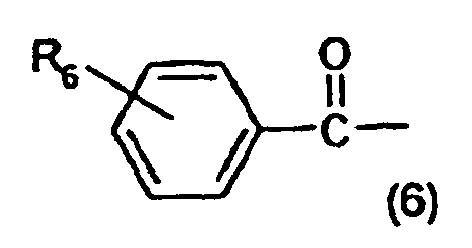
où R6 représente un atome d'hydrogène, un atome d'halogène, un groupe CN, un groupe NO2, un groupe CH3, un groupe C2H5, un groupe C3H7, un groupe CF3, un groupe C2F5 ou un groupe C3F7 ;un groupe phénylsulfanyle substitué ou non substitué représenté par la formule générale (7) :
où R7 représente un atome d'hydrogène, un atome d'halogène, un groupe CN, un groupe NO2, un groupe COOR8, un groupe SO2R9 (R8 représente H, Na, K, CH3 ou C2H5, et R9 représente OH, ONa, OK, un atome d'halogène, OCH3 ou OC2H5), un groupe CH3, un groupe C2H5, un groupe C3H7, un groupe (CH3)2-CH ou un groupe (CH3)3-C ;un groupe (phénylméthyl)sulfanyle substitué ou non substitué représenté par la formule générale (8) :
où R10 représente un atome d'hydrogène, un atome d'halogène, un groupe CN, un groupe NO2, un groupe COOR11, un groupe SO2R12 (R11 représente H, Na, K, CH3 ou C2H5, et R12 représente OH, ONa, OK, un atome d'halogène, OCH3 ou OC2H5), un groupe CH3, un groupe C2H5, un groupe C3H7, un groupe (CH3) 2-CH ou un groupe (CH3)3-C;un groupe 2-thiényle représenté par la formule générale (9) : un groupe 2-thiénylsulfanyle représenté par la formule générale (10) :
 un groupe 2-thiénylcarbonyle représenté par la formule générale (11) :
 un groupe phénylsulfinyle substitué ou non substitué représenté par la formule générale (12) :
où R13 représente un substituant d'un noyau aromatique et R13 représente un atome d'hydrogène, un atome d'halogène, un groupe CN, un groupe NO2, un groupe COOR14, un groupe SO2R15 (R14 représente H, Na, K, CH3 ou C2H5, et R15 représente OH, ONa, OK, un atome d'halogène, OCH3 ou OC2H5), un groupe CH3, un groupe C2H5, un groupe C3H7, un groupe (CH3)2-CH ou un groupe (CH3)3-C ;un groupe phénylsulfonyle substitué ou non substitué représenté par la formule générale (13) :
où R16 représente un atome d'hydrogène, un atome d'halogène, un groupe CN, un groupe NO2, un groupe COOR17, un groupe SO2R18 (R17 représente H, Na, K, CH3 ou C2H5, et R18 représente OH, ONa, OK, un atome d'halogène, OCH3 ou OC2H5), un groupe CH3, un groupe C2H5, un groupe C3H7, un groupe (CH3)2-CH ou un groupe (CH3)3-C; etun groupe (phénylméthyl)oxy représenté par la formule générale (14) :
- Polyhydroxyalcanoate copolymère selon la revendication 1, dans lequel :le motif de 3-hydroxy-ω-(4-vinylphényl)alcanoate représenté par la formule générale (1) est un motif de 3-hydroxy-ω-(4-vinylphényl)valérate représenté par la formule (15) suivante :
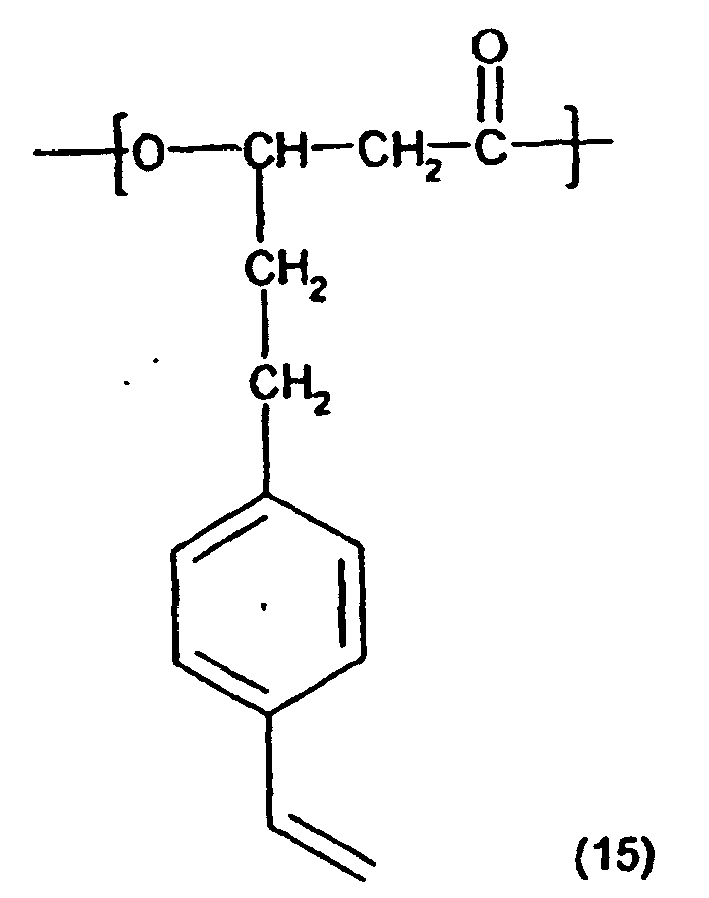
- Polyhydroxyalcanoate copolymère selon la revendication 1, dans lequel :le poids moléculaire moyen en nombre du polyhydroxyalcanoate copolymère est compris dans un intervalle de 2000 à 1 000 000.
- Procédé de fabrication d'un polyhydroxyalcanoate copolymère selon la revendication 1, qui contient dans la même molécule :un motif de 3-hydroxy-ω-(4-vinylphényl)alcanoate représenté par la formule générale (1) :

où n représente un nombre entier de 0 à 7, et n représente indépendamment le nombre entier pour chaque motif lorsque plusieurs motifs sont présents ; et
au moins un motif choisi dans la classe formée par : un motif de 3-hydroxyalcanoate substitué en ω représenté par la formule générale (19) :
où s représente un nombre entier de 1 à 8, et R19 représente un groupe contenant un résidu ayant une structure cyclique choisie parmi une structure de phényle et une structure de thiényle ; et
un motif de 3-hydroxy-ω-cyclohexylalcanoate représenté par la formule générale (3) :
où R2 représente un substituant d'un groupe cyclohexyle et R2 représente un atome d'hydrogène, un groupe CN, un groupe NO2, un atome d' halogène, un groupe CH3, un groupe C2H5, un groupe C3H7, un groupe CF3, un groupe C2F5 ou un groupe C3F7, et k représente un nombre entier de 0 à 8, s et R19 représentant indépendamment respectivement le nombre entier et le groupe pour chaque motif lorsque plusieurs motifs représentés par la formule générale (19) sont utilisés, et k et R2 représentant indépendamment respectivement le nombre entier et le substituant pour chaque motif lorsque plusieurs motifs représentés par la formule générale (3) sont présents,
le procédé comprenant l'étape consistant à :amener un microorganisme capable de synthétiser le polyhydroxyalcanoate copolymère à partir d'une matière première à synthétiser le polyhydroxyalcanoate en faisant agir le microorganisme sur la matière première qui comprend :(A) au moins un acide ω-(4-vinylphényl) alcanoïque représenté par la formule générale (16) suivante :
où p représente un nombre entier de 0 à 7 ; et(B) au moins un composant qui a une structure différente de la formule (16) et qui est choisi dans la classe formée par un acide alcanoïque substitué en ω représenté par la formule générale (17) :
où q représente un nombre entier de 1 à 8, et R17 représente un groupe contenant un résidu ayant une structure cyclique choisie parmi une structure de phényle et une structure de thiényle, et
un acide ω-cyclohexylalcanoïque représenté par la formule générale (18) :
où R18 représente un atome d'hydrogène, un groupe CN, un groupe NO2, un atome d'halogène, un groupe CH3, un groupe C2H5, un groupe C3H7, un groupe CF3, un groupe C2F5 ou un groupe C3F7, et r représente un nombre entier de 0 à 8. - Procédé de fabrication d'un polyhydroxyalcanoate copolymère selon la revendication 5, dans lequel :chacun de R17 et de R19 est un groupe choisi dans la classe formée par :un groupe phényle substitué ou non substitué représenté par la formule générale (20) :

où R20 représente un atome d'hydrogène, un atome d'halogène, un groupe CN, un groupe NO2, un groupe CH3, un groupe C2H5, un groupe C3H7, un groupe CF3, un groupe C2F5 ou un groupe C3F7 ;
un groupe phénoxy substitué ou non substitué représenté par la formule générale (5) :
où R5 représente un substituant d'un noyau aromatique et R5 représente un atome d'hydrogène, un atome d'halogène, un groupe CN, un groupe NO2, un groupe CH3, un groupe C2H5, un groupe C3H7, un groupe SCH3, un groupe CF3, un groupe C2F5 ou un groupe C3F7, et R5 représente indépendamment le substituant de chaque motif lorsque plusieurs motifs sont présents ;
un groupe benzoyle substitué ou non substitué représenté par la formule générale (6) :
où R6 représente un atome d'hydrogène, un atome d'halogène, un groupe CN, un groupe NO2, un groupe CH3, un groupe C2H5, un groupe C3H7, un groupe CF3, un groupe C2F5 ou un groupe C3F7 ;
un groupe phénylsulfanyle substitué ou non substitué représenté par la formule générale (7) :
où R7 représente un atome d'hydrogène, un atome d'halogène, un groupe CN, un groupe NO2, un groupe COOR8, un groupe SO2R9 (R8 représente H, Na, K, CH3 ou C2H5, et R9 représente OH, ONa, OK, un atome d'halogène, OCH3 ou OC2H5), un groupe CH3, un groupe C2H5, un groupe C3H7, un groupe (CH3)2-CH ou un groupe (CH3)3-C;
un groupe (phénylméthyl)sulfanyle substitué ou non substitué représenté par la formule générale (8) :
où R10 représente un atome d'hydrogène, un atome d'halogène, un groupe CN, un groupe NO2, un groupe COOR11, un groupe SO2R12 (R11 représente H, Na, K, CH3 ou C2H5, et R12 représente OH, ONa, OK, un atome d'halogène, OCH3 ou OC2H5), un groupe CH3, un groupe C2H5, un groupe C3H7, un groupe (CH3)2-CH ou un groupe (CH3)3-C ;
un groupe 2-thiényle représenté par la formule générale (9) :
un groupe 2-thiénylsulfanyle représenté par la formule générale (10) :
un groupe 2-thiénylcarbonyle représenté par la formule générale (11) :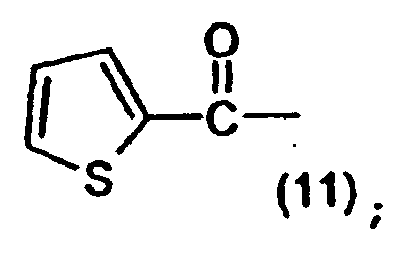
un groupe (phénylméthyl)oxy représenté par la formule générale (14) :
- Procédé de fabrication d'un polyhydroxyalcanoate copolymère selon la revendication 5, dans lequel :le microorganisme est cultivé dans un milieu de culture contenant la matière première pour permettre au microorganisme de synthétiser le polyhydroxyalcanoate copolymère.
- Procédé de fabrication d'un polyhydroxyalcanoate copolymère selon la revendication 7, dans lequel :le milieu de culture contient, de plus, au moins une substance choisie parmi des peptides, l'extrait de levure, des acides organiques et leurs sels, des acides aminés et leurs sels, des sucres et les acides alcanoïques à chaîne droite ayant 4 à 12 atomes de carbone et leurs sels.
- Procédé de fabrication d'un polyhydroxyalcanoate copolymère selon la revendication 8, dans lequel :une polypeptone est fournie à titre des peptides ;les acides organiques et leurs sels sont chacun un ou plusieurs composés choisis dans la classe formée par l'acide pyruvique, l'acide oxalacétique, l'acide citrique, l'acide isocitrique, l'acide cétoglutarique, l'acide succinique, l'acide fumarique, l'acide malique, l'acide lactique et leurs sels ;les acides aminés et leurs sels sont chacun ou plusieurs composés choisis dans la classe formée par l'acide glutamique, l'acide aspartique et leurs sels ; etles sucres sont un ou plusieurs composés choisis dans la classe formée par le glycéraldéhyde, l'érythrose, l'arabinose, le xylose, le glucose, le galactose, le mannose, le fructose, le glycérol, l'érythritol, le xylitol, l'acide gluconique, l'acide glucuronique, l'acide galacturonique, le maltose, le saccharose et le lactose.
- Procédé de fabrication d'un polyhydroxyalcanoate copolymère selon la revendication 5, comprenant de plus l'étape consistant à :recueillir le polyhydroxyalcanoate copolymère synthétisé par le microorganisme à partir des cellules microbiennes du microorganisme.
- Procédé de fabrication d'un polyhydroxyalcanoate copolymère selon la revendication 5, dans lequel :le microorganisme comprend un microorganisme appartenant au genre Pseudomonas.
- Procédé de fabrication d'un polyhydroxyalcanoate copolymère selon la revendication 11, dans lequel :le microorganisme comprend au moins une souche choisie dans la classe formée par :la souche Pseudomonas cichorii YN2, FERM BP-7375 ;la souche Pseudomonas cichorii H45, FERM BP-7374 ;la souche Pseudomonas jessenii P161, FERM BP-7376 ; etla souche Pseudomonas putida P91, FERM BP-7373.
- Procédé de fabrication d'un polyhydroxyalcanoate selon la revendication 1, qui contient dans la même molécule :au moins un motif de 3-hydroxy-ω-(4-vinylphényl)alcanoate représenté par la formule générale (1) :

où n représente un nombre entier de 0 à 7, et n représente indépendamment le nombre entier pour chaque motif lorsque plusieurs motifs représentés par la formule générale (1) sont présents ; et
au moins un motif choisi dans la classe formée par un motif de 3-hydroxyalcanoate substitué en ω représenté par la formule générale (2) :
où m représente un nombre entier de 1 à 8, et R1 représente un groupe contenant un résidu ayant une structure cyclique choisie parmi une structure de phényle et une structure de thiényle, et un motif de 3-hydroxy-ω-cyclohexylalcanoate représenté par la formule générale (3) :
où R2 représente un substituant d'un groupe cyclohexyle et R2 représente un atome d'hydrogène, un groupe CN, un groupe NO2, un atome d'halogène, un groupe CH3, un groupe C2H5, un groupe C3H7, un groupe CF3, un groupe C2F5 ou un groupe C3F7, et k représente un nombre entier de 0 à 8 ; m et R1 représentant indépendamment respectivement le nombre entier et le groupe pour chaque motif lorsque plusieurs motifs représentés par la formule générale (2) sont présents, et k et R2 représentant indépendamment respectivement le nombre entier et le substituant pour chaque motif lorsque plusieurs motifs représentés par la formule générale (3) sont présents,
où R1 contient au moins un groupe choisi dans la classe formée par un groupe phényle substitué représenté par la formule générale (4') suivante, un groupe phénylsulfinyle substitué ou non substitué représenté par la formule générale (12), et un groupe phénylsulfonyle substitué ou non substitué représenté par la formule générale (13) :
où R3' représente COOR4 (R4 représente un atome d'hydrogène, un atome de sodium ou un atome de potassium) ;
où R13 représente un atome d'hydrogène, un atome d'halogène, un groupe CN, un groupe NO2, un groupe COOR14, un groupe SO2R15 (R14 représente H, Na, K, CH3 ou C2H5, et R15 représente OH, ONa, OK, un atome d'halogène, OCH3 ou OC2H5), un groupe CH3, un groupe C2H5, un groupe C3H7, un groupe (CH3)2-CH ou un groupe (CH3)3-C ; et
où R16 représente un atome d'hydrogène, un atome d'halogène, un groupe CN, un groupe NO2, un groupe COOR17, un groupe SO2R18 (R17 représente H, Na, K, CH3 ou C2H5, et R18 représente OH, ONa, OK, un atome d'halogène, OCH3 ou OC2H5), un groupe CH3, un groupe C2H5, un groupe C3H7, un groupe (CH3)2-CH ou un groupe (CH3)3-C;
le procédé comprenant l'une des étapes consistant à :
(a) oxyder une partie d'un groupe vinyle contenu dans un groupe phényle d'un groupe représenté par la formule générale (1) d'une matière première pour former le groupe représenté par la formule générale (4') en tant que R1, la matière première comprenant un polyhydroxyalcanoate copolymère contenant dans la même molécule : deux ou plusieurs motifs de 3-hydroxy-ω-(4-vinylphényl)alcanoate représentés par la formule générale (1) :
où n représente un nombre entier de 0 à 7, et n représente indépendamment le nombre entier pour chaque motif ; et au moins un motif choisi dans la classe formée par un motif de 3-hydroxyalcanoate substitué en ω représenté par la formule générale (19) :
où s représente un nombre entier de 1 à 8 et R19 représente un groupe contenant un résidu ayant une structure cyclique choisie parmi une structure de phényle et une structure de thiényle, et un motif de 3-hydroxy-ω-cyclohexylalcanoate représenté par la formule générale (3) :
où R2 représente un substituant d'un groupe cyclohexyle et R2 représente un atome d'hydrogène, un groupe CN, un groupe NO2, un atome d'halogène, un groupe CH3, un groupe C2H5, un groupe C3H7, un groupe CF3, un groupe C2F5 ou un groupe C3F7, et k représente un nombre entier de 0 à 8, s et R19 représentant indépendamment respectivement le nombre entier et le groupe pour chaque motif lorsque plusieurs motifs représentés par la formule générale (19) sont présents, et k et R2 représentant indépendamment respectivement le nombre entier et le substituant pour chaque motif lorsque plusieurs motifs représentés par la formule générale (3) sont présents ; et
(b) oxyder sélectivement -S- du substituant représenté par la formule générale (7) dans un polyhydroxyalcanoate copolymère fourni comme matière première pour le convertir en un groupe représenté par la formule générale (12) ou un groupe représenté par la formule générale (13), le polyhydroxyalcanoate copolymère contenant dans la même molécule : un motif de 3-hydroxy-ω-(4-vinylphényl)alcanoate représenté par la formule générale (1) :
où n représente un nombre entier de 0 à 7, et n représente indépendamment le nombre entier pour chaque motif lorsque plusieurs motifs représentés par la formule générale (1) sont présents ; et au moins un motif choisi dans la classe formée par un motif de 3-hydroxyalcanoate substitué en ω représenté par la formule générale (2) :
où m représente un nombre entier de 1 à 8, et R1 représente un groupe phénylsulfanyle substitué ou non substitué représenté par la formule générale (7) :
où R7 représente un atome d'hydrogène, un atome d'halogène, un groupe CN, un groupe NO2, un groupe COOR8, un groupe SO2R9 (R8 représente H, Na, K, CH3 ou C2H5, et R9 représente OH, ONa, OK, un atome d'halogène, OCH3 ou OC2H5), un groupe CH3, un groupe C2H5, un groupe C3H7, un groupe (CH3)2-CH ou un groupe (CH3)3-C, et un motif de 3-hydroxy-ω-cyclohexylalcanoate représenté par la formule générale (3) :
où R2 représente un substituant d'un groupe cyclohexyle et R2 représente un atome d'hydrogène, un groupe CN, un groupe NO2, un atome d'halogène, un groupe CH3, un groupe C2H5, un groupe C3H7, un groupe CF3, un groupe C2F5 ou un groupe C3F7, et k représente un nombre entier de 0 à 8, m et R1 représentant indépendamment respectivement le nombre entier et le groupe pour chaque motif lorsque plusieurs motifs représentés par la formule générale (2) sont présents, et k et R2 représentant indépendamment respectivement le nombre entier et le substituant pour chaque motif lorsque plusieurs motifs représentés par la formule générale (3) sont présents. - Procédé de fabrication d'un polyhydroxyalcanoate copolymère selon la revendication 13, dans lequel :l'oxydation dans l'étape (a) et l'oxydation dans l'étape (b) sont effectuées indépendamment en utilisant au moins un agent oxydant choisi dans la classe formée par un permanganate, un dichromate, un periodate, le peroxyde d'hydrogène, le percarbonate de sodium, l'acide métachloroperbenzoïque, l'acide performique et l'acide peracétique.
- Procédé de fabrication d'un polyhydroxyalcanoate copolymère selon la revendication 14, dans lequel :l'oxydation dans chacune de l'étape (a) et de l'étape (b) est effectuée en utilisant un permanganate dans des conditions acides.
- Procédé de fabrication d'un polyhydroxyalcanoate copolymère selon la revendication 13, dans lequel :l'oxydation dans chacune de l'étape (a) et de l'étape (b) est effectuée en utilisant l'ozone.
Applications Claiming Priority (6)
| Application Number | Priority Date | Filing Date | Title |
|---|---|---|---|
| JP2002054897 | 2002-02-28 | ||
| JP2002054897 | 2002-02-28 | ||
| JP2002362962 | 2002-12-13 | ||
| JP2002362962 | 2002-12-13 | ||
| JP2003037322 | 2003-02-14 | ||
| JP2003037322A JP3689700B2 (ja) | 2002-02-28 | 2003-02-14 | 側鎖にビニルフェニル構造を含んでなるユニットを分子中に含む新規なポリヒドロキシアルカノエート共重合体及びその製造方法 |
Publications (2)
| Publication Number | Publication Date |
|---|---|
| EP1340778A1 EP1340778A1 (fr) | 2003-09-03 |
| EP1340778B1 true EP1340778B1 (fr) | 2006-01-18 |
Family
ID=27738928
Family Applications (1)
| Application Number | Title | Priority Date | Filing Date |
|---|---|---|---|
| EP03004350A Expired - Lifetime EP1340778B1 (fr) | 2002-02-28 | 2003-02-28 | Polyhydroxyalkanoates comprenant une structure vinylphényle dans la chaine pendante et procédé pour les préparer |
Country Status (6)
| Country | Link |
|---|---|
| US (1) | US6645743B1 (fr) |
| EP (1) | EP1340778B1 (fr) |
| JP (1) | JP3689700B2 (fr) |
| KR (1) | KR100523110B1 (fr) |
| CN (1) | CN1232561C (fr) |
| DE (1) | DE60303228T2 (fr) |
Families Citing this family (20)
| Publication number | Priority date | Publication date | Assignee | Title |
|---|---|---|---|---|
| JP3673711B2 (ja) * | 1999-12-27 | 2005-07-20 | キヤノン株式会社 | ポリヒドロキシアルカノエートおよび微生物を利用するその製造方法 |
| JP3720779B2 (ja) * | 2001-02-28 | 2005-11-30 | キヤノン株式会社 | 側鎖にビニルフェニル構造を有する新規なポリヒドロキシアルカノエート型ポリエステル、およびその製造方法 |
| JP3748537B2 (ja) * | 2001-03-01 | 2006-02-22 | キヤノン株式会社 | ポリヒドロキシアルカノエート及びその製造方法、並びにω−(2−チエニルスルファニル)アルカン酸及びその製造方法 |
| US6911521B2 (en) | 2001-05-31 | 2005-06-28 | Canon Kabushiki Kaisha | Polyhydroxyalkanoate that comprises unit having substituted or unsubstituted (phenylmethyl) sulfanyl structure in side chain thereof and process for producing the same |
| US6869782B2 (en) * | 2001-07-10 | 2005-03-22 | Canon Kabushiki Kaisha | Polyhydroxyalkanoate that comprises unit having (methylsulfanyl) phenoxy structure in side chain thereof and process for producing the same |
| JP3754956B2 (ja) * | 2002-02-15 | 2006-03-15 | キヤノン株式会社 | 側鎖にブロモ基を有するユニットを分子中に含む新規なポリヒドロキシアルカノエート共重合体及びその製造方法 |
| JP2003319792A (ja) * | 2002-02-28 | 2003-11-11 | Canon Inc | 側鎖にフェニル構造、チエニル構造、シクロヘキシル構造を有する残基を含むユニットを分子中に含むポリヒドロキシアルカノエートの分子量制御方法、およびポリヒドロキシアルカノエート |
| JP2003310292A (ja) | 2002-04-26 | 2003-11-05 | Canon Inc | 分子中に芳香環を含む残基を有するアルカンからのポリヒドロキシアルカノエートの製造方法 |
| JP4027297B2 (ja) * | 2002-10-24 | 2007-12-26 | キヤノン株式会社 | 新規なポリヒドロキシアルカノエート及びその製造方法;それを含む樹脂組成物;新規なポリヒドロキシアルカノエートを含有する荷電制御剤、静電荷像現像トナー及びバインダー樹脂組成物 |
| JP3880567B2 (ja) * | 2002-10-24 | 2007-02-14 | キヤノン株式会社 | 新規なポリヒドロキシアルカノエート共重合体 |
| JP3880566B2 (ja) * | 2002-10-24 | 2007-02-14 | キヤノン株式会社 | 側鎖に(フェニルメチル)オキシ構造を有するユニットを含む新規なポリヒドロキシアルカノエート及びその製造方法 |
| JP4502363B2 (ja) * | 2002-10-24 | 2010-07-14 | キヤノン株式会社 | 側鎖にビニル基を有するユニットを分子中に含む新規なポリヒドロキシアルカノエート共重合体、側鎖にカルボキシル基を有するユニットを分子中に含む新規なポリヒドロキシアルカノエート共重合体、及びそれらの製造方法 |
| JP2004331750A (ja) * | 2003-05-02 | 2004-11-25 | Canon Inc | ポリヒドロキシアルカノエートを含有する磁性構造体及びその製造方法ならびにその用途 |
| US20070003975A1 (en) * | 2003-05-02 | 2007-01-04 | Canon Kabushiki Kaisha | Structured construct and producing method therefor |
| JP4455413B2 (ja) | 2004-06-11 | 2010-04-21 | キヤノン株式会社 | ビニル基、エステル基、カルボキシル基並びにスルホン酸基を有するポリヒドロキシアルカン酸並びにその製造方法 |
| EP1758949B1 (fr) * | 2004-06-11 | 2010-01-13 | Canon Kabushiki Kaisha | Polyhydroxyalcanoate comportant un groupe vinyle, un groupe ester, un groupe carboxyle et un groupe acide sulfonique, et procédé de production de ce composé |
| US8137884B2 (en) * | 2007-12-14 | 2012-03-20 | Xerox Corporation | Toner compositions and processes |
| US20100018674A1 (en) * | 2008-07-22 | 2010-01-28 | Donald John Enzinna | Reservoir with moveable partition for quick recovery |
| US8187780B2 (en) * | 2008-10-21 | 2012-05-29 | Xerox Corporation | Toner compositions and processes |
| WO2010067541A1 (fr) * | 2008-12-09 | 2010-06-17 | 株式会社カネカ | Procédé de fabrication de poly-3-hydroxyalcanoate |
Family Cites Families (6)
| Publication number | Priority date | Publication date | Assignee | Title |
|---|---|---|---|---|
| JPH0231681B2 (ja) | 1983-04-14 | 1990-07-16 | Japan Synthetic Rubber Co Ltd | Tetorakarubonsannoseizohoho |
| JP2989175B1 (ja) | 1998-08-31 | 1999-12-13 | 名古屋市 | ポリエステル及びその製造方法 |
| JP3673711B2 (ja) | 1999-12-27 | 2005-07-20 | キヤノン株式会社 | ポリヒドロキシアルカノエートおよび微生物を利用するその製造方法 |
| JP3740358B2 (ja) | 2000-08-31 | 2006-02-01 | キヤノン株式会社 | 側鎖にエポキシ基を含むポリエステルの製造方法及び架橋ポリマーの製造方法 |
| KR100462543B1 (ko) | 2000-09-14 | 2004-12-17 | 캐논 가부시끼가이샤 | 폴리하이드록시알카노에이트 및 그 제조방법 |
| JP3720779B2 (ja) | 2001-02-28 | 2005-11-30 | キヤノン株式会社 | 側鎖にビニルフェニル構造を有する新規なポリヒドロキシアルカノエート型ポリエステル、およびその製造方法 |
-
2003
- 2003-02-14 JP JP2003037322A patent/JP3689700B2/ja not_active Expired - Fee Related
- 2003-02-25 US US10/372,285 patent/US6645743B1/en not_active Expired - Fee Related
- 2003-02-28 EP EP03004350A patent/EP1340778B1/fr not_active Expired - Lifetime
- 2003-02-28 CN CNB031066887A patent/CN1232561C/zh not_active Expired - Fee Related
- 2003-02-28 KR KR10-2003-0012721A patent/KR100523110B1/ko not_active Expired - Fee Related
- 2003-02-28 DE DE60303228T patent/DE60303228T2/de not_active Expired - Lifetime
Also Published As
| Publication number | Publication date |
|---|---|
| CN1232561C (zh) | 2005-12-21 |
| KR100523110B1 (ko) | 2005-10-20 |
| CN1445257A (zh) | 2003-10-01 |
| US6645743B1 (en) | 2003-11-11 |
| DE60303228D1 (de) | 2006-04-06 |
| EP1340778A1 (fr) | 2003-09-03 |
| JP3689700B2 (ja) | 2005-08-31 |
| JP2004238592A (ja) | 2004-08-26 |
| DE60303228T2 (de) | 2006-07-20 |
| US20030204044A1 (en) | 2003-10-30 |
| KR20030071578A (ko) | 2003-09-03 |
Similar Documents
| Publication | Publication Date | Title |
|---|---|---|
| EP1340778B1 (fr) | Polyhydroxyalkanoates comprenant une structure vinylphényle dans la chaine pendante et procédé pour les préparer | |
| JP3684150B2 (ja) | ポリヒドロキシアルカノエート | |
| JP3720779B2 (ja) | 側鎖にビニルフェニル構造を有する新規なポリヒドロキシアルカノエート型ポリエステル、およびその製造方法 | |
| KR100485119B1 (ko) | 폴리히드록시알카노에이트와, 그 생산방법, 및 ω-(2-티에닐설파닐)알칸산과 그 생산방법 | |
| US6521429B2 (en) | Polyhydroxyalkanoates and method of producing them by utilizing microorganisms | |
| EP1367078B1 (fr) | Procédé de préparation de polyhydroxyalcanoates à partir d' alcanes ayant des cycles aromatiques dans leur molécule | |
| KR100543993B1 (ko) | 분자의 곁사슬에 페닐구조, 티에닐구조 혹은 시클로헥실구조의 잔기를 함유하는 유닛으로 이루어진 폴리하이드록시알카노에이트의 분자량의 제어방법 | |
| JP4502363B2 (ja) | 側鎖にビニル基を有するユニットを分子中に含む新規なポリヒドロキシアルカノエート共重合体、側鎖にカルボキシル基を有するユニットを分子中に含む新規なポリヒドロキシアルカノエート共重合体、及びそれらの製造方法 | |
| KR100562126B1 (ko) | 곁사슬에 브로모기를 지닌 유닛을 포함하는 신규의폴리하이드록시알카노에이트 공중합체 및 그의 제조방법 | |
| JP3880566B2 (ja) | 側鎖に(フェニルメチル)オキシ構造を有するユニットを含む新規なポリヒドロキシアルカノエート及びその製造方法 | |
| JP3880462B2 (ja) | 側鎖にエステル基を有するユニットを分子中に含む新規なポリヒドロキシアルカノエート共重合体及びその製造方法 | |
| JP4147225B2 (ja) | ポリヒドロキシアルカノエートおよび微生物を利用するその製造方法 |
Legal Events
| Date | Code | Title | Description |
|---|---|---|---|
| PUAI | Public reference made under article 153(3) epc to a published international application that has entered the european phase |
Free format text: ORIGINAL CODE: 0009012 |
|
| AK | Designated contracting states |
Kind code of ref document: A1 Designated state(s): AT BE BG CH CY CZ DE DK EE ES FI FR GB GR HU IE IT LI LU MC NL PT SE SI SK TR |
|
| AX | Request for extension of the european patent |
Extension state: AL LT LV MK RO |
|
| 17P | Request for examination filed |
Effective date: 20040123 |
|
| 17Q | First examination report despatched |
Effective date: 20040408 |
|
| AKX | Designation fees paid |
Designated state(s): DE FR GB |
|
| GRAP | Despatch of communication of intention to grant a patent |
Free format text: ORIGINAL CODE: EPIDOSNIGR1 |
|
| GRAS | Grant fee paid |
Free format text: ORIGINAL CODE: EPIDOSNIGR3 |
|
| GRAA | (expected) grant |
Free format text: ORIGINAL CODE: 0009210 |
|
| AK | Designated contracting states |
Kind code of ref document: B1 Designated state(s): DE FR GB |
|
| REG | Reference to a national code |
Ref country code: GB Ref legal event code: FG4D |
|
| REF | Corresponds to: |
Ref document number: 60303228 Country of ref document: DE Date of ref document: 20060406 Kind code of ref document: P |
|
| PLBE | No opposition filed within time limit |
Free format text: ORIGINAL CODE: 0009261 |
|
| STAA | Information on the status of an ep patent application or granted ep patent |
Free format text: STATUS: NO OPPOSITION FILED WITHIN TIME LIMIT |
|
| 26N | No opposition filed |
Effective date: 20061019 |
|
| EN | Fr: translation not filed | ||
| PG25 | Lapsed in a contracting state [announced via postgrant information from national office to epo] |
Ref country code: FR Free format text: LAPSE BECAUSE OF FAILURE TO SUBMIT A TRANSLATION OF THE DESCRIPTION OR TO PAY THE FEE WITHIN THE PRESCRIBED TIME-LIMIT Effective date: 20070309 |
|
| PG25 | Lapsed in a contracting state [announced via postgrant information from national office to epo] |
Ref country code: FR Free format text: LAPSE BECAUSE OF FAILURE TO SUBMIT A TRANSLATION OF THE DESCRIPTION OR TO PAY THE FEE WITHIN THE PRESCRIBED TIME-LIMIT Effective date: 20060228 |
|
| PG25 | Lapsed in a contracting state [announced via postgrant information from national office to epo] |
Ref country code: FR Free format text: LAPSE BECAUSE OF FAILURE TO SUBMIT A TRANSLATION OF THE DESCRIPTION OR TO PAY THE FEE WITHIN THE PRESCRIBED TIME-LIMIT Effective date: 20060118 |
|
| PGFP | Annual fee paid to national office [announced via postgrant information from national office to epo] |
Ref country code: DE Payment date: 20150228 Year of fee payment: 13 |
|
| PGFP | Annual fee paid to national office [announced via postgrant information from national office to epo] |
Ref country code: GB Payment date: 20150220 Year of fee payment: 13 |
|
| REG | Reference to a national code |
Ref country code: DE Ref legal event code: R119 Ref document number: 60303228 Country of ref document: DE |
|
| GBPC | Gb: european patent ceased through non-payment of renewal fee |
Effective date: 20160228 |
|
| PG25 | Lapsed in a contracting state [announced via postgrant information from national office to epo] |
Ref country code: GB Free format text: LAPSE BECAUSE OF NON-PAYMENT OF DUE FEES Effective date: 20160228 Ref country code: DE Free format text: LAPSE BECAUSE OF NON-PAYMENT OF DUE FEES Effective date: 20160901 |