EP1353254B1 - Apparatus for regulating a flow in a heating or cooling system - Google Patents
Apparatus for regulating a flow in a heating or cooling system Download PDFInfo
- Publication number
- EP1353254B1 EP1353254B1 EP20030005223 EP03005223A EP1353254B1 EP 1353254 B1 EP1353254 B1 EP 1353254B1 EP 20030005223 EP20030005223 EP 20030005223 EP 03005223 A EP03005223 A EP 03005223A EP 1353254 B1 EP1353254 B1 EP 1353254B1
- Authority
- EP
- European Patent Office
- Prior art keywords
- piston
- housing
- throttling
- region
- fluid
- Prior art date
- Legal status (The legal status is an assumption and is not a legal conclusion. Google has not performed a legal analysis and makes no representation as to the accuracy of the status listed.)
- Expired - Lifetime
Links
- 230000001105 regulatory effect Effects 0.000 title claims abstract description 17
- 238000001816 cooling Methods 0.000 title description 5
- 238000010438 heat treatment Methods 0.000 title description 5
- 239000012530 fluid Substances 0.000 claims abstract description 59
- 238000011144 upstream manufacturing Methods 0.000 claims abstract description 33
- NBVXSUQYWXRMNV-UHFFFAOYSA-N fluoromethane Chemical compound FC NBVXSUQYWXRMNV-UHFFFAOYSA-N 0.000 claims description 2
- 230000008901 benefit Effects 0.000 description 11
- 230000033228 biological regulation Effects 0.000 description 5
- 230000007423 decrease Effects 0.000 description 5
- 230000008859 change Effects 0.000 description 3
- 230000002939 deleterious effect Effects 0.000 description 3
- 230000000694 effects Effects 0.000 description 3
- 238000010586 diagram Methods 0.000 description 2
- 230000033001 locomotion Effects 0.000 description 2
- 239000000463 material Substances 0.000 description 2
- 230000009467 reduction Effects 0.000 description 2
- 230000004044 response Effects 0.000 description 2
- 230000032258 transport Effects 0.000 description 2
- 229910001369 Brass Inorganic materials 0.000 description 1
- 239000004809 Teflon Substances 0.000 description 1
- 229920006362 Teflon® Polymers 0.000 description 1
- 230000009471 action Effects 0.000 description 1
- 238000007792 addition Methods 0.000 description 1
- 230000004075 alteration Effects 0.000 description 1
- 239000010951 brass Substances 0.000 description 1
- 238000004519 manufacturing process Methods 0.000 description 1
- 238000006386 neutralization reaction Methods 0.000 description 1
- 239000004033 plastic Substances 0.000 description 1
- 229910001220 stainless steel Inorganic materials 0.000 description 1
- 239000010935 stainless steel Substances 0.000 description 1
- XLYOFNOQVPJJNP-UHFFFAOYSA-N water Substances O XLYOFNOQVPJJNP-UHFFFAOYSA-N 0.000 description 1
Images


Classifications
-
- G—PHYSICS
- G05—CONTROLLING; REGULATING
- G05D—SYSTEMS FOR CONTROLLING OR REGULATING NON-ELECTRIC VARIABLES
- G05D7/00—Control of flow
- G05D7/01—Control of flow without auxiliary power
- G05D7/0126—Control of flow without auxiliary power the sensing element being a piston or plunger associated with one or more springs
- G05D7/0133—Control of flow without auxiliary power the sensing element being a piston or plunger associated with one or more springs within the flow-path
-
- F—MECHANICAL ENGINEERING; LIGHTING; HEATING; WEAPONS; BLASTING
- F25—REFRIGERATION OR COOLING; COMBINED HEATING AND REFRIGERATION SYSTEMS; HEAT PUMP SYSTEMS; MANUFACTURE OR STORAGE OF ICE; LIQUEFACTION SOLIDIFICATION OF GASES
- F25B—REFRIGERATION MACHINES, PLANTS OR SYSTEMS; COMBINED HEATING AND REFRIGERATION SYSTEMS; HEAT PUMP SYSTEMS
- F25B41/00—Fluid-circulation arrangements
- F25B41/30—Expansion means; Dispositions thereof
- F25B41/31—Expansion valves
- F25B41/33—Expansion valves with the valve member being actuated by the fluid pressure, e.g. by the pressure of the refrigerant
-
- G—PHYSICS
- G05—CONTROLLING; REGULATING
- G05D—SYSTEMS FOR CONTROLLING OR REGULATING NON-ELECTRIC VARIABLES
- G05D16/00—Control of fluid pressure
- G05D16/028—Controlling a pressure difference
-
- G—PHYSICS
- G05—CONTROLLING; REGULATING
- G05D—SYSTEMS FOR CONTROLLING OR REGULATING NON-ELECTRIC VARIABLES
- G05D16/00—Control of fluid pressure
- G05D16/04—Control of fluid pressure without auxiliary power
- G05D16/06—Control of fluid pressure without auxiliary power the sensing element being a flexible membrane, yielding to pressure, e.g. diaphragm, bellows, capsule
- G05D16/0608—Control of fluid pressure without auxiliary power the sensing element being a flexible membrane, yielding to pressure, e.g. diaphragm, bellows, capsule the controller being mounted within the flow path and having slidable elements
-
- F—MECHANICAL ENGINEERING; LIGHTING; HEATING; WEAPONS; BLASTING
- F25—REFRIGERATION OR COOLING; COMBINED HEATING AND REFRIGERATION SYSTEMS; HEAT PUMP SYSTEMS; MANUFACTURE OR STORAGE OF ICE; LIQUEFACTION SOLIDIFICATION OF GASES
- F25B—REFRIGERATION MACHINES, PLANTS OR SYSTEMS; COMBINED HEATING AND REFRIGERATION SYSTEMS; HEAT PUMP SYSTEMS
- F25B2500/00—Problems to be solved
- F25B2500/01—Geometry problems, e.g. for reducing size
-
- Y—GENERAL TAGGING OF NEW TECHNOLOGICAL DEVELOPMENTS; GENERAL TAGGING OF CROSS-SECTIONAL TECHNOLOGIES SPANNING OVER SEVERAL SECTIONS OF THE IPC; TECHNICAL SUBJECTS COVERED BY FORMER USPC CROSS-REFERENCE ART COLLECTIONS [XRACs] AND DIGESTS
- Y10—TECHNICAL SUBJECTS COVERED BY FORMER USPC
- Y10T—TECHNICAL SUBJECTS COVERED BY FORMER US CLASSIFICATION
- Y10T137/00—Fluid handling
- Y10T137/0318—Processes
- Y10T137/0324—With control of flow by a condition or characteristic of a fluid
-
- Y—GENERAL TAGGING OF NEW TECHNOLOGICAL DEVELOPMENTS; GENERAL TAGGING OF CROSS-SECTIONAL TECHNOLOGIES SPANNING OVER SEVERAL SECTIONS OF THE IPC; TECHNICAL SUBJECTS COVERED BY FORMER USPC CROSS-REFERENCE ART COLLECTIONS [XRACs] AND DIGESTS
- Y10—TECHNICAL SUBJECTS COVERED BY FORMER USPC
- Y10T—TECHNICAL SUBJECTS COVERED BY FORMER US CLASSIFICATION
- Y10T137/00—Fluid handling
- Y10T137/7722—Line condition change responsive valves
- Y10T137/7781—With separate connected fluid reactor surface
- Y10T137/7784—Responsive to change in rate of fluid flow
- Y10T137/7787—Expansible chamber subject to differential pressures
- Y10T137/7788—Pressures across fixed choke
-
- Y—GENERAL TAGGING OF NEW TECHNOLOGICAL DEVELOPMENTS; GENERAL TAGGING OF CROSS-SECTIONAL TECHNOLOGIES SPANNING OVER SEVERAL SECTIONS OF THE IPC; TECHNICAL SUBJECTS COVERED BY FORMER USPC CROSS-REFERENCE ART COLLECTIONS [XRACs] AND DIGESTS
- Y10—TECHNICAL SUBJECTS COVERED BY FORMER USPC
- Y10T—TECHNICAL SUBJECTS COVERED BY FORMER US CLASSIFICATION
- Y10T137/00—Fluid handling
- Y10T137/7722—Line condition change responsive valves
- Y10T137/7781—With separate connected fluid reactor surface
- Y10T137/7784—Responsive to change in rate of fluid flow
- Y10T137/7787—Expansible chamber subject to differential pressures
- Y10T137/7791—Pressures across flow line valve
Definitions
- This invention relates generally to the field of fluid flow and more specifically, to an apparatus for regulating a flow in a heating or cooling system.
- Fluid valves are used extensively in industry for many applications.
- An example is the use of fluid valves in heat exchanging systems in buildings for heating or cooling purposes.
- US 5,904,177 shows an other principle for regulating the flow.
- the patent discloses a 'T'-shaped piston, but in a valve that functions on a different principle. Instend of maintaining a constant pressure across a control orifice the piston moves in response to variable pressure to change the orifice size. .
- the object of the invention is to provide an apparatus for regulation a flow in a heating or cooling system, by which the above-mentioned problems are eliminated.
- the object of the invention is achieved with an apparatus for regulation a flow in a heating or cooling system, which is characterized by what is presented in claims.
- Embodiments of the invention provide a number of technical advantages. Embodiments of the invention may include all, some or none of these advantages.
- one embodiment of the invention allows improved flow regulation over a wide range of flows for a single device by placing a throttling element upstream of a control orifice and balancing the dynamic forces arising from the flow against the forces arising from the higher pressure.
- the device By throttling against a pressure which is higher, rather than lower, than the intermediate pressure, the device has a tendency to be disturbed to a more open position, rather than a more closed position. This tendency may then be balanced by the pressure reductions resulting from the fluid velocity to achieve a constant flow rate.
- the throttling edge is not required to be thin, as was the case with many prior devices. Avoiding this thin edge improves the durability and manufacturability of the device.
- the present invention also reduces the risk of cavitation. This is because the larger pressure drop across the throttling portion occurs before the smaller pressure drop across the control orifice.
- FIGURES 1 through 5B of the drawings in which like numerals refer to like parts.
- FIGURE 1 is a block diagram of a flow regulating control valve 100 according to one embodiment of the present invention.
- Control valve 100 receives fluid from an upstream region 102 and transports it to a downstream region 104.
- Control valve includes a throttling orifice 108, a control orifice 110, and an intermediate region 103 disposed between the throttling orifice 108 and control orifice 110.
- control valve 100 includes other components, as described in greater detail below. Any suitable fluid flows in the direction of arrow 106 from upstream region 102 to downstream region 104.
- throttling orifice 108 is positioned upstream from control orifice 110 as opposed to prior control valves that have the control orifice upstream from the throttling orifice. Both throttling orifice 108 and control orifice 110 are described in greater detail below. However, generally, throttling orifice 108 is adapted to dynamically change in size in response to a change in a pressure of a fluid in upstream region 102, and control orifice 110 is set to a predetermined size to regulate a flow rate of the fluid flowing through control valve 100. A reduction in pressure due to velocity of fluid through throttling orifice 108 may be used to balance the higher pressure in upstream region 102.
- throttling orifice 108 positioned upstream from control orifice 110 addresses the deleterious effects of the pressure of the fluid in downstream region 104 on the control of the flow rate of the fluid, as described below. Such an effect is known conventionally as "sag.”
- Some embodiments of the present invention may also reduce the risk of cavitation because a larger pressure drop across throttling orifice 108 occurs before a smaller pressure drop across control orifice 110.
- control valve 100 is described in detail below in conjunction with FIGURES 2A and 2B , while another embodiment of control valve 100 is described in detail below in conjunction with FIGURES 3A and 3B .
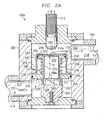
- FIGURE 2A is a cross-sectional view of one embodiment of control valve 100, designated 100a.
- control valve 100a includes a housing 200, a throttling element 202, a piston 204, a cap 206, an elastic member 208, a retaining ring 210, and an adjustable element 212.
- all components of control valve 100a are formed from any material suitable for control valves, such as brass, stainless steel, plastic, or other suitable material.
- Housing 200 is shown in FIGURE 2A to be generally rectangular in longitudinal cross-section; however, housing 200 may take on other configurations.
- Housing 200 has an upstream region 214 that couples to a pipe 216 and a downstream region 218 couples to a pipe 220. Both pipe 216 and pipe 220 may be any suitable conduits adapted to transport fluid.
- a fluid flows through housing 200 from upstream region 214 to downstream region 218, as denoted by arrow 222.
- Throttling element 202 is coupled to housing 200 adjacent upstream region 214 in any suitable manner. Details of one embodiment of throttling element 202 are described below in conjunction with FIGURES 5A and 5B . However, generally, throttling element 202 has a throttling surface 224 defined by an edge 226 of throttling element 202 and an inclined surface 228 of a cavity 230 formed in an end of throttling element 202. An example of throttling orifice 108, 108a, is defined by throttling surface 224 and an edge 231 of piston 204.
- Piston 204 is shown in FIGURE 2A to have a flange portion 232 and a stem portion 234 that includes edge 231. Flange portion 232 and stem portion 234 may be integral or may be separate portions of piston 204 coupled together in any suitable manner. Piston 204 is slidably disposed within cap 206 and is illustrated in a first position, in which piston 204 is restricted from moving toward a control orifice 110a because of a topside 236 of cap 206. Piston 204 is kept in this position by elastic member 208, which is described below. Generally, an inside diameter of piston 204 is chosen to give an average velocity of approximately 5 feet per second for the maximum fluid flow; however, other suitable diameters may be utilized.
- Flange portion 232 in one embodiment, has a diameter approximately equal to 1.7 times the inside diameter of piston 204; however, other suitable diameters may be utilized.
- Cap 206 is disposed within housing 200 and is shown to be secured therein by having a flange 238 pinched in between a lip 240 of housing 200 and retaining ring 210. Cap 206 may, however, be coupled to housing 200 in other suitable manners.
- Cap 206 includes control orifice 110a formed in topside 236 and a plurality of equalization apertures 242 formed in a sidewall 244. As described in greater detail below, equalization apertures 242 allow fluid in downstream region 218 to enter into an equalization chamber 246.
- Equalization chamber 246 is defined by an annular space formed by an inside surface of cap 206 and an outside surface of piston 204.
- Piston ring 258 may be any suitable seal, such as an o-ring or a square gasket formed from a fluorocarbon such as Teflon ® .
- Cap 206 may have any suitable shape; however, an inside surface of cap 206 should match up with a perimeter of flange 232 of piston 204 to facilitate the sliding of piston 204 therein.
- Elastic member 208 is any suitable elastic member, such as a spring. Elastic member 208 provides a force which urges piston 204 toward downstream region 218. This force is opposed by the difference in pressures acting on a top side 248 and a bottom side 250 of flange portion 232. From this it may be seen that if all other forces are neglected, elastic member 208, together with the area of flange portion 232 of piston 204, establishes the regulated pressure across control orifice 110a. Elastic member 208 is, therefore, chosen to provide a force that is nearly constant over the travel of piston 204. The action of other forces are described in greater detail below.
- Retaining ring 210 functions to retain cap 206 within housing 200.
- Retaining ring 210 has a seal 254 on a perimeter thereof to prevent fluid from seeping between the perimeter of retaining ring 210 and housing 200 and into equalization chamber 246.
- retaining ring 210 has another seal 256 that acts to prevent fluid from seeping between an outside surface of piston 204 and an inside surface of retaining ring 210 into equalization chamber 246. Seal 256 is also chosen such that it allows piston 204 to translate.
- Adjustable element 212 functions to selectively constrict control orifice 110a so that the flow rate of fluid through housing 200 is set. As illustrated, adjustable element 212 is threadably engaged with housing 200. However, adjustable element 212 may be coupled to housing 200 in other suitable manners. Adjustable element 212 is adapted to translate towards and away from control orifice 110a to either constrict or open up control orifice 110a. A gasket 260 may be coupled to an end of adjustable element 212 to prevent leakage through control orifice 110a if no flow rate is desired.
- a fluid flows through housing 200 in the direction indicated by arrow 222.
- the fluid in upstream region 214 is at a certain pressure denoted as P1.
- fluid enters into intermediate region 252 via throttling orifice 108a.
- the fluid pressure inside intermediate region 252, denoted as P2 is at a lower pressure than P1.
- the fluid then travels through intermediate region 252 and enters downstream region 218 via control orifice 110a.
- the fluid is at a pressure P3, which is less than P2.
- the fluid in downstream region 218 also enters equalization chamber 246 via equalization apertures 242, as described above. This means that the pressure of the fluid inside equalization chamber 246 is also at pressure P3.
- the pressure differential across control orifice 110a is P2-P3.
- This pressure differential is the same pressure differential that is across flange portion 232 of piston 204 (P2 acts on top side 248 and P3 acts on bottom side 250). Having the differential pressure across control orifice 110a equal to the pressure differential across flange portion 232 of piston 204 provides, among other advantages, stability to control valve 100a.
- Variations in the pressure of the fluid in upstream region 214 or downstream region 218 may cause changes in the flow rate of the fluid. If the flow rate is greater than the desired setting, then the differential pressure across control orifice 110a is also greater than the value required for equilibrium. This, in turn, results in the force imposed on piston 204 by the differential pressure to be greater than the force supplied by resilient member 208 so that piston 204 begins to move toward upstream region 214. This movement continues until throttling orifice 108a has closed sufficiently that the forces induced on piston 204 by the pressure of the fluid again match the force supplied by resilient member 208. If the disturbance forces are properly balanced as described below, this means that the differential pressure across control orifice 110a, and therefore the flow rate, has returned to its desired value within acceptable limits. This is best illustrated in FIGURE 2B .
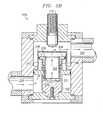
- FIGURE 2B is a cross-sectional view of control valve 100a illustrating piston 204 in a second position. This second position is caused by an increase in P1, as described above.
- elastic member 208 is in a compressed position.
- Edge 231 of piston 204 has entered into cavity 230 of throttling element 202.
- Piston 204 does this to constrict throttling orifice 108a to reduce or decrease the flow rate through throttling orifice 108a into intermediate region 252.
- P1 starts to decrease
- piston 204 translates back toward downstream region 218 to maintain the flow rate through control orifice 110a.
- control valve 100a addresses the deleterious effects from sag.
- Sag is caused by fluid pressure at the downstream side of the valve pulling on a moveable portion of the valve, which tends to close the throttling orifice and decrease the flow rate through the valve.
- the present invention addresses this by reversing the order of throttling orifice 108a and control orifice 110a by putting throttling orifice 108a upstream from control orifice 110a. In this manner, the overall pressure gradient from P1 to P2 tends to disturb piston 204 towards downstream region 218, while the Bernoulli forces generated by the fluid flowing through throttling orifice 108a acts the other way.
- FIGURE 4 shows an alternative embodiment of control valve 100 of the present invention.
- FIGURE 3A is a cross-sectional view of another embodiment of control valve 100, designated 100b.
- Control valve 100b includes a housing 300, a throttling element 302, a piston 304, an elastic member 306 and an adjustment element 308.
- Housing 300 which may be any suitable shape, has an upstream region 310, an intermediate region 312, and a downstream region 314 that defines a path for a fluid flowing therethrough in a direction as denoted by arrow 316.
- Control valve 100b is similar to control valve 100a in FIGURES 2A and 2B ; however, FIGURE 3A does not have a cap that includes a control orifice.
- control orifice 110b is formed in housing 300 adjacent downstream region 314, as illustrated.
- Throttling element 302 is similar to the throttling element 202 in FIGURE 2A and is coupled to housing 300 in any suitable manner. Throttling element 302 has a throttling surface 318 that works in conjunction with an edge 320 of piston 304 to define throttling orifice 108b. As illustrated, edge 320 of piston 304 is square. In prior systems, the edge of the piston had to be contoured in some manner to combat the effects of sag. However, because the present invention positions throttling orifice 108b before control orifice 1 10b, sag is not as much of a problem. Accordingly, edge 320 of piston 304 does not have to be contoured in any manner, which saves considerable manufacturing costs.
- Piston 304 is slidably disposed within housing 300 along a wall 322.
- Piston 304 has a flange portion 324, a perimeter of which slides along wall 322; and a stem portion 326 that extends from flange portion 324 down to edge 320.
- Flange portion 232 and stem portion 234 may be integral or may be separate portions of piston 204 coupled together in any suitable manner.
- piston 304 may have any suitable diameter.
- Elastic member 306 is disposed on the outside of piston 304.
- An equalization chamber 326 receives fluid from downstream region 314 via one or more equalization apertures 328 as shown. There exists a piston ring 330 around the perimeter of flange 324 to prevent fluid from leaking from equalization chamber 326 to intermediate region 312. Similarly, control valve 100b also includes a seal 332 around an upstream end of piston 304 to prevent fluid from leaking into equalization chamber 326 from upstream region 310.
- Adjustment element 308 functions to control the flow rate of the fluid exiting control orifice 110b by translating adjustment element 308 into or away from control orifice 110b.
- control 100b The operation of control 100b is similar to that of control valve 110a. As such, a fluid enters upstream region 310 and travels through throttling orifice 108b into intermediate region 312 before exiting control orifice 110b into downstream region 314, as denoted by the arrows. Once the pressure; P1, in upstream region 310 reaches a certain level, then P2 also increases. Piston 304 then starts translating toward upstream region 310. This acts to constrict throttling orifice 108b to reduce the flow rate of the fluid. This is best illustrated in FIGURE 3B .
- FIGURE 3B shows piston 304 translated toward upstream region 310 to constrict the flow of fluid through throttling orifice 108b.
- Elastic member 306 is shown in a compressed position.
- piston 304 translates upward and acts to open throttling orifice 108b so that the flow rate of the fluid may increase to maintain the flow rate of the fluid through control valve 100b.
- FIGURE 4 Graph 400 graphs a flow rate 402 versus a pressure differential 404 across control valve 100.
- the dotted line denoted by reference numeral 406 shows the phenomenon known as sag that occurs in prior systems.
- a graph of flow rate versus pressure differential according to one embodiment of the present invention is denoted by broken line 408. As the pressure differential 404 increases the flow rate increases. This provides for a much more stable control valve 100.
- curve 410 An ideal situation is denoted by curve 410. This illustrates that as the differential pressure 404 increases, the flow rate 402 is kept at a very steady rate. It is desirable to get as close to "ideal" curve 410 as possible. This is why the present invention uses the Bernoulli forces created by the fluid flow to counteract the pressure differential across throttling orifice 108.
- An important advantage of one embodiment of the present invention is that if the velocity induced forces (i.e., the Bernoulli forces) and the fluid pressure in the upstream region are matched in a given position for one flow, they remain matched at that position for a wide variety of flows.
- FIGURE 5A is an elevation view of a throttling element 500 according to one embodiment of the present invention.
- Throttling element 500 is an example of one that may be used as throttling element 202 in control valve 100a or throttling element 302 in control valve 100b.
- Throttling element 500 includes a first end 502 and a second end 504.
- First end 502 is the end of throttling element 500 that couples to a housing of control valve 100. As described above, throttling element 500 may be coupled to a housing in any suitable manner.
- Second end 504 has a cavity 506 formed therein, and an edge 508. An incline surface 510 of cavity 506 and edge 508 define throttling orifice 108 of control valve 100.
- edge 508 includes three ports 512.
- Ports 512 may have any suitable shape; however, the shape of ports 512 is preferably determined by experimentation such that the fluid flow rate through control valve 100 is maintained as closed to the desired flow rate as possible.
- Incline surface 510 is also chosen to maximize the efficiency of control valve 100 when trying to maintain the fluid flow rate.
- incline surface 510 is inclined at an angle of approximately six degrees; however, other suitable angles may be utilized. Edge 508 with ports 512 functions to handle relatively high flow rate, while incline surface 510 functions to handle relatively low flow rates.
- edge 508 and incline surface 510 is preferably determined experimentally by what is best to obtain the most constant flow rate as the pressure differential across control valve 100 increases. In other words, the combination of edge 508 and incline surface 510 is determined to obtain curve 410 ( FIGURE 4 ). Other shapes other than ports 512 may be utilized on edge 508.
- the maximum of x is approximately 0.28d, with the throttling surface being truncated at the point where the width of the three ports 512 equal approximately one third of the perimeter.
Landscapes
- Physics & Mathematics (AREA)
- Engineering & Computer Science (AREA)
- Fluid Mechanics (AREA)
- General Physics & Mathematics (AREA)
- Automation & Control Theory (AREA)
- Mechanical Engineering (AREA)
- Thermal Sciences (AREA)
- General Engineering & Computer Science (AREA)
- Safety Valves (AREA)
- Details Of Valves (AREA)
- Motor Or Generator Cooling System (AREA)
- Lift Valve (AREA)
- Heat-Pump Type And Storage Water Heaters (AREA)
- Flow Control (AREA)
- Discharge Heating (AREA)
- Emergency Protection Circuit Devices (AREA)
- General Induction Heating (AREA)
- Temperature-Responsive Valves (AREA)
Abstract
Description
- This invention relates generally to the field of fluid flow and more specifically, to an apparatus for regulating a flow in a heating or cooling system.
- Fluid valves are used extensively in industry for many applications. An example is the use of fluid valves in heat exchanging systems in buildings for heating or cooling purposes. In many applications, it is often desirable to maintain a constant flow rate through a fluid valve despite fluctuations that may occur in the pressure of the upstream or downstream fluid. It is also desirable in some instances to be able to adjust the flow rate through a valve.
- Some prior valves achieve a constant flow by attempting to maintain a constant differential pressure across a control orifice by allowing the differential pressure to act on a piston opposed by an elastic member of nearly constant force. The motion of said piston controls the size of a throttling restriction, which is placed downstream of the control orifice. A consequence of this is that an edge of the piston adjacent the throttling restriction is acted upon by the downstream pressure, which is lower than either of the pressures affecting the intended regulation. This lower pressure tends to cause the throttling restriction to close further than it should for proper regulation, resulting in a lower flow than intended. The dynamic forces arising from the flow of the fluid tend to further lower the pressure acting on the throttling restriction due to Bernoulli's principle. The error becomes greater as the total pressure differential across the device increases. This phenomenon is referred to as "sag" and various attempts have been made to limit its effect. Such previous attempts, however, have worked correctly only for a particular flow rate, as is the case of the special pattern of openings disclosed in
U.S. Patent No. 4,080,993 entitled InLine Flow-Control Valve, to Charles F. Lind. -
Even US 4,440,192 shows a design where the water flows around the outside of the piston and that design has big trobble with sag at high flow settings - seefig. 4 - and the result will be that the valve would chatter and even hammer at higher flow. -
US 5,904,177 shows an other principle for regulating the flow. The patent discloses a 'T'-shaped piston, but in a valve that functions on a different principle. Instend of maintaining a constant pressure across a control orifice the piston moves in response to variable pressure to change the orifice size. . - The object of the invention is to provide an apparatus for regulation a flow in a heating or cooling system, by which the above-mentioned problems are eliminated.
- The object of the invention is achieved with an apparatus for regulation a flow in a heating or cooling system, which is characterized by what is presented in claims.
- Embodiments of the invention provide a number of technical advantages. Embodiments of the invention may include all, some or none of these advantages. For example, one embodiment of the invention allows improved flow regulation over a wide range of flows for a single device by placing a throttling element upstream of a control orifice and balancing the dynamic forces arising from the flow against the forces arising from the higher pressure. By throttling against a pressure which is higher, rather than lower, than the intermediate pressure, the device has a tendency to be disturbed to a more open position, rather than a more closed position. This tendency may then be balanced by the pressure reductions resulting from the fluid velocity to achieve a constant flow rate. By achieving this balance, the throttling edge is not required to be thin, as was the case with many prior devices. Avoiding this thin edge improves the durability and manufacturability of the device.
- The present invention also reduces the risk of cavitation. This is because the larger pressure drop across the throttling portion occurs before the smaller pressure drop across the control orifice.
- Other technical advantages are readily apparent to one skilled in the art from the following figures, descriptions and claims.
- For a more complete understanding of the invention, and for further features and advantages, reference is now made to the following description, taken in conjunction with the accompanying drawings, in which:
-
FIGURE 1 is a block diagram of a flow regulating control valve having a throttling orifice positioned upstream from a control orifice according to one embodiment of the present invention; -
FIGURE 2A is a cross-sectional view of one embodiment of the flow regulating control valve inFIGURE 1 illustrating a piston in a first position; -
FIGURE 2B is a cross-sectional view of the flow regulating control valve inFIGURE 2A illustrating the piston in a second position; -
FIGURE 3A is a cross-sectional view of another embodiment of the flow regulating control valve inFIGURE 1 illustrating a piston in a first position; -
FIGURE 3B is a cross-sectional view of the flow regulating control valve inFIGURE 3A illustrating the piston in a second position; -
FIGURE 4 is a graph of flow rate versus pressure differential according to one embodiment of the present invention; -
FIGURE 5A is an elevation view of a throttling element according to one embodiment of the present invention; and -
FIGURE 5B is cross-section view of the throttling element ofFIGURE 5A . - Example embodiments of the present invention and their advantages are best understood by referring now to
FIGURES 1 through 5B of the drawings, in which like numerals refer to like parts. -
FIGURE 1 is a block diagram of a flow regulatingcontrol valve 100 according to one embodiment of the present invention.Control valve 100 receives fluid from anupstream region 102 and transports it to adownstream region 104. Control valve includes athrottling orifice 108, acontrol orifice 110, and anintermediate region 103 disposed between thethrottling orifice 108 andcontrol orifice 110. Although not explicitly illustrated inFIGURE 1 ,control valve 100 includes other components, as described in greater detail below. Any suitable fluid flows in the direction ofarrow 106 fromupstream region 102 todownstream region 104. - According to the teachings of the present invention, throttling
orifice 108 is positioned upstream fromcontrol orifice 110 as opposed to prior control valves that have the control orifice upstream from the throttling orifice. Boththrottling orifice 108 andcontrol orifice 110 are described in greater detail below. However, generally,throttling orifice 108 is adapted to dynamically change in size in response to a change in a pressure of a fluid inupstream region 102, andcontrol orifice 110 is set to a predetermined size to regulate a flow rate of the fluid flowing throughcontrol valve 100. A reduction in pressure due to velocity of fluid through throttlingorifice 108 may be used to balance the higher pressure inupstream region 102. Having throttlingorifice 108 positioned upstream fromcontrol orifice 110 addresses the deleterious effects of the pressure of the fluid indownstream region 104 on the control of the flow rate of the fluid, as described below. Such an effect is known conventionally as "sag." Some embodiments of the present invention may also reduce the risk of cavitation because a larger pressure drop across throttlingorifice 108 occurs before a smaller pressure drop acrosscontrol orifice 110. - One embodiment of
control valve 100 is described in detail below in conjunction withFIGURES 2A and2B , while another embodiment ofcontrol valve 100 is described in detail below in conjunction withFIGURES 3A and 3B . -
FIGURE 2A is a cross-sectional view of one embodiment ofcontrol valve 100, designated 100a. In the illustrated embodiment,control valve 100a includes ahousing 200, athrottling element 202, apiston 204, acap 206, anelastic member 208, aretaining ring 210, and anadjustable element 212. Unless otherwise noted below, all components ofcontrol valve 100a are formed from any material suitable for control valves, such as brass, stainless steel, plastic, or other suitable material. -
Housing 200 is shown inFIGURE 2A to be generally rectangular in longitudinal cross-section; however,housing 200 may take on other configurations.Housing 200 has anupstream region 214 that couples to apipe 216 and adownstream region 218 couples to apipe 220. Bothpipe 216 andpipe 220 may be any suitable conduits adapted to transport fluid. A fluid flows throughhousing 200 fromupstream region 214 todownstream region 218, as denoted byarrow 222. -
Throttling element 202 is coupled to housing 200 adjacentupstream region 214 in any suitable manner. Details of one embodiment of throttlingelement 202 are described below in conjunction withFIGURES 5A and 5B . However, generally, throttlingelement 202 has a throttlingsurface 224 defined by anedge 226 of throttlingelement 202 and aninclined surface 228 of acavity 230 formed in an end of throttlingelement 202. An example of throttlingorifice 108, 108a, is defined by throttlingsurface 224 and anedge 231 ofpiston 204. -
Piston 204 is shown inFIGURE 2A to have aflange portion 232 and astem portion 234 that includesedge 231.Flange portion 232 andstem portion 234 may be integral or may be separate portions ofpiston 204 coupled together in any suitable manner.Piston 204 is slidably disposed withincap 206 and is illustrated in a first position, in whichpiston 204 is restricted from moving toward acontrol orifice 110a because of atopside 236 ofcap 206.Piston 204 is kept in this position byelastic member 208, which is described below. Generally, an inside diameter ofpiston 204 is chosen to give an average velocity of approximately 5 feet per second for the maximum fluid flow; however, other suitable diameters may be utilized. In a particular embodiment,piston 204 has a diameter, d, that follows the relationship:
control valve 100.Flange portion 232, in one embodiment, has a diameter approximately equal to 1.7 times the inside diameter ofpiston 204; however, other suitable diameters may be utilized. -
Cap 206 is disposed withinhousing 200 and is shown to be secured therein by having aflange 238 pinched in between alip 240 ofhousing 200 and retainingring 210.Cap 206 may, however, be coupled tohousing 200 in other suitable manners.Cap 206 includescontrol orifice 110a formed intopside 236 and a plurality ofequalization apertures 242 formed in asidewall 244. As described in greater detail below,equalization apertures 242 allow fluid indownstream region 218 to enter into anequalization chamber 246.Equalization chamber 246 is defined by an annular space formed by an inside surface ofcap 206 and an outside surface ofpiston 204. Fluid in anintermediate region 252 is prevented from enteringequalization chamber 246 by apiston ring 258 coupled to a perimeter offlange portion 232 ofpiston 204.Piston ring 258 may be any suitable seal, such as an o-ring or a square gasket formed from a fluorocarbon such as Teflon®.Cap 206 may have any suitable shape; however, an inside surface ofcap 206 should match up with a perimeter offlange 232 ofpiston 204 to facilitate the sliding ofpiston 204 therein. -
Elastic member 208 is any suitable elastic member, such as a spring.Elastic member 208 provides a force which urgespiston 204 towarddownstream region 218. This force is opposed by the difference in pressures acting on atop side 248 and abottom side 250 offlange portion 232. From this it may be seen that if all other forces are neglected,elastic member 208, together with the area offlange portion 232 ofpiston 204, establishes the regulated pressure acrosscontrol orifice 110a.Elastic member 208 is, therefore, chosen to provide a force that is nearly constant over the travel ofpiston 204. The action of other forces are described in greater detail below. - Retaining
ring 210 functions to retaincap 206 withinhousing 200. Retainingring 210 has aseal 254 on a perimeter thereof to prevent fluid from seeping between the perimeter of retainingring 210 andhousing 200 and intoequalization chamber 246. In addition, retainingring 210 has anotherseal 256 that acts to prevent fluid from seeping between an outside surface ofpiston 204 and an inside surface of retainingring 210 intoequalization chamber 246.Seal 256 is also chosen such that it allowspiston 204 to translate. -
Adjustable element 212 functions to selectively constrictcontrol orifice 110a so that the flow rate of fluid throughhousing 200 is set. As illustrated,adjustable element 212 is threadably engaged withhousing 200. However,adjustable element 212 may be coupled tohousing 200 in other suitable manners.Adjustable element 212 is adapted to translate towards and away fromcontrol orifice 110a to either constrict or open upcontrol orifice 110a. Agasket 260 may be coupled to an end ofadjustable element 212 to prevent leakage throughcontrol orifice 110a if no flow rate is desired. - In operation, a fluid flows through
housing 200 in the direction indicated byarrow 222. The fluid inupstream region 214 is at a certain pressure denoted as P1. As indicated by the arrows, fluid enters intointermediate region 252 via throttling orifice 108a. The fluid pressure insideintermediate region 252, denoted as P2, is at a lower pressure than P1. The fluid then travels throughintermediate region 252 and entersdownstream region 218 viacontrol orifice 110a. Indownstream region 218, the fluid is at a pressure P3, which is less than P2. The fluid indownstream region 218 also entersequalization chamber 246 viaequalization apertures 242, as described above. This means that the pressure of the fluid insideequalization chamber 246 is also at pressure P3. Accordingly, the pressure differential acrosscontrol orifice 110a is P2-P3. This pressure differential is the same pressure differential that is acrossflange portion 232 of piston 204 (P2 acts ontop side 248 and P3 acts on bottom side 250). Having the differential pressure acrosscontrol orifice 110a equal to the pressure differential acrossflange portion 232 ofpiston 204 provides, among other advantages, stability to controlvalve 100a. - Variations in the pressure of the fluid in
upstream region 214 ordownstream region 218 may cause changes in the flow rate of the fluid. If the flow rate is greater than the desired setting, then the differential pressure acrosscontrol orifice 110a is also greater than the value required for equilibrium. This, in turn, results in the force imposed onpiston 204 by the differential pressure to be greater than the force supplied byresilient member 208 so thatpiston 204 begins to move towardupstream region 214. This movement continues until throttling orifice 108a has closed sufficiently that the forces induced onpiston 204 by the pressure of the fluid again match the force supplied byresilient member 208. If the disturbance forces are properly balanced as described below, this means that the differential pressure acrosscontrol orifice 110a, and therefore the flow rate, has returned to its desired value within acceptable limits. This is best illustrated inFIGURE 2B . -
FIGURE 2B is a cross-sectional view ofcontrol valve 100a illustrating piston 204 in a second position. This second position is caused by an increase in P1, as described above. As illustrated inFIGURE 2B ,elastic member 208 is in a compressed position.Edge 231 ofpiston 204 has entered intocavity 230 of throttlingelement 202.Piston 204 does this to constrict throttling orifice 108a to reduce or decrease the flow rate through throttling orifice 108a intointermediate region 252. At this point, when P1 starts to decrease, thenpiston 204 translates back towarddownstream region 218 to maintain the flow rate throughcontrol orifice 110a. - As mentioned above, one important technical advantage of the present invention is that
control valve 100a addresses the deleterious effects from sag. Sag is caused by fluid pressure at the downstream side of the valve pulling on a moveable portion of the valve, which tends to close the throttling orifice and decrease the flow rate through the valve. The present invention addresses this by reversing the order of throttling orifice 108a andcontrol orifice 110a by putting throttling orifice 108a upstream fromcontrol orifice 110a. In this manner, the overall pressure gradient from P1 to P2 tends to disturbpiston 204 towardsdownstream region 218, while the Bernoulli forces generated by the fluid flowing through throttling orifice 108a acts the other way. Thus, artfully employing the Bernoulli forces in the system neutralizes the pressure gradient. This advantage is illustrated best inFIGURE 4 below. In prior systems, both the pressure gradient and the Bernoulli forces tended to cause sag, thus making such a neutralization impossible. Prior systems attempted to counter sag with leakage or non-constant spring force. Before discussingFIGURE 4 ,FIGURES 3A and 3B show an alternative embodiment ofcontrol valve 100 of the present invention. -
FIGURE 3A is a cross-sectional view of another embodiment ofcontrol valve 100, designated 100b.Control valve 100b includes ahousing 300, athrottling element 302, apiston 304, anelastic member 306 and anadjustment element 308. -
Housing 300, which may be any suitable shape, has anupstream region 310, anintermediate region 312, and adownstream region 314 that defines a path for a fluid flowing therethrough in a direction as denoted byarrow 316.Control valve 100b is similar to controlvalve 100a inFIGURES 2A and2B ; however,FIGURE 3A does not have a cap that includes a control orifice. In the embodiment ofFIGURE 3A ,control orifice 110b is formed inhousing 300 adjacentdownstream region 314, as illustrated. -
Throttling element 302 is similar to thethrottling element 202 inFIGURE 2A and is coupled tohousing 300 in any suitable manner.Throttling element 302 has a throttlingsurface 318 that works in conjunction with anedge 320 ofpiston 304 to define throttlingorifice 108b. As illustrated,edge 320 ofpiston 304 is square. In prior systems, the edge of the piston had to be contoured in some manner to combat the effects of sag. However, because the present inventionpositions throttling orifice 108b before control orifice 1 10b, sag is not as much of a problem. Accordingly, edge 320 ofpiston 304 does not have to be contoured in any manner, which saves considerable manufacturing costs. -
Piston 304 is slidably disposed withinhousing 300 along awall 322.Piston 304 has aflange portion 324, a perimeter of which slides alongwall 322; and astem portion 326 that extends fromflange portion 324 down toedge 320.Flange portion 232 andstem portion 234 may be integral or may be separate portions ofpiston 204 coupled together in any suitable manner. As in the case ofpiston 204 above (FIGURE 2A ),piston 304 may have any suitable diameter.Elastic member 306, which may be any suitable elastic member, such as a spring, functions the same way thatelastic member 208 functioned inFIGURE 2A .Elastic member 306 is disposed on the outside ofpiston 304. - An
equalization chamber 326 receives fluid fromdownstream region 314 via one ormore equalization apertures 328 as shown. There exists apiston ring 330 around the perimeter offlange 324 to prevent fluid from leaking fromequalization chamber 326 tointermediate region 312. Similarly,control valve 100b also includes aseal 332 around an upstream end ofpiston 304 to prevent fluid from leaking intoequalization chamber 326 fromupstream region 310. -
Adjustment element 308 functions to control the flow rate of the fluid exitingcontrol orifice 110b by translatingadjustment element 308 into or away fromcontrol orifice 110b. - The operation of
control 100b is similar to that ofcontrol valve 110a. As such, a fluid entersupstream region 310 and travels through throttlingorifice 108b intointermediate region 312 before exitingcontrol orifice 110b intodownstream region 314, as denoted by the arrows. Once the pressure; P1, inupstream region 310 reaches a certain level, then P2 also increases.Piston 304 then starts translating towardupstream region 310. This acts to constrict throttlingorifice 108b to reduce the flow rate of the fluid. This is best illustrated inFIGURE 3B . -
FIGURE 3B showspiston 304 translated towardupstream region 310 to constrict the flow of fluid through throttlingorifice 108b.Elastic member 306 is shown in a compressed position. As P1 starts to decrease,piston 304 translates upward and acts to open throttlingorifice 108b so that the flow rate of the fluid may increase to maintain the flow rate of the fluid throughcontrol valve 100b. - As mentioned above, one technical advantage of the present invention is that it addresses the deleterious effects of sag. This is illustrated by a
graph 400 shown inFIGURE 4 .Graph 400 graphs aflow rate 402 versus apressure differential 404 acrosscontrol valve 100. The dotted line denoted byreference numeral 406 shows the phenomenon known as sag that occurs in prior systems. As illustrated, as the pressure differential across a control valve increases as the flow rate decreases. This provides for a very unstable control valve and may produce pulses in the control valve. A graph of flow rate versus pressure differential according to one embodiment of the present invention is denoted bybroken line 408. As the pressure differential 404 increases the flow rate increases. This provides for a much morestable control valve 100. An ideal situation is denoted bycurve 410. This illustrates that as thedifferential pressure 404 increases, theflow rate 402 is kept at a very steady rate. It is desirable to get as close to "ideal"curve 410 as possible. This is why the present invention uses the Bernoulli forces created by the fluid flow to counteract the pressure differential across throttlingorifice 108. An important advantage of one embodiment of the present invention is that if the velocity induced forces (i.e., the Bernoulli forces) and the fluid pressure in the upstream region are matched in a given position for one flow, they remain matched at that position for a wide variety of flows. -
FIGURE 5A is an elevation view of athrottling element 500 according to one embodiment of the present invention.Throttling element 500 is an example of one that may be used as throttlingelement 202 incontrol valve 100a or throttlingelement 302 incontrol valve 100b. -
Throttling element 500 includes afirst end 502 and asecond end 504.First end 502 is the end of throttlingelement 500 that couples to a housing ofcontrol valve 100. As described above, throttlingelement 500 may be coupled to a housing in any suitable manner.Second end 504 has acavity 506 formed therein, and anedge 508. Anincline surface 510 ofcavity 506 and edge 508 define throttlingorifice 108 ofcontrol valve 100. - As illustrated in
FIGURES 5A and 5B ,edge 508 includes threeports 512.Ports 512 may have any suitable shape; however, the shape ofports 512 is preferably determined by experimentation such that the fluid flow rate throughcontrol valve 100 is maintained as closed to the desired flow rate as possible.Incline surface 510 is also chosen to maximize the efficiency ofcontrol valve 100 when trying to maintain the fluid flow rate. In one embodiment,incline surface 510 is inclined at an angle of approximately six degrees; however, other suitable angles may be utilized.Edge 508 withports 512 functions to handle relatively high flow rate, while incline surface 510 functions to handle relatively low flow rates. Again, the combination ofedge 508 andincline surface 510 is preferably determined experimentally by what is best to obtain the most constant flow rate as the pressure differential acrosscontrol valve 100 increases. In other words, the combination ofedge 508 andincline surface 510 is determined to obtain curve 410 (FIGURE 4 ). Other shapes other thanports 512 may be utilized onedge 508. - In a particular embodiment of the present invention, a configuration of
ports 512 that works well to balance the forces from the flowing fluid follows the following equation: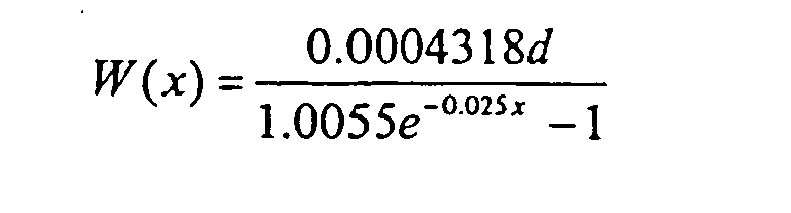
where d is the diameter of the piston, W is the width of each of the threeports 512, and x is the distance from the edge of the piston to its fully closed position (i.e., the position of the edge of the piston if it were touching the inclined surface of the cavity of the throttling element). The maximum of x is approximately 0.28d, with the throttling surface being truncated at the point where the width of the threeports 512 equal approximately one third of the perimeter. As described above, a preferred size for d follows the relationship: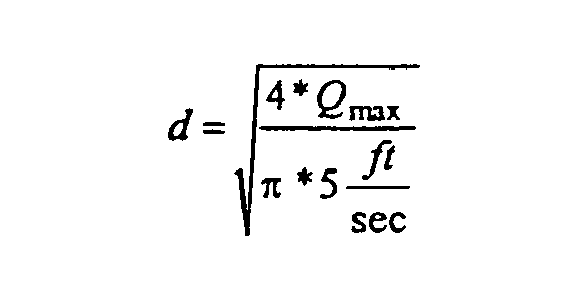
- Although example embodiments of the invention and their advantages are described in detail, a person skilled in the art could make various alterations, additions, and/or omissions without departing from the spirit and scope of the present invention as defined by the appended claims.
Claims (11)
- A fluid regulating control valve (100a, 100b), comprising:- a housing (200, 300) having an upstream region (102) and a downstream region (104) and having a control orifice (110, 110a, 110b) formed therein adjacent the downstream region;- a piston (204) slidably disposed within the housing, the piston having a fluid passage, through which the controlled flow passes, defining an intermediate region disposed between the upstream region and the downstream region;- a flange portion (232) with a top side (248) and a bottom side (250) and a stem portion (234) with an edge (231, 320) adjacent the upstream region;- an elastic member (208, 306) disposed within the housing for opposing translation of the piston within the housing;- a throttling element (202, 302) adjacent the upstream region, the throttling element having a throttling surface (224, 318) adjacent the edge of the piston, the throttling surface (224, 318) and the edge (321, 320) defining a throttling orifice therebetween; and- an equalization aperture (242, 328) formed in the housing to allow a fluid in the downstream region to enter an equalization chamber (246, 326) defined by a region between an inside surface of the housing and an outside surface of the piston, such that the pressure differential across the flange portion (232) is equal to the pressure differential across the control orifice (110, 110a, 110b).
- Apparatus according to claim 1, characterized in that the elastic member (208) is mounted within the housing for opposing translation of the piston (204).
- Apparatus according to claim 1, characterized in that an equalization aperture (242) formed in the housing, in a sidewall (244) of the cap (206), allows a fluid in the downstream region to enter an equalization chamber (246) defined by a region between an inside surface of the housing or of the sidewall (244) and an outside surface of a piston (204), and thereby exists the pressure P3 on the piston (204).
- Apparatus according to claim 1, characterized in that the flow regulating control valve comprising a seal (256) disposed between the housing and a perimeter of the piston (204) to prevent leakage of the fluid from the intermediate region (252) to the equalization chamber (246) and thereby preventing the pressure level P2 entering the equalization chamber.
- Apparatus according to claim 1, characterized in that the regulating control valve (100) preferably comprises a square piston ring (258) disposed between a perimeter of the piston (204) and a inner surface of the housing or of the cap (206) for reducing leakage of the fluid there between and the piston ring is preferably formed from fluorocarbon and thereby preventing the pressure level P2 entering the equalization chamber.
- Apparatus according to claim 1, characterized in that the regulating control valve, wherein an edge (226) of the piston (204) is square.
- Apparatus according to claim 1, characterized in that the regulating control valve (100) and the piston (204) comprises a flange portion (232) and the steam portion (234) where the flange portion having a first side exposed to the intermediate region (252) and a second side exposed to the equalization chamber (246) and a perimeter slidably engaged with an inside surface of the housing or the cap (206).
- Apparatus according to claim 1, characterized in that the throttling element (202) adjacent the upstream region, the throttling element having the throttling surface (224) adjacent a edge (231) of the piston (204) where the throttling surface and the edge are defining a throttling orifice there between.
- Apparatus according to claim 1, characterized in that the throttling element (202) has a cavity formed in one end thereof, the cavity having an inclined surface (228) or sidewall and wherein the throttling surface is defined by an edge (508) of the throttling element and the sidewall.
- Apparatus according to claims 1 and 9, characterized in that the throttling element (202) preferably has three ports (512) and where the ports configured to follow the following equation:

where d is the diameter of the piston, W is the width of each of the three ports and x is a distance from the edge of the piston to a fully closed position defined by a position of the piston in which the edge of the piston touches the inclined sidewall of the cavity of the throttling element. - Apparatus according to claim 1, characterized in that the regulating control valve (100) comprises the adjustment element (212) coupled to the housing for selectively constricting of the control orifice.
Priority Applications (2)
| Application Number | Priority Date | Filing Date | Title |
|---|---|---|---|
| DE60332891.1T DE60332891C5 (en) | 2002-04-10 | 2003-03-10 | Device for flow control valve in a heating or cooling system |
| SI200331858T SI1353254T1 (en) | 2002-04-10 | 2003-03-10 | Apparatus for regulating a flow in a heating or cooling system |
Applications Claiming Priority (2)
| Application Number | Priority Date | Filing Date | Title |
|---|---|---|---|
| US10/121,106 US6688319B2 (en) | 2002-04-10 | 2002-04-10 | Flow regulating control valve and method for regulating fluid flow |
| US121106 | 2002-04-10 |
Publications (3)
| Publication Number | Publication Date |
|---|---|
| EP1353254A2 EP1353254A2 (en) | 2003-10-15 |
| EP1353254A3 EP1353254A3 (en) | 2006-02-22 |
| EP1353254B1 true EP1353254B1 (en) | 2010-06-09 |
Family
ID=28454017
Family Applications (1)
| Application Number | Title | Priority Date | Filing Date |
|---|---|---|---|
| EP20030005223 Expired - Lifetime EP1353254B1 (en) | 2002-04-10 | 2003-03-10 | Apparatus for regulating a flow in a heating or cooling system |
Country Status (8)
| Country | Link |
|---|---|
| US (1) | US6688319B2 (en) |
| EP (1) | EP1353254B1 (en) |
| AT (1) | ATE470893T1 (en) |
| DE (1) | DE60332891C5 (en) |
| DK (1) | DK1353254T3 (en) |
| ES (1) | ES2348505T3 (en) |
| PT (1) | PT1353254E (en) |
| SI (1) | SI1353254T1 (en) |
Cited By (1)
| Publication number | Priority date | Publication date | Assignee | Title |
|---|---|---|---|---|
| EP3012705A1 (en) | 2014-10-22 | 2016-04-27 | Danfoss A/S | Heat exchanger valve arrangement, heating system and method for operating a heating system |
Families Citing this family (30)
| Publication number | Priority date | Publication date | Assignee | Title |
|---|---|---|---|---|
| US7156120B2 (en) * | 2004-07-28 | 2007-01-02 | Cct Manufacturing, Inc. | Inline liquid flow control valve |
| SE528703C2 (en) * | 2004-09-15 | 2007-01-30 | Tour & Andersson Ab | Device for flow control of a medium in a heating and cooling system |
| DE502006001866D1 (en) * | 2005-05-12 | 2008-12-04 | Behr Gmbh & Co Kg | Differential pressure valve |
| DE102006014446A1 (en) * | 2006-03-29 | 2007-10-04 | Schaeffler Kg | Hydraulic fluid flow control valve for e.g. hydrostatic profiled rail guide, has adjusting part to adjust control characteristics of controller and with operating section accessible from outside of pipe to adjust another adjusting part |
| WO2007127949A2 (en) | 2006-04-27 | 2007-11-08 | Sko Flo Industries, Inc. | Flow control valve |
| WO2007127986A2 (en) * | 2006-04-28 | 2007-11-08 | Sko Flo Industries, Inc. | Flow measuring apparatus including a piston movable in the flow barrel |
| US7621461B2 (en) * | 2006-08-18 | 2009-11-24 | Flow Design, Inc. | System and method for regulating heat transfer on a fluid by regulating the flow of the fluid |
| GB0711629D0 (en) * | 2007-06-15 | 2007-07-25 | Honeywell Normalair Garrett Lt | Hydraulic heating apparatus |
| US8123081B2 (en) * | 2008-09-12 | 2012-02-28 | Basf Corporation | Two component foam dispensing apparatus |
| US8118052B2 (en) * | 2008-09-12 | 2012-02-21 | Basf Corporation | Method of forming a polyurethane foam |
| US8276611B2 (en) * | 2008-09-12 | 2012-10-02 | Basf Corporation | Externally adjustable pressure compensated flow control valve |
| WO2010053382A1 (en) * | 2008-11-05 | 2010-05-14 | Hart, David, Stanley | Flow regulating device |
| US8973603B2 (en) * | 2009-02-17 | 2015-03-10 | Carefusion 2200, Inc. | Gas flow regulating device |
| US8061195B2 (en) | 2009-05-08 | 2011-11-22 | Jones Iii Tommy Jefferson | Flow control assembly |
| DE102009061242B3 (en) * | 2009-07-16 | 2016-09-08 | IMI Hydronic Engineering Deutschland GmbH | Presettable flow rate controller for heating systems (II) |
| DE102009033376B4 (en) | 2009-07-16 | 2014-05-28 | Ta Heimeier Gmbh | Presettable flow regulator for heating systems |
| KR101781236B1 (en) * | 2009-11-23 | 2017-09-22 | 바스프 에스이 | Foam dispensing apparatus |
| WO2012048039A1 (en) * | 2010-10-05 | 2012-04-12 | Kirchner Mark W | Flow rate controller for high flow rates and high pressure drops |
| CH708204A1 (en) * | 2013-06-12 | 2014-12-15 | Belimo Holding Ag | Surge use. |
| ITMI20132133A1 (en) * | 2013-12-19 | 2015-06-20 | Vir Valvoindustria Ing Rizzio S P A | DYNAMIC BALANCING VALVE FOR PRESSURE INDEPENDENT FLOW CONTROL |
| EP3120209B1 (en) | 2014-03-18 | 2020-05-06 | IMI Hydronic Engineering, Inc. | Retrofit smart components for use in a fluid transfer system |
| EP2977847B1 (en) | 2014-07-24 | 2017-04-26 | Danfoss A/S | Valve arrangement |
| EP2988071B1 (en) * | 2014-08-19 | 2016-06-22 | IMI Hydronic Engineering International SA | Flow regulator |
| CN107023688A (en) * | 2016-02-02 | 2017-08-08 | 丹佛斯有限公司 | The especially valve of heat exchanger valve |
| EP3203347A1 (en) * | 2016-02-02 | 2017-08-09 | Danfoss A/S | Valve, in particular heat exchanger valve |
| EP3203346A1 (en) * | 2016-02-02 | 2017-08-09 | Danfoss A/S | Valve, in particular heat exchanger valve |
| EP3203123A1 (en) * | 2016-02-02 | 2017-08-09 | Danfoss A/S | Valve, in particular heat exchanger valve |
| EP3203348A1 (en) * | 2016-02-02 | 2017-08-09 | Danfoss A/S | Valve, in particular heat exchanger valve |
| DE112018007619T5 (en) * | 2018-05-16 | 2021-02-25 | Parker Hannifin Corporation | Valve comprising a double piston assembly and method of forming a valve |
| DK4043803T3 (en) * | 2021-02-15 | 2025-06-30 | Mi Hydronic Engineering Int Sa | FLOW RATE REGULATION DEVICE AND REGULATION DEVICE THEREFOR |
Family Cites Families (43)
| Publication number | Priority date | Publication date | Assignee | Title |
|---|---|---|---|---|
| US2013974A (en) | 1934-03-17 | 1935-09-10 | Edison Inc Thomas A | Electric discharge starting circuit |
| US2139050A (en) * | 1937-05-01 | 1938-12-06 | Harry F Vickers | Viscosity compensating device |
| US2967543A (en) | 1955-06-01 | 1961-01-10 | W A Kates Company | Flow regulating valve |
| US2915084A (en) * | 1958-06-02 | 1959-12-01 | Carl C Taylor | Flow controllers |
| US3424196A (en) | 1966-06-01 | 1969-01-28 | Deltrol Corp | Flow regulating valve |
| US3472275A (en) | 1967-07-28 | 1969-10-14 | Baker Oil Tools Inc | Flow regulator apparatus |
| US3523559A (en) | 1968-05-17 | 1970-08-11 | Crane Co | Fluid flow control device |
| US3590861A (en) | 1969-05-05 | 1971-07-06 | Keelavite Hydraulics Ltd | Liquid flow control valves |
| US3854497A (en) | 1971-07-01 | 1974-12-17 | Lampert S | Combination shut-off valve and flow control valve with side access and viewing port for observation, testing and on-line servicing |
| US3951162A (en) | 1971-11-03 | 1976-04-20 | Koehring Company | Control valve with flow control means |
| US4009826A (en) | 1975-10-14 | 1977-03-01 | Walker Jordan E | Variable value constant volume flow device |
| US4080993A (en) | 1976-09-13 | 1978-03-28 | Aqueduct, Inc. | In-line flow-control valve |
| JPS5471432A (en) * | 1977-11-17 | 1979-06-08 | Sotokazu Rikuta | Flow rate constant value automatic control valve |
| US4375228A (en) | 1981-02-23 | 1983-03-01 | General Motors Corporation | Two-stage flow restrictor valve assembly |
| US4512187A (en) | 1981-11-19 | 1985-04-23 | Getty Oil Company | Flow rate controller |
| GB2115755B (en) * | 1982-01-13 | 1984-12-05 | Lucas Industries Ltd | Improvements in fluid flow regulators |
| DE3234779A1 (en) | 1982-09-20 | 1984-03-22 | Danfoss A/S, 6430 Nordborg | FLOW RATE CONTROLLER |
| US4440192A (en) | 1982-09-23 | 1984-04-03 | United Technologies Corporation | Minimization of pressure drop variation in flow controllers |
| JPS603533U (en) | 1983-06-18 | 1985-01-11 | 三菱電機株式会社 | pressure response device |
| US4513777A (en) | 1983-08-22 | 1985-04-30 | General Motors Corporation | Pressure compensated flow control valve assembly for fluids containing finely divided solids |
| JPS61105381A (en) | 1984-10-29 | 1986-05-23 | Kawasaki Heavy Ind Ltd | Electromagnetic flow control valve |
| US4655245A (en) | 1986-06-13 | 1987-04-07 | Dowty Decoto, Inc. | Hydraulic fuse |
| US5249599A (en) | 1987-01-31 | 1993-10-05 | Haynes Joel E | Fluid flow regulator |
| DE3724271A1 (en) | 1987-07-22 | 1989-02-02 | Bosch Gmbh Robert | DAMPING DEVICE |
| US5271430A (en) | 1988-08-16 | 1993-12-21 | Kabushiki Kaisha Komatsu Seisakusho | Flow rate control valve device and flow force reduction structure |
| US4926704A (en) | 1989-04-10 | 1990-05-22 | Flow Design, Inc. | Valve test plug |
| US5020774A (en) | 1990-04-11 | 1991-06-04 | The United States Of America As Represented By The Administrator Of The National Aeronautics And Space Administration | Variable orifice flow regulator |
| US5161577A (en) | 1990-04-23 | 1992-11-10 | Eaton Corporation | Fluid controller having rotary/axial valving, and spring arrangement therefor |
| DE9108617U1 (en) | 1991-07-12 | 1991-09-26 | MMM Münchener Medizin Mechanik GmbH, 8000 München | Control valve |
| US5148830A (en) | 1991-08-30 | 1992-09-22 | Hung Liu | Flow control device |
| US5174330A (en) * | 1991-12-05 | 1992-12-29 | Flow Design, Inc. | Constant flow rate control valve with low pressure drop start |
| US5265643A (en) | 1991-12-05 | 1993-11-30 | Flow Design Inc. | Constant flow rate control valve with low pressure drop start |
| US5971012A (en) | 1993-06-01 | 1999-10-26 | Skoglund; Paul K. | Constant flow control valve having matable piston sleeve and outlet cover |
| US5383489A (en) | 1993-10-26 | 1995-01-24 | Flow Design, Inc. | Flow control valve with enhanced flow control piston |
| US5427144A (en) | 1994-02-24 | 1995-06-27 | Deumed Group Inc. | Valve means with fluid retraction means |
| US5533549A (en) | 1995-01-26 | 1996-07-09 | Hydronic Components, Inc. | Ball valve with integrated removable flow venturi, flow balancing means, and pipe union means |
| DE19507086C2 (en) * | 1995-03-01 | 1997-01-30 | Danfoss As | Water hydraulic control valve |
| DE19539521C2 (en) | 1995-10-24 | 1999-01-07 | Mannesmann Rexroth Ag | Flow control valve |
| US5904177A (en) * | 1997-03-17 | 1999-05-18 | Marotta Scientific Controls, Inc. | Fluid flow control device |
| US5979495A (en) | 1997-12-22 | 1999-11-09 | Taube; Frank A. | Adjustable low flow high pressure regulator |
| WO1999045447A1 (en) * | 1998-03-05 | 1999-09-10 | Flow Design, Inc. | Method and apparatus for regulating fluid flow |
| US6196259B1 (en) * | 1998-03-12 | 2001-03-06 | Flow Design, Inc. | Method and apparatus for regulating and terminating fluid flow |
| US6276397B1 (en) | 2000-06-12 | 2001-08-21 | Flow Design, Inc. | Apparatus and method for shaping fluid flow |
-
2002
- 2002-04-10 US US10/121,106 patent/US6688319B2/en not_active Expired - Lifetime
-
2003
- 2003-03-10 PT PT03005223T patent/PT1353254E/en unknown
- 2003-03-10 ES ES03005223T patent/ES2348505T3/en not_active Expired - Lifetime
- 2003-03-10 SI SI200331858T patent/SI1353254T1/en unknown
- 2003-03-10 DK DK03005223T patent/DK1353254T3/en active
- 2003-03-10 DE DE60332891.1T patent/DE60332891C5/en not_active Expired - Lifetime
- 2003-03-10 EP EP20030005223 patent/EP1353254B1/en not_active Expired - Lifetime
- 2003-03-10 AT AT03005223T patent/ATE470893T1/en active
Cited By (2)
| Publication number | Priority date | Publication date | Assignee | Title |
|---|---|---|---|---|
| EP3012705A1 (en) | 2014-10-22 | 2016-04-27 | Danfoss A/S | Heat exchanger valve arrangement, heating system and method for operating a heating system |
| WO2016062747A1 (en) | 2014-10-22 | 2016-04-28 | Danfoss A/S | Heat exchanger valve arrangement, heating system and method for operation a heating system |
Also Published As
| Publication number | Publication date |
|---|---|
| PT1353254E (en) | 2010-10-13 |
| DE60332891D1 (en) | 2010-07-22 |
| DK1353254T3 (en) | 2010-08-23 |
| ES2348505T3 (en) | 2010-12-07 |
| EP1353254A3 (en) | 2006-02-22 |
| US6688319B2 (en) | 2004-02-10 |
| SI1353254T1 (en) | 2010-10-29 |
| US20030192597A1 (en) | 2003-10-16 |
| ATE470893T1 (en) | 2010-06-15 |
| DE60332891C5 (en) | 2018-08-09 |
| EP1353254A2 (en) | 2003-10-15 |
Similar Documents
| Publication | Publication Date | Title |
|---|---|---|
| US6688319B2 (en) | Flow regulating control valve and method for regulating fluid flow | |
| CN100516606C (en) | Anti-cavitation valve assembly | |
| KR100315573B1 (en) | Flow control valve with reinforced flow control piston | |
| US5396918A (en) | Water pressure regulator and method for regulating pressure through a valve | |
| EP3067772A2 (en) | Automatic balancing valve | |
| CA2042056C (en) | Constant flow valve | |
| US5265643A (en) | Constant flow rate control valve with low pressure drop start | |
| US5971012A (en) | Constant flow control valve having matable piston sleeve and outlet cover | |
| DK1321841T3 (en) | Valve with constant flow rate and method for mixing constant flow rates | |
| EP0545356B1 (en) | Constant flow rate control valve with low pressure drop start | |
| US5904177A (en) | Fluid flow control device | |
| US4325406A (en) | Continuous fluid pressure control device and system | |
| EP0385029B1 (en) | Line pressure regulator | |
| US6820643B2 (en) | Liquid pressure regulator with built-in antidrainage valve | |
| KR20040002758A (en) | Precision modulating globe valve | |
| EP2898387B1 (en) | A differential pressure control valve | |
| US5363876A (en) | Flow control devices | |
| EP3082009B1 (en) | Pressure regulator | |
| JPH0213792A (en) | Temperature controller for heat exchanger | |
| WO1999045447A1 (en) | Method and apparatus for regulating fluid flow | |
| US5979495A (en) | Adjustable low flow high pressure regulator | |
| US11513540B2 (en) | Pressure compensated flow controller with only two pressures | |
| GB1582644A (en) | Regulating valve | |
| CA1171891A (en) | Constant pressure nozzle with modulation effect | |
| USRE26880E (en) | Device for controlling the rate of flow of fluids |
Legal Events
| Date | Code | Title | Description |
|---|---|---|---|
| PUAI | Public reference made under article 153(3) epc to a published international application that has entered the european phase |
Free format text: ORIGINAL CODE: 0009012 |
|
| AK | Designated contracting states |
Kind code of ref document: A2 Designated state(s): AT BE BG CH CY CZ DE DK EE ES FI FR GB GR HU IE IT LI LU MC NL PT RO SE SI SK TR |
|
| AX | Request for extension of the european patent |
Extension state: AL LT LV MK RO |
|
| 17P | Request for examination filed |
Effective date: 20040306 |
|
| 19U | Interruption of proceedings before grant |
Effective date: 20040314 |
|
| 19W | Proceedings resumed before grant after interruption of proceedings |
Effective date: 20040824 |
|
| PUAL | Search report despatched |
Free format text: ORIGINAL CODE: 0009013 |
|
| AK | Designated contracting states |
Kind code of ref document: A3 Designated state(s): AT BE BG CH CY CZ DE DK EE ES FI FR GB GR HU IE IT LI LU MC NL PT RO SE SI SK TR |
|
| AX | Request for extension of the european patent |
Extension state: AL LT LV MK RO |
|
| AKX | Designation fees paid |
Designated state(s): AT BE BG CH CY CZ DE DK EE ES FI FR GB GR HU IE IT LI LU MC NL PT RO SE SI SK TR |
|
| 17Q | First examination report despatched |
Effective date: 20070404 |
|
| RTI1 | Title (correction) |
Free format text: APPARATUS FOR REGULATING A FLOW IN A HEATING OR COOLING SYSTEM |
|
| GRAP | Despatch of communication of intention to grant a patent |
Free format text: ORIGINAL CODE: EPIDOSNIGR1 |
|
| RIN1 | Information on inventor provided before grant (corrected) |
Inventor name: WATSON III, GEORGE T. Inventor name: TRANTHAM, JOHN M. |
|
| GRAS | Grant fee paid |
Free format text: ORIGINAL CODE: EPIDOSNIGR3 |
|
| GRAA | (expected) grant |
Free format text: ORIGINAL CODE: 0009210 |
|
| REG | Reference to a national code |
Ref country code: SE Ref legal event code: TRCL |
|
| AK | Designated contracting states |
Kind code of ref document: B1 Designated state(s): AT BE BG CH CY CZ DE DK EE ES FI FR GB GR HU IE IT LI LU MC NL PT RO SE SI SK TR |
|
| REG | Reference to a national code |
Ref country code: CH Ref legal event code: EP |
|
| REG | Reference to a national code |
Ref country code: IE Ref legal event code: FG4D |
|
| REF | Corresponds to: |
Ref document number: 60332891 Country of ref document: DE Date of ref document: 20100722 Kind code of ref document: P |
|
| REG | Reference to a national code |
Ref country code: SE Ref legal event code: TRGR |
|
| REG | Reference to a national code |
Ref country code: RO Ref legal event code: EPE |
|
| REG | Reference to a national code |
Ref country code: DK Ref legal event code: T3 |
|
| REG | Reference to a national code |
Ref country code: CH Ref legal event code: NV Representative=s name: INTERPAT LAW AG |
|
| REG | Reference to a national code |
Ref country code: NL Ref legal event code: T3 |
|
| REG | Reference to a national code |
Ref country code: GR Ref legal event code: EP Ref document number: 20100401941 Country of ref document: GR |
|
| REG | Reference to a national code |
Ref country code: ES Ref legal event code: FG2A Effective date: 20101124 |
|
| REG | Reference to a national code |
Ref country code: SK Ref legal event code: T3 Ref document number: E 7892 Country of ref document: SK |
|
| PG25 | Lapsed in a contracting state [announced via postgrant information from national office to epo] |
Ref country code: CY Free format text: LAPSE BECAUSE OF FAILURE TO SUBMIT A TRANSLATION OF THE DESCRIPTION OR TO PAY THE FEE WITHIN THE PRESCRIBED TIME-LIMIT Effective date: 20100609 |
|
| REG | Reference to a national code |
Ref country code: HU Ref legal event code: AG4A Ref document number: E008912 Country of ref document: HU |
|
| PLBE | No opposition filed within time limit |
Free format text: ORIGINAL CODE: 0009261 |
|
| STAA | Information on the status of an ep patent application or granted ep patent |
Free format text: STATUS: NO OPPOSITION FILED WITHIN TIME LIMIT |
|
| 26N | No opposition filed |
Effective date: 20110310 |
|
| REG | Reference to a national code |
Ref country code: DE Ref legal event code: R097 Ref document number: 60332891 Country of ref document: DE Effective date: 20110309 |
|
| PG25 | Lapsed in a contracting state [announced via postgrant information from national office to epo] |
Ref country code: MC Free format text: LAPSE BECAUSE OF NON-PAYMENT OF DUE FEES Effective date: 20110331 |
|
| REG | Reference to a national code |
Ref country code: DE Ref legal event code: R082 Ref document number: 60332891 Country of ref document: DE Representative=s name: DREISS PATENTANWAELTE PARTNERSCHAFT, DE Ref country code: DE Ref legal event code: R082 Ref document number: 60332891 Country of ref document: DE Representative=s name: DREISS PATENTANWAELTE PARTG MBB, DE |
|
| REG | Reference to a national code |
Ref country code: DE Ref legal event code: R046 Ref document number: 60332891 Country of ref document: DE Effective date: 20130807 |
|
| REG | Reference to a national code |
Ref country code: DE Ref legal event code: R050 Ref document number: 60332891 Country of ref document: DE |
|
| REG | Reference to a national code |
Ref country code: DE Ref legal event code: R008 Ref document number: 60332891 Country of ref document: DE |
|
| REG | Reference to a national code |
Ref country code: DE Ref legal event code: R050 Ref document number: 60332891 Country of ref document: DE Effective date: 20131227 |
|
| REG | Reference to a national code |
Ref country code: DE Ref legal event code: R039 Ref document number: 60332891 Country of ref document: DE Effective date: 20131230 |
|
| REG | Reference to a national code |
Ref country code: DE Ref legal event code: R206 Ref document number: 60332891 Country of ref document: DE Effective date: 20140528 |
|
| REG | Reference to a national code |
Ref country code: DE Ref legal event code: R097 Ref document number: 60332891 Country of ref document: DE Ref country code: DE Ref legal event code: R040 Ref document number: 60332891 Country of ref document: DE |
|
| REG | Reference to a national code |
Ref country code: DE Ref legal event code: R040 Ref document number: 60332891 Country of ref document: DE Effective date: 20140724 |
|
| REG | Reference to a national code |
Ref country code: DE Ref legal event code: R008 Ref document number: 60332891 Country of ref document: DE Ref country code: DE Ref legal event code: R039 Ref document number: 60332891 Country of ref document: DE |
|
| REG | Reference to a national code |
Ref country code: DE Ref legal event code: R082 Ref document number: 60332891 Country of ref document: DE Representative=s name: DREISS PATENTANWAELTE PARTG MBB, DE Ref country code: DE Ref legal event code: R081 Ref document number: 60332891 Country of ref document: DE Owner name: IMI HYDRONIC ENGINEERING INC., DALLAS, US Free format text: FORMER OWNER: FLOW DESIGN, INC., DALLAS, TEX., US |
|
| REG | Reference to a national code |
Ref country code: FR Ref legal event code: PLFP Year of fee payment: 14 |
|
| REG | Reference to a national code |
Ref country code: FR Ref legal event code: PLFP Year of fee payment: 15 |
|
| REG | Reference to a national code |
Ref country code: FR Ref legal event code: PLFP Year of fee payment: 16 |
|
| REG | Reference to a national code |
Ref country code: DE Ref legal event code: R043 Ref document number: 60332891 Country of ref document: DE |
|
| REG | Reference to a national code |
Ref country code: DE Ref legal event code: R206 Ref document number: 60332891 Country of ref document: DE |
|
| PGFP | Annual fee paid to national office [announced via postgrant information from national office to epo] |
Ref country code: LU Payment date: 20220124 Year of fee payment: 20 |
|
| PGFP | Annual fee paid to national office [announced via postgrant information from national office to epo] |
Ref country code: IE Payment date: 20220125 Year of fee payment: 20 Ref country code: HU Payment date: 20220106 Year of fee payment: 20 Ref country code: GB Payment date: 20220124 Year of fee payment: 20 Ref country code: FI Payment date: 20220124 Year of fee payment: 20 Ref country code: DK Payment date: 20220128 Year of fee payment: 20 Ref country code: DE Payment date: 20220125 Year of fee payment: 20 Ref country code: CH Payment date: 20220124 Year of fee payment: 20 Ref country code: BG Payment date: 20220125 Year of fee payment: 20 Ref country code: AT Payment date: 20220127 Year of fee payment: 20 |
|
| PGFP | Annual fee paid to national office [announced via postgrant information from national office to epo] |
Ref country code: TR Payment date: 20220309 Year of fee payment: 20 Ref country code: SK Payment date: 20220111 Year of fee payment: 20 Ref country code: SE Payment date: 20220124 Year of fee payment: 20 Ref country code: RO Payment date: 20220215 Year of fee payment: 20 Ref country code: PT Payment date: 20220117 Year of fee payment: 20 Ref country code: NL Payment date: 20220123 Year of fee payment: 20 Ref country code: IT Payment date: 20220128 Year of fee payment: 20 Ref country code: GR Payment date: 20220124 Year of fee payment: 20 Ref country code: FR Payment date: 20220125 Year of fee payment: 20 Ref country code: EE Payment date: 20220125 Year of fee payment: 20 Ref country code: CZ Payment date: 20220111 Year of fee payment: 20 Ref country code: BE Payment date: 20220128 Year of fee payment: 20 |
|
| PGFP | Annual fee paid to national office [announced via postgrant information from national office to epo] |
Ref country code: SI Payment date: 20220124 Year of fee payment: 20 |
|
| PGFP | Annual fee paid to national office [announced via postgrant information from national office to epo] |
Ref country code: ES Payment date: 20220510 Year of fee payment: 20 |
|
| REG | Reference to a national code |
Ref country code: EE Ref legal event code: HC1A Ref document number: E004611 Country of ref document: EE |
|
| REG | Reference to a national code |
Ref country code: DE Ref legal event code: R071 Ref document number: 60332891 Country of ref document: DE |
|
| REG | Reference to a national code |
Ref country code: DK Ref legal event code: EUP Expiry date: 20230310 |
|
| REG | Reference to a national code |
Ref country code: CH Ref legal event code: PL Ref country code: NL Ref legal event code: MK Effective date: 20230309 |
|
| REG | Reference to a national code |
Ref country code: BE Ref legal event code: MK Effective date: 20230310 Ref country code: GB Ref legal event code: PE20 Expiry date: 20230309 Ref country code: SK Ref legal event code: MK4A Ref document number: E 7892 Country of ref document: SK Expiry date: 20230310 |
|
| REG | Reference to a national code |
Ref country code: AT Ref legal event code: MK07 Ref document number: 470893 Country of ref document: AT Kind code of ref document: T Effective date: 20230310 |
|
| REG | Reference to a national code |
Ref country code: IE Ref legal event code: MK9A |
|
| PG25 | Lapsed in a contracting state [announced via postgrant information from national office to epo] |
Ref country code: PT Free format text: LAPSE BECAUSE OF EXPIRATION OF PROTECTION Effective date: 20230321 Ref country code: CZ Free format text: LAPSE BECAUSE OF EXPIRATION OF PROTECTION Effective date: 20230310 |
|
| REG | Reference to a national code |
Ref country code: ES Ref legal event code: FD2A Effective date: 20230428 |
|
| REG | Reference to a national code |
Ref country code: SE Ref legal event code: EUG |
|
| PG25 | Lapsed in a contracting state [announced via postgrant information from national office to epo] |
Ref country code: SK Free format text: LAPSE BECAUSE OF EXPIRATION OF PROTECTION Effective date: 20230310 Ref country code: SI Free format text: LAPSE BECAUSE OF EXPIRATION OF PROTECTION Effective date: 20230311 Ref country code: GB Free format text: LAPSE BECAUSE OF EXPIRATION OF PROTECTION Effective date: 20230309 |
|
| PG25 | Lapsed in a contracting state [announced via postgrant information from national office to epo] |
Ref country code: IE Free format text: LAPSE BECAUSE OF EXPIRATION OF PROTECTION Effective date: 20230310 Ref country code: ES Free format text: LAPSE BECAUSE OF EXPIRATION OF PROTECTION Effective date: 20230311 |