EP1366791A1 - Filtermedium - Google Patents
Filtermedium Download PDFInfo
- Publication number
- EP1366791A1 EP1366791A1 EP02011827A EP02011827A EP1366791A1 EP 1366791 A1 EP1366791 A1 EP 1366791A1 EP 02011827 A EP02011827 A EP 02011827A EP 02011827 A EP02011827 A EP 02011827A EP 1366791 A1 EP1366791 A1 EP 1366791A1
- Authority
- EP
- European Patent Office
- Prior art keywords
- filter medium
- layer
- filter
- fibers
- fine structure
- Prior art date
- Legal status (The legal status is an assumption and is not a legal conclusion. Google has not performed a legal analysis and makes no representation as to the accuracy of the status listed.)
- Granted
Links
- 239000000463 material Substances 0.000 title claims description 82
- 239000000835 fiber Substances 0.000 claims abstract description 74
- 229920005594 polymer fiber Polymers 0.000 claims abstract description 48
- 229920000642 polymer Polymers 0.000 claims abstract description 21
- 239000003054 catalyst Substances 0.000 claims abstract description 18
- 239000000243 solution Substances 0.000 claims abstract description 18
- 238000004519 manufacturing process Methods 0.000 claims abstract description 6
- 230000005684 electric field Effects 0.000 claims abstract description 3
- 239000002245 particle Substances 0.000 claims description 47
- 239000003431 cross linking reagent Substances 0.000 claims description 17
- 238000000034 method Methods 0.000 claims description 12
- 239000002585 base Substances 0.000 claims description 11
- 229920001568 phenolic resin Polymers 0.000 claims description 11
- 239000000126 substance Substances 0.000 claims description 11
- 239000005011 phenolic resin Substances 0.000 claims description 10
- 239000001913 cellulose Substances 0.000 claims description 9
- 229920002678 cellulose Polymers 0.000 claims description 9
- KXGFMDJXCMQABM-UHFFFAOYSA-N 2-methoxy-6-methylphenol Chemical compound [CH]OC1=CC=CC([CH])=C1O KXGFMDJXCMQABM-UHFFFAOYSA-N 0.000 claims description 8
- 229920000877 Melamine resin Polymers 0.000 claims description 8
- 230000000694 effects Effects 0.000 claims description 8
- 239000000203 mixture Substances 0.000 claims description 8
- 229920002994 synthetic fiber Polymers 0.000 claims description 8
- 239000012209 synthetic fiber Substances 0.000 claims description 8
- 239000004372 Polyvinyl alcohol Substances 0.000 claims description 7
- 239000003795 chemical substances by application Substances 0.000 claims description 7
- 229920002451 polyvinyl alcohol Polymers 0.000 claims description 7
- 239000002131 composite material Substances 0.000 claims description 6
- 150000001875 compounds Chemical class 0.000 claims description 6
- 239000004952 Polyamide Substances 0.000 claims description 5
- 239000007864 aqueous solution Substances 0.000 claims description 5
- 239000003446 ligand Substances 0.000 claims description 5
- 229920002647 polyamide Polymers 0.000 claims description 5
- 229920000178 Acrylic resin Polymers 0.000 claims description 4
- 239000004925 Acrylic resin Substances 0.000 claims description 4
- 229920001807 Urea-formaldehyde Polymers 0.000 claims description 4
- 238000010894 electron beam technology Methods 0.000 claims description 4
- 239000003822 epoxy resin Substances 0.000 claims description 4
- 239000002798 polar solvent Substances 0.000 claims description 4
- 229920002401 polyacrylamide Polymers 0.000 claims description 4
- 229920000647 polyepoxide Polymers 0.000 claims description 4
- 239000007848 Bronsted acid Substances 0.000 claims description 3
- 239000002841 Lewis acid Substances 0.000 claims description 3
- 239000000853 adhesive Substances 0.000 claims description 3
- 230000029936 alkylation Effects 0.000 claims description 3
- 238000005804 alkylation reaction Methods 0.000 claims description 3
- 230000001588 bifunctional effect Effects 0.000 claims description 3
- 238000001523 electrospinning Methods 0.000 claims description 3
- 239000003063 flame retardant Substances 0.000 claims description 3
- 239000007850 fluorescent dye Substances 0.000 claims description 3
- 230000003647 oxidation Effects 0.000 claims description 3
- 238000007254 oxidation reaction Methods 0.000 claims description 3
- 238000002444 silanisation Methods 0.000 claims description 3
- 238000006884 silylation reaction Methods 0.000 claims description 3
- 239000002253 acid Substances 0.000 claims description 2
- 230000002378 acidificating effect Effects 0.000 claims description 2
- 150000007513 acids Chemical class 0.000 claims description 2
- 230000009471 action Effects 0.000 claims description 2
- GZCGUPFRVQAUEE-SLPGGIOYSA-N aldehydo-D-glucose Chemical compound OC[C@@H](O)[C@@H](O)[C@H](O)[C@@H](O)C=O GZCGUPFRVQAUEE-SLPGGIOYSA-N 0.000 claims description 2
- 229920001577 copolymer Polymers 0.000 claims description 2
- 229920006037 cross link polymer Polymers 0.000 claims description 2
- 230000005670 electromagnetic radiation Effects 0.000 claims description 2
- 230000002209 hydrophobic effect Effects 0.000 claims description 2
- 239000003999 initiator Substances 0.000 claims description 2
- 239000012784 inorganic fiber Substances 0.000 claims description 2
- 239000012454 non-polar solvent Substances 0.000 claims description 2
- 238000002604 ultrasonography Methods 0.000 claims description 2
- 239000003341 Bronsted base Substances 0.000 claims 1
- 239000002879 Lewis base Substances 0.000 claims 1
- 239000004971 Cross linker Substances 0.000 abstract description 9
- 239000000155 melt Substances 0.000 abstract description 3
- 238000009987 spinning Methods 0.000 abstract description 3
- 239000010410 layer Substances 0.000 description 190
- 238000000926 separation method Methods 0.000 description 30
- 239000000428 dust Substances 0.000 description 20
- 230000035699 permeability Effects 0.000 description 13
- 238000004132 cross linking Methods 0.000 description 11
- 239000007788 liquid Substances 0.000 description 11
- 239000007789 gas Substances 0.000 description 10
- 238000001914 filtration Methods 0.000 description 7
- 229920005989 resin Polymers 0.000 description 7
- 239000011347 resin Substances 0.000 description 7
- 238000013461 design Methods 0.000 description 6
- -1 polychlorotrifluoroethylene Polymers 0.000 description 6
- 239000011148 porous material Substances 0.000 description 6
- 238000007669 thermal treatment Methods 0.000 description 6
- 230000014759 maintenance of location Effects 0.000 description 5
- 230000008569 process Effects 0.000 description 5
- XLYOFNOQVPJJNP-UHFFFAOYSA-N water Substances O XLYOFNOQVPJJNP-UHFFFAOYSA-N 0.000 description 5
- VYPSYNLAJGMNEJ-UHFFFAOYSA-N Silicium dioxide Chemical compound O=[Si]=O VYPSYNLAJGMNEJ-UHFFFAOYSA-N 0.000 description 4
- 238000010521 absorption reaction Methods 0.000 description 4
- 230000008901 benefit Effects 0.000 description 4
- 239000012065 filter cake Substances 0.000 description 4
- 239000003921 oil Substances 0.000 description 4
- 241000178343 Butea superba Species 0.000 description 3
- 229920000049 Carbon (fiber) Polymers 0.000 description 3
- 229920003043 Cellulose fiber Polymers 0.000 description 3
- 239000004917 carbon fiber Substances 0.000 description 3
- KRKNYBCHXYNGOX-UHFFFAOYSA-N citric acid Chemical compound OC(=O)CC(O)(C(O)=O)CC(O)=O KRKNYBCHXYNGOX-UHFFFAOYSA-N 0.000 description 3
- 238000001723 curing Methods 0.000 description 3
- 238000001035 drying Methods 0.000 description 3
- 238000010041 electrostatic spinning Methods 0.000 description 3
- 230000007613 environmental effect Effects 0.000 description 3
- 230000006870 function Effects 0.000 description 3
- 230000006855 networking Effects 0.000 description 3
- 229920002492 poly(sulfone) Polymers 0.000 description 3
- 239000000047 product Substances 0.000 description 3
- 230000000717 retained effect Effects 0.000 description 3
- 238000012360 testing method Methods 0.000 description 3
- 238000011144 upstream manufacturing Methods 0.000 description 3
- YBJHBAHKTGYVGT-ZKWXMUAHSA-N (+)-Biotin Chemical compound N1C(=O)N[C@@H]2[C@H](CCCCC(=O)O)SC[C@@H]21 YBJHBAHKTGYVGT-ZKWXMUAHSA-N 0.000 description 2
- 241000264877 Hippospongia communis Species 0.000 description 2
- WOBHKFSMXKNTIM-UHFFFAOYSA-N Hydroxyethyl methacrylate Chemical compound CC(=C)C(=O)OCCO WOBHKFSMXKNTIM-UHFFFAOYSA-N 0.000 description 2
- 239000004743 Polypropylene Substances 0.000 description 2
- 229920001328 Polyvinylidene chloride Polymers 0.000 description 2
- 229920002125 Sokalan® Polymers 0.000 description 2
- 229920002472 Starch Polymers 0.000 description 2
- 239000000969 carrier Substances 0.000 description 2
- 238000006243 chemical reaction Methods 0.000 description 2
- 238000004140 cleaning Methods 0.000 description 2
- 239000011248 coating agent Substances 0.000 description 2
- 238000000576 coating method Methods 0.000 description 2
- 238000009826 distribution Methods 0.000 description 2
- 239000004744 fabric Substances 0.000 description 2
- 239000002657 fibrous material Substances 0.000 description 2
- 239000000706 filtrate Substances 0.000 description 2
- 230000009969 flowable effect Effects 0.000 description 2
- 239000003365 glass fiber Substances 0.000 description 2
- LNEPOXFFQSENCJ-UHFFFAOYSA-N haloperidol Chemical compound C1CC(O)(C=2C=CC(Cl)=CC=2)CCN1CCCC(=O)C1=CC=C(F)C=C1 LNEPOXFFQSENCJ-UHFFFAOYSA-N 0.000 description 2
- 238000005470 impregnation Methods 0.000 description 2
- 230000003993 interaction Effects 0.000 description 2
- 229910052751 metal Inorganic materials 0.000 description 2
- 239000002184 metal Substances 0.000 description 2
- BDAGIHXWWSANSR-UHFFFAOYSA-N methanoic acid Natural products OC=O BDAGIHXWWSANSR-UHFFFAOYSA-N 0.000 description 2
- 239000004745 nonwoven fabric Substances 0.000 description 2
- 239000004584 polyacrylic acid Substances 0.000 description 2
- 229920002239 polyacrylonitrile Polymers 0.000 description 2
- 239000004417 polycarbonate Substances 0.000 description 2
- 229920000515 polycarbonate Polymers 0.000 description 2
- 229920000728 polyester Polymers 0.000 description 2
- 229920001155 polypropylene Polymers 0.000 description 2
- 239000005033 polyvinylidene chloride Substances 0.000 description 2
- 238000000197 pyrolysis Methods 0.000 description 2
- 239000000377 silicon dioxide Substances 0.000 description 2
- 239000007787 solid Substances 0.000 description 2
- 238000007711 solidification Methods 0.000 description 2
- 230000008023 solidification Effects 0.000 description 2
- 239000002904 solvent Substances 0.000 description 2
- 239000008107 starch Substances 0.000 description 2
- 235000019698 starch Nutrition 0.000 description 2
- 229920003002 synthetic resin Polymers 0.000 description 2
- 239000000057 synthetic resin Substances 0.000 description 2
- 229920002554 vinyl polymer Polymers 0.000 description 2
- 229920002818 (Hydroxyethyl)methacrylate Polymers 0.000 description 1
- OZAIFHULBGXAKX-UHFFFAOYSA-N 2-(2-cyanopropan-2-yldiazenyl)-2-methylpropanenitrile Chemical compound N#CC(C)(C)N=NC(C)(C)C#N OZAIFHULBGXAKX-UHFFFAOYSA-N 0.000 description 1
- OSWFIVFLDKOXQC-UHFFFAOYSA-N 4-(3-methoxyphenyl)aniline Chemical compound COC1=CC=CC(C=2C=CC(N)=CC=2)=C1 OSWFIVFLDKOXQC-UHFFFAOYSA-N 0.000 description 1
- OZAIFHULBGXAKX-VAWYXSNFSA-N AIBN Substances N#CC(C)(C)\N=N\C(C)(C)C#N OZAIFHULBGXAKX-VAWYXSNFSA-N 0.000 description 1
- 239000004801 Chlorinated PVC Substances 0.000 description 1
- 229920000858 Cyclodextrin Polymers 0.000 description 1
- 239000004640 Melamine resin Substances 0.000 description 1
- 229920001410 Microfiber Polymers 0.000 description 1
- 239000002033 PVDF binder Substances 0.000 description 1
- 229930040373 Paraformaldehyde Natural products 0.000 description 1
- 229920003171 Poly (ethylene oxide) Polymers 0.000 description 1
- 239000004698 Polyethylene Substances 0.000 description 1
- 239000004642 Polyimide Substances 0.000 description 1
- 239000004734 Polyphenylene sulfide Substances 0.000 description 1
- 239000004793 Polystyrene Substances 0.000 description 1
- 102000029797 Prion Human genes 0.000 description 1
- 108091000054 Prion Proteins 0.000 description 1
- 108010090804 Streptavidin Proteins 0.000 description 1
- 241000700605 Viruses Species 0.000 description 1
- DHKHKXVYLBGOIT-UHFFFAOYSA-N acetaldehyde Diethyl Acetal Natural products CCOC(C)OCC DHKHKXVYLBGOIT-UHFFFAOYSA-N 0.000 description 1
- 125000002777 acetyl group Chemical class [H]C([H])([H])C(*)=O 0.000 description 1
- 229920000180 alkyd Polymers 0.000 description 1
- 239000013566 allergen Substances 0.000 description 1
- 229960002685 biotin Drugs 0.000 description 1
- 235000020958 biotin Nutrition 0.000 description 1
- 239000011616 biotin Substances 0.000 description 1
- 229920001400 block copolymer Polymers 0.000 description 1
- KGBXLFKZBHKPEV-UHFFFAOYSA-N boric acid Chemical compound OB(O)O KGBXLFKZBHKPEV-UHFFFAOYSA-N 0.000 description 1
- 235000010338 boric acid Nutrition 0.000 description 1
- 229960002645 boric acid Drugs 0.000 description 1
- QHIWVLPBUQWDMQ-UHFFFAOYSA-N butyl prop-2-enoate;methyl 2-methylprop-2-enoate;prop-2-enoic acid Chemical compound OC(=O)C=C.COC(=O)C(C)=C.CCCCOC(=O)C=C QHIWVLPBUQWDMQ-UHFFFAOYSA-N 0.000 description 1
- 239000012876 carrier material Substances 0.000 description 1
- 239000005018 casein Substances 0.000 description 1
- BECPQYXYKAMYBN-UHFFFAOYSA-N casein, tech. Chemical compound NCCCCC(C(O)=O)N=C(O)C(CC(O)=O)N=C(O)C(CCC(O)=N)N=C(O)C(CC(C)C)N=C(O)C(CCC(O)=O)N=C(O)C(CC(O)=O)N=C(O)C(CCC(O)=O)N=C(O)C(C(C)O)N=C(O)C(CCC(O)=N)N=C(O)C(CCC(O)=N)N=C(O)C(CCC(O)=N)N=C(O)C(CCC(O)=O)N=C(O)C(CCC(O)=O)N=C(O)C(COP(O)(O)=O)N=C(O)C(CCC(O)=N)N=C(O)C(N)CC1=CC=CC=C1 BECPQYXYKAMYBN-UHFFFAOYSA-N 0.000 description 1
- 235000021240 caseins Nutrition 0.000 description 1
- 230000008859 change Effects 0.000 description 1
- 239000003153 chemical reaction reagent Substances 0.000 description 1
- 229920000457 chlorinated polyvinyl chloride Polymers 0.000 description 1
- 235000015165 citric acid Nutrition 0.000 description 1
- 238000010276 construction Methods 0.000 description 1
- 230000008878 coupling Effects 0.000 description 1
- 238000010168 coupling process Methods 0.000 description 1
- 238000005859 coupling reaction Methods 0.000 description 1
- 230000003247 decreasing effect Effects 0.000 description 1
- 230000001066 destructive effect Effects 0.000 description 1
- 238000011161 development Methods 0.000 description 1
- 235000014113 dietary fatty acids Nutrition 0.000 description 1
- 201000010099 disease Diseases 0.000 description 1
- 208000037265 diseases, disorders, signs and symptoms Diseases 0.000 description 1
- 238000001227 electron beam curing Methods 0.000 description 1
- 238000002474 experimental method Methods 0.000 description 1
- 239000000194 fatty acid Substances 0.000 description 1
- 229930195729 fatty acid Natural products 0.000 description 1
- 150000004665 fatty acids Chemical class 0.000 description 1
- 230000002349 favourable effect Effects 0.000 description 1
- 235000019253 formic acid Nutrition 0.000 description 1
- 239000003292 glue Substances 0.000 description 1
- 238000010438 heat treatment Methods 0.000 description 1
- 229910001385 heavy metal Inorganic materials 0.000 description 1
- 150000002430 hydrocarbons Chemical class 0.000 description 1
- 230000005661 hydrophobic surface Effects 0.000 description 1
- 230000006872 improvement Effects 0.000 description 1
- 238000011065 in-situ storage Methods 0.000 description 1
- 230000002045 lasting effect Effects 0.000 description 1
- 239000000787 lecithin Substances 0.000 description 1
- 235000010445 lecithin Nutrition 0.000 description 1
- 239000007791 liquid phase Substances 0.000 description 1
- 239000012263 liquid product Substances 0.000 description 1
- 238000005259 measurement Methods 0.000 description 1
- 229920000609 methyl cellulose Polymers 0.000 description 1
- 239000001923 methylcellulose Substances 0.000 description 1
- 235000010981 methylcellulose Nutrition 0.000 description 1
- 239000003658 microfiber Substances 0.000 description 1
- 239000011859 microparticle Substances 0.000 description 1
- 238000002156 mixing Methods 0.000 description 1
- 230000004048 modification Effects 0.000 description 1
- 238000012986 modification Methods 0.000 description 1
- 239000002121 nanofiber Substances 0.000 description 1
- 229920000620 organic polymer Polymers 0.000 description 1
- 125000002524 organometallic group Chemical group 0.000 description 1
- 238000002161 passivation Methods 0.000 description 1
- 244000052769 pathogen Species 0.000 description 1
- 230000000149 penetrating effect Effects 0.000 description 1
- 230000035515 penetration Effects 0.000 description 1
- 230000002085 persistent effect Effects 0.000 description 1
- 229920002493 poly(chlorotrifluoroethylene) Polymers 0.000 description 1
- 229920002037 poly(vinyl butyral) polymer Polymers 0.000 description 1
- 229920000058 polyacrylate Polymers 0.000 description 1
- 229920006260 polyaryletherketone Polymers 0.000 description 1
- 229920001748 polybutylene Polymers 0.000 description 1
- 239000005023 polychlorotrifluoroethylene (PCTFE) polymer Substances 0.000 description 1
- 229920001225 polyester resin Polymers 0.000 description 1
- 239000004645 polyester resin Substances 0.000 description 1
- 229920006393 polyether sulfone Polymers 0.000 description 1
- 229920000573 polyethylene Polymers 0.000 description 1
- 229920001721 polyimide Polymers 0.000 description 1
- 229920000193 polymethacrylate Polymers 0.000 description 1
- 229920000306 polymethylpentene Polymers 0.000 description 1
- 239000011116 polymethylpentene Substances 0.000 description 1
- 229920006324 polyoxymethylene Polymers 0.000 description 1
- 229920000069 polyphenylene sulfide Polymers 0.000 description 1
- 229920001296 polysiloxane Polymers 0.000 description 1
- 229920002223 polystyrene Polymers 0.000 description 1
- 229920002635 polyurethane Polymers 0.000 description 1
- 239000004814 polyurethane Substances 0.000 description 1
- 229920005749 polyurethane resin Polymers 0.000 description 1
- 229920002689 polyvinyl acetate Polymers 0.000 description 1
- 239000011118 polyvinyl acetate Substances 0.000 description 1
- 239000004800 polyvinyl chloride Substances 0.000 description 1
- 229920000915 polyvinyl chloride Polymers 0.000 description 1
- 229920001289 polyvinyl ether Polymers 0.000 description 1
- 229920002981 polyvinylidene fluoride Polymers 0.000 description 1
- 229920000036 polyvinylpyrrolidone Polymers 0.000 description 1
- 239000001267 polyvinylpyrrolidone Substances 0.000 description 1
- 235000013855 polyvinylpyrrolidone Nutrition 0.000 description 1
- USHAGKDGDHPEEY-UHFFFAOYSA-L potassium persulfate Chemical compound [K+].[K+].[O-]S(=O)(=O)OOS([O-])(=O)=O USHAGKDGDHPEEY-UHFFFAOYSA-L 0.000 description 1
- 125000001436 propyl group Chemical group [H]C([*])([H])C([H])([H])C([H])([H])[H] 0.000 description 1
- 230000001681 protective effect Effects 0.000 description 1
- 230000009993 protective function Effects 0.000 description 1
- 230000005855 radiation Effects 0.000 description 1
- 230000009257 reactivity Effects 0.000 description 1
- 239000005871 repellent Substances 0.000 description 1
- HFHDHCJBZVLPGP-UHFFFAOYSA-N schardinger α-dextrin Chemical compound O1C(C(C2O)O)C(CO)OC2OC(C(C2O)O)C(CO)OC2OC(C(C2O)O)C(CO)OC2OC(C(O)C2O)C(CO)OC2OC(C(C2O)O)C(CO)OC2OC2C(O)C(O)C1OC2CO HFHDHCJBZVLPGP-UHFFFAOYSA-N 0.000 description 1
- 230000011664 signaling Effects 0.000 description 1
- 150000004819 silanols Chemical class 0.000 description 1
- 150000003377 silicon compounds Chemical class 0.000 description 1
- 229920002050 silicone resin Polymers 0.000 description 1
- 239000002356 single layer Substances 0.000 description 1
- 125000006850 spacer group Chemical group 0.000 description 1
- 241000894007 species Species 0.000 description 1
- 239000007921 spray Substances 0.000 description 1
- 239000007858 starting material Substances 0.000 description 1
- 238000005728 strengthening Methods 0.000 description 1
- 230000008961 swelling Effects 0.000 description 1
- 229920001187 thermosetting polymer Polymers 0.000 description 1
- 238000012549 training Methods 0.000 description 1
- 229920006337 unsaturated polyester resin Polymers 0.000 description 1
- 238000009423 ventilation Methods 0.000 description 1
- 239000002699 waste material Substances 0.000 description 1
- 239000002351 wastewater Substances 0.000 description 1
- 229920003169 water-soluble polymer Polymers 0.000 description 1
- 238000003466 welding Methods 0.000 description 1
Images


Classifications
-
- B—PERFORMING OPERATIONS; TRANSPORTING
- B01—PHYSICAL OR CHEMICAL PROCESSES OR APPARATUS IN GENERAL
- B01D—SEPARATION
- B01D39/00—Filtering material for liquid or gaseous fluids
- B01D39/14—Other self-supporting filtering material ; Other filtering material
- B01D39/16—Other self-supporting filtering material ; Other filtering material of organic material, e.g. synthetic fibres
- B01D39/1607—Other self-supporting filtering material ; Other filtering material of organic material, e.g. synthetic fibres the material being fibrous
- B01D39/1623—Other self-supporting filtering material ; Other filtering material of organic material, e.g. synthetic fibres the material being fibrous of synthetic origin
- B01D39/163—Other self-supporting filtering material ; Other filtering material of organic material, e.g. synthetic fibres the material being fibrous of synthetic origin sintered or bonded
Definitions
- the invention relates to a filter medium for use in flow-through devices according to the preamble of claim 1, and a method for manufacturing of such a filter medium according to the preamble of claim 20.
- Filter media have many uses when it comes to the separation of particles from an air or gas stream to separate solid matter from a solid-liquid phase or maintaining a certain concentration. She are, for example, in the form of pleated filters made of cellulose in the laboratory used as a surface filter in ventilation systems, such as. B. in the automobile available.
- the object of the invention is to overcome these and other disadvantages of the prior art to overcome simple means and to create an improved filter medium that can be used under extreme environmental or operating conditions and is permanent has high filter performance. It should be inexpensive and environmentally friendly in large quantities be producible. The aim is also a high dust holding capacity, the filter medium with a relatively small overall thickness sufficient stability should have.
- the invention provides that the polymer fibers under the action of a Cross-linked catalyst directly or via a crosslinker are, the crosslinking agent and / or the crosslinked polymer fibers up to 200 ° C., are temperature stable.
- uncrosslinked polymer fibers can also be used can be used, which are temperature stable up to 200 ° C.
- the fine structure layer is not even under extreme conditions is destroyed, i.e. the filter effect is fully retained.
- Networking is more advantageous Possible way, with certain polymers even without a crosslinking agent can be because the heating to 200 ° C in the presence of a catalyst has already led to the crosslinking of the fibers with one another or with the material layer.
- the polymer fibers of the fine structure layer are on at least one of the material layers permanently self-adhesive and therefore do not require an additional crosslinking agent. They consist in particular of polyvinyl alcohol, polyacrylic acid, polyacrylamide, Polyamide, polyvinylamine, polyvinylformamide or from these Copolymers, i.e. from polymers soluble in polar solvents. This will create a extremely environmentally friendly production process guaranteed.
- the polymer fibers can have different diameters within the fine structure layer have, the fiber layer has a preferred direction. Along these are the polymer fibers ordered according to size, so that a within the filter medium Gradient structure arise. This can affect the filter properties of the filter medium be increased again, while reducing the overall thickness.
- the crosslinking agent for connecting the polymer fibers to one another and / or to at least one layer of material is an at least bifunctional chemical compound, preferably a melamine formaldehyde resin, a urea-formaldehyde resin Epoxy resin, an acrylic resin, a wet strength agent or a mixture of the above Substances.
- These crosslinking agents work together with the catalyst for a good cross-linking of the polymer fibers in the room. This creates an extraordinary stable fine structure layer, which is essential for a filter medium. This shows even with strong and persistent chemical, thermal and mechanical Stresses a permanently good filter performance.
- catalysts such as Lewis or Bronsted acids, Lewis or Brönsted bases or a compound with oxidation or radical initiator properties accelerate the networking process.
- crosslinker solutions irradiated with UV light can be processed for a long time.
- the filter medium Material layer provided, which is a top layer, a support fiber layer or another Filter layer is or forms, the fine structure layer on at least one of these Layers adjacent and / or downstream.
- filter medium therefore requires - despite increased filter performance - no additional space.
- At least one material layer expediently consists of organic and / or inorganic Fibers or a composite connection thereof, in particular from cellulose, synthetic fibers or micro glass fibers. These fiber materials have a reasonable one Price and advantageous mechanical properties. The latter will still be Improved if at least one layer of material is impregnated and solidified or solidifiable is, for example with a phenolic resin. As a result, the whole Filter medium permanently good filter properties even in aggressive environments high dimensional stability.
- a material layer is an electret medium, the filter performance of which is due to the fine structure also increased and also kept constant over time.
- At least one material layer of the filter medium is surface hydrophobic, for example by alkylation or silylation (silanization) and / or contains one or several flame retardants and / or fluorescent dyes, will firmly adhere effectively prevented by filtrates.
- the quality of the filter medium can be checked become.
- Affinity ligands also provided make the filter medium too Particle-selective under drastic operating conditions.
- At least one is better but forms several filter media together a particle or molecular filter.
- a method for producing a filter medium for use in flowable Devices in which at least one polymer is melted State or dissolved in a polar or non-polar solvent using a nozzle in an electric field is spun into polymer fibers, which are on a layer of material are stored in the form of a fine structure layer, the polymer fibers have an average fiber diameter smaller and / or equal to 1 ⁇ m and wherein spaces are formed between the polymer fibers, see Invention before that the polymer melt or the polymer solution is a crosslinking agent is added and that the polymer fibers deposited on the material layer with each other and / or with the crosslinking agent with the mediation of a catalyst network and / or be networked.
- fibers smaller than 1 ⁇ m can be produced quickly and precisely and depending on customer requirements or reactivity at a predetermined time fully harden, resulting in a very robust filter medium with a self in aggressive fine-structure layer in aggressive environments.
- the polymer fibers of the fine structure layer are made of polar, preferably aqueous solution, there is no great environmental impact.
- the material layer and the cross-linked or cross-linkable fine structure layer are good filter performance at least in one area with another crosslinking agent impregnated and solidified at 140 ° C to 180 ° C. The fine structure and its effectiveness is not affected by this.
- the polymer fibers are not laid on one impregnated material layer, treats the resulting non-impregnated Filter medium as a whole with an impregnating agent and then hardens it as Whole thing. This saves the separate drying process of the previously impregnated Material layer.
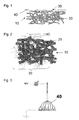
- the filter medium generally designated 10 in FIG. 1 is for use in flow-through devices, such as gas cleaning systems and liquid treatment systems formed as a surface filter 10. It has a material layer 20 made of phenolic resin paper and a fine structure layer 30 applied thereon from suitable for crosslinking Polymer fibers 40, which preferably consist of polyvinyl alcohol and with a Melamine resin are added.
- the layer thickness of the mostly consisting of cellulose Material layer 20 is - depending on the application - between 100 ⁇ m and 2000 ⁇ m, whereby the individual cellulose fibers with diameters between 10 ⁇ m and 20 ⁇ m form numerous gaps of micrometer dimensions.
- the fine structure layer 30 with layer thicknesses of 500 nm and a few micrometers wide more than 10 times thinner than the material layer 20.
- the area filter 10 consists of two superimposed three-dimensional ones Networks of different mesh sizes, namely the material layer 20 as Backing fleece on the one hand and the fine structure layer 30 as a fine structure fleece on the other. Both are permanent due to physical and / or chemical interactions linked together so that a stable layer composite is formed.
- Interspaces between the fibers of the individual layers which can be seen as honeycombs act as particle sieves with a statistically distributed mesh size in the micrometer or Nanometer range. Measurements have shown that, for example, the material layer 20 on average holds back particles larger than or equal to 1 ⁇ m to 95%, while the fine structure layer 30 moreover at least 2.5 times smaller particles when flowing through the Filter medium 10 effectively prevents, which leads to very good separation rates.
- the fibers 40 of the fine structure layer 30 are made by electrostatic spinning directly on paper 20 impregnated with reactive resins such as phenolic resin stored.
- reactive resins such as phenolic resin stored.
- an aqueous solution of polyvinyl alcohol is acidified catalytically and mixed with a melamine formaldehyde resin as a crosslinking agent.
- This solution is then, as shown in FIG. 3, on the material layer 20 homogeneously spun, creating the fine structure layer 30.
- the latter forms on the Material layer 20 a permanently adhering tangle of fibers.
- the filter 10 becomes mechanical in accordance with geometric specifications molded and treated for a few minutes at a temperature between 140 ° C and 180 ° C.
- the fibers 40 of the fine structure layer 30 crosslink with one another.
- Phenolic resin impregnated material layer 20 hardens and the filter medium 10 receives a total extremely high dimensional stability. It shows almost no swelling behavior and is at the same time insoluble in water.
- the application of the fine structure layer 30 significantly improves the initial separation efficiency of the filter 10 operated in the gas stream, the air permeability of the entire filter medium 10 decreasing only slightly. Another advantage is that the separation efficiency of the filter medium 10 does not decrease even in damp environments and after contact with water.
- Air permeability and degrees of separation (PALAS retentions) of the filter medium after thermal treatment and addition of water Material-position Layer of material with fine structure Filter medium after thermal treatment Filter medium after thermal treatment and water treatment Air permeability [I / m 2 s] 185 140 140 140 80% separation with grain size in ⁇ m 0.604 n / A n / A n / A 95% separation with grain size in ⁇ m 2,707 0.34 00:34 0.34 na cannot be analyzed because it is outside the measuring range ( ⁇ 0.294 ⁇ m)
- Tables 1 and 2 show that the degree of separation of the filter 10 does not change or changes only slightly after the curing process at temperatures of 180 ° C.
- the advantageous filter properties are therefore almost completely retained even when used above 180 ° C.
- the filter effect is all the more pronounced the more polymer fibers 40 are deposited as a fine structure layer 30 for retaining the smallest particles on a resin-impregnated backing paper used as the material layer 20. It is also noticeable that the weight and thickness of the carrier paper and thus its volume does not increase measurably due to the fine structure layer 30. This also applies to a very densely applied fine structure layer 30. Consequently, a considerably higher filter performance can be achieved without having to provide the user with a larger and heavier filter medium 10. It is therefore unnecessary to convert or adapt systems to new filter dimensions.
- the filter medium 10 according to the invention has the same mechanical Properties such as the backing paper already used as material layer 20. Fine fiber layer 30 and carrier paper 20 behave together as a single layer of material. This is why even at extreme chemical, thermal or mechanical stress of the individual filter layers 20, 30 no interface phenomena on how stresses due to different degrees of thermal expansion or variable compressibilities. This homogeneous dimensional stability of a filter medium 10 cannot be observed with filters coated with meltblown fibers.
- the filter medium according to the invention can also be used successfully in liquid streams. Air permeability, dust holding capacity and degrees of separation of various papers A, B, C used as liquid filters, partly coated with a fine structure layer; Multipass tests with synthetic oil, fine structure on the upstream side medium Paper A Paper B Paper B + fine structure layer Paper C Paper C + fine structure layer Air permeability [l / m 2 s] 17 50 40 250 75 Dust pick-up [g] 0.4 0.95 0.95 2.0 2.1 ⁇ value (20) [ ⁇ m] 6 12 8th > 16 12
- the ⁇ value indicates the filter performance in a liquid. It is a measure of ability a filter to separate particles down to the specified size from a liquid.
- Table 3 determined ⁇ (20) values.
- the number 20 means that every 20th Particles one (say 5%) pass through the filter, resulting in a degree of separation of Corresponds to 95%.
- the covering with the fine structure layer 30 is essential 95% of smaller particles are prevented from flowing through the filter medium 10.
- uncoated paper B holds particles as small as 12 ⁇ m, coated however up to 8 ⁇ m small particles back. With that comes the latter Separation performance of paper A very close, but can at the same time be opposite preserve this much higher dust holding capacity and air permeability.
- the surface filter 10 is therefore not only waterproof due to impregnation and crosslinking. Rather, the fine structure layer 30 obtained from polar, usually aqueous solution remains completely intact at temperatures up to 180 ° C. and even up to 200 ° C. The entire filter 10 and in particular the fine structure layer 30 maintains its high filter performance even under extreme conditions, which opens up numerous application possibilities which cannot be achieved with conventional filters. For example, it can be used in aqueous, heavily salt-laden media as well as in organic or organometallic solvents, since the fine structure layer 30 is not decomposed. It is equally suitable for the separation of solids from petrochemical liquid products and for the cleaning of corrosive waste water with a high heavy metal content. Even hot, corrosive vapors from acids, bases or aggressive gases cannot affect the filter performance.
- the filter medium 10 is further characterized in that in the area of Fine structure layer 30 does not form a deeply penetrating filter cake.
- the tight mesh this filter layer 30 causes a very large surface area. Particles therefore primarily in the surface area, i.e. in the top network layers of the Fine structure layer 30 already retained. They are reversed using compressed air easy to remove again from the filter medium 10. Training one only Thin filter cake also has the advantage that the filter medium 10 is continuous remains flowable and the flow rate does not increase over time must be overcome to overcome the resistance created by the filter cake.
- the fine structure layer 30 is made by electrostatic spinning of various Polymers made from an electrode.
- the methods shown can also form branched fiber shapes.
- the polymer fibers 40 are arranged according to their size on the Deposit carrier web 20.
- the procedure is to coarser fibers first a diameter of up to 1 ⁇ m can be applied to the increasingly thinner Fibers 40 follow, so that a funnel-shaped filter effect occurs.
- the diameter of the individual fibers is determined by the parameters to be set on the spinning electrode and in particular by the viscosity of the polymer solution to be spun or Polymer melt determined. These parameters are for every mixture of polymer, Crosslinking agent and catalyst specific.
- the fibers 40 produced from the respective polymer crosslink with one another and / or with reactive groups of the material layer 20.
- This crosslinking can be initiated at different times depending on the application.
- the crosslinking agent used is preferably melamine-formaldehyde resins and urea-formaldehyde resins, but also epoxy resins, acrylic resins, wet strength agents and polyester resins or a mixture of the substances mentioned.
- these at least bifunctional crosslinkers are brought together homogeneously with the polymer and a catalyst in the solution or melt to be spun electrostatically. This means crosslinking in situ, that is to say at the time when the electrospun fibers 40 are formed.
- the catalyst can also be brought into contact with the polymer fibers 40 after spinning, for example in the form of a finely divided spray , If the crosslinking rate is not sufficiently high, increasing the temperature to 140 ° C. to 180 ° C. leads to a rapid reaction course.
- the filter medium 10 Due to the high curing temperatures for the filter medium 10 from 140 ° C to It is 180 ° C for electrospun polymers with reactive groups or side chains - For example, with certain polyamides - even possible on one as a crosslinking agent to do without acting crosslinker.
- the presence of a catalyst is sufficient to crosslink between and / or in the individual polymer fibers 40 achieve what they are chemically inert, water-insoluble and temperature resistant makes. These are consequently on the material layer 20 and also among one another to be regarded as permanently self-adhesive fibers.
- Impregnating agent designed to be dimensionally stable and water-repellent.
- synthetic resins such as phenolic plastics, aminoplastics (melamine resins, urea-formaldehyde resins), unsaturated polyester resins, acrylic resins, epoxy resins, alkyd resins, Polyurethane resins, silicone resins, vinyl polymers, and polymeric fatty acids or Mixtures of these.
- Agents such as glue, starch or casein are used.
- Phenolic resins are becoming large Scope used under a wide variety of reaction conditions, cure promptly however only fully at a temperature of 140 ° C to 180 ° C. This poses however, this is not a problem with a filter medium according to the invention.
- the reactive resin used for impregnation must therefore not be dissolved in a solvent be in which the polymer fibers 40 of the fine structure layer 30 also dissolve.
- aqueous phenolic resin solutions are unsuitable if the fine structure layer 30 consists of non-crosslinked polyvinyl alcohol fibers.
- catalyst is to be used for crosslinking the polymer fibers 40 of the fine structure layer 30 or for impregnating and strengthening the other material layers 20 depends on the polymer and / or crosslinker selected. Lewis or Bronsted acids and their bases are mostly used. Diluted citric acid, formic acid or orthoboric acid, for example, is suitable for crosslinking polyvinyl alcohol with melamine resins. A radical bridging of acrylamide polymer chains is advantageously achieved with a few drops of a potassium peroxodisulfate solution. Other compounds with oxidation or radical starter properties, such as AIBN or a dilute KMnO 4 solution, can also be used.
- the crosslinking and solidification of the filter layers 20, 30 treated with synthetic resin is further achieved by high temperature, by UV radiation or by means of electron beam curing.
- the fiber layers serving as carriers are mainly Cellulose fibers and synthetic fibers used in a wide variety of configurations.
- the latter give the filter medium 10 special resistance to petrochemical Products, in particular oils and waste oils.
- the synthetic fibers can for example be woven into the cellulose tissue for its solidification, so that a Pulp-synthetic fiber blended fabric with variable proportions by weight of each Fibers are created.
- cellulose nonwovens can be laminated with synthetic fiber nonwovens become, i.e. a cellulose layer is laminated with a synthetic layer or bonded.
- a cadding is feasible, that is, a punctiform Welding of fiber layers using synthetic fibers.
- the material layer 20 consists of microglass fibers (MGF) or a micro-fiber-pulp combination fabric. Also synthetic fibers are combined with micro glass fibers if necessary. The latter have compared to Pulp dressings have a higher separation or filter performance.
- MMF microglass fibers
- the filter performance can still be achieved once significantly increase and at the same time the otherwise required amount of expensive Reduce microfiber paper significantly.
- an F7 filter that is able to retain 85% of all particles with a diameter of 300 nm, to improve an F9 filter that 98% of all 300 nm particles on Penetration of the multi-fiber layer prevents.
- An embodiment of the invention in which the fine structure layer is particularly interesting 30 is deposited on electret media, i.e. electrostatically charged carriers. These media are characterized by a high filter performance, which is less Minutes after the start of use, however, drops sharply. For example, how shown by the dashed curve in Fig. 4, in the electret medium Technostat® instead of 95% of all particles to be separated only after 14 minutes 63% effectively withheld. The reason for this is the filtered with increasing amount Particle sinking electrostatic deposit of the electret layer. coated such an electret medium with a fine structure layer 30 of crosslinkable Polymer fibers 40, so there is no drop in the high initial filter performance. Rather, this is increased in accordance with the solid line in FIG. 4 and kept constant at this high level.
- An inexpensive and very powerful design of a filter medium 10 uses a large-pore base medium 25 as the material layer 20, as shown in FIG. 5a.
- This large-pore fleece 25 has only a low filter effect, but is able to absorb large amounts of dust particles 70 without the inflow pressure having to be continuously increased during the filtration process in order to ensure a consistently high permeability for a gas or a liquid.
- a fine structure layer 30 made of electrospun crosslinked or crosslinkable polymer fibers 40 is placed on it. The improvements in the values for dust absorption and degree of separation achieved can be seen in Table 4 below.
- the ⁇ (20) value describing the retention in solution in column 4 became determined as already explained in Table 3.
- the degree of separation in column 7 relates however, to the entirety of all detectable particles and not to a PALAS retention, which, as indicated in Tables 1 and 2, the particle size as a function of a separation value in percent.
- Paper A used as a reference holds a very high percentage of all Particles in solution, but also back in the gas flow. So in the liquid 95% of all particles larger than or equal to 6 ⁇ m prevented from passing through, while with gaseous ones 97.6% of all detectable particles do not flow through the filter medium 10 happen. However, this high separation performance is only at the expense of a very low one Air permeability and a low absorption capacity of dust particles 70 to to reach.
- Paper B and paper C take 2.3 times to 5.2 times compared to paper A. more dust particles 70. But they can only do twice in relation to this effectively hold up to 2.7 times larger particles in a liquid. In the gas stream they effectively prevent only 84% of all particles from flowing through the filter.
- FIG. 5b shows the filter medium 10 flowing in from the opposite direction Fig. 5a.
- the dust particles 70 to be filtered meet the fine structure layer directly 30 on. They form an unordered layer of dust (filter cake) on it differently large dust particles 70.
- the latter flow, as can be seen in FIG. 5a, the large-pore base medium 25, so small dust particles 70 (small circles) deeper in it than larger (large circles), which is why the dust holding capacity here is higher.
- a further embodiment of the invention provides that the material layer 20 and / or on the fine structure layer 30 in each case a further material layer 20 as a cover layer is arranged.
- This is, for example, a coating that protects the respective layer layer from destructive effects without the filter performance to affect.
- the same fiber base material for this layer is preferred to use as for the first material layer 20 or the fine structure layer 30.
- different ones can also be used Materials are used that are applied in thin layers become.
- the top layer not only has a protective function, but also takes due to their 20 different chemical nature to the material layer was also a separation function, whereby in addition to the network honeycomb width, that is Pore size of this layer, the interaction of different chemical Side groups of the individual fibers are used with the substance passing through the filter becomes.
- the further material layer 20 can also be used as a support fiber layer or as a spacer be introduced between the first material layer 20 and the fine structure layer 30. This is useful, for example, when large quantities of particles are transported and / or high flow rates occur.
- the support fiber layer also acts as Connection broker.
- a layer of polypropylene fibers and another made of polysulfone fibers can be fixed to each other better adhering if Polyacrylic fibers or even polyamide fibers are inserted between these two fiber layers become.
- Certain carrier media cannot be used directly for mechanical reasons either cover with a fine structure layer 30 of spun polymer fibers 40 and thereby improve their filter performance.
- you can on uneven or Rough surface filter webs 80 cannot be applied directly because they are outstanding Individual fibers tear or at least tear the fiber network of the fine structure layer 30 would make very uneven.
- the fine structure layer 30 is therefore brought on an open-pored connection layer 60, which is very thin and therefore almost without any filter effect.
- the composite 90 thus formed can then - as in Fig. 6a and 6b - connected to the rough or uneven filter web 80, for example, be caded.
- connection layer 60 has two essential tasks in FIG. 6a. She poses as a further material layer 20 a connection to the filter web 80 and is a support fiber layer for the fine structure layer 30. In the construction in FIG. 6b, the layer borders 30 of the composite 90 directly to the surface-rough filter web 80. This Design is advantageous if the fine structure layer 30 before influences from should be largely protected on the outside, damage due to the rough surface However, filter web 80 is not to be expected.
- the invention sees a passivated form of the described Filter medium 10 before.
- the individual layers or the different fibers become This purpose at least partially hydrophobized on its surface, wherein mostly alkylation or silylation (silanization) reagents are used.
- Partially fluorinated or perfluorinated polymer fibers are already characterized by their hydrophobic Surface and no longer need special treatment. However are they are expensive to buy, which is why they are only used when the highest Claims are made on the filter medium 10.
- the filter medium 10 can still be used another embodiment specifically with protective particles and / or signaling molecules.
- fluorescent dyes show through their absorbency on how heavily the filter medium 10 is loaded with particles, which allows conclusions about the Permits filter performance.
- affinity ligand application primarily affinity ligand application. The latter become covalent to the respective one Fiber layer bound and help with biological, biochemical and analytical Questions to separate certain species from the air or liquid to be filtered. So z. B. lecithins suitable on their surface sugar-bearing Hold back particles.
- Streptavidin is another affinity ligand with a biotin grouping provided particles selectively filtered out.
- the filter medium 10 is constructed so that the fine structure layer 30, such as 5, shown on the upstream or downstream side of the material layer 20, wherein on or between these layers further layers of material 20 as cover or support layers are attachable.
- the filter medium 10 is special space-saving applications designed so that the thickness of the material layer 20 that of Fine structure layer 30 corresponds.
- a particle or molecular filter is made of one or several filter media 10 arranged one behind the other.
- the breaking strength of the filter medium 10 depends on its composition, which is why z. B. only an approximate value can be given for the material layer 20, which in is generally greater than 35 N in the longitudinal direction and greater than 25 N in the transverse direction. Furthermore, only an averaged is also for the fiber diameter of the fine structure layer 30 value with an error can be specified because of the electrostatic production of staple fibers in standard operation to a statistical distribution of fibers of different Diameter leads. However, it can be assumed that the diameter of the Fine structure fibers, i.e. the polymer fibers 40 of the fine structure layer 30, not less than 10 nm.
- the invention is not restricted to one of the above-described embodiments, but can be modified in many ways.
- carbon fibers or silica fibers are used in the material layer 20 .
- these must be made Hydrocarbon compounds such as cellulose, methyl cellulose, propyl cellulose, Cyclodextrin or starch or from the corresponding silanols or silicones Pyrolysis in the absence of air can be prepared in advance.
- silica fibers obtained from silicon compounds and even metal fibers become.
- a filter medium 10 consisting of a material layer 20 made of metal fibers and a fine structure layer 30 made of carbon fibers is even at extremely high temperatures Can be used up to 1,500 ° C.
- a novel filter medium 10 which, in addition to microparticles, also effectively retains particles with nanometer dimensions.
- it consists of at least one material layer 20 and at least one fine structure layer 30, with crosslinked cellulose fibers and microglass fibers, but also fibers composed of polymers, being used for the former.
- the diameters of the fibers of the material layer 20 are in the micrometer range and the pores of this layer mostly have cross-sections the size of square micrometers.
- the fine structure layer 30, which is very light with basis weights below 1 g / m 2, has gaps down to the nanometer range and is thermally stable at temperatures above 180 ° C.
- fibers 40 which are obtained from polymers by electrostatic spinning and have diameters in the nanometer range.
- Various resins for example melamine resins, are used to cross-link individual fibers 40 with one another or with the material layer 20 and thereby make them water-insoluble and chemically and thermally stable.
- the filter medium 10 can be supplemented with support and / or cover layers.
Landscapes
- Chemical & Material Sciences (AREA)
- Chemical Kinetics & Catalysis (AREA)
- Filtering Materials (AREA)
- Glass Compositions (AREA)
- Solid-Sorbent Or Filter-Aiding Compositions (AREA)
- Filters For Electric Vacuum Cleaners (AREA)
Abstract
Description
- Fig. 1
- eine schematische Darstellung eines Filtermediums im Querschnitt,
- Fig. 2
- eine Draufsicht auf das Filtermedium aus Fig. 1,
- Fig. 3
- eine schematisch dargestellte Anordnung zum Elektroverspinnen von Polymerfasem,
- Fig. 4
- das Abscheideverhalten einer anderen Ausführungsform eines Filtermediums,
- Fig. 5a
- eine weitere Ausführung eines Filtermediums im Querschnitt,
- Fig. 5b
- das in entgegengesetzter Richtung angeströmte Filtermedium aus Fig. 5a,
- Fig. 6a
- eine noch andere Ausführungsform eines Filtermediums im Querschnitt,
- Fig. 6b
- eine Abwandlung des Filtermediums aus Fig. 6a.
| Luftdurchlässigkeit und Abscheidegrade (PALAS-Retentionen) des Filtermediums nach thermischer Behandlung sowie Versetzen mit Wasser | ||||
| Material-lage | Materiallage mit Feinstruktur lage | Filtermedium nach thermischer Behandlung | Filtermedium nach thermischer Behandlung und Wasserbehandlung | |
| Luftdurchlässigkeit [I/m2s] | 185 | 140 | 140 | 140 |
| 80 % Abscheidung bei Korngröße in µm | 0,604 | n.a. | n.a. | n.a. |
| 95 % Abscheidung bei Korngröße in µm | 2,707 | 0,34 | 0.34 | 0,34 |
| n.a. = nicht analysierbar, weil außerhalb des Meßbereichs (<0,294 µm) |
| Flächengewicht, Dicke, Luftdurchlässigkeit sowie Abscheidegrade (PALAS®-Fraktionsabscheidegrade) und Temperaturbeständigkeit des Filtermediums als Funktion der Menge an Feinstrukturlage, Feinstrukturlage auf der Abströmseite | ||||
| ohne Feinstrukturlage | mit wenig Feinstrukturlage | mit mehr Feinstrukturlage | mit viel Feinstrukturlage | |
| Flächengewicht [g/m2] ISO 536 | 120 | 120 | 120 | 120 |
| Dicke [mm] ISO 534 | 0,76 | 0,76 | 0,76 | 0,76 |
| Luftdurchlässigkeit [I/m2s] DIN 531887 (A=20 cm2) | 238 | 221 | 180 | 166 |
| 80 % Abscheidung aller Partikel bei einer Korngröße von µm DIN 44956/2 | 0,523 | n.a. | n.a. | n.a. |
| 95 % Abscheidung aller Partikel bei einer Korngröße von µm DIN 44956/2 | 1,075 | 0,604 | 0,523 | n.a. |
| Temperaturbeständigkeit [°C] | >180 | >180 | >180 | |
| n.a. = nicht analysierbar, weil außerhalb des Meßbereichs (< 0,294 µm) |
| Luftdurchlässigkeit, Staubaufnahmekapazität und Abscheidegrade verschiedener als Flüssigkeitsfilter verwendeter, teilweise mit Feinstrukturlage beschichteter Papiere A, B, C; Multipass-Tests mit synthetischem Öl, Feinstrukturlage auf der Anströmseite | |||||
| Medium | Papier A | Papier B | Papier B + Feinstrukturlage | Papier C | Papier C + Feinstrukturlage |
| Luftdurchlässigkeit [l/m2s] | 17 | 50 | 40 | 250 | 75 |
| Staubaufnahme [g] | 0,4 | 0,95 | 0,95 | 2,0 | 2,1 |
| β-Wert (20) [µm] | 6 | 12 | 8 | >16 | 12 |
Das gesamte Filter 10 und besonders die Feinstrukturlage 30 behält selbst unter Extrembedingungen seine hohe Filterleistung, was zahlreiche Anwendungsmöglichkeiten eröffnet, die mit herkömmlichen Filtern nicht zu realisieren sind. So kann es beispielsweise in wässrigen, stark salzbeladenen Medien genauso eingesetzt werden wie in organischen oder metallorganischen Lösemitteln, da die Feinstrukturlage 30 nicht zersetzt wird. Es eignet sich gleichermaßen für die Abtrennung von Feststoffen aus petrochemischen Flüssigerzeugnissen wie für die Reinigung korrosiver Abwässer mit hohem Schwermetallgehalt. Auch heiße, ätzend wirkende Dämpfe von Säuren, Basen oder aggressiven Gasen können die Filterleistung nicht beeinträchtigen.
| Steigerung der Staubaufnahme und des Abscheidegrades durch Beschichtung großporiger Basismedien mit einer Feinstrukturlage aus elektroversponnenen Polymerfasern. Bestimmung des Filtrationsverhaltens in Lösung (Multipass-Test mit synthetischem Öl, Feinstrukturlage auf der Anströmseite) und im Gasstrom (gravimetrisch bestimmter Abscheidegrad, Teststaub: SAE-fine, Feinstrukturlage auf der Abströmseite) | ||||||
| Flüssigfiltration | Luftfiltration | |||||
| Medium | Luftdurchlässigkeit [I/m2s] | Staubaufnahme [g] | β-Wert (20) [µm] | Luftdurchlässigkeit [I/m2s] | Staubaufnahme [g] | Abscheidegrad [%] |
| Papier A | 17 | 0,4 | 6 | 230 | 1,8 | 97,6 |
| Papier B | 50 | 0,95 | 12 | |||
| Papier B mit Feinstrukturlage | 40 | 0,95 | 8 | |||
| Papier C | 250 | 2,0 | > 16 | 1400 | 4,7 | 84 |
| Papier C mit Feinstrukturlage | 75 | 2,1 | 12 | 900 | 4,5 | 98,6 |
- A
- Anströmrichtung
- HV
- Hochspannung
- 10
- Filtermedium
- 20
- Materiallage
- 25
- großporiges Basismedium
- 30
- Feinstrukturlage, Feinstrukturschicht
- 40
- Polymerfasern
- 60
- offenporige Verbindungslage
- 70
- Staubteilchen (verschieden groß)
- 80
- rauhe Filterbahn
- 90
- Komposit aus 60 und 30
Claims (23)
- Filtermedium zur Verwendung in durchströmbaren Vorrichtungen, mit wenigstens einer Materiallage (20) und mit wenigstens einer auf der Materiallage (20) permanenthaftend aufgebrachten Feinstrukturlage (30) bestehend aus elektrostatisch versponnenen Polymerfasern (40) mit einem durchschnittlichen Faserdurchmesser kleiner und/oder gleich 1 µm, dadurch gekennzeichnet, daß die Polymerfasem (40) unter Einwirkung eines Katalysators direkt oder über ein Vernetzungsmittel (cross-linker) miteinander vernetzt sind, wobei das Vernetzungsmittel und/oder die vernetzten Polymerfasern (40) bis 200 °C, temperaturstabil sind.
- Filtermedium nach Anspruch 1, dadurch gekennzeichnet, daß die unvernetzten Polymerfasem (40) bis 200°C temperaturstabil sind.
- Filtermedium nach Anspruch 1 oder 2, dadurch gekennzeichnet, daß die Polymerfasem (40) auf wenigstens einer der Materiallagen (20) permanent selbsthaftend sind.
- Filtermedium nach einem der Ansprüche 1 bis 3, dadurch gekennzeichnet, daß die Polymerfasern (40) aus in polaren Lösemitteln löslichen Polymeren, insbesondere aus Polyvinylalkohol, Polycarbonsäuren, Polyacrylamid, Polyamid, Polyvinylamin, Polyvinylformamid oder daraus gebildeten Copolymeren bestehen.
- Filtermedium nach einem der Ansprüche 1 bis 4, dadurch gekennzeichnet, daß die Polymerfasern (40) innerhalb der Feinstrukturlage (30) unterschiedliche Durchmesser aufweisen.
- Filtermedium nach einem der Ansprüche 1 bis 5, dadurch gekennzeichnet, daß die Feinstrukturlage (30) eine Vorzugsrichtung hat, entlang der die Polymerfasem (40) nach der Größe ihres Durchmessers geordnet angeordnet sind.
- Filtermedium nach einem der Ansprüche 1 bis 6, dadurch gekennzeichnet, daß das Vernetzungsmittel zur Verbindung der Polymerfasern (40) untereinander und/oder mit zumindest einer Materiallage (20) eine wenigstens bifunktionelle chemische Verbindung ist, vorzugsweise ein Phenolharz, ein Melaminformaldehydharz, ein Harnstoff-Formaldehyd-Harz ein Epoxidharz, ein Acrylharz, ein Naßfestmittel oder eine Mischung der genannten Substanzen.
- Filtermedium nach einem der Ansprüche 1 bis 7, dadurch gekennzeichnet, daß der Katalysator eine Lewis- oder Brönsted-Säure, eine Lewis- oder Brönsted-Base oder eine Verbindung mit Oxidations- oder Radikalstarter-Eigenschaften ist.
- Filtermedium nach einem der Ansprüche 1 bis 8, dadurch gekennzeichnet, daß der Katalysator Wärme, Ultraschall, elektromagnetische Strahlung, vorzugsweise IR- oder UV-Licht oder ein Elektronenstrahl ist.
- Filtermedium nach einem der Ansprüche 1 bis 9, dadurch gekennzeichnet, daß wenigstens eine weitere Materiallage (20) vorgesehen ist, die eine Deckschicht, eine Stützfaserlage oder eine weitere Filterschicht ist oder bildet, wobei die Feinstrukturlage (30) an wenigstens eine dieser Schichten an und/oder abströmseitig angrenzt.
- Filtermedium nach einem der Ansprüche 1 bis 10, dadurch gekennzeichnet, daß das makroskopisch meßbare Volumen der Materiallage (20) nach dem Aufbringen der Polymerfasern (40) der Feinstrukturlage (30) unverändert ist.
- Filtermedium nach einem der Ansprüche 1 bis 11, dadurch gekennzeichnet, daß wenigstens eine Materiallage (20) aus organischen und/oder anorganischen Fasern oder einer Komposit-Verbindung daraus besteht, insbesondere aus Zellstoff, synthetischen Fasern oder Mikroglasfasern.
- Filtermedium nach einem der Ansprüche 1 bis 12, dadurch gekennzeichnet, daß wenigstens eine Materiallage (20) imprägniert und verfestigt oder verfestigbar ist, beispielsweise mit einem Phenolharz.
- Filtermedium nach einem der Ansprüche 1 bis 13, dadurch gekennzeichnet, daß wenigstens eine Materiallage (20) ein großporiges Basismedium (25) mit geringer Filterwirkung oder eine offenporige Verbindungslage (60) ohne Filtereigenschaften ist.
- Filtermedium nach einem der Ansprüche 1 bis 14, dadurch gekennzeichnet, daß wenigstens eine Materiallage (20) ein Elektret-Medium ist.
- Filtermedium nach einem der Ansprüche 1 bis 15, dadurch gekennzeichnet, daß wenigstens eine Materiallage (20) oberflächenhydrophob ist, beispielsweise durch Alkylierung oder Silylierung (Silanisierung).
- Filtermedium nach einem der Ansprüche 1 bis 16, dadurch gekennzeichnet, daß wenigstens eine Materiallage (20) ein oder mehrere Flammschutzmittel und/oder Fluoreszenzfarbstoffe enthält.
- Filtermedium nach einem der Ansprüche 1 bis 17, dadurch gekennzeichnet, daß wenigstens eine Materiallage (20) mit Affinitätsliganden versehen ist.
- Partikelfilter oder Molekülfilter mit wenigstens einem Filtermedium (10) nach Anspruch 1.
- Verfahren zur Herstellung eines Filtermediums (10) zur Verwendung in durchströmbaren Vorrichtungen, bei welchem wenigstens ein Polymer in geschmolzenem Zustand oder in einem polaren oder unpolaren Lösemittel gelöst mittels einer Düse in einem elektrischen Feld zu Polymerfasern (40) versponnen wird, welche auf einer Materiallage (20) in Form einer Feinstrukturlage (30) abgelegt werden, wobei die Polymerfasern (40) einen durchschnittlichen Faserdurchmesser kleiner und/oder gleich 1 µm aufweisen und wobei zwischen den Polymerfasem (40) Zwischenräume ausgebildet sind, dadurch gekennzeichnet,a) daß der Polymer-Schmelze bzw. der Polymer-Lösung ein Vernetzungsmittel zugesetzt wird undb) daß die auf der Materiallage (20) abgelegten Polymerfasern (40) untereinander und/oder mit dem Vernetzungsmittel unter Vermittlung eines Katalysators vernetzen und/oder vernetzt werden.
- Verfahren nach Anspruch 20, dadurch gekennzeichnet, daß die Polymerfasem (40) der Feinstrukturlage (30) durch Elektrospinning aus polarer, vorzugsweise wässriger Lösung hergestellt werden.
- Verfahren nach Anspruch 20 oder 21, dadurch gekennzeichnet, daß ein Schichtstapel aus wenigstens einer Materiallage (20), sowie wenigstens einer Feinstrukturlage (30) mit basischen oder sauren Katalysatoren oder mit elektromagnetischen- bzw. Elektronenstrahlen in Kontakt gebracht wird.
- Verfahren nach einem der Ansprüche 20 bis 22, dadurch gekennzeichnet,a) daß die Polymerfasern (40) auf einer nicht imprägnierten Materiallage (20) abgelegt werden,b) daß das so entstandene nicht imprägnierte Filtermedium (10) als Ganzes mit einem Imprägnierungsmittel behandeltc) und danach als Ganzes ausgehärtet wird.
Priority Applications (9)
| Application Number | Priority Date | Filing Date | Title |
|---|---|---|---|
| EP02011827A EP1366791B1 (de) | 2002-05-28 | 2002-05-28 | Filtermedium |
| AT02011827T ATE390197T1 (de) | 2002-05-28 | 2002-05-28 | Filtermedium |
| DE50211962T DE50211962D1 (de) | 2002-05-28 | 2002-05-28 | Filtermedium |
| CA002487164A CA2487164A1 (en) | 2002-05-28 | 2003-05-28 | Filter medium |
| US10/515,423 US20050235619A1 (en) | 2002-05-28 | 2003-05-28 | Filter medium |
| AU2003273167A AU2003273167A1 (en) | 2002-05-28 | 2003-05-28 | Filter medium |
| PCT/EP2003/005626 WO2003099415A1 (de) | 2002-05-28 | 2003-05-28 | Filtermedium |
| BR0305023-8A BR0305023A (pt) | 2002-05-28 | 2003-05-28 | Meio de filtragem |
| JP2004506935A JP2005527358A (ja) | 2002-05-28 | 2003-05-28 | フィルター材 |
Applications Claiming Priority (1)
| Application Number | Priority Date | Filing Date | Title |
|---|---|---|---|
| EP02011827A EP1366791B1 (de) | 2002-05-28 | 2002-05-28 | Filtermedium |
Publications (2)
| Publication Number | Publication Date |
|---|---|
| EP1366791A1 true EP1366791A1 (de) | 2003-12-03 |
| EP1366791B1 EP1366791B1 (de) | 2008-03-26 |
Family
ID=29414704
Family Applications (1)
| Application Number | Title | Priority Date | Filing Date |
|---|---|---|---|
| EP02011827A Expired - Lifetime EP1366791B1 (de) | 2002-05-28 | 2002-05-28 | Filtermedium |
Country Status (9)
| Country | Link |
|---|---|
| US (1) | US20050235619A1 (de) |
| EP (1) | EP1366791B1 (de) |
| JP (1) | JP2005527358A (de) |
| AT (1) | ATE390197T1 (de) |
| AU (1) | AU2003273167A1 (de) |
| BR (1) | BR0305023A (de) |
| CA (1) | CA2487164A1 (de) |
| DE (1) | DE50211962D1 (de) |
| WO (1) | WO2003099415A1 (de) |
Cited By (23)
| Publication number | Priority date | Publication date | Assignee | Title |
|---|---|---|---|---|
| WO2006071980A1 (en) * | 2004-12-28 | 2006-07-06 | E.I. Dupont De Nemours And Company | Filtration media for filtering particulate material from gas streams |
| DE202005014687U1 (de) * | 2005-09-16 | 2007-02-01 | Mann + Hummel Gmbh | Filterelement für Flüssigkeiten |
| DE102005037313A1 (de) * | 2005-08-04 | 2007-02-15 | Carl Freudenberg Kg | Filterelement und Anordnung |
| WO2008036051A1 (en) * | 2006-09-18 | 2008-03-27 | National University Of Singapore | Fiber structures and process for their preparation |
| EP1629890A4 (de) * | 2003-04-11 | 2009-06-17 | Teijin Ltd | Katalysatortragende faserstruktur und herstellungsverfahren dafür |
| DE102009051105A1 (de) | 2008-10-31 | 2010-05-12 | Mann+Hummel Gmbh | Vliesmedium, Verfahren zu dessen Herstellung und aus diesem hergestelltes Filterelement |
| DE102008063824A1 (de) * | 2008-12-19 | 2010-06-24 | Philipps-Universität Marburg | Mittel zur Separation von Mikroorgansimen auf Basis elektrogesponnener Fasern |
| WO2011034782A1 (en) * | 2009-09-16 | 2011-03-24 | E. I. Du Pont De Nemours And Company | Air filtration medium with improved dust loading capacity and improved resistance to high humidity environment |
| WO2013068436A1 (de) * | 2011-11-10 | 2013-05-16 | Mahle International Gmbh | Filtermaterial |
| DE102012004610A1 (de) * | 2012-03-02 | 2013-09-05 | Knorr-Bremse Systeme für Nutzfahrzeuge GmbH | Luftfiltervorrichtung, Luftfilter und Luftaufbereitungsanlage |
| US8709138B2 (en) | 2008-10-31 | 2014-04-29 | Carl Freudenberg Kg | Filter medium for particulate filtration |
| DE102012215877A1 (de) * | 2012-09-07 | 2014-05-28 | Mahle International Gmbh | Filterelement |
| US9090995B2 (en) | 2007-04-03 | 2015-07-28 | Nisshinbo Holdings, Inc. | Process of making an antibacterial nanofiber |
| CN105126454A (zh) * | 2006-11-27 | 2015-12-09 | 纳幕尔杜邦公司 | 耐用纳米纤维网稀松布层压材料 |
| DE102005037545B4 (de) * | 2004-08-11 | 2015-12-17 | Cummins Filtration Ip, Inc. | Säure neutralisierendes Filtermaterial und Verfahren zur Herstellung eines solchen Filtermaterials |
| CN105392544A (zh) * | 2013-08-02 | 2016-03-09 | 康明斯过滤Ip公司 | 梯度纳米纤维过滤介质 |
| US9624605B2 (en) | 2013-08-29 | 2017-04-18 | Mahle International Gmbh | Filter material, filter element, and method and device for producing a filter material |
| EP2544791B1 (de) * | 2010-03-12 | 2017-11-01 | Mann + Hummel GmbH | Filtermedium eines filterelements und ein filterelement |
| WO2018108889A1 (de) * | 2016-12-15 | 2018-06-21 | Mann+Hummel Gmbh | Filtermedium, verfahren zu dessen herstellung und verwendung des filtermediums in einem filterelement |
| EP3185983B1 (de) * | 2014-08-26 | 2018-07-25 | Mahle International GmbH | Endabscheider, verwendung und herstellungsverfahren |
| CN111249805A (zh) * | 2020-02-28 | 2020-06-09 | 厦门理工学院 | 一种驻极纳米纤维过滤材料及其制备方法 |
| US20230175179A1 (en) * | 2021-12-07 | 2023-06-08 | Taiwan Textile Research Institute | Breathable water resistant film |
| CN118949717A (zh) * | 2024-10-17 | 2024-11-15 | 西南石油大学 | 一种纳米纤维空气过滤膜及其制备方法和应用 |
Families Citing this family (66)
| Publication number | Priority date | Publication date | Assignee | Title |
|---|---|---|---|---|
| US6743273B2 (en) | 2000-09-05 | 2004-06-01 | Donaldson Company, Inc. | Polymer, polymer microfiber, polymer nanofiber and applications including filter structures |
| US20050063868A1 (en) * | 2003-09-23 | 2005-03-24 | Visteon Global Technologies, Inc. | Method of measuring surfactant penetration in an air filter assembly |
| JP4614669B2 (ja) * | 2004-02-03 | 2011-01-19 | 日本バイリーン株式会社 | 濾過材及びフィルタ |
| US7717975B2 (en) * | 2005-02-16 | 2010-05-18 | Donaldson Company, Inc. | Reduced solidity web comprising fiber and fiber spacer or separation means |
| US20060230727A1 (en) * | 2005-04-19 | 2006-10-19 | Morgan Howard W | Filtration element having a variable density sidewall |
| KR20060110230A (ko) * | 2005-04-19 | 2006-10-24 | 윌리엄 모건 하워드 | 가변성의 밀도 측벽을 가진 필터소자 및 그 제조방법 |
| JP4776986B2 (ja) * | 2005-06-10 | 2011-09-21 | 日本バイリーン株式会社 | 滅菌濾過材及び滅菌フィルタ |
| JP2007083467A (ja) * | 2005-09-21 | 2007-04-05 | Japan Vilene Co Ltd | 複合シート |
| ITRE20050140A1 (it) * | 2005-12-13 | 2007-06-14 | Ufi Filters Spa | Metodo per la realizzazione di un setto filtrante comprendente uno strato di nanofibre associato a un substrato avente proprieta' filtranti |
| JP4745815B2 (ja) * | 2005-12-20 | 2011-08-10 | 帝人テクノプロダクツ株式会社 | 内燃機関空気取り入れ用フィルター材 |
| US20070163218A1 (en) * | 2005-12-22 | 2007-07-19 | Lydall, Inc. | Composite dual layer HEPA filter |
| JP4979407B2 (ja) * | 2006-02-20 | 2012-07-18 | 日本バイリーン株式会社 | 多層シート及びその製造方法 |
| DE102006014236A1 (de) | 2006-03-28 | 2007-10-04 | Irema-Filter Gmbh | Plissierbares Vliesmaterial und Verfahren und Vorrichtung zur Herstellung derselben |
| JP2008000682A (ja) * | 2006-06-22 | 2008-01-10 | Toyobo Co Ltd | フィルタおよびその製造方法 |
| US20080060328A1 (en) * | 2006-09-12 | 2008-03-13 | Bha Group, Inc. | Filter and filter media |
| US20080105626A1 (en) * | 2006-11-02 | 2008-05-08 | David Charles Jones | Fuel filter |
| US20080145655A1 (en) * | 2006-12-14 | 2008-06-19 | Ppg Industries Ohio, Inc. | Electrospinning Process |
| US8088323B2 (en) * | 2007-02-27 | 2012-01-03 | Ppg Industries Ohio, Inc. | Process of electrospinning organic-inorganic fibers |
| US8308834B2 (en) * | 2007-03-05 | 2012-11-13 | Bha Group, Inc. | Composite filter media |
| US7927540B2 (en) * | 2007-03-05 | 2011-04-19 | Bha Group, Inc. | Method of manufacturing a composite filter media |
| EP2119500B1 (de) * | 2007-03-14 | 2016-11-30 | Nissan Motor Co., Ltd. | Fiber structure |
| US8986432B2 (en) | 2007-11-09 | 2015-03-24 | Hollingsworth & Vose Company | Meltblown filter medium, related applications and uses |
| CN101868290A (zh) * | 2007-11-20 | 2010-10-20 | 克拉考公司 | 过滤介质、100纳米以下的精细纤维和方法 |
| US8673040B2 (en) | 2008-06-13 | 2014-03-18 | Donaldson Company, Inc. | Filter construction for use with air in-take for gas turbine and methods |
| US8512432B2 (en) * | 2008-08-01 | 2013-08-20 | David Charles Jones | Composite filter media |
| SG10201605780QA (en) | 2009-03-19 | 2016-09-29 | Emd Millipore Corp | Removal of microorganisms from fluid samples using nanofiber filtration media |
| US8950587B2 (en) * | 2009-04-03 | 2015-02-10 | Hollingsworth & Vose Company | Filter media suitable for hydraulic applications |
| US8951420B2 (en) * | 2009-04-03 | 2015-02-10 | Hollingsworth & Vose Company | Filter media suitable for hydraulic applications |
| EP2292309A1 (de) * | 2009-08-07 | 2011-03-09 | Ahlstrom Corporation | Nanofasern mit verbesserter chemischer und physikalischer Stabilität und netzhaltige Nanofasern |
| US8679218B2 (en) | 2010-04-27 | 2014-03-25 | Hollingsworth & Vose Company | Filter media with a multi-layer structure |
| ES2774949T3 (es) | 2010-08-10 | 2020-07-23 | Emd Millipore Corp | Método para la eliminación de retrovirus |
| DE102010052155A1 (de) * | 2010-11-22 | 2012-05-24 | Irema-Filter Gmbh | Luftfiltermedium mit zwei Wirkmechanismen |
| US8679231B2 (en) | 2011-01-19 | 2014-03-25 | Advanced Technology Materials, Inc. | PVDF pyrolyzate adsorbent and gas storage and dispensing system utilizing same |
| CN105413480B (zh) | 2011-04-01 | 2019-03-29 | Emd密理博公司 | 含有纳米纤维的复合材料结构 |
| US9435056B2 (en) | 2011-09-21 | 2016-09-06 | Donaldson Company, Inc. | Fibers made from soluble polymers |
| WO2013043987A1 (en) * | 2011-09-21 | 2013-03-28 | Donaldson Company, Inc. | Fine fibers made from polymer crosslinked with resinous aldehyde composition |
| FR2984176B1 (fr) * | 2011-12-19 | 2014-02-28 | Anios Lab Sarl | Dispositif de filtration d'un flux d'air a activite anti-bacterienne et/ou anti-virale et/ou anti-fongique et procede de preparation d'un tel dispositif |
| CN103175723B (zh) * | 2011-12-22 | 2015-11-18 | 上海纳米技术及应用国家工程研究中心有限公司 | 激光共聚焦扫描显微镜高分子纤维可视化的制备方法 |
| US9771904B2 (en) * | 2012-04-25 | 2017-09-26 | Fibrway Materials Science & Technology Development Co., Ltd. | Self-cleaning air filtering material and preparation method therefor |
| KR102139254B1 (ko) | 2013-03-09 | 2020-07-29 | 도널드선 컴파니 인코포레이티드 | 반응성 첨가제로부터 제조된 미세 섬유 |
| DE102013008402B4 (de) | 2013-05-16 | 2025-07-17 | Irema-Filter Gmbh | Faservlies und Verfahren zur Herstellung desselben |
| CN103276467B (zh) * | 2013-05-21 | 2015-08-05 | 苏州大学 | 具有荧光响应的多孔吸油纤维制备方法 |
| US9694306B2 (en) | 2013-05-24 | 2017-07-04 | Hollingsworth & Vose Company | Filter media including polymer compositions and blends |
| EP2821119B1 (de) | 2013-07-02 | 2016-06-29 | Ahlstrom Corporation | Filtermedium |
| EP3029190A4 (de) * | 2013-08-01 | 2016-08-17 | Finetex Ene Inc | Mehrschichtige nanofaserfilter mit verbesserter wärmebeständigkeit sowie verfahren zur herstellung davon |
| KR101416614B1 (ko) | 2013-08-01 | 2014-07-08 | (주)에프티이앤이 | 내열성이 향상된 폴리이미드 나노섬유 필터 및 이의 제조방법 |
| US20150090658A1 (en) * | 2013-09-30 | 2015-04-02 | Kimberly-Clark Worldwide, Inc. | Fiber having a Nanohair Surface Topography |
| KR101527500B1 (ko) * | 2013-10-07 | 2015-06-10 | (주)에프티이앤이 | 나일론 나노섬유와 이성분 기재를 포함하는 필터 및 이의 제조방법 |
| WO2015053444A1 (ko) * | 2013-10-07 | 2015-04-16 | (주)에프티이앤이 | 기재 사이에 나노섬유를 포함하는 필터 및 이의 제조방법 |
| JP6568545B2 (ja) | 2014-06-26 | 2019-08-28 | イー・エム・デイー・ミリポア・コーポレイシヨン | 増強された汚れ保持容量を有するフィルタ構造 |
| DE102014009707A1 (de) | 2014-07-02 | 2016-01-07 | Mann+Hummel Gmbh | Filtermedium, Filterelement mit einem Filtermedium, Filtersystem und Verfahren zur Herstellung eines Filtermediums |
| DE102014112798A1 (de) * | 2014-09-05 | 2016-03-10 | Christian-Albrechts-Universität Zu Kiel | Selbstreinigendes Dead-End Filtersystem mit Mikrosieb |
| US20160067641A1 (en) * | 2014-09-08 | 2016-03-10 | Hollingsworth & Vose Company | Hot oil durable media |
| JP6579784B2 (ja) * | 2015-04-13 | 2019-09-25 | キヤノン株式会社 | ナノファイバシート及びその製造方法 |
| EP3283202B1 (de) | 2015-04-17 | 2025-10-01 | EMD Millipore Corporation | Verfahren zur reinigung eines biologischen materials von interesse in einer probe mittels nanofaserultrafiltrationsmembrane in querstromfiltrationsmodus |
| DE102015010843A1 (de) * | 2015-08-19 | 2017-02-23 | Mann + Hummel Gmbh | Verfahren zur Herstellung eines Filtermediums und ein Filtermedium |
| JP2017071873A (ja) * | 2015-10-07 | 2017-04-13 | キヤノン株式会社 | ポリマーナノファイバ集積体及びその製造方法 |
| DE102016212056A1 (de) * | 2016-07-01 | 2018-01-04 | Mahle International Gmbh | Filtermedium und Verfahren zur Herstellung eines solchen Filtermediums |
| US10543441B2 (en) | 2016-12-15 | 2020-01-28 | Hollingsworth & Vose Company | Filter media including adhesives and/or oleophobic properties |
| US10898838B2 (en) | 2016-12-15 | 2021-01-26 | Hollingsworth & Vose Company | Filter media including adhesives |
| EP3655142B1 (de) | 2017-07-21 | 2026-02-25 | Merck Millipore Ltd | Vliesfasermembranen |
| MX2020013310A (es) | 2018-06-08 | 2021-05-27 | Ascend Performance Mat Operations Llc | Productos no tejidos de nanofibras afinables. |
| CN108950875B (zh) * | 2018-07-27 | 2020-03-10 | 中原工学院 | 一种环氧改性高邻位热固性酚醛基中空纳米梯度活性炭纤维膜的制备方法 |
| CN112776436A (zh) * | 2019-11-06 | 2021-05-11 | 北京中科艾加科技有限公司 | 一种复合型聚合物功能化纤维、其制备方法与其制备所用的压力喷涂设备 |
| WO2021224115A1 (de) | 2020-05-08 | 2021-11-11 | Basf Se | Filter auf basis eines vliesverbundes |
| CN116876130A (zh) * | 2023-06-28 | 2023-10-13 | 东华大学 | 一种抗菌功能静电纺纳米纤维跨尺度交联镶嵌纺纱线的制备方法 |
Citations (4)
| Publication number | Priority date | Publication date | Assignee | Title |
|---|---|---|---|---|
| EP0316195A2 (de) * | 1987-11-12 | 1989-05-17 | Asahi Kasei Kogyo Kabushiki Kaisha | Vliesstoff aus Polyallylensulfid |
| DE29907699U1 (de) * | 1999-04-30 | 1999-08-05 | FiberMark Gessner GmbH & Co., 83052 Bruckmühl | Staubfilterbeutel, enthaltend Nanofaservlies |
| US6165572A (en) * | 1995-11-17 | 2000-12-26 | Donaldson Company, Inc. | Filter material construction and method |
| WO2002020134A2 (en) * | 2000-09-05 | 2002-03-14 | Donaldson Company, Inc. | Methods for filtering air for a gas turbine system |
Family Cites Families (5)
| Publication number | Priority date | Publication date | Assignee | Title |
|---|---|---|---|---|
| US4650506A (en) * | 1986-02-25 | 1987-03-17 | Donaldson Company, Inc. | Multi-layered microfiltration medium |
| DE3940264A1 (de) * | 1989-12-06 | 1991-06-13 | Hoechst Ag | Zwei- oder mehrschichtiges vliesstoffmaterial, insbesondere mit langzeitfiltereigenschaften, sowie verfahren zu seiner herstellung |
| US5350443B2 (en) * | 1993-04-19 | 1999-08-10 | Von Hasso Bluecher | Filter sheet material for passenger cabins in motor vehicles |
| JP2002508811A (ja) * | 1997-05-30 | 2002-03-19 | ザ ダウ ケミカル カンパニー | 長鎖の枝分かれを有するシンジオタクチックビニル芳香族ポリマーから製造される繊維 |
| US6743273B2 (en) * | 2000-09-05 | 2004-06-01 | Donaldson Company, Inc. | Polymer, polymer microfiber, polymer nanofiber and applications including filter structures |
-
2002
- 2002-05-28 AT AT02011827T patent/ATE390197T1/de not_active IP Right Cessation
- 2002-05-28 EP EP02011827A patent/EP1366791B1/de not_active Expired - Lifetime
- 2002-05-28 DE DE50211962T patent/DE50211962D1/de not_active Expired - Lifetime
-
2003
- 2003-05-28 CA CA002487164A patent/CA2487164A1/en not_active Abandoned
- 2003-05-28 AU AU2003273167A patent/AU2003273167A1/en not_active Abandoned
- 2003-05-28 BR BR0305023-8A patent/BR0305023A/pt not_active Application Discontinuation
- 2003-05-28 WO PCT/EP2003/005626 patent/WO2003099415A1/de not_active Ceased
- 2003-05-28 US US10/515,423 patent/US20050235619A1/en not_active Abandoned
- 2003-05-28 JP JP2004506935A patent/JP2005527358A/ja active Pending
Patent Citations (4)
| Publication number | Priority date | Publication date | Assignee | Title |
|---|---|---|---|---|
| EP0316195A2 (de) * | 1987-11-12 | 1989-05-17 | Asahi Kasei Kogyo Kabushiki Kaisha | Vliesstoff aus Polyallylensulfid |
| US6165572A (en) * | 1995-11-17 | 2000-12-26 | Donaldson Company, Inc. | Filter material construction and method |
| DE29907699U1 (de) * | 1999-04-30 | 1999-08-05 | FiberMark Gessner GmbH & Co., 83052 Bruckmühl | Staubfilterbeutel, enthaltend Nanofaservlies |
| WO2002020134A2 (en) * | 2000-09-05 | 2002-03-14 | Donaldson Company, Inc. | Methods for filtering air for a gas turbine system |
Cited By (38)
| Publication number | Priority date | Publication date | Assignee | Title |
|---|---|---|---|---|
| EP1629890A4 (de) * | 2003-04-11 | 2009-06-17 | Teijin Ltd | Katalysatortragende faserstruktur und herstellungsverfahren dafür |
| DE102005037545B4 (de) * | 2004-08-11 | 2015-12-17 | Cummins Filtration Ip, Inc. | Säure neutralisierendes Filtermaterial und Verfahren zur Herstellung eines solchen Filtermaterials |
| WO2006071980A1 (en) * | 2004-12-28 | 2006-07-06 | E.I. Dupont De Nemours And Company | Filtration media for filtering particulate material from gas streams |
| KR101315000B1 (ko) * | 2004-12-28 | 2013-10-04 | 이 아이 듀폰 디 네모아 앤드 캄파니 | 기체 스트림으로부터 미립자 물질을 여과하기 위한 여과매질 |
| WO2007014602A3 (de) * | 2005-08-04 | 2007-04-12 | Freudenberg Carl Kg | Filterelement und anordnung |
| DE102005037313A1 (de) * | 2005-08-04 | 2007-02-15 | Carl Freudenberg Kg | Filterelement und Anordnung |
| EP1764144A1 (de) * | 2005-09-16 | 2007-03-21 | Mann+Hummel Gmbh | Filterelement für Flüssigkeiten |
| DE202005014687U1 (de) * | 2005-09-16 | 2007-02-01 | Mann + Hummel Gmbh | Filterelement für Flüssigkeiten |
| WO2008036051A1 (en) * | 2006-09-18 | 2008-03-27 | National University Of Singapore | Fiber structures and process for their preparation |
| CN105126454A (zh) * | 2006-11-27 | 2015-12-09 | 纳幕尔杜邦公司 | 耐用纳米纤维网稀松布层压材料 |
| US9090995B2 (en) | 2007-04-03 | 2015-07-28 | Nisshinbo Holdings, Inc. | Process of making an antibacterial nanofiber |
| DE102009051105A1 (de) | 2008-10-31 | 2010-05-12 | Mann+Hummel Gmbh | Vliesmedium, Verfahren zu dessen Herstellung und aus diesem hergestelltes Filterelement |
| US8709138B2 (en) | 2008-10-31 | 2014-04-29 | Carl Freudenberg Kg | Filter medium for particulate filtration |
| US8414821B2 (en) | 2008-10-31 | 2013-04-09 | Mann + Hummel Gmbh | Fleece medium, it's manufacturing method and a filter element made of it |
| DE102008063824A1 (de) * | 2008-12-19 | 2010-06-24 | Philipps-Universität Marburg | Mittel zur Separation von Mikroorgansimen auf Basis elektrogesponnener Fasern |
| WO2011034782A1 (en) * | 2009-09-16 | 2011-03-24 | E. I. Du Pont De Nemours And Company | Air filtration medium with improved dust loading capacity and improved resistance to high humidity environment |
| US8636833B2 (en) | 2009-09-16 | 2014-01-28 | E I Du Pont De Nemours And Company | Air filtration medium with improved dust loading capacity and improved resistance to high humidity environment |
| EP2544791B1 (de) * | 2010-03-12 | 2017-11-01 | Mann + Hummel GmbH | Filtermedium eines filterelements und ein filterelement |
| WO2013068436A1 (de) * | 2011-11-10 | 2013-05-16 | Mahle International Gmbh | Filtermaterial |
| CN103917283B (zh) * | 2011-11-10 | 2015-12-09 | 马勒国际有限公司 | 过滤材料 |
| US9592465B2 (en) | 2011-11-10 | 2017-03-14 | Mahle International Gmbh | Filter material |
| CN103917283A (zh) * | 2011-11-10 | 2014-07-09 | 马勒国际有限公司 | 过滤材料 |
| DE102012004610A1 (de) * | 2012-03-02 | 2013-09-05 | Knorr-Bremse Systeme für Nutzfahrzeuge GmbH | Luftfiltervorrichtung, Luftfilter und Luftaufbereitungsanlage |
| DE102012215877A1 (de) * | 2012-09-07 | 2014-05-28 | Mahle International Gmbh | Filterelement |
| US9440172B2 (en) | 2012-09-07 | 2016-09-13 | Mahle International Gmbh | Filter element |
| DE102012215877B4 (de) | 2012-09-07 | 2022-01-13 | Mahle International Gmbh | Filterelement |
| CN105392544A (zh) * | 2013-08-02 | 2016-03-09 | 康明斯过滤Ip公司 | 梯度纳米纤维过滤介质 |
| EP3038732B1 (de) * | 2013-08-29 | 2018-02-28 | Mahle International GmbH | Filtermaterial, filterelement und verfahren zum herstellen eines filtermaterials |
| US9624605B2 (en) | 2013-08-29 | 2017-04-18 | Mahle International Gmbh | Filter material, filter element, and method and device for producing a filter material |
| EP3185983B1 (de) * | 2014-08-26 | 2018-07-25 | Mahle International GmbH | Endabscheider, verwendung und herstellungsverfahren |
| WO2018108889A1 (de) * | 2016-12-15 | 2018-06-21 | Mann+Hummel Gmbh | Filtermedium, verfahren zu dessen herstellung und verwendung des filtermediums in einem filterelement |
| CN110049807A (zh) * | 2016-12-15 | 2019-07-23 | 曼·胡默尔有限公司 | 过滤介质、其制备方法和所述过滤介质在过滤元件中的用途 |
| US11266935B2 (en) * | 2016-12-15 | 2022-03-08 | Mann+Hummel Gmbh | Filter medium, method for producing same, and use of the filter medium in a filter element |
| CN110049807B (zh) * | 2016-12-15 | 2022-10-21 | 曼·胡默尔有限公司 | 过滤介质、其制备方法和所述过滤介质在过滤元件中的用途 |
| CN111249805A (zh) * | 2020-02-28 | 2020-06-09 | 厦门理工学院 | 一种驻极纳米纤维过滤材料及其制备方法 |
| US20230175179A1 (en) * | 2021-12-07 | 2023-06-08 | Taiwan Textile Research Institute | Breathable water resistant film |
| US12012682B2 (en) * | 2021-12-07 | 2024-06-18 | Taiwan Textile Research Institute | Breathable water resistant film |
| CN118949717A (zh) * | 2024-10-17 | 2024-11-15 | 西南石油大学 | 一种纳米纤维空气过滤膜及其制备方法和应用 |
Also Published As
| Publication number | Publication date |
|---|---|
| JP2005527358A (ja) | 2005-09-15 |
| BR0305023A (pt) | 2005-01-25 |
| EP1366791B1 (de) | 2008-03-26 |
| US20050235619A1 (en) | 2005-10-27 |
| WO2003099415A1 (de) | 2003-12-04 |
| AU2003273167A1 (en) | 2003-12-12 |
| ATE390197T1 (de) | 2008-04-15 |
| DE50211962D1 (de) | 2008-05-08 |
| CA2487164A1 (en) | 2003-12-04 |
Similar Documents
| Publication | Publication Date | Title |
|---|---|---|
| EP1366791B1 (de) | Filtermedium | |
| DE60111554T2 (de) | Filterstruktur mit zwei oder mehreren feinen faserschichten mit verlängerter nutzungsdauer | |
| DE2422426C2 (de) | Filter aus einem negativ geladenen Filtermaterial und Verfahren zu seiner Herstellung | |
| DE69913180T2 (de) | Extraktionseinheiten und verfahren | |
| EP3064262B1 (de) | Filtermedium, verfahren zur herstellung eines filtermediums und filterelement mit einem filtermedium | |
| EP2911765B1 (de) | Filtermaterial mit erhöhter standzeit und dieses filtermaterial enthaltendes filterelement | |
| DE112014003579B4 (de) | Ein Verbundmaterial-Filtermedium und ein Verfahren zur Herstellung desselben | |
| DE102012010307B4 (de) | Mehrlagiges Filtermaterial zur Flüssigkeitsfiltration sowie daraus hergestelltes Filterelement | |
| DE112010000801T5 (de) | Fasermedien und Verfahren und Vorrichtung zur Bildung Derselben | |
| DE102004036440A1 (de) | Hochleistungsfiltermaterial mit integrierter Nanofaserstruktur und Verfahren zu dessen Herstellung | |
| EP1923117A2 (de) | Filtermaterial und verfahren zu dessen herstellung, filter und filtrierverfahren | |
| DE112010001912T5 (de) | Mehrlagiger Filter aus Nanofasern | |
| WO1995017946A1 (de) | Mehrschichtiges filtermaterial | |
| DE102009051105A1 (de) | Vliesmedium, Verfahren zu dessen Herstellung und aus diesem hergestelltes Filterelement | |
| DE3637428C3 (de) | Filter und Verwendung desselben | |
| DE102011086104A1 (de) | Filtermaterial | |
| DE4418033A1 (de) | Filterelement mit Faserbeschichtung und Verfahren zu seiner Herstellung | |
| EP3478390A1 (de) | Filtermedium, beschichtunglösung zum erzeugen eines beschichtung eines solchen filtermediums und verfahren zur herstellung eines solchen filtermediums | |
| EP3423169B1 (de) | Filtereinsatz und kraftstofffilter | |
| DE69008214T2 (de) | Filtereinrichtung. | |
| DE102013014688A1 (de) | Filterelement und Verfahren zum Herstellen desselben | |
| WO2024094567A1 (de) | Filtereinsatz und fahrzeug-klimaanlagenfilter mit einem derartigen filtereinsatz | |
| DE102015122746B4 (de) | Filtermaterial und daraus hergestelltes Filterelement | |
| KR20050024298A (ko) | 필터 매개체 | |
| DE102008010862A1 (de) | Filtersystem, insbesondere für ein Kraftfahrzeug-Belüftungssystem |
Legal Events
| Date | Code | Title | Description |
|---|---|---|---|
| PUAI | Public reference made under article 153(3) epc to a published international application that has entered the european phase |
Free format text: ORIGINAL CODE: 0009012 |
|
| AK | Designated contracting states |
Kind code of ref document: A1 Designated state(s): AT BE CH CY DE DK ES FI FR GB GR IE IT LI LU MC NL PT SE TR |
|
| AX | Request for extension of the european patent |
Extension state: AL LT LV MK RO SI |
|
| 17P | Request for examination filed |
Effective date: 20031121 |
|
| 17Q | First examination report despatched |
Effective date: 20040330 |
|
| AKX | Designation fees paid |
Designated state(s): AT BE CH CY DE DK ES FI FR GB GR IE IT LI LU MC NL PT SE TR |
|
| RAP1 | Party data changed (applicant data changed or rights of an application transferred) |
Owner name: HOLLINGSWORTH & VOSE GMBH |
|
| 17Q | First examination report despatched |
Effective date: 20040330 |
|
| GRAP | Despatch of communication of intention to grant a patent |
Free format text: ORIGINAL CODE: EPIDOSNIGR1 |
|
| GRAS | Grant fee paid |
Free format text: ORIGINAL CODE: EPIDOSNIGR3 |
|
| GRAA | (expected) grant |
Free format text: ORIGINAL CODE: 0009210 |
|
| AK | Designated contracting states |
Kind code of ref document: B1 Designated state(s): AT BE CH CY DE DK ES FI FR GB GR IE IT LI LU MC NL PT SE TR |
|
| REG | Reference to a national code |
Ref country code: GB Ref legal event code: FG4D Free format text: NOT ENGLISH |
|
| REG | Reference to a national code |
Ref country code: IE Ref legal event code: FG4D Free format text: LANGUAGE OF EP DOCUMENT: GERMAN Ref country code: CH Ref legal event code: EP |
|
| REF | Corresponds to: |
Ref document number: 50211962 Country of ref document: DE Date of ref document: 20080508 Kind code of ref document: P |
|
| PG25 | Lapsed in a contracting state [announced via postgrant information from national office to epo] |
Ref country code: FI Free format text: LAPSE BECAUSE OF FAILURE TO SUBMIT A TRANSLATION OF THE DESCRIPTION OR TO PAY THE FEE WITHIN THE PRESCRIBED TIME-LIMIT Effective date: 20080326 |
|
| NLV1 | Nl: lapsed or annulled due to failure to fulfill the requirements of art. 29p and 29m of the patents act | ||
| REG | Reference to a national code |
Ref country code: IE Ref legal event code: FD4D |
|
| PG25 | Lapsed in a contracting state [announced via postgrant information from national office to epo] |
Ref country code: PT Free format text: LAPSE BECAUSE OF FAILURE TO SUBMIT A TRANSLATION OF THE DESCRIPTION OR TO PAY THE FEE WITHIN THE PRESCRIBED TIME-LIMIT Effective date: 20080901 Ref country code: ES Free format text: LAPSE BECAUSE OF FAILURE TO SUBMIT A TRANSLATION OF THE DESCRIPTION OR TO PAY THE FEE WITHIN THE PRESCRIBED TIME-LIMIT Effective date: 20080707 Ref country code: SE Free format text: LAPSE BECAUSE OF FAILURE TO SUBMIT A TRANSLATION OF THE DESCRIPTION OR TO PAY THE FEE WITHIN THE PRESCRIBED TIME-LIMIT Effective date: 20080626 |
|
| PG25 | Lapsed in a contracting state [announced via postgrant information from national office to epo] |
Ref country code: NL Free format text: LAPSE BECAUSE OF FAILURE TO SUBMIT A TRANSLATION OF THE DESCRIPTION OR TO PAY THE FEE WITHIN THE PRESCRIBED TIME-LIMIT Effective date: 20080326 |
|
| BERE | Be: lapsed |
Owner name: HOLLINGSWORTH & VOSE G.M.B.H. Effective date: 20080531 |
|
| PG25 | Lapsed in a contracting state [announced via postgrant information from national office to epo] |
Ref country code: MC Free format text: LAPSE BECAUSE OF NON-PAYMENT OF DUE FEES Effective date: 20080531 |
|
| REG | Reference to a national code |
Ref country code: CH Ref legal event code: PL |
|
| EN | Fr: translation not filed | ||
| PG25 | Lapsed in a contracting state [announced via postgrant information from national office to epo] |
Ref country code: CH Free format text: LAPSE BECAUSE OF NON-PAYMENT OF DUE FEES Effective date: 20080531 Ref country code: IE Free format text: LAPSE BECAUSE OF FAILURE TO SUBMIT A TRANSLATION OF THE DESCRIPTION OR TO PAY THE FEE WITHIN THE PRESCRIBED TIME-LIMIT Effective date: 20080326 Ref country code: DK Free format text: LAPSE BECAUSE OF FAILURE TO SUBMIT A TRANSLATION OF THE DESCRIPTION OR TO PAY THE FEE WITHIN THE PRESCRIBED TIME-LIMIT Effective date: 20080326 Ref country code: LI Free format text: LAPSE BECAUSE OF NON-PAYMENT OF DUE FEES Effective date: 20080531 |
|
| PLBE | No opposition filed within time limit |
Free format text: ORIGINAL CODE: 0009261 |
|
| STAA | Information on the status of an ep patent application or granted ep patent |
Free format text: STATUS: NO OPPOSITION FILED WITHIN TIME LIMIT |
|
| 26N | No opposition filed |
Effective date: 20081230 |
|
| PG25 | Lapsed in a contracting state [announced via postgrant information from national office to epo] |
Ref country code: BE Free format text: LAPSE BECAUSE OF NON-PAYMENT OF DUE FEES Effective date: 20080531 |
|
| PG25 | Lapsed in a contracting state [announced via postgrant information from national office to epo] |
Ref country code: FR Free format text: LAPSE BECAUSE OF FAILURE TO SUBMIT A TRANSLATION OF THE DESCRIPTION OR TO PAY THE FEE WITHIN THE PRESCRIBED TIME-LIMIT Effective date: 20090116 |
|
| PG25 | Lapsed in a contracting state [announced via postgrant information from national office to epo] |
Ref country code: AT Free format text: LAPSE BECAUSE OF NON-PAYMENT OF DUE FEES Effective date: 20080528 Ref country code: IT Free format text: LAPSE BECAUSE OF FAILURE TO SUBMIT A TRANSLATION OF THE DESCRIPTION OR TO PAY THE FEE WITHIN THE PRESCRIBED TIME-LIMIT Effective date: 20080326 |
|
| PG25 | Lapsed in a contracting state [announced via postgrant information from national office to epo] |
Ref country code: CY Free format text: LAPSE BECAUSE OF FAILURE TO SUBMIT A TRANSLATION OF THE DESCRIPTION OR TO PAY THE FEE WITHIN THE PRESCRIBED TIME-LIMIT Effective date: 20080326 |
|
| PG25 | Lapsed in a contracting state [announced via postgrant information from national office to epo] |
Ref country code: LU Free format text: LAPSE BECAUSE OF NON-PAYMENT OF DUE FEES Effective date: 20080528 |
|
| PG25 | Lapsed in a contracting state [announced via postgrant information from national office to epo] |
Ref country code: TR Free format text: LAPSE BECAUSE OF FAILURE TO SUBMIT A TRANSLATION OF THE DESCRIPTION OR TO PAY THE FEE WITHIN THE PRESCRIBED TIME-LIMIT Effective date: 20080326 |
|
| PG25 | Lapsed in a contracting state [announced via postgrant information from national office to epo] |
Ref country code: GR Free format text: LAPSE BECAUSE OF FAILURE TO SUBMIT A TRANSLATION OF THE DESCRIPTION OR TO PAY THE FEE WITHIN THE PRESCRIBED TIME-LIMIT Effective date: 20080627 |
|
| REG | Reference to a national code |
Ref country code: DE Ref legal event code: R082 Ref document number: 50211962 Country of ref document: DE Representative=s name: PATENTANWAELTE OLBRICHT, BUCHHOLD, KEULERTZ PA, DE |
|
| PGFP | Annual fee paid to national office [announced via postgrant information from national office to epo] |
Ref country code: DE Payment date: 20130522 Year of fee payment: 12 Ref country code: GB Payment date: 20130521 Year of fee payment: 12 |
|
| REG | Reference to a national code |
Ref country code: DE Ref legal event code: R119 Ref document number: 50211962 Country of ref document: DE |
|
| GBPC | Gb: european patent ceased through non-payment of renewal fee |
Effective date: 20140528 |
|
| REG | Reference to a national code |
Ref country code: DE Ref legal event code: R119 Ref document number: 50211962 Country of ref document: DE Effective date: 20141202 |
|
| PG25 | Lapsed in a contracting state [announced via postgrant information from national office to epo] |
Ref country code: DE Free format text: LAPSE BECAUSE OF NON-PAYMENT OF DUE FEES Effective date: 20141202 |
|
| PG25 | Lapsed in a contracting state [announced via postgrant information from national office to epo] |
Ref country code: GB Free format text: LAPSE BECAUSE OF NON-PAYMENT OF DUE FEES Effective date: 20140528 |