EP1373379B1 - Verfahren zur herstellung einer membran aus verbrücktem polymer und brennstoffzelle - Google Patents
Verfahren zur herstellung einer membran aus verbrücktem polymer und brennstoffzelle Download PDFInfo
- Publication number
- EP1373379B1 EP1373379B1 EP02732451A EP02732451A EP1373379B1 EP 1373379 B1 EP1373379 B1 EP 1373379B1 EP 02732451 A EP02732451 A EP 02732451A EP 02732451 A EP02732451 A EP 02732451A EP 1373379 B1 EP1373379 B1 EP 1373379B1
- Authority
- EP
- European Patent Office
- Prior art keywords
- membrane
- bridging
- polymer
- basic
- group
- Prior art date
- Legal status (The legal status is an assumption and is not a legal conclusion. Google has not performed a legal analysis and makes no representation as to the accuracy of the status listed.)
- Expired - Lifetime
Links
- 229920000642 polymer Polymers 0.000 title claims abstract description 70
- 239000012528 membrane Substances 0.000 title claims abstract description 55
- 239000000446 fuel Substances 0.000 title claims abstract description 19
- 238000004519 manufacturing process Methods 0.000 title abstract description 3
- 238000000034 method Methods 0.000 claims abstract description 12
- 239000002253 acid Substances 0.000 claims description 34
- 239000003153 chemical reaction reagent Substances 0.000 claims description 29
- NBIIXXVUZAFLBC-UHFFFAOYSA-N Phosphoric acid Chemical compound OP(O)(O)=O NBIIXXVUZAFLBC-UHFFFAOYSA-N 0.000 claims description 24
- 125000004432 carbon atom Chemical group C* 0.000 claims description 21
- 229920002480 polybenzimidazole Polymers 0.000 claims description 19
- 239000002904 solvent Substances 0.000 claims description 17
- KWYUFKZDYYNOTN-UHFFFAOYSA-M Potassium hydroxide Chemical compound [OH-].[K+] KWYUFKZDYYNOTN-UHFFFAOYSA-M 0.000 claims description 12
- 239000004693 Polybenzimidazole Substances 0.000 claims description 11
- 125000003277 amino group Chemical group 0.000 claims description 11
- 229910000147 aluminium phosphate Inorganic materials 0.000 claims description 10
- 239000003054 catalyst Substances 0.000 claims description 9
- 238000006243 chemical reaction Methods 0.000 claims description 8
- 238000001035 drying Methods 0.000 claims description 8
- 238000010438 heat treatment Methods 0.000 claims description 8
- 150000001875 compounds Chemical class 0.000 claims description 7
- -1 polyimidazole Polymers 0.000 claims description 7
- HEMHJVSKTPXQMS-UHFFFAOYSA-M Sodium hydroxide Chemical compound [OH-].[Na+] HEMHJVSKTPXQMS-UHFFFAOYSA-M 0.000 claims description 6
- QAOWNCQODCNURD-UHFFFAOYSA-N Sulfuric acid Chemical compound OS(O)(=O)=O QAOWNCQODCNURD-UHFFFAOYSA-N 0.000 claims description 6
- 125000002947 alkylene group Chemical group 0.000 claims description 6
- IQPQWNKOIGAROB-UHFFFAOYSA-N isocyanate group Chemical group [N-]=C=O IQPQWNKOIGAROB-UHFFFAOYSA-N 0.000 claims description 5
- DGUJJOYLOCXENZ-UHFFFAOYSA-N 4-[2-[4-(oxiran-2-ylmethoxy)phenyl]propan-2-yl]phenol Chemical group C=1C=C(OCC2OC2)C=CC=1C(C)(C)C1=CC=C(O)C=C1 DGUJJOYLOCXENZ-UHFFFAOYSA-N 0.000 claims description 4
- WMFOQBRAJBCJND-UHFFFAOYSA-M Lithium hydroxide Chemical compound [Li+].[OH-] WMFOQBRAJBCJND-UHFFFAOYSA-M 0.000 claims description 4
- MZRVEZGGRBJDDB-UHFFFAOYSA-N N-Butyllithium Chemical compound [Li]CCCC MZRVEZGGRBJDDB-UHFFFAOYSA-N 0.000 claims description 4
- HUCVOHYBFXVBRW-UHFFFAOYSA-M caesium hydroxide Chemical compound [OH-].[Cs+] HUCVOHYBFXVBRW-UHFFFAOYSA-M 0.000 claims description 4
- 238000005266 casting Methods 0.000 claims description 4
- 150000002118 epoxides Chemical group 0.000 claims description 4
- 125000001183 hydrocarbyl group Chemical group 0.000 claims description 4
- 230000000737 periodic effect Effects 0.000 claims description 4
- CPRMKOQKXYSDML-UHFFFAOYSA-M rubidium hydroxide Chemical compound [OH-].[Rb+] CPRMKOQKXYSDML-UHFFFAOYSA-M 0.000 claims description 4
- 229920002006 poly(N-vinylimidazole) polymer Polymers 0.000 claims description 3
- 150000004678 hydrides Chemical class 0.000 claims description 2
- 150000004679 hydroxides Chemical class 0.000 claims description 2
- DVSDBMFJEQPWNO-UHFFFAOYSA-N methyllithium Chemical compound C[Li] DVSDBMFJEQPWNO-UHFFFAOYSA-N 0.000 claims description 2
- 125000006551 perfluoro alkylene group Chemical group 0.000 claims description 2
- 238000006552 photochemical reaction Methods 0.000 claims description 2
- 125000001424 substituent group Chemical group 0.000 claims description 2
- SHKUUQIDMUMQQK-UHFFFAOYSA-N 2-[4-(oxiran-2-ylmethoxy)butoxymethyl]oxirane Chemical compound C1OC1COCCCCOCC1CO1 SHKUUQIDMUMQQK-UHFFFAOYSA-N 0.000 claims 1
- 229940126062 Compound A Drugs 0.000 claims 1
- NLDMNSXOCDLTTB-UHFFFAOYSA-N Heterophylliin A Natural products O1C2COC(=O)C3=CC(O)=C(O)C(O)=C3C3=C(O)C(O)=C(O)C=C3C(=O)OC2C(OC(=O)C=2C=C(O)C(O)=C(O)C=2)C(O)C1OC(=O)C1=CC(O)=C(O)C(O)=C1 NLDMNSXOCDLTTB-UHFFFAOYSA-N 0.000 claims 1
- RQPZNWPYLFFXCP-UHFFFAOYSA-L barium dihydroxide Chemical compound [OH-].[OH-].[Ba+2] RQPZNWPYLFFXCP-UHFFFAOYSA-L 0.000 claims 1
- AXCZMVOFGPJBDE-UHFFFAOYSA-L calcium dihydroxide Chemical compound [OH-].[OH-].[Ca+2] AXCZMVOFGPJBDE-UHFFFAOYSA-L 0.000 claims 1
- 239000000920 calcium hydroxide Substances 0.000 claims 1
- 229910001861 calcium hydroxide Inorganic materials 0.000 claims 1
- 230000000694 effects Effects 0.000 claims 1
- SIAPCJWMELPYOE-UHFFFAOYSA-N lithium hydride Chemical compound [LiH] SIAPCJWMELPYOE-UHFFFAOYSA-N 0.000 claims 1
- VTHJTEIRLNZDEV-UHFFFAOYSA-L magnesium dihydroxide Chemical compound [OH-].[OH-].[Mg+2] VTHJTEIRLNZDEV-UHFFFAOYSA-L 0.000 claims 1
- 239000000347 magnesium hydroxide Substances 0.000 claims 1
- 229910001862 magnesium hydroxide Inorganic materials 0.000 claims 1
- 150000002900 organolithium compounds Chemical class 0.000 claims 1
- 230000008961 swelling Effects 0.000 abstract description 3
- 239000000243 solution Substances 0.000 description 25
- 239000003792 electrolyte Substances 0.000 description 14
- 239000005518 polymer electrolyte Substances 0.000 description 12
- 235000011007 phosphoric acid Nutrition 0.000 description 11
- 125000003118 aryl group Chemical group 0.000 description 10
- 125000004433 nitrogen atom Chemical group N* 0.000 description 10
- 125000000217 alkyl group Chemical group 0.000 description 9
- 125000005647 linker group Chemical group 0.000 description 8
- 239000007788 liquid Substances 0.000 description 8
- 125000000542 sulfonic acid group Chemical group 0.000 description 8
- 238000005470 impregnation Methods 0.000 description 7
- 150000007513 acids Chemical class 0.000 description 5
- 239000003795 chemical substances by application Substances 0.000 description 5
- 125000003700 epoxy group Chemical group 0.000 description 5
- 229910052731 fluorine Inorganic materials 0.000 description 5
- 125000001153 fluoro group Chemical group F* 0.000 description 5
- 239000007789 gas Substances 0.000 description 5
- 125000004435 hydrogen atom Chemical group [H]* 0.000 description 5
- 229920005597 polymer membrane Polymers 0.000 description 5
- 125000003545 alkoxy group Chemical group 0.000 description 4
- 238000007654 immersion Methods 0.000 description 4
- 239000000758 substrate Substances 0.000 description 4
- ZMXDDKWLCZADIW-UHFFFAOYSA-N N,N-Dimethylformamide Chemical compound CN(C)C=O ZMXDDKWLCZADIW-UHFFFAOYSA-N 0.000 description 3
- 230000015572 biosynthetic process Effects 0.000 description 3
- 238000009792 diffusion process Methods 0.000 description 3
- 125000000524 functional group Chemical group 0.000 description 3
- 125000001072 heteroaryl group Chemical group 0.000 description 3
- 229910052757 nitrogen Inorganic materials 0.000 description 3
- 150000002894 organic compounds Chemical class 0.000 description 3
- 125000004430 oxygen atom Chemical group O* 0.000 description 3
- 238000002360 preparation method Methods 0.000 description 3
- XKRFYHLGVUSROY-UHFFFAOYSA-N Argon Chemical compound [Ar] XKRFYHLGVUSROY-UHFFFAOYSA-N 0.000 description 2
- IAZDPXIOMUYVGZ-UHFFFAOYSA-N Dimethylsulphoxide Chemical compound CS(C)=O IAZDPXIOMUYVGZ-UHFFFAOYSA-N 0.000 description 2
- MYMOFIZGZYHOMD-UHFFFAOYSA-N Dioxygen Chemical compound O=O MYMOFIZGZYHOMD-UHFFFAOYSA-N 0.000 description 2
- 239000004593 Epoxy Substances 0.000 description 2
- UFHFLCQGNIYNRP-UHFFFAOYSA-N Hydrogen Chemical compound [H][H] UFHFLCQGNIYNRP-UHFFFAOYSA-N 0.000 description 2
- SECXISVLQFMRJM-UHFFFAOYSA-N N-Methylpyrrolidone Chemical compound CN1CCCC1=O SECXISVLQFMRJM-UHFFFAOYSA-N 0.000 description 2
- DTQVDTLACAAQTR-UHFFFAOYSA-N Trifluoroacetic acid Chemical compound OC(=O)C(F)(F)F DTQVDTLACAAQTR-UHFFFAOYSA-N 0.000 description 2
- 230000002378 acidificating effect Effects 0.000 description 2
- 125000000732 arylene group Chemical group 0.000 description 2
- 229910001882 dioxygen Inorganic materials 0.000 description 2
- 229910052739 hydrogen Inorganic materials 0.000 description 2
- 125000002883 imidazolyl group Chemical group 0.000 description 2
- 238000005259 measurement Methods 0.000 description 2
- 125000000449 nitro group Chemical group [O-][N+](*)=O 0.000 description 2
- 239000003960 organic solvent Substances 0.000 description 2
- 125000001997 phenyl group Chemical group [H]C1=C([H])C([H])=C(*)C([H])=C1[H] 0.000 description 2
- 125000000843 phenylene group Chemical group C1(=C(C=CC=C1)*)* 0.000 description 2
- 229920000139 polyethylene terephthalate Polymers 0.000 description 2
- 239000005020 polyethylene terephthalate Substances 0.000 description 2
- 239000002243 precursor Substances 0.000 description 2
- 239000000126 substance Substances 0.000 description 2
- 239000000725 suspension Substances 0.000 description 2
- XLYOFNOQVPJJNP-UHFFFAOYSA-N water Substances O XLYOFNOQVPJJNP-UHFFFAOYSA-N 0.000 description 2
- YBYIRNPNPLQARY-UHFFFAOYSA-N 1H-indene Natural products C1=CC=C2CC=CC2=C1 YBYIRNPNPLQARY-UHFFFAOYSA-N 0.000 description 1
- YSWBFLWKAIRHEI-UHFFFAOYSA-N Cc1c(C)nc[nH]1 Chemical compound Cc1c(C)nc[nH]1 YSWBFLWKAIRHEI-UHFFFAOYSA-N 0.000 description 1
- OISVCGZHLKNMSJ-UHFFFAOYSA-N Cc1cccc(C)n1 Chemical compound Cc1cccc(C)n1 OISVCGZHLKNMSJ-UHFFFAOYSA-N 0.000 description 1
- UEZVMMHDMIWARA-UHFFFAOYSA-N Metaphosphoric acid Chemical compound OP(=O)=O UEZVMMHDMIWARA-UHFFFAOYSA-N 0.000 description 1
- FXHOOIRPVKKKFG-UHFFFAOYSA-N N,N-Dimethylacetamide Chemical compound CN(C)C(C)=O FXHOOIRPVKKKFG-UHFFFAOYSA-N 0.000 description 1
- ABLZXFCXXLZCGV-UHFFFAOYSA-N Phosphorous acid Chemical compound OP(O)=O ABLZXFCXXLZCGV-UHFFFAOYSA-N 0.000 description 1
- XUIMIQQOPSSXEZ-UHFFFAOYSA-N Silicon Chemical compound [Si] XUIMIQQOPSSXEZ-UHFFFAOYSA-N 0.000 description 1
- 150000001408 amides Chemical class 0.000 description 1
- 150000001413 amino acids Chemical class 0.000 description 1
- 150000001450 anions Chemical class 0.000 description 1
- 238000013459 approach Methods 0.000 description 1
- 229910052786 argon Inorganic materials 0.000 description 1
- 239000012298 atmosphere Substances 0.000 description 1
- 239000002322 conducting polymer Substances 0.000 description 1
- 229920001940 conductive polymer Polymers 0.000 description 1
- 238000009749 continuous casting Methods 0.000 description 1
- 229920001577 copolymer Polymers 0.000 description 1
- 230000007423 decrease Effects 0.000 description 1
- XPPKVPWEQAFLFU-UHFFFAOYSA-N diphosphoric acid Chemical compound OP(O)(=O)OP(O)(O)=O XPPKVPWEQAFLFU-UHFFFAOYSA-N 0.000 description 1
- 238000007606 doctor blade method Methods 0.000 description 1
- UQSQSQZYBQSBJZ-UHFFFAOYSA-N fluorosulfonic acid Chemical compound OS(F)(=O)=O UQSQSQZYBQSBJZ-UHFFFAOYSA-N 0.000 description 1
- 229910052736 halogen Inorganic materials 0.000 description 1
- 150000002367 halogens Chemical class 0.000 description 1
- 239000001257 hydrogen Substances 0.000 description 1
- GPRLSGONYQIRFK-UHFFFAOYSA-N hydron Chemical compound [H+] GPRLSGONYQIRFK-UHFFFAOYSA-N 0.000 description 1
- 125000003454 indenyl group Chemical group C1(C=CC2=CC=CC=C12)* 0.000 description 1
- 239000012948 isocyanate Substances 0.000 description 1
- 239000000463 material Substances 0.000 description 1
- 239000011159 matrix material Substances 0.000 description 1
- 229910052751 metal Inorganic materials 0.000 description 1
- 239000002184 metal Substances 0.000 description 1
- 239000000203 mixture Substances 0.000 description 1
- 125000001624 naphthyl group Chemical group 0.000 description 1
- 125000001190 organyl group Chemical group 0.000 description 1
- 239000007800 oxidant agent Substances 0.000 description 1
- 230000003647 oxidation Effects 0.000 description 1
- 238000007254 oxidation reaction Methods 0.000 description 1
- 239000002245 particle Substances 0.000 description 1
- 239000003495 polar organic solvent Substances 0.000 description 1
- 229920006254 polymer film Polymers 0.000 description 1
- 229920000137 polyphosphoric acid Polymers 0.000 description 1
- 239000011148 porous material Substances 0.000 description 1
- 125000002924 primary amino group Chemical group [H]N([H])* 0.000 description 1
- 229940005657 pyrophosphoric acid Drugs 0.000 description 1
- 239000012495 reaction gas Substances 0.000 description 1
- 230000009257 reactivity Effects 0.000 description 1
- 238000012552 review Methods 0.000 description 1
- 125000000467 secondary amino group Chemical group [H]N([*:1])[*:2] 0.000 description 1
- 239000004065 semiconductor Substances 0.000 description 1
- 238000004904 shortening Methods 0.000 description 1
- 229910052710 silicon Inorganic materials 0.000 description 1
- 239000010703 silicon Substances 0.000 description 1
- 239000002002 slurry Substances 0.000 description 1
- 239000007787 solid Substances 0.000 description 1
- 229910001220 stainless steel Inorganic materials 0.000 description 1
- 239000010935 stainless steel Substances 0.000 description 1
- 238000006277 sulfonation reaction Methods 0.000 description 1
- 150000008053 sultones Chemical class 0.000 description 1
- 229920001059 synthetic polymer Polymers 0.000 description 1
- 238000009864 tensile test Methods 0.000 description 1
- BFKJFAAPBSQJPD-UHFFFAOYSA-N tetrafluoroethene Chemical group FC(F)=C(F)F BFKJFAAPBSQJPD-UHFFFAOYSA-N 0.000 description 1
- TXEYQDLBPFQVAA-UHFFFAOYSA-N tetrafluoromethane Chemical group FC(F)(F)F TXEYQDLBPFQVAA-UHFFFAOYSA-N 0.000 description 1
- UNXRWKVEANCORM-UHFFFAOYSA-N triphosphoric acid Chemical compound OP(O)(=O)OP(O)(=O)OP(O)(O)=O UNXRWKVEANCORM-UHFFFAOYSA-N 0.000 description 1
- 229940048102 triphosphoric acid Drugs 0.000 description 1
Classifications
-
- C—CHEMISTRY; METALLURGY
- C08—ORGANIC MACROMOLECULAR COMPOUNDS; THEIR PREPARATION OR CHEMICAL WORKING-UP; COMPOSITIONS BASED THEREON
- C08J—WORKING-UP; GENERAL PROCESSES OF COMPOUNDING; AFTER-TREATMENT NOT COVERED BY SUBCLASSES C08B, C08C, C08F, C08G or C08H
- C08J5/00—Manufacture of articles or shaped materials containing macromolecular substances
- C08J5/20—Manufacture of shaped structures of ion-exchange resins
- C08J5/22—Films, membranes or diaphragms
- C08J5/2206—Films, membranes or diaphragms based on organic and/or inorganic macromolecular compounds
- C08J5/2218—Synthetic macromolecular compounds
- C08J5/2256—Synthetic macromolecular compounds based on macromolecular compounds obtained by reactions other than those involving carbon-to-carbon bonds, e.g. obtained by polycondensation
-
- C—CHEMISTRY; METALLURGY
- C08—ORGANIC MACROMOLECULAR COMPOUNDS; THEIR PREPARATION OR CHEMICAL WORKING-UP; COMPOSITIONS BASED THEREON
- C08J—WORKING-UP; GENERAL PROCESSES OF COMPOUNDING; AFTER-TREATMENT NOT COVERED BY SUBCLASSES C08B, C08C, C08F, C08G or C08H
- C08J5/00—Manufacture of articles or shaped materials containing macromolecular substances
- C08J5/20—Manufacture of shaped structures of ion-exchange resins
- C08J5/22—Films, membranes or diaphragms
-
- H—ELECTRICITY
- H01—ELECTRIC ELEMENTS
- H01M—PROCESSES OR MEANS, e.g. BATTERIES, FOR THE DIRECT CONVERSION OF CHEMICAL ENERGY INTO ELECTRICAL ENERGY
- H01M8/00—Fuel cells; Manufacture thereof
- H01M8/10—Fuel cells with solid electrolytes
- H01M8/12—Fuel cells with solid electrolytes operating at high temperature, e.g. with stabilised ZrO2 electrolyte
- H01M8/124—Fuel cells with solid electrolytes operating at high temperature, e.g. with stabilised ZrO2 electrolyte characterised by the process of manufacturing or by the material of the electrolyte
- H01M8/1246—Fuel cells with solid electrolytes operating at high temperature, e.g. with stabilised ZrO2 electrolyte characterised by the process of manufacturing or by the material of the electrolyte the electrolyte consisting of oxides
-
- C—CHEMISTRY; METALLURGY
- C08—ORGANIC MACROMOLECULAR COMPOUNDS; THEIR PREPARATION OR CHEMICAL WORKING-UP; COMPOSITIONS BASED THEREON
- C08J—WORKING-UP; GENERAL PROCESSES OF COMPOUNDING; AFTER-TREATMENT NOT COVERED BY SUBCLASSES C08B, C08C, C08F, C08G or C08H
- C08J2379/00—Characterised by the use of macromolecular compounds obtained by reactions forming in the main chain of the macromolecule a linkage containing nitrogen with or without oxygen, or carbon only, not provided for in groups C08J2361/00 - C08J2377/00
- C08J2379/04—Polycondensates having nitrogen-containing heterocyclic rings in the main chain; Polyhydrazides; Polyamide acids or similar polyimide precursors
- C08J2379/06—Polyhydrazides; Polytriazoles; Polyamino-triazoles; Polyoxadiazoles
-
- Y—GENERAL TAGGING OF NEW TECHNOLOGICAL DEVELOPMENTS; GENERAL TAGGING OF CROSS-SECTIONAL TECHNOLOGIES SPANNING OVER SEVERAL SECTIONS OF THE IPC; TECHNICAL SUBJECTS COVERED BY FORMER USPC CROSS-REFERENCE ART COLLECTIONS [XRACs] AND DIGESTS
- Y02—TECHNOLOGIES OR APPLICATIONS FOR MITIGATION OR ADAPTATION AGAINST CLIMATE CHANGE
- Y02E—REDUCTION OF GREENHOUSE GAS [GHG] EMISSIONS, RELATED TO ENERGY GENERATION, TRANSMISSION OR DISTRIBUTION
- Y02E60/00—Enabling technologies; Technologies with a potential or indirect contribution to GHG emissions mitigation
- Y02E60/30—Hydrogen technology
- Y02E60/50—Fuel cells
-
- Y—GENERAL TAGGING OF NEW TECHNOLOGICAL DEVELOPMENTS; GENERAL TAGGING OF CROSS-SECTIONAL TECHNOLOGIES SPANNING OVER SEVERAL SECTIONS OF THE IPC; TECHNICAL SUBJECTS COVERED BY FORMER USPC CROSS-REFERENCE ART COLLECTIONS [XRACs] AND DIGESTS
- Y02—TECHNOLOGIES OR APPLICATIONS FOR MITIGATION OR ADAPTATION AGAINST CLIMATE CHANGE
- Y02P—CLIMATE CHANGE MITIGATION TECHNOLOGIES IN THE PRODUCTION OR PROCESSING OF GOODS
- Y02P70/00—Climate change mitigation technologies in the production process for final industrial or consumer products
- Y02P70/50—Manufacturing or production processes characterised by the final manufactured product
Definitions
- the present invention relates to a bridged polymer membrane Process for their preparation and a fuel cell containing such Membrane.
- a fuel cell usually contains an electrolyte and two through the Electrolytes separate electrodes.
- one of the two Electrodes a fuel, such as hydrogen gas, and the other electrode Oxidizing agent, such as oxygen gas supplied and thereby chemical energy the fuel oxidation converted into electrical energy.
- the electrolyte is for hydrogen ions, i. Protons, but not for reactive gases as the hydrogen gas and the oxygen gas permeable.
- a fuel cell usually has a plurality of individual cells so-called MEU's (Membrane Electrode Unit), each containing an electrolyte and two by the Electrolytes contain separate electrodes.
- MEU's Membrane Electrode Unit
- an electrolyte for the fuel cell solids such as Polymer electrolyte membranes or liquids such as phosphoric acid to Application. Recently, polymer electrolyte membranes have been used as electrolytes for Fuel cell attention caught. So one uses as materials for Polymer electrolyte membranes, for example Perfluorsulfonklarepolymere and Complexes of basic polymers and strong acids.
- the perfluorosulfonic acid polymer generally has a perfluorocarbon skeleton, such as a copolymer of tetrafluoroethylene and trifluorovinyl, and an attached side chain having a sulfonic acid group, such as a Side chain with a sulfonic acid group attached to a perfluoroalkylene group.
- the sulfonic acid group changes into an anion with the release of a hydrogen ion and therefore conducts protons.
- Such a fuel cell in which such a polymer electrolyte membrane is used has the advantage of being at temperatures of 100 ° C or above can be operated.
- WO97 / 37396 and corresponding US Pat. No. 5,716,727 teach a process for the preparation of a polymer electrolyte membrane, in which one Polybenzimidazole in trifluoroacetic acid dissolves, the solution then with phosphoric acid added and then the solvent removed.
- the basic polymer is dissolved in the solvent, the solution obtained with the bridging reagent and the basic catalyst and then intimately mixed.
- the bridging agent there are no restrictions, provided that it is a compound with a functional group that contains an amino acid reacts, acts.
- the bridging reagent preferably has at least two functional groups for reaction with the amino group in the molecule and is in usually an organic compound. Examples of such groups are Epoxide groups and isocyanate groups. However, if the epoxy group and the Isocyanate group present in Brückungsstoffmolekül, the two react Groups with each other, which is therefore not preferred.
- the bridging reagent therefore preferably has at least two Epoxide groups or isocyanate groups per molecule.
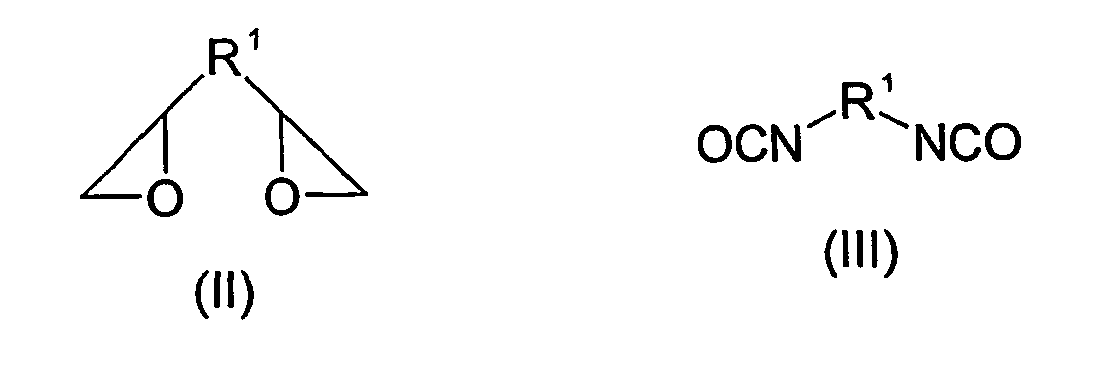
- Examples of the organic compound having not less than two epoxy groups and not less than two isocyanate groups are an epoxy compound of the formula (II) and an organic compound of the formula (III).
- the hydrogen atoms in the epoxy groups of the epoxy compound of the formula (II) may be substituted by a halogen or a lower alkyl group.
- R 1 represents a hydrocarbon group having 1 to 30 carbon atoms, for example, a straight-chain or branched lower alkylene group having 1 to 15 carbon atoms which may be substituted by a nitro group, an oxygen atom, an epoxy group or an aryl group, and a straight-chain or branched one Lower alkoxy group having 1 to 15 carbon atoms which may be substituted by a nitro group, an epoxy group or an aryl group.
- the aryl group is also understood to mean heteroaryls which have 4 to 20 carbon atoms, and in particular preferred aryls are in particular phenyl, naphthyl and indenyl.
- lower alkyl in the case of compounds of the formula (II) and (III) denotes a Alkyl group with 1 to 15 carbon atoms.
- aryl or heteroaryl means compounds of the formula (II) and (III) an aryl or heteroaryl having 4 to 20 carbon atoms.
- R 1 examples are the following groups.
- m, k and I are the same or different and stand for an integer from 1 to 6.
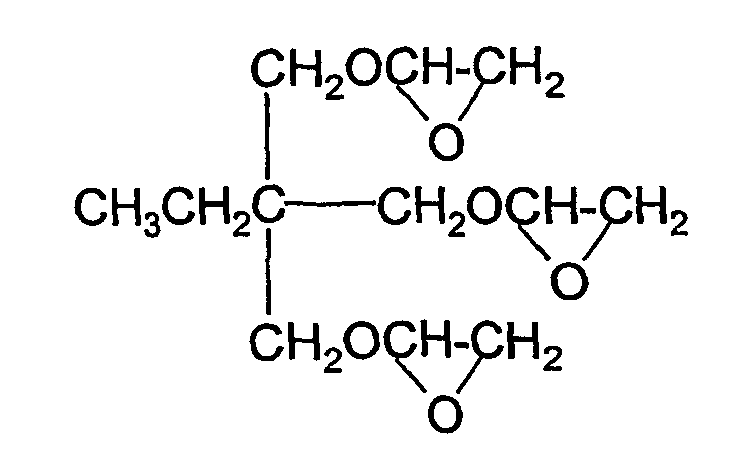
- a bridging reagent having three functional groups in the molecule which react with an amino group is the following compound.
- Particularly preferred bridging reagents are bis-phenol-A-glycidyl ether [BPAGDE] and 1,4-butyl diglycidyl ether.
- the solution according to step A) preferably contains 0.1 to 7 mol% of the Bridging Reagent per Unit of Basic Polymer, more preferably 0.5 to 6 mole% of the bridging reagent per unit of basic polymer, and particularly preferably 1 to 6 mol% of the bridging reagent per unit of basic polymer. If the proportion of bridging reagent is too high, the Impregnation of the basic polymer with a strong acid difficult. Is the By contrast, the proportion of bridging reagent too low, the mechanical Strength of the polymer membrane is not sufficiently improved.
- the solution according to step A) preferably contains at least 1 percent by weight the basic polymer and more preferably at least 2% by weight of the basic polymer.
- the solution according to step A) preferably contains at most 95% by weight of the basic polymer, more preferably not more than 80 Percent by weight of the basic polymer, and more preferably not more than 50 Percent by weight of the basic polymer.
- the basic polymer a basic polymer having at least one Amino group used in a repeating unit. Since the amino group in the Repeat unit is present, the polymer is basic, and the amino group can react with the bridging agent. In terms of reactivity towards the bridging agent is the amino group in the Repeating unit preferably a primary or secondary amino group.
- the repeating unit in the basic polymer preferably contains one aromatic ring with at least one nitrogen atom.
- the aromatic Ring is preferably a five- or six-membered ring with one up to three nitrogen atoms, with another ring, in particular another aromatic ring, can be fused.
- the basic polymer is preferably soluble in the solvent.
- the basic polymer are preferably in a solution at least 1 weight percent of the basic Polymers and more preferably not less than 2 weight percent dissolved.
- polybenzimidazoles As basic polymer come in the context of the present invention u.a. Polybenzimidazoles, polyimidazoles, polyvinylimidazoles and polybenzbisimidazoles in Consideration. Of these, polybenzimidazoles are preferred.
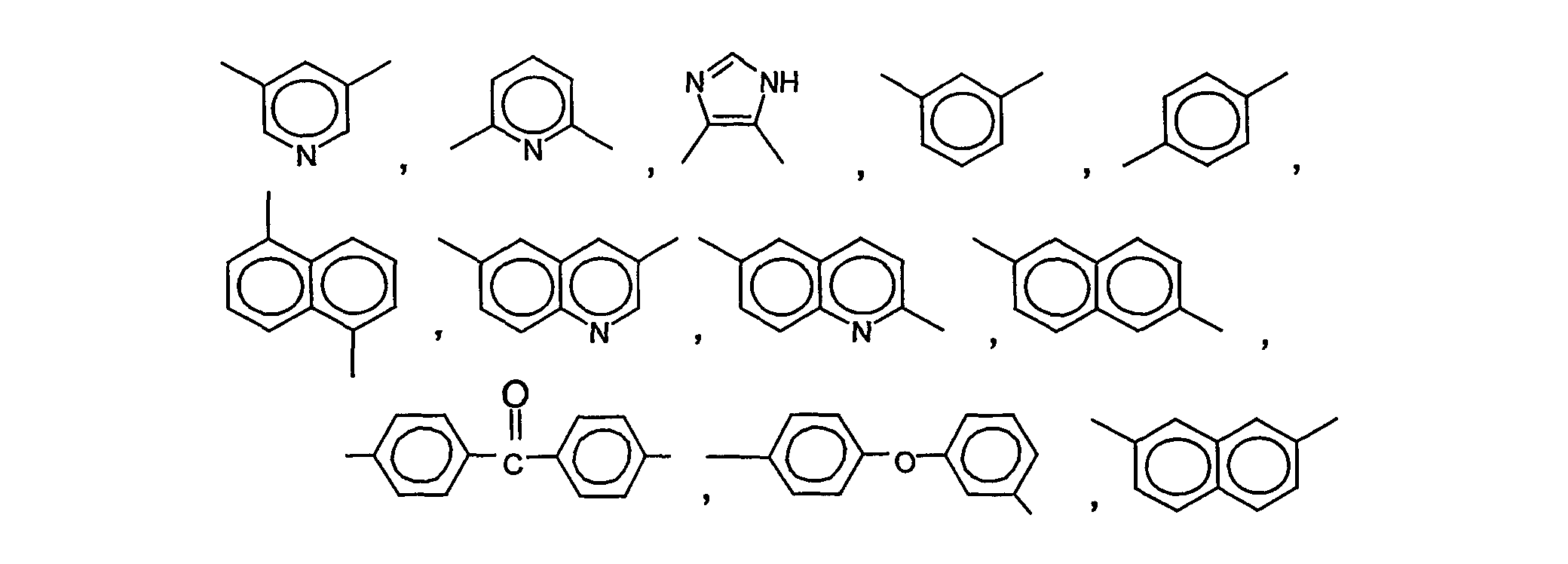
- Preferred polybenzimidazoles correspond to the following formula: wherein R is alkylene, perfluoroalkylene or a substituent of one of the following formulas:
- each alkylene and Perfuoralkylenoli which may be R, preferably having 1 to 10 carbon atoms and more preferably 1 to 6 carbon atoms.
- polybenzbisimidazoles of the following formula: wherein R has the meaning given above.
- Suitable linkers are the groups R listed above.
- the linker may be a linear or branched hydrocarbon group having 1 to 20 carbon atoms substituted with a fluorine atom and represented by an oxygen atom (-O-) or a group of the formula -N (R 2 ) -, wherein R 2 is a hydrogen atom or a lower alkyl group having 1 to 6 carbon atoms, may be interrupted.
- hydrocarbon group there are considered: a lower alkyl group having 1 to 20 carbon atoms which may be interrupted and branched by an oxygen atom or an arylene group such as a phenylene group; and an arylene group such as a phenylene group which may be substituted with a lower alkyl group having 1 to 20 carbon atoms, a lower alkoxy group having 1 to 20 carbon atoms, a sulfonic acid group, an amino group, a fluorine atom, etc.
- N is a nitrogen atom in the imidazole ring of the polybenzimidazoles or polybenzbisimidazoles; r is an integer from 1 to 20 and R 3 and R 4 are as defined above.
- the linker and strong acid can be between 5 and 85 percent of the Nitrogen atoms of the basic polymer, such as the nitrogen atoms of the imidazole ring, especially at 10 to 75 percent of the nitrogen atoms, and especially at 15 introduce up to 45 percent of the nitrogen atoms.
- the basic polymer can be sulfonated by reaction with a sultone in solution or sulfoalkylated.
- a solution of 1 is used here to 30 weight percent of the basic polymer, and especially a solution of 5 to 20 weight percent of the basic polymer.
- a solvent for the Sulfonation or sulfoalkylation is preferably used the solvent for the liquid medium, which will be described below.
- the basic polymer is preferably selected from the group consisting of Polybenzimidazoles, polyimidazoles, polyvinylimidazoles and Polybenzbisimidazolen.
- the basic polymer may already be in its repeat unit have a strongly acidic group.
- the presence of strong acid ensures Proton conductivity.
- the solvent for the liquid medium a solvent which does not react with the bridging agent is preferable.
- an organic solvent in particular a polar organic solvent.
- organic solvents are in particular lower amides such as N-methyl-2-pyrrolidone, N, N-dimethylacetamide, dimethylformamide; Dimethyl sulfoxide, etc. called. It is also possible to use a mixture of these solvents.
- the liquid medium may be either a solution or a suspension. In the case of the solution, the basic polymer is dissolved in the solvent. In the case of the suspension, dispersed phase particles of the basic polymer are dispersed in a continuous phase solvent. Alternatively, the liquid medium may be a slurry or a paste.
- step B a film is produced from the solution according to step A) (step B).
- the solution is poured out, for example, on a flat substrate and then dried at atmospheric pressure or under reduced pressure.
- the substrate for the casting or the doctor blade method may be a Semiconductors, such as a silicon wafer, a synthetic polymer, such as Poly (ethylene terephthalate), and a metal such as stainless steel.
- a Semiconductors such as a silicon wafer
- a synthetic polymer such as Poly (ethylene terephthalate)
- a metal such as stainless steel.
- a roll of poly (ethylene terephthalate) used as a substrate so one can for producing a film with a constant width and any thickness one use continuous casting system.
- the solution becomes poured onto the substrate and passes through a gap with predetermined Distance and then through a drying oven for drying by means of warm wind.
- the film formation may be carried out according to the method described in Japanese Application No. Hei 10-125560.
- the solution is poured into a cylinder with a cylindrical inner surface, and then the cylinder is rotated. At the same time, the solvent is allowed to evaporate by the centrifugal force caused by the rotation; wherein a cylindrical polymer film of substantially uniform thickness forms on the inner surface of the cylinder.
- the basic polymer can be formed with a uniform matrix.
- This method described in Japanese Patent Application Hei 10-125560 is also part of the present specification.
- the removal of the solvent in step C) can be carried out by drying.
- heating under reduced pressure may not more than 1 atmosphere, preferably not more than 0.1 atmospheres and more preferably not more than 0.05 atmospheres.
- the bridging takes place in step D) by heating, so that the bridging (step D) and the drying (step C) at the same time in one Step can be done.
- heating for drying or heating for the purpose of bridging you can use warm air.
- the bridging according to step D) can also by irradiation with electromagnetic waves (photochemical reaction) take place.
- Bridging causes the epoxide compound of the formula (IIa) to react with the polybenzimidazole of the formula (I) to bridge a polymer chain.
- R 1 has the meaning given above.
- R 1 has the meaning given above.
- the basic polymer for the purpose of Impregnation of proton conductivity with a strong acid impregnate (step E).
- the impregnation / doping can with the strong acid in the form of the liquid Medium done.
- the embodiment in which with the strong acid in the form of the liquid medium impregnated refers to the addition of a strong acid to the liquid Medium.
- the bridging reagent does not react with the strong one Acid.
- the impregnation with the strong acid is preferably carried out after heating the film according to step C).
- the bridged, basic polymer has a improved mechanical strength and easier to handle. Since that Brücking reagent is already reacted, is the reaction of the strong acid with unreacted bridging reagent very limited.
- the film of bridged, basic polymer can turn into a strong acid be immersed so that the film of basic polymer with the strong acid is impregnated and becomes the membrane.
- immersion step at 35 ° C or above allows one Shortening of the immersion time of the basic polymer in the strong acid.
- immersion is at most 200 ° C or below, preferably at 100 ° C or below, and most preferably at 80 ° C or below.
- Strong acids are protic strong acids.
- phosphoric acid is understood as meaning polyphosphoric acid, phosphonic acid (H 3 PO 3 ), orthophosphoric acid (H 3 PO 4 ), pyrophosphoric acid (H 4 P 2 O 7 ), triphosphoric acid (H 5 P 3 O 10 ) and metaphosphoric acid
- the phosphoric acid, especially orthophosphoric acid preferably has a concentration of at least 80 weight percent, more preferably a concentration of at least 90 weight percent, even more preferably a concentration of at least 95 weight percent, and most preferably a concentration of at least 98 weight percent. The reason for this is that as the concentration of the strong acid increases, the basic polymer can be impregnated with a larger number of molecules of strong acid.
- the polymer electrolyte membrane obtained according to the invention namely the complex from the basic polymer and the strong acid, is proton conductive and can therefore preferably used as electrolyte for cells. Nevertheless, that is Polymer electrolyte is not limited to use for cells, but can also as an electrolyte for a display element, an electrochromic element or different sensors are used.
- As basic catalysts are basic oxides and hydroxides of I., II. And III. Main group of the Periodic Table, hydrides of the I main group of the Periodic Table and Litzium organyls in question, preferably KOH, LiOH, NaOH, RbOH, CsOH, Ca (OH) 2 , Mg (OH) 2 , Ba (OH) 2 , LiH, NaH , KH, methyl lithium and butyl lithium.
- the basic catalyst is used in amounts of 0.01 to 5 mol%, preferably 0.02 to 3 mol%, particularly preferably 0.5 to 2.5 mol%, based on the used bridging reagent, added to the solution according to step A).
- the invention further provides the preferred use of Polymer electrolyte membrane according to the invention in the single cell (MEU) for a Fuel cell.
- MEU single cell
- the single cell for a fuel cell contains an inventive Polymer electrolyte membrane and two electrodes, between which the Polymer electrolyte membrane is sandwiched.
- the electrodes each have a catalytically active layer and a Gas diffusion layer for supplying a reaction gas to the catalytically active Shift up.
- the gas diffusion layer is porous to allow reactive gas to pass through can.
- the polymer electrolyte membrane of the present invention can be used as an electrolyte membrane be used.
- Another object of the present invention is a fuel cell with several individual cells (MEU's), each one according to the above method made of bridged polymer membrane and two electrodes, between where the membrane of bridged polymer is sandwiched, contain.
- MEU's individual cells
- the membranes produced by the process according to the invention show a increased by more than 100% over the unbridged polymer Fracture toughness.
- the membranes according to the invention furthermore exhibit, at an elongation at break of at least 60%, a stress of at least 1.5 MPa., Preferably an elongation at break of at least 80%, a tension of at least 2 MPa.
- the measurement of the elongation at break / stress is carried out on strip-shaped samples with a width of 15 mm and a length of 120 mm.
- the tensile test is carried out at a temperature of 100 ° C with a strain rate of 50 mm / min.
- Mol% BPADGE Modulus of elasticity [Mpa]
- Tensile strength [Mpa]
- Elongation at break [%]
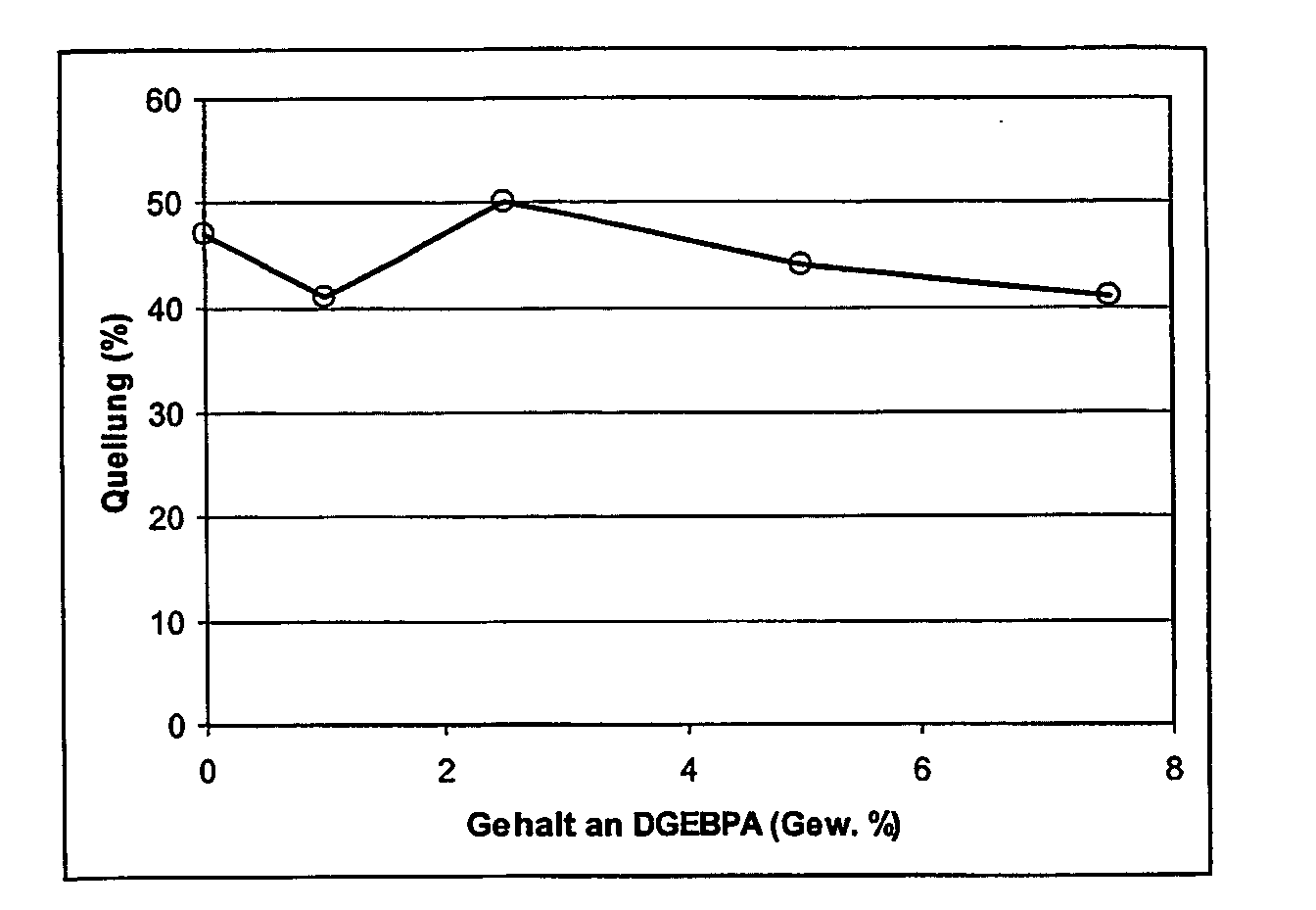
- the membranes according to the invention show a virtually unchanged swelling behavior of between 40 and 50%.
- the bridging rule The PBI solution is placed in a flask and degassed with argon. Then, 10 mg KOH is added to the PBI solution and stirred at 60 ° C for 30 min. Thereafter, the bridging reagent is added thereto and further stirred at 60 ° C for 1 h. The solution is degassed in and a film is cast. The film is then doped with a temperature interval between 30 and 200 ° C over a period of 15-30 minutes. The films thus obtained were doped with 85% H 3 PO 4 for at least 72 hours. Then the measurements were taken.
Landscapes
- Chemical & Material Sciences (AREA)
- Manufacturing & Machinery (AREA)
- Engineering & Computer Science (AREA)
- Chemical Kinetics & Catalysis (AREA)
- Organic Chemistry (AREA)
- Health & Medical Sciences (AREA)
- Medicinal Chemistry (AREA)
- Polymers & Plastics (AREA)
- Materials Engineering (AREA)
- Sustainable Development (AREA)
- Life Sciences & Earth Sciences (AREA)
- Inorganic Chemistry (AREA)
- Sustainable Energy (AREA)
- Electrochemistry (AREA)
- General Chemical & Material Sciences (AREA)
- Fuel Cell (AREA)
- Treatments Of Macromolecular Shaped Articles (AREA)
- Manufacture Of Macromolecular Shaped Articles (AREA)
Description




worin p und q unabhängig voneinander jeweils für eine ganze Zahl von 1 bis 10 stehen und
R3, R4, R5, und R6 unabhängig voneinander jeweils gleich oder verschieden sind und für ein Wasserstoffatom; ein Fluoratom; eine Niederalkylgruppe mit 1 bis 6 Kohlenstoffatomen oder eine Niederalkoxygruppe mit 1 bis 6 Kohlenstoffatomen; eine Arylgruppe, wie eine Phenylgruppe, die mit einer Niederalkylgruppe mit 1 bis 6 Kohlenstoffatomen, einer Niederalkoxygruppe mit 1 bis 6 Kohlenstoffatomen, einer Sulfonsäuregruppe, einer Aminogruppe, einem Fluoratom usw. substituiert sein kann; oder eine stark saure Gruppe wie eine Sulfonsäuregruppe, eine Phosphorsäuremonoestergruppe und vorzugsweise ein Wasserstoffatom; ein Fluoratom oder eine Niederalkylgruppe mit 1 bis 6 Kohlenstoffatomen stehen, in Betracht.
Bei dem flüssigen Medium kann es sich entweder um eine Lösung oder um eine Suspension handeln. Im Fall der Lösung ist das basische Polymer in dem Lösungsmittel gelöst. Im Fall der Suspension sind als dispergierte Phase dienende Teilchen aus dem basischen Polymer in einem als kontinuierliche Phase dienenden Lösungsmittel dispergiert. Alternativ dazu kann es sich bei dem flüssigen Medium um eine Aufschlämmung oder eine Paste handeln.
Hierbei wird die Lösung in einen Zylinder mit zylinderförmiger Innenfläche gegossen, und anschließend der Zylinder in Drehung versetzt wird. Gleichzeitig läßt man das Lösungsmittel durch die durch die Drehung verursachte Zentrifugalkraft abdampfen; wobei sich auf der Innenfläche des Zylinders eine zylindrische Polymerfolie weitgehend einheitlicher Dicke bildet.
Dieses in der japanischen Patentanmeldung Hei 10-125560 beschriebene Verfahren ist ebenfalls Bestandteil der vorliegenden Beschreibung.


| Mol-% BPADGE | E-Modul [Mpa] | Zugfestigkeit [Mpa] | Bruchdehnung [%] | Bruchzähig keit [kJ/m2] |
| 0 | 3,9 | 1 | 47 | 29,5 |
| 1 | 4,6 | 2 | 82,6 | 98 |
| 2,5 | 6,8 | 2,85 | 98,2 | 158 |
| 5 | 5,3 | 3,2 | 99 | 172 |
| 7,5 | 5,6 | 1,2 | 30 | 20 |
Die PBI-Lösung wird in einem Kolben vorgelegt und mit Argon entgast. Dann wird zur PBI-Lösung 10 mg KOH gegeben und 30 min bei 60°C gerührt. Danach wird das Verbrückungsreagenz dazu gegeben und bei 60°C 1 h lang weiter gerührt. Die Lösung wird in entgast und ein Film gegossen. Der Film wird dann mit über einen Zeitraum von 15 - 30 Minuten bei einem Temperaturintervall zwischen 30 und 200°C Die so erhaltenen Filme wurden mit 85%-H3PO4 über mindestens 72 Stunden dotiert. Anschließend wurden die Messungen gemacht.
Claims (24)
- Membran aus verbrücktem Polymer erhältlich durch ein Verfahren umfassend die folgenden Schritte:A. Herstellung einer Lösung enthaltend ein basisches Polymer mit mindestens einer Aminogruppe in einer Wiederholungseinheit und mindestens einem Verbrückungsreagenz in einem geeigneten Lösemittel,B. Gießen einer Folie mit der aus Schritt A) erhaltenen LösungC. Entfernen des Lösemittels aus Schritt A)D. Durchführung der Verbrückungsreaktion in der gemäß Schritt C) erhaltenen FolieE. Dotierung der gemäß Schritt D) erhaltenen Folie mit einer starken Säure dadurch gekennzeichnet, daß in Schritt A) zusätzlich ein basischer Katalysator zugemischt wird.
- Membran gemäß Anspruch 1, dadurch gekennzeichnet, daß das Verbrückungsreagenz mindestens zwei Epoxidgruppen oder Isocyanatgruppen pro Molekül aufweist
- Membran gemäß Anspruch 1, dadurch gekennzeichnet, daß das Verbrückungsreagenz mindestens eine Verbindung der Formel (II) und/oder (III)worin R1 für eine Kohlenwasserstoffgruppe mit 1 bis 30 Kohlenstoffatomen steht, ist.
- Membran gemäß Anspruch 3, dadurch gekennzeichnet, daß das R1 gleich
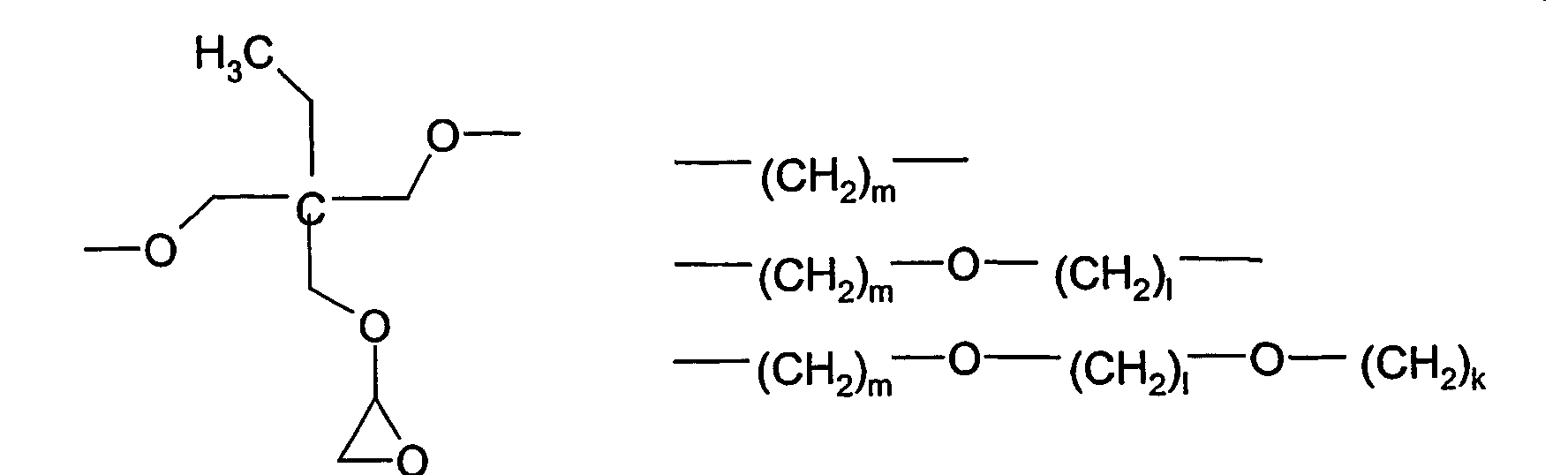
 worin m, k und I jeweils gleich oder verschieden sind und für eine ganze Zahl von 1 bis 6 stehen, ist.
- Membran gemäß Anspruch 1, dadurch gekennzeichnet, daß das Verbrückungsreagenz mindestens drei Epoxidgruppen pro Molekül enthält.
- Membran gemäß Anspruch 5, dadurch gekennzeichnet, daßist.

- Membran gemäß Anspruch 1, dadurch gekennzeichnet, daß Verbückungsreagenz Bis-phenol-A-glycidylether [BPAGDE] und/oder 1,4 Butyl-diglycidylether ist.
- Membran gemäß Anspruch 1, dadurch gekennzeichnet, daß die Lösung gemäß Schritt A) 0,1 bis 7 Mol% des Verbrückungsreagenzes pro Einheit des basischen Polymers enthält.
- Membran gemäß Anspruch 1, dadurch gekennzeichnet, daß als basisches Polymer Polybenzimidazole, Polyimidazole, Polyvinylimidazole und Polybenzbisimidazole eingesetzt werden.
- Membran gemäß Anspruch 9, dadurch gekennzeichnet, daß als Polybenzimidazole solche mit der Formel:worin R für Alkylen, Perfluoralkylen oder einen Substituenten einer der folgenden Formeln:
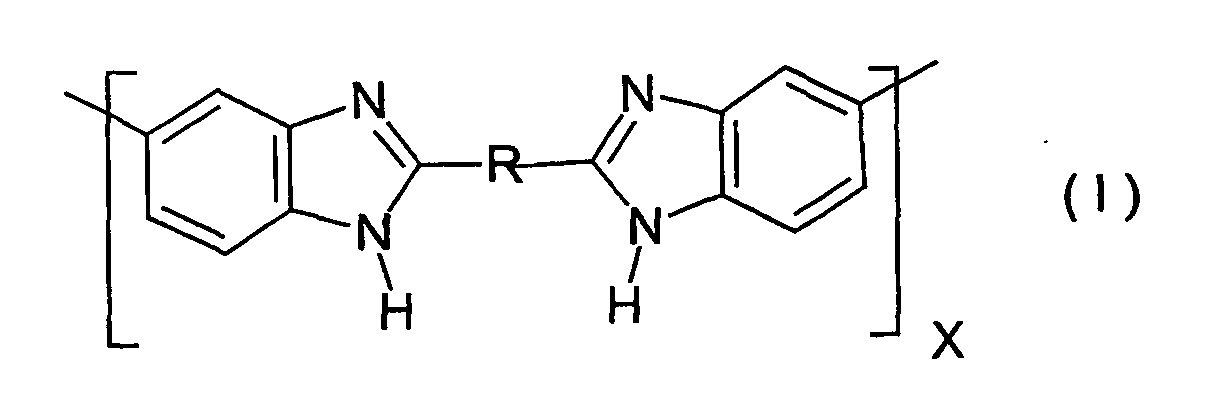 steht, wobei außerdem jede Alkylen- und Perfuoralkylengruppe, die R sein kann, vorzugsweise 1 bis 10 Kohlenstoffatome und besonders bevorzugt 1 bis 6 Kohlenstoffatome aufweist, eingesetzt wird.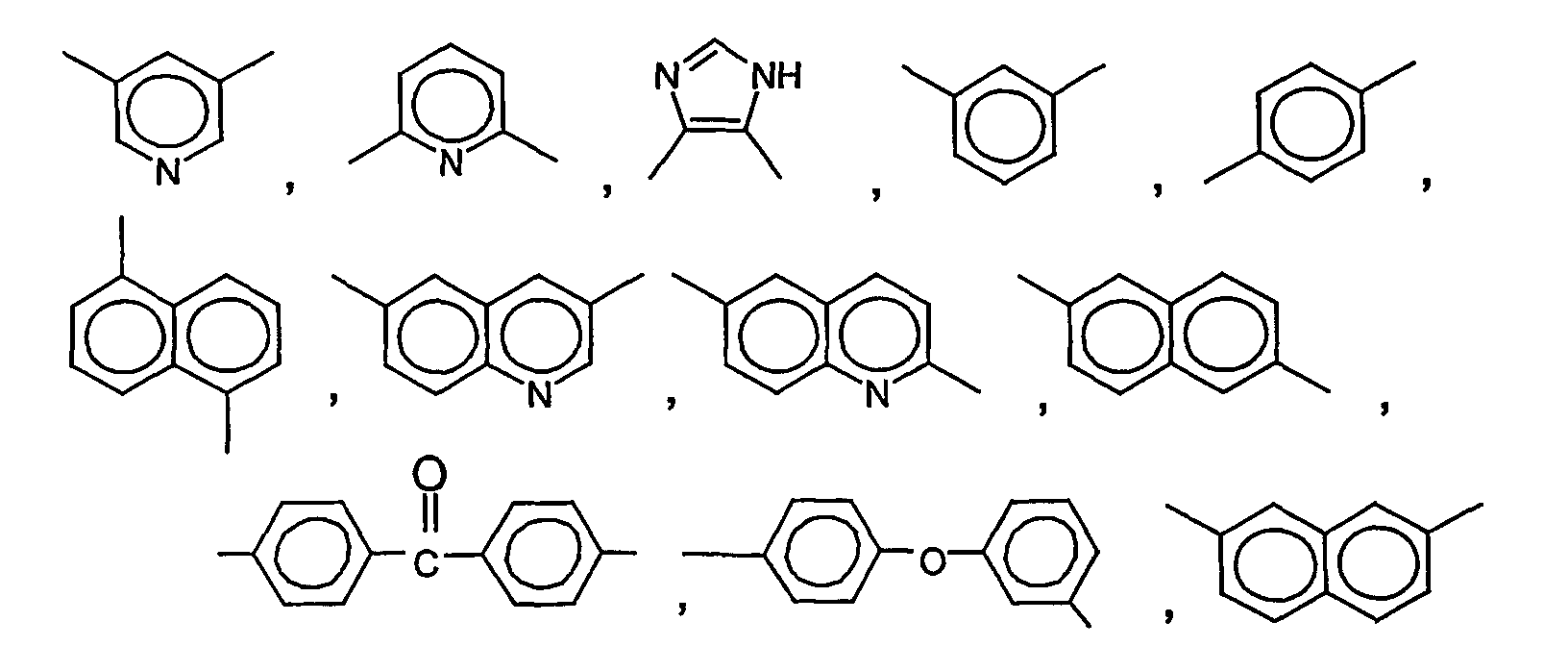
- Membran gemäß Anspruch 9, dadurch gekennzeichnet, daß als Polybenzbisimidazole solche mit der Formelworin R die unter Anspruch 10 angegebene Bedeutung hat, verwendet werden.

- Membran gemäß Anspruch 1, dadurch gekennzeichnet, daß die Verbrückung in Schritt D) durch Erhitzen erfolgt, so daß die Verbrückung (Schritt D) und die Trocknung (Schritt C) zugleich in einem Schritt erfolgt.
- Membran gemäß Anspruch 1, dadurch gekennzeichnet, daß die Trocknung der Folie bei einer Temperatur durchgeführt wird, die unterhalb der Reaktionstemperatur des Verbrückungsreagenzes liegt und anschließemd die Folie zwecks Verbrückung weiter erhitzt wird.
- Membran gemäß Anspruch 1, dadurch gekennzeichnet, daß die Verbrückung in Schritt D) durch eine Bestrahlung mit elektromagnetischen Wellen (photochemische Reaktion) erfolgt.
- Membran gemäß Anspruch 1, dadurch gekennzeichnet, daß als starke Säure in Schritt E) Phosphorsäure oder Schwefelsäure eingesetzt wird.
- Membran gemäß Anspruch 1, dadurch gekennzeichnet, daß als basische Katalysatoren basische Oxide und Hydroxyde der I., II. und III. Hauptgruppe des Periodensystems, Hydride der I. Hauptgruppe des Periodensystems und Litzium-organyle eingesetzt werden.
- Membran gemäß Anspruch 16, dadurch gekennzeichnet, daß als basische Katalysatoren KOH, LiOH, NaOH, RbOH, CsOH, Ca(OH)2, Mg(OH)2, Ba(OH)2, LiH, NaH, KH, Methyl-Lithium und/oder Butyl-Lithium eingesetzt werden.
- Membran gemäß Anspruch 1, dadurch gekennzeichnet, daß der basische Katalysator in Mengen von 0,01 bis 5 Mol-%, bezogen auf das eingesetzte Verbrückungsreagenz, in die Lösung gemäß Schritt A) zugesetzt wird.
- Membran gemäß Anspruch 1, dadurch gekennzeichnet, daß sie eine gegenüber einer Membran welche keine Verbrückungen enthält eine um mehr als 100% erhöhte Bruchzähigkeit aufweist.
- Membran gemäß Anspruch 1, dadurch gekennzeichnet, daß Membran eine Bruchdehnung von mindestens 60% und eine Spannung von mindestens 1,5 MPa. Aufweist.
- Verwendung der Membran gemäß einem der Ansprüche 1 bis 20 zur Herstellung von Membran-Elektroden-Einheiten.
- Verwendung der Membran gemäß einem der Ansprüche 1 bis 20 zur Herstellung von Brennstoffzellen.
- Membran-Elektroden-Einheit enthaltend mindestens eine Elektrode und mindestens eine Membran gemäß einem der Ansprüche 1 bis 20
- Brennstoffzelle enthaltend mindestens Membran-Elektroden-Einheit gemäß Anspruch 23.
Applications Claiming Priority (3)
| Application Number | Priority Date | Filing Date | Title |
|---|---|---|---|
| DE10110752A DE10110752A1 (de) | 2001-03-07 | 2001-03-07 | Verfahren zur Herstellung einer Membran aus verbrücktem Polymer und Brennstoffzelle |
| DE10110752 | 2001-03-07 | ||
| PCT/EP2002/002215 WO2002070592A2 (de) | 2001-03-07 | 2002-03-01 | Verfahren zur herstellung einer membran aus verbrücktem polymer und brennstoffzelle |
Publications (2)
| Publication Number | Publication Date |
|---|---|
| EP1373379A2 EP1373379A2 (de) | 2004-01-02 |
| EP1373379B1 true EP1373379B1 (de) | 2005-08-31 |
Family
ID=7676479
Family Applications (1)
| Application Number | Title | Priority Date | Filing Date |
|---|---|---|---|
| EP02732451A Expired - Lifetime EP1373379B1 (de) | 2001-03-07 | 2002-03-01 | Verfahren zur herstellung einer membran aus verbrücktem polymer und brennstoffzelle |
Country Status (11)
| Country | Link |
|---|---|
| US (1) | US7229553B2 (de) |
| EP (1) | EP1373379B1 (de) |
| JP (1) | JP4411479B2 (de) |
| KR (1) | KR20030085138A (de) |
| CN (1) | CN1494568A (de) |
| AT (1) | ATE303414T1 (de) |
| BR (1) | BR0207951A (de) |
| CA (1) | CA2439686A1 (de) |
| DE (2) | DE10110752A1 (de) |
| MX (1) | MXPA03008092A (de) |
| WO (1) | WO2002070592A2 (de) |
Cited By (2)
| Publication number | Priority date | Publication date | Assignee | Title |
|---|---|---|---|---|
| WO2007065586A1 (de) | 2005-12-08 | 2007-06-14 | Volkswagen Aktiengesellschaft | Membranen aus polyazolen, verfahren zu ihrer herstellung und brennstoffzellen unter verwendung derartiger membranen |
| DE102010029990A1 (de) | 2010-06-11 | 2011-12-15 | Wacker Chemie Ag | Polymerfilme auf der Basis von Polyazolen |
Families Citing this family (43)
| Publication number | Priority date | Publication date | Assignee | Title |
|---|---|---|---|---|
| DE10129458A1 (de) * | 2001-06-19 | 2003-01-02 | Celanese Ventures Gmbh | Verbesserte Polymerfolien auf Basis von Polyazolen |
| DE10140147A1 (de) | 2001-08-16 | 2003-03-06 | Celanese Ventures Gmbh | Verfahren zur Herstellung einer Blend-Membran aus verbrücktem Polymer und Brennstoffzelle |
| DE10224452C1 (de) | 2002-05-29 | 2003-11-20 | Fraunhofer Ges Forschung | Protonenleitende Polymermembran sowie Verfahren zu deren Herstellung |
| DE10235360A1 (de) | 2002-08-02 | 2004-02-19 | Celanese Ventures Gmbh | Membran-Elektrodeneinheiten mit langer Lebensdauer |
| DE10246372A1 (de) * | 2002-10-04 | 2004-04-15 | Celanese Ventures Gmbh | Mit einer Katalysatorschicht beschichtete protonenleitende Polymermembran enthaltend Polyazole und deren Anwendung in Brennstoffzellen |
| DE10301810A1 (de) * | 2003-01-20 | 2004-07-29 | Sartorius Ag | Membran-Elektroden-Einheit, Polymermembranen für eine Membran-Elektroden-Einheit und Polymerelektrolyt-Brennstoffzellen sowie Verfahren zur Herstellung derselben |
| US7211203B2 (en) * | 2003-02-04 | 2007-05-01 | Honda Motor Co., Ltd. | Polymer electrolyte, proton conductive membrane and membrane-electrode assembly |
| DE102004005389A1 (de) | 2004-02-04 | 2005-08-25 | Sartorius Ag | Membranen für Brennstoffzellen, Verfahren zur Herstellung der Membranen und Brennstoffzellen unter Verwendung derartiger Membranen |
| DE102004008628A1 (de) | 2004-02-21 | 2005-09-08 | Celanese Ventures Gmbh | Membran-Elektroden-Einheit mit hoher Leistung und deren Anwendung in Brennstoffzellen |
| JP2007537317A (ja) | 2004-05-14 | 2007-12-20 | ペミアス ゲーエムベーハー | 異方性造形体、異方性造形体の製造方法および使用 |
| DE102004034139A1 (de) | 2004-07-15 | 2006-02-02 | Pemeas Gmbh | Verfahren zur Herstellung von Membran-Elektroden-Einheiten |
| EP1624512A2 (de) | 2004-08-05 | 2006-02-08 | Pemeas GmbH | Membran-Elektrodeneinheiten mit langer Lebensdauer |
| EP1624511A1 (de) | 2004-08-05 | 2006-02-08 | Pemeas GmbH | Membran-Elektroden-Einheiten und Brennstoffzellen mit erhöhter Lebensdauer |
| DE102004044760A1 (de) * | 2004-09-16 | 2006-05-24 | Volkswagen Ag | Polymer-Membran, Membran-Elektroden-Einheit mit einer Polymer-Membran, Brennstoffzellenelektrode und Verfahren zur Herstellung |
| US7517604B2 (en) * | 2005-09-19 | 2009-04-14 | 3M Innovative Properties Company | Fuel cell electrolyte membrane with acidic polymer |
| US7838138B2 (en) * | 2005-09-19 | 2010-11-23 | 3M Innovative Properties Company | Fuel cell electrolyte membrane with basic polymer |
| JP4597835B2 (ja) * | 2005-10-18 | 2010-12-15 | 三星エスディアイ株式会社 | 燃料電池用のプロトン伝導性電解質膜及びその製造方法並びに燃料電池 |
| DE102005052378A1 (de) * | 2005-10-31 | 2007-05-03 | Pemeas Gmbh | Verbesserte Membran-Elektrodeneinheiten und Brennstoffzellen mit hoher Lebensdauer |
| DE102006036019A1 (de) * | 2006-08-02 | 2008-02-07 | Pemeas Gmbh | Membran-Elektroden-Einheit und Brennstoffzellen mit erhöhter Leistung |
| JP5264071B2 (ja) * | 2006-12-20 | 2013-08-14 | 三星エスディアイ株式会社 | 燃料電池用の高分子電解質膜及びその製造方法並びに燃料電池 |
| US20080317946A1 (en) * | 2007-06-21 | 2008-12-25 | Clearedge Power, Inc. | Fuel cell membranes, gels, and methods of fabrication |
| JP2011517037A (ja) * | 2008-04-11 | 2011-05-26 | ビーエーエスエフ ソシエタス・ヨーロピア | 燃料電池の操作方法 |
| EP2131433A1 (de) * | 2008-06-05 | 2009-12-09 | Reinz-Dichtungs-Gmbh | Elektrochemische Zelle und Verfahren zur ihrer Herstellung |
| EP2228857A1 (de) | 2009-03-06 | 2010-09-15 | Basf Se | Verbesserte Membran-Elektrodeneinheiten |
| WO2011003538A1 (de) | 2009-07-09 | 2011-01-13 | Basf Se | Methode zur mechanischen stabilisierung von stickstoffhaltigen polymeren |
| WO2011003539A1 (de) | 2009-07-09 | 2011-01-13 | Basf Se | Verfahren zur stabilisierung von stickstoffhaltigen polymeren |
| WO2011006625A1 (de) | 2009-07-16 | 2011-01-20 | Basf Se | Verfahren zum betrieb einer brennstoffzelle und zugehörige brennstoffzelle |
| WO2011006624A2 (de) | 2009-07-16 | 2011-01-20 | Basf Se | Verfahren zum betrieb einer brennstoffzelle und zugehörige brennstoffzelle |
| US20120225360A1 (en) | 2009-07-16 | 2012-09-06 | Basf Se | Method for operating a fuel cell |
| JP2013510383A (ja) | 2009-11-06 | 2013-03-21 | ビーエーエスエフ ソシエタス・ヨーロピア | 膜電極アセンブリ及び性能が改良された燃料電池 |
| EP2499691B1 (de) * | 2009-11-14 | 2017-07-12 | Samsung Electronics Co., Ltd. | Verfahren zur mechanischen stabilisierung von stickstoff haltigen polymeren |
| KR101279352B1 (ko) * | 2009-12-23 | 2013-07-04 | 한국화학연구원 | 강도가 개선된 다공성 지지체, 그를 이용한 강화 복합전해질 막, 그 막을 구비한 막-전극 어셈블리 및 연료전지 |
| EP2365567B1 (de) | 2010-03-03 | 2014-05-07 | Samsung Electronics Co., Ltd. | Zusammensetzung, Verfahren zur Herstellung der Zusammensetzung, Elektrode mit der Zusammensetzung und Brennstoffzelle mit der Elektrode |
| US9048478B2 (en) | 2010-04-22 | 2015-06-02 | Basf Se | Polymer electrolyte membrane based on polyazole |
| WO2011151775A1 (en) * | 2010-05-31 | 2011-12-08 | Basf Se | Mechanically stabilized polyazoles |
| JP2014500567A (ja) * | 2010-05-31 | 2014-01-09 | ビーエーエスエフ ソシエタス・ヨーロピア | 機械的に安定なポリアゾール |
| WO2011154811A1 (en) | 2010-06-08 | 2011-12-15 | Rensselaer Polytechnic Institute | Method for the production of an electrochemical cell |
| WO2012075977A1 (de) | 2010-09-07 | 2012-06-14 | White Fox Technologies Ltd. | Pbi-modifizierungs- und vernetzungsverfahren |
| US8461296B2 (en) | 2011-03-24 | 2013-06-11 | Basf Se | Method for mechanical stabilization of nitrogen-containing polymers |
| US9006339B2 (en) | 2011-05-10 | 2015-04-14 | Basf Se | Mechanically stabilized polyazoles comprising at least one polyvinyl alcohol |
| WO2014170733A2 (en) | 2013-04-16 | 2014-10-23 | Basf Se | Process for the manufacture of membrane electrode units |
| EP2843743B1 (de) | 2013-09-02 | 2018-03-28 | Basf Se | Membran-Elektroden-Einheiten für Hochtemperatur -Brennstoffzellen mit einer verbesserten Stabilität |
| DK2869382T3 (en) | 2013-10-30 | 2019-04-01 | Basf Se | Improved diaphragm electrode devices |
Family Cites Families (12)
| Publication number | Priority date | Publication date | Assignee | Title |
|---|---|---|---|---|
| US4933083A (en) * | 1985-04-15 | 1990-06-12 | Hoechst Celanese Corp. | Polybenzimidazole thin film composite membranes |
| US4693825A (en) * | 1985-09-23 | 1987-09-15 | Celanese Corporation | Method for the preparation of polybenzimidazole membranes |
| JPH01271423A (ja) * | 1988-04-22 | 1989-10-30 | Mitsui Petrochem Ind Ltd | ポリオール樹脂およびその製造方法 |
| US5525436A (en) * | 1994-11-01 | 1996-06-11 | Case Western Reserve University | Proton conducting polymers used as membranes |
| US5599639A (en) * | 1995-08-31 | 1997-02-04 | Hoechst Celanese Corporation | Acid-modified polybenzimidazole fuel cell elements |
| JP2000281819A (ja) * | 1999-01-27 | 2000-10-10 | Aventis Res & Technol Gmbh & Co Kg | 架橋高分子膜の製造方法及び燃料電池 |
| US6623639B2 (en) * | 1999-03-19 | 2003-09-23 | Bend Research, Inc. | Solvent-resistant microporous polybenzimidazole membranes |
| JP2001035509A (ja) * | 1999-07-19 | 2001-02-09 | Agency Of Ind Science & Technol | イオン伝導性膜 |
| EP1523053A3 (de) * | 1999-09-09 | 2010-04-28 | Danish Power Systems APS | Polymerelektrolytmembran-Brennstoffzellen |
| DE10140147A1 (de) * | 2001-08-16 | 2003-03-06 | Celanese Ventures Gmbh | Verfahren zur Herstellung einer Blend-Membran aus verbrücktem Polymer und Brennstoffzelle |
| DE10220817A1 (de) * | 2002-05-10 | 2003-11-27 | Celanese Ventures Gmbh | Verfahren zur Herstellung einer gepfropften Polymerelektrolytmembran und deren Anwendung in Brennstoffzellen |
| DE10239701A1 (de) * | 2002-08-29 | 2004-03-11 | Celanese Ventures Gmbh | Polymerfolie auf Basis von Polyazolen und deren Verwendung |
-
2001
- 2001-03-07 DE DE10110752A patent/DE10110752A1/de not_active Withdrawn
-
2002
- 2002-03-01 CA CA002439686A patent/CA2439686A1/en not_active Abandoned
- 2002-03-01 AT AT02732451T patent/ATE303414T1/de not_active IP Right Cessation
- 2002-03-01 EP EP02732451A patent/EP1373379B1/de not_active Expired - Lifetime
- 2002-03-01 WO PCT/EP2002/002215 patent/WO2002070592A2/de not_active Ceased
- 2002-03-01 KR KR10-2003-7011570A patent/KR20030085138A/ko not_active Withdrawn
- 2002-03-01 US US10/468,988 patent/US7229553B2/en not_active Expired - Fee Related
- 2002-03-01 MX MXPA03008092A patent/MXPA03008092A/es unknown
- 2002-03-01 JP JP2002570626A patent/JP4411479B2/ja not_active Expired - Fee Related
- 2002-03-01 BR BR0207951-8A patent/BR0207951A/pt not_active Application Discontinuation
- 2002-03-01 DE DE50204087T patent/DE50204087D1/de not_active Expired - Lifetime
- 2002-03-01 CN CNA028059921A patent/CN1494568A/zh active Pending
Cited By (3)
| Publication number | Priority date | Publication date | Assignee | Title |
|---|---|---|---|---|
| WO2007065586A1 (de) | 2005-12-08 | 2007-06-14 | Volkswagen Aktiengesellschaft | Membranen aus polyazolen, verfahren zu ihrer herstellung und brennstoffzellen unter verwendung derartiger membranen |
| DE102010029990A1 (de) | 2010-06-11 | 2011-12-15 | Wacker Chemie Ag | Polymerfilme auf der Basis von Polyazolen |
| WO2011154269A1 (de) | 2010-06-11 | 2011-12-15 | Wacker Chemie Ag | Polymerfilme auf der basis von polyazolen |
Also Published As
| Publication number | Publication date |
|---|---|
| US7229553B2 (en) | 2007-06-12 |
| DE50204087D1 (de) | 2005-10-06 |
| CA2439686A1 (en) | 2002-09-12 |
| BR0207951A (pt) | 2004-07-27 |
| JP2005512272A (ja) | 2005-04-28 |
| JP4411479B2 (ja) | 2010-02-10 |
| MXPA03008092A (es) | 2003-12-12 |
| WO2002070592A3 (de) | 2002-12-27 |
| WO2002070592A2 (de) | 2002-09-12 |
| CN1494568A (zh) | 2004-05-05 |
| DE10110752A1 (de) | 2002-09-19 |
| EP1373379A2 (de) | 2004-01-02 |
| KR20030085138A (ko) | 2003-11-03 |
| ATE303414T1 (de) | 2005-09-15 |
| US20040118773A1 (en) | 2004-06-24 |
Similar Documents
| Publication | Publication Date | Title |
|---|---|---|
| EP1373379B1 (de) | Verfahren zur herstellung einer membran aus verbrücktem polymer und brennstoffzelle | |
| EP1425336B1 (de) | Verfahren zur herstellung einer membran aus verbrücktem polymer und brennstoffzelle | |
| DE60017721T2 (de) | Verfahren zur herstellung von memranen und brennstoffzellen aus verbrückten polymeren | |
| DE69930474T2 (de) | Festpolymerelektrolyte | |
| DE60020915T2 (de) | Polymere Kompositmembran und Verfahren zu ihrer Herstellung | |
| EP1427517B1 (de) | Protonleitende membran und beschichtung | |
| EP1722435B1 (de) | Herstellungsverfahren für Polymermembran-Elektroden-Einheiten | |
| DE60025101T2 (de) | Protonenleitendes Polymer, Herstellungsverfahren dafür, fester Polymerelektrolyt und Elektrode | |
| DE60125042T2 (de) | Hybridmaterial, verwendung des hybridmaterials und verfahren zu seiner herstellung | |
| EP2009728B1 (de) | Verfahren zur Herstellung eines sulfonierten Poly(1,3,4-oxadiazol)-Polymers | |
| DE69912989T2 (de) | Methode zur produktion von polyelektrolytmembranen und brennstoffzellen | |
| DE10117687A1 (de) | Protonenleitende Membran und deren Verwendung | |
| EP1451887B1 (de) | Protonenleitende elektrolytmembran, verfahren zu ihrer herstellung und deren verwendung in einer brennstoffzelle | |
| DE10155543A1 (de) | Protonenleitende Elektrolytmembran, Verfahren zu ihrer Herstellung und die Membran enthaltende Brennstoffzelle | |
| DE112006003489B4 (de) | Neuer Metall(III)-Chrom-Phosphat-Komplex und Verwendung desselben | |
| DE102011007425A1 (de) | Polymere auf der Basis von Polyazolen | |
| DE102009028758A1 (de) | Langzeitstabile Polymerelektrolytmembran für HT-Brennstoffzellen und Verfahren zu ihrer Herstellung | |
| EP1673832B1 (de) | Schichtstrukturen und verfahren zu deren herstellung | |
| DE10218368A1 (de) | Mehrschichtige Elektrolytmembran | |
| DE102009001137A1 (de) | Polymerelektrolytmembran für Brennstoffzellen und Verfahren zu ihrer Herstellung | |
| DE10155545A1 (de) | Protonenleitende polymere Elektrolytmembran, Verfahren zu ihrer Herstellung und die Membran enthaltende Brennstoffzelle | |
| DE102009001141A1 (de) | Verfahren zur Herstellung einer Polymerelektrolytmembran | |
| WO2012025380A1 (de) | Poröse polymerfilme auf der basis von stickstoffhaltigen aromatischen polymeren | |
| WO2012052945A1 (de) | Polyazol enthaltendes katalysatorträgermaterial, elektrochemischer katalysator und die herstellung einer gasdiffusionselektrode und einer membranelektrodeneinheit daraus | |
| DE10218367A1 (de) | Mehrschichtige Elektrolytmembran |
Legal Events
| Date | Code | Title | Description |
|---|---|---|---|
| PUAI | Public reference made under article 153(3) epc to a published international application that has entered the european phase |
Free format text: ORIGINAL CODE: 0009012 |
|
| 17P | Request for examination filed |
Effective date: 20031007 |
|
| AK | Designated contracting states |
Kind code of ref document: A2 Designated state(s): AT BE CH CY DE DK ES FI FR GB GR IE IT LI LU MC NL PT SE TR |
|
| RAP1 | Party data changed (applicant data changed or rights of an application transferred) |
Owner name: PEMEAS GMBH |
|
| GRAP | Despatch of communication of intention to grant a patent |
Free format text: ORIGINAL CODE: EPIDOSNIGR1 |
|
| RIC1 | Information provided on ipc code assigned before grant |
Ipc: 7H 01M 8/12 B Ipc: 7C 08J 5/22 A |
|
| RIC1 | Information provided on ipc code assigned before grant |
Ipc: 7C 08J 5/22 A Ipc: 7H 01M 8/12 B |
|
| GRAS | Grant fee paid |
Free format text: ORIGINAL CODE: EPIDOSNIGR3 |
|
| GRAA | (expected) grant |
Free format text: ORIGINAL CODE: 0009210 |
|
| AK | Designated contracting states |
Kind code of ref document: B1 Designated state(s): AT BE CH CY DE DK ES FI FR GB GR IE IT LI LU MC NL PT SE TR |
|
| PG25 | Lapsed in a contracting state [announced via postgrant information from national office to epo] |
Ref country code: IT Free format text: LAPSE BECAUSE OF FAILURE TO SUBMIT A TRANSLATION OF THE DESCRIPTION OR TO PAY THE FEE WITHIN THE PRESCRIBED TIME-LIMIT;WARNING: LAPSES OF ITALIAN PATENTS WITH EFFECTIVE DATE BEFORE 2007 MAY HAVE OCCURRED AT ANY TIME BEFORE 2007. THE CORRECT EFFECTIVE DATE MAY BE DIFFERENT FROM THE ONE RECORDED. Effective date: 20050831 Ref country code: IE Free format text: LAPSE BECAUSE OF FAILURE TO SUBMIT A TRANSLATION OF THE DESCRIPTION OR TO PAY THE FEE WITHIN THE PRESCRIBED TIME-LIMIT Effective date: 20050831 Ref country code: NL Free format text: LAPSE BECAUSE OF FAILURE TO SUBMIT A TRANSLATION OF THE DESCRIPTION OR TO PAY THE FEE WITHIN THE PRESCRIBED TIME-LIMIT Effective date: 20050831 Ref country code: FI Free format text: LAPSE BECAUSE OF FAILURE TO SUBMIT A TRANSLATION OF THE DESCRIPTION OR TO PAY THE FEE WITHIN THE PRESCRIBED TIME-LIMIT Effective date: 20050831 |
|
| REG | Reference to a national code |
Ref country code: GB Ref legal event code: FG4D Free format text: NOT ENGLISH Ref country code: CH Ref legal event code: EP |
|
| REG | Reference to a national code |
Ref country code: IE Ref legal event code: FG4D Free format text: LANGUAGE OF EP DOCUMENT: GERMAN |
|
| REF | Corresponds to: |
Ref document number: 50204087 Country of ref document: DE Date of ref document: 20051006 Kind code of ref document: P |
|
| PG25 | Lapsed in a contracting state [announced via postgrant information from national office to epo] |
Ref country code: DK Free format text: LAPSE BECAUSE OF FAILURE TO SUBMIT A TRANSLATION OF THE DESCRIPTION OR TO PAY THE FEE WITHIN THE PRESCRIBED TIME-LIMIT Effective date: 20051130 Ref country code: SE Free format text: LAPSE BECAUSE OF FAILURE TO SUBMIT A TRANSLATION OF THE DESCRIPTION OR TO PAY THE FEE WITHIN THE PRESCRIBED TIME-LIMIT Effective date: 20051130 Ref country code: GR Free format text: LAPSE BECAUSE OF FAILURE TO SUBMIT A TRANSLATION OF THE DESCRIPTION OR TO PAY THE FEE WITHIN THE PRESCRIBED TIME-LIMIT Effective date: 20051130 |
|
| PG25 | Lapsed in a contracting state [announced via postgrant information from national office to epo] |
Ref country code: ES Free format text: LAPSE BECAUSE OF FAILURE TO SUBMIT A TRANSLATION OF THE DESCRIPTION OR TO PAY THE FEE WITHIN THE PRESCRIBED TIME-LIMIT Effective date: 20051212 |
|
| GBT | Gb: translation of ep patent filed (gb section 77(6)(a)/1977) |
Effective date: 20051214 |
|
| PG25 | Lapsed in a contracting state [announced via postgrant information from national office to epo] |
Ref country code: PT Free format text: LAPSE BECAUSE OF FAILURE TO SUBMIT A TRANSLATION OF THE DESCRIPTION OR TO PAY THE FEE WITHIN THE PRESCRIBED TIME-LIMIT Effective date: 20060223 |
|
| NLV1 | Nl: lapsed or annulled due to failure to fulfill the requirements of art. 29p and 29m of the patents act | ||
| PG25 | Lapsed in a contracting state [announced via postgrant information from national office to epo] |
Ref country code: AT Free format text: LAPSE BECAUSE OF NON-PAYMENT OF DUE FEES Effective date: 20060301 |
|
| REG | Reference to a national code |
Ref country code: IE Ref legal event code: FD4D |
|
| PG25 | Lapsed in a contracting state [announced via postgrant information from national office to epo] |
Ref country code: LU Free format text: LAPSE BECAUSE OF NON-PAYMENT OF DUE FEES Effective date: 20060331 Ref country code: LI Free format text: LAPSE BECAUSE OF NON-PAYMENT OF DUE FEES Effective date: 20060331 Ref country code: BE Free format text: LAPSE BECAUSE OF NON-PAYMENT OF DUE FEES Effective date: 20060331 Ref country code: MC Free format text: LAPSE BECAUSE OF NON-PAYMENT OF DUE FEES Effective date: 20060331 Ref country code: CH Free format text: LAPSE BECAUSE OF NON-PAYMENT OF DUE FEES Effective date: 20060331 |
|
| ET | Fr: translation filed | ||
| PLBE | No opposition filed within time limit |
Free format text: ORIGINAL CODE: 0009261 |
|
| STAA | Information on the status of an ep patent application or granted ep patent |
Free format text: STATUS: NO OPPOSITION FILED WITHIN TIME LIMIT |
|
| 26N | No opposition filed |
Effective date: 20060601 |
|
| REG | Reference to a national code |
Ref country code: CH Ref legal event code: PL |
|
| BERE | Be: lapsed |
Owner name: PEMEAS G.M.B.H. Effective date: 20060331 |
|
| PG25 | Lapsed in a contracting state [announced via postgrant information from national office to epo] |
Ref country code: TR Free format text: LAPSE BECAUSE OF FAILURE TO SUBMIT A TRANSLATION OF THE DESCRIPTION OR TO PAY THE FEE WITHIN THE PRESCRIBED TIME-LIMIT Effective date: 20050831 |
|
| PG25 | Lapsed in a contracting state [announced via postgrant information from national office to epo] |
Ref country code: CY Free format text: LAPSE BECAUSE OF FAILURE TO SUBMIT A TRANSLATION OF THE DESCRIPTION OR TO PAY THE FEE WITHIN THE PRESCRIBED TIME-LIMIT Effective date: 20050831 |
|
| REG | Reference to a national code |
Ref country code: FR Ref legal event code: PLFP Year of fee payment: 14 |
|
| PGFP | Annual fee paid to national office [announced via postgrant information from national office to epo] |
Ref country code: GB Payment date: 20150331 Year of fee payment: 14 |
|
| PGFP | Annual fee paid to national office [announced via postgrant information from national office to epo] |
Ref country code: DE Payment date: 20150601 Year of fee payment: 14 |
|
| PGFP | Annual fee paid to national office [announced via postgrant information from national office to epo] |
Ref country code: FR Payment date: 20150331 Year of fee payment: 14 |
|
| REG | Reference to a national code |
Ref country code: DE Ref legal event code: R119 Ref document number: 50204087 Country of ref document: DE |
|
| GBPC | Gb: european patent ceased through non-payment of renewal fee |
Effective date: 20160301 |
|
| REG | Reference to a national code |
Ref country code: FR Ref legal event code: ST Effective date: 20161130 |
|
| PG25 | Lapsed in a contracting state [announced via postgrant information from national office to epo] |
Ref country code: DE Free format text: LAPSE BECAUSE OF NON-PAYMENT OF DUE FEES Effective date: 20161001 Ref country code: FR Free format text: LAPSE BECAUSE OF NON-PAYMENT OF DUE FEES Effective date: 20160331 Ref country code: GB Free format text: LAPSE BECAUSE OF NON-PAYMENT OF DUE FEES Effective date: 20160301 |