EP1378767A1 - Vorrichtung und Verfahren zum Auslesen von in einer Speicherschicht abgespeicherter Information - Google Patents
Vorrichtung und Verfahren zum Auslesen von in einer Speicherschicht abgespeicherter Information Download PDFInfo
- Publication number
- EP1378767A1 EP1378767A1 EP02014627A EP02014627A EP1378767A1 EP 1378767 A1 EP1378767 A1 EP 1378767A1 EP 02014627 A EP02014627 A EP 02014627A EP 02014627 A EP02014627 A EP 02014627A EP 1378767 A1 EP1378767 A1 EP 1378767A1
- Authority
- EP
- European Patent Office
- Prior art keywords
- guide
- storage layer
- storage
- partial
- partial guide
- Prior art date
- Legal status (The legal status is an assumption and is not a legal conclusion. Google has not performed a legal analysis and makes no representation as to the accuracy of the status listed.)
- Granted
Links
- 238000000034 method Methods 0.000 title claims abstract description 13
- 238000003860 storage Methods 0.000 title claims description 122
- 230000005855 radiation Effects 0.000 claims description 11
- 239000011521 glass Substances 0.000 claims description 4
- 238000005259 measurement Methods 0.000 description 5
- 239000012876 carrier material Substances 0.000 description 3
- 230000000694 effects Effects 0.000 description 2
- 230000010355 oscillation Effects 0.000 description 2
- OAICVXFJPJFONN-UHFFFAOYSA-N Phosphorus Chemical compound [P] OAICVXFJPJFONN-UHFFFAOYSA-N 0.000 description 1
- 230000004913 activation Effects 0.000 description 1
- XAGFODPZIPBFFR-UHFFFAOYSA-N aluminium Chemical compound [Al] XAGFODPZIPBFFR-UHFFFAOYSA-N 0.000 description 1
- 229910052782 aluminium Inorganic materials 0.000 description 1
- 230000009286 beneficial effect Effects 0.000 description 1
- 210000000080 chela (arthropods) Anatomy 0.000 description 1
- 230000005284 excitation Effects 0.000 description 1
- 230000005484 gravity Effects 0.000 description 1
- 238000003384 imaging method Methods 0.000 description 1
- 238000009434 installation Methods 0.000 description 1
- 238000004519 manufacturing process Methods 0.000 description 1
- 229910052698 phosphorus Inorganic materials 0.000 description 1
- 239000011574 phosphorus Substances 0.000 description 1
- 230000036316 preload Effects 0.000 description 1
- 238000005096 rolling process Methods 0.000 description 1
- 239000000523 sample Substances 0.000 description 1
Images


Classifications
-
- G—PHYSICS
- G03—PHOTOGRAPHY; CINEMATOGRAPHY; ANALOGOUS TECHNIQUES USING WAVES OTHER THAN OPTICAL WAVES; ELECTROGRAPHY; HOLOGRAPHY
- G03B—APPARATUS OR ARRANGEMENTS FOR TAKING PHOTOGRAPHS OR FOR PROJECTING OR VIEWING THEM; APPARATUS OR ARRANGEMENTS EMPLOYING ANALOGOUS TECHNIQUES USING WAVES OTHER THAN OPTICAL WAVES; ACCESSORIES THEREFOR
- G03B42/00—Obtaining records using waves other than optical waves; Visualisation of such records by using optical means
- G03B42/02—Obtaining records using waves other than optical waves; Visualisation of such records by using optical means using X-rays
-
- G—PHYSICS
- G03—PHOTOGRAPHY; CINEMATOGRAPHY; ANALOGOUS TECHNIQUES USING WAVES OTHER THAN OPTICAL WAVES; ELECTROGRAPHY; HOLOGRAPHY
- G03B—APPARATUS OR ARRANGEMENTS FOR TAKING PHOTOGRAPHS OR FOR PROJECTING OR VIEWING THEM; APPARATUS OR ARRANGEMENTS EMPLOYING ANALOGOUS TECHNIQUES USING WAVES OTHER THAN OPTICAL WAVES; ACCESSORIES THEREFOR
- G03B42/00—Obtaining records using waves other than optical waves; Visualisation of such records by using optical means
- G03B42/08—Visualisation of records by optical means
-
- H—ELECTRICITY
- H04—ELECTRIC COMMUNICATION TECHNIQUE
- H04N—PICTORIAL COMMUNICATION, e.g. TELEVISION
- H04N1/00—Scanning, transmission or reproduction of documents or the like, e.g. facsimile transmission; Details thereof
- H04N1/04—Scanning arrangements, i.e. arrangements for the displacement of active reading or reproducing elements relative to the original or reproducing medium, or vice versa
- H04N1/10—Scanning arrangements, i.e. arrangements for the displacement of active reading or reproducing elements relative to the original or reproducing medium, or vice versa using flat picture-bearing surfaces
- H04N1/1013—Scanning arrangements, i.e. arrangements for the displacement of active reading or reproducing elements relative to the original or reproducing medium, or vice versa using flat picture-bearing surfaces with sub-scanning by translatory movement of at least a part of the main-scanning components
-
- H—ELECTRICITY
- H04—ELECTRIC COMMUNICATION TECHNIQUE
- H04N—PICTORIAL COMMUNICATION, e.g. TELEVISION
- H04N2201/00—Indexing scheme relating to scanning, transmission or reproduction of documents or the like, and to details thereof
- H04N2201/0077—Types of the still picture apparatus
- H04N2201/0079—Medical imaging device
Definitions
- the present invention relates to an apparatus and a method for reading out of information stored in a storage layer according to the preamble of Claim 1 or claim 15.
- Such a device and such a method are known from the EP 1 081 507 A2.
- This document shows a device in which the receiving device via an upper air bearing, which is supported on the storage layer, is stored relative to the storage layer.
- a lower air bearing is between one transparent carrier material on which the storage layer is arranged, and one Radiation source arranged.
- This additional air bearing is integrated in a base, those for guiding the transparent carrier material and the applied on it Storage layer serves. This is intended to read out the storage layer are moved along the radiation source and the receiving device.
- the Air gap of the air bearing arranged above the storage layer is indicated by a Equilibrium of forces formed, on the one hand by a pressure force generated by the air towards the receiving device, on the other hand by gravity caused by the receiving device acts in the direction of the storage layer. It is suggested, to use a spring on an outer border, for example the housing of the receiving device, attached and arranged so that the the force exerted by it acts in the direction of the storage layer and thus the contact pressure increased to the air
- the present invention is based on the object of a device and a To further develop methods of the type mentioned in the introduction such that a storage layer can be read with a good result.
- the invention is based on the finding that the distance between the storage layer and receiving device can then be observed very precisely, if, unlike in the prior art, the first and second partial guidance of the guide means are connected to each other in such a way that they are like pliers on the reference surface Act. That is, according to the invention, the first and the act the second part of the tour is not independent of one another, but rather forms together a pincer. This will in particular cause fluctuations in thickness or other unevenness the storage layer or the storage layer together with a carrier material, to which the storage layer can be applied, in an optimal way for the Reading of stored information is taken into account. In a very beneficial way can be a uniform, constant and very small distance between the Storage layer and the receiving device can be achieved.
- the guide means is also not on the surface the storage layer, which can be formed, for example, by phosphorus.
- the storage layer is poorly suited as a guide surface. This is mainly due to the roughness of the surface of the storage layer the extreme smoothness required when guiding. To understand this, you have to keep in mind that the distance between 1 ⁇ m and 4 ⁇ m, whereby a distance of 2 ⁇ m can lead to mixed friction, which the guide means could scratch.
- a guide surface that is not the storage layer, it can be made extremely smooth be made of glass, for example. This can advantageously be used for the support the receiving device easily use air bearings, which in other Benefits result.
- the storage surface preferably comes as guide surfaces itself, on which the storage layer is deposited at least during the reading, in particular - viewed in the feed direction - edge areas of the storage surface, or also guide rails into consideration, along which the receiving device or the storage layer is guided at least during the execution of the relative movement becomes.
- These guide rails are exactly on the course of the shelf adapted for the storage layer. This results in very good accuracy while leading.
- a particularly advantageous embodiment of the invention results when as a guide surface to guide the receiving device or the storage layer at Reading out the storage layer such a guide surface is selected, its level in the direction perpendicular to the plane spanned by the shelf is as exact as possible with the level of the storage area for the storage layer in Direction perpendicular to the level of the storage surface coincides.
- the course of the receiving device or the storage layer at Reading out the storage layer therefore corresponds - at least vertically in this direction to the level that is spanned by the shelf, considered - exactly the course of the storage layer lying on the storage surface in the direction perpendicular to the level of the shelf.
- This can advantageously over the entire course of the storage layer the same distance between the receiving device and storage layer, thus ensuring good image sharpness become.
- there are two (partial) guide surfaces on both sides the shelf are arranged. This makes guiding particularly easy perform exactly.
- the two guide surfaces are direct connected to the storage surface, in particular integrally. This can make the match realized in the course in a technically simple way and a special one good agreement can be achieved.
- the guide means preferably has a bearing for storing the receiving device on, which is designed in particular as an air bearing, which is arranged such that an air gap between the bearing and the guide surface during operation of the device is trained.
- Devices according to the invention are, for example used as a digital X-ray scanner, which places very high demands on the Make constant the speed with which the storage layer during the Readout process is read out. With plain bearings commonly used the synchronization due to the friction effect which cannot be completely prevented disturbed. All types of rolling bearings are also non-reactive.
- the first and second partial guides are preferably by at least one spring biased against each other. This can ensure that the receiving device if the management means have not been activated, in particular when using air bearings, is firmly coupled to the reference surface, because then the counterforce generated by the air pressure to that generated by the spring Force is not (yet) built up. This will damage, for example, the highly sensitive electronics, for example when transporting or carelessly touching, prevented. Furthermore, a counterforce can be applied in a particularly simple manner to the air pressure generated during operation.
- first and second partial guides have an in axis of rotation extending in the x direction are connected to one another. This represents one inexpensive and simple implementation of a connection according to the invention the first and second part of the tour.
- the first and / or the second partial guide at least two in a row in the x direction arranged sub-part guides. This can effectively tilt the guide means can be prevented particularly precisely in the feed direction.
- the scanner 10 comprises a scanning head 14, in which a receiving device for receiving emission radiation emitted by the storage layer 12 is arranged.
- the receiving device can be preceded by a CCD line Imaging optics included.
- a radiation source for emitting excitation radiation is also arranged in the scanning head 14, or at a transmitted-light scanner below the shelf 16.
- the radiation source can have a plurality of laser diodes arranged side by side, the Radiations are guided via optics onto the storage layer 12, one Line of the storage layer 12 can be excited.
- the scanning head 14 is over a first and a second adjustment unit 18a, 18b with a first and a second bearing device 20a, 20b, with which the scanning head 14 on the storage surface 16 to be led.
- the two bearing devices 20a, 20b are in two edge areas 11a and 11b of the storage surface 16 are arranged. This ensures that the course of the edge regions 11a, 11b in the z-direction exactly with the course of the Storage area 16 matches.
- the respective level in the z direction of the edge areas 11a, 11b coincides with the level in the z-direction of the storage surface 16.
- FIG. 1 also shows a Control means 15 for controlling the reading of the storage layer 12 by means of the Scanners 10 is used.
- the control means 15 is mounted here on the scanning head 14 and contains a memory 17 in which various ones required for reading out Information is stored and which the control means 15 access if necessary can.
- the importance of a first and second precision button 22a, 22b will be discussed in more detail below. But it is possible to use only one instead of two precision buttons.
- 2a to 2c show a structure of the device according to the invention, in which the storage surface 16 on the two end sides in the y direction for particularly simple Bearing and guiding the scanning head 14 relative to the storage surface 16 has pronounced edge finishes 24. These edge seals 24 are used for Guiding the scanning head 14 in the y direction.
- 2a shows the scanning head 14 Removal of its cover cap. The adjustment units 18a, 18b were also removed and are therefore not shown.
- Fig. 2b shows the arrangement of Fig. 2a without readhead 14, while Fig. 2c shows the arrangement of Fig. 2b, the Housing covers of the left and right bearing devices 20a, 20b removed were.
- FIG. 3a corresponds to the representation of Fig. 2b, but with the storage area 16 in the illustration has been removed. It can be seen that the left and the right bearing device 20a, 20b connected to one another via two webs 28a, 28b are.
- FIG. 3b shows the right bearing device 20b and FIG. 3c the left bearing device 20a of Fig. 3a in more detail. The rear view of the left bearing device 20a is shown in Fig. 3d.
- Fig. 4 shows schematically a partially sectioned front view of the illustration of Fig. 3a, from which it can be seen that the bearing devices 20a and 20b over two air bearings 30a, 30b and 30c, 30d interacting in the z-axis direction feature.
- Air bearings 30a, 30b and via a connection 32b of the left bearing device 20a the air bearings 30c, 30d are resiliently biased against each other in the z-axis direction.
- Forces for generating the prestresses can be used, for example Disc springs can be realized, which act on the connections 32a and 32b.
- the one in Operation by air pressure generated by the air bearing forms opposing forces to the forces generated by the disc springs.
- Two air bearings act in the y direction 34a, 34b together in the sense of a bearing and a counter bearing.
- the air bearings 34a, 34b in the y direction are also resiliently biased against one another.
- the Storage area 16, on which the various air bearings are supported, is by the Air bearing pairs as if clamped between pliers.
- FIG. 5a shows the air bearings 30c, 30d and 34b of the left bearing device 20a, 5b, the air bearings 30a1, 30a2, 30b and 34a of the right-hand bearing device 20b greater accuracy.
- One of the air bearings used is representative of the 6a-c and without specification of its installation location in one of the storage devices 20a, 20b, generally designated by reference numeral 36.
- the air bearing 36 includes an air connection 38 and a bearing 40, in the example a conical screw 42 is arranged to achieve a punctiform mounting, with the associated housing cover of the respective bearing device 20a, 20b and thus the scanning head 14 to be supported is rigidly connected.
- a thread is introduced into the head of the taper screw 42. Through the point storage over the tip of the taper screw 42 becomes a self-adjusting Warehouse realized.
- FIG. 6b shows a top view of the air bearing 36.
- An anti-rotation device is in the air bearing 36 44 arranged to prevent the air bearing 36 in the in Fig. 6b rotated with an arrow 47 direction.
- the air outlet side of the air bearing 36 is identified by the reference symbol 48. It contains air outlets, through the one introduced into the bearing via the air connection 38 Air is blown out.
- the upper air bearing 30a (See Fig. 4) here comprises two air bearings 30a1, 30a2, which are next to each other in the x direction are arranged. This ensures that the scanning head 14 during activation of the air bearings does not tip over the y axis.
- the above general described anti-rotation lock 44 correspond here anti-rotation lock 46 for the air bearing 30a2, anti-rotation devices 49 for the air bearing 30a1 and anti-rotation devices 50 for the air bearing 34a.
- the anti-rotation devices 46, 49, 50 are on their respective ends shown in FIG. 5b with the housing cover, not shown of the bearing device 20b.
- the tapered screws 42 of the 5a, 5b are on the connections 32a, 32b, with the bearing and counter bearing connected to each other, connected to the scanning head 14.
- the 5b also shows a plate spring 51b, which is used to generate a force to realize a preload of the air bearing pair 30a1, 30a2 and 30b in z direction serves.
- the plate spring 51 b is provided with a thread on its top, via which the plate spring 51b on the housing cover of the bearing device 20b can be attached (see also illustration in Fig. 3b).
- the one from the Disc spring 51 b generated force is here on a connecting plate 55b Transfer air bearing 30b, which is connected to the connecting plate 55b.
- the connecting plate 55b has an axis of rotation extending in the x direction 53b connected, the tilting of the connecting plate 55b and thus the Air bearing 30b along a direction of rotation D.
- the axis of rotation 53b is on both ends in the housing (not shown) of the bearing device 20b attached.
- the air pressures generated by the air bearings 30a1, 30a2 and 30b in operation form a counterforce to the force generated by the plate spring 51b.
- One corresponding to the plate spring 51b further disc spring (not shown), a connecting plate 55a and an axis of rotation 53a are provided for the bearing device 20a, in order also because the ensure pin-shaped storage of the storage surface 16.
- FIG. 7a and 7b show an embodiment of a precision button 22 already shown in FIG. 1.
- the precision button 22 is connected to the scanning head 14 in a stationary manner, it being advantageously possible for the precision button to be arranged displaceably in the y direction.
- the scanning head 14, which is connected to the precision probe 22 is lowered as far as in the Z 1 direction, ie in the direction of the storage layer 12, until an upper side 52 of a contact pin 58 comes into contact with a contact spring 54. In this case, an underside 60 of the contact pin 58 is in contact with the storage layer 12.
- a spring 56 ensures that without corresponding pressure on the underside 60 of the contact pin 58, ie without resistance through the storage layer 12, the upper side 52 of the contact pin 58 and the contact spring 54 are not in contact.
- an optimal distance between the storage layer 12 and the receiving device of the scanning head 14 is set by means of the adjusting unit 18 shown in FIG Z 1 direction is reversed. This results in a distance between the underside 60 of the contact pin 58 and the storage layer 12.
- the setting of the optimal distance is controlled for the sake of simplicity by the control means 15 (FIG. 1).
- the optimal distance can be determined by calibrating the scanner beforehand. The optimal distance ensures in particular that the image sharpness when reading out the storage layer 12 is very good and, if possible, is the same over the entire area of the storage layer 12.
- the adjustment unit 18 comprises two rods guided in parallel 62a, 62b, on the one hand, via bearings 64a, 64b with one of the bearing devices 20a, 20b, on the other hand coupled to the scanning head 14 via bearings 66a, 66b are.
- the rod 62a can be moved by a stepper motor 68 with an integrated spindle 69 are deflected, this movement as a corresponding deflection the rod 62b is transmitted. This allows the distance between the storage layer 12 and receiving device, d. H. Read head 14, set with high precision.
- Springs 70a, 70b ensure that the adjustment unit is braced as free of play as possible 18th
- Such a distance setting can be used for different storage layers before the start of a reading process, whereby during the reading process the distance is advantageously maintained. This improves the reading quality, because different storage layers in particular due to production have different thicknesses, so that with different storage layers 12 different distances between the surface of the respective storage layer 12 and the receiving device contained in the scanning head 14 would.
- the distance can advantageously be during a readout process be readjusted. For the sake of simplicity, this is done by means of the control means 15.
- it is advantageous if the distance is determined continuously during a scan. To mechanical scanning by a measuring wheel, for example, is suitable with minimal contact force on the surface of the storage layer 12 during the Scanning process and the level of the storage layer on a measuring system transfers.
- a non-contact distance measurement can also be used , but care should be taken to ensure that the storage layer is not is excited to emit radiation.
- the same storage layer is used for repeated readings 12 the result of the previously performed standardization, respectively the distance measurement, stored in a memory 17 (see FIG. 1) and the Storage layer is assigned.
- This can be realized particularly advantageously, when the storage layer 12 is stored in a cassette and this cassette has such a memory.
- the cassette is used to read out the inside of it contained storage layer 12 inserted into the scanner according to the invention and the storage layer 12 then out of the cassette and into the scanner drawn.
- a transfer of the result of the Distance measurement or standardization carried out beforehand can, for the sake of simplicity by a transponder on the device according to the invention for reading out the Information is transferred from the storage layer.
- the result of the distance measurement or standardization carried out previously after execution in the memory 17 of the scanner To the stored memory layer can be recognized again Distance of the scanning head 14 to the storage surface 16 retrieved and set become.
- Fig. 9 shows that by using air bearings, the scanning head oscillates 14 around the z-axis is made possible without it Slip-stick effect is coming. This makes the device according to the invention special also suitable for driving the receiving device 26 on both sides.
- the device according to the invention can be used both in variants in which the storage layer 12 and the storage surface 16 are firmly mounted in the device are. It can also be used in a variant in which the storage layer 16, if appropriate applied to an additional carrier layer, for example from Aluminum, only inserted into the device for reading out the storage layer 12 becomes.
- an additional carrier layer for example from Aluminum
Landscapes
- Physics & Mathematics (AREA)
- General Physics & Mathematics (AREA)
- Engineering & Computer Science (AREA)
- Multimedia (AREA)
- Signal Processing (AREA)
- Facsimile Scanning Arrangements (AREA)
- Measurement Of Radiation (AREA)
- Radiography Using Non-Light Waves (AREA)
- Facsimiles In General (AREA)
- Semiconductor Memories (AREA)
- Optical Recording Or Reproduction (AREA)
- Image Input (AREA)
Abstract
Description
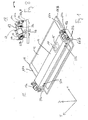
- Fig. 1
- in schematischer perspektivischer Darstellung eine erste Ausführungsform einer erfindungsgemäßen Vorrichtung zum Auslesen von in einer Speicherschicht abgespeicherter Information;
- Fig. 2a - 2c
- eine zweite Ausführungsform einer erfindungsgemäßen Vorrichtung nach sukzessivem Abbau von Teilen der erfindungsgemäßen Vorrichtung;
- Fig. 3a - 3d
- eine mit der Darstellung von Fig. 2b korrespondierende Darstellung der Lagerung der Empfangsvorrichtung, wobei aus den Darstellungen der Fig. 3b - 3d Details deutlich zu erkennen sind;
- Fig. 4
- die Darstellung von Fig. 3a in teilweise geschnittener Darstellung in Frontansicht;
- Fig. 5a, b
- eine detailliertere Darstellung von Einzelheiten der Fig. 3b;
- Fig. 6
- eine detaillierte Darstellung eines bevorzugt verwendeten Luftlagers;
- Fig. 7a, b
- in Seitenansicht und perspektivischer Darstellung einen bevorzugt bei der erfindungsgemäßen Vorrichtung zu verwendenden Präzisionstaster;
- Fig. 8
- in detaillierter Darstellung eine bevorzugt verwendbare Verstelleinheit; und
- Fig. 9
- in schematischer Darstellung das durch die Verwendung von Luftlagern ermöglichte Pendeln der Empfangsvorrichtung, beispielhaft gezeigt am Pendeln um die z-Achse.
Claims (15)
- Vorrichtung (10) zum Auslesen von in einer Speicherschicht (12) abgespeicherter Information mitdadurch gekennzeichnet, dass die Führungsfläche (11a, 11b, 16) von der Speicherschicht (12) unabhängig ist, undeiner Empfangsvorrichtung (14) zum Empfangen einer von der Speicherschicht (12) ausgesandten Emissionsstrahlung,einer Ablagefläche (16) zum Ablegen der Speicherschicht (12), wobei durch die Ablagefläche (16) eine x-y-Ebene definiert ist, undeinem Führungsmittel (20a, 20b) zum Führen der Empfangsvorrichtung (14) oder der Speicherschicht (12) auf einer Führungsfläche (11a, 11b, 16) während des Erzeugens einer Relativbewegung zwischen der Empfangsvorrichtung (14) und der Speicherschicht (12) in x-Richtung, wobei das Führungsmittel (20a, 20b) eine erste Teilführung (30a, 30c) zur Erzielung eines Abstandes in eine z-Richtung, die senkrecht zur x-y-Ebene liegt, zwischen der Führungsfläche (11a, 11 b, 16) und dem Führungsmittel (20a, 20b) und eine zweite Teilführung (30b, 30d) zur Erzielung eines Abstandes in die z-Richtung aufweist, und die erste Teilführung (30a, 30c) auf der - in z-Richtung betrachtet - einen Seite der Ablagefläche (16) und die zweite Teilführung (30b, 30d) auf der - in z-Richtung betrachtet - anderen Seite der Ablagefläche (16) angeordnet ist,
die erste Teilführung (30a, 30c) und die zweite Teilführung (30b, 30d) miteinander verbunden und so gegeneinander vorgespannt sind, dass sie zangenartig auf die Ablagefläche (16) wirken. - Vorrichtung nach Anspruch 1, dadurch gekennzeichnet, dass das Niveau der Führungsfläche (11a, 11b, 16) in z-Richtung mit dem Niveau der Ablagefläche (16) in z-Richtung übereinstimmt und die Führungsfläche (11a, 11 b, 16) zwei Teilführungsflächen (11a, 11b) aufweist, die in y-Richtung beidseitig der Ablagefläche (16) angeordnet sind.
- Vorrichtung nach Anspruch 2, dadurch gekennzeichnet, dass die Teilführungsflächen (11a, 11b) mit der Ablagefläche (16) verbunden sind.
- Vorrichtung nach Anspruch 3, dadurch gekennzeichnet, dass die Teilführungsflächen (11a, 11b) mit der Ablagefläche (16) integral verbunden sind.
- Vorrichtung nach einem der vorhergehenden Ansprüche, dadurch gekennzeichnet, dass die Führungsfläche (11a, 11b, 16) eine Glasoberfläche aufweist.
- Vorrichtung nach einem der vorhergehenden Ansprüche, dadurch gekennzeichnet, dass das Führungsmittel (20a, 20b) ein Lager (20) zum Lagern der Empfangsvorrichtung (14) aufweist.
- Vorrichtung nach einem der vorhergehenden Ansprüche, dadurch gekennzeichnet, dass die erste Teilführung (30a, 30c) und die zweite Teilführung (30b, 30d) durch mindestens eine Feder (51 b) gegeneinander vorgespannt sind.
- Vorrichtung nach einem der vorhergehenden Ansprüche, dadurch gekennzeichnet, dass die erste Teilführung (30a, 30c) und die zweite Teilführung (30b; 30d) über eine in x-Richtung verlaufende Drehachse (53a, 53b) miteinander verbunden sind.
- Vorrichtung nach einem der vorhergehenden Ansprüche, dadurch gekennzeichnet, dass die erste Teilführung (30a, 30c) und die zweite Teilführung (30b; 30d) jeweils mindestens ein Luftlager (36) umfassen.
- Vorrichtung nach Anspruch 9, dadurch gekennzeichnet, dass mindestens ein Luftlager (36) über eine punktförmige Verbindung (40, 42) mit der Empfangsvorrichtung (14) gekoppelt ist.
- Vorrichtung nach einem der vorhergehenden Ansprüche, dadurch gekennzeichnet, dass die erste Teilführung (30a, 30c) oder die zweite Teilführung (30b; 30d) wenigstens zwei in x-Richtung hintereinander angeordnete Unter-Teilführungen (30a1, 30a2) aufweist.
- Vorrichtung nach einem der vorhergehenden Ansprüche, dadurch gekennzeichnet, dass die erste Teilführung (30a, 30c) und die zweite Teilführung (30b; 30d) jeweils - in y-Richtung betrachtet - beidseitig der Ablagefläche (16) vorhanden sind.
- Vorrichtung nach einem der vorhergehenden Ansprüche, dadurch gekennzeichnet, dass eine dritte Teilführung (34a) zur Erzielung eines Abstandes in y-Richtung, und eine vierte Teilführung (34b) zur Erzielung eines Abstandes in y-Richtung vorhanden sind, und die dritte Teilführung - in y-Richtung betrachtet - auf der einen Seite der Ablagefläche (16) und die vierte Teilführung - in y-Richtung betrachtet - auf der anderen Seite der Ablagefläche (16) angeordnet ist.
- Vorrichtung nach Anspruch 13, dadurch gekennzeichnet, dass die dritte Teilführung (34a) und die vierte Teilführung (34b) miteinander verbunden und so gegeneinander vorgespannt sind, dass sie zangenartig auf die Ablagefläche (16) wirken.
- Verfahren zum Auslesen von in einer Speicherschicht (12) abgespeicherter Information unter Verwendung einer Empfangsvorrichtung (14) zum Empfangen von Emissionsstrahlung, die von der Speicherschicht (12) ausgegeben wurde, wobei sich die Speicherschicht (12) auf einer Ablagefläche (16) befindet, durch die eine xy-Ebene definiert wird, folgende Schritte umfassend:dadurch gekennzeichnet, dass die Führungsfläche (11a, 11b, 16) von der Speicherschicht (12) unabhängig ist, unda) Empfangen einer von der Speicherschicht (12) ausgesandten Emissionsstrahlung,b) Erzeugen einer Relativbewegung zwischen der Empfangsvorrichtung (14) und der Speicherschicht (12) in x-Richtung, undc) Führen der Empfangsvorrichtung (14) oder der Speicherschicht (12) während des Erzeugens der Relativbewegung mittels eines Führungsmittels (20a, 20b) auf einer Führungsfläche (11a, 11b, 16), wobei mittels einer ersten Teilführung ein Abstand in eine z-Richtung, die senkrecht zur x-y-Ebene liegt, auf der - in z-Richtung betrachtet - einen Seite der Ablagefläche (16) und mittels einer zweiten Teilführung ein Abstand in die z-Richtung auf der - in z-Richtung betrachtet - anderen Seite der Ablagefläche (16) eingestellt wird,
die erste Teilführung (30a, 30c) und die zweite Teilführung (30b, 30d) miteinander verbunden und gegeneinander vorgespannt sind und zangenartig auf die Ablagefläche (16) wirken.
Priority Applications (5)
| Application Number | Priority Date | Filing Date | Title |
|---|---|---|---|
| EP02014627A EP1378767B1 (de) | 2002-07-02 | 2002-07-02 | Vorrichtung und Verfahren zum Auslesen von in einer Speicherschicht abgespeicherter Information |
| DE50211552T DE50211552D1 (de) | 2002-07-02 | 2002-07-02 | Vorrichtung und Verfahren zum Auslesen von in einer Speicherschicht abgespeicherter Information |
| AT02014627T ATE384273T1 (de) | 2002-07-02 | 2002-07-02 | Vorrichtung und verfahren zum auslesen von in einer speicherschicht abgespeicherter information |
| US10/610,455 US6998633B2 (en) | 2002-07-02 | 2003-06-30 | Device and method for reading out information stored in a storage layer |
| JP2003270108A JP4041030B2 (ja) | 2002-07-02 | 2003-07-01 | 記憶層に記憶された情報を読み出す装置と方法 |
Applications Claiming Priority (1)
| Application Number | Priority Date | Filing Date | Title |
|---|---|---|---|
| EP02014627A EP1378767B1 (de) | 2002-07-02 | 2002-07-02 | Vorrichtung und Verfahren zum Auslesen von in einer Speicherschicht abgespeicherter Information |
Publications (2)
| Publication Number | Publication Date |
|---|---|
| EP1378767A1 true EP1378767A1 (de) | 2004-01-07 |
| EP1378767B1 EP1378767B1 (de) | 2008-01-16 |
Family
ID=29719699
Family Applications (1)
| Application Number | Title | Priority Date | Filing Date |
|---|---|---|---|
| EP02014627A Expired - Lifetime EP1378767B1 (de) | 2002-07-02 | 2002-07-02 | Vorrichtung und Verfahren zum Auslesen von in einer Speicherschicht abgespeicherter Information |
Country Status (5)
| Country | Link |
|---|---|
| US (1) | US6998633B2 (de) |
| EP (1) | EP1378767B1 (de) |
| JP (1) | JP4041030B2 (de) |
| AT (1) | ATE384273T1 (de) |
| DE (1) | DE50211552D1 (de) |
Cited By (1)
| Publication number | Priority date | Publication date | Assignee | Title |
|---|---|---|---|---|
| US6998633B2 (en) | 2002-07-02 | 2006-02-14 | Agfa-Gevaert Healthcare Gmbh | Device and method for reading out information stored in a storage layer |
Families Citing this family (6)
| Publication number | Priority date | Publication date | Assignee | Title |
|---|---|---|---|---|
| US7186996B2 (en) * | 2004-08-06 | 2007-03-06 | Agfa-Gevaert | System for reading out storage phosphor screens |
| EP1640801B1 (de) * | 2004-09-22 | 2008-08-20 | Agfa-Gevaert HealthCare GmbH | Vorrichtung und Verfahren zum Auslesen von in einer Speicherleuchtstoffplatte gespeicherten Röntgeninformationen |
| ATE535824T1 (de) * | 2005-02-15 | 2011-12-15 | Agfa Gevaert Healthcare Gmbh | Auslesevorrichtung und verfahren zum auslesen von in speicherleuchtstoffschichten gespeicherten röntgenaufnahmen |
| ATE439005T1 (de) * | 2005-12-29 | 2009-08-15 | Agfa Gevaert Healthcare Gmbh | Antriebsvorrichtung für eine optische abtasteinrichtung |
| US7446331B2 (en) * | 2006-08-21 | 2008-11-04 | Carestream Health, Inc. | Apparatus for scanning stimulable phosphor medium |
| JP7488292B2 (ja) | 2022-03-04 | 2024-05-21 | 株式会社モリタ製作所 | 放射線像の読取装置 |
Citations (1)
| Publication number | Priority date | Publication date | Assignee | Title |
|---|---|---|---|---|
| EP1081507A2 (de) * | 1999-08-07 | 2001-03-07 | Agfa-Gevaert AG | Vorrichtung zum Auslesen von in einer Speicherschicht abgespeicherten Informationen durch Anregungsstrahlung und Emfangsmittel |
Family Cites Families (6)
| Publication number | Priority date | Publication date | Assignee | Title |
|---|---|---|---|---|
| DE19962773A1 (de) * | 1999-12-23 | 2001-07-26 | Agfa Gevaert Ag | Vorrichtung zum Auslesen von in einer Speicherschicht abgespeicherten Informationen sowie Röntgenkassette und Röntgentisch |
| JP2001245100A (ja) * | 2000-02-25 | 2001-09-07 | Fuji Photo Film Co Ltd | 蓄積性蛍光体を用いた画像情報読取方法および装置並びに固体画像検出器 |
| JP2001350228A (ja) * | 2000-06-07 | 2001-12-21 | Fuji Photo Film Co Ltd | 放射線画像読取装置 |
| US6784448B2 (en) * | 2001-02-27 | 2004-08-31 | Fuji Photo Film Co., Ltd. | Method for reading radiation image from stimulable phosphor sheet |
| US6861662B2 (en) * | 2002-01-17 | 2005-03-01 | Fuji Photo Film Co., Ltd. | Image information reading apparatus |
| ATE384273T1 (de) | 2002-07-02 | 2008-02-15 | Agfa Gevaert Healthcare Gmbh | Vorrichtung und verfahren zum auslesen von in einer speicherschicht abgespeicherter information |
-
2002
- 2002-07-02 AT AT02014627T patent/ATE384273T1/de not_active IP Right Cessation
- 2002-07-02 EP EP02014627A patent/EP1378767B1/de not_active Expired - Lifetime
- 2002-07-02 DE DE50211552T patent/DE50211552D1/de not_active Expired - Lifetime
-
2003
- 2003-06-30 US US10/610,455 patent/US6998633B2/en not_active Expired - Fee Related
- 2003-07-01 JP JP2003270108A patent/JP4041030B2/ja not_active Expired - Fee Related
Patent Citations (1)
| Publication number | Priority date | Publication date | Assignee | Title |
|---|---|---|---|---|
| EP1081507A2 (de) * | 1999-08-07 | 2001-03-07 | Agfa-Gevaert AG | Vorrichtung zum Auslesen von in einer Speicherschicht abgespeicherten Informationen durch Anregungsstrahlung und Emfangsmittel |
Cited By (1)
| Publication number | Priority date | Publication date | Assignee | Title |
|---|---|---|---|---|
| US6998633B2 (en) | 2002-07-02 | 2006-02-14 | Agfa-Gevaert Healthcare Gmbh | Device and method for reading out information stored in a storage layer |
Also Published As
| Publication number | Publication date |
|---|---|
| EP1378767B1 (de) | 2008-01-16 |
| JP4041030B2 (ja) | 2008-01-30 |
| US6998633B2 (en) | 2006-02-14 |
| JP2004086201A (ja) | 2004-03-18 |
| DE50211552D1 (de) | 2008-03-06 |
| ATE384273T1 (de) | 2008-02-15 |
| US20040104364A1 (en) | 2004-06-03 |
Similar Documents
| Publication | Publication Date | Title |
|---|---|---|
| DE69320762T2 (de) | Mit hoher Genauigkeit bewegliche Plattform | |
| EP1133377B1 (de) | Vorrichtung und verfahren zum abtasten einer objektfläche mit einem laserstrahl | |
| EP0523521A2 (de) | Strahlungsmessgerät, insbesondere zur Lumineszenzmessung | |
| EP0867732A2 (de) | Lichtgitter und Verfahren zu seiner Herstellung | |
| DE10019231B4 (de) | Vorrichtung zum Kompensieren der Niveauebene einer Leiterplatte für eine Flächenmontagevorrichtung | |
| DE4235549A1 (de) | Lichtquelleneinheit und herstellungsverfahren dafuer, einstellungsverfahren und einstellungsgeraet | |
| EP0863482A2 (de) | Anlage zur Bearbeitung von Chip- und/oder Magnetstreifenkarten | |
| EP1378766B1 (de) | Vorrichtung und Verfahren zum Auslesen von in einer Speicherschicht abgespeicherter Information | |
| EP0863481A1 (de) | Anlage zur Bearbeitung von Chip- und/oder Magnetstreifenkarten | |
| EP1378767B1 (de) | Vorrichtung und Verfahren zum Auslesen von in einer Speicherschicht abgespeicherter Information | |
| DE3703217A1 (de) | Optische abtasteinrichtung | |
| EP1378765B1 (de) | Vorrichtung und Verfahren zum Auslesen von in einer Speicherschicht abgespeicherter Information | |
| DE60209367T2 (de) | Vorrichtung zur messung oder maschinellen bearbeitung eines objekts mit einer verschiebungsstufe mit keilförmigen führungen | |
| EP3424731B1 (de) | Vorrichtung und verfahren zur positionierung eines dokumentenkörpers sowie vorrichtung und verfahren zur herstellung eines dokumentenkörpers | |
| EP1791022B1 (de) | Kassette für eine Speicherleuchtstoffplatte sowie Vorrichtung zur Entnahme der Speicherleuchtstoffplatte aus der Kassette | |
| EP1081507B1 (de) | Vorrichtung zum Auslesen von in einer Speicherschicht abgespeicherten Informationen durch Anregungsstrahlung und Empfangsmittel | |
| EP1791023B1 (de) | Vorrichtung und Verfahren zum Auslesen einer Speicherleuchtstoffplatte | |
| DE3332909A1 (de) | Anordnung zum beleuchten einer zeile eines informationstraegers | |
| EP1804483B1 (de) | Antriebsvorrichtung für eine optische Abtasteinrichtung | |
| EP1622196A1 (de) | Waferbearbeitungsvorrichtung und zugehöriges Verfahren | |
| DE2903158C2 (de) | Vorrichtung zum Aufzeichnen einer Vielzahl von Mikrobildern auf einen Film | |
| DE102018001570A1 (de) | Vorrichtung und Verfahren zum Bearbeiten eines Werkstücks mittels eines Laserstrahls | |
| DE3921183C2 (de) | ||
| DE10050721A1 (de) | Verfahren und Vorrichtung zur Abtastung von Vorlagen mit digitaler Information | |
| CH686537A5 (de) | Fotografisches Rollenkopiergeraet. |
Legal Events
| Date | Code | Title | Description |
|---|---|---|---|
| PUAI | Public reference made under article 153(3) epc to a published international application that has entered the european phase |
Free format text: ORIGINAL CODE: 0009012 |
|
| AK | Designated contracting states |
Kind code of ref document: A1 Designated state(s): AT BE BG CH CY CZ DE DK EE ES FI FR GB GR IE IT LI LU MC NL PT SE SK TR |
|
| AX | Request for extension of the european patent |
Extension state: AL LT LV MK RO SI |
|
| 17P | Request for examination filed |
Effective date: 20040707 |
|
| AKX | Designation fees paid |
Designated state(s): AT BE BG CH CY CZ DE DK EE ES FI FR GB GR IE IT LI LU MC NL PT SE SK TR |
|
| RAP1 | Party data changed (applicant data changed or rights of an application transferred) |
Owner name: AGFA-GEVAERT HEALTHCARE GMBH |
|
| 17Q | First examination report despatched |
Effective date: 20061129 |
|
| GRAP | Despatch of communication of intention to grant a patent |
Free format text: ORIGINAL CODE: EPIDOSNIGR1 |
|
| GRAS | Grant fee paid |
Free format text: ORIGINAL CODE: EPIDOSNIGR3 |
|
| GRAA | (expected) grant |
Free format text: ORIGINAL CODE: 0009210 |
|
| AK | Designated contracting states |
Kind code of ref document: B1 Designated state(s): AT BE BG CH CY CZ DE DK EE ES FI FR GB GR IE IT LI LU MC NL PT SE SK TR |
|
| REG | Reference to a national code |
Ref country code: GB Ref legal event code: FG4D Free format text: NOT ENGLISH |
|
| GBT | Gb: translation of ep patent filed (gb section 77(6)(a)/1977) |
Effective date: 20080123 |
|
| REG | Reference to a national code |
Ref country code: CH Ref legal event code: EP |
|
| REG | Reference to a national code |
Ref country code: IE Ref legal event code: FG4D Free format text: LANGUAGE OF EP DOCUMENT: GERMAN |
|
| REF | Corresponds to: |
Ref document number: 50211552 Country of ref document: DE Date of ref document: 20080306 Kind code of ref document: P |
|
| PG25 | Lapsed in a contracting state [announced via postgrant information from national office to epo] |
Ref country code: NL Free format text: LAPSE BECAUSE OF FAILURE TO SUBMIT A TRANSLATION OF THE DESCRIPTION OR TO PAY THE FEE WITHIN THE PRESCRIBED TIME-LIMIT Effective date: 20080116 |
|
| NLV1 | Nl: lapsed or annulled due to failure to fulfill the requirements of art. 29p and 29m of the patents act | ||
| PG25 | Lapsed in a contracting state [announced via postgrant information from national office to epo] |
Ref country code: FI Free format text: LAPSE BECAUSE OF FAILURE TO SUBMIT A TRANSLATION OF THE DESCRIPTION OR TO PAY THE FEE WITHIN THE PRESCRIBED TIME-LIMIT Effective date: 20080116 Ref country code: ES Free format text: LAPSE BECAUSE OF FAILURE TO SUBMIT A TRANSLATION OF THE DESCRIPTION OR TO PAY THE FEE WITHIN THE PRESCRIBED TIME-LIMIT Effective date: 20080427 |
|
| PG25 | Lapsed in a contracting state [announced via postgrant information from national office to epo] |
Ref country code: BG Free format text: LAPSE BECAUSE OF FAILURE TO SUBMIT A TRANSLATION OF THE DESCRIPTION OR TO PAY THE FEE WITHIN THE PRESCRIBED TIME-LIMIT Effective date: 20080416 |
|
| ET | Fr: translation filed | ||
| PG25 | Lapsed in a contracting state [announced via postgrant information from national office to epo] |
Ref country code: PT Free format text: LAPSE BECAUSE OF FAILURE TO SUBMIT A TRANSLATION OF THE DESCRIPTION OR TO PAY THE FEE WITHIN THE PRESCRIBED TIME-LIMIT Effective date: 20080616 |
|
| REG | Reference to a national code |
Ref country code: IE Ref legal event code: FD4D |
|
| PG25 | Lapsed in a contracting state [announced via postgrant information from national office to epo] |
Ref country code: SK Free format text: LAPSE BECAUSE OF FAILURE TO SUBMIT A TRANSLATION OF THE DESCRIPTION OR TO PAY THE FEE WITHIN THE PRESCRIBED TIME-LIMIT Effective date: 20080116 Ref country code: CZ Free format text: LAPSE BECAUSE OF FAILURE TO SUBMIT A TRANSLATION OF THE DESCRIPTION OR TO PAY THE FEE WITHIN THE PRESCRIBED TIME-LIMIT Effective date: 20080116 Ref country code: SE Free format text: LAPSE BECAUSE OF FAILURE TO SUBMIT A TRANSLATION OF THE DESCRIPTION OR TO PAY THE FEE WITHIN THE PRESCRIBED TIME-LIMIT Effective date: 20080416 Ref country code: DK Free format text: LAPSE BECAUSE OF FAILURE TO SUBMIT A TRANSLATION OF THE DESCRIPTION OR TO PAY THE FEE WITHIN THE PRESCRIBED TIME-LIMIT Effective date: 20080116 Ref country code: IE Free format text: LAPSE BECAUSE OF FAILURE TO SUBMIT A TRANSLATION OF THE DESCRIPTION OR TO PAY THE FEE WITHIN THE PRESCRIBED TIME-LIMIT Effective date: 20080116 |
|
| PLBE | No opposition filed within time limit |
Free format text: ORIGINAL CODE: 0009261 |
|
| STAA | Information on the status of an ep patent application or granted ep patent |
Free format text: STATUS: NO OPPOSITION FILED WITHIN TIME LIMIT |
|
| 26N | No opposition filed |
Effective date: 20081017 |
|
| REG | Reference to a national code |
Ref country code: CH Ref legal event code: PL |
|
| PG25 | Lapsed in a contracting state [announced via postgrant information from national office to epo] |
Ref country code: MC Free format text: LAPSE BECAUSE OF NON-PAYMENT OF DUE FEES Effective date: 20080731 |
|
| PG25 | Lapsed in a contracting state [announced via postgrant information from national office to epo] |
Ref country code: EE Free format text: LAPSE BECAUSE OF FAILURE TO SUBMIT A TRANSLATION OF THE DESCRIPTION OR TO PAY THE FEE WITHIN THE PRESCRIBED TIME-LIMIT Effective date: 20080116 |
|
| PG25 | Lapsed in a contracting state [announced via postgrant information from national office to epo] |
Ref country code: CH Free format text: LAPSE BECAUSE OF NON-PAYMENT OF DUE FEES Effective date: 20080731 Ref country code: LI Free format text: LAPSE BECAUSE OF NON-PAYMENT OF DUE FEES Effective date: 20080731 |
|
| PG25 | Lapsed in a contracting state [announced via postgrant information from national office to epo] |
Ref country code: CY Free format text: LAPSE BECAUSE OF FAILURE TO SUBMIT A TRANSLATION OF THE DESCRIPTION OR TO PAY THE FEE WITHIN THE PRESCRIBED TIME-LIMIT Effective date: 20080116 |
|
| PG25 | Lapsed in a contracting state [announced via postgrant information from national office to epo] |
Ref country code: IT Free format text: LAPSE BECAUSE OF FAILURE TO SUBMIT A TRANSLATION OF THE DESCRIPTION OR TO PAY THE FEE WITHIN THE PRESCRIBED TIME-LIMIT Effective date: 20080116 |
|
| PG25 | Lapsed in a contracting state [announced via postgrant information from national office to epo] |
Ref country code: AT Free format text: LAPSE BECAUSE OF NON-PAYMENT OF DUE FEES Effective date: 20080702 |
|
| REG | Reference to a national code |
Ref country code: FR Ref legal event code: CA |
|
| PG25 | Lapsed in a contracting state [announced via postgrant information from national office to epo] |
Ref country code: LU Free format text: LAPSE BECAUSE OF NON-PAYMENT OF DUE FEES Effective date: 20080702 Ref country code: BE Free format text: LAPSE BECAUSE OF NON-PAYMENT OF DUE FEES Effective date: 20080731 |
|
| PG25 | Lapsed in a contracting state [announced via postgrant information from national office to epo] |
Ref country code: TR Free format text: LAPSE BECAUSE OF FAILURE TO SUBMIT A TRANSLATION OF THE DESCRIPTION OR TO PAY THE FEE WITHIN THE PRESCRIBED TIME-LIMIT Effective date: 20080116 |
|
| PG25 | Lapsed in a contracting state [announced via postgrant information from national office to epo] |
Ref country code: GR Free format text: LAPSE BECAUSE OF FAILURE TO SUBMIT A TRANSLATION OF THE DESCRIPTION OR TO PAY THE FEE WITHIN THE PRESCRIBED TIME-LIMIT Effective date: 20080417 |
|
| PGFP | Annual fee paid to national office [announced via postgrant information from national office to epo] |
Ref country code: FR Payment date: 20120628 Year of fee payment: 11 |
|
| PGFP | Annual fee paid to national office [announced via postgrant information from national office to epo] |
Ref country code: GB Payment date: 20120703 Year of fee payment: 11 |
|
| REG | Reference to a national code |
Ref country code: DE Ref legal event code: R084 Ref document number: 50211552 Country of ref document: DE Effective date: 20130131 |
|
| GBPC | Gb: european patent ceased through non-payment of renewal fee |
Effective date: 20130702 |
|
| REG | Reference to a national code |
Ref country code: FR Ref legal event code: ST Effective date: 20140331 |
|
| PG25 | Lapsed in a contracting state [announced via postgrant information from national office to epo] |
Ref country code: GB Free format text: LAPSE BECAUSE OF NON-PAYMENT OF DUE FEES Effective date: 20130702 |
|
| PG25 | Lapsed in a contracting state [announced via postgrant information from national office to epo] |
Ref country code: FR Free format text: LAPSE BECAUSE OF NON-PAYMENT OF DUE FEES Effective date: 20130731 |
|
| PGFP | Annual fee paid to national office [announced via postgrant information from national office to epo] |
Ref country code: DE Payment date: 20140618 Year of fee payment: 13 |
|
| REG | Reference to a national code |
Ref country code: DE Ref legal event code: R119 Ref document number: 50211552 Country of ref document: DE |
|
| PG25 | Lapsed in a contracting state [announced via postgrant information from national office to epo] |
Ref country code: DE Free format text: LAPSE BECAUSE OF NON-PAYMENT OF DUE FEES Effective date: 20160202 |