EP1379023A1 - Chiffrement/déchiffrement exécuté par un circuit intégré masquant une transformation non linéaire du type SUBBYTE - Google Patents
Chiffrement/déchiffrement exécuté par un circuit intégré masquant une transformation non linéaire du type SUBBYTE Download PDFInfo
- Publication number
- EP1379023A1 EP1379023A1 EP03300046A EP03300046A EP1379023A1 EP 1379023 A1 EP1379023 A1 EP 1379023A1 EP 03300046 A EP03300046 A EP 03300046A EP 03300046 A EP03300046 A EP 03300046A EP 1379023 A1 EP1379023 A1 EP 1379023A1
- Authority
- EP
- European Patent Office
- Prior art keywords
- encryption
- random number
- code
- blocks
- block
- Prior art date
- Legal status (The legal status is an assumption and is not a legal conclusion. Google has not performed a legal analysis and makes no representation as to the accuracy of the status listed.)
- Granted
Links
Images


Classifications
-
- H—ELECTRICITY
- H04—ELECTRIC COMMUNICATION TECHNIQUE
- H04L—TRANSMISSION OF DIGITAL INFORMATION, e.g. TELEGRAPHIC COMMUNICATION
- H04L9/00—Cryptographic mechanisms or cryptographic arrangements for secret or secure communications; Network security protocols
- H04L9/06—Cryptographic mechanisms or cryptographic arrangements for secret or secure communications; Network security protocols the encryption apparatus using shift registers or memories for block-wise or stream coding, e.g. DES systems or RC4; Hash functions; Pseudorandom sequence generators
- H04L9/0618—Block ciphers, i.e. encrypting groups of characters of a plain text message using fixed encryption transformation
- H04L9/0631—Substitution permutation network [SPN], i.e. cipher composed of a number of stages or rounds each involving linear and nonlinear transformations, e.g. AES algorithms
-
- H—ELECTRICITY
- H04—ELECTRIC COMMUNICATION TECHNIQUE
- H04L—TRANSMISSION OF DIGITAL INFORMATION, e.g. TELEGRAPHIC COMMUNICATION
- H04L9/00—Cryptographic mechanisms or cryptographic arrangements for secret or secure communications; Network security protocols
- H04L9/002—Countermeasures against attacks on cryptographic mechanisms
- H04L9/003—Countermeasures against attacks on cryptographic mechanisms for power analysis, e.g. differential power analysis [DPA] or simple power analysis [SPA]
-
- H—ELECTRICITY
- H04—ELECTRIC COMMUNICATION TECHNIQUE
- H04L—TRANSMISSION OF DIGITAL INFORMATION, e.g. TELEGRAPHIC COMMUNICATION
- H04L2209/00—Additional information or applications relating to cryptographic mechanisms or cryptographic arrangements for secret or secure communication H04L9/00
- H04L2209/04—Masking or blinding
- H04L2209/046—Masking or blinding of operations, operands or results of the operations
-
- H—ELECTRICITY
- H04—ELECTRIC COMMUNICATION TECHNIQUE
- H04L—TRANSMISSION OF DIGITAL INFORMATION, e.g. TELEGRAPHIC COMMUNICATION
- H04L2209/00—Additional information or applications relating to cryptographic mechanisms or cryptographic arrangements for secret or secure communication H04L9/00
- H04L2209/08—Randomization, e.g. dummy operations or using noise
Definitions
- the present invention relates to the field of encryption digital data using algorithms for hide original data to make it undetectable by a possible hacker.
- the invention relates more particularly algorithms implementing the same transformation on different parts of the data to be coded.
- the encryption / decryption algorithms to which applies the present invention are generally executed by integrated circuits, either by state machines in wired logic, either by microprocessors running a program in memory (usually read only memory). Such algorithms use circuit-specific secret keys integrated or to the user, which are exploited by the algorithm to code the data.
- AES Advanced Encryption Standard
- FIPS PUB 197 An algorithm known as AES (Advanced Encryption Standard, FIPS PUB 197). This algorithm applies to a word or data code cut into blocks, the same transformation several repeatedly from different encryption keys or, more precisely, of parts of a binary word constituting a key.
- FIG. 1 illustrates, by a simplified flowchart, the main steps of a classic AES algorithm. We will only describe the encryption, decryption taking up the reverse transformations.
- This algorithm encrypts a word or code S 0 of a predetermined number of bits (generally, 128 bits) into another word or code S n of the same size.
- the data to be encrypted are in fact made up of several words or codes resulting from a prior cutting of the data into words all having the same size. Encryption and decryption are based on a secret key, the length of which (generally 128 to 256 bits) conditions the security of the encryption.
- each step of an AES type algorithm processes a matrix of four rows and four columns, representing a word and each element of which is a byte or block of the 128-bit code processed.
- a first phase of the encryption process is an operation (block 2, ADDROUNDKEY) called "laundering” which consists in performing a combination of the OU-Exclusive type (XOR) of the initial state S 0 with the first subkey K0.
- a first intermediate state S 1 is obtained.
- a second phase of the encryption process consists in carrying out several turns or cycles of the same transformation T involving, at each turn, the state S i-1 obtained in the previous turn and a current subkey Ki.
- the number of turns of the transformation T corresponds to n-1, that is to say the number of derived sub-keys, reduced by 2.
- Each transformation of tower T consists of four operations applied successively.
- Figure 2 illustrates in more detail these four operations on a matrix 20 of four rows and four columns of binary bytes to which applies an AES type algorithm.
- a first step (block 3, SHIFTROWS) consists of rotate on the last three rows of the matrix 20.
- the first line 201 of the matrix 20 remains unchanged.
- the second line 202 is rotated one byte.
- the third line 203 is rotated by two bytes.
- the fourth line 204 is rotated three bytes.
- a second step (block 4, SUBBYTES) of the turn transformation T constitutes a non-linear transformation in which each byte of the matrix 20 'constituting the current state is replaced by its image taken from a substitution table (SBOX).
- SBOX substitution table is obtained by two successive transformations.
- a first transformation (block 41, INV) consists in inverting the byte considered (the element of the matrix 20 ') in the finite body of order 2 8 (to correspond to the byte), byte 00 constituting its own image. This inversion is followed by an affine transformation (block 42, AFFINE).
- the third stage (block 5, MIXCOLUMNS) of the transformation of tower T consists in considering each column of the matrix 20 "resulting from the preceding stage as a polynomial on the finite field of order 2 8 , and in multiplying each of these polynomials by a combination polynomial P [X] modulo a polynomial M [X].
- the fourth and final step in the transformation of turn T of rank i consists in applying the subkey Ki to the resulting matrix 20 "from the previous state to obtain a 20 "matrix, where each element of the 20" matrix has been combined by an OU-Exclusive, bit by bit, with the subkey Ki (block 6, ADDROUNDKEY).
- This step 6 is the same as step 2 of the first phase of encryption, but performed with a different subkey.
- the four stages of the turn transformation are repeated n-1 times, that is to say that after step 6, we return to step 3 to re-perform a turn with a following key.
- the third phase of the encryption algorithm (figure 1) consists of a last round, slightly modified from that illustrated in Figure 2. In fact, we reproduce the steps of the tower transformation except of the third (MIXCOLUMNS). This amounts to performing successively steps 7, 8 and 9 corresponding to steps 3, 4 and 6 described above with, as key for step 9, the last subkey Kn.
- Such an attack known as DPA (Differential Power Analysis) denomination consists in correlating the consumption of the integrated circuit executing the algorithm with the secret keys used during encryption or decryption.
- DPA Different Power Analysis
- a known solution to make algorithms more resistant against attacks by analysis of the consumption of integrated circuit, consists in involving a random number in the execution of the algorithm
- the use of a random value consists in hiding the state at the start of the algorithm by this random value and to restore the expected result to the end of the algorithm.
- FIG. 3 illustrates, partially and very schematically, a first known technique for introducing a random number Rd in the execution of an AES type algorithm.
- an OR-Exclusive type combination is carried out bit by bit (block 12, +) by a random number Rd.
- This number is therefore introduced before step 2 combination with the first under key K0.
- This random number Rd must then be taken into account at certain stages of the algorithm.
- SBOX Rd substitution table
- substitution table based on the random number means that this table must be recalculated each time it is encrypted or deciphered.
- This recalculation of the substitution tables results in a significant memory requirement in the integrated circuit and lengthens the execution time of the algorithm by the necessary calculation time.
- the recalculation of an SBOX Rd substitution table for each byte of the report requires 16 tables of 256 bytes, which represents 4 kilobytes of memory. Such a memory is far from negligible when it is integrated, for example, in a smart card.
- Figure 4 illustrates a second classic solution to involve a random value in an algorithm of AES type encryption. This solution is described in the article "An implementation of DES and AES, secure against some attacks” by M.L. Akkar and C. Giraud published at the CHES 2001 conference (Springer-Verlag editions).
- the first random number Rd1 occurs at start (between blocks 1 and 2) and is added (combination of the OU-Exclusive type 22).
- the second random value Rd2 is introduced in the tower transformations whether they are n-1 identical transformations T or the last transformation T '.
- step 3 or 7 of line shift is combined by a polynomial multiplication 23 with coefficients on the finite field of order 2 8 (modulo an irreducible polynomial) with the random value Rd2. Then, the resulting matrix obtained is added (combination of the OU-Exclusive type) to a matrix representing the result of the previous operation (S i * Rd2). This addition is symbolized by a block 25 in FIG. 4.
- a first transformation (block 241, INV) consists in inverting each byte of the resulting matrix from step 25. Then, we add (OU-Exclusive) to this inverse matrix (block 242, +), the product (byte by byte modulo an irreducible polynomial) of the initial state S i by the inverse (Rd2 -1 ) of the random value. The result is then multiplied (block 243, X) by the random value Rd2. Again, this is a polynomial multiplication. Finally, the last step of the byte substitution 24 of the matrix consists of an affine transformation 244 (AFFINE). At the end of step 24, the resulting matrix is subjected to the step of adding the corresponding subkey (step 6 or 9).
- AFFINE affine transformation 244
- step 5 MIXCOLUMNS
- step 6 we combine (block 26, +) with an Exclusive-OR the result obtained with the value Rd1.
- the result of addition 26 is combined (block 27), always by an Exclusive-OR, with the result (MC (AF (SR (Rd1))) of the polynomial column mix processing (MC) of the transformation affine AF applied to the line offset SR applied to the value Rd1.
- step 9 the step following step 24 is step 9 with the key Kn.
- step 29 we combine (block 29, +) with an Exclusive-OR the result obtained with the result (AF (SR (Rd1))) of the AF affine transformation applied to the line offset SR applied to the value Rd1.
- AF SR (Rd1)
- the problem of processing with a random number basically comes from the fact that in an algorithm like to which the invention applies, the substitution operation is a non-linear operation.
- the present invention aims to propose a new solution to the introduction of at least one random quantity in an AES type encryption algorithm which overcomes the disadvantages known solutions. More generally, the invention aims to propose the introduction of at least one random value in an algorithm subjecting an input code or word, cut into blocks, several times the same transformation (by substitution matrix) with different keys.
- the invention also aims to propose a solution which minimizes the number of times a substitution table must be calculated and / or stored.
- the invention also aims to minimize the time of calculation necessary for the execution of the algorithm following the introduction of the random number.
- the entry code is combined with a second number random of the same dimension as this code.
- said nonlinear transformation consists in using a input code block substitution table, calculated with a third random number of the same length as said code and all of whose blocks have the same value.
- said table respects the fact that the transformation of a code entry, previously combined by an Exclusive OR with the first random number, corresponds to the result of the combination by an Exclusive OU of this entry code with said third random number.
- the method is applied to an encryption algorithm of type AES.
- said first random number is changed each turn encryption.
- said second random number is changed at each encryption new data.
- said third random number is changed every turn encryption.
- a random quantity is used having the same size as the state to encrypt (the matrix) for the transformations processing multiple bytes at the same time or which mix them together, as is the case with transformations of type mixing of columns, introduction of subkey and line offset.
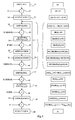
- FIG. 5 represents a flowchart of a mode of implementation of an AES type algorithm, masked by random and / or pseudo-random values according to this invention.
- This state S 0 corresponds to the code (data) to be encrypted by the algorithm.
- the first step 41 consists in carrying out an OR-Exclusive type combination of the state S 0 with a random value R whose size is the same as the state S 0 (for example, 128 bits).
- a conventional step 32 of subkey addition is executed (block 32, ADDROUNDKEY) by an OU-Exclusive type combination of the first subkey K0 with the result of the previous step.
- the state obtained corresponds to the state S 1 + R.
- the number (by example, 16) bytes of each value is the number bytes of a processed state (for example, 128 bits).
- SR (S i + R) SR (S i ) + SR (R) is obtained.
- the state SR (S i ) + SR is combined (block 42) with a value of the same size (R1 + SR (R)) corresponding to l application of the line offset to the combined random value R (SR (R)), byte by byte, by an Exclusive OR with the random value R1.
- the state is masked by a value of the same size, each byte of which has the same random value.
- substitution table SBOX R1, R2 is a function of the value R2 and is linked to the value R1 while respecting the following relationship:
- SB (S i + R1) SBOX (S i ) + R2, where SBOX represents the substitution table of the algorithm that we want to hide and SB designates the byte substitution function (SUBBYTES).
- SUBBYTES byte substitution function
- step 34 To the result (SB (SR (S i )) + R2) of step 34 which corresponds to a state masked by the value R2 (each byte of the matrix is masked by a byte of the same value), a combination of OR-Exclusive type (block 43) with the OR-Exclusive combination R2 + R (byte by byte) of the 128-bit value R and byte R2.
- the result (SB (SR (S i )) + R) undergoes the column mix transformation 35 of the conventional algorithm. Still respecting the classical algorithm, the sub-key Ki is introduced by step 36 of OR-Exclusive type combination with the preceding matrix.
- Cyclical transformation ends with this step 44 at the end of which, according to rank i, we return to step 33 for a new iteration or we go to step 37 of line shift (SHIFTROWS) of the last transformation T '.
- SHIFTROWS line shift
- the invention consists of interposing, between certain stages of the algorithm whose execution we wish to hide by random values, logical combinations of matrices treated by the quantities R1 and R2.
- substitution matrix 38 is identical to that described in relation to step 34, but framed by combinations 45 and 46. These combinations are identical to the combinations 42 and 43 described above, in upstream and downstream of processing 34.
- An advantage of the present invention is that the quantities R1 and R2 as well as the SBOX substitution table can be recalculated at each turn T of the transformation cyclic or at each encryption or decryption of the data input by the full algorithm.
- Another advantage of the invention is that a memory corresponding to twice the matrix to be treated is sufficient to store the new substitution tables (the old and the new) insofar as these are combined with a random value whose size corresponds to that of an element of the matrix.
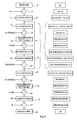
- FIG. 6 represents, in the form of a simplified flowchart, a mode of implementation of an algorithm for decrypting a data item S n according to the invention.
- decryption resumes the reverse steps to those of encryption with the exception of steps for introducing the Ki keys or sub-keys, which is carried out in reverse order.
- the initial state (block 51, STATE INIT) here corresponds to an encrypted or encrypted state (S n ) of the data.
- Steps 62, 63 and 64 are identical to steps 42, 43 and 44 executed during encryption. Steps 52, 53, 54, 55 and 56 correspond to the functions implemented conventionally for the decryption of the algorithm which one wishes hide execution.
- steps 57, 58 and 59 are applied successively, reverse to encryption steps 37, 38 and 39 and corresponding at the classic stages of the decryption process, by inserting the same combination steps 65, 66 and 67 as during the encryption.
- the random (or pseudo-random) quantities R, R1, and R2 used when decrypting data can be different from those used during encryption. Moreover, as during the execution of the encryption algorithm, these random quantities can be different each round of cyclical transformation.
- the quantities R1 and R2 are identical.
- step 44 is then deleted.
- step 64 can be deleted by modifying the step 63 by introducing R2 + MC (R) instead of R2 + R.
- the present invention is capable of various variations and modifications that will appear to humans art.
- the invention which has been described above in relation to the AES type encryption algorithm can be transposed to any encryption algorithm whose entry code is cut into blocks of identical size for be encrypted, each block undergoing the same transformation not linear.
- a particular example of application of the invention concerns the implementation of an encryption / decryption algorithm AES type in a smart card.
Landscapes
- Engineering & Computer Science (AREA)
- Computer Security & Cryptography (AREA)
- Computer Networks & Wireless Communication (AREA)
- Signal Processing (AREA)
- Storage Device Security (AREA)
Abstract
Description
- décalage de lignes inverse (bloc 53, INVSHIFTROWS, fonction ISR) correspondant à la transformation inverse de celle du bloc 33 ;
- combinaison de type OU-Exclusif 62 avec la quantité aléatoire R1 et la fonction 53 appliquée à la quantité aléatoire R (ISR(R)) ;
- application (bloc 54, INVSUBYTES, fonction ISB) de la table de substitution INVSBOXR1,R2 inverse à celle utilisée lors de l'étape 34 ;
- combinaison 63 de type OU-Exclusif avec les quantités R2 et R ;
- transformation inverse (bloc 55, INVMIXCOLUMNS, fonction IMC) de la transformation dite de mélange de colonnes 35 ;
- combinaison de type OU-Exclusif (bloc 56, ADDROUNDKEY) avec la sous-clé Ki de rang i ; et
- combinaison 64 de type OU-Exclusif avec la quantité aléatoire R et avec le résultat d'une transformation 55 (IMC) appliquée à cette quantité aléatoire.
Claims (9)
- Procédé de chiffrement et/ou déchiffrement, par un circuit intégré, d'un code numérique d'entrée (S0, Sn) au moyen deplusieurs clés (Ki), consistant :caractérisé en ce qu'il consiste à masquer les opérandes lors de l'exécution du procédé au moyen d'au moins un premier nombre aléatoire (R1) ayant la taille dudit code et dont tous les blocs ont la même valeur en combinant, par une fonction de type OU-Exclusif, les blocs d'entrée et de sortie de la transformation non linéaire avec ledit nombre aléatoire.à découper ledit code en plusieurs blocs de données de mêmes dimensions ; età appliquer auxdits blocs plusieurs (n-1) tours (T) de chiffrement ou déchiffrement consistant à faire subir à chaque bloc au moins une même transformation non linéaire (SUBBYTES, INVSUBBYTES) et à combiner ultérieurement chaque bloc avec une clé (Ki) différente à chaque tour,
- Procédé selon la revendication 1, dans lequel le code d'entrée (S0, Sn) est combiné avec un deuxième nombre aléatoire (R) de même dimension que ce code.
- Procédé selon la revendication 1 ou 2, dans lequel ladite transformation non linéaire (SUBBYTES, INVSUBBYTES) consiste à utiliser une table (SBOXR1,R2) de substitution des blocs du code d'entrée, calculée avec un troisième nombre aléatoire (R2) de même longueur que ledit code et dont tous les blocs ont la même valeur, ladite table (SBOXR1,R2) respectant le fait que la transformation d'un code d'entrée, préalablement combiné par un OU-Exclusif avec le premier nombre aléatoire (R1), correspond au résultat de la combinaison par un OU-Exclusif de ce code d'entrée avec ledit troisième nombre aléatoire.
- Procédé selon l'une quelconque des revendications 1 à 3, appliqué à un algorithme de chiffrement de type AES.
- Procédé selon la revendication 1, dans lequel ledit premier nombre aléatoire (R1) est changé à chaque tour de chiffrement.
- Procédé selon la revendication 2, dans lequel ledit deuxième nombre aléatoire (R) est changé à chaque chiffrement d'une nouvelle donnée.
- Procédé selon la revendication 3, dans lequel ledit troisième nombre aléatoire (R2) est changé à chaque tour de chiffrement.
- Circuit intégré comprenant un bloc de chiffrement/déchiffrement en plusieurs tours d'une donnée d'entrée (S0, Sn) découpée en blocs de mêmes dimensions, caractérisé en ce qu'il comporte :des moyens de génération d'au moins un premier nombre aléatoire (R1) de même taille que la taille des blocs de la donnée d'entrée ; etdes moyens de combinaison dudit nombre aléatoire avec chaque bloc, en entrée et en sortie d'une transformation non linéaire (34, 54) mise en oeuvre par le chiffrement/déchiffrement.
- Circuit selon la revendication 8, comprenant des moyens pour la mise en oeuvre du procédé selon l'une quelconque des revendications 1 à 7.
Applications Claiming Priority (2)
| Application Number | Priority Date | Filing Date | Title |
|---|---|---|---|
| FR0208268 | 2002-07-02 | ||
| FR0208268 | 2002-07-02 |
Publications (2)
| Publication Number | Publication Date |
|---|---|
| EP1379023A1 true EP1379023A1 (fr) | 2004-01-07 |
| EP1379023B1 EP1379023B1 (fr) | 2007-05-30 |
Family
ID=29720074
Family Applications (1)
| Application Number | Title | Priority Date | Filing Date |
|---|---|---|---|
| EP03300046A Expired - Lifetime EP1379023B1 (fr) | 2002-07-02 | 2003-07-02 | Chiffrement/déchiffrement exécuté par un circuit intégré masquant une transformation non linéaire du type SUBBYTE |
Country Status (3)
| Country | Link |
|---|---|
| US (1) | US7403620B2 (fr) |
| EP (1) | EP1379023B1 (fr) |
| DE (1) | DE60314055T2 (fr) |
Cited By (4)
| Publication number | Priority date | Publication date | Assignee | Title |
|---|---|---|---|---|
| JP2004527787A (ja) * | 2001-02-08 | 2004-09-09 | エステーミクロエレクトロニクス ソシエテ アノニム | シークレットキーを使った暗号化計算の安全化法、及び、この暗号化法を使った部品 |
| JP2004533630A (ja) * | 2001-02-08 | 2004-11-04 | エステーミクロエレクトロニクス ソシエテ アノニム | 安全化暗号化法と、この暗号化法を使ったコンポーネント |
| WO2007000702A3 (fr) * | 2005-06-29 | 2007-03-29 | Koninkl Philips Electronics Nv | Dispositif et procede de protection de dispositif de traitement de donnees contre une attaque ou analyse |
| FR2899751A1 (fr) * | 2006-04-10 | 2007-10-12 | Oberthur Card Syst Sa | Procede de traitement cryptographique de donnees, dispositif et programme associes |
Families Citing this family (26)
| Publication number | Priority date | Publication date | Assignee | Title |
|---|---|---|---|---|
| DE10345454A1 (de) * | 2003-09-30 | 2005-04-28 | Infineon Technologies Ag | Wortindividuelle Schlüsselerzeugung |
| KR100585119B1 (ko) * | 2004-01-07 | 2006-06-01 | 삼성전자주식회사 | 암호화 장치, 암호화 방법 및 그 기록매체 |
| EP1733502B1 (fr) * | 2004-03-29 | 2009-09-30 | Stmicroelectronics Sa | Processeur d'execution d'un algorithme de type aes |
| US7899190B2 (en) | 2004-04-16 | 2011-03-01 | Research In Motion Limited | Security countermeasures for power analysis attacks |
| US7848514B2 (en) * | 2004-05-24 | 2010-12-07 | Research In Motion Limited | Table masking for resistance to power analysis attacks |
| DE602004003226T2 (de) * | 2004-05-24 | 2007-03-29 | Research In Motion Ltd., Waterloo | Tabellenmaskierung zur Beständigkeit gegen Angriffe durch Analyse der Leistungsaufnahme. |
| EP1617586B1 (fr) * | 2004-07-06 | 2008-09-03 | Proton World International N.V. | Chiffrement en continu du contenu d'une mémoire externe à un processeur |
| EP1615369A1 (fr) * | 2004-07-06 | 2006-01-11 | Proton World International N.V. | Chiffrement par blocs du contenu d'une mémoire externe à un processeur |
| EP1764762B1 (fr) * | 2004-07-07 | 2019-05-15 | Mitsubishi Electric Corporation | Élément électronique et procédé de traitement des données |
| FR2879383A1 (fr) * | 2004-12-14 | 2006-06-16 | St Microelectronics Sa | Masquage de mots binaires traites par un circuit integre |
| US9191198B2 (en) * | 2005-06-16 | 2015-11-17 | Hewlett-Packard Development Company, L.P. | Method and device using one-time pad data |
| EP1899803A2 (fr) * | 2005-06-29 | 2008-03-19 | Koninklijke Philips Electronics N.V. | Dispositif et procede de protection de dispositif de traitement de donnees contre une attaque ou analyse |
| US8036379B2 (en) * | 2006-03-15 | 2011-10-11 | Microsoft Corporation | Cryptographic processing |
| US9191197B2 (en) * | 2007-10-10 | 2015-11-17 | Canon Kabushiki Kaisha | AES encryption/decryption circuit |
| FR2931326A1 (fr) * | 2008-05-16 | 2009-11-20 | St Microelectronics Rousset | Verification d'integrite d'une cle de chiffrement |
| BRPI0916687B1 (pt) | 2008-08-19 | 2020-09-29 | Nxp B.V. | Método para gerar um código de autenticação de mensagem baseado em cifra |
| FR2935503A1 (fr) * | 2008-08-28 | 2010-03-05 | St Microelectronics Rousset | Protection d'un algorithme de chiffrement |
| FR2941342B1 (fr) * | 2009-01-20 | 2011-05-20 | Groupe Des Ecoles De Telecommunications Get Ecole Nat Superieure Des Telecommunications Enst | Circuit de cryptographie protege contre les attaques en observation, notamment d'ordre eleve. |
| EP2290872B1 (fr) | 2009-08-27 | 2014-06-18 | Nxp B.V. | Dispositif de génération de code d'authentification de message pour authentifier un message |
| KR20120070873A (ko) * | 2010-12-22 | 2012-07-02 | 한국전자통신연구원 | 부채널 방지 마스킹 덧셈 연산 장치 |
| US8675866B2 (en) * | 2011-07-07 | 2014-03-18 | Apple Inc. | Multiplicative splits to protect cipher keys |
| US8958550B2 (en) * | 2011-09-13 | 2015-02-17 | Combined Conditional Access Development & Support. LLC (CCAD) | Encryption operation with real data rounds, dummy data rounds, and delay periods |
| FR3040514B1 (fr) * | 2015-09-02 | 2017-09-15 | Stmicroelectronics Rousset | Protection dpa d'un algorithme de rijndael |
| FR3040513B1 (fr) * | 2015-09-02 | 2018-11-16 | Stmicroelectronics (Rousset) Sas | Protection d'un algorithme de rijndael |
| FR3040515B1 (fr) | 2015-09-02 | 2018-07-27 | St Microelectronics Rousset | Verification de la resistance d'un circuit electronique a des attaques par canaux caches |
| EP3422176A1 (fr) * | 2017-06-28 | 2019-01-02 | Gemalto Sa | Method for securing a cryptographic process with sbox against high-order side-channel attacks |
Citations (3)
| Publication number | Priority date | Publication date | Assignee | Title |
|---|---|---|---|---|
| EP0981223A2 (fr) * | 1998-08-20 | 2000-02-23 | Kabushiki Kaisha Toshiba | Dispositif de chiffrage/déchiffrage |
| WO2000041356A1 (fr) * | 1998-12-30 | 2000-07-13 | Koninklijke Kpn N.V. | Procede et dispositif de traitement cryptographique de donnees |
| EP1109350A1 (fr) * | 1999-12-15 | 2001-06-20 | Sagem Sa | Dispositif mettant en oeuvre un algoritme de chiffrage par bloc à répétition de rondes |
Family Cites Families (1)
| Publication number | Priority date | Publication date | Assignee | Title |
|---|---|---|---|---|
| CA2486713A1 (fr) * | 2002-05-23 | 2003-12-04 | Atmel Corporation | Moteur cryptographique d'equipement technique base sur la norme avancee de chiffrement (aes) |
-
2003
- 2003-07-01 US US10/611,254 patent/US7403620B2/en not_active Expired - Fee Related
- 2003-07-02 EP EP03300046A patent/EP1379023B1/fr not_active Expired - Lifetime
- 2003-07-02 DE DE60314055T patent/DE60314055T2/de not_active Expired - Lifetime
Patent Citations (3)
| Publication number | Priority date | Publication date | Assignee | Title |
|---|---|---|---|---|
| EP0981223A2 (fr) * | 1998-08-20 | 2000-02-23 | Kabushiki Kaisha Toshiba | Dispositif de chiffrage/déchiffrage |
| WO2000041356A1 (fr) * | 1998-12-30 | 2000-07-13 | Koninklijke Kpn N.V. | Procede et dispositif de traitement cryptographique de donnees |
| EP1109350A1 (fr) * | 1999-12-15 | 2001-06-20 | Sagem Sa | Dispositif mettant en oeuvre un algoritme de chiffrage par bloc à répétition de rondes |
Non-Patent Citations (2)
| Title |
|---|
| AKKAR M-L ET AL: "AN IMPLEMENTATION OF DES AND AES, SECURE AGAINST SOME ATTACKS", CRYPTOGRAPHIC HARDWARE AND EMBEDDED SYSTEMS. 3RD INTERNATIONAL WORKSHOP, CHES 2001, PARIS, FRANCE, MAY 14 - 16, 2001 PROCEEDINGS, LECTURE NOTES IN COMPUTER SCIENCE, BERLIN: SPRINGER, DE, vol. 2162, 2001, pages 309 - 318, XP008002641, ISBN: 3-540-42521-7 * |
| KOCHER P ET AL: "Differential power analysis", CONFÉRENCE CRYPTO '99, 1999, pages 388 - 397, XP000279852 * |
Cited By (8)
| Publication number | Priority date | Publication date | Assignee | Title |
|---|---|---|---|---|
| JP2004527787A (ja) * | 2001-02-08 | 2004-09-09 | エステーミクロエレクトロニクス ソシエテ アノニム | シークレットキーを使った暗号化計算の安全化法、及び、この暗号化法を使った部品 |
| JP2004533630A (ja) * | 2001-02-08 | 2004-11-04 | エステーミクロエレクトロニクス ソシエテ アノニム | 安全化暗号化法と、この暗号化法を使ったコンポーネント |
| JP2008295109A (ja) * | 2001-02-08 | 2008-12-04 | Stmicroelectronics Sa | シークレットキーを使った暗号化計算方法、及び、装置 |
| WO2007000702A3 (fr) * | 2005-06-29 | 2007-03-29 | Koninkl Philips Electronics Nv | Dispositif et procede de protection de dispositif de traitement de donnees contre une attaque ou analyse |
| CN101213513B (zh) * | 2005-06-29 | 2013-06-12 | 爱迪德艾恩德霍芬公司 | 保护数据处理装置免受密码攻击或分析的设备和方法 |
| US8738927B2 (en) | 2005-06-29 | 2014-05-27 | Irdeto B.V. | Arrangement for and method of protecting a data processing device against an attack or analysis |
| FR2899751A1 (fr) * | 2006-04-10 | 2007-10-12 | Oberthur Card Syst Sa | Procede de traitement cryptographique de donnees, dispositif et programme associes |
| WO2007116140A1 (fr) * | 2006-04-10 | 2007-10-18 | Oberthur Technologies | PROCÉDÉ DE TRAITEMENT CRYPTOQRAPHIQυE DE DONNÉES, DISPOSITIF ET PROGRAMME ASSOCIÉS |
Also Published As
| Publication number | Publication date |
|---|---|
| US7403620B2 (en) | 2008-07-22 |
| DE60314055D1 (de) | 2007-07-12 |
| DE60314055T2 (de) | 2008-01-24 |
| EP1379023B1 (fr) | 2007-05-30 |
| US20040028224A1 (en) | 2004-02-12 |
Similar Documents
| Publication | Publication Date | Title |
|---|---|---|
| EP1379023B1 (fr) | Chiffrement/déchiffrement exécuté par un circuit intégré masquant une transformation non linéaire du type SUBBYTE | |
| EP1733502B1 (fr) | Processeur d'execution d'un algorithme de type aes | |
| EP3139364B1 (fr) | Protection dpa d'un algorithme de rijndael | |
| EP3139365B1 (fr) | Vérification de la résistance d'un circuit électronique à des attaques par canaux cachés | |
| EP1757009B1 (fr) | Procédé et dispositif d'exécution d'un calcul cryptographique | |
| EP3139363B1 (fr) | Protection d'un algorithme de rijndael | |
| FR2765056A1 (fr) | Algorithme de chiffrage par blocs ayant une securite robuste contre une analyse cryptographique differentielle, une analyse cryptographique lineaire et une analyse cryptographique differentielle d'ordre plus eleve | |
| WO2008148784A2 (fr) | Procedes et dispositifs cryptographiques de generation pseudo-aleatoire de chiffrement de donnees et de hachage cryptographique d'un message | |
| FR2844891A1 (fr) | Masquage de donnees decomposees dans un systeme de residus | |
| WO2007116171A2 (fr) | Procede et dispositif pour engendrer une suite pseudo-aleatoire | |
| WO2016087520A1 (fr) | Méthode de chiffrement à couches de confusion et de diffusion dynamiques | |
| FR2820577A1 (fr) | Procede securise de calcul cryptographique a cle secrete et composant mettant en oeuvre un tel procede | |
| EP1638245B2 (fr) | Protection d'un algorithme DES | |
| EP2166696B1 (fr) | Protection de l'intégrité de données chiffrées en utilisant un état intermédiare de chiffrement pour générer une signature | |
| EP4113895A1 (fr) | Protection de données traitées par un algorithme de chiffrement par bloc | |
| EP2296307A1 (fr) | Procédé de traitement cryptographique de données sécurisé contre les attaques par fautes | |
| EP1798888B1 (fr) | Protection de l'exécution d'un algorithme DES | |
| EP2159952B1 (fr) | Protection d'un algorithme de chiffrement | |
| JP2024053189A (ja) | 暗号処理装置、暗号処理装置の暗号処理方法およびプログラム | |
| FR2924550A1 (fr) | Procedes et dispositifs de cryptage et de decryptage d'un message de donnees a cle secrete aleatoire. | |
| EP1615369A1 (fr) | Chiffrement par blocs du contenu d'une mémoire externe à un processeur | |
| FR2909498A1 (fr) | Fonction de compression de donnees de longueur multiple utilisant des fonctions internes de longueur simple | |
| ManjulaRani et al. | An Efficient FPGA Implementation of Advanced Encryption Standard Algorithm on Virtex-5 FPGA’s |
Legal Events
| Date | Code | Title | Description |
|---|---|---|---|
| PUAI | Public reference made under article 153(3) epc to a published international application that has entered the european phase |
Free format text: ORIGINAL CODE: 0009012 |
|
| AK | Designated contracting states |
Kind code of ref document: A1 Designated state(s): AT BE BG CH CY CZ DE DK EE ES FI FR GB GR HU IE IT LI LU MC NL PT RO SE SI SK TR |
|
| AX | Request for extension of the european patent |
Extension state: AL LT LV MK |
|
| 17P | Request for examination filed |
Effective date: 20040630 |
|
| AKX | Designation fees paid |
Designated state(s): DE FR GB IT |
|
| 17Q | First examination report despatched |
Effective date: 20041124 |
|
| GRAP | Despatch of communication of intention to grant a patent |
Free format text: ORIGINAL CODE: EPIDOSNIGR1 |
|
| GRAS | Grant fee paid |
Free format text: ORIGINAL CODE: EPIDOSNIGR3 |
|
| GRAA | (expected) grant |
Free format text: ORIGINAL CODE: 0009210 |
|
| AK | Designated contracting states |
Kind code of ref document: B1 Designated state(s): DE FR GB IT |
|
| REG | Reference to a national code |
Ref country code: GB Ref legal event code: FG4D Free format text: NOT ENGLISH |
|
| REF | Corresponds to: |
Ref document number: 60314055 Country of ref document: DE Date of ref document: 20070712 Kind code of ref document: P |
|
| GBT | Gb: translation of ep patent filed (gb section 77(6)(a)/1977) |
Effective date: 20070710 |
|
| PLBE | No opposition filed within time limit |
Free format text: ORIGINAL CODE: 0009261 |
|
| STAA | Information on the status of an ep patent application or granted ep patent |
Free format text: STATUS: NO OPPOSITION FILED WITHIN TIME LIMIT |
|
| 26N | No opposition filed |
Effective date: 20080303 |
|
| PGFP | Annual fee paid to national office [announced via postgrant information from national office to epo] |
Ref country code: IT Payment date: 20110618 Year of fee payment: 9 |
|
| PGFP | Annual fee paid to national office [announced via postgrant information from national office to epo] |
Ref country code: GB Payment date: 20110701 Year of fee payment: 9 |
|
| GBPC | Gb: european patent ceased through non-payment of renewal fee |
Effective date: 20120702 |
|
| PG25 | Lapsed in a contracting state [announced via postgrant information from national office to epo] |
Ref country code: GB Free format text: LAPSE BECAUSE OF NON-PAYMENT OF DUE FEES Effective date: 20120702 |
|
| PG25 | Lapsed in a contracting state [announced via postgrant information from national office to epo] |
Ref country code: IT Free format text: LAPSE BECAUSE OF NON-PAYMENT OF DUE FEES Effective date: 20120702 |
|
| PGFP | Annual fee paid to national office [announced via postgrant information from national office to epo] |
Ref country code: DE Payment date: 20130621 Year of fee payment: 11 |
|
| PGFP | Annual fee paid to national office [announced via postgrant information from national office to epo] |
Ref country code: FR Payment date: 20130722 Year of fee payment: 11 |
|
| REG | Reference to a national code |
Ref country code: DE Ref legal event code: R119 Ref document number: 60314055 Country of ref document: DE |
|
| REG | Reference to a national code |
Ref country code: FR Ref legal event code: ST Effective date: 20150331 |
|
| PG25 | Lapsed in a contracting state [announced via postgrant information from national office to epo] |
Ref country code: DE Free format text: LAPSE BECAUSE OF NON-PAYMENT OF DUE FEES Effective date: 20150203 |
|
| REG | Reference to a national code |
Ref country code: DE Ref legal event code: R119 Ref document number: 60314055 Country of ref document: DE Effective date: 20150203 |
|
| PG25 | Lapsed in a contracting state [announced via postgrant information from national office to epo] |
Ref country code: FR Free format text: LAPSE BECAUSE OF NON-PAYMENT OF DUE FEES Effective date: 20140731 |