EP1396523A1 - Kompaktierte Flammschutzmittelzusammensetzung - Google Patents
Kompaktierte Flammschutzmittelzusammensetzung Download PDFInfo
- Publication number
- EP1396523A1 EP1396523A1 EP20030018726 EP03018726A EP1396523A1 EP 1396523 A1 EP1396523 A1 EP 1396523A1 EP 20030018726 EP20030018726 EP 20030018726 EP 03018726 A EP03018726 A EP 03018726A EP 1396523 A1 EP1396523 A1 EP 1396523A1
- Authority
- EP
- European Patent Office
- Prior art keywords
- flame retardant
- compacted
- composition according
- retardant composition
- polymer
- Prior art date
- Legal status (The legal status is an assumption and is not a legal conclusion. Google has not performed a legal analysis and makes no representation as to the accuracy of the status listed.)
- Withdrawn
Links
Classifications
-
- C—CHEMISTRY; METALLURGY
- C08—ORGANIC MACROMOLECULAR COMPOUNDS; THEIR PREPARATION OR CHEMICAL WORKING-UP; COMPOSITIONS BASED THEREON
- C08K—Use of inorganic or non-macromolecular organic substances as compounding ingredients
- C08K5/00—Use of organic ingredients
- C08K5/49—Phosphorus-containing compounds
- C08K5/51—Phosphorus bound to oxygen
- C08K5/53—Phosphorus bound to oxygen bound to oxygen and to carbon only
- C08K5/5313—Phosphinic compounds, e.g. R2=P(:O)OR'
Definitions
- the present invention relates to a compacted flame retardant composition with reduced tendency to dust formation, as well as a process for the production of this compacted flame retardant composition and their use.
- Organophosphorus compounds are used as flame retardants for Plastics such as B. polyamides or polyesters. In these areas of application the processing of the organophosphorus flame retardant component on the basis of The tendency to dust formation is often difficult.
- EP 1 081 190 A1 describes flame-retardant thermoplastic molding compositions, containing at least one of the components: high molecular syndiotactic Polymer based on vinyl aromatic monomers, polyphenylene ether, vinyl aromatic amorphous polymers, flame retardants
- DE 41 39 625 A1 describes a granulate consisting of polyphenylene ether, vinyl aromatic polymers, an aromatic phosphite.
- EP 0 899 296 A2 describes plastic molding compositions containing a synergistic Flame retardant combination for thermoplastic polymers made from a salt of 1-hydroxy-dihydrophospholoxiden and a further component from the Group benzoguanamine, tris (hydroxyethyl) isocyanurate, allantoin, glycoluril as well Melamine cyanurate, melamine phosphate, dimelamine phosphate and melamine pyrophosphate and ammonium polyphosphate.
- thermoplastic flame retardant non-drip polyamide compositions to which Production of phosphinic esters of polyphenols, anti-drip agents, Polyfluoroethylene polymer and / or aramid, zinc borate (hydrates) in a compact or powdered form can be used.
- the task was therefore to prevent dust from forming Reduce flame retardant compositions.
- This task is solved by compacting powdered flame retardant compositions or are preferably also roll compacted. Surprisingly, it was found that at the same time reducing the dust formation a good distribution of the Organophosphorus flame retardant component in the molded polymer body is guaranteed.
- the invention therefore relates to compacted flame retardant compositions containing an organophosphorus flame retardant component, produced by Compacting an organophosphorus flame retardant component with or without Compacting.
- M is preferably calcium, aluminum or zinc.
- Protonated nitrogen bases are preferably taken to mean the protonated bases of ammonia, melamine, triethanolamine, in particular NH 4 + .
- R 1 , R 2 are preferably identical or different and are C 1 -C 6 alkyl, linear or branched and / or phenyl.
- R 1 , R 2 are particularly preferably identical or different and are methyl, ethyl, n-propyl, isopropyl, n-butyl, tert-butyl, n-pentyl and / or phenyl.
- R 3 is preferably methylene, ethylene, n-propylene, iso-propylene, n-butylene, tert-butylene, n-pentylene, n-octylene or n-dodecylene.
- R 3 is also preferably phenylene or naphthylene.
- R 3 is preferably also methylphenylene, ethylphenylene, tert-butylphenylene, methylnaphthylene, ethylnaphthylene or tert-butylnaphthylene.
- R 3 is also preferably phenylmethylene, phenylethylene, phenylpropylene or phenylbutylene.
- the compacted flame retardant composition preferably contains and / or the organophosphorus flame retardant component continues to be melamine phosphate, Dimelamine phosphate, melamine pyrophosphate, melamine polyphosphates, Melam polyphosphates, melem polyphosphates and / or melon polyphosphates.
- the compacted flame retardant composition preferably contains and / or the organophosphorus flame retardant component continues Melamine condensation products such as melam, melem and / or melon.
- Condensation products of melamine or reaction products of Melamine with phosphoric acid or reaction products of Condensation products of melamine with phosphoric acid and mixtures of mentioned products are e.g. Melem, Melam or melon or higher condensed compounds of this type and mixtures the same and can e.g. be produced by a method as described in the WO-A-96/16948.
- the reaction products with phosphoric acid are compounds by reacting melamine or the condensed melamine compounds like melam, melem or melon etc. with phosphoric acid.
- Examples of this are melamine polyphosphate, melam polyphosphate and melem polyphosphate or mixed polysalts, such as z. B. are described in PCT / WO 98/39306.
- the mentioned compounds are already known from the literature and can also produced by methods other than direct reaction with phosphoric acid become.
- Melamine polyphosphate can, for example, analogously to PCT / WO 98/45364 are produced by the reaction of polyphosphoric acid and melamine or analogous to PCT / WO 98/08898 by the condensation of melamine phosphate or Melamine pyrophosphate.
- the compacted flame retardant composition preferably contains and / or the organophosphorus flame retardant component furthermore oligomeric esters of Tris (hydroxyethyl) isocyanurate with aromatic polycarboxylic acids, Benzoguanamine, tris (hydroxyethyl) isocyanurate, allantoin, glucoluril, melamine, Melamine cyanurate, dicyandiamide and / or guanidine.
- the compacted flame retardant composition and / or the organophosphorus flame retardant component preferably contains nitrogen-containing phosphates of the formulas (NH 4 ) y H 3-y PO 4 or (NH 4 PO 3 ) z , where y is 1 to 3 and z is 1 to 10,000
- the compacted flame retardant composition preferably contains and / or the organophosphorus flame retardant component as component B a synthetic inorganic compound and / or a mineral product.
- Component B is preferably an oxygen compound of Silicon, magnesium compounds, metal carbonates of metals second main group of the periodic table, around red phosphorus, around zinc or Aluminum compounds.
- the oxygen compounds of silicon are particularly preferred salts and esters of orthosilicic acid and their condensation products, um Silicates, zeolites and silicas to make glass, glass ceramic or ceramic powder; in the magnesium compounds around magnesium hydroxide, hydrotalcites, magnesium carbonates or magnesium calcium carbonates; for zinc compounds Zinc oxide, stannate, hydroxystannate, phosphate, borate or sulfide; both Aluminum compounds around aluminum hydroxide or phosphate.
- the compacted flame retardant composition preferably contains and / or the organophosphorus flame retardant component as a further component C Nitrogen compounds.
- the compacted flame retardant composition preferably contains and / or the organophosphorus flame retardant component also carbodiimides.
- the compacted according to the invention preferably have Flame retardant compositions have an average particle size of 100 to 2,000 microns, preferably 200 to 1000 microns.
- the compacted according to the invention preferably have Flame retardant compositions have an average bulk density of 200 to 1500 g / l, preferably 300 to 1,000 g / l.
- the quantity ratio of compacting aid to is preferably Organophosphorus flame retardant component 1 to 199 to 1 to 0.11, preferably 1 is up to 99 to 1 to 0.25, particularly preferably 1 to 49 to 1 to 1.
- the average particle size of the organophosphorus component used is 0.1 to 1000 ⁇ m, preferably 1 to 100 ⁇ m.
- the preferred bulk density of the organophosphorus component used is 80 to 800 g / l, particularly preferably 200 to 700 g / l.
- the flame retardant effect of the surface-modified phosphinates can by combination with other flame retardants, preferably nitrogenous ones Synergists or phosphorus / nitrogen flame retardants can be improved.
- the invention also relates to a process for the production of compacted flame retardant compositions, characterized in that the organophosphorus flame retardant component is compressed with or without a compacting aid under pressures of 1 kN / cm 2 to 60 kN / cm 2
- the line pressure is given here. This is the force that acts per cm of length of the compacting rollers.
- a line pressing force of 1 kN / cm to is preferred 30 kN / cm used.
- a line pressing force of is particularly preferred 2 kN / cm to 20 kN / cm used.
- the compacting aid is preferably an alkyl alkoxylate with 8 to 22 carbon atoms and 1 to 80 EO units per mole of alcohol.
- the compacting aid is preferably caprolactam and / or Triphenyl.
- the compacting aid is preferably ethylene glycol, Propylene glycol and / or butylene glycol, their oligomers and / or polymers and / or their ethers.
- the compacting aid is preferably natural, chemical modified and / or synthetic waxes; preferred around Carnauba waxes and Montan waxes.
- the compacting aid is preferably synthetic resin, preferably Phenolic resins.
- Preferred compacting aids are esters, amides, anhydrides, hydrates and salts of saturated aliphatic mono-, di-, tri- and polycarboxylic acids.
- Preferred compacting aids are also C 1 -C 20 - (alkyl, oxalkyl, alkenyl, alkynyl, aralkyl, alkylaryl or aryl) monocarboxylic esters, C 1 -C 20 - (alkyl, oxalkyl, alkenyl, alkynyl) , Aralkyl, alkylaryl or aryl) dicarboxylic acid esters, C 1 -C 20 - (alkyl, oxalkyl, alkenyl, alkynyl, aralkyl, alkylaryl or aryl) tricarboxylic acid esters, C 1 -C 20 - ( Alkyl, oxalkyl, alkenyl, alkynyl, aralkyl, alkylaryl or aryl) oligocarboxylic acid esters, C 1 -C 20 - (alkyl, oxalkyl, alkeny
- Preferred compacting aids are also dicarboxylic acid monoorganyl or -diorganylester; Tricarboxylic acid monoorganyl, diorganyl ester or triorganyl ester; Oligocarboxylic acid monoorganyl, diorganyl ester, triorganyl ester or - oligoorganylester; Polycarboxylic acid monoorganyl, diorganyl esters, triorganyl esters, - Oligoorganylester or -polyorganylester or mixtures thereof.
- Preferred compacting remain terephthalate, including Terephthal Acidmonoorganylester or Terephthal Acidbisorganylester
- organyl eg alkyl, oxaalkyl, alkenyl, alkynyl, aralkyl, alkylaryl or aryl, preferably Terephthal Acidmonoalkylester, terephthalic acid dialkyl ester
- alkyl linear, branched, cyclic, substituted cyclic, heterocyclic, C 1 -C 20 ).
- Preferred compacting aids are also oxalic acid esters, malonic acid esters (e.g. di (2,2,6,6-tetramethylpiperidin-4-yl) diethylmalonate, di (1,2,2,6,6-pentamethylpiperidin-4-yl) dibutyl malonate, di (1,2,2,6,6-pentamethylpiperidin-4-yl) butyl (3,5-di-tert-butyl-4-hydroxybenzyl) malonate), succinic acid ester (e.g. Di (2,2,6,6-tetramethylpiperidin-4-yl) succinate), glutaric acid esters (e.g. di (2,2,6,6-tetramethylpiperidin-4-yl) glutarate).
- malonic acid esters e.g. di (2,2,6,6-tetramethylpiperidin-4-yl) diethylmalonate, di (1,2,2,6,6-pentamethylpiperidin-4-yl
- Preferred compacting aids are also pimelic acid esters, suberic acid, Azelaic acid esters (e.g. dialkylazelate, especially di (2-ethylhexyl) azelate, esters of 1,13-tridecanedicarboxylic acid (brassylic acid).
- Azelaic acid esters e.g. dialkylazelate, especially di (2-ethylhexyl) azelate, esters of 1,13-tridecanedicarboxylic acid (brassylic acid).
- dialkyl sebacate especially di (2-ethylhexyl) sebacate, di (2,2,6,6-tetramethylpiperidin-4-yl) sebacate, di (1,2,2,6,6-pentamethylpiperidin-4-yl) sebacate, di (1,2,3,6-tetramethyl-2,6-diethyl-piperidin-4-yl) sebacate, di (1-octyloxy-2,2,6,6-tetramethylpiperidin-4-yl) sebacate, Di (1-cyclohexyloxy-2,2,6,6-tetramethylpiperidin-4-yl) sebacate.
- Tetrahydrophtal Acidester including Tetrahydrophtalklaremonoorganylester or Tetrahydrophtalklabisorganylester
- Tetrahydroisophthal Acidester including Tetrahydroisophthal Acidmonoorganylester or Tetrahydroisophthal Acidbisorganylester
- organyl eg alkyl, oxaalkyl, alkenyl, alkynyl, aralkyl, alkylaryl or aryl, preferably Tetrahydroisophthal Acidmonoalkylester, Tetrahydroisophthal Aciddialkylester
- alkyl linear, branched, cyclic, substituted cyclic, heterocyclic, C 1 -C 20 ).
- Tetrahydroterephthal Acidester including Tetrahydroterephthal Acidmonoorganylester or Tetrahydroterephthal Acidbisorganylester
- organyl eg alkyl, oxaalkyl, alkenyl, alkynyl, aralkyl, alkylaryl or aryl, preferably TetrahydroterephthalTalkremonoalkylester, Tetrahydroterephthal Aciddialkylester
- alkyl linear, branched, cyclic, substituted cyclic, heterocyclic, C 1 -C 20 ).
- Hexahydrophtal Acidester including Hexahydrophtalklaremonoorganylester or Hexahydrophtalklabisorganylester
- Hexahydroisophthal Acidester including Hexahydroisophthal Acidmonoorganylester or Hexahydroisophthal Acidbisorganylester
- organyl eg alkyl, oxaalkyl, alkenyl, alkynyl, aralkyl, alkylaryl or aryl, preferably Hexahydroisophthal Acidmonoalkylester, Hexahydroisophthal Aciddialkylester
- alkyl linear, branched, cyclic, substituted cyclic, heterocyclic, C 1 -C 20 ).
- Preferred compacting remain Hexahydroterephthal Acidester, including Hexahydroterephthal Acidmonoorganylester or Hexahydroterephthal Acidbisorganylester
- organyl eg alkyl, oxaalkyl, alkenyl, alkynyl, aralkyl, alkylaryl or aryl, preferably HexahydroterephthalTalkremonoalkylester, Hexahydroterephthal Aciddialkylester
- alkyl linear, branched, cyclic, substituted cyclic, heterocyclic, C 1 -C 20 ).
- organyl for example alkyl, oxalkyl, alkenyl, alkynyl, aralkyl, alkylaryl or aryl, preferably maleic acid monoalkyl ester, maleic acid dialkyl ester (al
- Preferred compacting aids are furthermore esters of hydroxycarboxylic acids, Hydroxydicarboxylic acids, hydroxytricarboxylic acids, hydroxyoligocarboxylic acids and / or hydroxypolycarboxylic acids, e.g. Tartronic acid, malic acid, tartaric acid, Citric acid etc.
- Preferred compacting aids are also butylepoxystearate, Hexylepoxystearate, epoxidized soybean oil, epoxidized octyl tallate, epoxidized Octyl oleate, tetraethylene glycol / di (2-ethylhexoate), and triethylene glycol / di (2-ethylhexoate).
- Preferred compacting aids are furthermore esters of one, two, three, four, pentavalent alcohols and higher polyols.
- Preferred compacting aids are mono-, di-, tri- or tetraorganyl esters from Pentaerythritol or mixtures thereof, e.g. Pentaerythritol tetrabenzoate.
- Preferred compacting aids sulfonamide-based compounds particularly preferably aromatic sulfonamides, for example N-ethyltoluenesulfonamide, N-cyclohexyltoluenesulfonamide, N-butylbenzenesulfonamide, N-methylbenzenesulfonamide, N-butyl-benzenesulfonamide, p-toluenesulfonamide, N-ethyl-p-toluenesulfonamide and N-cyclohexyl-p-toluenesulfonamide.
- aromatic sulfonamides for example N-ethyltoluenesulfonamide, N-cyclohexyltoluenesulfonamide, N-butylbenzenesulfonamide, N-methylbenzenesulfonamide, N-butyl-benzenesulfonamide, p-
- Preferred compacting aids are glycerol, hexyl glycol, modified urethane Prepolymer which has a molecular weight of 400 to 2000 by weight, preferably has 600 to 1000.
- Preferred compacting aids are p-hydroxybenzoic acid esters e.g. Hexyloxyethoxyethyl p-hydroxybenzoate, hexyloxypropoxypropyl p-hydroxybenzoate, Hexyloxybutoxybutyl p-hydroxybenzoate, octyloxyethoxyethyl p-hydroxybenzoate, Octyloxypropoxypropyl p-hydroxybenzoate, octyloxybutoxybutyl p-hydroxybenzoate, 2'-ethylhexyloxyethoxyethyl p-hydroxybenzoate, 2'-ethylhexyloxypropoxypropyl p-hydroxybenzoate, 2'-ethylhexyloxybutoxybutyl p-hydroxybenzoate, Decyloxyethoxyethyl p-hydroxybenzoate, decyloxypropoxypropyl p-hydroxybenzoate, Decy
- Preferred compacting aids are p-hydroxybenzoic acid alkyl esters e.g. octyl p-hydroxybenzoate, 2-ethylhexyl p-hydroxybenzoate, heptyl p-hydroxybenzoate, 2-ethyldecyl p-hydroxybenzoate, 2-octyloctyl p-hydroxybenzoate and 2-decyldodecyl p-hydroxybenzoate.
- p-hydroxybenzoic acid alkyl esters e.g. octyl p-hydroxybenzoate, 2-ethylhexyl p-hydroxybenzoate, heptyl p-hydroxybenzoate, 2-ethyldecyl p-hydroxybenzoate, 2-octyloctyl p-hydroxybenzoate and 2-decyldodecyl p-hydroxybenzoate.
- Preferred compacting aids are phenols such as beta-naphthol, Dibenzylphenol and octylcresol.
- alkyl and aryl-substituted phosphates examples are phenyl bisdodecyl phosphate, Phenylethyl hydrogen phosphate, phenyl bis (3,5,5-trimethylhexyl) phosphate, Ethyl diphenyl phosphate, 2-ethylhexyl di (tolyl) phosphate, diphenyl hydrogen phosphate, Bis (2-ethylhexyl) p-tolyl phosphate, tritolyl phosphate, bis (2-ethylhexyl) phenyl phosphate, Di (nonyl) phenyl phosphate, phenylmethyl hydrogen phosphate, Di (dodecyl) p-tolyl phosphate, p-tolylbis (2,5,5-trimethylhexyl) phosphate or 2-Ethylhexyldiphenyl-phosphate. Triphenyl phosphate and is very
- Preferred compacting aids are also tri (butoxyethyl) phosphate, Trioctyl phosphate, tricresyl phosphate, 2-ethylhexyl diphenyl phosphate, Cresyl.
- Preferred compacting aids are organic salts of polyvalent metals, particularly preferably organic salts of elements of the second, third and fourth main group and the second sub-group especially the elements Magnesium, calcium, strontium, barium, zinc, cadmium, aluminum, tin, lead.
- Carboxylic acids with at least 12 carbon atoms are particularly preferred Dodecanoic acid (lauric acid), cocoic acid, tetradecanoic acid (myristic acid), Hexadecanoic acid (palmitic acid, cetylic acid), octadecanoic acid (stearic acid), cis-9-octadecenoic acid, (oleic acid, elaic acid), trans-9-octadecenoic acid, (Elaidic acid), eicosanoic acid (arachidic acid), docosanoic acid (behenic acid).
- the invention also relates to a flame-retardant polymer molding composition which contains compacted flame retardant composition according to the invention.
- the flame-retardant polymer molding composition preferably contains 1 to 50% by weight of compacted flame retardant composition, 1 to 99% by weight thermoplastic polymer or mixtures thereof 0 to 60% by weight additives 0 to 60% by weight filler.
- the flame-retardant polymer molding composition particularly preferably contains 5 to 30% by weight of compacted flame retardant composition, 5 to 90% by weight thermoplastic polymer or mixtures thereof 5 to 40% by weight additives 5 to 40% by weight filler.
- the flame-retardant polymer molding composition preferably also contains components B and / or C as previously described.
- thermoplastic polymers are preferably polystyrene-Hl (High-impact), polyphenylene ethers, polyamides, polyesters, polycarbonates and blends or polymer blends of the type ABS (acrylonitrile butadiene styrene) or PC / ABS (Polycarbonate / acrylonitrile-butadiene-styrene).
- thermoplastic polymers are particularly preferably Polyamide, polyester or ABS.
- the invention also relates to polymer moldings, films, threads and - Fibers containing the compacted according to the invention Flame retardant composition.
- the polymer of the polymer moldings, films, threads and fibers is is a thermoplastic or thermosetting polymer.
- thermoplastic polymers are preferably polystyrene-HI (high-impact), Polyphenylene ethers, polyamides, polyesters, polycarbonates and blends or ABS (acrylonitrile-butadiene-styrene) or PC / ABS polymer blends (Polycarbonate / acrylonitrile-butadiene-styrene), polyamide, polyester and / or ABS.
- thermoplastic polymers are polyethylene (PE), polypropylene (PP), Polystyrene (PS), polyvinyl chloride (PVC), polyacrylonitrile (PAN) and polyacrylates.
- thermosetting polymers are preferably formaldehyde, Epoxy, melamine, phenolic resin polymers and / or polyurethanes.
- the polymer moldings, films, threads and fibers preferably contain 1 to 50% by weight of compacted flame retardant composition, 1 to 99% by weight polymer or mixtures thereof 0 to 60% by weight additives 0 to 60% by weight filler.
- the polymer moldings, films, threads and fibers particularly preferably contain 5 to 30% by weight of compacted flame retardant composition, 5 to 90% by weight polymer or mixtures thereof 5 to 40% by weight additives 5 to 40% by weight filler.
- thermoplastic polymers are polyethylene (PE), polypropylene (PP), Polystyrene (PS), polyvinyl chloride (PVC), polyacrylonitrile (PAN), polyamide (PA), Polyester (PES), polycarbonate and polyacrylates.
- thermoplastic polymers are formaldehyde, epoxy, melamine-phenolic resin polymers and polyurethanes
- Flame retardant coating containing at least 1 to 50% compacted flame retardant composition 0 to 60% ammonium polyphosphate
- Waxes are natural or artificially obtained substances that are solid and at 20 ° C kneadable and melting above 40 ° C without decomposition and low viscosity. Waxes usually go between 50 and 90 ° C, in exceptional cases up to about 200 ° C, in the molten, low-viscosity state above. you distinguishes natural waxes such as carnauba wax, chemically modified Waxes such as montan ester waxes and synthetic waxes such as polyethylene waxes.
- Montan waxes for plastics processing which are lubricants and internal release agents for the processing of polyvinyl chloride, polyolefins, polyamines, polystyrene, linear polyesters, thermoplastic polyurethane, curable molding compounds and other plastics. They are derived products from the refining of raw montan wax, which is obtained by extracting brown coal. They are long-chain carboxylic acids of chain lengths C2 8 -C 32 , their full and partial esters with ethylene glycol, glycerol, butylene glycol and alkaline earth salts of partially hydrolyzed esters, e.g. ®Licowax E, ®Licowax WE 4 and ®Licowax OP.
- Polyethylene waxes are for the polymer sector (PVC, rubber, polyolefins) suitable.
- PVC polymer sector
- alkyl alkoxylates preference is given to using ethoxylated alcohols, preferably primary alcohols, preferably having 8 to 22 carbon atoms and preferably 1 to 80 EO units per mole of alcohol, the alcohol radical being methyl or linear or preferably in the 2-position or linear and methyl branched Contains residues in the mixture, as is usually the case in oxo alcohol residues.
- ethoxylated alcohols preferably primary alcohols, preferably having 8 to 22 carbon atoms and preferably 1 to 80 EO units per mole of alcohol, the alcohol radical being methyl or linear or preferably in the 2-position or linear and methyl branched Contains residues in the mixture, as is usually the case in oxo alcohol residues.
- the preferred ethoxylated alcohols include, for example, C11 alcohols with 3, 5, 7, 8 and 11 EO units, (C 12 -C 15 ) alcohols with 3, 6, 7, 8, 10 and 13 EO units, ( C 14 -C 15 ) alcohols with 4, 7 and 8 EO units, (C 16 -C 18 ) alcohols with 8, 11, 15, 20, 25, 50 and 80 EO units and mixtures thereof, such as, for example the ® Genapol types T80, T110, T150, T200, T250, T500, T800 from Clariant GmbH.
- the degrees of ethoxylation given represent statistical averages, which can be an integer or a fraction for a specific product.
- fatty alcohol EO / PO adducts can also be used.
- Polyethylene glycols H (OCH 2 CH 2 O) n OH with molecular masses of 500 to 40,000 are also preferred.
- Types @PEG 600, 800, 1000, 1500, 2000, 3000, 4000, 6000, 8000, 10000, 12000, 20000 are particularly preferred , 35000.
- Polyethylene glycol monoalkyl ethers are also preferred, Polyethylene glycol monoallyl ether, polyethylene glycol monovinyl ether.
- Caprolactam and triphenyl phosphate are also preferred.
- Synthetic resins are also preferred, including synthetic ones according to DIN 55958 Understood resins by polymerization, polyaddition or Polycondensation reaction are prepared.
- Thermosets is one Collective name for all plastics made from hardenable resins.
- To the Thermosets include epoxy resins, polyurethanes, phenolic resins, melamine resins as well unsaturated polyester resins.
- Preferred phenolic resin is e.g. the type 28391 the Durez.
- the preferred method for producing the compacted according to the invention Flame retardant composition is the compacting: The Solid particles chopped against each other by external pressure. Which Solid bodies forming are mechanically broken up into grains by breaking be classified. The classified product (good grain) represents the one according to the invention Compact flame retardant composition (GFS).
- GFS Compact flame retardant composition
- Press granulation is carried out by roll compaction, briquetting etc.
- the powdery starting material is between two Dosed rolls that pull in and compact the material.
- the primary compact is a plate, or if the rolls are structured, e.g. cigar-shaped shoulders.
- the slugs are crushed mechanically.
- a line pressing force of 1 kN / cm to 30 kN / cm is preferred and a line pressing force of 2 kN / cm to 20 kN / cm is particularly preferred.
- Preferred apparatus for roll compaction are company compactors Hosokawa-Bepex GmbH (Pharmapaktor R), Alexanderwerk (WP 120 x 40 V, WP 170 x 120 V, WP 200 x 75 VN, WP 300 x 100 V) and roller presses from the company Köppern.
- the grain size is optimal through grinding and subsequent classification set.
- hammer mills and impact mills are suitable for grinding Vibration mills, ball mills, roller and pendulum roller mills from Neuman & Esser and air jet mills such as types from Hosokawa-Alpine. Sifting and / or screening serve as classification.
- screening e.g. Allgeier, Rhewum-Locker sieves are used.
- grinding aids can be added.
- a good particle distribution is the prerequisite for a good and aesthetic one Surface quality and quality and good mechanical Strength properties.
- the compacted flame retardant composition according to the invention can be used in one embodiment can be made by the compacting aid in solid or liquid form in a suitable mixer to the agitated given organophosphorus component and 0.01 to 1 hours at 50 to 300 ° C is mixed.
- Suitable mixers can be: ploughshare mixer types from Lödige, Annular gap mixer types from Lödige (e.g. type CB30), Flexomix mixer types from Schugi, annular gap mixer type HEC from Niro, annular layer mixer (e.g. type K-TTE4) from Drais / Mannheim, Eirich mixer (e.g. type R02), Telschig mixer (Type WPA6), Hauf mixer (the last two work on the free-fall principle) Zig-Zag mixer from Niro and mixers from Nauta, in which the mix according to the Archimedes principle is circulated by a snail. Are also suitable Swash and Hobart mixers.
- Dryer can be: Fluid bed dryer from Hosokawa Schugi (types: Schugi Fluid-Bed, Vometec fluid bed dryer), fluidized bed dryer from Waldner or Glatt, Turbo flight layer dryer from Waldner, spin-flash dryer from Anhydro as well as drum dryer.
- Hosokawa Schugi types: Schugi Fluid-Bed, Vometec fluid bed dryer
- fluidized bed dryer from Waldner or Glatt
- Turbo flight layer dryer from Waldner
- spin-flash dryer from Anhydro as well as drum dryer.
- Preferred operating conditions in the fluid bed dryer are: air inlet temperature 120 to 280 ° C, product temperature 20 to 200 ° C.
- the remaining moisture of the compacted according to the invention Flame retardant composition is 0.01 to 10%, preferably 0.05 to 1%.
- the compacted flame retardant composition according to the invention will preferably used in compounds that further for the production of polymer moldings be used.
- the flame retardant components can be used in thermoplastic polymers can be incorporated, e.g. all components as powder and / or granules in premixed in a mixer and then in a compounding unit (e.g. a twin screw extruder) are homogenized in the polymer melt.
- the melt is usually drawn off as a strand, cooled and granulated.
- the Components can also be fed directly into the Compounding unit are introduced.
- the flame retardant additives Add polymer granules or powder and mix the mixture directly on a Processing injection molding machine into molded parts.
- Preferred fillers are glass (preferably in spherical or fiber form), oxides and / or hydroxides of the elements of the second and third main group of Periodic table of the elements (preferably aluminum and magnesium), Layered silicates and clay minerals e.g. Bentonite, Montmorillonite, Hectorite, Saponite, precipitated / pyrogenic / crystalline / amorphous silicas, chalk.
- Layered silicates and clay minerals e.g. Bentonite, Montmorillonite, Hectorite, Saponite, precipitated / pyrogenic / crystalline / amorphous silicas, chalk.
- Preferred additives are synergists, antioxidants, light stabilizers, lubricants, Colorants, nucleating agents or antistatic agents. Examples of usable Additives are given in EP-A-584 567.
- the particle size in aqueous dispersion is determined using a Granulometer Microtrac ASVR / FRA from Leeds u. Northrup determined.
- the reflection or diffraction of a laser beam is measured when it penetrates the dispersion. For this, 400 ml of ethanol are pumped through the laser measuring cell.
- the solid sample eg 70 mg
- the particle size distribution is determined after 10 min.
- the evaluation unit of the device calculates the d 50 and d 90 values.
- the broken, roll-compacted product is placed on an electric vibrating screen (Siemens) with the built-in 1 mm sieve first cut off the coarse grain. Of the sieve passage becomes the undersize with a second sieve (400 ⁇ m) separated. The material remaining on the sieve is the good grain. The Coarse grain is broken and sieved again.
- Siemens electric vibrating screen
- the flame retardant components are made with the polymer granulate and any additives mixed and on a twin screw extruder (type Leistritz LSM 30/34) Temperatures from 230 to 260 ° C (PBT-GV) or from 260 to 280 ° C (PA 66-GV) incorporated. The homogenized polymer strand was drawn off in a water bath cooled and then granulated.
- the molding materials were on a Injection molding machine (type Aarburg Allrounder) at melt temperatures from 240 to 270 ° C (PBT-GV) or from 260 to 290 ° C (PA 66-GV) processed into test specimens and tested for flame resistance using the UL 94 test (Underwriter Laboratories) and classified.
- PBT-GV melt temperatures from 240 to 270 ° C
- PA 66-GV melt temperatures from 260 to 290 ° C
- the tendency to dust is determined from the organophosphorus flame retardant component of Example 1.
- product compositions E.g. KFM composition Press printing Undersize ⁇ 400 ⁇ m target particle bulk density POF % compacting % kN kg 400-1000 ⁇ m kg yield % g / l 1 100 - - 4 4.6 0.4 8.2 389 2 100 - - 10 3.0 2.0 39.7 443 3 100 - - 30 2.4 2.6 52.9 668 4 100 - - 38 1.7 3.3 66.0 817 6 100 - - 20 1.5 3.5 70.0 - 7 100 - - 10 2.9 2.1 42.0 - 8th 99 Licowax E 1 10 2.0 3.0 60.0 - 9 90 Licowax E 10 10 1.4 3.6 71.0 - 10 98 PEG T500 2 10 1.8 3.2 64.0 - Moldings compositions E.g.
- Molded body composition Remarks KFM % glass fiber % Polyamide 6.6 % PBT % - 11 12.5 30 57.5 0 KFM: from example 1 12 12.5 30 57.5 0 KFM: from Example 3 13 (See) 12.5 30 57.5 0 KFM: from example 4 14 12.5 30 57.5 0 KFM: from example 8 15 12.5 30 57.5 0 KFM: from example 6 16 20 30 0 50 KFM: from Example 3 Dusting E.g.
Landscapes
- Chemical & Material Sciences (AREA)
- Health & Medical Sciences (AREA)
- Chemical Kinetics & Catalysis (AREA)
- Medicinal Chemistry (AREA)
- Polymers & Plastics (AREA)
- Organic Chemistry (AREA)
- Compositions Of Macromolecular Compounds (AREA)
- Fireproofing Substances (AREA)
Abstract
Description


- R1, R2
- gleich oder verschieden sind und C1-C6-Alkyl, linear oder verzweigt und/oder Aryl;
- R3
- C1-C10-Alkylen, linear oder verzweigt, C6-C10-Arylen, -Alkylarylen oder - Arylalkylen;
- M
- Mg, Ca, Al, Sb, Sn, Ge, Ti, Zn, Fe, Zr, Ce, Bi, Sr, Mn, Li, Na, K und/oder eine protonierte Stickstoffbase;
- m
- 1 bis 4;
- n
- 1 bis 4;
- x
- 1 bis 4

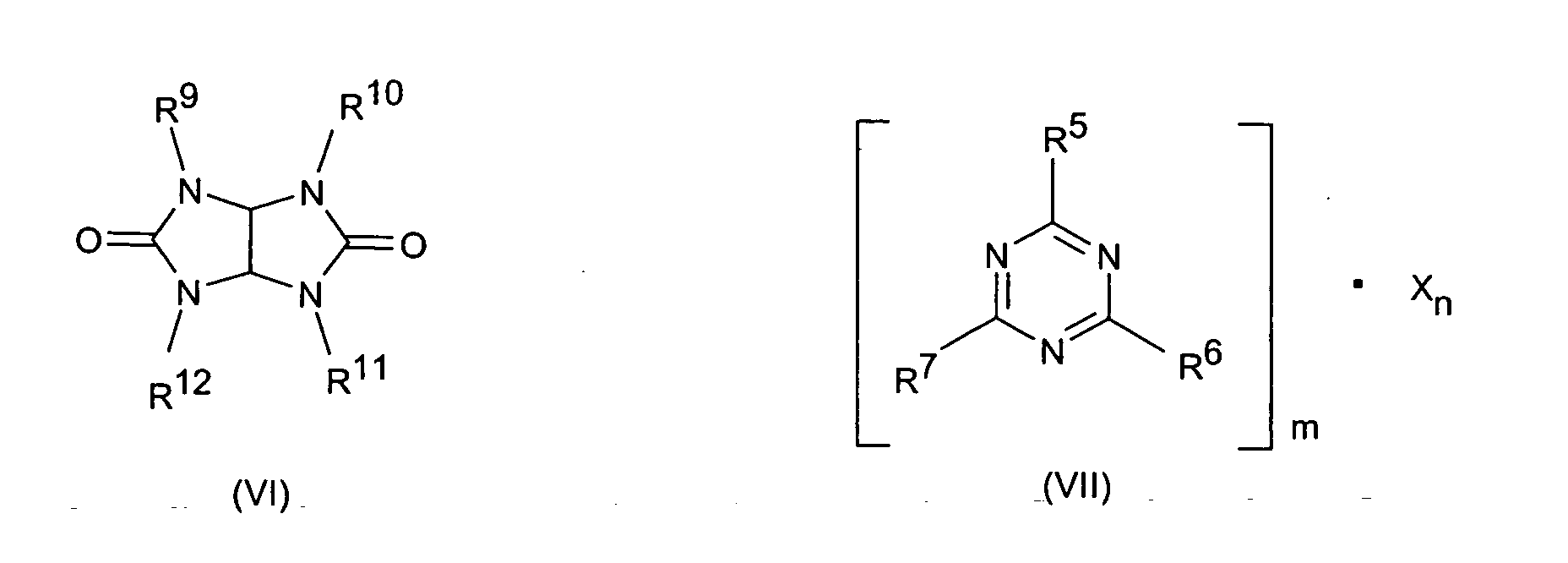

- R5 bis R7
- Wasserstoff, C1-C8-Alkyl, C5-C16-Cycloalkyl oder -Alkylcycloalkyl, möglicherweise substituiert mit einer Hydroxy- oder einer C1-C4-Hydroxyalkyl-Funktion, C2-C8-Alkenyl, C1-C8-Alkoxy, -Acyl, -Acyloxy, C6-C12-Aryl oder - Arylalkyl, -OR8 und -N(R8)R9, sowie N-alicyclisch oder N-aromatisch,
- R8
- Wasserstoff, C1-C8-Alkyl, C5-C16-Cycloalkyl oder -Alkylcycloalkyl, möglicherweise substituiert mit einer Hydroxy- oder einer C1-C4-Hydroxyalkyl-Funktion, C2-C8-Alkenyl, C1-C8-Alkoxy, -Acyl, -Acyloxy oder C6-C12-Aryl oder - Arylalkyl,
- R9 bis R13
- die gleichen Gruppen wie R8 sowie -O-R8,
- m und n
- unabhängig voneinander 1, 2, 3 oder 4,
- X
- Säuren, die Addukte mit Triazinverbindungen (III) bilden können,
N-Cyclohexyltoluolsulfonamid, N-Butylbenzolsulfonamid, N-Methylbenzolsulfonamid, N-Butyl-benzolsulfonamid, p-Toluolsulfonamid, N-Ethyl-p-toluolsulfonamid und N-Cyclohexyl-p-toluol sulfonamid.
1 bis 50 Gew.-% kompaktierte Flammschutzmittelzusammensetzung,
1 bis 99 Gew.-% thermoplastisches Polymer oder Mischungen derselben
0 bis 60 Gew.-% Additive
0 bis 60 Gew.-% Füllstoff.
5 bis 30 Gew.-% kompaktierte Flammschutzmittelzusammensetzung,
5 bis 90 Gew.-% thermoplastisches Polymer oder Mischungen derselben
5 bis 40 Gew.-% Additive
5 bis 40 Gew.-% Füllstoff.
1 bis 50 Gew.-% kompaktierte Flammschutzmittelzusammensetzung,
1 bis 99 Gew.-% Polymer oder Mischungen derselben
0 bis 60 Gew.-% Additive
0 bis 60 Gew.-% Füllstoff.
5 bis 30 Gew.-% kompaktierte Flammschutzmittelzusammensetzung,
5 bis 90 Gew.-% Polymer oder Mischungen derselben
5 bis 40 Gew.-% Additive
5 bis 40 Gew.-% Füllstoff.
1 bis 50 % kompaktierte Flammschutzmittelzusammensetzung
0 bis 60 % Ammoniumpolyphosphat
| Produktzusammensetzungen | ||||||||
| Bsp. | KFM-Zusammensetzung | Pressdruck | Unterkorn < 400 µm | Zielkorn | Schüttdichte | |||
| POF % | Kompaktierhilfsmittel | % | kN | kg | 400-1000 µm kg | Ausbeute % | g/l | |
| 1 | 100 | - | - | 4 | 4,6 | 0,4 | 8,2 | 389 |
| 2 | 100 | - | - | 10 | 3,0 | 2,0 | 39,7 | 443 |
| 3 | 100 | - | - | 30 | 2,4 | 2,6 | 52,9 | 668 |
| 4 | 100 | - | - | 38 | 1,7 | 3,3 | 66,0 | 817 |
| 6 | 100 | - | - | 20 | 1,5 | 3,5 | 70,0 | - |
| 7 | 100 | - | - | 10 | 2,9 | 2,1 | 42,0 | - |
| 8 | 99 | Licowax E | 1 | 10 | 2,0 | 3,0 | 60,0 | - |
| 9 | 90 | Licowax E | 10 | 10 | 1,4 | 3,6 | 71,0 | - |
| 10 | 98 | PEG T500 | 2 | 10 | 1,8 | 3,2 | 64,0 | - |
| Formkörper-Zusammensetzungen | |||||
| Bsp. | Formkörper-Zusammensetzung | Bemerkungen | |||
| KFM % | Glasfaser % | Polyamid 6.6 % | PBT % | - | |
| 11 | 12,5 | 30 | 57,5 | 0 | KFM: aus Bsp. 1 |
| 12 | 12,5 | 30 | 57,5 | 0 | KFM: aus Bsp. 3 |
| 13 (Vgl.) | 12,5 | 30 | 57,5 | 0 | KFM: aus Bsp. 4 |
| 14 | 12,5 | 30 | 57,5 | 0 | KFM: aus Bsp. 8 |
| 15 | 12,5 | 30 | 57,5 | 0 | KFM: aus Bsp. 6 |
| 16 | 20 | 30 | 0 | 50 | KFM: aus Bsp. 3 |
| Staubneigung | |||
| Bsp. | Staubneigung % | Formkörper-Austestung Visuell | Bemerkungen |
| 11 | 6 | Homogen | - |
| 12 | 13 | Homogen | - |
| 13 (Vgl) | 9 | Inhomogen | - |
| 14 | 15 | Homogen | - |
| 15 | 12 | Homogen | - |
| 16 | - | Homogen | - |
| 17 (Vgl) | 66 | - | POF aus Bsp. 1 |
Claims (40)
- Kompaktierte Flammschutzmittelzusammensetzung enthaltend eine phosphororganische Flammschutzkomponente, hergestellt durch Kompaktieren einer phosphororganischen Flammschutzkomponente mit oder ohne Kompaktierhilfsmittel.
- Kompaktierte Flammschutzmittelzusammensetzung nach Anspruch 1, dadurch gekennzeichnet, dass es sich bei der phosphororganischen Flammschutzkomponente um ein Phosphinsäuresalz der Formel (I) und/oder ein Diphosphinsäuresalz der Formel (II) und/oder deren Polymere (Komponente A) handelt,
 worin
worin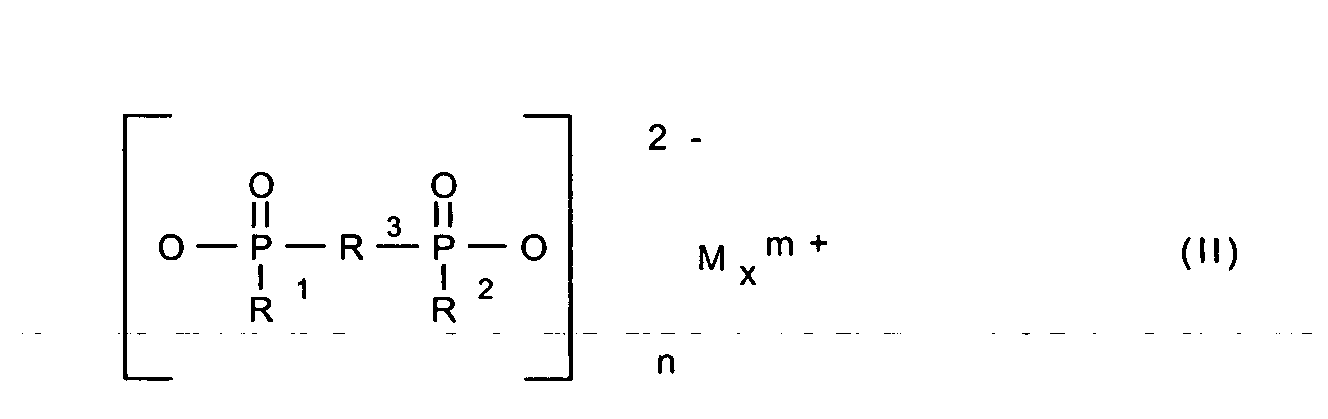
- R1, R2
- gleich oder verschieden sind und C1-C6-Alkyl, linear oder verzweigt und/oder Aryl;
- R3
- C1-C10-Alkylen, linear oder verzweigt, C6-C10-Arylen, -Alkylarylen oder - Arylalkylen;
- M
- Mg, Ca, Al, Sb, Sn, Ge, Ti, Zn, Fe, Zr, Ce, Bi, Sr, Mn, Li, Na, K und/oder eine protonierte Stickstoffbase;
- m
- 1 bis 4;
- n
- 1 bis 4;
- x
- 1 bis 4
- Kompaktierte Flammschutzmittelzusammensetzung nach Anspruch 1 oder 2, dadurch gekennzeichnet, dass M Calcium, Aluminium oder Zink bedeutet.
- Kompaktierte Flammschutzmittelzusammensetzung nach einem oder mehreren der Ansprüche 1 bis 3, dadurch gekennzeichnet, dass R1, R2 gleich oder verschieden sind und C1-C6-Alkyl, linear oder verzweigt und/oder Phenyl bedeuten.
- Kompaktierte Flammschutzmittelzusammensetzung nach einem oder mehreren der Ansprüche 1 bis 4, dadurch gekennzeichnet, dass R1, R2 gleich oder verschieden sind und Methyl, Ethyl, n-Propyl, iso-Propyl, n-Butyl, tert.-Butyl, n-Pentyl und/oder Phenyl bedeuten.
- Kompaktierte Flammschutzmittelzusammensetzung nach einem oder mehreren der Ansprüche 1 bis 5 dadurch gekennzeichnet, dass R3 Methylen, Ethylen, n-Propylen, iso-Propylen, n-Butylen, tert.-Butylen, n-Pentylen, n-Octylen oder n-Dodecylen; Phenylen oder Naphthylen; Methylphenylen, Ethylphenylen, tert.-Butylphenylen, Methyl-naphthylen, Ethyl-naphthylen oder tert.-Butylnaphthylen; Phenylmethylen, Phenylethylen, Phenylpropylen oder Phenylbutylen bedeutet.
- Kompaktierte Flammschutzmittelzusammensetzung nach einem oder mehreren der Ansprüche 1 bis 6, dadurch gekennzeichnet, dass sie und/oder die phosphororganische Flammschutzkomponente weiterhin Melaminphosphat, Dimelaminphosphat, Melaminpyrophosphat, Melaminpolyphosphate, Melampolyphosphate, Melempolyphosphate und/oder Melonpolyphosphate enthält.
- Kompaktierte Flammschutzmittelzusammensetzung nach einem oder mehreren der Ansprüche 1 bis 7, dadurch gekennzeichnet, dass sie und/oder die phosphororganische Flammschutzkomponente weiterhin Melaminkondensationsprodukte wie Melam, Melem und/oder Melon enthalten.
- Kompaktierte Flammschutzmittelzusammensetzung nach einem oder mehreren der Ansprüche 1 bis 8, dadurch gekennzeichnet, dass sie und/oder die phosphororganische Flammschutzkomponente weiterhin oligomere Ester des Tris(hydroxyethyl)isocyanurats mit aromatischen Polycarbonsäuren, Benzoguanamin, Tris(hydroxyethyl)isocyanurat, Allantoin, Glycoluril, Melamin, Melamincyanurat, Dicyandiamid und/oder Guanidin enthalten.
- Kompaktierte Flammschutzmittelzusammensetzung nach einem oder mehreren der Ansprüche 1 bis 9, dadurch gekennzeichnet, dass sie und/oder die phosphororganische Flammschutzkomponente stickstoffhaltige Phosphate der Formeln (NH4)y H3-y PO4 bzw. (NH4 PO3)z, mit y gleich 1 bis 3 und z gleich 1 bis 10.000, enthält.
- Kompaktierte Flammschutzmittelzusammensetzung nach einem oder mehreren der Ansprüche 1 bis 9, dadurch gekennzeichnet, dass sie und/oder die phosphororganische Flammschutzkomponente als Komponente B eine synthetische anorganische Verbindung und/oder ein mineralisches Produkt enthält.
- Kompaktierte Flammschutzmittelzusammensetzung nach einem oder mehreren der Ansprüche 1 bis 11, dadurch gekennzeichnet, dass es sich bei der Komponente B um eine Sauerstoffverbindung des Siliciums, um Magnesiumverbindungen, um Metallcarbonate von Metallen der zweiten Hauptgruppe des Periodensystems, um roten Phosphor, um Zink- oder Aluminiumverbindungen handelt.
- Kompaktierte Flammschutzmittelzusammensetzung nach einem oder mehreren der Ansprüche 1 bis 12, dadurch gekennzeichnet, dass sich bei den Sauerstoffverbindungen des Siliciums um Salze und Ester der Orthokieselsäure und deren Kondensationsprodukte, um Silikate, Zeolithe und Kieselsäuren, um Glas-, Glas-Keramik oder Keramik-Pulver; bei den Magnesiumverbindungen um Magnesiumhydroxid, Hydrotalcite, Magnesium-Carbonate oder Magnesium-Calcium-Carbonate; bei den Zinkverbindungen um Zinkoxid, -stannat, -hydroxystannat, - phosphat, -borat oder -sulfide; bei den Aluminiumverbindungen um Aluminiumhydroxid oder -phosphat handelt.
- Kompaktierte Flammschutzmittelzusammensetzung nach einem oder mehreren der Ansprüche 1 bis 13, dadurch gekennzeichnet, dass sie und/oder die phosphororganische Flammschutzkomponente als weitere Komponente C Stickstoffverbindungen enthält.
- Kompaktierte Flammschutzmittelzusammensetzung nach einem oder mehreren der Ansprüche 1 bis 14, dadurch gekennzeichnet, dass es sich bei den Stickstoffverbindungen um solche der Formeln (lll) bis (Vlll) oder Gemische davon
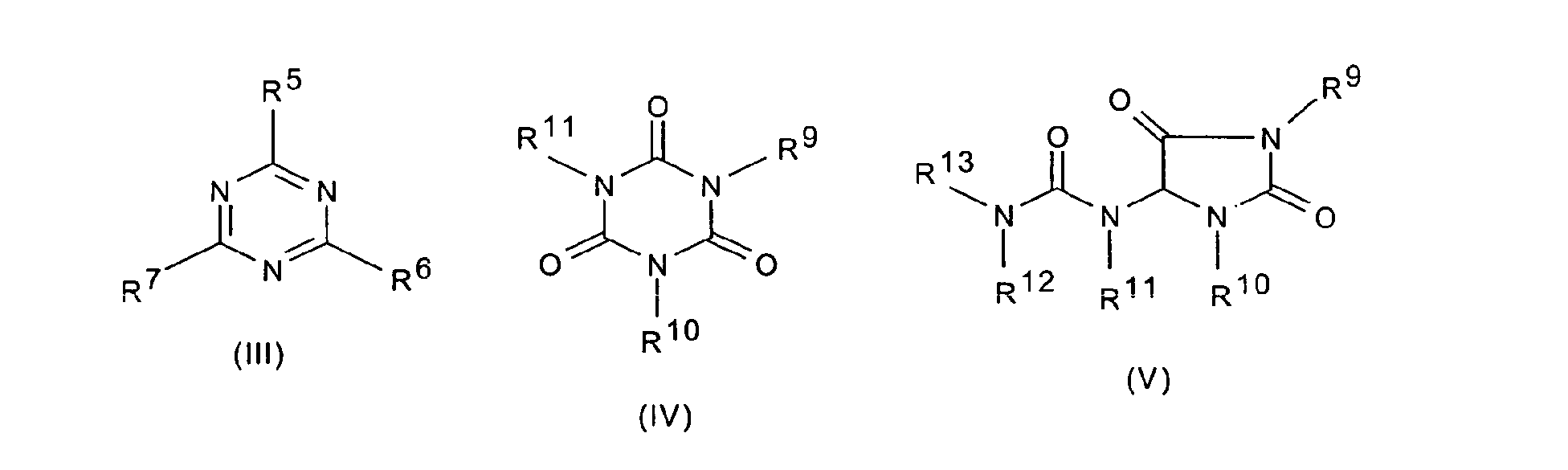
 worin
worin
- R5 bis R7
- Wasserstoff, C1-C8-Alkyl, C5-C16-Cycloalkyl oder -Alkylcycloalkyl, ggf. substituiert mit einer Hydroxy- oder einer C1-C4-Hydroxyalkyl-Funktion, C2-C8-Alkenyl, C1-C8-Alkoxy, -Acyl, -Acyloxy, C6-C12-Aryl oder -Arylalkyl, -OR8 und - N(R8)R9, sowie N-alicyclisch oder N-aromatisch,
- R8
- Wasserstoff, C1-C8-Alkyl, C5-C16-Cycloalkyl oder -Alkylcycloalkyl, ggf. substituiert mit einer Hydroxy- oder einer C1-C4-Hydroxyalkyl-Funktion, C2-C8-Alkenyl, C1-C8-Alkoxy, -Acyl, -Acyloxy oder C6-C12-Aryl oder -Arylalkyl,
- R9 bis R13
- die gleichen Gruppen wie R8 sowie -O-R8,
- m und n
- unabhängig voneinander 1, 2, 3 oder 4,
- X
- Säuren, die Addukte mit Triazinverbindungen (III) bilden können,
- Kompaktierte Flammschutzmittelzusammensetzung nach einem oder mehreren der Ansprüche 1 bis 15, dadurch gekennzeichnet, dass sie und/oder die phosphororganische Flammschutzkomponente weiterhin Carbodiimide enthalten.
- Kompaktierte Flammschutzmittelzusammensetzung nach einem oder mehreren der Ansprüche 1 bis 16, dadurch gekennzeichnet, dass sie eine mittlere Teilchengröße von 100 bis 2.000 µm, bevorzugt 200 bis 1000 µm aufweisen.
- Kompaktierte Flammschutzmittelzusammensetzung nach einem oder mehreren der Ansprüche 1 bis 17, dadurch gekennzeichnet, dass sie eine mittlere Schüttdichte von 200 bis 1500 g/l, bevorzugt 300 bis 1.000 g/l, aufweisen.
- Kompaktierte Flammschutzmittelzusammensetzung nach einem oder mehreren der Ansprüche 1 bis 18, dadurch gekennzeichnet, dass das Mengen-Verhältnis von Kompaktierhilfsmittel zu phosphororganischer Flammschutzkomponente 1 zu 199 bis 1 zu 0,11, bevorzugt 1 bis 99 bis 1 zu 0,25 und besonders bevorzugt 1 zu 49 bis 1 zu 1 beträgt.
- Verfahren zur Herstellung von kompaktierten Flammschutzmittelzusammensetzungen nach einem oder mehreren der Ansprüche 1 bis 19, dadurch gekennzeichnet, dass man die phosphororganischen Flammschutzkomponente mit oder ohne Kompaktierhilfsmittel unter einem Druck von 1 kN/cm2 bis 60 kN/cm2 verdichtet.
- Verfahren zur Herstellung von kompaktierten Flammschutzmittelzusammensetzungen nach Anspruch 20, dadurch gekennzeichnet, dass es sich dabei um eine Rollkompaktierung handelt.
- Verfahren nach Anspruch 21, dadurch gekennzeichnet, dass bei der Rollkompaktierung ein Linienpresskraft von 1 kN/cm bis 30 kN/cm eingesetzt wird.
- Verfahren nach Anspruch 21 oder 22, dadurch gekennzeichnet, dass bei der Rollkompaktierung ein Linienpresskraft von 2 kN/cm bis 20 kN/cm eingesetzt wird.
- Verfahren nach einem oder mehreren der Ansprüche 20 bis 23, dadurch gekennzeichnet, dass es sich bei dem Kompaktierhilfsmittel um Alkylalkoxylate mit 8 bis 22 C-Atomen und 1 bis 80 EO-Einheiten pro Mol Alkohol handelt.
- Verfahren nach einem oder mehreren der Ansprüche 20 bis 23, dadurch gekennzeichnet, dass es sich bei dem Kompaktierhilfsmittel um Caprolactam und/oder Triphenylphosphat handelt.
- Verfahren nach einem oder mehreren der Ansprüche 20 bis 23, dadurch gekennzeichnet, dass es sich bei dem Kompaktierhilfsmittel um Ethylenglykol, Propylenglykol und/oder Butylenglykol, deren Oligomere und/oder Polymere und/oder deren Ether handelt.
- Verfahren nach einem oder mehreren der Ansprüche 20 bis 23, dadurch gekennzeichnet, dass es sich bei dem Kompaktierhilfsmittel um natürliche, chemisch modifizierte und/oder synthetische Wachse; bevorzugt um Carnaubawachse und Montanwachse, handelt.
- Verfahren nach einem oder mehreren der Ansprüche 20 bis 23, dadurch gekennzeichnet, dass es sich bei dem Kompaktierhilfsmittel um Kunstharze, bevorzugt Phenolharze, handelt.
- Flammgeschützte Polymerformmasse, dadurch gekennzeichnet, dass sie eine kompaktierte Flammschutzmittelzusammensetzung nach mindestens einem der Ansprüche 1 bis 19 enthält.
- Flammgeschützte Polymerformmasse nach Anspruch 29, dadurch gekennzeichnet, dass sie
1 bis 50 Gew.-% kompaktierte Flammschutzmittelzusammensetzung,
1 bis 99 Gew.-% thermoplastisches Polymer oder Mischungen derselben
0 bis 60 Gew.-% Additive
0 bis 60 Gew.-% Füllstoff enthält. - Flammgeschützte Polymerformmasse nach Anspruch 29 oder 30, dadurch gekennzeichnet, dass sie
5 bis 30 Gew.-% Kompaktierte Flammschutzmittelzusammensetzung,
5 bis 90 Gew.-% thermoplastisches Polymer oder Mischungen derselben
5 bis 40 Gew.-% Additive
5 bis 40 Gew.-% Füllstoff enthält. - Flammgeschützte Polymerformmasse nach einem oder mehreren der Ansprüche 29 bis 31, dadurch gekennzeichnet, dass sie weiterhin Komponenten B und/oder C enthalten.
- Flammgeschützte Polymerformmasse nach einem oder mehreren der Ansprüche 29 bis 32, dadurch gekennzeichnet, dass es sich bei den thermoplastischen Polymeren um Polystyrol-HI (High-Impact), Polyphenylenether, Polyamide, Polyester, Polycarbonate und Blends oder Polymerblends vom Typ ABS (Acrylnitril-Butadien-Styrol) oder PC/ABS (Polycarbonat/Acrylnitril-Butadien-Styrol) handelt.
- Flammgeschützte Polymerformmasse nach einem oder mehreren der Ansprüche 29 bis 33, dadurch gekennzeichnet, dass es sich bei den thermoplastischen Polymeren um Polyamid, Polyester oder ABS handelt.
- Polymer-Formkörper, -Filme, -Fäden und -Fasern enthaltend eine kompaktierte Flammschutzmittelzusammensetzung nach mindestens einem der Ansprüche 1 bis 19.
- Polymer-Formkörper, -Filme, -Fäden und -Fasern nach Anspruch 35, dadurch gekennzeichnet, dass es sich bei dem Polymer um ein thermoplastisches oder duroplastisches Polymer handelt.
- Polymer-Formkörper, -Filme, -Fäden und -Fasern nach Anspruch 35 oder 36, dadurch gekennzeichnet, dass es sich bei dem bei den thermoplastischen Polymeren um Polystyrol-HI (High-Impact), Polyphenylenether, Polyamide, Polyester, Polycarbonate und Blends oder Polymerblends vom Typ ABS (Acrylnitril-Butadien-Styrol) oder PC/ABS (Polycarbonat/ Acrylnitril-Butadien-Styrol), Polyamid, Polyester und/oder ABS handelt.
- Polymer-Formkörper, -Filme, -Fäden und -Fasern nach Anspruch 35 oder 36, dadurch gekennzeichnet, dass es sich bei den duroplastischen Polymeren um Formaldehyd-, Epoxid-, Melamin- Phenolharz-Polymere und/oder Polyurethane handelt.
- Polymer-Formkörper, -Filme, -Fäden und -Fasern nach einem oder mehreren der Ansprüche 35 bis 37, dadurch gekennzeichnet, dass sie
1 bis 50 Gew.-% kompaktierte Flammschutzmittelzusammensetzung,
1 bis 99 Gew.-% Polymer oder Mischungen derselben
0 bis 60 Gew.-% Additive
0 bis 60 Gew.-% Füllstoff enthalten. - Polymer-Formkörper, -Filme, -Fäden und -Fasern nach einem oder mehreren der Ansprüche 35 bis 39, dadurch gekennzeichnet, dass sie
5 bis 30 Gew.- % kompaktierte Flammschutzmittelzusammensetzung,
5 bis 90 Gew.-% Polymer oder Mischungen derselben
5 bis 40 Gew.-% Additive
5 bis 40 Gew.-% Füllstoff enthalten.
Applications Claiming Priority (2)
| Application Number | Priority Date | Filing Date | Title |
|---|---|---|---|
| DE10241376A DE10241376A1 (de) | 2002-09-06 | 2002-09-06 | Kompaktierte Flammschutzmittelzusammensetzung |
| DE10241376 | 2002-09-06 |
Publications (1)
| Publication Number | Publication Date |
|---|---|
| EP1396523A1 true EP1396523A1 (de) | 2004-03-10 |
Family
ID=31502456
Family Applications (1)
| Application Number | Title | Priority Date | Filing Date |
|---|---|---|---|
| EP20030018726 Withdrawn EP1396523A1 (de) | 2002-09-06 | 2003-08-26 | Kompaktierte Flammschutzmittelzusammensetzung |
Country Status (4)
| Country | Link |
|---|---|
| US (3) | US20050101707A1 (de) |
| EP (1) | EP1396523A1 (de) |
| JP (1) | JP2004099894A (de) |
| DE (1) | DE10241376A1 (de) |
Cited By (5)
| Publication number | Priority date | Publication date | Assignee | Title |
|---|---|---|---|---|
| EP1522551A1 (de) * | 2003-10-07 | 2005-04-13 | Clariant GmbH | Phosphorhaltige Flammschutzmittelagglomerate |
| EP1624016A1 (de) * | 2004-07-22 | 2006-02-08 | Clariant GmbH | Nanoteiliges Phosphor-haltiges Flammschutzmittel |
| EP1624015A1 (de) * | 2004-07-22 | 2006-02-08 | Clariant GmbH | Flammgeschütze Polymerformmassen enthaltend ein nanoteiliges phosphorhaltiges Flammschutzmittel |
| EP1705220A1 (de) * | 2005-03-26 | 2006-09-27 | Clariant Produkte (Deutschland) GmbH | Phosphorhaltige thermostabilisierte Flammschutzmittelagglomerate |
| CN1980988B (zh) * | 2004-05-04 | 2010-12-15 | 沙伯基础创新塑料知识产权有限公司 | 具有改进的电性能和可燃性能的不含卤素的阻燃聚酰胺组合物 |
Families Citing this family (26)
| Publication number | Priority date | Publication date | Assignee | Title |
|---|---|---|---|---|
| DE10309385B4 (de) * | 2003-03-03 | 2007-01-18 | Clariant Produkte (Deutschland) Gmbh | Flammschutzmittel-Stabilisator-Kombination für thermoplastische Polymere und ihre Verwendung sowie flammfest ausgerüstete Kunststoff-Formmassen |
| US20050285086A1 (en) * | 2004-06-29 | 2005-12-29 | Kazunari Kosaka | Flame retardant composition |
| US7417083B2 (en) * | 2004-04-01 | 2008-08-26 | Sabic Innovative Plastics Ip B.V. | Flame retardant composition |
| US7582692B2 (en) * | 2004-04-01 | 2009-09-01 | Sabic Innovative Plastics Ip B.V. | Flame retardant thermoplastic composition and articles comprising the same |
| US7799854B2 (en) * | 2004-04-01 | 2010-09-21 | Sabic Innovative Plastics Ip B.V. | Flame retardant thermoplastic composition and articles comprising the same |
| JP2005336474A (ja) * | 2004-04-28 | 2005-12-08 | Ube Ind Ltd | 難燃性樹脂組成物 |
| US20050250885A1 (en) * | 2004-05-04 | 2005-11-10 | General Electric Company | Halogen-free flame retardant polyamide composition with improved electrical properties |
| DE102004026799B4 (de) * | 2004-06-02 | 2006-05-18 | Clariant Gmbh | Pressgranulierte Flammschutzmittelzusammensetzung, Verfahren zu deren Herstellung und deren Verwendung |
| DE102004039758A1 (de) * | 2004-08-17 | 2006-03-02 | Clariant Gmbh | Brandschutzbeschichtung |
| DE102006004781B4 (de) * | 2006-02-02 | 2007-11-15 | Thomas Magnete Gmbh | Expansionsventil für eine Klimaanlage |
| US8101007B2 (en) * | 2007-07-31 | 2012-01-24 | Kobe Steel Ltd. | Method for reduction treatment of electric furnace dust |
| KR20090067663A (ko) * | 2007-12-21 | 2009-06-25 | 루브리졸 어드밴스드 머티어리얼스, 인코포레이티드 | 비할로겐 난연 열가소성 폴리우레탄 복합 수지 조성물 |
| EP2191937A1 (de) * | 2008-11-28 | 2010-06-02 | Luigi Bettazza | Strahlmittel für einen unter Druck stehenden Flüssigkeitsstrahl in einem Strahlschneider |
| US20110152420A1 (en) * | 2009-12-22 | 2011-06-23 | Mark Elkovitch | Poly(arylene ether)/polyamide compositions, methods, and articles |
| US8450412B2 (en) * | 2009-12-22 | 2013-05-28 | Sabic Innovative Plastics Ip B.V. | Flame retardant polyamide composition, method, and article |
| EP2585473B1 (de) * | 2010-06-24 | 2015-09-23 | ICL-IP America Inc. | Flammschutzmittel aus metallphosphonat und herstellungsverfahren dafür |
| US8304478B2 (en) | 2010-07-30 | 2012-11-06 | Sabic Innovative Plastics Ip B.V. | Polyamide/poly(arylene ether) composition, article, and method |
| US8604105B2 (en) | 2010-09-03 | 2013-12-10 | Eastman Chemical Company | Flame retardant copolyester compositions |
| CN102603662B (zh) * | 2011-01-19 | 2014-10-15 | 兆欣化学工业股份有限公司 | 回收己内酰胺工艺废液合成阻燃剂的方法 |
| US9090999B2 (en) | 2011-09-28 | 2015-07-28 | Sabic Global Technologies B.V. | Polyamide/polyphenylene ether fibers and fiber-forming method |
| US8722837B2 (en) | 2012-01-31 | 2014-05-13 | Sabic Innovative Plastics Ip B.V. | Poly(phenylene ether)-polysiloxane composition and method |
| CN103172663B (zh) * | 2013-02-27 | 2015-09-30 | 广州金凯新材料有限公司 | 一种二烷基次膦酸金属盐的制备方法 |
| CN105683286B (zh) * | 2013-10-28 | 2017-07-21 | 帝人杜邦薄膜日本有限公司 | 阻燃性双轴取向聚酯膜、由其形成的阻燃性聚酯膜层合体和柔性电路基板 |
| DE102015223432A1 (de) * | 2015-11-26 | 2017-06-01 | Clariant International Ltd | Polymere Flammschutzmittelmischungen |
| JP7675603B2 (ja) * | 2021-09-02 | 2025-05-13 | 長瀬産業株式会社 | 難燃剤造粒物 |
| JP7705824B2 (ja) * | 2022-04-28 | 2025-07-10 | 長瀬産業株式会社 | 難燃剤造粒物、難燃剤造粒物の製造方法および使用 |
Citations (8)
| Publication number | Priority date | Publication date | Assignee | Title |
|---|---|---|---|---|
| JPH0892562A (ja) * | 1994-09-28 | 1996-04-09 | Asahi Chem Ind Co Ltd | 粒状難燃剤 |
| DE19614424A1 (de) * | 1996-04-12 | 1997-10-16 | Hoechst Ag | Synergistische Flammschutzmittel-Kombination für Polymere |
| EP0896023A1 (de) * | 1997-08-08 | 1999-02-10 | Clariant GmbH | Synergistiche Flammschutzmittel-Kombination für Polymere |
| DE19820399A1 (de) * | 1998-05-07 | 1999-11-11 | Basf Ag | Flammgeschützte Polyesterformmassen |
| DE19827845A1 (de) * | 1998-06-23 | 1999-12-30 | Basf Ag | Flammgeschützte Polyesterformmassen |
| EP1024167A1 (de) * | 1999-01-30 | 2000-08-02 | Clariant GmbH | Flammschutzmittel-Kombination für thermoplastische Polymere I |
| DE19907014A1 (de) * | 1999-02-18 | 2000-08-24 | Bayer Ag | Formulierung von Wasch- und Reinigungsmittel-Compounds mit Polyasparaginsäuren und/oder Iminodisuccinaten |
| WO2004022640A1 (de) * | 2002-09-03 | 2004-03-18 | Clariant Gmbh | Flammschutzmittel-stabilisator-kombination für thermoplastische polymere |
Family Cites Families (40)
| Publication number | Priority date | Publication date | Assignee | Title |
|---|---|---|---|---|
| US117651A (en) * | 1871-08-01 | Improvement in atomizers | ||
| US3296193A (en) * | 1962-08-28 | 1967-01-03 | Stauffer Chemical Co | Stabilized polyolefin compositions containing tin phosphinates |
| US4208322A (en) * | 1978-04-13 | 1980-06-17 | Pennwalt Corporation | Polyester-polyamide resins flame retarded by poly(metal phosphinate)s |
| IL80021A (en) * | 1985-11-13 | 1993-04-04 | Bromine Compounds Ltd | Granular flame retardant agents, process for their preparation and articles obtained thereby |
| CA1309954C (en) * | 1987-07-29 | 1992-11-10 | Yasuo Yamada | Deaerator for particulates |
| US5176904A (en) * | 1989-02-27 | 1993-01-05 | Kao Corporation | Alkali metal zinc monoalkylphosphate, particles thereof, process for preparing the same, and cosmetic containing the same |
| DE3925792A1 (de) * | 1989-08-04 | 1991-02-07 | Bayer Ag | Flammgeschuetzte, nicht tropfende polyamidformmassen |
| DE3925791A1 (de) * | 1989-08-04 | 1991-02-07 | Bayer Ag | Flammgeschuetzte, nicht tropfende polyamidformmassen |
| US5531252A (en) * | 1989-09-15 | 1996-07-02 | B.A.G. Corporation | Vacuum fill system |
| DE4016416A1 (de) * | 1990-05-22 | 1991-11-28 | Bayer Ag | Flammgeschuetzte, nicht tropfende polyalkylenterephthalat-formmassen |
| DE4040276A1 (de) * | 1990-12-17 | 1992-06-25 | Chemie Linz Deutschland | Feste flammhemmer-agglomerate fuer thermoplaste |
| US5879920A (en) * | 1991-10-07 | 1999-03-09 | Genencor International, Inc. | Coated enzyme-containing granule |
| TW252135B (de) * | 1992-08-01 | 1995-07-21 | Hoechst Ag | |
| US5958287A (en) * | 1992-09-11 | 1999-09-28 | Pullen; Erroll M. | Fluid, formulation, and method for dust control and dewatering of particulate materials |
| DE19506330A1 (de) * | 1995-02-23 | 1996-08-29 | Chemie Linz Deutschland Gmbh I | Verfahren zur Herstellung von Guanidin- oder Melaminphosphaten |
| DE19607635A1 (de) * | 1996-02-29 | 1997-09-04 | Hoechst Ag | Schwerentflammbare Polyamidformmassen |
| US6124366A (en) * | 1996-06-28 | 2000-09-26 | Nalco Chemical Company | Fluid formulation and method for dust control and wetting enhancement |
| DE19648503A1 (de) * | 1996-11-22 | 1998-05-28 | Basf Ag | Flammgeschützte thermoplastische Formmassen |
| DE19737727A1 (de) * | 1997-08-29 | 1999-07-08 | Clariant Gmbh | Synergistische Flammschutzmittel-Kombination für Kunststoffe |
| GB9721021D0 (en) * | 1997-10-04 | 1997-12-03 | Albright & Wilson Uk Ltd | Phosphonium salt composition |
| DE19903707C2 (de) * | 1999-01-30 | 2003-05-28 | Clariant Gmbh | Flammwidrige duroplastische Massen |
| US6239197B1 (en) * | 1999-04-23 | 2001-05-29 | Great Lakes Chemical Corporation | Vacuum de-aerated powdered polymer additives |
| JP2000302716A (ja) * | 1999-04-23 | 2000-10-31 | Mitsui Chemicals Inc | 顆粒状フェノール類の製造方法 |
| DE19933901A1 (de) * | 1999-07-22 | 2001-02-01 | Clariant Gmbh | Flammschutzmittel-Kombination |
| JP2001055515A (ja) * | 1999-08-20 | 2001-02-27 | Tosoh Corp | 難燃剤錠剤、それによる難燃化方法、並びにそれを配合してなる難燃性樹脂組成物及びその成形品 |
| GB0004043D0 (en) * | 2000-02-21 | 2000-04-12 | Borealis Polymers Oy | Polymer |
| DE10130834A1 (de) * | 2001-06-27 | 2003-01-16 | Bayer Ag | Flammgeschützte Polyesterformmassen mit ZnS |
| DE10132056A1 (de) * | 2001-07-05 | 2003-01-16 | Basf Ag | Flammgeschützte thermoplastische Formmassen |
| WO2003013444A1 (en) * | 2001-08-10 | 2003-02-20 | Dentsply International Inc. | One-part self-priming dental adhesive |
| EP1386942A1 (de) * | 2002-07-25 | 2004-02-04 | Clariant GmbH | Flammschutzmittel-Kombination |
| DE10241373A1 (de) * | 2002-09-06 | 2004-03-18 | Clariant Gmbh | Oberflächenmodifizierte Phosphinsäuresalze |
| DE10241375A1 (de) * | 2002-09-06 | 2004-03-18 | Clariant Gmbh | Granulare Flammschutzmittelzusammensetzung |
| DE10241374B3 (de) * | 2002-09-06 | 2004-02-19 | Clariant Gmbh | Staubarme, pulverförmige Flammschutzmittelzusammensetzung, Verfahren zu deren Herstellung und deren Verwendung, sowie flammgeschützte Polymerformmassen |
| DE10243231B4 (de) * | 2002-09-17 | 2004-10-28 | Clariant Gmbh | Brandschutzbeschichtung |
| DE10244579A1 (de) * | 2002-09-25 | 2004-04-08 | Clariant Gmbh | Flammwidrige duroplastische Massen |
| DE10244576A1 (de) * | 2002-09-25 | 2004-04-08 | Clariant Gmbh | Flammwidrige duroplastische Massen |
| DE10244578A1 (de) * | 2002-09-25 | 2004-04-08 | Clariant Gmbh | Flammwidrige duroplastische Massen |
| DE10309385B4 (de) * | 2003-03-03 | 2007-01-18 | Clariant Produkte (Deutschland) Gmbh | Flammschutzmittel-Stabilisator-Kombination für thermoplastische Polymere und ihre Verwendung sowie flammfest ausgerüstete Kunststoff-Formmassen |
| DE10347012A1 (de) * | 2003-10-07 | 2005-05-25 | Clariant Gmbh | Phosphorhaltige Flammschutzmittelagglomerate |
| DE102004039758A1 (de) * | 2004-08-17 | 2006-03-02 | Clariant Gmbh | Brandschutzbeschichtung |
-
2002
- 2002-09-06 DE DE10241376A patent/DE10241376A1/de not_active Withdrawn
-
2003
- 2003-08-26 EP EP20030018726 patent/EP1396523A1/de not_active Withdrawn
- 2003-09-05 JP JP2003314473A patent/JP2004099894A/ja active Pending
- 2003-09-05 US US10/656,406 patent/US20050101707A1/en not_active Abandoned
-
2006
- 2006-05-22 US US11/438,594 patent/US20060208239A1/en not_active Abandoned
-
2010
- 2010-03-03 US US12/717,053 patent/US20100160507A1/en not_active Abandoned
Patent Citations (8)
| Publication number | Priority date | Publication date | Assignee | Title |
|---|---|---|---|---|
| JPH0892562A (ja) * | 1994-09-28 | 1996-04-09 | Asahi Chem Ind Co Ltd | 粒状難燃剤 |
| DE19614424A1 (de) * | 1996-04-12 | 1997-10-16 | Hoechst Ag | Synergistische Flammschutzmittel-Kombination für Polymere |
| EP0896023A1 (de) * | 1997-08-08 | 1999-02-10 | Clariant GmbH | Synergistiche Flammschutzmittel-Kombination für Polymere |
| DE19820399A1 (de) * | 1998-05-07 | 1999-11-11 | Basf Ag | Flammgeschützte Polyesterformmassen |
| DE19827845A1 (de) * | 1998-06-23 | 1999-12-30 | Basf Ag | Flammgeschützte Polyesterformmassen |
| EP1024167A1 (de) * | 1999-01-30 | 2000-08-02 | Clariant GmbH | Flammschutzmittel-Kombination für thermoplastische Polymere I |
| DE19907014A1 (de) * | 1999-02-18 | 2000-08-24 | Bayer Ag | Formulierung von Wasch- und Reinigungsmittel-Compounds mit Polyasparaginsäuren und/oder Iminodisuccinaten |
| WO2004022640A1 (de) * | 2002-09-03 | 2004-03-18 | Clariant Gmbh | Flammschutzmittel-stabilisator-kombination für thermoplastische polymere |
Non-Patent Citations (4)
| Title |
|---|
| BOWDEN P.: "Particle Size Distribution Measurement from Millimeters to Nanometers and from Rods to Platelets", JOURNAL OF DISPERSION SCIENCE AND TECHNOLOGY, vol. 23, no. 5, 2002, pages 631 - 662, XP009102859 * |
| COWIE J.M.G.: "Chemie und Physik der synthetischen Polymeren", 1997, FRIEDR. VIEWEG & SOHN VERLAGSGESELLSCHAFT MBH, BRAUNSCHWEIG/WIESBADEN * |
| DATABASE WPI Section Ch Week 199624, Derwent World Patents Index; Class A60, AN 1996-236333 * |
| JÜRGEN FALBE; MANFRED REGITZ: "Römpp Chemie Lexikon", 1992, GEORG THIEME VERLAG, STUTTGART * NEW YORK * |
Cited By (6)
| Publication number | Priority date | Publication date | Assignee | Title |
|---|---|---|---|---|
| EP1522551A1 (de) * | 2003-10-07 | 2005-04-13 | Clariant GmbH | Phosphorhaltige Flammschutzmittelagglomerate |
| US7259200B2 (en) | 2003-10-07 | 2007-08-21 | Clariant Produkte (Deutschland) Gmbh | Phosphorus-containing flame retardant agglomerates |
| CN1980988B (zh) * | 2004-05-04 | 2010-12-15 | 沙伯基础创新塑料知识产权有限公司 | 具有改进的电性能和可燃性能的不含卤素的阻燃聚酰胺组合物 |
| EP1624016A1 (de) * | 2004-07-22 | 2006-02-08 | Clariant GmbH | Nanoteiliges Phosphor-haltiges Flammschutzmittel |
| EP1624015A1 (de) * | 2004-07-22 | 2006-02-08 | Clariant GmbH | Flammgeschütze Polymerformmassen enthaltend ein nanoteiliges phosphorhaltiges Flammschutzmittel |
| EP1705220A1 (de) * | 2005-03-26 | 2006-09-27 | Clariant Produkte (Deutschland) GmbH | Phosphorhaltige thermostabilisierte Flammschutzmittelagglomerate |
Also Published As
| Publication number | Publication date |
|---|---|
| US20050101707A1 (en) | 2005-05-12 |
| US20100160507A1 (en) | 2010-06-24 |
| JP2004099894A (ja) | 2004-04-02 |
| DE10241376A1 (de) | 2004-03-18 |
| US20060208239A1 (en) | 2006-09-21 |
Similar Documents
| Publication | Publication Date | Title |
|---|---|---|
| EP1396523A1 (de) | Kompaktierte Flammschutzmittelzusammensetzung | |
| EP1396522A1 (de) | Granulare Flammschutzmittelzusammensetzung | |
| DE102004026799B4 (de) | Pressgranulierte Flammschutzmittelzusammensetzung, Verfahren zu deren Herstellung und deren Verwendung | |
| EP1396521A1 (de) | Staubarme, pulverförmige Flammschutzmittelzusammensetzung, Verfahren zu deren Herstellung und deren Verwendung, sowie flammgeschützte Polymerformmassen | |
| EP1537173B1 (de) | Flammschutzmittel-stabilisator-kombination fur thermoplastische polymere | |
| EP1500676B1 (de) | Flammwidrige polyamide | |
| EP0899296B1 (de) | Synergistische Flammschutzmittel-Kombination für Kunststoffe | |
| DE10359816B4 (de) | Flammschutzmittel-Stabilisator-Kombination für Polyester und Polyamide sowie damit hergestellte Kunststoff-Formmassen | |
| EP1479718B1 (de) | Titanhaltige Phosphinat-Flammschutzmittel | |
| EP2788286B1 (de) | Aluminium-hydrogenphosphite, ein verfahren zu ihrer herstellung sowie ihre verwendung | |
| EP2678388B1 (de) | Flammschutzmittel-stabilisator-kombination für thermoplastische polymere | |
| EP1705220B1 (de) | Phosphorhaltige thermostabilisierte Flammschutzmittelagglomerate | |
| DE10241373A1 (de) | Oberflächenmodifizierte Phosphinsäuresalze | |
| EP1024167A1 (de) | Flammschutzmittel-Kombination für thermoplastische Polymere I | |
| EP3546511A1 (de) | Polyamidzusammensetzungen | |
| DE102004009455A1 (de) | Flammschutzmittel-Kombination für thermoplastische Polymere | |
| EP3034553A1 (de) | Polyamidzusammensetzungen | |
| WO2017089293A1 (de) | Polymere flammschutzmittelmischungen | |
| EP1731559B1 (de) | Brandgeschützte Polyamidformmasse | |
| EP1846487B1 (de) | Mit kugelförmigem glas gefüllte thermoplastische polyamide |
Legal Events
| Date | Code | Title | Description |
|---|---|---|---|
| PUAI | Public reference made under article 153(3) epc to a published international application that has entered the european phase |
Free format text: ORIGINAL CODE: 0009012 |
|
| AK | Designated contracting states |
Kind code of ref document: A1 Designated state(s): AT BE BG CH CY CZ DE DK EE ES FI FR GB GR HU IE IT LI LU MC NL PT RO SE SI SK TR |
|
| AX | Request for extension of the european patent |
Extension state: AL LT LV MK |
|
| 17P | Request for examination filed |
Effective date: 20040910 |
|
| AKX | Designation fees paid |
Designated state(s): AT BE BG CH CY CZ DE DK EE ES FI FR GB GR HU IE IT LI LU MC NL PT RO SE SI SK TR |
|
| RAP1 | Party data changed (applicant data changed or rights of an application transferred) |
Owner name: CLARIANT PRODUKTE (DEUTSCHLAND) GMBH |
|
| 17Q | First examination report despatched |
Effective date: 20050728 |
|
| STAA | Information on the status of an ep patent application or granted ep patent |
Free format text: STATUS: THE APPLICATION HAS BEEN WITHDRAWN |
|
| 18W | Application withdrawn |
Effective date: 20091224 |