EP1405625A1 - Composition cosmétique comprenant des huiles, un agent rhéologique et une phase particulaire - Google Patents
Composition cosmétique comprenant des huiles, un agent rhéologique et une phase particulaire Download PDFInfo
- Publication number
- EP1405625A1 EP1405625A1 EP03020174A EP03020174A EP1405625A1 EP 1405625 A1 EP1405625 A1 EP 1405625A1 EP 03020174 A EP03020174 A EP 03020174A EP 03020174 A EP03020174 A EP 03020174A EP 1405625 A1 EP1405625 A1 EP 1405625A1
- Authority
- EP
- European Patent Office
- Prior art keywords
- composition according
- composition
- silicone oil
- viscosity
- cst
- Prior art date
- Legal status (The legal status is an assumption and is not a legal conclusion. Google has not performed a legal analysis and makes no representation as to the accuracy of the status listed.)
- Granted
Links
Classifications
-
- A—HUMAN NECESSITIES
- A61—MEDICAL OR VETERINARY SCIENCE; HYGIENE
- A61K—PREPARATIONS FOR MEDICAL, DENTAL OR TOILETRY PURPOSES
- A61K8/00—Cosmetics or similar toiletry preparations
- A61K8/18—Cosmetics or similar toiletry preparations characterised by the composition
- A61K8/30—Cosmetics or similar toiletry preparations characterised by the composition containing organic compounds
- A61K8/33—Cosmetics or similar toiletry preparations characterised by the composition containing organic compounds containing oxygen
- A61K8/37—Esters of carboxylic acids
- A61K8/375—Esters of carboxylic acids the alcohol moiety containing more than one hydroxy group
-
- A—HUMAN NECESSITIES
- A61—MEDICAL OR VETERINARY SCIENCE; HYGIENE
- A61K—PREPARATIONS FOR MEDICAL, DENTAL OR TOILETRY PURPOSES
- A61K8/00—Cosmetics or similar toiletry preparations
- A61K8/18—Cosmetics or similar toiletry preparations characterised by the composition
- A61K8/30—Cosmetics or similar toiletry preparations characterised by the composition containing organic compounds
- A61K8/31—Hydrocarbons
-
- A—HUMAN NECESSITIES
- A61—MEDICAL OR VETERINARY SCIENCE; HYGIENE
- A61K—PREPARATIONS FOR MEDICAL, DENTAL OR TOILETRY PURPOSES
- A61K8/00—Cosmetics or similar toiletry preparations
- A61K8/18—Cosmetics or similar toiletry preparations characterised by the composition
- A61K8/30—Cosmetics or similar toiletry preparations characterised by the composition containing organic compounds
- A61K8/33—Cosmetics or similar toiletry preparations characterised by the composition containing organic compounds containing oxygen
- A61K8/37—Esters of carboxylic acids
-
- A—HUMAN NECESSITIES
- A61—MEDICAL OR VETERINARY SCIENCE; HYGIENE
- A61K—PREPARATIONS FOR MEDICAL, DENTAL OR TOILETRY PURPOSES
- A61K8/00—Cosmetics or similar toiletry preparations
- A61K8/18—Cosmetics or similar toiletry preparations characterised by the composition
- A61K8/72—Cosmetics or similar toiletry preparations characterised by the composition containing organic macromolecular compounds
- A61K8/81—Cosmetics or similar toiletry preparations characterised by the composition containing organic macromolecular compounds obtained by reactions involving only carbon-to-carbon unsaturated bonds
- A61K8/8105—Compositions of homopolymers or copolymers of unsaturated aliphatic hydrocarbons having only one carbon-to-carbon double bond; Compositions of derivatives of such polymers
- A61K8/8111—Homopolymers or copolymers of aliphatic olefines, e.g. polyethylene, polyisobutene; Compositions of derivatives of such polymers
-
- A—HUMAN NECESSITIES
- A61—MEDICAL OR VETERINARY SCIENCE; HYGIENE
- A61K—PREPARATIONS FOR MEDICAL, DENTAL OR TOILETRY PURPOSES
- A61K8/00—Cosmetics or similar toiletry preparations
- A61K8/18—Cosmetics or similar toiletry preparations characterised by the composition
- A61K8/72—Cosmetics or similar toiletry preparations characterised by the composition containing organic macromolecular compounds
- A61K8/84—Cosmetics or similar toiletry preparations characterised by the composition containing organic macromolecular compounds obtained by reactions otherwise than those involving only carbon-carbon unsaturated bonds
- A61K8/89—Polysiloxanes
- A61K8/891—Polysiloxanes saturated, e.g. dimethicone, phenyl trimethicone, C24-C28 methicone or stearyl dimethicone
-
- A—HUMAN NECESSITIES
- A61—MEDICAL OR VETERINARY SCIENCE; HYGIENE
- A61Q—SPECIFIC USE OF COSMETICS OR SIMILAR TOILETRY PREPARATIONS
- A61Q1/00—Make-up preparations; Body powders; Preparations for removing make-up
- A61Q1/02—Preparations containing skin colorants, e.g. pigments
- A61Q1/04—Preparations containing skin colorants, e.g. pigments for lips
- A61Q1/06—Lipsticks
Definitions
- the present invention relates to a cosmetic composition
- a cosmetic composition comprising, in a physiologically acceptable medium, a phenyl silicone oil of high viscosity, a nonvolatile hydrocarbon oil, a rheological agent and a particulate phase.
- This composition is in particular a makeup or skin care composition, as well as the human body, including the scalp, lips or integuments of the human beings, such as hair, eyelashes, eyebrows or nails. She has outstanding cosmetic properties, especially of holding, and confers on makeup or the care of gloss and / or comfort properties.
- the composition of the invention may in particular be in the form of a product of make-up of the keratinous substances (skin, lips, dander) having possibly care properties and / or non-therapeutic treatment.
- a product of make-up of the keratinous substances skin, lips, dander
- it constitutes a red lipstick or lip gloss, foundation, loose or compacted powder, blush eyelids, a makeup base, a concealer product, a product for tattoo, a mascara, an eyeliner, a nail polish, an artificial tanning product from the skin, a product of coloring or hair care.
- silicone compounds in cosmetic compositions, in particular makeup, is known to formulators.
- the document EP-A-0407205 which describes a composition comprising the combination of a silicone gum and a silicone oil, having good holding properties, spreading and comfort.
- this combination confers on cosmetic compositions excellent sensory properties, including a non-greasy feel, spreading properties and sliding and allow to obtain on the skin a particularly homogeneous film.
- silicone compounds can sometimes cause formulation problems, and especially difficulties of dispersion of the pigments in the compositions comprising silicone media, which leads to a poor development of the color of the composition as well as a granular appearance, which distances the consumer from this type of product, and that is not conducive to obtaining a brilliant composition.
- the document FR 2 771 628 describes the use of a solubilized silicone gum in a phenyltrimethicone oil in a cosmetic composition. This eraser presents the advantage of being soluble with oils commonly used in cosmetics.
- EP 1 112 734 discloses a transfer-free composition containing an oil hydrocarbon and a silicone oil, which are not soluble one in the other.
- the composition further contains a volatile solvent.
- oils having a high viscosity and a refractive index such as oily polymers such as polybutenes or certain vegetable oils (castor oil for example).
- these compounds do not make it possible to obtain a composition film whose performance, in particular shine, persists during the day.
- the Applicant has surprisingly found that the use of the combination of an oil phenyl silicone of high viscosity and a soluble nonvolatile hydrocarbon oil or dispersible in each other makes it possible to obtain a composition having good cosmetic and sensory properties, in particular withstand over time, shine and comfort and which is non-irritating for keratin materials.
- the subject of the present invention is a cosmetic composition
- a cosmetic composition comprising, in a physiologically acceptable medium, at least one silicone oil phenylated with a viscosity greater than or equal to 500 cSt and at least one hydrocarbon oil non-volatile having a molecular weight greater than 500 g / mol, characterized in that said composition has an average gloss greater than 100 out of 200 and a holding after test greater than 40 out of 100.
- the average gloss is measured using a gloss meter, in a conventional way, by the following method.
- a gloss meter On a LENETA brand contrast card and reference FORM 1A PENOPAC, one spreads a layer of 50 microns thick of the composition of which one try to evaluate the average gloss, using an automatic spreader. Layer covers at least the white background of the card.
- the brightness of the composition can also be measured one hour after the deposit of the composition.
- the average brightness of the composition measured at the deposit is preferably greater than 120, 130, 140, 150, and better 160 out of 200.
- the average brightness of the composition measured one hour after the deposit is preferably greater than 120, and better 130 out of 200.
- the post-challenge behavior of the composition according to the invention can be evaluated in the following manner on a group of at least 10 persons.
- Each person is measured, using a camera, the reduced diffusion coefficient of the incident light which illuminates the bare lips on which it is desired to apply the cosmetic composition, then the average of the measurements is calculated.
- the measurement conditions are described in the application FR0207108 whose contents are incorporated in this application by reference.
- Each person then applies the cosmetic composition on the bare lips, then applies a paper tissue on it without rubbing, by simple contact.
- the reduced diffusion coefficient of the lips thus masked for each person is measured and averaged.
- Each person participating in the evaluation of the outfit then drinks a hot drink and a glass of water and eats four bites of a sandwich and half an apple.
- the reduced diffusion coefficient of the masked lips for each person is measured as before and the average is calculated.
- Post-test performance is expressed as the percentage of (a) the difference between the average reduced diffusion coefficient of the make-up lips, after the meal, and the average reduced diffusion coefficient of the bare lips compared with (b) the difference between the medium reduced diffusion of masked lips, before the meal, and the average reduced diffusion coefficient of the naked lips.
- the post-challenge behavior of the composition according to the invention is greater than 40 out of 100, preferably greater than 50 out of 100.
- the subject of the present invention is a composition cosmetic composition
- a composition cosmetic composition comprising, in a physiologically acceptable medium, a) at least one phenyl silicone oil with a viscosity greater than or equal to 500 cSt, b) at least one oil nonvolatile hydrocarbon oil soluble or dispersible in said silicone oil and having a molecular weight greater than 500 g / Mol and c) at least one rheological agent, characterized in that the rheological agent is a silicone wax.
- the subject of the present invention is a composition cosmetic composition
- a composition cosmetic composition comprising, in a physiologically acceptable medium, a) at least one phenyl silicone oil with a viscosity greater than or equal to 500 cSt, b) at least one oil non-volatile hydrocarbon having a molecular weight greater than 600 g / Mol and c) a particulate phase, characterized in that it comprises less than 5% of a volatile oil.
- the subject of the present invention is more a composition cosmetic cosmetic composition
- a composition cosmetic cosmetic composition comprising, in a physiologically acceptable medium, less a phenyl silicone oil with a viscosity greater than or equal to 500 cSt and at least a non-volatile hydrocarbon oil having a molecular weight greater than 600 g / mol, said hydrocarbon oil being soluble or dispersible in said silicone oil.
- the present invention also relates to the use of the combination of at least one phenyl silicone oil with a high viscosity greater than or equal to 500 cSt, of at least one nonvolatile hydrocarbon oil having a molecular weight greater than 600 g / mol soluble or dispersible in said silicone oil, in a composition comprising a physiologically acceptable medium, said composition having holding properties and shine, and possibly comfort.
- the subject of the invention is also the use of the combination of at least one silicone oil high viscosity phenyl, of at least one nonvolatile hydrocarbon oil having a molecular weight greater than 600 g / mol soluble or dispersible in said silicone oil in a composition comprising a physiologically acceptable medium, as an agent to confer holding and / or shine and possibly comfort to said composition.
- the subject of the invention is also a cosmetic process for conferring a film of cosmetic composition of the holding and / or gloss and / or comfort properties, comprising introducing into said composition an effective amount of at least one oil phenyl silicone of high viscosity, of at least one nonvolatile hydrocarbon oil having a molecular weight greater than 600 g / mol soluble or dispersible in said oil silicone.
- “Physiologically acceptable” means non-toxic and may be applied on the skin (including the inside of the eyelids), the lips or dander of human beings.
- a compound is meant one or more compounds.
- oil any nonaqueous liquid medium at room temperature (25 ° C.) and atmospheric pressure (760mm Hg).
- volatile compound is meant a compound capable of evaporating from the skin or lips, in less than an hour.
- a volatile compound is especially chosen from the compounds having a vapor pressure, at ambient temperature and atmospheric pressure ranging from 0.02 mm to 300 mm Hg (2.66 Pa to 40,000 Pa) and better still from 0.1 to 90 mm Hg Pa at 12,000 Pa).
- high viscosity phenyl silicone oil is meant an oil having a viscosity at less than 500 cSt at 25 ° C measured according to ASTM D-445.
- the oil silicone is not a silicone gum.
- the phenyl silicone oil of high viscosity has a viscosity at 25 ° C ranging for example from 500 to 10 000 cSt, preferably from 600 to 5000 cSt, and better from 600 to 3000 cSt.
- v is 0.
- the low viscosity phenyl silicone oil satisfies the formula (A) with the sum u + v + w + x ranging from 1 to 150, and better still from 1 to 100, or even from 1 to 50
- the oil Phenyl silicone of high viscosity satisfies the formula (A) with the sum u + v + w + x ranging from 151 at 900, better from 160 to 800, even from 160 to 500.
- phenyl silicone oils of low viscosity that can be used in the invention, it is possible to Dow Corning's DC556 (22.5 cSt), SF558 (10-20 cSt) oils, Abil AV8853 (4-6 cSt) from Goldschmidt, Silbione oil 70 633 V 30 (28 cSt) from Rhône Poulenc, oils 15 M 40 (50 to 100 cSt), 15 M 50 (20 to 25 cSt) of PCR, oils SF 1550 (25 cSt), PK 20 (20 cSt), cSt) of Bayer, Belsil PDM 200 (200 cSt) and Belsil PDM 20 (20cSt) oils from Wacker, KF 53 (175 cSt), KF 54 (400 cSt) and KF 56 (14 cSt) oils from Shin-Etsu.
- the phenyl silicone oil of low viscosity can represent from 5 to 99% of the total weight of the composition, preferably from 7.5 to 80%, more preferably from 10 to 60% and more better from 10 to 40%.
- the ratio by weight of the low viscosity phenyl silicone oil and the silicone oil high viscosity phenyl may range for example from 1/10 to 10/1, preferably from 2/10 to 10/2, better from 3/10 to 10/5. Preferably, this ratio by weight is equal to 1/3.
- the composition according to the invention also comprises at least one non-volatile hydrocarbon oil having a molecular mass greater than 500 g / mol, preferably greater than 600 g / mol, and better still greater than 650 g / mol, but not more than 15,000. g / Mol.
- the refractive index is preferably greater than 1.440 at 20 ° C (the refractive index being measured by refractometer), preferably greater than 1.450, and more preferably greater than 1.460.
- hydrocarbon is meant a compound comprising mainly carbon and hydrogen atoms and optionally one or more functions selected from hydroxyl, ester, ether, carboxylic functions. These compounds are in particular free from -Si-O- groups.
- the non-volatile hydrocarbon oil is chosen from fatty acid esters with a total carbon number ranging from 30 to 70, hydroxylated esters, aromatic esters, esters of fatty alcohol or branched C24-C28 fatty acids and their mixtures.
- the nonvolatile hydrocarbon oil is preferably chosen from linear fatty acid esters, polyesters of optionally hydroxylated fatty alcohols and polybasic acids, and mixtures thereof. More preferably, the non-volatile hydrocarbon oil is chosen from hydroxylated polyesters, in particular polyesters of fatty monoalcohols and of hydroxylated polycarboxylic acid.
- the fatty monoalcohol preferably comprises from 16 to 22 carbon atoms and the polycarboxylic acid is preferably a dicarboxylic acid.
- the non-volatile hydrocarbon oil may represent from 5 to 99%, preferably from 10 to 60 % and better from 15 to 50% of the total weight of the composition.
- composition according to the invention contains at least one structuring rheological agent of its physiologically acceptable medium.
- This rheological agent is capable of thickening and / or gelling the composition. It may be present in an amount effective to increase the viscosity of the composition, in particular until a solid gel is obtained, namely a product which does not flow under its own weight. It is thus possible to obtain a stick.
- This rheological agent is advantageously chosen from waxes, pasty fatty compounds at room temperature (25 ° C.), lipophilic gelling agents and their mixtures.
- the rheological agent can represent from 0.1 to 65%, preferably from 1 to 50%, better still from 3 to 40% and even better from 5 to 30% of the total weight of the composition.
- the term "wax” is intended to mean a lipophilic fat compound which is solid to ambient temperature (25 ° C), solid state change / reversible liquid, having a melting temperature above 30 ° C, and more preferably above 45 ° C, up to 150 ° C, a hardness greater than 0.5 MPa at room temperature, and having in the state solid anisotropic crystalline organization.
- waxes that may be used in the invention, mention may be made of those generally used in the cosmetic field: they are of natural origin such as beeswax, Carnauba wax, Candelilla wax, Ouricoury wax, Japan wax, cork fiber or cane wax sugar, rice, Montan, paraffin, lignite or microcrystalline waxes, ceresin or ozokerite, hydrogenated oils such as jojoba oil or hydrogenated castor oil; synthetic waxes such as polyethylene waxes resulting from the polymerization or copolymerization of ethylene and Fischer-Tropsch waxes or acid esters fatty like octacosanyl stearate, glycerides concretes at 30 ° C and better at 45 ° C, waxes silicones such as alkyl- or alkoxydimethicones having an alkyl or alkoxy chain of 10 to 45 carbon atoms, the esters of poly (di) methylsiloxane solid at 30 ° C whose chain contains
- the wax or waxes may be present in an amount ranging from 0.1 to 50% by weight per relative to the total weight of the composition, better from 1 to 30% and better from 3 to 25%.
- the rheological agent may also be a pasty fat compound at room temperature (25 ° C).
- pasty fatty compound is meant a fatty substance having a hardness, measured at ambient temperature, ranging from 0.001 to 0.5 MPa, preferably ranging from 0.005 to 0.4 MPa.
- a slurry further has a melting point of 20 to 60 ° C, preferably 25 to 45 ° C.
- a pasty compound is a viscous product comprising a solid fraction and a liquid fraction.
- these fatty substances are hydrocarbon compounds, possibly of the type polymeric; they may also be chosen from silicone and / or fluorinated compounds; they may also be in the form of a mixture of hydrocarbon compounds and / or silicone and / or fluorinated. In the case of a mixture of different pasty fatty substances, it is used preferably the hydrocarbon-based pasty compounds in majority proportion.
- the pasty fatty substance (s) may be present in a proportion of 0.1 to 60% by weight, relative to the total weight of the composition, preferably in a proportion of 1-45% by weight and more preferably in the amount of 2-30% by weight, in the composition, if they are present.
- Polymeric organic lipophilic gelling agents are, for example, partially or fully crosslinked elastomeric organopolysiloxanes of three-dimensional structure, such as those marketed under the names KSG6, KSG16, KSG18 by Shin-Etsu, Trefil E-505C or Trefil E-506C from Dow-Corning, Gransil SR-CYC, SR DMF10, SR-DC556, SR 5CYC gel, SR DMF gel, SR DC 556 gel from Grant Industries, SF 1204 and JK 113 from General Electric; ethylcellulose such as those sold under the name of Ethocel by Dow Chemical; copolymers of a C 36 diacid condensed on the ethylene diamine with a weight average molecular weight of approximately 6000, such as the compounds marketed by the company Arizona Chemical under the names Uniclear 80 and Uniclear 100, the gums especially silicone gums such as the PDMS having a viscosity> 100 000 centistokes, galacto
- the molecules of the organogelators according to the invention comprise at least one group capable of establishing hydrogen bonds and better at least two groups capable of establishing hydrogen bonds, at least one aromatic ring and better at least two aromatic rings. at least one or more ethylenically unsaturated bonds and / or at least one or more asymmetric carbons.
- the groups capable of making hydrogen bonds are chosen from hydroxyl, carbonyl, amine, carboxylic acid, amide, urea and benzyl groups and their combinations.
- the molecular organogelator (s) that can be used in the composition according to the invention are particularly those described in the document "Specialist Surfactants", edited by D. Robb de 1997, p.209-263, Chapter 8 of P. Terech, European Applications EP-A-1068854 and EP-A-1086945 or in application WO-A-02/47031.
- the lipophilic gelling agent may represent from 0.1 to 50% by weight, preferably from 1 to 30% by weight. weight, and better still from 2 to 20% by weight relative to the total weight of the composition.
- pigments it is necessary to understand white or colored particles, mineral or organic, insoluble in fatty substances such as oils, intended to color and / or opacify the composition.
- charges it is necessary to include colorless particles or white, mineral or synthetic, lamellar or non-lamellar.
- pearlescent particles, iridescent particles particularly those produced by certain molluscs in their shells or synthesized.
- the nacres or pearlescent pigments can be chosen from white pearlescent pigments such as mica coated with titanium or bismuth oxychloride, colored pearlescent pigments such as than titanium mica with iron oxides, titanium mica with especially ferric blue or chromium oxide, titanium mica with an organic pigment of the aforementioned type as well as pearlescent pigments based on bismuth oxychloride. It is also possible to use pigments goniochromatic properties, especially liquid crystal or multilayer. Mother-of-pearl may be present in the composition at a rate of 0.01 to 20% of the total weight of the composition, preferably at a rate of the order of 1 to 15%.
- the charges may be present at the rate of 0.01 to 35% (if present) of the total weight of the composition, preferably 0.5 to 15%.
- talc talc
- mica kaolin
- lauroyl lysine polyamide powders
- polyamide powders such as Nylon® (Orgasol in particular) and polyethylene, polytetrafluoroethylene (Teflon®) powders, starch, boron nitride, microspheres of copolymers such as Expancel® (Nobel industry), Polytrap® (Dow Corning), Polypore® L 200 (Chemdal Corporation) and microbeads from silicone resin (Toshiba's Tospearl ®, for example).
- composition according to the invention may furthermore comprise at least one non additional aqueous solution of the phenyl silicone oil and the non-hydrocarbon oil molecular weight of more than 500 g / mol selected from oils, gums, resins, lipophilic polymers and mixtures thereof.
- the gums that can be used in the invention are generally in solubilized form in an oil and the resins can be liquid or solid at room temperature.
- the nature and quantity of the gums and resins depend on the mechanical properties and sought-after textures.
- the composition of the invention may comprise, in addition, at least one additive usually used in the field concerned, such as water, dyes, flavors, perfumes, antioxidants, preservatives, neutralizers, aqueous phase gelling agents, dispersants, cosmetic actives, and mixtures thereof.
- This additive with the exception of water which may represent from 0.01 to 80% and for example from 1 to 70 and better still from 1 to 60% of the weight total of the composition, may be present in the composition in a proportion of 0.0005 to 20% of the total weight of the composition and better still from 0.001 to 10%.
- cosmetic active is meant a lipophilic or hydrophilic compound providing a benefit to keratin materials and more specifically to the skin and lips.
- the composition according to the invention can be in the form of a cast product, for example in the form of a stick or stick, or in the form of cup used for direct contact or sponge or in a hot water bottle.
- a cast foundation for example in the form of a stick or stick, or in the form of cup used for direct contact or sponge or in a hot water bottle.
- it comes in solid form and then finds a application as a cast foundation, blush or eyeshadow, lipstick, base or lip care balm, concealer product. She can also introduce herself in the form of a foundation or a lipstick fluids, a lip gloss (gloss in Anglo-Saxon terminology), a solar product or skin coloring.
- composition according to the invention is in the form of a product of lip makeup such as lipstick or lip gloss.
- composition of the invention must be physiologically acceptable, namely non-toxic and may be applied to the skin (including the inside of the eyelids), the lips or dander of human beings. It is in particular cosmetically acceptable, ie pleasant taste, touch, appearance and / or odor, applicable several times a day for several months.
- composition according to the invention can be manufactured by known methods, generally used in the cosmetic field.
- phase C The pigments (phase C) are milled in the diisostearyl malate of phase A, then the ground material is mixed with phase (B) (waxes and pastes) and the remainder of phase A.
- the mixture is heated in a double skillet envelope for at least 30 minutes after complete melting of the waxes.
- the paste obtained is poured into a suitable stick mold which is heated to 40-42 ° C and is then placed at -18 ° C for half an hour. Then the sticks are unmolded.
- the 4 lipstick sticks were evaluated by 5 qualified people according to different criteria.
- the sticks of Examples 2 and 3 have been judged to have poor deposition properties because of too soft consistency; the stick of Example 1 was judged as depositing well on the lips but showing a loss of gloss over time.
- the stick of Example 4 according to the invention was judged as depositing well, the composition film was found to be homogeneous and glossy.
- composition of this composition was evaluated using instrumental methods and on a panel of 12 qualified people who applied the red stick to lips.
- Sensory behavior is assessed on a scale from 1 to 10: 1 corresponds to a formula that does not hold at all and 10 formula that holds very well.
- the instrumental performance is evaluated on a scale from 1 to 100: 1 corresponds to a formula that does not hold at all and 100 to a formula that holds very well.
Landscapes
- Health & Medical Sciences (AREA)
- Life Sciences & Earth Sciences (AREA)
- Animal Behavior & Ethology (AREA)
- General Health & Medical Sciences (AREA)
- Public Health (AREA)
- Veterinary Medicine (AREA)
- Birds (AREA)
- Epidemiology (AREA)
- Emergency Medicine (AREA)
- Cosmetics (AREA)
- Compositions Of Macromolecular Compounds (AREA)
Abstract
Description
La tenue après épreuve est exprimée comme le pourcentage de a) la différence entre le coefficient de diffusion réduit moyen des lèvres maquillées, après le repas, et le coefficient de diffusion réduit moyen des lèvres nues par rapport à b) la différence entre le coefficient de diffusion réduit moyen des lèvres maquillées, avant le repas, et le coefficient de diffusion réduit moyen des lèvres nues.
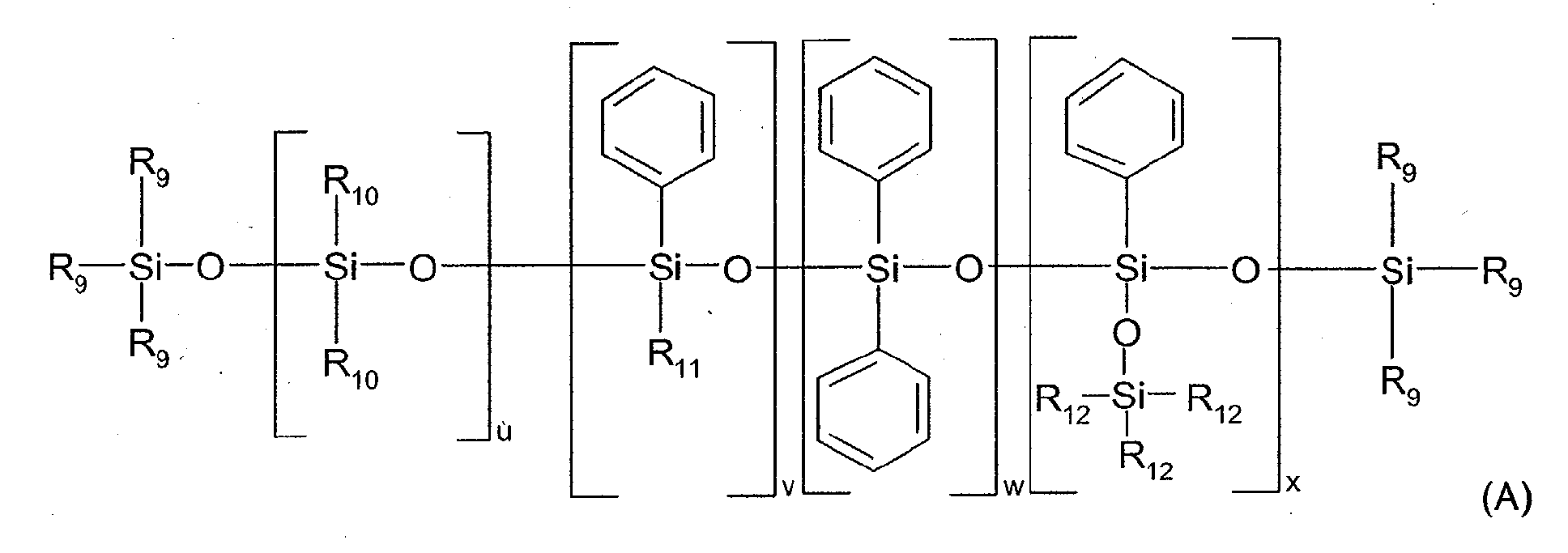
- R9 et R12 sont chacun indépendamment un radical alkyle en C1-C30, un radical aryle ou un radical aralkyle,
- R10 et R11 sont chacun indépendamment un radical alkyle en C1-C30 ou un radical aralkyle,
- u, v, w et x sont chacun indépendamment des nombres entiers allant de 0 à 900, sous réserve que la somme v+w+x soit différente de 0 et que la somme u+v+w+x va de 1 à 900 ; en particulier, u+v+w+x va de 1 à 800.

- R8 est un radical alkyle en C1-C30, un radical aryle, ou un radical aralkyle,
- n est un nombre entier allant de 0 à 100, et mieux, inférieur à 100,
- m est un nombre entier allant de 0 à 100, et mieux, inférieur à 100,
Les valeurs entre parenthèses représentent les viscosités à 25°C.
Par composé "hydrocarboné", on entend un composé comportant principalement des atomes de carbone et d'hydrogène et éventuellement une ou plusieurs fonctions choisies parmi les fonctions hydroxyle, ester, éther, carboxylique. Ces composés sont en particulier exempts de groupements -Si-O-.
- les polymères lipophiles tels que :
- les polybutylènes tels que l'INDOPOL H-100 (de masse molaire ou MM=965 g/mol), l'INDOPOL H-300 (MM=1340 g/mol), l'INDOPOL H-1500 (MM=2160g/mol) commercialisés ou fabriqués par la société AMOCO,
- les polyisobutylènes hydrogénés tels que le PANALANE H-300 E commercialisé ou fabriqué par la société AMOCO (M =1340 g/mol, indice de réfraction de 1,498), le VISEAL 20000 commercialisé ou fabriqué par la société SYNTEAL (MM=6000 g/mol), le REWOPAL PIB 1000 commercialisé ou fabriqué par la société WITCO (MM=1000 g/mol),
- Les polydécènes et les polydécènes hydrogénés tels que : le PURESYN 10 (MM=723 g/mol), le PURESYN 150 (MM=9200 g/mol) commercialisé ou fabriqués par la société MOBIL CHEMICALS,
- les esters tels que
- les esters d'acides gras linéaires ayant un nombre total de carbone allant de 30 à 70 comme le tétrapélargonate de pentaérythrityle (MM=697,05 g/mol),
- les esters hydroxylés tels que le malate de diisostéaryle (MM= 639 g/mol, indice de réfraction de 1,462),
- les esters aromatiques tels que le tridecyl trimellitate (MM=757,19 g/mol),
- les esters d'alcool gras ou d'acides gras ramifiés en C24-C28 tels que ceux décrits dans la demande EP-A-0 955 039, et notamment le citrate de triisocétyle (MM= 865 g/mol), le tétraisononanoate de pentaérythrityle (MM=697,05g/mol), le triisostéarate de glycéryle (MM=891,51 g/mol), le tri décyl-2 tétradécanoate de glycéryle (MM=1143,98 g/mol), le tétraisostéarate de pentaérythrityle (MM=1202,02 g/mol), le tétraisostéarate de polyglycéryle -2 (MM=1232,04 g/mol) ou encore le tétra décyl -2 tétradécanoate de pentaérythrityle (MM=1538,66 g/mol),
- les huiles d'origine végétale telles que l'huile de sésame (820,6 g/mol),
- et leurs mélanges.
De préférence encore, l'huile hydrocarbonée non volatile est choisie parmi les polyesters hydroxylés, notamment les polyesters de monoalcools gras et d'acide polycarboxylique hydroxylé. Le monoalcool gras comprend de préférence de 16 à 22 atomes de carbone et l'acide polycarboxylique est de préférence un acide dicarboxylique.
Cet agent rhéologique est avantageusement choisi parmi les cires, les composés gras pâteux à température ambiante (25°C), les gélifiants lipophiles et leurs mélanges.
Un composé pâteux est un produit visqueux comprenant une fraction solide et une fraction liquide.
Par "phase grasse liquide", on entend, au sens de l'invention, une phase grasse liquide à température ambiante (25° C) et pression atmosphérique (760 mm de Hg, soit 105 Pa), composée d'un ou plusieurs corps gras liquides température ambiante, appelés aussi huiles, généralement compatibles entre eux. En particulier, cette phase grasse liquide est constituée par les huiles hydrocarbonées non volatiles décrites précédemment.
L'aptitude à former ce réseau de fibrilles, et donc à gélifier, dépend de la nature (ou classe chimique) de l'organogélateur, de la nature des substituants portés par ses molécules pour une classe chimique donnée et de la nature de la phase grasse liquide.
Les interactions physiques sont diverses mais excluent la co-cristallisation. Ces interactions physiques sont en particulier des interactions du type interactions hydrogènes auto-complémentaires, interactions π entre cycles insaturés, interactions dipolaires, liaisons de coordination avec des dérivés organométalliques et leurs associations. En général, chaque molécule d'un organogélateur peut établir plusieurs types d'interactions physiques avec une molécule voisine. Aussi, avantageusement, les molécules des organogélateurs selon l'invention comportent au moins un groupement capable d'établir des liaisons hydrogène et mieux au moins deux groupements capables d'établir des liaisons hydrogène, au moins un cycle aromatique et mieux aux moins deux cycles aromatiques, au moins une ou plusieurs liaisons à insaturation éthylénique et/ou au moins un ou plusieurs carbones asymétriques. De préférence, les groupements capables de faire des liaisons hydrogènes sont choisis parmi les groupements hydroxyle, carbonyle, amine, acide carboxylique, amide, urée, benzyle et leurs associations.
La phase particulaire est généralement présente à raison de 0,01 à 60%, de préférence 10 à 5 à 25% en poids par rapport au poids total de la composition.
- les huiles hydrocarbonées d'origine animale telles que le perhydrosqualène ;
- les huiles hydrocarbonées végétales telles que les triglycérides liquides d'acides gras ayant de 4 à 10 atomes de carbone comme les triglycérides des acides heptanoïque ou octanoïque ou l'huile de jojoba ;
- les hydrocarbures linéaires ou ramifiés, d'origine minérale ou synthétique tels que les huiles de paraffine et leurs dérivés, la vaseline ;
- les esters et les éthers de synthèse notamment d'acides gras comme les huiles de formule R1COOR2 dans laquelle R1 représente le reste d'un acide gras supérieur comportant de 1 à 40 atomes de carbone et R2 représente une chaíne hydrocarbonée contenant de 1 à 40 atomes de carbone avec 10 = R1 + R2 = 41 comme par exemple, , le myristate d'isopropyle, le palmitate d'éthyl 2-hexyle, le stéarate d'octyl 2-dodécyle, l'érucate d'octyl 2-dodécyle ;
- les alcools gras ayant de 12 à 26 atomes de carbone comme l'octyl dodécanol, le 2-butyloctanol, le 2-hexyl décanol, le 2-undécyl pentadécanol, l'alcool oléique ;
- les acides gras supérieurs en C8-C26 tels que l'acide oléique, l'acide linoléique, l'acide linolénique ou l'acide isostéarique ;
- les huiles fluorées éventuellement partiellement hydrocarbonées et/ou siliconées ;
- les huiles siliconées comme les polydiméthylsiloxanes (PDMS) volatiles ou non, linéaires ou cycliques ; les polydiméthylsiloxanes comportant des groupements alkyle ou alcoxy, pendant ou en bout de chaíne siliconée, groupements ayant de 2 à 24 atomes de carbone ;
- et leurs mélanges.
Elle peut aussi se présenter sous forme d'une émulsion simple ou multiple à phase continue huileuse ou aqueuse, de dispersion huileuse dans une phase aqueuse grâce à des vésicules contenant des lipides ioniques et/ou non ioniques. Ces formes galéniques sont préparées selon les méthodes usuelles des domaines considérés.
La composition selon l'invention peut se présenter sous la forme d'une composition, colorée ou non, de soin de la peau, sous forme d'une composition de protection solaire ou de démaquillage ou encore sous forme d'une composition hygiénique. Si elle contient des actifs cosmétiques, elle peut alors être utilisée comme base de soin ou de traitement non thérapeutique pour la peau comme les mains ou le visage ou pour les lèvres (baumes à lèvres, protégeant les lèvres du froid et/ou du soleil et/ou du vent), produit de bronzage artificiel de la peau.
- la composition de l'exemple 1 comprend une huile siliconée, le cyclopentasiloxane,
- la composition de l'exemple 2 comprend une huile hydrocarbonée volatile, l'isododécane de masse moléculaire 170 g/Mol,
- la composition de l'exemple 3 comprend une huile hydrocarbonée non volatile, l'isononanoate d'isononyle ayant une masse moléculaire égale à 284 g/Mol et un indice de réfraction de 1,436,
- la composition de l'exemple 4 selon l'invention comprend du diisostéaryl malate ayant une
masse moléculaire égale à 639 g/Mol et un indice de réfraction de 1,462.
Phase Exemple 1 (comparatif) Exemple 2 (comparatif) Exemple 3 (comparatif) Exemple 4 (invention) A Cyclopentasiloxane 30 Isododécane 30 Isononanoate d'isononyle 30 Malate de di-isostéaryle 30 Phényltrimethyltrisiloxane (20 cSt) fabriquée ou commercialisée par la société Dow Corning sous la référence DC 556 18 18 18 18 Phényltrimethyltrisiloxane (1000 cSt) fabriquée ou commercialisée par la société Qsp 100 Qsp 100 Qsp 100 Qsp 100 Wacker sous la référence Belsil PDM 1000 B Cire microcristalline 10 10 10 10 Alkyl diméthicone en C30-C45 2,5 2,5 2,5 2,5 Mélange de triglycérides d'acides laurique, myristique, palmitique et stéarique (50/20/10/10) fabriqué ou commercialisé sous la référence Softisan 100 par la société Sasol. 10 10 10 10 C Red 7 0,26 0,26 0,26 0,26 Red 21 0,06 0,06 0,06 0,06 Oxyde de fer noir 0,09 0,09 0,09 0,09 Oxyde de fer brun 2,1 2,1 2,1 2,1 Mica oxyde de titane 1,8 1,8 1,8 1,8
La pâte obtenue est coulée dans un moule approprié pour stick qui est porté à 40-42 °C et qui est ensuite placé à -18°C pendant une demi-heure. Puis les sticks sont démoulés.
Le stick de l'exemple 4 selon l'invention a été jugé comme déposant bien, le film de composition a été jugé homogène et brillant.
| Phase | ||
| A | Malate de di-isostéaryle | qsp 100 |
| Phényltrimethyltrisiloxane (20 cSt) fabriquée ou commercialisée par la société Dow Corning sous la référence DC 556 | 18 | |
| Phényltrimethyltrisiloxane (1000 cSt) fabriquée ou commercialisée par la société Wacker sous la référence Belsil PDM 1000 | 27 | |
| B | Cire microcristalline | 10 |
| Alkyl diméthicone en C30-C45 | 2,5 | |
| Mélange de triglycérides d'acides laurique, myristique, palmitique et stéarique (50/20/10/10) fabriqué ou commercialisé sous la référence Softisan 100 par la société Sasol. | 10 | |
| C | Red 7 | 0,26 |
| Red 21 | 0,06 | |
| Oxyde de fer noir | 0,09 | |
| Oxyde de fer brun | 2,1 | |
| Mica oxyde de titane | 1,8 |
- dans un premier temps, une évaluation de la tenue "sensorielle" globale est réalisée une heure après l'application de la formule sur les lèvres.
- dans un second temps, une tenue "instrumentale" est évaluée après une série d'épreuves consistant à faire deux « bises » sur un mouchoir en papier, boire une boisson chaude puis une boisson froide et manger 4 bouchées d'un sandwich et d'une pomme.
- la brillance a été évaluée juste après l'application de la formule puis au bout d'une heure (la
brillance instrumentale est évaluée sur une échelle allant de 1 à 200. 1 correspond à une
formule qui n'est pas du tout brillante et 200 à une formule qui est très brillante.
La brillance instrumentale est mesurée à l'aide d'un brillancemètre, de manière conventionnelle, par la méthode suivante.
Sur une carte de contraste de marque LENETA et de référence FORM 1A PENOPAC, on étale une couche de 50 µm d'épaisseur de la composition dont on cherche à évaluer la brillance moyenne, à l'aide d'un étaleur automatique. La couche recouvre au moins le fond blanc de la carte. On procède de suite à la mesure de la brillance à 20° sur le fond blanc à l'aide d'un brillancemètre de marque BYK GARDNER et de référence microTRl-GLOSS. - le confort a été évalué au bout d'une heure.
| Résultats | ||||
| Tenue | Brillance | Confort | ||
| Evaluation sensorielle | A l'application | 6,3 | ||
| A 1 heure | 6,4 | 4,8 | 7,4 | |
| Evaluation instrumentale | A l'application | 171 | ||
| A 1 heure | 82 | 138 | ||
| Après épreuves | 54 |
L'application (facilité d'application et glissant) du film de composition a également été jugée comme satisfaisante.
Claims (38)
- Composition cosmétique comprenant, dans un milieu physiologiquement acceptable, au moins une huile siliconée phénylée de haute viscosité supérieure ou égale à 500 cSt et au moins une huile hydrocarbonée non volatile ayant une masse moléculaire supérieure à 500 g/Mol, caractérisée en ce que ladite composition présente une brillance moyenne supérieure à 100 sur 200 et une tenue après épreuve supérieure à 40 sur 100.
- Composition cosmétique comprenant, dans un milieu physiologiquement acceptable, a) au moins une huile siliconée phénylée de haute viscosité supérieure ou égale à 500 cSt, b) au moins une huile hydrocarbonée non volatile soluble ou dispersible dans ladite huile siliconée et ayant une masse moléculaire supérieure à 500 g/Mol et c) au moins un agent rhéologique, caractérisée en ce que l'agent rhéologique est une cire siliconée.
- Composition cosmétique comprenant, dans un milieu physiologiquement acceptable, a) au moins une huile siliconée phénylée de haute viscosité supérieure ou égale à 500 cSt, b) au moins une huile hydrocarbonée non volatile ayant une masse moléculaire supérieure à 600 g/Mol et c) une phase particulaire, caractérisée en ce qu'elle comprend moins de 5% d'une huile volatile.
- Composition cosmétique comprenant, dans un milieu physiologiquement acceptable, au moins une huile siliconée phénylée de haute viscosité supérieure ou égale à 500 cSt et au moins une huile hydrocarbonée non volatile ayant une masse moléculaire supérieure à 600 g/Mol, ladite huile hydrocarbonée étant soluble ou dispersible dans ladite huile siliconée.
- Composition selon l'une des revendications précédentes, caractérisée en ce que l'huile hydrocarbonée non volatile est choisie parmi les esters d'acides gras linéaires, les polyesters d'alcools gras et de polyacides éventuellement hydroxylés et leurs mélanges.
- Composition selon l'une des revendications précédentes, caractérisée en ce que l'huile hydrocarbonée non volatile est choisie parmi les polyesters hydroxylés, notamment les polyesters de monoalcool gras et d'acide polycarboxylique hydroxylé.
- Composition selon l'une des revendications précédentes, caractérisée en ce que l'huile hydrocarbonée non volatile a un nombre total de carbone allant de 30 à 70.
- Composition selon l'une des revendications précédentes, caractérisée en ce que l'huile hydrocarbonée non volatile est choisie parmi le tétrapélargonate de pentaérythrityle, le malate de diisostéaryle, le tridécyl trimellitate, le citrate de triisocétyle, le tétraisononanoate de pentaérythrityle, le triisostéarate de glycéryle, le tri décyl-2 tétradécanoate de glycéryle, le tétraisostéarate de pentaérythrityle et leurs mélanges.
- Composition selon l'une des revendications précédentes, caractérisée en ce que l'huile hydrocarbonée non volatile représente de 5 à 99 %, de préférence de 10 à 60 % et mieux de 15 à 50 % du poids total de la composition.
- Composition selon l'une des revendications précédentes, caractérisée en ce que l'huile siliconée phénylée de haute viscosité présente une viscosité à 25°C allant de 500 à 10 000 cSt.
- Composition selon l'une des revendications précédentes, caractérisée en ce que l'huile siliconée phénylée de haute viscosité présente une viscosité à 25°C allant de 600 à 5000 cSt.
- Composition selon l'une des revendications précédentes, caractérisée en ce que l'huile siliconée phénylée de haute viscosité présente une viscosité à 25°C allant de 600 à 3000 cSt.
- Composition selon l'une des revendications précédentes, caractérisée en ce que l'huile siliconée phénylée de haute viscosité représente de 5 à 99% en poids de la composition.
- Composition selon l'une des revendications précédentes, caractérisée en ce qu'elle contient en outre une huile siliconée phénylée de basse viscosité inférieure à 500 cSt.
- Composition selon la revendication précédente, caractérisée en ce que l'huile siliconée phénylée de basse viscosité présente une viscosité à 25°C allant de 5 à 500 cSt.
- Composition selon la revendication 11 ou 12, caractérisée en ce que l'huile siliconée phénylée de basse viscosité présente une viscosité à 25°C allant de 5 à 300 cSt à 25°C.
- Composition selon l'une des revendications 11 à 13, caractérisée en ce que l'huile siliconée phénylée de basse viscosité présente une viscosité à 25°C allant de 5 à 100 cSt à 25°C.
- Composition selon l'une des revendications 14 à 17, caractérisée en ce que l'huile siliconée phénylée de haute viscosité et/ou l'huile siliconée phénylée de basse viscosité est choisie parmi les huiles de formule (A) suivante :dans laquelle :
 R9 et R12 sont chacun indépendamment un radical alkyle en C1-C30, un radical aryle ou un radical aralkyle,R10 et R11 sont chacun indépendamment un radical alkyle en C1-C30 ou un radical aralkyle,u, v, w et x sont chacun indépendamment des nombres entiers allant de 0 à 900, sous réserve que la somme v+w+x soit différente de 0 et que la somme u+v+w+x va de 1 à 900, en particulier, u+v+w+x va de 1 à 800.
 - Composition selon l'une des revendications 11 à 15, caractérisée en ce que l'huile siliconée phénylée de basse viscosité représente de 5 à 99% en poids de la composition.
- Composition selon l'une des revendications 11 à 16, caractérisée en ce que le rapport en poids entre l'huile siliconée phénylée de basse viscosité et l'huile siliconée de haute viscosité va de 1/10 à 10/1.
- Composition selon l'une des revendications 11 à 17, caractérisée en ce que le rapport en poids entre l'huile siliconée phénylée de basse viscosité et l'huile siliconée de haute viscosité va de 2/10 à 10/2.
- Composition selon l'une des revendications 11 à 18, caractérisée en ce que le rapport en poids entre l'huile siliconée phénylée de basse viscosité et l'huile siliconée de haute viscosité va de 3/10 à 10/5.
- Composition selon l'une des revendications précédentes, caractérisée en ce que l'agent rhéologique est choisi parmi les cires, les composés gras pâteux à température ambiante (25°C), les gélifiants lipophiles et leurs mélanges.
- Composition selon l'une des revendications précédentes, caractérisée en ce que l'agent rhéologique représente de 0,1 à 65%, de préférence de 1 à 50%, mieux de 3 à 40% et encore mieux de 5 à 30% du poids total de la composition.
- Composition selon la revendication 2, caractérisée en ce que la cire siliconée est choisie parmi les alkyldiméthicones ou alkoxydiméthicones ayant une chaíne alkyle ou alcoxy de 10 à 45 atomes de carbone, les esters de poly(di)méthylsiloxane solide à 30°C dont la chaíne ester comporte au moins 10 atomes de carbone ou encore le tétrastéarate de di-(triméthylol-1,1,1 propane) et leurs mélanges.
- Composition selon la revendication 25, caractérisée en ce qu'elle comprend en outre une cire hydrocarbonée apolaire choisie parmi la paraffine, les cires de lignite ou microcristallines, la cérésine ou l'ozokérite, les cires synthétiques comme les cires de polyéthylène issues de la polymérisation ou copolymérisation de l'éthylène, les cires de Fischer-Tropsch et leurs mélanges.
- Composition selon la revendication 23, caractérisée en ce que le gélifiant lipophile est un organogélateur.
- Composition selon la revendication précédente, caractérisée en ce que l'organogélateur est choisi parmi les amides d'acides tri-carboxyliques, les diamides ayant des chaínes hydrocarbonées contenant chacune de 1 à 22 atomes de carbone, lesdites chaínes étant non substituées ou substituées avec au moins un substituant choisi parmi les groupes ester, urée et fluoro, les amides de N-acylamino acides et leurs mélanges.
- Composition selon l'une des revendications 27 ou 28, caractérisée en ce que l'organogélateur est choisi parmi les cyclohexanetricarboxamides, les diamides résultant de la réaction du diaminocyclohexane et d'un chlorure d'acide, les diamides résultant de l'action d'un N-acylamino acide avec des amines comportant de 1 à 22 atomes de carbone et leurs mélanges.
- Composition selon l'une des revendications 26 à 28, caractérisée en ce que le gélifiant lipophile représente de 0,1 à 50%, mieux 1 à 30 %, et mieux de 2 à 20 % en poids par rapport au poids total de la composition.
- Composition selon l'une des revendications précédentes, caractérisée en ce que la phase particulaire comprend des pigments et/ou des nacres et/ou des charges.
- Composition selon l'une des revendications précédentes, caractérisée en ce que la phase particulaire est présente à raison de 0,01 à 60%, de préférence 5 à 25% en poids par rapport au poids total de la composition.
- Composition selon l'une des revendications précédentes, caractérisée en ce qu'elle se présente sous la forme d'un produit de maquillage et/ou de soin du visage ou du corps, des lèvres et/ou des phanères.
- Composition selon l'une des revendications précédentes, caractérisée en ce qu'elle se présente sous la forme d'un produit de maquillage des lèvres.
- Composition selon la revendication précédente, caractérisée en ce qu'elle se présente sous forme anhydre.
- Utilisation de l'association d'au moins une huile siliconée phénylée de haute viscosité supérieure ou égale à 500 cSt, d'au moins une huile hydrocarbonée non volatile, de masse moléculaire supérieure à 600 g/mol soluble ou dispersible dans ladite huile siliconée dans une composition comprenant un milieu physiologiquement acceptable et une phase particulaire, ladite composition présentant des propriétés de tenue et de brillance.
- Utilisation de l'association d'au moins une huile siliconée phénylée de haute viscosité supérieure ou égale à 500 cSt, d'au moins une huile hydrocarbonée non volatile ayant une masse moléculaire supérieure à 600 g/Mol dans une composition comprenant un milieu physiologiquement acceptable, comme agent pour conférer de la tenue et de la brillance à ladite composition.
- Procédé cosmétique pour conférer à un film de composition cosmétique des propriétés de tenue et de brillance, consistant à introduire dans ladite composition une quantité efficace d'au moins une huile siliconée phénylée de haute viscosité supérieure ou égale à 500 cSt, d'au moins une huile hydrocarbonée non volatile ayant une masse moléculaire supérieure à 600 g/Mol soluble ou dispersible dans ladite huile siliconée.
Priority Applications (1)
| Application Number | Priority Date | Filing Date | Title |
|---|---|---|---|
| EP06300700A EP1738748A1 (fr) | 2002-09-06 | 2003-09-05 | Composition cosmétique comprenant une huile siliconée phénylée, une huile hydrocarbonée non volatile, un agent rhéologique et une phase particulaire |
Applications Claiming Priority (2)
| Application Number | Priority Date | Filing Date | Title |
|---|---|---|---|
| FR0211095A FR2844186B1 (fr) | 2002-09-06 | 2002-09-06 | Composition cosmetique comprenant des huiles, un agent rheologique et une phase particulaire |
| FR0211095 | 2002-09-06 |
Related Child Applications (2)
| Application Number | Title | Priority Date | Filing Date |
|---|---|---|---|
| EP06300700A Division EP1738748A1 (fr) | 2002-09-06 | 2003-09-05 | Composition cosmétique comprenant une huile siliconée phénylée, une huile hydrocarbonée non volatile, un agent rhéologique et une phase particulaire |
| EP06300700.9 Division-Into | 2006-07-07 |
Publications (2)
| Publication Number | Publication Date |
|---|---|
| EP1405625A1 true EP1405625A1 (fr) | 2004-04-07 |
| EP1405625B1 EP1405625B1 (fr) | 2010-03-24 |
Family
ID=31725912
Family Applications (2)
| Application Number | Title | Priority Date | Filing Date |
|---|---|---|---|
| EP06300700A Withdrawn EP1738748A1 (fr) | 2002-09-06 | 2003-09-05 | Composition cosmétique comprenant une huile siliconée phénylée, une huile hydrocarbonée non volatile, un agent rhéologique et une phase particulaire |
| EP03020174A Expired - Lifetime EP1405625B1 (fr) | 2002-09-06 | 2003-09-05 | Composition cosmétique comprenant des huiles, un agent rhéologique et une phase particulaire |
Family Applications Before (1)
| Application Number | Title | Priority Date | Filing Date |
|---|---|---|---|
| EP06300700A Withdrawn EP1738748A1 (fr) | 2002-09-06 | 2003-09-05 | Composition cosmétique comprenant une huile siliconée phénylée, une huile hydrocarbonée non volatile, un agent rhéologique et une phase particulaire |
Country Status (6)
| Country | Link |
|---|---|
| EP (2) | EP1738748A1 (fr) |
| JP (1) | JP2004262919A (fr) |
| AT (1) | ATE461728T1 (fr) |
| DE (1) | DE60331801D1 (fr) |
| ES (1) | ES2342881T3 (fr) |
| FR (1) | FR2844186B1 (fr) |
Cited By (2)
| Publication number | Priority date | Publication date | Assignee | Title |
|---|---|---|---|---|
| EP2263640A1 (fr) | 2009-06-19 | 2010-12-22 | L'Oréal | Composition cosmétique de maquillage et/ou de soin comprenant une résine tackifiante, et une association d'huiles particulières |
| CN115778855A (zh) * | 2022-12-16 | 2023-03-14 | 上海臻臣化妆品有限公司 | 口红及其制备方法 |
Families Citing this family (12)
| Publication number | Priority date | Publication date | Assignee | Title |
|---|---|---|---|---|
| JP2007153812A (ja) * | 2005-12-06 | 2007-06-21 | Noevir Co Ltd | 油性化粧料 |
| FR2939033B1 (fr) * | 2008-12-02 | 2012-08-31 | Oreal | Composition cosmetique de maquillage et/ou de soin des matieres keratiniques, et procede de maquillage |
| FR2957786B1 (fr) * | 2010-03-29 | 2012-06-15 | Oreal | Composition de maquillage des cils ou sourcils, ensemble et procedes |
| JP5833812B2 (ja) * | 2010-08-27 | 2015-12-16 | 株式会社日本色材工業研究所 | 油性化粧料 |
| FR2976805B1 (fr) * | 2011-06-23 | 2013-07-12 | Oreal | Composition cosmetique comprenant un compose supramoleculaire capable d'etablir des liaisons hydrogene, et deux huiles siliconees particulieres distinctes |
| FR3015259B1 (fr) * | 2013-12-23 | 2017-05-12 | Oreal | Composition solide avec un polymere vinylique a motif dendrimere carbosiloxane, une huile ester alcool non volatile et procede de traitement |
| WO2015097103A1 (fr) * | 2013-12-23 | 2015-07-02 | L'oreal | Composition solide comprenant un polymère vinylique renfermant un motif à base de dendrimères de carbosiloxane et deux huiles siliconées phénylées incompatibles, et méthode de traitement |
| FR3015257B1 (fr) * | 2013-12-23 | 2015-12-11 | Oreal | Composition solide avec un polymere vinylique a motif dendrimere carbosiloxane, deux huiles siliconees phenylees incompatibles et procede de traitement |
| FR3117859B1 (fr) * | 2020-12-23 | 2024-11-15 | Lvmh Rech | Composition de maquillage avec tenue et brillance |
| WO2024214485A1 (fr) | 2023-04-11 | 2024-10-17 | 信越化学工業株式会社 | Composé organopolysiloxane |
| JP2024165507A (ja) | 2023-05-17 | 2024-11-28 | 信越化学工業株式会社 | 熱伝導性シリコーン組成物及び硬化物 |
| EP4722300A1 (fr) | 2023-05-31 | 2026-04-08 | Shin-Etsu Chemical Co., Ltd. | Composition de silicone thermoconductrice et produit durci |
Citations (5)
| Publication number | Priority date | Publication date | Assignee | Title |
|---|---|---|---|---|
| JPS61210018A (ja) * | 1985-03-15 | 1986-09-18 | Shiseido Co Ltd | メ−キヤツプ化粧料 |
| EP0819419A1 (fr) * | 1996-07-17 | 1998-01-21 | L'oreal | Composition comprenant un composant hydrophile, et l'association d'un composé volatil et d'une huile siliconée phénylée, et utilisation de ladite association |
| FR2771628A1 (fr) * | 1997-12-02 | 1999-06-04 | Dior Christian Parfums | Utilisation de gomme de dihpenyldimethicone dissoute dans une silicone non volatile de type phenyltrimethicone pour la fabrication d'une composition cosmetique ou pharmaceutique, notamment dermatologique comprenant une phase grasse |
| EP1249223A1 (fr) * | 2001-04-10 | 2002-10-16 | L'oreal | Produit de maquillage bicouche, ses utilisations et kit de maquillage contenant ce produit |
| EP1249226A1 (fr) * | 2001-04-10 | 2002-10-16 | L'oreal | Produit de maquillage bicouche contenant un pigment goniochromatique et un pigment monocolore et kit de maquillage contenant ce produit |
Family Cites Families (1)
| Publication number | Priority date | Publication date | Assignee | Title |
|---|---|---|---|---|
| FR2801785B1 (fr) * | 1999-12-03 | 2002-09-27 | Oreal | Composition cosmetique sans transfert comprenant un compose non volatil silicone et une huile hydrocarbonee non volatile incompatible avec ce compose silicone |
-
2002
- 2002-09-06 FR FR0211095A patent/FR2844186B1/fr not_active Expired - Lifetime
-
2003
- 2003-09-05 EP EP06300700A patent/EP1738748A1/fr not_active Withdrawn
- 2003-09-05 ES ES03020174T patent/ES2342881T3/es not_active Expired - Lifetime
- 2003-09-05 AT AT03020174T patent/ATE461728T1/de not_active IP Right Cessation
- 2003-09-05 DE DE60331801T patent/DE60331801D1/de not_active Expired - Lifetime
- 2003-09-05 EP EP03020174A patent/EP1405625B1/fr not_active Expired - Lifetime
- 2003-09-08 JP JP2003315977A patent/JP2004262919A/ja active Pending
Patent Citations (5)
| Publication number | Priority date | Publication date | Assignee | Title |
|---|---|---|---|---|
| JPS61210018A (ja) * | 1985-03-15 | 1986-09-18 | Shiseido Co Ltd | メ−キヤツプ化粧料 |
| EP0819419A1 (fr) * | 1996-07-17 | 1998-01-21 | L'oreal | Composition comprenant un composant hydrophile, et l'association d'un composé volatil et d'une huile siliconée phénylée, et utilisation de ladite association |
| FR2771628A1 (fr) * | 1997-12-02 | 1999-06-04 | Dior Christian Parfums | Utilisation de gomme de dihpenyldimethicone dissoute dans une silicone non volatile de type phenyltrimethicone pour la fabrication d'une composition cosmetique ou pharmaceutique, notamment dermatologique comprenant une phase grasse |
| EP1249223A1 (fr) * | 2001-04-10 | 2002-10-16 | L'oreal | Produit de maquillage bicouche, ses utilisations et kit de maquillage contenant ce produit |
| EP1249226A1 (fr) * | 2001-04-10 | 2002-10-16 | L'oreal | Produit de maquillage bicouche contenant un pigment goniochromatique et un pigment monocolore et kit de maquillage contenant ce produit |
Non-Patent Citations (1)
| Title |
|---|
| DATABASE WPI Week 198644, Derwent World Patents Index; AN 1986-287936, XP002246654 * |
Cited By (2)
| Publication number | Priority date | Publication date | Assignee | Title |
|---|---|---|---|---|
| EP2263640A1 (fr) | 2009-06-19 | 2010-12-22 | L'Oréal | Composition cosmétique de maquillage et/ou de soin comprenant une résine tackifiante, et une association d'huiles particulières |
| CN115778855A (zh) * | 2022-12-16 | 2023-03-14 | 上海臻臣化妆品有限公司 | 口红及其制备方法 |
Also Published As
| Publication number | Publication date |
|---|---|
| EP1738748A1 (fr) | 2007-01-03 |
| FR2844186A1 (fr) | 2004-03-12 |
| ATE461728T1 (de) | 2010-04-15 |
| EP1405625B1 (fr) | 2010-03-24 |
| JP2004262919A (ja) | 2004-09-24 |
| DE60331801D1 (de) | 2010-05-06 |
| ES2342881T3 (es) | 2010-07-16 |
| FR2844186B1 (fr) | 2006-03-31 |
Similar Documents
| Publication | Publication Date | Title |
|---|---|---|
| US8110206B2 (en) | Cosmetic composition comprising a hydrocarbon oil and a silicone oil | |
| EP1184028B1 (fr) | Composition cosmétique sans transfert comprenant un composé non volatil siliconé, une huile hydrocarbonée non volatile et une phase particulaire inerte | |
| EP1112734B1 (fr) | Composition cosmétique sans transfert comprenant un composé non volatil siliconé et une huile hydrocarbonée non volatile incompatible avec ce composé siliconé | |
| EP1068856B1 (fr) | Composition cosmétique sans cire, structurée sous forme rigide par un polymère | |
| EP1068855B1 (fr) | Composition à phase grasse liquide gélifiée par un polyamide à groupements ester terminaux | |
| EP1114636B1 (fr) | Composition longue tenue structurée par un polymère et un corps gras pâteux | |
| EP1447078A1 (fr) | Emulsion solide a phase grasse liquide structuree par un polymere | |
| FR2804018A1 (fr) | Composition sans transfert structuree sous forme rigide par un polymere | |
| FR2819399A1 (fr) | Composition cosmetique contenant un polymere et une huile fluoree | |
| EP1616558A1 (fr) | Produit cosmétique bicouche comprenant un polymère de silicone | |
| EP1405625B1 (fr) | Composition cosmétique comprenant des huiles, un agent rhéologique et une phase particulaire | |
| EP1325730B1 (fr) | Composition de maquillage ou de soin des matières kératiniques comprenant une huile hydrocarbonée non volatile, une phase particulaire et un agent dispersant particulier | |
| FR2796271A1 (fr) | Composition sans cire structuree sous forme rigide par un polymere | |
| FR2802806A1 (fr) | Composition longue tenue structuree par un polymere et un corps gras pateux | |
| FR2796270A1 (fr) | Composition a phase grasse liquide gelifiee par un polyamide a groupements ester terminaux | |
| FR2804017A1 (fr) | Composition longue tenue structuree par un polymere et un corps gras pateux | |
| EP1457201B1 (fr) | Composition cosmétique contenant un polyester de triglycéride d'acides carboxyliques hydroxyles et une huile de masse molaire allant de 650 à 1000 g/mol. | |
| FR2834452A1 (fr) | Composition de maquillage ou de soin des matieres keratiniques comprenan un compose silicone non volatil, un polymere liposoluble non silicone et un agent dispersant particulier | |
| FR2838049A1 (fr) | Composition comprenant un milieu physiologiquement acceptable qui contient une phase grasse comprenant un ester particulier | |
| EP1653919A1 (fr) | Composition cosmetique comprenant un ester particulier et ses utilisations | |
| FR2840528A1 (fr) | Composition comprenant un polyol et un alkylether de polysaccharide | |
| FR2843019A1 (fr) | Composition gelifiee par un melange d'esters de dextrine |
Legal Events
| Date | Code | Title | Description |
|---|---|---|---|
| PUAI | Public reference made under article 153(3) epc to a published international application that has entered the european phase |
Free format text: ORIGINAL CODE: 0009012 |
|
| AK | Designated contracting states |
Kind code of ref document: A1 Designated state(s): AT BE BG CH CY CZ DE DK EE ES FI FR GB GR HU IE IT LI LU MC NL PT RO SE SI SK TR |
|
| AX | Request for extension of the european patent |
Extension state: AL LT LV MK |
|
| 17P | Request for examination filed |
Effective date: 20041007 |
|
| AKX | Designation fees paid |
Designated state(s): AT BE BG CH CY CZ DE DK EE ES FI FR GB GR HU IE IT LI LU MC NL PT RO SE SI SK TR |
|
| 17Q | First examination report despatched |
Effective date: 20041130 |
|
| 17Q | First examination report despatched |
Effective date: 20041130 |
|
| RTI1 | Title (correction) |
Free format text: COSMETIC COMPOSITION COMPRISING OILS, A RHEOLOGICAL AGENT AND A PARTICULATE PHASE |
|
| GRAP | Despatch of communication of intention to grant a patent |
Free format text: ORIGINAL CODE: EPIDOSNIGR1 |
|
| RIC1 | Information provided on ipc code assigned before grant |
Ipc: A61K 8/85 20060101ALI20091007BHEP Ipc: A61Q 1/04 20060101AFI20091007BHEP Ipc: A61K 8/891 20060101ALI20091007BHEP |
|
| GRAS | Grant fee paid |
Free format text: ORIGINAL CODE: EPIDOSNIGR3 |
|
| GRAA | (expected) grant |
Free format text: ORIGINAL CODE: 0009210 |
|
| AK | Designated contracting states |
Kind code of ref document: B1 Designated state(s): AT BE BG CH CY CZ DE DK EE ES FI FR GB GR HU IE IT LI LU MC NL PT RO SE SI SK TR |
|
| REG | Reference to a national code |
Ref country code: GB Ref legal event code: FG4D Free format text: NOT ENGLISH |
|
| REG | Reference to a national code |
Ref country code: CH Ref legal event code: EP |
|
| REG | Reference to a national code |
Ref country code: IE Ref legal event code: FG4D |
|
| REF | Corresponds to: |
Ref document number: 60331801 Country of ref document: DE Date of ref document: 20100506 Kind code of ref document: P |
|
| REG | Reference to a national code |
Ref country code: NL Ref legal event code: VDEP Effective date: 20100324 |
|
| REG | Reference to a national code |
Ref country code: ES Ref legal event code: FG2A Ref document number: 2342881 Country of ref document: ES Kind code of ref document: T3 |
|
| PG25 | Lapsed in a contracting state [announced via postgrant information from national office to epo] |
Ref country code: SI Free format text: LAPSE BECAUSE OF FAILURE TO SUBMIT A TRANSLATION OF THE DESCRIPTION OR TO PAY THE FEE WITHIN THE PRESCRIBED TIME-LIMIT Effective date: 20100324 Ref country code: AT Free format text: LAPSE BECAUSE OF FAILURE TO SUBMIT A TRANSLATION OF THE DESCRIPTION OR TO PAY THE FEE WITHIN THE PRESCRIBED TIME-LIMIT Effective date: 20100324 Ref country code: FI Free format text: LAPSE BECAUSE OF FAILURE TO SUBMIT A TRANSLATION OF THE DESCRIPTION OR TO PAY THE FEE WITHIN THE PRESCRIBED TIME-LIMIT Effective date: 20100324 |
|
| REG | Reference to a national code |
Ref country code: IE Ref legal event code: FD4D |
|
| PG25 | Lapsed in a contracting state [announced via postgrant information from national office to epo] |
Ref country code: SE Free format text: LAPSE BECAUSE OF FAILURE TO SUBMIT A TRANSLATION OF THE DESCRIPTION OR TO PAY THE FEE WITHIN THE PRESCRIBED TIME-LIMIT Effective date: 20100324 Ref country code: RO Free format text: LAPSE BECAUSE OF FAILURE TO SUBMIT A TRANSLATION OF THE DESCRIPTION OR TO PAY THE FEE WITHIN THE PRESCRIBED TIME-LIMIT Effective date: 20100324 Ref country code: GR Free format text: LAPSE BECAUSE OF FAILURE TO SUBMIT A TRANSLATION OF THE DESCRIPTION OR TO PAY THE FEE WITHIN THE PRESCRIBED TIME-LIMIT Effective date: 20100625 Ref country code: EE Free format text: LAPSE BECAUSE OF FAILURE TO SUBMIT A TRANSLATION OF THE DESCRIPTION OR TO PAY THE FEE WITHIN THE PRESCRIBED TIME-LIMIT Effective date: 20100324 Ref country code: NL Free format text: LAPSE BECAUSE OF FAILURE TO SUBMIT A TRANSLATION OF THE DESCRIPTION OR TO PAY THE FEE WITHIN THE PRESCRIBED TIME-LIMIT Effective date: 20100324 |
|
| PG25 | Lapsed in a contracting state [announced via postgrant information from national office to epo] |
Ref country code: SK Free format text: LAPSE BECAUSE OF FAILURE TO SUBMIT A TRANSLATION OF THE DESCRIPTION OR TO PAY THE FEE WITHIN THE PRESCRIBED TIME-LIMIT Effective date: 20100324 Ref country code: CZ Free format text: LAPSE BECAUSE OF FAILURE TO SUBMIT A TRANSLATION OF THE DESCRIPTION OR TO PAY THE FEE WITHIN THE PRESCRIBED TIME-LIMIT Effective date: 20100324 Ref country code: BG Free format text: LAPSE BECAUSE OF FAILURE TO SUBMIT A TRANSLATION OF THE DESCRIPTION OR TO PAY THE FEE WITHIN THE PRESCRIBED TIME-LIMIT Effective date: 20100624 |
|
| PLBE | No opposition filed within time limit |
Free format text: ORIGINAL CODE: 0009261 |
|
| STAA | Information on the status of an ep patent application or granted ep patent |
Free format text: STATUS: NO OPPOSITION FILED WITHIN TIME LIMIT |
|
| PG25 | Lapsed in a contracting state [announced via postgrant information from national office to epo] |
Ref country code: DK Free format text: LAPSE BECAUSE OF FAILURE TO SUBMIT A TRANSLATION OF THE DESCRIPTION OR TO PAY THE FEE WITHIN THE PRESCRIBED TIME-LIMIT Effective date: 20100324 Ref country code: PT Free format text: LAPSE BECAUSE OF FAILURE TO SUBMIT A TRANSLATION OF THE DESCRIPTION OR TO PAY THE FEE WITHIN THE PRESCRIBED TIME-LIMIT Effective date: 20100726 Ref country code: IE Free format text: LAPSE BECAUSE OF FAILURE TO SUBMIT A TRANSLATION OF THE DESCRIPTION OR TO PAY THE FEE WITHIN THE PRESCRIBED TIME-LIMIT Effective date: 20100324 |
|
| 26N | No opposition filed |
Effective date: 20101228 |
|
| BERE | Be: lapsed |
Owner name: L'OREAL Effective date: 20100930 |
|
| PG25 | Lapsed in a contracting state [announced via postgrant information from national office to epo] |
Ref country code: MC Free format text: LAPSE BECAUSE OF NON-PAYMENT OF DUE FEES Effective date: 20100930 |
|
| REG | Reference to a national code |
Ref country code: CH Ref legal event code: PL |
|
| PG25 | Lapsed in a contracting state [announced via postgrant information from national office to epo] |
Ref country code: BE Free format text: LAPSE BECAUSE OF NON-PAYMENT OF DUE FEES Effective date: 20100930 Ref country code: LI Free format text: LAPSE BECAUSE OF NON-PAYMENT OF DUE FEES Effective date: 20100930 Ref country code: CH Free format text: LAPSE BECAUSE OF NON-PAYMENT OF DUE FEES Effective date: 20100930 |
|
| PG25 | Lapsed in a contracting state [announced via postgrant information from national office to epo] |
Ref country code: CY Free format text: LAPSE BECAUSE OF FAILURE TO SUBMIT A TRANSLATION OF THE DESCRIPTION OR TO PAY THE FEE WITHIN THE PRESCRIBED TIME-LIMIT Effective date: 20100324 |
|
| PG25 | Lapsed in a contracting state [announced via postgrant information from national office to epo] |
Ref country code: HU Free format text: LAPSE BECAUSE OF FAILURE TO SUBMIT A TRANSLATION OF THE DESCRIPTION OR TO PAY THE FEE WITHIN THE PRESCRIBED TIME-LIMIT Effective date: 20100925 Ref country code: LU Free format text: LAPSE BECAUSE OF NON-PAYMENT OF DUE FEES Effective date: 20100905 |
|
| PG25 | Lapsed in a contracting state [announced via postgrant information from national office to epo] |
Ref country code: TR Free format text: LAPSE BECAUSE OF FAILURE TO SUBMIT A TRANSLATION OF THE DESCRIPTION OR TO PAY THE FEE WITHIN THE PRESCRIBED TIME-LIMIT Effective date: 20100324 |
|
| REG | Reference to a national code |
Ref country code: FR Ref legal event code: PLFP Year of fee payment: 14 |
|
| REG | Reference to a national code |
Ref country code: FR Ref legal event code: PLFP Year of fee payment: 15 |
|
| REG | Reference to a national code |
Ref country code: FR Ref legal event code: PLFP Year of fee payment: 16 |
|
| PGFP | Annual fee paid to national office [announced via postgrant information from national office to epo] |
Ref country code: IT Payment date: 20220811 Year of fee payment: 20 Ref country code: GB Payment date: 20220714 Year of fee payment: 20 Ref country code: DE Payment date: 20220609 Year of fee payment: 20 |
|
| PGFP | Annual fee paid to national office [announced via postgrant information from national office to epo] |
Ref country code: FR Payment date: 20220709 Year of fee payment: 20 |
|
| PGFP | Annual fee paid to national office [announced via postgrant information from national office to epo] |
Ref country code: ES Payment date: 20221006 Year of fee payment: 20 |
|
| REG | Reference to a national code |
Ref country code: DE Ref legal event code: R071 Ref document number: 60331801 Country of ref document: DE |
|
| REG | Reference to a national code |
Ref country code: GB Ref legal event code: PE20 Expiry date: 20230904 Ref country code: ES Ref legal event code: FD2A Effective date: 20230927 |
|
| PG25 | Lapsed in a contracting state [announced via postgrant information from national office to epo] |
Ref country code: GB Free format text: LAPSE BECAUSE OF EXPIRATION OF PROTECTION Effective date: 20230904 Ref country code: ES Free format text: LAPSE BECAUSE OF EXPIRATION OF PROTECTION Effective date: 20230906 |