EP1411158A1 - Fil composite et matière plastique renforcée par des fibres - Google Patents
Fil composite et matière plastique renforcée par des fibres Download PDFInfo
- Publication number
- EP1411158A1 EP1411158A1 EP02257156A EP02257156A EP1411158A1 EP 1411158 A1 EP1411158 A1 EP 1411158A1 EP 02257156 A EP02257156 A EP 02257156A EP 02257156 A EP02257156 A EP 02257156A EP 1411158 A1 EP1411158 A1 EP 1411158A1
- Authority
- EP
- European Patent Office
- Prior art keywords
- fiber
- tenacity
- reinforcing
- yarn
- conjugated yarn
- Prior art date
- Legal status (The legal status is an assumption and is not a legal conclusion. Google has not performed a legal analysis and makes no representation as to the accuracy of the status listed.)
- Withdrawn
Links
Images

Classifications
-
- D—TEXTILES; PAPER
- D02—YARNS; MECHANICAL FINISHING OF YARNS OR ROPES; WARPING OR BEAMING
- D02G—CRIMPING OR CURLING FIBRES, FILAMENTS, THREADS, OR YARNS; YARNS OR THREADS
- D02G3/00—Yarns or threads, e.g. fancy yarns; Processes or apparatus for the production thereof, not otherwise provided for
- D02G3/44—Yarns or threads characterised by the purpose for which they are designed
-
- D—TEXTILES; PAPER
- D02—YARNS; MECHANICAL FINISHING OF YARNS OR ROPES; WARPING OR BEAMING
- D02G—CRIMPING OR CURLING FIBRES, FILAMENTS, THREADS, OR YARNS; YARNS OR THREADS
- D02G3/00—Yarns or threads, e.g. fancy yarns; Processes or apparatus for the production thereof, not otherwise provided for
- D02G3/22—Yarns or threads characterised by constructional features, e.g. blending, filament/fibre
- D02G3/38—Threads in which fibres, filaments, or yarns are wound with other yarns or filaments, e.g. wrap yarns, i.e. strands of filaments or staple fibres are wrapped by a helically wound binder yarn
-
- D—TEXTILES; PAPER
- D02—YARNS; MECHANICAL FINISHING OF YARNS OR ROPES; WARPING OR BEAMING
- D02G—CRIMPING OR CURLING FIBRES, FILAMENTS, THREADS, OR YARNS; YARNS OR THREADS
- D02G3/00—Yarns or threads, e.g. fancy yarns; Processes or apparatus for the production thereof, not otherwise provided for
- D02G3/44—Yarns or threads characterised by the purpose for which they are designed
- D02G3/447—Yarns or threads for specific use in general industrial applications, e.g. as filters or reinforcement
Definitions
- the present invention relates to a conjugated yarn for use in weaving or knitting of a reinforcing fiber material to be used to ensure the strength of a carbon fiber reinforced plastic (hereinafter referred to as "CFRP") for example, and to a fiber reinforced plastic (hereinafter referred to as "FRP”) employing such a conjugated yarn.
- CFRP carbon fiber reinforced plastic
- FRP fiber reinforced plastic
- CFRP products such as shafts of golf clubs, fishing rods and concrete-reinforcing members.
- Widely known ones of such methods include, for example, a method (1) comprising the steps of: weaving a fabric with a carbon fiber yarn; allowing the woven fabric to be impregnated with a thermosetting resin to form a prepreg; forming the prepreg into a product shape; and thermosetting the prepreg thus shaped, and a method (2) comprising the steps of: weaving or knitting a preform with a carbon fiber yarn; allowing the preform to be impregnated with a resin matrix; and thermosetting the matrix impregnating the preform.
- Flexure stress works on such a carbon fiber yarn used in the method (1) or (2) during the weaving or knitting process. If the carbon fiber yarn is ruptured due to such flexure stress, a resulting product cannot ensure a desired strength.
- Another object of the present invention is to provide a conjugated yarn with which an FRP having higher strength and safety can be prepared. Yet another object of the present invention is to provide such an FRP having higher strength and safety.
- a conjugated yarn comprising core yarns each comprising a high-tenacity fiber and a reinforcing fiber positioned parallel with the high-tenacity fiber for reinforcing the high-tenacity fiber; and a tying yarn bundling the core yarns.
- the high-tenacity fiber carbon fiber, glass fiber, ceramic fiber or the like
- the reinforcing fiber are bundled with the tying yarn in the conjugated yarn
- the high-tenacity fiber is reinforced by the reinforcing fiber during a weaving or knitting process. Therefore, the high-tenacity fiber will not be ruptured during such a process.
- An FRP employing the conjugated yarn according to the first aspect of the invention exhibits a higher strength as a whole than a conventional one and hence is hard to break because the high-tenacity fiber forming a reinforcing material is reinforced by the reinforcing fiber.
- the reinforcing fiber and the tying yarn serve to tie a broken portion to the rest. Accordingly, even if the high-tenacity fiber is ruptured in the broken portion, the FRP is not ruptured as a whole.
- a fiber reinforced plastic comprising a cured product comprising a reinforcing fiber material formed of a conjugated yarn as recited above, and a resin matrix impregnating the reinforcing fiber material.
- a conjugated yarn 10 shown in Fig. 1 as one embodiment of the present invention forms a reinforcing material for CFRPs used to form golf club shafts, fishing rods, ski poles, concrete-reinforcing members, aircraft parts, rocket parts and the like.
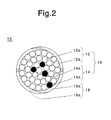
- the conjugated yarn 10 includes core yarns 16 each comprising a high-tenacity fiber 12 and a reinforcing fiber 14, and a tying yarn 18 wound around the core yarns 16.
- the high-tenacity fiber 12 is a strand of carbon monofilaments (i.e., high-tenacity monofilaments, hereinafter the same) 12a having such characteristics as a low elongation, a high elasticity modulus and a high strength.
- high-tenacity fibers 12 include Torayca produced by Toray Industries Inc. and GRANOC produced by Nippon Graphite Fiber Co., Ltd.
- each carbon monofilament 12a forming the high-tenacity fiber 12 is not particularly limited but is desirably within a range of from 3 to 15 ⁇ m from the viewpoint of resistance to flexural fatigue. If the diameter of each carbon monofilament 12a is less than 3 ⁇ m , it is possible that carbon monofilament 12a is ruptured during the carbon fiber conjugated yarn making process. If the diameter is more than 15 ⁇ m, carbon monofilament 12a is easy to break when bent.
- Typical carbon fibers include those of the acrylic type which is obtained through sintering of acrylic fibers and those of the pitch-based type which is obtained through sintering of pitch.
- the high-tenacity fiber 12 (carbon monofilament 12a) used in this embodiment may be of either type.
- the high-tenacity fiber 12 may take the form of twisted yarn, untwisted yarn, no twist yarn or the like. From the viewpoint of the balance between formability and strength, the form of untwisted yarn or no twist yarn is desirable.
- the reinforcing fiber 14 serves as a splint for reinforcing the high-tenacity fiber 12 and comprises a single or plural reinforcing monofilaments 14a to be positioned parallel with the high-tenacity fiber 12.
- a fiber forming the reinforcing fiber 14 (reinforcing monofilament 14a)
- fibers having such a property include titanium fiber, stainless steel fiber, TECHNORA fiber, vinylon fiber, polyamide fiber, polyester fiber, polyvinyl alcohol fiber, polyacrylonitrile fiber, and polyurethane fiber.
- Use of polyester fiber or polyamide fiber is desirable because they are inexpensive and easy to handle.
- the reinforcing fiber 14 (reinforcing monofilament 14a) be made using a fiber such as to impart the reinforcing fiber 14 with a higher resistance to flexural fatigue and a higher tensile elongation at break than the high-tenacity fiber 12.
- fibers having such properties include titanium fiber, stainless steel fiber, TECHNORA fiber, vinylon fiber, polyamide fiber, polyester fiber, polyvinyl alcohol fiber, polyacrylonitrile fiber, and polyurethane fiber.
- the tying yarn 18 serves to bundle the core yarns 16 (each comprising carbon monofilament 12a and reinforcing monofilament 14a) and comprises a single or plural tying fibers 18a to be wound around the core yarns 16.
- the tying yarn 18 is desirably formed of a fiber having a superior abrasion resistance because the tying yarn 18 becomes exposed on the outer surface of the carbon fiber conjugated yarn 10.
- the tying yarn 18 (tying fiber 18a) be made using a fiber such as to impart the tying yarn 18 with a higher resistance to flexural fatigue and a higher tensile elongation at break than the high-tenacity fiber 12.
- fibers having such properties include titanium fiber, stainless steel fiber, TECHNORA fiber, vinylon fiber, polyamide fiber, polyester fiber, polyvinyl alcohol fiber, polyacrylonitrile fiber, and polyurethane fiber.
- the high-tenacity fibers 12 and the reinforcing fibers 14 are positioned parallel with each other to form the core yarns 16 first. Subsequently, the tying fiber 18a is wound around the core yarns 16 to cover the same using an Italian-type twisting machine or a twisting machine for covering for example.
- any one of methods including a method (1) comprising the steps of: weaving a fabric (reinforcing carbon fiber material) with conjugated yarn 10; allowing the woven fabric to be impregnated with a resin matrix to form a prepreg; forming the prepreg into a product shape; and thermosetting the resin matrix forming the prepreg, a method (2) comprising the steps of: weaving or knitting a preform (reinforcing carbon fiber material) with conjugated yarn 10; allowing the preform to be impregnated with a resin matrix; and thermosetting the matrix impregnating the preform.
- a method (1) comprising the steps of: weaving a fabric (reinforcing carbon fiber material) with conjugated yarn 10; allowing the woven fabric to be impregnated with a resin matrix to form a prepreg; forming the prepreg into a product shape; and thermosetting the resin matrix forming the prepreg
- a method (2) comprising the steps of: weaving or knitting a preform (reinforcing
- the high-tenacity fiber 12 forming the reinforcing material is reinforced by the reinforcing fiber 14. Accordingly, if the reinforcing fiber 14 comprises a fiber having a high resistance to flexural fatigue, the CFRP is improved in strength as a whole. In the case where the CFRP is applied to a golf club shaft for example, the resulting golf club shaft is nervy and hence exhibits considerably improved performance.
- the CFRP employing the conjugated yarn 10 When the CFRP employing the conjugated yarn 10 is broken, it is possible that the high-tenacity fiber 12 is ruptured in the broken portion. However, the CFRP as a whole can be prevented from being ruptured if the reinforcing fiber 14 and/or the tying fiber 18 are/is formed of a fiber having a high tensile elongation at break.
- the breaking energy is attenuated upon rupture of the high-tenacity fiber 12 and, hence, the possibility that rupture of the reinforcing fiber 14 and/or the tying fiber 18 is reached is low.
- the reinforcing fiber 14 and/or the tying fiber 18 play(s) the role of tying the broken portion to the rest, thereby preventing the whole CFRP from being ruptured in many cases. Accordingly, there is no fear that the ruptured phases of any broken piece hurts a human body.
- the inventor of the present invention conducted the following test to verify the effect of the present invention.
- Three types of test samples (first to third test samples) each comprising 11 test pieces were woven using the high-tenacity fiber, comparative yarn and conjugated yarn, respectively, as weft and a cotton yarn as warp. Each of the test samples (11 test pieces of the three types) was subjected to a flexural test.
- Each test sample was of plain weave and was sized about 3.5 cm in the warp direction x about 18 cm in the weft direction, and the number of weft yarns of each test sample was 50.
- test results were as shown in Tables 1 and 2. It was found from the graph of Table 1 that: the first test sample employing only the high-tenacity fiber (carbon fiber) as weft did not exhibit a sufficient flexural strength; the flexural strength of the second test sample employing the comparative yarn was still insufficient; and the third test sample employing the conjugated yarn 10 exhibited a very high flexural strength.
- the tying yarn 18 is wound around the core yarns 16 in the foregoing embodiment, the tying yarn 18 may be braided around the core yarns 16 using a braider (for example a braider manufactured by KOKUBU TEKKO CO., LTD.).
- a braider for example a braider manufactured by KOKUBU TEKKO CO., LTD.
- the high-tenacity fiber 12 may be any fiber which has a low resistance to flexural fatigue but exhibits a high tenacity or any fiber which will take a dangerous broken form but exhibits a high tenacity, for example, glass fiber or ceramic fiber.
- At least one of the high-tenacity fiber 12, reinforcing fiber 14 and tying yarn 18 may comprise at least two types of fibers.
- the conjugated yarn of the present invention may be used as a reinforcing material for fiber reinforced concrete (FRC).
- FRC fiber reinforced concrete
- the present invention it is possible to prevent rupture of the high-tenacity fiber during a weaving or knitting process.
- weaving or knitting at a higher speed becomes possible, whereby the productivity of a reinforcing fiber material or an FRP can be improved remarkably.
- an FRP employing the reinforcing fiber material has an enhanced strength as a whole.
- the FRP employing the conjugated yarn of the present invention When the FRP employing the conjugated yarn of the present invention is broken, it is possible that the high-tenacity fiber is ruptured in the broken portion. However, the FRP as a whole can be prevented from being ruptured because the reinforcing fiber and/or the tying fiber play(s) the role of tying the broken portion to the rest. Accordingly, there is no fear that the ruptured phases of any broken piece hurts a human body and, hence, the FRP offers remarkably improved safety.
Landscapes
- Engineering & Computer Science (AREA)
- Mechanical Engineering (AREA)
- Textile Engineering (AREA)
- Yarns And Mechanical Finishing Of Yarns Or Ropes (AREA)
- Woven Fabrics (AREA)
- Ropes Or Cables (AREA)
- Reinforced Plastic Materials (AREA)
Priority Applications (4)
| Application Number | Priority Date | Filing Date | Title |
|---|---|---|---|
| JP2001244203A JP2003055850A (ja) | 2001-08-10 | 2001-08-10 | 複合糸および繊維強化プラスチック |
| US10/266,783 US20040068972A1 (en) | 2001-08-10 | 2002-10-09 | Conjugated yarn and fiber reinforced plastic |
| EP02257156A EP1411158A1 (fr) | 2001-08-10 | 2002-10-15 | Fil composite et matière plastique renforcée par des fibres |
| KR1020020063397A KR20040034792A (ko) | 2001-08-10 | 2002-10-17 | 복합사 및 섬유 강화 플라스틱 |
Applications Claiming Priority (3)
| Application Number | Priority Date | Filing Date | Title |
|---|---|---|---|
| JP2001244203A JP2003055850A (ja) | 2001-08-10 | 2001-08-10 | 複合糸および繊維強化プラスチック |
| US10/266,783 US20040068972A1 (en) | 2001-08-10 | 2002-10-09 | Conjugated yarn and fiber reinforced plastic |
| EP02257156A EP1411158A1 (fr) | 2001-08-10 | 2002-10-15 | Fil composite et matière plastique renforcée par des fibres |
Publications (1)
| Publication Number | Publication Date |
|---|---|
| EP1411158A1 true EP1411158A1 (fr) | 2004-04-21 |
Family
ID=32738556
Family Applications (1)
| Application Number | Title | Priority Date | Filing Date |
|---|---|---|---|
| EP02257156A Withdrawn EP1411158A1 (fr) | 2001-08-10 | 2002-10-15 | Fil composite et matière plastique renforcée par des fibres |
Country Status (4)
| Country | Link |
|---|---|
| US (1) | US20040068972A1 (fr) |
| EP (1) | EP1411158A1 (fr) |
| JP (1) | JP2003055850A (fr) |
| KR (1) | KR20040034792A (fr) |
Cited By (1)
| Publication number | Priority date | Publication date | Assignee | Title |
|---|---|---|---|---|
| EP2252731B1 (fr) * | 2008-02-28 | 2015-08-19 | Bell Helicopter Textron Inc. | Corde composite non durcie comprenant plusieurs différentes matières fibreuses |
Families Citing this family (15)
| Publication number | Priority date | Publication date | Assignee | Title |
|---|---|---|---|---|
| US7147904B1 (en) * | 2003-08-05 | 2006-12-12 | Evelyn Florence, Llc | Expandable tubular fabric |
| US7174701B2 (en) * | 2004-11-16 | 2007-02-13 | Dekko Technologies, Inc. | Electrical resistance heater having a core material back twist verification with tracer |
| AT501197B1 (de) * | 2004-11-25 | 2007-08-15 | Teufelberger Gmbh | Strang mit erhöhter haftung auf metallscheiben |
| US20070283677A1 (en) * | 2006-06-12 | 2007-12-13 | Hiroshi Ohara | Diaphragm Structure |
| JP5433836B2 (ja) * | 2007-05-22 | 2014-03-05 | 宮田布帛有限会社 | 熱可塑性繊維糸を巻縫いした織物の炭素繊維強化複合材料 |
| JP5320527B2 (ja) * | 2008-02-21 | 2013-10-23 | 古河電気工業株式会社 | 高強度ケーブル |
| JP5279121B2 (ja) * | 2008-11-21 | 2013-09-04 | 兵庫県 | 繊維強化複合材料 |
| CN102235057B (zh) * | 2010-05-07 | 2015-08-19 | 上海启鹏工程材料科技有限公司 | 一种frp筋 |
| JP5670230B2 (ja) * | 2010-12-10 | 2015-02-18 | 小松精練株式会社 | 紐状強化繊維複合体 |
| JP5801129B2 (ja) * | 2011-07-27 | 2015-10-28 | 小松精練株式会社 | 木製部材の接合方法 |
| JP5801130B2 (ja) * | 2011-07-27 | 2015-10-28 | 小松精練株式会社 | 木製部材補強用の高強力繊維線材およびそれを用いた木製部材の接合構造 |
| CN102979097B (zh) * | 2011-09-07 | 2017-02-22 | 上海启鹏工程材料科技有限公司 | 一种编织套管型frp筋及其制备方法 |
| US11047069B2 (en) | 2013-10-31 | 2021-06-29 | Ansell Limited | High tenacity fiber and mineral reinforced blended yarns |
| JP7123047B2 (ja) * | 2017-07-10 | 2022-08-22 | 倉敷紡績株式会社 | 繊維強化樹脂用芯鞘複合糸及びこれを使用した繊維強化樹脂 |
| US12467163B2 (en) | 2024-03-04 | 2025-11-11 | Ansell Limited | Composite yarn |
Citations (5)
| Publication number | Priority date | Publication date | Assignee | Title |
|---|---|---|---|---|
| GB2021660A (en) * | 1978-04-26 | 1979-12-05 | Tba Industrial Products Ltd | Cored staple-fibre yarns |
| US4299884A (en) * | 1979-01-10 | 1981-11-10 | L. Payen & Cie | Type of wrapped textile thread and process for its production which involves thermofusion to secure wrapping to core |
| GB2105247A (en) * | 1981-06-23 | 1983-03-23 | Courtaulds Plc | Process for making a fibre-reinforced moulding |
| FR2576045A1 (fr) * | 1984-12-20 | 1986-07-18 | Cousin Freres Sa | Cordage tresse a ame et procede de fabrication d'un tel cordage |
| JPH07243140A (ja) * | 1994-03-02 | 1995-09-19 | Toray Ind Inc | 複合紡績糸およびその製造方法 |
Family Cites Families (11)
| Publication number | Priority date | Publication date | Assignee | Title |
|---|---|---|---|---|
| US3565127A (en) * | 1968-10-22 | 1971-02-23 | Monsanto Co | Inextensible filamentary structures, and fabrics woven therefrom |
| US4272950A (en) * | 1978-12-07 | 1981-06-16 | Commissariat A L'energie Atomique | Filiform textile material |
| EP0126965B1 (fr) * | 1983-05-16 | 1989-03-15 | Akzo Patente GmbH | Câble de renforcement composé d'au moins deux composants |
| US5644907A (en) * | 1985-08-16 | 1997-07-08 | Kolmes; Nathaniel H. | Cut resistant yarn and protective garment made therefrom |
| US4793130A (en) * | 1986-06-20 | 1988-12-27 | Mitsubishi Rayon Co., Ltd. | Thin-metal-wire conjugated yarn |
| US5177948B1 (en) * | 1989-06-13 | 1995-04-18 | Nathaniel H Kolmes | Yarn and glove |
| FR2664621B1 (fr) * | 1990-07-13 | 1994-08-26 | Schappe Sa | Fil hybride pour materiaux composites a matrice thermoplastique et procede pour son obtention. |
| DE4137406A1 (de) * | 1991-11-14 | 1993-05-19 | Basf Ag | Hybridgarn aus polyamidfasern und verstaerkungsfasern |
| KR100444086B1 (ko) * | 1995-03-08 | 2004-11-06 | 도레이 가부시끼가이샤 | 보강직물과그제조방법및제조장치 |
| US6363703B1 (en) * | 2000-06-01 | 2002-04-02 | Supreme Elastic Corporation | Wire wrapped composite yarn |
| US6467251B1 (en) * | 2000-11-22 | 2002-10-22 | Supreme Elastic Corporation | Lightweight composite yarn |
-
2001
- 2001-08-10 JP JP2001244203A patent/JP2003055850A/ja active Pending
-
2002
- 2002-10-09 US US10/266,783 patent/US20040068972A1/en not_active Abandoned
- 2002-10-15 EP EP02257156A patent/EP1411158A1/fr not_active Withdrawn
- 2002-10-17 KR KR1020020063397A patent/KR20040034792A/ko not_active Withdrawn
Patent Citations (5)
| Publication number | Priority date | Publication date | Assignee | Title |
|---|---|---|---|---|
| GB2021660A (en) * | 1978-04-26 | 1979-12-05 | Tba Industrial Products Ltd | Cored staple-fibre yarns |
| US4299884A (en) * | 1979-01-10 | 1981-11-10 | L. Payen & Cie | Type of wrapped textile thread and process for its production which involves thermofusion to secure wrapping to core |
| GB2105247A (en) * | 1981-06-23 | 1983-03-23 | Courtaulds Plc | Process for making a fibre-reinforced moulding |
| FR2576045A1 (fr) * | 1984-12-20 | 1986-07-18 | Cousin Freres Sa | Cordage tresse a ame et procede de fabrication d'un tel cordage |
| JPH07243140A (ja) * | 1994-03-02 | 1995-09-19 | Toray Ind Inc | 複合紡績糸およびその製造方法 |
Non-Patent Citations (1)
| Title |
|---|
| PATENT ABSTRACTS OF JAPAN vol. 1996, no. 01 31 January 1996 (1996-01-31) * |
Cited By (1)
| Publication number | Priority date | Publication date | Assignee | Title |
|---|---|---|---|---|
| EP2252731B1 (fr) * | 2008-02-28 | 2015-08-19 | Bell Helicopter Textron Inc. | Corde composite non durcie comprenant plusieurs différentes matières fibreuses |
Also Published As
| Publication number | Publication date |
|---|---|
| JP2003055850A (ja) | 2003-02-26 |
| US20040068972A1 (en) | 2004-04-15 |
| KR20040034792A (ko) | 2004-04-29 |
Similar Documents
| Publication | Publication Date | Title |
|---|---|---|
| EP1411158A1 (fr) | Fil composite et matière plastique renforcée par des fibres | |
| US4876143A (en) | Rod material | |
| EP0417612B1 (fr) | Barre de construction en résine renforcée par fibres | |
| EP0050854B1 (fr) | Produit fibreux composé | |
| CN100445446C (zh) | 橡胶增强用帘子线及含有其的橡胶制品 | |
| US5633074A (en) | Prepreg available for fiber reinforced thermoplastic resin and process of producing sporting goods using the same | |
| EP0927628B1 (fr) | Composite renforce par des fibres hybrides | |
| US20140295207A1 (en) | Textile structure for the reinforcement of a polymer material | |
| EP1690966A1 (fr) | Tissu contenant des éléments en métal liés à pas de gaze | |
| JP3214647B2 (ja) | 繊維強化熱可塑性樹脂成形用材料およびその製造方法 | |
| JPH03244848A (ja) | 繊維補強ゴム製品 | |
| JP2017036519A (ja) | 強化用組紐構造体及びこれを用いた複合材料 | |
| JPH01229852A (ja) | 複合材料用補強基材 | |
| JP6364798B2 (ja) | 補強繊維織物及びその製造方法 | |
| EP1964952B1 (fr) | Fil pour tissus techniques et son procédé de fabrication | |
| EP4567217A1 (fr) | Barres d'armature composites renforcées par une maille et un cordon tissés, leur méthode de production et leurs utilisations | |
| JPH10245259A (ja) | コンクリート用補強材の製造方法 | |
| JP4135059B2 (ja) | 伸長回復性に優れた織物芯地 | |
| CN211947363U (zh) | 一种韧性高制衣线 | |
| JP3251437B2 (ja) | セールクロス用芯鞘構造糸 | |
| JP3401716B2 (ja) | 3軸織物およびその製造方法 | |
| JP2888082B2 (ja) | Frp用補強繊維織物 | |
| CN213295640U (zh) | 混合纤维、三维复合纤维预制体、包容机匣和航空发动机 | |
| JPH01229838A (ja) | 複合材料用補強基材 | |
| JP3234413B2 (ja) | セールクロス用芯鞘構造糸 |
Legal Events
| Date | Code | Title | Description |
|---|---|---|---|
| PUAI | Public reference made under article 153(3) epc to a published international application that has entered the european phase |
Free format text: ORIGINAL CODE: 0009012 |
|
| AK | Designated contracting states |
Kind code of ref document: A1 Designated state(s): AT BE BG CH CY CZ DE DK EE ES FI FR GB GR IE IT LI LU MC NL PT SE SK TR |
|
| AX | Request for extension of the european patent |
Extension state: AL LT LV MK RO SI |
|
| AKX | Designation fees paid | ||
| REG | Reference to a national code |
Ref country code: DE Ref legal event code: 8566 |
|
| STAA | Information on the status of an ep patent application or granted ep patent |
Free format text: STATUS: THE APPLICATION IS DEEMED TO BE WITHDRAWN |
|
| 18D | Application deemed to be withdrawn |
Effective date: 20041022 |