EP1411459B1 - Verfahren und Vorrichtung zur Extraktion eines Merkmalsvektors zur Erkennung von Gesichtern und zum Datenbankzugriff auf Gesichter - Google Patents
Verfahren und Vorrichtung zur Extraktion eines Merkmalsvektors zur Erkennung von Gesichtern und zum Datenbankzugriff auf Gesichter Download PDFInfo
- Publication number
- EP1411459B1 EP1411459B1 EP03256510A EP03256510A EP1411459B1 EP 1411459 B1 EP1411459 B1 EP 1411459B1 EP 03256510 A EP03256510 A EP 03256510A EP 03256510 A EP03256510 A EP 03256510A EP 1411459 B1 EP1411459 B1 EP 1411459B1
- Authority
- EP
- European Patent Office
- Prior art keywords
- feature vector
- fourier
- entire
- vector
- vectors
- Prior art date
- Legal status (The legal status is an assumption and is not a legal conclusion. Google has not performed a legal analysis and makes no representation as to the accuracy of the status listed.)
- Expired - Lifetime
Links
Images



Classifications
-
- G—PHYSICS
- G06—COMPUTING OR CALCULATING; COUNTING
- G06V—IMAGE OR VIDEO RECOGNITION OR UNDERSTANDING
- G06V40/00—Recognition of biometric, human-related or animal-related patterns in image or video data
- G06V40/10—Human or animal bodies, e.g. vehicle occupants or pedestrians; Body parts, e.g. hands
- G06V40/16—Human faces, e.g. facial parts, sketches or expressions
- G06V40/168—Feature extraction; Face representation
- G06V40/169—Holistic features and representations, i.e. based on the facial image taken as a whole
-
- G—PHYSICS
- G06—COMPUTING OR CALCULATING; COUNTING
- G06V—IMAGE OR VIDEO RECOGNITION OR UNDERSTANDING
- G06V40/00—Recognition of biometric, human-related or animal-related patterns in image or video data
- G06V40/10—Human or animal bodies, e.g. vehicle occupants or pedestrians; Body parts, e.g. hands
- G06V40/16—Human faces, e.g. facial parts, sketches or expressions
- G06V40/168—Feature extraction; Face representation
- G06V40/171—Local features and components; Facial parts ; Occluding parts, e.g. glasses; Geometrical relationships
Definitions
- the present invention relates to a face recognition and retrieval system, and more particularly, to a method and apparatus for extracting a feature vector used for face searching and recognition, which can overcome the limits of feature vectors generated in a frequency domain and a spatial domain by separately generating a Fourier feature vector and an intensity feature vector for a normalized face image and then merging the Fourier feature vector and the intensity feature vector.
- PCA principal component analysis
- the PCA-based face recognition technique is capable of recognizing a face image by extracting major feature vectors from the face image and classifying the face image into a predetermined category based on the extracted major feature vectors.
- this technique has problems, such as low recognition speed and low reliability. Even though this technique shows some degree of reliability irrespective of variations in the lightness of a face image, it has failed to provide reliable and satisfactory face recognition results for different face expressions and poses.
- a computer-readable recording medium on which a program enabling the method of extracting feature vectors for face recognition and retrieval is recorded.
- the present invention thus provides a method of extracting feature vectors for face recognition and retrieval, which can overcome the limits of feature vectors generated in a frequency domain and a spatial domain by separately generating a Fourier feature vector and an intensity feature vector for a normalized face image and then merging the Fourier feature vector and the intensity feature vector.
- the present invention also provides an apparatus for extracting a feature vector used for face recognition and retrieval, which uses the method of extracting feature vectors for face recognition and retrieval.
- FIG. 1 is a block diagram of an apparatus for extracting a feature vector used for face recognition and retrieval according to a preferred embodiment of the present invention.
- the apparatus is comprised of a frequency feature vector generation unit 120 and a composite feature vector generation unit 130.
- the frequency feature vector generation unit 120 includes a Fourier feature generation unit 121, an entire Fourier feature vector generation unit 123, and a central Fourier feature vector generation unit 125
- the composite feature vector generation unit 130 includes a Fourier feature generation unit 121, an intensity feature generation unit 131, an entire composite feature vector generation unit 133, and a central composite feature vector generation unit 135.
- a normalized face image 110 is obtained by scaling an original face image into, for example, 56 lines, in which case each line is comprised of, for example, 46 pixels.
- the center of the right eye in the original face image is located in the 24 th column and 16 th row of the normalized face image 110, and the center of the left eye is located in the 24 th column and 31 st row of the normalized face image 110.
- the Fourier feature generation unit 121 performs Fourier transformation on the normalized face image 110, i.e., an entire face area and a central face area, thus obtaining the Fourier spectra and Fourier amplitudes of the entire face area and the central face area, defines first and second feature vectors using the Fourier spectrum and Fourier amplitude of the entire face area, and defines third and fourth feature vectors using the Fourier spectrum and Fourier amplitude for the central face area.
- the first through fourth feature vectors are projected onto a principal component linear discriminant analysis (PCLDA) sub-space and then are normalized into unit vectors.
- the first and second normalized vectors are feature vectors for the entire face area
- the third and fourth normalized vectors are feature vectors for the central face area.
- Fourier feature vectors are obtained by encoding spatial relations between pixels constituting the normalized face image 110.
- the entire Fourier feature vector generation unit 123 combines the first and second normalized vectors, provided by the Fourier feature generation unit 121, into a single combined vector, projects the combined vector onto a discriminant space defined by a predetermined basis matrix, quantizes each component of the projected vector in a predetermined manner, and stores the quantized vector as an entire Fourier feature vector.
- the central Fourier feature vector generation unit 125 combines the third and fourth normalized vectors, provided by the Fourier feature generation unit 121, into a single combined vector, projects the combined vector onto a discriminant space defined by a predetermined basis matrix, quantizes each component of the projected vector in a predetermined manner, and stores the quantized vector as a central Fourier feature vector.
- the intensity feature generation unit 131 carries out pose estimation and compensation on the normalized face image 110, projects an entire face area and a predetermined number of components of the normalized face image 110, for example, 5 components of the normalized face image 110, among portions of the pose-compensated face image into the PCLDA sub-space, and normalizes the projection results into fifth and sixth unit vectors.
- An entire intensity feature vector for the entire face area is a fifth feature vector, which has been normalized into the fifth unit vector
- local intensity feature vectors for portions of the normalized face image 110 are sixth through tenth feature vectors, each of which has been normalized into the sixth unit vector.
- the intensity feature vectors are obtained by encoding variations in the intensity of the pixels constituting the entire face area and the five components of the normalized face image 110.
- the entire composite feature vector generation unit 133 combines the first and second normalized vectors, provided by the Fourier feature generation unit 121, and the entire intensity feature vector, provided by the intensity feature generation unit 131, into a single combined vector, projects the combined vector onto a discriminant space defined by a predetermined basis matrix, quantizes each component of the projected vector in a predetermined manner, and stores the quantized vector as an entire composite feature vector.
- the central composite feature vector generation unit 135 combines the third and fourth normalized vectors, provided by the Fourier feature generation unit 121, and the local intensity feature vectors, provided by the intensity feature generation unit 131, into a single combined vector, projects the combined vector onto a discriminant space defined by a predetermined basis matrix, quantizes each component of the projected vector in a predetermined manner, and stores the quantized vector as a central composite feature vector.
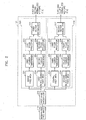
- FIG. 2 is a detailed block diagram of the Fourier feature generation unit 121 of FIG. 2 .
- the Fourier feature generation unit 121 includes a first image division unit 210, an entire Fourier feature vector generator 220, and a central Fourier feature vector generator 230.
- the entire Fourier feature vector generator 220 includes first and second Fourier transformers 222 and 225, first and second PCLDA projectors 223 and 226, and a first vector normalizer 227.
- the central Fourier feature vector generator 230 includes a third Fourier transformer 231, third and fourth PCLDA projectors 233 and 234, and a second vector normalizer 235.
- the first image division unit 210 divides the normalized face image 110 into an entire face area 221, a block-divided face area 224, and a central face area 231.
- the entire Fourier feature vector generator 220 obtains a Fourier spectrum of the entire face area 221 and Fourier amplitude of the block-divided face area 224 and then generates an entire Fourier feature vector using the Fourier spectrum and Fourier amplitude, a process which will become more apparent in the following paragraphs.
- the first Fourier transformer 222 performs Fourier transformation on the entire face area 221, thus converting the entire face area 221 into a frequency-domain component. Supposing that the entire face area 221 is represented by f(x, y), the Fourier spectrum F(u, v) can be expressed by the following equation.
- F (0, 0) indicates a DC component.
- Table 1 shows raster scanning parameters used for extracting feature vectors from a Fourier domain.
- Table 1 Feature Vector Feature Scan Area A Scan Area B Vector Dimension S A E A S B E B Subtotal Number of Blocks Total x 1 f Re [ F ( u , v )] (0, 0) (11, 13) (35, 0) (45, 13) 322 - 644 Im [ F ( u , v )] (0, 0) (11, 13) (35, 0) (45, 13) 322 - x 2 f F 1 0 u v (0, 0) (10, 13) (33, 0) (43, 13) 308 1 856 F k 1 u v (0, 0) (5, 6) (17, 0) (21, 6) 77 4 F k 2 u v (0, 0) (2, 2) (9, 0) (10, 2) 15 16 x 1 g Re [ G ( u , v )] (0,
- S A and S B represent starting points of the scanning areas A and B, respectively
- E A and E B represent ending points of the scanning areas A and B, respectively.
- Examples of the scanning areas A and B and the raster scanning are illustrated in FIG. 10 .
- Fourier components are extracted from the scanning areas A and B through raster scanning performed along a ' u ' direction.
- the first feature vector x 1 f which is obtained as a result of the raster scanning, can be expressed by Equation (2) below.
- the first feature vector x 1 f is a dimension of 644.
- the first PCLDA projector 223 projects the first feature vector x 1 f , obtained by the first Fourier transformer 222, onto a discriminant space obtained by carrying out PCLDA on the first feature vector x 1 f .
- the discriminant space is defined by a first basis matrix ⁇ 1 f , which is obtained using a predetermined well-known algorithm and is also well known to those skilled in the art.
- the second Fourier transformer 225 converts the block-divided face area 224 into a frequency domain by performing Fourier transformation on the block-divided face area 224.
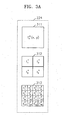
- the block-divided face area 224 includes three sub-spaces, i.e., an entire area 311, a four-block area 312, and a sixteen-block area 313.
- the Fourier transformation is performed on each of the sub-spaces of the block-divided face area 224.
- the entire area 311, represented by f 1 0 x y is obtained by removing boundary rows of the normalized face image 110 and clipping a resulting face image into a 44 ⁇ 56 image.
- f 1 0 x y can be represented by Equation (3) below.
- f 1 0 x y f ⁇ x + 1 , y
- the four-block area 312, which is represented by f k 1 x y , and the sixteen-block area 313, which is represented by f k 2 x y , are obtained using the entire area 311. Specifically, the four-block area 312 is obtained by dividing the entire area 311 into four identical blocks having a 22 ⁇ 28 size.
- f k 2 x y can be expressed by Equation (5) below.
- f k 2 x y f 1 0 ⁇ x + 11 ⁇ s k 2 , y + 14 ⁇ t k 2
- a Fourier spectrum F k j u v and Fourier amplitude F k j u v are obtained as results of the Fourier transformation performed on the entire area 311, the four-block area 312, and the sixteen-block area 311 by the second Fourier transformer 225 and can be expressed by Equations (6) and (7), respectively.
- F k j u 2 v Re [ F k j u v ⁇ ] 2 + lm [ F k j u v ⁇ ] 2
- Re ( z ) and Im ( z ) represent the real number portion and imaginary number portion, respectively, of a complex number z.
- M j represents the width of the entire area 311 or the width of each sub-block of the four-block area 312 or the sixteen-block area 313.
- N j represents the height of the entire area 311 or each sub-block of the four-block area 312 or the sixteen-block area 313.
- a second feature vector x 2 f is obtained by performing raster scanning on the Fourier amplitude F k j u v except for high frequency components, as defined in Table 1.
- the raster scanning is carried on Fourier amplitude values in the order of the Fourier amplitude of the entire area 311 F 1 0 u v , the Fourier amplitudes of the four-block area 312 F 1 1 u v , F 2 1 u v , F 3 1 u v , and F 4 1 u v , and the Fourier amplitudes of the sixteen-block area 313 F 1 2 u v , F 2 2 u v , ... , F 16 2 u v .
- the second feature vector x 2 f which is obtained as a result of the raster scanning, can be expressed by Equation (8) below.
- the dimension of the second feature vector x 2 f is 856.
- the second PCLDA projector 226 projects the second feature vector x 2 f , which is extracted by the second Fourier transformer 225, onto a discriminant space obtained by carrying out PCLDA on the second feature vector x 2 f .
- the discriminant space is defined by a second basis matrix ⁇ 2 f , which is obtained using a predetermined well-known algorithm and is also well known to those skilled in the art.
- the first vector normalizer 227 generates a first normalized vector y 1 f by normalizing the first feature vector, projected onto the discriminant space by the first PCLDA projector 223.
- the first vector normalizer 227 generates a second normalized vector y 2 f by normalizing the second feature vector, projected onto the discriminant space by the second PCLDA projector 226.
- the first and second normalized vectors y 1 f and y 2 f can be expressed by Equations (9) and (10), respectively.
- Equations (9) and (10) m 1 f and m 2 f represent averages of vectors projected onto the discriminant space by the first and second PCLDA projectors 223 and 226.
- the first and second normalized vectors y 1 f and y 2 f have dimensions of 70 and 80, respectively.
- the central Fourier feature vector generator 230 obtains a Fourier spectrum and Fourier amplitude of the central face area 231 and generates a central Fourier feature vector using the Fourier spectrum and Fourier amplitude of the central face area 231.
- the central Fourier feature vector generator 230 operates in a similar way to the way the entire Fourier feature vector generator 220 operates. The operation of the central Fourier feature vector generator 230 will become more apparent in the following paragraphs.
- the central face area 231 is obtained by clipping the normalized face image 110, which is represented by f ( x , y ), into a 32x32 image starting from a point (7, 12) and ending with a point (38, 43).
- the third Fourier transformer 232 obtains a Fourier spectrum G ( u , v ) by converting the central face area 231, which is represented by g ( x, y ), into a frequency domain through Fourier transformation.
- a third feature vector x x 1 g is obtained by performing raster scanning on the Fourier spectrum G ( u , v).
- the raster scanning is performed on the scanning areas A and B, as defined in Table 1.
- the third feature vector x 1 g which is obtained as a result of the raster scanning, is a dimension of 256.
- the third PCLDA projector 233 projects the third feature vector x 1 g , which is extracted by the third Fourier transformer 232, onto a discriminant space obtained by carrying out PCLDA on the third feature vector x 1 g .
- the discriminant space is defined by a third basis matrix ⁇ 1 g , which is obtained using a predetermined well-known algorithm and is also well known to those skilled in the art.
- the fourth Fourier transformer 235 converts the block-divided face area 234 into a frequency domain by performing Fourier transformation on the block-divided face area 234.
- the block-divided face area 234 includes three sub-spaces, i.e., a 32 ⁇ 32-sized central area 321, which is represented by g 1 0 x y and have a 32x32 size, a four-block area 322, which is represented by g k 1 x y and is constituted by four identical blocks having a 16x16 size, and a sixteen-block area 323, which is represented by g k 2 x y and is constituted by sixteen identical blocks having a 8 ⁇ 8 size, as shown in FIG. 3B .
- the Fourier transformation is performed on each of the sub-spaces of the block-divided face area 234.
- the central area 321 has a Fourier amplitude G u v ,
- each of the sub-blocks g k j x y of the four-block area 322 and the sixteen-block area 323 has an amplitude G k j u v .
- a fourth feature vector x 2 g is obtained.
- the raster scanning is performed on the scanning areas A and B, as defined in Table 1 above.
- the fourth feature vector x 2 g which is obtained as a result of the raster scanning, is a dimension of 384.
- the fourth PCLDA projector 236 projects the fourth feature vector x 2 g , which is extracted by the fourth Fourier transformer 235, onto a discriminant space obtained by carrying out PCLDA on the fourth feature vector x 2 g .
- the discriminant space is defined by a fourth basis matrix ⁇ 2 g , which is obtained using a predetermined well-known algorithm and is also well known to those skilled in the art.
- the second vector normalizer 237 In order to generate a unit vector using an average m 1 g of vectors projected onto the discriminant space by the third - PCLDA projector 233, the second vector normalizer 237 normalizes the third feature vector. As a result of the normalization, a third normalized vector y 1 g is obtained. In addition, in order to generate a unit vector using an average m 2 g of vectors projected onto the discriminant space by the fourth PCLDA projector 236, the second vector normalizer 237 normalizes the fourth feature vector. As a result of the normalization, a fourth normalized vector y 2 g is obtained.
- the third and fourth normalized vectors y 1 g and y 2 g have dimensions of 70 and 80, respectively.
- FIG. 4 is a detailed block diagram of the entire Fourier feature vector generation unit 123 of FIG. 1 .
- the entire Fourier feature vector generation unit 123 includes a first coupler 410, a first LDA projector 420, and a first quantizer 430.
- the first coupler 410 couples the first and second normalized vectors y 1 f and y 2 f , provided by the first vector normalizer 227 in the Fourier feature generation unit 121, into a single coupled vector having a dimension of, for example, 150.
- the first LDA projector 420 projects the coupled vector, provided by the first coupler 410, onto a linear discriminant space defined by a fifth basis matrix ⁇ 3 f , which is obtained using a predetermined well-known algorithm and is also well known to those skilled in the art.
- a resulting projected vector z f can be expressed by Equation (11) below.
- the first quantizer 430 clips and quantizes each component of the projected vector, provided by the first LDA projector 420, into a non-signed 5-bit integer, using Equation (12) below, and then stores a resulting vector as an entire Fourier feature vector w i f . .
- FIG. 5 is a detailed block diagram of the central Fourier feature vector generation unit 125 of FIG. 1 .
- the central Fourier feature vector generation unit 125 includes a second coupler 510, a second LDA projector 520, and a second quantizer 530.
- the second coupler 510 couples the third and fourth normalized vectors y 1 g and y 2 g , provided by the second vector normalizer 237 in the Fourier feature generation unit 121, into a single coupled vector having a dimension of, for example, 150.
- the second LDA projector 520 projects the coupled vector, provided by the second coupler 510, onto a linear discriminant space defined by a sixth basis matrix ⁇ 3 g , which is obtained using a predetermined well-known algorithm and is also well known to those skilled in the art.
- a resulting projected vector z g can be expressed by Equation (11) below.
- the second quantizer 530 clips and quantizes each component of the projected vector z g , provided by the second LDA projector 520, into a non-signed 5-bit integer, using Equation (13) below, and then stores a resulting vector as a central Fourier feature vector w i g .
- FIG. 6 is a detailed block diagram of the intensity feature vector generator 230 of FIG. 2 .
- the intensity feature vector generator 230 includes a pose estimation and compensation unit 610, a second image divider 620, an entire intensity feature vector generator 630, and a local intensity feature vector generator 640.
- the pose estimation and compensation unit 610 estimates a pose of the normalized face image 110, compensates for the normalized face image 110 based on the result of the pose estimation, and outputs a resulting frontal face image.
- the pose estimation and compensation unit 610 fix mismatches caused by variation in the pose of the normalized face image 110.
- the second image divider 620 divides the pose-compensated face image output from the pose estimation and compensation unit 610 into an entire face area and first through fifth local images having face components 1 through 5, respectively.
- the entire face area has a predetermined raster scanning area, which is defined in Table 2 below. More specifically, the entire face area, starting from a point (0, 0), has a 46x56 size..
- the first through fifth local images start from points (9, 4), (6, 16), (17, 16), (7, 25), and (16, 25), respectively, and have 29 ⁇ 27, 24 ⁇ 21, 24 ⁇ 21, 24 ⁇ 24, and 24 ⁇ 24 sizes, respectively.
- Table 2 Top Left Size Vector Dimension x y Width Height Entire Face: x h 0 0 46 56 2576 Face Component 1: x 1 c 9 4 29 27 783 Face Component 2: x 2 c 6 16 24 21 504 Face Component 3: x 3 c 17 16 24 21 504 Face Component 4: x 4 c 7 25 24 24 576 Face Component 5: x 5 c 16 25 24 24 576
- a first raster scanner 631 In the entire intensity feature vector generator 630, a first raster scanner 631 generates a fifth feature vector x h , which is comprised of intensity values for the entire face area, by performing raster scanning on the entire face area along a column direction.
- the column-directional raster scanning is carried out starting with the top-left point (0, 0) of the entire face area and ending with the bottom right point (46, 56) of the entire face area.
- the fifth feature vector x h has a dimension of, for example, 2576.
- a fifth PCLDA projector 632 projects the fifth feature vector x h , provided by the first raster scanner 631, onto a discriminant space defined by a seventh basis matrix ⁇ 1 h , which is obtained using a predetermined well-known algorithm and is also well known to those skilled in the art.
- a fifth vector normalizer 633 normalizes the projected vector into a unit vector y h and stores the unit vector y h as an entire intensity feature vector.
- Equation (14) m h represents an average of vectors, projected on the discriminant space by the fifth PCLDA projector 632, and has a dimension of 40.
- the column-directional raster scanning is carried out starting with the top-left point of each of the local face areas and ending with the bottom-right point of each of the local face areas.
- the unit vector y k c can be defined by Equation (15) below.
- m k c represents an average of vectors, projected on the discriminant space by each of the sixth through tenth PCLDA projectors 641 b through 645b, and has a dimension of 40.
- FIG. 7 is a detailed block diagram of the pose estimation and compensation unit 610 of FIG. 6 .
- the pose estimation and compensation unit 610 includes a pose estimator 710, which is comprised of n principal-component-analysis/distance-from-feature-space (PCA/DFFS) blocks 711, 712, and 713 and a minimum detector 714, and a pose compensator 720, which is comprised of an affine transformer 721 and an inverse mapper 722.
- PCA/DFFS principal-component-analysis/distance-from-feature-space
- a PCA model for each of the nine pose classes can be learned or obtained from exemplary images, collected from training face images. Face images having similar poses to those defined by the nine pose classes are determined as the distance for each pose class.
- Table 3 Pose ID Definition 1 Upward 2 Slightly Upward 3 Leftward 4 Slightly Left 5 Front 6 Slightly Rightward 7 Rightward 8 Slightly Downward 9 Downward
- First through n-th DFFS calculators 711 b, 712b, and 713b calculate a distance d i ( x ) for each of the nine pose classes using Equation (16) below.
- the distance d i ( x ) represents how precisely a face can be represented by the PCA sub-space for a specific pose class.
- d i x ⁇ x ⁇ 2 - ⁇ P i ⁇ x - M i ⁇ 2
- Equation (16) x and M i represent a vector obtained by column-wise raster scanning of the normalized face image result and an average vector of the PCA sub-space for a specific pose class ( i ), respectively.
- the pose compensator 720 compensates for the normalized face image 110 into a frontal face image according to the pose class estimated by the pose estimator 710. To make this happen, the affine transformer 721 loads a predetermined affine transformation matrix that brings about a frontal pose class corresponding to the estimated pose class. Affine transformation from a pose class to a frontal pose class depends on correspondence points between the pose class and the frontal pose class. Each pose class may have, for example, average locations of 15 distinctive face features, in detail, left and right edges at two eyebrows and eyes, left, right and bottom edges at nose, left, right, top and bottom edges at mouse as correspondence points. Such distinctive face features can be manually selected from a training image assigned to each pose class.
- the inverse mapper 722 provides a pose-compensated face image 730 by geometrically inverse-mapping the normalized face image 110 into a frontal face image using the predetermined affine transformation matrix loaded into the affine transformer 721.
- Intensity at a point (x, y) on the inverse-mapped face image can be calculated using bi-linear interpolation Formula (18) as described below.
- x' ceil( a ⁇ x + b ⁇ y + c )
- y ' ceil( d ⁇ x + e ⁇ y + f )
- dx ( a ⁇ x + b ⁇ y + c ) - x '
- dy ( d ⁇ x + e ⁇ y + f ) - y '.
- f ( x ', y ') represents the intensity of the normalized face image 110 at a point ( x ', y ').
- FIG. 8 is a detailed block diagram of the entire composite feature vector generation unit 133 of FIG. 1 .
- the entire composite feature vector generation unit 133 includes a third coupler 810, a third LDA projector 820, and a third quantizer 830.
- the third coupler 810 couples the first and second normalized vectors y 1 f and y 2 f , provided by the first vector normalizer 227 in the Fourier feature generation unit 121, and the entire intensity feature vector y h , provided by the entire intensity feature vector generator 630, into a single coupled vector having a dimension of, for example, 190.
- the third LDA projector 820 projects the coupled vector, provided by the third coupler 810, onto a linear discriminant space defined by a ninth basis matrix ⁇ ⁇ 2 h , which is obtained using a predetermined well-known algorithm and is also well known to those skilled in the art.
- a resulting projected vector z h can be expressed by Equation (19) below.
- the third quantizer 830 clips and quantizes each component of the projected vector z h , provided by the third LDA projector 820, into a non-signed 5-bit integer, using Equation (20) below, and then stores a resulting vector as an entire composite feature vector w i h .
- w i h ⁇ 0 if z i h ⁇ - 16 31 if z i h > 15 floor ⁇ z i h + 16 otherwise
- FIG. 9 is a detailed block diagram of the central composite feature vector generation unit 135 of FIG. 1 .
- the central composite feature vector generation unit 135 includes a fourth coupler 910, a fourth LDA projector 920, and a fourth quantizer 930.
- the fourth coupler 910 couples the third and forth normalized vectors y 1 g and y 2 g , provided by the second vector normalizer 237 in the Fourier feature generation unit 121, and the local intensity feature vector y k c , provided by the local intensity feature vector generator 640, into a single coupled vector that has, for example, a dimension of 350.
- the fourth LDA projector 920 projects the coupled vector, provided by the fourth coupler 910, onto a linear discriminant space defined by a tenth basis matrix ⁇ 6 c which is obtained using a predetermined well-known algorithm and is also well known to those skilled in the art.
- a resulting projected Vector z c can be expressed by Equation (21) below.
- the fourth quantizer 930 clips and quantizes each component of the projected vector, provided by the fourth LDA projector 920, into a non-signed 5-bit integer, using Equation (22) below, and then stores a resulting vector as a central composite feature vector w i c .
- a set of MPEG-7 face image data which is comprised of five databases.
- These five databases are an MPEG-7 face image database (E1) of expansion version 1, an Altkom database (A2), a MPEG-7 test set (M3) in an XM2VTS database, a FERET database F4, and an MPEG-7 test set (B5) in a Banca database.
- the total number of images that are used in this experiment is 11,845.
- 3,655 images are simply used as training images for LDA projection, and the rest are used as test images for evaluating the performance of an image searching algorithm according to the present invention.
- Table 5 shows detailed information on training images and test images used in this experiment. General information on each image used in this experiment is given in advance for making it possible to evaluate the performance of the image retrieval algorithm according to the present invention.
- Table 5 DB Person Image Total Trainning Image I 50vs50 Altkom 40 15 600 Banca - - - MPEG 317 5 1,585 XM2VTS 147 10 1,470 FERET - - - Total 504 3,655 Test Image I 50vs50 Altkom 40 15 600 Banca 52 10 520 MPEG 318 5 1,590 XM2VTS 148 10 1,480 FERET - - 4,000 Total 558 8,190
- the precision of retrieval, carried out by the image retrieval algorithm according to the present invention, is measured based on average normalized modified retrieval rate (ANMRR), which is taught by B. S. Manjunath, Philippe Salembier, and Thomas Sikora in “Introduction to MPEG-7: Multimedia Content Description Interface, " John Wiley & Sons Ltd., 2002 .
- NAMRR average normalized modified retrieval rate
- the retrieval precision of the image retrieval algorithm according to the present invention is 0.354 when using a Fourier feature vector only and is 0.390 when using an intensity feature vector only.
- the retrieval precision of the image retrieval algorithm according to the present invention is 0.266.
- the retrieval precision of the image retrieval algorithm according to the present invention varies depending on the size of feature vector.
- ANMRR is 0.280.
- ANMRR is 0.266.
- ANMRR is 0.249.
- the present invention can be realized as computer-readable codes that can be written on a computer-readable recording medium.
- the computer-readable medium includes nearly all sorts of recording devices on which computer-readable data can be written.
- the computer-readable recording medium includes ROM, RAM, CD-ROM, a magnetic tape, a floppy disk, an optical data storage, and carrier waves, such as data transmission through the Internet.
- the computer-readable recording medium can also be distributed over a plurality of computer systems that are connected to a network. Therefore, the computer-readable codes can be recorded on the computer-readable recording medium and can be executed in a decentralized manner.
- a frequency feature vector or composite feature vector can be selectively used depending on the specification of a face recognition and retrieval system.
Landscapes
- Engineering & Computer Science (AREA)
- Health & Medical Sciences (AREA)
- Oral & Maxillofacial Surgery (AREA)
- General Health & Medical Sciences (AREA)
- Physics & Mathematics (AREA)
- Human Computer Interaction (AREA)
- Computer Vision & Pattern Recognition (AREA)
- General Physics & Mathematics (AREA)
- Multimedia (AREA)
- Theoretical Computer Science (AREA)
- Image Analysis (AREA)
- Image Processing (AREA)
- Information Retrieval, Db Structures And Fs Structures Therefor (AREA)
Claims (21)
- Verfahren zum Extrahieren von Merkmalsvektoren für Gesichtserkennung und -abruf, wobei das Verfahren die folgenden Schritte beinhaltet:(a) Erzeugen eines gesamten Fourier-Merkmalsvektors für einen gesamten Gesichtsbereich (221) eines normalisierten Gesichtsbildes (110) und Erzeugen eines zentralen Fourier-Merkmalsvektors für einen zentralen Gesichtsbereich (231) des normalisierten Gesichtsbildes (110);(b) Erzeugen eines gesamten Intensitätsmerkmalsvektors für den gesamten Gesichtsbereich (221), Erzeugen eines gesamten Composite-Merkmalsvektors mittels eines von einer Fourier-Transformation des gesamten Gesichtsbereichs (221) erzeugten ersten Vektors und des gesamten Intensitätsmerkmalsvektors, Erzeugen eines lokalen Intensitätsmerkmalsvektors für eine vorbestimmte Anzahl von nach Gesichtskomponenten unterteilten Bereichen und Erzeugen eines zentralen Composite-Merkmalsvektors mittels eines von der Fourier-Transformation des zentralen Gesichtsbereichs (231) erzeugten zweiten Vektors und des lokalen Intensitätsmerkmalsvektors; und(c) Ausgeben entweder des gesamten Fourier-Merkmals und des zentralen Fourier-Merkmals oder des gesamten Composite-Merkmals und des zentralen Composite-Merkmals für Gesichtserkennung und -abruf;wobei in Schritt (b) der gesamte Composite-Merkmalsvektor erzeugt wird durch Koppeln des durch Fourier-Spektrumvektoren und Fourier-Amplitudenvektoren erhaltenen ersten Vektors für den in Blöcke unterteilten gesamten Gesichtsbereich (221) und des gesamten Intensitätsmerkmalsvektors und Erzeugen des zentralen Composite-Merkmalsvektors durch Koppeln des durch Fourier-Spektrumvektoren und Fourier-Amplitudenvektoren erhaltenen zweiten Vektors für den in Blöcke unterteilten zentralen Gesichtsbereich (231) und den lokalen Intensitätsvektor.
- Verfahren nach Anspruch 1, wobei in Schritt (a) der gesamte Fourier-Merkmalsvektor für den gesamten Gesichtsbereich (221) eines normalisierten Gesichtsbildes (110) mittels erster und zweiter normalisierter Vektoren erzeugt wird und der zentrale Fourier-Merkmalsvektor für den zentralen Gesichtsbereich (231) des normalisierten Gesichtsbildes (110) mittels dritter und vierter normalisierter Vektoren erzeugt wird.
- Verfahren nach Anspruch 1, wobei in Schritt (b) der gesamte Composite-Merkmalsvektor durch Koppeln von ersten und zweiten normalisierten Vektoren und des gesamten Intensitätsmerkmals erzeugt wird und der zentrale Composite-Merkmalsvektor durch Koppeln von dritten und vierten normalisierten Vektoren und den lokalen Intensitätsmerkmalsvektoren erzeugt wird.
- Verfahren nach Anspruch 2, wobei Schritt (a) Folgendes beinhaltet:(a1) Erhalten eines Fourier-Spektrums und einer Fourier-Amplitude für den gesamten Gesichtsbereich (221) durch Ausführen einer Fourier-Transformation am gesamten Gesichtsbereich (221) und Definieren von ersten und zweiten Merkmalsvektoren mittels des Fourier-Spektrums und der Fourier-Amplitude, die für den gesamten Gesichtsbereich (221) erhalten wurden;(a2) Erzeugen der ersten und zweiten normalisierten Vektoren durch Projizieren der ersten und zweiten Merkmalsvektoren auf einen ersten PCLDA-Teilraum und Normalisieren von resultierenden Merkmalsvektoren und Erzeugen des gesamten Fourier-Merkmalsvektors durch Koppeln der ersten und zweiten normalisierten Vektoren zu einem einzigen gekoppelten Vektor und Projizieren des einzigen gekoppelten Vektors auf einen ersten linearen Unterscheidungsraum;(a3) Erhalten eines Fourier-Spektrums und einer Fourier-Amplitude für den zentralen Gesichtsbereich (231) durch Ausführen einer Fourier-Transformation an dem zentralen Gesichtsbereich (231) und Definieren von dritten und vierten Merkmalsvektoren mittels des Fourier-Spektrums und der Fourier-Amplitude, die für den zentralen Gesichtsbereich erhalten wurden; und(a4) Erzeugen der dritten und vierten normalisierten Vektoren durch Projizieren der dritten und vierten Merkmalsvektoren auf einen zweiten PCLDA-Teilraum und Normalisieren von resultierenden Merkmalsvektoren und Erzeugen des zentralen Fourier-Merkmalsvektors durch Koppeln der dritten und vierten normalisierten Vektoren zu einem einzigen gekoppelten Vektor und Projizieren des einzigen gekoppelten Vektors auf einen zweiten linearen Unterscheidungsraum.
- Verfahren nach Anspruch 4, wobei in Schritt a1 das Fourier-Spektrum vom gesamten Gesichtsbereich (221) erhalten wird und die Fourier-Amplitude von einem ersten nach Blöcken unterteilten Gesichtsbereich (224) erhalten wird.
- Verfahren nach Anspruch 5, wobei der erste nach Blöcken unterteilte Gesichtsbereich (224) Folgendes umfasst: einen durch Beschneiden des gesamten Gesichtsbereichs (311) zu einem Bild einer vorbestimmten Größe erhaltenen Gesamtbereich (311), einen durch Unterteilen des Gesamtbereichs in vier Blöcke erhaltenen Vier-Block-Bereich (312) und einen durch Unterteilen des Gesamtbereichs in sechzehn Blöcke erhaltenen Sechzehn-Block-Bereich (313).
- Verfahren nach einem der Ansprüche 4 bis 6, wobei in Schritt b1 das Fourier-Spektrum vom zentralen Gesichtsbereich (231) erhalten wird und die Fourier-Amplitude von einem zweiten nach Blöcken unterteilten Bereich (234) erhalten wird.
- Verfahren nach Anspruch 7, wobei der zweite nach Blöcken unterteilte Gesichtsbereich (234) Folgendes umfasst: einen dem zentralen Gesichtsbereich (231) entsprechenden Zentralbereich (321), einen durch Unterteilen des Zentralbereichs in vier Blöcke erhaltenen Vier-Block-Bereich (322) und einen durch Unterteilen des Zentralbereichs in sechzehn Blöcke erhaltenen Sechzehn-Block-Bereich (323).
- Verfahren nach einem der Ansprüche 1 und 3, wobei Schritt (b) Folgendes beinhaltet:(b1) Erzeugen der ersten und zweiten normalisierten Vektoren für den gesamten Gesichtsbereich (221) des normalisierten Gesichtsbildes (110) und Erzeugen der dritten und vierten normalisierten Vektoren für den zentralen Gesichtsbereich (231) des normalisierten Gesichtsbildes (110);(b2) Erzeugen eines gesamten Composite-Merkmalsvektors durch Koppeln der ersten und zweiten normalisierten Vektoren und des gesamten Intensitätsmerkmalsvektors zu einem einzigen gekoppelten Vektor und Projizieren des gekoppelten Vektors auf einen dritten linearen Unterscheidungsraum;(b3) Erzeugen eines gesamten Intensitätsmerkmalsvektors für den gesamten Gesichtsbereich (221) und eines lokalen Intensitätsmerkmalsvektors für eine vorbestimmte Anzahl von nach Gesichtskomponenten unterteilten Bereichen; und(b4) Erzeugen eines zentralen Composite-Merkmalsvektors durch Koppeln der dritten und vierten normalisierten Vektoren und des lokalen Intensitätsmerkmalsvektors zu einem einzigen gekoppelten Vektor und Projizieren des gekoppelten Vektors auf einen vierten linearen Unterscheidungsraum.
- Verfahren nach Anspruch 9, wobei Schritt (b3) Folgendes beinhaltet:(b31) Konvertieren des normalisierten Gesichtsbildes (110) in ein Frontalgesichtsbild durch Ausführen von Haltungsschätzung und -kompensation an dem normalisierten Gesichtsbild (110);(b32) Definieren eines fünften Merkmalsvektors durch Ausführen einer Rasterabtastung an dem gesamten Gesichtsbereich eines resultierenden haltungskompensierten Gesichtsbildes (730);(b33) Definieren eines sechsten Merkmalsvektors durch Ausführen einer Rasterabtastung auf mehreren nach Gesichtskomponenten unterteilten Bereichen des haltungskompensierten Gesichtsbildes (730);(b34) Erzeugen des gesamten Intensitätsmerkmalsvektors durch Projizieren des fünften Merkmalsvektors auf einen dritten PCLDA-Teilraum und Normalisieren eines resultierenden Merkmalsvektors zu einem fünften Einheitsvektor; und(b35) Erzeugen des lokalen Intensitätsmerkmalsvektors durch Projizieren des sechsten Merkmalsvektors auf einen vierten PCLDA-Teilraum und Normalisieren eines resultierenden Merkmalsvektors zu einem sechsten Einheitsvektor.
- Verfahren nach Anspruch 10, wobei in Schritt (b31) eine Haltung des normalisierten Gesichtsbildes (110) mit einem PCA-DFFS-Verfahren geschätzt wird.
- Verfahren nach einem der Ansprüche 9 bis 11, wobei Schritt (b2) Folgendes beinhaltet:(b21) Koppeln der ersten und zweiten normalisierten Vektoren, in a1 erzeugt, mit dem gesamten Intensitätsmerkmalsvektor, in b erzeugt, zu einem einzigen gekoppelten Vektor;(b22) Projizieren des gekoppelten Vektors auf den dritten linearen Unterscheidungsraum; und(b23) Quantisieren jeder Komponente des projizierten Vektors und Speichern eines resultierenden Vektors als den gesamten Composite-Merkmalsvektor.
- Verfahren nach einem der Ansprüche 9 bis 12, wobei Schritt (b4) Folgendes beinhaltet:(b41) Koppeln der dritten und vierten normalisierten Vektoren, in a3 erzeugt, mit dem lokalen Intensitätsmerkmalsvektor, in b erzeugt, zu einem einzigen gekoppelten Vektor;(b42) Projizieren des gekoppelten Merkmalsvektors auf den vierten linearen Unterscheidungsraum; und(b43) Quantisieren jeder Komponente des projizierten Vektors und Speichern eines resultierenden Vektors als den zentralen Composite-Merkmalsvektor.
- Rechnerlesbares Aufzeichnungsmedium, auf dem ein Computerprogramm zur Ausführung des Verfahrens nach einem der Ansprüche 1 bis 13 aufgezeichnet ist.
- Vorrichtung zum Extrahieren von Merkmalsvektoren für Gesichtserkennung und -abruf, wobei die Vorrichtung Folgendes umfasst:eine erste Einheit (120), die einen gesamten Fourier-Merkmalsvektor auf der Basis einer kaskadierten LDA von Fourier-Charakteristiken einschließlich Fourier-Spektrumvektoren und nach Blöcken unterteilten Fourier-Amplitudenvektoren für einen gesamten Gesichtsbereich (221) eines normalisierten Gesichtsbildes (110) erzeugt;eine zweite Einheit (120), die einen zentralen Fourier-Merkmalsvektor auf der Basis einer kaskadierten LDA von Fourier-Charakteristiken einschließlich Fourier-Spektrumvektoren und nach Blöcken unterteilten Fourier-Amplitudenvektoren für einen zentralen Gesichtsbereich (231) des normalisierten Gesichtsbildes (110) erzeugt;eine dritte Einheit (130), die einen gesamten Intensitätsmerkmalsvektor für den gesamten Gesichtsbereich (221) erzeugt und einen gesamten Composite-Merkmalsvektor erzeugt, durch Koppeln eines mittels der Fourier-Spektrumvektoren und der Fourier-Amplitudenvektoren für den nach Blöcken unterteilten gesamten Gesichtsbereich (221) erhaltenen Verbundvektors und des gesamten Intensitätsmerkmals; undeine vierte Einheit (130), die einen lokalen Intensitätsmerkmalsvektor für eine vorbestimmte Anzahl von nach Gesichtskomponenten unterteilten Bereichen erzeugt und einen zentralen Composite-Merkmalsvektor durch Koppeln eines mittels der Fourier-Spektrumvektoren und der Fourier-Amplitudenvektoren für den nach Blöcken unterteilten zentralen Gesichtsbereich (231) erhaltenen Verbundvektors und der lokalen Intensitätsmerkmalsvektoren erzeugt.
- Vorrichtung nach Anspruch 15, wobei die erste und die zweite Einheit (120) Folgendes umfassen:einen Fourier-Merkmalsgenerator (121), der erste und zweite normalisierte Vektoren für den gesamten Gesichtsbereich (221) des normalisierten Gesichtsbildes (110) sowie dritte und vierte normalisierte Vektoren für den zentralen Gesichtsbereich (231) erzeugt;einen gesamten Fourier-Merkmalsvektorgenerator (123), der einen gesamten Fourier-Merkmalsvektor durch Koppeln der ersten und zweiten normalisierten Vektoren zu einem einzigen gekoppelten Vektor und Projizieren des gekoppelten Vektors auf einen ersten linearen Unterscheidungsraum erzeugt; undeinen zentralen Fourier-Merkmalsvektorgenerator (125), der einen zentralen Fourier-Merkmalsvektor durch Koppeln der dritten und vierten normalisierten Vektoren zu einem einzigen gekoppelten Vektor und Projizieren des gekoppelten Vektors auf einen zweiten linearen Unterscheidungsraum erzeugt.
- Vorrichtung nach Anspruch 15, wobei die dritte und die vierte Einheit (130) Folgendes umfassen:einen Fourier-Merkmalsgenerator (121), der erste und zweite normalisierte Vektoren für den gesamten Gesichtsbereich (221) des normalisierten Gesichtsbildes (110) sowie dritte und vierte normalisierte Vektoren für den gesamten Gesichtsbereich (231) des normalisierten Gesichtsbildes (110) erzeugt;einen Intensitätsmerkmalsgenerator (131), der einen gesamten Intensitätsmerkmalsvektor für den gesamten Gesichtsbereich und einen lokalen Intensitätsmerkmalsvektor für eine vorbestimmte Anzahl von nach Gesichtskomponenten unterteilten Bereichen erzeugt;einen gesamten Composite-Merkmalsvektorgenerator (133), der einen gesamten Composite-Merkmalsvektor durch Koppeln der ersten und zweiten normalisierten Vektoren mit dem gesamten Intensitätsmerkmalsvektor erzeugt; undeinen zentralen Composite-Merkmalsvektorgenerator (135), der einen zentralen Composite-Merkmalsvektor durch Koppeln der dritten und vierten normalisierten Vektoren mit dem lokalen Intensitätsmerkmalsvektor erzeugt.
- Vorrichtung nach Anspruch 16 oder 17, wobei der Fourier-Merkmalsgenerator (121) Folgendes umfasst:einen gesamten Fourier-Merkmalsvektorgenerator (220), der die ersten und zweiten normalisierten Vektoren durch Projizieren von ersten und zweiten Merkmalsvektoren, die durch ein Fourier-Spektrum und eine Fourier-Amplitude definiert werden, erhalten durch Fourier-Transformation des gesamten Gesichtsbereichs, auf einen ersten PCLDA-Teilraum und Normalisieren von resultierenden Merkmalsvektoren erzeugt; undeinen zentralen Fourier-Merkmalsvektorgenerator (230), der die dritten und vierten normalisierten Vektoren durch Projizieren von dritten und vierten Merkmalsvektoren, die durch ein Fourier-Spektrum und eine Fourier-Amplitude definiert werden, erhalten durch Fourier-Transformation des zentralen Gesichtsbereichs, auf einen zweiten PCLDA-Teilraum und Normalisieren von resultierenden Merkmalsvektoren erzeugt.
- Vorrichtung nach Anspruch 18, wobei das im gesamten Fourier-Merkmalsvektorgenerator (220) verwendete Fourier-Spektrum vom gesamten Gesichtsbereich erhalten wird und die Fourier-Amplitude für den gesamten Gesichtsbereich erhalten wird von einem durch Beschneiden des gesamten Gesichtsbereichs zu einem Bereich mit einer vorbestimmten Größe erhaltenen Gesamtbereich (311), einem durch Unterteilen des Gesamtbereichs in vier Blöcke erhaltenen Vier-Block-Bereich (312) und einem durch Unterteilen des Gesamtbereichs in sechzehn Blöcke erhaltenen Sechzehn-Block-Bereich (313).
- Vorrichtung nach Anspruch 18, wobei das im zentralen Fourier-Merkmalsvektorgenerator (230) verwendete Fourier-Spektrum vom zentralen Gesichtsbereich erhalten wird und die Fourier-Amplitude für den zentralen Gesichtsbereich von einem zentralen Bereich (321), einem durch Unterteilen des zentralen Bereichs in vier Blöcke erhaltenen Vier-Block-Bereich (322) und einem durch Unterteilen des zentralen Bereichs in sechzehn Blöcke erhaltenen Sechzehn-Block-Bereich (323) erhalten wird.
- Vorrichtung nach einem der Ansprüche 17 bis 20, wobei der Intensitätsmerkmalsgenerator (131) Folgendes umfasst:eine Haltungsschätz- und -kompensationseinheit (610), die eine Haltung des normalisierten Gesichtsbildes (110) schätzt und das normalisierte Gesichtsbild (110) in ein Frontalgesichtsbild auf der Basis des Schätzergebnisses umwandelt;einen gesamten Intensitätsmerkmalsvektorgenerator (630), der den gesamten Intensitätsmerkmalsvektor durch Projizieren eines fünften Merkmalsvektors, der durch Ausführen einer Rasterabtastung an dem gesamten Gesichtsbereich des normalisierten Gesichtsbildes (110) erhalten wird, auf einen dritten PCLDA-Teilraum und Normalisieren eines resultierenden Merkmalsvektors zu einem fünften Einheitsvektor erzeugt; undeinen lokalen Intensitätsmerkmalsvektorgenerator (640), der den Subregion-Intensitätsmerkmalsvektor durch Projizieren eines sechsten Merkmalsvektors, der durch Ausführen einer Rasterabtastung an einer Mehrzahl von nach Gesichtskomponenten unterteilten Bereichen eines haltungskompensierten Gesichtsbildes (730) erhalten wird, auf einen vierten PCLDA-Teilraum und Normalisieren eines resultierenden Merkmalsvektors zu einem sechsten Einheitsvektor erzeugt.
Applications Claiming Priority (4)
| Application Number | Priority Date | Filing Date | Title |
|---|---|---|---|
| KR2002062650 | 2002-10-15 | ||
| KR20020062650 | 2002-10-15 | ||
| KR2003026426 | 2003-04-25 | ||
| KR10-2003-0026426A KR100486738B1 (ko) | 2002-10-15 | 2003-04-25 | 얼굴 인식 및 검색용 특징벡터 추출방법 및 장치 |
Publications (2)
| Publication Number | Publication Date |
|---|---|
| EP1411459A1 EP1411459A1 (de) | 2004-04-21 |
| EP1411459B1 true EP1411459B1 (de) | 2009-05-13 |
Family
ID=32044739
Family Applications (1)
| Application Number | Title | Priority Date | Filing Date |
|---|---|---|---|
| EP03256510A Expired - Lifetime EP1411459B1 (de) | 2002-10-15 | 2003-10-15 | Verfahren und Vorrichtung zur Extraktion eines Merkmalsvektors zur Erkennung von Gesichtern und zum Datenbankzugriff auf Gesichter |
Country Status (4)
| Country | Link |
|---|---|
| US (1) | US7391889B2 (de) |
| EP (1) | EP1411459B1 (de) |
| JP (1) | JP4061260B2 (de) |
| CN (1) | CN100342399C (de) |
Cited By (1)
| Publication number | Priority date | Publication date | Assignee | Title |
|---|---|---|---|---|
| CN110135361A (zh) * | 2019-05-19 | 2019-08-16 | 北京深醒科技有限公司 | 一种基于红外摄像头下的多姿态人脸识别方法 |
Families Citing this family (35)
| Publication number | Priority date | Publication date | Assignee | Title |
|---|---|---|---|---|
| WO2000060288A1 (en) * | 1999-04-02 | 2000-10-12 | Matsushita Refrigeration Company | Heat pump |
| US8171567B1 (en) | 2002-09-04 | 2012-05-01 | Tracer Detection Technology Corp. | Authentication method and system |
| DE602005014755D1 (de) | 2004-03-12 | 2009-07-16 | Ingenia Technology Ltd | Verfahren und vorrichtungen zur erzeugung authentifizierbarer gegenstände und ihrer nachfolgenden überprüfung |
| AU2005220385B2 (en) | 2004-03-12 | 2010-07-15 | Ingenia Holdings Limited | Authenticity verification methods, products and apparatuses |
| GB2414328A (en) * | 2004-05-17 | 2005-11-23 | Mitsubishi Electric Inf Tech | Discrimination transforms applied to frequency domain derived feature vectors |
| GB2417592B (en) * | 2004-08-13 | 2006-07-26 | Ingenia Technology Ltd | Authenticity verification of articles |
| GB2438424B (en) * | 2004-08-13 | 2008-02-13 | Ingenia Technology Ltd | Article manufacturing screen |
| JP4332129B2 (ja) * | 2005-04-20 | 2009-09-16 | 富士通株式会社 | 文書分類プログラム、文書分類方法および文書分類装置 |
| RU2417448C2 (ru) | 2005-07-27 | 2011-04-27 | Инджениа Холдингс Лимитед | Верификация аутентичности |
| CN101923647B (zh) * | 2005-12-23 | 2013-01-09 | 英根亚控股有限公司 | 光学鉴别 |
| US7684594B2 (en) * | 2006-02-08 | 2010-03-23 | Fujifilm Corporation | Method and apparatus for estimating object part location in digital image data using feature value analysis |
| KR100819027B1 (ko) | 2006-04-26 | 2008-04-02 | 한국전자통신연구원 | 얼굴 영상을 이용한 사용자 인증 방법 및 장치 |
| US7684651B2 (en) * | 2006-08-23 | 2010-03-23 | Microsoft Corporation | Image-based face search |
| KR100855631B1 (ko) | 2006-12-26 | 2008-09-01 | (주)엔토시스 | 특징벡터 검출장치 및 방법, 그리고, 이를 이용한얼굴인식장치 및 방법 |
| US7991199B2 (en) * | 2007-06-29 | 2011-08-02 | Microsoft Corporation | Object identification and verification using transform vector quantization |
| DE102008041861A1 (de) * | 2008-09-08 | 2010-03-11 | Psylock Gmbh | Biometrisches Identifizierungsverfahren mittels Merkmalsvektoren und Analyse gegenüber mehreren biometrischen Proben |
| GB2466311B (en) | 2008-12-19 | 2010-11-03 | Ingenia Holdings | Self-calibration of a matching algorithm for determining authenticity |
| GB2466465B (en) | 2008-12-19 | 2011-02-16 | Ingenia Holdings | Authentication |
| US8213691B2 (en) * | 2008-12-30 | 2012-07-03 | Mitsubishi Electric Research Laboratories, Inc. | Method for identifying faces in images with improved accuracy using compressed feature vectors |
| TWI419060B (zh) * | 2009-10-15 | 2013-12-11 | Univ Nat Kaohsiung Applied Sci | 採用金字塔取樣演算法之人臉辨識方法 |
| GB2476226B (en) | 2009-11-10 | 2012-03-28 | Ingenia Holdings Ltd | Optimisation |
| JP5524692B2 (ja) * | 2010-04-20 | 2014-06-18 | 富士フイルム株式会社 | 情報処理装置および方法ならびにプログラム |
| TWI413004B (zh) * | 2010-07-29 | 2013-10-21 | Univ Nat Taiwan Science Tech | 人臉特徵辨識方法及系統 |
| US9251402B2 (en) | 2011-05-13 | 2016-02-02 | Microsoft Technology Licensing, Llc | Association and prediction in facial recognition |
| US9323980B2 (en) * | 2011-05-13 | 2016-04-26 | Microsoft Technology Licensing, Llc | Pose-robust recognition |
| US8593452B2 (en) * | 2011-12-20 | 2013-11-26 | Apple Inc. | Face feature vector construction |
| EP2825996A4 (de) | 2012-03-13 | 2017-03-08 | Nokia Technologies Oy | Verfahren und vorrichtung für verbesserte gesichtserkennung |
| US9361510B2 (en) * | 2013-12-13 | 2016-06-07 | Intel Corporation | Efficient facial landmark tracking using online shape regression method |
| CN104281835B (zh) * | 2014-09-04 | 2017-05-17 | 台州学院 | 基于局部敏感的核稀疏表示的人脸识别方法 |
| JP6702118B2 (ja) * | 2016-09-26 | 2020-05-27 | カシオ計算機株式会社 | 診断支援装置、及び診断支援装置における画像処理方法、並びにプログラム |
| US20180357819A1 (en) * | 2017-06-13 | 2018-12-13 | Fotonation Limited | Method for generating a set of annotated images |
| CN112737648B (zh) * | 2019-01-11 | 2022-07-29 | 华为技术有限公司 | 一种通信方法、设备及计算机可读存储介质 |
| EP3910807B1 (de) * | 2019-01-11 | 2026-03-11 | Huawei Technologies Co., Ltd. | Kommunikationsverfahren und -vorrichtung |
| CN111767828B (zh) * | 2020-06-28 | 2023-12-08 | 京东科技控股股份有限公司 | 证件图像翻拍识别方法、装置、电子设备和存储介质 |
| CN118691865B (zh) * | 2024-08-27 | 2024-11-15 | 华芯程(杭州)科技有限公司 | 一种图像筛选方法、装置、设备及介质 |
Family Cites Families (10)
| Publication number | Priority date | Publication date | Assignee | Title |
|---|---|---|---|---|
| US5956427A (en) * | 1995-06-15 | 1999-09-21 | California Institute Of Technology | DFT encoding of oriented filter responses for rotation invariance and orientation estimation in digitized images |
| US5917940A (en) * | 1996-01-23 | 1999-06-29 | Nec Corporation | Three dimensional reference image segmenting method and device and object discrimination system |
| JP3279913B2 (ja) * | 1996-03-18 | 2002-04-30 | 株式会社東芝 | 人物認証装置、特徴点抽出装置及び特徴点抽出方法 |
| JP2962549B2 (ja) * | 1997-03-11 | 1999-10-12 | 株式会社エイ・ティ・アール知能映像通信研究所 | 顔動画像からの表情認識方法 |
| JP2000030060A (ja) * | 1998-07-09 | 2000-01-28 | Cyber Tec Kk | 画像認識方法及びその装置 |
| US6466685B1 (en) * | 1998-07-14 | 2002-10-15 | Kabushiki Kaisha Toshiba | Pattern recognition apparatus and method |
| KR100633555B1 (ko) * | 1998-09-03 | 2006-10-16 | 월랙 오와이 | 신호 복구 방법 |
| JP2000222578A (ja) * | 1999-02-02 | 2000-08-11 | Matsushita Electric Ind Co Ltd | パターンマッチング方法および動きベクトル検出方法 |
| JP3406577B2 (ja) * | 2000-07-19 | 2003-05-12 | 技研トラステム株式会社 | 物体認識方法 |
| JP4292837B2 (ja) * | 2002-07-16 | 2009-07-08 | 日本電気株式会社 | パターン特徴抽出方法及びその装置 |
-
2003
- 2003-10-15 EP EP03256510A patent/EP1411459B1/de not_active Expired - Lifetime
- 2003-10-15 JP JP2003354929A patent/JP4061260B2/ja not_active Expired - Lifetime
- 2003-10-15 CN CNB2003101204703A patent/CN100342399C/zh not_active Expired - Lifetime
- 2003-10-15 US US10/685,002 patent/US7391889B2/en not_active Expired - Lifetime
Cited By (1)
| Publication number | Priority date | Publication date | Assignee | Title |
|---|---|---|---|---|
| CN110135361A (zh) * | 2019-05-19 | 2019-08-16 | 北京深醒科技有限公司 | 一种基于红外摄像头下的多姿态人脸识别方法 |
Also Published As
| Publication number | Publication date |
|---|---|
| US7391889B2 (en) | 2008-06-24 |
| JP4061260B2 (ja) | 2008-03-12 |
| CN1504961A (zh) | 2004-06-16 |
| CN100342399C (zh) | 2007-10-10 |
| JP2004139596A (ja) | 2004-05-13 |
| US20040170305A1 (en) | 2004-09-02 |
| EP1411459A1 (de) | 2004-04-21 |
Similar Documents
| Publication | Publication Date | Title |
|---|---|---|
| EP1411459B1 (de) | Verfahren und Vorrichtung zur Extraktion eines Merkmalsvektors zur Erkennung von Gesichtern und zum Datenbankzugriff auf Gesichter | |
| EP1452995B1 (de) | Verfahren zur Erkennung von farbigen Objekten in digitalen Bildern | |
| Bicego et al. | Using hidden Markov models and wavelets for face recognition | |
| Shen et al. | Convolution-based edge detection for image/video in block DCT domain | |
| Torres et al. | Automatic face recognition for video indexing applications | |
| Luo et al. | On face detection in the compressed domain | |
| Hladnik | Image compression and face recognition: Two image processing applications of principal component analysis | |
| Han et al. | Privacy-preserving face recognition in hybrid frequency-color domain | |
| Ojala et al. | Determining composition of grain mixtures by texture classification based on feature distributions | |
| Atta et al. | An efficient face recognition system based on embedded DCT pyramid | |
| 张燕昆 et al. | A novel face recognition method based on linear discriminant analysis | |
| Choi et al. | Face recognition using energy probability in DCT domain | |
| Horvath et al. | Effects of jpeg xr compression settings on iris recognition systems | |
| Demirel et al. | Data fusion boosted face recognition based on probability distribution functions in different colour channels | |
| Zhao et al. | Mosaic image method: a local and global method | |
| WO2004027692A1 (en) | Sketch-photo recognition | |
| Kumar et al. | Face recognition with frame size reduction and DCT compression using PCA algorithm | |
| Pnevmatikakis et al. | Comparison of eigenface-based feature vectors under different impairments | |
| Alobaidi et al. | Facial recognition system employing transform implementations of sparse representation method | |
| Thepade et al. | Novel multimodal identification technique using iris & palmprint traits with various matching score level proportions using BTC of bit plane slices | |
| Dwivedi et al. | Color image compression using 2-dimensional principal component analysis (2DPCA) | |
| Schwerin et al. | Local-DCT features for facial recognition | |
| Thamizharasi et al. | An illumination invariant face recognition by selection of dct coefficients | |
| Kisku et al. | Multithread face recognition in cloud | |
| Anjum et al. | A new approach to face recognition using dual dimension reduction |
Legal Events
| Date | Code | Title | Description |
|---|---|---|---|
| PUAI | Public reference made under article 153(3) epc to a published international application that has entered the european phase |
Free format text: ORIGINAL CODE: 0009012 |
|
| 17P | Request for examination filed |
Effective date: 20031029 |
|
| AK | Designated contracting states |
Kind code of ref document: A1 Designated state(s): AT BE BG CH CY CZ DE DK EE ES FI FR GB GR HU IE IT LI LU MC NL PT RO SE SI SK TR |
|
| AX | Request for extension of the european patent |
Extension state: AL LT LV MK |
|
| AKX | Designation fees paid |
Designated state(s): DE FR GB IT NL |
|
| 17Q | First examination report despatched |
Effective date: 20050404 |
|
| 17Q | First examination report despatched |
Effective date: 20050404 |
|
| GRAP | Despatch of communication of intention to grant a patent |
Free format text: ORIGINAL CODE: EPIDOSNIGR1 |
|
| GRAS | Grant fee paid |
Free format text: ORIGINAL CODE: EPIDOSNIGR3 |
|
| GRAA | (expected) grant |
Free format text: ORIGINAL CODE: 0009210 |
|
| AK | Designated contracting states |
Kind code of ref document: B1 Designated state(s): DE FR GB IT NL |
|
| REG | Reference to a national code |
Ref country code: GB Ref legal event code: FG4D |
|
| REF | Corresponds to: |
Ref document number: 60327589 Country of ref document: DE Date of ref document: 20090625 Kind code of ref document: P |
|
| NLV1 | Nl: lapsed or annulled due to failure to fulfill the requirements of art. 29p and 29m of the patents act | ||
| PG25 | Lapsed in a contracting state [announced via postgrant information from national office to epo] |
Ref country code: NL Free format text: LAPSE BECAUSE OF FAILURE TO SUBMIT A TRANSLATION OF THE DESCRIPTION OR TO PAY THE FEE WITHIN THE PRESCRIBED TIME-LIMIT Effective date: 20090513 |
|
| PLBE | No opposition filed within time limit |
Free format text: ORIGINAL CODE: 0009261 |
|
| STAA | Information on the status of an ep patent application or granted ep patent |
Free format text: STATUS: NO OPPOSITION FILED WITHIN TIME LIMIT |
|
| 26N | No opposition filed |
Effective date: 20100216 |
|
| REG | Reference to a national code |
Ref country code: FR Ref legal event code: ST Effective date: 20100630 |
|
| PG25 | Lapsed in a contracting state [announced via postgrant information from national office to epo] |
Ref country code: FR Free format text: LAPSE BECAUSE OF NON-PAYMENT OF DUE FEES Effective date: 20091102 |
|
| PG25 | Lapsed in a contracting state [announced via postgrant information from national office to epo] |
Ref country code: IT Free format text: LAPSE BECAUSE OF FAILURE TO SUBMIT A TRANSLATION OF THE DESCRIPTION OR TO PAY THE FEE WITHIN THE PRESCRIBED TIME-LIMIT Effective date: 20090513 |
|
| REG | Reference to a national code |
Ref country code: DE Ref legal event code: R081 Ref document number: 60327589 Country of ref document: DE Owner name: NEC CORP., JP Free format text: FORMER OWNERS: SAMSUNG ELECTRONICS CO., LTD., SUWON-SI, GYEONGGI-DO, KR; NEC CORP., TOKYO, JP |
|
| PGFP | Annual fee paid to national office [announced via postgrant information from national office to epo] |
Ref country code: GB Payment date: 20200923 Year of fee payment: 18 |
|
| REG | Reference to a national code |
Ref country code: DE Ref legal event code: R079 Ref document number: 60327589 Country of ref document: DE Free format text: PREVIOUS MAIN CLASS: G06K0009000000 Ipc: G06V0010000000 |
|
| GBPC | Gb: european patent ceased through non-payment of renewal fee |
Effective date: 20211015 |
|
| PG25 | Lapsed in a contracting state [announced via postgrant information from national office to epo] |
Ref country code: GB Free format text: LAPSE BECAUSE OF NON-PAYMENT OF DUE FEES Effective date: 20211015 |
|
| PGFP | Annual fee paid to national office [announced via postgrant information from national office to epo] |
Ref country code: DE Payment date: 20221019 Year of fee payment: 20 |
|
| REG | Reference to a national code |
Ref country code: DE Ref legal event code: R071 Ref document number: 60327589 Country of ref document: DE |