EP1413603A1 - Vibration-damping material composition - Google Patents
Vibration-damping material composition Download PDFInfo
- Publication number
- EP1413603A1 EP1413603A1 EP20030000612 EP03000612A EP1413603A1 EP 1413603 A1 EP1413603 A1 EP 1413603A1 EP 20030000612 EP20030000612 EP 20030000612 EP 03000612 A EP03000612 A EP 03000612A EP 1413603 A1 EP1413603 A1 EP 1413603A1
- Authority
- EP
- European Patent Office
- Prior art keywords
- vibration
- damping
- based resin
- resin
- composition according
- Prior art date
- Legal status (The legal status is an assumption and is not a legal conclusion. Google has not performed a legal analysis and makes no representation as to the accuracy of the status listed.)
- Withdrawn
Links
- 238000013016 damping Methods 0.000 title claims abstract description 144
- 239000000203 mixture Substances 0.000 title claims abstract description 94
- 239000000463 material Substances 0.000 title claims description 63
- 229920005989 resin Polymers 0.000 claims abstract description 93
- 239000011347 resin Substances 0.000 claims abstract description 93
- 239000003795 chemical substances by application Substances 0.000 claims abstract description 44
- 229920000620 organic polymer Polymers 0.000 claims abstract description 41
- 229920001665 Poly-4-vinylphenol Polymers 0.000 claims abstract description 39
- 239000011159 matrix material Substances 0.000 claims abstract description 34
- 239000011256 inorganic filler Substances 0.000 claims abstract description 25
- 239000012766 organic filler Substances 0.000 claims abstract description 20
- -1 polybutylene succinate Polymers 0.000 claims description 30
- 229920000800 acrylic rubber Polymers 0.000 claims description 24
- 229920000058 polyacrylate Polymers 0.000 claims description 24
- 229910003475 inorganic filler Inorganic materials 0.000 claims description 16
- 229920002961 polybutylene succinate Polymers 0.000 claims description 14
- 239000004631 polybutylene succinate Substances 0.000 claims description 14
- NIXOWILDQLNWCW-UHFFFAOYSA-M Acrylate Chemical compound [O-]C(=O)C=C NIXOWILDQLNWCW-UHFFFAOYSA-M 0.000 claims description 11
- PPBRXRYQALVLMV-UHFFFAOYSA-N Styrene Chemical compound C=CC1=CC=CC=C1 PPBRXRYQALVLMV-UHFFFAOYSA-N 0.000 claims description 11
- 239000011248 coating agent Substances 0.000 claims description 11
- 238000000576 coating method Methods 0.000 claims description 11
- 229920001577 copolymer Polymers 0.000 claims description 9
- 125000000217 alkyl group Chemical group 0.000 claims description 8
- 125000005843 halogen group Chemical group 0.000 claims description 7
- 125000001424 substituent group Chemical group 0.000 claims description 6
- 239000004743 Polypropylene Substances 0.000 claims description 5
- 229920001155 polypropylene Polymers 0.000 claims description 5
- NLHHRLWOUZZQLW-UHFFFAOYSA-N Acrylonitrile Chemical compound C=CC#N NLHHRLWOUZZQLW-UHFFFAOYSA-N 0.000 claims description 4
- KAKZBPTYRLMSJV-UHFFFAOYSA-N Butadiene Chemical compound C=CC=C KAKZBPTYRLMSJV-UHFFFAOYSA-N 0.000 claims description 4
- VGGSQFUCUMXWEO-UHFFFAOYSA-N Ethene Chemical compound C=C VGGSQFUCUMXWEO-UHFFFAOYSA-N 0.000 claims description 4
- 239000005977 Ethylene Substances 0.000 claims description 4
- 230000002378 acidificating effect Effects 0.000 claims description 4
- 229920000106 Liquid crystal polymer Polymers 0.000 claims description 3
- 239000004977 Liquid-crystal polymers (LCPs) Substances 0.000 claims description 3
- 239000004721 Polyphenylene oxide Substances 0.000 claims description 3
- XTXRWKRVRITETP-UHFFFAOYSA-N Vinyl acetate Chemical compound CC(=O)OC=C XTXRWKRVRITETP-UHFFFAOYSA-N 0.000 claims description 3
- 229920000747 poly(lactic acid) Polymers 0.000 claims description 3
- 239000004417 polycarbonate Substances 0.000 claims description 3
- 229920000570 polyether Polymers 0.000 claims description 3
- 239000004626 polylactic acid Substances 0.000 claims description 3
- 229920002635 polyurethane Polymers 0.000 claims description 3
- 239000004814 polyurethane Substances 0.000 claims description 3
- 229920005549 butyl rubber Polymers 0.000 claims description 2
- 229920001519 homopolymer Polymers 0.000 claims description 2
- 150000002605 large molecules Chemical class 0.000 claims description 2
- 229920000515 polycarbonate Polymers 0.000 claims description 2
- 229920001225 polyester resin Polymers 0.000 claims description 2
- CERQOIWHTDAKMF-UHFFFAOYSA-M Methacrylate Chemical compound CC(=C)C([O-])=O CERQOIWHTDAKMF-UHFFFAOYSA-M 0.000 claims 4
- 239000004593 Epoxy Substances 0.000 claims 1
- 239000004698 Polyethylene Substances 0.000 claims 1
- 229920000180 alkyd Polymers 0.000 claims 1
- 150000002484 inorganic compounds Chemical class 0.000 claims 1
- 229910010272 inorganic material Inorganic materials 0.000 claims 1
- 229920000573 polyethylene Polymers 0.000 claims 1
- 150000001875 compounds Chemical class 0.000 description 17
- ISWSIDIOOBJBQZ-UHFFFAOYSA-N Phenol Chemical compound OC1=CC=CC=C1 ISWSIDIOOBJBQZ-UHFFFAOYSA-N 0.000 description 15
- 229920000642 polymer Polymers 0.000 description 15
- 230000000052 comparative effect Effects 0.000 description 10
- 239000000839 emulsion Substances 0.000 description 10
- 239000000178 monomer Substances 0.000 description 10
- 239000005011 phenolic resin Substances 0.000 description 10
- 238000000034 method Methods 0.000 description 8
- 230000000694 effects Effects 0.000 description 7
- 238000011156 evaluation Methods 0.000 description 7
- OKTJSMMVPCPJKN-UHFFFAOYSA-N Carbon Chemical compound [C] OKTJSMMVPCPJKN-UHFFFAOYSA-N 0.000 description 6
- CPLXHLVBOLITMK-UHFFFAOYSA-N Magnesium oxide Chemical compound [Mg]=O CPLXHLVBOLITMK-UHFFFAOYSA-N 0.000 description 6
- 239000000126 substance Substances 0.000 description 6
- NIXOWILDQLNWCW-UHFFFAOYSA-N 2-Propenoic acid Natural products OC(=O)C=C NIXOWILDQLNWCW-UHFFFAOYSA-N 0.000 description 5
- 229910052799 carbon Inorganic materials 0.000 description 5
- 239000000945 filler Substances 0.000 description 5
- 239000007858 starting material Substances 0.000 description 5
- VTYYLEPIZMXCLO-UHFFFAOYSA-L Calcium carbonate Chemical compound [Ca+2].[O-]C([O-])=O VTYYLEPIZMXCLO-UHFFFAOYSA-L 0.000 description 4
- 239000004594 Masterbatch (MB) Substances 0.000 description 4
- BAPJBEWLBFYGME-UHFFFAOYSA-N Methyl acrylate Chemical compound COC(=O)C=C BAPJBEWLBFYGME-UHFFFAOYSA-N 0.000 description 4
- VYPSYNLAJGMNEJ-UHFFFAOYSA-N Silicium dioxide Chemical compound O=[Si]=O VYPSYNLAJGMNEJ-UHFFFAOYSA-N 0.000 description 4
- 239000000470 constituent Substances 0.000 description 4
- 230000007613 environmental effect Effects 0.000 description 4
- 230000003993 interaction Effects 0.000 description 4
- JVTAAEKCZFNVCJ-UHFFFAOYSA-N lactic acid Chemical compound CC(O)C(O)=O JVTAAEKCZFNVCJ-UHFFFAOYSA-N 0.000 description 4
- 239000010445 mica Substances 0.000 description 4
- 229910052618 mica group Inorganic materials 0.000 description 4
- 239000002245 particle Substances 0.000 description 4
- 230000008569 process Effects 0.000 description 4
- KGRVJHAUYBGFFP-UHFFFAOYSA-N 2,2'-Methylenebis(4-methyl-6-tert-butylphenol) Chemical compound CC(C)(C)C1=CC(C)=CC(CC=2C(=C(C=C(C)C=2)C(C)(C)C)O)=C1O KGRVJHAUYBGFFP-UHFFFAOYSA-N 0.000 description 3
- SMZOUWXMTYCWNB-UHFFFAOYSA-N 2-(2-methoxy-5-methylphenyl)ethanamine Chemical compound COC1=CC=C(C)C=C1CCN SMZOUWXMTYCWNB-UHFFFAOYSA-N 0.000 description 3
- HXIQYSLFEXIOAV-UHFFFAOYSA-N 2-tert-butyl-4-(5-tert-butyl-4-hydroxy-2-methylphenyl)sulfanyl-5-methylphenol Chemical compound CC1=CC(O)=C(C(C)(C)C)C=C1SC1=CC(C(C)(C)C)=C(O)C=C1C HXIQYSLFEXIOAV-UHFFFAOYSA-N 0.000 description 3
- IKEHOXWJQXIQAG-UHFFFAOYSA-N 2-tert-butyl-4-methylphenol Chemical compound CC1=CC=C(O)C(C(C)(C)C)=C1 IKEHOXWJQXIQAG-UHFFFAOYSA-N 0.000 description 3
- 238000010521 absorption reaction Methods 0.000 description 3
- 239000001913 cellulose Substances 0.000 description 3
- 150000002009 diols Chemical class 0.000 description 3
- 230000001747 exhibiting effect Effects 0.000 description 3
- 239000000835 fiber Substances 0.000 description 3
- 239000000395 magnesium oxide Substances 0.000 description 3
- 229920000098 polyolefin Polymers 0.000 description 3
- 229920005749 polyurethane resin Polymers 0.000 description 3
- 239000000454 talc Substances 0.000 description 3
- 229910052623 talc Inorganic materials 0.000 description 3
- 238000012360 testing method Methods 0.000 description 3
- XLYOFNOQVPJJNP-UHFFFAOYSA-N water Substances O XLYOFNOQVPJJNP-UHFFFAOYSA-N 0.000 description 3
- FMZUHGYZWYNSOA-VVBFYGJXSA-N (1r)-1-[(4r,4ar,8as)-2,6-diphenyl-4,4a,8,8a-tetrahydro-[1,3]dioxino[5,4-d][1,3]dioxin-4-yl]ethane-1,2-diol Chemical compound C([C@@H]1OC(O[C@@H]([C@@H]1O1)[C@H](O)CO)C=2C=CC=CC=2)OC1C1=CC=CC=C1 FMZUHGYZWYNSOA-VVBFYGJXSA-N 0.000 description 2
- JESXATFQYMPTNL-UHFFFAOYSA-N 2-ethenylphenol Chemical compound OC1=CC=CC=C1C=C JESXATFQYMPTNL-UHFFFAOYSA-N 0.000 description 2
- MUZDXNQOSGWMJJ-UHFFFAOYSA-N 2-methylprop-2-enoic acid;prop-2-enoic acid Chemical compound OC(=O)C=C.CC(=C)C(O)=O MUZDXNQOSGWMJJ-UHFFFAOYSA-N 0.000 description 2
- XOUQAVYLRNOXDO-UHFFFAOYSA-N 2-tert-butyl-5-methylphenol Chemical compound CC1=CC=C(C(C)(C)C)C(O)=C1 XOUQAVYLRNOXDO-UHFFFAOYSA-N 0.000 description 2
- WKBOTKDWSSQWDR-UHFFFAOYSA-N Bromine atom Chemical compound [Br] WKBOTKDWSSQWDR-UHFFFAOYSA-N 0.000 description 2
- ODINCKMPIJJUCX-UHFFFAOYSA-N Calcium oxide Chemical compound [Ca]=O ODINCKMPIJJUCX-UHFFFAOYSA-N 0.000 description 2
- 239000004709 Chlorinated polyethylene Substances 0.000 description 2
- FBPFZTCFMRRESA-FSIIMWSLSA-N D-Glucitol Natural products OC[C@H](O)[C@H](O)[C@@H](O)[C@H](O)CO FBPFZTCFMRRESA-FSIIMWSLSA-N 0.000 description 2
- JIGUQPWFLRLWPJ-UHFFFAOYSA-N Ethyl acrylate Chemical compound CCOC(=O)C=C JIGUQPWFLRLWPJ-UHFFFAOYSA-N 0.000 description 2
- LYCAIKOWRPUZTN-UHFFFAOYSA-N Ethylene glycol Chemical compound OCCO LYCAIKOWRPUZTN-UHFFFAOYSA-N 0.000 description 2
- RRHGJUQNOFWUDK-UHFFFAOYSA-N Isoprene Chemical compound CC(=C)C=C RRHGJUQNOFWUDK-UHFFFAOYSA-N 0.000 description 2
- CERQOIWHTDAKMF-UHFFFAOYSA-N Methacrylic acid Chemical compound CC(=C)C(O)=O CERQOIWHTDAKMF-UHFFFAOYSA-N 0.000 description 2
- VVQNEPGJFQJSBK-UHFFFAOYSA-N Methyl methacrylate Chemical compound COC(=O)C(C)=C VVQNEPGJFQJSBK-UHFFFAOYSA-N 0.000 description 2
- GWEVSGVZZGPLCZ-UHFFFAOYSA-N Titan oxide Chemical compound O=[Ti]=O GWEVSGVZZGPLCZ-UHFFFAOYSA-N 0.000 description 2
- 229910021536 Zeolite Inorganic materials 0.000 description 2
- 239000002253 acid Substances 0.000 description 2
- 239000000654 additive Substances 0.000 description 2
- 239000002518 antifoaming agent Substances 0.000 description 2
- 125000003118 aryl group Chemical group 0.000 description 2
- 229910002113 barium titanate Inorganic materials 0.000 description 2
- 229920005601 base polymer Polymers 0.000 description 2
- IOJUPLGTWVMSFF-UHFFFAOYSA-N benzothiazole Chemical compound C1=CC=C2SC=NC2=C1 IOJUPLGTWVMSFF-UHFFFAOYSA-N 0.000 description 2
- GDTBXPJZTBHREO-UHFFFAOYSA-N bromine Substances BrBr GDTBXPJZTBHREO-UHFFFAOYSA-N 0.000 description 2
- 229910052794 bromium Inorganic materials 0.000 description 2
- FUSUHKVFWTUUBE-UHFFFAOYSA-N buten-2-one Chemical compound CC(=O)C=C FUSUHKVFWTUUBE-UHFFFAOYSA-N 0.000 description 2
- 229910000019 calcium carbonate Inorganic materials 0.000 description 2
- 229920002678 cellulose Polymers 0.000 description 2
- 235000010980 cellulose Nutrition 0.000 description 2
- 229920006026 co-polymeric resin Polymers 0.000 description 2
- GUJOJGAPFQRJSV-UHFFFAOYSA-N dialuminum;dioxosilane;oxygen(2-);hydrate Chemical compound O.[O-2].[O-2].[O-2].[Al+3].[Al+3].O=[Si]=O.O=[Si]=O.O=[Si]=O.O=[Si]=O GUJOJGAPFQRJSV-UHFFFAOYSA-N 0.000 description 2
- 229940087101 dibenzylidene sorbitol Drugs 0.000 description 2
- 125000005442 diisocyanate group Chemical group 0.000 description 2
- 239000003085 diluting agent Substances 0.000 description 2
- HNPSIPDUKPIQMN-UHFFFAOYSA-N dioxosilane;oxo(oxoalumanyloxy)alumane Chemical compound O=[Si]=O.O=[Al]O[Al]=O HNPSIPDUKPIQMN-UHFFFAOYSA-N 0.000 description 2
- 229920001971 elastomer Polymers 0.000 description 2
- 239000005038 ethylene vinyl acetate Substances 0.000 description 2
- 125000002887 hydroxy group Chemical group [H]O* 0.000 description 2
- 239000004310 lactic acid Substances 0.000 description 2
- 235000014655 lactic acid Nutrition 0.000 description 2
- 238000004519 manufacturing process Methods 0.000 description 2
- 238000002844 melting Methods 0.000 description 2
- 230000008018 melting Effects 0.000 description 2
- 229910052901 montmorillonite Inorganic materials 0.000 description 2
- PNJWIWWMYCMZRO-UHFFFAOYSA-N pent‐4‐en‐2‐one Natural products CC(=O)CC=C PNJWIWWMYCMZRO-UHFFFAOYSA-N 0.000 description 2
- 238000005191 phase separation Methods 0.000 description 2
- 229920001200 poly(ethylene-vinyl acetate) Polymers 0.000 description 2
- 229920005668 polycarbonate resin Polymers 0.000 description 2
- 239000004431 polycarbonate resin Substances 0.000 description 2
- 229920000728 polyester Polymers 0.000 description 2
- 239000011118 polyvinyl acetate Substances 0.000 description 2
- 229920002689 polyvinyl acetate Polymers 0.000 description 2
- 238000003825 pressing Methods 0.000 description 2
- 229910000275 saponite Inorganic materials 0.000 description 2
- 239000000377 silicon dioxide Substances 0.000 description 2
- 229910021647 smectite Inorganic materials 0.000 description 2
- 239000000600 sorbitol Substances 0.000 description 2
- 239000003381 stabilizer Substances 0.000 description 2
- 229920003048 styrene butadiene rubber Polymers 0.000 description 2
- 229910052902 vermiculite Inorganic materials 0.000 description 2
- 239000010455 vermiculite Substances 0.000 description 2
- 235000019354 vermiculite Nutrition 0.000 description 2
- 229940117958 vinyl acetate Drugs 0.000 description 2
- 125000000391 vinyl group Chemical group [H]C([*])=C([H])[H] 0.000 description 2
- 239000004034 viscosity adjusting agent Substances 0.000 description 2
- 239000010457 zeolite Substances 0.000 description 2
- ALQLPWJFHRMHIU-UHFFFAOYSA-N 1,4-diisocyanatobenzene Chemical compound O=C=NC1=CC=C(N=C=O)C=C1 ALQLPWJFHRMHIU-UHFFFAOYSA-N 0.000 description 1
- OZCMOJQQLBXBKI-UHFFFAOYSA-N 1-ethenoxy-2-methylpropane Chemical compound CC(C)COC=C OZCMOJQQLBXBKI-UHFFFAOYSA-N 0.000 description 1
- UKDKWYQGLUUPBF-UHFFFAOYSA-N 1-ethenoxyhexadecane Chemical compound CCCCCCCCCCCCCCCCOC=C UKDKWYQGLUUPBF-UHFFFAOYSA-N 0.000 description 1
- STMDPCBYJCIZOD-UHFFFAOYSA-N 2-(2,4-dinitroanilino)-4-methylpentanoic acid Chemical compound CC(C)CC(C(O)=O)NC1=CC=C([N+]([O-])=O)C=C1[N+]([O-])=O STMDPCBYJCIZOD-UHFFFAOYSA-N 0.000 description 1
- 125000000954 2-hydroxyethyl group Chemical group [H]C([*])([H])C([H])([H])O[H] 0.000 description 1
- AGBXYHCHUYARJY-UHFFFAOYSA-N 2-phenylethenesulfonic acid Chemical compound OS(=O)(=O)C=CC1=CC=CC=C1 AGBXYHCHUYARJY-UHFFFAOYSA-N 0.000 description 1
- UPMLOUAZCHDJJD-UHFFFAOYSA-N 4,4'-Diphenylmethane Diisocyanate Chemical compound C1=CC(N=C=O)=CC=C1CC1=CC=C(N=C=O)C=C1 UPMLOUAZCHDJJD-UHFFFAOYSA-N 0.000 description 1
- 239000004925 Acrylic resin Substances 0.000 description 1
- ZAMOUSCENKQFHK-UHFFFAOYSA-N Chlorine atom Chemical compound [Cl] ZAMOUSCENKQFHK-UHFFFAOYSA-N 0.000 description 1
- IEPRKVQEAMIZSS-UHFFFAOYSA-N Di-Et ester-Fumaric acid Natural products CCOC(=O)C=CC(=O)OCC IEPRKVQEAMIZSS-UHFFFAOYSA-N 0.000 description 1
- IEPRKVQEAMIZSS-WAYWQWQTSA-N Diethyl maleate Chemical compound CCOC(=O)\C=C/C(=O)OCC IEPRKVQEAMIZSS-WAYWQWQTSA-N 0.000 description 1
- IMROMDMJAWUWLK-UHFFFAOYSA-N Ethenol Chemical compound OC=C IMROMDMJAWUWLK-UHFFFAOYSA-N 0.000 description 1
- PXGOKWXKJXAPGV-UHFFFAOYSA-N Fluorine Chemical compound FF PXGOKWXKJXAPGV-UHFFFAOYSA-N 0.000 description 1
- UFHFLCQGNIYNRP-UHFFFAOYSA-N Hydrogen Chemical compound [H][H] UFHFLCQGNIYNRP-UHFFFAOYSA-N 0.000 description 1
- WOBHKFSMXKNTIM-UHFFFAOYSA-N Hydroxyethyl methacrylate Chemical compound CC(=C)C(=O)OCCO WOBHKFSMXKNTIM-UHFFFAOYSA-N 0.000 description 1
- 239000004640 Melamine resin Substances 0.000 description 1
- 229920000877 Melamine resin Polymers 0.000 description 1
- KKCBUQHMOMHUOY-UHFFFAOYSA-N Na2O Inorganic materials [O-2].[Na+].[Na+] KKCBUQHMOMHUOY-UHFFFAOYSA-N 0.000 description 1
- BPQQTUXANYXVAA-UHFFFAOYSA-N Orthosilicate Chemical compound [O-][Si]([O-])([O-])[O-] BPQQTUXANYXVAA-UHFFFAOYSA-N 0.000 description 1
- 239000002033 PVDF binder Substances 0.000 description 1
- 229920003171 Poly (ethylene oxide) Polymers 0.000 description 1
- 229930182556 Polyacetal Natural products 0.000 description 1
- 229920002472 Starch Polymers 0.000 description 1
- 239000002174 Styrene-butadiene Substances 0.000 description 1
- 150000001252 acrylic acid derivatives Chemical class 0.000 description 1
- XECAHXYUAAWDEL-UHFFFAOYSA-N acrylonitrile butadiene styrene Chemical compound C=CC=C.C=CC#N.C=CC1=CC=CC=C1 XECAHXYUAAWDEL-UHFFFAOYSA-N 0.000 description 1
- 229920000122 acrylonitrile butadiene styrene Polymers 0.000 description 1
- 239000004676 acrylonitrile butadiene styrene Substances 0.000 description 1
- 230000000996 additive effect Effects 0.000 description 1
- 230000032683 aging Effects 0.000 description 1
- 150000001336 alkenes Chemical class 0.000 description 1
- 125000005250 alkyl acrylate group Chemical group 0.000 description 1
- XYLMUPLGERFSHI-UHFFFAOYSA-N alpha-Methylstyrene Chemical compound CC(=C)C1=CC=CC=C1 XYLMUPLGERFSHI-UHFFFAOYSA-N 0.000 description 1
- PNEYBMLMFCGWSK-UHFFFAOYSA-N aluminium oxide Inorganic materials [O-2].[O-2].[O-2].[Al+3].[Al+3] PNEYBMLMFCGWSK-UHFFFAOYSA-N 0.000 description 1
- 239000007864 aqueous solution Substances 0.000 description 1
- 239000012298 atmosphere Substances 0.000 description 1
- LFYJSSARVMHQJB-QIXNEVBVSA-N bakuchiol Chemical compound CC(C)=CCC[C@@](C)(C=C)\C=C\C1=CC=C(O)C=C1 LFYJSSARVMHQJB-QIXNEVBVSA-N 0.000 description 1
- JRPBQTZRNDNNOP-UHFFFAOYSA-N barium titanate Chemical compound [Ba+2].[Ba+2].[O-][Ti]([O-])([O-])[O-] JRPBQTZRNDNNOP-UHFFFAOYSA-N 0.000 description 1
- 239000003738 black carbon Substances 0.000 description 1
- CQEYYJKEWSMYFG-UHFFFAOYSA-N butyl acrylate Chemical compound CCCCOC(=O)C=C CQEYYJKEWSMYFG-UHFFFAOYSA-N 0.000 description 1
- 125000000484 butyl group Chemical group [H]C([*])([H])C([H])([H])C([H])([H])C([H])([H])[H] 0.000 description 1
- 239000000292 calcium oxide Substances 0.000 description 1
- UGGQKDBXXFIWJD-UHFFFAOYSA-N calcium;dihydroxy(oxo)silane;hydrate Chemical compound O.[Ca].O[Si](O)=O UGGQKDBXXFIWJD-UHFFFAOYSA-N 0.000 description 1
- 229910052801 chlorine Inorganic materials 0.000 description 1
- 239000000460 chlorine Substances 0.000 description 1
- YACLQRRMGMJLJV-UHFFFAOYSA-N chloroprene Chemical compound ClC(=C)C=C YACLQRRMGMJLJV-UHFFFAOYSA-N 0.000 description 1
- 239000002734 clay mineral Substances 0.000 description 1
- 229910052681 coesite Inorganic materials 0.000 description 1
- 239000010960 cold rolled steel Substances 0.000 description 1
- 239000002131 composite material Substances 0.000 description 1
- 230000010485 coping Effects 0.000 description 1
- 229910052593 corundum Inorganic materials 0.000 description 1
- 229910052906 cristobalite Inorganic materials 0.000 description 1
- 230000003247 decreasing effect Effects 0.000 description 1
- 230000018044 dehydration Effects 0.000 description 1
- 238000006297 dehydration reaction Methods 0.000 description 1
- ZWWQRMFIZFPUAA-UHFFFAOYSA-N dimethyl 2-methylidenebutanedioate Chemical compound COC(=O)CC(=C)C(=O)OC ZWWQRMFIZFPUAA-UHFFFAOYSA-N 0.000 description 1
- 239000002270 dispersing agent Substances 0.000 description 1
- 125000003438 dodecyl group Chemical group [H]C([H])([H])C([H])([H])C([H])([H])C([H])([H])C([H])([H])C([H])([H])C([H])([H])C([H])([H])C([H])([H])C([H])([H])C([H])([H])C([H])([H])* 0.000 description 1
- 239000000806 elastomer Substances 0.000 description 1
- 239000003822 epoxy resin Substances 0.000 description 1
- HQQADJVZYDDRJT-UHFFFAOYSA-N ethene;prop-1-ene Chemical group C=C.CC=C HQQADJVZYDDRJT-UHFFFAOYSA-N 0.000 description 1
- XRPZVNIXPWZPCA-UHFFFAOYSA-N ethenyl acetate;styrene Chemical compound CC(=O)OC=C.C=CC1=CC=CC=C1 XRPZVNIXPWZPCA-UHFFFAOYSA-N 0.000 description 1
- UIWXSTHGICQLQT-UHFFFAOYSA-N ethenyl propanoate Chemical compound CCC(=O)OC=C UIWXSTHGICQLQT-UHFFFAOYSA-N 0.000 description 1
- 125000001495 ethyl group Chemical group [H]C([H])([H])C([H])([H])* 0.000 description 1
- 229920006242 ethylene acrylic acid copolymer Polymers 0.000 description 1
- 239000010419 fine particle Substances 0.000 description 1
- 229910052731 fluorine Inorganic materials 0.000 description 1
- 239000011737 fluorine Substances 0.000 description 1
- 239000004088 foaming agent Substances 0.000 description 1
- 230000009477 glass transition Effects 0.000 description 1
- 229910021397 glassy carbon Inorganic materials 0.000 description 1
- 150000004676 glycans Chemical class 0.000 description 1
- 125000003055 glycidyl group Chemical group C(C1CO1)* 0.000 description 1
- 239000008187 granular material Substances 0.000 description 1
- 239000010439 graphite Substances 0.000 description 1
- 229910002804 graphite Inorganic materials 0.000 description 1
- 238000010438 heat treatment Methods 0.000 description 1
- LNMQRPPRQDGUDR-UHFFFAOYSA-N hexyl prop-2-enoate Chemical compound CCCCCCOC(=O)C=C LNMQRPPRQDGUDR-UHFFFAOYSA-N 0.000 description 1
- WGCNASOHLSPBMP-UHFFFAOYSA-N hydroxyacetaldehyde Natural products OCC=O WGCNASOHLSPBMP-UHFFFAOYSA-N 0.000 description 1
- 230000006872 improvement Effects 0.000 description 1
- 239000003112 inhibitor Substances 0.000 description 1
- 229910052500 inorganic mineral Inorganic materials 0.000 description 1
- 239000011810 insulating material Substances 0.000 description 1
- 238000009413 insulation Methods 0.000 description 1
- 230000002452 interceptive effect Effects 0.000 description 1
- JJTUDXZGHPGLLC-UHFFFAOYSA-N lactide Chemical compound CC1OC(=O)C(C)OC1=O JJTUDXZGHPGLLC-UHFFFAOYSA-N 0.000 description 1
- VQHSOMBJVWLPSR-UHFFFAOYSA-N lactitol Chemical compound OCC(O)C(O)C(C(O)CO)OC1OC(CO)C(O)C(O)C1O VQHSOMBJVWLPSR-UHFFFAOYSA-N 0.000 description 1
- 235000010448 lactitol Nutrition 0.000 description 1
- 239000007788 liquid Substances 0.000 description 1
- 239000000314 lubricant Substances 0.000 description 1
- 238000005259 measurement Methods 0.000 description 1
- 125000005641 methacryl group Chemical group 0.000 description 1
- 125000002496 methyl group Chemical group [H]C([H])([H])* 0.000 description 1
- XJRBAMWJDBPFIM-UHFFFAOYSA-N methyl vinyl ether Chemical compound COC=C XJRBAMWJDBPFIM-UHFFFAOYSA-N 0.000 description 1
- 239000011707 mineral Substances 0.000 description 1
- 238000002156 mixing Methods 0.000 description 1
- 239000004745 nonwoven fabric Substances 0.000 description 1
- 239000006259 organic additive Substances 0.000 description 1
- 229920002647 polyamide Polymers 0.000 description 1
- 229920001230 polyarylate Polymers 0.000 description 1
- 229920001748 polybutylene Polymers 0.000 description 1
- 238000006068 polycondensation reaction Methods 0.000 description 1
- 229920000647 polyepoxide Polymers 0.000 description 1
- 239000004645 polyester resin Substances 0.000 description 1
- 229920000139 polyethylene terephthalate Polymers 0.000 description 1
- 239000005020 polyethylene terephthalate Substances 0.000 description 1
- 229920006324 polyoxymethylene Polymers 0.000 description 1
- 229920001451 polypropylene glycol Polymers 0.000 description 1
- 229920001282 polysaccharide Polymers 0.000 description 1
- 239000005017 polysaccharide Substances 0.000 description 1
- 229920002981 polyvinylidene fluoride Polymers 0.000 description 1
- 239000000843 powder Substances 0.000 description 1
- 229920003124 powdered cellulose Polymers 0.000 description 1
- 235000019814 powdered cellulose Nutrition 0.000 description 1
- 238000004321 preservation Methods 0.000 description 1
- HXHCOXPZCUFAJI-UHFFFAOYSA-N prop-2-enoic acid;styrene Chemical compound OC(=O)C=C.C=CC1=CC=CC=C1 HXHCOXPZCUFAJI-UHFFFAOYSA-N 0.000 description 1
- PNXMTCDJUBJHQJ-UHFFFAOYSA-N propyl prop-2-enoate Chemical compound CCCOC(=O)C=C PNXMTCDJUBJHQJ-UHFFFAOYSA-N 0.000 description 1
- 239000011342 resin composition Substances 0.000 description 1
- 238000007151 ring opening polymerisation reaction Methods 0.000 description 1
- 239000005060 rubber Substances 0.000 description 1
- 239000007787 solid Substances 0.000 description 1
- 239000000243 solution Substances 0.000 description 1
- 239000002904 solvent Substances 0.000 description 1
- 230000000087 stabilizing effect Effects 0.000 description 1
- 229910001220 stainless steel Inorganic materials 0.000 description 1
- 239000010935 stainless steel Substances 0.000 description 1
- 239000008107 starch Substances 0.000 description 1
- 235000019698 starch Nutrition 0.000 description 1
- 125000004079 stearyl group Chemical group [H]C([*])([H])C([H])([H])C([H])([H])C([H])([H])C([H])([H])C([H])([H])C([H])([H])C([H])([H])C([H])([H])C([H])([H])C([H])([H])C([H])([H])C([H])([H])C([H])([H])C([H])([H])C([H])([H])C([H])([H])C([H])([H])[H] 0.000 description 1
- 229910052682 stishovite Inorganic materials 0.000 description 1
- 238000006467 substitution reaction Methods 0.000 description 1
- 229920002725 thermoplastic elastomer Polymers 0.000 description 1
- DVKJHBMWWAPEIU-UHFFFAOYSA-N toluene 2,4-diisocyanate Chemical compound CC1=CC=C(N=C=O)C=C1N=C=O DVKJHBMWWAPEIU-UHFFFAOYSA-N 0.000 description 1
- 229910052613 tourmaline Inorganic materials 0.000 description 1
- 229940070527 tourmaline Drugs 0.000 description 1
- 239000011032 tourmaline Substances 0.000 description 1
- 238000012546 transfer Methods 0.000 description 1
- 229910052905 tridymite Inorganic materials 0.000 description 1
- 150000004072 triols Chemical class 0.000 description 1
- 229920002554 vinyl polymer Polymers 0.000 description 1
- 239000002023 wood Substances 0.000 description 1
- 229910001845 yogo sapphire Inorganic materials 0.000 description 1
Images
Classifications
-
- C—CHEMISTRY; METALLURGY
- C08—ORGANIC MACROMOLECULAR COMPOUNDS; THEIR PREPARATION OR CHEMICAL WORKING-UP; COMPOSITIONS BASED THEREON
- C08F—MACROMOLECULAR COMPOUNDS OBTAINED BY REACTIONS ONLY INVOLVING CARBON-TO-CARBON UNSATURATED BONDS
- C08F12/00—Homopolymers and copolymers of compounds having one or more unsaturated aliphatic radicals, each having only one carbon-to-carbon double bond, and at least one being terminated by an aromatic carbocyclic ring
- C08F12/02—Monomers containing only one unsaturated aliphatic radical
- C08F12/04—Monomers containing only one unsaturated aliphatic radical containing one ring
- C08F12/14—Monomers containing only one unsaturated aliphatic radical containing one ring substituted by hetero atoms or groups containing heteroatoms
- C08F12/22—Oxygen
- C08F12/24—Phenols or alcohols
-
- C—CHEMISTRY; METALLURGY
- C08—ORGANIC MACROMOLECULAR COMPOUNDS; THEIR PREPARATION OR CHEMICAL WORKING-UP; COMPOSITIONS BASED THEREON
- C08L—COMPOSITIONS OF MACROMOLECULAR COMPOUNDS
- C08L35/00—Compositions of homopolymers or copolymers of compounds having one or more unsaturated aliphatic radicals, each having only one carbon-to-carbon double bond, and at least one being terminated by a carboxyl radical, and containing at least one other carboxyl radical in the molecule, or of salts, anhydrides, esters, amides, imides or nitriles thereof; Compositions of derivatives of such polymers
-
- C—CHEMISTRY; METALLURGY
- C08—ORGANIC MACROMOLECULAR COMPOUNDS; THEIR PREPARATION OR CHEMICAL WORKING-UP; COMPOSITIONS BASED THEREON
- C08L—COMPOSITIONS OF MACROMOLECULAR COMPOUNDS
- C08L67/00—Compositions of polyesters obtained by reactions forming a carboxylic ester link in the main chain; Compositions of derivatives of such polymers
- C08L67/04—Polyesters derived from hydroxycarboxylic acids, e.g. lactones
-
- C—CHEMISTRY; METALLURGY
- C08—ORGANIC MACROMOLECULAR COMPOUNDS; THEIR PREPARATION OR CHEMICAL WORKING-UP; COMPOSITIONS BASED THEREON
- C08L—COMPOSITIONS OF MACROMOLECULAR COMPOUNDS
- C08L23/00—Compositions of homopolymers or copolymers of unsaturated aliphatic hydrocarbons having only one carbon-to-carbon double bond; Compositions of derivatives of such polymers
- C08L23/02—Compositions of homopolymers or copolymers of unsaturated aliphatic hydrocarbons having only one carbon-to-carbon double bond; Compositions of derivatives of such polymers not modified by chemical after-treatment
- C08L23/10—Homopolymers or copolymers of propene
-
- C—CHEMISTRY; METALLURGY
- C08—ORGANIC MACROMOLECULAR COMPOUNDS; THEIR PREPARATION OR CHEMICAL WORKING-UP; COMPOSITIONS BASED THEREON
- C08L—COMPOSITIONS OF MACROMOLECULAR COMPOUNDS
- C08L25/00—Compositions of, homopolymers or copolymers of compounds having one or more unsaturated aliphatic radicals, each having only one carbon-to-carbon double bond, and at least one being terminated by an aromatic carbocyclic ring; Compositions of derivatives of such polymers
- C08L25/18—Homopolymers or copolymers of aromatic monomers containing elements other than carbon and hydrogen
-
- C—CHEMISTRY; METALLURGY
- C08—ORGANIC MACROMOLECULAR COMPOUNDS; THEIR PREPARATION OR CHEMICAL WORKING-UP; COMPOSITIONS BASED THEREON
- C08L—COMPOSITIONS OF MACROMOLECULAR COMPOUNDS
- C08L9/00—Compositions of homopolymers or copolymers of conjugated diene hydrocarbons
- C08L9/06—Copolymers with styrene
Definitions
- This invention relates to a vibration-damping material composition, more particularly a vibration-damping material composition capable of damping vibration and sound which is used as a starting material for, or in the form of coating material or others, in particular as sheet-shape formed article, for automobiles, buildings, various industrial machines and tools, home electronic appliances and medical equipment, among others, and a vibration-damping agent used for the same.
- Vibration-damping and acoustic insulating materials have been strongly demanded to be lighter in the today's industrialized societies, on account of increasing needs for energy-saving and reduced environmental loads to protect the global environments.
- the conventional polymer-based vibration-damping material having vibration-damping and acoustic insulation functions depends on the respective viscosity effect and friction effect each provided by the viscoelastic and inorganic filler components it contains, to achieve absorption of vibration by converting vibrational energy from the outside into thermal energy and dissipating the thermal energy into the atmosphere to damp the vibrational energy.
- Such a material is disadvantageous in that its vibration-damping effect is limited only in a temperature range determined by glass transition temperature of the polymer compound as the constituent and damping time is difficult to arbitrarily control. It's another disadvantage is limitation of decreasing its weight.
- Vibration-damping materials with the polymer component incorporated with a variety of organic additives have been proposed as the ones which can solve these disadvantages. These include composites of a polymer with a lower-molecular-weight compound, e.g., triazole- or hindered phenol-based compound.
- a polymer with a lower-molecular-weight compound e.g., triazole- or hindered phenol-based compound.
- Japanese Patent Application Laid-open (kokai) No.11-68190 discloses a vibration-damping material comprising a chlorinated polyethylene incorporated with a benzothiazole-based compound
- Japanese Patent Application Laid-open (kokai) No.2000-44818 discloses a vibration-damping material comprising a basic polymer with a basic polar side chain incorporated with a hindered phenol-based compound.
- a hindered phenol-based compound which is proposed as a vibration-damping agent, has a large alkyl group of butyl or higher, and hence shows limited interactions with a polymer as the matrix or inorganic filler. Therefore, it involves a problem of reduced number of the agent/polymer interactions. Its other disadvantages are inability of exhibiting a high max. loss modulus (E") and loss factor ( ⁇ ) at high temperature, and narrowed serviceable temperature range, because of the interactions being easily dissociated at high temperature. These disadvantages have prevented its industrial application. Moreover, there is much scope for improvement of durability which allows the vibration-damping function to be exhibited for extended periods.
- E max. loss modulus
- ⁇ loss factor
- E max. loss modulus
- ⁇ loss factor
- the inventors of the present invention have found, after having extensively studied to solve the disadvantages described above, that use of a specific phenol-based compound interacting with the damping material matrix of organic polymer more strongly than the phenol-based compound used for the conventional material allows the damping material composition to exhibit a higher max. loss modulus (E") and loss factor ( ⁇ ) at high temperature, and provides the vibration-damping composition serviceable over a wider temperature range, achieving the present invention.
- E loss modulus
- ⁇ loss factor
- the present invention provides a vibration-damping composition whose matrix material of organic polymer contains a vibration-damping agent, wherein the vibration-damping agent is of a polyvinyl phenol-based resin having a recurring unit represented by the general formula [I]: (in the general formula [I], X is at least one type of substituent selected from the group consisting of an alkyl group, alkylol group and halogen atom; "s” is a numeral of 0 to 2; “t” is an integer of 1 or 2; and “n” is a numeral of 5 to 200).
- the first aspect of the present invention relates to a vibration-damping composition
- a vibration-damping composition comprising a matrix material of organic polymer and polyvinyl phenol-based resin having a recurring unit represented by the general formula [I] as a vibration-damping agent.
- the second aspect of the present invention relates to a vibration-damping composition comprising a matrix material of organic polymer (1), polyvinyl phenol-based resin (2) represented by the general formula [I] as a vibration-damping agent, and inorganic and/or organic filler (3).
- the present invention includes the following vibration-damping compositions 1) to 11) as the preferred embodiments:
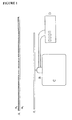
- FIG.1 shows an apparatus for evaluating loss factor ( ⁇ ) of the vibration-damping material composition, wherein A: test piece, A 1 : sample (sheet of vibration-damping material), A 2 : base, B: impedance head, C: vibrator, and D: transfer function analyzer (PC for FFT analysis).
- the organic polymer useful as the constituent of the vibration-damping material for the present invention and working as the matrix for the vibration-damping agent is not limited, so long as it has a given molecular weight and melting point, and a polar side chain. More specifically, the organic polymers useful for the present invention include acrylic rubber, butyl rubber, chloroprene, SBR (styrene-butadiene rubber), thermoplastic elastomer (e.g., ethylene/propylene rubber), polylactic resin and polybutylene succinate resin to begin with, polyurethane resin, acrylate resin, epoxy resin, polycarbonate resin, polyester resin, polyether resin, polyvinyl acetate resin, polyacetal resin, ethylene-vinyl acetate copolymer, styrene/vinylacetate copolymer, ethylene/vinyl chloride copolymer, ethylene/methacrylate copolymer, acrylonitrile/styrene copolymer, acrylonitrile-
- the organic polymer for the present invention may be optionally selected from the above compounds according to specific purposes of the vibration-damping material. However, preferably it has the polar group interactive with the vibration-damping agent and is effective for environmental preservation.
- These organic polymers include acrylic rubber, ethylene-acrylic acid copolymer, acrylate-methacrylate resin, acrylate-styrene resin, polyvinyl acetate resin, styrene-vinylacetate resin, ethylene-vinyl acetate copolymer, polycarbonate resin, polylactic resin and polybutylene succinate resin.
- the more preferable organic polymers for the vibration-damping material composition of the present invention are acrylate-methacrylate resin, acrylic rubber, polylactic resin, polybutylene succinate resin, and a mixture of acrylic rubber and polylactic resin, polylactic resin and polybutylene succinate resin, and acrylic rubber and polybutylene succinate resin.
- Acrylic rubber is a rubber-like elastomer, which is a polymer of acrylate ester or copolymer with acrylate ester as a major component.
- the acrylate esters include methyl acrylate, ethyl acrylate, propyl acrylate, butyl acrylate and hexyl acrylate; and the monomers to be copolymerized with an acrylate ester include methyl vinyl ketone, acrylic acid, acrylonitrile, butadiene and methyl methacrylate.
- Polylactic resin is normally produced by ring-opening polymerization of lactide, which is produced by dehydration/polycondensation of lactic acid and depolymerization of the resultant lactic acid oligomer.
- Polylactic resin which may be fabricated by a variety of processes, is useful for coping with environmental protection, because of its high bio-degradability.
- a polysaccharide e.g., cellulose or starch
- Polyurethane resin has the urethane bond -NHCOO- in the recurring unit in the main chain.
- the one produced by polyaddition of an organic diisocyanate and high-molecular-weight diol can be used for the present invention.
- the organic diisocyanates useful for the present invention include 4,4'-diphenylmethane diisocyanate, p-phenylene diisocyanate, tolylene diisocyanate and 4,4'-cyclohexylmethane diisocyanate, which are normally used as starting compounds for production of polyurethane.
- the high-molecular-weight diols and triols useful for the present invention are not limited, and the polyether type ones, e.g., polyoxypropylene glycol and polyoxypropylene-polyoxyethylene glycol, may be used.
- the polyurethane resin as the preferable matrix material of organic polymer contains a high-molecular-weight diol having an average molecular weight of 500 to 10,000, particularly preferably 1,000 to 7,000.
- acrylate/methyl methacrylate-based resin acrylic rubber, polylactic resin, and a mixture of acrylic rubber and polylactic resin, and polylactic acid and polybutylene succinate resin are more preferable.
- the preferable mixture which can be used for the present invention is composed of polybutylene succinate resin (A) and polylactic resin (B) in an (A): (B) ratio of (10 to 90):(90:10) by weight, preferably (15 to 70):(85:30).
- a resin emulsion or the one produced via a resin emulsion may be used as the organic polymer for the matrix.
- a resin emulsion comprises the resin dispersed in water or another solvent or emulsified.
- the aqueous emulsion produced with water is preferable for environmental protection. Moreover, it is produced by a simple procedure, and can give a coating film of uniform quality.
- the solid content of the resin emulsion can be optionally set. However, it is preferably 20 to 80% by weight, particularly preferably 35 to 65%.
- the resin in the emulsion has an average particle size of 0.01 to 50 ⁇ m, particularly preferably 0.1 to 10 ⁇ m.
- the organic polymer matrix for the composition has a function of stabilizing the sheet-shaped formed article and also a function as the diluent for the master batch of the vibration-damping agent.
- the polymers described above can make the matrix which is required to have the above characteristics.
- the vibration-damping agent as one of the constituents for the vibration-damping material composition of the present invention is a polyvinyl phenol-based resin having a recurring unit represented by the general formula [I]:
- the polyvinyl phenol-based resin is peculiar in that it contains the above-described recurring unit. These compounds include both polyvinyl phenol homopolymer and copolymer resins.
- X is at least one type of substituent selected from the group consisting of an alkyl group, alkylol group and halogen atom; and "s" is an average substitution rate and integer of 0 to 2.
- the alkyl and alkylol group preferably has a carbon number of 1 to 3.
- the halogen atoms useful for the present invention include bromine, chlorine and fluorine, of which bromine is more preferable.
- "t” represents number of hydroxyl groups in each ring, and 1 or 2, preferably 1.
- n is a numeral of 5 to 200, preferably 10 to 160, by which is meant that a high-molecular-weight compound may be used for the vibration-damping agent. It may be set in an optimum range, i.e., the vibration-damping agent of optimum molecular weight may be selected, for specific purposes of the vibration-damping material.
- the polyvinyl phenol-based resin as the vibration-damping agent for the vibration-damping material composition of the present invention has a weight-average molecular weight of 700 to 50,000, preferably 1,500 to 30,000.
- a polyvinyl phenol-based resin having a weight-average molecular weight below 700 may not sufficiently exhibit the vibration-damping function, and one having a weight-average molecular weight above 50,000 may have insufficient interactions with the matrix of organic polymer.
- the polyvinyl phenol-based copolymer resin contains the copolymer component.
- the copolymerizable monomer can be at least one type of monomer selected from the group consisting of vinyl carboxylate esters (e.g., vinyl acetate and vinyl propionate); unsaturated carboxylate esters (methyl (meth)acrylate, ethyl (meth)acrylate, lauryl (meth)acrylate, stearyl (meth)acrylate, 2-hydroxyethyl (meth)acrylate, diethyl maleate and dimethyl itaconate); aromatic vinyl compounds (e.g., styrene and ⁇ -methyl styrene) and olefins (ethylene, propylene, butadiene and isoprene); methyl vinyl ether, isobutyl vinyl ether, cetylvinyl ether, (meth)acrylic acid, acid phosphoxyethyl (meth)acrylate, styrenes
- the acrylic acid-based monomers useful for the present invention include alkyl acrylates, e.g., methyl acrylate, and ethyl acrylate, and methacryl acid-based monomers include 2-hydroxyethyl methacrylate.
- the vinyl phenol component is preferably contained at 30 to 60% by mol of the total monomers.
- the polyvinyl phenol-based resin is not limited, so long as it has a straight-chain or branched chemical structure.
- the polyvinyl phenol copolymer particularly preferable for the vibration-damping material composition of the present invention is the one represented by the general formula [II]:
- the recurring unit is the same as that in the general formula [I], and A is at least one polymerizable monomer selected from the group of polymerizable monomers represented by the following formulae (1) ⁇ (8): and wherein, "m" is a numeral of 1 to 200, particularly preferably 5 to 100.
- the resins having the recurring unit represented by the general formula [I] or [II] and exhibiting the notable vibration-damping function include a polyparavinyl phenol-based resin whose vinyl group is bonded to the 4-site of the hydroxyl group, and brominated polyparavinyl phenol-based resin.
- the commercial products of these polyparavinyl phenol-based resins include Maruzen Petrochemical's Marukalyncur MS-1P, MS-2P, MS-3P, MS-4P, MH-2P and MB.
- the vibration-damping agent can be incorporated at 5 to 60% by weight of the whole vibration-damping material composition, preferably 10 to 55%, more preferably 15 to 50%. At below 5%, it may not produce the desired vibration-damping effect. At above 70%, on the other hand, it may cause phase separation from the matrix material of organic polymer.
- the vibration-damping material composition of the present invention may be supplied as a master batch which contains the vibration-damping agent at a high concentration, and diluted before being used.
- the base polymer may contain the polar group described earlier.
- the resin as the diluent may be selected from those other than the base polymer, e.g., a polyolefin lacking a polar group. It may be optionally selected depending on specific purposes of the composition.
- the filler as the constituent component of the vibration-damping material composition is described.
- the filler type is not limited, so long as it strongly interacts with the organic polymer matrix. It may be inorganic, carbon-based or organic and piezoelectricity materials.
- the inorganic fillers useful for the present invention include layered compounds containing SiO 2 , Al 2 O 3 , MgO, Na 2 O or the like, e.g., calcium carbonate, talc, magnesia, saponite, smectite, montmorillonite, vermiculite, xonotlite, mica, powdered stainless steel, tourmaline, BaTiO 3 and PbTiZrO 3 ; and talc, calcium carbonate, natural and synthetic zeolite, mesoporous zeolite and flaky silica.
- the carbon-based fillers useful for the present invention include Ketjen's black carbon, sheathed carbon and flaky graphite.
- the inorganic filler is particularly preferably basic, when the organic polymer is acidic.
- the basic inorganic fillers useful for the present invention include TiO 2 , MgO, CaO and talc.
- a layered silicate clay mineral may be also used as the acidic inorganic filler.
- Such a mineral is preferably of 2:1 type, in particular the one having a relatively large basal plane distance, i.e., relatively large unit structure thickness or cycle in the direction perpendicular to the layer plane, e.g., the one having the distance of around 14 to 15 ⁇ or more.
- those useful for the present invention include smectite, montmorillonite, saponite, vermiculite and a mixture thereof, in addition to mica.
- the organic fillers useful for the present invention include dibenzylidene sorbitol, tetrafluoropolyethylene, gelol D, powdered cellulose, non-woven fabric, wood chips, sugar, paper, cellulose and FRP and liquid crystal polymer materials.
- Preferable liquid crystal polymers include an aromatic polyester, aromatic polyester amid and relating compound.
- POLYARYLATE® fiber can be used as a commercially-availabel organic filler POLYARYLATE® fiber can be used.
- barium titanate powder polyamid, polyvinylidene fluoride, glassy carbon are preferable.
- a combination of the inorganic and organic fillers can significantly expand a temperature region in which loss modulus (E") can be kept at a high level.
- the inorganic or organic filler is preferably used in the form of fine particles, in particular flakes, or fibers. Those having an average particle diameter of 1 to 200 ⁇ m, in particular 40 to 100 ⁇ m, will greatly contribute to vibration and sound absorption.
- a combination of the polyvinyl phenol-based resin partly substituted by the organic filler, organic filler and inorganic filler brings a notable effect of achieving a high loss modulus (E") over a wide temperature range, in particular high temperature range.
- the filler (inorganic or organic filler, or a combination thereof) is incorporated at 2 to 80% by weight of the whole vibration-damping material composition, preferably 20 to 60%. At below 2%, it may not sufficiently improve the vibration absorption performance. At above 80%, on the other hand, it may cause problems, e.g., phase separation which deteriorates composition strength, with the result that the composition may be difficult to keep sufficient strength.
- the organic filler when used, is incorporated preferably at 2 to 30% by weight, particularly preferably 5 to 20%.
- the preferable contents of the matrix material of organic polymer (a), polyvinyl phenol-based resin (b) and inorganic and/or organic filler (c) components of the vibration-damping material composition of the present invention are (a): 50 to 50%, preferably 10 to 40%, (b): 5 to 60%, preferably 10 to 40%, and (c): 2 to 70%, preferably 10 to 60%, all percentages being by weight.
- the organic or inorganic filler may be used as a master batch of the resin composition with a base resin and the vibration-damping agent, as is the case with the vibration-damping agent.
- the base resin as the organic polymer may be further incorporated, as required, with another organic polymer, depending on specific purposes of the composition.
- organic polymers other than those used for the base resin, useful for the present invention include melamine resin, phenol resin, polyethylene terephthalate, polycarbonate and polyolefin.
- the vibration-damping material composition of the present invention may be further incorporated with one or more other additives, e.g., lubricant, ageing inhibitor and foaming agent.
- the vibration-damping materials of the present invention is used in the form of fibers, granules, particles or the like. Any form may be used for the machines and tools, buildings or the like which need vibration-damping and for which it is used. It is particularly preferably used in the form of sheet-shape formed article. Its thickness can be optionally set for specific purposes and required performance. However, it is preferably 0.05 to 7mm, particularly preferably 1 to 4mm.
- the vibration-damping material composition of the present invention may be also supplied in the form of coating material. For example, it may be spread on a foamed structure or structure of complex shape, or on two or more layers to form a laminate and the vibration-damping material is put in the layered structure. It may be used for all types of structures, e.g., buildings, machines and tools, and transportation equipment which need vibration-damping.
- the process for producing the vibration-damping material composition of the present invention described above is not limited.
- the following processes may be used.
- the specific process conditions can be selected depending on, e.g., starting materials and specific purposes of the composition.
- Particles of the organic polymer (a) and vibration-damping agent (b), or those of the organic polymer (a), vibration-damping agent (b) and organic and/or inorganic filler (c) in a given ratio are kneaded at normal temperature or higher, and formed into a sheet shape by pressing or stretching under the temperature/pressure conditions needed for pressing the mixture, e.g., 60 to 300°C, preferably 100 to 200°C, and 100 to 300kgf/cm 2 , preferably 150 to 250kgf/cm 2 .
- the coating solution containing an emulsion of the organic polymer (a) dispersed/mixed with the vibration-damping agent (b), or an emulsion of the organic polymer (a) dispersed/mixed with the vibration-damping agent (b) and organic and/or inorganic filler (c) is prepared.
- the mixing ratio of each starting material for the coating material may be adjusted to obtain the vibration-damping material composition.
- the sheet-shape formed article may be applied to one or more planes which need vibration-damping after being placed in one or more spaces between layers of a laminate or pressed to the surface.
- the vibration-damping material composition of the present invention may be also supplied in the form of liquid, e.g., coating material. It brings a vibration-damping function after being spread in a space between a laminate or on its surface.
- Loss modulus (E) of the vibration-damping material composition prepared in each of EXAMPLES and COMPARATIVE EXAMPLES was measured by a dynamic viscoelasticity tester DVA-200S (IT Measurement Control Co., Ltd.) in a temperature range from -50 to 100°C at a frequency of 50Hz and heating rate of 5°C/minute in a tensile mode with a dynamic strain of 0.1%.
- the test piece size was around 20mml ⁇ 5mmw ⁇ 1mmt.
- Loss factor ( ⁇ ) was measured by the central vibration method in accordance with JIS G-0602 (1993) using an evaluation apparatus illustrated in FIG.1, where A: test sample comprising the sheet A 1 of vibration-damping material bonded to the cold-rolled steel sheet A 2 as the base, B: impedance head, C: vibrator, and D: analyzer (for measuring loss factor ( ⁇ ) from the resonance peak by the half-width method, after it was Fourier-transformed by a modal analysis software).
- the base size was 200mml ⁇ 10mmw ⁇ 0.8mmt, and the sample was adjusted to have a sample surface density of 2kg/m 2 .
- a vibration-damping material composition was prepared in each of EXAMPLES 1 to 7, wherein 100 parts by weight of acrylic rubber as the matrix material of organic polymer was incorporated with a varying poly4-vinyl phenol resin (Polyparavinyl phenol resin) (Maruzen Petrochemical's "Marukalyncur -M" series) given in Table 1 as the vibration-damping agent in a quantity also given in Table 1.
- a varying poly4-vinyl phenol resin Polyparavinyl phenol resin
- Maruzen Petrochemical's "Marukalyncur -M” series Maruzen Petrochemical's "Marukalyncur -M” series
- a vibration-damping material composition was prepared in each of EXAMPLES 8 and 9, wherein a 50/50 mixture of polylactic resin and polybutylene succinate was incorporated with a varying poly4-vinyl phenol resin (Maruzen Petrochemical's "Marukalyncur-M” series) given in Table 1 as the vibration-damping agent in a quantity also given in Table 1. Each mixture was hot-pressed at 180°C and 200kgf/cm 2 , to be formed into a 1mm thick sheet-shape vibration-damping material composition.
- a 50/50 mixture of polylactic resin and polybutylene succinate was incorporated with a varying poly4-vinyl phenol resin (Maruzen Petrochemical's "Marukalyncur-M” series) given in Table 1 as the vibration-damping agent in a quantity also given in Table 1.
- Each mixture was hot-pressed at 180°C and 200kgf/cm 2 , to be formed into a 1mm thick sheet-shape vibration-damping material composition
- a vibration-damping material composition was prepared in each of COMPARATIVE EXAMPLES 1 and 2, wherein acrylic rubber as the matrix material of organic polymer was incorporated with 2,2'-methylen-bis(4-methyl-6-t-butyl phenol or 4,4'-thio-bis(4-methyl-6-t-butyl phenol as the vibration-damping agent in a quantity given in Table 2.
- the vibration-damping composition prepared in COMPARATIVE EXAMPLE 3 or 4 was composed of polylactic resin or polybutylene succinate, free of any phenol-based resin. The evaluation results of each vibration-damping material composition are given in Table 2.
- a vibration-damping material composition was prepared in each of EXAMPLES 11 to 14, wherein a mixture of acrylic rubber and polypropylene in a ratio given in Table 3 was incorporated with a poly4-vinyl phenol resin given in Table 3 as the vibration-damping agent in a quantity also given in Table 3. Each mixture was hot-pressed at 140 to 180°C and 100 to 200kgf/cm 2 for 20 minutes, to be formed into a sheet-shape vibration-damping material composition.
- a coating material was prepared in each of EXAMPLES 15 to 21, wherein a mixture of acrylic-, vinyl acetate- and polyurethane-based emulsion was incorporated with a poly4-vinyl phenol resin and copolymer one in a quantity given in Table 4, and further with a stabilizer, dispersant, defoaming agent, filler, viscosity modifier, water and inorganic filler.
- a vibration-damping composition was prepared under the same conditions, except that poly4-vinyl phenol-based resin was replaced by 2,2'-methylene-bis(4-methyl-6-t-butylphenol), which is a hindered phenol-based compound.
- the evaluation results are given in Table 5.
- a vibration-damping composition was prepared using the same starting materials and under the same conditions as in COMPARATIVE EXAMPLE 1, except that poly4-vinyl phenol-based resin was replaced by 4,4'-thiobis(3-methyl-6-t-butylphenol), which is a hindered phenol-based compound.
- the evaluation results are given in Table 5.
- the present invention can provide a vibration-damping material composition having, as described above, a high max. loss modulus (E") and a wide temperature range extending from normal temperature to high temperature in which E" is kept at above 10 8 Pa, because it comprises an organic polymer matrix (a) and polybiphenol-based vibration-damping agent (b).
- the present invention also can provide a vibration-damping material composition having a high loss factor ( ⁇ ), because it comprises an organic polymer matrix (a), vibration-damping agent (b) and organic and/or inorganic filler (c).
- the present invention also can provide a vibration-damping material composition improved both in max. loss modulus (E") and loss factor ( ⁇ ), bringing a much greater vibration-damping effect than the one incorporated with the known vibration-damping agent.
Landscapes
- Chemical & Material Sciences (AREA)
- Health & Medical Sciences (AREA)
- Chemical Kinetics & Catalysis (AREA)
- Medicinal Chemistry (AREA)
- Polymers & Plastics (AREA)
- Organic Chemistry (AREA)
- Emergency Medicine (AREA)
- Compositions Of Macromolecular Compounds (AREA)
- Vibration Prevention Devices (AREA)
Abstract
It is an object of the present invention to provide a vibration-damping composition having a high loss modulus (E") and loss factor (η) in a high temperature region, and serviceable over a wide temperature range in a high temperature region. Provided is a (1) vibration-damping composition whose matrix material of organic polymer contains a vibration-damping agent, or (2) vibration-damping composition whose matrix material of organic polymer contains a vibration-damping agent, and inorganic and/or organic filler, wherein the vibration-damping agent is of a polyvinyl phenol-based resin having a recurring unit represented by the general formula [I]:
Description
- This invention relates to a vibration-damping material composition, more particularly a vibration-damping material composition capable of damping vibration and sound which is used as a starting material for, or in the form of coating material or others, in particular as sheet-shape formed article, for automobiles, buildings, various industrial machines and tools, home electronic appliances and medical equipment, among others, and a vibration-damping agent used for the same.
- Vibration-damping and acoustic insulating materials have been strongly demanded to be lighter in the today's industrialized societies, on account of increasing needs for energy-saving and reduced environmental loads to protect the global environments.
- However, the conventional polymer-based vibration-damping material having vibration-damping and acoustic insulation functions depends on the respective viscosity effect and friction effect each provided by the viscoelastic and inorganic filler components it contains, to achieve absorption of vibration by converting vibrational energy from the outside into thermal energy and dissipating the thermal energy into the atmosphere to damp the vibrational energy. Such a material is disadvantageous in that its vibration-damping effect is limited only in a temperature range determined by glass transition temperature of the polymer compound as the constituent and damping time is difficult to arbitrarily control. It's another disadvantage is limitation of decreasing its weight.
- Vibration-damping materials with the polymer component incorporated with a variety of organic additives have been proposed as the ones which can solve these disadvantages. These include composites of a polymer with a lower-molecular-weight compound, e.g., triazole- or hindered phenol-based compound. For example, Japanese Patent Application Laid-open (kokai) No.11-68190 discloses a vibration-damping material comprising a chlorinated polyethylene incorporated with a benzothiazole-based compound, and Japanese Patent Application Laid-open (kokai) No.2000-44818 discloses a vibration-damping material comprising a basic polymer with a basic polar side chain incorporated with a hindered phenol-based compound.
- However, a hindered phenol-based compound, which is proposed as a vibration-damping agent, has a large alkyl group of butyl or higher, and hence shows limited interactions with a polymer as the matrix or inorganic filler. Therefore, it involves a problem of reduced number of the agent/polymer interactions. Its other disadvantages are inability of exhibiting a high max. loss modulus (E") and loss factor (η) at high temperature, and narrowed serviceable temperature range, because of the interactions being easily dissociated at high temperature. These disadvantages have prevented its industrial application. Moreover, there is much scope for improvement of durability which allows the vibration-damping function to be exhibited for extended periods.
- It is an object of the present invention to provide a damping material composition exhibiting better vibration-damping functions than the conventional material containing a phenol-based compound, which has been proposed so far. More specifically, it has a higher max. loss modulus (E") and loss factor (η) at high temperature, wider serviceable temperature range for each of the above properties, and higher durability which allows the composition to exhibit the vibration-damping functions at a high level for extended periods.
- The inventors of the present invention have found, after having extensively studied to solve the disadvantages described above, that use of a specific phenol-based compound interacting with the damping material matrix of organic polymer more strongly than the phenol-based compound used for the conventional material allows the damping material composition to exhibit a higher max. loss modulus (E") and loss factor (η) at high temperature, and provides the vibration-damping composition serviceable over a wider temperature range, achieving the present invention.
- The present invention provides a vibration-damping composition whose matrix material of organic polymer contains a vibration-damping agent, wherein the vibration-damping agent is of a polyvinyl phenol-based resin having a recurring unit represented by the general formula [I]:

- The first aspect of the present invention relates to a vibration-damping composition comprising a matrix material of organic polymer and polyvinyl phenol-based resin having a recurring unit represented by the general formula [I] as a vibration-damping agent. The second aspect of the present invention relates to a vibration-damping composition comprising a matrix material of organic polymer (1), polyvinyl phenol-based resin (2) represented by the general formula [I] as a vibration-damping agent, and inorganic and/or organic filler (3). The present invention includes the following vibration-damping compositions 1) to 11) as the preferred embodiments:
- 1) the above-described vibration-damping composition, wherein the matrix material of organic polymer is a polybutylene succinate resin, or a mixture of polybutylene succinate resin and acrylic rubber and/or polylactic resin,
- 2) the above-described vibration-damping composition, wherein the matrix material of organic polymer is a mixture of acrylic rubber (10 to 40%) and polylactic resin (90 to 60%),
- 3) the above-described vibration-damping composition, wherein the matrix material of organic polymer is in the form of aqueous emulsion,
- 4) the above-described vibration-damping composition, which is used as a master batch and diluted with an organic polymer other than that for the vibration-damping composition,
- 5) the above-described vibration-damping composition, wherein the polyvinyl phenol-based resin is a polyparavinyl phenol-based resin,
- 6) the above-described vibration-damping composition, wherein the polyvinyl phenol-based resin has a weight-average molecular weight of 700 to 50,000,
- 7) the above-described vibration-damping composition, wherein the organic filler is of sorbitol and/or a fluoropolyolefin,
- 8) the above-described vibration-damping composition, wherein the inorganic filler is of at least one type selected from the basic ones and acidic ones,
- 9) the above-described vibration-damping composition, wherein the vibration-damping agent (a) and inorganic and/or organic filler (b) are incorporated in an (a):(b) ratio of 1:0.1 to 1:5,
- 10) the above-described vibration-damping composition, wherein the matrix material of organic polymer is of acrylic rubber and/or polylactic resin, and contains, as the vibration-damping agent, 5 to 60% by weight of a polyvinyl phenol-based polymer, and
- 11) the above-described vibration-damping composition, wherein the matrix material of organic polymer is of acrylic rubber and/or polylactic resin, and contains, as the vibration-damping agent, 5 to 60% by weight of a polyvinyl phenol-based polymer, 1 to 20% by weight of sorbitol and/or fluoropolyethylene, and 1 to 50% by weight of mica.
- FIG.1 shows an apparatus for evaluating loss factor (η) of the vibration-damping material composition, wherein A: test piece, A1: sample (sheet of vibration-damping material), A2: base, B: impedance head, C: vibrator, and D: transfer function analyzer (PC for FFT analysis).
- The present invention is described in more detail.
- The organic polymer useful as the constituent of the vibration-damping material for the present invention and working as the matrix for the vibration-damping agent is not limited, so long as it has a given molecular weight and melting point, and a polar side chain. More specifically, the organic polymers useful for the present invention include acrylic rubber, butyl rubber, chloroprene, SBR (styrene-butadiene rubber), thermoplastic elastomer (e.g., ethylene/propylene rubber), polylactic resin and polybutylene succinate resin to begin with, polyurethane resin, acrylate resin, epoxy resin, polycarbonate resin, polyester resin, polyether resin, polyvinyl acetate resin, polyacetal resin, ethylene-vinyl acetate copolymer, styrene/vinylacetate copolymer, ethylene/vinyl chloride copolymer, ethylene/methacrylate copolymer, acrylonitrile/styrene copolymer, acrylonitrile-butadiene-styrene copolymer, and chlorinated polyolefins, e.g., chlorinated polyethylene, polypropylene and polybutylene. The organic polymer for the present invention may be optionally selected from the above compounds according to specific purposes of the vibration-damping material. However, preferably it has the polar group interactive with the vibration-damping agent and is effective for environmental preservation. These organic polymers include acrylic rubber, ethylene-acrylic acid copolymer, acrylate-methacrylate resin, acrylate-styrene resin, polyvinyl acetate resin, styrene-vinylacetate resin, ethylene-vinyl acetate copolymer, polycarbonate resin, polylactic resin and polybutylene succinate resin. The more preferable organic polymers for the vibration-damping material composition of the present invention are acrylate-methacrylate resin, acrylic rubber, polylactic resin, polybutylene succinate resin, and a mixture of acrylic rubber and polylactic resin, polylactic resin and polybutylene succinate resin, and acrylic rubber and polybutylene succinate resin.
- Acrylic rubber is a rubber-like elastomer, which is a polymer of acrylate ester or copolymer with acrylate ester as a major component. The acrylate esters include methyl acrylate, ethyl acrylate, propyl acrylate, butyl acrylate and hexyl acrylate; and the monomers to be copolymerized with an acrylate ester include methyl vinyl ketone, acrylic acid, acrylonitrile, butadiene and methyl methacrylate.
- Polylactic resin is normally produced by ring-opening polymerization of lactide, which is produced by dehydration/polycondensation of lactic acid and depolymerization of the resultant lactic acid oligomer. Polylactic resin, which may be fabricated by a variety of processes, is useful for coping with environmental protection, because of its high bio-degradability.
- Polylactic acid having a weight-average molecular weight of 200,000 to 1,000,000, preferably 300,000 to 800,000, can be used for the present invention. It preferably has a melting point of 150°C or higher. Particularly preferably, it is incorporated with a polysaccharide (e.g., cellulose or starch) or another additive at 10 to 50% by weight for fabricability.
- Polyurethane resin has the urethane bond -NHCOO- in the recurring unit in the main chain. Normally, the one produced by polyaddition of an organic diisocyanate and high-molecular-weight diol can be used for the present invention. The organic diisocyanates useful for the present invention include 4,4'-diphenylmethane diisocyanate, p-phenylene diisocyanate, tolylene diisocyanate and 4,4'-cyclohexylmethane diisocyanate, which are normally used as starting compounds for production of polyurethane. The high-molecular-weight diols and triols useful for the present invention are not limited, and the polyether type ones, e.g., polyoxypropylene glycol and polyoxypropylene-polyoxyethylene glycol, may be used. The polyurethane resin as the preferable matrix material of organic polymer contains a high-molecular-weight diol having an average molecular weight of 500 to 10,000, particularly preferably 1,000 to 7,000.
- Of the various polymers cited above as the ones useful for the present invention as the matrix materials of organic polymer for the vibration-damping material, acrylate/methyl methacrylate-based resin, acrylic rubber, polylactic resin, and a mixture of acrylic rubber and polylactic resin, and polylactic acid and polybutylene succinate resin are more preferable. The preferable mixture which can be used for the present invention is composed of polybutylene succinate resin (A) and polylactic resin (B) in an (A): (B) ratio of (10 to 90):(90:10) by weight, preferably (15 to 70):(85:30).
- As the organic polymer for the matrix, a resin emulsion or the one produced via a resin emulsion may be used. One example of such a resin emulsion comprises the resin dispersed in water or another solvent or emulsified. The aqueous emulsion produced with water is preferable for environmental protection. Moreover, it is produced by a simple procedure, and can give a coating film of uniform quality. The solid content of the resin emulsion can be optionally set. However, it is preferably 20 to 80% by weight, particularly preferably 35 to 65%. The resin in the emulsion has an average particle size of 0.01 to 50µm, particularly preferably 0.1 to 10 µm.
- When the vibration-damping material composition is to be used for sheet-shaped formed articles, the organic polymer matrix for the composition has a function of stabilizing the sheet-shaped formed article and also a function as the diluent for the master batch of the vibration-damping agent. The polymers described above can make the matrix which is required to have the above characteristics.
- Next, the vibration-damping agent as one of the constituents for the vibration-damping material composition of the present invention is a polyvinyl phenol-based resin having a recurring unit represented by the general formula [I]:

- The polyvinyl phenol-based resin is peculiar in that it contains the above-described recurring unit. These compounds include both polyvinyl phenol homopolymer and copolymer resins.
- In the general formula [I], X is at least one type of substituent selected from the group consisting of an alkyl group, alkylol group and halogen atom; and "s" is an average substitution rate and integer of 0 to 2. The alkyl and alkylol group preferably has a carbon number of 1 to 3. The halogen atoms useful for the present invention include bromine, chlorine and fluorine, of which bromine is more preferable. "t" represents number of hydroxyl groups in each ring, and 1 or 2, preferably 1. "n" is a numeral of 5 to 200, preferably 10 to 160, by which is meant that a high-molecular-weight compound may be used for the vibration-damping agent. It may be set in an optimum range, i.e., the vibration-damping agent of optimum molecular weight may be selected, for specific purposes of the vibration-damping material.
- The polyvinyl phenol-based resin as the vibration-damping agent for the vibration-damping material composition of the present invention has a weight-average molecular weight of 700 to 50,000, preferably 1,500 to 30,000. A polyvinyl phenol-based resin having a weight-average molecular weight below 700 may not sufficiently exhibit the vibration-damping function, and one having a weight-average molecular weight above 50,000 may have insufficient interactions with the matrix of organic polymer.
- The polyvinyl phenol-based copolymer resin contains the copolymer component. The copolymerizable monomer can be at least one type of monomer selected from the group consisting of vinyl carboxylate esters (e.g., vinyl acetate and vinyl propionate); unsaturated carboxylate esters (methyl (meth)acrylate, ethyl (meth)acrylate, lauryl (meth)acrylate, stearyl (meth)acrylate, 2-hydroxyethyl (meth)acrylate, diethyl maleate and dimethyl itaconate); aromatic vinyl compounds (e.g., styrene and α-methyl styrene) and olefins (ethylene, propylene, butadiene and isoprene); methyl vinyl ether, isobutyl vinyl ether, cetylvinyl ether, (meth)acrylic acid, acid phosphoxyethyl (meth)acrylate, styrenesulfonic acid, vinyl alcohol, allyl glycidyl ether and glycidyl (meth)acrylate. The preferable copolymer components include acrylic acid-based monomer, methacrylic acid-based monomer and styrene.
- The acrylic acid-based monomers useful for the present invention include alkyl acrylates, e.g., methyl acrylate, and ethyl acrylate, and methacryl acid-based monomers include 2-hydroxyethyl methacrylate. The vinyl phenol component is preferably contained at 30 to 60% by mol of the total monomers. The polyvinyl phenol-based resin is not limited, so long as it has a straight-chain or branched chemical structure.
- The polyvinyl phenol copolymer particularly preferable for the vibration-damping material composition of the present invention is the one represented by the general formula [II]:

- In the general formula [II], the recurring unit is the same as that in the general formula [I], and A is at least one polymerizable monomer selected from the group of polymerizable monomers represented by the following formulae (1) ∼ (8):


- The resins having the recurring unit represented by the general formula [I] or [II] and exhibiting the notable vibration-damping function include a polyparavinyl phenol-based resin whose vinyl group is bonded to the 4-site of the hydroxyl group, and brominated polyparavinyl phenol-based resin.
The commercial products of these polyparavinyl phenol-based resins include Maruzen Petrochemical's Marukalyncur MS-1P, MS-2P, MS-3P, MS-4P, MH-2P and MB. - These phenol-based compounds bring a very notable vibration-damping effect as vibration-damping agents over a wide temperature range. They can be produced at a low cost, thereby greatly contributing to the industry.
- The vibration-damping agent can be incorporated at 5 to 60% by weight of the whole vibration-damping material composition, preferably 10 to 55%, more preferably 15 to 50%. At below 5%, it may not produce the desired vibration-damping effect. At above 70%, on the other hand, it may cause phase separation from the matrix material of organic polymer.
- The vibration-damping material composition of the present invention may be supplied as a master batch which contains the vibration-damping agent at a high concentration, and diluted before being used. In this case, the base polymer may contain the polar group described earlier. The resin as the diluent may be selected from those other than the base polymer, e.g., a polyolefin lacking a polar group. It may be optionally selected depending on specific purposes of the composition.
- Next, the filler as the constituent component of the vibration-damping material composition is described. The filler type is not limited, so long as it strongly interacts with the organic polymer matrix. It may be inorganic, carbon-based or organic and piezoelectricity materials.
- The inorganic fillers useful for the present invention include layered compounds containing SiO2, Al2O3, MgO, Na2O or the like, e.g., calcium carbonate, talc, magnesia, saponite, smectite, montmorillonite, vermiculite, xonotlite, mica, powdered stainless steel, tourmaline, BaTiO3 and PbTiZrO3; and talc, calcium carbonate, natural and synthetic zeolite, mesoporous zeolite and flaky silica. The carbon-based fillers useful for the present invention include Ketjen's black carbon, sheathed carbon and flaky graphite.
- The inorganic filler is particularly preferably basic, when the organic polymer is acidic. The basic inorganic fillers useful for the present invention include TiO2, MgO, CaO and talc. A layered silicate clay mineral may be also used as the acidic inorganic filler. Such a mineral is preferably of 2:1 type, in particular the one having a relatively large basal plane distance, i.e., relatively large unit structure thickness or cycle in the direction perpendicular to the layer plane, e.g., the one having the distance of around 14 to 15Å or more. Specifically, those useful for the present invention include smectite, montmorillonite, saponite, vermiculite and a mixture thereof, in addition to mica.
- The organic fillers useful for the present invention include dibenzylidene sorbitol, tetrafluoropolyethylene, gelol D, powdered cellulose, non-woven fabric, wood chips, sugar, paper, cellulose and FRP and liquid crystal polymer materials. Preferable liquid crystal polymers include an aromatic polyester, aromatic polyester amid and relating compound. For example, as a commercially-availabel organic filler POLYARYLATE® fiber can be used.
- As the piezoelectricity materials mentioned above, barium titanate powder, polyamid, polyvinylidene fluoride, glassy carbon are preferable.
- A combination of the inorganic and organic fillers can significantly expand a temperature region in which loss modulus (E") can be kept at a high level.
The inorganic or organic filler is preferably used in the form of fine particles, in particular flakes, or fibers. Those having an average particle diameter of 1 to 200µm, in particular 40 to 100 µm, will greatly contribute to vibration and sound absorption. - In particular, a combination of the polyvinyl phenol-based resin partly substituted by the organic filler, organic filler and inorganic filler brings a notable effect of achieving a high loss modulus (E") over a wide temperature range, in particular high temperature range.
- The filler (inorganic or organic filler, or a combination thereof) is incorporated at 2 to 80% by weight of the whole vibration-damping material composition, preferably 20 to 60%. At below 2%, it may not sufficiently improve the vibration absorption performance. At above 80%, on the other hand, it may cause problems, e.g., phase separation which deteriorates composition strength, with the result that the composition may be difficult to keep sufficient strength. In particular, the organic filler, when used, is incorporated preferably at 2 to 30% by weight, particularly preferably 5 to 20%.
- The preferable contents of the matrix material of organic polymer (a), polyvinyl phenol-based resin (b) and inorganic and/or organic filler (c) components of the vibration-damping material composition of the present invention are (a): 50 to 50%, preferably 10 to 40%, (b): 5 to 60%, preferably 10 to 40%, and (c): 2 to 70%, preferably 10 to 60%, all percentages being by weight.
The organic or inorganic filler may be used as a master batch of the resin composition with a base resin and the vibration-damping agent, as is the case with the vibration-damping agent. - In the vibration-damping material composition of the present invention, the base resin as the organic polymer may be further incorporated, as required, with another organic polymer, depending on specific purposes of the composition. These organic polymers, other than those used for the base resin, useful for the present invention include melamine resin, phenol resin, polyethylene terephthalate, polycarbonate and polyolefin.
Moreover, the vibration-damping material composition of the present invention may be further incorporated with one or more other additives, e.g., lubricant, ageing inhibitor and foaming agent. - The vibration-damping materials of the present invention is used in the form of fibers, granules, particles or the like. Any form may be used for the machines and tools, buildings or the like which need vibration-damping and for which it is used. It is particularly preferably used in the form of sheet-shape formed article. Its thickness can be optionally set for specific purposes and required performance. However, it is preferably 0.05 to 7mm, particularly preferably 1 to 4mm.
The vibration-damping material composition of the present invention may be also supplied in the form of coating material. For example, it may be spread on a foamed structure or structure of complex shape, or on two or more layers to form a laminate and the vibration-damping material is put in the layered structure. It may be used for all types of structures, e.g., buildings, machines and tools, and transportation equipment which need vibration-damping. - The process for producing the vibration-damping material composition of the present invention described above is not limited. For production of the sheet-shape formed article and coating material, the following processes may be used. The specific process conditions can be selected depending on, e.g., starting materials and specific purposes of the composition.
- Particles of the organic polymer (a) and vibration-damping agent (b), or those of the organic polymer (a), vibration-damping agent (b) and organic and/or inorganic filler (c) in a given ratio are kneaded at normal temperature or higher, and formed into a sheet shape by pressing or stretching under the temperature/pressure conditions needed for pressing the mixture, e.g., 60 to 300°C, preferably 100 to 200°C, and 100 to 300kgf/cm2, preferably 150 to 250kgf/cm2.
- The coating solution containing an emulsion of the organic polymer (a) dispersed/mixed with the vibration-damping agent (b), or an emulsion of the organic polymer (a) dispersed/mixed with the vibration-damping agent (b) and organic and/or inorganic filler (c) is prepared. The mixing ratio of each starting material for the coating material may be adjusted to obtain the vibration-damping material composition.
- The sheet-shape formed article may be applied to one or more planes which need vibration-damping after being placed in one or more spaces between layers of a laminate or pressed to the surface.
- The vibration-damping material composition of the present invention may be also supplied in the form of liquid, e.g., coating material. It brings a vibration-damping function after being spread in a space between a laminate or on its surface.
- The present invention is described in more detail by EXAMPLES and COMPARATIVE EXAMPLES, which by no means limit the present invention.
- Loss modulus (E") of the vibration-damping material composition prepared in each of EXAMPLES and COMPARATIVE EXAMPLES was measured by a dynamic viscoelasticity tester DVA-200S (IT Measurement Control Co., Ltd.) in a temperature range from -50 to 100°C at a frequency of 50Hz and heating rate of 5°C/minute in a tensile mode with a dynamic strain of 0.1%. The test piece size was around 20mml × 5mmw × 1mmt.
- Loss factor (η) was measured by the central vibration method in accordance with JIS G-0602 (1993) using an evaluation apparatus illustrated in FIG.1, where A: test sample comprising the sheet A1 of vibration-damping material bonded to the cold-rolled steel sheet A2 as the base, B: impedance head, C: vibrator, and D: analyzer (for measuring loss factor (η) from the resonance peak by the half-width method, after it was Fourier-transformed by a modal analysis software). The base size was 200mml × 10mmw × 0.8mmt, and the sample was adjusted to have a sample surface density of 2kg/m2.
- A vibration-damping material composition was prepared in each of EXAMPLES 1 to 7, wherein 100 parts by weight of acrylic rubber as the matrix material of organic polymer was incorporated with a varying poly4-vinyl phenol resin (Polyparavinyl phenol resin) (Maruzen Petrochemical's "Marukalyncur -M" series) given in Table 1 as the vibration-damping agent in a quantity also given in Table 1. Each mixture was hot-pressed at 180°C and 200kgf/cm2, to be formed into a 1mm thick sheet-shape vibration-damping material composition. The evaluation results are given in Table 1.
- A vibration-damping material composition was prepared in each of EXAMPLES 8 and 9, wherein a 50/50 mixture of polylactic resin and polybutylene succinate was incorporated with a varying poly4-vinyl phenol resin (Maruzen Petrochemical's "Marukalyncur-M" series) given in Table 1 as the vibration-damping agent in a quantity also given in Table 1. Each mixture was hot-pressed at 180°C and 200kgf/cm2, to be formed into a 1mm thick sheet-shape vibration-damping material composition.
- A vibration-damping material composition was prepared in each of COMPARATIVE EXAMPLES 1 and 2, wherein acrylic rubber as the matrix material of organic polymer was incorporated with 2,2'-methylen-bis(4-methyl-6-t-butyl phenol or 4,4'-thio-bis(4-methyl-6-t-butyl phenol as the vibration-damping agent in a quantity given in Table 2. The vibration-damping composition prepared in COMPARATIVE EXAMPLE 3 or 4 was composed of polylactic resin or polybutylene succinate, free of any phenol-based resin. The evaluation results of each vibration-damping material composition are given in Table 2.

Table 2 COMPARATIVE EXAMPLES 1 2 3 4 Polymer matrix Acrylic rubber Note 1) 100 100 Polylactic resin Note 2) 100 Polybutylene succinate Note 3) 100 Phenol-based compound PH101 Note 8) 80 PH102 Note 9) 80 Max. loss modulus E" (× 108), Pa 2.8 2.9 2.3 1.1 Temperature region in which E" is kept at above 108 Pa, °C 23∼-2 36∼11 69∼56 -17∼-30 Temperature range, °C 25 25 13 13 Note 1) Acrylic rubber (Nippon Zeon Corp.'s A R32) Note 2) Polylactic resin (Shimadzu Corp.'s Lacty 5000) Note 3) Polybutylene succinate Showa Highpolymer's Bionolle 1001
Note 4) PVPH1: Poly4-vinyl phenol resin (weight-average molecular weight: 2100) (Maruzen Petrochemical's Marukalyncur M S-1P)
Note 5) PVPH2: Poly4-vinyl phenol resin (weight-average molecular weight: 4800) (Maruzen Petrochemical's Marukalyncur M S-2P)
Note 6) PVPH3: Poly4-vinyl phenol resin (weight-average molecular weight: 9300) (Maruzen Petrochemical's Marukalyncur M S-4P)
Note 7) PVPH4: Poly4-vinyl phenol resin (weight-average molecular weight: 20,900) (Maruzen Petrochemical's Marukalyncur M H-2P)Note 8) PH101:Methylene-bis(4-methyl-6-t-butylphenol) (Ouchishinko Chemical Industrial's Nocrac NS6) Note 9) PH102:Thio-bis(3-methyl-6-t-butylphenol) (Ouchishinko Chemical Industrial's Nocrac 300) - A vibration-damping material composition was prepared in each of EXAMPLES 11 to 14, wherein a mixture of acrylic rubber and polypropylene in a ratio given in Table 3 was incorporated with a poly4-vinyl phenol resin given in Table 3 as the vibration-damping agent in a quantity also given in Table 3. Each mixture was hot-pressed at 140 to 180°C and 100 to 200kgf/cm2 for 20 minutes, to be formed into a sheet-shape vibration-damping material composition.
- Each sheet-shape composition was measured for the temperature region in which its loss factor(η) was kept at 0.08 or more by the procedure described earlier to determine it vibration-damping performance. The evaluation results are given in Table 3.
- A coating material was prepared in each of EXAMPLES 15 to 21, wherein a mixture of acrylic-, vinyl acetate- and polyurethane-based emulsion was incorporated with a poly4-vinyl phenol resin and copolymer one in a quantity given in Table 4, and further with a stabilizer, dispersant, defoaming agent, filler, viscosity modifier, water and inorganic filler.
- Each coating material was spread in a given quantity on a base board, naturally dried, and thermally treated at 100 to 200°C. The evaluation results are given in Table 4.
Table 3 EXAMPLES 11 12 13 14 Polymer matrix Acrylic rubber Note 1) 100 80 100 70 Polypropylene resin Note 2) 20 30 Polyvinyl phenol-based resin PVPH1 Note 3) 40 PVPH2 Note 4) 80 PVPH3 Note 5) 40 PVPH4 Note 6) 50 OF2 Note 7) 10 IF 1 Note 8) 70 50 20 80 IF3 Note 9) 10 Temperature performance which gives a loss factor (η) above 0.08 • Primary resonance (20 to 110Hz) Temperature region, °C 55-15 40∼0 55∼15 55∼10 Temperature range, °C 40 40 40 45 • Secondary resonance (300 to 750Hz) Temperature region, °C 58∼18 45-5 58∼20 58∼18 Temperature range, °C 40 40 38 40 • Tertiary resonance (1000 to 2500Hz) Temperature region, °C 60-24 50∼16 60-25 60-22 Temperature range, °C 36 34 35 38 Note 1) Acrylic rubber (Nippon Zeon Corp.'s A R32) Note 2) Random polypropylene (Idemitsu Petrochemical) Note 3) PVPH1; Poly4-vinyl phenol-based resin (weight-average molecular weight: 2100) (Maruzen Petrochemical's Marukalyncur M S-1P) Note 4) PVPH2; Poly4-vinyl phenol-based resin (weight-average molecular weight: 4800) (Maruzen Petrochemical's Marukalyncur M S-2P) Note 5) PVPH3; Poly4-vinyl phenol-based resin (weight-average molecular weight: 9300) (Maruzen Petrochemical's Marukalyncur M S-4P) Note 6) PVPH4; Poly4-vinyl phenol-based resin (weight-average molecular weight: 20900) (Maruzen Petrochemical's Marukalyncur M H-2P) Note 7) OF2; Dibenzylidene sorbitol (Chiba Specialty Chemicals' IRGACLEAR D) Note 8) IF1; Kuraray's suzolite 200HK mica Note 9) IF3;Cabot's sheathed 300 Carbon 

- A vibration-damping composition was prepared under the same conditions, except that poly4-vinyl phenol-based resin was replaced by 2,2'-methylene-bis(4-methyl-6-t-butylphenol), which is a hindered phenol-based compound. The evaluation results are given in Table 5.
- A vibration-damping composition was prepared using the same starting materials and under the same conditions as in COMPARATIVE EXAMPLE 1, except that poly4-vinyl phenol-based resin was replaced by 4,4'-thiobis(3-methyl-6-t-butylphenol), which is a hindered phenol-based compound. The evaluation results are given in Table 5.
Table 5 COMPARATIVE EXAMPLES 5 6 Polymer matrix Acrylic rubber Note 1) 100 100 Polyvinyl phenol-based resin PH101 Note 2) 80 PH102 Note 3) 80 IF1 Note 4) 310 310 Temperature performance which gives a loss factor (η) above 0.08 •Primary resonance (20 to 110Hz) Temperature region, °C 29-9 45∼18 Temperature range, °C 20 27 •Secondary resonance (300 to 750Hz) Temperature region, °C 33∼11 50-28 Temperature range, °C 22 22 •Tertiary resonance (1000 to 2500Hz) Temperature region, °C 40∼15 44-22 Temperature range, °C 25 22 Note 1) Acrylic rubber (Nippon Zeon Corp's AR32) Note 2) PH101; 2,2'-Methylene-bis(4-methyl-6-tertiary-butylphenol) (Ouchishinko Chemical Industrial's NOCRAC N36) Note 3) PH102; Thio-bis(3-methyl-6-tertiary-butylphenol) (Ouchishinko Chemical Industrial's NOCRAC 300) Note 4) IFI; An aqueous solution containing a stabilizer, desparsant, defoaming agent and viscosity modifier at 20%. - The present invention can provide a vibration-damping material composition having, as described above, a high max. loss modulus (E") and a wide temperature range extending from normal temperature to high temperature in which E" is kept at above 108Pa, because it comprises an organic polymer matrix (a) and polybiphenol-based vibration-damping agent (b). The present invention also can provide a vibration-damping material composition having a high loss factor (η), because it comprises an organic polymer matrix (a), vibration-damping agent (b) and organic and/or inorganic filler (c). Moreover, the present invention also can provide a vibration-damping material composition improved both in max. loss modulus (E") and loss factor (η), bringing a much greater vibration-damping effect than the one incorporated with the known vibration-damping agent.
Claims (14)
- A vibration-damping composition whose matrix material of organic polymer contains a vibration-damping agent, wherein the vibration-damping agent is of a polyvinyl phenol-based resin having a recurring unit represented by the general formula [I]:

- A vibration-damping composition whose matrix material of organic polymer contains a vibration-damping agent, and inorganic and/or organic filler, wherein the vibration-damping agent is of a polyvinyl phenol-based resin having a recurring unit represented by the general formula [I]:

- The vibration-damping composition according to Claim 1 or 2, wherein said matrix material of organic polymer is of at least one type of high-molecular-weight compound selected from the group consisting of vinyl acetate-based resin, ethylene/vinyl acetate-based resin, epoxy-based resin, alkyd-based resin, polyester-based resin, polyurethane-based resin, polycarbonate-based resin, polylactic-based resin, polybutylene succinate resin, polyether-based resin, ethylene/methacrylate-based resin, acrylate/methacrylate-based resin, acrylonitrile/styrene-based copolymer, acrylonitrile/butadiene/styrene-based resin, acrylic rubber, butyl rubber, halogenated polyolefm, polyethylene and polypropylene.
- The vibration-damping composition according to Claim 1 or 2, wherein said matrix material of organic polymer is of acrylic rubber and/or acrylate/methacrylate-based resin.
- The vibration-damping composition according to Claim 1 or 2, wherein said matrix material is of polylactic resin or a mixture of polylactic acid resin, acrylic rubber and acrylate/methacrylate-based resin.
- The vibration-damping composition according to anyone of Claims 1 to 5, wherein said vibration-damping agent is of a poly4-vinyl phenol homopolymer resin having a weight-average molecular weight of 700 to 50,000.
- The vibration-damping composition according to anyone of Claims 1 to 6, wherein said vibration-damping agent is of a polyvinyl phenol copolymer having a recurring unit represented by the general formula [II]:


- The vibration-damping composition according to anyone of Claims 1 to 7, wherein said vibration-damping agent is incorporated at 5 to 60% by weight of the whole composition.
- The vibration-damping composition according to anyone of Claims 2 to 8, wherein said inorganic filler is at least one type of inorganic compound selected from the group consisting of those for basic inorganic fillers, acidic inorganic fillers and piezoelectricity materials.
- The vibration-damping composition according to anyone of Claims 2 to 8, wherein said organic filler is a liquid crystal polymer material.
- The vibration-damping composition according to anyone of Claims 2 to 10, wherein said inorganic and/or organic filler is incorporated at 2 to 80% by weight, of the whole composition.
- The vibration-damping composition according to anyone of Claims 1 to 11, which is formed into a 0.05 to 7mm thick sheet-shape article.
- The vibration-damping composition according to anyone of Claims 1 to 11, which is spread on a structure to form the coating film thereon.
- A vibration-damping agent represented by the general formula [I]:

in the general formula [I], X is at least one type of substituent selected from the group consisting of an alkyl group, alkylol group and halogen atom; "s" is a numeral of 0 to 2; "t" is an integer of 1 or 2; and "n" is a numeral of 5 to 200.
Applications Claiming Priority (2)
| Application Number | Priority Date | Filing Date | Title |
|---|---|---|---|
| JP2002311637 | 2002-10-25 | ||
| JP2002311637 | 2002-10-25 |
Publications (1)
| Publication Number | Publication Date |
|---|---|
| EP1413603A1 true EP1413603A1 (en) | 2004-04-28 |
Family
ID=32064387
Family Applications (1)
| Application Number | Title | Priority Date | Filing Date |
|---|---|---|---|
| EP20030000612 Withdrawn EP1413603A1 (en) | 2002-10-25 | 2003-01-14 | Vibration-damping material composition |
Country Status (4)
| Country | Link |
|---|---|
| US (1) | US20040082721A1 (en) |
| EP (1) | EP1413603A1 (en) |
| KR (1) | KR20040036507A (en) |
| CN (1) | CN1491983A (en) |
Cited By (3)
| Publication number | Priority date | Publication date | Assignee | Title |
|---|---|---|---|---|
| WO2013174611A1 (en) * | 2012-05-22 | 2013-11-28 | Basf Se | Non-aqueous sound-absorbing compound with a solvent-free polyacrylate binder |
| CN103467908A (en) * | 2013-09-23 | 2013-12-25 | 句容市睿远科技有限公司 | Damping material for making rail backing plate of high-speed railway and preparation method thereof |
| EP2065456B2 (en) † | 2006-08-30 | 2021-03-31 | Koatsu Gas Kogyo Co., Ltd. | Resin composition for damping material and damping material |
Families Citing this family (11)
| Publication number | Priority date | Publication date | Assignee | Title |
|---|---|---|---|---|
| KR20040038817A (en) * | 2002-11-01 | 2004-05-08 | 스미또모 가가꾸 고오교오 가부시끼가이샤 | Colored photosenstive resin composition and color filter comprising the same |
| BRPI0411691A (en) | 2003-07-02 | 2006-12-26 | Teva Gyogyszergyar Reszvenytar | Aztreonam l-lysine and its preparation methods |
| JP2010526916A (en) * | 2007-05-08 | 2010-08-05 | シーカ・テクノロジー・アーゲー | Resin blend with damping ability over a wide range of temperatures |
| TWI504655B (en) * | 2009-04-10 | 2015-10-21 | Saint Gobain Performance Plast | Acoustic damping compositions having elastomeric particulate |
| JP5525036B2 (en) * | 2009-04-10 | 2014-06-18 | サン−ゴバン パフォーマンス プラスティックス コーポレイション | Acoustic damping composition |
| WO2014124269A1 (en) * | 2013-02-11 | 2014-08-14 | Henkel Ag & Co. Kgaa | Liquid rubber damping composition |
| FR3083165A1 (en) * | 2018-06-28 | 2020-01-03 | Saint-Gobain Glass France | MOTOR VEHICLE WINDSHIELD |
| CN109438614B (en) * | 2018-10-23 | 2021-01-22 | 上海应用技术大学 | Water-based resin emulsion and preparation method thereof |
| CN109438613B (en) * | 2018-10-23 | 2021-01-22 | 上海应用技术大学 | Damping resin emulsion and preparation method thereof |
| CN110205010B (en) * | 2019-06-12 | 2021-08-03 | 阜阳佳派生产力促进中心有限公司 | Preparation method of hybrid piezoelectric damping coating |
| CN111944114A (en) * | 2020-08-03 | 2020-11-17 | 长安大学 | A kind of polyurethane flame retardant vibration damping material and preparation method thereof |
Citations (2)
| Publication number | Priority date | Publication date | Assignee | Title |
|---|---|---|---|---|
| JPS5849239A (en) * | 1981-09-17 | 1983-03-23 | 株式会社日立製作所 | Diaphragm with sandwich structure and its manufacture |
| EP0319113A2 (en) * | 1987-12-04 | 1989-06-07 | Shell Internationale Researchmaatschappij B.V. | Polyketone polymer composition |
Family Cites Families (3)
| Publication number | Priority date | Publication date | Assignee | Title |
|---|---|---|---|---|
| JPS5229800B2 (en) * | 1972-11-01 | 1977-08-04 | ||
| USRE34122E (en) * | 1990-07-27 | 1992-11-10 | Hoechst Celanese Corporation | Hot melt adhesives containing poly(p-hydroxystyrene) homopolymers and copolymers and bonding methods, employing same |
| US5200460A (en) * | 1991-04-30 | 1993-04-06 | Shell Oil Company | Polyacetal polymer blends |
-
2003
- 2003-01-14 EP EP20030000612 patent/EP1413603A1/en not_active Withdrawn
- 2003-01-20 KR KR1020030003710A patent/KR20040036507A/en not_active Withdrawn
- 2003-01-23 US US10/349,041 patent/US20040082721A1/en not_active Abandoned
- 2003-03-10 CN CNA031201490A patent/CN1491983A/en active Pending
Patent Citations (2)
| Publication number | Priority date | Publication date | Assignee | Title |
|---|---|---|---|---|
| JPS5849239A (en) * | 1981-09-17 | 1983-03-23 | 株式会社日立製作所 | Diaphragm with sandwich structure and its manufacture |
| EP0319113A2 (en) * | 1987-12-04 | 1989-06-07 | Shell Internationale Researchmaatschappij B.V. | Polyketone polymer composition |
Non-Patent Citations (3)
| Title |
|---|
| DATABASE CA [online] CHEMICAL ABSTRACTS SERVICE, COLUMBUS, OHIO, US; HITACHI, LTD., JAPAN: "Manufacture of sandwiched vibration panels", XP002257663, retrieved from STN Database accession no. 99:141240 * |
| DATABASE CA [online] CHEMICAL ABSTRACTS SERVICE, COLUMBUS, OHIO, US; SHI, LINQI ET AL: "Study of the segmented ternary copolymers containing PDMS. II. Study on dynamic mechanical properties of -(PSF-PDMS-PHS)n- segmented ternary copolymers", XP002257662, retrieved from STN Database accession no. 124:177813 * |
| GONGNENG GAOFENZI XUEBAO (1995), 8(4), 416-24 * |
Cited By (4)
| Publication number | Priority date | Publication date | Assignee | Title |
|---|---|---|---|---|
| EP2065456B2 (en) † | 2006-08-30 | 2021-03-31 | Koatsu Gas Kogyo Co., Ltd. | Resin composition for damping material and damping material |
| WO2013174611A1 (en) * | 2012-05-22 | 2013-11-28 | Basf Se | Non-aqueous sound-absorbing compound with a solvent-free polyacrylate binder |
| US9969860B2 (en) | 2012-05-22 | 2018-05-15 | Basf Se | Non-aqueous sound-absorbing compound with a solvent-free polyacrylate binder |
| CN103467908A (en) * | 2013-09-23 | 2013-12-25 | 句容市睿远科技有限公司 | Damping material for making rail backing plate of high-speed railway and preparation method thereof |
Also Published As
| Publication number | Publication date |
|---|---|
| CN1491983A (en) | 2004-04-28 |
| US20040082721A1 (en) | 2004-04-29 |
| KR20040036507A (en) | 2004-04-30 |
Similar Documents
| Publication | Publication Date | Title |
|---|---|---|
| EP1408075A1 (en) | Vibration damping material composition | |
| US20040082721A1 (en) | Vibration-damping material composition | |
| US7041377B2 (en) | Resin composition for vibration-damping material, vibration-damping material, and sound-insulating member | |
| WO1997042844A1 (en) | Energy conversion composition | |
| CN107206745A (en) | Sound-attenuating system | |
| KR20190025337A (en) | Sound Blocking Material For Vehicle Containing Polyester Foam Sheet | |
| JP2002069424A (en) | Organic hybrid damping material, method for producing the same, and damping improver used therefor | |
| KR100308254B1 (en) | Polymer Composites for Impact Sound Insulation | |
| WO2023163871A1 (en) | Acrylic damping additives for filled thermoplastics | |
| JP2004278299A (en) | Sound insulation element | |
| JP3581940B2 (en) | Sound insulation damping material | |
| JP2004162061A (en) | Vibration-damping material composition | |
| JP2004149767A (en) | Vibration-damping material composition | |
| KR0163208B1 (en) | Composition and products for preventing silence | |
| JPH0453837A (en) | Fiber-containing rubber sheet | |
| KR101837501B1 (en) | Interfloor Noise Proofing Material Containing Polyester Resin Foam | |
| EP0456473B1 (en) | Polyvinyl chloride based resin composition | |
| JP3177654B2 (en) | Vibration energy absorber | |
| KR100216424B1 (en) | The soundproof composition | |
| CN1050887A (en) | Sound insulation vibration isolation thermoplastics and lamination thereof and laminate | |
| JPS61261047A (en) | Manufacture of vibration-damping board | |
| JP3815106B2 (en) | Vibration damping sheet manufacturing method | |
| RU185081U1 (en) | SOUND INSULATION MATERIAL | |
| JP3647368B2 (en) | Damping member, sound insulating material, and sound insulating partition | |
| JP3610613B2 (en) | Composition for vibration impact energy absorbing material and vibration shock energy absorbing foam obtained therefrom |
Legal Events
| Date | Code | Title | Description |
|---|---|---|---|
| PUAI | Public reference made under article 153(3) epc to a published international application that has entered the european phase |
Free format text: ORIGINAL CODE: 0009012 |
|
| AK | Designated contracting states |
Kind code of ref document: A1 Designated state(s): AT BE BG CH CY CZ DE DK EE ES FI FR GB GR HU IE IT LI LU MC NL PT SE SI SK TR |
|
| AX | Request for extension of the european patent |
Extension state: AL LT LV MK RO |
|
| 17P | Request for examination filed |
Effective date: 20040722 |
|
| AKX | Designation fees paid |
Designated state(s): DE FR GB |
|
| STAA | Information on the status of an ep patent application or granted ep patent |
Free format text: STATUS: THE APPLICATION IS DEEMED TO BE WITHDRAWN |
|
| 18D | Application deemed to be withdrawn |
Effective date: 20060411 |