EP1415443B1 - Dispositif et procede servant a programmer un debit en fonction de priorites d'un reseau mobile - Google Patents
Dispositif et procede servant a programmer un debit en fonction de priorites d'un reseau mobile Download PDFInfo
- Publication number
- EP1415443B1 EP1415443B1 EP01971843A EP01971843A EP1415443B1 EP 1415443 B1 EP1415443 B1 EP 1415443B1 EP 01971843 A EP01971843 A EP 01971843A EP 01971843 A EP01971843 A EP 01971843A EP 1415443 B1 EP1415443 B1 EP 1415443B1
- Authority
- EP
- European Patent Office
- Prior art keywords
- data flow
- transmission
- scheduling
- mobile network
- guaranteed
- Prior art date
- Legal status (The legal status is an assumption and is not a legal conclusion. Google has not performed a legal analysis and makes no representation as to the accuracy of the status listed.)
- Expired - Lifetime
Links
Images




Classifications
-
- H—ELECTRICITY
- H04—ELECTRIC COMMUNICATION TECHNIQUE
- H04L—TRANSMISSION OF DIGITAL INFORMATION, e.g. TELEGRAPHIC COMMUNICATION
- H04L1/00—Arrangements for detecting or preventing errors in the information received
- H04L1/0001—Systems modifying transmission characteristics according to link quality, e.g. power backoff
- H04L1/0002—Systems modifying transmission characteristics according to link quality, e.g. power backoff by adapting the transmission rate
- H04L1/0003—Systems modifying transmission characteristics according to link quality, e.g. power backoff by adapting the transmission rate by switching between different modulation schemes
-
- H—ELECTRICITY
- H04—ELECTRIC COMMUNICATION TECHNIQUE
- H04W—WIRELESS COMMUNICATION NETWORKS
- H04W72/00—Local resource management
- H04W72/50—Allocation or scheduling criteria for wireless resources
- H04W72/56—Allocation or scheduling criteria for wireless resources based on priority criteria
- H04W72/566—Allocation or scheduling criteria for wireless resources based on priority criteria of the information or information source or recipient
- H04W72/569—Allocation or scheduling criteria for wireless resources based on priority criteria of the information or information source or recipient of the traffic information
-
- H—ELECTRICITY
- H04—ELECTRIC COMMUNICATION TECHNIQUE
- H04L—TRANSMISSION OF DIGITAL INFORMATION, e.g. TELEGRAPHIC COMMUNICATION
- H04L1/00—Arrangements for detecting or preventing errors in the information received
- H04L1/0001—Systems modifying transmission characteristics according to link quality, e.g. power backoff
- H04L1/0009—Systems modifying transmission characteristics according to link quality, e.g. power backoff by adapting the channel coding
-
- H—ELECTRICITY
- H04—ELECTRIC COMMUNICATION TECHNIQUE
- H04L—TRANSMISSION OF DIGITAL INFORMATION, e.g. TELEGRAPHIC COMMUNICATION
- H04L1/00—Arrangements for detecting or preventing errors in the information received
- H04L1/0001—Systems modifying transmission characteristics according to link quality, e.g. power backoff
- H04L1/0023—Systems modifying transmission characteristics according to link quality, e.g. power backoff characterised by the signalling
- H04L1/0026—Transmission of channel quality indication
-
- H—ELECTRICITY
- H04—ELECTRIC COMMUNICATION TECHNIQUE
- H04L—TRANSMISSION OF DIGITAL INFORMATION, e.g. TELEGRAPHIC COMMUNICATION
- H04L47/00—Traffic control in data switching networks
- H04L47/50—Queue scheduling
-
- H—ELECTRICITY
- H04—ELECTRIC COMMUNICATION TECHNIQUE
- H04L—TRANSMISSION OF DIGITAL INFORMATION, e.g. TELEGRAPHIC COMMUNICATION
- H04L47/00—Traffic control in data switching networks
- H04L47/50—Queue scheduling
- H04L47/62—Queue scheduling characterised by scheduling criteria
- H04L47/6215—Individual queue per QOS, rate or priority
-
- H—ELECTRICITY
- H04—ELECTRIC COMMUNICATION TECHNIQUE
- H04L—TRANSMISSION OF DIGITAL INFORMATION, e.g. TELEGRAPHIC COMMUNICATION
- H04L47/00—Traffic control in data switching networks
- H04L47/50—Queue scheduling
- H04L47/62—Queue scheduling characterised by scheduling criteria
- H04L47/622—Queue service order
- H04L47/623—Weighted service order
-
- H—ELECTRICITY
- H04—ELECTRIC COMMUNICATION TECHNIQUE
- H04L—TRANSMISSION OF DIGITAL INFORMATION, e.g. TELEGRAPHIC COMMUNICATION
- H04L47/00—Traffic control in data switching networks
- H04L47/50—Queue scheduling
- H04L47/62—Queue scheduling characterised by scheduling criteria
- H04L47/625—Queue scheduling characterised by scheduling criteria for service slots or service orders
- H04L47/627—Queue scheduling characterised by scheduling criteria for service slots or service orders policing
-
- H—ELECTRICITY
- H04—ELECTRIC COMMUNICATION TECHNIQUE
- H04W—WIRELESS COMMUNICATION NETWORKS
- H04W72/00—Local resource management
- H04W72/50—Allocation or scheduling criteria for wireless resources
- H04W72/54—Allocation or scheduling criteria for wireless resources based on quality criteria
- H04W72/543—Allocation or scheduling criteria for wireless resources based on quality criteria based on requested quality, e.g. QoS
Definitions
- the invention relates to an apparatus and method for preparing a packet flow context for transmission in a mobile network, and especially for preparing such for a multi-channel transmission.
- a mobile network such as a GPRS or a EGPRS network
- a several number of users can simultaneously be allocated in the same physical radio channel and multiplexed onto that channel.
- a fixed network such as a local area network
- a determined quality of service is given. Therefore, a fixed scheme how to manage a multiple of packet flow context can be managed.
- bit rates can fall short of the bit rates usually provided.
- the transmission rate can be below the transmission rate which is needed by some users.
- WO 00/62457 A discloses a method and system for a data traffic scheduling. Thereby, downstream cells are de-multiplexed into the downstream traffic queue corresponding to its subscriber unit and traffic type.
- a cell scheduler first checks the pending reservation request buffer for the highest priority traffic type to see, if any cells of that type are awaiting transmission. Then, cells of the highest priority traffic type are sent, until all cells of the high priority traffic have been sent. Then, the cells from the next highest priority are scheduled by the scheduler. Because cells are serviced in a prioritized manner, the wireless network is able to support multiple qualities of service.
- the apparatus and method known from WO 00/62457 A has the disadvantage that cells having the highest priority are always transmitted first, even when the guaranteed bit rate for the cell of the highest transmission priority type has already been achieved.
- the apparatus and the method of the invention have the advantage that for each data flow a transmission priority is determined, and the data flows are scheduled according to this determination.
- the transmission priority of each of the data flows is determined independent of their traffic classes, such as guaranteed or non-guaranteed streaming, interactive traffic or background traffic.
- the guaranteed streaming traffic class is for a packet flow context for which a guaranteed transmission rate is negotiated.
- the data flows of the different traffic classes can be scheduled, such that an appropriate transmission rate is reached for each data flow and the guaranteed throughput is maintained.
- available transmission capabilities are allocated in a way so that radio blocks of data flows having higher weights are scheduled first, than the ones having lower weights, until all available capacity is filled up for the given reporting period. Radio blocks with same weight can be sent in a round robin fashion or any other algorithm.
- a link adaptation is provided to select a modulation and coding scheme for maximizing the throughput of the mobile network.
- Fig. 1 shows the schematic structure of the embodiment of the invention.
- the apparatus of the invention comprises a scheduling means 1, policing function means 2 and a link adaptation means 3, whereby the scheduling means 1 is connected with the policing function means 2 through a connector 4 and the scheduling means 1 is connected with the link adaptation means 3 through a connector 5.
- the policing function means 2 monitors the provided quality of service during the connection to make sure that the measured quality of service is in line with the negotiated one.
- the link adaptation means 3 monitors the radio link condition for each connection so that the throughput per channel can be maximized.
- connection channel may be a physical channel but according to the preferred embodiment it is a logical one. For example a lot of time slots can be grouped to N time slots per group to provide N logical channels. In both senses the present invention supports a multi-channel connection, even when the number of channels is changing or the quality, that means the transmission capacity of only one or some channels is changing. Accordingly, the link adaptation means 3 monitors the radio link condition for each connection (physical or logical), trying to maximize throughput per time slot, because radio link conditions of the mobile network are changing continuously.
- Fig. 2 shows the structure of the apparatus of the embodiment in greater detail.
- same elements are characterized by identical reference numerals to avoid repetitions.
- Fig. 2 shows a data flow #1, a data flow #2 and a data flow #3 which are from packet flow context and which are queued in the logical link control queue 6 of the base station system. Thereby, each data flow #1, #2, #3 has an associated queue where all the packet data units are waiting for transmission.
- a packet control unit 7 segments the packet data units of the data flow #1, #2, #3 stored in the link layer control queue 6, which are going to be sent as radio link control packets, and puts them in a transmission base frame associated radio link control 8, as shown by arrows 9a to 9c.
- the packet data units of the data flows #1, #2, #3 are modulated and coded according to a modulation and coding scheme in modulation and coding means 10a to 10c.
- the number of bits contained in each LLC segment depends on the selection of modulation and coding scheme.
- a part 11 of the scheduling means 1 assigns one of the time slots 12, 13 and a scheduling queue 12a to 12e or 13a to 13e for each time slot 12, 13.
- the time slot queue is not a first-in/first-out memory so that it is possible to access directly each memory position.
- the scheduling means 1 further comprises a switching element 14 for switching between the different queues given by the modulation and coding means 10a to 10c of the radio link control 8.
- the part 11 of the scheduling means 1 comprises an assigning means 15 to assign the packet selected by switching element 14 to one of the scheduled time slot elements 12a to 12e, 13a to 13e of the time slot transmission queues 12, 13.
- the data packets stored in elements 12a to 12e are successively transmitted to the transmission time slot 16 and the data packets stored in the elements 13a to 13e are successively transmitted to the transmission time slot 17.
- the packet data of a data flow which are successively arriving at, for example, transmission time slot 16 are modulated and coded by the same modulation and coding scheme.
- an input for the scheduling means 1 comes from the marking function means 21, which provides at least one of the functionalities of the policing function of the policing function means 2.
- the policing function means 2 uses information provided by the link adaptation means 3 in order to determine the number of blocks to be marked.
- the link adaptation means 3 takes as input the measurement reports sent by the mobile stations. Hence, if the link adaptation means 3 decides to change the respective modulation and coding scheme, it will be changed for next packet data units. On the other hand, if no change is needed, next packet data units will be transmitted with the same modulation and coding scheme.
- Fig. 3 shows a table describing a modulation and coding scheme according to the embodiment of the invention.
- nine different modulation and coding schemes are referred to by numerals 1 to 9.
- the number of bits transmitted with each radio block is displayed for each of said modulation and coding schemes.
- a radio block modulated and coded according to the modulation and coding scheme number 4 has a total number of 352 bits of useful data.
- This throughput estimation made by the link adaptation means 3 depends on the radio link control mode of transmission.
- NACK negative unit acknowledgement character
- the link adaptation means 3 selects the highest modulation and coding scheme that matches the reliability quality of service requirements, depending on the radio link conditions.
- the number of transmitted bits of useful data on each radio block period or one of the radio link control queues 8 is given by the number of transmitted bits divided by the duration of the radio link control packet data.
- the duration of the radio link control packet data is for example 20 ms.
- ACK acknowledgment character
- the retransmission mechanisms must be taken into account.
- the link adaptation means 3 selects the modulation and coding scheme by which the maximum throughput and QoS reliability requirements can be achieved.
- Fig. 4 shows a scheduling, especially a scheduling matrix, according to a general embodiment of the invention.
- the scheduling is based on a matrix 30 having M rows and N columns, what means that said scheduling is made for a certain period of time in advance characterized by the maximum duration of scheduling round M, so that the scheduling round lasts more than a packet data and it is multi-slot connection aware.
- data flows of different classes are shown. The packet data units of these data flows are scheduled over the matrix 30 according to their transmission priority.
- the packet data units of a data flow of the streaming service class shown with boxed numeral 1, are distributed over all three time slots.
- a data flow 32 of the interactive service class is distributed over time slot 1 and time slot 2, as shown by boxed numerals 2 in Fig. 4.
- Data flow of the background service class is distributed over time slot 0, as shown by boxed numeral 3.
- the time slots 0 and 1 are enough to provide the guaranteed throughput. However, more resources are allocated for the streaming service, whereby a higher bit rate is achieved.
- the target throughput is RSC (i) and the total number of scheduling turns is NT, that is the number of slots of the connection N times the duration of the scheduling round M.
- the bitrate estimation from link adaptation means is expressed through R(i) which denotes the estimated throughput and takes into account retransmitted radio-blocks.
- the link adaptation means changes the modulation and coding scheme during a scheduling round, which lasts M times, for example, 20 ms, the remaining current scheduling matrix is rejected and a new matrix of scheduling begins with new weight allocation, including those packet data unit blocks of the previous matrix which have not been served.
- the scheduling algorithm must modify the mark of the streaming packets to achieve with the new radio link conditions the guaranteed bit rate negotiated.
- the scheduling round duration parameter may vary depending on the reporting period duration between measurement reports received from the mobile stations.
- the reporting period duration is the period between measurement reports received from the mobile stations.
- Fig. 5 shows a weight determination means 40 of the apparatus of the embodiment for determining the weight value of a radio link control block.
- different weight values correspond, as shown on the right hand side.
- For guaranteed streaming the weight value is 2 and for non-guaranteed streaming the weight value is 4.
- For interactive traffic three different weight values are supplied. According to the traffic handling priorities 1, 2 and 3 the weight values 5, 6 and 7 are set. The background weight value is 8, because its priority is the lowest. If the transmission block frame timer is about to expire, the weight value of 3 is set to achieve a priority between said guaranteed and non-guaranteed streaming.
- Retransmissions must be treated in an accurate way to decrease the delay, mainly for streaming flows. Therefore, the retransmission need to have more priority than previously. Hence, they can preempt a position in the matrix of any radio link control block with less priority (higher weight).
- Streaming radio link control blocks to be retransmitted are managed in a different way, because every retransmitted streaming radio link control block needs to be sent with more priority than streaming radio link control block marked as guaranteed. That means, in case of streaming, the new priority has to be even higher than the priority of guaranteed streaming. Therefore, retransmitted streaming is always set to the weight value of 1, while in case of interactive or background streaming, the weight value of the retransmission is decreased by 1. It is also possible to assign the same weight to different types of traffic. In this case, those packets would be treated with round robin or any other fairness algorithm.
- a weight determination means 40 can use the table shown in Fig. 5. It is just an example and different weights could be assigned according to particular system requirements.
- the weight value can be obtained from the sum of: traffic class (2 streaming, 4 interactive, 8 background), policing function mark (only for streaming traffic class: 0 guaranteed, 2 non-guaranteed), traffic handling priority (only for interactive traffic class: 1, 2, 3), user class (subscription parameter, to differentiate among users), transmission block frame timer (3 if expiring, 0 if not). In case that a transmission block frame timer is about to expire, a weight value of 3 is set instead, and retransmissions are handled as described according to Fig. 5.
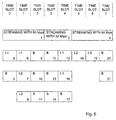
- the channel allocation status is shown in Fig. 6. On top of Fig. 6 different connection channels in terms of time slots 0 to 7 are shown. Below, it is shown allocation of all the connections, each of one is identified by a number in the bottom right and by the type of the quality of service attributes (traffic class, guaranteed throughput or traffic handling priority) displayed in the top left. For example, the data flow identified by number 18 (bottom right) is of the interactive user class with traffic handling priority 2.
- the modulation and coding scheme selected for the first connection is the modulation and coding scheme number 9 with the number of transmitted bits of 1184, as shown in Fig. 3, having a retransmissions probability of 0.3.
- the modulation and coding scheme selected for the second connection is the modulation and coding scheme number 7 with 896 transmitted bits having a retransmission probability of 0.2
- the modulation and coding scheme selected for the third connection is the modulation and coding scheme number 6 with 592 transmitted bits having a retransmission probability of 0.1.
- the duration of scheduling round parameter M is 5, that is the scheduling round lasts 100 ms.
- the user class parameter is not used in this example.
- radio link control blocks must be reserved for the guaranteed streaming of the data flow identified by number 1
- 5 radio link control blocks must be reserved for the guaranteed streaming identified by number 2
- 13 radio link control blocks must be reserved for guaranteed streaming of the data flow identified by number 3.
- Fig. 7 shows a weight allocation means 41.
- the weight allocation means 41 allocates a weight and thereby a priority to each of the data flows identified by their identification number.
- the table shows the columns identification number, traffic class, policing function mark, traffic handling priority and weight. Thereby, for each data flow identified by the identification number a weight value is given. The weight value is calculated from the sum of the traffic class value, the policing function mark value and the traffic handling priority value, which are also shown in the table to make the calculation clear.
- the policing function mark value of 2 corresponds to a non-guaranteed streaming radio link control block.
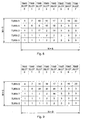
- Fig. 8 shows the scheduling matrix of the example of use according to the embodiment.
- the duration of scheduling rounds parameter M is 5 and the number of connection channels N is 8.
- the transmission of the radio link control blocks shown in the scheduling matrix is from the bottom to the top. Therefore, turns 1 to 5 are successively sent to the physical connection multi-channel.
- the number in the boxes of the matrix are the identification numbers of the data flow shown in Figs. 6 and 7.
- radio link control blocks for data flow with identification number 1 eight radio link control blocks (guaranteed) plus one additional radio link control block (non-guaranteed) are allocated in turns 1, 2 and 3 over time slots 0, 1 and 2.
- the additional radio link control block is marked with an asterisk and has been allocated after blocks of guaranteed streaming, but before interactive or background services, according to the weight values shown in Fig. 7.
- the other streaming connections are allocated over time slots 3, 4 and time slots 5, 6, 7, respectively.
- the rest of the radio link control blocks are allocated from higher priorities to lower priorities, that is from the lowest to the highest weight shown in the table of Fig. 7, until the matrix is full, or all the blocks are allocated. When there is multiplexing of several blocks with the same priority, it is first allocated those blocks less recently served. For example, in time slot 2 the connection with identification number 9 is allocated before the connection with identification number 10.
- the transmission of the blocks is made from the bottom to the top of the matrix, that means first time slots 0 to 7 of turn 1 are transmitted, thereafter time slots 0 to 7 of turn 2 are transmitted, and so on, until time slots 0 to 7 of turn 5 have been transmitted. Then, all blocks allocated have been transmitted and a new allocation turn allocating a new matrix is started.
- the number of transmission turns for data flow (connection) with identification number 1 is recalculated, because of the change in its modulation and coding scheme which changes the transmission bit rate.
- connection number 1 With this new number of transmission turns for connection number 1, the new matrix can be allocated, as shown in Fig. 9.
- Connection number 1 needs two more turns (10 instead of 8) to guarantee the negotiated transmission rate.
- time slot 2 the data flow with identification number 10 is allocated before the data flow with identification number 9 according to the rule of allocation of connections with the same priority.
- the data flow with identification number 9 was served, so the less recently served is data flow with identification number 10. The same occurs in time slot 3 with connections number 12, 13 and 14, and in the time slot 4 with connections number 15 and 16.
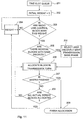
- Fig. 10 shows a flow chart of the scheduling method according to the embodiment.
- step 101 it is determined, whether the input is of the traffic class streaming. If yes, step 103 follows. If the input block belongs to a data flow of the guaranteed streaming class and by transmitting this block the guaranteed bit rate negotiated is not exceeded, both tested in step 103, then step 104 follows. Otherwise, this block is marked in step 105 which is also succeeded by step 104.
- step 106 follows. If the transmission base frame timer of this block is going to expire, as checked in step 106, step 107 of marking this block follows, else step 104 follows which is also succeeding step 107.
- step 104 the weights of the radio link control blocks are calculated, as described with reference to Figs. 5 and 7.
- Step 104 is followed by step 108, in which an allocation procedure is performed, as described in greater detail with reference to Fig. 11.
- step 109 it is checked, whether a change in the modulation and coding scheme has occurred. If yes, the scheduling method comes back to step 101 to read in the blocks of the radio link control block queue 8 that are modulated and encoded with the new modulation and coding scheme to guarantee an appropriate scheduling. If the modulation and coding scheme is not changed, step 110 follows, in which it is tested, whether a NACK radio link control block has been received, and in this case the scheduling method jumps back to step 104. Otherwise, the scheduling method can continue regularly with step 101.
- Steps 109 and 110 can also be seen as responses to events. Whenever a measurement report arrives and the link adaptation means 3 determines that a new modulation and coding scheme has to be used, the procedure jumps back to step 101. And whenever a NACK message is received, the procedure jumps back to step 104. In this case, the event for step 110 is the reception of a NACK message, which means a radio link control packet data has been lost and has to be retransmitted. It causes a change on the weight associated to this radio link control packet data and a turn reallocation.
- Fig. 11 shows the allocation procedure which is called in step 108 of the scheduling method shown in Fig. 10.
- step 201 a time slot queue, such as the time slot queue 12 or 13, as shown in Fig. 2, are inputted. Then, an initial weight is set to 0 in step 202. Thereafter, in step 203 it is probed, whether there is any radio link control block with this initial weight. If not, in the following step 204 the weight is increased by 1 and thereafter the procedure jumps back to step 203. If any radio link control block with this weight is detected in step 203, step 205 follows to check, whether there are several blocks with same priority. If there is only one block with this priority, step 205 is succeeded by step 206, in which a block in the transmission turn is allocated. In case there are several blocks with the same priority, step 210 is called first, in which the less recently sent transmission base frame is selected. Thus, a round robin algorithm is used for this case. As an alternative, different priorities could be taken into account for frames with the same weight.
- step 206 After step 206 it is probed in step 207, whether the matrix has been finished. If yes, the allocation procedure is finished in step 208. Otherwise, the procedure continues with step 209. In step 209 is checked, whether all actual weight blocks are allocated. If not, step 209 is followed by step 206. If yes, the allocation procedure continues with step 204 to increase the weight by 1 and jumps back to step 203.
- the present invention relates to a mobile network.
- This covers, for example, a cellular network and a radio network.
Landscapes
- Engineering & Computer Science (AREA)
- Computer Networks & Wireless Communication (AREA)
- Signal Processing (AREA)
- Quality & Reliability (AREA)
- Mobile Radio Communication Systems (AREA)
Claims (17)
- Appareil de préparation d'au moins un premier (#1) et un second (#2) flot de données pour une transmission dans un réseau mobile, comprenant :caractérisé en ce queun moyen de détermination de poids (40) destiné à déterminer au moins une priorité de transmission pour ledit premier flot de données (#1) et au moins une priorité de transmission pour ledit second flot de données (#2) selon leur classe, etun moyen de planification (1) destiné à planifier lesdits premier et second flots de données (#1, #2) pour une transmission dans ledit réseau mobile en fonction de leur priorité de transmission déterminée par ledit moyen de détermination de poids (40),
ladite planification est faite à l'avance pendant une durée maximale d'une passe de planification (M) durant plus d'une donnée par paquet, et
si la transmission est interrompue, une nouvelle planification commence avec une nouvelle détermination de poids, comprenant les blocs d'unité de données par paquet non transmis. - Appareil selon la revendication 1, caractérisé en ce que ledit moyen de détermination de poids (40) détermine ladite priorité de transmission en fonction de la classe de trafic desdits premier et second flots de données (#1, #2).
- Appareil selon la revendication 2, caractérisé en ce que ladite classe de trafic est : l'émission en continu, le trafic interactif ou le trafic de fond.
- Appareil selon la revendication 3, caractérisé en ce que ladite classe de trafic de l'émission en continu est une émission en continu garantie pour le flot de données pour lequel une vitesse de transmission garantie est négociée, ou une émission en continue non garantie.
- Appareil selon l'une quelconque des revendications 1 à 4, caractérisé en ce que ledit appareil réserve au moins la capacité de transmission dudit réseau mobile qui est nécessaire pour le flot de données (#1, #2) dont la vitesse de transmission est garantie.
- Appareil selon l'une quelconque des revendications 1 à 5, caractérisé en ce que ledit moyen de détermination de poids (40) détermine ladite priorité de transmission en fonction de la catégorie d'utilisateur desdits premier et second flots de données (#1, #2).
- Appareil selon l'une quelconque des revendications 1 à 6, caractérisé en ce que ledit moyen de détermination de poids (40) augmente ladite priorité de transmission pour un bloc d'un flot de données, lorsque ledit bloc est retransmis.
- Appareil selon l'une quelconque des revendications 1 à 7, caractérisé par un moyen de fonction de police (2) destiné à surveiller la qualité de service fournie dudit réseau mobile.
- Appareil selon la revendication 8, caractérisé en ce que ledit moyen de fonction de police (2) compte lesdits bits correctement envoyés pour chaque flot de données (#1, #2) et prévient si les bits comptés d'un flot de données (#1, #2) d'une classe de trafic d'émission en continu garantie sont inférieurs à celle garantie.
- Appareil selon l'une quelconque des revendications 1 à 9, caractérisé par un moyen d'adaptation de liaison (3) qui sélectionne un schéma de modulation et de codage destiné à maximiser le débit de même qu'à atteindre les exigences de fiabilité de qualité de service.
- Appareil selon l'une quelconque des revendications 1 à 10, caractérisé en ce qu'au moins deux canaux de connexion sont fournis pour ladite transmission dans ledit réseau mobile.
- Appareil selon la revendication 11, caractérisé en ce que lesdits canaux de connexion sont fournis par des tranches de temps (tranche de temps 0 à tranche de temps 7), et lesdites tranches de temps sont divisées et/ou distribuées sur au moins un canal radio physique dudit réseau mobile.
- Procédé de préparation d'au moins un premier (#1) et un second (#2) flot de données pour une transmission dans un réseau mobile, comprenant les étapes consistant à :a) déterminer au moins une priorité pour ledit premier flot de données (#1) et au moins une priorité pour ledit second flot de données (#2) selon leurs classes,b) planifier lesdits premier et second flots de données pour une transmission dans ledit réseau mobile selon leur priorité, moyennant quoi ladite planification est faite à l'avance pendant une durée maximale d'une passe de planification (M) durant plus d'une donnée par paquet, et
caractérisé par l'étape consistant à :c) commencer une nouvelle planification avec une nouvelle détermination de poids, comprenant les blocs d'unité de données par paquet non transmis, si la transmission est interrompue. - Procédé selon la revendication 13, caractérisé en ce que lesdites priorités sont déterminées selon la classe de trafic et/ou la catégorie d'utilisateur desdits premier et second flots de données (#1, #2).
- Procédé selon la revendication 14, comprenant l'étape supplémentaire consistant à :réserver au moins la capacité de transmission dudit réseau mobile qui est nécessaire pour le flot de données ayant une classe de trafic d'émission en continu garantie pour laquelle une vitesse de transmission garantie est négociée.
- Procédé selon l'une quelconque des revendications 13 à 15, comprenant l'étape supplémentaire consistant à :contrôler la quantité de bits correctement envoyés de chaque flot de données, etdéterminer si la qualité de ladite transmission a changé ou non.
- Procédé selon l'une quelconque des revendications 14 à 16, comprenant l'étape supplémentaire consistant à :maximiser le débit par adaptation de la liaison dû à un changement dans le schéma de modulation et de codage.
Applications Claiming Priority (1)
| Application Number | Priority Date | Filing Date | Title |
|---|---|---|---|
| PCT/EP2001/008908 WO2003015352A1 (fr) | 2001-08-01 | 2001-08-01 | Dispositif et procede servant a programmer un debit en fonction de priorites d'un reseau mobile |
Publications (2)
| Publication Number | Publication Date |
|---|---|
| EP1415443A1 EP1415443A1 (fr) | 2004-05-06 |
| EP1415443B1 true EP1415443B1 (fr) | 2005-11-16 |
Family
ID=8164524
Family Applications (1)
| Application Number | Title | Priority Date | Filing Date |
|---|---|---|---|
| EP01971843A Expired - Lifetime EP1415443B1 (fr) | 2001-08-01 | 2001-08-01 | Dispositif et procede servant a programmer un debit en fonction de priorites d'un reseau mobile |
Country Status (5)
| Country | Link |
|---|---|
| US (1) | US20040165596A1 (fr) |
| EP (1) | EP1415443B1 (fr) |
| AT (1) | ATE310351T1 (fr) |
| DE (1) | DE60115108T2 (fr) |
| WO (1) | WO2003015352A1 (fr) |
Families Citing this family (114)
| Publication number | Priority date | Publication date | Assignee | Title |
|---|---|---|---|---|
| JP4198921B2 (ja) * | 2002-02-28 | 2008-12-17 | 株式会社エヌ・ティ・ティ・ドコモ | 適応無線パラメータ制御方法、QoS制御装置、基地局及び無線通信システム |
| FI20020673A0 (fi) * | 2002-04-09 | 2002-04-09 | Nokia Corp | Ajantasaisen pakettidatan pakettien ajoittaminen |
| US7844228B2 (en) * | 2003-10-31 | 2010-11-30 | Kyocera Corporation | Method of determining transmission rate by controlling adaptive modulation scheme |
| US7680124B2 (en) * | 2004-07-30 | 2010-03-16 | Agere Systems Inc. | Frame mapping scheduler for scheduling data blocks using a mapping table and a weight table |
| US8289972B2 (en) * | 2004-11-10 | 2012-10-16 | Alcatel Lucent | Gigabit passive optical network strict priority weighted round robin scheduling mechanism |
| WO2007057728A1 (fr) * | 2005-11-18 | 2007-05-24 | Telefonaktiebolaget Lm Ericsson (Publ) | Procede et station de base pour ordonnancement de hsdpa |
| KR100913872B1 (ko) * | 2006-01-18 | 2009-08-26 | 삼성전자주식회사 | 통신 시스템에서 데이터 송수신 장치 및 방법 |
| US7693128B2 (en) * | 2006-02-23 | 2010-04-06 | Freescale Semiconductor, Inc. | Managing packets for transmission in a communication system |
| JP4410267B2 (ja) * | 2007-03-27 | 2010-02-03 | 株式会社東芝 | 無線通信方法と装置 |
| GB2448762B (en) * | 2007-04-27 | 2009-09-30 | Nec Corp | Scheduliing information method and related communications devices |
| US20090122753A1 (en) * | 2007-10-01 | 2009-05-14 | Hughes Timothy J | Dynamic data link segmentation and reassembly |
| US8346225B2 (en) | 2009-01-28 | 2013-01-01 | Headwater Partners I, Llc | Quality of service for device assisted services |
| US8402111B2 (en) | 2009-01-28 | 2013-03-19 | Headwater Partners I, Llc | Device assisted services install |
| US8406748B2 (en) | 2009-01-28 | 2013-03-26 | Headwater Partners I Llc | Adaptive ambient services |
| US8270952B2 (en) | 2009-01-28 | 2012-09-18 | Headwater Partners I Llc | Open development system for access service providers |
| US8589541B2 (en) | 2009-01-28 | 2013-11-19 | Headwater Partners I Llc | Device-assisted services for protecting network capacity |
| US8832777B2 (en) | 2009-03-02 | 2014-09-09 | Headwater Partners I Llc | Adapting network policies based on device service processor configuration |
| US8275830B2 (en) | 2009-01-28 | 2012-09-25 | Headwater Partners I Llc | Device assisted CDR creation, aggregation, mediation and billing |
| US8391834B2 (en) | 2009-01-28 | 2013-03-05 | Headwater Partners I Llc | Security techniques for device assisted services |
| US12388810B2 (en) | 2009-01-28 | 2025-08-12 | Headwater Research Llc | End user device that secures an association of application to service policy with an application certificate check |
| US12166596B2 (en) | 2009-01-28 | 2024-12-10 | Disney Enterprises, Inc. | Device-assisted services for protecting network capacity |
| US12389218B2 (en) | 2009-01-28 | 2025-08-12 | Headwater Research Llc | Service selection set publishing to device agent with on-device service selection |
| US11985155B2 (en) | 2009-01-28 | 2024-05-14 | Headwater Research Llc | Communications device with secure data path processing agents |
| US9980146B2 (en) | 2009-01-28 | 2018-05-22 | Headwater Research Llc | Communications device with secure data path processing agents |
| US9565707B2 (en) | 2009-01-28 | 2017-02-07 | Headwater Partners I Llc | Wireless end-user device with wireless data attribution to multiple personas |
| US10779177B2 (en) | 2009-01-28 | 2020-09-15 | Headwater Research Llc | Device group partitions and settlement platform |
| US9392462B2 (en) | 2009-01-28 | 2016-07-12 | Headwater Partners I Llc | Mobile end-user device with agent limiting wireless data communication for specified background applications based on a stored policy |
| US11973804B2 (en) | 2009-01-28 | 2024-04-30 | Headwater Research Llc | Network service plan design |
| US10841839B2 (en) | 2009-01-28 | 2020-11-17 | Headwater Research Llc | Security, fraud detection, and fraud mitigation in device-assisted services systems |
| US9572019B2 (en) | 2009-01-28 | 2017-02-14 | Headwater Partners LLC | Service selection set published to device agent with on-device service selection |
| US10326800B2 (en) | 2009-01-28 | 2019-06-18 | Headwater Research Llc | Wireless network service interfaces |
| US12543031B2 (en) | 2009-01-28 | 2026-02-03 | Headwater Research Llc | Adapting network policies based on device service processor configuration |
| US10798252B2 (en) | 2009-01-28 | 2020-10-06 | Headwater Research Llc | System and method for providing user notifications |
| US10264138B2 (en) | 2009-01-28 | 2019-04-16 | Headwater Research Llc | Mobile device and service management |
| US10248996B2 (en) | 2009-01-28 | 2019-04-02 | Headwater Research Llc | Method for operating a wireless end-user device mobile payment agent |
| US10484858B2 (en) | 2009-01-28 | 2019-11-19 | Headwater Research Llc | Enhanced roaming services and converged carrier networks with device assisted services and a proxy |
| US10200541B2 (en) | 2009-01-28 | 2019-02-05 | Headwater Research Llc | Wireless end-user device with divided user space/kernel space traffic policy system |
| US9706061B2 (en) | 2009-01-28 | 2017-07-11 | Headwater Partners I Llc | Service design center for device assisted services |
| US9270559B2 (en) | 2009-01-28 | 2016-02-23 | Headwater Partners I Llc | Service policy implementation for an end-user device having a control application or a proxy agent for routing an application traffic flow |
| US10492102B2 (en) | 2009-01-28 | 2019-11-26 | Headwater Research Llc | Intermediate networking devices |
| US12452377B2 (en) | 2009-01-28 | 2025-10-21 | Headwater Research Llc | Service design center for device assisted services |
| US12432130B2 (en) | 2009-01-28 | 2025-09-30 | Headwater Research Llc | Flow tagging for service policy implementation |
| US9954975B2 (en) | 2009-01-28 | 2018-04-24 | Headwater Research Llc | Enhanced curfew and protection associated with a device group |
| US9955332B2 (en) | 2009-01-28 | 2018-04-24 | Headwater Research Llc | Method for child wireless device activation to subscriber account of a master wireless device |
| US10783581B2 (en) | 2009-01-28 | 2020-09-22 | Headwater Research Llc | Wireless end-user device providing ambient or sponsored services |
| US10237757B2 (en) | 2009-01-28 | 2019-03-19 | Headwater Research Llc | System and method for wireless network offloading |
| US10715342B2 (en) | 2009-01-28 | 2020-07-14 | Headwater Research Llc | Managing service user discovery and service launch object placement on a device |
| US11218854B2 (en) | 2009-01-28 | 2022-01-04 | Headwater Research Llc | Service plan design, user interfaces, application programming interfaces, and device management |
| US8665886B2 (en) | 2009-03-26 | 2014-03-04 | Brocade Communications Systems, Inc. | Redundant host connection in a routed network |
| JP5494673B2 (ja) * | 2009-12-14 | 2014-05-21 | 日本電気株式会社 | 通信装置及び通信制御方法 |
| JP5709320B2 (ja) * | 2009-12-17 | 2015-04-30 | インテル・コーポレーション | 失われたデータブロックを再送するための方法、コンピューティングデバイス及びプログラム |
| US9461840B2 (en) | 2010-06-02 | 2016-10-04 | Brocade Communications Systems, Inc. | Port profile management for virtual cluster switching |
| US9769016B2 (en) | 2010-06-07 | 2017-09-19 | Brocade Communications Systems, Inc. | Advanced link tracking for virtual cluster switching |
| US9001824B2 (en) | 2010-05-18 | 2015-04-07 | Brocade Communication Systems, Inc. | Fabric formation for virtual cluster switching |
| US8989186B2 (en) | 2010-06-08 | 2015-03-24 | Brocade Communication Systems, Inc. | Virtual port grouping for virtual cluster switching |
| US8867552B2 (en) | 2010-05-03 | 2014-10-21 | Brocade Communications Systems, Inc. | Virtual cluster switching |
| US9716672B2 (en) | 2010-05-28 | 2017-07-25 | Brocade Communications Systems, Inc. | Distributed configuration management for virtual cluster switching |
| US9270486B2 (en) | 2010-06-07 | 2016-02-23 | Brocade Communications Systems, Inc. | Name services for virtual cluster switching |
| US9608833B2 (en) | 2010-06-08 | 2017-03-28 | Brocade Communications Systems, Inc. | Supporting multiple multicast trees in trill networks |
| US9806906B2 (en) | 2010-06-08 | 2017-10-31 | Brocade Communications Systems, Inc. | Flooding packets on a per-virtual-network basis |
| US9628293B2 (en) | 2010-06-08 | 2017-04-18 | Brocade Communications Systems, Inc. | Network layer multicasting in trill networks |
| US9246703B2 (en) | 2010-06-08 | 2016-01-26 | Brocade Communications Systems, Inc. | Remote port mirroring |
| US9807031B2 (en) | 2010-07-16 | 2017-10-31 | Brocade Communications Systems, Inc. | System and method for network configuration |
| US20120197902A1 (en) * | 2011-01-28 | 2012-08-02 | International Business Machines Corporation | Data ingest optimization |
| US20140050151A1 (en) * | 2011-04-20 | 2014-02-20 | Nokia Solutions And Networks Oy | Link Quality Reporting For A Communication System Capable Of Using Different Modulation Schemes |
| US9270572B2 (en) | 2011-05-02 | 2016-02-23 | Brocade Communications Systems Inc. | Layer-3 support in TRILL networks |
| US9407533B2 (en) | 2011-06-28 | 2016-08-02 | Brocade Communications Systems, Inc. | Multicast in a trill network |
| US9401861B2 (en) | 2011-06-28 | 2016-07-26 | Brocade Communications Systems, Inc. | Scalable MAC address distribution in an Ethernet fabric switch |
| US8948056B2 (en) | 2011-06-28 | 2015-02-03 | Brocade Communication Systems, Inc. | Spanning-tree based loop detection for an ethernet fabric switch |
| US8885641B2 (en) | 2011-06-30 | 2014-11-11 | Brocade Communication Systems, Inc. | Efficient trill forwarding |
| US9736085B2 (en) | 2011-08-29 | 2017-08-15 | Brocade Communications Systems, Inc. | End-to end lossless Ethernet in Ethernet fabric |
| US9699117B2 (en) | 2011-11-08 | 2017-07-04 | Brocade Communications Systems, Inc. | Integrated fibre channel support in an ethernet fabric switch |
| US9450870B2 (en) | 2011-11-10 | 2016-09-20 | Brocade Communications Systems, Inc. | System and method for flow management in software-defined networks |
| US8995272B2 (en) | 2012-01-26 | 2015-03-31 | Brocade Communication Systems, Inc. | Link aggregation in software-defined networks |
| US9742693B2 (en) | 2012-02-27 | 2017-08-22 | Brocade Communications Systems, Inc. | Dynamic service insertion in a fabric switch |
| US9154416B2 (en) | 2012-03-22 | 2015-10-06 | Brocade Communications Systems, Inc. | Overlay tunnel in a fabric switch |
| US9374301B2 (en) | 2012-05-18 | 2016-06-21 | Brocade Communications Systems, Inc. | Network feedback in software-defined networks |
| US10277464B2 (en) | 2012-05-22 | 2019-04-30 | Arris Enterprises Llc | Client auto-configuration in a multi-switch link aggregation |
| US10454760B2 (en) | 2012-05-23 | 2019-10-22 | Avago Technologies International Sales Pte. Limited | Layer-3 overlay gateways |
| US9602430B2 (en) | 2012-08-21 | 2017-03-21 | Brocade Communications Systems, Inc. | Global VLANs for fabric switches |
| US9401872B2 (en) | 2012-11-16 | 2016-07-26 | Brocade Communications Systems, Inc. | Virtual link aggregations across multiple fabric switches |
| US9413691B2 (en) | 2013-01-11 | 2016-08-09 | Brocade Communications Systems, Inc. | MAC address synchronization in a fabric switch |
| US9548926B2 (en) | 2013-01-11 | 2017-01-17 | Brocade Communications Systems, Inc. | Multicast traffic load balancing over virtual link aggregation |
| US9350680B2 (en) | 2013-01-11 | 2016-05-24 | Brocade Communications Systems, Inc. | Protection switching over a virtual link aggregation |
| US9565113B2 (en) | 2013-01-15 | 2017-02-07 | Brocade Communications Systems, Inc. | Adaptive link aggregation and virtual link aggregation |
| US9565099B2 (en) | 2013-03-01 | 2017-02-07 | Brocade Communications Systems, Inc. | Spanning tree in fabric switches |
| WO2014159862A1 (fr) | 2013-03-14 | 2014-10-02 | Headwater Partners I Llc | Portage de justificatif d'identité automatisé pour des dispositifs mobiles |
| WO2014145750A1 (fr) | 2013-03-15 | 2014-09-18 | Brocade Communications Systems, Inc. | Passerelles pouvant être mises l'échelle pour un commutateur matriciel |
| US9699001B2 (en) | 2013-06-10 | 2017-07-04 | Brocade Communications Systems, Inc. | Scalable and segregated network virtualization |
| US9565028B2 (en) | 2013-06-10 | 2017-02-07 | Brocade Communications Systems, Inc. | Ingress switch multicast distribution in a fabric switch |
| US9806949B2 (en) | 2013-09-06 | 2017-10-31 | Brocade Communications Systems, Inc. | Transparent interconnection of Ethernet fabric switches |
| US9912612B2 (en) | 2013-10-28 | 2018-03-06 | Brocade Communications Systems LLC | Extended ethernet fabric switches |
| US9548873B2 (en) | 2014-02-10 | 2017-01-17 | Brocade Communications Systems, Inc. | Virtual extensible LAN tunnel keepalives |
| US10581758B2 (en) | 2014-03-19 | 2020-03-03 | Avago Technologies International Sales Pte. Limited | Distributed hot standby links for vLAG |
| US10476698B2 (en) | 2014-03-20 | 2019-11-12 | Avago Technologies International Sales Pte. Limited | Redundent virtual link aggregation group |
| US10063473B2 (en) | 2014-04-30 | 2018-08-28 | Brocade Communications Systems LLC | Method and system for facilitating switch virtualization in a network of interconnected switches |
| US9800471B2 (en) | 2014-05-13 | 2017-10-24 | Brocade Communications Systems, Inc. | Network extension groups of global VLANs in a fabric switch |
| US10616108B2 (en) | 2014-07-29 | 2020-04-07 | Avago Technologies International Sales Pte. Limited | Scalable MAC address virtualization |
| US9544219B2 (en) | 2014-07-31 | 2017-01-10 | Brocade Communications Systems, Inc. | Global VLAN services |
| US9807007B2 (en) | 2014-08-11 | 2017-10-31 | Brocade Communications Systems, Inc. | Progressive MAC address learning |
| US9524173B2 (en) | 2014-10-09 | 2016-12-20 | Brocade Communications Systems, Inc. | Fast reboot for a switch |
| US9699029B2 (en) | 2014-10-10 | 2017-07-04 | Brocade Communications Systems, Inc. | Distributed configuration management in a switch group |
| US9628407B2 (en) | 2014-12-31 | 2017-04-18 | Brocade Communications Systems, Inc. | Multiple software versions in a switch group |
| US9626255B2 (en) | 2014-12-31 | 2017-04-18 | Brocade Communications Systems, Inc. | Online restoration of a switch snapshot |
| US10003552B2 (en) | 2015-01-05 | 2018-06-19 | Brocade Communications Systems, Llc. | Distributed bidirectional forwarding detection protocol (D-BFD) for cluster of interconnected switches |
| US9942097B2 (en) | 2015-01-05 | 2018-04-10 | Brocade Communications Systems LLC | Power management in a network of interconnected switches |
| US10038592B2 (en) | 2015-03-17 | 2018-07-31 | Brocade Communications Systems LLC | Identifier assignment to a new switch in a switch group |
| US9807005B2 (en) | 2015-03-17 | 2017-10-31 | Brocade Communications Systems, Inc. | Multi-fabric manager |
| US10579406B2 (en) | 2015-04-08 | 2020-03-03 | Avago Technologies International Sales Pte. Limited | Dynamic orchestration of overlay tunnels |
| US10439929B2 (en) | 2015-07-31 | 2019-10-08 | Avago Technologies International Sales Pte. Limited | Graceful recovery of a multicast-enabled switch |
| US10171303B2 (en) | 2015-09-16 | 2019-01-01 | Avago Technologies International Sales Pte. Limited | IP-based interconnection of switches with a logical chassis |
| US9912614B2 (en) | 2015-12-07 | 2018-03-06 | Brocade Communications Systems LLC | Interconnection of switches based on hierarchical overlay tunneling |
| US10237090B2 (en) | 2016-10-28 | 2019-03-19 | Avago Technologies International Sales Pte. Limited | Rule-based network identifier mapping |
| US12549999B2 (en) * | 2020-09-25 | 2026-02-10 | Lenovo (Beijing) Limited | Method and apparatus for multicast and broadcast services |
Family Cites Families (23)
| Publication number | Priority date | Publication date | Assignee | Title |
|---|---|---|---|---|
| US6850540B1 (en) * | 1999-10-28 | 2005-02-01 | Telefonaktiebolaget Lm Ericsson (Publ) | Packet scheduling in a communications system |
| IT1270938B (it) * | 1993-05-14 | 1997-05-16 | Cselt Centro Studi Lab Telecom | Procedimento per il controllo della trasmissione su uno stesso canale di flussi informativi a velocita' variabile in sistemi di comunicazione tra mezzi mobili, e sistema utilizzante tale procedimento |
| US5432787A (en) * | 1994-03-24 | 1995-07-11 | Loral Aerospace Corporation | Packet data transmission system with adaptive data recovery method |
| DE19722433A1 (de) * | 1997-05-28 | 1998-12-03 | Siemens Ag | Verfahren und Vorrichtung zur Übertragung eines kontinuierlichen Datenstroms in paketierter Form |
| US6104700A (en) * | 1997-08-29 | 2000-08-15 | Extreme Networks | Policy based quality of service |
| JPH11275112A (ja) * | 1998-03-26 | 1999-10-08 | Oki Electric Ind Co Ltd | Atmネットワークにおけるセル送出スケジューリング装置 |
| CA2326750C (fr) * | 1998-04-03 | 2010-03-16 | Telefonaktiebolaget Lm Ericsson | Acces et allocation de ressources radio flexibles dans un systeme universel de telecommunications mobiles (sutm) |
| US6212240B1 (en) * | 1998-06-24 | 2001-04-03 | Motorola, Inc. | Method and apparatus for conveying data between communication devices |
| EP0996248A1 (fr) * | 1998-10-21 | 2000-04-26 | Telefonaktiebolaget L M Ericsson (Publ) | Protocole ARQ avec ajustement du niveau de fiabilite par paquet |
| US6895057B1 (en) * | 1998-11-03 | 2005-05-17 | Lucent Technologies Inc. | System and method for wireless communication supporting link adaptation and incremental redundancy |
| CA2257319C (fr) * | 1998-12-30 | 2006-03-14 | Northern Telecom Limited | Adaptation de liaison radio dynamique |
| GB2349053B (en) * | 1999-04-14 | 2004-03-17 | Adaptive Broadband Ltd | A method and system for data traffic scheduling |
| EP1059741A1 (fr) * | 1999-06-09 | 2000-12-13 | Lucent Technologies Inc. | Intervalle de temps pour plusieurs utilisateurs dans un système AMRT |
| US7054267B2 (en) * | 1999-09-10 | 2006-05-30 | Lucent Technologies Inc. | Method and apparatus for scheduling traffic to meet quality of service requirements in a communication network |
| US7046678B2 (en) * | 2000-02-18 | 2006-05-16 | At & T Corp. | Channel efficiency based packet scheduling for interactive data in cellular networks |
| GB0007394D0 (en) * | 2000-03-27 | 2000-05-17 | Nokia Networks Oy | Transmitting packet data |
| US6621793B2 (en) * | 2000-05-22 | 2003-09-16 | Telefonaktiebolaget Lm Ericsson (Publ) | Application influenced policy |
| US7068607B2 (en) * | 2000-08-31 | 2006-06-27 | Telefonktiebolaget Lm Ericsson (Publ) | Bandwidth broker for cellular radio access networks |
| US7277446B1 (en) * | 2000-11-02 | 2007-10-02 | Airvana, Inc. | Communication of digital data over a wireless transmission medium |
| US7221648B2 (en) * | 2000-11-29 | 2007-05-22 | Lucent Technologies Inc. | Rate adaptation in a wireless communication system |
| US7106718B2 (en) * | 2001-02-09 | 2006-09-12 | Telefonaktiebolaget Lm Ericsson (Publ) | Signaling quality of service class for use in multimedia communicatations |
| US7042848B2 (en) * | 2001-05-04 | 2006-05-09 | Slt Logic Llc | System and method for hierarchical policing of flows and subflows of a data stream |
| US7142513B2 (en) * | 2002-05-23 | 2006-11-28 | Yea-Li Sun | Method and multi-queue packet scheduling system for managing network packet traffic with minimum performance guarantees and maximum service rate control |
-
2001
- 2001-08-01 EP EP01971843A patent/EP1415443B1/fr not_active Expired - Lifetime
- 2001-08-01 DE DE60115108T patent/DE60115108T2/de not_active Expired - Lifetime
- 2001-08-01 AT AT01971843T patent/ATE310351T1/de not_active IP Right Cessation
- 2001-08-01 US US10/485,524 patent/US20040165596A1/en not_active Abandoned
- 2001-08-01 WO PCT/EP2001/008908 patent/WO2003015352A1/fr not_active Ceased
Also Published As
| Publication number | Publication date |
|---|---|
| DE60115108T2 (de) | 2006-07-27 |
| EP1415443A1 (fr) | 2004-05-06 |
| DE60115108D1 (de) | 2005-12-22 |
| ATE310351T1 (de) | 2005-12-15 |
| US20040165596A1 (en) | 2004-08-26 |
| WO2003015352A1 (fr) | 2003-02-20 |
Similar Documents
| Publication | Publication Date | Title |
|---|---|---|
| EP1415443B1 (fr) | Dispositif et procede servant a programmer un debit en fonction de priorites d'un reseau mobile | |
| EP1378144B1 (fr) | Procede et appareil d'ordonnancement des transmissions dans un systeme de communication sans fil | |
| KR101169594B1 (ko) | 우선 순위에 기초한 큐잉과 패킷을 모으는 방법 | |
| US7190684B2 (en) | Method and system for UMTS packet transmission scheduling on shared downlink channels | |
| US8121083B2 (en) | Method and device for reporting request for uplink scheduling or emergency in wireless network | |
| US7177275B2 (en) | Scheduling method and system for communication systems that offer multiple classes of service | |
| CN112637911B (zh) | 一种5G系统中eMMB和urllc并存时资源分配方法及系统 | |
| US8249608B2 (en) | Apparatus and method for allocating resources in a mobile communication system | |
| EP2315368A2 (fr) | Procédé et appareil d'affectation dynamique des processus H-ARQ | |
| US7327709B2 (en) | Data transmitting and receiving method in a mobile communication system | |
| EP1209936A1 (fr) | Procédé et système pour l'ordonnancement de la transmission de paquets UMTS dans des canaux descendants | |
| JPH1169431A (ja) | Tdma可変スロット割当方法 | |
| EP1376948A1 (fr) | Ordonnancement de qualité de service pour services de données à commutation de paquets | |
| WO2008067358A2 (fr) | Appareil et procédé pour transmettre des informations de commande de liaison montante sur des canaux partagés | |
| US8478284B2 (en) | Apparatus and method for scheduling packets | |
| US8130713B2 (en) | System and method for credit-based channel transmission scheduling (CBCTS) | |
| US20090207787A1 (en) | Radio base station, control apparatus, and wireless communication method | |
| KR100862614B1 (ko) | 패킷 이동통신 시스템에서 스트리밍 서비스를 위한상향링크 시그널링 방법과, 이를 위한 기지국 장치 및 이동단말기 | |
| JP2004072379A (ja) | 送信パケットスケジューリング装置 | |
| KR100788891B1 (ko) | 통합 트래픽을 위한 패킷 레벨 자원 할당 방법 및 장치 | |
| EP2106187B1 (fr) | Appareil et procédé pour ordonnancement de paquets | |
| KR100606898B1 (ko) | 패킷 스케줄링을 위한 자원 활용 방법과, 그를 이용하는시스템 | |
| Kong et al. | SCTAC: A novel MAC protocol for a MultiCode-CDMA network | |
| HK1070525B (en) | Method and apparatus for scheduling transmissions in a wireless communication system |
Legal Events
| Date | Code | Title | Description |
|---|---|---|---|
| PUAI | Public reference made under article 153(3) epc to a published international application that has entered the european phase |
Free format text: ORIGINAL CODE: 0009012 |
|
| 17P | Request for examination filed |
Effective date: 20040301 |
|
| AK | Designated contracting states |
Kind code of ref document: A1 Designated state(s): AT BE CH CY DE DK ES FI FR GB GR IE IT LI LU MC NL PT SE TR |
|
| AX | Request for extension of the european patent |
Extension state: AL LT LV MK RO SI |
|
| RIN1 | Information on inventor provided before grant (corrected) |
Inventor name: GARCIA, JAVIER, ROMERO Inventor name: MAESTRA, DANIEL FERNANDEZ Inventor name: LINARES, HECTOR MONTES,C/O NOKIA CORPORATION |
|
| 17Q | First examination report despatched |
Effective date: 20040524 |
|
| GRAP | Despatch of communication of intention to grant a patent |
Free format text: ORIGINAL CODE: EPIDOSNIGR1 |
|
| GRAS | Grant fee paid |
Free format text: ORIGINAL CODE: EPIDOSNIGR3 |
|
| GRAA | (expected) grant |
Free format text: ORIGINAL CODE: 0009210 |
|
| AK | Designated contracting states |
Kind code of ref document: B1 Designated state(s): AT BE CH CY DE DK ES FI FR GB GR IE IT LI LU MC NL PT SE TR |
|
| PG25 | Lapsed in a contracting state [announced via postgrant information from national office to epo] |
Ref country code: IT Free format text: LAPSE BECAUSE OF FAILURE TO SUBMIT A TRANSLATION OF THE DESCRIPTION OR TO PAY THE FEE WITHIN THE PRESCRIBED TIME-LIMIT;WARNING: LAPSES OF ITALIAN PATENTS WITH EFFECTIVE DATE BEFORE 2007 MAY HAVE OCCURRED AT ANY TIME BEFORE 2007. THE CORRECT EFFECTIVE DATE MAY BE DIFFERENT FROM THE ONE RECORDED. Effective date: 20051116 Ref country code: NL Free format text: LAPSE BECAUSE OF FAILURE TO SUBMIT A TRANSLATION OF THE DESCRIPTION OR TO PAY THE FEE WITHIN THE PRESCRIBED TIME-LIMIT Effective date: 20051116 Ref country code: FI Free format text: LAPSE BECAUSE OF FAILURE TO SUBMIT A TRANSLATION OF THE DESCRIPTION OR TO PAY THE FEE WITHIN THE PRESCRIBED TIME-LIMIT Effective date: 20051116 Ref country code: LI Free format text: LAPSE BECAUSE OF FAILURE TO SUBMIT A TRANSLATION OF THE DESCRIPTION OR TO PAY THE FEE WITHIN THE PRESCRIBED TIME-LIMIT Effective date: 20051116 Ref country code: BE Free format text: LAPSE BECAUSE OF FAILURE TO SUBMIT A TRANSLATION OF THE DESCRIPTION OR TO PAY THE FEE WITHIN THE PRESCRIBED TIME-LIMIT Effective date: 20051116 Ref country code: CH Free format text: LAPSE BECAUSE OF FAILURE TO SUBMIT A TRANSLATION OF THE DESCRIPTION OR TO PAY THE FEE WITHIN THE PRESCRIBED TIME-LIMIT Effective date: 20051116 Ref country code: AT Free format text: LAPSE BECAUSE OF FAILURE TO SUBMIT A TRANSLATION OF THE DESCRIPTION OR TO PAY THE FEE WITHIN THE PRESCRIBED TIME-LIMIT Effective date: 20051116 |
|
| REG | Reference to a national code |
Ref country code: GB Ref legal event code: FG4D |
|
| RIN1 | Information on inventor provided before grant (corrected) |
Inventor name: LINARES, HECTOR MONTES,C/O NOKIA CORPORATION Inventor name: GARCIA, JAVIER, ROMERO Inventor name: MAESTRA, DANIEL FERNANDEZ |
|
| REG | Reference to a national code |
Ref country code: CH Ref legal event code: EP |
|
| REF | Corresponds to: |
Ref document number: 60115108 Country of ref document: DE Date of ref document: 20051222 Kind code of ref document: P |
|
| REG | Reference to a national code |
Ref country code: IE Ref legal event code: FG4D |
|
| PG25 | Lapsed in a contracting state [announced via postgrant information from national office to epo] |
Ref country code: SE Free format text: LAPSE BECAUSE OF FAILURE TO SUBMIT A TRANSLATION OF THE DESCRIPTION OR TO PAY THE FEE WITHIN THE PRESCRIBED TIME-LIMIT Effective date: 20060216 Ref country code: DK Free format text: LAPSE BECAUSE OF FAILURE TO SUBMIT A TRANSLATION OF THE DESCRIPTION OR TO PAY THE FEE WITHIN THE PRESCRIBED TIME-LIMIT Effective date: 20060216 Ref country code: GR Free format text: LAPSE BECAUSE OF FAILURE TO SUBMIT A TRANSLATION OF THE DESCRIPTION OR TO PAY THE FEE WITHIN THE PRESCRIBED TIME-LIMIT Effective date: 20060216 |
|
| PG25 | Lapsed in a contracting state [announced via postgrant information from national office to epo] |
Ref country code: ES Free format text: LAPSE BECAUSE OF FAILURE TO SUBMIT A TRANSLATION OF THE DESCRIPTION OR TO PAY THE FEE WITHIN THE PRESCRIBED TIME-LIMIT Effective date: 20060227 |
|
| PG25 | Lapsed in a contracting state [announced via postgrant information from national office to epo] |
Ref country code: PT Free format text: LAPSE BECAUSE OF FAILURE TO SUBMIT A TRANSLATION OF THE DESCRIPTION OR TO PAY THE FEE WITHIN THE PRESCRIBED TIME-LIMIT Effective date: 20060417 |
|
| NLV1 | Nl: lapsed or annulled due to failure to fulfill the requirements of art. 29p and 29m of the patents act | ||
| REG | Reference to a national code |
Ref country code: CH Ref legal event code: PL |
|
| ET | Fr: translation filed | ||
| PG25 | Lapsed in a contracting state [announced via postgrant information from national office to epo] |
Ref country code: IE Free format text: LAPSE BECAUSE OF NON-PAYMENT OF DUE FEES Effective date: 20060801 |
|
| PG25 | Lapsed in a contracting state [announced via postgrant information from national office to epo] |
Ref country code: MC Free format text: LAPSE BECAUSE OF NON-PAYMENT OF DUE FEES Effective date: 20060831 |
|
| PLBE | No opposition filed within time limit |
Free format text: ORIGINAL CODE: 0009261 |
|
| STAA | Information on the status of an ep patent application or granted ep patent |
Free format text: STATUS: NO OPPOSITION FILED WITHIN TIME LIMIT |
|
| 26N | No opposition filed |
Effective date: 20060817 |
|
| REG | Reference to a national code |
Ref country code: IE Ref legal event code: MM4A |
|
| PG25 | Lapsed in a contracting state [announced via postgrant information from national office to epo] |
Ref country code: TR Free format text: LAPSE BECAUSE OF FAILURE TO SUBMIT A TRANSLATION OF THE DESCRIPTION OR TO PAY THE FEE WITHIN THE PRESCRIBED TIME-LIMIT Effective date: 20051116 Ref country code: LU Free format text: LAPSE BECAUSE OF NON-PAYMENT OF DUE FEES Effective date: 20060801 |
|
| PG25 | Lapsed in a contracting state [announced via postgrant information from national office to epo] |
Ref country code: CY Free format text: LAPSE BECAUSE OF FAILURE TO SUBMIT A TRANSLATION OF THE DESCRIPTION OR TO PAY THE FEE WITHIN THE PRESCRIBED TIME-LIMIT Effective date: 20051116 |
|
| REG | Reference to a national code |
Ref country code: GB Ref legal event code: 732E Free format text: REGISTERED BETWEEN 20100701 AND 20100707 |
|
| REG | Reference to a national code |
Ref country code: FR Ref legal event code: TP |
|
| REG | Reference to a national code |
Ref country code: DE Ref legal event code: R082 Ref document number: 60115108 Country of ref document: DE |
|
| REG | Reference to a national code |
Ref country code: DE Ref legal event code: R081 Ref document number: 60115108 Country of ref document: DE Owner name: NOKIA SOLUTIONS AND NETWORKS OY, FI Free format text: FORMER OWNER: NOKIA CORP., ESPOO, FI Effective date: 20120131 Ref country code: DE Ref legal event code: R081 Ref document number: 60115108 Country of ref document: DE Owner name: NOKIA SOLUTIONS AND NETWORKS OY, FI Free format text: FORMER OWNER: NOKIA CORP., 02610 ESPOO, FI Effective date: 20120131 |
|
| REG | Reference to a national code |
Ref country code: DE Ref legal event code: R079 Ref document number: 60115108 Country of ref document: DE Free format text: PREVIOUS MAIN CLASS: H04L0012560000 Ipc: H04L0012863000 |
|
| REG | Reference to a national code |
Ref country code: DE Ref legal event code: R079 Ref document number: 60115108 Country of ref document: DE Free format text: PREVIOUS MAIN CLASS: H04L0012560000 Ipc: H04L0012863000 Effective date: 20140527 Ref country code: DE Ref legal event code: R081 Ref document number: 60115108 Country of ref document: DE Owner name: NOKIA SOLUTIONS AND NETWORKS OY, FI Free format text: FORMER OWNER: NOKIA SIEMENS NETWORKS OY, ESPOO, FI Effective date: 20140521 |
|
| PGFP | Annual fee paid to national office [announced via postgrant information from national office to epo] |
Ref country code: DE Payment date: 20140821 Year of fee payment: 14 |
|
| PGFP | Annual fee paid to national office [announced via postgrant information from national office to epo] |
Ref country code: GB Payment date: 20140820 Year of fee payment: 14 Ref country code: FR Payment date: 20140821 Year of fee payment: 14 |
|
| REG | Reference to a national code |
Ref country code: FR Ref legal event code: CD Owner name: NOKIA SOLUTIONS AND NETWORKS OY, FI Effective date: 20141201 |
|
| REG | Reference to a national code |
Ref country code: DE Ref legal event code: R119 Ref document number: 60115108 Country of ref document: DE |
|
| GBPC | Gb: european patent ceased through non-payment of renewal fee |
Effective date: 20150801 |
|
| REG | Reference to a national code |
Ref country code: FR Ref legal event code: ST Effective date: 20160429 |
|
| PG25 | Lapsed in a contracting state [announced via postgrant information from national office to epo] |
Ref country code: DE Free format text: LAPSE BECAUSE OF NON-PAYMENT OF DUE FEES Effective date: 20160301 Ref country code: GB Free format text: LAPSE BECAUSE OF NON-PAYMENT OF DUE FEES Effective date: 20150801 |
|
| PG25 | Lapsed in a contracting state [announced via postgrant information from national office to epo] |
Ref country code: FR Free format text: LAPSE BECAUSE OF NON-PAYMENT OF DUE FEES Effective date: 20150831 |