EP1421032B1 - Zusammensetzungen, welche stäbchenförmige polymere und nanoröhrenförmige strukturen umfassen, sowie verfahren zur herstellung derselben - Google Patents
Zusammensetzungen, welche stäbchenförmige polymere und nanoröhrenförmige strukturen umfassen, sowie verfahren zur herstellung derselben Download PDFInfo
- Publication number
- EP1421032B1 EP1421032B1 EP02763558A EP02763558A EP1421032B1 EP 1421032 B1 EP1421032 B1 EP 1421032B1 EP 02763558 A EP02763558 A EP 02763558A EP 02763558 A EP02763558 A EP 02763558A EP 1421032 B1 EP1421032 B1 EP 1421032B1
- Authority
- EP
- European Patent Office
- Prior art keywords
- polymer
- rigid
- group
- composition
- formula
- Prior art date
- Legal status (The legal status is an assumption and is not a legal conclusion. Google has not performed a legal analysis and makes no representation as to the accuracy of the status listed.)
- Expired - Lifetime
Links
- 0 CC(*1)=Nc(c*2*3)c1cc2N=C3c1ccc(C)cc1C*=C Chemical compound CC(*1)=Nc(c*2*3)c1cc2N=C3c1ccc(C)cc1C*=C 0.000 description 7
- AWTUVFPIARWUSB-JMPJYAQRSA-N CC/C=C(/C)\C=C/Cc([s]c1c2)nc1cc1c2nc(C)[s]1 Chemical compound CC/C=C(/C)\C=C/Cc([s]c1c2)nc1cc1c2nc(C)[s]1 AWTUVFPIARWUSB-JMPJYAQRSA-N 0.000 description 1
- SLDSUXINRYHMCN-UHFFFAOYSA-N Cc([s]c1c2)nc1cc1c2nc(C)[s]1 Chemical compound Cc([s]c1c2)nc1cc1c2nc(C)[s]1 SLDSUXINRYHMCN-UHFFFAOYSA-N 0.000 description 1
- OQCSAAHVJQOHES-UHFFFAOYSA-N Cc1nc(cc2nc(C3=COC(C)=CO3)[s]c2c2)c2[s]1 Chemical compound Cc1nc(cc2nc(C3=COC(C)=CO3)[s]c2c2)c2[s]1 OQCSAAHVJQOHES-UHFFFAOYSA-N 0.000 description 1
Images


Classifications
-
- B—PERFORMING OPERATIONS; TRANSPORTING
- B82—NANOTECHNOLOGY
- B82Y—SPECIFIC USES OR APPLICATIONS OF NANOSTRUCTURES; MEASUREMENT OR ANALYSIS OF NANOSTRUCTURES; MANUFACTURE OR TREATMENT OF NANOSTRUCTURES
- B82Y30/00—Nanotechnology for materials or surface science, e.g. nanocomposites
-
- A—HUMAN NECESSITIES
- A61—MEDICAL OR VETERINARY SCIENCE; HYGIENE
- A61K—PREPARATIONS FOR MEDICAL, DENTAL OR TOILETRY PURPOSES
- A61K9/00—Medicinal preparations characterised by special physical form
- A61K9/70—Web, sheet or filament bases ; Films; Fibres of the matrix type containing drug
-
- C—CHEMISTRY; METALLURGY
- C08—ORGANIC MACROMOLECULAR COMPOUNDS; THEIR PREPARATION OR CHEMICAL WORKING-UP; COMPOSITIONS BASED THEREON
- C08F—MACROMOLECULAR COMPOUNDS OBTAINED BY REACTIONS ONLY INVOLVING CARBON-TO-CARBON UNSATURATED BONDS
- C08F14/00—Homopolymers and copolymers of compounds having one or more unsaturated aliphatic radicals, each having only one carbon-to-carbon double bond, and at least one being terminated by a halogen
- C08F14/02—Monomers containing chlorine
- C08F14/04—Monomers containing two carbon atoms
- C08F14/12—1,2- Dichloroethene
-
- C—CHEMISTRY; METALLURGY
- C08—ORGANIC MACROMOLECULAR COMPOUNDS; THEIR PREPARATION OR CHEMICAL WORKING-UP; COMPOSITIONS BASED THEREON
- C08F—MACROMOLECULAR COMPOUNDS OBTAINED BY REACTIONS ONLY INVOLVING CARBON-TO-CARBON UNSATURATED BONDS
- C08F14/00—Homopolymers and copolymers of compounds having one or more unsaturated aliphatic radicals, each having only one carbon-to-carbon double bond, and at least one being terminated by a halogen
- C08F14/18—Monomers containing fluorine
- C08F14/28—Hexafluoropropene
-
- C—CHEMISTRY; METALLURGY
- C08—ORGANIC MACROMOLECULAR COMPOUNDS; THEIR PREPARATION OR CHEMICAL WORKING-UP; COMPOSITIONS BASED THEREON
- C08K—Use of inorganic or non-macromolecular organic substances as compounding ingredients
- C08K3/00—Use of inorganic substances as compounding ingredients
- C08K3/02—Elements
- C08K3/04—Carbon
- C08K3/041—Carbon nanotubes
-
- C—CHEMISTRY; METALLURGY
- C08—ORGANIC MACROMOLECULAR COMPOUNDS; THEIR PREPARATION OR CHEMICAL WORKING-UP; COMPOSITIONS BASED THEREON
- C08K—Use of inorganic or non-macromolecular organic substances as compounding ingredients
- C08K7/00—Use of ingredients characterised by shape
- C08K7/22—Expanded, porous or hollow particles
- C08K7/24—Expanded, porous or hollow particles inorganic
-
- C—CHEMISTRY; METALLURGY
- C08—ORGANIC MACROMOLECULAR COMPOUNDS; THEIR PREPARATION OR CHEMICAL WORKING-UP; COMPOSITIONS BASED THEREON
- C08L—COMPOSITIONS OF MACROMOLECULAR COMPOUNDS
- C08L79/00—Compositions of macromolecular compounds obtained by reactions forming in the main chain of the macromolecule a linkage containing nitrogen with or without oxygen or carbon only, not provided for in groups C08L61/00 - C08L77/00
- C08L79/04—Polycondensates having nitrogen-containing heterocyclic rings in the main chain; Polyhydrazides; Polyamide acids or similar polyimide precursors
-
- D—TEXTILES; PAPER
- D01—NATURAL OR MAN-MADE THREADS OR FIBRES; SPINNING
- D01F—CHEMICAL FEATURES IN THE MANUFACTURE OF ARTIFICIAL FILAMENTS, THREADS, FIBRES, BRISTLES OR RIBBONS; APPARATUS SPECIALLY ADAPTED FOR THE MANUFACTURE OF CARBON FILAMENTS
- D01F1/00—General methods for the manufacture of artificial filaments or the like
- D01F1/02—Addition of substances to the spinning solution or to the melt
- D01F1/10—Other agents for modifying properties
-
- D—TEXTILES; PAPER
- D01—NATURAL OR MAN-MADE THREADS OR FIBRES; SPINNING
- D01F—CHEMICAL FEATURES IN THE MANUFACTURE OF ARTIFICIAL FILAMENTS, THREADS, FIBRES, BRISTLES OR RIBBONS; APPARATUS SPECIALLY ADAPTED FOR THE MANUFACTURE OF CARBON FILAMENTS
- D01F6/00—Monocomponent artificial filaments or the like of synthetic polymers; Manufacture thereof
- D01F6/58—Monocomponent artificial filaments or the like of synthetic polymers; Manufacture thereof from homopolycondensation products
- D01F6/74—Monocomponent artificial filaments or the like of synthetic polymers; Manufacture thereof from homopolycondensation products from polycondensates of cyclic compounds, e.g. polyimides, polybenzimidazoles
-
- F—MECHANICAL ENGINEERING; LIGHTING; HEATING; WEAPONS; BLASTING
- F41—WEAPONS
- F41H—ARMOUR; ARMOURED TURRETS; ARMOURED OR ARMED VEHICLES; MEANS OF ATTACK OR DEFENCE, e.g. CAMOUFLAGE, IN GENERAL
- F41H5/00—Armour; Armour plates
- F41H5/02—Plate construction
- F41H5/04—Plate construction composed of more than one layer
- F41H5/0471—Layered armour containing fibre- or fabric-reinforced layers
-
- F—MECHANICAL ENGINEERING; LIGHTING; HEATING; WEAPONS; BLASTING
- F41—WEAPONS
- F41H—ARMOUR; ARMOURED TURRETS; ARMOURED OR ARMED VEHICLES; MEANS OF ATTACK OR DEFENCE, e.g. CAMOUFLAGE, IN GENERAL
- F41H5/00—Armour; Armour plates
- F41H5/02—Plate construction
- F41H5/04—Plate construction composed of more than one layer
- F41H5/0471—Layered armour containing fibre- or fabric-reinforced layers
- F41H5/0478—Fibre- or fabric-reinforced layers in combination with plastics layers
-
- Y—GENERAL TAGGING OF NEW TECHNOLOGICAL DEVELOPMENTS; GENERAL TAGGING OF CROSS-SECTIONAL TECHNOLOGIES SPANNING OVER SEVERAL SECTIONS OF THE IPC; TECHNICAL SUBJECTS COVERED BY FORMER USPC CROSS-REFERENCE ART COLLECTIONS [XRACs] AND DIGESTS
- Y10—TECHNICAL SUBJECTS COVERED BY FORMER USPC
- Y10S—TECHNICAL SUBJECTS COVERED BY FORMER USPC CROSS-REFERENCE ART COLLECTIONS [XRACs] AND DIGESTS
- Y10S977/00—Nanotechnology
- Y10S977/70—Nanostructure
- Y10S977/734—Fullerenes, i.e. graphene-based structures, such as nanohorns, nanococoons, nanoscrolls or fullerene-like structures, e.g. WS2 or MoS2 chalcogenide nanotubes, planar C3N4, etc.
- Y10S977/753—Fullerenes, i.e. graphene-based structures, such as nanohorns, nanococoons, nanoscrolls or fullerene-like structures, e.g. WS2 or MoS2 chalcogenide nanotubes, planar C3N4, etc. with polymeric or organic binder
Definitions
- SWNT Single-wall carbon nanotubes
- buckytubes These carbon cylindrical structures, known commonly as “buckytubes”, have extraordinary properties, including both high electrical and thermal conductivity, as well as high strength and stiffness.
- B.I. Yakobson and R. E. Smalley American Scientist, Vol. 85, July-August, 1997, pp. 324-337 .
- MWNT multi-wall carbon nanotubes
- the present invention is directed to a composition comprising a rigid-rod polymer and carbon nanotubes, wherein said rigid-rod polymer is selected from polymers comprising benzobisazole, pyridobisazole, and benzamidobenzophenanthroline monomer repeat units, copolymers of said benzobisazole, pyridobisazole or benzamidazobenzophenanthroline repeats units which additionally comprise at least one different monomer repeat unit, said benzobisazole, pyridobisazole and/or benzamidazobenzophenanthroline repeat units of said polymers or copolymers optionally being substituted, obtainable by a process comprising polymerising said rigid-rod polymer in the presence of carbon nanotubes, and wherein the rigid-rod polymer and carbon nanotubes are in anisotropic alignment.
- said rigid-rod polymer is selected from polymers comprising benzobisazole, pyridobisazole, and benzamidobenzoph
- the carbon nanotubes of this invention include both single-wall carbon nanotubes and multi-wall carbon nanotubes.
- Single-wall carbon nanotubes are considered to be the most rigid tubular polymeric material in existence with the highest tensile properties. (See B.I. Yakobson and R. E. Smalley, American Engineer, Vol. 85, July-August, 1997, pp. 324-337 .)
- Rigid-rod polymers are also characterized by high tensile strength, high modulus, stiffness and thermal stability. Such polymers are also referred to as liquid crystal extended chain polymers.
- the compositions of the present invention comprise rigid-rod heterocyclic aromatic polymers and copolymers comprising benzobisazole, pyridobisazole and/or benzamidazobenzophenanthroline repeat units.
- rigid-rod polymers shall be defined as those polymers comprising benzobisazole, pyridobisazole and/or benzamidazobenzophenanthroline repeat units, and shall include copolymers, comprising at least one different monomer repeat unit, and substituted polymers and copolymers, wherein other chemical moieties or functional groups are substituted on the benzobisazole, pyridobisazole and/or benzamidazobenzo-phenanthroline repeat units.
- the present invention is directed to a method for preparing a composite comprising a rigid-rod polymer and a carbon nanotube, comprising polymerising a rigid-rod polymer in the presence of carbon nanotubes, wherein said rigid-rod polymer is selected from polymers comprising benzobisazole, pyridobisazole, and benzamidobenzophenanthroline monomer repeat units, copolymers of said benzobisazole, pyridobisazole or benzamidazobenzophenanthroline repeats units which additionally comprise at least one different monomer repeat unit, said benzobisazole, pyridobisazole and/or benzamidazobenzophenanthroline repeat units of said polymers or copolymers optionally being substituted.
- said rigid-rod polymer is selected from polymers comprising benzobisazole, pyridobisazole, and benzamidobenzophenanthroline monomer repeat units, copolymers of said benzobisazo
- rigid-rod polymers or copolymers are formed and generally align in an anisotropic, liquid crystal distribution.
- the propagating rigid-rod polymer or copolymer acts as a template for ordering the carbon nanotubes.
- the polymer or copolymer entraps the carbon nanotubes in the liquid crystalline solution or dope.
- These polymer-nanotube compositions are extremely suitable for spinning into highly ordered and high strength fibers which exhibit significantly improved tensile properties over fibers spun without nanotubes.
- formation of composite rigid-rod polymer/nanotube films also results in films with significantly improved strength properties over the films without nanotubes.
- Figure 1 shows typical stress-strain curves for PBO and PBO/SWNT (90/10) fibers.
- Figure 2 shows thermal shrinkage at 25 MPa stress in PBO and PBO/SWNT (90/10) fibers when heated at 10 °C per minute in nitrogen
- Figure 3 shows creep behavior of PBO and PBO/SWNT (90/10) fibers at 400 °C at a stress of 250 MPa.
- Figure 4 shows weight loss in PBO, PBO/SWNT (90/10), and SWNT when heated at 20°C/minute in nitrogen.
- This invention provides a composition comprising a dispersion of carbon nanotubes in rigid-rod polymers or copolymers.
- the term "polymers” shall also include “copolymers”.
- the invention also provides a method for producing polymer compositions comprising carbon nanotubes and rigid-rod polymers and copolymers. The method involves in-situ polymerization of rigid-rod polymers in the presence of carbon nanotubes.
- the carbon nanotubes may be either single-wall, multi-wall or a combination thereof.
- the in-situ polymerization is done through the polycondensation of diamines and diacid monomers in the presence of carbon nanotubes.
- the rigid-rod polymers or copolymers polymerize, liquid crystalline domains form.
- the nanotubes align along the propagating para-ordered rigid-rod molecules and are entrapped in the resulting dope.
- the resulting anisotropic alignment of the rigid-rod polymers and carbon nanotubes appears liquid crystalline in nature.
- the present invention provides a substantially uniform, aligned distribution of nanotubes that is not readily obtainable by the process of melt mixing a molten polymer with carbon nanotubes.
- the polymer component of the present compositions include various benzobisazole, pyridobisimidazole, and benzamidazobenzophenanthroline polymers and copolymers. Fibers of these polymers and copolymers are known for their extremely high modulus and high strength.
- Rigid rod polymers and copolymers based on benzobisazole include the repeating group: or where Y is -O-, -S- or -NR', where R' is -H, Alkyl having 1 to 4 carbon atoms, or an aromatic group having 1 or 2 aromatic rings.
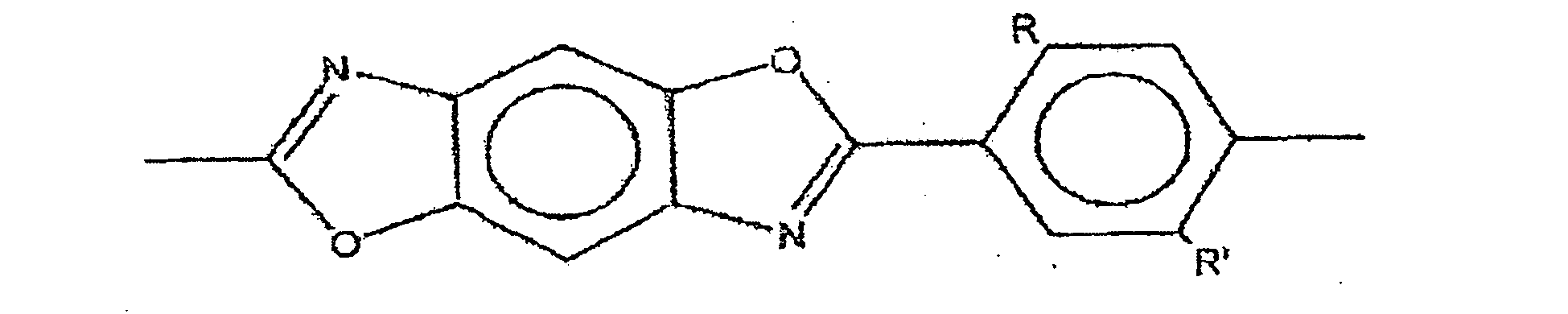
- rigid-rod benzobisazole polymers include para-ordered heterocyclic polymer having a repeat group of the formula or wherein Y is -S-, n is 1 or 2, and R is a hydroxyl group, a sulfo group or an alkyl group having 1 to 4 carbon atoms.
- rigid rod polymers include benzimidazole polymers and copolymers comprising repeat units of the formula or and include p-phenylenebenzimidazole (PBI) comprising repeat units of the formula
- benzobisazole polymers are polybenzobisoxazole polymers and copolymers comprising repeat units of the formula or and include polymers and copolymers of p-phenylenebenzobisoxazole (PBO) comprising repeat units of the formula
- benzobisazole polymers include polymers and copolymers of polybenzobisthiazole comprising repeat units of the formula or and include polymers and copolymers of p-phenylenebenzobisthiazole (PBZT) comprising repeat units of the formula both described in U.S. Pat. No. 4,533,693 .
- PBZT p-phenylenebenzobisthiazole
- benzobisazole polymers and copolymers are those p-phenylenebenzobisazole polymers and copolymers containing pendant substituents on the phenylene group, including phenylenebenzobisazoles with pendant hydroxyl groups, such as dihydroxyphenylene-benzobisoxazole (Di-OH PBO), comprising repeat units of the formula dihydroxy-phenylenebenzobisimidazole (Di-OH PBI) comprising repeat units of the formula dihydroxyphenylenebenzobisthiazole (Di-OH PBZT), comprising repeat units of the formula described in U.S. Pat. Nos.
- Di-OH PBO dihydroxyphenylene-benzobisoxazole
- DI-OH PBI dihydroxy-phenylenebenzobisimidazole
- DI-OH PBZT dihydroxyphenylenebenzobisthiazole
- dihydroxyphenylenepyridobisimidazole comprising repeat units of the formula and described in U.S. Pat. No. 5,674,969
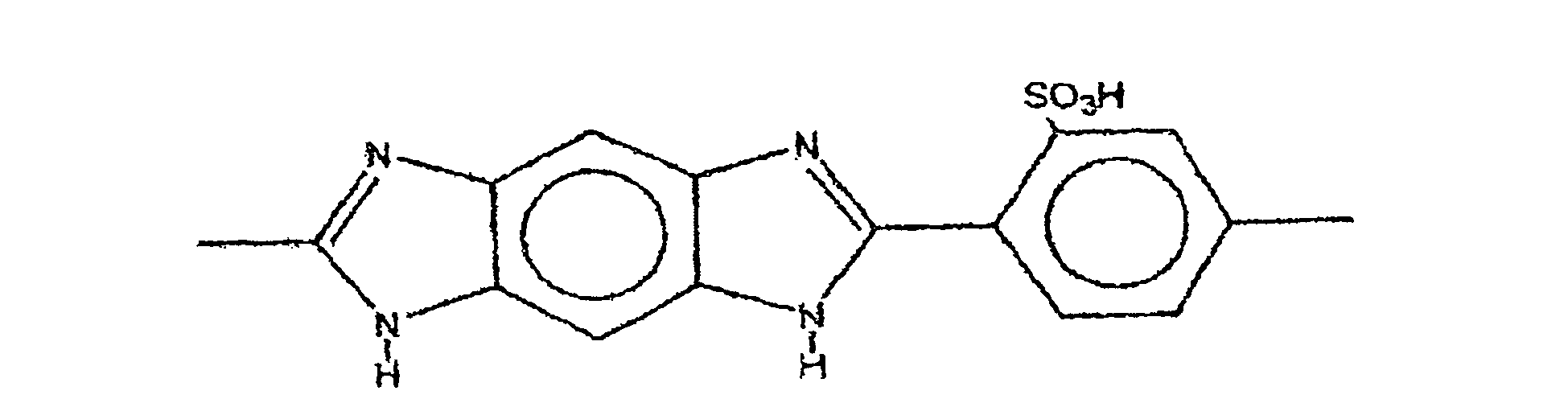
- polymers and copolymers of phenylenebenzobisazoles having pendant sulfo groups such as sulfo-phenylenebenzobisoxazole (sulfo-PBO) comprising repeat units of the formula sulfopolybenzobisimidazole (sulfo-PBI), comprising repeat units of the formula and sulfo-phenylenebenzobisthiazole (sulfo-PBZT), comprising repeat units of the formula described in U.S.
- Me-PBO methyl- and dimethylphenylenebenzobisoxazole
- Me-PBI methyl- and dimethylphenylenebenzobisimidazole
- Me-PBZT methyl- and dimethyl
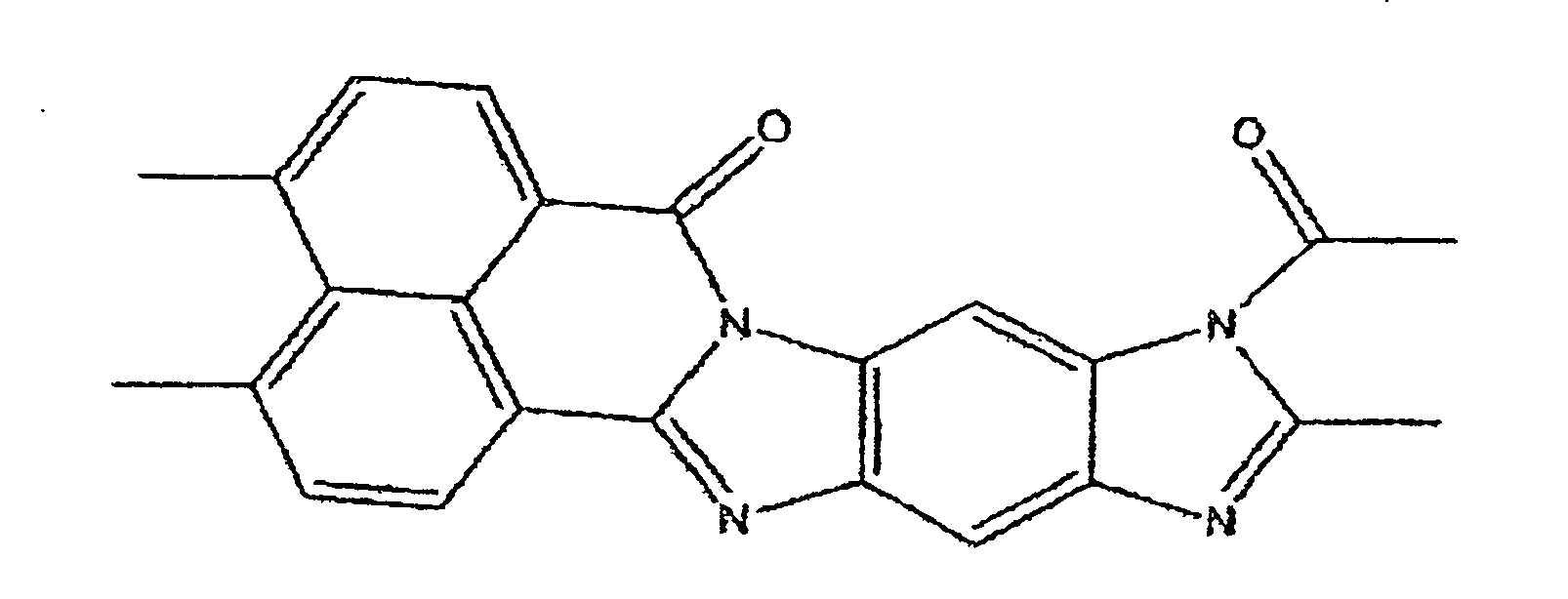
- rigid rod polymers include polymers and copolymers of benzamidazobenzophenanthroline (BBL) comprising repeat units of the formula described in U.S. Pat. No. 3,632,414 .
- BBL benzamidazobenzophenanthroline
- the rigid rod polymers and copolymers such as those based on benzobisazoles, pyridobisazoles and benzamidazobenzophenanthroline, are formed in-situ from the polycondensation of diamine and diacid monomers.
- Suitable amino-group-containing monomers include, but are not limited to: 2,5-diamino-1,4-benzenedithiol dihydrochloride, 4,6-diamino-1,3-benzenediol dihydrochloride, 1,2,4,5-tetraaminobenzene tetrahydrochloride, 2,3,5,6-tetraaminopyridine tetrahydrochloride, 2,5-diamino-1,4-benzenediol dihydrochloride, and 1,4,5,8-tetraaminonaphthalene tetrahydrochloride.
- Suitable acid-group-containing monomers include, but are not limited to: terephthalic acid, mono- and dihydroxy-terephthalic acid, 2-sulfoterephthalic acid, 1,4,5,8-tetracarboxynaphthalene, 2-methylterephthalic acid, 2,5-dimethyl-terephthalic acid, 1,5-dicarboxynaphthalene, and 2,6-dicarboxynaphthalene.
- the in-situ polymerizations may be conducted in any suitable medium in which the rigid-rod polymers can be formed and maintained in solution.
- a suitable medium for carrying out the polycondensation polymerizations of the present invention comprises polyphosphoric acid (PPA), having a formula represented by H n +2 P n O 3 n +1 or HO-(PO 3 H) n -H.
- PPA polyphosphoric acid
- the polymer concentration in the medium preferably is selected to promote the formation of an anisotropic reaction mixture.
- Polymer concentrations in the range from about 1 wt% to about 20 wt% in the medium can promote an anisotropic reaction mixture.
- the carbon nanotube concentration preferably can range from about 0.1 wt% to about 50 wt%, more preferably from about 1 wt% to about 30 wt% based on the weight of polymer in the polymerization.
- the process for making a rigid-rod polymer/nanotube composition involves synthesizing the rigid-rod polymer or copolymer in the presence of carbon nanotubes.
- stoichiometric amounts of amine hydrochloride and acid monomers are combined in 85% phosphoric acid and heated to a temperature in the range of about 60° to about 80°C to affect the thermal dehydrochlorination of the amine monomer.
- amines without protective hydrochloride is also within the scope of this invention.
- the nanotubes are added. The temperature is then raised to about 100°C and maintained for about 4 to 6 hours.
- the reaction temperature is cooled to about 45°C and phosphorous pentoxide (P 2 O 5 ) is added to make 77% PPA. After the phosphorous pentoxide addition, the temperature is increased to 100°C and maintained for about 4 hours. Additional P 2 O 5 is then added to increase the PPA concentration to about 82 to about 84% PPA. The temperature is then raised to about 165°C and maintained at that temperature for about 10 to 12 hours. The temperature of the reaction mixture is then raised to about 190°C and held for about 4 hours. The procedure results in a liquid crystalline composition comprising rigid-rod liquid crystalline polymer and nanotubes that can be extruded and processed into fiber or film.
- P 2 O 5 phosphorous pentoxide
- samples are taken to determine intrinsic viscosity and also for processing into cast films.
- the samples are precipitated into water, treated with ammonium hydroxide, washed extensively with water, and dried under reduced pressure. After precipitating into water or redissolving of dried samples in methanesulfonic acid for intrinsic viscosity measurements, the samples show no separation of the nanotubes from the derived polymer.
- Fiber spinning may be done by any suitable technique.
- One such method is dry-jet wet spinning using a piston driven spinning system.
- the polymer solution or dope comprising the rigid-rod polymer, nanotubes and phosphoric acid medium preferably is maintained between about 100°C and about 150°C.
- An air gap preferably is maintained in the range of about 2 cm and about 25 cm.
- Extruded fiber is coagulated in water at room temperature. Fiber is washed in running water for about a week or for any time sufficient to remove the acid from the fiber. The fiber is subsequently dried in vacuum at about 80°C. Dried fiber can be heat-treated in nitrogen at about 400°C to impart higher strength and tensile properties.
- the fibers of the present invention comprising rigid-rod polymer/carbon nanotube composites have significantly higher strength and tensile properties, such as higher stiffness, tensile modulus, and strain to failure (elongation to break), than like polymer fibers without nanotubes.
- Certain fibers comprising the rigid-rod polymers/nanotube composites of this invention have shown about 50% greater tensile strength than over fibers of the same polymeric composition without nanotubes. Fibers prepared with the compositions of this invention also show lower creep than like polymer fibers without carbon nanotubes.
- This composite of this invention provides a fundamental improvement in products and articles of manufacture comprising rigid-rod polymers and copolymers, and it enables new and improved articles of manufacture, including, but not limited to composite structural materials, films, coatings and fibers requiring high tensile strength such as for high-strength fibers and structural elements of machines, buildings, and vehicles.
- Improved articles of manufacture incorporating fibers of the present invention include body armor, bullet-proof vests, vehicular armor, armor for structures, elements of ballistic protection systems and as reinforcing fibers for both organic and inorganic products, such as in tires, belts, ceramics, polymer laminates for aircraft and other compositions requiring high strength materials.
- additional properties of electrical or thermal conductivity, electromagnetic and radio-frequency shielding may also be realized.
- a composition of 5% single-wall carbon nanotubes (SWNT) and 95% polyphenylenebenzobisthiazole (PBZT) was prepared as follows. Into the bottom of a 250-ml resin flask equipped with a mechanical stirrer, a nitrogen inlet and outlet, was placed 4.904 g (0.02 mol) of 2,5-diamino-1,4-benzenedithiol dihydrochloride, 3.3226 g (0.02 mol) of terephthalic acid, and 20.68 g of phosphoric acid (85%). The resulting mixture was dehydrochlorinated under nitrogen atmosphere at 65°C for 16 hours. The temperature was then raised to 80°C and held for 4 hours.
- SWNT single-wall carbon nanotubes
- PBZT polyphenylenebenzobisthiazole
- the mixture was heated at 160°C for 16 hours. As the temperature increased, stir opalescence began to occur at about 150°C. The mixture was finally heated to 190°C for an additional 4 hours. An aliquot of the polymer dope was precipitated in water, broken up with a blender, collected by suction filtration, washed with water and dried under reduced pressure (0.02 mm Hg) at 100°C for 24 hours. An intrinsic viscosity of 17 dl/g was determined in methanesulfonic acid at 30°C.
- a composition of 10% multi-wall carbon nanotubes (MWNT) and 90% polyphenylenebenzobisthiazole (PBZT) was prepared as follows. Into the bottom of a 250-ml resin flask equipped with a mechanical stirrer, a nitrogen inlet and outlet, was placed 4.904 g (0.02 mol) of 2,5-diamino-1,4-benzenedithiol dihydrochloride, 3.3226 g (0.02 mol) of terephthalic acid, and 20.68 g of phosphoric acid (85%). The resulting mixture was dehydrochlorinated under nitrogen atmosphere at 65°C for 16 hours. The temperature was then raised to 80°C and held for 4 hours.
- MWNT multi-wall carbon nanotubes
- PBZT polyphenylenebenzobisthiazole
- a composition of 5% single-wall carbon nanotubes (SWNT) and 95% polyphenylenebenzobisoxazole (PBO) was prepared as follows. Into the bottom of a 250-ml resin flask equipped with a mechanical stirrer, a nitrogen inlet and outlet, was place 4.2612 g (0.02 mol) of 1,4-diaminoresorcinol dihydrochloride, 4.0605 g (0.02 mol) of terephthaloyl chloride, and 12.14 g of phosphoric acid (85%). The resulting mixture was dehydrochlorinated under nitrogen atmosphere at 65°C for 16 hours. The temperature was then raised to 80°C and held for 4 hours.
- SWNT single-wall carbon nanotubes
- PBO polyphenylenebenzobisoxazole
- the mixture was heated at 160°C for 16 hours. As the temperature increased, stir opalescence began to occur at about 155°C. The mixture was finally heated to 190°C for an additional 4 hours. An aliquot of the polymer dope was precipitated in water, broken up with a blender, collected by suction filtration, washed with water and dried under reduced pressure (0.02 mmHg) at 100°C for 24 hours. An intrinsic viscosity of 14 dl/g was determined in methanesulfonic acid, at 30°C.
- a composition of 10% single-wall carbon nanotubes (SWNT) and 90% polyphenylenebenzobisoxazole (PBO) was prepared as follows. Into the bottom of a 250-ml resin flask equipped with a mechanical stirrer, a nitrogen inlet and outlet, was placed 4.2612 g (0.02 mol) of 1,4-diaminoresorcinol dihydrochloride, 4.0605 g (0.02 mol) of terephthaloyl chloride, and 12.14 g of phosphoric acid (85%). The resulting mixture was dehydrochlorinated under nitrogen atmosphere at 65°C for 16 hours. The temperature was then raised to 80°C and held for 4 hours.
- SWNT single-wall carbon nanotubes
- PBO polyphenylenebenzobisoxazole
- a composition of 20% single-wall carbon nanotubes (SWNT) and 80% polyphenylenebenzobisoxazole (PBO) was prepared as follows. Into the bottom of a 250-ml resin flask equipped with a mechanical stirrer, a nitrogen inlet and outlet, was placed 4.2612 g (0.02 mol) of 1,4-diaminoresorcinol dihydrochloride, 4.0605 g (0.02 mol) of terephthaloyl chloride, and 16.87g of phosphoric acid (85%). The resulting mixture was dehydrochlorinated under nitrogen atmosphere at 65°C for 16 hours. The temperature was then raised to 80°C and held for 4 hours.
- SWNT single-wall carbon nanotubes
- PBO polyphenylenebenzobisoxazole
- Polyphenylenebenzobisoxazole was prepared as follows. Into the bottom of a 250-ml resin flask equipped with a mechanical stirrer, a nitrogen inlet and outlet, was placed 4.2612 g (0.02 mol) of 1,4-diaminoresorcinol dihydrochloride, 4.0605 g (0.02 mol) of terephthaloyl chloride, and 16.87g of phosphoric acid (85%). The resulting mixture was dehydrochlorinated under nitrogen atmosphere at 65°C for 16 hours. The temperature was then raised to 80°C and held for 4 hours. The mixture was then heated at 100°C for 16 hours and then cooled to room temperature.
- a composition of 5% multi-wall carbon nanotubes (MWNT) and 95% polydihydroxyphenylenepyridobisimidazole (Di-OH-PPBI) was prepared as follows. Into the bottom of a 250-ml resin flask equipped with a mechanical stirrer, a nitrogen inlet and outlet, was placed 5.3310 g (0.02 mol) of 2,3,5,6-tetraaminopyridine-trihydrochloride-monohydrate, 4.7004 g (0.02 mol) of 2,5-dihydroxyterephthaloyl chloride, and 11.66 g of phosphoric acid (85%). The resulting mixture was dehydrochlorinated under nitrogen atmosphere at 65°C for 16 hours.
- a composition of 5% single-wall carbon nanotubes (SWNT) and 95% polydihydroxyphenylenepyridobisimidazole (Di-OH-PPBI) was prepared as follows. Into the bottom of a 250-ml resin flask equipped with a mechanical stirrer and a nitrogen inlet/outlet, was placed 5.3310 g (0.02 mol) of 2,3,5,6-tetraaminopyridine-trihydrochloride-monohydrate, 4.7004 g (0.02 mol) of 2,5-dihydroxyterephthaloyl chloride, and 11.66 g of phosphoric acid (85%). The resulting mixture was dehydrochlorinated under nitrogen atmosphere at 65°C for 16 hours.
- the temperature was then raised to 80°C and held for 4 hours.
- 0.26 g of purified SWNT HiPcoTM single-wall carbon nanotubes from Carbon Nanotechnologies, Inc., Houston, TX, purified according to the procedures given in I.W. Chiang, et al., J. Phys. Chem., Vol. 105, 2001, p. 8297 ) was added to the mixture.
- the mixture was heated at 100°C for 16 hours and then cooled to room temperature. 7.71 g of P 2 O 5 was added to the mixture to generate polyphosphoric acid (77% P 2 O 5 ).
- the mixture was then stirred for 2 hours at 80°C and cooled to room temperature.
- a composition of 5% multi-wall carbon nanotubes (MWNT) and 95% polydihydroxyphenylenebenzobisimidazole (Di-OH-PBI) was prepared as follows. Into the bottom of a 250-ml resin flask equipped with a mechanical stirrer, a nitrogen inlet and outlet, was placed 5.6804 g (0.02 mol) of 1,2,4,5-tetraaminobenzene tetrahydrochloride, 4.7004 g (0.02 mol) of 2,5-dihydroxyterephthaloyl chloride, and 12.55 g of phosphoric acid (85%). The resulting mixture was dehydrochlorinated under nitrogen atmosphere at 65°C for 16 hours. The temperature was then raised to 80°C and held for 4 hours.
- a composition of 5% multi-wall carbon nanotubes (MWNT) and 95% ladder polymer benzimidazobenzophenanthroline (BBL) was prepared as follows. Into the bottom of a 250-ml resin flask equipped with a mechanical stirrer, a nitrogen inlet and outlet, was placed 5.6804 g (0.02 mol) of 1,2,4,5-tetraaminobenzene tetrahydrochloride, 6.0842 g (0.02 mol) of 1,4,5,8-naphthalenetetracarboxylic acid, and 16.16 g of phosphoric acid (85%). The resulting mixture was dehydrochlorinated under nitrogen atmosphere at 65°C for 16 hours. The temperature was then raised to 80°C and held for 4 hours.
- MWNT multi-wall carbon nanotubes
- BBL ladder polymer benzimidazobenzophenanthroline
- the polymer dope was first preheated to 50°C for about 15 minutes.
- the polymer dope was then formed into a cylindrical shape under dry nitrogen and transferred to the spinning cylinder.
- the polymer composition was heated at 100°C for about five hours before spinning.
- a 50- ⁇ m stainless steel filter from Anderson Wire Works, Inc.
- a 30-mm spinning cylinder was used with a 28-mm diameter piston.
- the length of the air gap was 10 cm and length of the coagulation bath was 75 cm.
- Spun fiber was washed in water for one week, vacuum dried at 80°C for 12 hours and subsequently heat-treated in a Thermolyne 21100 tube furnace at 400°C in nitrogen under tension for 2 minutes.
- SWNT single-wall carbon nanotubes
- PBO polyphenylenebenzobisoxazole
- the polymer dope was first preheated to 50°C for about 15 minutes.
- the polymer dope was then formed into a cylindrical shape under dry nitrogen and transferred to the spinning cylinder.
- the polymer was heated at 100°C for about five hours before spinning.
- a 50- ⁇ m stainless steel filter (from Anderson Wire Works, Inc.) was used in-line for fiber spinning and the spinneret diameter was 250 ⁇ m.
- a 30-mm spinning cylinder was used with a 28-mm diameter piston.
- the length of the air gap was 10 cm and length of the coagulation bath was 75 cm.
- Spun fiber was washed in water for one week, vacuum dried at 80°C for 12 hours and subsequently heat-treated in a Thermolyne 21100 tube furnace at 400°C in nitrogen under tension for 2 minutes.
- the data show that tensile modulus, tensile strength, as well as elongation to break of PBO/SWNT (90/10) fiber are all higher than comparable measurements for the control PBO fiber by about 20, 60, and 40%, respectively.
- the average tensile strength values for the PBO control fibers varied between 1.8 and 2.6 GPa, while the average tensile strength values for the PBO/SWNT (90/10) fibers varied between 2.9 and 4.2.
- a tensile strength increase of 40 to 60% was obtained by incorporating 10 wt% SWNT in PBO.
- the stress-strain curves for PBO/SWNT (90/10) and PBO control fibers are shown in Figure 1 .
- the coefficient of thermal expansion (CTE) was measured for PBO and PBO/SWNT (90/10) fibers.
- the CTE data for the PBO and PBO/SWNT (90/10) fibers, shown in Figure 2 are -6 and -4 parts per million (ppm) per °C, respectively.
- PBO/SWNT (90/10) also exhibits reduced high temperature creep (measured using a TA Instruments TMA 2940) as compared to the control PBO fiber, as, as shown in Figure 3 .
- compositions and methods disclosed and claimed herein can be made and executed without undue experimentation in light of the present disclosure. While the compositions and methods of this invention have been described in terms of preferred embodiments, it will be apparent to those of skill in the art that variations may be applied to the compositions and methods and in the steps or in the sequence of steps of the method described herein without departing from the concept, spirit and scope of the invention. More specifically, it will be apparent that certain agents which are both chemically and physiologically related may be substituted for the agents described herein while the same or similar results would be achieved. All such similar substitutes and modifications apparent to those skilled in the art are deemed to be within the spirit, scope and concept of the invention as defined by the appended claims.
Landscapes
- Chemical & Material Sciences (AREA)
- Engineering & Computer Science (AREA)
- Health & Medical Sciences (AREA)
- Chemical Kinetics & Catalysis (AREA)
- Medicinal Chemistry (AREA)
- Organic Chemistry (AREA)
- Polymers & Plastics (AREA)
- Nanotechnology (AREA)
- General Chemical & Material Sciences (AREA)
- Textile Engineering (AREA)
- Ceramic Engineering (AREA)
- General Engineering & Computer Science (AREA)
- Materials Engineering (AREA)
- Condensed Matter Physics & Semiconductors (AREA)
- Life Sciences & Earth Sciences (AREA)
- General Physics & Mathematics (AREA)
- Physics & Mathematics (AREA)
- Crystallography & Structural Chemistry (AREA)
- Manufacturing & Machinery (AREA)
- Bioinformatics & Cheminformatics (AREA)
- Pharmacology & Pharmacy (AREA)
- Epidemiology (AREA)
- Composite Materials (AREA)
- Animal Behavior & Ethology (AREA)
- General Health & Medical Sciences (AREA)
- Public Health (AREA)
- Veterinary Medicine (AREA)
- Compositions Of Macromolecular Compounds (AREA)
- Macromolecular Compounds Obtained By Forming Nitrogen-Containing Linkages In General (AREA)
- Artificial Filaments (AREA)
- Carbon And Carbon Compounds (AREA)
Claims (62)
- Verfahren zur Herstellung eines Verbundstoffs, umfassend ein starres Stabpolymer und Kohlenstoffnanoröhrchen, beinhaltend das Polymerisieren eines starren Stabpolymers in Gegenwart von Kohlenstoffnanoröhrchen, wobei das starre Stabpolymer ausgewählt ist aus: Polymeren mit monomeren Wiederholungseinheiten von Benzobisazol, Pyridobisazol und Benzamidobenzophenanthrolin und Copolymeren mit Wiederholungseinheiten von Benzobisazol, Pyridobisazol oder Benzamidobenzophenanthrolin, die zudem mindestens eine weitere monomere Wiederholungseinheit enthalten, wobei die Wiederholungseinheiten von Benzobisazol, Pyridobisazol und Benzamidobenzophenanthrolin in den Polymeren oder Copolymeren gegebenenfalls substituiert sein können.
- Verfahren nach Anspruch 1, wobei das Polymer ein Flüssigkristallpolymer ist.
- Verfahren nach Anspruch 1, wobei das Polymerisieren durch Polykondensation erfolgt.
- Verfahren nach Anspruch 1, wobei die Kohlenstoffnanoröhrchen ausgewählt sind aus der Gruppe: einwandige Kohlenstoffnanoröhrchen, mehrwandige Kohlenstoffnanoröhrchen und deren Kombinationen.
- Verfahren nach Anspruch 1, wobei das starre Stabpolymer ein Benzobisazol-Polymer enthält mit einer Wiederholungsgruppe der Formel


- Verfahren nach Anspruch 1, wobei das starre Stabpolymer ein para-gestelltes heterozyklisches Polymer enthält mit einer Wiederholungsgruppe der Formel


- Verfahren nach Anspruch 1, wobei das starre Stabpolymer ein para-gestelltes heterozyklisches Polymer enthält mit einer Wiederholungsgruppe der Formel


- Verfahren nach Anspruch 7, wobei n gleich 1 ist.
- Verfahren nach Anspruch 8, wobei R gleich -HSO3 ist.
- Verfahren nach Anspruch 8, wobei R gleich -CH3 ist.
- Verfahren nach Anspruch 7, wobei n gleich 2 ist.
- Verfahren nach Anspruch 11, wobei R gleich -CH3 ist.
- Verfahren nach Anspruch 11, wobei R gleich -OH ist.
- Verfahren nach Anspruch 1, wobei das starre Stabpolymer ein Polymer ist, das eine Wiederholungsgruppe der Formel umfasst


- Verfahren nach Anspruch 1, wobei das starre Stab polymer ein Polymer ist, das eine Wiederholungsgruppe der Formel umfasst


- Verfahren nach Anspruch 1, wobei das starre Stabpolymer ein Polymer ist, das eine Wiederholungsgruppe der Formel umfasst
- Verfahren nach Anspruch 1, das zudem das Spinnen des Verbundwerkstoffs in eine Faser umfasst.
- Verfahren nach Anspruch 17, wobei die Faser mit dem Dry-Jet-Wet-Verfahren gesponnen wird.
- Verfahren nach Anspruch 18, das zudem Waschen und Trocknen der Faser umfasst.
- Verfahren nach Anspruch 18, das zudem ein Wärmebehandeln der Faser umfasst.
- Zusammensetzung, umfassend ein starres Stabpolymer und Kohlenstoffnanoröhrchen, wobei das starre Stabpolymer ausgewählt ist aus Polymeren mit monomeren Wiederholungseinheiten von Benzobisazol, Pyridobisazol und Benzamidobenzophenanthrolin; Copolymere mit Wiederholungseinheiten von Benzobisazol, Pyridobisazol oder Benzamidobenzophenanthrolin, die zudem mindestens eine weitere monomere Wiederholungseinheit enthalten, wobei die Wiederholungseinheit von Benzobisazol, Pyridobisazol und/oder Benzamidobenzophenanthrolin in den Polymere oder Copolymeren gegebenenfalls substituiert sei können, erhalten durch ein Verfahren, welches das Polymerisieren des starren Stabpolymers in Gegenwart von Kohlenstoffnanoröhrchen umfasst, wobei das starre Stabpolymer und die Kohlenstoffnanoröhrchen anisotrop ausgerichtet sind.
- Zusammensetzung nach Anspruch 21, wobei die Kohlenstoffnanoröhrchen ausgewählt sind aus der Gruppe: einwandige Kohlenstoffnanoröhrchen, mehrwandige Kohlenstoffnanoröhrchen und Kombinationen davon.
- Zusammensetzung nach Anspruch 21, wobei die Kohlenstoffnanoröhrchen in einer Konzentration im Bereich von etwa 0,1 Gewichtsprozent bis etwa 50 Gewichtsprozent, bezogen auf das Gewicht des Polymers, zugegen sind.
- Zusammensetzung nach Anspruch 21, wobei die Kohlenstoffnanoröhrchen in einer Konzentration im Bereich von etwa 1 Gewichtsprozent bis etwa 30 Gewichtsprozent, bezogen auf das Gewicht des Polymers, zugegen sind.
- Zusammensetzung nach Anspruch 21, wobei das starre Stabpolymer ein Flüssigkristallpolymer ist.
- Zusammensetzung nach Anspruch 21, wobei das starre Stabpolymer ein Benzobisazol-Polymer enthält, umfassend eine Wiederholungsgruppe der Formel


- Zusammensetzung nach Anspruch 21, wobei das starre Stabpolymer ein para-gestelltes heterozyklisches Polymer enthält, umfassend eine Wiederholungsgruppe der Formel


- Zusammensetzung nach Anspruch 21, wobei das starre Stabpolymer ein para-gestelltes heterozyklisches Polymer enthält, umfassend eine Wiederholungsgruppe der Formel


- Zusammensetzung nach Anspruch 28, wobei n gleich 1 ist.
- Zusammensetzung nach Anspruch 29, wobei R gleich -HSO3 ist.
- Zusammensetzung nach Anspruch 29, wobei R gleich -CH3 ist.
- Zusammensetzung nach Anspruch 28, wobei n gleich 2 ist.
- Zusammensetzung nach Anspruch 32, wobei R gleich -CH3 ist.
- Zusammensetzung nach Anspruch 32, wobei R gleich -OH ist.
- Zusammensetzung nach Anspruch 21, wobei das starre Stabpolymer ein Polymer ist, das eine Wiederholungsgruppe der Formel umfasst


- Zusammensetzung nach Anspruch 21, wobei das starre Stabpolymer ein Polymer ist, das eine Wiederholungsgruppe der Formel umfasst


- Zusammensetzung nach Anspruch 21, wobei das starre Stabpolymer ein Polymer ist, das eine Wiederholungsgruppe der Formel umfasst


- Zusammensetzung nach Anspruch 21, wobei das starre Stabpolymer ein Polymer ist, das eine Wiederholungsgruppe der Formel umfasst


- Zusammensetzung nach Anspruch 21, wobei das starre Stabpolymer ein Polymer ist, das eine Wiederholungsgruppe der Formel umfasst


- Zusammensetzung nach Anspruch 21, wobei das starre Stabpolymer ein Polymer ist, das eine Wiederholungsgruppe der Formel umfasst


- Zusammensetzung nach Anspruch 21, wobei das starre Stabpolymer ein Polymer ist, das eine Wiederholungsgruppe der Formel umfasst

- Zusammensetzung nach Anspruch 21, wobei das starre Stabpolymer ein Polymer ist, das eine Wiederholungsgruppe der Formel umfasst


- Zusammensetzung nach Anspruch 21, wobei das starre Stabpolymer ein Polymer ist, das eine Wiederholungsgruppe der Formel umfasst


- Zusammensetzung nach Anspruch 21, wobei das starre Stabpolymer ein Polymer ist, das eine Wiederholungsgruppe der Formel umfasst


- Zusammensetzung nach Anspruch 21, wobei das starre Stabpolymer ein Polymer ist, das eine Wiederholungsgruppe der Formel umfasst


- Zusammensetzung nach Anspruch 21, wobei das starre Stabpolymer ein Polymer ist, das eine Wiederholungsgruppe der Formel umfasst


- Zusammensetzung nach Anspruch 21, wobei das starre Stabpolymer ein Polymer ist, das eine Wiederholungsgruppe der Formel umfasst


- Zusammensetzung nach Anspruch 21, wobei das starre Stabpolymer ein Polymer ist, das eine Wiederholungsgruppe der Formel umfasst

- Zusammensetzung nach Anspruch 21, wobei das starre Stabpolymer ein Polymer ist, das eine Wiederholungsgruppe der Formel umfasst


- Zusammensetzung nach Anspruch 21, wobei das starre Stabpolymer ein Polymer ist, das eine Wiederholungsgruppe der Formel umfasst


- Zusammensetzung nach Anspruch 21, wobei das starre Stabpolymer ein Polymer ist, das eine Wiederholungsgruppe der Formel umfasst


- Zusammensetzung nach Anspruch 21, wobei das starre Stabpolymer ein Polymer ist, das eine Wiederholungsgruppe der Formel umfasst

- Zusammensetzung nach einem der Ansprüche 21 bis 52, die eine Faser ist.
- Zusammensetzung nach einem der Ansprüche 21 bis 52, die ein Film ist.
- Gegenstand, umfassend die Faser nach Anspruch 53.
- Gegenstand nach Anspruch 55, wobei der Gegenstand aus der Gruppe ausgewählt ist aus Fahrzeugpanzerung, kugelsichere Westen, Körperpanzerung und Panzerung für eine Struktur.
- Gegenstand nach Anspruch 55, wobei der Gegenstand ein Bestandteil eines ballistischen Schutzsystems ist.
- Gegenstand, umfassend den Film nach Anspruch 54.
- Gegenstand nach Anspruch 58, wobei der Gegenstand aus der Gruppe ausgewählt ist aus Fahrzeugpanzerung, kugelsichere Westen, Körperpanzerung und Panzerung für eine Struktur.
- Gegenstand nach Anspruch 58, wobei der Gegenstand ein Bestandteil eines ballistischen Schutzsystems ist.
- Gegenstand, umfassend die Zusammensetzung nach Anspruch 21.
- Gegenstand nach Anspruch 61, wobei der Gegenstand aus der Gruppe ausgewählt ist aus Gebäudebaugruppen und Maschinenbaugruppen.
Applications Claiming Priority (3)
| Application Number | Priority Date | Filing Date | Title |
|---|---|---|---|
| US31558301P | 2001-08-29 | 2001-08-29 | |
| US315583P | 2001-08-29 | ||
| PCT/US2002/027370 WO2003020638A1 (en) | 2001-08-29 | 2002-08-27 | Compositions comprising rigid-rod polymers and carbon nanotubes and process for making the same |
Publications (2)
| Publication Number | Publication Date |
|---|---|
| EP1421032A1 EP1421032A1 (de) | 2004-05-26 |
| EP1421032B1 true EP1421032B1 (de) | 2008-11-19 |
Family
ID=23225092
Family Applications (1)
| Application Number | Title | Priority Date | Filing Date |
|---|---|---|---|
| EP02763558A Expired - Lifetime EP1421032B1 (de) | 2001-08-29 | 2002-08-27 | Zusammensetzungen, welche stäbchenförmige polymere und nanoröhrenförmige strukturen umfassen, sowie verfahren zur herstellung derselben |
Country Status (6)
| Country | Link |
|---|---|
| US (1) | US6900264B2 (de) |
| EP (1) | EP1421032B1 (de) |
| JP (1) | JP2005501935A (de) |
| AT (1) | ATE414675T1 (de) |
| DE (1) | DE60229955D1 (de) |
| WO (1) | WO2003020638A1 (de) |
Families Citing this family (111)
| Publication number | Priority date | Publication date | Assignee | Title |
|---|---|---|---|---|
| US9056783B2 (en) | 1998-12-17 | 2015-06-16 | Hach Company | System for monitoring discharges into a waste water collection system |
| US20110125412A1 (en) * | 1998-12-17 | 2011-05-26 | Hach Company | Remote monitoring of carbon nanotube sensor |
| US7454295B2 (en) | 1998-12-17 | 2008-11-18 | The Watereye Corporation | Anti-terrorism water quality monitoring system |
| US8958917B2 (en) | 1998-12-17 | 2015-02-17 | Hach Company | Method and system for remote monitoring of fluid quality and treatment |
| US6689835B2 (en) * | 2001-04-27 | 2004-02-10 | General Electric Company | Conductive plastic compositions and method of manufacture thereof |
| US6723299B1 (en) | 2001-05-17 | 2004-04-20 | Zyvex Corporation | System and method for manipulating nanotubes |
| JP3852681B2 (ja) * | 2001-10-12 | 2006-12-06 | 東洋紡績株式会社 | ポリベンザゾール繊維 |
| JP4524060B2 (ja) * | 2002-02-08 | 2010-08-11 | 東洋紡績株式会社 | 産業資材用制電ポリベンザゾール組成物 |
| US7423084B2 (en) * | 2002-02-15 | 2008-09-09 | Dsm Ip Assets B.V. | Method of producing high strength elongated products containing nanotubes |
| AU2003230105A1 (en) * | 2002-02-20 | 2003-09-09 | Electrovac Fabrikation Elektrotechnischer Speziala | Flame retardant polymer composites and method of fabrication |
| US6764628B2 (en) * | 2002-03-04 | 2004-07-20 | Honeywell International Inc. | Composite material comprising oriented carbon nanotubes in a carbon matrix and process for preparing same |
| US6905667B1 (en) * | 2002-05-02 | 2005-06-14 | Zyvex Corporation | Polymer and method for using the polymer for noncovalently functionalizing nanotubes |
| US20040034177A1 (en) | 2002-05-02 | 2004-02-19 | Jian Chen | Polymer and method for using the polymer for solubilizing nanotubes |
| CA2584508A1 (en) | 2002-05-09 | 2003-11-09 | Institut National De La Recherche Scientifique | Method for producing single-wall carbon nanotubes |
| US7153903B1 (en) * | 2002-06-19 | 2006-12-26 | The Board Of Regents Of The University Of Oklahoma | Carbon nanotube-filled composites prepared by in-situ polymerization |
| US8920619B2 (en) | 2003-03-19 | 2014-12-30 | Hach Company | Carbon nanotube sensor |
| US7285591B2 (en) * | 2003-03-20 | 2007-10-23 | The Trustees Of The University Of Pennsylvania | Polymer-nanotube composites, fibers, and processes |
| US20040211942A1 (en) * | 2003-04-28 | 2004-10-28 | Clark Darren Cameron | Electrically conductive compositions and method of manufacture thereof |
| JP2007516314A (ja) | 2003-05-22 | 2007-06-21 | ザイベックス コーポレーション | ナノコンポジットおよびナノコンポジットに関する方法 |
| US20040232389A1 (en) * | 2003-05-22 | 2004-11-25 | Elkovitch Mark D. | Electrically conductive compositions and method of manufacture thereof |
| US7956108B2 (en) | 2003-05-30 | 2011-06-07 | The Provost, Fellows And Scholars Of The College Of The Holy And Undivided Trinity Of Queen Elizabeth, Near Dublin | Product |
| US20040262581A1 (en) * | 2003-06-27 | 2004-12-30 | Rodrigues David E. | Electrically conductive compositions and method of manufacture thereof |
| US20050188831A1 (en) * | 2003-07-11 | 2005-09-01 | Us Global Nanospace, Inc. | Ballistic resistant turret and method of making same |
| WO2005015574A1 (en) * | 2003-08-08 | 2005-02-17 | General Electric Company | Electrically conductive compositions comprising carbon nanotubes and method of manufacture thereof |
| US7026432B2 (en) * | 2003-08-12 | 2006-04-11 | General Electric Company | Electrically conductive compositions and method of manufacture thereof |
| US7354988B2 (en) | 2003-08-12 | 2008-04-08 | General Electric Company | Electrically conductive compositions and method of manufacture thereof |
| US7414088B1 (en) | 2003-09-05 | 2008-08-19 | The Board Of Regents For Oklahoma State University | Polymers grafted to carbon nanotubes |
| US7309727B2 (en) | 2003-09-29 | 2007-12-18 | General Electric Company | Conductive thermoplastic compositions, methods of manufacture and articles derived from such compositions |
| US20050070658A1 (en) * | 2003-09-30 | 2005-03-31 | Soumyadeb Ghosh | Electrically conductive compositions, methods of manufacture thereof and articles derived from such compositions |
| US7759413B2 (en) * | 2003-10-30 | 2010-07-20 | The Trustees Of The University Of Pennsylvania | Dispersion method |
| US7265175B2 (en) * | 2003-10-30 | 2007-09-04 | The Trustees Of The University Of Pennsylvania | Flame retardant nanocomposite |
| US7013998B2 (en) * | 2003-11-20 | 2006-03-21 | Halliburton Energy Services, Inc. | Drill bit having an improved seal and lubrication method using same |
| US7296576B2 (en) | 2004-08-18 | 2007-11-20 | Zyvex Performance Materials, Llc | Polymers for enhanced solubility of nanomaterials, compositions and methods therefor |
| US7425368B2 (en) * | 2004-08-20 | 2008-09-16 | Massachusetts Institute Of Technology | Filler-enhanced polymeric fibers with improved mechanical properties and method for making |
| US7316789B2 (en) * | 2004-11-02 | 2008-01-08 | International Business Machines Corporation | Conducting liquid crystal polymer nature comprising carbon nanotubes, use thereof and method of fabrication |
| US7635518B1 (en) * | 2005-02-04 | 2009-12-22 | University Of Louisiana At Lafayette | Dendritic magnetic nanostructures and method for making same |
| US7462656B2 (en) | 2005-02-15 | 2008-12-09 | Sabic Innovative Plastics Ip B.V. | Electrically conductive compositions and method of manufacture thereof |
| JP5036700B2 (ja) * | 2005-03-28 | 2012-09-26 | イー・アイ・デュポン・ドウ・ヌムール・アンド・カンパニー | ポリアレーンアゾール重合体の製造方法 |
| JP5090336B2 (ja) | 2005-03-28 | 2012-12-05 | イー・アイ・デュポン・ドウ・ヌムール・アンド・カンパニー | ポリアレーンアゾール繊維からカチオンを除去する方法 |
| US7776246B2 (en) * | 2005-03-28 | 2010-08-17 | E. I. Du Pont De Nemours And Company | Process for the production of polyarenazole yarn |
| WO2006105080A1 (en) * | 2005-03-28 | 2006-10-05 | E.I. Du Pont De Nemours And Company | Processes for increasing polymer inherent viscosity |
| CN101258272B (zh) * | 2005-03-28 | 2010-12-29 | 纳幕尔杜邦公司 | 热表面水解纺成纱线中的多磷酸 |
| US7977453B2 (en) * | 2005-03-28 | 2011-07-12 | E. I. Du Pont De Nemours And Company | Processes for hydrolyzing polyphosphoric acid in shaped articles |
| WO2006105227A1 (en) * | 2005-03-28 | 2006-10-05 | E. I. Du Pont De Nemours And Company | Thermal processes for increasing polyareneazole inherent viscosities |
| JP5302674B2 (ja) * | 2005-03-28 | 2013-10-02 | イー・アイ・デュポン・ドウ・ヌムール・アンド・カンパニー | 金属粉末を使用する固有粘度が高いポリアレンアゾールの製造法 |
| CN101203547A (zh) * | 2005-03-28 | 2008-06-18 | 纳幕尔杜邦公司 | 高特性粘度聚合物和由其制成的纤维 |
| EP1863957B1 (de) | 2005-03-28 | 2012-06-13 | E.I. Du Pont De Nemours And Company | Verfahren zur hydrolysierung von phosphorsäure in einem fasergarn |
| JP4769292B2 (ja) | 2005-03-28 | 2011-09-07 | イー・アイ・デュポン・ドウ・ヌムール・アンド・カンパニー | ポリアレーンアゾールフィラメント中のポリ燐酸に加水分解を受けさせる方法 |
| US8202965B2 (en) * | 2005-03-28 | 2012-06-19 | E.I. Du Pont De Nemours And Company | Fusion free hydrolysis of polyphosphoric acid in spun multifilament yarns |
| US7851584B2 (en) * | 2005-03-28 | 2010-12-14 | E. I. Du Pont De Nemours And Company | Process for preparing monomer complexes |
| ATE502143T1 (de) * | 2005-03-28 | 2011-04-15 | Du Pont | Polyareneazolpolymerfasern mit hängenden hydroxylgruppen und kationen |
| WO2006105230A1 (en) * | 2005-03-28 | 2006-10-05 | E. I. Du Pont De Nemours And Company | Process for the production of polyareneazole polymer |
| US7888457B2 (en) | 2005-04-01 | 2011-02-15 | E. I. Du Pont De Nemours And Company | Process for removing phosphorous from a fiber or yarn |
| US8033501B2 (en) * | 2005-06-10 | 2011-10-11 | The Boeing Company | Method and apparatus for attaching electrically powered seat track cover to through hole seat track design |
| KR100707357B1 (ko) * | 2005-06-23 | 2007-04-13 | (주)그라쎌 | 전기 발광 재료용 유기 금속착물의 전구체 화합물 |
| US7722796B1 (en) * | 2005-08-05 | 2010-05-25 | Wright State University | Fabrication of small diameter continuous fibers |
| EP1963567B1 (de) * | 2005-12-21 | 2010-10-27 | E.I. Du Pont De Nemours And Company | Pipd-papier und daraus hergestellte komponenten |
| JP2009521622A (ja) * | 2005-12-21 | 2009-06-04 | イー・アイ・デュポン・ドウ・ヌムール・アンド・カンパニー | Pipd繊維を含有する摩擦紙 |
| US8264137B2 (en) * | 2006-01-03 | 2012-09-11 | Samsung Electronics Co., Ltd. | Curing binder material for carbon nanotube electron emission cathodes |
| US7863381B2 (en) * | 2006-03-08 | 2011-01-04 | 3M Innovative Properties Company | Polymer composites |
| US20070283801A1 (en) * | 2006-06-09 | 2007-12-13 | Armorsmith Company | Armor apparatus and method |
| CN101086939B (zh) * | 2006-06-09 | 2010-05-12 | 清华大学 | 场发射元件及其制备方法 |
| CN101093764B (zh) | 2006-06-23 | 2012-03-28 | 清华大学 | 场发射元件及其制备方法 |
| CN101093765B (zh) * | 2006-06-23 | 2011-06-08 | 清华大学 | 场发射元件及其制备方法 |
| US8158217B2 (en) * | 2007-01-03 | 2012-04-17 | Applied Nanostructured Solutions, Llc | CNT-infused fiber and method therefor |
| US8951631B2 (en) | 2007-01-03 | 2015-02-10 | Applied Nanostructured Solutions, Llc | CNT-infused metal fiber materials and process therefor |
| US9005755B2 (en) | 2007-01-03 | 2015-04-14 | Applied Nanostructured Solutions, Llc | CNS-infused carbon nanomaterials and process therefor |
| US8951632B2 (en) | 2007-01-03 | 2015-02-10 | Applied Nanostructured Solutions, Llc | CNT-infused carbon fiber materials and process therefor |
| US20090081383A1 (en) * | 2007-09-20 | 2009-03-26 | Lockheed Martin Corporation | Carbon Nanotube Infused Composites via Plasma Processing |
| US20090081441A1 (en) * | 2007-09-20 | 2009-03-26 | Lockheed Martin Corporation | Fiber Tow Comprising Carbon-Nanotube-Infused Fibers |
| US20100047549A1 (en) * | 2008-08-20 | 2010-02-25 | Lockheed Martin Corporation | Ballistic Material with Enhanced Polymer Matrix and Method for Production Thereof |
| BRPI1007300A2 (pt) | 2009-02-17 | 2019-09-24 | Applied Nanostructured Sols | compósitos compreendendo nanotubos de carbono sobre fibra |
| CN102333906B (zh) * | 2009-02-27 | 2015-03-11 | 应用纳米结构方案公司 | 使用气体预热法的低温cnt生长 |
| US20100227134A1 (en) | 2009-03-03 | 2010-09-09 | Lockheed Martin Corporation | Method for the prevention of nanoparticle agglomeration at high temperatures |
| BRPI1016244A2 (pt) | 2009-04-24 | 2016-04-26 | Applied Nanostructured Sols | compósito de proteção contra emi infundido com cnt e revestimento. |
| US9111658B2 (en) | 2009-04-24 | 2015-08-18 | Applied Nanostructured Solutions, Llc | CNS-shielded wires |
| JP5744008B2 (ja) | 2009-04-27 | 2015-07-01 | アプライド ナノストラクチャード ソリューションズ リミテッド ライアビリティー カンパニーApplied Nanostructuredsolutions, Llc | 複合材料構造体を除氷するためのcntベース抵抗加熱 |
| KR20120036890A (ko) | 2009-08-03 | 2012-04-18 | 어플라이드 나노스트럭처드 솔루션스, 엘엘씨. | 복합재 섬유에 나노입자의 결합 |
| US10167572B2 (en) * | 2009-08-07 | 2019-01-01 | Guardian Glass, LLC | Large area deposition of graphene via hetero-epitaxial growth, and products including the same |
| US8507797B2 (en) | 2009-08-07 | 2013-08-13 | Guardian Industries Corp. | Large area deposition and doping of graphene, and products including the same |
| US10164135B2 (en) * | 2009-08-07 | 2018-12-25 | Guardian Glass, LLC | Electronic device including graphene-based layer(s), and/or method or making the same |
| US8236118B2 (en) | 2009-08-07 | 2012-08-07 | Guardian Industries Corp. | Debonding and transfer techniques for hetero-epitaxially grown graphene, and products including the same |
| CN102596715A (zh) | 2009-11-23 | 2012-07-18 | 应用纳米结构方案公司 | Cnt特制复合材料地面基结构 |
| EP2504164A4 (de) * | 2009-11-23 | 2013-07-17 | Applied Nanostructured Sols | Keramikverbundmaterialien mit kohlenstoffnanoröhreninfundierten fasermaterialien sowie herstellungsverfahren dafür |
| BR112012012979A2 (pt) | 2009-12-14 | 2019-09-24 | Applied Nanostructured Sols | materias compostos resistentes à chama e artigos contendo materiais de fibra infundidos de nanotubo de carbono. |
| US8808810B2 (en) * | 2009-12-15 | 2014-08-19 | Guardian Industries Corp. | Large area deposition of graphene on substrates, and products including the same |
| US9167736B2 (en) | 2010-01-15 | 2015-10-20 | Applied Nanostructured Solutions, Llc | CNT-infused fiber as a self shielding wire for enhanced power transmission line |
| AU2011256789A1 (en) | 2010-02-02 | 2012-07-12 | Applied Nanostructured Solutions, Llc | Fiber containing parallel-aligned carbon nanotubes |
| EP2543052B1 (de) | 2010-03-02 | 2019-11-27 | Applied NanoStructured Solutions, LLC | Elektrische vorrichtung mit kohlenstoffnanoröhrchen-infundierten fasern sowie herstellungsverfahren dafür |
| JP2013521656A (ja) | 2010-03-02 | 2013-06-10 | アプライド ナノストラクチャード ソリューションズ リミテッド ライアビリティー カンパニー | カーボン・ナノチューブ浸出電極材料を含む螺旋に巻き付けられた電気機器及びその生産方法並びに生産装置 |
| US8460747B2 (en) * | 2010-03-04 | 2013-06-11 | Guardian Industries Corp. | Large-area transparent conductive coatings including alloyed carbon nanotubes and nanowire composites, and methods of making the same |
| US8604332B2 (en) * | 2010-03-04 | 2013-12-10 | Guardian Industries Corp. | Electronic devices including transparent conductive coatings including carbon nanotubes and nanowire composites, and methods of making the same |
| US8518472B2 (en) * | 2010-03-04 | 2013-08-27 | Guardian Industries Corp. | Large-area transparent conductive coatings including doped carbon nanotubes and nanowire composites, and methods of making the same |
| US8780526B2 (en) | 2010-06-15 | 2014-07-15 | Applied Nanostructured Solutions, Llc | Electrical devices containing carbon nanotube-infused fibers and methods for production thereof |
| US9017854B2 (en) | 2010-08-30 | 2015-04-28 | Applied Nanostructured Solutions, Llc | Structural energy storage assemblies and methods for production thereof |
| AU2011302314A1 (en) | 2010-09-14 | 2013-02-28 | Applied Nanostructured Solutions, Llc | Glass substrates having carbon nanotubes grown thereon and methods for production thereof |
| AU2011305809A1 (en) | 2010-09-22 | 2013-02-28 | Applied Nanostructured Solutions, Llc | Carbon fiber substrates having carbon nanotubes grown thereon and processes for production thereof |
| WO2012040038A2 (en) | 2010-09-23 | 2012-03-29 | Applied Nanostructured Solutions, Llc | Cnt-infused fiber as a self shielding wire for enhanced power transmission line |
| US9085464B2 (en) | 2012-03-07 | 2015-07-21 | Applied Nanostructured Solutions, Llc | Resistance measurement system and method of using the same |
| US9850596B2 (en) | 2012-08-22 | 2017-12-26 | TJC Polymer Inc. | Composites comprising rigid-rod polymers and graphene nanoparticles and process for making the same |
| US9593019B2 (en) | 2013-03-15 | 2017-03-14 | Guardian Industries Corp. | Methods for low-temperature graphene precipitation onto glass, and associated articles/devices |
| US10431354B2 (en) | 2013-03-15 | 2019-10-01 | Guardian Glass, LLC | Methods for direct production of graphene on dielectric substrates, and associated articles/devices |
| US9115266B2 (en) | 2013-07-31 | 2015-08-25 | E I Du Pont De Nemours And Company | Carbon nanotube-polymer composite and process for making same |
| EP3145703A1 (de) * | 2014-05-21 | 2017-03-29 | BAE Systems PLC | Generative fertigung von verbundstoffmaterialien |
| US10145005B2 (en) | 2015-08-19 | 2018-12-04 | Guardian Glass, LLC | Techniques for low temperature direct graphene growth on glass |
| CN109232234B (zh) * | 2018-10-12 | 2021-04-23 | 株洲时代新材料科技股份有限公司 | 一种2,5-二羟基对苯二甲酰氯及其制备方法 |
| US11421090B2 (en) | 2018-10-24 | 2022-08-23 | Massachusetts Institute Of Technology | Systems, devices, and methods for promoting in situ polymerization within nanomaterial assemblies |
| WO2023049606A1 (en) * | 2021-09-22 | 2023-03-30 | ExxonMobil Technology and Engineering Company | Polymer-nanocarbon composites |
| CN113861950B (zh) * | 2021-10-11 | 2022-12-06 | 佛山电器照明股份有限公司 | 各向异性pbo纳米纤维散热复合材料及其制备方法 |
| JPWO2023136037A1 (de) * | 2022-01-12 | 2023-07-20 | ||
| CN114805799B (zh) * | 2022-05-18 | 2024-03-19 | 哈尔滨工业大学 | 一种pipd-swcnt共聚物的制备方法及应用 |
Family Cites Families (34)
| Publication number | Priority date | Publication date | Assignee | Title |
|---|---|---|---|---|
| US3632414A (en) | 1969-06-26 | 1972-01-04 | Us Air Force | Method of preparing films and coatings of heterocyclic-aromatic polymers |
| US3901855A (en) | 1974-08-07 | 1975-08-26 | Us Air Force | Preparation of polybenzimidazoles |
| US4533693A (en) | 1982-09-17 | 1985-08-06 | Sri International | Liquid crystalline polymer compositions, process, and products |
| US4703103A (en) * | 1984-03-16 | 1987-10-27 | Commtech International | Liquid crystalline polymer compositions, process and products |
| US5098988A (en) | 1989-07-13 | 1992-03-24 | The United States Of America As Represented By The Secretary Of The Air Force | Crosslinkable rigid-rod benzobisazole copolymer |
| US5001217A (en) | 1989-07-13 | 1991-03-19 | The United States Of America As Represented By The Secretary Of The Air Force | Crosslinkable rigid-rod benzobisazole polymers |
| US5041522A (en) | 1990-03-23 | 1991-08-20 | The United States Of America As Represented By The Secretary Of The Air Force | Dihydroxy-pendant rigid-rod benzobisazole polymer |
| US5039778A (en) | 1990-03-23 | 1991-08-13 | The United States Of America As Represented By The Secretary Of The Air Force | Dihydroxy-pendant rigid-rod benzobisazole copolymer |
| US5136012A (en) | 1990-03-23 | 1992-08-04 | United States Of America As Represented By The Secretary Of The Air Force | Dihydroxy-pendant rigid-rod benzobisazole copolymer |
| US5674967A (en) | 1990-04-03 | 1997-10-07 | Ppg Industries, Inc. | Water repellent surface treatment with integrated primer |
| DE4207246A1 (de) * | 1992-03-07 | 1993-09-09 | Basf Ag | Abriebarme thermoplastformmassen |
| US5312876A (en) | 1993-03-12 | 1994-05-17 | The United States Of America As Represented By The Secretary Of The Air Force | Water soluble rigid-rod polymer |
| US5312895A (en) | 1993-03-12 | 1994-05-17 | The United States Of America As Represented By The Secretary Of The Air Force | Benzobisazole copolymer system soluble in aprotic solvents |
| US5276085A (en) * | 1993-04-23 | 1994-01-04 | E. I. Du Pont De Nemours And Company | Aromatic polyamide compositions and fibers |
| DE4411756A1 (de) * | 1994-04-06 | 1995-10-19 | Hoechst Ag | Zusammensetzungen enthaltend aromatische Polyamide und Fullerene, Verfahren zu deren Herstellung, geformte Gebilde daraus sowie deren Verwendung |
| US6203814B1 (en) * | 1994-12-08 | 2001-03-20 | Hyperion Catalysis International, Inc. | Method of making functionalized nanotubes |
| US5512368A (en) * | 1995-03-16 | 1996-04-30 | E. I. Du Pont De Nemours And Company | Fibers reinforced with inorganic whiskers |
| US5997832A (en) * | 1997-03-07 | 1999-12-07 | President And Fellows Of Harvard College | Preparation of carbide nanorods |
| ATE299474T1 (de) * | 1997-03-07 | 2005-07-15 | Univ Rice William M | Kohlenstofffasern ausgehend von einwandigen kohlenstoffnanoröhren |
| JP3906954B2 (ja) * | 1997-06-10 | 2007-04-18 | 東洋紡績株式会社 | 4,6−ジアミノレゾルシノール及び/又はその塩、それより得られるポリベンズビスオキサゾールの製造方法及びその成形体 |
| KR100414697B1 (ko) * | 1999-01-25 | 2004-01-13 | 리카가쿠 겐큐쇼 | 감광성 수지조성물 및 이를 사용한 반도체장치 |
| JP2001011311A (ja) * | 1999-06-30 | 2001-01-16 | Toyobo Co Ltd | 耐光性ポリベンザゾール組成物、その繊維およびフィルム |
| JP2001098160A (ja) * | 1999-09-30 | 2001-04-10 | Sumitomo Bakelite Co Ltd | 絶縁材用樹脂組成物及びこれを用いた絶縁材 |
| JP3685049B2 (ja) * | 1999-12-06 | 2005-08-17 | 東洋紡績株式会社 | ポリベンザゾールおよびその繊維 |
| JP3918976B2 (ja) * | 1999-12-22 | 2007-05-23 | 東洋紡績株式会社 | フェニレンジアミン誘導体塩酸塩の保存方法 |
| EP1313900A4 (de) | 2000-08-24 | 2011-12-07 | Univ Rice William M | Einwandige kohlenstoffnanoröhren umwickelt mit polymeren |
| JP4586251B2 (ja) * | 2000-09-22 | 2010-11-24 | 東レ株式会社 | 燃料電池用セパレーター |
| JP2002105329A (ja) * | 2000-09-29 | 2002-04-10 | Toray Ind Inc | 熱可塑性樹脂組成物及び成形品 |
| JP2003012939A (ja) * | 2001-07-03 | 2003-01-15 | Toray Ind Inc | カーボン含有樹脂組成物、成形材料および成形体 |
| JP2003027722A (ja) * | 2001-07-13 | 2003-01-29 | Hagihara Industries Inc | 畳床被覆用防水シート |
| US6680016B2 (en) * | 2001-08-17 | 2004-01-20 | University Of Dayton | Method of forming conductive polymeric nanocomposite materials |
| JP3852681B2 (ja) * | 2001-10-12 | 2006-12-06 | 東洋紡績株式会社 | ポリベンザゾール繊維 |
| JP4524060B2 (ja) * | 2002-02-08 | 2010-08-11 | 東洋紡績株式会社 | 産業資材用制電ポリベンザゾール組成物 |
| JP2003234013A (ja) * | 2002-02-08 | 2003-08-22 | Toyobo Co Ltd | 電気伝導体 |
-
2002
- 2002-08-27 DE DE60229955T patent/DE60229955D1/de not_active Expired - Fee Related
- 2002-08-27 JP JP2003524911A patent/JP2005501935A/ja active Pending
- 2002-08-27 US US10/228,483 patent/US6900264B2/en not_active Expired - Fee Related
- 2002-08-27 WO PCT/US2002/027370 patent/WO2003020638A1/en not_active Ceased
- 2002-08-27 EP EP02763558A patent/EP1421032B1/de not_active Expired - Lifetime
- 2002-08-27 AT AT02763558T patent/ATE414675T1/de not_active IP Right Cessation
Also Published As
| Publication number | Publication date |
|---|---|
| US6900264B2 (en) | 2005-05-31 |
| WO2003020638A1 (en) | 2003-03-13 |
| ATE414675T1 (de) | 2008-12-15 |
| DE60229955D1 (de) | 2009-01-02 |
| JP2005501935A (ja) | 2005-01-20 |
| US20030083421A1 (en) | 2003-05-01 |
| EP1421032A1 (de) | 2004-05-26 |
Similar Documents
| Publication | Publication Date | Title |
|---|---|---|
| EP1421032B1 (de) | Zusammensetzungen, welche stäbchenförmige polymere und nanoröhrenförmige strukturen umfassen, sowie verfahren zur herstellung derselben | |
| EP1574551B1 (de) | Verbundfaser mit vollaromatischem polyamid und kohlenstoffnanoröhrchen | |
| US20040022981A1 (en) | Composite of single-wall carbon nanotubes and aromatic polyamide and process for making the same | |
| US10323338B2 (en) | Process for making composites comprising rigid-rod polymers and graphene nanoparticles | |
| EP0672199B1 (de) | Polybenzazolfasern mit ultrahohen physikalischen eigenschaften und verfahren zu ihrer herstellung | |
| Hwang et al. | Solution processing and properties of molecular composite fibers and films | |
| US6852410B2 (en) | Macroscopic fiber comprising single-wall carbon nanotubes and acrylonitrile-based polymer and process for making the same | |
| US7976945B2 (en) | Flame resistant fiber, carbon fiber and production method thereof | |
| EP1449942B1 (de) | Polybenzazolfaser | |
| CN101687988A (zh) | 聚苯唑和聚苯唑前体 | |
| Hu et al. | One-pot preparation and continuous spinning of carbon nanotube/poly (p-phenylene benzobisoxazole) copolymer fibers | |
| JP2007145677A (ja) | 芳香族ポリアミドにより被覆された窒化ホウ素ナノチューブ | |
| Li et al. | Mechanical reinforcement of PBO fibers by dicarboxylic acid functionalized carbon nanotubes through in situ copolymerization | |
| KR20220094640A (ko) | 파라-아라미드 섬유의 제조 방법 및 이로부터 제조되는 파라-아라미드 | |
| JP4456965B2 (ja) | 全芳香族ポリアミドと単層カーボンナノチューブとからなるコンポジットファイバー | |
| Shen et al. | Breaking the strength-toughness trade-off in high-performance polyimide nanocomposites using solution-processable aminated heterocyclic polyamide-grafted graphene oxide at ultralow loading | |
| Kim | Study of Polyacrylonitrile/Cellulose Nanocrystal Composite Fibers via In-situ Polymerization, and Super Engineering Plastic Based Nano Composite Fibers | |
| Dang et al. | Alignment of SWNTs in lyotropic rigid-rod polymer compositions | |
| Park et al. | Significant enhancement in compressive strength of poly (p-phenylenebenzobisoxazole) fibers by incorporation of carbon nanofibers | |
| KR20210039952A (ko) | 아라미드 나노섬유를 포함하는 고분자 복합소재 및 이의 제조방법 | |
| HK1085754B (en) | Composite fiber comprising wholly aromatic polyamide and carbon nanotube | |
| JPH0815587A (ja) | 高抗張力光ファイバー用テンションメンバー |
Legal Events
| Date | Code | Title | Description |
|---|---|---|---|
| PUAI | Public reference made under article 153(3) epc to a published international application that has entered the european phase |
Free format text: ORIGINAL CODE: 0009012 |
|
| 17P | Request for examination filed |
Effective date: 20040324 |
|
| AK | Designated contracting states |
Kind code of ref document: A1 Designated state(s): AT BE BG CH CY CZ DE DK EE ES FI FR GB GR IE IT LI LU MC NL PT SE SK TR |
|
| AX | Request for extension of the european patent |
Extension state: AL LT LV MK RO SI |
|
| 17Q | First examination report despatched |
Effective date: 20040604 |
|
| 17Q | First examination report despatched |
Effective date: 20040604 |
|
| 17Q | First examination report despatched |
Effective date: 20040604 |
|
| 17Q | First examination report despatched |
Effective date: 20040604 |
|
| GRAP | Despatch of communication of intention to grant a patent |
Free format text: ORIGINAL CODE: EPIDOSNIGR1 |
|
| GRAS | Grant fee paid |
Free format text: ORIGINAL CODE: EPIDOSNIGR3 |
|
| GRAA | (expected) grant |
Free format text: ORIGINAL CODE: 0009210 |
|
| AK | Designated contracting states |
Kind code of ref document: B1 Designated state(s): AT BE BG CH CY CZ DE DK EE ES FI FR GB GR IE IT LI LU MC NL PT SE SK TR |
|
| REG | Reference to a national code |
Ref country code: GB Ref legal event code: FG4D |
|
| REG | Reference to a national code |
Ref country code: CH Ref legal event code: EP |
|
| REG | Reference to a national code |
Ref country code: IE Ref legal event code: FG4D |
|
| REF | Corresponds to: |
Ref document number: 60229955 Country of ref document: DE Date of ref document: 20090102 Kind code of ref document: P |
|
| PG25 | Lapsed in a contracting state [announced via postgrant information from national office to epo] |
Ref country code: ES Free format text: LAPSE BECAUSE OF FAILURE TO SUBMIT A TRANSLATION OF THE DESCRIPTION OR TO PAY THE FEE WITHIN THE PRESCRIBED TIME-LIMIT Effective date: 20090301 Ref country code: AT Free format text: LAPSE BECAUSE OF FAILURE TO SUBMIT A TRANSLATION OF THE DESCRIPTION OR TO PAY THE FEE WITHIN THE PRESCRIBED TIME-LIMIT Effective date: 20081119 |
|
| NLV1 | Nl: lapsed or annulled due to failure to fulfill the requirements of art. 29p and 29m of the patents act | ||
| PG25 | Lapsed in a contracting state [announced via postgrant information from national office to epo] |
Ref country code: FI Free format text: LAPSE BECAUSE OF FAILURE TO SUBMIT A TRANSLATION OF THE DESCRIPTION OR TO PAY THE FEE WITHIN THE PRESCRIBED TIME-LIMIT Effective date: 20081119 Ref country code: NL Free format text: LAPSE BECAUSE OF FAILURE TO SUBMIT A TRANSLATION OF THE DESCRIPTION OR TO PAY THE FEE WITHIN THE PRESCRIBED TIME-LIMIT Effective date: 20081119 |
|
| PG25 | Lapsed in a contracting state [announced via postgrant information from national office to epo] |
Ref country code: DK Free format text: LAPSE BECAUSE OF FAILURE TO SUBMIT A TRANSLATION OF THE DESCRIPTION OR TO PAY THE FEE WITHIN THE PRESCRIBED TIME-LIMIT Effective date: 20081119 Ref country code: BG Free format text: LAPSE BECAUSE OF FAILURE TO SUBMIT A TRANSLATION OF THE DESCRIPTION OR TO PAY THE FEE WITHIN THE PRESCRIBED TIME-LIMIT Effective date: 20090219 Ref country code: EE Free format text: LAPSE BECAUSE OF FAILURE TO SUBMIT A TRANSLATION OF THE DESCRIPTION OR TO PAY THE FEE WITHIN THE PRESCRIBED TIME-LIMIT Effective date: 20081119 Ref country code: BE Free format text: LAPSE BECAUSE OF FAILURE TO SUBMIT A TRANSLATION OF THE DESCRIPTION OR TO PAY THE FEE WITHIN THE PRESCRIBED TIME-LIMIT Effective date: 20081119 |
|
| PG25 | Lapsed in a contracting state [announced via postgrant information from national office to epo] |
Ref country code: PT Free format text: LAPSE BECAUSE OF FAILURE TO SUBMIT A TRANSLATION OF THE DESCRIPTION OR TO PAY THE FEE WITHIN THE PRESCRIBED TIME-LIMIT Effective date: 20090420 Ref country code: CZ Free format text: LAPSE BECAUSE OF FAILURE TO SUBMIT A TRANSLATION OF THE DESCRIPTION OR TO PAY THE FEE WITHIN THE PRESCRIBED TIME-LIMIT Effective date: 20081119 Ref country code: SE Free format text: LAPSE BECAUSE OF FAILURE TO SUBMIT A TRANSLATION OF THE DESCRIPTION OR TO PAY THE FEE WITHIN THE PRESCRIBED TIME-LIMIT Effective date: 20090219 |
|
| PLBE | No opposition filed within time limit |
Free format text: ORIGINAL CODE: 0009261 |
|
| STAA | Information on the status of an ep patent application or granted ep patent |
Free format text: STATUS: NO OPPOSITION FILED WITHIN TIME LIMIT |
|
| PG25 | Lapsed in a contracting state [announced via postgrant information from national office to epo] |
Ref country code: SK Free format text: LAPSE BECAUSE OF FAILURE TO SUBMIT A TRANSLATION OF THE DESCRIPTION OR TO PAY THE FEE WITHIN THE PRESCRIBED TIME-LIMIT Effective date: 20081119 |
|
| 26N | No opposition filed |
Effective date: 20090820 |
|
| PG25 | Lapsed in a contracting state [announced via postgrant information from national office to epo] |
Ref country code: MC Free format text: LAPSE BECAUSE OF NON-PAYMENT OF DUE FEES Effective date: 20090831 |
|
| REG | Reference to a national code |
Ref country code: CH Ref legal event code: PL |
|
| GBPC | Gb: european patent ceased through non-payment of renewal fee |
Effective date: 20090827 |
|
| PG25 | Lapsed in a contracting state [announced via postgrant information from national office to epo] |
Ref country code: LI Free format text: LAPSE BECAUSE OF NON-PAYMENT OF DUE FEES Effective date: 20090831 Ref country code: CH Free format text: LAPSE BECAUSE OF NON-PAYMENT OF DUE FEES Effective date: 20090831 |
|
| REG | Reference to a national code |
Ref country code: FR Ref legal event code: ST Effective date: 20100430 |
|
| REG | Reference to a national code |
Ref country code: IE Ref legal event code: MM4A |
|
| PG25 | Lapsed in a contracting state [announced via postgrant information from national office to epo] |
Ref country code: IE Free format text: LAPSE BECAUSE OF NON-PAYMENT OF DUE FEES Effective date: 20090827 Ref country code: DE Free format text: LAPSE BECAUSE OF NON-PAYMENT OF DUE FEES Effective date: 20100302 Ref country code: FR Free format text: LAPSE BECAUSE OF NON-PAYMENT OF DUE FEES Effective date: 20090831 |
|
| PG25 | Lapsed in a contracting state [announced via postgrant information from national office to epo] |
Ref country code: GR Free format text: LAPSE BECAUSE OF FAILURE TO SUBMIT A TRANSLATION OF THE DESCRIPTION OR TO PAY THE FEE WITHIN THE PRESCRIBED TIME-LIMIT Effective date: 20090220 |
|
| PG25 | Lapsed in a contracting state [announced via postgrant information from national office to epo] |
Ref country code: GB Free format text: LAPSE BECAUSE OF NON-PAYMENT OF DUE FEES Effective date: 20090827 |
|
| PG25 | Lapsed in a contracting state [announced via postgrant information from national office to epo] |
Ref country code: IT Free format text: LAPSE BECAUSE OF FAILURE TO SUBMIT A TRANSLATION OF THE DESCRIPTION OR TO PAY THE FEE WITHIN THE PRESCRIBED TIME-LIMIT Effective date: 20081119 |
|
| PG25 | Lapsed in a contracting state [announced via postgrant information from national office to epo] |
Ref country code: LU Free format text: LAPSE BECAUSE OF NON-PAYMENT OF DUE FEES Effective date: 20090827 |
|
| PG25 | Lapsed in a contracting state [announced via postgrant information from national office to epo] |
Ref country code: TR Free format text: LAPSE BECAUSE OF FAILURE TO SUBMIT A TRANSLATION OF THE DESCRIPTION OR TO PAY THE FEE WITHIN THE PRESCRIBED TIME-LIMIT Effective date: 20081119 |
|
| PG25 | Lapsed in a contracting state [announced via postgrant information from national office to epo] |
Ref country code: CY Free format text: LAPSE BECAUSE OF FAILURE TO SUBMIT A TRANSLATION OF THE DESCRIPTION OR TO PAY THE FEE WITHIN THE PRESCRIBED TIME-LIMIT Effective date: 20081119 |