EP1424361A1 - Verwendung von Polykondensatmischungen zur Herstellung von Formteilen mit verbesserter Hydrolysebeständigkeit - Google Patents
Verwendung von Polykondensatmischungen zur Herstellung von Formteilen mit verbesserter Hydrolysebeständigkeit Download PDFInfo
- Publication number
- EP1424361A1 EP1424361A1 EP03026509A EP03026509A EP1424361A1 EP 1424361 A1 EP1424361 A1 EP 1424361A1 EP 03026509 A EP03026509 A EP 03026509A EP 03026509 A EP03026509 A EP 03026509A EP 1424361 A1 EP1424361 A1 EP 1424361A1
- Authority
- EP
- European Patent Office
- Prior art keywords
- bis
- thermoplastic
- acid
- molding compositions
- crosslinking
- Prior art date
- Legal status (The legal status is an assumption and is not a legal conclusion. Google has not performed a legal analysis and makes no representation as to the accuracy of the status listed.)
- Withdrawn
Links
Classifications
-
- C—CHEMISTRY; METALLURGY
- C08—ORGANIC MACROMOLECULAR COMPOUNDS; THEIR PREPARATION OR CHEMICAL WORKING-UP; COMPOSITIONS BASED THEREON
- C08L—COMPOSITIONS OF MACROMOLECULAR COMPOUNDS
- C08L77/00—Compositions of polyamides obtained by reactions forming a carboxylic amide link in the main chain; Compositions of derivatives of such polymers
- C08L77/06—Polyamides derived from polyamines and polycarboxylic acids
-
- C—CHEMISTRY; METALLURGY
- C08—ORGANIC MACROMOLECULAR COMPOUNDS; THEIR PREPARATION OR CHEMICAL WORKING-UP; COMPOSITIONS BASED THEREON
- C08J—WORKING-UP; GENERAL PROCESSES OF COMPOUNDING; AFTER-TREATMENT NOT COVERED BY SUBCLASSES C08B, C08C, C08F, C08G or C08H
- C08J3/00—Processes of treating or compounding macromolecular substances
- C08J3/28—Treatment by wave energy or particle radiation
-
- C—CHEMISTRY; METALLURGY
- C08—ORGANIC MACROMOLECULAR COMPOUNDS; THEIR PREPARATION OR CHEMICAL WORKING-UP; COMPOSITIONS BASED THEREON
- C08L—COMPOSITIONS OF MACROMOLECULAR COMPOUNDS
- C08L67/00—Compositions of polyesters obtained by reactions forming a carboxylic ester link in the main chain; Compositions of derivatives of such polymers
- C08L67/02—Polyesters derived from dicarboxylic acids and dihydroxy compounds
-
- C—CHEMISTRY; METALLURGY
- C08—ORGANIC MACROMOLECULAR COMPOUNDS; THEIR PREPARATION OR CHEMICAL WORKING-UP; COMPOSITIONS BASED THEREON
- C08L—COMPOSITIONS OF MACROMOLECULAR COMPOUNDS
- C08L67/00—Compositions of polyesters obtained by reactions forming a carboxylic ester link in the main chain; Compositions of derivatives of such polymers
- C08L67/06—Unsaturated polyesters
-
- C—CHEMISTRY; METALLURGY
- C08—ORGANIC MACROMOLECULAR COMPOUNDS; THEIR PREPARATION OR CHEMICAL WORKING-UP; COMPOSITIONS BASED THEREON
- C08L—COMPOSITIONS OF MACROMOLECULAR COMPOUNDS
- C08L77/00—Compositions of polyamides obtained by reactions forming a carboxylic amide link in the main chain; Compositions of derivatives of such polymers
-
- C—CHEMISTRY; METALLURGY
- C08—ORGANIC MACROMOLECULAR COMPOUNDS; THEIR PREPARATION OR CHEMICAL WORKING-UP; COMPOSITIONS BASED THEREON
- C08L—COMPOSITIONS OF MACROMOLECULAR COMPOUNDS
- C08L77/00—Compositions of polyamides obtained by reactions forming a carboxylic amide link in the main chain; Compositions of derivatives of such polymers
- C08L77/02—Polyamides derived from omega-amino carboxylic acids or from lactams thereof
-
- C—CHEMISTRY; METALLURGY
- C08—ORGANIC MACROMOLECULAR COMPOUNDS; THEIR PREPARATION OR CHEMICAL WORKING-UP; COMPOSITIONS BASED THEREON
- C08K—Use of inorganic or non-macromolecular organic substances as compounding ingredients
- C08K3/00—Use of inorganic substances as compounding ingredients
- C08K3/01—Use of inorganic substances as compounding ingredients characterized by their specific function
- C08K3/013—Fillers, pigments or reinforcing additives
-
- C—CHEMISTRY; METALLURGY
- C08—ORGANIC MACROMOLECULAR COMPOUNDS; THEIR PREPARATION OR CHEMICAL WORKING-UP; COMPOSITIONS BASED THEREON
- C08K—Use of inorganic or non-macromolecular organic substances as compounding ingredients
- C08K5/00—Use of organic ingredients
- C08K5/0008—Organic ingredients according to more than one of the "one dot" groups of C08K5/01 - C08K5/59
- C08K5/0025—Crosslinking or vulcanising agents; including accelerators
-
- C—CHEMISTRY; METALLURGY
- C08—ORGANIC MACROMOLECULAR COMPOUNDS; THEIR PREPARATION OR CHEMICAL WORKING-UP; COMPOSITIONS BASED THEREON
- C08L—COMPOSITIONS OF MACROMOLECULAR COMPOUNDS
- C08L2205/00—Polymer mixtures characterised by other features
- C08L2205/02—Polymer mixtures characterised by other features containing two or more polymers of the same C08L -group
-
- C—CHEMISTRY; METALLURGY
- C08—ORGANIC MACROMOLECULAR COMPOUNDS; THEIR PREPARATION OR CHEMICAL WORKING-UP; COMPOSITIONS BASED THEREON
- C08L—COMPOSITIONS OF MACROMOLECULAR COMPOUNDS
- C08L2205/00—Polymer mixtures characterised by other features
- C08L2205/03—Polymer mixtures characterised by other features containing three or more polymers in a blend
-
- C—CHEMISTRY; METALLURGY
- C08—ORGANIC MACROMOLECULAR COMPOUNDS; THEIR PREPARATION OR CHEMICAL WORKING-UP; COMPOSITIONS BASED THEREON
- C08L—COMPOSITIONS OF MACROMOLECULAR COMPOUNDS
- C08L23/00—Compositions of homopolymers or copolymers of unsaturated aliphatic hydrocarbons having only one carbon-to-carbon double bond; Compositions of derivatives of such polymers
- C08L23/02—Compositions of homopolymers or copolymers of unsaturated aliphatic hydrocarbons having only one carbon-to-carbon double bond; Compositions of derivatives of such polymers not modified by chemical after-treatment
- C08L23/16—Ethylene-propylene or ethylene-propylene-diene copolymers
-
- C—CHEMISTRY; METALLURGY
- C08—ORGANIC MACROMOLECULAR COMPOUNDS; THEIR PREPARATION OR CHEMICAL WORKING-UP; COMPOSITIONS BASED THEREON
- C08L—COMPOSITIONS OF MACROMOLECULAR COMPOUNDS
- C08L33/00—Compositions of homopolymers or copolymers of compounds having one or more unsaturated aliphatic radicals, each having only one carbon-to-carbon double bond, and only one being terminated by only one carboxyl radical, or of salts, anhydrides, esters, amides, imides or nitriles thereof; Compositions of derivatives of such polymers
- C08L33/04—Homopolymers or copolymers of esters
- C08L33/06—Homopolymers or copolymers of esters of esters containing only carbon, hydrogen and oxygen, which oxygen atoms are present only as part of the carboxyl radical
- C08L33/062—Copolymers with monomers not covered by C08L33/06
- C08L33/068—Copolymers with monomers not covered by C08L33/06 containing glycidyl groups
-
- C—CHEMISTRY; METALLURGY
- C08—ORGANIC MACROMOLECULAR COMPOUNDS; THEIR PREPARATION OR CHEMICAL WORKING-UP; COMPOSITIONS BASED THEREON
- C08L—COMPOSITIONS OF MACROMOLECULAR COMPOUNDS
- C08L33/00—Compositions of homopolymers or copolymers of compounds having one or more unsaturated aliphatic radicals, each having only one carbon-to-carbon double bond, and only one being terminated by only one carboxyl radical, or of salts, anhydrides, esters, amides, imides or nitriles thereof; Compositions of derivatives of such polymers
- C08L33/04—Homopolymers or copolymers of esters
- C08L33/06—Homopolymers or copolymers of esters of esters containing only carbon, hydrogen and oxygen, which oxygen atoms are present only as part of the carboxyl radical
- C08L33/08—Homopolymers or copolymers of acrylic acid esters
-
- C—CHEMISTRY; METALLURGY
- C08—ORGANIC MACROMOLECULAR COMPOUNDS; THEIR PREPARATION OR CHEMICAL WORKING-UP; COMPOSITIONS BASED THEREON
- C08L—COMPOSITIONS OF MACROMOLECULAR COMPOUNDS
- C08L33/00—Compositions of homopolymers or copolymers of compounds having one or more unsaturated aliphatic radicals, each having only one carbon-to-carbon double bond, and only one being terminated by only one carboxyl radical, or of salts, anhydrides, esters, amides, imides or nitriles thereof; Compositions of derivatives of such polymers
- C08L33/04—Homopolymers or copolymers of esters
- C08L33/06—Homopolymers or copolymers of esters of esters containing only carbon, hydrogen and oxygen, which oxygen atoms are present only as part of the carboxyl radical
- C08L33/10—Homopolymers or copolymers of methacrylic acid esters
-
- C—CHEMISTRY; METALLURGY
- C08—ORGANIC MACROMOLECULAR COMPOUNDS; THEIR PREPARATION OR CHEMICAL WORKING-UP; COMPOSITIONS BASED THEREON
- C08L—COMPOSITIONS OF MACROMOLECULAR COMPOUNDS
- C08L51/00—Compositions of graft polymers in which the grafted component is obtained by reactions only involving carbon-to-carbon unsaturated bonds; Compositions of derivatives of such polymers
- C08L51/06—Compositions of graft polymers in which the grafted component is obtained by reactions only involving carbon-to-carbon unsaturated bonds; Compositions of derivatives of such polymers grafted on to homopolymers or copolymers of aliphatic hydrocarbons containing only one carbon-to-carbon double bond
Definitions
- the invention relates to the production of hydrolysis-stable moldings from polycondensates.
- thermoplastics such as polyamides and polyesters are used for a wide variety of applications Fields of application because they have interesting mechanical and electrical properties, Longevity and chemical resistance in combination with high Have freedom of design. In some of these applications, however Chemical resistance requirements at elevated temperatures that cannot be met sufficiently.
- polyamides in particular polyamide 66 reinforced with glass fibers, e.g. used in the automotive cooling circuit, where by contact with cooling medium (e.g. ethylene glycol / water 1/1) at temperatures above 100 ° C a noticeable deterioration in the mechanical Properties, especially toughness, is caused.
- Polyester e.g. polybutylene terephthalate, are used in applications, e.g.
- the resistance to hydrolysis that is commonly used in the automotive cooling circuit glass fiber reinforced polyamide 66 against cooling medium can be installed increase aromatic and / or hydrophobic structures, this type of modification has disadvantages in terms of processability and costs.
- Some improvement in the hydrolysis resistance of glass fiber reinforced PA66 can also be optimized by using nucleating agents to optimize crystallinity and by using special glass fibers that some glass fiber manufacturers achieve in their range.
- all of the measures mentioned have serious consequences technical or cost disadvantages or lead to an inadequate Improve resistance to hydrolysis.
- polyesters especially polybutylene terephthalate (PBT)
- PBT polybutylene terephthalate
- Polyolefins have quite good resistance to water but at high temperatures relatively badly damaged by thermal oxidation and can also because of their low heat resistance or strong Creep tendency at elevated temperatures is limited, e.g. for hot water pipes be used. Pipes are much more suitable for such applications, in which the polymer matrix is crosslinked after shaping.
- Polyethylene are e.g. described the following processes or on an industrial scale established:
- Polyolefins especially polyethylene
- suitable ones Alkoxyalkenylsilanes are modified in a graft reaction so that the polyolefin chains are modified with alkoxysilane groups.
- these alkoxysilane groups react with one another with elimination of alcohols and lead to the crosslinking of the polymer chains.
- the Graft reaction requires a radical initiator, the crosslinking reaction is initiated by a Catalyst accelerates.
- the process is e.g. in EP-A 0 426 073, US-A 3,646,155 and US-A 4117195. This is particularly disadvantageous the high costs for the graft components and the crosslinking catalyst out.
- crosslinking takes place by supplying thermal energy, i.e. in the molten state.
- the thermally induced decay of the radical initiator causes the formation of polymer chain radicals.
- the crosslinking is realized by two polymer radicals. A strong increase in viscosity the melt is the result.
- Crosslinking takes place more selectively if reactive, unsaturated components are also incorporated into the polyolefin molding compound. When irradiated, the unsaturated groups are polymerized and thus crosslinked.
- the various embodiments are described, for example, in A. Bhattachary, Progress in Polymer Science 25, 373 (2000).
- Radiation crosslinking with beta rays is also used for certain special applications in polyesters and polyamides.
- the radiation-crosslinkable structural components are either incorporated into the polymer chain, for example in the case of PBT, using unsaturated dicarboxylic acids and / or diols (EP-A 0 559 072) or butenediol (EP-A 0 679 689), or by means of compoundable additives the molding compound introduced, for example compounding triallyl isocyanurate in PA66, described in JP-A 2002146068.
- the crosslinking leads to improvements only in the case of very specific properties, described, for example, in K.Ueno, Radiat. Phys. Chem. 35, 129 f (1990).
- the improvement in the heat resistance of radiation-crosslinked PA6 and PBT cannot be demonstrated with conventional test methods such as HDT (ISO 75), Vicat or tensile test at elevated temperature, but it can be demonstrated with the "soldering tip test", in which a soldering iron tip of diameter 1 heated to the test temperature mm acts on a test specimen from the corresponding cross-linked molding compounds with a defined force. The result is the temperature at which the tip penetrates exactly 0.1 mm deep into the material.
- plates made of radiation-crosslinked polyamide or polyester have a clear advantage over the uncrosslinked analogues; depending on the dose of the radiation, penetration temperatures which are up to 80 ° C. higher are measured compared to non-irradiated comparative samples. This behavior means that radiation-crosslinked polyamides and polyesters can be exposed to temperatures above the melting point of the uncrosslinked material, for example in the area of soldering applications.
- the object is therefore the use of molding compositions for the production of hydrolysis-stable moldings, the molding compositions being capable of crosslinking Contain additive and / or a thermoplastic, olefinically unsaturated polycondensate and the shaped bodies after shaping with high-energy radiation such as treated for example beta, gamma, x-ray, UV or electron radiation become.
- the compositions contain as component A at least one thermoplastic polycondensate, such as, for example, polyoxymethylene polymers, polyimides, polyether ketones, polycarbonate, polyamides, polyesters, thermoplastic polyurethanes.
- the compositions preferably contain, as component A, at least one polycondensate from the group of the polycarbonates, polyamides such as, for example, polyamide 6 or polyamide 6,6, polyesters such as, for example, polyalkylene terephthalates, for example polybutylene terephthalate or polyethylene terephthalate.
- a mixture of two or more polycondensates can preferably also be used as component A.
- Mixtures comprising polycarbonate, polyamides and polyesters are particularly preferred, such as, for example, polycarbonate / polybutylene terephthalate blends, polybutylene terephthalate / polyethylene terephthalate blends, polycarbonate / polyethylene terephthalate blends or polyamide / polyalkylene terephthalate blends
- Suitable polyamides are known homopolyamides, copolyamides and mixtures of these polyamides. These can be partially crystalline and / or amorphous polyamides.
- the partially crystalline polyamides are polyamide 6, polyamide 6.6, polyamide 4.6, Mixtures and corresponding copolymers of these components are suitable.
- Semi-crystalline polyamides, their acid component are also suitable wholly or partly of terephthalic acid and / or isophthalic acid and / or suberic acid and / or sebacic acid and / or azelaic acid and / or adipic acid and / or cyclohexanedicarboxylic acid, whose diamine component wholly or partly from m- and / or p-xylylene diamine and / or hexamethylene diamine and / or 2,2,4-trimethyl hexamethylene diamine and / or 2,2,4-trimethylhexamethylene diamine and / or isophorone diamine exists and whose composition is known in principle.
- polyamides that are made entirely or partially from lactams with 7-12 C atoms in the ring, optionally with the use of one or more of the above-mentioned starting components.
- Particularly preferred partially crystalline polyamides are polyamide-6,6 and polyamide-6 and their mixtures, polyamide 6.6 being very particularly preferred.
- Known products can be used as amorphous polyamides. you will be obtained by polycondensation of diamines such as ethylenediamine, hexamethylenediamine, Decamethylene diamine, 2,2,4- and / or 2,4,4-trimethylhexamethylene diamine, m- and / or p-xylylene diamine, bis (4-aminocyclohexyl) methane, bis (4-aminocyclohexyl) propane, 3,3'-dimethyl-4,4'-diamino-dicyclohexylmethane, 3-aminomethyl, 3,5,5, -trimethylcyclohexylamine, 2,5- and / or 2,6-bis (aminomethyl) norboman and / or 1,4-diaminomethylcyclohexane with dicarboxylic acids such as oxalic acid, adipic acid, Azelaic acid, azelaic acid, decanedicarboxy
- Copolymers which are obtained by polycondensation of several monomers, are also suitable copolymers, such as with the addition of amino carboxylic acids Aminocaproic acid, aminoundecanoic acid or aminolauric acid or their lactams, getting produced.
- the polyamides described can also be branched using suitable reagents or their polymer chains can be extended accordingly.
- a branch or Chain extenders are suitable for low molecular weight and oligomeric compounds, which have at least two reactive groups with primary and / or secondary amino groups, and / or amide groups and / or carboxylic acid groups can react.
- Reactive groups can e.g. Isocyanates, optionally blocked, epoxides, Maleic anhydride, oxazolines, oxazines, oxazolones, etc. his.
- Diepoxides based on diglycidyl ether bisphenol and epichlorohydrin
- based Amine epoxy resin aniline and epichlorohydrin
- diglycidyl ester cycloaliphatic Dicarboxylic acids and epichlorohydrin individually or in mixtures as well 2,2-bis [p-hydroxy-pheny] 1-propane diglycidyl ether, bis- [p- (N-methyl-N-2,3-epoxypropylamino) phenyl] methane.
- Glycidyl ethers are particularly preferred, very particularly preferably bisphenol A diglycidyl ether.
- the polyamides preferably have a relative viscosity (measured on a 1 wt .-% solution in m-cresol at 25 ° C) from 2.0 to 5.0, particularly preferred from 2.5 to 4.0.
- Partly aromatic polyesters can likewise preferably be used as component A. become.
- the partially aromatic polyesters according to the invention are selected from the Group derivatives of polyalkylene terephthalates, preferably selected from the group polyethylene terephthalates, polytrimethylene terephthalates and polybutylene terephthalates, particularly preferably polybutylene terephthalate and polyethylene terephthalate, very particularly preferably of polybutylene terephthalate.
- Semi-aromatic polyesters are materials that are aromatic Molecular parts also contain aliphatic molecular parts
- Polyalkylene terephthalates in the sense of the invention are reaction products of aromatic Dicarboxylic acid or its reactive derivatives (e.g. dimethyl esters or anhydrides) and aliphatic, cycloaliphatic or araliphatic diols and mixtures of these reaction products.
- aromatic Dicarboxylic acid or its reactive derivatives e.g. dimethyl esters or anhydrides
- aliphatic, cycloaliphatic or araliphatic diols and mixtures of these reaction products.
- Preferred polyalkylene terephthalates can be derived from terephthalic acid (or its reactive derivatives) and aliphatic or cycloaliphatic diols Produce 2 to 10 carbon atoms using known methods (Kunststoff-Handbuch, Vol. VIII, p. 695 FF, Karl-Hanser-Verlag, Kunststoff 1973).
- Preferred polyalkylene terephthalates contain at least 80, preferably 90 mol%, based on the dicarboxylic acid, terephthalic acid residues and at least 80 preferably at least 90 mol%, based on the diol component, of ethylene glycol and / or 1,3-propanediol and / or 1,4-butanediol radicals.
- the preferred polyalkylene terephthalates can besides terephthalic acid residues 20 mol% of residues of other aromatic dicarboxylic acids with 8 to 14 carbon atoms or contain aliphatic dicarboxylic acids with 4 to 12 carbon atoms, such as residues of Phthalic acid, isophthalic acid, naphthalene-2,6-dicarboxylic acid, 4,4'-diphenyldicarboxylic acid, Succinic, adipic, sebacic, azelaic, cyclohexanediacetic, Cyclohexane.
- the preferred polyalkylene terephthalates can, in addition to ethylene or propanediol-1,3- or butanediol-1,4-glycol residues up to 20 mol% of other aliphatic Diols with 3 to 12 carbon atoms or cycloaliphatic diols with 6 to 21 carbon atoms included, e.g.
- the polyalkylene terephthalates can be trivalent or tetravalent by incorporating relatively small amounts Alcohols or 3- or 4-basic carboxylic acid such as e.g. in the DE-A 19 00 270 and US-A 3 692 744 are described.
- Examples for preferred branching agents are trimesic acid, trimellitic acid, trimethylolethane and propane and pentaerythritol.
- Polyalkylene terephthalates which consist solely of terephthalic acid are particularly preferred and their reactive derivatives (e.g. their dialkyl esters) and ethylene glycol and / or 1,3-propanediol and / or 1,4-butanediol (polyethylene and polybutylene terephthalate), and mixtures of these polyalkylene terephthalates.
- their reactive derivatives e.g. their dialkyl esters
- ethylene glycol and / or 1,3-propanediol and / or 1,4-butanediol polyethylene and polybutylene terephthalate
- Preferred polyalkylene terephthalates are also copolyesters which consist of at least two of the above acid components and / or from at least two of the above Alcohol components are produced, particularly preferred copolyesters are poly (ethylene glycol / 1,4-butanediol) terephthalates.
- the polyalkylene terephthalates generally have an intrinsic viscosity of about 0.3 cm 3 / g to 1.5 cm 3 / g, preferably 0.4 cm 3 / g to 1.3 cm 3 / g, particularly preferably 0.5 to 1.0 each measured in phenol / o-dichlorobenzene (1: 1 parts by weight) at 25 ° C.
- polyesters produced according to the invention can also be mixed with others Polyesters and / or other polymers are used.
- Mold release agents e.g. Mold release agents, stabilizers and / or flow aids are mixed in the melt or applied to the surface become.
- component A) can also be so-called comprise unsaturated polyesters based on at least one monomer, which has at least one olefinic double bond as a substituent or in the Main chain contains.
- the monomers according to the invention with at least one olefinic double bonds can, for example, be selected from the group olefinically unsaturated diols, dicarboxylic acids, dicarboxylic acid esters, others Dicarboxylic acid derivatives and / or from the group of diols, dicarboxylic acids, Dicarboxylic acid esters or other dicarboxylic acid derivatives that result are characterized in that they have at least one olefinically unsaturated Substituents, e.g. Contains vinyl, allyl, butenyl, alkenyl, cycloalkenyl.
- Substituents e.g. Contains vinyl, allyl, butenyl, alkenyl, cycloalkenyl.
- Suitable diols containing olefinic double bonds are, for example, 2-butene-1,4-diol, 2-pentene-1,5-diol, 2-hexene-1,6-diol, 3-hexene-1,6-diol, 3-octene-1,8-diol, 4-octene-1,8-diol, any other alkene diols, alkdiene diols, alctriene diols, or cycloalkylene diols such as 2-cyclohexene-1,4-diol as they for example in EP-B 06797689 or in EP-A 0 559 072.
- Dicarboxylic acids containing olefinic double bonds and their implementation unsaturated polyesters are mentioned for example in EP-A 0 559 072, e.g. 3-hexene-1,6-dicarboxylic acid, 3-octene-1,8-dicarboxylic acid and / or their corresponding derivatives such as methyl esters.
- component C) can also be dispensed with.
- olefinically unsaturated, thermoplastic polycondensates are used as component A.
- the olefinically unsaturated thermoplastic polycondensates are understood to be those polycondensates which contain olefinic double bonds in the main and / or side chain.
- polycarbonates or a mixture of polycarbonates can be used.
- bisphenols according to the general formula (I) are bisphenols which belong to the following groups: dihydroxydiphenyls, bis (hydroxyphenyl) alkanes, Bis (hydroxyphenyl) cycloalkanes, indane bisphenols, bis (hydroxyphenyl) sulfides, Bis (hydroxyphenyl) ether, bis (hydroxyphenyl) ketone, bis (hydroxyphenyl) sulfone, Bis (hydroxyphenyl) sulfoxides and ⁇ , ⁇ '-bis (hydroxyphenyl) diisopropylbenzenes.
- Examples of bisphenols according to general formula (I) are, in particular the following compounds: hydroquinone, resorcinol, 4,4'-dihydroxydiphenyl, bis- (4-hydroxyphenyl) sulfide, Bis (4-hydroxyphenyl) sulfone, bis (3,5-dimethyl-4-hydroxyphenyl) methane, Bis (3,5-dimethyl-4-hydroxyphenyl) sulfone, 1,1-bis (3,5-dimethyl-4-hydroxyphenyl) p / m-diisopropylbenzene, 1,1-bis (4-hydroxyphenyl) -1-phenylethane, 1,1-bis (3,5-dimethyl-4-hydroxyphenyl) cyclohexane, 1,1-bis (4-hydroxyphenyl) -3-methylcyclohexane, 1,1-bis (4-hydroxyphenyl) -3,3-dimethylcyclohexane, 1,1-bis (4-hydroxyphenyl)
- bisphenol A 2,2-bis (3-chloro-4-hydroxyphenyl) propane, 2,2-bis (3,5-dibromo-4-hydroxyphenyl) propane, 2,4-bis (4-hydroxyphenyl) -2-methylbutane, 2,4-bis (3,5-dimethyl-4-hydroxyphenyl) -2-methylbutane, ⁇ , ⁇ , '- bis (4-hydroxyphenyl) -o-diisopropylbenzene, ⁇ , ⁇ '-bis (4-hydroxyphenyl) -m-diisopropylbenzene (i.e. bisphenol M), ⁇ , ⁇ '-bis (4-hydroxyphenyl) -p-diisopropylbenzene and Indian bisphenol.
- Particularly preferred polycarbonates are homopolycarbonate based on Bisphenol A, the homopolycarbonate based on 1,1-bis (4-hydroxyphenyl) -3,3,5-trimethylcyclohexane and the copolycarbonates based on the two monomers Bisphenol A and 1,1-bis (4-hydroxyphenyl) -3,3,5-trimethylcyclohexane.
- Polycarbonates can be produced by known processes. Appropriate procedures for the manufacture of polycarbonates are, for example, the manufacture of Bisphenols with phosgene using the phase interface method or from bisphenols with phosgene using the homogeneous phase process, the so-called pyridine process, or from bisphenols with carbonic acid esters according to the melt transesterification process. These manufacturing processes are e.g. described in H. Schnell, "Chemistry and Physics of Polycarbonates", Polymer Reviews, Volume 9, pp. 31-76, Interscience Publishers, New York, London, Sidney, 1964. The production processes mentioned are also described in D. Freitag, U. Grigo, P. R. Müller, H.
- the polycarbonates suitable according to the invention preferably have a weight average molar mass ( M w), which can be determined, for example, by ultracentrifugation or scattered light measurement, of 10,000 to 200,000 g / mol. They particularly preferably have a weight average molar mass of 12,000 to 80,000 g / mol, particularly preferably 20,000 to 35,000 g / mol.
- the average molar mass of the polycarbonates according to the invention can, for example set in a known manner by an appropriate amount of chain terminators become.
- the chain terminators can be used individually or as a mixture of different ones Chain breakers are used.
- Suitable chain terminators are both monophenols and monocarboxylic acids.
- Suitable monophenols are e.g. Phenol, p-chlorophenol, p-tert-butylphenol, Cumylphenol or 2,4,6-tribromophenol, as well as long-chain alkylphenols, e.g. 4- (1,1,3,3-tetramethylbutyl) -phenol or with monoalkylphenols or dialkylphenols a total of 8 to 20 carbon atoms in the alkyl substituents, e.g.
- Suitable monocarboxylic acids are benzoic acid, Alkylbenzoic and halobenzoic acids.
- Preferred chain terminators are phenol, p-tert-butylphenol, 4- (1,1,3,3-tetramethylbutyl) phenol and cumylphenol.
- the amount of chain terminators is preferably between 0.25 and 10 mol%, based on the sum of the bisphenols used in each case.
- polycarbonates suitable according to the invention can be branched in a known manner be, preferably by incorporating trifunctional or more as trifunctional branches.
- Suitable branching devices are e.g. those with three or more than three phenolic groups or those with three or more than three Carboxylic acid groups.
- Suitable branching agents are, for example, phloroglucin, 4,6-dimethyl-2,4,6-tri- (4-hydroxyphenyl) -hepten-2, 4,6-dimethyl-2,4,6-tri- (4-hydroxyphenyl) heptane, 1,3,5-tri- (4-hydroxyphenyl) benzene, 1,1,1-tris- (4-hydroxyphenyl) -ethane, tri- (4-hydroxyphenyl) -phenylmethane, 2,2-bis- [4,4-bis- (4-hydroxyphenyl) cyclohexyl] propane, 2,4-bis (4-hydroxyphenylisopropyl) phenol, 2,6-bis- (2-hydroxy-5'-methyl-benzyl) -4-methylphenol, 2- (4-hydroxyphenyl) -2- (2,4-dihydroxyphenyl) propane, hexa- (4- (4-hydroxyphenyl-isopropyl) phenyl) terephthalic acid ester
- Preferred branching agents are 1,1,1-tris (4-hydroxyphenyl) ethane and 3,3-bis (3-methyl-4-hydroxyphenyl) -2-oxo-2,3-dihydroindole.
- the amount of branching agents which may be used is preferred 0.05 mol% to 2 mol%, based on moles of bisphenols used.
- Mold release agents e.g. Mold release agents, stabilizers and / or flow aids mixed in the melt or on the surface be applied.
- the polycarbonates used preferably contain already mold release agents such as pentaerythritol tetrastearate before compounding with the other components of the molding compositions according to the invention.
- thermoplastics such as preferred PC / polyalkylene terephthalate, PC / PBT, PC / PET, PBT / PA, PET / PA, PBT / PS, PET / PS, PA / PS.
- the mixtures PC / polyalkylene terephthalate such as PC / PBT and PC / PET.
- Mixtures of PC / polyalkylene terephthalate are most preferred such as PC / PBT and PC / PET in which the weight ratio PC: polyalkylene terephthalate is in the range 3: 1 to 1: 3, preferably in the range 1: 1 to 1: 2.5.
- fiber or particulate reinforcement or fillers are carbon fibers, Glass fibers, glass balls, glass flakes, amorphous silica, calcium silicate, Calcium metasilicate, magnesium carbonate, kaolin, chalk, powdered quartz, Mica, barium sulfate and feldspar called, in amounts up to 50 wt .-%, in particular up to 40% can be used.
- the preferred fibrous reinforcing materials are carbon fibers, aramid fibers and called potassium titanate fibers, with glass fibers being particularly preferred as E-glass are. These can be used as rovings or cut glass in the commercially available Shapes are used.
- the fibrous reinforcing materials can for better compatibility with the Thermoplastics with surface modifiers, e.g. Pretreated silane compounds his.
- Preferred silane compounds are aminopropyltrimethoxysilane, aminobutyltrimethoxysilane, Aminopropyltriethoxysilane, aminobutyltriethosysilane and the corresponding Silanes which contain a glycidyl group as substituent X.
- the silane compounds are generally preferred in amounts of 0.05 to 5 0.5 to 1.5 and in particular 0.8 to 1 wt .-% (based on D) for surface coating used.
- acicular mineral fillers are used mineral filler understood with a pronounced acicular character. Needle-shaped wollastonite is an example.
- the mineral preferably has an L / D (length diameter) ratio of 8: 1 to 35: 1, preferably 8: 1 to 11: 1, on.
- the mineral filler can optionally with the above Pretreated silane compounds; however, the pretreatment is not absolutely necessary. In principle, however, wollastonites with less can Aspect ratio can be used.
- Kaolin, calcined kaolin, talc and chalk may be mentioned as further fillers.
- compositions are used as component C) which bring about the crosslinking of the molding compositions when irradiated.
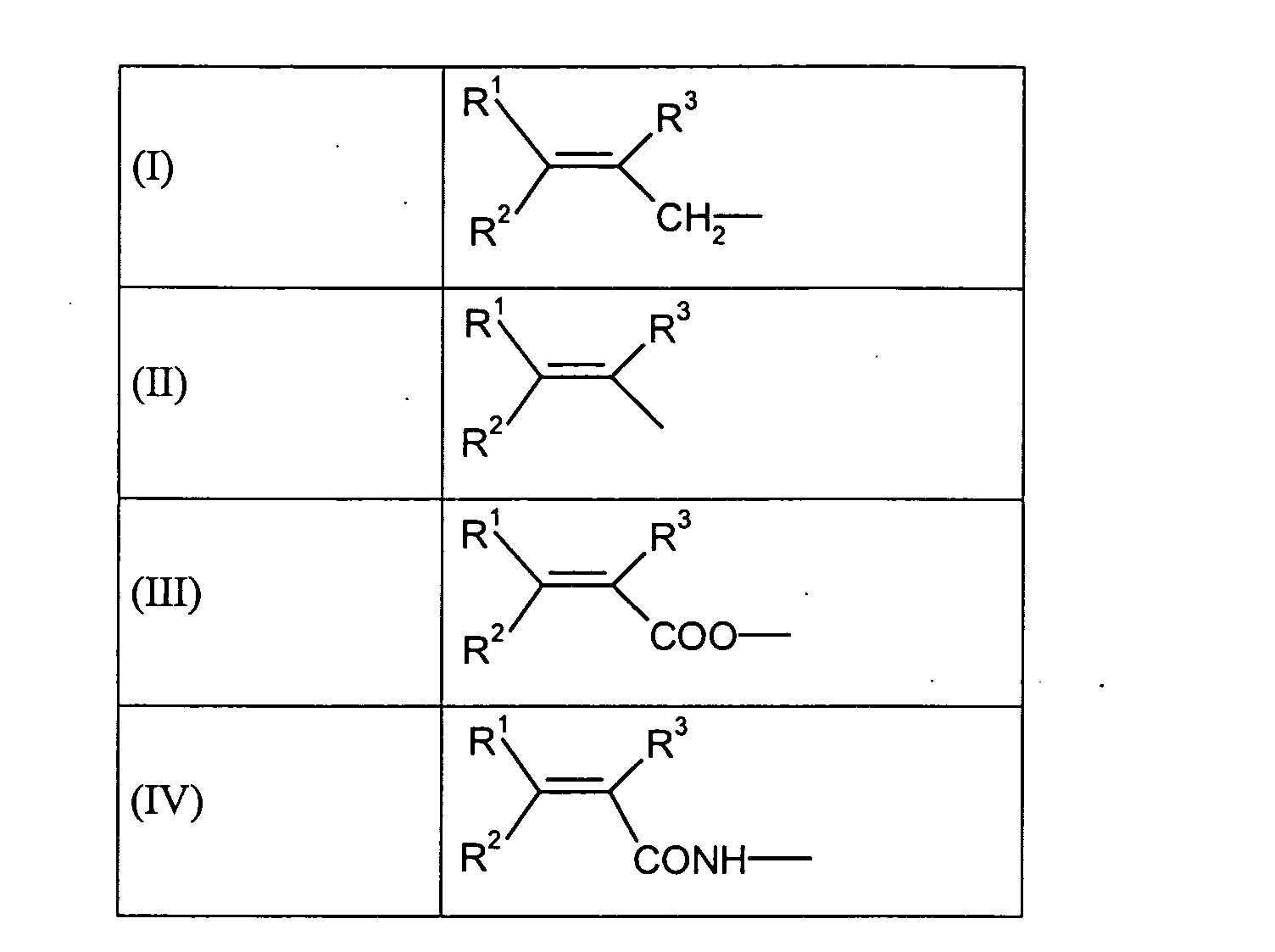
- These compositions - also called crosslinking additives - are characterized in that they contain compounds with at least one radical of the group defined by the formulas I to IV, where R 1 , R 2 and R 3 are independently selected from the group consisting of a hydrogen atom and an alkyl radical having 1 to 6 carbon atoms, and may additionally contain compounds defined by the formulas V and VI, wherein R 8 , R 9 and R 10 are independently selected from the group hydrogen atom, alkyl radical with 1 to 10 carbon atoms, hydroxyalkyl radical with 1 to 10 carbon atoms, carboxyalkyl radical with 1 to 10 carbon atoms and halogenated alkyl radical with 1 to 10 carbon atoms.
- the groups R 1 to R 10 can optionally also contain further functional groups and / or multiple bonds.
- compounds which are characterized by the formulas VII to X can be used as the crosslinking additive, where at least one representative of R 4 , R 5 and R 6 in the formulas VII and VII and at least one representative of R 4 , R 5 , R 6 and R 7 in the formulas IX and X each independently of one another a residue of those defined above Structures I and II and the remaining radicals R 4 , R 5 , R 6 and R 7 in structures VII to X are each independently selected from the group hydrogen atom, alkyl radical with 1 to 10 carbon atoms, hydroxyalkyl radical with 1 to 10 carbon atoms , Carboxyalkyl radical having 1 to 10 carbon atoms and halogenated alkyl radical having 1 to 10 carbon atoms.
- Preferred compounds corresponding to formulas VII to X are triallyl cyanurate, Diallyl methyl cyanurate, polyethylene ally cyanurate, triallyl isocyanurate, diallyl methyl isocyanurate, polyethylene allyl isocyanurate, ethylene bis (diallyl cyanurate), tetramethylene bis (diallyl cyanurate), Ethylene bis (diallyl isocyanurate), tetramethylene bis (diallyl isocyanurate), Diallylhydroxyethyl cyanurate, diallylhydroxyethyl isocyanurate, Diallyl carboethoxy cyanurate, diallyl carboethoxy isocyanurate, diallyl chloroethyl cyanurate and diallyl chloroethyl isocyanurate. Triallyl cyanurate are particularly preferred and triallyl isocyanurate.
- the crosslinking additives can contain compounds containing residues of Structure I and II from the group of dicarboxylic acid diallyl esters, such as Diallyl malonate.
- Diallyl succinate, diallyl glutarate, diallyl adipate and diallylazelate as well from the group of allyl-substituted melamines, such as, for example, N, N-diallylmelamine, Hexaallylhydroxy-methylmelamine, hexaallylmelamine and triallylmelamine his.
- the crosslinking additives can contain compounds containing radicals Structure III and IV from the group of acrylic acid esters, such as methyl acrylate, Ethyl acrylate, butyl acrylate and hexyl acrylate, from the group of methacrylic acid esters, such as methyl methacrylate, ethyl methacrylate and 2-hydroxyethyl methacrylate, from the group of polyethylene glycol esters of acrylic acid and Methacrylic acid, and from the group of acrylic acid and methacrylic acid amides, such as acrylamide and methacrylamide.
- acrylic acid esters such as methyl acrylate, Ethyl acrylate, butyl acrylate and hexyl acrylate
- methacrylic acid esters such as methyl methacrylate, ethyl methacrylate and 2-hydroxyethyl methacrylate
- acrylic acid and methacrylic acid amides such as acrylamide and methacrylamide.
- crosslinking additives can be defined by the Contain formulas V and VI, preference being given to cyanuric acid, isocyanuric acid, triethylcyanuric acid, Triethylsiocyanuric acid, tris- (hydroxyethyl) cyanuric acid, tris- (hydroxyethyl) isocyanuric acid, Tris (carboxyethyl) cyanuric acid, tris (carboxyethyl) isocyanuric acid, Tris (chloroethyl) cyanuric acid and tris (chloroethyl) isocyanuric acid.
- thermoplastics for incorporating the thermoplastics used according to the invention are suitable for crosslinking additives, in particular polyamide 6, polyamide 66, polybutylene terephthalate, polypropylene and Polyethylene.
- crosslinking additives described are preferred in amounts between 0.1-20% between 0.2-15%, particularly preferably between 0.5-10%, very particularly preferably between 2-4% crosslinking aid, based in each case on the pure crosslinking additive used.
- the molding compositions may contain, as further polymeric components D) , rubber-elastic polymers which increase the impact strength of the molding compositions.
- the rubber-elastic polymers are generally copolymers which are preferably composed of at least two of the following monomers are: ethylene, propylene, butadiene, isobutene, isoprene, chloroprene, vinyl acetate, Styrene, acrylonitrile and acrylic or methacrylic acid esters with 1 to 18 carbon atoms in the alcohol component.
- EPM ethylene propylene
- EPDM ethylene-propylene-diene
- EPM rubbers generally have practically no more double bonds, while EPDM rubbers have 1 to 20 double bonds / 100 carbon atoms can.
- Conjugated dienes are, for example, diene monomers for EPDM rubbers such as isoprene and butadiene, non-conjugated dienes with 5 to 25 carbon atoms such as Penta-1,4-diene, hexa-1,4-diene, hexa-1,5-diene, 2,5-dimethylhexa-1,5-diene and octa-1,4-diene, cyclic dienes such as cyclopentadiene, cyclohexadienes, cyclooctadienes and Dicyclopentadiene and alkenylnorbornenes such as 5-ethylened-2-norbornene, 5-butyliden-2-norbornene, 2-methallyl-5-norbornene, 2-isopropenyl-5-norbornene and tricyclodienes such as 3-methyl-tricyclo (5.2.1.0.2.6) -3,8-decadiene or mixtures thereof called.
- the diene content of the EPDM rubbers is preferably 0.5 to 50, in particular 1 to 8 wt .-%, based on the total weight of the rubber.
- EPM or EPDM Katuschuke can preferably also with reactive carboxylic acids or their derivatives have been dropped.
- reactive carboxylic acids or their derivatives e.g. Acrylic acid, methacrylic acid and their derivatives, e.g. Glycidyl (meth) acrylate, as well as maleic anhydride.
- Another group of preferred rubbers are copolymers of ethylene with acrylic acid and / or methacrylic acid and / or the esters of these acids.
- the rubbers can also contain dicarboxylic acids such as maleic acid and fumaric acid or derivatives of these acids, for example esters and anhydrides, and / or monomers containing epoxy groups.
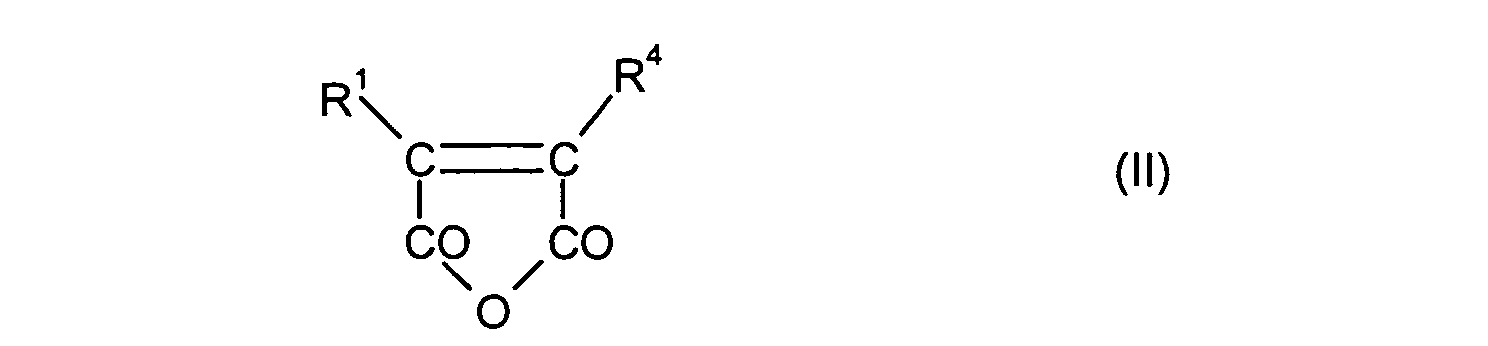
- dicarboxylic acid derivatives or monomers containing epoxy groups are preferably incorporated into the rubber by adding monomers of the general formulas (I) or (II) or (III) or (IV) containing dicarboxylic acid or epoxy groups to the monomer mixture
- R 1 C (COOR 2 ) C (COOR 3 ) R 4
- R 1 to R 9 represent hydrogen or alkyl groups having 1 to 6 carbon atoms and m is an integer from 0 to 20, g is an integer from 0 to 10 and p is an integer from 0 to 5.
- the radicals R 1 to R 9 are preferably hydrogen, where m is 0 or 1 and g is 1.
- the corresponding compounds are maleic acid, fumaric acid, maleic anhydride, allyl glycidyl ether and vinyl glycidyl ether.
- Preferred compounds of the formulas (I), (II) and (IV) are maleic acid, maleic anhydride and epoxy group-containing esters of acrylic acid and / or methacrylic acid, such as glycidyl acrylate, glycidyl methacrylate and the esters with tertiary Alcohols such as t-butyl acrylate.
- the latter do not have any free carboxyl groups but come close in their behavior to the free acids and are therefore called Monomers with latent carboxyl groups.
- the copolymers advantageously consist of 50 to 98% by weight of ethylene, 0.1 to 20% by weight of monomers containing epoxy groups and / or methacrylic acid and / or monomers containing acid anhydride groups and the remaining amount on (meth) acrylic acid esters.
- Copolymers of are particularly preferred 50 to 98, in particular 55 to 95% by weight of ethylene, 0.1 to 40, in particular 0.3 to 20% by weight of glycidyl acrylate and / or glycidyl methacrylate, (meth) acrylic acid and / or maleic anhydride, and 1 to 45, in particular 10 to 40% by weight of n-butyl acrylate and / or 2-ethylhexyl acrylate.
- esters of acrylic and / or methacrylic acid are methyl, Ethyl, propyl and i- or t-butyl esters.
- vinyl esters and vinyl ethers can also be used as comonomers become.
- the ethylene copolymers described above can be according to known Processes are prepared, preferably by random copolymerization under high pressure and elevated temperature. Appropriate procedures are general known.
- Preferred elastomers are also emulsion polymers, the production of which e.g. at Blackley is described in the monograph "Emulsion Polymerization".
- Emulsifiers and catalysts are known per se.
- homogeneous elastomers or those with a Shell structure can be used.
- the shell-like structure is due to the order of addition of the individual monomers; also the morphology of the Polymers are affected by this order of addition.
- the monomers for the production of the rubber part are only representative here the elastomer acrylates such as n-butyl acrylate and 2-ethylhexyl acrylate, respectively Methacrylates, butadiene and isoprene and mixtures thereof.
- These monomers can be combined with other monomers such as e.g. Styrene, acrylonitrile, Vinyl ethers and other acrylates or metacrylates such as methyl methacrylate, Methyl acrylate, ethyl acrylate and propyl acrylate can be copolymerized.
- monomers such as e.g. Styrene, acrylonitrile, Vinyl ethers and other acrylates or metacrylates such as methyl methacrylate, Methyl acrylate, ethyl acrylate and propyl acrylate can be copolymerized.
- the soft or rubber phase (with a glass transition temperature below 0 ° C) of the elastomers can the core, the outer shell or a middle shell (at Represent elastomers with more than two shells); for multi-layer Elastomers can also consist of several shells from a rubber phase.
- hard components (with glass transition temperatures of more than 20 ° C) involved in the construction of the elastomer, so these are generally by polymerizing styrene, acrylonitrile, Methacrylonitrile, ⁇ -methylstyrene, p-methylstyrene, acrylic acid esters and methacrylic acid esters such as methyl acrylate, ethyl acrylate and methyl methacrylate as the main monomers manufactured.
- Comonomers can be used.
- the graft monomers described in P-A 208 187 are also being introduced reactive groups on the surface.
- Acrylamide, methacrylamide and substituted esters are further examples acrylic acid or methacrylic acid such as (N-t-butylamino) ethyl methacrylate, (N, N-dimethylamino) ethyl acrylate, (N, N-dimethylamino) methyl acrylate and (N, N-diethylamino) ethyl acrylate called.
- the particles of the rubber phase can also be crosslinked.
- a crosslinker acting monomers are, for example, buta-1,3-diene, divinylbenzene, diallyl phthalate and dihydrodicyclopentadienyl acrylate and those in EP-A 50 265 described connections.
- graft-linking monomers i.e. Monomers with two or more polymerizable Double bonds that occur during polymerization at different rates react.
- Such compounds are preferably used in which at least one reactive group is at about the same rate as the remaining monomers polymerized while the other reactive group (or reactive groups) e.g. polymerizes much slower (polymerize).
- the different Polymerization rates add a certain amount unsaturated double bonds in the rubber itself. Then on one such a rubber grafted on another phase, they react in the rubber existing double bonds at least partially with the graft monomers Formation of chemical bonds, i.e. the grafted phase is at least partially linked to the graft base via chemical bonds.
- graft-crosslinking monomers examples include those containing allyl groups Monomers, especially allyl esters of ethylenically unsaturated carboxylic acids such as Allyl acrylate, allyl methacrylate, diallyl maleate, diallyl fumarate, diallyl itaconate or the corresponding monoallyl compounds of these dicarboxylic acids.
- allyl groups Monomers, especially allyl esters of ethylenically unsaturated carboxylic acids such as Allyl acrylate, allyl methacrylate, diallyl maleate, diallyl fumarate, diallyl itaconate or the corresponding monoallyl compounds of these dicarboxylic acids.
- graft crosslinking monomers for details reference is made here, for example, to US Pat. No. 4,148,846.
- the proportion of these crosslinking monomers in the impact strength modifying polymer up to 5 wt .-%, preferably not more than 3% by weight, based on the impact-modifying polymer.
- graft polymers with a core and at least one outer shell that have the following structure: Type Monomers for the core Monomers for the shell I Buta-1,3-diene, isoprene, n-butyl acrylate, ethylhexyl acrylate or mixtures thereof Styrene, acrylonitrile, methyl methacrylate II like I but with the use of crosslinkers like I III like I or II n-butyl acrylate, ethyl acrylate, methacrylate, buta-1,3-diene, isoprene, ethyl hexyl acrylate IV like I or II as I or III but with the use of monomers with reactive groups as described herein V Styrene, acrylonitrile, methyl methacrylate or mixtures thereof first shell of monomers as described under I and II for the core second shell as described under I or IV for the shell
- graft polymers in particular ABS and / or ASA polymers in quantities up to 40 wt .-%, preferably for impact modification of PBT, if necessary in a mixture with up to 40% by weight of polyethylene terephthalate.
- Corresponding blend products are under the trademark Ultradur® s (formerly Ultrablend® S from BASF AG).
- ABS / ASA blends with polycarbonates are commercially available under the trademark Terblend® (BASF AG).
- graft polymers with a multi-layer structure you can also homogeneous, i.e. single-shell elastomers made from buta-1,3-diene, isoprene and n-butyl acrylate or their copolymers are used. These products can also by Use of crosslinking monomers or monomers with reactive Groups are created.
- emulsion polymers examples include n-butyl acrylate / (meth) acrylic acid copolymers, n-butyl acrylate / glycidyl acrylate or n-butyl acrylate / glycidyl methacrylate copolymers, Graft polymers with an inner core made of n-butyl acrylate ode based on butandiene and an outer shell of the above Copolymers and copolymers of ethylene with comonomers that are reactive Deliver groups.
- the elastomers described can also be made by other conventional methods, e.g. by suspension polymerization.
- Silicone rubbers as in DE-A 37 25 576, EP-A 235 690, DE-A 38 00 603 and EP-A 319 290 are also preferred.
- compositions comprising two or more thermoplastics are also preferred contain, where appropriate compatibility agents can be used.
- thermoplastic molding compositions according to the invention can be used as component E) usual processing aids such as stabilizers, antioxidants, agents against heat decomposition and decomposition by ultraviolet light, so-called UV stabilizers, Lubricants and mold release agents, colorants such as dyes and Contain pigments, nucleating agents, plasticizers, etc.
- processing aids such as stabilizers, antioxidants, agents against heat decomposition and decomposition by ultraviolet light, so-called UV stabilizers, Lubricants and mold release agents, colorants such as dyes and Contain pigments, nucleating agents, plasticizers, etc.
- processing aids such as stabilizers, antioxidants, agents against heat decomposition and decomposition by ultraviolet light, so-called UV stabilizers, Lubricants and mold release agents, colorants such as dyes and Contain pigments, nucleating agents, plasticizers, etc.
- oxidation retarders and heat stabilizers are steric hindered phenols and / or phosphites, hydroquinones, aromatic secondary Amines such as diphenylamines, various substituted representatives of these groups and their mixtures in concentrations up to 1 wt .-%, based on the weight called the thermoplastic molding compositions.
- UV stabilizers which are generally present in amounts of up to 2% by weight the molding compound used are various substituted resorcinols, Called salicylates, benzotriazoles and benzophenones.
- Inorganic pigments such as titanium dioxide, ultramarine blue, iron oxide and Carbon black, also organic pigments, such as phthalocyanines, quinacridones, perylenes and dyes such as nigrosine and anthraquinones are added as colorants.
- nucleating agents e.g. Barium sulfate, sodium phenylphosphinate, Aluminum oxide, silicon dioxide and preferably talc are used.
- Lubricants and mold release agents which are usually present in amounts of up to 1% by weight.
- long-chain fatty acids e.g. stearic acid or Behenic acid
- its salts e.g. Ca or Zn stearate
- amide derivatives e.g. Ethylene-bis-stearylamide
- montan waxes mixturetures of straight-chain, saturated carboxylic acids with chain lengths of 28 to 32 carbon atoms
- plasticizers are dioctyl phthalate, dibenzyl phthalate, Butyl benzyl phthalate, hydrocarbon oils, N- (n-butyl) benzenesulfonamide called.
- PTFE polytetrafluoroethylene
- tetrafluoroethylene-hexafluoropropylene copolymers or tetrafluoroethylene copolymers with smaller proportions (usually up to 50 wt .-%) copolymerizable ethylenically unsaturated Monomers.
- PTFE polytetrafluoroethylene
- tetrafluoroethylene-hexafluoropropylene copolymers or tetrafluoroethylene copolymers with smaller proportions (usually up to 50 wt .-%) copolymerizable ethylenically unsaturated Monomers.
- fluorine-containing ethylene polymers are homogeneously distributed in the molding compositions and preferably have a particle size d 50 (number average) in the range from 0.05 to 10 ⁇ m, in particular from 0.1 to 5 ⁇ m. These small particle sizes can be achieved particularly preferably by using aqueous dispersions of fluorine-containing ethylene polymers and incorporating them into a polyester melt.
- the molding compositions for the moldings according to the invention are produced according to known methods e.g. on single-shaft or twin-shaft extruders or -Knetern.
- the mass temperature depends on the thermoplastics used and is between 220 ° C and 350 ° C. After extrusion, the extrudate cooled and crushed into granules.
- the crosslinking additives can be in pure form or incorporated into a thermoplastic matrix be added during the manufacture of the molding compound or after the manufacture of the molding compositions with the comminuted molding compositions per se known methods are physically mixed (dry blend).
- the molding compositions thus obtained or the mixture of the molding composition and the Crosslinking additive can be molded articles or flat structures such as foils or Make plates.
- the shaped bodies can be block-like or hollow bodies different wall thicknesses.
- known processes such as casting, rolling, blow molding, suction blow molding, Sheet extrusion or preferably injection molding can be used.
- Several of the like Moldings produced can be prepared using known processes, e.g. Vibration welding, heating element welding or laser welding with each other new moldings are connected.
- the moldings or semi-finished products are crosslinked after their production by ionizing radiation such as X-ray, electron, gamma or beta radiation.
- ionizing radiation such as X-ray, electron, gamma or beta radiation.
- commercially available sources for beta or gamma rays are used.
- van der Graaf generators with radiation energies with an output of 150 keV to 5 MeV can be used as beta radiation sources and Co 60 or Cs 137 preparations with high radiation output, for example, can be used as gamma radiation sources.
- the dose required for the irradiated ionizing radiation is above 10 to a maximum of 2000 kGy, particularly in the range 100 to 1500 kGy and in particular in the range 300 to 1000 kGy. The higher the energy selected, the greater the desired depth of penetration into the molded part due to the wall thickness of the molded part.
- the total irradiation time is between 1 s and 60 s, preferably 5 to 30 s.
- the Shaped bodies or flat structures can be continuously irradiated or be irradiated several times for a shorter time until the desired total irradiation time is reached.
- parts up to can be crosslinked to a thickness of about 20 cm, preferably 10 cm. This corresponds to irradiation on both sides with a penetration depth of approx. 10 or 5 cm.
- Gamma rays achieve penetration depths of several meters, so that the Thickness of the parts to be cross-linked is practically unrestricted.
- the Irradiation times for gamma radiation are between about 0.1 to about 100 Hours, preferably from about 1 to about 20 hours.
- the molded parts can be added after the radiation crosslinking Temperatures in the range from 40 to 350 ° C., preferably in the range from 80 to 300 ° C., particularly preferably in the range from 100 to 250 ° C. for 2 to 180 minutes, preferably stored for 5 to 100 minutes, particularly preferably for 10 to 60 minutes become.
- component C 0.1-20%, preferably 0.2-15%, particularly preferably 0.5-10% and very particularly preferably 2-4% crosslinking aid, based in each case on the pure crosslinking additive can be used.
- thermoplastic polymer A Polyamide or mixtures of different polyamides can be used.
- thermoplastic polymer polyester Use characterized in that as a thermoplastic polymer polyester or mixtures of different polyesters can be used.
- crosslinking aids compounds containing unsaturated groups, preferably allyl and / or vinyl groups be used.
- Another object is the shaped bodies according to the invention.
- Another subject is the use of the shaped bodies as a media-carrying system, preferably coolant based on water and / or ethylene glycol are to be understood and preferred containers and as a media-carrying system Lines are to be understood.
- a media-carrying system preferably coolant based on water and / or ethylene glycol are to be understood and preferred containers and as a media-carrying system Lines are to be understood.
- shaped bodies as coolant lines, coolant water boxes, coolant expansion tanks, Pump housing, pump impellers and cooling water distributor and thermostat housing.
- shaped bodies as a media-carrying system, oil being the medium, Engine oil and gear oil are preferred and are to be understood as a media-carrying system preferably containers and lines are to be understood.
- Another subject of the registration is:
- Composite molded article characterized in that at least one part of the shaped body after shaping beta, gamma, X-ray, UV or Electron radiation has been exposed.
- Shaped body characterized in that it is in electrical connectors or parts thereof.
- Shaped body characterized in that it is in electrical connectors or parts thereof.
Landscapes
- Chemical & Material Sciences (AREA)
- Health & Medical Sciences (AREA)
- Chemical Kinetics & Catalysis (AREA)
- Medicinal Chemistry (AREA)
- Polymers & Plastics (AREA)
- Organic Chemistry (AREA)
- Compositions Of Macromolecular Compounds (AREA)
Abstract
Description
und deren Polymermatrix im Anschluss an die thermoplastische Formgebung mit Beta-, Gamma-, Röntgen-, UV- oder Elektronenstrahlung, vorzugsweise mit Betastrahlen der Energie 10 bis 2000 kGy bestrahlt werden und dadurch bevorzugt zumindest teilweise vernetzt werden.
Dies gilt allgemein für den Fall, dass olefinisch ungesättigte, thermoplastische Polykondensate als Komponente A eingesetzt werden. Als olefinisch ungesättigte thermoplastische Polykondensate sind solche Polykondensate zu verstehen, die olefinische Doppelbindungen in der Haupt- und/oder Seitenkette enthalten. Bevorzugt sind in diesem Zusammenhang neben den oben beschriebenen ungesättigten Polyestern auch Polyamide, die als Monomerbausteine olefinisch ungesättigte Diamine und/oder olefinisch ungesättigte Dicarbonsäuren enthalten.
- Z
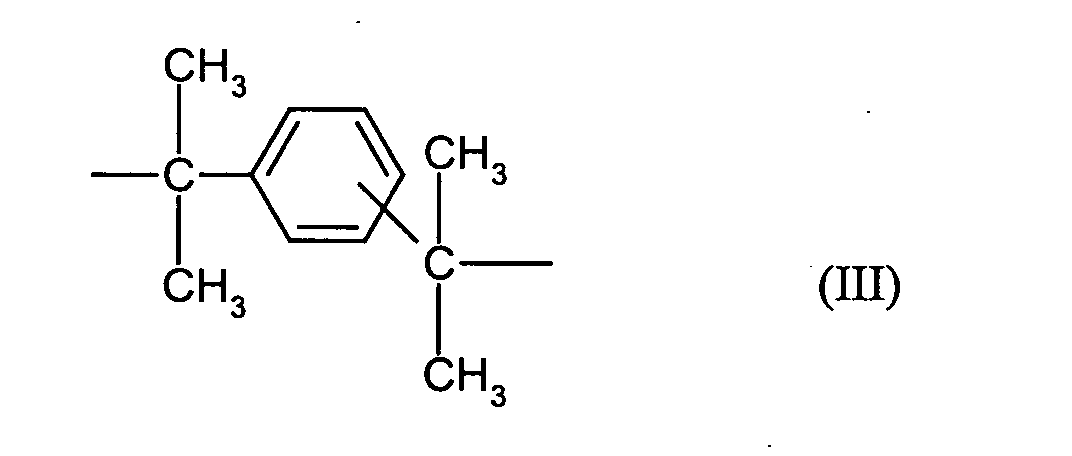
- ein divalenter organischen Rest mit 6 bis 30 C-Atomen ist, der eine oder mehrere aromatische Gruppen enthält.

- A
- eine Einfachbindung, C1-C5-Alkylen, C2-C5-Alkyliden, C5-C6-Cycloalkyliden,
-O-, -SO-, -CO-, -S-, -SO2-, C6-C12-Arylen, an das weitere aromatische
gegebenenfalls Heteroatome enthaltende Ringe kondensiert sein können,
oder ein Rest der Formel (II) oder (III)
- B
- jeweils C1-C12-Alkyl, vorzugsweise Methyl, Halogen, vorzugsweise Chlor und/oder Brom
- x
- jeweils unabhängig voneinander 0, 1 oder 2,
- p
- 1 oder 0 sind, und
- R1 und R2
- für jedes X1 individuell wählbar, unabhängig voneinander Wasserstoff oder C1-C6-Alkyl, vorzugsweise Wasserstoff, Methyl oder Ethyl,
- X1
- Kohlenstoff und
- m
- eine ganze Zahl von 4 bis 7, bevorzugt 4 oder 5 bedeuten, mit der Maßgabe, dass an mindestens einen Atom X1, R1 und R2 gleichzeitig Alkyl sind.
- x
-
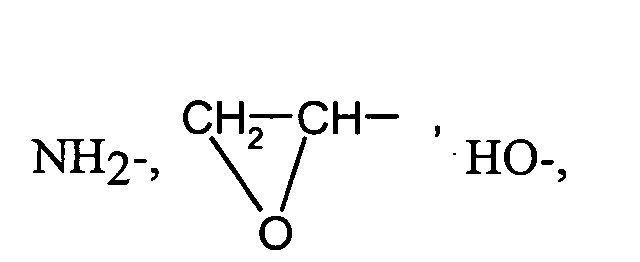
- n
- eine ganze Zahl von 2 bis 10, bevorzugt 3 bis 4
- m
- eine ganze Zahl von 1 bis 5, bevorzugt 1 bis 2
- k
- eine ganze Zahl von 1 bis 3, bevorzugt 1.




| 50 bis 98, | insbesondere 55 bis 95 Gew.-% Ethylen, |
| 0,1 bis 40, | insbesondere 0,3 bis 20 Gew.-% Glycidylacrylat und/oder Glycidylmethacrylat, (Meth)acrylsäure und/oder Maleinsäureanhydrid, und |
| 1 bis 45, | insbesondere 10 bis 40 Gew.-% n-Butylacrylat und/oder 2-Ethylhexylacrylat. |

wobei die Substituenten folgende Bedeutung haben können:
- R10
- Wasserstoff oder eine C1- bis C4-Alkylgruppe,
- R11
- Wasserstoff, eine C1- bis C8-Alkylgruppe oder eine Arylgruppe, insbesondere Phenyl
- R12
- Wasserstoff, eine C1- bis C10-Alkyl-, eine C6- bis C12-Arylgruppe oder -OR13
- R13
- eine C1- bis C8-Alkyl- oder C6- bis C12-Arylgruppe, die gegebenenfalls mit O- oder N-haltigen Gruppen substituiert sein können,
- X
- eine chemische Bindung, eine C1- bis C10-Alkylen- oder C6- bis C12-Arylengruppe
oder

- Y
- O-Z oder NH-Z und
- Z
- eine C1- bis C10-Alkylen- oder C6- bis C12-Arylengruppe.
| Typ | Monomere für den Kern | Monomere für die Hülle |
| I | Buta-1,3-dien, Isopren, n-Butylacrylat, Ethylhexylacrylat oder deren Mischungen | Styrol, Acrylnitril, Methylmethacrylat |
| II | wie I aber unter Mitverwendung von Vernetzern | wie I |
| III | wie I oder II | n-Butylacrylat, Ethylacrylat, Methacrylat, Buta-1,3-dien, Isopren, Ethylhexylacrylat |
| IV | wie I oder II | wie I oder III aber unter Mitverwendung von Monomeren mit reaktiven Gruppen wie hierin beschrieben |
| V | Styrol, Acrylnitril, Methylmethacrylat oder deren Mischungen | erste Hülle aus Monomeren wie unter I und II für den Kern beschrieben zweite Hülle wie unter I oder IV für die Hülle beschrieben |
PA6, Durethan B30F der Bayer AG, Leverkusen, Deutschland, relative Viskosität ηrel. = 3,0, 0,5 Gew.-%-ige Lösung in m-Kresol
PA66, Ultramid A3 der BASF AG, relative Viskosität ηrel. = 3,0, 0,5 Gew.-%-ige Lösung in m-Kresol
Glasfaser CS 7928 der Bayer AG, Leverkusen, Deutschland
Betalink-Master IC/W65PA6 der Firma PTS Marketing und Vertriebs-GmbH, Tauberzell, Deutschland

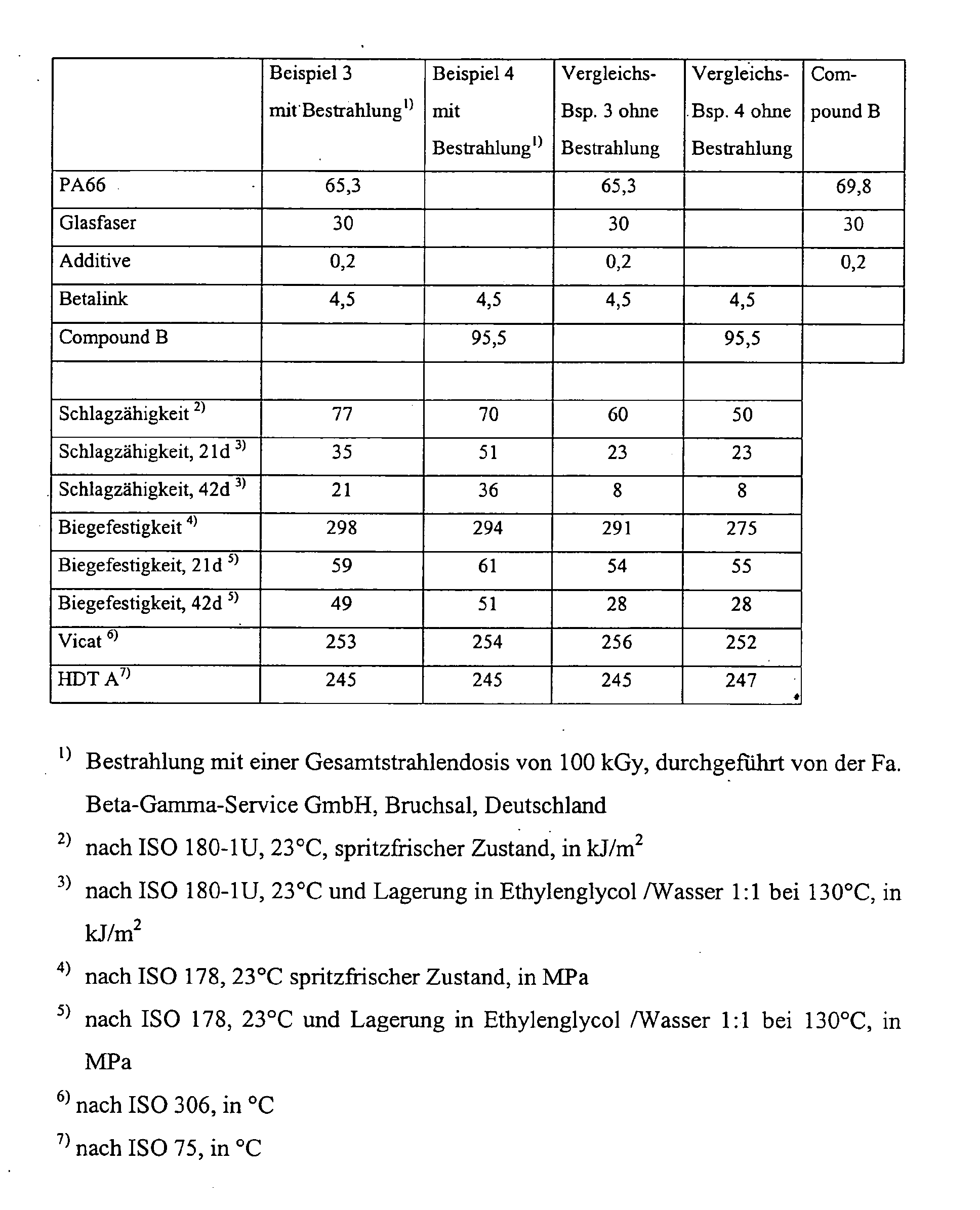
Claims (12)
- Verwendung von Formmassen zur Herstellung von hydrolysestabilen Formkörpern, wobei die Formmassen ein zur Vernetzung fähiges Additiv und /oder ein thermoplastisches, olefinisch ungesättigtes Polykondensat enthalten und die Formkörper nach der Formgebung mit energiereicher Strahlung wie zum Beispiel Beta-, Gamma-, Röntgen-, UV- oder Elektronenstrahlung behandelt werden.
- Verwendung von Formmassen zur Herstellung von hydrolysestabilen Formteilen, wobei die Formmassen die folgenden Komponenten enthaltenund deren Polymermatrix im Anschluss an die thermoplastische Formgebung mit Beta-, Gamma-, Röntgen-, UV- oder Elektronenstrahlung, vorzugsweise mit Betastrahlen der Energie 10-2000 kGy bestrahlt werden.A) thermoplastisches PolykondensatB) VerstärkungsstoffeC) vernetzungsfähiges AdditivD) weitere polymere KomponentenE) Additive, Zusatzstoffe, Verarbeitungshilfsmittel
- Verwendung gemäß Anspruch 1, wobei die Formmassen enthalten:A) 30 - 99,9 % thermoplastisches PolykondensatB) 0 - 60 % VerstärkungsstoffeC) 0,1 - 20 % VernetzungshilfsmittelD) 0 - 30 % weitere polymere ZusatzstoffeE) 0 - 15 % Zusatzstoffe und/oder Verarbeitungshilfmittel.
- Verwendung gemäß einem oder mehreren der vorangegangenen Ansprüche, dadurch gekennzeichnet, dass als thermoplastisches Polymer A) Polyamid oder Mischungen aus verschiedenen Polyamiden eingesetzt werden.
- Verwendung gemäß einem oder mehreren der vorangegangenen Ansprüche, dadurch gekennzeichnet, dass als thermoplastisches Polymer Polyester oder Mischungen aus verschiedenen Polyestern eingesetzt werden.
- Verwendung gemäß einem oder mehreren der vorangegangenen Ansprüche, dadurch gekennzeichnet, dass als Vernetzungshilfsmitteln Verbindungen enthaltend ungesättigte Gruppen, bevorzugt Allyl- und/oder Vinyl- Gruppen eingesetzt werden.
- Formkörper, hergestellt gemäß einem oder mehrerer der vorangegangenen Ansprüche.
- Verwendung der Formkörper gemäß einem oder mehreren der vorstehenden Ansprüche als medienführendes System, wobei als Medium bevorzugt Kühlmittel auf Wasser und/oder Ethylenglycol-Basis zu verstehen sind und als medienführendes System bevorzugt Behältnisse und Leitungen zu verstehen sind.
- Verwendung der Formkörper gemäß einem oder mehreren der vorstehenden Ansprüche als Kühlmittelleitungen, Kühlerwasserkästen, Kühlmittelausgleichsbehälter, Pumpengehäuse, Pumpenlaufräder und Kühlwasserverteiler sowie Thermostatgehäuse.
- Verwendung der Formkörper gemäß einem oder mehreren der vorstehenden Ansprüche als medienführendes System, wobei als Medium Öl, bevorzugt Motoröl und Getriebeöl verstehen sind und als medienführendes System bevorzugt Behältnisse und Leitungen zu verstehen sind.
- Verwendung der Formkörper gemäß einem oder mehreren der vorstehenden Ansprüche als Bestandteil einer elektrischen Steckerverbindung, bevorzugt in Sicherungen, Sicherungskästen, Relais, Airbag-Steckverbindungen oder Bremssensoren für Kfz-Antiblockiersysteme.
- Verfahren zur Herstellung von hydrolysestabilen Formkörpern gemäß einem oder mehreren der vorstehenden Ansprüche, dadurch gekennzeichnet, dass der Formkörper nach der Formgebung Beta-, Gamma-, Röntgen-, UV- oder Elektronenstrahlung ausgesetzt wird.
Applications Claiming Priority (2)
| Application Number | Priority Date | Filing Date | Title |
|---|---|---|---|
| DE10255043A DE10255043A1 (de) | 2002-11-26 | 2002-11-26 | Verwendung von Polykondensatmischungen zur Herstellung von Formteilen mit verbesserter Hydrolysebeständigkeit |
| DE10255043 | 2002-11-26 |
Publications (1)
| Publication Number | Publication Date |
|---|---|
| EP1424361A1 true EP1424361A1 (de) | 2004-06-02 |
Family
ID=32240421
Family Applications (1)
| Application Number | Title | Priority Date | Filing Date |
|---|---|---|---|
| EP03026509A Withdrawn EP1424361A1 (de) | 2002-11-26 | 2003-11-19 | Verwendung von Polykondensatmischungen zur Herstellung von Formteilen mit verbesserter Hydrolysebeständigkeit |
Country Status (2)
| Country | Link |
|---|---|
| EP (1) | EP1424361A1 (de) |
| DE (1) | DE10255043A1 (de) |
Cited By (6)
| Publication number | Priority date | Publication date | Assignee | Title |
|---|---|---|---|---|
| DE102005022061A1 (de) * | 2005-05-12 | 2006-11-16 | BSH Bosch und Siemens Hausgeräte GmbH | Haushaltsgerätevorrichtung |
| WO2009135692A1 (de) * | 2008-05-09 | 2009-11-12 | Yamaichi Electronics Deutschland Gmbh | Verbindersystem, verwendung und verfahren |
| CN102311638A (zh) * | 2010-12-21 | 2012-01-11 | 深圳市科聚新材料有限公司 | 一种耐水解耐醇解玻纤增强ppa材料及其制备方法 |
| WO2014090787A1 (de) * | 2012-12-12 | 2014-06-19 | Krones Ag | Vorrichtung zum behandeln von getränken mit wandungselementen aus kunststoff |
| CN103937074A (zh) * | 2012-02-28 | 2014-07-23 | 昆明普尔顿环保科技股份有限公司 | 新型耐腐蚀管接头 |
| US9505912B2 (en) | 2006-08-23 | 2016-11-29 | Basf Se | Polyamide molding materials with improved thermal aging and hydrolysis stability |
Families Citing this family (1)
| Publication number | Priority date | Publication date | Assignee | Title |
|---|---|---|---|---|
| DE102014206069A1 (de) * | 2014-03-31 | 2015-10-01 | Schaeffler Technologies AG & Co. KG | Vorrichtung zur Regelung des Flusses eines Temperierfluids |
Citations (5)
| Publication number | Priority date | Publication date | Assignee | Title |
|---|---|---|---|---|
| EP0214602A2 (de) * | 1985-09-04 | 1987-03-18 | Sumitomo Electric Industries Limited | Formartikel aus Urethanharzzusammensetzung |
| EP0560132A1 (de) * | 1992-03-05 | 1993-09-15 | BASF Aktiengesellschaft | Formmassen auf der Basis olefinische Doppelbindungen enthaltender Homo- und Copolyamide |
| EP0679689A2 (de) * | 1994-04-29 | 1995-11-02 | Gaf-Hüls Chemie Gmbh | Polyester-Formkörper mit ausgezeichneter thermischer Stabilität |
| JPH10269859A (ja) * | 1997-03-27 | 1998-10-09 | Furukawa Electric Co Ltd:The | ケーブル |
| JP2002146068A (ja) * | 2000-11-17 | 2002-05-22 | Sumitomo Electric Fine Polymer Inc | ポリアミド樹脂、ポリアミド樹脂成形品及び該成形品の製造方法 |
-
2002
- 2002-11-26 DE DE10255043A patent/DE10255043A1/de not_active Withdrawn
-
2003
- 2003-11-19 EP EP03026509A patent/EP1424361A1/de not_active Withdrawn
Patent Citations (5)
| Publication number | Priority date | Publication date | Assignee | Title |
|---|---|---|---|---|
| EP0214602A2 (de) * | 1985-09-04 | 1987-03-18 | Sumitomo Electric Industries Limited | Formartikel aus Urethanharzzusammensetzung |
| EP0560132A1 (de) * | 1992-03-05 | 1993-09-15 | BASF Aktiengesellschaft | Formmassen auf der Basis olefinische Doppelbindungen enthaltender Homo- und Copolyamide |
| EP0679689A2 (de) * | 1994-04-29 | 1995-11-02 | Gaf-Hüls Chemie Gmbh | Polyester-Formkörper mit ausgezeichneter thermischer Stabilität |
| JPH10269859A (ja) * | 1997-03-27 | 1998-10-09 | Furukawa Electric Co Ltd:The | ケーブル |
| JP2002146068A (ja) * | 2000-11-17 | 2002-05-22 | Sumitomo Electric Fine Polymer Inc | ポリアミド樹脂、ポリアミド樹脂成形品及び該成形品の製造方法 |
Non-Patent Citations (1)
| Title |
|---|
| DATABASE WPI Section Ch Week 199851, Derwent World Patents Index; Class A23, AN 1998-600138, XP002271034 * |
Cited By (10)
| Publication number | Priority date | Publication date | Assignee | Title |
|---|---|---|---|---|
| DE102005022061A1 (de) * | 2005-05-12 | 2006-11-16 | BSH Bosch und Siemens Hausgeräte GmbH | Haushaltsgerätevorrichtung |
| DE102005022061B4 (de) * | 2005-05-12 | 2013-08-22 | BSH Bosch und Siemens Hausgeräte GmbH | Haushaltsgerätevorrichtung mit einer Haushaltsgerätescheibe und Verfahren zum Verkleben einer Haushaltsgerätescheibe mit einem weiteren Bauteil |
| US9505912B2 (en) | 2006-08-23 | 2016-11-29 | Basf Se | Polyamide molding materials with improved thermal aging and hydrolysis stability |
| WO2009135692A1 (de) * | 2008-05-09 | 2009-11-12 | Yamaichi Electronics Deutschland Gmbh | Verbindersystem, verwendung und verfahren |
| JP2011520227A (ja) * | 2008-05-09 | 2011-07-14 | ヤマイチ エレクトロニクス ドイチュラント ゲゼルシャフト ミット ベシュレンクテル ハフツング | コネクタシステム、及びその使用方法、製造方法 |
| US8226437B2 (en) | 2008-05-09 | 2012-07-24 | Yamaichi Electronics Co., Ltd. | Connector system, use and method |
| CN102311638A (zh) * | 2010-12-21 | 2012-01-11 | 深圳市科聚新材料有限公司 | 一种耐水解耐醇解玻纤增强ppa材料及其制备方法 |
| CN102311638B (zh) * | 2010-12-21 | 2012-12-19 | 深圳市科聚新材料有限公司 | 一种耐水解耐醇解玻纤增强ppa材料及其制备方法 |
| CN103937074A (zh) * | 2012-02-28 | 2014-07-23 | 昆明普尔顿环保科技股份有限公司 | 新型耐腐蚀管接头 |
| WO2014090787A1 (de) * | 2012-12-12 | 2014-06-19 | Krones Ag | Vorrichtung zum behandeln von getränken mit wandungselementen aus kunststoff |
Also Published As
| Publication number | Publication date |
|---|---|
| DE10255043A1 (de) | 2004-06-03 |
Similar Documents
| Publication | Publication Date | Title |
|---|---|---|
| EP1756223B1 (de) | Formmassen auf basis eines thermoplastischen polyesters mit verbesserter fliessfähigkeit | |
| DE10330722A1 (de) | Laserdurchstrahlschweißbare thermoplastische Formmassen auf Basis einer Mischung von mindestens zwei Thermoplasten | |
| DE3347071A1 (de) | Thermoplastische formmassen auf basis von polysiloxan-polycarbont-blockcopolymeren | |
| DE10304341A1 (de) | Hydrolysebeständige Polyester | |
| DE10255044A1 (de) | Verwendung von verzweigten Fließhilfsmitteln in hochfließfähigen Polymerzusammensetzungen | |
| EP1383836B1 (de) | Schlagzähmodifizierte blends aus polyethylenterephthalat und mindestens einem auf dihydroxydiarylcyclohexan basierenden polycarbonat | |
| WO2001038436A1 (de) | Thermisch stabile polyesterformmassen | |
| EP3362516A1 (de) | Polyesterblend mit halogenfreiem flammschutz | |
| EP1192221B1 (de) | Polyester/polycarbonat blends | |
| EP1869123B1 (de) | Formmassen auf basis eines thermoplastischen polycarbonats | |
| EP1424361A1 (de) | Verwendung von Polykondensatmischungen zur Herstellung von Formteilen mit verbesserter Hydrolysebeständigkeit | |
| EP1523520B1 (de) | Mit polymeren phosphorigsäureestern stabilisierte thermoplaste | |
| EP1790692A2 (de) | Formmassen auf Basis eines thermoplastischen Polyesters mit verbesserter Fliessfähigkeit | |
| EP2035499B1 (de) | Verfahren zur herstellung schlagzähmodifizierter polyalkylenterephthalat/polycarbonat-zusammensetzungen | |
| DE102004054632A1 (de) | Polymerblends aus Polyestern und linearen oligomeren Polycarbonaten | |
| EP1339795B1 (de) | Mit phosphorigsäureestern stabilisierte polyalkylenterephthalat-zusammensetzungen | |
| WO2013189779A1 (de) | Flammgeschützte polyester mit polyacrylnitrilhomopolymerisaten | |
| WO2005103113A1 (de) | Strahlenvernetzbare polyesterformmassen mit ungesättigten dicarbonsäuren | |
| EP1583799B1 (de) | Homogen durchgefärbte zusammensetzungen auf basis schlagzähmodifizierten polyalkylenterephthalat/polycarbonat blends | |
| DE102005009201A1 (de) | Formmassen auf Basis eines thermoplastischen Polyesters mit verbesserter Fließfähigkeit | |
| DE19900891A1 (de) | Verfahren zur Herstellung von Polyesterblends | |
| DE19913987A1 (de) | Dimensionsstabile Polyester/Polycarbonat Blends | |
| DE102005034742A1 (de) | Beleuchtungselemente aus Polyestern | |
| DE19840274A1 (de) | Glasverstärkte Polyesterformmassen | |
| DE102005009911A1 (de) | Formmassen auf Basis eines thermoplastischen Polyesters mit verbesserter Fließfähigkeit |
Legal Events
| Date | Code | Title | Description |
|---|---|---|---|
| PUAI | Public reference made under article 153(3) epc to a published international application that has entered the european phase |
Free format text: ORIGINAL CODE: 0009012 |
|
| AK | Designated contracting states |
Kind code of ref document: A1 Designated state(s): AT BE BG CH CY CZ DE DK EE ES FI FR GB GR HU IE IT LI LU MC NL PT RO SE SI SK TR |
|
| AX | Request for extension of the european patent |
Extension state: AL LT LV MK |
|
| 17P | Request for examination filed |
Effective date: 20041202 |
|
| AKX | Designation fees paid |
Designated state(s): BE DE ES FR IT NL |
|
| RAP1 | Party data changed (applicant data changed or rights of an application transferred) |
Owner name: LANXESS DEUTSCHLAND GMBH |
|
| STAA | Information on the status of an ep patent application or granted ep patent |
Free format text: STATUS: THE APPLICATION IS DEEMED TO BE WITHDRAWN |
|
| 18D | Application deemed to be withdrawn |
Effective date: 20061128 |