EP1426466A1 - SURFACE TREATMENT FOR METAL, PROCESS FOR SURFACE TREATMENT OF METALLIC SUBSTANCES AND SURFACE−TREATED METALLIC SUBSTANCES - Google Patents
SURFACE TREATMENT FOR METAL, PROCESS FOR SURFACE TREATMENT OF METALLIC SUBSTANCES AND SURFACE−TREATED METALLIC SUBSTANCES Download PDFInfo
- Publication number
- EP1426466A1 EP1426466A1 EP02733436A EP02733436A EP1426466A1 EP 1426466 A1 EP1426466 A1 EP 1426466A1 EP 02733436 A EP02733436 A EP 02733436A EP 02733436 A EP02733436 A EP 02733436A EP 1426466 A1 EP1426466 A1 EP 1426466A1
- Authority
- EP
- European Patent Office
- Prior art keywords
- surface treatment
- metal
- group
- treatment agent
- resin
- Prior art date
- Legal status (The legal status is an assumption and is not a legal conclusion. Google has not performed a legal analysis and makes no representation as to the accuracy of the status listed.)
- Withdrawn
Links
Classifications
-
- C—CHEMISTRY; METALLURGY
- C23—COATING METALLIC MATERIAL; COATING MATERIAL WITH METALLIC MATERIAL; CHEMICAL SURFACE TREATMENT; DIFFUSION TREATMENT OF METALLIC MATERIAL; COATING BY VACUUM EVAPORATION, BY SPUTTERING, BY ION IMPLANTATION OR BY CHEMICAL VAPOUR DEPOSITION, IN GENERAL; INHIBITING CORROSION OF METALLIC MATERIAL OR INCRUSTATION IN GENERAL
- C23C—COATING METALLIC MATERIAL; COATING MATERIAL WITH METALLIC MATERIAL; SURFACE TREATMENT OF METALLIC MATERIAL BY DIFFUSION INTO THE SURFACE, BY CHEMICAL CONVERSION OR SUBSTITUTION; COATING BY VACUUM EVAPORATION, BY SPUTTERING, BY ION IMPLANTATION OR BY CHEMICAL VAPOUR DEPOSITION, IN GENERAL
- C23C22/00—Chemical surface treatment of metallic material by reaction of the surface with a reactive liquid, leaving reaction products of surface material in the coating, e.g. conversion coatings, passivation of metals
- C23C22/05—Chemical surface treatment of metallic material by reaction of the surface with a reactive liquid, leaving reaction products of surface material in the coating, e.g. conversion coatings, passivation of metals using aqueous solutions
- C23C22/06—Chemical surface treatment of metallic material by reaction of the surface with a reactive liquid, leaving reaction products of surface material in the coating, e.g. conversion coatings, passivation of metals using aqueous solutions using aqueous acidic solutions with pH less than 6
- C23C22/40—Chemical surface treatment of metallic material by reaction of the surface with a reactive liquid, leaving reaction products of surface material in the coating, e.g. conversion coatings, passivation of metals using aqueous solutions using aqueous acidic solutions with pH less than 6 containing molybdates, tungstates or vanadates
- C23C22/44—Chemical surface treatment of metallic material by reaction of the surface with a reactive liquid, leaving reaction products of surface material in the coating, e.g. conversion coatings, passivation of metals using aqueous solutions using aqueous acidic solutions with pH less than 6 containing molybdates, tungstates or vanadates containing also fluorides or complex fluorides
-
- C—CHEMISTRY; METALLURGY
- C08—ORGANIC MACROMOLECULAR COMPOUNDS; THEIR PREPARATION OR CHEMICAL WORKING-UP; COMPOSITIONS BASED THEREON
- C08G—MACROMOLECULAR COMPOUNDS OBTAINED OTHERWISE THAN BY REACTIONS ONLY INVOLVING UNSATURATED CARBON-TO-CARBON BONDS
- C08G18/00—Polymeric products of isocyanates or isothiocyanates
- C08G18/06—Polymeric products of isocyanates or isothiocyanates with compounds having active hydrogen
- C08G18/08—Processes
- C08G18/0804—Manufacture of polymers containing ionic or ionogenic groups
- C08G18/0809—Manufacture of polymers containing ionic or ionogenic groups containing cationic or cationogenic groups
- C08G18/0814—Manufacture of polymers containing ionic or ionogenic groups containing cationic or cationogenic groups containing ammonium groups or groups forming them
-
- C—CHEMISTRY; METALLURGY
- C08—ORGANIC MACROMOLECULAR COMPOUNDS; THEIR PREPARATION OR CHEMICAL WORKING-UP; COMPOSITIONS BASED THEREON
- C08L—COMPOSITIONS OF MACROMOLECULAR COMPOUNDS
- C08L67/00—Compositions of polyesters obtained by reactions forming a carboxylic ester link in the main chain; Compositions of derivatives of such polymers
-
- C—CHEMISTRY; METALLURGY
- C09—DYES; PAINTS; POLISHES; NATURAL RESINS; ADHESIVES; COMPOSITIONS NOT OTHERWISE PROVIDED FOR; APPLICATIONS OF MATERIALS NOT OTHERWISE PROVIDED FOR
- C09D—COATING COMPOSITIONS, e.g. PAINTS, VARNISHES OR LACQUERS; FILLING PASTES; CHEMICAL PAINT OR INK REMOVERS; INKS; CORRECTING FLUIDS; WOODSTAINS; PASTES OR SOLIDS FOR COLOURING OR PRINTING; USE OF MATERIALS THEREFOR
- C09D167/00—Coating compositions based on polyesters obtained by reactions forming a carboxylic ester link in the main chain; Coating compositions based on derivatives of such polymers
-
- C—CHEMISTRY; METALLURGY
- C09—DYES; PAINTS; POLISHES; NATURAL RESINS; ADHESIVES; COMPOSITIONS NOT OTHERWISE PROVIDED FOR; APPLICATIONS OF MATERIALS NOT OTHERWISE PROVIDED FOR
- C09D—COATING COMPOSITIONS, e.g. PAINTS, VARNISHES OR LACQUERS; FILLING PASTES; CHEMICAL PAINT OR INK REMOVERS; INKS; CORRECTING FLUIDS; WOODSTAINS; PASTES OR SOLIDS FOR COLOURING OR PRINTING; USE OF MATERIALS THEREFOR
- C09D175/00—Coating compositions based on polyureas or polyurethanes; Coating compositions based on derivatives of such polymers
- C09D175/04—Polyurethanes
-
- C—CHEMISTRY; METALLURGY
- C09—DYES; PAINTS; POLISHES; NATURAL RESINS; ADHESIVES; COMPOSITIONS NOT OTHERWISE PROVIDED FOR; APPLICATIONS OF MATERIALS NOT OTHERWISE PROVIDED FOR
- C09D—COATING COMPOSITIONS, e.g. PAINTS, VARNISHES OR LACQUERS; FILLING PASTES; CHEMICAL PAINT OR INK REMOVERS; INKS; CORRECTING FLUIDS; WOODSTAINS; PASTES OR SOLIDS FOR COLOURING OR PRINTING; USE OF MATERIALS THEREFOR
- C09D5/00—Coating compositions, e.g. paints, varnishes or lacquers, characterised by their physical nature or the effects produced; Filling pastes
- C09D5/08—Anti-corrosive paints
-
- C—CHEMISTRY; METALLURGY
- C23—COATING METALLIC MATERIAL; COATING MATERIAL WITH METALLIC MATERIAL; CHEMICAL SURFACE TREATMENT; DIFFUSION TREATMENT OF METALLIC MATERIAL; COATING BY VACUUM EVAPORATION, BY SPUTTERING, BY ION IMPLANTATION OR BY CHEMICAL VAPOUR DEPOSITION, IN GENERAL; INHIBITING CORROSION OF METALLIC MATERIAL OR INCRUSTATION IN GENERAL
- C23C—COATING METALLIC MATERIAL; COATING MATERIAL WITH METALLIC MATERIAL; SURFACE TREATMENT OF METALLIC MATERIAL BY DIFFUSION INTO THE SURFACE, BY CHEMICAL CONVERSION OR SUBSTITUTION; COATING BY VACUUM EVAPORATION, BY SPUTTERING, BY ION IMPLANTATION OR BY CHEMICAL VAPOUR DEPOSITION, IN GENERAL
- C23C22/00—Chemical surface treatment of metallic material by reaction of the surface with a reactive liquid, leaving reaction products of surface material in the coating, e.g. conversion coatings, passivation of metals
- C23C22/05—Chemical surface treatment of metallic material by reaction of the surface with a reactive liquid, leaving reaction products of surface material in the coating, e.g. conversion coatings, passivation of metals using aqueous solutions
- C23C22/06—Chemical surface treatment of metallic material by reaction of the surface with a reactive liquid, leaving reaction products of surface material in the coating, e.g. conversion coatings, passivation of metals using aqueous solutions using aqueous acidic solutions with pH less than 6
- C23C22/34—Chemical surface treatment of metallic material by reaction of the surface with a reactive liquid, leaving reaction products of surface material in the coating, e.g. conversion coatings, passivation of metals using aqueous solutions using aqueous acidic solutions with pH less than 6 containing fluorides or complex fluorides
-
- C—CHEMISTRY; METALLURGY
- C23—COATING METALLIC MATERIAL; COATING MATERIAL WITH METALLIC MATERIAL; CHEMICAL SURFACE TREATMENT; DIFFUSION TREATMENT OF METALLIC MATERIAL; COATING BY VACUUM EVAPORATION, BY SPUTTERING, BY ION IMPLANTATION OR BY CHEMICAL VAPOUR DEPOSITION, IN GENERAL; INHIBITING CORROSION OF METALLIC MATERIAL OR INCRUSTATION IN GENERAL
- C23C—COATING METALLIC MATERIAL; COATING MATERIAL WITH METALLIC MATERIAL; SURFACE TREATMENT OF METALLIC MATERIAL BY DIFFUSION INTO THE SURFACE, BY CHEMICAL CONVERSION OR SUBSTITUTION; COATING BY VACUUM EVAPORATION, BY SPUTTERING, BY ION IMPLANTATION OR BY CHEMICAL VAPOUR DEPOSITION, IN GENERAL
- C23C22/00—Chemical surface treatment of metallic material by reaction of the surface with a reactive liquid, leaving reaction products of surface material in the coating, e.g. conversion coatings, passivation of metals
- C23C22/05—Chemical surface treatment of metallic material by reaction of the surface with a reactive liquid, leaving reaction products of surface material in the coating, e.g. conversion coatings, passivation of metals using aqueous solutions
- C23C22/06—Chemical surface treatment of metallic material by reaction of the surface with a reactive liquid, leaving reaction products of surface material in the coating, e.g. conversion coatings, passivation of metals using aqueous solutions using aqueous acidic solutions with pH less than 6
- C23C22/34—Chemical surface treatment of metallic material by reaction of the surface with a reactive liquid, leaving reaction products of surface material in the coating, e.g. conversion coatings, passivation of metals using aqueous solutions using aqueous acidic solutions with pH less than 6 containing fluorides or complex fluorides
- C23C22/36—Chemical surface treatment of metallic material by reaction of the surface with a reactive liquid, leaving reaction products of surface material in the coating, e.g. conversion coatings, passivation of metals using aqueous solutions using aqueous acidic solutions with pH less than 6 containing fluorides or complex fluorides containing also phosphates
-
- C—CHEMISTRY; METALLURGY
- C23—COATING METALLIC MATERIAL; COATING MATERIAL WITH METALLIC MATERIAL; CHEMICAL SURFACE TREATMENT; DIFFUSION TREATMENT OF METALLIC MATERIAL; COATING BY VACUUM EVAPORATION, BY SPUTTERING, BY ION IMPLANTATION OR BY CHEMICAL VAPOUR DEPOSITION, IN GENERAL; INHIBITING CORROSION OF METALLIC MATERIAL OR INCRUSTATION IN GENERAL
- C23C—COATING METALLIC MATERIAL; COATING MATERIAL WITH METALLIC MATERIAL; SURFACE TREATMENT OF METALLIC MATERIAL BY DIFFUSION INTO THE SURFACE, BY CHEMICAL CONVERSION OR SUBSTITUTION; COATING BY VACUUM EVAPORATION, BY SPUTTERING, BY ION IMPLANTATION OR BY CHEMICAL VAPOUR DEPOSITION, IN GENERAL
- C23C22/00—Chemical surface treatment of metallic material by reaction of the surface with a reactive liquid, leaving reaction products of surface material in the coating, e.g. conversion coatings, passivation of metals
- C23C22/05—Chemical surface treatment of metallic material by reaction of the surface with a reactive liquid, leaving reaction products of surface material in the coating, e.g. conversion coatings, passivation of metals using aqueous solutions
- C23C22/06—Chemical surface treatment of metallic material by reaction of the surface with a reactive liquid, leaving reaction products of surface material in the coating, e.g. conversion coatings, passivation of metals using aqueous solutions using aqueous acidic solutions with pH less than 6
- C23C22/34—Chemical surface treatment of metallic material by reaction of the surface with a reactive liquid, leaving reaction products of surface material in the coating, e.g. conversion coatings, passivation of metals using aqueous solutions using aqueous acidic solutions with pH less than 6 containing fluorides or complex fluorides
- C23C22/36—Chemical surface treatment of metallic material by reaction of the surface with a reactive liquid, leaving reaction products of surface material in the coating, e.g. conversion coatings, passivation of metals using aqueous solutions using aqueous acidic solutions with pH less than 6 containing fluorides or complex fluorides containing also phosphates
- C23C22/364—Chemical surface treatment of metallic material by reaction of the surface with a reactive liquid, leaving reaction products of surface material in the coating, e.g. conversion coatings, passivation of metals using aqueous solutions using aqueous acidic solutions with pH less than 6 containing fluorides or complex fluorides containing also phosphates containing also manganese cations
-
- C—CHEMISTRY; METALLURGY
- C23—COATING METALLIC MATERIAL; COATING MATERIAL WITH METALLIC MATERIAL; CHEMICAL SURFACE TREATMENT; DIFFUSION TREATMENT OF METALLIC MATERIAL; COATING BY VACUUM EVAPORATION, BY SPUTTERING, BY ION IMPLANTATION OR BY CHEMICAL VAPOUR DEPOSITION, IN GENERAL; INHIBITING CORROSION OF METALLIC MATERIAL OR INCRUSTATION IN GENERAL
- C23C—COATING METALLIC MATERIAL; COATING MATERIAL WITH METALLIC MATERIAL; SURFACE TREATMENT OF METALLIC MATERIAL BY DIFFUSION INTO THE SURFACE, BY CHEMICAL CONVERSION OR SUBSTITUTION; COATING BY VACUUM EVAPORATION, BY SPUTTERING, BY ION IMPLANTATION OR BY CHEMICAL VAPOUR DEPOSITION, IN GENERAL
- C23C22/00—Chemical surface treatment of metallic material by reaction of the surface with a reactive liquid, leaving reaction products of surface material in the coating, e.g. conversion coatings, passivation of metals
- C23C22/05—Chemical surface treatment of metallic material by reaction of the surface with a reactive liquid, leaving reaction products of surface material in the coating, e.g. conversion coatings, passivation of metals using aqueous solutions
- C23C22/06—Chemical surface treatment of metallic material by reaction of the surface with a reactive liquid, leaving reaction products of surface material in the coating, e.g. conversion coatings, passivation of metals using aqueous solutions using aqueous acidic solutions with pH less than 6
- C23C22/40—Chemical surface treatment of metallic material by reaction of the surface with a reactive liquid, leaving reaction products of surface material in the coating, e.g. conversion coatings, passivation of metals using aqueous solutions using aqueous acidic solutions with pH less than 6 containing molybdates, tungstates or vanadates
-
- C—CHEMISTRY; METALLURGY
- C23—COATING METALLIC MATERIAL; COATING MATERIAL WITH METALLIC MATERIAL; CHEMICAL SURFACE TREATMENT; DIFFUSION TREATMENT OF METALLIC MATERIAL; COATING BY VACUUM EVAPORATION, BY SPUTTERING, BY ION IMPLANTATION OR BY CHEMICAL VAPOUR DEPOSITION, IN GENERAL; INHIBITING CORROSION OF METALLIC MATERIAL OR INCRUSTATION IN GENERAL
- C23C—COATING METALLIC MATERIAL; COATING MATERIAL WITH METALLIC MATERIAL; SURFACE TREATMENT OF METALLIC MATERIAL BY DIFFUSION INTO THE SURFACE, BY CHEMICAL CONVERSION OR SUBSTITUTION; COATING BY VACUUM EVAPORATION, BY SPUTTERING, BY ION IMPLANTATION OR BY CHEMICAL VAPOUR DEPOSITION, IN GENERAL
- C23C22/00—Chemical surface treatment of metallic material by reaction of the surface with a reactive liquid, leaving reaction products of surface material in the coating, e.g. conversion coatings, passivation of metals
- C23C22/05—Chemical surface treatment of metallic material by reaction of the surface with a reactive liquid, leaving reaction products of surface material in the coating, e.g. conversion coatings, passivation of metals using aqueous solutions
- C23C22/06—Chemical surface treatment of metallic material by reaction of the surface with a reactive liquid, leaving reaction products of surface material in the coating, e.g. conversion coatings, passivation of metals using aqueous solutions using aqueous acidic solutions with pH less than 6
- C23C22/40—Chemical surface treatment of metallic material by reaction of the surface with a reactive liquid, leaving reaction products of surface material in the coating, e.g. conversion coatings, passivation of metals using aqueous solutions using aqueous acidic solutions with pH less than 6 containing molybdates, tungstates or vanadates
- C23C22/42—Chemical surface treatment of metallic material by reaction of the surface with a reactive liquid, leaving reaction products of surface material in the coating, e.g. conversion coatings, passivation of metals using aqueous solutions using aqueous acidic solutions with pH less than 6 containing molybdates, tungstates or vanadates containing also phosphates
-
- C—CHEMISTRY; METALLURGY
- C23—COATING METALLIC MATERIAL; COATING MATERIAL WITH METALLIC MATERIAL; CHEMICAL SURFACE TREATMENT; DIFFUSION TREATMENT OF METALLIC MATERIAL; COATING BY VACUUM EVAPORATION, BY SPUTTERING, BY ION IMPLANTATION OR BY CHEMICAL VAPOUR DEPOSITION, IN GENERAL; INHIBITING CORROSION OF METALLIC MATERIAL OR INCRUSTATION IN GENERAL
- C23C—COATING METALLIC MATERIAL; COATING MATERIAL WITH METALLIC MATERIAL; SURFACE TREATMENT OF METALLIC MATERIAL BY DIFFUSION INTO THE SURFACE, BY CHEMICAL CONVERSION OR SUBSTITUTION; COATING BY VACUUM EVAPORATION, BY SPUTTERING, BY ION IMPLANTATION OR BY CHEMICAL VAPOUR DEPOSITION, IN GENERAL
- C23C22/00—Chemical surface treatment of metallic material by reaction of the surface with a reactive liquid, leaving reaction products of surface material in the coating, e.g. conversion coatings, passivation of metals
- C23C22/05—Chemical surface treatment of metallic material by reaction of the surface with a reactive liquid, leaving reaction products of surface material in the coating, e.g. conversion coatings, passivation of metals using aqueous solutions
- C23C22/06—Chemical surface treatment of metallic material by reaction of the surface with a reactive liquid, leaving reaction products of surface material in the coating, e.g. conversion coatings, passivation of metals using aqueous solutions using aqueous acidic solutions with pH less than 6
- C23C22/48—Chemical surface treatment of metallic material by reaction of the surface with a reactive liquid, leaving reaction products of surface material in the coating, e.g. conversion coatings, passivation of metals using aqueous solutions using aqueous acidic solutions with pH less than 6 not containing phosphates, hexavalent chromium compounds, fluorides or complex fluorides, molybdates, tungstates, vanadates or oxalates
-
- C—CHEMISTRY; METALLURGY
- C23—COATING METALLIC MATERIAL; COATING MATERIAL WITH METALLIC MATERIAL; CHEMICAL SURFACE TREATMENT; DIFFUSION TREATMENT OF METALLIC MATERIAL; COATING BY VACUUM EVAPORATION, BY SPUTTERING, BY ION IMPLANTATION OR BY CHEMICAL VAPOUR DEPOSITION, IN GENERAL; INHIBITING CORROSION OF METALLIC MATERIAL OR INCRUSTATION IN GENERAL
- C23C—COATING METALLIC MATERIAL; COATING MATERIAL WITH METALLIC MATERIAL; SURFACE TREATMENT OF METALLIC MATERIAL BY DIFFUSION INTO THE SURFACE, BY CHEMICAL CONVERSION OR SUBSTITUTION; COATING BY VACUUM EVAPORATION, BY SPUTTERING, BY ION IMPLANTATION OR BY CHEMICAL VAPOUR DEPOSITION, IN GENERAL
- C23C22/00—Chemical surface treatment of metallic material by reaction of the surface with a reactive liquid, leaving reaction products of surface material in the coating, e.g. conversion coatings, passivation of metals
- C23C22/05—Chemical surface treatment of metallic material by reaction of the surface with a reactive liquid, leaving reaction products of surface material in the coating, e.g. conversion coatings, passivation of metals using aqueous solutions
- C23C22/06—Chemical surface treatment of metallic material by reaction of the surface with a reactive liquid, leaving reaction products of surface material in the coating, e.g. conversion coatings, passivation of metals using aqueous solutions using aqueous acidic solutions with pH less than 6
- C23C22/48—Chemical surface treatment of metallic material by reaction of the surface with a reactive liquid, leaving reaction products of surface material in the coating, e.g. conversion coatings, passivation of metals using aqueous solutions using aqueous acidic solutions with pH less than 6 not containing phosphates, hexavalent chromium compounds, fluorides or complex fluorides, molybdates, tungstates, vanadates or oxalates
- C23C22/53—Treatment of zinc or alloys based thereon
-
- C—CHEMISTRY; METALLURGY
- C08—ORGANIC MACROMOLECULAR COMPOUNDS; THEIR PREPARATION OR CHEMICAL WORKING-UP; COMPOSITIONS BASED THEREON
- C08G—MACROMOLECULAR COMPOUNDS OBTAINED OTHERWISE THAN BY REACTIONS ONLY INVOLVING UNSATURATED CARBON-TO-CARBON BONDS
- C08G2150/00—Compositions for coatings
- C08G2150/90—Compositions for anticorrosive coatings
-
- C—CHEMISTRY; METALLURGY
- C08—ORGANIC MACROMOLECULAR COMPOUNDS; THEIR PREPARATION OR CHEMICAL WORKING-UP; COMPOSITIONS BASED THEREON
- C08K—Use of inorganic or non-macromolecular organic substances as compounding ingredients
- C08K3/00—Use of inorganic substances as compounding ingredients
- C08K3/10—Metal compounds
-
- C—CHEMISTRY; METALLURGY
- C08—ORGANIC MACROMOLECULAR COMPOUNDS; THEIR PREPARATION OR CHEMICAL WORKING-UP; COMPOSITIONS BASED THEREON
- C08K—Use of inorganic or non-macromolecular organic substances as compounding ingredients
- C08K5/00—Use of organic ingredients
- C08K5/04—Oxygen-containing compounds
- C08K5/09—Carboxylic acids; Metal salts thereof; Anhydrides thereof
- C08K5/098—Metal salts of carboxylic acids
-
- C—CHEMISTRY; METALLURGY
- C08—ORGANIC MACROMOLECULAR COMPOUNDS; THEIR PREPARATION OR CHEMICAL WORKING-UP; COMPOSITIONS BASED THEREON
- C08L—COMPOSITIONS OF MACROMOLECULAR COMPOUNDS
- C08L61/00—Compositions of condensation polymers of aldehydes or ketones; Compositions of derivatives of such polymers
- C08L61/04—Condensation polymers of aldehydes or ketones with phenols only
-
- C—CHEMISTRY; METALLURGY
- C23—COATING METALLIC MATERIAL; COATING MATERIAL WITH METALLIC MATERIAL; CHEMICAL SURFACE TREATMENT; DIFFUSION TREATMENT OF METALLIC MATERIAL; COATING BY VACUUM EVAPORATION, BY SPUTTERING, BY ION IMPLANTATION OR BY CHEMICAL VAPOUR DEPOSITION, IN GENERAL; INHIBITING CORROSION OF METALLIC MATERIAL OR INCRUSTATION IN GENERAL
- C23C—COATING METALLIC MATERIAL; COATING MATERIAL WITH METALLIC MATERIAL; SURFACE TREATMENT OF METALLIC MATERIAL BY DIFFUSION INTO THE SURFACE, BY CHEMICAL CONVERSION OR SUBSTITUTION; COATING BY VACUUM EVAPORATION, BY SPUTTERING, BY ION IMPLANTATION OR BY CHEMICAL VAPOUR DEPOSITION, IN GENERAL
- C23C2222/00—Aspects relating to chemical surface treatment of metallic material by reaction of the surface with a reactive medium
- C23C2222/20—Use of solutions containing silanes
Definitions
- the present invention pertains to a surface treatment agent for metal to be used for forming a film that can impart excellent corrosion resistance, alkali resistance, and fingerprint resistance to the surfaces of sheet coil and formed products made of metals and that does not contain chromium; to a surface treatment process for metal; and to surface-treated metallic materials.
- the present invention pertains to a surface treatment agent to be used for forming a film that does not contain chromium, that imparts excellent corrosion resistance, alkali resistance, solvent resistance, and fingerprint resistance to formed products such as automobile bodies, automotive parts, building materials, and parts for consumer electronics, cast products, sheet coil, etc., prepared from steel sheet with zinc-based plating, steel sheet, or aluminum-based metallic materials; to a surface treatment process; and to surface-treated metallic materials.
- Metallic materials such as steel sheet and steel sheet with zinc-based plating are oxidized by oxygen in the atmosphere, water, the ions contained in water, etc., and thus become corroded.
- a chromate film is deposited by bringing the surfaces of said metallic materials into contact with a treatment solution that contains chromium, such as chromic acid chromate, or by applying said solution and then drying.
- chromium such as chromic acid chromate
- a double-layer treatment is generally carried out, in which a chromate film is formed on the surface of a metallic material and further a resin film is provided on the formed chromate film, in order to satisfy all requirements such as corrosion resistance, fingerprint resistance, scratch resistance, lubricity, and coat adhesion.
- the chromate film requires time to apply and the process is expensive with regard to the wastewater treatment which is needed since the treatment solution contains harmful hexavalent chromium. What is more, the process is inadequate in terms of performance, and is generally avoided from an environmental and safety point of view because the formed film also contains hexavalent chromium.
- the present invention was developed to solve the problems of the aforesaid conventional techniques; thus, the object of the present invention is to provide a chromium-free surface treatment agent for metal to be used for imparting excellent corrosion resistance, alkali resistance, solvent resistance, and fingerprint resistance to metallic materials, a metal surface treatment process, and surface-treated metallic materials.
- the present inventors carried out extensive investigations with regard to approaches to solving said problem, and as a result found that a film with excellent corrosion resistance, alkali resistance, solvent resistance, and fingerprint resistance can be obtained by treating the surface of a metallic material with the use of a water-based surface treatment agent composed essentially of a specified water-soluble resin or water-based emulsion resin, a resin compound with a specified structure, and a specified metal compound. It was this discovery that led to the development of the present invention.
- the metal surface treatment agent of the present invention is characterized in that at least one type of water-soluble resin or water-based emulsion resin (A) selected from among cationic or nonionic urethane, acrylic, epoxy, polyester, and polyamide resins, a resin compound (B) represented by the general formula (I), and a metal compound (C) containing at least one type of metal selected from the group consisting of Zr, Ti, V, Mo, W, Mn, and Ce are added to water.
- Y represents a hydrogen atom or a group represented by the general formula (II) (wherein R 2 and R 3 independently represent a hydrogen atom or an alkyl group with 1 to 3 carbon atoms);
- Z is a bivalent group that is generated with the loss of hydrogen atoms bonded to carbon atoms constituting the aromatic ring from an aromatic compound that can undergo addition condensation with formaldehyde, may have 1 to 4 -CH 2 X groups (wherein X represents the same as X in the definition of W mentioned below), and differs from the aromatic ring group in the structure enclosed in brackets with subscript n, or a bivalent group generated with the loss of one hydrogen atom from each of two amino groups of melamine, guanamine, or urea; each W is independently hydrogen or a group P, said P being -CH 2 X, -CH 2
- the present invention also pertains to a surface treatment process for metallic materials, characterized in that the above-mentioned surface treatment agent is applied to the surface of a metallic material and dried, and thereby a film is formed on said metallic material surface.
- the present invention also pertains to metallic materials with a film formed by using the above-mentioned surface treatment process.
- the present invention will be described in detail below.
- the metal surface treatment agent and surface treatment process of the present invention are suitable for steel sheets such as cold rolled steel sheet, carbon steel sheet, and silicon steel sheet, coated steel sheet, and aluminum-based metallic materials.
- Coated steel sheet includes steel sheets with zinc-containing plating subjected to plating processes such as zinc electroplating, hot-dip zinc coating, 55% aluminum zinc plating, 5% aluminum zinc plating, aluminum plating, and iron-zinc plating.
- the aluminum-based metallic materials include metallic materials consisting mainly of aluminum or aluminum alloys, such as pure aluminum materials, aluminum alloy materials, and aluminum die-cast materials.
- At least one type of water-soluble resin or water-based emulsion resin (A) selected from among cationic or nonionic urethane, acrylic, epoxy, polyester, and polyamide resins to be added to the metal surface treatment agent of the present invention is an urethane, acrylic, epoxy, polyester, or polyamide resin having in its molecular structure at least one functional group selected from cationic functional groups such as a primary amino group, secondary amino group, tertiary amino group, and quaternary ammonium group, and nonionic functional groups such as a polyoxyethylene group, hydroxyl group, primary amide group, secondary amide group, and tertiary amide group, and is in water-soluble form or a water-based emulsion form.
- cationic functional groups such as a primary amino group, secondary amino group, tertiary amino group, and quaternary ammonium group
- nonionic functional groups such as a polyoxyethylene group, hydroxyl group, primary amide group, secondary amide group, and
- the water-soluble resin or water-based emulsion resin (A) must be cationic or nonionic.
- the cationic or nonionic functional group in the resin (A) contributes to making the resin (A) water-soluble or water-dispersible, and also contributes to compatibility with the resin compound (B) and metal compound (C).
- the dissolution or dispersion of resin (A) in water may be achieved based on the self-solubility or self-dispersibility of resin (A) in water, or with the aid of a cationic surfactant (e.g., an alkyl quaternary ammonium salt) and/or a nonionic surfactant (e.g., an alkyl phenyl ether).
- a cationic surfactant e.g., an alkyl quaternary ammonium salt
- a nonionic surfactant e.g., an alkyl phenyl ether
- water-soluble resins or water-based emulsion resins (A) can be given as follows: copolymerized acrylic resin emulsions of cationic monomers that contain an amino group, for example, N,N -dialkylaminoalkyl (meth)acrylates or N -alkylaminoalkyl (meth)acrylates (examples of alkyl groups as substituents in the amino group including those with 1 to 4 carbon atoms, particularly 1 or 2 carbon atoms, and examples of alkyl groups substituted with the substituted amino group including those with 1 to 6 carbon atoms, particularly 1 to 4 carbon atoms) such as N,N -dimethylaminopropyl acrylate and N -methylaminoethyl, and/or nonionic monomers (particularly (meth)acrylates) that contain a hydrophilic group such as a polyoxyethylene or a hydroxyl group, such as polyethylene glycol (meth)acrylate, 2-hydroxyethyl (
- examples of polyether polyols include polyethylene glycols such as diethylene glycol and triethylene glycol, and polyethylene/propylene glycol.
- polyester polyols include polyester polyols with hydroxyl groups at the terminals that can be obtained by the polycondensation of polyols such as alkylene (e.g., 1 to 6 carbon atoms) glycols (ethylene glycol, propylene glycol, butylene glycol, neopentyl glycol, hexamethylene glycol, etc.), polyether polyols as mentioned above, bisphenol A, hydrogenated bisphenol A, trimethylol propane, and glycerol, with polybasic acids such as succinic acid, glutaric acid, adipic acid, sebacic acid, phthalic acid, isophthalic acid, terephthalic acid, and trimellitic acid.
- aliphatic, alicyclic, or aromatic polyisocyanates examples include tolylenediisocyanate, diphenylmethanediisocyanate, xylylenediisocyanate, dicyclohexylmethanediisocyanate, cyclohexylenediisocyanate, hexamethylenediisocyanate, and lysinediisocyanate; epoxy resins cationized by reacting bisphenol-type, particularly bisphenol-A-type, epoxy compounds or other glycidyl ether compounds with alkylene (e.g., 1 to 6 carbon atoms) diamines or aromatic diamines such as ethylene diamine, trimethylene diamine, tetramethylene diamine, hexamethylene diamine, and phenylene diamine, or nonionic epoxy resins prepared by adding polyethylene glycol to side chains of epoxy resins; and polyester resins which are polycondensation products of polyol components such as ethylene glycol
- these water-soluble resins or water-based emulsion resins (A) be given as soap-free without the use of a surfactant as a solubilizer or emulsifier, or as containing only limited amounts of a surfactant.
- the weight-average molecular weight of the water-soluble resin or water-based emulsion resin (A) is preferably from 1,000 to 1,000,000, and more preferably from 2,000 to 500, 000. If said molecular weight is less than 1,000, film formability is inadequate, and with more than 1,000,000, on the other hand, the stability of the treatment agent tends to decline.
- the resin compound (B) to be added to the metal surface treatment agent of the present invention has a phenolic resin prepared by condensation of a phenolic compound with formalin as the main backbone structure, and is represented by the general formula (I) for the sake of convenience, but includes not only linear compounds but also three-dimensionally condensed compounds as a matter of course.
- alkyl groups with 1 to 3 carbon atoms represented by R 2 and R 3 in the definition of Y include methyl, ethyl, propyl, and isopropyl groups.
- Z is a bivalent group that is generated with the loss of hydrogen atoms bonded to carbon atoms constituting the aromatic ring from an aromatic compound that can undergo addition condensation with formaldehyde, may have 1 to 4 -CH 2 X groups (wherein X represents the same as X in the definition of W mentioned below), and differs from the aromatic ring group in the structure enclosed in brackets with subscript n, or a bivalent group generated with the loss of one hydrogen atom from each of two amino groups of melamine, guanamine, or urea, as already mentioned, but the above-mentioned aromatic compound that can undergo addition polymerization with formaldehyde is not particularly critical; for example, aromatic compounds such as phenolsulfonic acid, alkylene glycol phenyl ethers (examples of the alkylene groups being alkylene groups with 2 to 8, particularly 2 to 6 carbon atoms, such as ethylene, propylene, tetramethylene, and hexamethylene),
- the alkyl groups with 1 to 5 carbon atoms represented by R 4 include methyl, ethyl, propyl, isopropyl, butyl, isobutyl, pentyl, and isopentyl groups
- hydroxyalkyl groups with 1 to 5 carbon atoms include hydroxymethyl, 2-hydroxyethyl, 1-hydroxyethyl, 3-hydroxypropyl, 4-hydroxybutyl, and 5-hydroxypentyl groups.
- the halogen atoms include chlorine, bromine, iodine, and fluorine atoms.
- the alkyl groups with 1 to 10 carbon atoms represented by R 5 , R 6 , R 7 , R 8 , and R 9 include methyl, ethyl, propyl, isopropyl, butyl, isobutyl, pentyl, hexyl, heptyl, octyl, nonyl, and decyl groups, and hydroxyalkyl groups with 1 to 10 carbon atoms include hydroxymethyl, 2-hydroxyethyl, 1-hydroxyethyl, 3-hydroxypropyl, 4-hydroxybutyl, 5-hydroxypentyl, 6-hydroxyhexyl, 7-hydroxyheptyl, 8-hydroxyoctyl, 9-hydroxynonyl, and 10-hydroxydecyl.
- the acid ions represented by A - include inorganic acid ions such as halogen ions (e.g., chloride ions, bromide ions, fluoride ions), the sulfate ion, the nitrate ion, and the phosphate ion, and organic acid ions such as the acetate ion and the formate ion.
- halogen ions e.g., chloride ions, bromide ions, fluoride ions
- organic acid ions such as the acetate ion and the formate ion.
- Resin compounds represented by the general formula (I) may be of any structure, whether block-like, alternately linked, or randomly linked, with respect to the repeating [ structural ] units enclosed in brackets with n and m.
- the stability of the treatment agent decreases, if the number of carbon atoms of the alkyl or hydroxyalkyl groups R 5 to R 9 in the general formulas (III) and (IV) exceeds 10. Furthermore, if n exceeds 29, the viscosity becomes too high, and the stability of the resin compound (B) decreases in the treatment agent. It is desirable for n to be an integer of 1 to 29.
- Resin compounds (B) represented by the general formula (I) are compounds known in and of themselves or compounds that can be easily produced by those skilled in the art. In other words, they can be obtained by the addition condensation of phenol or bisphenol compounds with or without the substituent P, or these compounds plus compounds that will provide the group Z and can undergo addition condensation with formaldehyde, and formaldehyde, or this [ resulting compound ] plus ammonia, and if needed by converting the group W to the intended one.
- the metal compound (C) to be added to the metal surface treatment agent of the present invention containing at least one metal selected from the group consisting of Zr, Ti, V, Mo, W, Mn, and Ce, is an oxide, hydroxide, complex compound, or salt with an inorganic or organic acid of the above-mentioned metal, and preferably a compound with good compatibility with the above-mentioned water-soluble or water-based emulsion resin (A).
- metal compounds (C) include zirconyl nitrate (ZrO(NO 3 ) 2 ), zirconyl acetate, zirconyl sulfate, ammonium zirconyl carbonate ((NH 4 ) 2 (Zr(CO 3 ) 2 (OH) 2 ]), fluorozirconic acid, titanyl sulfate (TiOSO 4 ), diisopropoxy titanium bisacetylacetone ((C 5 H 7 O 2 ) 2 Ti[OCH(CH 3 ) 2 ] 2 ), reaction products of lactic acid with titanium alkoxides, titanium laurate, vanadium pentoxide (V 2 O 5 ), metavanadic acid (HVO 3 ), ammonium metavanadate, sodium metavanadate, vanadium oxytrichloride (VOCl 3 ), vanadium trioxide (V 2 O 3 ), vanadium dioxide (VO 2 ), vanadium oxysulfate (VOSO 4
- nitric acid has the effect of increasing resistance to blackening under high-humidity conditions as well.
- silane coupling agent (E) it is desirable to further add a silane coupling agent (E) to the metal surface treatment agent of the present invention, in order to enhance corrosion resistance and adhesion.
- silane coupling agents include N -(2-aminoetbyl)-3-aminopropylmethyldimethoxysilane, N -(2-aminoethyl)-3-aminopropyltrimethoxysilane, 3-aminopropyltriethoxysilane, 3-glycidoxypropyltrimethoxysilane, 3-glycidoxypropyl-methyldimethoxysilane, 2-(3,4-epoxycyclohexyl)methyltriethoxysilane, vinylethoxysilane, 3-mercaptopropyltrimethoxysilane, 3-methacryloxypropyl-trimethoxysilane, and 3-methacryloxypropylmethyldimethoxysilane.
- the amounts of the various components in the treatment agent of the present invention will be given below, when the total of water-soluble or water-based emulsion resin (A) (solids content), resin compound (B) (solids content), and metal in metal compound (C) is given as 100 mass%.
- the content of water-soluble or water-based emulsion resin (A) is preferably from 1.9 to 98 mass%, and more preferably from 4.5 to 90 mass%.
- the content of resin compound (B) is preferably from 1.9 to 98 mass%, and more preferably from 9.5 to 95 mass%.
- the content of metal compound (C) is preferably from 0.1 to 30 mass%, and more preferably from 0.5 to 20 mass%, in terms of the metal.
- the content of acid (D) is preferably from 0.1 to 100 g/L, and more preferably from 0.5 to 50 g/L in the treatment agent.
- the content of silane coupling agent (E) is preferably from 1 to 300 g/L, and more preferably from 10 to 200 g/L.
- the total solids concentration in the treatment agent is not particularly critical, provided that the treatment agent can exist stably or has enough liquid properties for coating, but it is preferably from 1 to 60 mass%, and more preferably from 5 to 40 mass%.
- the surface treatment agent of the present invention it is effective to add a water-dispersible silica sol and/or a metal sol, such as an alumina sol or zirconia sol, in order to enhance the corrosion resistance of the film and film properties such as tensile strength.
- the amount to be added is preferably from 5 to 40 mass%, and more preferably from 10 to 30 mass%, as solids content, when the total of water-soluble or water-based emulsion resin (A) (solids content), resin compound (B) (solids content), and metal in the metal compound (C) is given as 100 mass%.
- the surface treatment agent of the present invention is effective in the surface treatment agent of the present invention to add at least one selected from among water-based waxes such as polyolefin-based wax, ester-based wax, and hydrocarbon-based wax, in order to enhance the lubricity and workability of the film.
- the amount to be added is preferably from 0.5 to 30 mass%, and more preferably from 1 to 20 mass%, when the total of water-soluble or water-based emulsion resin (A) (solids content), resin compound (B) (solids content), and metal in the metal compound (C) is given as 100 mass%.
- organic crosslinking agent or inorganic crosslinking agent that can crosslink the water-based emulsion resin (A) can be added to the surface treatment agent of the present invention.
- Organic crosslinking agents that can be used include epoxy-based, melamine-based, aldehyde-based, or isocyanate-based organic crosslinking agents.
- inorganic crosslinking agents include metal compounds such as Fe, Co, Ni, Nb, Ta, and Zn excluding the metal compounds specified in the present invention.
- the solvent to be used in the surface treatment agent of the present invention consists mainly of water, but it is not intended to preclude the use of a water-soluble organic solvent such as an alcohol, ketone, or Cellosolve in addition, if needed, for example, to improve the drying property of the film.
- a surfactant an antifoamer, a leveling agent, an antibacterial and antimold agent, a colorant, etc.
- a surfactant can be added, without thereby impairing the intended purpose of the present invention or film performance.
- Any treatment method may be used as long as the treatment agent can be dried by heating at 50 to 250°C after being applied to the surface of a metallic material, and it is not intended to specify any particular methods for coating and drying.
- the following methods can be used: a roll coat method that applies the treatment agent by roll transferring it to the metallic material surface; a method that pours the treatment agent over the metallic material with a shower wringer or the like and then wrings it with a roll or removes the liquid with an air knife; a method that dips the metallic material in the treatment solution; and a method that sprays the treatment agent over the metallic material.
- the temperature of the treatment solution is not particularly critical, but the treatment temperature is preferably from 0 to 60°C, and more preferably from 5 to 40°C, since the solvent of the treatment agent consists mainly of water.
- the base material is cleaned with an alkali or acid degreasing agent, or by hot water washing, solvent washing, etc., to remove adhering oil and dirt before carrying out the treatment. Thereafter, surface adjustment is carried out with acids, alkalis, etc., if necessary.
- the cleaning of the metallic material surface it is desirable to carry out rinsing after cleaning, so that as little cleaner as possible remains on the metallic material surface.
- the drying process does not necessarily require heat but may involve only physical drying by air drying or with an air blower, when adhering water is only to be removed without the need for accelerating the setting of water-soluble or water-based emulsion resin (A), but heat drying is required in order to accelerate the setting of the resin (A) or to enhance the covering effect by softening.
- the temperature in such a case is preferably from 50 to 250°C, and more preferably from 60 to 220°C.
- the coating weight of the film to be formed is preferably from 30 to 5,000 mg/m 2 , and more preferably from 50 to 3,000 mg/m 2 , in terms of dry film weight. With less than 30 mg/m 2 , sufficient corrosion resistance and adhesion to a topcoat cannot be provided, and with more than 5,000 mg/m 2 , cracks develop in the film and the adhesion of the film itself declines.
- the surface treatment agent of the present invention is thought to impart excellent corrosion resistance and coat adhesion to the base material by reacting with the metallic material surface, forming a film with good adhesion, and also forming a film of the resin components in the process of being applied to a metallic material and dried.
- the water-soluble or water-based emulsion resin (A), resin compound (B), and metal compound (C) form a compact three-dimensional structure, forming a film, and at the same time react with and stick fast to the metal surface during application of the treatment agent or in the heat drying process.
- All the substituents -CH 2 X specified in the resin compound (B) act as cationoid (-CH 2 + ), and undergo a crosslinking reaction in the manner of electrophilic substitution with sites (aromatic rings) with a high electron density in the resin backbone, but these cationoid groups also react with sites with a high electron density in the metal surface, and the resin precipitates and sticks fast to the surface.
- All the specified metal compounds (C) are transition metal compounds and have vacant orbitals, and are considered as a kind of cationoid and similarly have the property of adhering fast to the metal surface.
- the reason why the film thus formed has excellent corrosion resistance can be considered as follows, apart from the metal surface barrier property of the formed film.
- the resin compound (B) specified in the present invention is a compound that has a resonance-stabilized structure, and the specified metal compound (C) is a transition metal compound as previously mentioned.
- the film formed with the resin compound (B) and specified metal compound (C) adheres fast to the metal surface by reacting therewith, and is thereby located close enough to overlap the outer orbitals of the metal of the base material, thus serving to delocalize electrons generated by corrosion with the use of ⁇ orbitals, and this fact is thought to keep the surface potential uniform and to impart excellent corrosion resistance (at cut edges and scratches as well as in flat parts).
- the anticorrosion mechanism of the conventional chromate film is generally said to be a self-repairing action in that soluble hexavalent chromium dissolves out and re-precipitates in exposed areas of the metal surface, but the present inventors think that the anticorrosion mechanism of the chromate film is a mechanism similar to that of the treatment agent of the present invention, arising from the high cationoidic property of chromium (high reactivity with regard to adhering to the metal surface) and excellent (corrosion electron) delocalizing effect, and the present invention was developed based on these ideas.
- the water-soluble or water-based emulsion resin (A) is formed on the aforesaid film formed on the metal surface (i.e., a double-layer structure is provided), and has the effect of increasing the corrosion resistance by enhancing the barrier property, and in addition has the effect of increasing fingerprint resistance and workability.
- the acid (D) presumably serves to accelerate the reaction of the resin compound (B) and metal compound (C) with the metal surface by etching the metal base material, and to form a film with higher adhesion.
- Aromatic compounds that serves as the source of group Z are Aromatic compounds that serves as the source of group Z:
- the metal compounds used are given below.
- silane coupling agents (E) used are given below.
- the base material was degreased with an alkali degreasing agent, Parclean 364S (20 g/L bath prepared, 60°C, 10-second spray, spray pressure 0.5 kg/cm 2 ) produced by Nihon Parkerizing (Ltd.) and then spray washed with water for 10 seconds.
- Parclean 364S (20 g/L bath prepared, 60°C, 10-second spray, spray pressure 0.5 kg/cm 2 ) produced by Nihon Parkerizing (Ltd.) and then spray washed with water for 10 seconds.
- Treated sheet samples were sprayed for 2 minutes with an aqueous solution of a degreasing agent provided by preparing an initial bath of 20 g/L of an alkali degreasing agent, Parclean 3645 produced by Nihon Parkerizing (Ltd.), and adjusting its temperature to 65°C, washed with water, and then dried at 80°C.
- a degreasing agent provided by preparing an initial bath of 20 g/L of an alkali degreasing agent, Parclean 3645 produced by Nihon Parkerizing (Ltd.), and adjusting its temperature to 65°C, washed with water, and then dried at 80°C.
- the corrosion resistance of these sheets was tested under the conditions and by the evaluation methods described in section (1) above.
- Table shows the contents of the treatment solutions and treatment methods of Actual Examples 1-14 and Comparison Examples 1-4, and Table 3 shows the test evaluation results.
- Comparison Example 1 which did not contain the water-soluble or water-based emulsion resin (A) which is an essential component of the treatment agent of the present invention
- Comparison Example 2 which did not contain the resin compound (B)
- Comparison Example 3 which did not contain the metal compound (C) were poor in corrosion resistance
- Comparison Example 4 which was treated with chromate (Zinchromium 3360H) was particularly poor in fingerprint resistance and corrosion resistance in the worked part after alkali degreasing.
- the treatment agents of the present invention are non-chromate type agents that contain no harmful chromium compounds, and the films that are formed from the invention surface treatment agents have corrosion resistance that equals or surpasses that of conventional chromate films, not only in flat parts but also in scratched and worked parts, and also have excellent alkali resistance and fingerprint resistance; thus, the surface treatment agent, surface treatment process, and surface treated metal materials of the present invention are extremely valuable for use in industry.
Landscapes
- Chemical & Material Sciences (AREA)
- Organic Chemistry (AREA)
- Engineering & Computer Science (AREA)
- Chemical Kinetics & Catalysis (AREA)
- Materials Engineering (AREA)
- General Chemical & Material Sciences (AREA)
- Mechanical Engineering (AREA)
- Metallurgy (AREA)
- Life Sciences & Earth Sciences (AREA)
- Wood Science & Technology (AREA)
- Health & Medical Sciences (AREA)
- Medicinal Chemistry (AREA)
- Polymers & Plastics (AREA)
- Manufacturing & Machinery (AREA)
- Chemical Treatment Of Metals (AREA)
- Paints Or Removers (AREA)
- Application Of Or Painting With Fluid Materials (AREA)
- Compositions Of Macromolecular Compounds (AREA)
Abstract
Description

-CH=N-CH2-; Y represents a hydrogen atom or a group represented by the general formula (II)


a polyurethane that can be obtained by using a polyol with a (substituted) amino group (e.g., N,N dimethylaminodimethylol propane) or a polyol with a polyoxyethylene group (e.g., polyethylene glycol) as some of the polyols to be used in a urethane resin that is a condensation product of a polyol such as polyether polyol, polyester polyol, or polycarbonate polyol and an aliphatic, alicyclic, or aromatic polyisocyanate.
- R1:
- 1 ○-CH2- 2 ○-CH2-NH-CH2-
- W:
- 1 ○H 2 ○-CH2OH
3 ○-CH2OCH3 4 ○-CH2Br
5 ○-CH2N (CH3) (CH3CH2OH)
6 ○-CH2N (CH2CH2OH)2
7 ○-CH2NH2 8 ○-CH2 N+ (CH3)3 • OH- - Y:
-


o ○ = less than 10% , ○ = from 10% to less than 30%,
Δ = from 30% to less than 60%, × = 60% or more
o ○ = practically no rusting, ○ = slight rusting,
Δ = recognizable rusting, × = severe rusting
o ○ = practically no rusting, ○ = slight rusting,
Δ = recognizable rusting, × = severe rusting
Evaluation Criteria: o ○ = no traces at all, ○ = very slight traces present,
Δ = traces present, × = clearly remaining traces
| Actual Examples and Comparison Examples | Base Material | Treatment Solution Composition (mass%) | Treatment Method | ||||
| (A) | (B) | (C) | (D) | (E) | |||
| Actual Example 1 | A | a1(45) | b1(50) | c1(5) | d1(3) | ―- | I |
| Actual Example 2 | B | a1(70) | b1(27) | c4(3) | d2(5) | --- | II |
| Actual Example 3 | A | a1(35) a2(10) | b2(45) | c5(5) c6(5) | d2(2) d3(1) | ―- | I |
| Actual Example 4 | B | a2(20) a3(60) | b2(10) | c2(5) c3(5) | d1(10) d3(2) | e1(20) | II |
| Actual Example 5 | A | a3(10) | b1(87) | c1(3) | d1(7) | e2(80) | I |
| Actual Example 6 | A | a3(62) | b3(30) | c2(8) | d2(4) | e2(30) | II |
| Actual Example 7 | A | a3(60) | b3(38) | c2(2) | --- | --- | I |
| Actual Example 8 | C | a3(55) | b4(30) | c4(15) | d1(2) d2(3) | e2(10) e3(20) | II |
| Actual Example 9 | A | a4(20) | b5(70) | c5(10) | d2(5) | I | |
| Actual Example 10 | A | a5(25) | b5(70) | c5(5) | d2(5) | e1(5) | I |
| Actual Example 11 | B | a4(55) | b6(30) | c6(15) | --- | e3(10) | II |
| Actual Example 12 | C | a3(20) | b7(70) | c6(5) c7(5) | d2(2) d3(3) | --- | I |
| Actual Example 13 | C | a4(57) | b8(40) | c2(3) | d1(3) | --- | II |
| Actual Example 14 | C | a5(70) | b9(20) | c3(10) | --- | --- | II |
| Comparison Example 1 | A | Component (A) not used in Actual Example 1 | I | ||||
| Comparison Example 2 | B | Component (B) not used in Actual Example 2 | II | ||||
| Comparison Example 3 | A | Component (C) not used in Actual Example 3 | I | ||||
| Comparison Example 4 | A | Chromate (Zinchromium 3360H; Cr 20 mg/m2) |
| Evaluation No. | Corrosion Resistance | Finger-print Resistance | |||||
| flat part | crosscut part | worked part | |||||
| without) | with | without | with | without | with | ||
| Actual Example 1 | o ○ | o ○ | o ○ | ○ | ○ | ○ | o ○ |
| Actual Example 2 | o ○ | ○ | o ○ | ○ | ○ | ○ | o ○ |
| Actual Example 3 | o ○ | o ○ | ○ | o ○ | ○ | ○ | o ○ |
| Actual Example 4 | o ○ | o ○ | o ○ | o ○ | o ○ | o ○ | o ○ |
| Actual Example 5 | o ○ | o ○ | o ○ | o ○ | o ○ | o ○ | o ○ |
| Actual Example 6 | o ○ | o ○ | o ○ | o ○ | o ○ | o ○ | o ○ |
| Actual Example 7 | o ○ | ○ | ○ | ○ | o ○ | ○ | o ○ |
| Actual Example 8 | o ○ | o ○ | o ○ | o ○ | o ○ | o ○ | o ○ |
| Actual Example 9 | o ○ | o ○ | o ○ | o ○ | ○ | ○ | o ○ |
| Actual Example 10 | o ○ | o ○ | o ○ | o ○ | o ○ | o ○ | o ○ |
| Actual Example 11 | o ○ | o ○ | ○ | ○ | o ○ | o ○ | o ○ |
| Actual Example 12 | ○ | ○ | ○ | ○ | ○ | ○ | o ○ |
| Actual Example 13 | o ○ | o ○ | o ○ | o ○ | ○ | ○ | o ○ |
| Actual Example 14 | ○ | ○ | ○ | ○ | ○ | ○ | o ○ |
| Comparison Example 1 | Δ | X | X | X | X | X | o ○ |
| Comparison Example 2 | Δ | Δ | Δ | X | Δ | X | o ○ |
| Comparison Example 3 | O | X | O | X | O | X | o ○ |
| Comparison Example 4 | o ○ | Δ | o ○ | Δ | Δ | X | X |
Claims (8)
- A surface treatment agent for metal, prepared by adding at least one water-soluble resin or water-based emulsion resin (A) selected from among cationic or nonionic urethane, acrylic, epoxy, polyester, and polyamide resins, a resin compound (B) represented by the general formula (1), and a metal compound (C) containing at least one metal selected from the group consisting of Zr, Ti, V, Mo, W, Mn, and Ce, to water:{in the formula, each R1 independently represents -CH2-, -CH2-NH-CH2-, or
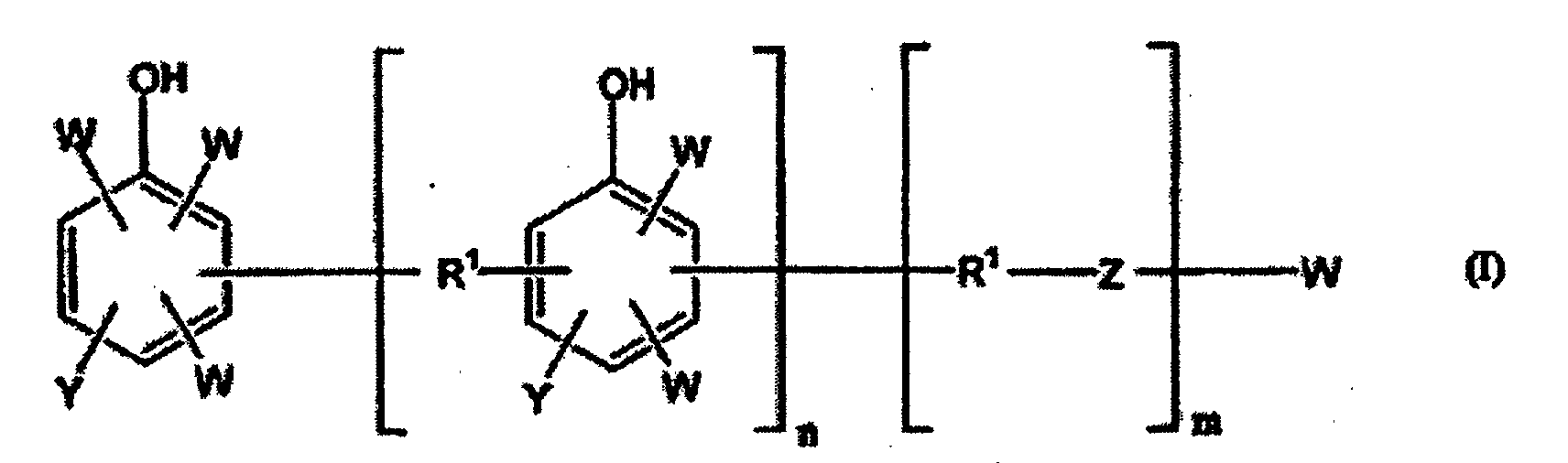
-CH=N-CH2-; Y represents a hydrogen atom or a group represented by the general formula (II)(wherein R2 and R3 independently represent a hydrogen atom or an alkyl group with 1 to 3 carbon atoms); Z is a bivalent group that is generated with the loss of hydrogen atoms bonded to carbon atoms constituting the aromatic ring from an aromatic compound that can undergo addition condensation with formaldehyde, may have 1 to 4 -CH2X groups (wherein X represents the same as X in the definition of W mentioned below), and differs from the aromatic ring group in the structure enclosed in brackets with subscript n, or a bivalent group generated with the loss of one hydrogen atom from each of two amino groups of melamine, guanamine, or urea; each W is independently hydrogen or a group P, said P being -CH2X, -CH2NHCH2X, or -CH=NCH2X [wherein X is OH, OR4 (R4 representing an alkyl group with 1 to 5 carbon atoms or a hydroxyalkyl group with 1 to 5 carbon atoms), a halogen atom, or a group represented by the general formula (III) or (IV) (wherein R5, R6, R7, R8 and R9 independently represent a hydrogen atom, an alkyl group with 1 to 10 carbon atoms, or a hydroxyalkyl group with 1 to 10 carbon atoms, and A- represents a hydroxyl ion or acid ion)], the degree of substitution with group P satisfying the relationship: (number of Ps)/( total number of benzene rings and Zs) = 0.2 to 4.0, and the ratio: (number of -CH2X groups where X is a functional group represented by the formula (III) or (IV) + number of -CH2NHCH2X groups + number of -CH=NCH2X groups)/( total number of Ps) being 0.1 to 1.0; n is 0 or an integer of 1 to 29; and m is 0 or an integer of 1 to to.}
- A surface treatment agent for metal as described in Claim 1, wherein the content of said water-soluble resin or water-based emulsion resin (A) is 1.9 to 98 mass%, the content of said resin compound (B) is 1.9 to 98 mass%, and the content of the metal in said metal compound (C) is 0.1 to 30 mass%, when the total of (A), (B), and metal in (C) is given as 100 mass%.
- A surface treatment agent for metal as described in Claim 1 or Claim 2, wherein at least one acid (D) selected from among nitric acid, phosphoric acid, and hydrofluoric acid is also added.
- A surface treatment agent as described in Claim 3, wherein the concentration of said acid (D) in said surface treatment agent for metal is 0.1 to 100 g/L.
- A surface treatment agent as described in one of Claims 1 to 4, wherein a silane coupling agent (E) is also added.
- A surface treatment agent as described in Claim 5, wherein the concentration of said silane coupling agent (E) in said surface treatment agent for metal is 1 to 300 g/L.
- A process for the surface treatment of metallic materials, characterized in that the surface treatment agent for metal described in one of Claims 1 to 6 is applied to the surface of a metallic material and dried, and thereby a film is formed on said metallic material surface.
- Metallic materials that contain a film formed with the use of the surface treatment process described in Claim 7.
Applications Claiming Priority (3)
| Application Number | Priority Date | Filing Date | Title |
|---|---|---|---|
| JP2001193169 | 2001-06-26 | ||
| JP2001193169A JP4078044B2 (en) | 2001-06-26 | 2001-06-26 | Metal surface treatment agent, surface treatment method of metal material, and surface treatment metal material |
| PCT/JP2002/005732 WO2003000953A1 (en) | 2001-06-26 | 2002-06-10 | Surface treatment for metal, process for surface treatment of metallic substances and surface-treated metallic substances |
Publications (2)
| Publication Number | Publication Date |
|---|---|
| EP1426466A1 true EP1426466A1 (en) | 2004-06-09 |
| EP1426466A4 EP1426466A4 (en) | 2004-09-15 |
Family
ID=19031504
Family Applications (1)
| Application Number | Title | Priority Date | Filing Date |
|---|---|---|---|
| EP02733436A Withdrawn EP1426466A4 (en) | 2001-06-26 | 2002-06-10 | Surface treatment for metal, process for surface treatment of metallic substances and surface-treated metallic substances |
Country Status (6)
| Country | Link |
|---|---|
| US (1) | US20040167266A1 (en) |
| EP (1) | EP1426466A4 (en) |
| JP (1) | JP4078044B2 (en) |
| CN (1) | CN1260392C (en) |
| CA (1) | CA2451471A1 (en) |
| WO (1) | WO2003000953A1 (en) |
Cited By (13)
| Publication number | Priority date | Publication date | Assignee | Title |
|---|---|---|---|---|
| WO2006050915A2 (en) | 2004-11-10 | 2006-05-18 | Chemetall Gmbh | Method for coating metallic surfaces with an aqueous composition comprising silanes silanols siloxanes and polysiloxanes and said composition |
| WO2006028894A3 (en) * | 2004-09-02 | 2006-06-01 | Gen Electric | Method and composition for forming a non-chrome conversion coating on steel surface |
| EP1884579A1 (en) * | 2006-08-04 | 2008-02-06 | Kansai Paint Co., Ltd. | Method for forming surface-treating film |
| EP1889952A1 (en) * | 2006-08-08 | 2008-02-20 | Kansai Paint Co., Ltd. | Method for forming surface-treating film |
| EP1788051A4 (en) * | 2004-08-26 | 2009-10-21 | Kansai Paint Co Ltd | Electrodeposition coating composition and coated article |
| EP1918419A4 (en) * | 2005-07-22 | 2011-06-22 | Nippon Steel Corp | METALLIC MATERIAL HAVING TREATED SURFACE WITHOUT CHROMATE EXCELLENT IN CORROSION RESISTANCE, HEAT RESISTANCE, FINGER TRACES, CONDUCTIVITY, COATING AND STRENGTH PROPERTIES |
| EP2080564A3 (en) * | 2007-12-19 | 2011-11-16 | Voestalpine Stahl GmbH | Treatment solution for coating a galvanised or alloy galvanised steel band, method for applying same and a galvanised or alloy galvanised steel band with a coating composed of the received treatment solution for improving deformation behaviour |
| US8241744B2 (en) | 2006-11-15 | 2012-08-14 | Nippon Steel Corporation | Surface-treated metal material and producing method thereof |
| US8409661B2 (en) | 2004-11-10 | 2013-04-02 | Chemetall Gmbh | Process for producing a repair coating on a coated metallic surface |
| US8784991B2 (en) | 2005-04-04 | 2014-07-22 | Chemetall Gmbh | Process for coating metallic surfaces with an aqueous composition, and this composition |
| WO2018050506A1 (en) * | 2016-09-15 | 2018-03-22 | Chemetall Gmbh | Improved process for corrosion-protecting pretreatment of a metallic surface containing steel, galvanized steel, aluminum, an aluminum alloy, magnesium and/or a zinc-magnesium alloy |
| WO2021009186A1 (en) * | 2019-07-15 | 2021-01-21 | Chemetall Gmbh | Compositions and methods for metal pre-treatment |
| US11142655B2 (en) | 2004-11-10 | 2021-10-12 | Chemetall Gmbh | Process for coating metallic surfaces with a multicomponent aqueous composition |
Families Citing this family (67)
| Publication number | Priority date | Publication date | Assignee | Title |
|---|---|---|---|---|
| JP4110848B2 (en) * | 2002-06-12 | 2008-07-02 | Jfeスチール株式会社 | Surface-treated steel sheet excellent in press formability and corrosion resistance and method for producing the same |
| ATE553163T1 (en) * | 2003-02-25 | 2012-04-15 | Chemetall Gmbh | METHOD FOR COATING METAL SURFACES WITH A MIXTURE CONTAINING AT LEAST TWO SILANES |
| JP2005120469A (en) * | 2003-09-26 | 2005-05-12 | Nippon Parkerizing Co Ltd | Composition for surface treatment of metal material and surface treatment method |
| JP4629984B2 (en) * | 2004-03-01 | 2011-02-09 | 日本ペイント株式会社 | Aqueous coating agent for steel, coating method and coated steel |
| JP4629987B2 (en) * | 2004-03-19 | 2011-02-09 | 日本ペイント株式会社 | Sealing agent, phosphating steel sheet coating method and phosphating steel sheet |
| JP2006118012A (en) * | 2004-10-22 | 2006-05-11 | Nippon Parkerizing Co Ltd | Metal surface treatment agent, surface treatment method of metal material, and surface treatment metal material |
| KR20070069169A (en) * | 2004-10-22 | 2007-07-02 | 니혼 파커라이징 가부시키가이샤 | Metal surface treatment agent, surface treatment method of metal material and surface treatment metal material |
| JP4969831B2 (en) * | 2004-10-26 | 2012-07-04 | 日本パーカライジング株式会社 | Metal surface treatment agent, surface treatment method of metal material, and surface treatment metal material |
| JP5342718B2 (en) * | 2004-10-26 | 2013-11-13 | 日本パーカライジング株式会社 | Metal surface treatment agent, surface treatment method of metal material, and surface treatment metal material |
| JP5342719B2 (en) * | 2004-10-26 | 2013-11-13 | 日本パーカライジング株式会社 | Metal surface treatment agent, surface treatment method of metal material, and surface treatment metal material |
| JP4975999B2 (en) * | 2004-10-26 | 2012-07-11 | 日本パーカライジング株式会社 | Metal surface treatment agent, surface treatment method of metal material, and surface treatment metal material |
| KR100947198B1 (en) * | 2005-02-02 | 2010-03-11 | 니혼 파커라이징 가부시키가이샤 | Aqueous metal material surface treatment agent, surface treatment method and surface treatment metal material |
| JP4683582B2 (en) * | 2005-02-02 | 2011-05-18 | 日本パーカライジング株式会社 | Water-based metal material surface treatment agent, surface treatment method and surface treatment metal material |
| DE102005012961A1 (en) * | 2005-03-17 | 2006-09-21 | Wiegel Verwaltung Gmbh & Co Kg | Coating, useful for gloss preservation of hot-dip galvanized materials, comprises water-based dispersion comprising a polymer, water and an adhesive silane |
| JP4831991B2 (en) * | 2005-04-06 | 2011-12-07 | 住友金属工業株式会社 | Surface-treated plated steel sheet for gasoline fuel containers |
| JP2006316342A (en) * | 2005-04-15 | 2006-11-24 | Nippon Steel Corp | Metal member, antirust treatment agent, and antirust treatment method |
| JP2006321957A (en) * | 2005-05-20 | 2006-11-30 | Nippon Parkerizing Co Ltd | Water-based surface treatment agent for environment-friendly pre-coated metal material and surface treatment method |
| JP2007002330A (en) * | 2005-06-27 | 2007-01-11 | Baoshan Iron & Steel Co Ltd | Surface treatment agent for zinc or zinc alloy galvanized steel sheet, and surface treated zinc or zinc alloy galvanized steel sheet |
| JP4832023B2 (en) * | 2005-08-12 | 2011-12-07 | 住友金属工業株式会社 | Surface-treated steel sheet with heat resistance |
| JP4470874B2 (en) | 2005-11-30 | 2010-06-02 | Jfeスチール株式会社 | Surface-treated galvanized steel sheet |
| US20090047436A1 (en) * | 2005-12-12 | 2009-02-19 | Dic Corporation | Aqueous coating composition, organic-inorganic composite coating film and production method thereof |
| JP2007162098A (en) * | 2005-12-15 | 2007-06-28 | Nippon Parkerizing Co Ltd | Water-based metal surface treatment agent, surface treatment method and surface treatment metal material |
| KR100681664B1 (en) | 2005-12-30 | 2007-02-09 | 동부제강주식회사 | Chrome-free surface treatment solution composition with excellent powder coating property and manufacturing method of coated steel sheet coated with it |
| JP5088095B2 (en) | 2006-12-13 | 2012-12-05 | Jfeスチール株式会社 | Surface treated galvanized steel sheet with excellent corrosion resistance, blackening resistance, appearance and corrosion resistance after press molding, and aqueous surface treatment liquid for galvanized steel sheet |
| MX2009005823A (en) | 2006-12-20 | 2009-07-24 | Nippon Steel Corp | Surface-treated steel sheet. |
| JP5144660B2 (en) * | 2007-06-29 | 2013-02-13 | 日本パーカライジング株式会社 | Aqueous surface treatment solution for galvanized steel sheet and galvanized steel sheet |
| US20090123656A1 (en) * | 2007-11-13 | 2009-05-14 | Ernest Long | Composition and method for controlling galvanic corrosion in printed circuit boards |
| JP5529372B2 (en) * | 2007-11-20 | 2014-06-25 | 関西ペイント株式会社 | Metal surface treatment composition |
| JP2009155688A (en) * | 2007-12-26 | 2009-07-16 | Nisshin Steel Co Ltd | Chemical conversion treatment liquid superior in storage stability for steel sheet |
| JP2009191284A (en) * | 2008-02-12 | 2009-08-27 | Kansai Paint Co Ltd | Metal surface treatment agent |
| JP5061978B2 (en) * | 2008-03-18 | 2012-10-31 | 住友金属工業株式会社 | Surface-treated steel sheets and coated steel plates with excellent corrosion resistance, heat radiation, and conductivity |
| JP2010013677A (en) * | 2008-07-01 | 2010-01-21 | Nippon Parkerizing Co Ltd | Chemical conversion liquid for metal structure and surface treatment method |
| CN101323948B (en) * | 2008-07-08 | 2010-06-16 | 洛阳旷谷毓新化工科技有限公司 | Low temperature curing type non-chromium passivation agent for galvanizing plate |
| JP5183586B2 (en) * | 2008-08-12 | 2013-04-17 | 日本パーカライジング株式会社 | Water-based paint surface treatment agent also used as a primer, surface-treated metal material, and pre-coated metal material |
| JP5663915B2 (en) * | 2009-03-31 | 2015-02-04 | Jfeスチール株式会社 | Galvanized steel sheet |
| JP5446390B2 (en) * | 2009-03-31 | 2014-03-19 | Jfeスチール株式会社 | Surface treatment agent, method for producing plated steel sheet using the surface treatment agent, and plated steel sheet |
| CN101629288B (en) * | 2009-08-21 | 2011-06-22 | 攀钢集团钢铁钒钛股份有限公司 | Passivation treatment agent for hot-dip aluminum-zinc plate and preparation method thereof |
| WO2011030439A1 (en) | 2009-09-11 | 2011-03-17 | 日本パーカライジング株式会社 | Composition for adhesive layer formation for use for steel sheet having surface treated with multiple layers |
| JP5754102B2 (en) | 2009-10-27 | 2015-07-22 | Jfeスチール株式会社 | Galvanized steel sheet |
| CN101705036B (en) * | 2009-11-20 | 2012-09-19 | 中山市三民金属处理有限公司 | Paint capable of replacing electroplated decorative chromium layer |
| JP5995305B2 (en) * | 2010-01-19 | 2016-09-21 | Jx金属株式会社 | Metal surface treatment agent |
| KR100970461B1 (en) * | 2010-02-09 | 2010-07-16 | 엘베스트지에이티 주식회사 | Organic inorganic hybrid type composition of coating agent for anticorrosion and manufacturing method of the same |
| JP5499773B2 (en) | 2010-02-26 | 2014-05-21 | Jfeスチール株式会社 | Surface treatment liquid for galvanized steel sheet, galvanized steel sheet and method for producing the same |
| JP5168332B2 (en) * | 2010-09-24 | 2013-03-21 | Jfeスチール株式会社 | Surface treatment liquid for galvanized steel sheet, galvanized steel sheet and method for producing the same |
| CA2810987C (en) | 2010-09-29 | 2015-12-15 | Jfe Steel Corporation | Zinc-based metal coated steel sheet |
| MY181000A (en) | 2010-09-29 | 2020-12-15 | Jfe Steel Corp | Method for manufacturing zinc or zinc alloy coated steel sheet and zinc or zinc alloy coated steel sheet manufactured by the method |
| JP5754104B2 (en) * | 2010-09-29 | 2015-07-22 | Jfeスチール株式会社 | Hot-dip galvanized steel sheet and method for producing the same |
| JP5870570B2 (en) | 2011-09-14 | 2016-03-01 | Jfeスチール株式会社 | Surface treatment liquid for galvanized steel sheet, galvanized steel sheet and method for producing the same |
| PL2890830T3 (en) | 2012-08-29 | 2019-01-31 | Ppg Industries Ohio, Inc. | Zirconium pretreatment compositions containing molybdenum, associated methods for treating metal substrates, and related coated metal substrates |
| HK1207890A1 (en) | 2012-08-29 | 2016-02-12 | Ppg工业俄亥俄公司 | Zirconium pretreatment compositions containing lithium, associated methods for treating metal substrates, and realted coated metal substrates |
| JP6003507B2 (en) * | 2012-10-05 | 2016-10-05 | Jfeスチール株式会社 | Electrical steel sheet with insulation coating |
| JP5356616B1 (en) * | 2012-11-27 | 2013-12-04 | 日新製鋼株式会社 | Method for producing hot-dip Zn alloy-plated steel sheet |
| CN103254755B (en) * | 2013-05-27 | 2016-01-27 | 宝山钢铁股份有限公司 | There is hot-dip aluminizing zincium steel plate of excellent weather resistance, solidity to corrosion and alkali resistance and preparation method thereof and surface treatment agent |
| FR3008985B1 (en) * | 2013-07-26 | 2016-08-26 | Soc Now Des Couleurs Zinciques | COMPOSITION COMPRISING A CONTINUOUS ORGANIC PHASE AND REVERSE EMULSION INCORPORATING AN ACTIVE INGREDIENT FOR COATING A METAL SURFACE AND METHOD OF PRODUCING THE SAME |
| US20150050518A1 (en) * | 2013-08-15 | 2015-02-19 | Sanchem, Inc. | Method and composition for passivating zinc, zinc-coated, silver, and silver-coated substrates |
| CN104451643B (en) * | 2014-11-14 | 2017-08-18 | 深圳市钝化技术有限公司 | A kind of aluminium alloy non-chromium passivating solution and preparation method thereof |
| MY184050A (en) * | 2014-12-10 | 2021-03-17 | Nippon Steel Corp | Surface treatment agent for zinc-plated steel sheet |
| ES2763038T3 (en) | 2015-04-15 | 2020-05-26 | Henkel Ag & Co Kgaa | Thin corrosion protection coatings incorporating polyamidoamine polymers |
| US10435806B2 (en) | 2015-10-12 | 2019-10-08 | Prc-Desoto International, Inc. | Methods for electrolytically depositing pretreatment compositions |
| JP6561901B2 (en) * | 2016-04-15 | 2019-08-21 | 信越化学工業株式会社 | Metal surface treatment agent |
| CN119194461A (en) | 2016-08-24 | 2024-12-27 | Ppg工业俄亥俄公司 | Alkaline compositions for treating metal substrates |
| CN110662856A (en) * | 2017-05-11 | 2020-01-07 | 日本帕卡濑精株式会社 | Metal surface treatment agent, metal surface treatment method and metal material |
| JP7011990B2 (en) * | 2018-08-31 | 2022-01-27 | 株式会社エフコンサルタント | Aqueous dressing |
| RU2685353C1 (en) | 2018-10-02 | 2019-04-18 | Общество с ограниченной ответственностью "ТОРЕГ" | Pump unit |
| EP4209616A4 (en) * | 2020-10-05 | 2024-03-13 | JFE Steel Corporation | Surface treated steel sheet for organic resin coating and manufacturing method thereof; organic resin coated steel sheet and manufacturing method thereof |
| CN113444438B (en) * | 2020-12-30 | 2022-09-20 | 江苏苏博特新材料股份有限公司 | Concrete super-hydrophobic self-repairing protective coating and preparation method thereof |
| CN115094422A (en) * | 2022-04-24 | 2022-09-23 | 西安西部新锆科技股份有限公司 | A kind of beta phase etchant of zirconium/zirconium alloy and preparation method and corrosion method thereof |
Family Cites Families (22)
| Publication number | Priority date | Publication date | Assignee | Title |
|---|---|---|---|---|
| JPS53137039A (en) * | 1977-05-06 | 1978-11-30 | Daiwa Kasei Kenkyusho:Kk | Rust preventing liquid for zinc and zinc alloy |
| US4433615A (en) * | 1981-10-22 | 1984-02-28 | The Bendix Corporation | Blocking and thermal relief valve |
| US4433015A (en) * | 1982-04-07 | 1984-02-21 | Parker Chemical Company | Treatment of metal with derivative of poly-4-vinylphenol |
| US4457790A (en) * | 1983-05-09 | 1984-07-03 | Parker Chemical Company | Treatment of metal with group IV B metal ion and derivative of polyalkenylphenol |
| JPS59205708A (en) * | 1983-05-10 | 1984-11-21 | Sumitomo Metal Ind Ltd | Formation of electrical insulating film |
| US5298289A (en) * | 1987-12-04 | 1994-03-29 | Henkel Corporation | Polyphenol compounds and treatment and after-treatment of metal, plastic and painted surfaces therewith |
| US5068299A (en) * | 1987-12-04 | 1991-11-26 | Henkel Corporation | Carbodohydrate-modifed polyphenol compounds and compositions containing them |
| US5266410A (en) * | 1987-12-04 | 1993-11-30 | Henkel Corporation | Treatment and after-treatment of metal with polyphenol compounds |
| US4970264A (en) * | 1987-12-04 | 1990-11-13 | Henkel Corporation | Treatment and after-treatment of metal with amine oxide-containing polyphenol compounds |
| US5063089A (en) * | 1987-12-04 | 1991-11-05 | Henkel Corporation | Hydroxylamine or amine oxide containing polyphenolic compounds and uses thereof |
| US5116912A (en) * | 1987-12-04 | 1992-05-26 | Henkel Corporation | Polyphenolic compounds and uses thereof |
| US4963596A (en) * | 1987-12-04 | 1990-10-16 | Henkel Corporation | Treatment and after-treatment of metal with carbohydrate-modified polyphenol compounds |
| US5039770A (en) * | 1987-12-04 | 1991-08-13 | Henkel Corporation | Treatment and after-treatment of metal with polyphenol compounds |
| US5125989A (en) * | 1989-04-21 | 1992-06-30 | Henkel Corporation | Method and composition for coating aluminum |
| JP2811020B2 (en) * | 1990-04-17 | 1998-10-15 | 日本特殊陶業株式会社 | Joint of ceramic and steel and method of manufacturing the same |
| US5226976A (en) * | 1991-04-15 | 1993-07-13 | Henkel Corporation | Metal treatment |
| US5733386A (en) * | 1994-04-15 | 1998-03-31 | Henkel Corporation | Polymer composition and method for treating metal surfaces |
| EP1024905B1 (en) * | 1997-08-21 | 2005-10-26 | Henkel Kommanditgesellschaft auf Aktien | Process for coating and/or touching up coatings on metal surfaces |
| US6720032B1 (en) * | 1997-09-10 | 2004-04-13 | Henkel Kommanditgesellschaft Auf Aktien | Pretreatment before painting of composite metal structures containing aluminum portions |
| US5891952A (en) * | 1997-10-01 | 1999-04-06 | Henkel Corporation | Aqueous compositions containing polyphenol copolymers and processes for their preparation |
| BR9907927B1 (en) * | 1998-01-27 | 2009-08-11 | aqueous composition, method for providing a protective coating on a metal substrate, method for attaching an elastomeric substrate surface to a metal substrate surface, and method for providing a protective coating or primer on a metal substrate surface. | |
| US6736908B2 (en) * | 1999-12-27 | 2004-05-18 | Henkel Kommanditgesellschaft Auf Aktien | Composition and process for treating metal surfaces and resulting article |
-
2001
- 2001-06-26 JP JP2001193169A patent/JP4078044B2/en not_active Expired - Lifetime
-
2002
- 2002-06-10 CN CN02812886.9A patent/CN1260392C/en not_active Expired - Fee Related
- 2002-06-10 CA CA002451471A patent/CA2451471A1/en not_active Abandoned
- 2002-06-10 WO PCT/JP2002/005732 patent/WO2003000953A1/en not_active Ceased
- 2002-06-10 EP EP02733436A patent/EP1426466A4/en not_active Withdrawn
-
2003
- 2003-12-15 US US10/736,366 patent/US20040167266A1/en not_active Abandoned
Cited By (27)
| Publication number | Priority date | Publication date | Assignee | Title |
|---|---|---|---|---|
| EP1788051A4 (en) * | 2004-08-26 | 2009-10-21 | Kansai Paint Co Ltd | Electrodeposition coating composition and coated article |
| WO2006028894A3 (en) * | 2004-09-02 | 2006-06-01 | Gen Electric | Method and composition for forming a non-chrome conversion coating on steel surface |
| RU2396370C2 (en) * | 2004-09-02 | 2010-08-10 | Кеметол Корпорейшн | Chromium-free passivation of steel |
| US9327315B2 (en) | 2004-11-10 | 2016-05-03 | Chemetall Gmbh | Process for producing a repair coating on a coated metallic surface |
| US9879349B2 (en) | 2004-11-10 | 2018-01-30 | Chemetall Gmbh | Method for coating metallic surfaces with an aqueous composition |
| US11142655B2 (en) | 2004-11-10 | 2021-10-12 | Chemetall Gmbh | Process for coating metallic surfaces with a multicomponent aqueous composition |
| WO2006050916A3 (en) * | 2004-11-10 | 2006-07-27 | Chemetall Gmbh | Method for coating metallic surfaces with an aqueous composition comprising silanes silanols siloxanes and polysiloxanes and said composition |
| WO2006050915A2 (en) | 2004-11-10 | 2006-05-18 | Chemetall Gmbh | Method for coating metallic surfaces with an aqueous composition comprising silanes silanols siloxanes and polysiloxanes and said composition |
| WO2006050915A3 (en) * | 2004-11-10 | 2006-07-27 | Chemetall Gmbh | Method for coating metallic surfaces with an aqueous composition comprising silanes silanols siloxanes and polysiloxanes and said composition |
| US9254507B2 (en) | 2004-11-10 | 2016-02-09 | Chemetall Gmbh | Process for producing a repair coating on a coated metallic surface |
| EP2309028A1 (en) * | 2004-11-10 | 2011-04-13 | Chemetall GmbH | Method for coating metallic surfaces with silane /silanole / siloxane/ polysiloxane containing aqueous composition and this composition |
| US8807067B2 (en) | 2004-11-10 | 2014-08-19 | Chemetall Gmbh | Tool for the application of a repair coating to a metallic surface |
| US8409661B2 (en) | 2004-11-10 | 2013-04-02 | Chemetall Gmbh | Process for producing a repair coating on a coated metallic surface |
| US8784991B2 (en) | 2005-04-04 | 2014-07-22 | Chemetall Gmbh | Process for coating metallic surfaces with an aqueous composition, and this composition |
| EP1918419A4 (en) * | 2005-07-22 | 2011-06-22 | Nippon Steel Corp | METALLIC MATERIAL HAVING TREATED SURFACE WITHOUT CHROMATE EXCELLENT IN CORROSION RESISTANCE, HEAT RESISTANCE, FINGER TRACES, CONDUCTIVITY, COATING AND STRENGTH PROPERTIES |
| EP1884579A1 (en) * | 2006-08-04 | 2008-02-06 | Kansai Paint Co., Ltd. | Method for forming surface-treating film |
| US7906002B2 (en) | 2006-08-04 | 2011-03-15 | Kansai Paint Co., Ltd. | Method for forming surface-treating film |
| US7625476B2 (en) | 2006-08-08 | 2009-12-01 | Kansai Paint Co., Ltd | Method for forming surface-treating film |
| EP1889952A1 (en) * | 2006-08-08 | 2008-02-20 | Kansai Paint Co., Ltd. | Method for forming surface-treating film |
| US8241744B2 (en) | 2006-11-15 | 2012-08-14 | Nippon Steel Corporation | Surface-treated metal material and producing method thereof |
| EP2080564A3 (en) * | 2007-12-19 | 2011-11-16 | Voestalpine Stahl GmbH | Treatment solution for coating a galvanised or alloy galvanised steel band, method for applying same and a galvanised or alloy galvanised steel band with a coating composed of the received treatment solution for improving deformation behaviour |
| WO2018050506A1 (en) * | 2016-09-15 | 2018-03-22 | Chemetall Gmbh | Improved process for corrosion-protecting pretreatment of a metallic surface containing steel, galvanized steel, aluminum, an aluminum alloy, magnesium and/or a zinc-magnesium alloy |
| RU2754068C2 (en) * | 2016-09-15 | 2021-08-25 | Хеметалл Гмбх | Improved method for anticorrosive pretreatment of metal surface consisting of steel, galvanized steel, aluminum, aluminum alloy, magnesium and/or zinc-magnesium alloy |
| US12043753B2 (en) | 2016-09-15 | 2024-07-23 | Chemetall Gmbh | Process for corrosion-protecting pretreatment of a metallic surface containing steel, galvanized steel, aluminum, an aluminum alloy, magnesium and/or a zinc-magnesium alloy |
| WO2021009186A1 (en) * | 2019-07-15 | 2021-01-21 | Chemetall Gmbh | Compositions and methods for metal pre-treatment |
| US12195575B2 (en) | 2019-07-15 | 2025-01-14 | Chemetall Gmbh | Compositions and methods for metal pre-treatment |
| AU2020314690B2 (en) * | 2019-07-15 | 2026-02-12 | Chemetall Gmbh | Compositions and methods for metal pre-treatment |
Also Published As
| Publication number | Publication date |
|---|---|
| WO2003000953A1 (en) | 2003-01-03 |
| CN1260392C (en) | 2006-06-21 |
| EP1426466A4 (en) | 2004-09-15 |
| JP4078044B2 (en) | 2008-04-23 |
| JP2003013252A (en) | 2003-01-15 |
| US20040167266A1 (en) | 2004-08-26 |
| CN1520468A (en) | 2004-08-11 |
| CA2451471A1 (en) | 2003-01-03 |
Similar Documents
| Publication | Publication Date | Title |
|---|---|---|
| US20040167266A1 (en) | Surface treatment for metal, process for surface treatment of metallic substances, and surface-treated metallic substances | |
| KR100625947B1 (en) | Metal surface treatment chemical, surface treatment method and surface-treated metal material | |
| US6736908B2 (en) | Composition and process for treating metal surfaces and resulting article | |
| JP4646966B2 (en) | Metal surface treatment agent, surface treatment method of metal material, and surface treatment metal material | |
| US5578669A (en) | Water-based polyurethane coating composition | |
| CN102991023B (en) | The surface treated steel plate that corrosion stability, conductivity and coating appearance are excellent | |
| CN105143513B (en) | Coated steel plate is with base treatment composition and has carried out the coated steel sheet and its manufacture method, application coated steel sheet and its manufacture method of base treatment | |
| EP2581471B1 (en) | Inorganic chromium-free metal surface treatment agent | |
| JP5086040B2 (en) | Metal surface treatment composition | |
| JP2006213958A (en) | Metal material surface treatment composition and treatment method | |
| JP3143046B2 (en) | Organic composite coated steel sheet with excellent press formability and perforated corrosion resistance | |
| US20090274926A1 (en) | Surface-Treated Steel Sheet | |
| KR102043572B1 (en) | Waterborne treatments, galvanized or galvanized steel and painted galvanized or galvanized steel | |
| JP2007002330A (en) | Surface treatment agent for zinc or zinc alloy galvanized steel sheet, and surface treated zinc or zinc alloy galvanized steel sheet | |
| JP4419532B2 (en) | Surface-treated steel sheet with excellent corrosion resistance, conductivity, and coating appearance | |
| JP4970773B2 (en) | Metal surface treatment agent, metal material surface treatment method and surface treatment metal material | |
| JP2000160353A (en) | Organic coated steel sheet with excellent corrosion resistance | |
| JP3461741B2 (en) | Pre-coated steel sheet with excellent corrosion resistance | |
| JP3412538B2 (en) | Organic coated steel sheet with excellent corrosion resistance | |
| JP2797036B2 (en) | Organic composite coated steel sheet having excellent external rust resistance and excellent image clarity and method for producing the same | |
| JP4966480B2 (en) | Post-treatment method for zinc phosphate-based treatment material excellent in corrosion resistance and top coatability and post-treated zinc phosphate-based treatment material | |
| JP2007009232A (en) | Surface-treated steel sheet and manufacturing method thereof | |
| JPH08209065A (en) | Aqueous coating composition | |
| JP2004197179A (en) | Manufacturing method of non-chrome type treated galvanized steel sheet | |
| JP3892642B2 (en) | Surface-treated steel sheet and manufacturing method thereof |
Legal Events
| Date | Code | Title | Description |
|---|---|---|---|
| PUAI | Public reference made under article 153(3) epc to a published international application that has entered the european phase |
Free format text: ORIGINAL CODE: 0009012 |
|
| 17P | Request for examination filed |
Effective date: 20031217 |
|
| AK | Designated contracting states |
Kind code of ref document: A1 Designated state(s): AT BE CH CY DE DK ES FI FR GB GR IE IT LI LU MC NL PT SE TR |
|
| AX | Request for extension of the european patent |
Extension state: AL LT LV MK RO SI |
|
| RTI1 | Title (correction) |
Free format text: SURFACE TREATMENT FOR METAL, PROCESS FOR SURFACE TREATMENT OF METALLIC SUBSTANCES AND SURFACE-TREATED METALLIC SUBSTANCES |
|
| A4 | Supplementary search report drawn up and despatched |
Effective date: 20040804 |
|
| RIC1 | Information provided on ipc code assigned before grant |
Ipc: 7C 09D 5/08 B Ipc: 7C 23C 22/36 B Ipc: 7C 23C 22/34 B Ipc: 7C 23C 22/42 B Ipc: 7C 23C 22/40 A |
|
| RAP1 | Party data changed (applicant data changed or rights of an application transferred) |
Owner name: HENKEL AG & CO. KGAA |
|
| R17P | Request for examination filed (corrected) |
Effective date: 20031217 |
|
| STAA | Information on the status of an ep patent application or granted ep patent |
Free format text: STATUS: THE APPLICATION IS DEEMED TO BE WITHDRAWN |
|
| 18D | Application deemed to be withdrawn |
Effective date: 20080103 |