EP1431407A1 - Steel plate exhibiting excellent workability and method for producing the same - Google Patents
Steel plate exhibiting excellent workability and method for producing the same Download PDFInfo
- Publication number
- EP1431407A1 EP1431407A1 EP02736196A EP02736196A EP1431407A1 EP 1431407 A1 EP1431407 A1 EP 1431407A1 EP 02736196 A EP02736196 A EP 02736196A EP 02736196 A EP02736196 A EP 02736196A EP 1431407 A1 EP1431407 A1 EP 1431407A1
- Authority
- EP
- European Patent Office
- Prior art keywords
- steel sheet
- mass
- value
- sheet excellent
- temperature
- Prior art date
- Legal status (The legal status is an assumption and is not a legal conclusion. Google has not performed a legal analysis and makes no representation as to the accuracy of the status listed.)
- Granted
Links
Classifications
-
- C—CHEMISTRY; METALLURGY
- C22—METALLURGY; FERROUS OR NON-FERROUS ALLOYS; TREATMENT OF ALLOYS OR NON-FERROUS METALS
- C22C—ALLOYS
- C22C38/00—Ferrous alloys, e.g. steel alloys
- C22C38/02—Ferrous alloys, e.g. steel alloys containing silicon
-
- C—CHEMISTRY; METALLURGY
- C21—METALLURGY OF IRON
- C21D—MODIFYING THE PHYSICAL STRUCTURE OF FERROUS METALS; GENERAL DEVICES FOR HEAT TREATMENT OF FERROUS OR NON-FERROUS METALS OR ALLOYS; MAKING METAL MALLEABLE, e.g. BY DECARBURISATION OR TEMPERING
- C21D8/00—Modifying the physical properties of ferrous metals or ferrous alloys by deformation combined with, or followed by, heat treatment
- C21D8/02—Modifying the physical properties of ferrous metals or ferrous alloys by deformation combined with, or followed by, heat treatment during manufacturing of plates or strips
- C21D8/04—Modifying the physical properties of ferrous metals or ferrous alloys by deformation combined with, or followed by, heat treatment during manufacturing of plates or strips to produce plates or strips for drawing, e.g. for deep-drawing
-
- C—CHEMISTRY; METALLURGY
- C21—METALLURGY OF IRON
- C21D—MODIFYING THE PHYSICAL STRUCTURE OF FERROUS METALS; GENERAL DEVICES FOR HEAT TREATMENT OF FERROUS OR NON-FERROUS METALS OR ALLOYS; MAKING METAL MALLEABLE, e.g. BY DECARBURISATION OR TEMPERING
- C21D8/00—Modifying the physical properties of ferrous metals or ferrous alloys by deformation combined with, or followed by, heat treatment
- C21D8/02—Modifying the physical properties of ferrous metals or ferrous alloys by deformation combined with, or followed by, heat treatment during manufacturing of plates or strips
- C21D8/04—Modifying the physical properties of ferrous metals or ferrous alloys by deformation combined with, or followed by, heat treatment during manufacturing of plates or strips to produce plates or strips for drawing, e.g. for deep-drawing
- C21D8/0421—Modifying the physical properties of ferrous metals or ferrous alloys by deformation combined with, or followed by, heat treatment during manufacturing of plates or strips to produce plates or strips for drawing, e.g. for deep-drawing characterised by the working steps
- C21D8/0426—Hot rolling
-
- C—CHEMISTRY; METALLURGY
- C21—METALLURGY OF IRON
- C21D—MODIFYING THE PHYSICAL STRUCTURE OF FERROUS METALS; GENERAL DEVICES FOR HEAT TREATMENT OF FERROUS OR NON-FERROUS METALS OR ALLOYS; MAKING METAL MALLEABLE, e.g. BY DECARBURISATION OR TEMPERING
- C21D8/00—Modifying the physical properties of ferrous metals or ferrous alloys by deformation combined with, or followed by, heat treatment
- C21D8/02—Modifying the physical properties of ferrous metals or ferrous alloys by deformation combined with, or followed by, heat treatment during manufacturing of plates or strips
- C21D8/04—Modifying the physical properties of ferrous metals or ferrous alloys by deformation combined with, or followed by, heat treatment during manufacturing of plates or strips to produce plates or strips for drawing, e.g. for deep-drawing
- C21D8/0421—Modifying the physical properties of ferrous metals or ferrous alloys by deformation combined with, or followed by, heat treatment during manufacturing of plates or strips to produce plates or strips for drawing, e.g. for deep-drawing characterised by the working steps
- C21D8/0436—Cold rolling
-
- C—CHEMISTRY; METALLURGY
- C22—METALLURGY; FERROUS OR NON-FERROUS ALLOYS; TREATMENT OF ALLOYS OR NON-FERROUS METALS
- C22C—ALLOYS
- C22C38/00—Ferrous alloys, e.g. steel alloys
- C22C38/001—Ferrous alloys, e.g. steel alloys containing N
-
- C—CHEMISTRY; METALLURGY
- C22—METALLURGY; FERROUS OR NON-FERROUS ALLOYS; TREATMENT OF ALLOYS OR NON-FERROUS METALS
- C22C—ALLOYS
- C22C38/00—Ferrous alloys, e.g. steel alloys
- C22C38/002—Ferrous alloys, e.g. steel alloys containing In, Mg, or other elements not provided for in one single group C22C38/001 - C22C38/60
-
- C—CHEMISTRY; METALLURGY
- C22—METALLURGY; FERROUS OR NON-FERROUS ALLOYS; TREATMENT OF ALLOYS OR NON-FERROUS METALS
- C22C—ALLOYS
- C22C38/00—Ferrous alloys, e.g. steel alloys
- C22C38/04—Ferrous alloys, e.g. steel alloys containing manganese
-
- C—CHEMISTRY; METALLURGY
- C22—METALLURGY; FERROUS OR NON-FERROUS ALLOYS; TREATMENT OF ALLOYS OR NON-FERROUS METALS
- C22C—ALLOYS
- C22C38/00—Ferrous alloys, e.g. steel alloys
- C22C38/06—Ferrous alloys, e.g. steel alloys containing aluminium
-
- C—CHEMISTRY; METALLURGY
- C22—METALLURGY; FERROUS OR NON-FERROUS ALLOYS; TREATMENT OF ALLOYS OR NON-FERROUS METALS
- C22C—ALLOYS
- C22C38/00—Ferrous alloys, e.g. steel alloys
- C22C38/60—Ferrous alloys, e.g. steel alloys containing lead, selenium, tellurium, or antimony, or more than 0.04% by weight of sulfur
-
- C—CHEMISTRY; METALLURGY
- C23—COATING METALLIC MATERIAL; COATING MATERIAL WITH METALLIC MATERIAL; CHEMICAL SURFACE TREATMENT; DIFFUSION TREATMENT OF METALLIC MATERIAL; COATING BY VACUUM EVAPORATION, BY SPUTTERING, BY ION IMPLANTATION OR BY CHEMICAL VAPOUR DEPOSITION, IN GENERAL; INHIBITING CORROSION OF METALLIC MATERIAL OR INCRUSTATION IN GENERAL
- C23C—COATING METALLIC MATERIAL; COATING MATERIAL WITH METALLIC MATERIAL; SURFACE TREATMENT OF METALLIC MATERIAL BY DIFFUSION INTO THE SURFACE, BY CHEMICAL CONVERSION OR SUBSTITUTION; COATING BY VACUUM EVAPORATION, BY SPUTTERING, BY ION IMPLANTATION OR BY CHEMICAL VAPOUR DEPOSITION, IN GENERAL
- C23C2/00—Hot-dipping or immersion processes for applying the coating material in the molten state without affecting the shape; Apparatus therefor
- C23C2/02—Pretreatment of the material to be coated, e.g. for coating on selected surface areas
-
- C—CHEMISTRY; METALLURGY
- C23—COATING METALLIC MATERIAL; COATING MATERIAL WITH METALLIC MATERIAL; CHEMICAL SURFACE TREATMENT; DIFFUSION TREATMENT OF METALLIC MATERIAL; COATING BY VACUUM EVAPORATION, BY SPUTTERING, BY ION IMPLANTATION OR BY CHEMICAL VAPOUR DEPOSITION, IN GENERAL; INHIBITING CORROSION OF METALLIC MATERIAL OR INCRUSTATION IN GENERAL
- C23C—COATING METALLIC MATERIAL; COATING MATERIAL WITH METALLIC MATERIAL; SURFACE TREATMENT OF METALLIC MATERIAL BY DIFFUSION INTO THE SURFACE, BY CHEMICAL CONVERSION OR SUBSTITUTION; COATING BY VACUUM EVAPORATION, BY SPUTTERING, BY ION IMPLANTATION OR BY CHEMICAL VAPOUR DEPOSITION, IN GENERAL
- C23C2/00—Hot-dipping or immersion processes for applying the coating material in the molten state without affecting the shape; Apparatus therefor
- C23C2/02—Pretreatment of the material to be coated, e.g. for coating on selected surface areas
- C23C2/022—Pretreatment of the material to be coated, e.g. for coating on selected surface areas by heating
- C23C2/0224—Two or more thermal pretreatments
-
- C—CHEMISTRY; METALLURGY
- C23—COATING METALLIC MATERIAL; COATING MATERIAL WITH METALLIC MATERIAL; CHEMICAL SURFACE TREATMENT; DIFFUSION TREATMENT OF METALLIC MATERIAL; COATING BY VACUUM EVAPORATION, BY SPUTTERING, BY ION IMPLANTATION OR BY CHEMICAL VAPOUR DEPOSITION, IN GENERAL; INHIBITING CORROSION OF METALLIC MATERIAL OR INCRUSTATION IN GENERAL
- C23C—COATING METALLIC MATERIAL; COATING MATERIAL WITH METALLIC MATERIAL; SURFACE TREATMENT OF METALLIC MATERIAL BY DIFFUSION INTO THE SURFACE, BY CHEMICAL CONVERSION OR SUBSTITUTION; COATING BY VACUUM EVAPORATION, BY SPUTTERING, BY ION IMPLANTATION OR BY CHEMICAL VAPOUR DEPOSITION, IN GENERAL
- C23C2/00—Hot-dipping or immersion processes for applying the coating material in the molten state without affecting the shape; Apparatus therefor
- C23C2/02—Pretreatment of the material to be coated, e.g. for coating on selected surface areas
- C23C2/024—Pretreatment of the material to be coated, e.g. for coating on selected surface areas by cleaning or etching
-
- C—CHEMISTRY; METALLURGY
- C25—ELECTROLYTIC OR ELECTROPHORETIC PROCESSES; APPARATUS THEREFOR
- C25D—PROCESSES FOR THE ELECTROLYTIC OR ELECTROPHORETIC PRODUCTION OF COATINGS; ELECTROFORMING; APPARATUS THEREFOR
- C25D5/00—Electroplating characterised by the process; Pretreatment or after-treatment of workpieces
- C25D5/34—Pretreatment of metallic surfaces to be electroplated
-
- C—CHEMISTRY; METALLURGY
- C21—METALLURGY OF IRON
- C21D—MODIFYING THE PHYSICAL STRUCTURE OF FERROUS METALS; GENERAL DEVICES FOR HEAT TREATMENT OF FERROUS OR NON-FERROUS METALS OR ALLOYS; MAKING METAL MALLEABLE, e.g. BY DECARBURISATION OR TEMPERING
- C21D2211/00—Microstructure comprising significant phases
- C21D2211/002—Bainite
-
- C—CHEMISTRY; METALLURGY
- C21—METALLURGY OF IRON
- C21D—MODIFYING THE PHYSICAL STRUCTURE OF FERROUS METALS; GENERAL DEVICES FOR HEAT TREATMENT OF FERROUS OR NON-FERROUS METALS OR ALLOYS; MAKING METAL MALLEABLE, e.g. BY DECARBURISATION OR TEMPERING
- C21D2211/00—Microstructure comprising significant phases
- C21D2211/008—Martensite
-
- C—CHEMISTRY; METALLURGY
- C21—METALLURGY OF IRON
- C21D—MODIFYING THE PHYSICAL STRUCTURE OF FERROUS METALS; GENERAL DEVICES FOR HEAT TREATMENT OF FERROUS OR NON-FERROUS METALS OR ALLOYS; MAKING METAL MALLEABLE, e.g. BY DECARBURISATION OR TEMPERING
- C21D8/00—Modifying the physical properties of ferrous metals or ferrous alloys by deformation combined with, or followed by, heat treatment
- C21D8/02—Modifying the physical properties of ferrous metals or ferrous alloys by deformation combined with, or followed by, heat treatment during manufacturing of plates or strips
- C21D8/0221—Modifying the physical properties of ferrous metals or ferrous alloys by deformation combined with, or followed by, heat treatment during manufacturing of plates or strips characterised by the working steps
- C21D8/0226—Hot rolling
-
- C—CHEMISTRY; METALLURGY
- C21—METALLURGY OF IRON
- C21D—MODIFYING THE PHYSICAL STRUCTURE OF FERROUS METALS; GENERAL DEVICES FOR HEAT TREATMENT OF FERROUS OR NON-FERROUS METALS OR ALLOYS; MAKING METAL MALLEABLE, e.g. BY DECARBURISATION OR TEMPERING
- C21D8/00—Modifying the physical properties of ferrous metals or ferrous alloys by deformation combined with, or followed by, heat treatment
- C21D8/02—Modifying the physical properties of ferrous metals or ferrous alloys by deformation combined with, or followed by, heat treatment during manufacturing of plates or strips
- C21D8/0221—Modifying the physical properties of ferrous metals or ferrous alloys by deformation combined with, or followed by, heat treatment during manufacturing of plates or strips characterised by the working steps
- C21D8/0236—Cold rolling
-
- C—CHEMISTRY; METALLURGY
- C21—METALLURGY OF IRON
- C21D—MODIFYING THE PHYSICAL STRUCTURE OF FERROUS METALS; GENERAL DEVICES FOR HEAT TREATMENT OF FERROUS OR NON-FERROUS METALS OR ALLOYS; MAKING METAL MALLEABLE, e.g. BY DECARBURISATION OR TEMPERING
- C21D9/00—Heat treatment, e.g. annealing, hardening, quenching or tempering, adapted for particular articles; Furnaces therefor
- C21D9/46—Heat treatment, e.g. annealing, hardening, quenching or tempering, adapted for particular articles; Furnaces therefor for sheet metals
- C21D9/48—Heat treatment, e.g. annealing, hardening, quenching or tempering, adapted for particular articles; Furnaces therefor for sheet metals deep-drawing sheets
Definitions
- the present invention relates to: a steel sheet used for, for instance, panels, undercarriage components, structural members and the like of an automobile; and a method for producing the same.
- the steel sheets according to the present invention include both those not subjected to surface treatment and those subjected to surface treatment such as hot-dip galvanizing, electrolytic plating or other plating for rust prevention.
- the plating includes the plating of pure zinc, an alloy containing zinc as the main component and further an alloy consisting mainly of Al or Al-Mg. Those steel sheets are also suitable as the materials for steel pipes for hydroforming applications.
- the reduction of a C amount requires to adopt vacuum degassing in a steelmaking process, that causes CO 2 gas to emit in quantity during the production process, and therefore it is hard to say that the reduction of a C amount is the most appropriate measure from the viewpoint of the conservation of the global environment.
- Japanese Patent Application No. 2000-52574 regarding a steel pipe that has a controlled texture and is excellent in formability.
- a steel pipe finished through high-temperature processing often contains solute C and solute N in quantity, and the solute elements sometimes cause cracks to be generated during hydroforming or surface defects such as stretcher strain to be induced.
- Other problems with such a steel pipe are that high-temperature thermomechanical treatment applied after a steel sheet has been formed into a tubular shape deteriorates productivity, burdens the global environment and raises a cost.
- An object of the present invention is to provide a steel sheet and a steel pipe having good r-values and methods for producing them without incurring a high cost and burdening the global environment excessively, the steel sheet being a high strength steel sheet having good formability while containing a large amount of C.
- another object of the present invention is to provide a steel sheet having yet better formability and a method for producing the steel sheet without incurring a high cost.
- the present invention has been established on the basis of the finding that to make the metallographic structure of a hot-rolled steel sheet before cold rolling composed mainly of a bainite or martensite phase makes it possible to improve deep drawability of the steel sheet after cold rolling and annealing.
- the present invention provides a high strength steel sheet, while containing a large amount of C, having good deep drawability and containing bainite, martensite, austenite and the like, as required, other than ferrite.
- the present invention also provides a high strength steel sheet, while containing comparatively large amounts of C and Mn, having good deep drawability without incurring a high cost and burdening the global environment excessively.
- the present inventors conducted studies intensively to solve the above problems and reached an unprecedented finding that, in the case of a steel containing large amounts of C and Mn, it was effective for the improvement of deep drawability to disperse carbides in a hot-rolled steel sheet evenly and finely and to make the metallographic microstructure of the hot-rolled steel sheet uniform.
- C is effective for strengthening a steel and the reduction of a C amount causes a cost to increase. For these reasons, a C amount is set at 0.08 mass % or more. Meanwhile, an excessive addition of C is undesirable for obtaining a good r-value, and therefore the upper limit of a C amount is set at 0.25 mass %. It goes without saying that an r-value is improved when a C amount is reduced to less than 0.08 mass %. However, because the objects of the present invention do not include reducing a C amount, such a low C amount is excluded intentionally. A preferable range of a C amount is from more than 0.10 to 0.18 mass %.
- Si raises the mechanical strength of a steel economically and thus it may be added in accordance with a required strength level.
- an excessive addition of Si causes not only the wettability of plating and workability but also an r-value to deteriorate.
- the upper limit of an Si amount is set at 1.5 mass %.
- the lower limit of an Si amount is set at 0.001 mass %, because an Si amount lower than the figure is hardly obtainable by the current steelmaking technology.
- a more desirable upper limit of an Si amount is 0.5 mass % or less.
- Mn is effective for strengthening a steel and may be added as required.
- the upper limit of an Mn amount is set at 2.0 mass %.
- the lower limit of an Mn amount is set at 0.01 mass %, because an Mn amount lower than the figure causes a steelmaking cost to increase and S-induced hot-rolling cracks to occur.
- a desirable range of an Mn amount is from 0.04 to 0.8 mass %.
- a lower Mn amount is preferable and therefore a preferable range of an Mn amount is from 0.04 to 0.12 mass %.
- P is an element effective for strengthening a steel and hence P is added by 0.001 mass % or more. However, when P is added by more than 0.06 mass %, weldability, the fatigue strength of a weld and resistance to brittleness in secondary working are deteriorated.
- a preferable P amount is less than 0.04 mass %.
- S is an impurity element and the lower the amount, the better.
- An S amount is set at 0.05 mass % or less in order to prevent hot cracking.
- a preferable S amount is 0.015 mass % or less. Further, in relation to the amount of Mn, it is preferable to satisfy the expression Mn/S > 10.
- N addition of 0.001 mass % or more is indispensable for securing a good r-value.
- an excessive N addition causes aging properties to deteriorate and requires a large amount of Al to be added.
- the upper limit of an N amount is set at 0.007 mass %.
- a more desirable range of an N amount is from 0.002 to 0.005 mass %.
- Al is necessary for securing a good r-value and hence is added by 0.008 mass % or more.
- the upper limit of an Al amount is set at 0.2 mass %.
- a preferable range of an Al amount is from 0.015 to 0.07 mass %.
- the r-value in the axial direction (rL) of the steel pipe is 1.3 or more.
- An r-value is obtained by conducting a tensile test using a JIS #12 arc-shaped test piece and calculating the r-value from the changes of the gauge length and the width of the test piece after the application of 15% tension in accordance with the definition of an r-value.
- the r-value may be calculated on the basis of the figures after the application of 10% tension.
- the r-value of an arc-shaped test piece is generally different from that of a flat test piece. Further, an r-value changes with the change of the diameter of an original steel pipe and moreover the change in the curvature of an arc is hardly measurable. For these reasons, it is desirable to measure an r-value by attaching a strain gauge to a test piece. An rL value of 1.4 or more is desirable for hydroforming application. with regard to the r-values of a steel pipe, usually, only an rL value is measurable because,of the tubular shape. However, when a steel pipe is formed into a flat sheet by pressing or other means and r-values in other directions are measured, the r-values are evaluated as follows.
- an average r-value is 1.2 or more
- an r-value in the direction of 45 degrees to the rolling direction (rD) is 0.9 or more
- an r-value in the direction of a right angle to the rolling direction (rC) is 1.2 or more.
- Preferable r-values thereof are 1.3 or more, 1.0 or more and 1.3 or more, respectively.
- An average r-value is given as (rL + 2rD + rC)/4.
- an r-value may be obtained by conducting a tensile test using a JIS #13B or JIS #5B test piece and calculating the r-value from the changes of the gauge length and the width of the test piece after the application of 15% tension in accordance with the definition of an r-value.
- the r-value may be calculated on the basis of the figures after the application of 10% tension. Note that the anisotropy of r-values is rL ⁇ rC > rD.
- the average grain size of the steel pipe is 15 ⁇ m or more.
- a good r-value cannot be obtained with an average grain size smaller than this figure.
- an average grain size is 60 ⁇ m or more, problems such as rough surfaces may occur during forming. For this reason, it is desirable that an average grain size is less than 60 ⁇ m.
- a grain size may be measured on a section perpendicular to a steel sheet surface and parallel to the rolling direction (L section) in a region from 3/8 to 5/8 of the thickness of the steel sheet by the point counting method or the like. To minimize measurement errors, it is necessary to measure in an area where 100 or more grains are observed. It is desirable to use nitral for etching.
- the grains meant here are ferrite grains, and an average grain size is the arithmetic average (simple average) of the sizes of all grains measured in the above manner.
- the aging index (AI) that is evaluated through a tensile test using a JIS #12 arc-shaped test piece is 40 MPa or less. If solute C remains in quantity, there are cases where formability is deteriorated and/or stretcher strain and other defects appear during forming. A more desirable AI value is 25 MPa or less.
- An AI value is measured through the following procedures. Firstly, 10% tensile deformation is applied to a test piece in the direction of the pipe axis. A flow stress under 10% tensile deformation is measured as ⁇ 1. Secondly, heat treatment is applied to the test piece for 1 h. at 100°C and another tensile test is applied thereto, and the lower yield stress at the time is measured as ⁇ 2. Then, the AI value is given as ⁇ 2 - ⁇ 1.
- an AI value has a positive correlation with the amounts of solute C and N.
- AI exceeds 40 MPa unless the pipe undergoes a post-heat treatment at a low temperature (200°C to 450°C). Therefore, the case is outside the scope of the present invention.
- a steel pipe according to the present invention has a yield-point elongation of 1.5% or less at a tensile test after the artificial aging for 1 h. at 100°C.
- the surface roughness is small: an Ra value specified in JIS B 0601 is 0.8 or less, that contrasts with the fact that the Ra value of a steel pipe produced through a diameter reducing process at a high temperature as stated above exceeds 0.8.
- a more desirable surface roughness is 0.6 or less.
- the ratios of the X-ray diffraction intensities in the orientation components of ⁇ 111 ⁇ , ⁇ 100 ⁇ and ⁇ 110 ⁇ to the random X-ray diffraction intensities at least on a reflection plane at the thickness center are 2.0 or more, 1.0 or less and 0.2 or more, respectively. Since X-ray measurement is not applied to a steel pipe as it is, it is conducted through the following procedures.
- a test piece is appropriately cut out from a steel pipe and formed into a tabular shape by pressing or other means. Then, the thickness of the test piece is reduced to a measurement thickness by mechanical polishing or other means. Finally, the test piece is finished by chemical polishing so as to reduce the thickness by about 30 to 100 ⁇ m with intent to reduce it by an average grain size or more.
- the ratio of the X-ray diffraction intensities in an orientation component to the random X-ray diffraction intensities is an X-ray diffraction intensities relative to the X-ray diffraction intensities of a random sample.
- the thickness center means a region from 3/8 to 5/8 of the thickness of a steel sheet, and the measurement may be taken on any plane within the region. It is commonly known that an r-value increases as the ⁇ 111 ⁇ planes increases. Therefore, it is desirable that the ratio of the X-ray diffraction intensities in the orientation component of ⁇ 111 ⁇ to the random X-ray diffraction intensities is as high as possible. However, a distinct feature of the present invention is that the ratio of the X-ray diffraction intensities in the orientation component of not only ⁇ 111 ⁇ but also ⁇ 110 ⁇ to the random X-ray diffraction intensities is higher than that of an ordinary steel.
- the ⁇ 110 ⁇ planes are usually unwelcome because they are planes that deteriorate deep drawability. However, in the present invention, it is desirable to allow the ⁇ 110 ⁇ planes to remain to some extent in order to increase the values of rL and rC.
- the ⁇ 110 ⁇ planes obtained through the present invention comprise ⁇ 110 ⁇ 110>, ⁇ 110 ⁇ 331>, ⁇ 110 ⁇ 001>, ⁇ 110 ⁇ 113>, etc.
- the ratio(s) of the X-ray diffraction intensities in the orientation component(s) of ⁇ 111 ⁇ 112> and/or ⁇ 554 ⁇ 225> to the random X-ray diffraction intensities is/are 1.5 or more. This is because these orientation components improve formability in hydroforming and they are the orientation components hardly obtainable through a diameter reducing process at a high temperature as mentioned earlier.
- ⁇ hkl ⁇ uvw> means that the crystal orientation normal to a pipe wall surface is ⁇ hkl> and that in the axial direction of a steel pipe is ⁇ uvw>.
- the average grain size of the steel pipe is 15 ⁇ m or more.
- a good r-value cannot be obtained with an average grain size smaller than this figure.
- an average grain size is 60 ⁇ m or more, problems such as rough surfaces may occur during forming. For this reason, it is desirable that an average grain size is less than 60 ⁇ m.
- a grain size may be measured on a section perpendicular to a pipe wall surface and parallel to the rolling direction (L section) in a region from 3/8 to 5/8 of the thickness of the pipe wall by the point counting method or the like. To minimize measurement errors, it is necessary to measure in an area where 100 or more grains are observed. It is desirable to use nitral for etching.
- the grains meant here are ferrite grains, and an average grain size is the arithmetic average (simple average) of the sizes of all grains measured in the above manner.
- the average aspect ratio of the grains composing the steel pipe is in the range from 1.0 to 3.0. A good r-value cannot be obtained with an average aspect ratio outside this range.
- the aspect ratio here is identical to the elongation rate measured by the method specified in JIS G 0552.
- an aspect ratio is obtained by dividing the number of grains intersected by a line segment of a certain length parallel to the rolling direction by the number of grains intersected by a line segment of the same length normal to the rolling direction on a section perpendicular to a pipe wall surface and parallel to the rolling direction (L section) in a region from 3/8 to 5/8 of the thickness of the pipe wall.
- An average aspect ratio is defined as the arithmetic average (simple average) of all the aspect ratios measured in the above manner.
- the present invention does not particularly specify the metallographic microstructure of a steel pipe, but it is desirable that the metallographic microstructure is composed of ferrite of 90% or more and cementite and/or pearlite of 10% or less from the viewpoint of securing good workability. It is more desirable that ferrite is 95% or more and cementite and/or pearlite is 5% or less.
- ferrite is 95% or more and cementite and/or pearlite is 5% or less.
- the fact that 30 % or more in volume percentage of the carbides composed mainly of Fe and C exist inside ferrite grains is also another feature of the present invention.
- the yield ratio (0.2% proof stress/maximum tensile strength) evaluated by subjecting the steel sheet used for a steel pipe according to the present invention to a tensile test is usually 0.65 or less. However, a yield ratio sometimes exceeds the figure when a reduction ratio in skin pass rolling is raised or a temperature in annealing is lowered. A yield ratio of 0.65 or less is desirable from the viewpoint of a shape freezing property.
- the value of Al/N is in the range from 3 to 25. If a value is outside the above range, a good r-value is hardly obtained. A more desirable range is from 5 to 15.
- B is effective for improving an r-value and resistance to brittleness in secondary working and therefore it is added as required.
- a B amount is less than 0.0001 mass %, these effects are too small.
- a B amount exceeds 0.01 mass %, no further effects are obtained.
- a preferable range of a B amount is from 0.0002 to 0.0030 mass %.
- Zr and Mg are elements effective for deoxidation.
- an excessive addition of Zr and Mg causes oxides, sulfides and nitrides to crystallize and precipitate in quantity and thus the cleanliness, ductility and plating properties of a steel to deteriorate.
- one or both of Zr and Mg may be added, as required, by 0.0001 to 0.50 mass % in total.
- Ti, Nb and V are also added if required. Since these elements enhance the strength and workability of a steel material by forming carbides, nitrides and/or carbonitrides, one or more of them may be added by 0.001 mass % or more in total. When a total addition amount of them exceeds 0.2 mass %, carbides, nitrides and/or carbonitrides precipitate in quantity in the interior or at the grain boundaries of ferrite grains which are the mother phase and ductility is deteriorated. For this reason, a total addition amount of Ti, Nb and V is regulated in the range from 0.001 to 0.2 mass %. A more desirable range is from 0.01 to 0.06 mass %.
- Sn, Cr, Cu, Ni, Co, W and Mo are strengthening elements and one or more of them may be added as required by 0.001 mass % or more in total. An excessive addition of these elements causes a cost to increase and ductility to deteriorate. For this reason, a total addition amount of the elements is set at 2.5 mass % or less.
- Ca is an element effective for deoxidation in addition to the control of inclusions and an appropriate addition amount of Ca improves hot workability.
- an excessive addition of Ca accelerates hot shortness adversely.
- Ca is added in the range from 0.0001 to 0.01 mass %, as required.
- a steel is melted and refined in a blast furnace, a converter, an electric arc furnace and the like, successively subjected to various secondary refining processes, and cast by ingot casting or continuous casting.
- a CC-DR process or the like wherein a steel is hot-rolled without cooled to a temperature near room temperature may be employed in combination.
- a cast ingot or a cast slab may be reheated and then hot rolled.
- the present invention does not particularly specify a reheating temperature at hot rolling. However, in order to keep AlN in a solid solution state, it is desirable that a reheating temperature is 1,100°C or higher.
- a finishing temperature at hot rolling is controlled to the Ar 3 transformation temperature - 50°C or higher.
- a desirable finishing temperature is the Ar 3 transformation temperature + 30°C or higher and, more desirably, the Ar 3 transformation temperature + 70°C or higher. This is because, in order to improve the r-value of a final product in the present invention, it is preferable to keep the texture of a hot-rolled steel sheet as random as possible and to make the crystal grains thereof grow as much as possible.
- the present invention does not particularly specify a cooling rate after hot rolling, but it is desirable that an average cooling rate down to a coiling temperature is less than 30°C/sec.
- a coiling temperature is set at 700°C or lower.
- the purpose is to suppress the coarsening of AlN and thus to secure a good r-value.
- a preferable coiling temperature is 620°C or lower.
- Roll lubrication may be applied at one or more of hot rolling passes. It is also permitted to join two or more rough hot-rolled bars with each other and to apply finish hot rolling continuously. A rough hot-rolled bar may be once wound into a coil and then unwound for finish hot rolling.
- the effects of the present invention can be realized without specifying any lower limit of a coiling temperature, but, in order to reduce the amount of solute C, it is desirable that a coiling temperature is 350°C or higher.
- a reduction ratio at cold rolling is regulated in the range from 25 to less than 60%.
- the basic concept of the prior art has been to attempt to improve an r-value by applying heavy cold rolling at a reduction ratio of 60% or more.
- the present inventors newly discovered that it was essential to apply rather a low reduction ratio in cold rolling.
- a cold-rolling reduction ratio is less than 25% or more than 60%, an r-value lowers.
- a cold-rolling reduction ratio is regulated in the range from 25 to less than 60%, preferably from 30 to 55%.
- box annealing is adopted basically, but another annealing may be adopted as long as the following conditions are satisfied.
- a heating rate is 4 to 200°C/h.
- a more desirable range of a heating rate is from 10 to 40°C/h.
- a maximum arrival temperature is 600°C to 800°C also from the viewpoint of securing a good r-value. When a maximum arrival temperature is lower than 600°C, recrystallization is not completed and workability is deteriorated.
- the present invention does not particularly specify a retention time at a maximum arrival temperature, but it is desirable that a retention time is 2 h. or more in the temperature range of a maximum arrival temperature - 20°C or higher from the viewpoint of improving an r-value.
- a cooling rate is determined in consideration of sufficiently reducing the amount of solute C and is regulated in the range from 5 to 100°C/h.
- skin pass rolling is applied as required from the viewpoint of correcting shape, controlling strength and securing non-aging properties at room temperature.
- a desirable reduction ratio of skin pass rolling is 0.5 to 5.0%.
- a steel sheet produced as described above is formed and welded into a steel pipe so that the rolling direction of the steel sheet may correspond to the axial direction of the steel pipe.
- the reason is that, even when a steel pipe is formed so that any other direction, for instance the direction of a right angle to the rolling direction, of a steel sheet may correspond to the axial direction of the pipe, the pipe is still applicable to hydroforming, but the productivity deteriorates.
- C is effective for strengthening a steel and the reduction of a C amount causes a cost to increase. Besides, by increasing a C amount, it becomes easy to make the metallographic microstructure of a hot-rolled steel sheet composed mainly of bainite and/or martensite. For these reasons, C is added proactively. An addition amount of C is set at 0.03 mass % or more. However, an excessive addition of C is undesirable for securing a good r-value and weldability and therefore the upper limit of a C amount is set at 0.25 mass %. A desirable range of a C amount is from 0.05 to 0.17 mass %, and more desirably 0.08 to 0.16 mass %.
- Si raises the mechanical strength of a steel economically and thus it may be added in accordance with a required strength level. Further, Si also has an effect of improving an r-value by reducing the amount of carbides existing in a hot-rolled steel sheet and making the size of the carbides fine. On the other hand, an excessive addition of Si causes not only the wettability of plating and workability but also an r-value to deteriorate. For this reason, the upper limit of an Si amount is set at 3.0 mass %. The lower limit of an Si amount is set at 0.001%, because an Si amount lower than the figure is hardly obtainable by the current steelmaking technology. A preferable range of an Si amount is from 0.4 to 2.3 mass % from the viewpoint of improving an r-value.
- Mn is an element that is effective not only for strengthening a steel but also for making the metallographic microstructure of a hot-rolled steel sheet composed mainly of bainite and/or martensite.
- an excessive addition of Mn deteriorates an r-value and therefore the upper limit of an Mn amount is set at 3.0 mass %.
- the lower limit of an Mn amount is set at 0.01 mass %, because an Mn amount lower than the figure causes a steelmaking cost to increase and S-induced hot-rolling cracks to be induced.
- An upper limit of an Mn amount desirable for obtaining good deep drawability is 2.4 mass %.
- it is desirable that the expression Mn% + 11C% > 1.5 is satisfied.
- P is an element effective for strengthening a steel and hence P is added by 0.001 mass % or more.
- P is added in excess of 0.06 mass %, weldability, the fatigue strength of a weld and resistance to brittleness in secondary working are deteriorated.
- the upper limit of a P amount is set at 0.06 mass %.
- a preferable P amount is less than 0.04 mass %.
- S is an impurity element and the lower the amount, the better.
- An S amount is set at 0.05 mass % or less in order to prevent hot cracking.
- a preferable S mount is 0.015 mass % or less. Further, in relation to the amount of Mn, it is preferable to satisfy the expression Mn/S > 10.
- N is of importance in the present invention. N forms clusters and/or precipitates with Al during slow heating after cold rolling, by so doing accelerates the development of a texture, and resultantly improves deep drawability.
- an addition of N by 0.001 mass % or more is indispensable.
- the upper limit of an N amount is set at 0.03 mass %.
- a preferable range of an N amount is from 0.002 to 0.007 mass %.
- Al is also of importance in the present invention. Al forms clusters and/or precipitates with N during slow heating after cold rolling, by so doing accelerates the development of a texture, and resultantly improves deep drawability. It is also an element effective for deoxidation. For these reasons, Al is added by 0.005 mass % or more. However, an excessive addition of Al causes a cost to increase, surface defects to be induced and an r-value to be deteriorated. For this reason, the upper limit of an Al amount is set at 0.3 mass %. A preferable range of an Al amount is from 0.01 to 0.10 mass %.
- the metallographic microstructure of a steel sheet according to the present invention is explained hereunder.
- the metallographic microstructure contains one or more of bainite, austenite and martensite by at least 3% in total, preferably 5% or more. It is desirable that the balance consists of ferrite. This is because bainite, austenite and martensite are effective for enhancing the mechanical strength of a steel. As is well known, bainite has the effect of improving burring workability and hole expansibility, austenite that of improving an n-value and elongation, and martensite that of lowering YR (yield strength/tensile strength). For these reasons, the volume percentage of each of the above phases may be changed appropriately in accordance with the required properties of a product steel sheet.
- a volume percentage less than 3% does not bring about a tangible effect.
- a structure consisting of bainite of 90 to 100% and ferrite of 0 to 10% is desirable, and in order to improve elongation, a structure consisting of retained austenite of 3 to 30% and ferrite of 70 to 97% is desirable.
- the bainite mentioned here includes acicular ferrite and bainitic ferrite in addition to upper and lower bainite.
- the volume percentage of any of these structures is defined as the value obtained by observing 5 to 20 visual fields at an arbitrary portion in the region from 1/4 to 3/4 of the thickness of a steel sheet on a section perpendicular to the width direction of the steel sheet under a magnification of 200 to 500 with a light optical microscope and using the point counting method.
- the EBSP method is also effectively adopted instead of a light optical microscope.
- the average r-value of the steel sheet is 1.3 or more.
- the r-value in the rolling direction (rL) is 1.1 or more
- the r-value in the direction of 45 degrees to the rolling direction (rD) is 0.9 or more
- the r-value in the direction of a right angle to the rolling direction (rC) is 1.2 or more.
- the average r-value is 1.4 or more and the values of rL, rD and rC are 1.2 or more, 1.0 or more and 1.3 or more, respectively.
- An average r-value is given as (rL + 2rD + rC)/4.
- An r-value may be obtained by conducting a tensile test using a JIS #13B or JIS #5B test piece and calculating the r-value from the changes of the gauge length and the width of the test piece after the application of 10 or 15% tension in accordance with the definition of an r-value. If a uniform elongation is less than 10%, the r-values may be evaluated by imposing a tensile deformation in the range from 3% to the uniform elongation.
- the ratios of the X-ray diffraction intensities in the orientation components of ⁇ 111 ⁇ and ⁇ 100 ⁇ to the random X-ray diffraction intensities at least on a reflection plane at the thickness center are 4.0 or more and 3.0 or less, respectively, preferably 6.0 or more and 1.5 or less, respectively.
- the ratio of the X-ray diffraction intensities in an orientation component to the random X-ray diffraction intensities is an X-ray diffraction intensities relative to the X-ray diffraction intensities of a random sample.
- the thickness center means a region from 3/8 to 5/8 of the thickness of a steel sheet, and the measurement may be taken on any plane within the region.
- the values of rL and rC improve.
- the value of Al/N is in the range from 3 to 25. If a value is outside the above range, a good r-value is hardly obtained. A more desirable range is from 5 to 15.
- B is effective for improving an r-value and resistance to brittleness in secondary working and therefore it is added as required.
- a B amount is less than 0.0001 mass %, these effects are too small.
- a B amount exceeds 0.01 mass %, no further effects are obtained.
- a preferable range of a B amount is from 0.0002 to 0.0030 mass %.
- Mg is an element effective for deoxidation.
- an excessive addition of Mg causes oxides, sulfides and nitrides to crystallize and precipitate in quantity and thus the cleanliness, ductility, r-value and plating properties of a steel to deteriorate.
- an Mg amount is regulated in the range from 0.0001 to 0.50 mass %.
- Ti, Nb, V and Zr are added as required. Since these elements enhance the strength and workability of a steel material by forming carbides, nitrides and/or carbonitrides, one or more of them may be added by 0.001 mass % or more in total. When a total addition amount of the elements exceeds 0.2 mass %, they precipitate as carbides, nitrides and/or carbonitrides in quantity in the interior or at the grain boundaries of ferrite grains which are the mother phase and deteriorate ductility.
- an addition amount of those elements is regulated in the range from 0.001 to 0.2 mass %.
- a desirable range is from 0.001 to 0.08 mass % and more desirably from 0.001 to 0.04 mass %.
- Sn, Cr, Cu, Ni, Co, W and Mo are strengthening elements and one or more of them may be added as required by 0.001 mass % or more in total. An excessive addition of these elements causes a cost to increase and ductility to deteriorate. For this reason, a total addition amount of the elements is set at 2.5 mass % or less.
- Ca is an element effective for deoxidation in addition to the control of inclusions and an appropriate addition amount of Ca improves hot workability.
- an excessive addition of Ca accelerates hot shortness adversely.
- Ca is added in the range from 0.0001 to 0.01 mass %, as required.
- a steel is melted and refined in a blast furnace, an electric arc furnace and the like, successively subjected to various secondary refining processes, and cast by ingot casting or continuous casting.
- a CC-DR process or the like wherein a steel is hot rolled without cooled to a temperature near room temperature may be employed in combination.
- a cast ingot or a cast slab may be reheated and then hot rolled.
- the present invention does not particularly specify a reheating temperature at hot rolling. However, in order to keep AlN in a solid solution state, it is desirable that a reheating temperature is 1,100°C or higher.
- a finishing temperature at hot rolling is controlled to the Ar 3 transformation temperature - 50°C or higher.
- a preferable finishing temperature is the Ar 3 transformation temperature or higher.
- the present invention does not particularly specify a cooling rate after hot rolling, but it is desirable that an average cooling rate down to a coiling temperature is 10°C/sec. or more in order to prevent AlN from precipitating.
- a coiling temperature is controlled in the temperature range from the room temperature to 700°C. The purpose is to suppress the coarsening of AlN and thus to secure a good r-value.
- a desirable coiling temperature is 620°C or lower and more desirably 580°C or lower.
- Roll lubrication may be applied at one or more of hot rolling passes. It is also permitted to join two or more rough hot-rolled bars with each other and to apply finish hot rolling continuously. A rough hot-rolled bar may be once wound into a coil and then unwound for finish hot rolling. It is preferable to apply pickling after hot rolling.
- a reduction ratio at cold rolling after hot rolling is regulated in the range from 25 to 95%.
- a cold-rolling reduction ratio is less than 25% or more than 95%, an r-value lowers. For this reason, a cold-rolling reduction ratio is regulated in the range from 25 to 95%.
- a preferable range thereof is 40 to 80%.
- a steel sheet is subjected to annealing to obtain a good r-value and then heat treatment to produce a desired metallographic microstructure.
- the preceding annealing and the succeeding heat treatment may be applied in a continuous line if possible or otherwise off-line separately.
- Another cold rolling at a reduction ratio of 10% or less may be applied after the annealing.
- box annealing is adopted basically, but another annealing may be adopted as long as the following conditions are satisfied.
- an average heating rate is 4 to 200°C/h.
- a more desirable range of an average heating rate is from 10 to 40°C/h.
- a maximum arrival temperature is 600°C to 800°C also from the viewpoint of securing a good r-value.
- a maximum arrival temperature is lower than 600°C, recrystallization is not completed and workability is deteriorated.
- a maximum arrival temperature exceeds 800°C, since the thermal history of a steel passes through a region where the ratio of a ⁇ phase is high in the ⁇ + ⁇ zone, deep drawability may sometimes be deteriorated.
- the present invention does not particularly specify a retention time at a maximum arrival temperature, but it is desirable that a retention time is 1 h. or more in the temperature range of a maximum arrival temperature - 20°C or higher from the viewpoint of improving an r-value.
- the present invention does not particularly specify a cooling rate, but, when a steel sheet is cooled in a furnace of box annealing, a cooling rate is in the range from 5 to 100°C/h. In this case, it is desirable that a cooling end temperature is 100°C or lower from the viewpoint of handling for conveying a coil. Successively, heat treatment is applied to obtain any of the phases of bainite, martensite and austenite. In any of these cases, it is indispensable to apply heating at a temperature of the Ac 1 transformation temperature or higher, namely a temperature corresponding to the ⁇ + ⁇ dual phase zone or higher. When a heating temperature is lower than the Ac 1 transformation temperature, any of the above phases cannot be obtained.
- a preferable lower limit of a heating temperature is the Ac 1 transformation temperature + 30°C.
- the upper limit of a heating temperature is set at 1,050°C.
- a preferable upper limit is 950°C.
- the total volume percentage of a bainite phase and/or a martensite phase is 70% or more at least in a region from 1/4 to 3/4 of the thickness.
- a more desirable total volume percentage is 80% or more, and still more desirably 90% or more. Needless to say, it is far better if such a structure is formed all over the steel sheet thickness.
- the reason why to make the metallographic microstructure of a hot-rolled steel sheet composed of bainite and/or martensite improves deep drawability after cold rolling and annealing is not altogether obvious, but it is estimated that the effect of fractionizing carbides and further crystal grains in a hot-rolled steel sheet as stated earlier plays the role.
- the bainite mentioned here includes acicular ferrite and bainitic ferrite in addition to upper and lower bainite. It goes without saying that lower bainite is preferable to upper bainite from the viewpoint of fractionizing carbides.
- an annealing temperature is regulated in the range from the recrystallization temperature to 1,000°C.
- a recrystallization temperature is the temperature at which recrystallization commences.
- an annealing temperature is lower than the recrystallization temperature, a good texture does not develop, the condition that the ratios of the X-ray diffraction strengths in the orientation components of ⁇ 111 ⁇ and ⁇ 100 ⁇ to the random X-ray diffraction intensities on a reflection plane at the thickness center are 3.0 or more and 3.0 or less, respectively, cannot be satisfied, and an r-value is likely to deteriorate.
- an annealing temperature is raised to 1,000°C or higher, heat buckles or the like are induced and cause problems such as strip break. For this reason, the upper limit of an annealing temperature is set at 1,000°C.
- plating may be applied to a steel sheet after annealed as described above.
- the plating includes the plating of pure zinc, an alloy containing zinc as the main component and further an alloy consisting mainly of Al or Al-Mg. It is desirable that the zinc plating is applied continuously together with annealing in a continuous hot-dip galvanizing line. After immersed in a hot-dip galvanizing bath, a steel sheet may be subjected to treatment to heat and accelerate alloying of the zinc plating and the base iron. It goes without saying that, other than hot-dip galvanizing, various kinds of electrolytic plating composed mainly of zinc are also applicable.
- skin pass rolling is applied as required from the viewpoint of correcting shape, controlling strength and securing non-aging properties at room temperature.
- a desirable reduction ratio of the skin pass rolling is 0.5 to 5.0%.
- the tensile strength of a steel sheet produced according to the present invention is 340 MPa or more.
- C is effective for strengthening a steel and the reduction of a C amount causes a cost to increase. For these reasons, a C amount is set at 0.04 mass % or more. Meanwhile, an excessive addition of C is undesirable for obtaining a good r-value, and therefore the upper limit of a C amount is set at 0.25 mass %. A preferable range of a C amount is from more than 0.08 to 0.18 mass %.
- Si raises the mechanical strength of a steel economically and thus it may be added in accordance with a required strength level. Further, Si is effective for fractionizing carbides and equalizing a metallographic microstructure in a hot-rolled steel sheet, and resultantly has the effect of improving deep drawability. For these reasons, it is desirable to add Si by 0.2 mass % or more. On the other hand, an excessive addition of Si causes not only the wettability of plating and workability but also weldability to deteriorate. For this reason, the upper limit of an Si amount is set at 2.5 mass %. The lower limit of an Si amount is set at 0.001 mass %, because an Si amount lower than the figure is hardly obtainable by the current steelmaking technology. A more desirable upper limit of a Si amount is 2.0% or less.
- Mn is generally known as an element that lowers an r-value.
- the deterioration of an r-value by Mn increases as a C amount increases.
- the present invention is based on the technological challenge to obtain a good r-value by suppressing such deterioration of an r-value by Mn and in that sense the lower limit of an Mn amount is set at 0.8 mass %. Further, when an Mn amount is 0.8 mass % or more, the effect of strengthening a steel is easy to obtain.
- the upper limit of an Mn amount is set at 3.0 mass %, because the addition amount of Mn exceeding this figure exerts a bad influence on elongation and an r-value.
- P is an element effective for strengthening a steel and hence P is added by 0.001 mass % or more.
- P is added in excess of 0.06 mass %, weldability, the fatigue strength of a weld and resistance to brittleness in secondary working are deteriorated.
- the upper limit of a P amount is set at 0.06 mass %.
- a preferable P amount is less than 0.04 mass %.
- S is an impurity element and the lower the amount, the better.
- An S amount is set at 0.03 mass % or less in order to prevent hot cracking.
- a preferable S amount is 0.015 mass % or less. Further, in relation to the amount of Mn, it is preferable to satisfy the expression Mn/S > 10.
- N addition of 0.001 mass % or more is indispensable for securing a good r-value.
- an excessive N addition causes aging properties to deteriorate and requires a large amount of Al to be added.
- the upper limit of an N amount is set at 0.015 mass %.
- a more desirable range of an N amount is from 0.002 to 0.007 mass %.
- Al is of importance in the present invention. Al forms clusters and/or precipitates with N during slow heating after cold rolling, by so doing accelerates the development of a texture, and resultantly improves deep drawability. It is also an element effective for deoxidation. For these reasons, Al is added by 0.008 mass % or more. However, an excessive addition of Al causes a cost to increase, surface defects to be induced and an r-value to be deteriorated. For this reason, the upper limit of an Al amount is set at 0.3 mass %. A preferable range of an Al amount is from 0.01 to 0.10 mass %.
- the average r-value of the steel sheet is 1.2 or more, preferably 1.3 or more.
- the r-value in the rolling direction (rL) is 1.1 or more
- the r-value in the direction of 45 degrees to the rolling direction (rD) is 0.9 or more
- the r-value in the direction of a right angle to the rolling direction (rC) is 1.2 or more, preferably 1.3 or more, 1.0 or more and 1.3 or more, respectively.
- An average r-value is given as (rL + 2rD + rC)/4.
- An r-value may be obtained by conducting a tensile test using JIS #13B test piece and calculating the r-value from the changes of the gauge length and the width of the test piece after the application of 10 or 15% tension in accordance with the definition of an r-value.
- the main phase of the metallographic microstructure of the steel sheet is composed of ferrite and precipitate and the ferrite and precipitate account for 99% or more in volume.
- the precipitate usually consists mainly of carbides (cementite, in most cases), but in some chemical compositions, nitrides, carbonitrides, sulfides, etc. also precipitate.
- the volume percentage of retained austenite and the low temperature transformation generated phase of iron such as martensite and bainite is 1% or less.
- the ratios of the X-ray diffraction intensities in the orientation components of ⁇ 111 ⁇ and (100 ⁇ to the random X-ray diffraction intensities at least on a reflection plane at the thickness center are 4.0 or more and 2.5 or less, respectively.
- the ratio of the X-ray diffraction intensities in an orientation component to the random X-ray diffraction intensities is the X-ray diffraction intensities relative to the X-ray diffraction intensities of a random sample.
- the thickness center means a region from 3/8 to 5/8 of the thickness of a steel sheet, and the measurement may be taken on any plane within the region.
- the average grain size of composing the steel sheet is 15 ⁇ m or more.
- a good r-value cannot be obtained with an average grain size smaller than this figure.
- an average grain size is 100 ⁇ m or more, problems such as rough surfaces may occur during forming. For this reason, it is desirable that an average grain size is less than 100 ⁇ m.
- a grain size may be measured on a section perpendicular to a steel sheet surface and parallel to the rolling direction (L section) in a region from 3/8 to 5/8 of the thickness of the steel sheet by the point counting method or the like. To minimize measurement errors, it is necessary to measure in an area where 100 or more grains are observed. It is desirable to use nitral for etching.
- the average aspect ratio of the grains composing the steel sheet is in the range from 1.0 to less than 5.0.
- a good r-value cannot be obtained with an average aspect ratio outside this range.
- the aspect ratio here is identical to the elongation rate measured by the method specified in JIS G 0552.
- an aspect ratio is obtained by dividing the number of grains intersected by a line segment of a certain length parallel to the rolling direction by the number of grains intersected by a line segment of the same length normal to the rolling direction on a section perpendicular to the steel sheet surface and parallel to the rolling direction (L section) in a region from 3/8 to 5/8 of the thickness of a steel sheet.
- a preferable range of an average aspect ratio is from 1.5 to less than 4.0.
- the yield ratio (0.2% proof stress/maximum tensile strength) evaluated by subjecting a steel sheet according to the present invention to a tensile test is usually less than 0.70.
- a preferable yield ratio is 0.65 or less from the viewpoint of securing a shape freezing property and suppressing surface distortion during press forming.
- the yield ratio of a steel sheet according to the present invention is low and therefore the n-value thereof is also good.
- the n-value is high particularly in the region of a low strain (10% or less).
- the present invention does not particularly specify any lower limit of a yield ratio, but it is desirable that a yield ratio is 0.40 or more, for instance, in order to prevent buckling during hydroforming.
- the value of Al/N is in the range from 3 to 25. If a value is outside the above range, a good r-value is hardly obtained. A more desirable range is from 5 to 15.
- B is effective for improving an r-value and resistance to brittleness in secondary working and therefore it is added as required.
- a B amount is less than 0.0001 mass %, these effects are too small.
- a B amount exceeds 0.01 mass %, no further effects are obtained.
- a preferable range of a B amount is from 0.0002 to 0.0020 mass %.
- Zr and Mg are elements effective for deoxidation.
- an excessive addition of Zr and Mg causes oxides, sulfides and nitrides to crystallize and precipitate in quantity and thus the cleanliness, ductility and plating properties of a steel to deteriorate.
- one or both of Zr and Mg may be added, as required, by 0.0001 to 0.50 mass % in total.
- Ti, Nb and V are also added if required. Since these elements enhance the strength and workability of a steel material by forming carbides, nitrides and/or carbonitrides, one or more of them may be added by 0.001 mass % or more in total. When a total addition amount of them exceeds 0.2 mass %, carbides, nitrides and/or carbonitrides precipitate in quantity in the interior or at the grain boundaries of ferrite grains which are the mother phase and ductility is deteriorated. In addition, an excessive addition of these elements prevents AlN from precipitating during annealing and thus deteriorates deep drawability, which is one of the features of the present invention. For those reasons, a total addition amount of Ti, Nb and V is regulated in the range from 0.001 to 0.2 mass %. A more desirable range is from 0.01 to 0.03 mass %.
- Sn, Cr, Cu, Ni, Co, W and Mo are strengthening elements and one or more of them may be added as required by 0.001 mass % or more in total.
- An excessive addition of these elements causes a cost to increase and ductility to deteriorate. For this reason, a total addition amount of the elements is set at 2.5 mass % or less.
- Ca is an element effective for deoxidation in addition to the control of inclusions and an appropriate addition amount of Ca improves hot workability.
- an excessive addition of Ca accelerates hot shortness adversely.
- Ca is added in the range from 0.0001 to 0.01 mass %, as required.
- a steel is melted and refined in a blast furnace, an electric arc furnace and the like, successively subjected to various secondary refining processes, and cast by ingot casting or continuous casting.
- a CC-DR process or the like wherein a steel is hot rolled without cooled to a temperature near room temperature may be employed in combination.
- a cast ingot or a cast slab may be reheated and then hot rolled.
- the present invention does not particularly specify a reheating temperature at hot rolling. However, in order to keep AlN in a solid solution state, it is desirable that a reheating temperature is 1,100°C or higher.
- a finishing temperature at hot rolling is controlled to the Ar 3 transformation temperature or higher.
- a hot rolling finishing temperature is lower than the Ar 3 transformation temperature, an uneven structure is formed wherein coarse ferrite grains that have transformed at a high temperature, coarser ferrite grains that have further coarsened by recrystallization and grain growth of the coarse ferrite grains through processing, and fine ferrite grains that have transformed at a comparatively low temperature coexist in a mixed manner.
- the present invention does not particularly specify any upper limit of a hot rolling finishing temperature, but it is desirable that a hot rolling finishing temperature is the Ar 3 transformation temperature + 100°C or lower in order to uniform the metallographic structure of a hot-rolled steel sheet.
- a cooling rate after hot rolling is of importance in the present invention.
- An average cooling rate from after finish hot rolling to a coiling temperature is set at 30°C/sec. or higher.
- it is extremely important to disperse carbides as fine as possible and to make the metallographic microstructure uniform in a hot-rolled steel sheet in improving an r-value after cold rolling and annealing.
- the above cooling condition at hot rolling is determined from this viewpoint.
- a cooling rate is lower than 80°C/sec., not only a grain size becomes uneven but also pearlite transformation is accelerated and carbides coarsen.
- the present invention does not particularly specify any upper limit of a cooling rate, but, if a cooling rate is too high, a steel may become extremely hard. For this reason, it is desirable that a cooling rate is 100°C/sec. or lower.
- the most desirable structure of a hot-rolled steel sheet is the one that contains bainite by 97% or more and it is better still if the bainite is lower bainite. Needless to say, it is ideal if a structure is composed of a single phase of bainite. A single phase of martensite is also acceptable, but hardness becomes excessive and thus cold rolling is hardly applied.
- a hot-rolled steel sheet having a structure composed of a single ferrite phase or a complex structure composed of two or more of ferrite, bainite, martensite and retained austenite is not suitable as a material for cold rolling.
- a coiling temperature is set at 550°C or lower.
- a coiling temperature is higher than 550°C, AlN precipitates and coarsens, carbides also coarsen, and resultantly an r-value deteriorates.
- a preferable coiling temperature is lower than 500°C.
- Roll lubrication may be applied at one or more of hot rolling passes. It is also permitted to join two or more rough hot-rolled bars with each other and to apply finish hot rolling continuously. A rough hot-rolled bar may be once wound into a coil and then unwound for finish hot rolling.
- the present invention does not particularly specify any lower limit of a coiling temperature, but, in order to reduce the amount of solute C in a hot-rolled steel sheet and obtain a good r-value, it is desirable that a coiling temperature is 100°C or higher.
- a cold rolling reduction ratio is regulated in the range from 35 to less than 85%.
- a preferable range is from 50 to 75%.
- box annealing is adopted basically, but another annealing may be adopted as long as the following conditions are satisfied.
- a heating rate is 4 to 200°C/h.
- a more desirable range of a heating rate is from 10 to 40°C/h.
- a maximum arrival temperature is 600°C to 800°C also from the viewpoint of securing a good r-value. When a maximum arrival temperature is lower than 600°C, recrystallization is not completed and workability is deteriorated.
- the present invention does not particularly specify a retention time at a maximum arrival temperature, but it is desirable that a retention time is 2 h. or more in the temperature range of a maximum arrival temperature - 20°C or higher from the viewpoint of improving an r-value.
- a cooling rate is determined in consideration of sufficiently reducing the amount of solute C and is regulated in the range from 5 to 100°C/h.
- skin pass rolling is applied as required from the viewpoint of correcting shape, controlling strength and securing non-aging properties at room temperature.
- a desirable reduction ratio of skin pass rolling is 0.5 to 5.0%.
- plating may be applied to the surfaces of a steel sheet produced as described above either by hot-dip or electrolytic plating as long as the plating contains zinc and aluminum as the main components.
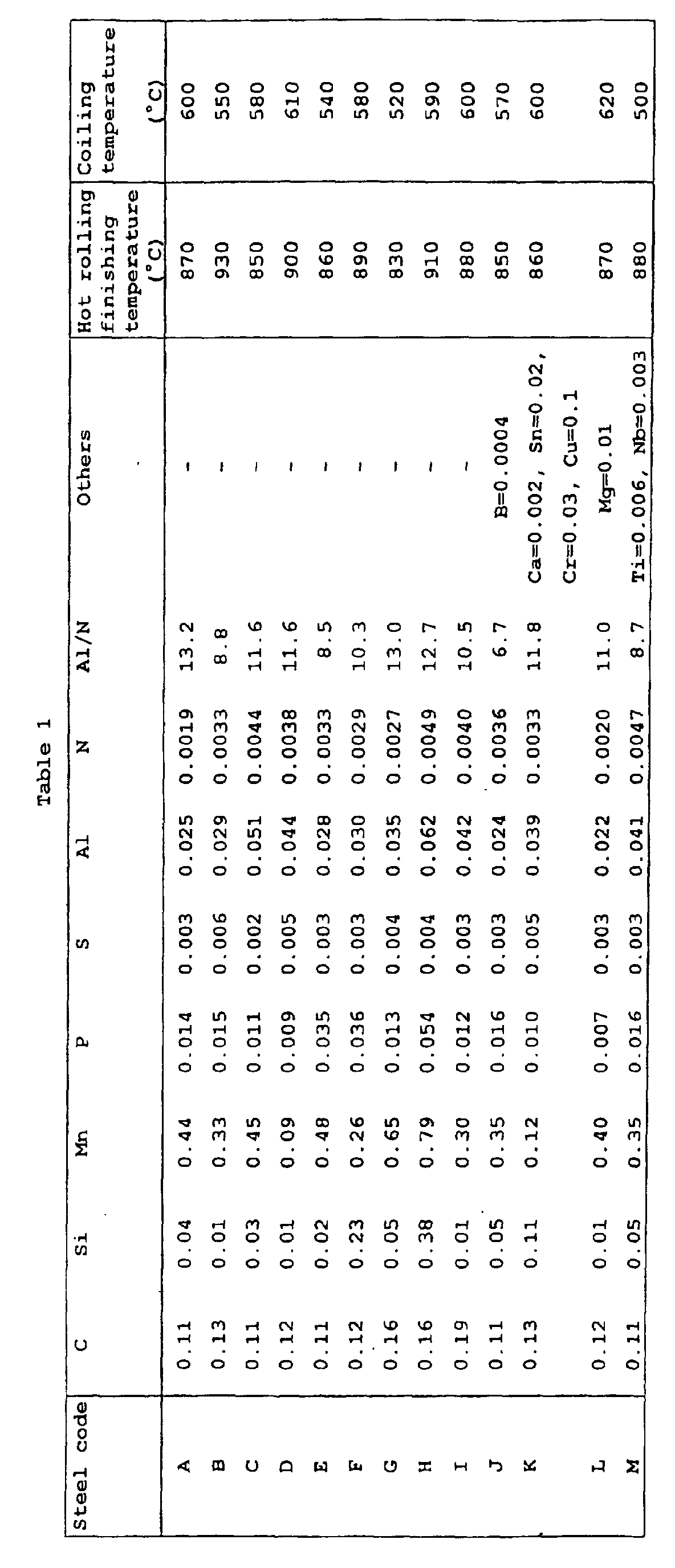
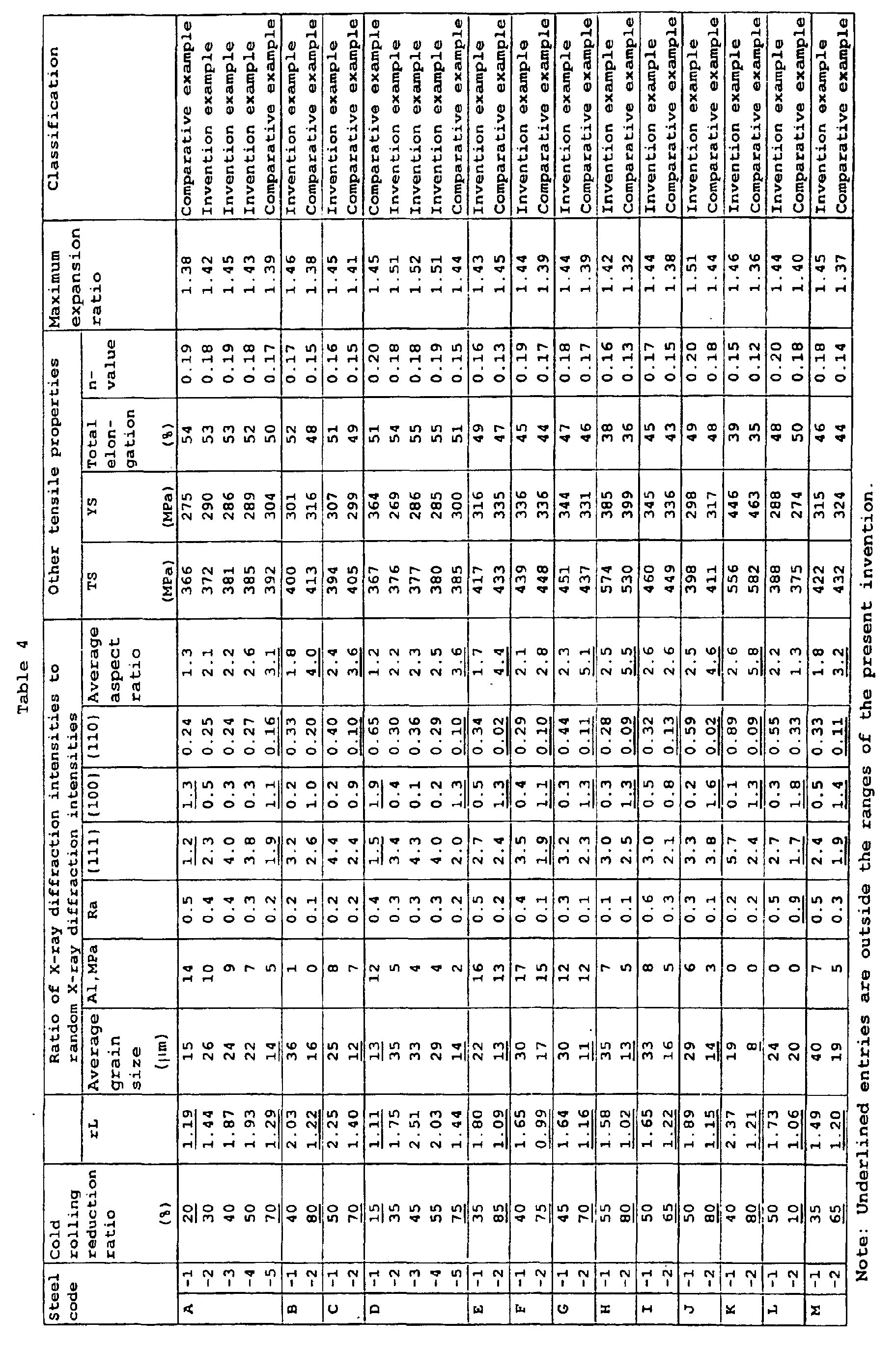
- the workability of the produced steel sheets was evaluated through tensile tests using JIS #5 test pieces.
- an r-value was obtained by measuring the change of the width of a test piece after the application of 15% tensile deformation. Further, some test pieces were ground nearly to the thickness center by mechanical polishing, then finished by chemical polishing and subjected to X-ray measurements.
- the present invention provides a high strength steel sheet excellent in workability and a method for producing the steel sheet, and contributes to the conservation of the global environment and the like.
- the workability of the produced steel pipes was evaluated by the following method.
- a scribed circle 10 mm in diameter was transcribed on the surface of a steel pipe beforehand and stretch forming was applied to the steel pipe in the circumferential direction while the inner pressure and the amount of axial compression were controlled.
- the mechanical properties of a steel pipe were evaluated using a JIS #12 arc-shaped test piece. Since an r-value was influenced by the shape of a test piece, the measurement was carried out with a strain gauge attached to a test piece.
- the X-ray measurement was carried out as follows. A tabular test piece was prepared by cutting out a arc-shaped test piece from a steel pipe after diameter reduction and then pressing it. Then, the tabular test piece was ground nearly to the thickness center by mechanical polishing, then finished by chemical polishing and subjected to X-ray measurement.
- the present invention provides a steel pipe excellent in workability and a method for producing the steel pipe, is suitably applied to hydroforming, and contributes to the conservation of the global environment and the like.
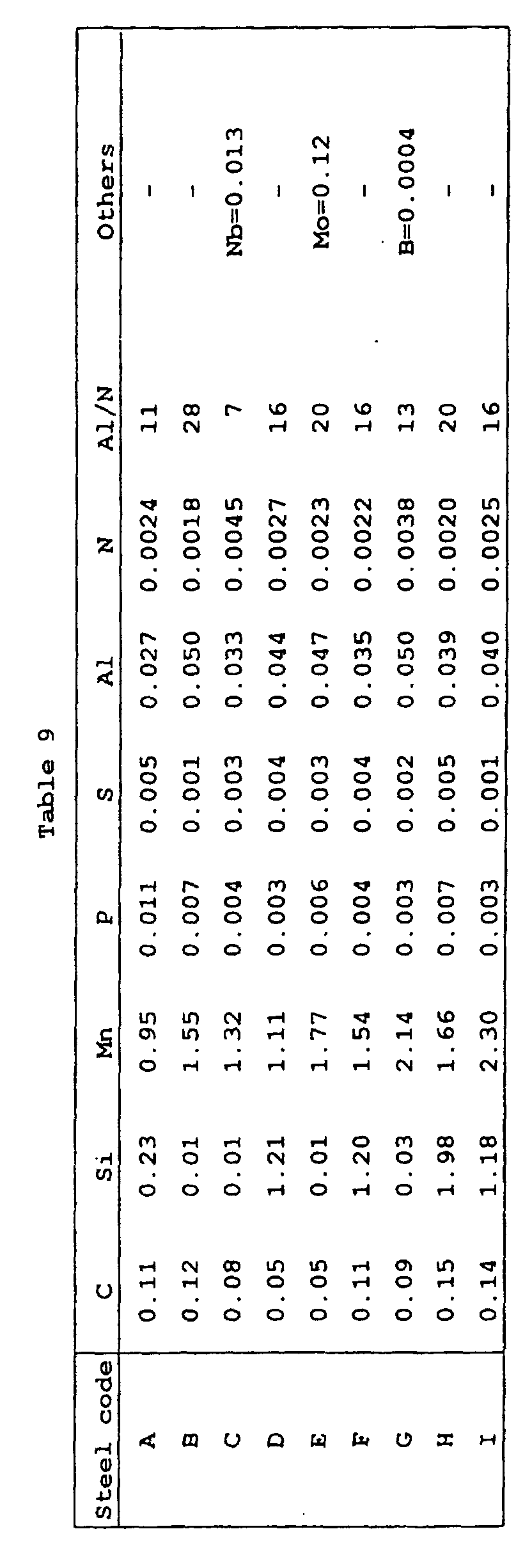
- the r-values and the other mechanical properties of the produced steel sheets were evaluated through tensile tests using JIS #13B test pieces and JIS #5B test pieces, respectively.
- the test pieces to be subjected to X-ray measurements were prepared by grinding nearly to the thickness center by mechanical polishing and then finishing by chemical polishing.
- the present invention provides, in the case of a steel containing a comparatively large amount of C, a high strength steel sheet having good deep drawability without incurring a high cost and a method for producing the steel sheet, and contributes to the conservation of the global environment and the like.
- the r-values and the other mechanical properties of the produced steel sheets were evaluated through tensile tests using JIS #13B test pieces and JIS #5B test pieces, respectively. Further, some test pieces were ground nearly to the thickness center by mechanical polishing, then finished by chemical polishing and subjected to X-ray measurements.
- the steel sheets having good r-values are obtained in all of the invention examples. Further, by making the metallographic microstructure of a hot-rolled steel sheet before cold rolling composed mainly of bainite and/or martensite, better r-values are obtained.
- the present invention provides a high strength steel sheet excellent in deep drawability and a method for producing the steel sheet, and contributes to the conservation of the global environment and the like.
- the r-values of the produced steel sheets were evaluated through tensile tests using JIS #13 test pieces.
- the other tensile properties thereof were evaluated using JIS #5 test pieces.
- an r-value was obtained by measuring the change of the width of a test piece after the application of 10 to 15% tensile deformation. Further, some test pieces were ground nearly to the thickness center by mechanical polishing, then finished by chemical polishing and subjected to X-ray measurements.
- the present invention makes it possible to produce a high strength steel sheet having a good r-value and being excellent in deep drawability.
Landscapes
- Chemical & Material Sciences (AREA)
- Engineering & Computer Science (AREA)
- Materials Engineering (AREA)
- Metallurgy (AREA)
- Organic Chemistry (AREA)
- Mechanical Engineering (AREA)
- Chemical Kinetics & Catalysis (AREA)
- Thermal Sciences (AREA)
- Physics & Mathematics (AREA)
- Crystallography & Structural Chemistry (AREA)
- Electrochemistry (AREA)
- Heat Treatment Of Sheet Steel (AREA)
- Heat Treatment Of Steel (AREA)
Abstract
Description
0.08 to 0.25% C,
0.001 to 1.5% Si,
0.01 to 2.0% Mn,
0.001 to 0.06% P,
0.05% or less S,
0.001 to 0.007% N and
0.008 to 0.2% Al, with the balance consisting of Fe and unavoidable impurities; and having an average r-value of 1.2 or more, an r-value in the rolling direction (rL) of 1.3 or more; an r-value in the direction of 45 degrees to the rolling direction (rD) of 0.9 or more, and an r-value in the direction of a right angle to the rolling direction (rC) of 1.2 or more.
0.03 to 0.25% C,
0.001 to 3.0% Si,
0.01 to 3.0% Mn,
0.001 to 0.06% P,
0.05% or less S,
0.0005 to 0.030% N and
0.005 to 0.3% Al, with the balance consisting of Fe and unavoidable impurities; having an average r-value of 1.2 or more; and consisting of a metallographic microstructure composed of ferrite and precipitates.
0.03 to 0.25% C,
0.001 to 3.0% Si,
0.01 to 3.0% Mn,
0.001 to 0.06% P,
0.05% or less S,
0.0005 to 0.030% N and
0.005 to 0.3% Al, with the balance consisting of Fe and unavoidable impurities; having an average r-value of 1.3 or more; and containing one or more of bainite, martensite and austenite by 3 to 100% in total in the metallographic microstructure of said steel sheet.





Claims (33)
- A steel sheet excellent in workability, characterized by: containing, in mass,
0.08 to 0.25% C,
0.001 to 1.5% Si,
0.01 to 2.0% Mn,
0.001 to 0.06% P,
0.05% or less S,
0.001 to 0.007% N and
0.008 to 0.2% Al,
with the balance consisting of Fe and unavoidable impurities; and having an average r-value of 1.2 or more, an r-value in the rolling direction (rL) of 1.3 or more; an r-value in the direction of 45 degrees to the rolling direction (rD) of 0.9 or more, and an r-value in the direction of a right angle to the rolling direction (rC) of 1.2 or more. - A steel sheet excellent in workability according to claim 1, characterized in that the ratios of the X-ray diffraction intensities in the orientation components of {111}, {100} and {110} to the random X-ray diffraction intensities on a reflection plane at the thickness center of said steel sheet are 2.0 or more, 1.0 or less and 0.2 or more, respectively.
- A steel sheet excellent in workability according to claim 1 or 2, characterized in that the average grain size of composing said steel sheet is 15 µm or more.
- A steel sheet excellent in workability according to any one of claims 1 to 3, characterized in that the average aspect ratio of the grains composing said steel sheet is in the range from 1.0 to less than 3.0.
- A steel sheet excellent in workability according to any one of claims 1 to 4, characterized in that the yield ratio (= 0.2% proof stress/maximum tensile strength) of said steel sheet is 0.65 or less.
- A steel sheet excellent in workability according to any one of claims 1 to 5, characterized in that the value of Al/N in said steel sheet is in the range from 3 to 25.
- A steel sheet excellent in workability according to any one of claims 1 to 6, characterized by containing 0.0001 to 0.01 mass % B.
- A steel sheet excellent in workability according to any one of claims 1 to 7, characterized by containing Zr and/or Mg by 0.0001 to 0.5 mass % in total.
- A steel sheet excellent in workability according to any one of claims 1 to 8, characterized by containing one or more of Ti, Nb and V by 0.001 to 0.2 mass % in total.
- A steel sheet excellent in workability according to any one of claims 1 to 9, characterized by containing one or more of Sn, Cr, Cu, Ni, Co, W and Mo by 0.001 to 2.5 mass % in total.
- A steel sheet excellent in workability according to any one of claims 1 to 10, characterized by containing 0.0001 to 0.01 mass % Ca.
- A method for producing a steel sheet excellent in formability according to any one of claims 1 to 11, characterized by subjecting a steel having chemical components according to any one of claims 1 and 6 to 11 to the processes of: hot rolling at a finishing temperature of the Ar3 transformation temperature - 50°C or higher; coiling at 700°C or lower; cold rolling at a reduction ratio of 25 to less than 60%; heating at an average heating rate of 4 to 200°C/h.; annealing at a maximum arrival temperature of 600°C to 800°C; and cooling at a rate of 5 to 100°C/h.
- A steel pipe excellent in workability according to any one of claims 1 to 12, characterized by having an aging index (AI) of 40 MPa or less, which is evaluated through a tensile test, and a surface roughness of 0.8 or less.
- A steel sheet excellent in deep drawability, characterized by: containing, in mass,
0.03 to 0.25% C,
0.001 to 3.0% Si,
0.01 to 3.0% Mn,
0.001 to 0.06% P,
0.05% or less S,
0.0005 to 0.030% N and
0.005 to 0.3% Al,
with the balance consisting of Fe and unavoidable impurities; having an average r-value of 1.2 or more; and consisting of a metallographic microstructure composed of ferrite and precipitates. - A high strength steel sheet excellent in deep drawability, characterized by: containing, in mass,
0.03 to 0.25% C,
0.001 to 3.0% Si,
0.01 to 3.0% Mn,
0.001 to 0.06% P,
0.05% or less S,
0.0005 to 0.030% N and
0.005 to 0.3% Al,
with the balance consisting of Fe and unavoidable impurities; having an average r-value of 1.3 or more; and containing one or more of bainite, martensite and austenite by 3 to 100% in total in the metallographic microstructure of said steel sheet. - A steel sheet excellent in deep drawability according to claim 14 or 15, characterized by having an r-value in the rolling direction (rL) of 1.1 or more, an r-value in the direction of 45 degrees to the rolling direction (rD) of 0.9 or more, and an r-value in the direction of a right angle to the rolling direction (rC) of 1.2 or more.
- A high strength cold-rolled steel sheet excellent in deep drawability according to any one of claims 14 to 16, characterized by containing Mn and C so as to satisfy the expression Mn + 11C > 1.5.
- A steel sheet excellent in deep drawability according to any one of claims 14 to 17, characterized in that the ratios of the X-ray diffraction intensities in the orientation components of {111} and {100} to the random X-ray diffraction intensities on a reflection plane at the thickness center of said steel sheet are 3.0 or more and 3.0 or less, respectively.
- A steel sheet excellent in deep drawability according to any one of claims 14 to 18, characterized in that the average ferrite grain size of composing said steel sheet is 15 µm or more.
- A steel sheet excellent in deep drawability according to any one of claims 14 to 19, characterized in that the average aspect ratio of the ferrite grains composing said steel sheet is in the range from 1.0 to less than 5.0.
- A steel sheet excellent in deep drawability according to any one of claims 14 to 20, characterized in that the yield ratio defined by the ratio of 0.2% proof stress to the maximum tensile strength of said steel sheet is less than 0.7.
- A steel sheet excellent in deep drawability according to any one of claims 14 to 20, characterized in that the value of Al/N in said steel sheet is in the range from 3 to 25.
- A steel sheet excellent in deep drawability according to any one of claims 14 to 22, characterized by containing 0.0001 to 0.01 mass % B.
- A steel sheet excellent in deep drawability according to any one of claims 14 to 23, characterized by containing Zr and/or Mg by 0.0001 to 0.5 mass % in total.
- A steel sheet excellent in deep drawability according to any one of claims 14 to 24, characterized by containing one or more of Ti, Nb and V by 0.001 to 0.2 mass % in total.
- A steel sheet excellent in deep drawability according to any one of claims 14 to 25, characterized by containing one or more of Sn, Cr, Cu, Ni, Co, W and Mo by 0.001 to 2.5 mass % in total.
- A steel sheet excellent in deep drawability according to any one of claims 14 to 26, characterized by containing 0.0001 to 0.01 mass % Ca.
- A method for producing a high strength cold-rolled steel sheet excellent in deep drawability according to any one of claims 14 to 18 and 22 to 27, characterized by subjecting a hot-rolled steel sheet having chemical components according to any one of claims 14, 15, 17 and 23 to 27 and a metallographic microstructure wherein the volume percentage of a bainite phase and/or a martensite phase is 70 to 100% at least in the region from 1/4 to 3/4 of the thickness of said steel sheet to the processes of: cold rolling at a reduction ratio of 25 to 95%; and annealing in the temperature range from the recrystallization temperature to 1,000°C.
- A method for producing a high strength steel sheet excellent in deep drawability according to any one of claims 14 to 27, characterized by subjecting a steel having chemical components according to any one of claims 14, 15 and 22 to 27 to the processes of: hot rolling at a finishing temperature of the Ar3 transformation temperature - 50°C or higher; coiling in the temperature range from the room temperature to 700°C; cold rolling at a reduction ratio of 30 to less than 95%; heating at an average heating rate of 4 to 200°C/h.; annealing at a maximum arrival temperature of 600°C to 800°C; and heating to a temperature in the range from the Ac1 transformation temperature to 1,050°C.
- A method for producing a high strength steel sheet excellent in deep drawability according to any one of claims 14 to 27, characterized by subjecting a hot-rolled steel sheet having chemical components according to any one of claims 14, 15, 17 and 22 to 27 and a metallographic structure wherein the volume percentage of a bainite phase and/or a martensite phase is 70 to 100% at least in the region from 1/4 to 3/4 of the thickness of said steel sheet to the processes of: cold rolling at a reduction ratio of 30 to less than 95%; heating at an average heating rate of 4 to 200°C/h.; annealing at a maximum arrival temperature of 600°C to 800°C; and heating to a temperature in the range from the Ac1 transformation temperature to 1,050°C.
- A method for producing a steel sheet excellent in deep drawability according to any one of claims 14 and 16 to 27, characterized by subjecting a steel having chemical components according to any one of claims 14, 17 and 22 to 27 to processes of: hot rolling at a finishing temperature of the Ar3 transformation temperature or higher; cooling at an average cooling rate of 30°C/sec. or more in the temperature range from the hot rolling finishing temperature to 550°C; coiling at 550°C or lower; cold rolling at a reduction ratio of 35 to less than 85%; heating at an average heating rate of 4 to 200°C/h.; annealing at a maximum arrival temperature of 600°C to 800°C; and cooling at a rate of 5 to 100°C/h.
- A steel sheet excellent in deep drawability according to any one of claims 14 to 27, characterized by having a plating layer on each of the surfaces of said steel sheet.
- A method for producing a plated steel sheet excellent in deep drawability according to any one of claims 28 to 31, characterized by applying hot-dip or electrolytic plating to the surfaces of said steel sheet after annealing and cooling in the method for producing a steel sheet according to claim 32.
Priority Applications (2)
| Application Number | Priority Date | Filing Date | Title |
|---|---|---|---|
| EP11186515.0A EP2415894B1 (en) | 2001-08-24 | 2002-06-27 | Steel sheet excellent in workability and method for producing the same |
| EP11186496.3A EP2415893B1 (en) | 2001-08-24 | 2002-06-27 | Steel sheet excellent in workability and method for producing the same |
Applications Claiming Priority (7)
| Application Number | Priority Date | Filing Date | Title |
|---|---|---|---|
| JP2001255385A JP4041296B2 (en) | 2001-08-24 | 2001-08-24 | High strength steel plate with excellent deep drawability and manufacturing method |
| JP2001255384 | 2001-08-24 | ||
| JP2001255385 | 2001-08-24 | ||
| JP2001255384A JP4041295B2 (en) | 2001-08-24 | 2001-08-24 | High-strength cold-rolled steel sheet excellent in deep drawability and its manufacturing method |
| JP2002153030 | 2002-05-27 | ||
| JP2002153030 | 2002-05-27 | ||
| PCT/JP2002/006518 WO2003018857A1 (en) | 2001-08-24 | 2002-06-27 | Steel plate exhibiting excellent workability and method for producing the same |
Related Child Applications (4)
| Application Number | Title | Priority Date | Filing Date |
|---|---|---|---|
| EP11186496.3A Division-Into EP2415893B1 (en) | 2001-08-24 | 2002-06-27 | Steel sheet excellent in workability and method for producing the same |
| EP11186496.3A Division EP2415893B1 (en) | 2001-08-24 | 2002-06-27 | Steel sheet excellent in workability and method for producing the same |
| EP11186515.0A Division EP2415894B1 (en) | 2001-08-24 | 2002-06-27 | Steel sheet excellent in workability and method for producing the same |
| EP11186515.0A Division-Into EP2415894B1 (en) | 2001-08-24 | 2002-06-27 | Steel sheet excellent in workability and method for producing the same |
Publications (3)
| Publication Number | Publication Date |
|---|---|
| EP1431407A1 true EP1431407A1 (en) | 2004-06-23 |
| EP1431407A4 EP1431407A4 (en) | 2006-01-04 |
| EP1431407B1 EP1431407B1 (en) | 2014-10-29 |
Family
ID=27347379
Family Applications (3)
| Application Number | Title | Priority Date | Filing Date |
|---|---|---|---|
| EP02736196.3A Expired - Lifetime EP1431407B1 (en) | 2001-08-24 | 2002-06-27 | Steel plate exhibiting excellent workability and method for producing the same |
| EP11186496.3A Expired - Lifetime EP2415893B1 (en) | 2001-08-24 | 2002-06-27 | Steel sheet excellent in workability and method for producing the same |
| EP11186515.0A Expired - Lifetime EP2415894B1 (en) | 2001-08-24 | 2002-06-27 | Steel sheet excellent in workability and method for producing the same |
Family Applications After (2)
| Application Number | Title | Priority Date | Filing Date |
|---|---|---|---|
| EP11186496.3A Expired - Lifetime EP2415893B1 (en) | 2001-08-24 | 2002-06-27 | Steel sheet excellent in workability and method for producing the same |
| EP11186515.0A Expired - Lifetime EP2415894B1 (en) | 2001-08-24 | 2002-06-27 | Steel sheet excellent in workability and method for producing the same |
Country Status (6)
| Country | Link |
|---|---|
| US (4) | US7534312B2 (en) |
| EP (3) | EP1431407B1 (en) |
| KR (1) | KR100548864B1 (en) |
| CN (1) | CN100549203C (en) |
| TW (1) | TWI290177B (en) |
| WO (1) | WO2003018857A1 (en) |
Cited By (21)
| Publication number | Priority date | Publication date | Assignee | Title |
|---|---|---|---|---|
| EP1705257A1 (en) * | 2005-03-24 | 2006-09-27 | Benteler Automobiltechnik GmbH | Armour for vehicle |
| WO2008072873A1 (en) * | 2006-12-12 | 2008-06-19 | Posco | Formable high strength cold-rolled steel sheet with excellent weather resistance and method manufacturing the same |
| US7442268B2 (en) | 2004-11-24 | 2008-10-28 | Nucor Corporation | Method of manufacturing cold rolled dual-phase steel sheet |
| DE102008035714A1 (en) * | 2008-03-24 | 2009-10-08 | Posco, Pohang | Hot stamping steel sheet having low-temperature tempering property, methods of producing the same, methods of producing parts using the same, and parts made therewith |
| US7959747B2 (en) * | 2004-11-24 | 2011-06-14 | Nucor Corporation | Method of making cold rolled dual phase steel sheet |
| US8366844B2 (en) | 2004-11-24 | 2013-02-05 | Nucor Corporation | Method of making hot rolled dual phase steel sheet |
| DE112006003169B4 (en) * | 2005-12-01 | 2013-03-21 | Posco | Steel sheets for hot press forming with excellent heat treatment and impact properties, hot pressed parts produced therefrom and process for their production |
| US8435363B2 (en) | 2007-10-10 | 2013-05-07 | Nucor Corporation | Complex metallographic structured high strength steel and manufacturing same |
| EP2370608A4 (en) * | 2008-12-26 | 2014-05-21 | Posco | High strength steel plate for nuclear reactor containment vessel and method of manufacturing the same |
| EP2462252A4 (en) * | 2009-08-04 | 2014-10-29 | Posco | THERMALLY THERMALLY TREATED LAMINATED STEEL AND METAL WIRE ROD EXCELLENTLY STRENGTHENED, AND METHOD OF MANUFACTURING THE SAME |
| EP2803745A4 (en) * | 2012-01-13 | 2015-10-21 | Nippon Steel & Sumitomo Metal Corp | HOT ROLLED STEEL SHEET AND MANUFACTURING METHOD THEREOF |
| EP2832884A4 (en) * | 2012-03-30 | 2016-02-17 | Voestalpine Stahl Gmbh | HOT DIP GALVANIZED STEEL SHEET FOR PRESSING FORMING, HAVING EXCELLENT COLD SHAPING FEATURE, MOLD TIGHTNESS AND SURFACE PROPERTIES, AND METHOD OF MANUFACTURING THE SAME |
| EP2383360A4 (en) * | 2008-12-26 | 2017-03-29 | JFE Steel Corporation | Steel with excellent anti-ductile crack generation characteristics in weld heat-affected zone and base material and manufacturing method therefor |
| US10077486B2 (en) | 2013-08-09 | 2018-09-18 | Jfe Steel Corporation | High-strength cold-rolled steel sheet and method of manufacturing the same |
| US10301698B2 (en) | 2012-01-31 | 2019-05-28 | Jfe Steel Corporation | Hot-rolled steel sheet for generator rim and method for manufacturing the same |
| EP3561114A4 (en) * | 2016-12-20 | 2019-10-30 | Posco | HOT DIP COATED STEEL HAVING EXCELLENT PROCESSABILITY, AND METHOD OF MANUFACTURING THE SAME |
| US10920294B2 (en) | 2016-03-31 | 2021-02-16 | Jfe Steel Corporation | Steel sheet, coated steel sheet, method for producing hot-rolled steel sheet, method for producing full-hard cold-rolled steel sheet, method for producing heat-treated sheet, method for producing steel sheet, and method for producing coated steel sheet |
| US11155902B2 (en) | 2006-09-27 | 2021-10-26 | Nucor Corporation | High strength, hot dip coated, dual phase, steel sheet and method of manufacturing same |
| DE102021108448A1 (en) | 2021-04-01 | 2022-10-06 | Salzgitter Flachstahl Gmbh | Steel strip made from a high-strength multi-phase steel and method for producing such a steel strip |
| DE102022125128A1 (en) | 2022-09-29 | 2024-04-04 | Salzgitter Flachstahl Gmbh | Method for producing a steel strip from a high-strength multi-phase steel and corresponding steel strip |
| EP4265753A4 (en) * | 2020-12-21 | 2024-05-15 | POSCO Co., Ltd | COLD-ROLLED STEEL SHEET HAVING EXCELLENT PROCESSABILITY AND METHOD FOR MANUFACTURING SAME |
Families Citing this family (79)
| Publication number | Priority date | Publication date | Assignee | Title |
|---|---|---|---|---|
| TWI248977B (en) * | 2003-06-26 | 2006-02-11 | Nippon Steel Corp | High-strength hot-rolled steel sheet excellent in shape fixability and method of producing the same |
| JP4276482B2 (en) * | 2003-06-26 | 2009-06-10 | 新日本製鐵株式会社 | High-strength hot-rolled steel sheet with excellent ultimate deformability and shape freezing property and its manufacturing method |
| JP4819305B2 (en) * | 2003-09-04 | 2011-11-24 | 日産自動車株式会社 | Method for manufacturing reinforcing member |
| MX2007006431A (en) * | 2004-12-08 | 2007-10-18 | Nippon Steel Corp | Precoated metal plate and process for producing precoated metal plate. |
| US8986468B2 (en) * | 2005-03-31 | 2015-03-24 | Kobe Steel, Ltd. | High-strength cold-rolled steel sheet excellent in coating adhesion, workability and hydrogen embrittlement resistance, and steel component for automobile |
| KR20070038730A (en) * | 2005-10-06 | 2007-04-11 | 주식회사 포스코 | Precipitation-reinforced cold-rolled steel sheet with excellent yield ratio and manufacturing method |
| EP1832667A1 (en) | 2006-03-07 | 2007-09-12 | ARCELOR France | Method of producing steel sheets having high strength, ductility and toughness and thus produced sheets. |
| KR101133870B1 (en) * | 2006-05-10 | 2012-04-06 | 수미도모 메탈 인더스트리즈, 리미티드 | Hot-pressed steel sheet member and process for production thereof |
| US20070267110A1 (en) * | 2006-05-17 | 2007-11-22 | Ipsco Enterprises, Inc. | Method for making high-strength steel pipe, and pipe made by that method |
| US7608155B2 (en) * | 2006-09-27 | 2009-10-27 | Nucor Corporation | High strength, hot dip coated, dual phase, steel sheet and method of manufacturing same |
| KR100837702B1 (en) | 2006-10-26 | 2008-06-13 | 한국전자통신연구원 | Carrier Frequency Restoration Apparatus Using Phase Shift and Its Method |
| KR100815799B1 (en) | 2006-12-12 | 2008-03-20 | 주식회사 포스코 | High yield ratio cold rolled steel with excellent weatherability |
| JP5162924B2 (en) | 2007-02-28 | 2013-03-13 | Jfeスチール株式会社 | Steel plate for can and manufacturing method thereof |
| KR100958002B1 (en) * | 2007-12-20 | 2010-05-17 | 주식회사 포스코 | High strength weather resistant cold rolled steel sheet with excellent workability and manufacturing method |
| KR100925639B1 (en) * | 2007-12-24 | 2009-11-06 | 주식회사 포스코 | High strength cold rolled steel sheet with excellent weather resistance and manufacturing method |
| KR100957967B1 (en) * | 2007-12-27 | 2010-05-17 | 주식회사 포스코 | High strength cold rolled steel with excellent anisotropy in yield strength, hot dip galvanized steel sheet and manufacturing method thereof |
| CN102015155B (en) * | 2008-03-19 | 2013-11-27 | 纽科尔公司 | Strip casting apparatus with casting roll positioning |
| US20090236068A1 (en) | 2008-03-19 | 2009-09-24 | Nucor Corporation | Strip casting apparatus for rapid set and change of casting rolls |
| KR101130837B1 (en) * | 2008-04-10 | 2012-03-28 | 신닛뽄세이테쯔 카부시키카이샤 | High-strength steel sheets which are extreamely excellent in the balance between burring workability and ductility and excellent in fatigue endurance, zinc-coated steel sheets, and processes for production of both |
| US20090288798A1 (en) * | 2008-05-23 | 2009-11-26 | Nucor Corporation | Method and apparatus for controlling temperature of thin cast strip |
| KR101038826B1 (en) | 2008-09-09 | 2011-06-03 | 주식회사 포스코 | High strength hot rolled steel sheet with excellent weather resistance and impact resistance and its manufacturing method |
| JP5399681B2 (en) * | 2008-10-08 | 2014-01-29 | Jfeスチール株式会社 | High workability and high strength steel pipe excellent in chemical conversion and process for producing the same |
| WO2010074458A2 (en) * | 2008-12-24 | 2010-07-01 | 주식회사 포스코 | High-strength cold rolled steel sheet having superior deep drawability and a high yield ratio, galvanized steel sheet using same, alloyed galvanized steel sheet, and method for manufacturing same |
| KR101160001B1 (en) * | 2009-02-25 | 2012-06-25 | 현대제철 주식회사 | High strength steel sheet having excellent formability, and method for producing the same |
| CN102471821B (en) * | 2009-07-08 | 2014-07-16 | 东洋钢钣株式会社 | Process for production of cold-rolled steel sheet having excellent press moldability, and cold-rolled steel sheet |
| JP5515732B2 (en) * | 2009-12-25 | 2014-06-11 | Jfeスチール株式会社 | Method for producing hot-rolled steel sheet without edge cracks and method for producing cold-rolled steel sheet without edge cracks |
| KR101160016B1 (en) * | 2010-09-29 | 2012-06-25 | 현대제철 주식회사 | High strength hot-rolled steel for hydroforming with excellent workability and method of manufacturing the hot-rolled steel |
| JP5884151B2 (en) * | 2010-11-25 | 2016-03-15 | Jfeスチール株式会社 | Steel sheet for hot press and method for producing hot press member using the same |
| JP5488763B2 (en) | 2011-05-25 | 2014-05-14 | 新日鐵住金株式会社 | Cold-rolled steel sheet and manufacturing method thereof |
| ES2714302T3 (en) * | 2011-07-27 | 2019-05-28 | Nippon Steel & Sumitomo Metal Corp | High strength cold rolled steel sheet that has excellent flawlessness and precision drivability, and a manufacturing method of said sheet |
| JP5408314B2 (en) * | 2011-10-13 | 2014-02-05 | Jfeスチール株式会社 | High-strength cold-rolled steel sheet excellent in deep drawability and material uniformity in the coil and method for producing the same |
| KR101353634B1 (en) * | 2011-11-18 | 2014-01-21 | 주식회사 포스코 | Low alloy cold rolled steel sheet having excellent weldability and strength and method for manufacturing the same |
| KR101353787B1 (en) * | 2011-12-26 | 2014-01-22 | 주식회사 포스코 | Ultra high strength colde rolled steel sheet having excellent weldability and bendability and method for manufacturing the same |
| EP2808417B1 (en) | 2012-03-07 | 2019-04-24 | JFE Steel Corporation | Steel sheet for hot press-forming, method for manufacturing the same and method for producing hot press-formed parts using the same |
| JP6001884B2 (en) * | 2012-03-09 | 2016-10-05 | 株式会社神戸製鋼所 | Manufacturing method of press-molded product and press-molded product |
| WO2013160567A1 (en) | 2012-04-25 | 2013-10-31 | Arcelormittal Investigacion Y Desarrollo, S.L. | Method for producing a pre-lacquered metal sheet having zn-al-mg coatings, and corresponding metal sheet |
| MX2015000770A (en) | 2012-07-20 | 2015-05-07 | Nippon Steel & Sumitomo Metal Corp | Steel material. |
| CN103667878B (en) * | 2012-08-31 | 2015-10-28 | 宝山钢铁股份有限公司 | A kind of Steel strip for thin-wall oil bucket and manufacture method thereof |
| CN102796956B (en) * | 2012-08-31 | 2014-07-23 | 宝山钢铁股份有限公司 | High-strength thin band steel for cold forming and manufacturing method thereof |
| JP5610003B2 (en) * | 2013-01-31 | 2014-10-22 | Jfeスチール株式会社 | High-strength hot-rolled steel sheet excellent in burring workability and manufacturing method thereof |
| CN103114240B (en) * | 2013-03-12 | 2014-11-19 | 上海大学 | A kind of low-carbon low-nickel vanadium-containing cold-rolled phase transformation plastic steel and preparation method thereof |
| US20140283960A1 (en) * | 2013-03-22 | 2014-09-25 | Caterpillar Inc. | Air-hardenable bainitic steel with enhanced material characteristics |
| CN103667650B (en) * | 2013-11-28 | 2016-04-20 | 安徽银力铸造有限公司 | A kind of preparation method of hot rolled steel for vehicle wheel steel ring |
| CN104726770B (en) * | 2013-12-20 | 2017-04-12 | Posco公司 | Precipitation hardening steel sheet having excellent hole expandability and method for manufacturing the same |
| KR101674751B1 (en) * | 2013-12-20 | 2016-11-10 | 주식회사 포스코 | Precipitation hardening steel sheet having excellent hole expandability and method for manufacturing the same |
| KR101568511B1 (en) | 2013-12-23 | 2015-11-11 | 주식회사 포스코 | Quenched steel sheet having excellent strength and ductility and method for manufacturing the steel sheet using the same |
| US20150321846A1 (en) | 2014-05-08 | 2015-11-12 | Air Liquide Large Industries U.S. Lp | Hydrogen cavern pad gas management |
| US20160138142A1 (en) | 2014-11-18 | 2016-05-19 | Air Liquide Large Industries U.S. Lp | Materials of construction for use in high pressure hydrogen storage in a salt cavern |
| KR101999910B1 (en) * | 2015-03-27 | 2019-07-12 | 제이에프이 스틸 가부시키가이샤 | High-strength steel sheet and production method therefor |
| CN107709593B (en) * | 2015-05-29 | 2020-01-14 | 杰富意钢铁株式会社 | Hot-rolled steel sheet, all-hard cold-rolled steel sheet, and method for producing hot-rolled steel sheet |
| US9573762B2 (en) | 2015-06-05 | 2017-02-21 | Air Liquide Large Industries U.S. Lp | Cavern pressure management |
| KR101696100B1 (en) * | 2015-09-25 | 2017-01-13 | 주식회사 포스코 | High-strength cold rolled steel sheet having excellent workability and method for manufacturing the same |
| US9482654B1 (en) | 2015-11-17 | 2016-11-01 | Air Liquide Large Industries U.S. Lp | Use of multiple storage caverns for product impurity control |
| US9365349B1 (en) | 2015-11-17 | 2016-06-14 | Air Liquide Large Industries U.S. Lp | Use of multiple storage caverns for product impurity control |
| CN105568140B (en) * | 2016-03-02 | 2017-10-17 | 江苏九龙汽车制造有限公司 | A kind of torsion beam preparation method |
| CN106148813A (en) * | 2016-08-12 | 2016-11-23 | 安徽祥宇钢业集团有限公司 | A kind of stainless steel tube containing nano-silicon and preparation method thereof |
| CN106636943B (en) * | 2016-09-18 | 2018-11-30 | 武汉钢铁有限公司 | Elongation percentage A50.8>=48% thin gauge high tensile pipeline steel and its production method |
| KR20190075730A (en) * | 2017-12-21 | 2019-07-01 | 주식회사 포스코 | Low deviation of property by direction precipitatiom hardening steel sheet and manufacturing method of the same |
| KR102043288B1 (en) * | 2017-12-22 | 2019-12-05 | 주식회사 포스코 | High strength hot dip galvanizing steel sheet and method for manufacturing the same |
| CN108251752B (en) * | 2018-01-18 | 2019-11-22 | 唐山钢铁集团有限责任公司 | A kind of motor vehicle sound-absorbing sheet substrate and its production method |
| KR102131527B1 (en) * | 2018-11-26 | 2020-07-08 | 주식회사 포스코 | High-strength steel sheet with excellent durability and method for manufacturing thereof |
| WO2020109098A1 (en) | 2018-11-29 | 2020-06-04 | Tata Steel Nederland Technology B.V. | A method for producing a high strength steel strip with a good deep drawability and a high strength steel produced thereby |
| KR102179214B1 (en) * | 2018-11-30 | 2020-11-16 | 주식회사 포스코 | Cold-rolled steel sheet for enamel and method of manufacturing the same |
| CN109517959A (en) * | 2018-12-17 | 2019-03-26 | 包头钢铁(集团)有限责任公司 | Effective hot rolled strip of a kind of low cost conveying and preparation method thereof |
| CN114008231B (en) * | 2019-06-14 | 2022-06-07 | 杰富意钢铁株式会社 | High-strength hot-rolled steel sheet and method for producing same |
| CN112430787B (en) * | 2019-08-26 | 2022-04-15 | 上海梅山钢铁股份有限公司 | Low-yield-ratio high-strength cold-rolled hot-dip galvanized steel plate and manufacturing method thereof |
| CN111719084A (en) * | 2020-06-15 | 2020-09-29 | 南京钢铁股份有限公司 | A method for producing extremely low-cost titanium-containing thick-spec export alloy steel |
| CN111607746A (en) * | 2020-06-15 | 2020-09-01 | 南京钢铁股份有限公司 | A method for producing extremely low-cost titanium-containing thin-spec export alloy steel |
| CN111778448A (en) * | 2020-06-15 | 2020-10-16 | 南京钢铁股份有限公司 | A method for producing extremely low-cost boron-containing thin-spec export alloy steel |
| KR102405223B1 (en) | 2020-11-05 | 2022-06-02 | 주식회사 포스코 | Steel sheet for enamel and method of manufacturing the same |
| US20240344165A1 (en) * | 2021-08-27 | 2024-10-17 | Nippon Steel Corporation | Steel sheet and press-formed article |
| WO2023135550A1 (en) | 2022-01-13 | 2023-07-20 | Tata Steel Limited | Cold rolled low carbon microalloyed steel and method of manufacturing thereof |
| CN117265377B (en) * | 2022-06-14 | 2026-04-10 | 宝山钢铁股份有限公司 | 110Ksi strength grade seamless steel pipe and manufacturing method thereof |
| CN115449741B (en) * | 2022-09-20 | 2023-11-24 | 武汉钢铁有限公司 | High-magnetic induction oriented silicon steel produced based on sheet billet continuous casting and rolling and method |
| CN116043095A (en) * | 2022-11-17 | 2023-05-02 | 包头钢铁(集团)有限责任公司 | A production method for mass production of full-thickness galvanized structural steel |
| KR102904562B1 (en) * | 2023-10-31 | 2025-12-26 | 현대제철 주식회사 | Cold rolled steel sheet and method of manufacturing the same |
| WO2026070924A1 (en) * | 2024-09-25 | 2026-04-02 | 日本製鉄株式会社 | Automotive undercarriage component |
| KR20260105521A (en) * | 2024-12-27 | 2026-07-07 | 현대제철 주식회사 | Cold rolled steel sheet and method for manufacturing the same |
| CN120738556B (en) * | 2025-09-05 | 2026-01-13 | 鞍钢股份有限公司 | Economical 650 MPa-grade high-strength hot-rolled wheel steel and production method thereof |
Family Cites Families (48)
| Publication number | Priority date | Publication date | Assignee | Title |
|---|---|---|---|---|
| US3959029A (en) * | 1970-11-21 | 1976-05-25 | Nippon Kokan Kabushiki Kaisha | Process of making cold reduced Al-stabilized steel having high drawability |
| US3988173A (en) * | 1972-04-03 | 1976-10-26 | Nippon Steel Corporation | Cold rolled steel sheet having excellent workability and method thereof |
| JPS5531182A (en) | 1978-08-28 | 1980-03-05 | Sumitomo Metal Ind Ltd | High strength cold rolled steel plate with superior workability and manufacture thereof |
| JPS5534656A (en) * | 1978-08-31 | 1980-03-11 | Sumitomo Metal Ind Ltd | Manufacture of high tensile cold rolled steel plate with low yield ratio and high r value |
| JPS5849623B2 (en) | 1979-01-27 | 1983-11-05 | 住友金属工業株式会社 | Method for manufacturing high-strength galvanized steel sheet with excellent drawability and shapeability |
| JPS5849624B2 (en) * | 1979-01-27 | 1983-11-05 | 住友金属工業株式会社 | Method for manufacturing high-strength cold-rolled steel sheets with excellent drawability and shapeability |
| JPS5910413B2 (en) * | 1979-02-20 | 1984-03-08 | 株式会社神戸製鋼所 | Manufacturing method of Al-killed cold-rolled high-strength steel sheet |
| JPS5849628B2 (en) | 1979-05-28 | 1983-11-05 | 新日本製鐵株式会社 | Method for producing composite structure high-strength cold-rolled steel sheet with excellent deep drawability |
| JPS55158217A (en) * | 1979-05-30 | 1980-12-09 | Nippon Kokan Kk <Nkk> | Production of cold rolled steel plate of high lankford value |
| US4313770A (en) * | 1979-06-28 | 1982-02-02 | Sumitomo Metal Industries, Ltd. | Method of producing cold rolled steel strip having improved press formability and bake-hardenability |
| JPS566709A (en) | 1979-06-28 | 1981-01-23 | Sumitomo Metal Ind Ltd | Manufacture of cold rolled steel sheet possessing excellent press formability and baking hardenability |
| JPS5635727A (en) * | 1979-08-31 | 1981-04-08 | Kobe Steel Ltd | Production of unequal thickness a -killed type cold-rolled high tensile steel plate |
| JPS5858414B2 (en) * | 1980-01-28 | 1983-12-24 | 住友金属工業株式会社 | Manufacturing method of high-strength cold-rolled steel sheet with good press formability |
| JPS5940215B2 (en) | 1980-03-31 | 1984-09-28 | 川崎製鉄株式会社 | High tensile strength cold rolled steel sheet with excellent formability and its manufacturing method |
| JPS5773123A (en) | 1980-10-22 | 1982-05-07 | Sumitomo Metal Ind Ltd | Producton of low alloy steel of superior cold workability |
| US4426235A (en) * | 1981-01-26 | 1984-01-17 | Kabushiki Kaisha Kobe Seiko Sho | Cold-rolled high strength steel plate with composite steel structure of high r-value and method for producing same |
| JPS57192224A (en) | 1981-05-20 | 1982-11-26 | Kawasaki Steel Corp | Production of al-killed cold-rolled steel sheet excellent in press-formability |
| JPS57203749A (en) | 1982-03-01 | 1982-12-14 | Sumitomo Metal Ind Ltd | High strength cold rolled steel plate of superior workability and its production |
| JPS5913030A (en) | 1982-07-12 | 1984-01-23 | Nippon Steel Corp | Manufacture of cold rolled al killed steel plate with superior deep drawability |
| US4473411A (en) | 1983-07-20 | 1984-09-25 | Armco Inc. | Process of making aluminum killed low manganese deep drawing steel |
| JPS6110012A (en) | 1984-06-22 | 1986-01-17 | Japan Metals & Chem Co Ltd | Production of ultrafine metal nitride and production unit |
| JPH0699756B2 (en) * | 1986-06-26 | 1994-12-07 | 新日本製鐵株式会社 | Method for manufacturing high strength high r value cold rolled steel sheet |
| JP3032985B2 (en) * | 1989-12-29 | 2000-04-17 | 新日本製鐵株式会社 | Hot rolled steel sheet excellent in burring property and method for producing the same |
| EP0475096B2 (en) * | 1990-08-17 | 2004-01-14 | JFE Steel Corporation | High strength steel sheet adapted for press forming and method of producing the same |
| JP2868870B2 (en) | 1990-09-11 | 1999-03-10 | 川崎製鉄株式会社 | High tensile cold rolled steel sheet and method for producing the same |
| JPH04337049A (en) | 1991-05-13 | 1992-11-25 | Kawasaki Steel Corp | Cold rolled steel sheet for can manufacturing having high strength and superior workability and its production |
| JP3238211B2 (en) * | 1992-10-02 | 2001-12-10 | 新日本製鐵株式会社 | Manufacturing method of cold rolled steel sheet or hot-dip galvanized cold rolled steel sheet with excellent bake hardenability and non-aging property |
| EP0630983B1 (en) * | 1993-01-14 | 2001-04-04 | Nkk Corporation | Cold rolled steel sheet of excellent delayed fracture resistance and superhigh strength and method of manufacturing the same |
| JPH07188855A (en) | 1993-12-27 | 1995-07-25 | Kawasaki Steel Corp | High-strength cold-rolled steel sheet for deep drawing with low yield ratio and method for producing the same |
| JP3292671B2 (en) | 1997-02-10 | 2002-06-17 | 川崎製鉄株式会社 | Hot-rolled steel strip for cold-rolled steel sheet with good deep drawability and aging resistance |
| JPH09279302A (en) * | 1996-04-17 | 1997-10-28 | Nippon Steel Corp | Steel sheet excellent in stretch formability and method of manufacturing the same |
| JPH116028A (en) | 1997-06-11 | 1999-01-12 | Kobe Steel Ltd | High strength cold-rolled steel sheet for deep drawing with excellent surface properties after press forming |
| JPH1124654A (en) | 1997-07-02 | 1999-01-29 | Kawai Musical Instr Mfg Co Ltd | Aliquot equipment |
| JPH1150211A (en) | 1997-08-05 | 1999-02-23 | Kawasaki Steel Corp | Thick cold rolled steel sheet excellent in deep drawing workability and method for producing the same |
| JP3852210B2 (en) | 1997-08-18 | 2006-11-29 | Jfeスチール株式会社 | Steel plate for modified 3-piece can and manufacturing method thereof |
| CA2271639C (en) * | 1997-09-11 | 2006-11-14 | Kawasaki Steel Corporation | Hot rolled steel sheet having ultra fine grains with improved formability, and production of hot rolled or cold rolled steel sheet |
| EP0936271A1 (en) | 1998-02-17 | 1999-08-18 | Synthelabo | Calcium-activated potassium channel beta subunit gene and protein |
| JP3932658B2 (en) * | 1998-03-27 | 2007-06-20 | Jfeスチール株式会社 | Method for producing steel plate for cans with excellent uniform deformation and surface beauty |
| EP0999288B1 (en) * | 1998-04-08 | 2007-11-07 | JFE Steel Corporation | Steel sheet for can and manufacturing method thereof |
| US6076915A (en) | 1998-08-03 | 2000-06-20 | Hewlett-Packard Company | Inkjet printhead calibration |
| JP3692797B2 (en) * | 1998-10-01 | 2005-09-07 | Jfeスチール株式会社 | Steel plate for cans with good surface properties and excellent can stability |
| JP3931455B2 (en) * | 1998-11-25 | 2007-06-13 | Jfeスチール株式会社 | Steel plate for can and manufacturing method thereof |
| JP2000282173A (en) | 1999-04-02 | 2000-10-10 | Kawasaki Steel Corp | High tensile strength steel sheet excellent in workability and method for producing the same |
| JP2000328172A (en) | 1999-05-13 | 2000-11-28 | Sumitomo Metal Ind Ltd | High-carbon cold-rolled steel strip with small in-plane anisotropy in deep drawing and its manufacturing method |
| JP2001009950A (en) | 1999-06-28 | 2001-01-16 | Mitsubishi Chemicals Corp | Breathable laminates and hygiene products |
| DE19936151A1 (en) * | 1999-07-31 | 2001-02-08 | Thyssenkrupp Stahl Ag | High-strength steel strip or sheet and process for its manufacture |
| JP3990553B2 (en) * | 2000-08-03 | 2007-10-17 | 新日本製鐵株式会社 | High stretch flangeability steel sheet with excellent shape freezing property and method for producing the same |
| JP3742559B2 (en) * | 2000-12-28 | 2006-02-08 | 新日本製鐵株式会社 | Steel plate excellent in workability and manufacturing method |
-
2002
- 2002-06-26 TW TW091114082A patent/TWI290177B/en not_active IP Right Cessation
- 2002-06-27 EP EP02736196.3A patent/EP1431407B1/en not_active Expired - Lifetime
- 2002-06-27 EP EP11186496.3A patent/EP2415893B1/en not_active Expired - Lifetime
- 2002-06-27 WO PCT/JP2002/006518 patent/WO2003018857A1/en not_active Ceased
- 2002-06-27 US US10/487,797 patent/US7534312B2/en not_active Expired - Fee Related
- 2002-06-27 CN CNB028165721A patent/CN100549203C/en not_active Expired - Fee Related
- 2002-06-27 KR KR1020047002603A patent/KR100548864B1/en not_active Expired - Fee Related
- 2002-06-27 EP EP11186515.0A patent/EP2415894B1/en not_active Expired - Lifetime
-
2008
- 2008-03-14 US US12/048,465 patent/US7776161B2/en not_active Expired - Fee Related
- 2008-08-04 US US12/185,423 patent/US8052807B2/en not_active Expired - Fee Related
- 2008-08-04 US US12/185,402 patent/US7749343B2/en not_active Expired - Fee Related
Cited By (30)
| Publication number | Priority date | Publication date | Assignee | Title |
|---|---|---|---|---|
| US7442268B2 (en) | 2004-11-24 | 2008-10-28 | Nucor Corporation | Method of manufacturing cold rolled dual-phase steel sheet |
| US7879160B2 (en) * | 2004-11-24 | 2011-02-01 | Nucor Corporation | Cold rolled dual-phase steel sheet |
| US7959747B2 (en) * | 2004-11-24 | 2011-06-14 | Nucor Corporation | Method of making cold rolled dual phase steel sheet |
| US8366844B2 (en) | 2004-11-24 | 2013-02-05 | Nucor Corporation | Method of making hot rolled dual phase steel sheet |
| EP1705257A1 (en) * | 2005-03-24 | 2006-09-27 | Benteler Automobiltechnik GmbH | Armour for vehicle |
| US7357060B2 (en) | 2005-03-24 | 2008-04-15 | Benteler Automobiltechnik Gmbh | Vehicle armor |
| DE112006003169B4 (en) * | 2005-12-01 | 2013-03-21 | Posco | Steel sheets for hot press forming with excellent heat treatment and impact properties, hot pressed parts produced therefrom and process for their production |
| US11155902B2 (en) | 2006-09-27 | 2021-10-26 | Nucor Corporation | High strength, hot dip coated, dual phase, steel sheet and method of manufacturing same |
| WO2008072873A1 (en) * | 2006-12-12 | 2008-06-19 | Posco | Formable high strength cold-rolled steel sheet with excellent weather resistance and method manufacturing the same |
| CN101553586B (en) * | 2006-12-12 | 2011-03-02 | Posco公司 | Formable high strength cold-rolled steel sheet with excellent weather resistance and method manufacturing the same |
| US9157138B2 (en) | 2007-10-10 | 2015-10-13 | Nucor Corporation | Complex metallographic structured high strength steel and method of manufacturing |
| US8435363B2 (en) | 2007-10-10 | 2013-05-07 | Nucor Corporation | Complex metallographic structured high strength steel and manufacturing same |
| DE102008035714B4 (en) * | 2008-03-24 | 2013-01-03 | Posco | Hot stamping steel sheet having low-temperature tempering property, methods for producing the same, methods of producing parts using the same, and parts made therewith |
| DE102008035714B9 (en) * | 2008-03-24 | 2013-05-29 | Posco | Hot stamping steel sheet having low-temperature tempering property, methods for producing the same, methods of producing parts using the same, and parts made therewith |
| DE102008035714A1 (en) * | 2008-03-24 | 2009-10-08 | Posco, Pohang | Hot stamping steel sheet having low-temperature tempering property, methods of producing the same, methods of producing parts using the same, and parts made therewith |
| US9255313B2 (en) | 2008-03-24 | 2016-02-09 | Posco | Steel sheet for hot press forming having low-temperature heat treatment property, method of manufacturing the same, method of manufacturing parts using the same, and parts manufactured by the same |
| EP2370608A4 (en) * | 2008-12-26 | 2014-05-21 | Posco | High strength steel plate for nuclear reactor containment vessel and method of manufacturing the same |
| EP2383360A4 (en) * | 2008-12-26 | 2017-03-29 | JFE Steel Corporation | Steel with excellent anti-ductile crack generation characteristics in weld heat-affected zone and base material and manufacturing method therefor |
| EP2462252A4 (en) * | 2009-08-04 | 2014-10-29 | Posco | THERMALLY THERMALLY TREATED LAMINATED STEEL AND METAL WIRE ROD EXCELLENTLY STRENGTHENED, AND METHOD OF MANUFACTURING THE SAME |
| US10106873B2 (en) | 2012-01-13 | 2018-10-23 | Nippon Steel & Sumitomo Metal Corporation | Hot-rolled steel sheet and manufacturing method for same |
| EP2803745A4 (en) * | 2012-01-13 | 2015-10-21 | Nippon Steel & Sumitomo Metal Corp | HOT ROLLED STEEL SHEET AND MANUFACTURING METHOD THEREOF |
| US10301698B2 (en) | 2012-01-31 | 2019-05-28 | Jfe Steel Corporation | Hot-rolled steel sheet for generator rim and method for manufacturing the same |
| EP2832884A4 (en) * | 2012-03-30 | 2016-02-17 | Voestalpine Stahl Gmbh | HOT DIP GALVANIZED STEEL SHEET FOR PRESSING FORMING, HAVING EXCELLENT COLD SHAPING FEATURE, MOLD TIGHTNESS AND SURFACE PROPERTIES, AND METHOD OF MANUFACTURING THE SAME |
| US10077486B2 (en) | 2013-08-09 | 2018-09-18 | Jfe Steel Corporation | High-strength cold-rolled steel sheet and method of manufacturing the same |
| US10920294B2 (en) | 2016-03-31 | 2021-02-16 | Jfe Steel Corporation | Steel sheet, coated steel sheet, method for producing hot-rolled steel sheet, method for producing full-hard cold-rolled steel sheet, method for producing heat-treated sheet, method for producing steel sheet, and method for producing coated steel sheet |
| EP3561114A4 (en) * | 2016-12-20 | 2019-10-30 | Posco | HOT DIP COATED STEEL HAVING EXCELLENT PROCESSABILITY, AND METHOD OF MANUFACTURING THE SAME |
| EP4265753A4 (en) * | 2020-12-21 | 2024-05-15 | POSCO Co., Ltd | COLD-ROLLED STEEL SHEET HAVING EXCELLENT PROCESSABILITY AND METHOD FOR MANUFACTURING SAME |
| DE102021108448A1 (en) | 2021-04-01 | 2022-10-06 | Salzgitter Flachstahl Gmbh | Steel strip made from a high-strength multi-phase steel and method for producing such a steel strip |
| DE102022125128A1 (en) | 2022-09-29 | 2024-04-04 | Salzgitter Flachstahl Gmbh | Method for producing a steel strip from a high-strength multi-phase steel and corresponding steel strip |
| WO2024068957A1 (en) | 2022-09-29 | 2024-04-04 | Salzgitter Flachstahl Gmbh | Method for producing a steel strip from a high-strength multiphase steel, and the corresponding steel strip |
Also Published As
| Publication number | Publication date |
|---|---|
| EP2415893A3 (en) | 2012-10-17 |
| EP2415893A2 (en) | 2012-02-08 |
| US20080166257A1 (en) | 2008-07-10 |
| US20040238081A1 (en) | 2004-12-02 |
| EP2415894A3 (en) | 2012-10-17 |
| CN1547620A (en) | 2004-11-17 |
| WO2003018857A1 (en) | 2003-03-06 |
| EP2415894A2 (en) | 2012-02-08 |
| EP2415894B1 (en) | 2018-12-19 |
| KR20040027981A (en) | 2004-04-01 |
| EP1431407A4 (en) | 2006-01-04 |
| US20080295924A1 (en) | 2008-12-04 |
| US20080308200A1 (en) | 2008-12-18 |
| CN100549203C (en) | 2009-10-14 |
| EP1431407B1 (en) | 2014-10-29 |
| US7749343B2 (en) | 2010-07-06 |
| TWI290177B (en) | 2007-11-21 |
| US7776161B2 (en) | 2010-08-17 |
| KR100548864B1 (en) | 2006-02-02 |
| US8052807B2 (en) | 2011-11-08 |
| US7534312B2 (en) | 2009-05-19 |
| EP2415893B1 (en) | 2014-11-05 |
Similar Documents
| Publication | Publication Date | Title |
|---|---|---|
| US7776161B2 (en) | Cold-rolled steel sheet excellent in workability | |
| KR101570629B1 (en) | High-strength hot-dip galvanized steel plate having excellent impact resistance and method for producing same, and high-strength alloyed hot-dip galvanized steel sheet and method for producing same | |
| CN102341521B (en) | High-strength steel sheet, hot-dip-coated steel sheet, alloyed hot-dip-coated steel sheet excellent in fatigue properties, elongation, and impact properties, and methods for producing them | |
| JP4635525B2 (en) | High-strength steel sheet excellent in deep drawability and manufacturing method thereof | |
| KR101587968B1 (en) | Alloyed hot-dip zinc coat layer, steel sheet having same, and method for producing same | |
| CN114008231B (en) | High-strength hot-rolled steel sheet and method for producing same | |
| CA2767439C (en) | High-strength steel sheet and method for manufacturing the same | |
| JP4041296B2 (en) | High strength steel plate with excellent deep drawability and manufacturing method | |
| WO2013018722A1 (en) | High-strength zinc-plated steel sheet and high-strength steel sheet having superior moldability, and method for producing each | |
| US12565691B2 (en) | Steel sheet, member, and methods for manufacturing the same | |
| US12258647B2 (en) | Steel sheet, member, and methods for manufacturing the same | |
| US12565690B2 (en) | Steel sheet, member, and methods for manufacturing the same | |
| JP4280078B2 (en) | High-strength cold-rolled steel sheet and plated steel sheet excellent in deep drawability, steel pipes excellent in workability, and production methods thereof | |
| JP4696870B2 (en) | High strength steel plate and manufacturing method thereof | |
| JP4041295B2 (en) | High-strength cold-rolled steel sheet excellent in deep drawability and its manufacturing method | |
| JP2003113440A (en) | Drawable high-strength thin steel sheet excellent in shape freezing property and method for producing the same | |
| JP3549483B2 (en) | Hydroform forming steel pipe excellent in processability and manufacturing method | |
| JP2004225131A (en) | High-strength steel pipe excellent in workability and its manufacturing method | |
| JP4506380B2 (en) | Manufacturing method of high-strength steel sheet | |
| JP2004084024A (en) | Galvanized steel pipe with excellent workability and corrosion resistance, automobile parts, and method of manufacturing the same | |
| JP2004052103A (en) | Steel sheet excellent in deep drawability, steel pipe excellent in workability, and manufacturing method | |
| JP2004218018A (en) | High-strength cold-rolled steel sheet and high-strength plated steel sheet having excellent workability and strain age hardening properties, and methods for producing them | |
| US12577642B2 (en) | High-strength steel sheet and method for manufacturing the same | |
| US20240167127A1 (en) | High-strength steel sheet and method for manufacturing the same |
Legal Events
| Date | Code | Title | Description |
|---|---|---|---|
| PUAI | Public reference made under article 153(3) epc to a published international application that has entered the european phase |
Free format text: ORIGINAL CODE: 0009012 |
|
| 17P | Request for examination filed |
Effective date: 20040323 |
|
| AK | Designated contracting states |
Kind code of ref document: A1 Designated state(s): AT BE CH CY DE DK ES FI FR GB GR IE IT LI LU MC NL PT SE TR |
|
| RIC1 | Information provided on ipc code assigned before grant |
Ipc: 7C 22C 38/58 B Ipc: 7C 21D 9/48 B Ipc: 7C 22C 38/04 B Ipc: 7C 22C 38/38 B Ipc: 7C 22C 38/06 B Ipc: 7C 22C 38/00 A Ipc: 7C 22C 38/02 B |
|
| A4 | Supplementary search report drawn up and despatched |
Effective date: 20051117 |
|
| 17Q | First examination report despatched |
Effective date: 20091022 |
|
| RAP1 | Party data changed (applicant data changed or rights of an application transferred) |
Owner name: NIPPON STEEL & SUMITOMO METAL CORPORATION |
|
| GRAP | Despatch of communication of intention to grant a patent |
Free format text: ORIGINAL CODE: EPIDOSNIGR1 |
|
| INTG | Intention to grant announced |
Effective date: 20140410 |
|
| GRAS | Grant fee paid |
Free format text: ORIGINAL CODE: EPIDOSNIGR3 |
|
| GRAP | Despatch of communication of intention to grant a patent |
Free format text: ORIGINAL CODE: EPIDOSNIGR1 |
|
| RIN1 | Information on inventor provided before grant (corrected) |
Inventor name: KAWASAKI, KAORU, C/O NIPPON STEEL CORP. HIROHATA W Inventor name: TAKAHASHI, MANABU, C/O NIPPON STEEL CORPORATION Inventor name: FUJITA, NOBUHIRO, C/O NIPPON STEEL CORPORATION Inventor name: SENUMA, TAKEHIDE, C/O NIPPON STEEL CORPORATION Inventor name: YOSHINAGA, NAOKI, C/O NIPPON STEEL CORPORATION Inventor name: HASHIMOTO, KOJI, C/O NIPPON STEEL CORPORATION Inventor name: SHINOHARA, YASUHIRO, C/O NIPPON STEEL CORPORATION Inventor name: SAKAMOTO, SHINYA, C/O NIPPON STEEL CORP. KIMITSU W |
|
| GRAA | (expected) grant |
Free format text: ORIGINAL CODE: 0009210 |
|
| INTG | Intention to grant announced |
Effective date: 20140911 |
|
| AK | Designated contracting states |
Kind code of ref document: B1 Designated state(s): DE FR GB |
|
| REG | Reference to a national code |
Ref country code: GB Ref legal event code: FG4D |
|
| REG | Reference to a national code |
Ref country code: DE Ref legal event code: R096 Ref document number: 60246730 Country of ref document: DE Effective date: 20141211 |
|
| REG | Reference to a national code |
Ref country code: DE Ref legal event code: R097 Ref document number: 60246730 Country of ref document: DE |
|
| PLBE | No opposition filed within time limit |
Free format text: ORIGINAL CODE: 0009261 |
|
| STAA | Information on the status of an ep patent application or granted ep patent |
Free format text: STATUS: NO OPPOSITION FILED WITHIN TIME LIMIT |
|
| 26N | No opposition filed |
Effective date: 20150730 |
|
| REG | Reference to a national code |
Ref country code: FR Ref legal event code: PLFP Year of fee payment: 15 |
|
| REG | Reference to a national code |
Ref country code: FR Ref legal event code: PLFP Year of fee payment: 16 |
|
| REG | Reference to a national code |
Ref country code: FR Ref legal event code: PLFP Year of fee payment: 17 |
|
| REG | Reference to a national code |
Ref country code: DE Ref legal event code: R082 Ref document number: 60246730 Country of ref document: DE Representative=s name: VOSSIUS & PARTNER PATENTANWAELTE RECHTSANWAELT, DE Ref country code: DE Ref legal event code: R081 Ref document number: 60246730 Country of ref document: DE Owner name: NIPPON STEEL CORPORATION, JP Free format text: FORMER OWNER: NIPPON STEEL & SUMITOMO METAL CORP., TOKYO, JP |
|
| PGFP | Annual fee paid to national office [announced via postgrant information from national office to epo] |
Ref country code: DE Payment date: 20190612 Year of fee payment: 18 |
|
| PGFP | Annual fee paid to national office [announced via postgrant information from national office to epo] |
Ref country code: GB Payment date: 20190626 Year of fee payment: 18 |
|
| PGFP | Annual fee paid to national office [announced via postgrant information from national office to epo] |
Ref country code: FR Payment date: 20200512 Year of fee payment: 19 |
|
| REG | Reference to a national code |
Ref country code: DE Ref legal event code: R119 Ref document number: 60246730 Country of ref document: DE |
|
| GBPC | Gb: european patent ceased through non-payment of renewal fee |
Effective date: 20200627 |
|
| PG25 | Lapsed in a contracting state [announced via postgrant information from national office to epo] |
Ref country code: GB Free format text: LAPSE BECAUSE OF NON-PAYMENT OF DUE FEES Effective date: 20200627 |
|
| PG25 | Lapsed in a contracting state [announced via postgrant information from national office to epo] |
Ref country code: DE Free format text: LAPSE BECAUSE OF NON-PAYMENT OF DUE FEES Effective date: 20210101 |
|
| PG25 | Lapsed in a contracting state [announced via postgrant information from national office to epo] |
Ref country code: FR Free format text: LAPSE BECAUSE OF NON-PAYMENT OF DUE FEES Effective date: 20210630 |