EP1434163B1 - Apparatus and method for acquisition, validation and verification of biometric features - Google Patents
Apparatus and method for acquisition, validation and verification of biometric features Download PDFInfo
- Publication number
- EP1434163B1 EP1434163B1 EP03257672A EP03257672A EP1434163B1 EP 1434163 B1 EP1434163 B1 EP 1434163B1 EP 03257672 A EP03257672 A EP 03257672A EP 03257672 A EP03257672 A EP 03257672A EP 1434163 B1 EP1434163 B1 EP 1434163B1
- Authority
- EP
- European Patent Office
- Prior art keywords
- certifying
- data
- dictionary
- unit
- acquired
- Prior art date
- Legal status (The legal status is an assumption and is not a legal conclusion. Google has not performed a legal analysis and makes no representation as to the accuracy of the status listed.)
- Expired - Lifetime
Links
Images


Classifications
-
- G—PHYSICS
- G06—COMPUTING OR CALCULATING; COUNTING
- G06V—IMAGE OR VIDEO RECOGNITION OR UNDERSTANDING
- G06V10/00—Arrangements for image or video recognition or understanding
- G06V10/40—Extraction of image or video features
-
- G—PHYSICS
- G06—COMPUTING OR CALCULATING; COUNTING
- G06V—IMAGE OR VIDEO RECOGNITION OR UNDERSTANDING
- G06V40/00—Recognition of biometric, human-related or animal-related patterns in image or video data
- G06V40/10—Human or animal bodies, e.g. vehicle occupants or pedestrians; Body parts, e.g. hands
- G06V40/16—Human faces, e.g. facial parts, sketches or expressions
- G06V40/168—Feature extraction; Face representation
-
- G—PHYSICS
- G06—COMPUTING OR CALCULATING; COUNTING
- G06F—ELECTRIC DIGITAL DATA PROCESSING
- G06F18/00—Pattern recognition
- G06F18/20—Analysing
- G06F18/21—Design or setup of recognition systems or techniques; Extraction of features in feature space; Blind source separation
- G06F18/213—Feature extraction, e.g. by transforming the feature space; Summarisation; Mappings, e.g. subspace methods
- G06F18/2135—Feature extraction, e.g. by transforming the feature space; Summarisation; Mappings, e.g. subspace methods based on approximation criteria, e.g. principal component analysis
-
- G—PHYSICS
- G06—COMPUTING OR CALCULATING; COUNTING
- G06V—IMAGE OR VIDEO RECOGNITION OR UNDERSTANDING
- G06V10/00—Arrangements for image or video recognition or understanding
- G06V10/70—Arrangements for image or video recognition or understanding using pattern recognition or machine learning
- G06V10/77—Processing image or video features in feature spaces; using data integration or data reduction, e.g. principal component analysis [PCA] or independent component analysis [ICA] or self-organising maps [SOM]; Blind source separation
- G06V10/7715—Feature extraction, e.g. by transforming the feature space, e.g. multi-dimensional scaling [MDS]; Mappings, e.g. subspace methods
-
- G—PHYSICS
- G06—COMPUTING OR CALCULATING; COUNTING
- G06V—IMAGE OR VIDEO RECOGNITION OR UNDERSTANDING
- G06V40/00—Recognition of biometric, human-related or animal-related patterns in image or video data
- G06V40/10—Human or animal bodies, e.g. vehicle occupants or pedestrians; Body parts, e.g. hands
- G06V40/16—Human faces, e.g. facial parts, sketches or expressions
- G06V40/168—Feature extraction; Face representation
- G06V40/169—Holistic features and representations, i.e. based on the facial image taken as a whole
Definitions
- This invention relates to an individual recognizing apparatus to recognize whether a recognized person is the proper person by using biological information such as a face image of a recognized person as data for certifying and an individual recognizing method.
- an individual recognizing apparatus was developed and is used in the management of the entry/exit to/from buildings/rooms requiring security for certifying whether a recognized person is the proper person using a face image, finger print, retina, iris, palm figure, etc. of the recognized person.
- Such the individual recognizing apparatus is normally provided with a dictionary storing unit storing dictionaries for use in the individual certification.
- the individual certification is executed to certify whether a recognized person is the proper person using dictionaries stored in this dictionary storing unit and input certifying data (biological information of a recognized person).
- certifying dictionaries are stored (hereinafter, called also as registered) in the dictionary storing unit and certifying data including various kinds of variations are acquired when a dictionary is stored. For this reason, a recognized person is urged to add various kinds of variations through the user interface.
- a certifying dictionary is updated by recognizing a person.
- GB-A-2357175 discloses a user authentication apparatus which permits substitute authentication when the quality of a fingerprint image is insufficient or when user verification (e.g. entering a PIN) fails. Images may be stored so that unauthorised users can be pursued.
- WO-A-0043960 discloses a fraud prevention system in which personal biological data is compared with reference data and the person being identified is required to perform movement so as to establish that they are a living person and not an imitation of any kind.
- an individual recognizing apparatus comprising: a data acquisition unit to acquire a plurality of certifying image data from a face region of a recognized person; a detection unit to detect feature points from the plurality of certifying image data of such face regions as eyes, brows, nose or lips of the recognized person acquired by the data acquisition unit; a change calculation unit to calculate changes in detected positions of the feature points detected from the plurality of certifying data by the detection unit, the change calculation unit including a unit to calculate at least one of an up down and a left right angle change of the detected feature points; an aptitude judging unit to judge whether the certifying data acquired by the data acquisition unit is appropriate for the preparation of a certifying dictionary based on the change in the feature points calculated by the change calculation unit; a dictionary preparing unit to prepare a certifying dictionary based on the certifying data acquired by the data acquisition unit when the certifying data is judged appropriate; a dictionary storing unit to store the certifying dictionary prepared by the dictionary preparing unit; and
- an individual recognizing method comprising the steps of: acquiring a plurality of certifying data from a face region of a recognized person; detecting feature points of such face regions as eyes, brows, nose or lips of the recognized person from the acquired certifying data; calculating changes in detected positions of the feature points detected from the plurality of certifying image data, the calculation including calculating at least one of an up down and left right angle change of the detected feature points; judging whether the acquired certifying data is appropriate for the preparation of a certifying dictionary based on the change of the calculated feature points; preparing a certifying dictionary based on the acquired certifying data when the certifying data is judged appropriate in the judging step; storing the prepared certifying dictionary; and certifying whether a recognized person is a proper person using the acquired certifying data and the stored dictionary.
- FIG. 1 schematically shows the construction of the individual recognizing apparatus involved in the first embodiment.
- This individual recognizing apparatus comprises a data acquisition unit 101, a detection unit 102, a change calculation unit 103, an aptitude judging unit 104, a dictionary preparing unit 105, a dictionary storing unit 106, and a certifying unit 107.
- the data acquisition unit 101 acquires biological information and other certifying data from a recognized person 100.
- the detection unit 102 detects feature points from the certifying data acquired by the data acquisition unit 101.
- the change calculation unit 103 calculates a change of detecting position of the feature point detected by the detection unit 102.
- the aptitude judging unit 104 judges whether the certifying data acquired by the data acquisition unit 101 is appropriate for preparing a certifying dictionary based on the change of feature point calculated by the change calculation unit 103.
- the dictionary preparing unit 105 prepares a dictionary for certifying based on the certifying data acquired by the data acquisition unit 101 when the certifying data acquired by the data acquisition unit 105 is judged appropriate.
- the dictionary storing unit 106 stores a certifying dictionary prepared by the dictionary preparing unit 105.
- the certifying unit 107 certifies whether a recognized person is the proper person using the certifying data acquired by the data acquisition unit 101 and the dictionary stored in the dictionary storing unit 106.
- a certifying data D is acquired from a recognized person 100 by the data acquisition unit 101 (Step S101).
- This certifying data D is, for instance, a face image data in the face certification, a fingerprint data in the fingerprint data, a voiceprint data in the voiceprint certification, and a sign data in the signature certification.
- feature points are detected from these certifying data D in the detection unit 102.
- the feature points referred to here are, for instance, such regions as eyes, brows, nose, lip, an edge, wrinkles in the face image data.
- the feature points are minutiae (the edge, a branched finger pattern, etc.).
- the ending and leaping units are feature points.
- the detecting technique described in a publicly known literature [1] (“ Extraction of Face Characteristics by Combination of Shape Extraction and Pattern Collation", Kazuhiro FUKUI and Osamu YAMAGUCHI, The Institute Electronics, Information and Communication Engineers Paper D-11, Vol. J82-D-11, No. 8, pp. 2170-2177, August 1997 ) is applicable as a method for extracting a face image.
- eyes and nose are detected as the feature points even when the certifying data D is a face image data.
- Step S103 The processes in Steps S101 and S102 are repeated until a sufficient amount of data is obtained.
- the sufficient amount of data referred to here is about 50 to 100 sheets of face image data assuming that 5 sheets of face images per second are obtained.
- the aptitude judging unit 104 judges whether the certifying data acquired by the data acquisition unit 101 is appropriate for the preparation of a certifying dictionary (Step S105). For instance, when the position change is above a prescribed threshold value TH101 or below TH102, it is too large (above TH101) or too small (below TH101) and the data is judged inaptitude for the dictionary registration and the registration is made over or a recognized person 101 is so warned and asked to select to make the registration (Step S106).
- the dictionary preparing unit 105 prepares a certifying dictionary based on the certifying data acquired by the data acquisition unit 101 (Step S107). Then, the dictionary storing unit 106 stores the prepared dictionary (Step S108).
- the inaptitude dictionary leaning is such that there is less variation or data is excessively far from threshold values.
- FIG. 3 schematically shows the construction of the individual recognizing apparatus in the second embodiment.
- This individual recognizing apparatus comprises a data acquisition unit 201, a detection unit 202, an angle change calculation unit 203, an aptitude judging unit 204, a dictionary preparing unit 205, a dictionary storing unit 206, and a certifying unit 207.
- the data acquisition unit 201 acquires biological information and other certifying data from a recognized person.
- the detection unit 202 detects feature points from the certifying data acquired by the data acquisition unit 201.
- the angle change calculation unit 203 calculates either one of the up_down, and the left_right feature points detected by the detection unit 202; in this case, the up_down and left_right angle changes.
- the aptitude judging unit 204 judges whether certifying data acquired by the data acquisition unit 201 is appropriate for the preparation of a certifying dictionary based on he angle changes calculated by the angle change calculation unit 203.
- the dictionary preparing unit 205 prepares a certifying data based on the certifying data acquired by the data acquisition unit 201 when the data is judged appropriate by the aptitude judging unit 204.
- the dictionary storing unit 206 stores a certifying dictionary prepared by the dictionary preparing unit 205.
- the certifying unit 207 certifies whether a recognized person 100 is the proper person using the certifying data acquired by the data acquisition unit 201 and dictionaries stored in the dictionary storing unit 206.
- Step S201 the processes to acquire certifying data D from a recognized person 100 by the data acquisition unit 201 (Step S201) and to detect feature points by the detection unit 202 (Step S203) are the same as the processes in Steps S101 to S103 in the first embodiment described above until sufficient volume of data is obtained (Step S203).
- the angle change calculation unit 203 calculates first the up_down angle change as described below (Step S204).
- the left eye coordinates (X left_eye , Y left_eye ), the right eye coordinates (X right_eye , Y right_eye ), the left naris coordinates (X left_nose , Y left_nose ) and the right naris coordinates (X right_nose , Y right_nose ) are used, respectively. Even when the feature point is, for instance, the eye area, mouth or brow, the process is the same.
- the eye to nose distance (eye to nose distance) becomes large and the index becomes large.
- FIG. 5B when the face is faced upward, the eye to nose distance becomes small and the index becomes small. So, in this example, the eye to nose distance is normalized by dividing it with the both eyes distance and even when the eye to nose distance becomes large or small by simply coming close to or away so that the eye to nose distance is not judged erroneously as an upper and lower angle change.
- the index UP_DOWN change may be erroneously judged as the change of the upper and lower angle. In this case, therefore, the correction may be made as shown below.
- the positions of the feature points in the direction x are expressed as shown in FIG. 8A . Further, when the face is turned from the front side by R, it is expressed as shown in FIG. 8B .
- r1, r2, R, ⁇ 1 and ⁇ 2 are defined as shown below (see FIGS. 8A and 8B ).
- an apparent distance on an image changes according to a distance between the face of a recognized person 100 and a camera that is used as the data acquiring unit 201 and an apparent distance is generally in proportion to an actual distance.
- the apparent distances on an image in Numeral Formulas 5, 6 and 7 become as shown below respectively:
- the left side of Mathematical Expression 12 is obtained from an observed value on an image and a parameter R is determined by substituting Mathematical Expressions 6 and 7 into the right side.
- L eye,R is obtained from Mathematical Expression 6 and a is obtained by substituting it into Mathematical Expression 11.
- the distance L' eye,0 (a corrected vale of the distance between both eyes in Mathematical Expression 4) on an image of both eyes distance in the direction x at the front is estimated when a is substituted into Mathematical Expression 8.
- the angle change calculation unit 203 calculates the index LEFT_RIGHT that shows a left and right angle change according to the following Mathematical Expression 13 (refer to Step S205, FIG. 9 ).
- the both eyes distance used in Step S204 may be corrected.
- the aptitude judging unit 204 judges whether the certifying data acquired by the data acquisition unit 201 has sufficient angle changes (Steps S206 and S208).
- the upper and lower angle change index UP_DOWN is above the prescribed threshold value TH201, it is judged too large and the dictionary registration is made over or a recognized person 100 is so warned and have select whether to make the registration (Step S207).
- a certifying dictionary is prepared based on the certifying data acquired by the data acquisition unit 201 (Step S209). Then, the prepared dictionary is stored in the dictionary storing unit 206 (Step S210).
- FIG. 10 is a diagram schematically showing the construction of the individual recognizing apparatus involved in the third embodiment.
- This individual recognizing apparatus comprises a data acquisition unit 301, a dictionary preparing unit 302, an eigenvalue calculation unit 303, an eigenvalue contribution rate calculation unit 304, an aptitude judging unit 305, a dictionary storing unit 396, and a certifying unit 307.
- the data acquisition unit 301 acquires certifying data including biological information from a recognized person 100.
- the dictionary preparing unit 302 prepares a certifying dictionary by executing a principal component analysis based on the certifying data acquired by the data acquisition unit 301.
- the eigenvalue calculation unit 303 calculates an eigenvalue included in the dictionary preparing unit 302.
- the eigenvalue contribution rate calculation unit 304 calculates an eigenvalue contribution rate of the dictionary prepared by the dictionary preparing unit 302.
- the aptitude judging unit 305 judges whether the dictionary prepared by the dictionary preparing unit 302 is aptitude as a certifying dictionary based on the eigenvalue contribution rate calculated by the eigenvalue contribution rate calculation unit 304.
- the dictionary storing unit 306 stores a dictionary prepared by the dictionary preparing unit 302 when it is judged aptitude by the aptitude judging unit 305.
- the certifying unit 307 certifies whether a recognized person 100 is the person himself (or herself) using the certifying data acquired by the data acquisition unit 301 and the dictionary stored in the dictionary storing unit 306.
- Step S301 the process to acquire certifying data D from a recognized person 100 (Step S301) is repeated in the data acquiring unit 301 until sufficient volume of data is acquired (Step S302).
- the dictionary preparing unit 302 and the eigenvalue calculation unit 303 prepare a certifying dictionary by analyzing principal components based on the acquired certifying data.
- an analytical library contained in the above-mentioned literature [1] is usable.
- a cross-correlation matrix R shown below is usable.
- the eigenvalue contribution rate calculation unit 304 calculates an eigenvalue contribution rate according to the following formula 17 (for details, refer to "Image Analyzing Handbook", Takagi and Shimoda, p. 43, Tokyo University Publishing Society, 1991).
- the symbol "T” represents a transposed matrix.
- This eigenvalue shows the distribution of higher dimensional eigenvalue occupying a large part of the contribution rate (For details, refer to the publicly known literature [4] " Application of the Karhymen-Loeve Procedure for the Characterization of Human Faces". M. Kirby and L. Sirovich, IEEE Transactions on Patterns Analysis and Machine Intelligence, Vol. 12, No. 1, pp. 103, January 1990 ). This means that a large part of the distribution of the learning data can be expressed in higher dimensional feature vectors.
- an individual recognizing apparatus and an individual recognizing method capable of using certifying data suited for certifying in the dictionary registration for learning and preventing the inaptitude dictionary registration can be provided.
Landscapes
- Engineering & Computer Science (AREA)
- Theoretical Computer Science (AREA)
- Computer Vision & Pattern Recognition (AREA)
- Health & Medical Sciences (AREA)
- Oral & Maxillofacial Surgery (AREA)
- General Physics & Mathematics (AREA)
- Physics & Mathematics (AREA)
- Multimedia (AREA)
- General Health & Medical Sciences (AREA)
- Human Computer Interaction (AREA)
- Evolutionary Computation (AREA)
- Artificial Intelligence (AREA)
- Software Systems (AREA)
- Medical Informatics (AREA)
- Databases & Information Systems (AREA)
- Computing Systems (AREA)
- Data Mining & Analysis (AREA)
- Life Sciences & Earth Sciences (AREA)
- Bioinformatics & Cheminformatics (AREA)
- Bioinformatics & Computational Biology (AREA)
- Evolutionary Biology (AREA)
- General Engineering & Computer Science (AREA)
- Collating Specific Patterns (AREA)
- Image Analysis (AREA)
- Measurement Of The Respiration, Hearing Ability, Form, And Blood Characteristics Of Living Organisms (AREA)
- Image Processing (AREA)
Description
- This invention relates to an individual recognizing apparatus to recognize whether a recognized person is the proper person by using biological information such as a face image of a recognized person as data for certifying and an individual recognizing method.
- Recently, an individual recognizing apparatus was developed and is used in the management of the entry/exit to/from buildings/rooms requiring security for certifying whether a recognized person is the proper person using a face image, finger print, retina, iris, palm figure, etc. of the recognized person.
- Such the individual recognizing apparatus is normally provided with a dictionary storing unit storing dictionaries for use in the individual certification. The individual certification is executed to certify whether a recognized person is the proper person using dictionaries stored in this dictionary storing unit and input certifying data (biological information of a recognized person).
- By the way, certifying dictionaries are stored (hereinafter, called also as registered) in the dictionary storing unit and certifying data including various kinds of variations are acquired when a dictionary is stored. For this reason, a recognized person is urged to add various kinds of variations through the user interface.
- Further, for instance, when failed to recognize (collate) a person, a certifying dictionary is updated by recognizing a person.
- As described above, it was so far tried to acquire versatile certifying data (a face image) of a recognized person through the guidance to the recognized person. However, a recognized person may not act as provided in the guidance.
- Further, it was so far supposed that if an improper dictionary was registered for recognition (collation), it is updated to a proper dictionary through re-registration or updating of the dictionary. However, a recognized person may not always re-register or update a dictionary.
-
GB-A-2357175 -
WO-A-0043960 - It is an object of this invention to provide an individual recognizing apparatus and an individual recognizing method capable of using certifying data suited for the recognition for the learning when storing a dictionary and preventing an improper dictionary storage.
- According to this invention, there is provided an individual recognizing apparatus comprising: a data acquisition unit to acquire a plurality of certifying image data from a face region of a recognized person; a detection unit to detect feature points from the plurality of certifying image data of such face regions as eyes, brows, nose or lips of the recognized person acquired by the data acquisition unit; a change calculation unit to calculate changes in detected positions of the feature points detected from the plurality of certifying data by the detection unit, the change calculation unit including a unit to calculate at least one of an up down and a left right angle change of the detected feature points; an aptitude judging unit to judge whether the certifying data acquired by the data acquisition unit is appropriate for the preparation of a certifying dictionary based on the change in the feature points calculated by the change calculation unit; a dictionary preparing unit to prepare a certifying dictionary based on the certifying data acquired by the data acquisition unit when the certifying data is judged appropriate; a dictionary storing unit to store the certifying dictionary prepared by the dictionary preparing unit; and a certifying unit to certify whether a recognized person is a proper person using the certifying data acquired by the data acquisition unit and the dictionary stored in the dictionary storing unit.
- Further, according to this invention, there is provided an individual recognizing method comprising the steps of: acquiring a plurality of certifying data from a face region of a recognized person; detecting feature points of such face regions as eyes, brows, nose or lips of the recognized person from the acquired certifying data; calculating changes in detected positions of the feature points detected from the plurality of certifying image data, the calculation including calculating at least one of an up down and left right angle change of the detected feature points; judging whether the acquired certifying data is appropriate for the preparation of a certifying dictionary based on the change of the calculated feature points; preparing a certifying dictionary based on the acquired certifying data when the certifying data is judged appropriate in the judging step; storing the prepared certifying dictionary; and certifying whether a recognized person is a proper person using the acquired certifying data and the stored dictionary.
-
-
Fig 1 is a block diagram schematically showing the construction of an individual recognizing apparatus involved in a first embodiment of this invention; -
FIG. 2 is a flowchart for explaining the flow of the dictionary registration process of an individual recognizing apparatus involved in the first embodiment; -
FIG. 3 is a block diagram schematically showing the construction of an individual recognizing apparatus involved in a second embodiment; -
FIG. 4 is a flowchart for explaining the flow of the dictionary registration process of an individual recognizing apparatus in the second embodiment; -
FIG. 5A and FIG. 5B are diagrams for explaining the state of detecting a change in the UP_DOWN angle in the individual recognizing apparatus in the second embodiment; -
FIG. 6A and FIG. 6B are diagrams for explaining failed examples of detecting changes in the UP_DOWN angle in the individual recognizing apparatus in the second embodiment; -
FIG. 7 is a top view of the head of a person viewed from the top for explaining the positional relation of feature points in the individual recognizing apparatus in the second embodiment; -
FIG. 8A and FIG. 8B are diagrams for explaining changes in feature points resulting from the rotation in the individual recognizing apparatus in the second embodiment; -
FIG. 9A and 9B are diagrams for explaining the state of detecting changes in the LEFT_RIGHT angle in the individual recognizing apparatus in the second embodiment; -
FIG. 10 is a block diagram schematically showing the construction of the individual recognizing apparatus involved in a third embodiment; -
FIG. 11 is a flowchart for explaining the flow of the dictionary registration process of the individual recognizing apparatus in the third embodiment; and -
FIG. 12A to FIG. 12C are graphs for explaining an eigenvalue contribution rate in the individual recognizing apparatus in the third embodiment. - Preferred embodiments of this invention will be described below referring to the attached drawings.
- The first embodiment of this invention will be first explained referring to the drawings.
-
FIG. 1 schematically shows the construction of the individual recognizing apparatus involved in the first embodiment. - This individual recognizing apparatus comprises a
data acquisition unit 101, adetection unit 102, achange calculation unit 103, anaptitude judging unit 104, adictionary preparing unit 105, adictionary storing unit 106, and a certifyingunit 107. - The
data acquisition unit 101 acquires biological information and other certifying data from a recognizedperson 100. - The
detection unit 102 detects feature points from the certifying data acquired by thedata acquisition unit 101. - The
change calculation unit 103 calculates a change of detecting position of the feature point detected by thedetection unit 102. - The
aptitude judging unit 104 judges whether the certifying data acquired by thedata acquisition unit 101 is appropriate for preparing a certifying dictionary based on the change of feature point calculated by thechange calculation unit 103. - The
dictionary preparing unit 105 prepares a dictionary for certifying based on the certifying data acquired by thedata acquisition unit 101 when the certifying data acquired by thedata acquisition unit 105 is judged appropriate. - The
dictionary storing unit 106 stores a certifying dictionary prepared by thedictionary preparing unit 105. - The
certifying unit 107 certifies whether a recognized person is the proper person using the certifying data acquired by thedata acquisition unit 101 and the dictionary stored in thedictionary storing unit 106. - Hereinafter, the flow of the dictionary registration process in the first embodiment will be explained referring to the flowchart shown in
FIG. 2 . - First, a certifying data D is acquired from a recognized
person 100 by the data acquisition unit 101 (Step S101). This certifying data D is, for instance, a face image data in the face certification, a fingerprint data in the fingerprint data, a voiceprint data in the voiceprint certification, and a sign data in the signature certification. - Then, feature points are detected from these certifying data D in the
detection unit 102. The feature points referred to here are, for instance, such regions as eyes, brows, nose, lip, an edge, wrinkles in the face image data. In the fingerprint data, the feature points are minutiae (the edge, a branched finger pattern, etc.). In the signature data, the ending and leaping units are feature points. To detect these feature points, for instance, the detecting technique described in a publicly known literature [1] ("Extraction of Face Characteristics by Combination of Shape Extraction and Pattern Collation", Kazuhiro FUKUI and Osamu YAMAGUCHI, The Institute Electronics, Information and Communication Engineers Paper D-11, Vol. J82-D-11, No. 8, pp. 2170-2177, August 1997) is applicable as a method for extracting a face image. - Further, in this example, eyes and nose are detected as the feature points even when the certifying data D is a face image data.
- The processes in Steps S101 and S102 are repeated until a sufficient amount of data is obtained (Step S103). The sufficient amount of data referred to here is about 50 to 100 sheets of face image data assuming that 5 sheets of face images per second are obtained.
- When the sufficient volume of data is obtained, the
change calculation unit 103 calculates changing positions of the feature points (eyes and nose) detected in Step S102 (S104). For instance, when assuming that a-pieces of feature points fj,i (j=1,2,...,a) were detected from n-pieces of data Di (i=1, 2, ..., k,...,n). At this time, if an average position of one feature point at j-th is fj,center, "Change" that is the position change can be calculated as shown by, for instance, the following mathematical expression 1.
- Further, the change may be calculated according to the following mathematical expression [2] regarding it not the shift from the mean position but a total moving volume from the position of the preceding feature point:

- Or may be calculated as shown by the following mathematical expression 3 based on the change in a distance between feature points not the position of feature point.

- Then, the
aptitude judging unit 104 judges whether the certifying data acquired by thedata acquisition unit 101 is appropriate for the preparation of a certifying dictionary (Step S105). For instance, when the position change is above a prescribed threshold value TH101 or below TH102, it is too large (above TH101) or too small (below TH101) and the data is judged inaptitude for the dictionary registration and the registration is made over or a recognizedperson 101 is so warned and asked to select to make the registration (Step S106). - When the acquired certifying data is judged appropriate for the preparation of a certifying dictionary in Step S105, the
dictionary preparing unit 105 prepares a certifying dictionary based on the certifying data acquired by the data acquisition unit 101 (Step S107). Then, thedictionary storing unit 106 stores the prepared dictionary (Step S108). - When learning a dictionary, it is necessary to learn data having somewhat diversity. Therefore, if no sufficient motion was observed or excessive motions were observed inversely when motions of a face were detected according to the eye and nose detecting positions as described above, a process is executed to exclude such data from the learning data. Thus, it becomes possible to prevent the inaptitude dictionary learning by data having no sufficient change or data having too large change.
- The inaptitude dictionary leaning is such that there is less variation or data is excessively far from threshold values.
- Next, the second embodiment will be explained.
-
FIG. 3 schematically shows the construction of the individual recognizing apparatus in the second embodiment. This individual recognizing apparatus comprises adata acquisition unit 201, adetection unit 202, an anglechange calculation unit 203, anaptitude judging unit 204, adictionary preparing unit 205, adictionary storing unit 206, and a certifyingunit 207. - The
data acquisition unit 201 acquires biological information and other certifying data from a recognized person. - The
detection unit 202 detects feature points from the certifying data acquired by thedata acquisition unit 201. - The angle
change calculation unit 203 calculates either one of the up_down, and the left_right feature points detected by thedetection unit 202; in this case, the up_down and left_right angle changes. - The
aptitude judging unit 204 judges whether certifying data acquired by thedata acquisition unit 201 is appropriate for the preparation of a certifying dictionary based on he angle changes calculated by the anglechange calculation unit 203. - The
dictionary preparing unit 205 prepares a certifying data based on the certifying data acquired by thedata acquisition unit 201 when the data is judged appropriate by theaptitude judging unit 204. - The
dictionary storing unit 206 stores a certifying dictionary prepared by thedictionary preparing unit 205. - The certifying
unit 207 certifies whether a recognizedperson 100 is the proper person using the certifying data acquired by thedata acquisition unit 201 and dictionaries stored in thedictionary storing unit 206. - Hereinafter, the flow of the dictionary registration process involved in the second embodiment will be explained referring to the flowchart shown in
FIG. 4 . - First, the processes to acquire certifying data D from a recognized
person 100 by the data acquisition unit 201 (Step S201) and to detect feature points by the detection unit 202 (Step S203) are the same as the processes in Steps S101 to S103 in the first embodiment described above until sufficient volume of data is obtained (Step S203). - When a-pieces feature points fj, i(j = 1, 2, ..., n) are detected from n-pieces data Di (i = 1, 2, ..., n) likewise the first embodiment, the angle
change calculation unit 203 calculates first the up_down angle change as described below (Step S204). When certifying data D that is a face image data is taken here as an example of the positional information of feature points, the left eye coordinates (Xleft_eye, Yleft_eye), the right eye coordinates (Xright_eye, Yright_eye), the left naris coordinates (Xleft_nose, Yleft_nose) and the right naris coordinates (Xright_nose, Yright_nose) are used, respectively. Even when the feature point is, for instance, the eye area, mouth or brow, the process is the same. - When the central coordinates of both eyes are (Xcenter_eye, Ycenter_eye) and the central coordinates of both nares are (Xcenter_nose, Ycenter_nose), the UP_DOWN index indicating the upper and lower angle change is obtained by the mathematical expression 4 shown below (See
FIG. 5 ).
- As shown in
FIG. 5A , when the face is faced to the front, the eye to nose distance (eye to nose distance) becomes large and the index becomes large. As shown inFIG. 5B , when the face is faced upward, the eye to nose distance becomes small and the index becomes small. So, in this example, the eye to nose distance is normalized by dividing it with the both eyes distance and even when the eye to nose distance becomes large or small by simply coming close to or away so that the eye to nose distance is not judged erroneously as an upper and lower angle change. - However, in this technique, even when the left and right angles only are changed as shown in
FIG. 6B instead of the face facing the front as shown inFIG. 6A , the index UP_DOWN change may be erroneously judged as the change of the upper and lower angle. In this case, therefore, the correction may be made as shown below. - If the
eyes nares 704 and 705) were positioned as shown by a model inFIG. 7 , the positions of the feature points in the direction x are expressed as shown inFIG. 8A . Further, when the face is turned from the front side by R, it is expressed as shown inFIG. 8B . Accordingly, the distance between both eyes Leye,0 in the direction x at the front side is expressed by the following expression:


- Further, r1, r2, R, θ 1 and θ 2 are defined as shown below (see
FIGS. 8A and 8B ). - r1: A distance from the central point of the head to the
left eye 702; - r2: A distance from the central point of the head to the
right naris 704; - R: An angle turned the face from the front to left or right;
- θ 1: An angle formed between the line connecting the front from the central point of the head and the line connecting the
left eye 702 from the center of the head; and - θ 2: An angle formed between the line connecting the front from the central point of the head to the front and the line connecting the
left naris 705 from the center of the head. - On the other hand, an apparent distance on an image changes according to a distance between the face of a recognized
person 100 and a camera that is used as thedata acquiring unit 201 and an apparent distance is generally in proportion to an actual distance. In other words, the apparent distances on an image in Numeral Formulas 5, 6 and 7 become as shown below respectively:


- Accordingly, from Mathematical Expressions 9 and 10,


- Thus, it becomes possible to calculate the upper and lower angle change index UP_DOWN of Mathematical Expression 4 without causing a trouble from such a change in both eye distance as shown in
FIG. 6B . Further, as the model shown inFIG. 7 , a model may be used commonly to all persons or a model different for each type of face structure of a recognizedperson 100 can be used. - Then, the angle
change calculation unit 203 calculates the index LEFT_RIGHT that shows a left and right angle change according to the following Mathematical Expression 13 (refer to Step S205,FIG. 9 ).
- Here, for the distance between both eyes, the both eyes distance used in Step S204 may be corrected.
- Based on the results obtained in the above, the
aptitude judging unit 204 judges whether the certifying data acquired by thedata acquisition unit 201 has sufficient angle changes (Steps S206 and S208). When, for instance, the upper and lower angle change index UP_DOWN is above the prescribed threshold value TH201, it is judged too large and the dictionary registration is made over or a recognizedperson 100 is so warned and have select whether to make the registration (Step S207). - When the upper and lower angle change index UP_DOWN is below the prescribed threshold value TH202, the upper and lower angle change is judged too small or when the left and right angle change index LEFT_RIGHT is above the prescribed threshold value TH203, the left and right angle change is judged too large, and when the left and right angle change index LEFT_RIGHT is below the prescribed threshold value TH204, the left and right angle change is judged too small and the process shown in Step S207 is executed.
- When the certifying data were not judged as inaptitude in Steps S206 and S208 (when the acquired certifying data was judged to have a sufficient angle change), a certifying dictionary is prepared based on the certifying data acquired by the data acquisition unit 201 (Step S209). Then, the prepared dictionary is stored in the dictionary storing unit 206 (Step S210).
- When learning dictionaries, it is necessary to make the learning using data having a certain variety and therefore, the vertical and lateral directions of a face are judged based on the positions of the eyes and the nose as described above. If there are less changes in the direction or inversely too many changes, it is possible to prevent an inaptitude learning of dictionaries using data not having sufficient angle changes or data having large angle changes by executing the process to exclude such data from the learning data.
- Next, the third embodiment will be explained.
-
FIG. 10 is a diagram schematically showing the construction of the individual recognizing apparatus involved in the third embodiment. This individual recognizing apparatus comprises adata acquisition unit 301, adictionary preparing unit 302, aneigenvalue calculation unit 303, an eigenvalue contributionrate calculation unit 304, anaptitude judging unit 305, a dictionary storing unit 396, and a certifyingunit 307. - The
data acquisition unit 301 acquires certifying data including biological information from a recognizedperson 100. - The
dictionary preparing unit 302 prepares a certifying dictionary by executing a principal component analysis based on the certifying data acquired by thedata acquisition unit 301. - The
eigenvalue calculation unit 303 calculates an eigenvalue included in thedictionary preparing unit 302. - The eigenvalue contribution
rate calculation unit 304 calculates an eigenvalue contribution rate of the dictionary prepared by thedictionary preparing unit 302. - The
aptitude judging unit 305 judges whether the dictionary prepared by thedictionary preparing unit 302 is aptitude as a certifying dictionary based on the eigenvalue contribution rate calculated by the eigenvalue contributionrate calculation unit 304. - The
dictionary storing unit 306 stores a dictionary prepared by thedictionary preparing unit 302 when it is judged aptitude by theaptitude judging unit 305. - The certifying
unit 307 certifies whether a recognizedperson 100 is the person himself (or herself) using the certifying data acquired by thedata acquisition unit 301 and the dictionary stored in thedictionary storing unit 306. - The flow of the dictionary registration process in the third embodiment will be explained below referring to the flowchart shown in
FIG. 11 . - First, the process to acquire certifying data D from a recognized person 100 (Step S301) is repeated in the
data acquiring unit 301 until sufficient volume of data is acquired (Step S302). When sufficient volume of data is acquired, thedictionary preparing unit 302 and theeigenvalue calculation unit 303 prepare a certifying dictionary by analyzing principal components based on the acquired certifying data. - Definitely, the processes shown below are executed. For details, refer to the publicly known literature [2] ("Recognition of Face by Computer - Survey", Shigeru AKAMATSU, Institute Electronics Information and Communication Engineers Paper D-11, Vol. J80-d-11, No. 8, pp. 2031-2046, 1997).
- M pieces patterns that are expressed by N dimensional vectors are xi (i=1, 2, ..., M) and a mean vector of them is µ , a variance-covariance matrix S is expressed by

- S0, by solving a feature equation shown below

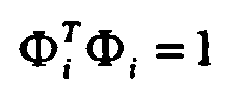
- N-pieces N-dimensional feature vector ? i (i = 1, 2, ..., N) and corresponding N-pieces eigenvalues λi(i = 1, 2, ..., N; λ1 > λ2 > ... > λN) are obtained. For solving the feature equation, an analytical library contained in the above-mentioned literature [1] is usable. Further, instead of using the variance-covariance matrix, a cross-correlation matrix R shown below is usable.

- Then, the eigenvalue contribution
rate calculation unit 304 calculates an eigenvalue contribution rate according to the following formula 17 (for details, refer to "Image Analyzing Handbook", Takagi and Shimoda, p. 43, Tokyo University Publishing Society, 1991). The symbol "T" represents a transposed matrix.
- This eigenvalue shows the distribution of higher dimensional eigenvalue occupying a large part of the contribution rate (For details, refer to the publicly known literature [4] "Application of the Karhymen-Loeve Procedure for the Characterization of Human Faces". M. Kirby and L. Sirovich, IEEE Transactions on Patterns Analysis and Machine Intelligence, Vol. 12, No. 1, pp. 103, January 1990). This means that a large part of the distribution of the learning data can be expressed in higher dimensional feature vectors.
- On the other hand, when the variety in the learning data is small (for instance, when a face is kept almost stationary), almost all of the eigenvalue contribution rate is occupied by very small higher dimensional eigenvalue only. On the contrary, when the variety of the learning data is too large (for instance, when a face is excessively moved or a detected face is shifted), a large eigenalue contribution rate is retained to lower dimensional eigenvalues as shown in
FIG. 12C . - Accordingly, when an eigenvalue contribution rate of the mth eigenvalue or an accumulated eigenvalue contribution rate to the m-th eigenvalue shown in

aptitude judging unit 305 judges the variety as being too large and inaptitude as a dictionary for certification (collation) (Step S304), and the dictionary registration is made over or a recognizedperson 100 is so warned and have him (or her) to select whether to make the registration (Step S305). When a dictionary is judged aptitude in Step S304, thedictionary storing unit 306 stores that dictionary (Step S306). - As described above, when the face image change is too small, the eigenvalue contribution rate of a dictionary becomes large and on the contrary, when the change is too large, the eigenvalue contribution rate of a dictionary becomes small. Therefore, it is possible to prevent the inaptitude dictionary learning made by data that have no sufficient change or too large change by judging a face change.
- Further, in the above-mentioned embodiments, the processes in the dictionary registration are explained, the similar process can be made in the certification (collation) after the dictionary registration.
- According to this invention as described in detail in the above, an individual recognizing apparatus and an individual recognizing method capable of using certifying data suited for certifying in the dictionary registration for learning and preventing the inaptitude dictionary registration can be provided.
Claims (4)
- An individual recognizing apparatus comprising:a data acquisition unit (101; 201) to acquire a plurality of certifying image data from a face region of a recognized person;a detection unit (102; 202) to detect feature points from the plurality of certifying image data of such face regions as eyes (701; 702), brows, nose (703) or lips of the recognized person acquired by the data acquisition unit;a change calculation unit (103; 203) to calculate changes in detected positions of the feature points detected from the plurality of certifying image data by the detection unit (202), the change calculation unit including a unit to calculate at least one of an up down and a left right angle change of the detected feature points;an aptitude judging unit (104; 204) to judge whether the plurality of certifying image data acquired by the data acquisition unit are appropriate for the preparation of a certifying dictionary based on the change in the feature points calculated by the change calculation unit;a dictionary preparing unit (105; 205) to prepare a certifying dictionary based on the certifying data acquired by the data acquisition unit when the certifying data is judged appropriate;a dictionary storing unit (106; 206) to store the certifying dictionary prepared by the dictionary preparing unit; anda certifying unit (107; 207) to certify whether a recognized person is a proper person using the certifying data acquired by the data acquisition unit and the dictionary stored in the dictionary storing unit.
- An individual recognizing apparatus according to claim 1, wherein the aptitude judging unit restarts the recognizing process again starting from the acquisition of certifying data by the data acquisition unit, when the certifying data is judged as inappropriate by the aptitude judging unit.
- An individual recognizing method comprising the steps of:acquiring a plurality of certifying image data from a face region of a recognized person;detecting feature points of such face regions as eyes (701; 702), brows, nose (703) or lips of the recognized person from the acquired certifying data;calculating changes in detected positions of the feature points detected from the plurality of certifying image data the calculation including calculating at least one of an up down and left right angle change of the detected feature points;judging whether the plurality of acquired certifying image data are appropriate for the preparation of a certifying dictionary based on the change of the calculated feature points;preparing a certifying dictionary based on the acquired certifying data when the certifying data is judged appropriate in the judging step;storing the prepared certifying dictionary; andcertifying whether a recognized person is a proper person using the acquired certifying data and the stored dictionary.
- An individual recognizing method according to claim 3, wherein the processes are executed again starting from the acquisition of the certifying data by the data acquiring step when the acquired data is judged as inappropriate in the aptitude judging step.
Priority Applications (1)
| Application Number | Priority Date | Filing Date | Title |
|---|---|---|---|
| EP07022719A EP1903476A3 (en) | 2002-12-26 | 2003-12-05 | Face recognition apparatus and face recognition method |
Applications Claiming Priority (2)
| Application Number | Priority Date | Filing Date | Title |
|---|---|---|---|
| JP2002378452 | 2002-12-26 | ||
| JP2002378452A JP2004213087A (en) | 2002-12-26 | 2002-12-26 | Personal authentication device and personal authentication method |
Related Child Applications (1)
| Application Number | Title | Priority Date | Filing Date |
|---|---|---|---|
| EP07022719A Division EP1903476A3 (en) | 2002-12-26 | 2003-12-05 | Face recognition apparatus and face recognition method |
Publications (3)
| Publication Number | Publication Date |
|---|---|
| EP1434163A2 EP1434163A2 (en) | 2004-06-30 |
| EP1434163A3 EP1434163A3 (en) | 2006-06-07 |
| EP1434163B1 true EP1434163B1 (en) | 2008-10-22 |
Family
ID=32463606
Family Applications (2)
| Application Number | Title | Priority Date | Filing Date |
|---|---|---|---|
| EP03257672A Expired - Lifetime EP1434163B1 (en) | 2002-12-26 | 2003-12-05 | Apparatus and method for acquisition, validation and verification of biometric features |
| EP07022719A Withdrawn EP1903476A3 (en) | 2002-12-26 | 2003-12-05 | Face recognition apparatus and face recognition method |
Family Applications After (1)
| Application Number | Title | Priority Date | Filing Date |
|---|---|---|---|
| EP07022719A Withdrawn EP1903476A3 (en) | 2002-12-26 | 2003-12-05 | Face recognition apparatus and face recognition method |
Country Status (8)
| Country | Link |
|---|---|
| US (1) | US20040125991A1 (en) |
| EP (2) | EP1434163B1 (en) |
| JP (1) | JP2004213087A (en) |
| KR (1) | KR100587617B1 (en) |
| CN (1) | CN1288600C (en) |
| CA (1) | CA2452188A1 (en) |
| DE (1) | DE60324246D1 (en) |
| TW (1) | TWI250469B (en) |
Cited By (1)
| Publication number | Priority date | Publication date | Assignee | Title |
|---|---|---|---|---|
| EP2584493A2 (en) | 2011-10-20 | 2013-04-24 | Bioid AG | Method for distinguishing between a real face and a two-dimensional image of the face in a biometric recording process |
Families Citing this family (33)
| Publication number | Priority date | Publication date | Assignee | Title |
|---|---|---|---|---|
| JP4696857B2 (en) | 2005-11-02 | 2011-06-08 | オムロン株式会社 | Face matching device |
| US20070201727A1 (en) * | 2006-02-13 | 2007-08-30 | Precor Incorporated | User identification for fitness equipment |
| US20070261100A1 (en) * | 2006-05-05 | 2007-11-08 | Greeson Robert L | Platform independent distributed system and method that constructs a security management infrastructure |
| JP4910507B2 (en) * | 2006-06-29 | 2012-04-04 | コニカミノルタホールディングス株式会社 | Face authentication system and face authentication method |
| US8170297B2 (en) * | 2007-01-19 | 2012-05-01 | Konica Minolta Holdings, Inc. | Face authentication system and face authentication method |
| JP4952267B2 (en) * | 2007-01-19 | 2012-06-13 | コニカミノルタホールディングス株式会社 | Three-dimensional shape processing apparatus, three-dimensional shape processing apparatus control method, and three-dimensional shape processing apparatus control program |
| US9639740B2 (en) | 2007-12-31 | 2017-05-02 | Applied Recognition Inc. | Face detection and recognition |
| CN102016882B (en) | 2007-12-31 | 2015-05-27 | 应用识别公司 | Method, system and computer program for identifying and sharing digital images using facial signatures |
| US9721148B2 (en) | 2007-12-31 | 2017-08-01 | Applied Recognition Inc. | Face detection and recognition |
| EP2499240A1 (en) | 2009-11-12 | 2012-09-19 | Vbi Technologies, LLC | Subpopulations of spore-like cells and uses thereof |
| JP5783759B2 (en) * | 2011-03-08 | 2015-09-24 | キヤノン株式会社 | Authentication device, authentication method, authentication program, and recording medium |
| US8830032B2 (en) | 2010-10-25 | 2014-09-09 | International Business Machines Corporation | Biometric-based identity confirmation |
| JP5567152B2 (en) * | 2011-01-27 | 2014-08-06 | 株式会社Nttドコモ | Mobile information terminal, gripping feature learning method, gripping feature authentication method, and recording medium |
| US9552376B2 (en) | 2011-06-09 | 2017-01-24 | MemoryWeb, LLC | Method and apparatus for managing digital files |
| US8548207B2 (en) | 2011-08-15 | 2013-10-01 | Daon Holdings Limited | Method of host-directed illumination and system for conducting host-directed illumination |
| US9931154B2 (en) * | 2012-01-11 | 2018-04-03 | Biosense Webster (Israel), Ltd. | Touch free operation of ablator workstation by use of depth sensors |
| US9202105B1 (en) | 2012-01-13 | 2015-12-01 | Amazon Technologies, Inc. | Image analysis for user authentication |
| US9792528B2 (en) * | 2012-01-30 | 2017-10-17 | Nec Corporation | Information processing system, information processing method, information processing apparatus and control method and control program thereof, and communication terminal and control method and control program thereof |
| JP6528764B2 (en) * | 2014-03-28 | 2019-06-12 | 日本電気株式会社 | Face matching device, method, and recording medium |
| US10803160B2 (en) | 2014-08-28 | 2020-10-13 | Facetec, Inc. | Method to verify and identify blockchain with user question data |
| US12130900B2 (en) | 2014-08-28 | 2024-10-29 | Facetec, Inc. | Method and apparatus to dynamically control facial illumination |
| US10614204B2 (en) | 2014-08-28 | 2020-04-07 | Facetec, Inc. | Facial recognition authentication system including path parameters |
| US11256792B2 (en) | 2014-08-28 | 2022-02-22 | Facetec, Inc. | Method and apparatus for creation and use of digital identification |
| CA2902093C (en) | 2014-08-28 | 2023-03-07 | Kevin Alan Tussy | Facial recognition authentication system including path parameters |
| US10915618B2 (en) | 2014-08-28 | 2021-02-09 | Facetec, Inc. | Method to add remotely collected biometric images / templates to a database record of personal information |
| US10698995B2 (en) | 2014-08-28 | 2020-06-30 | Facetec, Inc. | Method to verify identity using a previously collected biometric image/data |
| CN106991355B (en) * | 2015-09-10 | 2020-04-24 | 天津中科智能识别产业技术研究院有限公司 | Face recognition method of analytic dictionary learning model based on topology maintenance |
| CN105701786B (en) * | 2016-03-21 | 2019-09-24 | 联想(北京)有限公司 | A kind of image processing method and electronic equipment |
| USD987653S1 (en) | 2016-04-26 | 2023-05-30 | Facetec, Inc. | Display screen or portion thereof with graphical user interface |
| USD1074689S1 (en) | 2016-04-26 | 2025-05-13 | Facetec, Inc. | Display screen or portion thereof with animated graphical user interface |
| CN109034138B (en) * | 2018-09-11 | 2021-09-03 | 湖南拓视觉信息技术有限公司 | Image processing method and device |
| US10936178B2 (en) | 2019-01-07 | 2021-03-02 | MemoryWeb, LLC | Systems and methods for analyzing and organizing digital photos and videos |
| WO2022080292A1 (en) * | 2020-10-16 | 2022-04-21 | 日本電気株式会社 | Authentication system, authentication method, and program recording medium |
Family Cites Families (13)
| Publication number | Priority date | Publication date | Assignee | Title |
|---|---|---|---|---|
| EP0173972B1 (en) * | 1984-08-30 | 1991-02-27 | Nec Corporation | Pre-processing system for pre-processing an image signal succession prior to identification |
| CA2004457A1 (en) * | 1988-12-06 | 1990-06-06 | Seigo Igaki | Minutia data extraction in fingerprint identification |
| US5040213A (en) * | 1989-01-27 | 1991-08-13 | Ricoh Company, Ltd. | Method of renewing reference pattern stored in dictionary |
| WO1994023390A1 (en) * | 1993-03-29 | 1994-10-13 | Matsushita Electric Industrial Co., Ltd. | Apparatus for identifying person |
| JP3279913B2 (en) * | 1996-03-18 | 2002-04-30 | 株式会社東芝 | Person authentication device, feature point extraction device, and feature point extraction method |
| AU3926597A (en) * | 1996-09-26 | 1998-04-02 | Canon Kabushiki Kaisha | Process cartridge, electrophotographic image forming apparatus driving force transmission part and electrophotographic photosensitive drum |
| DE19901881A1 (en) * | 1999-01-19 | 2000-07-27 | Dcs Dialog Communication Syste | Falsification protection method for biometric identification process for people using multiple data samples, |
| AU1330501A (en) * | 1999-10-07 | 2001-05-10 | Veridicom, Inc. | Spoof detection for biometric sensing systems |
| JP3356144B2 (en) * | 1999-12-08 | 2002-12-09 | 日本電気株式会社 | User authentication device using biometrics and user authentication method used therefor |
| JP4526639B2 (en) * | 2000-03-02 | 2010-08-18 | 本田技研工業株式会社 | Face recognition apparatus and method |
| JP4443722B2 (en) * | 2000-04-25 | 2010-03-31 | 富士通株式会社 | Image recognition apparatus and method |
| JP2002229955A (en) * | 2001-02-02 | 2002-08-16 | Matsushita Electric Ind Co Ltd | Information terminal device and authentication system |
| EP1260935B1 (en) * | 2001-05-22 | 2006-07-12 | Matsushita Electric Industrial Co., Ltd. | Face detection device, face pose detection device, partial image extraction device, and methods for said devices |
-
2002
- 2002-12-26 JP JP2002378452A patent/JP2004213087A/en active Pending
-
2003
- 2003-11-07 TW TW092131283A patent/TWI250469B/en not_active IP Right Cessation
- 2003-11-20 US US10/716,537 patent/US20040125991A1/en not_active Abandoned
- 2003-12-05 EP EP03257672A patent/EP1434163B1/en not_active Expired - Lifetime
- 2003-12-05 EP EP07022719A patent/EP1903476A3/en not_active Withdrawn
- 2003-12-05 DE DE60324246T patent/DE60324246D1/en not_active Expired - Fee Related
- 2003-12-08 CA CA002452188A patent/CA2452188A1/en not_active Abandoned
- 2003-12-19 KR KR1020030093705A patent/KR100587617B1/en not_active Expired - Fee Related
- 2003-12-23 CN CNB2003101233034A patent/CN1288600C/en not_active Expired - Fee Related
Cited By (3)
| Publication number | Priority date | Publication date | Assignee | Title |
|---|---|---|---|---|
| EP2584493A2 (en) | 2011-10-20 | 2013-04-24 | Bioid AG | Method for distinguishing between a real face and a two-dimensional image of the face in a biometric recording process |
| DE102011054658A1 (en) | 2011-10-20 | 2013-04-25 | Bioid Ag | Method for distinguishing between a real face and a two-dimensional image of the face in a biometric capture process |
| US8977010B2 (en) | 2011-10-20 | 2015-03-10 | Bioid Ag | Method for discriminating between a real face and a two-dimensional image of the face in a biometric detection process |
Also Published As
| Publication number | Publication date |
|---|---|
| US20040125991A1 (en) | 2004-07-01 |
| JP2004213087A (en) | 2004-07-29 |
| KR20040057942A (en) | 2004-07-02 |
| TW200414074A (en) | 2004-08-01 |
| EP1434163A3 (en) | 2006-06-07 |
| EP1903476A3 (en) | 2008-05-21 |
| EP1903476A2 (en) | 2008-03-26 |
| CA2452188A1 (en) | 2004-06-26 |
| CN1512452A (en) | 2004-07-14 |
| DE60324246D1 (en) | 2008-12-04 |
| TWI250469B (en) | 2006-03-01 |
| EP1434163A2 (en) | 2004-06-30 |
| KR100587617B1 (en) | 2006-06-07 |
| CN1288600C (en) | 2006-12-06 |
Similar Documents
| Publication | Publication Date | Title |
|---|---|---|
| EP1434163B1 (en) | Apparatus and method for acquisition, validation and verification of biometric features | |
| Jain et al. | Integrating faces, fingerprints, and soft biometric traits for user recognition | |
| US7412081B2 (en) | Personal authentication apparatus and personal authentication method | |
| US8320643B2 (en) | Face authentication device | |
| KR101217349B1 (en) | Image processing apparatus and method, and computer readable recording medium | |
| US20180342067A1 (en) | Moving object tracking system and moving object tracking method | |
| JP4546168B2 (en) | Biometric authentication system registration method, biometric authentication system and program thereof | |
| EP1416427A2 (en) | Person recognising apparatus, person recognising method & passage controller | |
| US20030039378A1 (en) | Image processing system and driving support system | |
| US20060193502A1 (en) | Device control apparatus and method | |
| JP2008257425A (en) | Face recognition device, face recognition method, and computer program | |
| EP3113073A1 (en) | Determination device, determination method, and non-transitory storage medium | |
| JP2006107288A (en) | Personal authentication method, apparatus and program | |
| JP4507679B2 (en) | Image recognition apparatus, image extraction apparatus, image extraction method, and program | |
| EP1742169B1 (en) | Tracking apparatus | |
| JP2019109843A (en) | Classification device, classification method, attribute recognition device, and machine learning device | |
| JP2019132019A (en) | Information processing unit | |
| JP2008257329A (en) | Face matching device | |
| JP4594176B2 (en) | Image processing apparatus and entrance / exit management system | |
| JP2004234355A (en) | Person recognition device, person recognition method, and traffic control device | |
| Isaac et al. | Template-based gait authentication through Bayesian thresholding | |
| JPH10261083A (en) | Personal identification device and personal identification method | |
| JP6798285B2 (en) | Biometric device, biometric method and program | |
| JP2005084979A (en) | Face authentication system, method and program | |
| JP3841482B2 (en) | Face image recognition device |
Legal Events
| Date | Code | Title | Description |
|---|---|---|---|
| PUAI | Public reference made under article 153(3) epc to a published international application that has entered the european phase |
Free format text: ORIGINAL CODE: 0009012 |
|
| 17P | Request for examination filed |
Effective date: 20031222 |
|
| AK | Designated contracting states |
Kind code of ref document: A2 Designated state(s): AT BE BG CH CY CZ DE DK EE ES FI FR GB GR HU IE IT LI LU MC NL PT RO SE SI SK TR |
|
| AX | Request for extension of the european patent |
Extension state: AL LT LV MK |
|
| PUAL | Search report despatched |
Free format text: ORIGINAL CODE: 0009013 |
|
| AK | Designated contracting states |
Kind code of ref document: A3 Designated state(s): AT BE BG CH CY CZ DE DK EE ES FI FR GB GR HU IE IT LI LU MC NL PT RO SE SI SK TR |
|
| AX | Request for extension of the european patent |
Extension state: AL LT LV MK |
|
| 17Q | First examination report despatched |
Effective date: 20060726 |
|
| AKX | Designation fees paid |
Designated state(s): DE FR GB |
|
| GRAP | Despatch of communication of intention to grant a patent |
Free format text: ORIGINAL CODE: EPIDOSNIGR1 |
|
| GRAS | Grant fee paid |
Free format text: ORIGINAL CODE: EPIDOSNIGR3 |
|
| GRAA | (expected) grant |
Free format text: ORIGINAL CODE: 0009210 |
|
| AK | Designated contracting states |
Kind code of ref document: B1 Designated state(s): DE FR GB |
|
| REG | Reference to a national code |
Ref country code: GB Ref legal event code: FG4D |
|
| REF | Corresponds to: |
Ref document number: 60324246 Country of ref document: DE Date of ref document: 20081204 Kind code of ref document: P |
|
| PGFP | Annual fee paid to national office [announced via postgrant information from national office to epo] |
Ref country code: DE Payment date: 20081127 Year of fee payment: 6 |
|
| PLBE | No opposition filed within time limit |
Free format text: ORIGINAL CODE: 0009261 |
|
| STAA | Information on the status of an ep patent application or granted ep patent |
Free format text: STATUS: NO OPPOSITION FILED WITHIN TIME LIMIT |
|
| 26N | No opposition filed |
Effective date: 20090723 |
|
| PGFP | Annual fee paid to national office [announced via postgrant information from national office to epo] |
Ref country code: FR Payment date: 20091221 Year of fee payment: 7 Ref country code: GB Payment date: 20091202 Year of fee payment: 7 |
|
| PG25 | Lapsed in a contracting state [announced via postgrant information from national office to epo] |
Ref country code: DE Free format text: LAPSE BECAUSE OF NON-PAYMENT OF DUE FEES Effective date: 20100701 |
|
| GBPC | Gb: european patent ceased through non-payment of renewal fee |
Effective date: 20101205 |
|
| REG | Reference to a national code |
Ref country code: FR Ref legal event code: ST Effective date: 20110831 |
|
| PG25 | Lapsed in a contracting state [announced via postgrant information from national office to epo] |
Ref country code: FR Free format text: LAPSE BECAUSE OF NON-PAYMENT OF DUE FEES Effective date: 20110103 |
|
| PG25 | Lapsed in a contracting state [announced via postgrant information from national office to epo] |
Ref country code: GB Free format text: LAPSE BECAUSE OF NON-PAYMENT OF DUE FEES Effective date: 20101205 |