EP1473132A2 - Highly porous interlayers to toughen liquid-molded fabric-based composites - Google Patents
Highly porous interlayers to toughen liquid-molded fabric-based composites Download PDFInfo
- Publication number
- EP1473132A2 EP1473132A2 EP20040010275 EP04010275A EP1473132A2 EP 1473132 A2 EP1473132 A2 EP 1473132A2 EP 20040010275 EP20040010275 EP 20040010275 EP 04010275 A EP04010275 A EP 04010275A EP 1473132 A2 EP1473132 A2 EP 1473132A2
- Authority
- EP
- European Patent Office
- Prior art keywords
- preform
- unidirectional
- fabric
- fibers
- layers
- Prior art date
- Legal status (The legal status is an assumption and is not a legal conclusion. Google has not performed a legal analysis and makes no representation as to the accuracy of the status listed.)
- Granted
Links
Images


Classifications
-
- B—PERFORMING OPERATIONS; TRANSPORTING
- B32—LAYERED PRODUCTS
- B32B—LAYERED PRODUCTS, i.e. PRODUCTS BUILT-UP OF STRATA OF FLAT OR NON-FLAT, e.g. CELLULAR OR HONEYCOMB, FORM
- B32B5/00—Layered products characterised by the non- homogeneity or physical structure, i.e. comprising a fibrous, filamentary, particulate or foam layer; Layered products characterised by having a layer differing constitutionally or physically in different parts
- B32B5/22—Layered products characterised by the non- homogeneity or physical structure, i.e. comprising a fibrous, filamentary, particulate or foam layer; Layered products characterised by having a layer differing constitutionally or physically in different parts characterised by the presence of two or more layers which are next to each other and are fibrous, filamentary, formed of particles or foamed
- B32B5/24—Layered products characterised by the non- homogeneity or physical structure, i.e. comprising a fibrous, filamentary, particulate or foam layer; Layered products characterised by having a layer differing constitutionally or physically in different parts characterised by the presence of two or more layers which are next to each other and are fibrous, filamentary, formed of particles or foamed one layer being a fibrous or filamentary layer
- B32B5/26—Layered products characterised by the non- homogeneity or physical structure, i.e. comprising a fibrous, filamentary, particulate or foam layer; Layered products characterised by having a layer differing constitutionally or physically in different parts characterised by the presence of two or more layers which are next to each other and are fibrous, filamentary, formed of particles or foamed one layer being a fibrous or filamentary layer another layer next to it also being fibrous or filamentary
-
- B—PERFORMING OPERATIONS; TRANSPORTING
- B29—WORKING OF PLASTICS; WORKING OF SUBSTANCES IN A PLASTIC STATE IN GENERAL
- B29B—PREPARATION OR PRETREATMENT OF THE MATERIAL TO BE SHAPED; MAKING GRANULES OR PREFORMS; RECOVERY OF PLASTICS OR OTHER CONSTITUENTS OF WASTE MATERIAL CONTAINING PLASTICS
- B29B11/00—Making preforms
- B29B11/14—Making preforms characterised by structure or composition
- B29B11/16—Making preforms characterised by structure or composition comprising fillers or reinforcement
-
- B—PERFORMING OPERATIONS; TRANSPORTING
- B29—WORKING OF PLASTICS; WORKING OF SUBSTANCES IN A PLASTIC STATE IN GENERAL
- B29C—SHAPING OR JOINING OF PLASTICS; SHAPING OF MATERIAL IN A PLASTIC STATE, NOT OTHERWISE PROVIDED FOR; AFTER-TREATMENT OF THE SHAPED PRODUCTS, e.g. REPAIRING
- B29C48/00—Extrusion moulding, i.e. expressing the moulding material through a die or nozzle which imparts the desired form; Apparatus therefor
- B29C48/03—Extrusion moulding, i.e. expressing the moulding material through a die or nozzle which imparts the desired form; Apparatus therefor characterised by the shape of the extruded material at extrusion
- B29C48/05—Filamentary, e.g. strands
-
- B—PERFORMING OPERATIONS; TRANSPORTING
- B29—WORKING OF PLASTICS; WORKING OF SUBSTANCES IN A PLASTIC STATE IN GENERAL
- B29C—SHAPING OR JOINING OF PLASTICS; SHAPING OF MATERIAL IN A PLASTIC STATE, NOT OTHERWISE PROVIDED FOR; AFTER-TREATMENT OF THE SHAPED PRODUCTS, e.g. REPAIRING
- B29C70/00—Shaping composites, i.e. plastics material comprising reinforcements, fillers or preformed parts, e.g. inserts
- B29C70/04—Shaping composites, i.e. plastics material comprising reinforcements, fillers or preformed parts, e.g. inserts comprising reinforcements only, e.g. self-reinforcing plastics
- B29C70/06—Fibrous reinforcements only
- B29C70/08—Fibrous reinforcements only comprising combinations of different forms of fibrous reinforcements incorporated in matrix material, forming one or more layers, and with or without non-reinforced layers
- B29C70/083—Combinations of continuous fibres or fibrous profiled structures oriented in one direction and reinforcements forming a two dimensional structure, e.g. mats
-
- B—PERFORMING OPERATIONS; TRANSPORTING
- B29—WORKING OF PLASTICS; WORKING OF SUBSTANCES IN A PLASTIC STATE IN GENERAL
- B29C—SHAPING OR JOINING OF PLASTICS; SHAPING OF MATERIAL IN A PLASTIC STATE, NOT OTHERWISE PROVIDED FOR; AFTER-TREATMENT OF THE SHAPED PRODUCTS, e.g. REPAIRING
- B29C70/00—Shaping composites, i.e. plastics material comprising reinforcements, fillers or preformed parts, e.g. inserts
- B29C70/04—Shaping composites, i.e. plastics material comprising reinforcements, fillers or preformed parts, e.g. inserts comprising reinforcements only, e.g. self-reinforcing plastics
- B29C70/06—Fibrous reinforcements only
- B29C70/10—Fibrous reinforcements only characterised by the structure of fibrous reinforcements, e.g. hollow fibres
- B29C70/16—Fibrous reinforcements only characterised by the structure of fibrous reinforcements, e.g. hollow fibres using fibres of substantial or continuous length
- B29C70/24—Fibrous reinforcements only characterised by the structure of fibrous reinforcements, e.g. hollow fibres using fibres of substantial or continuous length oriented in at least three directions forming a three-dimensional [3D] structure
-
- B—PERFORMING OPERATIONS; TRANSPORTING
- B29—WORKING OF PLASTICS; WORKING OF SUBSTANCES IN A PLASTIC STATE IN GENERAL
- B29C—SHAPING OR JOINING OF PLASTICS; SHAPING OF MATERIAL IN A PLASTIC STATE, NOT OTHERWISE PROVIDED FOR; AFTER-TREATMENT OF THE SHAPED PRODUCTS, e.g. REPAIRING
- B29C70/00—Shaping composites, i.e. plastics material comprising reinforcements, fillers or preformed parts, e.g. inserts
- B29C70/04—Shaping composites, i.e. plastics material comprising reinforcements, fillers or preformed parts, e.g. inserts comprising reinforcements only, e.g. self-reinforcing plastics
- B29C70/28—Shaping operations therefor
- B29C70/40—Shaping or impregnating by compression not applied
- B29C70/42—Shaping or impregnating by compression not applied for producing articles of definite length, i.e. discrete articles
- B29C70/44—Shaping or impregnating by compression not applied for producing articles of definite length, i.e. discrete articles using isostatic pressure, e.g. pressure difference-moulding, vacuum bag-moulding, autoclave-moulding or expanding rubber-moulding
- B29C70/443—Shaping or impregnating by compression not applied for producing articles of definite length, i.e. discrete articles using isostatic pressure, e.g. pressure difference-moulding, vacuum bag-moulding, autoclave-moulding or expanding rubber-moulding and impregnating by vacuum or injection
-
- B—PERFORMING OPERATIONS; TRANSPORTING
- B29—WORKING OF PLASTICS; WORKING OF SUBSTANCES IN A PLASTIC STATE IN GENERAL
- B29C—SHAPING OR JOINING OF PLASTICS; SHAPING OF MATERIAL IN A PLASTIC STATE, NOT OTHERWISE PROVIDED FOR; AFTER-TREATMENT OF THE SHAPED PRODUCTS, e.g. REPAIRING
- B29C70/00—Shaping composites, i.e. plastics material comprising reinforcements, fillers or preformed parts, e.g. inserts
- B29C70/04—Shaping composites, i.e. plastics material comprising reinforcements, fillers or preformed parts, e.g. inserts comprising reinforcements only, e.g. self-reinforcing plastics
- B29C70/28—Shaping operations therefor
- B29C70/40—Shaping or impregnating by compression not applied
- B29C70/42—Shaping or impregnating by compression not applied for producing articles of definite length, i.e. discrete articles
- B29C70/46—Shaping or impregnating by compression not applied for producing articles of definite length, i.e. discrete articles using matched moulds, e.g. for deforming sheet moulding compounds [SMC] or prepregs
- B29C70/465—Shaping or impregnating by compression not applied for producing articles of definite length, i.e. discrete articles using matched moulds, e.g. for deforming sheet moulding compounds [SMC] or prepregs and impregnating by melting a solid material, e.g. sheets, powders of fibres
-
- B—PERFORMING OPERATIONS; TRANSPORTING
- B29—WORKING OF PLASTICS; WORKING OF SUBSTANCES IN A PLASTIC STATE IN GENERAL
- B29C—SHAPING OR JOINING OF PLASTICS; SHAPING OF MATERIAL IN A PLASTIC STATE, NOT OTHERWISE PROVIDED FOR; AFTER-TREATMENT OF THE SHAPED PRODUCTS, e.g. REPAIRING
- B29C70/00—Shaping composites, i.e. plastics material comprising reinforcements, fillers or preformed parts, e.g. inserts
- B29C70/04—Shaping composites, i.e. plastics material comprising reinforcements, fillers or preformed parts, e.g. inserts comprising reinforcements only, e.g. self-reinforcing plastics
- B29C70/28—Shaping operations therefor
- B29C70/40—Shaping or impregnating by compression not applied
- B29C70/42—Shaping or impregnating by compression not applied for producing articles of definite length, i.e. discrete articles
- B29C70/46—Shaping or impregnating by compression not applied for producing articles of definite length, i.e. discrete articles using matched moulds, e.g. for deforming sheet moulding compounds [SMC] or prepregs
- B29C70/48—Shaping or impregnating by compression not applied for producing articles of definite length, i.e. discrete articles using matched moulds, e.g. for deforming sheet moulding compounds [SMC] or prepregs and impregnating the reinforcements in the closed mould, e.g. resin transfer moulding [RTM], e.g. by vacuum
-
- B—PERFORMING OPERATIONS; TRANSPORTING
- B29—WORKING OF PLASTICS; WORKING OF SUBSTANCES IN A PLASTIC STATE IN GENERAL
- B29C—SHAPING OR JOINING OF PLASTICS; SHAPING OF MATERIAL IN A PLASTIC STATE, NOT OTHERWISE PROVIDED FOR; AFTER-TREATMENT OF THE SHAPED PRODUCTS, e.g. REPAIRING
- B29C70/00—Shaping composites, i.e. plastics material comprising reinforcements, fillers or preformed parts, e.g. inserts
- B29C70/04—Shaping composites, i.e. plastics material comprising reinforcements, fillers or preformed parts, e.g. inserts comprising reinforcements only, e.g. self-reinforcing plastics
- B29C70/28—Shaping operations therefor
- B29C70/40—Shaping or impregnating by compression not applied
- B29C70/50—Shaping or impregnating by compression not applied for producing articles of indefinite length, e.g. prepregs, sheet moulding compounds [SMC] or cross moulding compounds [XMC]
-
- B—PERFORMING OPERATIONS; TRANSPORTING
- B32—LAYERED PRODUCTS
- B32B—LAYERED PRODUCTS, i.e. PRODUCTS BUILT-UP OF STRATA OF FLAT OR NON-FLAT, e.g. CELLULAR OR HONEYCOMB, FORM
- B32B5/00—Layered products characterised by the non- homogeneity or physical structure, i.e. comprising a fibrous, filamentary, particulate or foam layer; Layered products characterised by having a layer differing constitutionally or physically in different parts
- B32B5/02—Layered products characterised by the non- homogeneity or physical structure, i.e. comprising a fibrous, filamentary, particulate or foam layer; Layered products characterised by having a layer differing constitutionally or physically in different parts characterised by structural features of a fibrous or filamentary layer
- B32B5/022—Non-woven fabric
-
- D—TEXTILES; PAPER
- D04—BRAIDING; LACE-MAKING; KNITTING; TRIMMINGS; NON-WOVEN FABRICS
- D04B—KNITTING
- D04B21/00—Warp knitting processes for the production of fabrics or articles not dependent on the use of particular machines; Fabrics or articles defined by such processes
- D04B21/14—Fabrics characterised by the incorporation by knitting, in one or more thread, fleece, or fabric layers, of reinforcing, binding, or decorative threads; Fabrics incorporating small auxiliary elements, e.g. for decorative purposes
- D04B21/16—Fabrics characterised by the incorporation by knitting, in one or more thread, fleece, or fabric layers, of reinforcing, binding, or decorative threads; Fabrics incorporating small auxiliary elements, e.g. for decorative purposes incorporating synthetic threads
- D04B21/165—Fabrics characterised by the incorporation by knitting, in one or more thread, fleece, or fabric layers, of reinforcing, binding, or decorative threads; Fabrics incorporating small auxiliary elements, e.g. for decorative purposes incorporating synthetic threads with yarns stitched through one or more layers or tows, e.g. stitch-bonded fabrics
-
- B—PERFORMING OPERATIONS; TRANSPORTING
- B29—WORKING OF PLASTICS; WORKING OF SUBSTANCES IN A PLASTIC STATE IN GENERAL
- B29C—SHAPING OR JOINING OF PLASTICS; SHAPING OF MATERIAL IN A PLASTIC STATE, NOT OTHERWISE PROVIDED FOR; AFTER-TREATMENT OF THE SHAPED PRODUCTS, e.g. REPAIRING
- B29C48/00—Extrusion moulding, i.e. expressing the moulding material through a die or nozzle which imparts the desired form; Apparatus therefor
- B29C48/16—Articles comprising two or more components, e.g. co-extruded layers
- B29C48/18—Articles comprising two or more components, e.g. co-extruded layers the components being layers
- B29C48/19—Articles comprising two or more components, e.g. co-extruded layers the components being layers the layers being joined at their edges
-
- B—PERFORMING OPERATIONS; TRANSPORTING
- B32—LAYERED PRODUCTS
- B32B—LAYERED PRODUCTS, i.e. PRODUCTS BUILT-UP OF STRATA OF FLAT OR NON-FLAT, e.g. CELLULAR OR HONEYCOMB, FORM
- B32B2262/00—Composition or structural features of fibres which form a fibrous or filamentary layer or are present as additives
- B32B2262/02—Synthetic macromolecular fibres
- B32B2262/0261—Polyamide fibres
-
- B—PERFORMING OPERATIONS; TRANSPORTING
- B32—LAYERED PRODUCTS
- B32B—LAYERED PRODUCTS, i.e. PRODUCTS BUILT-UP OF STRATA OF FLAT OR NON-FLAT, e.g. CELLULAR OR HONEYCOMB, FORM
- B32B2262/00—Composition or structural features of fibres which form a fibrous or filamentary layer or are present as additives
- B32B2262/02—Synthetic macromolecular fibres
- B32B2262/0276—Polyester fibres
-
- D—TEXTILES; PAPER
- D10—INDEXING SCHEME ASSOCIATED WITH SUBLASSES OF SECTION D, RELATING TO TEXTILES
- D10B—INDEXING SCHEME ASSOCIATED WITH SUBLASSES OF SECTION D, RELATING TO TEXTILES
- D10B2403/00—Details of fabric structure established in the fabric forming process
- D10B2403/02—Cross-sectional features
- D10B2403/024—Fabric incorporating additional compounds
- D10B2403/0241—Fabric incorporating additional compounds enhancing mechanical properties
- D10B2403/02412—Fabric incorporating additional compounds enhancing mechanical properties including several arrays of unbent yarn, e.g. multiaxial fabrics
-
- D—TEXTILES; PAPER
- D10—INDEXING SCHEME ASSOCIATED WITH SUBLASSES OF SECTION D, RELATING TO TEXTILES
- D10B—INDEXING SCHEME ASSOCIATED WITH SUBLASSES OF SECTION D, RELATING TO TEXTILES
- D10B2505/00—Industrial
- D10B2505/02—Reinforcing materials; Prepregs
-
- Y—GENERAL TAGGING OF NEW TECHNOLOGICAL DEVELOPMENTS; GENERAL TAGGING OF CROSS-SECTIONAL TECHNOLOGIES SPANNING OVER SEVERAL SECTIONS OF THE IPC; TECHNICAL SUBJECTS COVERED BY FORMER USPC CROSS-REFERENCE ART COLLECTIONS [XRACs] AND DIGESTS
- Y10—TECHNICAL SUBJECTS COVERED BY FORMER USPC
- Y10T—TECHNICAL SUBJECTS COVERED BY FORMER US CLASSIFICATION
- Y10T442/00—Fabric [woven, knitted, or nonwoven textile or cloth, etc.]
- Y10T442/10—Scrim [e.g., open net or mesh, gauze, loose or open weave or knit, etc.]
- Y10T442/184—Nonwoven scrim
- Y10T442/186—Comprising a composite fiber
-
- Y—GENERAL TAGGING OF NEW TECHNOLOGICAL DEVELOPMENTS; GENERAL TAGGING OF CROSS-SECTIONAL TECHNOLOGIES SPANNING OVER SEVERAL SECTIONS OF THE IPC; TECHNICAL SUBJECTS COVERED BY FORMER USPC CROSS-REFERENCE ART COLLECTIONS [XRACs] AND DIGESTS
- Y10—TECHNICAL SUBJECTS COVERED BY FORMER USPC
- Y10T—TECHNICAL SUBJECTS COVERED BY FORMER US CLASSIFICATION
- Y10T442/00—Fabric [woven, knitted, or nonwoven textile or cloth, etc.]
- Y10T442/10—Scrim [e.g., open net or mesh, gauze, loose or open weave or knit, etc.]
- Y10T442/184—Nonwoven scrim
- Y10T442/197—Including a nonwoven fabric which is not a scrim
-
- Y—GENERAL TAGGING OF NEW TECHNOLOGICAL DEVELOPMENTS; GENERAL TAGGING OF CROSS-SECTIONAL TECHNOLOGIES SPANNING OVER SEVERAL SECTIONS OF THE IPC; TECHNICAL SUBJECTS COVERED BY FORMER USPC CROSS-REFERENCE ART COLLECTIONS [XRACs] AND DIGESTS
- Y10—TECHNICAL SUBJECTS COVERED BY FORMER USPC
- Y10T—TECHNICAL SUBJECTS COVERED BY FORMER US CLASSIFICATION
- Y10T442/00—Fabric [woven, knitted, or nonwoven textile or cloth, etc.]
- Y10T442/30—Woven fabric [i.e., woven strand or strip material]
- Y10T442/3179—Woven fabric is characterized by a particular or differential weave other than fabric in which the strand denier or warp/weft pick count is specified
-
- Y—GENERAL TAGGING OF NEW TECHNOLOGICAL DEVELOPMENTS; GENERAL TAGGING OF CROSS-SECTIONAL TECHNOLOGIES SPANNING OVER SEVERAL SECTIONS OF THE IPC; TECHNICAL SUBJECTS COVERED BY FORMER USPC CROSS-REFERENCE ART COLLECTIONS [XRACs] AND DIGESTS
- Y10—TECHNICAL SUBJECTS COVERED BY FORMER USPC
- Y10T—TECHNICAL SUBJECTS COVERED BY FORMER US CLASSIFICATION
- Y10T442/00—Fabric [woven, knitted, or nonwoven textile or cloth, etc.]
- Y10T442/30—Woven fabric [i.e., woven strand or strip material]
- Y10T442/3179—Woven fabric is characterized by a particular or differential weave other than fabric in which the strand denier or warp/weft pick count is specified
- Y10T442/3293—Warp and weft are identical and contain at least two chemically different strand materials
-
- Y—GENERAL TAGGING OF NEW TECHNOLOGICAL DEVELOPMENTS; GENERAL TAGGING OF CROSS-SECTIONAL TECHNOLOGIES SPANNING OVER SEVERAL SECTIONS OF THE IPC; TECHNICAL SUBJECTS COVERED BY FORMER USPC CROSS-REFERENCE ART COLLECTIONS [XRACs] AND DIGESTS
- Y10—TECHNICAL SUBJECTS COVERED BY FORMER USPC
- Y10T—TECHNICAL SUBJECTS COVERED BY FORMER US CLASSIFICATION
- Y10T442/00—Fabric [woven, knitted, or nonwoven textile or cloth, etc.]
- Y10T442/30—Woven fabric [i.e., woven strand or strip material]
- Y10T442/3707—Woven fabric including a nonwoven fabric layer other than paper
-
- Y—GENERAL TAGGING OF NEW TECHNOLOGICAL DEVELOPMENTS; GENERAL TAGGING OF CROSS-SECTIONAL TECHNOLOGIES SPANNING OVER SEVERAL SECTIONS OF THE IPC; TECHNICAL SUBJECTS COVERED BY FORMER USPC CROSS-REFERENCE ART COLLECTIONS [XRACs] AND DIGESTS
- Y10—TECHNICAL SUBJECTS COVERED BY FORMER USPC
- Y10T—TECHNICAL SUBJECTS COVERED BY FORMER US CLASSIFICATION
- Y10T442/00—Fabric [woven, knitted, or nonwoven textile or cloth, etc.]
- Y10T442/60—Nonwoven fabric [i.e., nonwoven strand or fiber material]
- Y10T442/637—Including strand or fiber material which is a monofilament composed of two or more polymeric materials in physically distinct relationship [e.g., sheath-core, side-by-side, islands-in-sea, fibrils-in-matrix, etc.] or composed of physical blend of chemically different polymeric materials or a physical blend of a polymeric material and a filler material
- Y10T442/641—Sheath-core multicomponent strand or fiber material
-
- Y—GENERAL TAGGING OF NEW TECHNOLOGICAL DEVELOPMENTS; GENERAL TAGGING OF CROSS-SECTIONAL TECHNOLOGIES SPANNING OVER SEVERAL SECTIONS OF THE IPC; TECHNICAL SUBJECTS COVERED BY FORMER USPC CROSS-REFERENCE ART COLLECTIONS [XRACs] AND DIGESTS
- Y10—TECHNICAL SUBJECTS COVERED BY FORMER USPC
- Y10T—TECHNICAL SUBJECTS COVERED BY FORMER US CLASSIFICATION
- Y10T442/00—Fabric [woven, knitted, or nonwoven textile or cloth, etc.]
- Y10T442/60—Nonwoven fabric [i.e., nonwoven strand or fiber material]
- Y10T442/643—Including parallel strand or fiber material within the nonwoven fabric
-
- Y—GENERAL TAGGING OF NEW TECHNOLOGICAL DEVELOPMENTS; GENERAL TAGGING OF CROSS-SECTIONAL TECHNOLOGIES SPANNING OVER SEVERAL SECTIONS OF THE IPC; TECHNICAL SUBJECTS COVERED BY FORMER USPC CROSS-REFERENCE ART COLLECTIONS [XRACs] AND DIGESTS
- Y10—TECHNICAL SUBJECTS COVERED BY FORMER USPC
- Y10T—TECHNICAL SUBJECTS COVERED BY FORMER US CLASSIFICATION
- Y10T442/00—Fabric [woven, knitted, or nonwoven textile or cloth, etc.]
- Y10T442/60—Nonwoven fabric [i.e., nonwoven strand or fiber material]
- Y10T442/659—Including an additional nonwoven fabric
-
- Y—GENERAL TAGGING OF NEW TECHNOLOGICAL DEVELOPMENTS; GENERAL TAGGING OF CROSS-SECTIONAL TECHNOLOGIES SPANNING OVER SEVERAL SECTIONS OF THE IPC; TECHNICAL SUBJECTS COVERED BY FORMER USPC CROSS-REFERENCE ART COLLECTIONS [XRACs] AND DIGESTS
- Y10—TECHNICAL SUBJECTS COVERED BY FORMER USPC
- Y10T—TECHNICAL SUBJECTS COVERED BY FORMER US CLASSIFICATION
- Y10T442/00—Fabric [woven, knitted, or nonwoven textile or cloth, etc.]
- Y10T442/60—Nonwoven fabric [i.e., nonwoven strand or fiber material]
- Y10T442/681—Spun-bonded nonwoven fabric
Definitions
- the present invention relates to cured composites built from layers of unidirectional fibers.
- the invention utilizes highly porous lightweight materials in conjunction with multilayer preforms to obtain cured articles with improved toughness.
- High-performance composite materials built of alternating layers of unidirectional reinforcing fibers have an advantageous combination of high strength and light weight. As such they find use in aerospace and other industries where such properties are critical.
- the composite materials are prepared by laying up a number of alternating layers wherein adjacent layers have unidirectional fibers running at different angles. The net effect of buildup of several layers of such unidirectional fabrics is to provide a composite material having exceptional strength, either quasi-isotropically, or in one or more particular directions.
- Such composite materials may be produced as prepregs or as preforms.
- prepregs layers of unidirectional fabrics immersed or impregnated with a resin are laid-up into the shape of the part to be produced from the composite material. Thereafter, the laid-up part is heated to cure the resin and provide the finished composite part.
- layers of unidirectional reinforcing fibers or woven, braided, or warp-knit fabric are laid up similarly to the way they are laid-up in prepregs. However, in the preform method, the layers are laid-up dry. Thereafter, the laid-up material is infused with resin in a liquid-molding process, and the molded part is heated to cure the resin as in the prepregs.
- the alternating layers, or lamina, of reinforcing fibers provide the composite articles made from the prepreg or preform process with a great deal of strength, especially in directions that align with specific fiber directions. Accordingly, very strong lightweight parts may be produced, for example, as wings and fuselages of aircraft.
- the alternating lamina of reinforcing fibers provide strength, toughness or impact resistance is determined mainly by the properties of the cured resin. Impact-resistant or toughened resins are preferred because they are resistant to damage from impact. This is important, for example, in the case of airplane wings made from such composite materials. Any failure from foreign-object impact during flight would be catastrophic for the airplane to which the wing is attached. Also, any damage resulting from ground-maintenance impact (e.g.
- the resin typically an epoxy-based formulation
- the resin may be toughened by adding particles of a thermoplastic material to the conventional resin.
- thermoplastic particles may either be soluble in the matrix resin and dissolve in the epoxy resin or may be insoluble and placed, during the prepregging operation (see, for example, US 5,028,478) on the surface of each layer.
- the thermoplastic resin in the cured epoxy matrix serves to limit crack propagation through the part.
- Preform materials may be stitched before resin infusion and cure to provide toughness and crack resistance.
- One drawback to stitching is the reduction of in-plane mechanical properties, particularly as the stitch density increases.
- the prepreg approach of applying particles of thermoplastic material to the resin before cure is not directly transferable to the liquid molding processes used to prepare preform articles.
- thermoplastics tend to increase the melt-flow viscosity of the matrix resin unacceptably, while insoluble thermoplastic toughening particles tend to be filtered by the preform and thus will not be located uniformly between the plies in the preform.
- thermoplastic resin layers are provided between layers of the reinforcement fiber.
- the thermoplastic resin layer is described in the form of a porous film, fiber, network structure, knitted loop, and the like.
- the laminated product uses a thermoplastic layer of sufficient permeability between the layers of reinforcing fibers so as not to inhibit liquid resin flow during a liquid molding process.
- One drawback inherent in processes such as those described in EP 1 175 998 is that the performs made of alternating layers of reinforcing fibers and thermoplastic resin layers are less than perfectly stable during resin infusion. As a result, the reinforcing fibers and the thermoplastic resin layer tend to move or shift during the liquid molding process.
- the invention provides a multiaxial preform made up of reinforcing layers of unidirectional fibers.
- Non-woven interlayers made of spunbonded, spunlaced, or mesh fabric of thermoplastic fibers are disposed between and melt-bonded or stitched to the reinforcing layers.
- the multiaxial preform is used in a liquid-molding process by which resin is infused into the preform, followed by heating to gel and set the resin.
- the interlayers are permeable to permit the flow of resin during the liquid-molding operation.
- the interlayer material is melt-bonded to at least one of the unidirectional layers, preferably on both sides. The layers are further held together with knit threads.
- the melt-bonded interlayers hold the unidirectional fibers in place during the resin infusion and subsequent curing of the resin to produce a fiber reinforced composite material.
- the unidirectional fibers are made of carbon fibers.
- the material making up the interlayers is chosen for compatibility with the resin upon curing.
- the resin is an epoxy resin and the interlayer fibers are made of a polyamide.
- the invention provides a method for manufacturing a multiaxial fabric made of reinforcing layers of unidirectional fiber, with non-woven interlayers disposed between the reinforcing layers.
- the method includes the step of melt-bonding an interlayer material made of thermoplastic fibers to one or both sides of a unidirectional dry fabric to produce a dry unidirectional tape. Thereafter, a preform may be built up from the unidirectional tape by laying down the tape with at least one other layer or lamina of unidirectional fibers at angles between -90 and +90° from the warp direction of the multiaxial fabric.
- alternating unidirectional fibers is accomplished by building up the preform from a plurality of dry unidirectional tapes.
- the layers of the preform are preferably stitched together.
- Fabric-reinforced composite materials may be prepared by molding such a preform and infusing the preform in the mold with a thermosetting resin in a liquid-molding process.
- the lamina of unidirectional fibers in the multiaxial fabric may be laid-down in quasi-isotropic or orthotropic patterns.
- the pattern may be repeated as needed to achieve a desired thickness of the finished part.
- the repeated pattern may be constant, or may be varied across the preform. Where the repeated pattern is varied across the preform, the locally different thicknesses may be mechanically held in place, such as by stitching, tufting, or heating to melt-bond the multilayers together.
- a localized "tackifier" such as are known in the trade, may be used for holding preform pieces in place mechanically.
- Conventional methods for manufacturing large-scale preform materials may be modified to produce multiaxial fabrics containing reinforcing layers of unidirectional fibers with non-woven interlayers disposed between the reinforcing layers and melt-bonded to at least one of them.
- a plurality of tows is first pulled across a set of pins to create reinforcing layers of unidirectional fibers.
- An interlayer material is introduced to reside between the reinforcing layers, and the layers of unidirectional fibers are knitted together to form a multilayer stack.
- the interlayer material may be attached to individual reinforcing layers via heating without causing all layers to be melt-bonded to each other.
- Fiber-reinforced composite materials may be made by molding a preform and infusing the preform with a thermosetting resin in a number of liquid-molding processes.
- Liquid-molding processes that may be used in the invention include, without limitation, vacuum-assisted resin transfer molding (VARTM), in which resin is infused into the preform using a vacuum-generated pressure differential.
- VARTM vacuum-assisted resin transfer molding
- RTM resin transfer molding
- RFI resin film infusion
- a semi-solid resin is placed underneath or on top of the preform, appropriate tooling is located on the part, the part is bagged and then placed in an autoclave to melt and infuse the resin into the preform.
- RFI resin film infusion
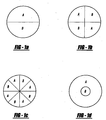
- Figure 1 is a schematic side view of the preferred thermoplastic fibers
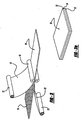
- Figure 2 illustrates a stitched preform
- Figure 3 illustrates a process for preparing a unidirectional dry tape
- Figure 4 illustrates a process for producing a preform.
- a multiaxial fabric is prepared that is made of alternating layers of reinforcing unidirectional fibers and non-woven interlayers.
- the non-woven interlayers comprise a spunbonded, spunlaced, or mesh fabric of thermoplastic fibers.
- the interlayers are disposed between and knit-stitched to the reinforcing layers.
- the thermoplastic interlayers are melt-bonded to at least one of reinforcing unidirectional fabric layers.
- Such multiaxial fabrics may be manufactured by a number of processes to produce preforms that are 12-300" wide.
- fiber reinforced composite materials are made by molding a multiaxial preform such as described above, and infusing the preform with a thermosetting resin in a liquid-molding process. After infusion of the preform, the component is heated in the mold to gel and set the resin.
- unidirectional fibers for use in the multiaxial preforms and fiber reinforced composite materials of the invention are well known in the art.
- the unidirectional fibers are made of carbon fibers.
- Other examples of unidirectional fibers include, without limitation, glass fibers and mineral fibers.
- Such layers of unidirectional fibers are usually prepared by a laminating process in which unidirectional carbon fibers are taken from a creel containing multiple spools of fiber that are spread to the desired width and then melt-bonded to a thermoplastic interlayer, as described above, under heat and pressure.
- the interlayer is made of a spunbonded, spunlaced, or mesh fabric of thermoplastic fibers.
- the thermoplastic fibers may be selected from among any type of fiber that is compatible with the thermosetting resin used to form the fiber reinforced composite material.
- the thermoplastic fibers of the interlayer may be selected from the group consisting of polyamide, polyimide, polyamide-imide, polyester, polybutadiene, polyurethane, polypropylene, polyetherimide, polysulfone, polyethersulfone, polyphenylsulfone, polyphenylene sulfide, polyetherketone, polyethertherketone, polyarylamide, polyketone, polyphthalamide, polyphenylenether, polybutylene terephthalate and polyethylene terephthalate.
- the thermoplastic fibers are made from two or more materials.
- the two or more materials may be prepared by mechanically mixing different fibers, which are used to create the spunbonded, spunlaced, or mesh fabric.
- the two or more materials may be used to form a bi-component fiber, tri-component fiber or higher component fiber to create the interlayer fabric.
- Bi-component fibers are illustrated schematically in Figure 1.
- Figure 1(a) shows in cross-section a fiber made for example by coextrusion of a fiber material A and a fiber material B. Such a fiber may be produced by a spinneret with two outlets.
- Figure 1(b) shows a bi-component fiber made from materials A and B such as would be produced by extrusion through four spinnerets.
- Figure 1(c) shows a bi-component fiber spun from eight spinnerets.
- the bi-component fiber is used in the form of a core sheath fiber such as illustrated in Figure 1(d).
- a fiber material of one type, illustrated as B in Figure 1(d) is extruded as the core
- a fiber material of another type, illustrated as A in Figure 1(d) is extruded as the sheath.
- Bi-component fibers such as illustrated in Figure 1, and other fibers containing more than two components are well known in the art and can be made by a number of conventional procedures. Additionally, although the fibers in Figure 1 are illustrated schematically with circular cross-sections, it is to be appreciated that other cross-sections may be used.
- the interlayer material is made of bi-component fibers containing a sheath of one material and a core of another.
- the sheath is made of a polyurethane and the core is made of a polyamide.
- the fibers making up the interlayer have diameters from 1 to 100 microns, preferably from 10 to 75 microns and more preferably from 10 to 30 microns. In another embodiment, the thermoplastic fibers have diameters from 1 to 15 microns.
- the interlayer material may have a wide range of areal densities.
- the areal density may be chosen according to the amount required to impart the desired impact resistance, as verified for example by compression-after-impact testing according to Boeing test method BSS 7260.
- the desired impact-resistance level is determined on a part-by-part basis assuming specific impact-energy levels.
- the interlayer material has a areal density of 1-50 grams/square meter. In another embodiment, the areal density of the interlayer is about 2-15 grams/square meter.
- the interlayer material may be a spunbonded fabric.
- Spunbonded fabrics are produced from continuous fibers that are continuously spun and bonded thermally. These fabrics are commercially available from a wide variety of sources, primarily for the clothing industry. Preferred fabrics have areal weights that are generally lower than those of fabrics used in clothing.
- the interlayer is a spunlaced fabric.
- Spunlaced fabrics are prepared from continuous fibers that are continuously spun and bonded mechanically. These fabrics are commercially available from a wide variety of sources, primarily for the clothing industry. As for the spunbonded fabrics, preferred spunlaced fabrics have areal weights that are generally lower than those commonly used in the clothing industry.
- the interlayer comprises a mesh fabric.
- the mesh construction contains between 0.5 and 15 threads per inch in the warp and weft directions.
- the multiaxial preform comprises a plurality of reinforcing layers with interlayers disposed between the reinforcing layers and melt-bonded to at least one of the reinforcing layers. It is preferred to use multiaxial preforms having 4 or more reinforcing layers of unidirectional fabrics. In another embodiment, the preform has from 2-16 layers of unidirectional fabrics.
- the lamina may be laid-down in a quasi-isotropic pattern.
- a quasi-isotropic pattern is one that approximates an isotropic material in the plane of the fibers. This is also known as transverse isotropy.
- other quasi-isotropic patterns include +45/0/-45/-90 and -45/0/+45/90.
- Another quasi-isotropic pattern is 0/+60/-60.
- the lamina may be laid-down in an orthotropic pattern.
- Orthotropic means having fibers or units such that the net result is not quasi-isotropic in plane like the quasi-isotropic patterns just described.
- An example of an orthotropic pattern is one with 44% 0°, 22% +45°, 22% -45° and 12% 90° fibers. In this example, greater longitudinal strength (along the 0°-direction) and lower shear strength ( ⁇ 45°-direction) and transverse strength (90°-direction) than a quasi-isotropic (25/50/25) lay-up are achieved.
- the resulting built-up lamina provide higher strength and thickness in the 0° direction as compared to a quasi-isotropic laminate, but provide lower shear strength and thickness (provided by the ⁇ 45° layers).
- the 90° strength is lower than a quasi-tropic laminate.
- orthotropic is well understood in the field. For example a 0° fabric is orthotropic, as well as any other pattern that does not result in balanced average in plane ( i.e. quasi-isotropic) properties.
- the laminae in sets of four. Where desired, the pattern of four laminae may be repeated to achieve a desired thickness.
- mirror-image lamina stacks are used to prevent post-cure bending and twisting due to thermal stresses created after curing the resin at elevated temperature. In such a case, the total lay-up would be made up of groups of balanced laminae, or laid-up alternately to balance the laminate. This practice is common in the field and is done to ensure the fabrication of flat parts and to avoid the problem of parts with unknown and/or temperature-sensitive configurations.
- the interlayers made of thermoplastic fibers are melt-bonded to the unidirectional fiber layers between which they are disposed. Such melt-bonding acts to maintain the orientation of the unidirectional fibers in place during resin infusion into the mold during a (subsequent) liquid-molding process.
- the multiaxial preform may be knitted or sewed together with thread to hold the fabric layers together during resin infusion and cure.
- a warp-knit, multiaxial fabric may be assembled by knit-stitching the reinforcing layers together with thermoplastic interlayers between the reinforcing layers.
- the knit thread or sewing thread may be selected from a variety of materials, including without limitation, polyester-polyarylate (e.g.
- Vectran® Vectran®
- polyaramid e.g. Kevlar®
- polybenzoxazole e.g. Zylon®
- viscose e.g. Rayon®
- acrylic polyamide
- carbon and fiberglass
- the knitting or sewing step is carried out after the initial lay-up of the multiaxial preform.
- the same kinds of threads may be used to hold locally different thicknesses mechanically in place by stitching and by tufting, as discussed above.
- Figure 2 shows a multiaxial preform for a composite material for use in a liquid-molding process of the invention.
- interlayers 6 made of thermoplastic fibers are disposed between reinforcing fabric layers 2 of unidirectional fabrics. In a preferred embodiment, at least some of the interlayers are melt-bonded to an adjacent reinforcing fabric layer.
- a sewing thread 8 may be used to hold the preform layers together.
- the invention provides a multiaxial warp knit fabric where the thermoplastic interlayer is melt-bonded only to the 0-degree layers with the non-0-degree layers and other interlayers attached to the 0-degree layer using a knit thread.
- the thermoplastic interlayer is melt-bonded only to the 0-degree layers with the non-0-degree layers and other interlayers attached to the 0-degree layer using a knit thread.
- only the 0-degree layer is melt-bonded.
- an example lay-up is thermoplastic (TP) interlayer not melt-bonded/+45° fibers/TP interlayer melt-bonded to top of 0° layer/0° fibers/TP interlayer melt-bonded to bottom of 0° layer/-45° fibers/TP interlayer not melt-bonded/90° fibers with the whole assembly knitted together.
- the 0-degree layer is generally used as the primary load carrying direction.
- the strength of the resulting molded part is increased without having to melt-bond the other directions.
- the other directions are not necessarily strengthened as much as the 0-degree layer, the other layers will generally contribute to greater impact resistance of the molded part due to the presence of non-bonded interlayer material.
- an interlayer material may be melt-bonded to one or both sides of a unidirectional dry fabric to produce a dry unidirectional tape.
- Figure 3 illustrates such a process.
- a veil 12 made of the interlayer material is fed from rollers 13 and laminated to a unidirectional dry fabric 14.
- the veil 12 is melt bonded to the fabric 14, for example by passing between heated rollers 16, to produce a fabric 18 having a veil material melt bonded to the unidirectional fibers.
- the fabric 18 may be provided in the form of a dry unidirectional tape.
- Figure 3a shows a detail of the construction of a fabric 18 with interlayer material 12 melt bonded to both sides of the unidirectional dry fabric 14.
- the veil material 12 may be melt-bonded to only one side of the unidirectional fibers 14. However, it is preferred to melt-bond the interlayer material on both sides of the unidirectional dry fabric to produce a tape with easier handleability.
- the dry unidirectional tape 18 may be used to assemble a multiaxial preform in a continuous process, such as disclosed in EP0972102/WO9844183 by Hexcel, the disclosure of which is hereby incorporated by reference.
- unidirectional dry tapes are introduced along a moving bed to produce a multiaxial lay-up.
- the Hexcel patent describes a method wherein several unidirectional webs are stacked in different directions and mutually linked. At least one of the unidirectional webs is provided with cohesion for manipulation before being stacked with the other web.
- cohesion is provided for example by physical entanglement, chemical adhesives, or by providing the web with stitch filaments that may be melted with heat to provide cohesion between the fibers of the unidirectional webs.
- the present invention provides unidirectional webs with good cohesion for manipulation before being stacked.
- the cohesion is provided by a spunlaced, spunbonded or mesh fabric melt-bonded to a layer of unidirectional fibers.
- Dry unidirectional tapes may be prepared by the process illustrated in Figure 3.
- a process for making the preform of the invention is schematically illustrated in Figure 4.
- unidirectional tapes are provided on unidirectional tape rolls 51 and on longitudinal roll 53.
- Longitudinal roll 53 may hold a plurality of rolls of unidirectional fabric to achieve a desired width.
- Tape rolls 51 are associated with lay-up devices 52 and tape delivery heads 55 that lay down four plies of fabric on a moving conveyor 54.
- the lay-up devices are disposed at a plurality of angles relative to the warp direction, corresponding to the desired pattern of buildup of the four-layer preform material. After all four layers are laid down, the fabric passes through a knitting unit 56 and is taken up on take-up spool 57.
- a device such as described in Hagel, US 5,241,842 or Wunner, et al., US 6,276,174 (the disclosures of which are incorporated by reference; see also pictures and video at http://www.liba.de/tricot/cop_max_layer.htm) may be used to prepare multiaxial preforms by providing tows of unidirectional carbon fibers. One or a plurality of tows is pulled across pins to create reinforcing layers of unidirectional fibers.
- a means is provided for introducing the interlayer material between the layers of unidirectional carbon fibers. Because the interlayer material is non-directional, it need not be introduced at an angle in the way that the unidirectional carbon fibers are.
- the multiaxial preforms of the invention may be made into cured fiber-reinforced composite materials by a variety of liquid-molding processes.
- vacuum-assisted resin transfer molding a resin is introduced to a mold containing the multiaxial preform under vacuum.
- the resin infuses the preform and saturates the interlayers between the layers of unidirectional fibers.
- the interlayers are made of a material that is permeable to permit the flow of resin during the liquid-molding operation. Furthermore, the melt-bonded interlayers hold the unidirectional fibers in place during the resin infusion.
- resin transfer molding resin is infused under pressure into a closed mold.
- the mold is heated to cure the resin to produce the finished part.
- the resin reacts with itself to form crosslinks in the matrix of the composite material.
- the resin gels.
- the resin no longer flows, but rather behaves as a solid.
- the temperature or cure may be ramped up to a final temperature to complete the cure.
- the final cure temperature depends on the nature and properties of the thermosetting resin chosen. For the case of aerospace-grade epoxy resins, it is conventional to ramp the temperature after gel up to a temperature range of 325 to 375°F and hold at this temperature for 1 to 6 hours to complete the cure.
- CAI compression-after-impact
- Test panels were prepared as follows. The panel lay-up was (+45/0/-45/90) 3S using unidirectional fabric from Anchor Reinforcements (Huntington Beach, CA) to which spunbonded fabric had been melt-bonded. A control used only a thermoplastic weft fiber to hold the fabric together.
- the three spunbonded fabrics were supplied by Spunfab (Cuyahoga Falls, OH) in areal weights of 0.125, 0.250, and 0.375 oz/yd 2 .
- the three materials used were PE2900, a polyester; VI6010, a ternary polymer blend; and PA1008, a polyamide.
- a dry, uni-directional tape 13-inches in width was prepared by melt-bonding the respective spunbonded fabrics onto a tape containing 190 g/m 2 of T700 carbon fibers (Toray, Tokyo, Japan).
- the uni-directional tape was cut in the same manner as prepreg and laid-up according to BMS 8-276 as described above.
- the laid-up fabric was VARTM processed using an epoxy resin, TV-15, from Applied Poleramic, Inc. (Benicia, CA). After infusion and cure, the resulting panels were machined into 4" x 6" impact test specimens according to BSS7260. Impact was performed using a 0.3125" spherical steel tup. Four panels for each construction were tested.
- Table 2 Compression-after-impact strength results are shown in Table 2 and panel thicknesses and per-ply thicknesses are shown in Table 3.
- Tables 1 and 2 show significant decreases in impact damage area for the PA 1008 and VI6010 interlayer materials as well as significant increases in compression-after-impact strength for these same materials, respectively.
- Table 3 shows that the interlayer-toughening concept meets the current commercial Boeing specification (BMS 8-276) for per-ply thickness. Average Impact Damage Area for Three Panels vs. Control.
Landscapes
- Engineering & Computer Science (AREA)
- Mechanical Engineering (AREA)
- Chemical & Material Sciences (AREA)
- Composite Materials (AREA)
- Textile Engineering (AREA)
- Laminated Bodies (AREA)
- Moulding By Coating Moulds (AREA)
- Reinforced Plastic Materials (AREA)
- Nonwoven Fabrics (AREA)
- Preparation Of Compounds By Using Micro-Organisms (AREA)
Abstract
Description
- The present invention relates to cured composites built from layers of unidirectional fibers. In particular, the invention utilizes highly porous lightweight materials in conjunction with multilayer preforms to obtain cured articles with improved toughness.
- High-performance composite materials built of alternating layers of unidirectional reinforcing fibers have an advantageous combination of high strength and light weight. As such they find use in aerospace and other industries where such properties are critical. Generally, the composite materials are prepared by laying up a number of alternating layers wherein adjacent layers have unidirectional fibers running at different angles. The net effect of buildup of several layers of such unidirectional fabrics is to provide a composite material having exceptional strength, either quasi-isotropically, or in one or more particular directions.
- Such composite materials may be produced as prepregs or as preforms. In prepregs, layers of unidirectional fabrics immersed or impregnated with a resin are laid-up into the shape of the part to be produced from the composite material. Thereafter, the laid-up part is heated to cure the resin and provide the finished composite part. In the preform approach, layers of unidirectional reinforcing fibers or woven, braided, or warp-knit fabric are laid up similarly to the way they are laid-up in prepregs. However, in the preform method, the layers are laid-up dry. Thereafter, the laid-up material is infused with resin in a liquid-molding process, and the molded part is heated to cure the resin as in the prepregs.
- The alternating layers, or lamina, of reinforcing fibers provide the composite articles made from the prepreg or preform process with a great deal of strength, especially in directions that align with specific fiber directions.
Accordingly, very strong lightweight parts may be produced, for example, as wings and fuselages of aircraft. Although the alternating lamina of reinforcing fibers provide strength, toughness or impact resistance is determined mainly by the properties of the cured resin. Impact-resistant or toughened resins are preferred because they are resistant to damage from impact. This is important, for example, in the case of airplane wings made from such composite materials. Any failure from foreign-object impact during flight would be catastrophic for the airplane to which the wing is attached. Also, any damage resulting from ground-maintenance impact (e.g. from tool drop, forklifts or other vehicles) would require replacement of the entire piece, because such composite materials are built up as a single piece. Furthermore, because impact damage in composite materials is generally not visible to the naked eye, it is important for such primary load-bearing structures to be able to carry their full design load after impact and prior to detection using non-destructive techniques. - In prepregs, the resin, typically an epoxy-based formulation, may be toughened by adding particles of a thermoplastic material to the conventional resin. These thermoplastic particles may either be soluble in the matrix resin and dissolve in the epoxy resin or may be insoluble and placed, during the prepregging operation (see, for example, US 5,028,478) on the surface of each layer. Upon cure, the thermoplastic resin in the cured epoxy matrix serves to limit crack propagation through the part. Preform materials may be stitched before resin infusion and cure to provide toughness and crack resistance. One drawback to stitching is the reduction of in-plane mechanical properties, particularly as the stitch density increases. The prepreg approach of applying particles of thermoplastic material to the resin before cure is not directly transferable to the liquid molding processes used to prepare preform articles. In the resin infusion of the liquid molding process, soluble thermoplastics tend to increase the melt-flow viscosity of the matrix resin unacceptably, while insoluble thermoplastic toughening particles tend to be filtered by the preform and thus will not be located uniformly between the plies in the preform.
- In the European Patent EP 1 175 998 to Mitsubishi, laminated products formed of reinforcing fibers are provided in which thermoplastic resin layers are provided between layers of the reinforcement fiber. The thermoplastic resin layer is described in the form of a porous film, fiber, network structure, knitted loop, and the like. The laminated product uses a thermoplastic layer of sufficient permeability between the layers of reinforcing fibers so as not to inhibit liquid resin flow during a liquid molding process. One drawback inherent in processes such as those described in EP 1 175 998 is that the performs made of alternating layers of reinforcing fibers and thermoplastic resin layers are less than perfectly stable during resin infusion. As a result, the reinforcing fibers and the thermoplastic resin layer tend to move or shift during the liquid molding process. Such moving or shifting can be mitigated by stitching together the layers before infusion with the resin. Another drawback to the processes described in EP 1 175 998 is that they are primarily effective for hand lay-up operations and not for automated lay-up operations that would be more relevant in the fabrication of large aircraft parts or in the continuous production of broad goods.
- It would be desirable to provide a molded article made by a preform process in which the reinforcing fibers are held tightly in relative orientation to one another. It would further be desirable to provide a process for making such a preform article in widths and lengths feasible for producing large-scale parts, such as airplane wings, from them.
- In one embodiment, the invention provides a multiaxial preform made up of reinforcing layers of unidirectional fibers. Non-woven interlayers made of spunbonded, spunlaced, or mesh fabric of thermoplastic fibers are disposed between and melt-bonded or stitched to the reinforcing layers. The multiaxial preform is used in a liquid-molding process by which resin is infused into the preform, followed by heating to gel and set the resin. The interlayers are permeable to permit the flow of resin during the liquid-molding operation. In a preferred embodiment, the interlayer material is melt-bonded to at least one of the unidirectional layers, preferably on both sides. The layers are further held together with knit threads. The melt-bonded interlayers hold the unidirectional fibers in place during the resin infusion and subsequent curing of the resin to produce a fiber reinforced composite material. In a preferred embodiment, the unidirectional fibers are made of carbon fibers. The material making up the interlayers is chosen for compatibility with the resin upon curing. In one embodiment, the resin is an epoxy resin and the interlayer fibers are made of a polyamide.
- In another embodiment, the invention provides a method for manufacturing a multiaxial fabric made of reinforcing layers of unidirectional fiber, with non-woven interlayers disposed between the reinforcing layers. The method includes the step of melt-bonding an interlayer material made of thermoplastic fibers to one or both sides of a unidirectional dry fabric to produce a dry unidirectional tape. Thereafter, a preform may be built up from the unidirectional tape by laying down the tape with at least one other layer or lamina of unidirectional fibers at angles between -90 and +90° from the warp direction of the multiaxial fabric.
- In a preferred embodiment, alternating unidirectional fibers is accomplished by building up the preform from a plurality of dry unidirectional tapes. The layers of the preform are preferably stitched together. Fabric-reinforced composite materials may be prepared by molding such a preform and infusing the preform in the mold with a thermosetting resin in a liquid-molding process.
- The lamina of unidirectional fibers in the multiaxial fabric may be laid-down in quasi-isotropic or orthotropic patterns. The pattern may be repeated as needed to achieve a desired thickness of the finished part. The repeated pattern may be constant, or may be varied across the preform. Where the repeated pattern is varied across the preform, the locally different thicknesses may be mechanically held in place, such as by stitching, tufting, or heating to melt-bond the multilayers together. Alternatively, a localized "tackifier", such as are known in the trade, may be used for holding preform pieces in place mechanically.
- Conventional methods for manufacturing large-scale preform materials may be modified to produce multiaxial fabrics containing reinforcing layers of unidirectional fibers with non-woven interlayers disposed between the reinforcing layers and melt-bonded to at least one of them. In one method, a plurality of tows is first pulled across a set of pins to create reinforcing layers of unidirectional fibers. An interlayer material is introduced to reside between the reinforcing layers, and the layers of unidirectional fibers are knitted together to form a multilayer stack. The interlayer material may be attached to individual reinforcing layers via heating without causing all layers to be melt-bonded to each other.
- Fiber-reinforced composite materials may be made by molding a preform and infusing the preform with a thermosetting resin in a number of liquid-molding processes. Liquid-molding processes that may be used in the invention include, without limitation, vacuum-assisted resin transfer molding (VARTM), in which resin is infused into the preform using a vacuum-generated pressure differential. Another method is resin transfer molding (RTM), wherein resin is infused under pressure into the preform in a closed mold. A third method is resin film infusion (RFI), wherein a semi-solid resin is placed underneath or on top of the preform, appropriate tooling is located on the part, the part is bagged and then placed in an autoclave to melt and infuse the resin into the preform. The RFI method is described in US patent 4,311,661, the disclosure of which is incorporated by reference.
- The present invention will become more fully understood from the detailed description and the accompanying drawings, wherein:
- Figure 1 is a schematic side view of the preferred thermoplastic fibers;
- Figure 2 illustrates a stitched preform;
- Figure 3 illustrates a process for preparing a unidirectional dry tape; and
- Figure 4 illustrates a process for producing a preform.
- The following description of the preferred embodiment(s) is merely exemplary in nature and is in no way intended to limit the invention, its application, or uses.
- In a first aspect of the invention, a multiaxial fabric is prepared that is made of alternating layers of reinforcing unidirectional fibers and non-woven interlayers. The non-woven interlayers comprise a spunbonded, spunlaced, or mesh fabric of thermoplastic fibers. The interlayers are disposed between and knit-stitched to the reinforcing layers. In a preferred embodiment, the thermoplastic interlayers are melt-bonded to at least one of reinforcing unidirectional fabric layers. Such multiaxial fabrics may be manufactured by a number of processes to produce preforms that are 12-300" wide.
- In another aspect, fiber reinforced composite materials are made by molding a multiaxial preform such as described above, and infusing the preform with a thermosetting resin in a liquid-molding process. After infusion of the preform, the component is heated in the mold to gel and set the resin.
- Layers of unidirectional fibers for use in the multiaxial preforms and fiber reinforced composite materials of the invention are well known in the art. In a preferred embodiment, the unidirectional fibers are made of carbon fibers. Other examples of unidirectional fibers include, without limitation, glass fibers and mineral fibers. Such layers of unidirectional fibers are usually prepared by a laminating process in which unidirectional carbon fibers are taken from a creel containing multiple spools of fiber that are spread to the desired width and then melt-bonded to a thermoplastic interlayer, as described above, under heat and pressure.
- The interlayer is made of a spunbonded, spunlaced, or mesh fabric of thermoplastic fibers. The thermoplastic fibers may be selected from among any type of fiber that is compatible with the thermosetting resin used to form the fiber reinforced composite material. For example, the thermoplastic fibers of the interlayer may be selected from the group consisting of polyamide, polyimide, polyamide-imide, polyester, polybutadiene, polyurethane, polypropylene, polyetherimide, polysulfone, polyethersulfone, polyphenylsulfone, polyphenylene sulfide, polyetherketone, polyethertherketone, polyarylamide, polyketone, polyphthalamide, polyphenylenether, polybutylene terephthalate and polyethylene terephthalate.
- In a preferred embodiment, the thermoplastic fibers are made from two or more materials. For example, the two or more materials may be prepared by mechanically mixing different fibers, which are used to create the spunbonded, spunlaced, or mesh fabric. In a preferred embodiment, the two or more materials may be used to form a bi-component fiber, tri-component fiber or higher component fiber to create the interlayer fabric. Non-limiting examples of bi-component fibers are illustrated schematically in Figure 1. Figure 1(a) shows in cross-section a fiber made for example by coextrusion of a fiber material A and a fiber material B. Such a fiber may be produced by a spinneret with two outlets. Figure 1(b) shows a bi-component fiber made from materials A and B such as would be produced by extrusion through four spinnerets. Similarly, Figure 1(c) shows a bi-component fiber spun from eight spinnerets. In a preferred embodiment, the bi-component fiber is used in the form of a core sheath fiber such as illustrated in Figure 1(d). In a core sheath fiber, a fiber material of one type, illustrated as B in Figure 1(d) is extruded as the core, while a fiber material of another type, illustrated as A in Figure 1(d) is extruded as the sheath.
- Bi-component fibers such as illustrated in Figure 1, and other fibers containing more than two components are well known in the art and can be made by a number of conventional procedures. Additionally, although the fibers in Figure 1 are illustrated schematically with circular cross-sections, it is to be appreciated that other cross-sections may be used.
- In a preferred embodiment, the interlayer material is made of bi-component fibers containing a sheath of one material and a core of another. In a particularly preferred embodiment, the sheath is made of a polyurethane and the core is made of a polyamide.
- In a preferred embodiment, the fibers making up the interlayer have diameters from 1 to 100 microns, preferably from 10 to 75 microns and more preferably from 10 to 30 microns. In another embodiment, the thermoplastic fibers have diameters from 1 to 15 microns.
- The interlayer material may have a wide range of areal densities. The areal density may be chosen according to the amount required to impart the desired impact resistance, as verified for example by compression-after-impact testing according to Boeing test method BSS 7260. The desired impact-resistance level is determined on a part-by-part basis assuming specific impact-energy levels. In one embodiment, the interlayer material has a areal density of 1-50 grams/square meter. In another embodiment, the areal density of the interlayer is about 2-15 grams/square meter.
- The interlayer material may be a spunbonded fabric. Spunbonded fabrics are produced from continuous fibers that are continuously spun and bonded thermally. These fabrics are commercially available from a wide variety of sources, primarily for the clothing industry. Preferred fabrics have areal weights that are generally lower than those of fabrics used in clothing.
- In another embodiment, the interlayer is a spunlaced fabric. Spunlaced fabrics are prepared from continuous fibers that are continuously spun and bonded mechanically. These fabrics are commercially available from a wide variety of sources, primarily for the clothing industry. As for the spunbonded fabrics, preferred spunlaced fabrics have areal weights that are generally lower than those commonly used in the clothing industry.
- In another embodiment, the interlayer comprises a mesh fabric. In a preferred embodiment, the mesh construction contains between 0.5 and 15 threads per inch in the warp and weft directions.
- The multiaxial preform comprises a plurality of reinforcing layers with interlayers disposed between the reinforcing layers and melt-bonded to at least one of the reinforcing layers. It is preferred to use multiaxial preforms having 4 or more reinforcing layers of unidirectional fabrics. In another embodiment, the preform has from 2-16 layers of unidirectional fabrics.
- The lamina may be laid-down in a quasi-isotropic pattern. A quasi-isotropic pattern is one that approximates an isotropic material in the plane of the fibers. This is also known as transverse isotropy. For example it is possible to lay-down lamina in a quasi-isotropic 0/+45/90/-45 pattern. To illustrate, other quasi-isotropic patterns include +45/0/-45/-90 and -45/0/+45/90. Another quasi-isotropic pattern is 0/+60/-60.
- In another embodiment, the lamina may be laid-down in an orthotropic pattern. Orthotropic means having fibers or units such that the net result is not quasi-isotropic in plane like the quasi-isotropic patterns just described. An example of an orthotropic pattern is one with 44% 0°, 22% +45°, 22% -45° and 12% 90° fibers. In this example, greater longitudinal strength (along the 0°-direction) and lower shear strength (±45°-direction) and transverse strength (90°-direction) than a quasi-isotropic (25/50/25) lay-up are achieved. The resulting built-up lamina provide higher strength and thickness in the 0° direction as compared to a quasi-isotropic laminate, but provide lower shear strength and thickness (provided by the ±45° layers). Correspondingly, in the example, the 90° strength is lower than a quasi-tropic laminate. The term orthotropic is well understood in the field. For example a 0° fabric is orthotropic, as well as any other pattern that does not result in balanced average in plane (i.e. quasi-isotropic) properties.
- As noted above, it is common to prepare the laminae in sets of four. Where desired, the pattern of four laminae may be repeated to achieve a desired thickness. In a preferred embodiment, when it is desired to build-up a desired thickness, mirror-image lamina stacks are used to prevent post-cure bending and twisting due to thermal stresses created after curing the resin at elevated temperature. In such a case, the total lay-up would be made up of groups of balanced laminae, or laid-up alternately to balance the laminate. This practice is common in the field and is done to ensure the fabrication of flat parts and to avoid the problem of parts with unknown and/or temperature-sensitive configurations.
- In one embodiment, the interlayers made of thermoplastic fibers are melt-bonded to the unidirectional fiber layers between which they are disposed. Such melt-bonding acts to maintain the orientation of the unidirectional fibers in place during resin infusion into the mold during a (subsequent) liquid-molding process. In addition, the multiaxial preform may be knitted or sewed together with thread to hold the fabric layers together during resin infusion and cure. In an alternative embodiment, a warp-knit, multiaxial fabric may be assembled by knit-stitching the reinforcing layers together with thermoplastic interlayers between the reinforcing layers. The knit thread or sewing thread may be selected from a variety of materials, including without limitation, polyester-polyarylate (e.g. Vectran®), polyaramid (e.g. Kevlar®)), polybenzoxazole (e.g. Zylon®)), viscose (e.g. Rayon®)), acrylic, polyamide, carbon, and fiberglass). Where desired, the knitting or sewing step is carried out after the initial lay-up of the multiaxial preform. The same kinds of threads may be used to hold locally different thicknesses mechanically in place by stitching and by tufting, as discussed above.
- Figure 2 shows a multiaxial preform for a composite material for use in a liquid-molding process of the invention. In Figure 2, interlayers 6 made of thermoplastic fibers are disposed between reinforcing fabric layers 2 of unidirectional fabrics. In a preferred embodiment, at least some of the interlayers are melt-bonded to an adjacent reinforcing fabric layer. A sewing thread 8 may be used to hold the preform layers together.
- In another embodiment, the invention provides a multiaxial warp knit fabric where the thermoplastic interlayer is melt-bonded only to the 0-degree layers with the non-0-degree layers and other interlayers attached to the 0-degree layer using a knit thread. In a preferred embodiment, only the 0-degree layer is melt-bonded. To illustrate, an example lay-up is thermoplastic (TP) interlayer not melt-bonded/+45° fibers/TP interlayer melt-bonded to top of 0° layer/0° fibers/TP interlayer melt-bonded to bottom of 0° layer/-45° fibers/TP interlayer not melt-bonded/90° fibers with the whole assembly knitted together.
- The 0-degree layer is generally used as the primary load carrying direction. By stabilizing the 0-degree layer in the preferred embodiment by melt-bonding a thermoplastic interlayer, the strength of the resulting molded part is increased without having to melt-bond the other directions. Although in this embodiment the other directions are not necessarily strengthened as much as the 0-degree layer, the other layers will generally contribute to greater impact resistance of the molded part due to the presence of non-bonded interlayer material.
- In one embodiment, an interlayer material may be melt-bonded to one or both sides of a unidirectional dry fabric to produce a dry unidirectional tape. Figure 3 illustrates such a process. A
veil 12 made of the interlayer material is fed fromrollers 13 and laminated to a unidirectionaldry fabric 14. Theveil 12 is melt bonded to thefabric 14, for example by passing betweenheated rollers 16, to produce afabric 18 having a veil material melt bonded to the unidirectional fibers. Thefabric 18 may be provided in the form of a dry unidirectional tape. Figure 3a shows a detail of the construction of afabric 18 withinterlayer material 12 melt bonded to both sides of the unidirectionaldry fabric 14. In an alternative embodiment, theveil material 12 may be melt-bonded to only one side of theunidirectional fibers 14. However, it is preferred to melt-bond the interlayer material on both sides of the unidirectional dry fabric to produce a tape with easier handleability. - The dry
unidirectional tape 18 may be used to assemble a multiaxial preform in a continuous process, such as disclosed in EP0972102/WO9844183 by Hexcel, the disclosure of which is hereby incorporated by reference. In a process described in the Hexcel patent, unidirectional dry tapes are introduced along a moving bed to produce a multiaxial lay-up. The Hexcel patent describes a method wherein several unidirectional webs are stacked in different directions and mutually linked. At least one of the unidirectional webs is provided with cohesion for manipulation before being stacked with the other web. In the Hexcel patent, cohesion is provided for example by physical entanglement, chemical adhesives, or by providing the web with stitch filaments that may be melted with heat to provide cohesion between the fibers of the unidirectional webs. - In one aspect, the present invention provides unidirectional webs with good cohesion for manipulation before being stacked. The cohesion is provided by a spunlaced, spunbonded or mesh fabric melt-bonded to a layer of unidirectional fibers. Dry unidirectional tapes may be prepared by the process illustrated in Figure 3.
- A process for making the preform of the invention is schematically illustrated in Figure 4. In the method of Figure 4, unidirectional tapes are provided on unidirectional tape rolls 51 and on
longitudinal roll 53.Longitudinal roll 53 may hold a plurality of rolls of unidirectional fabric to achieve a desired width. Tape rolls 51 are associated with lay-updevices 52 and tape delivery heads 55 that lay down four plies of fabric on a moving conveyor 54. The lay-up devices are disposed at a plurality of angles relative to the warp direction, corresponding to the desired pattern of buildup of the four-layer preform material. After all four layers are laid down, the fabric passes through aknitting unit 56 and is taken up on take-upspool 57. - Alternatively, a device such as described in Hagel, US 5,241,842 or Wunner, et al., US 6,276,174 (the disclosures of which are incorporated by reference; see also pictures and video at http://www.liba.de/tricot/cop_max_layer.htm) may be used to prepare multiaxial preforms by providing tows of unidirectional carbon fibers. One or a plurality of tows is pulled across pins to create reinforcing layers of unidirectional fibers. In this embodiment, a means is provided for introducing the interlayer material between the layers of unidirectional carbon fibers. Because the interlayer material is non-directional, it need not be introduced at an angle in the way that the unidirectional carbon fibers are.
- The multiaxial preforms of the invention may be made into cured fiber-reinforced composite materials by a variety of liquid-molding processes. In one, vacuum-assisted resin transfer molding, a resin is introduced to a mold containing the multiaxial preform under vacuum. The resin infuses the preform and saturates the interlayers between the layers of unidirectional fibers. The interlayers are made of a material that is permeable to permit the flow of resin during the liquid-molding operation. Furthermore, the melt-bonded interlayers hold the unidirectional fibers in place during the resin infusion.
- In another method, resin transfer molding, resin is infused under pressure into a closed mold. These and other liquid-molding processes may be used to prepare the cured fiber-reinforced composite material of the invention.
- Following infusion of the resin in the mold in a process such as those described above, the mold is heated to cure the resin to produce the finished part. During heating, the resin reacts with itself to form crosslinks in the matrix of the composite material. After an initial period of heating, the resin gels. At gel, the resin no longer flows, but rather behaves as a solid. In a preferred embodiment, it is important to gel the resin at a temperature below the melting point of the thermoplastic fibers of the interlayer in order to prevent their melting and flowing into the reinforcement fiber bundles. After gel, the temperature or cure may be ramped up to a final temperature to complete the cure. The final cure temperature depends on the nature and properties of the thermosetting resin chosen. For the case of aerospace-grade epoxy resins, it is conventional to ramp the temperature after gel up to a temperature range of 325 to 375°F and hold at this temperature for 1 to 6 hours to complete the cure.
- The results shown below are for compression-after-impact (CAI) panels made and tested according to BMS 8-276 (a Boeing material specification for a toughened prepreg system used for commercial aircraft) using BSS 7260 Type II, Class 1 impact with an impact energy of 270 in-lb.
- Test panels were prepared as follows. The panel lay-up was (+45/0/-45/90)3S using unidirectional fabric from Anchor Reinforcements (Huntington Beach, CA) to which spunbonded fabric had been melt-bonded. A control used only a thermoplastic weft fiber to hold the fabric together. The three spunbonded fabrics were supplied by Spunfab (Cuyahoga Falls, OH) in areal weights of 0.125, 0.250, and 0.375 oz/yd2. The three materials used were PE2900, a polyester; VI6010, a ternary polymer blend; and PA1008, a polyamide.
- A dry, uni-directional tape 13-inches in width was prepared by melt-bonding the respective spunbonded fabrics onto a tape containing 190 g/m2 of T700 carbon fibers (Toray, Tokyo, Japan). The uni-directional tape was cut in the same manner as prepreg and laid-up according to BMS 8-276 as described above. The laid-up fabric was VARTM processed using an epoxy resin, TV-15, from Applied Poleramic, Inc. (Benicia, CA). After infusion and cure, the resulting panels were machined into 4" x 6" impact test specimens according to BSS7260. Impact was performed using a 0.3125" spherical steel tup. Four panels for each construction were tested.
- After impact, all specimens were ultrasonically C-scanned. In these figures, a through-transmission amplitude plot and the bottom row shows a time-of-flight response was prepared. Impact damage areas were calculated directly from the center "hole" shown in the amplitude plots using the built-in software tool on the C-scan apparatus. These results are shown in Table 1.
- Compression-after-impact strength results are shown in Table 2 and panel thicknesses and per-ply thicknesses are shown in Table 3. Tables 1 and 2 show significant decreases in impact damage area for the PA 1008 and VI6010 interlayer materials as well as significant increases in compression-after-impact strength for these same materials, respectively. Table 3 shows that the interlayer-toughening concept meets the current commercial Boeing specification (BMS 8-276) for per-ply thickness.
Average Impact Damage Area for Three Panels vs. Control. Examples Spunbonded Fabric Impact Damage Area (in2) Percent Change in Impact Area Interlayer Areal Weight Interlayer Areal Weight none 0.125 0.250 0.375 0.125 0.250 0.375 oz/yd2 oz/yd2 oz/yd2 oz/yd2 oz/yd2 oz/yd2 Comparative Control 7.134 N/A N/A N/A 1 PE2900 8.258 8.632 10.037 15.8 21.0 40.7 2 V16010 4.529 3.936 2.093 -36.5 -44.8 -70.,7 3 PA1008 1.489 1.160 0.619 -79.1 -83.7 -91.3 Average Compression-After-Impact Strength for Three Panels vs. Control. Examples CAI Strength (ksi) Percent Change CAI Strength Interlayer Areal Weight Interlayer Areal Weight none 0.125 0.250 0.375 0.125 0.250 0.375 oz/yd2 oz/yd2 oz/yd2 oz/yd2 oz/yd2 oz/yd2 Comparative 19.3 1 17.2 15.6 13.8 -10.9 -19.2 -28.6 2 20.5 24.3 29.4 6.1 26.2 52.6 3 30.6 27.8 39.6 58.6 44.4 105.3 Average Cured-Panel Thicknesses. Examples Average Panel Thickness (in) Average Per-Ply Thickness (mil) Interlayer Areal Weight none 0.125 oz/yd2 0.250 oz/yd2 0.375 oz/yd2 none 0.125
oz/yd20.250
oz/yd20.375
oz/yd2Comparative 0.170 7.08 1 0.175 0.185 0.186 7.29 7.71 7.75 2 0.173 0.182 0.180 7.21 7.58 7.50 3 0.177 0.189 0.187 7.38 7.88 7.79 - The description of the invention is merely exemplary in nature and, thus, variations that do not depart from the gist of the invention are intended to be within the scope of the invention. Such variations are not to be regarded as a departure from the spirit and scope of the invention, which is defined in the appended claims.
Claims (17)
- A multiaxial preform for a composite material for use in liquid molding processes in which resin is infused into the preform, followed by heating to gel and set the resin, comprising reinforcing layers (2; 14) of unidirectional fibers with non-woven interlayers (6; 12) comprising a spunbonded, spunlaced, or mesh fabric of thermoplastic fibers disposed between the reinforcing layers (2; 14),
wherein the interlayers (6; 12) are melt-bonded to at least one of layers (2; 14) of unidirectional fibers;
and wherein the interlayers (6; 12) are permeable to permit the flow of resin during a liquid molding operation. - The preform of claim 1, wherein the thermoplastic fibers are selected from the group consisting of polyamide, polyimide, polyamide-imide, polyester, polybutadiene, polyurethane, polypropylene, polyetherimide, polysulfone, polyethersulfone, polyphenylsulfone, polyphenylene sulfide, polyetherketone, polyethertherketone, polyarylamide, polyketone, polyphthalamide, polyphenylenether, polybutylene terephthalate and polyethylene terephthalate, wherein the fibers comprise preferably at least two different materials.
- The preform of claim 2, wherein the thermoplastic fibers comprise a bi-component fiber, and wherein the bi-component fiber comprises a sheath of one material and a core of another, and wherein, preferably, the sheath comprises polyurethane and the core comprises polyamide.
- The preform of any of claims 1 - 3, wherein the interlayer material (6; 12) has an areal density of 1-50 grams/square meter, preferably 2-15 grams/square meter.
- The preform of any of claims 1 - 4, wherein the interlayer (6; 12) comprises a mesh fabric, wherein the mesh construction contains between 0.5 and 15 threads per inch in the warp and weft directions.
- The preform of any of claims 1 - 5, further comprising knit thread holding the fabric layers (2, 6; 14, 12) together.
- The preform of any of claims 1 - 6, wherein the preform is 12-300 inches wide, preferably 24-100 inches wide, and most preferred about 50 inches wide.
- A method of making a fiber reinforced composite material (18) comprising infusing a preform with a thermosetting resin in a liquid molding process, wherein the preform is a multiaxial preform according to any of claims 1 - 7.
- A method for manufacturing a multiaxial fabric (18) comprising reinforcing layers (14) of unidirectional fiber with non-woven interlayers (12) disposed between the reinforcing layers (14), the method comprising:melt-bonding an interlayer material (12) comprising thermoplastic fibers to one or both sides of a unidirectional dry fabric (14) to produce a dry unidirectional tape (18); andbuilding up a preform from the unidirectional tape by laying down at least four lamina of unidirectional tape (18) at angles between -90 and +90° from the warp direction of the multiaxial fabric.
- The method of claim 9, further comprising stitching together the tape lamina with a knit thread (8).
- The method of claim 9 or 10, wherein the lamina (18) are laid-down in a 0/-45/+45/90 pattern.
- The method of any of claims 9 - 11, wherein the preform is a preform as defined in any of claims 1 - 8.
- A method of making a fiber reinforced composite material comprising infusing a preform with a thermosetting resin in a liquid molding process, wherein the preform is made by a process according to any of claims 9 - 12.
- A method for manufacturing a multiaxial fabric comprising reinforcing layers (2; 14) of unidirectional fiber with non-woven interlayers (6; 12) comprising a spun-bonded, spunlaced, or mesh fabric of thermoplastic fibers disposed between and melt-bonded to the reinforcing layers (2; 14), comprising:pulling one or a plurality of tows across pins to create reinforcing layers (2; 14) of unidirectional fibers;introducing an interlayer material (6; 12) to reside between the reinforcing layers (2; 14); andknitting the interlayer material (6; 12) to the reinforcing layers (2; 14) using a knit or sewing thread.
- A multiaxial warp knit fabric comprising reinforcing layers (2; 14) of unidirectional fibers with non-woven interlayers (6; 12) comprising a spunbonded, spunlaced or mesh fabric of thermoplastic fibers disposed between the reinforcing layers (2; 14), the reinforcing layers (2; 14) of unidirectional fibers comprising a 0 degree layer and a plurality of other layers with different orientations, wherein the thermoplastic interlayers (6; 12) are melt-bonded to the 0 degree layer, wherein the multiaxial warp knit fabric is held together with a knit or stitch thread (8).
- The warp knit fabric of claim 15, comprising layers of +45° unidirectional fibers and a layer of -45° unidirectional fibers.
- The warp knit fabric of claim 15 or 16, wherein the fabric is manufactured according to any of claims 9 - 13.
Applications Claiming Priority (2)
| Application Number | Priority Date | Filing Date | Title |
|---|---|---|---|
| US428500 | 2003-05-02 | ||
| US10/428,500 US20040219855A1 (en) | 2003-05-02 | 2003-05-02 | Highly porous interlayers to toughen liquid-molded fabric-based composites |
Publications (3)
| Publication Number | Publication Date |
|---|---|
| EP1473132A2 true EP1473132A2 (en) | 2004-11-03 |
| EP1473132A3 EP1473132A3 (en) | 2007-01-03 |
| EP1473132B1 EP1473132B1 (en) | 2010-08-18 |
Family
ID=32990478
Family Applications (1)
| Application Number | Title | Priority Date | Filing Date |
|---|---|---|---|
| EP20040010275 Expired - Lifetime EP1473132B1 (en) | 2003-05-02 | 2004-04-30 | Method for manufacturing a multiaxial fabric |
Country Status (4)
| Country | Link |
|---|---|
| US (1) | US20040219855A1 (en) |
| EP (1) | EP1473132B1 (en) |
| AT (1) | ATE477902T1 (en) |
| DE (1) | DE602004028688D1 (en) |
Cited By (44)
| Publication number | Priority date | Publication date | Assignee | Title |
|---|---|---|---|---|
| EP1705277A1 (en) * | 2005-03-22 | 2006-09-27 | Colbond B.V. | Nonwoven web laminate |
| EP1860220A1 (en) * | 2006-05-24 | 2007-11-28 | Fukui Prefecture Government | Apparatus and method for manufacturing sheet |
| EP2033754A1 (en) * | 2007-09-07 | 2009-03-11 | The Boeing Company | Method for manufacturing highly porous interlayers to toughen liquid-molded fabric-based composites |
| WO2009036820A1 (en) * | 2007-09-17 | 2009-03-26 | Daimler Ag | Method for the production of a composite fiber component and apparatus for this purpose |
| EP2058101A1 (en) | 2007-11-08 | 2009-05-13 | The Boeing Company | Method and apparatus for low-bulk toughened fabrics for low-pressure molding processes |
| WO2010046609A1 (en) * | 2008-10-23 | 2010-04-29 | Hexcel Reinforcements | Novel reinforcement materials, suitable for the constitution of composite parts |
| FR2937583A1 (en) * | 2008-10-23 | 2010-04-30 | Hexcel Reinforcements | Intermediate novel material associated to a thermohardening resin for producing composite parts, comprises unidirectional carbon fibers, associated, on each sides, to veil of thermoplastic fibers |
| FR2939451A1 (en) * | 2008-12-09 | 2010-06-11 | Hexcel Reinforcements | NEW INTERMEDIATE MATERIAL FOR LIMITING THE MICROFISSURATIONS OF COMPOSITE PIECES. |
| CN101845758A (en) * | 2010-04-16 | 2010-09-29 | 江苏安格特新材料科技有限公司 | Processing technique for longitude and latitude overlapped non-weaving compound material |
| WO2011048340A2 (en) | 2009-10-23 | 2011-04-28 | Hexcel Reinforcements | Multiaxial stack rigidly connected by means of weld points applied by means of inserted thermoplastic webs |
| EP2358516A1 (en) | 2008-11-28 | 2011-08-24 | Hexcel Reinforcements | Novel intermediate material with constant width for the direct process production of composite components |
| WO2011113752A1 (en) | 2010-03-18 | 2011-09-22 | Toho Tenax Europe Gmbh | Multiaxial laid scrim having a polymer nonwoven |
| EP2447305A1 (en) * | 2010-10-28 | 2012-05-02 | General Electric Company | Polyetherimide Stitched Reinforcing Fabrics And Composite Materials Comprising The Same |
| CN102535021A (en) * | 2010-12-13 | 2012-07-04 | 宋锋 | Process for manufacturing continuous non-woven cloth and cross cloth with more than two layers |
| AU2006244242B2 (en) * | 2005-05-09 | 2012-07-19 | Cytec Technology Corp. | Resin-soluble thermoplastic veil for composite materials |
| EP2487286A1 (en) * | 2011-02-14 | 2012-08-15 | Universität Bremen | Method for producing semi-finished fibre products |
| WO2012152242A1 (en) * | 2011-05-12 | 2012-11-15 | Skl Schwergewebekonfektion Lichtenstein Gmbh | Textile multiple-layer reinforcing structure having an integrated thermoplastic matrix for producing fibre-composite semi-finished structures which can be shaped |
| US8372231B1 (en) | 2007-11-08 | 2013-02-12 | The Boeing Company | Method and apparatus for low-bulk toughened fabrics for low-pressure molding processes |
| CN102953226A (en) * | 2012-10-25 | 2013-03-06 | 上海劲纬高强纤维有限公司 | An online heating device suitable for multiaxial warp knitting equipment |
| WO2013040618A1 (en) | 2011-09-21 | 2013-03-28 | Kapsch-Group Beteiligungs Gmbh | Semi-finished fiber product, fiber composite material and method for the production thereof |
| WO2014120347A1 (en) * | 2013-01-30 | 2014-08-07 | The Boeing Company | Veil-stabilized composite with improved tensile strength |
| ITFI20130035A1 (en) * | 2013-02-25 | 2014-08-26 | Bromas Log S R L | AUTOMATIC FRAME FOR TRIASSIAL FABRICS WITH VARIOUS TYPES OF CROSSINGS. |
| US20140346715A1 (en) * | 2007-12-13 | 2014-11-27 | Airbus Operations Gmbh | Method and device for the production of tubular structural components |
| CN104245512A (en) * | 2012-04-27 | 2014-12-24 | 赫克赛尔加固材料公司 | Use of penetration operations in the production of composite parts to increase the transverse conductivity of said composite parts |
| DE102013016854A1 (en) * | 2013-10-10 | 2015-04-16 | Airbus Defence and Space GmbH | Composite fiber semifinished product and method for producing semifinished fiber composite products |
| DE102013017450A1 (en) | 2013-10-22 | 2015-04-23 | Airbus Defence and Space GmbH | Process for the production of fiber composite semi-finished products |
| CN104963071A (en) * | 2015-07-28 | 2015-10-07 | 湖北三江航天江河化工科技有限公司 | Carbon fiber enhanced structure and knitting method used for composite material |
| DE102014007824A1 (en) | 2014-06-02 | 2015-12-03 | Airbus Defence and Space GmbH | A method of manufacturing a fiber reinforced composite member, preform for use, component and manufacturing apparatus manufacturable therewith |
| EP2547816B1 (en) | 2010-03-18 | 2016-07-27 | Toho Tenax Europe GmbH | Sewed multiaxial laid fabric |
| EP3168353A1 (en) * | 2015-11-12 | 2017-05-17 | Epsilon Composite | Nonwoven |
| US9840936B2 (en) | 2012-02-16 | 2017-12-12 | United Technologies Corporation | Case with ballistic liner |
| US20180001594A1 (en) * | 2012-02-08 | 2018-01-04 | Quadrant Plastic Composites Ag | Planar composite material |
| US9868265B2 (en) | 2010-05-27 | 2018-01-16 | Hexcel Composites, Limited | Structured thermoplastic in composite interleaves |
| WO2018099910A1 (en) | 2016-11-29 | 2018-06-07 | Advanced Materials Design & Manufacturing Limited | Process for making hybrid (fiber-nanofiber) textiles through efficient fiber-to-nanofiber bonds comprising novel effective load-transfer mechanisms |
| US10065393B2 (en) | 2006-03-25 | 2018-09-04 | Hexcel Composites Limited | Structured thermoplastic in composite interleaves |
| WO2018184992A1 (en) | 2017-04-03 | 2018-10-11 | Toho Tenax Europe Gmbh | Method for producing a textile unidirectional fabric |
| US10618227B2 (en) | 2006-03-25 | 2020-04-14 | Hexcel Composites, Ltd. | Structured thermoplastic in composite interleaves |
| US11224992B2 (en) | 2015-10-26 | 2022-01-18 | The Boeing Company | Heating of thermoplastic interlayers in a preform tool for producing a preform of a composite member |
| CN115431553A (en) * | 2017-06-28 | 2022-12-06 | 秦内蒂克有限公司 | Product comprising reinforcing fiber and shape memory alloy wire and method for producing same |
| EP4389403A1 (en) * | 2022-12-13 | 2024-06-26 | The Boeing Company | Methods for manufacturing hat-stiffened structures |
| US12044205B2 (en) | 2020-04-28 | 2024-07-23 | Lm Wind Power A/S | Optimized interlayer for a spar cap for a wind turbine blade |
| US12247542B2 (en) | 2020-04-28 | 2025-03-11 | Lm Wind Power A/S | Optimized spar cap structure for wind turbine blade |
| WO2025242693A1 (en) | 2024-05-24 | 2025-11-27 | Sabic Global Technologies B.V. | A tape, a reinforced thermoplastic pipe comprising the tape, and a method of manufacturing and uses of the tape |
| US12611823B2 (en) | 2023-09-25 | 2026-04-28 | The Boeing Company | In-tool compaction for composite structures |
Families Citing this family (53)
| Publication number | Priority date | Publication date | Assignee | Title |
|---|---|---|---|---|
| GB0101362D0 (en) * | 2001-01-19 | 2001-03-07 | Bae Systems Plc | Non-crimp fabrics |
| US8246882B2 (en) * | 2003-05-02 | 2012-08-21 | The Boeing Company | Methods and preforms for forming composite members with interlayers formed of nonwoven, continuous materials |
| US20050257887A1 (en) * | 2004-05-24 | 2005-11-24 | Tsotsis Thomas K | Method and apparatus for melt-bonded materials for tackification of dry fabric preforms |
| US20050142968A1 (en) * | 2003-12-24 | 2005-06-30 | The Boeing Company | Translucent, flame resistant composite materials |
| WO2005077632A1 (en) * | 2004-02-17 | 2005-08-25 | Toray Industries, Inc. | Rtm molding method and device |
| US7527222B2 (en) * | 2004-04-06 | 2009-05-05 | The Boeing Company | Composite barrel sections for aircraft fuselages and other structures, and methods and systems for manufacturing such barrel sections |
| US7622066B2 (en) * | 2004-07-26 | 2009-11-24 | The Boeing Company | Methods and systems for manufacturing composite parts with female tools |
| US7325771B2 (en) | 2004-09-23 | 2008-02-05 | The Boeing Company | Splice joints for composite aircraft fuselages and other structures |
| US7306450B2 (en) * | 2004-09-29 | 2007-12-11 | The Boeing Company | Apparatuses, systems, and methods for manufacturing composite parts |
| US7503368B2 (en) | 2004-11-24 | 2009-03-17 | The Boeing Company | Composite sections for aircraft fuselages and other structures, and methods and systems for manufacturing such sections |
| BRPI0606371A2 (en) * | 2005-02-21 | 2009-06-23 | Airbus Gmbh | composite fiber building element and process for producing a composite fiber building element |
| US8601694B2 (en) | 2008-06-13 | 2013-12-10 | The Boeing Company | Method for forming and installing stringers |
| US8557165B2 (en) | 2008-10-25 | 2013-10-15 | The Boeing Company | Forming highly contoured composite parts |
| KR100973622B1 (en) * | 2005-07-29 | 2010-08-02 | 학교법인 도시샤 | Method for forming fiber reinforced thermoplastic composite material and intermediates thereof, and composite sheet |
| US8205532B2 (en) | 2005-08-16 | 2012-06-26 | The Boeing Company | Method of cutting tow |
| US7633040B2 (en) * | 2005-11-14 | 2009-12-15 | The Boeing Company | Bulk resin infusion system apparatus and method |
| US7655168B2 (en) * | 2006-01-31 | 2010-02-02 | The Boeing Company | Tools for manufacturing composite parts and methods for using such tools |
| CN101466535B (en) * | 2006-11-22 | 2013-05-22 | 福井县 | Thermoplastic resin multilayer reinforced sheet, manufacturing method thereof, and molding method of thermoplastic resin composite molded article |
| US20080166517A1 (en) * | 2007-01-10 | 2008-07-10 | Garland Industries, Inc. | Reinforced fabric having a thermally fused mat |
| US8388795B2 (en) * | 2007-05-17 | 2013-03-05 | The Boeing Company | Nanotube-enhanced interlayers for composite structures |
| US8449709B2 (en) | 2007-05-25 | 2013-05-28 | The Boeing Company | Method of fabricating fiber reinforced composite structure having stepped surface |
| US8042767B2 (en) | 2007-09-04 | 2011-10-25 | The Boeing Company | Composite fabric with rigid member structure |
| US20100196652A1 (en) * | 2009-02-03 | 2010-08-05 | Demien Jacquinet | Quasi-isotropic sandwich structures |
| CN102470614B (en) * | 2009-08-17 | 2016-04-06 | 奎德兰特塑料合成股份公司 | For the manufacture of the injection moulding process of parts |
| FR2954356B1 (en) | 2009-12-22 | 2012-01-13 | Hexcel Reinforcements | NEW INTERMEDIATE MATERIALS PRODUCED BY INTERCONNECTION WITH INTERLAYING OF SAILED YARNS |
| ES2680620T3 (en) | 2011-01-12 | 2018-09-10 | Companie Chomarat | Laminated structures of composite material and methods of manufacturing and using them |
| EP2511083A1 (en) * | 2011-04-14 | 2012-10-17 | Siemens Aktiengesellschaft | Method for manufacturing a work piece by vacuum assisted resin transfer moulding |
| EP2700492B1 (en) * | 2012-08-23 | 2017-02-01 | Airbus Operations GmbH | Infusion method and structure for infusion method |
| EP2711170A1 (en) * | 2012-09-19 | 2014-03-26 | Hexcel Holding GmbH | Improvements in or relating to fibre reinforced composites |
| CN103963363A (en) * | 2013-02-01 | 2014-08-06 | 曾凯熙 | Woven cloth and its production method |
| US9789662B2 (en) * | 2013-03-13 | 2017-10-17 | Cubic Tech Corporation | Engineered composite systems |
| CN109940959A (en) * | 2013-03-13 | 2019-06-28 | 帝斯曼知识产权资产管理有限公司 | Flexible composite material systems and methods |
| WO2014145675A1 (en) * | 2013-03-15 | 2014-09-18 | Hollander Jonathan Marc | Methods for three-dimensional weaving of composite preforms and products with varying cross-sectional topology |
| WO2015055619A1 (en) * | 2013-10-18 | 2015-04-23 | Bonar B.V. | Method for providing a carrier material |
| DE102014104266A1 (en) * | 2014-03-26 | 2015-10-01 | Airbus Operations Gmbh | Multiaxial textile scrim for the production of an electrically conductive fiber composite component |
| US20150283788A1 (en) * | 2014-04-02 | 2015-10-08 | The Boeing Company | Nonwoven interlayers made using polymer-nanoparticle polymers |
| DE102014219035A1 (en) * | 2014-09-22 | 2016-03-24 | Bayerische Motoren Werke Aktiengesellschaft | Process for the production of semi-finished textile products by means of direct fiber deposition |
| FR3027546B1 (en) | 2014-10-24 | 2017-07-21 | Porcher Ind | POWDERED MACHINES BY ELECTROSTATIC PROCESS |
| CN104846539B (en) * | 2015-06-09 | 2017-06-27 | 常州市新创复合材料有限公司 | A kind of production method of unidirectional shuffling braid |
| US20180162092A1 (en) * | 2016-12-09 | 2018-06-14 | The Boeing Company | Fiber-modified interlayer for a composite structure and method of manufacture |
| US20190299540A1 (en) * | 2018-03-28 | 2019-10-03 | Kenneth Keuchel | Stabilizing a deformable fabric |
| WO2018203154A1 (en) * | 2017-05-01 | 2018-11-08 | Elaheh Ahmadloo | Toughening of laminated composites by nanofiber yarn |
| CN107245812B (en) * | 2017-08-01 | 2024-01-16 | 杭州友凯船艇有限公司 | Non-woven fabric manufacturing machine |
| US20200385906A1 (en) * | 2017-12-04 | 2020-12-10 | Cytec Industries Inc. | Stitching yarn and ncf fabric contaning such yarn |
| EP3508459A1 (en) | 2018-01-09 | 2019-07-10 | OCV Intellectual Capital, LLC | Fiber reinforced materials with improved fatigue performance |
| JP7114266B2 (en) * | 2018-02-13 | 2022-08-08 | 三菱重工業株式会社 | Composite material manufacturing method and fiber base material |
| FR3083735B1 (en) * | 2018-07-10 | 2020-09-11 | Safran Nacelles | METHOD OF MANUFACTURING A COMPOSITE PANEL |
| EP3693156A1 (en) * | 2019-02-07 | 2020-08-12 | LM Wind Power A/S | A method of manufacturing a wind turbine blade |
| KR20210134340A (en) * | 2019-03-07 | 2021-11-09 | 주식회사 쿠라레 | Continuous long fiber nonwoven fabric, laminate, and composite material and manufacturing method thereof |
| US11541635B2 (en) | 2019-04-19 | 2023-01-03 | Goodrich Corporation | Flexible carbon fiber decorative veneer |
| EP4143013A1 (en) | 2020-04-28 | 2023-03-08 | LM Wind Power A/S | An interlayer, a spar cap and a wind turbine blade |
| CN113715330B (en) * | 2021-09-02 | 2022-07-08 | 北京理工大学 | Interlayer penetrating continuous fiber composite material additive manufacturing equipment and method |
| US20230243077A1 (en) * | 2022-01-28 | 2023-08-03 | Karl Mayer Technische Textilien Gmbh | Method and device for producing an annular multiaxial laid fabric and an annular object produced therewith |
Citations (3)
| Publication number | Priority date | Publication date | Assignee | Title |
|---|---|---|---|---|
| WO1999044810A1 (en) | 1998-03-04 | 1999-09-10 | Eldra Kunststofftechnik Gmbh | Fibrous structure arrangement and a method for producing a preform |
| EP1125728A1 (en) | 1999-03-23 | 2001-08-22 | Toray Industries, Inc. | Composite reinforcing fiber base material, preform and production method for fiber reinforced plastic |
| EP1175998A1 (en) | 1999-04-08 | 2002-01-30 | Mitsubishi Rayon Co., Ltd. | Preform for composite material and composite material |
Family Cites Families (6)
| Publication number | Priority date | Publication date | Assignee | Title |
|---|---|---|---|---|
| US5085928A (en) * | 1989-04-06 | 1992-02-04 | E. I. Dupont De Nemours And Company | Fiber reinforced composites comprising uni-directional fiber layers and aramid spunlaced fabric layers |
| US5809805A (en) * | 1996-09-03 | 1998-09-22 | Mcdonnell Douglas Corporation | Warp/knit reinforced structural fabric |
| US5888915A (en) * | 1996-09-17 | 1999-03-30 | Albany International Corp. | Paper machine clothings constructed of interconnected bicomponent fibers |
| US6139942A (en) * | 1997-02-06 | 2000-10-31 | Cytec Technology, Inc. | Resin composition, a fiber reinforced material having a partially impregnated resin and composites made therefrom |
| FR2761380B1 (en) * | 1997-03-28 | 1999-07-02 | Europ Propulsion | METHOD AND MACHINE FOR PRODUCING MULTIAXIAL FIBROUS MATS |
| JP2001146673A (en) * | 1999-11-17 | 2001-05-29 | Nippon Petrochem Co Ltd | Orthogonally laminated nonwoven fabric |
-
2003
- 2003-05-02 US US10/428,500 patent/US20040219855A1/en not_active Abandoned
-
2004
- 2004-04-30 DE DE200460028688 patent/DE602004028688D1/en not_active Expired - Lifetime
- 2004-04-30 AT AT04010275T patent/ATE477902T1/en not_active IP Right Cessation
- 2004-04-30 EP EP20040010275 patent/EP1473132B1/en not_active Expired - Lifetime
Patent Citations (3)
| Publication number | Priority date | Publication date | Assignee | Title |
|---|---|---|---|---|
| WO1999044810A1 (en) | 1998-03-04 | 1999-09-10 | Eldra Kunststofftechnik Gmbh | Fibrous structure arrangement and a method for producing a preform |
| EP1125728A1 (en) | 1999-03-23 | 2001-08-22 | Toray Industries, Inc. | Composite reinforcing fiber base material, preform and production method for fiber reinforced plastic |
| EP1175998A1 (en) | 1999-04-08 | 2002-01-30 | Mitsubishi Rayon Co., Ltd. | Preform for composite material and composite material |
Cited By (79)
| Publication number | Priority date | Publication date | Assignee | Title |
|---|---|---|---|---|
| EP1705277A1 (en) * | 2005-03-22 | 2006-09-27 | Colbond B.V. | Nonwoven web laminate |
| US9566762B2 (en) | 2005-05-09 | 2017-02-14 | Cytec Technology Corp. | Resin-soluble thermoplastic veil for composite materials |
| US8703630B2 (en) | 2005-05-09 | 2014-04-22 | Cytec Technology Corp | Resin-soluble thermoplastic veil for composite materials |
| AU2006244242B2 (en) * | 2005-05-09 | 2012-07-19 | Cytec Technology Corp. | Resin-soluble thermoplastic veil for composite materials |
| US10618227B2 (en) | 2006-03-25 | 2020-04-14 | Hexcel Composites, Ltd. | Structured thermoplastic in composite interleaves |
| US10065393B2 (en) | 2006-03-25 | 2018-09-04 | Hexcel Composites Limited | Structured thermoplastic in composite interleaves |
| EP1860220A1 (en) * | 2006-05-24 | 2007-11-28 | Fukui Prefecture Government | Apparatus and method for manufacturing sheet |
| EP2033754A1 (en) * | 2007-09-07 | 2009-03-11 | The Boeing Company | Method for manufacturing highly porous interlayers to toughen liquid-molded fabric-based composites |
| WO2009036820A1 (en) * | 2007-09-17 | 2009-03-26 | Daimler Ag | Method for the production of a composite fiber component and apparatus for this purpose |
| JP2009114615A (en) * | 2007-11-08 | 2009-05-28 | Boeing Co:The | Manufacturing method and apparatus |
| EP2058101A1 (en) | 2007-11-08 | 2009-05-13 | The Boeing Company | Method and apparatus for low-bulk toughened fabrics for low-pressure molding processes |
| US8607835B2 (en) | 2007-11-08 | 2013-12-17 | The Boeing Company | Method and apparatus for low-bulk toughened fabrics for low-pressure molding processes |
| US8372231B1 (en) | 2007-11-08 | 2013-02-12 | The Boeing Company | Method and apparatus for low-bulk toughened fabrics for low-pressure molding processes |
| US8361262B2 (en) | 2007-11-08 | 2013-01-29 | The Boeing Company | Method and apparatus for low-bulk toughened fabrics for low-pressure molding processes |
| US20140346715A1 (en) * | 2007-12-13 | 2014-11-27 | Airbus Operations Gmbh | Method and device for the production of tubular structural components |
| US9180628B2 (en) * | 2007-12-13 | 2015-11-10 | Airbus Operations Gmbh | Method and device for the production of tubular structural components |
| WO2010046609A1 (en) * | 2008-10-23 | 2010-04-29 | Hexcel Reinforcements | Novel reinforcement materials, suitable for the constitution of composite parts |
| JP2012506499A (en) * | 2008-10-23 | 2012-03-15 | ヘクセル ランフォルセマン | New reinforcing material suitable for the production of composite parts |
| FR2937583A1 (en) * | 2008-10-23 | 2010-04-30 | Hexcel Reinforcements | Intermediate novel material associated to a thermohardening resin for producing composite parts, comprises unidirectional carbon fibers, associated, on each sides, to veil of thermoplastic fibers |
| US9427917B2 (en) | 2008-10-23 | 2016-08-30 | Hexcel Reinforcements | Reinforcement materials, suitable for the constitution of composite parts |
| US10059063B2 (en) | 2008-10-23 | 2018-08-28 | Hexcel Reinforcements | Fibrous preforms for use in making composite parts |
| CN102264534B (en) * | 2008-10-23 | 2014-10-29 | 赫克赛尔加固材料公司 | New reinforcement material for composite parts |
| JP2014145149A (en) * | 2008-10-23 | 2014-08-14 | Kheksel Riinforsments | New reinforcing material suitable for manufacturing composite component |
| US10682819B2 (en) | 2008-10-23 | 2020-06-16 | Hexcel Reinforcements, S.A.S. | Fibrous preforms with elongated slot perforations for use in making composite parts |
| JP2012510385A (en) * | 2008-11-28 | 2012-05-10 | ヘクセル ランフォルセマン | A novel intermediate material with constant width for the production of composite parts by direct method |
| EP2358516A1 (en) | 2008-11-28 | 2011-08-24 | Hexcel Reinforcements | Novel intermediate material with constant width for the direct process production of composite components |
| US9695533B2 (en) | 2008-12-09 | 2017-07-04 | Hexcel Reinforcements | Intermediate material intended to limit the microcracking of composite parts |
| FR2939451A1 (en) * | 2008-12-09 | 2010-06-11 | Hexcel Reinforcements | NEW INTERMEDIATE MATERIAL FOR LIMITING THE MICROFISSURATIONS OF COMPOSITE PIECES. |
| AU2009326902B2 (en) * | 2008-12-09 | 2015-06-04 | Hexcel Reinforcements | Novel intermediate material intended to limit the microcracking of composite parts |
| WO2010067003A1 (en) * | 2008-12-09 | 2010-06-17 | Hexcel Reinforcements | Novel intermediate material intended to limit the microcracking of composite parts |
| FR2951664A1 (en) * | 2009-10-23 | 2011-04-29 | Hexcel Reinforcements | MULTIAXIAL STACK SOLIDARIZED BY SINGLE WELTS PRODUCED BY INTERCALAR THERMOPLASTIC SAILS |
| WO2011048340A3 (en) * | 2009-10-23 | 2011-07-07 | Hexcel Reinforcements | Multiaxial stack rigidly connected by means of weld points applied by means of inserted thermoplastic webs |
| WO2011048340A2 (en) | 2009-10-23 | 2011-04-28 | Hexcel Reinforcements | Multiaxial stack rigidly connected by means of weld points applied by means of inserted thermoplastic webs |
| US9475254B2 (en) | 2009-10-23 | 2016-10-25 | Hexcel Reinforcements | Multiaxial stack rigidly connected by means of weld points applied by means of inserted thermoplastic webs |
| AU2010309642B2 (en) * | 2009-10-23 | 2013-06-27 | Hexcel Reinforcements | Multiaxial stack rigidly connected by means of weld points applied by means of inserted thermoplastic webs |
| CN102575401B (en) * | 2009-10-23 | 2015-03-04 | 赫克赛尔加固材料公司 | Multi-directional laminates firmly connected by solder joints applied by inserting thermoplastic mesh |
| CN102575401A (en) * | 2009-10-23 | 2012-07-11 | 赫克赛尔加固材料公司 | Multiaxial stack rigidly connected by means of weld points applied by means of inserted thermoplastic webs |
| RU2549955C2 (en) * | 2009-10-23 | 2015-05-10 | Хексел Риинфорсментс | Multiaxial piling fixed by spot welding produced by means of insert thermoplastic thin non-woven materials |
| EP2547816B1 (en) | 2010-03-18 | 2016-07-27 | Toho Tenax Europe GmbH | Sewed multiaxial laid fabric |
| WO2011113752A1 (en) | 2010-03-18 | 2011-09-22 | Toho Tenax Europe Gmbh | Multiaxial laid scrim having a polymer nonwoven |
| US9371604B2 (en) | 2010-03-18 | 2016-06-21 | Toho Tenax Europe Gmbh | Multiaxial non-crimp fabrics having polymer non-wovens |
| CN101845758A (en) * | 2010-04-16 | 2010-09-29 | 江苏安格特新材料科技有限公司 | Processing technique for longitude and latitude overlapped non-weaving compound material |
| US9868265B2 (en) | 2010-05-27 | 2018-01-16 | Hexcel Composites, Limited | Structured thermoplastic in composite interleaves |
| EP2447305A1 (en) * | 2010-10-28 | 2012-05-02 | General Electric Company | Polyetherimide Stitched Reinforcing Fabrics And Composite Materials Comprising The Same |
| CN102535021A (en) * | 2010-12-13 | 2012-07-04 | 宋锋 | Process for manufacturing continuous non-woven cloth and cross cloth with more than two layers |
| EP2487286A1 (en) * | 2011-02-14 | 2012-08-15 | Universität Bremen | Method for producing semi-finished fibre products |
| WO2012152242A1 (en) * | 2011-05-12 | 2012-11-15 | Skl Schwergewebekonfektion Lichtenstein Gmbh | Textile multiple-layer reinforcing structure having an integrated thermoplastic matrix for producing fibre-composite semi-finished structures which can be shaped |
| WO2013040618A1 (en) | 2011-09-21 | 2013-03-28 | Kapsch-Group Beteiligungs Gmbh | Semi-finished fiber product, fiber composite material and method for the production thereof |
| US20180001594A1 (en) * | 2012-02-08 | 2018-01-04 | Quadrant Plastic Composites Ag | Planar composite material |
| US12485643B2 (en) | 2012-02-08 | 2025-12-02 | Quadrant Plastic Composites Ag | Planar composite material |
| US9840936B2 (en) | 2012-02-16 | 2017-12-12 | United Technologies Corporation | Case with ballistic liner |
| US10724397B2 (en) | 2012-02-16 | 2020-07-28 | Raytheon Technologies Corporation | Case with ballistic liner |
| CN104245512A (en) * | 2012-04-27 | 2014-12-24 | 赫克赛尔加固材料公司 | Use of penetration operations in the production of composite parts to increase the transverse conductivity of said composite parts |
| CN102953226A (en) * | 2012-10-25 | 2013-03-06 | 上海劲纬高强纤维有限公司 | An online heating device suitable for multiaxial warp knitting equipment |
| CN104781067A (en) * | 2013-01-30 | 2015-07-15 | 波音公司 | Veil-stabilized composite with improved tensile strength |
| WO2014120347A1 (en) * | 2013-01-30 | 2014-08-07 | The Boeing Company | Veil-stabilized composite with improved tensile strength |
| ITFI20130035A1 (en) * | 2013-02-25 | 2014-08-26 | Bromas Log S R L | AUTOMATIC FRAME FOR TRIASSIAL FABRICS WITH VARIOUS TYPES OF CROSSINGS. |
| DE102013016854A1 (en) * | 2013-10-10 | 2015-04-16 | Airbus Defence and Space GmbH | Composite fiber semifinished product and method for producing semifinished fiber composite products |
| EP2873515A2 (en) | 2013-10-22 | 2015-05-20 | Airbus Defence and Space GmbH | Method for manufacturing semi-finished fibre composites |
| DE102013017450A1 (en) | 2013-10-22 | 2015-04-23 | Airbus Defence and Space GmbH | Process for the production of fiber composite semi-finished products |
| EP2873515A3 (en) * | 2013-10-22 | 2015-09-09 | Airbus Defence and Space GmbH | Method for manufacturing semi-finished fibre composites |
| EP2952338A1 (en) | 2014-06-02 | 2015-12-09 | Airbus Defence and Space GmbH | Method for producing a component made of fibre-reinforced composite material, preform for use, component produced according to said method and manufacturing device |
| DE102014007824A1 (en) | 2014-06-02 | 2015-12-03 | Airbus Defence and Space GmbH | A method of manufacturing a fiber reinforced composite member, preform for use, component and manufacturing apparatus manufacturable therewith |
| CN104963071A (en) * | 2015-07-28 | 2015-10-07 | 湖北三江航天江河化工科技有限公司 | Carbon fiber enhanced structure and knitting method used for composite material |
| CN104963071B (en) * | 2015-07-28 | 2017-01-04 | 湖北三江航天江河化工科技有限公司 | A kind of fibre reinforced structure for composite and knitting method |
| US11224992B2 (en) | 2015-10-26 | 2022-01-18 | The Boeing Company | Heating of thermoplastic interlayers in a preform tool for producing a preform of a composite member |
| FR3043700A1 (en) * | 2015-11-12 | 2017-05-19 | Epsilon Composite | NONWOVEN |
| EP3168353A1 (en) * | 2015-11-12 | 2017-05-17 | Epsilon Composite | Nonwoven |
| WO2018099910A1 (en) | 2016-11-29 | 2018-06-07 | Advanced Materials Design & Manufacturing Limited | Process for making hybrid (fiber-nanofiber) textiles through efficient fiber-to-nanofiber bonds comprising novel effective load-transfer mechanisms |
| KR20200016203A (en) * | 2017-04-03 | 2020-02-14 | 테이진 카르본 오이로페 게엠베하 | How to make textile unidirectional fabric |
| US11047073B2 (en) | 2017-04-03 | 2021-06-29 | Toho Tenax Europe Gmbh | Method for producing a textile unidirectional fabric |
| KR102386951B1 (en) | 2017-04-03 | 2022-04-18 | 테이진 카르본 오이로페 게엠베하 | Manufacturing method of textile unidirectional fabric |
| WO2018184992A1 (en) | 2017-04-03 | 2018-10-11 | Toho Tenax Europe Gmbh | Method for producing a textile unidirectional fabric |
| CN115431553A (en) * | 2017-06-28 | 2022-12-06 | 秦内蒂克有限公司 | Product comprising reinforcing fiber and shape memory alloy wire and method for producing same |
| US12044205B2 (en) | 2020-04-28 | 2024-07-23 | Lm Wind Power A/S | Optimized interlayer for a spar cap for a wind turbine blade |
| US12247542B2 (en) | 2020-04-28 | 2025-03-11 | Lm Wind Power A/S | Optimized spar cap structure for wind turbine blade |
| EP4389403A1 (en) * | 2022-12-13 | 2024-06-26 | The Boeing Company | Methods for manufacturing hat-stiffened structures |
| US12611823B2 (en) | 2023-09-25 | 2026-04-28 | The Boeing Company | In-tool compaction for composite structures |
| WO2025242693A1 (en) | 2024-05-24 | 2025-11-27 | Sabic Global Technologies B.V. | A tape, a reinforced thermoplastic pipe comprising the tape, and a method of manufacturing and uses of the tape |
Also Published As
| Publication number | Publication date |
|---|---|
| ATE477902T1 (en) | 2010-09-15 |
| EP1473132B1 (en) | 2010-08-18 |
| US20040219855A1 (en) | 2004-11-04 |
| EP1473132A3 (en) | 2007-01-03 |
| DE602004028688D1 (en) | 2010-09-30 |
Similar Documents
| Publication | Publication Date | Title |
|---|---|---|
| EP1473132B1 (en) | Method for manufacturing a multiaxial fabric | |
| US8852713B2 (en) | Methods and preforms for forming composite members with interlayers formed of nonwoven, continuous materials | |
| EP2033754A1 (en) | Method for manufacturing highly porous interlayers to toughen liquid-molded fabric-based composites | |
| EP2058101B1 (en) | Manufacturing method for low-bulk toughened fabrics for low-pressure molding processes | |
| CN102575401B (en) | Multi-directional laminates firmly connected by solder joints applied by inserting thermoplastic mesh | |
| US20080260954A1 (en) | Method of Binding Dry Reinforcement Fibres | |
| CN110386241B (en) | Composite article and method of making the same | |
| EP3854924B1 (en) | Method of manufacturing a composite structure | |
| JP5011613B2 (en) | Preform and molding method | |
| AU2020201610A1 (en) | Fabrication of composite laminates using temporarily stitched preforms | |
| CN104781067B (en) | Thin felt-stabilized composites with enhanced tensile strength | |
| JP7339961B2 (en) | 3D printed fibrous bonding interlayer | |
| US11691359B2 (en) | Multiple layer article with interactive reinforcements linear ribbon fiber reinforcement for composite forms | |
| JP2018065999A (en) | Fiber-reinforced base material, fiber-reinforced laminate and fiber-reinforced resin | |
| JP2003020542A (en) | Carbon fiber fabric, molding method, carbon fiber reinforced plastic and aircraft structural member | |
| CN103384592B (en) | Reinforcing fiber scrim and method for producing same | |
| JP2001073241A (en) | Composite reinforced yarn or string, knitted material and composite material using the same, method for producing the same, and structure | |
| US20200362124A1 (en) | Composite material comprising metallic wires and method for fabrication thereof | |
| KR20060083981A (en) | No crimp impregnable reinforcement fabric and composite reinforcements made therefrom | |
| EP1361949B1 (en) | Composites | |
| Venkataraman et al. | Review on Hybrid Yarn, Structure and Techniques | |
| AU2006301926A1 (en) | A method of binding dry reinforcement fibres |
Legal Events
| Date | Code | Title | Description |
|---|---|---|---|
| PUAI | Public reference made under article 153(3) epc to a published international application that has entered the european phase |
Free format text: ORIGINAL CODE: 0009012 |
|
| AK | Designated contracting states |
Kind code of ref document: A2 Designated state(s): AT BE BG CH CY CZ DE DK EE ES FI FR GB GR HU IE IT LI LU MC NL PL PT RO SE SI SK TR |
|
| AX | Request for extension of the european patent |
Extension state: AL HR LT LV MK |
|
| PUAL | Search report despatched |
Free format text: ORIGINAL CODE: 0009013 |
|
| AK | Designated contracting states |
Kind code of ref document: A3 Designated state(s): AT BE BG CH CY CZ DE DK EE ES FI FR GB GR HU IE IT LI LU MC NL PL PT RO SE SI SK TR |
|
| AX | Request for extension of the european patent |
Extension state: AL HR LT LV MK |
|
| 17P | Request for examination filed |
Effective date: 20070703 |
|
| AKX | Designation fees paid |
Designated state(s): AT BE BG CH CY CZ DE DK EE ES FI FR GB GR HU IE IT LI LU MC NL PL PT RO SE SI SK TR |
|
| 17Q | First examination report despatched |
Effective date: 20071031 |
|
| GRAP | Despatch of communication of intention to grant a patent |
Free format text: ORIGINAL CODE: EPIDOSNIGR1 |
|
| RTI1 | Title (correction) |
Free format text: METHOD FOR MANUFACTURING A MULTIAXIAL FABRIC |
|
| GRAS | Grant fee paid |
Free format text: ORIGINAL CODE: EPIDOSNIGR3 |
|
| GRAA | (expected) grant |
Free format text: ORIGINAL CODE: 0009210 |
|
| AK | Designated contracting states |
Kind code of ref document: B1 Designated state(s): AT BE BG CH CY CZ DE DK EE ES FI FR GB GR HU IE IT LI LU MC NL PL PT RO SE SI SK TR |
|
| REG | Reference to a national code |
Ref country code: GB Ref legal event code: FG4D |
|
| REG | Reference to a national code |
Ref country code: CH Ref legal event code: EP |
|
| REG | Reference to a national code |
Ref country code: IE Ref legal event code: FG4D |
|
| REF | Corresponds to: |
Ref document number: 602004028688 Country of ref document: DE Date of ref document: 20100930 Kind code of ref document: P |
|
| REG | Reference to a national code |
Ref country code: NL Ref legal event code: VDEP Effective date: 20100818 |
|
| PG25 | Lapsed in a contracting state [announced via postgrant information from national office to epo] |
Ref country code: AT Free format text: LAPSE BECAUSE OF FAILURE TO SUBMIT A TRANSLATION OF THE DESCRIPTION OR TO PAY THE FEE WITHIN THE PRESCRIBED TIME-LIMIT Effective date: 20100818 Ref country code: FI Free format text: LAPSE BECAUSE OF FAILURE TO SUBMIT A TRANSLATION OF THE DESCRIPTION OR TO PAY THE FEE WITHIN THE PRESCRIBED TIME-LIMIT Effective date: 20100818 |
|
| PG25 | Lapsed in a contracting state [announced via postgrant information from national office to epo] |
Ref country code: BG Free format text: LAPSE BECAUSE OF FAILURE TO SUBMIT A TRANSLATION OF THE DESCRIPTION OR TO PAY THE FEE WITHIN THE PRESCRIBED TIME-LIMIT Effective date: 20101118 Ref country code: PL Free format text: LAPSE BECAUSE OF FAILURE TO SUBMIT A TRANSLATION OF THE DESCRIPTION OR TO PAY THE FEE WITHIN THE PRESCRIBED TIME-LIMIT Effective date: 20100818 Ref country code: PT Free format text: LAPSE BECAUSE OF FAILURE TO SUBMIT A TRANSLATION OF THE DESCRIPTION OR TO PAY THE FEE WITHIN THE PRESCRIBED TIME-LIMIT Effective date: 20101220 Ref country code: SI Free format text: LAPSE BECAUSE OF FAILURE TO SUBMIT A TRANSLATION OF THE DESCRIPTION OR TO PAY THE FEE WITHIN THE PRESCRIBED TIME-LIMIT Effective date: 20100818 Ref country code: CY Free format text: LAPSE BECAUSE OF FAILURE TO SUBMIT A TRANSLATION OF THE DESCRIPTION OR TO PAY THE FEE WITHIN THE PRESCRIBED TIME-LIMIT Effective date: 20100818 |
|
| PG25 | Lapsed in a contracting state [announced via postgrant information from national office to epo] |
Ref country code: SE Free format text: LAPSE BECAUSE OF FAILURE TO SUBMIT A TRANSLATION OF THE DESCRIPTION OR TO PAY THE FEE WITHIN THE PRESCRIBED TIME-LIMIT Effective date: 20100818 Ref country code: GR Free format text: LAPSE BECAUSE OF FAILURE TO SUBMIT A TRANSLATION OF THE DESCRIPTION OR TO PAY THE FEE WITHIN THE PRESCRIBED TIME-LIMIT Effective date: 20101119 Ref country code: BE Free format text: LAPSE BECAUSE OF FAILURE TO SUBMIT A TRANSLATION OF THE DESCRIPTION OR TO PAY THE FEE WITHIN THE PRESCRIBED TIME-LIMIT Effective date: 20100818 Ref country code: NL Free format text: LAPSE BECAUSE OF FAILURE TO SUBMIT A TRANSLATION OF THE DESCRIPTION OR TO PAY THE FEE WITHIN THE PRESCRIBED TIME-LIMIT Effective date: 20100818 |
|
| PG25 | Lapsed in a contracting state [announced via postgrant information from national office to epo] |
Ref country code: DK Free format text: LAPSE BECAUSE OF FAILURE TO SUBMIT A TRANSLATION OF THE DESCRIPTION OR TO PAY THE FEE WITHIN THE PRESCRIBED TIME-LIMIT Effective date: 20100818 |
|
| PLBI | Opposition filed |
Free format text: ORIGINAL CODE: 0009260 |
|
| PG25 | Lapsed in a contracting state [announced via postgrant information from national office to epo] |
Ref country code: CZ Free format text: LAPSE BECAUSE OF FAILURE TO SUBMIT A TRANSLATION OF THE DESCRIPTION OR TO PAY THE FEE WITHIN THE PRESCRIBED TIME-LIMIT Effective date: 20100818 Ref country code: RO Free format text: LAPSE BECAUSE OF FAILURE TO SUBMIT A TRANSLATION OF THE DESCRIPTION OR TO PAY THE FEE WITHIN THE PRESCRIBED TIME-LIMIT Effective date: 20100818 Ref country code: EE Free format text: LAPSE BECAUSE OF FAILURE TO SUBMIT A TRANSLATION OF THE DESCRIPTION OR TO PAY THE FEE WITHIN THE PRESCRIBED TIME-LIMIT Effective date: 20100818 Ref country code: SK Free format text: LAPSE BECAUSE OF FAILURE TO SUBMIT A TRANSLATION OF THE DESCRIPTION OR TO PAY THE FEE WITHIN THE PRESCRIBED TIME-LIMIT Effective date: 20100818 Ref country code: IT Free format text: LAPSE BECAUSE OF FAILURE TO SUBMIT A TRANSLATION OF THE DESCRIPTION OR TO PAY THE FEE WITHIN THE PRESCRIBED TIME-LIMIT Effective date: 20100818 |
|
| PLAX | Notice of opposition and request to file observation + time limit sent |
Free format text: ORIGINAL CODE: EPIDOSNOBS2 |
|
| 26 | Opposition filed |
Opponent name: CABINET NONY Effective date: 20110516 |
|
| PG25 | Lapsed in a contracting state [announced via postgrant information from national office to epo] |
Ref country code: ES Free format text: LAPSE BECAUSE OF FAILURE TO SUBMIT A TRANSLATION OF THE DESCRIPTION OR TO PAY THE FEE WITHIN THE PRESCRIBED TIME-LIMIT Effective date: 20101129 |
|
| REG | Reference to a national code |
Ref country code: DE Ref legal event code: R026 Ref document number: 602004028688 Country of ref document: DE Effective date: 20110516 |
|
| PLBB | Reply of patent proprietor to notice(s) of opposition received |
Free format text: ORIGINAL CODE: EPIDOSNOBS3 |
|
| PG25 | Lapsed in a contracting state [announced via postgrant information from national office to epo] |
Ref country code: MC Free format text: LAPSE BECAUSE OF NON-PAYMENT OF DUE FEES Effective date: 20110430 |
|
| REG | Reference to a national code |
Ref country code: CH Ref legal event code: PL |
|
| PG25 | Lapsed in a contracting state [announced via postgrant information from national office to epo] |
Ref country code: LI Free format text: LAPSE BECAUSE OF NON-PAYMENT OF DUE FEES Effective date: 20110430 Ref country code: CH Free format text: LAPSE BECAUSE OF NON-PAYMENT OF DUE FEES Effective date: 20110430 |
|
| REG | Reference to a national code |
Ref country code: IE Ref legal event code: MM4A |
|
| PG25 | Lapsed in a contracting state [announced via postgrant information from national office to epo] |
Ref country code: IE Free format text: LAPSE BECAUSE OF NON-PAYMENT OF DUE FEES Effective date: 20110430 |
|
| PG25 | Lapsed in a contracting state [announced via postgrant information from national office to epo] |
Ref country code: LU Free format text: LAPSE BECAUSE OF NON-PAYMENT OF DUE FEES Effective date: 20110430 |
|
| PG25 | Lapsed in a contracting state [announced via postgrant information from national office to epo] |
Ref country code: TR Free format text: LAPSE BECAUSE OF FAILURE TO SUBMIT A TRANSLATION OF THE DESCRIPTION OR TO PAY THE FEE WITHIN THE PRESCRIBED TIME-LIMIT Effective date: 20100818 |
|
| PG25 | Lapsed in a contracting state [announced via postgrant information from national office to epo] |
Ref country code: HU Free format text: LAPSE BECAUSE OF FAILURE TO SUBMIT A TRANSLATION OF THE DESCRIPTION OR TO PAY THE FEE WITHIN THE PRESCRIBED TIME-LIMIT Effective date: 20100818 |
|
| PLCK | Communication despatched that opposition was rejected |
Free format text: ORIGINAL CODE: EPIDOSNREJ1 |
|
| APAH | Appeal reference modified |
Free format text: ORIGINAL CODE: EPIDOSCREFNO |
|
| APBM | Appeal reference recorded |
Free format text: ORIGINAL CODE: EPIDOSNREFNO |
|
| APBP | Date of receipt of notice of appeal recorded |
Free format text: ORIGINAL CODE: EPIDOSNNOA2O |
|
| APBQ | Date of receipt of statement of grounds of appeal recorded |
Free format text: ORIGINAL CODE: EPIDOSNNOA3O |
|
| REG | Reference to a national code |
Ref country code: FR Ref legal event code: PLFP Year of fee payment: 13 |
|
| PLAB | Opposition data, opponent's data or that of the opponent's representative modified |
Free format text: ORIGINAL CODE: 0009299OPPO |
|
| R26 | Opposition filed (corrected) |
Opponent name: CABINET NONY Effective date: 20110516 |
|
| REG | Reference to a national code |
Ref country code: FR Ref legal event code: PLFP Year of fee payment: 14 |
|
| REG | Reference to a national code |
Ref country code: FR Ref legal event code: PLFP Year of fee payment: 15 |
|
| APBY | Invitation to file observations in appeal sent |
Free format text: ORIGINAL CODE: EPIDOSNOBA2O |
|
| APCA | Receipt of observations in appeal recorded |
Free format text: ORIGINAL CODE: EPIDOSNOBA4O |
|
| APBU | Appeal procedure closed |
Free format text: ORIGINAL CODE: EPIDOSNNOA9O |
|
| REG | Reference to a national code |
Ref country code: DE Ref legal event code: R100 Ref document number: 602004028688 Country of ref document: DE |
|
| PLBN | Opposition rejected |
Free format text: ORIGINAL CODE: 0009273 |
|
| STAA | Information on the status of an ep patent application or granted ep patent |
Free format text: STATUS: OPPOSITION REJECTED |
|
| 27O | Opposition rejected |
Effective date: 20210421 |
|
| P01 | Opt-out of the competence of the unified patent court (upc) registered |
Effective date: 20230503 |
|
| PGFP | Annual fee paid to national office [announced via postgrant information from national office to epo] |
Ref country code: FR Payment date: 20230425 Year of fee payment: 20 Ref country code: DE Payment date: 20230427 Year of fee payment: 20 |
|
| PGFP | Annual fee paid to national office [announced via postgrant information from national office to epo] |
Ref country code: GB Payment date: 20230427 Year of fee payment: 20 |
|
| REG | Reference to a national code |
Ref country code: DE Ref legal event code: R071 Ref document number: 602004028688 Country of ref document: DE |
|
| REG | Reference to a national code |
Ref country code: GB Ref legal event code: PE20 Expiry date: 20240429 |
|
| PG25 | Lapsed in a contracting state [announced via postgrant information from national office to epo] |
Ref country code: GB Free format text: LAPSE BECAUSE OF EXPIRATION OF PROTECTION Effective date: 20240429 |
|
| PG25 | Lapsed in a contracting state [announced via postgrant information from national office to epo] |
Ref country code: GB Free format text: LAPSE BECAUSE OF EXPIRATION OF PROTECTION Effective date: 20240429 |