EP1477505A1 - Polyester - Google Patents
Polyester Download PDFInfo
- Publication number
- EP1477505A1 EP1477505A1 EP03703082A EP03703082A EP1477505A1 EP 1477505 A1 EP1477505 A1 EP 1477505A1 EP 03703082 A EP03703082 A EP 03703082A EP 03703082 A EP03703082 A EP 03703082A EP 1477505 A1 EP1477505 A1 EP 1477505A1
- Authority
- EP
- European Patent Office
- Prior art keywords
- polyester
- acid
- polyurethane
- average molecular
- present
- Prior art date
- Legal status (The legal status is an assumption and is not a legal conclusion. Google has not performed a legal analysis and makes no representation as to the accuracy of the status listed.)
- Withdrawn
Links
Classifications
-
- C—CHEMISTRY; METALLURGY
- C08—ORGANIC MACROMOLECULAR COMPOUNDS; THEIR PREPARATION OR CHEMICAL WORKING-UP; COMPOSITIONS BASED THEREON
- C08G—MACROMOLECULAR COMPOUNDS OBTAINED OTHERWISE THAN BY REACTIONS ONLY INVOLVING UNSATURATED CARBON-TO-CARBON BONDS
- C08G63/00—Macromolecular compounds obtained by reactions forming a carboxylic ester link in the main chain of the macromolecule
- C08G63/91—Polymers modified by chemical after-treatment
- C08G63/914—Polymers modified by chemical after-treatment derived from polycarboxylic acids and polyhydroxy compounds
- C08G63/916—Dicarboxylic acids and dihydroxy compounds
-
- C—CHEMISTRY; METALLURGY
- C08—ORGANIC MACROMOLECULAR COMPOUNDS; THEIR PREPARATION OR CHEMICAL WORKING-UP; COMPOSITIONS BASED THEREON
- C08G—MACROMOLECULAR COMPOUNDS OBTAINED OTHERWISE THAN BY REACTIONS ONLY INVOLVING UNSATURATED CARBON-TO-CARBON BONDS
- C08G18/00—Polymeric products of isocyanates or isothiocyanates
- C08G18/06—Polymeric products of isocyanates or isothiocyanates with compounds having active hydrogen
- C08G18/28—Polymeric products of isocyanates or isothiocyanates with compounds having active hydrogen characterised by the compounds used containing active hydrogen
- C08G18/40—High-molecular-weight compounds
- C08G18/42—Polycondensates having carboxylic or carbonic ester groups in the main chain
-
- C—CHEMISTRY; METALLURGY
- C08—ORGANIC MACROMOLECULAR COMPOUNDS; THEIR PREPARATION OR CHEMICAL WORKING-UP; COMPOSITIONS BASED THEREON
- C08G—MACROMOLECULAR COMPOUNDS OBTAINED OTHERWISE THAN BY REACTIONS ONLY INVOLVING UNSATURATED CARBON-TO-CARBON BONDS
- C08G18/00—Polymeric products of isocyanates or isothiocyanates
- C08G18/06—Polymeric products of isocyanates or isothiocyanates with compounds having active hydrogen
- C08G18/28—Polymeric products of isocyanates or isothiocyanates with compounds having active hydrogen characterised by the compounds used containing active hydrogen
- C08G18/40—High-molecular-weight compounds
- C08G18/42—Polycondensates having carboxylic or carbonic ester groups in the main chain
- C08G18/4236—Polycondensates having carboxylic or carbonic ester groups in the main chain containing only aliphatic groups
- C08G18/4238—Polycondensates having carboxylic or carbonic ester groups in the main chain containing only aliphatic groups derived from dicarboxylic acids and dialcohols
-
- C—CHEMISTRY; METALLURGY
- C08—ORGANIC MACROMOLECULAR COMPOUNDS; THEIR PREPARATION OR CHEMICAL WORKING-UP; COMPOSITIONS BASED THEREON
- C08G—MACROMOLECULAR COMPOUNDS OBTAINED OTHERWISE THAN BY REACTIONS ONLY INVOLVING UNSATURATED CARBON-TO-CARBON BONDS
- C08G18/00—Polymeric products of isocyanates or isothiocyanates
- C08G18/06—Polymeric products of isocyanates or isothiocyanates with compounds having active hydrogen
- C08G18/28—Polymeric products of isocyanates or isothiocyanates with compounds having active hydrogen characterised by the compounds used containing active hydrogen
- C08G18/67—Unsaturated compounds having active hydrogen
- C08G18/671—Unsaturated compounds having only one group containing active hydrogen
- C08G18/672—Esters of acrylic or alkyl acrylic acid having only one group containing active hydrogen
-
- C—CHEMISTRY; METALLURGY
- C08—ORGANIC MACROMOLECULAR COMPOUNDS; THEIR PREPARATION OR CHEMICAL WORKING-UP; COMPOSITIONS BASED THEREON
- C08G—MACROMOLECULAR COMPOUNDS OBTAINED OTHERWISE THAN BY REACTIONS ONLY INVOLVING UNSATURATED CARBON-TO-CARBON BONDS
- C08G63/00—Macromolecular compounds obtained by reactions forming a carboxylic ester link in the main chain of the macromolecule
- C08G63/02—Polyesters derived from hydroxycarboxylic acids or from polycarboxylic acids and polyhydroxy compounds
- C08G63/12—Polyesters derived from hydroxycarboxylic acids or from polycarboxylic acids and polyhydroxy compounds derived from polycarboxylic acids and polyhydroxy compounds
- C08G63/16—Dicarboxylic acids and dihydroxy compounds
Definitions
- the present invention relates to polyesters useful for applications such as various molding materials, biodegradable materials, paints, adhesives, raw materials for polyurethanes, polyester elastomers, polymerizable oligomers, etc., curing agents of epoxy resins, or the like.
- the present invention also relates to polyurethanes useful for applications such as various molding materials, biodegradable materials, paints, adhesives, artificial leather, or the like.
- Polyesters are useful for applications such as various molding materials, biodegradable materials, paints, adhesives, raw materials for polyurethanes, polyester elastomers, polymerizable oligomers, etc., curing agents of epoxy resins, or the like.
- conventionally known polyesters produced from an adipic acid or the like tend to undergo hydrolysis, and there is a demand for polyesters excellent in hydrolysis resistance.
- polyurethanes produced from a polyester polyol which are useful for applications such as various molding materials, biodegradable materials, paints, adhesives, artificial leather, or the like, also similarly tend to undergo hydrolysis, and there is a demand for polyurethanes excellent in hydrolysis resistance.
- An object of the present invention is to provide polyesters and polyurethanes excellent in hydrolysis resistance.
- the present invention provides the following [1] to [11]:
- the lower alkyl includes a straight-chain or branched alkyl group having 1 to 6 carbon atoms, such as methyl, ethyl, propyl, isopropyl, butyl, isobutyl, s-butyl, t-butyl, pentyl, isopentyl, neopentyl and hexyl.
- Preferred alkyl are those having 1 to 3 carbon atoms (methyl, ethyl, propyl, and isopropyl), and ethyl is more preferred.
- polyester of the present invention preferred is the one having a structural unit represented by formula (I) wherein R 1 and R 3 , which are the same or different, are lower alkyl, and R 2 , R 4 , R 5 and R 6 each are hydrogen atoms, and more preferred is the one having a structural unit represented by formula (I) wherein R 1 and R 3 are ethyl, and R 2 , or R 5 , and R 6 are hydrogen atoms.
- the polyester of the present invention is obtainable by subjecting a dicarboxylic acid component containing a branched glutaric acid corresponding to the structural unit represented by formula (I) and diol to a polycondensation reaction in accordance with known methods (the methods described in WO98/41578, JP-A-9-255767, and the like). Alternatively, polycondensation may also be carried out while performing dealcoholization using a dicarboxylic acid diester (such as dimethyl ester or diethyl ester), or the like in place of the dicarboxylic acid component. Further, the polyester of the present invention is also obtainable in the following manner. In accordance with known methods [SHIN KOUBUNSHI JIKKENGAKU, Vol.
- a catalyst may be used in the polycondensation reactions.
- the catalyst include oxides and chlorides of metals such as potassium, sodium, magnesium, vanadium, calcium, zinc, cobalt, manganese, tin, tungsten, germanium, titanium, antimony, aluminum, hafnium, and iron, alkyl titanates such as titanium tetrabutoxide, and titanium tetraisopropoxide, tin compounds such as tin 2-ethylhexanoate and tin dibutyl dilaurate, boron fluoride, phosphorus fluoride, tin fluoride, and substituted borate such as phenyl borate and 3,5-bis(trifluoromethyl)phenyl borate, phosphoric acid, phosphorus acid, and hypophosphorous acid, or salts thereof (such as metal salts of potassium, sodium, magnesium, vanadium, calcium, zinc, cobalt, manganese, tin, tungsten, germanium, titanium, antimony,
- the branched glutaric acid which is a raw material for the polyester of the present invention means a glutaric acid having one or a plurality of lower alkyl side chains. Specific preferred examples thereof may include 2,4-dialkyl glutarate, 3-alkyl glutarate, and 2,3-dialkyl glutarate, among which, 2 ,4-diethyl glutarate is more preferred.
- the branched glutaric acids are used alone, or in mixture of two or more thereof.
- the branched glutaric acid can be produced from the corresponding diol in accordance with the known methods [YUKAGAKU (J. Japan, Oil Chem. Soc.), Vol. 19, No. 12, page 1087 (1970), JP-A-6-72948, and the like].
- the dicarboxylic acid component as a raw material for the polyester of the present invention may contain a dicarboxylic acid other than a branched glutaric acid.
- a dicarboxylic acid other than a branched glutaric acid is used in combination, the amount of the branched glutaric acid to be used is preferably 20 mol% or more, and more preferably 30 mol% or more based on the total amount of dicarboxylic acids to be used.
- the amount of the branched glutaric acid to be used is 20 mol% or more, the hydrolysis resistance of the resulting polyester is more excellent, and further, the solubility in an organic solvent of the polyester is more excellent.
- the dicarboxylic acids other than a branched glutaric acid have no particular restriction so long as they are compounds each having two carboxylic groups, and mention may be preferably made of dicarboxylic acids having 3 to 22 carbon atoms. Specific preferred examples thereof may include aliphatic dicarboxylic acids such as malonic acid, dimethylmalonic acid, succinic acid, glutaric acid, adipic acid, 2-methyladipic acid, 2,5-diethyladipic acid, trimethyladipic acid, 2,2,5,5-teteramethyladipic acid, pimelic acid, 3,3-diethylsuccinic acid, azelaic acid, sebacic acid, and suberic acid, and alicyclic dicarboxylic acids such as 1,3-cyclopentanedicarboxylic acid, 1,4-cyclohexanedicarboxylic acid, and tricyclodecane dicarboxylic acid, and aromatic dicarboxylic acids such as isophthalic acid, 2,
- a carboxylic acid having three or more carboxyl groups such as trimellitic acid, trimesic acid, or pyromellitic acid may also be used in an amount in the range capable of melt molding of the resulting polyester.
- the diol as the raw material for the polyester of the present invention has no particular restriction so long as it is a compound having two hydroxyl groups.
- Examples thereof include diols such as ethylene glycol, diethylene glycol, triethylene glycol, tetraethylene glycol, propylene glycol, dipropylene glycol, tripropylene glycol, 1,3-propanediol, 1,3-butanediol, 1,4-butanediol, 2,3-butanediol, 2-methyl-1,2-propanediol, 2-methyl-1, 3-propanediol, 1,2-pentanediol, 1,3-pentanediol, 1,4-pentanediol, 1,5-pentanediol, 1,2-hexanediol, 1,5-hexanediol, 1,6-hexanediol, 2,5-hexanediol, 2-methyl-2,
- an alcohol having three or more hydroxyl groups such as trimethylolpropane and pentaerythritol may be used in an amount in the range capable of melt molding of the resulting polyester.
- the ratio between the number of moles of the hydroxyl groups and the number of moles of the carboxyl groups in the raw material is preferably 0.5 : 1 to 2.5 : 1, and more preferably 0.6 : 1 to 2 : 1.
- polyesters each having hydroxyl groups at its both ends are obtained in a larger proportion.
- polyesters each having carboxyl groups at its both ends are obtained in a larger proportion.
- the polycondensation reaction is carried out preferably at 50 to 280°C, and more preferably at 100 to 250°C, if required, under reduced pressure.
- the number-average molecular weight of the polyester of the present invention is preferably 300 to 1,000,000, and more preferably 500 to 200,000.
- additives such as stabilizer, coloring agent, ultraviolet absorber, light stabilizer, antioxidant, antistatic agent, flame retarder, glass fiber, plasticizer, and lubricant may be added according to various intended purposes.
- the amount of the additives to be used is preferably 0.001 to 5 wt% based on the amount of the polyester of the present invention.
- the polyester of the present invention can be molded by, for example, injection molding, blow molding, extrusion molding, compression molding, drawing,or vacuum molding. Further, the polyester of the present invention can also be processed by being dissolved in an organic solvent (a ketone compound such as acetone or methyl ethyl ketone, dimethylformamide, tetrahydrofuran, chloroform, or the like).
- an organic solvent a ketone compound such as acetone or methyl ethyl ketone, dimethylformamide, tetrahydrofuran, chloroform, or the like.
- the polyester of the present invention can be formed in molded products in various forms, and it can also be molded in, for example, a sheet, a film, or a fiber according to the known method (Plastic Kakougijutsu Binran, (Plastic Processing Technology Guide), Japan Industrial Journal Co., Ltd., 1969, or the like).
- the polyester of the present invention is useful for applications such as various molding materials, biodegradable materials, paints, adhesives, and raw materials for a polyurethane, a polyester elastomer, and a polymerizable oligomer, and curing agents of epoxy resins.
- the polyester of the present invention is high in solubility in an organic solvent (as the organic solvent, mention may be made of each of the aforesaid organic solvents, or the like).
- the polyester of the present invention is excellent in hydrolysis resistance, alkali resistance, acid resistance, weather resistance, and the like.
- the product prepared by depolymerizing the polyester of the present invention to monomers by long-time hydrolysis is also excellent in biodegradability, and hence the polyester of the present invention is also useful as a biodegradable polymer.
- the polyurethane of the present invention can be produced by allowing a polyester having the structural unit represented by formula(I) and having hydroxyl groups at its both ends to react with an isocyanate compound preferably at 50 to 150°C according to the known method (WO 96/9334, and the like).
- the polyester herein used preferably has a number-average molecular weight of 300 to 5,000.
- a chain extender may be added, if required, to the raw material for the polyurethane.
- the chain extender mention may be made of a compound having two or more amino groups such as propylene diamine or isophorone diamine, a compound having two or more hydroxyl groups such as ethylene glycol, propylene glycol, or 1,4-butanediol, and the like. It is preferably used in an amount of 0.5 to 10 wt% based on the total amount of the raw material for the polyurethane.
- the isocyanate compound is preferably a compound having two or more isocyanate groups. Specific examples thereof may include 4,4'-diphenylmethane diisocyanate, tolylenediisocyanate, isophoronediisocyanate, and hexamethylenediisocyanate.
- the isocyanate compound is preferably used such that the ratio of the number of isocyanate groups to the number of the hydroxyl groups in the whole raw materials for the polyurethane is 0.9 to 1.2.
- the weight-average molecular weight of the polyurethane of the present invention is preferably 10,000 to 3,000,000, and more preferably 50,000 to 1,000,000.
- the polyurethane of the present invention is excellent in hydrolysis resistance, alkali resistance, acid resistance, weather resistance, and the like, and is useful for applications such as various molding materials, biodegradable materials, paints, adhesives, and artificial leather.
- the polyester of the present invention having a polymerizable double bond (herein, the group having a polymerizable double bond is preferably a vinyl group) at its end can be produced: (1) by allowing a polyester having the structural unit represented by the formula (I) hydroxyl groups at its both ends(hereinafter, referred to as Polymer A), to react with a compound having a polymerizable double bond and a carboxyl group or with an ester thereof; (2) by allowing Polymer A to react with a compound having a polymerizable double bond and an isocyanate group; (3) by allowing Polymer A to react with multifunctional isocyanate to thereby change the end to an isocyanate group, and allowing the isocyanate-terminated Polymer A to react with a compound having a polymerizable double bond and a hydroxyl group; (4) by allowing Polymer A to react with the product inwhich the end has been changed to an isocyanate group by allowing multifunctional isocyanate and a compound having a poly
- the polyester having the structural unit represented by formula (I) herein used preferably has a number-average molecular weight of 300 to 10,000.
- the compound having a polymerizable double bond and a carboxyl group or an ester thereof herein used has no particular restriction.
- examples thereof include acrylic acid, methacrylic acid, methyl acrylate, ethyl acrylate, propyl acrylate, isopropyl acrylate, methyl methacrylate, ethyl methacrylate, propylmethacrylate, isopropylmethacrylate, and 2-acryloyloxyethyl succinate, and mixtures thereof.
- the compound having a polymerizable double bond and an isocyanate group has no particular restriction.
- Examples thereof include 2-methacryloyloxy ethyl isocyanate.
- the multifunctional isocyanate has no particular restriction. Examples thereof include tolylene diisocyanate, 4,4'-diphenylmethane diisocyanate, hexamethylene diisocyanate, isophorone diisocyanate, cyclohexane diisocyanate, lysine triisocyanate, lysine diisocyanate, m- or p-phenylene diisocyanate, 1,5-naphthalene diisocyanate, and xylylene diisocyanate, and mixtures thereof.
- the compound having a polymerizable double bond and a hydroxyl group has no particular restriction.
- Examples thereof include 2-hydroxyethyl acrylate,2-hydroxyethyl methacrylate, 2-hydroxypropyl acrylate, 2-hydroxypropyl methacrylate, 2-hydroxybutyl acrylate, 2-hydroxybutyl methacrylate, polyethylene glycol acrylate, polyethylene glycol methacrylate, polypropylene glycol acrylate, polypropylene glycol methacrylate, and 2-hydroxy-3-phenoxypropyl acrylate.
- the above-mentioned conditions for producing the polyester of the present invention it is possible to use the above-mentioned conditions for producing the polyester of the present invention.
- the catalyst the above-mentioned catalysts for the polycondensation reaction are usable.
- polymerization inhibitor examples include, hydroquinone, hydroquinone monomethyl ether, hydroquinone monobenzyl ether, hydroquinone monopentyl ether, t-butyl catechol and phenothiazine.
- the polyester of the present invention having a polymerizable double bond at its end is usable as an oligomer for ultraviolet or electron beam curing, or the like, and useful for applications such as a coating material, a photoresist, and a solder resist.
- the resulting hydrogen gas was determined by means of a gas meter to follow the proceeding of the reaction. The generation of the gas was observed from the vicinity of 230°C. The reaction was further continued with the temperature kept at 250 to 270°C. 89.4 L of hydrogen was generated until 3.5 hours later after the temperature had reached 250°C. The reaction was further continued for 30 minutes, during which a hydrogen gas coincided in an amount of 0.8 L. The amount of hydrogen generated was in accordance with the theoretical amount, and the rate of reaction was 100 %. After the reaction, a reaction solution containing 2,4-diethylglutarate dipotassium was dissolved inwater, and sulfuric acidwas further added thereto to, thereby obtain crude 2, 4-diethylglutaric acid.
- the crude 2,4-diethylglutaric acid was washed with water, crystallized with n-hexane, and filtrated. Then, 142.5 g of 2,4-diethylglutaric acid (white crystal) was obtained. The purity of the obtained 2,4-diethylglutaric acid was 98.3 % (calculated from the acid value (yield 79.1 %).
- the polyester obtained had a weight-average molecular weight of 12,000, and a number-average molecular weight of about 5,000.
- the number-average molecular weights and the weight-average molecular weights of polyester and polyurethane were measured by means of gel permeation chromatography under the following analysis conditions.
- Table-1 indicates that the polyester of the present invention shows a less increase in acid value, and is excellent in hydrolysis resistance.
- Example 1 The polyester obtained in Example 1 or Comparative Example 1 was mixed with 1,4-butanediol, and heated to 120°C.
- 4,4'-diphenylmethane diisocyanate which had been previously heated to 120°C in a separate container was mixed, and melt polymerization was carried out at 120°C for about 3 minutes.
- the resulting polymerized product was aged at 80°C for 3 days to thereby synthesize the objective polyurethane.
- the amount of the raw material charged and the weight-average molecular weight are shown in Table 2.
- Example 4 Two gram each of polyurethane obtained in Example 4 and Comparative Example 3 was charged in a closed container together with 5 g of distilled water, and allowed to stand in a 100°C constant temperature storage for a prescribed period. After a test, polyurethane was taken out from the container, and the weight-average molecular weight measurement (measurement under the foregoing analysis conditions) was carried out to examine the changes before and after the test. The results are shown in Table 2.
- Table 2 indicates that the polyurethane of the present invention shows a less reduction in weight-average molecular weight after the test, and is excellent in hydrolysis resistance.
- polyester having hydroxyl groups at its both ends had an acid value of 0.6 mgKOH/g, and a number-average molecular weight of about 1,030.
- 0.39 mol (403 g) of the obtained polyester having hydroxyl groups at its both ends, 0.56 mol (98 g) of 2, 4-tolylene diisocyanate, 0.3 g (0.06 wt%) of hydroquinone monomethyl ether, and 0.13 g (0.02 wt%) of tin octylate were charged into a flask, and allowed to react under a nitrogen flow at the maximum reaction temperature of 80°C for about 4 hours.
- the polyester obtained had a weight-average molecular weight of 6,275 and a number-average molecular weight of 3,260.
- the present invention provides a polyester and a polyurethane which are excellent in hydrolysis resistance.
Landscapes
- Chemical & Material Sciences (AREA)
- Health & Medical Sciences (AREA)
- Chemical Kinetics & Catalysis (AREA)
- Medicinal Chemistry (AREA)
- Polymers & Plastics (AREA)
- Organic Chemistry (AREA)
- General Chemical & Material Sciences (AREA)
- Polyurethanes Or Polyureas (AREA)
- Polyesters Or Polycarbonates (AREA)
Abstract
Description


- X:
- Titration amount of 0.5mol/L ethanol solution of potassium hydroxide
- Y:
- Weight of sample
- X:
- Titration amount in the blank test
- Y:
- Titration amount in the case where a sample has been placed
- Z:
- Weight of the sample

| Hydrolysis resistance test (changes in weight-average molecular weight) | ||||
| Example 4 | Comparative Example 3 | |||
| Raw material for polyurethane and weight-average molecular weight in ( ): Charging amount [parts by weight] | Polyester polyol | Polyester produced in Example 1 (178.2) | Polyester produced in Comparative Example 1 (179.8) | |
| Chain externder | 1,4-Butanediol (26.2) | Same as the left (25.8) | ||
| Diisocyanate | 4,4'-Diphenyl methane diisocyanate (95.6) | Same as the left (94.3) | ||
| Weight-average molecular weight | 81,000 | 92,000 | ||
| Weight-average molecular weight after hydrolysis resistance test | Test period | 1 week | 79,000 | 61,000 |
| 2 weeks | 78,000 | 29,000 |
Claims (11)
- A polyester having, in the molecule, a structural unit represented by formula (I):(wherein R1, R2, R3, R4, R5 and R6, which are the same or different, each represent a hydrogen atom or lower alkyl, provided that at least one of R1, R2, R3, R4, R5 and R6 is lower alkyl.)

- The polyester according to claim 1, wherein R1 and R3, which are the same or different, each are lower alkyl; and R2, R4, R5 and R6 are hydrogen atoms).
- The polyester according to claim 1, wherein R1 and R3 are both ethyl; and R2, R4, R5 and R6 are hydrogen atoms.
- The polyester according to any of claims 1 to 3, wherein the number-average molecular weight of the polyester is within a range of 300 to 1,000,000.
- The polyester according to any of claim 1 to 4, which has a hydroxyl group or a carboxyl group at its end.
- A method for producing a polyurethane having a structural unit represented by formula (I):(wherein R1, R2, R3, R4, R5 and R6 have the same meanings as defined above, respectively), which comprises: allowing a polyester having in the molecule a structural unit represented by formula (I):
 (wherein R1, R2, R3, R4, R5 and R6 have the same meanings as defined above, respectively), and having at its both ends hydroxyl groups to react with an isocyanate compound at 50 to 150°C.
- A polyurethane having, in the molecule, a structural unit represented by formula (I):(wherein R1, R2, R3, R4, R5 and R6 have the same meaning as defined above, respectively).
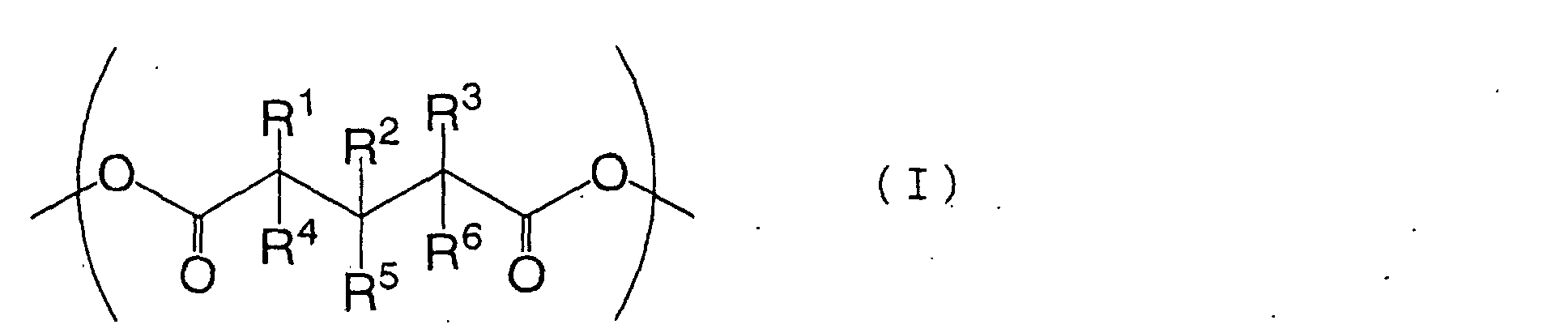
- The polyurethane according to claim 7, wherein R1 and R3, which are the same or different, are lower alkyl; and R2, R4, R5 and R6 are hydrogen atoms.
- The polyurethane according to claim 7, wherein R1 and R3 are both ethyl, and R2, R4, R5 and R6 are hydrogen atoms.
- The polyurethane according to any of claim 7 to 9, wherein the weight-average molecular weight of the polyurethane is within a range of 10,000 to 3,000,000.
- The polyester according to any of claims 1 to 4, which has a polymerizable double bond at its end.
Applications Claiming Priority (3)
| Application Number | Priority Date | Filing Date | Title |
|---|---|---|---|
| JP2002021107 | 2002-01-30 | ||
| JP2002021107 | 2002-01-30 | ||
| PCT/JP2003/000874 WO2003064497A1 (en) | 2002-01-30 | 2003-01-30 | Polyester |
Publications (2)
| Publication Number | Publication Date |
|---|---|
| EP1477505A1 true EP1477505A1 (en) | 2004-11-17 |
| EP1477505A4 EP1477505A4 (en) | 2005-04-13 |
Family
ID=27654383
Family Applications (1)
| Application Number | Title | Priority Date | Filing Date |
|---|---|---|---|
| EP03703082A Withdrawn EP1477505A4 (en) | 2002-01-30 | 2003-01-30 | POLYESTER |
Country Status (6)
| Country | Link |
|---|---|
| US (1) | US20050038224A1 (en) |
| EP (1) | EP1477505A4 (en) |
| JP (1) | JP4347060B2 (en) |
| KR (1) | KR20040079964A (en) |
| CN (1) | CN1290894C (en) |
| WO (1) | WO2003064497A1 (en) |
Cited By (2)
| Publication number | Priority date | Publication date | Assignee | Title |
|---|---|---|---|---|
| EP1932863A3 (en) * | 2006-12-11 | 2010-01-06 | Bayer MaterialScience AG | Soft thermoplastic polyurethane elastomers and processes for their preparation and use |
| WO2014128290A1 (en) | 2013-02-25 | 2014-08-28 | Basf Se | Reduced discoloration of thermoplastic polyurethanes based on polymer polyols by incorporating aliphatic isocyanates |
Families Citing this family (5)
| Publication number | Priority date | Publication date | Assignee | Title |
|---|---|---|---|---|
| JP2005255860A (en) * | 2004-03-12 | 2005-09-22 | Kyowa Hakko Chemical Co Ltd | Polyurethane and water-based polyurethane resin |
| US20060004151A1 (en) * | 2004-06-30 | 2006-01-05 | General Electric Company | Copolymers containing indan moieties and blends thereof |
| JP5380841B2 (en) * | 2006-01-12 | 2014-01-08 | 宇部興産株式会社 | Polyoxalate urethane |
| WO2009138387A1 (en) * | 2008-05-14 | 2009-11-19 | Basf Se | Use of a cyclohexane diol mixture for manufacturing polymers |
| EP2307472A1 (en) * | 2008-07-23 | 2011-04-13 | Basf Se | Use of 2-isopropyl-2-alkyl-1,3-propanediols for the manufacture of polymers |
Family Cites Families (6)
| Publication number | Priority date | Publication date | Assignee | Title |
|---|---|---|---|---|
| US2720502A (en) * | 1952-10-03 | 1955-10-11 | Eastman Kodak Co | Organo-metallic titanium catalysts for the preparation of polyesters |
| US2909499A (en) * | 1957-03-27 | 1959-10-20 | Union Carbide Corp | Vinyl chloride compositions containing alkyl-1, 5-pentanediol polyesters |
| EP0119961B1 (en) * | 1983-03-21 | 1988-01-20 | Ciba-Geigy Ag | Oligo esters containing polyalkyl piperidine groups |
| DE3642667A1 (en) * | 1986-12-13 | 1988-06-23 | Basf Ag | AT ROOM TEMPERATURE, LIQUID POLYESTER POLYOLS BASED ON 2-METHYLPENTANDIOL-1,5, 2-ETHYLBUTANDIOL-1,4, 2-METHYLGLUTARIC ACID AND / OR 2-ETHYLBERSTEINIC ACID, AND THE CORRESPONDING DICARFAXYSTONES, HERBAL DETECTEDS, AND THE CORRESPONDING DICARFAIRS AFTER THE POLYISOCYANATE POLYADDITION PROCESS |
| DE3642666A1 (en) * | 1986-12-13 | 1988-06-23 | Basf Ag | METHOD FOR THE PRODUCTION OF SOLID FOAM MATERIALS CONTAINING ESSENTIAL CLOSED CELLS, URETHANE OR URETHANE AND ISOCYANURATE GROUPS, AND THE USE THEREOF |
| JPH10130377A (en) * | 1996-10-31 | 1998-05-19 | Kuraray Co Ltd | polyester |
-
2003
- 2003-01-30 WO PCT/JP2003/000874 patent/WO2003064497A1/en not_active Ceased
- 2003-01-30 CN CNB03802845XA patent/CN1290894C/en not_active Expired - Fee Related
- 2003-01-30 JP JP2003564111A patent/JP4347060B2/en not_active Expired - Fee Related
- 2003-01-30 EP EP03703082A patent/EP1477505A4/en not_active Withdrawn
- 2003-01-30 US US10/501,457 patent/US20050038224A1/en not_active Abandoned
- 2003-01-30 KR KR10-2004-7011758A patent/KR20040079964A/en not_active Ceased
Cited By (3)
| Publication number | Priority date | Publication date | Assignee | Title |
|---|---|---|---|---|
| EP1932863A3 (en) * | 2006-12-11 | 2010-01-06 | Bayer MaterialScience AG | Soft thermoplastic polyurethane elastomers and processes for their preparation and use |
| WO2014128290A1 (en) | 2013-02-25 | 2014-08-28 | Basf Se | Reduced discoloration of thermoplastic polyurethanes based on polymer polyols by incorporating aliphatic isocyanates |
| US9957347B2 (en) | 2013-02-25 | 2018-05-01 | Basf Se | Reduced discoloration of thermoplastic polyurethanes based on polymer polyols via incorporation of aliphatic isocyanates |
Also Published As
| Publication number | Publication date |
|---|---|
| CN1290894C (en) | 2006-12-20 |
| JPWO2003064497A1 (en) | 2005-05-26 |
| KR20040079964A (en) | 2004-09-16 |
| WO2003064497A1 (en) | 2003-08-07 |
| US20050038224A1 (en) | 2005-02-17 |
| EP1477505A4 (en) | 2005-04-13 |
| JP4347060B2 (en) | 2009-10-21 |
| CN1622964A (en) | 2005-06-01 |
Similar Documents
| Publication | Publication Date | Title |
|---|---|---|
| JP5742202B2 (en) | Polycarbonate diol-containing composition and production method thereof, and polyurethane and production method using the same. | |
| KR102025074B1 (en) | Polycarbonate diol and polyurethane using same | |
| JP2015143316A (en) | Polycarbonate diol and method of producing the same, and polyurethane using the same | |
| JP2013010948A (en) | Method for producing polycarbonate polyol, and polyurethane using the polycarbonate polyol | |
| JPWO2018088575A1 (en) | Polycarbonate diol, polycarbonate diol-containing composition, method for producing polycarbonate diol, and polyurethane | |
| JP2825969B2 (en) | Method for producing aliphatic polyester | |
| EP1477505A1 (en) | Polyester | |
| AU2021233025A1 (en) | Thermoplastic polyurethane compositions comprising nitro-substituted polyester diols | |
| JPH10273514A (en) | Manufacturing method of polyurethane resin | |
| JPH10251369A (en) | Method for producing polyurethane resin | |
| JP4045857B2 (en) | Polyester carbonate urethane | |
| JP2003335837A (en) | Polyester urethane | |
| JPH10251398A (en) | Method for producing polycarbonate diol | |
| KR101666171B1 (en) | Polycarbonate polyol and method for preparing the same | |
| JP4529437B2 (en) | Powdered polyurethane resin for slush molding, manufacturing method thereof and slush molding method | |
| CA1137690A (en) | Hydrolysis and microbe-resistant thermoplastically processable polyurethane elastomers, their manufacture and use as coating materials and molded parts | |
| JP5121085B2 (en) | Method for producing lactone-based polyol and polyurethane resin using the same | |
| JP4529676B2 (en) | Process for producing reactive stabilized polycarbonate polyol and polyurethane resin using reactive stabilized polycarbonate polyol | |
| JP2003048867A (en) | Ester oligomer, method for producing the same, and method for producing thermoplastic polyurethane using the ester oligomer | |
| JP7750161B2 (en) | Polyalkylene glycol copolymer polyester | |
| JP2534271B2 (en) | Polycarbonate polyamide copolymer | |
| EP1274758A1 (en) | Polyester polyols and the use of polyester polyols for producing pur cast elastomers that have an improved resistance to hydrolysis | |
| JP2004137384A (en) | Method for producing powdered polyurethane resin for slush molding | |
| JPH0764934B2 (en) | Polyester polyamide copolymer | |
| JPH11130849A (en) | Method for producing low viscosity polyester polyol |
Legal Events
| Date | Code | Title | Description |
|---|---|---|---|
| PUAI | Public reference made under article 153(3) epc to a published international application that has entered the european phase |
Free format text: ORIGINAL CODE: 0009012 |
|
| 17P | Request for examination filed |
Effective date: 20040819 |
|
| AK | Designated contracting states |
Kind code of ref document: A1 Designated state(s): AT BE BG CH CY CZ DE DK EE ES FI FR GB GR HU IE IT LI LU MC NL PT SE SI SK TR |
|
| AX | Request for extension of the european patent |
Extension state: AL LT LV MK RO |
|
| A4 | Supplementary search report drawn up and despatched |
Effective date: 20050301 |
|
| RIC1 | Information provided on ipc code assigned before grant |
Ipc: 7C 08G 18/76 B Ipc: 7C 08G 18/67 B Ipc: 7C 08G 18/66 B Ipc: 7C 08G 18/42 B Ipc: 7C 08G 63/16 A |
|
| 17Q | First examination report despatched |
Effective date: 20090306 |
|
| STAA | Information on the status of an ep patent application or granted ep patent |
Free format text: STATUS: THE APPLICATION IS DEEMED TO BE WITHDRAWN |
|
| 18D | Application deemed to be withdrawn |
Effective date: 20090717 |